Category: OT reflection

  • Why Should We Do Good Works?

    Why Should We Do Good Works?

    5th Sunday in Ordinary Time: Isaiah 58:7-10, 1 Corinthians 2:1-5, Matthew 5:13-16.

    Doing good works, especially for those who are in great need, is at the core of the Christian life. Jesus not only preaches this (Parable of the Good Samaritan, Parable of the Sheep and Goats, etc.), but he also demonstrates it by doing the greatest work of all — providing salvation for the entire human race.
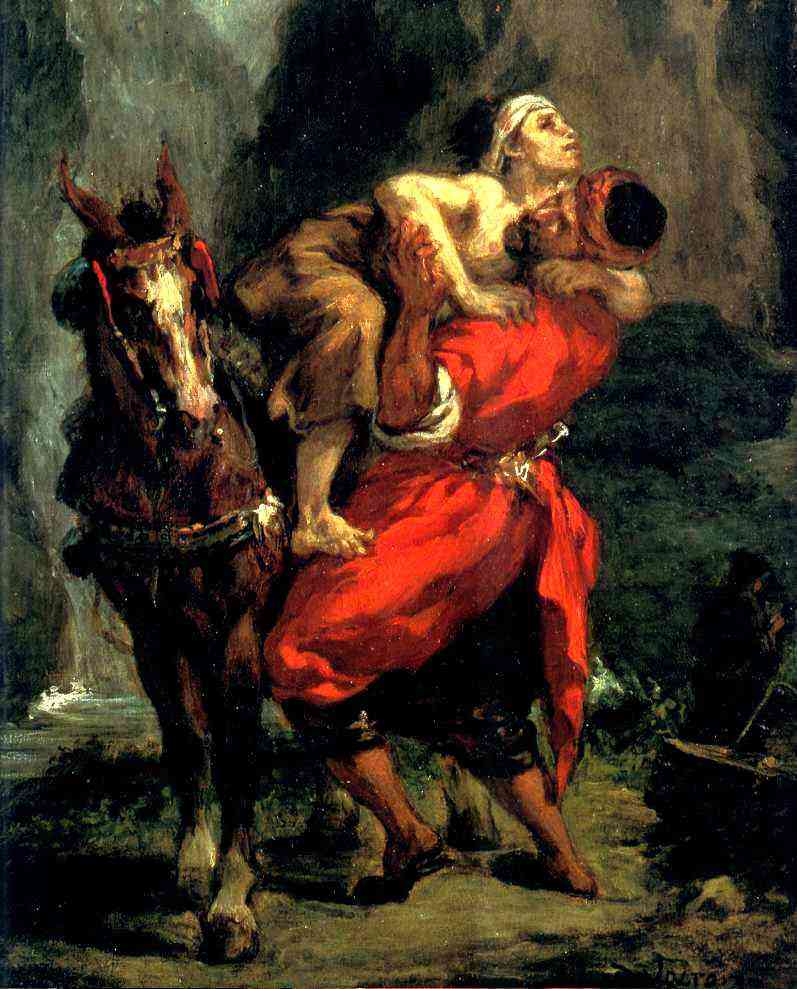
    The Good Samaritan, Eugène Delacroix (1849) | Creative Commons, courtesy Wikimedia.

    This is not to say that Christianity as a religion is only about doing good works. It is clearly about much more, most especially God’s revelation of himself to us in the form of the Word of God incarnate, through whom, in whom and for whom, all Creation is made. The centrality of Jesus Christ’s Incarnation, ministry, suffering, Crucifixion, Resurrection and Ascension (all of which we could call the “Christ Event”) to all of humanity and to each of us individually is truly the core of Christianity.

    But the scriptures tell us that the Christian life — that is, how we go about living in this world while we await the infinitely greater one we hope to inhabit with God — is one that should be lived in service to others.

    Today’s readings afford us the opportunity to ask why. Why does God want us to do good works?

    The question might seem like a no-brainer — we do good works in order to get to Heaven, right? But Christians have been arguing over this particular issue for centuries.

    The Theological Fuss Over Salvation and Justification

    “Getting to Heaven” is an informal way to refer to salvation. There is another term, justification, that is related to the larger concept of salvation, but refers to that moment when God declares a person to be “not guilty” or “acquitted of guilt.” The reason we pay attention to these two terms is that St. Paul uses them, especially in his Epistle to the Romans. In one passage, for example, he writes, “… now that we have been justified by his blood, will we be saved through him from the wrath of God” (Romans 5:9). I want to take a moment to examine good works in relation to salvation (“getting to Heaven”) and justification because this is one of the big debates that was brought up in the Protestant Reformation.

    In his Epistle to the Romans, Paul is not terribly precise in describing justification, despite the fact that he spends a lot of time discussing it. In the passage above, he states that Christ’s sacrifice on the Cross is the thing that justifies us: “we have been justified by his blood.” Yet a few verses earlier, Paul writes that Jesus “was handed over to death for our trespasses and was raised for our justification” (Romans 4:25). Here, it seems that the Resurrection was the vehicle for our justification, not the sacrifice on the Cross. More fundamentally, he writes that “since all have sinned and fall short of the glory of God; they are now justified by his grace as a gift, through the redemption that is in Christ Jesus” (Romans 3:23-24). This is a more comprehensive statement and the one he really cares about, that we are justified by God’s grace, and this grace manifested itself through all the divine works of Jesus Christ (including his sacrifice on the Cross and his Resurrection).

    This point is not debated between Catholics and Protestants, despite some confusion. Both profess the same belief that the moment of being pronounced “acquitted” by God (aka, justified) is accomplished solely through God’s grace and no effort of our own. It’s beyond our ability to acquit ourselves before God — it took the divine Son of God to take on our humanity and accomplish this for us.

    Of course the issue is that we continue to sin, so despite this initial divine help in justifying us, the question remains: could we lose our salvation by turning away from God? Is there a way for us to secure our salvation?

    In the early 1500s, a German priest and theology teacher at the University of Wittenburg named Martin Luther made waves in the Church, preaching about this technical term, justification, and offering his opinion on this matter. Luther had become obsessed with the letter to the Romans, writing, “This epistle is in truth the chief part of the New Testament and the purest Gospel.” This should strike us as a bit of a red flag, in that none of the epistles are the actual Gospel, but inspired instruction to the faithful — certainly not “the chief part of the New Testament”! Yet Luther latches onto some of St. Paul’s statements in the epistle and doesn’t let go, unable to weigh them in the balance of all of scripture and achieve the appropriate perspective for orthodox theological teaching.

    One of Luther’s main objectives in his Preface to the Epistle of the Romans is to argue that our righteousness before God comes through faith alone, not through works. To accomplish this, he puts forth an imbalanced definition of faith, not in line with Catholic teaching then or now. He writes, “faith is a divine work in us, which transforms us, gives us a new birth out of God … Oh, it is a living, energetic, active, mighty thing, this faith. It cannot but do good unceasingly” (16). Luther overemphasizes the divine origin of the theological virtue of faith, to the point where it becomes an “active, mighty thing” all on its own, doing good seemingly without any tether to the person. He writes scathingly about people who doubt if faith is enough and go about doing good works as a way to “become godly.” He says their notions of faith are erroneous and a “human figment” (15).

    Contrast this with the Catechism of the Catholic Church, which teaches that faith is both a grace and a human act: “In faith, the human intellect and will co-operate with divine grace”; at this point, the Catechism quotes St. Thomas Aquinas, whose writings already heavily influenced the Church by Luther’s time: “Believing is an act of the intellect assenting to the divine truth by command of the will moved by God through grace” (155).

    Luther is having none of this.1 He imagines faith as a type of superpower: “Faith is a living, daring confidence in the grace of God … [which] makes a person happy, bold, and full of gladness in his relation to God and all creatures.” He adds that faith makes a person “willing and enthusiastic to do good to everybody, to serve everybody.” His conception of faith prompts him to make the claim that “it is impossible to separate works from faith, just as impossible as it is to separate the power to burn and shine from fire” (18). Not only does this fly in the face of human experience (clearly, it’s possible to have great faith but not have the physical ability or opportunity to do works, and just as clearly you can do good works but have zero faith in God), it also disagrees with how the Apostles, Church Fathers, saints and popes have talked about faith and works.

    St. Gregory of Nyssa puts it plainly: “Faith without works of justice is not sufficient for salvation; neither is righteous living secure in itself of salvation, if it is disjoined from faith” (Homilies on Ecclesiastes, 8 [ca. A.D. 335- 394]). Why Luther chose to disagree with so many Fathers of the Church and the teaching of the Magisterium is beyond me. But, to this day, Protestants continue to choose this hill to die on.

    In short, Luther elevates faith to the level of a divine force (as opposed to simply having a divine origin) in order to make it easier to swallow the claim that justification and salvation come from faith alone. The implications of his definition of faith enable him to write, “all good works are merely external signs flowing from faith and, as good fruits, attesting that a person is already inwardly righteous in the sight of God” (26). While good works can be a sign of strong faith and good fruits of faith, not all good works find their source in faith. His diminishment and disdain for good works find their punctuation in the word merely.

    The implications of this philosophy is that our lives and actions are divorced from divine, supernatural realities. Our works are just external signs of this supernatural faith that seems to leave out any potential for free will, concupiscence or any number of things that make us human. And, it has more than a little of the old gnostic heresy that calls the body bad and the spirit the only good.

    OK, enough of Luther and this foray into “faith alone.” As the Church reminds us, God invites us, urges us, enchants us, fills us with awe — all so that we respond. We are called to respond with our will, our intellect, and our acts.

    Do Good Works Earn You Anything?

    Luther’s legacy has given Protestants a firm belief that good works can earn you nothing. Yet the Church Fathers like Gregory of Nyssa are clear: faith and works contribute to God’s decision over the fate of our souls. This is the orthodox teaching of the Church.

    But that doesn’t mean that the point of good works is to earn salvation. Perhaps they do help us achieve ultimate union with God; but maybe they do more.

    Turning to today’s readings, we encounter some intriguing suggestions. God shares his wisdom through the mouth of Isaiah, encouraging us to do good works like feeding the hungry, sheltering the oppressed and homeless, clothing the naked and not turning our backs on our family and neighbors. What does God do in response?

    Then your light shall break forth like the dawn,
    and your wound shall quickly be healed;
    your vindication shall go before you,
    and the glory of the LORD shall be your rear guard.
    Then you shall call, and the LORD will answer,
    you shall cry for help, and he will say: Here I am!

    We are given a key image here: light. Jesus speaks to this in the gospel reading, and we’ll return to this below. Other things are happening — things that impact us here and now in this life. When I hear “your wound shall quickly be healed,” I think of emotional and psychological wounds. There is something about charitable works that heals the doer as much as the recipient.

    More importantly, we are told that good works bolster our relationship with God. As God stands by our side and acts as our rear guard, our faith can strengthen. As our faith and reliance on him grows, he answers when we call.

    The Lord adds one more thing at the end of this reading: “then light shall rise for you in the darkness, and the gloom shall become for you like midday.” How important this light is! The scene is spectacular if we picture it: the person doing good deeds has an internal light that flows forth like the dawn, and at the same time another spiritual light rises within that person’s life, enlightening them in their spiritual darkness.

    How else to describe the influence of God, other than light? It’s hard to pinpoint, but overwhelming in its impact, it’s warmth, it’s omnipresence. Note that this does not deny the fact that the fallen world holds “gloom” for us; doing good deeds, however, makes that gloom seem like midday, because we have brought God into the world. It enables us to not just endure the gloom of a fallen world, but to encounter it differently. By living in the light, the world no longer holds its terror.

    So, the point of good works might be more immediate than earning eternal salvation. This reminds me of a discussion I had recently with my brother that involved the distinction between Heaven and the Kingdom of God. Heaven — that ultimate resting place where we hope to dwell in the eternal Father’s presence — is different from the Kingdom, it can be argued. Jesus talks about the Kingdom of God movingly in his parables, and it is something more immediate to which we have access. The Kingdom is “happening now,” in our midst, while Heaven is that long-sought-after final home. Jesus’s description of the Kingdom of God is not that of a physical place or jurisdiction (like the Kingdom of Thailand, or the United Kingdom) but that of an active presence of a King, almost like an existential state of living under the power and rule of a king.

    The Kingdom, we might consider, is this spiritual light that God tells us about. This light is the presence of the king. Remarkably, here in the passage from Isaiah, He even tells us that doing good works helps to manifest the Kingdom!

    Thus, another way of considering good works, when done with faith in God and out of love for him, is that it enables us to share in his Kingdom. He has implanted in humanity a way to channel his transcendent love by using our will, intellect and very bodies — and this seems to enable the divine light to grow in us and illuminate us from without.

    Today’s psalm echoes this important lesson, with the refrain, “The just man is a light in darkness to the upright.” This light in the darkness is clearly more than just a helpful physical thing: it’s a spiritual light. In the same way, the good deeds done by this just man are about more than just clothing, food, and physical aid. The good deeds are ultimately (perhaps primarily) about spiritual aid in a fallen world.

    The light we read about in these passages is a little peek into the dynamic love that flows between the persons of the Trinity. This divine love, this divine light, might seem impossible to experience in this life, but Jesus dispels this doubt in today’s gospel reading.

    We are told that Jesus tells his disciples, “You are the light of the world.” Let’s return with fresh ears to this familiar saying from Jesus. He and his disciples knew the prophecy of Isaiah quite well. They would have known that good works, in particular, make “your light break forth like the dawn.” During his ministry, he gave them even more wisdom and spiritual power to bring forth light in his name. So, when we reach the final teaching he provides in this episode, we can see how doing good works continues to be at the heart of living a Christian life: “your light must shine before others, that they may see your good deeds and glorify your heavenly Father.”

    He gives us an answer here to that question, why should we do good works? The answer is that these works bring God’s transcendent, divine light into the world, and this light dispels darkness, turning gloom into midday, spreading spiritual encouragement, and — ultimately — bringing people into right relationship with the Father, glorifying him. In short, the reason is the salvation of souls. Doing good works brings salvation to others by bringing them into contact with God’s light.

    Note that these are his beloved disciples he’s talking to. Thus, the component of faith is also present. We have the conditions of faith and good works coming together.

    So perhaps the whole theological fuss was beside the point. It’s not about what good works earn for the doer, but what they do for the world, the watchers, the recipients, the skeptics. Justification is certainly brought about by grace alone, specifically through Jesus Christ, but the fact that our good works do not justify us does not diminish their importance in bringing about the Kingdom of God and doing his will.

    Doing. Not just passively receiving. Not burying in the ground these talents we received.


    1Paul was not writing a theological treatise on the concept of justification, so Luther’s commentary is taking Paul’s words a bit out of context. He was more concerned with the issues gripping early Christian communities, particularly whether non-Jewish converts to the faith needed to be circumcised, according to Old Testament practices. He is adamantly against this prescription and successfully argues so that it was formally upheld in the First Council of Jerusalem, AD 48-50.

    The way he makes his argument in the Epistle to the Romans is by asking whether doing things according to the Law (like circumcision) provided salvation, or if instead it was faith in Jesus Christ that saved people. He notes that Jews who are circumcised are just as likely to be denied Heaven as anyone else. It’s not the physical circumcision — the deed, or “work” of the law — that justifies them. As he writes, “real circumcision is a matter of the heart—it is spiritual and not literal” (Romans 2:29). He asks if it was the stuff that Abraham did that justified him or if it was his faith and fidelity to God that made the difference. He quotes the Old Testament, writing, “Abraham believed God, and it was reckoned to him as righteousness” (Romans 4:3). “Reckoned to him as righteousness” is another way to say “he was justified.”

    Paul goes on to discuss how adherence to the law does not justify anyone, but “it depends on faith.” Luther latches onto Paul’s diminishment of “works under the law” (like circumcision) in favor of faith — taking it out of this context of belonging to the community and applying it to the broader question of individual salvation.
  • Who Can Know God’s Counsel?

    Who Can Know God’s Counsel?

    Twenty-Third Sunday in Ordinary Time: Wisdom 9:13-18b, Philemon 9-10, 12-17, Luke 14:25-33

    This Sunday, we listened to a fantastic set of readings, including an echo of the gospel reading from St. Luke we heard three Sundays ago: “Do you think that I have come to establish peace on the earth? No, I tell you, but rather division. From now on a household of five will be divided …” (Luke 12:51-52). In this Sunday’s gospel, Jesus proclaims to his followers, “If anyone comes to me without hating his father and mother, wife and children, brothers and sisters, and even his own life, he cannot be my disciple.” How do we react to these words? Is our reaction warranted?

    We are traveling currently, leaving Salt Lake City after 25 years and starting our retirement with a “Farewell USA tour” to say goodbye to friends and family around the country (and see many roads we haven’t before we move to Spain permanently). It was a little hard to condense everything we owned into our SUV, but the process of giving away most of our belongings to friends and charities was actually quite freeing. For the next three months, our routine includes leveling the car on a camping spot so that our sleep in the rooftop tent doesn’t end up with us rolling into a clump on one side of the tent. Our dog is with us, until we leave him with Suzanne’s sister in Oregon in October, and we’re having fun on hikes and in lakes.

    As a result of being nomads, we are getting to experience Mass in Catholic churches around the West. We went to St. John Neumann parish in North Las Vegas three weeks ago, St. Sebastian Church in Santa Paula, CA, two weeks ago, St. Francis of Assisi in Palm Desert, CA, last week and St. Daniel’s Catholic Church in Ouray, CO this Sunday. I’m thinking of writing a blog in a few months just about these experiences as a sort of random survey of the state of affairs of Catholic liturgies in the US, but I’ll leave that to another day. But one thing I heard three Sundays ago in Las Vegas and again in Ouray was that these gospel readings are “hard.” You may have heard something similar at your local church.

    In fact, the deacon who gave the homily this Sunday in Ouray really pushed on the point. “Did we just hear Jesus tell us that we have to hate our parents, our wives and our siblings?” he asked incredulously. “How can we reconcile this with our Lord, who we know to be all-forgiving and all-loving?”

    This is an incredibly important question for modern Catholics, and I think the answer is right in front of us, in the opening of the first reading from the Book of Wisdom: “Who can know God’s counsel, or who can conceive what the LORD intends? For the deliberations of mortals are timid, and unsure are our plans.” So that I’m not just answering a question with another question, I hope to elaborate what I think the Word of God this Sunday presents to us.

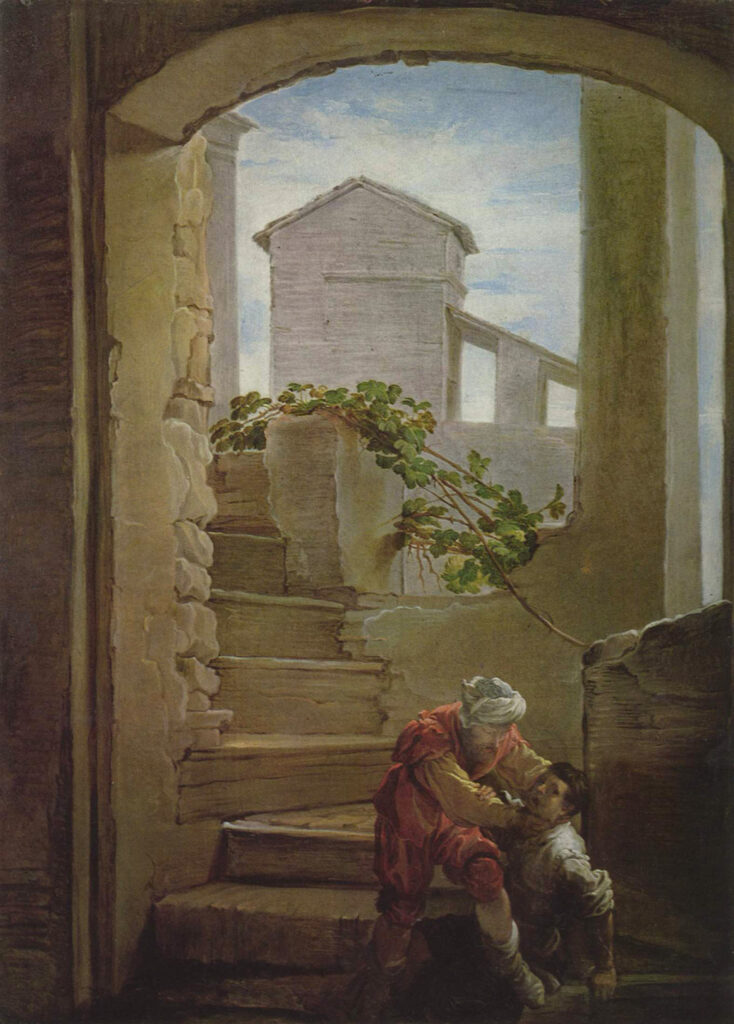
    Detail from Parable of the Wicked Servant (La parabola del servo malvagio), 1620, Domenico Fetti | Creative commons, Wikimedia.

    The deacon at our church gave a thoughtful homily, first tracing the fact that “hate” in Hebrew more often meant “to love less.” I’m going to take a moment to both agree with him and add a little nuance. From my research, I’ve found that it’s true that in most contexts, שׁנה (sana’) in Hebrew does not translate directly to our everyday use of the term “hate.” The main difference is that, in modern English, hate is most often associated with emotions. For example, “I hate you,” is one of the worst things a teenager can say to a parent, often in a fit of pique. “I hate cilantro” is less emotionally charged, but still carries the feeling of disgust. In ancient Hebrew, especially in a scriptural context, the word hate (sana’) is most often used in reference to God. Consider Psalm 139:

    Do I not hate those who hate you, O Lord?
    And do I not loathe those who rise up against you?
    I hate them with complete hatred;
    I count them my enemies.

    I’ve read that some Jewish scholars prefer to use “reject” here rather than “hate.” The clear overtone is one of judgment and moral rejection, not something said emotionally or in a fit of anger. We should remember this when we read the Old Testament. When we hear at the beginning of the Book of the Prophet Malachi, for example, that God says, “Yet I have loved Jacob but Esau I have hated,” we can understand that he has rejected Esau from his favor.

    So, at least in the Jewish scriptural context, “hate” is not normally the emotionally charged verb it is in English. But I think the deacon was a little short of the target when he said it was “love a little less,” because there is definitely a sense of judgment (especially when applied to God) and moral decision-making. Technically, I guess that judging against something makes it “less” than the thing it is compared to, but why are we softening the impact here? I think that modern ears need to hear something like this because it helps us “reconcile” this with our vision of the Lord being all-loving.

    But this is crucial! What does it mean to “reconcile” these thoughts? This means that we have preconceived notions of what love is, what forgiveness is, and we’re putting Christ’s words up against these notions, trying to look for some way they cannot contradict each other. Stop! We should recognize from the beginning that a.) do not put the Lord your God to the test, and b.) faith demands an acceptance of that which we cannot fathom or immediately understand. So, let’s meet Christ’s words with awe and reverence and try to accept and ponder them before we have some kind of emotional reaction.

    The Church, in her wisdom, prepares us for this gospel reading through the inclusion of the first reading. Again, it starts, “Who can know God’s counsel, or who can conceive what the LORD intends? For the deliberations of mortals are timid, and unsure are our plans.” In other words, know your shortcomings! Our thoughts are “timid” — too small to approach the grand thoughts of the divine — and this should make us humble as we approach the Word of God. The second part of this reading brings in a corollary important to understanding the gospel reading: “For the corruptible body burdens the soul and the earthen shelter weighs down the mind that has many concerns.” So, not only should we not attempt to fathom God’s plan and Word without the grace he provides for us, but we should recognize that we are already handicapped in understanding spiritual matters, for the “body burdens the soul” and “the earthen shelter weighs down the mind.” Jesus will return to this theme of earthly matters being problematic to us achieving the Kingdom. To recap, in a few sentences, the first reading reminds us that not only are we unable to fathom the plans of the divine mind, we are further encumbered when we try to think on spiritual things because we are concerned with earthly things. 

    As if this dose of humility isn’t enough, the author of the Book of Wisdom continues: “And scarce do we guess the things on earth, and what is within our grasp we find with difficulty.” Ha! How true. Even figuring out earthly things like, “what career should I choose?” or “does she love me?” or “how can we organize a society without fighting with each other?” are found with difficulty, if at all. The answer to this big multivitamin of humility is given at the end of the reading: “Or who ever knew your counsel, except you had given wisdom and sent your holy spirit from on high? And thus were the paths of those on earth made straight.” GRACE through the Holy Spirit is the only way we can make sense of ourselves and our world, much less the spiritual paths set before us by God. This important reading should set us straight in meekness and humbleness before we approach the Gospel — not in a stance of comparing Jesus’s words against our timid earthly notions of love and hate.

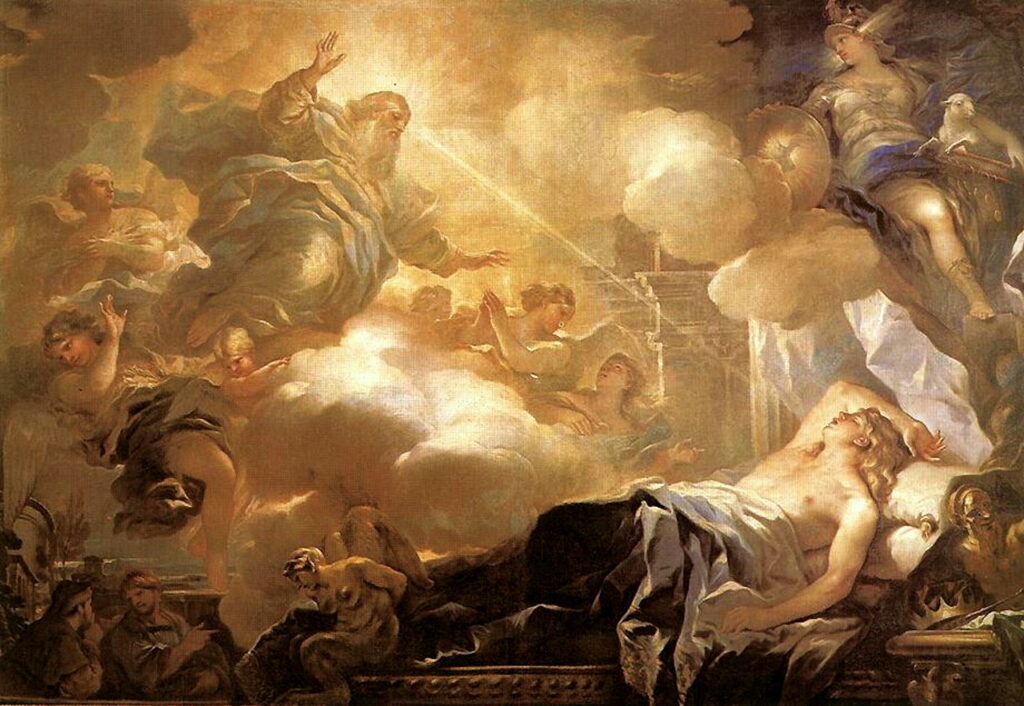
    Dream of Solomon (1694-1695), Luca Giordano | Museo del Prado, creative commons via Wikimedia.

    So, when Jesus says, “If anyone comes to me without hating his father and mother, wife and children, brothers and sisters, and even his own life, he cannot be my disciple,” if we listen to this alongside everything Jesus has taught and shown us, we can grasp his meaning with the help of his Holy Spirit. If we think of the word hate as “reject,” we recognize that Jesus has said something similar many other times:

    • “So therefore, any one of you who does not renounce all that he has cannot be my disciple.” (Luke 14:33)
    • “No one who puts his hand to the plow and looks back is fit for the kingdom of God.” (Luke 9:62)
    • “And everyone who has left houses or brothers or sisters or father or mother or children or lands, for my name’s sake, will receive a hundredfold and will inherit eternal life.” (Matthew 19:29)

    But today’s words seem like more than other statements about worldly renunciation. He’s talking about our most cherished relationships here on earth. If this sounds extreme, well, yes — I think it is. It’s impossible to hear Jesus in the gospels without hearing this type of “all-or-nothing” message. He tells the would-be-follower who wants to bury his father, “Leave the dead to bury their own dead. But as for you, go and proclaim the kingdom of God” (Luke 9:60). !!! I mean, that’s pretty extreme. We think of funerals as a respectful, God-forward practice, but in the face of God Himself, this ritual pales in comparison. Without a doubt, this Sunday’s gospel challenges us to be “all-in” in regards to following Jesus. 

    Jesus follows up this sentence with words of preparation: “Whoever does not carry his own cross and come after me cannot be my disciple.” With how often-referenced this sentence is, we can lose track of its power. The cross is sacrifice, undoubtedly, but it to his listeners, it was likely more charged with the understanding of spectacle and shame. After all, it wasn’t until his Resurrection that the shame and spectacle of the Cross turned into the glory of sacrifice. 

    Jesus is preparing his listeners to be true followers. He is letting them know that those closest to them will likely disagree with their newfound faith in Jesus Christ. He is presenting them with the fact that they must hate/reject those closest to them when they cast suspicion and begin to shame these new Christians and even make a spectacle of them. Jesus is both preparing them and trying to give them courage. This is why the end of the gospel reading focuses on “calculating the cost” of discipleship. Jesus wants his listeners to know the cost, to brace themselves and find the courage to follow him.

    When is the last time we felt that we were carrying shame or spectacle by following Christ? Not that we should seek these things out, but I think we perhaps instinctively shy away from these, as anyone would. But this gospel is for us as much as it is for first-century Jews. When is the last time you boldly made the sign of the cross and said a prayer before your meal in a restaurant? This small gesture of thanks to God is essential with everything we do, but most often we don’t want to draw attention to ourselves in public. Are you picking up your cross here or just leaving it on the ground? When is the last time you walked in a Eucharistic procession in your town? I can recall a number of them on the University of Utah campus, including the catcalls and obscenities occasionally yelled at us. Atheistic culture wants to make Catholics feel ashamed, out-of-date, and ridiculous for something as beautiful and just as a procession! It is our responsibility and honor to stand with Christ, to process him in public as our King and Savior. When is the last time you talked about prayer or Jesus to a friend or colleague? Does it feel too awkward for you? When was the last time you asked someone not to use your Lord and Savior’s name in vain by shouting “Jesus Christ!” when something surprised them? The virtue of religion, St. Thomas Aquinas tells us, is part of the virtue of justice — that is, giving God what is due to him. We must consider that Jesus’s words in this gospel are telling us about the repercussions of holding this virtue of religion. Shame, spectacle and sacrifice are part-and-parcel of following Jesus and giving God what is due to him. The question is, have we dumbed down what our religion demands to simply “being nice to others?”

    If we read the last few verses following today’s excerpt in the 14th chapter of Luke, we hear Jesus tell these same listeners, “Salt is good, but if salt has lost its taste, how shall its saltiness be restored? It is of no use either for the soil or for the manure pile. It is thrown away.” Remember that in the Beatitudes, Jesus tells his disciples that they are the salt of the earth — so clearly his meaning in this reading is that his listeners must retain their saltiness, that is, their openness to sacrifice, spectacle and shame, or be discarded from the Kingdom. 

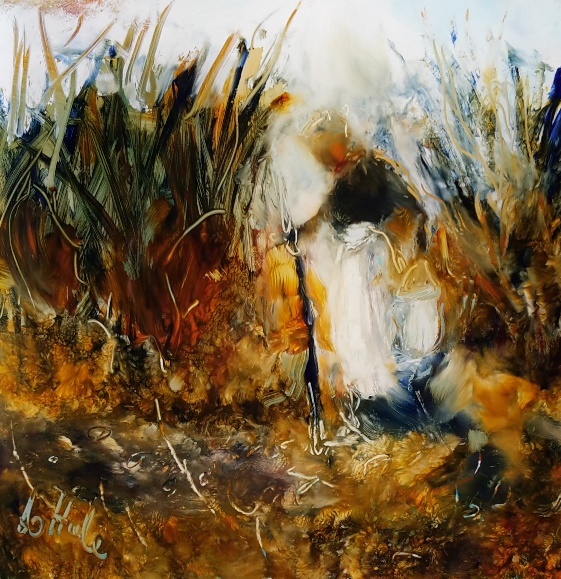
    Salt of the Earth, contemporary, Alison Hale | Image from https://alisonhale.co.nz/paintings-archive/glass-works-sold/salt-of-the-earth/

    From Aquinas to St. Paul

    I’d like to bring up one last lens within which we can examine Sunday’s gospel, and through this lens, make our way to the second reading, St. Paul’s Letter to Philemon. The lens here is to actually challenge the reading above that hate isn’t really hate. What if we follow the Scholastics, St. Thomas in particular, in thinking about hate? In the Summa Theologica, St. Thomas writes, “hatred is a movement of the appetitive power, which power is not set in motion save by something apprehended” (II, ii, q43, a1). To unpack this, what he is saying is that hatred is a movement of the intellect (aka, an “appetite”) that is only set in motion when you apprehend something. In other words, first, hatred is something natural in our soul and intellect, God-given and for a purpose. Second, it’s not a state of being but something that arises in us in response to something we encounter (a thought, a person, a thing, whatever). So, hatred is not an evil thing, but a natural thing, an appetite that we must work to regulate just like all of our other passions and appetites.

    Why would God make us with this appetite of hatred, or any of the passions that we tend to regulate poorly, for that matter? In the case of hatred, Thomas tells us, “the object of hatred is evil.” Aha! So, God gives us hatred as a natural repugnance for evil and sin. When regulated well, hatred will turn us from evil and sin.

    But regulating this appetite takes prudence and good judgment. After all, Thomas warns us: “Just as a thing may be apprehended as good, when it is not truly good; so a thing may be apprehended as evil, whereas it is not truly evil.” This is why studying and contemplating the truth in the scriptures and Catholic tradition are so important. We train ourselves to better apprehend and recognize good when we see it and evil when we see it.

    So why would anyone hate what is good? Because they reject God’s revelation of truth and himself to humanity. Instead, throughout history, people cling to the world around them — what their senses tell them and what passes for “good” in their culture. Is the sound of applause and shouts of praise good? Our senses and culture tell us yes, but Jesus tells us that the meek are blessed because he sees that the cost of fame and recognition is the diminishment of others. Is the pursuit of money good? Pretty much everything in our culture says yes and pretty much everything in scripture says no. What about the flipside of this – what do we mis-apprehend as evil? Let’s think about one of the most common commands in the epistles – to “exhort” and “correct” one another in staying true to the teachings of Christ. But this is difficult to do because nobody likes to be corrected, and our contemporary culture has developed an incredibly robust system of moral idols in diversity and inclusion that make it an evil to tell someone that what they are thinking or doing is wrong. I truly think that today one of the most obvious ways a person can be a spectacle and shame for Christ is to openly tell someone that something they are doing is not morally right or a perspective they are defending is not the truth. In the name of acceptance of others, this is just not OK (so we are told)! But, Jesus commands us to be the salt of the earth, to take up our crosses and be his disciple. Which will you listen to — your culture or your Lord?

    But surely our family members can’t be summarily judged as evil and thus worthy of hate! I guess that depends on the culture you live within. For Jesus’s listeners, the cultural voice resided in the Pharisees, Sadducees and scribes, most of whom were in disagreement with him on many aspects of his teaching (especially the core teaching about the conversion of one’s heart to God). Certainly, the broader cultural voices of Rome and of Greek culture were at odds with his teachings. In this context, it likely wouldn’t be too far off the mark to apply hatred towards voices that denied the Good News. 

    Perhaps referencing family members was way of giving an evocative example of earthly matters. With this reading, we can see that Jesus is being consistent with his other teachings about rejecting the worldly in preference to the spiritual life with God. But, I don’t think this is just rhetorical pyrotechnics. I think Jesus references family members specifically because his Apostles have already had to leave their homes and families to follow him. He has likely seen in the course of his ministry plenty of family arguments, anger and division over following him. This isn’t a hypothetical.

    More important than this historico-critical reading of the passage is the understanding that there is a reason Jesus tells us this. The Divine Mind has a plan for our own good, for our reconciliation and union with Him. Remember the first reading: “you had given wisdom and sent your holy spirit from on high … And thus were the paths of those on earth made straight.” So what might this reason be? Jesus tells us time and again that God loves his children — that he will leave the whole flock just to save the one who has strayed — that he welcomes back the prodigal with open arms. All we have to do is to remain faithful to him. This means trusting him and putting him first, above all other concerns (including our family members and other worldly worries). Jesus is reminding us how we have to fulfill our end of the covenant, putting God above all else.

    And in return? God perfects us with his grace and his love. He helps us be the loving humans he wants us to be, that he has created us to be. He fills us with his own love and sends us back into the world to love our neighbors (including those family members we judged to “love less” than him). Let’s not think we’re the only ones who are active in our lives! Our part is actually quite small — a continual conversion of heart to God — and then his blessings infuse us and those who we touch in our lives. His is the powerful work in the world, transforming it, not ours. 

    In other words, the whole point of hating your “own father and mother and wife and children and brothers and sisters” is to allow God to perfect you and give you the ability to love those same people better than you ever could have without his help.

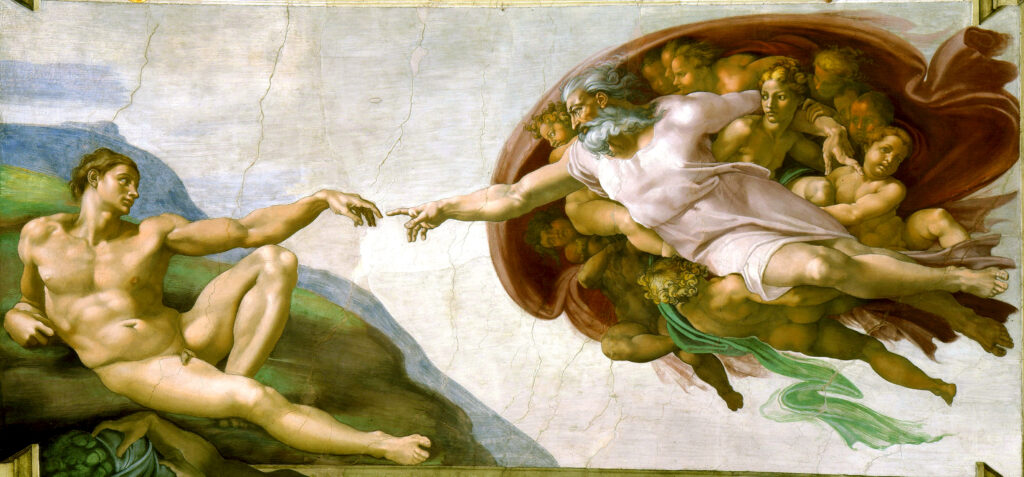
    The Creation of Adam, Sistine Chapel ceiling (1511), Michelangelo | Creative commons, Wikimedia.

    The second reading (the only one in the Sunday lectionary cycle from the Letter to Philemon) is seemingly weird and out-of-context, but blossoms with this understanding of the gospel reading. Paul, writing from jail, is sending Philemon’s slave back to him after this slave, Onesimus, has spent time following Paul and learning about Christ. Onesimus has fled his master, perhaps even owing him money — is this not someone who “hates” his “father”? And, having been nurtured at Paul’s breast, he is returning to his “father” in an act of love by Paul. This is a parallel to what we can read in the gospel account. 

    Add to this the overtones of Paul’s Letter to the Galatians, where he writes, “So you are no longer a slave, but a son, and if a son, then an heir through God” (Galatians 4:7), and a rich tapestry emerges. In Sunday’s reading, Paul sits in the seat of a redeemed child of God — bearing his cross in jail for proclaiming Christ to the world, but acting with the power of the Father because of it. He sends back a former slave to his family, but not as a slave, but a fellow heir to the Kingdom: 

    that you might have him back forever,
    no longer as a slave
    but more than a slave, a brother,
    beloved especially to me, but even more so to you,
    as a man and in the Lord. 

    It is now Philemon’s turn to hate the teaching of his culture and the logic of the world, to accept Christ as Paul is urging him to, and to offer his forgiveness to a slave who has so obviously been healed by God. So, if we, like Onesimus the slave, hate our family in order to receive Christ and love him above all else, the divine logic decrees that this enables us to return to our families, even in debt or disgrace, in order to love them with clear eyes and a God-filled heart.

    I hope that this contemplation of the Sunday readings have struck a chord with you, that perhaps they have helped move you to approach the gospel with open ears and without the urge to compare Jesus’s words with what we think love and forgiveness should look like.

  • Contemplating Corpus Christi

    Contemplating Corpus Christi

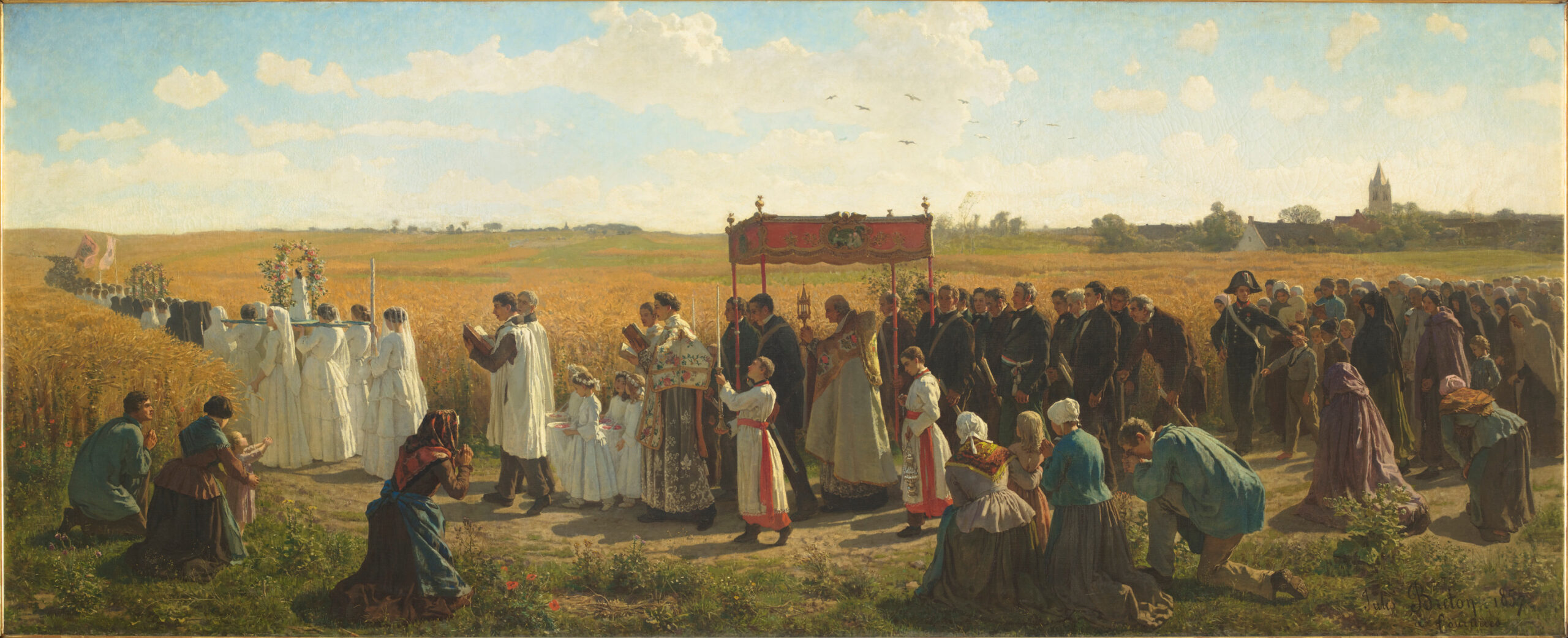
    The Blessing of the Wheat in Artois (1857), Jules Breton | wikimedia.

     Today is the Solemnity of the Most Holy Body and Blood of Christ — aka, the Feast of Corpus Christi. We were fortunate to celebrate Mass in Park City at St. Mary’s Church, presided by Fr. Chris Gray, who is about to be transferred to the Cathedral of the Madeleine in Salt Lake City to serve as rector, and undoubtedly become a Monseigneur or even greater someday. He’s a great priest. He’s likeable, has a great singing/chanting voice, is funny, but most importantly, has a great reverence for the liturgy. So, in addition to a meaningful homily and prayerful sacrifice of the Mass, we enjoyed a Eucharistic procession around the church and a benediction, complete with incense and chanting of St. Thomas’s Tantum Ergo Sacramentum

    This solemnity is the great marker of the Catholic faith; a dividing line between Protestants and Catholics. We believe that in the Eucharist the Body and Blood of Christ are really and truly present — mystically and spiritually available to us in all their power and glory. Protestants believe that Jesus was speaking symbolically when he said the bread and wine were his body and blood. Why does this matter? Because if we want to follow the entire Way given to us through Christ, we can’t ignore the sacraments and the Eucharistic miracle he gives us. (The early Church was unanimous in believing in the real presence of Christ in the Eucharist. Heck, in 110 AD, St. Ignatius of Antioch told the Smyrnaeans to “keep aloof from” the heretical Gnostics “because they confess not the Eucharist to be the flesh of our Savior Jesus Christ” (Epistle to the Smyrnaeans, 7).) The sacraments are the way his Spirit is active in the world. Would you dare not believe in the power and work of the Holy Spirit?

    Since the Council of Trent, the Catholic Church has affirmed that “for believers the sacraments of the New Covenant are necessary for salvation” (Catechism of the Catholic Church, 1129). Protestants believe nothing of the sort. It seems to me that theirs is a passive religion when it comes to salvation — taken in passively by grace and faith alone. In comparison, Catholics are taught that we have an active role in receiving grace, through the sacraments and in love and charity of God and neighbor.

    But something else stuck with me as I contemplated today’s readings and the significance of the solemnity. When Protestants say the Eucharist is just a “symbolic act,” they are in fact missing the depth of the symbolism. We, too, believe it is a sign — the greatest of all signs — but the significance of the sign is that it points to a new reality. So, I’d like to blog this Feast of Corpus Christi about the intersection of sign, symbol and reality as well as the unique and troubling (for some) insistence of Jesus Christ that we eat his actual body and blood.

    Sign, Symbol and Reality

    It can be confusing to talk about signs and symbols because they’re often lumped together. Unless you’re a semiotics professor, we all sort-of shoot from the hip here. (The academic field of semiotics that started perhaps with the ancient Greeks but blossomed in the second half of the 1900s is dedicated to studying sign, symbol, meaning and the like, but if there was ever a field that felt like splitting hairs, it’s semiotics.) Let’s first acknowledge that these words definitely overlap and share meaning, and not just in English, but also in Greek, Latin and Hebrew:

    EnglishLatinGreekHebrew
    signsignumσημεῖον (sēmeion)סִימָן (siman)
    symbolsymbolumσύμβολον (symbolon)סֵמֶל (semel)

    Despite the difficulties involved, I’d love to lay out a general difference between sign and symbol for the purpose of this blog. Let’s take a cue from the Latin signum, which is something that marks or identifies. An everyday usage could be something like a military signum in the form of a battle standard, and a supernatural signum would be a heavenly sign or miracle. We can see where we get the word signature (a personal “mark” that identifies the signer). I like also to think of a road sign, which points towards something. Taken together, let’s think of “sign” to mean a material thing that points to something else that holds extra meaning. So, when we make the sign of the Cross, it means more than just cross-shaped gesture around the face and chest area. It’s a sign of following Jesus Christ.

    “Symbol” has an interesting history, too. In the ancient world, the Greek word symbolon described an object like a piece of parchment, a seal, or a coin that was cut in half and given to two parties. It established a relationship between them. When the halves of the symbolon were reassembled, the owner’s identity was verified and the relationship confirmed. To take poetic license with this etymology, we might say that a sign is like a signature, but a symbol is only half the story (half the signature). It points to something even more complex: a relationship to a shared history.

    As a short side note, the early Christians and Church Fathers called the Creed they developed in the Council of Nicea and further councils as the “symbol of faith” or just the “Symbol.” This reveals that they saw our Creed as a way to recognize another Christian, and that a shared relationship is at the heart of our faith (shared with Christ and shared with one another as the Church).

    In our language, we’ve applied the deeper, more abstract meaning of “symbol” into words like symbolism, which implies a shared cultural story that lies behind the symbol. To sum up, I think “sign” is more direct, although still pointing to something outside itself (we say, “what does that signify?” and we expect a direct answer). I think “symbol” is a bit more complex and abstract, pointing to something more like a shared story of significance (we say, “what does that symbolize?” and we push our minds to think of things like metaphor, analogy, and mythological and religious stories).

    These terms have a deep history in our faith tradition. Circumcision is a sign of being a Jew, but it is a symbol of a circumcised heart — a life dedicated to God and living within his laws and precepts. Burning incense in our churches is a sign of reverence to our Holy God, and it is a symbol of our prayers rising up to Him in Heaven, as well as a symbol of immolating something precious to us as an offering to the Lord according to our covenant with Him. Importantly, signs and symbols in our religious tradition are material things in the world that point to spiritual realities we cannot see, touch, or otherwise sense. They help our physical humanity interact in some way, no matter how diminished, with something greater and immaterial. As St. Thomas writes: “Signs are given to men, to whom it is proper to discover the unknown by means of the known” (Summa Theologica, III, 60.2). I love the fact that he says signs are “given” to us, reminding us that there is logic and intentionality in the way God created the universe, even down to knowing how we might apprehend material things in the world and apply signification of greater things to them.

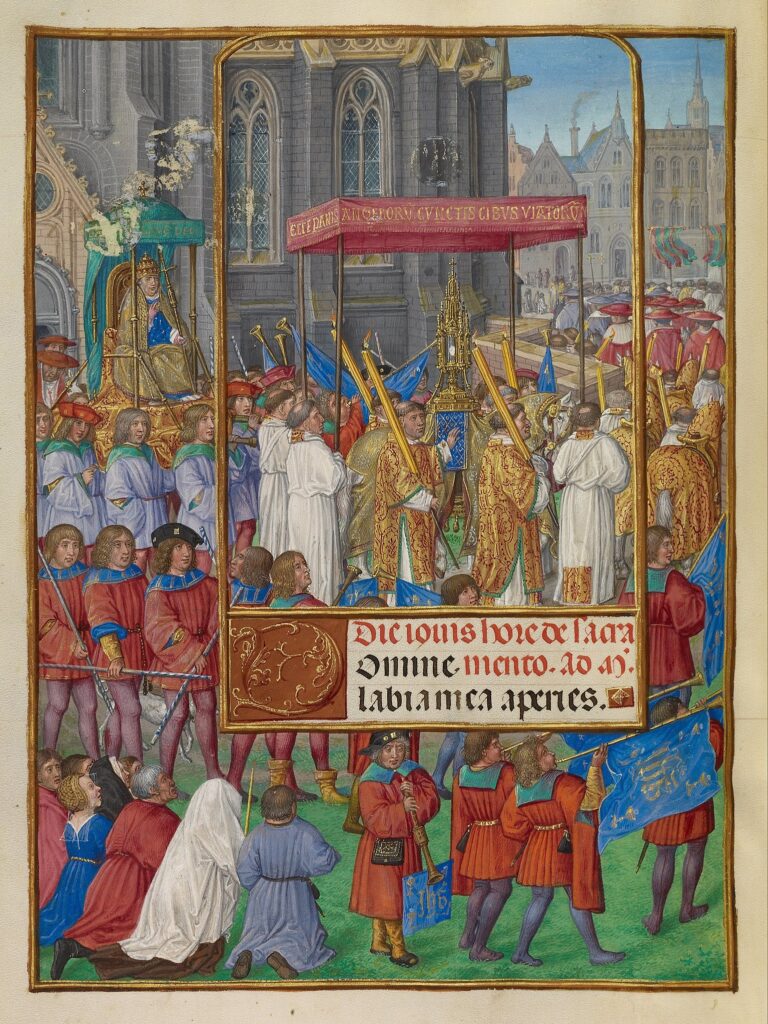
    The Blessing of the Wheat in Artois (1857), Jules Breton | wikimedia. Religious processions, typically with the exposed Blessed Sacrament in a monstrance, are another important Christian sign. They symbolize our spiritual journey to everlasting life, our affirmation that we are in the world but not of the world and are on our way to our real home. Religious processions used to be more widespread, especially in Europe, and I think it’s a bit of a shame that they have fallen out of fashion. They’re a great way to show our secular society that there is an alternative to the narrative of consumption and materialism that is constantly fed through our devices and experiences.

    This idea that signs are a bit more straightforward and symbols are a bit more complex gets turned on its head when it comes to the sacraments. This is because, as signs, they point to the mystery happening in our midst.

    The Church teaches that the sacraments are the greatest of signs in our faith lives because they transcend being signs and actually have real spiritual effects within us. Even just at face value, each sacrament is more than a typical sign, which is a single material object or action. In their execution, the sacraments include a form of the liturgy specific to each — that is, the prayers, movements, and physical items used in each rite. So a sacrament includes a number of other “signs” within it, such as water, candles, incense, etc. For instance, water is a sign of spiritual purity, but when water is used in the sacrament of Baptism, that sign takes on more meaning and contributes to a larger understanding of the “sign” of the sacrament of Baptism. Likewise, the Eucharist has the material appearance of bread and wine, but those symbols/signs are part of a larger liturgical movement that calls down the Holy Spirit in sanctification and intones a shared set of prayers between priest and believers. The whole sacrament, then, is a “sign,” but is so much bigger than other types of signs.

    It’s hard to overstate just how deep and important the sacraments are as signs. The Catechism of the Catholic Church sums up a discussion of the sacraments with the words of St. Thomas: “Therefore a sacrament is a sign that commemorates what precedes it – Christ’s Passion; demonstrates what is accomplished in us through Christ’s Passion – grace; and prefigures what that Passion pledges to us – future glory.” As a collection of material signs, prayers and action of the Holy Spirit, a sacrament is a sign that “points to” many other symbols and signs in salvation history at the same time it is doing active spiritual work through the power of the Holy Spirit. 

    All of this sets the stage for discussing the Eucharist on this Feast of Corpus Christi. As I thought about the great sacramental sign of the Eucharist, three aspects jumped out at me: how the bread and wine are a symbol of — and somehow the reality of — manna, the sacrificial Lamb, and the true Body and Blood of Christ.

    Bread of Affliction, Bread from Heaven

    The Passover figures greatly in a full understanding of the sacrament of the Eucharist. Perhaps the best exploration I’ve read is Brant Pitre’s Jesus and the Jewish Roots of the Eucharist. Highly recommended. I’ll do my best to summarize a few things here.

    One of the seemingly smaller aspects of the Jews’ flight from Egypt is bread. On the original Passover night, the Jews had to get ready to move quickly because after the angel of the Lord passes by their homes and slaughters the firstborn throughout the land, they must hightail it out of Egypt. This means they don’t have time to let their bread rise with yeast and they have to bake and eat unleavened bread during their flight.

    Moses enshrines the memory of the Exodus in the Festival of Unleavened Bread: “For seven days you shall eat unleavened bread with [your Passover sacrifice] — the bread of affliction — because you came out of the land of Egypt in great haste, so that all the days of your life you may remember the day of your departure from the land of Egypt” (Deuteronomy 16:3). So much can be said about this “bread of affliction”! The bread made by human hands, out of necessity being less than satisfying — what a great symbol of our metaphysical state of being separated from God. The act of intentionally depriving ourselves of material comfort — a great parallel with the intentional deprivations practiced by saints and monastics thousands of years later. 

    But there is more to be said about bread as a symbol.

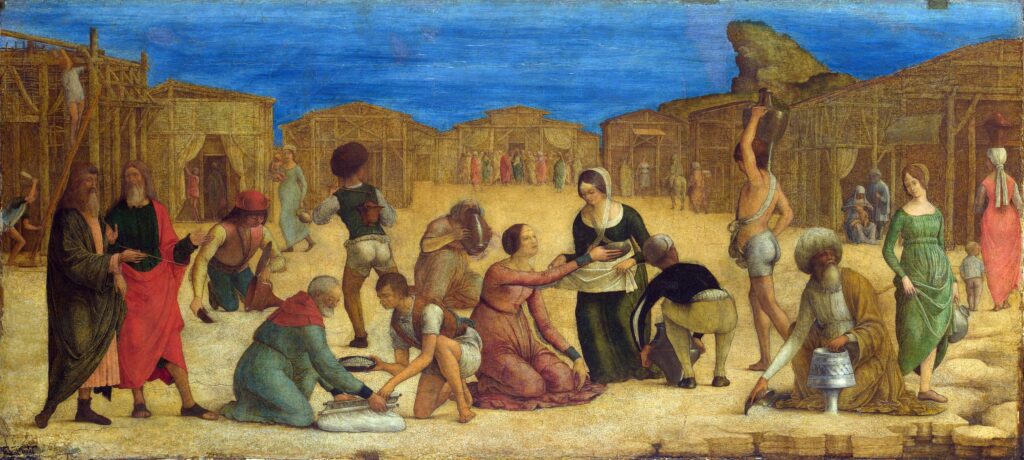
    Detail from The Israelites gathering Manna (c.1490s), Ercole de’ Roberti | Image courtesy nationalgallery.org.uk

    Wandering in the wilderness after they fled Egypt, the Israelites complained to Moses that they were hungry. God showed his love by raining down bread from heaven to sustain them. “The house of Israel called it manna; it was like coriander seed, white, and the taste of it was like wafers made with honey … The Israelites ate manna forty years, until they came to a habitable land” (Exodus 16:31, 35). Unlike the bread of affliction, the manna from heaven is both pleasing to the senses and extremely nourishing. Bread as a symbol had been sanctified. But sanctified bread came only from God, it was not something that could be made by humans. 

    After the Exodus, bread would never again be “just bread” for the Jews. It would always also be a symbol of God’s love for them and his commitment to them. God chooses good symbols; bread sustains life, and he was training them to understand that he sustains life even more fundamentally than physical food. By the time of King David, 450 years later, they had memorialized manna as more than normal bread: “he rained down on them manna to eat, and gave them the grain of heaven. Mortals ate of the bread of angels; he sent them food in abundance” (Psalm 78:24-25). 

    And 1,000 years after David, when Jesus perfects our understanding of God’s law and the words of the prophets, he deepens this reference to manna: “[My flesh and blood] is the bread that came down from heaven, not like that which your ancestors ate, and they died. But the one who eats this bread will live forever” (John 6:58). Jesus brought something new and shocking to the already-rich symbol of bread. God allowed the symbol to convey meaning for many centuries specifically so he could invoke all that the symbol of bread stood for and use that image to point to a new reality in our midst. Note what is going on here! It’s a reversal of how material signs usually operate in our entire way of building meaning. Until this moment, the material sign of bread was a pointer to something deeper, a symbol of God’s love and commitment. Jesus himself used this conventional symbology during his miracle of the loaves and fishes, when the bread demonstrated God’s inexhaustible and overflowing love for humanity. But now, the rich symbol is used to point to a new material and spiritual thing. In other words, usually things act as symbols pointing to complex concepts, but here the complex symbol is pointing to a thing. A very corporeal and perfectly spiritual thing that is Christ’s actual flesh and blood. 

    I’d even argue that it had to happen this way. Only with a symbol that was so richly endowed could Jesus teach us about the mystery of the gift he was giving us. He’s saying to us, “Even with how awesome you thought that manna given in the Exodus was, the gift of my flesh and blood for you to eat is the real bread of heaven because it does more than keep you alive in this world.” 

    Bread is still a material thing, and it’s still a symbol with a rich history of meaning, but now that symbol is pointing to something new, a new thing, the reality of the Eucharist.

    The Sacrificial Lamb

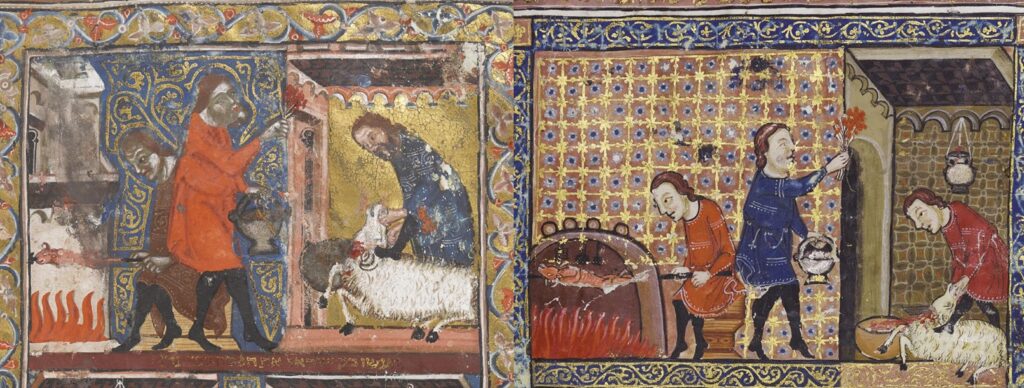
    Much like bread, the sacrificial lamb has thousands of years of meaning attached to it for the Jewish people. All the way back to Abraham, we have the willing but difficult sacrifice of the son, replaced by the ram provided by God. But the sacrificial lamb really becomes codified in the lives of Jews during the Passover, when each family takes an unblemished lamb (from the sheep or goats) and “the whole assembled congregation of Israel shall slaughter it at twilight. They shall take some of the blood and put it on the two doorposts and the lintel of the houses in which they eat it. They shall eat the lamb that same night” (Exodus 12:6b-8a). The lamb here is an interesting mix of symbol (much more than just a lamb, it is a symbol of fidelity to God’s command) and physical sustenance. We really see the roots of the Eucharist clearly — in a ritualized way, believers gather as a community to slaughter the lamb as a sacrifice to God, then eat it.

    Detail from the Brothers Haggadah (left) and the Rylands Haggadah (right, both from 1330-1350), manuscripts from Catalonia that detail Jewish life. | Image courtesy Museu d’Historia de Barcelona. These particular images show the slaughter of the Passover lamb and the painting of the lintels with the blood.

    Famously, the Jewish faith includes a lot of animal sacrifice. Sin offerings were a common form of sacrifice and this particular ritual is important for Christians to understand because the phrase “He died for our sins” very much refers to this practice. God told Moses that they must make regular offerings as a payment of sorts for their sins. God prescribed that “The sin offering shall be slaughtered before the Lord at the spot where the burnt offering is slaughtered; it is most holy. The priest who offers it as a sin offering shall eat of it; it shall be eaten in a holy place in the court of the tent of meeting. Whatever touches its flesh shall become holy” (Leviticus 6:25-26).* Note the insistence of the holiness of the event and the offering, which is again eaten. Strikingly, the ritualized sin offering is transformative — “whatever touches its flesh shall become holy.” We can locate a number of things in our religion that echo this transformational aspect of the sin offering: primarily, the Eucharist, which is the new offering for sin that we eat and which transforms us into something holy, but also things like holy relics of the saints, from which we have seen miracles transmitted.

    So imagine what must have been dawning on the Apostles, who were brought up with the rich symbology of the bread and the rituals of the sin offerings with an unblemished lamb, when “On the first day of Unleavened Bread, when the Passover lamb is sacrificed” (Mark 14:12), they were led to the upper room for him to institute the Eucharist during the Last Supper. Surely, some of them remembered John the Baptist declaring when he saw Jesus, “Here is the Lamb of God who takes away the sin of the world!” (John 1:36). They were told he was the lamb who was going to produce some sort of never-before-seen, world changing sin offering! 

    Sure enough, Jesus uses the sign of the lamb, as well as those loaded signs of bread and wine, to point back to himself, the nearly unfathomable mystery of salvation for all of humanity. “Jesus took a loaf of bread, and after blessing it he broke it, gave it to the disciples, and said, ‘Take, eat; this is my body’” (Matthew 26:26). He sanctifies and sacralizes the bread, meaning that he makes it holy with his own essence and by his own divine power, then tells them to eat it, just like they eat the flesh of the Passover lamb. And why is the wine used? “Drink from it, all of you,” he says, “for this is my blood of the covenant, which is poured out for many for the forgiveness of sins” (Matthew 26:27-28). It is used because the sin sacrifice requires real blood, real suffering.

    We might ask why not use actual sacrificed lamb meat as the Eucharist during the Last Supper? I’ll offer a theory (Aquinas offers his own). I think there had to be a physical and mental break with the traditions of the Old Testament. Jesus was instituting a new covenant where he was going to be sacrificed, not a lamb. The “remembrance” of this great event is more fittingly placed in the symbols of bread and wine, which were symbols of a covenantal relationship with God and signs of God’s abundance. What’s more, the difference of Christ’s flesh is accentuated here — the God-man’s flesh cannot be appropriately signaled by actual meat of any sort. Jesus Christ’s body is united not just with a spirit, but with God’s Spirit. Meat would be too similar and encourage us to fall too short of recognizing this great difference.

    Truly Eating Flesh

    In the gospel of John, when Jesus tells the crowd, “the bread that I will give for the life of the world is my flesh,” the Jews don’t react well, saying, “How can this man give us his flesh to eat?” (John 6:51-52). Does Jesus back off a little and say, “I’m speaking symbolically”? No! He doubles down. He says, “Very truly, I tell you, unless you eat the flesh of the Son of Man and drink his blood, you have no life in you” (v.53). He is insistent on this point, which sounds a heck of a lot like cannibalism to ears not prepared for it and hearts not realizing that this is God speaking. 

    And as if to punctuate the literal nature of what he means, Jesus adds, “Those who eat my flesh and drink my blood have eternal life, and I will raise them up on the last day” (v.54). But English fails us here, because in verse 53 he uses the common Greek verb for eating, “phagein” (φαγεῖν), while in verse 54 he ups the literalness and uses the verb trōgō (τρώγω), which means to gnaw, munch, or crunch. Those who gnaw on my flesh!!

    As if he’s not shocking enough, he’s also claiming to be able to give eternal life through this eating of his flesh. The divine power of the Eucharistic sacrament is laid bare. But it’s only available to those who are willing to eat his literal flesh. Very truly, I tell you!

    People call the gospel of John the most theological and the most symbolic. With the confluence of these two ideas, we see what Christianity is all about: we know God through a highly symbolic language that points to new realities, new things. Again, if what Jesus is doing is reversing the typical “sign /symbol is a physical thing pointing to a complex idea” into “complex sign/symbol is pointing to a new physical thing” (i.e., his flesh in the Eucharist), then this is precisely why our theology is the opposite of a mythology. Myths are stories to help us understand our world and experiences, but Christian theology is the exploration of God revealing himself to us as reality itself. Traditional sign/symbol meaning making is great for talking about ourselves and our experience, but God saw fit to use symbols in a new way: to help us access his own infinite reality.

    Thinking back on our celebration of the Feast of Corpus Christi, these thoughts were swirling around in my head as I listened to Fr. Gray’s homily and prayed with the congregation during the consecration of the Eucharist. The Eucharist contemplated and received can be an emotional thing. And I was contemplating what emotions Jesus may have wanted us to feel when gnawing on his unbloody flesh in the form of the host and the wine. Why insist that we physically interact with his flesh in this way? Why be a sacrificed lamb, whose holiness spreads to everything it touches but is at the same time unapologetically messy in its grease and juice and chew?

    I have been taught to feel joy and thankfulness for this incredible gift of the Eucharist. I have imagined it sanctifying my mouth, my esophagus, and my stomach as well as my soul as I ingest it. Aquinas teaches us that the great difference between this food and other food is that instead of us turning the food into ourselves (by nourishing our cells and organs), the Eucharist helps turn us more and more into Christ. I love this teaching and love approaching the Eucharist with this in mind.

    But, for the first time, I felt something different. As I considered the bloody sacrifice of the Cross and Christ’s insistence that we eat the flesh of this sacrifice, I had a catch in my throat. The moment when we as a congregation shout “Crucify him!” during our Good Friday Mass of the Passion came flooding back to me and my culpability as a sinner unfit for unity with He who is all good came over me. My eyes threatened to tear as I thought about the sheer sorrow of having to eat of a sacrifice that humanity made necessary through our initial disobedience and stubborn stupidity when he came in bodily form. There is something of the gag reflex here — of choking on something that is both sweet and horrible. Horrible not because of taboo (as in cannibalism), but horrible because we needed such a sacrifice. Horrible because that suffering of that very real savior Jesus Christ actually happened, and we remember that when we proclaim the Eucharist to be his very real presence. 

    Of course, God transformed our sorrow into awe and joy with the Resurrection, and this is the point of sharing in the Eucharist — sharing in the Resurrection. So, I didn’t dwell on that feeling of self-repulsion, because I don’t think it reflects what this sacrament is all about. At the same time, I think it was a positive experience. I think there are infinitely plumb-able depths to the reality of the Eucharist that is pointed to by our simple signs of bread and wine. I think Christ’s insistence on actually eating his flesh is something we need to take seriously and contemplate.

    And I thank God for the fact that his Son’s flesh is made unbloody and spiritual in our sacrament. I praise him for his wisdom and his gentleness with us, who condemned his Son to death, only to desperately need his saving Body and Blood so that we can partake in the Heavenly banquet that is everlasting life with him.

    Procession for Corpus Christi (1510-1520), Master of James IV of Scotland | wikimedia.


    * Note: it is worth re-reading chapter 23 of Leviticus, where God teaches Moses how to celebrate festivals, or “holy convocations” to honor him. These are the seeds of the sacraments as we know them today: liturgical rites with specific practices and gestures that endured for 1,500 years before Christ instituted the New Covenant. The “sign” of each sacrament points back here (indeed, back to Abraham and Isaac), and simultaneously points to Christ’s life, work, death and Resurrection, as well as pointing to the everlasting life to come.

  • Who is the Holy Spirit?

    Who is the Holy Spirit?

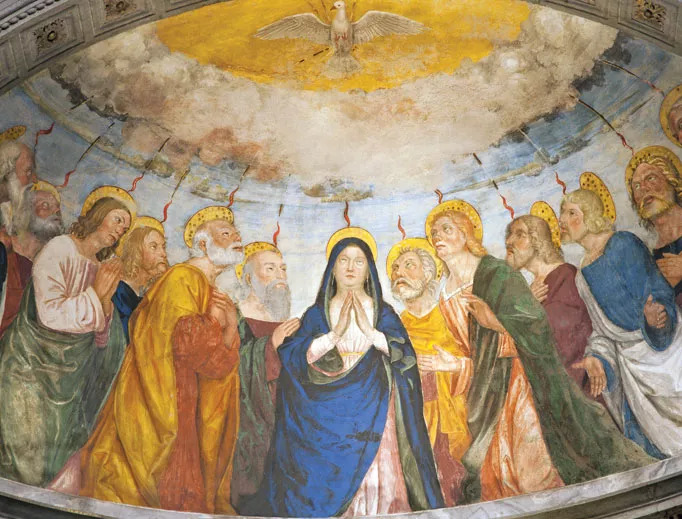
    VERONA: Apse of Chapel Miniscalchi in Saint Anastasia’s church from year 1506 designed by Angelo di Giovanni with main scene of the Pentecost.

    Pentecost is one of our highest feasts — marking the anointing and confirmation of the Church by the Holy Spirit. It is a true turning point for humanity, when God begins to interact with us in a new way. The Church’s liturgy for Pentecost is so full of the mystery surrounding the action of the Holy Spirit that it provides us with a dazzling array of Scripture to shed light on this event. The Vigil Mass has an extended form, much like Easter Vigil. Through four Old Testament readings and associated psalms, it reminds us how the Spirit has been guiding us and transforming our activity into something holy from the beginning of time. We hear of humanity’s hubris in the Tower of Babel, a symptom of our fallen state that God remedies by confusing our language. Lest we think that God is a malevolent God, doing this to spite us, he promises us through the prophet Joel, “I will pour out my spirit upon all flesh. Your sons and daughters shall prophesy … Then everyone shall be rescued who calls on the name of the LORD.” Of course, this is realized at Pentecost when the Spirit descends on Mary and the Apostles and reverses the confusion of Babel.

    But it’s more than just a loosening of tongues. Those tongues have something new to proclaim. We have become intelligible to one another once again, but only in a specific mode: allowing the Spirit to talk through us, to tell us about the Triune God and his saving plan for us through the person of the Son.

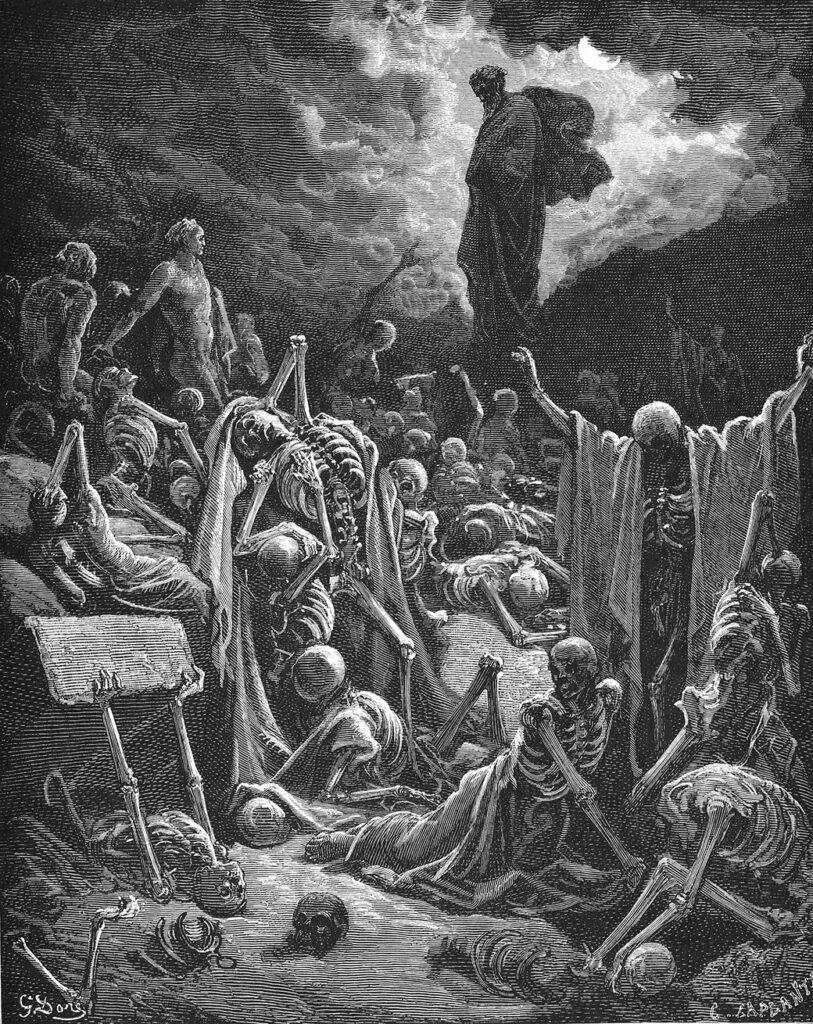
    The incredible reading from Ezekiel in the valley of dry bones is an astounding prophecy of the Pentecost in the upper room in Jerusalem. God tells Ezekiel, “Prophesy over these bones, and say to them: Dry bones, hear the word of the LORD!” Note how this foretells exactly what will happen. The “dry bones” of the Jews and Gentiles hear the word of the Lord from the mouths of the Apostles, the new prophets of a new age. God assures Ezekiel that his word will be efficacious. God tells the bones, “See! I will bring spirit into you, that you may come to life.” Indeed, Ezekiel sees sinews and flesh cover the bones as they stand, “but there was no spirit in them.” Now, note carefully — God tells Ezekiel to pray to the Holy Spirit: “Prophesy to the spirit, prophesy, son of man, and say to the spirit: … come, O spirit, and breathe into these slain that they may come to life.” How surprising! I find it more than a little striking within the Jewish context that the God who time and again reminds them that he is the one and only God, the Creator, tells his prophet Ezekiel to turn his appeals to the Holy Spirit. This is one of several times in the Old Testament, in fact, that when we read carefully, we see that God is telling us something about himself, about the three persons of the Trinity. It would take centuries until the Councils of Nicea and Constantinople could properly articulate an understanding (dumbed down for our human intellect) of the Trinity having one and the same essence of a single God, but three distinct persons in the Father, Son, and Holy Spirit. Nonetheless, we can trace their distinction to moments like these in Ezekiel and even to the creation story itself where God tells us that it is him, but also his Word and his Breath that act in creation in different ways.

    Vision of the Valley of Dry Bones (1866), Gustave Doré | Wikimedia Commons.

    I want to take a moment to reflect on the person of the Holy Spirit. I think many of us might be quietly (and innocently) caught in a type of subordinationist heresy. Simply put, this means that we have the tendency to think that God the Father is hierarchically the main and most powerful person of the Trinity — effectively subordinating the Son and the Holy Spirit to being lesser than him. Don’t fret, we would be in good company because several early Church Fathers like Irenaeus, Tertullian and Justin Martyr were also likely subordinationist, but that’s because the Church hadn’t yet been forced to think hard and long about the relationship between the persons of the Trinity. That was foisted upon the Nicene Council by Emperor Constantine I to figure out in the year 325 A.D. In fact, it was the more serious heresy of Arianism, where Jesus was taught to be a created being, that was the cause of the council, but the effect was the same — the council came up with our formulation that we repeat in our Creed to this day, where the Father, Son, and Holy spirit are proclaimed to be consubstantial with one another. That is, of one and the same essence.

    Perhaps it’s because of some of the references to the Spirit in Scripture might make us feel that it is not as, I don’t know, approachable (?) reliable (?) as the Father. For me, it’s when Jesus tells Nicodemus, “The wind (pneuma) blows where it chooses, and you hear the sound of it, but you do not know where it comes from or where it goes. So it is with everyone who is born of the Spirit (Pneumatos)” (John 3:8). This passage leaves me with a sense of flightiness about the Spirit (although I think that’s erroneous). Plus, the Apostles are waiting in the upper room for the Spirit to come, and it seems like no one knows when it will come. So, we don’t know where it comes from, when it will come, or where it will go next. A heretic might say that this Spirit sounds unreliable. But Jesus tells us emphatically that “everyone who speaks a word against the Son of Man, it will be forgiven him; but he who blasphemes against the Holy Spirit, it will not be forgiven him” (Luke 12:10). So, let us never say that the Spirit is unreliable!

    Turning back to Scripture, of course, we find that the Spirit is both efficacious and reliable. If Ezekiel on the plain of bones isn’t convincing enough, we have the Word of God, Jesus, who tells us, “It is the Spirit who gives life” (John 6:63), and in reference to reliability, “how much more will your heavenly Father give the Holy Spirit to those who ask Him [than those who are evil and also fulfill promises]?” (Luke 11:13). We learn from Jesus that the Spirit gives us life, which is why we baptize in his name, and the Spirit is the one who speaks through us when we are blessed by God. The Spirit is the Father’s way of acting in and through us. All of this is possible because the Holy Spirit is God’s actual spirit! But I don’t know if that helps clear up the subordinationist heresy. A person’s spirit certainly seems to be an integral, if not central, part of oneself. But it’s not that whole self, is it?

    This is where we go wrong — using ourselves as a reference point to try to understand God. We should always go the opposite way and use the mysterious truth God reveals about himself to better understand ourselves.

    This Pentecost, I really leaned on correcting any misconceptions I was harboring about the Holy Spirit as a secondary divine player. Some of this was reflecting on the work of the Council of Nicea in affirming that the Spirit is the same exact divine essence of the Father and the Son. Another was a re-reading of the opening of the Letter to the Hebrews, where the Holy Spirit speaks through the writer (St. Paul or one of his followers) with this astounding and clear proclamation: “[The Son] is the reflection of God’s glory and the exact imprint of God’s very being” (Hebrews 1:3). I’m not presuming to tackle one of the most difficult fields in all of theology in understanding the mystery of the Trinity, but there is one point that my brain was able to process here. Being of the “same essence” is a technical way to talk about being “the exact imprint of God’s very being.” This phrase from Hebrews is very specific and resonates with me differently.

    If we apply the “exact imprint” thought to the creation scene, we might see something different. When God creates Adam, he “breathed into his nostrils the breath of life” — this breath is his Spirit (rukah in Hebrew and pneuma in Greek refer equally to breath, spirit and wind). This is not a metaphor, it is a way that God is revealing the mystery of the Trinity to us. The action of a human breathing might bear some resemblance to God breathing, but only a shadow of it. The Father is so superabundant and generative that when he breathes, his breath contains all that he is. This is no normal exhale. This breath is God sharing his very essence, so strongly that this essence has its own personhood and action in Creation. In the same fashion, the Word is from God, and it is also fully God, a personhood of his essence who is active in the world in a special way. This Creator who can make all of Creation with a Word and a Breath imbues his essence into everything simply by thinking about it! His presence is so overwhelming that just a whiff of his essence could spawn a thousand galaxies (although everything he does is intentional and intelligible, as his Word and law attest). Imagine what his actual, full Spirit can do!

    These are things we cannot do — imbuing our very selves in our breath and world — and we have no power to create and inspire and be truth. And yet, by the grace of God we actually can create some things (physical, emotional, mental) and we can inspire one another, and we can speak the truth, all just in an infinitely reduced way compared to God. Do we pride ourselves in our little godhood or do we recognize that what we are sharing in is a gift from the one who created us? Can we realize just how much greater God’s power is than our little triumphs in life? 

    More importantly, are we doing the good that God wants us to do? I want to shift from thinking about how the Spirit is fully God to thinking about how important it is that God is giving his full self to us now in the End Times. We receive the Spirit as much as the Apostles in the upper room did, albeit the way this manifests in us is different. While the Spirit is present in all of our Sacraments, Baptism and Confirmation confer on us a personal evangelical call that we too often ignore. Consider what happened to the Apostles when the Holy Spirit descended on them. We are told in the first reading of the Pentecost liturgy during the day, “And they were all filled with the Holy Spirit and began to speak in different tongues, as the Spirit enabled them to proclaim” (Acts 2:4). What did they proclaim? The rest of Acts chapter 2 relates Peter’s great homily, where he proclaims, “This Jesus God raised up, and of that all of us are witnesses. Being therefore exalted at the right hand of God, and having received from the Father the promise of the Holy Spirit, he has poured out this that you both see and hear” (Acts 2:32-33). Here’s the nugget! The Spirit is poured out so that the Apostles can share the saving truth that God worked through his Son, Jesus Christ.

    The Spirit is not poured out simply to make them feel emboldened or to grace them for being good people. There is a purpose, because now the End Times have begun and all of humanity is given some time to turn their hearts to the Way, the Truth and the Life before the Last Judgement.

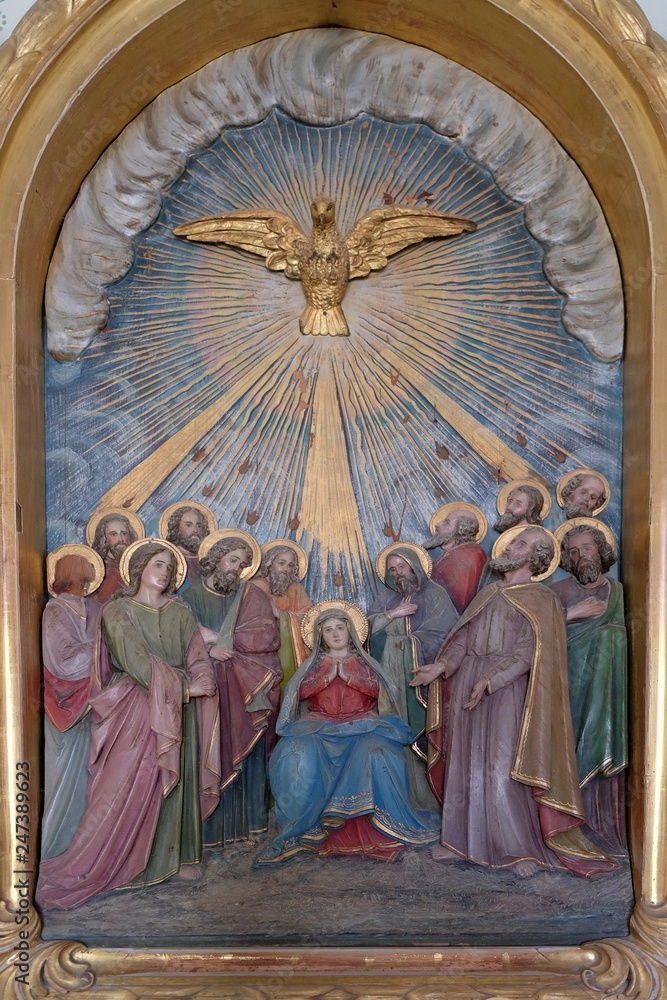
    Pentecost, the descent of the Holy Spirit in the chapel in the village Stitar, Croatia. Photo from Adobe Stock.

    Note how the Letter to the Romans acknowledges this moment that we still live within, found in the Pentecost Vigil epistle reading:

    We know that all creation is groaning in labor pains even until now;
    and not only that, but we ourselves,
    who have the firstfruits of the Spirit,
    we also groan within ourselves
    as we wait for adoption, the redemption of our bodies. …

    the Spirit too comes to the aid of our weakness;
    for we do not know how to pray as we ought,
    but the Spirit himself intercedes with inexpressible groanings.

    In other words, the whole point of life is the “adoption, the redemption of our bodies,” when we will be reunited perfectly with God. We — indeed, all of creation — are groaning in the labor pains brought about by Christ’s life, death and resurrection. And the Spirit is here to help us during this time, filling our mouths with the saving message of Jesus Christ, which gets us to this adoption, i.e., Heaven.

    Let’s repeat this: the Spirit is given to us (today, in our Sacraments and freely by grace) specifically to fill our mouths with the redemptive message of Jesus Christ — intelligible in all languages and meant for all people. We are supposed to be sharing the Way, the Truth and the Life with others. This is what it means to truly love your neighbor. I meet so many Christians who think loving your neighbor means good deeds, kind words, and a helping hand. But without the message of Jesus Christ, who was literally raised bodily from the dead to create a new path to salvation for us, these good deeds are meaningless. Because the point has never been this life or making things better in this world. The point has always been to do God’s will, which is absolute goodness and truth, so we can be as worthy as possible for the redemption he is holding out to us. How can we have fallen so far from this message?

    The second reading on the Pentecost liturgy celebrated during the day makes this point crystal clear: “If the Spirit of the one who raised Jesus from the dead dwells in you, the one who raised Christ from the dead will give life to your mortal bodies also, through his Spirit that dwells in you” (Romans 8:11). Being raised from the dead — body and soul — to dwell with God in Heaven is the point of the Spirit being sent to us. That’s what we celebrate on Pentecost and that’s what makes us Christian.

    I pray on this Pentecost that Catholics will be shocked out of their lukewarm tendencies, their acedia that keeps them comfortable in their jobs and money and little material triumphs. We must truly let the Spirit that has soaked our souls in our baptisms and confirmations to open our mouths to proclaim with the Apostles that Jesus Christ is the Way that all humanity has been given to share in God’s eternal glory.

  • Begging the Mystery to Emerge

    Wednesday in the Fourth Week of Advent, Year A: Song of Songs 2:8-14, Luke 1:39-45.

    Today’s readings are pregnant (pun intended) with the mystery of the divine waiting to burst forth. Both Old Testament and New present us with figures full of a happy anxiousness for meeting their ultimate love. In the Song of Songs, it’s our unnamed narrator and her lover, God. In the gospel of Luke, it is Elizabeth speaking for humanity, John the infant jumping with the energy of all the prophets who have come before him. Can we feel it?? Can we immerse ourselves in this breathless expectation for our Savior in just a few days?

    The end of today’s passage from the Song of Songs stirs me. “O my dove in the clefts of the rock, in the secret recesses of the cliff, Let me see you, let me hear your voice, For your voice is sweet, and you are lovely.” Much has been made of the erotic quality of the Song of Songs (dove in the clefts …), but apart from that I like to think of the dove in the more traditional biblical metaphors: peace and the Holy Spirit. The clefts of rock, the secret recesses, strike me as appropriate ways to talk of our hearts or our souls. The author knows that her lover, the dove, is present, but is dancing just outside of her field of vision, “gazing through the windows, peering through the lattices” at her. Is this not an accurate description of our God? We know in our hearts that He is there, He knows us better than we know ourselves and yet stays out of sight, peering at us through lattices like a lover. The author longs to see him and hear his voice, just as we do. And yet she knows that his voice is sweet (even not hearing it) and that he is lovely (even not seeing him). This is the memory of the soul, a spark of the divine within us, recalling its maker. 

    Depiction of the Christian Holy Spirit as a dove, by Gian Lorenzo Bernini, in the apse of Saint Peter’s Basilica, c. 1660 | Creative Commons, courtesy Wikimedia.

    The same closeness that the author of the Song of Songs is reveling in is present even more in the Visitation. Christ is literally there, in the flesh, yet not quite there. Agh, the anticipation Mary and Elizabeth must have felt! A thousand times more than any other mothers in history because their spirits were soaring in concert with the Holy Spirit. The gift of a Son from our God, who is peering at us through the lattices, is very much bound up in this spiritual communion via the Spirit as well as the Christ Himself. Consider this sentence from one of the best liturgical theology books of the 20th century, Wellspring of Worship, by Jean Corbon, OP: “In the body of Christ and flowing forth from it, the Holy Spirit is as it were the impatient desire of the Father’s glory that human beings should live” (65). Here we have the same impatient lover as we have in the Song of Songs – located in the person of the Holy Spirit.

    The Holy Spirit is the loving communion between the Son and the Father, and also the “sap” of the vine that allows us to commune with God. The Catechism phrases this nicely: “In every liturgical action the Holy Spirit is sent in order to bring us into communion with Christ and so to form his Body. The Holy Spirit is like the sap of the Father’s vine which bears fruit on its branches. The most intimate cooperation of the Holy Spirit and the Church is achieved in the liturgy” (CCC 1108). So, when Luke tells us, “Elizabeth, filled with the Holy Spirit, cried out in a loud voice and said, ‘Most blessed are you among women, and blessed is the fruit of your womb’,” we understand this as God communing with us and we can even consider this a special liturgical action between Elizabeth, John, Mary, and Jesus.

    The liturgy keeps coming up here, and our moment of history is special in this way. From our baptism onward, we are invited to live within the liturgy that was instituted in a new way by Jesus Christ and the Holy Spirit. All of the signs and actions in the Mass point to the actual communion being made present to us by the Holy Spirit. The Spirit prepares us for this communion (CCC 1098), recalls the meaning of the scriptures and gives life to the Word of God (CCC 1100), not only transforms the bread and wine into the Body and Blood of Christ, but also transforms those who receive the Eucharist into what they have received (cf. CCC 1105), and brings us into communion with Christ in the liturgy (CCC 1108). The liturgy is this amazing point where true communion happens, and this is why the Eucharist is so revered. It is not a type of overwrought, semi-superstitious, overly pious attitude. Our reverence occurs naturally during the Liturgy of the Eucharist because the communion that is received in bread and wine is the same communion that made John leap in the womb, that made Elizabeth cry out in a loud voice, and made Mary immaculate! It is the presence of God-with-us, God who transforms us into Himself. 

    The liturgy is a corporate action of the Church, not a private, individual event. This is important, as Corbon states, “in the liturgy the Church, which is already the communion of those who believe in the name of the beloved Son and have been changed into him, ‘becomes what it is’; that is, it becomes the body of Christ and a sacrament of the communion between God and human beings” (Wellspring 72). What a great understanding! The Church is “a sacrament of the communion between God and human beings.” Again, we participate in this thing we call the Church that Elizabeth, John, and Mary participated in (and still do!). As we participate in the Body of Christ, we begin to realize that we can more fully experience that same breathless anticipation and awe that Elizabeth, John, and Mary felt – particularly because we still await the fullness of redemption, the fullness of our union with God.

    This is where we are now in the fourth week of Advent in the year 2022: begging the mystery to emerge, as a dove from the recesses of our soul, as a God-man from a sinless Ark of the New Covenant, as a King of Judgement to welcome our souls home.

  • From Genie God to Fantastic God

    From Genie God to Fantastic God

    Tuesday of the Fourth Week in Advent, Year A: Isaiah 7:10-14, Luke 1:26-38.

    Today’s reading from Isaiah can come across as a little odd. Not the bit about the future Emmanuel, but the bit about Ahaz being offered whatever kind of sign he wants. As a kid, I read a lot of fairy tales from around the world and this one smacks of an Arabian tale of finding a genie in a bottle: “The LORD spoke to Ahaz: Ask for a sign from the Lord, your God; let it be deep as the nether world, or high as the sky!” This excerpt makes more sense when you read it in context, thankfully. 

    Fisherman and The Genie, from the Arabian Nights, Maxfield Parrish (1905) | Image from fineartamerica.com.

    Ahaz, we recall, was a very wicked king whose father (Jotham) and son (Hezekiah) were both good kings. Ahaz’s story is an interesting dive into politics (which haven’t changed much since 740 BC!) and religious practices bowing to outside influences. The short version is that good King Jotham was deposed at the age of 41 when his son Ahaz became king at the tender age of 20. Why? The Wikipedia entry for Jotham states that he was “deposed by a pro-Assyrian faction,” presumably of Jews in his own increasingly beleaguered small-but-powerful kingdom of Judah. You see, Assyria was the reigning power in the Middle East at this time, and the northern kingdoms of Samaria and Israel were super nervous about being overtaken.

    So, when Israel and Samaria came to King Ahaz in the southern kingdom of Judah for an alliance, Ahaz refused because he was backed by pro-Assyrian Judeans. Soon, the Israelite and Samarian armies were at Jerusalem’s doorstep, ready to depose Ahaz in favor of someone who would ally with them. Heady politics! Here’s where Isaiah comes in.

    God sends Isaiah to Ahaz. His first message is that the kings of Israel and Samaria would not succeed in trying to attack Jerusalem: “thus says the Lord God: It shall not stand, and it shall not come to pass” (Is 7:7). That being said, just before the section we read in the lectionary, Isaiah relates that God says, “If you do not stand firm in faith, you shall not stand at all” (Is 7:9b). God sent Isaiah to plead with Ahaz not to ally with foreign powers (that is, Assyria) and instead trust in the Lord. 

    And so we get to our lectionary excerpt, where God tells Ahaz to ask for a sign, any sign “high as the sky” to show that God was with Israel and all they had to do was trust in Him. Note that what is being offered is a sign, not a wish. The sign means that God will honor His covenant and promises to His People, whereas a wish is something granted to a specific person outside of a broader plan for salvation. So, no genie here. Instead, this is the God who has always been happy to work wonders and signs for His People. 

    Let’s not confuse Ahaz’s response “I will not ask! I will not tempt the LORD!” for true modesty. We know from other books of the Bible that he was a rotten Jew: he set up idols and images of foreign gods and committed abominations by worshipping these gods (2 Chron. 28:2-3). He even worshipped the god Molech by offering his children in sacrifice (in Leviticus 20:1-5, God pronounced the death sentence against all who worshipped this god). As Ahaz’s fortunes decline in later years after Assyria turns against him, he shows his absolute degeneration as a child of God. He says, “‘Because the gods of the kings of Aram helped them, I will sacrifice to them so that they may help me.’ But they were the ruin of him, and of all Israel” (2 Chron 28:23b).

    This makes it a little easier to understand Isaiah’s lack of patience with Ahaz’s demurring. For what it’s worth, I find Isaiah’s rejoinder to be a great moment of exasperation captured in scripture: “Is it not enough for you to weary men, must you also weary my God?” I can just envision the fantastic eyeroll that accompanied this statement.

    Isaiah goes on for quite some time about Emmanuel, that is, Jesus. But the lectionary today stops with a concise, “Therefore the Lord himself will give you this sign: the virgin shall conceive and bear a son, and shall name him Emmanuel.” The fact that it takes another 7 centuries for Emmanuel to be conceived unto Mary tells us that 1) God is truly looking out for his people as a group rather than an individual king or person, and 2) God is patient with His love, playing the long game and waiting until His People are ready for the child to be conceived unto Mary. 

    I have written four separate reflections on the wonderful gospel reading from Luke describing the Annunciation, so I don’t want to repeat myself here. I do encourage anyone reading this to consider diving into them.

    • This one focuses on Mary’s fiat.
    • This one focuses on Mary as the living House of God.
    • This one focuses on Mary’s unique title of Kecharitōmenē and the exchange between her and the angel Gabriel.
    • This one (from 12 days ago) focuses on Mary as the New Eve.

    I simply want to reflect today on how God’s great plan to give us Emmanuel, His Son, is way more fantastic than a genie granting wishes. Fantastic in all senses — unbelievable, supernatural, awesome, great, immensely pleasing. In fact, this story is too fantastic for a human to make it up. The threads of prophecy and fulfillment, the indescribable humility and selfless goodness of Christ, the centuries — no, millennia — of teaching that was perfected in Christ in an always surprising way … these things are absolutely the Greatest Story Ever Told. Fairy tales borrow from God’s entry into humanity, not the other way around. All that humans can come up with on their own is a genie or spirit who grants singular wishes to a selfish human (who often makes a terrible mistake, giving us some sort of moral tale). Of course, today we can find very sophisticated fantasy and science fiction book series and TV series, but all of this smacks of escapism, not reality. 

    Stories of life and passion of Christ, fresco, Gaudenzio Ferrari (1513), Church of Santa Maria delle Grazie, Varallo Sesia (VC), Italy | Creative Commons, courtesy Wikimedia.

    That’s the ground truth that keeps us in church. Israel, Judah, Christ, the martyrs, the Church Fathers: these are all real history. We don’t have to look to another planet or a pretend reality to find the most fantastic story in our very midst. We have to have faith and embrace it, because our God was patient and loving and gave it to us in the form of an infant to be adored.

  • Widows and Our Spiritual Family

    Thursday in the Third Week of Advent, Year A: Isaiah 54:1-10, Luke 7:24-30.

    We are traveling today, so I have to keep this reflection short before we head to the airport, but I did want to write something about that venerated group in the Apostolic Age and the Patristic Age, but their role has faded into obscurity. Widows were a class unto themselves from the time of the Acts of the Apostles onward. We have some skewed ideas of them today, thanks to (false) popular belief that women could not own property, were dependent upon their husbands, and were legally subordinate in every way. Even adjusting for a more accurate historical understanding of women, widowhood rightfully evokes sympathy – losing one’s spouse is an incredibly difficult thing. We find some lovely spiritual salve for widows in today’s readings.

    The Widow’s Mite, James Christensen (contemporary) | Image from havenlight.com.

    Susan Hylen, PhD, MDiv, from the Candler School of Theology at Emory University has written a nice historical revision to the ideas we have about the helpless widow of antiquity. She summarizes by saying:

    This historical portrait suggests there was a lot of variety in the social status of widows. Some were wealthy and even powerful. Some were poor, and many were in the middle. Some experienced a drop in economic position when their husbands’ died, and others did not. Although vulnerable in some ways, widows were also supported by social expectations that gave them increased status.

    Thus, when we find specific mention of widows and barren women in scriptures, we might better understand the feeling being evoked as one of personal sympathy for people removed from highly valued things in Jewish society such as a loving spouse and children, rather than sympathy because their legal and monetary situation is dire. Isaiah uses the sad situation of widowhood to describe the devastated nation of Israel, but he promises marriage to a much better spouse: “Fear not, you shall not be put to shame; you need not blush, for you shall not be disgraced. The shame of your youth you shall forget, the reproach of your widowhood no longer remember. For he who has become your husband is your Maker; his name is the Lord of hosts.” There does seem to be reference to a social stigma or at least embarrassment/shame, but this can be in reference to a woman who was married and then “cast off” or divorced. But the promise is that even this deeply felt personal feeling in a social context is like nothing in the face of union with God. And, of course, this promise of the mystical marriage with God was established by Jesus in the Church.

    In the early centuries of the Church, an “order” of widows existed that was as established and recognized as the role of deacon was. In fact, diakonos is simply the Greek word for a servant such as a waiter or messenger. In the early Church the deacon’s (or deaconess, in the case of widows) first role was that described in Acts 6: distributing food to the poor, leaving the apostles free to devote themselves to prayer and to the ministry of the word” (Acts 6:4). As early as the Apostolic Age, we hear Paul instructing, “Do not let a widow under sixty years old be taken into the number, and not unless she has been the wife of one man, well reported for good works: if she has brought up children, if she has lodged strangers, if she has washed the saints’ feet, if she has relieved the afflicted, if she has diligently followed every good work” (1 Timothy 5:3-10). Thus, widows were not only recognized, but they performed great services for the communities of Christians, living out the maxim to love their neighbors as themselves. Some of them had inherited money and goods that they donated or used for the benefit of the early churches. Others, as we see in Paul’s statement, owned property and practiced hospitality, “lodging strangers.” The third-century Syrian book of Church order, the Didaskalia, mentions three specific roles for them: 

    1. Visiting women in their homes. It reads, in part, “… to visit those who are sick, and to minister to their needs, and to bathe those who have begun to recover from sickness”
    2. Assisting in baptisms for women: “Also, because in many other matters the office of a woman deacon is required. In the first place, when women go down into the water, those who go down into the water ought to be anointed by a deaconess with the oil of anointing… it is not fitting that women should be seen by men.” The Fourth-century Syrian book of Church order, the Apostolic Constitutions, Book II, adds “And when she who is being baptized has come up from the water, let the deaconess receive her, and teach and instruct her how the seal of baptism ought to be (kept) unbroken in purity and holiness. For this cause we say that the ministry of a woman deacon is especially needful and important.”
    3. Keeping order in the women’s section of the church. This was like being an usher, and finding a place for any woman who comes, rich or poor, “one of a low family, or a stranger.”

    Elsewhere, we read that widows would instruct young married women in caring for a household and rearing children. We can see that widows not only participated in the early Church in a special way, but even walked the Christian Way more perfectly and thoroughly than many others. It is almost like a proto-nun order, one that is steeped in worldly works rather than solitude and prayer behind convent walls. In this way, the Church as the mystical Body of Christ fulfills the promises of Isaiah in a structural way, providing real spiritual advancement towards the Kingdom for widows while on earth. And, it fully overturns our stereotypical image of widows as pitiful and helpless.

    Elijah Receiving Bread from the Widow of Zarephath, Giovanni Lanfranco (1621-1624) | Creative Commons, courtesy Wikimedia.

    In today’s gospel reading, Jesus takes the promise shared with Isaiah about widows and amplifies it. He exalts John the Baptist, saying, “among those born of women, no one is greater than John.” High praise, indeed! But he adds, “yet the least in the Kingdom of God is greater than he.” This truth about the state of souls in heaven gives us great hope. No matter how far we’ve fallen in our lives, no matter our flaws and inability to avoid sins, if we can achieve heaven, great glory awaits us. Even the least of us in heaven is greater than the greatest human on earth! If we have ever wanted to make something of ourselves and our existence, this is it.

    May we all recapture the diakonos way of living and serving that is part of the path to the Kingdom. May we all, too, be exalted eventually in heaven.

  • Running Out of Chances

    Running Out of Chances

    Memorial of Saint Lucy, Virgin and Martyr, Third Tuesday of Advent, Year A: Zephaniah 3:1-2, 9-13, Matthew 21:28-32.

    Alongside the great promise of our covenant with God – that we will be saved and granted eternal life with Him – there is an ominous warning. If we don’t come to him with open hearts, if we remain committed to our own pleasures and will, then we will be cut off from Him. This being cut off is quite an uncomfortable condition, to put it mildly. Eternal torment is another way to say it. But God would rather have us with Him, so we keep getting warnings to repent, to turn back to him, to stop our navel gazing and do His will while we are alive.

    I wonder if we are running out of chances.

    Russian icon of Zephaniah, 17th Century | Creative Commons, courtesy Wikimedia.

    Today’s readings give us two of these warnings. The first is given to us through the mouth of the prophet Zephaniah, speaking to the Jews collectively as “Jerusalem.” I think his words could equally be applied to Americans today: “Woe to the city, rebellious and polluted, to the tyrannical city! She hears no voice, accepts no correction; In the LORD she has not trusted.” Especially the idea of accepting no correction – there is a huge arrogance among Americans who feel that this is the best country on the earth and no one can correct us. And don’t get me started on the false slogan “In God we Trust” which makes me cringe every time I see it on a Utah license plate. The main thing our culture trusts in is money; we were built on capitalism and on capitalism we will die. Thus, the great irony is that we were taught to take the “In God we Trust” printed on our currency as a serious statement rather than seeing it for the hoax it was; after all, our government was carefully crafted to fully separate its laws and operations from any religious influence. The truth is, our real slogan is “In Man and Money we Trust.” OK, rant over, but hopefully the applicability of Zephaniah’s words is clear.

    Let us pray we are called to participate in Zephaniah’s next statement: “I will change and purify the lips of the peoples, That they all may call upon the name of the LORD.” If we want to join our Lord, we must start by actually being courageous enough to call upon His name, in private and in public. God’s promise is that, like it or not, He will intervene. We will become a changed, humbled people. “You need not be ashamed of all your deeds, your rebellious actions against me; For then will I remove from your midst the proud braggarts, And you shall no longer exalt yourself.” It may be easiest to see our showboating athletes, strutting music icons, and loudmouthed politicians as the “proud braggarts” of our culture, but I know that every time I hope for recognition at work or appreciation at home or even desire for holiness that I participate in this exalting of self. My wife has shared with me the powerful Litany of Humility this Advent, and it is a fantastic prayer to help us get ourselves right around the crucial problem of pride. Thank you to her! I’ve included it here.

    Maybe if we pray the Litany of Humility enough and conform our hearts more and more to doing God’s will alone, we can be a part of the remnant that Zephaniah speaks of: “But I will leave as a remnant in your midst a people humble and lowly, Who shall take refuge in the name of the LORD: the remnant of Israel.” We often jump to the idea of exalting in God’s glory in heaven, of living in the bliss of His presence, without considering what type of person we must become first. Heaven as an endless banquet is a wonderful image, heaven as a state of having no cares or worries is as well. But these things look very different for the person who has and expects nothing versus the person who has many things and is continually striving for more. For me, I fall into the problem of seeing heaven as a place of final relaxation with the Lord, essentially where I can be lazy in the sun, like a great beach vacation. How stupid! This vision is completely dominated first of all by me, and secondly by how I will feel. I have so far to go. So far, in fact, that I feel like I’m starting at the beginning every day.

    Contrast this vision of heaven with the mindset of someone who is truly humble before the Lord. For someone who thirsts, for someone who never expects to be mentioned in conversations or remembered by history, even a sidelong glance from the Lord is a thrill of a lifetime. Imagine this person being looked upon full in the face by the Lord, in absolute love, and then grasped and pulled to sit at the Master’s table to be in His presence for eternity. This is mind-blowing. This is heaven. And it’s not as if the Lord is awesome as a consequence of perspective. God is truly awesome with or without our perspective being right.

    Zephaniah shows us that God’s will is that we be humble. One might claim that only by being truly humble can we experience true love for Him and all others in humanity. Consider this: pride by its nature seeks to put us above others, to see them as an object to be used (as my confessor recently gently explained to me), and there can be no love when this adversarial, objectifying impulse is present. Love is itself desiring the good of the other more than the good for yourself. If you see yourself above others, how can you ever truly love them? You might care for them, have sympathy for them, even do good works for them, but love, caritas, agape, is another mode. For this reason, we should pray to become a remnant of the people, humble and lowly.

    Litany of Humility

    -by Rafael Cardinal Merry del Val

    O Jesus! meek and humble of heart, Hear me.

    From the desire of being esteemed,
    Deliver me, Jesus.

    From the desire of being loved,
    Deliver me, Jesus.

    From the desire of being extolled,
    Deliver me, Jesus.

    From the desire of being honored,
    Deliver me, Jesus.

    From the desire of being praised,
    Deliver me, Jesus.

    From the desire of being preferred to others,
    Deliver me, Jesus.

    From the desire of being consulted,
    Deliver me, Jesus.

    From the desire of being approved,
    Deliver me, Jesus.

    From the fear of being humiliated,
    Deliver me, Jesus.

    From the fear of being despised,
    Deliver me, Jesus.

    From the fear of suffering rebukes,
    Deliver me, Jesus.

    From the fear of being calumated,
    Deliver me, Jesus.

    From the fear of being forgotten,
    Deliver me, Jesus.

    From the fear of being ridiculed,
    Deliver me, Jesus.

    From the fear of being wronged,
    Deliver me, Jesus.

    From the fear of being suspected,
    Deliver me, Jesus.

    That others may be loved more than I,
    Jesus, grant me the grace to desire it.

    That others may be esteemed more than I,
    Jesus, grant me the grace to desire it.

    That, in the opinion of the world, others may be loved more than I, others may increase and I may decrease,
    Jesus, grant me the grace to desire it.

    That others may be chosen and I set aside,
    Jesus, grant me the grace to desire it.

    That others may be praised and I unnoticed,
    Jesus, grant me the grace to desire it.

    That others may be preferred to me in everything,
    Jesus, grant me the grace to desire it.

    That others may become holier than I, provided that I may become as holy as I should,
    Jesus, grant me the grace to desire it.

    Amen.

    Nearly 700 years after Zephaniah and all of the other prophets who repeated God’s message to the people, we encounter Jesus in today’s gospel reading. He teaches the Parable of the Two Sons, one who initially refuses to work for his father, but then actually does it and the other who says he will but never does. Growing up, this parable immediately resonated with me. I was always mouthy (I know, shocking!), but thankfully the conscience God planted in me was also very active. I often regretted things said or done in moments of passion or temper, and sought to do good afterwards, in part to atone for my previous idiocy. So, I related to this parable on a very literal level. Jesus asks, “Which of the two did his father’s will?” and the answer is obvious.

    But understanding the parable on this level doesn’t really go far enough. After all, does God want his people to be a bunch of resistant hotheads who end up doing the right thing in the end? Probably not. This parable is illustrating an aspect of hearing God’s will, not an entire way of being a good Christian. The point of this parable might be summarized in the title of this post: hey people, you might be running out of chances to follow God’s will! Jesus drives this home when he says, “When John came to you in the way of righteousness, you did not believe him; but tax collectors and prostitutes did. Yet even when you saw that, you did not later change your minds and believe him.” He could have started with: God sent you centuries of prophets and warnings about being humble, turning to Him, and doing His will. But, graciously, he just holds them to what has happened during their generation. He points to John the Baptist, Elijah in their midst, calling them to repentance and opening themselves to God who has come.

    The chief priests and elders, while initially saying they would do God’s will given their paths in life, didn’t believe John and do God’s will, making them the second son in the parable. The tax collectors and prostitutes, who had initially said no to God in their life choices, now turned to Him to do His will. 

    The Parable of the Father and His Two Sons in the Vineyard, from The Story of Christ, Georg Pencz (1534-35) | Public domain, courtesy of the Metropolitan Museum of Art.

    This is compounded by the fact that the priests and elders have seen that John’s baptism has been doing much good and converting people’s hearts back to God. John’s ministry of preparing people for Jesus has been successful; many crowds of disciples are filled with faith, are being healed, and are on their way to the Kingdom. But the priests and elders remain antagonistic, challenging and not believing God who is right in front of them.

    Woe to them! They are most definitely not the remnant, humble and lowly.

    Let us pray the Litany of Humility this Advent. Let us seek to become the remnant who will be welcomed into the Kingdom when our Savior comes.

  • Getting into Gaudete Sunday

    Getting into Gaudete Sunday

    Third Sunday of Advent “Gaudete Sunday,” Year A: Isaiah 35:1-6a, 10, James 5:7-10, Matthew 11:2-11.

    Gaudéte in Dómino semper: íterum dico, gaudéte. Rejoice in the Lord always: again I say rejoice. This is the first line of the Introit to today’s Mass, marking the halfway point of Advent when we take a little break from the semi-penitential season to recall the joy of Christ’s coming into our hearts. The name for this special Sunday comes from the first word of the Introit, Rejoice!

    Virgin Mary and Christ Child, unknown illustrator (20th century) | Image from divine-innocence.org. Priests are allowed to wear rose on Gaudete Sunday, a color signifying the mixing of the white of Christmas with the violet of the Advent Season, a lovely symbolic gesture of the meaning of this halfway point of rejoicing.

    I’ve been reflecting on the dual nature of Christ’s coming (the babe in the Nativity and the judge at the end of time) this Advent, but there is a third coming for which Catholics are preparing in Advent: the coming of Christ in our hearts. Gaudete Sunday asks us directly to prepare our hearts by cultivating the joy that Christ’s coming will bring (and that we will allow to fully blossom in the Christmas liturgical season). Advent is a time to scour our hearts of sin, making them suitable for the Lord. Gaudete Sunday is a moment in Advent when we can align that preparation of the heart by remembering that joy is what awaits us, not just the continual work of penitential scouring. 

    So, today’s readings are chock-full of rejoicing. The first lines of Isaiah even extend rejoicing to all of creation: “The desert and the parched land will exult; the steppe will rejoice and bloom.” I appreciate these reminders that it’s not just humanity that will be perfected in Christ but all of creation.

    God does have a special place in His heart for humanity, though (case in point: Jesus is incarnated as a man, not a goat or a tree), and the message for us involves our intellect, emotions, and spirit: “say to those whose hearts are frightened: Be strong, fear not! Here is your God … He comes to save you.” This message never gets stale. It gave hope and confidence to Jews in exile hundreds of years before Christ, to early Christians suffering martyrdom, to Christians in the turbulence, disease, and violence of the Dark and Middle Ages, and to us moderns, assailed by a lust-filled, nihilist and atheistic culture.

    Apart from the 100,000-foot view of cultures and history, this message gives hope and confidence to all of us on an intensely personal level, whether we struggle with depression, family problems, money problems, or other uncertainties. God’s promise, proclaimed through Isaiah, is a true celebration of the best in each of us. He promises that in heaven we “will return and enter Zion singing, crowned with everlasting joy; [we] will meet with joy and gladness, sorrow and mourning will flee.” This promise of joy is so needed in all of our lives, and a huge reason that reading and re-reading the scriptures is important; not just to find comfort, but to find a much-needed perspective in our lives.

    So, God is coming to save us, and Jesus has already initiated the Last Times. Awesome, let’s do this! What is God waiting for??

    This question was especially poignant in the first generations after Christ’s resurrection, when they pondered his words, “Truly I tell you, this generation will not pass away until all these things have taken place. Heaven and earth will pass away, but my words will not pass away” (Mt 24-34-35). There was a very real expectation that the second coming would happen at any minute.

    Thus, for Christians at all moments since the resurrection, St. James’s words in today’s second reading are very important: “Be patient, brothers and sisters, until the coming of the Lord.” This is echoed by other apostolic writers, notably St. John, who uses the word abide (“to stay,” “stand fast,” “remain” or “endure”) 34 times in his gospel and 19 times in his letters. Abiding and patience are both practices related to the virtue of fortitude — that is, not straying from the faith and the practice of the faith, remaining strong. James picks up this association with remaining strong: “Make your hearts firm, because the coming of the Lord is at hand.”

    It is oh so easy for us to give up on things that don’t yield right away. Especially in today’s immediate gratification culture (heck, I find myself oddly impatient when an entire TV series isn’t available for immediate streaming all at once — having to wait a week for the next episode? The horror!). Thankfully, our history as God’s people provides us with the example and confidence that we can do it. As James says, “Take as an example of hardship and patience, brothers and sisters, the prophets who spoke in the name of the Lord.” This is another reason why reading and re-reading the scriptures is so important for us. It helps us find courage and remember the example of those who have come before us. We are not in this alone and without a guide!

    3rd century painting of Christians praying, Catacomb of Priscilla, Rome | Creative Commons, courtesy Wikimedia.

    We even see the need for reassurance and confidence from the great John the Baptist in today’s gospel reading. John sends some disciples to ask if Jesus is the Messiah they’ve been waiting for. We might be cultivating a sense of anticipation in Advent, but John was bursting with it. His whole life was oriented to this one thing.

    Jesus, consistent with his teaching that we will be judged by our fruits, responds: “Go and tell John what you hear and see: the blind regain their sight, the lame walk, lepers are cleansed, the deaf hear, the dead are raised, and the poor have the good news proclaimed to them.” In other words, trust in the supernatural realities that are being revealed to you.

    What an interesting answer! He could have said, “yes,” and been done with it, but Jesus was always teaching, always consistent, always urging us to go deeper. His point was that we must meet God’s will with our own will — we must exercise the muscle of faith and enter into a spiritual dimension with God in order to perceive the truth about life.

    Even this simple experience of entering into faith is one that can give joy. We often give up in frustration over what we perceive to be the silence of God in our lives, but, once again, St. James tells us to cultivate patience and a firm heart! Developing a relationship with God, who doesn’t often answer questions head-on the way we wish He would, takes effort and openness, but even the journey has its rewards.

    As we open ourselves to supernatural realities and the mysterious presence of divinity, God immediately rewards us with an expanded sense of Him and the world. And let’s not imagine we’re in this alone, praying in the cell of our mind. The Church of which we are a part has been established as the bridegroom of Christ, where we meet him in joy and love. The rituals, sacraments, devotions, and prayer life of the Church as a body are where we encounter God in sight, sound, feeling, and even in our bodies through the Eucharist. If we are feeling dry in our spiritual life and lacking in patience with our faith, we must ask ourselves how often we are participating in the life-restoring activities of the Church and how open our hearts and minds are to those activities and sacraments. They are great joy bringers for us in this time of patience.

    One last thing is something that really stuck with me from the pastor of St. Catherine of Siena Newman Center, Fr. Gabriel Mosher, OP, in his homily for Gaudete Sunday. He asked if we really knew what joy was and had we considered that Christ had achieved perfect joy as he hung crucified on the Cross?

    This is, of course, a Thomist definition of joy: “For joy is caused by love, either through the presence of the thing loved, or because the proper good of the thing loved exists and endures in it” (Summa II.II.28.1). As he hung on the Cross, Jesus obtained his heart’s desire, a perfect sacrifice to the Father that provided salvation for humanity. This is a great lesson for us! How often do we let suffering lead us to misery instead of joy? Perhaps always??

    Imagine instead responding to your suffering by remembering Christ absolutely joyful on the Cross (undoubtedly in great pain), and finding inspiration in him to be joyful yourself. You might not be taking away the sin of the world with your suffering, but you can offer your suffering self to the Father, just like Jesus did. You can say a prayer like, “Father, accept my lowly suffering alongside the great redeeming suffering of your Son. Allow me to offer my broken human self to you like he did, and in your mercy make me more like him.”

    Who knows — you might just find a glimmer of joy after that prayer. If for nothing else, you’ve taken up Christ’s offer to “take up your yoke” with him; and you might find it as sweet as he promises.

    I don’t want to be a “downer” amid our joyful celebration of Gaudete Sunday, but I was struck by how Fr. Gabriel expanded my notion of what joy can be and further deepened my appreciation for the depth of Jesus’s sacrifice. This is a powerful way to look at the Crucifixion, a scene which is often dominated by sorrow, upset, and emptiness. How important for us to consider that Jesus experienced a powerful joy over the completion of his ministry and doing God’s will. How fruitful is the contemplation of this type of joy, which so dwarfs suffering and ignominy.

    This joy persists for eternity with the Father, while those other things pass like a whisper in the night.

    Crucified Jesus Christ, Viktor Mikhailovich Vasnetsov (1885-1896) | Creative Commons, courtesy Wikimedia.
  • John is Elijah, Both Prepare the Way

    Saturday in the Second Week of Advent, Year A: Sirach 48:1-4, 9-11, Matthew 17:9a, 10-13.

    Today’s readings shed light on a lesser-emphasized aspect of St. John the Baptist: the fact that he is Elijah returned. The prophecy in question was given to Micah: “I will send you the prophet Elijah before the great and terrible day of the Lord comes. He will turn the hearts of parents to their children and the hearts of children to their parents, so that I will not come and strike the land with a curse” (Micah 4:5-6). Modern Christians simply don’t have the cultural frame of reference to appreciate this prophecy. Elijah was one of the original superheroes of the Jewish tradition, alongside Moses and likely eclipsing even the name of Solomon, David, Judah and Israel. His miracles were profound, his wisdom straight from the mouth of God. For Jews around the time of Christ, the return of Elijah would have been a not-to-miss event, a fitting prelude to the Messiah himself.

    Elijah the Prophet, Nicholas Roerich (1931) | Creative Commons, courtesy Wikiart.

    To help us remember Elijah’s superhero status, the Lectionary provides us with an excerpt from Sirach, praising him. “How awesome are you, Elijah, in your wondrous deeds! Whose glory is equal to yours?” Sirach goes on to recount a number of his deeds, including ones not included in this excerpt like raising from the dead, healing, sending kings to their destruction. Fire figures prominently in Sirach’s account, especially the famous “whirlwind of fire, in a chariot with horses of fire” that carried him to heaven. We have reflected this Advent on how fire is a symbol of God’s purity. Elijah, surrounded by fire, was a prophet seemingly closer to God than other men in every way.

    The gospel reading picks up the Elijah thread. It is pulled from right after the Transfiguration (which, of course, featured Elijah as well). The disciples are walking down the mountain, asking Christ about Micah’s prophecy. Jesus answers that “Elijah has already come, and they did not recognize him, but they did to him whatever they pleased. So also the Son of Man is about to suffer at their hands.” They understand he is speaking of John the Baptist. What’s the connection between the two? Well, there are many: they both preached in the wilderness, apart from communities of men and women; they both dressed as wild men, with a leather belt around their waist; both set themselves against kings and had high-profile enemies; and both preached repentance. This last point, in particular, is how they both prepared humanity for the coming of Jesus Christ, and it is in this that Jesus can explain that Elijah has come as John the Baptist.

    But Jesus also speaks about Elijah in the future tense: “Elijah is indeed coming and will restore all things.” What are we to make of this? Was Jesus just confused at that moment? Clearly not – he was just transfigured and shared the company of Moses, Elijah, and his Father! Was this a misprint in the gospel or maybe Matthew just got it wrong? Not at all – Matthew faithfully reported Jesus’s words and many manuscripts have faithfully reproduced these seemingly contradictory statements. How can Elijah still be coming and yet have already come?

    We know that God stands outside of time – that the Christ Event explains the the history that came before it and forms the future after it, that the Word can speak to the prophets and also be made flesh in Mary’s womb and be coming for the Last Judgement. In this way, it makes sense to speak of the Son of God having spoke in the past, being present in humanity and still coming at the end of history. All three tenses apply and make perfect sense in reference to God, who stands outside of time. If we think of Elijah in these same moments – as a prophet to whom the Word spoke, as John the Baptist in the “present” of the gospel, and as some yet-to-come Elijah just before the end of history – then Jesus’s statements make perfect sense as well.

    We might also imagine who Elijah is after he is taken into heaven on the burning chariot. We are told he was taken into heaven body and soul, but we must admit that he exists primarily on the spiritual plane where the spirit is perhaps more “real” (as we would consider things of the body more “real” here on earth). Perhaps the spiritual mode of existence in heaven alongside God allows Elijah to inherit some of His characteristics and ability to exist outside of time. After all, we are working to purify our souls so that we can be worthy of union with God. True union with God is our deification, our sharing in His Godliness. Perhaps, also, the “spirit of Elijah” can inhabit John without detracting from John’s own personhood, much like the Spirit of God can work in us. We don’t know the answers to these musings, but it is not beyond the scope of even our impoverished human imaginations to consider how it might be so.

    St. John the Forerunner, Angel of the Desert, Lyuba Yatskiv (2019) | Image from artandtheology.org.

    In any case, the fact that Jesus tells his disciples that Elijah has already come as John is enough for us to accept it. I try not to question the teaching of my God, but try to humbly and happily accept it. The take-home message is that all of the prophecy regarding Jesus’s coming really did happen, including the prophecy of Elijah coming before Jesus. Probably more prophecy was fulfilled than we could ever know.

    John, like Mary, accepted the role that God had for him. He is an amazing prophet and role model for us. For this reason, we should listen to him and Elijah and repent for our sins, for the Kingdom of God is near.