Tag: charity

  • As Wheat Gathered by the Lord

    Third Sunday of Advent: Zephaniah 3:14-18a, Philippians 4:4-7, Luke 3:10-18.

    Gaudete in Domino semper! These are the first words of today’s second reading and, in fact, the introit (opening chant) for the third Sunday in Advent, marking Gaudete Sunday every year. What does it mean? The Latin translates as “Rejoice in the Lord always,” so we celebrate Rejoice Sunday. Hooray!

    But what is joy, really? St. Thomas Aquinas writes that “joy is caused by love,” either in the presence of something that is loved or having that thing you love achieve it’s proper state of goodness (Summa II-II, q28.1). There is joy in earthly things, but the highest joy is spiritual because the highest form of love is charity (caritas). As St. Thomas writes, “according to 1 John 4:16: ‘He that abideth in charity, abideth in God, and God in him.’ Therefore spiritual joy, which is about God, is caused by charity” (Ibid). There is something circular here, something only the Creator Himself can generate: we rejoice in God always because God is the very charity that creates the joy we have. It boils down to simply allowing ourselves to exist wholly in His generative presence, which is love itself, and which generates the joy we experience.
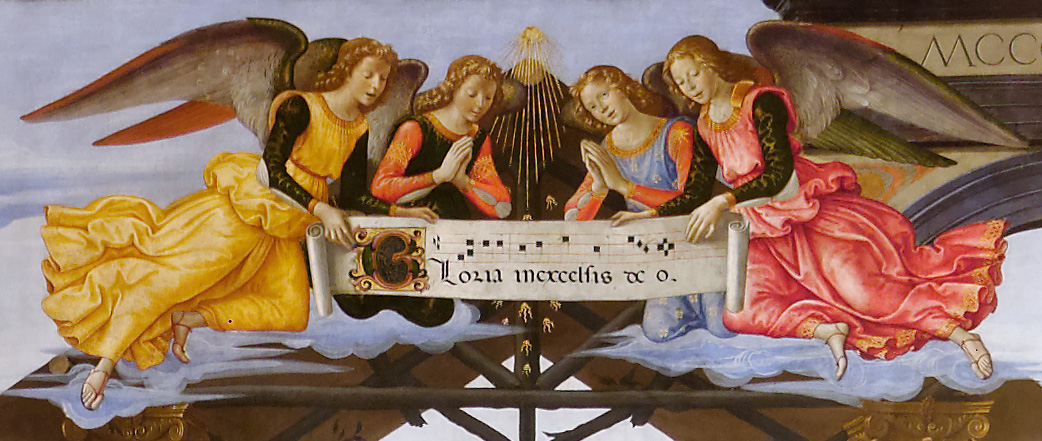
    Adoration of the Magi (detail), Domenico Ghirlandaio (1488-1489) | Wikimedia Commons.

    As we dig into St. Paul’s exhortation in the second reading, we should note a subtlety to today’s Lectionary translation. We hear today, “Your kindness should be known to all,” but “kindness” is an interesting translation of the original Greek, ἐπιεικὲς (epieikes), which means gentle spirit or gentleness. The Latin Vulgate translation is Modestia vestra nota sit omnibus hominibus, or “let your moderation be known unto all men.” So, we have a key word, epieikes or modestia, which is variously translated as forbearance, gentleness, reasonableness, moderation, and humility. In fact, our Lectionary is the only place I’ve found it translated as kindness. This is a point to consider, especially in the context of what we are called to do and to be. Certainly, our call to love God and then our neighbor as ourselves (simply put, a call to caritas or agape) can manifest itself as kindness. I’m not saying this is a mis-translation. But kindness emphasizes an act that we do – something we call up within us and enact on the world around us. These other words: forbearance, gentleness, moderation, and humility, all emphasize a state of internal calm that radiates through our actions. It is best phrased in perhaps the closest translation, gentle spirit. This emphasizes an internal ordering toward God, a letting go of self rather than an assertion of self. St. Paul is exhorting the Philippians (and all of us) to be known for our gentle spirit. Indeed, in the next sentence he says, “Be anxious about nothing.” This is Christianity on earth: a gentle spirit, anxious about nothing, living in Christ and awaiting His triumphant return; awaiting our own second birth into heaven. This is the essence of Gaudete Sunday, especially.

    This gentle spirit, ordered to and ordered by God, is compatible with St. Thomas’s discussion of joy, too. He writes, “joy is not a virtue distinct from charity, but an act, or effect, of charity” (Summa, II-II, q 28.4). Joy, in other words, is brought about by charity. As stated earlier, when God loves us, joy is the natural effect. Contemplating and living in the Christ event brings this joy back to the surface of our minds. Living in Christ also means allowing God’s love – charity – to flow through us to others. Our gentle spirit can be anxious about nothing as we are rejoicing in God always because we exist within the constant effects of charity.

    This is getting a little abstract and philosophical (as St. Thomas tends to do). Let’s bring it back to the reality of Jesus Christ, man and God, alive on earth. In his excellent apostolic exhortation in 1975, Gaudete in Domino, Pope Paul VI reminds us: “But it is necessary here below to understand properly the secret of the unfathomable joy which dwells in Jesus and which is special to Him. It is especially the Gospel of Saint John that lifts the veil, by giving us the intimate words of the Son of God made man. If Jesus radiates such peace, such assurance, such happiness, such availability, it is by reason of the inexpressible love by which He knows that He is loved by His Father” (III). Pope Paul VI goes on to recount the number of ways John tells us Christ knows the Father and is united with Him: “It is an unceasing and total exchange: ‘All I have is yours and all you have is mine.’ The Father has given the Son the power to judge, the power to dispose of life. It is a mutual indwelling: ‘…I am in the Father and the Father in me….’.” Pope Paul VI’s point is to more clearly flesh out the charity that gives us joy. Perfect charity is the relationship between God the Father and God the Son: “Here there is an uncommunicable relationship of love which is identified with His existence as the Son and which is the secret of the life of the Trinity: the Father is seen here as the one, who gives Himself to the Son, without reserve and without ceasing, in a burst of joyful generosity, and the Son is seen as He who gives Himself in the same way to the Father, in a burst of joyful gratitude, in the Holy Spirit.” And, the best part: “And the disciples and all those who believe in Christ are called to share this joy.” There it is! This is the fullness of what St. Paul means when he says rejoice in the Lord always.
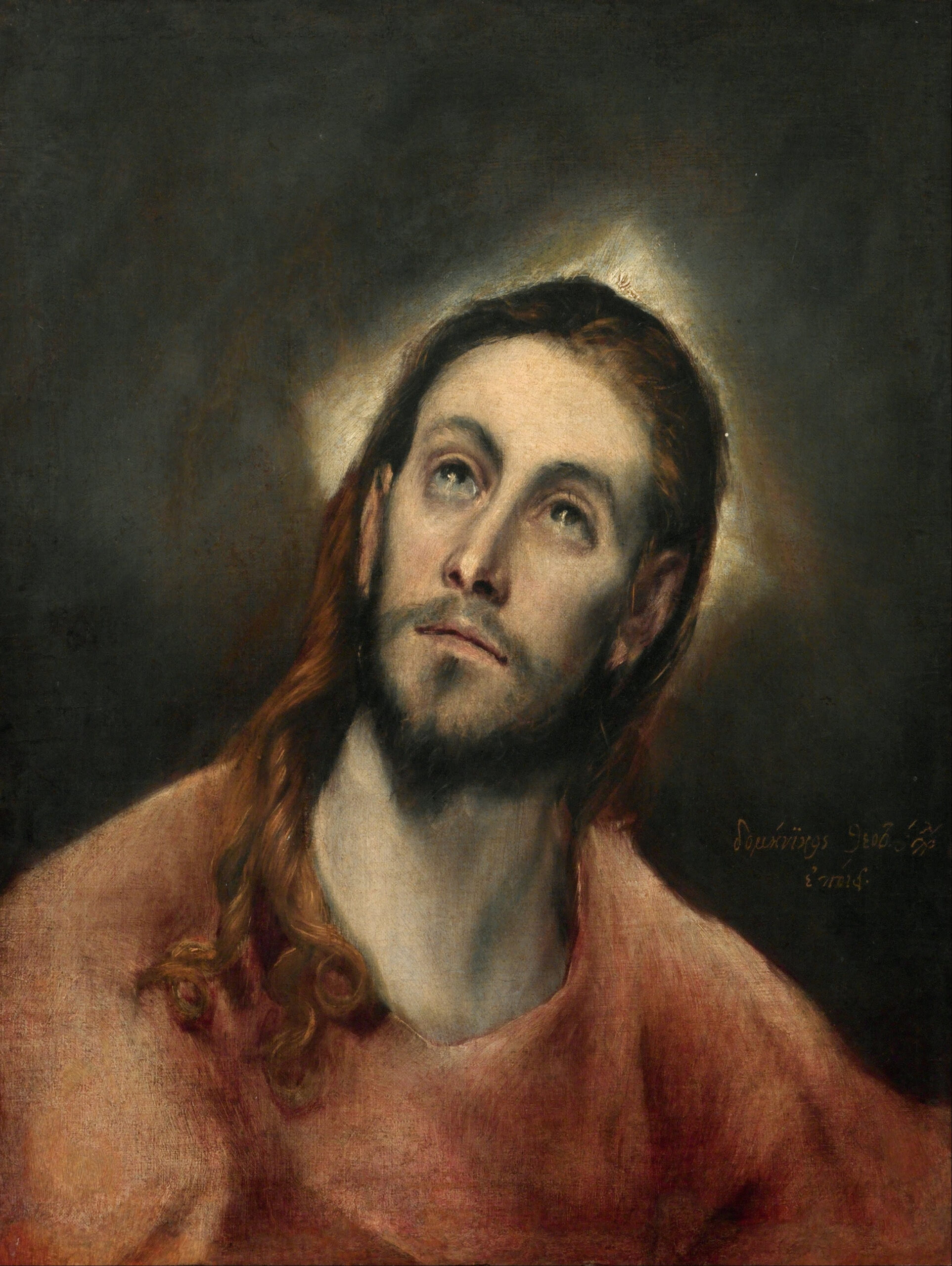
    Christ in Prayer, El Greco (1595-1597) | Wikimedia Commons.

    This (and every) Advent, we remember the anticipation of the world awaiting its Savior. We also anticipate the second coming of Christ. And, finally, we celebrate Christ being here with us already. This third reality is most clearly articulated here on the third Sunday of Advent through St. Paul’s words to the Philippians, who were themselves living in the new reality brought to the Earth through His death and resurrection. Zephaniah, too, in the first reading foresees this age: “the King of Israel, the LORD, is in your midst, you have no further misfortune to fear … Fear not, O Zion, be not discouraged! The LORD, your God, is in your midst, a mighty savior; he will rejoice over you with gladness, and renew you in his love.” What a deep and accurate prophecy! This is the same Word that speaks through St. Paul to the Philippians, a Word that unveils the meaning of the Christ event in the lives of humans. How can we fear misfortunes here on earth when the grave has been conquered and eternal life in Heaven has been offered to us? Humanity’s greatest fear and sadness, that we will cease to exist one day and that life has no meaning beyond the present, has been blown to bits by Christ’s sacrifice. What joy that His love of the Father has provided us a Way to the Kingdom! Rejoice in the Lord always!

    We cannot end this reflection without gazing at the titanic figure of St. John the Baptist, the great prophet, the voice crying out in the wilderness. In the gospel reading, John teaches the crowds to stop being selfish: “share with the person who has none … Stop collecting more than what is prescribed … Do not practice extortion.” Let’s remember that John has felt the effects of charity come to earth; he “leaped for joy” in Elizabeth’s womb when Mary, carrying Jesus, came near. Like a supernova, the child even as an embryo radiated charity upon the world, transforming the hearts of those open to Him. John is so transformed that he spends his life preparing the world for Jesus. What other messianic figure in that day (and there were many, as we know from the historic record) tells his expectant, adulatory followers that he doesn’t want their praise, that “one mightier than I is coming. I am not worthy to loosen the thongs of his sandals”? Only a man who has been transformed by God and holds no stock in worldly things can so thoroughly cast off the mantle that his followers want to place on him. John, filled with the zeal of the Lord, infects his followers with the anticipation of Christ that fills him. What’s more, this anticipation is not just one of looking and waiting but one that paves the way for charity. He tells them to stop being selfish while they wait so that they can prepare themselves for the more radical baptism in the Spirit that Jesus will bring to them. If they can repent, strip away their concern for worldly pleasure and security, they will create fertile ground for the message Christ brings.
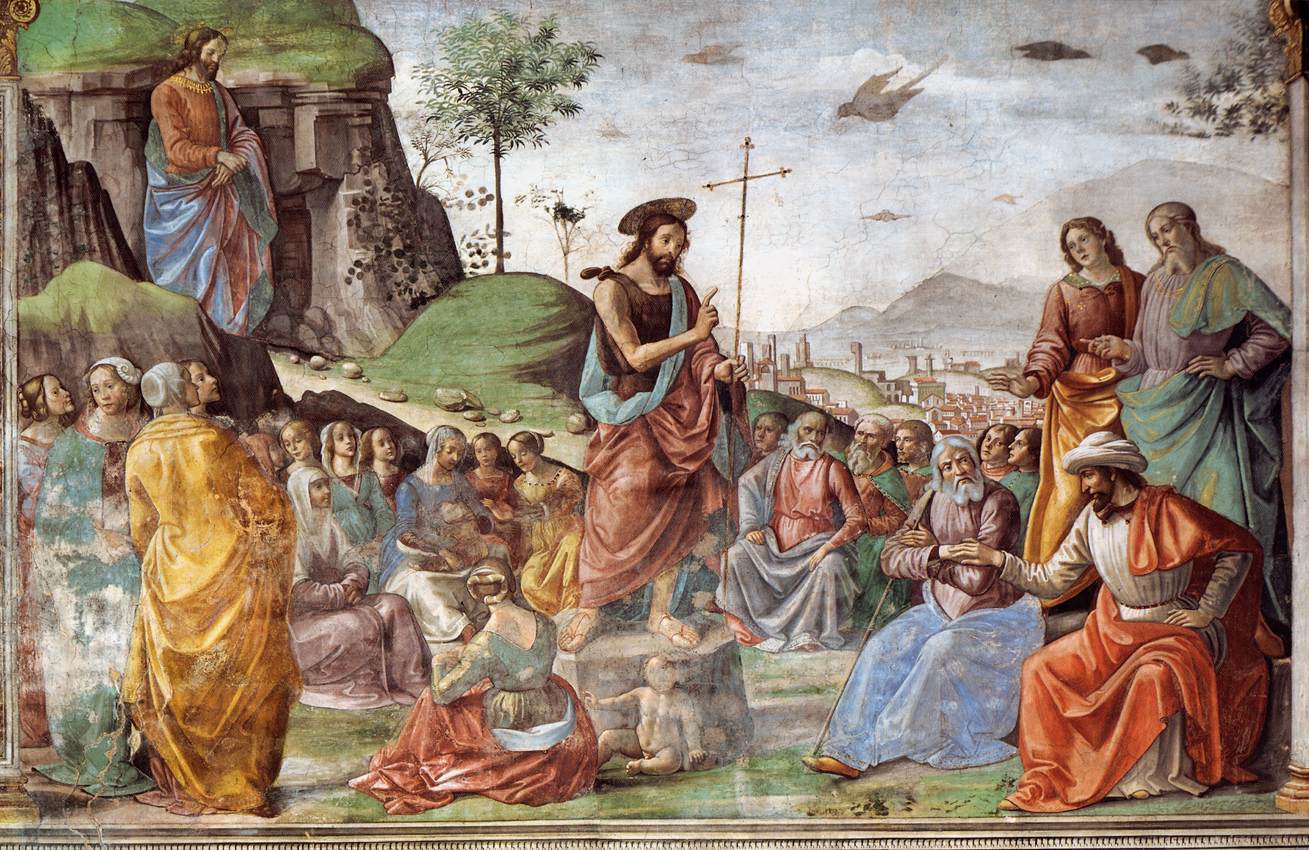
    Preaching of St. John the Baptist, Domenico Ghirlandaio (1486-1490) | Wikimedia Commons.

    I choose the agricultural metaphor purposely, because John, in his brilliance as a prophet, does the same. Let us concentrate on these final words of the gospel reading as John describes Christ: “His winnowing fan is in his hand to clear his threshing floor and to gather the wheat into his barn, but the chaff he will burn with unquenchable fire.” On the most obvious level, the metaphor is one his listeners can understand given the tools and occupation common to their time and place. A winnowing fan is used at the harvest to separate the good grain from the husks, dust, stalks and other “chaff” that do not serve as food. Metaphorically, the wheat are those who please God while the evil ones are the chaff. The harvester is Christ, the one who brings the final judgment. But the metaphor is agricultural particularly because it involves growth and harvest. He could have used a metaphor of a builder choosing strong stones instead of weak ones, or any number of other metaphors. But this one reminds us that life is at stake. First, life is implicated because we can grow into wheat or dead stalks. This is a living process in which we are bound up. Second, life is at stake because the wheat will go on to a greater life (gathered into the barn, or kingdom of Heaven) while the chaff will be burned in unquenchable fire. Finally, the third and most intricate reading here is to consider what the life of mature wheat is. Wheat feeds us, it is nourishment, it is an offering of life. Literally, it forms the grain offering, the minchah, that is prescribed in the Book of Leviticus where the finest parts of the grain, the semolina, are offered to God, either ground, cooked, or burnt. This is our destiny, to feed others, and to be an offering of life to the Father. Our greatest destiny and goal is to be gathered like wheat to the Father where we cease living simply for ourselves (that is, to grow nice, fat grains on the stalk). The mature wheat, having been grown rejoicing in the charity of God, achieves its ultimate purpose: to nourish others and be an offering to God Himself. Astounding depth in a simple metaphor!

    And this is why John must begin the process by having us turn our mindset away from self and towards others. Our ultimate purpose, revealed through Christ, is to grow into something great with a purpose beyond us. If we allow ourselves to rejoice in the Lord always, to be fully caught up in His love, we just might achieve it.
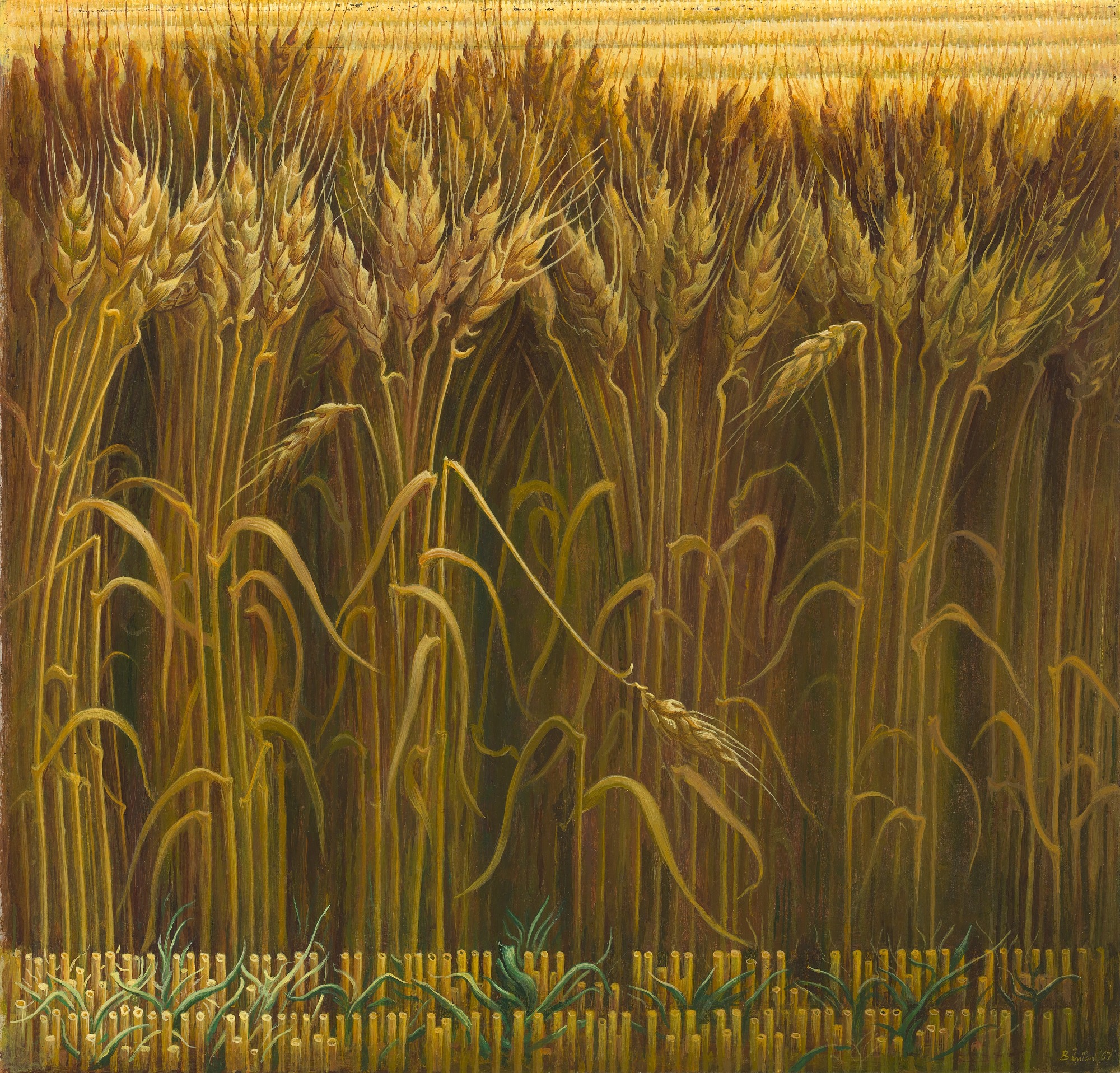
    Wheat, Thomas Hart Benton (1967) | Image courtesy the Smithsonian American Art Museum.
  • Tree Beside Running Waters

    Tree Beside Running Waters

    Thursday in the Second Week of Lent: Jeremiah 17:5-10, Luke 16:19-31.

    (Note: this is a lightly edited version of the reflection I originally wrote in 2020 for the Second Thursday of Lent: Beware the Enchantments of the World.) 

    Today, we hear the parable of the Rich Man and Lazarus from the gospel of St. Luke. On its surface, this parable seems to warn us of too much enjoyment in this world because we will pay for it later (in Hell). As we dig into the parable, however, we see a deeper problem with the rich man. The connection to the reading from Jeremiah becomes more apparent: the enchantments of this world distract us from God, who is busy giving us plenty of opportunities for redemption by our faith and actions.

    The opening of Jesus’s parable almost sounds like a fairy tale: “There was a rich man who dressed in purple garments and fine linen and dined sumptuously each day.” This opening may tempt us to read it as a simple morality play. But the Truth spoken by the Word of God is not just a self-improvement class. It draws our spirit to dwell with Him, even if it does so via a warning.

    Our gospel passage opens: “Jesus said to the Pharisees…” and in Luke, Chapter 15, He is, in fact, in the middle of talking to them. Let’s back up a few verses to get the full context. “The Pharisees, who were lovers of money, heard all this [his last parable that “You cannot serve God and wealth”], and they ridiculed him. So he said to them, ‘You are those who justify yourselves in the sight of others; but God knows your hearts; for what is prized by human beings is an abomination in the sight of God’” (Lk 16:14-15). These parables are specifically for them. We shall see that His criticism of loving money holds true for loving other human desires.

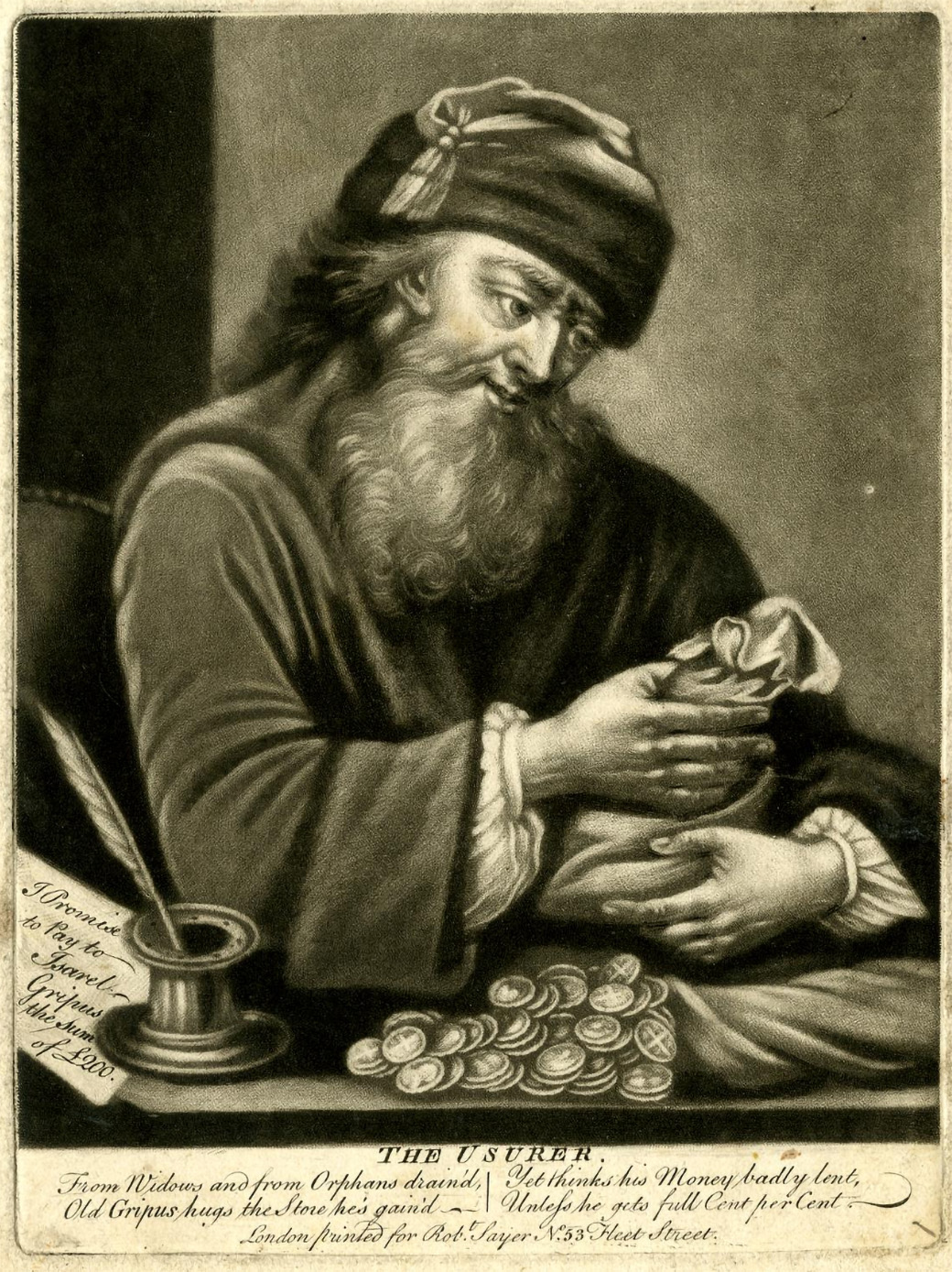
    The Userer, ca. 1766-1774, after George van der Mijn (1721-1763) | Creative Commons, courtesy the British Museum.

    What does today’s parable tell us about the rich man other than his expensive tastes and gluttony? We can glean that he did not seem to give alms of any sort to Lazarus, who would have been glad to have “scraps that fell” from his table. Just two days ago, we heard Jesus saying of the Pharisees: “For they preach but they do not practice. They tie up heavy burdens hard to carry and lay them on people’s shoulders, but they will not lift a finger to move them. All their works are performed to be seen.” In the rich man we see the same lack of helping as we do in the Pharisees: he does “not lift a finger” to relieve Lazarus’s suffering.

    He displays his true colors when he finds himself in Hell. Unbelievably, he retains an arrogant sense of self-worth greater than Lazarus when he says, “Send Lazarus to dip the tip of his finger in water and cool my tongue.” Here the rich man is “in torment,” asking for pity, and he’s still treating Lazarus as a servant or slave! 

    Abraham explains that they are reaping their rewards based on their experiences and actions on earth, and that “a great chasm” separates them. And still the rich man asks, “send him to my father’s house” to warn his family to mend their ways, betraying his continued dismissal of Lazarus as a person with dignity. He sees Lazarus as a tool to be employed for his family’s benefit, arguing with Abraham, “if someone from the dead goes to them, they will repent.” His sense of superiority and belief that everyone (even Abraham!) should listen to him is astounding, and certainly a pointed example for the Pharisees who were listening.

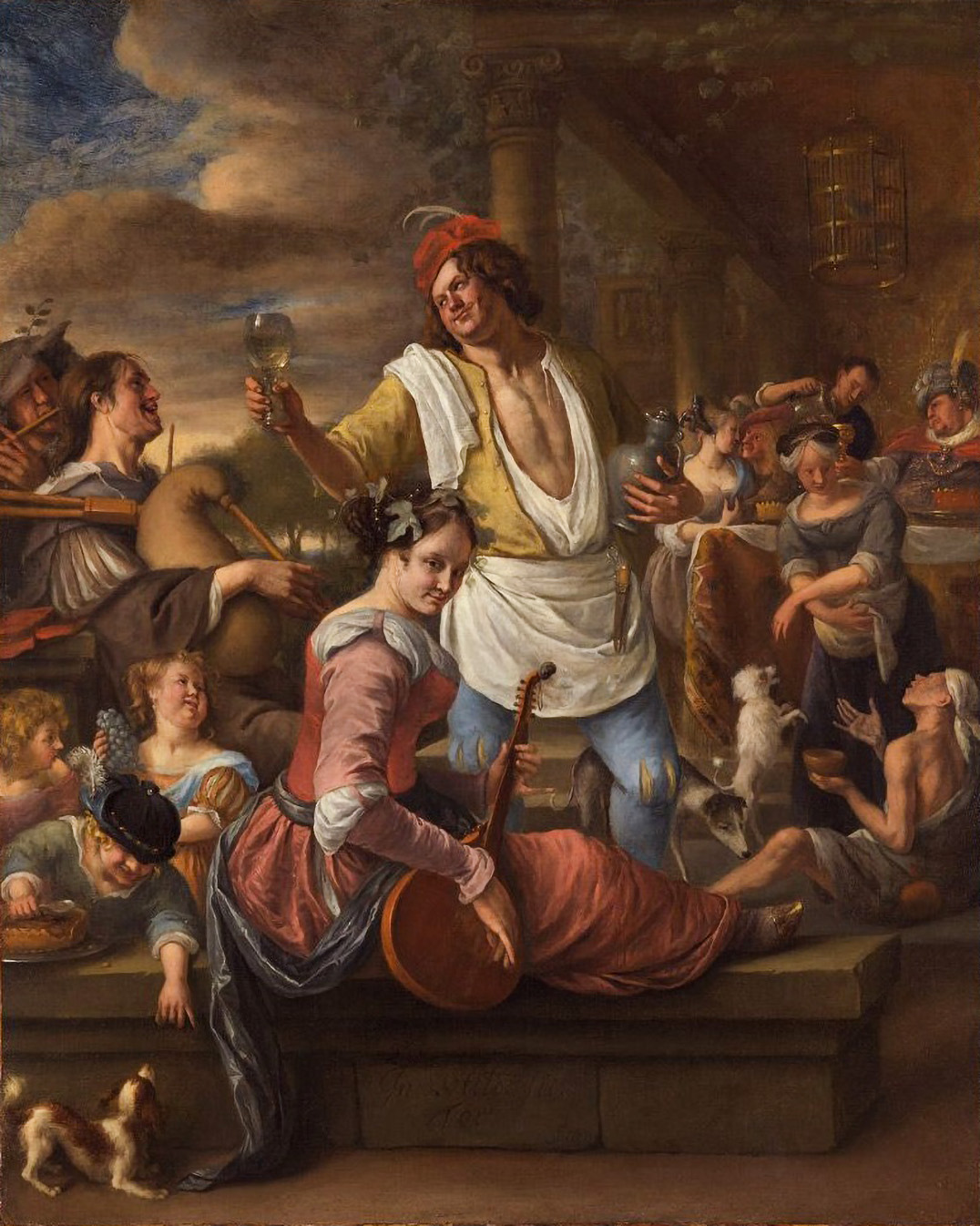
    The Parable of the Rich Man and Lazarus (1677), Jan Steen | Wikimedia Commons. I particularly like the self-important, dismissive expression of the man holding the goblet in the foreground, which captures the failings of the rich man archetype. Note that the actual rich man from the parable, however, seems to be in the upper right corner, even more removed from humanity in his gluttony. Overall, I appreciate Jan Steen’s painting for focusing on the enchantments of the world, raising a glass to toast today’s enjoyments, oblivious to the judgment that is coming.

     For his part, Abraham at first replies with a certain pity for the rich man, saying, “My child, remember that you received what was good during your lifetime …” This turns eerily neutral after the rich man displays his unrepentant attitude: “They have Moses and the prophets. Let them listen to them.” And finally he utters some baleful words indeed at the end: “If they will not listen to Moses and the prophets, neither will they be persuaded if someone should rise from the dead.” This last proclamation can clearly be applied to Christ, who will rise from the dead, and those who refuse to listen are, of course, the Pharisees themselves.

    If we return to the verse that set the context for the parable of the rich man, we can see how the parable illustrates Jesus’s point: “God knows your hearts; for what is prized by human beings is an abomination in the sight of God.” Money, gluttony, and other things “of the flesh” take the brunt of the blame, but let’s not overlook that Christ is talking about God knowing our hearts. Love of wealth and being noticed are the “bad fruit” from a diseased tree — “every good tree bears good fruit, but the bad tree bears bad fruit” (Mt 7:15). The tree itself is what concerns God — He wants us to grow strong and beautiful and bear good fruit (i.e., love one another, good deeds), which require nourishment from Him and His precepts. 

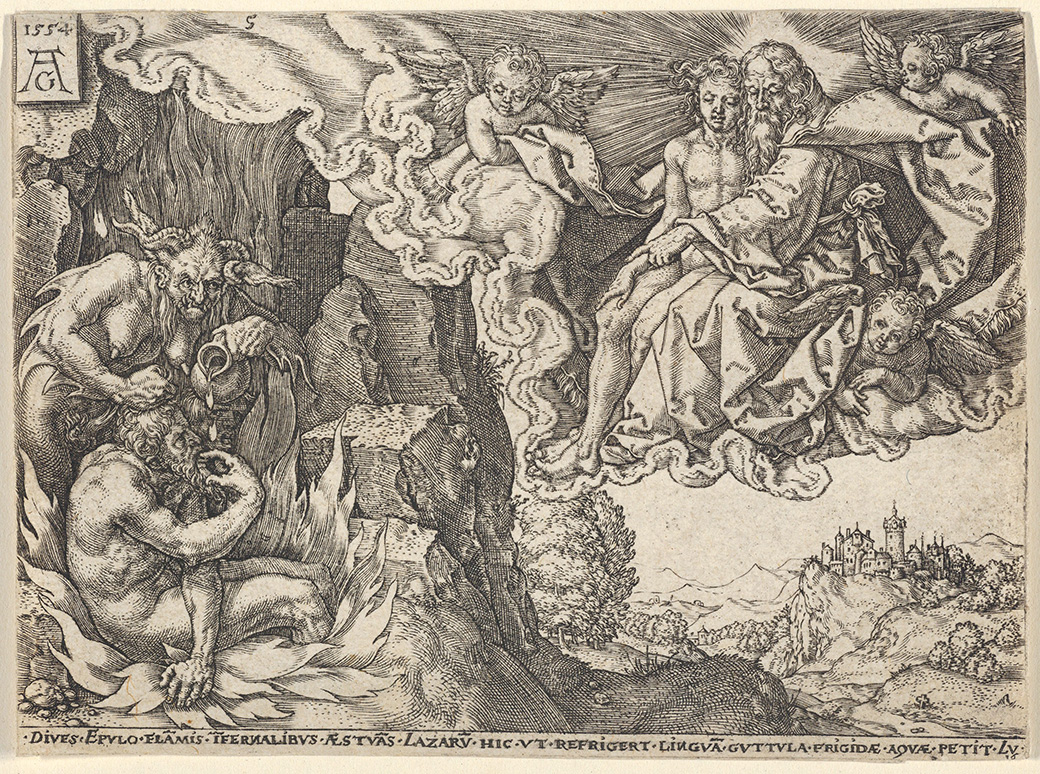
    The Rich Man in Hell, Seeing Lazarus Embraced by Abraham, from The Parable of the Rich Man and Lazarus (1554), Heinrich Aldegrever | Creative Commons, courtesy the Metropolitan Museum of Art.

    This is where the first reading from Jeremiah is helpful. He employs this same imagery of a tree that is either healthy or diseased, depending on a person’s attachment to God or to the world. He says that he “who seeks his strength in flesh … is like a barren bush in the desert … [that] stands in a lava waste, a salt and empty earth.” Conversely, “the man who trusts in the LORD … is like a tree planted beside the waters that stretches out its roots to the stream … In the year of drought it shows no distress, but still bears fruit.” I love the image of a person strong in the Lord being a plant growing by running waters (also used in the first Psalm), probably because it simplifies life: all you need to make you thrive is the Word of God. What a refreshing thought when compared to all of the other “things” we think we need to do and accumulate in this life. Applying Jeremiah’s imagery to the gospel reading, the Pharisees are the “barren bush in the desert,” removed from the life-giving spring because they reflect everything back on themselves. While they seem rich (in this life), they will find that they are barren spiritually and destitute in the next life. 

    But, look! God gives us endless chances to return to the stream of living water. What was Lazarus but a chance for the rich man to turn his heart to God and practice charity? And what was Lazarus’s suffering but his cross to bear for the salvation of another (even if that other person did not accept the salvation offered to him)? This is God’s prerogative as our Master and Creator. The Word tells us through Jeremiah at the end of today’s reading:

    I, the LORD, alone probe the mind
    and test the heart,
    To reward everyone according to his ways,
    according to the merit of his deeds. 

    This is the work of God to bring us back to unity with Him: probing our minds, providing opportunities to exercise our spiritual muscle, and ultimately rewarding us according to our ways and deeds. As fruit shows us the type of tree, our deeds reveal the heart of the person. Charity comes from a good heart that finds its refreshment in the Lord. Selfishness comes from a heart focused on this world’s enchantments and the self alone. This is why we Catholics insist that our justification (i.e., place in heaven) comes from faith and works, not just faith alone. This teaching is found throughout scripture, no more clearly than today’s readings.

    At the risk of slightly repeating myself, let’s tackle one of the common complaints humans have voiced throughout our history, “why is there suffering in the world?” The parable of the rich man is a great reply to this. For the rich man, God is probing his heart and giving him opportunities to return to the sheepfold. For Lazarus, he must remember that he will be comforted in heaven if he bears his suffering with dignity and a focus on God. What’s more, all of us must remember that God works in ways beyond our immediate knowledge to bring us closer to him. Lazarus is God’s way to reach out to the rich man’s heart. Which of us can truly bemoan the honor of being used by God for a holy purpose, even if it involves our suffering? Was this not the exact example Christ set for us? 

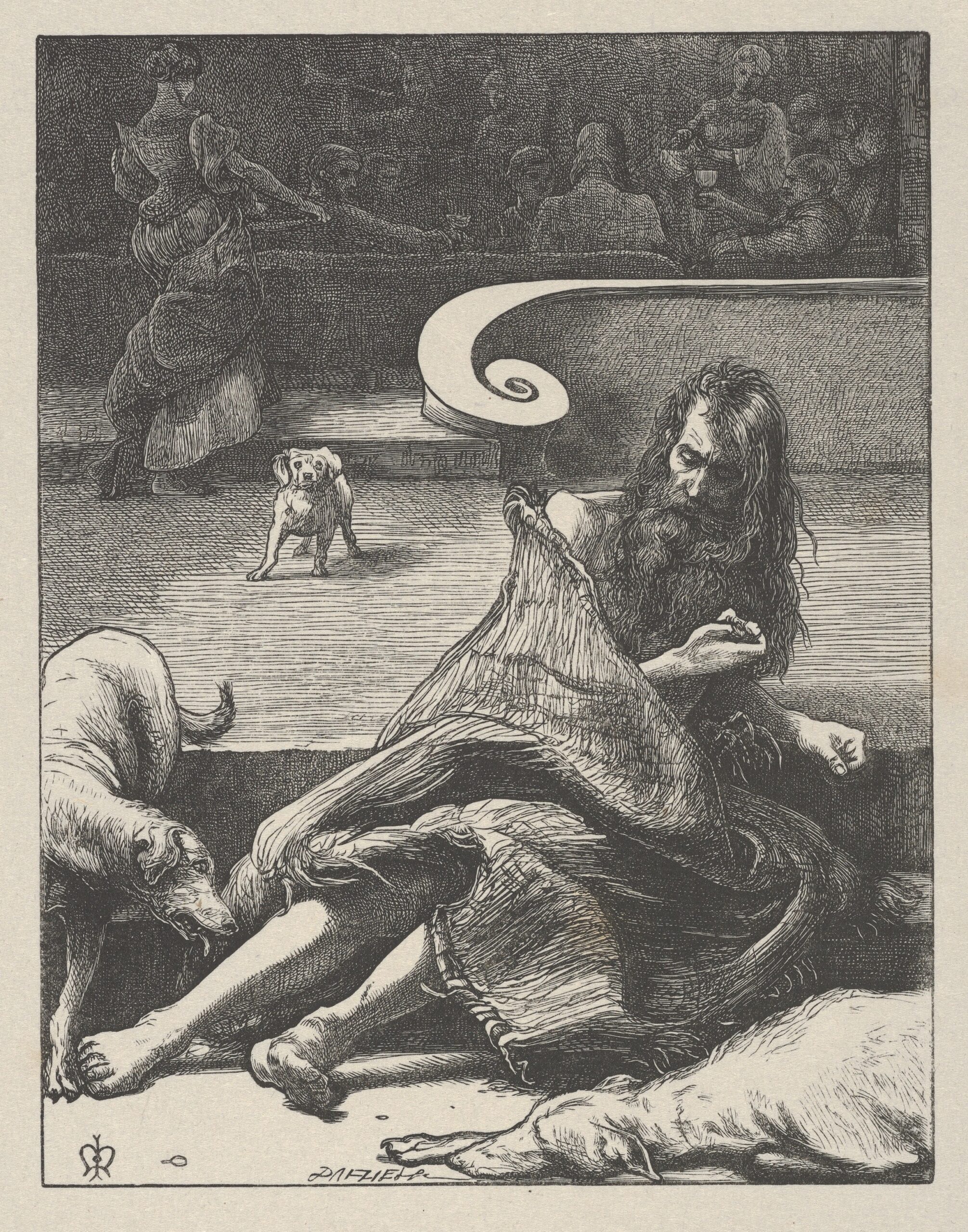
    The Rich Man and Lazarus (The Parables of Our Lord and Saviour Jesus Christ), 1864, Sir John Everett Millais | Creative Commons, courtesy The Metropolitan Museum of Art. I love this more tender artistic look at Lazarus, who is often sidelined in the story.

    In this vein, let’s finish this reflection with the words of St. Therèse of Lisieux. One of only three female Doctors of the Church, St. Therèse led an incredibly short life, dying at the age of 24 from tuberculosis. She suffered much (even as a child she suffered from mysterious illnesses that left her bed-bound) but bore it with incredible kindness towards others. “As Jesus had made me realize that the Cross was the means by which He would give me souls,” she said, “the more often it came my way, the more suffering attracted me.” What a fantastic attitude towards suffering!

    Since suffering was “attractive” to her as a way of doing God’s will, she saw small sacrifices less as burdens and more like acts of love. She writes, “Miss no single opportunity of making some small sacrifice, here by a smiling look, there by a kindly word; always doing the smallest right and doing it all for love.”

    And, finally, almost as a nod to Lazarus in today’s reading, she writes, “Our Lord’s love shines out just as much through a little soul who yields completely to His Grace as it does through the greatest.” Talk about a tree growing next to life-giving waters! She is a true inspiration.

    Thank you, St. Therèse for giving us such a positive way to understand turning our hearts to God and making suffering a joy to bear for the Lord.

  • Pray for your Persecutors

    Pray for your Persecutors

    Saturday in the First Week of Lent: Deuteronomy 26:16-19, Matthew 5:43-48.

    Today’s readings spell out our compact with God in a nutshell. He will make us sacred and all he asks in return is that we love unconditionally. We will ponder today how difficult it is to love those who hate us and are mean to us, but let’s consider for a moment the flip side. How easy and generous this covenant is! After all, loving is the best feeling one can possibly have. Not just easy love for someone who’s nice to you, but also that generous love for a stranger when you give them a coffee or a blanket. God is not trying to lead us down a necessarily onerous path (although the Cross is part of the path) — He has infused this world with grace and His Spirit and nothing is greater than union with God’s grace and Spirit. They lift us up, give us strength, reveal beauty, and elevate our souls. This feels good. As Jesus tells us, “Take my yoke upon you and learn from me, for I am gentle and humble in heart, and you will find rest for your souls. For my yoke is easy and my burden is light” (Mt 11:29-30).

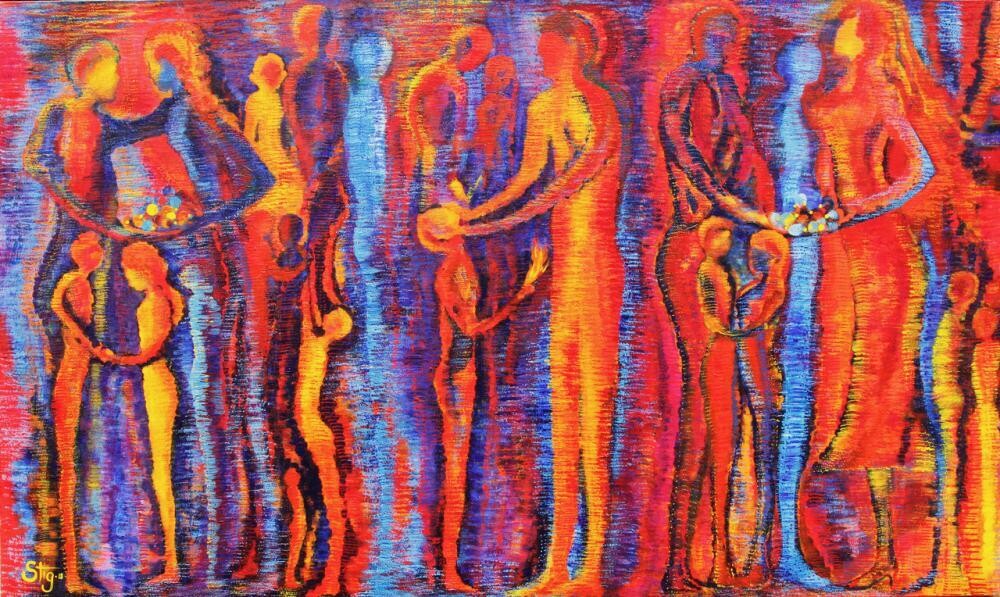
    Generosity (contemporary), Stig Lofnes | Image from silapix.com.

    For those like St. Thomas Aquinas, who believe our capacity for reason is an essential part of our spiritual being and scientific pursuits can aid our ability to know God’s wondrous works, the 2010s were a boom decade in happiness research. Several studies showed that people reported increased happiness when engaging in generous behaviors like giving sweets or money to others rather than keeping these things for themselves. This is “light” social science, but the hard sciences back this up.

    In the 2017 article “A neural link between generosity and happiness,” the authors use functional MRI to show that specific regions in the brain linked to happiness controls are more active in people practicing generosity: “Generous decisions engage the temporo-parietal junction (TPJ) in the experimental more than in the control group and differentially modulate the connectivity between TPJ and ventral striatum. Importantly, striatal activity during generous decisions is directly related to changes in happiness.”¹ So science has finally showed a physical manifestation of something God has been urging us to do since we’ve been human! Listening to God’s Word and practicing charity undeniably makes us feel good.

    So why is it seem to be so rare?

    We can’t forget that we’re living in a fallen world, the devil’s world. Jesus acknowledges this, for instance, before his Passion and Death in John’s gospel: “Now is the judgment of this world; now the ruler of this world will be driven out” (John 12:31).

    St. Paul writes several times how Christians, the children of light, must continue what Christ started and dispel the darkness of the world. He describes the action of Satan: “In their case the god of this world has blinded the minds of the unbelievers, to keep them from seeing the light of the gospel of the glory of Christ, who is the image of God” (2 Cor 4:4). And the devil’s primary mode of blinding us to the truth is through our senses, through temptations that beguile us and ensnare us into believing that we must fulfill our desires at all costs.

    The redemption of the world out of the clutches of the devil won’t be complete until the Judgement Day and Christ’s return. Until then, we struggle with temptations contrary to God’s law. This is our cross to bear, and why Jesus tells us, “If any want to become my followers, let them deny themselves and take up their cross and follow me” (Mt 16:24).

    The struggle is real. St. Paul writes to the Romans about the inner conflict between knowing what’s right but still doing the wrong thing: “For we know that the law is spiritual; but I am of the flesh, sold into slavery under sin. I do not understand my own actions. For I do not do what I want, but I do the very thing I hate” (Rom 7:14-15). He speaks of being sold into slavery under sin, that is the original sin of Adam and Eve that cursed humanity to be subjects of the prince of the world, Satan. 

    Yes, the struggle. This is why God and Moses are so forceful in setting the commandments before the Jewish people. God knows that, in our fallen state, we need strong guidance, a strong dose of His truth in order to sustain our moral fiber. Moses says, “This day the LORD, your God, commands you to observe these statutes and decrees. Be careful, then, to observe them with all your heart and with all your soul.” In just the short passage from Deuteronomy in today’s first reading, we hear “command,” “observe,” “walk,” “hearken,” and “keep.” On the other side of the equation, we hear twice that God has “promised” them in return and twice that this is an “agreement.”

    If it feels a little bit like a parent repeating himself to his wayward child in order to impress upon the child the need to do the right thing, well, it is exactly that. But the promise is so great. In no uncertain terms, God promises to reverse the curse that He placed on humanity via Adam and Eve: “you will be a people sacred to the LORD.” 

    This return to a sacred state from our fallen state, as we know, comes through His Son and the great sacrifice to expiate our sins. God’s patient plan is to cultivate his Chosen People to be the receptacle of his divinity (Mary, that is) and the first recipients of his mercy and grace. 

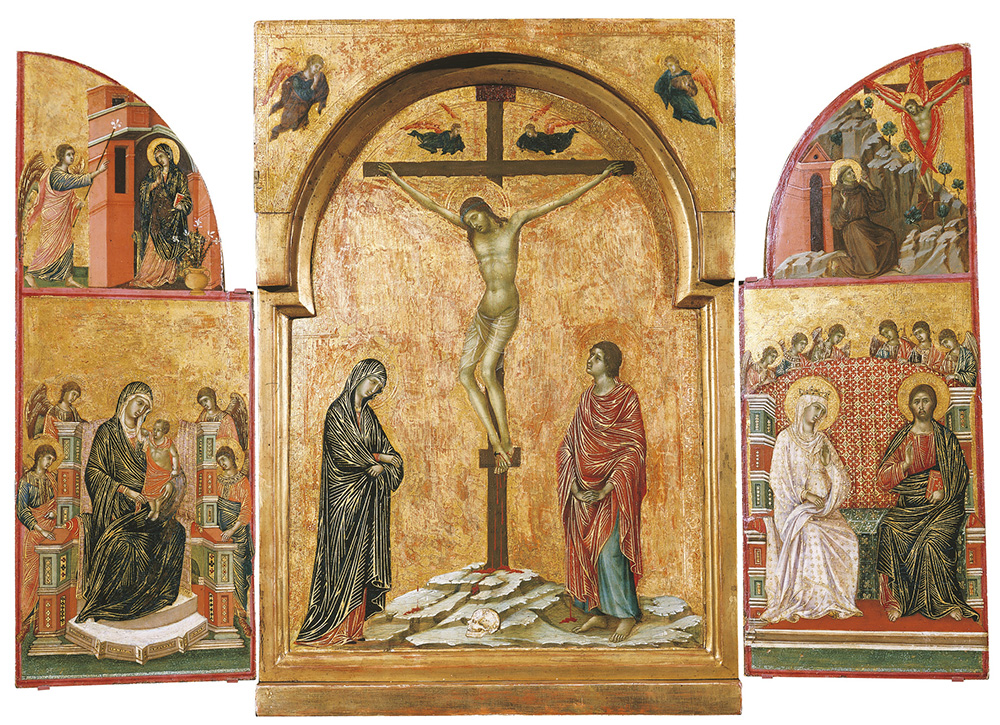
    Triptych: Crucifixion and other Scenes (1302-1308), Duccio di Buoninsegna | Creative Commons, courtesy the Royal Collection Trust, England.

    But Jesus perfects our understanding of the Ten Commandments when he comes. Today, he teaches, “You have heard that it was said, You shall love your neighbor and hate your enemy. But I say to you, love your enemies, and pray for those who persecute you.” The “hate your enemy” part was not in the Ten Commandments but rose instead as a cultural tradition, which is why Jesus must correct it.

    He explains that if we want to be a people sacred to the Lord, we must truly be worthy to be called his children; we must act like Him: “that you may be children of your heavenly Father, for he makes his sun rise on the bad and the good, and causes rain to fall on the just and the unjust.” It’s a lovely sentence to describe the indiscriminate love of the Father, because sun and rain are life-giving aspects of creation that God has created to nourish us. Jesus ends with, “So be perfect, just as your heavenly Father is perfect.” Tall order! This is the call of sainthood. But then, the reward couldn’t be greater, to reclaim our status as a people sacred to Him.

    OK, it’s time to get real with ourselves. Is perfection possible? Even just this one commandment, to love everyone, to pray for your persecutors? Let’s say that we are faithful people, that we cultivate a relationship with God in prayer and receive the sacraments as part of the Church on earth. Let’s say that we even make a point not to have “enemies,” per se. That is, even if people do evil against us, we forgive them and do not harbor hatred for them, making them an enemy. Is that the same as loving them?

    Can we remind ourselves to literally pray for the person who is being mean to us or making the planet a worse place by their greed and pride? Reason tells me that I would need a heck of a thick skin not to react badly to someone road raging at me or yelling at me in a store for no reason other than they are having a crappy day. Practically speaking, I think I would need tons of patience and tons of practice.

    While these practical considerations might be true to an extent, the one thing I’m not relying on here is God’s grace. If we are trying to be loving, wouldn’t it make sense to appeal to the author of love itself? Let’s be honest, we can’t do this on our own — our sense of pride and injustice is too great to have someone scream at us unreasonably and meet them with love in return. Or have someone drag us to court unfairly and meet them with love in return. Or have someone want to silence us, arrest us, beat us because we are different than them … and meet them with love in return.

    Thankfully, God made us more than just physical creatures. We are spiritual creatures! We have something available to us that elevates us from being mere animals and we need to enter into “that mysterious encounter known as prayer” (CCC, 2567). If we can shut off our knee-jerk response for just a moment and enter into that mystical space of prayer, it immediately helps us. Just closing your eyes and reaching out with your soul to ask God for help has a calming effect in my experience.

    We have many saints as role models for us. We also have modern role models who have dealt with some of the worst persecution outside of war — I’m speaking of icons from the civil rights movement, specifically Dr. Martin Luther King, Jr. Facing blind hatred from white supremacists, politicians reluctant to enact change, and a black populace vacillating between violent retribution and nonviolence, King’s words came from his deep Christian spirituality: “Darkness cannot drive out darkness; only light can do that. Hate cannot drive out hate; only love can do that.” King’s statement moves beyond the internal struggle to acknowledge the spiritual forces at work.

    If we do not consider that we are caught up in a much bigger world than what we perceive with our senses, we are blind to truths that we are called to understand. King helps us remember what Jesus had to say about his own Passion and Death — that it was about vanquishing Satan and death, not about his feelings or pride. I particularly like another quote from King: “I have decided to stick with love. Hate is too great a burden to bear.” He knew that beyond the emotional burden of hate, the burden of sin was much too great to carry.

    Martin Luther King, Jr. (2013), Derek Russell | Image from mccall.com

    Look at a video recording of what King had to deal with and realize that if he could channel love in the face of the hate he endured, it should be a piece of cake for most of the rest of us.

    As we keep our sights on being perfect just as our heavenly Father is perfect, Let’s remember that God knows what it’s like to be human. Jesus acknowledges the limitations of our minds and bodies to his favored apostles this when praying at the Garden of Gethsemane: “Stay awake and pray that you may not come into the time of trial; the spirit indeed is willing, but the flesh is weak” (Mt 26:41). This added gift from God is that he showed us his willingness to become completely human and experience the same weaknesses we experience. There’s some experiential empathy for you. He gives us the sacrament of Reconciliation to help us return to him with a clean soul again and again. And he gives us the richness of his Word to explore over and over in order to help us slowly, painfully, resist hatred and enmity, replacing it with the spiritual ballast of prayer. 


    ¹ Park, S., Kahnt, T., Dogan, A. et al. A neural link between generosity and happiness. Nat Commun 8, 15964 (2017). https://doi.org/10.1038/ncomms15964

  • Beware the Enchantments of the World

    Beware the Enchantments of the World

    Thursday in the Second Week of Lent: Jeremiah 17:5-10, Luke 16:19-31.

    Today, we hear the Parable of the Rich Man and Lazarus from the gospel of St. Luke. On its surface, this parable seems to warn us of too much enjoyment in this world because we will pay for it later (in Hell). As we dig into the parable, however, we see a deeper problem with the rich man. The connection to the reading from Jeremiah becomes more apparent: the enchantments of this world distract us from God, who is, in the meantime, giving us plenty of opportunities for redemption by our actions.

    The opening of Jesus’s parable almost sounds like a fairy tale: “There was a rich man who dressed in purple garments and fine linen and dined sumptuously each day.” This opening may tempt us to read it as a simple morality play. But the Truth spoken by the Word of God is not just a self-improvement class. It draws our spirit to dwell with Him, even if it does so via a warning.

    We must note how this passage opens: “Jesus said to the Pharisees…” Let’s back up a few verses to get the full context. “The Pharisees, who were lovers of money, heard all this [his last parable that “You cannot serve God and wealth”], and they ridiculed him. So he said to them, ‘You are those who justify yourselves in the sight of others; but God knows your hearts; for what is prized by human beings is an abomination in the sight of God’” (Lk 16:14-15). The parable of the rich man is specifically for them, and his criticisms of the Pharisees speak loudly in it.

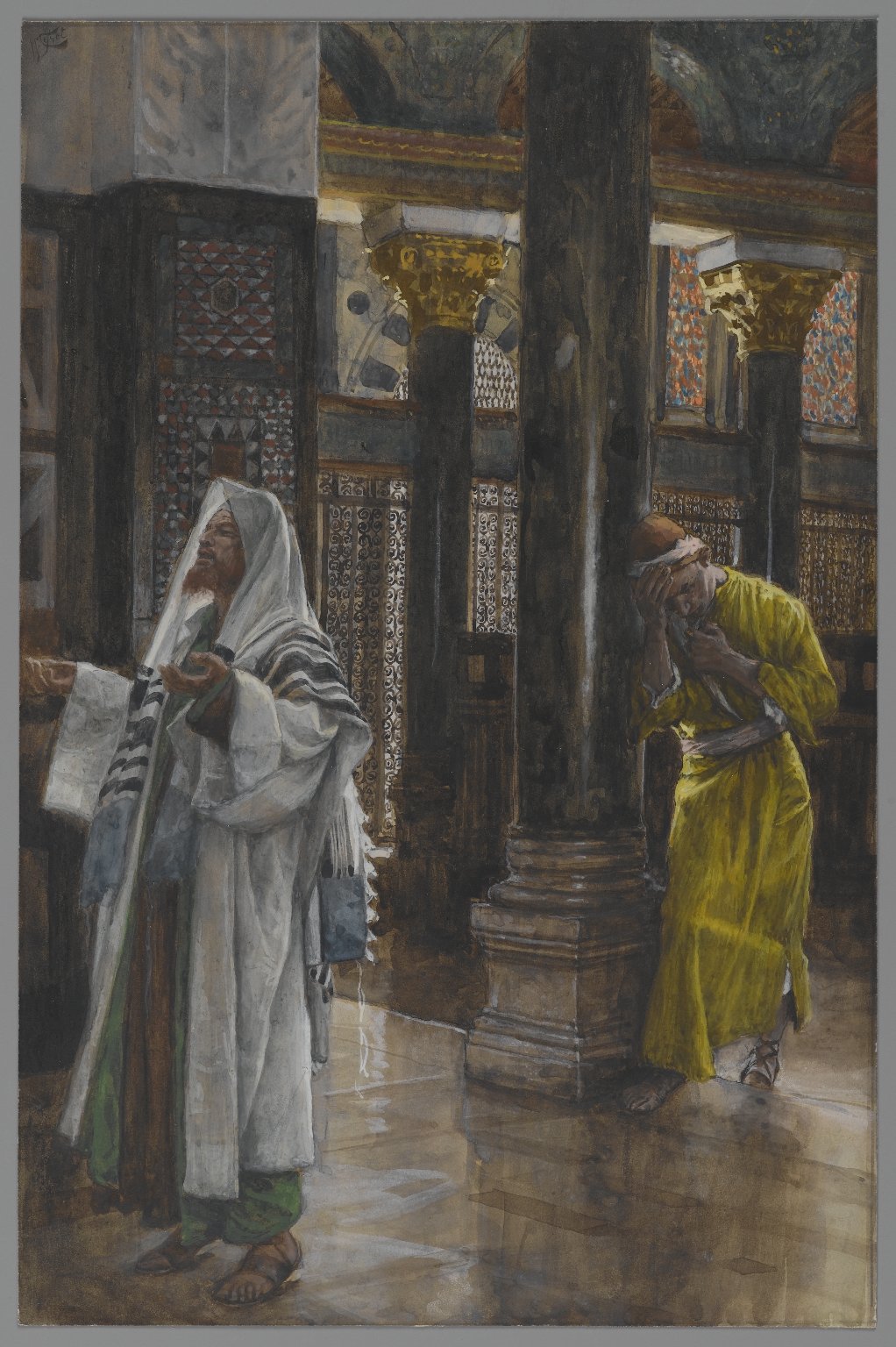
    The Pharisee and the Publican (Le pharisien et le publicain), 1886-1894, James Tissot | Creative Commons, courtesy the Brooklyn Museum.

    So, what do we know about the rich man other than his expensive tastes and gluttony? We can glean that he did not seem to give alms of any sort to Lazarus, who would have been glad to have “scraps that fell” from his table. Just two days ago, we heard Jesus saying of the Pharisees: “For they preach but they do not practice. They tie up heavy burdens hard to carry and lay them on people’s shoulders, but they will not lift a finger to move them. All their works are performed to be seen.” (See the post Led by the Master for more on this aspect of the Pharisees.) In the rich man we see the same: he does “not lift a finger” to relieve Lazarus’s suffering.

    So this is no oversight from an otherwise kindly rich man in the parable. He displays his true colors when he finds himself in Hell. Unbelievably, he retains an arrogant sense of self-worth as being greater than Lazarus when he says, “Send Lazarus to dip the tip of his finger in water and cool my tongue.” Here the rich man is “in torment,” asking for pity, and he’s still treating Lazarus as a servant or slave! 

    Abraham explains that they are reaping their rewards based on their experiences and actions on earth, and that “a great chasm” separates them. And still the rich man asks, “send him to my father’s house” to warn his family to mend their ways, betraying his continued dismissal of Lazarus as a person with dignity. He sees Lazarus as a tool to be employed for his family’s benefit, arguing with Abraham, “if someone from the dead goes to them, they will repent.” His sense of superiority and belief that everyone (even Abraham!) should listen to him is astounding, and certainly a pointed example for the Pharisees who were listening.

    The Parable of the Rich Man and Lazarus (1677), Jan Steen | Wikimedia Commons. I particularly like the self-important, dismissive expression of the man holding the goblet in the foreground, which captures the failings of the rich man archetype. Note that the actual rich man from the parable, however, seems to be in the upper right corner, even more removed from humanity in his gluttony. Overall, I appreciate Jan Steen’s painting for focusing on the enchantments of the world, raising a glass to toast today’s enjoyments, oblivious to the judgment that is coming.

     For his part, Abraham at first replies with a certain pity for the rich man, saying, “My child, remember that you received what was good during your lifetime …” This turns eerily neutral after the rich man displays his unrepentant attitude: “They have Moses and the prophets. Let them listen to them.” And finally he utters some baleful words indeed at the end: “If they will not listen to Moses and the prophets, neither will they be persuaded if someone should rise from the dead.” This last proclamation can clearly be applied to Christ, who will rise from the dead, and those who refuse to listen are, of course, the Pharisees themselves.

    If we return to the verse that set the context for this parable, we can see how it illustrates Jesus’s point: “God knows your hearts; for what is prized by human beings is an abomination in the sight of God.” Money, gluttony, and other things “of the flesh” take the brunt of the blame, but let’s not overlook that Christ is talking about God knowing our hearts. Love of wealth and being noticed are the “bad fruit” from a diseased tree — “every good tree bears good fruit, but the bad tree bears bad fruit” (Mt 7:15). The tree itself is what concerns God — He wants us to grow strong and beautiful and bear good fruit (i.e., love one another, good deeds), which require nourishment from Him and faithfulness to his precepts. 

    The Rich Man in Hell, Seeing Lazarus Embraced by Abraham, from The Parable of the Rich Man and Lazarus (1554), Heinrich Aldegrever | Creative Commons, courtesy the Metropolitan Museum of Art.

    This is where the first reading from Jeremiah is helpful. He employs this same imagery of a tree (bush) that is either healthy or diseased, depending on a person’s attachment to God or to the world. He says that he “who seeks his strength in flesh … is like a barren bush in the desert … [that] stands in a lava waste, a salt and empty earth.” Conversely, “the man who trusts in the LORD … is like a tree planted beside the waters that stretches out its roots to the stream … In the year of drought it shows no distress, but still bears fruit.” I love the image of a person strong in the Lord being a plant growing by running waters (also used in the first Psalm), probably because it simplifies life: all you need to make you thrive is the Word of God. What a refreshing thought when compared to all of the other “things” we think we need to do and accumulate in this life. Applying Jeremiah’s imagery to the gospel reading, the Pharisees are the “barren bush in the desert,” removed from the life-giving spring because they reflect everything back on themselves. While they seem rich (in this life), they will find that they are barren spiritually and destitute in the next life. 

    But, look! God gives us endless chances to return to the stream of living water. What was Lazarus in life but a chance for the rich man to turn his heart to God and practice charity? And what was Lazarus’s suffering but his cross to bear for the salvation of another (even if that other person did not accept the salvation offered to him)? This is God’s prerogative as our Master and Creator. The Word tells us through Jeremiah at the end of today’s reading:

    I, the LORD, alone probe the mind
    and test the heart,
    To reward everyone according to his ways,
    according to the merit of his deeds. 

    This is the work of God to bring us back to unity with Him: probing our minds, testing our hearts, and ultimately rewarding us according to our ways and deeds. As fruit shows us the type of tree, our deeds reveal the heart of the person. Charity comes from a good heart that finds its refreshment in the Lord. Selfishness comes from a heart focused on this world’s enchantments and the self alone. This is why we Catholics insist that our justification (i.e., place in heaven) comes from faith and works, not just faith alone. This teaching is found throughout scripture, no more clearly than today’s readings.

    At the risk of slightly repeating myself, let’s tackle one of the common complaints humans have voiced throughout our history, “why is there suffering in the world?” The Parable of the Rich Man is a great reply to this. For the rich man, God is probing his heart and testing him to bring him back into the sheepfold. For Lazarus, he must remember that he will be comforted in heaven if he bears his suffering with dignity and a focus on God. What’s more, all of us must remember that God works in ways beyond our immediate knowledge to bring us closer to him. Lazarus is God’s way to reach out to the rich man’s heart. Which of us can truly bemoan the honor of being used by God for a holy purpose, even if it involves our suffering? Was this not the exact example Christ set for us? 

    The Rich Man and Lazarus (The Parables of Our Lord and Saviour Jesus Christ), 1864, Sir John Everett Millais | Creative Commons, courtesy The Metropolitan Museum of Art. I love this more tender artistic look at Lazarus, who is often sidelined in the story.

    In this vein, let’s finish this reflection with the words of St. Therèse of Lisieux. One of only three female doctors of the Church, St. Therèse led an incredibly short life, dying at the age of 24 from tuberculosis. She suffered much (even as a child she suffered from mysterious illnesses that left her bed-bound) but bore it with incredible kindness towards others. “As Jesus had made me realize that the Cross was the means by which He would give me souls,” she said, “the more often it came my way, the more suffering attracted me.” What a fantastic attitude towards suffering!

    Since suffering was “attractive” to her as a way of doing God’s will, she saw small sacrifices less as burdens and more like acts of love. She writes, “Miss no single opportunity of making some small sacrifice, here by a smiling look, there by a kindly word; always doing the smallest right and doing it all for love.”

    And, finally, almost as a nod to Lazarus in today’s reading, she writes, “Our Lord’s love shines out just as much through a little soul who yields completely to His Grace as it does through the greatest.” Talk about a bush growing next to life-giving waters! She is a true inspiration.

    Thank you, St. Therèse for giving us such a positive way to understand turning our hearts to God and making suffering a joy to bear for the Lord.