Tag: Church

  • Moses in the Promised Land! … And More About the Transfiguration

    Moses in the Promised Land! … And More About the Transfiguration

    Feast of the Transfiguration of the Lord. Daniel 7:9-10, 13-142 Peter 1:16-19Luke 9:28b-36.

    Rejoice! Today we commemorate and celebrate the gratuitous love of the Father to bolster the faith of Peter, James and John by allowing them to witness a vision of Jesus in his glory. This episode in the life of Jesus and the Apostles is so rich and full of meaning for the Church. On Sunday, I led a discussion with our Lay Dominicans and inquirers about the Transfiguration in anticipation of this feast day. We discussed St. Thomas Aquinas’s writing about the fittingness of the Transfiguration as presented in the Summa Theologica, Part III, question 45, and I’d love to share a few bits of that fruitful discussion here.
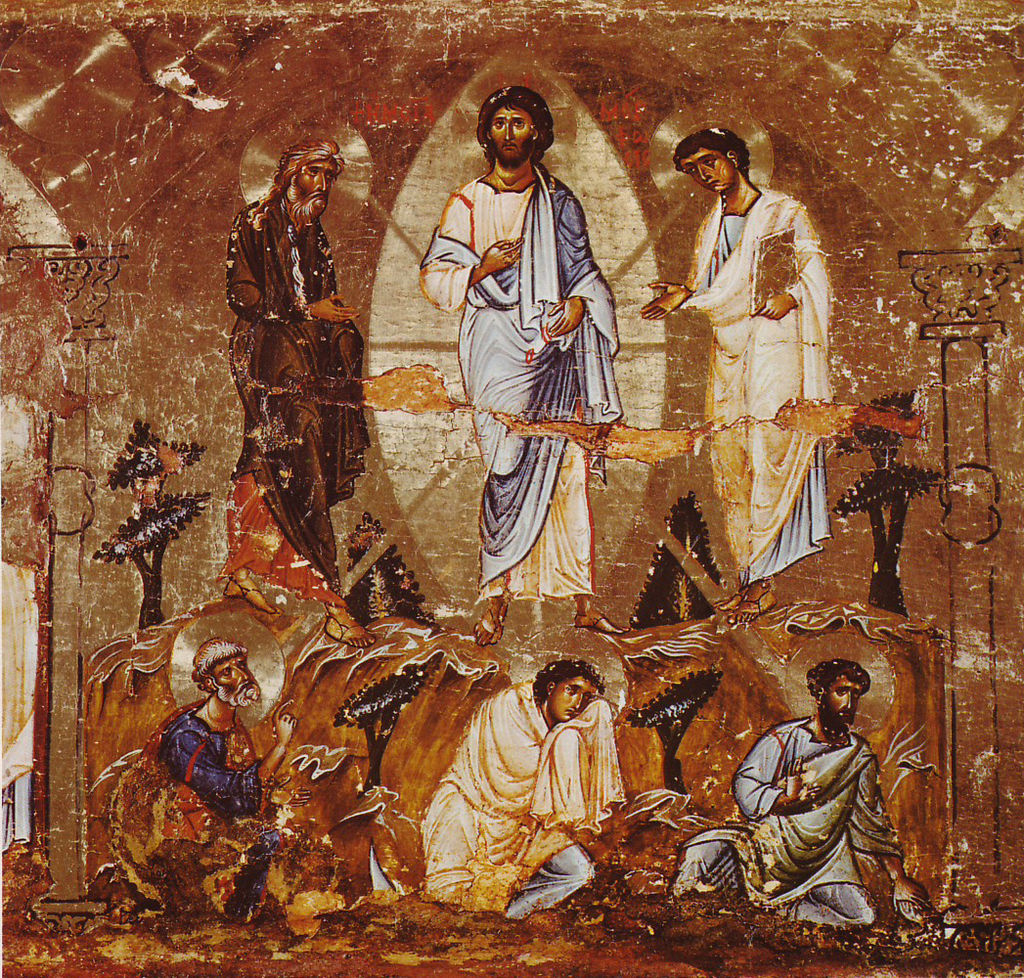
    The Transfiguration of Christ: Part of an iconostasis in Constantinople style. Middle of the 12th century. This is the earliest of the three paintings of the Transfiguration on this page. Below, you’ll see how the human expressiveness was emphasized in later Western art, while the symbolism of color, line, and figure took precedent over emotional content in the Eastern icon tradition (in fact, the more “fixed” and inexpressive faces are meant to indicate a more transcendent reality in this tradition).

    Fittingness Versus Necessity

    One of the questions an inquirer asked during our discussion was, “If the Transfiguration never happened, would the Crucifixion and Resurrection still have happened? In other words, was it necessary to our salvation?” This question is actually at the heart of how St. Thomas presents many aspects of salvation history. He readily admits that God could have ordered things differently — even to the point of not having the Incarnation or the Passion. These things, according to St. Thomas (and St. Athanasius and St. Anselm before him), are not “necessary,” per se, but he shows how they are “fitting.” The Latin word he uses is Convenientia, which translates to suitable, appropriate, harmonious or beautiful. The Church Fathers had a very good reason to be thinking in this way. First of all, they knew that they could never fathom the mind of God and “prove” some sort of necessity around the events and stories of our salvation history. Second, they had a huge body of texts that emerged from the early years of the faith, some orthodox and true, and some that were not. This contemplation of convenientia was a critical tool in helping to decide what writings were part of the canon of the New Testament. 

    As that same inquirer pointed out during our discussion, a good example of something that was NOT fitting would be in the apocryphal Infancy Gospel of Thomas, when Jesus is said to curse and kill a child who bumped into him. This is not consistent or harmonious with what we know of God and of Jesus’ ministry on Earth. 

    But beyond a tool for determining the truth of early texts, I think contemplating fittingness is a fantastic perspective for any kind of lectio divina. With this starting point, we can ask questions about why events happened and have them always point back to God and how he is revealing himself to us (as opposed to treating the divine plan like a puzzle to be solved, as if we could ever comprehend it fully!). In the case of the Transfiguration, the “why” of the event is answered amply by many Church Fathers. Here’s what St. Thomas has to say: “For anyone to walk straight along a road, he must have some knowledge of the end … Above all, this is necessary when the road is hard and rough, the going is heavy, but the end is delightful … Therefore, it was fitting that He should show His disciples the glory of His clarity (which is to be transfigured), to which He will configure those who are His.” In other words, one reason the Transfiguration happened was to provide the Apostles with the backbone to persevere when the going got tough — to let them see the goal of divinization alongside Jesus. Understood as a completely unnecessary but helpful and beautiful blessing for the Apostles (and the Church as a whole), we can start to glimpse the overwhelming, overabundant love the Father has for us, his delight in showing us a Way to him through his Son.
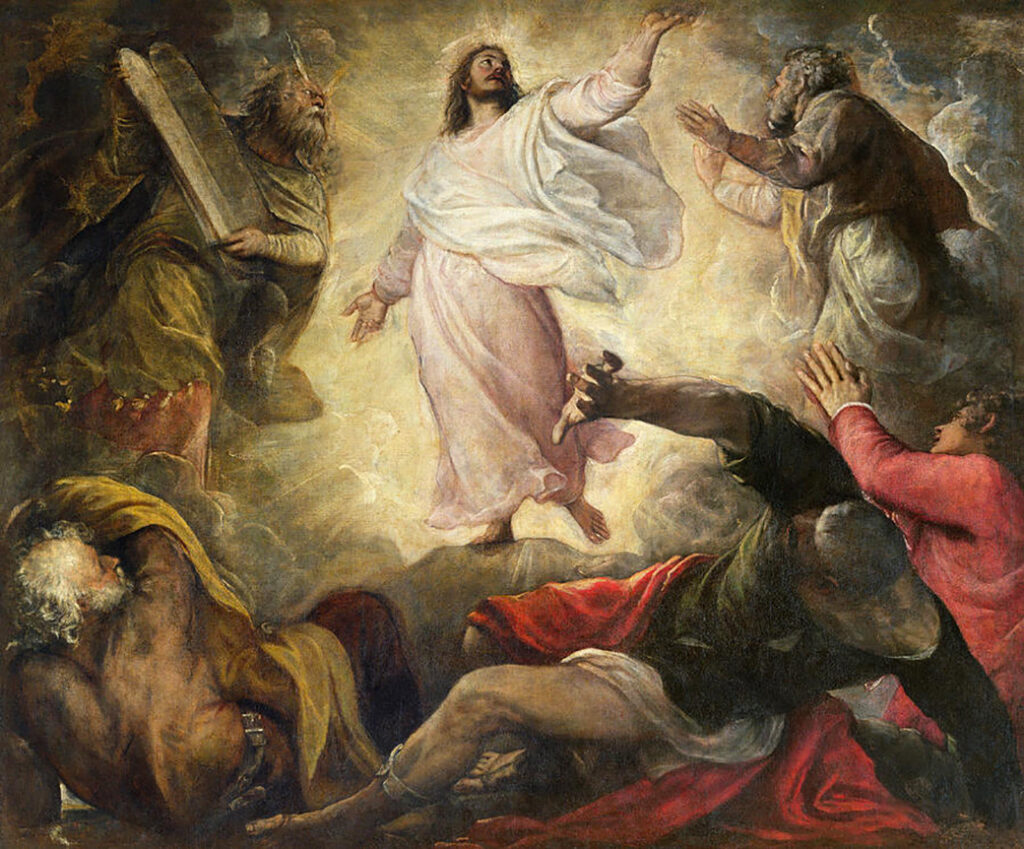
    Transfiguration (1560), Titian | Wikimedia Commons. Ah, the Italian Renaissance. Titian indicates a number of internal dramas within each unique face, and is a master of color and composition, with dynamic (and melodramatic) poses somehow all working to frame Christ in his glory.

    Bright Clothing

    Another aspect we discussed was that more than Jesus’s face was transfigured: “his clothing became dazzling white.” This might seem like a simple detail, but the Church Fathers fastened onto it with gusto. The first reading from the Book of Daniel gives us a clue as to why they might have done so: “The Ancient One took his throne. His clothing was bright as snow … Thousands upon thousands were ministering to him, and myriads upon myriads attended him.” So bright white clothing seems to be an important detail in this beatific vision, but what does it mean?

    St. Thomas tells us that “the clarity which was in His garments signified the future clarity of the saints.” This might seem like a leap, but he traces it back to St. Gregory the Great, who wrote, “because in the height of heavenly clarity all the saints will cling to Him in the refulgence of righteousness. For His garments signify the righteous, because He will unite them to Himself.” As we think of garments as things that cling to and adorn a person, this parallel starts to make more sense. The saints cling to Christ and his Way, and by so doing, they fulfill the word of God given to Isaiah: “You shall put all of them on like an ornament” (Isaiah 49:18). Thus, the Transfiguration is truly the full beatific vision: Christ in his glory, surrounded by the law (Moses) and the prophets (Elijah) and all the saints (his bright clothing, adorning him). What is nice about this understanding is that we see glory going back to God rather than ourselves in this vision of heaven. It’s not about us gaining virtue and being so good that we are given the gold star of heaven. It’s about us loving God so much (as close as we can mirroring the love he first gives to us) that we adore and adorn him, becoming more and more like Christ as an acknowledgement of the plan the Father has for all of us. Imitation is the sincerest form of flattery, so the saying goes, and we can see a small truth — yes, we are trying to imitate Christ, but even more than trying to flatter him we are trying to sincerely love him and show the world that he is the only Way to heaven. Let us be your brilliant clothes, nothing more, O Lord!

    We also discussed how there is more support for this understanding of the bright clothing in the Book of Revelation according to St. John: “Then one of the elders addressed me, saying, ‘Who are these, robed in white, and where have they come from? … These are they who have come out of the great ordeal; they have washed their robes and made them white in the blood of the Lamb.’” So John was doubly gifted with the vision of the Transfiguration during Jesus’s lifetime and then again in the visions that became the Book of Revelation. Only this time, the white robes have received their color from walking the Way of Christ — from going through “the great ordeal” and washing them in “the blood of the Lamb.” Whether adorning Christ or more literally being worn by the saints in heaven, the brilliant white clothes seem to symbolize the members of the Church who have remained faithful to the Way and entered into the divine heavenly eternity.

    There is one last interesting note we discussed about the clothing. One of the great early Church Fathers was Origen, who lived in the first half of the 200s AD. His influence was huge. Many later Church Fathers quote Origen when discussing the Transfiguration and many other mysteries of the faith. He writes that the white garments are “the words in the Apostles which indicate the truths concerning Him,” that is, the Gospels themselves. Origen adds that if someone speaks with deep theology of Christ and explains the Gospels brilliantly, “do not hesitate to say that to Him the garments of Jesus have become white as the light.” Imagine saying that the next time you hear a good homily! “Hey, Father, the garments of Jesus really became white as the light today! Thanks!”
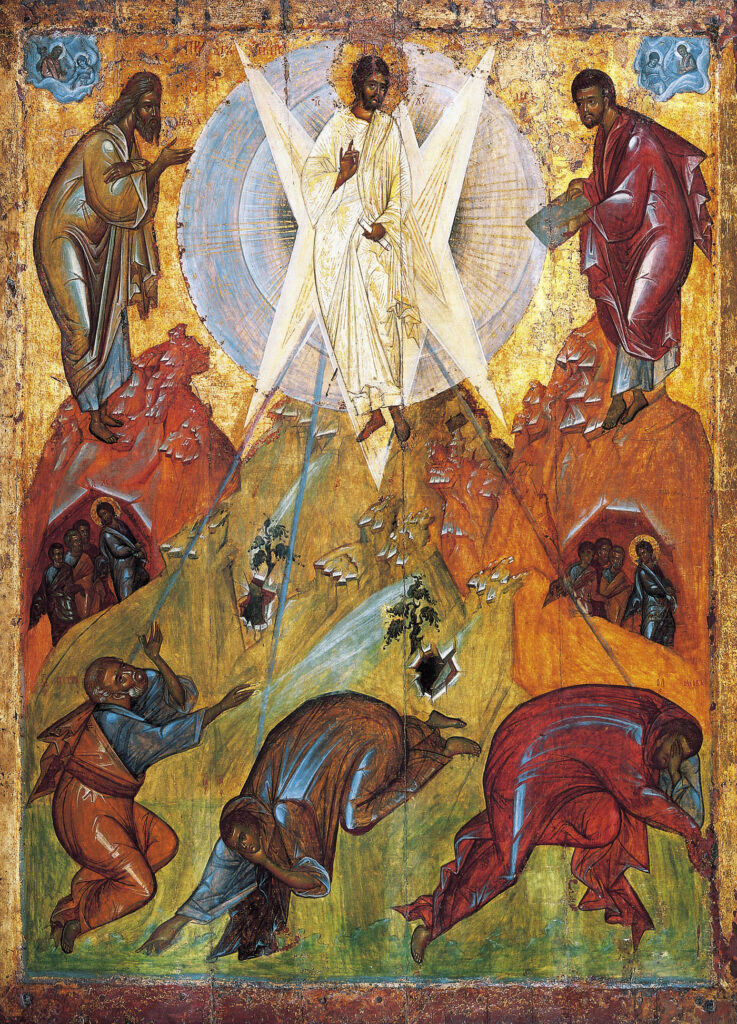
    Transfiguration of Jesus (icon), 1408, Theophanes the Greek | Wikimedia Commons. Artwork from Spaso-Preobrazhensky Cathedral in Pereslavl-Zalessky. This is one of the most common and copied icons of the Transfiguration, notable for it’s white star-shaped depiction of Christ’s brilliance, the positioning of all the secondary characters, and the lines of revelation shooting down to the Apostles. I always like how icons manage to paint more than just a single moment in time, and we see both the climb up to the mountain on the left and climb down on the right as well as little moments of the life of Moses and Elijah in the upper corners. Great way to depict kairos time!

    Moses, Elijah, and Unfinished Stories

    Of course, the other important detail, as we see in each of the paintings on this page, is that Moses and Elijah were present during the Transfiguration. Our little discussion group talked about how this might be fitting. First, we read the six separate ways that St. Thomas points out the significance of these two towering Old Testament figures. The one most often mentioned St. Thomas attributes to St. Hilary of Poitiers: that Moses symbolizes the law and Elijah the prophets, and this reminds everyone that Christ was foretold by these two important men.

    But then one of our life-professed Lay Dominicans made an observation that none of us had considered before: “Isn’t this the first time Moses appears in the Holy Land?” We all went silent, and then burst out with agreement. Even Fr. Gabriel admitted that he had never read any commentaries that bring up this important detail.

    Next, we had to contemplate how this might be fitting and why it might be important. We noted that both Moses and Elijah leave scripture with their stories somewhat unfinished or at least a little unsatisfying to the listener. Moses is told by God that he can’t enter into the Promised Land because the generation he ushered through the wilderness was so ungrateful and rebellious. So, he dies just outside of the Promised Land. In a way, he must suffer and sacrifice for the sins of others (sound familiar? nice foreshadowing of Christ). Elijah, on the other hand, is taken up to heaven alive. Why? What is he doing there? He’s not the Messiah, even if he is one of the greatest prophets.

    Both of these stories find a suitable and fulfilling ending here in the Transfiguration, however. Moses does get to enter the Promised Land, but only now and here, with Jesus Christ as the Savior who ushers in the Kingdom. God is not a vengeful God but a loving God whose plan spans all time and who loves us so much that he instructs and points the way through generations upon generations. He wants Moses with him — Moses the bearer of his law who now comes back to the bosom of the Father in the presence of the fulfillment of that law.

    Why Elijah is still alive, keeping the Jews in a state of suspense about his possible return, becomes clear when he returns here to commune with and point to Jesus Christ. Elijah, speaker of God’s living Word, never dies as the bearer of that living Word, and only reappears alongside that living Word made flesh. Jesus, who unites the dead (Moses) and eternal life (Elijah), is in the center of this vision. Jesus is the true Alpha and Omega here.

    Like the brilliant clothes, Moses and Elijah are not there for their own glory, but to adorn and ornament Jesus Christ, the Son with whom the Father is well pleased. The Father’s voice and the Holy Spirit in the form of a cloud (something seen because it obscures the sun and darkens the sky and yet somehow “a bright cloud overshadowed them” in Matthew’s account) also appear, but again, to point to the Son. If ever there was an argument for the divinity of Jesus Christ, this is it!


    I hope this post did some justice to sharing the fruits of a lively discussion and I also hope it enkindles a newfound reverence for the wonder of the Transfiguration. Thank you, God, for this vision of heaven, given to sustain us in our belief, faith, and fidelity to your Word.
  • Widows and Our Spiritual Family

    Thursday in the Third Week of Advent, Year A: Isaiah 54:1-10, Luke 7:24-30.

    We are traveling today, so I have to keep this reflection short before we head to the airport, but I did want to write something about that venerated group in the Apostolic Age and the Patristic Age, but their role has faded into obscurity. Widows were a class unto themselves from the time of the Acts of the Apostles onward. We have some skewed ideas of them today, thanks to (false) popular belief that women could not own property, were dependent upon their husbands, and were legally subordinate in every way. Even adjusting for a more accurate historical understanding of women, widowhood rightfully evokes sympathy – losing one’s spouse is an incredibly difficult thing. We find some lovely spiritual salve for widows in today’s readings.

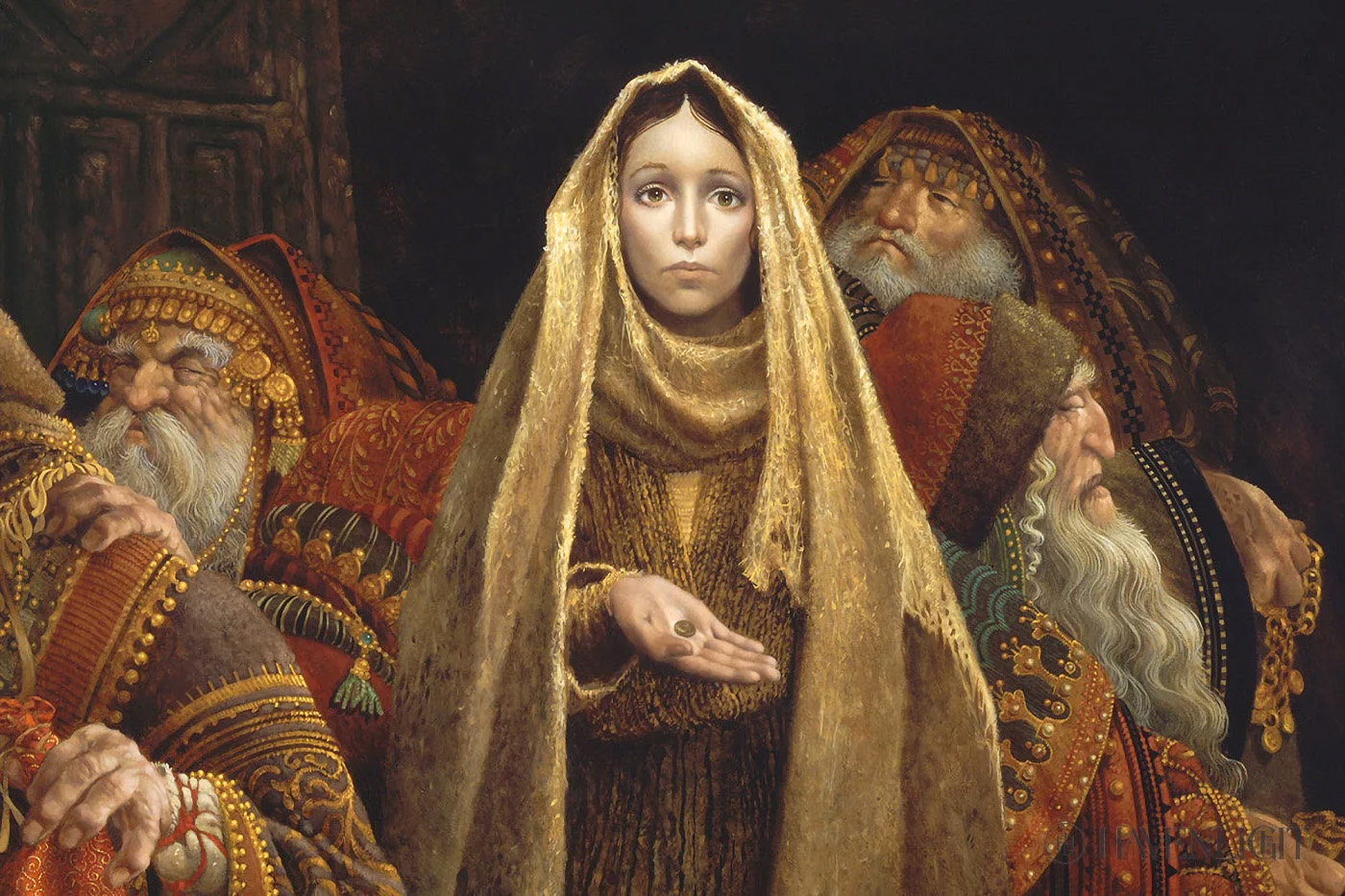
    The Widow’s Mite, James Christensen (contemporary) | Image from havenlight.com.

    Susan Hylen, PhD, MDiv, from the Candler School of Theology at Emory University has written a nice historical revision to the ideas we have about the helpless widow of antiquity. She summarizes by saying:

    This historical portrait suggests there was a lot of variety in the social status of widows. Some were wealthy and even powerful. Some were poor, and many were in the middle. Some experienced a drop in economic position when their husbands’ died, and others did not. Although vulnerable in some ways, widows were also supported by social expectations that gave them increased status.

    Thus, when we find specific mention of widows and barren women in scriptures, we might better understand the feeling being evoked as one of personal sympathy for people removed from highly valued things in Jewish society such as a loving spouse and children, rather than sympathy because their legal and monetary situation is dire. Isaiah uses the sad situation of widowhood to describe the devastated nation of Israel, but he promises marriage to a much better spouse: “Fear not, you shall not be put to shame; you need not blush, for you shall not be disgraced. The shame of your youth you shall forget, the reproach of your widowhood no longer remember. For he who has become your husband is your Maker; his name is the Lord of hosts.” There does seem to be reference to a social stigma or at least embarrassment/shame, but this can be in reference to a woman who was married and then “cast off” or divorced. But the promise is that even this deeply felt personal feeling in a social context is like nothing in the face of union with God. And, of course, this promise of the mystical marriage with God was established by Jesus in the Church.

    In the early centuries of the Church, an “order” of widows existed that was as established and recognized as the role of deacon was. In fact, diakonos is simply the Greek word for a servant such as a waiter or messenger. In the early Church the deacon’s (or deaconess, in the case of widows) first role was that described in Acts 6: distributing food to the poor, leaving the apostles free to devote themselves to prayer and to the ministry of the word” (Acts 6:4). As early as the Apostolic Age, we hear Paul instructing, “Do not let a widow under sixty years old be taken into the number, and not unless she has been the wife of one man, well reported for good works: if she has brought up children, if she has lodged strangers, if she has washed the saints’ feet, if she has relieved the afflicted, if she has diligently followed every good work” (1 Timothy 5:3-10). Thus, widows were not only recognized, but they performed great services for the communities of Christians, living out the maxim to love their neighbors as themselves. Some of them had inherited money and goods that they donated or used for the benefit of the early churches. Others, as we see in Paul’s statement, owned property and practiced hospitality, “lodging strangers.” The third-century Syrian book of Church order, the Didaskalia, mentions three specific roles for them: 

    1. Visiting women in their homes. It reads, in part, “… to visit those who are sick, and to minister to their needs, and to bathe those who have begun to recover from sickness”
    2. Assisting in baptisms for women: “Also, because in many other matters the office of a woman deacon is required. In the first place, when women go down into the water, those who go down into the water ought to be anointed by a deaconess with the oil of anointing… it is not fitting that women should be seen by men.” The Fourth-century Syrian book of Church order, the Apostolic Constitutions, Book II, adds “And when she who is being baptized has come up from the water, let the deaconess receive her, and teach and instruct her how the seal of baptism ought to be (kept) unbroken in purity and holiness. For this cause we say that the ministry of a woman deacon is especially needful and important.”
    3. Keeping order in the women’s section of the church. This was like being an usher, and finding a place for any woman who comes, rich or poor, “one of a low family, or a stranger.”

    Elsewhere, we read that widows would instruct young married women in caring for a household and rearing children. We can see that widows not only participated in the early Church in a special way, but even walked the Christian Way more perfectly and thoroughly than many others. It is almost like a proto-nun order, one that is steeped in worldly works rather than solitude and prayer behind convent walls. In this way, the Church as the mystical Body of Christ fulfills the promises of Isaiah in a structural way, providing real spiritual advancement towards the Kingdom for widows while on earth. And, it fully overturns our stereotypical image of widows as pitiful and helpless.

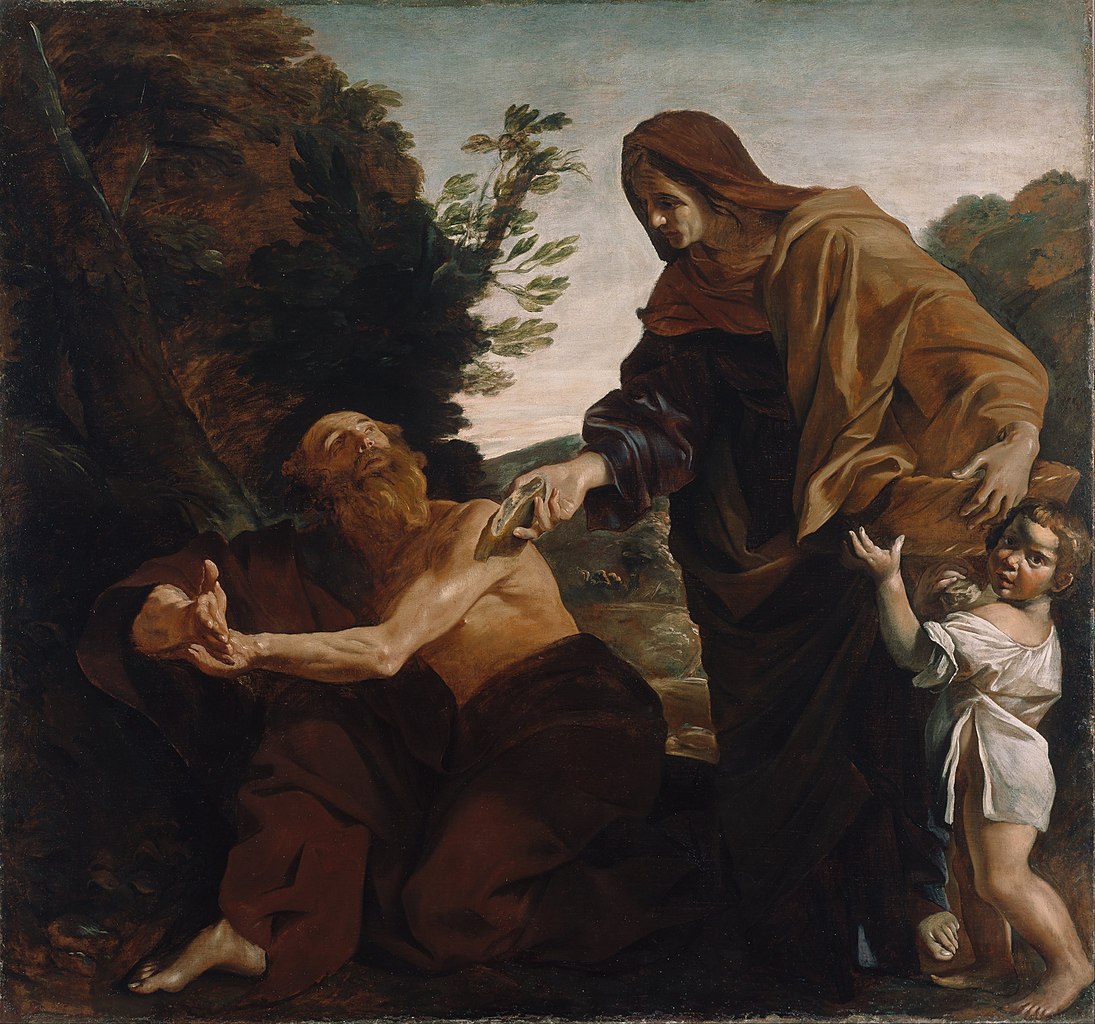
    Elijah Receiving Bread from the Widow of Zarephath, Giovanni Lanfranco (1621-1624) | Creative Commons, courtesy Wikimedia.

    In today’s gospel reading, Jesus takes the promise shared with Isaiah about widows and amplifies it. He exalts John the Baptist, saying, “among those born of women, no one is greater than John.” High praise, indeed! But he adds, “yet the least in the Kingdom of God is greater than he.” This truth about the state of souls in heaven gives us great hope. No matter how far we’ve fallen in our lives, no matter our flaws and inability to avoid sins, if we can achieve heaven, great glory awaits us. Even the least of us in heaven is greater than the greatest human on earth! If we have ever wanted to make something of ourselves and our existence, this is it.

    May we all recapture the diakonos way of living and serving that is part of the path to the Kingdom. May we all, too, be exalted eventually in heaven.

  • The Heavenly Womb

    The Fourth Sunday of Advent, Year C: Micah 5:1-4a, Hebrews 10:5-10, Luke 1:39-45.

    Today’s readings present us with a familiar scene, the kindly image of pregnant Elizabeth greeting pregnant Mary. This is the Visitation of Mary. Mary travels to the hill country, she “enters the house of Zachariah,” the women exchange pleasantries. It’s December 19th and Salt Lake City is covered in snow. The whole scene can lull us with its domesticity as I dream of cozying up to the fireplace and doing a puzzle this afternoon. The gospel reading with its overtones of “nesting” fits perfectly.

    But, let’s dwell with the Word of God for a moment and let it reveal its wonder and wisdom to us. There is something deep happening in this gospel reading. We are witnessing the turning point of history, when the time of the Prophets meets the time of the Messiah. Hidden in this countryside meeting of cousins is a glorious revelation for the world, much like the glorious revelation Himself will soon be given to the world, yet hidden in a humble manger.

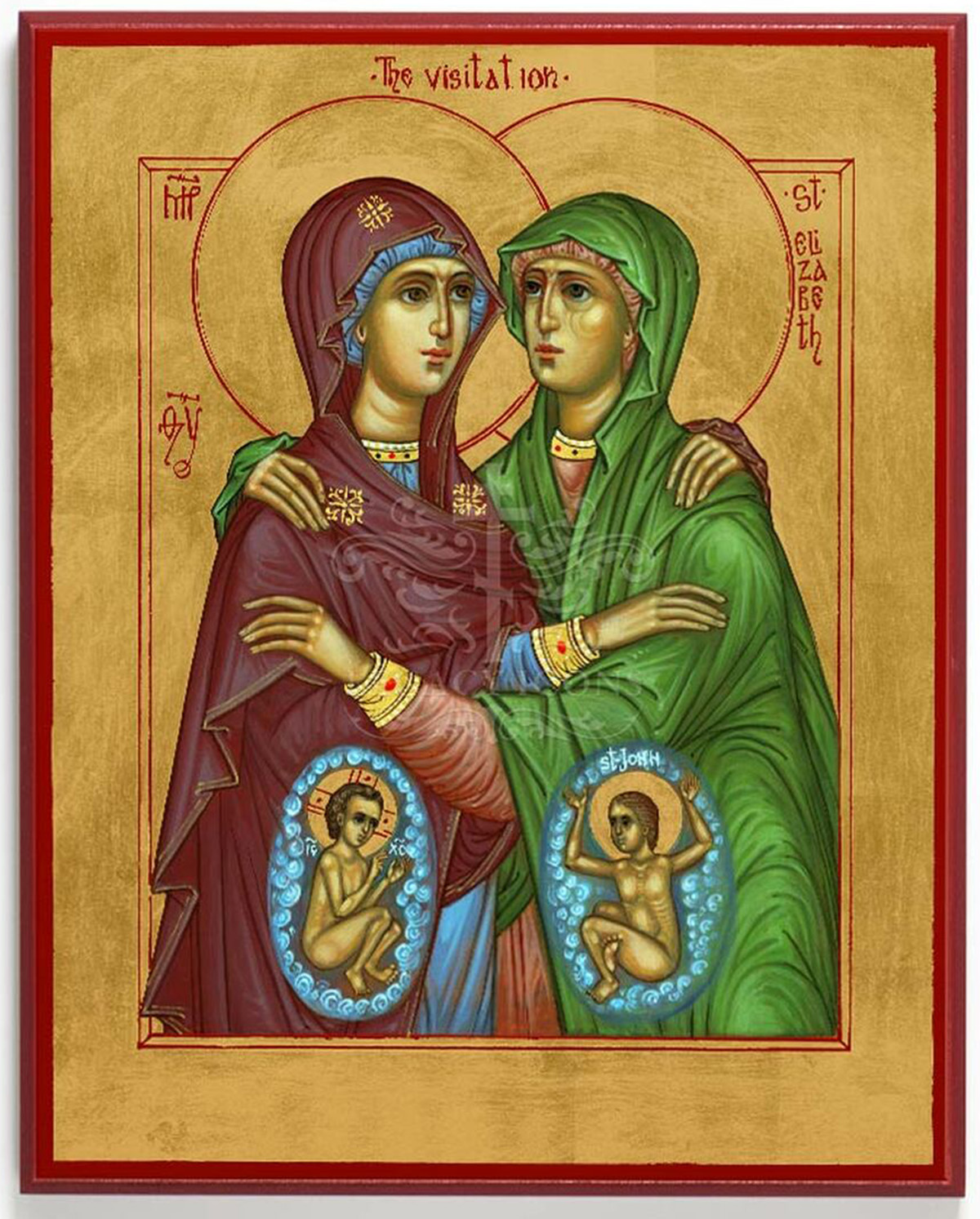
    Icon of the Visitation | Image from legacyicons.com. There are plenty of beautiful paintings of the Visitation, but I wanted to choose one here to emphasize that this was as much a meeting of Jesus and John as Mary and Elizabeth. And while it is more common to see John depicted in a pose of humility in sacred icons, I like this one particularly because it shows John “leaping for joy.”

    There are many present at this meeting – there is Elizabeth meeting Mary, but also John meeting Jesus, in fact the prophets (remember that Jesus will say, “And if you are willing to accept it, John himself is Elijah who was to come,” (Mt 11:14)) meeting the Messiah, and finally the Spirit filling humanity. Let’s remember the central action of this scene. After Mary enters the house and greets Elizabeth,

    When Elizabeth heard Mary’s greeting,
    the infant leaped in her womb, 
    and Elizabeth, filled with the Holy Spirit, 
    cried out in a loud voice and said, 
    “Blessed are you among women, 
    and blessed is the fruit of your womb.”

    Several things happen before Elizabeth speaks: first, the infant John reacts to the Messiah entering his presence. Remember, this is John’s entire reason for being – the Father has given him the solemn job of preparing the world for the Messiah and recognizing Him when He comes. John is more than a normal baby; he is chosen and exalted by God and because his soul is so much greater and full even at this stage of his life, he is able to model for us the true meaning of joy by leaping in the presence of the Lord (see last week’s reflection for more thoughts on this joy). John’s great soul seems to envelop his mother at this point because she herself prophesies! She is “filled with the Holy Spirit” and “cries out in a loud voice” – both things we read of prophets in general and John in particular during his ministry. The Holy Spirit gives her the wisdom and courage to proclaim the truth present in front of her: “Blessed are you among women, and blessed is the fruit of your womb.”

    There is a reason the Hail Mary joins these words with the angel Gabriel’s words during the Annunciation (“Hail Mary, full of grace, the Lord is with you”): this moment is John’s first pronouncement to the world that the Savior is present in his pure vessel, the virgin womb of Mary. God makes his Word heard, first through an angel and then through the Holy Spirit speaking through John and Elizabeth. Both times, the proclamation is made to Mary (and in the retelling of the gospel, to the world). Mary is, in fact, the archetype of the Church herself. The Church, who bears and protects and is transformed by Christ, is being announced as blessed and full of grace (literally and figuratively). The original Greek is worth noting, since Gabriel calls her Kecharitōmenē (One Whom Grace Inhabits) and Elizabeth calls her Eulogēmenē. I unpack Gabriel’s words in a prior reflection, but let’s understand what the Holy Spirit is saying through Elizabeth here. The root word is eulogéō, which is a combination of , meaning “well, good” and lógos, which we should all recognize as “word, reason,” or in this context “speaking,” which is how we arrive at “bless” for eulogéō. Greek scholars also note that this word can properly mean “confer what is beneficial” when we read of how God blesses His people and they bless him in return. The point is that there is an action combined with the word – the blessing is coming from someone, through being spoken, and is thereby conveyed on someone else. Who is speaking? The Holy Spirit! That means that God Himself is conveying blessings upon Mary and His Son in this scene. This scene is thus tied to not just the Annunciation but Jesus’s Baptism when the Father calls down from heaven, saying, “This is my Son, the Beloved, with whom I am well pleased” (Mt 3:17), as well as the Transfiguration when the Father proclaims, “This is my Son, whom I have chosen, listen to Him” (Lk 9:35). All of these scenes are the revelation of Christ to humanity, accomplished by the Father and the Holy Spirit.

    Returning to today’s gospel passage, let’s look at the curious self-awareness that Elizabeth shows after God proclaims the blessedness of Mary and the presence of His Son:

    And how does this happen to me, 
    that the mother of my Lord should come to me?
    For at the moment the sound of your greeting reached my ears, 
    the infant in my womb leaped for joy.

    How fascinating that her own voice is intermingled with that of the Spirit and John’s expansive soul. She is fully aware of the fact that Mary bears the Christ in her womb, and she marvels that she is lucky enough to be in the presence of them both. But she also calls attention to her own body, to the feeling of John leaping for joy. This, I believe is a purposeful and profound passage for us. We are invited to consider what it is like to be pregnant with another being growing inside us. I have no personal insights here, but I have two children and my mother had 10 pregnancies. From what I’ve observed and read, the feeling is at the same time alien and could not be more integral and personal. There is not just something growing inside you, but someone. I’ve come across this quote from author Anne Christian Buchanan and it seems insightful: “To be pregnant is to be vitally alive, thoroughly woman, and distressingly inhabited. Soul and spirit are stretched – along with body – making pregnancy a time of transition, growth, and profound beginnings.” There is something of this being “distressingly inhabited” and having one’s soul stretched going on in our gospel scene. Elizabeth is profoundly aware of the movement in her womb – something that is her but not her. She is doubly inhabited here because she is “filled with the Holy Spirit.” What are we being told about God’s will for us here?

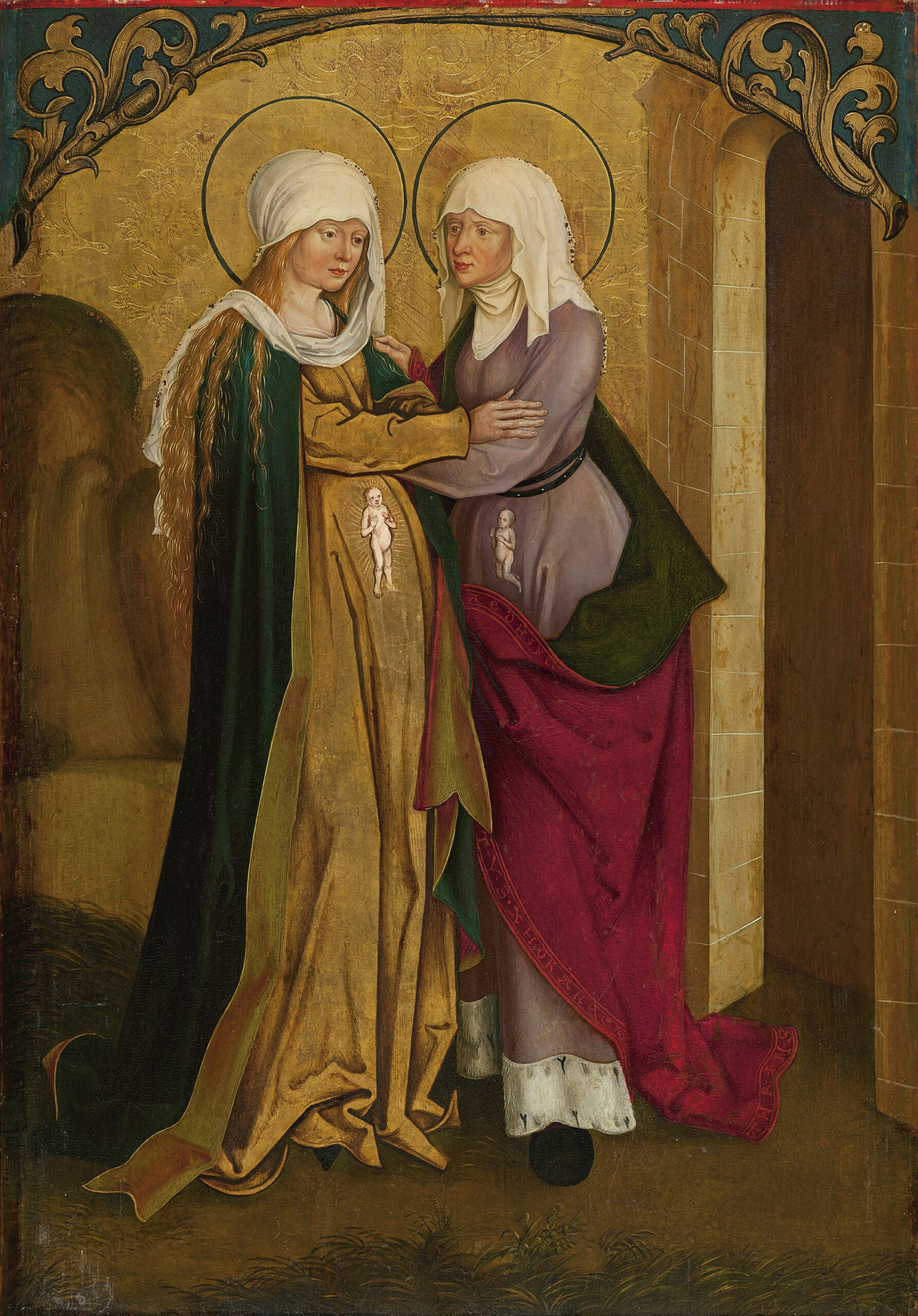
    The Visitation, Jakob and/or Hans Strüb (1505) | Image courtesy the Museo Nacional Thyssen-Bornemisza, Madrid. I like the slightly distant looks in Mary and Elizabeth’s eyes here, as if they are witnessing the expansion of their souls, the meeting of the prophet and the Savior, and the Holy Spirit beside and within them.

    Let’s take a look at Elizabeth’s final words: “Blessed are you who believed that what was spoken to you by the Lord would be fulfilled.” The final piece of the revelation puzzle begins to appear. Our work is trust in the Lord and acceptance of His will. It is Mary’s faith that has made her blessed. Mariologists would quibble here that she was blessed upon her own birth by her virgin mother, in fact blessed by God before time began. But the Holy Spirit is blessing her here for her belief and acceptance of God’s will, for she was granted free will and could have denied the incarnation of Christ offered to her. Thus, blessings come upon Mary (who is us, remember: the Church) when she accepts God’s will; more, even: when she accepts God Himself and allows Him to grow within her.

    We are invited to consider the womb as the reality of our spiritual life here on earth. It is the intersection of our biology and our spirit. Our soul – that invisible and intangible essence within us that allows us to recognize and commune with God – needs to grow, just like the body. Sadly, many of us neglect it. But Christ has shown us the Way. We must empty ourselves of personal ambition and self-centeredness and open ourselves up to the Spirit, to God’s will.

    Elizabeth and Mary are at the heart of God’s revelation of Himself to us because this is precisely how He works through us to achieve our salvation. Just as Mary is the living vessel for God, the Ark of the New Covenant, we are all to become vessels for the Spirit. Indeed, in today’s second reading during the Office of the Readings (part of the Divine Office), St. Irenaeus tells us, “Man is the vessel which receives God’s action and all his wisdom and power” (from Against Heresies). What’s more, we all undergo that mysterious, life-giving process of gestating something new and wondrous within us. Irenaeus continues: “if man perseveres in God’s love, and in obedience and gratitude to him, he will receive greater glory from him. It will be a glory which will grow ever brighter until he takes on the likeness of the one who died for him.” This is our deification, our ability to take our first steps in the Kingdom, imperfectly while still on this earth, but entrance to the Kingdom is indeed promised to us if we follow Christ the Way. What a marvelous plan that uses the very biological processes of gestating and becoming (processes He created, of course) in order to bring about the formation of the soul in the likeness of Christ. Note, though, that this plan is only made possible because of Christ. The Jews “persevered in obedience and gratitude” (off and on) but they still waited for a Messiah to save them. Humanity had no actual way to achieve eternal life or enter the Kingdom of God until Christ. Irenaeus elaborates: “He wanted to invite man to take on his likeness … establishing man in a way of life in obedience to the Father that would lead to the vision of God, and endowing man with power to receive the Father. He is the Word of God who dwelt with man and became the Son of Man to open the way for man to receive God, for God to dwell with man, according to the will of the Father.” To paraphrase Pope John Paul II, we must always remember to view the world through a Christological lens. Nothing makes sense without Him. 

    So, located in this everyday, humble scene of two pregnant women, we find the glowing embers not just of the greatest prophet and the Messiah, but the wisdom of our entire religion. We are all “pregnant” with a soul. While it may seem foreign to us, this thing can be a person, just like pregnancy. We can allow God to inhabit our souls. God can fill us with His glory, helping our souls swell with His love and moving us toward perfect unity with Him and eternal life in the Kingdom. We are all invited to participate in a heavenly womb, at once foreign to us and also something that could not be more personal. If pregnancy is “a time of transition, growth, and profound beginnings,” then the heavenly womb wherein we gestate God in our souls is even moreso. Knowingly or unknowingly, we have been doing this since our own moments of creation, and as we turn to the gospels this Advent, we can recommit ourselves to this work of believing in God, accepting His will in a deeper and deeper way until we can also leap with joy simply to be in His presence.

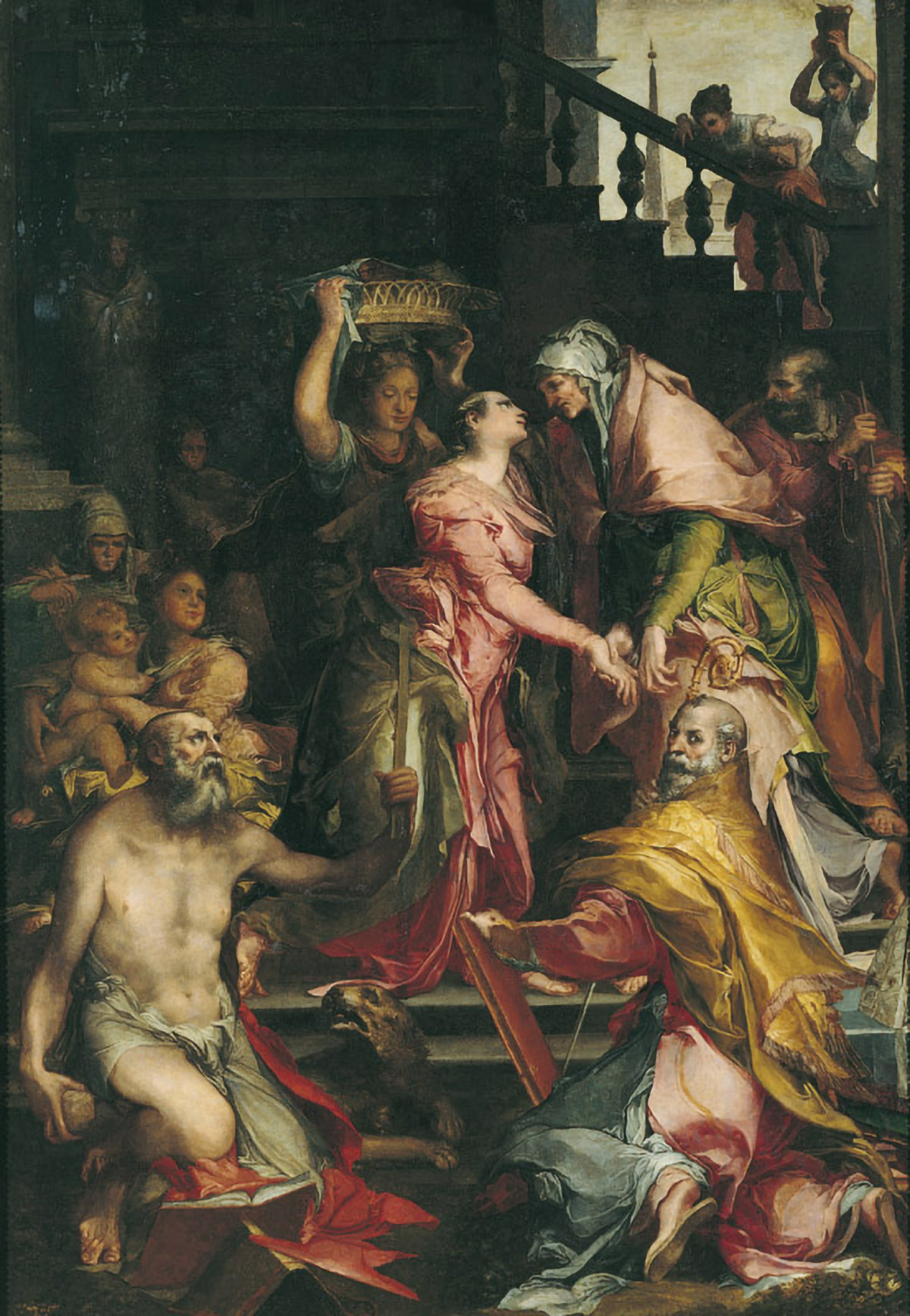
    Visitation of Mary to Saint Elizabeth, Cristoforo Gherardi (c. 1541), currently in the Musée des Augustins, Toulouse | Wikimedia Commons. Note how crowded this scene is as painted by Gherardi. An archetype for the Church, indeed!

  • The Scattered People

    The Scattered People

    Thursday of the Third Week in Lent: Jeremiah 7:23-28, Luke 11:14-23.

    In today’s readings, we hear a lament from Jeremiah about the faithlessness of the Jewish people coupled with a gospel reading where Jesus’s exorcism of demons is met with skepticism. I am struck by a few things: the reluctance of humanity to accept God’s guidance and help as well as the stubbornness of humanity in believing we know what’s true and what’s not.

    But what jumps out at me most today are the final words from Jesus: “whoever does not gather with me scatters.” This tells us much about what God is trying to do and why. He offers us unity, and in unity, strength to rebuff the devil. This is the action of the Good Shepherd, to gather the sheep and save them from being scattered (which is the action of the wolf/devil).

    The Word of God today provides the logic of establishing the Church, and it is a fantastic lesson of love for humans caught in a spiritual battle with the forces of the devil.

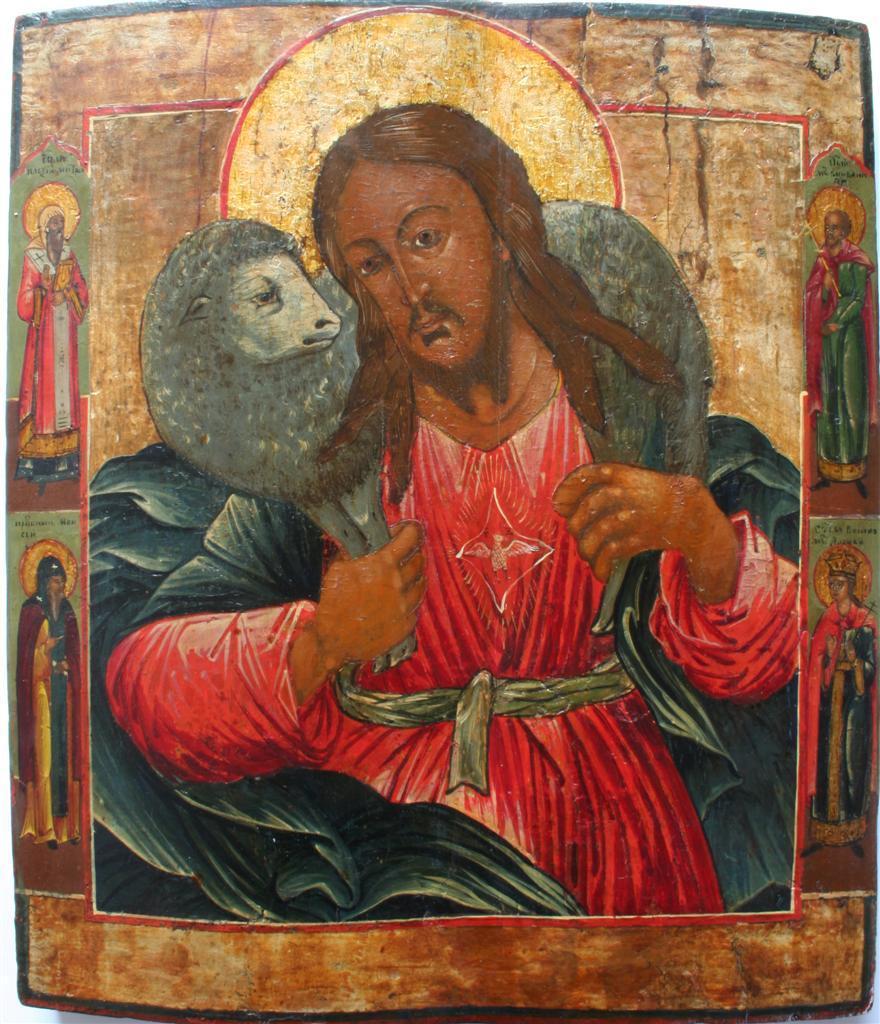
    The Good Shepherd, 19th Century Russian Icon | Wikimedia Commons.

    In the gospel reading, Jesus drives out “a demon that was mute” and the man who was possessed begins to speak. Skeptics said, “By the power of Beelzebul, the prince of demons, he drives out demons.” In some ways, we can all identify with these skeptics. Charlatans and carnival tricks are nothing new — in fact, Jesus and later the Apostles warn Christians about being taken in by charlatans pretending to be sent from God. In our science-driven age, we are taught to mistrust things until they are examined thoroughly and (dis)proven via the scientific method (or Sherlock Holmes-level sleuthing).

    This is an unavoidable reaction to miracles, which is why true miracles, especially those accomplished by Christ, always have a greater divine purpose than just “amazing” people. Every miracle done by Christ primarily serves to point to his own divinity as the Son of God come to earth, but each also has a deeper spiritual lesson. Today, the demon is mute, and we learn something about freeing our lips in response to God’s presence in our lives.

    Jesus delivers his lesson in response to lips that have been freed by things other than God — namely, worldly mistrust, which has its origin in the serpent in the Garden of Eden. He points out the ridiculousness of their logic: “Every kingdom divided against itself will be laid waste and house will fall against house. And if Satan is divided against himself, how will his kingdom stand?” He is pointing out that Satan is always seeking to divide and pervert humanity, and that he would never come to the aid of a human to heal another human. It is against his nature and what’s more, he could not maintain “his kingdom” on earth if half the time he was helping humans and the other half he was harming them. No, Satan would never be party to his own undoing. 

    After dispelling their logic, Jesus proclaims, “But if it is by the finger of God that I drive out demons, then the Kingdom of God has come upon you.” He wants them to be open to the possibility of the truth in front of them. It’s an interesting, patient way of engaging them. He acknowledges their skepticism but points out their flawed logic. He opens the possibility of the Kingdom of God having come upon them.

    Then he talks about Satan as a strong man, fully armed and guarding his possessions (humans). Jesus accepts their belief in Satan as someone so strong he can work wonders on earth and then trumps it completely. He says, “But when one stronger than he attacks and overcomes him, he takes away the armor on which he relied and distributes the spoils.” This is the Lord on earth, pointing out that Satan can never stand in the Face of God. 

    Then comes the line that jumps out at me: “Whoever is not with me is against me, and whoever does not gather with me scatters.” The first half of this sentence is stark and absolute. It makes me shudder a bit because it has been used since 2001 in reference to our “war on terror” (first by Hilary Clinton, then George W. Bush; more recently by Turkish President Recep Tayyip Erdoğan).

    The great difference, of course, lies in Christ’s actions and in the second half of the sentence. Christ heals, Christ loves, Christ sacrifices himself, and Christ gathers his sheep. Our political figures use this phrase when employing aggressive campaigns of violence, essentially the work of the devil in the world even if it is sold as “for the greater good.” These statements may upset some people, but Christ is unequivocal in his teaching to uphold the commandments (you shall not kill); everything he does nurtures and builds up humanity so that we can find our way to God.

    If everything Jesus does as the Way, the Truth and the Light is to gather and bring people to God, anyone who is not helping in this work is truly against that gathering action. This is why he says, “whoever does not gather with me scatters.” There are two main ways that “scattering” is used in the New Testament. In the positive sense, we read about seed being scattered in the Parable of the Sower (“the seed is God’s word,” Jesus tells us). The Greek word here is related to sowing/planting: σπείρειν (speirein). But there is another, negative sense of scattering that means to waste something, disperse it, or dissipate it. This is an entirely different word, which we encounter here in today’s gospel: σκορπίζει (skorpizei). The root word here is skorpios, or scorpion — clearly a negative connotation, and possibly the connection is the concept of penetration or the way scorpions scatter when you come upon them. 

    Scorpion Oil Painting (2010), Fabrizio Cassetta | Image from fineartamerica.com.

    It does make me think about the way the devil operates in the world, this skorpios scattering. He works by tempting us, inflating our pride, making us operate solely out of selfish concerns. Looking at humanity from the 100,000-foot view, we see a mass of scorpions lashing out at one another’s dignity, each on his or her own self-determined path. The prince of the world thrives on us being scattered and without a purpose greater than our own selfish desires.

    God provides us with the great antidote to the scorpion’s venom in the form of His Son. This new Way, this brilliant Light, is a uniting force that gathers us to work together as we honor the Father. Indeed, one of Jesus’s other references to skorpios scattering occurs in the Parable of the Good Shepherd: 

    Very truly, I tell you, I am the gate for the sheep. … Whoever enters by me will be saved, and will come in and go out and find pasture. … I am the good shepherd. The good shepherd lays down his life for the sheep. The hired hand, who is not the shepherd and does not own the sheep, sees the wolf coming and leaves the sheep and runs away—and the wolf snatches them and scatters [skorpizei] them. (Jn 10:7, 9, 11-12)

    Here the devil (the wolf) is much more clearly identified with the skorpios scattering. And Christ the Good Shepherd protects us from Satan’s scattering by not leaving his sheep, by laying down his very life (which allowed him to vanquish Satan and death in Hell). We also see a clear connection to today’s reading in Luke where Jesus says “whoever does not gather with me scatters.” Jesus is completely consistent across all gospel accounts: his action is to gather the sheep, the Children of God, to himself so that through him (the gate), they can enter the Kingdom.

    What he tells his listeners today is that their response to him has eschatological implications. If they believe in him as the Son of God and follow his Way of gathering, then they are with him and have access to the Kingdom of God. On the other hand, if they are skeptical — worse yet, if they encourage others not to believe in him — then they have joined the devil in his work of scattering humanity.

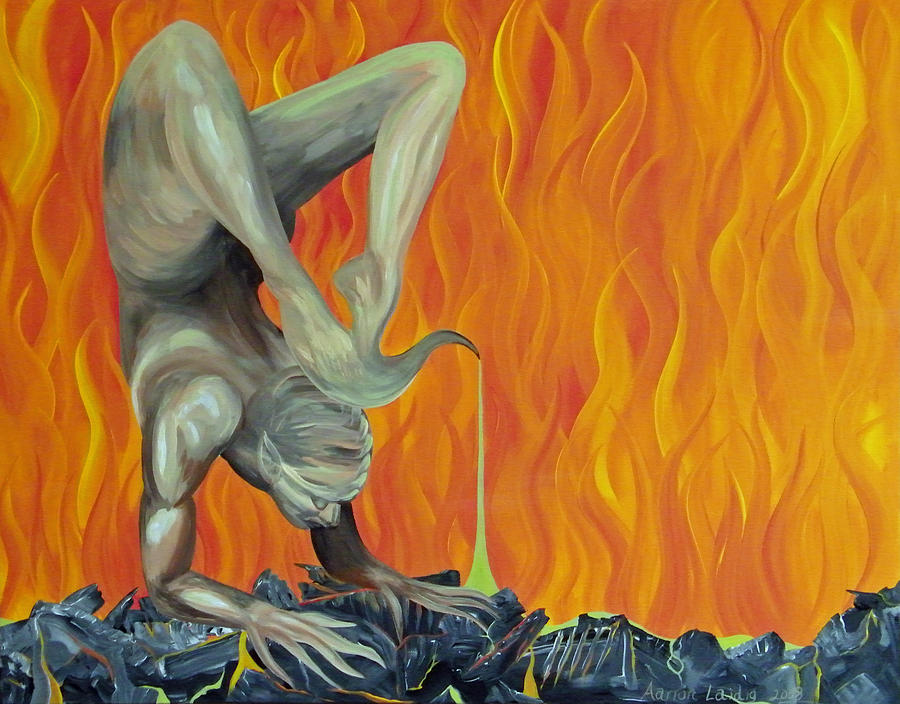
    Scorpion (2008), Aarron Laidig | Image from fineartamerica.com.

    This brings us back to the mute man being given his voice in this miraculous exorcism. God always lets us have our voice, our free will. By giving this man his voice and engaging the skeptics in their arguments, Jesus is posing the question to us: what will you use your voice for? Will you join him in gathering people to the Way? Or will you join the devil in scattering people away from the Kingdom? The choice is yours.

    One last item: we can start to understand the divine logic behind the Church as the mystical Body of Christ, still at work in the world gathering humanity and providing a Way to the Father. Christ very deliberately establishes the Church and from the Apostolic Age onward, our saints and doctors of the Church have rigorously defended the need for the Church to remain united despite evils from within and without. The unity of the Church in its spiritual mission as the Body of Christ means that either we are with it in gathering people to God or we are against it in our scattering effect with the devil. May all Christian denominations understand this fundamental concept and find their way back to the one, universal Catholic Church.

  • Hung Up on Our Notions of Jesus the Man

    Hung Up on Our Notions of Jesus the Man

    Friday in the Fourth Week of Lent: Wisdom 2:1a, 12-22, John 7:1-2, 10, 25-30.

    I don’t know about you, but I get a clear sense of inertia drawing us towards the Passion and Holy Week in today’s readings. I’ve always found the rejection Jesus experiences in St. John’s gospel to be palpable, and when joined with the reading from the Book of Wisdom today, it creates a profound and sad condemnation of the people in his time.

    Worse yet, we might be more implicated in this sad commentary than we realize.

    The passage from the Book of Wisdom sounds like a real-time response from the skeptics listening to Jesus, yet it was written some 80 years earlier. The wicked people in the passage complain that “he is obnoxious to us … He professes to have knowledge of God and styles himself a child of the LORD. To us he is the censure of our thoughts; merely to see him is a hardship for us.” This sounds very much like the internal mental script of the chief priests and scribes who attack and test Jesus.

    What’s more, we hear truly wicked, devilish thoughts: “With revilement and torture let us put him to the test,” “For if the just one be the son of God, he will defend him and deliver him from the hand of his foes.” These last bits of blasphemy and mockery actually did occur while Jesus hung on the Cross:

    Those who passed by derided him, shaking their heads and saying, “You who would destroy the temple and build it in three days, save yourself! If you are the Son of God, come down from the cross.” In the same way the chief priests also, along with the scribes and elders, were mocking him, saying, “He saved others; he cannot save himself. He is the King of Israel; let him come down from the cross now, and we will believe in him. He trusts in God; let God deliver him now, if he wants to; for he said, ‘I am God’s Son’” (Lk 27:39-43).

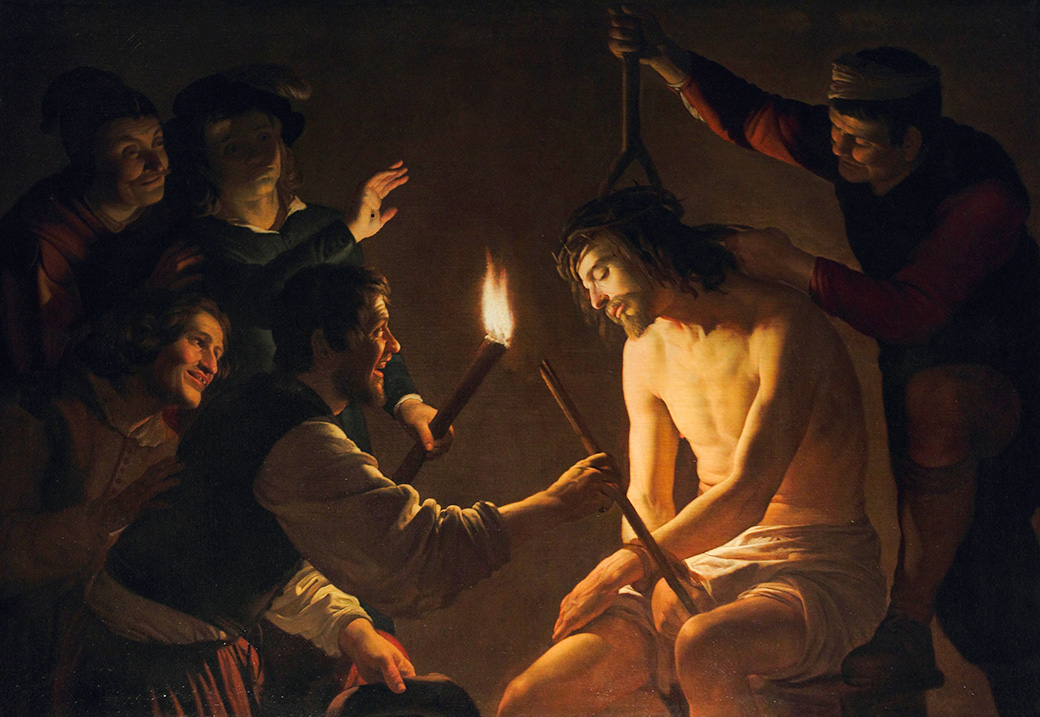
    The Mocking of Christ (1616-1617), Gerard van Honthorst | Wikimedia Commons.

    Such similarities emphasize the wickedness of the people who mocked Christ; their words are nearly identical to those called out in the Book of Wisdom decades earlier. However, as we look at this entire chapter of the Book of Wisdom from which this passage comes, we see that this wickedness refers to a larger group of people than just those who mock Christ. The chapter starts by identifying these people as those caught up in existential angst: “Short and sorrowful is our life, and there is no remedy when a life comes to its end … For we were born by mere chance, and hereafter we shall be as though we had never been … reason is a spark kindled by the beating of our hearts; when it is extinguished, the body will turn to ashes” (Wis 2:1-3). These people have rejected God and the teachings of the Jewish fathers, that he intentionally created us and has given us his covenant.

    This rejection is even deeper in that they reject the Spirit that is in each of us when they say that “reason is a spark” that comes just from our biology, and when that spark is extinguished, nothing is left but ash. This is a full denial of the spirit and the soul. It is secularism, atheism, scientism.

    What to do with this existential angst? The response of these wicked ones is to live life voraciously while they can. They say, “let us enjoy the good things that exist … Let none of us fail to share in our revelry; everywhere let us leave signs of enjoyment” (Wis 2:6, 9). When there is nothing to our existence but the world we see in front of us, there is also no basis for moral considerations. There are no repercussions beyond this world.

    Therefore, they say, “Let us oppress the righteous poor man; let us not spare the widow or regard the gray hairs of the aged. But let our might be our law of right, for what is weak proves itself to be useless” (Wis 2:10-11). By rejecting God in their flawed understanding of their own existence, these people have lost their moral bearings. Everything looks to be ripe for the picking, for the using and for the abusing.

    Thus, the final indictment against the thoughts and words of these people that we read today can be extended to all those who are amoral, who reject God, and who employ Social Darwinism in their worldview. It reads: “These were their thoughts, but they erred; for their wickedness blinded them, and they knew not the hidden counsels of God; neither did they count on a recompense of holiness nor discern the innocent souls’ reward.” The “recompense of holiness” and the “reward” is eternal salvation itself, the greatest testament to God’s being. The fact that God is there and offers us recompense and reward drives the need to order our lives according to his Word.

    This criticism is just as important today as it was 2,000 years ago. Our culture and economy are almost entirely devoted to consumption and living life voraciously. Our politics are infused with an evil streak of Social Darwinism where “might is right.” The root of the problem is the same: a rejection of God, a disavowal of the spirit and soul, and a blindness to the revelation of the Lord in history that points to a greater life beyond this one.

    The frightening implication is that when we descend into materialism or scientism, in a way we are participating in the mockery of Christ. They are logically and inexorably connected.

    Let’s put this more plainly. When all we can think about is that new car, new dress, new thing we want to buy; or when we think that the world is made of only explainable natural phenomena; or when we feel that it’s our right to get what we want, well, that’s when we’ve shut ourselves off from the source of life, from accepting the mystery, from living in the humility of a creature in God’s presence.

    And joined with these perspectives is a gut reaction that someone righteous telling us otherwise “is obnoxious to us.” In these moments, we are much further down the road of mocking Christ on the Cross than we might realize.

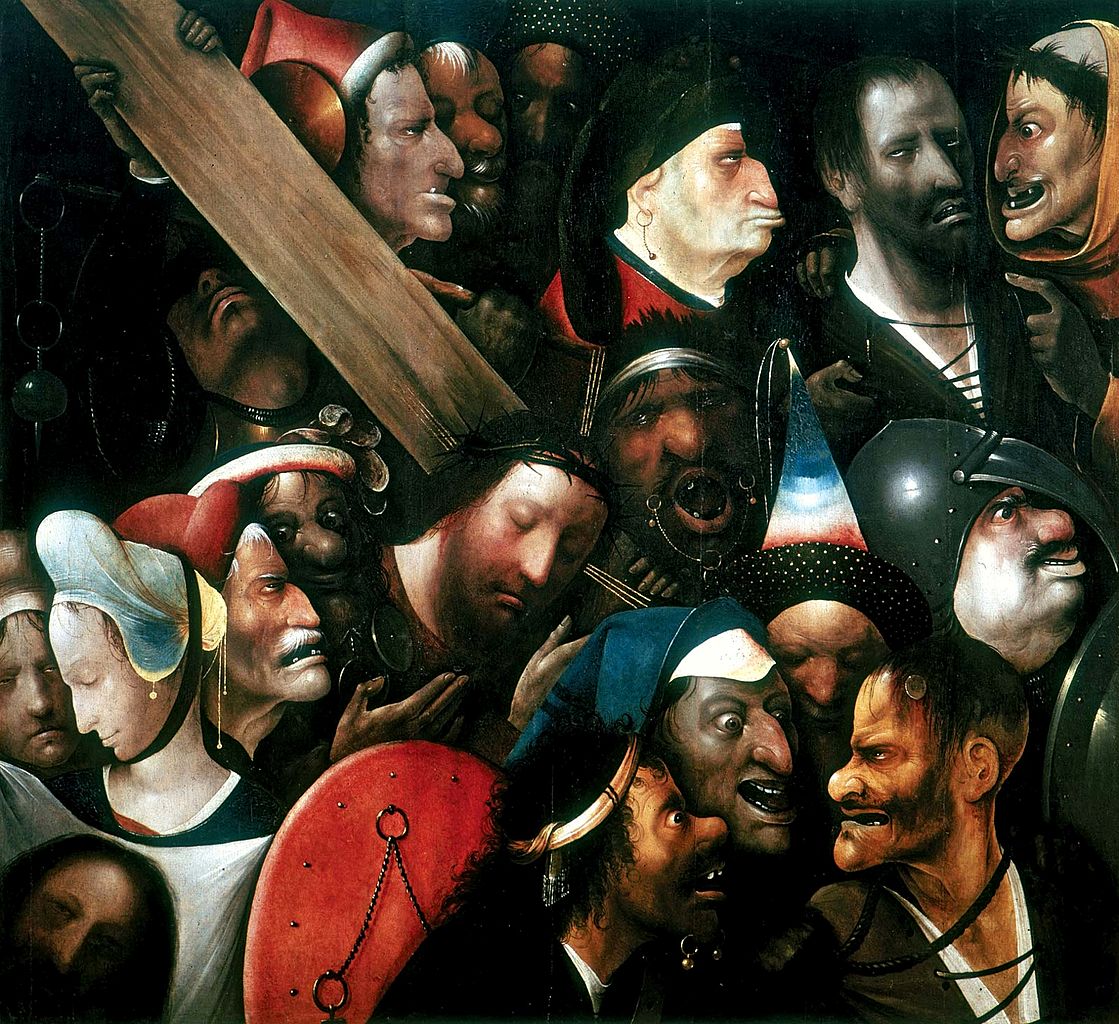
    Christ Carrying the Cross (1510-1535), Hieronymus Bosch or follower | Wikimedia Commons. Bosch is a master of grotesque human expression, and this piece is no exception. It strikes me to see the variety of ways evil is personified – that is, made personal by various people – and how the power of Satan twists and distorts us, obscuring what is good in us. The other striking thing about this painting is the serenity and prayerful visage of Christ in the midst of this miasma. 

    In the gospel reading, Christ struggles with Jews who have turned themselves away from hearing and seeing God. The reading opens by tracking the movements of our Lord almost as if he is under siege: “he did not wish to travel in Judea, because the Jews were trying to kill him.” In the full text of Chapter 7 in John’s gospel, we hear him encourage his brothers to go to Jerusalem without him during the Festival of the Tabernacles. Then he also goes, but secretly.

    Then, “About the middle of the festival Jesus went up into the temple and began to teach” (Jn 7:14). It seems that God’s will is that his incarnate Word be present and be heard at the festival. The Festival of the Tabernacles is symbolically important because the Jews commemorate their time “on the move” from Egypt to Israel when they lived in temporary accommodations (the title of the Festival, Sukkot, is translated as “tabernacles” or “booths”). Thus, they are commemorating their temporary status, and Jesus is there to move them to a new place spiritually.

    The Jews are “astonished” by his teaching and say, “How does this man have such learning when he has never been taught?” His answer is that the teaching is not his but “his who sent me.” Today’s reading focuses on this concept: hearing God through Jesus, seeing the invisible in the visible, encountering the unknown through the known. The question is if the Jews (and, by extension, we) can overcome our earth-bound notions to do so.

    But We Know Where He is From

    The Jews are hung up on a single fact: “But we know where he is from. When the Christ comes, no one will know where he is from.” They reference a belief, possibly from a passage in Isaiah or Micah, that people will not know from where the Messiah comes. Ironically, they are about to prove this belief as correct, since they do not comprehend from where Jesus comes.

    Jesus acknowledges that they might know he’s from Nazareth, in Galilee, but that’s not the whole story. He says, “You know me and also know where I am from. Yet I did not come on my own.” The Greek word translated here as “on my own” is ἐμαυτοῦ (emautou), which is translated in other editions as “of my own initiative,” “of my own accord,” and “on my own authority.” He adds, “but the one who sent me, whom you do not know, is true.” I prefer the ESV Bible version of this last sentence for clarity’s sake: “He who sent me is true, and him you do not know.” This establishes Jesus’s relationship as an ambassador for God, and the fact that the Jews do not know God in the way they should.

    He doubles down with his final sentence: “I know him, because I am from him, and he sent me.” He accomplishes several things in this sentence, establishing his own knowledge of, proximity to, and mission from God the Father. Note that Greek words used to say “from him” are παρ’αὐτοῦ (par’autou), and English doesn’t quite convey the close proximity that is connoted here. It properly means “close beside,” “in the presence of,” or “from the side of.”

    Jesus thus makes a series of explicit statements in this compact exchange:

    1. You indeed know me and that I come from Galilee
    2. But I haven’t come to you on my own authority
    3. The one who sent me is not made up, is real and, in fact, the source of all truth
    4. What’s more, you don’t know this source of truth, who happens to be your God
    5. Finally, I am the one who knows Him, I am from close beside Him, in fact He sent me specifically to you

    I find it interesting that we are told Jesus was astonishing the Jews in the temple with his learned and perfect teaching, but John doesn’t give us any of his words of teaching. Instead, we get this passage that he “exclaims” or “cries out” as he is aware of the doubts in the crowd. John is more concerned with showing us the drama of the Jews accepting Jesus the man joined with the divine Word of God. It’s interesting because this has hung up believers for millennia. The heresies of Adoptionism and Arianism reared their heads as early as a few hundred years after Christ and continue into the present day. The heart of these heresies (and of the Jewish doubters in the crowd) is that notions of Jesus as a man rule out other, mystical truths.

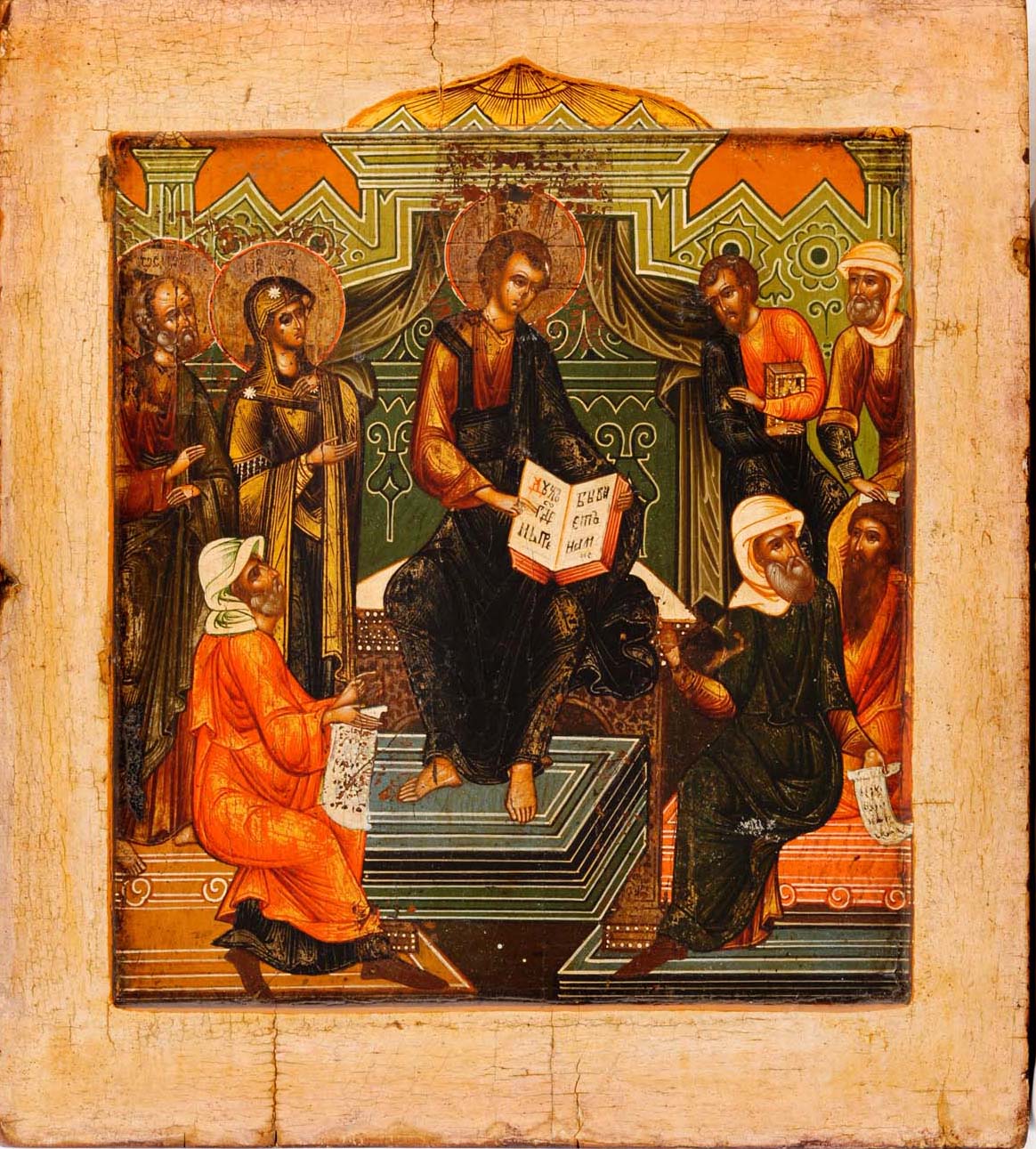
    Jesus Preaching in the Temple, c.1800, unknown Russian icon writer | Wikimedia Commons.

    This is an easy trap to fall into, especially these days as our way of knowing the world is dominated by the scientific method. I, for one, love history — imagining ages past and influences on people of different eras. But using a historical lens to interpret something fundamentally mystical — that is, the mysterious descent of the divine into the flesh of humanity — well, it leads to atrocious conclusions about Jesus like those found in Reza Aslan’s Zealot: The Life and Times of Jesus of Nazareth. Sadly, this book has been a #1 New York Times Bestseller and does nothing but present Jesus as a failed political zealot. Plus, it’s a tired, old argument of doubt. It’s so old that it happened exactly when Jesus was preaching astonishingly at the temple. It’s there in today’s reading.

    We must do better than this. We can’t ignore the historicity of Jesus, but we also can’t simply use the scientific/historical lens to look at Jesus the man. Pope Benedict XVI published Jesus of Nazareth (he was Cardinal Ratzinger at the time) as a more mature reconciliation of the facts of Jesus operating in a specific time and culture with the mystical reality of his Personhood in the Trinity. As he notes, “We are not meant to regard Jesus’ activity as taking place in some sort of mythical ‘anytime’” (11), so his historical person is important. But, he points out that his book “sees Jesus in light of his communication with the Father, which is the true center of his personality; without it, we cannot understand him at all, and it is from this center that he makes himself present to us still today” (xiv).

    This is what today’s readings are telling us: we cannot know Jesus without seeing how he dwells with the Father. Our notions of Jesus the man are simply inadequate in understanding him, the mystery of God, or the great Church that has emerged as his Body and Bride here on earth.