Tag: covenant

  • The Radicality of the New Covenant

    The Radicality of the New Covenant

    Third Sunday of Lent: Exodus 20:1-17, 1 Corinthians 1:22-25, John 2:13-25.

    Today we receive the Word of God in its most accepted and unchallenged form (the Ten Commandments) and then it its most radical and challenging — St. Paul bragging of the humiliation of the Cross and Jesus himself blowing up the concept of the Jewish temple as a sacred meeting place with God.

    The scene of Jesus casting out the moneychangers and animals was so serious that the Jews used this as one of the two main charges against Christ in his trial (that he claimed to be God and he wanted to destroy the temple). We need to ask ourselves why Jesus was so radical in today’s gospel and what it tells us about his New Covenant with us.
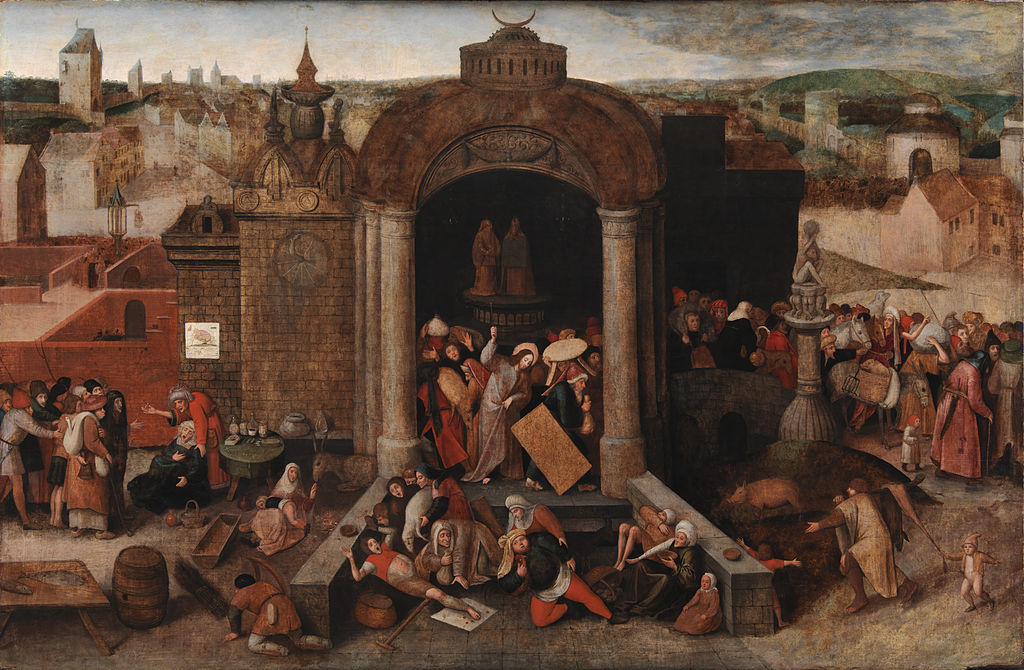
    Christ Driving the Traders from the Temple (Kristus uddriver kræmmerne af templet), after 1570, from the workshop of Pieter Brueghel the Elder | Wikimedia Commons.

    St. John’s account of this scene occurs at the beginning of Jesus’s ministry, unlike the three synoptic gospels where it occurs at the end. To me, this is interesting because it is another example of how John’s worldview is so transformed by Christ. Every event and detail overflow with his divinity; Christ is in control and in his power and glory throughout the gospel of John.

    The first thing that jumped out at me was the whip of cords (a flail or scourge) being used to drive the moneychangers and the animals out of the Temple. Jesus using a scourge on people? A close translation is needed here and unfortunately the Lectionary isn’t exact on this line. The original Greek specifies that the whip was only used on the animals. Here is the scholar David Bentley Hart’s translation: “And, having fashioned a stockwhip out of cords, he drove all of both the sheep and the oxen out of the Temple; he also spilled out the coins and overturned the tables of the moneychangers.”

    So while Jesus undoubtedly uses forceful methods to get the animals and money interests out of the Temple, it is not a depiction of violence against another human. This passage has been used to justify righteous war and violence, not to mention a “muscular” Christianity, and I think these are misunderstandings and poor applications of Jesus’s example.

    Christ’s point here is that they should “stop making my Father’s house a marketplace.” Having animals and moneychangers in the Temple served a very practical purpose. For those who traveled far to reach the Temple at Jerusalem, it was inconvenient and difficult to bring their required animal sacrifice with them. It was much more convenient to be able to buy an animal for sacrifice there. The doves, in particular, were targeted towards the poor and women/widows who couldn’t afford a lamb or ox but who still needed an animal sacrifice.

    Furthermore, Jewish law forbade foreign or secular coinage to be used in the Temple, hence the proliferation of money changers. Jerusalem was both a holy city and a crossroads for many cultures — caravan routes from Asia and Africa crossed there, as well as Gallic and Roman people from Europe thanks to the Roman Empire. The livestock and money changers, therefore, served a very useful purpose. But Jesus is clearly incensed that they are operating there in the Temple.

    We must not mistake his response as a simple desire for Temple purity. Jesus was not overly concerned with the fetishization of purity, as the Pharisees criticized several times (pointing out that his disciples did not fast like they did, nor did he and his disciples fastidiously wash before meals like they did). Instead, I think his point is that the Jews were placing the doing of deeds ahead of the heart-and-soul encounter with God.

    This is consistent with his critique of the Pharisees and scribes: “They tie up heavy burdens, hard to bear, and lay them on the shoulders of others; but they themselves are unwilling to lift a finger to move them. They do all their deeds to be seen by others” (Mt 23:4-5a). Yes, the livestock and money changers serve a useful purpose but this purpose is not to deepen the faithful’s experience with God. Instead, it is a marketplace of convenience, serving the needs and desires of humans.

    What’s more, those who sold the livestock and changed money made their living in this fashion — essentially profiting from a person’s journey to worship God. This self-serving practice is certainly not fit to occupy a position within the Temple. Perhaps the difficulty of bringing animals to the Temple was part of God’s plan to help people prepare their hearts for meeting him, much like our Lenten sacrifices. Perhaps the prescriptions on Temple coinage also came about purely as part of a bureaucracy of human convenience and desire. 
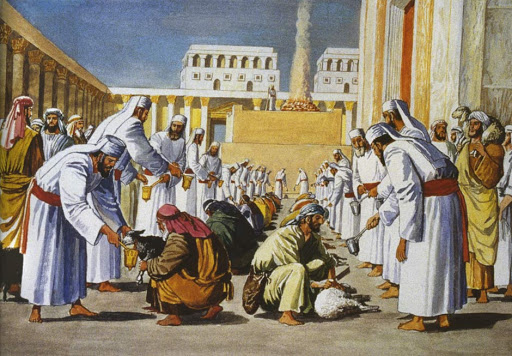
    The Temple Sacrifice (1995), Zely Smekhov | Image from zely-smekhov.com/

    In this light, it becomes much more clear why Jesus became so upset as to drive off the livestock and command the money changers to leave. This was no longer a dwelling place for the Lord, a sacred temple unto Him. It was simply a place of ritualized practices developed with convenience and efficiency in mind.

    The Jews had reduced the temple to spiritual rubble all on their own. All that was left was for Christ to show the inadequacy and irrelevance of the Temple as he instituted a new temple in his Body and Blood. This was not understood yet, but what was apparent was the pure shock of Jesus’s actions. Any disruption to Temple workings would be an affront to those in power — the scribes, the elders, the Sanhedrin. They held the authority in this place, and this traveling preacher was worth next to nothing in their book. Such actions were tantamount to terrorism in their eyes. Add to this the fact that he was suggesting an end to commerce and the ability for many people to obtain animals for their ritual sacrifices, and the disruptive nature of this act is apparent.

    Yet let’s not get carried away with this image of Jesus’s forcefulness and a promise of temple destruction. That is the same road the Jewish zealots tread with their expectation of the Messiah. God has his own way that does not correspond to human intelligence or intuition; that way is always love and self-sacrifice. We get the first hint of the underlying divine Way and Truth in the midst of this scene when the Evangelist writes, “His disciples recalled the words of Scripture, Zeal for your house will consume me.” This passage comes from Psalm 69, the Prayer for Deliverance from Persecution. Despite what it sounds like — someone being taken over by righteous anger (zeal) and lifted up to a position of power — this scriptural reference is to someone who is greatly persecuted and at the end of their rope, pleading for God’s deliverance.

    There is a real desperation in Psalm 69, which begins, “Save me, O God, for the waters have come up to my neck. I sink in deep mire, where there is no foothold.” It continues: “Do not let those who hope in you be put to shame because of me … It is for your sake that I have borne reproach, that shame has covered my face … It is zeal for your house that has consumed me; the insults of those who insult you have fallen on me.” In many ways, St. John’s use of this reference early on in his gospel is a foreshadowing of the Passion and Death of our Savior.

    It also helps us connect the final lines in today’s gospel when John tells us that Jesus understood human nature well. His great empathy with us comes from his Incarnation and living a fully human life; he knows life’s temptations and failings. The desperation of Psalm 69 speaks to the common human experience of trying to be faithful to God amid a culture consumed with earthly things. The reference to this psalm underlines the drastic nature of the Temple’s decline in Jesus’s mind, as well as a people so committed to their rituals instead of the presence of God in their midst that they will persecute and kill him. 

    As our gospel continues, the Jews, likely angered and put out, demand from him: “What signs do you show us, since you do these things?” Now, of course Jesus could have healed someone, raised someone from the dead, or performed some other miracle, but we are validating the mindset of the Jews if we think this way. Jesus only does miracles to bring people closer to God, to take away spiritual blindness, to enkindle hope or teach them about spiritual sustenance. The stakes here are not individual journeys of faith but the very locus of faith for the entire human race. The Temple was God’s dwelling place on earth, the most sacred place for humanity. What sign of this magnitude can Jesus give them other than himself? 
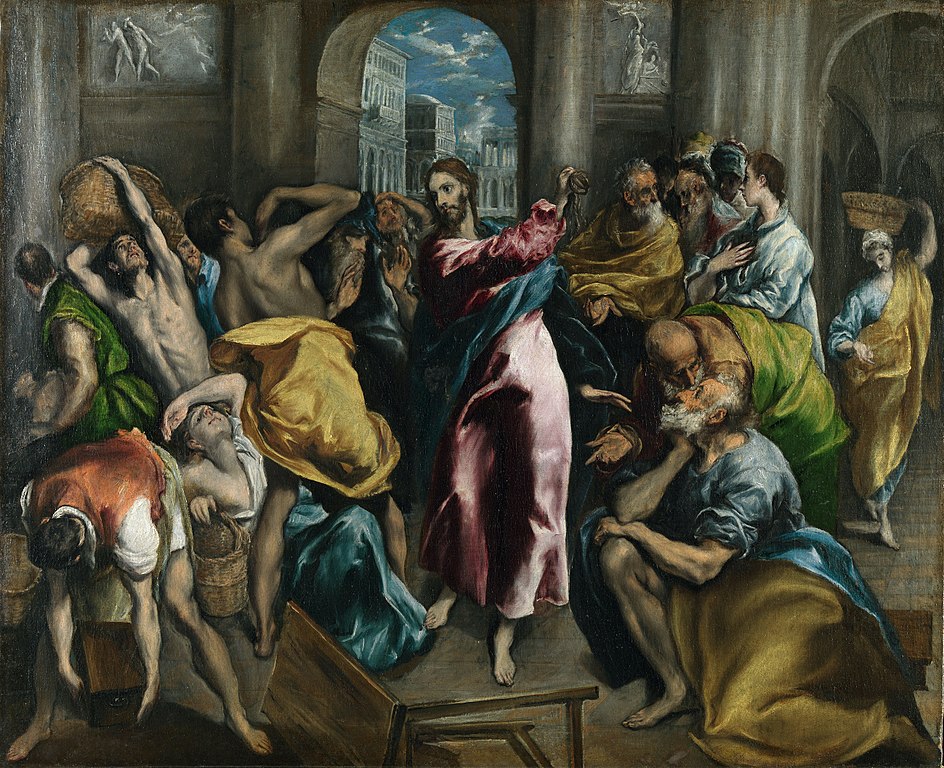
    Christ driving the Traders from the Temple (1600), version located in London, El Greco | Wikimedia Commons.

    And so he says, “Destroy this temple and in three days I shall raise it.” I envision him saying this with a quiet calm, in contrast to his other forceful actions. As John tells us, “he was speaking about the temple of his body.” What greater sign could there possibly be than the Resurrection?

    But the import of this exchange between Jesus and the Jews is that this is not just a sign. As we now know, he establishes his Body and Blood as lasting spiritual food, as part of the New Covenant with humanity. The sign of the Resurrection denotes a new reality: the liturgy bursts upon us, divinification is made possible as we walk his Way faithfully, the mystical Church is born, eternal life is made available to humans, and the old Temple is made irrelevant.

    In some ways, I almost think we can read the first part of Christ’s sentence, “Destroy this temple,” as truly referring to the Temple in Jerusalem, almost like a directive to humanity. Yes, destroy this temple because you will no longer need it and its empty, convenience-driven rituals that have made it no longer fit as a dwelling place for God. And, because He is the dwelling place of God on earth, we can understand the destruction of the Temple and his own death as an equivalency. Thus, he will raise his Body, which is and already has been the only real Temple since the Incarnation.

    Imagine the divine responsibility and patience it took for him to know this reality and to attempt to teach it to the Jews in a way they could start to accept. Not only is it a mystery of faith to understand the starting point of the Incarnation and how it has irrevocably changed the entire Jewish religion, but the ongoing work of Jesus in his ministry and acceptance of his own Sacrifice and Death is simply so counter-intuitive to our human conception of power and glory that it needed to be lived out to be believed.

    Thus, we hear John tell us that while he was in Jerusalem, “Jesus did not entrust himself” to all the people who started flocking to him; and John notes that he “did not need anyone to testify about human nature for he himself understood it well.” Because he is fully human and fully divine, Jesus knows how human hearts are fickle and how people can quickly twist signs and prophets to their own ends. He desperately wants to love humanity and bring them close to himself and the Father, but he must operate in the world in a way where his ultimate end as a loving sacrifice for humanity can be accomplished and not thwarted. Again, St. John presents us with a fully in-control Lord who steers himself and his disciples to the New Covenant with single-minded purpose.

    Artist’s illustration of a supernova, iStock

    As I reach the end of my reflection, I’m struck by the radicality of the New Covenant that is Jesus Christ. So much is centered on him, his Body and Spirit. He is the most dense spiritual supernova around which the universe rotates. He is the new Temple, transforming a type of ritual worship centered on a building into a true communion with God that provides real spiritual food.

    No human could imagine such a transformation of the Jewish covenant. It took God to come in person to make this important transformation happen and, in the process, open up for us the gates of Heaven. I suppose this is why we have such a shocking scene as he upsets the entire Temple economy in today’s gospel. How else can we grapple with the sheer upending of our old way of knowing God?
  • The Power of Baptism

    The Power of Baptism

    First Sunday of Lent: Genesis 9:8-15, 1 Peter 3:18-22, Mark 1:12-15.

    While on our personal Lenten journeys with Christ, we sometimes forget that it is also the season for the elect to formally pledge themselves to the Church, finish their preparation, and present themselves for Baptism, Confirmation, and First Holy Communion at Easter Vigil Mass. This form of the Rite of Christian Initiation for Adults is a modern way we grow the Body of Christ and has a rich tradition stretching back to the very first days of the Apostolic Age.

    During Roman persecutions, catechumenate faced execution for attempting to join the Church, and this act of faith was a truly courageous act. In the third and fourth centuries, adult initiates had a long, three-year process of formation (at least) that impressed the seriousness of their conversion and salvation. Over the centuries, this catechism devolved into “mass baptisms” of many people and the seriousness of their training and conversion was rightfully questioned.

    In any case, today we have a formalized process that is by no means as rigorous as the early centuries but does impress both the seriousness of the sacramental union with the Church and an understanding of our teachings (our Catechism of the Catholic Church). Lent is the season of the catechumenates’ final preparations to join and grow the Church.

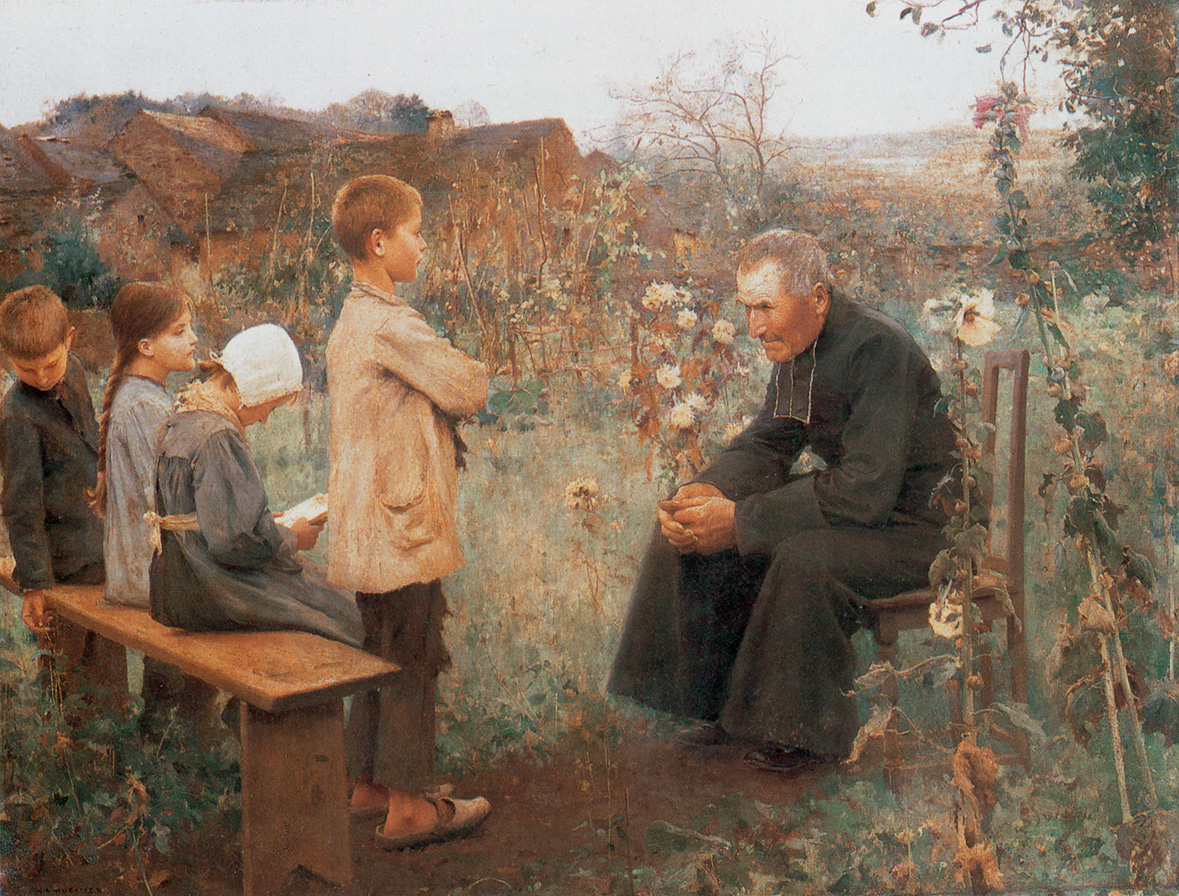
    The Catechism Lesson (La Leçon de catéchisme), 1890, Jules-Alexis Muenier | Wikimedia Commons.

    The three-year cycle of Sunday readings reflects this aspect of Lent, doing the work of reminding all of us of the major tenets of our history and faith, not to mention the importance of our sacraments. This transitions, of course, during Holy Week to recount the Passion, Death and Resurrection of our Savior, but it might be surprising to learn that the Church has ordered her readings on Sundays in Lent to help serve the formation of our catechumenate.

    So we can approach today’s readings with this framework in mind. Appropriately enough, we encounter the theme of baptism, particularly as spiritual protection. The first reading from Genesis recounts the upshot of Noah’s faithful obedience to God in building the ark. God tells him, “See, I am now establishing my covenant with you and your descendants after you and with every living creature that was with you: … there shall not be another flood to devastate the earth.” The Church sees great symbolism in the flood story. It is God’s second great covenant with humanity (the first being with Adam and Eve); the ark — the saving vessel in the face of God’s purifying force — prefigures the Church that will arise through Christ; the flood is a type of baptism, in this case a baptism that wipes away the evil of the world and blesses and ties Noah to God in a new covenant. The great tropes of baptism have been established: spiritual purification and a binding covenant with God through water.

    The first letter of St. Peter makes the connection to the flood in Noah’s time and clearly states its significance: “… a few persons, eight in all, were saved through water. This prefigured baptism, which saves you now. It is not a removal of dirt from the body but an appeal to God for a clear conscience …” This last statement is a bit confusing; is baptism an appeal to God for a clear conscience? I suppose it is, although the NRSV translation’s footnote says “Or a pledge to God from” a clear conscience. Interesting that our pledge could be perceived either as “for” or “from” a clear conscience.

    When I start wondering about translations, I often consult a few others, and I think the David Bentley Hart’s New Testament translation serves admirably (along with his three very long explanatory footnotes for this section): “… prefigures the baptism that now saves you — which is not a removal of the filth of flesh but rather the pledged consent of a good conscience to God — through resurrection of Jesus the Anointed.” He has a nice footnote to justify his translation of “pledged consent” and it does seem to wrap up the “to” vs. “from” debate by implying that God requests our good conscience in entering into the baptismal covenant and we give it to him. This reinforces the fact of our own free will and choice in baptism — something much more apparent in adult baptism than in infant baptism and thus very appropriate for this RCIA formation period.

    Noah’s Flood (Всемирный потоп), 2013, by Olga Glumcher | Image from useum.org.

    This whole discussion of conscience was initiated in the verses just prior to today’s reading. Peter encourages us to not be intimidated by those who seek to destroy our belief: “Keep your conscience clear, so that, when you are maligned, those who abuse you for your good conduct in Christ may be put to shame. For it is better to suffer for doing good, if suffering should be God’s will, than to suffer for doing evil. For Christ also suffered for sins once for all, the righteous for the unrighteous, in order to bring you to God” (1 Pet 3:16-18). A good conscience, which is part of the baptismal covenant, is important because Christians should be “living in the light.” Moreover, Peter points out that Christ, who is ultimately righteous and bears a clean conscience, suffered for all of us unrighteous souls, so he set the example of the Way we must walk. 

    All of this baptismal rubber hits the road when we encounter the gospel reading. St. Mark’s gospel, commonly seen as the earliest gospel, upon which Matthew and Luke drew, is very brief regarding the start of Christ’s ministry. There is great profundity; we must simply read it a bit slower and ponder each word.

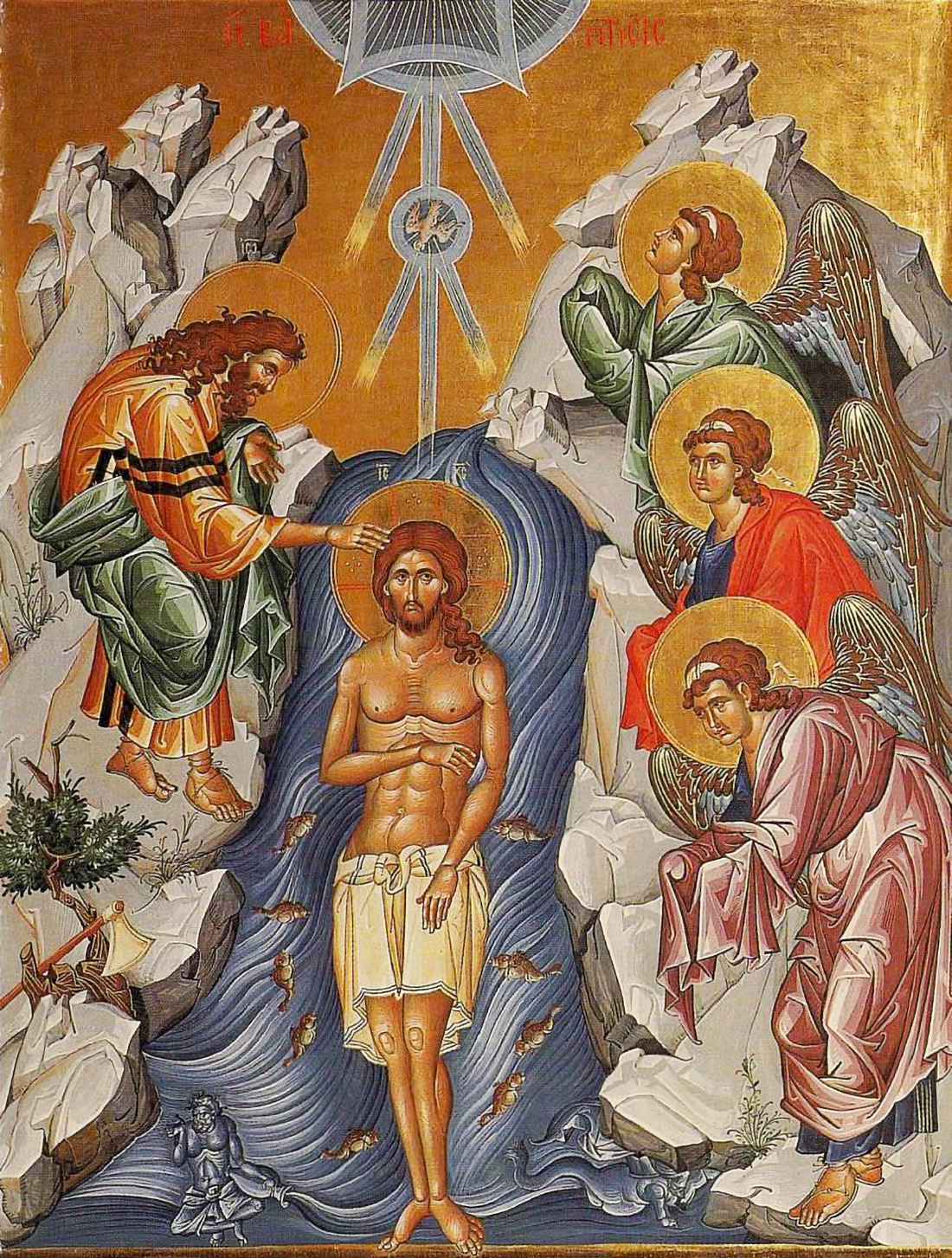
    The setup to today’s reading is the Baptism of our Lord by St. John the Baptist. Mark writes: “And just as he was coming up out of the water, he saw the heavens torn apart and the Spirit descending like a dove on him. And a voice came from heaven, ‘You are my Son, the Beloved; with you I am well pleased’” (Mk 1:10-11). So early in the first chapter of the first gospel we see the Holy Trinity in its unity as well as its diverse Persons! Consider how deep this revelation of Christ as the Son of God is: we see the outpouring of love from the Father, the participation of the Spirit, active in the earth, and Son’s willing acceptance of the covenant with His Father, which he will crown with his Blood. Christ’s Baptism reveals for all to see the endlessly flowing love of the Trinity that has burst upon the earth with his presence. This is something wholly new, and when we are baptized in Christ, it is this supernatural love and glory that is bestowed upon us as well. What a gift to be adopted sons and daughters of the Father, thanks to our great brother and teacher, Jesus Christ.

    As if sharing in the supernatural love of the Trinity was not enough, Mark shows us today how transformative a Christian baptism can be for us. He writes: “And the Spirit immediately drove him out into the wilderness. He was in the wilderness forty days, tempted by Satan; and he was with the wild beasts; and the angels waited on him” (NRSV translation). The dove-like Holy Spirit fills Jesus and immediately drives him into the desert. Matthew and Luke write that the Spirit “leads him” but Mark is undeniably writing something more forceful. The Greek word he writes is ἐκβάλλει (ekballei), the very same word used throughout the gospels when Christ “casts out” demons. Mark seems to be saying that baptismal sanctification by the Holy Spirit causes something more extreme in us than a gentle “leading into the light.” It casts the domination of worldly concerns out of our soul. This is what happens when Christ is cast into the desert, with wild beasts instead of human concerns. The supernatural force of his Baptism is so great that he cannot stay with humans who are so ordered by their passions and designs; these are not the Way to the Father.

    And while we can find profound meaning in the specific temptations that Satan imposes upon Jesus (see last year’s reflection, Getting to Know the Tempter, for thoughts on Matthew’s account of Jesus in the desert), Mark’s point is different. He notes that Jesus is tempted by the devil, but the emphasis is on the action of the Holy Spirit in Christ’s Baptism. The Spirit, let’s remember, has descended upon the Anointed One of God. While the Divine Persons undoubtedly can never be separated, we reflected last week on how Jesus put aside his divinity while taking on human form. He never stopped, on the order of being, to be the Son of God, but his time on earth in mortal form included a complete assent to being human. With his Baptism, Jesus the man is fully revealed also as a Person of the Holy Trinity, and the Spirit can dwell with him in a new way within that mortal lifetime.

    Icon of the Baptism of our Lord, provenance unknown | Image from ricochet.com.

    So he is impelled by his Baptism and the indwelling of the Spirit to eschew the human ordering of self that occurs within civilization and go to the desert. This is something we are given in our baptism as well: a radical new orientation of ourselves within salvation history where we fully enter the End Times with Christ. This doesn’t mean we are outside of the fallen world, which is ruled by Satan. Christ is tempted by Satan, just as we shall be, even after our baptism in Christ. But Mark shrugs aside these temptations as if inconsequential, for this is the Son of God, blessed by the Father and graced by the Spirit! This is why the more important point for Mark is that “the angels ministered to him.” Christ has opened a new way of living that bests the temptations of Satan and dwells in the company of angels. This is the promise of our New Covenant that we enter into in Christian baptism.

    Mark’s final verses in today’s gospel reading affirm this new state of the world. The time of John the Baptist has passed with the Baptism of our Lord. Jesus announces: “This is the time of fulfillment. The kingdom of God is at hand. Repent, and believe in the gospel.” Note that he fulfills and concludes the very words of the Baptist, “Repent, for the kingdom of heaven has come near” (Mt 3:2). The kingdom is no longer near, it is “at hand.” The command to repent remains, for none are on the new path of Christ yet, and repentance and baptism await us all as a prerequisite to entering the Kingdom of God.

    I don’t know about you, but there is something of the fire-and-brimstone Southern preacher in the call to “repent” that may deaden our ears to this call. It’s refreshing to look at Christ’s words in a new light outside of some of our cultural stereotypes. Here again is Bentley Hart’s translation: “change your hearts and have faith in the good tidings.” Yes, this is repentance: a change of heart. It is what Baptism entails as part of our covenant with God — our promise to convert our hearts to Him. We remind ourselves of our baptism and conversion of heart every time we enter our church and bless ourselves with holy water. While on the earth, we will endlessly turn our hearts back to God, return to the Way any time we stray, and employ the sacraments to strengthen us, absolve our sins, and draw us closer and closer to our Lord.

    May we all walk the way of the catechumenate this Lent, repenting and re-affirming our covenant with God.

  • Amen, the Logos is the Great I AM

    Amen, the Logos is the Great I AM

    Thursday in the Fifth Week of Lent: Genesis 17:3-9, John 8:51-59.

    Today’s readings compare God’s foundational covenant with Abraham and the New Covenant he offers through Christ. The terms of the covenants change, both the scope of God’s promise as well as the requirements from humanity. The constant, however, is the Word of God, providing the providential ordering of our lives.

    What stands out for me in the first reading is the earthly terms of the covenant God establishes with Abraham. Note the earthly elements: making him “exceedingly fertile,” giving him “the land in which you are now staying, the whole land of Canaan, as a permanent possession,” and changing his name from Abram (“Exalted Father”) to Abraham (“Father of Many Nations”). God’s plan seems to be one of choosing the patch of earth and people that he will till and tend, waiting for the fruit that it will bear. This fruit, of course, is Mary, and in turn, Christ.

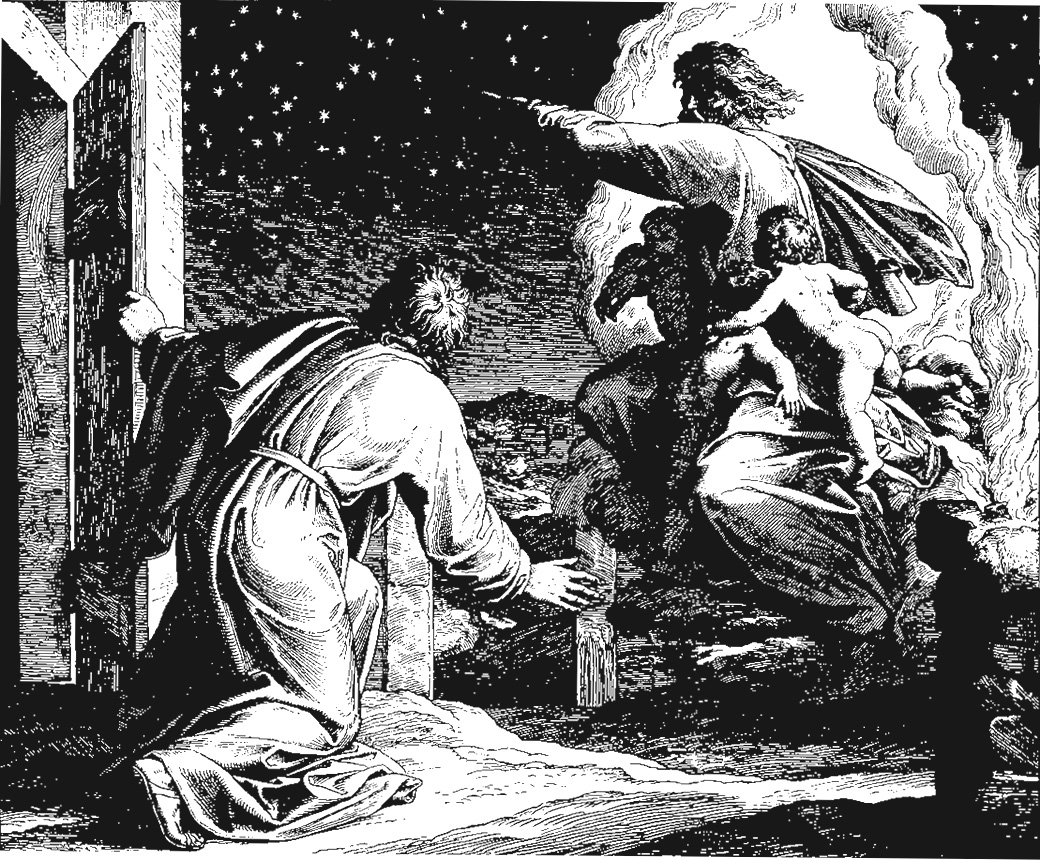
    God’s Promise to Abraham (1866), woodcut by Julius Schnorr von Carolsfeld for the “Bibel in Bildern” (Bible in Pictures) | Wikimedia Commons.

    Even the terms of the covenant placed upon Abraham and his offspring are very earthly. Genesis reports God’s command in the verses after today’s reading: “Every male among you shall be circumcised.” Symbolically and bodily, this is very important. The very organ for procreation, the method for being “exceedingly fertile,” will be marked for God. It will be exposed in a symbolic opening of one’s heart to be a servant of God. This is a permanent mark of a tribe, more permanent than pagan piercings, more indelible than tattoos. There is no hiding or turning back from this bodily mark in this world. 

    Circumcision lays the foundation for Moses and the generations after him when God presents them with a multitude of laws. The Abrahamic nations needed to live with the incontrovertibility of circumcision so that later generations could accept more prescriptive laws intended to keep them pure in body, mind, and spirit. Into this people, Mary was born miraculously without sin via the Immaculate Conception. And the prescriptions on purity and a cultural willingness to accept God’s law prepared her to accept the Incarnation of Christ in her womb.

    Returning to our reading, let’s dwell for a moment on the opening verses: “you are to become the father of a host of nations. No longer shall you be called Abram; your name shall be Abraham.” This is the essence of the Word of God: to create, to name, to make manifest his plans. No other “word” operates in this way. I might name my dog “Thunderbark,” but that doesn’t make his bark actually sound like thunder. In fact, our act of naming things often describes what we see, hear, touch, smell, or in some other way process through our senses. God’s Word, on the other hand, is creative and generative in that reality conforms to his Word rather than his Word describing what already exists. He is the Creator — he makes it exist. 

    We know from St. John that Jesus Christ is the Word of God, specifically the Λόγος (Logos). In the prologue to his gospel, he gives us the most influential Christian text on the Logos: “In the beginning was the Logos, and the Logos was with God, and the Logos was God. … All things came into being through him …  And the Logos became flesh and lived among us, and we have seen his glory, the glory as of a father’s only son, full of grace and truth” (Jn 1:1, 3a, 14). Logos, as I have noted in a previous reflection (The Life-Giving Word) is only partially defined by the English “Word.” It does literally mean “word,” “discourse,” or “account,” but by the time John writes his gospel, it had about 600 years of philosophical meaning attached to it as well. There are several threads that likely would have influenced John:

    • The writings of the Greek philosopher Heraclitus (c.535-475 BC) and his followers, who took the word logos that was already in common use and gave it more of a philosophical meaning, that of the reason or truth inherent in the world. From here we can see how Aristotle formulates logos as “reasoned discourse,” one of the three modes of persuasion.
    • The writings of the Greek Stoics (c.300 BC – 200 AD), who spoke of logos as the active reason pervading the Universe. They used the term λόγος σπερματικός (logos spermatikos) to mean the generative principle of the Universe that creates and takes back all things. This sounds a lot like God, which they intended, since logos for them was a type of spiritual or supernatural “ordering essence” in things.
    • The writings of the Hellenized Jew Philo of Alexandria (20 BC – 40 AD), who takes the Stoic philosophy a bit father. He calls Logos “the first-born of God,” and writes, “the Logos of the living God is the bond of everything, holding all things together and binding all the parts, and prevents them from being dissolved and separated.” But for Philo, the Logos is an intermediary divine being, a demiurge that is God’s instrument of creation, and this is soundly rejected by the developing Christian Church that upholds the equality and consubstantiality of the Son and the Father in the Trinity.
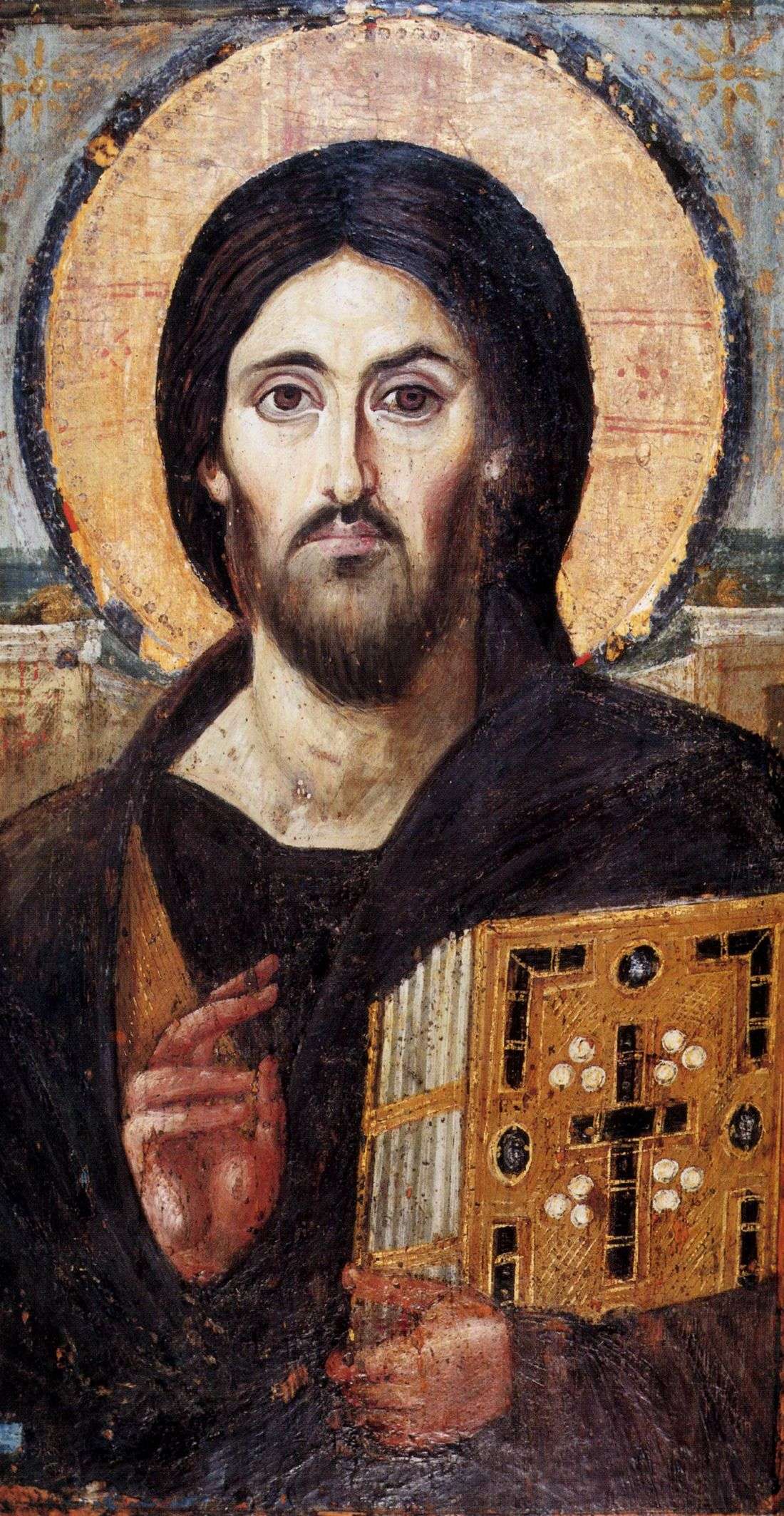
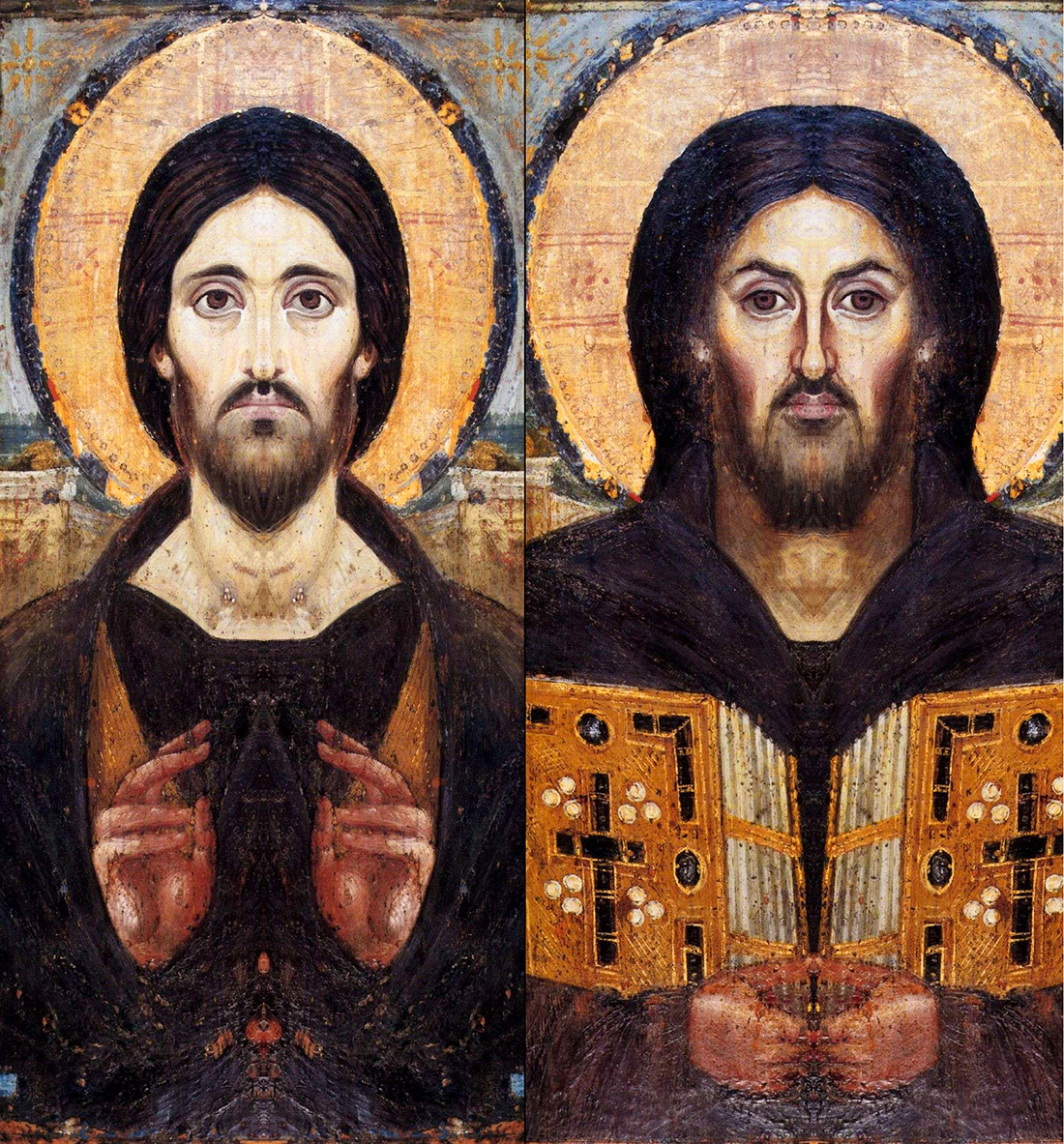
    The oldest known icon of Christ Pantocrator, 6th-century encaustic icon from Saint Catherine’s Monastery, Mount Sinai | Wikimedia Commons. This famous icon represents the perfect union of the human and the divine in Christ. The features on his left side (the viewer’s right) represent the qualities of his human nature, while his right side (the viewer’s left) represents his divinity. His right hand is shown opening outward, signifying his gift of blessing, while the left hand and arm is clutching a thick Gospel. Below is a mirrored composite of this image (made in Photoshop) that illustrates how the divine essence (left) is pure and perfect while the human nature (right) is painted in shadow with all of the “weathered” nature of the body and the earth.

    John’s Logos is not a synthesis of these definitions, nor does he simply “borrow” from these more developed and earlier systems, which many scholars want to claim. I think that is a condescending and belittling statement that discounts the true divine revelation at work in John’s Christology. Certainly, he did not invent the word Logos, but he instills the particularity of Jesus’s person that other philosophies employing Logos simply do not contain. Much like Christ reformulates our understanding of the terms life, death, and father, he gives new meaning to the word Logos. That being said, I think we must consider the vibrant meaning this word already contained by the time John uses it. It does translate to “word,” but it’s fair to say that John also understood it to mean reason, a generative principle in the universe, and an ordering essence.

    By insisting that Jesus Christ is the Logos of God and the Son of God, he says that this particular Jew who died on a cross around 33 BC was the ordering essence of the Universe, reason and truth incarnate. Thus, when Jesus speaks, the generative Word of God, the Logos is brought to bear in the world. That same Word that gave Abraham his name and established circumcision to prepare the fertile soil that would bring forth Jesus Christ as its fruit is, in fact, dwelling in Christ. Every time Christ speaks in John’s gospel, he brings forth real truth, and he is sure to remind us that he is sent from God and is speaking God’s Word, not something he generated himself as a man. We hear of no one else in sacred scripture who makes this claim.

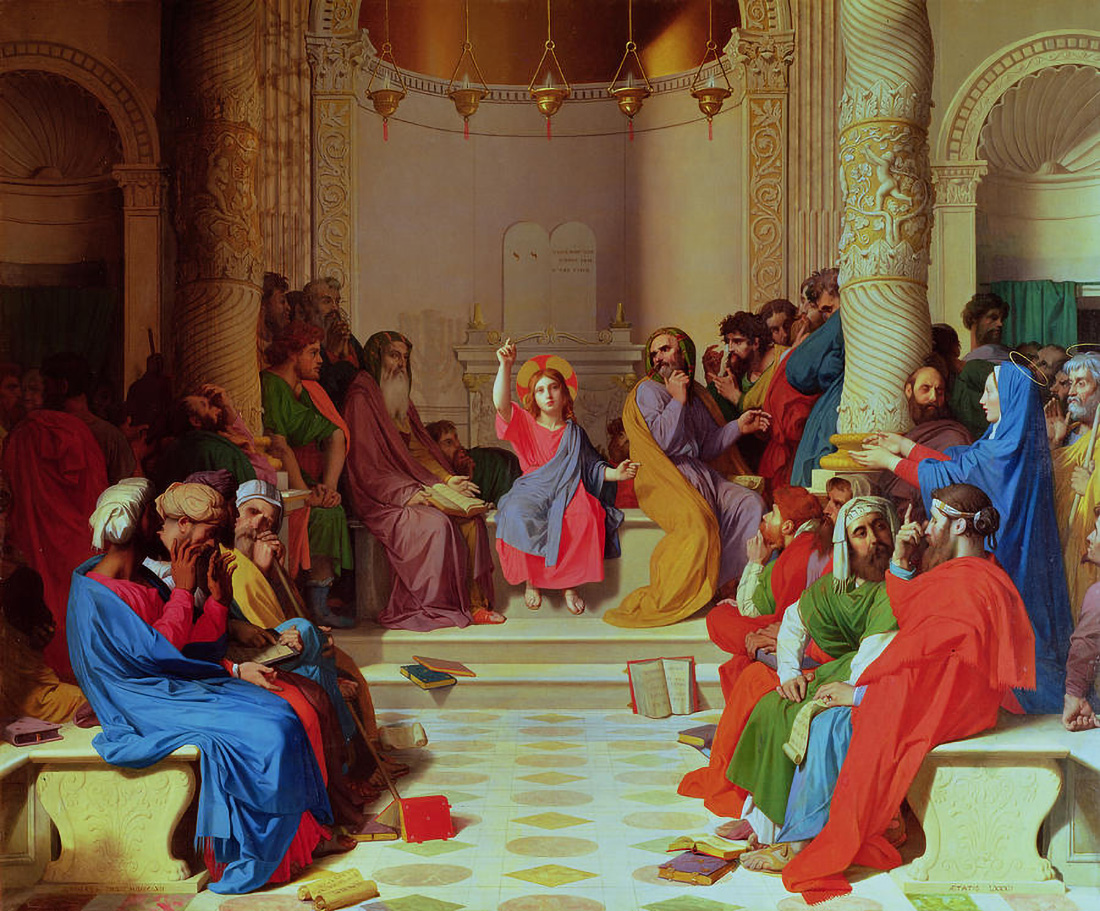
    Jesus Among the Doctors (1862), Jean-Auguste-Dominique Ingres | Wikimedia Commons.

    So, the question is, how can you resist the Word of God, the Logos of the universe? How can you doubt it, not trust it? A few verses before our gospel reading today, Jesus asks this very question: “If I tell the truth, why do you not believe me?” (Jn 8:46). He then answers his own question for them: “Whoever is of God hears the words of God. The reason you do not hear them is that you are not of God.” This is a continuation of yesterday’s gospel reading and reflection; Jesus is trying to remind them of who their spiritual father is, namely God the Father. He points out that their disbelief in him stems from their fundamental distance from God the Father. They reject him because they have already rejected the Father in spirit.

    The exchange in today’s gospel, the remainder of chapter 8, displays just how much they have rejected the Father and, in turn, how far they are from accepting Jesus and the Kingdom he offers. Their response to him (just before the reading picks up) is “Are we not right in saying that you are a Samaritan and have a demon?” They have devolved into name-calling, certainly not the sign of people who hold God dear to their hearts.

    Then, they take up jeering: “Are you greater than our father Abraham, who died? Or the prophets, who died? Who do you make yourself out to be?” They are not open to hearing the content of his words in the least. They are just picking out phrases he says to throw them back and wound him. Their rejection is complete when they pick up stones to throw at him; since their barbed words seem not to work, they try to carry out the violence physically. All of these words and actions come from a sinful spirit, a soul being fed by Satan and not God.

    What exactly is Jesus trying to say to them that garners this barrage of insults? The text sounds like Jesus desperately wants to break through to them, saying, “Amen, amen, I say to you, whoever keeps my word will never see death.” This sentence is worth examining. The first half of the sentence occurs so often throughout the gospels (John writes “Amen, amen,” while Matthew, Mark, and Luke use a single “Amen,”) that it is the most characteristic thing about his speech patterns. Jesus is the only one to use it at the beginning of his statements rather than the end of a prayer or as a confirmation of some other saying. And all of these writers have chosen to keep the Hebrew word “Amen” even though Greek has a word for “truly”: ἀληθῶς (alethos). So, “Truly I tell you” and “Verily I tell you” are not good translations here. There is no reason to translate a word that we regularly use in all of our prayers.

    To get at what “Amen” means other than “truly” “or “verily,” let’s turn to Joseph Cardinal Ratzinger’s fantastic Introduction of Christianity, where the entire first chapter delves into this question: “‘Amen’ simply says once again in its own way what belief means: the trustful placing of myself on a ground that upholds me, not because I have made it and checked it by my own calculations but, rather, precisely because I have not made it and cannot check it” (75). This Hebrew word expresses that one’s being is grounded in belief and faith. It marks the rootedness of oneself in the faith of our singular God. It could easily be translated as “I believe” when used at the end of a prayer or when receiving the Eucharist. Ratzinger goes on to write:

    The Christian attitude of belief is expressed in the little word “Amen”, in which the meanings trust, entrust, fidelity, firmness, firm ground, stand, truth all interpenetrate each other … The indivisibility of meaning, ground, and truth that is expressed both in the Hebrew word “Amen” and in the Greek logos at the same time intimates a whole view of the world. … For to believe as a Christian means in fact entrusting oneself to the meaning that upholds me and the world; taking it as the firm ground on which I can stand fearlessly (76, 73).

    So what is “Amen” when it is used by Jesus not as a confirmation of belief but as an introduction of something he is saying? I believe he is affirming that he is the firm ground on which we can stand. He is the source of the Amen, the Logos that is truth and meaning. And I don’t think this is just a clever rhetorical trick he uses to establish authority. It pours out of him 50 or so times in the New Testament, part and parcel of the truth he gives as a gift to humanity.

    After he says, “Amen, Amen,” He says λέγω ὑμῖν (legō hymin), which translates to “I say to you” or “I am telling you,” but legō just as correctly translates to “teach” or “command.” Thus, we can just as truthfully translate the first half of his statement, amēn, amēn, legō hymin to be: “The truth is here, I am teaching it to you.”

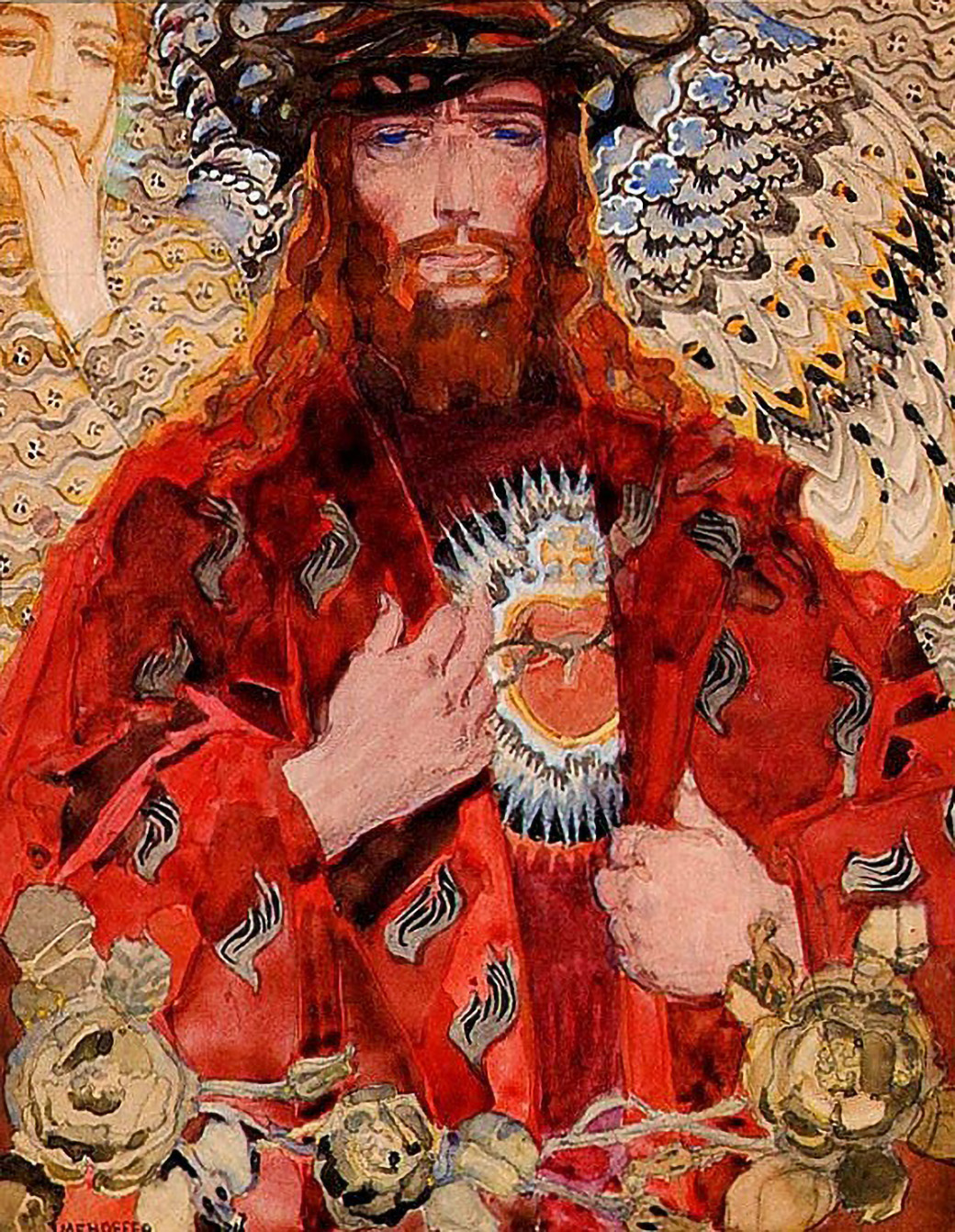
    The Sacred Heart of Jesus (Serce Jezusa), 1911, Józef Mehoffer | Wikimedia Commons.

    The second half of his important statement is “whoever keeps my word will never see death.” As you might imagine, there is more depth here than first appears in our English translation. The verb “keeps” (τηρήσῃ / tērēsē) means to “watch over,” to “guard,” and to “observe.” And, lo and behold, “my word” is logon (from logos). As we have detailed, since Christ is the Logos, when he says “observe my logon,” we can understand this to mean “whoever upholds the truth I bring to the world.”

    The entire statement has the lyrical feel of a proverb because the next verb “see” is θεωρήσῃ (theōrēsē), so we have some alliteration and rhyme between two verbs of beholding: tērēsē and theōrēsē. And let’s not think he means “experience” death when he says “see death.” This verb theōrēsē means to see in the sense of “to observe (as a spectator)” or “to contemplate (as in the mind)” and thus is much more consistent with the meaning of death as a type of sleeping, an inferior force in the world compared to the life from the Logos, as we discussed in the reflection on Lazarus, See the Glory of God.

    ‘Amen’ simply says once again in its own way what belief means: the trustful placing of myself on a ground that upholds me, not because I have made it and checked it by my own calculations but, rather, precisely because I have not made it and cannot check it.

    – Joseph Cardinal Ratzinger, Introduction to Christianity, 75.

    I know that this has been a long examination of a simple sentence, but where have we arrived? I think this changes the tenor of the statement to be less of a desperate “listen to me!” to more of a confident declaration of his truth and revelation of his being. “Amen, amen, I say to you, whoever keeps my word will never see death” can be also translated (in the context of this discussion), “The truth is here, I am teaching it to you; whoever upholds the truth I bring to the world will never be held in the thrall of death.” 

    Christ in the Desert (1933), Nicholas Roerich | image from arthive.com. I like this painting in that death is pictured in the shadows and could be mistaken for a black mountain if not for Christ’s patient, pervasive light that illuminates his grotesque charade.

    To tie this back to our opening observation about the contrast between the Abrahamic covenant and the new covenant given by Christ, God’s promise is no longer earth-bound. In fact, it’s about transcending the scope of earthly concerns, specifically death, and accessing the divine. For our part, our requirement is almost absurdly simple: uphold in our hearts the truth Christ brings into the world. Of course, in practice, this turns out to be harder than it sounds.

    Jesus’s final statement in today’s reading also speaks to the revelation of his being, and this one really throws the Jews into a fit. They scoff and ask how he can possibly know that Abraham saw his day and was glad. His answer: “Amen, amen, I say to you, before Abraham came to be, I AM.”

    Whoa! We get his signature opening of truth and the statement that their spiritual and ethnic father was γενέσθαι (genesthai), that is, “brought into being,” and before that, he (Jesus Christ) “is” — a different verb, εἰμί (eimi), which means to exist, not to be brought into being. He affirms John’s prologue that he is the Logos made flesh, that he exists from the beginning, with God and of God. By telling them that Abraham was glad for his arrival on earth, he also affirms that he has existed throughout all time, has been with all of the prophets and is above them.

    As we say in the Liturgy of the Hours, “He is the first-born of all creation; in every way the primacy is his.” With this lens of comprehension on his statement, the argument that the Jews are attempting to have with him in the temple is almost laughable. As St. Paul says in his letter to the Colossians, 

    He is the image of the invisible God, the firstborn of all creation; for in him all things in heaven and on earth were created, things visible and invisible, whether thrones or dominions or rulers or powers—all things have been created through him and for him. He himself is before all things, and in him all things hold together. He is the head of the body, the church; he is the beginning, the firstborn from the dead, so that he might come to have first place in everything. For in him all the fullness of God was pleased to dwell  (Col 1:15-19a).

    What is the sum total of all these heavy theological concepts that come together in Jesus Christ? For me, if I am a Christian, I accept all that Christ reveals as Logos, as Truth, as God. What he tells us today is that when we accept him (“guard” his Logos in our hearts), we are accepting a reality of God’s providential plan for humanity.

    In his 1998 Encyclical Letter Fides et Ratio, Pope Saint John Paul II writes, “The word of God reveals the final destiny of men and women and provides a unifying explanation of all that they do in the world” (81). Do we allow this to happen? Is our worldview fundamentally Christological?

    Do we interpret all of history through Christ or do we think that he’s just one voice among many holy voices? Do we think that has some truthful things to share with us or do we accept that he is the very truth and meaning that have ordered the universe from the beginning of time?

    These are important questions — he forces us to make a choice because only by accepting his truth can we transcend death. If we want sanctification, divinization, and salvation, we have the Way, the Truth, and the Life right here with us.

  • The Examined Self Before God

    The Examined Self Before God

    Monday the Second Week of Lent: Daniel 9:4b-10, Luke 6:36-38.

    Today’s readings call us to reflect on our sins. In the Book of Daniel, we are shown the model of a contrite heart for past sins. In the gospel of St. Luke, Jesus instructs us on how to avoid sins in the future. Now for many of us, thinking about sins is not the most captivating aspect of our religion (low attendance at Confession can attest to that), yet even the most casual reading of the Bible shows us how essential self-examination is.

    Perhaps we can better embrace the spirit of today’s readings if we bring to mind yesterday’s glorious Transfiguration reading from Matthew. When I put myself in the sandals of Peter, James, and John, and imagine witnessing the divine light shining from the face of our Lord, followed by the bright cloud of the Father instructing me to listen to him, I can also see myself falling prostrate on the ground. The purifying and incomprehensible divine light casts a shadow over my soul that “darkens and empties and annihilates it in its particular apprehensions and affections concerning both earthly and heavenly things,” in the words of St. John of the Cross (see the end of yesterday’s reflection for more context here).

    When my soul in its imperfect state encounters the divine light, I cannot help but notice its blemishes. It’s like a familiar shirt that seems fine until I wear it to a nice event in the sunshine — then, the stains and frayed seams jump out as obvious.

    How do we feel about the grubby shirt that is our soul? A bit embarrassed? That’s OK — let’s take heart from one of today’s patron saints, St. Catherine of Bologna (1413-1463): “It means little to wear a worn habit and walk with bowed head; to be truly humble one has to know how to bear humiliation. It is the touchstone of Christian discipleship.” Humiliation, embarrassment: both of these accept a public acknowledgment of a sin or mistake. It shouldn’t be too difficult for us to acknowledge our sins before God, in the privacy of our relationship with Him.

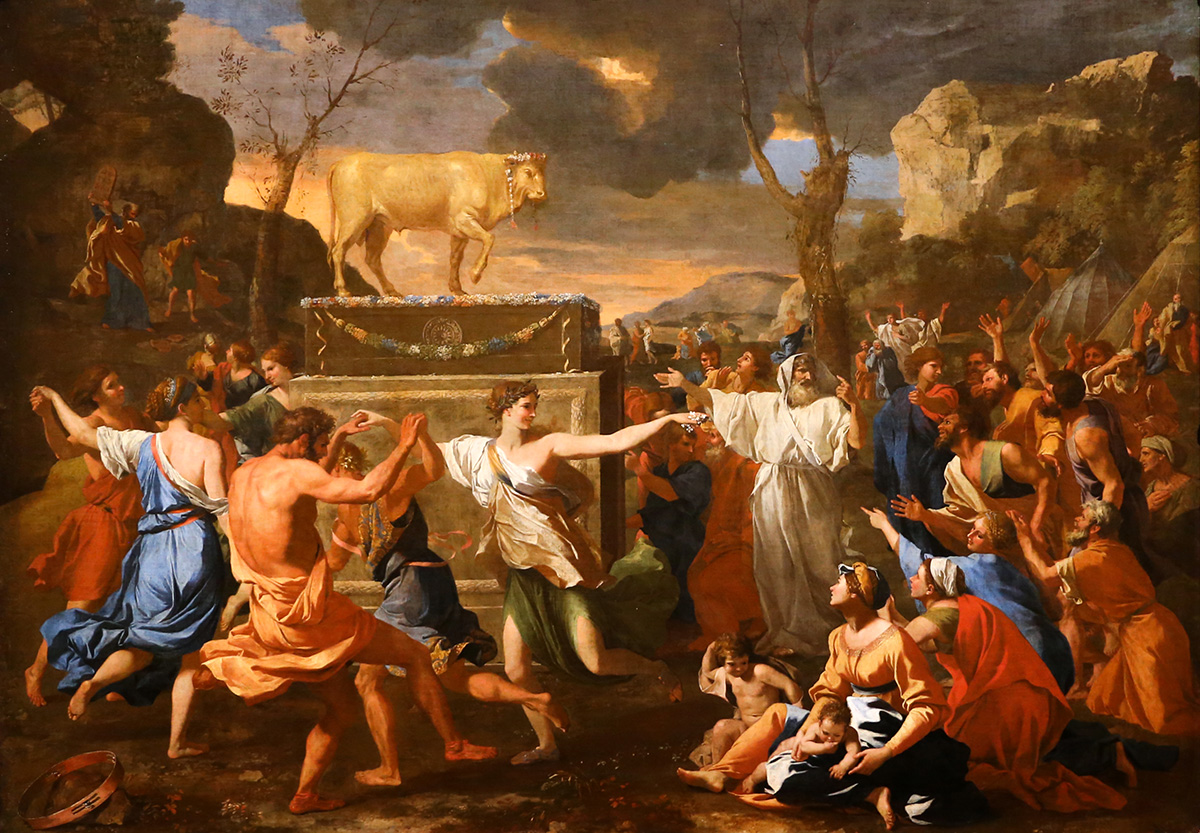
    The Adoration of the Golden Calf (L’Adoration du veau d’or), 1633-1634, Nicolas Poussin | Wikimedia Commons.

    Humiliation is something the Jews knew well at the time the Book of Daniel was written (~165 BC). During this period, Antiochus IV Epiphanes was the Greek ruler over Israel who brutally put down the revolt recorded in the Book of Maccabees. “He ordered his soldiers to cut down without mercy those whom they met and to slay those who took refuge in their houses. There was a massacre of young and old, a killing of women and children, a slaughter of virgins and infants. In the space of three days, eighty thousand were lost, forty thousand meeting a violent death, and the same number being sold into slavery” (2 Maccabees 5:11–14). Then he tried to force the remaining Jews to worship Zeus on pain of death.

    Rather than bemoan their conquered and downtrodden state, the Book of Daniel acknowledges the humiliation and takes spiritual responsibility: “O LORD, we are shamefaced, like our kings, our princes, and our fathers, for having sinned against you.” The message is not all shame and doom, however. God’s covenant with his people still stands and hope is always there: “But yours, O Lord, our God, are compassion and forgiveness!” The Book of Daniel is an apocalyptic writing and focuses on the coming day of the Lord and the ultimate vindication of the chosen people. (The writer of Daniel uses the famous phrase “Son of Man” for the messiah — one that Jesus will use in reference to himself throughout his ministry.) 

    What can we learn from this long passage acknowledging sins? We aren’t Israelites who broke their covenant by worshipping idols and ignoring God’s commandments. Or are we more like them than we think? Our idols may not be golden calves, and our worship of them may not include burnt offerings, but let’s consider our contemporary lives. American culture is known for a few things: nearly limitless choice (for food, for clothing, for entertainment, for jobs, for housing, etc.) and unconstrained appetite (for those same things). We don’t think twice about ordering something we don’t need from Amazon if the price seems good or buying that little impulse purchase right next to the cash register at the store.

    Our golden calf is ourselves and our offerings are conspicuous consumption. This has been true for a long time. Heck, Thorstein Veblen writes in the Theory of the Leisure Class in 1899 that “The quasi-peaceable gentleman of leisure, then, not only consumes of the staff of life beyond the minimum required for subsistence and physical efficiency, but his consumption also undergoes a specialization as regards the quality of the goods consumed. He consumes freely and of the best, in food, drink, narcotics, shelter, services, ornaments, apparel, weapons and accoutrements, amusements, amulets, and idols or divinities” (Chap 4: “Conspicuous Consumption, p.73).

    All of this is to say that we live in a society rooted in self, not in God. We participate in ways great and small. Too often we rationalize away the Word of God and try to fit it within our normal cycle of making money, saving money, spending money, getting things for ourselves, getting things for our mini-me (kids), etc. Granted, living in contemporary society and simultaneously living out the New Covenant is not easy apart from becoming a monk, but nonetheless we’re all called to be saints.

    Plus. that’s kind-of the point of Christianity. It was seriously hard (on pain of death) before it was sanctioned by Constantine and being Christian began to synchronize with the power of the state. This sent us down an arguably more difficult path of retaining our focus on a world beyond this one when the current world seemed to be achieving all we wanted. I digress.

    Acknowledging sins: is it worthwhile or does the reading from Daniel seem to take it a little too far? Let’s take some wisdom from one of our great Church Fathers, St. John Chrysostom, who writes: “If we have been neglectful to the present moment, let us proceed immediately to the work of destroying sin through confession and tears. … Unless you tell the magnitude of your debt, you do not experience the abundance of grace” (Homilies on Lazarus (388 AD), 4.4). Sounds like it’s worth it.

    Chrysostom’s comment about confession and tears (i.e., contrition) “destroying sin” is echoed by several other Church Fathers. Tertullian writes his treatise Repentance in 203 AD and makes clear this connection: “of confession is repentance born, and by repentance is God appeased. … by its own pronouncement against the sinner, [confession may] stand in place of God’s indignation … In so far as you do not spare yourself, the more, believe me, will God spare you!” This affirms that God wants us to convert to Him wholly, and the more work we do in confessing sins and purifying our own souls, the less God will have to do later (perhaps in Purgatory?).

    So here we get to the reason we’re confessing sins to God. Tertullian and Chrysostom are doing some arithmetic: if we have a bank of sins, we can confess and be contrite while here on earth to destroy some or most (maybe even all?) of this bank of sins … while of course trying not to commit more of them. Otherwise, we meet God after this life with a big bank of sins that He must deal with, not something we want. To use our earlier analogy, will we present ourselves to God in a grubby, stained shirt or will we scrub and iron that shirt the best we can before we meet Him?

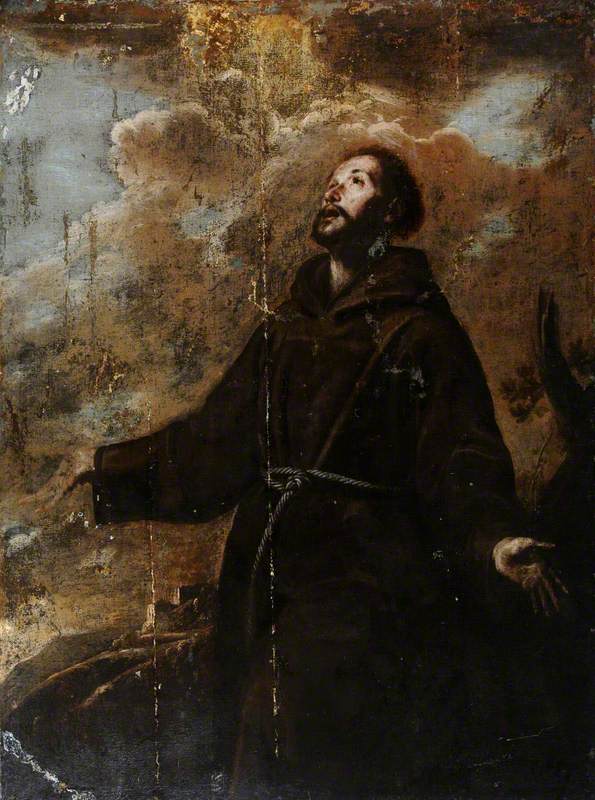
    Saint Francis in Ecstasy (1600s), Italian (Neapolitan) School | Creative Commons, courtesy Guernsey Museum & Art Gallery/ArtUK.

    The reasoning presented by Tertullian and Chrysostom we might call “negative reasoning” in that we are encouraged to do something good to avoid something bad (God’s reaction to our huge bank of sins). Christ presents us with “positive reasoning” in today’s gospel reading. While he is referring to avoiding future sins instead of confessing and repenting for past sins, his reasoning applies to both.

    Christ’s message is that we are active participants in our own salvation in how we respond to God’s call and take on God’s commandments. He says, “Stop condemning and you will not be condemned. Forgive and you will be forgiven. Give and gifts will be given to you.” In other words, live by God’s law and you will continue to live with God for eternity; carry divine love in your heart as you live, work, and act with other people, and divine love will be given to you for eternity.

    This reciprocation is a refrain that Jesus repeats throughout his ministry. The Lord’s Prayer uses nearly the same formulation: “forgive us our trespasses, as [you see us forgiving others].” How extraordinary — we seem to be hearing that we, in effect, have the power to save ourselves because God will mirror whatever we do. But let’s avoid this simplification of the message (and heresy) and dig a little deeper. 

    Jesus wants us to so fully embrace the divine life offered to us that we transcend the letter of the law to inhabit the spirit of the law. The readings last week showed us several times how Jesus exhorts us to surpass the righteousness of the scribes and Pharisees and to “be perfect, just as your heavenly Father is perfect” (see The Difficult New Covenant of Love). What changed from the time of Daniel in the old covenant is that Jesus offers humanity a real taste of the Kingdom here on earth and is the true gateway to the eternal Kingdom. That’s why we must transcend the letter of the law, which ruled the Israelite understanding of God’s relationship, and more fully let the Spirit inhabit us.

    Since we now have the liturgy that gives us true communion with God, we have the opportunity to carry our godliness into every aspect of our lives in a way that was never available before Christ. It is this same generosity of Christ that speaks today when he says that an “overflowing measure” will be measured out to us if we live in the New Covenant. This new Way (earliest Christians referred to themselves as followers “of the Way,” cf. Acts 9:1-2) requires more than the old covenants.

    To inhabit the spirit of the law (and let the Spirit inhabit us), we must not carry the spirit of condemnation and judgement, we must forgive and give. Again, the big difference is that we are sanctified by the Spirit in the liturgy and sacraments; our sanctified lives puts us in intimate communion with God. That means that when we sin we turn our backs on God, the God dwelling within us who we just sullied with sin. We must both confess/repent for past sins and keep from future sins because we are already “on the Way” to union with God. We already have the Spirit dwelling within us and acting in our lives. Our union with God’s will by the way we act confirms our covenant with Him and therein his promise to reciprocate in the life to come.

    To live a fully human life means to be elevated and transformed by God, to strive for perfection in spirit and action as we unite ourselves with Him. The ultimate reason for Christians to live like this is not a selfish guarantee of eternal life for that person we think we are (as we worship at the altar of self), but because we want to be with Him, to leave these limited “selves” and join the heavenly host. That’s exactly the “overflowing measure” promised to us.

  • The Transfiguration Reveals Truth “According to His Own Design”

    The Transfiguration Reveals Truth “According to His Own Design”

    Second Sunday in Lent, The Transfiguration of Christ: Genesis 12:1-4a, 2 Timothy 1:8b-10, Matthew 17:1-9.

    Today we hear of the Lord’s glorious Transfiguration, set up wonderfully by yesterday’s readings on covenants (see The Difficult New Covenant of Love). There are many signs that point to the New Covenant, including the Annunciation, the Lord’s Baptism, the Presentation of Jesus at the Temple, and of course the Resurrection. But the Transfiguration stands out as a pivotal moment that invokes the old covenants in the form of Moses and Elijah while the Father presents his blessed Son as a gift with the command to “listen to him.” We encounter all of the elements of the covenant as a pact with God where his gift and our commitment to him are both present.

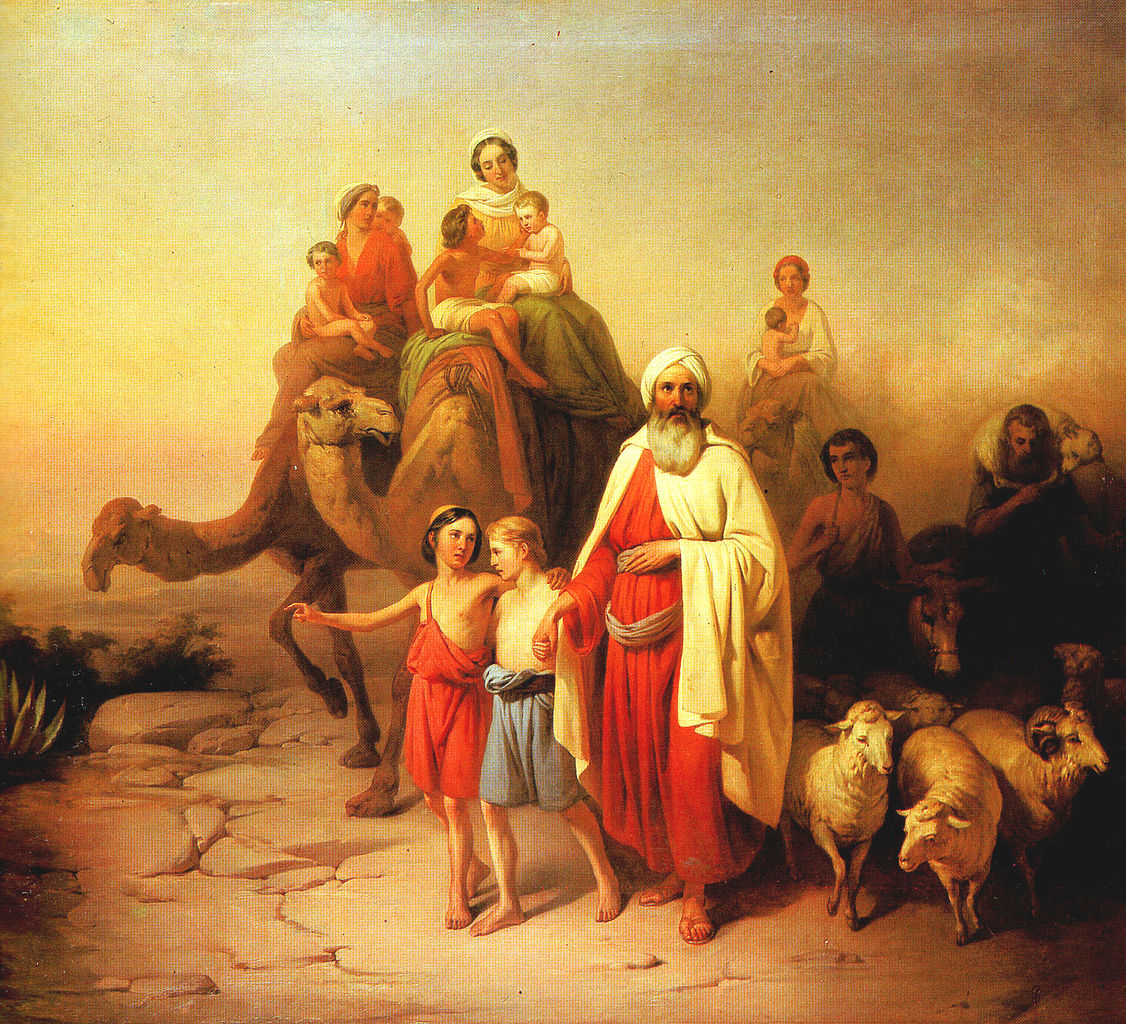
    The first reading from Genesis relates the Abrahamic Covenant where God asks for great faithfulness in return for his blessing. He commands: “Go forth from the land of your kinsfolk and from your father’s house to a land that I will show you.” We might call this blind faith, actually. Abraham must leave everything — his father’s inheritance, all of his relatives and friends — to go to parts unknown (to be revealed later!). Of course, after the test of faith where he was asked to sacrifice his son Isaac, maybe he was getting used to these demands of faithfulness. Whatever the case, we hear that “Abram went as the LORD directed him.” It’s a short sentence but displays the absolute trust that Abram places in God. (Hence the very appropriate Responsorial Psalm 33, Lord, let your mercy be on us, as we place our trust in you.)

    Abraham’s Journey from Ur to Canaan (Ábrahám kiköltözése), 1850, József Molnár | Wikimedia Commons, artwork housed in Szépművészeti Múzeum – Magyar Nemzeti Galéria, Hungary.

    The Abrahamic Covenant sets the stage for all of God’s covenants: we are asked to act in faith based on what we do not know or see. We can’t do this unless we trust God completely.

    In the second reading, St. Paul underscores this aspect of our relationship with God as he urges his flock to “Bear your share of hardship for the gospel with the strength that comes from God.” We might think we lack that strength ourselves, but no matter, the strength actually comes from God, another point of trust. This trust is made possible thanks to Abraham and the entire tradition to the point of Christ. Paul writes, “He saved us and called us to a holy life,” noting that God’s covenants have saved the nation time and again, and that, in return, they have been called to a holy life. Lest his readers think they earned their holiness, much less their salvation, he corrects them: “not according to our works but according to his own design.”

    And here we have a great and humbling admission: “according to his own design.” As humans, relinquishing power over our destiny, trajectory, or career (to use modern terms) is something we have a hard time accepting. Especially in “pull yourself up by your bootstraps” USA. It’s part of our national fabric to be a “self-made man.” Yet how far from our faith could we possibly get when we think this way? Was Abraham a self-made man? Moses? Elijah? Christ?? Of course not. These greatest of figures in history were not only made by God, but directed, commanded, steered, and loved by Him. Their greatness lay in their acceptance of his dominion and willingness to trust, have faith, and do his will.

    We have to actively work to change our unconscious bias for being self-made, for controlling our own destiny. Thank God that we have thousands of years of his promises kept, miracles done, and covenants upheld. These must give us great comfort; they display that he does indeed have “his own design” and it works best if we don’t try to know it but rather simply trust it.

    The greatest of You-deserve-our-trust signs is Jesus Christ himself. Today’s account of the Transfiguration of Christ in the gospel of St. Matthew is almost understated in regards to the pure majesty and import of the New Covenant’s revelation. Matthew gets right to the point: Jesus and his chosen three go up the mountain, “And he was transfigured before them; his face shone like the sun and his clothes became white as light.” 

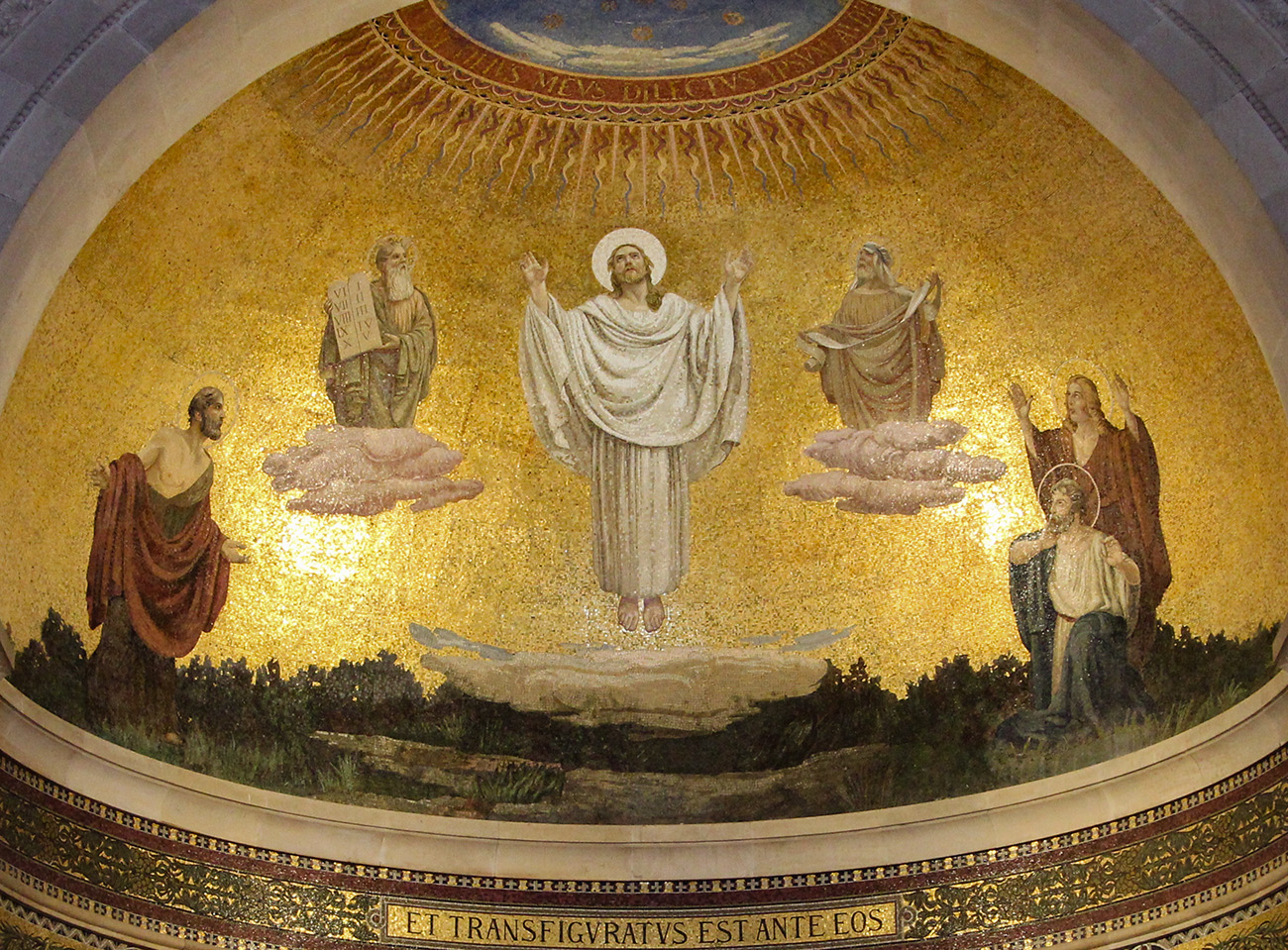
    The Transfiguration of the Lord (mosaic, Church of the Transfiguration, Mount Tabor, Israel), 1924, Umberto Noni | Wikimedia Commons. The caption is Latin for “And he was transfigured before them.”

    There was one other encounter with God that changed a man’s appearance: Moses on Mt. Sinai receiving the Ten Commandments. These two mountain encounters with God are worth comparing. Matthew’s report that Jesus’s face shone like the sun is important to contrast to the interplay of light on the faces at Mt. Sinai. The glorious face needed to be hidden from Moses; The Lord tells him “you cannot see my face; for no one shall see me and live….you shall see my back; but my face shall not be seen” (Ex 33:20, 23). When he comes down from the mountain, “Moses did not know that the skin of his face shone because he had been talking with God” (Ex 34:29b), and even this reflected glory makes the Israelites afraid. Moses has to wear a veil over his face when he talks to them so that they can overcome their fear and awe.

    Yet Jesus does not reflect God’s light, he emanates it. He is such a perfect, non-conflicting union of the human and the divine that the divine light that would kill humans merges perfectly with him; more: he, in fact, is the source of illumination.

    What is the significance of his clothes? He purifies these garments made by human hands, turning them white. This is a sign that, in him, humans can be purified and divinized as well.

    Matthew tells us next, “behold, Moses and Elijah appeared to them, conversing with him.” Moses is the ultimate representative of the law, and Elijah is the ultimate representative of the prophets. Christ is the fulfillment of both the law and the prophets. Here he stands talking with the greatest of those who represent the law and the prophets, and Peter, for one, is thrilled. Here are two of the greatest Jewish religious figures and heroes, conversing with his own teacher, who glows with some sort of mysterious providence that they’ve never seen before. He asks Jesus if he should build tents for each of them. This is easy to misinterpret, but remember that Moses (and all of Israel before the Temple of Solomon was built) made a tent for God to dwell with them. Peter’s tents are a Biblically-sound suggestion for these celestial beings to remain with them, as if a new era has started where the new heavenly Jewish superheroes will help the nation reach new heights.

    But he’s clearly missed the point, and God the Father interrupts him mid-request. Note how differently God appears here on Mt. Tabor compared to Mt. Sinai. On Mt. Sinai:

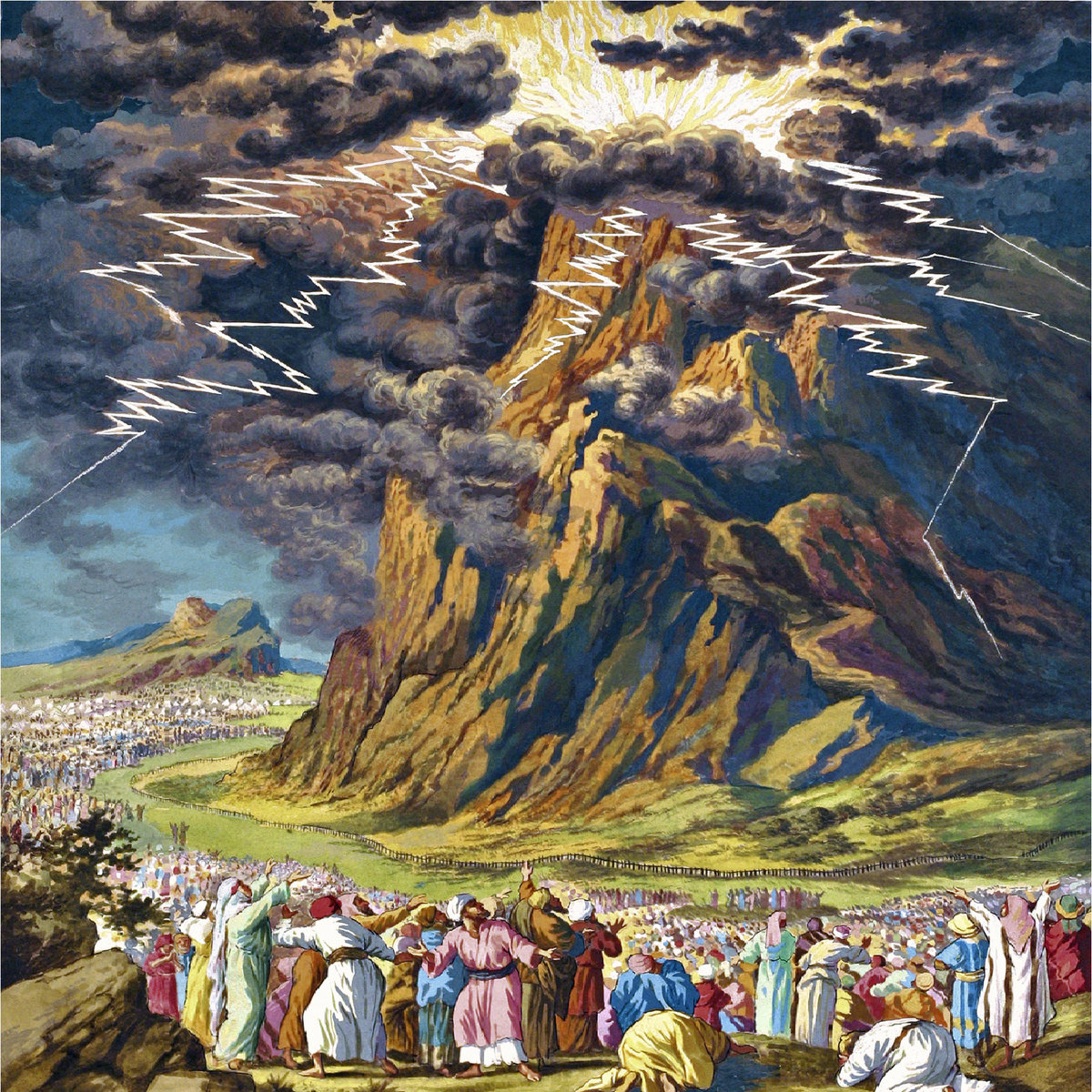
    On the morning of the third day there was thunder and lightning, as well as a thick cloud on the mountain, and a blast of a trumpet so loud that all the people who were in the camp trembled. Moses brought the people out of the camp to meet God. They took their stand at the foot of the mountain. Now Mount Sinai was wrapped in smoke, because the Lord had descended upon it in fire; the smoke went up like the smoke of a kiln, while the whole mountain shook violently. As the blast of the trumpet grew louder and louder, Moses would speak and God would answer him in thunder (Ex 19:16-19).

    The Giving of the Law, 1936, unknown artist | Creative Commons.

    Thunder, lightning, a thick cloud, smoke, fire, violent shaking and trumpet blasts. Truly frightening phenomena. Add to this God’s command to Moses: “warn the people not to break through to the Lord to look; otherwise many of them will perish.” The Lord is hidden from view, darkness and opacity characterize His appearance, and even Moses must only converse with his back, not his face.

    Contrast this with today’s reading: “While [Peter] was still speaking, behold, a bright cloud cast a shadow over them, then from the cloud came a voice…” What an interesting description of light that St. Matthew gives us! The cloud is bright, not dark, akin to the glow we see on the face of Christ. And how can we explain that a source of brightness casts a shadow, since shadows are only cast when a greater source of light is behind them? The divine cloud is surely the brightest thing in the sky.

    For one point of reference, I am reminded of St. John of the Cross and his contemplations in The Dark Night of the Soul: “The more simply and purely the divine light strikes the soul, the more it darkens and empties and annihilates it in its particular apprehensions and affections concerning both earthly and heavenly things” (Book 2, 8.2(2)). This seems to be precisely what is happening — the shadow cast over them is the darkness that strikes the soul by the purifying and incomprehensible divine light.

    Indeed, “they fell prostrate and were very much afraid,” despite the fact that they are in the light and there are no terrible phenomena like we see on Mt. Sinai. Their minds are also cleared of the “particular apprehensions and affections concerning both earthly and heavenly things” as described by St. John of the Cross — there is no more discussion of tents.

    God delivers the New Covenant: “This is my beloved Son, with whom I am well pleased; listen to him.” His gift: his Son. His command: listen to him. Christ is both sides of the covenant, the gift and our requirement. This seemingly simple covenant, taking up so few words compared to those in the Old Testament, is unapproachably dense in its profundity.

    How can we comprehend the gift of God Himself, joined to humanity in our New Covenant? This unlikely and undeserved gift simply requires us to “listen to him.” Like an overly-dense star ready to become a supernova, Christ is poised for the Resurrection, when the love of the Trinity will be poured out on humanity. But the Resurrection will only come after his example of self-giving love is shared with us in the form of the Cross. Listening to him will, in fact, require a radical shift in our lives, a willingness to accept the way of the cross.

    Transfiguration of Jesus (icon), 1408, Theophanes the Greek | Wikimedia Commons. Artwork from Spaso-Preobrazhensky Cathedral in Pereslavl-Zalessky.

    But the truth of the Transfiguration is most beautifully portrayed in Jesus’s words: “Jesus came and touched them, saying, ‘Rise, and do not be afraid.’ And when the disciples raised their eyes, they saw no one else but Jesus alone.” Despite the difficulties we will encounter truly listening to him and taking up our crosses, Jesus the man, the friend, the teacher, is there for us in person, giving us his generous love. He touches them with tenderness, encouraging them not to be afraid of the reaction of their souls to the divinity they are in contact with. When they raise their eyes like docile sheep, they see only the Good Shepherd, who is also the sacrificial lamb.

    The first test of this New Covenant will be given to Peter, James and John when he charges them: “Do not tell the vision to anyone until the Son of Man has been raised from the dead.” They must listen to him as God commanded, although every fiber of their being must have been straining to share the Good News, electrons excited out of their shells with the potential of the divine energy waiting to erupt into the world. But only when the Resurrection is accomplished will the world be ready to comprehend that God Himself walked among us, that he was the fulfillment of the law and the prophets.

  • The Difficult New Covenant of Love

    The Difficult New Covenant of Love

    Saturday in the First Week of Lent: Deuteronomy 26:16-19, Matthew 5:43-48.

    A covenant is an agreement, a pact, a legal contract. When covenants are offered by God, they take on more significance, guaranteeing protection and favor for the people in exchange for adoration and obedience to God.

    Covenants with God are so important in the Jewish tradition that they trump earthly agreements between kings and peoples. As Christians, we inherit this same understanding of God’s covenant being the orienting principle to our entire lives, above all other agreements or laws.

    Today’s readings trace the establishment of the Mosaic Covenant as well as the New Covenant, drawing similarities and points of departure between them. Our God does not change, nor do his promises to us, but what he asks of us evolves in relation to the readiness and receptiveness of humanity to understand and perform his will.

    Aphraates, the Bishop of the monastery at Mar Mattai (near modern-day Mosul), speaks to this succession of covenants. He is also known as the “Persian Sage” and is considered one of the very important Syriac Church Fathers. His words are part of the Liturgy of the Hours, recited during the Office of the Readings on Wendesday in the First Week of Lent:

    Law and covenant have been entirely changed. God changed the first pact with Adam, and gave a new one to Noah. He gave another to Abraham, and changed this to give a new one to Moses. When the covenant with Moses was no longer observed, he gave another pact in this last age, a pact never again to be changed. … Every covenant was proved firm and trustworthy in its own time, and those who have been circumcised in heart are brought to life and receive a second circumcision beside the true Jordan, the waters of baptism that bring forgiveness of sins. (from the 11th Demonstration (homily) on Circumcision, 344 AD.)

    This is helpful for us to understand how God slowly prepared humanity for the gift of his Son, giving us progressively more nuanced and deep commandments to follow. He prepared our hearts, generation after generation, to receive the Truth in the flesh. As one of my heroes, Jean Corbon, OP, says in his book Wellspring of Worship, “Through faith men begin to become responsive and accepting and to enter into covenants. The seed of the Resurrection is sown in the time of death … This is the time of God’s venture in history and his preparation of man for the full truth; it is the time of reciprocal searching and of the fidelity of the Holy One that is maintained despite the infidelities of his sinful people” (34-35). Covenants seem to serve as a kind of spiritual weight training, a way to grow the “muscle” of faith.

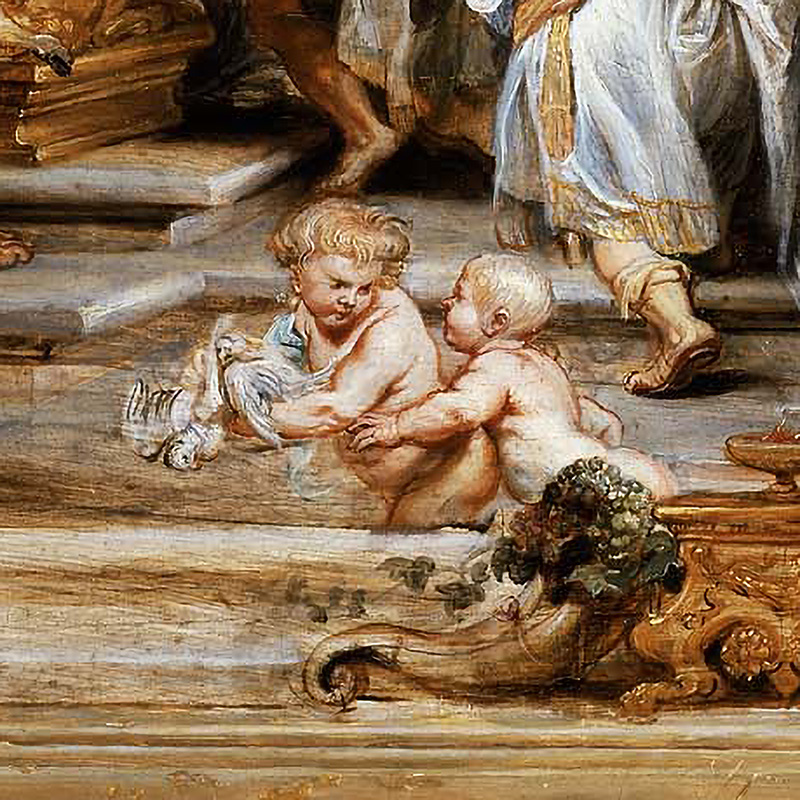
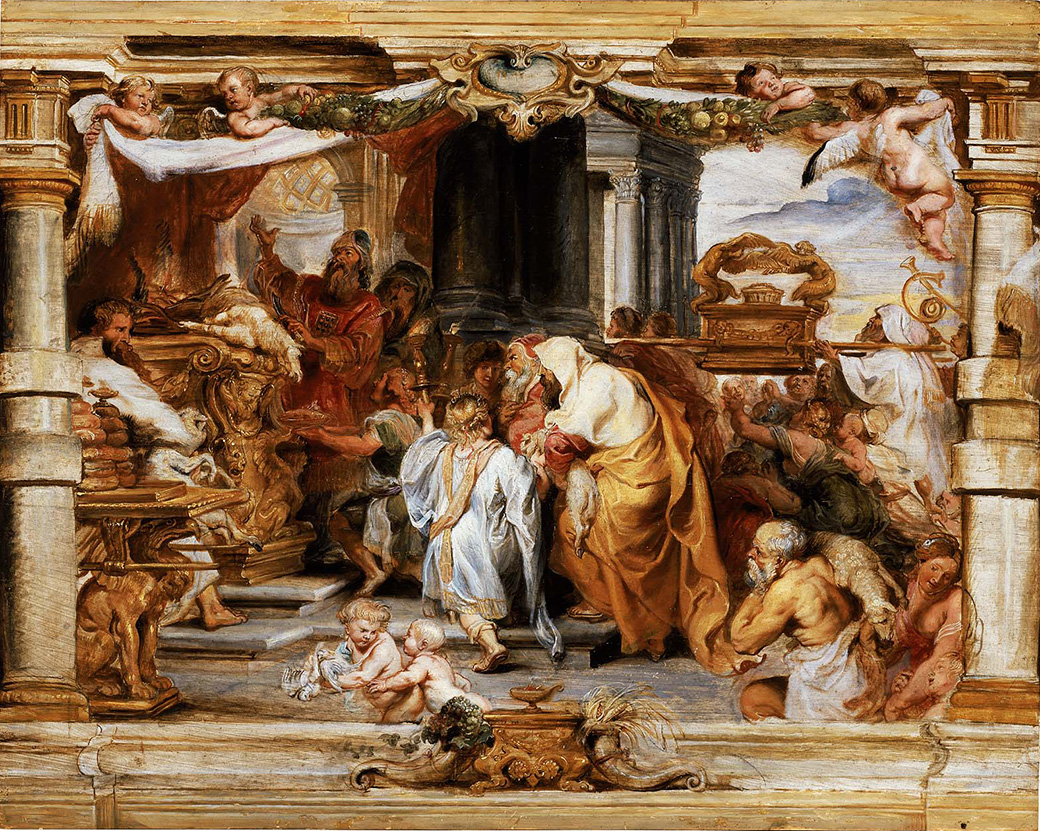
    The Sacrifice of the Old Covenant (oil sketch), ~1626, Peter Paul Rubens | Wikimedia Commons.

    We hear a very clear contract in the earlier covenants, such as the Mosaic one in today’s first reading, when he says “provided you keep all his commandments, he will then raise you high in praise and renown and glory above all other nations he has made.” At this time, the Jews were very concerned with building a nation, having a land for themselves, and being protected from their enemies. God found a way to work within these secular concerns and plant the seed of faith and obedience to something not of this world. The promise in return for faithfulness is something to which they can relate: renown and glory above the other nations.

    Jesus comes 1300 years after Moses, after the time of human infidelities and renewed covenants, not to mention prophets who spoke the Word of God with astoundingly clear proclamations of Christ’s coming mission and impact. These events shaped the tenor and direction of the Jewish faith until it was ripe for the Christ event — from the Annunciation (Mary’s readiness to accept the gift) to the Resurrection and Pentecost (the apostles’ readiness to accept the Spirit and mantle of evangelization).

    Interestingly, the terms of the covenant were quite clear and easy to accept when the Truth was still partially hidden from view (the time of the Old Testament), yet our ability to grasp the terms and import of the New Covenant have an almost inverse relationship to the nearness and clarity of the truth. In other words, because the unity of God and man is so profound and real with Christ, the Word describing our new covenant is almost beyond our comprehension, somehow obscured in its mystery and proximity, as if peering at it through a cloud of incense at Mass.

    As an example of what I mean, we see time and again that the disciples don’t quite understand what Jesus’s parables and teaching are all about. Some of his teaching is too difficult for them to accept, like the revelation of his very flesh and blood being the food of life and that we must eat it, and they leave in droves. Even today, it’s easier for Catholics to believe in a simplified “love one another” existence than the nuanced call to dwell in God first and love others because you are loving Him in them. Or easier for Christians of other denominations to disregard the call to literally eat his flesh and drink his blood to be sacramentally purified and joined with the triune God. The closer the mystery and the truth, the more of a deep faith is required.

    After all, it’s much easier to have faith in a God who helps you win a battle than it is to have faith in a silent Trinity pouring out their ever-flowing love on humanity, specifically through sacraments that were established when one Person of the Trinity died in an act of love for his Father and then bodily rose from the dead. This is the difficult work of faith we are called to bring to our New Covenant.

    Transfiguration (1560), Titian | Wikimedia Commons. Jesus is the new Adam, the new Moses, the perfection of Elijah; as the apostles wanted to stay in on the mountain where His glory was revealed, we, too, sometimes forget that the New Covenant commands us to “pick up our cross” and follow Him.

    Today’s reading from St. Matthew shows Jesus tackling these difficulties head-on: “You have heard that it was said, You shall love your neighbor and hate your enemy. But I say to you, love your enemies, and pray for those who persecute you.” Jesus refers to some liberties taken by the scribes and Rabbis who took commandments from old covenants and applied them not to personal interactions (instead of the establishment of nationhood). Jesus is straightforward in reversing this errant teaching.

    Why on earth would we pray for those who persecute us? The answer, in fact, lies in heaven, not earth. Jesus explains that we do this “that you may be children of your heavenly Father, for he makes his sun rise on the bad and the good.” To be a child of the heavenly Father in this New Covenant is something much more profound than the nation-building hopes of the chosen people in the old covenants. The real union with God that Christ gives us means that we really have a filial relationship with God.

    If we inherit our being from God (which we always have since he is our Creator), then we have inherited a fundamental holiness that is contained in the soul of each of us. Christ renews and perfects the holiness in us through the sacraments. This holiness demands: a.) that we do not hate others out of our moral integrity with our God-infused souls, and b.) that we must respect the holiness found in every other human. We simply cannot hate them (which includes the inseparable part of them that is God) while at the same time being true to our covenant with God.

    As we explored in Thursday’s post , we can’t expect to dwell in God and push Him away at the same time. Thus, we must pray for those who persecute us because they are not being true to their Godly nature, and we see God in them and love and respect them for it.

    Jesus is clear that our aim is not to be like pagans and sinners who only love those who are easy to love, those on their own side. Instead, we must “be perfect, just as your heavenly Father is perfect.” Let that sink in for a moment. It’s no small potatoes, this covenant we have. It’s a lot easier to focus on the benefits we get from our God, like everlasting life in the Kingdom, than it is to think about our own requirements as part of this contract. But Lent is a time to seriously consider just what we’re doing here.

    It’s a whole-body, whole-mind, whole-soul venture to be a Christian. How do you arrange your days between work, children, colleagues, leisure, and God? Where is God in the list of priorities? How often each day are you praying to Him and talking to Him? Are you carrying love of Him into every interaction with another human being that you have in a week? 

    In short, are you living up to your end of the covenant?