Tag: Elijah

  • God’s Voice: Quiet, Insistent, Uncompromising

    Friday of the 10th Week in Ordinary Time: 1 Kings 19: 9a, 11-16, Matthew 5: 27-32.

    Today’s readings cap off a week of readings about Elijah and about Christ’s Sermon on the Mount. We explored earlier this week how Elijah’s life in exile harmonizes with Jesus’s lessons in the Beatitudes about the type of person God wants us to be: humble, obedient, and clean of heart. Today’s readings, on the other hand, reveal something about the nature of God Himself.

    We join Elijah at the cave where he has hid himself, but it’s not just any cave. This is Mount Horeb, the Mountain of God where Moses was given the Ten Commandments. In all of scriptures, this is the only time we hear of a prophet or other major figure traveling back to Mount Horeb. That’s probably because it’s a heck of a journey southward, into today’s Saudi Arabia, across the Red Sea from Egypt. And why does he go there? We can glean from a few verses prior to today’s reading that God is trying to care for him in his despair. You see, King Ahab tells his wife Jezebel all that Elijah did in slaughtering her prophets to Baal, and she vows to do the same to Elijah the next day. He flees from the northern kingdom of Israel to Beer-Sheba in the southern kingdom of Judah, “and came and sat down under a solitary broom tree. He asked that he might die: ‘It is enough; now, O Lord, take away my life, for I am no better than my ancestors’” (1 Kings 19:4). He has been effectively cast out of his homeland, God’s chosen nation of Israel, and he despairs. He believes himself to be a failure because the nation did not accept him and a new conversion to God.

    Elijah in the Wilderness (1877-1878), Frederic Leighton (1st Baron Leighton) | Wikimedia Commons.

    It’s worth understanding that this scene is a direct reference to a similar occasion long before in Jewish history when Abraham casts out his mistress Hagar and son Ishmael at the insistence of his wife Sarah. Note the similarities: “[Hagar] departed, and wandered about in the wilderness of Beer-sheba. When the water in the skin was gone, she cast the child under one of the bushes. Then she went and sat down opposite him a good way off, about the distance of a bowshot; for she said, ‘Do not let me look on the death of the child.’ And as she sat opposite him, she lifted up her voice and wept.” (Genesis 21:14c-16). We have Beer-sheba, despair, resignation to death, and a broom tree/shrub. Yet in both instances, God sends an angel to console His favored ones. For Hagar: “the angel of God called to Hagar from heaven, and said to her, ‘What troubles you, Hagar? Do not be afraid; for God has heard the voice of the boy where he is. Come, lift up the boy and hold him fast with your hand, for I will make a great nation of him’” (Gen 21:17-18). And for Elijah: “Suddenly an angel touched him and said to him, ‘Get up and eat.’ He looked, and there at his head was a cake baked on hot stones, and a jar of water. He ate and drank, and lay down again. The angel of the Lord came a second time, touched him, and said, ‘Get up and eat, otherwise the journey will be too much for you’” (1 Kings 19:5b-7). (The journey is 40 days and nights to Mount Horeb). The parallels for the Jewish audience hearing this text would be clear, that God shows mercy and favor on his chosen ones, regardless of their state in the world.

    Hagar and the Angel (1614), Pieter Lastman | Wikimedia Commons.

    This is the background to today’s first reading. We pick up when Jesus’s divine nature, the Word of God, tells him, “Go outside and stand on the mountain before the LORD; the LORD will be passing by.” This is astonishing — only Moses has met God, also here on Mt. Horeb, and he was transfigured by the experience, needing to wear a veil around the Jews because his face glowed so much. And this was from only being in his presence, facing God’s back. No one sees God face-to-face except the Son and those who are called to everlasting life with Him. 

    What follows is a fascinating series of signs: great wind, an earthquake, and fire. Yet God is not in any of them. This is an important message in a part of scriptures specifically dealing with idolatry. As Elijah points out to Ahab and Jezebel, we must not make statues and images to pray to, but here God shows that He cannot be found or encapsulated by any earthly phenomenon, no matter how great. God’s point is that He is beyond and before any of these things. So, how does He come to Elijah? “After the fire there was a tiny whispering sound. When he heard this, Elijah hid his face in his cloak and went and stood at the entrance of the cave.” A tiny whispering sound! How unexpected, especially in the Old Testament where we are used to hearing about God’s might, how no one can stand to be in His presence, how he slaughters the foes of the Israelites. Even unexpected here in the 1st Book of Kings where God’s fire had just immolated not only the bull offering but also the stones, water and dust; and His judgment upon the prophets of Baal was carried out to the extreme by Elijah. 

    Elijah recognizes God in that tiny whispering sound and hides his face with the appropriate fear, awe, and reverence due to God. The voice of God asks, “Elijah, why are you here?” Clearly, this is asked for Elijah to vocalize his own despair and failings, to go through confession, as it were. God knows why he is there, after all, God’s angel prepared him for the journey and set him out to Horeb. But Elijah must answer and we hear him give voice to anxieties and personal despair that we feel to this day. “I have been most zealous for the LORD,” he answers, “But the children of Israel have forsaken your covenant.” And he admits: “I alone am left, and they seek to take my life.” The first concern is akin to the problems we have with the Church today, that despite our zeal and devotion to God it seems that the broader Church and world have forsaken His covenant (e.g., sexual abuse scandals, clueless parishioners, shallow faith, divisive politics influencing Christians more than the precepts of faith, etc.). The second concern we experience less literally, especially here in our comfortable Amerian existence, but the feeling is familiar to some: isolation, anxiety, feeling threatened.

    Elijah in the Cave at Mount Horeb. Try as I might, I could not find the artist who made this painting.

    God’s response to Elijah is instructive: “Go, take the road back to the desert near Damascus. When you arrive, you shall anoint Hazael as king of Aram. Then you shall anoint Jehu, son of Nimshi, as king of Israel, and Elisha, son of Shaphat of Abel-meholah, as prophet to succeed you.” This no-nonsense instruction to do His will provides the direction and focus that Elijah needs. In this quiet voice, God shows that He cares for Elijah, that he’s not dismissing him, but God’s words also reveal to Elijah that anxiety and self-pity are useless feelings. God is not worried about the state of His people or of His plan on earth — we get the sense that His plan will unfold in due time and the concerns that we might have at any specific moment in time simply reveal how far we are from the divine perspective.

    But God does say more. Why it is left out of the lectionary might be another problem of letting contemporary sensibilities edit our experience of scriptures. He adds, “Whoever escapes from the sword of Hazael, Jehu shall kill; and whoever escapes from the sword of Jehu, Elisha shall kill. Yet I will leave seven thousand in Israel, all the knees that have not bowed to Baal, and every mouth that has not kissed him.” This is important because it shows that God cares about human devotion to Him and to the truth. He is telling Elijah that the nation of Israel is not utterly lost, that it will be purged of heresy (so that it can be pure soil for Mary to be born and become the Ark of the New Covenant), and that even though Elijah thinks he’s the last believer left, some 7,000 righteous ones remain, too. Killing heretics doesn’t jive with our sense of earthly justice here in the year 2020, but as I reflected in The Cycle of Salvation, we can see this as God’s prerogative in dealing out divine justice at the time and place He sees fit. It’s not up to us to judge His actions. 

    It also says something about the uncompromising nature of God. Ours is not a God who can be placed among idols — this applies to Baal and Asherah as well as the idols of money, scientific rationalism, power, prestige, entertainment, and pleasure. Some say that they don’t like this “idea” of God and it doesn’t jive with him being love. After all, love involves a sacrificial quality that is self-giving rather than uncompromising. I respond that perhaps we’re confusing the way God acts toward us with Who he is. God’s uncompromising nature is not an “idea” but a revealed reality. From Genesis through the gospels, God in the form of the Father and the Son reveals to us that there are things that do not bend, things that are uncompromising. Most central here is truth: truth does not change according to circumstance. And when we contemplate God with our very limited minds, the first thing that we must admit is that God is ultimate truth. There are no lies in God. So let’s pay close attention when God establishes the first commandment, “I am the Lord your God, who brought you out of the land of Egypt, out of the house of slavery; you shall have no other gods beforeme. You shall not make for yourself an idol, whether in the form of anything that is in heaven above, or that is on the earth beneath, or that is in the water under the earth. You shall not bow down to them or worship them; for I the Lord your God am a jealous God” (Exodus 20:2-5). He is telling Moses not just that He is ultimate and above other gods, but that His essence — ontologically speaking — is fully complete, and nothing can be added. In other words, when it comes to God, there is simply no other room for another god or idol. This is uncompromising. This is the same uncompromising point He is making with Elijah when He proclaims that all of the Baal worshippers will be killed. It has to do with establishing God’s nature, not other aspects of how we act and sin. Because at the same time we know that He is all-loving and all-forgiving. He acts with us, His beloved, in ways that are the opposite of uncompromising. How many times does He return to the Jews despite their infidelities? How many times does He welcome us back despite our sins and us turning our backs on Him? Infinite times.

    Sun Behind Clouds (contemporary), Kate Hodges | Image from deviantart.com.

    So we must have room in our conception of God for both an uncompromising ontological nature and a loving and forgiving performative nature.

    Jesus, throughout his ministry but particularly in today’s gospel reading, tries to help us synthesize this truth about God’s nature and realize what it means for our own lives. This is the part of St. Matthew’s account of the Sermon on the Mount when Jesus tackles the question of adultery and human sexuality. It is also an example of how He perfects the law given to the Jews. He begins with the law they know: “You have heard that it was said, You shall not commit adultery.” Then the pivot words that signal how He is perfecting the law: “But I say to you,” followed by his teaching: “everyone who looks at a woman with lust has already committed adultery with her in his heart.” 

    My first thought: “Woe is me!” How counter-to-culture it is for a “hot-blooded man,” as the cliché goes, to not have a lustful thought when just browsing the news or walking past shop windows. We have glorified the female body (at least one skinny, large-breasted version of it) in our Western culture and at the same time liberalized sexuality as something freeing and freely shared. The result is a constant bombardment of skimpily clad beauties broadcast online, in print, and in person as young women, in particular, seek to come to grips with cultural expectations and still feel good about themselves. It is a difficult situation for women and men alike. Men, while ostensibly the “audience” for the liberalized female form (some might say voyeurs, exploiters, or aggressors here) encounter a serious challenge in Christ’s words today. I’m not even going to talk about porn, but this multi-billion dollar industry is the worst of the offenses to Christian life seen through this lens.

    So what’s the solution? Make women cover up like a repressive Islamic state? No! Christ is clear that the problem is internal to the one who lusts, not a problem of the one being lusted after. The solution was clearly stated by St. Paul and countless saints after him: self-control. He writes, “Put to death, therefore, whatever in you is earthly: fornication, impurity, passion, evil desire, and greed (which is idolatry)” (Colossians 3:5). Before we scoff at this, let’s recall that Paul dealt with the problem of taming the passions constantly with his fledgling communities. This was not something he was flippant about. He saw that a new baptism in Christ enables a person to truly be re-born and devote themselves to pure things. But self-control starts with yearning for God and it finds its lasting power in Christ. Without Christ, the whole idea of taming the passions makes no sense to Paul and is truly fruitless. But Christ lifts us to a higher plane. Hear his passion about this point: “Do not lie to one another, seeing that you have stripped off the old self with its practices and have clothed yourselves with the new self, which is being renewed in knowledge according to the image of its creator. In that renewal there is no longer Greek and Jew, circumcised and uncircumcised, barbarian, Scythian, slave and free; but Christ is all and in all!” (Col 3: 9-11). This isn’t a point about multiculturalism. He’s pointing out the radical newness of a life in Christ that unites us and helps us break free from old morés. 

    Let’s return, then, to Christ, and what exactly He says on this point. He says that looking at a woman with lust is committing adultery in your heart. He perfects the law by changing the notion that it’s simply a set of actions to avoid or to do. He points out that the law is meant to make an internal change, to purify one’s thoughts, heart, and soul. This is so much deeper than just avoiding certain actions. I think of when I used to justify some small sin I committed by saying, “well, at least I didn’t do something really bad.” But this is the wrong mindset. It’s not about weighing relative evil of actions but about avoiding all “occasions of sin” as we say in our Act of Contrition. The “near occasion of sin” is my next thought — will it be one that pleases God or one that is contrary to God? If we truly are re-born in Christ in our baptism, then we receive the gift of full purity given to humanity. While we might never be able to achieve perfection in this life, our goal must be to live up to the gift of the Son that the Father gave to us. We are given scriptures, the Church, the communion of Saints, prayer, miracles, the Holy Spirit active in our lives, the liturgy, the sacraments — all to aid us in this quest.

    Christ counters the undoubtedly stunned and disbelieving reaction of His audience (“that’s impossible!” they must have thought) with a few sentences about the continuum of punishments. Cutting off the hand of a thief was an actual thing, as was blinding as a punishment. They represent a certain type of justice (albeit less life-threatening), as does the eschatological judgment of being sent to Gehenna. His point is that He’s serious about His teaching, and the impulse to lust is on the continuum of adultery (like saying “fool” is a form of murder). He wants to draw a clear connection between one’s internal orientation and one’s external actions. He teaches that the internal orientation is just as serious as the external action. 

    A Dead Man Before His Judge (Le Mort devant son juge), 15th Century, unknown French Master, a miniature from the Rohan Book of Hours | Wikimedia Commons.

    This is not the way secular justice works. Just wanting to kill someone versus actually killing them is the difference between an innocent and a guilty judgment. But not so with God! Let’s sit up and take notice, Christians! We are called to a greater, more uncompromising standard. And here we get to the meat of Jesus’s teaching: as we seek our adoption as sons and daughters of the Father through our baptism in Christ, we are entering a new life with new standards and new realities. As we have explored, God’s nature is uncompromising in that He exists alone. His infinite enormity includes real truth, which cannot be altered or hidden from. As we become sharers in this truth that has been revealed in the laws and commandments of our faith, see just how deeply they have to become a part of our lives! We must assimilate these moral truths down to our core, beyond just our actions, deeper into our motivations and very thoughts. Our very core is meant to be transformed and purified in Christ.

    This is what it means to grow in Christ, to unite ourselves with God, to do His will. Every time we say the Our Father, let us remember this as we utter, “Thy will be done, on earth as it is in heaven.” We are saying, “transform my very being, my very thoughts and impulses, just as you do in your existence as purity and truth in heaven.”
  • The Cycle of Salvation; the Meaning of Life

    Monday – Wednesday in the 10th Week of Ordinary Time: 1 Kings 17-18, Matthew 5: 1-19.

    The first three days of this week (see Monday, Tuesday, and Wednesday readings) give us consecutive readings from the first book of Kings in the Old Testament and the Sermon on the Mount from the gospel of St. Matthew. We have the story of Elijah’s God-imposed exile from the Israelites juxtaposed with the Beatitudes and Christ’s sayings about who He is and what we are called to be. There are many provocative connections between these texts, which, at first glance, we might not immediately identify with each other.

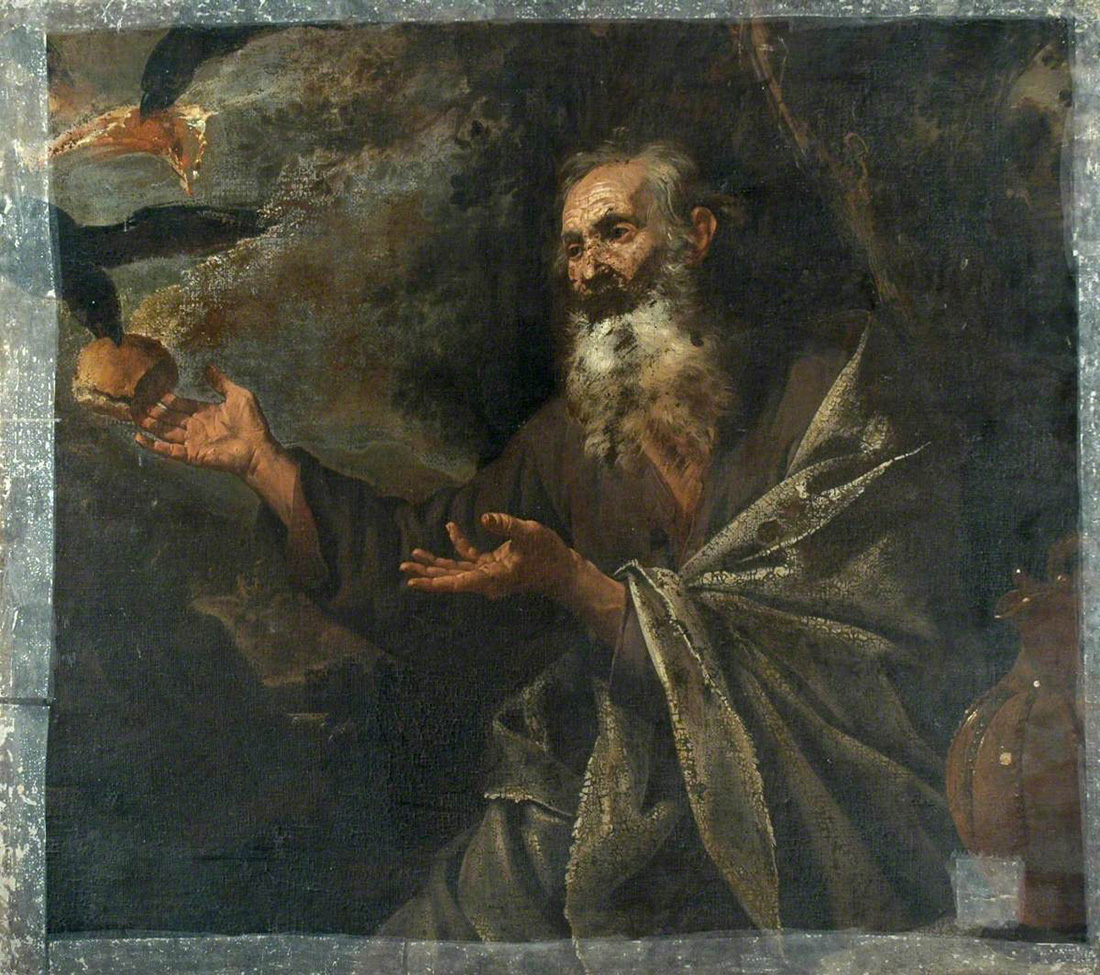
    Elijah Fed by the Ravens (c.1630-1670), Manner of Pier Francesco Mola, previously attributed to Jusepe de Ribera | Creative Commons, courtesy ArtUK.

    Let’s look at the Elijah story as a whole. Elijah is an important figure for at least three religions: Judaism, Christianity, and Islam. He was a prophet and miracle worker who displayed a zeal and devotion to God at a time when the Israelites had all but abandoned Him while adopting idolatrous faith in Ba’al and Asherah. The time period is 800 years before Christ, the Jewish state is split into the northern kingdom (Israel) and the southern kingdom (Judah, which contained Jerusalem). Elijah is a prophet in the northern kingdom and the King during his time was the absolutely awful King Ahab (let your next reading of Moby-Dick take on new significance). Ahab came after a series of bad kings starting with Jeroboam but scripture tells us “Ahab son of Omri did evil in the sight of the Lord more than all who were before him” (1 Kings 16:30), and again: “Ahab did more to provoke the anger of the Lord, the God of Israel, than had all the kings of Israel who were before him” (1 Kings 16:33). Part of the problem was his wife, Jezebel, a Phoenician princess who was undoubtedly a strong political match that helped stabilize Israel in the region. Ahab allows Jezebel to erect statues and temples to the Canaanite god Baʿal and the goddess Asherah. She does such a thorough job that she nearly exterminates the priests and prophets of the Jewish God (except the ones who hide in mountain caves) and brings in hundreds of her own prophets to Baʿal. The northern kingdom of Israel seems to have no state support for Yahweh, and the people fall into idolatry. Even the accursed city of Jericho — the first city to fall under Joshua’s entrance into the Promised Land after the Jews had wandered in the desert for 40 years with Moses — is rebuilt under King Ahab’s rule despite the curse Joshua had laid upon it if it were rebuilt (which comes true).

    As we see over and over in our salvation history, God intervenes on behalf of His Chosen People through his anointed prophets. The Israelites have brought a disastrous drought upon themselves due to their unrepentant idolatry and Elijah tells King Ahab, “there shall be neither dew nor rain these years, except by my word” (1 Kings 17:1). The Word of God tells Elijah to go east of the boundary of Israel, the Jordan river, to “Wadi Cherith.” A wadi is a feature of desert hydrogeology, a seasonal creek that does not have water year-round. They range from relatively flat areas to more wild, ravine-line gullies. “Cherith” is the English spelling of the Hebrew name כְּרִית “Kərīṯ”, which means cut off or separated — something Elijah is being asked to do — it also means “carved” or “gorge,” which suggests that this was one of the more wild wadis, probably good for hiding from an angry king. The Word tells Elijah, “You shall drink from the wadi, and I have commanded the ravens to feed you there” (1 Kings 17:4). What makes this interesting is that the raven was among the birds the Jews were told to consider “detestable.” In Leviticus, we hear that the Lord tells Moses and Aaron that all ravens (among other birds and animals) “shall not be eaten; they are detestable” (Lev 11:13). Furthermore, “And by these you shall become unclean. Whoever touches their carcass shall be unclean until the evening, and whoever carries any part of their carcass shall wash his clothes and be unclean until the evening” (Lev 11:24-25). For this reason, God-fearing Jews would avoid ravens. Yet the ravens bring Elijah bread and meat in the morning and evening (thus he doesn’t eat them or necessary touch them), but the whole setup is definitely on the edge of being unclean from a strict Judaism standpoint.

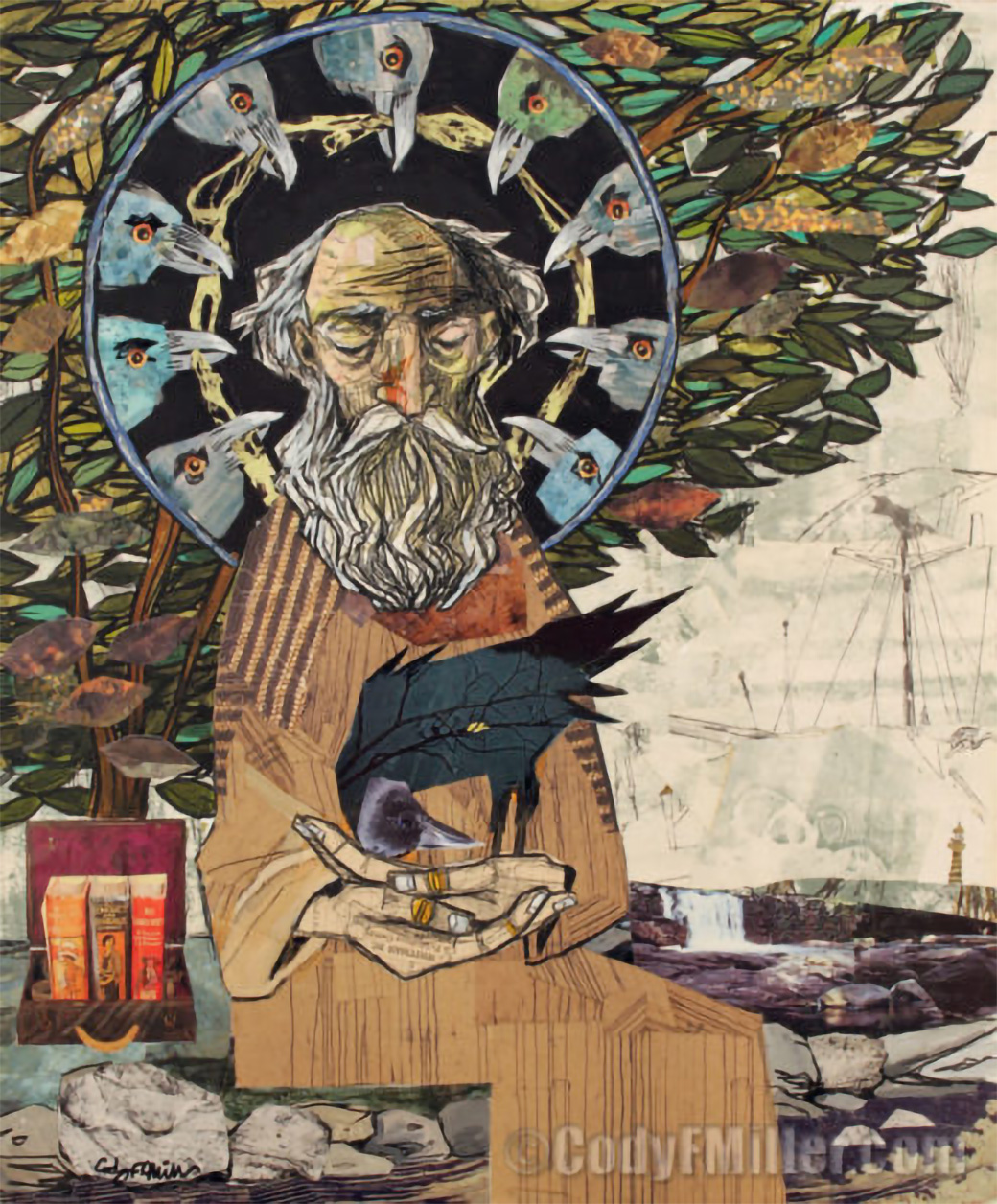
    Elijah Being Fed by the Ravens III (contemporary), Cody Miller | Image from codyfmiller.com. I like the interesting crown of ravens, suggestive of course of Christ’s crown of thorns. Suffering and being outcast while proclaiming God’s Word are things these two share.

    But Elijah doesn’t bat an eye. He goes there as God commands until the wadi dries up. He accepts the water, bread, and meat provided by God. It reminds me of the vision Peter receives in the Acts of the Apostles when a great sheet from descends from heaven with all sorts of detestable creatures on it and God encourages him to eat, saying “What God has made clean, you must not call profane” (Acts 10:15). While Peter understood this as opening up restrictive purity laws as well as opening up the new Christian Church for Gentiles, his vision and the Elijah raven episode emphasize obedience and humility in the face of God’s will.

    And here we have our first connection to the Sermon on the Mount. With the Beatitudes, Jesus reaffirms the type of human who is pleasing in God’s eyes, and it has everything to do with humility, obedience, and authenticity over appearances.

    Entire books have been written on the Beatitudes, so I can’t do much justice here, but let’s think about what type of person Jesus describes as being “blessed.” These are his words: the poor in spirit, they who mourn, the meek, they who hunger and thirst for righteousness, the merciful, the clean of heart, the peacemakers, they who are persecuted for the sake of righteousness. This is not a picture of the proud and strong, of those in power or even those in control of what happens to them. The “clean of heart,” in particular, gets after the type of purity that God desires. The extensive rules given to Moses are meant to create a person who is dedicated absolutely to God, who will follow His prescriptions over his or her own desires and pleasures. The purity laws help to remind the Jews that their goal is to purify themselves specifically for the Lord, not as bragging rights over their neighbors or as cause to visibly separate themselves from other humans. The purity laws are meant for Jews to take seriously the idea of cleaning out the evil from their lives and becoming truly pure internally, that is, “clean of heart.”

    This is an important point. I’ve heard my fellow Christians (and Jewish friends) scoff at the crazy list of unclean and impure things in the Jewish tradition. Orthodox Jews are seen as going way overboard. I don’t pretend to be able to parse out the differences between what’s impure and what’s allowed (nor to know when someone is fetishizing the idea of worldly impurity as an affectation of character rather than a true devotion to God), but this act is very much solidly within the Christian tradition, too. Consider Lent, when we forgo pleasures and seek to purify our hearts through prayer, penance, self-denial, and repentance for our sins as we prepare for Easter. Consider the lives of monastic communities, some of whom live in silence, many of which regularly observe fasts or have restricted diets. And how about the mortification of the flesh?? This isn’t some bygone practice done by masochistic medieval saints; it’s come to light that Pope St. John Paul II practiced mortification of the flesh. The National Catholic Reporter states, “Msgr. Slawomir Oder, postulator of the late pope’s cause [for canonization], said Pope John Paul used self-mortification ‘both to affirm the primacy of God and as an instrument for perfecting himself’” (Pope John Paul practiced self-mortification, Jan 10, 2010). All of these Christian practices align with the same motives of the Jewish purity laws: to create a clean heart, a devotion to God, a reminder that the flesh is weak and the world should not be the object of our attachment or desire. Together with the Jews, we share a belief that sin, evil, and Satan (the tempter) are real aspects of our life in the world and that we must guard against aligning ourselves with the devil.

    This is a good time to reflect on Wednesday’s gospel reading, a continuation of the Sermon on the Mount in St. Matthew’s account, when Jesus proclaims, “Do not think that I have come to abolish the law or the prophets. I have come not to abolish but to fulfill.” We Christians are a continuation and fulfillment of Judaism. We pervert and misunderstand Christ if we imagine ourselves outside of the Jewish tradition. He very clearly states that He is not starting something new or breaking with God’s revelation to humanity for the preceding thousands of years. While not starting something new, He absolutely brings something new to us: divinity dwelling as man on the earth and His sacrifice of Himself for the salvation of humanity. But He is continuing, perfecting, and fulfilling God’s promise to humanity, not starting fresh. Jesus is insistent on this point, always pointing back to the Jewish patriarchs, couching His actions in the prophecies of Jewish prophets, and speaking the Word of God that His own divine nature shared with these people over the previous millennia. 

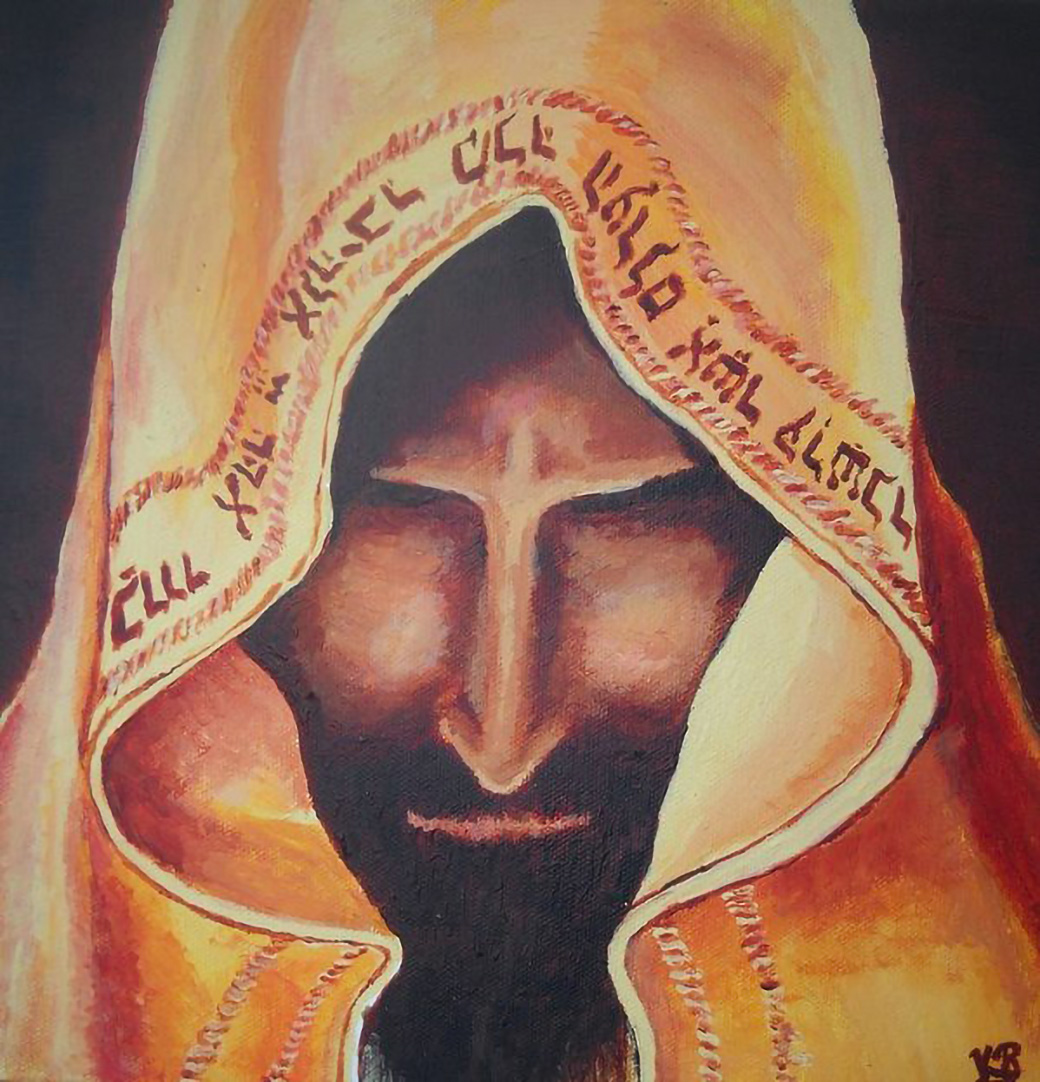
    Praying Jew (contemporary), Kerstin Berthold | Image from fineartamerica.com.

    On this point, let’s return to Elijah, with whom Jesus’s divine nature, the Word of God, was present. After the water in the wadi dries up, God tells Elijah, “Move on to Zarephath of Sidon and stay there. I have designated a widow there to provide for you.” So God continues to care for Elijah as an exile from Israel, hidden now in a Phoenecian city. But watch what God does here through Elijah. When Elijah meets the widow, she is about to make her last meal for herself and her son because they are destitute. Elijah asks for her to trust in the Lord who has told him, “The jar of flour shall not go empty, nor the jug of oil run dry, until the day when the LORD sends rain upon the earth.” The woman obeys Elijah, displays faith in the Lord and his prophet, and indeed the flour and oil replenish themselves and the three of them eat for a year. Despite the outward, slightly shameful appearance of an exiled Jew living with a widow in a Gentile city, this is the fundamental cycle of God’s saving work in humanity. First, He asks His chosen one to trust Him and bestows His grace when the chosen one obeys, especially in humble circumstances. Next, He asks that person to be an instrument of His will on the earth, bringing others to faith and under the grace of God. This is the core of our faith and salvation: hearing God’s call, trusting in Him, and bringing others to God’s light. These readings show this with Elijah, but scriptures also show this cycle with other prophets in their times and Christ in His time. We must realize that this is also true for us in our time.

    This reading of Elijah and the widow of Zarephath occurred yesterday (Tuesday), and the accompanying gospel reading recounts Christ’s lesson directly following the Beatitudes where he tells his disciples that they are the salt of the earth and the light of the world. We can see how Christ’s words echo the life example Elijah sets: “Just so, your light must shine before others, that they may see your good deeds and glorify your heavenly Father.” This is the cycle in which we are called to participate, like Elijah and like Christ Himself. This is the meaning of life: to listen to the Father, become pure of heart and poor in spirit, let our faith shine in our deeds, and have our glorification of the Father draw others to God’s embrace.

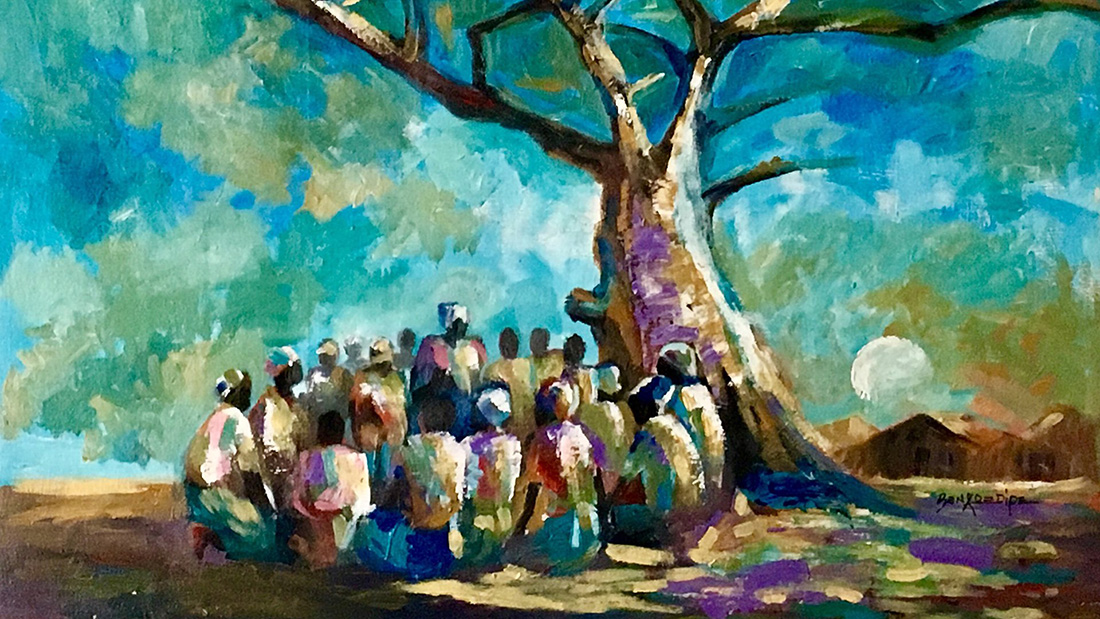
    Story Telling (contemporary), Benedict Adedipe | Creative Commons, courtesy imb.org. We have so much ability to draw others into God’s embrace. Do we take these opportunities?

    These readings end with a note of finality today (Wednesday). After three years of drought, God tells Elijah: “Go, present yourself to Ahab; I will send rain on the earth” (1 Kings 18:1). When he meets Ahab, who calls him the “troubler of Israel,” he says: “have all Israel assemble for me at Mount Carmel, with the four hundred fifty prophets of Baal and the four hundred prophets of Asherah, who eat at Jezebel’s table” (1 Kings 18:19). Once the people are assembled, Elijah makes a very clear statement: “How long will you straddle the issue? If the LORD is God, follow him; if Baal, follow him.” Based on archaeological evidence of home shrines and figurines of gods like Asherah, scholars argue that polytheism was relatively normal among the Jewish people until after the Babylonian exile (605-539 BC). Elijah’s statement here supports this assertion; he sees devotion to many gods as not just inconsistent with the teaching that Yahweh is the only God, but downright heretical and needing to be stamped out. Simply put, if you follow our God, you can’t at the same time follow another. 

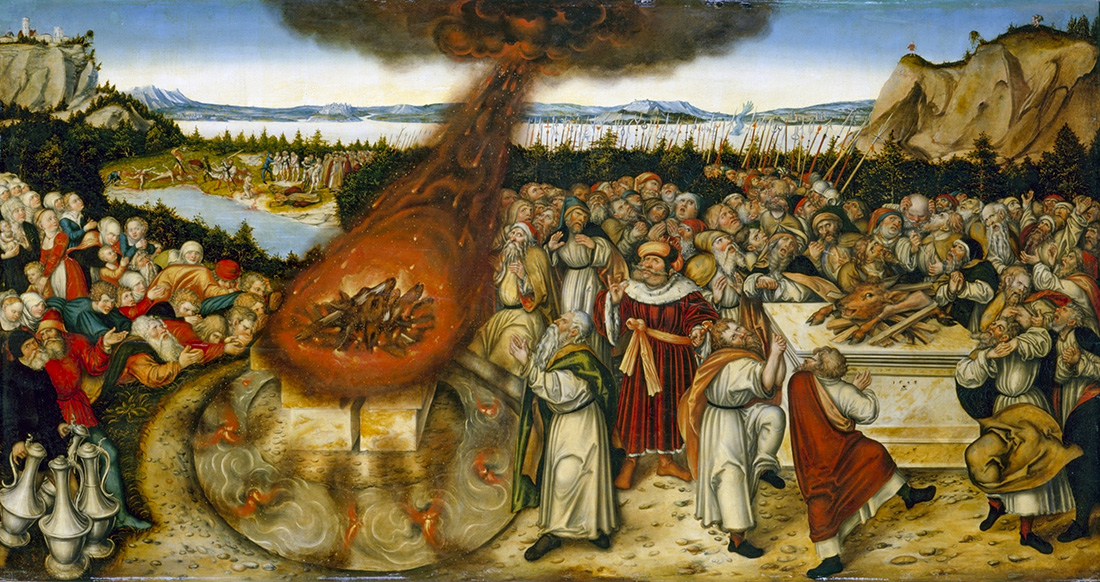
    So Elijah, at God’s instruction, announces the great sacrifice challenge. The hundreds of prophets for Baʿal can’t get their bull offering to ignite on their altar despite frenzied dancing, prayers, and self-laceration for hours. Before Elijah calls upon God to immolate his offering, he accomplishes a symbolic re-baptism of Israel in the faith by dousing the butchered bull, sticks, and altar in water three times (we can see the Father, Son, and Holy Spirit in God’s instructions here) until the trench around it is full. Elijah’s prayer to God over the offering ends with, “Answer me, that this people may know that you, LORD, are God and that you have brought them back to their senses.” On one hand, it seems incredible that the Jews would need more convincing or to be brought back to their senses after God so proved Himself to them through Abraham, Moses, Jacob, David, Solomon, and so many other early figures. But considering that the people had been ruled by weak and faithless kings in the northern kingdom for generations, I suppose it makes some sense. Still, I’m starting to feel Jesus when we hear Him say, “Unless you see signs and wonders you will not believe” (Jn 4:48).

    God’s answer exhibits his totality: “The LORD’s fire came down and consumed the burnt offering, wood, stones, and dust, and it lapped up the water in the trench.” Vaporizing water, burning up stones and dust — signs that not a shred of doubt should be left in the minds of the Israelites. Indeed, they have the fear of God put back in them: “Seeing this, all the people fell prostrate and said, ‘The LORD is God! The LORD is God!’” But while the lectionary reading ends here, scriptures contain one more verse: “Elijah said to them, ‘Seize the prophets of Baal; do not let one of them escape.’ Then they seized them; and Elijah brought them down to the Wadi Kishon, and killed them there” (1 Kings 18:40). Sensitive modern readers might balk at this verse and wonder why such retribution is necessary. But we must not edit scriptures to fit our sensibilities and ideas of who God is. The totality of God includes judgment. Most of us do not experience judgment here on earth and we are taught that it is something that happens in the afterlife but that’s not saying God can’t exact judgment whenever He cares to. When offering His people a chance to come back to Him, when entering human history so directly through the lives of His prophets, God makes Himself present in ways that cannot exclude all parts of His totality. He is salvation for the just and devastation for the evil. There’s no way around this, it is His nature as being all pure, all good, the divine Lord. There is no room for anathema and evil in the presence of the divine love – it simply cannot exist together because then it would no longer be pure, divine love. We may prefer to concentrate on the loving salvation God offers us, and that’s fine, but we would be wrong if we thought that God did not bring terrible justice down on the evil among us.

    Elijah and the Priests of Baal (1545), Lucas Cranach the Younger | Image from arthive.com.

    And so we can better understand today’s gospel reading as well. Just like God’s divine totality uplifts the faithful and crushes the unfaithful, Jesus reminds us of the ultimate fate that awaits us: “Therefore, whoever breaks one of the least of these commandments and teaches others to do so will be called least in the Kingdom of heaven. But whoever obeys and teaches these commandments will be called greatest in the Kingdom of heaven.” Tying this all together, we can see that the great cycle of salvation in which we are called to participate has very real consequences. It’s not just to feel good or to torture ourselves with guilt in this world. These are eternal consequences and ones that should define us.