Tag: Eucharist

  • Contemplating Corpus Christi

    Contemplating Corpus Christi

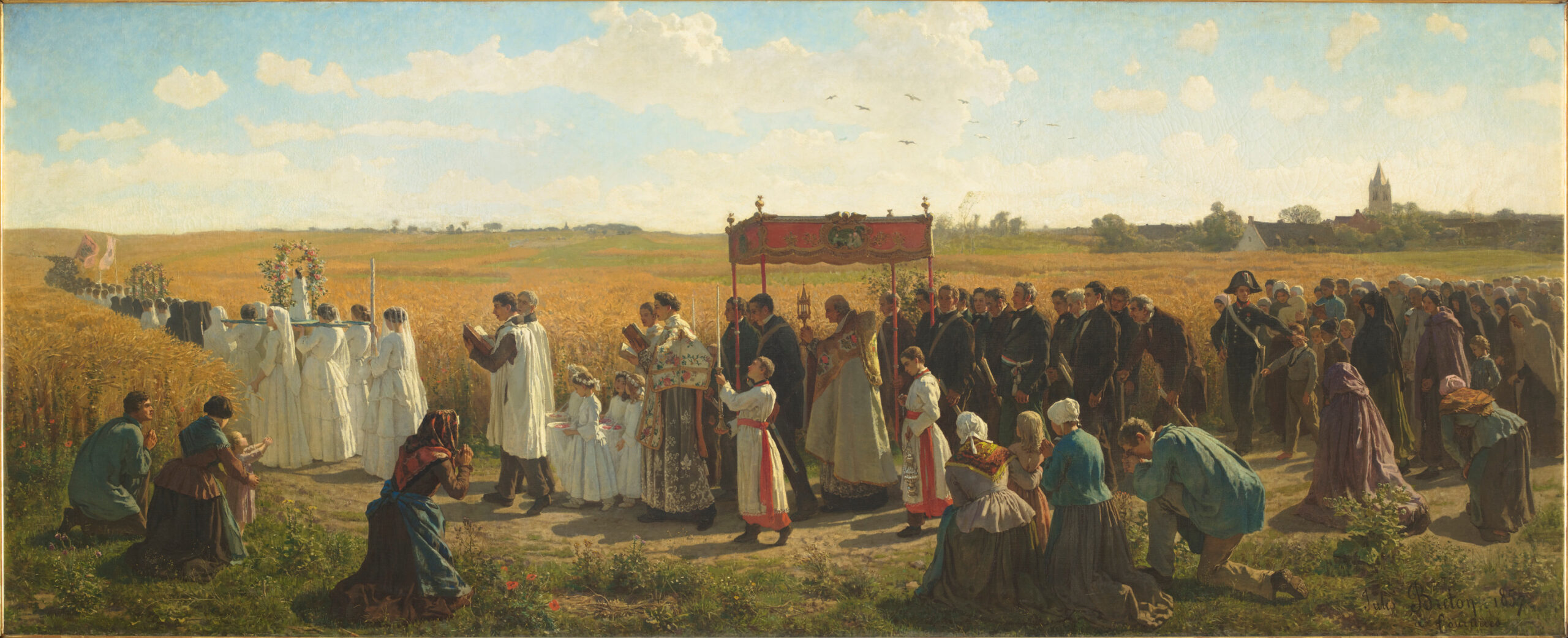
    The Blessing of the Wheat in Artois (1857), Jules Breton | wikimedia.

     Today is the Solemnity of the Most Holy Body and Blood of Christ — aka, the Feast of Corpus Christi. We were fortunate to celebrate Mass in Park City at St. Mary’s Church, presided by Fr. Chris Gray, who is about to be transferred to the Cathedral of the Madeleine in Salt Lake City to serve as rector, and undoubtedly become a Monseigneur or even greater someday. He’s a great priest. He’s likeable, has a great singing/chanting voice, is funny, but most importantly, has a great reverence for the liturgy. So, in addition to a meaningful homily and prayerful sacrifice of the Mass, we enjoyed a Eucharistic procession around the church and a benediction, complete with incense and chanting of St. Thomas’s Tantum Ergo Sacramentum

    This solemnity is the great marker of the Catholic faith; a dividing line between Protestants and Catholics. We believe that in the Eucharist the Body and Blood of Christ are really and truly present — mystically and spiritually available to us in all their power and glory. Protestants believe that Jesus was speaking symbolically when he said the bread and wine were his body and blood. Why does this matter? Because if we want to follow the entire Way given to us through Christ, we can’t ignore the sacraments and the Eucharistic miracle he gives us. (The early Church was unanimous in believing in the real presence of Christ in the Eucharist. Heck, in 110 AD, St. Ignatius of Antioch told the Smyrnaeans to “keep aloof from” the heretical Gnostics “because they confess not the Eucharist to be the flesh of our Savior Jesus Christ” (Epistle to the Smyrnaeans, 7).) The sacraments are the way his Spirit is active in the world. Would you dare not believe in the power and work of the Holy Spirit?

    Since the Council of Trent, the Catholic Church has affirmed that “for believers the sacraments of the New Covenant are necessary for salvation” (Catechism of the Catholic Church, 1129). Protestants believe nothing of the sort. It seems to me that theirs is a passive religion when it comes to salvation — taken in passively by grace and faith alone. In comparison, Catholics are taught that we have an active role in receiving grace, through the sacraments and in love and charity of God and neighbor.

    But something else stuck with me as I contemplated today’s readings and the significance of the solemnity. When Protestants say the Eucharist is just a “symbolic act,” they are in fact missing the depth of the symbolism. We, too, believe it is a sign — the greatest of all signs — but the significance of the sign is that it points to a new reality. So, I’d like to blog this Feast of Corpus Christi about the intersection of sign, symbol and reality as well as the unique and troubling (for some) insistence of Jesus Christ that we eat his actual body and blood.

    Sign, Symbol and Reality

    It can be confusing to talk about signs and symbols because they’re often lumped together. Unless you’re a semiotics professor, we all sort-of shoot from the hip here. (The academic field of semiotics that started perhaps with the ancient Greeks but blossomed in the second half of the 1900s is dedicated to studying sign, symbol, meaning and the like, but if there was ever a field that felt like splitting hairs, it’s semiotics.) Let’s first acknowledge that these words definitely overlap and share meaning, and not just in English, but also in Greek, Latin and Hebrew:

    EnglishLatinGreekHebrew
    signsignumσημεῖον (sēmeion)סִימָן (siman)
    symbolsymbolumσύμβολον (symbolon)סֵמֶל (semel)

    Despite the difficulties involved, I’d love to lay out a general difference between sign and symbol for the purpose of this blog. Let’s take a cue from the Latin signum, which is something that marks or identifies. An everyday usage could be something like a military signum in the form of a battle standard, and a supernatural signum would be a heavenly sign or miracle. We can see where we get the word signature (a personal “mark” that identifies the signer). I like also to think of a road sign, which points towards something. Taken together, let’s think of “sign” to mean a material thing that points to something else that holds extra meaning. So, when we make the sign of the Cross, it means more than just cross-shaped gesture around the face and chest area. It’s a sign of following Jesus Christ.

    “Symbol” has an interesting history, too. In the ancient world, the Greek word symbolon described an object like a piece of parchment, a seal, or a coin that was cut in half and given to two parties. It established a relationship between them. When the halves of the symbolon were reassembled, the owner’s identity was verified and the relationship confirmed. To take poetic license with this etymology, we might say that a sign is like a signature, but a symbol is only half the story (half the signature). It points to something even more complex: a relationship to a shared history.

    As a short side note, the early Christians and Church Fathers called the Creed they developed in the Council of Nicea and further councils as the “symbol of faith” or just the “Symbol.” This reveals that they saw our Creed as a way to recognize another Christian, and that a shared relationship is at the heart of our faith (shared with Christ and shared with one another as the Church).

    In our language, we’ve applied the deeper, more abstract meaning of “symbol” into words like symbolism, which implies a shared cultural story that lies behind the symbol. To sum up, I think “sign” is more direct, although still pointing to something outside itself (we say, “what does that signify?” and we expect a direct answer). I think “symbol” is a bit more complex and abstract, pointing to something more like a shared story of significance (we say, “what does that symbolize?” and we push our minds to think of things like metaphor, analogy, and mythological and religious stories).

    These terms have a deep history in our faith tradition. Circumcision is a sign of being a Jew, but it is a symbol of a circumcised heart — a life dedicated to God and living within his laws and precepts. Burning incense in our churches is a sign of reverence to our Holy God, and it is a symbol of our prayers rising up to Him in Heaven, as well as a symbol of immolating something precious to us as an offering to the Lord according to our covenant with Him. Importantly, signs and symbols in our religious tradition are material things in the world that point to spiritual realities we cannot see, touch, or otherwise sense. They help our physical humanity interact in some way, no matter how diminished, with something greater and immaterial. As St. Thomas writes: “Signs are given to men, to whom it is proper to discover the unknown by means of the known” (Summa Theologica, III, 60.2). I love the fact that he says signs are “given” to us, reminding us that there is logic and intentionality in the way God created the universe, even down to knowing how we might apprehend material things in the world and apply signification of greater things to them.

    The Blessing of the Wheat in Artois (1857), Jules Breton | wikimedia. Religious processions, typically with the exposed Blessed Sacrament in a monstrance, are another important Christian sign. They symbolize our spiritual journey to everlasting life, our affirmation that we are in the world but not of the world and are on our way to our real home. Religious processions used to be more widespread, especially in Europe, and I think it’s a bit of a shame that they have fallen out of fashion. They’re a great way to show our secular society that there is an alternative to the narrative of consumption and materialism that is constantly fed through our devices and experiences.

    This idea that signs are a bit more straightforward and symbols are a bit more complex gets turned on its head when it comes to the sacraments. This is because, as signs, they point to the mystery happening in our midst.

    The Church teaches that the sacraments are the greatest of signs in our faith lives because they transcend being signs and actually have real spiritual effects within us. Even just at face value, each sacrament is more than a typical sign, which is a single material object or action. In their execution, the sacraments include a form of the liturgy specific to each — that is, the prayers, movements, and physical items used in each rite. So a sacrament includes a number of other “signs” within it, such as water, candles, incense, etc. For instance, water is a sign of spiritual purity, but when water is used in the sacrament of Baptism, that sign takes on more meaning and contributes to a larger understanding of the “sign” of the sacrament of Baptism. Likewise, the Eucharist has the material appearance of bread and wine, but those symbols/signs are part of a larger liturgical movement that calls down the Holy Spirit in sanctification and intones a shared set of prayers between priest and believers. The whole sacrament, then, is a “sign,” but is so much bigger than other types of signs.

    It’s hard to overstate just how deep and important the sacraments are as signs. The Catechism of the Catholic Church sums up a discussion of the sacraments with the words of St. Thomas: “Therefore a sacrament is a sign that commemorates what precedes it – Christ’s Passion; demonstrates what is accomplished in us through Christ’s Passion – grace; and prefigures what that Passion pledges to us – future glory.” As a collection of material signs, prayers and action of the Holy Spirit, a sacrament is a sign that “points to” many other symbols and signs in salvation history at the same time it is doing active spiritual work through the power of the Holy Spirit. 

    All of this sets the stage for discussing the Eucharist on this Feast of Corpus Christi. As I thought about the great sacramental sign of the Eucharist, three aspects jumped out at me: how the bread and wine are a symbol of — and somehow the reality of — manna, the sacrificial Lamb, and the true Body and Blood of Christ.

    Bread of Affliction, Bread from Heaven

    The Passover figures greatly in a full understanding of the sacrament of the Eucharist. Perhaps the best exploration I’ve read is Brant Pitre’s Jesus and the Jewish Roots of the Eucharist. Highly recommended. I’ll do my best to summarize a few things here.

    One of the seemingly smaller aspects of the Jews’ flight from Egypt is bread. On the original Passover night, the Jews had to get ready to move quickly because after the angel of the Lord passes by their homes and slaughters the firstborn throughout the land, they must hightail it out of Egypt. This means they don’t have time to let their bread rise with yeast and they have to bake and eat unleavened bread during their flight.

    Moses enshrines the memory of the Exodus in the Festival of Unleavened Bread: “For seven days you shall eat unleavened bread with [your Passover sacrifice] — the bread of affliction — because you came out of the land of Egypt in great haste, so that all the days of your life you may remember the day of your departure from the land of Egypt” (Deuteronomy 16:3). So much can be said about this “bread of affliction”! The bread made by human hands, out of necessity being less than satisfying — what a great symbol of our metaphysical state of being separated from God. The act of intentionally depriving ourselves of material comfort — a great parallel with the intentional deprivations practiced by saints and monastics thousands of years later. 

    But there is more to be said about bread as a symbol.
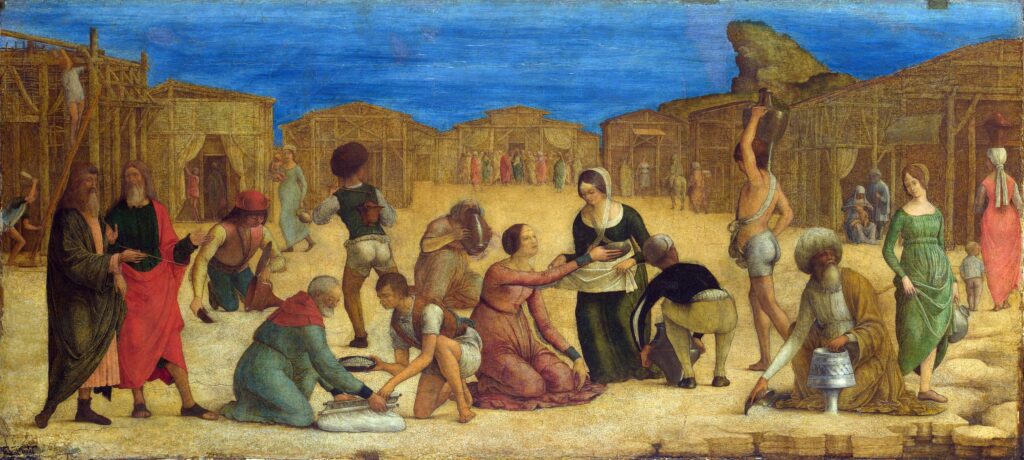
    Detail from The Israelites gathering Manna (c.1490s), Ercole de’ Roberti | Image courtesy nationalgallery.org.uk

    Wandering in the wilderness after they fled Egypt, the Israelites complained to Moses that they were hungry. God showed his love by raining down bread from heaven to sustain them. “The house of Israel called it manna; it was like coriander seed, white, and the taste of it was like wafers made with honey … The Israelites ate manna forty years, until they came to a habitable land” (Exodus 16:31, 35). Unlike the bread of affliction, the manna from heaven is both pleasing to the senses and extremely nourishing. Bread as a symbol had been sanctified. But sanctified bread came only from God, it was not something that could be made by humans. 

    After the Exodus, bread would never again be “just bread” for the Jews. It would always also be a symbol of God’s love for them and his commitment to them. God chooses good symbols; bread sustains life, and he was training them to understand that he sustains life even more fundamentally than physical food. By the time of King David, 450 years later, they had memorialized manna as more than normal bread: “he rained down on them manna to eat, and gave them the grain of heaven. Mortals ate of the bread of angels; he sent them food in abundance” (Psalm 78:24-25). 

    And 1,000 years after David, when Jesus perfects our understanding of God’s law and the words of the prophets, he deepens this reference to manna: “[My flesh and blood] is the bread that came down from heaven, not like that which your ancestors ate, and they died. But the one who eats this bread will live forever” (John 6:58). Jesus brought something new and shocking to the already-rich symbol of bread. God allowed the symbol to convey meaning for many centuries specifically so he could invoke all that the symbol of bread stood for and use that image to point to a new reality in our midst. Note what is going on here! It’s a reversal of how material signs usually operate in our entire way of building meaning. Until this moment, the material sign of bread was a pointer to something deeper, a symbol of God’s love and commitment. Jesus himself used this conventional symbology during his miracle of the loaves and fishes, when the bread demonstrated God’s inexhaustible and overflowing love for humanity. But now, the rich symbol is used to point to a new material and spiritual thing. In other words, usually things act as symbols pointing to complex concepts, but here the complex symbol is pointing to a thing. A very corporeal and perfectly spiritual thing that is Christ’s actual flesh and blood. 

    I’d even argue that it had to happen this way. Only with a symbol that was so richly endowed could Jesus teach us about the mystery of the gift he was giving us. He’s saying to us, “Even with how awesome you thought that manna given in the Exodus was, the gift of my flesh and blood for you to eat is the real bread of heaven because it does more than keep you alive in this world.” 

    Bread is still a material thing, and it’s still a symbol with a rich history of meaning, but now that symbol is pointing to something new, a new thing, the reality of the Eucharist.

    The Sacrificial Lamb

    Much like bread, the sacrificial lamb has thousands of years of meaning attached to it for the Jewish people. All the way back to Abraham, we have the willing but difficult sacrifice of the son, replaced by the ram provided by God. But the sacrificial lamb really becomes codified in the lives of Jews during the Passover, when each family takes an unblemished lamb (from the sheep or goats) and “the whole assembled congregation of Israel shall slaughter it at twilight. They shall take some of the blood and put it on the two doorposts and the lintel of the houses in which they eat it. They shall eat the lamb that same night” (Exodus 12:6b-8a). The lamb here is an interesting mix of symbol (much more than just a lamb, it is a symbol of fidelity to God’s command) and physical sustenance. We really see the roots of the Eucharist clearly — in a ritualized way, believers gather as a community to slaughter the lamb as a sacrifice to God, then eat it.
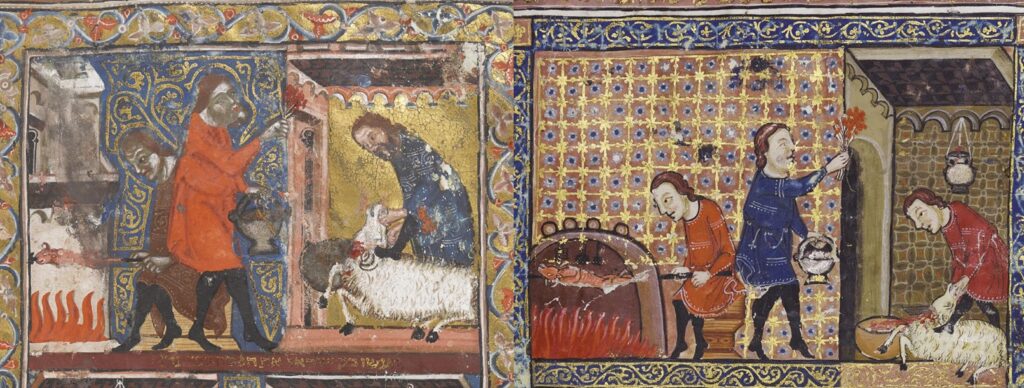
    Detail from the Brothers Haggadah (left) and the Rylands Haggadah (right, both from 1330-1350), manuscripts from Catalonia that detail Jewish life. | Image courtesy Museu d’Historia de Barcelona. These particular images show the slaughter of the Passover lamb and the painting of the lintels with the blood.

    Famously, the Jewish faith includes a lot of animal sacrifice. Sin offerings were a common form of sacrifice and this particular ritual is important for Christians to understand because the phrase “He died for our sins” very much refers to this practice. God told Moses that they must make regular offerings as a payment of sorts for their sins. God prescribed that “The sin offering shall be slaughtered before the Lord at the spot where the burnt offering is slaughtered; it is most holy. The priest who offers it as a sin offering shall eat of it; it shall be eaten in a holy place in the court of the tent of meeting. Whatever touches its flesh shall become holy” (Leviticus 6:25-26).* Note the insistence of the holiness of the event and the offering, which is again eaten. Strikingly, the ritualized sin offering is transformative — “whatever touches its flesh shall become holy.” We can locate a number of things in our religion that echo this transformational aspect of the sin offering: primarily, the Eucharist, which is the new offering for sin that we eat and which transforms us into something holy, but also things like holy relics of the saints, from which we have seen miracles transmitted.

    So imagine what must have been dawning on the Apostles, who were brought up with the rich symbology of the bread and the rituals of the sin offerings with an unblemished lamb, when “On the first day of Unleavened Bread, when the Passover lamb is sacrificed” (Mark 14:12), they were led to the upper room for him to institute the Eucharist during the Last Supper. Surely, some of them remembered John the Baptist declaring when he saw Jesus, “Here is the Lamb of God who takes away the sin of the world!” (John 1:36). They were told he was the lamb who was going to produce some sort of never-before-seen, world changing sin offering! 

    Sure enough, Jesus uses the sign of the lamb, as well as those loaded signs of bread and wine, to point back to himself, the nearly unfathomable mystery of salvation for all of humanity. “Jesus took a loaf of bread, and after blessing it he broke it, gave it to the disciples, and said, ‘Take, eat; this is my body’” (Matthew 26:26). He sanctifies and sacralizes the bread, meaning that he makes it holy with his own essence and by his own divine power, then tells them to eat it, just like they eat the flesh of the Passover lamb. And why is the wine used? “Drink from it, all of you,” he says, “for this is my blood of the covenant, which is poured out for many for the forgiveness of sins” (Matthew 26:27-28). It is used because the sin sacrifice requires real blood, real suffering.

    We might ask why not use actual sacrificed lamb meat as the Eucharist during the Last Supper? I’ll offer a theory (Aquinas offers his own). I think there had to be a physical and mental break with the traditions of the Old Testament. Jesus was instituting a new covenant where he was going to be sacrificed, not a lamb. The “remembrance” of this great event is more fittingly placed in the symbols of bread and wine, which were symbols of a covenantal relationship with God and signs of God’s abundance. What’s more, the difference of Christ’s flesh is accentuated here — the God-man’s flesh cannot be appropriately signaled by actual meat of any sort. Jesus Christ’s body is united not just with a spirit, but with God’s Spirit. Meat would be too similar and encourage us to fall too short of recognizing this great difference.

    Truly Eating Flesh

    In the gospel of John, when Jesus tells the crowd, “the bread that I will give for the life of the world is my flesh,” the Jews don’t react well, saying, “How can this man give us his flesh to eat?” (John 6:51-52). Does Jesus back off a little and say, “I’m speaking symbolically”? No! He doubles down. He says, “Very truly, I tell you, unless you eat the flesh of the Son of Man and drink his blood, you have no life in you” (v.53). He is insistent on this point, which sounds a heck of a lot like cannibalism to ears not prepared for it and hearts not realizing that this is God speaking. 

    And as if to punctuate the literal nature of what he means, Jesus adds, “Those who eat my flesh and drink my blood have eternal life, and I will raise them up on the last day” (v.54). But English fails us here, because in verse 53 he uses the common Greek verb for eating, “phagein” (φαγεῖν), while in verse 54 he ups the literalness and uses the verb trōgō (τρώγω), which means to gnaw, munch, or crunch. Those who gnaw on my flesh!!

    As if he’s not shocking enough, he’s also claiming to be able to give eternal life through this eating of his flesh. The divine power of the Eucharistic sacrament is laid bare. But it’s only available to those who are willing to eat his literal flesh. Very truly, I tell you!

    People call the gospel of John the most theological and the most symbolic. With the confluence of these two ideas, we see what Christianity is all about: we know God through a highly symbolic language that points to new realities, new things. Again, if what Jesus is doing is reversing the typical “sign /symbol is a physical thing pointing to a complex idea” into “complex sign/symbol is pointing to a new physical thing” (i.e., his flesh in the Eucharist), then this is precisely why our theology is the opposite of a mythology. Myths are stories to help us understand our world and experiences, but Christian theology is the exploration of God revealing himself to us as reality itself. Traditional sign/symbol meaning making is great for talking about ourselves and our experience, but God saw fit to use symbols in a new way: to help us access his own infinite reality.

    Thinking back on our celebration of the Feast of Corpus Christi, these thoughts were swirling around in my head as I listened to Fr. Gray’s homily and prayed with the congregation during the consecration of the Eucharist. The Eucharist contemplated and received can be an emotional thing. And I was contemplating what emotions Jesus may have wanted us to feel when gnawing on his unbloody flesh in the form of the host and the wine. Why insist that we physically interact with his flesh in this way? Why be a sacrificed lamb, whose holiness spreads to everything it touches but is at the same time unapologetically messy in its grease and juice and chew?

    I have been taught to feel joy and thankfulness for this incredible gift of the Eucharist. I have imagined it sanctifying my mouth, my esophagus, and my stomach as well as my soul as I ingest it. Aquinas teaches us that the great difference between this food and other food is that instead of us turning the food into ourselves (by nourishing our cells and organs), the Eucharist helps turn us more and more into Christ. I love this teaching and love approaching the Eucharist with this in mind.

    But, for the first time, I felt something different. As I considered the bloody sacrifice of the Cross and Christ’s insistence that we eat the flesh of this sacrifice, I had a catch in my throat. The moment when we as a congregation shout “Crucify him!” during our Good Friday Mass of the Passion came flooding back to me and my culpability as a sinner unfit for unity with He who is all good came over me. My eyes threatened to tear as I thought about the sheer sorrow of having to eat of a sacrifice that humanity made necessary through our initial disobedience and stubborn stupidity when he came in bodily form. There is something of the gag reflex here — of choking on something that is both sweet and horrible. Horrible not because of taboo (as in cannibalism), but horrible because we needed such a sacrifice. Horrible because that suffering of that very real savior Jesus Christ actually happened, and we remember that when we proclaim the Eucharist to be his very real presence. 

    Of course, God transformed our sorrow into awe and joy with the Resurrection, and this is the point of sharing in the Eucharist — sharing in the Resurrection. So, I didn’t dwell on that feeling of self-repulsion, because I don’t think it reflects what this sacrament is all about. At the same time, I think it was a positive experience. I think there are infinitely plumb-able depths to the reality of the Eucharist that is pointed to by our simple signs of bread and wine. I think Christ’s insistence on actually eating his flesh is something we need to take seriously and contemplate.

    And I thank God for the fact that his Son’s flesh is made unbloody and spiritual in our sacrament. I praise him for his wisdom and his gentleness with us, who condemned his Son to death, only to desperately need his saving Body and Blood so that we can partake in the Heavenly banquet that is everlasting life with him.
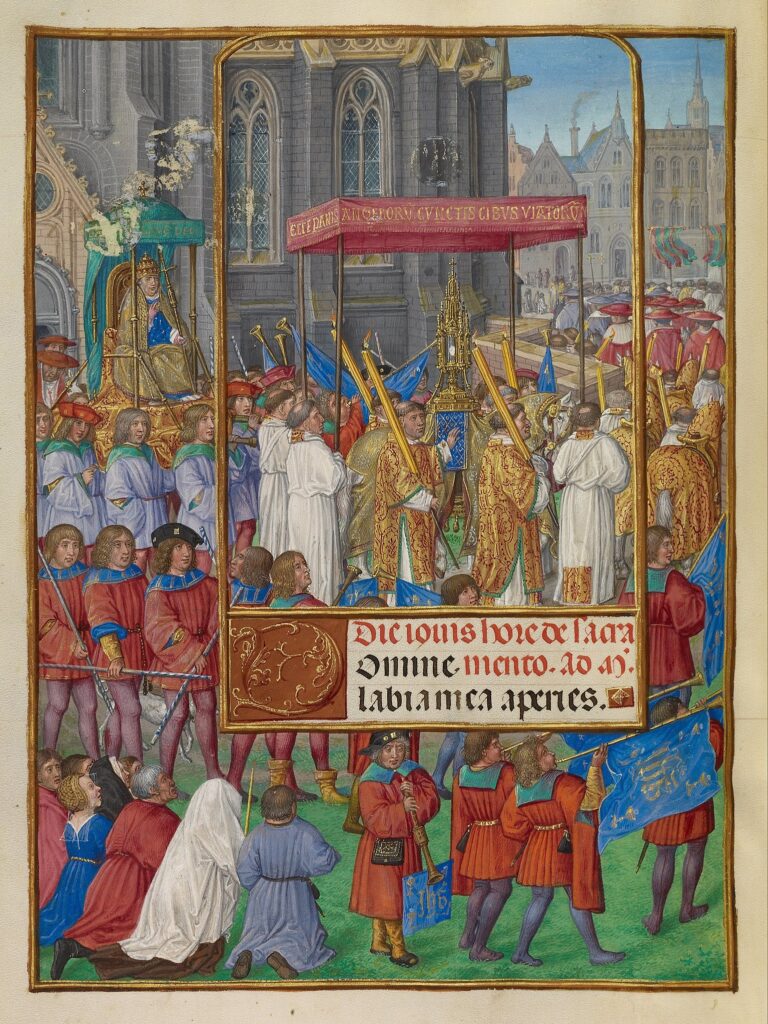
    Procession for Corpus Christi (1510-1520), Master of James IV of Scotland | wikimedia.


    * Note: it is worth re-reading chapter 23 of Leviticus, where God teaches Moses how to celebrate festivals, or “holy convocations” to honor him. These are the seeds of the sacraments as we know them today: liturgical rites with specific practices and gestures that endured for 1,500 years before Christ instituted the New Covenant. The “sign” of each sacrament points back here (indeed, back to Abraham and Isaac), and simultaneously points to Christ’s life, work, death and Resurrection, as well as pointing to the everlasting life to come.
  • The Establishment of the Sacraments

    The Establishment of the Sacraments

    Holy Thursday – Evening Mass of the Lord’s Supper: Exodus 12:1-8, 11-14, 1 Corinthians 11:23-26, John 13:1-15.

    The Easter Triduum begins tonight with the Evening Mass of the Lord’s Supper. As I consider the readings for tonight’s Mass, I am struck by the tightly knit, condensed sequence of action and meaning that Christ gives us. The readings can barely contain it, for he not only provides the full meaning of millennia of Jewish ritual practices, he also institutes new sacraments in his actions and self that have never existed until this moment.

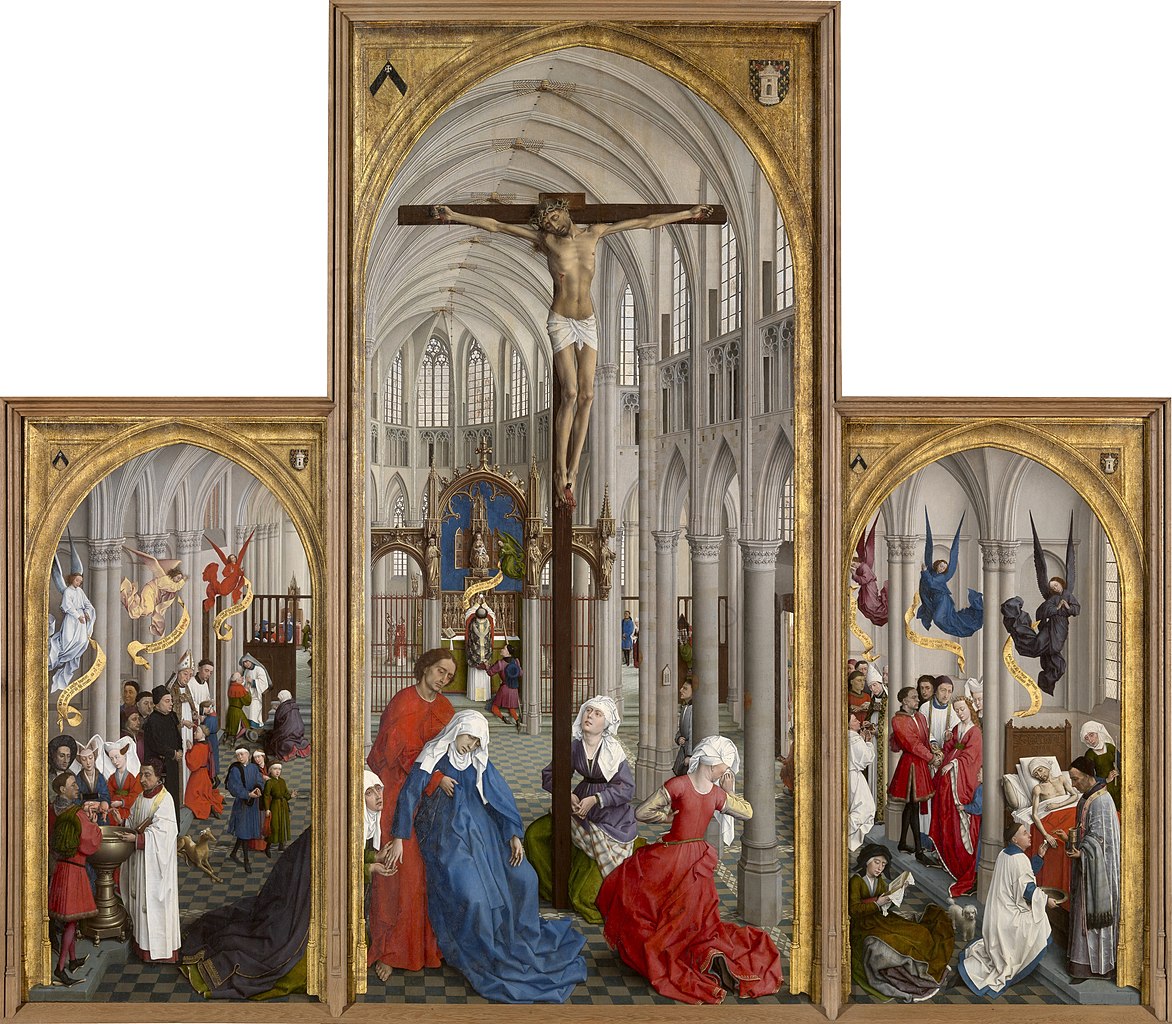
    Seven Sacraments Altarpiece (1445-1450), Rogier van der Weyden | Wikimedia Commons. On the left panel are baptism, confirmation and confession and on the right hand panel the ordination of a priest, marriage and the last rites. The central panel is dominated by a crucifixion in the foreground, with the sacrament of the Eucharist in the background. Angels hover over each sacrament with scrolls, with clothes color-matched to the sacraments, from white for baptism to black for the last rites.

    This is the reason that the Easter Triduum is the high point of our liturgical calendar, that these three days are considered their own liturgical season, outside of Lent. The density of the mystery at work in the world, like a spiritual supernova touched down on the earth, is simply too great for humanity to take in. It took the Church centuries to unpack, appreciate, and codify the depth of what happened, all the while maintaining steadfast faith and devotion to the sacraments instituted by our Savior. Thankfully, the Church has always been guided by the Holy Spirit, as Christ promised.

    I will try to lay out just the high points as I see them:

    • Jesus institutes our greatest sacrament, the Eucharist, which not only helps to make sense of the Passover rituals observed by the Jews since the time of Moses, but itself continues to unfold throughout the next three days, taking on its true substance only when his very Body is nailed to the Cross and his Blood is shed for humanity.
    • Jesus institutes the sacrament of confession and the importance of forgiveness as a participation in his own Spirit when he washes the feet of the Apostles.
    • Jesus passes to the Apostles these sacraments and instructions as part of the formation of the holy priesthood, which is developed as the sacrament of Holy Orders.
    • Jesus sets in motion the ways he will continue to commune with his Church after his Death, Resurrection, and Ascension. Consider how he patiently goes about setting everything in order. Think about the to-do list here: giving his apostles one last great moment of teaching, instituting the Eucharist and Reconciliation, establishing the momentum for the Church to continue, leaving time to travel “to the mountain” (Mount of Olives) to have a prayerful encounter with his Father in anticipation of the Passion and Crucifixion ahead … all in a matter of a few hours! It’s remarkably, almost serenely organized.

    I’d like to reflect briefly on these to better understand what today’s readings are telling us.


    The Eucharist as the Passover Perfected

    Regularity. The first reading recounts the prescription of the regularity of the Passover meal — it is the reason this is the first month of the Jewish calendar and it is held annually on the 14th of this month. For the Catholic Church, the Eucharistic meal is so central to our being that we celebrate it with every gathering (Mass), a regularity that has been instituted at least every Sunday.

    Purity. God prescribes that “The lamb must be a year-old male and without blemish.” God was establishing a special place for the “unblemished lamb” in their cultural memory to be ready for the time when the Lamb of God, pure of sin, comes for his ultimate sacrifice. Purity is important because it is the state in which God, as pure goodness, exists. We do these things to be united with him, and therefore we must strive for purity in ourselves to become fitting children of God.

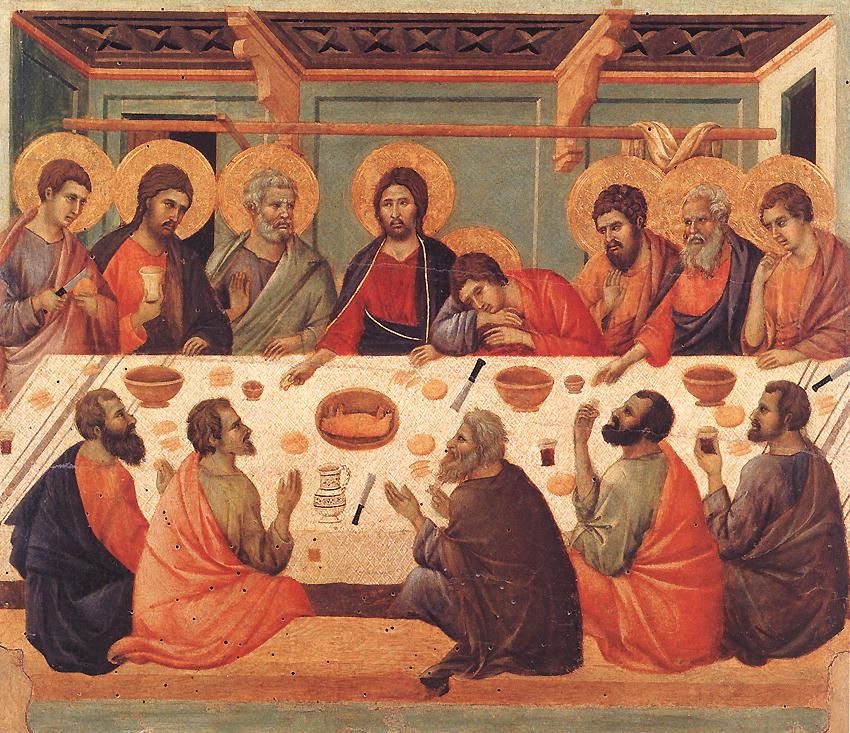
    Ritual action. There is to be one lamb per family and it is to be slaughtered at twilight, at which point some of its blood is to be applied “to the two doorposts and the lintel of every house” where they “partake” of the lamb. What is the point of these prescriptive rituals? This is a continuation of the many animal sacrifices described in the Old Testament, and part of the challenge for the Jewish nation was to uphold these prescriptions in order to display their faithfulness to God. There is something essential to the ritual nature of religious, sacramental action: the words, gestures, and scope of action are particular and important, meant to be done faithfully and not sloppily. They display a faithfulness to the origin of the ritual: God Himself. All of this comes to a head when Christ tells his Apostles, “This is my body that is for you. Do this in remembrance of me” (Mk 14:22, Lk 22:19, 1 Cor 11:24). The “remembrance” encompasses millennia of Jewish ritual and faithfulness, culminating in the remembrance of the new Passover, the Christ Event, that ushered in salvation and eternal life for humanity.

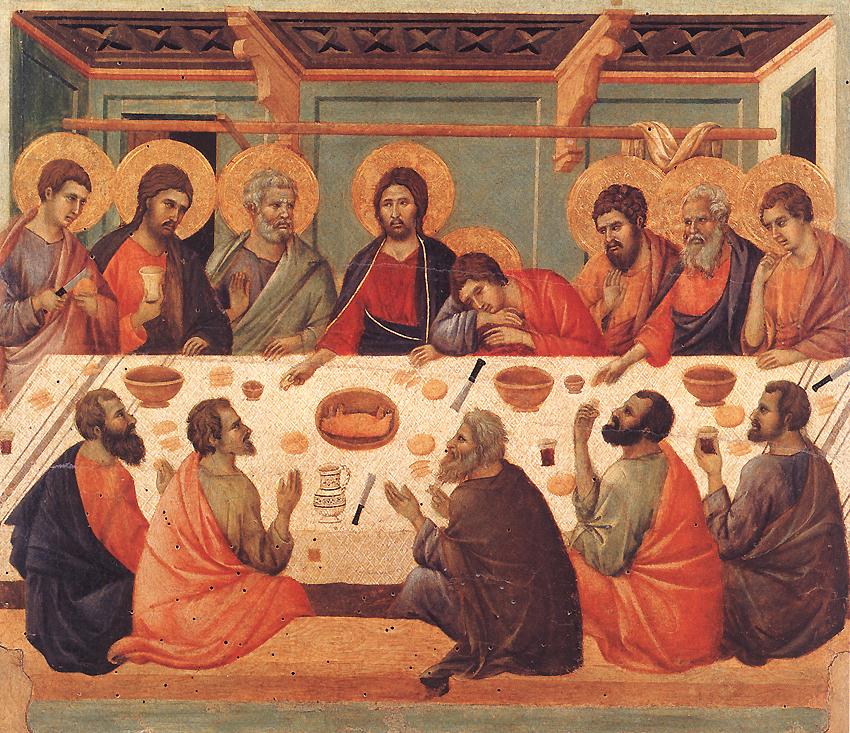
    Last Supper (1308-1311), Duccio di Buoninsegna | Wikimedia Commons.

    Food. The slaughtered lamb is not wasted, but used as nourishment: “That same night they shall eat its roasted flesh with unleavened bread and bitter herbs.” The Word of God made flesh, Jesus Christ, establishes the full meaning of this ritual when he says,  and “Amen, I tell you, unless you eat the flesh of the Son of Man and drink his blood, you have no life in you” (Jn 6:53). As Christians, we understand the Passover lamb as the precursor (easier to understand and easier to “stomach”) to the true Paschal Lamb, Christ Himself. Our Eucharist is real food, truly the flesh of the Lord present through the mystical action of the Spirit in our liturgy, made palatable through the unbloody sacrifice present at the altar.

    Deliverance. The Passover rituals delivered the Jews from the wrath of God that ravaged “every firstborn of the land, both man and beast” in Egypt. Yet this only applied to life on the earth. How much greater is the new Passover given to us in Christ! Our life in Christ, possible because of his sacrifice and given to us as spiritual sustenance in the Eucharist, delivers us from the tyranny of death, opening up for us eternal life. 

    Transition. The idea of being on the move to something greater is central to Judeo-Christian faithful. God instructs the Jews to eat the Passover meal in a certain way: “with your loins girt, sandals on your feet and your staff in hand, you shall eat like those who are in flight.” This idea of being on the way to something greater, not tied to the things of this world, was embraced from the very beginning of the Christian Church. Jesus tells his apostles on this Holy Thursday, “but because you do not belong to the world, and I have chosen you out of the world, the world hates you” (Jn 15:19). St. Peter calls the faithful “strangers and refugees in this world” (1 Peter 2:11), and St. Paul enjoins us, “Do not be conformed to this world” (Rom 12:2). In our thirst to follow Christ and be with the Father, Christians are “On the Way.” We read in the Acts of the Apostles that the earliest Christians referred to themselves as followers “of the Way” (cf. Acts 9:1-2).


    The Washing of Feet as the Institution of the Sacrament of Reconciliation

    Phases of one mystery. Jesus connects this act to the salvific acts that will come. First, he rises from the supper and takes off his outer garments — as an action, this reminds me of his Resurrection to come and the garments found in the empty tomb, and as such this act of washing the feet is a salvific act akin to the Resurrection itself. St. Augustine also notes that “When about to be crucified, He was indeed stripped of His garments” (Tractate 55 on the Gospel of John), so we see a parallel in the Crucifixion, too. Importantly, Fr. Jean Corbon notes that the Crucifixion and Resurrection “are not two events, but two phases or moments of the same mystery” (Wellspring of Worship, 46). This is a very complex and helpful way of viewing the events we celebrate during the Easter Triduum.

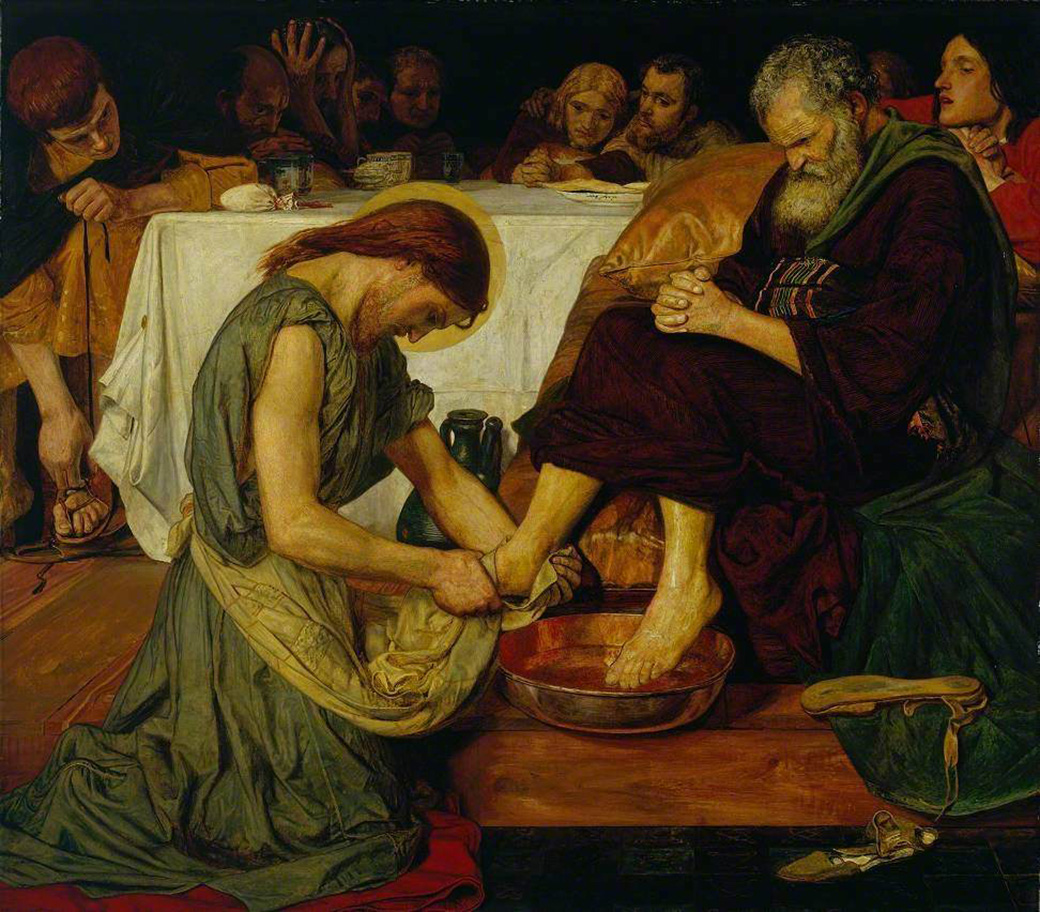
    Jesus Washing Peter’s Feet (1852-1856), Ford Madox Brown | Creative Commons, courtesy ArtUK/Tate.

    Servitude. He doesn’t ask for some water in a bowl, but pours the water into the basin himself. St. Augustine notes that this is like how he “poured His blood upon the earth to wash away the filth of their sins,” and I see a clear parallel to the endless pouring out of love, of the water of everlasting life, that flows continually between the three Persons of the Trinity. God’s love is apparent in the state of perpetual servitude of the other. It is only this type of love that is able to “wash away” sins and not allow any dirt to cling to our souls. The lowly act of washing feet as a servant is important for Jesus to model for his apostles, so much so that he tells Peter that he’ll tell him why he’s doing it after it is done, so as to not disrupt the action by discussing it. St. Augustine notes that he even deigns to wash Judas’s feet: “the greatness of His humility should be still further enhanced by the fact that He did not esteem it beneath His dignity to wash also the feet of one whose hands He already foresaw to be steeped in wickedness.”

    The symbolic importance of feet. Jesus tells the Apostles, “Whoever has bathed has no need except to have his feet washed, for he is clean all over.” What can this cryptic message mean? If we have bathed and are “clean all over,” aren’t our feet clean, too? Clearly, the “bathing” Christ references is spiritual baptism, not mundane bodily bathing. Yet there remains a need to wash feet even after baptism. On a literal level, feet were often washed in the Holy Land because sandals were the footwear of choice, allowing feet to get dusty and dirty quickly. Washing feet was a sign of respect when entering a house and a sign of refreshment for a weary person. This act, therefore, already carried a symbolic meaning. But Christ imbues this with another layer of meaning, this time spiritual. Feet move us through the word — they are a reminder that we are grounded in the world and encounter sin here. Washing them provides refreshment — this time symbolic refreshment of the soul — and seeking to wash the soul is a respectful way of encountering God. St. John writes in his first epistle: “If we say we have no sin, we deceive ourselves, and the truth is not in us. If we confess our sins, he is faithful and just, and will forgive our sins and cleanse us from all unrighteousness” (1 Jn 1:8-9). Pope Benedict XVI talks about this passage in his Holy Thursday homily on March 20, 2008:

    We are in need of the “washing of the feet”, the cleansing of our daily sins, and for this reason we need to confess our sins as St John spoke of in this Letter. We have to recognize that we sin, even in our new identity as baptized persons. We need confession in the form it has taken in the Sacrament of Reconciliation. In it the Lord washes our dirty feet ever anew and we can be seated at table with him.

    Pope Benedict XVI makes the connection between Jesus’s washing of the Apostles’ feet and the sacrament of Reconciliation crystal clear. These feet, doing the work of carrying us and our Christian message around the world, will of course get dirty and need to be re-washed.


    The Foundation of the Church and the Priesthood

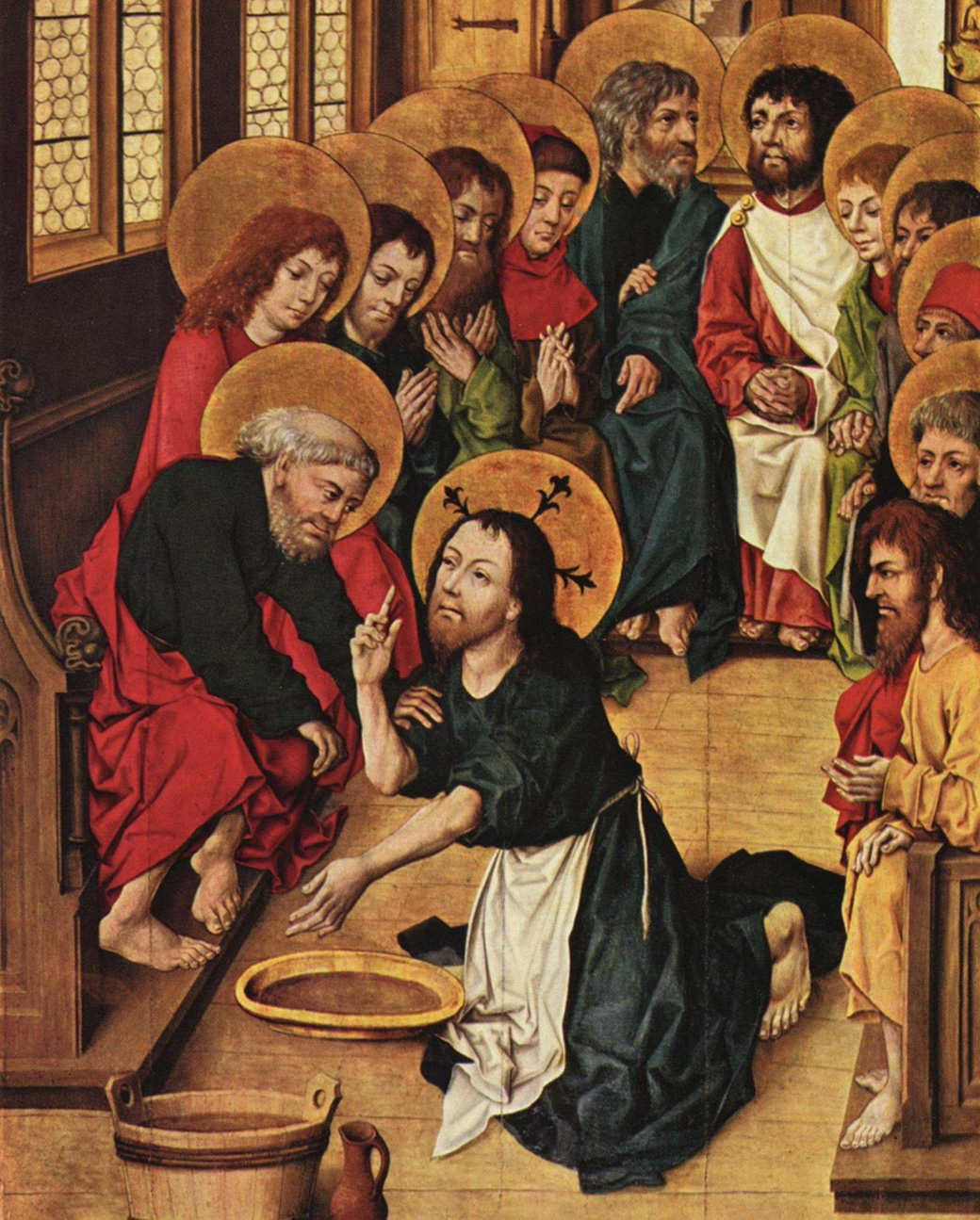
    So much meaning condensed in such a humble act! When he is finished, Jesus signals that something special is going on: “Do you realize what I have done for you?” He brings the whole mystery of God’s descent into humanity into this act of a servant for his Apostles. He continues, “You call me ‘teacher’ and ‘master,’  and rightly so, for indeed I am. If I, therefore, the master and teacher, have washed your feet, you ought to wash one another’s feet. I have given you a model to follow, so that as I have done for you, you should also do.”

    On the most obvious level, Jesus is conferring upon his Apostles the Holy Priesthood in his name. He is handing over his teaching to his chosen disciples, marking a development in their apprenticeship to the master where they can begin doing work like him, in his name. Specifically, however, there is an injunction to be humble, to wash feet, not have them washed by others. This very specific Christian form of priesthood is shared by all of the faithful — it is the Way of God’s love.

    Christ Washing the Feet of the Apostles (1475), Meister des Hausbuches | Wikimedia Commons.

    Continuing in this vein, there is the catechetical teaching that all of the faithful receive a share in a priestly vocation (CCC, 784). As Pope Benedict XVI also says in his Holy Thursday homily: “We must wash one another’s feet in the mutual daily service of love. But we must also wash one another’s feet in the sense that we must forgive one another ever anew.” Christ has given all of us this injunction to act humbly with forgiveness in our hearts.

    And thus the Holy Thursday action of Christ in washing his apostles’ feet is a crucial part of establishing the Church as well as the special office of the priesthood. He gives the Apostles the words and gestures and experience that make up the Eucharistic feast, which they in turn share with all Christians. He has given them the special experience of having their feet washed by the master, which they in turn are told to share with all Christians. Here is the establishment of the priesthood as well as the Church.

    But note how we can’t point to just this single moment, either. It carries no weight without the sacrifice on the Cross, which also contains no significance without the Resurrection. None of this has meaning without the Incarnation of God in human form. The point is that this one great mystery, this Christ Event, is made up of many phases as Fr. Corbon points out, and we must carry all of these in our hearts and minds as we contemplate what it means to be a true Christian. The Easter Triduum allows us the space for a concentrated moment of contemplation and prayer of thanks for this blessed gift given to us.

  • Agape Has Only One Source: God

    Agape Has Only One Source: God

    Friday in the Third Week of Lent: Hosea 14:2-10, Mark 12:28-34.

    Today’s gospel reading should be very familiar to us. Not only is it one of Jesus’s most straightforward sayings, it’s the answer to what is the “greatest commandment,” which is shorthand for saying, “cut to the chase, what do I need to do to get into Heaven?” Everyone perks up their ears for this answer. It sounds simple; it’s a nice sound bite. But we really have to dig into this to understand what defines Christianity beyond simple morality or concern for the social good.

    Although this episode occurs in all three of the synoptic gospels (Matthew, Mark, and Luke), here in Mark it is the most positive of all the run-ins with scribes in the gospels. A scribe, evidently impressed with his teachings rather than simply seeking to test him or trap him, asks Jesus what the greatest commandment is. Remember, there are 613 commandments in the Old Testament, and the scribes’ job was to know them intimately and come up with complex scenarios to test them as they teach their people. While we can rightly understand Jesus’s response as a joining of two commandments — loving God and loving neighbor — his response has three parts:

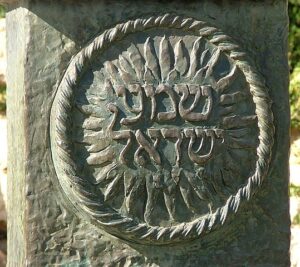
    The Shema inscription on the Knesset Menorah (the Israeli national legislature building in Jerusalem), 1954, Benno Elkan | Wikimedia Commons.

    1a. Hear, O Israel! The Lord our God is Lord alone! This is the opening verse of the Shema (she-MAH), a highly important prayer recited by Jews to open their morning and evening prayer. It is spoken by Moses in Deuteronomy 6:4. Praying the Shema is a religious commandment in itself (a mitzvah). This prayer distinguished our God as only one in the midst of a world dominated by polytheism. But it applies today; the gods vying for our attention may not be Baal, Ishtar, or Zeus, but they most certainly are self, as seen in pride, power, riches, and pleasure.

    1b. You shall love the Lord your God with all your heart, with all your soul, with all your mind, and with all your strength. This is the continuation of the Deuteronomy passage (6:5), and while it flows directly from the first declaration, it is a different mandate. The only difference between Mark’s account of Jesus’s words is the addition of “with all your mind,” which may be an addition for his Greek-speaking, non-Jewish audience since Jews had a concept of the mind being intertwined in the heart, akin to the concept of intention (and was therefore implied in already in Deuteronomy). In either case, it is clear that we should love God with everything we have: intelligence, emotion, intention, courage, endurance, etc. It is from this whole-person love of God that we receive the gifts to accomplish the last part of the great commandment.

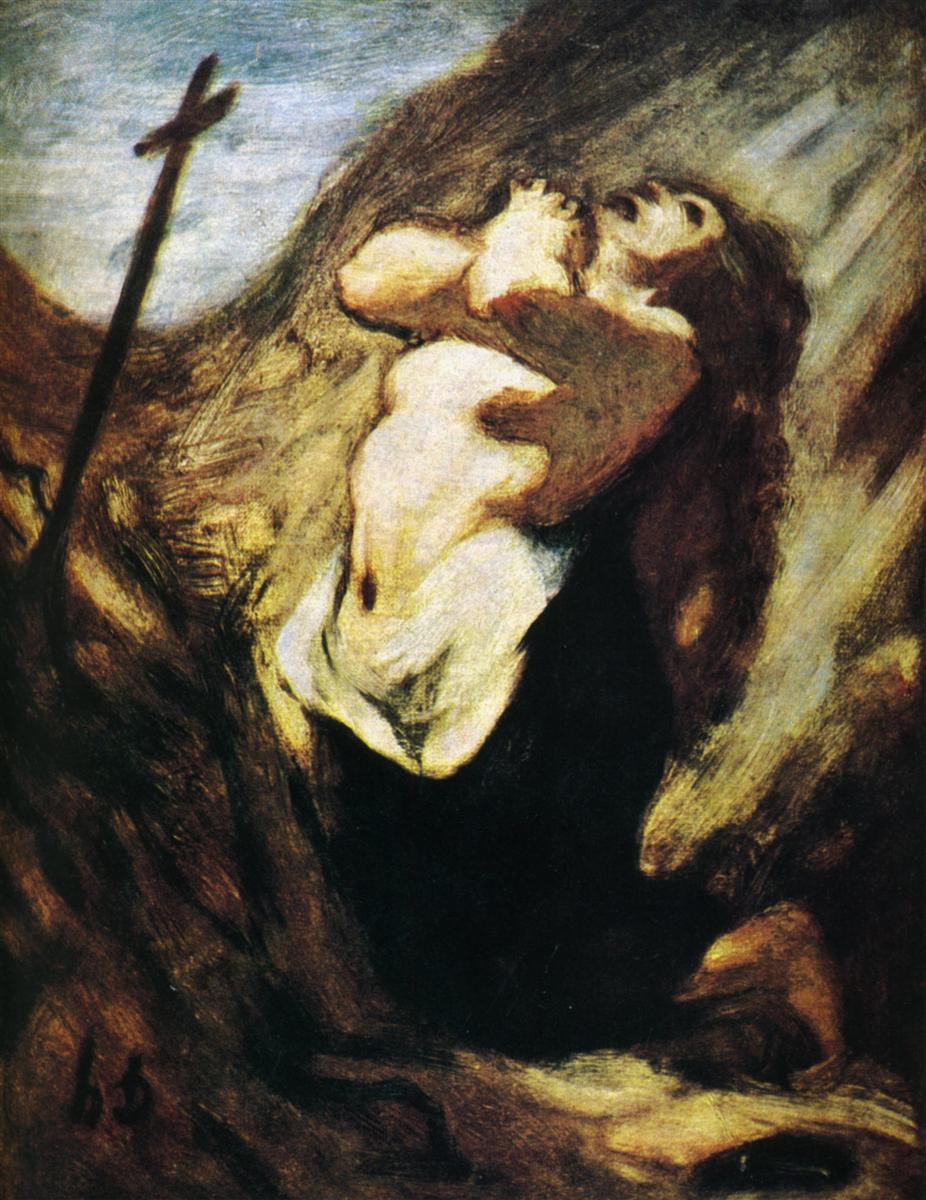
    St. Magdalene in the Desert (1848-1852), Honore Daumier | Creative Commons, courtesy WikiArt.org.

    2. You shall love your neighbor as yourself. The Word of God first uttered this commandment to Moses as recorded in the Book of Leviticus, chapter 19, verse 18. It comes after a series of verses that describe ways this love should be manifested, reading much like the second half of the Ten Commandments. And when we consider Jesus’s answer to the scribe, we do see a reflection of the Ten Commandments, the first half dealing with loving God and the second half dealing with love of neighbor. The “greatest” of the commandments is a consolidation of God’s law that does not omit a thing.

    More than just a summary, however, this commandment demonstrates the great movement and flow of love between us and God. What is this love that has a life of its own, that gains energy as it gets passed along? Let’s examine the classical Greek categories of love. This is not eros, or erotic love, that is the irresistible desire between two people; although desire is a part of this love. This is not philia, or the fondness and brotherly love that binds us in friendship; although this type of love is a part of it. This is not storge, or instinctual love like that towards your family, although, again, instinctual love comes into play.

    This love is agape (ἀγάπη). It is considered the “highest” type of love, transcending the others. This word for love was seldom used by Greek writers prior to Christianity and meant a selfless love solely for the benefit of another. Agape was used by the New Testament writers and found its truest, purest definition in God. As we explored in If You Knew the Gift!, the love we call agape is at the heart of the Trinity. The river of life, the love that endlessly flows between the three Persons of the Trinity, is the “self-opening of our thrice-holy God.” Here we see that agape originates in God, before the world was created. 

    It is only in this sense that we can begin to understand what is meant in the First Letter of John: “God is love, and those who abide in love abide in God, and God abides in them” (Jn 4:16). Yes, St. John uses the word agape for love. And this famous passage provides a good lens for understanding the greatest commandment. If God is love, then by “loving God with all our heart, soul, mind, and strength” is to give God (love) back to God. It is to be God, for God. We are asked to somehow give this selfless river of life back to God.

    And we can see how the second part of the great commandment flows naturally from the first, for what characterizes God’s agape other than the care and cultivation of his Creation? God does this gratuitously and with unending forgiveness. When we allow the agape originating in God to suffuse us and pour from us back to Him, we are at the same time loving our neighbor since this is part of the nature of that agape to begin with. That’s why love of God always must come first. Loving our neighbor cannot be an aim in its own right, divorced from loving God first. It is our very acceptance, understanding, and reciprocation of God’s own agape that enables us to truly love our neighbor as Christ intends.

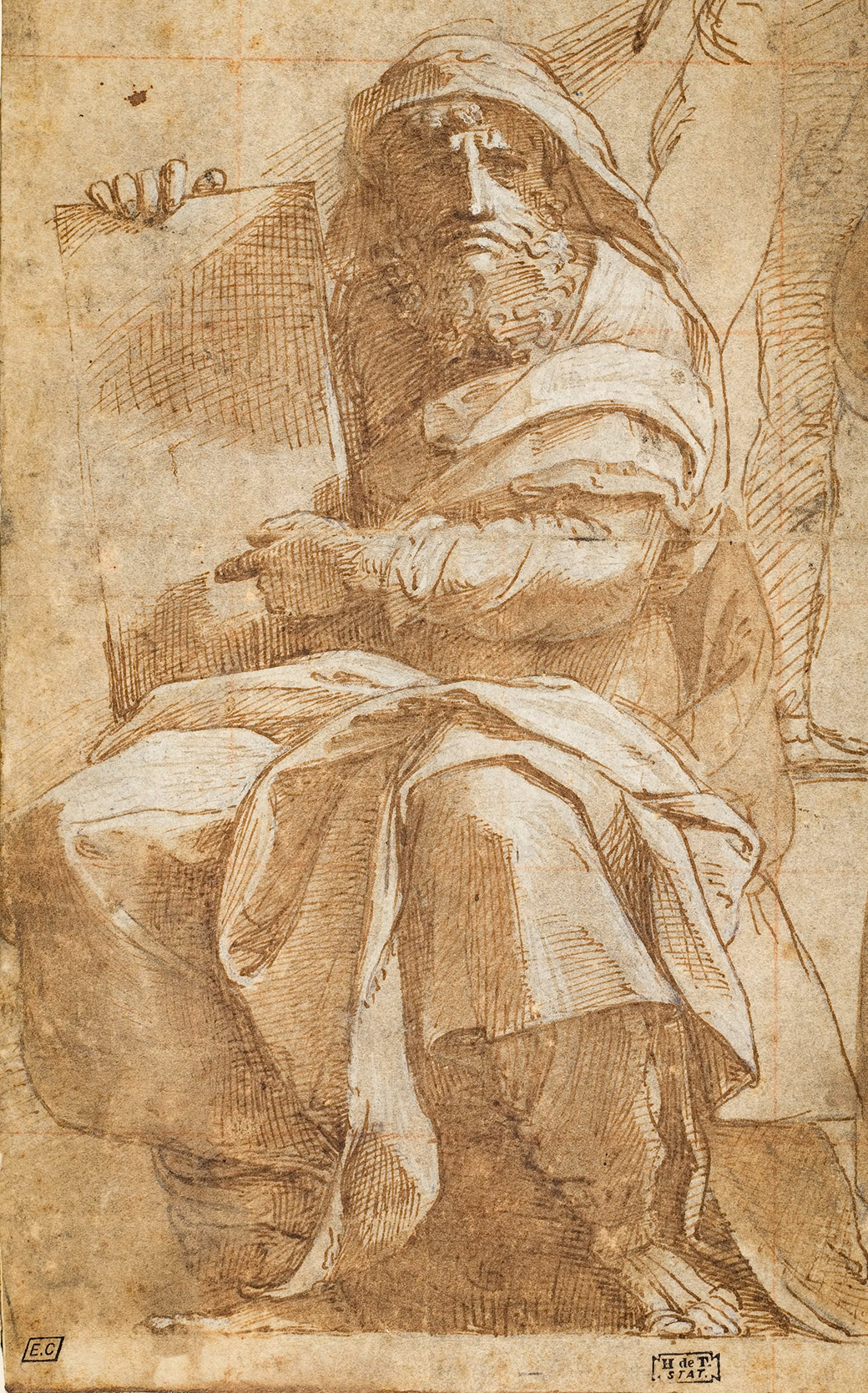
    The Prophet Hosea (c.1510), Raphael | Wikimedia Commons. This was a preparatory study for a fresco in the Chigi Chapel in Santa Maria della Pace in Rome.

    Here we see a great connection to Hosea, one of the earliest prophets, to whom God revealed the nature of his love. As Pope Benedict the XVI’s points out in his first encyclical, Deus Caritas Est (God is Love):

    Hosea above all shows us that this agape dimension of God’s love for man goes far beyond the aspect of gratuity. Israel has committed “adultery” and has broken the covenant; God should judge and repudiate her. It is precisely at this point that God is revealed to be God and not man: “How can I give you up, O Ephraim! How can I hand you over, O Israel! … My heart recoils within me, my compassion grows warm and tender. I will not execute my fierce anger, I will not again destroy Ephraim; for I am God and not man, the Holy One in your midst” (Hos 11:8-9).

    So when we hear in the final chapter of Hosea in today’s first reading, “Return, O Israel, to the LORD, your God,” it is God in his forgiveness and love who is imploring them to return. As we discovered in our reflection a few days ago, mercy is the master principle for our religion because it is the act of passing on the forgiveness God gives us. Through mercy, we take in God’s agape and reflect it, share it with others.

    You might ask if God is really a necessary part of the loving others equation. Atheists who donate to food banks and agnostics who volunteer at homeless shelters are fine examples of philia, brotherly love, or even perhaps storge, instinctual love, but not agape. Because the atheist and the agnostic turn their backs on God, they refuse to receive and then give the agape that originates in Him. No Christian can truly live the greatest commandment to love his or her neighbor without having that love originate in and be a reflection of God.

    Why does this matter? Because eternal salvation rests in us uniting ourselves with God, with that agape

    It feels like our readings and reflections this Lent have been building to this point, which is roughly halfway to our Lord’s death and resurrection. We have been growing in our understanding of God’s nature: how he thirsts for us and we reciprocate in thirst for him (see If You Knew the Gift!), how he wants us to turn from our sin and follow him in spirit as well as adherence to the law (see Salvation is Based on our Core Person), how each of us is on a path of reditus back to the Lord and once we get there we can start to love selflessly like him (see Rejoice for the Pardon of the Prodigal), and how our granting of mercy to each other in the same manner he grants it to us is the master principle of our faith (see Mercy is the Master Principle). We are left with a question: how do we follow the greatest commandment? With what strength will we possibly be able to love God completely and treat others like we treat ourselves? We know that we constantly fall back into temptation and sin. It is our nature and the way of the world. How can we be re-sanctified and raised beyond this world in order to follow this greatest of commandments?

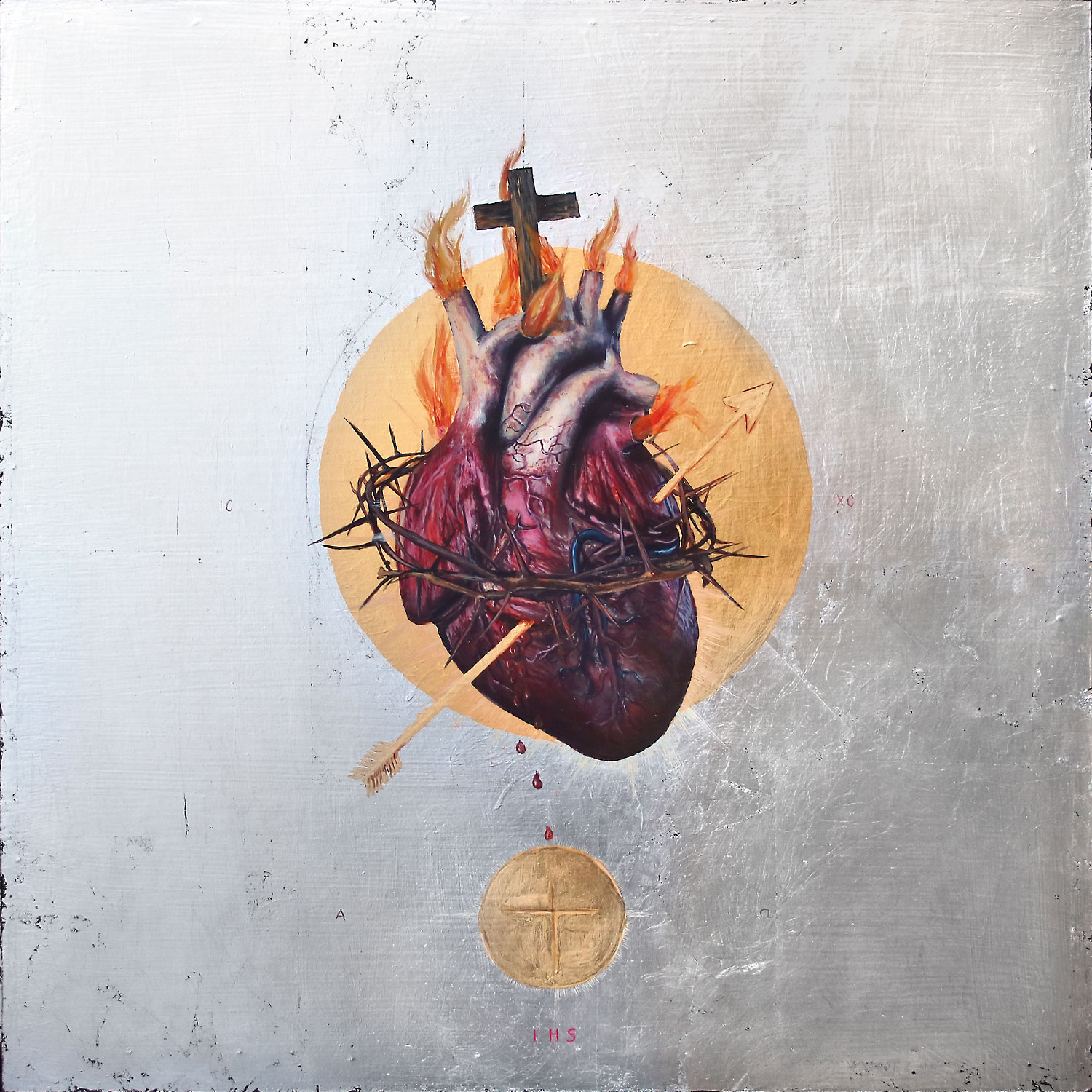
    The answer for all of us Christians is, of course, the Sacred Heart of Jesus, which is the fount of our strength, purification, and salvation. It endlessly pours upon us divine grace and enables our true communion with God.

    The Sacred Heart of Jesus – the Golden Arrow (2017), Ingrid Blixt | Artwork from ingridblixt.wordpress.com.

    Pope Benedict XVI writes, “Anyone who wishes to give love must also receive love as a gift. Certainly, as the Lord tells us, one can become a source from which rivers of living water flow (cf. Jn 7:37-38). Yet to become such a source, one must constantly drink anew from the original source, which is Jesus Christ, from whose pierced heart flows the love of God (cf. Jn 19:34)” (Deus Caritas Est, 7). Yes, Christ is the ultimate example of agape for us. God not only gives his Son as a sacrifice for us in a stunning display of love, but he opens the door for us to become sources of life for the world. The Christ event opens a new reality specifically through the flesh and blood of Jesus, in which he enables us to mystically partake in every liturgy.

    How exactly are the Church and the great Sacrament enabling us to live out the greatest commandment in an even more unanticipated and deep way? Pope Benedict XVI explains:

    Communion draws me out of myself toward him, and thus also toward unity with all Christians. We become “one body,” completely joined in a single existence. Love of God and love of neighbor are now truly united: God incarnate draws us all to himself. we can thus understand how agape also became a term for Eucharist: there God’s own agape comes to us bodily, in order to continue his work in us and through us. Only by keeping in mind this Christological and sacramental basis can we correctly understand Jesus’ teaching on love (Deus Caritas Est, 14).

    Over the second half of Lent we continue to contemplate God’s nature and works but we also pivot to begin contemplating the majesty and mystery of his Son. The internal logic of the readings and their relationship to the liturgical seasons becomes more apparent. Yet the fullness of God’s message was always there, at all times. It was Christ, the Word, who first gave this greatest of commandments to Moses as recorded in Deuteronomy and Leviticus. The one great difference, the great change, is the New Covenant given by Christ in the person of Jesus, where agape descended from Heaven and manifested in a bodily and spiritual sacrifice, made once and forever.

    Let us embrace this second half of Lent and immerse ourselves, prepare ourselves for the gift of agape that we are asked to celebrate and carry with us throughout our lives.