Tag: Jeremiah

  • The Tree in its Vigor

    The Tree in its Vigor

    Saturday of the Fourth Week of Lent: Jeremiah 11:18-20, John 7:40-53.

    Today we observe two men of God in their prime: the prophet Jeremiah and Jesus Christ. As strong as they are in their relationship with the Father, they are besieged by the evil that walks among humanity. Despite being the living embodiment of God’s Truth, the peoples’ response was, “Let us destroy the tree in its vigor.”

    We should certainly take note of this historic violence against God’s anointed ones, not because we fear to repeat it (after all, Jesus is the final prophet), but because it presents us with a perspective on God’s chosen way to operate in humanity. This perspective, coupled with the Christ Event in its fullness, should prompt us to quicken our steps to the Lord, keep our lamps trimmed and burning, for the Lord will come like a thief in the night and we must be upright and ready.

    The reality is that we live the Last Times, the final age before the Judgment, and if we do not pay attention to all that has been given to us (scriptural revelation and the gift of Christ Himself), then we are dooming ourselves as surely as the chief priests and Pharisees who conspired against Christ.
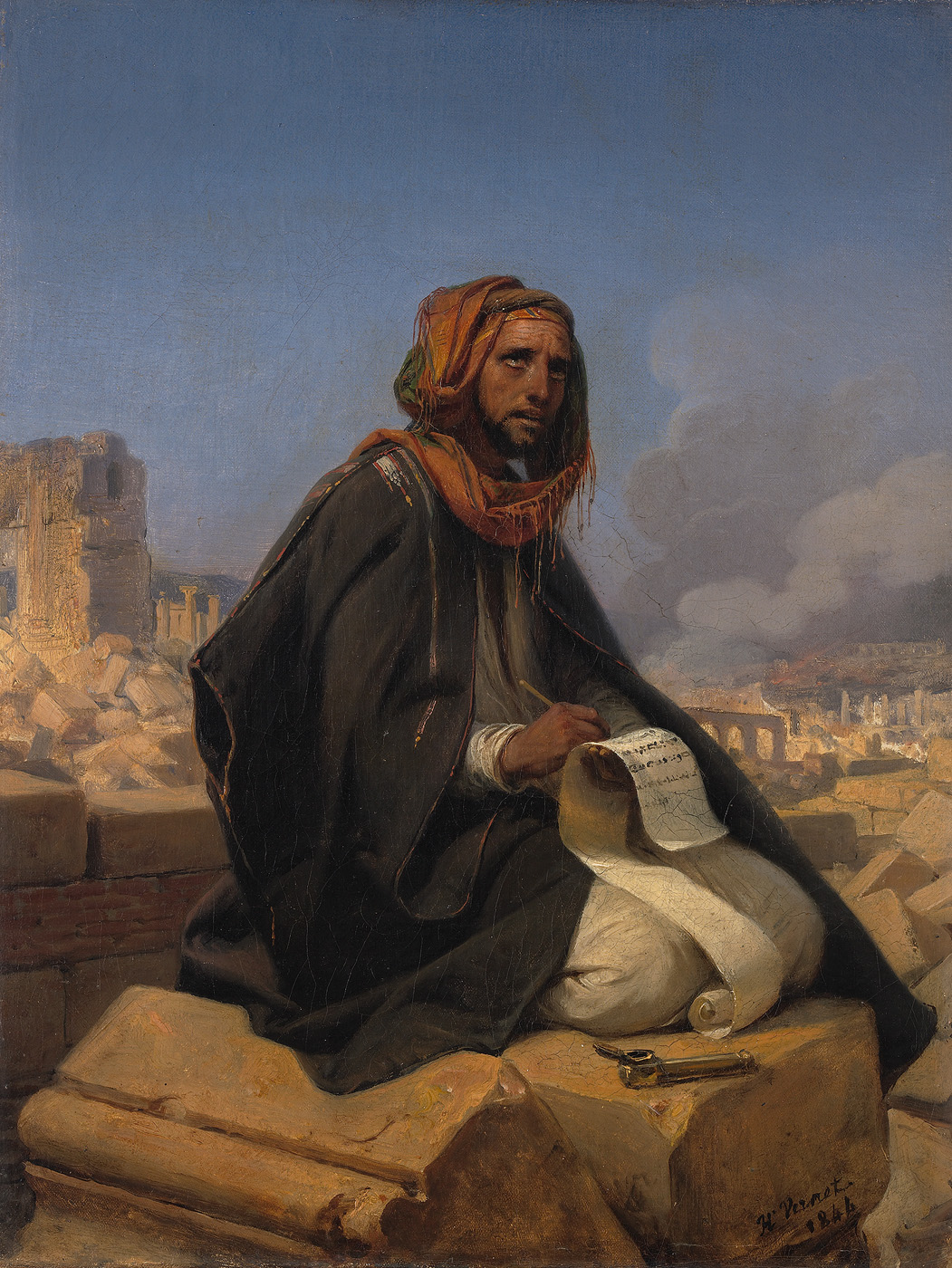
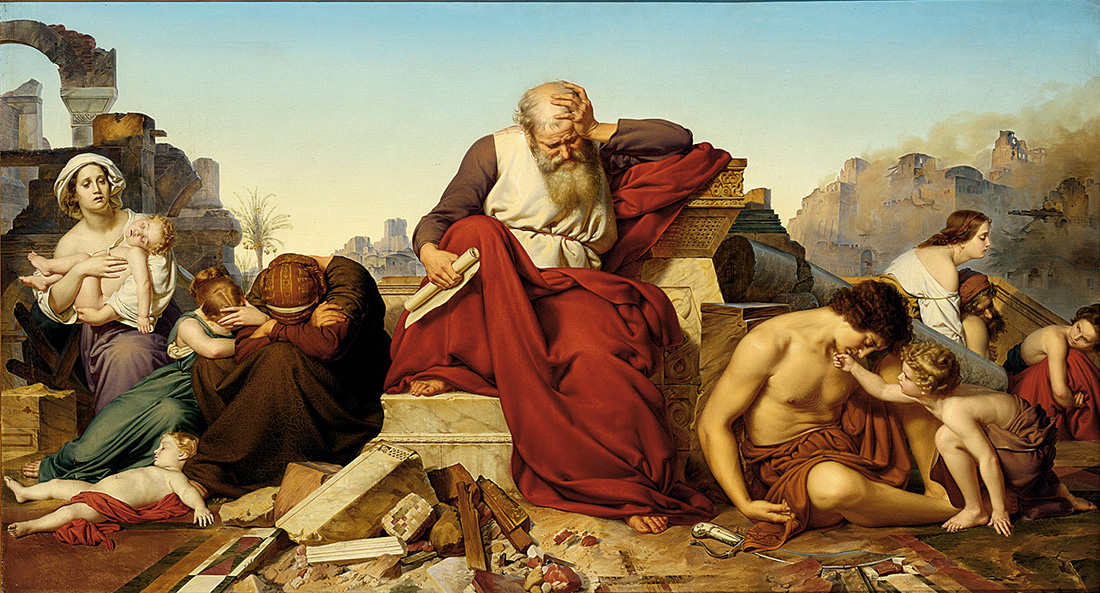
    Jeremiah on the Ruins of Jerusalem (Jeremia op de puinhopen van Jeruzalem), 1844, Horace Vernet | Wikimedia Commons.

    Jeremiah is as simple yet as troubled a soul as there can be. Simple in that he is the model of fidelity to the Lord, doing his will without question and delivering difficult prophecies without sugar-coating them. There is no guile, no politicking. Yet he is troubled in every other way.

    He concisely shares his state of affairs in today’s reading: “Yet I, like a trusting lamb led to slaughter, had not realized that they were hatching plots against me.” People mock him, imprison him, beat him, conspire against him, and he is emotionally ripped up because he sees what lies in store for Judah and mourns their intractable defiance of the Lord. No one listens during his entire ministry and indeed the nation is destroyed as the Babylonian Exile begins.

    Jeremiah gives us a look into the evil hearts of his enemies: “Let us destroy the tree in its vigor; let us cut him off from the land of the living, so that his name will be spoken no more.” I note two things about this. First, there is a reaction against his strength in the Lord — they recognize that he is at the top of his prophetic game, a “tree in its vigor.” This is the reaction of the prince of this world to the presence of holiness. Second, this reaction is so forceful that it seeks the utter destruction of the prophet. It is not enough to kill him, but to ensure that “his name will be spoken no more.”

    They want to not only destroy the man but the divine truth that he has brought into the world. This erasure enables the devil to work without opposition. Satan preys on our base instincts and works through us to destroy truth and beauty.

    But we cannot be sucked into dualism, a worldview that pits good forces against equivalent evil forces like a version of Star Wars. That is a heretical teaching that the Church has stamped out many times in her history. This is why the lectionary includes the final verse of today’s first reading: “But, you, O LORD of hosts, O just Judge, searcher of mind and heart, Let me witness the vengeance you take on them, for to you I have entrusted my cause!” This is not just a message that good will win out in the end. What it shows us is that Jeremiah has been blessed with a tiny glimpse of the divine intelligence, enough to show him that God has a great plan for humanity in which his lifetime is just a fraction of a breath.

    Jeremiah knows that there will be a “vengeance” against evil at some point and he is asking to witness it. I don’t think this has been included just to make Jeremiah look like a vengeful guy, with evil in his own heart. No, that’s completely inconsistent with who we know Jeremiah to be. Enraptured in the divine vision, he longs to see full justice restored for humanity — this is the Kingdom of God — and he wants to be present for it (which he will, indeed, after Jesus resurrects).

    But God’s plan is that evil is allowed to act upon humanity in Jeremiah’s age. He could stop it, but he doesn’t. Why? This is the great question that so consumes people bothered by suffering in the world. Why are we left to be vulnerable to evil?

    There is something greater going on. Let’s remember that God asks nothing of us that he does not also ask of his Son.

    Looking at today’s gospel reading, Jesus experiences much more success in planting Truth and his Word in the world (of course!) — he converts countless people to himself, and in today’s reading we hear several proclaim that he is “the Christ.” But perhaps the greatest mystery (and point of beauty) in God’s plan is how delicately he enters into humanity, allowing for personal sovereignty of will rather than eradicating all evil and opposition in a forceful application of the divine will. So, the great drama of our God’s self-willed vulnerability unfolds. The conspiracy of those supposed to be his greatest defenders, the upholders of divine law, is shown in its awfulness.

    What is so interesting here is that we do witness a type of scriptural/religious tyranny, but on the side of the Jews. This is a great contrast to our Lord’s refusal to be a divine tyrant. The Jews have painted themselves into a corner: “The Christ will not come from Galilee, will he?” They have fetishized scriptural accounts and their huge corpus of rabbinic teaching to such an extent that rather than being open to the Lord in the world, they have narrowed and perverted their expectations. This is what I mean by a religious tyranny, where it is not God speaking to them, but their manmade understanding of religious teaching that looms over them and determines their reactions to Truth in their midst.

    They are specific: “Does not Scripture say that the Christ will be of David’s family and come from Bethlehem, the village where David lived?” And it is worth noting that so much of the Jewish tradition at that point was concerned with restrictions — what you cannot touch, cannot eat, cannot say, cannot do. By living only in the restrictions and not in the life-giving love that God calls them to, they lose their autonomy to respond to Truth in their midst. 
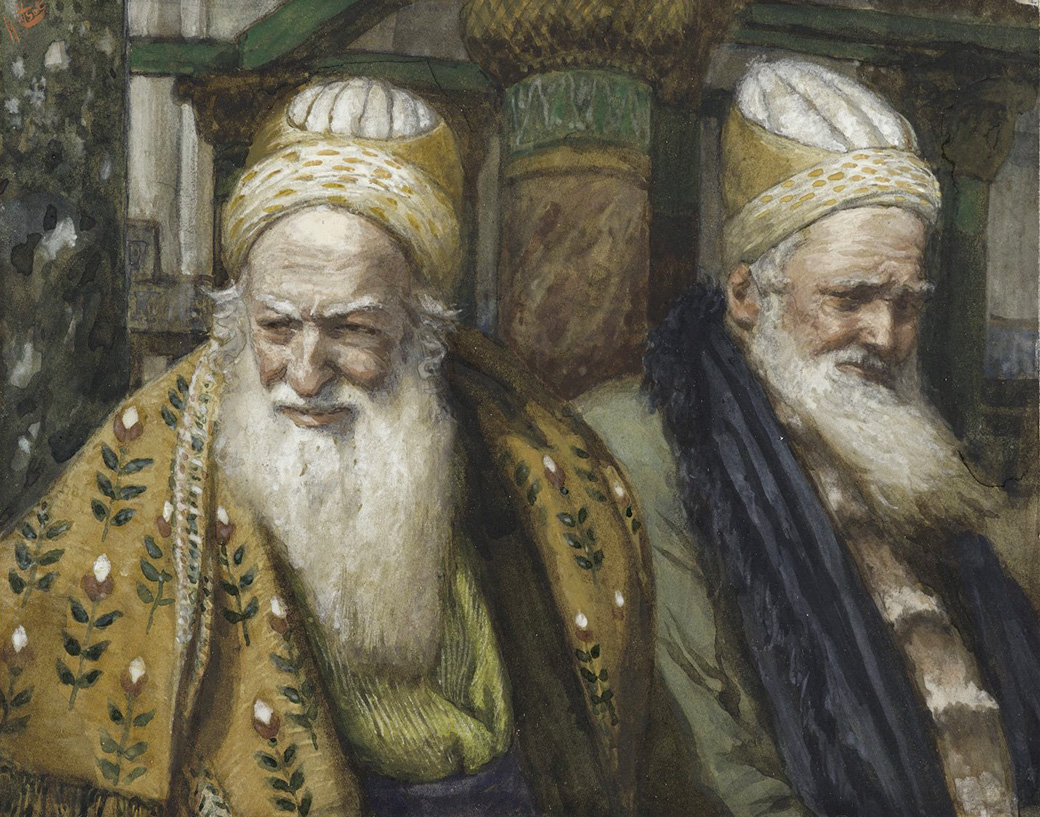
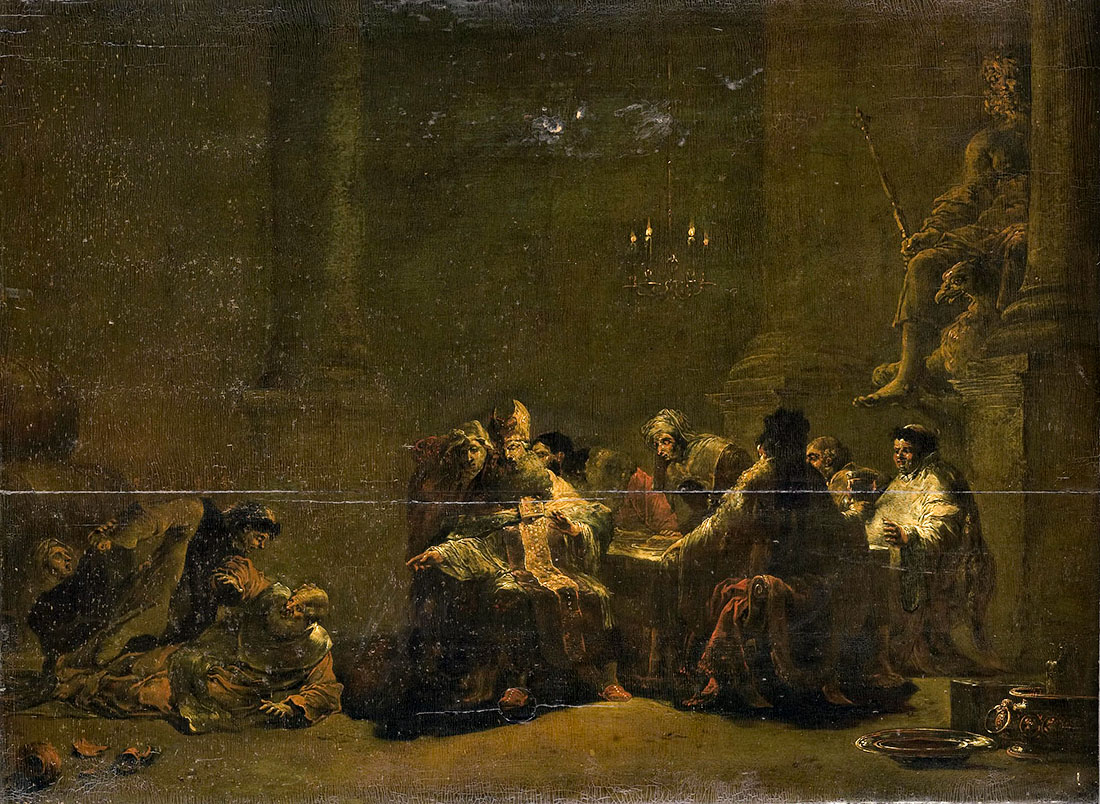
    Annas and Caiaphas (Anne et Caïphe), 1886-1894, James Tissot | Creative Commons, courtesy the Brooklyn Museum.

    The result? We are told, “So a division occurred in the crowd because of him.” God is allowing us the space to see for ourselves, to contrast the freedom of belief in the Truth with the constriction of fetishizing the trappings of truth. God is creating for us the opportunity to make a choice of our own free will, to decide to come to him or, alternatively, reject him. 

    When the guards return empty-handed to the chief priests and scribes, they are mocked: “Have you also been deceived? Have any of the authorities or the Pharisees believed in him? But this crowd, which does not know the law, is accursed.” Note how the leaders of the religious tyranny operate in darkness, in mockery and deceit. They show their narrow-minded clutching at scraps of prophecy by saying the crowd does not know the law. How ironic, since Jesus tells us he is the very fulfillment of the law!

    At stake here is the true meaning of “knowing.” The priests and scribes have filled themselves with book knowledge and the grammar of restrictions, which they wield like weapons of power. But God presents himself to us so that we can know him as a person, and this knowledge is used as a salve for humanity. The “knowing” that God is calling us to is always completely wrapped up in his personhood and the personhood of humans.

    He takes the form of a human in part to show us that when we open ourselves to him, we are also opening ourselves to each other. Godliness is absolute openness to knowing each other fully, not judging, not forcing our will or the other’s, but knowing and accepting. When this “knowing” is joined with loving, then we are on our way to the Kingdom.

    Nicodemus, who came timidly to Jesus at night to get to know him better, is the one Pharisee who is on the Way. He slows the Pharisees’ frenzy by challenging them to adhere to the spirit of the law — to not condemn before hearing someone first. Having started his own journey of knowing, he brings both truth and humanity back to the scene of these circling sharks. They spit a mocking comment at him before we hear the end of the episode: “Then each went to his own house.” How fitting that these men filled with worldly knowledge and power plays disperse, alone. They do not “know” God or humanity, which draws us together, not apart.

    Today, we encounter a contrast of visions. First is the worldly vision of the religious leaders who wield their knowledge as weapons to divide humanity. Second is God’s plan for humanity as revealed through his “trees in their vigor,” marked by gentleness and a personal knowing that heals and unites.

    The worldly vision is all-too-familiar; we see it in force to this day in our governments, businesses, and even families. The second has also been laid out for us to see plainly. We’ve had access to this amazing perspective on God’s personhood and plan for 2,000 years. We have no excuse, we cannot plead ignorance, and we cannot expect that God has more to reveal and more prophets to send.

    The Church has always insisted that we are living in the End Times, the last period before Christ will return for the Final Judgment. This Lent, let’s all realize that the time is now, there is no other. 
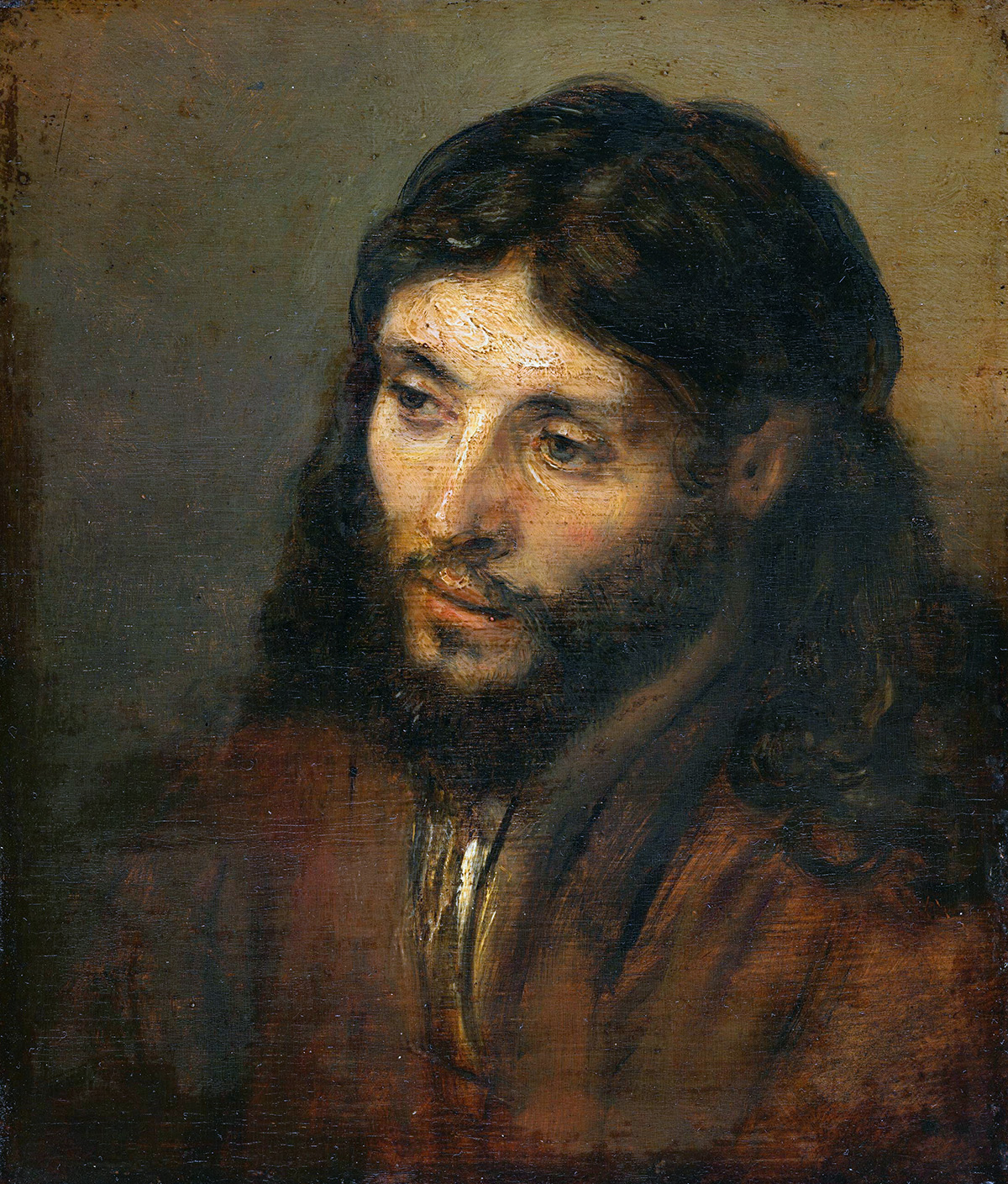
    Head of Christ (c.1648), Rembrandt | Wikimedia Commons.

    I want to finish with a reminder of why everyone was a-buzz in today’s gospel reading. In the verses just prior to our reading, we learn that it is “last day of the festival, the great day,” which is known as Hoshana Rabbah. This is the last “day of judgment” in the Jewish calendar when they process around the temple seven times and have a great temple service, imploring the Lord for a bountiful year ahead. On this last day of Hoshana Rabbah, the priest makes a great show of the water libation as an appeal to God to provide water for the people in the year ahead. It is at this time that Jesus cries out, “Let anyone who is thirsty come to me, and let the one who believes in me drink. As the scripture has said, ‘Out of the believer’s heart shall flow rivers of living water’” (Jn 7:37-38).

    No wonder the crowd is amazed! Jesus, as if in answer to the priest’s prayer, tells the people to come to him for living water. He is establishing that he has God’s power of restoration for the people. The Jews must make a decision: will they accept and follow the Messiah in their midst or reject Him? 

    Will you?
  • Tree Beside Running Waters

    Tree Beside Running Waters

    Thursday in the Second Week of Lent: Jeremiah 17:5-10, Luke 16:19-31.

    (Note: this is a lightly edited version of the reflection I originally wrote in 2020 for the Second Thursday of Lent: Beware the Enchantments of the World.) 

    Today, we hear the parable of the Rich Man and Lazarus from the gospel of St. Luke. On its surface, this parable seems to warn us of too much enjoyment in this world because we will pay for it later (in Hell). As we dig into the parable, however, we see a deeper problem with the rich man. The connection to the reading from Jeremiah becomes more apparent: the enchantments of this world distract us from God, who is busy giving us plenty of opportunities for redemption by our faith and actions.

    The opening of Jesus’s parable almost sounds like a fairy tale: “There was a rich man who dressed in purple garments and fine linen and dined sumptuously each day.” This opening may tempt us to read it as a simple morality play. But the Truth spoken by the Word of God is not just a self-improvement class. It draws our spirit to dwell with Him, even if it does so via a warning.

    Our gospel passage opens: “Jesus said to the Pharisees…” and in Luke, Chapter 15, He is, in fact, in the middle of talking to them. Let’s back up a few verses to get the full context. “The Pharisees, who were lovers of money, heard all this [his last parable that “You cannot serve God and wealth”], and they ridiculed him. So he said to them, ‘You are those who justify yourselves in the sight of others; but God knows your hearts; for what is prized by human beings is an abomination in the sight of God’” (Lk 16:14-15). These parables are specifically for them. We shall see that His criticism of loving money holds true for loving other human desires.

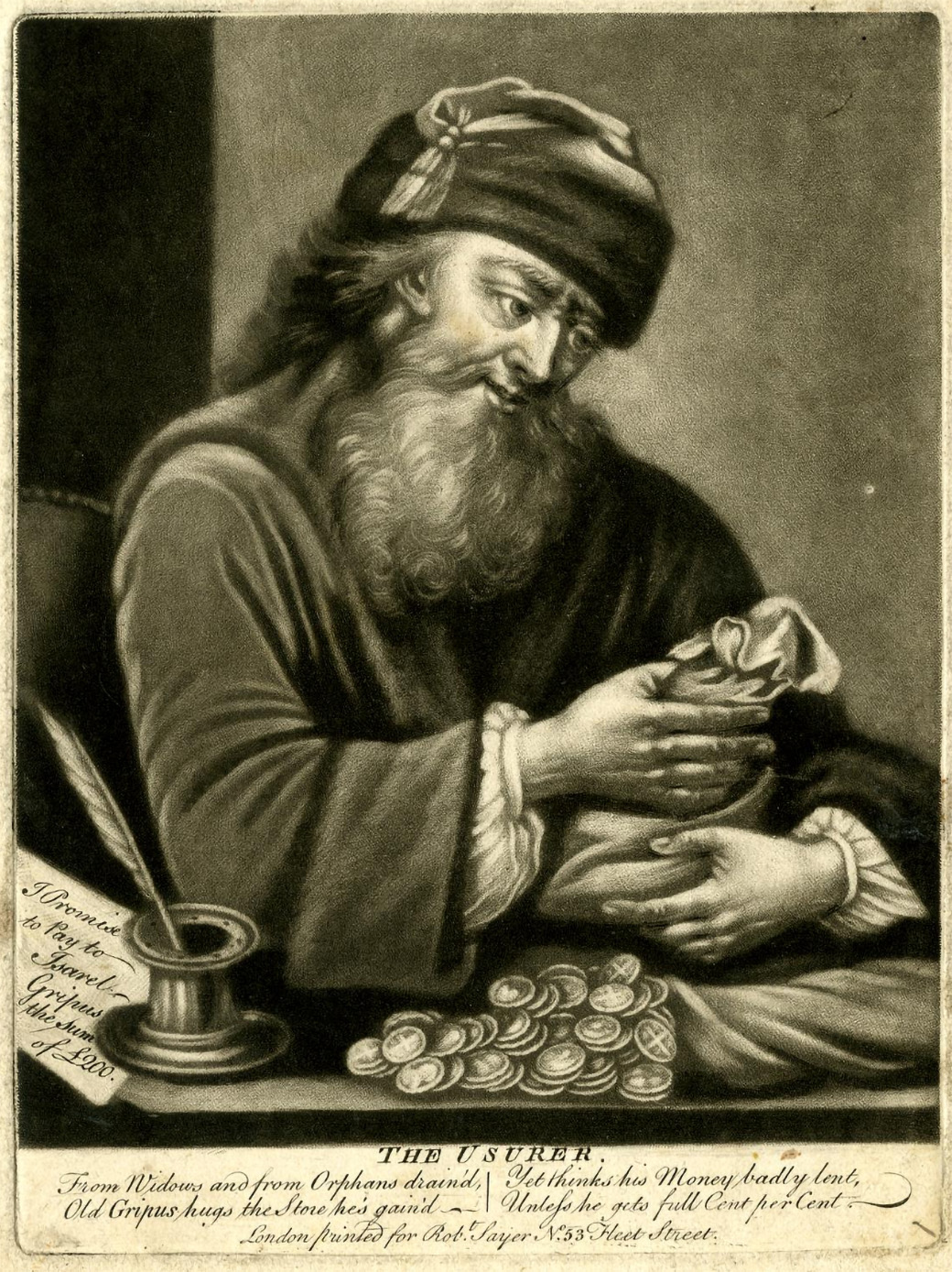
    The Userer, ca. 1766-1774, after George van der Mijn (1721-1763) | Creative Commons, courtesy the British Museum.

    What does today’s parable tell us about the rich man other than his expensive tastes and gluttony? We can glean that he did not seem to give alms of any sort to Lazarus, who would have been glad to have “scraps that fell” from his table. Just two days ago, we heard Jesus saying of the Pharisees: “For they preach but they do not practice. They tie up heavy burdens hard to carry and lay them on people’s shoulders, but they will not lift a finger to move them. All their works are performed to be seen.” In the rich man we see the same lack of helping as we do in the Pharisees: he does “not lift a finger” to relieve Lazarus’s suffering.

    He displays his true colors when he finds himself in Hell. Unbelievably, he retains an arrogant sense of self-worth greater than Lazarus when he says, “Send Lazarus to dip the tip of his finger in water and cool my tongue.” Here the rich man is “in torment,” asking for pity, and he’s still treating Lazarus as a servant or slave! 

    Abraham explains that they are reaping their rewards based on their experiences and actions on earth, and that “a great chasm” separates them. And still the rich man asks, “send him to my father’s house” to warn his family to mend their ways, betraying his continued dismissal of Lazarus as a person with dignity. He sees Lazarus as a tool to be employed for his family’s benefit, arguing with Abraham, “if someone from the dead goes to them, they will repent.” His sense of superiority and belief that everyone (even Abraham!) should listen to him is astounding, and certainly a pointed example for the Pharisees who were listening.

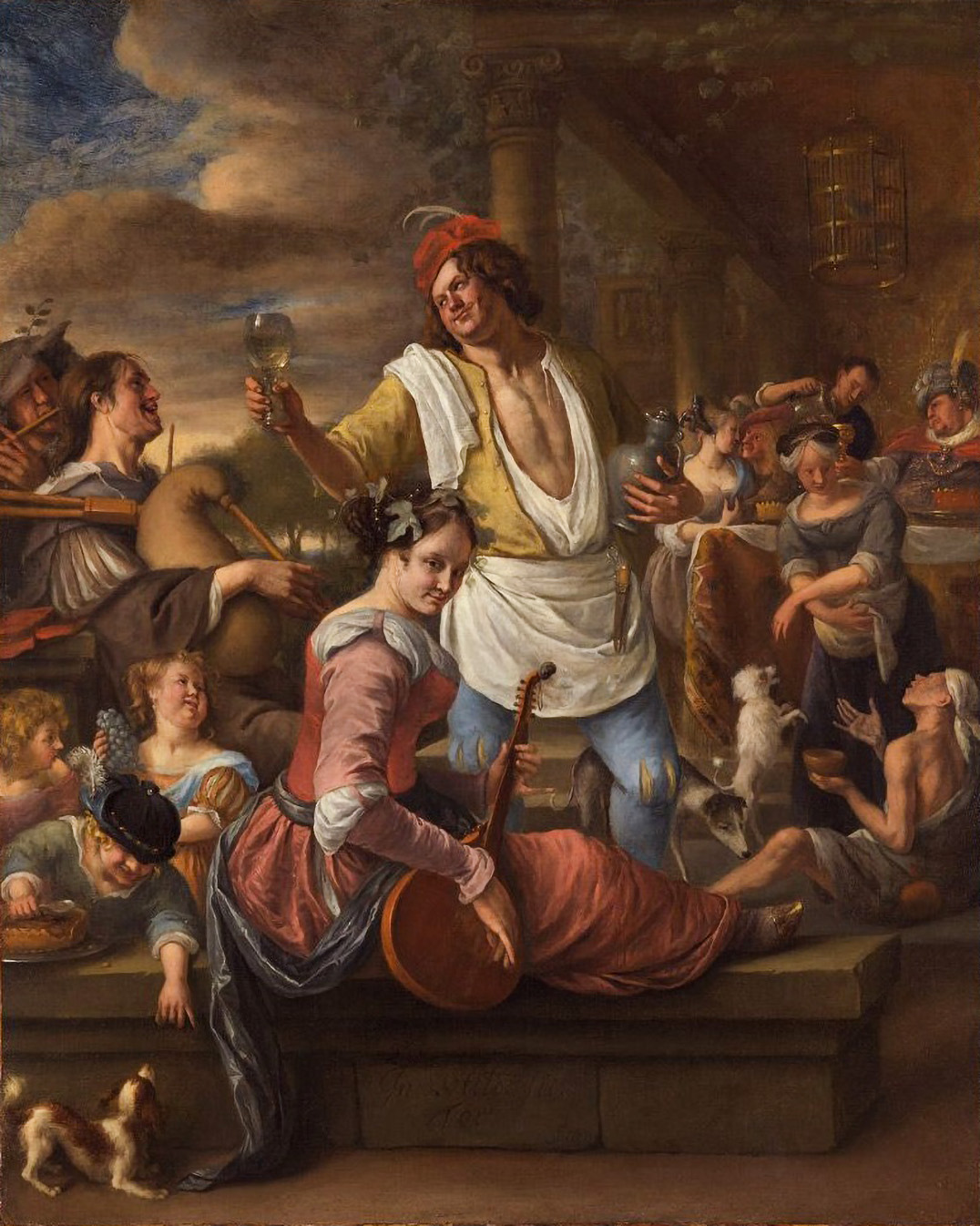
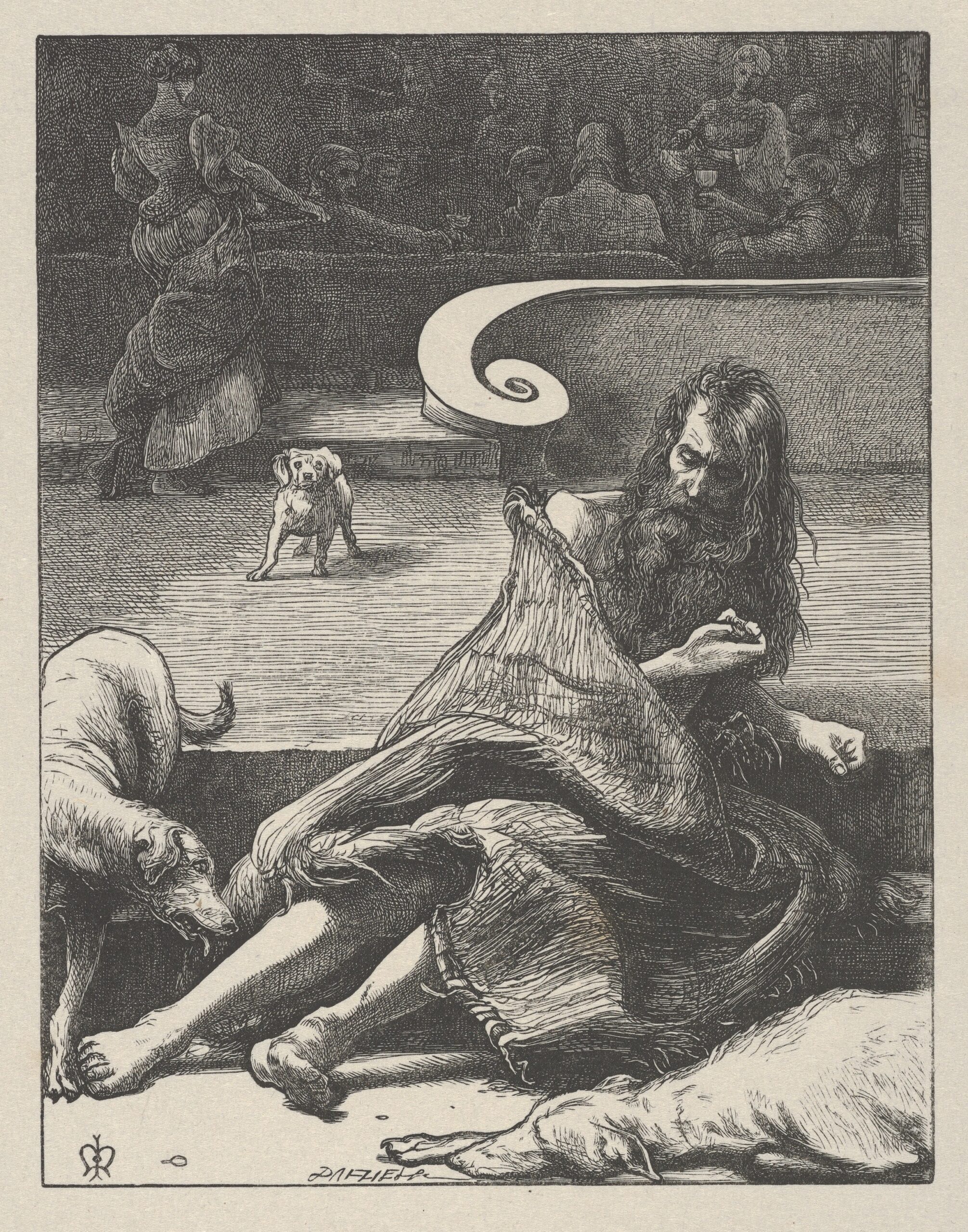
    The Parable of the Rich Man and Lazarus (1677), Jan Steen | Wikimedia Commons. I particularly like the self-important, dismissive expression of the man holding the goblet in the foreground, which captures the failings of the rich man archetype. Note that the actual rich man from the parable, however, seems to be in the upper right corner, even more removed from humanity in his gluttony. Overall, I appreciate Jan Steen’s painting for focusing on the enchantments of the world, raising a glass to toast today’s enjoyments, oblivious to the judgment that is coming.

     For his part, Abraham at first replies with a certain pity for the rich man, saying, “My child, remember that you received what was good during your lifetime …” This turns eerily neutral after the rich man displays his unrepentant attitude: “They have Moses and the prophets. Let them listen to them.” And finally he utters some baleful words indeed at the end: “If they will not listen to Moses and the prophets, neither will they be persuaded if someone should rise from the dead.” This last proclamation can clearly be applied to Christ, who will rise from the dead, and those who refuse to listen are, of course, the Pharisees themselves.

    If we return to the verse that set the context for the parable of the rich man, we can see how the parable illustrates Jesus’s point: “God knows your hearts; for what is prized by human beings is an abomination in the sight of God.” Money, gluttony, and other things “of the flesh” take the brunt of the blame, but let’s not overlook that Christ is talking about God knowing our hearts. Love of wealth and being noticed are the “bad fruit” from a diseased tree — “every good tree bears good fruit, but the bad tree bears bad fruit” (Mt 7:15). The tree itself is what concerns God — He wants us to grow strong and beautiful and bear good fruit (i.e., love one another, good deeds), which require nourishment from Him and His precepts. 

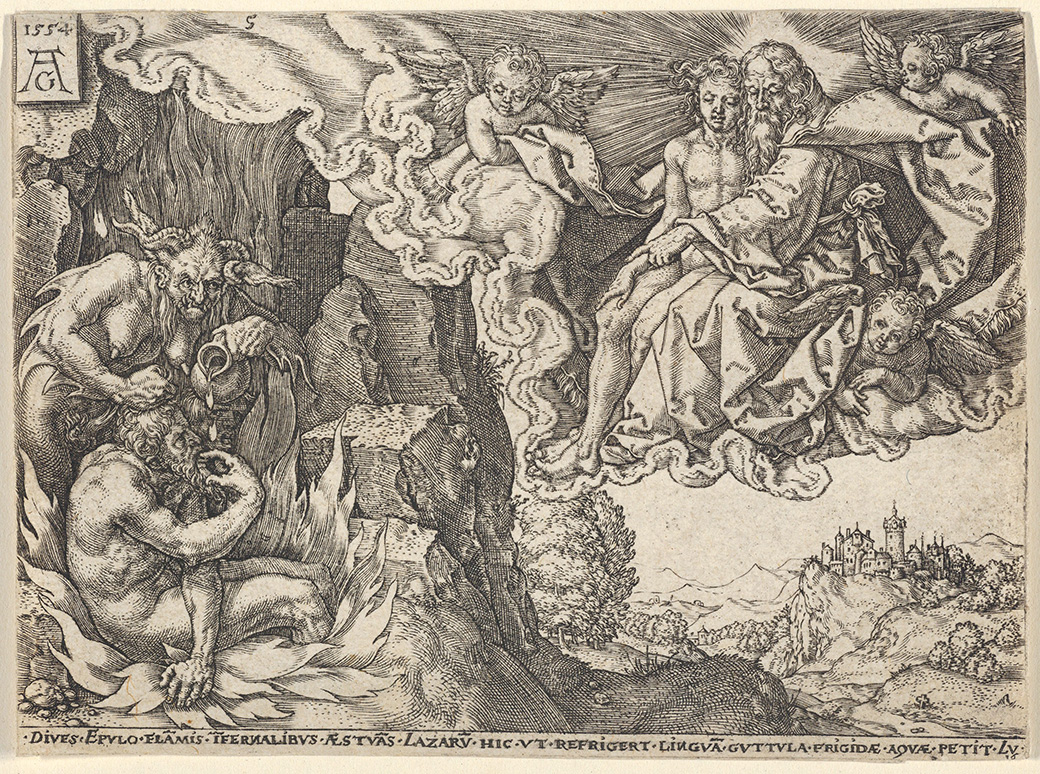
    The Rich Man in Hell, Seeing Lazarus Embraced by Abraham, from The Parable of the Rich Man and Lazarus (1554), Heinrich Aldegrever | Creative Commons, courtesy the Metropolitan Museum of Art.

    This is where the first reading from Jeremiah is helpful. He employs this same imagery of a tree that is either healthy or diseased, depending on a person’s attachment to God or to the world. He says that he “who seeks his strength in flesh … is like a barren bush in the desert … [that] stands in a lava waste, a salt and empty earth.” Conversely, “the man who trusts in the LORD … is like a tree planted beside the waters that stretches out its roots to the stream … In the year of drought it shows no distress, but still bears fruit.” I love the image of a person strong in the Lord being a plant growing by running waters (also used in the first Psalm), probably because it simplifies life: all you need to make you thrive is the Word of God. What a refreshing thought when compared to all of the other “things” we think we need to do and accumulate in this life. Applying Jeremiah’s imagery to the gospel reading, the Pharisees are the “barren bush in the desert,” removed from the life-giving spring because they reflect everything back on themselves. While they seem rich (in this life), they will find that they are barren spiritually and destitute in the next life. 

    But, look! God gives us endless chances to return to the stream of living water. What was Lazarus but a chance for the rich man to turn his heart to God and practice charity? And what was Lazarus’s suffering but his cross to bear for the salvation of another (even if that other person did not accept the salvation offered to him)? This is God’s prerogative as our Master and Creator. The Word tells us through Jeremiah at the end of today’s reading:

    I, the LORD, alone probe the mind
    and test the heart,
    To reward everyone according to his ways,
    according to the merit of his deeds. 

    This is the work of God to bring us back to unity with Him: probing our minds, providing opportunities to exercise our spiritual muscle, and ultimately rewarding us according to our ways and deeds. As fruit shows us the type of tree, our deeds reveal the heart of the person. Charity comes from a good heart that finds its refreshment in the Lord. Selfishness comes from a heart focused on this world’s enchantments and the self alone. This is why we Catholics insist that our justification (i.e., place in heaven) comes from faith and works, not just faith alone. This teaching is found throughout scripture, no more clearly than today’s readings.

    At the risk of slightly repeating myself, let’s tackle one of the common complaints humans have voiced throughout our history, “why is there suffering in the world?” The parable of the rich man is a great reply to this. For the rich man, God is probing his heart and giving him opportunities to return to the sheepfold. For Lazarus, he must remember that he will be comforted in heaven if he bears his suffering with dignity and a focus on God. What’s more, all of us must remember that God works in ways beyond our immediate knowledge to bring us closer to him. Lazarus is God’s way to reach out to the rich man’s heart. Which of us can truly bemoan the honor of being used by God for a holy purpose, even if it involves our suffering? Was this not the exact example Christ set for us? 

    The Rich Man and Lazarus (The Parables of Our Lord and Saviour Jesus Christ), 1864, Sir John Everett Millais | Creative Commons, courtesy The Metropolitan Museum of Art. I love this more tender artistic look at Lazarus, who is often sidelined in the story.

    In this vein, let’s finish this reflection with the words of St. Therèse of Lisieux. One of only three female Doctors of the Church, St. Therèse led an incredibly short life, dying at the age of 24 from tuberculosis. She suffered much (even as a child she suffered from mysterious illnesses that left her bed-bound) but bore it with incredible kindness towards others. “As Jesus had made me realize that the Cross was the means by which He would give me souls,” she said, “the more often it came my way, the more suffering attracted me.” What a fantastic attitude towards suffering!

    Since suffering was “attractive” to her as a way of doing God’s will, she saw small sacrifices less as burdens and more like acts of love. She writes, “Miss no single opportunity of making some small sacrifice, here by a smiling look, there by a kindly word; always doing the smallest right and doing it all for love.”

    And, finally, almost as a nod to Lazarus in today’s reading, she writes, “Our Lord’s love shines out just as much through a little soul who yields completely to His Grace as it does through the greatest.” Talk about a tree growing next to life-giving waters! She is a true inspiration.

    Thank you, St. Therèse for giving us such a positive way to understand turning our hearts to God and making suffering a joy to bear for the Lord.

  • Worm of the Soul

    Worm of the Soul

    Wednesday of the Second Week in Lent: Jeremiah 18:18-20, Matthew 20:17-28.

    Today’s readings show the ugliness of jealousy, which St. Cyprian of Carthage calls “the root of all evil.” After examining the readings, I’d like to reflect on St. Cyprian’s Treatise on Jealousy and Envy, which offers some sharp insights.

    The Jews in Jeremiah’s time were tired of hearing his gloom-and-doom prophecies. In the Book of Jeremiah, we read of how his no-holds-barred warnings and criticisms land him in prison, get him beaten, and make him an outcast. Today’s reading shows the inner mindset of the Jews who wanted to discredit and destroy him: “Come, let us contrive a plot against Jeremiah … let us destroy him by his own tongue; let us carefully note his every word.”

    What provokes such evil in the hearts of his countrymen? Jeremiah wonders as much himself: “Must good be repaid with evil that they should dig a pit to take my life?”

    Jealousy (contemporary), Yvonne Wright | Image from pixels.com.

    There are many ways to react to a person who proclaims something upsetting. We can ignore them. We can disagree, perhaps loudly. We can silently listen to their harangue and think about it over time, seeing if there is any truth to it. Or, we can allow our passions to grip us and lash out. If we allow negative passions like anger to build, we begin to desire retribution in a more lasting way. This is the work of evil.

    But another sin may be in play in Jeremiah’s case, specifically jealousy. He is getting attention with his troubling prophecies, and the other priests and Jews are not liking the power and attention he is garnering. If jealousy is in the heart of Jeremiah’s adversaries, we can begin to understand how elaborate plots might develop.

    Jealousy is such an ugly sin that we never want to admit that it grips us. It’s embarrassing because it is such a strong sin, stripping us of everything elevated and good in character. Because it is ugly and embarrassing, we keep it hidden; we plot and the festering evil builds.

    In the gospel, Jesus quickly identifies this sin erupting among the Apostles and stamps it out before it can grow. When the Apostles learn of James and John’s desire to sit at Jesus’s right in Heaven, they “became indignant” and undoubtedly jealous. Jesus’s response is that while leaders in the Gentile world operate by having authority lorded over others, “it shall not be so among you. Rather, whoever wishes to be great among you shall be your servant; whoever wishes to be first among you shall be your slave.” Jesus must re-orient them to the goal of the Christian life: to serve and thereby inhabit and spread the love of the Father.

    The entire discussion of greatness and deservedness to sit at the Lord’s right hand is upended. If greatness is defined by being the best slave, then that’s a silly thing to be jealous over. In fact, as soon as you start serving people out of love, the idea of being regarded for one’s own greatness is absurd.

    And so we must ask ourselves what came over the mother of James and John (and them) when the request was made. The three of them are operating under a different mindset than Jesus’s teaching. She wants her sons to be great (and by extension, herself). As Christ points out, in the secular world this greatness comes at the cost of others — one is exalted above others, in fact the only way to know that one is exalted is by seeing others lower than you in status. This entire worldview relies on envy of that exalted status. People are motivated by jealousy over that position, even if it is currently unoccupied. This type of “greatness” will never be aligned with God’s self-giving love because at its heart is inequality and envy.

    This is precisely why Jesus must die in a mode of sacrifice, showing that glory resides not in earthly exaltation above others. He shows that glory can reside in the most detested and shunned of places: the Cross. This is the only world where greatness and God’s love can coexist: where greatness finds itself residing in servitude and sacrifice.

    So as we peel back the layers of motivation behind the persecution of Jeremiah and the yearned-for elevation of James and John, we find the ugly sin of jealousy. We also find this squarely at the heart of the Sanhedrin during the arrest, trial, and Crucifixion of Jesus. Today’s readings are a warning, pointing to the dangers of jealousy, which hides in the motivations by which we live out our lives. Lent is our time to root it out and stop it.

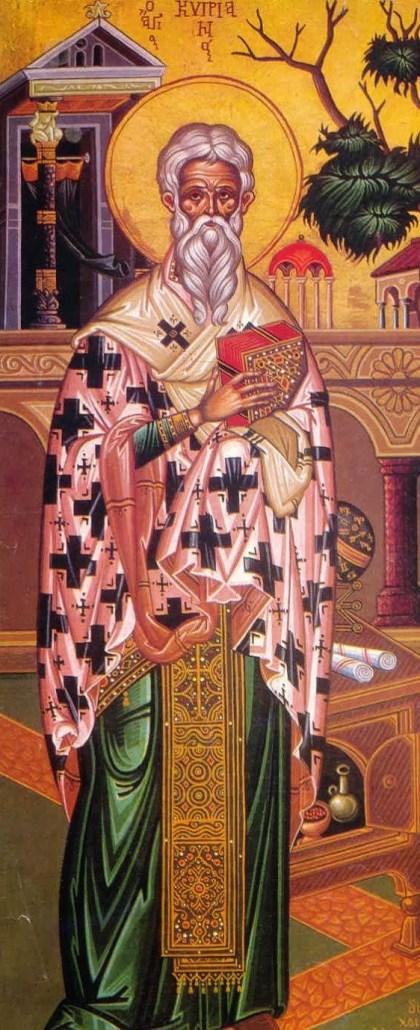
    Modern icon of Saint Cyprian, provenance unknown | Image from pilgrimcenterofhope.org.

    Saint Cyprian, Doctor of the Church, Bishop of Carthage and Martyr, was an African born of noble birth around the year 200 AD. Son of a Roman senator, he was a dissolute pagan in his youth, although well trained in rhetoric, philosophy and law. He converted to Christianity in his middle years. He went to his own beheading willingly in 258 AD after refusing to recant his Christianity during the persecutions of the Emperor Valerian.

    In his Treatise on Jealousy and Envy, St. Cyprian traces jealousy to Satan, “when he beheld man made in the image of God, broke forth into jealousy with malevolent envy— not hurling down another by the instinct of his jealousy before he himself was first hurled down by jealousy, captive before he takes captive, ruined before he ruins others” (4). This sin, therefore, is so powerful that it overcame the devil himself and is associated with the core of his own evil. “Thenceforth envy rages on the earth, in that he who is about to perish by jealousy obeys the author of his ruin, imitating the devil in his jealousy” (4).

    St. Cyprian traces how jealousy is at the heart of tragedies and figures throughout scripture: Cain and Abel, Esau and Jacob, Joseph and his brothers, King Saul and King David, and finally Christ and the Jews. Then, he proclaims that jealousy is, in fact, the source of all the other evils:

    It is the root of all evils, the fountain of disasters, the nursery of crimes, the material of transgressions. Thence arises hatred, thence proceeds animosity. Jealousy inflames avarice, in that one cannot be content with what is his own, while he sees another more wealthy. Jealousy stirs up ambition, when one sees another more exalted in honors. When jealousy darkens our perceptions, and reduces the secret agencies of the mind under its command, the fear of God is despised, the teaching of Christ is neglected, the day of judgment is not anticipated. Pride inflates, cruelty embitters, faithlessness prevaricates, impatience agitates, discord rages, anger grows hot; nor can he who has become the subject of a foreign authority any longer restrain or govern himself. By this the bond of the Lord’s peace is broken; by this is violated brotherly charity; by this truth is adulterated, unity is divided; men plunge into heresies and schisms when priests are disparaged, when bishops are envied … (6).

    We have heard the more memorable, “money is the root of all evil,” but is not money just a vector for envy? Cyprian has some memorable phrases of his own; I particularly like “nursery of crimes” and how jealousy removes our ability to “restrain or govern” ourselves. He has several great phrases at the start of the next section: “what a gnawing worm of the soul is it, what a plague-spot of our thoughts, what a rust of the heart, to be jealous of another, either in respect of his virtue or of his happiness … to make other people’s glory one’s own penalty” (7). Cyprian really brings home how jealousy is primarily a harm to our own selves, our own humanity.

    He says this even more forcefully: “Yet you are the enemy of no one’s well-being more than your own … Wherever you may be, your adversary is with you; your enemy is always in your own breast; your mischief is shut up within; you are tied and bound with the links of chains from which you cannot extricate yourself; you are captive under the tyranny of jealousy” (9). 

    Venus, Cupid, Folly and Time (detail), 1545, Angelo Bronzino | Wikimedia Commons. This figure in the background of the painting is often thought to be Jealousy.

    This does resonate, at least with me. Even just from my adolescent jealousies over love interests, jealousy threatened to be overwhelming. It definitely seemed to act like a tyrant; and a tyrant harming me and my character more than anything else. With this in mind, I think about contemporary secular credos I hear from friends, “as long as I’m not harming anyone else, then it shouldn’t be anyone’s concern.” Do we really want to ascribe to this thinking? Don’t we want to help people who are being ruled by the gnawing worm of the soul, the tyrant of jealousy?

    We are called to bring others to God, and there is no room for someone to move toward God if they are ruled by jealousy. Our love of others and charity should move us to help people overcome their jealousies and envy. So, even if they are harming themselves and not others, it really might be our business and mission as Christians to bring the light of Christ into their lives.

    But, it’s certainly enough for us during this time of Lent to try to identify the sneaky, hiding currents of jealousy in ourselves. Christ gives us many teachings like that in today’s gospel reading to help us overcome jealousy specifically by making it irrelevant. I think that in most cases, jealousy thrives in a worldview that is secular and driven by desires of this world.

    Let’s close with some words of encouragement from St. Cyprian: “Tear out from your breast thorns and thistles, that the Lord’s seed may enrich you with a fertile produce, that the divine and spiritual cornfield may abound to the plentifulness of a fruitful harvest … let all bitterness which had settled within be softened by the sweetness of Christ” (17).

  • The Back-Seat Servitude of Fatherhood

    The Back-Seat Servitude of Fatherhood

    Friday in the 3rd Week of Advent: Jeremiah 23:5-8, Matthew 1:18-25.

    Today’s readings provide us with further prophecy about the coming Messiah, but from Jeremiah rather than the Advent-friendly Isaiah. Jeremiah gives a unique name for Christ the Messiah: The Lord Our Righteousness. At least most translations phrase it this way, although our lectionary for some reason chooses “The Lord Our Justice.” This raises some interesting thoughts regarding the relationship between righteousness and justice, which we’ll touch on later. But I’d like to stick with righteousness for a moment, because it gives us a lens with which we can explore the gospel reading.

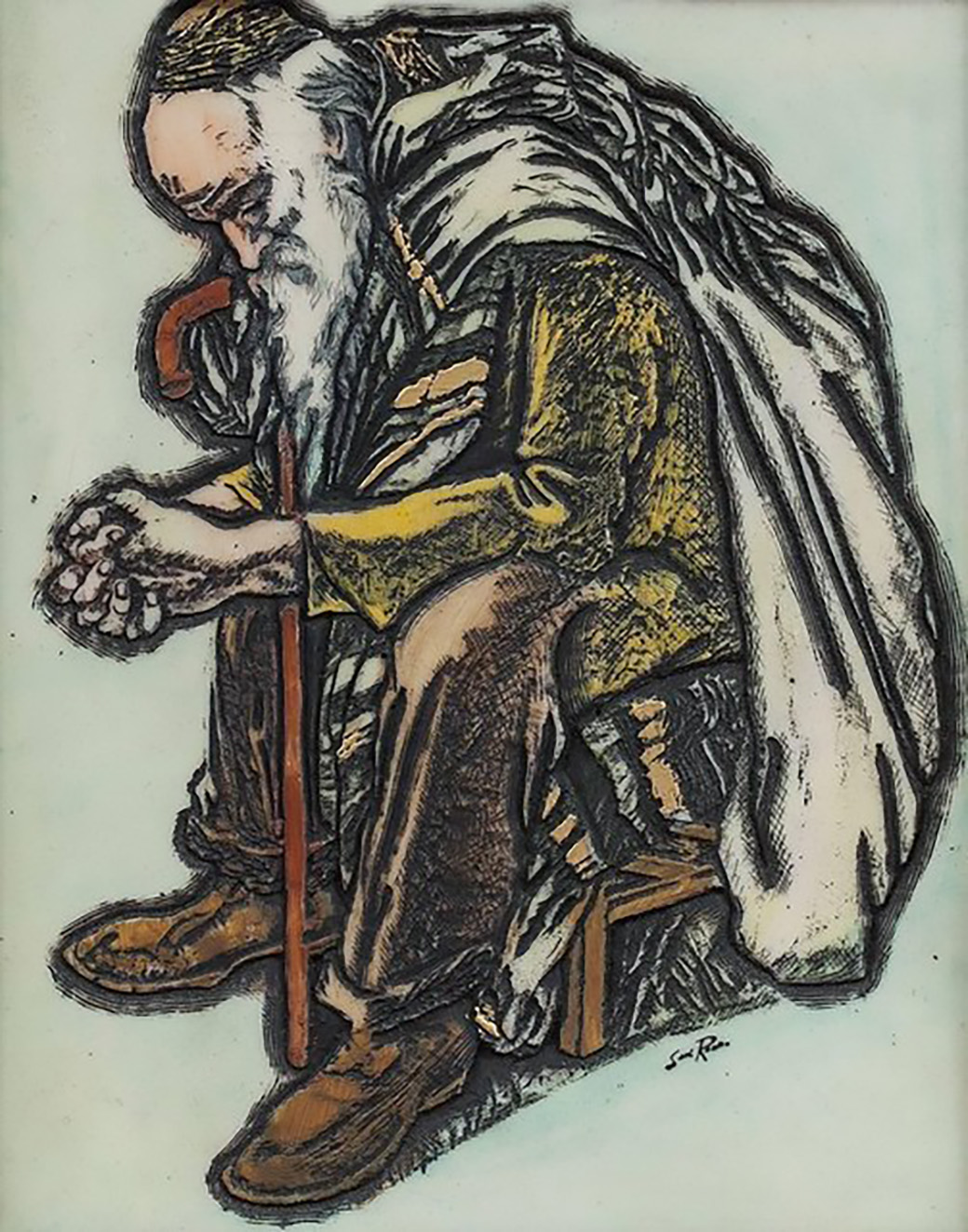
    Meditation (mid-1900s), Saul Raskin, (carved ivorine plaque) | Image from artsy.net.

    Jeremiah’s passage in the original Hebrew calls the Messiah יְהוָ֥ה ׀ צִדְקֵֽנוּ׃  (Yahweh Tsidkenu). The root here is tsedek, and the -enu is the suffix that means “our”; elsewhere in scriptures we read tsedeka, which is translated as “your righteousness,” almost always applied to God. Why am I making a point of tracing out this word? Because righteousness is at stake in the birth of Christ.

    Righteousness means a state of blamelessness, of living completely according to God’s law, of being worthy. Let’s not get sidetracked by the modern insult, “she’s so self-righteous.” This casts righteousness in the exact opposite light of what the word means. It is the state of being worthy of praise because one abides by God’s law. Jeremiah proclaims, “This is the name they give him: ‘The LORD Our Righteousness.’” In other words, Jesus Christ’s very name proclaims how his spotless worthiness is the hope and fulfillment of the Jewish people (“our” righteousness). Jeremiah underlines that God’s law made perfect is joined with a human person in this coming Messiah.

    What is a fitting way for the Lord Our Righteousness to come into the world? If righteousness is the key concept, we might expect an exceptional family for him to be born into. We’re not talking about glory (which is later revealed), so the circumstances are humble. We’re not talking about earthly success and savvy, so the circumstances are poor. No, “righteousness” is, above all, a trait characterized by the willingness to live by God’s Word. The Blessed Virgin Mary is our Queen of Heaven for a reason: she gives us the ultimate example of righteousness with her acceptance of the Holy Spirit at the Annunciation and subsequent Incarnation.

    But there’s more to the family.

    St. Matthew’s gospel is the one source that describes Joseph in the detail we hear today. Mark and John skip the Nativity entirely and Luke picks up on the journey to Bethlehem. But Matthew dwells for a moment upon Joseph, deeming it necessary and appropriate to describe the righteousness of Jesus’s family down to the foster father. Joseph, as Matthew tells us, is a very righteous man: “Joseph her husband, since he was a righteous man, yet unwilling to expose her to shame, decided to divorce her quietly.” This reaction actually goes above and beyond the law set by the Jews. He could have denounced her publicly and she could have been stoned to death for adultery. This shows his true righteousness because he understands that God’s laws are based on love, and he acts out of love, not retribution.

    Saint Joseph (1635), Jusepe de Ribera | Image from fineartamerica.com. I appreciate the way Ribera paints Joseph as focused intently on the voice of God. He was, after all, visited four times by angels who direct his actions in the gospels. 

    But next he is visited by an angel in a dream who tells him, “Joseph, son of David, do not be afraid to take Mary your wife into your home. For it is through the Holy Spirit that this child has been conceived in her.” It was a step beyond expectations to divorce her quietly, but now God is asking him to swallow all pride and take her into his home, to trust that God miraculously impregnated the Virgin by the Holy Spirit.

    It would take an exceptional man to agree to this. Everyone would know that Mary was pregnant before their marriage and would likely question whether Joseph was the father, given their customary distance prior to marriage. The insinuation would be that he was a cuckold, a pathetic creature who is betrayed sexually by his partner, possibly the biggest blow to a man’s pride that can happen.

    God is asking Joseph to look past all of this in great humility because something greater and more wonderful is going on: “She will bear a son and you are to name him Jesus, because he will save his people from their sins.” With fidelity and trust in God, this can be seen as an amazing blessing — a God-bestowed name for the child and the role of spiritual savior, surpassing even Messianic hopes for a great king. Through the lens of doubt, however, this could be seen as another blow: not even being able to name the child much less shape his destiny. God is asking Joseph to nearly disappear as a man and a father figure, against even his purest instincts and lawful expectations.

    Matthew then relates, without fanfare or hints of emotional struggle, “When Joseph awoke, he did as the angel of the Lord had commanded him and took his wife into his home. He had no relations with her until she bore a son, and he named him Jesus.” On the surface, we see a cowed man, stripped of his virility and authority — the very things that “man” has meant likely since the beginning of our race. What a lesson God provides us here, and what a worthy, righteous man in Joseph to do God’s will and become this new man! For it is precisely in the re-fashioning of an authority figure into a slave to God that Joseph helps to save the world through his son, Jesus.

    Let there be no doubt, Jesus has an earthly father in Joseph, the man who procured food, shelter, and clothing for him and likely taught him a trade, not to mention passed down to him his birthright by training him in the Jewish faith. Why couldn’t God simply have worked through Mary, single Mother of God? The answer is partly to teach us that the sacred bond of marriage is grounded in faithfulness to God, and the answer must also be that Joseph can become an icon of a humble, righteous father, willing to take the back seat in servitude.

    And this is another key feature of righteousness: a willing servitude to the Father in Heaven. Joseph, we are told, does “as the angel of the Lord had commanded him.” He understands his relationship to God; he owes everything he has and everything he is to God. He does not think twice about who his real master is and he willingly follows his commands. I can’t even think of such unbegrudging servitude existing in this contemporary period. We look down on the very concept of servitude — and rightfully so if it is solely defined as servitude to another human being in this fallen world. But servitude to God is the definition of righteousness! Joseph’s willing servitude to God is proof of his righteousness, of his worthiness to be the earthly foster father of Jesus Christ.

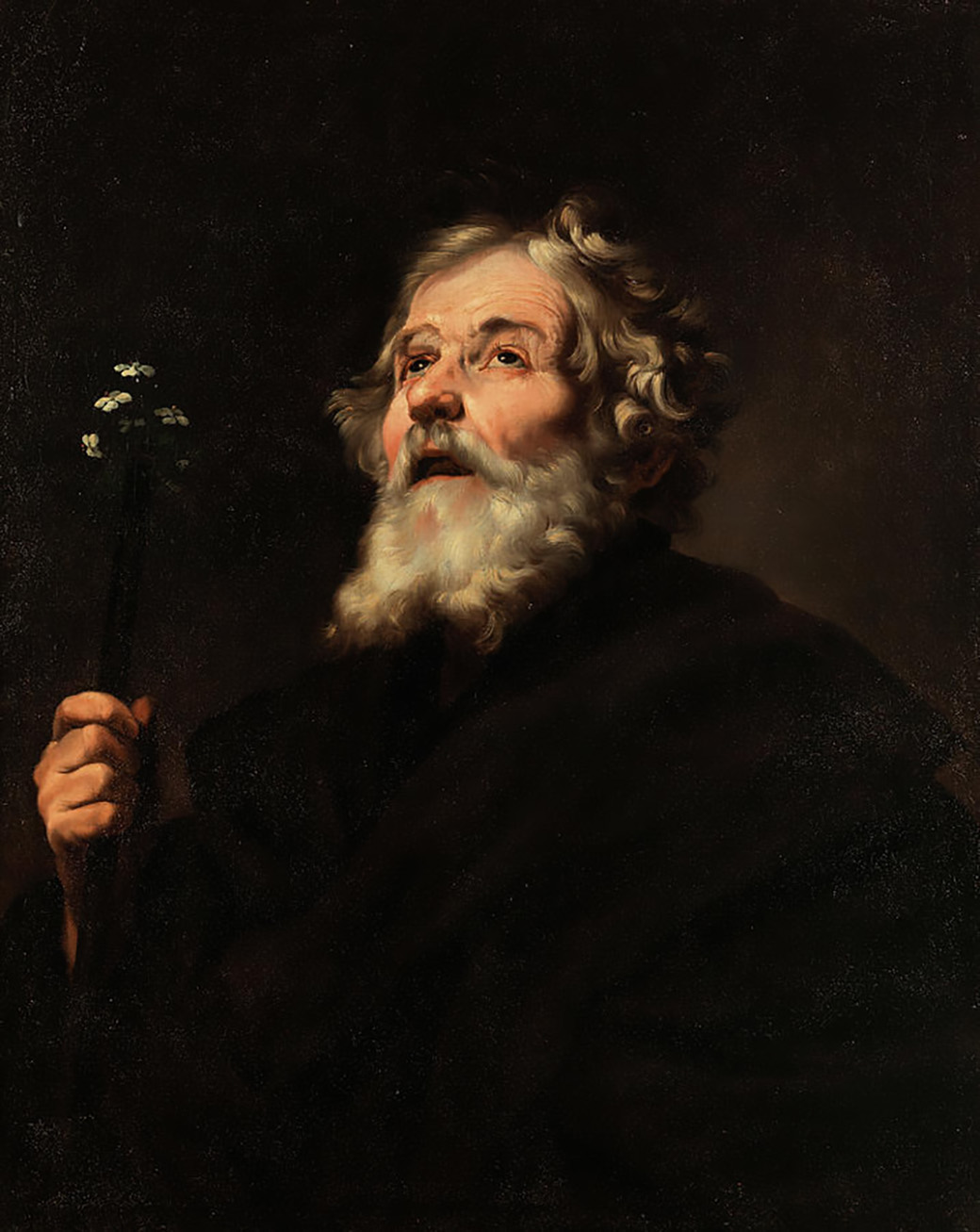
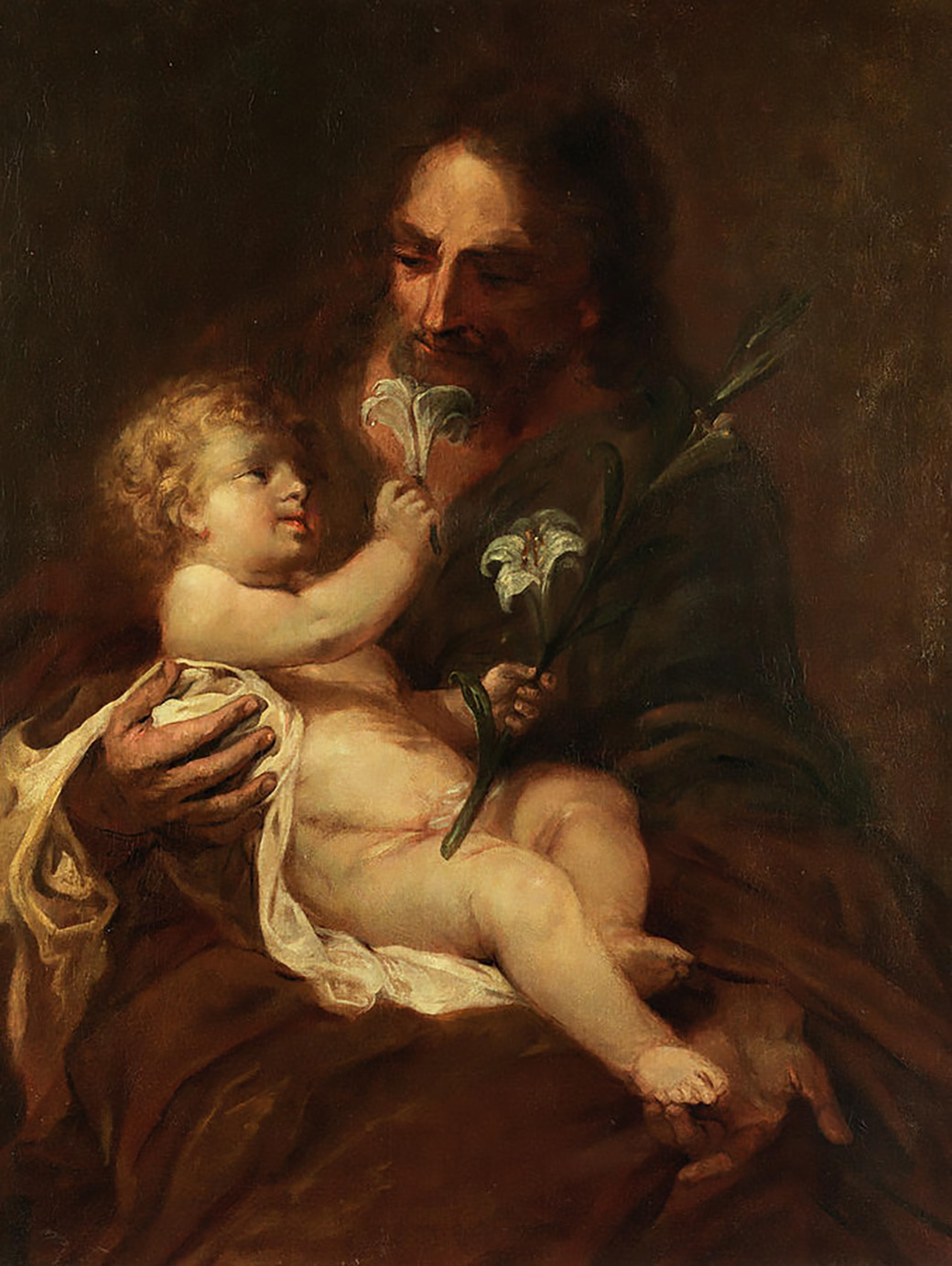
    Saint Joseph with the Infant Savior (mid 1600s), Bartolomé Esteban Murillo | Image from pixels.com. There’s something I love in this painting even though the facial details are blurry and Jesus is decidedly cherubic here. It might be the attitude of cautious awe I see in Joseph, his unselfconscious willingness to be in the background, gingerly cradling the salvation of all humanity.

    Now, let’s open ourselves to something even more amazing. In his righteousness, Joseph is one of the first humans to participate in the new life offered to us by Christ. Jesus is not yet born, yet Joseph has become a servant of the Trinitarian God (including the Son) and allows His saving grace to inhabit him.

    Let’s look at this with the words of St. Paul in mind: “And having been liberated from sin you were enslaved to righteousness” (Rom 6:18, translation from David Bentley Hart’s The New Testament). In Paul’s mind, Christ’s saving act not only liberates us from sin but enslaves us to righteousness. We have a new master here, bestowed upon humanity by adoption in Christ. Consider that this same transforming love of Christ fills Joseph in his assent to foster-fatherhood, another adoptive relationship, more intimate than the one we will all receive. What’s more, in a way Joseph prefigures the sacrifice his son will make on the cross. He gives his person, his pride, his authority to the Father.

    We can start to realize that Joseph is the perfect earthly father for Jesus, not a bystander in his life, not a second-rate role in the great drama of salvation history. Joseph is completely caught up in the self-sacrificing love of the Trinity, achieving glory in heaven while humbly, simply seeking to serve his master.

    Now that’s justice. Heavenly Justice. So we can also understand if Jeremiah’s title is translated as “The Lord Our Justice” because Christ the Lord is setting right the scale and scope of justice. Justice flows from righteousness, from a re-configuration of one’s heart to God’s will and God’s love.

    Let’s end by returning to St. Paul. Living in righteousness himself, Paul was filled with the Spirit, filled with fidelity to God. This enables him to write, “But now that you have been freed from sin and enslaved to God, the advantage you get is sanctification. The end is eternal life” (Rom 6:22). Note that our sanctification, our gift of liberation from death and the promised end of eternal life all have this happy enslavement to God as part of the equation.

    How many of us happily enslave ourselves to God? Can we follow everything that our conscience, guided by God’s Word and Spirit, presents to us? Can we bring ourselves to do whatever we sense as his will, even if it is as emasculating and potentially embarrassing as what he asked of Joseph? If we can’t, we need to re-evaluate our priorities, because we are not serving our true master. We’re turning our backs on the freedom from enslavement to sin that Christ won for us on the Cross.

    If it all sounds too hard, St. Paul has some words of encouragement: “For sin’s wages are death, but the free gift of God is eternal life in Christ Jesus our Lord” (Rom 6:23).

  • The Irrefutable Logic of the Logos

    The Irrefutable Logic of the Logos

    Friday in the Fifth Week of Lent: Jeremiah 20:10-13, John 10:31-42.

    Today’s readings show the inexorable movement of Jesus’s ministry towards the Passion but also the irrefutable logic he provides in his works and words. The take-home message of the gospel narratives seems to be that since humanity can’t accept the divine truth brought into their midst, Jesus must be crucified as a sacrifice on our behalf, not just to fulfill prophecy, but as a very real atonement on our behalf for our rejection of Him, the Spirit, and the Father.

    Jeremiah was a “repent, the end is near!” prophet. The Book of Jeremiah is so interesting in part because it is a first-hand account of someone we’d probably call a crazy person if we saw them on the street corner. In the verse prior to the ones in today’s reading, he explains that he tries not to be that guy and he knows he’s a “laughingstock,” but he can’t resist God’s message within him: “If I say, ‘I will not mention him, or speak any more in his name,’ then within me there is something like a burning fire shut up in my bones; I am weary with holding it in and I cannot” (Jer 20:9). He shares a clear insight into what it means to completely give yourself over to God: “O Lord, you have enticed me,” he says, “you have overpowered me” (Jer 20:7). This is a great example of how we can’t pigeonhole God into a single metaphor or image. He’s not always the benign guiding light or the patient beating heart of love. Sometimes He’s the urgent master, beguiling us with His energy and leading us to preach like wild people (or wear camel hair and eat grasshoppers and wild honey like St. John the Baptist). 

    Jeremiah Seated in the Ruins of Jerusalem (Jeremias auf den trümmern von Jerusalem), 1837, Eduard Julius Friedrich Bendemann | Wikimedia Commons.

    So in today’s reading, Jeremiah laments that he is abandoned by his friends and trapped by his enemies, but he is aware that in a way he brought it upon himself. After all, he pointed out how wicked everyone was and how they would be conquered and enslaved. Not exactly words to win friends. At the beginning of this very chapter, the priest Pashhur beats him and puts him in the stocks for a day because he hears him prophesying. When he is let out, Jeremiah delivers a tirade complete with curse and death sentence for Pashhur. Firebrand, indeed. So we must read today’s lament within this mixed bag of emotions: a man who wants to save his people, but ends up being hated by them. When he tries to hold it in, he can’t resist God, whom he loves but also feels a bit exhausted by. He notes the inevitability that God will triumph over those persecuting him because He is “a mighty champion.” Jeremiah has cast his lot with the Lord over all else, and it’s interesting to hear the way he describes God. The lectionary reads at one point, “O LORD of hosts, you who test the just, who probe mind and heart,” and it seems like Jeremiah is speaking from experience, as one who has been tested in mind and heart. The NRSV Bible translation of this verse is “O LORD of hosts, you test the righteous, you see the heart and the mind; let me see your retribution upon them, for to you I have committed my cause,” and we hear even more clearly the internal dialogue Jeremiah is having with the Lord. He is saying, you’ve tested me, you know my heart and mind, so let me confess that I want to see your retribution on them, for I have long ago committed to you and you know that I am just a petty human doing your work.

    The passage we read ends in a seemingly triumphant way: “Sing to the LORD, praise the LORD, For he has rescued the life of the poor from the power of the wicked!” And I don’t mean to question the legitimate praise and truth in this statement, but when we read the very next verse, omitted from today’s reading, we get quite a different picture of his struggle. He says, “Cursed be the day on which I was born!” (Jer 20:14) and a little later to clarify: “Why did I come forth from the womb to see toil and sorrow, and spend my days in shame?” (Jer 20:18). These are the words of a tortured soul. He knows on a certain level that he is but God’s tool in this life, yet he is also committed to and entranced by God. He knows that he is doing good work but also knows that the Lord has planned the destruction of Jerusalem and the Babylonian Exile for the Jews. Jeremiah teaches us that the life of the prophet is a hard, hard, thing. That God’s love sometimes carries a difficult message, one that will make you hated.

    Pashur Smiting Jeremiah in the Temple (c.1648), Leonaert Bramer | Wikimedia Commons.

    Which brings us to our greatest prophet and Only-Begotten Son of God, Jesus Christ. Much like Jeremiah, he faces some serious hatred and persecution, as the first line of today’s reading states, “The Jews picked up rocks to stone Jesus.” But Jesus handles Himself very differently than Jeremiah. We never get the sense in the gospels that he is mentally tortured, even when crying in the Garden of Gethsemene, or that He wishes to see the Lord’s retribution on the people. Exactly the opposite: He still wants to grant them salvation and forgive them, all the way to His death and triumphantly so with His Resurrection. This is the great game-changer in history. No mere human could do this. It is why God had to send us His Son and have Him take on the flesh of humanity so that He could enact such forgiveness and love when those of us who were merely human would have failed long before.

    How can he accomplish this? The fact that he is the Logos of God has something to do with it. In today’s reading, he displays the irrefutable logic inherent in the Logos. Faced with stoning, He calmly asks, “I have shown you many good works from my Father. For which of these are you trying to stone me?” Logical point one: why would you stone a miracle worker? Point two: these good works have come from God the Father, why would you stone someone bringing you works from God?

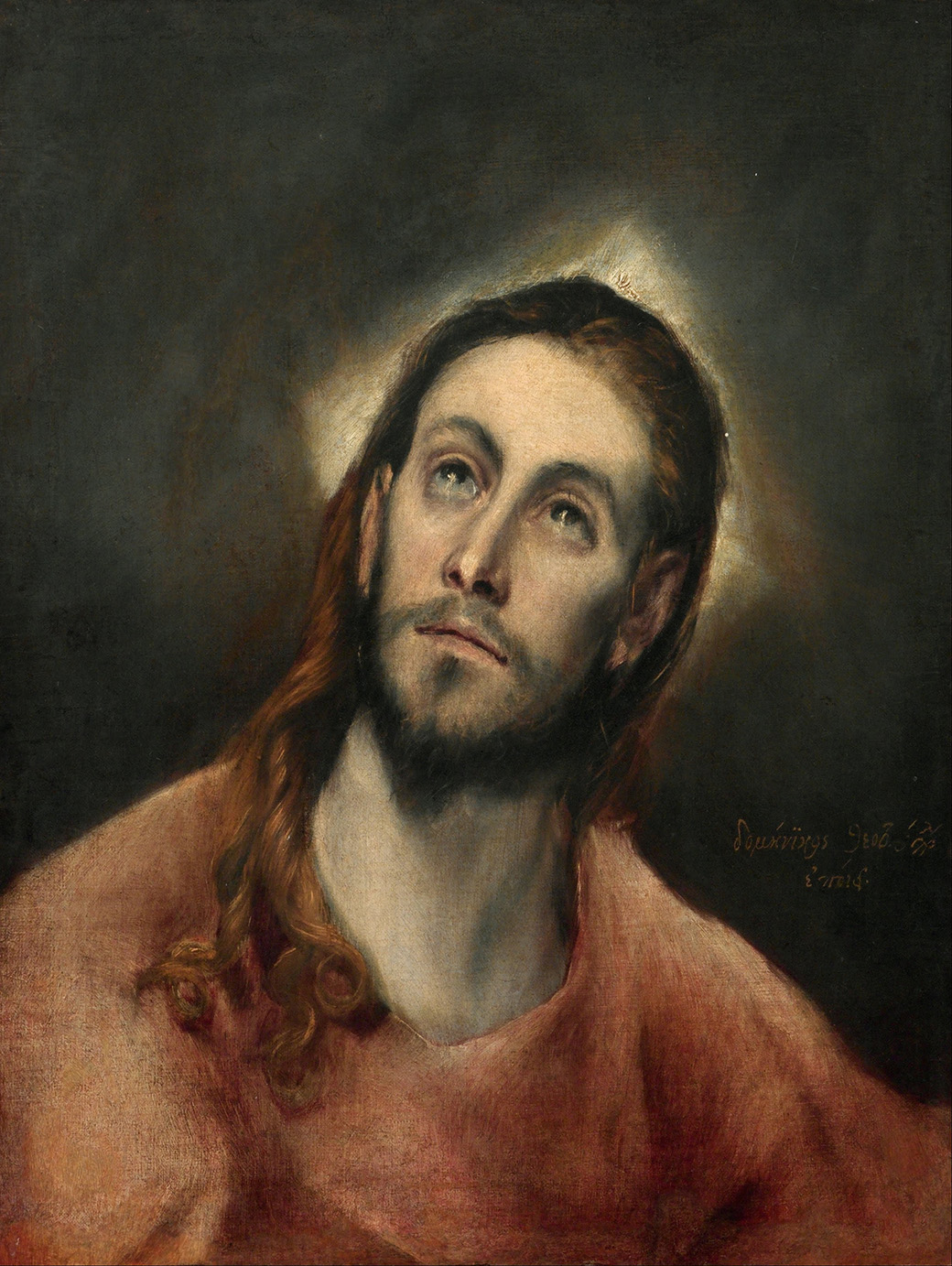
    Christ in Prayer (1595-1597), Doménikos Theotokópulos (called El Greco) | Wikimedia Commons. I love El Greco’s painting of a pure, patient, innocent-yet-all-wise Christ, looking to His Father with eyes full of devoted love, despite all its difficulty.

    They respond that it’s not the good works but his words, that “You, a man, are making yourself God.” He responds first by pointing out that God Himself in the Scriptures (in Psalm 82, to be precise) says “You are gods,” when he is speaking to the highest earthly authorities (judges, kings) to remind them of their moral responsibilities and the fact that they’re failing at giving justice to the weak and not the wicked. Jesus’s point is that if the Scriptures, the very Word of God, in fact, call some humans “gods,” especially when those were being called to the carpet for shirking their duties, then why is it blasphemy for him to call himself “Son of God” when he is enacting the works of the Father? His logic resides in the Scriptures, the Law itself. He goes on to let the works of the Father be his testimony:

    If I do not perform my Father’s works, do not believe me;
    but if I perform them, even if you do not believe me,
    believe the works, so that you may realize and understand
    that the Father is in me and I am in the Father.

    In other words, if I perform no miracles, then you shouldn’t believe me. But look at these works of the Father and you can believe them even if you don’t believe me. Maybe through them, you’d realize and understand when I say I am the Son of God. His logic cannot be questioned. There is no arguing with it. They simply try to grab him. Our lectionary reads, “but he escaped from their power.” The Greek, however, is that he “went forth from” (ἐξῆλθεν / exēlthen) — interestingly, the same verb used to describe the water and blood that “flowed” from his side when he is pierced by a spear on the cross — “their grasp” (literally, their hands). This sense of “going forth” like flowing water reinforces the sense of irrefutability of the logic that we hear from the Logos of God. When water flows, we are somewhat at a loss of how to stop it, just like the Word of God can’t be stoppered and Jesus can’t be arrested before His time. These things are not subject to the will of humanity; they operate on a different plane and they are inevitable.

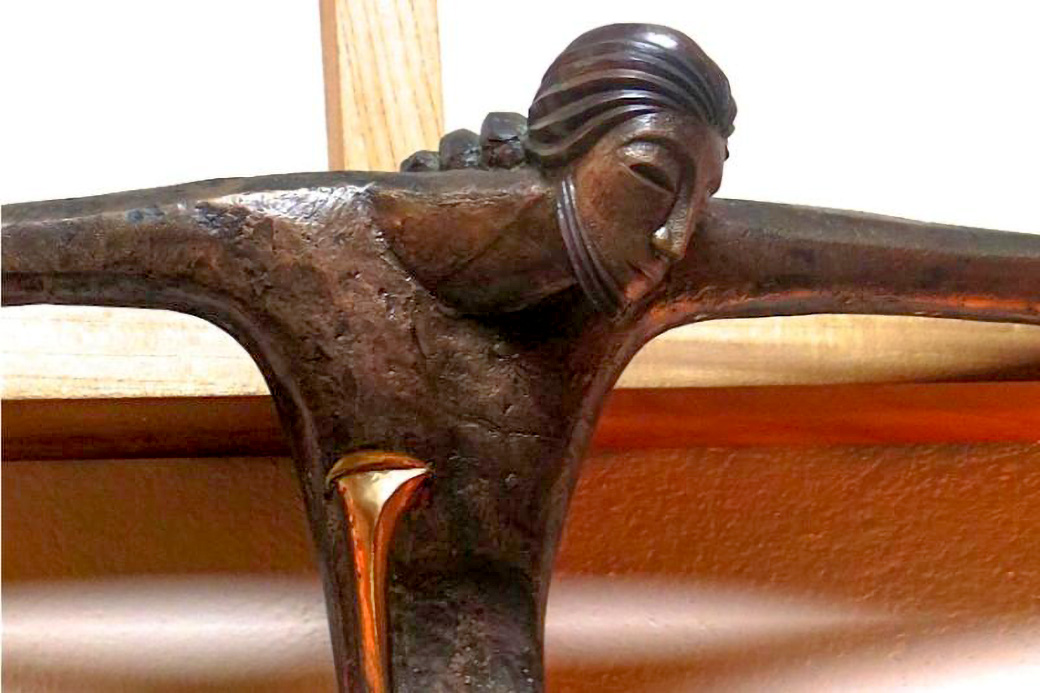
    Crucifix of the Pierced Heart of Jesus from the Mother House Chapel of the Religious of the Sacred Heart of Jesus, Ixelles, Belgium | image from rscjinternational.org.

    As we have read Jesus’s exchanges with the Jews in Jerusalem all week, I am struck by the repeated rejection He received and the unwillingness of the Jews to hear His message. There were many years when I only got the “greatest hits” readings on Sundays, often focused on his miracles and great sayings, and they don’t portray the fuller story of his work as a prophet who is rejected by his people. The gospels are definitely meant to be read as a narrative, straight through, beginning to end. The whole Bible for that matter, for how else can we see the redemption of Jeremiah in the figure of Christ, who experiences his same tribulations but bears it with a patience, a steadiness, and a love that is unequaled by mankind.

  • The Chalice of Persecution and the Ransom for Many

    The Chalice of Persecution and the Ransom for Many

    Wednesday in the Second Week of Lent: Jeremiah 18:18-20, Matthew 20:17-28.

    Today’s readings display two things clearly: how clueless the chosen people can be, and (somewhat related) the inevitable persecution of those who proclaim the Word of God. 

    Jeremiah was a prophet 100 years after Isaiah, and the major power threatening Israel and Judah is no longer Assyria but Babylon. The unfaithfulness of the Jews, however, is a common thread, and we find them once again worshipping other gods and not being faithful to the God of Abraham. Jeremiah is a bold prophet, not afraid to proclaim the difficult words God gives him. The Word, which will become flesh in Jesus, is shown to be unstoppable, even though Jeremiah gets beaten, put in stocks, and later thrown in a pit to die.

    Jesus, too, will pay the price for bringing the Truth to humanity.

    The section from Jeremiah we hear today happens in the midst of a classic metaphor where we are the clay and the Lord is the potter. Given my upbringing with the dulcet folk tunes played in our 1980s church, I always associated this verse with a gentle potter shaping us in love. And certainly this would be the case in the Book of Jeremiah if the Jews had obeyed God’s commandments, but that’s not the case.

    It’s much more neutral. God’s message is that, as the potter, He can do as he pleases with the malleable clay. He can mold a nice vessel with the nation of Israel or utterly destroy what he’s building and start over. He ends his analogy by commanding Jeremiah to tell the people, “Look, I am a potter shaping evil against you and devising a plan against you. Turn now, all of you from your evil way, and amend your ways and your doings” (Jer 18:11b).

    (Just imagine the tune “Abba, Father” with dark and haunting chords.)

    Jeremiah on the Ruins of Jerusalem (Jeremia op de puinhopen van Jeruzalem), 1844, Horace Vernet | Wikimedia Commons.

    The Jews respond to Jeremiah’s message: “But they say, ‘It is no use! We will follow our own plans, and each of us will act according to the stubbornness of our evil will’” (Jer 18:12). So, God says he will make their land a horror, “a thing to be hissed at forever.” Then we get to today’s passage.

    I’m going into this detail because, on one hand, Jeremiah’s words in the selected text today seem very much like a mirror of Christ’s trials to come. The people say, “let us destroy him by his own tongue; let us carefully note his every word.” This sounds like the plots of the Pharisees and scribes in trapping Jesus in his own teachings.

    Even more in the final verses: “Must good be repaid with evil that they should dig a pit to take my life? Remember that I stood before you to speak in their behalf, to turn away your wrath from them.” We could imagine Christ uttering similar words in the Garden of Gethsemane. In today’s passage from Jeremiah, we see the Word of God enduring similar treatment that He will endure as Christ 600 years later.

    But the parallels end as we look at the full context of Jeremiah. In fact, there is a stark difference in the way Jesus accepts his Cross and offers his suffering and Passion to the Father “as a ransom for many” (more on that below), and the way Jeremiah reacts with righteous indignation. Here is the frightening verse immediately following the ones from today’s reading: “Therefore give their children over to famine; hurl them out to the power of the sword, let their wives become childless and widowed. May their men meet death by pestilence, their youths be slain by the sword in battle” (Jer 18:21). Oy! Jeremiah, what are you wishing upon your fellow people?? Sounds like straight-up revenge talk to me.

    Yes, they may deserve it, but where’s the begging for mercy such as Abraham did on behalf of Sodom or Moses did time and again for the unfaithful Israelites in the desert? (It’s worth noting that whatever his personal bitterness, Jeremiah continued to follow God’s instructions to the letter. When he takes an earthenware jug and breaks it in front of the people as a symbol of how they will be broken by the potter, this is the beginning of a string of doomsday-ish prophecies leading up to the Babylonian Captivity. But he also spreads prophecies of hope after that for Israel and Judah to be restored.)

    Now let’s turn to the gospel reading from St. Matthew. Jesus tells his apostles as clear as day what awaits when they get to Jerusalem: “and they will condemn him to death, and hand him over to the Gentiles to be mocked and scourged and crucified, and he will be raised on the third day” (speaking of the “Son of Man,” who he is). But they remain clueless.

    So clueless that the next thing Matthew reports how the mother of James and John comes before Jesus to ask that her sons “sit, one at your right and the other at your left, in your kingdom.” There is good evidence here to assume that she, like all of them, still thinks there will be an earthly kingdom, where the Romans will be driven out and the descendent of David (Jesus) will sit on the kingly throne of a restored Jewish nation. As a funny aside, our Fr. Erik shared his nickname for James and John in morning Mass today: “Mama’s boys,” due to today’s reading.

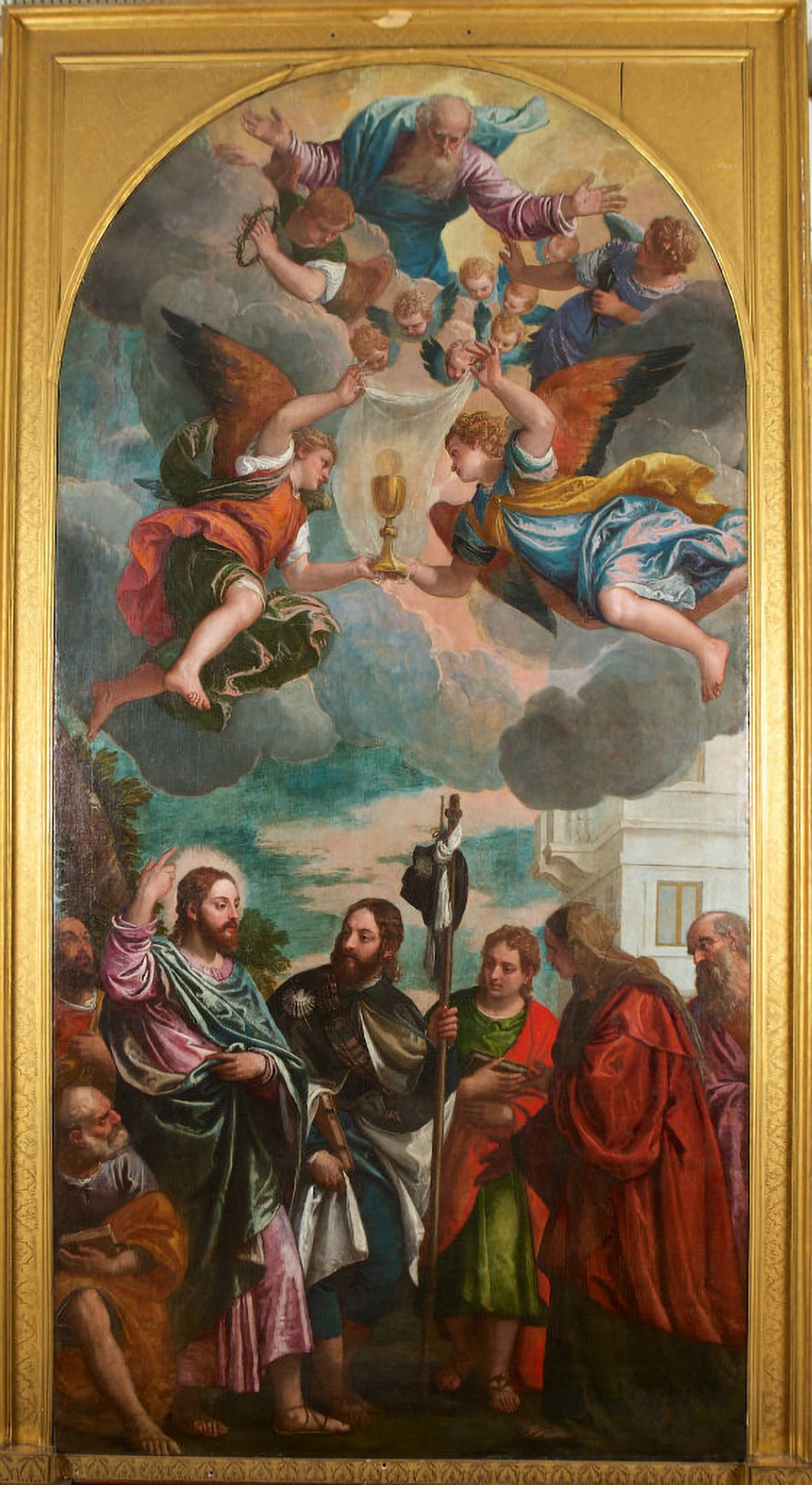
    Zebedee’s Wife Petitioning Our Lord, Paolo Caliari, called Il Veronese, (1528-1588) and Workshop | Creative Commons, courtesy Burghley House Collections, UK. This altarpiece was formerly in the Church of St Jacopo on the Venetian island of Murano, where it formed part of a triptych.

    Jesus asks if they can drink of the chalice that he will drink and they blithely respond, “We can,” which I read as “Sure!” Maybe they were thinking of a jewel-encrusted chalice of victory, but we in retrospect know better. Jesus patiently and knowingly affirms that they will (James is the first martyred apostle) but deflects the question at hand by saying it is the Father’s choice in terms of who will be at his right and his left when he enters the Kingdom.

    We know that it will be the two thieves crucified with Christ, drinking of that chalice of suffering. There’s a lesson in “watch out what you ask for.”

    The ensuing “indignation” of the other ten apostles provides a good teaching opportunity for Jesus. He reiterates a theme we reflected upon yesterday: “whoever wishes to be first among you shall be your slave,” that is, humility must reign, not lording authority over others (see Led by the Master for a deeper discussion of humility). As their heads are filled with visions of an earthly empire like King Solomon, King David, and others in their history, this message was probably received as a bit of simple peacemaking, an Apostles’ Code of Good Conduct.

    But it’s so much more. It’s the essence of the Trinity and the mystery by which our salvation is gained. So Jesus pushes deeper: “Just so, the Son of Man did not come to be served but to serve and to give his life as a ransom for many.” He wants them to understand that humility and service are the core of his mission. These are more than behavioral codes — they are ways to embody the selfless love that endlessly flows between the persons of the Trinity, and he will be giving them an ultimate example of humility and service in just a week’s time.

    The fulcrum here is the word “ransom.” We use the word ransom in reference to extortion, when someone is held against their will, and the ransom is the payment to free them. The Greek word used by Matthew, λύτρον, means ransom, but more specifically a payment to free slaves, which is different than extortion payments. For millennia, theologians have formulated various ransom theories of atonement, going down the rabbit hole, asking “to whom is the ransom payment made? The devil? Death? Back to God?” But I think the important point Jesus wants to make is that his selfless sacrifice is a severing of an enslavement, a change in the status of humanity; in other words, we were a people fundamentally enslaved in sin and death, but his sacrifice for us makes us a people freed from that enslavement and welcomed into the Kingdom of everlasting life.

    In fact, we find the Word of God speaking 750-some years earlier through the mouth of the Hosea, prophesying this ransom. The NRSV Bible translates it as: “Shall I ransom them from the power of Sheol? Shall I redeem them from Death?” The Hebrew word אֶפְדֵּ֔ם translated as “ransom” is, like the Greek, not tinged with our references to extortion. It means to sever, i.e., ransom; or more generally to release or preserve. And here in Hosea we see the Word of God making it clear that the enslavement is to death.

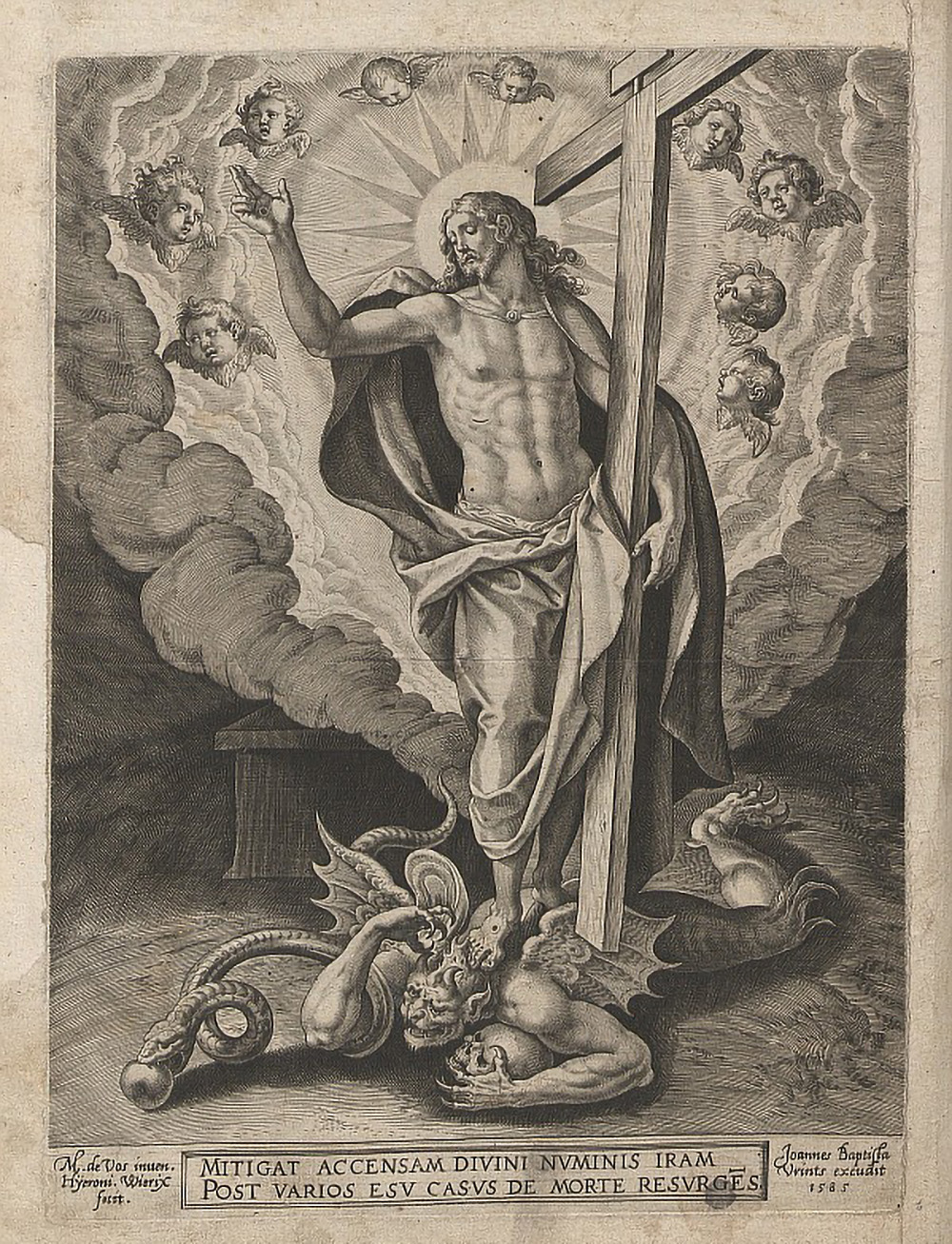
    Mitigat Accensam Divini Numinis Iram Post Varios esu Casus de Morte Resurges (1585), Martin de Vos, Hieronymus Wierix, and Johann Baptist Vrints | Wikimedia Commons. Copper engraving on paper.

    Back to Jesus’s words “to serve and to give his life as a ransom for many.” Jesus is the ransom payment that releases us from the bondage of death and sin, but not a payment of inert money. His ransom is an active, divine energy inherent in service and humility. What a complex thought. Something that we think of as a static thing, a payment, can be an active process to be lived and replicated. Just so, our God, who we might relegate to being a static “old guy in the sky” is an active energy in the world, then and now. This is getting abstract, but stay with me because the important pivot here is that Christ’s ransom is not just a one-time thing. It’s a once and forever thing.

    Christ’s ransom converts the potential energy of hope and salvation into a reality, a kinetic energy of living with God. Yes, we get to live with God in the Kingdom here and now, a real communion. The liturgy is our ongoing communion, freed from enslavement. We not only commemorate but re-celebrate Christ’s sacrifice during the liturgy so that the sacraments re-instill the divine energy in us as we fall away into sin and require constant re-dedication to God. There is much more to say about how important it is that Eucharist is the actual Body and Blood of Christ because his ransom is essentially about the flesh of the world, death, and rising in spirit … but let’s leave that for another day. 

    May we not be like the Mama Zebedee and the Jews of Jeremiah’s time, focused on the present and clueless to the truth revealed by the Word of God. And may we forever thank God for sending his Son as a ransom for us. So much better than human prophets like Jeremiah who got fed up and called down bitter revenge for our sins!