Tag: justice

  • Lust and Justice

    Lust and Justice

    Monday of the Fifth Week of Lent: Daniel 13:1-9, 15-17, 19-30, 33-62, John 8:1-11.

    Wow, what a first reading today – 1,079 words! I’m guessing, but I think it’s the longest one outside of Easter Vigil. Thankfully, it reads like the script for a telenovela, so there’s a certain pacing and several plot twists to keep us interested. This reading and the gospel seem to be about adultery — at least the accusation of adultery. But in the end, they are more about lust, the perversion of God’s law, and divine justice. Let’s dig in.

    Detail from Susanna and the Elders (1653), Jacob Jordaens | Wikimedia Commons. While I think Jordaens is off with his smiling Susanna, as if she’s enjoying the intrusion of these nasty men on her bath, I think he’s spot on with the devilish faces of the judges and their grasping hands. It speaks to their lustful focus on her.

    Susanna, the heroine of the first reading and my wife’s namesake, is a fitting object of desire: “a very beautiful and God-fearing woman.” This reading is ostensibly about her, but really it’s about the two elder judges, complete degenerates that they are. When they begin to lust after her, the state of their sin is described in these terms: “They suppressed their consciences; they would not allow their eyes to look to heaven, and did not keep in mind just judgments.” This strikes me as being so on-point. Unbridled lust is absolutely a suppression of our God-given conscience, something that we have to cultivate and listen to in order to live upright lives.

    Lust is a determined effort not to look at God, for who can contemplate the face of God and still be drawn to evil? They also are determined not to think of “just judgements” — ironic for judges, and a choice that will come back to bite them. This description cuts right to the spiritual truth of their actions. When we think of being caught up in lust, this series of choices made on the spiritual plane might not occur to us because physical desire can be so blinding of a force (at least in my experience as a man), almost like animal instinct. We’ve all heard of or experienced sex as a result of being “caught up in the moment.” To me, at least, lust doesn’t seem as calculated or deliberate as it is described, but when I think about it, this is exactly what’s going on in terms of my spiritual being. Lust has an amazing ability to cause a huge discrepancy between what we experience mentally and physically and what we experience spiritually.

    All religious orders must address lust as communities of same-sex people living out their lives in sexual abstinence. Our saints from religious orders have gone to great lengths to preserve their purity. St. Josemaria Escriva said: “To defend his purity, St. Francis of Assisi rolled in the snow, St. Benedict threw himself into a thorn bush, St. Bernard plunged into an icy pond…You…what have you done?” Now that speaks to the power of temptation and lust!

    Yes, there’s something special about this sin, as St. Alphonsus Liguori writes, “In temptations against chastity, the spiritual masters advise us, not so much to contend with the bad thought, as to turn the mind to some spiritual, or, at least, indifferent object. It is useful to combat other bad thoughts face to face, but not thoughts of impurity.” How interesting, and consistent with the description of how the judges were affected in today’s first reading. If turning your thoughts to a spiritual matter is the best way to combat lust, then the description of how they “would not allow their eyes to look to heaven” is telling indeed.

    In addition, the line about how they suppressed their consciences is exactly the opposite of what Pope Saint John Paul II writes about how to deal with lust: “Deep within yourself, listen to your conscience, which calls you to be pure…a home is not warmed by the fire of pleasure, which burns quickly like a pile of withered grass. Passing encounters are only a caricature of love; they injure hearts and mock God’s plan.” I bring up all of these saints not just to complement the description of the sin in the first reading, but to help us remember that even though the sin appears to be purely physical, it is in fact a deep spiritual injury to ourselves and God.

    Lust as temptation is dangerous because it perverts our spiritual nature, turning us into baser animal creatures. If unchecked, it culminates in lust as an action. Today, we hear the two elder judges tell Susanna, “give in to our desire, and lie with us. If you refuse, we will testify against you.” Their spiritual natures are so undermined and perverted that they threaten rape and end up carrying out false testimony when she screams for help.

    Shortly after this, we hear the cringe-worthy, sleazy details of their false testimony. How interesting that the train wreck of sins is so caught up in power and wielding power on this earth. It is no mere coincidence that these men are elder judges. They represent the corrupting influence of the world, the depravity that reigns in the place where justice should be.

    As a sharp contrast, a young Daniel (think: new life in the spirit) intervenes to help restore a community twisted by sin: “God stirred up the holy spirit of a young boy named Daniel, and he cried aloud: ‘… Are you such fools, O children of Israel! To condemn a woman of Israel without examination and without clear evidence? Return to court, for they have testified falsely against her.’” Here we have God’s intervention because grave sin and injustice are at stake. The reading hinges on this moment, when God works through his chosen prophet Daniel to confront the people with truth.

    Like an early version of a detective crime story, Daniel smoothly trips up the elders to reveal their treachery. Finally, unlike what we hear in the gospel, divine justice is enacted on the spot.

    The Self-Mortification of St. Benedict (1496), Albrecht Dürer | Creative Commons, courtesy of the Isabella Stewart Gardner Museum. From their website: “This window depicts an episode from the life of Saint Benedict (ca. 480–547). Satan, in the form of black birds, flutters around the saint. The young saint overcame his sexual desires (represented by the woman seen at the right) by throwing himself into a thorn bush. Albrecht Dürer shows Benedict lying in a thicket, deep in prayer.” One word: ouch.

    I think this is more than a critique of Jewish law and earthly justice systems. Likewise, I think it’s more than a simple morality fable even though the narrative structure reads like it. Remember that we are told that there was a prophecy about these judges: “of whom the Lord said, ‘Wickedness has come out of Babylon: from the elders who were to govern the people as judges.’” This brings the scope of salvation history into play. God has announced their coming, and as we see with other prophesied events, their arrival is a moment for God to reveal something about his desire to have us come to him in the Kingdom. It’s more than just a story of right vs. wrong.

    We learn two things in this vein:

    1. God hears us when we are pure of heart and call out to Him. Susanna precipitates David’s prophetic intervention when she cries, “O eternal God, you know what is hidden and are aware of all things before they come to be: you know that they have testified falsely against me.” Then we are told, “The Lord heard her prayer.”
    2. God promises divine justice, especially when earthly justice falls short due to human guile. Daniel does not promise a lynch mob or a simple execution; instead, he speaks of justice delivered by spiritual beings: “the angel of God waits with a sword to cut you in two so as to make an end of you both.” And even though the people do take the judges’ lives, Daniel’s words speak to a much more profound justice. God, through this scripture, gives us a vision of the Kingdom, where purity and virtue live with him and where sin and perversion of the spirit are eradicated.

    Let’s turn to the gospel, where Jesus Christ is the true way we will be re-configured in the Spirit. Daniel’s life and works simply pointed to Christ, like an early promise of the configuring and justice yet to be fully unveiled. And Jesus, as ever, surprises us with a teaching about God’s law and justice. 

    When the scribes and Pharisees throw a woman into the middle of the place where Jesus is teaching, St. John tells us that their question to Jesus about punishing her adultery was “to test him, so that they could have some charge to bring against him.” How like the elder judges in the Book of Daniel!

    They are here on false pretenses, not interested in justice but instead their own gain. Like the elder judges, they have bound themselves to the quest for worldly power and control; in so doing, they are avoiding looking at God. They lust not for sexual relations but for power, specifically the power of the judge to charge and condemn Jesus.
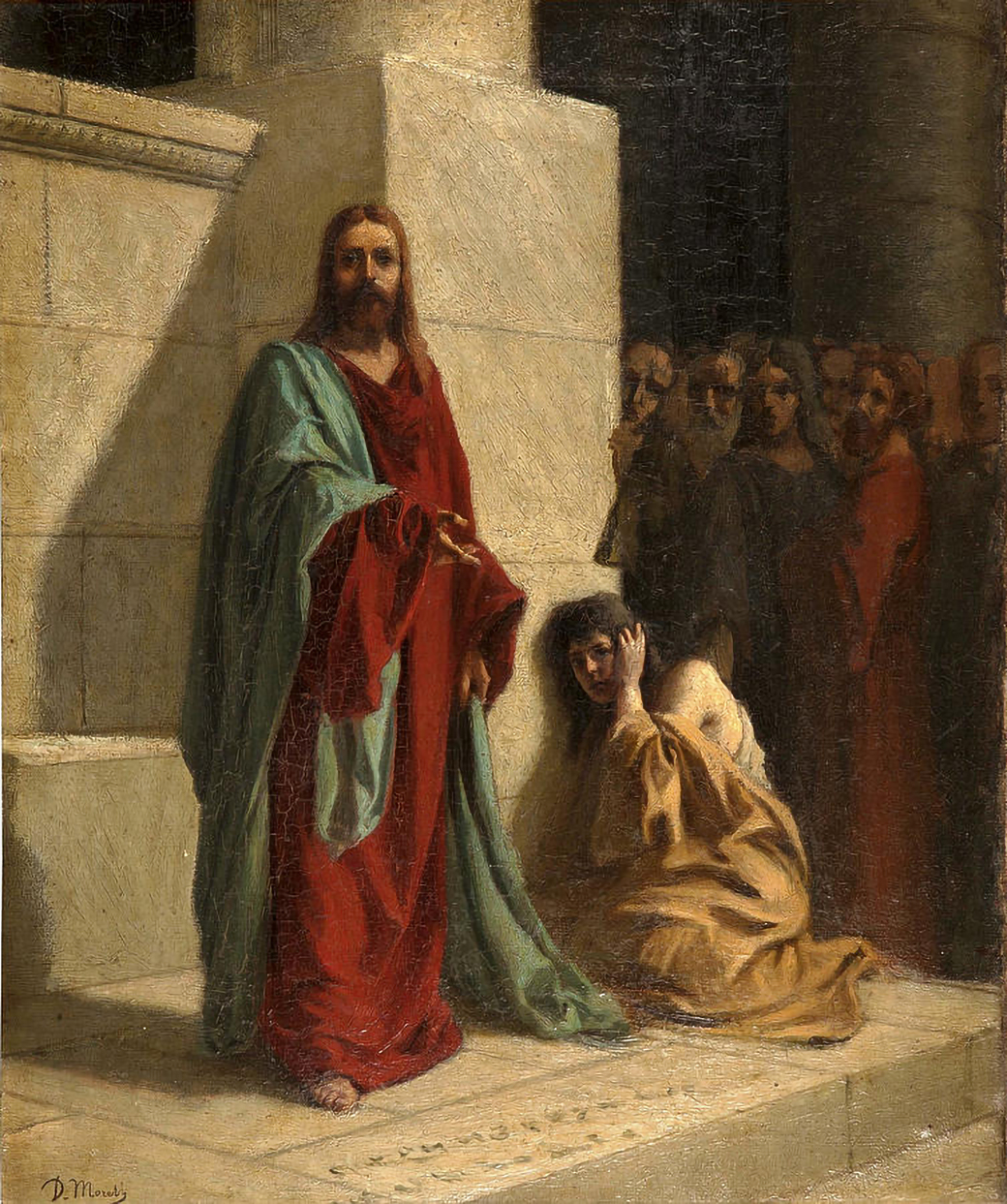
    Christ and the Adulterous Woman (contemporary), Domenico Morelli | Image from pixels.com. Excusing the overtly neo-classical elements of this painting (including Jesus’s robes), I like the use of light and dark to delineate Christ and the accusers.

    The other important thing here is the way the narrative of adultery is dealt with. On the surface, this episode seems to be a slam-dunk according to Jewish law, and when Jesus allows the woman to go unpunished, it seems to subvert that law. But John’s statement about their hidden intentions changes the narrative completely.

    They are not seeking to identify sin at all. Christ knows what is in their hearts, and for him this encounter is about their own falseness, not about the woman. After all, isn’t this what all encounters with God are about? When we stand before God, it is a personal encounter — we don’t go with a list of people we want to praise or condemn. Our role as his creation, his servants, is not one where we play judge or colleague.

    So as the Sun of Righteousness turns his gaze on the scribes and Pharisees, let’s remember that he understands their priestly role as upholders of God’s commandments and precepts. In fact, he shows them that their sin is the betrayal of the solemn, pure role they are supposed to play for their community.

    St. Augustine of Hippo explains the ironic position that these false upholders of the law occupy:

    “You have heard, O Jews, you have heard, O Pharisees, you have heard, O teachers of the law, the guardian of the law, but have not yet understood Him as the Lawgiver. What else does He signify to you when He writes with His finger on the ground? For the law was written with the finger of God; but written on stone because of the hard-hearted. The Lord now wrote on the ground, because He was seeking fruit” (Tractate 33 on the Gospel of John, 5).

    Thank you, St. Augustine, for connecting that mysterious detail from today’s gospel to the writing of the law. Many people wonder what Jesus may have been writing on the ground. The simple act of doing so in response to the question he was asked almost seems like an evasion or an act of rudely ignoring them. But not so! You see, these are professionals of the law, brought together in their common purpose of tripping up Jesus, not by some coincidental experience of all seeing a woman commit adultery at the same time. In other words, although they claim that she was “caught in the act,” they are not themselves the witnesses. This is a form of false witness in itself.

    For accusations of adultery without witnesses, the Torah describes a water trial (called Sotah) that the woman must undergo. As part of this, “the priest shall put [the charges and penalties] in writing, and wash them off into the water of bitterness” (Numbers 5:23). Here we have the incarnate Word of God, the One who forms the Torah and its prescriptions around how to carry out justice, bending down to enact the prescriptions of the law in front of the scribes and Pharisees. He is reminding them that there is a form of earthly justice that was handed to them by God and which is a solemn gift not to be tampered with. He knows that these prescriptions are in place so that there is no miscarriage of justice. He lifts up the law to fulfill the spiritual work it is intended to do: to keep our hearts clean from lies and sin, to keep sinners from perverting the justice God intends in the world.

    So when he stands back up at their insistence and says, “Let the one among you who is without sin be the first to throw a stone at her,” we understand that this is a specific accusation against them. He knows their hearts and they have been called out. In response, “they went away one by one, beginning with the elders.” The elders, the ones who should know better than the rest, but in whom lies the entropy of sin. They slink off first, avoiding the embarrassment of those left later.

    Christ and the Adulteress (1532), Lucas Cranach the Elder | Wikimedia Commons. Lucas Cranach gets the focus of this episode correct in the variously ugly, refined, worldly, and half-interested looks of the scribes and Pharisees to the left of Jesus.

    Then they are left alone. Jesus’s simple questioning is a reminder of how we must all encounter God: “Woman, where are they? Has no one condemned you?” We must all account for our sins in honesty before God, no one else will be there to condemn or defend us. He knows our hearts and our deeds. But then we have this pestering problem of him letting a woman “caught in the act” of adultery leave unpunished. What is the point of this episode? That no matter what you do, all will be forgiven?

    I don’t think so. Jesus is incarnated to give us a new way, a new unity with God, not to judge and destroy. His mission is about fidelity of Spirit. If he has anything new to say about adultery, it is to point out that the worst adultery is to break our most fundamental covenant and union with God. This spiritual adultery is what the scribes and Pharisees just committed, not the woman.

    Nothing about this final exchange is like the other miracles or healings he accomplishes. He does not ask her about her faith or belief. He does not establish the atonement and request for mercy that is the requirement for spiritual healing. We must conclude that this encounter is not about sin being forgiven. Not her sin, certainly, because he doesn’t ritually absolve her.

    Instead, He renews God’s call to be holy: “Go, and from now on do not sin any more.” It’s not that he didn’t know if she committed adultery and was unwilling to point it out. After all, he told the Samaritan woman at the well that she had five husbands and was living in adultery at that moment.

    No, the lesson of today’s gospel is not so much about forgiveness as it is about the ultimate sanctity of our spiritual fidelity with God.

  • Forgiveness is Mercy in Action

    Forgiveness is Mercy in Action

    Tuesday of the Third Week in Lent: Daniel 3:25, 34-43, Matthew18:21-35.

    Today’s readings slide from Azariah’s beautiful placement of his fate in God’s hands to the damning of the unmerciful servant in the gospel. If ever there was a day to consider the term fear of God, this is it.

    The Books of Psalms and Proverbs mention fear of the Lord many times, calling it “the beginning of wisdom” and the “fountain of life” and proclaiming that the person who lives in the fear of the Lord is “blessed.” St. Thomas Aquinas reminds us that fear of God is one of the gifts of the Holy Spirit, and it is best understood not in terms of fearing something evil but fearing being separated from our Father — a filial fear.

    Detail from A Hermit Praying (1663), Gerbrand van den Eeckhout | Image from artsy.net.

    Fear is a blessing? How gauche, how antiquated! We live in a time when liberation and freedom to do as you please holds the highest cultural value. But as we are swept up in this cultural moment, we have to remember that what we think is ours (our body, our thoughts, our actions) is actually a gift, too. It was a biological gift from a mother and a father, but more importantly, that spark of life, intellect, and soul is a gift from God. No biological mechanism can explain that gift of spirit that makes us human.

    Biologically, we are but atoms arranged in certain ways — proteins and fats and water that come together in a certain form. Even these building blocks had to come from somewhere, and we believe that our God is the Creator of all the universe. But more, we owe the divine Maker the fact that we are animated as intelligent, soulful beings, bridging the animal kingdom and the angelic kingdom.

    Here is where fear comes in and why we might call it a blessing. Imagine that source of divine power and goodness for just a second. Imagine how incredible it is that he cares enough to hold us in being, favored among all Creation. “Fear of God” means giving him the respect and love that he is due, but also clinging to him as the source of our being. To help us, the Holy Spirit gives us the gift of fear of God, something that aligns us spiritually, that endows us with the appropriate humble stance in front of our Creator.

    This is the way we should be thinking about the fear of God as we examine today’s readings: a gift to be treasured, one that gives us wisdom and blesses us, a feeling in our gut that we never want to be separated from our Father and the knowledge that our actions and hearts must be in line with God’s will in order to stay united with him and his grace.

    This type of fear of God is evident in Azariah in the first reading. This is part of the much-celebrated episode when the three young Jews Hananiah, Azariah, and Mishael are punished by Nebuchadnezzar for refusing to worship the gigantic golden idol he builds on the plain of Dura. They respond to the accusations against them by saying, “we have no need to present a defense to you in this matter. If our God whom we serve is able to deliver us from the furnace of blazing fire and out of your hand, O king, let him deliver us.” In a rage, he sentences them to be bound and cast into a fiery furnace so hot that it burns to death the men who throw them in.

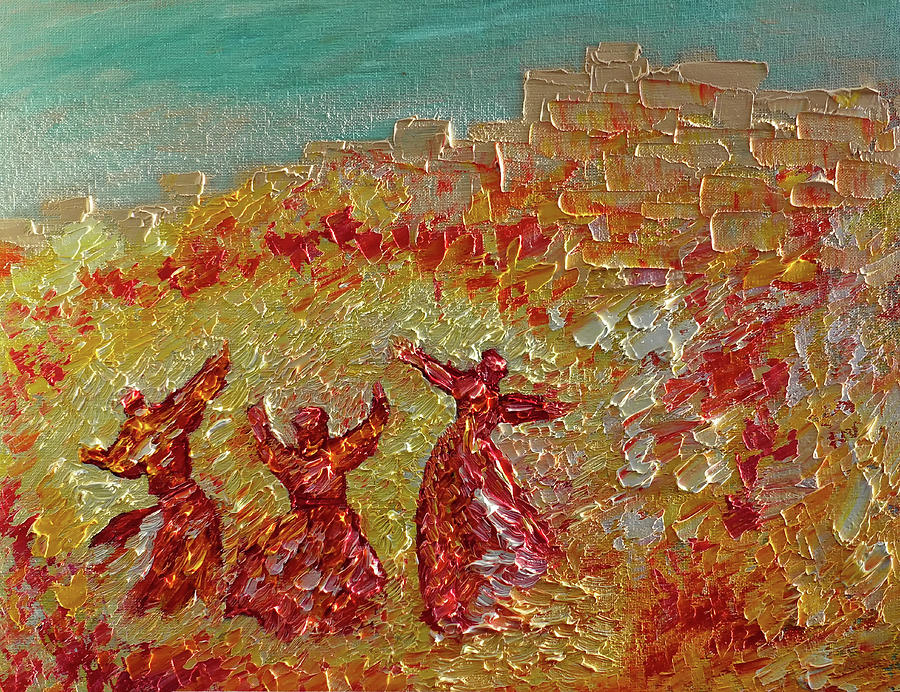
    Dancing Hebrew youths, Mishael, Azariah and Hananiah, in a fiery furnace of Nebuchadnezzar (contemporary) Zoriy Fine | Image from fineartamerica.com.

    We read the Prayer of Azariah in today’s readings, which he offers to God when they are inside the furnace. Importantly, Azariah prays not for the three of them, but for the entire nation of Israel, “for the sake of Abraham, your beloved, Isaac your servant, and Israel your holy one.” He notes how depleted Israel is (indeed, they’ve been conquered by the Babylonians and many have been dragged to Babylon). In a clear reference to the psalms, he says he has no offering but his “contrite heart and humble spirit.” (Psalm 51 reads: “For you have no delight in sacrifice; if I were to give a burnt offering, you would not be pleased. The sacrifice acceptable to God is a broken spirit; a broken and contrite heart, O God, you will not despise.”)

    Having declared his pure intentions, he says, “we fear you and seek your presence.” As we shall see in the gospel reading, this deep respect, this profound obeisance, is key to our request for mercy. The entire prayer reaches its climax with his request: “deal with us in your patience and in your abundant mercy. Deliver us in accordance with your marvelous works, and bring glory to your name, O Lord.” How important that Azariah understands that all must point back to God and his glory! He asks for deliverance not just out of a selfish desire for his own life, but knowing that Nebuchadnezzar would be amazed at the power of God to save his people. Most importantly, he models for us what a gift fear of God is.

    Spoiler alert: the three young men are saved by God and not harmed in the fiery furnace.

    Upon their deliverance, the three young men dance and sing in the furnace a great canticle of thanksgiving, one that we use in our liturgy: Week 1 Sunday Morning Prayer of the Divine Office, and repeated for each solemnity and other high feast days. The canticle is one of my favorites to chant during the Liturgy of the Hours because it starts by blessing God and then goes through all of creation, encouraging everything to bless the Lord. This canticle is important because Hananiah, Azariah, and Mishael not only model for us the fear of God and heartfelt pleas for mercy, but also the correct response once you’ve received his mercy: sharing that mercy with all of creation.

    Turning our attention to the gospel reading, the Parable of the Unmerciful Servant starts strong. The servant who owes an impossible amount of money to the king follows the lead of Hananiah, Azariah, and Mishael, showing proper respect for and dependence on the king. The original Greek uses the verb προσεκύνει (a form of proskynesis), which is often translated as “worship” elsewhere in the Bible and means to bow on your knees in a display of supplication and reverence. 

    Further examination of the Greek helps us understand the exchange between the servant and the king. Erasmo Leiva-Merikakis writes in Volume II of his masterwork Fire of Mercy, Heart of the Word, “God responded at once to the servant’s plea because the man used one of God’s dearest names in adoration of him: ὁ Μακροθύμος—’the Long-suffering One’. The man’s plea is said to have affected the almighty King’s very viscera (σπλάγχνα), hidden under all his golden robes … ‘the Lord of that servant was viscerally moved to compassion’” (647-648). The king is so moved that he forgives his entire debt! In this way, Jesus is describing God the Father in his overflowing forgiveness and mercy, far beyond our expectations. 

    The parable then turns, however, and reveals that the servant’s display of respect was only skin deep. He finds a fellow servant who owes him a much smaller debt and instead of forgiving this debt in turn, as his king forgave him, he chokes him, refuses to show him mercy, and has him imprisoned. This is a grievous sin.

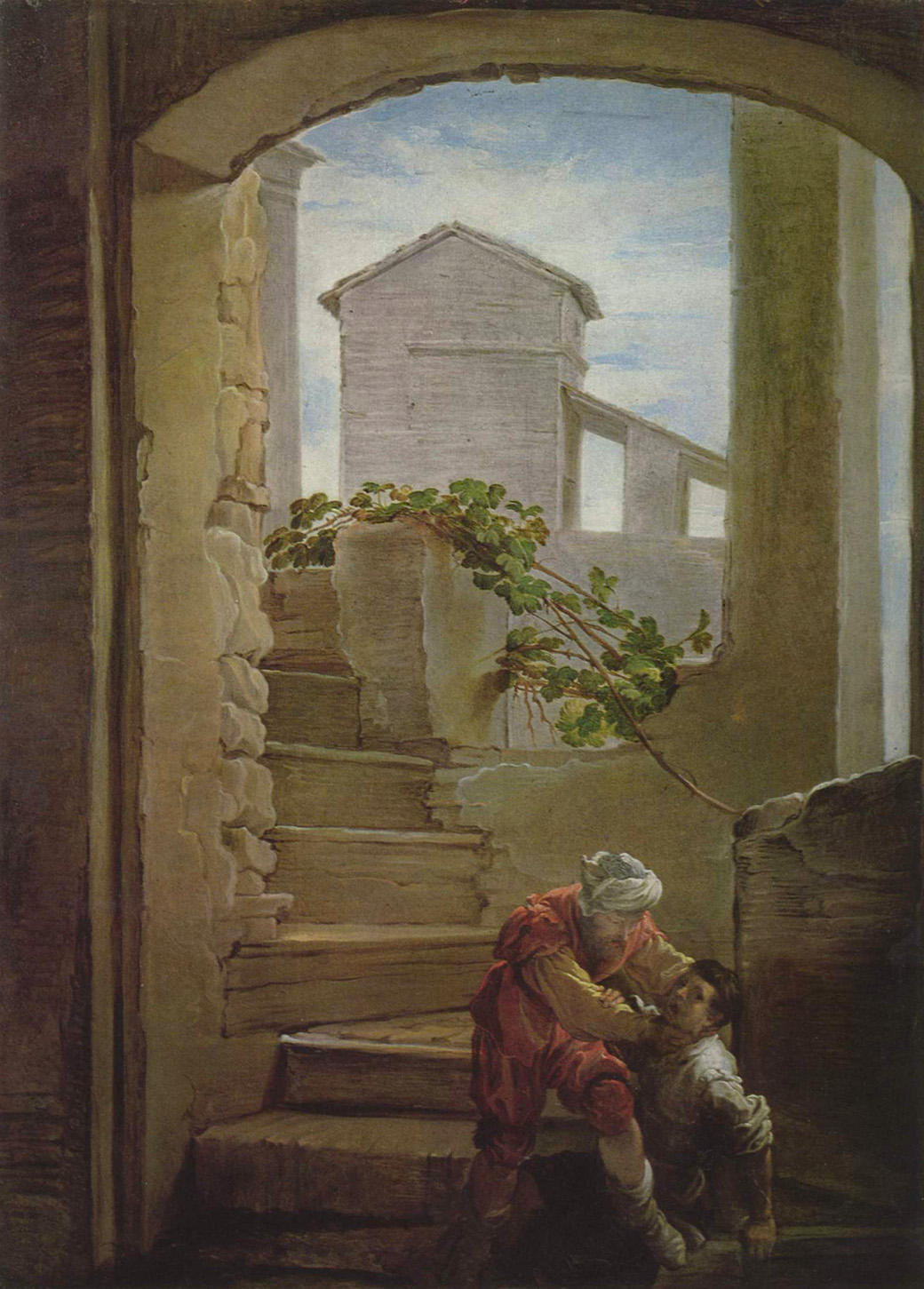
    Parable of the Wicked Servant (La parabola del servo malvagio), 1620, Domenico Fetti | Wikimedia Commons.

    The king’s action is not merely a good example for the servant. God’s mercy is a thing, alive, needing to course through us into the world. His mercy is the living force of love in the world. Leiva-Merikakis beautifully describes this, “Our vocation is to ignite conflagrations of love and forgiveness all around us. God’s light intends to be refracted through our being: it shines upon us not only for our own benefit, to dispel our own darkness, but also to stream through us and beyond us” (649). 

    Our very “vocation,” our purpose on the earth, is to share God’s mercy in the world. By so doing, we accomplish God’s will. But refusing mercy is the perversion of the Spirit. In the parable, the unmerciful servant shows that he does not have the type of fear of the Lord that is wholesome and transformative. The other servants must react at his perversion of the Spirit: “Now when his fellow servants saw what had happened, they were deeply disturbed, and went to their master and reported the whole affair.” Not sharing mercy with others is a cardinal sin. This leads us to the conclusion of the parable and a glimpse of divine justice.

    Even if it makes us uncomfortable, we must accept that God rightfully expresses anger when his goodness is hoarded and discarded. Divine justice hinges upon how we use the gifts God bestows on us, principally mercy: is it shared and given forth to others in acts of charity and love or is it discarded and replaced by selfishness, greed, and sadism? When we discard the energy of God Himself, we embrace the energy of evil, of the devil. What’s more, we reject ourselves, our purpose, to help bring others to God and into the Kingdom. We become an abomination of everything God has created us to be.

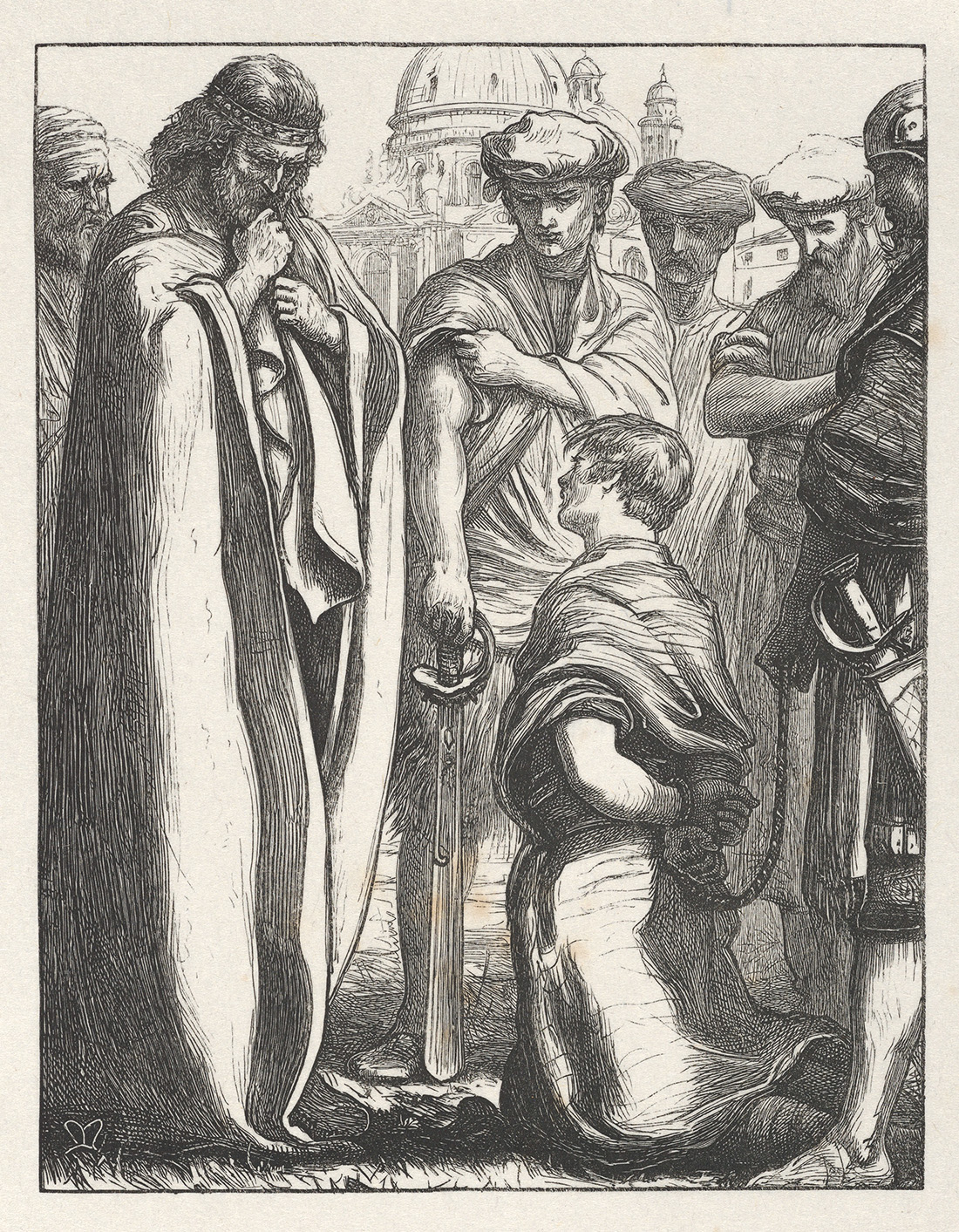
    The Unmerciful Servant (1864), artist: After Sir John Everett Millais, Engraved and printed by Dalziel Brothers | Creative Commons, courtesy The Metropolitan Museum of Art.

    So, we read that “in anger his master handed him over to the torturers.” Let’s look closely at the original Greek as we wrap our heads around God’s righteous anger and act of divine justice in this passage.

    The verb for his anger is ὀργισθεὶς (orgistheis), which can be translated as “moved to anger” or “provoked to anger.” Here we see that the king is provoked or moved by the actions of the servant; it is a response to something the servant has done. We must recall that while God is indeed all that is good, he is also the source of moral behavior, moral decision making, and moral valence (that is, what is good vs. what is bad). As such, he stands as the judge of behavior, and a judge is not silent when presented with something. Actions either uphold the good or go against the good. Being “moved to anger” means that he stands in his role as judge and proclaims the evil that he sees.

    Why anger? Why not sadness or emotionless judgment? Well, let’s return to the kind of God we know we have: one who overflows with love for his people and his creation. Is this the sign of impassivity? Should we expect a divinity so pure and full to not react viscerally to both the goodness he finds in us as well as the evil he finds in us? As it appears in today’s reading, God is viscerally moved to compassion — σπλαγχνισθεὶς (splanchnistheis) where the word σπλαγχνα (splanchna) means interior organs or intestines — and we can expect that he can be viscerally moved to something other than compassion when encountering evil. I don’t presume to know what he is moved to, but the scriptures tell us many times that he is moved to anger, so I take divine revelation for what it is.

    In his anger, the king “handed him over”: παρέδωκεν (paredōken), which occurs 18 times in the New Testament, notably when Judas hands over Christ to the chief priests, when Pilate hands over Christ to be crucified, and when Christ gives up his spirit in death. This is an irrevocable step in delivering something. And to whom does the king hand over the servant? The torturers, who will enact pain upon him “until he should pay back the whole debt” (200,000 years, I guess). We can rightfully say that in his goodness God does not take pleasure in this torture and note that he does not inflict it himself. Gehenna/Hell is set up for this purpose, a place for the people who pervert the Spirit and undermine God’s law.

    So as to not end this reflection as a total downer, let’s end with some wise words from Leiva-Merikakis, for whom today’s reading in part gives him the title for his three-volume work on St. Matthew’s gospel.

    The only thing we should be afraid of is not being merciful as our heavenly Father is merciful, for it is from unmercy that the most dire consequences flow, the ones reaching most deeply and devastatingly into both our psyche and our eternal destiny. For the Kingdom of Heaven is a kingdom of mercy, and mercy is never realized in the abstract but only through a concrete exercise of forgiveness. … Therefore, the ability to forgive our brother unceasingly and from the heart should be one of the primary concerns of our prayer, one of the most earnest pleas we make before the Throne of Grace (654).

  • Justice Like Gentle Rain

    Wednesday in the 3rd Week of Advent: Isaiah 45:6c-8, 18, 21c-25, Luke 7:18b-23.

    Justice is something I’ve been considering a lot in the face of crooked politicians making themselves rich while being morally abhorrent in behavior and policy. Of course it’s important to remember that this is nothing new — every generation has human greed and sin, dating back before the days of King Herod in Israel. But certainly there are times all of us want justice not to descend on the earth “like gentle rain,” but instead like a cracking, vindicating lightning bolt. God, in His mercy, has a different plan; if justice were so severe, there would be very few of us left to marvel at it!

    Today’s readings tackle God’s promise of justice, and contemplating them has helped me start to reconsider what justice on earth might look like. Undoubtedly, we are faced with two types of justice: the justice that happens on Judgment Day, when souls are weighed and either accepted into heaven or sent to hell, and the secular justice that we experience while alive on the earth. I’m starting to wonder if there isn’t also a third — one that straddles these two — the loving, forgiving justice of God working through humanity here on earth. This is perhaps the most tenuous and paradoxical of all; it might be uncommon or it might be the most common thing ever, a testament to God’s grace at work in the world; it might seem fleeting in its smallness but likely looms as the most eventful thing in a person’s life, configuring them to the light until death. It seems to be the stuff of novels, a wispy but significant thread in the human experience that turns out to be stronger than steel. How can we truly explore this justice without living it? Let’s turn to scripture.

    Saint Michael Vanquishing Satan (early 1500s), attributed to Pedro Romana | Image from pinterest.com. This divine justice, meted out by Christ and the angels, is not something we can expect to apply to common, legal justice we hope to see enacted in this lifetime.

    God, speaking through Isaiah, says, “Let justice descend, O heavens, like dew from above, like gentle rain let the skies drop it down.” He speaks of justice like dew, like a gentle rain — I’m reminded of manna in the Exodus, feeding the Jews who were following God’s commands. This is definitely not a fire-and-brimstone justice but more like a blessing. He then says, “Let the earth open and salvation bud forth; let justice also spring up!” We read earlier this week how Isaiah prophesies that salvation budding forth on the earth will be in the form of the Christ, the Anointed One. Thus, the “earth opening” to bring forth salvation we can understand as Mary bringing forth divinity, the mystery of the Incarnation. The corollary statement is “let justice also spring up,” which means that a second way God is giving the world justice is through His Son on earth. Thus, we have two forms of earthly justice given to us by God: His blessing/grace from above and His Son, the Way, the Truth and the Light made incarnate here on earth.

    For the past few years, I’ve nearly given up on the idea of earthly justice, probably because I’m always putting it in secular terms. In other words, “why can’t that person go to jail or be found guilty and punished accordingly?” In the face of what seems like injustice all around and an increasing culture of hate and self-centeredness, I have turned my eyes to the heavenly kingdom to come. My past year of lectio divina, however, has made it apparent that God means for us to experience the Kingdom here and now if we can only meet Him, fully open to do His will. Nothing speaks more clearly to this desire for us to experience a kind of heavenly justice while alive on earth like these lines from Isaiah today: “The creator of the heavens, who is God, The designer and maker of the earth who established it, Not creating it to be a waste, but designing it be lived in: I am the LORD, and there is no other.” The culmination of the sentence is an confirmation of the first part of the Jewish profession of faith, the shema: Hear O Israel, the Lord is our God, the Lord is One. The force of the sentence is that our God is the only God in the heavens, in fact he created the heavens and the earth, and nothing is impossible for Him to decree or to do. Yet placed in this sentence is an affirmation that earth was created for real, true, full living: “not creating it to be a waste, but designing it to be lived in.” For me, this means I can’t just scorn this world as a testament to the fallenness of humanity (no matter how much I want to at times). God wants us to live fully in the world, not to have it be a waste.

    But how can we trust that God’s great plan for this world he created is not going to be wasted anyway, given the freewill granted to humanity to mess things up if they so choose? Well, here’s where faithfulness to God and trust in Him come to roost. Isaiah continues: “Turn to me and be safe, all you ends of the earth, for I am God; there is no other!” The answer is really quite simple: if you truly believe in your singular, all powerful creator God, then from what you know of His benevolence and scope of salvation history, you can’t doubt. In Isaiah’s words is comfort for anxiety: “Turn to me and be safe.” There is safety in the turning to Him, in the posture: physical, mental, and spiritual. 

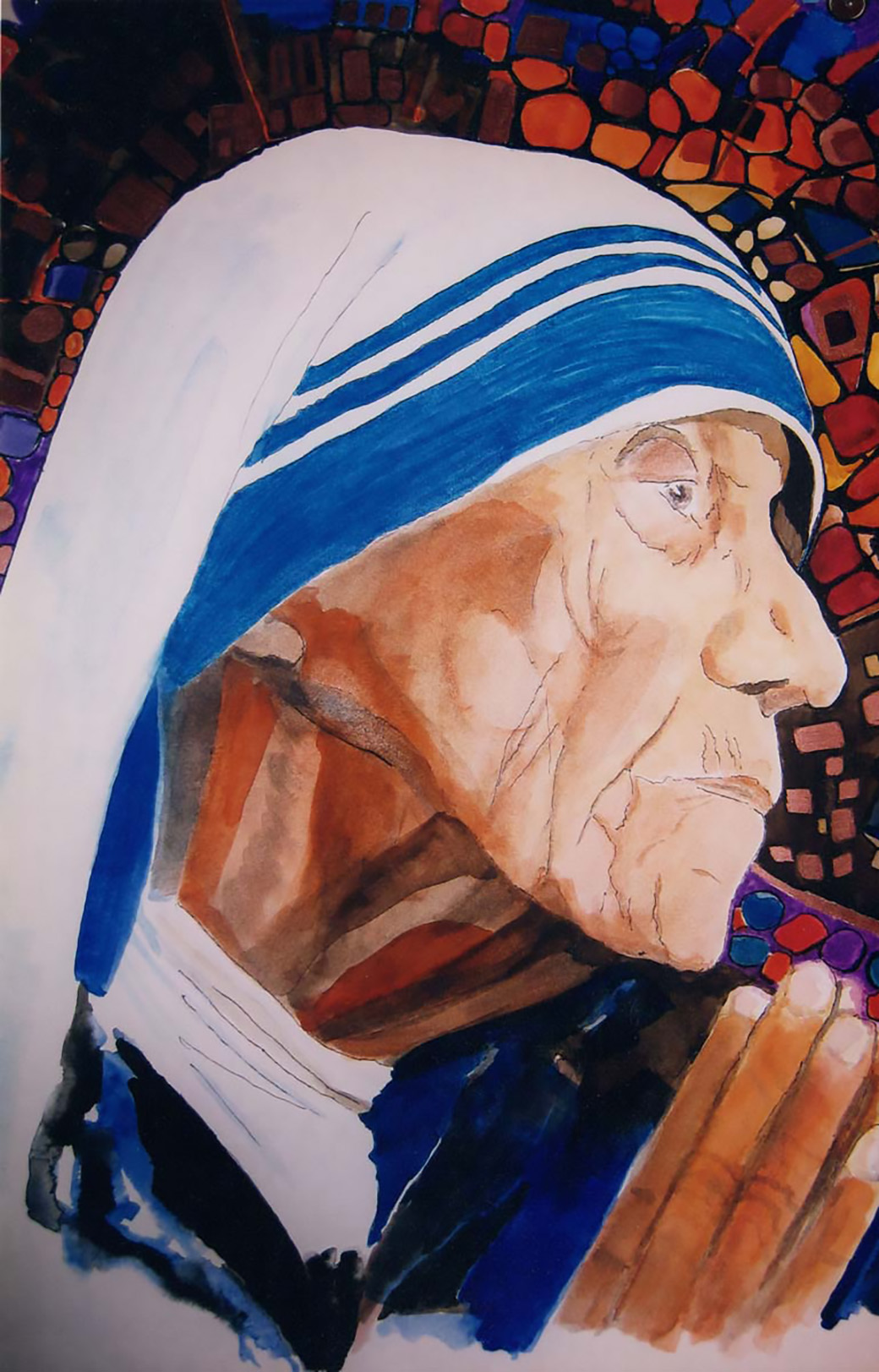
    Mother Teresa (contemporary), Br. Michael Valdes, CFC | Image from the Edmund Rice Christian Brothers Art Foundation. I can’t think of a better contemporary portrait of real justice and power in the world than the life of St. Mother Teresa.

    After these words of comfort, Isaiah then brings us back to justice: “Only in the LORD are just deeds and power. Before him in shame shall come all who vent their anger against him.” What does it mean that only in the Lord are just deeds and power? Does the preposition here mean that justice and power are relegated to heaven only and are only wielded by God from on high? Or does it leave room that those who live in the Lord may also accomplish just deeds and wield power (a power and justice that rightly come from God and belong to Him)? We have to be careful with our definitions; remember that Christ’s great lesson is that power resides in taking up the cross, a very contrary understanding to temporal power. Power flows from a love that conquers and purifies everything. It is reasonable to surmise that justice, too, is subject to love as its guiding principle.

    God is known by His transformative love. What does His love transform other than beings in the sphere of creation? Revelation teaches us that this happens specifically in human hearts. Thus, as God’s love becomes active in the world in human hearts, so “just deeds and power” are present. The logic that flows from our scriptures teaches us about this third type of justice and power: while God may wield justice and power from on high, He also chooses to have them present in the world through us because He transforms us and conforms our hearts to Him.

    Note how Isaiah’s second sentence paired to this declaration characterizes base, worldly actions as “venting anger against him.” I don’t think that all actions outside of those done in the Lord are a type of “vented anger” (some may be simply indifferent), but this category might be more expansive than we imagine. Any act that inherently works against love is contrary to God. Even the smallest thing that is done out of self-interest instead of love for another belies a type of vented anger, frustration, or brushing off of God’s law and God’s always-outwardly-focused love. I am reminded of the past few days’ worth of reflections on sin, even venial sin, and how it is the “blackest ingratitude, the greatest injustice, and the gravest outrage” to God, our rightful master. Thus, of course “before him in shame shall come all who vent their anger against him!”

    The message I hear as I contemplate Isaiah’s words is that in order to have justice, we must trust in and channel the God who is love — love that is beyond Platonic, erotic, fraternal, and even agape; the unselfish, always forgiving, always wanting the best for the other, desiring to sow the seeds that will bear fruit in the other love of God that we cannot describe, understand, or even feel. We are poor vessels to carry His love and spread it, but it is His plan, nonetheless. It prepares us for eventual unity with Him. We are bound to fail, but how we deal with our failures is also of the essence (can we accept His forgiveness as His created creatures?).

    At issue here is the fact that instead of embracing this charge to channel God’s love, we want to skip straight to the justice and the power. It’s convenient for us to think that justice can be implemented without that difficult, slow process of loving (which often changes the whole scenario and outcome), or that what we think is “power” can simply be enacted/enforced (even if, deep down, it’s just venting anger at God). Perhaps this is because our prophets and Lord have given us such great visions of justice and power that we want to just make it so. But this is impossible — “Only in the LORD are just deeds and power” — that is, justice and power must flow from Him and His transformative love. We can’t even conceive of what justice in any given circumstance will look like until we enter into this love. We can’t conceive of what power looks like either.

    That’s not entirely true. Christ shows us the power of God here on earth. In today’s gospel reading, John the Baptist sends his disciples to Christ to see for themselves if He is the Messiah. “At that time Jesus cured many of their diseases, sufferings, and evil spirits; he also granted sight to many who were blind.” He manifests God’s love here on earth, pouring out blessings, healings (spiritual and physical), and above all, forgiveness and mercy. Jesus tells John’s disciples, “Go and tell John what you have seen and heard: the blind regain their sight, the lame walk, lepers are cleansed, the deaf hear, the dead are raised, the poor have the good news proclaimed to them. And blessed is the one who takes no offense at me.” Jesus calls us to testify to Him and His works. This none other than the same refrain He spoke to Isaiah 800 years earlier: “Turn to me and be safe, all you ends of the earth, for I am God; there is no other!” He is here to prove to us that we can trust in Him. We must share that essential message around the world because trust in God combats our propensity to define for ourselves justice and power without having His love as the essential part of the equation.

    Christ Healing the Blind Man (1645), Eustache Le Sueur | Wikimedia Commons.

    But why might he say, “And blessed is the one who takes no offense at me”? Who would take offense at healings and raising from the dead? Well, yesterday’s gospel shows us: the chief priests and elders who are shocked to hear that tax collectors and prostitutes are getting into the Kingdom of Heaven ahead of them. Those who embrace being transformed by God’s love are accessing the Kingdom being given to them here and now by Christ. This offends those who have practiced piety for so long but whose hearts are frozen in judgement against their “lesser” fellow humans. They think they know what justice looks like: this person who worked on the Sabbath or who consorts with prostitutes should not enter the Kingdom, much less be God Himself! These same people supposedly have power that they wield with their earthly positions in the synagogue. But that sense of justice and power is totally perverted. It means nothing if it does not emanate from God’s love. 

    This, of course, applies today. I know many a pious Catholic who prays longer, harder, and more frequently than 99% of us, but their hearts are frozen in judgement against those who are “polluting” the Church. What a sad state! Not just them; really any of us who gain our bearings in the world by defining “justice” as we see it are guilty of the same offense. I’m starting to realize that “justice” as a social and legal concept needs to be taken down from its secular pedestal lest it defile our understanding of divine justice, which is never ours to define or even completely comprehend. We might have to be jury members or judges in our work and civic life, but this should in some ways fill us with dread and unease. We are called to something much greater, and the more we can turn to that greater being, the more we can enact real justice in the world. 

  • Adultery in the Heart

    Adultery in the Heart

    Monday in the Fifth Week of Lent: Daniel 13:1-9, 15-17, 19-30, 33-62, John 8:1-11.

    Adultery is the theme in today’s readings. As we are presented with stories about this sin, one of the great sins against the Ten Commandments, we learn about a different kind of adultery, which is a betrayal of God in our hearts. We also learn about the fidelity God provides even in the midst of our sin — that his law protects us from sin and also picks us up when we fall.

    In the first reading from the Book of Daniel, we read about the “God-fearing woman, Susanna” and the wicked judges who accuse her of adultery with a fictitious young man. It is they who have succumbed to lust for her. The author writes, “They suppressed their consciences; they would not allow their eyes to look to heaven.” I appreciate how this describes the moment of slipping into evil; they act here by suppressing their consciences and keeping their eyes from looking to heaven. The gaze of a person to heaven, yearning for and obeying God, is a great way to envision our relationship with him. We are always striving to be worthy of him, of his grace and mercy. By intentionally looking away from heaven, these wicked judges are breaking off their relationship with God.

    So, what is this relationship? First of all, it is a relationship that he began — with our initial Creation as his children, and then with the covenants he initiates for us throughout history. This reveals that he loves us and wants us to be close to him. As we discussed in our reflection, The Purifying Fire We Call God’s Wrath, being close to him requires some preparation because his purifying essence embraces all that is good but burns all that is evil. With his covenants, he gives us a path to follow in order to not be burned but be embraced. We call this path the Law, but note that it serves the purpose of helping us grow in the Spirit, not that it should simply be followed for the sake of being followed.

    Where does adultery come in? Well, marriage is a microcosm of this covenant with God (assuming we’re talking about marriage in the Church, not a civil union). Marriage carries with it a vow, a covenant between the man and woman. There are rules (law) to follow that define that fidelity and that covenant, but holding it together is the love they have and that will grow between them (the spirit).

    On top of this legalistic view of marriage vows, marriage is a sacrament because God sanctifies the union. The couple vows to be loving and faithful to each other with the help of the Spirit. God, in turn, enters the sacramental marriage and becomes present in their union. Each is Christ for one another.

    The Mystic Marriage of Saint Catherine of Siena (c.1460), Giovanni di Paolo (Giovanni di Paolo di Grazia) | Wikimedia Commons.

    Adultery is a spiritual sin as much as a breaking of the law. That is why James in his letter “Adulterers! Do you not know that friendship with the world is enmity with God? Therefore whoever wishes to be a friend of the world becomes an enemy of God” (James 4:4). Adultery is here applied to choosing the world over God. Jesus, too, uses the word to refer to a faithless people who have turned spiritually away from God: “An evil and adulterous generation seeks for a sign, but no sign will be given to it except the sign of the prophet Jonah” (Mt 12:39).

    Some have written that because adultery is such a serious sin in God’s eyes it is used as a metaphor for spiritual sin in turning away from God. But I think this is backward. Adultery is breaking a personal covenant with one’s beloved, and Jesus teaches that the “greatest commandment” is to love God first, then love our neighbor as we love ourselves. To say that human marriage and adultery is of primary importance and it can then be extended to our relationship with God is backward in priority.

    Our personal covenant of love with God is the primary relationship that orders our lives and marriage on earth is a beautiful microcosm of that love. After all, God is the source and Christ the example of the type of selfless love we are called to bring to our marriages. Adultery with our spouse on earth is perhaps a more tangible way for us to grasp the great sin that is adultery against God.

    Detail from Susanna and the Elders (1653), Jacob Jordaens | Wikimedia Commons. While I think Jodaens is off with his smiling Susanna, as if she’s enjoying the intrusion of these nasty men on her bath, I think he’s spot on with the devilish faces of the judges and their grasping hands. It speaks to their lustful focus on her.

    So when the two elder judges in the Book of Daniel “would not allow their eyes to look to heaven,” they are on the path of becoming spiritual adulterers. When they act upon their lustful desires by attempting to rape Susanna and then falsely accuse her of adultery, we are given a juxtaposition of worldly adultery and spiritual adultery. Their false testimony as judges in a court and the ensuing guilty verdict begs the question of why laws can fail to provide justice. Human justice, as we all know, often does fail and miss the mark — it is not divine justice and it is tainted by the sins each of us carries with us.

    But Susanna appeals to God for divine justice, not to the court for human justice. And, “The Lord heard her prayer. As she was being led to execution, God stirred up the holy spirit of a young boy named Daniel.” The story reminds us that while God is the source, he works in this world through the Spirit and through other people. Daniel’s youth speaks to the purity and honesty we hope for when we think of justice. And his spirit-given wisdom allows him to trap the wicked judges in their lies. The whole episode validates spiritual fidelity to God as well as marital fidelity to one’s spouse.

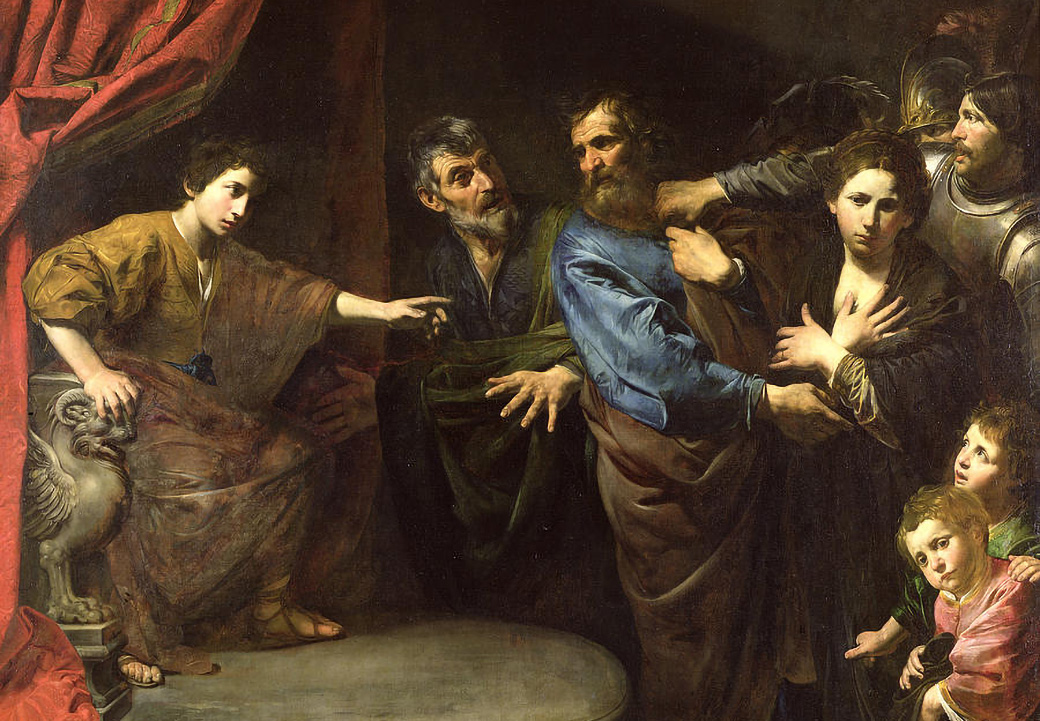
    Cropped image of The Innocence of Susanna (c.1621), Valentin de Boulogne | Creative Commons, courtesy the Metropolitan Museum of Art. Note the emphasis of the children and the child-like honesty of divine justice.

    The gospel from St. John presents another look at marital vs. spiritual adultery. In this account, the question of the Law and the Spirit come into even sharper focus. This account has often been presented to us in a very moralistic sense, i.e., don’t judge others and God’s mercy is boundless, even for sinners. But we are very far removed from traditional Jewish ritual practice, and I think we’re both missing the point and mistakenly generalizing a specific act of teaching that Jesus presents.

    All signs point to the fact that this is almost identical in nature to the first reading, where several judges are falsely accusing a woman of adultery in a miscarriage of justice. The key is when Jesus says, “Let the one among you who is without sin be the first to throw a stone at her.” He is not saying that only sinless people can execute justice (no judicial system could exist!). He is referring to the Torah where it is written that if “you make a thorough inquiry, and the charge is proved true,” then not only shall the adulterer/adulteress be stoned, but “The hands of the witnesses shall be the first raised against the person to execute the death penalty” (Deut 17:4, 7).

    You see, this woman was dragged before Jesus by the scribes and Pharisees although the Torah relates that witnesses must bring her to the temple for justice. If these scribes and Pharisees truly caught her in the act and are witnesses, then they should cast the first stone (a serious act that must be justified otherwise you are murdering, not carrying out justice). Otherwise, they are sinning by lying about witnessing the adultery.

    So, “let the one among you who is without sin” is the same as saying “whoever witnessed this should be the first to stone her.” Jesus is living the law more fully then these scribes and Pharisees are. Tellingly, no one casts a stone. 

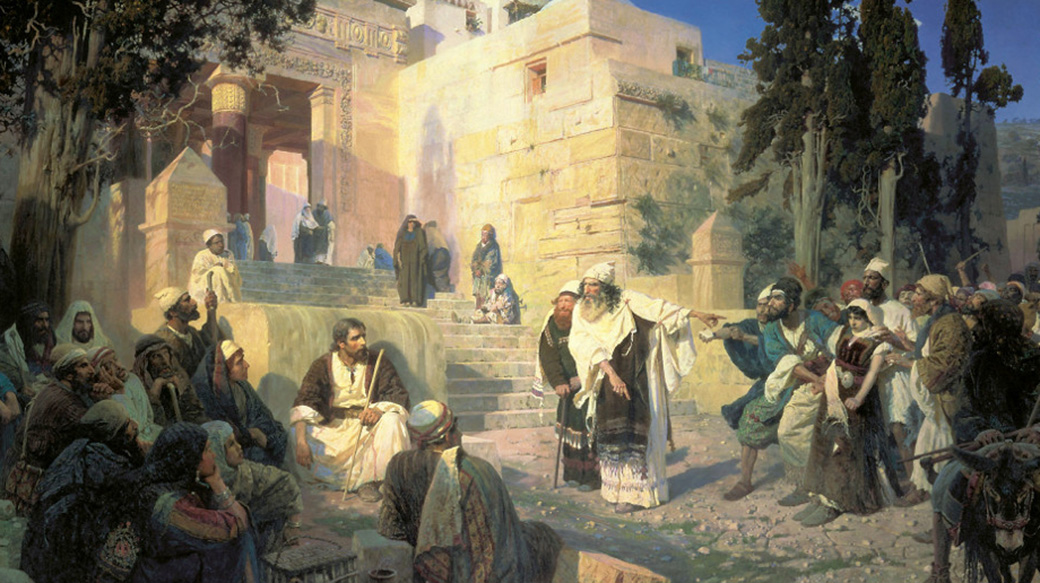
    Detail from Jesus and the Sinner Woman (c.1886), Vasily Polenov | Creative Commons, courtesy Artbible.info.

    The other key that tells us this episode is more about Jesus’s authority as the Word and Law than it is about mercy and forgiveness is his act of writing in the dirt. St. Augustine of Hippo writes an enticing few lines about this act:

    “You have heard, O Jews, you have heard, O Pharisees, you have heard, O teachers of the law, the guardian of the law, but have not yet understood Him as the Lawgiver. What else does He signify to you when He writes with His finger on the ground? For the law was written with the finger of God; but written on stone because of the hard-hearted. The Lord now wrote on the ground, because He was seeking fruit” (Tractate 33 on the Gospel of John, 5).

    This interpretive move is a nice way to look at the new reality of God in the flesh, working in humanity in a new way.

    But let us also understand this more literally within Jewish ritual law. For accusations of adultery without witnesses (as Jesus knows this is), the Torah describes a water trial (called Sotah) that the woman must undergo. It instructs, “the priest shall take holy water in an earthen vessel, and take some of the dust that is on the floor of the tabernacle and put it into the water. … the priest shall put [the charges and penalties] in writing, and wash them off into the water of bitterness. He shall make the woman drink the water of bitterness that brings the curse” (Numbers 5:17, 23).

    “Holy water” was written in Hebrew as “living water,” and we can begin to see how Christ, who is living water and our high priest, is enacting the Sotah ritual as prescribed in the Torah. He (the water) writes in the dust the charges and penalties, fulfilling the letter of the Law that He wrote. Let us also keep in the front of our minds that this is the incarnate Word of God. The Word that forms the Torah and its prescriptions around how to carry out justice. As Jesus affirms, “Do not think that I have come to abolish the Law or the Prophets; I have not come to abolish them but to fulfill them” (Mt 5:17). 

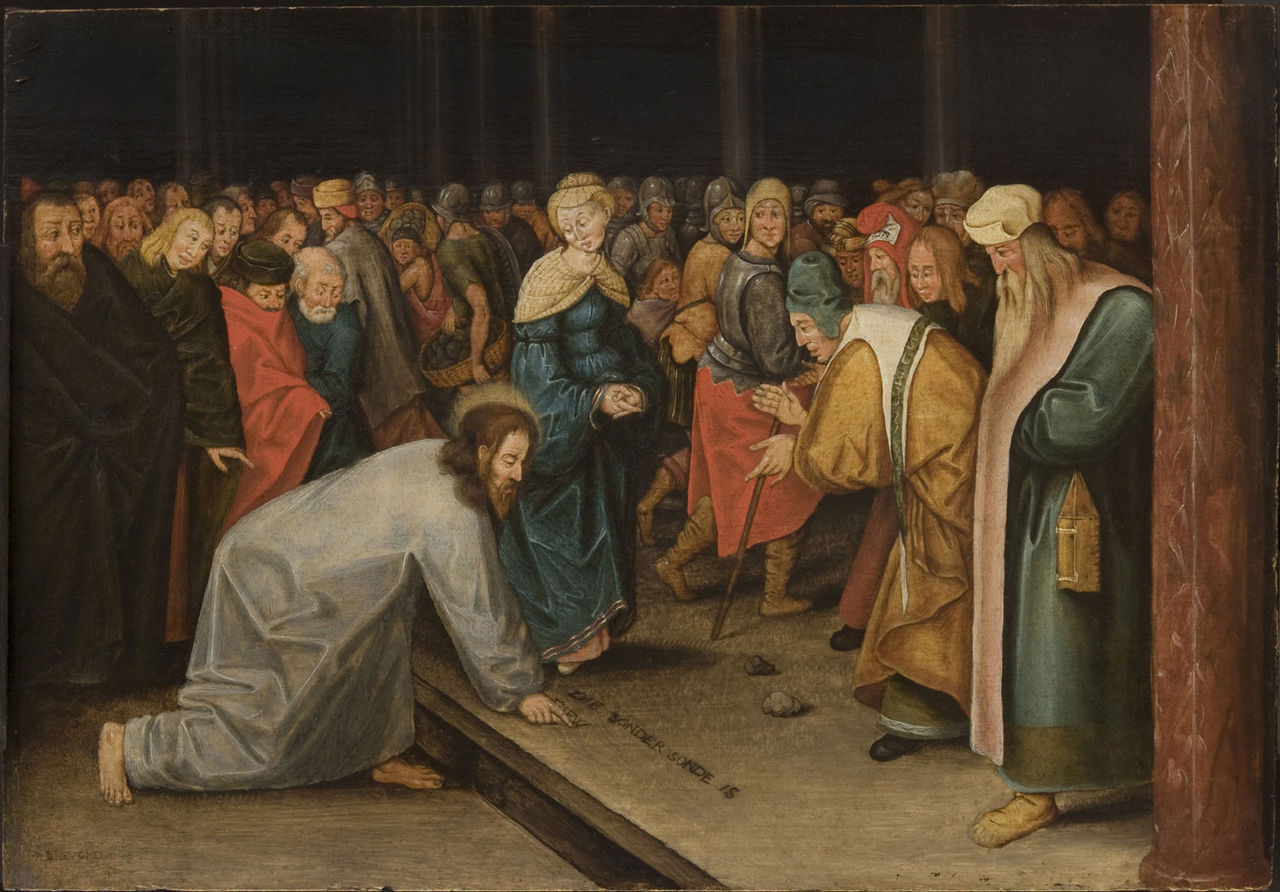
    Christ and the Woman Taken in Adultery (c.1600), Pieter Brueghel the Younger | Wikimedia Commons.

    So the scribes and Pharisees came to entrap him and they truly have no clue about who they are challenging. He is the Word, the fulfillment of the Law — he knows it better than they ever could. He knows that these prescriptions are in place so that there is no miscarriage of justice. He lifts up the law to fulfill the spiritual work it is intended to do: to keep our hearts clean from lies and sin, to keep sinners from perverting the justice God intends in the world.

    On what other evidence might we think this episode is not about “forgiveness no matter what”? His parting exchange with the woman bears no resemblance to the other miracles he performs when forgiving sin or healing. He says, “Neither do I condemn you. Go, and from now on do not sin any more.” He confirms that he was also not a witness to adultery on her part (which is the point of the encounter with the scribes and Pharisees). Does that mean that she didn’t commit adultery? Not necessarily, but that’s not his mission.

    Recall that the Samaritan woman at the well was living in adultery and had five husbands, yet he shared with her one of his most thorough revelations of divinity. Mary Magdalene was also a prostitute, but she became one of his close disciples. It’s not that adultery against a spouse doesn’t matter — the Word of God clearly says it does. It’s that his mission is about fidelity of Spirit. He preaches primarily on the dangers of adultery in the context of our most fundamental covenant with God.

    Nothing about this final exchange is like the other miracles or healings he accomplishes. He does not ask her about her faith or belief. He does not establish the atonement and request for mercy that is the requirement for spiritual healing. We must conclude that this encounter is not about sin being forgiven. So when Jesus says, “Go, and from now on do not sin any more,” I’m sure that he was speaking of spiritual adultery just as much, if not more, than spousal adultery.

    For me, at least, returning to these familiar stories with a new lens and spirit of contemplation has shed light in new ways. I’m sure that none of these reflections are the ultimate exegesis of scripture, but going through the effort has helped me feel much closer to Christ this Lent.

  • Mercy is the Master Principle

    Mercy is the Master Principle

    Tuesday in the Third Week of Lent: Daniel 3:25, 34-43, Matthew 18:21-35.

    Today, we read a parable about God’s great mercy and the expectation that we will, in turn, extend that mercy to each other. Mercy, we learn, is the great master principle upon which divine justice is built, and it is an action that stems not from the human heart, but from the heart of the Lord.

    The beginning of the book of Daniel, although written ~165 BC, details the stories of Daniel and his friends in Babylon around the year 600 BC. Today’s reading comes from the much-celebrated episode when the three young Jews Hananiah, Azariah, and Mishael are punished by Nebuchadnezzar for refusing to worship the gigantic golden idol he builds on the plain of Dura. They respond to the accusations against them by saying, “we have no need to present a defense to you in this matter. If our God whom we serve is able to deliver us from the furnace of blazing fire and out of your hand, O king, let him deliver us.” In a rage, he sentences them to be bound and cast into a fiery furnace so hot that it burns to death the men who throw them in.

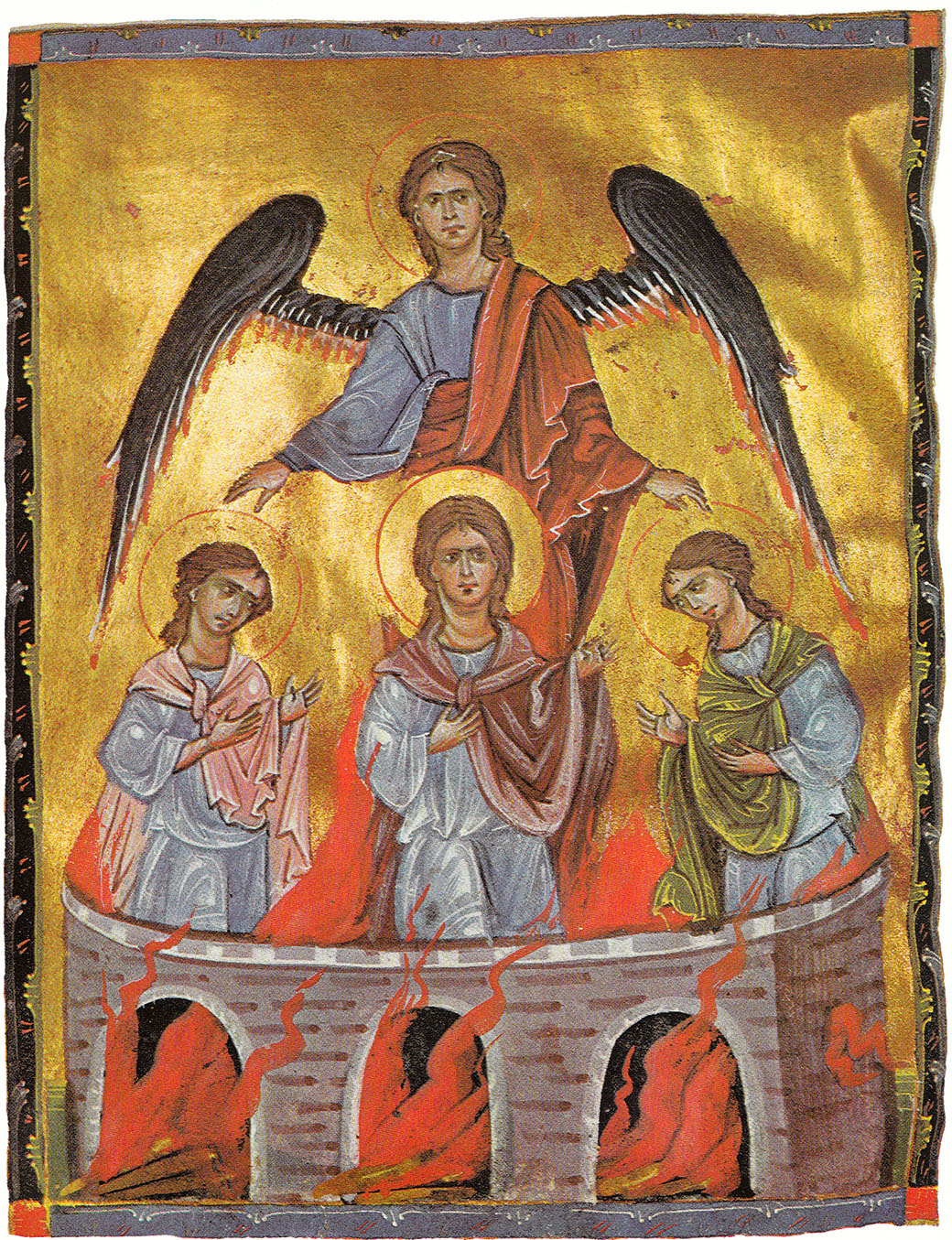
    Fiery Furnace, Shadrach, Meshach, and Abednego (1266), Toros Roslin (circa 1210–1270), who was the most prominent Armenian manuscript illuminator in the High Middle Ages | Wikimedia Commons.

    We read the Prayer of Azariah in today’s readings, which he offers to God when they are inside the furnace. Importantly, Azariah prays not for the three of them, but for the entire nation of Israel, “for the sake of Abraham, your beloved, Isaac your servant, and Israel your holy one.” He notes how depleted Israel is (indeed, they’ve been conquered by the Babylonians and many have been dragged to Babylon). In a clear reference to the psalms, he says he has no offering but his “contrite heart and humble spirit.” (Psalm 51 reads: “For you have no delight in sacrifice; if I were to give a burnt offering, you would not be pleased. The sacrifice acceptable to God is a broken spirit; a broken and contrite heart, O God, you will not despise.”)

    Having declared his pure intentions, he says, “we fear you and seek your presence.” As we shall see in the gospel reading, this deep respect, this profound obeisance, is crucial to our request for mercy. The entire prayer reaches its climax with his appeal: “deal with us in your patience and in your abundant mercy. Deliver us in accordance with your marvelous works, and bring glory to your name, O Lord.” How important that Azariah understands that all must point back to God and his glory! He asks for deliverance not just out of a selfish desire for his own life, but knowing that Nebuchadnezzar would be amazed at the power of God to save his people.

    The reader of the Book of Daniel is held in suspense a bit longer. After the passage we read today, we hear that the king’s servants stoke the fire mightily, and it rises 49 cubits (73.5 feet!) above the furnace. The point is that God’s people are being purified. The fiery furnace is the symbol of ultimate trial by fire, which is only met and conquered in the Spirit, with a steadfast faith and fundamental reliance on God. They prove that their hearts are pure, focused on God, and they ask for his mercy. Thus, “the angel of the Lord came down into the furnace to be with Azariah and his companions, and drove the fiery flame out of the furnace, and made the inside of the furnace as though a moist wind were whistling through it.”

    Upon their deliverance, the three young men dance and sing in the furnace a great canticle of thanksgiving, one that we use in our liturgy: Week 1 Sunday Morning Prayer of the Divine Office, and repeated for each solemnity and other high feast days. The canticle is one of my favorites to chant during the Liturgy of the Hours because it starts by blessing God and then goes through all of creation, encouraging everything to bless the Lord. (Some of my favorites: sun and moon, fire and heat, dolphins and water creatures.)

    This canticle is important because Hananiah, Azariah, and Mishael not only model for us the correct approach and posture to have before God when begging for mercy, but also the correct response once you’ve received his mercy: sharing that mercy with all of creation.

    The Parable of the Unmerciful Servant in today’s gospel reading clearly depicts the other side of this coin. Today’s gospel reading begins with Peter asking Jesus how many times we should forgive someone. Jesus corrects Peter’s guess of seven (the number of perfection in Jewish numerology, and already a literal number that would test the most patient person) to say seventy times seven — essentially, an infinite number of times. He then explains the reasoning with the Parable of the Unmerciful Servant.

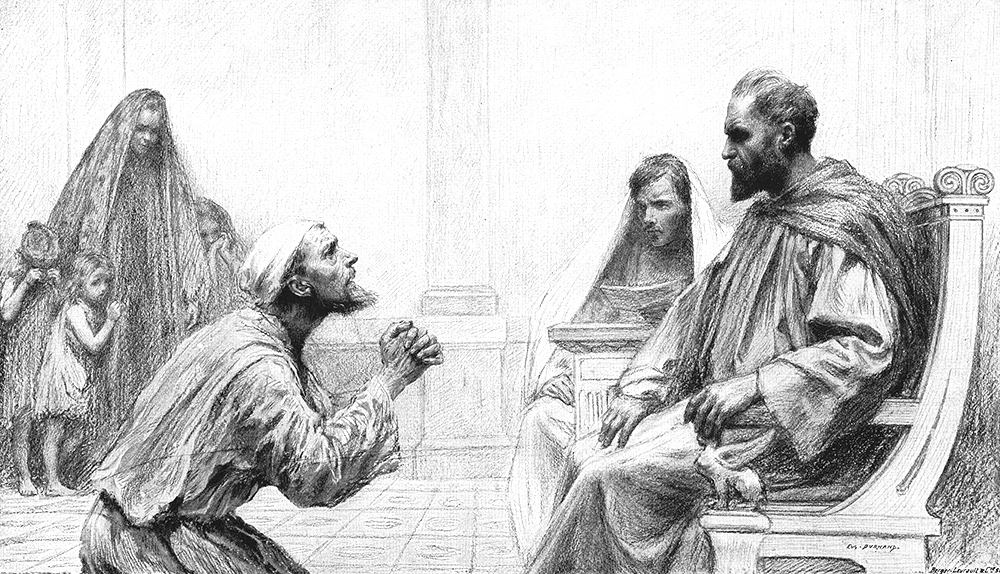
    The Unmerciful Servant (1908), Eugène Burnand | Creative Commons, courtesy eugene-burnand.com.

    Our lectionary reading says the servant owed the king “a huge amount,” although the scriptures specify “10,000 talents;” a talent is equal to 6,000 denarii, and since a typical Jewish laborer earned 300 denarii a year (1 denarius per day, 6 days per week, minus religious holidays), it would take around 200,000 years to earn 10,000 talents! Clearly, this is an impossible amount to pay back.

    The king proclaims a sentence according to the law, that he, his family and his property be sold. At this, “the servant fell down, did him homage, and said, ‘Be patient with me, and I will pay you back in full.’” Now, there is no way the king could expect to be paid back in full, but the servant follows the lead of Hananiah, Azariah, and Mishael in that he shows proper respect for and dependence on the king. The original Greek uses the verb προσεκύνει (a form of proskynesis), which is often translated as “worship” elsewhere in the Bible and means to bow on your knees in a display of supplication and reverence. 

    Further examination of the Greek helps us understand the exchange between the servant and the king. Erasmo Leiva-Merikakis writes in Volume II of his masterwork Fire of Mercy, Heart of the Word, “God responded at once to the servant’s plea because the man used one of God’s dearest names in adoration of him: ὁ Μακροθύμος—’the Long-suffering One’. The man’s plea is said to have affected the almighty King’s very viscera (σπλάγχνα), hidden under all his golden robes … ‘the Lord of that servant was viscerally moved to compassion’” (647-648).

    And the king goes beyond giving the servant time to repay, instead forgiving his entire debt! In this way, Jesus is describing God the Father in his overflowing forgiveness and mercy, far beyond even our expectations.

    The parable now turns on the actions of the forgiven servant. He finds a fellow servant who owes him a much smaller debt and instead of forgiving this debt in turn, as his king forgave him, he chokes him, refuses to show him mercy, and has him imprisoned. This is a grievous sin.

    Parable of the Wicked Servant (La parabola del servo malvagio), 1620, Domenico Fetti | Wikimedia Commons.

    The king’s action is not merely a good example for the servant. God’s mercy is a thing, alive, needing to course through us into the world. His mercy is the living force of love in the world. Leiva-Merikakis beautifully describes this, “Our vocation is to ignite conflagrations of love and forgiveness all around us. God’s light intends to be refracted through our being: it shines upon us not only for our own benefit, to dispel our own darkness, but also to stream through us and beyond us” (649). 

    As Leiva-Merikakis points out, God sharing his mercy implicates our very “vocation,” our purpose on the earth. And the kingdom reacts at the injustice, the perversion of Spirit in its midst: “Now when his fellow servants saw what had happened, they were deeply disturbed, and went to their master and reported the whole affair.” As Leiva-Merikakis writes, “Mercilessness looms as the primary enemy of the hierarchy of being as established by divine creation and decree” (653). In other words, God — as the fullness of mercy and goodness — fills us with mercy so that we, in turn, can allow the overflowing mercy to be shared with the rest of creation (this is what he means by “hierarchy”). Not sharing mercy with others is a cardinal sin, a “primary enemy.” This leads us to the conclusion of the parable and a glimpse of divine justice.

    The Unmerciful Servant (1864), artist: After Sir John Everett Millais, Engraved and printed by Dalziel Brothers | Creative Commons, courtesy The Metropolitan Museum of Art.

    Even if it makes us uncomfortable, we must accept that God rightfully expresses anger when his goodness is hoarded and discarded. Divine justice hinges upon how we use the gifts God bestows on us, principally mercy: is it shared and given forth to others in acts of charity and love or is it discarded and replaced by selfishness, greed, and sadism? When we discard the energy of God Himself, we embrace the energy of evil, of the devil. What’s more, we reject ourselves, our purpose, to help bring others to God and into the Kingdom. We become an abomination of everything God has created us to be.

    So, we read that “in anger his master handed him over to the torturers.” Much has been said in recent years about how God is all goodness and could never have vengeance or anger. I think we come close to ignoring parts of scripture if we take this too far. Let’s look closely at the original Greek as we wrap our heads around God’s righteous anger and act of divine justice in this passage.

    The verb for his anger is ὀργισθεὶς (orgistheis), which can be translated as “having been angry,” “moved to anger,” or “provoked to anger.” Here we see that the king is provoked or moved by the actions of the servant; it is a response to something the servant has done. We must recall that while God is indeed all that is good, he is also the source of moral behavior, moral decision making, and moral valence (that is, what is good vs. what is bad). As such, he stands as the judge of behavior, and a judge is not silent when presented with something. Actions either uphold the good or go against the good. Being “moved to anger” means that he stands in his role as judge and proclaims the evil that he sees.

    Why anger? Why not sadness or emotionless judgment? Well, let’s return to the kind of God we know we have: one who overflows with love for his people and his creation. Is this the sign of impassivity? Should we expect a divinity so pure and full to not react viscerally to both the goodness he finds in us as well as the evil he finds in us? As it appears in today’s reading, God is viscerally moved to compassion — σπλαγχνισθεὶς (splanchnistheis) where the word σπλαγχνα (splanchna) means interior organs or intestines — and we can expect that he can be viscerally moved to something other than compassion when encountering evil. I don’t presume to know what he is moved to, but the scriptures tell us many times that he is moved to anger, so I take divine revelation for what it is.

    In his anger, the king “handed him over”: παρέδωκεν (paredōken), which occurs 18 times in the New Testament, notably when Judas hands over Christ to the chief priests, when Pilate hands over Christ to be crucified, and when Christ gives up his spirit in death. This is an irrevocable step in delivering something. And to whom does the king hand over the servant? The torturers, who will enact pain upon him “until he should pay back the whole debt” (200,000 years, I guess). We can rightfully say that, in his goodness, God does not take pleasure in this torture and note that he does not inflict it himself. Gehenna/Hell is set up for this purpose, a place for the people who pervert the Spirit and undermine God’s law.

    So as to not end this reflection as a total downer, let’s end with some wise words from Leiva-Merikakis, for whom today’s reading in part gives him the title for his three-volume work on St. Matthew’s gospel.

    The only thing we should be afraid of is not being merciful as our heavenly Father is merciful, for it is from unmercy that the most dire consequences flow, the ones reaching most deeply and devastatingly into both our psyche and our eternal destiny. For the Kingdom of Heaven is a kingdom of mercy, and mercy is never realized in the abstract but only through a concrete exercise of forgiveness. … Therefore, the ability to forgive our brother unceasingly and from the heart should be one of the primary concerns of our prayer, one of the most earnest pleas we make before the Throne of Grace (654).