Tag: light

  • Courage and Cowardice

    Courage and Cowardice

    Wednesday of Holy Week: Isaiah 50:4-9a, Matthew 26:14-25.

    Today’s gospel focuses on Judas’s betrayal, much like yesterday’s reading. Coupled with the first reading from Isaiah, we get a clear look at what it means to live in the light compared to living in darkness. 

    Today’s first reading is from a section of Isaiah’s prophecy entitled “The Servant’s Humiliation and Vindication” in the NRSV Bible. He speaks in the first person as a blessed servant with a “well-trained tongue” for whom God “opens my ear that I may hear.” This servant accepts his gifts and uses them: “And I have not rebelled, have not turned back. I gave my back to those who beat me, my cheeks to those who plucked my beard; My face I did not shield from buffets and spitting.” This is a person who uses his human faculties and talents with the grace of God and is persecuted for it, like Jesus in his ministry.

    But this servant is “not disgraced,” he says, “I have set my face like flint knowing that I shall not be put to shame. He is near who upholds my right.” This servant lives fully as a human in the light of God’s presence and graces; as such, God is near to him and no amount of trying by other humans can make him disgraced or ashamed.

    I am struck by this person’s courage. Aren’t we all raised to be aware of others in our communities, to take care not to offend or make fools of ourselves? But this servant of God, by living fully in the light of God, is not defined not by social morés; he has found the true lodestar for humans: the Word of God for his well-trained tongue, the grace of God to open his ears, and the love of God to give him courage. Let’s think about this love, the source of his courage. This love coincides with a surety in the Lord, a thirst to be with Him, and an unshakable faith that what he has comes from God who has created him.
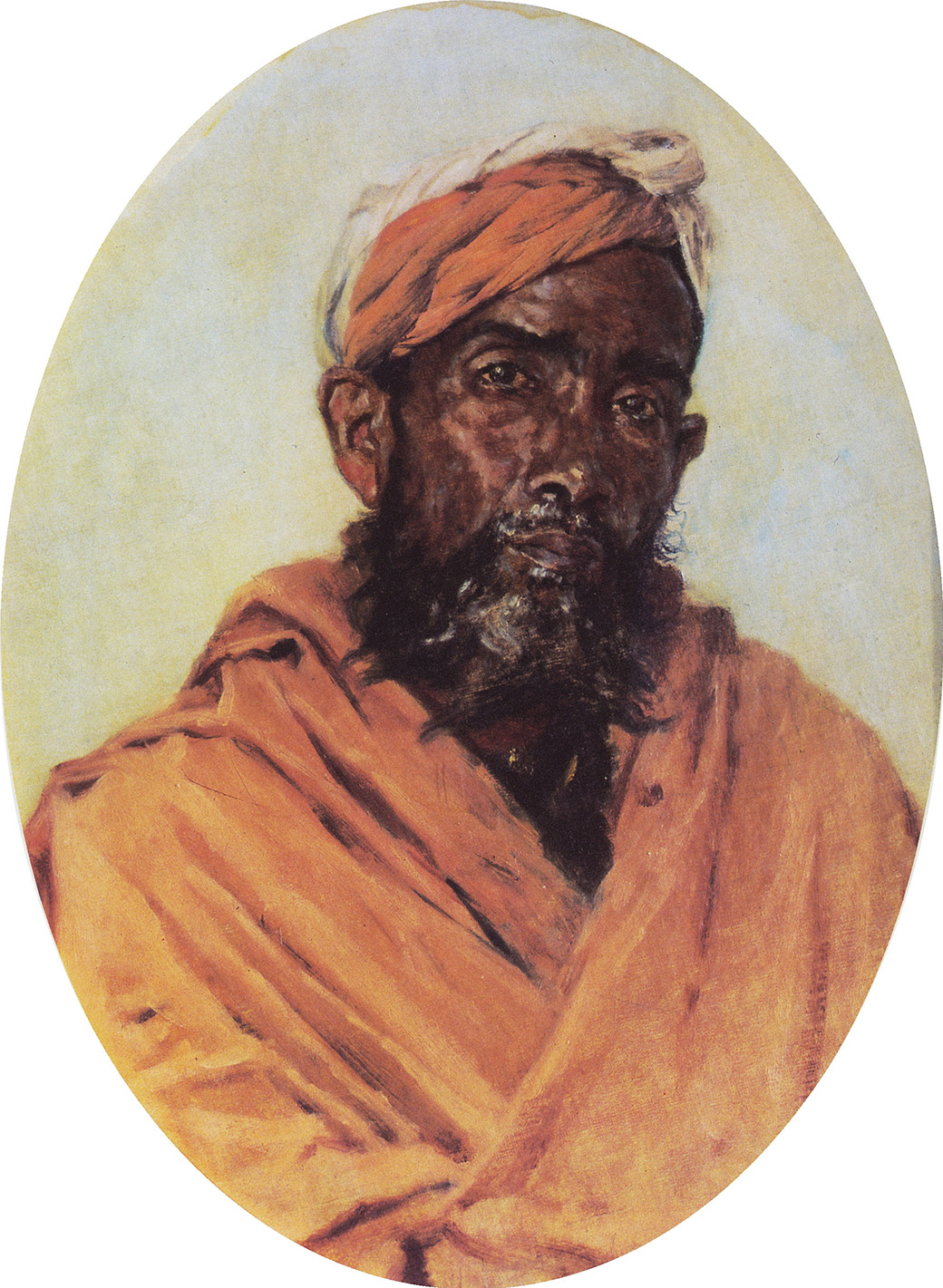
    A Muslim servant (1883), Vasily Vereshchagin | Creative Commons, courtesy arthive.com. Today’s reflection made me consider how each of us is called to be the courageous servant, near to God who upholds our “right.” It has also made me consider the Christian tenet that each of us has God within us, in our soul, and since we are called to humility and service, you can never judge a person based on their look or station in life. To that end, I’ve included a few lovely portraits from Vasily Vereshchagin that give dignity to the subjects and seem to reveal the light of God within them.

    Thus, the servant is absolutely aware that God lives beside him: “He is near who upholds my right.” I like the Lectionary translation here; the Hebrew is more literally translated as “He is near who vindicates/justifies me.” By using the phrase that the Lord upholds his “right,” we might actually come closer to the nuance in the Hebrew phrase since those words vindicate and justify have taken on a technical aspect after several thousand years of Church theology.

    We can think of this “right” in several ways. First, tracing the word “near,” the right is a statement of authority due to proximity. In other words, the servant’s sheer proximity to God, his state of “living in the light” of God, gives him the right to speak. Beyond the proximity argument, second is a statement of personal right to speak as an endowment specifically from God. This meaning traces back to the statement that “He…upholds my right.” God is gracing, upholding, this servant’s right to speak.

    Note that this is different than Natural Law envisioned by John Locke. Locke postulated that God establishes a Natural Law that grants all people certain unalienable rights. Many (myself included) think that scripture does not support Locke’s theory because, in scripture, people regularly lose their lives and communities (i.e., “rights”) when they live outside of God’s commandments and precepts. Today’s reading is a perfect example: the servant can claim his right because he lives in the light of God, as opposed to those who live in darkness. Even with the history-changing reality of Christianity, the basic right is the same: an invitation to accept God into our hearts, not a right for everyone even if they sneer at God and push him away.

    The third way we can think of “right” when the servant says “He is near who upholds my right” is the idea of correctness. God’s Word is Truth — the “well-trained tongue” is one that speaks the truth — and we can understand that the servant’s “right” is his accuracy in presenting the truth. 

    This reading culminates in a bold statement of the servant’s courage: “if anyone wishes to oppose me, let us appear together. Who disputes my right? Let him confront me.” Here is the full reality of the servant living in the light, speaking the truth. There is no space or “right” for those who live in darkness. We see a contrast between courage to speak and cowardice in not speaking, between truth and deceit.
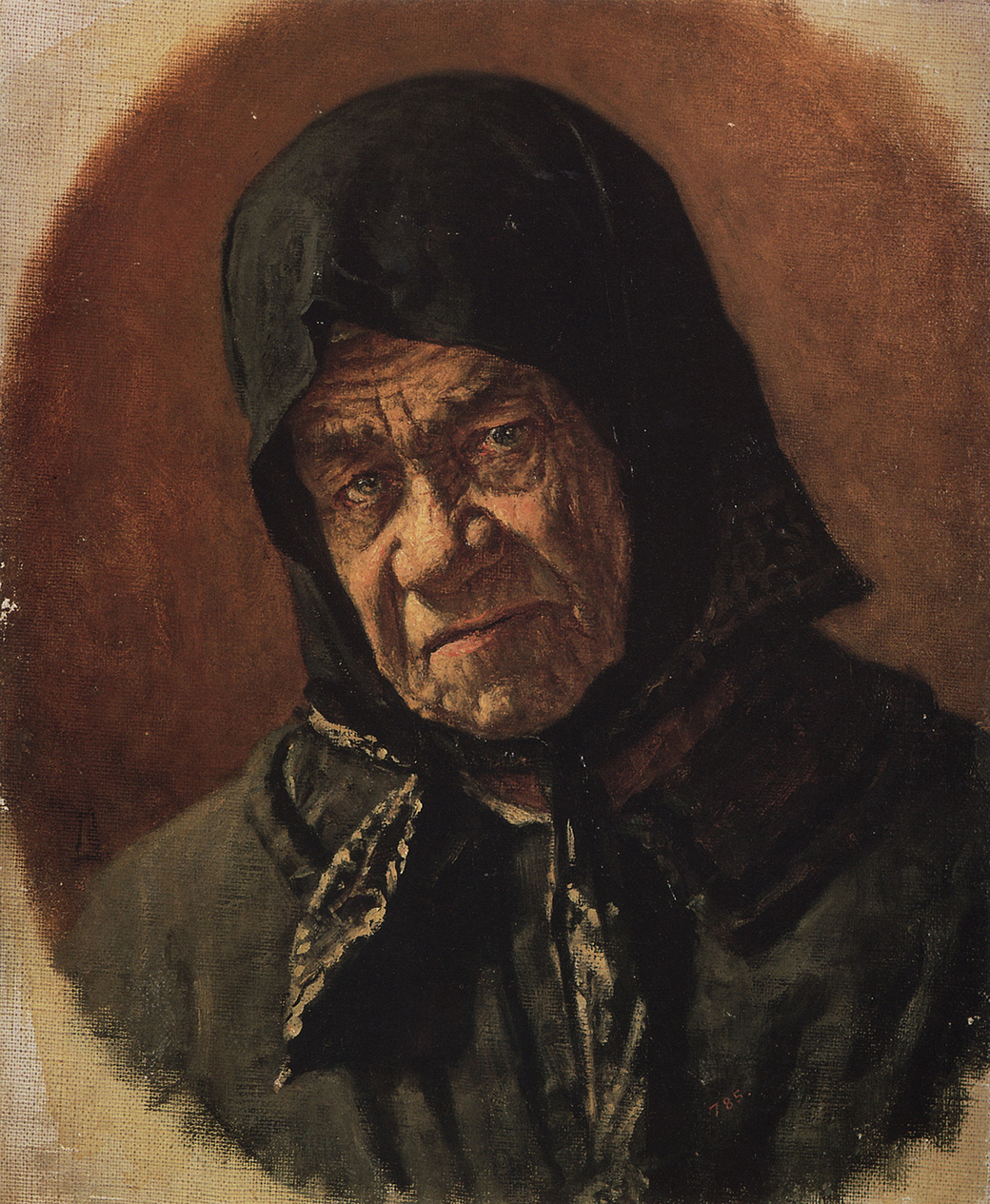
    The Old Beggar Ninety Six Years (1891), Vasily Vereshchagin | Creative Commons, courtesy arthive.com.

    These contrasts are displayed clearly in the gospel reading from St. Matthew, where Jesus gives Judas the chance to be courageous and to speak the truth, but Judas chooses cowardice and deceit. The reading opens with an account of Judas’s visit to the chief priests and his agreement to hand over Jesus for 30 pieces of silver. We can only imagine the darkness of spirit that would have made Judas turn his back on the Word of God, the Truth incarnate. Like John who tells us that “the devil had already put it into the heart of Judas” to betray Jesus, Matthew tells us, “and from that time on he looked for an opportunity to hand him over.” In other words, Judas’s betrayal did not come about in some moment of passion but out of his fallen state.

    Just as in the gospel of John, Matthew tells us that while they were eating, Jesus says, “Amen, I say to you, one of you will betray me.” What is the point of saying this? Is it meant to alarm them, stir them up with doubt and suspicion of one another?

    St. John Chrysostom provides a window into what may have been Jesus’s motivation; he writes, “And before the supper, He had even washed his feet. And see how He spares the traitor. For He said not, such a one shall betray me; but, “one of you,” so as again to give him power of repentance by concealment. And He chooses to alarm all, for the sake of saving this man” (Homilies on Matthew, 81.1). As we reflected yesterday, Christ the Good Shepherd is at work, especially here when one of his chosen Apostles’ souls is at stake. In Chrysostom’s view, Christ is trying to give Judas a chance to come back into the light of God.
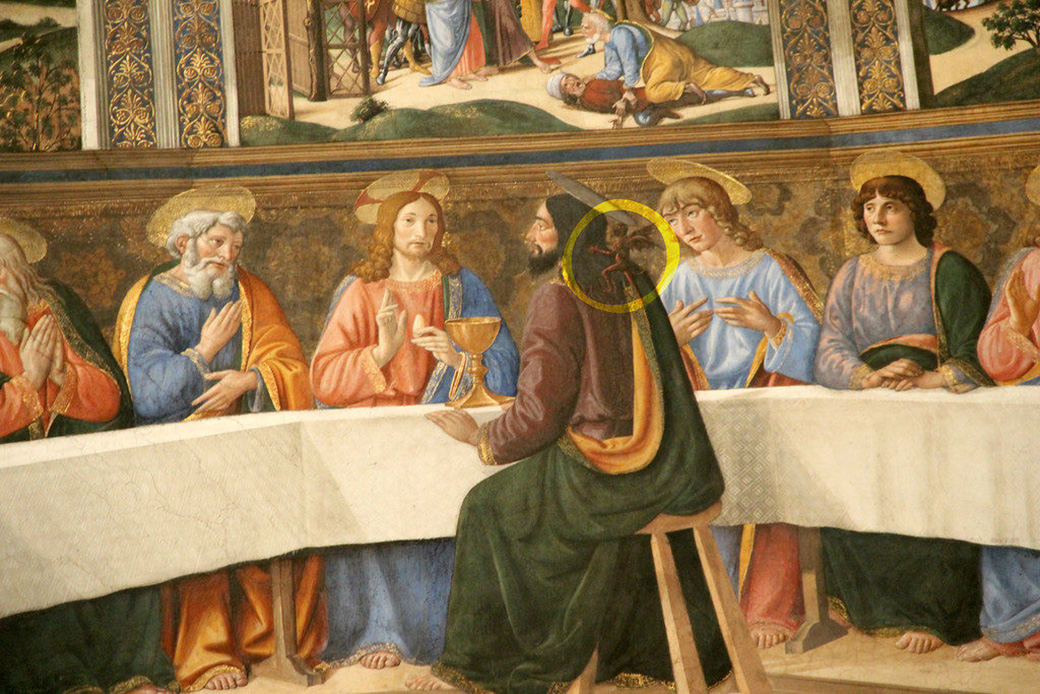
    Detail from The Last Supper in the Sistine Chapel (c.1481-1482), Cosimo Rosselli | image from sharingtravelmemories.com, including added circle. Note the devil placed on Judas’s shoulder as well as the halo that has turned gray. 

    Even after the distressed apostles say, “surely it is not me, Lord,” Jesus gives a dire warning, a last chance for Judas to come clean: “The Son of Man indeed goes, as it is written of him, but woe to that man by whom the Son of Man is betrayed. It would be better for that man if he had never been born.” Jesus has committed Himself to “going,” as John tells us, “Jesus knew that his hour had come to depart from this world and go to the Father.”

    An interesting question to ponder is if he needed to be betrayed to the chief priests; if someone had to do it even if it wasn’t Judas. It seems quite plausible that he could have simply walked into the temple the next day of his own accord and started the sequence of arrest and death. So let’s take him at his word that he was willingly accepting death and did not need to be betrayed. Then we must also see his attempt to save Judas from this great sin as genuine. He truly hoped to save him and keep him from committing this betrayal. But, as we are taught, God has given humanity free will to accept or reject him, and in this choice lies our own salvation.

    Another way to think of this is in terms of fate. “Fate” is a concept that doesn’t take responsibility for the reality of humans making choices in regards to God’s invitation to be with him. Instead, “fate” makes it seem like its’ all out of our hands. I don’t think Judas was “fated” to betray Jesus, and based on today’s reading, Jesus didn’t believe that this was somehow pre-ordained by God, because he tries to save Judas from this error.

    So, what happens when Jesus speaks in truth like Isaiah’s courageous servant, saying, “if anyone wishes to oppose me, let us appear together.” He invites Judas to speak openly of any concerns or changes of heart, to return to him, without calling him on the carpet in front of the other Apostles. What is Judas’s response? “Surely it is not I, Rabbi?” He hides in the cover of deceit, he takes on cowardice rather than courage. This is because he has taken the devil into his heart rather than God and he operates in the devil’s ways.

    Jesus simply (and I must imagine sadly) responds, “You have said so.” This is the only sad truth he can utter in the face of Judas’s cowardice and deceit. Chrysostom gives us a heck of a reaction to this:

    Oh insensibility! He inquires, when conscious to himself of such things. … What then says the most mild and gentle Jesus? “You say.” And yet He might have said, “O thou unholy, thou all unholy one; accursed, and profane; so long a time in travail with mischief, who hast gone your way, and made satanical compacts, and hast agreed to receive money, and hast been convicted by me too, do you yet dare to ask?” But none of these things did He say; but how? “You say?” fixing for us bounds and rules of long suffering (Homilies on Matthew, 81.2).

    I love Chrysostom’s commentary here, if for nothing else because it shows that in 395 AD, his jaw was dropping at the deceitfulness of Judas in the same way mine is today. I also appreciate how he concentrates on the “most mild and gentle Jesus,” who sets an example for us on “long suffering,” that is, patience in the face of troubles caused by others. 
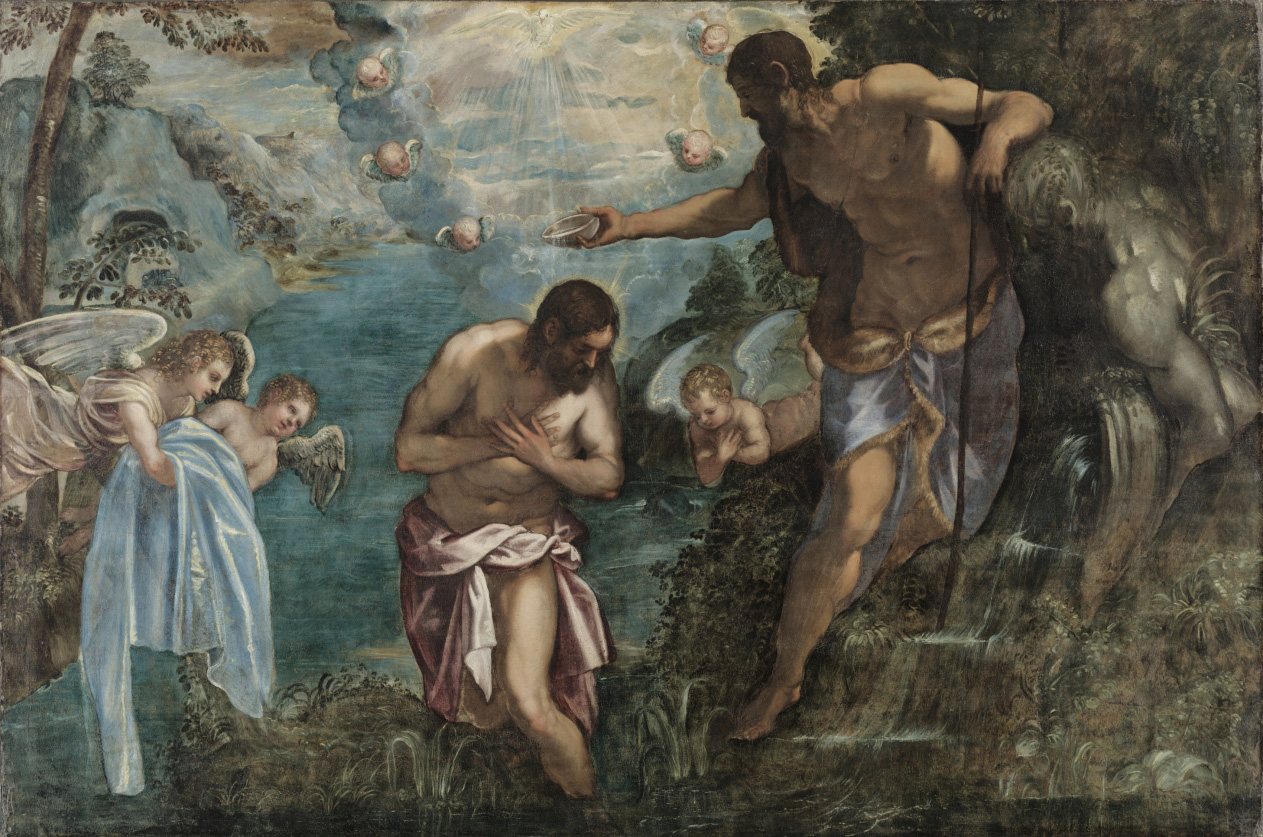
    Baptism of Christ (1580s), workshop of Jacopo Tintoretto | Creative Commons, courtesy of Cleveland Museum of Art. I appreciate the humble servant aspect of Christ depicted here as He begins His ministry, also the form of the Spirit that is pouring out the water of everlasting life.

    Let us take the challenge from Christ to live in the light of God, to have our “right” come from him and him alone. May we well heed the terrible choice that Judas makes to turn his back on God and live in the cowardice and deceit of the devil; “woe to that man.”
  • Seeing with the Light of the Lord

    Seeing with the Light of the Lord

    Fourth Sunday in Lent: 1 Samuel 16:1b, 6-7, 10-13a, Ephesians 5:8-14, John 9:1-41.

    Today’s readings reveal to us how differently from us that the Lord sees, and how Jesus came to reveal the blindness in us and reverse it through himself. The dialectic of light vs. darkness is another way to understand good and evil, and allows us to examine our own senses in the process. Living “in the light,” we are told, is more a matter of the heart than sight. 

    In the first reading, the Lord sends Samuel to Bethlehem to anoint the new king he has chosen from among Jesse’s eight sons. He warns Samuel, “Do not judge from his appearance or from his lofty stature, because I have rejected [these ones].” God has more to say about seeing and judging, which we might call discernment: “Not as man sees does God see, because man sees the appearance but the LORD looks into the heart.” So we receive an important message, that God peers into the very hearts of people when he “looks,” something that we are unable to do. We require God’s help when it comes to true discernment.

    Today’s passage also gives us many ways in which David prefigures Jesus. In scripture, we often encounter the “house of David” and the “Tree of Jesse” from which Jesus comes. It’s fascinating to dwell on today’s verses where God has chosen David. As we listen to the Word of God, who will be born to Mary in Bethlehem, who will be the Good Shepherd for the world, it’s interesting to hear that Jesse dwells in Bethlehem and David is out tending the sheep when the seven other sons are presented to Samuel for potential anointing. The Word is implanting prophecy about His eventual arrival. In this way, David and the lineage of Jesse are a sign of the greater thing to come.

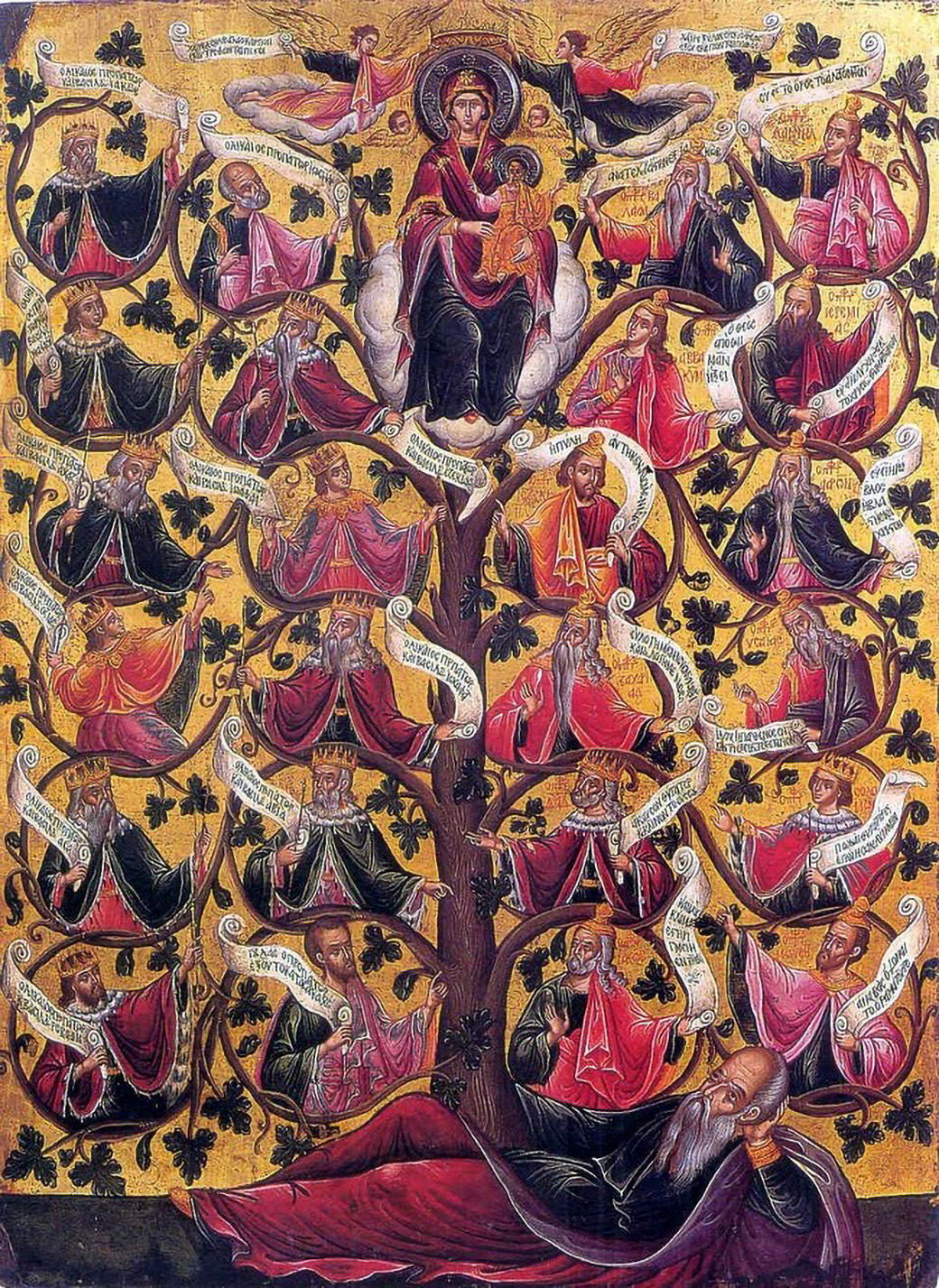
    Root of Jesse icon, provenance unknown | Creative Commons, courtesy iconreader.wordpress.com. In Russian icons this is also known as the Tree of Jesse. Its inspiration comes from Isaiah: “There shall come forth a shoot from the stump of Jesse, and a branch shall grow out of his roots” (Is 11:1). St. Ambrose of Milan writes: “The root is the household of the Jews, the rod is Mary, the Flower of Mary is Christ. She is rightly called a rod, for she is of the royal lineage, of the house and family of David. Her Flower is Christ, Who destroyed the stench of worldly pollution and poured out the fragrance of eternal life. As He Himself said, ‘I am a flower of the plain, a lily of the valleys.’”

    Transitioning to the second reading, I am always struck at how the Word of God works through St. Paul in marvelous ways. Remember that Paul never met Christ before his death; he became an Apostle through the Risen Christ appearing to him. And what an Apostle! We have inherited so much knowledge, encouragement, and theological understanding from him.

    His conversion to Christ is a great example of what we shall see in the gospel reading: the light of Christ opens his eyes. He was spiritually blind and this blindness was rendered literally for him. We are told, “Saul got up from the ground, and though his eyes were open, he could see nothing; so they led him by the hand and brought him into Damascus. For three days he was without sight, and neither ate nor drank” (Acts 9:8-9). There is a sense of penance here, where Saul, on his way to becoming St. Paul, must go into the desert to fast and contemplate (like we do in Lent).

    But this is just the beginning for him, as he will soon pick up his cross and follow Christ in both suffering and spreading the message of salvation. The disciple Ananias is hesitant to cure his blindness as Christ bids him, but Christ tells him, “he is an instrument whom I have chosen to bring my name before Gentiles and kings and before the people of Israel; I myself will show him how much he must suffer for the sake of my name” (Acts 9:15-16). Oh, the penance will continue! To whom much is given, much will be required (Lk 12:48), says the Lord. At Ananias’s touch, the blindness falls from his eyes “like scales,” he is baptized, and he is on his new path. 

    In today’s reading from Paul’s letter to the Ephesians, he must have been thinking of his own experience when he writes, “You were once darkness, but now you are light in the Lord.” Note that he doesn’t say, you were once in darkness, but that they were darkness and now are light. He was, in fact, “darkness” in both spiritual sight and deed since he physically persecuted disciples of Christ before his own conversion. Thus Paul gives us another understanding of darkness and light not just being aspects of sight (either physical or spiritual), but also ways of being.

    He continues, “Live as children of light, for light produces every kind of goodness and righteousness and truth. Try to learn what is pleasing to the Lord. Take no part in the fruitless works of darkness.” Note how he conceives of light as “producing” goodness, not just revealing it. And how darkness produces fruitless works. We see Paul building the Church, providing instruction for fledgling communities of those baptized in Christ. Through their Baptism, Christ has opened their eyes to spiritual light, and now Paul is deepening their understanding of that light. It is a light, he says, that is active and productive in the world. This is the Holy Spirit working through the Church, part and parcel of a Baptism in Christ, who is the gateway to the divine essence, an essence that continually creates goodness in the world.

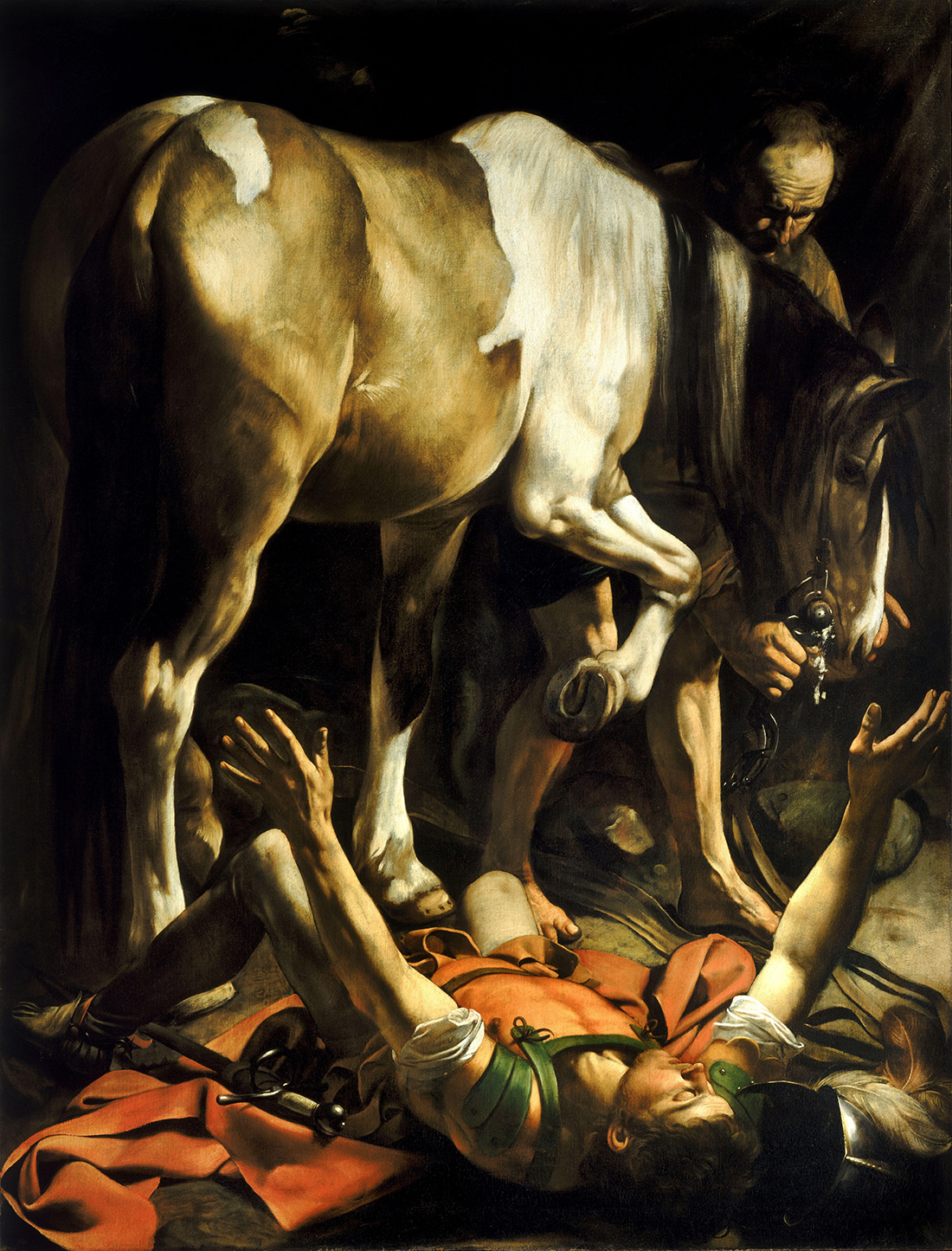
    Conversion on the Way to Damascus (1600-1601), Caravaggio | Wikimedia Commons. There is much to say about this, one of Caravaggio’s masterpieces, from the striking use of light to the opening of St. Paul at the same time of blinding him, but let’s contemplate on what Caravaggio might be saying about the person Saul was at that point by giving us such a magnificent horse’s ass to look at!

    This is a light that doesn’t just reveal truth but transforms the person. Today’s gospel from St. John is a masterpiece of depicting this revelation in the curing of the blind man. This morning, Bishop Robert Barron presents a great exposition of the gospel reading in his live-streamed daily mass and mentions how St. John’s writing is akin to icon writing, where you can look at every detail in an icon and see how rich it is in symbolism and tells another aspect of the story.

    The first detail to note is that the man is blind from birth — not from cataracts or disease, but fundamentally blind since he came into the world. Why is this important? St. Augustine tells us: “that blind man is the human race; for this blindness had place in the first man, through sin, from whom we all draw our origin, not only in respect of death, but also of unrighteousness. For if unbelief is blindness…” (Tractate 44 on John 9, 1). Recall God telling Samuel “not as man sees does God see,” and here we are given a story about how man (in general) cannot see.

    Christ passes by this man, but when his disciples fruitlessly question who is at fault for the man’s blindness, he stops. He says, “Neither he nor his parents sinned; it is so that the works of God might be made visible through him.” Again, this clues us in to the universal application of the story to all of mankind. Jesus adds, “We have to do the works of the one who sent me while it is day. … While I am in the world, I am the light of the world.” Jesus speaks here of the irresistible nature of the Spirit of the Lord, active in the world. He is compelled, he must do the works of God while here on earth. To that end, he sets about healing the blind man. He is not asked to do this, he does it gratuitously.

    As a child, I always wondered about this next bit of the gospel. With other miracles, we hear Jesus say, “your faith has healed you,” or someone is healed just by touching the hem of his garment. But here we see something that seems like a magician’s ritual: “he spat on the ground and made clay with the saliva, and smeared the clay on his eyes.” Is this necessary? How is spitting and making clay related to Christ’s mission on earth?

    Nothing Jesus does is meaningless, and he certainly doesn’t need obscure rituals to heal people. So let’s examine this act and what it signifies. St. Augustine tells us plainly, “The Word is as it were the spittle, the Flesh is the earth” (Sermon 85 on the New Testament [CXXXV. Ben.], 1). Just as “the Lord God formed man from the dust of the ground,” (Gen 2:7), we see Christ initiate a similar act of creation using the dust on the ground. This act of (re-)creation for humanity comes in the form of the uniting of the Word (his spittle) and humanity (the earth); in other words, Jesus Himself is the clay that is the unity of the river of life (spittle) and the earth. Jesus spreads Himself on the eyes of the blind man.

    And Christ emphasizes the great mystical unity and energy that is the Trinity by telling him, “Go wash in the Pool of Siloam.” John helpfully tells us, “which means Sent,” so we can connect the dots. First, washing in the pool represents Baptism. What is the Baptism Christ offers us? St. John the Baptist tells us, “he will baptize you with the Holy Spirit” (Lk 3:16). So, Christ is pointing to the work of the Holy Spirit in this baptism in the Pool of Siloam.

    Second, the pool’s name means “Sent,” and Jesus has just said, “We have to do the works of the one who sent me.” Thus, the entire affair is done under the auspices of God the Father, who has sent Christ and sends the Holy Spirit. The life-giving water of the Holy Trinity, the overflowing love that characterizes the essence of our Three-in-One God, is the action that grants sight to the man blind from birth.

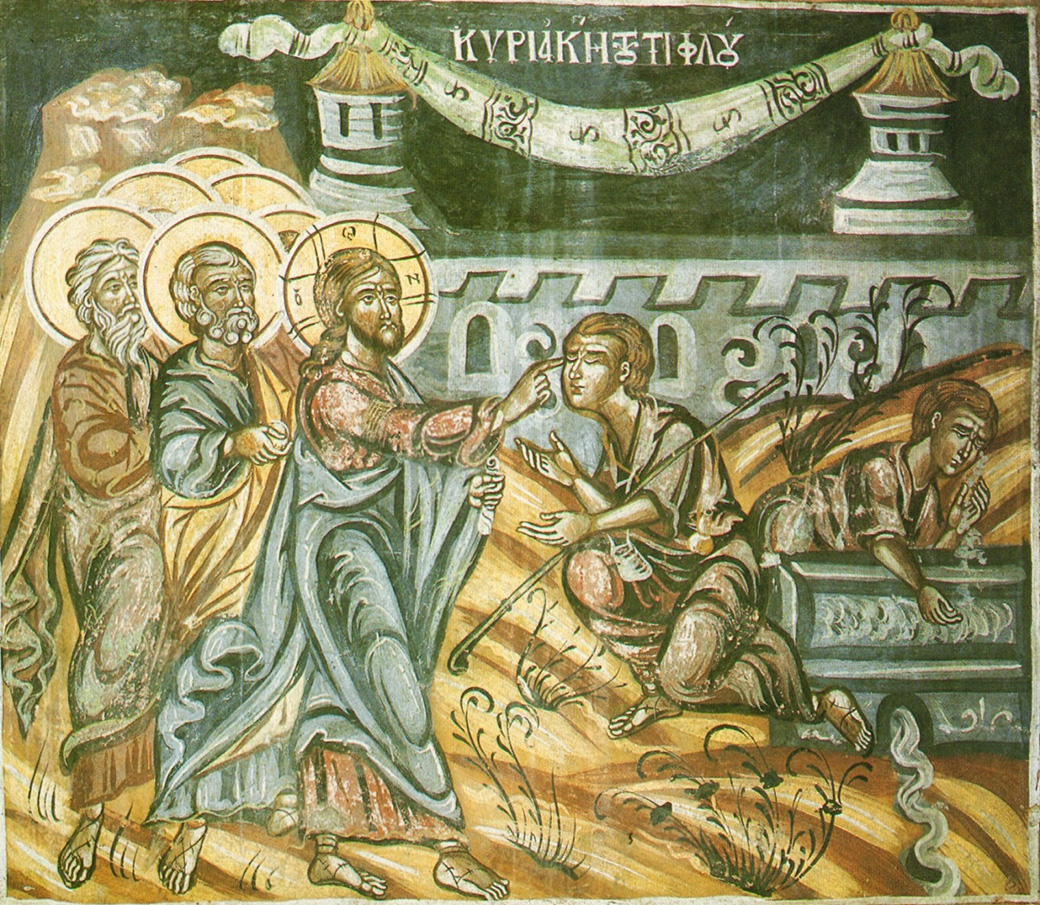
    Healing of the Blind Man from Birth, unknown provenance | Creative Commons, courtesy johnsanidopoulos.com.

    Let’s think more about this pool named Sent. After the man is cured of his blindness, he is asked many times by his neighbors and the Pharisees how this came about. His answer is simple: “He put clay on my eyes, and I washed, and now I can see.” But the more he is interrogated, the more he must contemplate this action and the more he must be the light (to recall the second reading from St. Paul). This man finally takes on the role of teacher to the Pharisees, a startling reversal for one who was a beggar:

    “This is what is so amazing, that you do not know where he is from, yet he opened my eyes. We know that God does not listen to sinners, but if one is devout and does his will, he listens to him. It is unheard of that anyone ever opened the eyes of a person born blind. If this man were not from God, he would not be able to do anything.”

    He answers them with the ineffable logic of the truth and the light. And so this man sets the stage for several millennia of Christians who — once they accept Baptism and the light offered by Christ — answer skeptics with clear logic. From St. Augustine through the medieval scholastics like St. Thomas Aquinas to contemporary popes, we hear similar explanations as they evangelize in the light of Christ.

    And so we can see how the man himself is sent from the pool by God, carrying a new message for the world. All of us who are baptized Christians both receive his mercy and love have been sent by God to give his mercy and love to the world.

    This inevitably means that we will be rejected by those living in darkness. Christ finds the man after the Pharisees kick him out of the temple and reveals his true nature to him. He tells him, “I came into this world for judgment, so that those who do not see might see, and those who do see might become blind.” Here we find the double-edged sword that is the Truth: it not only saves us from spiritual blindness, but it condemns those who cling to their flawed human “sight.” God’s plan is to unite us to Him, and those who choose darkness over the light will be condemned to live in perpetual blindness.

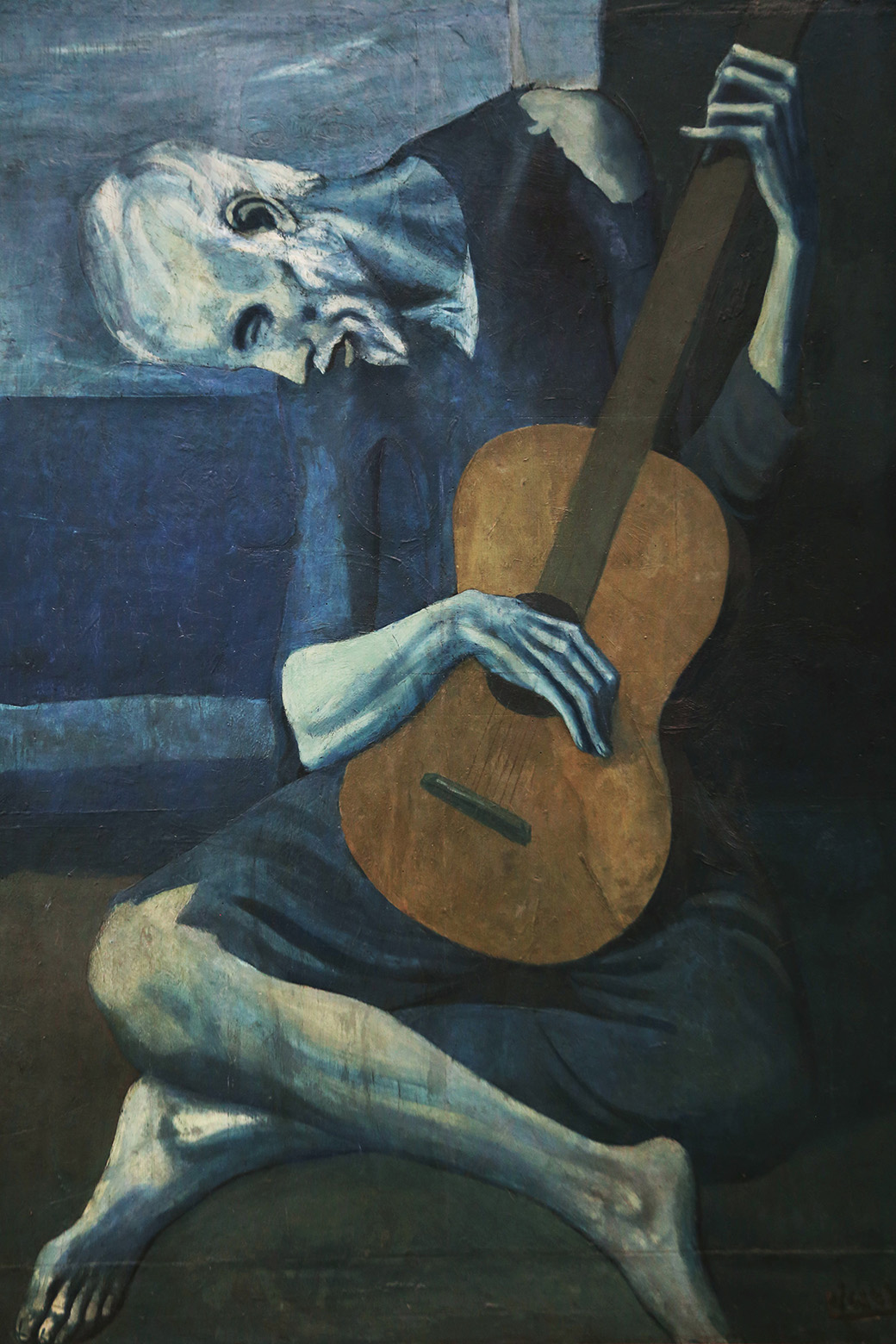
    The Old Guitarist (1903-1904), Pablo Picasso | Wikimedia Commons. Picasso painted this during his Blue Period, a time of depression and desolation after his good friend committed suicide. We see a resignation to death in this old, blind guitarist, clinging to life in the form of his guitar. When seen in the light of today’s gospel, we might see in this the blind clinging to their earthly concerns and ways of knowing, pushing away the light offered by Christ and soon to be condemned to dwell for all eternity in that darkness unless they accept Christ.

    This brings me back to St. Paul, who lived his life being sent by the Lord, being rejected by those in darkness. Yet he never failed in passing along this great impetus of being sent — his evangelization aimed to encourage others in spreading the faith, living the faith, being active, not stagnant. As he tells us today, “now you are light in the Lord. Live as children of light.”