Holy Thursday – Evening Mass of the Lord’s Supper: Exodus 12:1-8, 11-14, 1 Corinthians 11:23-26, John 13:1-15.
We know the readings of the Easter Triduum well, as we should; it is our highest of feasts, the culmination of Christ’s mission and ministry. On this Holy Thursday, the Lord is ready; his hour has come. As I consider these readings, I’ve been asking myself how I would spend my last hours on the earth, and how Christ’s message at the Last Supper can guide me.
The first reading from Exodus recounts the institution of the Passover meal that commemorates the truly terrifying Passover night in Egypt. In describing the Passover meal, this reading relates to Holy Thursday, and in describing the blood marking the houses of the Israelites, it relates to the Lord’s death on Good Friday.
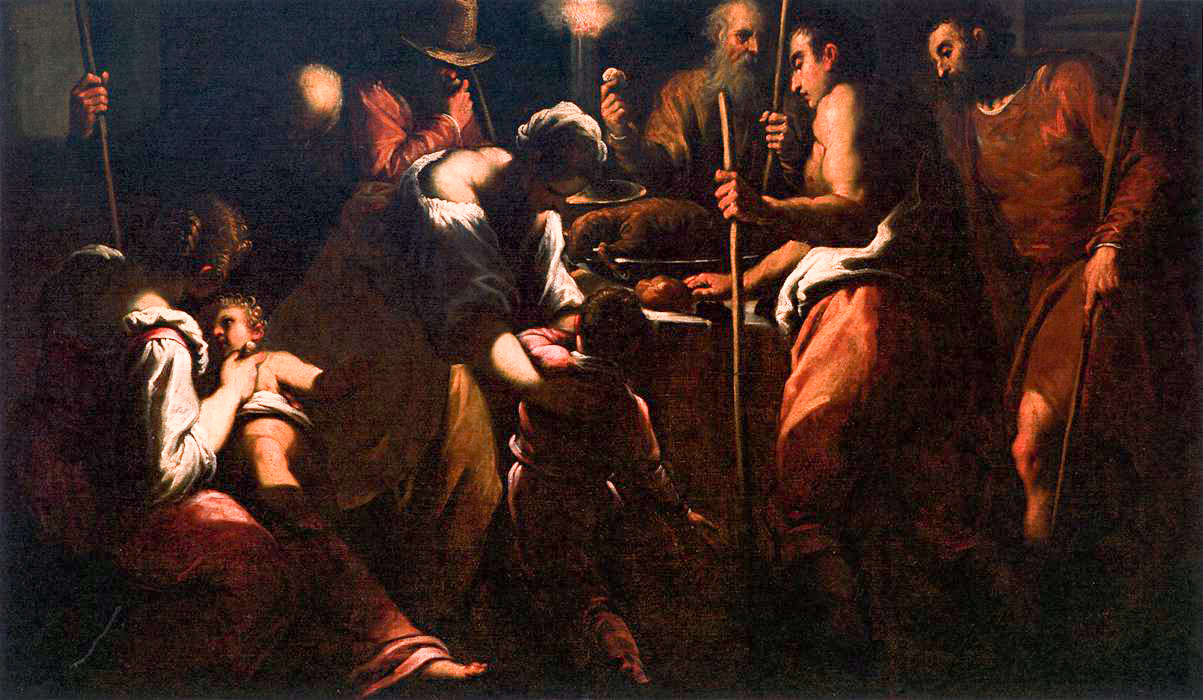
Jesus instituted the greatest sacrament, the Eucharist, during the Last Supper (as St. Paul recounts in the second reading). Let’s consider how the Word of God prefigured the meal of the Eucharist in the institution of the Passover meal. First, there is the regularity of the Passover meal — it is held annually on the 14th of the first month. For the Catholic Church, the Eucharistic meal is so much more central to our being that we celebrate it with every gathering (Mass), a regularity that has been instituted at least every Sunday. Next, the Word of God establishes the mark of purity for this meal; he prescribes that “The lamb must be a year-old male and without blemish.” Also, there is one lamb per family and it is to be slaughtered at twilight, at which point some of its blood is to be applied “to the two doorposts and the lintel of every house” where they “partake” of the lamb. What is the point of these prescriptive rituals? This is but one of many animal sacrifices described in the Old Testament, and part of the challenge for the Jewish nation was to uphold these prescriptions in order to display their faithfulness to God. This speaks to a certain type of ritual beauty that exists in its particularity for each sacrifice — whether those participating were in the desert, in the glorious time of King Solomon, or in the Babylonian Exile, each connected ritually with God in a way that is both shared yet particular to their place and time. In addition to instilling an appropriate thankfulness as the Jews recollect the original Passover, God was establishing a special place for the “unblemished lamb” in their cultural memory to be ready for the time when the Lamb of God, pure of sin, comes for his ultimate sacrifice.
Eating the slaughtered lamb is an important part of the Passover ritual: “That same night they shall eat its roasted flesh with unleavened bread and bitter herbs.” The Word of God made flesh, Jesus Christ, establishes the full meaning of this ritual when he says, “This is my body that is for you. Do this in remembrance of me” (Mk 14:22, Lk 22:19, 1 Cor 11:24) and “Amen, I tell you, unless you eat the flesh of the Son of Man and drink his blood, you have no life in you” (Jn 6:53). As Christians, we understand the Passover lamb as the precursor (easier to understand and easier to “stomach”) to the true Paschal Lamb, Christ Himself.
In the same way, we understand the Passover deliverance from the wrath of God that ravaged “every firstborn of the land, both man and beast” in Egypt as a precursor to Christ’s deliverance from the ravaging of every person on earth, condemning them to Gehenna. Our Eucharistic feast is a dense recollection of the great mystery of the Christ event: it is a gift from God, it is a joining of the food of life and the great sin-atoning sacrifice, it is a fulfillment of generations of Jewish ritual and God’s preparation of human hearts for his entrance into humanity. At the same time, it is real food, truly the flesh of the Lord present through the mystical action of the Spirit in our liturgy. The mysterious sacrament of the Eucharist, the heart of our Mass and the “source and summit of our faith,” can be plumbed endlessly for theological significance but more importantly provides real-world transformation of humanity.
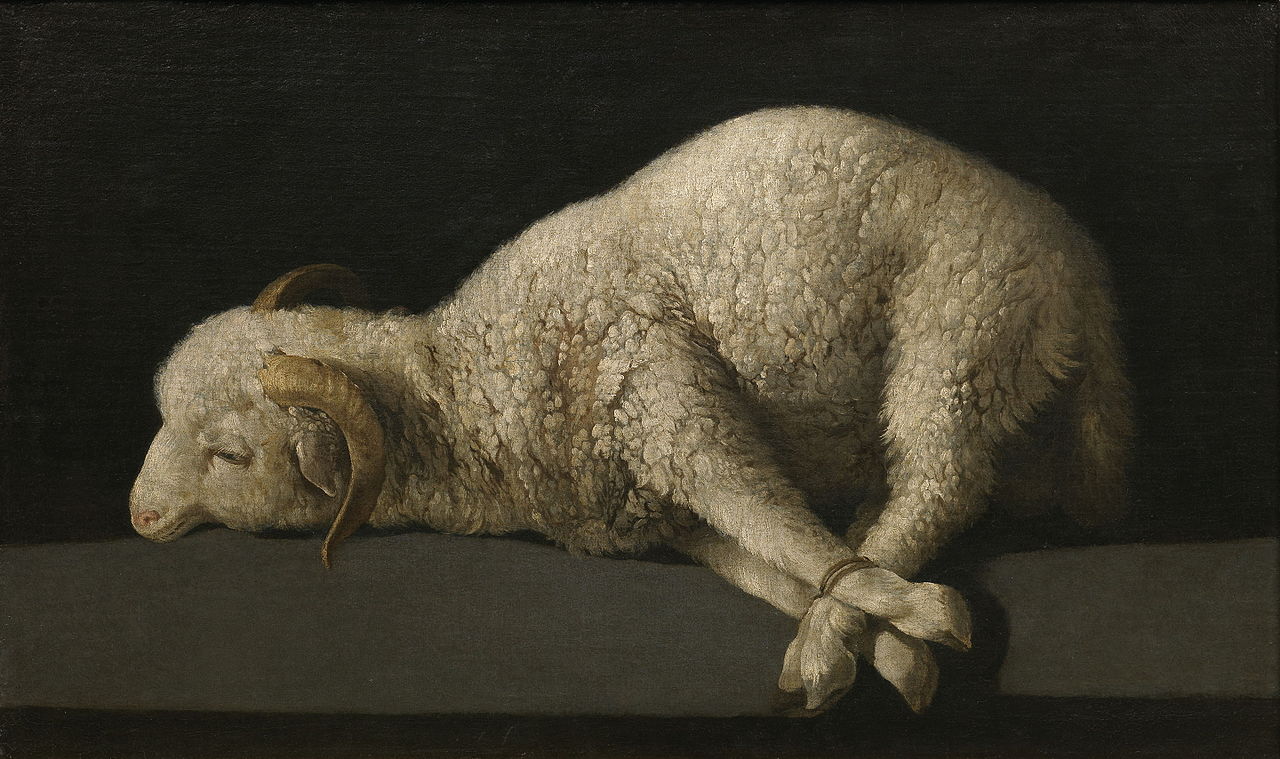
A final instruction from God to Moses is important to note. He instructs the Jews to eat the Passover meal in a certain way: “with your loins girt, sandals on your feet and your staff in hand, you shall eat like those who are in flight.” This idea of being on the way to something greater, not tied to the things of this world, was embraced from the very beginning of the Church. Jesus tells his apostles on this Holy Thursday, “but because you do not belong to the world, and I have chosen you out of the world, the world hates you” (Jn 15:19).
Peter acknowledges this transitory nature of our existence and our belonging to something other than this world in his epistle, “I appeal to you, my friends, as strangers and refugees in this world! Do not give in to bodily passions, which are always at war against the soul” (1 Peter 2:11). And, of course, St. Paul gives us a number of memorable passages related to this, including “Do not be conformed to this world, but be transformed by the renewing of your minds” (Rom 12:2). So, drawing on Jesus saying “I am the way, and the truth, and the life. No one comes to the Father except through me” (Jn 14:6), Christians very truly had their “loins girt, sandals on your feet and your staff in your hand” — in their thirst to follow Christ and be with the Father, they were “On the Way.” We read in the Acts of the Apostles that the earliest Christians referred to themselves as followers “of the Way” (cf. Acts 9:1-2).
It’s incredible that the Last Supper, this pinpoint moment in a room with his Apostles, is the moment that the Word of God begins to reveal the true fulfillment of these ancient rituals. Yet there is also the drama of Judas’s betrayal and Christ’s effort to save Judas from this great sin (see yesterday’s reflection). Despite the knowledge of his entire ministry coming to an end and the drama of betrayal and denial by his closest friends, Jesus patiently goes about setting everything in order.
Think about the to-do list here: giving his Apostles one last great moment of teaching, instituting the Eucharist, establishing the momentum for the Church to continue, leaving time to travel “to the mountain” (Mount of Olives) to have a prayerful encounter with his Father in anticipation of the Passion and Crucifixion ahead … all in a matter of a few hours! It’s remarkably, almost serenely organized.
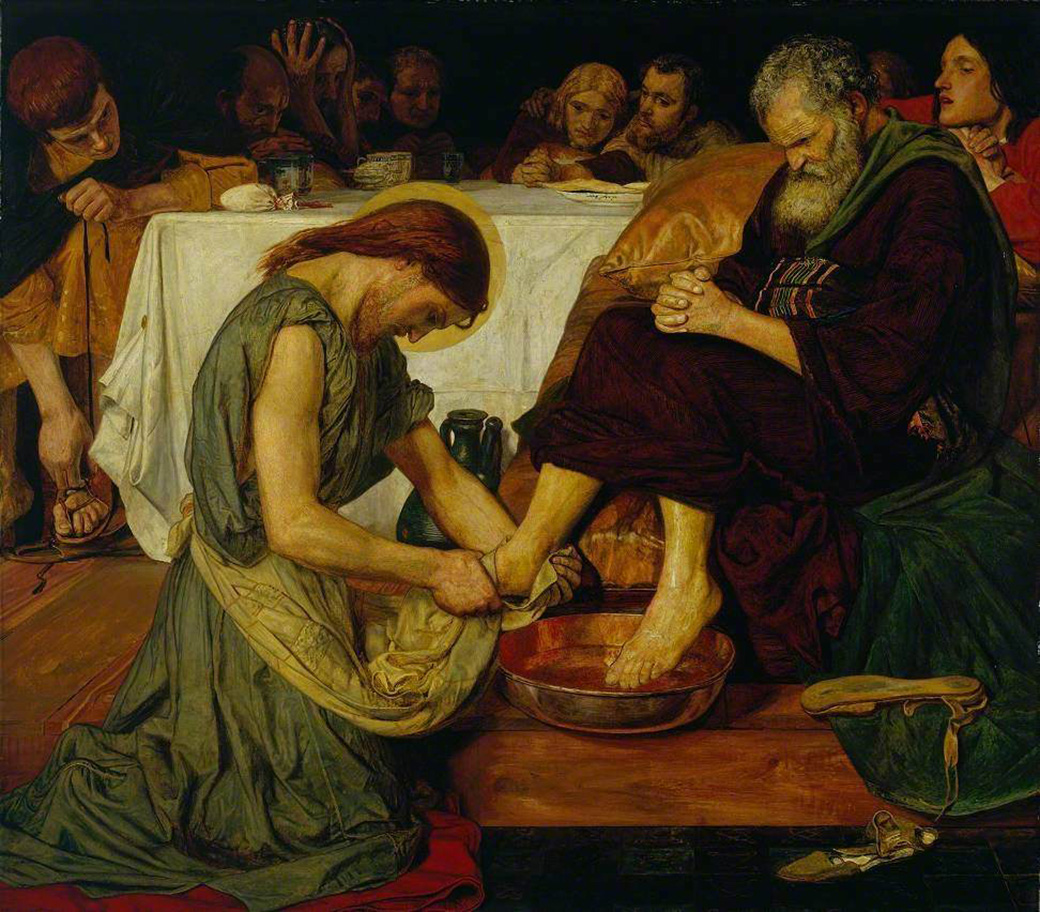
Today’s gospel focuses on Christ the servant, who “rose from supper and took off his outer garments. He took a towel and tied it around his waist. Then he poured water into a basin and began to wash the disciples’ feet.” St. Augustine of Hippo in Tractate 55 on the Gospel of John explains how each of these actions relates to something significant in the manner of his saving sacrifice. I’d like to use some of his ideas and some from other sources to consider this extraordinary action of our Lord.
First, he rises from the supper and takes off his outer garments — as an action, this reminds me of his Resurrection to come and the garments found in the empty tomb, and as such this act of washing the feet is a salvific act akin to the Resurrection itself. St. Augustine also notes that “When about to be crucified, He was indeed stripped of His garments,” so we see a parallel in the Crucifixion, too.
Indeed, Fr. Jean Corbon notes that the Crucifixion and Resurrection “are not two events, but two phases or moments of the same mystery” (Wellspring of Worship, 46).
Next, Jesus ties a towel around his waist like a servant, and St. Augustine compares this to the larger humility of the Word of God taking on human form. Then, he doesn’t ask for some water in a bowl, but pours the water into the basin himself. St. Augustine notes that this is like how he “poured His blood upon the earth to wash away the filth of their sins,” and I see a clear parallel to the endless pouring out of love, of the water of everlasting life, that flows continually between the three Persons of the Trinity (as we have explored in several previous reflections).
Finally, there is the washing of the Apostles’ feet. This lowly act of a servant is important for Jesus to model for his apostles, so much so that he tells Peter that he’ll tell him why he’s doing it after it is done, so as to not disrupt the action by discussing it. St. Augustine notes that he even deigns to wash Judas’s feet: “the greatness of His humility should be still further enhanced by the fact that He did not esteem it beneath His dignity to wash also the feet of one whose hands He already foresaw to be steeped in wickedness.”
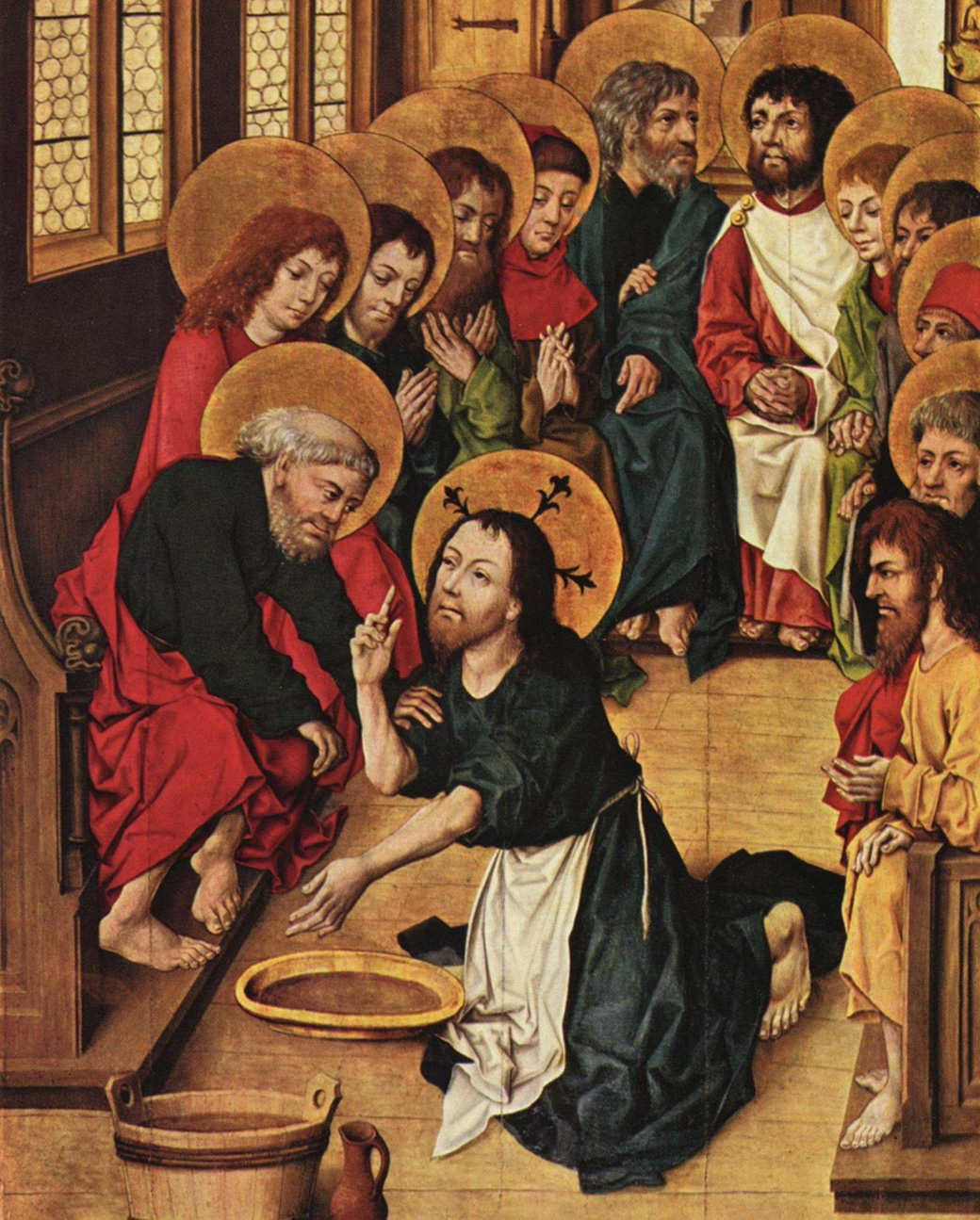
Peter’s reaction is typically passionate and vacillatory. First, he says, “You will never wash my feet” because he thinks it is too far beneath his Lord and Savior. After hearing that he needs it or he will “have no inheritance” with Christ, Peter pulls a quick 180° turn: “then not only my feet, but my hands and head as well.”
Oh, Peter. Your heart is in the right place, but sometimes it seems like you have no check on your mouth.
But Jesus uses Peter’s outbursts to teach us something important: “Whoever has bathed has no need except to have his feet washed, for he is clean all over.” What can this cryptic message mean? If we have bathed are “clean all over,” aren’t our feet clean, too? When I think of the feet, I think of those things that ground us, both literally and in our faith (faith means to “stand on firm ground” of that which we can’t prove, as Cardinal Joseph Ratzinger writes). And I think of those things that keep us on the move, signifying that we are agents of action in the world. Why do these appendages that ground us and yet move us require refreshment and purification before we sit down at table with our Lord?
In his homily for Holy Thursday on March 20, 2008, Pope Benedict XVI gives us a great explanation of this response from Jesus:
Yet here, with the distinction between bathing and the washing of the feet, an allusion to life in the community of the disciples also becomes perceptible, an allusion to the life of the Church. It then seems clear that the bathing that purifies us once and for all and must not be repeated is Baptism – being immersed in the death and Resurrection of Christ, a fact that profoundly changes our life, giving us as it were a new identity that lasts. … It seems to me that the First Letter of St John gives us the key to understanding [the “washing of the feet”]. In it we read: “If we say we have no sin, we deceive ourselves, and the truth is not in us. If we confess our sins, he is faithful and just, and will forgive our sins and cleanse us from all unrighteousness” (1: 8ff.). We are in need of the “washing of the feet”, the cleansing of our daily sins, and for this reason we need to confess our sins as St John spoke of in this Letter. We have to recognize that we sin, even in our new identity as baptized persons. We need confession in the form it has taken in the Sacrament of Reconciliation. In it the Lord washes our dirty feet ever anew and we can be seated at table with him.
I think Pope Benedict XVI’s analysis is spot-on, and fits with this idea of the feet grounding us in faith. The liturgy, where we are “at table with the Lord,” is the wellspring for our faith to be continually renewed, refreshed, and purified. These feet, doing the work of carrying us and our Christian message around the world to all those we meet, will of course get dirty and need to be re-washed.
So much meaning condensed in such a humble act! As Jesus asks when he is finished, “Do you realize what I have done for you?” Jesus brings the whole mystery of the Word of God’s descent into humanity into this act of a servant for his apostles. He signals this when he says, “You call me ‘teacher’ and ‘master,’ and rightly so, for indeed I am.” Remember his words from St. Matthew’s gospel back in the second week of Lent: “Call no one on earth your father; you have but one Father in heaven. Do not be called ‘Master’; you have but one master, the Christ” (Mt 23:9-10; see the reflection Led by the Master). In other words, he is invoking his own teaching to re-establish here that the Christ, the Messiah, is speaking.
And what he says: “If I, therefore, the master and teacher, have washed your feet, you ought to wash one another’s feet. I have given you a model to follow, so that as I have done for you, you should also do.” We must understand his washing of feet as both the humility/action of a servant as well as a metaphor for a specific type of service related to the ritual cleansing in confession. As Pope Benedict XVI also says in his Holy Thursday homily: “We must wash one another’s feet in the mutual daily service of love. But we must also wash one another’s feet in the sense that we must forgive one another ever anew.”
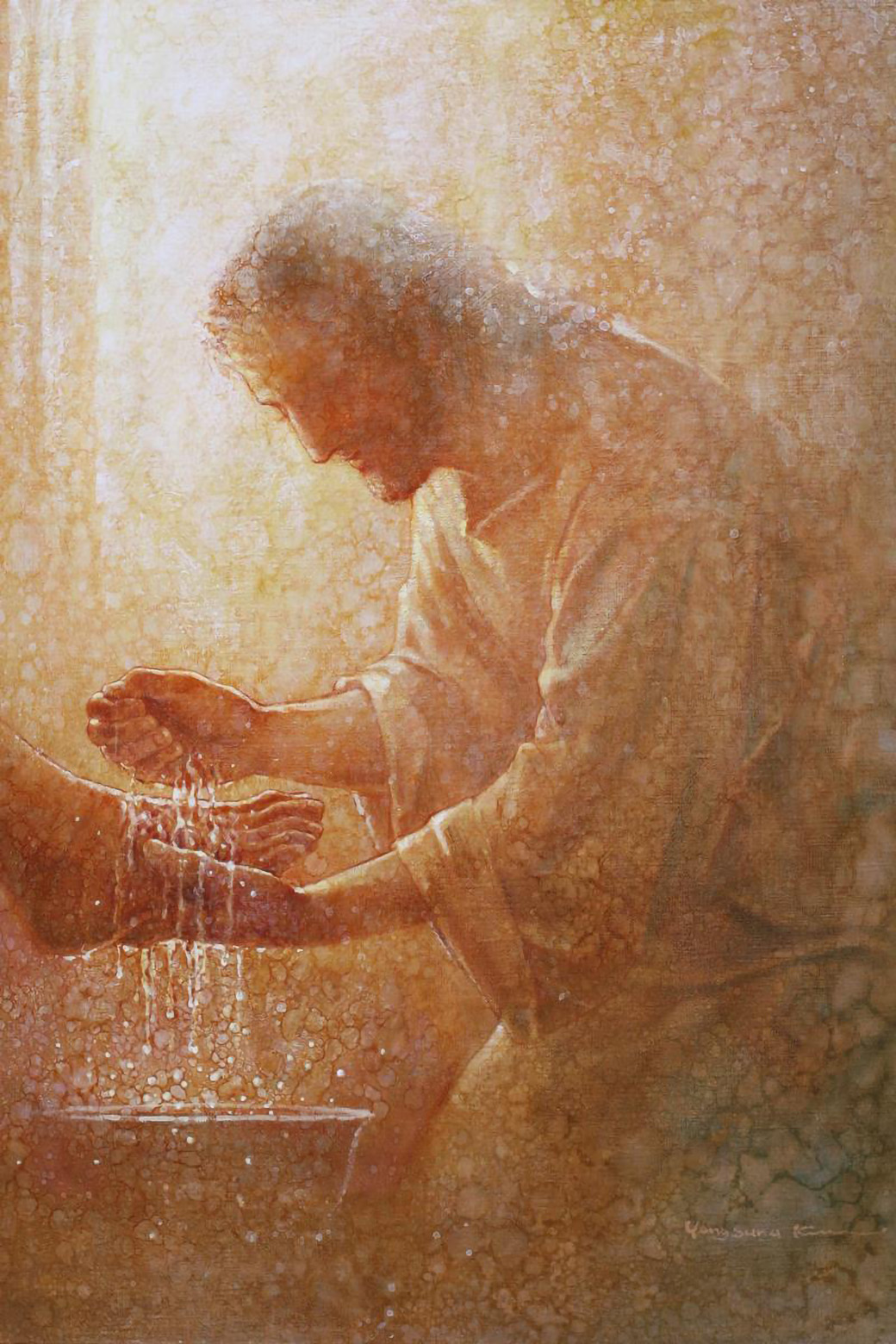
And thus the Holy Thursday action of Christ in washing his apostles’ feet is a crucial act of establishing the Church. The ultimate mystery of his Death and Resurrection will usher in a new age, a New Covenant, a new opening of Heaven for humanity. But before this saving action is done, Christ sets his Church in motion through his Apostles, giving them the appropriate method, intention, and understanding of what it means to pour out love for one another in an endless example of agape on earth, irresistibly drawing people to God.