Tag: St. Peter

  • Leveling Mountains and Valleys

    Sunday in the 2nd Week of Advent: Isaiah 40:1-5, 9-11, 2 Peter 3:8-14, Mark 1:1-8.

    The second week of Advent is marked by this phrase: Prepare the Way of the Lord! We hear it from Isaiah, and 800 years later from St. John the Baptist, and 50 years later from St. Mark in his gospel, and 2,000 years later we hear it in our churches. This is our Christian clarion — the loud, clear, brassy call that something of ultimate importance comes this way. It is our King, our Lord and Savior. We must make way for Him, prepare for Him; but how exactly do we do this?
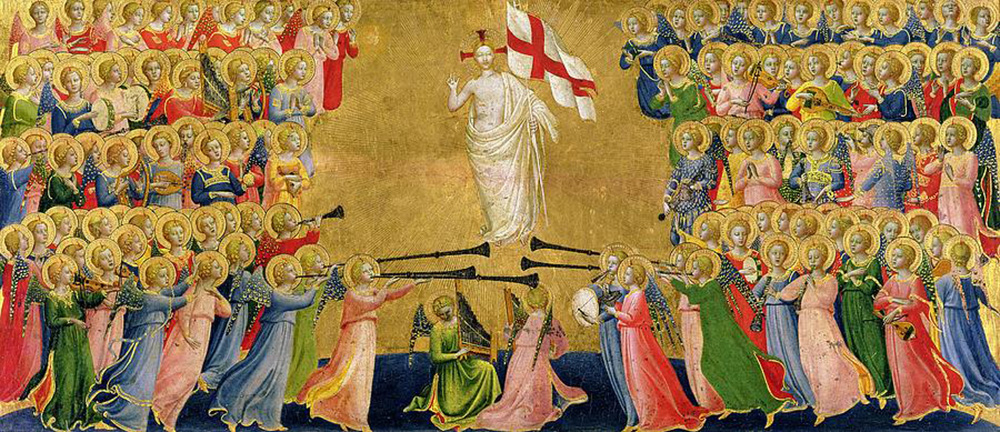
    Christ Glorified in the Court of Heaven (1423-1424), Fra Angelico | Image from fineartamerica.com. Note the clarions (long medieval-style horn) being played by the angels and the wide, straight path that is made for Him.

    Today’s readings provide the answer: we are to make way for Him in our hearts and in our minds by leveling mountains and valleys, by acknowledging our sins, and by living in holiness and devotion. But we should not get too wrapped up in what we are doing because all of this is a job of scouring of ourselves in order to let the Lord come into our beings and reign there. It is only the Lord who can do the work of sanctifying, of saving, of pouring out saving grace. We must simply scrub the house and make it as pristine as possible for the Lord to inhabit.

    Isaiah uses imagery of the land to emphasize the level of preparation that must be made: “Make straight in the wasteland a highway for our God! Every valley shall be filled in, every mountain and hill shall be made low; the rugged land shall be made a plain, the rough country, a broad valley.” Remember, this is Isaiah’s vision of what John the Baptist will be saying. We know that John’s message was a spiritual one: “I have baptized you with water; he will baptize you with the Holy Spirit.” Thus, let’s understand that Isaiah is speaking of a spiritual landscape. So, speaking of one’s soul, what vision does Isaiah provide? One of a great leveling — mountains lowered and valleys raised to create a wide plain, rough country tamed and made into a broad valley. This is a type of domestication, an ordering. What might loom in our hearts as a mountain? Perhaps unfilled ambitions. What stretches out before us like a deep valley? Our fears. What is rough country, hard to traverse? Perhaps distractions, little events in the grand scheme that we make into large things. Isaiah sees that John will ask us to perform an internal ordering, to wipe out the worldly ambitions, fears, distractions, and sins.

    In return, John baptizes people in the Jordan River. Jews had long practiced mikveh, a ritual cleaning in “living water” (a natural, running water source). Mikveh is practiced so that the person can be considered ritually pure and resume religious rites. It is used for men after normal emissions of semen and for women after childbirth or menstruation (among several other reasons). But something else is going on with John. As St. Mark relates, the Jews “were being baptized by him in the Jordan River as they acknowledged their sins.” Could these sins have been the same as those for mikveh? Perhaps, but the verse seems to encompass more than these physical impurities. Especially as it is linked to Isaiah’s prophecy and the spiritual leveling as part of the anticipation of the coming of the Lord, John’s baptism is a ritual that signifies the cleaning of their souls, not their bodies. John is clearly outside of the religious establishment, living apart in the desert, eating locusts and honey, clothed in camel hair. Something new and different is happening. And John’s message is loud and clear: “One mightier than I is coming after me. I am not worthy to stoop and loosen the thongs of his sandals. I have baptized you with water; he will baptize you with the Holy Spirit.” The people coming to John are not there for themselves, they’re there for the Messiah. They aren’t being ritually cleaned to resume normal religious worship, they’re being spiritually cleansed in order to properly await one who will truly give them a new birth in the Spirit. 
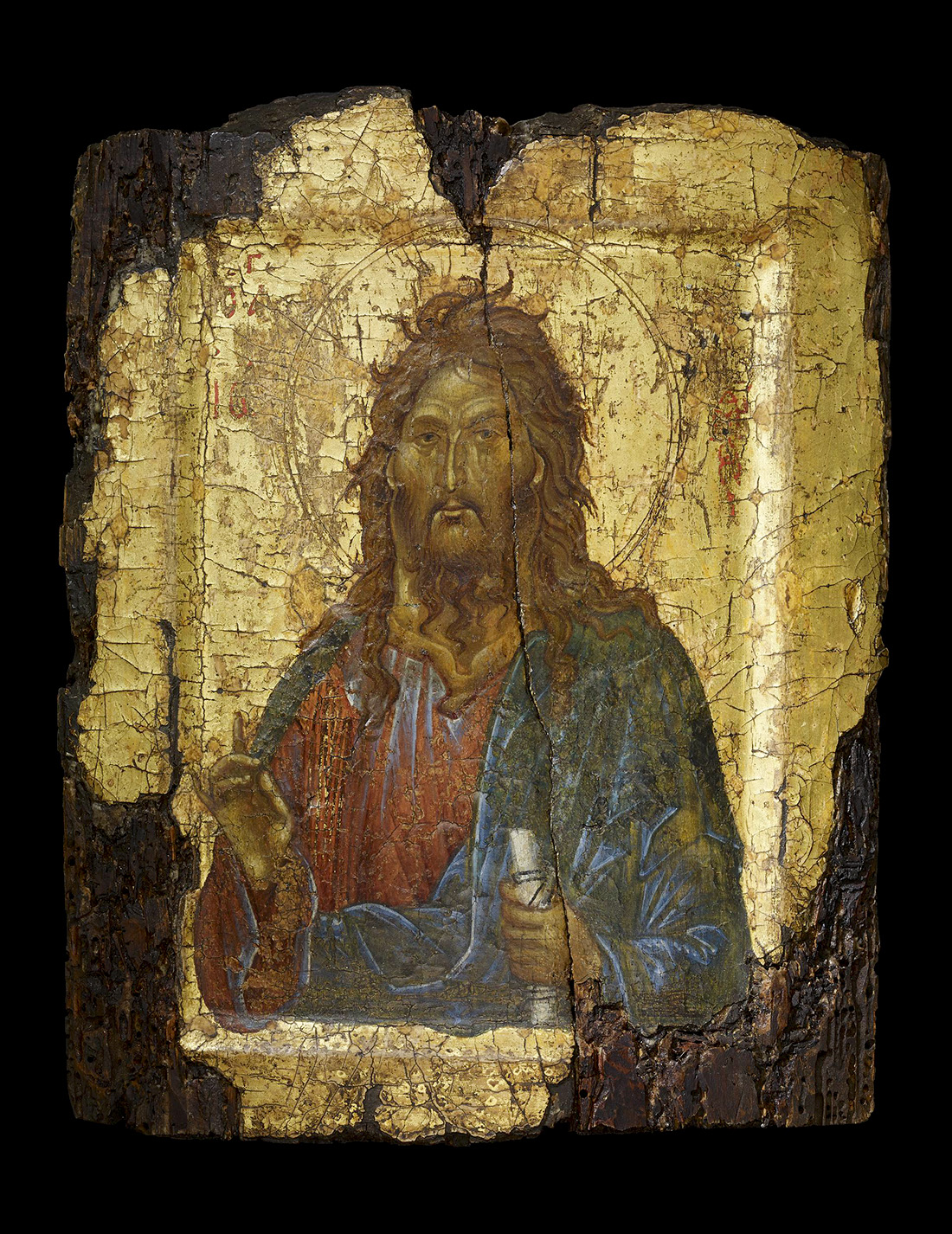
    Icon of St. John the Baptist (c.1300, Constantinople) | Creative Commons, courtesy the British Museum. Their notes: “He is identified by a Greek inscription in red on either side of the halo: ‘St John’ to the left and O Prodromos (`the Forerunner’) to the right.” He is usually depicted in icons with wild hair.

    So John’s message in the second week of Advent is that we must prepare ourselves for the one coming after him, the Christ. Jews in his time understood this to mean that they should confess their sins and undergo a ritual spiritual cleansing in the Jordan River. The second reading from St. Peter connects this same awaiting for Christ that they experienced before his ministry to the waiting we are doing now in the End Times, awaiting His return in glory. Peter tells us how and why we should be preparing ourselves: “what sort of persons ought you to be, conducting yourselves in holiness and devotion, waiting for and hastening the coming of the day of God.” He recommends conducting ourselves in holiness and devotion and hoping for (hastening) the “day of God.” Thanks to Christ, we have a perfected understanding of holy conduct and godliness; He has given us a Way to follow. But are we doing these things just to be upright and moral? Are we hoping to be patted on the head for our goody-two-shoes ways?

    Both John the Baptist and Peter speak of readying ourselves for Christ’s coming (the kairos moment that occupies at least two major historical moments). He is the reason; we want to be ready and acceptable for Christ to reign. But let’s think this through. If God is all goodness, love, and purity, then His reign is one where those qualities dominate the heavens and the earth. What room is there for hate, sin, greed, or evil? None! Do we really understand why we’re preparing in the way we are? We are awaiting the end of the world, which Jesus tells us could happen at any moment. What do we imagine comes next? Peter tells us: “we await new heavens and a new earth in which righteousness dwells. Therefore, beloved, since you await these things, be eager to be found without spot or blemish before him, at peace.” And there it is: since we await a new world where righteousness dwells, we should be eager to be found without blemish and at peace so that we can inhabit this world. I’m beginning to understand that my spiritual preparation must also include a deep contemplation (and yearning for) a world where righteousness reigns without challenge. If I don’t understand and yearn for this, then my preparations, confessions, and penances are just window dressing. There is no substance to these preparations unless I am doing them with the right goal and person in mind: Christ’s Reign of righteousness. It must be for Him and His Kingdom, not for me and my desire to “be good.”
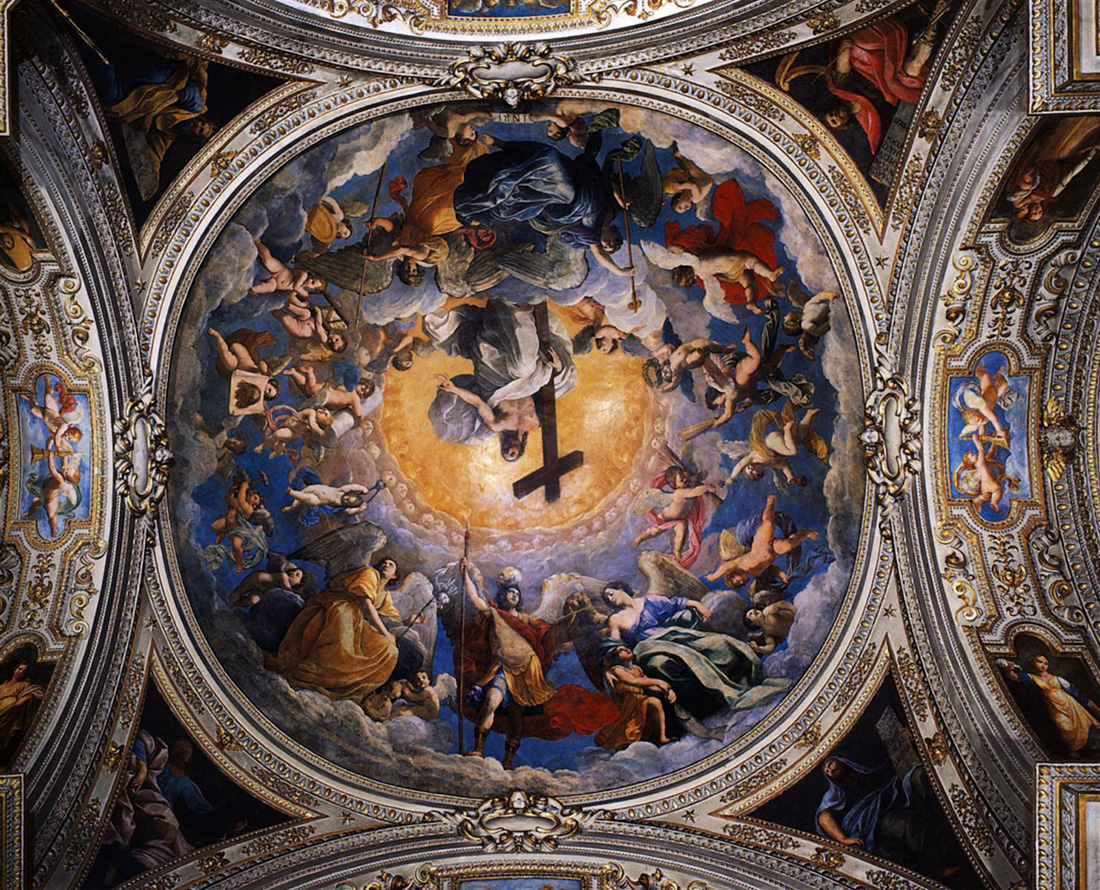
    Christ in Glory between the angels and archangels (1621), Guido Reni | Creative Commons, courtesy wikiart.org.

    But let’s be honest, we are much better at dreaming of conflict and sin than we are of goodness alone. From Dante’s Inferno to pornography (one a great and thoughtful piece of literature and the other sheer sin), we are fascinated by the fallenness of the world. Whether it’s a sick addiction to watching evil as a voyeur or a moral lesson for ourselves or a mirror where we recognize our own failings, we are drawn to stories that contain evil. Consider horror movies. Consider detective shows that delve into the worst of crimes. We entertain ourselves with these depictions. The adage behind good novel writing and good screenplays is that there must be a conflict. Without a conflict, there’s no story. We would get bored. Is this why we barely put effort into imagining “new heavens and a new earth in which righteousness dwells”? Since there’s no story here but the end of time, is there anything to imagine?

    If so, I think this is a real failure of the Catholic imagination. Some philosophers have gone so far as to call God a tyrant who imposes His magisterial will on everyone and everything in heaven; they impose a sinister heaviness on heaven and cast God as an authoritarian. What on earth is going on here? How far this is from the scriptural “fear of God” that reveres Him as the merciful and just Creator of the universe who loves His people above all else!

    Why can’t we imagine and long for “new heavens and a new earth in which righteousness dwells”? I have a theory that it has something to do with lives of comfort. It’s hard to long for something so much greater when what you’ve got is pretty good to begin with. On the other hand, for Eritrean or Syrian refugees fleeing war in their home countries, the desire for a better future is all-consuming. The poor, the hungry, those who have been humbled — they are the ones graced with a true Christian imagination and longing for God’s Kingdom. This is why Christ teaches us, “Blessed are the poor in spirit, for theirs is the kingdom of heaven” (Mt 5:3). This is why it is so important to be humble (or humbled), to eschew riches and worldly desires: these things keep us from focusing our hopes and desires squarely upon “new heavens and a new earth in which righteousness dwells.” If we are too comfortable, we have no desire or need for a greater eschatological vision. This is why Jesus proclaims, “Again I tell you, it is easier for a camel to go through the eye of a needle than for someone who is rich to enter the kingdom of God” (Mt 19:24).

    In closing, let’s consider that today’s gospel is the very first passage from St. Mark. How would you start if you had to explain something that most people would be primed to disbelieve? The great claim is there in the title: “The beginning of the gospel of Jesus Christ the Son of God. One way to begin is to trace the historical prophecies of the Jewish nation through bold figures like Isaiah and John the Baptist. The connection is undeniable between God’s promise to Isaiah, “I am sending my messenger ahead of you; he will prepare your way. A voice of one crying out in the desert” and the figure of John the Baptist, who “appeared in the desert proclaiming a baptism of repentance for the forgiveness of sins.” But there’s more than just a play for legitimacy here. St. Mark shows us that crowds listened to the clarion call from John: “People of the whole Judean countryside and all the inhabitants of Jerusalem were going out to him and were being baptized by him in the Jordan River as they acknowledged their sins.” What’s important is not just that the clarion is blown, but that people respond. This testifies to the power of the call and the truth that the messenger delivers. This is the journey of faith to which we are called: to respond to God’s call in our lives. St. Mark illustrates for us in the very opening scene of his gospel what Christianity is all about.

    May we all be people with eyes on the horizon, awaiting the coming of Christ and His Kingdom. May that vision inspire us to prepare our souls to meet Him in this glorious Kingdom.
  • From Despondency to Boldness

    Friday in the Octave of Easter: Acts of the Apostles 4:1-12, John 21:1-14.

    Today’s readings show us Peter and John revisiting places that were instrumental in Jesus’s ministry before His death. One scene is marked with despondency and ineptitude, while the other is filled with boldness and perfection. How do they manage to make this change from inept acolytes to masters in faith? The answer lies in an often-overlooked aspect of the gospels: Jesus’s ministry does not end in the Resurrection; He guides the fledgling Church in the days between the Resurrection and Ascension. 

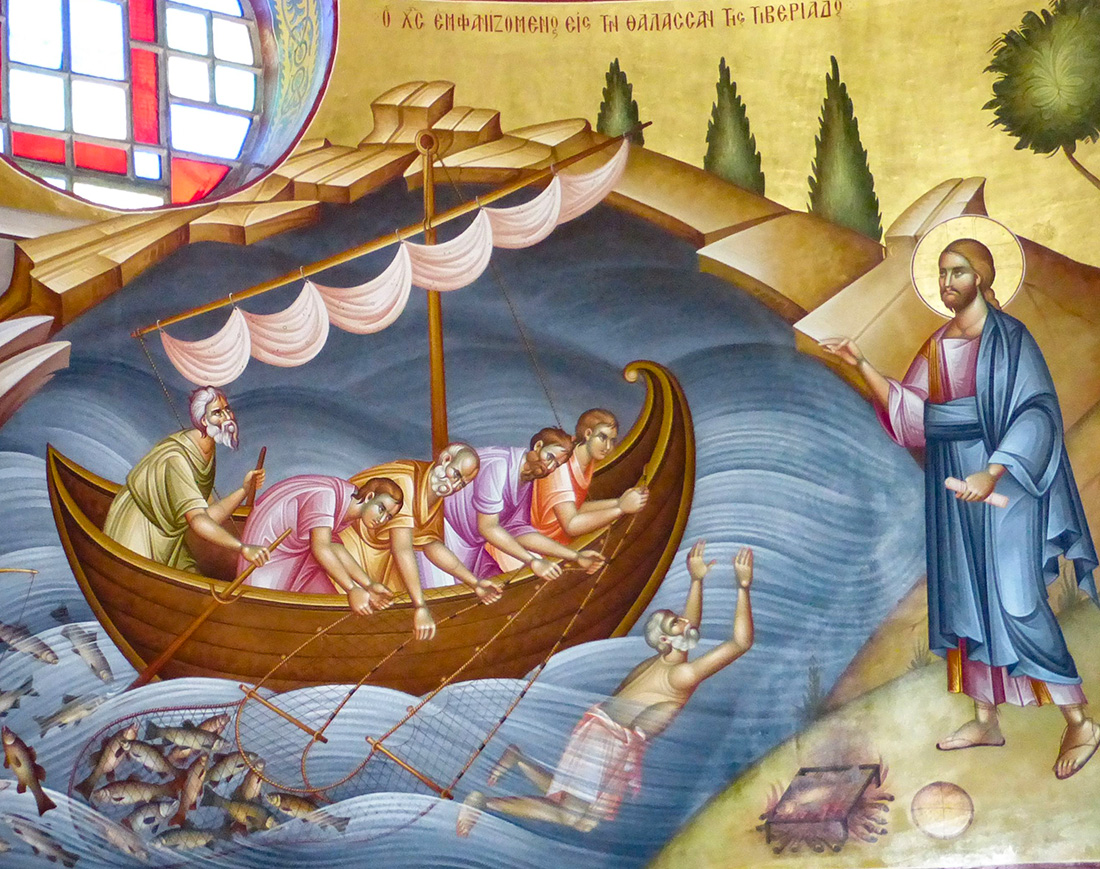
    Fresco of the Miraculous Catch of Fish (unknown date and author) on the walls of the Church of the Holy Apostles, a Greek Orthodox monastery at Capernaum, on the shores of the Sea of Galilee | photo from reneeriley.wordpress.com.

    First, let’s look at the gospel reading. We hear that the disciples are back at the Sea of Galilee, where Jesus first met them. This is curious. After the astounding fact of the empty tomb and the appearance of the risen Lord to the disciples in Jerusalem, what are they doing back in Galilee? For lack of something better to do, “Simon Peter said to them, ‘I am going fishing.’
    They said to him, ‘We also will come with you.’” Is this the great work of evangelization that will grow the Church immeasurably? Not at all — they have retreated back to what they used to do, as if the reality Jesus brought into the world hasn’t changed them. Pope Francis notes,

    They seem to take a step backwards; Peter takes up the nets he had left behind for Jesus. The weight of suffering, disappointment, and of betrayal had become like a stone blocking the hearts of the disciples. They were still burdened with pain and guilt, and the good news of the resurrection had not taken root in their hearts … This is the tomb psychology that tinges everything with dejection and leads us to indulge in a soothing sense of self-pity that, like a moth, eats away at all our hope. Then the worst thing that can happen to any community begins to appear – the grim pragmatism of a life in which everything appears to proceed normally, while in reality faith is wearing down and degenerating into small-mindedness.  (Sunday Mass homily, May 5, 2019)

    But, as Pope Francis notes, “it was at the very moment of Peter’s failure that Jesus appears.” They had caught nothing during an entire night of fishing, and there, Jesus on the shore asks them a double-edged question: “Children, have you caught anything to eat?” Of course, the original Greek is a bit more enlightening. Jesus first calls out their immaturity by calling them παιδία (paidia), which is a diminutive form of child, i.e., “little child” (the only time in the New Testament, incidentally, that Jesus calls his apostles paidia). He then asks if they hadn’t any προσφάγιον (prosphagion), which is properly translated as “anything eaten with bread” (Thayer’s Greek Lexicon). What is He saying here? Clearly, there’s the literal meaning “haven’t you caught anything?” but the words He chooses point to something more. He notes that their development as his followers is not yet mature (they are paidia). Case in point, they are looking for something “to eat with bread;” this, coming from the Bread of Life Himself who had just instituted the great sacrament of Eucharist with them. All they need is the bread He gives them, but they don’t yet comprehend the power of His Spirit in the sacrament and in the world.

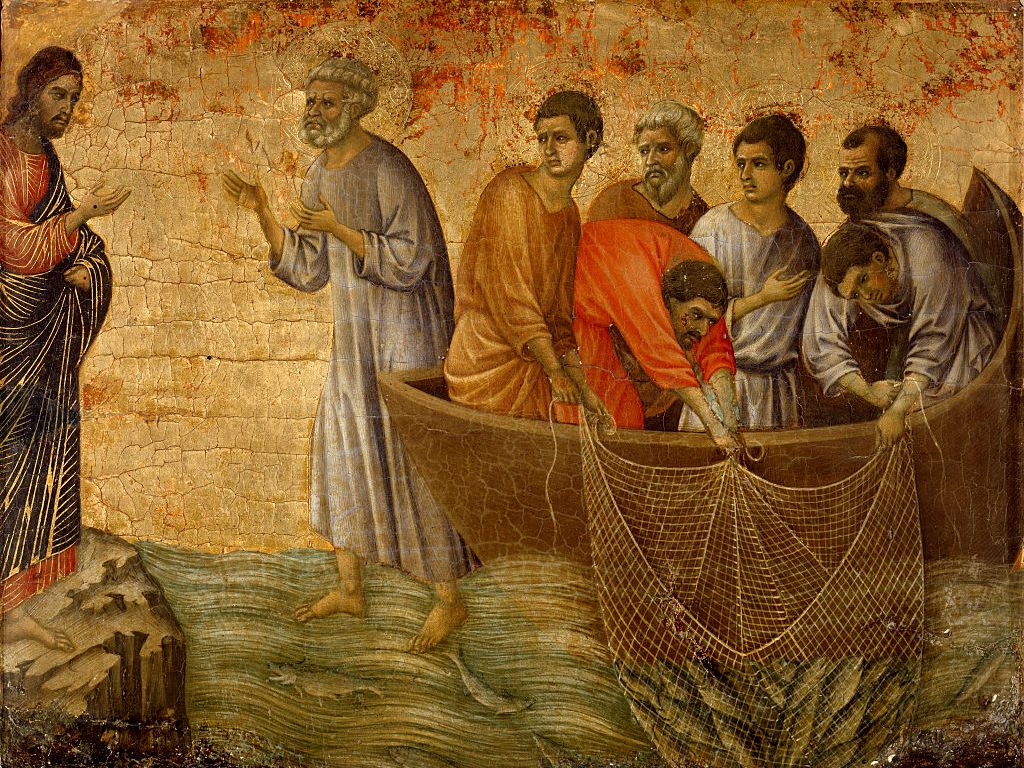
    Appearance on Lake Tiberias (1308-1311), Duccio di Buoninsegna | Wikimedia Commons.

    Evidently, they need another lesson, signified by the miracle of a net suddenly full beyond belief with fish. Once again, God bestows lavishly, both in patience and gifts for His beloved Church. John recognizes the man behind the miracle and Peter reacts. As St. John Chrysostom writes, “when they recognized Him, the disciples Peter and John again exhibited the peculiarities of their several tempers. The one was more fervent, the other more lofty; the one more keen, the other more clear-sighted. On this account John first recognized Jesus, Peter first came to Him” (Homily 87 on the Gospel of John, 2). Here, they are re-enacting their roles as we see them throughout the gospels but Jesus needs them to move beyond and become new people who establish the new Church.

    They meet him on the shore and “saw a charcoal fire with fish on it and bread.” This bit of detail from John is important. It establishes that Jesus is truly a man resurrected, not a ghost or vision. He can partake in physical food. Symbolically, it presents something new with something familiar. We might expect to see the bread, through which Jesus sacramentally gives us His Body, but what to make of the fish over the fire? Let’s consider the other times Jesus refers to fish and fishing. The first miraculous catch of fish here on the Sea of Galilee happened when Jesus called Peter, Andrew, James and John to become His disciples. As St. Matthew writes, Jesus counsels an astounded Peter, “Do not be afraid; from now on you will be catching people” (Luke 5:10b). Fishing is the work of evangelization. Fish are people. Here, once again, the disciples catch an overwhelming quantity of fish when they obey Jesus, only this time his call is different — it’s not to follow Him throughout Judea but to bring Him fish. A second interpretive key for this passage comes from Jesus’s words recorded in the gospel of St. Matthew: “the kingdom of heaven is like a net that was thrown into the sea and caught fish of every kind; when it was full, they drew it ashore, sat down, and put the good into baskets but threw out the bad. So it will be at the end of the age” (Mt 13:47-49a). Jesus shows them that He is the purifier of men, He tends to the fire that purifies the fish, making them good food. Before the “end of the age” when the good will be separated from the bad, the apostles’ work is to catch fish in His name so that they can be purified in His love.

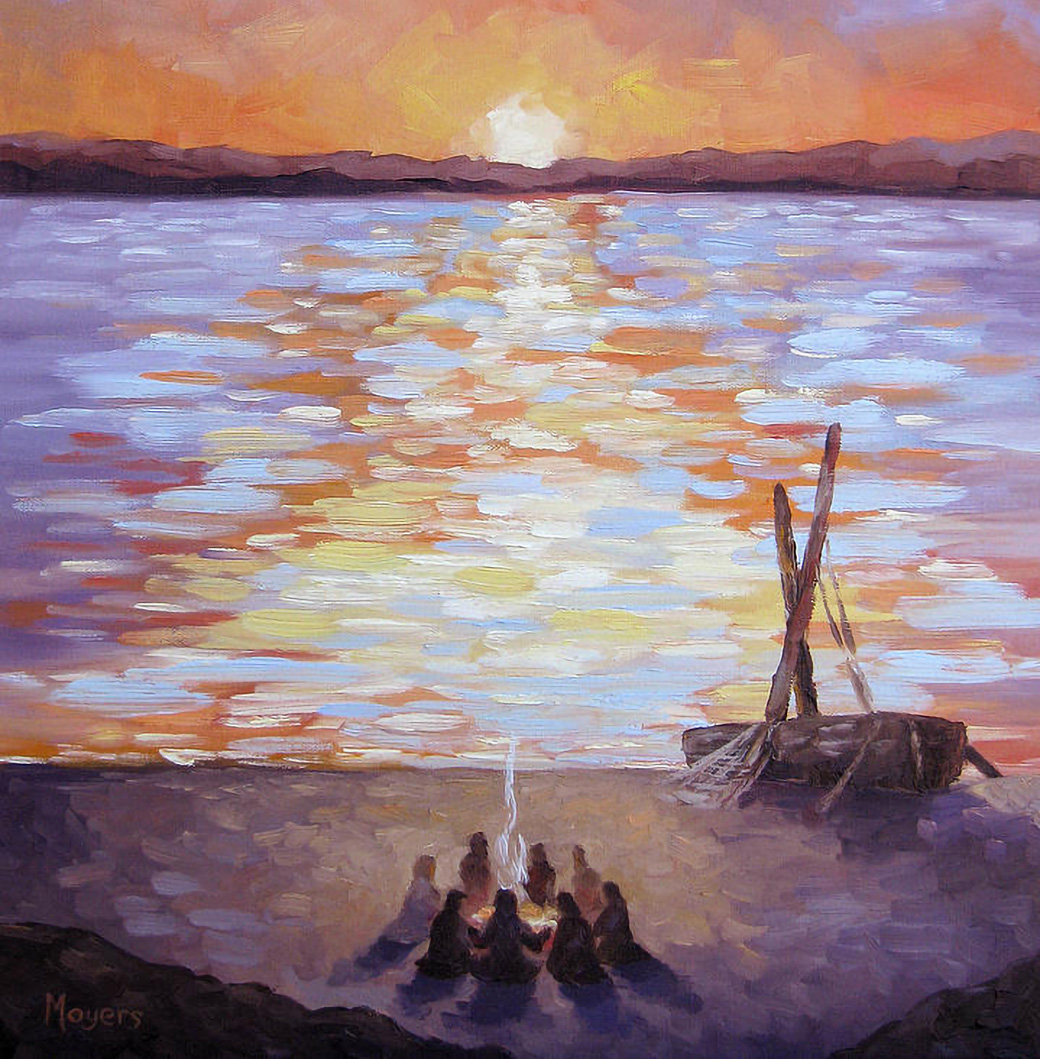
    Detail from Breakfast at Dawn (2012), Mike Moyers | image from fineartamerica.com.

    To move them beyond an incapacitating dependency upon Him, like the disciples in Emmaus who say, “Stay with us,” Jesus again chooses to accomplish this through a meal. We will read the verses after today’s gospel, “When they had finished breakfast, Jesus said to Simon Peter, “Simon son of John, do you love me more than these?’” Jesus’s threefold questioning leads to the directive to feed his sheep (like Jesus) and to follow Jesus (in the way of the Cross). Jesus is passing a heavy baton to Peter, who will no longer wonder what to do with himself nor go back to his old ways.

    The courage and the fire to accomplish Jesus’s directive comes to the apostles at Pentecost. The Holy Spirit, the One whom Jesus promised, descends upon them in the fervor of their prayer and immediately they are given the boldness and means to accomplish the work of Christ. This is, after all, Christ’s very Spirit, ushering them to the Way, the Truth, and the Life.

    And it is after Pentecost that the events found in the first reading happen. We are in the midst of the great story of the Acts of the Apostles that is being read over consecutive days in the first reading at Mass. Note the difference in Peter and John. They heal a lifelong cripple in the temple like Jesus once did and they claim no credit, having done it in the name of Jesus Christ. Amazed Jews gather around them in Solomon’s Portico and Peter explains how the miracle of healing happened: “But you rejected the Holy and Righteous One and asked to have a murderer given to you, and you killed the Author of life, whom God raised from the dead. To this we are witnesses. And by faith in his name, his name itself has made this man strong” (Acts 3:14-16a). He establishes their culpability in the Messiah’s death, the fact of the Resurrection, and the fact of the unending power of the name of Jesus Christ the Lord. What’s more, Peter presents them with an open call to join His Body, the Church, “Repent, therefore, and be converted, that your sins may be wiped away, and that the Lord may grant you times of refreshment and send you the Christ already appointed for you, Jesus” (Acts 3:19-20). In these moments, they have become the fishers of men that Jesus has asked them to be. 

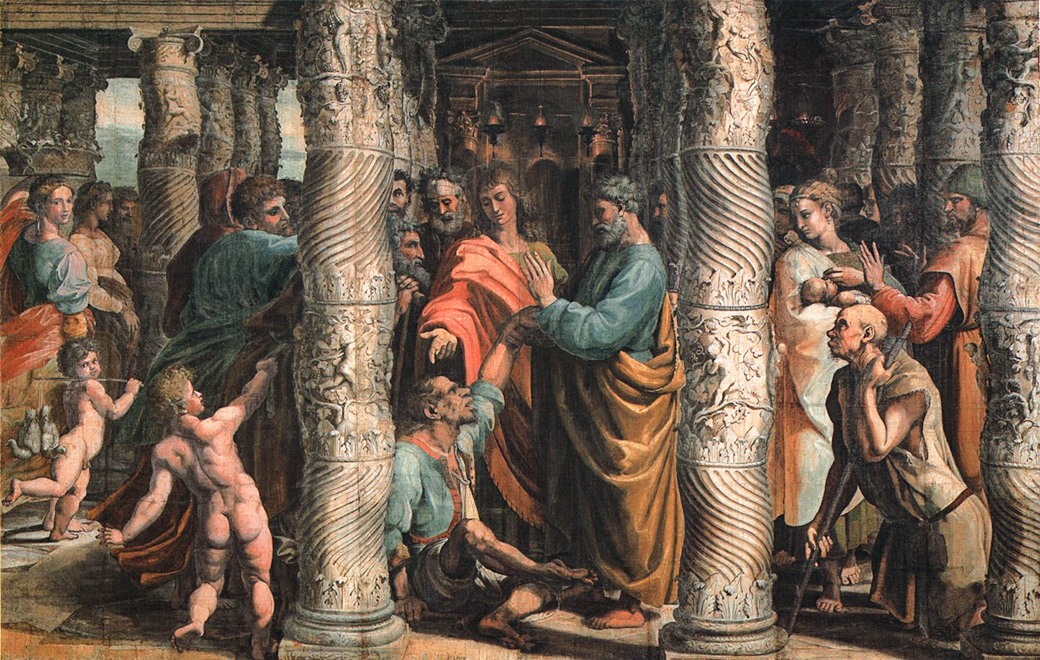
    Healing of the Lame Man (c.1516), Raphael | image from artbible.info. Raphael’s design intended for a tapestry in the Sistine Chapel, painted on sheets of paper.

    But their words garner the attention of the Sadducees, who do not believe in resurrection, and the chief priests, who had just “succeeded” in killing Jesus. Peter and John are arrested, but their fishing has begun: “But many of those who heard the word came to believe and the number of men grew to about five thousand.” The cast of evil characters is present again the next morning to interrogate them (thinking of you, Caiaphas and Annas), but “Peter, filled with the Holy Spirit, answered them.” We glean not a speck of fear or apology in his words. He boldly proclaims not just the righteousness of their act of healing the crippled man but the name of the one these people recently crucified:

    all of you and all the people of Israel should know
    that it was in the name of Jesus Christ the Nazorean
    whom you crucified, whom God raised from the dead;
    in his name this man stands before you healed.
    He is the stone rejected by you, the builders,
    which has become the cornerstone.

    There is no salvation through anyone else,
    nor is there any other name under heaven
    given to the human race by which we are to be saved.

    Just imagine them standing there, under temple arrest in front of the chief priests, proclaiming the divinity and power of Jesus, quoting scripture, and teaching about salvation of the world. We hear this brave and powerful voice of the Spirit emerge time and time again from the great martyrs in our tradition. We will see tomorrow that this bold elocution from “uneducated, ordinary men” will leave the leaders, elders, and scribes amazed and speechless. The power of the Spirit is the gift that Jesus gives His Church for which secular authorities have no answer. The Spirit dwelling within the Church enables its members to ascend to the Kingdom, to inhabit a world that dominates the world below in its love and power.