
Tag: water

  • From Temple to Living Water

    From Temple to Living Water

    Tuesday of the Fourth Week in Lent: Ezekiel 47:1-9, 12, John 5:1-16.

    [COVID-19-era] It’s been over a year since we could attend Mass in our churches in a normal fashion. The exact experience differs from town to town, church to church. For some people, this has been quite upsetting while for others it’s a convenient excuse to stop going to something that interrupted their leisurely Sundays. Being Lent, it’s a good chance to reflect on our church experiences — what they mean to us, what they should mean to us.
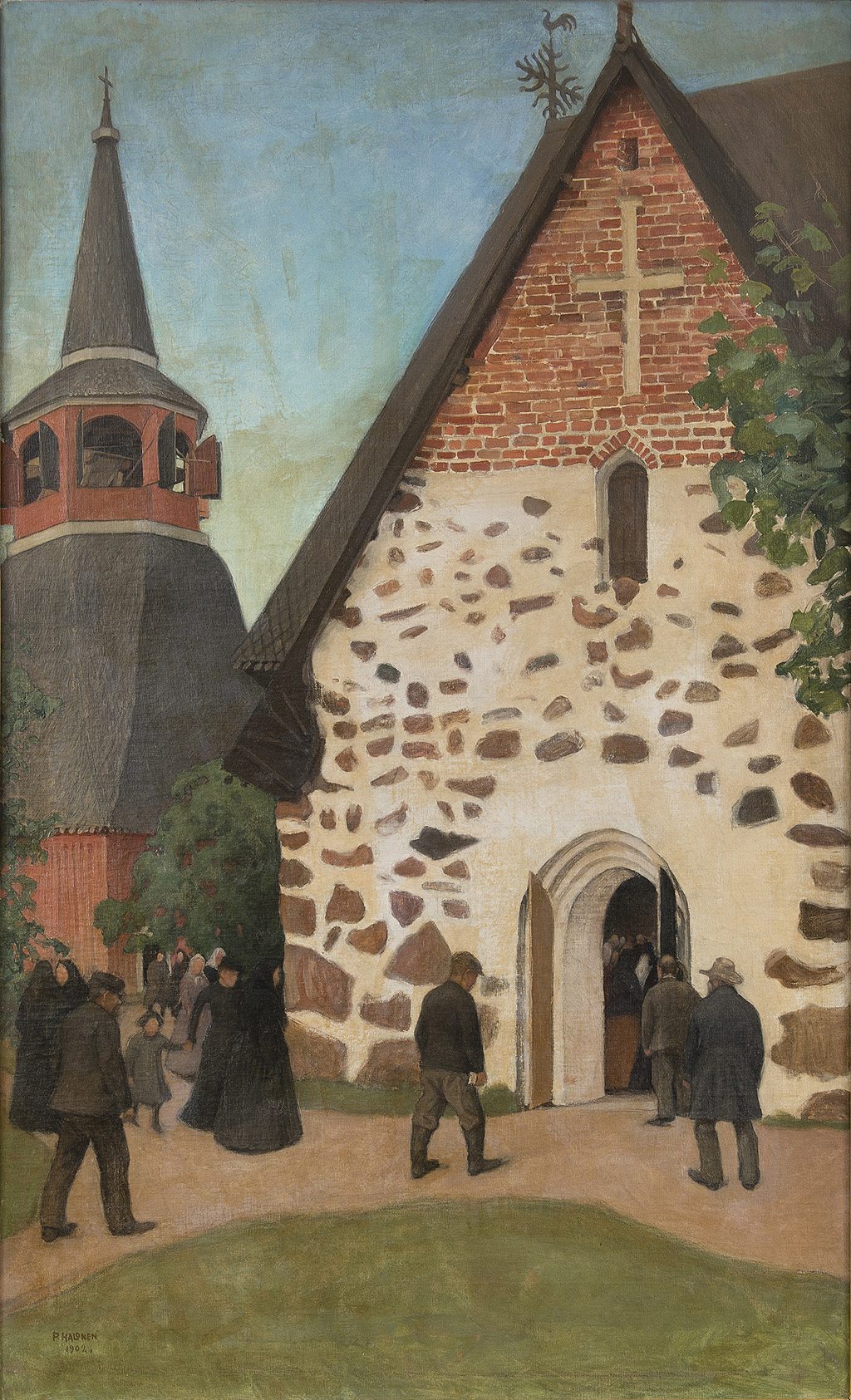
    Going to Church (1902), Pekka Halonen | Wikimedia Commons.

    I grew up going to church every Sunday (bless my parents for that). “Blowing off” Mass was not an option. Thus, I came into adulthood with a strong sense of obligation when it comes to regular Mass attendance. But when you’re a young adult you have this existential moment when you realize that you don’t have to do things just because you always have or you feel obligated to. You can skip Mass and no one is around to make you feel guilty. This is an important moment — some experience it while still in their teens, others not until their 30s or later. This is important because we need to grow out of the habit of going to the church building to “endure” the Mass for an hour and grow into something deeper. We must find that it is something we do because we felt compelled to, from deep inside of ourselves as we respond to God’s call. Not because someone else is telling us we have to go. God wants us to respond personally to His invitation.

    On the other side of this moment, when I feel so blessed to be part of the mystical Church, I look back on the great bugbear of Catholic obligation as an absurdity. I see how it served its purpose, especially for children who must be taught where the spiritual well resides so that they can access it throughout their lives, but if we allow our lifelong relationship to God to exist in the shadow of obligation, we risk never finding the Church despite all our church-going.

    Don’t get me wrong — I think obligation has a very good place within the pantheon of attitudes that make up “fear of God” — but this is a reflection of our humble state in front of our Creator, not a motivation for religious practices like going to Mass or confession.

    What does that church building mean to you? That question is at the forefront of our readings today. Ezekiel is shown how the temple is transformed in the New Jerusalem, and in the gospel reading, Jesus enters a ritualized, symbolized, and mythologized part of the great Temple in Jerusalem to establish a new call to humanity on the Sabbath, effectively reforming the temple from within. At the end of this reflection, we must ask ourselves if we have heard the scriptures and the Voice of God — do we conceive of our churches and our Church in the way he intends?

    Ezekiel prophesies during the Babylonian Captivity, around the years 596-574 BC. Jerusalem and its great holy temple have been destroyed, which is a catastrophic symbolic and religious loss for the Jews. They collectively mourn, and Ezekiel can only dream of the great temple being rebuilt. Twenty-five years into their exile, God grants Ezekiel an extraordinary vision of the restored temple. The record of this vision covers 7 extensive chapters at the end of the Book of Ezekiel and details the dimensions and activities of the temple. Clearly, the Jewish traditions and laws surrounding religious worship still matter a great deal, but something else is going on, too. And it coalesces at the East Gate.

    Ezekiel relates that at the East Gate, “the glory of the God of Israel was coming from the east; the sound was like the sound of mighty waters; and the earth shone with his glory.” Ezekiel falls on his face, and “As the glory of the Lord entered the temple by the gate facing east, the spirit lifted me up, and brought me into the inner court; and the glory of the Lord filled the temple” (Ez 43:2, 4-5). The East Gate, therefore is identified as the place where the Lord enters, and Ezekiel is commanded to keep it closed and locked except on the Sabbath, when the people come to encounter the Lord. The temple is made holy not by its height and girth and golden ornamentation, but by this connection to the presence of the Lord.

    One of our Church Fathers, Origen, helps us understand Ezekiel’s vision of the east through the lens of Christ: “Atonement comes to you from the east. From the east comes the one whose name is Dayspring, he who is mediator between God and men. You are invited then to look always to the east: it is there that the sun of righteousness rises for you, it is there that the light is always being born for you” (Hom. 9, 5. 10: PG 12, 515. 523.). 

    The description of the restored temple finishes with today’s reading. In an extraordinary scene, Ezekiel sees beyond the temple walls. Flowing eastward from the temple is a stream of water that becomes deeper and deeper until it is a mighty river, too deep to cross. The river gives life to all around it: “Wherever the river flows, every sort of living creature that can multiply shall live.”

    The vision is clear: the Lord, coming from the east, meets humanity in the temple at the altar, and from the temple flows forth a river of life — in the world and making its way back toward God in the east. This river of life happens as a consequence of the encounter within the temple, and is clearly an ecstatic vision of a transformed world. Nothing could be a more concise picture of the reality ushered in by Christ than this.
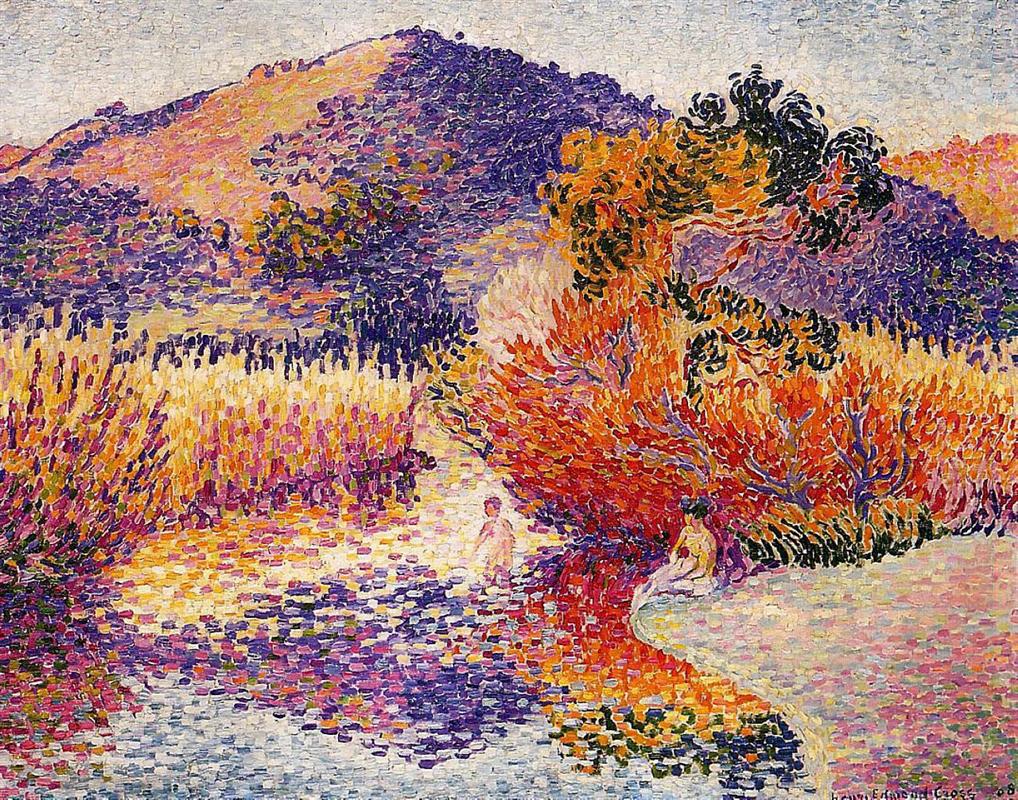
    River in Saint-Clair (1908), Henri-Edmond Cross | Creative Commons, courtesy Wikiart.org.

    The Jews recognized the incredible importance of the temple as the holy meeting place between them and God, but it seems as though the end of Ezekiel’s vision was not as firmly implanted. Jesus criticizes the Pharisees and scribes for only upholding the strictures of the laws and rituals but missing the point of how the temple encounter should transform how they relate with their fellow human beings outside of the temple. This aborted, truncated life in the Lord precipitates the need for the Son of God to be born into humanity, perfect the Lord’s teachings, and usher in a new way to encounter divinity that allows for the River of Life to eclipse the temple in importance.

    At many points in Christ’s ministry, he tells us how he is establishing a new priesthood (with Peter and his apostles), a new sacrifice to replace all other ritual sacrifices (the Eucharist as initiated at the Last Supper), and a new direct communion with God and God’s love through himself. In fact, we hear echoes Ezekiel’s description of the temple gates when Jesus calls himself the gate for the sheep (cf. Jn 10:1-10). Most strikingly, he not only identifies himself with the temple, but being greater than the temple: “I tell you, something greater than the temple is here. … For the Son of Man is lord of the sabbath” (Mt 12:6, 8).

    This brings us to the gospel reading, which happens at the Temple, on the Sabbath, at the Sheep Gate. This likely references the sheep market where people could buy sheep for sacrifice at the temple. There are also pools there, used to ritually wash the animals before they were used in the temple. “In these lay a large number of ill, blind, lame, and crippled. One man was there who had been ill for thirty-eight years.”

    A few things are being conveyed to us. First, Jesus is drawn to the place where the outcasts go in a bid to purify themselves like the sacrificial animals. (Jesus more than once calls humanity his sheep as he describes himself as the Good Shepherd — here that image is seen to be much more accurate in actual practice than we may have realized.) We see a desperation in these poor beings as they wait for a “stirring” of the waters by an angel whereby, according to common legend, the first one in the water is cleaned by divine action. We might be reminded of the story of the Canaanite woman begging for Christ’s mercy and healing: “Even the dogs eat the crumbs that fall from their master’s table” (Mt 15:27). 

    To sum up the deeply symbolic scene: at a place where animals are purified before being sacrificed to God, we encounter poor, wretched humans hoping for scraps of cleanliness to drop their way, by a singular, angelic stirring of the waters. They essentially have no dignity, no place in Jewish society. Contrast this with the great, flowing River of Life that Ezekiel sees pouring out from the temple, granting bounty to everything it touches. Clearly, the beatific vision is not being realized.

    But then comes Christ.
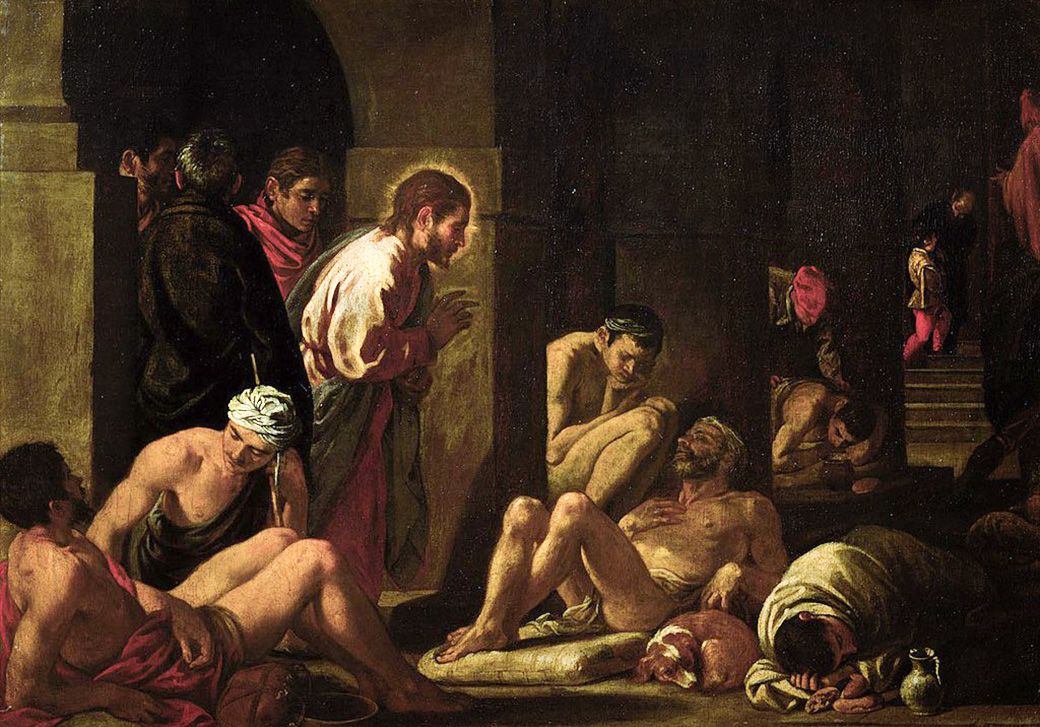
    Christ Healing the Sick at the Pool of Bethesda (c.1615-1620), Pedro Orrente | Wikimedia Commons.

    Note the formula of God’s call and our response; this is his way. Jesus asks if the man wants to be well (pure, whole; the Greek word is hygiēs). The man laments that he cannot do it on his own, he needs help. Jesus’s response is beyond the man’s expectations or even understanding of what is possible, as is always the way with God’s overflowing love. Jesus says, “Rise, take up your mat, and walk.”

    Like all of us, the man was so caught up in his thoughts of what he needed at the moment (which he had been doing for 38 years!), that he couldn’t imagine anything else to ask for. How many times have we been overwhelmed by our current concerns and worries that we only bring these trivialities to God to “solve” rather than asking to be made whole?

    Let’s expand our focus and notice several other things happening here.

    First, Jesus establishes a new, direct connection to healing in himself, something only available before through the extensive rituals of the temple. This is the miraculous change brought about by the Incarnation of divinity in human flesh. This is underscored by his instruction to “take up your mat,” which provides a temporary dwelling place for the man in the temple. That dwelling is no longer needed.

    Second, he provides the divine energy personally to the man so that he can rise by himself and walk on his own. The river of life enables us to “bear fresh fruit” of our own. The man is enabled to be fully human, blossoming in the love of God.

    Third, Jesus performs an act of healing on the Sabbath. The Jews, particularly the Pharisees and scribes, will use this act of “work” on the Sabbath to persecute and eventually arrest Jesus. It is a major theme of the gospels, and juxtaposes their hangups with particularities of the law while disregarding the presence of God among them.

    But perhaps throughout the gospels, Jesus is intentionally healing on the Sabbath. Let’s return to the quote from Matthew: “I tell you, something greater than the temple is here. … For the Son of Man is lord of the sabbath” (Mt 12:6, 8). Christ is establishing in himself, here at the temple in today’s reading, what he says in that passage from Matthew. Here, in the temple, he does the “work” of replacing the temple through his own saving person and mission. As the Lord of the Sabbath, united with God to whom the sacrifice is being offered, he releases humanity from our ritual debt of sin offerings and atonement.

    Origen emphasizes this wonderfully in terms of the liturgy:

    “God taught the people of the old covenant how to celebrate the ritual offered to him in atonement for the sins of men. But you have come to Christ, the true high priest. Through his blood he has made God turn to you in mercy and has reconciled you with the Father. You must not think simply of ordinary blood but you must learn to recognize instead the blood of the Word. Listen to him as he tells you: This is my blood, which will be shed for you for the forgiveness of sins.”

    This brings us back to the questions that opened this reflection: what do our churches mean to us? Our churches are the center of our liturgical lives because that is where Christ instituted the sacramental remembrance of his own great sacrifice. No longer are animals needed for atonement as we encounter God because Jesus makes that sacrifice unnecessary.

    But so much more! He gives himself continually, over and over, not just to the Father but to us, through his Word and his Body and Blood. He is the River of Life flowing from the altar, nourishing us and making the world whole and bountiful. He flows to the east, back to the Father, and has inaugurated the Church, his mystical Body, as his Bride in this journey to the Father.

    Thus, our participation in the Church (both in the church building and in every other aspect of our lives) becomes much more than just “going to church”. It is the deepest spiritual encounter with God that certainly does not end when the priest announces “the Mass is over, go in peace.” The life of the Church is the liturgy. Liturgy is not confined to the hour or so of the Mass; instead the Mass is one of the greatest ways we celebrate the liturgy.
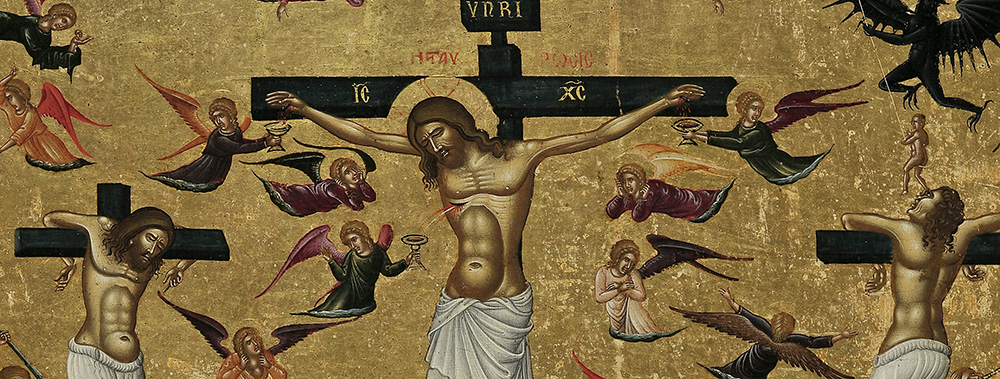
    Detail from The Crucifixion (late 1400s), Andreas Pavias | Wikimedia Commons. St. John’s description of water and blood coming from the side of Christ when the centurion pierces his side with a spear is a good point of reflection. As we consider the River of Life in which we are baptized as Christians, this life-giving water finds its source alongside the Blood of our crucified Savior.

    If what we miss about church in the time of pandemic is hanging out with other parishioners for doughnuts and coffee, perhaps we need to reconsider what our Church means. If what we miss most is the great music at Mass, perhaps we need to recall exactly what type of heavenly encounter is going on there and re-prioritize ourselves. We are united with saints and angels, the dead and the alive, in a way that is much more deep than discussion groups, charity drives, and parish dinners. These things are great, absolutely! But the Church is fundamentally something altogether different.

    A Lenten prayer for today: may we all desire to encounter the River of Life throughout our day and cherish our moments within the Mass when we encounter the Word and Eucharist in a singularly spectacular way.
  • Water from the Temple

    Water from the Temple

    Tuesday in the Fourth Week of Lent: Ezekiel 47:1-9, 12, John 5:1-16.

    Water figures strongly in today’s readings. Water is the great bringer of spiritual purification and cleanliness. God’s law prescribed that Jews must ritually purify themselves in water before partaking in everything from meals to sacrifice before the Lord. Water is also the substance of physical life, sustaining humans and all of creation.

    We reflected at length on the connection between the life-giving and spiritual-purifying aspects of water as presented to us in the story of Jesus at Jacob’s well with the Samaritan woman (see If You Knew the Gift!). Today, we see how water figures in prophecy about the Kingdom of God, specifically in the person of Jesus Christ.

    Ezekiel, writes during the Babylonian Captivity around the years 596-574 BC, like the events found in the Book of Daniel. Ezekiel is given prophetic visions from the Lord about both the destruction of Jerusalem and the rebuilding of the temple. Remember that the temple in Jerusalem was the heart of the Jewish faith, where the presence of God dwells. It had supreme importance for them, and the destruction of the temple along with all of Jerusalem was a catastrophic event. Thus, when we hear of a rebuilt temple, we must understand that this is a restored connection with the presence of God.

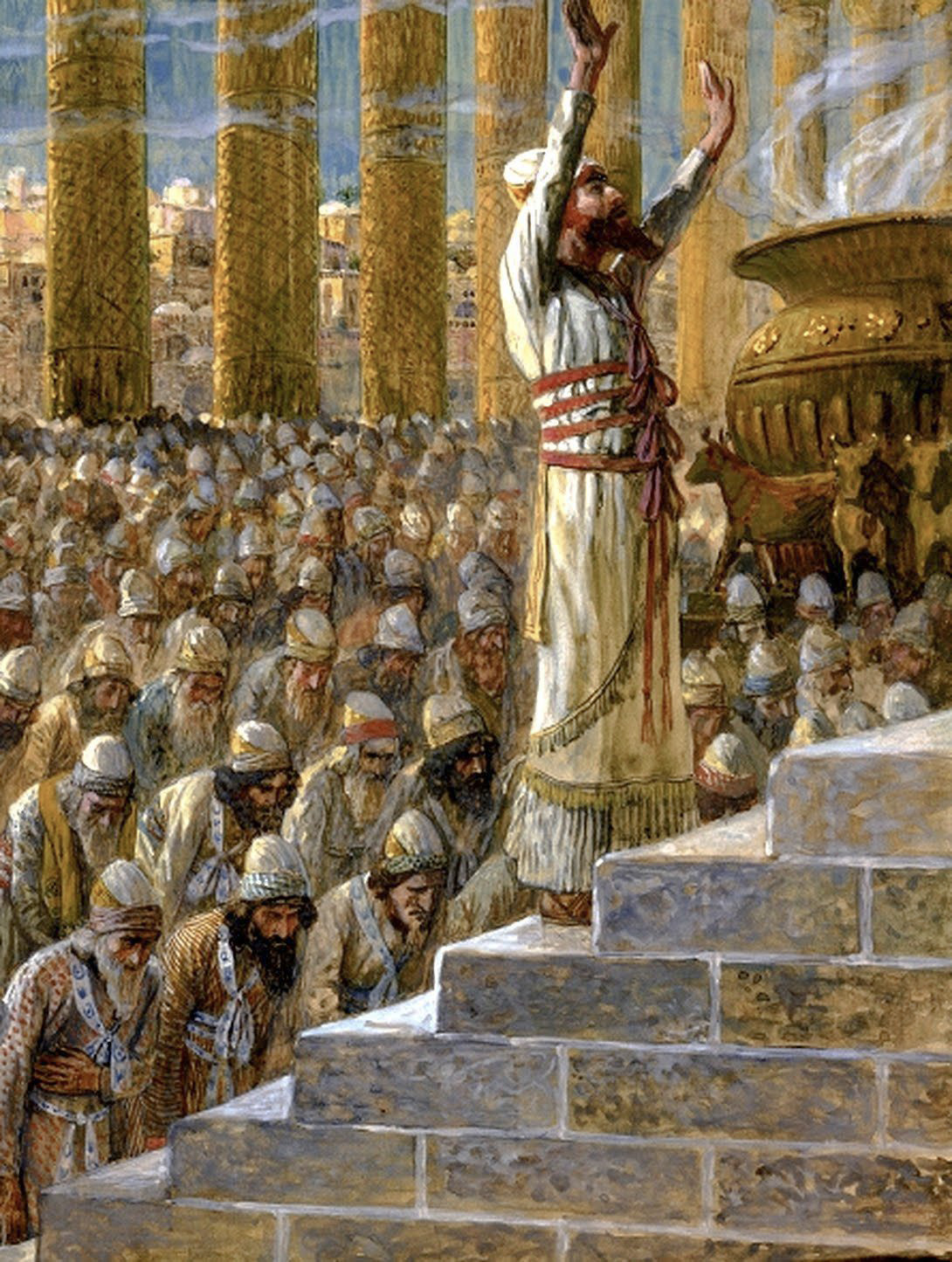
    Solomon Dedicates the Temple at Jerusalem (c.1896-1902), James Tissot or followers | Wikimedia Commons.

    Today’s reading is part of Ezekiel’s vision of the restored temple; an angel shows him “water flowing out from beneath the threshold of the temple toward the east,” which is the direction that the temple faces. The angel takes him away from the temple and the water builds and deepens, first into a stream and then into a mighty river. In the east, it reveals its life-giving nature, it “empties into the sea, the salt waters, which it makes fresh. Wherever the river flows, every sort of living creature that can multiply shall live.”

    This type of imagery should be familiar to us. We have explored how Jesus tells the Samaritan woman that he provides “life-giving water.” It is the endless river of life flowing from the Trinity, the “self-opening of our Thrice-Holy God,” as Fr. Jean Corbon, OP puts it. The river in Ezekiel’s vision, therefore, we can understand as the same river of life that St. John will see in the heavenly Jerusalem in the Book of Revelation. This is the eschatological vision of the river: the life abounding in the river is everlasting life.

    In this eschatological vein, let’s examine the importance of the direction of the east that Ezekiel takes great pains to emphasize. One of our Church Fathers, Origen, explains why the direction of the east is important to us:

    “Atonement comes to you from the east. From the east comes the one whose name is Dayspring, he who is mediator between God and men. You are invited then to look always to the east: it is there that the sun of righteousness rises for you, it is there that the light is always being born for you. You are never to walk in darkness; the great and final day is not to enfold you in darkness” (Hom. 9, 5. 10: PG 12, 515. 523.).

    For centuries, this is why Catholic churches have been built with the altar facing the east. We worship in the direction of Christ, the “sun of righteousness” rising for us, where “light is always being born” for us. 

    This brings us to the physical nexus of Ezekiel’s vision. Recall that he is describing the temple. The saving nature of the river, deep and wide in the east, points to the sacred nature of the temple. Since the river starts in the temple, our experience of divinity starts in the temple. This building (like our Catholic churches) is important because it is our physical place where we encounter God.

    In Christ, though, the physical and the divine co-exist. This changes everything, and even while Ezekiel was a devout proponent of all kinds of traditional Jewish religious prescriptions, his mystical vision inexorably points to a new temple that is nothing the traditional Jewish faith could envision. God is presenting him with a vision of the new temple in the person of Christ.

    River in Saint-Clair (1908), Henri-Edmond Cross | Creative Commons, courtesy Wikiart.org. How can we imagine the divine river of life? This work of pointillism stimulates my imagination.

    At many points in Christ’s ministry, he tells us how he is establishing a new priesthood (with Peter and his apostles), a new sacrifice to replace all other ritual sacrifices (the Eucharist as initiated at the Last Supper), and a new direct communion with God through himself. Most strikingly, he not only identifies himself with the temple, but being greater than the temple: “I tell you, something greater than the temple is here. … For the Son of Man is lord of the sabbath” (Mt 12:6, 8).

    He is not abolishing physical buildings for worship, but he is re-defining the symbolic and religious meaning that the Jews placed on Jerusalem’s temple. This is most evident when the temple shroud is ripped in half and the earth shakes when he dies on the Cross. Brent Pitre, PhD, explains the importance of these events: “with the tearing of the Temple veil and the earthquake—the whole universe, ‘heaven and earth,’ were symbolically being torn asunder” (Jesus, the New Temple, and the New Priesthood, p.63). Again, with Jesus being the physical union of divinity and humanity, everything changed.

    Pitre’s article referenced above is a great academic deep-dive into the implications of Jesus replacing the Jewish concept of the temple in Jerusalem. He traces the depth of the temple in Jewish consciousness: “From a theological and liturgical perspective, for a first-century Jew, the Temple was at least four things: (1) the dwelling-place of God on earth; (2) a microcosm of heaven and earth; (3) the sole place of sacrificial worship; (4) the place of the sacrificial priesthood” (48). It’s worth a read if you’re interested in exploring this further, and it certainly underscores the radical nature of Christ’s message for the Jewish people.

    One last item to note from Ezekiel’s vision: the fruit born by the trees growing on the banks of the river has a life beyond the river. He says, “Every month they shall bear fresh fruit, for they shall be watered by the flow from the sanctuary. Their fruit shall serve for food, and their leaves for medicine.”

    As we have explored in previous reflections, Jesus counsels us in discerning between good and bad prophets, “by their fruits you will know them” (Mt 7:20). The idea is that the fruit reveals the heart of the person: “every good tree bears good fruit, but the bad tree bears bad fruit” (Mt 7:15). Thus, when Ezekiel tells us that the fruit growing on the banks of the river of life “shall serve for food and their leaves for medicine,” the Word of God is telling us that those who are fed by this divine river will be transformed in goodness, in turn feeding and healing those in the world. This is the action of God’s mercy and agape as he works his will through us.

    Turning to today’s gospel reading, we find the incarnate Word of God in Jerusalem for a Jewish feast day and he is by the Sheep Gate. This likely references the sheep market where people could buy sheep for sacrifice at the temple. There are also pools there, presumably used to ritually wash the animals before they were used in the temple. “In these lay a large number of ill, blind, lame, and crippled. One man was there who had been ill for thirty-eight years.”

    A few things are being conveyed to us. First, Jesus is drawn to the place where the outcasts go in a bid to purify themselves like the sacrificial animals. More than simply outcasts, they were spiritually unclean in the Jewish mind. They exhibit a certain desperation in waiting for a “stirring” of the waters by an angel whereby the first one in the water is cleaned by divine action. We might be reminded of the story of the Canaanite woman begging for Christ’s mercy and healing: “Even the dogs eat the crumbs that fall from their master’s table” (Mt 15:27). 

    But here there is even deeper symbolism because this is the temple, these are waters meant to be used for purification in order to give sacrifices to the Lord. When Jesus asks the paralytic “Do you want to be well?” the man answers pitiably, “I have no one to put me into the pool.” He does not ask the Lord to heal him, for he does not recognize who he might be. He simply laments his predicament. Despite his pitiful state, the man has undiminished hope and faith, having been ill for 38 years.

    Christ Healing the Sick at the Pool of Bethesda (c.1615-1620), Pedro Orrente | Wikimedia Commons.

    Given the logic of healing stories, we might expect that Jesus will be the one to “put him into the pool,” perhaps after first asking for his faith in God. But that’s not what happens. Jesus has something deeper to say and do. He instead says, “Rise, take up your mat, and walk.”

    Several things happen here. First, Jesus cuts through the ritual nature of the temple, displayed in this outlying washing pool for sacrificial animals and the infirm where the first one in the pool gets healed. He establishes a new, direct connection to healing in himself. This is underscored by his instruction to “take up your mat,” which provides a temporary dwelling place for the man in the temple. That dwelling is no longer needed.

    Second, he provides the divine energy personally to the man so that he can rise by himself and walk on his own. The river of life enables us to “bear fresh fruit” of our own. The man is enabled to be fully human, blossoming in the love of God.

    Third, Jesus performs an act of healing on the Sabbath. The Jews, particularly the Pharisees and scribes, will use this act of “work” on the Sabbath to persecute and eventually arrest Jesus. It is a major theme of the gospels, and juxtaposes their hangups with particularities of the law while disregarding the Spirit of God among them.

    But have you ever wondered that Jesus might be intentionally healing on the Sabbath, not just doing his ministry as if it were any other day? Let’s return to the quote from Matthew I referenced earlier: “I tell you, something greater than the temple is here. … For the Son of Man is lord of the sabbath” (Mt 12:6, 8). Christ is establishing in himself, here at the temple in today’s reading, what he says in that passage from Matthew. Here, in the temple, he does the “work” of replacing the temple through his own saving person and mission. As the Lord of the Sabbath, united with God to whom the sacrifice is being offered, he releases humanity from our ritual debt of sin offerings and atonement.

    In yesterday’s Office of Readings, we read the account from Leviticus on the complicated ritual for Yom Kippur, the Day of Atonement, with all of its purifications, sacrifices, and sprinkles of blood. Notably, one lamb was to be sacrificed to God while the other was to have all of the Jews’ sins cast upon its head and released into the desert as an offering to Azazel (a fallen angel, much like Satan). In today’s readings, we encounter sheep at the Sheep Gate — literal sheep, the infirm who are the pitiful sheep lost to their people, and the Lamb of God Himself. The Lamb of God replaces all of these sacrificial sheep and he saves those lost sheep.

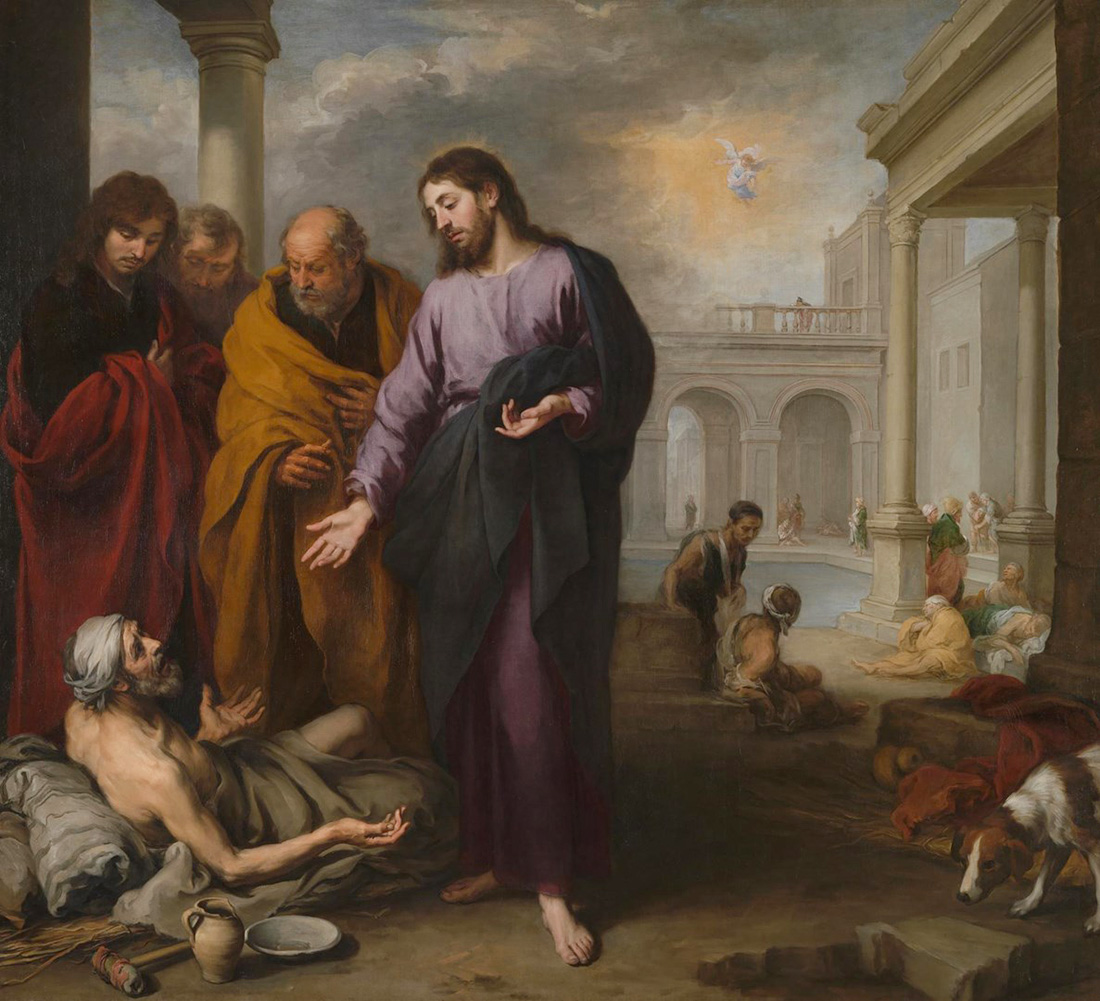
    Christ Healing the Paralytic at the Pool of Bethesda (1667-1670), Bartolomé Esteban Murillo | Creative Commons, courtesy The National Gallery (UK).

    Yesterday’s Office of the Readings also gives us Origen’s commentary (quoted earlier). Here is another important link from Origen:

    “God taught the people of the old covenant how to celebrate the ritual offered to him in atonement for the sins of men. But you have come to Christ, the true high priest. Through his blood he has made God turn to you in mercy and has reconciled you with the Father. You must not think simply of ordinary blood but you must learn to recognize instead the blood of the Word. Listen to him as he tells you: This is my blood, which will be shed for you for the forgiveness of sins.

    Once again, we encounter Christ in all his fullness today, enacting his saving mission with every word and deed. We must strive to see the mystery hidden deep within each passage from the Word of God. Jesus gives us a profound understanding of the water that flows from the new temple: it is him, it restores our humanity and enables a new communion with the divine.