Friday in the Fifth Week of Lent: Jeremiah 20:10-13, John 10:31-42.
Today’s readings show the inexorable movement of Jesus’s ministry towards the Passion but also the irrefutable logic he provides in his works and words. The take-home message of the gospel narratives seems to be that since humanity can’t accept the divine truth brought into their midst, Jesus must be crucified as a sacrifice on our behalf, not just to fulfill prophecy, but as a very real atonement on our behalf for our rejection of Him, the Spirit, and the Father.
Jeremiah was a “repent, the end is near!” prophet. The Book of Jeremiah is so interesting in part because it is a first-hand account of someone we’d probably call a crazy person if we saw them on the street corner. In the verse prior to the ones in today’s reading, he explains that he tries not to be that guy and he knows he’s a “laughingstock,” but he can’t resist God’s message within him: “If I say, ‘I will not mention him, or speak any more in his name,’ then within me there is something like a burning fire shut up in my bones; I am weary with holding it in and I cannot” (Jer 20:9). He shares a clear insight into what it means to completely give yourself over to God: “O Lord, you have enticed me,” he says, “you have overpowered me” (Jer 20:7). This is a great example of how we can’t pigeonhole God into a single metaphor or image. He’s not always the benign guiding light or the patient beating heart of love. Sometimes He’s the urgent master, beguiling us with His energy and leading us to preach like wild people (or wear camel hair and eat grasshoppers and wild honey like St. John the Baptist).
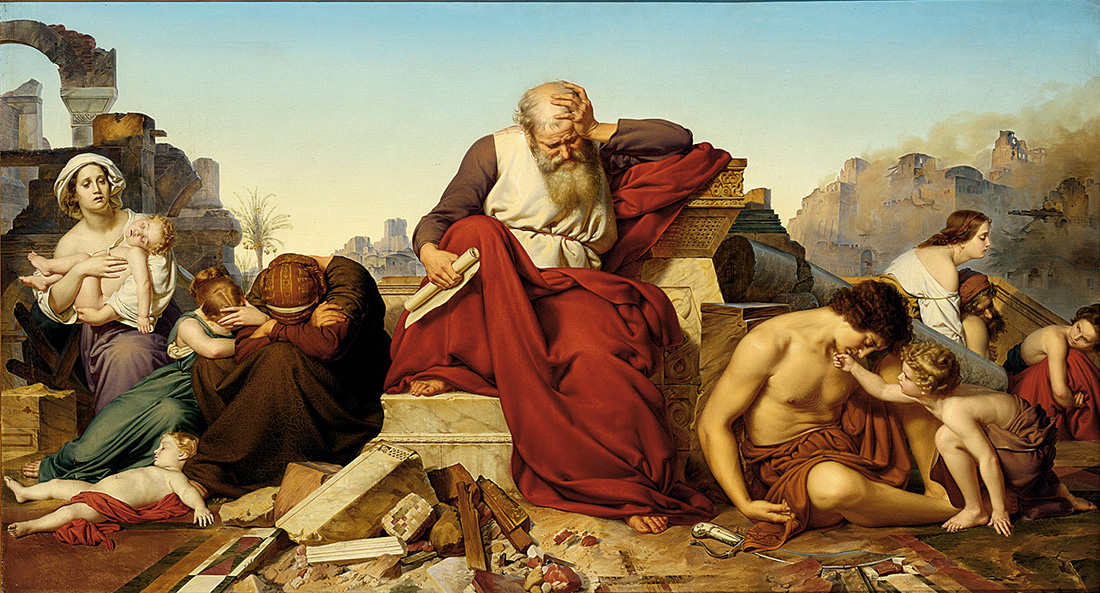
Jeremiah Seated in the Ruins of Jerusalem (Jeremias auf den trümmern von Jerusalem), 1837, Eduard Julius Friedrich Bendemann | Wikimedia Commons.
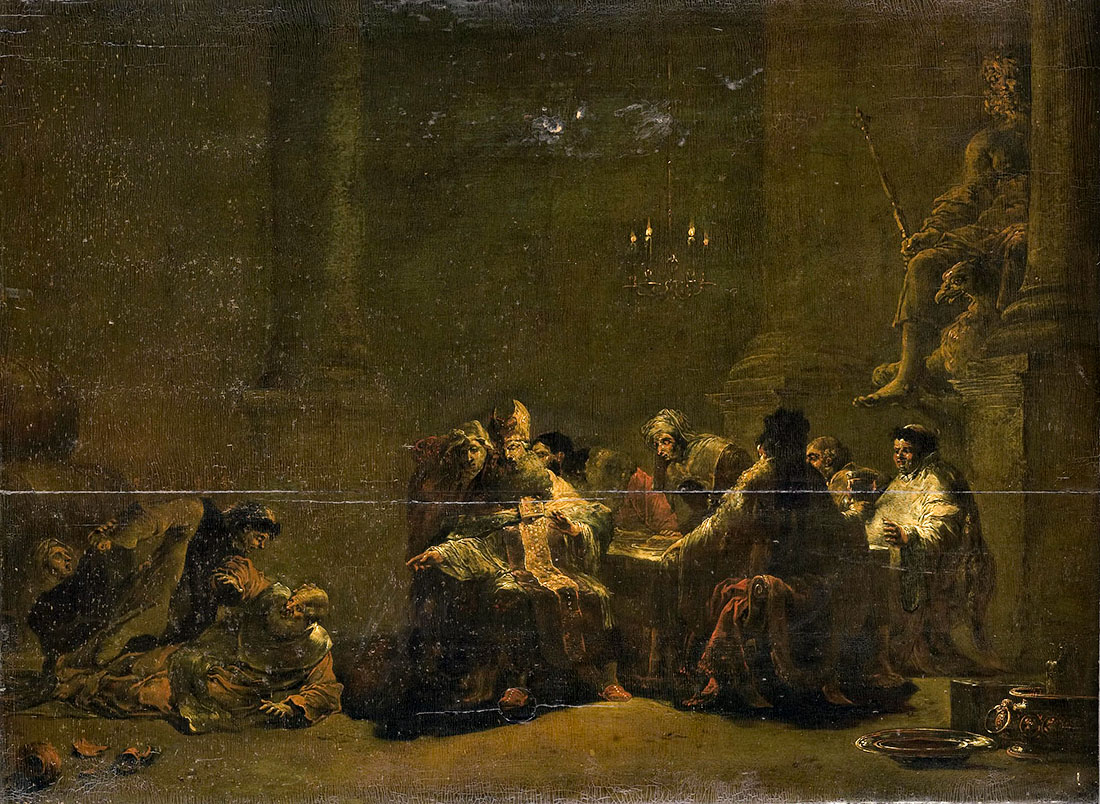
So in today’s reading, Jeremiah laments that he is abandoned by his friends and trapped by his enemies, but he is aware that in a way he brought it upon himself. After all, he pointed out how wicked everyone was and how they would be conquered and enslaved. Not exactly words to win friends. At the beginning of this very chapter, the priest Pashhur beats him and puts him in the stocks for a day because he hears him prophesying. When he is let out, Jeremiah delivers a tirade complete with curse and death sentence for Pashhur. Firebrand, indeed. So we must read today’s lament within this mixed bag of emotions: a man who wants to save his people, but ends up being hated by them. When he tries to hold it in, he can’t resist God, whom he loves but also feels a bit exhausted by. He notes the inevitability that God will triumph over those persecuting him because He is “a mighty champion.” Jeremiah has cast his lot with the Lord over all else, and it’s interesting to hear the way he describes God. The lectionary reads at one point, “O LORD of hosts, you who test the just, who probe mind and heart,” and it seems like Jeremiah is speaking from experience, as one who has been tested in mind and heart. The NRSV Bible translation of this verse is “O LORD of hosts, you test the righteous, you see the heart and the mind; let me see your retribution upon them, for to you I have committed my cause,” and we hear even more clearly the internal dialogue Jeremiah is having with the Lord. He is saying, you’ve tested me, you know my heart and mind, so let me confess that I want to see your retribution on them, for I have long ago committed to you and you know that I am just a petty human doing your work.
The passage we read ends in a seemingly triumphant way: “Sing to the LORD, praise the LORD, For he has rescued the life of the poor from the power of the wicked!” And I don’t mean to question the legitimate praise and truth in this statement, but when we read the very next verse, omitted from today’s reading, we get quite a different picture of his struggle. He says, “Cursed be the day on which I was born!” (Jer 20:14) and a little later to clarify: “Why did I come forth from the womb to see toil and sorrow, and spend my days in shame?” (Jer 20:18). These are the words of a tortured soul. He knows on a certain level that he is but God’s tool in this life, yet he is also committed to and entranced by God. He knows that he is doing good work but also knows that the Lord has planned the destruction of Jerusalem and the Babylonian Exile for the Jews. Jeremiah teaches us that the life of the prophet is a hard, hard, thing. That God’s love sometimes carries a difficult message, one that will make you hated.
Pashur Smiting Jeremiah in the Temple (c.1648), Leonaert Bramer | Wikimedia Commons.
Which brings us to our greatest prophet and Only-Begotten Son of God, Jesus Christ. Much like Jeremiah, he faces some serious hatred and persecution, as the first line of today’s reading states, “The Jews picked up rocks to stone Jesus.” But Jesus handles Himself very differently than Jeremiah. We never get the sense in the gospels that he is mentally tortured, even when crying in the Garden of Gethsemene, or that He wishes to see the Lord’s retribution on the people. Exactly the opposite: He still wants to grant them salvation and forgive them, all the way to His death and triumphantly so with His Resurrection. This is the great game-changer in history. No mere human could do this. It is why God had to send us His Son and have Him take on the flesh of humanity so that He could enact such forgiveness and love when those of us who were merely human would have failed long before.
How can he accomplish this? The fact that he is the Logos of God has something to do with it. In today’s reading, he displays the irrefutable logic inherent in the Logos. Faced with stoning, He calmly asks, “I have shown you many good works from my Father. For which of these are you trying to stone me?” Logical point one: why would you stone a miracle worker? Point two: these good works have come from God the Father, why would you stone someone bringing you works from God?
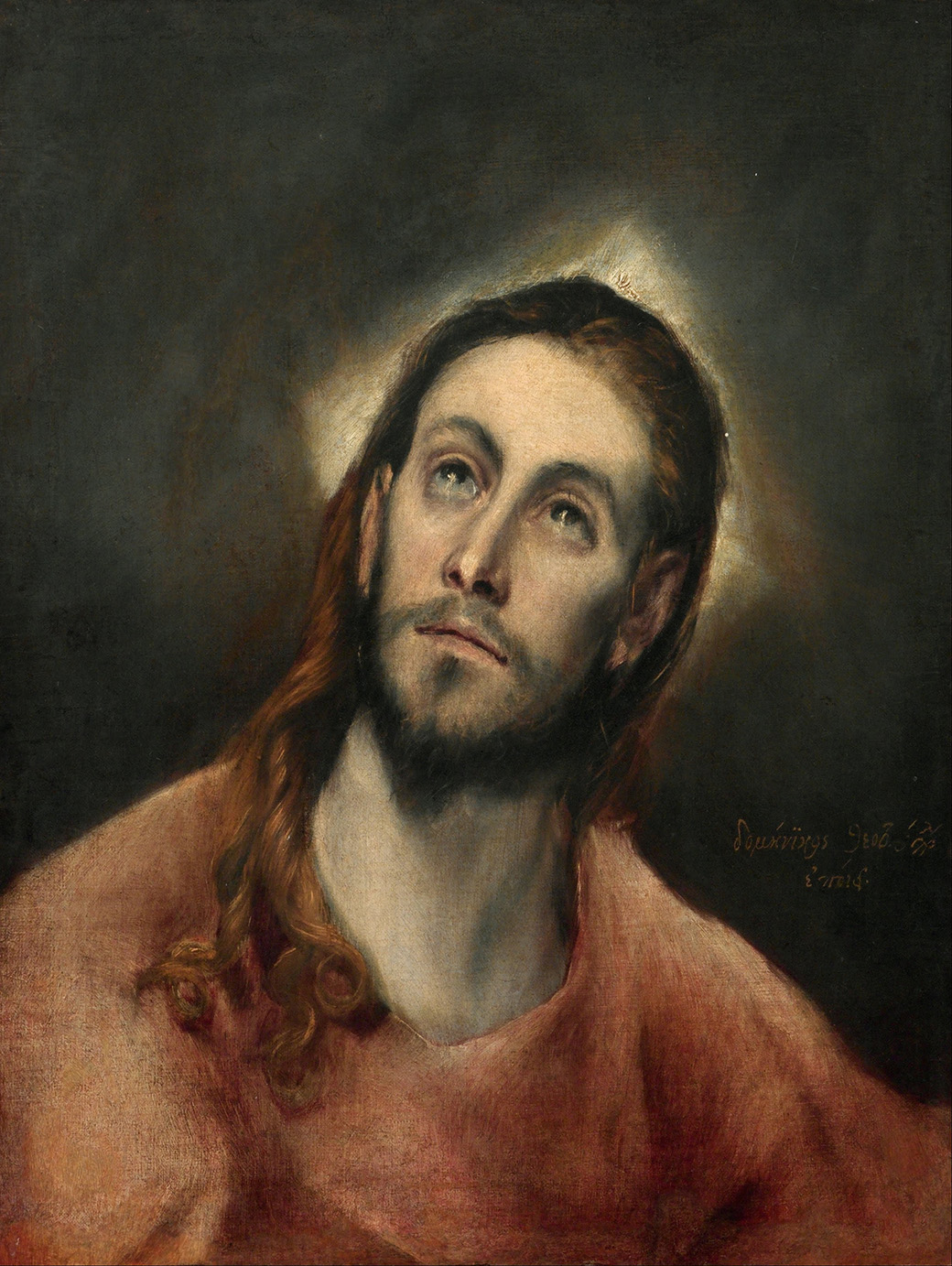
Christ in Prayer (1595-1597), Doménikos Theotokópulos (called El Greco) | Wikimedia Commons. I love El Greco’s painting of a pure, patient, innocent-yet-all-wise Christ, looking to His Father with eyes full of devoted love, despite all its difficulty.
They respond that it’s not the good works but his words, that “You, a man, are making yourself God.” He responds first by pointing out that God Himself in the Scriptures (in Psalm 82, to be precise) says “You are gods,” when he is speaking to the highest earthly authorities (judges, kings) to remind them of their moral responsibilities and the fact that they’re failing at giving justice to the weak and not the wicked. Jesus’s point is that if the Scriptures, the very Word of God, in fact, call some humans “gods,” especially when those were being called to the carpet for shirking their duties, then why is it blasphemy for him to call himself “Son of God” when he is enacting the works of the Father? His logic resides in the Scriptures, the Law itself. He goes on to let the works of the Father be his testimony:
If I do not perform my Father’s works, do not believe me; but if I perform them, even if you do not believe me, believe the works, so that you may realize and understand that the Father is in me and I am in the Father.
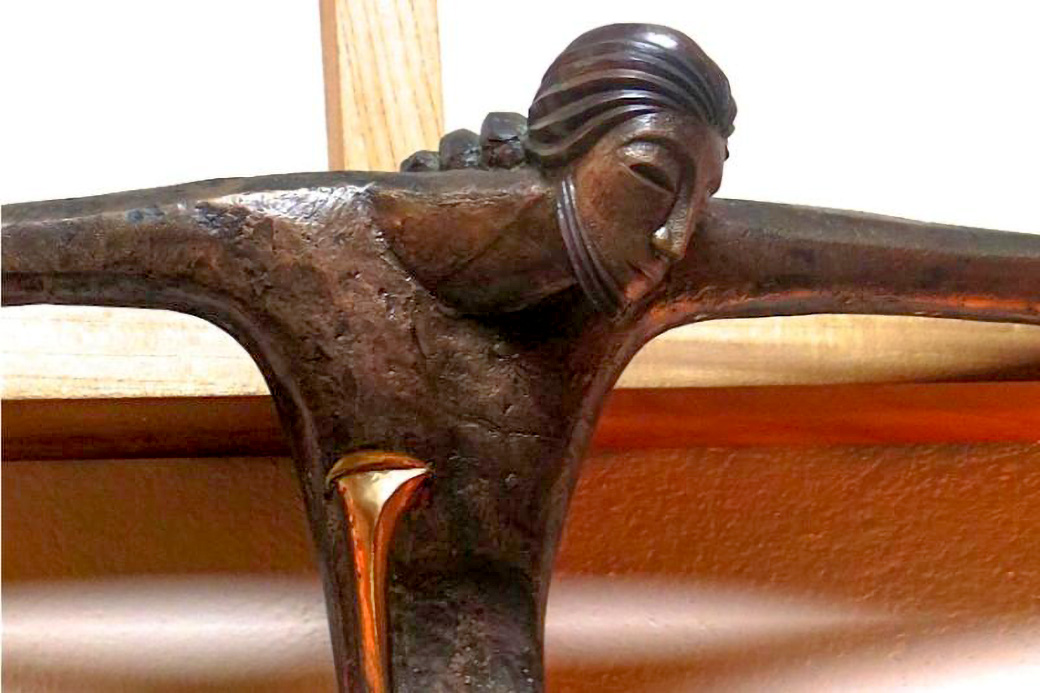
In other words, if I perform no miracles, then you shouldn’t believe me. But look at these works of the Father and you can believe them even if you don’t believe me. Maybe through them, you’d realize and understand when I say I am the Son of God. His logic cannot be questioned. There is no arguing with it. They simply try to grab him. Our lectionary reads, “but he escaped from their power.” The Greek, however, is that he “went forth from” (ἐξῆλθεν / exēlthen) — interestingly, the same verb used to describe the water and blood that “flowed” from his side when he is pierced by a spear on the cross — “their grasp” (literally, their hands). This sense of “going forth” like flowing water reinforces the sense of irrefutability of the logic that we hear from the Logos of God. When water flows, we are somewhat at a loss of how to stop it, just like the Word of God can’t be stoppered and Jesus can’t be arrested before His time. These things are not subject to the will of humanity; they operate on a different plane and they are inevitable.
Crucifix of the Pierced Heart of Jesus from the Mother House Chapel of the Religious of the Sacred Heart of Jesus, Ixelles, Belgium | image from rscjinternational.org.
As we have read Jesus’s exchanges with the Jews in Jerusalem all week, I am struck by the repeated rejection He received and the unwillingness of the Jews to hear His message. There were many years when I only got the “greatest hits” readings on Sundays, often focused on his miracles and great sayings, and they don’t portray the fuller story of his work as a prophet who is rejected by his people. The gospels are definitely meant to be read as a narrative, straight through, beginning to end. The whole Bible for that matter, for how else can we see the redemption of Jeremiah in the figure of Christ, who experiences his same tribulations but bears it with a patience, a steadiness, and a love that is unequaled by mankind.
Thursday in the Fifth Week of Lent: Genesis 17:3-9, John 8:51-59.
Today’s readings compare God’s foundational covenant with Abraham and the New Covenant he offers through Christ. The terms of the covenants change, both the scope of God’s promise as well as the requirements from humanity. The constant, however, is the Word of God, providing the providential ordering of our lives.
What stands out for me in the first reading is the earthly terms of the covenant God establishes with Abraham. Note the earthly elements: making him “exceedingly fertile,” giving him “the land in which you are now staying, the whole land of Canaan, as a permanent possession,” and changing his name from Abram (“Exalted Father”) to Abraham (“Father of Many Nations”). God’s plan seems to be one of choosing the patch of earth and people that he will till and tend, waiting for the fruit that it will bear. This fruit, of course, is Mary, and in turn, Christ.
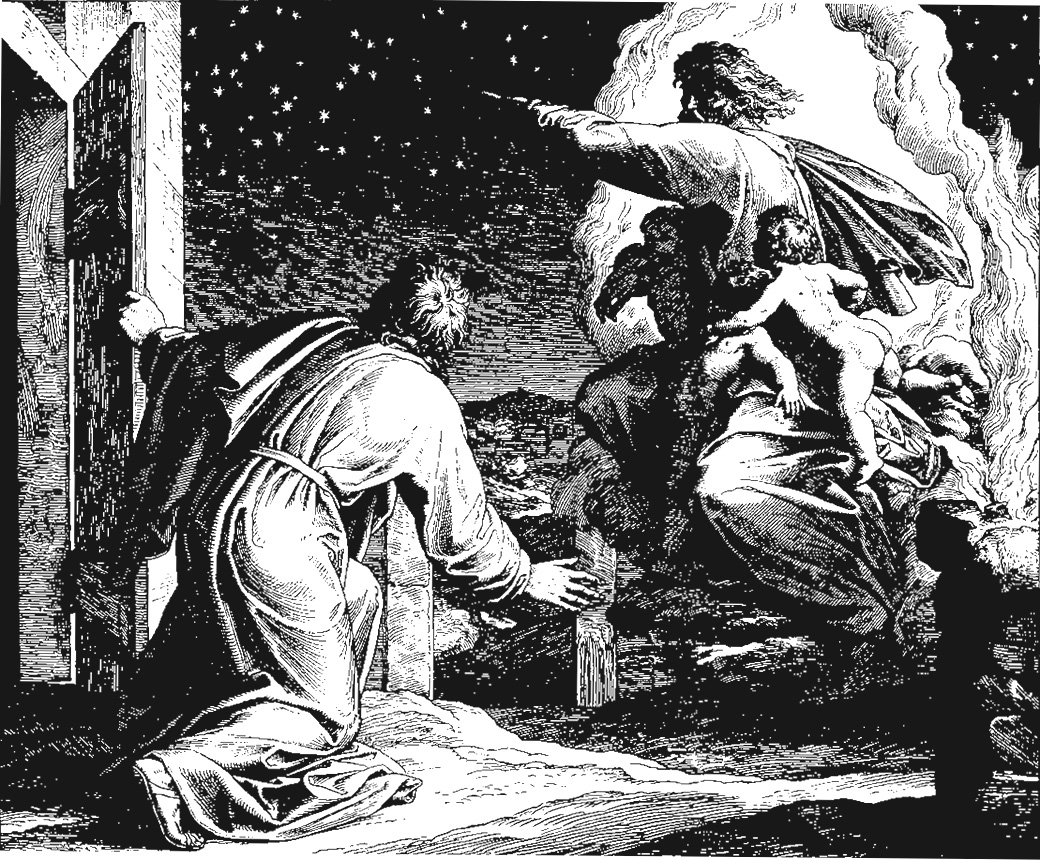
God’s Promise to Abraham (1866), woodcut by Julius Schnorr von Carolsfeld for the “Bibel in Bildern” (Bible in Pictures) | Wikimedia Commons.
Even the terms of the covenant placed upon Abraham and his offspring are very earthly. Genesis reports God’s command in the verses after today’s reading: “Every male among you shall be circumcised.” Symbolically and bodily, this is very important. The very organ for procreation, the method for being “exceedingly fertile,” will be marked for God. It will be exposed in a symbolic opening of one’s heart to be a servant of God. This is a permanent mark of a tribe, more permanent than pagan piercings, more indelible than tattoos. There is no hiding or turning back from this bodily mark in this world.
Circumcision lays the foundation for Moses and the generations after him when God presents them with a multitude of laws. The Abrahamic nations needed to live with the incontrovertibility of circumcision so that later generations could accept more prescriptive laws intended to keep them pure in body, mind, and spirit. Into this people, Mary was born miraculously without sin via the Immaculate Conception. And the prescriptions on purity and a cultural willingness to accept God’s law prepared her to accept the Incarnation of Christ in her womb.
Returning to our reading, let’s dwell for a moment on the opening verses: “you are to become the father of a host of nations. No longer shall you be called Abram; your name shall be Abraham.” This is the essence of the Word of God: to create, to name, to make manifest his plans. No other “word” operates in this way. I might name my dog “Thunderbark,” but that doesn’t make his bark actually sound like thunder. In fact, our act of naming things often describes what we see, hear, touch, smell, or in some other way process through our senses. God’s Word, on the other hand, is creative and generative in that reality conforms to his Word rather than his Word describing what already exists. He is the Creator — he makes it exist.
We know from St. John that Jesus Christ is the Word of God, specifically the Λόγος (Logos). In the prologue to his gospel, he gives us the most influential Christian text on the Logos: “In the beginning was the Logos, and the Logos was with God, and the Logos was God. … All things came into being through him … And the Logos became flesh and lived among us, and we have seen his glory, the glory as of a father’s only son, full of grace and truth” (Jn 1:1, 3a, 14). Logos, as I have noted in a previous reflection (The Life-Giving Word) is only partially defined by the English “Word.” It does literally mean “word,” “discourse,” or “account,” but by the time John writes his gospel, it had about 600 years of philosophical meaning attached to it as well. There are several threads that likely would have influenced John:
The writings of the Greek philosopher Heraclitus (c.535-475 BC) and his followers, who took the word logos that was already in common use and gave it more of a philosophical meaning, that of the reason or truth inherent in the world. From here we can see how Aristotle formulates logos as “reasoned discourse,” one of the three modes of persuasion.
The writings of the Greek Stoics (c.300 BC – 200 AD), who spoke of logos as the active reason pervading the Universe. They used the term λόγος σπερματικός (logos spermatikos) to mean the generative principle of the Universe that creates and takes back all things. This sounds a lot like God, which they intended, since logos for them was a type of spiritual or supernatural “ordering essence” in things.
The writings of the Hellenized Jew Philo of Alexandria (20 BC – 40 AD), who takes the Stoic philosophy a bit father. He calls Logos “the first-born of God,” and writes, “the Logos of the living God is the bond of everything, holding all things together and binding all the parts, and prevents them from being dissolved and separated.” But for Philo, the Logos is an intermediary divine being, a demiurge that is God’s instrument of creation, and this is soundly rejected by the developing Christian Church that upholds the equality and consubstantiality of the Son and the Father in the Trinity.
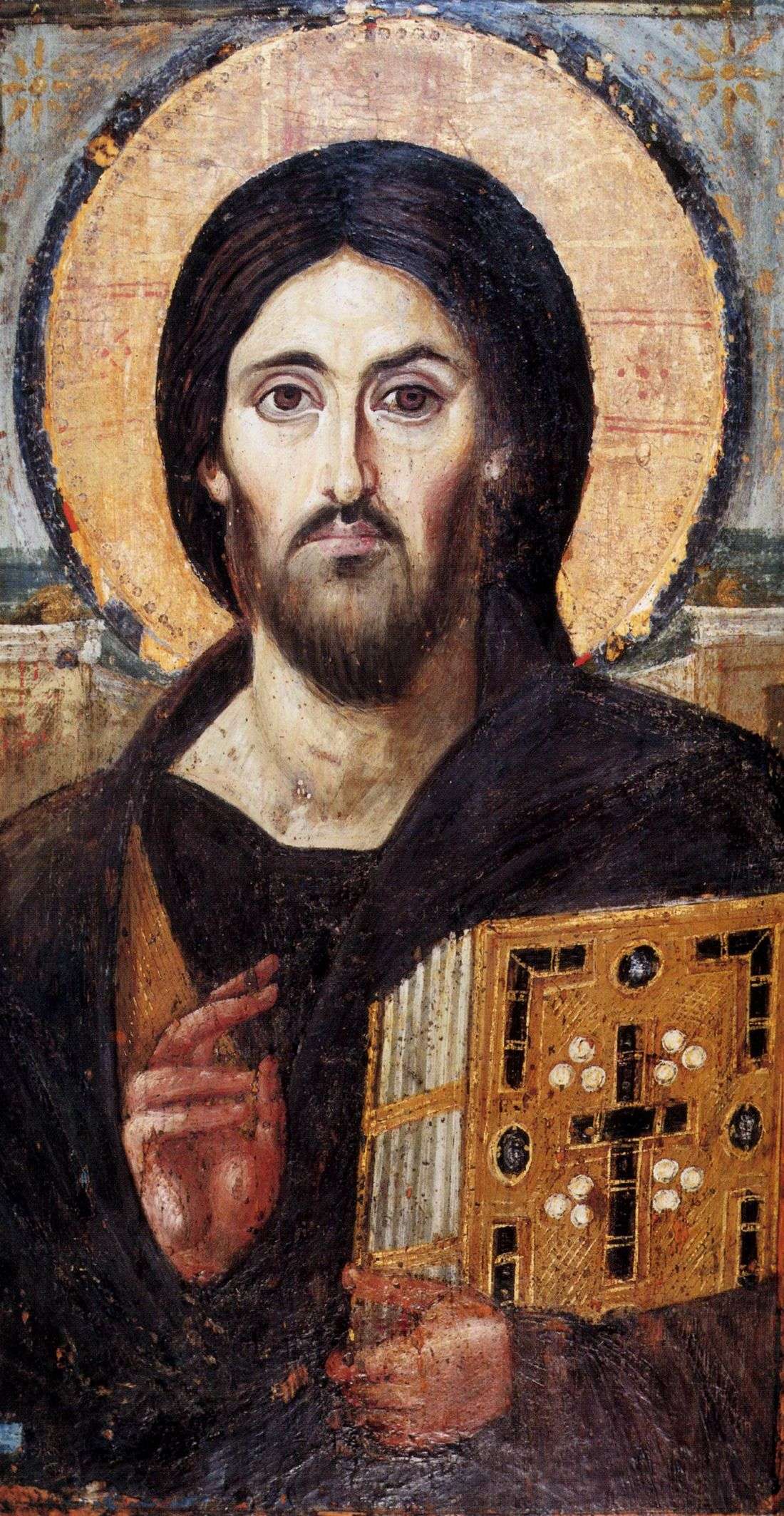
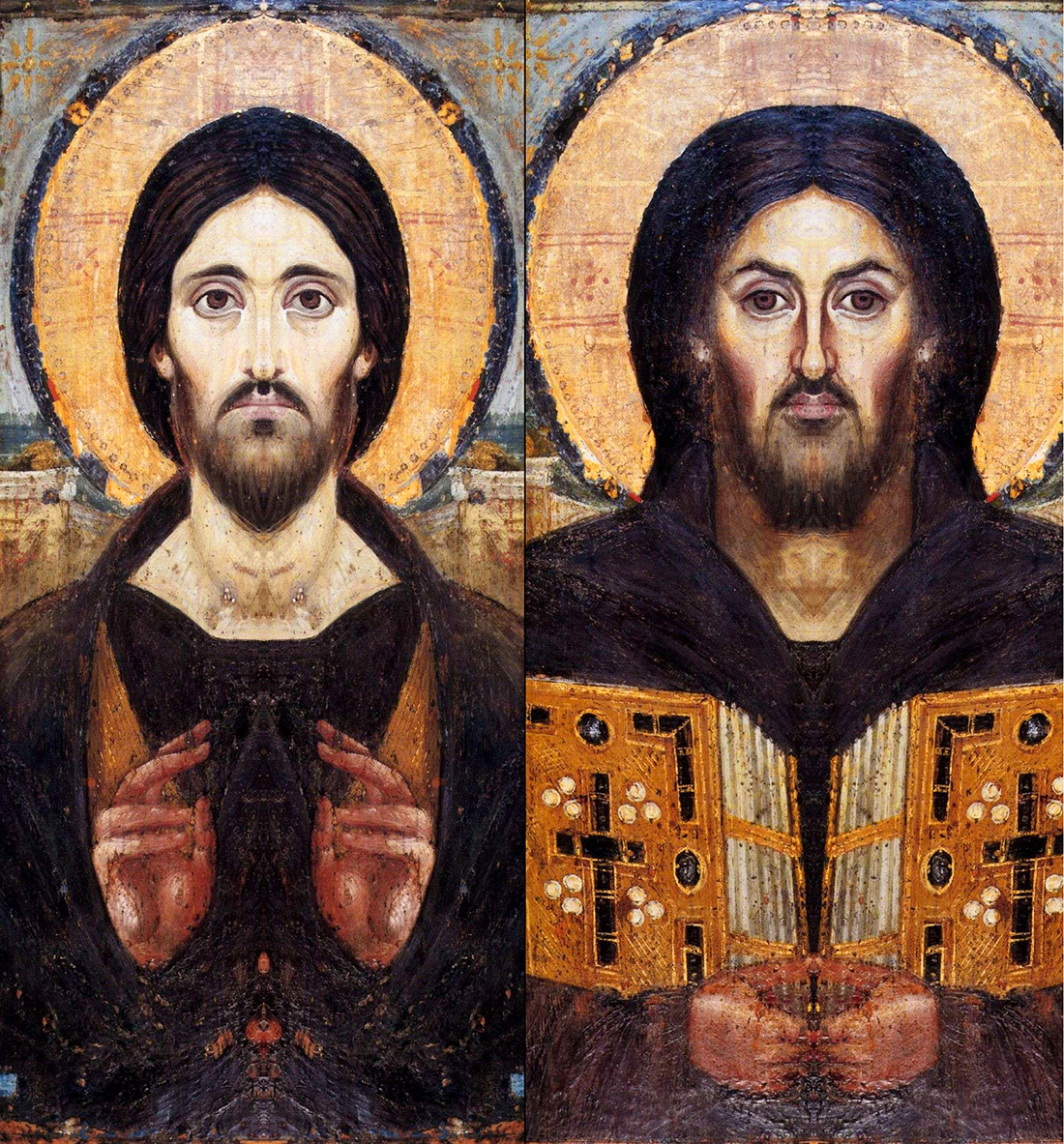
The oldest known icon of Christ Pantocrator, 6th-century encaustic icon from Saint Catherine’s Monastery, Mount Sinai | Wikimedia Commons. This famous icon represents the perfect union of the human and the divine in Christ. The features on his left side (the viewer’s right) represent the qualities of his human nature, while his right side (the viewer’s left) represents his divinity.His right hand is shown opening outward, signifying his gift of blessing, while the left hand and arm is clutching a thick Gospel. Below is a mirrored composite of this image (made in Photoshop) that illustrates how the divine essence (left) is pure and perfect while the human nature (right) is painted in shadow with all of the “weathered” nature of the body and the earth.
John’s Logos is not a synthesis of these definitions, nor does he simply “borrow” from these more developed and earlier systems, which many scholars want to claim. I think that is a condescending and belittling statement that discounts the true divine revelation at work in John’s Christology. Certainly, he did not invent the word Logos, but he instills the particularity of Jesus’s person that other philosophies employing Logos simply do not contain. Much like Christ reformulates our understanding of the terms life, death, and father, he gives new meaning to the word Logos. That being said, I think we must consider the vibrant meaning this word already contained by the time John uses it. It does translate to “word,” but it’s fair to say that John also understood it to mean reason, a generative principle in the universe, and an ordering essence.
By insisting that Jesus Christ is the Logos of God and the Son of God, he says that this particular Jew who died on a cross around 33 BC was the ordering essence of the Universe, reason and truth incarnate. Thus, when Jesus speaks, the generative Word of God, the Logos is brought to bear in the world. That same Word that gave Abraham his name and established circumcision to prepare the fertile soil that would bring forth Jesus Christ as its fruit is, in fact, dwelling in Christ. Every time Christ speaks in John’s gospel, he brings forth real truth, and he is sure to remind us that he is sent from God and is speaking God’s Word, not something he generated himself as a man. We hear of no one else in sacred scripture who makes this claim.
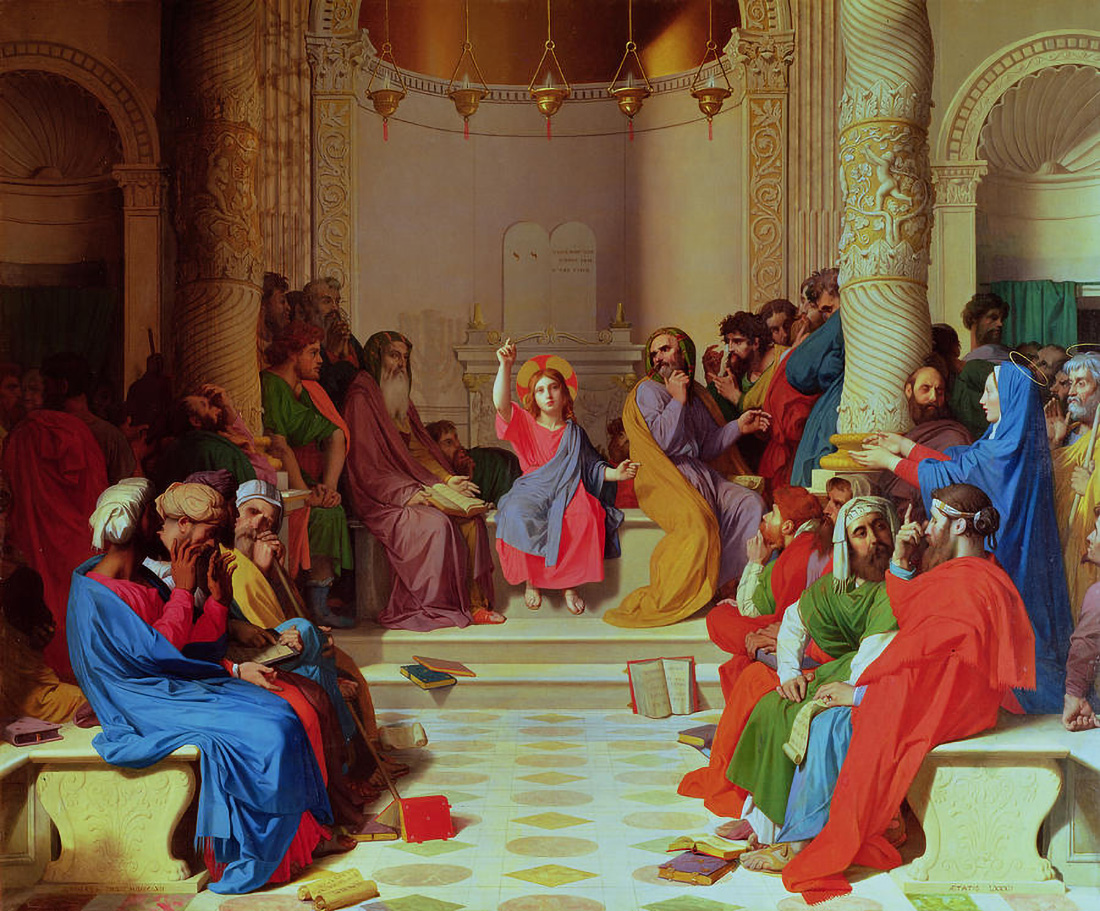
Jesus Among the Doctors (1862), Jean-Auguste-Dominique Ingres | Wikimedia Commons.
So, the question is, how can you resist the Word of God, the Logos of the universe? How can you doubt it, not trust it? A few verses before our gospel reading today, Jesus asks this very question: “If I tell the truth, why do you not believe me?” (Jn 8:46). He then answers his own question for them: “Whoever is of God hears the words of God. The reason you do not hear them is that you are not of God.” This is a continuation of yesterday’s gospel reading and reflection; Jesus is trying to remind them of who their spiritual father is, namely God the Father. He points out that their disbelief in him stems from their fundamental distance from God the Father. They reject him because they have already rejected the Father in spirit.
The exchange in today’s gospel, the remainder of chapter 8, displays just how much they have rejected the Father and, in turn, how far they are from accepting Jesus and the Kingdom he offers. Their response to him (just before the reading picks up) is “Are we not right in saying that you are a Samaritan and have a demon?” They have devolved into name-calling, certainly not the sign of people who hold God dear to their hearts.
Then, they take up jeering: “Are you greater than our father Abraham, who died? Or the prophets, who died? Who do you make yourself out to be?” They are not open to hearing the content of his words in the least. They are just picking out phrases he says to throw them back and wound him. Their rejection is complete when they pick up stones to throw at him; since their barbed words seem not to work, they try to carry out the violence physically. All of these words and actions come from a sinful spirit, a soul being fed by Satan and not God.
What exactly is Jesus trying to say to them that garners this barrage of insults? The text sounds like Jesus desperately wants to break through to them, saying, “Amen, amen, I say to you, whoever keeps my word will never see death.” This sentence is worth examining. The first half of the sentence occurs so often throughout the gospels (John writes “Amen, amen,” while Matthew, Mark, and Luke use a single “Amen,”) that it is the most characteristic thing about his speech patterns. Jesus is the only one to use it at the beginning of his statements rather than the end of a prayer or as a confirmation of some other saying. And all of these writers have chosen to keep the Hebrew word “Amen” even though Greek has a word for “truly”: ἀληθῶς (alethos). So, “Truly I tell you” and “Verily I tell you” are not good translations here. There is no reason to translate a word that we regularly use in all of our prayers.
To get at what “Amen” means other than “truly” “or “verily,” let’s turn to Joseph Cardinal Ratzinger’s fantastic Introduction of Christianity, where the entire first chapter delves into this question: “‘Amen’ simply says once again in its own way what belief means: the trustful placing of myself on a ground that upholds me, not because I have made it and checked it by my own calculations but, rather, precisely because I have not made it and cannot check it” (75). This Hebrew word expresses that one’s being is grounded in belief and faith. It marks the rootedness of oneself in the faith of our singular God. It could easily be translated as “I believe” when used at the end of a prayer or when receiving the Eucharist. Ratzinger goes on to write:
The Christian attitude of belief is expressed in the little word “Amen”, in which the meanings trust, entrust, fidelity, firmness, firm ground, stand, truth all interpenetrate each other … The indivisibility of meaning, ground, and truth that is expressed both in the Hebrew word “Amen” and in the Greek logos at the same time intimates a whole view of the world. … For to believe as a Christian means in fact entrusting oneself to the meaning that upholds me and the world; taking it as the firm ground on which I can stand fearlessly (76, 73).
So what is “Amen” when it is used by Jesus not as a confirmation of belief but as an introduction of something he is saying? I believe he is affirming that he is the firm ground on which we can stand. He is the source of the Amen, the Logos that is truth and meaning. And I don’t think this is just a clever rhetorical trick he uses to establish authority. It pours out of him 50 or so times in the New Testament, part and parcel of the truth he gives as a gift to humanity.
After he says, “Amen, Amen,” He says λέγω ὑμῖν (legō hymin), which translates to “I say to you” or “I am telling you,” but legō just as correctly translates to “teach” or “command.” Thus, we can just as truthfully translate the first half of his statement, amēn, amēn, legō hymin to be: “The truth is here, I am teaching it to you.”
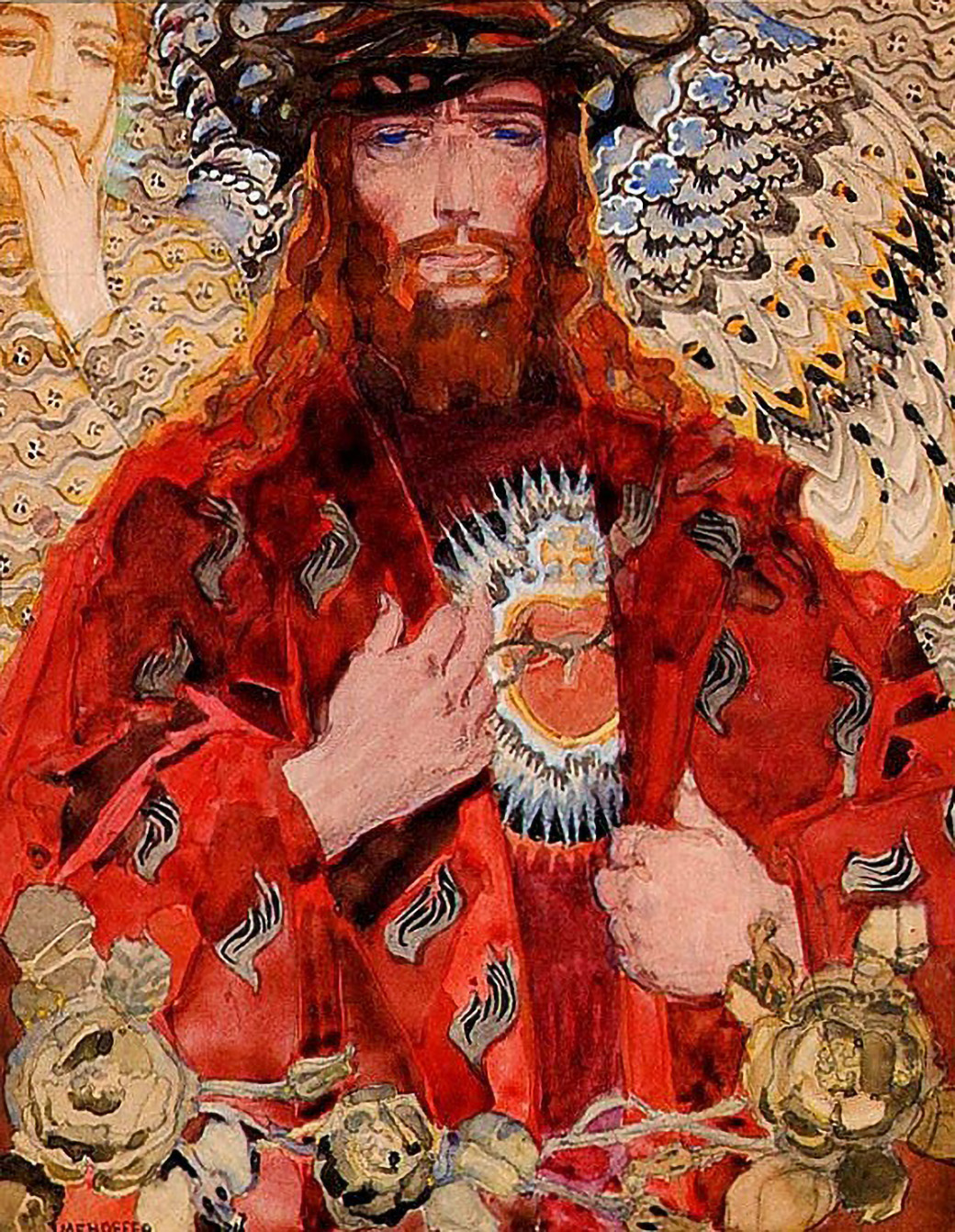
The Sacred Heart of Jesus (Serce Jezusa), 1911, Józef Mehoffer | Wikimedia Commons.
The second half of his important statement is “whoever keeps my word will never see death.” As you might imagine, there is more depth here than first appears in our English translation. The verb “keeps” (τηρήσῃ / tērēsē) means to “watch over,” to “guard,” and to “observe.” And, lo and behold, “my word” is logon (from logos). As we have detailed, since Christ is the Logos, when he says “observe my logon,” we can understand this to mean “whoever upholds the truth I bring to the world.”
The entire statement has the lyrical feel of a proverb because the next verb “see” is θεωρήσῃ (theōrēsē), so we have some alliteration and rhyme between two verbs of beholding: tērēsē and theōrēsē. And let’s not think he means “experience” death when he says “see death.” This verb theōrēsē means to see in the sense of “to observe (as a spectator)” or “to contemplate (as in the mind)” and thus is much more consistent with the meaning of death as a type of sleeping, an inferior force in the world compared to the life from the Logos, as we discussed in the reflection on Lazarus, See the Glory of God.
‘Amen’ simply says once again in its own way what belief means: the trustful placing of myself on a ground that upholds me, not because I have made it and checked it by my own calculations but, rather, precisely because I have not made it and cannot check it.
– Joseph Cardinal Ratzinger, Introduction to Christianity, 75.
I know that this has been a long examination of a simple sentence, but where have we arrived? I think this changes the tenor of the statement to be less of a desperate “listen to me!” to more of a confident declaration of his truth and revelation of his being. “Amen, amen, I say to you, whoever keeps my word will never see death” can be also translated (in the context of this discussion), “The truth is here, I am teaching it to you; whoever upholds the truth I bring to the world will never be held in the thrall of death.”
Christ in the Desert (1933), Nicholas Roerich | image from arthive.com. I like this painting in that death is pictured in the shadows and could be mistaken for a black mountain if not for Christ’s patient, pervasive light that illuminates his grotesque charade.
To tie this back to our opening observation about the contrast between the Abrahamic covenant and the new covenant given by Christ, God’s promise is no longer earth-bound. In fact, it’s about transcending the scope of earthly concerns, specifically death, and accessing the divine. For our part, our requirement is almost absurdly simple: uphold in our hearts the truth Christ brings into the world. Of course, in practice, this turns out to be harder than it sounds.
Jesus’s final statement in today’s reading also speaks to the revelation of his being, and this one really throws the Jews into a fit. They scoff and ask how he can possibly know that Abraham saw his day and was glad. His answer: “Amen, amen, I say to you, before Abraham came to be, I AM.”
Whoa! We get his signature opening of truth and the statement that their spiritual and ethnic father was γενέσθαι (genesthai), that is, “brought into being,” and before that, he (Jesus Christ) “is” — a different verb, εἰμί (eimi), which means to exist, not to be brought into being. He affirms John’s prologue that he is the Logos made flesh, that he exists from the beginning, with God and of God. By telling them that Abraham was glad for his arrival on earth, he also affirms that he has existed throughout all time, has been with all of the prophets and is above them.
As we say in the Liturgy of the Hours, “He is the first-born of all creation; in every way the primacy is his.” With this lens of comprehension on his statement, the argument that the Jews are attempting to have with him in the temple is almost laughable. As St. Paul says in his letter to the Colossians,
He is the image of the invisible God, the firstborn of all creation; for in him all things in heaven and on earth were created, things visible and invisible, whether thrones or dominions or rulers or powers—all things have been created through him and for him. He himself is before all things, and in him all things hold together. He is the head of the body, the church; he is the beginning, the firstborn from the dead, so that he might come to have first place in everything. For in him all the fullness of God was pleased to dwell (Col 1:15-19a).
What is the sum total of all these heavy theological concepts that come together in Jesus Christ? For me, if I am a Christian, I accept all that Christ reveals as Logos, as Truth, as God. What he tells us today is that when we accept him (“guard” his Logos in our hearts), we are accepting a reality of God’s providential plan for humanity.
In his 1998 Encyclical Letter Fides et Ratio, Pope Saint John Paul II writes, “The word of God reveals the final destiny of men and women and provides a unifying explanation of all that they do in the world” (81). Do we allow this to happen? Is our worldview fundamentally Christological?
Do we interpret all of history through Christ or do we think that he’s just one voice among many holy voices? Do we think that has some truthful things to share with us or do we accept that he is the very truth and meaning that have ordered the universe from the beginning of time?
These are important questions — he forces us to make a choice because only by accepting his truth can we transcend death. If we want sanctification, divinization, and salvation, we have the Way, the Truth, and the Life right here with us.
Wednesday in the Third Week of Lent: Deuteronomy 4:1, 5-9, Matthew 5:17-19.
Today’s readings show Moses and the new Moses (Christ) discussing God’s law and urging their listeners to not only obey it but teach it to future generations. Jesus’s words occur during the Sermon on the Mount when he shares the Beatitudes, and they are a powerful claim on his Kingship.
Once chosen by God, Moses seems to be in near-constant communication with him. I’m sure that’s not quite true, but when reading Exodus and Deuteronomy, I’m struck with just how much the two of them spoke. The Word of God is not only with him verbally, but eventually on “tablets of stone, written with the finger of God” (Ex 31:18).
The Word is extraordinarily active, first as prophecy bringer, then miracle worker, deliverer, satisfier of human needs, and finally, upon Mt. Sinai, law-giver. God continues to reach out to his people, manifesting his presence as a response to their incapacity to recognize him and hold him in their hearts. The law written on stone tablets is a capstone on his work establishing the nation of Israel, rescuing them from enslavement.
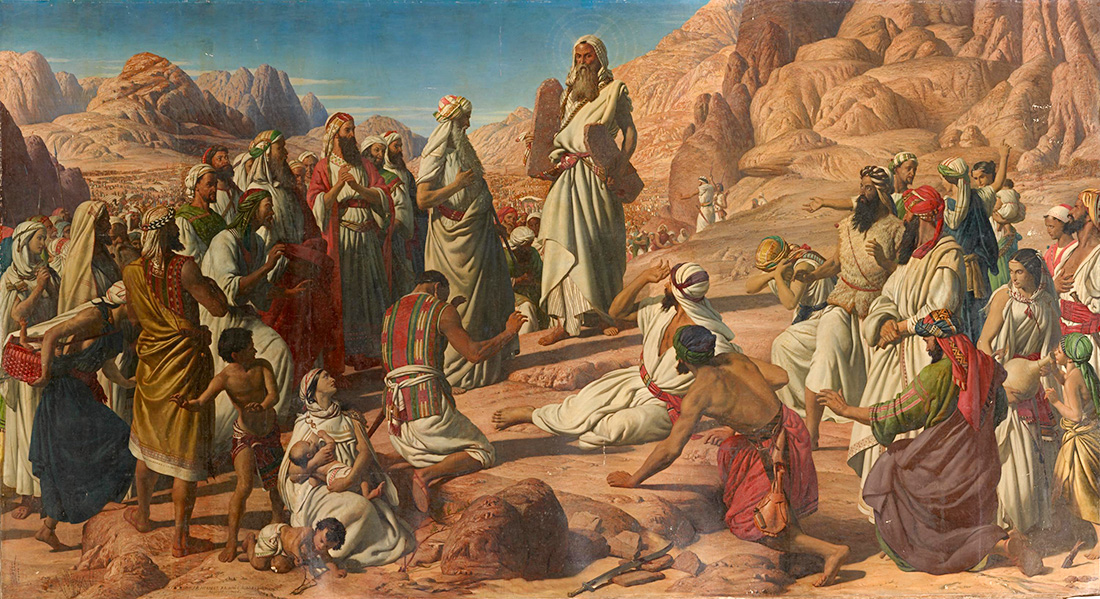
Moses bringing down the Tables of the Law (1877), John Rogers Herbert | Creative Commons, courtesy the National Gallery of Victoria, Melbourne, Australia. This monumental work of art is 11 feet high and nearly 21 feet wide, suiting the monumental nature of the event. As someone who lives in Utah, I also appreciate the red rock desert depicted here it all its beautiful barrenness.
Laws on stone tablets (not to mention the much more extensive precepts given to Moses verbally) seem fairly final in their permanence, but God’s aim is to inscribe his law on the hearts of his people, not on stone. Indeed, while he’s inscribing the first set of stone tablets, the Israelites are busy building and worshipping a golden calf at the base of Mt. Sinai. He eventually gives Moses a second set of tablets after Moses smashes the first ones in his anger and shock over the Israelites unfaithfulness while he was on the mountain for 40 days and nights.
So today’s reading shows Moses imploring God’s fledgling people not to forget (again) God’s works, providence, and laws. After stressing God’s laws and decrees, Moses tells them “not to forget the things which your own eyes have seen, nor let them slip from your memory as long as you live, but teach them to your children and to your children’s children.” Like God, Moses understands that the laws must be inscribed in their memory and on their hearts, not just on stone tablets.
Moses spends the bulk of the Book of Deuteronomy teaching them the laws and decrees. At one point, though, he summarizes the multitude of prescriptions: “what does the Lord your God require of you? Only to fear the Lord your God, to walk in all his ways, to love him, to serve the Lord your God with all your heart and with all your soul, and to keep the commandments of the Lord your God and his decrees” (Dt 10:12-13).
We see over time that the Israelites struggle with both keeping both the letter of the law and the spirit of the law. Jesus enters history at a time when the Pharisees and scribes are experts in the letter of the law but do not uphold the spirit of the law. Jesus points out that they have ended up fetishizing the law, as demonstrated by their physical appearance: “they make their phylacteries broad and their fringes long” (Mt 23:5). Phylacteries are boxes affixed to the head and left arm that contain slips of paper with scriptural passages. The tassels on their clothing were commanded in the Book of Numbers by God to be worn as a reminder to keep his commandments. They take these devices meant to remind a person to turn inwardly to God and make a show of them, boasting outwardly that the law resides with them.
Today’s gospel reading marks how Jesus reconciles, joins, and perfects the letter and the spirit of the law in himself. It comes shortly after the Beatitudes, towards the beginning of the lengthy Sermon on the Mount. Let’s imagine the excitement in the air with the crowds gathered around him, the Sea of Galilee the backdrop for a miracle worker preaching with authority.
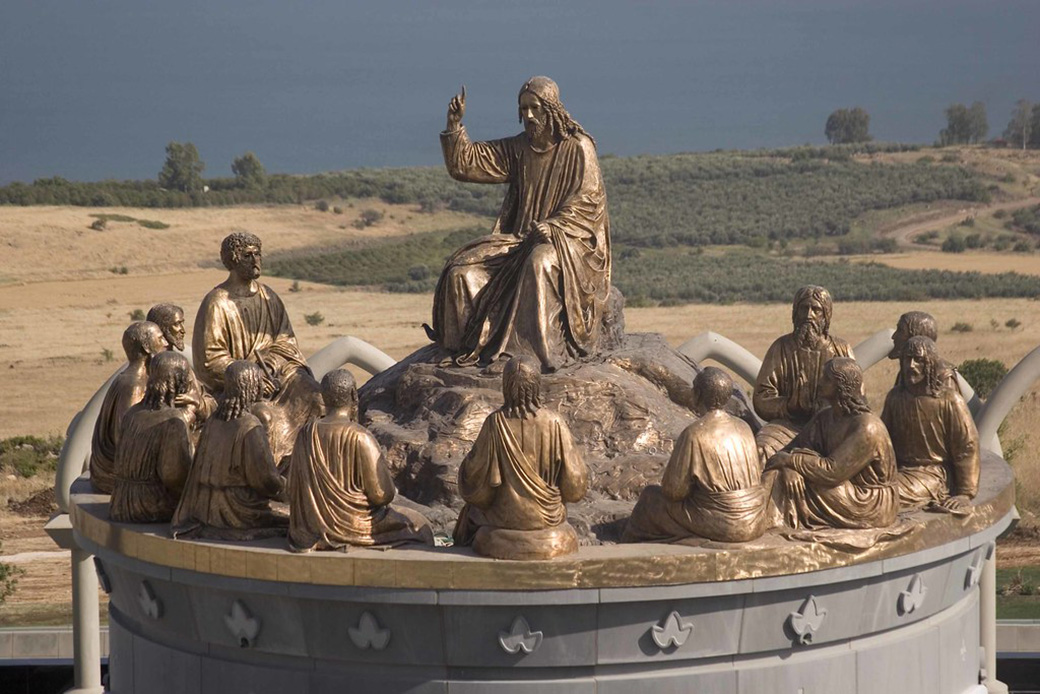
Statues depicting Christ preaching the Sermon on the Mount, located above the Chapel of Adoration at Domus Galilaeae International Center, near the summit of the hill known as the Mount of the Beatitudes. The Sea of Galilee can be seen in the background. The actual figures are slightly larger than human scale.
The Beatitudes seem to turn everything on its head. Blessed are the poor in spirit, the meek, the merciful, the peace makers — all figures of weakness who are guaranteed the earth and the kingdom of Heaven. Many who were listening may have thought this was a new revelation, perhaps the beginning of a new sect of Judaism. But, as Fr. Erasmo Leiva-Merikakis points out,
“Jesus likewise surprises everyone by here defining himself over against mere religious anarchists and innovators, all those who would in fact invent on the spot a religious ‘tradition’ that is nothing more than a projection of their own frustrations, opportunism, political programs, and spiritual arbitrariness, often masquerading under the names of ‘mysticism’ and ‘spiritual authenticity’” (Fire of Mercy, Heart of the Word, Vol I, p. 211).
Jesus surprises everyone by stating, “Do not think that I have come to abolish the law or the prophets; I have come not to abolish but to fulfill.” Contrary to that Baby Boomer we know at our church who always says, “Jesus was the first hippy,” he most definitely was not. He is not anti-establishment for the sake of disrupting social order. He is not just preaching peace, love and joy (although these are aspects of his teaching). He is the Law (its fulfillment in fact) and he is the Spirit. His being and ministry unite these seemingly disparate but in fact unified things.
When he says, “I have come,” he speaks not of coming to the mountain or coming to Galilee, but of coming in the more general sense, coming to earth. He refers to his purpose. It is an astounding message for the Jews who were listening and a good reminder for us now. Everything that they have founded their nation upon, from Moses and the Ten Commandments to the finicky rule-following of the Pharisees in their own time, is being fulfilled by Jesus. Not added onto, not adjusted, not clarified, but fulfilled. Either this was a seriously self-deluded man or it was God Himself. The mystical realities presented in the New Testament prove the second option.
There is something new about his Word, but he is careful to point out that this newness is a fulfillment, not a breaking with the law that has been established. A megalomaniac savior figure would likely have wanted to start his own cult, but as we realize that Jesus is the Word of God, this is preposterous. He does not propose a schism or something “better.” The New Covenant (which is Christ Himself, body, teaching, and Spirit) is offered to us from God like the other covenants, superseding the ones that came before, but from the same originator (see the reflection The Difficult New Covenant of Love for more discussion here).
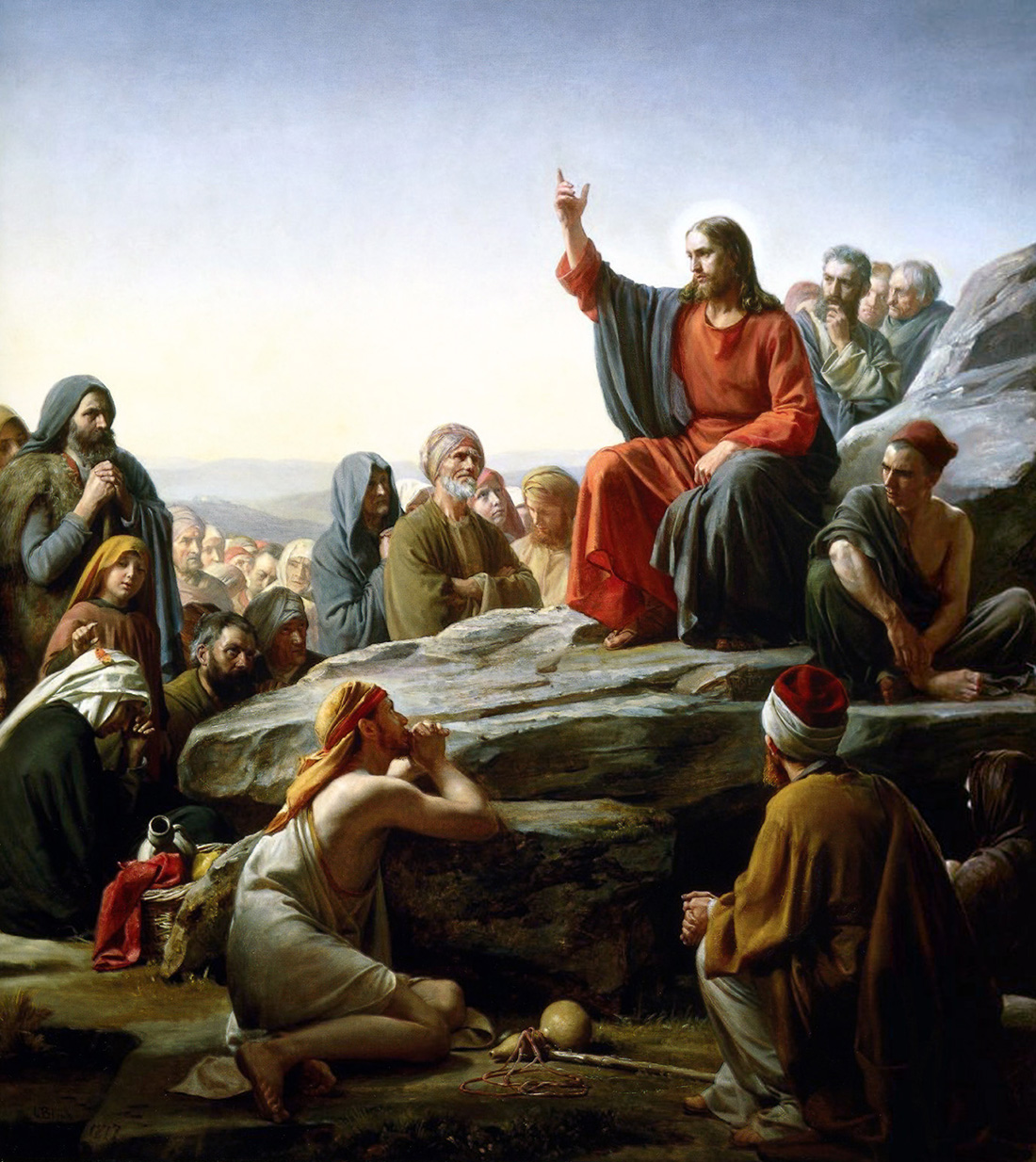
The Sermon on the Mount (1877), Carl Bloch | Wikimedia Commons.
Why do both of today’s readings speak of our participation in teaching the law? Moses urges his people to teach all future generations about what they hear and see. Jesus goes a step further and says, “whoever obeys and teaches these commandments will be called greatest in the Kingdom of heaven.” To answer this, let us ponder the nature of the Word of God.
Just as God is characterized by the fullness of all that is good (see yesterday’s reflection, Mercy is the Master Principle), implicit in the Word of God is that fullness in communication. It is at once declarative, imperative, exclamatory, and even interrogative in its request to have us comprehend. It engages us wholly, it elicits a response (in prayer, in study, in action).
Also, when we say that the Word of God is given to us for our own benefit, this has many layers of meaning. It benefits us on a physical level by ordering us correctly in relation to one another, enabling just dealings and charity for all to live. It benefits us on a moral level, ordering our actions to the good rather than the evil, and leading us towards salvation. Finally, it benefits us on a spiritual level by uniting us with its author, God. Every benefit requires us to participate with it, however.
The Word lives organically in our world both because of its nature as being the fullness of communication and because God deemed that we should have free will and choose to interact with him of our own accord. When we do interact with God through his Word, it lives in us (precisely by ordering us for physical, moral, and spiritual well-being). We become caught up in the Word, intertwined with the Word. What could be more satisfying as a human being than to be lifted into higher graces and levels of being than to be intertwined with the Word of God?
Here’s the great bit: in a spiritual symbiosis, we engender more life for the Word of God in our world when we teach it to others. At the same time, the Word strengthens us and brings us closer to its author. God does not need us to do this work — it’s not as if the Word of God would somehow peter out if we stopped teaching it — but this is the great vocation God has granted us. It is part and parcel of his injunction to share his mercy and charity throughout the world (again, see yesterday’s reflection). Like granting others mercy and performing acts of charity, our very act of teaching lifts us spiritually, delights God on a visceral level, and brings us closer to him. That is why Jesus says, “whoever obeys and teaches these commandments will be called greatest in the Kingdom of heaven.” Obeying and teaching is the union of the letter and spirit of God’s law in us.
Additionally, to be able to teach something the way Jesus does means that you more than understand the Word; you are living with the Word and therefore setting a living example of the teaching. This is why Jesus gets so upset with the Pharisees, who pose as the ultimate teachers but have somehow removed living the Spirit of the law from knowing the letter of the law.
Jesus is the fulfillment of the law that he, the Word of God, first spoke to Moses, precisely because he can live it perfectly. He is rightfully seen as our King. Every word and act he performs on earth is pregnant with the depth of God’s message for us.
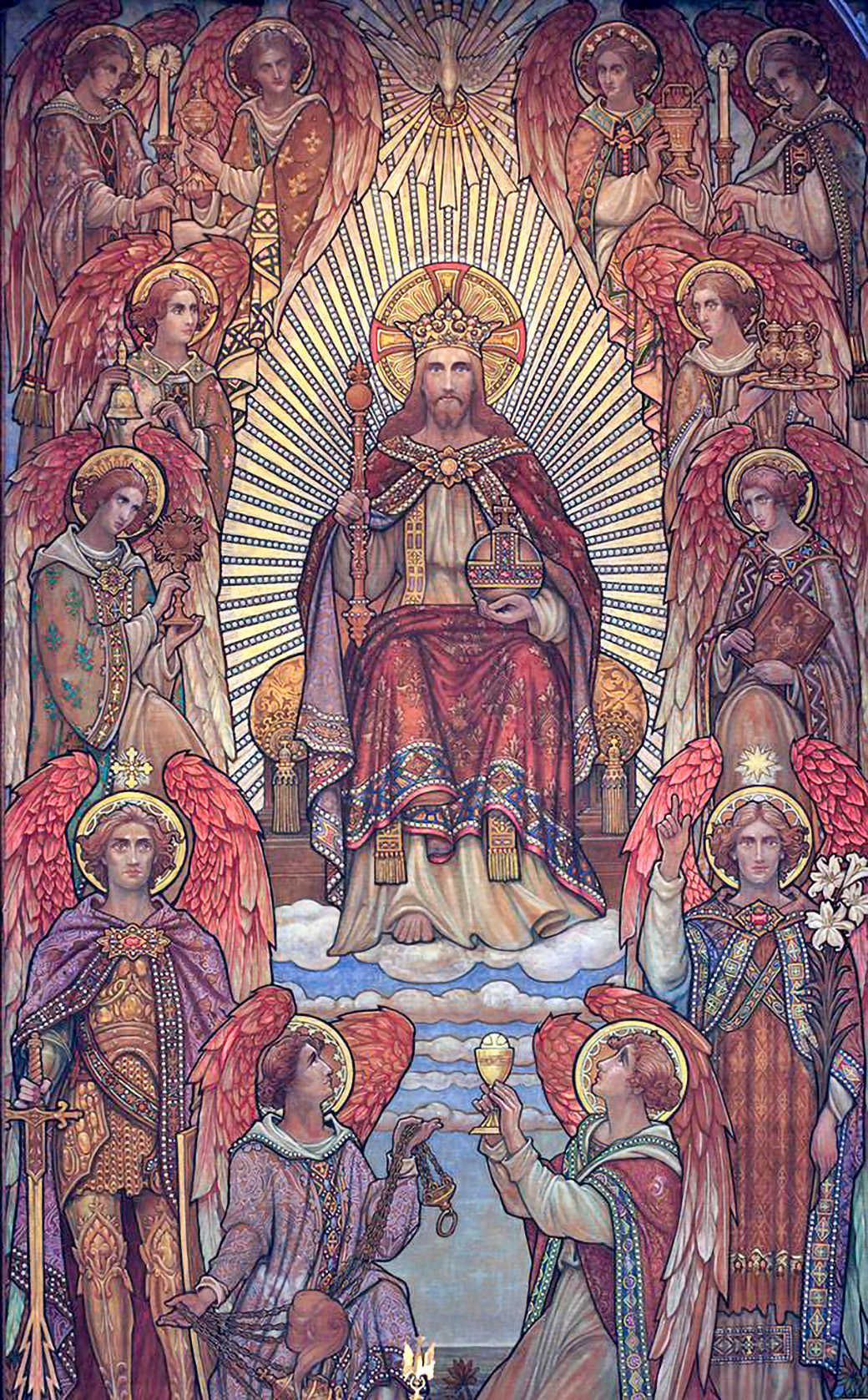
Christ the King tapestry hung at the altar of St. James the Greater Church in St. Louis, Missouri, artist unknown.
It is worth reflecting upon the awesome glory contained in our God-and-man Jesus Christ. To have your purpose be the very fulfillment of the law and covenants God has made with humanity! To become a suffering sacrifice for the entire human race, offered as the means to rescue us from the slavery of death and sin! To become a sacrament in body and Spirit!
Did Mary have an inkling of this when she accepted the Incarnation given to her? Jewish women of her time were primed with the sure knowledge that one of them would bear the Messiah to the nation, but to have it come about in humbleness and end in seeming humility, only to burst forth in the liturgy of true communion with God … what a strange king! He leads us to a wholly different land with wholly different goals, but He is the truest King the world will ever know.
Tuesday of the First Week of Lent: Isaiah 55:10-11, Matthew 6:7-15.
The Word of God: could there be a more exciting topic for those of us with English degrees? If your academic training is centered on how words create and describe culture, then the Word of God in scripture is the pinnacle of significance. In addition to literature and cultural studies, we moderns have scientific systems for analyzing words and languages: semiotics (thanks to Ferdinand de Saussure) and linguistics (looking at you, Noam Chomsky), to name some biggies. But humans have always been aware of the power of words. The Judeo-Christian understanding of the Word of God is that it is not just an utterance with theological significance, but the very mechanism of creation. From the beginning of scripture and Jewish consciousness, this has been the case. Imagine if every time you spoke of something, it came to be. That’s the Word of God.
We read an engaging set of verses about the Word from Isaiah in today’s readings. Suiting the beauty of his imagery, the living Word of God, Jesus, gives us the Lord’s Prayer in the gospel according to Matthew. What a day of readings!
Isaiah’s verses form a lovely piece of poetry. He says that just as rain and snow water the earth, “making it fertile and fruitful, Giving seed to the one who sows and bread to the one who eats,” so God’s Word “that goes forth from my mouth” will act in the world. We receive a promise from God that his will will, in fact, be done: “It shall not return to me void, but shall do my will, achieving the end for which I sent it.” For me, this is greatly comforting and reassuring. In a world that appears more godless by the minute, I begin to fear God’s will is completely betrayed and somehow lost. But God assures us that his Word is a generative, active force, as reliable and inexorable as the rain that makes the earth fertile. It’s not up to me to make sure God’s will is done (although I pray for it daily); his Word contains all of the power needed to complete his will. Thanks be to God!
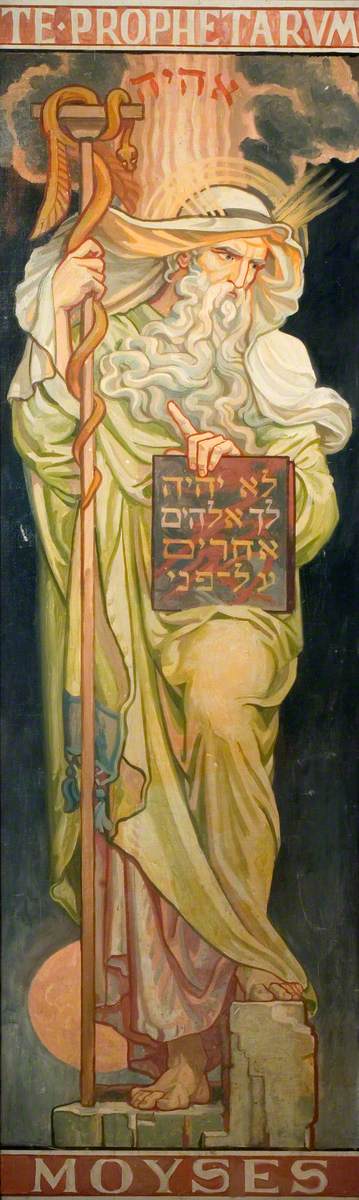
Stained Glass Design, Moses (1900-1910), Frederick James Shields | Creative Commons, courtesy Bantock House and Park/ArtUK.
This Word is such an active force — and issues from such an inscrutable source — that Isaiah, just a few verses prior to today’s reading, prophesies to the Jews: “See, you shall call nations that you do not know, and nations that do not know you shall run to you, because of the Lord your God” (Is 55:5). This “calling” of other nations happens 700 years after Isaiah in the form of the Word incarnate, Jesus Christ. Isaiah describes the remarkable spread of Christianity to this day.
Let us contemplate this amazing Word. The Word of God is evident in the time of promises, in his covenants with Abraham, Moses, David, and other figures in the Old Testament. His Word generates action in the Chosen People, who alternately live out his commands and are blessed or betray them and incur wrath and misfortune. It manifests itself throughout the history of the Jews, not just as words inscribed in stone tablets as if a dead text. In fact, Moses breaks the tablets — they’re not the point; the Word must live actively. The Word continues to flow forth from the mouth of the prophets; it spills into the dreams of men and women; it orients every action recorded about these people.
And we cast back further to find that the Word always existed. It was the very generative force that made the cosmos. It issues forth from God, both an integral part of him and somehow ontologically separate from him. St. John opens his gospel with perhaps the most complex and beautiful words in all of scripture: “In the beginning was the Word, and the Word was with God, and the Word was God. He was in the beginning with God. All things came into being through him, and without him not one thing came into being” (Jn 1:1-3). Indeed, we hear from Eve in Genesis that they are told about the garden and the forbidden tree from God, so we know that the Word was with them at this point. The Word of God is not made, like the other aspects of the cosmos, but is “with God” and “is God” from the beginning. Even deeper, here, the original Greek word is logos, which does mean word but also means an organizing principle, something that makes meaning.
And in the opening prologue to John’s gospel, we of course read that “the Logos became flesh and lived among us.” That is, the generative Word of God, the organizing principle of the universe that enables meaning to be made, well, it took on human flesh. Our ancestors in the faith would have recognized the incomprehensible power in this person Jesus Christ, the logos in the flesh, even if it comes to us 2,000 years later as a sort of ho-hum story. Something new happened that ended the time of promises and began the end times: the Word that existed from the beginning is made flesh, has a mother named Mary.
Is this really the same Word of God that we know has been active throughout the history of humanity? Our Church Father, Origen, verifies this in his Commentaries on John when contemplating the death of Jesus:
But while it is certainly a man who died, the Truth, Wisdom, Peace and Justice, of whom it is written, “The Word was God,” was not a man; and the God who is the Word, and the Truth, and Wisdom and Justice, is not dead. For the Image of the invisible God, the First-born of all creation, is incapable of death.
This insight sheds light on the resurrection. It does not diminish the sacrifice in the least, as if the Word of God knew he could not die so Jesus’s Passion and death was just a show. In fact, it elevates the Passion, death, and resurrection because God deigned to truly suffer and die for us instead of ruling the created world in power (simple!) or majestically exiting the scene as an untouchable deity might (like the Greek gods would in their mythology).
Consider that. The Word of God deliberately chose a specific way of becoming man, revealing the truth in Himself, submitting to human authority, suffering, and offering himself back to the Father in the greatest act of love. This life he led was not an accident and he certainly had as many other options available as you can imagine (and more we can’t imagine).
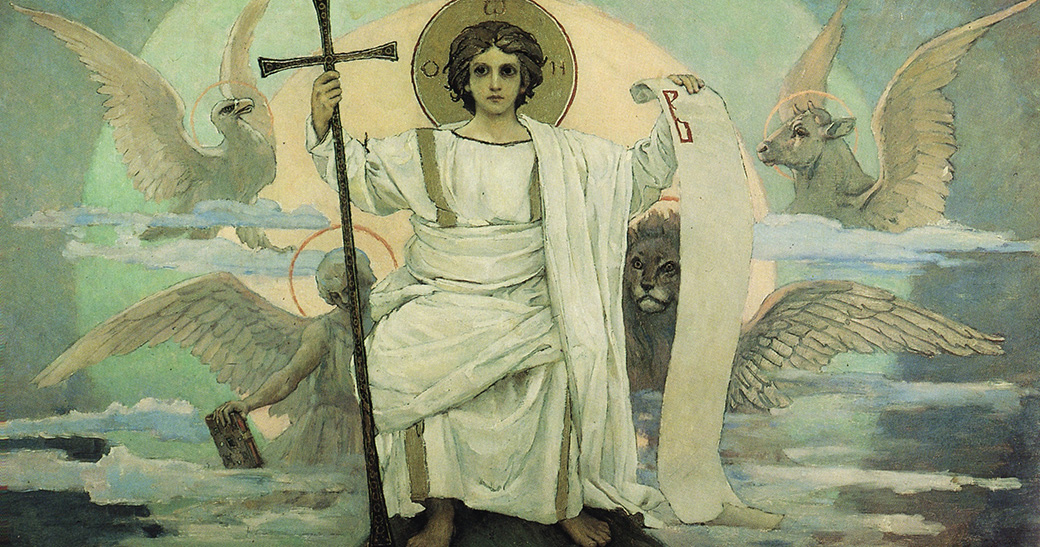
His only Begotten Son and the Word of God (sketch for a fresco in the Cathedral of St. Vladimir in Kiev 1885-1896), Victor Mikhailovich Vasnetsov | Wikimedia Commons
Why? What causes the invincible Word of God that made all of creation choose such a torturous existence as a human? It might just be that it is the perfect way for Jesus to be the ultimate teacher as well as the very method of our salvation. As a simple man who bleeds and suffers, he is our brother, yet as the life-giving Word, he alone can accomplish our salvation. As a human like us, he demonstrates in his life how to have a relationship with the Father, but as God he brings the reality of the Father into the world to forever change it. He is both the role model and reality being modeled.
This brings us to the reading from Matthew where Jesus inhabits the role of teacher when he says, “This is how you are to pray.” And then we are given the Lord’s Prayer, the depths of which are too great to plumb in a simple blog post. If you want to better understand the meaning of the Lord’s Prayer, read Pope Benedict XVI’s book Jesus of Nazareth, which contains a great 40-page chapter devoted to the Lord’s Prayer.
But let us note just a few things. We hear echoes of Isaiah’s verses in “thy will be done, on earth as it is in heaven.” Remember, God promises that his Word “shall not return to me void, but shall do my will, achieving the end for which I sent it.” Thus, we signal our acceptance of how the Word acts in the world, and we give it our blessing, our hope for its speedy success.
The second thing that strikes me is the verbal equation, “and forgive us our trespasses, as we forgive those who trespass against us.” I’ve always wondered why this isn’t stated the other way around, i.e., “as your father forgives you, you should forgive others.” I think my confusion stems from the use of the word “as,” which I typically take to mean “in the manner.” Thankfully, today’s reading includes the verses following the bestowal of the Lord’s Prayer, where Christ doubles down on the formulation and explains what He means: “If you forgive men their transgressions, your heavenly Father will forgive you. But if you do not forgive men, neither will your Father forgive your transgressions.” Aha! I should be reading it in this way: “forgive us our trespasses if we are able to forgive those who trespass against us.” Even if we do everything according to His will (such as forgiving others), we must also pray for his grace and salvation, which is not guaranteed, but a gift.
As we return to Isaiah’s verses that God’s Word will make the earth fruitful and do his will, we are struck with just how true this is and in how many ways we can see it. God’s will that we are brought into perfect communion with him: the liturgy is established by the Word made Flesh; his will that men testify to his truth at the risk of their own lives: the saints and the martyrs; his will that we love our neighbors as ourselves: countless acts of true charity done in the name of the Lord. Christ the Word has made this possible on earth in a way it was never possible before his great sacrifice.