Tag: kingdom

  • Who Can Know God’s Counsel?

    Who Can Know God’s Counsel?

    Twenty-Third Sunday in Ordinary Time: Wisdom 9:13-18b, Philemon 9-10, 12-17, Luke 14:25-33

    This Sunday, we listened to a fantastic set of readings, including an echo of the gospel reading from St. Luke we heard three Sundays ago: “Do you think that I have come to establish peace on the earth? No, I tell you, but rather division. From now on a household of five will be divided …” (Luke 12:51-52). In this Sunday’s gospel, Jesus proclaims to his followers, “If anyone comes to me without hating his father and mother, wife and children, brothers and sisters, and even his own life, he cannot be my disciple.” How do we react to these words? Is our reaction warranted?

    We are traveling currently, leaving Salt Lake City after 25 years and starting our retirement with a “Farewell USA tour” to say goodbye to friends and family around the country (and see many roads we haven’t before we move to Spain permanently). It was a little hard to condense everything we owned into our SUV, but the process of giving away most of our belongings to friends and charities was actually quite freeing. For the next three months, our routine includes leveling the car on a camping spot so that our sleep in the rooftop tent doesn’t end up with us rolling into a clump on one side of the tent. Our dog is with us, until we leave him with Suzanne’s sister in Oregon in October, and we’re having fun on hikes and in lakes.

    As a result of being nomads, we are getting to experience Mass in Catholic churches around the West. We went to St. John Neumann parish in North Las Vegas three weeks ago, St. Sebastian Church in Santa Paula, CA, two weeks ago, St. Francis of Assisi in Palm Desert, CA, last week and St. Daniel’s Catholic Church in Ouray, CO this Sunday. I’m thinking of writing a blog in a few months just about these experiences as a sort of random survey of the state of affairs of Catholic liturgies in the US, but I’ll leave that to another day. But one thing I heard three Sundays ago in Las Vegas and again in Ouray was that these gospel readings are “hard.” You may have heard something similar at your local church.

    In fact, the deacon who gave the homily this Sunday in Ouray really pushed on the point. “Did we just hear Jesus tell us that we have to hate our parents, our wives and our siblings?” he asked incredulously. “How can we reconcile this with our Lord, who we know to be all-forgiving and all-loving?”

    This is an incredibly important question for modern Catholics, and I think the answer is right in front of us, in the opening of the first reading from the Book of Wisdom: “Who can know God’s counsel, or who can conceive what the LORD intends? For the deliberations of mortals are timid, and unsure are our plans.” So that I’m not just answering a question with another question, I hope to elaborate what I think the Word of God this Sunday presents to us.
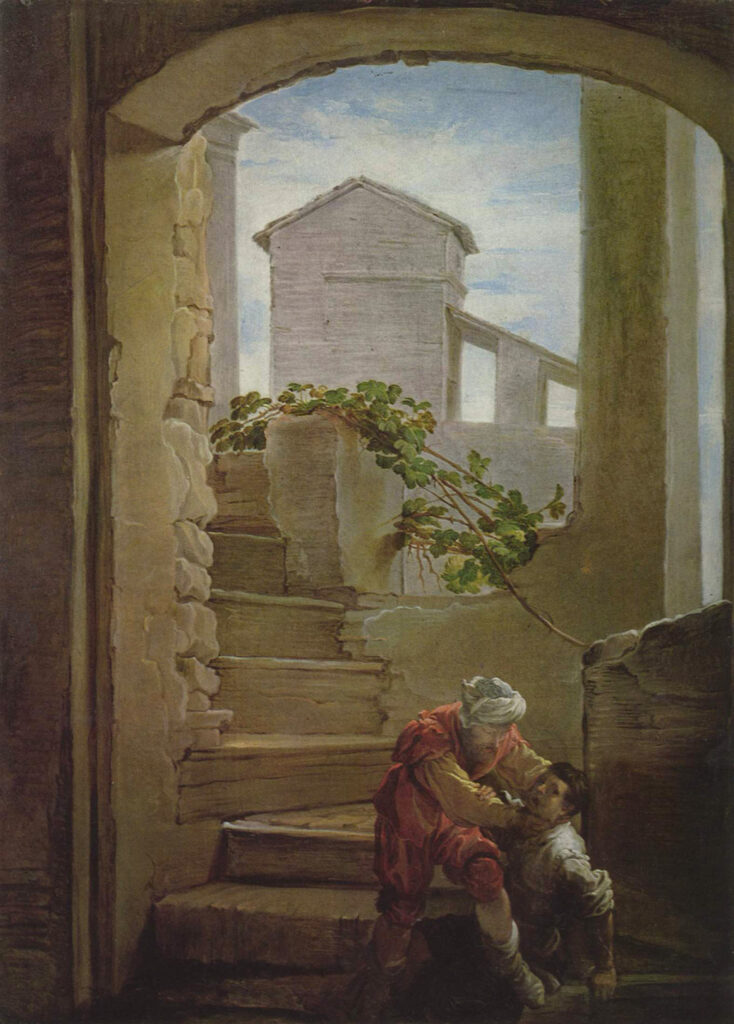
    Detail from Parable of the Wicked Servant (La parabola del servo malvagio), 1620, Domenico Fetti | Creative commons, Wikimedia.

    The deacon at our church gave a thoughtful homily, first tracing the fact that “hate” in Hebrew more often meant “to love less.” I’m going to take a moment to both agree with him and add a little nuance. From my research, I’ve found that it’s true that in most contexts, שׁנה (sana’) in Hebrew does not translate directly to our everyday use of the term “hate.” The main difference is that, in modern English, hate is most often associated with emotions. For example, “I hate you,” is one of the worst things a teenager can say to a parent, often in a fit of pique. “I hate cilantro” is less emotionally charged, but still carries the feeling of disgust. In ancient Hebrew, especially in a scriptural context, the word hate (sana’) is most often used in reference to God. Consider Psalm 139:

    Do I not hate those who hate you, O Lord?
    And do I not loathe those who rise up against you?
    I hate them with complete hatred;
    I count them my enemies.

    I’ve read that some Jewish scholars prefer to use “reject” here rather than “hate.” The clear overtone is one of judgment and moral rejection, not something said emotionally or in a fit of anger. We should remember this when we read the Old Testament. When we hear at the beginning of the Book of the Prophet Malachi, for example, that God says, “Yet I have loved Jacob but Esau I have hated,” we can understand that he has rejected Esau from his favor.

    So, at least in the Jewish scriptural context, “hate” is not normally the emotionally charged verb it is in English. But I think the deacon was a little short of the target when he said it was “love a little less,” because there is definitely a sense of judgment (especially when applied to God) and moral decision-making. Technically, I guess that judging against something makes it “less” than the thing it is compared to, but why are we softening the impact here? I think that modern ears need to hear something like this because it helps us “reconcile” this with our vision of the Lord being all-loving.

    But this is crucial! What does it mean to “reconcile” these thoughts? This means that we have preconceived notions of what love is, what forgiveness is, and we’re putting Christ’s words up against these notions, trying to look for some way they cannot contradict each other. Stop! We should recognize from the beginning that a.) do not put the Lord your God to the test, and b.) faith demands an acceptance of that which we cannot fathom or immediately understand. So, let’s meet Christ’s words with awe and reverence and try to accept and ponder them before we have some kind of emotional reaction.

    The Church, in her wisdom, prepares us for this gospel reading through the inclusion of the first reading. Again, it starts, “Who can know God’s counsel, or who can conceive what the LORD intends? For the deliberations of mortals are timid, and unsure are our plans.” In other words, know your shortcomings! Our thoughts are “timid” — too small to approach the grand thoughts of the divine — and this should make us humble as we approach the Word of God. The second part of this reading brings in a corollary important to understanding the gospel reading: “For the corruptible body burdens the soul and the earthen shelter weighs down the mind that has many concerns.” So, not only should we not attempt to fathom God’s plan and Word without the grace he provides for us, but we should recognize that we are already handicapped in understanding spiritual matters, for the “body burdens the soul” and “the earthen shelter weighs down the mind.” Jesus will return to this theme of earthly matters being problematic to us achieving the Kingdom. To recap, in a few sentences, the first reading reminds us that not only are we unable to fathom the plans of the divine mind, we are further encumbered when we try to think on spiritual things because we are concerned with earthly things. 

    As if this dose of humility isn’t enough, the author of the Book of Wisdom continues: “And scarce do we guess the things on earth, and what is within our grasp we find with difficulty.” Ha! How true. Even figuring out earthly things like, “what career should I choose?” or “does she love me?” or “how can we organize a society without fighting with each other?” are found with difficulty, if at all. The answer to this big multivitamin of humility is given at the end of the reading: “Or who ever knew your counsel, except you had given wisdom and sent your holy spirit from on high? And thus were the paths of those on earth made straight.” GRACE through the Holy Spirit is the only way we can make sense of ourselves and our world, much less the spiritual paths set before us by God. This important reading should set us straight in meekness and humbleness before we approach the Gospel — not in a stance of comparing Jesus’s words against our timid earthly notions of love and hate.
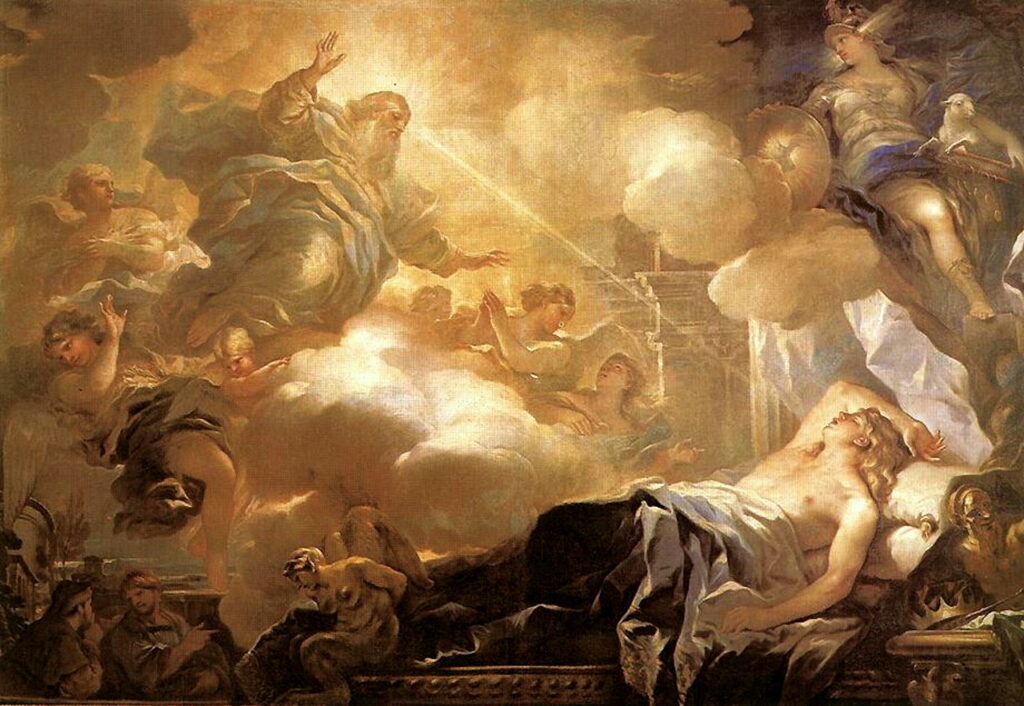
    Dream of Solomon (1694-1695), Luca Giordano | Museo del Prado, creative commons via Wikimedia.

    So, when Jesus says, “If anyone comes to me without hating his father and mother, wife and children, brothers and sisters, and even his own life, he cannot be my disciple,” if we listen to this alongside everything Jesus has taught and shown us, we can grasp his meaning with the help of his Holy Spirit. If we think of the word hate as “reject,” we recognize that Jesus has said something similar many other times:

    • “So therefore, any one of you who does not renounce all that he has cannot be my disciple.” (Luke 14:33)
    • “No one who puts his hand to the plow and looks back is fit for the kingdom of God.” (Luke 9:62)
    • “And everyone who has left houses or brothers or sisters or father or mother or children or lands, for my name’s sake, will receive a hundredfold and will inherit eternal life.” (Matthew 19:29)

    But today’s words seem like more than other statements about worldly renunciation. He’s talking about our most cherished relationships here on earth. If this sounds extreme, well, yes — I think it is. It’s impossible to hear Jesus in the gospels without hearing this type of “all-or-nothing” message. He tells the would-be-follower who wants to bury his father, “Leave the dead to bury their own dead. But as for you, go and proclaim the kingdom of God” (Luke 9:60). !!! I mean, that’s pretty extreme. We think of funerals as a respectful, God-forward practice, but in the face of God Himself, this ritual pales in comparison. Without a doubt, this Sunday’s gospel challenges us to be “all-in” in regards to following Jesus. 

    Jesus follows up this sentence with words of preparation: “Whoever does not carry his own cross and come after me cannot be my disciple.” With how often-referenced this sentence is, we can lose track of its power. The cross is sacrifice, undoubtedly, but it to his listeners, it was likely more charged with the understanding of spectacle and shame. After all, it wasn’t until his Resurrection that the shame and spectacle of the Cross turned into the glory of sacrifice. 

    Jesus is preparing his listeners to be true followers. He is letting them know that those closest to them will likely disagree with their newfound faith in Jesus Christ. He is presenting them with the fact that they must hate/reject those closest to them when they cast suspicion and begin to shame these new Christians and even make a spectacle of them. Jesus is both preparing them and trying to give them courage. This is why the end of the gospel reading focuses on “calculating the cost” of discipleship. Jesus wants his listeners to know the cost, to brace themselves and find the courage to follow him.

    When is the last time we felt that we were carrying shame or spectacle by following Christ? Not that we should seek these things out, but I think we perhaps instinctively shy away from these, as anyone would. But this gospel is for us as much as it is for first-century Jews. When is the last time you boldly made the sign of the cross and said a prayer before your meal in a restaurant? This small gesture of thanks to God is essential with everything we do, but most often we don’t want to draw attention to ourselves in public. Are you picking up your cross here or just leaving it on the ground? When is the last time you walked in a Eucharistic procession in your town? I can recall a number of them on the University of Utah campus, including the catcalls and obscenities occasionally yelled at us. Atheistic culture wants to make Catholics feel ashamed, out-of-date, and ridiculous for something as beautiful and just as a procession! It is our responsibility and honor to stand with Christ, to process him in public as our King and Savior. When is the last time you talked about prayer or Jesus to a friend or colleague? Does it feel too awkward for you? When was the last time you asked someone not to use your Lord and Savior’s name in vain by shouting “Jesus Christ!” when something surprised them? The virtue of religion, St. Thomas Aquinas tells us, is part of the virtue of justice — that is, giving God what is due to him. We must consider that Jesus’s words in this gospel are telling us about the repercussions of holding this virtue of religion. Shame, spectacle and sacrifice are part-and-parcel of following Jesus and giving God what is due to him. The question is, have we dumbed down what our religion demands to simply “being nice to others?”

    If we read the last few verses following today’s excerpt in the 14th chapter of Luke, we hear Jesus tell these same listeners, “Salt is good, but if salt has lost its taste, how shall its saltiness be restored? It is of no use either for the soil or for the manure pile. It is thrown away.” Remember that in the Beatitudes, Jesus tells his disciples that they are the salt of the earth — so clearly his meaning in this reading is that his listeners must retain their saltiness, that is, their openness to sacrifice, spectacle and shame, or be discarded from the Kingdom. 
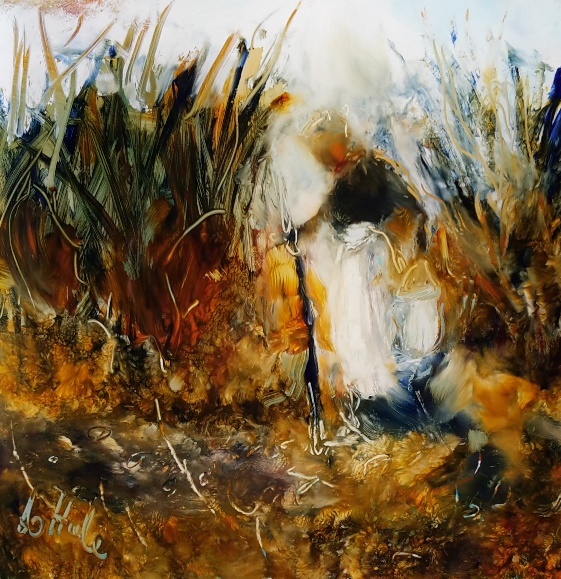
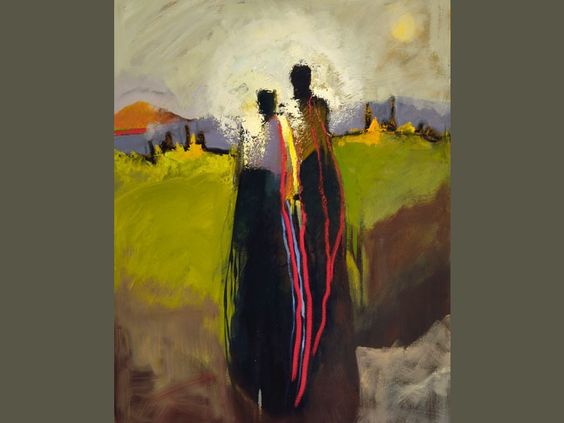
    Salt of the Earth, contemporary, Alison Hale | Image from https://alisonhale.co.nz/paintings-archive/glass-works-sold/salt-of-the-earth/

    From Aquinas to St. Paul

    I’d like to bring up one last lens within which we can examine Sunday’s gospel, and through this lens, make our way to the second reading, St. Paul’s Letter to Philemon. The lens here is to actually challenge the reading above that hate isn’t really hate. What if we follow the Scholastics, St. Thomas in particular, in thinking about hate? In the Summa Theologica, St. Thomas writes, “hatred is a movement of the appetitive power, which power is not set in motion save by something apprehended” (II, ii, q43, a1). To unpack this, what he is saying is that hatred is a movement of the intellect (aka, an “appetite”) that is only set in motion when you apprehend something. In other words, first, hatred is something natural in our soul and intellect, God-given and for a purpose. Second, it’s not a state of being but something that arises in us in response to something we encounter (a thought, a person, a thing, whatever). So, hatred is not an evil thing, but a natural thing, an appetite that we must work to regulate just like all of our other passions and appetites.

    Why would God make us with this appetite of hatred, or any of the passions that we tend to regulate poorly, for that matter? In the case of hatred, Thomas tells us, “the object of hatred is evil.” Aha! So, God gives us hatred as a natural repugnance for evil and sin. When regulated well, hatred will turn us from evil and sin.

    But regulating this appetite takes prudence and good judgment. After all, Thomas warns us: “Just as a thing may be apprehended as good, when it is not truly good; so a thing may be apprehended as evil, whereas it is not truly evil.” This is why studying and contemplating the truth in the scriptures and Catholic tradition are so important. We train ourselves to better apprehend and recognize good when we see it and evil when we see it.

    So why would anyone hate what is good? Because they reject God’s revelation of truth and himself to humanity. Instead, throughout history, people cling to the world around them — what their senses tell them and what passes for “good” in their culture. Is the sound of applause and shouts of praise good? Our senses and culture tell us yes, but Jesus tells us that the meek are blessed because he sees that the cost of fame and recognition is the diminishment of others. Is the pursuit of money good? Pretty much everything in our culture says yes and pretty much everything in scripture says no. What about the flipside of this – what do we mis-apprehend as evil? Let’s think about one of the most common commands in the epistles – to “exhort” and “correct” one another in staying true to the teachings of Christ. But this is difficult to do because nobody likes to be corrected, and our contemporary culture has developed an incredibly robust system of moral idols in diversity and inclusion that make it an evil to tell someone that what they are thinking or doing is wrong. I truly think that today one of the most obvious ways a person can be a spectacle and shame for Christ is to openly tell someone that something they are doing is not morally right or a perspective they are defending is not the truth. In the name of acceptance of others, this is just not OK (so we are told)! But, Jesus commands us to be the salt of the earth, to take up our crosses and be his disciple. Which will you listen to — your culture or your Lord?

    But surely our family members can’t be summarily judged as evil and thus worthy of hate! I guess that depends on the culture you live within. For Jesus’s listeners, the cultural voice resided in the Pharisees, Sadducees and scribes, most of whom were in disagreement with him on many aspects of his teaching (especially the core teaching about the conversion of one’s heart to God). Certainly, the broader cultural voices of Rome and of Greek culture were at odds with his teachings. In this context, it likely wouldn’t be too far off the mark to apply hatred towards voices that denied the Good News. 

    Perhaps referencing family members was way of giving an evocative example of earthly matters. With this reading, we can see that Jesus is being consistent with his other teachings about rejecting the worldly in preference to the spiritual life with God. But, I don’t think this is just rhetorical pyrotechnics. I think Jesus references family members specifically because his Apostles have already had to leave their homes and families to follow him. He has likely seen in the course of his ministry plenty of family arguments, anger and division over following him. This isn’t a hypothetical.

    More important than this historico-critical reading of the passage is the understanding that there is a reason Jesus tells us this. The Divine Mind has a plan for our own good, for our reconciliation and union with Him. Remember the first reading: “you had given wisdom and sent your holy spirit from on high … And thus were the paths of those on earth made straight.” So what might this reason be? Jesus tells us time and again that God loves his children — that he will leave the whole flock just to save the one who has strayed — that he welcomes back the prodigal with open arms. All we have to do is to remain faithful to him. This means trusting him and putting him first, above all other concerns (including our family members and other worldly worries). Jesus is reminding us how we have to fulfill our end of the covenant, putting God above all else.

    And in return? God perfects us with his grace and his love. He helps us be the loving humans he wants us to be, that he has created us to be. He fills us with his own love and sends us back into the world to love our neighbors (including those family members we judged to “love less” than him). Let’s not think we’re the only ones who are active in our lives! Our part is actually quite small — a continual conversion of heart to God — and then his blessings infuse us and those who we touch in our lives. His is the powerful work in the world, transforming it, not ours. 

    In other words, the whole point of hating your “own father and mother and wife and children and brothers and sisters” is to allow God to perfect you and give you the ability to love those same people better than you ever could have without his help.
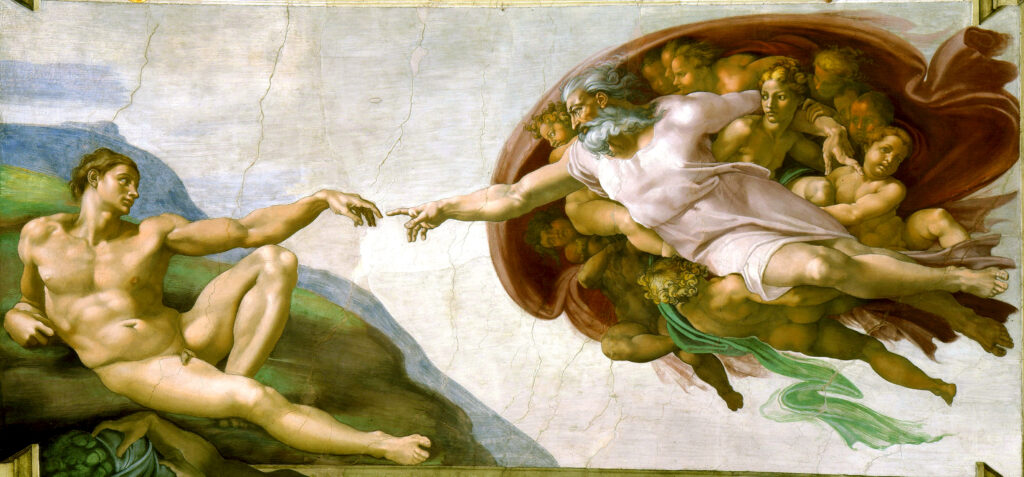
    The Creation of Adam, Sistine Chapel ceiling (1511), Michelangelo | Creative commons, Wikimedia.

    The second reading (the only one in the Sunday lectionary cycle from the Letter to Philemon) is seemingly weird and out-of-context, but blossoms with this understanding of the gospel reading. Paul, writing from jail, is sending Philemon’s slave back to him after this slave, Onesimus, has spent time following Paul and learning about Christ. Onesimus has fled his master, perhaps even owing him money — is this not someone who “hates” his “father”? And, having been nurtured at Paul’s breast, he is returning to his “father” in an act of love by Paul. This is a parallel to what we can read in the gospel account. 

    Add to this the overtones of Paul’s Letter to the Galatians, where he writes, “So you are no longer a slave, but a son, and if a son, then an heir through God” (Galatians 4:7), and a rich tapestry emerges. In Sunday’s reading, Paul sits in the seat of a redeemed child of God — bearing his cross in jail for proclaiming Christ to the world, but acting with the power of the Father because of it. He sends back a former slave to his family, but not as a slave, but a fellow heir to the Kingdom: 

    that you might have him back forever,
    no longer as a slave
    but more than a slave, a brother,
    beloved especially to me, but even more so to you,
    as a man and in the Lord. 

    It is now Philemon’s turn to hate the teaching of his culture and the logic of the world, to accept Christ as Paul is urging him to, and to offer his forgiveness to a slave who has so obviously been healed by God. So, if we, like Onesimus the slave, hate our family in order to receive Christ and love him above all else, the divine logic decrees that this enables us to return to our families, even in debt or disgrace, in order to love them with clear eyes and a God-filled heart.

    I hope that this contemplation of the Sunday readings have struck a chord with you, that perhaps they have helped move you to approach the gospel with open ears and without the urge to compare Jesus’s words with what we think love and forgiveness should look like.
  • Moses in the Promised Land! … And More About the Transfiguration

    Moses in the Promised Land! … And More About the Transfiguration

    Feast of the Transfiguration of the Lord. Daniel 7:9-10, 13-142 Peter 1:16-19Luke 9:28b-36.

    Rejoice! Today we commemorate and celebrate the gratuitous love of the Father to bolster the faith of Peter, James and John by allowing them to witness a vision of Jesus in his glory. This episode in the life of Jesus and the Apostles is so rich and full of meaning for the Church. On Sunday, I led a discussion with our Lay Dominicans and inquirers about the Transfiguration in anticipation of this feast day. We discussed St. Thomas Aquinas’s writing about the fittingness of the Transfiguration as presented in the Summa Theologica, Part III, question 45, and I’d love to share a few bits of that fruitful discussion here.

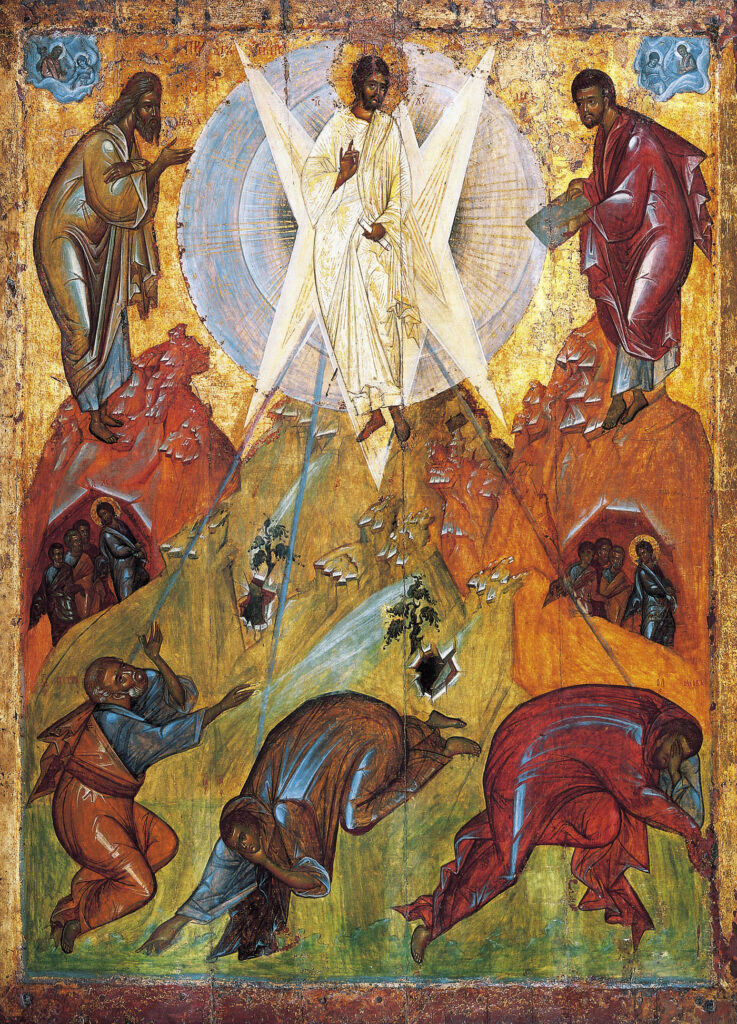
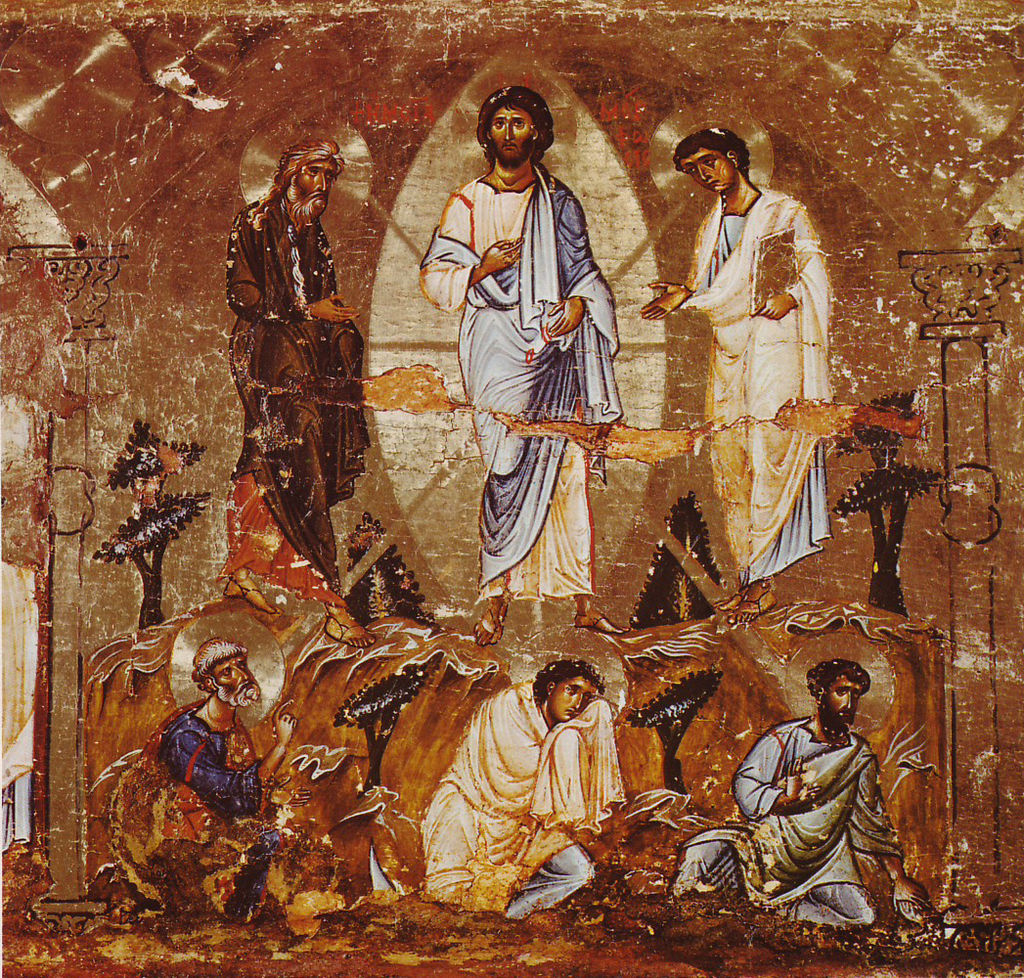
    The Transfiguration of Christ: Part of an iconostasis in Constantinople style. Middle of the 12th century. This is the earliest of the three paintings of the Transfiguration on this page. Below, you’ll see how the human expressiveness was emphasized in later Western art, while the symbolism of color, line, and figure took precedent over emotional content in the Eastern icon tradition (in fact, the more “fixed” and inexpressive faces are meant to indicate a more transcendent reality in this tradition).

    Fittingness Versus Necessity

    One of the questions an inquirer asked during our discussion was, “If the Transfiguration never happened, would the Crucifixion and Resurrection still have happened? In other words, was it necessary to our salvation?” This question is actually at the heart of how St. Thomas presents many aspects of salvation history. He readily admits that God could have ordered things differently — even to the point of not having the Incarnation or the Passion. These things, according to St. Thomas (and St. Athanasius and St. Anselm before him), are not “necessary,” per se, but he shows how they are “fitting.” The Latin word he uses is Convenientia, which translates to suitable, appropriate, harmonious or beautiful. The Church Fathers had a very good reason to be thinking in this way. First of all, they knew that they could never fathom the mind of God and “prove” some sort of necessity around the events and stories of our salvation history. Second, they had a huge body of texts that emerged from the early years of the faith, some orthodox and true, and some that were not. This contemplation of convenientia was a critical tool in helping to decide what writings were part of the canon of the New Testament. 

    As that same inquirer pointed out during our discussion, a good example of something that was NOT fitting would be in the apocryphal Infancy Gospel of Thomas, when Jesus is said to curse and kill a child who bumped into him. This is not consistent or harmonious with what we know of God and of Jesus’ ministry on Earth. 

    But beyond a tool for determining the truth of early texts, I think contemplating fittingness is a fantastic perspective for any kind of lectio divina. With this starting point, we can ask questions about why events happened and have them always point back to God and how he is revealing himself to us (as opposed to treating the divine plan like a puzzle to be solved, as if we could ever comprehend it fully!). In the case of the Transfiguration, the “why” of the event is answered amply by many Church Fathers. Here’s what St. Thomas has to say: “For anyone to walk straight along a road, he must have some knowledge of the end … Above all, this is necessary when the road is hard and rough, the going is heavy, but the end is delightful … Therefore, it was fitting that He should show His disciples the glory of His clarity (which is to be transfigured), to which He will configure those who are His.” In other words, one reason the Transfiguration happened was to provide the Apostles with the backbone to persevere when the going got tough — to let them see the goal of divinization alongside Jesus. Understood as a completely unnecessary but helpful and beautiful blessing for the Apostles (and the Church as a whole), we can start to glimpse the overwhelming, overabundant love the Father has for us, his delight in showing us a Way to him through his Son.

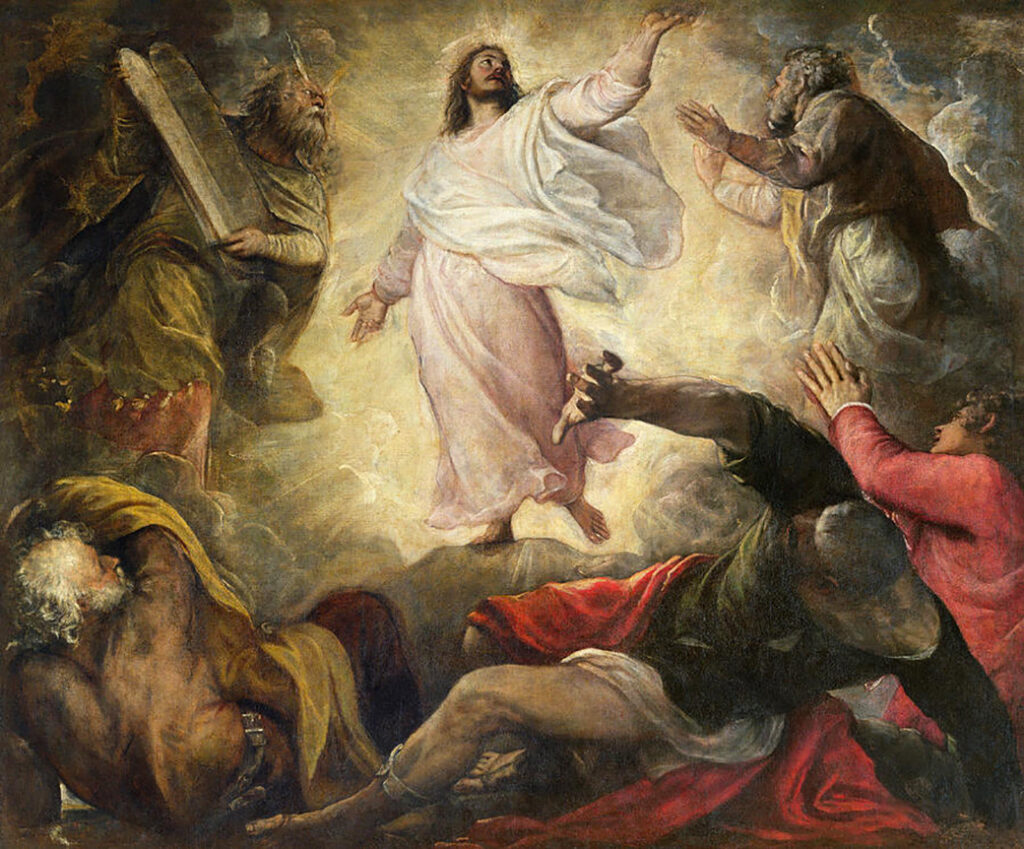
    Transfiguration (1560), Titian | Wikimedia Commons. Ah, the Italian Renaissance. Titian indicates a number of internal dramas within each unique face, and is a master of color and composition, with dynamic (and melodramatic) poses somehow all working to frame Christ in his glory.

    Bright Clothing

    Another aspect we discussed was that more than Jesus’s face was transfigured: “his clothing became dazzling white.” This might seem like a simple detail, but the Church Fathers fastened onto it with gusto. The first reading from the Book of Daniel gives us a clue as to why they might have done so: “The Ancient One took his throne. His clothing was bright as snow … Thousands upon thousands were ministering to him, and myriads upon myriads attended him.” So bright white clothing seems to be an important detail in this beatific vision, but what does it mean?

    St. Thomas tells us that “the clarity which was in His garments signified the future clarity of the saints.” This might seem like a leap, but he traces it back to St. Gregory the Great, who wrote, “because in the height of heavenly clarity all the saints will cling to Him in the refulgence of righteousness. For His garments signify the righteous, because He will unite them to Himself.” As we think of garments as things that cling to and adorn a person, this parallel starts to make more sense. The saints cling to Christ and his Way, and by so doing, they fulfill the word of God given to Isaiah: “You shall put all of them on like an ornament” (Isaiah 49:18). Thus, the Transfiguration is truly the full beatific vision: Christ in his glory, surrounded by the law (Moses) and the prophets (Elijah) and all the saints (his bright clothing, adorning him). What is nice about this understanding is that we see glory going back to God rather than ourselves in this vision of heaven. It’s not about us gaining virtue and being so good that we are given the gold star of heaven. It’s about us loving God so much (as close as we can mirroring the love he first gives to us) that we adore and adorn him, becoming more and more like Christ as an acknowledgement of the plan the Father has for all of us. Imitation is the sincerest form of flattery, so the saying goes, and we can see a small truth — yes, we are trying to imitate Christ, but even more than trying to flatter him we are trying to sincerely love him and show the world that he is the only Way to heaven. Let us be your brilliant clothes, nothing more, O Lord!

    We also discussed how there is more support for this understanding of the bright clothing in the Book of Revelation according to St. John: “Then one of the elders addressed me, saying, ‘Who are these, robed in white, and where have they come from? … These are they who have come out of the great ordeal; they have washed their robes and made them white in the blood of the Lamb.’” So John was doubly gifted with the vision of the Transfiguration during Jesus’s lifetime and then again in the visions that became the Book of Revelation. Only this time, the white robes have received their color from walking the Way of Christ — from going through “the great ordeal” and washing them in “the blood of the Lamb.” Whether adorning Christ or more literally being worn by the saints in heaven, the brilliant white clothes seem to symbolize the members of the Church who have remained faithful to the Way and entered into the divine heavenly eternity.

    There is one last interesting note we discussed about the clothing. One of the great early Church Fathers was Origen, who lived in the first half of the 200s AD. His influence was huge. Many later Church Fathers quote Origen when discussing the Transfiguration and many other mysteries of the faith. He writes that the white garments are “the words in the Apostles which indicate the truths concerning Him,” that is, the Gospels themselves. Origen adds that if someone speaks with deep theology of Christ and explains the Gospels brilliantly, “do not hesitate to say that to Him the garments of Jesus have become white as the light.” Imagine saying that the next time you hear a good homily! “Hey, Father, the garments of Jesus really became white as the light today! Thanks!”

    Transfiguration of Jesus (icon), 1408, Theophanes the Greek | Wikimedia Commons. Artwork from Spaso-Preobrazhensky Cathedral in Pereslavl-Zalessky. This is one of the most common and copied icons of the Transfiguration, notable for it’s white star-shaped depiction of Christ’s brilliance, the positioning of all the secondary characters, and the lines of revelation shooting down to the Apostles. I always like how icons manage to paint more than just a single moment in time, and we see both the climb up to the mountain on the left and climb down on the right as well as little moments of the life of Moses and Elijah in the upper corners. Great way to depict kairos time!

    Moses, Elijah, and Unfinished Stories

    Of course, the other important detail, as we see in each of the paintings on this page, is that Moses and Elijah were present during the Transfiguration. Our little discussion group talked about how this might be fitting. First, we read the six separate ways that St. Thomas points out the significance of these two towering Old Testament figures. The one most often mentioned St. Thomas attributes to St. Hilary of Poitiers: that Moses symbolizes the law and Elijah the prophets, and this reminds everyone that Christ was foretold by these two important men.

    But then one of our life-professed Lay Dominicans made an observation that none of us had considered before: “Isn’t this the first time Moses appears in the Holy Land?” We all went silent, and then burst out with agreement. Even Fr. Gabriel admitted that he had never read any commentaries that bring up this important detail.

    Next, we had to contemplate how this might be fitting and why it might be important. We noted that both Moses and Elijah leave scripture with their stories somewhat unfinished or at least a little unsatisfying to the listener. Moses is told by God that he can’t enter into the Promised Land because the generation he ushered through the wilderness was so ungrateful and rebellious. So, he dies just outside of the Promised Land. In a way, he must suffer and sacrifice for the sins of others (sound familiar? nice foreshadowing of Christ). Elijah, on the other hand, is taken up to heaven alive. Why? What is he doing there? He’s not the Messiah, even if he is one of the greatest prophets.

    Both of these stories find a suitable and fulfilling ending here in the Transfiguration, however. Moses does get to enter the Promised Land, but only now and here, with Jesus Christ as the Savior who ushers in the Kingdom. God is not a vengeful God but a loving God whose plan spans all time and who loves us so much that he instructs and points the way through generations upon generations. He wants Moses with him — Moses the bearer of his law who now comes back to the bosom of the Father in the presence of the fulfillment of that law.

    Why Elijah is still alive, keeping the Jews in a state of suspense about his possible return, becomes clear when he returns here to commune with and point to Jesus Christ. Elijah, speaker of God’s living Word, never dies as the bearer of that living Word, and only reappears alongside that living Word made flesh. Jesus, who unites the dead (Moses) and eternal life (Elijah), is in the center of this vision. Jesus is the true Alpha and Omega here.

    Like the brilliant clothes, Moses and Elijah are not there for their own glory, but to adorn and ornament Jesus Christ, the Son with whom the Father is well pleased. The Father’s voice and the Holy Spirit in the form of a cloud (something seen because it obscures the sun and darkens the sky and yet somehow “a bright cloud overshadowed them” in Matthew’s account) also appear, but again, to point to the Son. If ever there was an argument for the divinity of Jesus Christ, this is it!


    I hope this post did some justice to sharing the fruits of a lively discussion and I also hope it enkindles a newfound reverence for the wonder of the Transfiguration. Thank you, God, for this vision of heaven, given to sustain us in our belief, faith, and fidelity to your Word.

  • Who is the Holy Spirit?

    Who is the Holy Spirit?

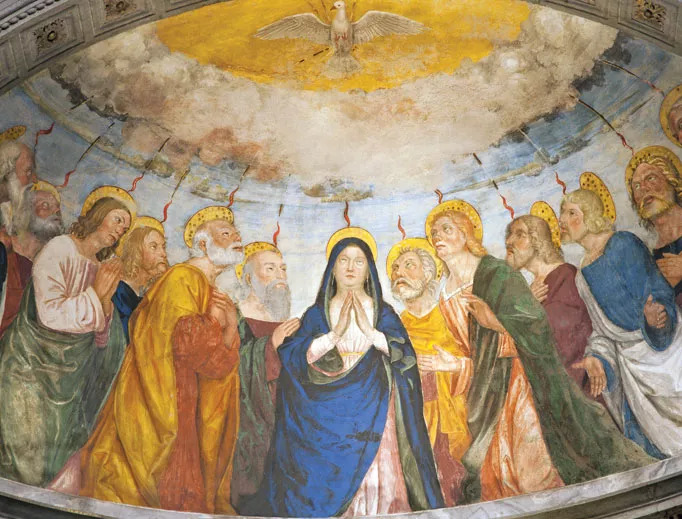
    VERONA: Apse of Chapel Miniscalchi in Saint Anastasia’s church from year 1506 designed by Angelo di Giovanni with main scene of the Pentecost.

    Pentecost is one of our highest feasts — marking the anointing and confirmation of the Church by the Holy Spirit. It is a true turning point for humanity, when God begins to interact with us in a new way. The Church’s liturgy for Pentecost is so full of the mystery surrounding the action of the Holy Spirit that it provides us with a dazzling array of Scripture to shed light on this event. The Vigil Mass has an extended form, much like Easter Vigil. Through four Old Testament readings and associated psalms, it reminds us how the Spirit has been guiding us and transforming our activity into something holy from the beginning of time. We hear of humanity’s hubris in the Tower of Babel, a symptom of our fallen state that God remedies by confusing our language. Lest we think that God is a malevolent God, doing this to spite us, he promises us through the prophet Joel, “I will pour out my spirit upon all flesh. Your sons and daughters shall prophesy … Then everyone shall be rescued who calls on the name of the LORD.” Of course, this is realized at Pentecost when the Spirit descends on Mary and the Apostles and reverses the confusion of Babel.

    But it’s more than just a loosening of tongues. Those tongues have something new to proclaim. We have become intelligible to one another once again, but only in a specific mode: allowing the Spirit to talk through us, to tell us about the Triune God and his saving plan for us through the person of the Son.

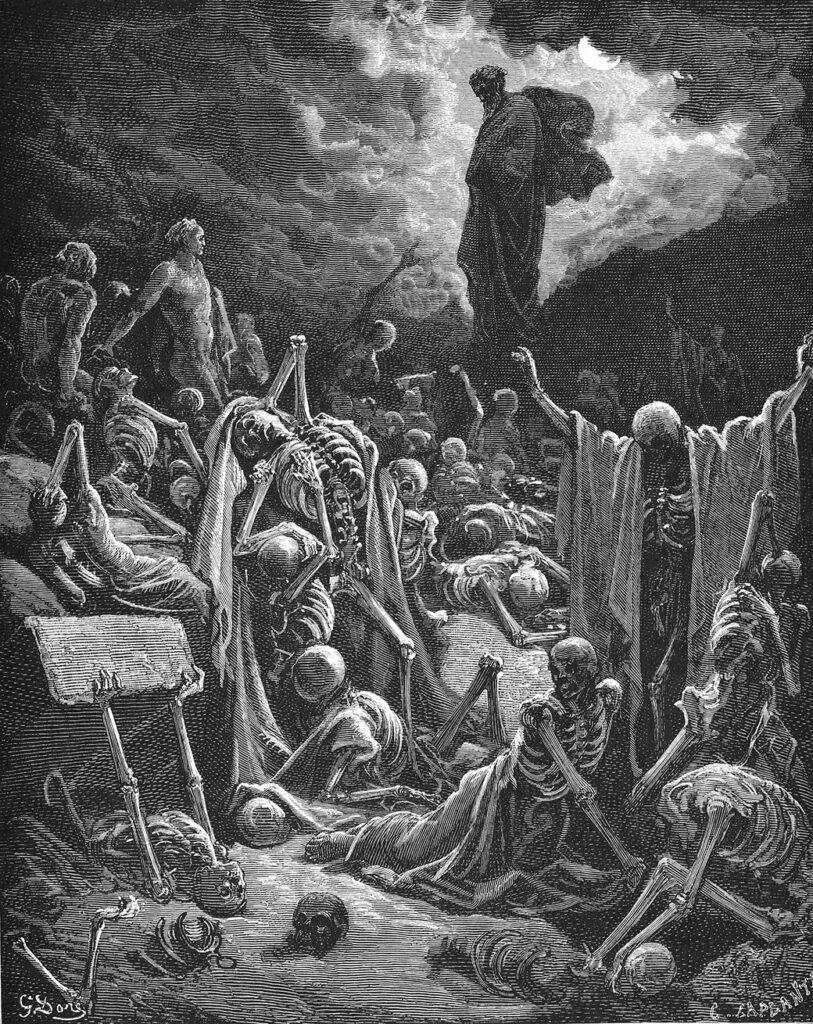
    The incredible reading from Ezekiel in the valley of dry bones is an astounding prophecy of the Pentecost in the upper room in Jerusalem. God tells Ezekiel, “Prophesy over these bones, and say to them: Dry bones, hear the word of the LORD!” Note how this foretells exactly what will happen. The “dry bones” of the Jews and Gentiles hear the word of the Lord from the mouths of the Apostles, the new prophets of a new age. God assures Ezekiel that his word will be efficacious. God tells the bones, “See! I will bring spirit into you, that you may come to life.” Indeed, Ezekiel sees sinews and flesh cover the bones as they stand, “but there was no spirit in them.” Now, note carefully — God tells Ezekiel to pray to the Holy Spirit: “Prophesy to the spirit, prophesy, son of man, and say to the spirit: … come, O spirit, and breathe into these slain that they may come to life.” How surprising! I find it more than a little striking within the Jewish context that the God who time and again reminds them that he is the one and only God, the Creator, tells his prophet Ezekiel to turn his appeals to the Holy Spirit. This is one of several times in the Old Testament, in fact, that when we read carefully, we see that God is telling us something about himself, about the three persons of the Trinity. It would take centuries until the Councils of Nicea and Constantinople could properly articulate an understanding (dumbed down for our human intellect) of the Trinity having one and the same essence of a single God, but three distinct persons in the Father, Son, and Holy Spirit. Nonetheless, we can trace their distinction to moments like these in Ezekiel and even to the creation story itself where God tells us that it is him, but also his Word and his Breath that act in creation in different ways.

    Vision of the Valley of Dry Bones (1866), Gustave Doré | Wikimedia Commons.

    I want to take a moment to reflect on the person of the Holy Spirit. I think many of us might be quietly (and innocently) caught in a type of subordinationist heresy. Simply put, this means that we have the tendency to think that God the Father is hierarchically the main and most powerful person of the Trinity — effectively subordinating the Son and the Holy Spirit to being lesser than him. Don’t fret, we would be in good company because several early Church Fathers like Irenaeus, Tertullian and Justin Martyr were also likely subordinationist, but that’s because the Church hadn’t yet been forced to think hard and long about the relationship between the persons of the Trinity. That was foisted upon the Nicene Council by Emperor Constantine I to figure out in the year 325 A.D. In fact, it was the more serious heresy of Arianism, where Jesus was taught to be a created being, that was the cause of the council, but the effect was the same — the council came up with our formulation that we repeat in our Creed to this day, where the Father, Son, and Holy spirit are proclaimed to be consubstantial with one another. That is, of one and the same essence.

    Perhaps it’s because of some of the references to the Spirit in Scripture might make us feel that it is not as, I don’t know, approachable (?) reliable (?) as the Father. For me, it’s when Jesus tells Nicodemus, “The wind (pneuma) blows where it chooses, and you hear the sound of it, but you do not know where it comes from or where it goes. So it is with everyone who is born of the Spirit (Pneumatos)” (John 3:8). This passage leaves me with a sense of flightiness about the Spirit (although I think that’s erroneous). Plus, the Apostles are waiting in the upper room for the Spirit to come, and it seems like no one knows when it will come. So, we don’t know where it comes from, when it will come, or where it will go next. A heretic might say that this Spirit sounds unreliable. But Jesus tells us emphatically that “everyone who speaks a word against the Son of Man, it will be forgiven him; but he who blasphemes against the Holy Spirit, it will not be forgiven him” (Luke 12:10). So, let us never say that the Spirit is unreliable!

    Turning back to Scripture, of course, we find that the Spirit is both efficacious and reliable. If Ezekiel on the plain of bones isn’t convincing enough, we have the Word of God, Jesus, who tells us, “It is the Spirit who gives life” (John 6:63), and in reference to reliability, “how much more will your heavenly Father give the Holy Spirit to those who ask Him [than those who are evil and also fulfill promises]?” (Luke 11:13). We learn from Jesus that the Spirit gives us life, which is why we baptize in his name, and the Spirit is the one who speaks through us when we are blessed by God. The Spirit is the Father’s way of acting in and through us. All of this is possible because the Holy Spirit is God’s actual spirit! But I don’t know if that helps clear up the subordinationist heresy. A person’s spirit certainly seems to be an integral, if not central, part of oneself. But it’s not that whole self, is it?

    This is where we go wrong — using ourselves as a reference point to try to understand God. We should always go the opposite way and use the mysterious truth God reveals about himself to better understand ourselves.

    This Pentecost, I really leaned on correcting any misconceptions I was harboring about the Holy Spirit as a secondary divine player. Some of this was reflecting on the work of the Council of Nicea in affirming that the Spirit is the same exact divine essence of the Father and the Son. Another was a re-reading of the opening of the Letter to the Hebrews, where the Holy Spirit speaks through the writer (St. Paul or one of his followers) with this astounding and clear proclamation: “[The Son] is the reflection of God’s glory and the exact imprint of God’s very being” (Hebrews 1:3). I’m not presuming to tackle one of the most difficult fields in all of theology in understanding the mystery of the Trinity, but there is one point that my brain was able to process here. Being of the “same essence” is a technical way to talk about being “the exact imprint of God’s very being.” This phrase from Hebrews is very specific and resonates with me differently.

    If we apply the “exact imprint” thought to the creation scene, we might see something different. When God creates Adam, he “breathed into his nostrils the breath of life” — this breath is his Spirit (rukah in Hebrew and pneuma in Greek refer equally to breath, spirit and wind). This is not a metaphor, it is a way that God is revealing the mystery of the Trinity to us. The action of a human breathing might bear some resemblance to God breathing, but only a shadow of it. The Father is so superabundant and generative that when he breathes, his breath contains all that he is. This is no normal exhale. This breath is God sharing his very essence, so strongly that this essence has its own personhood and action in Creation. In the same fashion, the Word is from God, and it is also fully God, a personhood of his essence who is active in the world in a special way. This Creator who can make all of Creation with a Word and a Breath imbues his essence into everything simply by thinking about it! His presence is so overwhelming that just a whiff of his essence could spawn a thousand galaxies (although everything he does is intentional and intelligible, as his Word and law attest). Imagine what his actual, full Spirit can do!

    These are things we cannot do — imbuing our very selves in our breath and world — and we have no power to create and inspire and be truth. And yet, by the grace of God we actually can create some things (physical, emotional, mental) and we can inspire one another, and we can speak the truth, all just in an infinitely reduced way compared to God. Do we pride ourselves in our little godhood or do we recognize that what we are sharing in is a gift from the one who created us? Can we realize just how much greater God’s power is than our little triumphs in life? 

    More importantly, are we doing the good that God wants us to do? I want to shift from thinking about how the Spirit is fully God to thinking about how important it is that God is giving his full self to us now in the End Times. We receive the Spirit as much as the Apostles in the upper room did, albeit the way this manifests in us is different. While the Spirit is present in all of our Sacraments, Baptism and Confirmation confer on us a personal evangelical call that we too often ignore. Consider what happened to the Apostles when the Holy Spirit descended on them. We are told in the first reading of the Pentecost liturgy during the day, “And they were all filled with the Holy Spirit and began to speak in different tongues, as the Spirit enabled them to proclaim” (Acts 2:4). What did they proclaim? The rest of Acts chapter 2 relates Peter’s great homily, where he proclaims, “This Jesus God raised up, and of that all of us are witnesses. Being therefore exalted at the right hand of God, and having received from the Father the promise of the Holy Spirit, he has poured out this that you both see and hear” (Acts 2:32-33). Here’s the nugget! The Spirit is poured out so that the Apostles can share the saving truth that God worked through his Son, Jesus Christ.

    The Spirit is not poured out simply to make them feel emboldened or to grace them for being good people. There is a purpose, because now the End Times have begun and all of humanity is given some time to turn their hearts to the Way, the Truth and the Life before the Last Judgement.

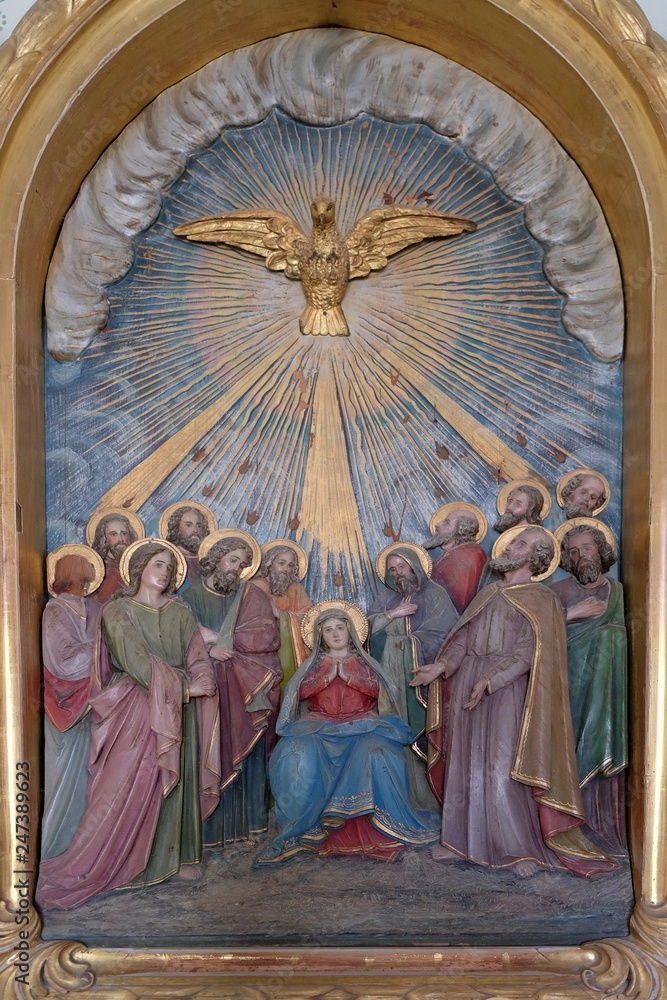
    Pentecost, the descent of the Holy Spirit in the chapel in the village Stitar, Croatia. Photo from Adobe Stock.

    Note how the Letter to the Romans acknowledges this moment that we still live within, found in the Pentecost Vigil epistle reading:

    We know that all creation is groaning in labor pains even until now;
    and not only that, but we ourselves,
    who have the firstfruits of the Spirit,
    we also groan within ourselves
    as we wait for adoption, the redemption of our bodies. …

    the Spirit too comes to the aid of our weakness;
    for we do not know how to pray as we ought,
    but the Spirit himself intercedes with inexpressible groanings.

    In other words, the whole point of life is the “adoption, the redemption of our bodies,” when we will be reunited perfectly with God. We — indeed, all of creation — are groaning in the labor pains brought about by Christ’s life, death and resurrection. And the Spirit is here to help us during this time, filling our mouths with the saving message of Jesus Christ, which gets us to this adoption, i.e., Heaven.

    Let’s repeat this: the Spirit is given to us (today, in our Sacraments and freely by grace) specifically to fill our mouths with the redemptive message of Jesus Christ — intelligible in all languages and meant for all people. We are supposed to be sharing the Way, the Truth and the Life with others. This is what it means to truly love your neighbor. I meet so many Christians who think loving your neighbor means good deeds, kind words, and a helping hand. But without the message of Jesus Christ, who was literally raised bodily from the dead to create a new path to salvation for us, these good deeds are meaningless. Because the point has never been this life or making things better in this world. The point has always been to do God’s will, which is absolute goodness and truth, so we can be as worthy as possible for the redemption he is holding out to us. How can we have fallen so far from this message?

    The second reading on the Pentecost liturgy celebrated during the day makes this point crystal clear: “If the Spirit of the one who raised Jesus from the dead dwells in you, the one who raised Christ from the dead will give life to your mortal bodies also, through his Spirit that dwells in you” (Romans 8:11). Being raised from the dead — body and soul — to dwell with God in Heaven is the point of the Spirit being sent to us. That’s what we celebrate on Pentecost and that’s what makes us Christian.

    I pray on this Pentecost that Catholics will be shocked out of their lukewarm tendencies, their acedia that keeps them comfortable in their jobs and money and little material triumphs. We must truly let the Spirit that has soaked our souls in our baptisms and confirmations to open our mouths to proclaim with the Apostles that Jesus Christ is the Way that all humanity has been given to share in God’s eternal glory.

  • As Wheat Gathered by the Lord

    Third Sunday of Advent: Zephaniah 3:14-18a, Philippians 4:4-7, Luke 3:10-18.

    Gaudete in Domino semper! These are the first words of today’s second reading and, in fact, the introit (opening chant) for the third Sunday in Advent, marking Gaudete Sunday every year. What does it mean? The Latin translates as “Rejoice in the Lord always,” so we celebrate Rejoice Sunday. Hooray!

    But what is joy, really? St. Thomas Aquinas writes that “joy is caused by love,” either in the presence of something that is loved or having that thing you love achieve it’s proper state of goodness (Summa II-II, q28.1). There is joy in earthly things, but the highest joy is spiritual because the highest form of love is charity (caritas). As St. Thomas writes, “according to 1 John 4:16: ‘He that abideth in charity, abideth in God, and God in him.’ Therefore spiritual joy, which is about God, is caused by charity” (Ibid). There is something circular here, something only the Creator Himself can generate: we rejoice in God always because God is the very charity that creates the joy we have. It boils down to simply allowing ourselves to exist wholly in His generative presence, which is love itself, and which generates the joy we experience.

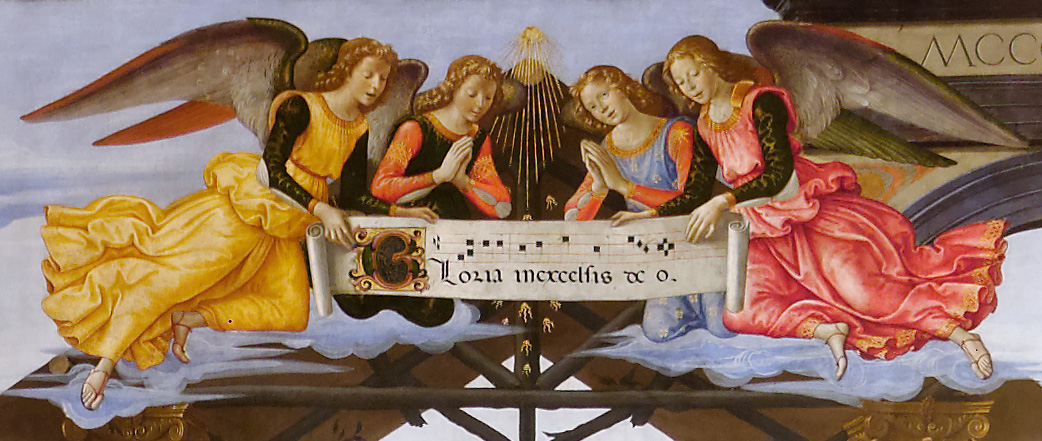
    Adoration of the Magi (detail), Domenico Ghirlandaio (1488-1489) | Wikimedia Commons.

    As we dig into St. Paul’s exhortation in the second reading, we should note a subtlety to today’s Lectionary translation. We hear today, “Your kindness should be known to all,” but “kindness” is an interesting translation of the original Greek, ἐπιεικὲς (epieikes), which means gentle spirit or gentleness. The Latin Vulgate translation is Modestia vestra nota sit omnibus hominibus, or “let your moderation be known unto all men.” So, we have a key word, epieikes or modestia, which is variously translated as forbearance, gentleness, reasonableness, moderation, and humility. In fact, our Lectionary is the only place I’ve found it translated as kindness. This is a point to consider, especially in the context of what we are called to do and to be. Certainly, our call to love God and then our neighbor as ourselves (simply put, a call to caritas or agape) can manifest itself as kindness. I’m not saying this is a mis-translation. But kindness emphasizes an act that we do – something we call up within us and enact on the world around us. These other words: forbearance, gentleness, moderation, and humility, all emphasize a state of internal calm that radiates through our actions. It is best phrased in perhaps the closest translation, gentle spirit. This emphasizes an internal ordering toward God, a letting go of self rather than an assertion of self. St. Paul is exhorting the Philippians (and all of us) to be known for our gentle spirit. Indeed, in the next sentence he says, “Be anxious about nothing.” This is Christianity on earth: a gentle spirit, anxious about nothing, living in Christ and awaiting His triumphant return; awaiting our own second birth into heaven. This is the essence of Gaudete Sunday, especially.

    This gentle spirit, ordered to and ordered by God, is compatible with St. Thomas’s discussion of joy, too. He writes, “joy is not a virtue distinct from charity, but an act, or effect, of charity” (Summa, II-II, q 28.4). Joy, in other words, is brought about by charity. As stated earlier, when God loves us, joy is the natural effect. Contemplating and living in the Christ event brings this joy back to the surface of our minds. Living in Christ also means allowing God’s love – charity – to flow through us to others. Our gentle spirit can be anxious about nothing as we are rejoicing in God always because we exist within the constant effects of charity.

    This is getting a little abstract and philosophical (as St. Thomas tends to do). Let’s bring it back to the reality of Jesus Christ, man and God, alive on earth. In his excellent apostolic exhortation in 1975, Gaudete in Domino, Pope Paul VI reminds us: “But it is necessary here below to understand properly the secret of the unfathomable joy which dwells in Jesus and which is special to Him. It is especially the Gospel of Saint John that lifts the veil, by giving us the intimate words of the Son of God made man. If Jesus radiates such peace, such assurance, such happiness, such availability, it is by reason of the inexpressible love by which He knows that He is loved by His Father” (III). Pope Paul VI goes on to recount the number of ways John tells us Christ knows the Father and is united with Him: “It is an unceasing and total exchange: ‘All I have is yours and all you have is mine.’ The Father has given the Son the power to judge, the power to dispose of life. It is a mutual indwelling: ‘…I am in the Father and the Father in me….’.” Pope Paul VI’s point is to more clearly flesh out the charity that gives us joy. Perfect charity is the relationship between God the Father and God the Son: “Here there is an uncommunicable relationship of love which is identified with His existence as the Son and which is the secret of the life of the Trinity: the Father is seen here as the one, who gives Himself to the Son, without reserve and without ceasing, in a burst of joyful generosity, and the Son is seen as He who gives Himself in the same way to the Father, in a burst of joyful gratitude, in the Holy Spirit.” And, the best part: “And the disciples and all those who believe in Christ are called to share this joy.” There it is! This is the fullness of what St. Paul means when he says rejoice in the Lord always.

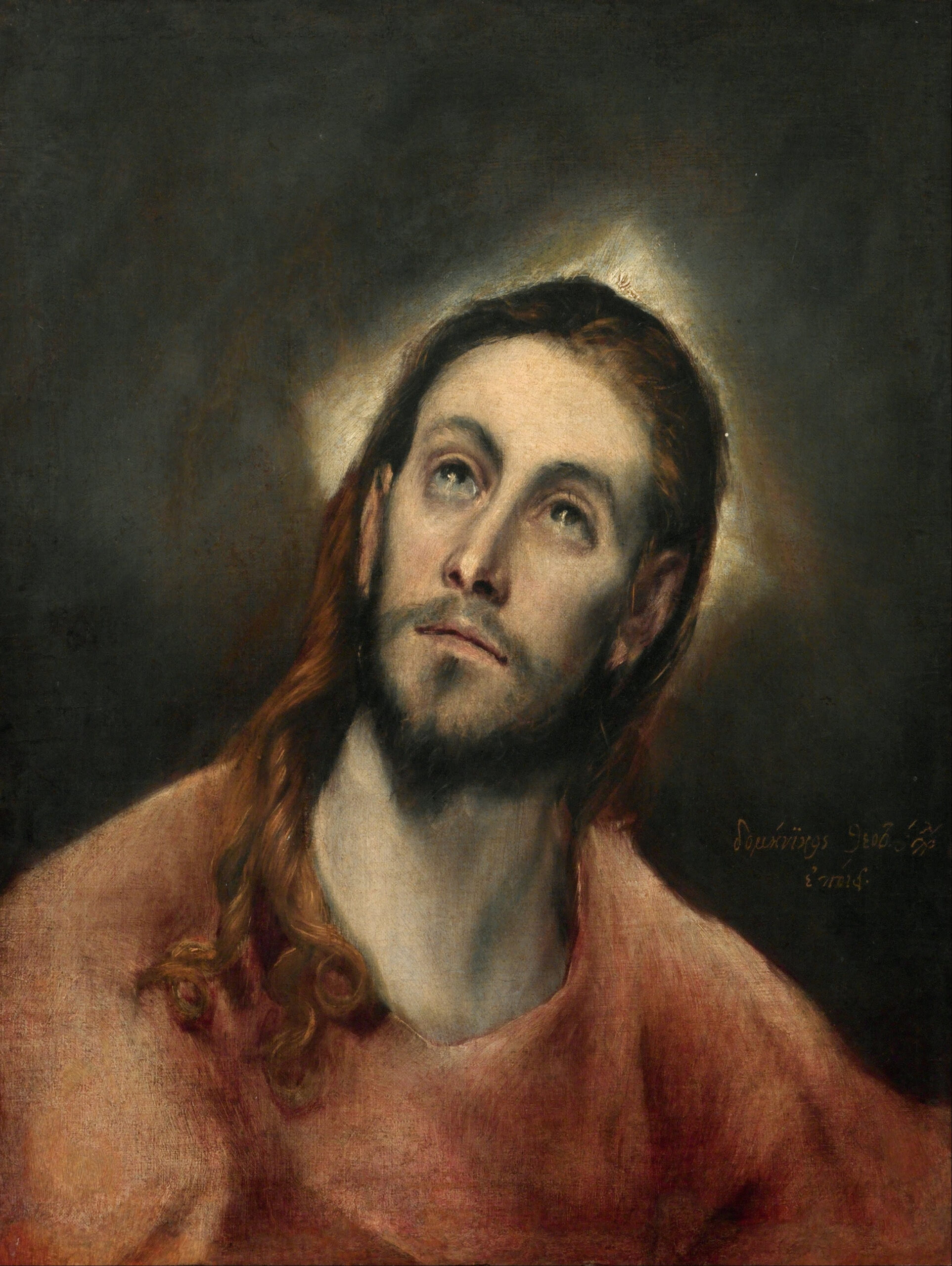
    Christ in Prayer, El Greco (1595-1597) | Wikimedia Commons.

    This (and every) Advent, we remember the anticipation of the world awaiting its Savior. We also anticipate the second coming of Christ. And, finally, we celebrate Christ being here with us already. This third reality is most clearly articulated here on the third Sunday of Advent through St. Paul’s words to the Philippians, who were themselves living in the new reality brought to the Earth through His death and resurrection. Zephaniah, too, in the first reading foresees this age: “the King of Israel, the LORD, is in your midst, you have no further misfortune to fear … Fear not, O Zion, be not discouraged! The LORD, your God, is in your midst, a mighty savior; he will rejoice over you with gladness, and renew you in his love.” What a deep and accurate prophecy! This is the same Word that speaks through St. Paul to the Philippians, a Word that unveils the meaning of the Christ event in the lives of humans. How can we fear misfortunes here on earth when the grave has been conquered and eternal life in Heaven has been offered to us? Humanity’s greatest fear and sadness, that we will cease to exist one day and that life has no meaning beyond the present, has been blown to bits by Christ’s sacrifice. What joy that His love of the Father has provided us a Way to the Kingdom! Rejoice in the Lord always!

    We cannot end this reflection without gazing at the titanic figure of St. John the Baptist, the great prophet, the voice crying out in the wilderness. In the gospel reading, John teaches the crowds to stop being selfish: “share with the person who has none … Stop collecting more than what is prescribed … Do not practice extortion.” Let’s remember that John has felt the effects of charity come to earth; he “leaped for joy” in Elizabeth’s womb when Mary, carrying Jesus, came near. Like a supernova, the child even as an embryo radiated charity upon the world, transforming the hearts of those open to Him. John is so transformed that he spends his life preparing the world for Jesus. What other messianic figure in that day (and there were many, as we know from the historic record) tells his expectant, adulatory followers that he doesn’t want their praise, that “one mightier than I is coming. I am not worthy to loosen the thongs of his sandals”? Only a man who has been transformed by God and holds no stock in worldly things can so thoroughly cast off the mantle that his followers want to place on him. John, filled with the zeal of the Lord, infects his followers with the anticipation of Christ that fills him. What’s more, this anticipation is not just one of looking and waiting but one that paves the way for charity. He tells them to stop being selfish while they wait so that they can prepare themselves for the more radical baptism in the Spirit that Jesus will bring to them. If they can repent, strip away their concern for worldly pleasure and security, they will create fertile ground for the message Christ brings.

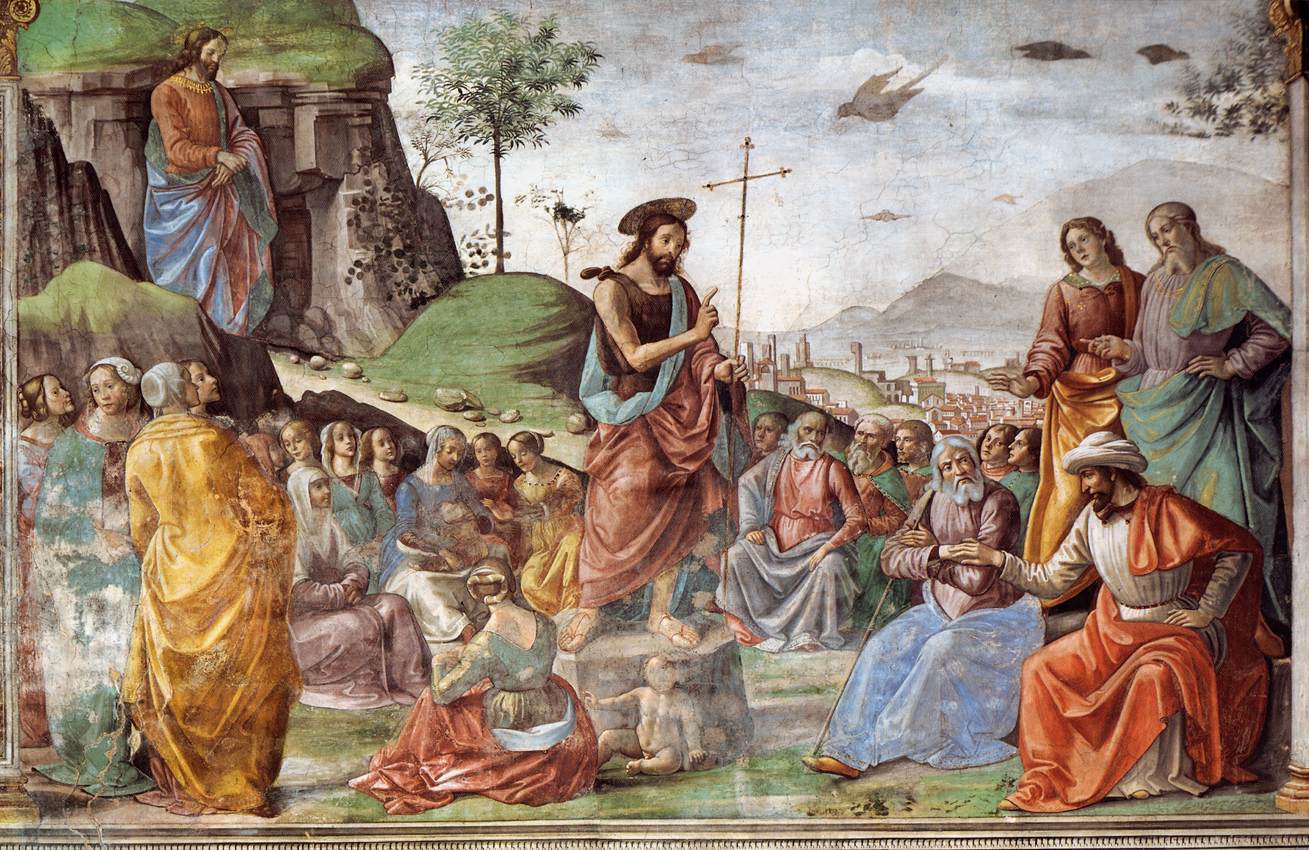
    Preaching of St. John the Baptist, Domenico Ghirlandaio (1486-1490) | Wikimedia Commons.

    I choose the agricultural metaphor purposely, because John, in his brilliance as a prophet, does the same. Let us concentrate on these final words of the gospel reading as John describes Christ: “His winnowing fan is in his hand to clear his threshing floor and to gather the wheat into his barn, but the chaff he will burn with unquenchable fire.” On the most obvious level, the metaphor is one his listeners can understand given the tools and occupation common to their time and place. A winnowing fan is used at the harvest to separate the good grain from the husks, dust, stalks and other “chaff” that do not serve as food. Metaphorically, the wheat are those who please God while the evil ones are the chaff. The harvester is Christ, the one who brings the final judgment. But the metaphor is agricultural particularly because it involves growth and harvest. He could have used a metaphor of a builder choosing strong stones instead of weak ones, or any number of other metaphors. But this one reminds us that life is at stake. First, life is implicated because we can grow into wheat or dead stalks. This is a living process in which we are bound up. Second, life is at stake because the wheat will go on to a greater life (gathered into the barn, or kingdom of Heaven) while the chaff will be burned in unquenchable fire. Finally, the third and most intricate reading here is to consider what the life of mature wheat is. Wheat feeds us, it is nourishment, it is an offering of life. Literally, it forms the grain offering, the minchah, that is prescribed in the Book of Leviticus where the finest parts of the grain, the semolina, are offered to God, either ground, cooked, or burnt. This is our destiny, to feed others, and to be an offering of life to the Father. Our greatest destiny and goal is to be gathered like wheat to the Father where we cease living simply for ourselves (that is, to grow nice, fat grains on the stalk). The mature wheat, having been grown rejoicing in the charity of God, achieves its ultimate purpose: to nourish others and be an offering to God Himself. Astounding depth in a simple metaphor!

    And this is why John must begin the process by having us turn our mindset away from self and towards others. Our ultimate purpose, revealed through Christ, is to grow into something great with a purpose beyond us. If we allow ourselves to rejoice in the Lord always, to be fully caught up in His love, we just might achieve it.

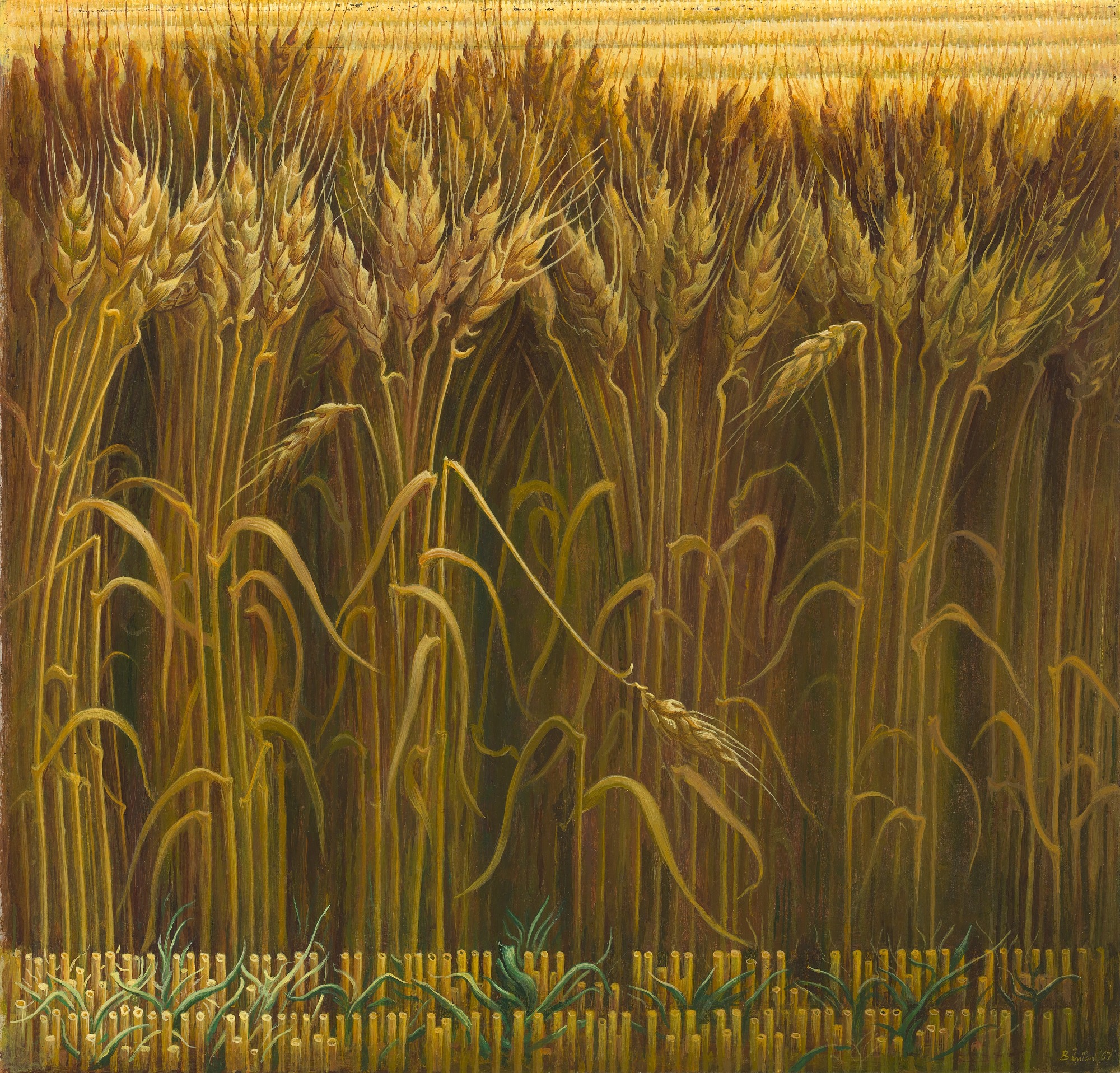
    Wheat, Thomas Hart Benton (1967) | Image courtesy the Smithsonian American Art Museum.

  • The Way to Pleasing God

    The First Sunday of Advent, Year C: Jeremiah 33:14-16, 1 Thessalonians 3:12 – 4:2, Luke 21:25-28, 34-36.

    It is right and just that Advent starts with looking forward to Christ’s coming, that is, “coming in a cloud with power and great glory,” as He himself attests in the gospel reading. Yes, in the liturgical calendar, this season occurs before the birth of the Christ child in Bethlehem, but the real waiting and anticipation that we are doing – right here, right now – as Christians alive in this last age is the waiting for the end of the world and the final judgment. We celebrate the birth of Christ at Christmas, but we don’t live in a make-believe reality where He has not yet been born.

    Too often we boil down Christianity to easy sayings (e.g., “God is Love”) and simple moral living. This is a great disservice to the density of the Christian life within which we live. Advent can easily be seen as a time simply waiting for the Christ baby to appear in the manger scene. Not so! Let’s remember that Christ has already begun His reign and has invited us to be a part of the kingdom while alive here on the earth. We can never be as fully united with God as we will in death, but we are given a way to experience the kingdom through the Holy Spirit, not to mention amazing role models (saints), sacraments, and spiritual communion. Not to mention, in terms of the hard facts of salvation history, Christ has ushered in this final era, whether we listen/understand/believe it or not. We are literally on the Way (to the end of humanity and all time), and the start of Advent is a reminder of exactly what it means to be on the Way.

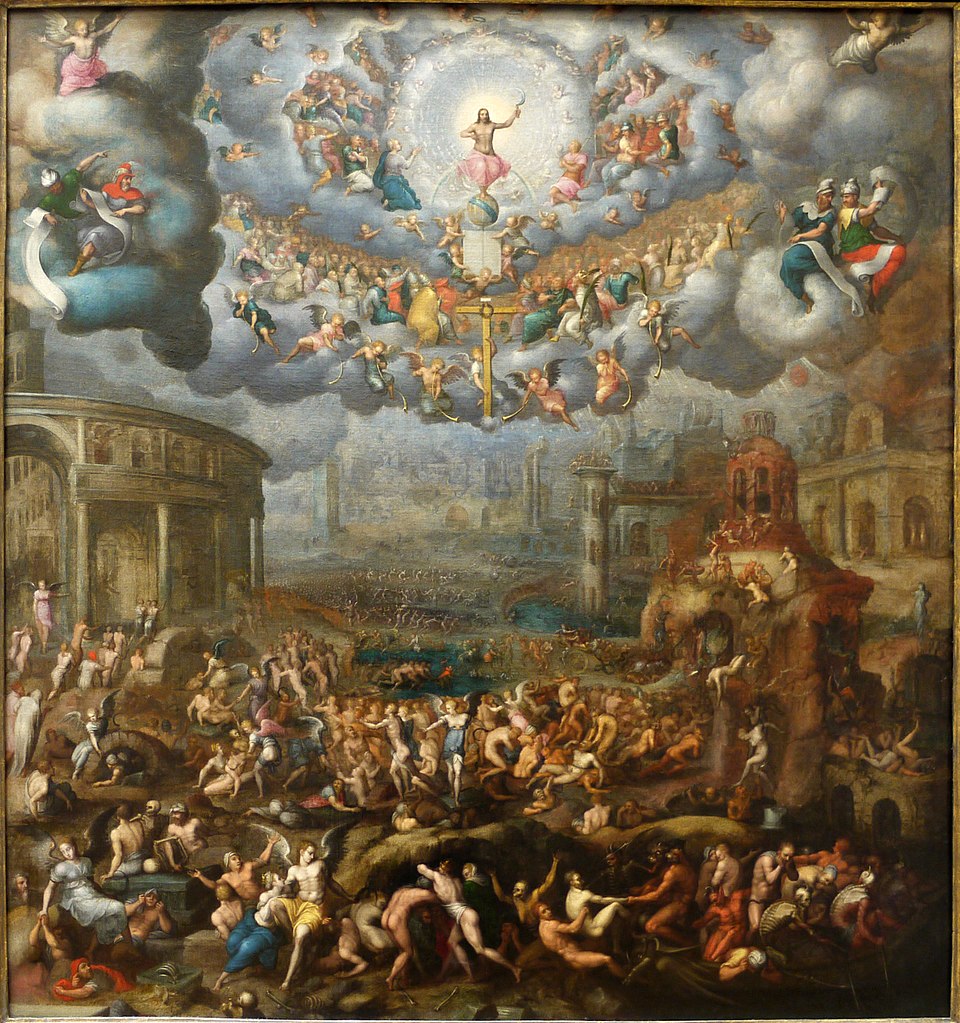
    Judgment Day, Jean Cousin le fils (c. 1585) | image courtesy wikimedia.

    God is, as the saying goes, love; and lucky for us! Jeremiah reminds us of God’s loving covenant with us: “I will fulfill the promise I made … I will raise up for David a just shoot … Judah shall be safe and Jerusalem shall dwell secure.” The Jews never forgot that our relationship with God rests on this undeserved covenant He made with us, and neither should we. Without this covenant, the end of the world would be as bad as every Hollywood apocalypse movie or dystopian sci fi novel would have us believe. But with this covenant, we have hope; more than hope, we have God’s very promise.

    2000 years ago, God sent the “just shoot” from David’s line: Jesus. But His plan is even greater than we could imagine, because Christ ushers in an age where we have the ability to reach new spiritual heights, through Him. Those who listen to Him and abide in Him are able to experience the Kingdom and bring others to the Kingdom – a spectacular raising up of our souls and purpose that we couldn’t imagine possible. Christ promises that it will be hard, that we will be persecuted, and He himself accepts the most ignoble death to show us that in seeming weakness is the great, loving power of God. Thus, today’s second reading gives us St. Paul exhorting the Thessalonians to stick to the Way: “May the Lord make you increase and abound in love for one another and for all.” Why is this so important? Again, Christ has made possible for us the great spiritual purpose of making our way to the Kingdom. Apart from the saints, the vast majority of us will not experience the kingdom while still alive, but we must devote ourselves to it nonetheless. Paul explains why: “to be blameless in holiness before our God and Father at the coming of our Lord Jesus with all his holy ones.” The Way itself helps us get to the Kingdom, whether partially experienced while still alive or simply through our efforts that show us faithful to Him when He comes on the cloud with the heavenly host. 

    This is a great way to reflect on why Catholics have spent so much time on preaching and living the moral life. We may have gone too far from mentioning God in our moral writings and conversations over the centuries because it really makes no sense if you’re not on the Way. If you’re not living the dense Christian life, aware of ourselves here in the final age, then moral decisions are as arbitrary as evil ones. I would go so far as to say that there is no real purpose to choosing good if you are not at the same time knowingly choosing God. Secularists would say that lawful society, psychological health, or longevity would be perfectly good examples of the purpose behind choosing good vs. evil. I would respond that all of these are justifications that deliberately remove God from our existence, creating a seemingly rational, human-made world. But that type of world Christians flatly reject. Our lives are a gift directly from God – how can we remove Him from the equation and think it’s rational? Lawful society, psychological health, and longevity are certainly benefits of moral action, but they should not be the purpose or the goal. The purpose we act morally is that we love God first, and God (who is love) has given to us commandments and precepts to help us achieve a greater, fuller way to be human. The purpose is our loving relationship with God as His subjects, and in the final age in which we live, that purpose has the goal revealed by Christ: walking the Way to the Kingdom that will be finally commenced at some point in the future. 

    Oh, the anticipation, the waiting! Yes, this is the Advent spirit. In the gospel reading, Christ tells us, “People will die of fright in anticipation of what is coming upon the world, for the powers of the heavens will be shaken.” We are in a state of tension, but it’s no holding pattern, with nothing to do and no way to hasten its fulfillment. He has given us His Spirit to help us stay on the path to the Kingdom. And so He can say, “when these signs begin to happen, stand erect and raise your heads because your redemption is at hand.” This is the great Christian message of hope: the end of the world is not annihilation but redemption and reunion with God. Don’t be frightened, be excited! But also, be prepared. Christ somberly exhorts His apostles in this reading to stick to the Way and not to falter: “Be vigilant at all times and pray that you have the strength to escape the tribulations that are imminent and to stand before the Son of Man.” So … excited with an asterisk, that we must be obedient to Him.

    Obedience is such a downer for today’s modern person, right? The modern would say that obedience equals stifling freedom of speech, obedience equals the white, rich status quo, and obedience prevents positive change. Where to start? It must always start with God, who is not a stifling influence but a creator, not a preventer but an expander of potential. When we take ourselves and our precious points of view so seriously that we forget that all we have is a gift we didn’t earn, then we are truly lost. In the end, obedience takes a heart docile to God, and once that happens, joy, wonder, and hope follow. Isn’t that what we want to experience in Advent?

    Unknown title, Kathy Jones (contemporary) | Image from kathyjonesstudio.com

    Perhaps the most helpful short line in today’s readings comes from St. Paul: “conduct yourselves to please God.” This wraps up everything we’ve been discussing: acknowledging God’s supreme sovereignty, the true purpose behind moral actions, the way to live in this final age that has already been given Christ but yet awaits Him still. It is right and just that the operative word here is to “please” God. God wants to please us, His beloved creation; and as we grow in love for Him, we realize that wanting to please Him is our greatest calling.


  • A Lion Recumbent

    A Lion Recumbent

    Thursday in the 3rd Week of Advent: Genesis 49:2, 8-10, Matthew 1:1-17

    Today’s readings are bursting with royal significance; pregnant, as it were, with the promise of triumph. It’s no wonder that expectations for the Messiah were so high by the time Jesus was born. God’s promise to His People is so great. Unimaginably great, and given the geopolitical crush of occupying powers, they could not help but try to materialize this promise in earthly kingdom-making.

    But this was never God’s plan. He offers lasting peace, yes, but a peace of the soul that is much deeper and more significant than the temporal peace found in human boundary-drawing. This misunderstanding and lack of preparedness in the hearts of the Jewish nation would mean a horrible crucifixion of God Himself, which proves to be the very action by which God ushers His peace into the world.

    The first reading from Genesis presents Jacob (given the name Israel by God) on his deathbed, calling his sons to gather around him so he can prophesy their futures. His sons, of course, are the heads of the twelve tribes of Israel. We might remember that Jacob is a bit of a scoundrel — he swipes his older brother Esau’s birthright impersonating him to their blind, old father Isaac on his deathbed (albeit, according to his mother Rebecca’s plot). Jacob also had children via four women (two wives and two handmaids to the wives), and famously showed favor to the second wife, Rachel, and her sons, Joseph and Benjamin.

    So, while Jacob (Israel) is the very foundation of the Jewish nation, we must recognize that he is very far from perfect. Nonetheless, God loves and blesses him. Two lessons here: the Chosen People have a lot of growing to do in forming themselves to God’s image, and God will continue to mysteriously love us and bless us even in our sins and stupidity.

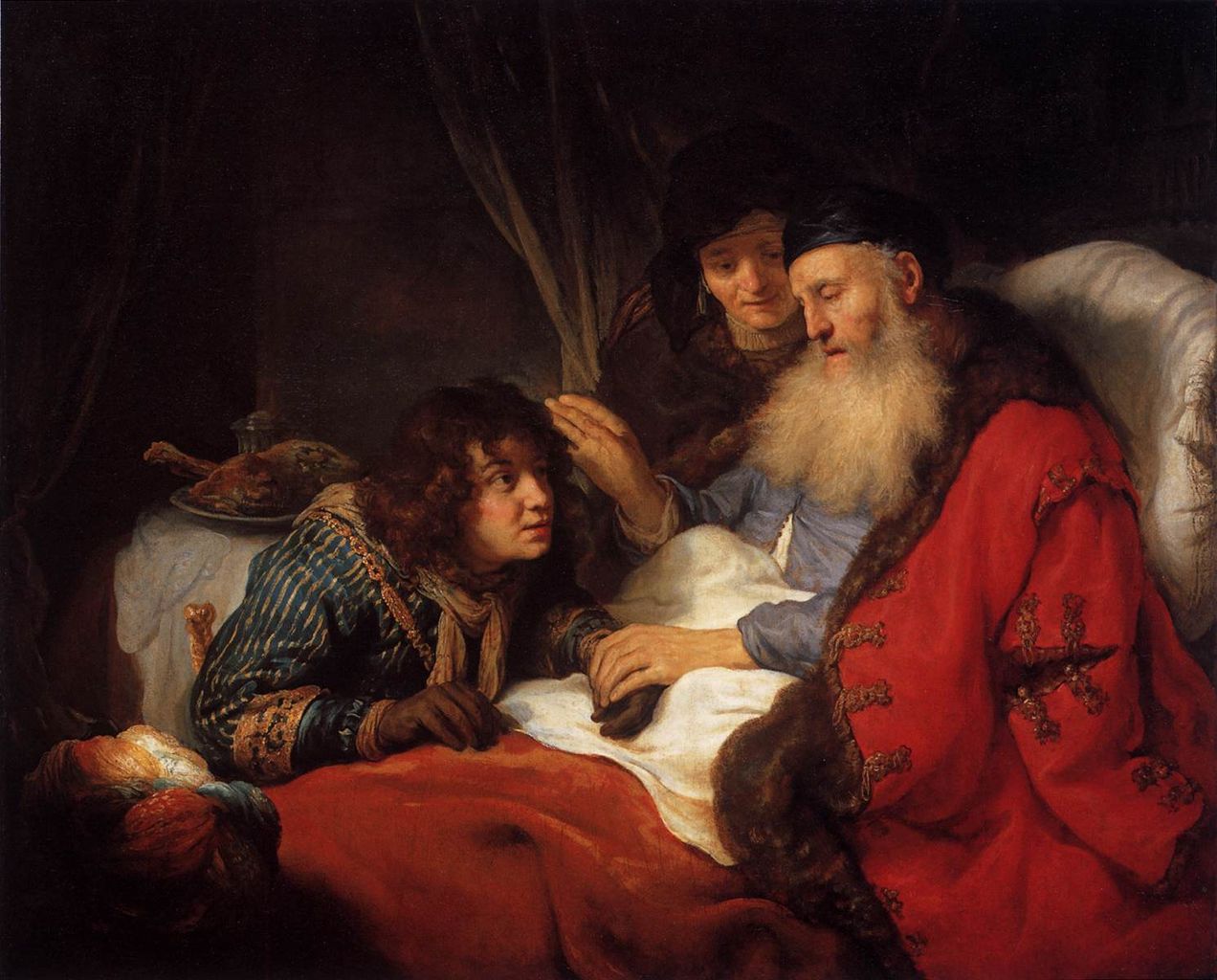
    Isaac Blessing Jacob (1638), Govert Flinck | Wikimedia Commons.

    Today’s reading gives us Jacob’s words about his son Judah, who is not really his favorite, a middle son to his first wife Leah. Despite his father’s lukewarm feelings, Judah receives the second-best treatment in the book of Genesis, advocating for selling Joseph to the caravan rather than killing him, interceding on Benjamin’s behalf, and showing strong leadership among his brothers. Judah seems blessed by God. And Jacob acknowledges this: “You, Judah, shall your brothers praise … Judah, like a lion’s whelp, you have grown up on prey, my son. He crouches like a lion recumbent, the king of beasts–who would dare rouse him?” In some ways, this is a curious statement because other sons have shown much more violence than Judah. Simeon and Levi, in particular, slaughter all the men in the city for the supposed rape of their sister Dinah. So, how has he “grown up on prey” other than having to live in the wake of his father (the lion) and his dealings?

    It also seems a bit like a backhanded compliment offered to someone you secretly fear: a crouching lion, who would dare rouse him? I think Jacob sees the greatness in him and his line, but does not quite know what to make of it. This is appropriate, since the Messiah will come from his line and the people will not know what to make of Him, either.

    I do like this image, though: a lion recumbent. We’ll return to this in reference to Christ.

    Jacob foresees another thing in Judah: “The scepter shall never depart from Judah.” This and the accompanying lines about the mace and tribute brought to him speak to a lasting reign, a lasting peace, that comes through Judah.

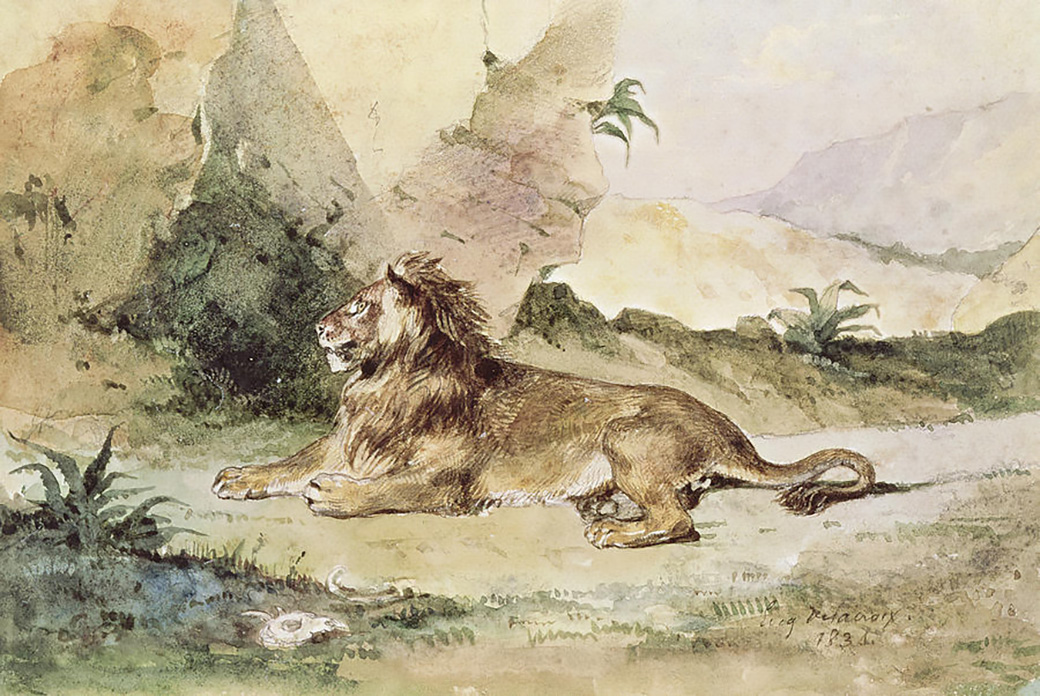
    A Lion In The Desert (1834), Eugene Delacroix | Image from arthive.com.

    Today’s responsorial psalm spikes the readings with significance. We sing: “Justice shall flourish in his time, and fullness of peace for ever.” This links overtly to the last words we hear from Jacob about his son Judah. But we know that the psalmist speaks inside and outside his own time here, not necessarily about Judah or even King David, but of the ultimate destiny of the nation, God’s plan for his people.

    Thus, we can see many figures in the following lines: “O God, with your judgment endow the king, and with your justice, the king’s son; He shall govern your people with justice and your afflicted ones with judgment.” In light of the first reading, the “king” is Israel and the “king’s son” is Judah. Closer to the historical time of the psalmist, the “king” could be King David and the “king’s son” Solomon, the wisest of all men, blessed by God. In both cases, we see the extension of a familial reign, where a father and son extend a reign of justice and righteous judgment.

    As Christians, we see the deeper theological meaning of God the Father and Jesus Christ, His Son establishing a heavenly kingdom. Christ is also in the line of Judah and David, as we read in the gospel. He unites the earthly and heavenly, the human and the divine. Today, we are urged to consider how Jesus Christ ushers in “fullness of peace for ever.” What could this mean after two millennia of wars, death and strife? Most unbelievers would be happy to point this out as a refutation of our “wishful thinking.”

    Let’s consider this in light of the gospel reading, the opening to St. Matthew’s gospel. Lectors everywhere cringe with dread over having to pronounce this seemingly endless string of biblical names. Kids shift on their feet, dads space out with glazed looks, even a pious mom or two wonders if we have to hear the whole list.

    Well, take heart, because Matthew didn’t stuff his gospel with filler. His Jewish listeners would quickly be steeped in the history of their nation, great figures and the stories surrounding them would immerse them in an illustrious familial history. Even today, we can recognize some seminal names: Isaac, Judah, Ruth, Jesse, David, Solomon.

    As the list builds and swells, we anticipate a culmination. We participate in an Advent expectation as we wait to see where this is heading. He ends it: “… Jacob the father of Joseph, the husband of Mary. Of her was born Jesus who is called the Christ.” Jesus who is called the Christ is the fulfillment of this heritage.

    With the weight of 2,500 years of Jewish prophecy, we realize that God’s plan is here laid out for us. And Matthew punctuates this larger plan by showing how 14 generations separate Abraham and David, David and the Babylonian Exile, and the Exile and Jesus Christ. There is a perfection in this, a plan. We mentioned earlier how Jacob’s (Israel’s) imperfections reveal the immaturity of the Chosen People in the scope of salvation history. Well over a thousand years later, God determines that Mary embodies the readiness of the nation.

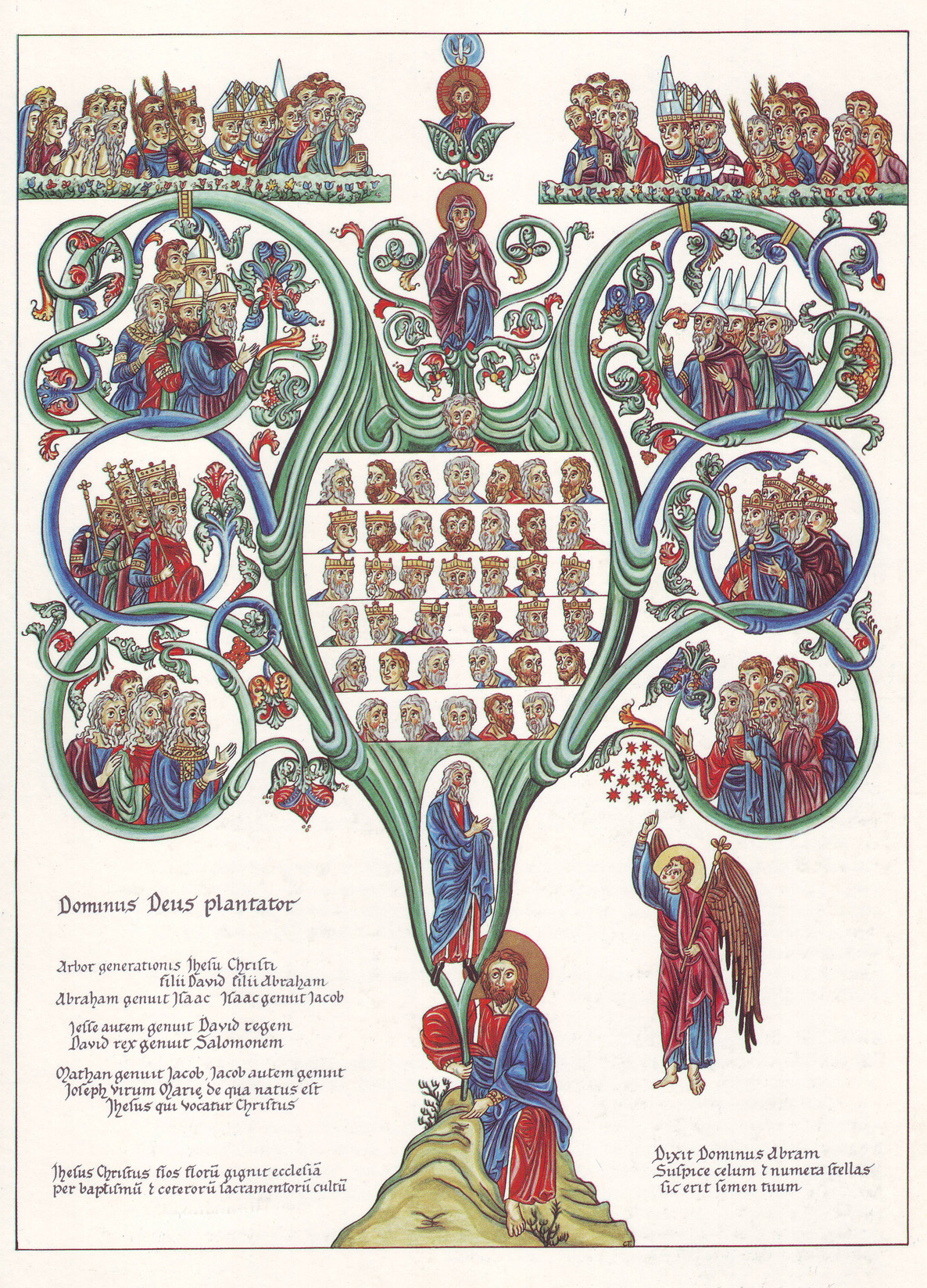
    Tree of Jesse illustration from the Hortus Deliciarum (c.1180), Herrad of Landsberg | Wikimedia Commons.

    This gospel reading requires patience to read, patience to hear, and patience to contemplate its significance. How the Holy Spirit blessed the evangelist! Just hearing this gospel as it is written brings us closer to God in receptiveness and spirit.

    The psalms recall God’s perception of time: “For a thousand years in your sight are like yesterday when it is past, or like a watch in the night” (Ps 90:4). This doesn’t mean that God could care less about what happens in the span of those thousand years — quite the contrary, He constantly, tirelessly offers his grace and forgiveness to everyone at every second. It’s just that his love is so overwhelming and so much the fabric of Him that little setbacks (like a semi-scoundrel called Jacob or a spaced-out dad at Mass) are meaningless. We can often overlook flaws in a loved one. We realize that the little things don’t matter; in fact, little flaws can be endearing.

    Thus, love is the lens by which patience is a part of God’s character. Patience is a virtue (as my mom repeated endlessly to me in my childhood) because it goes hand-in-glove with the love that God is. The gospel brings this patience to us experientially, and we begin to understand that 42 generations in a family is simply the time it takes for the Word of God to germinate. 

    Once we struggle through our antsy-ness, do our breathing or mindfulness training or meditation and finally achieve patience, we perhaps notice something else. True patience, the kind that is tethered to love, is nearly indistinguishable from a peaceful heart. 

    Think of it: we push aside the things that make us impatient, disquieting things, in order to achieve patience. We have to focus on something of a longer perspective, not the little things here and now that make us antsy to get something resolved. We adjust our bearings and this longer, broader field of vision gives us the ability to relax and be patient. What is that but a taste of true peace?

    This gospel reading provides a long view that enables us to start to grasp a bit of God’s plan. If we’re fidgeting or spacing out, it’s likely because we’re thinking of something other than encountering Christ. If we yearn for God and His entrance to humanity, this gospel allows us to join in God’s patience over the generations.

    And at the end of the genealogy lies our lion, recumbent in a manger. 

    I love the combination of the two readings today because it gives us this image: Christ, the king of the beasts, a lion, yet recumbent. There are so many ways this image resonates with me. King of the beasts, of course, meaning king of all creation; Christ is King of the Universe. “Who would dare rouse him?” takes on a solemnity as we consider the shepherds, angels, and the magi adoring the Christ child.

    But the idea of a recumbent lion is perhaps the most evocative. The dangerousness and ferocity of the lion is well-known and feared — we might consider the fears of Israel’s neighbors in the Old Testament upon their entrance into the Levant, knowing that no army could stand in the way of God and His plan. Or we might consider that Christ will come again for the Final Judgment. But the lion is recumbent. The great question: Why?

    God is the primary mover, there is no force that can exert itself against Him. Nothing would make Him be recumbent but His own will. Why does He choose to sit back and be peaceable, despite His awesome power?

    Perhaps this is the point in itself. As Christ teaches us, there is a power greater than what comes from kings and swords. This power arises from love — first for our Creator and then for our fellow human — and gives birth to charity, never violence. This is the promised “fullness of peace forever.” It comes not from an unbeatable army and impregnable national border (talking to you, U.S.A.), but from the fragile and mercurial hearts of humans, transformed and forged into something made stronger than armies by the grace of God.

    Christ gives us a Way to achieve peace in our hearts, which, in truth, is the only peace that matters because it is the achievement of the Kingdom. He is the way, he is the mystical bond between us and God, and the gateway to the Kingdom. We will sing this at his coming in a week and a half with the angels: “Glory to God in the highest heaven, and on earth peace among those whom he favors!”


    I want to thank Suzanne for sharing her thoughts this morning about today’s psalm and its relation to our reflection yesterday. She got me excited to write this reflection. Marriage is a blessing!

  • Fret Not, the Work is Glorious

    Wednesday in the 20th Week of Ordinary Time: Ezekiel 34:1-11, Matthew 20-1-16.

    Today’s gospel reading presents us with the Parable of the Laborers in the Vineyard. It seems to me that the heart of this reading and the Old Testament reading from Ezekiel is the question of the work we do in this world. It is clear that God expects us to do His good work in the world, and apart from the question of whether we do it or not is the question of how we approach the work and the reward.

    We approach the gospel with Ezekiel’s prophecy in our ears. The Lord instructs Ezekiel to tell the nation, “Woe to the shepherds of Israel who have been pasturing themselves! Should not shepherds, rather, pasture sheep?” Who are the shepherds? The first thought that comes to mind is that the shepherds are the leaders, the kings, the prophets, the priests, the teachers, and the keepers of the law. They are all charged with special tasks in maintaining the spiritual health and fidelity of the Jewish people. But as we consider the Ten Commandments, we realize that every member of the nation is, in part, charged with upholding God’s law for the sake of others. In some sense, everyone is implicated with this prophecy.

    Shepherd of the Pyrenees (1888), Rosa Bonheur | Creative Commons, courtesy Art UK/Brighton and Hove Museums and Art Galleries.

    Ezekiel elaborates that the sheep are the most vulnerable of the Jews: “You did not strengthen the weak nor heal the sick nor bind up the injured. You did not bring back the strayed nor seek the lost, but you lorded it over them harshly and brutally.” Let there be no doubt that God wants us to act in love, be generous and give to those who need help. His commandments are not meant to be a laundry list of prescriptions that restrict our movements and actions. On the contrary, they are meant to expand our movements and actions in the direction of love.

    Ezekiel then prophesies the coming of Christ: “I will claim my sheep from them and put a stop to their shepherding my sheep … For thus says the Lord GOD: I myself will look after and tend my sheep.” God does not throw up His hands in resignation over our poor job of accomplishing the work he asks us to do. No, He promises to take an even more active role in shepherding us by coming to us Himself. 

    Which brings us to God incarnate, Jesus Christ, shepherding his apostles through His many teachings and parables. He has just taught them the truth of God’s riches being on a different level than worldly riches (see The Sadness of Possessions). In fact, God’s riches — pure love — are aligned with giving away, emptying oneself of selfish thoughts and desires, and so worldly riches are an obstacle to the kingdom because they promote the opposite action: hoarding, possessing, and selfishness. Jesus teaches that the spiritual order of things is in many ways the inverse of the worldly order, and the last in this world shall be first in heaven while the first here on Earth shall be last. 

    He follows this teaching with today’s gospel, the Parable of the Laborers in the Vineyard. It is another re-ordering of priorities for the apostles, a discussion of how the psychology of the world is poor preparation for the reality of the Kingdom of God. “The Kingdom of heaven is like a landowner who went out at dawn to hire laborers for his vineyard,” Jesus begins. The analogy is clear: God is the landowner and we are “hired” to be laborers for his vineyard. We’ll return to this, but notice that even here it is overly generous for the Creator of all to be offering any sort of payment to those who owe Him their very existence. 

    Parable of the Workers in the Vineyard (Gleichnis von den Arbeitern im Weinberg), c.1670, Jacob Willemsz de Wet | Wikimedia Commons.

    The landowner hires people throughout the day, including just an hour before quitting time. The payment, rather than being based on hours worked, is the same for each laborer. Those who worked the longest “grumbled against the landowner, saying, ‘These last ones worked only one hour, and you have made them equal to us, who bore the day’s burden and the heat.’” We can recognize their feeling of how the landowner was unfair, since our idea of work is tied up in a very worldly concern for personal gain.

    But, in the words of the landowner, Jesus gives us a new framework: “What if I wish to give this last one the same as you? Or am I not free to do as I wish with my own money? Are you envious because I am generous?” The guiding principle of the Kingdom is love and generosity; these are equally bestowed on all who come to work in the vineyard, regardless of when they begin this work in their lives. One deep lesson here is that God is generous; when He gives, He gives all He has. Griping over who gets more is both meaningless and petty.

    But it’s hard to let go of our sense of fairness. Something almost seems unjust about not giving more compensation to those who work longer and harder. Here we must be careful: justice is God’s realm, not ours. Jesus is telling us something about justice, too. Let’s consider again how he phrases the parable: “like a landowner who went out at dawn to hire laborers for his vineyard.” What is the work that the landowner is asking them to do? To tend to the vines, to nurture them and reap the fruit of the harvest. The vineyard is a fitting example of the pinnacle of human work on earth, a marriage of our will for good things and careful tending to produce fruit that is good. The Jews offered God the first and best fruits of their labor as a sign that our work must first benefit Him, and we must recognize that everything comes from Him and returns to Him. The vineyard has a particularly eschatological significance for Jesus — here he is talking about the ultimate reward, the kingdom of heaven, and later he uses the image of the vineyard in the Parable of the Wicked Tenants, when he tells the Chief Priests, “the kingdom of God will be taken away from you and given to a people that produces the fruits of the kingdom” (Mt 21:43). 

    His Jewish disciples thus had a good sense that this was no ordinary work. In fact, this was the most important work in their lives that the landowner was hiring them to do. It concerned their very salvation. Yet even though it’s important, we are left asking how should we feel doing this work and, again, is the recompense commensurate with the effort?

    Parable of the Workers in the Vineyard, 11th century, unknown author from the illustrated manuscript Codex aureus Epternacensis, fol. 76f | Wikimedia Commons.

    As Christians, we have an incomparable lens through which we can answer these questions: Jesus’s great Paschal Sacrifice gives us the ultimate example of what this work in the vineyard is and how we are to accomplish it. Our most memorable vineyard-related teaching from Jesus comprises the core of his continual presence in our liturgy: “Then he took a cup, and after giving thanks he gave it to them, saying, ‘Drink from it, all of you; for this is my blood of the covenant, which is poured out for many for the forgiveness of sins. I tell you, I will never again drink of this fruit of the vine until that day when I drink it new with you in my Father’s kingdom’” (Mt 26:27-29). Here we have the confluence of the vineyard:Kingdom allegory and the very real sacrificial act of Christ offering to the Father His Body and Blood to free us from the bonds of death. His real Blood is the fruit offered to the Father at the end of his work harvesting in the vineyard. His Redeeming Blood accomplishes what none of us could accomplish over millennia of sacrifices. We are “hired” to work in the vineyard, but the great harvest and offering to the landowner has already been made on our behalf.

    The world-changing gift, the real Blood celebrated in the fruit of the vine, enables us to leap with joy in our work! Christ is our Master and our model, and we are free to do the work that He showed us knowing that our salvation has already been won for us.

    In short, our Christological lens shows us that the work we are “hired” to do is joyous and glorious because we have the Truth, the Way, and the Life laid out before us. More: we can be united with the glorious Way and Life by doing this work and that is payment in itself. The more we give ourselves freely to this work, as Jesus gave Himself freely to be sacrificed, the more we unite ourselves with the holy Way. The more we are united to Christ, the more God’s love and grace is poured upon us, lightening our load. Over time, we can start to give generously of ourselves in a way that only God knows. The work almost becomes effortless because God is the One doing it.

    Red Vineyards at Arles (1888), Vincent van Gogh | Creative Commons, WikiArt.org.

    Only someone who begrudges the labor would complain about the payment. If the labor is in itself an experience of love and generosity, any payment is simply icing on the cake (although, what a payment, this everlasting life with God!).

    With this parable, Jesus challenges us to make a big move in our minds and hearts. He asks us to value God’s generosity over our own desires for a reward. We know that the Way He asks us to walk is the Way of the Cross — one of poverty of spirit, humility, generosity, and love. Let’s study the lives and writings of our saints to find courage and peace with this Way rather than dread and fear of pain. St. Dominic, whom everyone loved to be around because he was gentle, kind, and good company, walked the Way of Christ (often barefoot over mountains), praying constantly, wearing hair shirts, practicing mortification of the flesh, and always giving of himself when in the presence of others. St. Catherine of Siena, who underwent a lifetime of fasting, mortification of the flesh, and continual prayer, was granted mystical ecstasies and was in constant demand as a spiritual advisor to popes and plainfolk alike. St. Francis of Assisi, who devoted himself to destitution and poverty, shunning possessions like they were the devil incarnate, inspired thousands upon thousands of followers with Christ’s holy Way. The point is that the Way may seem uncomfortable and filled with suffering, but in fact the graces and glories of the Kingdom begin to be realized even here on this earth, as we discover in our holy saints and models in the faith. They were filled with indescribable joy and peace, understanding every step and hunger pain as a glimmer of unification with God Himself who suffered for us all.