Tag: Lent

  • Judgment Will be Based on Acts of Love

    Monday the First Week of Lent: Leviticus 19:1-2, 11-18, Matthew 25:31-46.

    Today presents a good old fire-and-brimstone set of readings. Leviticus gives us the Word of God from the mouth of Moses, laying out a further explanation of the commandments. He elaborates on the law, “you shall love your neighbor as yourself.” Jesus takes up the thread in the reading from Matthew and explains that Jesus the King will separate the lambs from the goats, sending the evil people to Hell and taking the good to Heaven. This judgment will be based on whether we adhere to God’s law as laid out in the scriptures. Heed well, O Christians: there will be a second coming and judgment!

    As we dwell on these readings, let us not forget this terrible and great day of judgment that is promised, but let us also glean what is hopeful, for we know that our God is the God of Life.
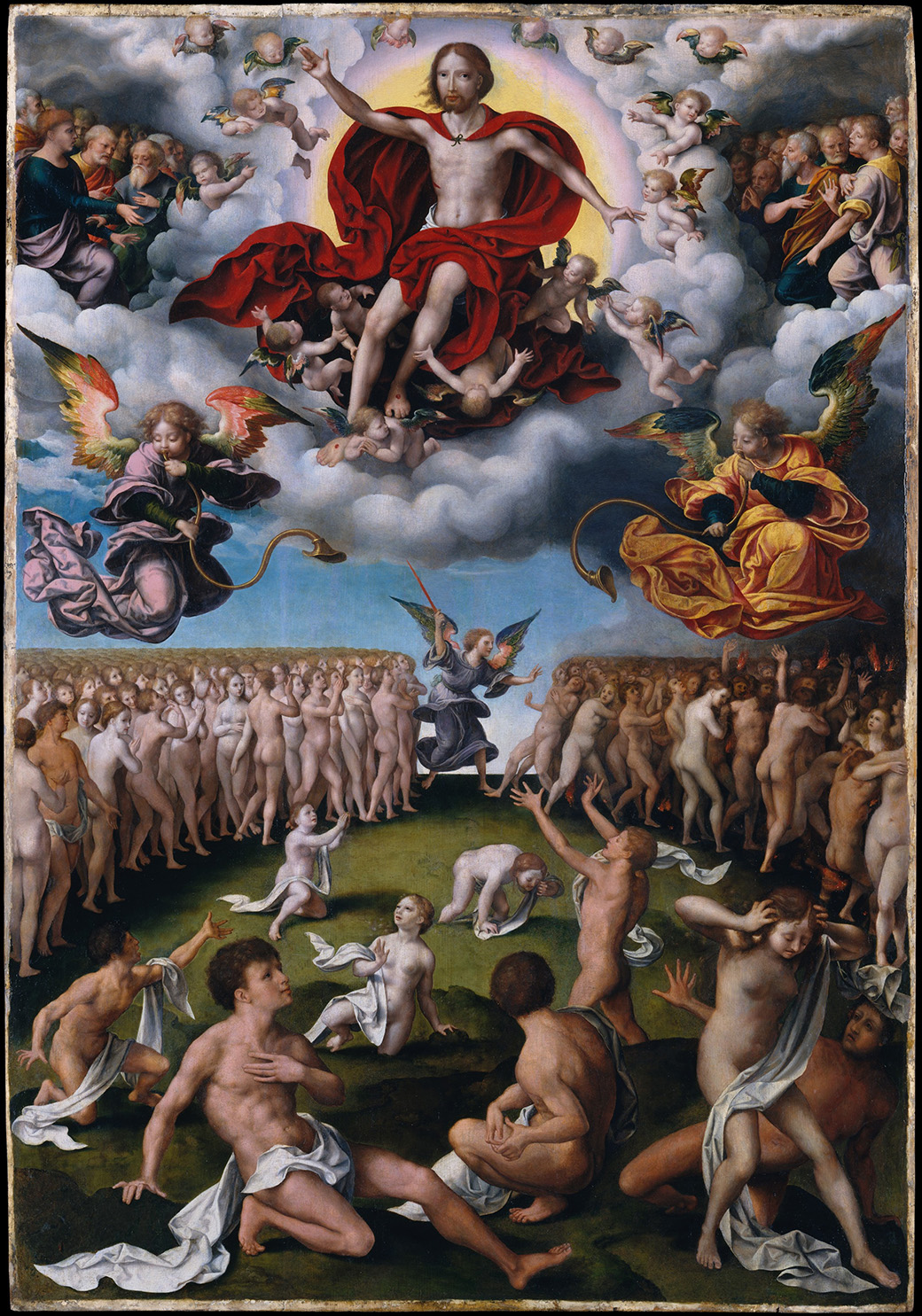
    The Last Judgment (1525–30), Joos van Cleve | Creative Commons, courtesy the Metropolitan Museum of Art.

    What strikes me about the reading from Leviticus is the last line of each paragraph (or stanza, as it were): “I am the LORD.” Four times it is repeated, and this is no accident. God wants to impress upon his people that these instructions for life come from a place of ultimate authority. But let’s consider what type of authority that is. He is the perfection of love, truth, and goodness; the giver of light and life. Imagine that phrase at the end of each paragraph: “I am the perfection of love, truth, goodness; the giver of light and life.” The sense of oppressiveness is lifted; we now cling to these words as veritable gifts bestowed on us to help us in our poor, imperfect state.

    God clearly cares that we try our best to be like Him. The first words he instructs Moses to share are “Be holy, for I, the LORD, your God, am holy.” He wants us to share in his perfection. What a loving, caring God! At the same time, we must carry in our hearts the humility to know that humanity is imperfect and in need of redemption, that we aren’t God. His words, “but you shall fear your God,” must be indelibly carved in our spirits. 

    This co-existence of a holy, reverent “fear” of the Lord and the knowledge of an all-good and loving Lord is no more evident than it is in the reading from Matthew. On the one hand, Jesus at the Second Coming jubilantly welcomes those who have acted righteously: “Come, you who are blessed by my Father. Inherit the kingdom prepared for you from the foundation of the world.” God prepared for us a kingdom from the foundation of the world! Yet on the other hand, Jesus the King curses those who have not obeyed God’s commandments: “Depart from me, you accursed, into the eternal fire prepared for the Devil and his angels.” Terrible judgment, indeed. God renders both of these because truth and divine justice are not just cotton candy and puppy dogs.

    (As a side note, given yesterday’s post Getting to Know the Tempter, I find it fascinating to hear that the eternal fire is “prepared for the Devil and his angels.” We think of the Devil as reigning in Hell, but here it seems that he is burning in Hell with the rest of the damned. Indeed, he is Prince of this World, but when the world comes to an end and all are judged, it seems that he is cast into Hell to succumb to eternal fire just as the damned are. Not so much a monarch of Hell as a fellow sufferer…)

    In this judgment scene, we hear the oft-repeated phrase “whatever you did for one of these least brothers of mine, you did for me.” Growing up in a rather liberal post-Vatican II family and church, this was the folk-mass standard lingo for a type of social justice and care of the homeless and poor. And I don’t think that’s far off — certainly, it’s consistent with the Beatitudes and Jesus’s other teachings. But if we singlemindedly focus on works of kindness towards others, especially the less fortunate, it may devolve into simple “good society building” or “personal virtue building.” We must dig deeper into what Jesus is saying.

    We must cultivate in ourselves the best reason to treat others with charity: that we fundamentally and desperately love God and all his creation.

    First, we know one thing is for sure: His message is not a self-improvement plan or an instruction book for how to build a just society here on earth. We must resist all statements about our faith that simplify his message to these banal ends.

    What Jesus says is “For I was hungry and you gave me food, I was thirsty and you gave me drink …” He is the one to whom we are ministering. Importantly, neither the good people nor the bad people understand what he means — they both ask for clarification. The good people follow God’s commandments, not even necessarily understanding the full import of their works. Great reminder! We don’t know God’s full plan, nor are we meant to. Trust in his Word and faith in the mystery are the challenging yet most important aspects of our mission.

    Jesus emphasizes that we are acting upon God when we act in the world. How is this possible? We must come to realize that God loves us so much that he shares himself with each of us. Our spirit is the organ for communion with him and the vessel to receive his Spirit. He has fused himself with us, his creation, and greatly cares that we return again to him in the Kingdom. This fusion is no more evident than in the person of Jesus Christ, fully man and fully God. 

    Arab Man with a Child (1933), James McBey | Creative Commons, courtesy Aberdeen Art Gallery & Museums/ArtUK

    So, yes, it is a common refrain to “see God in others” as a way to respect and care for other people. But sometimes this feels a bit like tricking our minds to “look past” that person’s flaws and things we dislike to “imagine God” in his or her face. Let’s take this deeper.

    We must love God so much that we don’t just follow his commandments out of fear or out of duty. We must love him so much that we start to see how he has fused himself with all of humanity (each of us included). We must love him so much that we realize we offend the Spirit of God in us when we act in sin. Finally, we must love him so much that we love his creation, we love him in his creation, and here is where our charity towards others finds its inexhaustible spring. We love others, warts and all, not looking past them or through them, but directly at them because they are God’s creation and fused with God like we are, and we love all of God and what he has created.

    No easy feat. But let’s not simplify Jesus’s message. We are called to communion with something amazing, namely “the perfection of love, truth, goodness; the giver of light and life.” This is mystical, it is known by the spirit and through faith.

    Christians are not simply social workers, but members of a family that is not of this world.
  • Getting to Know the Tempter

    Getting to Know the Tempter

    First Sunday of Lent: Genesis 2:7-9, 3:1-7, Romans 5:12-19, Matthew 4:1-11.

    Satan is known by many names in the scriptures: the Adversary (the most literal definition of the word “Satan”), Lucifer, Beelzebub, the Devil, the serpent, the Prince of the World, the Father of Lies, and the Tempter. Today’s readings give us a chance to get to know him as the Tempter. First, we watch him tempt Eve and cause the great fall of humanity. Then, we watch him try to tempt Christ in the desert. What we might realize from the readings is just how tightly interwoven his whispers are to our way of looking at the world. His temptations are the same ones we encounter today. 

    As we revisit our origin story in Genesis, it absorbs us lyrically like a colorful legend. After forming man from clay, God “blew into his nostrils the breath of life.” God plants a garden and makes trees sprout up that are “delightful to look at and good for food.” What evocative language! But lest we consider this just a colorful story, remember that it is laced with the undeniable stamp of truth. One example: thanks to modern science, we realize that we are made of biological building blocks like DNA, in turn made of inert elements (the “clay”) like carbon, nitrogen and oxygen, somehow sewn together and animated in relationship to one another.

    But I am not trying to be a Biblical literalist here; let me focus more on the theological truths in Genesis. Let’s consider that the garden is a metaphor for perfect life with God, in other words, the Kingdom of God. We long to return to a place of unity with God. One aspect of the garden that we take into our spiritual lives is its orientation. The garden is planted in the east, not just symbolic of newness, but the direction of the rising sun. It is the place of eternal renewal and newness, which is why Catholic churches have their altars in the east and the people face east during Mass.

    In the middle of the garden are the tree of life and the tree of the knowledge of good and evil. The tree of life is the creative power of God, and the tree of knowledge of good and evil reveals characteristics of his essence. God’s only commandment for Adam and Eve is to not eat of the fruit of the tree in the middle of the garden. The message here is that humanity should not try to partake in the essence of God, should not try to be gods.

    Lo, enter the serpent, the “most cunning of all the animals.” He begins his conversation like the quintessential gossip: “Did God really tell you not to eat from any of the trees in the garden?” The “really” is very telling — he’s not asking for clarification, he’s asking because he has an agenda, something he wants to implant in Eve’s mind. She naively tells him about the injunction on the tree in the middle of the garden, and the serpent responds: “You certainly will not die! No, God knows well that the moment you eat of it your eyes will be opened and you will be like gods who know what is good and what is evil.” The first thing we must acknowledge is that the Tempter is setting himself up as an alternative truth, a friend who shares secret knowledge. This presents Eve with a choice, who to believe? And her great sin (and Adam’s) is to begin to doubt God. She doubts that God has been entirely truthful. 

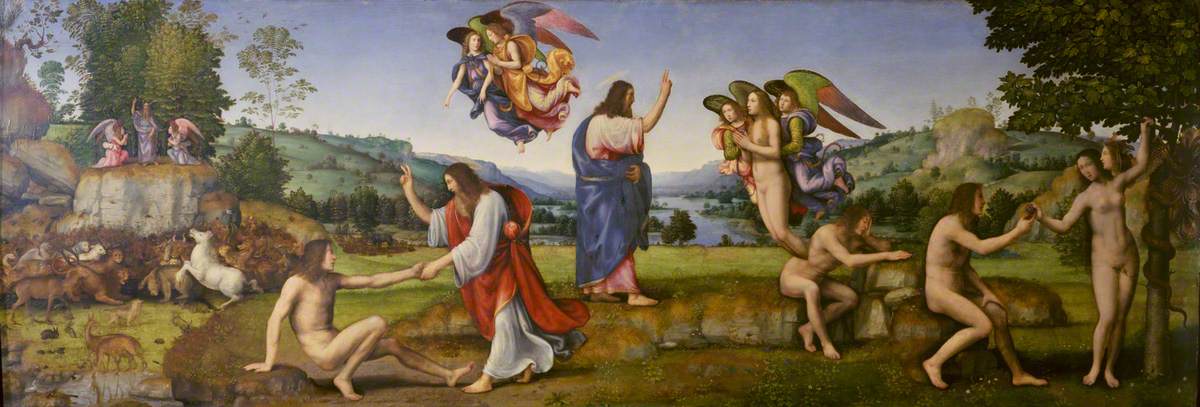
    Creation and Fall of Man (1513-1514), Mariotto Albertinelli | Creative Commons, courtesy The Courtauld Gallery/ArtUK. Note the depiction of the serpent in the tree as a human voice whispering in Eve’s ear, a nice representation of temptation as a familiar, almost human voice.

    The Tempter, we see, is a friendly devil. He operates by setting himself as a friend who wants the best for you, but that “best” is always to be questioned. Who on earth or in the heavens knows what is best for us, other than God?

    It’s important not to misunderstand the outcome of their choice. We read: “Then the eyes of both of them were opened, and they realized that they were naked.” Was Satan right? He said their eyes would be opened! Like a good used car salesman, the Devil may have laced his lies with some half-truths, but when their eyes are opened, they do not become omnipotent (which we realize in retrospect he didn’t promise) and instead they realize the evil they committed in disobeying and distrusting God, and the goodness of the garden they just betrayed. It is their shame that they realize, and the metaphor, or perhaps simply the object of this shame, is their nakedness, which they attempt to hide. Their nakedness caused no shame while they were in perfect, trusting relationship with God, but they became ashamed of their very nature (most physically obvious in their nakedness) once they broke the trust.

    This is the Original Sin: mistrusting God.

    The Expulsion of Adam and Eve (1829), Alexander Mosses | Creative Commons, courtesy Walker Art Gallery/ArtUK

    St. Paul connects for us the truth in God’s statement to Adam and Eve, “You shall not eat it or even touch it, lest you die.” The death of which God warned was not immediate (as if the fruit was a poisoned apple), but now an inevitable part of the nature of humans, brought about by their sin. Paul writes, “Through one man sin entered the world, and through sin, death, and thus death came to all men, inasmuch as all sinned.” Sin and death are inexorably joined. But the good news Paul shares is that when Jesus Christ takes on this sin and offers it to the Father in a perfect sacrifice, we are given life again. This life is evident in the bodily resurrection of Jesus, and is now available to all humanity.

    Jesus is the new Adam.

    And just as the Tempter wormed his way into the minds of Adam and Eve, he attempts to do the same with Jesus. The three temptations he uses with Jesus after his 40 days of fasting in the desert are a case study in the way we experience temptations to this day.

    The first thing we read from Matthew in today’s reading is that Jesus was “led by the Spirit into the desert to be tempted by the devil.” How much this tells us of the Spirit of God! Jesus was led by the spirit in order to be tempted. One of the major questions modern people ask when they question God is why he permits evil in the world. There are many ways to approach the answer (one of which being the fact that we were meant to be in the garden, not the world, but we screwed that one up), and this passage helps us realize one of the reasons. As we read from our Church Fathers, God refines our spirit through the fires of temptation and difficulties. God, no doubt, tests us and wants us to continue to purify ourselves and our souls in order to rejoin him in perfection. Jesus was not exempt from this. And temptations are hard, particularly because the Devil is so convincing. This is why in the Lord’s Prayer we ask God not to lead us into temptations (although it is his prerogative to do so).

    Matthew tells the temptation story in a very neutral voice. Picking up on his clues (calling the devil “the tempter,” for instance) and knowing what we know of the devil, we can flesh out this story as we contemplate. We are told that Jesus was hungry after his 40-day fast. So when the Tempter says, “If you are the Son of God, command that these stones become loaves of bread,” we can almost hear the false compassion in his voice.

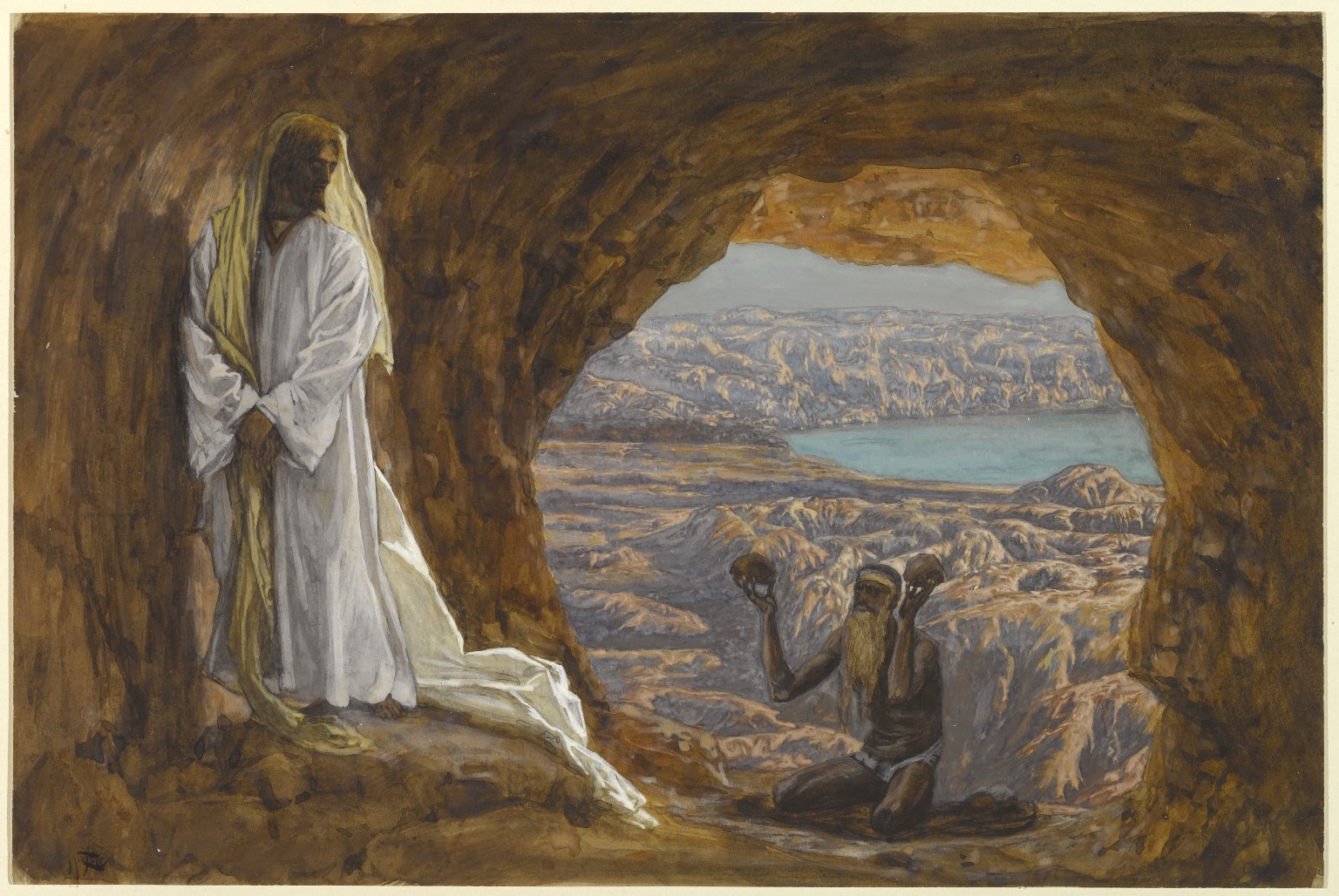
    Jesus Tempted in the Wilderness (Jésus tenté dans le désert), 1886-1894, James Tissot | Creative Commons, courtesy Brooklyn Museum. I particularly like the depiction of the Tempter as a common desert ascetic, hiding his nature from Jesus.

    Satan wants to appear empathetic to Jesus’s hungry state and offers him a way out. But Jesus points out the falseness of his empathy in that the Tempter focuses on physical things when the test is a spiritual one. Jesus responds with a scriptural quote: One does not live on bread alone, but on every word that comes forth from the mouth of God. What a great way to start Lent, when we might be tempted by this same devilish voice to focus on the physical discomfort we might feel in fasting instead of forging our spiritual fortitude.

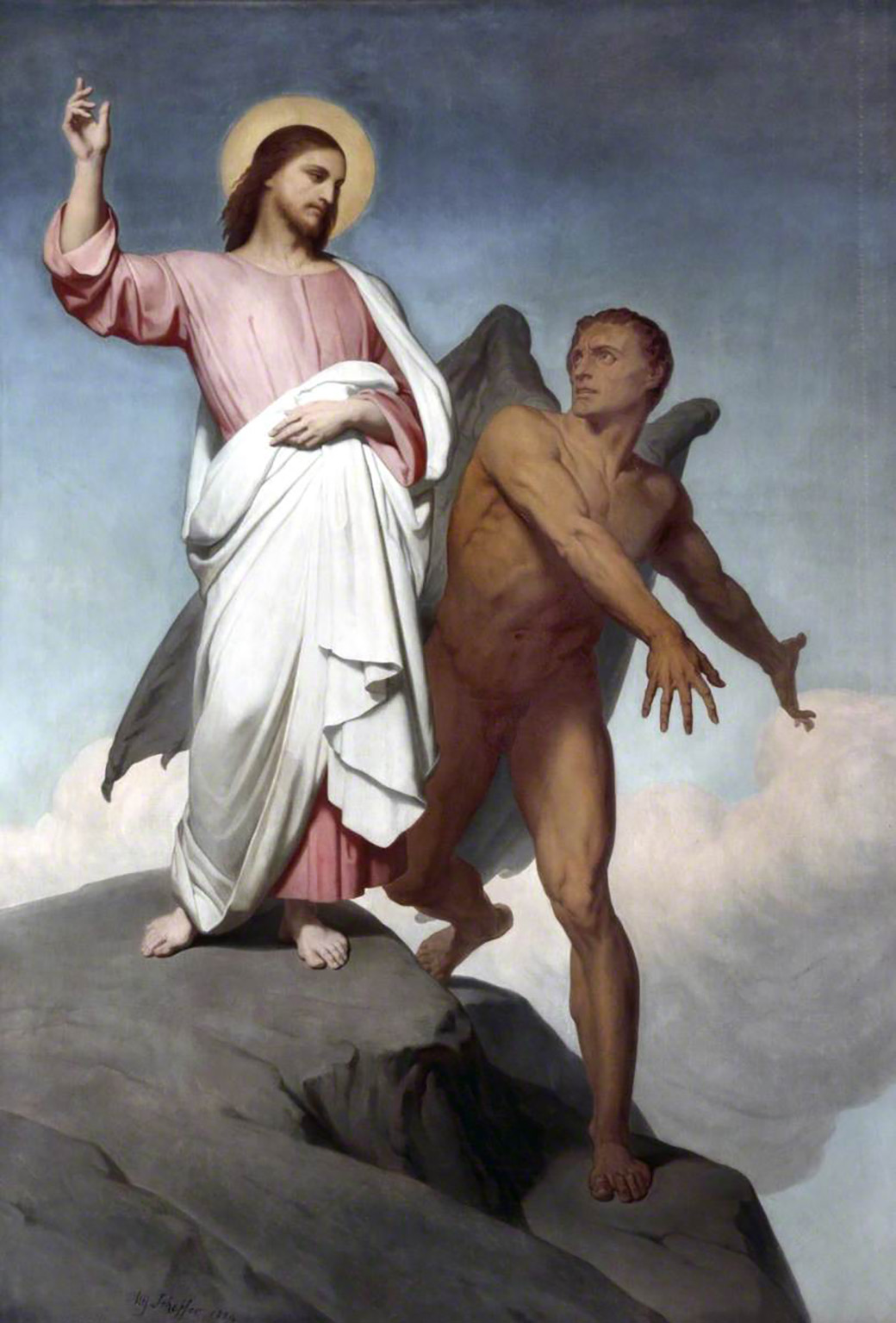
    With the second temptation, we might think that the devil is mocking Jesus when he says, “If you are the Son of God, throw yourself down” from the high parapet of the temple in Jerusalem. But I think he’s more smooth and sneaky than this. He is a fallen angel and has the same nature as these celestial creatures, so he could appear to Jesus as an angel who is interceding with him. Note that at the end of the temptations, this is precisely what happens when angels tend to him. Indeed, I think that he takes Jesus up on his redirection of the first temptation that this is a spiritual quest, and he pretends to support him in this. The Tempter quotes scripture when saying that God will command his angels concerning you and with their hands they will support you. In fact, Satan may have been posing as one of those angels who would support him, making the temptation all the more difficult to resist.

    The Temptation of Christ (1834), studio of Ary Scheffer | Creative Commons, courtesy Walker Art Gallery/ArtUK. While this may depict the third temptation, I find it works well at this point in my post because it depicts the devil in an angelic form.

    But Jesus demurs and in humility reminds Satan that we are not to tempt our God. This is another great reminder not just during Lent but for life in general. We may feel that we are due a certain support from God or from other people, but humility and the fear of God (as in reverence and awe) should be our focus, not our own rights/desires/feelings.

    Jesus calls out the Tempter for who he is in the final temptation, perhaps because the vice of pride is on full display with this temptation. The Devil comments on all the lands below them on the earth: “All these I shall give to you, if you will prostrate yourself and worship me.” He appeals to both Jesus’s pride (the promise of power and glory) and his own pride (of being worshipped). Not only is pride the opposite of humility, but it is also a fundamental regard of oneself above God. It is, in essence, self-worship. The Devil’s condition of worship carries this double-meaning of worshipping self.

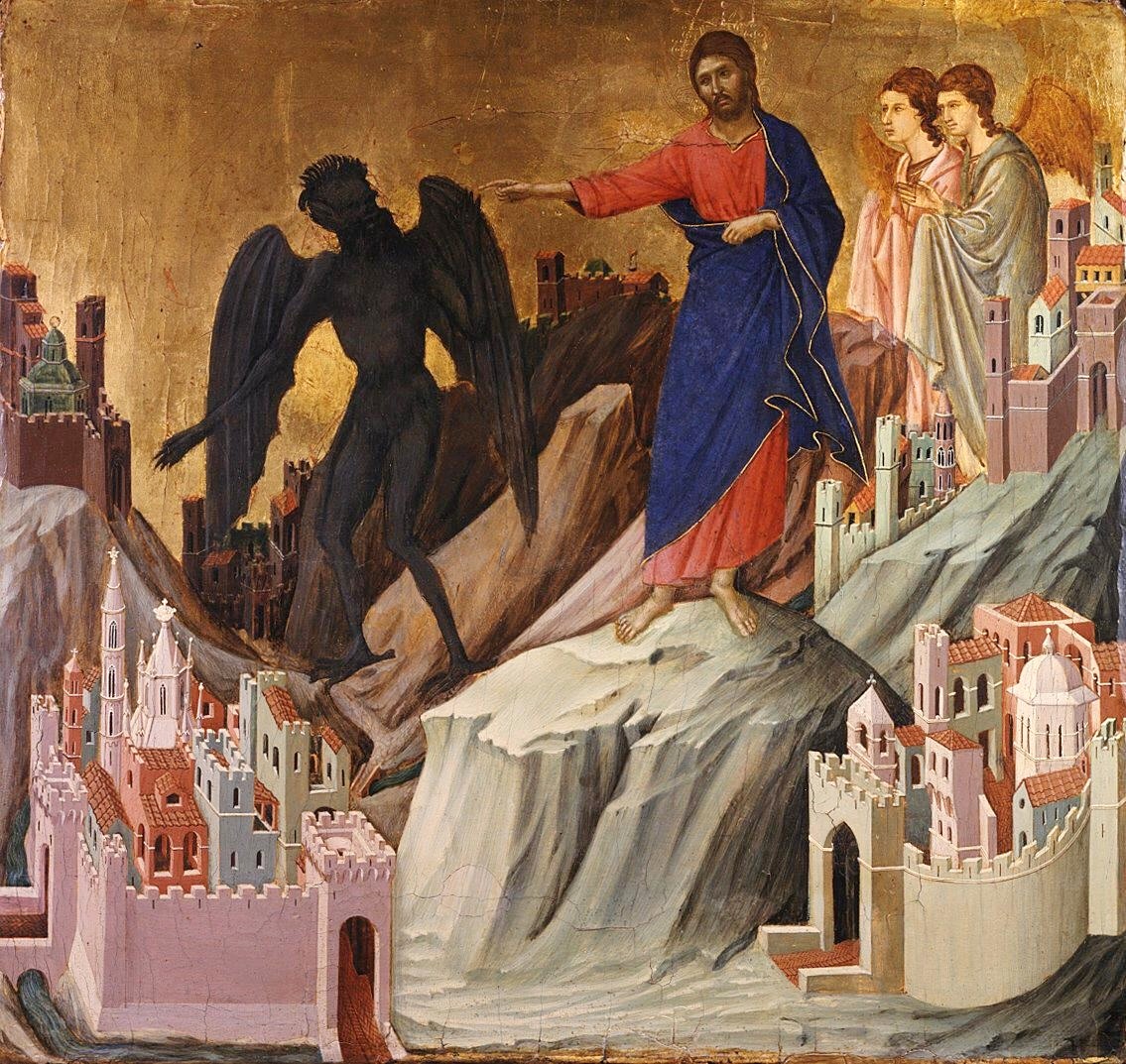
    Temptation on the Mount (1308-1311), Duccio di Buoninsegna | Wikimedia Commons. This earlier representation of the Temptation of Christ is done in an icon style where the entire story is told, regardless of each element’s temporal relationship to the others. In other words, the devil unmasked appears, Christ in victory appears, as do the angels who tend to him at the end, the wilderness, the mountain, and Jerusalem.

    Christ calls out the tempter at this, knowing that the core of all truth and light is the first commandment to worship one God above all else. Satan has revealed himself as the antithesis of truth. Elsewhere, in the gospel of St. John, Jesus elaborates on how Satan is the antithesis of truth: “He was a murderer from the beginning and does not stand in the truth, because there is no truth in him. When he lies, he speaks according to his own nature, for he is a liar and the father of lies” (Jn 8:44b). The phrase “He was a murderer from the beginning” refers to the Adam and Eve story in that Satan brought about our fallen state of sin and death. Note that Christ establishes the fact that the Tempter’s very nature is the antithesis of truth. He contains no truth and is not to be trusted.

    Christ shows us the right way to deal with the Father of Lies. We must always keep God in the forefront of our minds, and all the truth that God shares with us in his commandments. When we encounter temptations in the workplace, in our home, even in the quiet of our own minds, we must compare these thoughts and words to the truth revealed to us by God and through Christ. We have been given agape (love) and charity as our guides for how to act in the world — they are essential guideposts for us as we discern the difference between the voice of God and the sneaky, all-too-human voice of the Tempter.

  • Fasting for What?

    Fasting for What?

    Friday after Ash Wednesday: Isaiah 58:1-9a, Matthew 9:14-15


    In today’s readings, Isaiah takes on the custom of fasting head-on. Then, in the gospel reading, John the Baptist’s disciples challenge Christ on fasting, but he uses it as a chance to reveal his own nature and thereby reflect on the entire purpose of fasting. The question of sincerity is at stake in both readings.

    Isaiah is an unrelenting prophet. He delivers vividly clear images of Christ who will come, but also pulls no punches when it comes to calling out the unfaithfulness of his people. In today’s reading, he points out the hypocritical self-righteousness of the Jews:

    They seek me day after day,
    and desire to know my ways,
    Like a nation that has done what is just
    and not abandoned the law of their God;
    They ask me to declare what is due them
    pleased to gain access to God

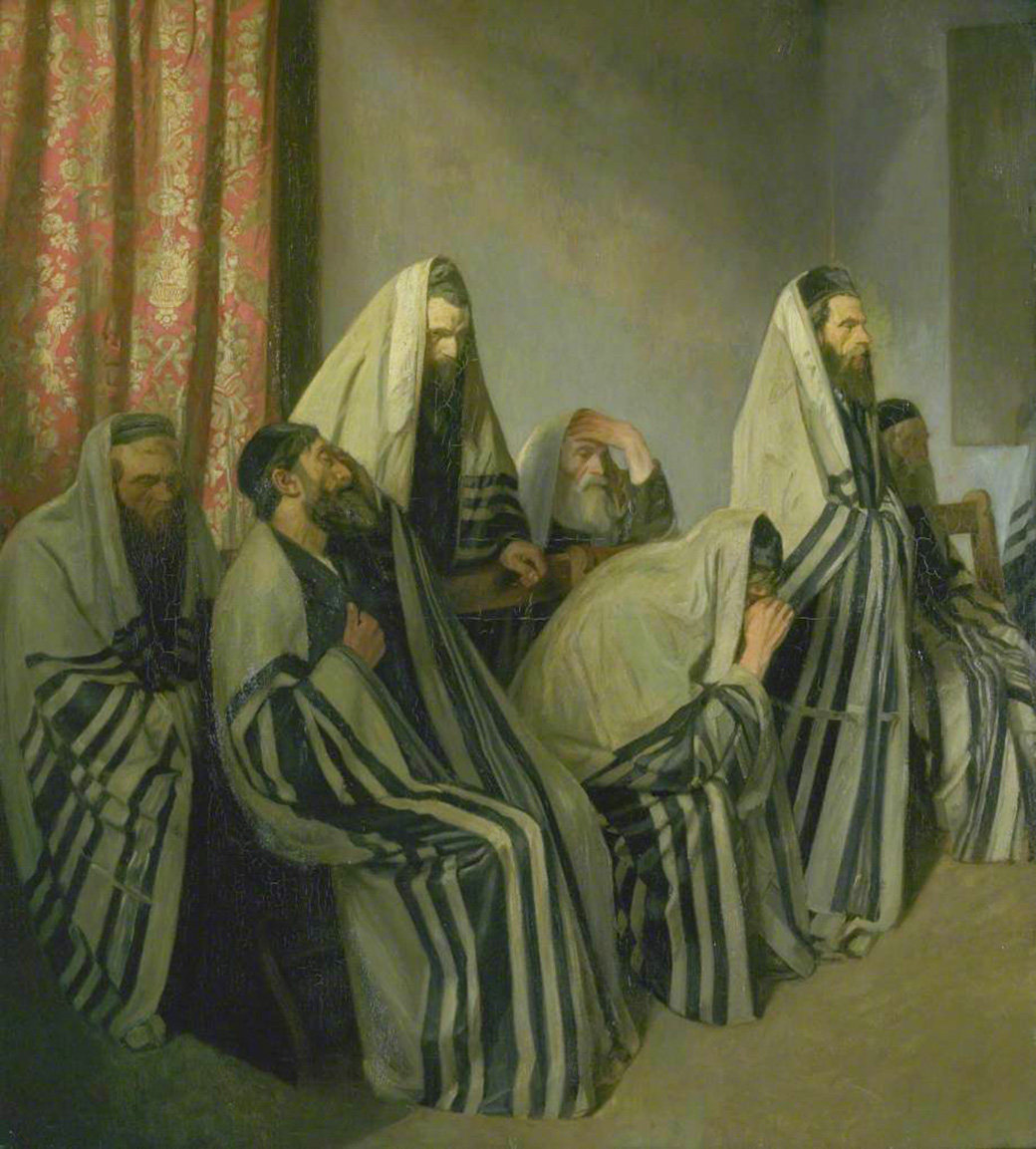
    Jews Mourning in a Synagogue, 1906, William Rothenstein | Creative Commons, courtesy Tate Museum.

    Yes, as if they had done what is just, they want what is due to them. Oh, the arrogance. The question they ask is “why do we fast and you take no notice of it?” Isaiah schools them. He points out that while they put on the appearance of fasting (sackcloth and ashes), their deeds display that they aren’t living the fast. Much like the Christ who will come, Isaiah wants to distinguish living the letter of the law from living the spirit of the law. Isaiah tells them what they should be doing while fasting (apart from abstaining from foods):

    releasing those bound unjustly,
    untying the thongs of the yoke;
    Setting free the oppressed,
    breaking every yoke;
    Sharing your bread with the hungry,
    sheltering the oppressed and the homeless;
    Clothing the naked when you see them,

    Jesus will emphasize these same points in his ministry. We can call them acts of charity. Many of us consider fasting mainly an act of deprivation, but Isaiah reminds us that the act of depriving ourselves of food is simply the first step — sharpening our senses, waking us up from the complacency of being well-fed — so that we can offer ourselves more fully to God by service to one another.

    But if we’re too absorbed in ourselves when we fast, all we think about is our hunger and discomfort. Alternatively, if we’re too concerned with showing others that we abide by the law, we look mournful and disheveled in order to broadcast our efforts to humble ourselves in front of God. Both of these pitfalls miss the entire point of fasting, which is the spirit of fully offering ourselves to God.

    Isaiah is essentially asking his people, “Are you sincere in your faith?” Following God’s precepts is a whole-person effort, and God knows if we are sincere. There’s an old saying, “Smith went to Mass every Sunday, but went to hell for what he did on Monday.” The idea, of course, is that simply going through the motions is not what God asks of us.

    So what about duty? Where does our obligation lie? Isaiah (and later, Jesus) is clear that our obligation is not to the rituals but to the spirit that the rituals are meant to bring us into. As the Catechism of the Catholic Church states, “Our duty toward God is to believe in him and to bear witness to him” (2087). Belief, faith, bearing witness (through testimony and good acts).

    An interesting acceleration of these questions occurs in Matthew’s gospel today. The disciples of John the Baptist, who were by all accounts faithful in spirit as well as in the letter of the law, ask Jesus why his disciples weren’t fasting. Jesus uses this opportunity to talk not about fasting, but about his own divine nature. Like Isaiah, he presses the people about their sincerity, only this time in a more immediate way.

    Jesus says, “Can the wedding guests mourn as long as the bridegroom is with them?” This image of Jesus as the groom and the Church as his mystical bride will be developed theologically in the years to come. More germane to our discussion, Jesus is gently telling John the Baptist’s disciples (who, we must remember, already heard from John that Jesus is the Messiah) that God is in their midst. If the goal of fasting is to attest to God in our bodies and our spirits, in a desire to be close to Him, then what place does it have when he’s already with you? 

    It’s like standing next to your father and shouting, “Oh, if my father was only here! I wish to be near my father!” It’s ridiculous. And here Jesus pushes on the sincerity of these questioners’ practice of fasting at that moment in time. If they sincerely desire unity with God, why are they fasting in front of him as if he was not present? Or is their fasting yet again simply a ritual that they stubbornly hold onto? 

    Our faith demands that we bring our entire beings, including our spirit and our intellect, to bear on this world and the next. If we fast without acting in God’s love, we are not living out our faith. If we prioritize the niggly details of our fast over the presence of God Himself, then we are blindly following ritual and not recognizing the Spirit at work.

    By being sincere in our fast — focusing on being close to God, doing his will — we can avoid these mistakes and begin to recognize when and where He is with us.

  • Ambassadors for Christ

    Ambassadors for Christ

    Ash Wednesday: Joel 2:12-18, 2 Corinthians 5:20-6:2, Matthew 6:1-6, 16-18

    The readings today certainly set the stage for Lent, as you’d imagine they might on Ash Wednesday. In the gospel reading, Jesus instructs on the appropriate way to pray and fast. This is part of his long sermon that starts with the Beatitudes, taking up three full chapters in Matthew’s gospel. But let’s take our time and see how today’s first two readings tell us why we might be praying and fasting in the first place.

    The book of Joel uses lovely language to portray some rather drastic times for the Jewish people. A plague of locusts (some scholars claim this is an allegory for invading armies) has so devastated the land that there is no grain in the fields nor even viable wilderness pasture either thanks to wildfires. The land is ruined, “the ground mourns.” Then the prophet Joel speaks of impending doom, “the day of the Lord,” when the Lord brings an innumerable, unstoppable army upon them. This horrible apocalyptic vision ends with: “Truly the day of the Lord is great; terrible indeed—who can endure it?”

    Israelites defeated by Canaanites for Having Disobeyed Moses, ~1590-1610, Antonio Tempesta | Creative Commons license, courtesy The Metropolitan Museum of Art.

    And that’s the lead up to what we read today. Despite opening with complete despair, we hear undeniable hope from Joel, “Even now, says the LORD, return to me with your whole heart, with fasting, and weeping, and mourning; Rend your hearts, not your garments, and return to the LORD, your God. For gracious and merciful is he, slow to anger, rich in kindness, and relenting in punishment. Perhaps he will again relent and leave behind him a blessing.” Joel gives us a reason to return to God with our whole hearts: the hope that He will relent from his punishments, that is, the hope that we will be saved and be brought into his Kingdom for eternity. This trumps all of the worldly concerns of barren land and empty granaries. Joel implores the entire populace (“Assemble the elders, gather the children…”) to weep and pray for God’s mercy.

    St. Paul’s words to the Corinthians are significantly different than Joel’s instructions for the Jews of his time.

    As we move to the New Testament in the second reading, we enter a new world transformed by Christ. We are, ontologically speaking, new beings. St. Paul explains this beautifully elsewhere, in the letter to the Hebrews: “we have been sanctified through the offering of the body of Jesus Christ once for all … by a single offering he has perfected for all time those who are being sanctified” (Heb 10:10,14). We no longer have to keep sacrificing animals and other offerings over and over as we beg for God’s forgiveness and mercy (which he amply provides in the time before Christ). Instead, we are able to commune directly with God thanks to, and through Christ — our new way of “right relationship” with God is called the Holy Liturgy.

    This is why St. Paul’s words to the Corinthians are significantly different than Joel’s instructions for the Jews of his time. Christians encounter a new perspective. The first sentence of the reading encapsulates the new reason we pray, fast, and give alms: “We are ambassadors for Christ, as if God were appealing through us.” What an exalted position, ambassadors for Christ! This means that our lives are examples to the world, showing who Christ is. And who exactly was Christ? Above all, he was perfect in devotion to his Father. Therefore, our first act as ambassadors is to embody the humility for the Father that Christ had, the desire to please Him and do His will, the focus on spiritual fortitude, not the pleasures of the world. This is why St. Paul asks the Corinthians to “be reconciled to God” so that they do not “receive the grace of God in vain.” We do this for the Father, yes, but also to grow the Body of Christ in the world.

    This brings us to the words of Jesus himself. Shortly before what we read today, he says, “Do not think that I have come to abolish the law or the prophets; I have come not to abolish but to fulfill” (Mt 5:17). And, indeed, he mentions the same prescriptions that prophets like Joel and Isaiah levy upon their people: righteous deeds, giving alms, prayer, and fasting. Only now Christ is instructing us on the way in which we carry out these acts. In order for us to be good ambassadors for him, we must listen intently and understand that he perfected the law, fulfilled the law, and wishes for us to continue this fulfillment of the law as He lives in us. And so we are instructed to fervently pray, fast, give alms, and do good deeds, but to do them in a way that does not draw attention to ourselves. This self-effacement is essential for the good Christian. Why? Because Jesus reminds us in his instructions that all things should begin and end in the Father. All things should point to the Father. What will be noticed are the good works, the alms, the prayerful attitude — all of which speak of God alive in the world. What won’t be noticed is a person trying hard to look pious. 

    St. Dominic in Penitence, 1607, Filippo Tarchiani | Creative Commons license, courtesy The Metropolitan Museum of Art

    This reminds me of St. Dominic. He was known for being an enjoyable, affectionate man in an age when the religious were expected to be grimly serious. Yet he was also famous for his all-night weeping and prayer sessions in the chapel, crying for the lost souls in Purgatory, that kept up the friars in the various monasteries where he rested his head.¹  Here was a saint who actively worked all over Europe doing good deeds, praying, and preaching; in essence, being a fantastic ambassador for Christ. We also know that he was deeply penitent, praying, fasting, and even performing mortification of the flesh three times nightly. Yet those who met him enjoyed his company immensely and did not find him morose or looking like he was in the middle of constant penance. Something about the man always pointed to the goodness of God. In fact, the Dominicans gained an early reputation for being too cheerful and showy, but the order grew in all ways (friars, nuns, laypeople) exponentially. 

    So that we don’t forget the upshot of all of this, Jesus reminds us in today’s reading at the end of each paragraph. He repeats: “And your Father who sees in secret will repay you.” This is a great reminder of the intensely personal relationship each of us has with our God, who knows us better than we know ourselves. May we all be reconciled to Him this Lent so that we can be excellent ambassadors for Christ!


    ¹ I am much indebted to Simon Tugwell, OP, for any knowledge I might have about St. Dominic and the early Dominicans. If you haven’t read The Way of the Preacher (among several other excellent books), I highly recommend it.