

Tag: love

  • Who Can Know God’s Counsel?

    Who Can Know God’s Counsel?

    Twenty-Third Sunday in Ordinary Time: Wisdom 9:13-18b, Philemon 9-10, 12-17, Luke 14:25-33

    This Sunday, we listened to a fantastic set of readings, including an echo of the gospel reading from St. Luke we heard three Sundays ago: “Do you think that I have come to establish peace on the earth? No, I tell you, but rather division. From now on a household of five will be divided …” (Luke 12:51-52). In this Sunday’s gospel, Jesus proclaims to his followers, “If anyone comes to me without hating his father and mother, wife and children, brothers and sisters, and even his own life, he cannot be my disciple.” How do we react to these words? Is our reaction warranted?

    We are traveling currently, leaving Salt Lake City after 25 years and starting our retirement with a “Farewell USA tour” to say goodbye to friends and family around the country (and see many roads we haven’t before we move to Spain permanently). It was a little hard to condense everything we owned into our SUV, but the process of giving away most of our belongings to friends and charities was actually quite freeing. For the next three months, our routine includes leveling the car on a camping spot so that our sleep in the rooftop tent doesn’t end up with us rolling into a clump on one side of the tent. Our dog is with us, until we leave him with Suzanne’s sister in Oregon in October, and we’re having fun on hikes and in lakes.

    As a result of being nomads, we are getting to experience Mass in Catholic churches around the West. We went to St. John Neumann parish in North Las Vegas three weeks ago, St. Sebastian Church in Santa Paula, CA, two weeks ago, St. Francis of Assisi in Palm Desert, CA, last week and St. Daniel’s Catholic Church in Ouray, CO this Sunday. I’m thinking of writing a blog in a few months just about these experiences as a sort of random survey of the state of affairs of Catholic liturgies in the US, but I’ll leave that to another day. But one thing I heard three Sundays ago in Las Vegas and again in Ouray was that these gospel readings are “hard.” You may have heard something similar at your local church.

    In fact, the deacon who gave the homily this Sunday in Ouray really pushed on the point. “Did we just hear Jesus tell us that we have to hate our parents, our wives and our siblings?” he asked incredulously. “How can we reconcile this with our Lord, who we know to be all-forgiving and all-loving?”

    This is an incredibly important question for modern Catholics, and I think the answer is right in front of us, in the opening of the first reading from the Book of Wisdom: “Who can know God’s counsel, or who can conceive what the LORD intends? For the deliberations of mortals are timid, and unsure are our plans.” So that I’m not just answering a question with another question, I hope to elaborate what I think the Word of God this Sunday presents to us.
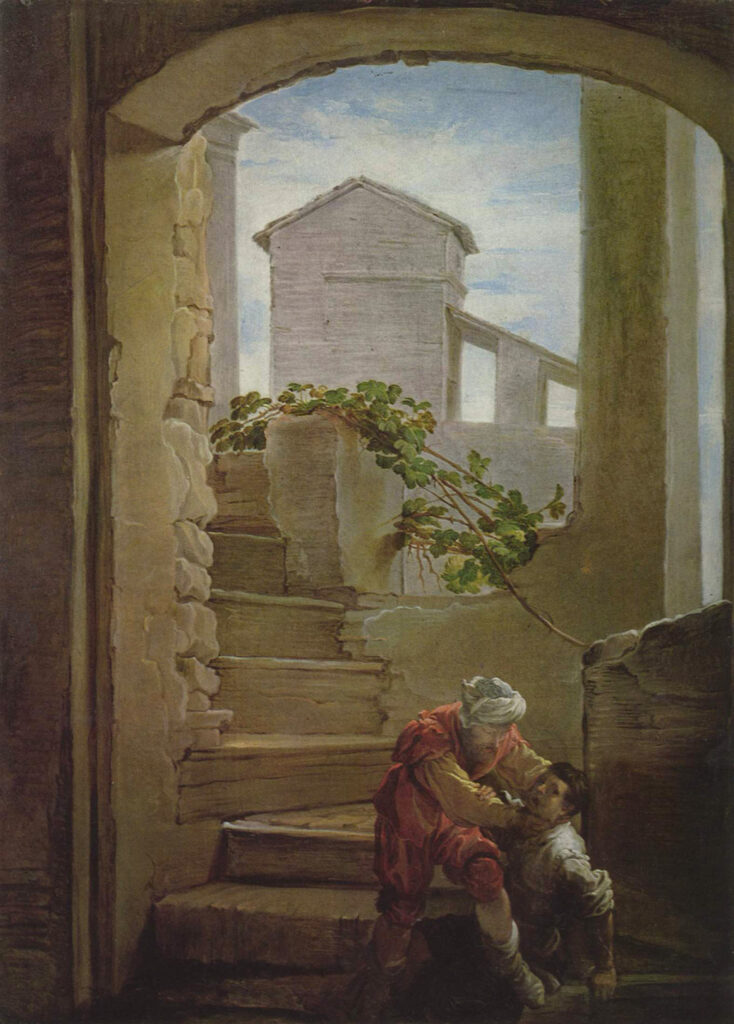
    Detail from Parable of the Wicked Servant (La parabola del servo malvagio), 1620, Domenico Fetti | Creative commons, Wikimedia.

    The deacon at our church gave a thoughtful homily, first tracing the fact that “hate” in Hebrew more often meant “to love less.” I’m going to take a moment to both agree with him and add a little nuance. From my research, I’ve found that it’s true that in most contexts, שׁנה (sana’) in Hebrew does not translate directly to our everyday use of the term “hate.” The main difference is that, in modern English, hate is most often associated with emotions. For example, “I hate you,” is one of the worst things a teenager can say to a parent, often in a fit of pique. “I hate cilantro” is less emotionally charged, but still carries the feeling of disgust. In ancient Hebrew, especially in a scriptural context, the word hate (sana’) is most often used in reference to God. Consider Psalm 139:

    Do I not hate those who hate you, O Lord?
    And do I not loathe those who rise up against you?
    I hate them with complete hatred;
    I count them my enemies.

    I’ve read that some Jewish scholars prefer to use “reject” here rather than “hate.” The clear overtone is one of judgment and moral rejection, not something said emotionally or in a fit of anger. We should remember this when we read the Old Testament. When we hear at the beginning of the Book of the Prophet Malachi, for example, that God says, “Yet I have loved Jacob but Esau I have hated,” we can understand that he has rejected Esau from his favor.

    So, at least in the Jewish scriptural context, “hate” is not normally the emotionally charged verb it is in English. But I think the deacon was a little short of the target when he said it was “love a little less,” because there is definitely a sense of judgment (especially when applied to God) and moral decision-making. Technically, I guess that judging against something makes it “less” than the thing it is compared to, but why are we softening the impact here? I think that modern ears need to hear something like this because it helps us “reconcile” this with our vision of the Lord being all-loving.

    But this is crucial! What does it mean to “reconcile” these thoughts? This means that we have preconceived notions of what love is, what forgiveness is, and we’re putting Christ’s words up against these notions, trying to look for some way they cannot contradict each other. Stop! We should recognize from the beginning that a.) do not put the Lord your God to the test, and b.) faith demands an acceptance of that which we cannot fathom or immediately understand. So, let’s meet Christ’s words with awe and reverence and try to accept and ponder them before we have some kind of emotional reaction.

    The Church, in her wisdom, prepares us for this gospel reading through the inclusion of the first reading. Again, it starts, “Who can know God’s counsel, or who can conceive what the LORD intends? For the deliberations of mortals are timid, and unsure are our plans.” In other words, know your shortcomings! Our thoughts are “timid” — too small to approach the grand thoughts of the divine — and this should make us humble as we approach the Word of God. The second part of this reading brings in a corollary important to understanding the gospel reading: “For the corruptible body burdens the soul and the earthen shelter weighs down the mind that has many concerns.” So, not only should we not attempt to fathom God’s plan and Word without the grace he provides for us, but we should recognize that we are already handicapped in understanding spiritual matters, for the “body burdens the soul” and “the earthen shelter weighs down the mind.” Jesus will return to this theme of earthly matters being problematic to us achieving the Kingdom. To recap, in a few sentences, the first reading reminds us that not only are we unable to fathom the plans of the divine mind, we are further encumbered when we try to think on spiritual things because we are concerned with earthly things. 

    As if this dose of humility isn’t enough, the author of the Book of Wisdom continues: “And scarce do we guess the things on earth, and what is within our grasp we find with difficulty.” Ha! How true. Even figuring out earthly things like, “what career should I choose?” or “does she love me?” or “how can we organize a society without fighting with each other?” are found with difficulty, if at all. The answer to this big multivitamin of humility is given at the end of the reading: “Or who ever knew your counsel, except you had given wisdom and sent your holy spirit from on high? And thus were the paths of those on earth made straight.” GRACE through the Holy Spirit is the only way we can make sense of ourselves and our world, much less the spiritual paths set before us by God. This important reading should set us straight in meekness and humbleness before we approach the Gospel — not in a stance of comparing Jesus’s words against our timid earthly notions of love and hate.
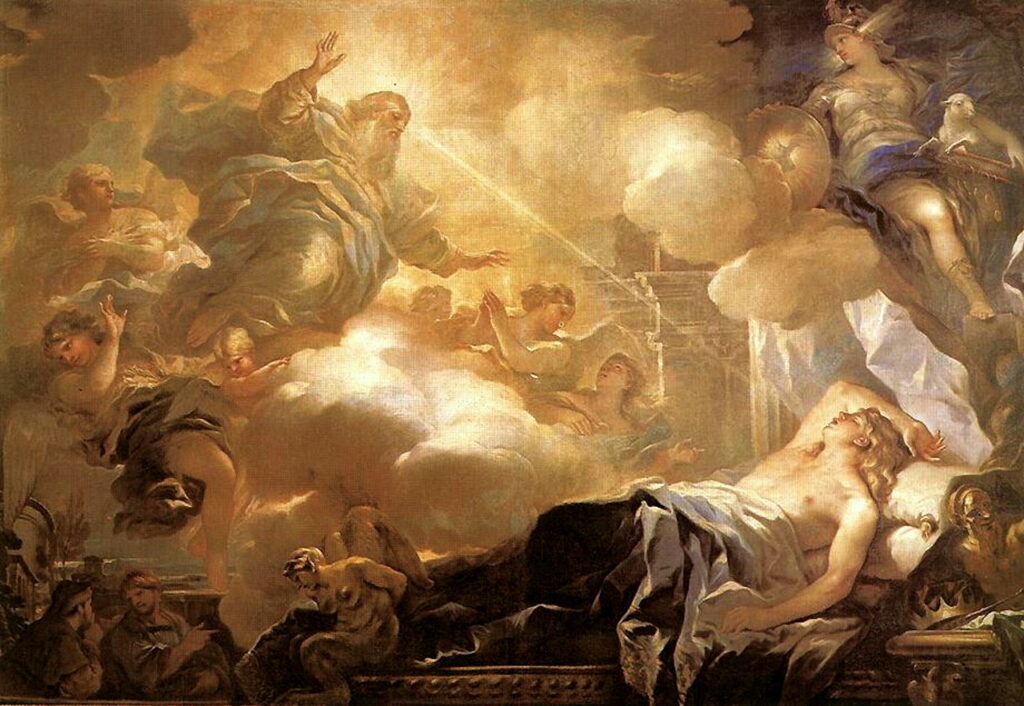
    Dream of Solomon (1694-1695), Luca Giordano | Museo del Prado, creative commons via Wikimedia.

    So, when Jesus says, “If anyone comes to me without hating his father and mother, wife and children, brothers and sisters, and even his own life, he cannot be my disciple,” if we listen to this alongside everything Jesus has taught and shown us, we can grasp his meaning with the help of his Holy Spirit. If we think of the word hate as “reject,” we recognize that Jesus has said something similar many other times:

    • “So therefore, any one of you who does not renounce all that he has cannot be my disciple.” (Luke 14:33)
    • “No one who puts his hand to the plow and looks back is fit for the kingdom of God.” (Luke 9:62)
    • “And everyone who has left houses or brothers or sisters or father or mother or children or lands, for my name’s sake, will receive a hundredfold and will inherit eternal life.” (Matthew 19:29)

    But today’s words seem like more than other statements about worldly renunciation. He’s talking about our most cherished relationships here on earth. If this sounds extreme, well, yes — I think it is. It’s impossible to hear Jesus in the gospels without hearing this type of “all-or-nothing” message. He tells the would-be-follower who wants to bury his father, “Leave the dead to bury their own dead. But as for you, go and proclaim the kingdom of God” (Luke 9:60). !!! I mean, that’s pretty extreme. We think of funerals as a respectful, God-forward practice, but in the face of God Himself, this ritual pales in comparison. Without a doubt, this Sunday’s gospel challenges us to be “all-in” in regards to following Jesus. 

    Jesus follows up this sentence with words of preparation: “Whoever does not carry his own cross and come after me cannot be my disciple.” With how often-referenced this sentence is, we can lose track of its power. The cross is sacrifice, undoubtedly, but it to his listeners, it was likely more charged with the understanding of spectacle and shame. After all, it wasn’t until his Resurrection that the shame and spectacle of the Cross turned into the glory of sacrifice. 

    Jesus is preparing his listeners to be true followers. He is letting them know that those closest to them will likely disagree with their newfound faith in Jesus Christ. He is presenting them with the fact that they must hate/reject those closest to them when they cast suspicion and begin to shame these new Christians and even make a spectacle of them. Jesus is both preparing them and trying to give them courage. This is why the end of the gospel reading focuses on “calculating the cost” of discipleship. Jesus wants his listeners to know the cost, to brace themselves and find the courage to follow him.

    When is the last time we felt that we were carrying shame or spectacle by following Christ? Not that we should seek these things out, but I think we perhaps instinctively shy away from these, as anyone would. But this gospel is for us as much as it is for first-century Jews. When is the last time you boldly made the sign of the cross and said a prayer before your meal in a restaurant? This small gesture of thanks to God is essential with everything we do, but most often we don’t want to draw attention to ourselves in public. Are you picking up your cross here or just leaving it on the ground? When is the last time you walked in a Eucharistic procession in your town? I can recall a number of them on the University of Utah campus, including the catcalls and obscenities occasionally yelled at us. Atheistic culture wants to make Catholics feel ashamed, out-of-date, and ridiculous for something as beautiful and just as a procession! It is our responsibility and honor to stand with Christ, to process him in public as our King and Savior. When is the last time you talked about prayer or Jesus to a friend or colleague? Does it feel too awkward for you? When was the last time you asked someone not to use your Lord and Savior’s name in vain by shouting “Jesus Christ!” when something surprised them? The virtue of religion, St. Thomas Aquinas tells us, is part of the virtue of justice — that is, giving God what is due to him. We must consider that Jesus’s words in this gospel are telling us about the repercussions of holding this virtue of religion. Shame, spectacle and sacrifice are part-and-parcel of following Jesus and giving God what is due to him. The question is, have we dumbed down what our religion demands to simply “being nice to others?”

    If we read the last few verses following today’s excerpt in the 14th chapter of Luke, we hear Jesus tell these same listeners, “Salt is good, but if salt has lost its taste, how shall its saltiness be restored? It is of no use either for the soil or for the manure pile. It is thrown away.” Remember that in the Beatitudes, Jesus tells his disciples that they are the salt of the earth — so clearly his meaning in this reading is that his listeners must retain their saltiness, that is, their openness to sacrifice, spectacle and shame, or be discarded from the Kingdom. 

    Salt of the Earth, contemporary, Alison Hale | Image from https://alisonhale.co.nz/paintings-archive/glass-works-sold/salt-of-the-earth/

    From Aquinas to St. Paul

    I’d like to bring up one last lens within which we can examine Sunday’s gospel, and through this lens, make our way to the second reading, St. Paul’s Letter to Philemon. The lens here is to actually challenge the reading above that hate isn’t really hate. What if we follow the Scholastics, St. Thomas in particular, in thinking about hate? In the Summa Theologica, St. Thomas writes, “hatred is a movement of the appetitive power, which power is not set in motion save by something apprehended” (II, ii, q43, a1). To unpack this, what he is saying is that hatred is a movement of the intellect (aka, an “appetite”) that is only set in motion when you apprehend something. In other words, first, hatred is something natural in our soul and intellect, God-given and for a purpose. Second, it’s not a state of being but something that arises in us in response to something we encounter (a thought, a person, a thing, whatever). So, hatred is not an evil thing, but a natural thing, an appetite that we must work to regulate just like all of our other passions and appetites.

    Why would God make us with this appetite of hatred, or any of the passions that we tend to regulate poorly, for that matter? In the case of hatred, Thomas tells us, “the object of hatred is evil.” Aha! So, God gives us hatred as a natural repugnance for evil and sin. When regulated well, hatred will turn us from evil and sin.

    But regulating this appetite takes prudence and good judgment. After all, Thomas warns us: “Just as a thing may be apprehended as good, when it is not truly good; so a thing may be apprehended as evil, whereas it is not truly evil.” This is why studying and contemplating the truth in the scriptures and Catholic tradition are so important. We train ourselves to better apprehend and recognize good when we see it and evil when we see it.

    So why would anyone hate what is good? Because they reject God’s revelation of truth and himself to humanity. Instead, throughout history, people cling to the world around them — what their senses tell them and what passes for “good” in their culture. Is the sound of applause and shouts of praise good? Our senses and culture tell us yes, but Jesus tells us that the meek are blessed because he sees that the cost of fame and recognition is the diminishment of others. Is the pursuit of money good? Pretty much everything in our culture says yes and pretty much everything in scripture says no. What about the flipside of this – what do we mis-apprehend as evil? Let’s think about one of the most common commands in the epistles – to “exhort” and “correct” one another in staying true to the teachings of Christ. But this is difficult to do because nobody likes to be corrected, and our contemporary culture has developed an incredibly robust system of moral idols in diversity and inclusion that make it an evil to tell someone that what they are thinking or doing is wrong. I truly think that today one of the most obvious ways a person can be a spectacle and shame for Christ is to openly tell someone that something they are doing is not morally right or a perspective they are defending is not the truth. In the name of acceptance of others, this is just not OK (so we are told)! But, Jesus commands us to be the salt of the earth, to take up our crosses and be his disciple. Which will you listen to — your culture or your Lord?

    But surely our family members can’t be summarily judged as evil and thus worthy of hate! I guess that depends on the culture you live within. For Jesus’s listeners, the cultural voice resided in the Pharisees, Sadducees and scribes, most of whom were in disagreement with him on many aspects of his teaching (especially the core teaching about the conversion of one’s heart to God). Certainly, the broader cultural voices of Rome and of Greek culture were at odds with his teachings. In this context, it likely wouldn’t be too far off the mark to apply hatred towards voices that denied the Good News. 

    Perhaps referencing family members was way of giving an evocative example of earthly matters. With this reading, we can see that Jesus is being consistent with his other teachings about rejecting the worldly in preference to the spiritual life with God. But, I don’t think this is just rhetorical pyrotechnics. I think Jesus references family members specifically because his Apostles have already had to leave their homes and families to follow him. He has likely seen in the course of his ministry plenty of family arguments, anger and division over following him. This isn’t a hypothetical.

    More important than this historico-critical reading of the passage is the understanding that there is a reason Jesus tells us this. The Divine Mind has a plan for our own good, for our reconciliation and union with Him. Remember the first reading: “you had given wisdom and sent your holy spirit from on high … And thus were the paths of those on earth made straight.” So what might this reason be? Jesus tells us time and again that God loves his children — that he will leave the whole flock just to save the one who has strayed — that he welcomes back the prodigal with open arms. All we have to do is to remain faithful to him. This means trusting him and putting him first, above all other concerns (including our family members and other worldly worries). Jesus is reminding us how we have to fulfill our end of the covenant, putting God above all else.

    And in return? God perfects us with his grace and his love. He helps us be the loving humans he wants us to be, that he has created us to be. He fills us with his own love and sends us back into the world to love our neighbors (including those family members we judged to “love less” than him). Let’s not think we’re the only ones who are active in our lives! Our part is actually quite small — a continual conversion of heart to God — and then his blessings infuse us and those who we touch in our lives. His is the powerful work in the world, transforming it, not ours. 

    In other words, the whole point of hating your “own father and mother and wife and children and brothers and sisters” is to allow God to perfect you and give you the ability to love those same people better than you ever could have without his help.
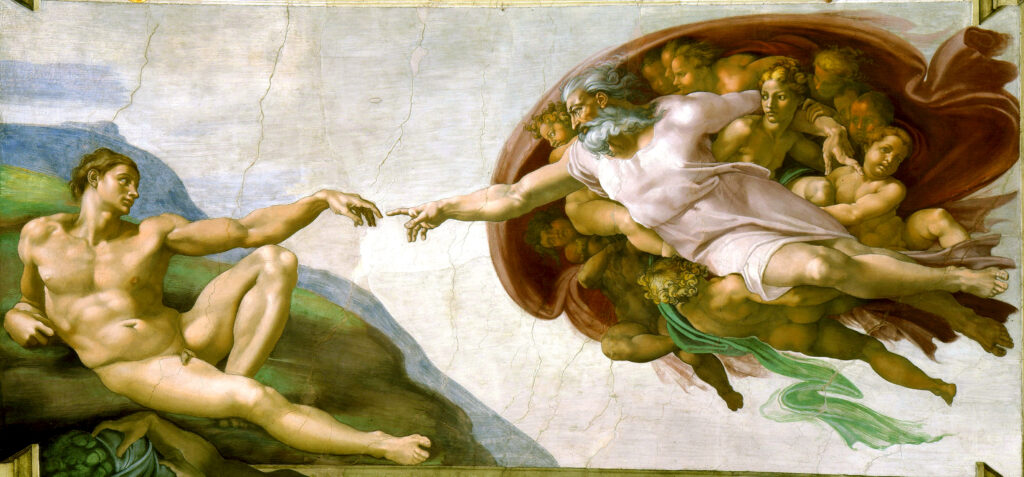
    The Creation of Adam, Sistine Chapel ceiling (1511), Michelangelo | Creative commons, Wikimedia.

    The second reading (the only one in the Sunday lectionary cycle from the Letter to Philemon) is seemingly weird and out-of-context, but blossoms with this understanding of the gospel reading. Paul, writing from jail, is sending Philemon’s slave back to him after this slave, Onesimus, has spent time following Paul and learning about Christ. Onesimus has fled his master, perhaps even owing him money — is this not someone who “hates” his “father”? And, having been nurtured at Paul’s breast, he is returning to his “father” in an act of love by Paul. This is a parallel to what we can read in the gospel account. 

    Add to this the overtones of Paul’s Letter to the Galatians, where he writes, “So you are no longer a slave, but a son, and if a son, then an heir through God” (Galatians 4:7), and a rich tapestry emerges. In Sunday’s reading, Paul sits in the seat of a redeemed child of God — bearing his cross in jail for proclaiming Christ to the world, but acting with the power of the Father because of it. He sends back a former slave to his family, but not as a slave, but a fellow heir to the Kingdom: 

    that you might have him back forever,
    no longer as a slave
    but more than a slave, a brother,
    beloved especially to me, but even more so to you,
    as a man and in the Lord. 

    It is now Philemon’s turn to hate the teaching of his culture and the logic of the world, to accept Christ as Paul is urging him to, and to offer his forgiveness to a slave who has so obviously been healed by God. So, if we, like Onesimus the slave, hate our family in order to receive Christ and love him above all else, the divine logic decrees that this enables us to return to our families, even in debt or disgrace, in order to love them with clear eyes and a God-filled heart.

    I hope that this contemplation of the Sunday readings have struck a chord with you, that perhaps they have helped move you to approach the gospel with open ears and without the urge to compare Jesus’s words with what we think love and forgiveness should look like.

  • Moses in the Promised Land! … And More About the Transfiguration

    Moses in the Promised Land! … And More About the Transfiguration

    Feast of the Transfiguration of the Lord. Daniel 7:9-10, 13-142 Peter 1:16-19Luke 9:28b-36.

    Rejoice! Today we commemorate and celebrate the gratuitous love of the Father to bolster the faith of Peter, James and John by allowing them to witness a vision of Jesus in his glory. This episode in the life of Jesus and the Apostles is so rich and full of meaning for the Church. On Sunday, I led a discussion with our Lay Dominicans and inquirers about the Transfiguration in anticipation of this feast day. We discussed St. Thomas Aquinas’s writing about the fittingness of the Transfiguration as presented in the Summa Theologica, Part III, question 45, and I’d love to share a few bits of that fruitful discussion here.

    The Transfiguration of Christ: Part of an iconostasis in Constantinople style. Middle of the 12th century. This is the earliest of the three paintings of the Transfiguration on this page. Below, you’ll see how the human expressiveness was emphasized in later Western art, while the symbolism of color, line, and figure took precedent over emotional content in the Eastern icon tradition (in fact, the more “fixed” and inexpressive faces are meant to indicate a more transcendent reality in this tradition).

    Fittingness Versus Necessity

    One of the questions an inquirer asked during our discussion was, “If the Transfiguration never happened, would the Crucifixion and Resurrection still have happened? In other words, was it necessary to our salvation?” This question is actually at the heart of how St. Thomas presents many aspects of salvation history. He readily admits that God could have ordered things differently — even to the point of not having the Incarnation or the Passion. These things, according to St. Thomas (and St. Athanasius and St. Anselm before him), are not “necessary,” per se, but he shows how they are “fitting.” The Latin word he uses is Convenientia, which translates to suitable, appropriate, harmonious or beautiful. The Church Fathers had a very good reason to be thinking in this way. First of all, they knew that they could never fathom the mind of God and “prove” some sort of necessity around the events and stories of our salvation history. Second, they had a huge body of texts that emerged from the early years of the faith, some orthodox and true, and some that were not. This contemplation of convenientia was a critical tool in helping to decide what writings were part of the canon of the New Testament. 

    As that same inquirer pointed out during our discussion, a good example of something that was NOT fitting would be in the apocryphal Infancy Gospel of Thomas, when Jesus is said to curse and kill a child who bumped into him. This is not consistent or harmonious with what we know of God and of Jesus’ ministry on Earth. 

    But beyond a tool for determining the truth of early texts, I think contemplating fittingness is a fantastic perspective for any kind of lectio divina. With this starting point, we can ask questions about why events happened and have them always point back to God and how he is revealing himself to us (as opposed to treating the divine plan like a puzzle to be solved, as if we could ever comprehend it fully!). In the case of the Transfiguration, the “why” of the event is answered amply by many Church Fathers. Here’s what St. Thomas has to say: “For anyone to walk straight along a road, he must have some knowledge of the end … Above all, this is necessary when the road is hard and rough, the going is heavy, but the end is delightful … Therefore, it was fitting that He should show His disciples the glory of His clarity (which is to be transfigured), to which He will configure those who are His.” In other words, one reason the Transfiguration happened was to provide the Apostles with the backbone to persevere when the going got tough — to let them see the goal of divinization alongside Jesus. Understood as a completely unnecessary but helpful and beautiful blessing for the Apostles (and the Church as a whole), we can start to glimpse the overwhelming, overabundant love the Father has for us, his delight in showing us a Way to him through his Son.

    Transfiguration (1560), Titian | Wikimedia Commons. Ah, the Italian Renaissance. Titian indicates a number of internal dramas within each unique face, and is a master of color and composition, with dynamic (and melodramatic) poses somehow all working to frame Christ in his glory.

    Bright Clothing

    Another aspect we discussed was that more than Jesus’s face was transfigured: “his clothing became dazzling white.” This might seem like a simple detail, but the Church Fathers fastened onto it with gusto. The first reading from the Book of Daniel gives us a clue as to why they might have done so: “The Ancient One took his throne. His clothing was bright as snow … Thousands upon thousands were ministering to him, and myriads upon myriads attended him.” So bright white clothing seems to be an important detail in this beatific vision, but what does it mean?

    St. Thomas tells us that “the clarity which was in His garments signified the future clarity of the saints.” This might seem like a leap, but he traces it back to St. Gregory the Great, who wrote, “because in the height of heavenly clarity all the saints will cling to Him in the refulgence of righteousness. For His garments signify the righteous, because He will unite them to Himself.” As we think of garments as things that cling to and adorn a person, this parallel starts to make more sense. The saints cling to Christ and his Way, and by so doing, they fulfill the word of God given to Isaiah: “You shall put all of them on like an ornament” (Isaiah 49:18). Thus, the Transfiguration is truly the full beatific vision: Christ in his glory, surrounded by the law (Moses) and the prophets (Elijah) and all the saints (his bright clothing, adorning him). What is nice about this understanding is that we see glory going back to God rather than ourselves in this vision of heaven. It’s not about us gaining virtue and being so good that we are given the gold star of heaven. It’s about us loving God so much (as close as we can mirroring the love he first gives to us) that we adore and adorn him, becoming more and more like Christ as an acknowledgement of the plan the Father has for all of us. Imitation is the sincerest form of flattery, so the saying goes, and we can see a small truth — yes, we are trying to imitate Christ, but even more than trying to flatter him we are trying to sincerely love him and show the world that he is the only Way to heaven. Let us be your brilliant clothes, nothing more, O Lord!

    We also discussed how there is more support for this understanding of the bright clothing in the Book of Revelation according to St. John: “Then one of the elders addressed me, saying, ‘Who are these, robed in white, and where have they come from? … These are they who have come out of the great ordeal; they have washed their robes and made them white in the blood of the Lamb.’” So John was doubly gifted with the vision of the Transfiguration during Jesus’s lifetime and then again in the visions that became the Book of Revelation. Only this time, the white robes have received their color from walking the Way of Christ — from going through “the great ordeal” and washing them in “the blood of the Lamb.” Whether adorning Christ or more literally being worn by the saints in heaven, the brilliant white clothes seem to symbolize the members of the Church who have remained faithful to the Way and entered into the divine heavenly eternity.

    There is one last interesting note we discussed about the clothing. One of the great early Church Fathers was Origen, who lived in the first half of the 200s AD. His influence was huge. Many later Church Fathers quote Origen when discussing the Transfiguration and many other mysteries of the faith. He writes that the white garments are “the words in the Apostles which indicate the truths concerning Him,” that is, the Gospels themselves. Origen adds that if someone speaks with deep theology of Christ and explains the Gospels brilliantly, “do not hesitate to say that to Him the garments of Jesus have become white as the light.” Imagine saying that the next time you hear a good homily! “Hey, Father, the garments of Jesus really became white as the light today! Thanks!”

    Transfiguration of Jesus (icon), 1408, Theophanes the Greek | Wikimedia Commons. Artwork from Spaso-Preobrazhensky Cathedral in Pereslavl-Zalessky. This is one of the most common and copied icons of the Transfiguration, notable for it’s white star-shaped depiction of Christ’s brilliance, the positioning of all the secondary characters, and the lines of revelation shooting down to the Apostles. I always like how icons manage to paint more than just a single moment in time, and we see both the climb up to the mountain on the left and climb down on the right as well as little moments of the life of Moses and Elijah in the upper corners. Great way to depict kairos time!

    Moses, Elijah, and Unfinished Stories

    Of course, the other important detail, as we see in each of the paintings on this page, is that Moses and Elijah were present during the Transfiguration. Our little discussion group talked about how this might be fitting. First, we read the six separate ways that St. Thomas points out the significance of these two towering Old Testament figures. The one most often mentioned St. Thomas attributes to St. Hilary of Poitiers: that Moses symbolizes the law and Elijah the prophets, and this reminds everyone that Christ was foretold by these two important men.

    But then one of our life-professed Lay Dominicans made an observation that none of us had considered before: “Isn’t this the first time Moses appears in the Holy Land?” We all went silent, and then burst out with agreement. Even Fr. Gabriel admitted that he had never read any commentaries that bring up this important detail.

    Next, we had to contemplate how this might be fitting and why it might be important. We noted that both Moses and Elijah leave scripture with their stories somewhat unfinished or at least a little unsatisfying to the listener. Moses is told by God that he can’t enter into the Promised Land because the generation he ushered through the wilderness was so ungrateful and rebellious. So, he dies just outside of the Promised Land. In a way, he must suffer and sacrifice for the sins of others (sound familiar? nice foreshadowing of Christ). Elijah, on the other hand, is taken up to heaven alive. Why? What is he doing there? He’s not the Messiah, even if he is one of the greatest prophets.

    Both of these stories find a suitable and fulfilling ending here in the Transfiguration, however. Moses does get to enter the Promised Land, but only now and here, with Jesus Christ as the Savior who ushers in the Kingdom. God is not a vengeful God but a loving God whose plan spans all time and who loves us so much that he instructs and points the way through generations upon generations. He wants Moses with him — Moses the bearer of his law who now comes back to the bosom of the Father in the presence of the fulfillment of that law.

    Why Elijah is still alive, keeping the Jews in a state of suspense about his possible return, becomes clear when he returns here to commune with and point to Jesus Christ. Elijah, speaker of God’s living Word, never dies as the bearer of that living Word, and only reappears alongside that living Word made flesh. Jesus, who unites the dead (Moses) and eternal life (Elijah), is in the center of this vision. Jesus is the true Alpha and Omega here.

    Like the brilliant clothes, Moses and Elijah are not there for their own glory, but to adorn and ornament Jesus Christ, the Son with whom the Father is well pleased. The Father’s voice and the Holy Spirit in the form of a cloud (something seen because it obscures the sun and darkens the sky and yet somehow “a bright cloud overshadowed them” in Matthew’s account) also appear, but again, to point to the Son. If ever there was an argument for the divinity of Jesus Christ, this is it!


    I hope this post did some justice to sharing the fruits of a lively discussion and I also hope it enkindles a newfound reverence for the wonder of the Transfiguration. Thank you, God, for this vision of heaven, given to sustain us in our belief, faith, and fidelity to your Word.

  • Infinite Value

    Infinite Value

    Good Friday of the Lord’s Passion: Isaiah 52:13 – 53:12, Hebrews 4:14-16; 5:7-9, John 18:1 – 19:42.

    The sad and wonderful day is here. We must mourn with Mary because her most perfect Son has been tortured and killed, and this is a grievous wrong. But we must marvel at the willing act of charity that the Son carries out by offering himself wholly to the Father.

    St. John makes no bones in today’s gospel account of the Passion and Crucifixion that Jesus is in total control and is offering himself without a struggle. He tells the most powerful secular ruler in the region, Pontius Pilate: “You would have no power over me if it had not been given to you from above,” and “My kingdom does not belong to this world. If my kingdom did belong to this world, my attendants would be fighting to keep me from being handed over to the Jews. But as it is, my kingdom is not here.” Jesus has been consistent through his entire life that he comes from his Father above and does his will. As his faithful, let us truly take on the significance of this claim.

    Pietà in St. Peter’s Basilica in the Vatican (1498), Michaelangelo | Wikimedia Commons.

    It has been in vogue for the past few decades to portray the gritty reality of Christ’s suffering. I’m thinking, of course, of Mel Gibson’s The Passion of the Christ, but also books that try to know Jesus the man apart from Jesus the Lord. Yes, the bloody details of the Passion are important to remember, but they are not the point. Likewise, it is of supreme importance that he truly was a man, but it can never be separated from the fact that he is (and always was) also God. We did not invent this “extra layer” of divinity as non-believers would claim.

    So if we are to spend our Good Friday time in fruitful reflections, let us take a cue from our great saints and spiritual teachers. In the collection of retreat conferences preached to his fellow Dominicans entitled Knowing the Love of God, Fr. Reginald Garrigou-Lagrange orients us to the truly important aspects of the Passion. He helps me to understand why Christ submitted himself to the Passion and Crucifixion in the way he did:

    Jesus took upon Himself the responsibility for all the sins of men, and He began to suffer for them as if it had been He who had committed them, as if He were impious, rebellious, frenzied, cowardly, ungrateful, and sacrilegious. He felt the divine anger and divine curse weigh on His soul while hell with supreme fury broke loose against Him. The horror of evil and all vices together seemed for an instant to suffocate Him. A cry burst from His lips on the Cross: “My God, My God, why have You deserted Me?” (Mt 27:46).

    In this darkness, in this abandonment, Our Lord performed His greatest act of love. In the midst of this anguish He loved His Father above everything and He loved us even to the giving of His life for our salvation, only grieving that a greater number were not saved. This act of love makes abundant satisfaction for all hatreds. The obedience that it involves compensates for all rebellions in the eyes of God. The humiliations of the Passion redeem all acts of pride. The gentleness of Him crucified repairs all acts of anger and His sufferings pay for all sensuality.

    This act of charity of the Incarnate Word has saved the world. (36).

    In short, there is an entirely different sequence of events going on than just the physical one. The spiritual events are the important ones. What unites the physical plane with the spiritual one is Christ’s Blood. It is literally shed in whip strokes, puncturing thorns, nails, and a spear. But this is no everyday blood: it is divine blood. Do we realize this?

    It’s not in vogue to talk about the supernatural value of Christ’s Blood; this seems like a 19th century, antiquated notion wrapped up in lace and the Latin Mass. But today is the day to re-embrace the importance of Christ’s Blood and how — because of its divine source — it accomplishes things that no mere crucifixion or sacrifice can accomplish.

    Sanguis Christi (1670), Gian Lorenzo Bernini | Wikimedia Commons. On the left is the original drawing and on the right is a painting from the workshop of Bernini. Bernini’s biographer, Filippo Baldinucci, writes: “He sometimes deepened his thoughts and speeches with a very high esteem and concept that he always had of the efficacy of the Blood of Christ the Redeemer, in which (as he used to say) he hoped to drown his sins. To this object he drew with his own hand, and then had an image of Christ Crucified printed, from whose hands and feet flow streams of blood, which form almost a sea, and the great Queen of Heaven, who is offering it to the Eternal Father. This pious meditation also made him paint on a large canvas, which he always wanted to keep in the face of his bed in life and in death.”

    Today’s second reading in the Office of Readings is from St. John Chrysostom’s catechetical teachings to those about to become part of Catholic Church. This is very appropriate since thousands are going to be baptized into the Church tomorrow night after having gone through their teaching, soul-searching, and vows. Chrysostom writes about the power of Christ’s Blood:

    If we wish to understand the power of Christ’s blood, we should go back to the ancient account of its prefiguration in Egypt. Sacrifice a lamb without blemish, commanded Moses, and sprinkle its blood on your doors. If we were to ask him what he meant, and how the blood of an irrational beast could possibly save men endowed with reason, his answer would be that the saving power lies not in the blood itself, but in the fact that it is a sign of the Lord’s blood. In those days, when the destroying angel saw the blood on the doors he did not dare to enter, so how much less will the devil approach now when he sees, not that figurative blood on the doors, but the true blood on the lips of believers, the doors of the temple of Christ.

    If you desire further proof of the power of this blood, remember where it came from, how it ran down from the cross, flowing from the Master’s side. The gospel records that when Christ was dead, but still hung on the cross, a soldier came and pierced his side with a lance and immediately there poured out water and blood. Now the water was a symbol of baptism and the blood, of the holy eucharist. The soldier pierced the Lord’s side, he breached the wall of the sacred temple, and I have found the treasure and made it my own. So also with the lamb: the Jews sacrificed the victim and I have been saved by it.

    There flowed from his side water and blood. Beloved, do not pass over this mystery without thought; it has yet another hidden meaning, which I will explain to you. I said that water and blood symbolized baptism and the holy eucharist. From these two sacraments the Church is born: from baptism, the cleansing water that gives rebirth and renewal through the Holy Spirit, and from the holy eucharist. Since the symbols of baptism and the eucharist flowed from his side, it was from his side that Christ fashioned the Church, as he had fashioned Eve from the side of Adam. Moses gives a hint of this when he tells the story of the first man and makes him exclaim: Bone from my bones and flesh from my flesh! As God then took a rib from Adam’s side to fashion a woman, so Christ has given us blood and water from his side to fashion the Church. God took the rib when Adam was in a deep sleep, and in the same way Christ gave us the blood and the water after his own death.

    Do you understand, then, how Christ has united his bride to himself and what food he gives us all to eat? By one and the same food we are both brought into being and nourished. As a woman nourishes her child with her own blood and milk, so does Christ unceasingly nourish with his own blood those to whom he himself has given life.

    As we reflect today on the great Passion and Crucifixion, specifically on the amazing gift Christ is giving humanity, Fr. Garrigou-Lagrange can give us some final words to consider:

    According to the definition of the Church, the redemptive act of Christ has infinite value and efficacy. It makes satisfaction for any guilt whatsoever, repairs any offense against God, even though its gravity is infinite. It satisfies for all the sins of men, and still more … It merits all graces for even the most degraded souls, provided they are not stubbornly fixed in evil. It is impossible to think of a limit to the efficacy of the redemptive act. The redemptive omnipotence of the act of Christ, who immolated Himself upon the Cross, derives from the fact that it is a perfect act of charity performed by a divine Person; the perfect act of the Incarnate Word. It is a supernatural act of charity towards God which makes Him forget all offenses.
    (Knowing the Love of God, 30-31).

    What does this mean for you and me? It means that we should never be so low as to think we’re outside of the saving power of Christ. That would be a huge insult and underestimation of Christ’s redemptive act on the Cross. It also means that we owe everything to him and this act on our behalf. There is nothing that we have that was not given to us first by the Father and then, in order to make us perfect after we walk in the world in sin, by Christ.

    As I contemplate Christ on the Cross, may I be filled with humility, thankfulness, and admiration.

    The Crucifixion (1675), Bartolomé Estebán Murillo | Creative Commons, courtesy of the Metropolitan Museum of Art.
  • The Sadness of Losing Sheep

    The Sadness of Losing Sheep

    Tuesday of Holy Week: Isaiah 49:1-6, John 13:21-33, 36-38.

    Today, we hear part of  John’s account of the Last Supper when Jesus offers himself to and through Judas, always giving himself even in his own betrayal. As we contemplate the Word of God recorded by St. John, let us be drawn into the mystery of the Spirit that is “agitated” and the mind that understands all prophecy and all revelation. Below is a lightly edited version of my post from this same day in 2020.

    The gospel reading opens with, “Reclining at table with his disciples, Jesus was deeply troubled and testified, ‘Amen, amen, I say to you, one of you will betray me.’” The Greek phrase used for “deeply troubled” is ἐταράχθη τῷ πνεύματι (etarachthē tō pneumati), which means “agitated in spirit.” This is nearly identical to the phrase used to describe the state of his spirit when he encounters an emotional Mary just before raising Lazarus from the dead.

    In my reflection See the Glory of God, I argue that this agitation of spirit is due to the gut-like passion of God rejecting the force of death in his midst. I feel that we are experiencing the same agitation of spirit and the same underlying cause here in today’s gospel. Just as “Amen, Amen, I say to you” is a common phrase used by Jesus throughout the New Testament, and one that we can take to mean “The truth is here, I am teaching it to you,” I feel that this phrase “agitated in spirit” signals a fundamental surge of the spirit in opposition to death’s enthralling grip on someone. Here, it is Judas, and Christ’s agitation is not tied to the fact that his own death is implicated, but that this apostle he loved, someone whose feet he just washed, had given himself over to death. This is a lament from Jesus, the Good Shepherd who goes to every length to rescue one of his sheep, over the loss of Judas’s soul.

    The betrayal is even more symbolically devastating than we might think at first glance. The beloved one (John himself, the writer of the gospel) leans back on Jesus’s chest and asks who he’s talking about. Jesus replies, “It is the one to whom I hand the morsel after I have dipped it.” What morsel is He describing? Remember, this is the Last Supper, when Jesus institutes the sacrament of the Eucharist and provides his instructions to the apostles: “This is my body, which is given for you. Do this in remembrance of me” (Lk 22:19). John, for his part, doesn’t describe the Last Supper with these same words of institution as the synoptic gospels, but simply tells us, “So he dipped the morsel and took it and handed it to Judas.”

    Could this be a different, more simple morsel of bread? Perhaps, but is any morsel of bread “simple” at this sacred meal? They are all handed to the apostles personally by the Lord on the eve of his Passion, with his sanctifying grace and the intention of instituting the sacrament of Eucharist. It is all the Body of Christ, meant to spark the mystical Body of Christ that is the Church.

    And what happens with Judas when this holy morsel is given freely to him by Christ? John writes, “After Judas took the morsel, Satan entered him. So Jesus said to him, ‘What you are going to do, do quickly.’” It seems that Satan recoils and constricts his victim as the presence of God is placed upon him. Jesus, in turn, realizes that Judas is firmly in the devil’s grip and releases him from His Presence.

    The Last Supper (1786), Benjamin West | Creative Commons, courtesy the Detroit Institute of Arts. I think West captures a great range of humanity in the faces of the apostles and Jesus. We see the incredulous, questioning, uncomprehending, and earnest faces of most of the apostles, the divine relationship of Christ and God the Father as he institutes the sacrament of the Eucharist, and Satan darkly inhabiting the face and form of Judas.

    The Apostles aren’t sure what’s going on, but Judas, Satan, and Christ are clear. John writes, “So Judas took the morsel and left at once. And it was night.” Judas takes Christ’s life, His sanctified body, and leaves with it. He doesn’t eat the morsel, he doesn’t allow it to nourish him and bring the love of God into his being. Instead, he takes the gift like a greedy child, hoarding it away. And John gives us a poetic little sentence that signals the true darkness of this moment: “And it was night.” 

    Newcomers to Christianity are more incredulous over this moment than many lifelong Catholics. Why would Jesus just let Judas go if he knew he would betray him? He has it in his power to stop the whole, horrible ordeal before it starts. Yes, he’s always had this in his power, and that’s really the point. Jesus is the master of his destiny at all times. He can feed thousands and raise the dead with nothing but a word of thanks to the Father.

    But Jesus isn’t just the master of his destiny — He is the Master of Destiny, that is, of all destiny for all of humanity. As such, his responsibility has always been more than his human life; his responsibility is to provide salvation for all humans — life everlasting. The only way to do this is to take our sin and nail it to the Cross as a sacrifice to the Father, then to descend into death in a humanity He deliberately shares with us, but raise that human form with a divinity that is solely His. His choices are divine, they always exist within the love of the Trinity that is a pouring out of the self (kenosis) to a degree that we can’t quite comprehend. So he knows that he must let this sheep Judas escape with Satan in order to start the saving action he destines for us.

    The rest of today’s reading shows us how Jesus tells his beloved Apostles about his ordering of destiny. I am struck with how patient he has been throughout the gospels to this point, gradually revealing the mystery of his being and mission of salvation, trying to give them enough time to grow in understanding, and always pointing back to the glory of the Father. Now, things accelerate, as they must.

    He begins by saying, “Now is the Son of Man glorified, and God is glorified in him.” I believe that we must again remember the importance of the Last Supper here and the seed of Christian ritual that Jesus gives the Church, one that will begin to make sense as his Body and Blood are literally poured out and then when he resurrects. But at the same time “glorification” refers to the necessary divine reaction to the fleeing Judas. How is Judas’s betrayal the thing that causes Jesus to say “Now is the Son of Man glorified”?

    I believe that this act enables Christ to display the overflowing, undeserved, and totally out-of-proportion love of God that the pours out in response to our infidelity. This is beyond turning the other cheek; this is the wellspring of love.

    Christ in Glory (14th c. Crete, Greece), Hand-painted (written) icon by Plamen Kazakov | image from blessedmart.com.

    Judas is the first in a cascade of sin and evil that will be rained down on Jesus during his suffering and death. His glorification and the glorification of God resides not in the smiting of the offenders but in the patient acceptance of this evil. This ability to love in the face of all the hate and injustice that can be mustered, well, it’s supernatural. It’s so paradoxical to how humans would respond that in it is the proof and the glory of God. The plea to forgive those “who know not what they do” as he hangs on the Cross! This looking out for his sheep in the darkest of night, this is the glorification.

    So when Jesus says, “Where I am going, you cannot follow me now, though you will follow later,” we can take a double meaning. The apostles can’t follow him into the never-ending love in the face of torture and hate because of the supernatural divine love it requires, and this has not yet been poured out upon humanity. Secondly, they can’t follow him into death and the underworld, where he must go so that his divine essence, which can never die, can raise up again. But, as he notes, their paths to sainthood will require them to follow in both senses.

    Our reading today ends with Jesus explaining to Peter that although he claims he will lay down his life for Jesus, he will actually deny him three times that night, before the crow signals morning. When I was younger, I imagined that a certain degree of understandable bitterness may have marked Christ’s statement, but now I see things differently.

    I think the emotion that overwhelms Jesus on this fateful evening that will take them to the Garden of Gethsemane is sadness. Not anger toward God or the people who will betray him. Not fear of the impending torturous death. Not anguish over losing his family and friends. He may have experienced some measure of these things but I think it’s been in vogue since Vatican II to emphasize these aspects his humanity, perhaps to the detriment of remembering that the Good News is about the divinity that comes to earth. For me, I think that if we accept the reality of the love that defines the Trinity, which is the operative force brought into the world through the man Jesus Christ, agape must define for us who he ultimately is, especially in his final hours. That love is purely selfless, only wanting to draw others to unity with God.

    I think he grieves for humanity in the display of evil, the enthrallment of death, all of the cowardly and wicked acts. He knows that the cup the Father wants him to drink will entail humanity digging itself even further down into the depths of evil by torturing and crucifying the Word of God, an unspeakable sin. This is the Good Shepherd, this is the Son of Man who has devoted his life to preaching the New Covenant of love, this is the Anointed One who cares more deeply than we can imagine for all of us.

    So, no, I don’t think he was bitter with Peter, but instead sad. I can even imagine a tear on the cheek of our Savior when he gently tells Peter with some irony that the Rock who pledges to lay down his life is destined to deny any connection with Jesus three times that night. A tear of sadness, not for himself, but for Peter, a lost sheep who will thankfully eventually find his way back to the Father.

  • Pray for your Persecutors

    Pray for your Persecutors

    Saturday in the First Week of Lent: Deuteronomy 26:16-19, Matthew 5:43-48.

    Today’s readings spell out our compact with God in a nutshell. He will make us sacred and all he asks in return is that we love unconditionally. We will ponder today how difficult it is to love those who hate us and are mean to us, but let’s consider for a moment the flip side. How easy and generous this covenant is! After all, loving is the best feeling one can possibly have. Not just easy love for someone who’s nice to you, but also that generous love for a stranger when you give them a coffee or a blanket. God is not trying to lead us down a necessarily onerous path (although the Cross is part of the path) — He has infused this world with grace and His Spirit and nothing is greater than union with God’s grace and Spirit. They lift us up, give us strength, reveal beauty, and elevate our souls. This feels good. As Jesus tells us, “Take my yoke upon you and learn from me, for I am gentle and humble in heart, and you will find rest for your souls. For my yoke is easy and my burden is light” (Mt 11:29-30).

    Generosity (contemporary), Stig Lofnes | Image from silapix.com.

    For those like St. Thomas Aquinas, who believe our capacity for reason is an essential part of our spiritual being and scientific pursuits can aid our ability to know God’s wondrous works, the 2010s were a boom decade in happiness research. Several studies showed that people reported increased happiness when engaging in generous behaviors like giving sweets or money to others rather than keeping these things for themselves. This is “light” social science, but the hard sciences back this up.

    In the 2017 article “A neural link between generosity and happiness,” the authors use functional MRI to show that specific regions in the brain linked to happiness controls are more active in people practicing generosity: “Generous decisions engage the temporo-parietal junction (TPJ) in the experimental more than in the control group and differentially modulate the connectivity between TPJ and ventral striatum. Importantly, striatal activity during generous decisions is directly related to changes in happiness.”¹ So science has finally showed a physical manifestation of something God has been urging us to do since we’ve been human! Listening to God’s Word and practicing charity undeniably makes us feel good.

    So why is it seem to be so rare?

    We can’t forget that we’re living in a fallen world, the devil’s world. Jesus acknowledges this, for instance, before his Passion and Death in John’s gospel: “Now is the judgment of this world; now the ruler of this world will be driven out” (John 12:31).

    St. Paul writes several times how Christians, the children of light, must continue what Christ started and dispel the darkness of the world. He describes the action of Satan: “In their case the god of this world has blinded the minds of the unbelievers, to keep them from seeing the light of the gospel of the glory of Christ, who is the image of God” (2 Cor 4:4). And the devil’s primary mode of blinding us to the truth is through our senses, through temptations that beguile us and ensnare us into believing that we must fulfill our desires at all costs.

    The redemption of the world out of the clutches of the devil won’t be complete until the Judgement Day and Christ’s return. Until then, we struggle with temptations contrary to God’s law. This is our cross to bear, and why Jesus tells us, “If any want to become my followers, let them deny themselves and take up their cross and follow me” (Mt 16:24).

    The struggle is real. St. Paul writes to the Romans about the inner conflict between knowing what’s right but still doing the wrong thing: “For we know that the law is spiritual; but I am of the flesh, sold into slavery under sin. I do not understand my own actions. For I do not do what I want, but I do the very thing I hate” (Rom 7:14-15). He speaks of being sold into slavery under sin, that is the original sin of Adam and Eve that cursed humanity to be subjects of the prince of the world, Satan. 

    Yes, the struggle. This is why God and Moses are so forceful in setting the commandments before the Jewish people. God knows that, in our fallen state, we need strong guidance, a strong dose of His truth in order to sustain our moral fiber. Moses says, “This day the LORD, your God, commands you to observe these statutes and decrees. Be careful, then, to observe them with all your heart and with all your soul.” In just the short passage from Deuteronomy in today’s first reading, we hear “command,” “observe,” “walk,” “hearken,” and “keep.” On the other side of the equation, we hear twice that God has “promised” them in return and twice that this is an “agreement.”

    If it feels a little bit like a parent repeating himself to his wayward child in order to impress upon the child the need to do the right thing, well, it is exactly that. But the promise is so great. In no uncertain terms, God promises to reverse the curse that He placed on humanity via Adam and Eve: “you will be a people sacred to the LORD.” 

    This return to a sacred state from our fallen state, as we know, comes through His Son and the great sacrifice to expiate our sins. God’s patient plan is to cultivate his Chosen People to be the receptacle of his divinity (Mary, that is) and the first recipients of his mercy and grace. 

    Triptych: Crucifixion and other Scenes (1302-1308), Duccio di Buoninsegna | Creative Commons, courtesy the Royal Collection Trust, England.

    But Jesus perfects our understanding of the Ten Commandments when he comes. Today, he teaches, “You have heard that it was said, You shall love your neighbor and hate your enemy. But I say to you, love your enemies, and pray for those who persecute you.” The “hate your enemy” part was not in the Ten Commandments but rose instead as a cultural tradition, which is why Jesus must correct it.

    He explains that if we want to be a people sacred to the Lord, we must truly be worthy to be called his children; we must act like Him: “that you may be children of your heavenly Father, for he makes his sun rise on the bad and the good, and causes rain to fall on the just and the unjust.” It’s a lovely sentence to describe the indiscriminate love of the Father, because sun and rain are life-giving aspects of creation that God has created to nourish us. Jesus ends with, “So be perfect, just as your heavenly Father is perfect.” Tall order! This is the call of sainthood. But then, the reward couldn’t be greater, to reclaim our status as a people sacred to Him.

    OK, it’s time to get real with ourselves. Is perfection possible? Even just this one commandment, to love everyone, to pray for your persecutors? Let’s say that we are faithful people, that we cultivate a relationship with God in prayer and receive the sacraments as part of the Church on earth. Let’s say that we even make a point not to have “enemies,” per se. That is, even if people do evil against us, we forgive them and do not harbor hatred for them, making them an enemy. Is that the same as loving them?

    Can we remind ourselves to literally pray for the person who is being mean to us or making the planet a worse place by their greed and pride? Reason tells me that I would need a heck of a thick skin not to react badly to someone road raging at me or yelling at me in a store for no reason other than they are having a crappy day. Practically speaking, I think I would need tons of patience and tons of practice.

    While these practical considerations might be true to an extent, the one thing I’m not relying on here is God’s grace. If we are trying to be loving, wouldn’t it make sense to appeal to the author of love itself? Let’s be honest, we can’t do this on our own — our sense of pride and injustice is too great to have someone scream at us unreasonably and meet them with love in return. Or have someone drag us to court unfairly and meet them with love in return. Or have someone want to silence us, arrest us, beat us because we are different than them … and meet them with love in return.

    Thankfully, God made us more than just physical creatures. We are spiritual creatures! We have something available to us that elevates us from being mere animals and we need to enter into “that mysterious encounter known as prayer” (CCC, 2567). If we can shut off our knee-jerk response for just a moment and enter into that mystical space of prayer, it immediately helps us. Just closing your eyes and reaching out with your soul to ask God for help has a calming effect in my experience.

    We have many saints as role models for us. We also have modern role models who have dealt with some of the worst persecution outside of war — I’m speaking of icons from the civil rights movement, specifically Dr. Martin Luther King, Jr. Facing blind hatred from white supremacists, politicians reluctant to enact change, and a black populace vacillating between violent retribution and nonviolence, King’s words came from his deep Christian spirituality: “Darkness cannot drive out darkness; only light can do that. Hate cannot drive out hate; only love can do that.” King’s statement moves beyond the internal struggle to acknowledge the spiritual forces at work.

    If we do not consider that we are caught up in a much bigger world than what we perceive with our senses, we are blind to truths that we are called to understand. King helps us remember what Jesus had to say about his own Passion and Death — that it was about vanquishing Satan and death, not about his feelings or pride. I particularly like another quote from King: “I have decided to stick with love. Hate is too great a burden to bear.” He knew that beyond the emotional burden of hate, the burden of sin was much too great to carry.

    Martin Luther King, Jr. (2013), Derek Russell | Image from mccall.com

    Look at a video recording of what King had to deal with and realize that if he could channel love in the face of the hate he endured, it should be a piece of cake for most of the rest of us.

    As we keep our sights on being perfect just as our heavenly Father is perfect, Let’s remember that God knows what it’s like to be human. Jesus acknowledges the limitations of our minds and bodies to his favored apostles this when praying at the Garden of Gethsemane: “Stay awake and pray that you may not come into the time of trial; the spirit indeed is willing, but the flesh is weak” (Mt 26:41). This added gift from God is that he showed us his willingness to become completely human and experience the same weaknesses we experience. There’s some experiential empathy for you. He gives us the sacrament of Reconciliation to help us return to him with a clean soul again and again. And he gives us the richness of his Word to explore over and over in order to help us slowly, painfully, resist hatred and enmity, replacing it with the spiritual ballast of prayer. 


    ¹ Park, S., Kahnt, T., Dogan, A. et al. A neural link between generosity and happiness. Nat Commun 8, 15964 (2017). https://doi.org/10.1038/ncomms15964

  • A Lion Recumbent

    A Lion Recumbent

    Thursday in the 3rd Week of Advent: Genesis 49:2, 8-10, Matthew 1:1-17

    Today’s readings are bursting with royal significance; pregnant, as it were, with the promise of triumph. It’s no wonder that expectations for the Messiah were so high by the time Jesus was born. God’s promise to His People is so great. Unimaginably great, and given the geopolitical crush of occupying powers, they could not help but try to materialize this promise in earthly kingdom-making.

    But this was never God’s plan. He offers lasting peace, yes, but a peace of the soul that is much deeper and more significant than the temporal peace found in human boundary-drawing. This misunderstanding and lack of preparedness in the hearts of the Jewish nation would mean a horrible crucifixion of God Himself, which proves to be the very action by which God ushers His peace into the world.

    The first reading from Genesis presents Jacob (given the name Israel by God) on his deathbed, calling his sons to gather around him so he can prophesy their futures. His sons, of course, are the heads of the twelve tribes of Israel. We might remember that Jacob is a bit of a scoundrel — he swipes his older brother Esau’s birthright impersonating him to their blind, old father Isaac on his deathbed (albeit, according to his mother Rebecca’s plot). Jacob also had children via four women (two wives and two handmaids to the wives), and famously showed favor to the second wife, Rachel, and her sons, Joseph and Benjamin.

    So, while Jacob (Israel) is the very foundation of the Jewish nation, we must recognize that he is very far from perfect. Nonetheless, God loves and blesses him. Two lessons here: the Chosen People have a lot of growing to do in forming themselves to God’s image, and God will continue to mysteriously love us and bless us even in our sins and stupidity.

    Isaac Blessing Jacob (1638), Govert Flinck | Wikimedia Commons.

    Today’s reading gives us Jacob’s words about his son Judah, who is not really his favorite, a middle son to his first wife Leah. Despite his father’s lukewarm feelings, Judah receives the second-best treatment in the book of Genesis, advocating for selling Joseph to the caravan rather than killing him, interceding on Benjamin’s behalf, and showing strong leadership among his brothers. Judah seems blessed by God. And Jacob acknowledges this: “You, Judah, shall your brothers praise … Judah, like a lion’s whelp, you have grown up on prey, my son. He crouches like a lion recumbent, the king of beasts–who would dare rouse him?” In some ways, this is a curious statement because other sons have shown much more violence than Judah. Simeon and Levi, in particular, slaughter all the men in the city for the supposed rape of their sister Dinah. So, how has he “grown up on prey” other than having to live in the wake of his father (the lion) and his dealings?

    It also seems a bit like a backhanded compliment offered to someone you secretly fear: a crouching lion, who would dare rouse him? I think Jacob sees the greatness in him and his line, but does not quite know what to make of it. This is appropriate, since the Messiah will come from his line and the people will not know what to make of Him, either.

    I do like this image, though: a lion recumbent. We’ll return to this in reference to Christ.

    Jacob foresees another thing in Judah: “The scepter shall never depart from Judah.” This and the accompanying lines about the mace and tribute brought to him speak to a lasting reign, a lasting peace, that comes through Judah.

    A Lion In The Desert (1834), Eugene Delacroix | Image from arthive.com.

    Today’s responsorial psalm spikes the readings with significance. We sing: “Justice shall flourish in his time, and fullness of peace for ever.” This links overtly to the last words we hear from Jacob about his son Judah. But we know that the psalmist speaks inside and outside his own time here, not necessarily about Judah or even King David, but of the ultimate destiny of the nation, God’s plan for his people.

    Thus, we can see many figures in the following lines: “O God, with your judgment endow the king, and with your justice, the king’s son; He shall govern your people with justice and your afflicted ones with judgment.” In light of the first reading, the “king” is Israel and the “king’s son” is Judah. Closer to the historical time of the psalmist, the “king” could be King David and the “king’s son” Solomon, the wisest of all men, blessed by God. In both cases, we see the extension of a familial reign, where a father and son extend a reign of justice and righteous judgment.

    As Christians, we see the deeper theological meaning of God the Father and Jesus Christ, His Son establishing a heavenly kingdom. Christ is also in the line of Judah and David, as we read in the gospel. He unites the earthly and heavenly, the human and the divine. Today, we are urged to consider how Jesus Christ ushers in “fullness of peace for ever.” What could this mean after two millennia of wars, death and strife? Most unbelievers would be happy to point this out as a refutation of our “wishful thinking.”

    Let’s consider this in light of the gospel reading, the opening to St. Matthew’s gospel. Lectors everywhere cringe with dread over having to pronounce this seemingly endless string of biblical names. Kids shift on their feet, dads space out with glazed looks, even a pious mom or two wonders if we have to hear the whole list.

    Well, take heart, because Matthew didn’t stuff his gospel with filler. His Jewish listeners would quickly be steeped in the history of their nation, great figures and the stories surrounding them would immerse them in an illustrious familial history. Even today, we can recognize some seminal names: Isaac, Judah, Ruth, Jesse, David, Solomon.

    As the list builds and swells, we anticipate a culmination. We participate in an Advent expectation as we wait to see where this is heading. He ends it: “… Jacob the father of Joseph, the husband of Mary. Of her was born Jesus who is called the Christ.” Jesus who is called the Christ is the fulfillment of this heritage.

    With the weight of 2,500 years of Jewish prophecy, we realize that God’s plan is here laid out for us. And Matthew punctuates this larger plan by showing how 14 generations separate Abraham and David, David and the Babylonian Exile, and the Exile and Jesus Christ. There is a perfection in this, a plan. We mentioned earlier how Jacob’s (Israel’s) imperfections reveal the immaturity of the Chosen People in the scope of salvation history. Well over a thousand years later, God determines that Mary embodies the readiness of the nation.

    Tree of Jesse illustration from the Hortus Deliciarum (c.1180), Herrad of Landsberg | Wikimedia Commons.

    This gospel reading requires patience to read, patience to hear, and patience to contemplate its significance. How the Holy Spirit blessed the evangelist! Just hearing this gospel as it is written brings us closer to God in receptiveness and spirit.

    The psalms recall God’s perception of time: “For a thousand years in your sight are like yesterday when it is past, or like a watch in the night” (Ps 90:4). This doesn’t mean that God could care less about what happens in the span of those thousand years — quite the contrary, He constantly, tirelessly offers his grace and forgiveness to everyone at every second. It’s just that his love is so overwhelming and so much the fabric of Him that little setbacks (like a semi-scoundrel called Jacob or a spaced-out dad at Mass) are meaningless. We can often overlook flaws in a loved one. We realize that the little things don’t matter; in fact, little flaws can be endearing.

    Thus, love is the lens by which patience is a part of God’s character. Patience is a virtue (as my mom repeated endlessly to me in my childhood) because it goes hand-in-glove with the love that God is. The gospel brings this patience to us experientially, and we begin to understand that 42 generations in a family is simply the time it takes for the Word of God to germinate. 

    Once we struggle through our antsy-ness, do our breathing or mindfulness training or meditation and finally achieve patience, we perhaps notice something else. True patience, the kind that is tethered to love, is nearly indistinguishable from a peaceful heart. 

    Think of it: we push aside the things that make us impatient, disquieting things, in order to achieve patience. We have to focus on something of a longer perspective, not the little things here and now that make us antsy to get something resolved. We adjust our bearings and this longer, broader field of vision gives us the ability to relax and be patient. What is that but a taste of true peace?

    This gospel reading provides a long view that enables us to start to grasp a bit of God’s plan. If we’re fidgeting or spacing out, it’s likely because we’re thinking of something other than encountering Christ. If we yearn for God and His entrance to humanity, this gospel allows us to join in God’s patience over the generations.

    And at the end of the genealogy lies our lion, recumbent in a manger. 

    I love the combination of the two readings today because it gives us this image: Christ, the king of the beasts, a lion, yet recumbent. There are so many ways this image resonates with me. King of the beasts, of course, meaning king of all creation; Christ is King of the Universe. “Who would dare rouse him?” takes on a solemnity as we consider the shepherds, angels, and the magi adoring the Christ child.

    But the idea of a recumbent lion is perhaps the most evocative. The dangerousness and ferocity of the lion is well-known and feared — we might consider the fears of Israel’s neighbors in the Old Testament upon their entrance into the Levant, knowing that no army could stand in the way of God and His plan. Or we might consider that Christ will come again for the Final Judgment. But the lion is recumbent. The great question: Why?

    God is the primary mover, there is no force that can exert itself against Him. Nothing would make Him be recumbent but His own will. Why does He choose to sit back and be peaceable, despite His awesome power?

    Perhaps this is the point in itself. As Christ teaches us, there is a power greater than what comes from kings and swords. This power arises from love — first for our Creator and then for our fellow human — and gives birth to charity, never violence. This is the promised “fullness of peace forever.” It comes not from an unbeatable army and impregnable national border (talking to you, U.S.A.), but from the fragile and mercurial hearts of humans, transformed and forged into something made stronger than armies by the grace of God.

    Christ gives us a Way to achieve peace in our hearts, which, in truth, is the only peace that matters because it is the achievement of the Kingdom. He is the way, he is the mystical bond between us and God, and the gateway to the Kingdom. We will sing this at his coming in a week and a half with the angels: “Glory to God in the highest heaven, and on earth peace among those whom he favors!”


    I want to thank Suzanne for sharing her thoughts this morning about today’s psalm and its relation to our reflection yesterday. She got me excited to write this reflection. Marriage is a blessing!

  • Justice Like Gentle Rain

    Wednesday in the 3rd Week of Advent: Isaiah 45:6c-8, 18, 21c-25, Luke 7:18b-23.

    Justice is something I’ve been considering a lot in the face of crooked politicians making themselves rich while being morally abhorrent in behavior and policy. Of course it’s important to remember that this is nothing new — every generation has human greed and sin, dating back before the days of King Herod in Israel. But certainly there are times all of us want justice not to descend on the earth “like gentle rain,” but instead like a cracking, vindicating lightning bolt. God, in His mercy, has a different plan; if justice were so severe, there would be very few of us left to marvel at it!

    Today’s readings tackle God’s promise of justice, and contemplating them has helped me start to reconsider what justice on earth might look like. Undoubtedly, we are faced with two types of justice: the justice that happens on Judgment Day, when souls are weighed and either accepted into heaven or sent to hell, and the secular justice that we experience while alive on the earth. I’m starting to wonder if there isn’t also a third — one that straddles these two — the loving, forgiving justice of God working through humanity here on earth. This is perhaps the most tenuous and paradoxical of all; it might be uncommon or it might be the most common thing ever, a testament to God’s grace at work in the world; it might seem fleeting in its smallness but likely looms as the most eventful thing in a person’s life, configuring them to the light until death. It seems to be the stuff of novels, a wispy but significant thread in the human experience that turns out to be stronger than steel. How can we truly explore this justice without living it? Let’s turn to scripture.

    Saint Michael Vanquishing Satan (early 1500s), attributed to Pedro Romana | Image from pinterest.com. This divine justice, meted out by Christ and the angels, is not something we can expect to apply to common, legal justice we hope to see enacted in this lifetime.

    God, speaking through Isaiah, says, “Let justice descend, O heavens, like dew from above, like gentle rain let the skies drop it down.” He speaks of justice like dew, like a gentle rain — I’m reminded of manna in the Exodus, feeding the Jews who were following God’s commands. This is definitely not a fire-and-brimstone justice but more like a blessing. He then says, “Let the earth open and salvation bud forth; let justice also spring up!” We read earlier this week how Isaiah prophesies that salvation budding forth on the earth will be in the form of the Christ, the Anointed One. Thus, the “earth opening” to bring forth salvation we can understand as Mary bringing forth divinity, the mystery of the Incarnation. The corollary statement is “let justice also spring up,” which means that a second way God is giving the world justice is through His Son on earth. Thus, we have two forms of earthly justice given to us by God: His blessing/grace from above and His Son, the Way, the Truth and the Light made incarnate here on earth.

    For the past few years, I’ve nearly given up on the idea of earthly justice, probably because I’m always putting it in secular terms. In other words, “why can’t that person go to jail or be found guilty and punished accordingly?” In the face of what seems like injustice all around and an increasing culture of hate and self-centeredness, I have turned my eyes to the heavenly kingdom to come. My past year of lectio divina, however, has made it apparent that God means for us to experience the Kingdom here and now if we can only meet Him, fully open to do His will. Nothing speaks more clearly to this desire for us to experience a kind of heavenly justice while alive on earth like these lines from Isaiah today: “The creator of the heavens, who is God, The designer and maker of the earth who established it, Not creating it to be a waste, but designing it be lived in: I am the LORD, and there is no other.” The culmination of the sentence is an confirmation of the first part of the Jewish profession of faith, the shema: Hear O Israel, the Lord is our God, the Lord is One. The force of the sentence is that our God is the only God in the heavens, in fact he created the heavens and the earth, and nothing is impossible for Him to decree or to do. Yet placed in this sentence is an affirmation that earth was created for real, true, full living: “not creating it to be a waste, but designing it to be lived in.” For me, this means I can’t just scorn this world as a testament to the fallenness of humanity (no matter how much I want to at times). God wants us to live fully in the world, not to have it be a waste.

    But how can we trust that God’s great plan for this world he created is not going to be wasted anyway, given the freewill granted to humanity to mess things up if they so choose? Well, here’s where faithfulness to God and trust in Him come to roost. Isaiah continues: “Turn to me and be safe, all you ends of the earth, for I am God; there is no other!” The answer is really quite simple: if you truly believe in your singular, all powerful creator God, then from what you know of His benevolence and scope of salvation history, you can’t doubt. In Isaiah’s words is comfort for anxiety: “Turn to me and be safe.” There is safety in the turning to Him, in the posture: physical, mental, and spiritual. 

    Mother Teresa (contemporary), Br. Michael Valdes, CFC | Image from the Edmund Rice Christian Brothers Art Foundation. I can’t think of a better contemporary portrait of real justice and power in the world than the life of St. Mother Teresa.

    After these words of comfort, Isaiah then brings us back to justice: “Only in the LORD are just deeds and power. Before him in shame shall come all who vent their anger against him.” What does it mean that only in the Lord are just deeds and power? Does the preposition here mean that justice and power are relegated to heaven only and are only wielded by God from on high? Or does it leave room that those who live in the Lord may also accomplish just deeds and wield power (a power and justice that rightly come from God and belong to Him)? We have to be careful with our definitions; remember that Christ’s great lesson is that power resides in taking up the cross, a very contrary understanding to temporal power. Power flows from a love that conquers and purifies everything. It is reasonable to surmise that justice, too, is subject to love as its guiding principle.

    God is known by His transformative love. What does His love transform other than beings in the sphere of creation? Revelation teaches us that this happens specifically in human hearts. Thus, as God’s love becomes active in the world in human hearts, so “just deeds and power” are present. The logic that flows from our scriptures teaches us about this third type of justice and power: while God may wield justice and power from on high, He also chooses to have them present in the world through us because He transforms us and conforms our hearts to Him.

    Note how Isaiah’s second sentence paired to this declaration characterizes base, worldly actions as “venting anger against him.” I don’t think that all actions outside of those done in the Lord are a type of “vented anger” (some may be simply indifferent), but this category might be more expansive than we imagine. Any act that inherently works against love is contrary to God. Even the smallest thing that is done out of self-interest instead of love for another belies a type of vented anger, frustration, or brushing off of God’s law and God’s always-outwardly-focused love. I am reminded of the past few days’ worth of reflections on sin, even venial sin, and how it is the “blackest ingratitude, the greatest injustice, and the gravest outrage” to God, our rightful master. Thus, of course “before him in shame shall come all who vent their anger against him!”

    The message I hear as I contemplate Isaiah’s words is that in order to have justice, we must trust in and channel the God who is love — love that is beyond Platonic, erotic, fraternal, and even agape; the unselfish, always forgiving, always wanting the best for the other, desiring to sow the seeds that will bear fruit in the other love of God that we cannot describe, understand, or even feel. We are poor vessels to carry His love and spread it, but it is His plan, nonetheless. It prepares us for eventual unity with Him. We are bound to fail, but how we deal with our failures is also of the essence (can we accept His forgiveness as His created creatures?).

    At issue here is the fact that instead of embracing this charge to channel God’s love, we want to skip straight to the justice and the power. It’s convenient for us to think that justice can be implemented without that difficult, slow process of loving (which often changes the whole scenario and outcome), or that what we think is “power” can simply be enacted/enforced (even if, deep down, it’s just venting anger at God). Perhaps this is because our prophets and Lord have given us such great visions of justice and power that we want to just make it so. But this is impossible — “Only in the LORD are just deeds and power” — that is, justice and power must flow from Him and His transformative love. We can’t even conceive of what justice in any given circumstance will look like until we enter into this love. We can’t conceive of what power looks like either.

    That’s not entirely true. Christ shows us the power of God here on earth. In today’s gospel reading, John the Baptist sends his disciples to Christ to see for themselves if He is the Messiah. “At that time Jesus cured many of their diseases, sufferings, and evil spirits; he also granted sight to many who were blind.” He manifests God’s love here on earth, pouring out blessings, healings (spiritual and physical), and above all, forgiveness and mercy. Jesus tells John’s disciples, “Go and tell John what you have seen and heard: the blind regain their sight, the lame walk, lepers are cleansed, the deaf hear, the dead are raised, the poor have the good news proclaimed to them. And blessed is the one who takes no offense at me.” Jesus calls us to testify to Him and His works. This none other than the same refrain He spoke to Isaiah 800 years earlier: “Turn to me and be safe, all you ends of the earth, for I am God; there is no other!” He is here to prove to us that we can trust in Him. We must share that essential message around the world because trust in God combats our propensity to define for ourselves justice and power without having His love as the essential part of the equation.

    Christ Healing the Blind Man (1645), Eustache Le Sueur | Wikimedia Commons.

    But why might he say, “And blessed is the one who takes no offense at me”? Who would take offense at healings and raising from the dead? Well, yesterday’s gospel shows us: the chief priests and elders who are shocked to hear that tax collectors and prostitutes are getting into the Kingdom of Heaven ahead of them. Those who embrace being transformed by God’s love are accessing the Kingdom being given to them here and now by Christ. This offends those who have practiced piety for so long but whose hearts are frozen in judgement against their “lesser” fellow humans. They think they know what justice looks like: this person who worked on the Sabbath or who consorts with prostitutes should not enter the Kingdom, much less be God Himself! These same people supposedly have power that they wield with their earthly positions in the synagogue. But that sense of justice and power is totally perverted. It means nothing if it does not emanate from God’s love. 

    This, of course, applies today. I know many a pious Catholic who prays longer, harder, and more frequently than 99% of us, but their hearts are frozen in judgement against those who are “polluting” the Church. What a sad state! Not just them; really any of us who gain our bearings in the world by defining “justice” as we see it are guilty of the same offense. I’m starting to realize that “justice” as a social and legal concept needs to be taken down from its secular pedestal lest it defile our understanding of divine justice, which is never ours to define or even completely comprehend. We might have to be jury members or judges in our work and civic life, but this should in some ways fill us with dread and unease. We are called to something much greater, and the more we can turn to that greater being, the more we can enact real justice in the world. 

  • The Violent Transformation of Love

    The Violent Transformation of Love

    Thursday in the 2nd Week of Advent: Isaiah 41:13-20, Matthew 11:11-15.

    Today’s readings appear to be head-scratchers. The gospel, in particular, quotes Jesus speaking in an ominous-sounding tone about the violent taking the Kingdom of Heaven by force. But as we dig into them, the readings reveal a consistent truth about the sometimes violent nature of love as it transforms something lukewarm into something passionate. We also can realize that Jesus is applying this understanding to the change of epochs from the Time of Promises to the End Times in which we live in love as the Church.

    Isaiah provides a startlingly Christ-like promise to the Chosen People 750 years before Christ — well, startling until you recall that it is the Word, Jesus Christ Himself, who is speaking through Isaiah, and then we recognize in yet another way the proof of God in the world. Isaiah says, “Fear not, O worm Jacob, O maggot Israel; I will help you, says the LORD; your redeemer is the Holy One of Israel.” Sounds harsh, doesn’t it? Is Isaiah just name-calling? He does ridicule the Chosen People soundly throughout his prophecies for how they have turned from God and stopped living according to his law. But there’s more here.

    What are worms and maggots but the lowliest of things, creatures who live off of death and decay? Isaiah is simply stating a fact that they are caught in the world ruled by death, something that Jesus will finally dispel for humanity. Isaiah actually gives them great hope here because God promises to help them, and not only that: their redeemer will be one of them, in the line of Israel. 

    And then we encounter our first visions of violence: “I will make of you a threshing sledge,
    sharp, new, and double-edged, To thresh the mountains and crush them, to make the hills like chaff.” God is speaking in terms of a violent transformation, that Israel will be a tool for the nations, sharp enough to crush them. He does not mention pagan “nations” being crushed like chaff, but instead the mountains and hills. Could these be the obstacles in life that loom before us?

    He continues: “When you winnow them, the wind shall carry them off and the storm shall scatter them.” In this image, Israel is doing the important work of threshing and winnowing grain, removing the useless and non-nutritious bits of the world and keeping that which gives life. This does not seem to be a blind violence intent on destruction.

    Threshing sledge. Illustration from Earthly Footsteps of the Man of Galilee (1884), Bishop John H. Vincent | Wikimedia Commons. The threshing sledge had sharp rocks or bits of metal studded into the bottom of the board. The driver would stand on it to put weight on the scythed grain and an animal would haul him around a large area called the threshing floor. This breaks up the usable bits of grain from the chaff. These are further refined by putting them in large baskets and tossing into the air to catch the batch again, with the wind carrying away the lighter bits of chaff.

    The next verses help to explain that something of a different order is going on. “The afflicted and the needy seek water in vain, their tongues are parched with thirst. I, the LORD, will answer them; I, the God of Israel, will not forsake them.” The passage resumes the refrain of God’s help and love for Israel and other poor “worms” in need. The sharp threshing sledge — a tool for the harvest (see The Generous Harvest without Cost for more thoughts on the importance of harvesting in God’s plan) — seems to be more of a refinement than a destruction. Water is synonymous with life in sacred scripture, and God paints his promise with the imagery of overwhelming, death-defying life sprouting everywhere: “I will open up rivers on the bare heights, and fountains in the broad valleys; I will turn the desert into a marshland, and the dry ground into springs of water.” The land itself is transformed by God’s love, in order to support life and help humanity thrive. Thus, Isaiah presents an undeniable image of violence on the earth paired with God’s saving, life-giving, transformative love.

    But how can love be violent? We think of love as comfort, protection, and peace. Without the correct lens to understand God’s Word, we end up like the Messianic Jews in Jesus’s time, awaiting a King who will enact the violence of destruction to create an earthly kingdom for the Jews. They might have even referenced Isaiah’s passage to support their arguments (they are “thirsty” for their own nation and God promises that they will crush and scatter).

    Of course, Jesus Christ is our lens to understand this seeming paradox, not to mention the Redeemer who is promised. An important explanation of this joining of violence and love comes today, although it seems even weirder at first glance. Jesus is doing a number of things in the gospel reading: testifying to John the Baptist’s greatness, marking the transition from the Old Covenant and Time of Promises to the New Covenant and the End Times, and pairing a type of violence with his new reign of love.

    The Baptism of Christ (1580-1582), Jacopo Tintoretto | Image from savevenice.org.

    Overtly, today’s gospel is about John the Baptist. He opens with, “among those born of women there has been none greater than John the Baptist.” Note that Jesus qualifies his statement with “born of women” — the contrast being “born of God” or “born of the Spirit,” which applies to Him and also all Christians who are baptized in His Name and become a part of His Bride, the Church. So, Jesus is saying that John is the greatest person ever to have been born to date. Indeed, we call him the greatest of the prophets. This is because he prepares the way for the Lord, always points away from himself and to the Son of God, demonstrating for us the appropriate posture of all humanity.

    Then Jesus quickly qualifies His statement: “yet the least in the Kingdom of heaven is greater than he.” This does not detract from John’s greatness, but simply states the fact that those who are united with God in the Kingdom are on a completely different level of greatness, simply by their proximity to and joining with the Creator. Nothing on earth can compare with the glory and splendor of the Kingdom of heaven. Jesus is drawing some distinctions for the crowd who has gathered to be with Him.

    And the next distinction is inscrutable upon first hearing it: “From the days of John the Baptist until now, the Kingdom of heaven suffers violence, and the violent are taking it by force.” Jesus is marking a distinction of times: the time before John versus the time “of” John, when Christ has been walking the earth as his contemporary. Jesus says that the Kingdom suffers violence, and those violent people are forcefully taking it. What’s going on here? We must ponder this.

    Recall that in the Gospel of St. Matthew, John’s disciples had just come to join the crowds around Jesus and asked him if he was the Messiah. Jesus told them to report back to John truthfully about what they see (the proof is in the pudding!). John’s disciples, who in truth are Jesus’s disciples just like the crowds gathered there, are what is different about this time of “John the Baptist until now.” People are earnestly seeking God, dropping everything else in their lives, living anew in a Spirit-fueled way. Are these the “violent” whom Jesus says are taking the Kingdom by force?

    We certainly can’t think that He means the Romans, the Herodians, and others who cause violence to the people. He preaches many times against this type of worldly power; we need simply scan the Beatitudes to know that these people are not “taking the Kingdom.” Plus, such a reading implies that somehow the Kingdom of Heaven is vulnerable and that the Son of God has anxiety over its unlawful seizure. No, this is untenable — God’s reign is absolute and God does not feel anxiety over injustice; instead He destroys evil with an unyielding, purifying fire.

    So if Jesus is not anxious about an unlawful violence, we must conclude that He is saying these things with a certain recognition of the righteousness of “the violent taking it by force.” This must be God’s plan.

    Thankfully, Fr. Simeon Erasmo Leiva-Merikakis helped to make sense of this passage for me. He translates the original Greek as “the Kingdom of Heaven is irrupting forcefully, and the forceful are seizing it.” I will quote at length his masterful interpretation:

    The Lord’s saying here possesses a resonance of deep mystery: Is violence being done to the Kingdom or by the Kingdom? The Greek middle voice here admits either the rendering given above or the more traditional “the Kingdom of Heaven suffers violence.” However, any number of signs from the context prompt us to understand the passage in terms of the forceful initiative undertaken by the Kingdom of Heaven to establish itself on earth as a new reality. We have been prepared for such an understanding by Jesus’ declaration, “I have come to bring not peace but the sword upon the earth” (10:34). … His followers must be persons of deep convictions, whose faith is more powerful than the natural human fear of “those who can kill the body” (10:28). Above all, the Christian must be a person who loves Jesus more than father and mother, son or daughter (10:37). All of these are particular aspects of the salutary interior violence a person must do to himself in order to be “worthy of Jesus”, an heir of the Kingdom, and a child of the Father of the Word. The mysterious formulation, then, appears to mean that the “violence” or “forcefulness” that God himself is using so as to tear down the barriers that the human heart has erected against the approach of grace must be matched by the decision on the part of individuals to respond just as violently and forcefully in embracing that grace. … The Kingdom does not fall on us like the rain: we must repent, change our way of life, catch the fire of the love of God in Jesus, cling to God just as passionately as we previously clung to our wayward desires.
    (Fire of Mercy, Heart of the Word, Vol. I, 659-660)

    I particularly like how Leiva-Merikakis identifies the violence as of the type God Himself uses to tear down barriers in the human heart. How does God do this other than love? We begin to see how God’s love has an inherent violence against sloth and against evil. We, as Christians, are called to respond to this internal violence caused by love and just as forcefully “embrace the grace.”

    I am reminded of this passage from the Book of Revelation: “I know your works; you are neither cold nor hot. I wish that you were either cold or hot. So, because you are lukewarm, and neither cold nor hot, I am about to spit you out of my mouth” (Rev 3:15-16). We are not called to be lukewarm Christians, nodding at what we hear, kneeling at the right time, learning the prayers by rote but without a conversion of heart that translates into charity. We are called to grasp Christ and hold Him close, to change our lives from the base temptations and evil in the world so that we can yoke ourselves to Christ, allow Him to perfect us, and be worthy of the Kingdom.

    St. Francis Embraces Christ on the Cross (Abrazo de San Francisco al crucificado), 1620, Francisco Ribalta | Wikimedia Commons.

    This speaks to the violence inherent in any kind of change or passion. Change is a movement from one state of being to another. It is inherently and unavoidably disruptive. And as we’ve identified throughout Advent, God’s love is transformative. This means there is a certain awesome violence in this love that dislodges us from self-centeredness and inactivity. Remember Isaiah’s words from God today: “I will open up rivers on the bare heights, and fountains in the broad valleys; I will turn the desert into a marshland, and the dry ground into springs of water.” This transformation is life-giving, not destructive. This is a force to rejoice in, not to fear. This is an internal violence that may upend our lives, but only for the better!

    So Jesus is marking the time of His coming — the time of John the Baptist helping his disciples prepare the way for the Lord — as one of an internal violence, fueled by the Spirit, where those who are “moved” are seizing the Kingdom of Heaven within this sphere of transformative love.

    The final bit of today’s gospel finds Jesus emphatically marking the end of the age of the prophets. He says, “All the prophets and the law prophesied up to the time of John. And if you are willing to accept it, he is Elijah, the one who is to come.” Jesus is saying that the time of the prophets (also called the Age of Promises) ends with John. All of the prophets until John prepared the people with prophecies of what was to come, but John actually announced that the Son of God has arrived. The last sentence shows that John is the fulfillment of the time of prophecy; Jesus is referring to the Book of Malachi: “Lo, I will send you the prophet Elijah before the great and terrible day of the Lord comes” (Mal 4:5). Jesus tells the crowds that John closes the cycle of prophecy, fulfilling the promise of Elijah’s coming. John has inaugurated the era of Christ’s Reign, the Kingdom of Heaven come down to earth.

    So, let us not be too meek and mild in our hearts this Advent. Today’s readings remind us that God’s transformative love is violent, in a good way, and we are called to seize the Kingdom by throwing ourselves into it wholeheartedly, opening ourselves completely.

    Hope (La Speranza), 2018, Carolin Goedeke | Image from Etsy.com where the original painting is on sale.
  • The Advocate Comes to Convict

    Tuesday in the Sixth Week of Easter: Acts of the Apostles 16:22-34, John 16:5-11.

    Today’s readings may seem like standard Easter season fare: miraculous things happen with Paul as he evangelizes throughout the Near East and in the gospel, Jesus talks about His impending death and Resurrection. But we have to stop and examine them closely because they reveal some important aspects of the Holy Spirit, and therefore about the Holy Trinity, God Himself. 

    In the gospel reading, Jesus clearly references each Person of the Trinity separately. He says, “Now I am going to the one who sent me,” referring to His journey back to the Father. He proceeds to guide them through a new way of viewing a departure from this world. This is the psychology of the New Covenant, wherein death no longer has finality for us. First, he marvels a bit that “not one of you asks me, ‘Where are you going?’” as a way to signal that something greater resides in the place He is going. This is a gentle way of telling the apostles (remember, this is John’s account of His long speech during the Last Supper) that they are still focused on the wrong thing (i.e., death) and should be focused on the right thing (i.e., everlasting life with God). He notes that “grief has filled your hearts,” and this psychology of grief is one that we struggle with to this day when we think of a loved one who has passed.

    Jesus then describes the unfolding of the Church in the final days and tells them how His passing will benefit them more than if Jesus stayed on earth. This is rather incredible, and something that we don’t consider much as we think about our Savior. Jesus says, “it is better for you that I go. For if I do not go, the Advocate will not come to you.” Thus, the first thing we hear about the Trinity is that the Persons act separately in the world, according to their time. Let’s consider how logical this is: God is One and indivisible. Thus, while God’s essence is incarnate on the earth in bodily form (i.e., Jesus), He is also not actively working in the form of His Spirit. As we are taught, a human has a body and a spirit, united and given life by God. So I can speak of myself and refer to my body (Michael’s body) and my spirit (Michael’s spirit). Let’s apply this to Jesus. He has His body, which He will offer up as a sacrifice, gathering all the world’s sin to be sacrificed in His Body on the Cross. He also has His Spirit, which in the case of God incarnate, is the Holy Spirit itself. Let’s repeat: Jesus’s Spirit is the Spirit of God, the Holy Spirit. This wonderful mystery is what makes our salvation possible. The immortal takes on mortality so that it can burst into this world and give us a share in immortality, defeating death, which can never take God. The world-changing realities that Jesus is revealing to this small band of his apostles are truly mind-boggling, and He acknowledges this in the verses following today’s reading: “I still have many things to say to you, but you cannot bear them now.” They cannot bear them because of their sadness and also because they have not yet seen him risen from the dead. The realities must begin to unfold on their own for the apostles to grasp what’s going on.

    The Intercession of Christ and the Virgin (before 1402), attributed to Lorenzo Monaco (Piero di Giovanni) | Creative Commons, courtesy the Metropolitan Museum of Art.

    Jesus tells His apostles that while the Holy Spirit is bound to the Body of Christ in the world, it cannot be active in the world apart from Him: “if I do not go, the Advocate will not come to you.” Jesus’s death, Resurrection, and Ascension to the Father mark (at the very least): 1.) the salvation of humanity from the reign of death, 2.) the beginning of a new age, the “final days,” when we can sacramentally participate in the life of the Trinity and the reign of God, and 3.) the release of the Holy Spirit into the world as God’s primary way of interacting with humanity.

    Jesus expounds: “if I go, I will send him to you.” Again, once Jesus ascends, the Spirit can be sent to them. Note that we reflect Jesus’s statement in the Nicene Creed: the Holy Spirit “proceeds from the Father and the Son.” Jesus can send His Spirit just as the Father can because “All that the Father has is mine” (Acts 16:15). Yet notice how Jesus maintains the autonomy of the Spirit as a Person of the Trinity. He continues to refer to the Spirit as “him” and “he.” In His ministry, He calls the Spirit the Paraclete and the Advocate. How mysterious and wonderful that the Spirit of God, the Spirit of Christ, is granted personhood in the way that the Son is granted personhood. The Spirit is undoubtedly a part of God and a part of the Son (indeed, the very spirit of the man Jesus Christ), yet Jesus speaks of Him as an independent actor in the world. This is consistent with how Jesus acknowledges that everything He is given is a gift from the Father — He does not even speak of His own Spirit as something that He has ownership over. And this seems right and just, for how can a man “own” his spirit, even if that man is the Son of God? The spark of divinity, the Breath of God, is not owned or subservient to any being. And here the Person of the Holy Spirit is not inferior or subservient to the Person of the Son. All Persons of the Trinity are united in God’s love, which grants autonomy and truth above all.

    Then Jesus gives us some incredible insight into the action of the Spirit in the world: “And when he comes he will convict the world in regard to sin and righteousness and condemnation.” What can this mean? Is the mission of the Spirit to “convict the world”? When we look at the original Greek, we indeed see the verb ἐλέγξει (elenxei), and according to Thayer’s Greek Lexicon, this means: “1. to convict, refute, confute, generally with a suggestion of the shame of the person convicted; 2. to find fault with, correct.” How can this be, since the Spirit is known also as the Consoler? Does a consoler convict people? Also, how does this jive with the fact that God is ultimate goodness and love?

    Let’s consider that Jesus is doing some consoling of His own with His apostles when He shares this promise of the Spirit. He explains in the next verse, “sin, because they do not believe in me; righteousness, because I am going to the Father and you will no longer see me; condemnation, because the ruler of this world has been condemned.” He is telling them that the Spirit will uphold the fact that Jesus is, in fact, the Savior of the World. There is a certain consolation for them to know that they are following the true path, the true Son of God. So the Spirit will convict those who willfully do not believe in Christ (their sin is convicted), will uphold the righteousness of those who do believe (he will do it because Christ who has ascended cannot be there to do it), and condemnation of the chief priest/Pontius Pilate (“the ruler of this world”) for executing the Savior. 

    Fire of the Holy Spirit (contemporary), Davy Cheng | image from fineartamerica.com.

    We can start to see how “Consoler” is an appropriate title for the Spirit who will uphold the mission of Christ in the world, thus consoling Christ’s disciples. But how about reconciling this action of convicting the world with the nature of God being goodness and love?

    I think the key to understanding this seeming paradox is found in the verses immediately following today’s gospel reading. Jesus continues to give the apostles hope by describing the close guidance the Spirit will provide them: “When the Spirit of truth comes, he will guide you into all the truth; for he will not speak on his own, but will speak whatever he hears, and he will declare to you the things that are to come.” Jesus refers to the Holy Spirit as the “Spirit of truth.” Just as Jesus is the fulfillment of the Law, the Holy Spirit is the very truth of God, active in the world. We must understand this aspect of the Spirit if we are to understand how He works in the world. The truth of God is not something that is “maybe this, maybe that.” It is not equivocal, up to interpretation. It is “what is right,” which means that there are things that are wrong. How unpopular in today’s world where the prevailing axiom is “this problem is not black and white, it’s many shades of grey.” Let’s not deny that there is complexity in the world and that most problems are multi-faceted. But that’s not the same thing as saying that right and wrong don’t exist. Sure, problems can be multi-faceted but at the same time, the individual choices that make up a solution to complex problems can be right or wrong. Since the Creation, God has been sharing with us His truth, His commandments, in order to teach us the right and wrong that make up goodness in the world. Do we have the intellectual space for God’s truth when we demand that everything is nuanced and no “truth” exists that can transcend everyone’s specific context? This is the central claim of the postmodern world, that specific perspectives are the only real thing and there is nothing universal, no “truth” that can transcend or supersede specific contexts and perspectives. (Of course, this claim is itself a universal “truth,” oh, the irony!). Yet the history of salvation demonstrates the opposite: there is universal truth, and that universal truth is God.

    Let’s return to the question of love and “convicting the world” coexisting in the Spirit of God. I am reminded of our reflection about the Purifying Love of God (see The Purifying Fire We Call God’s Wrath). God’s love, uncompromising in its truth, has a terrible aspect to those in sin, who cannot stand its purity. This is how we can speak of the “wrath of God.” Simply put, there is no room for evil, sin, and wrong thinking in the presence of God. God’s ultimate goodness, truth, and love vaporize those things in his purifying fire. This is why no one could look at God when He was with Moses on Mt. Sinai. This is why His Spirit appears as a cloud that obscures our sight, protecting us from a fire that none of us is truly able to bear.

    So it is the truth that the Spirit brings that is both loving (after all, His message is that of Christ) and convicts those in the wrong. Only truth points out right and wrong. All human legal systems try in an imperfect way to get to “truth” in order to convict those in the wrong. Jesus shares with us that the Holy Spirit is really the only one who can do this infallibly. We must live in Him and with Him in order to access the truth.

    This brings us around to today’s first reading where St. Paul and Silas are unjustly stripped, beaten with rods, and imprisoned in Philippi. We don’t hear the verses leading up to this, which explain why they are treated in this way. I don’t mean to make light of anything, but it’s a little funny that what causes all of this is Paul being annoyed by a spirit that inhabits a slave girl. The scene is this:

    One day, as we were going to the place of prayer, we met a slave-girl who had a spirit of divination and brought her owners a great deal of money by fortune-telling. While she followed Paul and us, she would cry out, “These men are slaves of the Most High God, who proclaim to you a way of salvation.” She kept doing this for many days. But Paul, very much annoyed, turned and said to the spirit, “I order you in the name of Jesus Christ to come out of her.” And it came out that very hour. But when her owners saw that their hope of making money was gone, they seized Paul and Silas and dragged them into the marketplace before the authorities. (Acts 16:16-19).

    So Paul releases the girl from spiritual possession, the power of which is a gift from the Holy Spirit, but the consequence is that the greedy owners want retribution. This is quite the commentary on truth. The spirit of divination is something that evidently brings truth into the world. After all, it correctly identifies Paul and Silas as slaves of God who “proclaim a way of salvation.” But this spirit has possessed a human in what must be understood as a type of enslavement; after all, she is an actual slave, which is not a coincidental or accidental aspect of the story. The spirit of truth is being used not to free people to make their way to God but instead as a way to make greedy people rich. This is not the objective of truth, it is against the nature of truth as found in God. Thus, Paul’s exorcism is just, and it tells us something of the fact that even when truth is found, it must be used appropriately, with reverence to God and His plans for humanity.

    The way truth is enslaved in the girl is again enacted when Paul and Silas are imprisoned under the care of a jailer who “put them in the innermost cell and secured their feet to a stake.” Now that’s a depiction of the entrapment/imprisonment/enslavement of truth! But this is against the very nature of God. It simply cannot stand. No force of man or nature can capture and silence the truth of Jesus Christ. 

    Silas (contemporary), Carolina Ines Vivenza | image from useum.org.

    I love the fact that Paul and Silas were praying and singing hymns to God for the other prisoners to hear. What light in the darkness! Does this not remind you of Hananiah, Azariah and Mishael as they are put in the fiery furnace by Nebedchunezzar? Or Esther during her three-day petition to the Lord? Paul and Silas are so full of the Holy Spirit it swells in my heart just to read it. And of course they are — only as such, as ones fully embracing and being embraced by the Spirit, could the earth be shook, their chains broken, and the doors of the jail flung open. Let us all take heed: this is how we must be, not wavering in our joyful embrace with God despite beatings and jailing. The truth of Jesus Christ must be so much a part of who we are that nothing stops the truth that we pour out of ourselves into the world. The truth comes with prayer, praise, and thanksgiving.

    What’s more, the truth comes with love. For what does Paul immediately do but shout out in a loud voice to the jailer: “Do no harm to yourself; we are all here.” He does not blame or seek retribution on the jailer who was simply doing his job. He meets him with love and an offering of salvation: “Believe in the Lord Jesus and you and your household will be saved.” In an almost storybook ending, the jailer takes them home and bathes their wounds, they, in turn, catechize and baptize him and his family, and they all “rejoiced at having come to faith in God.”

    Speaking the truth, that is, convicting the wrong and upholding the right, is part and parcel of the loving work of the Holy Spirit. There is no contradiction here. In this way, the first reading is the real-time reporting of the work of the Holy Spirit as Jesus promised He would come. St. Paul is a fantastic, enduring figure of one who intimately knows the Holy Spirit and brings the Word of God to the world fully within the embrace of the Spirit. That is why his letters make up such an important part of our scriptures and why we should read them over and over as we slowly gain more insight into God’s love for us.

    So we have explored Jesus’s promise of the Holy Spirit and how the Advocate will come to convict those rejecting the truth of Christ and uphold those who have embraced the truth of Christ. Logically, our next question is: so what? How does this make me a better Christian?

    I think the first repercussion of this knowledge in our lives is that we must allow ourselves to be conformed to the truth. The truth is no small line item in Christianity. Jesus said, “I am the Way, the Truth, and the Life,” so it is clearly THE central item of what He brings to us. This emphasis on truth does not end with the Cross — He promises us “the Spirit of truth” when He speaks of the Holy Spirit. Thus, this way we’ve discussed of understanding truth as something that reveals and upholds Godliness and righteousness and at the same time reveals and condemns sinfulness must be central to who we are in the world. This is the Way that is Christ. I am not a neo-Inquisitionist; I don’t think we should imagine we as individual people have a monopoly on truth (see my second repercussion below). But I do think that we have become rather limp in our modern Christianity. We have accepted too much of the postmodern insistence that there is no universal truth. When we conform ourselves to the truth that is Christ, we uphold the clear commandments he gives and condemn the sins that he condemns. There is nothing wishy-washy about Christ and His ministry. He fulfills the law that God has given His Chosen People. There should be nothing wishy-washy about our faith and the truth we bring to the world, either.

    The clearest embodiment of being “conformed to the truth” that strikes me is our approach to morality, in other words, doing right vs. doing wrong. For perhaps the last 400-500 years, our understanding of morality has been dominated by a sense that we should do something, often against our own inclination. This is a dangerous road we’ve been on, and one that doesn’t lead to God. This sense of should inevitably leads to guilt and a feeling of sinfulness rather than living in the embrace of God. In other words, morality has become an external obligation rather than an internal desire to unite and conform oneself to God. Morality has become a bugbear. Why would we turn morality into something we frankly loathe because it makes us feel bad about ourselves? Morality is supposed to be about goodness, about Godliness. And perhaps here is where we can pivot. If we have been emphasizing an obligation where what is right is often opposed to what we want, we can pivot to contemplating the right as the very thing we want. 

    This is the act of conforming ourselves to the Truth that is Christ: morality is knowing what Jesus would do and what Jesus would say. It is an embrace of the good in the world and a rejection of sin. It is a willingness to be led by the Spirit as opposed to being led by our base desires, our greed, our lust, and our pride. We willingly change and mold ourselves to the model of Christ, and we are given so many gifts to do it: our conscience, the Holy Spirit, and the Church.

    This brings me to the second repercussion that strikes me from today’s reflection. Let’s suppose that we want to open ourselves to the Spirit. Let’s assume we are also surrounded by secular pressures and ideas … work, “me time,” healthiness, politics, etc. It can be tricky teasing apart the Spirit’s action and God’s voice in our lives from everything else. Meditation in a goat yoga class might seem equivalent to adoration at church. But these things are definitively different. How can we discern the voice of God, the action of the Spirit in our lives? In short, sure, even if we want to conform ourselves to the truth that is God, how do we know and uphold the truth in any given situation? Well, myriad books have been written on the subject, and in the end, the Church herself gives us the tools: prayer, the sacraments, especially the Mass, and the Word of God. These might seem humdrum, but only by training ourselves with the history of God’s saving work and feeding ourselves on the Word and Body of Christ can we begin to commune with the Spirit.

    Yoga Goat (contemporary), Anna Afzelius-Alm | image from saatchiart.com.  Goat yoga – yeah, it’s a thing.

    There is a specific aspect of the Holy Catholic Church that is fundamental to our recognition of the Spirit and truth in our lives: the Magisterium. If you’re unfamiliar with the term, the Magesterium is the authority of the Catholic Church to provide for us the authentic interpretation of the Word of God. This is something that the Protestant Churches have rejected. But for me, whatever historical and political complications made that seem like a good idea, rejecting the authority of the Church is a horrible overshot, throwing out the baby with the bathwater. The fact is that the Holy Spirit is a mysterious force in the world, and He has made Himself intimately known to the Apostles, the great saints like Paul, and many of our popes and martyrs. These figures began to assemble the discernment, knowledge, writing, and teaching of the Catholic Church as early as the first days of the Church and the Council of Jerusalem. Their accumulated teachings continue to this day. Who are we — what kind of mad pride do we have — to insist that we would have a better interpretation of the Word of God or more faithful/truthful/honest knowledge of the Spirit than the incredible tradition of Fathers and Saints that have made the Magisterium what it is? Friends, the Catholic Church is the Body of Christ, the physical and spiritual manifestation of Christ in the world that has been guided by the Holy Spirit from Pentecost onward. This body is also a body of knowledge and authority, a guide for us in our messy lives. The most obvious and available manifestation of the Magesterium is the Catechism of the Catholic Church. It’s not a pick-and-choose catechism. We can’t just agree with the things we like and quietly decide to ignore those that trouble us. We must study and come to grips with the teachings of our Church in order to fully conform ourselves to the truth that is God. There is no other way; the Church was established by Christ and guided by the Holy Spirit. May we fully embrace the Way, the Truth, and the Life!

  • How to Love God with All Your Being

    How to Love God with All Your Being

    Monday of Holy Week: Isaiah 42:1-7, John 12:1-11.

     As Jesus approaches the Cross in this Holy Week, we glimpse a picture of perfect Christian relationship at the house of Mary, Martha, and Lazarus. It is quickly broken by the duplicitous thoughts and words of humanity dwelling in darkness — Judas. Is this a commentary on the state of the Church until the final judgment? Due to our sinful nature and choices to push away God in favor of ourselves, perhaps the Church will always suffer to have those with unclean hearts attempt to corrupt it.

    In today’s gospel reading, St. John sets a scene of comfortable domesticity: “They gave a dinner for him there, and Martha served, while Lazarus was one of those reclining at table with him.” This is the Kingdom, here on earth, where the Lord is with those who please him and serve him. Lazarus, having been resurrected by Christ, is the symbol of one who has experienced earthly death, but through the grace of God death poses no finality for him; indeed, he reclines in the presence of the Lord. Martha, ever the good servant, prepares and serves the meal. And lest we always cast Mary in the role of the one who lazily lounges in the presence of the Lord, let’s pay attention to the fact that she is the role model for serving, for loving the Lord with all her mind, her heart, and her soul. John tells us, “Mary took a liter of costly perfumed oil made from genuine aromatic nard and anointed the feet of Jesus and dried them with her hair.” This lovely, intimate gesture is one we should examine in more detail.

    Anointing of Jesus (c.1906), William Hole | Wikimedia Commons.

    First, the amount and cost of the oil is clearly extravagant. The Greek text tells us this is a litra of oil, which is actually a Roman measure of a pound, equivalent to 12 ounces in today’s measures (it’s not a liter — I’m not sure why the Lectionary uses this translation). This is still a great amount of something usually used just by wetting the fingertips and rubbing into the skin. The oil is nardou in Greek, translated to nard or Spikenard, a fragrance that comes from a plant growing in the Himalayas, thus foreign and costly. The final clue to the significance of this perfumed oil is hidden in a poor translation. What our lectionary calls “genuine” is in fact the word pistikēs, which translates to “pure.” But more importantly, pistikēs (only used once in the Bible, here) comes from the Greek word pistis, which means faith. As St. Augustine writes,

    Whatever soul of you wishes to be truly faithful, anoint like Mary the feet of the Lord with precious ointment. That ointment was righteousness, and therefore it was a pound weight: but it was ointment of pure nard, very precious. From his calling it pistici, we ought to infer that there was some locality from which it derived its preciousness: but this does not exhaust its meaning, and it harmonizes well with a sacramental symbol. The root of the word in the Greek is by us called “faith”  (Tractates on the Gospel of John, 50.6). 

    St. Augustine points out that Mary’s act of using a litra of costly nardou pistikēs is an extravagance of faith. She fulfills the greatest commandment given to us by Christ: “You shall love the Lord your God with all your heart, with all your soul, with all your mind, and with all your strength” (Mk 12:30). This extravagance, despite the poison spit by Judas in the following verses, is completely appropriate in our loving of the Lord.

    The Old Testament provides verses upon verses detailing the extravagant sacrifices offered to God. Think of King Solomon, who offered “twenty-two thousand head of cattle and a hundred and twenty thousand sheep and goats” at the dedication of the Temple in Jerusalem (2 Chron 7:5). Here we are about to dedicate the new temple, should not our sacrifice be greater?

    Mary Anoints Christ’s Feet (Maria salver Kristi fødder), 1907, Niels Larsen Stevn | Creative Commons, courtesy Museum of Modern Art Aalborg.

    This brings to mind the sermon of the bishop Saint Andrew of Crete we read yesterday for the Office of the Readings. He says:

    Let us run to accompany him as he hastens toward Jerusalem, and imitate those who met him then, not by covering his path with garments, olive branches or palms, but by doing all we can to prostrate ourselves before him by being humble and by trying to live as he would wish. … So let us spread before his feet, not garments or soulless olive branches, which delight the eye for a few hours and then wither, but ourselves, clothed in his grace, or rather, clothed completely in him. … Let our souls take the place of the welcoming branches (Oratio 9, PG 97, 990-994).

    Yes, let us spread our very souls before his feet, like Mary in today’s reading. Which brings up the last part of her supplication, that she dried his feet with her hair. She anoints him like a servant, and finishes the act with an intimacy almost like desire or complete supplication, in either case, of one wholly in love.

    Some readers of the gospel over the millennia have been uncomfortable with the intimacy of this act. They are bothered by the fact that this seems inappropriate, like a desire that approaches eros instead of agape. But there is ample room in the love of God for both the desire we associate with eros and the selfless charity we associate with agape. Think of the sacrament of marriage — clearly eros and desire can be good, not inappropriate. But that’s marriage, you might argue, not our relationship with the Lord. Let’s look to our philosophers of beauty for a foothold here.

    Following on the heels of Hans Urs von Balthasar, the contemporary theologian David Bentley Hart writes in his book The Beauty of the Infinite, “Beauty evokes desire … [beauty] precedes and elicits desire, supplicates and commands it (often in vain), and gives shape to the will that receives it” (19). We’re not talking about a beautiful face or figure, here. For Hart and von Balthasar, beauty is a transcendent, objective category that defines aesthetics and is inseparable from the identity of Christ and the divine.

    As Hart describes a certain agency active in beauty, ordering the people who behold it, he goes on to write, “it is only in desire that the beautiful is known and its invitation is heard … the trinitarian love of God — and the love God requires of creatures — is eros and agape at once: a desire for the other that delights in the distance of otherness” (20). What Hart is saying is that if we see the divine Son of God in the figure of Jesus, the pure beauty he presents evokes our desire; it is precisely our desire, our thirst, that God satisfies in us. 

    Mary’s Sacrifice (early 2000s), Wayne Forte | Creative Commons, image from christianmessenger.in.

    To cap this short description of tranquility before the tempest of the Passion, John tells us, “the house was filled with the fragrance of the oil.” To me, this seems to be the fulfillment of Psalm 141, where David sings, “Let my prayer be counted as incense before you, and the lifting up of my hands as an evening sacrifice.” The anointing and bodily supplication of Mary stand in the presence of the Lord like incense, an offering of faith. They perfume the whole house (i.e., the world, the Kingdom here on earth) with their beauty and righteousness. Jesus, who has been surrounded by doubt and constant challenges to his authority and holiness, finally experiences a moment of perfect adoration.

    But here the narrative pivots on the sinful presence of Judas. John reports his complaint that the oil could have been sold for three hundred day’s wages and given to the poor, but John tells us more: “He said this not because he cared about the poor but because he was a thief and held the money bag and used to steal the contributions.” What an interesting side note, and I don’t think it’s written just to spite one of the most hated figures in Christianity. St. Augustine explains:

    Look now, and learn that this Judas did not become perverted only at the time when he yielded to the bribery of the Jews and betrayed his Lord. For not a few, inattentive to the Gospel, suppose that Judas only perished when he accepted money from the Jews to betray the Lord. It was not then that he perished, but he was already a thief, and a reprobate, when following the Lord; for it was with his body and not with his heart that he followed  (Tractates on the Gospel of John, 50.10).

    Judas stands there as one who has succumbed to the sin all around us, ironically speaking words meant to stir our consciences. Perhaps not ironically but deviously, because we know that the devil is most convincing and uses everything in his power to entrap us. Judas the thief speaks out of jealousy and greed, wanting those riches poured out upon the Lord for himself. This is the tired tune of sin: to cause violence to the pure and the perfect in covetousness, seeking to turn it back upon oneself. Judas shows that he has no real adoration for the Lord, or really any place in his heart until it’s too late.

    Jesus’s response has given some of those committed to social works heartburn over the years. He says, “Let her keep this for the day of my burial. You always have the poor with you, but you do not always have me.” I think this worry that God somehow brushes aside concern for the poor is unfounded. First, Jesus knows that Judas is not speaking out of true concern for the poor but out of his own greed and the devil’s work of disrupting a moment of adoration of the Lord. Second, Jesus never suggests that love has a limit, that we only have so much to give so if we have to choose, we give it to God over the poor. In fact, he shows that the love of God is generative, creating more love (think of the loaves and the fishes) and will enable us to care for more of the poor once we attend to God in our hearts.

    Third, Jesus wants to return attention to the role of God in the world, the salvation he offers, and the transitory nature of our worldly opportunity to dwell with him. While many a time I’ve wished that I could go back in time to experience the ministry of Jesus, his words here remind us that all of us, regardless of our time in history, have just this period while we are alive to dwell with him and adore him. There is something about our passing into the sleep of death, extinguishing the light of life given to us by God, that marks a change for us spiritually. Even though Christ’s work has brought about eternal salvation, we must fully accept his gift in our hearts while still alive in order to gain the eternal life he offers to us.

    Mary Anointing Christ’s Feet (c.1503-1504) from the illuminated manuscript Vaux Passional | Wikimedia Commons. This from is one of the most elaborately decorated medieval manuscripts in the National Library of Wales, and a rare survival in its original binding.

    One last remark: let’s consider that Jesus tells Judas to allow Mary to save the oil for his embalming (the literal translation of the Greek). This has meaning of course on the literal level but also on the symbolic. The costly, pure, aromatic oil is faith and adoration, desiring to be with God and love him completely. Jesus not only reminds them all of his upcoming death but of the work that must continue on their part to establish the Church. Mary and the rest of his disciples must anoint his Body (the Church) with faith and the desire for God. They must pour it out lavishly, just as she did here at the feet of Christ.

    We see the beginnings of the Church in the final verses from the gospel: “The large crowd of the Jews found out that he was there and came … And the chief priests plotted to kill Lazarus too, because many of the Jews were turning away and believing in Jesus because of him.” The chief priests, like Judas, like all who seek to disrupt and discredit our Christian faith, will seek to kill not just Jesus, but his works and his followers. We, the Church, should be ready for this and meet it with the same lavish outpouring of love our God has given us.