Tag: mercy

  • The Jesus Prayer

    The Jesus Prayer

    Saturday in the Third Week of Lent: Hosea 6:1-6, Luke 18: 9-14.

    Today’s readings seem to be about us — about our fidelity and about how we pray. But just under the surface, they reveal themselves to be all about Jesus Christ, body and soul, as befits prayer itself. Reflecting on these readings, it is easy to see how the short Jesus prayer has become such a mainstay of the Church (especially the Eastern Orthodox Churches).

    In the reading from Hosea, we hear the Word of God promise his coming through the mouth of the prophet: “on the third day he will raise us up, to live in his presence.” This reference to the world-changing Resurrection of Christ is joined by a call to action on our part. Hosea says, “Let us know, let us strive to know the LORD.” I love this little repetition and reframing. We want to know the Lord but also that we may never truly fathom Him. The emphasis turns to striving to know the Lord. This effort shows our pure intentions, our focus, our dedication to God, and the way we enact this striving to know the Lord is through prayer.

    God speaks to this very thing through Hosea: “For it is love that I desire, not sacrifice, and knowledge of God rather than burnt offerings.” He wants us to want him. He wants us to love him and know him, certainly more than burnt offerings and ritual sacrifice. Ours is a God who wants a personal relationship with us, deeper than any other relationship we can forge on earth.

    I love the poetry of the scriptures, too. Hosea uses some wonderful imagery to urge us into right relationship with God: “as certain as the dawn is his coming, and his judgment shines forth like the light of day!” I love the prophet’s faith. I love that the Lord’s coming is as “certain as the dawn.” This is unshakable faith, for what do we rely on more than the changing of night into day? And the light that he brings is his judgment, his Truth, aka Jesus Christ, the Word of God in the flesh.

    In another life-giving image, Hosea tells us, “He will come to us like the rain, like spring rain that waters the earth.” We will hear from many prophets and Christ himself how physical thirst and spiritual thirst are conjoined. Jesus will perfect Hosea’s prophecy: “but those who drink of the water that I will give them will never be thirsty. The water that I will give will become in them a spring of water gushing up to eternal life” (John 4:14). Yes, he will come to us like spring rain that waters the earth.

    The reading from Hosea is a call to anticipate God’s coming in Christ and to strive to know him. How else do we do this other than prayer?

    Dawn (1896), Jules Breton | Wikimedia Commons. This work beautifully expresses Hosea’s message. The dawn arrives and we are expected to be at work, bringing the harvested wheat (souls brought to Christ) and “living water” of Christ to the world.

     Jesus addresses the question of prayer head-on in the gospel reading comparing the prayer of the Pharisee to that of the tax collector. Jesus describes the Pharisees’ showy devotion that lacks a sincere love of God in their hearts. The Pharisee in the parable “takes up his position” in the temple, which was undoubtedly one where he could be seen clearly, and “spoke this prayer to himself.” This is a huge clue that something’s backward; prayer is always offered to God and spoken to God, whether audibly or inaudibly. The Pharisee is primarily self-focused.

    After a cursory “O God” to start, we hear the Pharisee speak of himself during the whole prayer, contrasting his law-abiding deeds with “the rest of humanity — greedy, dishonest, adulterous.” Let’s note that his window on the world, himself included, is one of judgment. Jesus is clear about not being judgmental: “Do not judge, so that you may not be judged” (Mt 7:1). We all know people who are consumed with judging themselves and others (we probably fall into this camp ourselves at times). It is simply not compatible with being a Christian. Judging the worth of another being is something that rightfully belongs only to God. Furthermore, we know that he judges us all to be worth forgiving, worth saving, worth His love. We are asked to follow his lead and offer nothing but his love to the rest of Creation. 
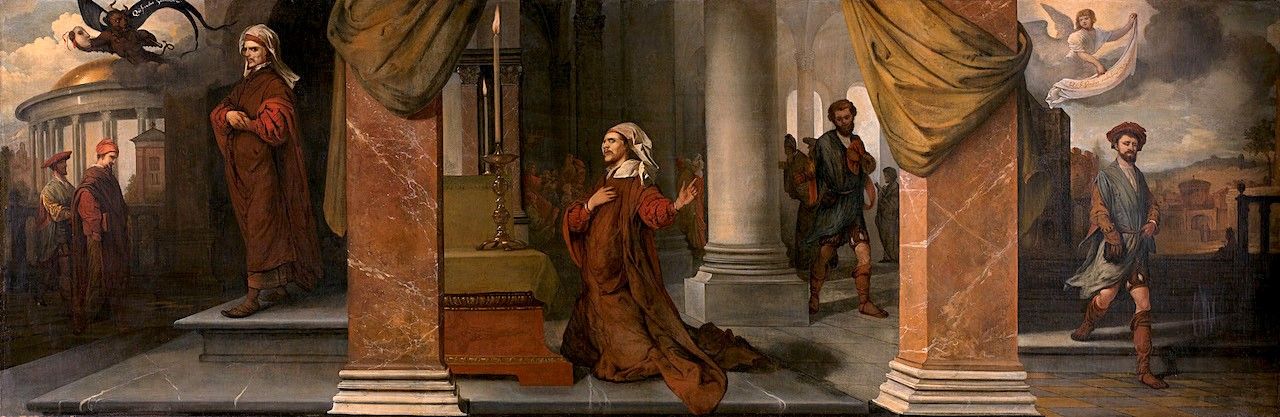
    The Pharisee and the Publican (1661), Barent Fabritius | Image from oceansbridge.com.

    The next item to note about the Pharisee’s off-kilter prayer is how much he speaks of himself as the agent of action. What a marvelous command of grammatical structure Jesus uses to display the self-centeredness of the Pharisee. Four times we hear the Pharisee put himself as the first person subject of phrases in his prayer: “I thank you,” “I am not like,” “I fast,” and “I pay tithes.” The Pharisee has so sublimated his own sense of self-worth that, apart from being the subject of the phrases, he places himself as the grammatical agent (meaning the cause and initiator of action). This semantic idea is a great way for Jesus to make his point: it’s not just the empty show of devotion that makes the Pharisee a hypocrite, it’s his lack of conversion of heart to place the Lord first, the agent of all. This almost unconscious grammatical structuring of his prayer belies the deep perversion and reversal of order in his being. 

    Let’s compare this with what Jesus tells us about the tax collector: “But the tax collector stood off at a distance and would not even raise his eyes to heaven but beat his breast and prayed, ‘O God, be merciful to me a sinner.’” We hear much about his physical bearing — standing off, eyes lowered, beating his breast. This is the stance of supplication. It reminds us of the great supplication offered for days by Esther in order to save the Israelites in Babylonia (see the reflection Esther: Model of How to Petition the Father) and of Hananiah, Azariah, and Mishael in Nebuchadnezzar’s fiery furnace.

    The tax collector’s prayer itself is so fundamentally correct that it forms the proto-Jesus Prayer. In this prayer, Jesus gives us another example of how to pray correctly (in addition to the Lord’s Prayer, of course). Let’s dissect it: the tax collector approaches in supplication, addresses God as the agent of action in the world (he says “merciful to me,” and as such he is the object of action, not the agent), and identifies himself as a sinner in need of mercy. And as we reflected this week, mercy is the way of the Kingdom, the currency of the economy of love. Jesus wants us to “pay forward” the mercy God gives us by forgiving “seventy times seven” times (i.e., infinitely). Acknowledging that we need God’s mercy is the first step in becoming more God-like and offering His mercy to others.
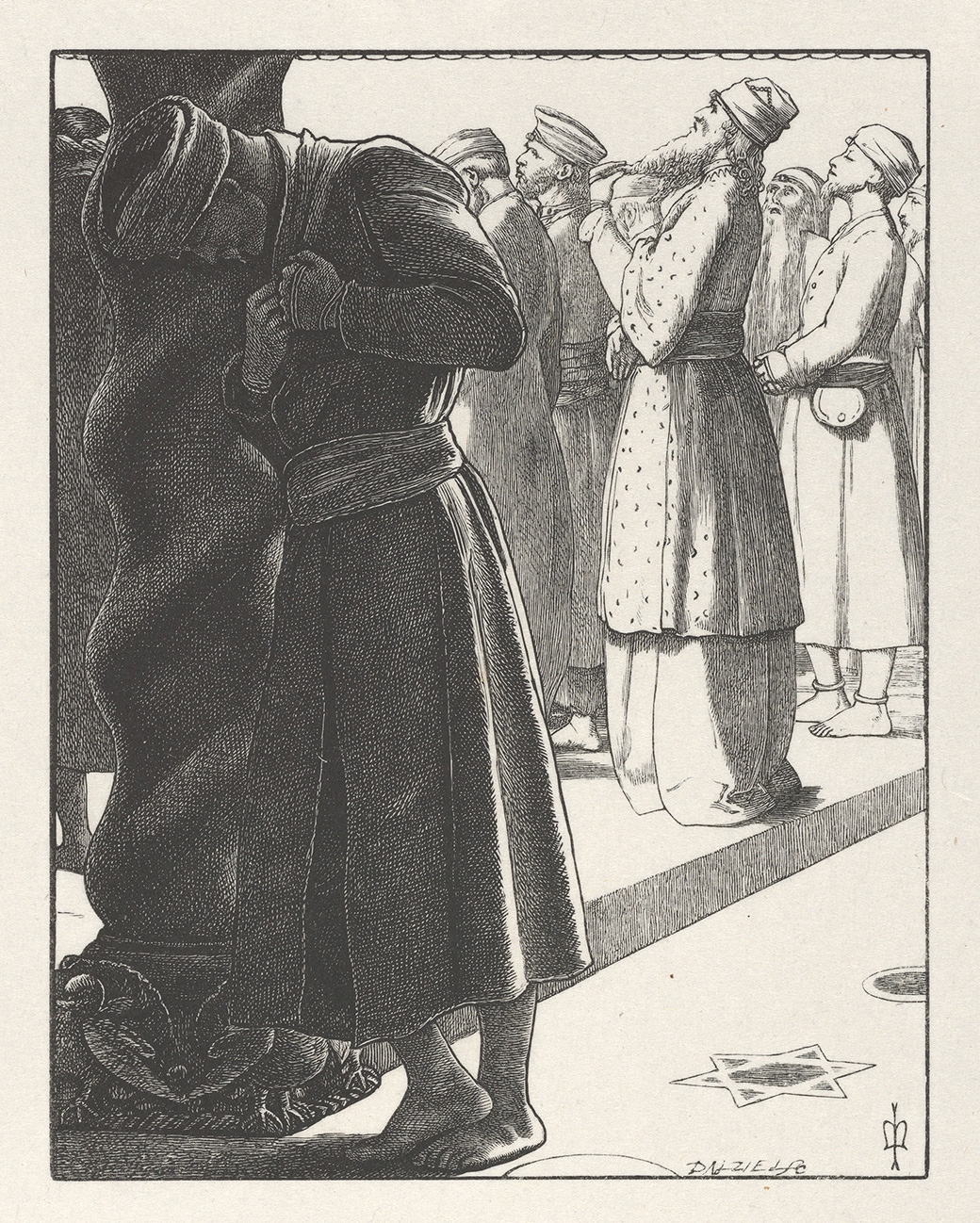
    The Pharisee and the Publican (1864), Artist: After Sir John Everett Millais, Engraved and Printed by Dalziel Brothers | Creative Commons, courtesy The Metropolitan Museum of Art.

    Today’s most common form of the Jesus Prayer is, “Lord Jesus Christ, Son of God, have mercy on me, a sinner.” We can see the marriage of today’s two readings — Hosea’s striving to know God who rises on the third day and the tax collector’s humble prayer for mercy. Praying to the second Person of the Trinity, our great high priest and chief intercessor who descended to earth to dwell and suffer with us, is a key gift in our Christian lives. The Catechism of the Catholic Church teaches us, “The name ‘Jesus’ contains all: God and man and the whole economy of creation and salvation. To pray ‘Jesus’ is to invoke him and to call him within us. His name is the only one that contains the presence it signifies” (2666).

    Thus, the Jesus Prayer unites the same correctness of prayer we find in the tax collector with the new reality that Christ brought to history with his death and Resurrection. The Jesus Prayer is powerful and draws us deeper into the mystery of being a part of the Church.

    “When the holy name is repeated often by a humbly attentive heart, the prayer is not lost by heaping up empty phrases, but holds fast to the word and ‘brings forth fruit with patience.’ This prayer is possible ‘at all times’ because it is not one occupation among others but the only occupation: that of loving God, which animates and transfigures every action in Christ Jesus” (CCC, 2668).

    I can testify that I’ve come to a much deeper appreciation of the Jesus Prayer in my own prayer life. I use it often when I find myself not concentrating during the Mass to bring myself back to the sacrifice at the altar. I use it when in Adoration, contemplating the mysteries of our Savior, and I use it now and again during the day when I need to remind myself of my purpose and my center: Christ.

    What better time than Lent, in its stillness and silence, to repeat the Jesus Prayer and let it sink in to transform our hearts? Let us take the Church’s instruction to pray in Jesus’s name as we ask God for mercy in the light of our infidelities and sins.

    For we know, as certain as the dawn, He will come.
  • Forgiveness is Mercy in Action

    Forgiveness is Mercy in Action

    Tuesday of the Third Week in Lent: Daniel 3:25, 34-43, Matthew18:21-35.

    Today’s readings slide from Azariah’s beautiful placement of his fate in God’s hands to the damning of the unmerciful servant in the gospel. If ever there was a day to consider the term fear of God, this is it.

    The Books of Psalms and Proverbs mention fear of the Lord many times, calling it “the beginning of wisdom” and the “fountain of life” and proclaiming that the person who lives in the fear of the Lord is “blessed.” St. Thomas Aquinas reminds us that fear of God is one of the gifts of the Holy Spirit, and it is best understood not in terms of fearing something evil but fearing being separated from our Father — a filial fear.

    Detail from A Hermit Praying (1663), Gerbrand van den Eeckhout | Image from artsy.net.

    Fear is a blessing? How gauche, how antiquated! We live in a time when liberation and freedom to do as you please holds the highest cultural value. But as we are swept up in this cultural moment, we have to remember that what we think is ours (our body, our thoughts, our actions) is actually a gift, too. It was a biological gift from a mother and a father, but more importantly, that spark of life, intellect, and soul is a gift from God. No biological mechanism can explain that gift of spirit that makes us human.

    Biologically, we are but atoms arranged in certain ways — proteins and fats and water that come together in a certain form. Even these building blocks had to come from somewhere, and we believe that our God is the Creator of all the universe. But more, we owe the divine Maker the fact that we are animated as intelligent, soulful beings, bridging the animal kingdom and the angelic kingdom.

    Here is where fear comes in and why we might call it a blessing. Imagine that source of divine power and goodness for just a second. Imagine how incredible it is that he cares enough to hold us in being, favored among all Creation. “Fear of God” means giving him the respect and love that he is due, but also clinging to him as the source of our being. To help us, the Holy Spirit gives us the gift of fear of God, something that aligns us spiritually, that endows us with the appropriate humble stance in front of our Creator.

    This is the way we should be thinking about the fear of God as we examine today’s readings: a gift to be treasured, one that gives us wisdom and blesses us, a feeling in our gut that we never want to be separated from our Father and the knowledge that our actions and hearts must be in line with God’s will in order to stay united with him and his grace.

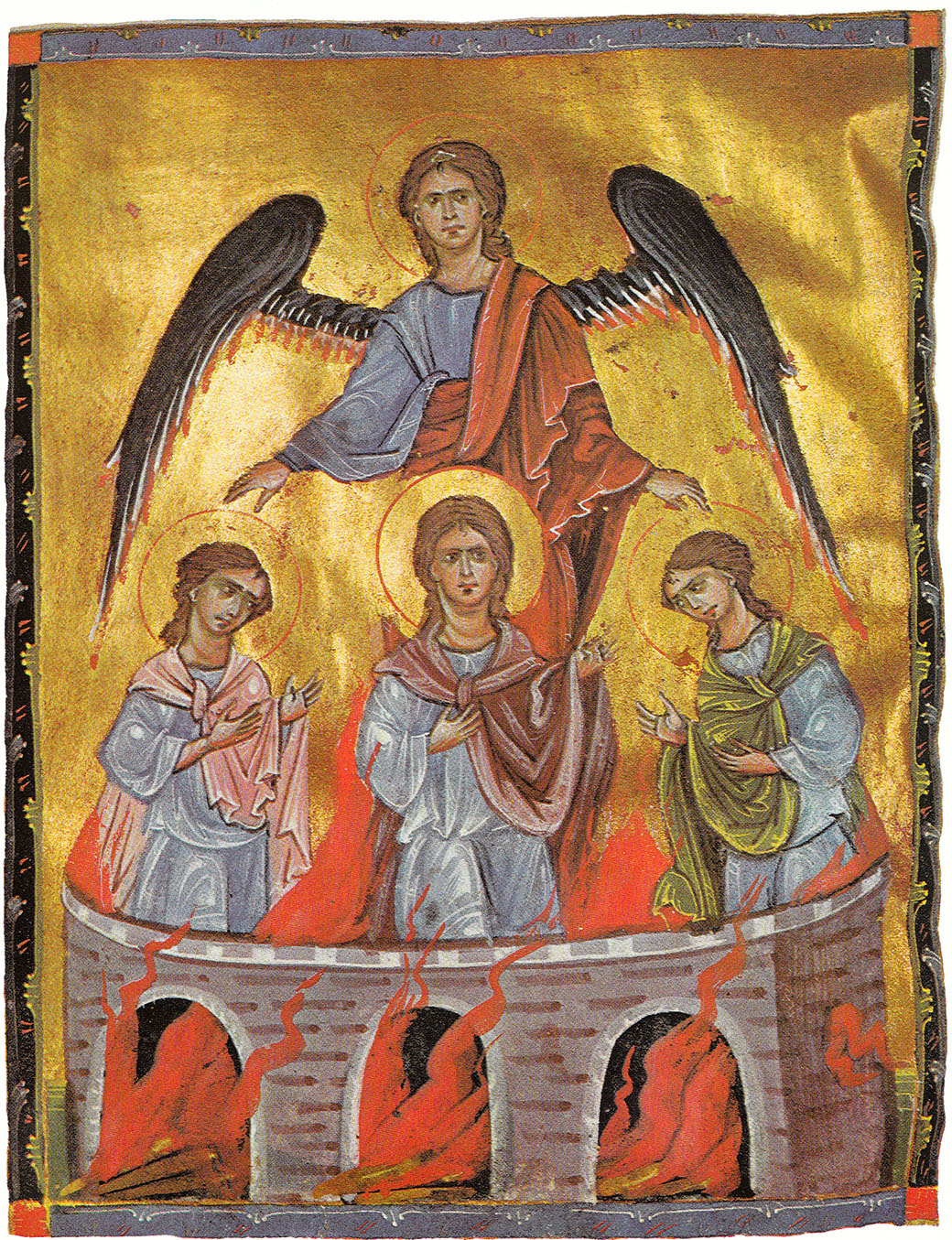
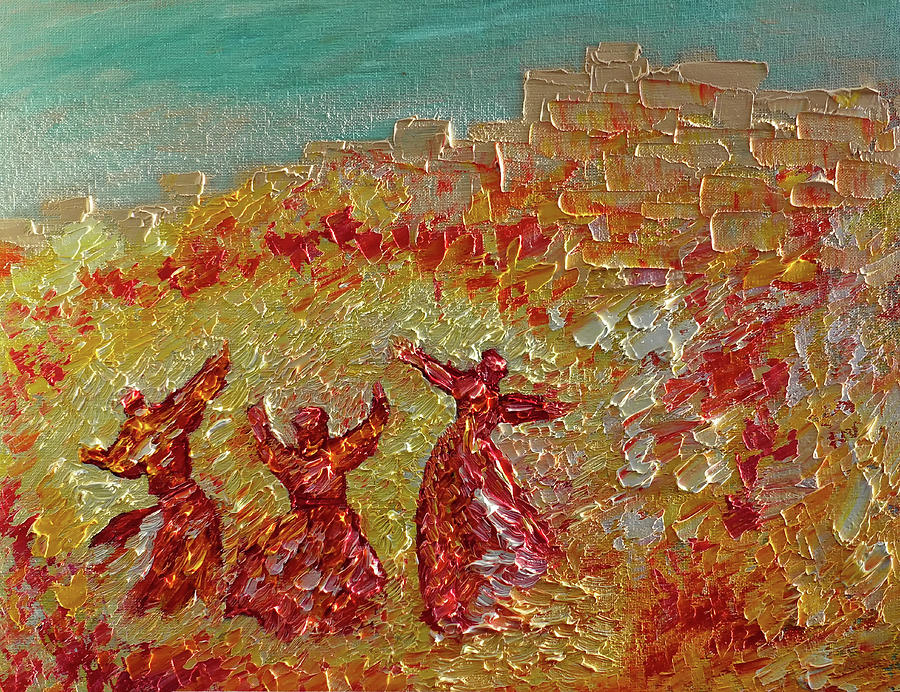
    This type of fear of God is evident in Azariah in the first reading. This is part of the much-celebrated episode when the three young Jews Hananiah, Azariah, and Mishael are punished by Nebuchadnezzar for refusing to worship the gigantic golden idol he builds on the plain of Dura. They respond to the accusations against them by saying, “we have no need to present a defense to you in this matter. If our God whom we serve is able to deliver us from the furnace of blazing fire and out of your hand, O king, let him deliver us.” In a rage, he sentences them to be bound and cast into a fiery furnace so hot that it burns to death the men who throw them in.

    Dancing Hebrew youths, Mishael, Azariah and Hananiah, in a fiery furnace of Nebuchadnezzar (contemporary) Zoriy Fine | Image from fineartamerica.com.

    We read the Prayer of Azariah in today’s readings, which he offers to God when they are inside the furnace. Importantly, Azariah prays not for the three of them, but for the entire nation of Israel, “for the sake of Abraham, your beloved, Isaac your servant, and Israel your holy one.” He notes how depleted Israel is (indeed, they’ve been conquered by the Babylonians and many have been dragged to Babylon). In a clear reference to the psalms, he says he has no offering but his “contrite heart and humble spirit.” (Psalm 51 reads: “For you have no delight in sacrifice; if I were to give a burnt offering, you would not be pleased. The sacrifice acceptable to God is a broken spirit; a broken and contrite heart, O God, you will not despise.”)

    Having declared his pure intentions, he says, “we fear you and seek your presence.” As we shall see in the gospel reading, this deep respect, this profound obeisance, is key to our request for mercy. The entire prayer reaches its climax with his request: “deal with us in your patience and in your abundant mercy. Deliver us in accordance with your marvelous works, and bring glory to your name, O Lord.” How important that Azariah understands that all must point back to God and his glory! He asks for deliverance not just out of a selfish desire for his own life, but knowing that Nebuchadnezzar would be amazed at the power of God to save his people. Most importantly, he models for us what a gift fear of God is.

    Spoiler alert: the three young men are saved by God and not harmed in the fiery furnace.

    Upon their deliverance, the three young men dance and sing in the furnace a great canticle of thanksgiving, one that we use in our liturgy: Week 1 Sunday Morning Prayer of the Divine Office, and repeated for each solemnity and other high feast days. The canticle is one of my favorites to chant during the Liturgy of the Hours because it starts by blessing God and then goes through all of creation, encouraging everything to bless the Lord. This canticle is important because Hananiah, Azariah, and Mishael not only model for us the fear of God and heartfelt pleas for mercy, but also the correct response once you’ve received his mercy: sharing that mercy with all of creation.

    Turning our attention to the gospel reading, the Parable of the Unmerciful Servant starts strong. The servant who owes an impossible amount of money to the king follows the lead of Hananiah, Azariah, and Mishael, showing proper respect for and dependence on the king. The original Greek uses the verb προσεκύνει (a form of proskynesis), which is often translated as “worship” elsewhere in the Bible and means to bow on your knees in a display of supplication and reverence. 

    Further examination of the Greek helps us understand the exchange between the servant and the king. Erasmo Leiva-Merikakis writes in Volume II of his masterwork Fire of Mercy, Heart of the Word, “God responded at once to the servant’s plea because the man used one of God’s dearest names in adoration of him: ὁ Μακροθύμος—’the Long-suffering One’. The man’s plea is said to have affected the almighty King’s very viscera (σπλάγχνα), hidden under all his golden robes … ‘the Lord of that servant was viscerally moved to compassion’” (647-648). The king is so moved that he forgives his entire debt! In this way, Jesus is describing God the Father in his overflowing forgiveness and mercy, far beyond our expectations. 

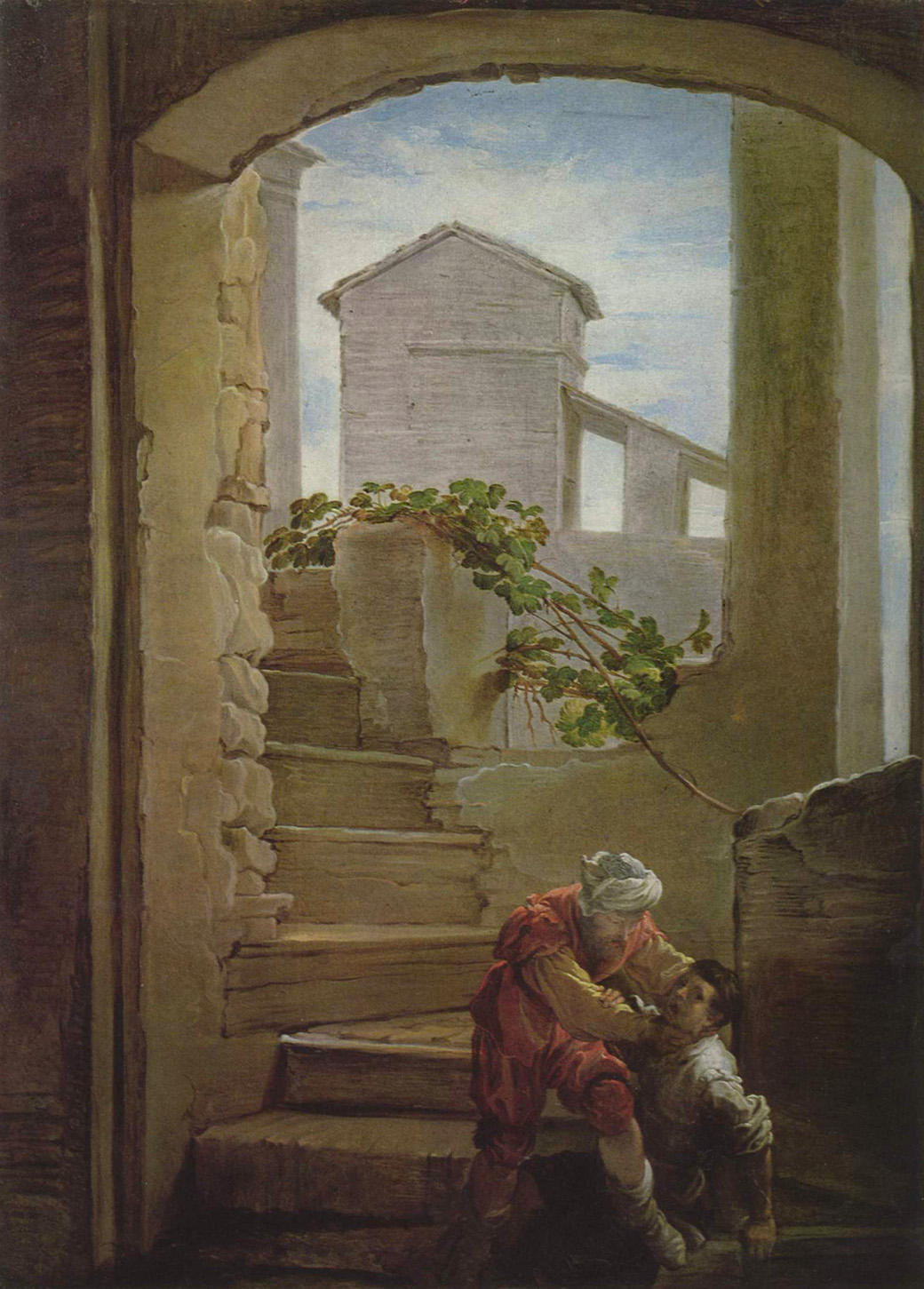
    The parable then turns, however, and reveals that the servant’s display of respect was only skin deep. He finds a fellow servant who owes him a much smaller debt and instead of forgiving this debt in turn, as his king forgave him, he chokes him, refuses to show him mercy, and has him imprisoned. This is a grievous sin.

    Parable of the Wicked Servant (La parabola del servo malvagio), 1620, Domenico Fetti | Wikimedia Commons.

    The king’s action is not merely a good example for the servant. God’s mercy is a thing, alive, needing to course through us into the world. His mercy is the living force of love in the world. Leiva-Merikakis beautifully describes this, “Our vocation is to ignite conflagrations of love and forgiveness all around us. God’s light intends to be refracted through our being: it shines upon us not only for our own benefit, to dispel our own darkness, but also to stream through us and beyond us” (649). 

    Our very “vocation,” our purpose on the earth, is to share God’s mercy in the world. By so doing, we accomplish God’s will. But refusing mercy is the perversion of the Spirit. In the parable, the unmerciful servant shows that he does not have the type of fear of the Lord that is wholesome and transformative. The other servants must react at his perversion of the Spirit: “Now when his fellow servants saw what had happened, they were deeply disturbed, and went to their master and reported the whole affair.” Not sharing mercy with others is a cardinal sin. This leads us to the conclusion of the parable and a glimpse of divine justice.

    Even if it makes us uncomfortable, we must accept that God rightfully expresses anger when his goodness is hoarded and discarded. Divine justice hinges upon how we use the gifts God bestows on us, principally mercy: is it shared and given forth to others in acts of charity and love or is it discarded and replaced by selfishness, greed, and sadism? When we discard the energy of God Himself, we embrace the energy of evil, of the devil. What’s more, we reject ourselves, our purpose, to help bring others to God and into the Kingdom. We become an abomination of everything God has created us to be.

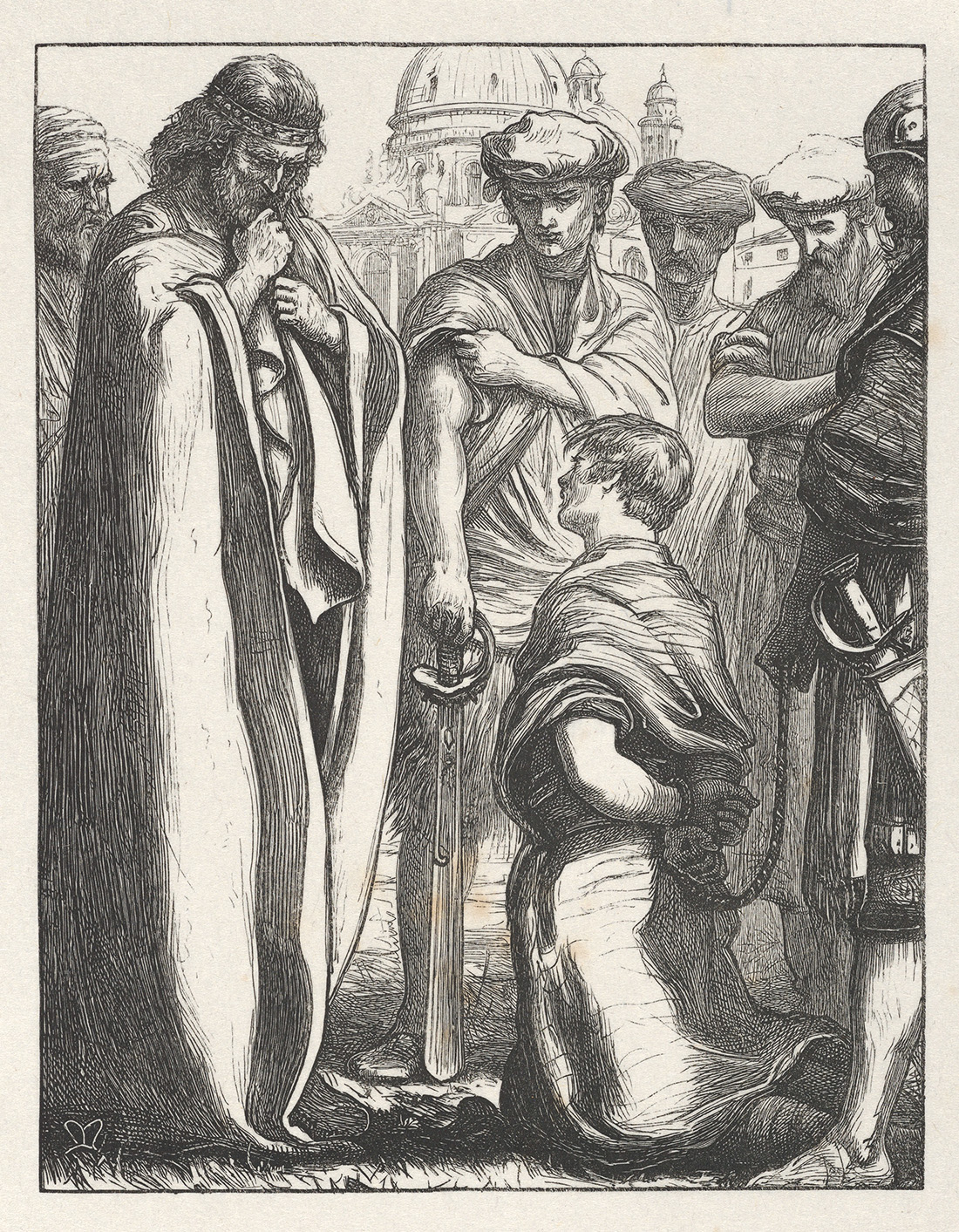
    The Unmerciful Servant (1864), artist: After Sir John Everett Millais, Engraved and printed by Dalziel Brothers | Creative Commons, courtesy The Metropolitan Museum of Art.

    So, we read that “in anger his master handed him over to the torturers.” Let’s look closely at the original Greek as we wrap our heads around God’s righteous anger and act of divine justice in this passage.

    The verb for his anger is ὀργισθεὶς (orgistheis), which can be translated as “moved to anger” or “provoked to anger.” Here we see that the king is provoked or moved by the actions of the servant; it is a response to something the servant has done. We must recall that while God is indeed all that is good, he is also the source of moral behavior, moral decision making, and moral valence (that is, what is good vs. what is bad). As such, he stands as the judge of behavior, and a judge is not silent when presented with something. Actions either uphold the good or go against the good. Being “moved to anger” means that he stands in his role as judge and proclaims the evil that he sees.

    Why anger? Why not sadness or emotionless judgment? Well, let’s return to the kind of God we know we have: one who overflows with love for his people and his creation. Is this the sign of impassivity? Should we expect a divinity so pure and full to not react viscerally to both the goodness he finds in us as well as the evil he finds in us? As it appears in today’s reading, God is viscerally moved to compassion — σπλαγχνισθεὶς (splanchnistheis) where the word σπλαγχνα (splanchna) means interior organs or intestines — and we can expect that he can be viscerally moved to something other than compassion when encountering evil. I don’t presume to know what he is moved to, but the scriptures tell us many times that he is moved to anger, so I take divine revelation for what it is.

    In his anger, the king “handed him over”: παρέδωκεν (paredōken), which occurs 18 times in the New Testament, notably when Judas hands over Christ to the chief priests, when Pilate hands over Christ to be crucified, and when Christ gives up his spirit in death. This is an irrevocable step in delivering something. And to whom does the king hand over the servant? The torturers, who will enact pain upon him “until he should pay back the whole debt” (200,000 years, I guess). We can rightfully say that in his goodness God does not take pleasure in this torture and note that he does not inflict it himself. Gehenna/Hell is set up for this purpose, a place for the people who pervert the Spirit and undermine God’s law.

    So as to not end this reflection as a total downer, let’s end with some wise words from Leiva-Merikakis, for whom today’s reading in part gives him the title for his three-volume work on St. Matthew’s gospel.

    The only thing we should be afraid of is not being merciful as our heavenly Father is merciful, for it is from unmercy that the most dire consequences flow, the ones reaching most deeply and devastatingly into both our psyche and our eternal destiny. For the Kingdom of Heaven is a kingdom of mercy, and mercy is never realized in the abstract but only through a concrete exercise of forgiveness. … Therefore, the ability to forgive our brother unceasingly and from the heart should be one of the primary concerns of our prayer, one of the most earnest pleas we make before the Throne of Grace (654).

  • As Certain As the Dawn

    As Certain As the Dawn

    Saturday in the Third Week of Lent: Hosea 6:1-6, Luke 18: 9-14.

    Today’s readings give us a stunning prophecy of the Christ event some 780 years earlier and urge us to remain steadfast to the Lord in our faith and humility.

    The short Book of Hosea continues to surprise me. We hear the Word of God promise his coming through the mouth of the prophet: “on the third day he will raise us up, to live in his presence.” It’s easy to understand how the Israelites could not comprehend this prophecy since they were worried more about pressures from great nations like Assyria and Egypt. As if the “third day” reference wasn’t difficult enough to understand in its specificity, there is the question of the raising up and living in his presence.

    The closest they might have come was to understand this in its eschatological sense of their own bodies rising after death to join God in Heaven. The mystical reality that Jesus would be the one rising and we would live in his presence sacramentally (and bodily for a few disciples) … well, that wouldn’t become clear until the event itself. But here we can see that the Word of God was speaking in its fullness much earlier in our history.

    Hosea then uses some wonderful imagery from nature to urge us into right relationship with God: “let us strive to know the LORD; as certain as the dawn is his coming, and his judgment shines forth like the light of day!” I love the prophet’s faith. I love that the Lord’s coming is as “certain as the dawn.” And the light that he brings is his judgment, his truth. This is not a prophecy of the end of time (the second coming), but of Jesus’s first mission on earth that brings the times we live in now. Hosea tells us, “He will come to us like the rain, like spring rain that waters the earth.” This spring rain brings Christianity to the world.

    Dawn (1896), Jules Breton | Wikimedia Commons. This work beautifully expresses Hosea’s message. The dawn arrives and we are expected to be at work, bringing the harvested wheat (the communion with Christ who brings new life with his death and Resurrection) and “living water” of Christ to the world.

    We also hear the Lord’s slightly exasperated but caring question, “What can I do with you, Judah? Your piety is like a morning cloud, like the dew that early passes away.” The image is clear: we must be more substantial in our faith, more persistent, and not fade away so easily.

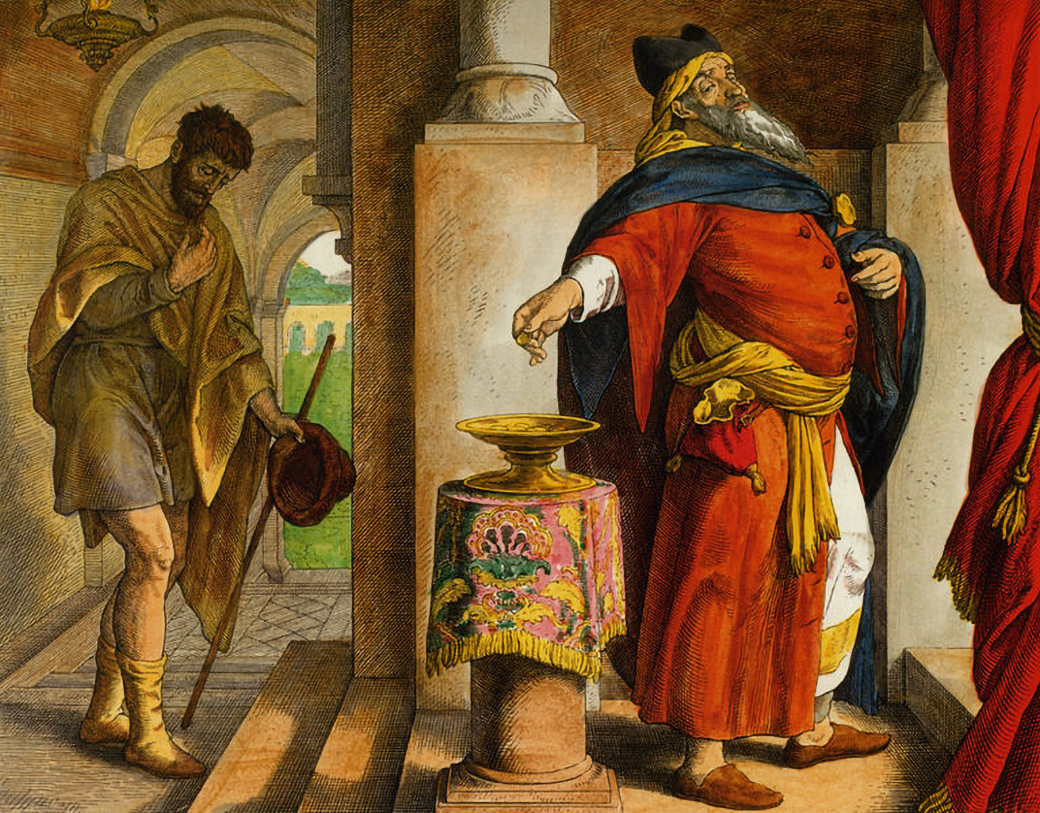
    Jesus picks up this thread in the gospel reading. In another parable addressed to the Pharisees, Jesus describes their showy devotion that lacks a sincere love of God in their hearts. The Pharisee in the parable “takes up his position” in the temple, which was undoubtedly one where he could be seen clearly, and “spoke this prayer to himself.” This is a huge clue that something’s backward; prayer is always offered to God and spoken to God, whether audibly or inaudibly. The Pharisee is primarily self-focused.

    This focus on himself is evident in his words. After a cursory “O God” to start his prayer, we hear the Pharisee speak of himself during the whole prayer, contrasting his law-abiding deeds with “the rest of humanity — greedy, dishonest, adulterous.” Let’s note that his window on the world, himself included, is one of judgment.

    Jesus is clear about not being judgemental: “Do not judge, so that you may not be judged” (Mt 7:1). We all know people who are consumed with judging themselves and others (we all probably fall into this camp at times). It is simply not compatible with being a Christian. Judging the worth of another being is something that rightfully belongs only to God. We should never try to put ourselves on par with Him.

    Furthermore, in this life he judges us all to be worth forgiving, worth saving, worth his love. We are asked to follow his lead and offer nothing but his love to our brothers and sisters on the planet. The Final Judgment will come at the end of time, and we are the judged, not the judges in that drama.

    A colorized version of an illustration from Die Bibel in Bildern (Picture Bible), 1860, Julius Schnorr von Carolsfeld | Creative Commons, courtesy orthochristian.com.

    The next item to note about the Pharisee’s off-kilter prayer is how much he speaks of himself as the agent of action. As we explored in the reflection Our Vocation to Teach the Word of God, the Word contains the fullness of communication. What a marvelous command of grammatical structure Jesus uses to display the self-centeredness of the Pharisee. Four times we hear the Pharisee put himself as the first person subject of phrases in his prayer: “I thank you,” “I am not like,” “I fast,” and “I pay tithes.” The Pharisee has so sublimated his own sense of self-worth that, apart from being the subject of the phrases, he places himself as the grammatical agent (meaning the cause and initiator of action).

    This semantic idea is a great way for Jesus to make his point: it’s not just the empty show of devotion that makes the Pharisee a hypocrite, it’s his lack of conversion of heart to place the Lord first, the agent of all. This almost unconscious grammatical structuring of his prayer belies the deep perversion and reversal of order in his being. 

    Let’s compare the tax collector’s prayer: “But the tax collector stood off at a distance and would not even raise his eyes to heaven but beat his breast and prayed, ‘O God, be merciful to me a sinner.’” We hear much about his physical bearing — standing off, eyes lowered, beating his breast. This is the stance of supplication. It reminds us of the great supplication offered for days by Esther in order to save the Israelites in Babylonia (see Esther: Model of How to Petition the Father).

    The tax collector’s prayer itself is so fundamentally correct that it forms the proto-Jesus Prayer. In this prayer, Jesus gives us another example of how to pray correctly (in addition to the Lord’s Prayer, which he gives us as well). Let’s dissect it: the tax collector approaches in supplication, addresses God as the agent of action in the world (he says “merciful to me,” and as such he is the object of action, not the agent), and identifies himself as a sinner in need of mercy.

    We have reflected upon the importance of mercy as one of God’s great attributes that sets him above the rest of Creation (see Mercy is the Master Principle). As we start to comprehend that mercy is an important aspect of God’s love (agape), which is given to us in order to live beyond us as we give it to others, we can see that asking for mercy is a way to return to the wellspring of life-giving water. This can and should be our perpetual prayer as Christians.

    The Pharisee and the Publican (1864), Artist: After Sir John Everett Millais, Engraved and Printed by Dalziel Brothers | Creative Commons, courtesy The Metropolitan Museum of Art.

    And Jesus has given us a much deeper, intimate communion with this wellspring in the form of the liturgy where we can sacramentally bring into our bodies the mercy and love flowing from the Lord’s pierced heart. This brings us to the Jesus Prayer: “Lord Jesus Christ, Son of God, have mercy on me, a sinner.” Praying to the second Person of the Trinity, our great high priest and chief intercessor who descended to earth to dwell and suffer with us, is a key gift in our Christian lives. The Catechism of the Catholic Church teaches us, “The name ‘Jesus’ contains all: God and man and the whole economy of creation and salvation. To pray ‘Jesus’ is to invoke him and to call him within us. His name is the only one that contains the presence it signifies” (2666).

    Thus, the Jesus Prayer unites the same correctness of prayer we find in the tax collector with the new reality that Christ brought to history with his death and Resurrection. The Jesus Prayer is powerful and draws us deeper into the mystery of being a part of the Church.

    “When the holy name is repeated often by a humbly attentive heart, the prayer is not lost by heaping up empty phrases, but holds fast to the word and ‘brings forth fruit with patience.’ This prayer is possible ‘at all times’ because it is not one occupation among others but the only occupation: that of loving God, which animates and transfigures every action in Christ Jesus” (CCC, 2668).

    What better time than Lent, in its stillness and silence, to repeat the Jesus Prayer and let it sink in to transform our hearts? Let us take Jesus’s instruction to be like the tax collector in the parable and not the Pharisee. Let us take the Church’s instruction to pray in Jesus’s name as we ask God for mercy in the light of our infidelities and sins.

    For we know, as certain as the dawn, He will come.

  • Mercy is the Master Principle

    Mercy is the Master Principle

    Tuesday in the Third Week of Lent: Daniel 3:25, 34-43, Matthew 18:21-35.

    Today, we read a parable about God’s great mercy and the expectation that we will, in turn, extend that mercy to each other. Mercy, we learn, is the great master principle upon which divine justice is built, and it is an action that stems not from the human heart, but from the heart of the Lord.

    The beginning of the book of Daniel, although written ~165 BC, details the stories of Daniel and his friends in Babylon around the year 600 BC. Today’s reading comes from the much-celebrated episode when the three young Jews Hananiah, Azariah, and Mishael are punished by Nebuchadnezzar for refusing to worship the gigantic golden idol he builds on the plain of Dura. They respond to the accusations against them by saying, “we have no need to present a defense to you in this matter. If our God whom we serve is able to deliver us from the furnace of blazing fire and out of your hand, O king, let him deliver us.” In a rage, he sentences them to be bound and cast into a fiery furnace so hot that it burns to death the men who throw them in.

    Fiery Furnace, Shadrach, Meshach, and Abednego (1266), Toros Roslin (circa 1210–1270), who was the most prominent Armenian manuscript illuminator in the High Middle Ages | Wikimedia Commons.

    We read the Prayer of Azariah in today’s readings, which he offers to God when they are inside the furnace. Importantly, Azariah prays not for the three of them, but for the entire nation of Israel, “for the sake of Abraham, your beloved, Isaac your servant, and Israel your holy one.” He notes how depleted Israel is (indeed, they’ve been conquered by the Babylonians and many have been dragged to Babylon). In a clear reference to the psalms, he says he has no offering but his “contrite heart and humble spirit.” (Psalm 51 reads: “For you have no delight in sacrifice; if I were to give a burnt offering, you would not be pleased. The sacrifice acceptable to God is a broken spirit; a broken and contrite heart, O God, you will not despise.”)

    Having declared his pure intentions, he says, “we fear you and seek your presence.” As we shall see in the gospel reading, this deep respect, this profound obeisance, is crucial to our request for mercy. The entire prayer reaches its climax with his appeal: “deal with us in your patience and in your abundant mercy. Deliver us in accordance with your marvelous works, and bring glory to your name, O Lord.” How important that Azariah understands that all must point back to God and his glory! He asks for deliverance not just out of a selfish desire for his own life, but knowing that Nebuchadnezzar would be amazed at the power of God to save his people.

    The reader of the Book of Daniel is held in suspense a bit longer. After the passage we read today, we hear that the king’s servants stoke the fire mightily, and it rises 49 cubits (73.5 feet!) above the furnace. The point is that God’s people are being purified. The fiery furnace is the symbol of ultimate trial by fire, which is only met and conquered in the Spirit, with a steadfast faith and fundamental reliance on God. They prove that their hearts are pure, focused on God, and they ask for his mercy. Thus, “the angel of the Lord came down into the furnace to be with Azariah and his companions, and drove the fiery flame out of the furnace, and made the inside of the furnace as though a moist wind were whistling through it.”

    Upon their deliverance, the three young men dance and sing in the furnace a great canticle of thanksgiving, one that we use in our liturgy: Week 1 Sunday Morning Prayer of the Divine Office, and repeated for each solemnity and other high feast days. The canticle is one of my favorites to chant during the Liturgy of the Hours because it starts by blessing God and then goes through all of creation, encouraging everything to bless the Lord. (Some of my favorites: sun and moon, fire and heat, dolphins and water creatures.)

    This canticle is important because Hananiah, Azariah, and Mishael not only model for us the correct approach and posture to have before God when begging for mercy, but also the correct response once you’ve received his mercy: sharing that mercy with all of creation.

    The Parable of the Unmerciful Servant in today’s gospel reading clearly depicts the other side of this coin. Today’s gospel reading begins with Peter asking Jesus how many times we should forgive someone. Jesus corrects Peter’s guess of seven (the number of perfection in Jewish numerology, and already a literal number that would test the most patient person) to say seventy times seven — essentially, an infinite number of times. He then explains the reasoning with the Parable of the Unmerciful Servant.

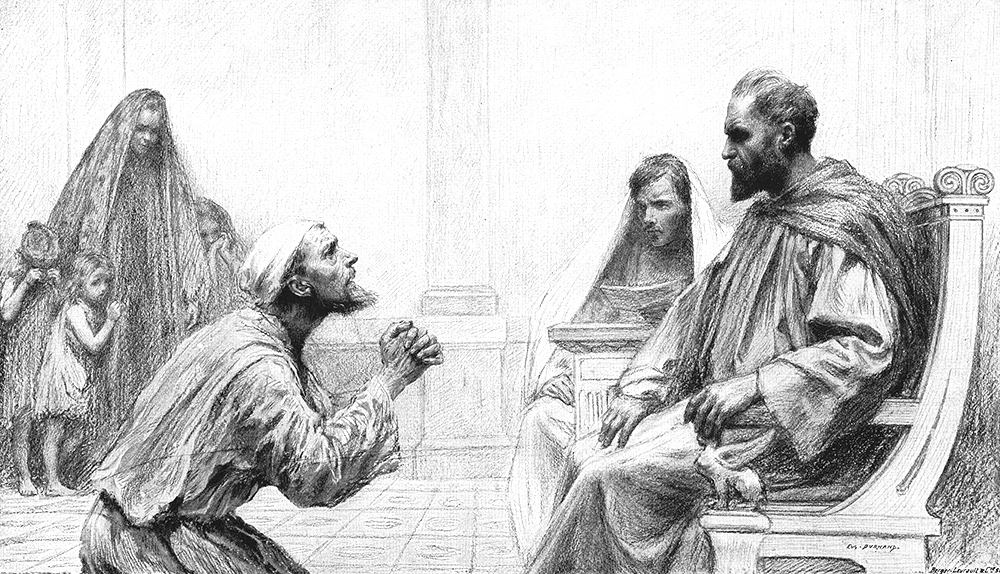
    The Unmerciful Servant (1908), Eugène Burnand | Creative Commons, courtesy eugene-burnand.com.

    Our lectionary reading says the servant owed the king “a huge amount,” although the scriptures specify “10,000 talents;” a talent is equal to 6,000 denarii, and since a typical Jewish laborer earned 300 denarii a year (1 denarius per day, 6 days per week, minus religious holidays), it would take around 200,000 years to earn 10,000 talents! Clearly, this is an impossible amount to pay back.

    The king proclaims a sentence according to the law, that he, his family and his property be sold. At this, “the servant fell down, did him homage, and said, ‘Be patient with me, and I will pay you back in full.’” Now, there is no way the king could expect to be paid back in full, but the servant follows the lead of Hananiah, Azariah, and Mishael in that he shows proper respect for and dependence on the king. The original Greek uses the verb προσεκύνει (a form of proskynesis), which is often translated as “worship” elsewhere in the Bible and means to bow on your knees in a display of supplication and reverence. 

    Further examination of the Greek helps us understand the exchange between the servant and the king. Erasmo Leiva-Merikakis writes in Volume II of his masterwork Fire of Mercy, Heart of the Word, “God responded at once to the servant’s plea because the man used one of God’s dearest names in adoration of him: ὁ Μακροθύμος—’the Long-suffering One’. The man’s plea is said to have affected the almighty King’s very viscera (σπλάγχνα), hidden under all his golden robes … ‘the Lord of that servant was viscerally moved to compassion’” (647-648).

    And the king goes beyond giving the servant time to repay, instead forgiving his entire debt! In this way, Jesus is describing God the Father in his overflowing forgiveness and mercy, far beyond even our expectations.

    The parable now turns on the actions of the forgiven servant. He finds a fellow servant who owes him a much smaller debt and instead of forgiving this debt in turn, as his king forgave him, he chokes him, refuses to show him mercy, and has him imprisoned. This is a grievous sin.

    Parable of the Wicked Servant (La parabola del servo malvagio), 1620, Domenico Fetti | Wikimedia Commons.

    The king’s action is not merely a good example for the servant. God’s mercy is a thing, alive, needing to course through us into the world. His mercy is the living force of love in the world. Leiva-Merikakis beautifully describes this, “Our vocation is to ignite conflagrations of love and forgiveness all around us. God’s light intends to be refracted through our being: it shines upon us not only for our own benefit, to dispel our own darkness, but also to stream through us and beyond us” (649). 

    As Leiva-Merikakis points out, God sharing his mercy implicates our very “vocation,” our purpose on the earth. And the kingdom reacts at the injustice, the perversion of Spirit in its midst: “Now when his fellow servants saw what had happened, they were deeply disturbed, and went to their master and reported the whole affair.” As Leiva-Merikakis writes, “Mercilessness looms as the primary enemy of the hierarchy of being as established by divine creation and decree” (653). In other words, God — as the fullness of mercy and goodness — fills us with mercy so that we, in turn, can allow the overflowing mercy to be shared with the rest of creation (this is what he means by “hierarchy”). Not sharing mercy with others is a cardinal sin, a “primary enemy.” This leads us to the conclusion of the parable and a glimpse of divine justice.

    The Unmerciful Servant (1864), artist: After Sir John Everett Millais, Engraved and printed by Dalziel Brothers | Creative Commons, courtesy The Metropolitan Museum of Art.

    Even if it makes us uncomfortable, we must accept that God rightfully expresses anger when his goodness is hoarded and discarded. Divine justice hinges upon how we use the gifts God bestows on us, principally mercy: is it shared and given forth to others in acts of charity and love or is it discarded and replaced by selfishness, greed, and sadism? When we discard the energy of God Himself, we embrace the energy of evil, of the devil. What’s more, we reject ourselves, our purpose, to help bring others to God and into the Kingdom. We become an abomination of everything God has created us to be.

    So, we read that “in anger his master handed him over to the torturers.” Much has been said in recent years about how God is all goodness and could never have vengeance or anger. I think we come close to ignoring parts of scripture if we take this too far. Let’s look closely at the original Greek as we wrap our heads around God’s righteous anger and act of divine justice in this passage.

    The verb for his anger is ὀργισθεὶς (orgistheis), which can be translated as “having been angry,” “moved to anger,” or “provoked to anger.” Here we see that the king is provoked or moved by the actions of the servant; it is a response to something the servant has done. We must recall that while God is indeed all that is good, he is also the source of moral behavior, moral decision making, and moral valence (that is, what is good vs. what is bad). As such, he stands as the judge of behavior, and a judge is not silent when presented with something. Actions either uphold the good or go against the good. Being “moved to anger” means that he stands in his role as judge and proclaims the evil that he sees.

    Why anger? Why not sadness or emotionless judgment? Well, let’s return to the kind of God we know we have: one who overflows with love for his people and his creation. Is this the sign of impassivity? Should we expect a divinity so pure and full to not react viscerally to both the goodness he finds in us as well as the evil he finds in us? As it appears in today’s reading, God is viscerally moved to compassion — σπλαγχνισθεὶς (splanchnistheis) where the word σπλαγχνα (splanchna) means interior organs or intestines — and we can expect that he can be viscerally moved to something other than compassion when encountering evil. I don’t presume to know what he is moved to, but the scriptures tell us many times that he is moved to anger, so I take divine revelation for what it is.

    In his anger, the king “handed him over”: παρέδωκεν (paredōken), which occurs 18 times in the New Testament, notably when Judas hands over Christ to the chief priests, when Pilate hands over Christ to be crucified, and when Christ gives up his spirit in death. This is an irrevocable step in delivering something. And to whom does the king hand over the servant? The torturers, who will enact pain upon him “until he should pay back the whole debt” (200,000 years, I guess). We can rightfully say that, in his goodness, God does not take pleasure in this torture and note that he does not inflict it himself. Gehenna/Hell is set up for this purpose, a place for the people who pervert the Spirit and undermine God’s law.

    So as to not end this reflection as a total downer, let’s end with some wise words from Leiva-Merikakis, for whom today’s reading in part gives him the title for his three-volume work on St. Matthew’s gospel.

    The only thing we should be afraid of is not being merciful as our heavenly Father is merciful, for it is from unmercy that the most dire consequences flow, the ones reaching most deeply and devastatingly into both our psyche and our eternal destiny. For the Kingdom of Heaven is a kingdom of mercy, and mercy is never realized in the abstract but only through a concrete exercise of forgiveness. … Therefore, the ability to forgive our brother unceasingly and from the heart should be one of the primary concerns of our prayer, one of the most earnest pleas we make before the Throne of Grace (654).