Tag: Moses

  • The Limits of Language

    The Limits of Language

    Tuesday of the Fifth Week of Lent: Numbers 21:4-9, John 8:21-30.

    For me, today’s readings expose the limits of language to convey God’s plan. More than language, really, it’s a limit to our very capacity to understand. The reason we call these things the mysteries of our faith is not that they are to be blown over or passed of as simply “unknowable” (that’s a cop out, in some ways). It’s because they exist within a divine logic that we do not have access to here on the earthly plane.

    I imagine that some saints and mystics have had encounters with this divine logic and entered an ecstasy that included an understanding, in parts, of God’s ways. What this tells us is that pure worldly knowledge and intelligence are poor ways to “interrogate” or understand these mysteries. God IS, and there is an experiential aspect to encountering God’s divine plan.

    In other words, the more we can exist in a way that is conformed to God’s image, the more our very existence is compatible with Him. What follows it that the more we can conform to Him, the more we might gain insights into the mysteries of our faith.

    We discussed the seminal Lenten image of Moses’s bronze serpent on the staff in the reflections Lifted Like the Serpent and Bridging Salvation History with a Serpent. We encounter that full reading from the Book of Numbers today. It is very difficult to understand how this thing that resembles an idol could be prescribed by God, who detests all forms of idolatry in his Chosen People. In fact, the entire thing doesn’t really reveal its meaning until Jesus comes and compares his own Crucifixion with the bronze serpent, which happens about 1,475 years later.

    This is a good example of the divine intelligence, where millennia are but a breath, where symbols contain a depth of meaning that may only reveal itself in another age. We can react to this in many ways, from frustration to withdrawal. This is why God constantly tells us that he loves us and won’t abandon us. He calls us to him and strengthens us with opportunities to exercise our spiritual muscle of faith in him over and over again. The overwhelming message is clear: we are his sheep, we need to trust in our Good Shepherd. His plan is unknowable to us as calculus is to a sheep, likely infinitely moreso. 

    When I first really grappled with the first reading some years ago, I was left with a lot of questions. It’s somewhat funny that the text just plows along without anyone’s doubt being expressed. That’s why I was pleased to find that I wasn’t the only one imagining that Moses’s introduction of a bronze staff would have been met with some skepticism. The excellent series The Chosen opened episode 7 with this exact scene, and Joshua confronts Moses with all of these doubts. Moses replies, “It’s an act of faith, not reason!” It’s worth a peek if you haven’t seen it:

    Moving to today’s gospel reading, we find that Jesus’s words are oddly unilluminating for the Pharisees. When I read this passage, I find myself frustrated, undoubtedly as St. John must have been when recalling the exchange. Every time Jesus offers a kernel of truth about himself or a piece of wisdom about eternal life, they respond like idiots. This is the perspective of a believer: he’s giving you gold, giving you the truth about his very self, and you respond with lame, cynical questions! And the perspective of an unbeliever: he’s talking in riddles, not answering us in plain language or at least the language we’re expecting.

    How can these perspectives be so different? He is the Word of God, the light casting away darkness, bringing intelligibility to the universe. Perhaps this is the genius of how St. John has presented the gospel here. There is no better way to convey the difference between walking the Way and being an unbeliever — it should make those of us who love Christ want to help him explain to the pigheaded Pharisees, make them understand that the stakes couldn’t be higher here and they’re fumbling the ball. Think of some of the exchange:

    Jesus: I am going away and you will look for me, but you will die in your sin.

    Pharisees: He is not going to kill himself, is he?

    [My reaction: Miss the point much? He’s concerned about you missing out on your salvation]

    Jesus: You belong to this world, but I do not belong to this world. That is why I told you that you will die in your sins. For if you do not believe that I AM, you will die in your sins.

    Pharisees: Who are you?

    [My reaction: He just told you He is the great I AM!]

    Jesus: the one who sent me is true, and what I heard from him I tell the world.

    Pharisees: They did not realize that he was speaking to them of the Father.

    [My reaction: !!]

    Jesus: When you lift up the Son of Man, then you will realize that I AM, and that I do nothing on my own, but I say only what the Father taught me.

    Pharisees:

    At this point, my reaction has to move past frustration and figure out what John is telling us about Christ. Is his point that language is simply inadequate to explain the mystery of the Trinity and the Incarnation? I don’t think so. It’s true, language only goes so far, but language can go much further than we give it credit. That is why the scriptures will continue to reveal the treasures of wisdom to us throughout our lives — they are inexhaustible. As St. Paul tells the Romans, “O the depth of the riches and wisdom and knowledge of God!” (Rom 11:33).

    But what is required is an alignment of one’s spirit with the spirit of Truth. Simply put, we have to want to encounter God. If we don’t want to encounter God, it will all seem like rubbish, ravings of a crazy cult. Indeed, we have heard such accusations from atheists over the last few centuries.

    Are You Talking to Me? (contemporary), Witold Gilewicz and Janusz Gilewicz | Image from artpal.com.

    When we admit to ourselves that we actually want to get to know God, that we’re willing to take on faith the entire tradition and revelation of himself to humanity, we start to see meaning where before we saw nothing. We are not creating meaning — this meaning existed long before our little brains encountered it — it’s more like we finally moved the radio dial off of static and tuned into the divine frequency. In our gospel reading today, Jesus is broadcasting loud and clear to those tuned into the divine frequency. The Pharisees, sadly, are not just on static, they’re on their own channel that broadcasts nothing but politics and self-assuredness.

    Jesus tells us something else of great importance at the end of today’s reading: “The one who sent me is with me. He has not left me alone, because I always do what is pleasing to him.” Remember, with every revelation about himself, he is instructing us on the Way to the Kingdom. He is our role model, our high priest, and our Savior. The more we can be like him, the more we will be on our way to the Kingdom. And here he shares that the divine frequency carries more than just wisdom. It is a spiritual reality where God himself walks alongside us.

    “The one who sent me is with me. He has not left me alone, because I always do what is pleasing to him.” The promise is the same as it has always been: God will not leave us alone, and in return we should do what is pleasing to him. It’s amazing how the core of our faith is always this simple covenant of loving care. But this is more real than perhaps we ever hoped! Jesus tells us that the very real being of God is “with” him and “has not left me alone.” We have to be open to the ways of the Spirit and spiritual realities to understand this, but once we open ourselves, the reality is stunning.

    This is no distant judge from on high who checks his list each time we sin. This is our shepherd and partner every step of our life. He doesn’t leave us when we’re exhausted and crabby, or when we can’t afford a meal, or when we suffer an embarrassing failure. This should transform how we pray to him; he is much closer than we imagined, much more interested in giving us his mercy and help than we thought. The psalmist writes beautifully on this:

    O Lord, you have searched me and known me.
    You know when I sit down and when I rise up;
        you discern my thoughts from far away.
    You search out my path and my lying down,
        and are acquainted with all my ways.
    Even before a word is on my tongue,
        O Lord, you know it completely.
    You hem me in, behind and before,
        and lay your hand upon me.
    Such knowledge is too wonderful for me;
        it is so high that I cannot attain it.

    Where can I go from your spirit?
        Or where can I flee from your presence?
    If I ascend to heaven, you are there;
        if I make my bed in Sheol, you are there. …

    For it was you who formed my inward parts;
        you knit me together in my mother’s womb.
    I praise you, for I am fearfully and wonderfully made.
        Wonderful are your works    (Psalm 139:1-8, 13-14).
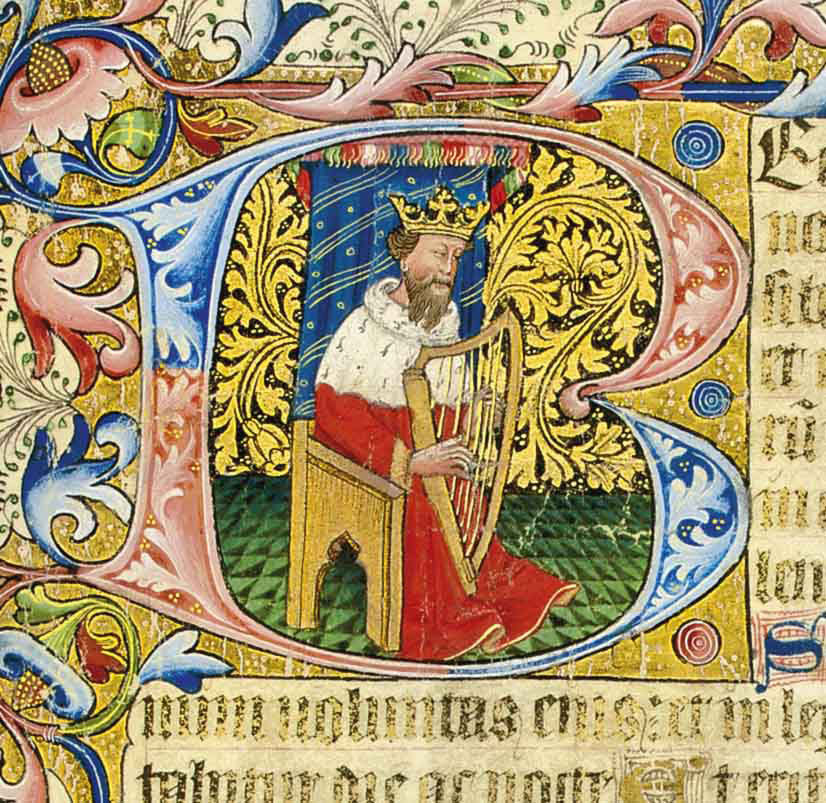
    Medieval artist’s rendering of King David as the psalmist in the Rice Psalter (mid-1400s) | Image from christies.com.

    This is a great aspect of God’s Wisdom for us to comprehend: not only does God exist, not only does he care that you do “what is pleasing” to him, he is so close to your being that you could never escape even if you wanted to. Why are so many of us spending our lives running away from the source of all goodness that springs up like a well within us?

    It’s time for us to tune into the divine frequency, to walk the Way with Christ who has always been right here with us.
  • Forgiving our Great Affront

    Forgiving our Great Affront

    Thursday of the Fourth Week of Lent: Exodus 32:7-14, John 5:31-47.

    Today’s readings pull no punches in shining a light on our inability to recognize God and remain faithful to Him. But they also show us that God’s overwhelming love, mercy, and forgiveness wipe away this great affront. This is our God: deserving of all honor and glory, but as the source of goodness and love, willing to erase the greatest affront and welcome us back to himself.

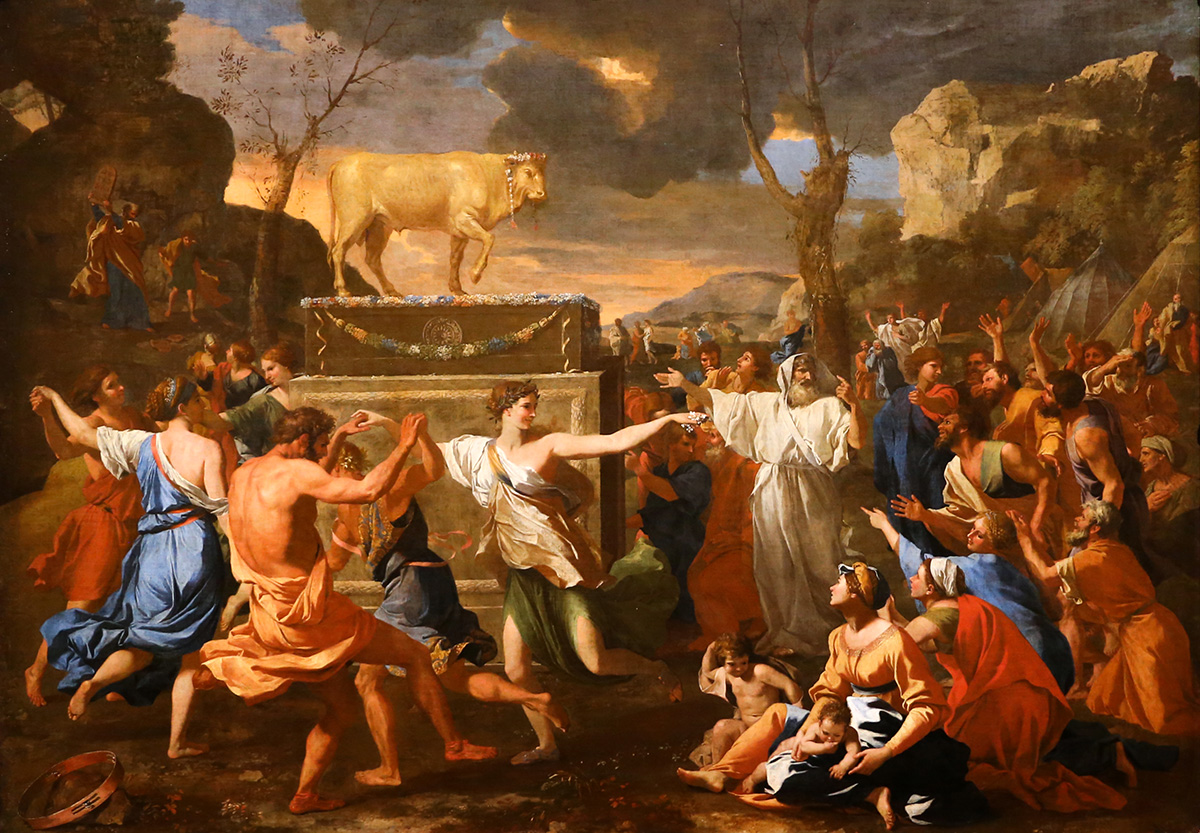
    The Adoration of the Golden Calf (L’Adoration du veau d’or), 1633-1634, Nicolas Poussin | Wikimedia Commons.

    The famous incident of the golden calf is the subject of the first reading. In the verses just prior to this, the extent of God’s betrayal is shown in the person of his chosen priest, Aaron. Aaron, Moses’s brother, who has been by his side for all of the wonders God worked in Egypt, who held up Moses’s arms during the long battle with Amalek so the Jews could win, is the one who builds the calf. Aaron responds to the wishes of the people who were tired of waiting for Moses (occupied on Mount Sinai with God). He takes all of their gold rings, melts them, and casts a statue of a golden calf. Then, he says, “These are your gods, O Israel, who brought you up out of the land of Egypt!” and “he built an altar before it; and Aaron made proclamation and said, ‘Tomorrow shall be a festival to the Lord.’”

    Now, that’s truly messed up if you asked me. I understand the desperation of a people lost and wandering in the desert without a home, but this extreme of abandoning the God who made himself known personally to Aaron, who singlehandedly brought them all out of slavery … it’s almost unfathomable.

    It’s surprising, but on second thought, not terribly different from all of us today who abandon God despite all of the blessings we’ve received. It is interesting that those who receive the most blessings on earth are often the quickest to abandon God when reflecting on the troubles that plague humanity. People in poorer countries (in South America and Africa, for instance) are the ones who comprise the bulk of the Catholic Church nowadays while rates of atheists in first-world countries are higher than ever before.

    Perhaps God makes up for whatever blessings of earthly pleasures are lacking for some people by blessing them with greater faith. Or perhaps striving to live with dignity in the face of great obstacles reminds us of our humility in the face of things greater than us and thereby find room in our hearts to honor God and seek his help. Either way, the poor and less fortunate seem to be more faithful to God.

    We begin to understand Jesus when he says, “many who are first will be last, and the last will be first” (Mt 19:30) — that is, the “first” in this world will be last in the Kingdom because they have abandoned God while the “last” in this world will be first in the Kingdom because they remained faithful.

    There is something of this conundrum in the Jews who are tarrying at the base of Mt. Sinai. Over the course of their miraculous deliverance from slavery in Egypt, they have benefitted from miracle after miracle: waters parting, manna and quail being given as food, water sprouting from rocks at the strike of Moses’s staff. And oddly we hear at each turn how they are abandoning God for idols or not obeying his commandments. Their ongoing blessings seem to engender a sense of entitlement rather than thankfulness. The more they receive, the less they recognize the giver of the gifts.

    This culminates in them so forgetting who God is that they clamor for Aaron to invent someone for them to worship: “Come, make gods for us, who shall go before us; as for this Moses, the man who brought us up out of the land of Egypt, we do not know what has become of him” (Ex 32:1b).

    Let’s not tell ourselves that this is the work of particularly evil or callous people. The story of the Jews in the desert is the story of all humanity failing to recognize God in their blessings. It is the story of our lost wanderings, being led back to God and the Promised Land (i.e., the Kingdom of God), but questioning him and his ways at every step. Sadly, it is the story of our contemporary descent into idolatry and atheism even when we have been shown the way.

    What is God’s response to this unfaithfulness? He tells Moses he’s ready to purify these people: “that my wrath may blaze up against them to consume them. Then I will make of you a great nation.” Whoa! This is the God of Love. Let’s unpack this so that we don’t think there is some sort of contradiction going on.

    The Church teaches us that God is all good, complete, and unchanging. He is the origin of all creation, not a part of it, as He tells Moses: “I AM who I AM.” As the only complete and unchanging thing in the universe (or outside of the universe), he doesn’t get angry, he’s not surprised, he’s not jealous, etc. That doesn’t mean he doesn’t care, mind you, or doesn’t yearn for us more than we yearn for him. When we encounter moments like today’s in the Scriptures, we have to remember what all of revelation has taught us about God and read the passage as it has been laid down by a mortal.

    One of the better articles I’ve read on this topic was posted on the Catholic Standard by Monsignor Charles Pope in 2019. He writes that God’s “wrath” can be called “wrath” only in how it is experienced by us, not as an emotion raging within him. He writes about the analogy of trying to mix water and fire:

    God’s wrath is our experience of the total incompatibility of our sinful state before the holiness of God. Sin and God’s holiness just don’t mix; they can’t keep company. Think of fire and water; they cannot coexist in the same place. Bring them together and you can hear the conflict. Think of a small amount of water poured into a large fire: the water droplets sizzle and pop; steam rises as the water boils away. … We must be purified before entering His presence, otherwise we could not tolerate His glory. We would wail and grind our teeth, turning away in horror. The wrath is the conflict between our sin and God’s holiness. God cannot and will not change, so we must be changed or else we will experience wrath.

    So we can affirm that God does not lose self-control or experience emotions in the ways that humans do. I tend to agree with our Church Father, Tertullian, though, who writes, “Angry He will possibly be, but not irritated, nor dangerously tempted; He will be moved, but not subverted” (Against Marcion, II.16). Tertullian’s point, in part, is that we can’t really know how or if God experiences “feelings,” since it is beyond our capacity. But, he notes that one thing is for sure: “it is yet palpably absurd of you to be placing human characteristics in God rather than divine ones in man, and clothing God in the likeness of man, instead of man in the image of God” (ibid, II.16).

    As I wrote in Forgiveness is Mercy in Action last week, there is something in the original Greek that points to God’s visceral reaction that we might interpret (by analogy) as “emotional” or “affective.” When he is viscerally moved to compassion, the verb has its root in the word for intestines and internal organs: σπλαγχνισθεὶς (splanchnistheis). This is a nice nuance to add to Msgr. Pope’s analogy of the fire, which is by definition an element that is impassive and will burn anything regardless of its good or evil nature.

    Let me tentatively put this forward: because God is all goodness and purity, the purifying fire of his nature has a valence, meaning that it is weighted with all things good and against all things evil. Thus, when goodness approaches Him, the reaction is unity, which we experience as delight, warmth, and embrace. When evil approaches Him, the reaction is rejection and elimination, which we experience as wrath, anger, and jealousy.

    Transfiguration of Jesus (2004), Armando Alemdar Ara | Wikimedia Commons. I think this beautiful interpretation of the Transfiguration might also be a nice way to visualize the purifying fire of God.

    Let’s return with these thoughts to our story from Exodus. God says, “Let me alone, then, that my wrath may blaze up against them to consume them.” Two things to note: first, he maintains his discourse and relationship with Moses, not to mention the promise to build for him “a great nation.” When he asks Moses to “let him alone,” we might see this as a the way Moses interprets this moment of sensing the momentum of God’s purifying fire and the opening Moses himself has in terms of begging for mercy for his people.

    For those who welcome the idea of a God who tests us, perhaps he is probing to see if Moses is able to fully inhabit the mercy of God and reflect this same mercy in a request to save his people. In any case, we can say that God is exhibiting his own mercy here simply in the act of conversing with Moses, giving him a chance to halt his purifying essence from burning through his people.

    The second thing to note is that God is not consumed by wrath; he is not out of control with human-like emotions. He is measured, speaking frankly and with mercy to Moses. In fact, he presents his wrath as a fundamental part of who he is, a purifying force that simply blazes up in rejection of the sin it encounters. This shows us the mercy and compassion of God while maintaining his essential, indivisible nature, “I AM who I AM.”

    Moses steps into his role of chosen prophet and law-giver admirably, reflecting back to God the mercy that he himself was shown. He pleads for the sinful people to be saved. God, ever merciful, grants his prayer. We hear, “So the LORD relented in the punishment, he had threatened to inflict on his people.” In some ways this wording is unfortunate because the words “punishment” and “threatened” feed a misunderstanding of God as one who is overly emotional and fickle (the theological terms would be passible and changing). This sentence could have also been written “So the LORD granted Moses’s prayer and mercifully spared the sinful people from His purifying essence.” In this way, we should understand his “punishment” as simply the incompatibility of sin and blasphemy with the presence of God. Likewise, “threatened to inflict” is “told Moses would occur if His presence fully encountered and burned/purified the sinful people.”

    Could worshipping a golden calf after God has saved you countless times be the biggest affront possible? It’s close, but I think how we treat Jesus Christ is worse. After all, we take his greatest gift, his only Son, don’t believe him, mock him, torture him, and crucify him. It is the same type of affront — faithlessness — but many degrees more egregious.

    Today’s gospel reading is a continuation of yesterday’s, when Jesus is talking about his consubstantial relationship with the Father, like a flame and the light it gives forth. He is trying to show the ridiculousness of the Jews’ accusations of blasphemy; they are distrustful of the only one telling the truth! But how do you convince distrustful people? You have prophets testify to your coming throughout the scriptures, including a living example in John the Baptist. More, you have the Father’s miracles coursing through you that testify to the Truth you are. What more could they want?

    This is what Jesus tells them. They have the promised gift of life from God and refuse to accept it. He speaks of an interesting mindset, particularly Jewish: “You search the Scriptures, because you think you have eternal life through them; even they testify on my behalf. But you do not want to come to me to have life.” This is not the disbelief of an atheist or pagan. This is the disbelief of a people who have become fossilized in what they consider to be truth, yet is only prophecy, only something that points to the truth yet to come in a very real way: Jesus the Christ.

    They think they have eternal life through the scriptures, that is, by living out written laws and prescriptions, but Jesus tells them this is not eternal life — it is only part of the path of living on the earth right now. Importantly, he points out the big affront: “you do not want to come to me to have life.” This is the stubbornness and pride of the “stiff-necked” people. They must acknowledge that they need something more, that they are still vulnerable and dependent on God, in order to want to come to Christ. They do not do so.

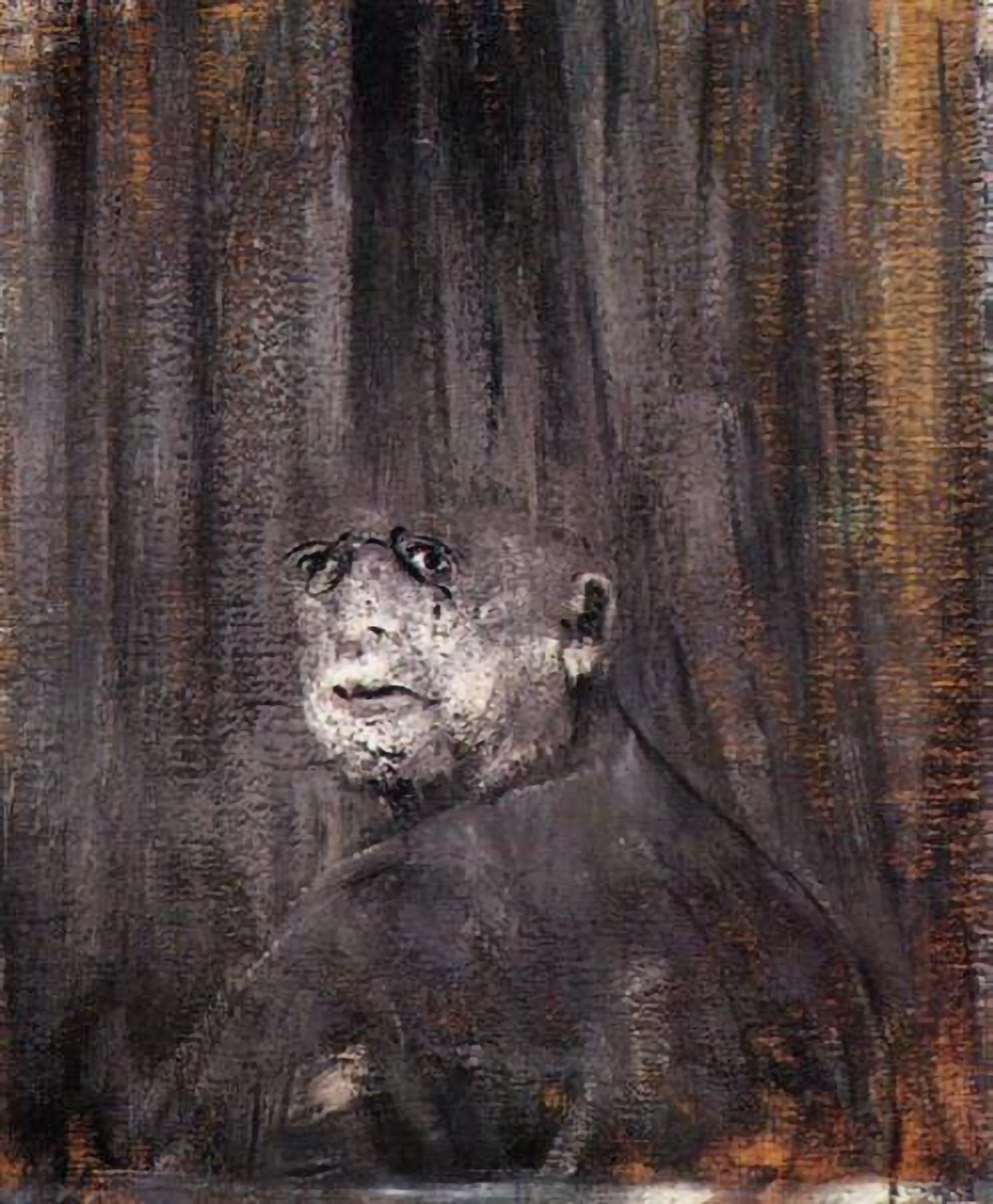
    Head III (1949), Francis Bacon | Wikimedia Commons. Bacon was an Irish-born British figurative painter known for his raw, unsettling imagery, and claimed that he strove to render “the brutality of fact.” This is neither his most abstract nor most macabre work, but one that I think speaks to the mind of humans when we think that we “know best.” There is a pride in this man’s demeanor and hints of scholarly knowledge in his eyeglasses. And while we see his features and face, it is as if they emerge with great effort, for he is but a shell of what a full human should be. Importantly, his mind is obliterated – lost to a vacuum of some sort rather than full and defined with actual Truth.

    “Moreover,” Jesus says, “I know that you do not have the love of God in you.” Oh, the shame and trembling if they only knew who was saying this to them! It is interesting to me that Jesus separates this ultimate sin of turning one’s back on God from the earlier point about them not wanting to come to him. Jesus instructs us here that one can be imperfect and prideful yet still perhaps have a kernel of God’s love inside them. Sadly, the Jews who disbelieve and accuse him are both prideful and lack God’s love inside them, meaning that the truth they supposedly found in the scriptures is not something they have incorporated into themselves. They lack God’s love out of their own fault, not because it has been withheld from them. This is a horrible state of affairs, a great affront to our Creator, to whom we owe our lives, our intelligence, our souls, everything. 

    But like the Father, the Son loves and gives mercy. Despite their accusations against him and their disbelief in who he IS, he says, “Do not think that I will accuse you before the Father: the one who will accuse you is Moses, in whom you have placed your hope.” Like the Father, he IS, meaning he will radiate and purify with his love through his actions and his very being. His saving mission at this moment in history is to teach, to suffer, to die, to resurrect, and to initiate the Church in Spirit and Truth.

    But we must remember his words from yesterday (part of this same dialogue), when he says, “[the Father] has given him authority to execute judgment, because he is the Son of Man.” This discussion, in other words, has an eschatological bent. It is concerned with everlasting life or everlasting torment. The Son’s mission isn’t done with the establishment of the Church — it will eventually conclude with his presiding over Judgement Day. He will embody the purifying love of the Father. He returns to that concept when he says “Do not think that I will accuse you before the Father.” It sends a chill up my spine to imagine how these unconverted Jews will wither when they see their great hero, Moses, prostrate before the Son of God and condemning them.

    The take-home message is clear: be grateful to God for your life and every blessing in it. Be faithful to God — especially when thinking and talking about him with others. Your testimony to the Truth of God and Jesus Christ is an essential element of your salvation. And, like Jesus tells us, whether you believe it or not, the Truth has already been testified to.

  • Lifted Like the Serpent

    Lifted Like the Serpent

    Sunday of the Fourth week in Lent: 2 Chronicles 36:14-16, 19-23, Ephesians 2:4-10, John 3:14-21.

    In today’s gospel reading, Jesus has a memorable meeting with Nicodemus, a Jewish member of the Sanhedrin, a faithful Jew, and eventually a full disciple of Jesus who comes with myrrh and aloes along with Joseph of Arimathea to retrieve his body from the Cross.

    Jesus presents himself to Nicodemus as a modern, living version of Moses’s serpent on the staff that saved the Jews bitten by poisonous serpents in the desert. While foreign to us if we are not versed in scriptures, this comparison would undoubtedly have been powerful and shocking for Nicodemus. In fact, Jesus’s words finally explain the significance of God instructing Moses to make a bronze serpent and mount it on a pole.

    As we dig into today’s gospel reading, we are struck with the entire span of salvation history from the Garden of Eden to Christ’s Paschal Sacrifice on the Cross. Also, we see Nicodemus as a true Christian, converted to Christ, moving from the darkness to the light.

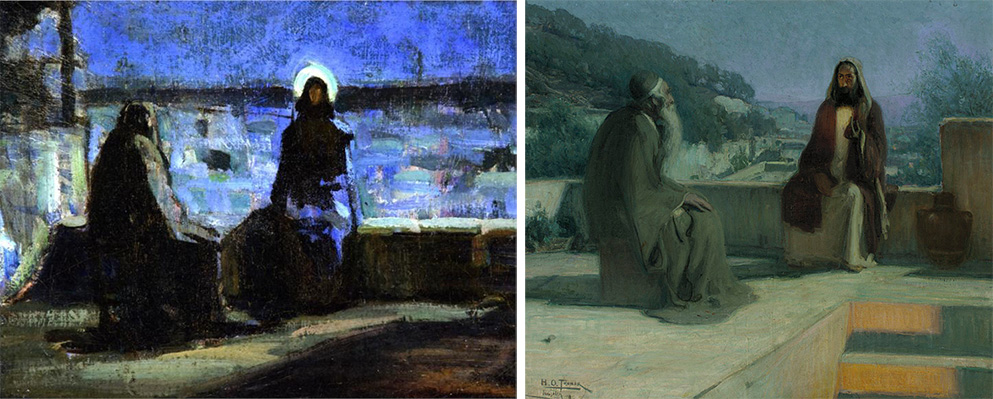
    Nicodemus and Jesus on a Rooftop (1899), Henry Ossawa Tanner | Wikimedia Commons. On the left is a study that Tanner did for the finished painting on the right. I appreciate the nimbus on Christ in the study, acknowledging that he is the “Light of the World,” despite the meeting occurring at night.

    St. John tells us that Nicodemus comes to Jesus by night. In just this simple statement, we can glean many things. Some scholars believe that a leader of the Jews would only come by night because it would be unseemly for a member of the Sanhedrin to join the crowds and rabble who followed this traveling preacher by day. Whether he was too busy with his duties, too proud to be seen going to learn from an unlearned miracle-worker, or too bashful to present himself openly, we encounter this powerful man coming to Jesus under cover of night.

    As historians and scholars have envisioned this meeting, there is a compelling argument that they met on a rooftop. First of all, this was (and is) common practice for men to retire to the rooftops after their evening meal on the hot, Middle Eastern nights, in order to enjoy cooling breezes. Second, Jesus makes some memorable statements about the air and the Spirit, likely choosing the moment when the phenomenon of the breeze could help him make this point: “The wind blows where it chooses, and you hear the sound of it, but you do not know where it comes from or where it goes. So it is with everyone who is born of the Spirit” (Jn 3:8).

    Jesus speaks of a spiritual logic unknown to those merely born of the flesh, encouraging Nicodemus to break out of his disbelief and earth-bound assumptions about what is possible. So, we see Nicodemus coming to Christ at night to know more about this man sent by God, and God, in return, engages him in the deepest truths. Is this not the exact journey we all make to Christ? Do we all not suffer from a certain bashfulness to approach Him openly in a culture where our faith is seen as antiquated, naïve, and gullible? Yet Jesus is there, waiting for us with deep truths.

    These deep truths are inevitably deeper than we are prepared to comprehend. Jesus reveals himself to Nicodemus as not just “a teacher who has come from God” (as Nicodemus calls him), but as the “Son of Man” and God’s “only Son.” And Jesus ups the stakes to eternal bliss or eternal damnation based on this very fact alone: “everyone who believes in him might not perish but might have eternal life … but whoever does not believe has already been condemned, because he has not believed in the name of the only Son of God.” Nicodemus definitely got more than he bargained for by coming to this “teacher” by night.

    As we think about this “all-or-nothing” statement by Christ, we are reminded of the gospel a few days ago where he proclaimed, “whoever is not with me is against me,” that is, scattering people instead of gathering to the Kingdom. Why does our Lord deal in these absolutes? There can be no doubt here that he is asking us to be “all-in,” much like he asked Abraham to sacrifice his son or Noah to build the ark (see the post, A Glimpse of Heaven). And just as Abraham’s assent was blessed by founding the nations and Noah’s assent was blessed by saving humanity from destruction, our assent to Christ will be blessed with everlasting life.

    In all cases, the call is personal. It is an individual meeting with the unfathomable God. Just like Nicodemus, we all must go to have a personal encounter with Christ to listen to what he has to tell us.

    Pope Benedict the XVI put this succinctly at the beginning of his encyclical on love: “Being Christian is not the result of an ethical choice or a lofty idea, but the encounter with an event, a person, which gives life a new horizon and a decisive direction” (Deus Caritas Est, 1). Today’s gospel is one of many very concrete examples of this encounter in action. 

    Jesus proclaims elsewhere in John’s gospel, “I am the light of the world” (Jn 8:12), and he makes a similar statement here with Nicodemus. His words may have stung Nicodemus, since he came to Christ at night:

    “And this is the verdict, that the light came into the world, but people preferred darkness to light, because their works were evil. For everyone who does wicked things hates the light and does not come toward the light, so that his works might not be exposed. But whoever lives the truth comes to the light, so that his works may be clearly seen as done in God.”

    He is urging Nicodemus to come to him in the light of day, openly. But more than that, he needs Nicodemus to understand that God and truth dwell in the light, and this is something to always glory in, to be proud of; in fact, by believing in this truth and light, and acting in it, a person is securing for himself or herself a place in Heaven.

    Jesus mentions the concept of being exposed, and there is absolutely an aspect of vulnerability in this. As he says, the “verdict” is that “people preferred darkness to light,” thus living in the light does not exempt one from pain and suffering as a result of this exposed vulnerability. This fact is wonderfully demonstrated in Jesus’s incredible comparison of himself to Moses’s serpent on the staff.

    That story from the Book of Numbers speaks of events 1,475 years before Christ sits with Nicodemus on the roof. The passage is exceedingly odd at first glance: God first punishes the Israelites for complaining by sending poisonous serpents among them. In terms of today’s gospel, we could say that they are living in darkness (complaining and turning from God), and as a result they are bitten by serpents and die. Upon their admission of guilt and atonement, Moses prays for deliverance. At this point, God instructs Moses to mount a bronze serpent on a pole; subsequently, when the people look up at the serpent on the pole after being bitten, they are spared from death.

    Before we wonder what kind of witchcraft is going on here, let’s again consider it in terms of today’s gospel reading: by looking up at the serpent, the Jews in the desert are re-confirming their belief in God, who promises to protect them. They gaze upon the source of their suffering, the serpent, exposed, held up in the light for all to see, and they do not die. Importantly, they do not avoid suffering (that is, they continue to be bitten by serpents), but they avoid death through their continually re-confirmed faith in God.

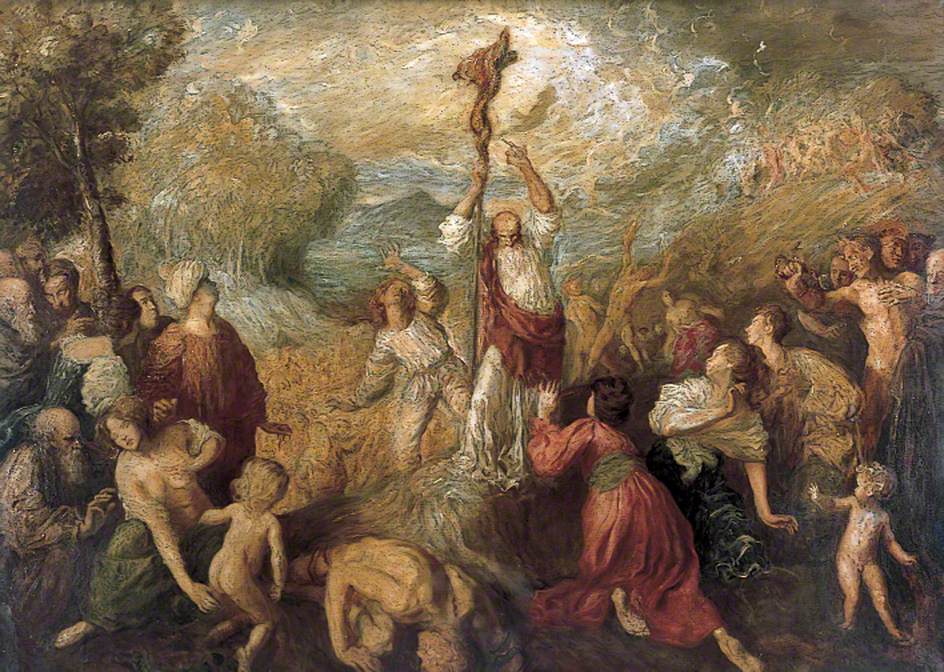
    Moses and the Brazen Serpent (1898), Augustus John | Creative Commons, courtesy UCL Art Museum/ArtUK. I like the impressionistic style Augustus John employs in this painting, the flowing waves suggesting a divine entrance into the fabric of humanity. As with any encounter with the divine, sin will merit pain and “gnashing of teeth,” and the purifying energy of God may not be pleasant for those in sin. I also see a bit of the devil in the bare-chested man on the right side of the canvas, which for me, at least, recollects the Garden of Eden connection. 

    It would be fair to say that the serpent is the symbol of humanity’s sin against God, ever since Adam and Eve in the garden. This sin is poisonous and it brings about the reign of death. The people repent and say to Moses, “We have sinned in complaining against the LORD and you. Pray the LORD to take the serpents away from us.” The act of looking up, heavenward, to the sign of the sin they lived with, is the action that reminds them of their dependence on God and his saving mercy. God’s divine mercy flows to the sinful, bitten individual in that moment, not through the arcane power of a bronze staff, but through the symbol that the staff presents to the Jewish believers in God.

    As Catholics, we know well that, in the liturgy, divine sanctification works in and through symbols, from the altar and ambo to the bread and wine. The bronze serpent on the staff is this type of sacramentalized symbol that his prophet on earth made under his instruction.

    The Jews understood the symbolic importance of this staff as a way to encounter God’s grace and they kept the physical staff around for centuries. They may have begun to confuse the symbolic function of the staff with a divine presence, however, because 740-ish years later we read in 2 Kings that King Hezekiah orders the destruction of the staff, which he calls Nehushtan (“a mere piece of brass”) because the Jews were burning incense to it and essentially treating it like an idol. 

    Now I don’t know much about divine numerology, but I do find it interesting that exactly another 740-ish years later, we hear Jesus tell Nicodemus the Pharisee: “just as Moses lifted up the serpent in the wilderness, so must the Son of Man be lifted up, that whoever believes in him may have eternal life.” With this statement, the Word of God reveals the full scope of this symbol Moses was instructed to make. “Just as Moses lifted up the serpent”: note that the parallel being drawn is to the fixing of the serpent to the pole and lifting it up, the fact of exposure for all to see. “So must the Son of Man be lifted up”: this refers to his Crucifixion, where he becomes the ultimate symbol for humanity. And finally the salvific import: “that whoever believes in him may have eternal life.” Like the sinful Jews who re-confirmed their belief in God and were saved from dying, we receive an infinitely greater promise and divine grace given to us when we behold Christ on the Cross, believe in him, and are granted eternal life that eradicates all sway of death.

    Yes, consider this! Christ is admitting that living in the light constitutes suffering at the hands of those who live in the darkness. What greater sign than his broken and crucified Body hanging on the Cross for all to see? But just as the suffering from being bitten by serpents is ameliorated by gazing at that exposed suffering on a pole, our suffering from sin in this life is ameliorated by gazing on the Lord’s suffering on the Cross, done for our sakes. This is exactly what “on our behalf” entails!

    He allowed himself to be affixed on the Cross like the serpent on Moses’s staff so that we could have salvation as we gaze upon him and live in his light!

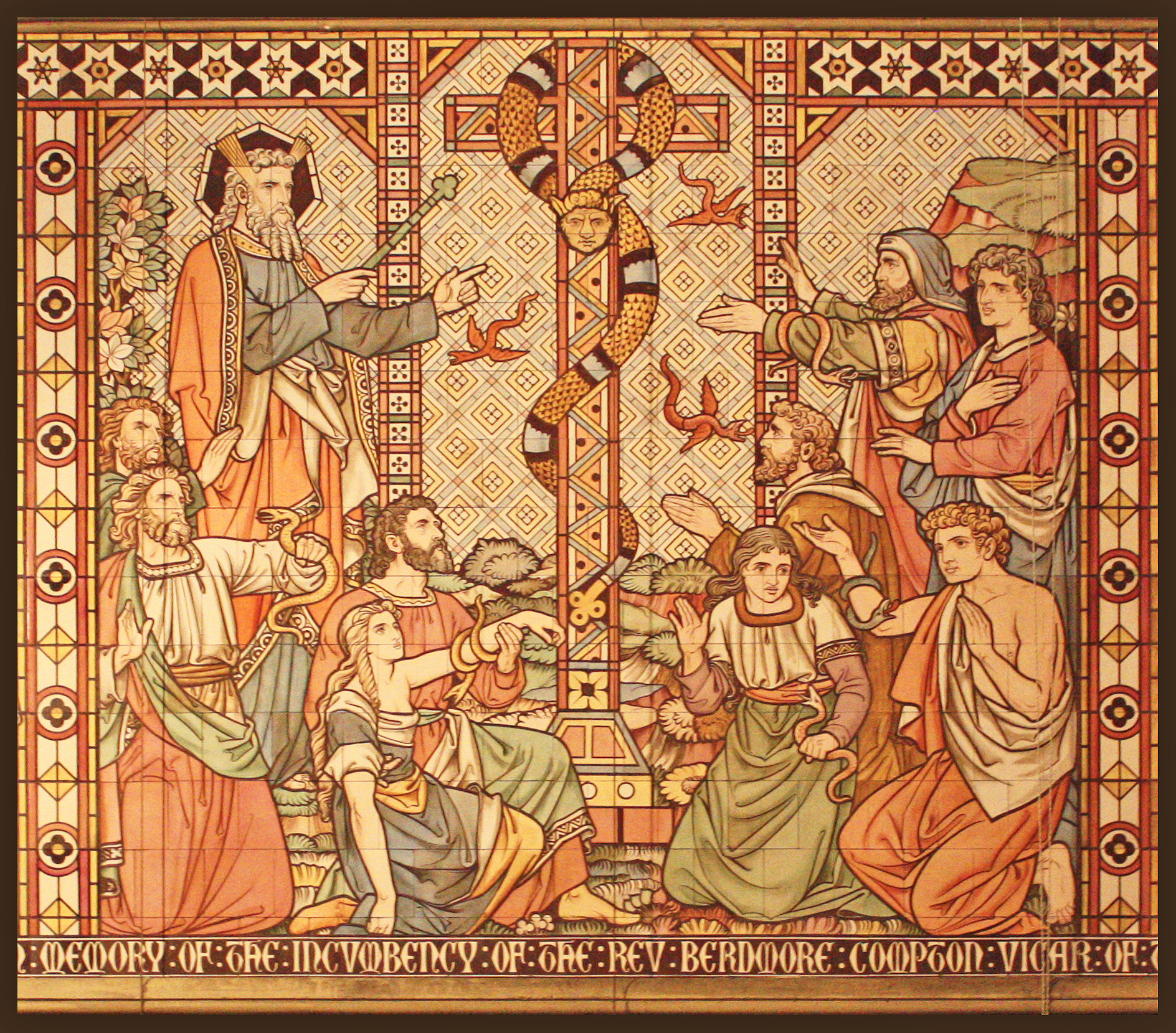
    Moses and the Bronze Serpent, mural in All Saints Margaret Street church in London (1889), tiles painted by Alexander Gibbs | photo courtesy Lawrence OP, flickr.com. Note that over the centuries, the connection of the bronze serpent and the cross has been made much more explicitly, as in this tile work.

    Sometimes the scope of God’s saving plan is just breathtaking. So many moments of patience and mercy over the millennia, from Adam and Eve, through Moses, and ultimately Jesus Christ. And so subversive of our normal worldly affections, too, in the use of the lowly and hated serpent as a resounding symbol for overcoming sin, much like using the reviled Cross as a throne for our Savior.

    I am brought back to the all-or-nothing statements we keep encountering this Lent. After this reflection, I am struck by the fact that Jesus is saying these absolutes because he must remind us that he is God’s plan, God’s gift. To not recognize and believe in him is to throw God’s gift back in his face. It is worse than living in sin — it is a deliberate act of defiance and rejection of our Creator. We must listen to Christ, and St. Paul does a fantastic job of reminding us in today’s second reading: “God, who is rich in mercy, because of the great love he had for us, even when we were dead in our transgressions, brought us to life with Christ — by grace you have been saved.”

    Serpent Illustration by Katie Scott | courtesy katie-scott.tumblr.com.
  • Bridging Salvation History with a Serpent

    Bridging Salvation History with a Serpent

    Tuesday in the Fifth Week of Lent: Numbers 21:4-9, John 8:21-30.

    Today’s readings present us with a seminal scene from the Old Testament that bridges the entire span of salvation history from the Garden of Eden to Christ’s Paschal Sacrifice on the Cross. In the gospel, Jesus speaks of himself in terms of the actions of Moses in the Old Testament reading, and in this way, the two passages — 1,475 years apart — shed light on one another.

    Serpent illustration by Katie Scott | courtesy katie-scott.tumblr.com.

    The passage from the Book of Numbers is exceedingly odd at first glance: the Lord punishes the Israelites for complaining by sending poisonous serpents among them; upon their admission of guilt and atonement, Moses prays for deliverance, after which God instructs him to mount a serpent on a pole; subsequently, when the people look up at the serpent on the pole after being bitten, they are spared from death. What kind of witchcraft is going on here? A magic serpent staff to ward off a plague of poisonous snakes?

    Let’s slowly interrogate this story to understand what’s going on. First, what is this great sin that deserves a plague of poisonous snakes? On one hand, it seems like somewhat innocuous, albeit irritating, grumbling. We hear, “But with their patience worn out by the journey, the people complained against God and Moses.” This is just human nature, right? However, it wasn’t general complaining, it was complaining specifically against God and Moses. It showed a lack of trust, despite the wonders given to them in escaping Egypt, encountering God on Mt. Sinai, receiving the commandments, being given manna and quail and water from a rock.

    Mistrust in the midst of wonders — does this remind us of anyone? How about Adam and Eve? And who plants the seeds of mistrusting God in the mind of Eve but the serpent? Thus, God’s sending of the serpents is the reminder of humanity’s original sin in mistrusting God’s providence and grace.

    It would be fair to say that the serpent is the symbol of humanity’s sin against God. This sin is poisonous and it brings about the reign of death. The people repent and say to Moses, “We have sinned in complaining against the LORD and you. Pray the LORD to take the serpents away from us.” The first requirement in the recipe for God’s mercy has been met: contrition. Next comes Moses’s prayer, followed by divine mercy in the form of … well, another serpent. God instructs Moses to “mount it on a pole, and whoever looks at it after being bitten will live.”

    The Word of God truly seems baffling here, operating on a level that is not immediately evident. Nonetheless, being the obedient servant of God that he is, Moses complies with the Lord’s instructions, “and whenever anyone who had been bitten by a serpent looked at the bronze serpent, he lived.” The act of looking up, heavenward, to the sign of the sin they lived with, is the action that reminds them of their dependence on God and his saving mercy.

    God’s divine mercy flows to the sinful, bitten individual in that moment, not through the arcane power of a bronze staff, but through the symbol that the staff presents to the Jewish believers in God. As Catholics, we know well that in the liturgy, divine sanctification works in and through symbols, from the altar and ambo to the bread and wine. The bronze serpent on the staff is this type of sacramentalized symbol that his prophet on earth made under his instruction.

    Moses and the Brazen Serpent (1898), Augustus John | Creative Commons, courtesy UCL Art Museum/ArtUK. I like the impressionistic style Augustus John employs in this painting, the flowing waves in the forms suggesting a divine entrance into the fabric of humanity. As with any encounter with the divine, sin will merit pain and “gnashing of teeth,” and the purifying energy of God may not be pleasant for those in sin. I also see a bit of the devil in the bare-chested man on the right side of the canvas, which for me, at least, recollects the Garden of Eden connection. 

    The Jews understood the symbolic and importance of this staff as a way to encounter God’s grace and kept it around for centuries. They may have begun to confuse the symbolic function of the staff with a divine presence, however, because 740-ish years later we read in 2 Kings that King Hezekiah orders the destruction of the staff, which he calls Nehushtan (“a mere piece of brass”) because the Jews were burning incense to it and essentially treating it like an idol. 

    Now I don’t know much about divine numerology, but I do find it interesting that exactly another 740-ish years later, we hear Jesus tell Nicodemus the Pharisee: “just as Moses lifted up the serpent in the wilderness, so must the Son of Man be lifted up, that whoever believes in him may have eternal life” (Jn 3:14-15). With this statement, the Word of God doesn’t just restore the symbolic importance of the serpent staff, he also reveals the full scope of this symbol Moses was instructed to make.

    “Just as Moses lifted up the serpent” — note that the parallel being drawn is to the fixing of the serpent to the pole and lifting it up, not to the serpent itself (in other words, Jesus is not comparing himself to a serpent!). “So must the Son of Man be lifted up” — this refers to his crucifixion, where he becomes the ultimate symbol for humanity; and note that he refers to his human nature here when saying “Son of Man” to emphasize that the same sin symbolized by the serpent is being affixed to the cross in the sins of the human person, for which Jesus stands in as a sacrificial lamb.

    And finally the salvific import: “that whoever believes in him may have eternal life.” Just as the Jews who were sinful and bitten by snakes saw the staff were reminded of their belief in God and were saved from dying at that moment, we have an infinitely greater promise and divine grace given to us when we behold Christ on the Cross, believe in him, and are granted eternal life that eradicates all sway of death, as if it is only sleep by another name (as we explored in the reflection, See the Glory of God).

    Moses and the Bronze Serpent, mural in All Saints Margaret Street church in London (1889), tiles painted by Alexander Gibbs | photo courtesy Lawrence OP, flickr.com. Note that over the centuries, the connection of the bronze serpent and the cross has been made much more explicitly, as in this tile work.

    Sometimes the scope of God’s saving plan is just breathtaking. So many moments of patience and mercy over the millennia, from Adam and Eve, through Moses, and ultimately Jesus Christ. And so subversive of our normal worldly affections, too, in the use of the lowly and hated serpent as a resounding symbol for overcoming sin, much like using the reviled Cross as a throne for our Savior.

    All of this brings us to today’s gospel, where Jesus tells the Pharisees “if you do not believe that I AM, you will die in your sins.” This is one of a series of super bold statements John reports of Jesus. It doesn’t get much more blunt than this; by invoking the name of YAHWEH in reference to himself (I AM Who I AM), Jesus is clearly saying that he is God as well as a man. Plus, he tells them that only a belief in him as God will save them from dying in sin. We can hear echoes of his conversation with Nicodemus, “whoever believes in him may have eternal life.” His message is consistent and resounding: he is to be the symbol of sin pinned down, raised up on a Cross in hatred by men, but in reality a sacrament of God’s grace and love. This is the Word of God writ large in the temple; this is stunning.

    The Pharisees don’t get it. All they can say is, “Who are you?” The scribes and Pharisees in John’s gospel seem to be stuck in this morass of defining Jesus’s provenance. Later in this chapter, they will say, “Aren’t we right in saying that you are a Samaritan and demon-possessed?” And we’ve already heard them get hung up on their belief that the Messiah could never come from Galilee. Over and over, Jesus tries to tell them that he is from the one “who is true,” that His Father is in heaven. But this truth is too radical, too supernatural, too blasphemous in their minds to even compute.

    Jesus tries again in today’s reading to make Himself clear:

    When you lift up the Son of Man,
    then you will realize that I AM,
    and that I do nothing on my own,
    but I say only what the Father taught me.
    The one who sent me is with me.
    He has not left me alone,
    because I always do what is pleasing to him.

    Again, it is simply stunning to me how he refers to himself as “I AM” and constantly puts the focus back on God the Father. It is plain as day. Whoever tries to tell you that Jesus was a social rabble-rouser and malcontent, like so many other “Messiahs” at this point in history, well that person needs to read the Bible a little more closely. What political activist uses his moment in the limelight to say “I do nothing on my own but I only say what the Father taught me”?

    He does not seek glory and he has hard teachings (such as eating his Body and drinking his Blood for salvation) that push away many would-be followers. And he literally schools the experts in Jewish law (see yesterday’s post), establishing his own wisdom and command over divine teaching. Finally, we have his selfless, miraculous death and resurrection, when the Son of Man is raised like the serpent staff of Moses for us to gaze upon. 

    Our only job at this point is to believe. To fully believe after we have been given such wonders. Let us not be like Adam and Eve and mistrust God in the midst of the wonders we are given. Let us not be like the Israelites in the Exodus who do the same. We are a new people, the Church, in a New Covenant, and have been given the greatest sacrament of all.

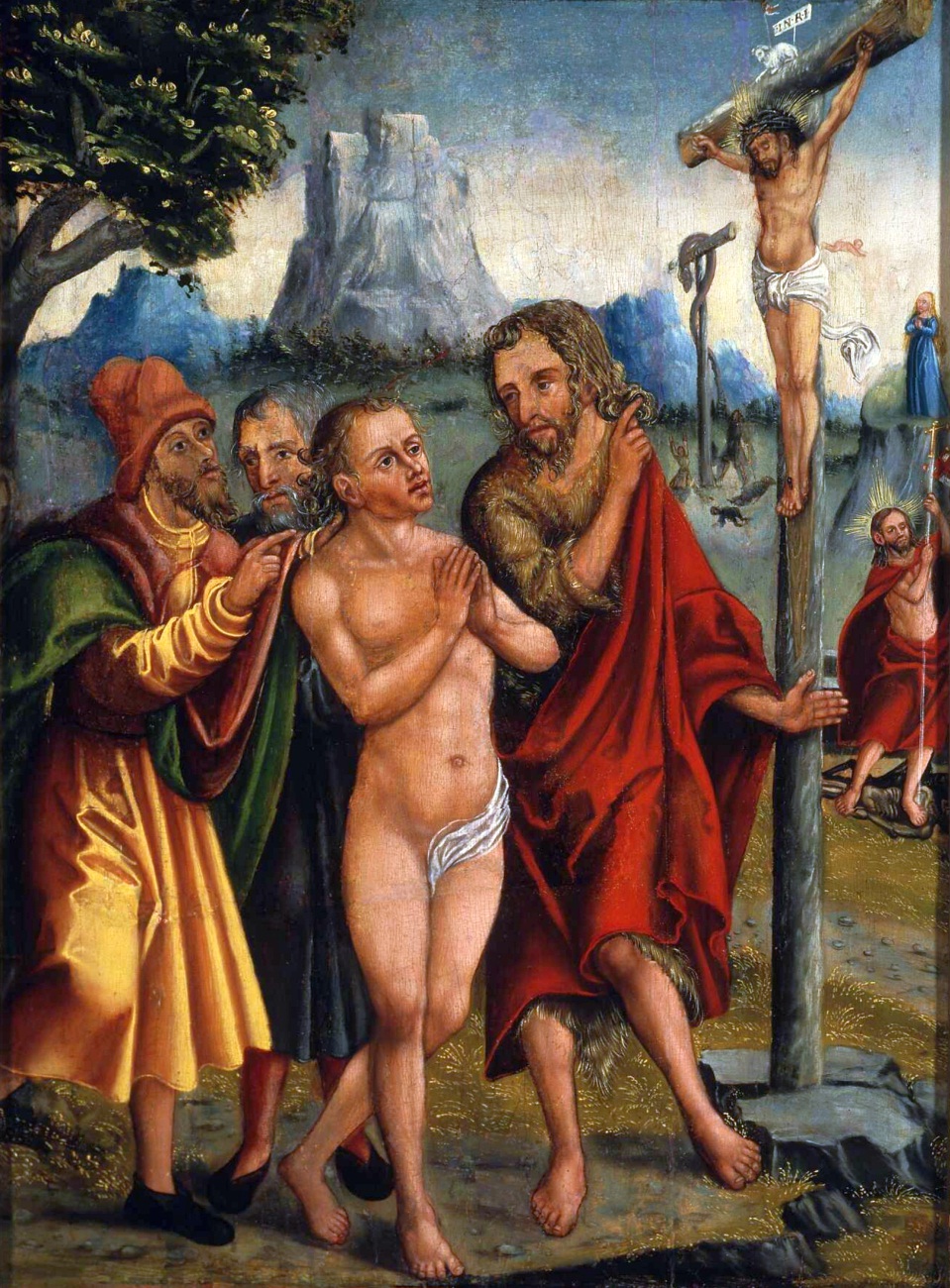
    Allegory of Salvation (c.1555), Antonius Heusler | Wikimedia Commons. The description states: John the Baptist makes a man (Adam), clothed only with a loin cloth aware of the crucified Jesus. Behind the man are standing Isaiah and an apostle. In the background are shown the Brazen Serpent, the Annunciation to the Virgin and Christ triumphing over Death and the Devil.
  • Our Vocation to Teach the Word of God

    Our Vocation to Teach the Word of God

    Wednesday in the Third Week of Lent: Deuteronomy 4:1, 5-9, Matthew 5:17-19.

    Today’s readings show Moses and the new Moses (Christ) discussing God’s law and urging their listeners to not only obey it but teach it to future generations. Jesus’s words occur during the Sermon on the Mount when he shares the Beatitudes, and they are a powerful claim on his Kingship.

    Once chosen by God, Moses seems to be in near-constant communication with him. I’m sure that’s not quite true, but when reading Exodus and Deuteronomy, I’m struck with just how much the two of them spoke. The Word of God is not only with him verbally, but eventually on “tablets of stone, written with the finger of God” (Ex 31:18).

    The Word is extraordinarily active, first as prophecy bringer, then miracle worker, deliverer, satisfier of human needs, and finally, upon Mt. Sinai, law-giver. God continues to reach out to his people, manifesting his presence as a response to their incapacity to recognize him and hold him in their hearts. The law written on stone tablets is a capstone on his work establishing the nation of Israel, rescuing them from enslavement.

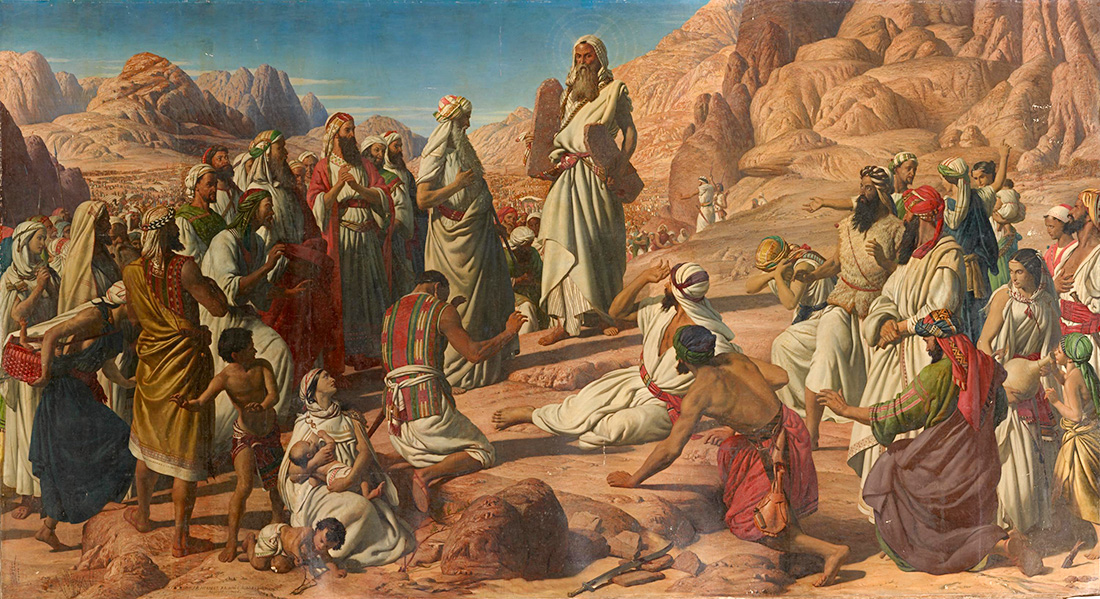
    Moses bringing down the Tables of the Law (1877), John Rogers Herbert | Creative Commons, courtesy the National Gallery of Victoria, Melbourne, Australia. This monumental work of art is 11 feet high and nearly 21 feet wide, suiting the monumental nature of the event. As someone who lives in Utah, I also appreciate the red rock desert depicted here it all its beautiful barrenness.

    Laws on stone tablets (not to mention the much more extensive precepts given to Moses verbally) seem fairly final in their permanence, but God’s aim is to inscribe his law on the hearts of his people, not on stone. Indeed, while he’s inscribing the first set of stone tablets, the Israelites are busy building and worshipping a golden calf at the base of Mt. Sinai. He eventually gives Moses a second set of tablets after Moses smashes the first ones in his anger and shock over the Israelites unfaithfulness while he was on the mountain for 40 days and nights.

    So today’s reading shows Moses imploring God’s fledgling people not to forget (again) God’s works, providence, and laws. After stressing God’s laws and decrees, Moses tells them “not to forget the things which your own eyes have seen, nor let them slip from your memory as long as you live, but teach them to your children and to your children’s children.” Like God, Moses understands that the laws must be inscribed in their memory and on their hearts, not just on stone tablets.

    Moses spends the bulk of the Book of Deuteronomy teaching them the laws and decrees. At one point, though, he summarizes the multitude of prescriptions: “what does the Lord your God require of you? Only to fear the Lord your God, to walk in all his ways, to love him, to serve the Lord your God with all your heart and with all your soul, and to keep the commandments of the Lord your God and his decrees” (Dt 10:12-13)

    We see over time that the Israelites struggle with both keeping both the letter of the law and the spirit of the law. Jesus enters history at a time when the Pharisees and scribes are experts in the letter of the law but do not uphold the spirit of the law. Jesus points out that they have ended up fetishizing the law, as demonstrated by their physical appearance: “they make their phylacteries broad and their fringes long” (Mt 23:5). Phylacteries are boxes affixed to the head and left arm that contain slips of paper with scriptural passages. The tassels on their clothing were commanded in the Book of Numbers by God to be worn as a reminder to keep his commandments. They take these devices meant to remind a person to turn inwardly to God and make a show of them, boasting outwardly that the law resides with them.

    Today’s gospel reading marks how Jesus reconciles, joins, and perfects the letter and the spirit of the law in himself. It comes shortly after the Beatitudes, towards the beginning of the lengthy Sermon on the Mount. Let’s imagine the excitement in the air with the crowds gathered around him, the Sea of Galilee the backdrop for a miracle worker preaching with authority.

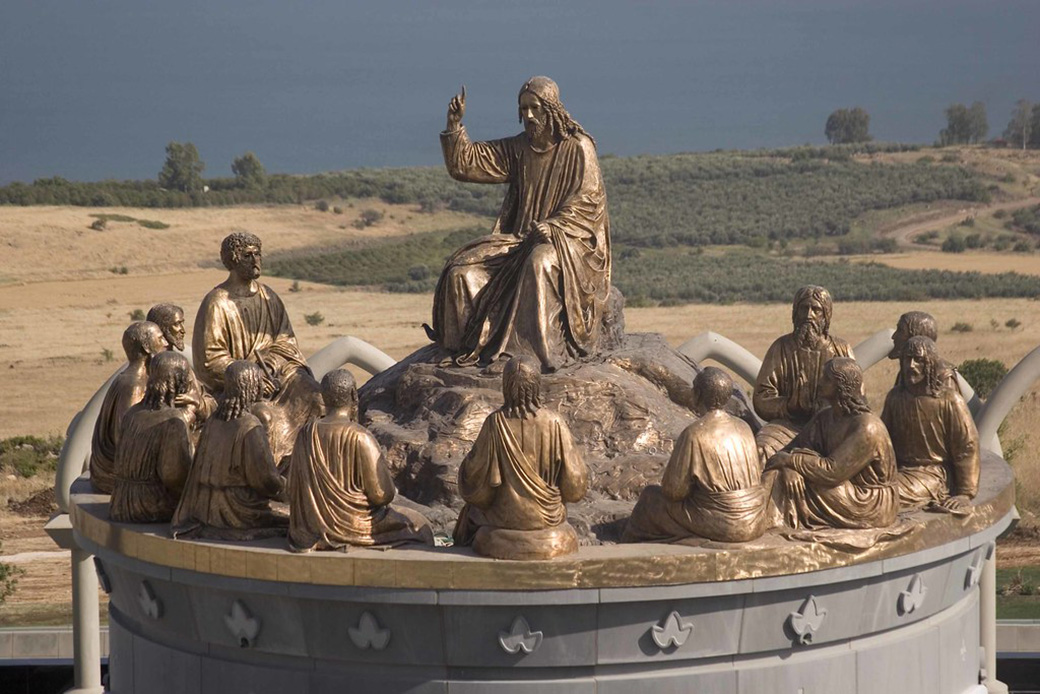
    Statues depicting Christ preaching the Sermon on the Mount, located above the Chapel of Adoration at Domus Galilaeae International Center, near the summit of the hill known as the Mount of the Beatitudes. The Sea of Galilee can be seen in the background. The actual figures are slightly larger than human scale.

    The Beatitudes seem to turn everything on its head. Blessed are the poor in spirit, the meek, the merciful, the peace makers — all figures of weakness who are guaranteed the earth and the kingdom of Heaven. Many who were listening may have thought this was a new revelation, perhaps the beginning of a new sect of Judaism. But, as Fr. Erasmo Leiva-Merikakis points out,

    “Jesus likewise surprises everyone by here defining himself over against mere religious anarchists and innovators, all those who would in fact invent on the spot a religious ‘tradition’ that is nothing more than a projection of their own frustrations, opportunism, political programs, and spiritual arbitrariness, often masquerading under the names of ‘mysticism’ and ‘spiritual authenticity’” (Fire of Mercy, Heart of the Word, Vol I, p. 211).

    Jesus surprises everyone by stating, “Do not think that I have come to abolish the law or the prophets; I have come not to abolish but to fulfill.” Contrary to that Baby Boomer we know at our church who always says, “Jesus was the first hippy,” he most definitely was not. He is not anti-establishment for the sake of disrupting social order. He is not just preaching peace, love and joy (although these are aspects of his teaching). He is the Law (its fulfillment in fact) and he is the Spirit. His being and ministry unite these seemingly disparate but in fact unified things. 

    When he says, “I have come,” he speaks not of coming to the mountain or coming to Galilee, but of coming in the more general sense, coming to earth. He refers to his purpose. It is an astounding message for the Jews who were listening and a good reminder for us now. Everything that they have founded their nation upon, from Moses and the Ten Commandments to the finicky rule-following of the Pharisees in their own time, is being fulfilled by Jesus. Not added onto, not adjusted, not clarified, but fulfilled. Either this was a seriously self-deluded man or it was God Himself. The mystical realities presented in the New Testament prove the second option.

    There is something new about his Word, but he is careful to point out that this newness is a fulfillment, not a breaking with the law that has been established. A megalomaniac savior figure would likely have wanted to start his own cult, but as we realize that Jesus is the Word of God, this is preposterous. He does not propose a schism or something “better.” The New Covenant (which is Christ Himself, body, teaching, and Spirit) is offered to us from God like the other covenants, superseding the ones that came before, but from the same originator (see the reflection The Difficult New Covenant of Love for more discussion here).

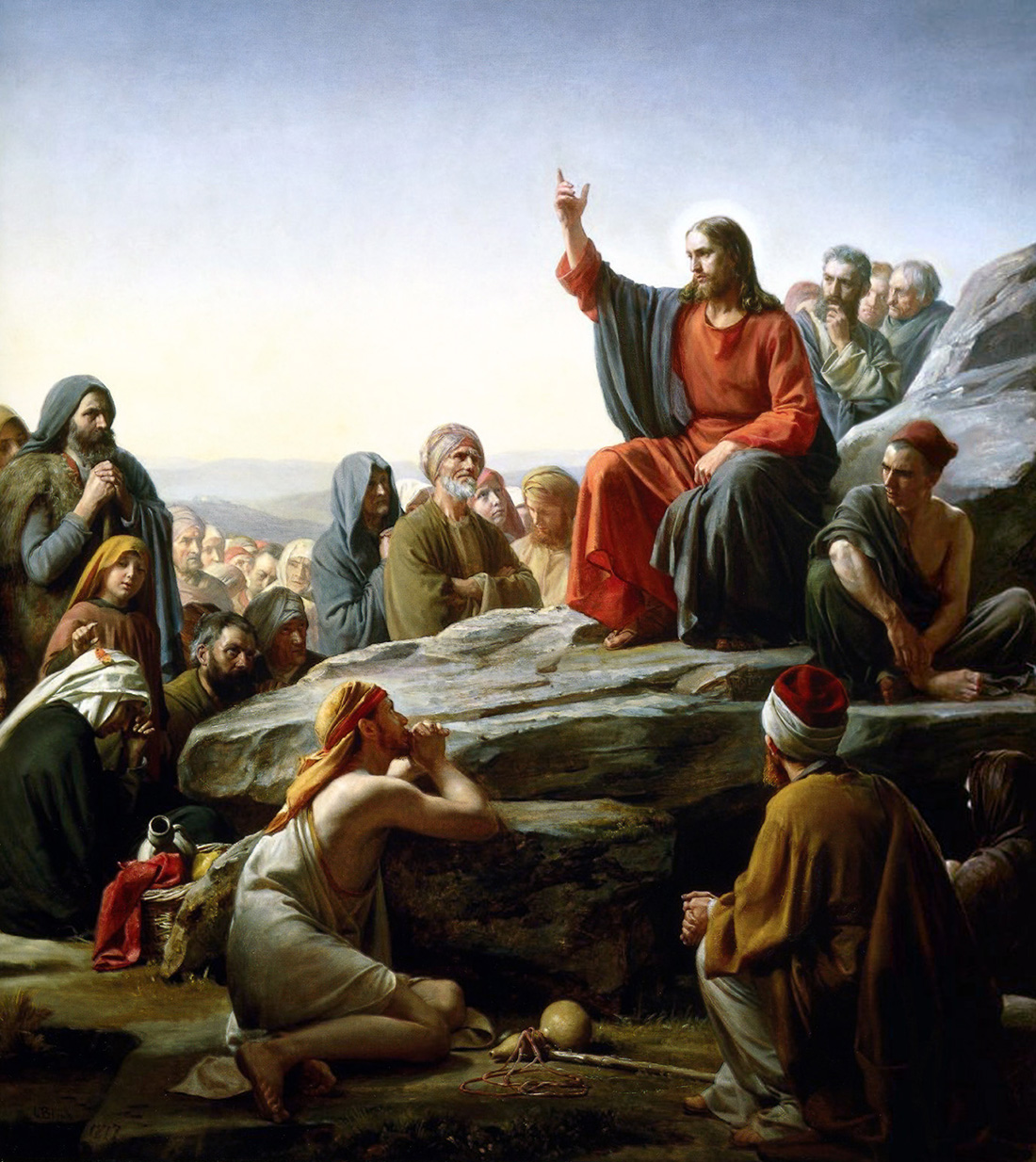
    The Sermon on the Mount (1877), Carl Bloch | Wikimedia Commons.

    Why do both of today’s readings speak of our participation in teaching the law? Moses urges his people to teach all future generations about what they hear and see. Jesus goes a step further and says, “whoever obeys and teaches these commandments will be called greatest in the Kingdom of heaven.” To answer this, let us ponder the nature of the Word of God.

    Just as God is characterized by the fullness of all that is good (see yesterday’s reflection, Mercy is the Master Principle), implicit in the Word of God is that fullness in communication. It is at once declarative, imperative, exclamatory, and even interrogative in its request to have us comprehend. It engages us wholly, it elicits a response (in prayer, in study, in action). 

    Also, when we say that the Word of God is given to us for our own benefit, this has many layers of meaning. It benefits us on a physical level by ordering us correctly in relation to one another, enabling just dealings and charity for all to live. It benefits us on a moral level, ordering our actions to the good rather than the evil, and leading us towards salvation. Finally, it benefits us on a spiritual level by uniting us with its author, God. Every benefit requires us to participate with it, however.

    The Word lives organically in our world both because of its nature as being the fullness of communication and because God deemed that we should have free will and choose to interact with him of our own accord. When we do interact with God through his Word, it lives in us (precisely by ordering us for physical, moral, and spiritual well-being). We become caught up in the Word, intertwined with the Word. What could be more satisfying as a human being than to be lifted into higher graces and levels of being than to be intertwined with the Word of God?

    Here’s the great bit: in a spiritual symbiosis, we engender more life for the Word of God in our world when we teach it to others. At the same time, the Word strengthens us and brings us closer to its author. God does not need us to do this work — it’s not as if the Word of God would somehow peter out if we stopped teaching it — but this is the great vocation God has granted us. It is part and parcel of his injunction to share his mercy and charity throughout the world (again, see yesterday’s reflection). Like granting others mercy and performing acts of charity, our very act of teaching lifts us spiritually, delights God on a visceral level, and brings us closer to him. That is why Jesus says, “whoever obeys and teaches these commandments will be called greatest in the Kingdom of heaven.” Obeying and teaching is the union of the letter and spirit of God’s law in us.

    Additionally, to be able to teach something the way Jesus does means that you more than understand the Word; you are living with the Word and therefore setting a living example of the teaching. This is why Jesus gets so upset with the Pharisees, who pose as the ultimate teachers but have somehow removed living the Spirit of the law from knowing the letter of the law. 

    Jesus is the fulfillment of the law that he, the Word of God, first spoke to Moses, precisely because he can live it perfectly. He is rightfully seen as our King. Every word and act he performs on earth is pregnant with the depth of God’s message for us.

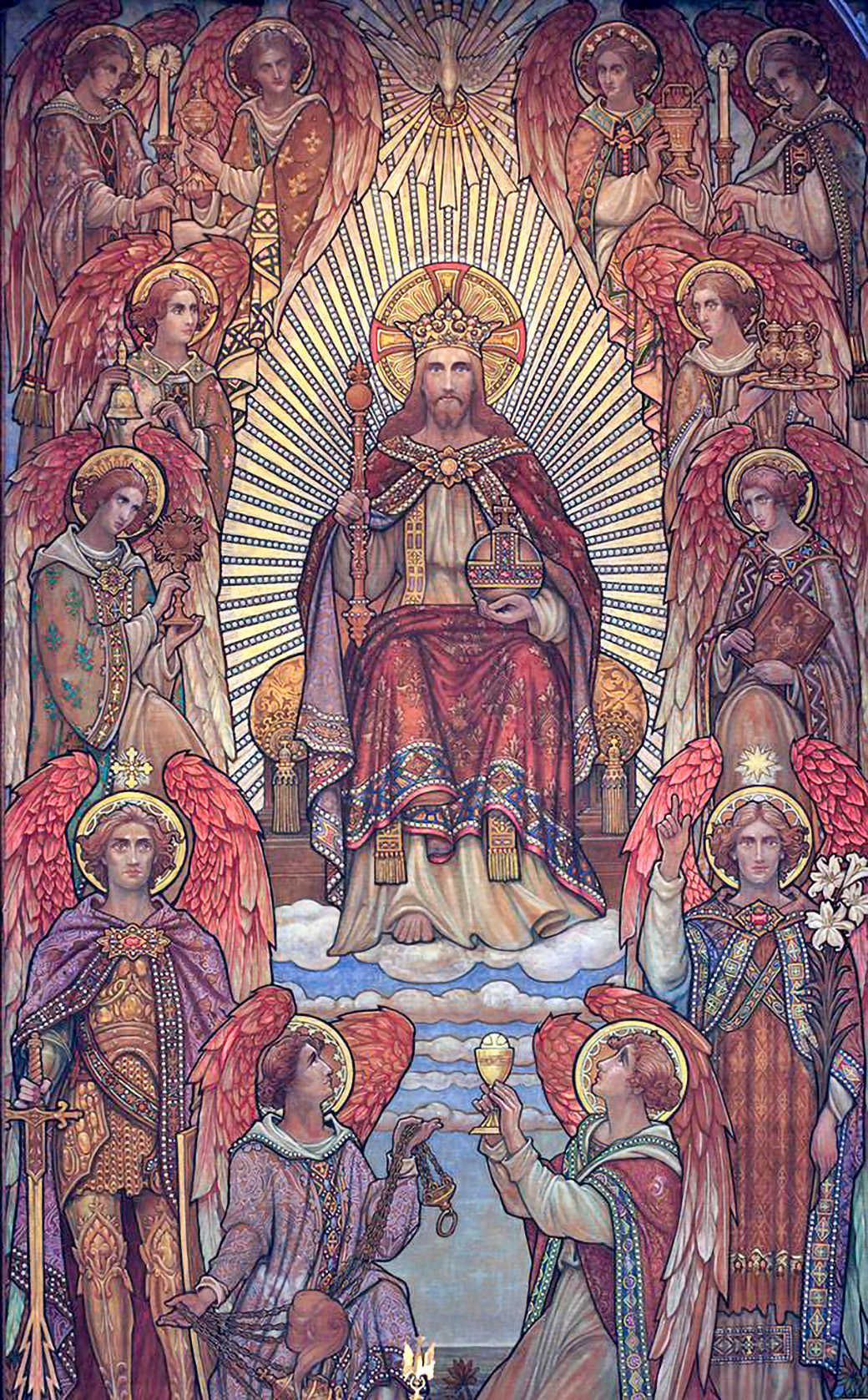
    Christ the King tapestry hung at the altar of St. James the Greater Church in St. Louis, Missouri, artist unknown.

    It is worth reflecting upon the awesome glory contained in our God-and-man Jesus Christ. To have your purpose be the very fulfillment of the law and covenants God has made with humanity! To become a suffering sacrifice for the entire human race, offered as the means to rescue us from the slavery of death and sin! To become a sacrament in body and Spirit!

    Did Mary have an inkling of this when she accepted the Incarnation given to her? Jewish women of her time were primed with the sure knowledge that one of them would bear the Messiah to the nation, but to have it come about in humbleness and end in seeming humility, only to burst forth in the liturgy of true communion with God … what a strange king! He leads us to a wholly different land with wholly different goals, but He is the truest King the world will ever know.