
Tag: sin

  • The Dense Life

    The Dense Life

    Wednesday of the Fifth Week of Lent: Daniel 3:14-20, 91-92, 95, John 8:31-42.

    Ah, freedom! It’s a major aspect of today’s gospel reading. Who knows more about freedom than the American (so we tell ourselves)? There was an article in one of our local news outlets, the Deseret News, just before the November 2020 presidential election that shed a lot of light on how Americans have thrown their notions of the constitution, the symbol of the flag, and personal freedoms into a blender to arrive at a specific brand of in-your-face freedom.

    The article is called Big Flags on Big Trucks, and details the phenomenon of “caravanning as a conservative way of protesting,” including a 6-mile-long train of trucks and cars flying flags and pro-Trump propaganda that drove the 380-mile length of Utah’s I-15 in late October, 2020. Now, people’s political persuasions are not my concern with this site. A quote from this article, however, reveals something about how Americans have twisted the concept of freedom to mean the opposite of what Christ means.

    “Liberals are always in your face. They want to push their opinion on you,” says a 22-year-old construction worker quoted in the article, “I have freedom of speech. I can say what I feel too.” Indeed, on both sides of the political spectrum, freedom means the unfiltered, unregulated firehose of opinion. Because American “freedom” implies the lack of any check or law, it has instilled a type of anarchy in the national psyche.

    It’s not too much of a leap to claim that Americans still have a bit of the wild West in them, feeling like they have the right to take matters into their own hands — certainly with words, but also with actions, guns, whatever. Our concept of freedom empowers us to “say what I feel” or “do as I please.” The result is that we envision ourselves as mini deities, marching about the world according to rules that we make up for ourselves, or no rules at all.
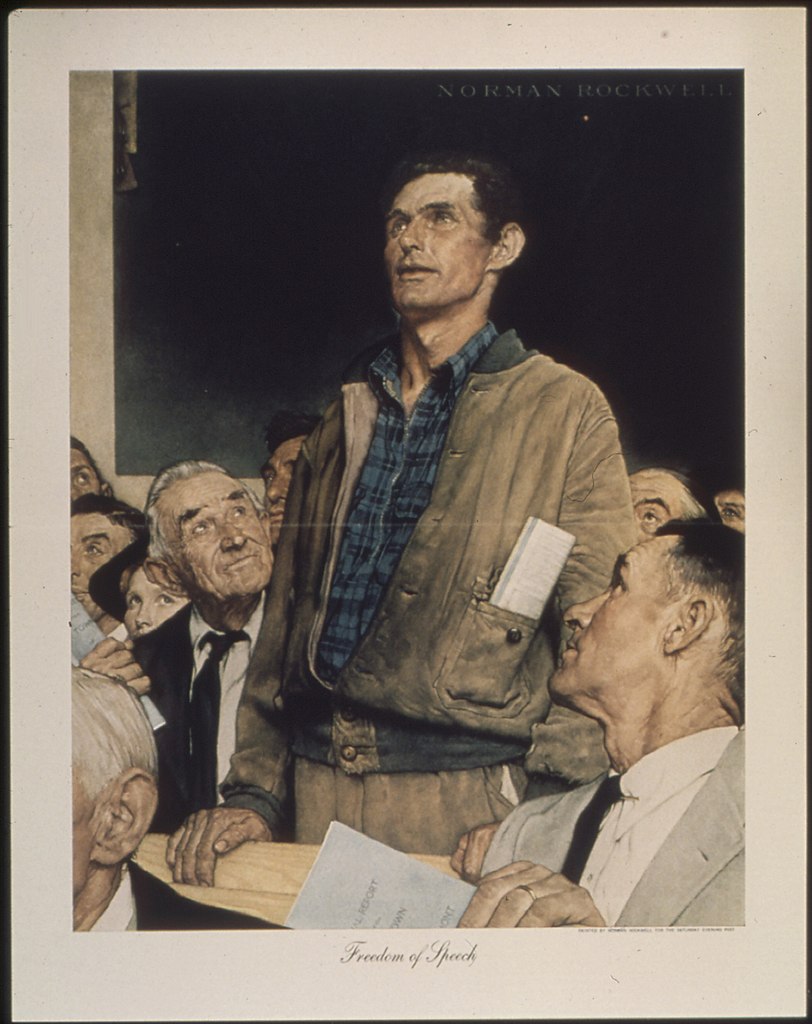
    Freedom of Speech (btw 1941-1945), Norman Rockwell | Wikimedia Commons.

    It’s important to state that this is a new (and errant) way of thinking about freedom. Human civilizations until the last several hundred years regularly had enslavement and servitude as part of cultures around the world. When someone was freed from slavery, this meant they could operate in society as any other citizen — according to the laws and prescriptions of the society. Free citizens certainly enjoyed more rights than slaves, but no one was exempt from the law, except the rulers, and even then certain codes of conduct were expected.

    Americans founded their society on revolution from a colonial master, and the rhetoric of freedom has always enjoyed center stage. “Freedom” as a national touchstone grew with our abolishment of slavery after the Civil War (something that lagged behind European countries, by the way), and enfranchisement of women and people of color in the 20th century. I would claim that the civil freedoms we enjoy are not that different from many, if not most, other countries around the world, but in our minds, we are exceptional.

    Much has been written about American exceptionalism in academic circles, and suffice it to say here that our exceptionalism has many levels: we feel exempt from many prescriptions that other cultures have but also more exceptional in character, in the fiber of who we are, which results in a ton of entitlement. I don’t think any of us intentionally feels this way — it’s simply something that we take on by millions of subtle and not-so-subtle messages in our public discourse, our entertainment, our advertising, etc.

    In my mind, the consequence of American exceptionalism as a part of our national character is that we are weaker, more arrogant, and less conformed to Christ. To put it bluntly, personal or national exceptionalism is a form of sin, where we place ourselves above others.

    As children of God, equal to all other children of God, we are lying to ourselves when we imagine a type of exceptionalism. As Dostoevsky wrote,

    “People who lie to themselves and listen to their own lie come to such a pass that they cannot distinguish the truth within them, or around them, and so lose all respect for themselves and for others. And having no respect, they cease to love, and in order to occupy and distract themselves without love they give way to passions and to coarse pleasures, and sink to bestiality in their vices, all from continual lying to others and to themselves.” (The Brothers Karamazov, II, 2).

    Dostoevsky rightly locates the loss of truth as a crucial part of the spiral of sin.

    Christ speaks today of the role of truth in establishing true freedom: “If you remain in my word, you will truly be my disciples, and you will know the truth, and the truth will set you free.” Christ promises freedom, but at the end of a sequence of things that starts with a personal journey with him.

    Let’s start with the beginning: “If you remain in my word.” His word is both the teaching of the man Jesus as well as the Word of God contained in all of scripture. Jesus is affirming the laws and prescriptions of how to act and comport oneself as laid down for millennia in the scriptures as well as his own perfection of the law as he reveals during his ministry. Remaining in his word is where we start. Many (or most) of us may spend our entire lives just trying to get here, aspiring to remain, not slip, to train ourselves to resist worldly temptations, to pray often to the Father, and to serve our fellow human like Christ taught. 

    Christ promises that if we remain in his word, we will truly be his disciples. This means we will have a personal relationship with our teacher. Our lives become more than just following rules of behavior. We are immersed in a spiritual relationship that feeds us and transforms us. It is dynamic. We learn from him and lean on him and he rejoices with us when we succeed in turning to goodness and away from evil. He also comforts us when we slip.

    As we check in with ourselves on this journey, we can start to see that we are living a fuller, denser life, allowing ourselves to be conformed to something divine, to take on a spiritual dimension that promises to be more meaty than our physical one.
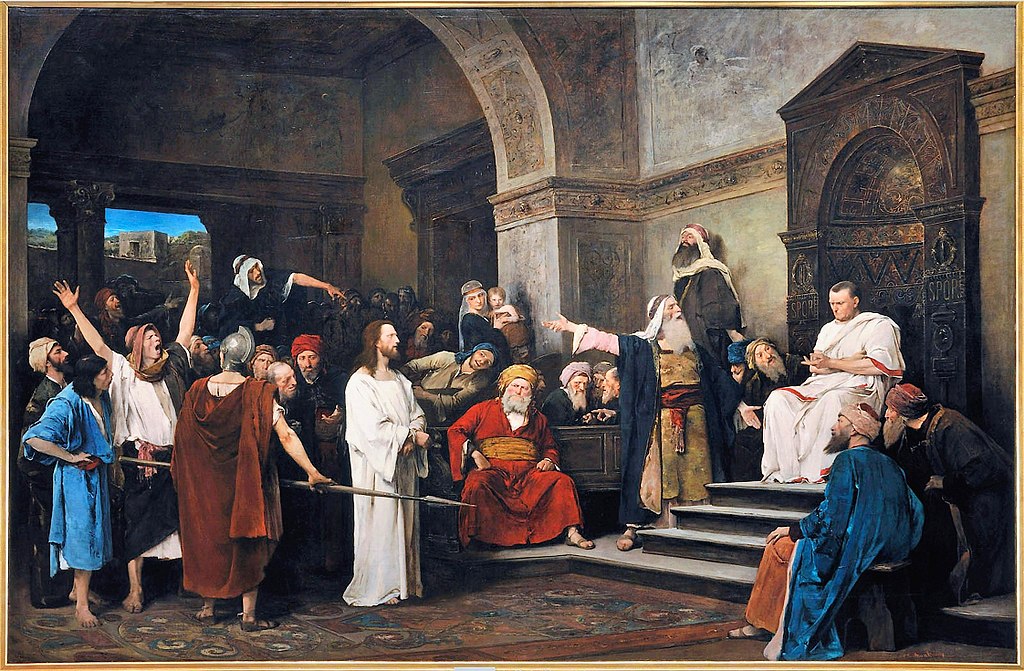
    Christ in Front of Pilate (1881), Mihály Munkácsy | Wikimedia Commons. Nietzsche (see next paragraph) aligns himself with one of the greatest theological “misses” in the Passion story, Pilate’s offhand retort to Christ. In The Anti-Christ, Nietzsche writes, “Must I add that, in the whole New Testament, there appears but a solitary figure worthy of honor? Pilate, the Roman viceroy. … The noble scorn of a Roman, before whom the word “truth” was shamelessly mishandled, enriched the New Testament with the only saying that has any value—and that is at once its criticism and its destruction: ‘What is truth?’”

    Then Jesus promises us that we “will know the truth.” After remaining in his Word and developing a personal relationship with our teacher, we will know the Truth. Let’s pause here and say that anyone who thinks that truth is a matter of context or is subjective depending on who you are, well, this person cannot call herself a Christian. Jesus clearly here and elsewhere tells us that there is a (singular) Truth — that Truth lives in God and we apprehend it through Christ as the Way.

    In fact, this is how he can say, “I am the Way, the Truth, and the Light.” To deny that there is Truth is at the heart of atheism. Thus, Nietzsche says, “What is the truth, but a lie agreed upon.” In this world of Nietzsche, nothing exists but people making things up and calling them “rational” or “true” or “false.”

    Apart from this being simply counter to everything God has revealed about reality, I find it quite a mental stretch, like a bad dystopian movie or an episode of the Twilight Zone. There are too many things that exist beyond us and to which we respond to limit the world in this way. Certainly, in God’s great created universe we can find amazement and life that surprises us, that we do not create. But even in what we do create, like artwork, there is something about beauty that speaks to something transcendent, something that carries meaning outside of what we determine it should be.

    Thus, even the cynical, anti-Christian, existentialist student of Nietzsche, Albert Camus, writes, “Fiction is the lie through which we tell the truth.” He affirms that there is truth, and that we tell ourselves fictions, some of which reveal the truth that is external to what we can create on our own.

    Pope Francis does a lovely job of summarizing how Christianity conveys a denser, more profound understanding of truth:

    In Christianity, truth is not just a conceptual reality that regards how we judge things, defining them as true or false. The truth is not just bringing to light things that are concealed, “revealing reality”, as the ancient Greek term aletheia (from a-lethès, “not hidden”) might lead us to believe. Truth involves our whole life. In the Bible, it carries with it the sense of support, solidity, and trust, as implied by the root ‘aman, the source of our liturgical expression Amen. Truth is something you can lean on, so as not to fall. In this relational sense, the only truly reliable and trustworthy One – the One on whom we can count – is the living God. Hence, Jesus can say: “I am the truth” (Jn 14:6). We discover and rediscover the truth when we experience it within ourselves in the loyalty and trustworthiness of the One who loves us. This alone can liberate us: “The truth will set you free” (Jn 8:32).
    – from Pope Francis’s message on World Communications Day, January 24, 2018.

    So, Truth necessarily involves the “only truly reliable and trustworthy One,” God. It is only in our lifelong walk with Christ, within the fabric of that personal relationship where he transforms us into better and better human beings, that we start to recognize and discover Truth.

    Thus, we arrive at the final part of this complex relationship and promise from Christ: “the truth will set you free.” We will get to the “free from what?” question presently, but first let’s linger on the fact that freedom comes as a result of a lifelong walk on the Way to the Kingdom where we discover truth “in the loyalty and trustworthiness of the One who loves us.” Contrast this complex, experiential definition with the American concept of freedom (“say what I feel” or “do as I please”). How self-centered and shallow it is revealed to be! There is no discovery of Truth that underlies this type of “freedom”; everything comes from within our flawed selves.

    This is, in fact, the very definition of living in a state of sin and without God in our hearts. It’s hard to think of a saint who hasn’t warned us about allowing ourselves to be led by our passions and desires. St. Benedict: “No one should follow what he considers to be good for himself, but rather what seems good for another.” St. Alphonso Liguori: “He who trusts in himself is lost. He who trusts in God can do all things.” (We could go on and on).

    The point is that when we follow our own desires, we are being ruled by the prince of this world. This is how Satan works in us, by having us elevate our own interests above everything else. The Ten Commandments were given to us to help us push back on these desires and temptations — coveting property and people, disrespecting our parents, destroying people who stand in our way, and putting ourselves ahead of God. Sinning is giving into the unchecked desires of self that are not conformed to God.
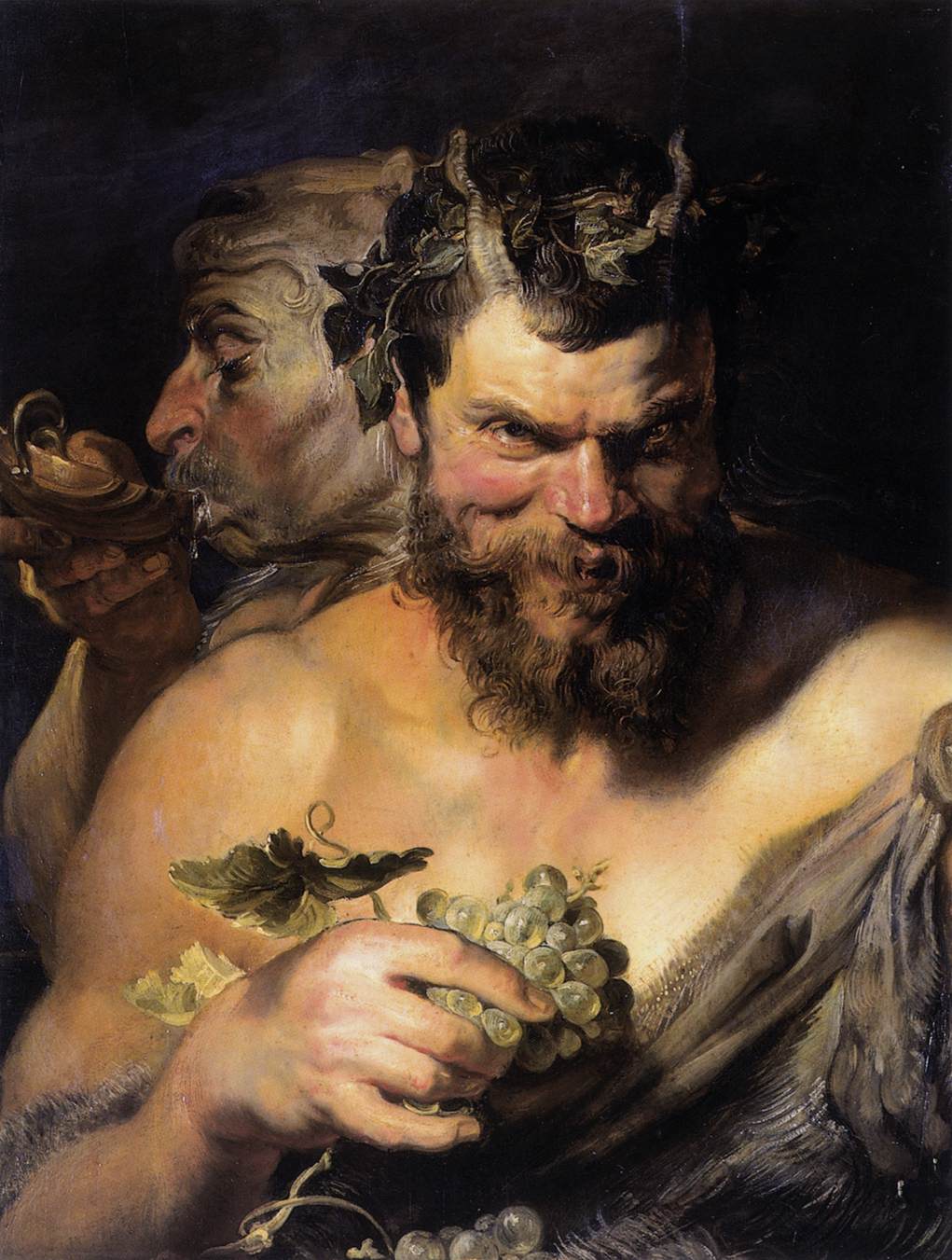
    Two Satyrs (1618-1619), Peter Paul Rubens | Wikimedia Commons.

    (NB., desire can be good, too! Desire for God, sexual desire for a spouse, desire to have someone else do well or be saved from suffering, etc.)

    So when Christ speaks of being set free, of course, he is saying, “everyone who commits sin is a slave of sin.” The slavery of sin is what he has come to free us from. Imagine if we lived in a land where people proudly spoke of their freedom and — instead of the right to bear arms, to say whatever they pleased, or to hold private property — they meant freedom from sin. Now, that would be a country to be proud of!

    Along these lines, imagine if we found our purpose in this density of being, this filling out of ourselves with meaning and Truth. Rather than pursing the goal of proving our worth by showing off accomplishments that we’ve done all on our own, as if our own merit is the driving force in our lives, what if we pursue the goal of being shown Truth and goodness from outside of ourselves, by God. The first is a lonely, selfish, and ultimately shallow existence. The second is filled with the life of the heavenly hosts, it’s expansive, and it’s an ultimately deep existence.

    We must close with St. Paul because we have to realize that Jesus gave us our freedom from sin permanently and irrevocably. While it continues to be our challenge and call to find truth after a lifelong personal walk with Christ, he permanently changed our ontological spiritual state with his death and resurrection.

    Do you not know that all of us who have been baptized into Christ Jesus were baptized into his death? Therefore we have been buried with him by baptism into death, so that, just as Christ was raised from the dead by the glory of the Father, so we too might walk in newness of life. For if we have been united with him in a death like his, we will certainly be united with him in a resurrection like his. We know that our old self was crucified with him so that the body of sin might be destroyed, and we might no longer be enslaved to sin. For whoever has died is freed from sin. But if we have died with Christ, we believe that we will also live with him. We know that Christ, being raised from the dead, will never die again; death no longer has dominion over him. The death he died, he died to sin, once for all; but the life he lives, he lives to God. So you also must consider yourselves dead to sin and alive to God in Christ Jesus. Therefore, do not let sin exercise dominion in your mortal bodies, to make you obey their passions. (Romans 6:3-12).

  • Lust and Justice

    Lust and Justice

    Monday of the Fifth Week of Lent: Daniel 13:1-9, 15-17, 19-30, 33-62, John 8:1-11.

    Wow, what a first reading today – 1,079 words! I’m guessing, but I think it’s the longest one outside of Easter Vigil. Thankfully, it reads like the script for a telenovela, so there’s a certain pacing and several plot twists to keep us interested. This reading and the gospel seem to be about adultery — at least the accusation of adultery. But in the end, they are more about lust, the perversion of God’s law, and divine justice. Let’s dig in.

    Detail from Susanna and the Elders (1653), Jacob Jordaens | Wikimedia Commons. While I think Jordaens is off with his smiling Susanna, as if she’s enjoying the intrusion of these nasty men on her bath, I think he’s spot on with the devilish faces of the judges and their grasping hands. It speaks to their lustful focus on her.

    Susanna, the heroine of the first reading and my wife’s namesake, is a fitting object of desire: “a very beautiful and God-fearing woman.” This reading is ostensibly about her, but really it’s about the two elder judges, complete degenerates that they are. When they begin to lust after her, the state of their sin is described in these terms: “They suppressed their consciences; they would not allow their eyes to look to heaven, and did not keep in mind just judgments.” This strikes me as being so on-point. Unbridled lust is absolutely a suppression of our God-given conscience, something that we have to cultivate and listen to in order to live upright lives.

    Lust is a determined effort not to look at God, for who can contemplate the face of God and still be drawn to evil? They also are determined not to think of “just judgements” — ironic for judges, and a choice that will come back to bite them. This description cuts right to the spiritual truth of their actions. When we think of being caught up in lust, this series of choices made on the spiritual plane might not occur to us because physical desire can be so blinding of a force (at least in my experience as a man), almost like animal instinct. We’ve all heard of or experienced sex as a result of being “caught up in the moment.” To me, at least, lust doesn’t seem as calculated or deliberate as it is described, but when I think about it, this is exactly what’s going on in terms of my spiritual being. Lust has an amazing ability to cause a huge discrepancy between what we experience mentally and physically and what we experience spiritually.

    All religious orders must address lust as communities of same-sex people living out their lives in sexual abstinence. Our saints from religious orders have gone to great lengths to preserve their purity. St. Josemaria Escriva said: “To defend his purity, St. Francis of Assisi rolled in the snow, St. Benedict threw himself into a thorn bush, St. Bernard plunged into an icy pond…You…what have you done?” Now that speaks to the power of temptation and lust!

    Yes, there’s something special about this sin, as St. Alphonsus Liguori writes, “In temptations against chastity, the spiritual masters advise us, not so much to contend with the bad thought, as to turn the mind to some spiritual, or, at least, indifferent object. It is useful to combat other bad thoughts face to face, but not thoughts of impurity.” How interesting, and consistent with the description of how the judges were affected in today’s first reading. If turning your thoughts to a spiritual matter is the best way to combat lust, then the description of how they “would not allow their eyes to look to heaven” is telling indeed.

    In addition, the line about how they suppressed their consciences is exactly the opposite of what Pope Saint John Paul II writes about how to deal with lust: “Deep within yourself, listen to your conscience, which calls you to be pure…a home is not warmed by the fire of pleasure, which burns quickly like a pile of withered grass. Passing encounters are only a caricature of love; they injure hearts and mock God’s plan.” I bring up all of these saints not just to complement the description of the sin in the first reading, but to help us remember that even though the sin appears to be purely physical, it is in fact a deep spiritual injury to ourselves and God.

    Lust as temptation is dangerous because it perverts our spiritual nature, turning us into baser animal creatures. If unchecked, it culminates in lust as an action. Today, we hear the two elder judges tell Susanna, “give in to our desire, and lie with us. If you refuse, we will testify against you.” Their spiritual natures are so undermined and perverted that they threaten rape and end up carrying out false testimony when she screams for help.

    Shortly after this, we hear the cringe-worthy, sleazy details of their false testimony. How interesting that the train wreck of sins is so caught up in power and wielding power on this earth. It is no mere coincidence that these men are elder judges. They represent the corrupting influence of the world, the depravity that reigns in the place where justice should be.

    As a sharp contrast, a young Daniel (think: new life in the spirit) intervenes to help restore a community twisted by sin: “God stirred up the holy spirit of a young boy named Daniel, and he cried aloud: ‘… Are you such fools, O children of Israel! To condemn a woman of Israel without examination and without clear evidence? Return to court, for they have testified falsely against her.’” Here we have God’s intervention because grave sin and injustice are at stake. The reading hinges on this moment, when God works through his chosen prophet Daniel to confront the people with truth.

    Like an early version of a detective crime story, Daniel smoothly trips up the elders to reveal their treachery. Finally, unlike what we hear in the gospel, divine justice is enacted on the spot.

    The Self-Mortification of St. Benedict (1496), Albrecht Dürer | Creative Commons, courtesy of the Isabella Stewart Gardner Museum. From their website: “This window depicts an episode from the life of Saint Benedict (ca. 480–547). Satan, in the form of black birds, flutters around the saint. The young saint overcame his sexual desires (represented by the woman seen at the right) by throwing himself into a thorn bush. Albrecht Dürer shows Benedict lying in a thicket, deep in prayer.” One word: ouch.

    I think this is more than a critique of Jewish law and earthly justice systems. Likewise, I think it’s more than a simple morality fable even though the narrative structure reads like it. Remember that we are told that there was a prophecy about these judges: “of whom the Lord said, ‘Wickedness has come out of Babylon: from the elders who were to govern the people as judges.’” This brings the scope of salvation history into play. God has announced their coming, and as we see with other prophesied events, their arrival is a moment for God to reveal something about his desire to have us come to him in the Kingdom. It’s more than just a story of right vs. wrong.

    We learn two things in this vein:

    1. God hears us when we are pure of heart and call out to Him. Susanna precipitates David’s prophetic intervention when she cries, “O eternal God, you know what is hidden and are aware of all things before they come to be: you know that they have testified falsely against me.” Then we are told, “The Lord heard her prayer.”
    2. God promises divine justice, especially when earthly justice falls short due to human guile. Daniel does not promise a lynch mob or a simple execution; instead, he speaks of justice delivered by spiritual beings: “the angel of God waits with a sword to cut you in two so as to make an end of you both.” And even though the people do take the judges’ lives, Daniel’s words speak to a much more profound justice. God, through this scripture, gives us a vision of the Kingdom, where purity and virtue live with him and where sin and perversion of the spirit are eradicated.

    Let’s turn to the gospel, where Jesus Christ is the true way we will be re-configured in the Spirit. Daniel’s life and works simply pointed to Christ, like an early promise of the configuring and justice yet to be fully unveiled. And Jesus, as ever, surprises us with a teaching about God’s law and justice. 

    When the scribes and Pharisees throw a woman into the middle of the place where Jesus is teaching, St. John tells us that their question to Jesus about punishing her adultery was “to test him, so that they could have some charge to bring against him.” How like the elder judges in the Book of Daniel!

    They are here on false pretenses, not interested in justice but instead their own gain. Like the elder judges, they have bound themselves to the quest for worldly power and control; in so doing, they are avoiding looking at God. They lust not for sexual relations but for power, specifically the power of the judge to charge and condemn Jesus.

    Christ and the Adulterous Woman (contemporary), Domenico Morelli | Image from pixels.com. Excusing the overtly neo-classical elements of this painting (including Jesus’s robes), I like the use of light and dark to delineate Christ and the accusers.

    The other important thing here is the way the narrative of adultery is dealt with. On the surface, this episode seems to be a slam-dunk according to Jewish law, and when Jesus allows the woman to go unpunished, it seems to subvert that law. But John’s statement about their hidden intentions changes the narrative completely.

    They are not seeking to identify sin at all. Christ knows what is in their hearts, and for him this encounter is about their own falseness, not about the woman. After all, isn’t this what all encounters with God are about? When we stand before God, it is a personal encounter — we don’t go with a list of people we want to praise or condemn. Our role as his creation, his servants, is not one where we play judge or colleague.

    So as the Sun of Righteousness turns his gaze on the scribes and Pharisees, let’s remember that he understands their priestly role as upholders of God’s commandments and precepts. In fact, he shows them that their sin is the betrayal of the solemn, pure role they are supposed to play for their community.

    St. Augustine of Hippo explains the ironic position that these false upholders of the law occupy:

    “You have heard, O Jews, you have heard, O Pharisees, you have heard, O teachers of the law, the guardian of the law, but have not yet understood Him as the Lawgiver. What else does He signify to you when He writes with His finger on the ground? For the law was written with the finger of God; but written on stone because of the hard-hearted. The Lord now wrote on the ground, because He was seeking fruit” (Tractate 33 on the Gospel of John, 5).

    Thank you, St. Augustine, for connecting that mysterious detail from today’s gospel to the writing of the law. Many people wonder what Jesus may have been writing on the ground. The simple act of doing so in response to the question he was asked almost seems like an evasion or an act of rudely ignoring them. But not so! You see, these are professionals of the law, brought together in their common purpose of tripping up Jesus, not by some coincidental experience of all seeing a woman commit adultery at the same time. In other words, although they claim that she was “caught in the act,” they are not themselves the witnesses. This is a form of false witness in itself.

    For accusations of adultery without witnesses, the Torah describes a water trial (called Sotah) that the woman must undergo. As part of this, “the priest shall put [the charges and penalties] in writing, and wash them off into the water of bitterness” (Numbers 5:23). Here we have the incarnate Word of God, the One who forms the Torah and its prescriptions around how to carry out justice, bending down to enact the prescriptions of the law in front of the scribes and Pharisees. He is reminding them that there is a form of earthly justice that was handed to them by God and which is a solemn gift not to be tampered with. He knows that these prescriptions are in place so that there is no miscarriage of justice. He lifts up the law to fulfill the spiritual work it is intended to do: to keep our hearts clean from lies and sin, to keep sinners from perverting the justice God intends in the world.

    So when he stands back up at their insistence and says, “Let the one among you who is without sin be the first to throw a stone at her,” we understand that this is a specific accusation against them. He knows their hearts and they have been called out. In response, “they went away one by one, beginning with the elders.” The elders, the ones who should know better than the rest, but in whom lies the entropy of sin. They slink off first, avoiding the embarrassment of those left later.

    Christ and the Adulteress (1532), Lucas Cranach the Elder | Wikimedia Commons. Lucas Cranach gets the focus of this episode correct in the variously ugly, refined, worldly, and half-interested looks of the scribes and Pharisees to the left of Jesus.

    Then they are left alone. Jesus’s simple questioning is a reminder of how we must all encounter God: “Woman, where are they? Has no one condemned you?” We must all account for our sins in honesty before God, no one else will be there to condemn or defend us. He knows our hearts and our deeds. But then we have this pestering problem of him letting a woman “caught in the act” of adultery leave unpunished. What is the point of this episode? That no matter what you do, all will be forgiven?

    I don’t think so. Jesus is incarnated to give us a new way, a new unity with God, not to judge and destroy. His mission is about fidelity of Spirit. If he has anything new to say about adultery, it is to point out that the worst adultery is to break our most fundamental covenant and union with God. This spiritual adultery is what the scribes and Pharisees just committed, not the woman.

    Nothing about this final exchange is like the other miracles or healings he accomplishes. He does not ask her about her faith or belief. He does not establish the atonement and request for mercy that is the requirement for spiritual healing. We must conclude that this encounter is not about sin being forgiven. Not her sin, certainly, because he doesn’t ritually absolve her.

    Instead, He renews God’s call to be holy: “Go, and from now on do not sin any more.” It’s not that he didn’t know if she committed adultery and was unwilling to point it out. After all, he told the Samaritan woman at the well that she had five husbands and was living in adultery at that moment.

    No, the lesson of today’s gospel is not so much about forgiveness as it is about the ultimate sanctity of our spiritual fidelity with God.

  • Lifted Like the Serpent

    Lifted Like the Serpent

    Sunday of the Fourth week in Lent: 2 Chronicles 36:14-16, 19-23, Ephesians 2:4-10, John 3:14-21.

    In today’s gospel reading, Jesus has a memorable meeting with Nicodemus, a Jewish member of the Sanhedrin, a faithful Jew, and eventually a full disciple of Jesus who comes with myrrh and aloes along with Joseph of Arimathea to retrieve his body from the Cross.

    Jesus presents himself to Nicodemus as a modern, living version of Moses’s serpent on the staff that saved the Jews bitten by poisonous serpents in the desert. While foreign to us if we are not versed in scriptures, this comparison would undoubtedly have been powerful and shocking for Nicodemus. In fact, Jesus’s words finally explain the significance of God instructing Moses to make a bronze serpent and mount it on a pole.

    As we dig into today’s gospel reading, we are struck with the entire span of salvation history from the Garden of Eden to Christ’s Paschal Sacrifice on the Cross. Also, we see Nicodemus as a true Christian, converted to Christ, moving from the darkness to the light.

    Nicodemus and Jesus on a Rooftop (1899), Henry Ossawa Tanner | Wikimedia Commons. On the left is a study that Tanner did for the finished painting on the right. I appreciate the nimbus on Christ in the study, acknowledging that he is the “Light of the World,” despite the meeting occurring at night.

    St. John tells us that Nicodemus comes to Jesus by night. In just this simple statement, we can glean many things. Some scholars believe that a leader of the Jews would only come by night because it would be unseemly for a member of the Sanhedrin to join the crowds and rabble who followed this traveling preacher by day. Whether he was too busy with his duties, too proud to be seen going to learn from an unlearned miracle-worker, or too bashful to present himself openly, we encounter this powerful man coming to Jesus under cover of night.

    As historians and scholars have envisioned this meeting, there is a compelling argument that they met on a rooftop. First of all, this was (and is) common practice for men to retire to the rooftops after their evening meal on the hot, Middle Eastern nights, in order to enjoy cooling breezes. Second, Jesus makes some memorable statements about the air and the Spirit, likely choosing the moment when the phenomenon of the breeze could help him make this point: “The wind blows where it chooses, and you hear the sound of it, but you do not know where it comes from or where it goes. So it is with everyone who is born of the Spirit” (Jn 3:8).

    Jesus speaks of a spiritual logic unknown to those merely born of the flesh, encouraging Nicodemus to break out of his disbelief and earth-bound assumptions about what is possible. So, we see Nicodemus coming to Christ at night to know more about this man sent by God, and God, in return, engages him in the deepest truths. Is this not the exact journey we all make to Christ? Do we all not suffer from a certain bashfulness to approach Him openly in a culture where our faith is seen as antiquated, naïve, and gullible? Yet Jesus is there, waiting for us with deep truths.

    These deep truths are inevitably deeper than we are prepared to comprehend. Jesus reveals himself to Nicodemus as not just “a teacher who has come from God” (as Nicodemus calls him), but as the “Son of Man” and God’s “only Son.” And Jesus ups the stakes to eternal bliss or eternal damnation based on this very fact alone: “everyone who believes in him might not perish but might have eternal life … but whoever does not believe has already been condemned, because he has not believed in the name of the only Son of God.” Nicodemus definitely got more than he bargained for by coming to this “teacher” by night.

    As we think about this “all-or-nothing” statement by Christ, we are reminded of the gospel a few days ago where he proclaimed, “whoever is not with me is against me,” that is, scattering people instead of gathering to the Kingdom. Why does our Lord deal in these absolutes? There can be no doubt here that he is asking us to be “all-in,” much like he asked Abraham to sacrifice his son or Noah to build the ark (see the post, A Glimpse of Heaven). And just as Abraham’s assent was blessed by founding the nations and Noah’s assent was blessed by saving humanity from destruction, our assent to Christ will be blessed with everlasting life.

    In all cases, the call is personal. It is an individual meeting with the unfathomable God. Just like Nicodemus, we all must go to have a personal encounter with Christ to listen to what he has to tell us.

    Pope Benedict the XVI put this succinctly at the beginning of his encyclical on love: “Being Christian is not the result of an ethical choice or a lofty idea, but the encounter with an event, a person, which gives life a new horizon and a decisive direction” (Deus Caritas Est, 1). Today’s gospel is one of many very concrete examples of this encounter in action. 

    Jesus proclaims elsewhere in John’s gospel, “I am the light of the world” (Jn 8:12), and he makes a similar statement here with Nicodemus. His words may have stung Nicodemus, since he came to Christ at night:

    “And this is the verdict, that the light came into the world, but people preferred darkness to light, because their works were evil. For everyone who does wicked things hates the light and does not come toward the light, so that his works might not be exposed. But whoever lives the truth comes to the light, so that his works may be clearly seen as done in God.”

    He is urging Nicodemus to come to him in the light of day, openly. But more than that, he needs Nicodemus to understand that God and truth dwell in the light, and this is something to always glory in, to be proud of; in fact, by believing in this truth and light, and acting in it, a person is securing for himself or herself a place in Heaven.

    Jesus mentions the concept of being exposed, and there is absolutely an aspect of vulnerability in this. As he says, the “verdict” is that “people preferred darkness to light,” thus living in the light does not exempt one from pain and suffering as a result of this exposed vulnerability. This fact is wonderfully demonstrated in Jesus’s incredible comparison of himself to Moses’s serpent on the staff.

    That story from the Book of Numbers speaks of events 1,475 years before Christ sits with Nicodemus on the roof. The passage is exceedingly odd at first glance: God first punishes the Israelites for complaining by sending poisonous serpents among them. In terms of today’s gospel, we could say that they are living in darkness (complaining and turning from God), and as a result they are bitten by serpents and die. Upon their admission of guilt and atonement, Moses prays for deliverance. At this point, God instructs Moses to mount a bronze serpent on a pole; subsequently, when the people look up at the serpent on the pole after being bitten, they are spared from death.

    Before we wonder what kind of witchcraft is going on here, let’s again consider it in terms of today’s gospel reading: by looking up at the serpent, the Jews in the desert are re-confirming their belief in God, who promises to protect them. They gaze upon the source of their suffering, the serpent, exposed, held up in the light for all to see, and they do not die. Importantly, they do not avoid suffering (that is, they continue to be bitten by serpents), but they avoid death through their continually re-confirmed faith in God.

    Moses and the Brazen Serpent (1898), Augustus John | Creative Commons, courtesy UCL Art Museum/ArtUK. I like the impressionistic style Augustus John employs in this painting, the flowing waves suggesting a divine entrance into the fabric of humanity. As with any encounter with the divine, sin will merit pain and “gnashing of teeth,” and the purifying energy of God may not be pleasant for those in sin. I also see a bit of the devil in the bare-chested man on the right side of the canvas, which for me, at least, recollects the Garden of Eden connection. 

    It would be fair to say that the serpent is the symbol of humanity’s sin against God, ever since Adam and Eve in the garden. This sin is poisonous and it brings about the reign of death. The people repent and say to Moses, “We have sinned in complaining against the LORD and you. Pray the LORD to take the serpents away from us.” The act of looking up, heavenward, to the sign of the sin they lived with, is the action that reminds them of their dependence on God and his saving mercy. God’s divine mercy flows to the sinful, bitten individual in that moment, not through the arcane power of a bronze staff, but through the symbol that the staff presents to the Jewish believers in God.

    As Catholics, we know well that, in the liturgy, divine sanctification works in and through symbols, from the altar and ambo to the bread and wine. The bronze serpent on the staff is this type of sacramentalized symbol that his prophet on earth made under his instruction.

    The Jews understood the symbolic importance of this staff as a way to encounter God’s grace and they kept the physical staff around for centuries. They may have begun to confuse the symbolic function of the staff with a divine presence, however, because 740-ish years later we read in 2 Kings that King Hezekiah orders the destruction of the staff, which he calls Nehushtan (“a mere piece of brass”) because the Jews were burning incense to it and essentially treating it like an idol. 

    Now I don’t know much about divine numerology, but I do find it interesting that exactly another 740-ish years later, we hear Jesus tell Nicodemus the Pharisee: “just as Moses lifted up the serpent in the wilderness, so must the Son of Man be lifted up, that whoever believes in him may have eternal life.” With this statement, the Word of God reveals the full scope of this symbol Moses was instructed to make. “Just as Moses lifted up the serpent”: note that the parallel being drawn is to the fixing of the serpent to the pole and lifting it up, the fact of exposure for all to see. “So must the Son of Man be lifted up”: this refers to his Crucifixion, where he becomes the ultimate symbol for humanity. And finally the salvific import: “that whoever believes in him may have eternal life.” Like the sinful Jews who re-confirmed their belief in God and were saved from dying, we receive an infinitely greater promise and divine grace given to us when we behold Christ on the Cross, believe in him, and are granted eternal life that eradicates all sway of death.

    Yes, consider this! Christ is admitting that living in the light constitutes suffering at the hands of those who live in the darkness. What greater sign than his broken and crucified Body hanging on the Cross for all to see? But just as the suffering from being bitten by serpents is ameliorated by gazing at that exposed suffering on a pole, our suffering from sin in this life is ameliorated by gazing on the Lord’s suffering on the Cross, done for our sakes. This is exactly what “on our behalf” entails!

    He allowed himself to be affixed on the Cross like the serpent on Moses’s staff so that we could have salvation as we gaze upon him and live in his light!

    Moses and the Bronze Serpent, mural in All Saints Margaret Street church in London (1889), tiles painted by Alexander Gibbs | photo courtesy Lawrence OP, flickr.com. Note that over the centuries, the connection of the bronze serpent and the cross has been made much more explicitly, as in this tile work.

    Sometimes the scope of God’s saving plan is just breathtaking. So many moments of patience and mercy over the millennia, from Adam and Eve, through Moses, and ultimately Jesus Christ. And so subversive of our normal worldly affections, too, in the use of the lowly and hated serpent as a resounding symbol for overcoming sin, much like using the reviled Cross as a throne for our Savior.

    I am brought back to the all-or-nothing statements we keep encountering this Lent. After this reflection, I am struck by the fact that Jesus is saying these absolutes because he must remind us that he is God’s plan, God’s gift. To not recognize and believe in him is to throw God’s gift back in his face. It is worse than living in sin — it is a deliberate act of defiance and rejection of our Creator. We must listen to Christ, and St. Paul does a fantastic job of reminding us in today’s second reading: “God, who is rich in mercy, because of the great love he had for us, even when we were dead in our transgressions, brought us to life with Christ — by grace you have been saved.”

    Serpent Illustration by Katie Scott | courtesy katie-scott.tumblr.com.
  • Worm of the Soul

    Worm of the Soul

    Wednesday of the Second Week in Lent: Jeremiah 18:18-20, Matthew 20:17-28.

    Today’s readings show the ugliness of jealousy, which St. Cyprian of Carthage calls “the root of all evil.” After examining the readings, I’d like to reflect on St. Cyprian’s Treatise on Jealousy and Envy, which offers some sharp insights.

    The Jews in Jeremiah’s time were tired of hearing his gloom-and-doom prophecies. In the Book of Jeremiah, we read of how his no-holds-barred warnings and criticisms land him in prison, get him beaten, and make him an outcast. Today’s reading shows the inner mindset of the Jews who wanted to discredit and destroy him: “Come, let us contrive a plot against Jeremiah … let us destroy him by his own tongue; let us carefully note his every word.”

    What provokes such evil in the hearts of his countrymen? Jeremiah wonders as much himself: “Must good be repaid with evil that they should dig a pit to take my life?”

    Jealousy (contemporary), Yvonne Wright | Image from pixels.com.

    There are many ways to react to a person who proclaims something upsetting. We can ignore them. We can disagree, perhaps loudly. We can silently listen to their harangue and think about it over time, seeing if there is any truth to it. Or, we can allow our passions to grip us and lash out. If we allow negative passions like anger to build, we begin to desire retribution in a more lasting way. This is the work of evil.

    But another sin may be in play in Jeremiah’s case, specifically jealousy. He is getting attention with his troubling prophecies, and the other priests and Jews are not liking the power and attention he is garnering. If jealousy is in the heart of Jeremiah’s adversaries, we can begin to understand how elaborate plots might develop.

    Jealousy is such an ugly sin that we never want to admit that it grips us. It’s embarrassing because it is such a strong sin, stripping us of everything elevated and good in character. Because it is ugly and embarrassing, we keep it hidden; we plot and the festering evil builds.

    In the gospel, Jesus quickly identifies this sin erupting among the Apostles and stamps it out before it can grow. When the Apostles learn of James and John’s desire to sit at Jesus’s right in Heaven, they “became indignant” and undoubtedly jealous. Jesus’s response is that while leaders in the Gentile world operate by having authority lorded over others, “it shall not be so among you. Rather, whoever wishes to be great among you shall be your servant; whoever wishes to be first among you shall be your slave.” Jesus must re-orient them to the goal of the Christian life: to serve and thereby inhabit and spread the love of the Father.

    The entire discussion of greatness and deservedness to sit at the Lord’s right hand is upended. If greatness is defined by being the best slave, then that’s a silly thing to be jealous over. In fact, as soon as you start serving people out of love, the idea of being regarded for one’s own greatness is absurd.

    And so we must ask ourselves what came over the mother of James and John (and them) when the request was made. The three of them are operating under a different mindset than Jesus’s teaching. She wants her sons to be great (and by extension, herself). As Christ points out, in the secular world this greatness comes at the cost of others — one is exalted above others, in fact the only way to know that one is exalted is by seeing others lower than you in status. This entire worldview relies on envy of that exalted status. People are motivated by jealousy over that position, even if it is currently unoccupied. This type of “greatness” will never be aligned with God’s self-giving love because at its heart is inequality and envy.

    This is precisely why Jesus must die in a mode of sacrifice, showing that glory resides not in earthly exaltation above others. He shows that glory can reside in the most detested and shunned of places: the Cross. This is the only world where greatness and God’s love can coexist: where greatness finds itself residing in servitude and sacrifice.

    So as we peel back the layers of motivation behind the persecution of Jeremiah and the yearned-for elevation of James and John, we find the ugly sin of jealousy. We also find this squarely at the heart of the Sanhedrin during the arrest, trial, and Crucifixion of Jesus. Today’s readings are a warning, pointing to the dangers of jealousy, which hides in the motivations by which we live out our lives. Lent is our time to root it out and stop it.

    Modern icon of Saint Cyprian, provenance unknown | Image from pilgrimcenterofhope.org.

    Saint Cyprian, Doctor of the Church, Bishop of Carthage and Martyr, was an African born of noble birth around the year 200 AD. Son of a Roman senator, he was a dissolute pagan in his youth, although well trained in rhetoric, philosophy and law. He converted to Christianity in his middle years. He went to his own beheading willingly in 258 AD after refusing to recant his Christianity during the persecutions of the Emperor Valerian.

    In his Treatise on Jealousy and Envy, St. Cyprian traces jealousy to Satan, “when he beheld man made in the image of God, broke forth into jealousy with malevolent envy— not hurling down another by the instinct of his jealousy before he himself was first hurled down by jealousy, captive before he takes captive, ruined before he ruins others” (4). This sin, therefore, is so powerful that it overcame the devil himself and is associated with the core of his own evil. “Thenceforth envy rages on the earth, in that he who is about to perish by jealousy obeys the author of his ruin, imitating the devil in his jealousy” (4).

    St. Cyprian traces how jealousy is at the heart of tragedies and figures throughout scripture: Cain and Abel, Esau and Jacob, Joseph and his brothers, King Saul and King David, and finally Christ and the Jews. Then, he proclaims that jealousy is, in fact, the source of all the other evils:

    It is the root of all evils, the fountain of disasters, the nursery of crimes, the material of transgressions. Thence arises hatred, thence proceeds animosity. Jealousy inflames avarice, in that one cannot be content with what is his own, while he sees another more wealthy. Jealousy stirs up ambition, when one sees another more exalted in honors. When jealousy darkens our perceptions, and reduces the secret agencies of the mind under its command, the fear of God is despised, the teaching of Christ is neglected, the day of judgment is not anticipated. Pride inflates, cruelty embitters, faithlessness prevaricates, impatience agitates, discord rages, anger grows hot; nor can he who has become the subject of a foreign authority any longer restrain or govern himself. By this the bond of the Lord’s peace is broken; by this is violated brotherly charity; by this truth is adulterated, unity is divided; men plunge into heresies and schisms when priests are disparaged, when bishops are envied … (6).

    We have heard the more memorable, “money is the root of all evil,” but is not money just a vector for envy? Cyprian has some memorable phrases of his own; I particularly like “nursery of crimes” and how jealousy removes our ability to “restrain or govern” ourselves. He has several great phrases at the start of the next section: “what a gnawing worm of the soul is it, what a plague-spot of our thoughts, what a rust of the heart, to be jealous of another, either in respect of his virtue or of his happiness … to make other people’s glory one’s own penalty” (7). Cyprian really brings home how jealousy is primarily a harm to our own selves, our own humanity.

    He says this even more forcefully: “Yet you are the enemy of no one’s well-being more than your own … Wherever you may be, your adversary is with you; your enemy is always in your own breast; your mischief is shut up within; you are tied and bound with the links of chains from which you cannot extricate yourself; you are captive under the tyranny of jealousy” (9). 

    Venus, Cupid, Folly and Time (detail), 1545, Angelo Bronzino | Wikimedia Commons. This figure in the background of the painting is often thought to be Jealousy.

    This does resonate, at least with me. Even just from my adolescent jealousies over love interests, jealousy threatened to be overwhelming. It definitely seemed to act like a tyrant; and a tyrant harming me and my character more than anything else. With this in mind, I think about contemporary secular credos I hear from friends, “as long as I’m not harming anyone else, then it shouldn’t be anyone’s concern.” Do we really want to ascribe to this thinking? Don’t we want to help people who are being ruled by the gnawing worm of the soul, the tyrant of jealousy?

    We are called to bring others to God, and there is no room for someone to move toward God if they are ruled by jealousy. Our love of others and charity should move us to help people overcome their jealousies and envy. So, even if they are harming themselves and not others, it really might be our business and mission as Christians to bring the light of Christ into their lives.

    But, it’s certainly enough for us during this time of Lent to try to identify the sneaky, hiding currents of jealousy in ourselves. Christ gives us many teachings like that in today’s gospel reading to help us overcome jealousy specifically by making it irrelevant. I think that in most cases, jealousy thrives in a worldview that is secular and driven by desires of this world.

    Let’s close with some words of encouragement from St. Cyprian: “Tear out from your breast thorns and thistles, that the Lord’s seed may enrich you with a fertile produce, that the divine and spiritual cornfield may abound to the plentifulness of a fruitful harvest … let all bitterness which had settled within be softened by the sweetness of Christ” (17).

  • The Flipside of Feeling Bad

    Monday of the Second Week in Lent: Daniel 9:4b-10, Luke 6:36-38.

    Today’s readings present us with two sides of the Christian coin: sin and forgiveness. One side is ugly and tarnished; when we look at it in the full light of day, we are humiliated by what it reveals about us. The other side, though, is shiny and new, stamped with God’s image, gorgeous to behold. As long as we walk this earth, we deal in these coins. The devil constantly presses us to use the ugly side while God offers to make it beautiful again. Our soul soars when the coin is made beautiful, but it demands a full accounting of our sin in order to flip that coin.

    The Coin Collector (1600), Joos van Craesbeeck | Creative Commons, courtesy of the Krannert Art Museum, University of Illinois.

    But God operates within a different economy: that of love. The economy of love is governed only by the rules of mercy and abundance. Jesus tells us that we can participate in God’s economy of love. He teaches us that the more we forgive others, the more we will be forgiven for our own sins. The economy of love is multiplicative, never divisive.

    Let’s consider the first reading where the author of the Book of Daniel presents an honest accounting for the sins of the Jews and an accompanying request for forgiveness. Humiliation is something the Jews knew well at the time the Book of Daniel was written (~165 BC). During this period, Antiochus IV Epiphanes was the Greek ruler over Israel who brutally put down the revolt recorded in the Book of Maccabees. “He ordered his soldiers to cut down without mercy those whom they met and to slay those who took refuge in their houses. There was a massacre of young and old, a killing of women and children, a slaughter of virgins and infants. In the space of three days, eighty thousand were lost, forty thousand meeting a violent death, and the same number being sold into slavery” (2 Maccabees 5:11–14). Then he tried to force the remaining Jews to worship Zeus on pain of death.

    Rather than bemoan their conquered and downtrodden state, the Book of Daniel acknowledges their humiliation and takes spiritual responsibility: “O LORD, we are shamefaced, like our kings, our princes, and our fathers, for having sinned against you.” The message is not all shame and doom, however. God’s covenant with his people still stands and hope is always there: “But yours, O Lord, our God, are compassion and forgiveness!” The Book of Daniel sees God’s compassion and forgiveness in the coming of the Messiah and the ultimate vindication of the chosen people. (The writer of Daniel uses the famous phrase “Son of Man” for the messiah — one that Jesus will use in reference to himself throughout his ministry.) He is pointing to Christ, waiting for a fuller experience of being human and redeemed.

    What can we learn from this long passage acknowledging sins? We aren’t Israelites who broke their covenant by worshipping idols and ignoring God’s commandments. Or are we more like them than we think? Our idols may not be golden calves, and our worship of them may not include burnt offerings, but how much more willing are we to sacrifice our time and money for things of leisure, pleasure, pride, and position than charity for our fellow human? Americans are notorious for a few things: relentless drive in the work world, greed, and consumption. I think we can honestly lament with Daniel, “we have rebelled and departed from your commandments and your laws. We have not obeyed your servants the prophets.”

    We live in a world transformed by Christ, one that the author of Daniel longed for. God has provided us with a clear path to forgiveness, namely our sacrament of Reconciliation. Let’s recall that at the heart of this sacrament is a pledge to no longer sin and an honest intention to convert back to God in our ways. Church Fathers like Tertullian see Reconciliation as the amazing gift that it is and beg us to engage fully with it: “In so far as you do not spare yourself, the more, believe me, will God spare you!” (Repentance, 203 AD). A few centuries later, St. John Chrysostom writes much the same: “Unless you tell the magnitude of your debt, you do not experience the abundance of grace” (Homilies on Lazarus (388 AD), 4.4).

    The emphasis on public confession and penance grew throughout the centuries until it was commandeered by secular Kings during their own inquisitions to root out heretics in their populace. The Spanish Inquisition is the most infamous, and these trials culminated in the highly orchestrated auto-da-fé. Prisoners were taken outside the city walls to a place called the quemadero, or burning place, where the sentences were read. Prisoners who were acquitted or whose sentence was suspended would fall on their knees in thanksgiving, but the condemned would be punished (whipping, torture, burning at the stake).

    The auto-da-fé is the pinnacle of public humiliation for sins and stands at the outward bound of a philosophy of negative reasoning around sin. In negative reasoning, if God’s mercy is given to us in the measure that we “do not spare ourselves” (to use Tertullian’s words), then extreme penance and humiliations are better guarantees of mercy. In this line of reasoning, the auto-da-fé is not only justified, its punishments are the best thing we can do to save souls. (queue the shivers)

    The Inquisition Tribunal (1808), Francisco Goya | Wikimedia Commons.

    Thankfully, Christ provides a much different teaching in today’s gospel. He says, “Stop condemning and you will not be condemned. Forgive and you will be forgiven. Give and gifts will be given to you.” In other words, live by God’s law and you will continue to live with God for eternity; carry divine love in your heart as you live, work, and act with other people, and divine love will be given to you for eternity. In addition to providing us with the Way to live in the light of truth, this is the antidote to negative reasoning about sin.

    Instead of the equation where greater humiliation and penance = greater forgiveness from God (negative reasoning), we encounter an equation where greater forgiveness towards others = greater forgiveness from God for our own sins (positive). We can see that the more we participate in the economy of love by which God operates, the more we are conforming ourselves to final unity with Him. This reciprocation is a refrain that Jesus repeats throughout his ministry. The Lord’s Prayer uses nearly the same formulation: “forgive us our trespasses, as [you see us forgiving others].”

    What changed from the old covenant in time of Daniel is that Jesus bursts into history as a bridge between Heaven and earth. He himself is the one gateway to the eternal Kingdom. Since we now have the liturgy that gives us true communion with God, we have the opportunity to carry our godliness into every aspect of our lives in a way that was never available before Christ. The liturgy as we live it is the new Way; the earliest Christians referred to themselves as followers “of the Way” (cf. Acts 9:1-2). To inhabit the spirit of the law (and let the Spirit inhabit us), we must not carry the spirit of condemnation and judgement, we must forgive and give.

    It’s easy to Monday-morning quarterback the problem with Inquisitors and the logic of the auto-da-fé. We must realize that this was a form of policing by the crown leveraged against non-Catholics and heretics, and reveals the problem with co-mingling our faith and political power structures. The state is charged with keeping the peace and enacting the national politics of a group of people. The Church is charged with saving souls. These are different aims and the centuries of Christendom in the Middle Ages gave us plenty of examples of how power structures of the state twisted and mobilized aspects of our faith for dubious ends.

    Christ calls us to something much different, much more radically personal. He calls us to begin operating within the generous, merciful economy of love. This has to be on an individual level, not a policy or state level, because it is a participation in the unique relationship God forges with each of us. Each person’s free will must be engaged within the state of life, personal histories, and sphere of influence that person has. The only law that can prescribe this type of engagement is a spiritual law because it involves the action of the soul in communion with God. No secular structure can know, much less evaluate, someone’s adherence to this law. Only God knows; and He knows us better than we know ourselves.

    Detail from the ceiling of the Sistine Chapel, the Creation of Adam (1511), Michelangelo | Wikimedia Commons.

    Finally, I’d like to explain the title of this post. Just like our Christian coin on earth is sin/forgiveness, there is an associated mindset with which we can proceed in our lives. On one hand, we can focus on the awfulness of our sinful state and approach ourselves and everyone else as impure abscesses on the Body of Christ that require penance to eradicate. Or we could focus on the gift of forgiveness God gives us and the broader economy of love. This is the clear direction in which Jesus leads us. He speaks not just of forgiveness but of three other ways to understand God’s overflowing generosity:

    Stop judging and you will not be judged.
    Stop condemning and you will not be condemned.
    Forgive and you will be forgiven.
    Give and gifts will be given to you;

    What unites these four is love and generosity — no judgement, no condemnation, just forgiving and giving. This is the way God works and Jesus is calling us to become more and more like him.

    This isn’t just good advice. His final statement in the gospel reading spells out, “For the measure with which you measure will in return be measured out to you.” I like the double meaning of measure being something you measure out to someone else as well as the way in which you take account of things. The “measure with which you measure” is not just the quantity of your generosity with others but also the way in which you’re thinking about your spiritual journey and salvation.

    This means that true salvation (i.e., divinification, union with God) comes to those in whom the spirit of generosity and forgiveness are infused to such an extent that they are everything. We are not “measuring” the number of times we forgive others or the number of gifts we give as a way to quantify or tally our movement towards Heaven. The way we go about things, “the measure with which we measure,” itself shuns the idea of quantification. We don’t count the hurts people enact on us; we don’t judge or condemn, we simply forgive. This Way of being, brought to us through Christ, is the point. And the more we walk the Way, the sooner and more completely God embraces us on that Way.

  • Pray for your Persecutors

    Pray for your Persecutors

    Saturday in the First Week of Lent: Deuteronomy 26:16-19, Matthew 5:43-48.

    Today’s readings spell out our compact with God in a nutshell. He will make us sacred and all he asks in return is that we love unconditionally. We will ponder today how difficult it is to love those who hate us and are mean to us, but let’s consider for a moment the flip side. How easy and generous this covenant is! After all, loving is the best feeling one can possibly have. Not just easy love for someone who’s nice to you, but also that generous love for a stranger when you give them a coffee or a blanket. God is not trying to lead us down a necessarily onerous path (although the Cross is part of the path) — He has infused this world with grace and His Spirit and nothing is greater than union with God’s grace and Spirit. They lift us up, give us strength, reveal beauty, and elevate our souls. This feels good. As Jesus tells us, “Take my yoke upon you and learn from me, for I am gentle and humble in heart, and you will find rest for your souls. For my yoke is easy and my burden is light” (Mt 11:29-30).

    Generosity (contemporary), Stig Lofnes | Image from silapix.com.

    For those like St. Thomas Aquinas, who believe our capacity for reason is an essential part of our spiritual being and scientific pursuits can aid our ability to know God’s wondrous works, the 2010s were a boom decade in happiness research. Several studies showed that people reported increased happiness when engaging in generous behaviors like giving sweets or money to others rather than keeping these things for themselves. This is “light” social science, but the hard sciences back this up.

    In the 2017 article “A neural link between generosity and happiness,” the authors use functional MRI to show that specific regions in the brain linked to happiness controls are more active in people practicing generosity: “Generous decisions engage the temporo-parietal junction (TPJ) in the experimental more than in the control group and differentially modulate the connectivity between TPJ and ventral striatum. Importantly, striatal activity during generous decisions is directly related to changes in happiness.”¹ So science has finally showed a physical manifestation of something God has been urging us to do since we’ve been human! Listening to God’s Word and practicing charity undeniably makes us feel good.

    So why is it seem to be so rare?

    We can’t forget that we’re living in a fallen world, the devil’s world. Jesus acknowledges this, for instance, before his Passion and Death in John’s gospel: “Now is the judgment of this world; now the ruler of this world will be driven out” (John 12:31).

    St. Paul writes several times how Christians, the children of light, must continue what Christ started and dispel the darkness of the world. He describes the action of Satan: “In their case the god of this world has blinded the minds of the unbelievers, to keep them from seeing the light of the gospel of the glory of Christ, who is the image of God” (2 Cor 4:4). And the devil’s primary mode of blinding us to the truth is through our senses, through temptations that beguile us and ensnare us into believing that we must fulfill our desires at all costs.

    The redemption of the world out of the clutches of the devil won’t be complete until the Judgement Day and Christ’s return. Until then, we struggle with temptations contrary to God’s law. This is our cross to bear, and why Jesus tells us, “If any want to become my followers, let them deny themselves and take up their cross and follow me” (Mt 16:24).

    The struggle is real. St. Paul writes to the Romans about the inner conflict between knowing what’s right but still doing the wrong thing: “For we know that the law is spiritual; but I am of the flesh, sold into slavery under sin. I do not understand my own actions. For I do not do what I want, but I do the very thing I hate” (Rom 7:14-15). He speaks of being sold into slavery under sin, that is the original sin of Adam and Eve that cursed humanity to be subjects of the prince of the world, Satan. 

    Yes, the struggle. This is why God and Moses are so forceful in setting the commandments before the Jewish people. God knows that, in our fallen state, we need strong guidance, a strong dose of His truth in order to sustain our moral fiber. Moses says, “This day the LORD, your God, commands you to observe these statutes and decrees. Be careful, then, to observe them with all your heart and with all your soul.” In just the short passage from Deuteronomy in today’s first reading, we hear “command,” “observe,” “walk,” “hearken,” and “keep.” On the other side of the equation, we hear twice that God has “promised” them in return and twice that this is an “agreement.”

    If it feels a little bit like a parent repeating himself to his wayward child in order to impress upon the child the need to do the right thing, well, it is exactly that. But the promise is so great. In no uncertain terms, God promises to reverse the curse that He placed on humanity via Adam and Eve: “you will be a people sacred to the LORD.” 

    This return to a sacred state from our fallen state, as we know, comes through His Son and the great sacrifice to expiate our sins. God’s patient plan is to cultivate his Chosen People to be the receptacle of his divinity (Mary, that is) and the first recipients of his mercy and grace. 

    Triptych: Crucifixion and other Scenes (1302-1308), Duccio di Buoninsegna | Creative Commons, courtesy the Royal Collection Trust, England.

    But Jesus perfects our understanding of the Ten Commandments when he comes. Today, he teaches, “You have heard that it was said, You shall love your neighbor and hate your enemy. But I say to you, love your enemies, and pray for those who persecute you.” The “hate your enemy” part was not in the Ten Commandments but rose instead as a cultural tradition, which is why Jesus must correct it.

    He explains that if we want to be a people sacred to the Lord, we must truly be worthy to be called his children; we must act like Him: “that you may be children of your heavenly Father, for he makes his sun rise on the bad and the good, and causes rain to fall on the just and the unjust.” It’s a lovely sentence to describe the indiscriminate love of the Father, because sun and rain are life-giving aspects of creation that God has created to nourish us. Jesus ends with, “So be perfect, just as your heavenly Father is perfect.” Tall order! This is the call of sainthood. But then, the reward couldn’t be greater, to reclaim our status as a people sacred to Him.

    OK, it’s time to get real with ourselves. Is perfection possible? Even just this one commandment, to love everyone, to pray for your persecutors? Let’s say that we are faithful people, that we cultivate a relationship with God in prayer and receive the sacraments as part of the Church on earth. Let’s say that we even make a point not to have “enemies,” per se. That is, even if people do evil against us, we forgive them and do not harbor hatred for them, making them an enemy. Is that the same as loving them?

    Can we remind ourselves to literally pray for the person who is being mean to us or making the planet a worse place by their greed and pride? Reason tells me that I would need a heck of a thick skin not to react badly to someone road raging at me or yelling at me in a store for no reason other than they are having a crappy day. Practically speaking, I think I would need tons of patience and tons of practice.

    While these practical considerations might be true to an extent, the one thing I’m not relying on here is God’s grace. If we are trying to be loving, wouldn’t it make sense to appeal to the author of love itself? Let’s be honest, we can’t do this on our own — our sense of pride and injustice is too great to have someone scream at us unreasonably and meet them with love in return. Or have someone drag us to court unfairly and meet them with love in return. Or have someone want to silence us, arrest us, beat us because we are different than them … and meet them with love in return.

    Thankfully, God made us more than just physical creatures. We are spiritual creatures! We have something available to us that elevates us from being mere animals and we need to enter into “that mysterious encounter known as prayer” (CCC, 2567). If we can shut off our knee-jerk response for just a moment and enter into that mystical space of prayer, it immediately helps us. Just closing your eyes and reaching out with your soul to ask God for help has a calming effect in my experience.

    We have many saints as role models for us. We also have modern role models who have dealt with some of the worst persecution outside of war — I’m speaking of icons from the civil rights movement, specifically Dr. Martin Luther King, Jr. Facing blind hatred from white supremacists, politicians reluctant to enact change, and a black populace vacillating between violent retribution and nonviolence, King’s words came from his deep Christian spirituality: “Darkness cannot drive out darkness; only light can do that. Hate cannot drive out hate; only love can do that.” King’s statement moves beyond the internal struggle to acknowledge the spiritual forces at work.

    If we do not consider that we are caught up in a much bigger world than what we perceive with our senses, we are blind to truths that we are called to understand. King helps us remember what Jesus had to say about his own Passion and Death — that it was about vanquishing Satan and death, not about his feelings or pride. I particularly like another quote from King: “I have decided to stick with love. Hate is too great a burden to bear.” He knew that beyond the emotional burden of hate, the burden of sin was much too great to carry.

    Martin Luther King, Jr. (2013), Derek Russell | Image from mccall.com

    Look at a video recording of what King had to deal with and realize that if he could channel love in the face of the hate he endured, it should be a piece of cake for most of the rest of us.

    As we keep our sights on being perfect just as our heavenly Father is perfect, Let’s remember that God knows what it’s like to be human. Jesus acknowledges the limitations of our minds and bodies to his favored apostles this when praying at the Garden of Gethsemane: “Stay awake and pray that you may not come into the time of trial; the spirit indeed is willing, but the flesh is weak” (Mt 26:41). This added gift from God is that he showed us his willingness to become completely human and experience the same weaknesses we experience. There’s some experiential empathy for you. He gives us the sacrament of Reconciliation to help us return to him with a clean soul again and again. And he gives us the richness of his Word to explore over and over in order to help us slowly, painfully, resist hatred and enmity, replacing it with the spiritual ballast of prayer. 


    ¹ Park, S., Kahnt, T., Dogan, A. et al. A neural link between generosity and happiness. Nat Commun 8, 15964 (2017). https://doi.org/10.1038/ncomms15964

  • The Problem with Little Sins

    The Problem with Little Sins

    Friday in the First Week of Lent: Ezekiel 18:21-28, Matthew 5:20-26.

    Most of us understand when something is evil because that word itself conjures the sense of serious moral wrong. Murder, for instance, is clearly evil, and hopefully we feel the same about stealing, cheating, and adultery.

    When we get to lying, things get a bit more vague. There’s that convenient category of “white lies” wherein we place our untruths not done out of malice but out of some other interest (often mistakenly considered “the other person’s own good”). I’d like to ponder this category of white lies because it attempts to bring the spirit of Christ’s words today to weaken the law that He also upholds.

    It’s a good example of how crafty we are in trying to turn a blind eye to venial sins.

    White Lie (2010), Erin Harper Vernon | Image from erinharpervernon.com.

    In the first reading, Ezekiel explains the repercussions of following or not following the moral law set by God. God speaks through Ezekiel: “If the wicked man turns away from all the sins he committed, if he keeps all my statutes and does what is right and just, he shall surely live, he shall not die.” Now some Jewish scholars and rabbis did interpret this as an eschatological “life and death,” meaning that God was speaking of eternal life in Heaven or death in Sheol. But many Jews heard this as a life and death on this earth, which implies that God’s retribution was like an instant karma type of thing (for instance, the Sadducees did not believe in resurrection).

    God continues by speaking of his relationship with us: “None of the crimes he committed shall be remembered against him; he shall live because of the virtue he has practiced.” A few notes here: first, we hear the great tenet of the Judeo-Christian faith, what the Jews call teshuva, or the ability to repent and be forgiven by God. God promises that he will not remember — completely forget! — the sins of a wicked man who turns from his sins and practices virtue. We sometimes continue to punish ourselves for past sins even after confession, so it’s important to realize that from the very first revelations to the prophets, God shares this aspect of his love for us.

    Second note: our spiritual life or death is inexorably tied to a relationship with God, not just our virtuous actions. It is not our virtuous actions by themselves that grant us spiritual life in the Kingdom, but God’s forgiveness as part of his covenant with us. This should make us want to avoid a “cold” virtuous life, where we are simply doing what is right because that’s what we’re supposed to do. We need to encounter Him at some point, in some way, and the more we encounter and embrace his love, the more we’re on the path to spiritual life in the Kingdom. God wants to make this personal.

    Ezekiel proclaims, “Do I indeed derive any pleasure from the death of the wicked? says the Lord GOD. Do I not rather rejoice when he turns from his evil way that he may live?” I just love the idea that God can derive pleasure and rejoice when we turn away from evil. Maybe it’s the thing in me that wants to please, but I can’t think of any greater calling than to cause delight in the Lord. As the source of good, he also reassures us that he’s not a deity who cackles with glee when it comes time to punish evil. This causes him no joy; he wants us all to join him in Heaven.

    As we turn to the gospel reading, we are again plunged into St. Matthew’s account of the Sermon on the Mount. It starts with God’s call to be greater even than those who represent the pinnacle of Jewish observance of the law: “unless your righteousness surpasses that of the scribes and Pharisees, you will not enter into the Kingdom of heaven.” Whoa! What is a regular, workingman Jew or Gentile supposed to think of this?

    Today’s gospel doesn’t show us, but this comes at the end of the section where Jesus proclaims, “Do not think that I have come to abolish the law or the prophets; I have come not to abolish but to fulfill … whoever breaks one of the least of these commandments, and teaches others to do the same, will be called least in the kingdom of heaven; but whoever does them and teaches them will be called great in the kingdom of heaven” (Mt 5:17, 19). I want to examine his specific phrasing here — Christ is not speaking of just obeying the law but of (dis)obeying and teaching others to do the same.

    Why does this matter? Because Christ’s entry into history has started the End Times, where we all receive a share in his divinity. By being baptized in the blood of Christ’s sacrifice, we emerge from our baptismal waters as new people, part of the Mystical Body of Christ. Thus, when we teach others something wrong, we are attempting to corrupt a very part of the divinity of Christ. Conversely, when we uphold the law and teach others to do the same, we are upholding our New Covenant with God, affirming the divinity of Christ in humanity, and bolstering the mystical relationship between our spiritual health, God’s love for us, and the love we pour out on each other in virtuous actions of charity.

    The Light of the World (1853-54), William Holman Hunt | Image from pixels.com.

    Then, Jesus delves into the seeming differences between mortal and venial sins. He acknowledges that we all are familiar with the law of mortal sin, that You shall not kill, adding, “But I say to you, whoever is angry with his brother will be liable to judgment.” Jesus seems to impose an impossible obstacle for our entrance to the Kingdom. He is equating unspoken and unacted upon anger with murder! How can we be this perfect?

    It helps to dig into the heart. What these share is evil intent. Our anger puts us in a position of opposing another person to such an extent that we wish to enact some type of violence — a verbal insult, public scorn, physical violence, etc. This reflects an attitude of hate, not love, where we no longer consider that person a brother or sister but instead see an enemy or an opponent. In this state of anger, we no longer abide by the spirit of the law. Murder is just an extreme physical manifestation of the same spiritual low point.

    Thus, Jesus wants to point out that it’s not just adherence to the outward details of the law, but an equal adherence to the spirit of the law that makes one righteous. He points out the hypocrisy of the Pharisees and Scribes throughout his ministry, and today’s teaching is an expansion of why he is upset over hypocrisy. His point here is the same as when he says, “They tie up heavy burdens, hard to bear, and lay them on the shoulders of others; but they themselves are unwilling to lift a finger to move them” (Mt 23:4). The spirit of their actions is not God’s Spirit of helping the downtrodden.

    The Law is in place to help us become more God-like, and when they place “heavy burdens” upon others (i.e., religious prescriptions) rather than helping and loving others as God does, they are no longer operating within God’s law, even though they seem to be. To rephrase Christ’s lesson here, we must allow the Holy Spirit to re-orient us in everything we think, say, and do. Otherwise, we are just as far from God when we think hateful thoughts as we are when we act them out.

    This lesson from the Incarnate Word of God is, as we would expect, the same that he shared with Ezekiel 600 years earlier. God wants to emphasize his intimate relationship with us and our salvation. He is trying to tell us that he wants a personal relationship with us; he wants us to get close to him in mind, spirit, and action.

    Fr. Reginald Garrigou-Lagrange, the great 20th century Dominican spiritual master, can help us understand why venial sins are so destructive and to be avoided. He points out that while mortal sin is like committing spiritual suicide, “He who falls into venial sin impedes the action of God from exercising itself freely on him, and little by little ruins his spiritual health just as the alcoholic ruins the health of his body” (Knowing the Love of God, 16). I appreciate the analogy here — I can see how venial sins are somewhat addictive in that we fall into the habit of doing them because we think they’re no big deal, and I can see how they are spiritually destructive. We constantly make excuses for ourselves when we commit venial sins, specifically of the vein, “I didn’t mean to do something bad.” We are trying to excuse the slight against God and fellow human.

    Garrigou-Lagrange is unsparing in his assessment of what sin means: “Sin is not only a foolishness and a vileness, but considered in relation to God it is also the blackest ingratitude, the greatest injustice, and the gravest outrage” (21). This is where I want to go with this reflection: how do we hurt our relationship with God when we sin?

    Garrigou-Lagrange justifies his statements about ingratitude, injustice, and outrage against God by reminding us of his sovereignty as Creator of the Universe. He writes, “God, the Creator, has full rights over our life. As supreme overlord He has the right of possession over our mind and our heart, and this right, more absolute than any of our property rights, remains binding even if we forget it” (21). What a wake-up call for us. We are so used to imagining that we are independent actors in the world, sovereign over our own bodies and minds, that all our cultural messaging argues to the contrary of God’s primary sovereignty.

    Contemporary American rhetoric over “rights,” in particular, is an extreme example of how we imagine that the most inviolable thing in the world is our right to do as we see fit within the law (or change the law if it’s inconvenient). But how wrong this is! The most inviolable thing is God’s sovereignty, and we are his subjects. We owe him our faith and loyalty and his Law is not to be changed in any way. This does not sit easy with the contemporary imagination.

    Of course God is no tyrant and, instead of forcing our obedience, he gives us the free will to obey or disobey, to grow closer to him or to push him away. As we’ve observed in prior reflections, he has called out to us before we searched for him. And he constantly offers us his grace. That is where we start.

    Thus, as Garrigou-Lagrange points out, “In the present, in the very instant in which it is committed, venial sin deprives the soul of a precious grace. In that instant, grace was offered us to make progress in perfection, to be charitable, fervent, and industrious … Now this grace has been lost by our neglect, our laziness, and our limited charity” (23). Perhaps if we start thinking of our venial sins in this way, as a moment when we pushed away the grace that could have perfected us, we will become more aware of the fact that they are sins.

    Sorrowing old man (“At Eternity’s Gate”), 1890, Vincent van Gogh | Wikimedia Commons.

    I want to circle back to the idea of “white lies.” This might be the most common type of venial sin and it is a real perversion of Christ’s teaching in the gospel today. We justify white lies by saying that we are operating under a spirit of goodness. We don’t want someone to get overly upset by the truth, or we want to shield them from difficult truths, so we lie. But Jesus doesn’t say that the spirit trumps the letter of the law. Upholding the spirit of God’s goodness is part and parcel of the Law that also prescribes a specific way of action. The basis of these prescriptions are the Ten Commandments and the Beatitudes. We can’t justify breaking the command to be truthful by saying we meant well. Let’s remember St. Paul’s great words to the Ephesians: “For once you were darkness, but now in the Lord you are light. Live as children of light” (Eph 5:8).

    Both readings today display how God wants us to convert to Him, fully and unreservedly. Unless we’re in a monastery, praying constantly, it’s easy for us to be tempted to venial sin and turn our backs to God’s offer of grace. But that’s why Lent is so important, so that prayer, fasting, and acts of charity can help us fight temptations and remain close to God. 

  • Courage and Cowardice

    Courage and Cowardice

    Wednesday of Holy Week: Isaiah 50:4-9a, Matthew 26:14-25.

    Today’s gospel focuses on Judas’s betrayal, much like yesterday’s reading. Coupled with the first reading from Isaiah, we get a clear look at what it means to live in the light compared to living in darkness. 

    Today’s first reading is from a section of Isaiah’s prophecy entitled “The Servant’s Humiliation and Vindication” in the NRSV Bible. He speaks in the first person as a blessed servant with a “well-trained tongue” for whom God “opens my ear that I may hear.” This servant accepts his gifts and uses them: “And I have not rebelled, have not turned back. I gave my back to those who beat me, my cheeks to those who plucked my beard; My face I did not shield from buffets and spitting.” This is a person who uses his human faculties and talents with the grace of God and is persecuted for it, like Jesus in his ministry.

    But this servant is “not disgraced,” he says, “I have set my face like flint knowing that I shall not be put to shame. He is near who upholds my right.” This servant lives fully as a human in the light of God’s presence and graces; as such, God is near to him and no amount of trying by other humans can make him disgraced or ashamed.

    I am struck by this person’s courage. Aren’t we all raised to be aware of others in our communities, to take care not to offend or make fools of ourselves? But this servant of God, by living fully in the light of God, is not defined not by social morés; he has found the true lodestar for humans: the Word of God for his well-trained tongue, the grace of God to open his ears, and the love of God to give him courage. Let’s think about this love, the source of his courage. This love coincides with a surety in the Lord, a thirst to be with Him, and an unshakable faith that what he has comes from God who has created him.

    A Muslim servant (1883), Vasily Vereshchagin | Creative Commons, courtesy arthive.com. Today’s reflection made me consider how each of us is called to be the courageous servant, near to God who upholds our “right.” It has also made me consider the Christian tenet that each of us has God within us, in our soul, and since we are called to humility and service, you can never judge a person based on their look or station in life. To that end, I’ve included a few lovely portraits from Vasily Vereshchagin that give dignity to the subjects and seem to reveal the light of God within them.

    Thus, the servant is absolutely aware that God lives beside him: “He is near who upholds my right.” I like the Lectionary translation here; the Hebrew is more literally translated as “He is near who vindicates/justifies me.” By using the phrase that the Lord upholds his “right,” we might actually come closer to the nuance in the Hebrew phrase since those words vindicate and justify have taken on a technical aspect after several thousand years of Church theology.

    We can think of this “right” in several ways. First, tracing the word “near,” the right is a statement of authority due to proximity. In other words, the servant’s sheer proximity to God, his state of “living in the light” of God, gives him the right to speak. Beyond the proximity argument, second is a statement of personal right to speak as an endowment specifically from God. This meaning traces back to the statement that “He…upholds my right.” God is gracing, upholding, this servant’s right to speak.

    Note that this is different than Natural Law envisioned by John Locke. Locke postulated that God establishes a Natural Law that grants all people certain unalienable rights. Many (myself included) think that scripture does not support Locke’s theory because, in scripture, people regularly lose their lives and communities (i.e., “rights”) when they live outside of God’s commandments and precepts. Today’s reading is a perfect example: the servant can claim his right because he lives in the light of God, as opposed to those who live in darkness. Even with the history-changing reality of Christianity, the basic right is the same: an invitation to accept God into our hearts, not a right for everyone even if they sneer at God and push him away.

    The third way we can think of “right” when the servant says “He is near who upholds my right” is the idea of correctness. God’s Word is Truth — the “well-trained tongue” is one that speaks the truth — and we can understand that the servant’s “right” is his accuracy in presenting the truth. 

    This reading culminates in a bold statement of the servant’s courage: “if anyone wishes to oppose me, let us appear together. Who disputes my right? Let him confront me.” Here is the full reality of the servant living in the light, speaking the truth. There is no space or “right” for those who live in darkness. We see a contrast between courage to speak and cowardice in not speaking, between truth and deceit.

    The Old Beggar Ninety Six Years (1891), Vasily Vereshchagin | Creative Commons, courtesy arthive.com.

    These contrasts are displayed clearly in the gospel reading from St. Matthew, where Jesus gives Judas the chance to be courageous and to speak the truth, but Judas chooses cowardice and deceit. The reading opens with an account of Judas’s visit to the chief priests and his agreement to hand over Jesus for 30 pieces of silver. We can only imagine the darkness of spirit that would have made Judas turn his back on the Word of God, the Truth incarnate. Like John who tells us that “the devil had already put it into the heart of Judas” to betray Jesus, Matthew tells us, “and from that time on he looked for an opportunity to hand him over.” In other words, Judas’s betrayal did not come about in some moment of passion but out of his fallen state.

    Just as in the gospel of John, Matthew tells us that while they were eating, Jesus says, “Amen, I say to you, one of you will betray me.” What is the point of saying this? Is it meant to alarm them, stir them up with doubt and suspicion of one another?

    St. John Chrysostom provides a window into what may have been Jesus’s motivation; he writes, “And before the supper, He had even washed his feet. And see how He spares the traitor. For He said not, such a one shall betray me; but, “one of you,” so as again to give him power of repentance by concealment. And He chooses to alarm all, for the sake of saving this man” (Homilies on Matthew, 81.1). As we reflected yesterday, Christ the Good Shepherd is at work, especially here when one of his chosen Apostles’ souls is at stake. In Chrysostom’s view, Christ is trying to give Judas a chance to come back into the light of God.

    Detail from The Last Supper in the Sistine Chapel (c.1481-1482), Cosimo Rosselli | image from sharingtravelmemories.com, including added circle. Note the devil placed on Judas’s shoulder as well as the halo that has turned gray. 

    Even after the distressed apostles say, “surely it is not me, Lord,” Jesus gives a dire warning, a last chance for Judas to come clean: “The Son of Man indeed goes, as it is written of him, but woe to that man by whom the Son of Man is betrayed. It would be better for that man if he had never been born.” Jesus has committed Himself to “going,” as John tells us, “Jesus knew that his hour had come to depart from this world and go to the Father.”

    An interesting question to ponder is if he needed to be betrayed to the chief priests; if someone had to do it even if it wasn’t Judas. It seems quite plausible that he could have simply walked into the temple the next day of his own accord and started the sequence of arrest and death. So let’s take him at his word that he was willingly accepting death and did not need to be betrayed. Then we must also see his attempt to save Judas from this great sin as genuine. He truly hoped to save him and keep him from committing this betrayal. But, as we are taught, God has given humanity free will to accept or reject him, and in this choice lies our own salvation.

    Another way to think of this is in terms of fate. “Fate” is a concept that doesn’t take responsibility for the reality of humans making choices in regards to God’s invitation to be with him. Instead, “fate” makes it seem like its’ all out of our hands. I don’t think Judas was “fated” to betray Jesus, and based on today’s reading, Jesus didn’t believe that this was somehow pre-ordained by God, because he tries to save Judas from this error.

    So, what happens when Jesus speaks in truth like Isaiah’s courageous servant, saying, “if anyone wishes to oppose me, let us appear together.” He invites Judas to speak openly of any concerns or changes of heart, to return to him, without calling him on the carpet in front of the other Apostles. What is Judas’s response? “Surely it is not I, Rabbi?” He hides in the cover of deceit, he takes on cowardice rather than courage. This is because he has taken the devil into his heart rather than God and he operates in the devil’s ways.

    Jesus simply (and I must imagine sadly) responds, “You have said so.” This is the only sad truth he can utter in the face of Judas’s cowardice and deceit. Chrysostom gives us a heck of a reaction to this:

    Oh insensibility! He inquires, when conscious to himself of such things. … What then says the most mild and gentle Jesus? “You say.” And yet He might have said, “O thou unholy, thou all unholy one; accursed, and profane; so long a time in travail with mischief, who hast gone your way, and made satanical compacts, and hast agreed to receive money, and hast been convicted by me too, do you yet dare to ask?” But none of these things did He say; but how? “You say?” fixing for us bounds and rules of long suffering (Homilies on Matthew, 81.2).

    I love Chrysostom’s commentary here, if for nothing else because it shows that in 395 AD, his jaw was dropping at the deceitfulness of Judas in the same way mine is today. I also appreciate how he concentrates on the “most mild and gentle Jesus,” who sets an example for us on “long suffering,” that is, patience in the face of troubles caused by others. 

    Baptism of Christ (1580s), workshop of Jacopo Tintoretto | Creative Commons, courtesy of Cleveland Museum of Art. I appreciate the humble servant aspect of Christ depicted here as He begins His ministry, also the form of the Spirit that is pouring out the water of everlasting life.

    Let us take the challenge from Christ to live in the light of God, to have our “right” come from him and him alone. May we well heed the terrible choice that Judas makes to turn his back on God and live in the cowardice and deceit of the devil; “woe to that man.”

  • Every Knee Should Bend

    Every Knee Should Bend

    Palm Sunday of the Passion of the Lord: (Procession with Palms: Mt 21:1-11), Isaiah 50: 4-7, Philippians 2:6-11, Matthew 26:14 – 17:66.

    In the space of a blog post, how can we take in, much less reflect upon the events we celebrate on Palm Sunday? As disciples, we go from the highest of highs, seeing our Lord’s triumphant entrance to Jerusalem to the lowest of lows in betrayal, denial, and his death. Since I will reflect on the different aspects of the Lord’s Passion, Death, and Resurrection throughout Holy Week, I will use the space here to focus primarily on the readings that happen before the gospel.

    We celebrate his triumphant entrance of Jerusalem by once again waving blessed palm branches, reading the passage from the gospel of St. Matthew, and singing “Hosanna to the Son of David!” Let’s peer into these two important symbols: the palm branches and the cry, “Hosanna!”

    Christ’s Entry into Jerusalem (1846), Jean-Hippolyte Flandrin | Creative Commons, image from iconsandimagery.blogspot.com.

    Matthew tells us, “The very large crowd spread their cloaks on the road, while others cut branches from the trees and strewed them on the road.” The use of the palm branches — both in the original procession and in our continual processions each Palm Sunday — was first planted in the mouth of the psalmist by the Word of God. It comes from Psalm 118, A Song of Victory. Here are some important verses from that psalm:

    With the Lord on my side I do not fear.
        What can mortals do to me?
    The Lord is on my side to help me;
        I shall look in triumph on those who hate me. …
    Open to me the gates of righteousness,
        that I may enter through them
        and give thanks to the Lord. …
    The stone that the builders rejected
        has become the chief cornerstone. …
    Blessed is the one who comes in the name of the Lord.
        We bless you from the house of the Lord.
    The Lord is God,
        and he has given us light.
    Bind the festal procession with branches,
        up to the horns of the altar.

    This entire psalm is a prophecy of this moment of Christ’s entrance into Jerusalem. The final verse quoted above prophesies that the branches will line the procession “up to the horns of the altar,” for this is the entrance of a king and priest, coming to make a sacrifice to God at the altar. And, indeed, Christ, our high priest and king, does this, but not in the way imagined by the Jews. His altar is Golgatha, his sacrifice is his own Body and Blood. The Song of Victory exists both in triumph and in the pain and sorrow of his sacrifice. The Christian power is always surprising, always focused on God, always revealing the truth of transcending this world through self-sacrifice.

    Christ’s Entry into Jerusalem (late 1800s), Gustave Doré | Wikimedia Commons. I quite like the impressionistic strokes in this painting, not to mention the darkness of Jesus on the donkey compared to the lightness of the surrounding elements, the reverse of what’s normally depicted. For me, this speaks to the sin that Jesus will take on, a foreboding darkness present even at this time of triumph.

    Next, Matthew tells us, “The crowds preceding him and those following kept crying out and saying: ‘Hosanna to the Son of David; blessed is the he who comes in the name of the Lord; hosanna in the highest.’” What is this Hosanna? Many of us might equate this with a triumphant shout, much like how we use “Alleluia!” It translates to something quite different, however.

    This phrase also comes from Psalm 118, verse 25: “Save us, we beseech you, O Lord! O Lord, we beseech you, give us success!” In Hebrew, this is “Anna, Yahweh, hoshi’a na! Anna, Yahweh, hasliah na!” So the Hebrew אנ העישוה (hoshi’a na), means “save us now, please!” It was originally a desperate plea to be saved.

    It is immediately followed in the psalm with “Blessed is the one who comes in the name of the Lord,” so we hear this plea of concern changing into one of joy. When the apostles tell us that the crowd shouted “Hosanna in the highest” and “Hosanna to the Son of David,” we should hear the urgent, Messianic cry applied to a specific person: Jesus Christ. We can also see how the belief in a Messiah and the sight of this wonder-worker Son of God in the flesh would inflect the desperate plea for saving with a hopeful joyousness.

    “Hosanna” in the Christian context is a cry that contains both that plea for help as well as the confidence and joy of the Resurrection that has burst upon the world. 

    Palm Sunday seems to resound with this double, somewhat contradictory knowledge. We need saving, we have been saved. Jesus rides in triumph, Jesus is condemned and killed in a shameful way. We wave palms in triumph, we kneel in sorrow. This important feast day, the bell tolling for the celebration of Holy Week, bursts at the seams with the mystery of the Christ Event. “The veil of the sanctuary was torn in two from top to bottom. The earth quaked, rocks were split, tombs were opened.” The world, and our feast day, cannot contain the mystery, nor can it break it into intelligible bits as if we can just celebrate the triumph without the sorrow. Or the sorrow without the triumph. They come together. This is Christianity.

    The Veil of the Temple (c.1700), Gilliam van der Gouwen, after Ottmar Elliger | Creative Commons, image from institutopoimenica.com. This engraving was used in the Mortier Bible, published in 1700.

    St. Paul was graced with such incisive insight into the mystery of Christ and the Church. He tells us in today’s reading from the letter to the Philippians that Jesus did not attempt to “grasp” the equality he held with God, “Rather, he emptied himself, taking the form of a slave.” This is what we commemorate during Holy Week, the “emptying” of Himself from the praise he receives on his palm-lined entry into Jerusalem. This is a deliberate act — we have to see the praises being shouted in order to comprehend the true action of Christ.

    What kind of glory is this, to empty yourself of the praise, hopes, and adoration of your people? That’s not what a king does! And what does Jesus fill himself with after becoming the slave? Sin that is not his. He descends into all of the sins in the Passion: betrayal by Judas, denial by Peter, hatred of the chief priests and Pharisees, the indifference of Pilate, torture of the soldiers, the mockery of the crowd. These, we are amply shown, are what he takes on instead of the triumph and earthly glory we associate with kings. He takes the fullness of sin of humanity and nails it, sacrifices it on the Cross with his own Body.

    Here, in the depths of this never-before-imagined degradation and sacrifice, St. Paul shows us what he gains:

    Because of this, God greatly exalted him
    and bestowed on him the name
    which is above every name,
    that at the name of Jesus
    every knee should bend,
    of those in heaven and on earth and under the earth,
    and every tongue confess that
    Jesus Christ is Lord,

    He gains God’s exaltation. This thing that humans only briefly experience at the oddest of times in our history, usually only when God chooses us and we somewhat stupidly and awkwardly do His will. Yet Jesus shows us how to do this intentionally, meaningfully and perfectly. It’s against all of our worldly instincts of raising ourselves above others. But Jesus gains the name “above every name,” that is, “Christ” and “Lord.”

    With his impossible and incredible acts of humility and carrying the burden of sin for humanity, “every knee should bend, of those in heaven and on earth and under the earth.” I love this image and this word choice. Every knee should bend! We, all of us who truly heed the reality of Christ’s entry into the world, simply cannot help but worship, adore, and pledge ourselves to Jesus Christ the Lord. Not just us! It’s beyond just us. It’s angels, demons, the dead, the “thrones and dominions.”

    Against all of our notions of triumph, it turns out that this is glory. This is a king.

    Entry of Christ into Jerusalem (c.1320), Pietro Lorenzetti | Flickr, Frans Vandewalle.
  • Slaves of Sin

    Slaves of Sin

    Wednesday in the Fifth Week of Lent: Daniel 3:14-20, 91-92, 95, John 8: 31-42.

    Today’s readings give us a glimpse of what it looks like to be freed from the slavery of sin alongside the Son of God and also what it looks like to be stuck in our slavery. It’s clear that faith is the key ingredient.

    The first reading from the Book of Daniel is the other perspective of the reading we had two weeks ago (which we discussed in Mercy is the Master Principle). The young Jewish men named Hananiah, Mishael, and Azariah were given Persian names by King Nebuchadnezzar’s chief official. As we hear, they are called Shadrach, Meshach, and Abednego; it is a form of forced assimilation, as is the king’s decree that all must bow and worship the golden statue he has erected.

    But our young Jewish men refuse, and when called in front of the king to explain themselves, they profess their faith in the God of Abraham. Their speech is noteworthy:

    If our God, whom we serve,
    can save us from the white-hot furnace
    and from your hands, O king, may he save us!
    But even if he will not, know, O king,
    that we will not serve your god
    or worship the golden statue that you set up.

    Their faith does not depend on a display of power from God. They say “if he can save us, may he do so.” Importantly, they add, “even if he will not save us, know that we won’t serve your god or worship your statue.” Now that’s a refreshing display of faith. We’re used to hearing laments of how God can forsake his people, yet these three aren’t filled with fear, doubt, or anger.

    The story of Daniel and the Three Youths in the Fiery Furnace (1725-1750), Adrianoupolitis Konstantinos | Wikimedia Commons.

    The passage we read a few weeks ago provides Azariah’s great prayer, but today we hear instead the reaction of the king before they are cast into the fire: his “face became livid with utter rage,” he heats the furnace up “seven times more than usual” and has “some of the strongest men in his army” bind them and cast them into the fire. His over-the-top, emotional reaction is emphasized in his unnecessary measures like superheating the furnace and having his strongest men cast them in. This is the reaction of human, earthly power when it is defied.

    It’s a show of power that is truly impotent in the face of a power that comes not from this world. Contrast this with God’s patience and mercy when we defy him. Also, let’s contrast this with God’s wrath, which he has under control, does not use unjustly or emotionally (see The Purifying Fire We Call God’s Wrath).

    In all of his power, King Nebuchadnezzar becomes an archetype of someone who is a slave to sin. His power, extreme passions, and pride distort his soul and the breath of divinity God has placed in humanity. He cannot blossom in his humanity, which requires embracing love. In fact, he eventually goes mad (see William Blake’s illustration below):

    “He was driven away from people and ate grass like the ox. His body was drenched with the dew of heaven until his hair grew like the feathers of an eagle and his nails like the claws of a bird. At the end of that time, I, Nebuchadnezzar, raised my eyes toward heaven, and my sanity was restored. Then I praised the Most High; I honored and glorified him who lives forever” (Dn 4:33-34).

    God shows us that when we are enslaved to sin, we become no more than base animals. It is the spark of divinity in us that raises us up from that state. God frees us from the slavery of sin, a type of insanity and animalism.

    Nebuchadnezzar, the Tate impression (1805), William Blake | Wikimedia Commons. Nebuchadnezzar was part of the so-called Large Colour Prints; a series begun in 1795 of twelve color monotype prints. These were painted on millboard, after which the board was put through Blake’s printing press. After they were printed, Blake and his wife Catherine added ink and watercolor to the impressions. It existed in four impressions (copies), now in: Tate Britain in London, the Museum of Fine Arts, Boston, the Minneapolis Institute of Art, and a fourth which has been missing since 1887.

    King Nebuchadnezzar is the figure who shows us slavery to sin but he is also the one who points out the state of being freed from sin and blessed by God. In today’s reading, he makes another notable comment. Upon seeing figures still standing in the furnace, he exclaims, “I see four men unfettered and unhurt, walking in the fire, and the fourth looks like a son of God.” This clear choice of words for “son of God,” לְבַר־ אֱלָהִֽין׃ (bar-Elahim), when read with the full view of salvation history provided by Jesus Christ, is a reminder that when we are blessed with eternal life, we live with the Son of God. Elsewhere, this figure is identified as an angel of God, but here, viewed through the white-hot fire intended to purify — the trial by fire that these young men have survived — this salvific figure is seen as the Son of God.

    This brings us to Jesus in today’s gospel from St. John. This is the third of four consecutive days we read from chapter 8 of John’s gospel where Jesus is displayed in a series of confrontations with dubious Jews in the temple area. On Monday, he schooled the scribes and Pharisees who attempted to bring him an adulteress for judgment, establishing that he was the law in letter and spirit. Yesterday, he made bold claims of his authority and parentage, noting that by disbelieving in his divinity, they will die in sin. Today, he turns to what should be a more trusting audience than the Phariseees, “those Jews who believed in him.” But even with these people, we find that their elevated notions of who they are get in the way of hearing his message.

    He tells them, “If you remain in my word, you will truly be my disciples, and you will know the truth, and the truth will set you free.” What a lovely promise! And a quotable quote, as they say, for 21st-century thinking: the truth will set you free. Our contemporary problem is that we ignore that the truth comes only from the Son of God and we think some other “truth” that we will discover will set us free.

    The problem in Jesus’s time was the second half of the aphorism, the “set you free” part. They object: “We are descendants of Abraham and have never been enslaved to anyone.” Slavery was a very much a reality in these days. They object to the use of the word because it has real-world implications and a terrifying historical value for them.

    By the rivers of Babylon there we sat down yea we wept when we remembered Zion (1942), Saul Raskin | image from mutualart.com. This is Raskin’s illustration of Psalm 137 that he painted for an illustrated Book of Psalms. Enslavement has always haunted the Jewish mind, and Jesus’s words about slavery to sin were difficult to digest.

    But Jesus doesn’t budge. Much like he does in re-framing their worldview around death and life with the raising of Lazarus (see See the Glory of God), he is determined here to re-frame their understanding of slavery and freedom. He explains, “everyone who commits sin is a slave of sin. A slave does not remain in a household forever, but a son always remains. So if the Son frees you, then you will truly be free.” His point is an important one: we slaves cannot stay in the Father’s house, the Kingdom of God, of our own volition, good works, faith, or anything else we do. It is only when the Son frees us that we stop being slaves and can become adopted sons and daughters of God.

    How does the Son free us? He brings us the truth from the Father about how we must order our lives, and we must fully accept his Truth. He also brings a New Covenant, established on the Cross, that pours out the liturgy upon us, and we must participate as one Church in this everlasting liturgy of life in order to stay in the Kingdom and no longer be slaves to sin.

    Today’s reading continues as he urges them to do what the Father has said, “I tell you what I have seen in the Father’s presence; then do what you have heard from the Father,” but they continue to oppose His point of view and the truth He is giving them. They respond that their father is Abraham, sadly identifying themselves primarily through their human progenitor rather than their Creator whom they supposedly love and worship above all else. Jesus meets them here, however, and says,

    If you were Abraham’s children,
    you would be doing the works of Abraham.
    But now you are trying to kill me,
    a man who has told you the truth that I heard from God;
    Abraham did not do this.
    You are doing the works of your father!

    Jesus will tell them even more about his relationship to Abraham in tomorrow’s reading. Here, he notes that they can’t be true children of Abraham because they are doing something he did not do; that is, Abraham listened to and obeyed God no matter how difficult his commands, while they are not. Note how subtly Jesus continues to reframe the conversation — he talks about Abraham as their spiritual father, the one who guides their moral choices, while he knows that they are talking about Abraham as their ethnic father.

    His final remark is to be read in this same spiritual vein: the work of their actual spiritual “father” (not Abraham) is to willfully not listen to the truth Jesus brings. What father does he mean other than Satan, the father of sin and prince of the world?

    They begin to meet him on this spiritual father footing, but retain a stubborn literalism in the ways of the world they think establish their own worth. They say, “We were not born of fornication.” They seek to legitimize themselves (we’re not bastards! we have a true father!), although Christ continues to push on the point that the only legitimizing source is God in heaven. They add, almost sullenly, as if finally conceding what he’s saying, “We have one Father, God.”

    Aha! They finally arrive to the place he was leading them. So Jesus can begin to make his logic heard: “If God were your Father, you would love me, for I came from God and am here; I did not come on my own, but he sent me.”

    The Sacrifice of Jesus Christ, Son of God, Gathering and Protecting Mankind (1562), Frans Floris I | Wikimedia Commons.

    This conversation continues in tomorrow’s gospel reading, but today’s reading displays for us the slavery of sin in a very interesting way. Just as shackles hold one down, hold one back from free movement, we see the Jews being held down from spiritual growth, even mental opening to the possibility of Christ. Nothing is holding them down but their own stubbornness, their own attachments to definitions made in the world (ethnicity, legitimacy from human ancestors), and their unwillingness to let go of the comfort of their self-assuredness.

    This is why Jesus preaches so energetically about the need for humility throughout his ministry. Pride is the veneer we build up over our eyes so that we will not notice our own enslavement to sin. We must dissolve this pride and open ourselves up with humility so that we can grow into the truth that Christ gives us.

    This demands a vulnerability, a willingness to say that our Father is the invisible one who we can’t prove exists but in whom we believe more solidly than the ground beneath our feet.