Tag: sin

  • Bridging Salvation History with a Serpent

    Bridging Salvation History with a Serpent

    Tuesday in the Fifth Week of Lent: Numbers 21:4-9, John 8:21-30.

    Today’s readings present us with a seminal scene from the Old Testament that bridges the entire span of salvation history from the Garden of Eden to Christ’s Paschal Sacrifice on the Cross. In the gospel, Jesus speaks of himself in terms of the actions of Moses in the Old Testament reading, and in this way, the two passages — 1,475 years apart — shed light on one another.

    Serpent illustration by Katie Scott | courtesy katie-scott.tumblr.com.

    The passage from the Book of Numbers is exceedingly odd at first glance: the Lord punishes the Israelites for complaining by sending poisonous serpents among them; upon their admission of guilt and atonement, Moses prays for deliverance, after which God instructs him to mount a serpent on a pole; subsequently, when the people look up at the serpent on the pole after being bitten, they are spared from death. What kind of witchcraft is going on here? A magic serpent staff to ward off a plague of poisonous snakes?

    Let’s slowly interrogate this story to understand what’s going on. First, what is this great sin that deserves a plague of poisonous snakes? On one hand, it seems like somewhat innocuous, albeit irritating, grumbling. We hear, “But with their patience worn out by the journey, the people complained against God and Moses.” This is just human nature, right? However, it wasn’t general complaining, it was complaining specifically against God and Moses. It showed a lack of trust, despite the wonders given to them in escaping Egypt, encountering God on Mt. Sinai, receiving the commandments, being given manna and quail and water from a rock.

    Mistrust in the midst of wonders — does this remind us of anyone? How about Adam and Eve? And who plants the seeds of mistrusting God in the mind of Eve but the serpent? Thus, God’s sending of the serpents is the reminder of humanity’s original sin in mistrusting God’s providence and grace.

    It would be fair to say that the serpent is the symbol of humanity’s sin against God. This sin is poisonous and it brings about the reign of death. The people repent and say to Moses, “We have sinned in complaining against the LORD and you. Pray the LORD to take the serpents away from us.” The first requirement in the recipe for God’s mercy has been met: contrition. Next comes Moses’s prayer, followed by divine mercy in the form of … well, another serpent. God instructs Moses to “mount it on a pole, and whoever looks at it after being bitten will live.”

    The Word of God truly seems baffling here, operating on a level that is not immediately evident. Nonetheless, being the obedient servant of God that he is, Moses complies with the Lord’s instructions, “and whenever anyone who had been bitten by a serpent looked at the bronze serpent, he lived.” The act of looking up, heavenward, to the sign of the sin they lived with, is the action that reminds them of their dependence on God and his saving mercy.

    God’s divine mercy flows to the sinful, bitten individual in that moment, not through the arcane power of a bronze staff, but through the symbol that the staff presents to the Jewish believers in God. As Catholics, we know well that in the liturgy, divine sanctification works in and through symbols, from the altar and ambo to the bread and wine. The bronze serpent on the staff is this type of sacramentalized symbol that his prophet on earth made under his instruction.

    Moses and the Brazen Serpent (1898), Augustus John | Creative Commons, courtesy UCL Art Museum/ArtUK. I like the impressionistic style Augustus John employs in this painting, the flowing waves in the forms suggesting a divine entrance into the fabric of humanity. As with any encounter with the divine, sin will merit pain and “gnashing of teeth,” and the purifying energy of God may not be pleasant for those in sin. I also see a bit of the devil in the bare-chested man on the right side of the canvas, which for me, at least, recollects the Garden of Eden connection. 

    The Jews understood the symbolic and importance of this staff as a way to encounter God’s grace and kept it around for centuries. They may have begun to confuse the symbolic function of the staff with a divine presence, however, because 740-ish years later we read in 2 Kings that King Hezekiah orders the destruction of the staff, which he calls Nehushtan (“a mere piece of brass”) because the Jews were burning incense to it and essentially treating it like an idol. 

    Now I don’t know much about divine numerology, but I do find it interesting that exactly another 740-ish years later, we hear Jesus tell Nicodemus the Pharisee: “just as Moses lifted up the serpent in the wilderness, so must the Son of Man be lifted up, that whoever believes in him may have eternal life” (Jn 3:14-15). With this statement, the Word of God doesn’t just restore the symbolic importance of the serpent staff, he also reveals the full scope of this symbol Moses was instructed to make.

    “Just as Moses lifted up the serpent” — note that the parallel being drawn is to the fixing of the serpent to the pole and lifting it up, not to the serpent itself (in other words, Jesus is not comparing himself to a serpent!). “So must the Son of Man be lifted up” — this refers to his crucifixion, where he becomes the ultimate symbol for humanity; and note that he refers to his human nature here when saying “Son of Man” to emphasize that the same sin symbolized by the serpent is being affixed to the cross in the sins of the human person, for which Jesus stands in as a sacrificial lamb.

    And finally the salvific import: “that whoever believes in him may have eternal life.” Just as the Jews who were sinful and bitten by snakes saw the staff were reminded of their belief in God and were saved from dying at that moment, we have an infinitely greater promise and divine grace given to us when we behold Christ on the Cross, believe in him, and are granted eternal life that eradicates all sway of death, as if it is only sleep by another name (as we explored in the reflection, See the Glory of God).

    Moses and the Bronze Serpent, mural in All Saints Margaret Street church in London (1889), tiles painted by Alexander Gibbs | photo courtesy Lawrence OP, flickr.com. Note that over the centuries, the connection of the bronze serpent and the cross has been made much more explicitly, as in this tile work.

    Sometimes the scope of God’s saving plan is just breathtaking. So many moments of patience and mercy over the millennia, from Adam and Eve, through Moses, and ultimately Jesus Christ. And so subversive of our normal worldly affections, too, in the use of the lowly and hated serpent as a resounding symbol for overcoming sin, much like using the reviled Cross as a throne for our Savior.

    All of this brings us to today’s gospel, where Jesus tells the Pharisees “if you do not believe that I AM, you will die in your sins.” This is one of a series of super bold statements John reports of Jesus. It doesn’t get much more blunt than this; by invoking the name of YAHWEH in reference to himself (I AM Who I AM), Jesus is clearly saying that he is God as well as a man. Plus, he tells them that only a belief in him as God will save them from dying in sin. We can hear echoes of his conversation with Nicodemus, “whoever believes in him may have eternal life.” His message is consistent and resounding: he is to be the symbol of sin pinned down, raised up on a Cross in hatred by men, but in reality a sacrament of God’s grace and love. This is the Word of God writ large in the temple; this is stunning.

    The Pharisees don’t get it. All they can say is, “Who are you?” The scribes and Pharisees in John’s gospel seem to be stuck in this morass of defining Jesus’s provenance. Later in this chapter, they will say, “Aren’t we right in saying that you are a Samaritan and demon-possessed?” And we’ve already heard them get hung up on their belief that the Messiah could never come from Galilee. Over and over, Jesus tries to tell them that he is from the one “who is true,” that His Father is in heaven. But this truth is too radical, too supernatural, too blasphemous in their minds to even compute.

    Jesus tries again in today’s reading to make Himself clear:

    When you lift up the Son of Man,
    then you will realize that I AM,
    and that I do nothing on my own,
    but I say only what the Father taught me.
    The one who sent me is with me.
    He has not left me alone,
    because I always do what is pleasing to him.

    Again, it is simply stunning to me how he refers to himself as “I AM” and constantly puts the focus back on God the Father. It is plain as day. Whoever tries to tell you that Jesus was a social rabble-rouser and malcontent, like so many other “Messiahs” at this point in history, well that person needs to read the Bible a little more closely. What political activist uses his moment in the limelight to say “I do nothing on my own but I only say what the Father taught me”?

    He does not seek glory and he has hard teachings (such as eating his Body and drinking his Blood for salvation) that push away many would-be followers. And he literally schools the experts in Jewish law (see yesterday’s post), establishing his own wisdom and command over divine teaching. Finally, we have his selfless, miraculous death and resurrection, when the Son of Man is raised like the serpent staff of Moses for us to gaze upon. 

    Our only job at this point is to believe. To fully believe after we have been given such wonders. Let us not be like Adam and Eve and mistrust God in the midst of the wonders we are given. Let us not be like the Israelites in the Exodus who do the same. We are a new people, the Church, in a New Covenant, and have been given the greatest sacrament of all.

    Allegory of Salvation (c.1555), Antonius Heusler | Wikimedia Commons. The description states: John the Baptist makes a man (Adam), clothed only with a loin cloth aware of the crucified Jesus. Behind the man are standing Isaiah and an apostle. In the background are shown the Brazen Serpent, the Annunciation to the Virgin and Christ triumphing over Death and the Devil.
  • Adultery in the Heart

    Adultery in the Heart

    Monday in the Fifth Week of Lent: Daniel 13:1-9, 15-17, 19-30, 33-62, John 8:1-11.

    Adultery is the theme in today’s readings. As we are presented with stories about this sin, one of the great sins against the Ten Commandments, we learn about a different kind of adultery, which is a betrayal of God in our hearts. We also learn about the fidelity God provides even in the midst of our sin — that his law protects us from sin and also picks us up when we fall.

    In the first reading from the Book of Daniel, we read about the “God-fearing woman, Susanna” and the wicked judges who accuse her of adultery with a fictitious young man. It is they who have succumbed to lust for her. The author writes, “They suppressed their consciences; they would not allow their eyes to look to heaven.” I appreciate how this describes the moment of slipping into evil; they act here by suppressing their consciences and keeping their eyes from looking to heaven. The gaze of a person to heaven, yearning for and obeying God, is a great way to envision our relationship with him. We are always striving to be worthy of him, of his grace and mercy. By intentionally looking away from heaven, these wicked judges are breaking off their relationship with God.

    So, what is this relationship? First of all, it is a relationship that he began — with our initial Creation as his children, and then with the covenants he initiates for us throughout history. This reveals that he loves us and wants us to be close to him. As we discussed in our reflection, The Purifying Fire We Call God’s Wrath, being close to him requires some preparation because his purifying essence embraces all that is good but burns all that is evil. With his covenants, he gives us a path to follow in order to not be burned but be embraced. We call this path the Law, but note that it serves the purpose of helping us grow in the Spirit, not that it should simply be followed for the sake of being followed.

    Where does adultery come in? Well, marriage is a microcosm of this covenant with God (assuming we’re talking about marriage in the Church, not a civil union). Marriage carries with it a vow, a covenant between the man and woman. There are rules (law) to follow that define that fidelity and that covenant, but holding it together is the love they have and that will grow between them (the spirit).

    On top of this legalistic view of marriage vows, marriage is a sacrament because God sanctifies the union. The couple vows to be loving and faithful to each other with the help of the Spirit. God, in turn, enters the sacramental marriage and becomes present in their union. Each is Christ for one another.

    The Mystic Marriage of Saint Catherine of Siena (c.1460), Giovanni di Paolo (Giovanni di Paolo di Grazia) | Wikimedia Commons.

    Adultery is a spiritual sin as much as a breaking of the law. That is why James in his letter “Adulterers! Do you not know that friendship with the world is enmity with God? Therefore whoever wishes to be a friend of the world becomes an enemy of God” (James 4:4). Adultery is here applied to choosing the world over God. Jesus, too, uses the word to refer to a faithless people who have turned spiritually away from God: “An evil and adulterous generation seeks for a sign, but no sign will be given to it except the sign of the prophet Jonah” (Mt 12:39).

    Some have written that because adultery is such a serious sin in God’s eyes it is used as a metaphor for spiritual sin in turning away from God. But I think this is backward. Adultery is breaking a personal covenant with one’s beloved, and Jesus teaches that the “greatest commandment” is to love God first, then love our neighbor as we love ourselves. To say that human marriage and adultery is of primary importance and it can then be extended to our relationship with God is backward in priority.

    Our personal covenant of love with God is the primary relationship that orders our lives and marriage on earth is a beautiful microcosm of that love. After all, God is the source and Christ the example of the type of selfless love we are called to bring to our marriages. Adultery with our spouse on earth is perhaps a more tangible way for us to grasp the great sin that is adultery against God.

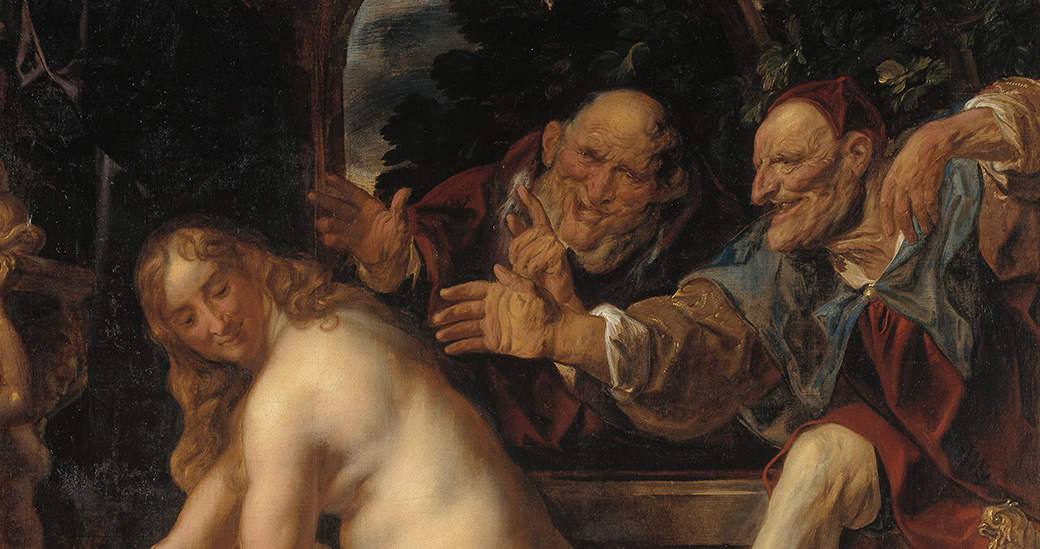
    Detail from Susanna and the Elders (1653), Jacob Jordaens | Wikimedia Commons. While I think Jodaens is off with his smiling Susanna, as if she’s enjoying the intrusion of these nasty men on her bath, I think he’s spot on with the devilish faces of the judges and their grasping hands. It speaks to their lustful focus on her.

    So when the two elder judges in the Book of Daniel “would not allow their eyes to look to heaven,” they are on the path of becoming spiritual adulterers. When they act upon their lustful desires by attempting to rape Susanna and then falsely accuse her of adultery, we are given a juxtaposition of worldly adultery and spiritual adultery. Their false testimony as judges in a court and the ensuing guilty verdict begs the question of why laws can fail to provide justice. Human justice, as we all know, often does fail and miss the mark — it is not divine justice and it is tainted by the sins each of us carries with us.

    But Susanna appeals to God for divine justice, not to the court for human justice. And, “The Lord heard her prayer. As she was being led to execution, God stirred up the holy spirit of a young boy named Daniel.” The story reminds us that while God is the source, he works in this world through the Spirit and through other people. Daniel’s youth speaks to the purity and honesty we hope for when we think of justice. And his spirit-given wisdom allows him to trap the wicked judges in their lies. The whole episode validates spiritual fidelity to God as well as marital fidelity to one’s spouse.

    Cropped image of The Innocence of Susanna (c.1621), Valentin de Boulogne | Creative Commons, courtesy the Metropolitan Museum of Art. Note the emphasis of the children and the child-like honesty of divine justice.

    The gospel from St. John presents another look at marital vs. spiritual adultery. In this account, the question of the Law and the Spirit come into even sharper focus. This account has often been presented to us in a very moralistic sense, i.e., don’t judge others and God’s mercy is boundless, even for sinners. But we are very far removed from traditional Jewish ritual practice, and I think we’re both missing the point and mistakenly generalizing a specific act of teaching that Jesus presents.

    All signs point to the fact that this is almost identical in nature to the first reading, where several judges are falsely accusing a woman of adultery in a miscarriage of justice. The key is when Jesus says, “Let the one among you who is without sin be the first to throw a stone at her.” He is not saying that only sinless people can execute justice (no judicial system could exist!). He is referring to the Torah where it is written that if “you make a thorough inquiry, and the charge is proved true,” then not only shall the adulterer/adulteress be stoned, but “The hands of the witnesses shall be the first raised against the person to execute the death penalty” (Deut 17:4, 7).

    You see, this woman was dragged before Jesus by the scribes and Pharisees although the Torah relates that witnesses must bring her to the temple for justice. If these scribes and Pharisees truly caught her in the act and are witnesses, then they should cast the first stone (a serious act that must be justified otherwise you are murdering, not carrying out justice). Otherwise, they are sinning by lying about witnessing the adultery.

    So, “let the one among you who is without sin” is the same as saying “whoever witnessed this should be the first to stone her.” Jesus is living the law more fully then these scribes and Pharisees are. Tellingly, no one casts a stone. 

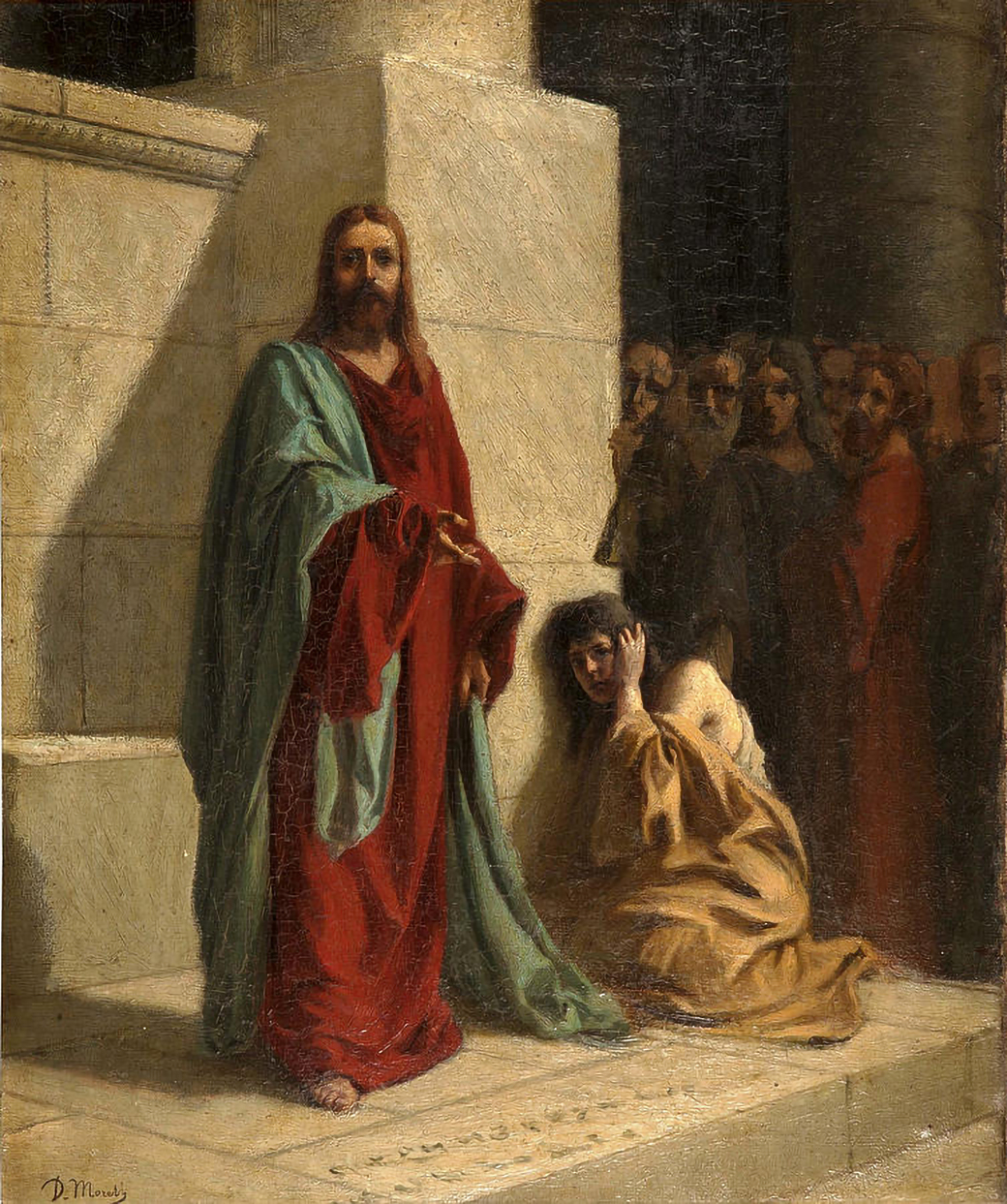
    Detail from Jesus and the Sinner Woman (c.1886), Vasily Polenov | Creative Commons, courtesy Artbible.info.

    The other key that tells us this episode is more about Jesus’s authority as the Word and Law than it is about mercy and forgiveness is his act of writing in the dirt. St. Augustine of Hippo writes an enticing few lines about this act:

    “You have heard, O Jews, you have heard, O Pharisees, you have heard, O teachers of the law, the guardian of the law, but have not yet understood Him as the Lawgiver. What else does He signify to you when He writes with His finger on the ground? For the law was written with the finger of God; but written on stone because of the hard-hearted. The Lord now wrote on the ground, because He was seeking fruit” (Tractate 33 on the Gospel of John, 5).

    This interpretive move is a nice way to look at the new reality of God in the flesh, working in humanity in a new way.

    But let us also understand this more literally within Jewish ritual law. For accusations of adultery without witnesses (as Jesus knows this is), the Torah describes a water trial (called Sotah) that the woman must undergo. It instructs, “the priest shall take holy water in an earthen vessel, and take some of the dust that is on the floor of the tabernacle and put it into the water. … the priest shall put [the charges and penalties] in writing, and wash them off into the water of bitterness. He shall make the woman drink the water of bitterness that brings the curse” (Numbers 5:17, 23).

    “Holy water” was written in Hebrew as “living water,” and we can begin to see how Christ, who is living water and our high priest, is enacting the Sotah ritual as prescribed in the Torah. He (the water) writes in the dust the charges and penalties, fulfilling the letter of the Law that He wrote. Let us also keep in the front of our minds that this is the incarnate Word of God. The Word that forms the Torah and its prescriptions around how to carry out justice. As Jesus affirms, “Do not think that I have come to abolish the Law or the Prophets; I have not come to abolish them but to fulfill them” (Mt 5:17). 

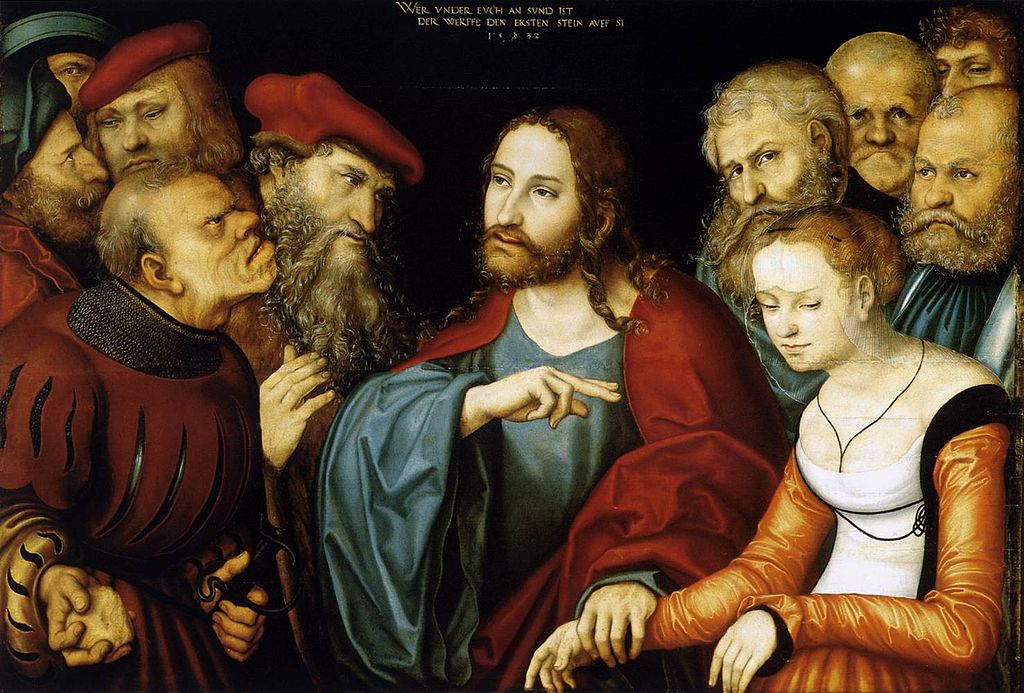
    Christ and the Woman Taken in Adultery (c.1600), Pieter Brueghel the Younger | Wikimedia Commons.

    So the scribes and Pharisees came to entrap him and they truly have no clue about who they are challenging. He is the Word, the fulfillment of the Law — he knows it better than they ever could. He knows that these prescriptions are in place so that there is no miscarriage of justice. He lifts up the law to fulfill the spiritual work it is intended to do: to keep our hearts clean from lies and sin, to keep sinners from perverting the justice God intends in the world.

    On what other evidence might we think this episode is not about “forgiveness no matter what”? His parting exchange with the woman bears no resemblance to the other miracles he performs when forgiving sin or healing. He says, “Neither do I condemn you. Go, and from now on do not sin any more.” He confirms that he was also not a witness to adultery on her part (which is the point of the encounter with the scribes and Pharisees). Does that mean that she didn’t commit adultery? Not necessarily, but that’s not his mission.

    Recall that the Samaritan woman at the well was living in adultery and had five husbands, yet he shared with her one of his most thorough revelations of divinity. Mary Magdalene was also a prostitute, but she became one of his close disciples. It’s not that adultery against a spouse doesn’t matter — the Word of God clearly says it does. It’s that his mission is about fidelity of Spirit. He preaches primarily on the dangers of adultery in the context of our most fundamental covenant with God.

    Nothing about this final exchange is like the other miracles or healings he accomplishes. He does not ask her about her faith or belief. He does not establish the atonement and request for mercy that is the requirement for spiritual healing. We must conclude that this encounter is not about sin being forgiven. So when Jesus says, “Go, and from now on do not sin any more,” I’m sure that he was speaking of spiritual adultery just as much, if not more, than spousal adultery.

    For me, at least, returning to these familiar stories with a new lens and spirit of contemplation has shed light in new ways. I’m sure that none of these reflections are the ultimate exegesis of scripture, but going through the effort has helped me feel much closer to Christ this Lent.

  • Tend to the Good Fruit of the Vineyard

    Tend to the Good Fruit of the Vineyard

    Friday in the Second Week of Lent: Genesis 37:3-4, 12-13a, 17B-28a, Matthew: 21:33-43, 45-46.

    Today’s readings are riches in storytelling and spiritual importance. I don’t mean to give short shrift to Joseph and his jealous brothers in Genesis, but I must explore it rather briefly to leave space to plumb the depths of the Parable of the Wicked Tenants in the gospel reading from St. Matthew.

    These two stories are, of course, quite related. Joseph is a very early figure in the Bible who prefigures Jesus. He is the favored son, given visions and special graces from God the Father. He is persecuted by those closest to him and finds adoption by an alien people. Finally, he never stops loving even those who sold him into slavery and ends up saving them during a time of famine and establishing a new home for them.

    Joseph, a favorite Son, Sold into Slavery (from an illustrated French manuscript, known as the Crusader Bible or the Morgan Bible, c.1244-1254) | Creative Commons, courtesy Pierpont Morgan Library. MS M.638.

    What strikes me about today’s reading is what becomes of us when we allow ourselves to be consumed by jealousy and are taken over to sin. Listen to the brothers: “Here comes that master dreamer! Come on, let us kill him and throw him into one of the cisterns here; we could say that a wild beast devoured him. … just throw him into that cistern there in the desert; but do not kill him outright. … What is to be gained by killing our brother and concealing his blood? Rather, let us sell him to these Ishmaelites.” This spiral of evil conspiracy starts with the seed of jealousy, planted in their hearts by the devil. It is not something they push away with prayer and trust in God. Instead, it festers and manifests by calling him names, degrading him. This enables them to see him as something other than fully human (much less their brother).

    Then we hear a sequence of plots and machinations. They have already given themselves over to sin and evil, and this sequence smacks of the guilty desperately trying to find a way not to be found out. We must recognize this tortured logic because we encounter it in ourselves in many ways. Whenever we find ourselves making certain calculations and rationalizations to avoid a certain end, it is a good time to sit up and examine what exactly we are doing. Are we living in the light or are we obscuring our actions because we’re heading down a path of darkness? This is not to say that all situations are easy and straightforward — indeed, many take careful thought and weighing of moral issues — but it is a good reminder in this Lenten season of what our more quiet soul-searching can do for us in a busy modern world.

    Jesus is all-too-aware of the plots and machinations of the chief priests and elders of the temple who want to arrest him. They, too, are already guilty of having sinned in their hearts and turned away from the light. For them, he presents the Parable of the Wicked Tenants.

    Central to the parable is the setting: a vineyard. His listeners would immediately identify the vineyard with Israel since one of the more famous and eloquent passages in Isaiah is “The Song of the Vineyard”:

    Let me sing for my beloved
        my love-song concerning his vineyard:
    My beloved had a vineyard
        on a very fertile hill.
    He dug it and cleared it of stones,
        and planted it with choice vines;
    he built a watchtower in the midst of it,
        and hewed out a wine vat in it;
    he expected it to yield grapes,
        but it yielded wild grapes. …
    For the vineyard of the Lord of hosts
        is the house of Israel,
    and the people of Judah
        are his pleasant planting;   (Is 5:1-2, 7a).

    Isaiah’s verses question why wild grapes have grown rather than choice grapes, and Jesus answers: it is the evil in the tenants who were entrusted to care for the vineyard.

    Against the important backdrop of a vineyard, Jesus weaves a parable that presents the scope of salvation history. First, we see creation: the landlord planted a vineyard, put a hedge, dug a wine press, and built a tower. Next, the election of the nation of Israel as a hope for the world: “Then he leased it to tenants and went on a journey.” Then, we see the long line of prophets who were sent to the people as well as their brutal rejection: “the tenants seized the servants and one they beat, another they killed, and a third they stoned.” Next, we see the time of Christ, when the son comes to “obtain the produce,” but he, too, is killed. Finally, we are given the question about the final judgment: “What will the owner of the vineyard do to those tenants when he comes?” Because it presents the history of God’s work of salvation in a concise allegory, this parable should be precious to us.

    The Wicked Husbandmen (1864), Artist: After Sir John Everett Millais, Engraver: Dalziel Brothers | Creative Commons, courtesy The Metropolitan Museum of Art.

    In his masterwork volumes on the gospel of St. Matthew, Fire of Mercy, Heart of the Word, Erasmo Leiva-Merikakis points out how central to the story (both the allegory and our reality) is the absence of the landowner. God’s physical absence is what makes the life of faith so important and what makes his return so anticipated. In Volume III, Leiva-Merikakis states, “The master’s physical absence is a kind of mystical vacuum that generates a tremendous moral crisis exposing the innermost heart of the tenants, revealing it in all its perversity” (468).

    Why, in fact, does God leave us to begin with? Leiva-Merikakis points out that the Hassidic answer “is that God must be absent for man’s sake, that is, if man is ever to grow fully into his divine vocation of becoming the eyes and hands and Heart of God in this word, the very dwelling place of God’s glory and truth” (468).

    God’s absence presents us with the choice: either trust in him, his wishes, and his eventual return, or choose to forget that he was ever here and act like it’s all in our hands to do what we want. Clearly, the wicked tenants in the parable, who Jesus points out are the chief priests and Pharisees, have chosen the second option. 

    But let’s not forget that God cares deeply about his beloved vineyard, the tenants, and the precious fruit he waits for it to bear. That’s why he sends his servants (the prophets) time and again, as well as his son. When Jesus asks the priests and elders what the landlord will do to the tenants, they rightly answer, “He will put those wretched men to a wretched death and lease his vineyard to other tenants who will give him the produce at the proper times.”

    But God is not focused on the retribution for the wrongdoing. Instead, Jesus replies to their answer with the following from scripture: “The stone that the builders rejected has become the cornerstone; by the Lord has this been done, and it is wonderful in our eyes.” His Good News is that God’s work and presence in the world is restored. The “stone that the builders rejected” refers to the new tenants who will better care for the vineyard. Who exactly are they? 

    The Heir Cast Out of the Vineyard (1855-1856), William Cave Thomas | Creative Commons, courtesy The World of Glass/ArtUK.

    The tenants (and the rejected cornerstone) begin with Christ. He is rejected by his people, but becomes the cornerstone of a new reality of salvation alive in the world. And it is wonderful in our eyes. This new reality of salvation happens in the presence, not the absence, of the Spirit of Christ, alive in the world after the Resurrection. This makes us the new tenants in as much as we share Christ with the world. In his high-priestly prayer at the Last Supper, Jesus affirms this aspect of the Church: “The glory that you have given me I have given them, so that they may be one, as we are one, I in them and you in me, that they may become completely one, so that the world may know that you have sent me and have loved them even as you have loved me” (Jn 17:22-23).

    Leiva-Merikakis elaborates: “When people look for God in a visible form, they will see only each other. When they look for Christ, they will see only Christians. By giving us his own animating and sanctifying Spirit, Christ has entrusted us with everything that is his. No, ‘entrusted’ is not to say enough. Through his death and Resurrection, he has implanted in us a wholly new life, with all the same energies and principles of life that give thrust to his own life” (469).

    If we are in part the new tenants, are we (or our deeds) not also the fruit that the landlord will find? This is the question of all of salvation history: what kind of fruit will the landlord find? God has given us the ability to tend the vineyard through Christ’s Spirit active in our lives, but our deeds and charity, indeed all that we do here on earth are our fruits.

    Can we wisely accept the Spirit of Christ in our lives as a landlord who is present? Or will we continue to act as the Israelites did and conform to the law externally while having no internal relationship to the truth? Each of us this Lent has the opportunity to re-dedicate ourselves to tending the vineyard with Christ and bringing forth the fruits pleasing to the Lord.

    Red Vineyards at Arles (1888), Vincent van Gogh | Creative Commons, WikiArt.org.
  • Led by the Master

    Led by the Master

    Tuesday in the Second Week of Lent: Isaiah 1:10, 16-20, Matthew 23:1-12.

    Today’s readings reveal much about the Master, that is, Christ, as well as how He wants His people to live in his Spirit. The Word of God spoken by Isaiah makes clear that religious customs won’t save the Jews, instead they must cleanse their souls and perform acts of mercy. Jesus repeats this refrain in the flesh when contrasting his teachings with the Pharisees. 

    The “Vision of Isaiah” concerning Judah and Jerusalem was taken down in the early 700s BC, during a low point for Judah. King Ahaz (r. 732-715 BC) had cozied up to the Assyrians and brought their tastes and religious idolatry not just into the country but into the Temple itself. Just how wicked was he? Well, he also offered his son by fire to Moloch, the Canaanite god associated with child sacrifice. His wickedness did not stop despite many trials, and he even closed schools and houses of worship so religious instruction had to go underground.

    Isaiah (1838), Jean Louis Ernest Meissonier | Creative Commons, courtesy The Wallace Collection/ArtUK.

    Given the king’s significant turning away from God, we can start to understand the dire warnings in Isaiah. For me, one of the signs that the Word of God is truly speaking through Isaiah is that he did not focus on the form of worship, which constitutes the core of Jewish priestly concerns and to this day characterizes the ultra-Orthodox strain of Judaism. In verses 11-14 (omitted from today’s reading), he is clear that these are no longer pleasing to the Lord: 

    I have had enough of burnt offerings of rams
        and the fat of fed beasts;
    I do not delight in the blood of bulls,
        or of lambs, or of goats. …

        Trample my courts no more;
    bringing offerings is futile;
        incense is an abomination to me. …

    Your new moons and your appointed festivals
        my soul hates;
    they have become a burden to me,
        I am weary of bearing them.

    You could imagine that the priestly class would be calling for more sacrifices, more incense, more religious festivals. But Isaiah points out that the problem is the people themselves. His encouragement is for them to “Wash yourselves clean! Put away your misdeeds from before my eyes; cease doing evil; learn to do good.” And in a verse that could come from the mouth of Jesus some 700 years later, he urges them to establish their goodness through works of mercy: “Make justice your aim: redress the wronged, hear the orphan’s plea, defend the widow.”

    What strikes me in this reading is the eternal patience of God and his refusal to abandon those with whom he has made his covenant, even after they abandon him: “Come now, let us set things right, says the LORD: Though your sins be like scarlet, they may become white as snow.” These are sweet words, like a parent cajoling a naughty child to make up with them after some misbehavior. Even the imagery is soothing — taking a blood-red sin and making it “white as snow.” Who would not want this Master? He gives us the opportunity to make amends where so many other masters would not.

    In the reading from Matthew, Jesus has some harsh words for the Pharisees and scribes. He enjoins the crowds to listen to their words because they have law-giving authority in their society (they sit on “the chair of Moses”). But he tells them flat-out not to ” follow their example. For they preach but they do not practice.” Ouch! To be called out by Christ!

    Their problem, Jesus says, is that they glory in their power, they have too much pride in their station. “All their works are performed to be seen,” he says, “They love places of honor at banquets, seats of honor in synagogues, greetings in marketplaces, and the salutation ‘Rabbi.’” Jesus tells them they have only one teacher (and I think it rhymes with “the level”).

    He adds two more equivalent sayings, one for God the Father and one for himself. There is only one Father, who is our Creator … this seems obvious. But note who the master is: “Do not be called ‘Master’; you have but one master, the Christ.” And here we get to see for ourselves the most exceptional aspect of our Master: he leads by the ultimate example. He is the opposite of the Pharisees who don’t practice what they preach. He leads us with love and dies on the Cross himself, as an example and encouragement for us all to not fear death, but retain absolute devotion to our Father in all circumstances.

    To solidify his message about subduing pride and, instead, serving others, he ends today’s reading with: “The greatest among you must be your servant. Whoever exalts himself will be humbled; but whoever humbles himself will be exalted.” We must note his authority over the abstract moral terms “greatest” and “exalted.” He, the Lord, is the definition and the definer of what is known as “great” and what will be “exalted.” There is no debate or wiggle room where we could somehow insert our own understanding of what it means to be great.

    This is precisely his point: we keep getting ourselves in this pickle, this distancing ourselves from God, because we try to be the definer of moral terms. We think that we have mastered life (or ethics, or morality) and can teach others. We have the audacity to feel “exalted” above others if we do something our earthly jobs/politics/society feels is “great.” These terms are not for us to play with; they have very definite meanings established by the source of the universe: God. This is why humility is his example and is so important to our lives as Christians.

    Vendimian of Bithynia, a miniature painting found in the Menologion of Basil II, an illuminated “lives of the saints,” 985 AD | Wikimedia Commons.

    It’s fascinating to see how the Desert Fathers lived out Christ’s instructions from today’s gospel. The Desert Fathers (and Desert Mothers) were Christians who moved to the desert to live the life of seclusion and asceticism. The area especially known for this was the Scetes Desert south of Alexandria, Egypt (to get your bearings, this would be a 24-hour walk from Alexandria, or a 2-hour drive for us moderns), and the most well-known Desert Father, St. Anthony the Great, moved there about 270 AD. The Desert Fathers sought to be humble to the utmost. This meant always recognizing their own sinfulness, being gentle and subservient to others, and not judging others. It seems they fashioned their lives directly on Mt 23:11-12 from today’s reading: “The greatest among you must be your servant. Whoever exalts himself will be humbled; but whoever humbles himself will be exalted.”

    For instance, Abba Matoes says “Be always mindful of your sins and do not judge others; rather become inferior to all … If somebody speaks to you about any matter whatsoever, do not argue with him; but [if he speaks well] say ‘yes’ and if he speaks badly, say: ‘You know what you are talking about’ and do not contend with him about how he spoke” (Matoes 11).

    Over time the sayings from the great abbas (elders) of these monastic groups were written down and became the Sayings of the Desert Fathers (the Apophthegmata Patrum, originally written in Greek). These sayings contain wonderful anecdotes that display the depths of the humility these Christians took upon themselves. Lest we think they just preached humility, there are many examples of practice. “

    Someone once brought abba Hor and abba Athre a bit of fish, and Athre had already picked up the knife and started cutting it up when Hor called him. He left the knife in the fish and came at once. Sisoes was impressed and asked where the old man had learned such submission. Athre said he had learned it from Hor, and to prove it he took a bit of the fish and cooked it and deliberately spoiled it. Then he took it to abba Hor and said, ‘Isn’t it good, father?’ Hor said, ‘Yes, it’s excellent.’ Then he cooked another bit without spoiling it, and took it to Hor, saying, ‘I’ve spoiled it, father.’ And Hor replied, ‘Yes, you have spoiled it a bit’” (from Ways of Imperfection by Simon Tugwell, OP, p.19).

    This type of humility was good for the soul of the one humbling himself and also a type of fraternal charity to uplift one’s brothers. There are countless stories of how humility and fraternal charity was lived by these Christians. Here’s another noteworthy one:

    Now there was a tone statue there in the temple; Abba Anoub would get up early in the morning and throw stones at the face of the statue; in the evening he would say to it, “Forgive me,” and he spent the whole week behaving like that. On Saturday they met up with each other, and Abba Poemen said to Abba Anoub, “I saw you throwing stones at the face of the statue during the whole week, Abba, then making an apology to it too. Does a man of faith act like that?” “I did this deed on your account,” the elder replied. “When you saw me stoning the face of the statue, was it angry, or did it speak?” “No,” said Abba Poemen. “And then again, when I prostrated myself to it, was it troubled, and did it say, ‘I do not forgive you’?” “No,” said Abba Poemen. Abba Anoub said, “And here we are, seven brothers. If you want us to live with each other, let us become like this statue that is not troubled even if it is insulted. If you do not want to become like that, here there are four gates in this temple; let each one go where he will.” But they threw themselves to the ground saying to Abba Anoub, “We will do as you wish, father, and attend to what you say to us” (number 12 in the Humility section of the systematic collection of the Book of Elders).

    Finally, one of my favorite (number 87): “The devil appeared to a brother in the disguise of an angel of light, saying to him, ‘I am the archangel Gabriel, and I was sent to you.’ ‘Make sure you were not sent to somebody else,’ said the brother to him, ‘for I am not worthy to see an angel,’ and the demon immediately disappeared.” 

    So here we have centuries of examples of how humility and charity can be lived as the core part of what makes us Christian. May we all learn from these examples and seek to bring the spirit of this teaching into our daily modern existence.

  • The Examined Self Before God

    The Examined Self Before God

    Monday the Second Week of Lent: Daniel 9:4b-10, Luke 6:36-38.

    Today’s readings call us to reflect on our sins. In the Book of Daniel, we are shown the model of a contrite heart for past sins. In the gospel of St. Luke, Jesus instructs us on how to avoid sins in the future. Now for many of us, thinking about sins is not the most captivating aspect of our religion (low attendance at Confession can attest to that), yet even the most casual reading of the Bible shows us how essential self-examination is.

    Perhaps we can better embrace the spirit of today’s readings if we bring to mind yesterday’s glorious Transfiguration reading from Matthew. When I put myself in the sandals of Peter, James, and John, and imagine witnessing the divine light shining from the face of our Lord, followed by the bright cloud of the Father instructing me to listen to him, I can also see myself falling prostrate on the ground. The purifying and incomprehensible divine light casts a shadow over my soul that “darkens and empties and annihilates it in its particular apprehensions and affections concerning both earthly and heavenly things,” in the words of St. John of the Cross (see the end of yesterday’s reflection for more context here).

    When my soul in its imperfect state encounters the divine light, I cannot help but notice its blemishes. It’s like a familiar shirt that seems fine until I wear it to a nice event in the sunshine — then, the stains and frayed seams jump out as obvious.

    How do we feel about the grubby shirt that is our soul? A bit embarrassed? That’s OK — let’s take heart from one of today’s patron saints, St. Catherine of Bologna (1413-1463): “It means little to wear a worn habit and walk with bowed head; to be truly humble one has to know how to bear humiliation. It is the touchstone of Christian discipleship.” Humiliation, embarrassment: both of these accept a public acknowledgment of a sin or mistake. It shouldn’t be too difficult for us to acknowledge our sins before God, in the privacy of our relationship with Him.

    The Adoration of the Golden Calf (L’Adoration du veau d’or), 1633-1634, Nicolas Poussin | Wikimedia Commons.

    Humiliation is something the Jews knew well at the time the Book of Daniel was written (~165 BC). During this period, Antiochus IV Epiphanes was the Greek ruler over Israel who brutally put down the revolt recorded in the Book of Maccabees. “He ordered his soldiers to cut down without mercy those whom they met and to slay those who took refuge in their houses. There was a massacre of young and old, a killing of women and children, a slaughter of virgins and infants. In the space of three days, eighty thousand were lost, forty thousand meeting a violent death, and the same number being sold into slavery” (2 Maccabees 5:11–14). Then he tried to force the remaining Jews to worship Zeus on pain of death.

    Rather than bemoan their conquered and downtrodden state, the Book of Daniel acknowledges the humiliation and takes spiritual responsibility: “O LORD, we are shamefaced, like our kings, our princes, and our fathers, for having sinned against you.” The message is not all shame and doom, however. God’s covenant with his people still stands and hope is always there: “But yours, O Lord, our God, are compassion and forgiveness!” The Book of Daniel is an apocalyptic writing and focuses on the coming day of the Lord and the ultimate vindication of the chosen people. (The writer of Daniel uses the famous phrase “Son of Man” for the messiah — one that Jesus will use in reference to himself throughout his ministry.) 

    What can we learn from this long passage acknowledging sins? We aren’t Israelites who broke their covenant by worshipping idols and ignoring God’s commandments. Or are we more like them than we think? Our idols may not be golden calves, and our worship of them may not include burnt offerings, but let’s consider our contemporary lives. American culture is known for a few things: nearly limitless choice (for food, for clothing, for entertainment, for jobs, for housing, etc.) and unconstrained appetite (for those same things). We don’t think twice about ordering something we don’t need from Amazon if the price seems good or buying that little impulse purchase right next to the cash register at the store.

    Our golden calf is ourselves and our offerings are conspicuous consumption. This has been true for a long time. Heck, Thorstein Veblen writes in the Theory of the Leisure Class in 1899 that “The quasi-peaceable gentleman of leisure, then, not only consumes of the staff of life beyond the minimum required for subsistence and physical efficiency, but his consumption also undergoes a specialization as regards the quality of the goods consumed. He consumes freely and of the best, in food, drink, narcotics, shelter, services, ornaments, apparel, weapons and accoutrements, amusements, amulets, and idols or divinities” (Chap 4: “Conspicuous Consumption, p.73).

    All of this is to say that we live in a society rooted in self, not in God. We participate in ways great and small. Too often we rationalize away the Word of God and try to fit it within our normal cycle of making money, saving money, spending money, getting things for ourselves, getting things for our mini-me (kids), etc. Granted, living in contemporary society and simultaneously living out the New Covenant is not easy apart from becoming a monk, but nonetheless we’re all called to be saints.

    Plus. that’s kind-of the point of Christianity. It was seriously hard (on pain of death) before it was sanctioned by Constantine and being Christian began to synchronize with the power of the state. This sent us down an arguably more difficult path of retaining our focus on a world beyond this one when the current world seemed to be achieving all we wanted. I digress.

    Acknowledging sins: is it worthwhile or does the reading from Daniel seem to take it a little too far? Let’s take some wisdom from one of our great Church Fathers, St. John Chrysostom, who writes: “If we have been neglectful to the present moment, let us proceed immediately to the work of destroying sin through confession and tears. … Unless you tell the magnitude of your debt, you do not experience the abundance of grace” (Homilies on Lazarus (388 AD), 4.4). Sounds like it’s worth it.

    Chrysostom’s comment about confession and tears (i.e., contrition) “destroying sin” is echoed by several other Church Fathers. Tertullian writes his treatise Repentance in 203 AD and makes clear this connection: “of confession is repentance born, and by repentance is God appeased. … by its own pronouncement against the sinner, [confession may] stand in place of God’s indignation … In so far as you do not spare yourself, the more, believe me, will God spare you!” This affirms that God wants us to convert to Him wholly, and the more work we do in confessing sins and purifying our own souls, the less God will have to do later (perhaps in Purgatory?).

    So here we get to the reason we’re confessing sins to God. Tertullian and Chrysostom are doing some arithmetic: if we have a bank of sins, we can confess and be contrite while here on earth to destroy some or most (maybe even all?) of this bank of sins … while of course trying not to commit more of them. Otherwise, we meet God after this life with a big bank of sins that He must deal with, not something we want. To use our earlier analogy, will we present ourselves to God in a grubby, stained shirt or will we scrub and iron that shirt the best we can before we meet Him?

    Saint Francis in Ecstasy (1600s), Italian (Neapolitan) School | Creative Commons, courtesy Guernsey Museum & Art Gallery/ArtUK.

    The reasoning presented by Tertullian and Chrysostom we might call “negative reasoning” in that we are encouraged to do something good to avoid something bad (God’s reaction to our huge bank of sins). Christ presents us with “positive reasoning” in today’s gospel reading. While he is referring to avoiding future sins instead of confessing and repenting for past sins, his reasoning applies to both.

    Christ’s message is that we are active participants in our own salvation in how we respond to God’s call and take on God’s commandments. He says, “Stop condemning and you will not be condemned. Forgive and you will be forgiven. Give and gifts will be given to you.” In other words, live by God’s law and you will continue to live with God for eternity; carry divine love in your heart as you live, work, and act with other people, and divine love will be given to you for eternity.

    This reciprocation is a refrain that Jesus repeats throughout his ministry. The Lord’s Prayer uses nearly the same formulation: “forgive us our trespasses, as [you see us forgiving others].” How extraordinary — we seem to be hearing that we, in effect, have the power to save ourselves because God will mirror whatever we do. But let’s avoid this simplification of the message (and heresy) and dig a little deeper. 

    Jesus wants us to so fully embrace the divine life offered to us that we transcend the letter of the law to inhabit the spirit of the law. The readings last week showed us several times how Jesus exhorts us to surpass the righteousness of the scribes and Pharisees and to “be perfect, just as your heavenly Father is perfect” (see The Difficult New Covenant of Love). What changed from the time of Daniel in the old covenant is that Jesus offers humanity a real taste of the Kingdom here on earth and is the true gateway to the eternal Kingdom. That’s why we must transcend the letter of the law, which ruled the Israelite understanding of God’s relationship, and more fully let the Spirit inhabit us.

    Since we now have the liturgy that gives us true communion with God, we have the opportunity to carry our godliness into every aspect of our lives in a way that was never available before Christ. It is this same generosity of Christ that speaks today when he says that an “overflowing measure” will be measured out to us if we live in the New Covenant. This new Way (earliest Christians referred to themselves as followers “of the Way,” cf. Acts 9:1-2) requires more than the old covenants.

    To inhabit the spirit of the law (and let the Spirit inhabit us), we must not carry the spirit of condemnation and judgement, we must forgive and give. Again, the big difference is that we are sanctified by the Spirit in the liturgy and sacraments; our sanctified lives puts us in intimate communion with God. That means that when we sin we turn our backs on God, the God dwelling within us who we just sullied with sin. We must both confess/repent for past sins and keep from future sins because we are already “on the Way” to union with God. We already have the Spirit dwelling within us and acting in our lives. Our union with God’s will by the way we act confirms our covenant with Him and therein his promise to reciprocate in the life to come.

    To live a fully human life means to be elevated and transformed by God, to strive for perfection in spirit and action as we unite ourselves with Him. The ultimate reason for Christians to live like this is not a selfish guarantee of eternal life for that person we think we are (as we worship at the altar of self), but because we want to be with Him, to leave these limited “selves” and join the heavenly host. That’s exactly the “overflowing measure” promised to us.

  • Getting to Know the Tempter

    Getting to Know the Tempter

    First Sunday of Lent: Genesis 2:7-9, 3:1-7, Romans 5:12-19, Matthew 4:1-11.

    Satan is known by many names in the scriptures: the Adversary (the most literal definition of the word “Satan”), Lucifer, Beelzebub, the Devil, the serpent, the Prince of the World, the Father of Lies, and the Tempter. Today’s readings give us a chance to get to know him as the Tempter. First, we watch him tempt Eve and cause the great fall of humanity. Then, we watch him try to tempt Christ in the desert. What we might realize from the readings is just how tightly interwoven his whispers are to our way of looking at the world. His temptations are the same ones we encounter today. 

    As we revisit our origin story in Genesis, it absorbs us lyrically like a colorful legend. After forming man from clay, God “blew into his nostrils the breath of life.” God plants a garden and makes trees sprout up that are “delightful to look at and good for food.” What evocative language! But lest we consider this just a colorful story, remember that it is laced with the undeniable stamp of truth. One example: thanks to modern science, we realize that we are made of biological building blocks like DNA, in turn made of inert elements (the “clay”) like carbon, nitrogen and oxygen, somehow sewn together and animated in relationship to one another.

    But I am not trying to be a Biblical literalist here; let me focus more on the theological truths in Genesis. Let’s consider that the garden is a metaphor for perfect life with God, in other words, the Kingdom of God. We long to return to a place of unity with God. One aspect of the garden that we take into our spiritual lives is its orientation. The garden is planted in the east, not just symbolic of newness, but the direction of the rising sun. It is the place of eternal renewal and newness, which is why Catholic churches have their altars in the east and the people face east during Mass.

    In the middle of the garden are the tree of life and the tree of the knowledge of good and evil. The tree of life is the creative power of God, and the tree of knowledge of good and evil reveals characteristics of his essence. God’s only commandment for Adam and Eve is to not eat of the fruit of the tree in the middle of the garden. The message here is that humanity should not try to partake in the essence of God, should not try to be gods.

    Lo, enter the serpent, the “most cunning of all the animals.” He begins his conversation like the quintessential gossip: “Did God really tell you not to eat from any of the trees in the garden?” The “really” is very telling — he’s not asking for clarification, he’s asking because he has an agenda, something he wants to implant in Eve’s mind. She naively tells him about the injunction on the tree in the middle of the garden, and the serpent responds: “You certainly will not die! No, God knows well that the moment you eat of it your eyes will be opened and you will be like gods who know what is good and what is evil.” The first thing we must acknowledge is that the Tempter is setting himself up as an alternative truth, a friend who shares secret knowledge. This presents Eve with a choice, who to believe? And her great sin (and Adam’s) is to begin to doubt God. She doubts that God has been entirely truthful. 

    Creation and Fall of Man (1513-1514), Mariotto Albertinelli | Creative Commons, courtesy The Courtauld Gallery/ArtUK. Note the depiction of the serpent in the tree as a human voice whispering in Eve’s ear, a nice representation of temptation as a familiar, almost human voice.

    The Tempter, we see, is a friendly devil. He operates by setting himself as a friend who wants the best for you, but that “best” is always to be questioned. Who on earth or in the heavens knows what is best for us, other than God?

    It’s important not to misunderstand the outcome of their choice. We read: “Then the eyes of both of them were opened, and they realized that they were naked.” Was Satan right? He said their eyes would be opened! Like a good used car salesman, the Devil may have laced his lies with some half-truths, but when their eyes are opened, they do not become omnipotent (which we realize in retrospect he didn’t promise) and instead they realize the evil they committed in disobeying and distrusting God, and the goodness of the garden they just betrayed. It is their shame that they realize, and the metaphor, or perhaps simply the object of this shame, is their nakedness, which they attempt to hide. Their nakedness caused no shame while they were in perfect, trusting relationship with God, but they became ashamed of their very nature (most physically obvious in their nakedness) once they broke the trust.

    This is the Original Sin: mistrusting God.

    The Expulsion of Adam and Eve (1829), Alexander Mosses | Creative Commons, courtesy Walker Art Gallery/ArtUK

    St. Paul connects for us the truth in God’s statement to Adam and Eve, “You shall not eat it or even touch it, lest you die.” The death of which God warned was not immediate (as if the fruit was a poisoned apple), but now an inevitable part of the nature of humans, brought about by their sin. Paul writes, “Through one man sin entered the world, and through sin, death, and thus death came to all men, inasmuch as all sinned.” Sin and death are inexorably joined. But the good news Paul shares is that when Jesus Christ takes on this sin and offers it to the Father in a perfect sacrifice, we are given life again. This life is evident in the bodily resurrection of Jesus, and is now available to all humanity.

    Jesus is the new Adam.

    And just as the Tempter wormed his way into the minds of Adam and Eve, he attempts to do the same with Jesus. The three temptations he uses with Jesus after his 40 days of fasting in the desert are a case study in the way we experience temptations to this day.

    The first thing we read from Matthew in today’s reading is that Jesus was “led by the Spirit into the desert to be tempted by the devil.” How much this tells us of the Spirit of God! Jesus was led by the spirit in order to be tempted. One of the major questions modern people ask when they question God is why he permits evil in the world. There are many ways to approach the answer (one of which being the fact that we were meant to be in the garden, not the world, but we screwed that one up), and this passage helps us realize one of the reasons. As we read from our Church Fathers, God refines our spirit through the fires of temptation and difficulties. God, no doubt, tests us and wants us to continue to purify ourselves and our souls in order to rejoin him in perfection. Jesus was not exempt from this. And temptations are hard, particularly because the Devil is so convincing. This is why in the Lord’s Prayer we ask God not to lead us into temptations (although it is his prerogative to do so).

    Matthew tells the temptation story in a very neutral voice. Picking up on his clues (calling the devil “the tempter,” for instance) and knowing what we know of the devil, we can flesh out this story as we contemplate. We are told that Jesus was hungry after his 40-day fast. So when the Tempter says, “If you are the Son of God, command that these stones become loaves of bread,” we can almost hear the false compassion in his voice.

    Jesus Tempted in the Wilderness (Jésus tenté dans le désert), 1886-1894, James Tissot | Creative Commons, courtesy Brooklyn Museum. I particularly like the depiction of the Tempter as a common desert ascetic, hiding his nature from Jesus.

    Satan wants to appear empathetic to Jesus’s hungry state and offers him a way out. But Jesus points out the falseness of his empathy in that the Tempter focuses on physical things when the test is a spiritual one. Jesus responds with a scriptural quote: One does not live on bread alone, but on every word that comes forth from the mouth of God. What a great way to start Lent, when we might be tempted by this same devilish voice to focus on the physical discomfort we might feel in fasting instead of forging our spiritual fortitude.

    With the second temptation, we might think that the devil is mocking Jesus when he says, “If you are the Son of God, throw yourself down” from the high parapet of the temple in Jerusalem. But I think he’s more smooth and sneaky than this. He is a fallen angel and has the same nature as these celestial creatures, so he could appear to Jesus as an angel who is interceding with him. Note that at the end of the temptations, this is precisely what happens when angels tend to him. Indeed, I think that he takes Jesus up on his redirection of the first temptation that this is a spiritual quest, and he pretends to support him in this. The Tempter quotes scripture when saying that God will command his angels concerning you and with their hands they will support you. In fact, Satan may have been posing as one of those angels who would support him, making the temptation all the more difficult to resist.

    The Temptation of Christ (1834), studio of Ary Scheffer | Creative Commons, courtesy Walker Art Gallery/ArtUK. While this may depict the third temptation, I find it works well at this point in my post because it depicts the devil in an angelic form.

    But Jesus demurs and in humility reminds Satan that we are not to tempt our God. This is another great reminder not just during Lent but for life in general. We may feel that we are due a certain support from God or from other people, but humility and the fear of God (as in reverence and awe) should be our focus, not our own rights/desires/feelings.

    Jesus calls out the Tempter for who he is in the final temptation, perhaps because the vice of pride is on full display with this temptation. The Devil comments on all the lands below them on the earth: “All these I shall give to you, if you will prostrate yourself and worship me.” He appeals to both Jesus’s pride (the promise of power and glory) and his own pride (of being worshipped). Not only is pride the opposite of humility, but it is also a fundamental regard of oneself above God. It is, in essence, self-worship. The Devil’s condition of worship carries this double-meaning of worshipping self.

    Temptation on the Mount (1308-1311), Duccio di Buoninsegna | Wikimedia Commons. This earlier representation of the Temptation of Christ is done in an icon style where the entire story is told, regardless of each element’s temporal relationship to the others. In other words, the devil unmasked appears, Christ in victory appears, as do the angels who tend to him at the end, the wilderness, the mountain, and Jerusalem.

    Christ calls out the tempter at this, knowing that the core of all truth and light is the first commandment to worship one God above all else. Satan has revealed himself as the antithesis of truth. Elsewhere, in the gospel of St. John, Jesus elaborates on how Satan is the antithesis of truth: “He was a murderer from the beginning and does not stand in the truth, because there is no truth in him. When he lies, he speaks according to his own nature, for he is a liar and the father of lies” (Jn 8:44b). The phrase “He was a murderer from the beginning” refers to the Adam and Eve story in that Satan brought about our fallen state of sin and death. Note that Christ establishes the fact that the Tempter’s very nature is the antithesis of truth. He contains no truth and is not to be trusted.

    Christ shows us the right way to deal with the Father of Lies. We must always keep God in the forefront of our minds, and all the truth that God shares with us in his commandments. When we encounter temptations in the workplace, in our home, even in the quiet of our own minds, we must compare these thoughts and words to the truth revealed to us by God and through Christ. We have been given agape (love) and charity as our guides for how to act in the world — they are essential guideposts for us as we discern the difference between the voice of God and the sneaky, all-too-human voice of the Tempter.