Tag: St. John

  • The Work of God

    Monday of the Third Week of Easter: Acts of the Apostles 6:8-15, John 6:22-29.

    In today’s readings, we encounter two men — filled with the Holy Spirit and dedicated to the Father — in the moments before they speak with great eloquence to those who do not understand or believe. In the gospel, it is our Lord and Savior, Jesus Christ, who is the perfect union of mankind with God. In the first reading, it is St. Stephen, a perfect Christian, walking in the footsteps of Jesus and understanding that He is the “gate” to the Father (Jn 10:9 — “I am the gate. Whoever enters through me will be saved”).

    Let’s start with the gospel reading. This passage occurs the day after the feeding of the 5,000; the crowds are looking literally all across the Sea of Galilee for Jesus and find Him at Capernaum. As is the way with Jesus’s ministry, He draws people to Himself but, once there, continuously challenges them to encounter a new reality that He is offering. Today’s gospel reading is the beginning of the great discourse on the Bread from Heaven, His own flesh. For many, it is the hardest of all of His teachings — we will hear at the end of this chapter from St. John that many followers will leave Him because of it. Let’s trace how Jesus begins this difficult teaching.

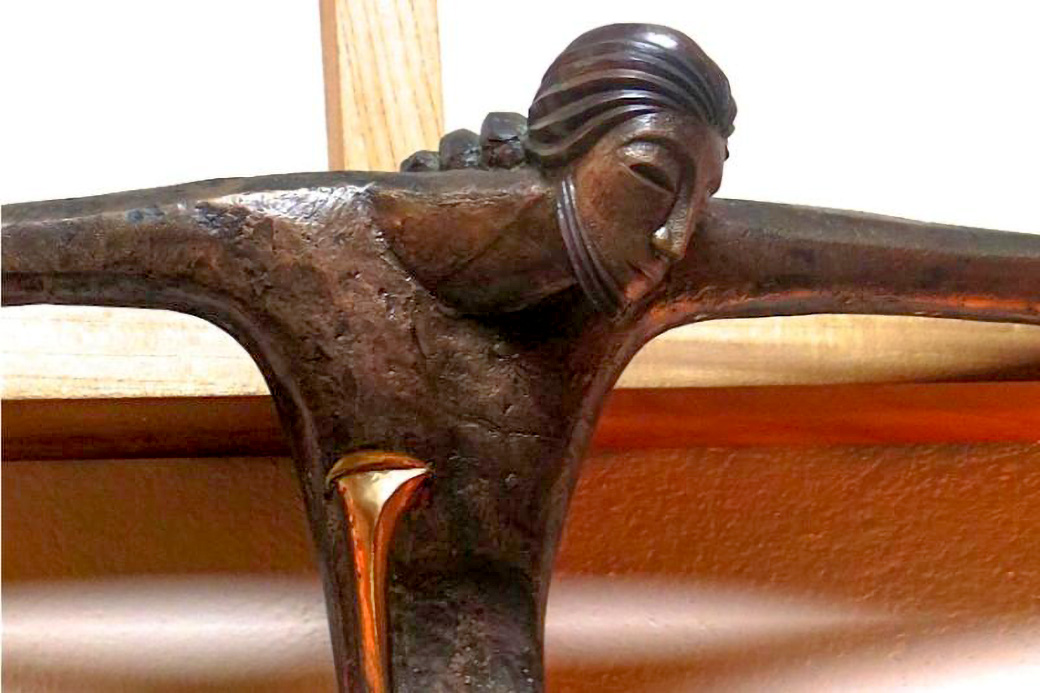
    Corpus Christi Icon (unknown provenance) | image from catholicsteward.com.

    When the crowds find Him, He cuts to the chase: “you are looking for me not because you saw signs but because you ate the loaves and were filled. Do not work for food that perishes but for the food that endures for eternal life.” He is saying that they essentially want a free lunch, that they want to find Him to fill their bellies. He contrasts this to seeing “signs” of something greater. Then He encourages them to work for a different kind of food, a “food that endures for eternal life.” Let us not misinterpret Him as saying something along the lines of “don’t think of your physical needs, only think of eternity.” He never says in His ministry something like “let yourself die and join me in Heaven.” Remember, He is the Lord of Life, and living as a child of God in the world is central to His message. He is encouraging them to work for “food that endures,” in other words to feed their spirit as well as their body.

    This is an interesting facet of Christ’s ministry. He is solidly focused on bringing salvation to the world (not just keeping it distantly away in Heaven). He bases His proverbs and analogies in the land (the mustard seed, the harvest, the wine, the water, the mountain) and the way people relate (the wicked manager, the thief in the night, etc.). At the same time, He always points to the Father, to the kingdom/reign of God, to a new reality and a new covenant. Thus, while He grounds His teachings in this world, He urges His followers to open themselves up to a greater reality, namely the reign of God.

    This is not something foreign to the Jewish people; their life in the world has always been oriented towards God. But Jesus comes in a time when the law is fetishized by a few experts (scribes, chief priests) in a way that chokes off the saving power of God from the world. Just as they try to trap Jesus in legal arguments, they employ God’s law as a great weight around the necks of the Jewish people. The options available to Jews are to either live under the nitpicky legal codification of rituals or live in the shame of being unclean, impure, or outside of the favor of the experts. This is counter to all of salvation history, where God chooses a people upon whom He gives great favor in order for them to flourish and be a light to all nations. Jesus comes to break through this stalled state where the work of God in the world is stifled. He provides a new “Way” so that life can be lived in the way God intended, so that Israel truly can be a light to all nations.

    Thus, Jesus is often trying to get his followers to break through a “dead” way of seeing things. In today’s reading, He wants them to look beyond the promise of simple food and see the “signs” His miracles represent, namely the creative power of God in the world. They pick up on his command to “work for” a different kind of food, and they respond by asking, “What can we do to accomplish the works of God?” A more literal translation that accounts for their repetition of the root word ἔργα (erga) is “What must we do, that we may work the works of God?” At first glance, this seems like a step in the right direction, perhaps even a noble thing. But remember that Jesus just pointed out that they understand the “work of God” to be feeding themselves. Their request to know “what must we do” still smacks of a limited, selfish drive to get an everlasting food supply. Their hope to “work the works of God” shows how they primarily see this as a type of conjuring.

    Jesus Teaches the People by the Sea (Jésus enseigne le peuple près de la mer), 1886-1896, James Tissot | Creative Commons, courtesy Brooklyn Museum.

    Jesus responds, “This is the work of God, that you believe in the one he sent.” While Jesus will expand upon this statement greatly in the following verses, it stands on its own as a fantastic, compact teaching. First, let’s ask ourselves if He answers their question of “what must we do.” He responds by telling them what the work of God is. There is a difference. They are not ready to be instructed on “what to do” when they don’t even know what the work of God is. They think God’s work boils down to miracles of food or healing — a series of supernatural interventions to ease the life we have on earth. They want to know what to do so they have this miracle-working power. He directs them instead to truly understand what the work of God is. 

    So what does He say the work of God is? He says it is “that you believe in the one he sent.” This is a remarkable saying: the Heavenly Father’s work in the world is to seed the belief in His Anointed One, His Son. The Father’s work is to act within each of us. And this action He accomplishes is belief, or better translated “faith.” The Greek word used is πιστεύητε (pisteuēte), which is a verb form of pistis (faith). So the work of God is that we have faith in Jesus Christ. Here we can see that our work and God’s work are united in the great activity of faith — faith is work, it isn’t easy, it requires help, in fact, heavenly help. In other words, we can glimpse how Jesus’s reply fuses multiple meanings of the “work of God”: it means both the work God accomplishes as well as the “work of God” that we do. These are united in the work of faith.

    And what a remarkable claim out of the mouth of Jesus that God’s work is to believe in Him, Jesus! This is one of those moments when Jesus forces us to either think He’s a self-absorbed madman or, in fact, the Savior. And since He speaks with wisdom, grace, love, and always gives glory to the Father, being a madman doesn’t fit. But why is God’s work to have faith in this one man from Nazareth in 30 AD? This is where outsiders to Christianity often stumble and brush it off as a silly deification of a guy from a detested outpost of the Roman Empire. Let’s remember that when He said these words, there were no Christians yet, so the crowds of Jews who heard it may very well have been thinking the same thing: what an odd thing for someone to say! God’s work in the world is for us to have faith in this guy? 

    But in the same breath, He is clearly not just “some guy.” Apart from the signs and miracles He makes, there is something that draws crowds to Him, that draws people to give up their livelihoods, their pride, their earthly concerns to abruptly follow Him. In everything He does, from preaching to healing, He is set apart from everyone else. In fact, the word Jesus uses when He refers to Himself as “the one whom God sent,” ἀπέστειλεν (apesteilen), means to be sent forth (as in a mission), but also carries the connotation of being set apart. Strong’s Exhaustive Greek Concordance states that apesteilen is “From apo and stello; set apart, i.e. (by implication) to send out (properly, on a mission) literally or figuratively.” God the Father has sent Jesus into the world, has set Him apart from His fellow men, and the reason is to be revealed on the Cross and in the Resurrection.

    So we come back to faith and work. God’s work, our work, is to have faith in the One He has sent. What does this mean to have faith in Him? It must mean that we believe the words that He speaks, but also the signs that he gives us: that feeding 5,000 people is a sign of the overflowing mercy and love of God active in the world, that Jesus Christ brings a new kind of nourishment, sacramental nourishment, that is the way for his followers to be a light for the rest of the world here, on earth, in this time.

    Christ the High Priest Icon (contemporary), unknown icon writer | image from monasteryicons.com.

    As we look back to the first reading in the light of Christ’s words in the gospel, we see that St. Stephen is the manifestation of the “work of God.” He shows us what it means to have faith in Christ. In today’s reading, while we hear of the arguments, resistance, and the false witness of his opponents, we encounter a thrilling serenity in the form of Stephen. “Stephen, filled with grace and power, was working great wonders and signs among the people … [those arguing with him] could not withstand the wisdom and the Spirit with which he spoke.” He appears fully under control, yet filled with power. This power comes from God, not Stephen, and that is the difference. Despite the nasty public accusations, we hear that the Sanhedrin “saw that his face was like the face of an angel.” What a gift to be so united with the will of God, doing the work He calls you to do! It manifests visibly upon Stephen’s face.

    We are told in the verses prior to today’s reading that Stephen is “a man full of faith and the Holy Spirit (Acts 6:5). Here, then is the example and proof of what Jesus meant when he said the work of God is to have faith in the One He sent. This condition of having faith in Christ means that you believe in His Sonship with the Father, you believe in His work of redemption at Easter, in the new state of human history made possible by Him where we can live differently with one another under the reign of God. Stephen is graced by God to be an example for us.

    Of course there are those who do not have faith in Jesus Christ, and those who allow evil to settle in their hearts. That is why there is persecution and suffering and why the reign of God is not yet complete. And Jesus gave us the way to encounter these people: to speak the truth of God’s love and plan for humanity and to leave open the door to repentance. This is what Stephen does in his great speech to the Sanhedrin in the following verses, which is an extended recounting of salvation history in the lives of the Jews, focused on times when they were deaf to God and turned their backs on his providence. He ends with the hard truth that these very men to whom he was speaking murdered the Son of God. 

    The Stoning of St. Stephen (1603-1604), Annibale Carracci | Wikimedia Commons.

    The end for Stephen, as we all know, is his stoning at the hands of these enraged Jews. Yet lest we think that the way of the Cross is nothing but torture and suffering, we will hear in tomorrow’s reading how Stephen looks up to heaven and sees the glory of God and how he meets his end with a certain peaceful unity with God. The way is certainly hard, but when filled with the Holy Spirit, the saints can endure (even joyfully so) the hard way.

    Let’s consider that this, too, is the work of God.

  • God’s Ever-Generative Endeavors

    Friday of the Second Week of Easter: Acts of the Apostles 5:34-42, John 6:1-15.

    Today’s readings place two disparate events in context with one another and reveal the ever-generative aspect of God’s reign. In the first reading, a member of the Sanhedrin is inspired to share some wisdom about the divine nature of the spread of Jesus’s disciples. Seen in the light of the gospel’s loaves and the fishes, this provides a glimpse into the here-but-not-yet-fully reign of God.

    In the Acts of the Apostles, we read the bold teachings of Peter, John, and the other apostles, which quickly lead to the conversion of thousands and jail time for the apostles. After being captured then released, re-captured and released by an angel from jail, and yet another re-capture, today’s reading shows them standing in front of a Sanhedrin that is steaming mad and ready to put them all to death. But here God intervenes in the form of a Pharisee by the name of Gamaliel. 

    Synaxis of the Twelve Apostles (20th century), unknown icon writer | image from greekcitytimes.com.

    Something makes Gamaliel speak up in the face of an enraged Sanhedrin. Perhaps it’s the apostles’ persistence in preaching in the temple despite repeated warnings and arrests. Perhaps it’s the boldness with which the apostles tell the Jews and the council that they are to blame for crucifying the Savior. Perhaps it’s their reply to the council, “We must obey God rather than any human authority” (Acts 5:29). It is likely a combination of these, but, as believers, we know that it is also the action of the Holy Spirit. The Spirit that has so inflamed the apostles with the truth and courage to proclaim Jesus Christ as Lord is also active in the heart of Gamaliel. He, a Pharisee on the council, speaks with a wisdom and courage that mirrors the apostles.

    He begins his appeal to the Sanhedrin with a secular logic: other false Messiahs had been put to death and their followers naturally dissipated. But then he presents a faith-based logic: “if this endeavor or this activity is of human origin, it will destroy itself. But if it comes from God, you will not be able to destroy them; you may even find yourselves fighting against God.” Certainly this logic was always in the back of the minds of the council as they took out one “Messiah” after another — what if one of those actually was the Messiah? Wouldn’t they be “fighting against God”? However, something is happening here that doesn’t just “feel” different but is different in substance. Christ’s sacrifice and resurrection have ruptured history and the liturgy is pouring into the world. The Spirit — the advocate, the Paraclete — is doing the work of the advocate, revealing in the hearts of those who have ears to listen the truth of this new reality. The action of the Spirit is more powerful than fear of disagreement, ridicule, or even persecution. 

    That’s why the Apostles react with joy after being flogged and told not to speak any more about Jesus. They leave the council “rejoicing that they had been found worthy to suffer dishonor for the sake of the name. And all day long, both at the temple and in their homes, they did not stop teaching and proclaiming the Christ, Jesus.” How can we account for this? Are they just masochists? It would be a weird coincidence if the Apostles, as well as so many martyrs and saints, found masochistic pleasure in suffering in the name of Jesus Christ. We can only understand this as something other than personal “pleasure;” it is a sharing in the self-giving love that marks the reign of God. 

    Christ and the Twelve Apostles, from the base of an altarpiece (c.1400), Taddeo di Bartolo | Creative Commons, courtesy the Metropolitan Museum of Art.

    I bring up the idea of the reign of God because this is what is on display in the Acts of the Apostles. I borrow here from the writings of the contemporary theologian Gerhard Lohfink. Jesus’s miracles and message, his gathering of the Twelve and his sacrifice for all, these all point to the reign of God (also translated as the kingdom of God), which He promised was here, available, immanent yet not fully complete. In his book Jesus of Nazareth: What He Wanted, Who He Was, Lohfink provides an extended reflection upon what the reign of God means. One description that I think applies here is his interpretation of the story from the gospel of St. Mark when the poor widow gives her two copper coins and Jesus points out the value of her gift. Lohfink writes:

    the reader of Mark’s gospel is meant to see the widow’s sacrifice against the background of the reign of God proclaimed by Jesus. The reign of God — that means that God turns to human beings totally and without any reservation in order to bring divine abundance to the world. This self-gift of God is a historical event: it is happening now, in Israel and in the new community life Jesus is creating. Therefore the reign of God attracts those who are able to experience God’s overflowing self-gift, so that they in turn give everything they have: their whole heart, their whole existence. The poor widow who gave her two copper coins becomes a sign, a symbol of this “totality” (220).

    Of course the real “totality” of self-gift is Jesus Christ Himself. Many parables and comments throughout His ministry point to the gratuitous and overflowing gift of self that characterize the essence of our Three-in-One God, and characterize the reign of that God that is to be brought to humanity here within history. This is what the Apostles are talking about when they say “for the sake of the name.” The Name of Jesus Christ encompasses His self-gift, His divinity, and His message for the world to reach out and embrace the reign of God.

    Yet Jesus didn’t just say “follow me,” but “take up your cross and follow me.” As Lohfink writes, “It was only in Jesus’ death that this message achieved its proper profundity … the reign of God does not come without persecution, without sacrifice … Ultimately, Jesus’ death lays bare all human self-glorification and thereby also every superficial and presumptuous notion of the reign of God” (38). Once people understand this, then they are able to “rejoice that they had been found worthy to suffer dishonor for the sake of the name,” because they know they are properly participating in the reign of God. Their persecution can become an opportunity to let go of their “selves” and desires as the ultimate truth of Jesus Christ shines forth.

    Pentecost (detail). c.1600, El Greco | Creative Commons, courtesy Museo del Prado.

    For me, it is very gratifying to read the Acts of the Apostles as the realization of the reign of God in the hearts of people here in the stream of time, acting on this earth. Lohfink, for one, feels that this aspect of the reign of God is too often overlooked as we concentrate on the last times and a reign of God that is purely consigned to Heaven. He argues persuasively that this is a reduction of Jesus’s message that leaves behind an important aspect of immanence. He explains that Jesus spoke of the reign being immanent, available, and yet not fully realized because not everyone was accepting the reign of God in their hearts and their lives. I feel that the Acts of the Apostles is a real gift — we get to glimpse how the reign of God, delivered to us with the very real historical sacrifice and resurrection of Jesus Christ, can live here and now on this earth. Of course, it is still incomplete because not everyone has accepted it and because a final judgment is coming.

    As we turn our attention to today’s gospel reading, we can start to contemplate another aspect of the reign of God that we glimpse in the life of the Apostolic Church: the fact that it is everlasting. 

    The gospel is a familiar one. A crowd of 5,000 is gathered to listen to Jesus, and his disciples are incredulous that they could be fed. The meager gathering of a few loaves and fish is given to Jesus and after He blesses them, this small amount of food is passed to the crowd. It miraculously feeds everyone. In fact, in the end, 12 wicker baskets are filled with the leftovers. Much has been said about this episode (and woe to those who deny the miracle and claim that these people simply pitched in what they were hoarding in a type of mass generosity event). This scene is a precursor to the Last Supper and the institution of the Eucharist, the food that will never run out, the very sacramental Body and Blood of Christ. But here, Jesus is not as close to his Passion, after which the meaning of the Last Supper will become clear. Here, we can understand the miracle within the context of his proclamations about the reign of God, which happen in the prior chapter in Matthew’s account of the feeding of the 5,000.

    St. Matthew reports a series of seven parables from Jesus that describe the reign (kingdom) of God.¹ Two of these describe the ever-generative nature of the reign of God: the mustard seed and the leaven. Like leaven, the reign is always actively growing and multiplying; like a mustard seed, it contains the growth potential to become “greater than the herbs and become a tree.” Two of the parables speak of the unsurpassable value of the reign of God: the hidden treasure and the pearl of great price. In both parables, the human who discovers these items (i.e., the reign of God) completely devotes himself to it, selling everything else to possess it. And the remaining three parables refer to the winnowing of the people who have accepted the reign into their hearts from those who have not: the sower, the wheat and the weeds, and the net. In each of these, there is a clear eschatological bent that speaks to the end times, but notably the reign does not wait until the end times to start: the seed on the good ground grows and multiplies, the wheat grows tall amid the weeds, and the net pulls in the good fish with the bad. The point is that the reign/kingdom is here and active for those who choose to claim it, and yet there will be a time of reckoning for people and their choices, so the reign is not yet fully “complete.”

    Parable of the Sower icon (20th century), unknown icon writer | image from blessedmart.com.

    So, how do these parables shed light on the feeding of the 5,000? We see the promise of the reign of God in action. We see the food multiply like leaven or a mustard seed becoming a great tree. What’s more, this is a gift that has been given (the aspect of the self-gift that is so integral to the reign of God), and a gift that was initiated by God (as we ask and give Him thanks). And the people recognize the amazing value of the gift, but their understanding is incomplete. As St. John tells us in today’s gospel, the people say “‘This is truly the Prophet, the one who is to come into the world.’ Since Jesus knew that they were going to come and carry him off to make him king, he withdrew again to the mountain alone.” With the feeding of the 5,000, we have the parable of the sower happening in front of our eyes. Let’s revisit Jesus’s own explanation of the parable:

    When anyone hears the word of the kingdom and does not understand it, the evil one comes and snatches away what is sown in the heart; this is what was sown on the path. As for what was sown on rocky ground, this is the one who hears the word and immediately receives it with joy; yet such a person has no root, but endures only for a while, and when trouble or persecution arises on account of the word, that person immediately falls away. As for what was sown among thorns, this is the one who hears the word, but the cares of the world and the lure of wealth choke the word, and it yields nothing. But as for what was sown on good soil, this is the one who hears the word and understands it, who indeed bears fruit and yields, in one case a hundredfold, in another sixty, and in another thirty (Matt 13:18-23).

    Jesus, as the Word of God, sows the seed of the reign of God through his miracle, and John shows us that it fell among some rocky and thorny ground. The people receive the Word, but will their immediate joy endure? Are they only concerned with wealth and power in the form of a king?

    The Feeding of the Five Thousand (c.1560), Hendrick de Clerck | image from resourceforkidsministry.com.

    The last aspect of today’s gospel I’d like to explore are the only words John ascribes to Jesus after the 5,000 are fed: “Gather the fragments left over, so that nothing will be wasted.” I’d wager that Lohfink would tell us how this displays Jesus’s “gathering of Israel” (which is the title of a chapter in his book). And indeed, His ministry was very deliberately the act of gathering the tribes of Israel to be that mustard seed where the reign of God starts, specifically so that it can then spread throughout the world. What’s more, I think Jesus demonstrates a few other important things: the overflowing generosity of God and his reign and His desire that no one is spared an invitation, that everyone is given a chance to “enter into” the kingdom. The reign of God starts in Israel, but it is meant for all — it is already inevitably spreading beyond the Jewish people (think of the Canaanite woman who says to Jesus, “even the dogs eat the crumbs that fall from their masters’ table,” whereupon He heals her daughter). Jesus will not waste any of the fragments, for the Word is here, the reign is available to us, and it will not erupt into history in vain.

    All of this brings me back to the Acts of the Apostles in a sort of breathless way. Here we have people who get it, who are the seed growing on good ground, who are living in the kingdom of God, under the reign of God. The power, boldness, courage, and joy of these people, even right after being flogged, is contagious! This is the Spirit who has been unleashed in the world in a new way now that the reign of God is at hand. Let us all participate in this wondrous new world!


    ¹ I am persuaded by Gerhard Lohfink’s argument about preferring “reign of God” to “kingdom of God.” He argues,

    In Aramaic, the language Jesus spoke every day, the Greek basileaia reflects the word malkuta. And malkuta is first of all the “king’s rule or reign,” and only secondarily the extent of the king’s rule or a particular territory. With Jesus the concept of “reign of God” has something utterly dynamic about it. The reign of God has an event-character. It is something that happens. It “comes” or “is coming.” For that reason also we should prefer the concept of the “reign of God.” But obviously the notion “kingdom of God” also reflects a certain aspect of the event, namely a realm within which God is establishing his rule. One can “go into” the basileia or “enter into” it (cf., e.g., Mark 9:47; 10:15).  (Jesus of Nazareth, 24-25).

  • Community in the Spirit

    Tuesday of the Second Week of Easter: Acts of the Apostles 4:32-37, John 3:7b-15.

    We encounter lessons about the Holy Spirit in both of today’s readings. The first is about the beginnings of the Church in the Apostolic age, an ideal community living in truth, trusting one another, and filled with the Holy Spirit. The gospel reading from St. John is one of those amazing passages from Jesus where He reveals truths about the Spirit, salvation, and our relationship with God.

    Let there be no question that the ideal Christian community is one where trust creates an environment where the idea of “personal” property and money is anachronistic, and thus communal sharing of everything is the rule. This particular passage from the Acts of the Apostles makes capitalists shudder and fall over themselves to disprove any such “socialist” core within Christianity; likewise, it makes Socialists rejoice and attempt to employ it as Biblical justification for their ideology. Both camps are wrong, of course, because they concentrate on the end result (i.e., sharing all possessions) when they should be considering the means by which the first Church got there. In fact, the Apostolic Church shows us something much more radical than any form of capitalism or socialism: it’s a community living in full communion with and focus on the Father, inhabited continually by the Holy Spirit, and proclaiming the name of the Son boldly and loudly. In short, its a community fundamentally unconcerned about its fleshly needs. They are in full mystical union with God, who provides for them. They trust one another and their Lord implicitly.

    Saint Peter preaching the Gospel in the Catacombs (1902), Jan Styka | Wikimedia Commons.

    Contrast this with ideologies that try to construct markets and governments from nothing but human reason and intellect. These post-Enlightenment systems (capitalism, socialism, etc.) operate from a basis of broken trust. They all share a basic belief that people can’t be trusted without state-imposed rules, that there is nothing that unites people enough to overcome their self-interest. These are the fruits of the “Enlightenment,” which dissociated human reason from God, that pushed God out of our conception of self. If we cannot see the light of God within each other, we have nothing transcendent or universal that unites us. And if Jesus Christ is seen as one prophet among others (at best) or a fantasy for the feeble-minded (at worst), then we truly have nothing to raise humanity beyond the mire of sin and self-interest that dominates us. Well, people convince themselves that some “perfect” form of government, checks and balances, will balance our protections and freedoms perfectly. What a poor vision for humanity! Even at its best, this post-Enlightenment thinking delivers people an adult life of around 50-60 years where we retain a sense of self-possession and “freedom” within an uneasy network of other self-possessed and “free” humans who inevitably impinge upon our own bubble. That’s why we have lawyers and courts to fight and scrap over these collisions of perceived freedoms and self-possession. What a pathetic state of selfish, scrabbling people we’ve become. 

    So, back to the Apostolic Church. The difference here is their conception of self. They realize that their lives are dominated by the gifts God has given them: first, their own lives, but then the greatest gift of Jesus Christ, which entails everything from the baptism in water and spirit to the bearing of our sins to open the door for our salvation. What is the truth that Christ brings to the world, the reality that He uncovers? His great love liberates us from the selfishness and distrust that dominates humanity in its fallen state. This is freedom. Not something that we have to protect with laws and jealously guard (like our guns or “rights”). This one, true freedom, this love that fills us, comes from God — it is not something devised by humans, legislated by governments and protected by law. It is cultivated through faith, prayer, and proclamation, and it brings a panoply of gifts, as we see in today’s reading: “With great power the Apostles bore witness to the resurrection of the Lord Jesus, and great favor was accorded them all. There was no needy person among them.” The gifts (the “great favor”) come from God and the result is that “there was no needy person among them.” This is not socialism, where the state is the agent of power (indeed, where ideology supplants God). This is not capitalism, where the individual’s right to exploit for profit is the golden calf. This is much more radical for today’s mind to comprehend because it forces us to question those assumptions about the inviolability of human reason that we inherit from the Enlightenment and modernity. Our passage today reveals that the perfection of the Apostolic Church lies exactly in the radical reliance on something unreasonable, something at first glance not apparent or logical, something mystical. The Church is perfect only because they rely upon and trust (i.e., have faith) not only in God’s desire to bring us to Him but the manifested action of his doing so through Jesus Christ. As a consequence of this, and only this, they are bathed in the Holy Spirit, they shed their destructive self-interest, they trust one another, and thus “no one claimed that any of his possessions was his own, but they had everything in common.” Why would they need to own possessions separately from this community of the Spirit? It becomes not just silly, but something against the will of God, the impulse of charity, and the movement of love in the world.

    St. Peter Preaching in Jerusalem (1642), Charles Poërson | Wikimedia Commons.

    In the gospel reading, Jesus attempts to teach the Pharisee Nicodemus about being baptized in this something unreasonable, this something mystical. Nicodemus comes to Jesus under cover of night, likely in part because the Pharisees were deeply distrustful of Jesus rocking the boat of earthly power they had established, so he couldn’t come to Jesus openly in the daytime out of fear of being chastised by his fellow Pharisees. Yet in the act of coming to Jesus at night, which is a breaking of ranks with the Pharisees, Nicodemus shows that he wants to come out of the “night” of unknowing into the light of truth that Christ is giving the world. In Judea, men would relax on rooftops at night, where the desert winds would provide cool after the heat of the day. So, here Jesus reclines with Nicodemus and in the verses before today’s passage tells him, “no one can enter the kingdom of God without being born of water and Spirit.” Nicodemus is stuck in the reason and knowledge of earthly things that we see come to prominence in the Enlightenment; he doesn’t understand how people can be born again once they are born by their mother.

    Today’s reading is Jesus’s answer: ” You must be born from above. The wind blows where it wills, and you can hear the sound it makes, but you do not know where it comes from or where it goes; so it is with everyone who is born of the Spirit.” At first glance, this seems to be a non-answer, but Jesus, the great teacher that He is, uses the beautiful earthly phenomenon around them to draw an analogy. The wind, although we cannot see it or understand the directions it travels at any given moment, nonetheless exists and has great power and movement in the world. And so like this earthly phenomenon, there is the heavenly phenomenon of the Spirit that can move within those who are “born from above.” His lesson is one that is just as important today: don’t look to reason your way into knowing the ways of God and the Spirit. Don’t think that this is something that comes from your intelligence or even your effort of prayer or ritual. We must accept that, like the wind, the Spirit is active and powerful despite our inability to see it or understand it.

    Jesus and Nicodemus (early 1900s), William Brassey Hole | Wikimedia Commons.

    When Nicodemus says, “how can this happen?” he reveals that he is still stuck in his own head, in his own need to challenge and dissect the workings of God. Jesus’s answer is fantastic, “You are the teacher of Israel and you do not understand this?” not because He is somehow shaming Nicodemus but because He points to the entire tradition of the Jews as His proof. He is saying, here you have the entire history of God’s miraculous intervention into the lives of your people, from Abraham, Noah, Moses, the prophets and up to today, and you’re asking “how?” with disbelief??

    Jesus’s following statements are a good reminder to us that even if we have the gist of the wind analogy, we must remember that it’s just an analogy and the heavenly truth is incomparably deep in mystery. He says, “If I tell you about earthly things and you do not believe, how will you believe if I tell you about heavenly things?” In other words, the comparison between the action of the wind in the world and the Spirit in the people “born from above” is still just an analogic glimpse into what the Spirit might be. If we can’t grasp and believe that, how could we possibly handle a statement about the actual truth of the Spirit or the nature of God?

    Jesus’s final statement in today’s reading does give us a glimpse of the mystery He brings to the earth, again in a type of comparison to something Nicodemus already knows. It undoubtedly mystified Nicodemus (who was already mystified by the wind analogy) because Christ had not yet entered into his Crucifixion and Resurrection:  “just as Moses lifted up the serpent in the desert, so must the Son of Man be lifted up, so that everyone who believes in him may have eternal life.” We explored this passage in a prior reflection (see Bridging Salvation History with a Serpent), but suffice it to say that Jesus is pointing to this same paradigm of glimpsing reality-by-analogy. There is the analogy of Moses’s serpent staff and the Son of Man hung on the Cross, and there is a glimpse of heavenly meaning at the heart of both “liftings up.” They both provide salvation (Moses’s staff provides a remedy from deadly snake bites for earthly saving while Jesus provides eternal salvation) through the symbol of sin being sacrificed, which is but a glimpse of the eternal flux of love that God is. Christ is more than His Crucifixion, although it is fundamental to His saving mission. Christ is also the Way that brings the Living Spirit into the lives of his disciples. God is living, active love flowing constantly in the universe, a reality that we merely glimpse with our faculties, reason, and intellect. It takes our faith to truly live with the mystical reality of God in the world, and “blessed are those who have not seen and have believed” as Christ tells Thomas, presenting Hs hands and side to be felt. 

    The Incredulity of Thomas Altarpiece (1308-1311), Duccio di Buoninsegna | Creative Commons, courtesy the Divinity Library at the Jean and Alexander Heard Library, Vanderbilt University.

    I love contemplating the “community in Spirit” that the Apostolic Church managed to live. Even if it didn’t last in perfection that long, it is at the heart of the Church as the Body of Christ, the Bride of Christ. It displays for us the perfection of living in the Spirit, boldly proclaiming the Word of God, and trusting one another. We should all hold this in our hearts as the true life for which we strive.

    Some might say that this perfect community is impossible, that, practically speaking, humans just can’t be truly communal. I respond that this is indeed impossible without God at the center of each person’s existence. This is the basis of monastic life! Countless lay Christians have also committed themselves to intentional communities over the millennia. It is understandably hard, as any truly selfless act is, but it is definitely not impossible if the Apostolic spirit (and the Holy Spirit) is evident.  

  • From Despondency to Boldness

    Friday in the Octave of Easter: Acts of the Apostles 4:1-12, John 21:1-14.

    Today’s readings show us Peter and John revisiting places that were instrumental in Jesus’s ministry before His death. One scene is marked with despondency and ineptitude, while the other is filled with boldness and perfection. How do they manage to make this change from inept acolytes to masters in faith? The answer lies in an often-overlooked aspect of the gospels: Jesus’s ministry does not end in the Resurrection; He guides the fledgling Church in the days between the Resurrection and Ascension. 

    Fresco of the Miraculous Catch of Fish (unknown date and author) on the walls of the Church of the Holy Apostles, a Greek Orthodox monastery at Capernaum, on the shores of the Sea of Galilee | photo from reneeriley.wordpress.com.

    First, let’s look at the gospel reading. We hear that the disciples are back at the Sea of Galilee, where Jesus first met them. This is curious. After the astounding fact of the empty tomb and the appearance of the risen Lord to the disciples in Jerusalem, what are they doing back in Galilee? For lack of something better to do, “Simon Peter said to them, ‘I am going fishing.’
    They said to him, ‘We also will come with you.’” Is this the great work of evangelization that will grow the Church immeasurably? Not at all — they have retreated back to what they used to do, as if the reality Jesus brought into the world hasn’t changed them. Pope Francis notes,

    They seem to take a step backwards; Peter takes up the nets he had left behind for Jesus. The weight of suffering, disappointment, and of betrayal had become like a stone blocking the hearts of the disciples. They were still burdened with pain and guilt, and the good news of the resurrection had not taken root in their hearts … This is the tomb psychology that tinges everything with dejection and leads us to indulge in a soothing sense of self-pity that, like a moth, eats away at all our hope. Then the worst thing that can happen to any community begins to appear – the grim pragmatism of a life in which everything appears to proceed normally, while in reality faith is wearing down and degenerating into small-mindedness.  (Sunday Mass homily, May 5, 2019)

    But, as Pope Francis notes, “it was at the very moment of Peter’s failure that Jesus appears.” They had caught nothing during an entire night of fishing, and there, Jesus on the shore asks them a double-edged question: “Children, have you caught anything to eat?” Of course, the original Greek is a bit more enlightening. Jesus first calls out their immaturity by calling them παιδία (paidia), which is a diminutive form of child, i.e., “little child” (the only time in the New Testament, incidentally, that Jesus calls his apostles paidia). He then asks if they hadn’t any προσφάγιον (prosphagion), which is properly translated as “anything eaten with bread” (Thayer’s Greek Lexicon). What is He saying here? Clearly, there’s the literal meaning “haven’t you caught anything?” but the words He chooses point to something more. He notes that their development as his followers is not yet mature (they are paidia). Case in point, they are looking for something “to eat with bread;” this, coming from the Bread of Life Himself who had just instituted the great sacrament of Eucharist with them. All they need is the bread He gives them, but they don’t yet comprehend the power of His Spirit in the sacrament and in the world.

    Appearance on Lake Tiberias (1308-1311), Duccio di Buoninsegna | Wikimedia Commons.

    Evidently, they need another lesson, signified by the miracle of a net suddenly full beyond belief with fish. Once again, God bestows lavishly, both in patience and gifts for His beloved Church. John recognizes the man behind the miracle and Peter reacts. As St. John Chrysostom writes, “when they recognized Him, the disciples Peter and John again exhibited the peculiarities of their several tempers. The one was more fervent, the other more lofty; the one more keen, the other more clear-sighted. On this account John first recognized Jesus, Peter first came to Him” (Homily 87 on the Gospel of John, 2). Here, they are re-enacting their roles as we see them throughout the gospels but Jesus needs them to move beyond and become new people who establish the new Church.

    They meet him on the shore and “saw a charcoal fire with fish on it and bread.” This bit of detail from John is important. It establishes that Jesus is truly a man resurrected, not a ghost or vision. He can partake in physical food. Symbolically, it presents something new with something familiar. We might expect to see the bread, through which Jesus sacramentally gives us His Body, but what to make of the fish over the fire? Let’s consider the other times Jesus refers to fish and fishing. The first miraculous catch of fish here on the Sea of Galilee happened when Jesus called Peter, Andrew, James and John to become His disciples. As St. Matthew writes, Jesus counsels an astounded Peter, “Do not be afraid; from now on you will be catching people” (Luke 5:10b). Fishing is the work of evangelization. Fish are people. Here, once again, the disciples catch an overwhelming quantity of fish when they obey Jesus, only this time his call is different — it’s not to follow Him throughout Judea but to bring Him fish. A second interpretive key for this passage comes from Jesus’s words recorded in the gospel of St. Matthew: “the kingdom of heaven is like a net that was thrown into the sea and caught fish of every kind; when it was full, they drew it ashore, sat down, and put the good into baskets but threw out the bad. So it will be at the end of the age” (Mt 13:47-49a). Jesus shows them that He is the purifier of men, He tends to the fire that purifies the fish, making them good food. Before the “end of the age” when the good will be separated from the bad, the apostles’ work is to catch fish in His name so that they can be purified in His love.

    Detail from Breakfast at Dawn (2012), Mike Moyers | image from fineartamerica.com.

    To move them beyond an incapacitating dependency upon Him, like the disciples in Emmaus who say, “Stay with us,” Jesus again chooses to accomplish this through a meal. We will read the verses after today’s gospel, “When they had finished breakfast, Jesus said to Simon Peter, “Simon son of John, do you love me more than these?’” Jesus’s threefold questioning leads to the directive to feed his sheep (like Jesus) and to follow Jesus (in the way of the Cross). Jesus is passing a heavy baton to Peter, who will no longer wonder what to do with himself nor go back to his old ways.

    The courage and the fire to accomplish Jesus’s directive comes to the apostles at Pentecost. The Holy Spirit, the One whom Jesus promised, descends upon them in the fervor of their prayer and immediately they are given the boldness and means to accomplish the work of Christ. This is, after all, Christ’s very Spirit, ushering them to the Way, the Truth, and the Life.

    And it is after Pentecost that the events found in the first reading happen. We are in the midst of the great story of the Acts of the Apostles that is being read over consecutive days in the first reading at Mass. Note the difference in Peter and John. They heal a lifelong cripple in the temple like Jesus once did and they claim no credit, having done it in the name of Jesus Christ. Amazed Jews gather around them in Solomon’s Portico and Peter explains how the miracle of healing happened: “But you rejected the Holy and Righteous One and asked to have a murderer given to you, and you killed the Author of life, whom God raised from the dead. To this we are witnesses. And by faith in his name, his name itself has made this man strong” (Acts 3:14-16a). He establishes their culpability in the Messiah’s death, the fact of the Resurrection, and the fact of the unending power of the name of Jesus Christ the Lord. What’s more, Peter presents them with an open call to join His Body, the Church, “Repent, therefore, and be converted, that your sins may be wiped away, and that the Lord may grant you times of refreshment and send you the Christ already appointed for you, Jesus” (Acts 3:19-20). In these moments, they have become the fishers of men that Jesus has asked them to be. 

    Healing of the Lame Man (c.1516), Raphael | image from artbible.info. Raphael’s design intended for a tapestry in the Sistine Chapel, painted on sheets of paper.

    But their words garner the attention of the Sadducees, who do not believe in resurrection, and the chief priests, who had just “succeeded” in killing Jesus. Peter and John are arrested, but their fishing has begun: “But many of those who heard the word came to believe and the number of men grew to about five thousand.” The cast of evil characters is present again the next morning to interrogate them (thinking of you, Caiaphas and Annas), but “Peter, filled with the Holy Spirit, answered them.” We glean not a speck of fear or apology in his words. He boldly proclaims not just the righteousness of their act of healing the crippled man but the name of the one these people recently crucified:

    all of you and all the people of Israel should know
    that it was in the name of Jesus Christ the Nazorean
    whom you crucified, whom God raised from the dead;
    in his name this man stands before you healed.
    He is the stone rejected by you, the builders,
    which has become the cornerstone.

    There is no salvation through anyone else,
    nor is there any other name under heaven
    given to the human race by which we are to be saved.

    Just imagine them standing there, under temple arrest in front of the chief priests, proclaiming the divinity and power of Jesus, quoting scripture, and teaching about salvation of the world. We hear this brave and powerful voice of the Spirit emerge time and time again from the great martyrs in our tradition. We will see tomorrow that this bold elocution from “uneducated, ordinary men” will leave the leaders, elders, and scribes amazed and speechless. The power of the Spirit is the gift that Jesus gives His Church for which secular authorities have no answer. The Spirit dwelling within the Church enables its members to ascend to the Kingdom, to inhabit a world that dominates the world below in its love and power.


  • The Empty Tomb

    The Empty Tomb

    Easter Sunday: Acts of the Apostles 10:34a, 37-43, Colossians 3:1-4, John 20:1-9.

    Today’s readings uncover the truly baffling nature of the empty tomb. We rejoice 2,000 years later because the full revelation of the Resurrection is known. We sing Alleluia! with abandon, but today’s readings remind us that his rising from the dead was unexpected and incomprehensible on the morning after Passover, even for those who believed in him as the Messiah.

    Mary Magdalene on Christ’s Tomb (c.1900), Giuseppe Calì | image from artnet.com.

    In the gospel, Mary Magdalene, driven by her love of Jesus, goes to the tomb early in the morning after Passover, “while it was still dark.” The darkness is emblematic of the encounter at the tomb for her and, later, Peter and John. Mary is so discombobulated by the sight of the stone that is rolled away that she runs back to the Apostles without even looking in. She thinks that someone stole his body: “They have taken the Lord from the tomb, and we don’t know where they put him.” Perhaps the “they” she refers to are the guards, the Romans. 

    The state of the burial cloths is even more confusing for them. Peter and John see “the burial cloths there, and the cloth that had covered his head, not with the burial cloths but rolled up in a separate place.” This is not the scene of a tomb being pilfered or a simple act of transferring a body somewhere else. St. John Chrysostom writes:

    If any persons had removed the body, would they before doing so have stripped it; or if any had stolen it, would they have taken the trouble to remove the napkin, and roll it up, and lay it in a place by itself; but how? They would have taken the body as it was. On this account John tells us by anticipation that it was buried with much myrrh, which glues linen to the body not less firmly than lead; in order that when you hear that the napkins lay apart, you may not endure those who say that He was stolen. For a thief would not have been so foolish as to spend so much trouble on a superfluous matter. For why should he undo the clothes? And how could he have escaped detection if he had done so? Since he would probably have spent much time in so doing, and be found out by delaying and loitering. But why do the clothes lie apart, while the napkin was wrapped together by itself? That you may learn that it was not the action of men in confusion or haste, the placing some in one place, some in another, and the wrapping them together (Homily 85 on the Gospel of John, 4).

    I had no idea that myrrh “glues linen to the body not less firmly than lead.” Thank you to Chrysostom for pointing that out. Chrysostom indentifies that the care taken not just to unwrap the body but also lay the head covering (“napkin”) aside separately means that something altogether different happened. Something deliberate, something careful, something unafraid. Yet something that is still hidden from them.

    The Disciples Peter and John running to the sepulchre on the morning of the Resurrection (1898), Eugène Burnand | Image from eugene-burnand.com.

    Which makes me wonder what is meant when John says of himself, “he saw and believed,” when he follows it with “For they did not yet understand the Scripture that he had to rise from the dead.” I think that John and Peter have the seeds of hope when they encounter the empty tomb in the state it is in. They believe in the possibility of all the hints that Christ gave them about them seeing him again after he dies. They have yet to meet him in his Resurrected Body. The angels have yet to explain to Mary what happened.

    This is the moment of hope! Humanity sees order, care, and absence where there should be death. What a mysterious but wonderful sight. Mourning is no longer appropriate, but instead hope — maybe, just maybe, all those incredible things Jesus told us are true!

    The empty tomb is the picture of our new reality: the place of death has been ransacked and re-ordered. Mysterious hope fills us but God remains out of sight; we must trust the Lord’s Word and grow together as a Church in the sacraments he has given us until we meet him face-to-face.

    Even in the decades after His Resurrection, St. Paul in today’s second reading writes of a “hiddenness” that characterizes Christianity: “For you have died, and your life is hidden with Christ in God. When Christ your life appears, then you too will appear with him in glory.” This is the wonderful mystery we are able to live to this very day.

    People bemoan this state, they want proof that God exists, but what we are given is the empty tomb. This is, in fact, proof; albeit, proof of a different type. We have to remember that God fundamentally wants us to yearn for him, to thirst for him, to live in a differently ordered way that shows how central he is to us despite his hiddenness. He has given us free will, but “to whom much is given, much will be required” (Lk 12:48). We are called to use our free will to choose His will precisely because he gave us the empty tomb, his ordered absence that speaks volumes.

    Of course, much more is given to us. He will appear to his disciples and His Spirit explodes into the world in all its fullness, working amidst humanity constantly and to this day. All of this is most evident in the liturgy, in the sacraments.

    But for now, let us consider the empty tomb, the mystery of his disappearance from the grip of death. It is the surest sign we require.

  • What is Truth?

    What is Truth?

    Good Friday of the Lord’s Passion: Isaiah 52:13 – 53:12, Hebrews 4:14-16; 5:7-9, John 18:1 – 19:42.

    With so much evil at work in the events of the Lord’s Passion and Crucifixion, it feels almost like an oxymoron to call this “Good” Friday, but the Truth that is Christ, the Word of God, nailed and hung on a cross for all to see, that is the Good that we commemorate. This is what it means to be Catholic: to understand the ultimate good while acknowledging the evil; to stand in the face of our chaotic, sinful nature and embrace the saving reality of Jesus Christ rather than run screaming and crazed into the abyss of nihilism. Today’s readings , in particular, with the strong, in-control Jesus shown to us by St. John teach us that the Truth rises above the petty evils of the humans who try to have power over it.

    The first reading from Isaiah is so striking. The Word of God speaks so clearly of his own Passion and Death through the mouth of Isaiah. He foretells the beating, scourging, and crown of thorns: “Even as many were amazed at him — so marred was his look beyond human semblance.” He foretells his blessed silence in the face of persecution: “Though he was harshly treated, he submitted and opened not his mouth; like a lamb led to the slaughter.” He foretells his ignominious death when he was treated like a criminal: “a grave was assigned him among the wicked and a burial place with evildoers, though he had done no wrong nor spoken any falsehood.” Such precision of detail in this prophecy!

    But the most significant aspect of Isaiah’s prophecy is that the Word of God tells us the reason this Passion is endured. He says, “he was pierced for our offenses, crushed for our sins; upon him was the chastisement that makes us whole, by his stripes we were healed.” This idea of taking on sin as a “lamb led to the slaughter” was understood from the time of Moses in the use of the scapegoat. When instituting Yom Kippur (the Day of Atonement), the Word of God instructed Moses: 

    Aaron shall cast lots on the two goats, one lot for the Lord and the other lot for Azazel. Aaron shall present the goat on which the lot fell for the Lord, and offer it as a sin offering; but the goat on which the lot fell for Azazel shall be presented alive before the Lord to make atonement over it, that it may be sent away into the wilderness to Azazel. … Then Aaron shall lay both his hands on the head of the live goat, and confess over it all the iniquities of the people of Israel, and all their transgressions, all their sins, putting them on the head of the goat, and sending it away into the wilderness by means of someone designated for the task. The goat shall bear on itself all their iniquities to a barren region; and the goat shall be set free in the wilderness. (Leviticus 16:8-10, 21-22).

    Jews Praying in the Synagogue on Yom Kippur (1878), Maurycy Gottlieb | Wikimedia Commons.

    So the scapegoat was in use in Judaism about 1500 years before Christ. About 700 years before he comes to earth in the flesh, through Isaiah, the Word of God sows in the memory of the Jewish people the significance of the new sacrifice he will accomplish: “through his suffering, my servant shall justify many, and their guilt he shall bear. … he shall take away the sins of many, and win pardon for their offenses.” As a new scapegoat, Jesus Christ will be the ultimate sacrifice, uniting the two goats Aaron was told to use, the son Isaac and the substitute ram Abraham sacrificed, and all of the millions of other sacrificial animals and food items the Jews had slaughtered and burned over the millennia. As the true Son sacrificed, Christ puts an end to the endless wheel of animal sacrifice. These animals could never intentionally take on the sins of all and in an overwhelming river of agape atone for humanity — only the divine Son of God, the Messiah, could do this.

    Today’s readings shift in tone with the second reading from St. Paul to the Hebrews, when he writes, “we have a great high priest who has passed through the heavens, Jesus, the Son of God.” While Christ is the ultimate sacrifice, the replacement for the scapegoat, he is also God-and-man, who institutes the new covenant through himself. He somehow seamlessly integrates the ultimate agency of “great high priest” with the supplication of a servant. John’s account of his Passion in the gospel reading shows us how he accomplishes this.

    Note how differently the arrest transpires from the accounts in the synoptic gospels. Here, “Jesus, knowing everything that was going to happen to him, went out and said to them, ‘Whom are you looking for?’” He, knowing all, is the one who goes to them. It’s not Judas who holds the agency, the power, by going to him and kissing him on the cheek. It is Jesus who holds the agency and the power.

    This is emphasized when he tells them “I AM,” the same words used by God the Father to Moses. This is the moment of the great I AM, the Word of God, speaking Truth in all its splendor. And this Truth is too much for the guards to handle: “they turned away and fell to the ground.” Jesus is willing to be the sacrifice for all and to accept the Passion and Crucifixion, so he is not intending to scorch them with glory of God. But even so, just the sheer Truth of the Word asserting his being and authority in his moment of glory sends shockwaves through the earth and humbles those with evil intent, against their will.

    So he must ask them again who they are looking for and then says, “I told you that I AM. So if you are looking for me, let these men go.” Even at the beginning of his humiliation, he is the one issuing instructions. Such is the power of God and the blindness of those who do not see it.

    Detail from The Capture of Christ with the Malchus Episode, Dirck van Baburen (1617) | Creative commons, courtesy Wikimedia.

    I love the response he gives to Peter when he cuts off the ear of the slave: “Put your sword into its scabbard. Shall I not drink the cup that the Father gave me?” By asking Peter this question, he maintains his Way, that is, to teach how to bring oneself into right relationship with the Father, even in the midst of the heightened tension and passions of his arrest. His love for his disciples (and all of humanity) never dims; he is ever-constant in his mission to bring them closer to God, closer to understanding that accepting the “cup” given to you by the Father is the ultimate good and right thing to do.

    Christ’s integrity is on full display throughout John’s account of the Passion. When questioned by Annas, he simply replies that he never hid in secret and always preached the truth in the temple area for all to hear. When the temple guard strikes him for speaking this way (apparently this man considered it impertinent), Jesus replies: “If I have spoken wrongly, testify to the wrong; but if I have spoken rightly, why do you strike me?” Jesus never wavers from “speaking rightly,” that is, bringing the truth of God to the world.

    Altarpiece with the Passion of Christ: Flagellation (c.1480-1495), anonymous (German) | Creative Commons, courtesy The Walters Art Museum.

    This discourse on truth in action and in word reaches a high point with Pilate. Taking up significant space in the gospel of John, this exchange displays for us the truth of God over and against a worldly relativism. Upon the question of his kingship, Jesus replies, “My kingdom does not belong to this world.” He establishes the foundation for his words and actions in an irreproachable source: Heaven, eternity. In his Roman worldview, Pilate may have understood this to mean Mount Olympus, home of the Roman gods. For any worldview, this claim is astonishing.

    But Pilate cuts to the chase, since Jesus uses the word “kingdom”: “Then you are a king?” Jesus’s response lays bare the question at hand, namely, how can a secular power judge God? This is a short-circuit of the fundamental relation of things. Jesus says: “You say I am a king. For this I was born and for this I came into the world, to testify to the truth. Everyone who belongs to the truth listens to my voice.” So there we have it: Christ is here not for some earthly understanding of power or kingship, but to testify to the Truth. And the way he speaks of Truth is analogous to God Himself, since people can already “belong to the truth,” and these people listen to his voice. God and Truth as presented by Jesus are the same, incorruptible thing. Truth (and God) is an undeniable thing, more real than the fantasies of power we lay upon the world.

    Pilate’s response betrays the horrible relativism that blinds our eyes, plugs our ears, and stifles our mouths when it comes to God’s Truth: “What is truth?” In the narrative, Pilate immediately goes to the Jews to say that he finds no guilt in Jesus, presumably because Jesus clearly has no intention of disrupting the secular power structures at work. But Pilate’s offhand “What is truth?” hangs in the air for us to weigh against the solid, undeniable truth of God-and-man in the shackled body of Jesus Christ.

    What is truth? Truth stands in front of you! Here he is, the great I AM whose utterance of his being makes men fall prostrate. The one who has openly taught in Jerusalem’s temple for years, the one whose truth is so real and cutting that the chief priests and elders can’t stand it anymore.

    But Pilate sees the world through political eyes, through a mind that seeks to live another day, fight another fight until death finally takes him. In this world where the prize is simply survival and worldly success as much as you can manage, truth becomes malleable according to the circumstance. This is a natural consequence of giving oneself only to this world. This moral relativism is an easy way to drug a conscience into a stupor so that it no longer bothers you.

    But conscience is the voice of the spirit God gives you at your birth. By smothering it with explanations that soothe it, you are turning your back on God, stifling his voice in your life. When you flippantly dismiss truth as something that we simply construct to take a stand on something arbitrary, you seek to place yourself outside of God’s law.

    Christ Carrying the Cross (Cristo abrazado a la cruz), 1580s, El Greco | Wikimedia Commons.

    Yet here in the gospel of John, even Pilate who has completely given in to moral relativism responds to something in Jesus. What is this mysterious something that convinces Pilate and leads him to say, “I find no guilt in him,” and offer to release him or Barrabbas? What else but the Truth that Jesus Christ embodies in human form causes Pilate, even after the Jews take Barrabbas and demand crucifixion, to say, “Take him yourselves and crucify him. I find no guilt in him.”

    Even then, when they say Jesus made himself Son of God and Pilate “became even more afraid,” he goes to Jesus to have one last conversation. Jesus, shackled and unloved, asserts to Pilate that he “would have no power over me if it had not been given to you from above.” Jesus refuses to budge from his claim to truth from Heaven, showing Pilate that even he, the unbeliever in truth, is operating within its omnipotent sphere. Pilate, clearly shaken, “tried to release him.”

    We know that this ends in Jesus’s Crucifixion, that Pilate succumbs to the secular pressures of being an appointee of Caesar’s and grants the Jews their bloodthirsty wish. But it is striking to see how Jesus in his quiet statements of authority in God, as the bringer of the Truth, holds Pilate in thrall over and against his self-proclaimed skepticism of truth. His interaction with Christ continues to resound in Pilate: “Pilate also had an inscription written and put on the cross. It read, ‘Jesus the Nazorean, the King of the Jews.’”

    And so perhaps Pilate doesn’t succumb as completely as we think. He proclaims the Truth that came to him; he places the Truth over the head of the Savior. When the chief priests ask him to change it to indicate that this was a claim that Christ made, not the Truth, he responds, “What I have written, I have written.”

    Christ on the Cross (1745-1750), Giovanni Battista Tiepolo | Wikimedia Commons.

    Why is there so much focus on Jesus Christ as the embodiment of God’s Truth on earth during this Passion? In short, this is the great belief of our faith. Jesus Christ wasn’t just another man, another teacher, prophet, or miracle-worker. He was (and is, as he is Resurrected, in Heaven, and our primary intercessor with the Father) the very Truth itself. What that Truth says is, “I AM,” thus he is God. That Truth gives us the greatest commandment, the Way to the Father.

    Our faith is that the historical particularities of the God-and-man in 33 AD matter. The Word of God was made incarnate at a particular time in a particular place, according to a plan that is not ours to understand in its completeness but to live within thanks to the grace of God and the saving work of his Son. Why does this matter? Because this real Truth said real things and performed real actions. We can never accept moral relativism, in fact, we are called to repudiate the slipperiness of relativism with the very fiber of our beings. We believe in an absolute Truth, that truth has been expressed by God on this earth in Jesus Christ — both his knowable words and works put down in the New Testament as well as his unknowable mystery.

    This is not fashionable. We live in an age of acceptance of all perspectives. I’m not saying that we shouldn’t accept others and all of the differences they represent. We absolutely should! But we accept them for the God in them, as brothers and sisters on the Way to God. We don’t accept viewpoints that seek to weaken or refute Jesus Christ’s sovereign claim to Truth. We don’t accept statements that place our Lord on a continuum of some-right-but-some-wrong things. We cannot become watered-down Christians! Look, today, at what our Lord did for us, becoming the ultimate sacrifice, the scapegoat to end scapegoats, shouldering the burden of humanity’s sins and still standing in the great truth of His “I AM.” Our response can only be a humble and truthful Lord Have Mercy!

    Mural of the crucified Christ and Trinity above the altar at the Cathedral of the Madeleine in Salt Lake City, Utah (1918), Felix Lieftuchter | Creative Commons, image courtesy Lynn R. Johnson
  • As I Have Done for You

    As I Have Done for You

    Holy Thursday – Evening Mass of the Lord’s Supper: Exodus 12:1-8, 11-14, 1 Corinthians 11:23-26, John 13:1-15.

    We know the readings of the Easter Triduum well, as we should; it is our highest of feasts, the culmination of Christ’s mission and ministry. On this Holy Thursday, the Lord is ready; his hour has come. As I consider these readings, I’ve been asking myself how I would spend my last hours on the earth, and how Christ’s message at the Last Supper can guide me.

    The first reading from Exodus recounts the institution of the Passover meal that commemorates the truly terrifying Passover night in Egypt. In describing the Passover meal, this reading relates to Holy Thursday, and in describing the blood marking the houses of the Israelites, it relates to the Lord’s death on Good Friday.

    The Paschal Lamb (1580-1581), Palma il Giovane | Wikimedia Commons.

    Jesus instituted the greatest sacrament, the Eucharist, during the Last Supper (as St. Paul recounts in the second reading). Let’s consider how the Word of God prefigured the meal of the Eucharist in the institution of the Passover meal. First, there is the regularity of the Passover meal — it is held annually on the 14th of the first month. For the Catholic Church, the Eucharistic meal is so much more central to our being that we celebrate it with every gathering (Mass), a regularity that has been instituted at least every Sunday. Next, the Word of God establishes the mark of purity for this meal; he prescribes that “The lamb must be a year-old male and without blemish.” Also, there is one lamb per family and it is to be slaughtered at twilight, at which point some of its blood is to be applied “to the two doorposts and the lintel of every house” where they “partake” of the lamb. What is the point of these prescriptive rituals? This is but one of many animal sacrifices described in the Old Testament, and part of the challenge for the Jewish nation was to uphold these prescriptions in order to display their faithfulness to God. This speaks to a certain type of ritual beauty that exists in its particularity for each sacrifice — whether those participating were in the desert, in the glorious time of King Solomon, or in the Babylonian Exile, each connected ritually with God in a way that is both shared yet particular to their place and time. In addition to instilling an appropriate thankfulness as the Jews recollect the original Passover, God was establishing a special place for the “unblemished lamb” in their cultural memory to be ready for the time when the Lamb of God, pure of sin, comes for his ultimate sacrifice.

    Eating the slaughtered lamb is an important part of the Passover ritual: “That same night they shall eat its roasted flesh with unleavened bread and bitter herbs.” The Word of God made flesh, Jesus Christ, establishes the full meaning of this ritual when he says, “This is my body that is for you. Do this in remembrance of me” (Mk 14:22, Lk 22:19, 1 Cor 11:24) and “Amen, I tell you, unless you eat the flesh of the Son of Man and drink his blood, you have no life in you” (Jn 6:53). As Christians, we understand the Passover lamb as the precursor (easier to understand and easier to “stomach”) to the true Paschal Lamb, Christ Himself.

    In the same way, we understand the Passover deliverance from the wrath of God that ravaged “every firstborn of the land, both man and beast” in Egypt as a precursor to Christ’s deliverance from the ravaging of every person on earth, condemning them to Gehenna. Our Eucharistic feast is a dense recollection of the great mystery of the Christ event: it is a gift from God, it is a joining of the food of life and the great sin-atoning sacrifice, it is a fulfillment of generations of Jewish ritual and God’s preparation of human hearts for his entrance into humanity. At the same time, it is real food, truly the flesh of the Lord present through the mystical action of the Spirit in our liturgy. The mysterious sacrament of the Eucharist, the heart of our Mass and the “source and summit of our faith,” can be plumbed endlessly for theological significance but more importantly provides real-world transformation of humanity.

    Agnus Dei (1635-1640), Francisco de Zurbarán | Wikimedia Commons.

    A final instruction from God to Moses is important to note. He instructs the Jews to eat the Passover meal in a certain way: “with your loins girt, sandals on your feet and your staff in hand, you shall eat like those who are in flight.” This idea of being on the way to something greater, not tied to the things of this world, was embraced from the very beginning of the Church. Jesus tells his apostles on this Holy Thursday, “but because you do not belong to the world, and I have chosen you out of the world, the world hates you” (Jn 15:19).

    Peter acknowledges this transitory nature of our existence and our belonging to something other than this world in his epistle, “I appeal to you, my friends, as strangers and refugees in this world! Do not give in to bodily passions, which are always at war against the soul” (1 Peter 2:11). And, of course, St. Paul gives us a number of memorable passages related to this, including “Do not be conformed to this world, but be transformed by the renewing of your minds” (Rom 12:2). So, drawing on Jesus saying “I am the way, and the truth, and the life. No one comes to the Father except through me” (Jn 14:6), Christians very truly had their “loins girt, sandals on your feet and your staff in your hand” — in their thirst to follow Christ and be with the Father, they were “On the Way.” We read in the Acts of the Apostles that the earliest Christians referred to themselves as followers “of the Way” (cf. Acts 9:1-2).

    It’s incredible that the Last Supper, this pinpoint moment in a room with his Apostles, is the moment that the Word of God begins to reveal the true fulfillment of these ancient rituals. Yet there is also the drama of Judas’s betrayal and Christ’s effort to save Judas from this great sin (see yesterday’s reflection). Despite the knowledge of his entire ministry coming to an end and the drama of betrayal and denial by his closest friends, Jesus patiently goes about setting everything in order.

    Think about the to-do list here: giving his Apostles one last great moment of teaching, instituting the Eucharist, establishing the momentum for the Church to continue, leaving time to travel “to the mountain” (Mount of Olives) to have a prayerful encounter with his Father in anticipation of the Passion and Crucifixion ahead … all in a matter of a few hours! It’s remarkably, almost serenely organized.

    Jesus Washing Peter’s Feet (1852-1856), Ford Madox Brown | Creative Commons, courtesy ArtUK/Tate.

    Today’s gospel focuses on Christ the servant, who “rose from supper and took off his outer garments. He took a towel and tied it around his waist. Then he poured water into a basin and began to wash the disciples’ feet.” St. Augustine of Hippo in Tractate 55 on the Gospel of John explains how each of these actions relates to something significant in the manner of his saving sacrifice. I’d like to use some of his ideas and some from other sources to consider this extraordinary action of our Lord.

    First, he rises from the supper and takes off his outer garments — as an action, this reminds me of his Resurrection to come and the garments found in the empty tomb, and as such this act of washing the feet is a salvific act akin to the Resurrection itself. St. Augustine also notes that “When about to be crucified, He was indeed stripped of His garments,” so we see a parallel in the Crucifixion, too.

    Indeed, Fr. Jean Corbon notes that the Crucifixion and Resurrection “are not two events, but two phases or moments of the same mystery” (Wellspring of Worship, 46).

    Next, Jesus ties a towel around his waist like a servant, and St. Augustine compares this to the larger humility of the Word of God taking on human form. Then, he doesn’t ask for some water in a bowl, but pours the water into the basin himself. St. Augustine notes that this is like how he “poured His blood upon the earth to wash away the filth of their sins,” and I see a clear parallel to the endless pouring out of love, of the water of everlasting life, that flows continually between the three Persons of the Trinity (as we have explored in several previous reflections).

    Finally, there is the washing of the Apostles’ feet. This lowly act of a servant is important for Jesus to model for his apostles, so much so that he tells Peter that he’ll tell him why he’s doing it after it is done, so as to not disrupt the action by discussing it. St. Augustine notes that he even deigns to wash Judas’s feet: “the greatness of His humility should be still further enhanced by the fact that He did not esteem it beneath His dignity to wash also the feet of one whose hands He already foresaw to be steeped in wickedness.”

    Detail from Christ Washing the Feet of the Apostles (1475), Meister des Hausbuches | Wikimedia Commons.

    Peter’s reaction is typically passionate and vacillatory. First, he says, “You will never wash my feet” because he thinks it is too far beneath his Lord and Savior. After hearing that he needs it or he will “have no inheritance” with Christ, Peter pulls a quick 180° turn: “then not only my feet, but my hands and head as well.”

    Oh, Peter. Your heart is in the right place, but sometimes it seems like you have no check on your mouth.

    But Jesus uses Peter’s outbursts to teach us something important: “Whoever has bathed has no need except to have his feet washed, for he is clean all over.” What can this cryptic message mean? If we have bathed are “clean all over,” aren’t our feet clean, too? When I think of the feet, I think of those things that ground us, both literally and in our faith (faith means to “stand on firm ground” of that which we can’t prove, as Cardinal Joseph Ratzinger writes). And I think of those things that keep us on the move, signifying that we are agents of action in the world. Why do these appendages that ground us and yet move us require refreshment and purification before we sit down at table with our Lord?

    In his homily for Holy Thursday on March 20, 2008, Pope Benedict XVI gives us a great explanation of this response from Jesus:

    Yet here, with the distinction between bathing and the washing of the feet, an allusion to life in the community of the disciples also becomes perceptible, an allusion to the life of the Church. It then seems clear that the bathing that purifies us once and for all and must not be repeated is Baptism – being immersed in the death and Resurrection of Christ, a fact that profoundly changes our life, giving us as it were a new identity that lasts. … It seems to me that the First Letter of St John gives us the key to understanding [the “washing of the feet”]. In it we read: “If we say we have no sin, we deceive ourselves, and the truth is not in us. If we confess our sins, he is faithful and just, and will forgive our sins and cleanse us from all unrighteousness” (1: 8ff.). We are in need of the “washing of the feet”, the cleansing of our daily sins, and for this reason we need to confess our sins as St John spoke of in this Letter. We have to recognize that we sin, even in our new identity as baptized persons. We need confession in the form it has taken in the Sacrament of Reconciliation. In it the Lord washes our dirty feet ever anew and we can be seated at table with him.

    I think Pope Benedict XVI’s analysis is spot-on, and fits with this idea of the feet grounding us in faith. The liturgy, where we are “at table with the Lord,” is the wellspring for our faith to be continually renewed, refreshed, and purified. These feet, doing the work of carrying us and our Christian message around the world to all those we meet, will of course get dirty and need to be re-washed.

    So much meaning condensed in such a humble act! As Jesus asks when he is finished, “Do you realize what I have done for you?” Jesus brings the whole mystery of the Word of God’s descent into humanity into this act of a servant for his apostles. He signals this when he says, “You call me ‘teacher’ and ‘master,’  and rightly so, for indeed I am.” Remember his words from St. Matthew’s gospel back in the second week of Lent: “Call no one on earth your father; you have but one Father in heaven. Do not be called ‘Master’; you have but one master, the Christ” (Mt 23:9-10; see the reflection Led by the Master). In other words, he is invoking his own teaching to re-establish here that the Christ, the Messiah, is speaking.

    And what he says: “If I, therefore, the master and teacher, have washed your feet, you ought to wash one another’s feet. I have given you a model to follow, so that as I have done for you, you should also do.” We must understand his washing of feet as both the humility/action of a servant as well as a metaphor for a specific type of service related to the ritual cleansing in confession. As Pope Benedict XVI also says in his Holy Thursday homily: “We must wash one another’s feet in the mutual daily service of love. But we must also wash one another’s feet in the sense that we must forgive one another ever anew.”  

    The Servant (2000s), Yongsung Kim | image from lighthaven.net.

    And thus the Holy Thursday action of Christ in washing his apostles’ feet is a crucial act of establishing the Church. The ultimate mystery of his Death and Resurrection will usher in a new age, a New Covenant, a new opening of Heaven for humanity. But before this saving action is done, Christ sets his Church in motion through his Apostles, giving them the appropriate method, intention, and understanding of what it means to pour out love for one another in an endless example of agape on earth, irresistibly drawing people to God.

  • Master of Destiny

    Master of Destiny

    Tuesday of Holy Week: Isaiah 49:1-6, John 13:21-33, 36-38.

    Today, we hear part of John’s account of the Last Supper when Jesus offers himself to and through Judas, always giving himself even in his own betrayal. As we contemplate the Word of God recorded by St. John, let us be drawn into the mystery of the Spirit that is “agitated” and the mind that understands all prophecy and all revelation.

    First, some short thoughts about the first reading from Isaiah. This is a lovely prophecy of Jesus Christ: “The Lord called me before I was born, while I was in my mother’s womb he named me. He made my mouth like a sharp sword, in the shadow of his hand he hid me.” Indeed, Christ was “called” into being upon the first word God ever uttered, as he is the very Word of God, and his name was shared with Mary and Joseph before his birth. His mouth was like a “sharp sword” in the truth and perfection of the Law that flowed from it. And for 30 years he was hidden “in the shadow” of God’s hand before his ministry started.

    Further, Isaiah prophesies, “Though I thought I had toiled in vain, and for nothing, uselessly, spent my strength, Yet my reward is with the LORD, my recompense is with my God.” As shown by Jesus’s constant arguments with the chief priests, Pharisees, and other Jews, there were plenty of times when his teachings fell on deaf ears, but as we approach his Passion, the divine relationship becomes more and more evident. It must, since his time with his disciples is coming to an end and his time of reunification with the Father in Heaven approaches.

    Finally, in today’s first reading Isaiah gives us the genesis of the Church, the mystical Body of Christ as a deliberate act by God through Christ: “I am made glorious in the sight of the LORD, and my God is now my strength! It is too little, he says, for you to be my servant, to raise up the tribes of Jacob, and restore the survivors of Israel; I will make you a light to the nations, that my salvation may reach to the ends of the earth.” This is a great reminder in Holy Week that Christ’s mission was not only to teach and convert but to unify humanity in God by establishing the Church so that his “salvation may reach to the ends of the earth.” The purpose of his great sacrifice of self was always simultaneously for God and for us.

    Mandylion, contemporary, Emilia Jankowska-Ciełuczecka | image from ikonypisane.pl. A mandylion is the reproduction of the Image of Edessa, a holy relic of the Eastern Church. The original Image of Edessa was an imprint of Jesus’s face on a cloth used by St. Vernoica to wipe his face when he carried the Cross to Golgotha. As we contemplate the mandylion, consider this simple prayer from Pope St. John Paul II: “In Your luminous Face, we learn to love and to be loved, to find freedom and reconciliation, to promote peace, which radiates from you and leads to you.” 

    John’s gospel reading delves into the mechanics of how Christ is “given up” for us, and down to the last detail, we see the integrity of his message, of the unification of his will with God’s will. Prior to today’s verses, this chapter opens with, “Now before the festival of the Passover, Jesus knew that his hour had come to depart from this world and go to the Father. … The devil had already put it into the heart of Judas son of Simon Iscariot to betray him.” Two pieces of Jesus’s foreknowledge are established: the time for his Passion, Death and Resurrection had arrived, and Judas was under Satan’s influence and ready to betray him.

    His first action after this acknowledgment that the “clock had started” is to wash the feet of his apostles, taking the role of a servant. He performs this act with all of them and asks them to do the same in their ministries. Yet Jesus notes that not everyone is receptive to his example, quoting scripture with, “The one who ate my bread has lifted his heel against me.” He speaks in a veiled way about Judas, but the apostles will understand the message clearly later that evening.

    At this point, today’s reading picks up. We hear, “Reclining at table with his disciples, Jesus was deeply troubled and testified, ‘Amen, amen, I say to you, one of you will betray me.’” The Greek phrase used for “deeply troubled” is ἐταράχθη τῷ πνεύματι (etarachthē tō pneumati), which means “agitated in spirit.” This is nearly identical to the phrase used to describe the state of his spirit when he encounters an emotional Mary just before raising Lazarus from the dead.

    In my reflection See the Glory of God, I argue that this agitation of spirit is due to the gut-like passion of God rejecting the force of death in his midst. I feel that we are experiencing the same agitation of spirit and the same underlying cause here in today’s gospel. Just as “Amen, Amen, I say to you” is a common phrase used by Jesus throughout the New Testament, and one that we can take to mean “The truth is here, I am teaching it to you,” I feel that this phrase “agitated in spirit” signals a fundamental surge of the spirit in opposition to death’s enthralling grip on someone. Here, it is Judas, and Christ’s agitation is not tied to the fact that his own death is implicated, but that this apostle he loved, someone whose feet he just washed, had given himself over to death. This is a lament from Jesus, the Good Shepherd who goes to every length to rescue one of his sheep, over the loss of Judas’s soul.

    The betrayal is even more symbolically devastating than we might think at first glance. The beloved one (John himself, the writer of the gospel) leans back on Jesus’s chest and asks who he’s talking about. Jesus replies, “It is the one to whom I hand the morsel after I have dipped it.” What morsel is he describing? Remember, this is the Last Supper, when Jesus institutes the sacrament of the Eucharist and provides his instructions to the Apostles: “This is my body, which is given for you. Do this in remembrance of me” (Lk 22:19). John, for his part, doesn’t describe the Last Supper with these same words of institution as the synoptic gospels, but simply tells us, “So he dipped the morsel and took it and handed it to Judas.”

    Could this be a different, more simple morsel of bread? Perhaps, but is any morsel of bread “simple” at this sacred meal? They are all handed to the Apostles personally by the Lord on the eve of his Passion, with his sanctifying grace and the intention of instituting the sacrament of Eucharist. It is all the Body of Christ, meant to spark the mystical Body of Christ that is the Church.

    And what happens with Judas when this holy morsel is given freely to him by Christ? John writes, “After Judas took the morsel, Satan entered him. So Jesus said to him, ‘What you are going to do, do quickly.’” It seems that Satan recoils and constricts his victim as the presence of God is placed upon him. Jesus, in turn, realizes that Judas is firmly in the devil’s grip and releases him from his presence. 

    The Last Supper (1786), Benjamin West | Creative Commons, courtesy the Detroit Institute of Arts. I think West captures a great range of humanity in the faces of the apostles and Jesus. We see the incredulous, questioning, uncomprehending, and earnest faces of most of the apostles, the divine relationship of Christ and God the Father as he institutes the sacrament of the Eucharist, and Satan darkly inhabiting the face and form of Judas.

    The apostles aren’t sure what’s going on, but Judas, Satan, and Christ are clear. John writes, “So Judas took the morsel and left at once. And it was night.” Judas takes Christ’s life, his sanctified body, and leaves with it. He doesn’t eat the morsel, he doesn’t allow it to nourish him and bring the love of God into his being. Instead, he takes the gift like a greedy child, hoarding it away. And John gives us a poetic little sentence that signals the true darkness of this moment: “And it was night.” 

    Newcomers to Christianity are more incredulous over this moment than many lifelong Catholics. Why would Jesus just let Judas go if he knew he would betray him? He has it in his power to stop the whole, horrible ordeal before it starts. Yes, he’s always had this in his power, and that’s really the point. Jesus is the master of his destiny at all times. He can feed thousands and raise the dead with nothing but a word of thanks to the Father. But Jesus isn’t just the master of his destiny — he is the Master of Destiny, that is, of all destiny for all of humanity. As such, His responsibility has always been more than his human life; his responsibility is to provide salvation for all humans — life everlasting.

    The only way to do this is to take our sin and nail it to the Cross as a sacrifice to the Father, then to descend into death in a humanity he deliberately shares with us, but raise that human form with a divinity that is solely his. His choices are divine, they always exist within the love of the Trinity that is a pouring out of the self (kenosis) to a degree that we can’t quite comprehend. So he knows that he must let this sheep Judas escape with Satan in order to start the saving action he destines for us.

    The rest of today’s reading shows us how Jesus tells his beloved apostles about his ordering of destiny. I am struck with how patient he has been throughout the gospels to this point, gradually revealing the mystery of his being and mission of salvation, trying to give them enough time to grow in understanding, and always pointing back to the glory of the Father. Now, things accelerate, as they must.

    He begins by saying, “Now is the Son of Man glorified, and God is glorified in him.” I believe that we must again remember the importance of the Last Supper here and the seed of Christian ritual that Jesus gives the Church, one that will begin to make sense as his Body and Blood are literally poured out and then when he resurrects. But, at the same time, “glorification” refers to the necessary divine reaction to the fleeing Judas. How is Judas’s betrayal the thing that causes Jesus to say “Now is the Son of Man glorified”? I believe that this act enables Christ to display the overflowing, undeserved, and totally out-of-proportion love of God that the pours out in response to our infidelity. This is beyond turning the other cheek; this is the wellspring of love.

    Christ in Glory (14th c. Crete, Greece), Hand-painted (written) icon by Plamen Kazakov | image from blessedmart.com.

    Judas is the first in a cascade of sin and evil that will be rained down on Jesus during his suffering and death. His glorification and the glorification of God resides not in the smiting of the offenders but in the patient acceptance of this evil. This ability to love in the face of all the hate and injustice that can be mustered, well, it’s supernatural. It’s so paradoxical to how humans would respond that in it is the proof and the glory of God. The plea to forgive those “who know not what they do” as he hangs on the Cross! This looking out for his sheep in the darkest of night, this is the glorification.

    So when Jesus says, “Where I am going, you cannot follow me now, though you will follow later,” we can take a double meaning. The apostles can’t follow him into never-ending love in the face of torture and hate because of the supernatural divine love it requires, and this has not yet been poured out upon humanity. Secondly, they can’t follow him into death and the underworld, where he must go so that his divine essence, which can never die, can raise up again. But, as he notes, their paths to sainthood will require them to follow in both senses.

    Our reading today ends with Jesus explaining to Peter that although he claims he will lay down his life for Jesus, he will actually deny him three times that night, before the crow signals morning. When I was younger, I imagined that a certain degree of understandable bitterness may have marked Christ’s statement, but now I see things differently. I think the emotion that overwhelms Jesus on this fateful evening that will take them to the Garden of Gethsemane is sadness.

    Not anger toward God or the people who will betray him. Not fear of the impending torturous death. Not anguish over losing his family and friends. He may have experienced some measure of these things but I think it’s been in vogue since Vatican II to emphasize these aspects his humanity, perhaps to the detriment of remembering that the Good News is about the divinity that comes to earth.

    For me, I think that if we accept the reality of the love that defines the Trinity, which is the operative force brought into the world through the man Jesus Christ, agape must define for us who he ultimately is, especially in his final hours. That love is purely selfless, only wanting to draw others to unity with God. I think he grieves for humanity in the display of evil, the enthrallment of death, all of the cowardly and wicked acts. He knows that the cup the Father wants him to drink will entail humanity digging itself even further down into the depths of evil by torturing and crucifying the Word of God, an unspeakable sin. This is the Good Shepherd, this is the Son of Man who has devoted his life to preaching the New Covenant of love, this is the Anointed One who cares more deeply than we can imagine for all of us.

    So, no, I don’t think he was bitter with Peter, but instead sad. I can even imagine a tear on the cheek of our Savior when he gently tells Peter with some irony that the Rock who pledges to lay down his life is destined to deny any connection with Jesus three times that night. A tear of sadness, not for himself, but for Peter.

  • How to Love God with All Your Being

    How to Love God with All Your Being

    Monday of Holy Week: Isaiah 42:1-7, John 12:1-11.

     As Jesus approaches the Cross in this Holy Week, we glimpse a picture of perfect Christian relationship at the house of Mary, Martha, and Lazarus. It is quickly broken by the duplicitous thoughts and words of humanity dwelling in darkness — Judas. Is this a commentary on the state of the Church until the final judgment? Due to our sinful nature and choices to push away God in favor of ourselves, perhaps the Church will always suffer to have those with unclean hearts attempt to corrupt it.

    In today’s gospel reading, St. John sets a scene of comfortable domesticity: “They gave a dinner for him there, and Martha served, while Lazarus was one of those reclining at table with him.” This is the Kingdom, here on earth, where the Lord is with those who please him and serve him. Lazarus, having been resurrected by Christ, is the symbol of one who has experienced earthly death, but through the grace of God death poses no finality for him; indeed, he reclines in the presence of the Lord. Martha, ever the good servant, prepares and serves the meal. And lest we always cast Mary in the role of the one who lazily lounges in the presence of the Lord, let’s pay attention to the fact that she is the role model for serving, for loving the Lord with all her mind, her heart, and her soul. John tells us, “Mary took a liter of costly perfumed oil made from genuine aromatic nard and anointed the feet of Jesus and dried them with her hair.” This lovely, intimate gesture is one we should examine in more detail.

    Anointing of Jesus (c.1906), William Hole | Wikimedia Commons.

    First, the amount and cost of the oil is clearly extravagant. The Greek text tells us this is a litra of oil, which is actually a Roman measure of a pound, equivalent to 12 ounces in today’s measures (it’s not a liter — I’m not sure why the Lectionary uses this translation). This is still a great amount of something usually used just by wetting the fingertips and rubbing into the skin. The oil is nardou in Greek, translated to nard or Spikenard, a fragrance that comes from a plant growing in the Himalayas, thus foreign and costly. The final clue to the significance of this perfumed oil is hidden in a poor translation. What our lectionary calls “genuine” is in fact the word pistikēs, which translates to “pure.” But more importantly, pistikēs (only used once in the Bible, here) comes from the Greek word pistis, which means faith. As St. Augustine writes,

    Whatever soul of you wishes to be truly faithful, anoint like Mary the feet of the Lord with precious ointment. That ointment was righteousness, and therefore it was a pound weight: but it was ointment of pure nard, very precious. From his calling it pistici, we ought to infer that there was some locality from which it derived its preciousness: but this does not exhaust its meaning, and it harmonizes well with a sacramental symbol. The root of the word in the Greek is by us called “faith”  (Tractates on the Gospel of John, 50.6). 

    St. Augustine points out that Mary’s act of using a litra of costly nardou pistikēs is an extravagance of faith. She fulfills the greatest commandment given to us by Christ: “You shall love the Lord your God with all your heart, with all your soul, with all your mind, and with all your strength” (Mk 12:30). This extravagance, despite the poison spit by Judas in the following verses, is completely appropriate in our loving of the Lord.

    The Old Testament provides verses upon verses detailing the extravagant sacrifices offered to God. Think of King Solomon, who offered “twenty-two thousand head of cattle and a hundred and twenty thousand sheep and goats” at the dedication of the Temple in Jerusalem (2 Chron 7:5). Here we are about to dedicate the new temple, should not our sacrifice be greater?

    Mary Anoints Christ’s Feet (Maria salver Kristi fødder), 1907, Niels Larsen Stevn | Creative Commons, courtesy Museum of Modern Art Aalborg.

    This brings to mind the sermon of the bishop Saint Andrew of Crete we read yesterday for the Office of the Readings. He says:

    Let us run to accompany him as he hastens toward Jerusalem, and imitate those who met him then, not by covering his path with garments, olive branches or palms, but by doing all we can to prostrate ourselves before him by being humble and by trying to live as he would wish. … So let us spread before his feet, not garments or soulless olive branches, which delight the eye for a few hours and then wither, but ourselves, clothed in his grace, or rather, clothed completely in him. … Let our souls take the place of the welcoming branches (Oratio 9, PG 97, 990-994).

    Yes, let us spread our very souls before his feet, like Mary in today’s reading. Which brings up the last part of her supplication, that she dried his feet with her hair. She anoints him like a servant, and finishes the act with an intimacy almost like desire or complete supplication, in either case, of one wholly in love.

    Some readers of the gospel over the millennia have been uncomfortable with the intimacy of this act. They are bothered by the fact that this seems inappropriate, like a desire that approaches eros instead of agape. But there is ample room in the love of God for both the desire we associate with eros and the selfless charity we associate with agape. Think of the sacrament of marriage — clearly eros and desire can be good, not inappropriate. But that’s marriage, you might argue, not our relationship with the Lord. Let’s look to our philosophers of beauty for a foothold here.

    Following on the heels of Hans Urs von Balthasar, the contemporary theologian David Bentley Hart writes in his book The Beauty of the Infinite, “Beauty evokes desire … [beauty] precedes and elicits desire, supplicates and commands it (often in vain), and gives shape to the will that receives it” (19). We’re not talking about a beautiful face or figure, here. For Hart and von Balthasar, beauty is a transcendent, objective category that defines aesthetics and is inseparable from the identity of Christ and the divine.

    As Hart describes a certain agency active in beauty, ordering the people who behold it, he goes on to write, “it is only in desire that the beautiful is known and its invitation is heard … the trinitarian love of God — and the love God requires of creatures — is eros and agape at once: a desire for the other that delights in the distance of otherness” (20). What Hart is saying is that if we see the divine Son of God in the figure of Jesus, the pure beauty he presents evokes our desire; it is precisely our desire, our thirst, that God satisfies in us. 

    Mary’s Sacrifice (early 2000s), Wayne Forte | Creative Commons, image from christianmessenger.in.

    To cap this short description of tranquility before the tempest of the Passion, John tells us, “the house was filled with the fragrance of the oil.” To me, this seems to be the fulfillment of Psalm 141, where David sings, “Let my prayer be counted as incense before you, and the lifting up of my hands as an evening sacrifice.” The anointing and bodily supplication of Mary stand in the presence of the Lord like incense, an offering of faith. They perfume the whole house (i.e., the world, the Kingdom here on earth) with their beauty and righteousness. Jesus, who has been surrounded by doubt and constant challenges to his authority and holiness, finally experiences a moment of perfect adoration.

    But here the narrative pivots on the sinful presence of Judas. John reports his complaint that the oil could have been sold for three hundred day’s wages and given to the poor, but John tells us more: “He said this not because he cared about the poor but because he was a thief and held the money bag and used to steal the contributions.” What an interesting side note, and I don’t think it’s written just to spite one of the most hated figures in Christianity. St. Augustine explains:

    Look now, and learn that this Judas did not become perverted only at the time when he yielded to the bribery of the Jews and betrayed his Lord. For not a few, inattentive to the Gospel, suppose that Judas only perished when he accepted money from the Jews to betray the Lord. It was not then that he perished, but he was already a thief, and a reprobate, when following the Lord; for it was with his body and not with his heart that he followed  (Tractates on the Gospel of John, 50.10).

    Judas stands there as one who has succumbed to the sin all around us, ironically speaking words meant to stir our consciences. Perhaps not ironically but deviously, because we know that the devil is most convincing and uses everything in his power to entrap us. Judas the thief speaks out of jealousy and greed, wanting those riches poured out upon the Lord for himself. This is the tired tune of sin: to cause violence to the pure and the perfect in covetousness, seeking to turn it back upon oneself. Judas shows that he has no real adoration for the Lord, or really any place in his heart until it’s too late.

    Jesus’s response has given some of those committed to social works heartburn over the years. He says, “Let her keep this for the day of my burial. You always have the poor with you, but you do not always have me.” I think this worry that God somehow brushes aside concern for the poor is unfounded. First, Jesus knows that Judas is not speaking out of true concern for the poor but out of his own greed and the devil’s work of disrupting a moment of adoration of the Lord. Second, Jesus never suggests that love has a limit, that we only have so much to give so if we have to choose, we give it to God over the poor. In fact, he shows that the love of God is generative, creating more love (think of the loaves and the fishes) and will enable us to care for more of the poor once we attend to God in our hearts.

    Third, Jesus wants to return attention to the role of God in the world, the salvation he offers, and the transitory nature of our worldly opportunity to dwell with him. While many a time I’ve wished that I could go back in time to experience the ministry of Jesus, his words here remind us that all of us, regardless of our time in history, have just this period while we are alive to dwell with him and adore him. There is something about our passing into the sleep of death, extinguishing the light of life given to us by God, that marks a change for us spiritually. Even though Christ’s work has brought about eternal salvation, we must fully accept his gift in our hearts while still alive in order to gain the eternal life he offers to us.

    Mary Anointing Christ’s Feet (c.1503-1504) from the illuminated manuscript Vaux Passional | Wikimedia Commons. This from is one of the most elaborately decorated medieval manuscripts in the National Library of Wales, and a rare survival in its original binding.

    One last remark: let’s consider that Jesus tells Judas to allow Mary to save the oil for his embalming (the literal translation of the Greek). This has meaning of course on the literal level but also on the symbolic. The costly, pure, aromatic oil is faith and adoration, desiring to be with God and love him completely. Jesus not only reminds them all of his upcoming death but of the work that must continue on their part to establish the Church. Mary and the rest of his disciples must anoint his Body (the Church) with faith and the desire for God. They must pour it out lavishly, just as she did here at the feet of Christ.

    We see the beginnings of the Church in the final verses from the gospel: “The large crowd of the Jews found out that he was there and came … And the chief priests plotted to kill Lazarus too, because many of the Jews were turning away and believing in Jesus because of him.” The chief priests, like Judas, like all who seek to disrupt and discredit our Christian faith, will seek to kill not just Jesus, but his works and his followers. We, the Church, should be ready for this and meet it with the same lavish outpouring of love our God has given us.

  • False Utilitarian Morality

    False Utilitarian Morality

    Saturday in the Fifth Week of Lent: Ezekiel 37:21-28, John 11:45-56.

    Today we read of the chief priests and scribes convening in the Sanhedrin about Jesus. I immediately think of the plotting that was foreshadowed in the stories of Joseph (son of Jacob) whose brothers plotted against him and the Jews who plotted against Jeremiah (see Evil Plots in Empty Hearts).

    Caiaphas, “the high priest that year,” steps up with authority to ease their consciences about a plot to have Jesus killed. It’s worth looking at Caiaphas’s words in detail. They lay out for us a false morality completely at odds with the gospel of love, mercy, and charity that Jesus preaches. 

    John tells us that the chief priests and Pharisees are concerned that their inaction against Jesus will lead to the Romans coming to “take away both our land and our nation.” They rightfully worry about an established order being disrupted — not that it needs to happen violently, but Jesus is clear that he brings a New Covenant to the world, the salvation for all, a nation beyond the Israelites, a new Jerusalem that is the spiritual Kingdom of God, and a new temple that is himself. This would rightfully cause worry and existential angst for the power structure of the Jewish nation; what is to become of them? Jesus forces them to make a decision to be a part of his New Covenant or to oppose it.

    They choose to oppose it.

    Opposing this new ordering of the world could take many forms: a disinformation campaign against him, an increase in traditional Jewish piety, exiling him to some faraway place, etc. But Caiaphas cuts them to the quick: “You know nothing.” His evil plan, the acceptance of death into his heart, fittingly starts with an insult to his comrades. The way of violence starts and ends with violence. He then presents a seemingly logical and beneficent rationale, a spoonful of sugar to help the medicine of death go down: “nor do you consider that it is better for you that one man should die instead of the people, so that the whole nation may not perish.” This is classic utilitarian morality: given an unavoidable choice, choosing that one die rather than many is the better, more moral choice.

    Annas and Caiaphas (Anne et Caïphe), 1886-1894, James Tissot | Creative Commons, courtesy the Brooklyn Museum.

    This seems to be a persuasive argument, so let’s dig into it a bit. While this thinking is as old as time, it was presented in a modern way as the “Trolley Problem” by Philippa Foot in 1967. The scenario is this: a trolley is hurtling down a track and can’t be stopped. There are five people on the track who will be killed, but you have a chance to switch the trolley to a side track where only one person will be killed. Should you switch the trolley to the side track? In other words, it’s not just a question of whether it is better to have one person die than five, but also would you intervene to make this happen?

    There are plenty of variations here, including one with a large man who could be shoved onto the track to derail the trolley and save the five people (making the violence of the act a bit more apparent). The dilemma calls into question the idea that not acting is as immoral as being complicit in murder. We’ve heard this same dilemma posed with intensified pressure as “would you kill Hitler as a young man to avoid World War II?” or similar such thought experiments. Caiaphas is setting up the same problem: killing one man to save the nation is a better, more moral act.

    Now I’m not a professional ethicist, nor do I think anyone can simply put this thought experiment to bed in a blog post. Instead, I am suggesting that our scriptures and tradition give us plenty of reasons not to be beguiled by the limited choice suggested by Caiaphas. Let’s start on the personal level: is choosing to sacrifice the one person in this dilemma the mark of a more generous person, someone more concerned with the greater good?

    Since utilitarian morality is more prevalent in a modern, nonreligious mindset, let me marshal a scientific study for evidence to the contrary. Oxford researchers published a paper in the journal Cognition in January 2015, detailing how four separate experiments teased out the fact that people revealed their true stripes apart from their answer to the trolley problem. The authors found several striking things: “rates of ‘utilitarian’ judgment were associated with a broadly immoral outlook concerning clear ethical transgressions … less donation of money to a charity, and less identification with the whole of humanity.” What’s more, people who chose to sacrifice the one person in the dilemma showed no desire for “assistance to distant people in need, self-sacrifice and impartiality, even when the utilitarian justification for these judgments was made explicit and unequivocal.” So, in short, no, making this utilitarian moral choice is not really the mark of a “good” person when judged by these many factors. (read the paper: ‘Utilitarian’ judgments in sacrificial moral dilemmas do not reflect impartial concern for the greater good.)

    From a Christian viewpoint, utilitarian morality is problematic for several reasons. First, it positions us as a type of god who is in the position of determining right and wrong for society. This is definitely the position that Caiaphas and those in the Sanhedrin occupy — as leaders, they have let the scope of their responsibilities creep from maintaining religious teaching and leading worship into questions of law and order, life and death. At the heart here is a desire to control the world and destinies of those in it. They determine right from wrong and are “playing God.” This is the opposite of the humility that is a prerequisite for our relationship to God and a building block for all of Christianity.

    Christ and the Pharisees (early 17th century), Anthony van Dyck | Creative Commons, courtesy the Metropolitan Museum of Art.

    Second, once the scope of the drama has been expanded and the actor in the drama is the controller and arbiter of right and wrong, the question of “obligation” looms large. Obligation is, in fact, the central question of the Trolley Problem: what are you obliged to do, morally speaking?

    I believe that this is the wrong focus, taking a cue from Servais Pinckaers, OP. He is a master of moral theology, whose seminal book, The Sources of Christian Ethics, contrasts a more modern morality based on obligation with an earlier Christian ethics based on happiness (as we read it from St. Augustine and St. Thomas Aquinas). Pinckaers admits that the question of obligation is important for moral theory, but questions, is it “really all that central and basic?” Citing the Franciscan William of Ockham as the poster child, he notes that morality has been reduced to following the obligation of laws prescribed by God. “For Ockham all morality was concentrated in free choice … a succession of free decision or independent acts — cases of conscience as they would later be called”(243, 244).

    You might be asking yourself, what’s so wrong with this? Indeed, this viewpoint has been so incorporated into our modern Christian consciousness that it is almost a “given.” But Pinckaers calls it “the first atomic explosion of the modern era” (242). His point is that by conceiving of ourselves as little independent islands and all of existence as independent acts, there are no “universals.” Moreover, Ockham’s philosophy separates modern ethicists from the Church Fathers and the scriptures themselves, which is a problem because Pinckaers follows St. Thomas Aquinas in seeing the Sermon on the Mount as a “perfect charter for Christian living” (162). The Beatitudes and accompanying sermon reveal the active Spirit of the Lord as a defining principle of life that unites us instead of splintering us into individual fiefdoms of independence.

    Pinckaers says, “there can be no renewal of moral theology today without the rediscovery and exploitation of the Gospel sources. They alone can restore to moral theology its true dimension and spiritual vitality”(167).

    To apply this to our current question, I would say that the trolley problem is simply a manifestation of a perverted understanding of ethics that breaks down the world into isolated questions of obligation. We are even further distanced from the moral theology Ockham envisioned because today’s philosophers don’t even agree on basic Christian tenets, so the question of obligation is not rooted in God’s Word or God’s Law, but some variant of natural law, social law, or some other human-constructed law. Is this even a moral question at this point?

    The Just and the Unjust (2016), Carolynne Coulson | image from carolynnecoulson.co.uk. The abstract forms and streakily blurred faces seem to comment on the impossibility of real justice on earth, on the unknowability of people and the mistake of judging. Who is just? Who is unjust? Perhaps Coulson is calling into question whether moral systems can truly exist, but I see this the other way – that only God has a clear picture of who we are (He is the one true moral system) and when we try to judge, our vision is as blurred as this one.

    Christ gives us the clearest of instructions: love our neighbor as ourselves. This follows from loving God first, with all of our being. For the sake of argument, let’s apply this to our trolley problem. If we are consumed with the love of God (for Him and back from Him), then the idea of intentionally causing the trolley to hurt someone (in any direction) is simply anathema. Our choice is not determined by what we do with the trolley but how we bring God’s love to people. A Christian would run towards an accident, a site of violence, with a prayer on his or her lips and a body poised to provide care and comfort.

    The Christian is the servant of God, humble in aspect, giving all power over to Him. Our work is always and primarily with and through God. By living with him at all times, we realize that this world is full of death and violence, but that doesn’t determine our outlook. We don’t choose between the lesser of deaths but the overwhelming greater of life, of the Kingdom, both in this world and in the next. We reflect God’s mercy, we swim in the matrix of his grace, and we provide light in the darkness. The trolley problem simply isn’t a problem for us, just like death isn’t a problem for us. We live on a different plane.

    So, back to our reading, Caiaphas is presenting a false utilitarian morality. It is anti-Christian not just in the false restriction of choice it presents (as if killing Jesus is the only option), but also in how it embraces death on all sides as an inevitable finality. Either the nation dies or Jesus dies. Jesus has been telling the Pharisees and scribes: come to me for life-giving water and you will never be held in the thrall of death again. Caiaphas has turned his back on this offer.

    John provides us with an interesting gloss after Caiaphas speaks: “He did not say this on his own, but since he was high priest for that year, he prophesied that Jesus was going to die for the nation, and not only for the nation, but also to gather into one the dispersed children of God.” Why does John go out of his way to relieve Caiaphas from some of his personal responsibility and shift some of the responsibility to the fulfillment of prophecy?

    John puts the power and will in Jesus’s hands in this statement: “Jesus was going to die for the nation” —Jesus is the agent of action, not Caiaphas. This is very important for John, who presents us with a Savior who is always in control and in the driver’s seat for his saving action on earth. I do not doubt this perspective is real and divinely inspired! Caiaphas becomes a type of Judas figure, one who’s actions are undoubtedly vile but also in some way the will of God because they reveal the saving work of Christ. 

    Judas (1885), Ilya Repin | Creative Commons, courtesy wikiart.org.

    Looking back at the first reading, we can see what prophecy John was referencing. God tells Ezekiel that he will “gather them from all sides to bring them back to their land. I will make them one nation upon the land … Thus the nations shall know that it is I, the LORD, who make Israel holy, when my sanctuary shall be set up among them forever.” John helps us see that Christ’s ministry is one of unification, of bringing all the nations together. Also that his death and Resurrection, which starts with Caiaphas’s venom, will open up the eternal liturgy and is the “sanctuary set up among them forever.”

    Here, on the eve of Holy Week, may we be like the Jews arriving in Jerusalem for Passover, asking one another, “What do you think? That he will not come to the feast?” We anticipate his coming, once and forever eternal.