
Tag: St. Paul

  • The Way to Pleasing God

    The First Sunday of Advent, Year C: Jeremiah 33:14-16, 1 Thessalonians 3:12 – 4:2, Luke 21:25-28, 34-36.

    It is right and just that Advent starts with looking forward to Christ’s coming, that is, “coming in a cloud with power and great glory,” as He himself attests in the gospel reading. Yes, in the liturgical calendar, this season occurs before the birth of the Christ child in Bethlehem, but the real waiting and anticipation that we are doing – right here, right now – as Christians alive in this last age is the waiting for the end of the world and the final judgment. We celebrate the birth of Christ at Christmas, but we don’t live in a make-believe reality where He has not yet been born.

    Too often we boil down Christianity to easy sayings (e.g., “God is Love”) and simple moral living. This is a great disservice to the density of the Christian life within which we live. Advent can easily be seen as a time simply waiting for the Christ baby to appear in the manger scene. Not so! Let’s remember that Christ has already begun His reign and has invited us to be a part of the kingdom while alive here on the earth. We can never be as fully united with God as we will in death, but we are given a way to experience the kingdom through the Holy Spirit, not to mention amazing role models (saints), sacraments, and spiritual communion. Not to mention, in terms of the hard facts of salvation history, Christ has ushered in this final era, whether we listen/understand/believe it or not. We are literally on the Way (to the end of humanity and all time), and the start of Advent is a reminder of exactly what it means to be on the Way.
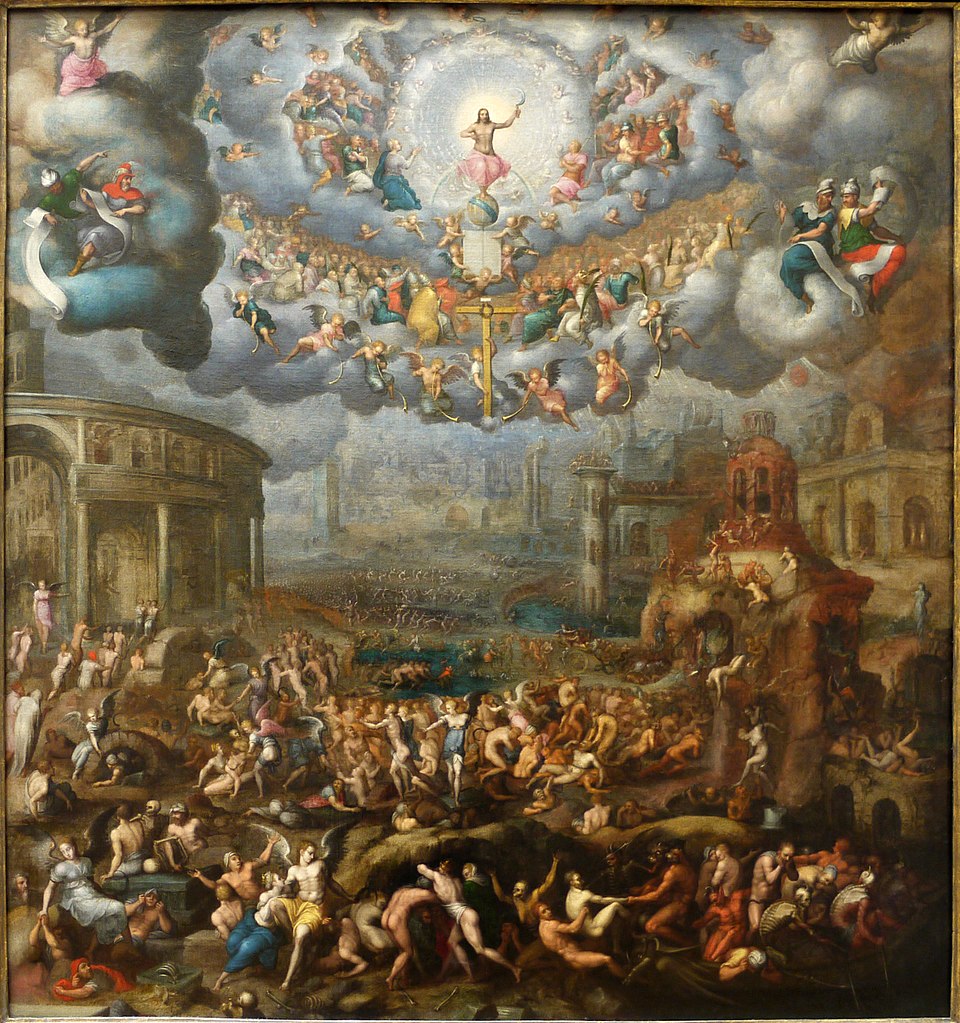
    Judgment Day, Jean Cousin le fils (c. 1585) | image courtesy wikimedia.

    God is, as the saying goes, love; and lucky for us! Jeremiah reminds us of God’s loving covenant with us: “I will fulfill the promise I made … I will raise up for David a just shoot … Judah shall be safe and Jerusalem shall dwell secure.” The Jews never forgot that our relationship with God rests on this undeserved covenant He made with us, and neither should we. Without this covenant, the end of the world would be as bad as every Hollywood apocalypse movie or dystopian sci fi novel would have us believe. But with this covenant, we have hope; more than hope, we have God’s very promise.

    2000 years ago, God sent the “just shoot” from David’s line: Jesus. But His plan is even greater than we could imagine, because Christ ushers in an age where we have the ability to reach new spiritual heights, through Him. Those who listen to Him and abide in Him are able to experience the Kingdom and bring others to the Kingdom – a spectacular raising up of our souls and purpose that we couldn’t imagine possible. Christ promises that it will be hard, that we will be persecuted, and He himself accepts the most ignoble death to show us that in seeming weakness is the great, loving power of God. Thus, today’s second reading gives us St. Paul exhorting the Thessalonians to stick to the Way: “May the Lord make you increase and abound in love for one another and for all.” Why is this so important? Again, Christ has made possible for us the great spiritual purpose of making our way to the Kingdom. Apart from the saints, the vast majority of us will not experience the kingdom while still alive, but we must devote ourselves to it nonetheless. Paul explains why: “to be blameless in holiness before our God and Father at the coming of our Lord Jesus with all his holy ones.” The Way itself helps us get to the Kingdom, whether partially experienced while still alive or simply through our efforts that show us faithful to Him when He comes on the cloud with the heavenly host. 

    This is a great way to reflect on why Catholics have spent so much time on preaching and living the moral life. We may have gone too far from mentioning God in our moral writings and conversations over the centuries because it really makes no sense if you’re not on the Way. If you’re not living the dense Christian life, aware of ourselves here in the final age, then moral decisions are as arbitrary as evil ones. I would go so far as to say that there is no real purpose to choosing good if you are not at the same time knowingly choosing God. Secularists would say that lawful society, psychological health, or longevity would be perfectly good examples of the purpose behind choosing good vs. evil. I would respond that all of these are justifications that deliberately remove God from our existence, creating a seemingly rational, human-made world. But that type of world Christians flatly reject. Our lives are a gift directly from God – how can we remove Him from the equation and think it’s rational? Lawful society, psychological health, and longevity are certainly benefits of moral action, but they should not be the purpose or the goal. The purpose we act morally is that we love God first, and God (who is love) has given to us commandments and precepts to help us achieve a greater, fuller way to be human. The purpose is our loving relationship with God as His subjects, and in the final age in which we live, that purpose has the goal revealed by Christ: walking the Way to the Kingdom that will be finally commenced at some point in the future. 

    Oh, the anticipation, the waiting! Yes, this is the Advent spirit. In the gospel reading, Christ tells us, “People will die of fright in anticipation of what is coming upon the world, for the powers of the heavens will be shaken.” We are in a state of tension, but it’s no holding pattern, with nothing to do and no way to hasten its fulfillment. He has given us His Spirit to help us stay on the path to the Kingdom. And so He can say, “when these signs begin to happen, stand erect and raise your heads because your redemption is at hand.” This is the great Christian message of hope: the end of the world is not annihilation but redemption and reunion with God. Don’t be frightened, be excited! But also, be prepared. Christ somberly exhorts His apostles in this reading to stick to the Way and not to falter: “Be vigilant at all times and pray that you have the strength to escape the tribulations that are imminent and to stand before the Son of Man.” So … excited with an asterisk, that we must be obedient to Him.

    Obedience is such a downer for today’s modern person, right? The modern would say that obedience equals stifling freedom of speech, obedience equals the white, rich status quo, and obedience prevents positive change. Where to start? It must always start with God, who is not a stifling influence but a creator, not a preventer but an expander of potential. When we take ourselves and our precious points of view so seriously that we forget that all we have is a gift we didn’t earn, then we are truly lost. In the end, obedience takes a heart docile to God, and once that happens, joy, wonder, and hope follow. Isn’t that what we want to experience in Advent?
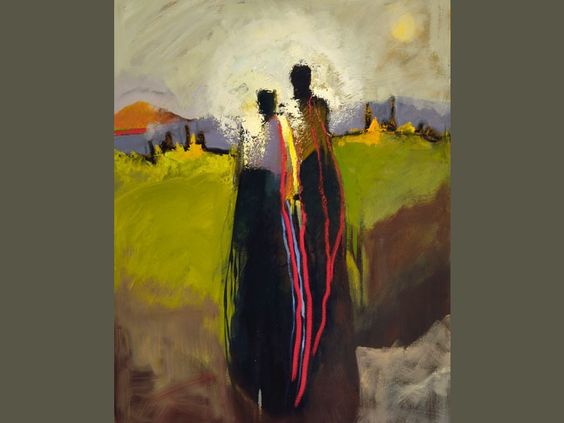
    Unknown title, Kathy Jones (contemporary) | Image from kathyjonesstudio.com

    Perhaps the most helpful short line in today’s readings comes from St. Paul: “conduct yourselves to please God.” This wraps up everything we’ve been discussing: acknowledging God’s supreme sovereignty, the true purpose behind moral actions, the way to live in this final age that has already been given Christ but yet awaits Him still. It is right and just that the operative word here is to “please” God. God wants to please us, His beloved creation; and as we grow in love for Him, we realize that wanting to please Him is our greatest calling.


  • The Radicality of the New Covenant

    The Radicality of the New Covenant

    Third Sunday of Lent: Exodus 20:1-17, 1 Corinthians 1:22-25, John 2:13-25.

    Today we receive the Word of God in its most accepted and unchallenged form (the Ten Commandments) and then it its most radical and challenging — St. Paul bragging of the humiliation of the Cross and Jesus himself blowing up the concept of the Jewish temple as a sacred meeting place with God.

    The scene of Jesus casting out the moneychangers and animals was so serious that the Jews used this as one of the two main charges against Christ in his trial (that he claimed to be God and he wanted to destroy the temple). We need to ask ourselves why Jesus was so radical in today’s gospel and what it tells us about his New Covenant with us.

    Christ Driving the Traders from the Temple (Kristus uddriver kræmmerne af templet), after 1570, from the workshop of Pieter Brueghel the Elder | Wikimedia Commons.

    St. John’s account of this scene occurs at the beginning of Jesus’s ministry, unlike the three synoptic gospels where it occurs at the end. To me, this is interesting because it is another example of how John’s worldview is so transformed by Christ. Every event and detail overflow with his divinity; Christ is in control and in his power and glory throughout the gospel of John.

    The first thing that jumped out at me was the whip of cords (a flail or scourge) being used to drive the moneychangers and the animals out of the Temple. Jesus using a scourge on people? A close translation is needed here and unfortunately the Lectionary isn’t exact on this line. The original Greek specifies that the whip was only used on the animals. Here is the scholar David Bentley Hart’s translation: “And, having fashioned a stockwhip out of cords, he drove all of both the sheep and the oxen out of the Temple; he also spilled out the coins and overturned the tables of the moneychangers.”

    So while Jesus undoubtedly uses forceful methods to get the animals and money interests out of the Temple, it is not a depiction of violence against another human. This passage has been used to justify righteous war and violence, not to mention a “muscular” Christianity, and I think these are misunderstandings and poor applications of Jesus’s example.

    Christ’s point here is that they should “stop making my Father’s house a marketplace.” Having animals and moneychangers in the Temple served a very practical purpose. For those who traveled far to reach the Temple at Jerusalem, it was inconvenient and difficult to bring their required animal sacrifice with them. It was much more convenient to be able to buy an animal for sacrifice there. The doves, in particular, were targeted towards the poor and women/widows who couldn’t afford a lamb or ox but who still needed an animal sacrifice.

    Furthermore, Jewish law forbade foreign or secular coinage to be used in the Temple, hence the proliferation of money changers. Jerusalem was both a holy city and a crossroads for many cultures — caravan routes from Asia and Africa crossed there, as well as Gallic and Roman people from Europe thanks to the Roman Empire. The livestock and money changers, therefore, served a very useful purpose. But Jesus is clearly incensed that they are operating there in the Temple.

    We must not mistake his response as a simple desire for Temple purity. Jesus was not overly concerned with the fetishization of purity, as the Pharisees criticized several times (pointing out that his disciples did not fast like they did, nor did he and his disciples fastidiously wash before meals like they did). Instead, I think his point is that the Jews were placing the doing of deeds ahead of the heart-and-soul encounter with God.

    This is consistent with his critique of the Pharisees and scribes: “They tie up heavy burdens, hard to bear, and lay them on the shoulders of others; but they themselves are unwilling to lift a finger to move them. They do all their deeds to be seen by others” (Mt 23:4-5a). Yes, the livestock and money changers serve a useful purpose but this purpose is not to deepen the faithful’s experience with God. Instead, it is a marketplace of convenience, serving the needs and desires of humans.

    What’s more, those who sold the livestock and changed money made their living in this fashion — essentially profiting from a person’s journey to worship God. This self-serving practice is certainly not fit to occupy a position within the Temple. Perhaps the difficulty of bringing animals to the Temple was part of God’s plan to help people prepare their hearts for meeting him, much like our Lenten sacrifices. Perhaps the prescriptions on Temple coinage also came about purely as part of a bureaucracy of human convenience and desire. 

    The Temple Sacrifice (1995), Zely Smekhov | Image from zely-smekhov.com/

    In this light, it becomes much more clear why Jesus became so upset as to drive off the livestock and command the money changers to leave. This was no longer a dwelling place for the Lord, a sacred temple unto Him. It was simply a place of ritualized practices developed with convenience and efficiency in mind.

    The Jews had reduced the temple to spiritual rubble all on their own. All that was left was for Christ to show the inadequacy and irrelevance of the Temple as he instituted a new temple in his Body and Blood. This was not understood yet, but what was apparent was the pure shock of Jesus’s actions. Any disruption to Temple workings would be an affront to those in power — the scribes, the elders, the Sanhedrin. They held the authority in this place, and this traveling preacher was worth next to nothing in their book. Such actions were tantamount to terrorism in their eyes. Add to this the fact that he was suggesting an end to commerce and the ability for many people to obtain animals for their ritual sacrifices, and the disruptive nature of this act is apparent.

    Yet let’s not get carried away with this image of Jesus’s forcefulness and a promise of temple destruction. That is the same road the Jewish zealots tread with their expectation of the Messiah. God has his own way that does not correspond to human intelligence or intuition; that way is always love and self-sacrifice. We get the first hint of the underlying divine Way and Truth in the midst of this scene when the Evangelist writes, “His disciples recalled the words of Scripture, Zeal for your house will consume me.” This passage comes from Psalm 69, the Prayer for Deliverance from Persecution. Despite what it sounds like — someone being taken over by righteous anger (zeal) and lifted up to a position of power — this scriptural reference is to someone who is greatly persecuted and at the end of their rope, pleading for God’s deliverance.

    There is a real desperation in Psalm 69, which begins, “Save me, O God, for the waters have come up to my neck. I sink in deep mire, where there is no foothold.” It continues: “Do not let those who hope in you be put to shame because of me … It is for your sake that I have borne reproach, that shame has covered my face … It is zeal for your house that has consumed me; the insults of those who insult you have fallen on me.” In many ways, St. John’s use of this reference early on in his gospel is a foreshadowing of the Passion and Death of our Savior.

    It also helps us connect the final lines in today’s gospel when John tells us that Jesus understood human nature well. His great empathy with us comes from his Incarnation and living a fully human life; he knows life’s temptations and failings. The desperation of Psalm 69 speaks to the common human experience of trying to be faithful to God amid a culture consumed with earthly things. The reference to this psalm underlines the drastic nature of the Temple’s decline in Jesus’s mind, as well as a people so committed to their rituals instead of the presence of God in their midst that they will persecute and kill him. 

    As our gospel continues, the Jews, likely angered and put out, demand from him: “What signs do you show us, since you do these things?” Now, of course Jesus could have healed someone, raised someone from the dead, or performed some other miracle, but we are validating the mindset of the Jews if we think this way. Jesus only does miracles to bring people closer to God, to take away spiritual blindness, to enkindle hope or teach them about spiritual sustenance. The stakes here are not individual journeys of faith but the very locus of faith for the entire human race. The Temple was God’s dwelling place on earth, the most sacred place for humanity. What sign of this magnitude can Jesus give them other than himself? 

    Christ driving the Traders from the Temple (1600), version located in London, El Greco | Wikimedia Commons.

    And so he says, “Destroy this temple and in three days I shall raise it.” I envision him saying this with a quiet calm, in contrast to his other forceful actions. As John tells us, “he was speaking about the temple of his body.” What greater sign could there possibly be than the Resurrection?

    But the import of this exchange between Jesus and the Jews is that this is not just a sign. As we now know, he establishes his Body and Blood as lasting spiritual food, as part of the New Covenant with humanity. The sign of the Resurrection denotes a new reality: the liturgy bursts upon us, divinification is made possible as we walk his Way faithfully, the mystical Church is born, eternal life is made available to humans, and the old Temple is made irrelevant.

    In some ways, I almost think we can read the first part of Christ’s sentence, “Destroy this temple,” as truly referring to the Temple in Jerusalem, almost like a directive to humanity. Yes, destroy this temple because you will no longer need it and its empty, convenience-driven rituals that have made it no longer fit as a dwelling place for God. And, because He is the dwelling place of God on earth, we can understand the destruction of the Temple and his own death as an equivalency. Thus, he will raise his Body, which is and already has been the only real Temple since the Incarnation.

    Imagine the divine responsibility and patience it took for him to know this reality and to attempt to teach it to the Jews in a way they could start to accept. Not only is it a mystery of faith to understand the starting point of the Incarnation and how it has irrevocably changed the entire Jewish religion, but the ongoing work of Jesus in his ministry and acceptance of his own Sacrifice and Death is simply so counter-intuitive to our human conception of power and glory that it needed to be lived out to be believed.

    Thus, we hear John tell us that while he was in Jerusalem, “Jesus did not entrust himself” to all the people who started flocking to him; and John notes that he “did not need anyone to testify about human nature for he himself understood it well.” Because he is fully human and fully divine, Jesus knows how human hearts are fickle and how people can quickly twist signs and prophets to their own ends. He desperately wants to love humanity and bring them close to himself and the Father, but he must operate in the world in a way where his ultimate end as a loving sacrifice for humanity can be accomplished and not thwarted. Again, St. John presents us with a fully in-control Lord who steers himself and his disciples to the New Covenant with single-minded purpose.

    Artist’s illustration of a supernova, iStock

    As I reach the end of my reflection, I’m struck by the radicality of the New Covenant that is Jesus Christ. So much is centered on him, his Body and Spirit. He is the most dense spiritual supernova around which the universe rotates. He is the new Temple, transforming a type of ritual worship centered on a building into a true communion with God that provides real spiritual food.

    No human could imagine such a transformation of the Jewish covenant. It took God to come in person to make this important transformation happen and, in the process, open up for us the gates of Heaven. I suppose this is why we have such a shocking scene as he upsets the entire Temple economy in today’s gospel. How else can we grapple with the sheer upending of our old way of knowing God?

  • The Church’s Mission Statement

    Monday in the 1st Week of Advent: Romans 10:9-18, Matthew 4:18-22.

    What an interesting start to Advent! Yesterday, Christ admonished us, “Be watchful! Be alert! You do not know when the time will come.” This should be a familiar refrain, a reminder that Advent is a time of waiting for both the Incarnation of Christ and the Final Judgment. This vigilance will be marked by prayer and anticipation until we celebrate the Birth of our Lord. But what do we get today, the second day of Advent and the Feast of St. Andrew the Apostle? We receive a concise exposition on eternal salvation being realized and the mission of the Church herself. This may seem incongruous with the initial message of waiting and vigil, but I think the Church, in her wisdom, places these readings and this feast at the beginning of Advent for a reason. Today, we acknowledge that the Christ Event has changed the world irrevocably and, although Advent commemorates and celebrates a time of waiting, we cannot “pretend” that the keys to the kingdom are not yet here. Christ has already brought the end times, and our active work as the Church is happening even as our liturgical calendar revolves in memorials and feasts.

    Icon of Christ, King of Kings (Greece, c.1600) | Wikimedia Commons.

    Let’s unpack today’s startlingly concise mission statement for the Church, brought to us by St. Paul. He writes to the early Christian Church in Rome: “If you confess with your mouth that Jesus is Lord and believe in your heart that God raised him from the dead, you will be saved.” While this seems simple (almost too simple!), it belies a depth of personal commitment that we might not notice at first. I’d like to take a small detour here into the issue of a person’s good works and faith and how these impact one’s salvation. The second part of Paul’s sentence quoted above, that is, “faith provides salvation,” has been surgically taken out of St. Paul’s overall corpus of writings to justify misunderstandings and heresies since the Apostolic Age. The Gnostics (many different sects) spread beliefs along the lines that faith in Jesus and other spiritual gifts were separate and more important than acts of the world and the body. This separation is dangerous because it erodes the connection between faith in Christ and moral acts here in this world. This heresy was taken up by Martin Luther and John Calvin in the 1500s, and sadly the foundation of the Protestant churches is a misunderstanding of this passage, that if you have faith alone (“belief in your heart”) in the mystery of Christ’s death Resurrection, you will be saved.

    This statement is taken out of the context of St. Paul’s full writings. We must understand that for St. Paul, “believing in your heart” the mysteries of the Christ event is a transformative thing – a person not only thinks differently, but a person also acts, speaks, and worships differently. He writes clearly to the Galatians: “the faith that finds its expression in love is all that matters” (Gal 5:6b, emphasis mine). He also tells the Corinthians: “I may have utter faith, so that I can move mountains; yet if I lack charity [do not have love], I count for nothing” (1 Cor 13:2b). Clearly, he is not telling the Romans that faith without works is salvation. For Paul, and for all Christians, faith is inextricably linked to charity, love, and good works. This is because the particular faith we have is in God who becomes man to show us that love, peace, and charity are more important than power and worldly knowledge. When we have faith in Him, we seek to embody His teachings and His example. His greatest commandment, to love God first with our whole being and then our neighbor as ourselves, unites this lesson that faith cannot be separated from moral actions here on earth.

    But this post isn’t about Catholicism vs. Protestantism. St. Paul tells us in today’s first reading that two things, faith in the Resurrection and confessing that Jesus is Lord, bring us salvation. We’ve explored how “faith in the Resurrection” is a kernel of wisdom that means faith in all of the mysteries contained in the Christ event exploding upon human history, and allowing that faith to change us, to transform us in the image of our Lord. The second bit flows from this transformation: we Christians do not sit silently in our faith. We are not lamps hidden under the bushel basket. We are called to be evangelists in our work and in our mouths. We must proclaim to everyone who will hear.

    And here we have, in a nutshell, what the Church is all about. We don’t hoard salvation to ourselves. We are not a secretive society of the select (again, Gnostic heresy). The Church is always “two or more gathered in my name” – always plural people, not a singular person. As we have faith in Christ and all that He revealed, we are transformed by God into something greater. This is grace, this is justification. And by the grace of God, we can begin to aspire to be like Christ, that is, to love everyone unconditionally, to see our Father in everyone and everything, and to ardently desire to save souls and bring them to our Father’s kingdom.

    The Calling of Peter and Andrew (1308-1311), Duccio di Buoninsegna | Wikimedia Commons.

    I, like many Catholics I know, am a little scarred by the televangelists of the 80s and 90s who co-opted many fine Biblical sayings, shouting the meaning out of them. It’s hard in some ways to read “confess with your mouth that Jesus is Lord” without hearing a Jerry Fallwell-like voice and thinking of intolerant American fundamentalism. But we must recover what the Apostles and Christ bestowed on the Church in our sacred scriptures. Our great saints proclaimed with their mouths the Truth of Christ and Wisdom of God long before our contemporary cult-of-personality evangelical preachers twisted these words to suit their purposes. I’m not saying that evangelicals are all wrong, but they are not representatives of the one, true, universal Catholic Church. In particular, we must reverse the notion that Christian evangelization is linked to intolerance and that not everyone is welcomed by God. As the Second Vatican Council’s document on evangelization, Ad Gentes, states: “The members of the Church are impelled to carry on such missionary activity by reason of the love with which they love God and by which they desire to share with all men the spiritual goods of both its life and the life to come” (7). In other words, what drives us is not to perfect the world in the image we think is in God’s mind (much less drive out sin like zealous crusaders), but our driving force is the same love with which we love God. We are driven by a desire to share with everyone spiritual good. Love and sharing. This is a topic for another post, but evangelism for Christians must be an invitation to know God through Jesus Christ done out of love for our fellow humans.

    The reason we have to return evangelization to its original dignity: it is the very first thing Christ promised His Apostles. Today’s gospel reading from St. Matthew tells us of the iconic calling of Peter, Andrew, John, and James. Christ says, “Come after me, and I will make you fishers of men.” This is the evangelical promise He gives them: they will catch men instead of fish; they will harvest humanity for God. Note that there is no hesitation: “At once they left their nets and followed him.” Again, with John and James: “He called them, and immediately they left their boat and their father and followed him.” The Voice of God speaks to them and they do not hesitate. But, no, more than the voice – the very Word of God in human form speaking corporally to them and beckoning them to be transformed into a new thing: a fisher of men. This irresistibility is an effect of the miracle of the Incarnation, which we anxiously await in Advent. With the gravity of a million suns, Christ walks the earth, pulling people to Him. That spiritual gravity cannot be overstated; it is God Himself taking His own incomprehensible, immeasurable being and distilling it into a baby. This tiny being will then draw humanity to himself, teach them in word and in deed what it means to love, and thereby give us the salvation that St. Paul speaks of.

    This is the Christian mystery of salvation and let’s note that God intends for us to be active participants in this plan. The Church, through the Apostles, is created to put on full display and shout from the mountaintops the glory of Christ. This action is and has always been evangelical. Furthermore, is it a coincidence that “evangelist” contains the word “angel”? No – the Greek word used in the gospels, εὐαγγελιστοῦ (euaggelistés), means “bringer of good news,” and the Greek word for angel, ἄγγελος (aggelos), means “a messenger.” Being an evangelist means participating in the same action of the angels as messengers of God. We are participating in announcing the kingdom of God just as the angels do. (NB: In a very specific way, we meet the angels here on earth. The Mass and Eucharistic celebration is the moment when the kingdom of heaven meets the action of the faithful on the earth and we celebrate with the angels the mysteries of our faith and gift of Christ as food for us.) In other words, God has invited us to his heavenly feast here and now, recognizing and blessing our souls as holy like the angels, and inviting us to carry out the same work as the angels. 

    Cutting from an Italian choir book (Lombardy) – Historiated initial ‘D’ of the Calling of Peter and Andrew (c. 1475-1500) | Image Courtesy the British Library Catalogue of Illuminated Manuscripts.


    Let’s return to the opening thought: what a fascinating start to Advent. Advent brings together two events that historically seem very far apart: Christ’s birth to Mary and Christ’s return at the end of time. But today’s reading shows us that these two events are in fact united (in kairos time), that the inexpressible mystery of God coming to humanity cannot be contained in a historical figure. Christ will always be more than just the historical figure who the Apostles met on the shore of Galilee. As God, he transcends time and mortality – he existed before time and outside of history (hence the misguided attempts to “know” Jesus Christ simply through a historical lens). So when He is made incarnate, human history is ruptured and ripped from a linear trajectory. The center of the universe isn’t the sun or a terrestrial body but the Body of Christ, which rises and takes its rightful place in the heavenly realm. We now orbit this spiritual truth that carries us through our lives with a centrifugal force much different than the passing of the earth around the sun and the march of time. The liturgical calendar attempts to reflect this new ordering of our lives, and Advent is a season where we approach the unification with God from both sides: as those waiting for the babe and those waiting for the judgment and final unity. But the same reality is achieved in both events: God offers us real, corporeal salvation. In one, that salvation is the form of the Savior, in whom our faith and actions carry us through this life while we await the second, in the form of that same Savior, carrying out his same saving action.

    This is how the Catechism can claim “To fulfill the Father’s will, Christ ushered in the Kingdom of heaven on earth. The Church ‘is the Reign of Christ already present in mystery’” (CCC, 763). At the same time, it teaches “Though already present in his Church, Christ’s reign is nevertheless yet to be fulfilled ‘with power and great glory’ by the King’s return to earth” (CCC, 671). The Church that Christ established is brought into clear focus, started the calling of the Apostles to become fishers of men and bringers of Good News, and continuing with us in prayer, action, and spirit.

    Finally, we can look back at the first reading from St. Paul and understand the fullness of his words. When he writes, “one confesses with the mouth and so is saved,” we can see that this evangelical act is the sharing of love that the Church was established to accomplish. We can see that our confession of Jesus Christ as Lord – as an act meant to lovingly draw people to the truth – is what makes us part of the Church, “the Reign of Christ already present in mystery.” Of course we are saved in this moment! We are fully participating in God’s plan, in the universal Church, in the Reign of Christ.

  • What is there about His Word?

    Tuesday of the 22nd Week in Ordinary Time: 1 Corinthians 2:10b-16, Luke 4:31-37

    Today’s readings present St. Paul’s contrast of spiritual living and worldly living to the early Christian community in Corinth as well as Christ’s healing of a possessed man in Capernaum. Both readings invite us to consider the invisible world of the Spirit where God reigns, a world where Christ is our key to life.

    The fuller introduction to St. Paul’s discussion of the Spirit is excluded from the Lectionary reading. Yet it is important because it sets the context; he is discussing the Spirit as a way to explain wisdom, specifically God’s wisdom: “But we speak God’s wisdom, secret and hidden, which God decreed before the ages for our glory … these things God has revealed to us through the Spirit; for the Spirit searches everything, even the depths of God” (1 Cor 2:7,10). This “secret and hidden” wisdom of God, “decreed before the ages for our glory,” is surely of ultimate importance to all humanity. And there is only one agent capable of knowing and of revealing this wisdom: the Holy Spirit of God.

    Saint Paul Writing (from an early 9th century manuscript version of Saint Paul’s letters), ascribed to the Monastery of St. Gallen under the scribe Wolfcoz | Wikimedia Commons.

    St. Paul makes an analogy between God’s wisdom and ours: “Among men, who knows what pertains to the man except his spirit that is within? Similarly, no one knows what pertains to God except the Spirit of God.” This analogy rests on a common idea of an integral spirit within a being. We are able to speak of this spirit as something separate from the being yet something intimately tied to that being. Thus, “my” spirit is particular to me. I might argue that it is nonsensical to speak of my spirit separate from “me” (whatever that non-spiritual part of me is), but St. Paul speaks of a spirit as separate from the being, as an agent who knows me intimately; likewise for God’s Spirit. But next he points out that the Spirit who speaks with and through the apostles is not their internal human spirit but “the Spirit who is from God.” This direct contact with the Holy Spirit. That’s important because there is no understanding or wisdom of God without the Spirit. God is unknowable. Except with the help of His Spirit.

    Thus, St. Paul can describe his entire enterprise of evangelization in this way: “And we speak about [the things freely given us by God] not with words taught by human wisdom, but with words taught by the Spirit, describing spiritual realities in spiritual terms.” This has rather huge implications for how we should treat the writings of the New Testament. Without a doubt, the source of Wisdom is Jesus Christ, the Son, co-existent with the Spirit and the Father. Yet let’s not overlook that this same source spoke to the apostles at Pentecost and afterward. They speak and write with words given to them from the Spirit, “describing spiritual realities in spiritual terms.” This is why the Church refers to these writings as divinely inspired — not because they seem to capture a certain “poetic essence” of divine things, but because they actually come from the Holy Spirit and describe spiritual realities as God reveals them to us.

    Beyond this, St. Paul writes about these spiritual matters because early Christian communities were bound to test the wisdom presented to them by the apostles against the wisdom they found in the world. This worldly wisdom tells them that people are selfish, that the rich are “blessed,” that all pleasure is good. What’s more, Corinth is in south-central Greece, 50 miles west of Athens, and the wisdom of the Greek philosophers was a learned perspective often in opposition to Christian wisdom as revealed by God. St. Paul here pointedly writes: “Now the natural man does not accept what pertains to the Spirit of God, for to him it is foolishness, and he cannot understand it, because it is judged spiritually. The one who is spiritual, however, can judge everything but is not subject to judgment by anyone.” Here he counsels that non-spiritual people will call Christian wisdom foolish because it is of an order they cannot understand (unless they accept the Spirit). Furthermore, he points to the supremacy of the order of spiritual wisdom over worldly wisdom because “one who is spiritual … can judge everything.” In other words, the “secret and hidden” wisdom of God pertains to the right ordering of all of creation, and with this wisdom, a spiritual person can “judge everything.” The reciprocal statement is not true: someone with only worldly wisdom doesn’t have the full picture. This is why St. Paul says a person living in spiritual wisdom “is not subject to judgment by anyone” (especially those with only worldly wisdom). His letter is a comfort for these early Christians: despite the scoffing and judgments they might endure, they should remain confident that they are living in the true and transcendent Wisdom of God.

    Icon of St. Paul (unknown provenance) | found on Pinterest, uploaded by Icone Sacre Mirabile Ydio.

    His final sentence, “But we have the mind of Christ,” stresses the indivisible nature of the Trinity. Christ is one with the Spirit and the Father. It is Christ who has interceded on our behalf with the Father and who ushers in the great pouring out of the Spirit into history. It is Christ who is the living Word of God, present with the early prophets and again as a human in Galilee, the incarnation of the Wisdom and Logos living among us. And it is Christ who shared God’s wisdom not just in the Word, but in his actions and ultimately in the Cross. Above all, Christ distinguishes the wisdom they have received from every other philosophical or theological foray humans have made. It’s not just a correct philosophical worldview to compare among so many other worldviews, but God’s singular way of making His Wisdom and self known to us, in a form we can comprehend: a man.

    This, ironically, becomes a stumbling block for us: how can a mere man encompass all of God’s wisdom? How can a mere man at the same time also be God Himself? Just yesterday, we heard in the gospel that the Nazarenes from his hometown skeptically declare, “Is this not the son of Joseph?” They are full of judgment, full of their worldly knowledge when they declare to know him as something different than what he claims. To them we can only repeat St. Paul’s words: “The one who is spiritual [in this case, Jesus] … can judge everything but is not subject to judgment by anyone.”

    Head of Christ (c.1648), Rembrandt | Wikimedia Commons.

    Appropriately, today’s gospel reading immediately follows the episode in Nazareth. It ends as He, we might conclude, physically manifesting the powers of the Holy Spirit, “passed through the midst of them and went away.” St. Luke gives us this striking marker of his nature starting to be revealed, like an early Transfiguration. Today’s gospel takes place in Capernaum, where he teaches in the synagogue on the sabbath, “and they were astonished at his teaching because he spoke with authority.” We hear from the start that He is again recognized, but in a completely different way than He was in Nazareth. He is recognized first by the Jews in the synagogue by a quality of his words, an authority that is found in great, inspired, perhaps prophetic or anointed teachers.

    And next, He is recognized by a denizen of the spiritual world. “A man with the spirit of an unclean demon” recognizes Him and cries out, “What have you to do with us, Jesus of Nazareth? Have you come to destroy us? I know who you are–the Holy One of God!” St. Luke clearly ties back in the Nazareth episode by having the demon call him out as “Jesus of Nazareth” and at the same time “I know who you are-the Holy One of God!” This is what the Nazarenes could not wrap their heads around: the fact that God has become a man, a specific man from a specific place, but is nonetheless much more than just a man.

    Possession by demons is the sign of spiritual illness. Jesus, by His Word (although it could have easily have been a flick of the wrist or even just a blink of His eye), cures the spiritual illness and casts out the demon. He deliberately speaks, “Be quiet! Come out of him!” He silences the voice of a perverted spirit and removes the world-bound false knowledge of the demons that possess us. The Jews from Capernaum begin to ask the right question: “What is there about his word? For with authority and power he commands the unclean spirits, and they come out.” This is the exact question that we must ask ourselves as we constantly re-convert to Christ and re-discover God: what is there about his word? This is no ordinary word, no ordinary authority, no ordinary power.

    The Word of God, made flesh in Jesus, is present in the world to do some specific Spiritual work. The Word of God, made flesh, then crucified, then risen in Jesus, establishes a new reality for us that transcends the created world. In the words of St. Paul, “We have not received the spirit of the world but the Spirit who is from God, so that we may understand the things freely given us by God.”

    The Holy Trinity (1st half of 17th century), Antonio De Pereda | Creative Commons, courtesy the Web Gallery of Art.

    As some of these thoughts swirled in my head today, it was a pleasure to hear the following from Thomas à Kempis’s The Imitation of Christ during the Office of the Readings: “My son, says the Lord, listen to my words, the most delightful of all words, surpassing all the knowledge of the philosophers and wise men of this world. My words are spirit and life and cannot be comprehended by human senses alone.” This is the answer to the question, “What is there about his word?” This is the sense of wonder we read about in the gospels as people hear Jesus preach and work miracles; it “cannot be comprehended by human senses alone.” The something wonderful is the presence of God, of the Spirit of God, because “My words are spirit and life.” All of life, which is more than our flesh on this earth, can be found in God’s Word.

    Now, consider that this Word was a living man, in whom the swirling mysteries of the universe, right and wrong, destiny and salvation, were located. What an incomprehensible mystery and miracle! We think of wisdom as belonging in a book, perhaps in advice garnered from long life experience. But this wisdom, as St. Paul points out, is of a different order. God’s wisdom is made manifest as a stroke of artistic brilliance that only the Creator Himself could devise: a living, breathing being who can speak His Word, with whom He can co-exist, a unique someone who can be perfect and thereby bestow a perfect gift upon humanity.

    What is this Word, what is this gift? Here, let us trace the passage from The Imitation of Christ to its origin in the gospel of St. John: Jesus says, “It is the spirit that gives life; the flesh is useless. The words that I have spoken to you are spirit and life” (Jn 6:63). Jesus is referring to specific words he spoke moments before. This is the discourse on the Bread of Life and His listeners are balking at His promise to those who eat his flesh. He tells them, “I am the living bread that came down from heaven. Whoever eats of this bread will live forever; and the bread that I will give for the life of the world is my flesh” (Jn 6:51). He doubles down on this: “for my flesh is true food and my blood is true drink. Those who eat my flesh and drink my blood abide in me, and I in them. Just as the living Father sent me, and I live because of the Father, so whoever eats me will live because of me” (Jn 6:55-57). 

    Christ the Saviour with the Eucharist (1545-1550), Juan de Juanes (Vicente Juan Masip) | Creative Commons, courtesy Museo Del Prado.

    For the Church, this means that the sacrament of the Eucharist is part and parcel of the wisdom of God. It is this gift (the actual Flesh and Blood, the actual Spirit acting within the sacrament) that the living Word of God, Jesus Christ, brings to humanity as a way to forever have access to the heavenly liturgy and the kingdom. We don’t divorce this sacrament from the other wisdom that Christ and the prophets present in their teachings, nor do we separate it from His miracles, His death on the Cross, or His Resurrection. The Eucharist is all the more significant because all of these things are made present in the sacrament: the Spirit, Wisdom, the Body and Blood of Christ, the flashpoint of salvation history. He gives it to us to sustain us in spirit and to help us remember the supremacy of the Spirit, especially in a physical world where we are called to sacrifice and serve one another.

  • The Challenge of Fulfilling Your Ministry

    Saturday of the 9th Week of Ordinary Time: 2 Timothy 4:1-8, Mark 12:38-44.

    Today’s readings follow a theme from our last reflection: giving ourselves fully to the Lord. At least this is what jumps out at me, likely aided by the fact that I’m also reading The Life of St. Catherine of Siena by Blessed Raymond of Capua for our Dominican formation, and the descriptions of how she was “all in” with her devotion to God are simply astounding. Today, we hear more from St. Paul’s final letter to Timothy from the Roman jail as well as Jesus’s comment on the poor widow who gave two small coins to the temple treasury. The message from both is clear: we are called to go “all in” for God.

    Let’s start with Jesus’s commentary on the widow and then see how St. Paul relates to this as an evangelist for Christ. Jesus first points out a problem with the scribes who accept “seats of honor in synagogues” and “devour the houses of widows” (presumably taking food and riches from these vulnerable widows and offering “lengthy prayers” in return). Jesus is uncompromising in his judgment here: “They will receive a very severe condemnation.” What is He pointing out with this speech? I think the problem is not just what the scribes do, but the way they are internally ordered. Their actions reveal a deeper problem: they delight in the honors, recognition, and riches of this world. They are consumed by selfishness and pride. But worse is their casual bartering of prayer for worldly concerns. With this, we see that they do not fear God; that is, they do not offer Him the awe, reverence, and devotion He is due. Their prayers are used like a commodity, like money, to get other pleasures they can enjoy in this world. Here is the ultimate example of people who know the law and the scriptures but have ordered themselves internally to seek only their own gratification. We start to understand why Jesus calls the scribes and Pharisees “hypocrites”: they preach unstinting devotion to the Lord but practice unstinting devotion to themselves.

    The Widow’s Mite (1872-1876), Gustave Doré, woodcut for Holy Bible illustration | Creative Commons, courtesy Pitts Theology Library at Emory University.

    As we understand the scribes’ use of prayer as a commodity, like money, the transition to the passage about the temple treasury is much more natural. We begin to wonder, is prayer commodified here, too? Jesus and his disciples are situated in a place of the temple where they observe people putting their offerings in the treasury box. At first glance, at least worldly offerings are used for spiritual things (the temple and furthering the work/glory of God) rather than prayers being offered in order to receive worldly commodities. But Jesus takes us deeper and says that this seemingly virtuous act is not the point. I love His message here because He is so radically centered on God that God is always the measure as well as the destination. He measures the worth of a person’s contribution not on the value of the money they donate but on the faith they have as they make the donation. He says of the widow, “she, from her poverty, has contributed all she had, her whole livelihood.” His point is not that one should bankrupt oneself when donating to the Church (although this may be part of His point), but that the widow’s faith in the saving grace of God is greater than her faith in the value of money and worldly security. Money, in fact, is blown up as any kind of measure of value. The only value in this world is the slippery currency of faith that we must always cultivate within ourselves, and its inestimable value exists only because the object of faith, God, bestows it thanks to His awesome nature. Value has nothing to do with us or the things we create (like money), and everything to do with God.

    This widow is “all in,” to use a poker metaphor. The fantastic thing about being “all in” for God is that we aren’t trusting luck or gaming skill to “win,” but trusting in the One who loves his children. We are trusting the divine promise — not much of a gamble, it’s a guarantee! Also, the payout is not riches on earth but everlasting life with God. This last point must shift our entire perspective on the “game” we’re playing in life: the stakes are more profound, the One who bestows the eternal payout is waiting with welcoming arms but wants us to use this life to grow in perfection of spirit and action in order to be united with Him. He has given us a Way, His Son, to show us how to find Him.

    St. Paul Preaching Christ Crucified (2010), Dmitry Shkolnik, in St. Paul the Apostle Orthodox Church in Dayton, Ohio | Image courtesy Fr. Ted Bobosh on Flickr.

    Before turning to St. Paul in the first reading, I’d like to reflect on just how far this perspective is from the one we encounter every day. Let’s look beyond the joke that is popular culture with its uber-rich rappers, athletes, and socialites (not to mention my mother’s pet peeve, American Idol, which transparently disobeys the first commandment). Let’s consider contemporary events where we have a chance to put our faith into action. From the senseless and shameful killing of black men by the police to the sexual and economic exploitation of women, what does the discourse of the morally correct sound like? Let me point out the parallel here to those donating money at the temple treasury — we’re all doing “the right thing,” but there is a qualitative difference for Christ in how people do it. And the difference is not earnestness. The difference is God-driven; it is faith and constant focus on our Creator, the Alpha and Omega. Back to our contemporary events. The discourse I hear is driven from many perspectives: racial, economic, political, pragmatic, idealistic. But I rarely hear one that is Christocentric. People, if we are Catholics, our primary objection to these injustices must be that they abuse God, God’s creation, God’s gift of love to humanity, our promise to uphold our end of God’s Covenant. Where is God in this discourse? There have always been horrors on the earth and likely always will be. Why, when Canaanite children were sacrificed to Moloch, humans could decry this as an affront to God, and today, when we encounter atrocities we find only socially-defined objections to shout (race, economy, politics, ideals). Are we embarrassed to bring up God because people will scoff? Even when we do hear people object from a “religious viewpoint” it is shown as one (often marginalized) perspective among many, others of which are assumed to be more convincing. We’ve strayed far from acknowledging that all comes from God. I firmly believe (as does the Church) that any moral sense comes to us directly from God, nowhere else. We don’t create moral right and wrong. Thus, when we align ourselves with reasons to object to injustice and atrocities that omit God (consciously or unconsciously), we are fooling ourselves and not proclaiming Christ in the way we are called to do.

    Let’s bring this discussion to St. Paul’s letter to Timothy. In his exhortation for Timothy to keep the faith and fulfill his ministry, Paul writes: 

    For the time will come when people will not tolerate sound doctrine
    but, following their own desires and insatiable curiosity,
    will accumulate teachers and will stop listening to the truth
    and will be diverted to myths.

    I believe that this “time” has been with us for a while and we are living solidly within it. Many of my friends and colleagues who are atheists simply “will not tolerate sound doctrine.” They are offended whenever God comes up in conversation. This offense over God in the public sphere has become institutionalized in our society. I’m not arguing that we should become a religious state, simply that Christians should not fool themselves in thinking that we live in a “Christian society” — we live in a fully secularized and atheistic society. Speaking of God, using Him as a basis for orienting our lives and making decisions, is seen as ludicrous, if not dangerous. Catholics should not be complacent or comfortable with the state of culture in the world. We are even farther away from the widow and her two cents than the rich donors or even the hypocritical scribes, for it is not acceptable to even utter the word “God” in polite society.

    St. Paul Guides St. John Chrysostom (2010), Dmitry Shkolnik, in St. Paul the Apostle Orthodox Church in Dayton, Ohio | Image courtesy Fr. Ted Bobosh on Flickr.

    What to do? Let’s return to our scripture for inspiration and instruction. St. Paul “charges” Timothy to “proclaim the word; be persistent whether it is convenient or inconvenient; convince, reprimand, encourage through all patience and teaching.” Well, it’s certainly inconvenient in today’s age. And let’s note that we should eschew contemporary shock journalism and debate by convincing and encouraging “through all patience and teaching.” Isn’t it refreshing to hear a measured voice in debates? One that is not worked into a frenzy but instead reveals patience and learning? This takes self-control and a knowledge that one’s way of being (our demeanor should model Christ for others) is as important as any sort of “winning” of an argument. This is why Paul urges: “be self-possessed in all circumstances; put up with hardship; perform the work of an evangelist; fulfill your ministry.” I love these words. We must listen to them. I talk to people in the Church who have an edge of hysteria in their voices, who are sidetracked on issues of Latin Mass vs. vernacular Mass or receiving the eucharist by mouth vs. in your hand. They speak of these things wildly as if the fate of the Church rests on their interpretation. This is very much contrary to what Paul is telling us. First off, let’s focus on the real problems in the world. Secondly, let’s be self-possessed, patient, and encouraging. How we evangelize is as important as what we say.

    Finally, I am struck by Paul’s phrase, “fulfill your ministry.” Certainly, we don’t all have the same vocation, calling, or ministry. And we all have the freedom and latitude to accomplish our calling with our own gifts and in our own way. But what strikes me is that we can’t forget that our calling or ministry is already there, given to us by God, waiting for us to fulfill it. We can’t go through life thinking that we can just do the motions (go to Mass on Sundays, say a few kind words to people, give to the Rice Bowl). God has a relationship with each of us, a specific calling, and gave us His Son as a guide, a gate to Him, and an intercessor. Are we yearning for God, searching to fulfill our ministry?

    Are we “all in”?

  • Souls: Our Nature Under the God of the Living

    Wednesday of the 9th Week of Ordinary Time (Memorial of Saint Charles Lwanga and Companions, Martyrs): 2 Timothy 1:1-3, 6-12, Mark 12:18-27.

    Today’s readings present an incarcerated St. Paul, sincerely encouraging Timothy even as he faces his ultimate fate, and the gospel reading shows Jesus telling the Sadducees that they are “greatly misled.” Together, these readings shed light on what makes us who we are, especially as Christians baptized in the Holy Spirit.

    What a lovely opening to the 2nd Letter to Timothy. Paul, writing what we believe to be his final letter from the prison in Rome, sweetly greets his old friend Timothy and blesses him from afar: “to Timothy, my dear child: grace, mercy, and peace from God the Father and Christ Jesus our Lord.” What follows is an incredible statement of surety and courage from someone who is at peace with his relationship to God. We must remember the trials that St. Paul has faced by this point: a lackluster acceptance by the mother Church in Jerusalem that is dominated by Jewish converts to Christianity, beatings, imprisonments, shipwrecks, attempts on his life, and even witnessing the backsliding of the Christian communities he founds, some of which will completely fail. It’s fair to say that most of us would have been discouraged, if not in despair, that is, if we had not given up long before. But not Paul, for he is a man who lives in and with the Spirit, who graces him with legendary perseverance in spreading the Word of God and confessing the nature of Jesus Christ as the Savior of the World. He is like one possessed, but this possession is a strengthening and lifting of his character, not a diminishing of his person. He is an incredible example for us of someone who singularly does God’s will, and in so doing is transformed into something greater. 

    St. Paul in Prison (1627), Rembrandt | Wikimedia Commons.

    No, he does not express despair but instead thankfulness: “I am grateful to God, whom I worship with a clear conscience as my ancestors did.” This is a pattern we will see through the ages: saints who exhibit serenity, peacefulness, and gratitude while accomplishing the work of God, especially as they approach their own deaths. And this work never ends as they submit their own will to God; Paul has a clear exhortation to Timothy in this passage: “I remind you to stir into flame the gift of God that you have through the imposition of my hands.” Let’s dig into this for a moment. He clearly references Timothy’s baptism in water and the Spirit — the same baptism we all share — and reminds him to “enkindle” or “stir into flame” the “gift of God” that he received through his baptism. Two things we might note: we, like Timothy, must do something, must engage with and “stir into flame” the gift given to us at our baptism. Second, Paul tells us that the gift is God Himself. He doesn’t speak of various “gifts of the Spirit” like he does in other epistles, nor should we take him to mean specific charisms, talents, or skills. He reminds Timothy that we receive a share in God Himself as we are baptized in the name of Jesus Christ, as we are anointed and initiated into God’s saving plan for us. God dwells within and works within us, but as Paul says, we must stir this gift into flame.

    Paul goes further to characterize the spirit of God that is the gift within us: “For God did not give us a spirit of cowardice but rather of power and love and self-control.” When I heard this, the first thing that came to mind were the several historical fiction shows I watch on Netflix and Amazon about Christians and Vikings in the middle ages. Perhaps it was the close proximity of the words “cowardice” and “power.” Images of Christian soldiers fighting (and hating) pagan enemies come across my mind. Sure, it’s cinema, but we know from documents surrounding the Crusades and historical records throughout Europe that Christians conflated their insistence on the truth of their faith with the peacekeeping efforts of secular powers. In fact, there was little separation in many countries between the secular power (king & queen) and the religious hierarchy (bishops). Let’s be clear: the loser in this equation has always been the faith. Secular interests like expanding a country’s power in the region work in direct opposition to what Christ taught. The sad result for the faithful is that they see their faith as an instrument of power or their religion as something that demands respect and authority. How off-kilter is this from what St. Paul tells Timothy today? Paul writes that God’s gift is not “a spirit of cowardice,” but this does not mean an aggressive attitude towards others; rather, it is a way to encourage Timothy not to hide and be quiet in the face of persecution. He tells Timothy, “bear your share of hardship for the Gospel with the strength that comes from God;” this is the opposite of cowardice. Paul also writes that our baptismal gift is a spirit of “power and love and self-control.” The “power” can only refer to the indefatigability of the eternal Word as well as the eschatological power of everlasting life. It is not earthly power as measured in swords, treasure, and territory. The other two nouns used by Paul accompany this type of heavenly power: love and self-control are not things typified by battlefield berzerkers but by kindly saints. I’ve always struggled a bit with the “Church Militant” terminology and perspectives like a “muscular” Christianity. Proponents of this terminology are tempted to relate spiritual warfare with the devil to secular warfare with non-Christians. Spiritual warfare is a very real internal struggle to uphold the purity of our souls, not an external campaign to wipe out anything non-Christian in the world. I simply think that military metaphors are overplayed in some religious rhetoric, and in the light of today’s example that Paul gives us, we should instead have a model of the suffering but persistent saint, unfazed by seeming earthly failure, serene in proclaiming the Good News, non-violent, and filled to overflowing with the Spirit of love and self-control. Our model is this man who writes, “I am not ashamed, for I know him in whom I have believed and am confident that he is able to guard what has been entrusted to me until that day.”

    St. Paul at His Writing Desk (1629-1630), Rembrandt | Wikimedia Commons.

    What kind of person is this saintly Christian? What kind of person does not define himself or herself based on accomplishments, wealth, property, or children? This is someone whose focus is unrelentingly God-centric. This is what we are called to be. Yet how much of the time are we unrelentingly God-centered? 5% of the time? 1% of the time? We should be exhorting one another to “stir into flame” our baptismal gift, just as Paul writes. 

    It seems to me that St. Paul demonstrates how he has located his own soul here at the end of his life. He is intimately in touch with that “gift of God,” the spirit that anointed his soul when he himself was baptized. He has gotten to know, prioritize, and hold up for all to see the spiritual aspect of his human person. How thoroughly absent this is in our contemporary lives! We relegate this type of spiritual person to the cobwebbed corners of our society — perhaps the bearded monk blissfully praying away in the monastery or the chaste nun slaving away in the inner city. We settle with a laughable concept of “spiritual” that winks at us in mindfulness exercises or New Age retreats. Meanwhile, we revere the intellectual and the physical: scientists with Spock-like logic and rationality are seen as one type of paragon while athletes are seen as another. I’m not suggesting that intellect and physicality are unimportant parts of who we are, but if we want to be Christians, we have to be serious about our souls as the most important part of our person.

    To my mind, Jesus says just as much in today’s gospel reading. The Sadducees, a powerful political and religious group among the Jews, do not believe in resurrection; more specifically, they don’t believe in the immortality of the soul, which rules out resurrection. This is why they become one of the primary enemies to the early Christian Church, which proclaimed Jesus resurrected. They attempt to challenge Jesus with a tortured question about whose wife a woman would be in the afterlife after successive remarriages. Jesus points out this ridiculous line of questioning from the get-go: perhaps “you do not know the Scriptures or the power of God?” He poses. First, He points out that there is no marriage for those risen from the dead because they are “like the angels,” united with God in a bond more significant and profound than any marriage. This is a point-blank insistence in the immortality of the soul, contrary to the Sadducees’ beliefs. Further, Jesus pulls an example from Exodus, a book in the Pentateuch that they revered and read literally. He points out that God identifies Himself to Moses as the God of Abraham, Isaac, and Jacob, in other words, patriarchs who were hundreds of years dead. Jesus seems to be saying that God was not just mentioning the patriarchs as a memory of ones once alive but as ones alive and dwelling with Him. Indeed, Jesus completes his answer by stating, “He is not God of the dead but of the living. You are greatly misled.” Some have commented that Jesus is frustrated in this passage or that he rebukes them, but I think that this is a great example of self-control and plain truth spoken by our Lord. He doesn’t call them fools or tell them that their question is stupid. Instead, he hears their question, as duplicitous as it may be, and re-directs the conversation to the fundamental question that needs to be addressed with the Sadducees: that of the immortality, the ongoing life, of the soul.

    The Pharisees and the Saduccees Come to Tempt Jesus (Les pharisiens et les saducéens viennent pour tenter Jésus), 1886-1894, James Tissot | Creative Commons, Courtesy the Brooklyn Museum.

    Let’s consider the importance of this teaching. At the heart of it is who we truly are and who our God truly is. We are promised to be “like the angels in heaven,” where even fundamentally important human relationships like marriage no longer matter as we come face-to-face with the Great I AM. Our God is the God of the living, not of the dead. What part of us participates in this rising from the dead? The Church teaches that it is our entire being, body and soul, although we hear St. Paul emphasize over and over in his letters the importance of the soul and detachment from the worldly. This is significant not in order to discount the rising of the body, but to elevate the importance of that invisible part of us, easily overlooked and ignored. As Jesus insists here in the gospel reading and as St. Paul demonstrates in his serene encouragement of Timothy, we are made of something that is immortal, that communes with our God of the living, and that thing is the soul. It is the organ that is perceptive to the Spirit and most in communion with God. Elsewhere, Jesus notes the importance of the soul for our true, everlasting lives: “Do not fear those who kill the body but cannot kill the soul; rather fear him who can destroy both soul and body in hell” (Mt 10:28). This instruction to his disciples is right in line with today’s first reading from Paul, albeit more ominous in tone. Do not be ashamed or afraid of earthly trials, instead focus on the One who can preserve your soul in everlasting life.

    I am left reflecting on how much I may or may not be “dwelling in my soul” rather than in my mind and body, and what that might even mean. I think it must start with a desire, a thirst for God; a desire to connect that invisible part of me with the invisible God. This is the seed of faith, and my goal is to water that seed with prayer, study of divine scriptures, and loving action in the world. This last bit — the loving action — I have the feeling is the true soul-expander. 

  • The Empty Tomb

    The Empty Tomb

    Easter Sunday: Acts of the Apostles 10:34a, 37-43, Colossians 3:1-4, John 20:1-9.

    Today’s readings uncover the truly baffling nature of the empty tomb. We rejoice 2,000 years later because the full revelation of the Resurrection is known. We sing Alleluia! with abandon, but today’s readings remind us that his rising from the dead was unexpected and incomprehensible on the morning after Passover, even for those who believed in him as the Messiah.

    Mary Magdalene on Christ’s Tomb (c.1900), Giuseppe Calì | image from artnet.com.

    In the gospel, Mary Magdalene, driven by her love of Jesus, goes to the tomb early in the morning after Passover, “while it was still dark.” The darkness is emblematic of the encounter at the tomb for her and, later, Peter and John. Mary is so discombobulated by the sight of the stone that is rolled away that she runs back to the Apostles without even looking in. She thinks that someone stole his body: “They have taken the Lord from the tomb, and we don’t know where they put him.” Perhaps the “they” she refers to are the guards, the Romans. 

    The state of the burial cloths is even more confusing for them. Peter and John see “the burial cloths there, and the cloth that had covered his head, not with the burial cloths but rolled up in a separate place.” This is not the scene of a tomb being pilfered or a simple act of transferring a body somewhere else. St. John Chrysostom writes:

    If any persons had removed the body, would they before doing so have stripped it; or if any had stolen it, would they have taken the trouble to remove the napkin, and roll it up, and lay it in a place by itself; but how? They would have taken the body as it was. On this account John tells us by anticipation that it was buried with much myrrh, which glues linen to the body not less firmly than lead; in order that when you hear that the napkins lay apart, you may not endure those who say that He was stolen. For a thief would not have been so foolish as to spend so much trouble on a superfluous matter. For why should he undo the clothes? And how could he have escaped detection if he had done so? Since he would probably have spent much time in so doing, and be found out by delaying and loitering. But why do the clothes lie apart, while the napkin was wrapped together by itself? That you may learn that it was not the action of men in confusion or haste, the placing some in one place, some in another, and the wrapping them together (Homily 85 on the Gospel of John, 4).

    I had no idea that myrrh “glues linen to the body not less firmly than lead.” Thank you to Chrysostom for pointing that out. Chrysostom indentifies that the care taken not just to unwrap the body but also lay the head covering (“napkin”) aside separately means that something altogether different happened. Something deliberate, something careful, something unafraid. Yet something that is still hidden from them.

    The Disciples Peter and John running to the sepulchre on the morning of the Resurrection (1898), Eugène Burnand | Image from eugene-burnand.com.

    Which makes me wonder what is meant when John says of himself, “he saw and believed,” when he follows it with “For they did not yet understand the Scripture that he had to rise from the dead.” I think that John and Peter have the seeds of hope when they encounter the empty tomb in the state it is in. They believe in the possibility of all the hints that Christ gave them about them seeing him again after he dies. They have yet to meet him in his Resurrected Body. The angels have yet to explain to Mary what happened.

    This is the moment of hope! Humanity sees order, care, and absence where there should be death. What a mysterious but wonderful sight. Mourning is no longer appropriate, but instead hope — maybe, just maybe, all those incredible things Jesus told us are true!

    The empty tomb is the picture of our new reality: the place of death has been ransacked and re-ordered. Mysterious hope fills us but God remains out of sight; we must trust the Lord’s Word and grow together as a Church in the sacraments he has given us until we meet him face-to-face.

    Even in the decades after His Resurrection, St. Paul in today’s second reading writes of a “hiddenness” that characterizes Christianity: “For you have died, and your life is hidden with Christ in God. When Christ your life appears, then you too will appear with him in glory.” This is the wonderful mystery we are able to live to this very day.

    People bemoan this state, they want proof that God exists, but what we are given is the empty tomb. This is, in fact, proof; albeit, proof of a different type. We have to remember that God fundamentally wants us to yearn for him, to thirst for him, to live in a differently ordered way that shows how central he is to us despite his hiddenness. He has given us free will, but “to whom much is given, much will be required” (Lk 12:48). We are called to use our free will to choose His will precisely because he gave us the empty tomb, his ordered absence that speaks volumes.

    Of course, much more is given to us. He will appear to his disciples and His Spirit explodes into the world in all its fullness, working amidst humanity constantly and to this day. All of this is most evident in the liturgy, in the sacraments.

    But for now, let us consider the empty tomb, the mystery of his disappearance from the grip of death. It is the surest sign we require.

  • As I Have Done for You

    As I Have Done for You

    Holy Thursday – Evening Mass of the Lord’s Supper: Exodus 12:1-8, 11-14, 1 Corinthians 11:23-26, John 13:1-15.

    We know the readings of the Easter Triduum well, as we should; it is our highest of feasts, the culmination of Christ’s mission and ministry. On this Holy Thursday, the Lord is ready; his hour has come. As I consider these readings, I’ve been asking myself how I would spend my last hours on the earth, and how Christ’s message at the Last Supper can guide me.

    The first reading from Exodus recounts the institution of the Passover meal that commemorates the truly terrifying Passover night in Egypt. In describing the Passover meal, this reading relates to Holy Thursday, and in describing the blood marking the houses of the Israelites, it relates to the Lord’s death on Good Friday.

    The Paschal Lamb (1580-1581), Palma il Giovane | Wikimedia Commons.

    Jesus instituted the greatest sacrament, the Eucharist, during the Last Supper (as St. Paul recounts in the second reading). Let’s consider how the Word of God prefigured the meal of the Eucharist in the institution of the Passover meal. First, there is the regularity of the Passover meal — it is held annually on the 14th of the first month. For the Catholic Church, the Eucharistic meal is so much more central to our being that we celebrate it with every gathering (Mass), a regularity that has been instituted at least every Sunday. Next, the Word of God establishes the mark of purity for this meal; he prescribes that “The lamb must be a year-old male and without blemish.” Also, there is one lamb per family and it is to be slaughtered at twilight, at which point some of its blood is to be applied “to the two doorposts and the lintel of every house” where they “partake” of the lamb. What is the point of these prescriptive rituals? This is but one of many animal sacrifices described in the Old Testament, and part of the challenge for the Jewish nation was to uphold these prescriptions in order to display their faithfulness to God. This speaks to a certain type of ritual beauty that exists in its particularity for each sacrifice — whether those participating were in the desert, in the glorious time of King Solomon, or in the Babylonian Exile, each connected ritually with God in a way that is both shared yet particular to their place and time. In addition to instilling an appropriate thankfulness as the Jews recollect the original Passover, God was establishing a special place for the “unblemished lamb” in their cultural memory to be ready for the time when the Lamb of God, pure of sin, comes for his ultimate sacrifice.

    Eating the slaughtered lamb is an important part of the Passover ritual: “That same night they shall eat its roasted flesh with unleavened bread and bitter herbs.” The Word of God made flesh, Jesus Christ, establishes the full meaning of this ritual when he says, “This is my body that is for you. Do this in remembrance of me” (Mk 14:22, Lk 22:19, 1 Cor 11:24) and “Amen, I tell you, unless you eat the flesh of the Son of Man and drink his blood, you have no life in you” (Jn 6:53). As Christians, we understand the Passover lamb as the precursor (easier to understand and easier to “stomach”) to the true Paschal Lamb, Christ Himself.

    In the same way, we understand the Passover deliverance from the wrath of God that ravaged “every firstborn of the land, both man and beast” in Egypt as a precursor to Christ’s deliverance from the ravaging of every person on earth, condemning them to Gehenna. Our Eucharistic feast is a dense recollection of the great mystery of the Christ event: it is a gift from God, it is a joining of the food of life and the great sin-atoning sacrifice, it is a fulfillment of generations of Jewish ritual and God’s preparation of human hearts for his entrance into humanity. At the same time, it is real food, truly the flesh of the Lord present through the mystical action of the Spirit in our liturgy. The mysterious sacrament of the Eucharist, the heart of our Mass and the “source and summit of our faith,” can be plumbed endlessly for theological significance but more importantly provides real-world transformation of humanity.

    Agnus Dei (1635-1640), Francisco de Zurbarán | Wikimedia Commons.

    A final instruction from God to Moses is important to note. He instructs the Jews to eat the Passover meal in a certain way: “with your loins girt, sandals on your feet and your staff in hand, you shall eat like those who are in flight.” This idea of being on the way to something greater, not tied to the things of this world, was embraced from the very beginning of the Church. Jesus tells his apostles on this Holy Thursday, “but because you do not belong to the world, and I have chosen you out of the world, the world hates you” (Jn 15:19).

    Peter acknowledges this transitory nature of our existence and our belonging to something other than this world in his epistle, “I appeal to you, my friends, as strangers and refugees in this world! Do not give in to bodily passions, which are always at war against the soul” (1 Peter 2:11). And, of course, St. Paul gives us a number of memorable passages related to this, including “Do not be conformed to this world, but be transformed by the renewing of your minds” (Rom 12:2). So, drawing on Jesus saying “I am the way, and the truth, and the life. No one comes to the Father except through me” (Jn 14:6), Christians very truly had their “loins girt, sandals on your feet and your staff in your hand” — in their thirst to follow Christ and be with the Father, they were “On the Way.” We read in the Acts of the Apostles that the earliest Christians referred to themselves as followers “of the Way” (cf. Acts 9:1-2).

    It’s incredible that the Last Supper, this pinpoint moment in a room with his Apostles, is the moment that the Word of God begins to reveal the true fulfillment of these ancient rituals. Yet there is also the drama of Judas’s betrayal and Christ’s effort to save Judas from this great sin (see yesterday’s reflection). Despite the knowledge of his entire ministry coming to an end and the drama of betrayal and denial by his closest friends, Jesus patiently goes about setting everything in order.

    Think about the to-do list here: giving his Apostles one last great moment of teaching, instituting the Eucharist, establishing the momentum for the Church to continue, leaving time to travel “to the mountain” (Mount of Olives) to have a prayerful encounter with his Father in anticipation of the Passion and Crucifixion ahead … all in a matter of a few hours! It’s remarkably, almost serenely organized.

    Jesus Washing Peter’s Feet (1852-1856), Ford Madox Brown | Creative Commons, courtesy ArtUK/Tate.

    Today’s gospel focuses on Christ the servant, who “rose from supper and took off his outer garments. He took a towel and tied it around his waist. Then he poured water into a basin and began to wash the disciples’ feet.” St. Augustine of Hippo in Tractate 55 on the Gospel of John explains how each of these actions relates to something significant in the manner of his saving sacrifice. I’d like to use some of his ideas and some from other sources to consider this extraordinary action of our Lord.

    First, he rises from the supper and takes off his outer garments — as an action, this reminds me of his Resurrection to come and the garments found in the empty tomb, and as such this act of washing the feet is a salvific act akin to the Resurrection itself. St. Augustine also notes that “When about to be crucified, He was indeed stripped of His garments,” so we see a parallel in the Crucifixion, too.

    Indeed, Fr. Jean Corbon notes that the Crucifixion and Resurrection “are not two events, but two phases or moments of the same mystery” (Wellspring of Worship, 46).

    Next, Jesus ties a towel around his waist like a servant, and St. Augustine compares this to the larger humility of the Word of God taking on human form. Then, he doesn’t ask for some water in a bowl, but pours the water into the basin himself. St. Augustine notes that this is like how he “poured His blood upon the earth to wash away the filth of their sins,” and I see a clear parallel to the endless pouring out of love, of the water of everlasting life, that flows continually between the three Persons of the Trinity (as we have explored in several previous reflections).

    Finally, there is the washing of the Apostles’ feet. This lowly act of a servant is important for Jesus to model for his apostles, so much so that he tells Peter that he’ll tell him why he’s doing it after it is done, so as to not disrupt the action by discussing it. St. Augustine notes that he even deigns to wash Judas’s feet: “the greatness of His humility should be still further enhanced by the fact that He did not esteem it beneath His dignity to wash also the feet of one whose hands He already foresaw to be steeped in wickedness.”

    Detail from Christ Washing the Feet of the Apostles (1475), Meister des Hausbuches | Wikimedia Commons.

    Peter’s reaction is typically passionate and vacillatory. First, he says, “You will never wash my feet” because he thinks it is too far beneath his Lord and Savior. After hearing that he needs it or he will “have no inheritance” with Christ, Peter pulls a quick 180° turn: “then not only my feet, but my hands and head as well.”

    Oh, Peter. Your heart is in the right place, but sometimes it seems like you have no check on your mouth.

    But Jesus uses Peter’s outbursts to teach us something important: “Whoever has bathed has no need except to have his feet washed, for he is clean all over.” What can this cryptic message mean? If we have bathed are “clean all over,” aren’t our feet clean, too? When I think of the feet, I think of those things that ground us, both literally and in our faith (faith means to “stand on firm ground” of that which we can’t prove, as Cardinal Joseph Ratzinger writes). And I think of those things that keep us on the move, signifying that we are agents of action in the world. Why do these appendages that ground us and yet move us require refreshment and purification before we sit down at table with our Lord?

    In his homily for Holy Thursday on March 20, 2008, Pope Benedict XVI gives us a great explanation of this response from Jesus:

    Yet here, with the distinction between bathing and the washing of the feet, an allusion to life in the community of the disciples also becomes perceptible, an allusion to the life of the Church. It then seems clear that the bathing that purifies us once and for all and must not be repeated is Baptism – being immersed in the death and Resurrection of Christ, a fact that profoundly changes our life, giving us as it were a new identity that lasts. … It seems to me that the First Letter of St John gives us the key to understanding [the “washing of the feet”]. In it we read: “If we say we have no sin, we deceive ourselves, and the truth is not in us. If we confess our sins, he is faithful and just, and will forgive our sins and cleanse us from all unrighteousness” (1: 8ff.). We are in need of the “washing of the feet”, the cleansing of our daily sins, and for this reason we need to confess our sins as St John spoke of in this Letter. We have to recognize that we sin, even in our new identity as baptized persons. We need confession in the form it has taken in the Sacrament of Reconciliation. In it the Lord washes our dirty feet ever anew and we can be seated at table with him.

    I think Pope Benedict XVI’s analysis is spot-on, and fits with this idea of the feet grounding us in faith. The liturgy, where we are “at table with the Lord,” is the wellspring for our faith to be continually renewed, refreshed, and purified. These feet, doing the work of carrying us and our Christian message around the world to all those we meet, will of course get dirty and need to be re-washed.

    So much meaning condensed in such a humble act! As Jesus asks when he is finished, “Do you realize what I have done for you?” Jesus brings the whole mystery of the Word of God’s descent into humanity into this act of a servant for his apostles. He signals this when he says, “You call me ‘teacher’ and ‘master,’  and rightly so, for indeed I am.” Remember his words from St. Matthew’s gospel back in the second week of Lent: “Call no one on earth your father; you have but one Father in heaven. Do not be called ‘Master’; you have but one master, the Christ” (Mt 23:9-10; see the reflection Led by the Master). In other words, he is invoking his own teaching to re-establish here that the Christ, the Messiah, is speaking.

    And what he says: “If I, therefore, the master and teacher, have washed your feet, you ought to wash one another’s feet. I have given you a model to follow, so that as I have done for you, you should also do.” We must understand his washing of feet as both the humility/action of a servant as well as a metaphor for a specific type of service related to the ritual cleansing in confession. As Pope Benedict XVI also says in his Holy Thursday homily: “We must wash one another’s feet in the mutual daily service of love. But we must also wash one another’s feet in the sense that we must forgive one another ever anew.”  

    The Servant (2000s), Yongsung Kim | image from lighthaven.net.

    And thus the Holy Thursday action of Christ in washing his apostles’ feet is a crucial act of establishing the Church. The ultimate mystery of his Death and Resurrection will usher in a new age, a New Covenant, a new opening of Heaven for humanity. But before this saving action is done, Christ sets his Church in motion through his Apostles, giving them the appropriate method, intention, and understanding of what it means to pour out love for one another in an endless example of agape on earth, irresistibly drawing people to God.

  • Every Knee Should Bend

    Every Knee Should Bend

    Palm Sunday of the Passion of the Lord: (Procession with Palms: Mt 21:1-11), Isaiah 50: 4-7, Philippians 2:6-11, Matthew 26:14 – 17:66.

    In the space of a blog post, how can we take in, much less reflect upon the events we celebrate on Palm Sunday? As disciples, we go from the highest of highs, seeing our Lord’s triumphant entrance to Jerusalem to the lowest of lows in betrayal, denial, and his death. Since I will reflect on the different aspects of the Lord’s Passion, Death, and Resurrection throughout Holy Week, I will use the space here to focus primarily on the readings that happen before the gospel.

    We celebrate his triumphant entrance of Jerusalem by once again waving blessed palm branches, reading the passage from the gospel of St. Matthew, and singing “Hosanna to the Son of David!” Let’s peer into these two important symbols: the palm branches and the cry, “Hosanna!”

    Christ’s Entry into Jerusalem (1846), Jean-Hippolyte Flandrin | Creative Commons, image from iconsandimagery.blogspot.com.

    Matthew tells us, “The very large crowd spread their cloaks on the road, while others cut branches from the trees and strewed them on the road.” The use of the palm branches — both in the original procession and in our continual processions each Palm Sunday — was first planted in the mouth of the psalmist by the Word of God. It comes from Psalm 118, A Song of Victory. Here are some important verses from that psalm:

    With the Lord on my side I do not fear.
        What can mortals do to me?
    The Lord is on my side to help me;
        I shall look in triumph on those who hate me. …
    Open to me the gates of righteousness,
        that I may enter through them
        and give thanks to the Lord. …
    The stone that the builders rejected
        has become the chief cornerstone. …
    Blessed is the one who comes in the name of the Lord.
        We bless you from the house of the Lord.
    The Lord is God,
        and he has given us light.
    Bind the festal procession with branches,
        up to the horns of the altar.

    This entire psalm is a prophecy of this moment of Christ’s entrance into Jerusalem. The final verse quoted above prophesies that the branches will line the procession “up to the horns of the altar,” for this is the entrance of a king and priest, coming to make a sacrifice to God at the altar. And, indeed, Christ, our high priest and king, does this, but not in the way imagined by the Jews. His altar is Golgatha, his sacrifice is his own Body and Blood. The Song of Victory exists both in triumph and in the pain and sorrow of his sacrifice. The Christian power is always surprising, always focused on God, always revealing the truth of transcending this world through self-sacrifice.

    Christ’s Entry into Jerusalem (late 1800s), Gustave Doré | Wikimedia Commons. I quite like the impressionistic strokes in this painting, not to mention the darkness of Jesus on the donkey compared to the lightness of the surrounding elements, the reverse of what’s normally depicted. For me, this speaks to the sin that Jesus will take on, a foreboding darkness present even at this time of triumph.

    Next, Matthew tells us, “The crowds preceding him and those following kept crying out and saying: ‘Hosanna to the Son of David; blessed is the he who comes in the name of the Lord; hosanna in the highest.’” What is this Hosanna? Many of us might equate this with a triumphant shout, much like how we use “Alleluia!” It translates to something quite different, however.

    This phrase also comes from Psalm 118, verse 25: “Save us, we beseech you, O Lord! O Lord, we beseech you, give us success!” In Hebrew, this is “Anna, Yahweh, hoshi’a na! Anna, Yahweh, hasliah na!” So the Hebrew אנ העישוה (hoshi’a na), means “save us now, please!” It was originally a desperate plea to be saved.

    It is immediately followed in the psalm with “Blessed is the one who comes in the name of the Lord,” so we hear this plea of concern changing into one of joy. When the apostles tell us that the crowd shouted “Hosanna in the highest” and “Hosanna to the Son of David,” we should hear the urgent, Messianic cry applied to a specific person: Jesus Christ. We can also see how the belief in a Messiah and the sight of this wonder-worker Son of God in the flesh would inflect the desperate plea for saving with a hopeful joyousness.

    “Hosanna” in the Christian context is a cry that contains both that plea for help as well as the confidence and joy of the Resurrection that has burst upon the world. 

    Palm Sunday seems to resound with this double, somewhat contradictory knowledge. We need saving, we have been saved. Jesus rides in triumph, Jesus is condemned and killed in a shameful way. We wave palms in triumph, we kneel in sorrow. This important feast day, the bell tolling for the celebration of Holy Week, bursts at the seams with the mystery of the Christ Event. “The veil of the sanctuary was torn in two from top to bottom. The earth quaked, rocks were split, tombs were opened.” The world, and our feast day, cannot contain the mystery, nor can it break it into intelligible bits as if we can just celebrate the triumph without the sorrow. Or the sorrow without the triumph. They come together. This is Christianity.

    The Veil of the Temple (c.1700), Gilliam van der Gouwen, after Ottmar Elliger | Creative Commons, image from institutopoimenica.com. This engraving was used in the Mortier Bible, published in 1700.

    St. Paul was graced with such incisive insight into the mystery of Christ and the Church. He tells us in today’s reading from the letter to the Philippians that Jesus did not attempt to “grasp” the equality he held with God, “Rather, he emptied himself, taking the form of a slave.” This is what we commemorate during Holy Week, the “emptying” of Himself from the praise he receives on his palm-lined entry into Jerusalem. This is a deliberate act — we have to see the praises being shouted in order to comprehend the true action of Christ.

    What kind of glory is this, to empty yourself of the praise, hopes, and adoration of your people? That’s not what a king does! And what does Jesus fill himself with after becoming the slave? Sin that is not his. He descends into all of the sins in the Passion: betrayal by Judas, denial by Peter, hatred of the chief priests and Pharisees, the indifference of Pilate, torture of the soldiers, the mockery of the crowd. These, we are amply shown, are what he takes on instead of the triumph and earthly glory we associate with kings. He takes the fullness of sin of humanity and nails it, sacrifices it on the Cross with his own Body.

    Here, in the depths of this never-before-imagined degradation and sacrifice, St. Paul shows us what he gains:

    Because of this, God greatly exalted him
    and bestowed on him the name
    which is above every name,
    that at the name of Jesus
    every knee should bend,
    of those in heaven and on earth and under the earth,
    and every tongue confess that
    Jesus Christ is Lord,

    He gains God’s exaltation. This thing that humans only briefly experience at the oddest of times in our history, usually only when God chooses us and we somewhat stupidly and awkwardly do His will. Yet Jesus shows us how to do this intentionally, meaningfully and perfectly. It’s against all of our worldly instincts of raising ourselves above others. But Jesus gains the name “above every name,” that is, “Christ” and “Lord.”

    With his impossible and incredible acts of humility and carrying the burden of sin for humanity, “every knee should bend, of those in heaven and on earth and under the earth.” I love this image and this word choice. Every knee should bend! We, all of us who truly heed the reality of Christ’s entry into the world, simply cannot help but worship, adore, and pledge ourselves to Jesus Christ the Lord. Not just us! It’s beyond just us. It’s angels, demons, the dead, the “thrones and dominions.”

    Against all of our notions of triumph, it turns out that this is glory. This is a king.

    Entry of Christ into Jerusalem (c.1320), Pietro Lorenzetti | Flickr, Frans Vandewalle.
  • See the Glory of God

    See the Glory of God

    Fifth Sunday of Lent: Ezekiel 37:12-14, Romans 8:8-11, John 11:1-45.

    Resurrection. Each one of today’s readings discusses resurrection. The gospel presents us with the last of Jesus’s great signs in St. John’s gospel, the raising of Lazarus from the dead. We must ask ourselves: what do the prophets and Jesus have to say about death and overcoming death?

    Through the mouths of prophets in the Old Testament, God promises us a triumph over death. Because he speaks to us through analogy, millennia of commentators juggle the importance of the literal resurrection of the body, the salvific resurrection at the final judgment, and a more fundamental aspect of the triumph of the Spirit.

    What we hear in today’s reading seems to be not just a spiritual triumph, but a bodily triumph. Ezekiel says: “O my people, I will open your graves and have you rise from them.” He also says, “I will put my spirit in you that you may live, and I will settle you upon your land,” so the body and spirit are essential in this triumph over death. We clearly hear that bodies will rise from graves, and the Spirit of the Lord will be put into them.

    The full context of this scene in Ezekiel, chapter 37, is that the Lord whisks Ezekiel off to a valley filled with “very dry” bones, people who were clearly dead for a long time. The Lord tells Ezekiel to prophesy to the bones and they will become people again. When Ezekiel follows his commands, they become more than just animated skeletons: “suddenly there was a noise, a rattling, and the bones came together, bone to its bone. I looked, and there were sinews on them, and flesh had come upon them, and skin had covered them.”

    Then, the Lord prompts Ezekiel to ask for the breath of life to fill them, “and the breath came into them, and they lived, and stood on their feet, a vast multitude.”

    Vision of the Valley of Dry Bones (1866), Gustave Doré | Wikimedia Commons.

    So Ezekiel prophesies about the full resurrection, body and spirit, but the Lord also makes a point that this is a metaphor for the life of faith here among his Chosen People: “Mortal, these bones are the whole house of Israel. They say, ‘Our bones are dried up, and our hope is lost; we are cut off completely.’”

    Remember that Ezekiel was a prophet during the Babylonian Exile, when the Jews were cut off from the “land of milk and honey,” where Moses had established their lands. So when Ezekiel says in today’s reading, “I will open your graves and have you rise from them, and bring you back to the land of Israel,” he is speaking of a literal return of the nation back to the land of Israel.

    Yet as Christians, we understand that the Word of God speaking through the prophets is the same Word of God that becomes incarnate in Jesus Christ. Thus we understand Ezekiel’s words through the lens of Christ as well; he establishes the new Jerusalem as the Kingdom of God and himself as the new temple. To rise bodily from the graves of the exiled Jewish people and be brought back “to the land of Israel” is to find life in the hundreds of millions of believers who make up the Church, the Body of Christ.

    Consistent throughout these levels of meaning — bodily and spiritual resurrection, Jewish nation and Christian Church — is how God’s will is opposed to death. The essence of God is the opposite of death. It is the generative spirit of life.

    St. Paul speaks of this in today’s reading, telling the Romans that the Spirit, the Person of the Trinity through Whom Christ was raised from the dead, constantly gives us this power of life. He says, “If the Spirit of the one who raised Jesus from the dead dwells in you, the one who raised Christ from the dead will give life to your mortal bodies also, through his Spirit dwelling in you.”

    We must dig deep to understand the spiritual wisdom of St. Paul. Filled with the Spirit himself, he is describing a new way of being, one which dispels a preoccupation with death. Before Christ, humanity was so preoccupied with death as the inevitable fact of existence that it ruled their minds, determined their actions, and “deadened” their souls (and continues to do so for those outside of Christianity). Paul’s consistent message in his epistles is that Christ changed all of this. By rising from the dead — moreso, by placing the divine and immortal God into a mortal human form and having that particular human’s selfless sacrifice so overpower death in significance — death need no longer dominate our lives.

    God came to us in love and gave us his Spirit to dwell within us! He writes, “if Christ is in you, although the body is dead because of sin, the spirit is alive because of righteousness.” Death, for St. Paul, is more of an accidental aspect of our bodies and fleshly desires than it is a finality. The only finality that matters to St. Paul is the unconquerable, generative life given to us by God.

    This is the point Jesus attempts to make by raising Lazarus from the dead. While this is the greatest of his miracles in the gospels, it seems that the triumph of the sign he gives might be marred by uncomprehending minds. Don’t get me wrong, there is much cause for rejoicing in this gospel reading, but if we follow Christ’s words and reactions closely, we see that John is saying something about the reception of his message.

    St. John gives us a number of clues in this chapter that what Jesus intends is flying over the heads of those with him. John signals the importance of Christ’s message at the beginning of the chapter: Jesus says, “This illness is not to end in death, but is for the glory of God, that the Son of God may be glorified through it.” The point, in other words, is “the glory of God,” not how awful death is.

    And so we hear the curious logic: “Now Jesus loved Martha and her sister and Lazarus. So when he heard that he was ill, he remained for two days in the place where he was.” What type of healer would stay put when he hears that a loved one is ill? An earthly healer bound in mind and spirit to the finality of death would run to their aid immediately. But Jesus, that is, God Incarnate, operates differently. His plan is to show his love for Lazarus and his sisters by opening their eyes to the fact that death isn’t the real finality. Or at least he will try to have them see this point.

    Resurrection of Lazarus (6th century), mosaic in Sant’ Apollinare Nuovo, Ravenna, Italy | Wikimedia Commons.

    Several times he tries to tell his apostles that he’s going to wake Lazarus from his sleep. They first miss the point by saying “Master, if he is asleep, he will be saved.” As if Jesus needs a reminder of the final judgment and salvation of the righteous!

    Why does Jesus say “sleep”? If we try to understand the world through his eyes, death is just sleep by another name — it does not hold the same frightening finality and inexorable dread that it does for us.

    Jesus tries to be more direct. “Lazarus has died. And I am glad for you that I was not there, that you may believe. Let us go to him.” Then, the sad Eeyore that is Thomas says gloomily, “Let us also go to die with him.” I can just imagine the suppressed eye roll from Jesus at this weird misunderstanding of his words, as if they were going to emotionally “die” with Lazarus while sitting shiva with Lazarus’s sisters. Jesus’s message will continue to be clouded by this emotional response we have to death.

    We commonly associate Martha and Mary with the famous episode in St. Luke’s gospel when they welcome him into their house for a meal. Years of sermons have impressed upon us that Martha represents the busy believer who is caught up in the rituals of service while not basking in the Spirit right in front of her. Mary represents the opposite: choosing to bask in his presence and let other tasks slide. But this isn’t Luke’s gospel. Here, St. John perhaps gives us a reverse picture: if anything, Martha is closer to appropriately accepting Christ and what he signifies than Mary is.

    First clue: Martha comes to meet Jesus outside of town “but Mary sat at home.” Martha says that if Christ had been there Lazarus would not have died. Many have tried to read some type of chastisement in this statement, but I’m not sure the context supports it. She immediately follows this statement with a profession of faith that God will answer any of Jesus’s prayers. The sum of her statements seems like she laments that he was not there but respects his power and authority. Jesus tells her that Lazarus will rise, and her response is similar to the apostles’: “I know he will rise, in the resurrection on the last day.”

    Jesus patiently responds with one of the more memorable lines from the gospels: “I am the resurrection and the life; whoever believes in me, even if he dies, will live, and everyone who lives and believes in me will never die.” Jesus accomplishes much, theologically speaking, in this response. First, he takes her belief in the resurrection and makes it immanent in his presence. It is now, not later. Second, he blows up our traditional understanding of death and life. How can someone live “even if he dies”? How can a person of faith “never die”? Let’s recall that Jesus first refers to death as “sleep”. It does not hold the finality that we give it. In this passage, he is saying that the life he gives is way more substantial and significant than this sleep we call death. Plus, in him this life is here now; we need not wait until the last day.

    Martha seems to get it. He asks her if she believes and she proclaims that she does. She adds, “I have come to believe that you are the Christ, the Son of God, the one who is coming into the world.” Does she understand the true implications of his coming? Perhaps so! This proclamation of faith is on the order of the famous one that Peter gives him after his difficult teaching about eating his Body and drinking his Blood in order to have eternal life.

    The Raising of Lazarus (c.1616), Jusepe de Ribera, lo Spagnoletto | courtesy Museo del Prado.

    Mary, however, is another story. Martha encourages her to get out of her self-absorbed sorrow and go to see the Lord. When she does, Mary is a blubbering puddle of emotion: “she fell at his feet and said to him, ‘Lord, if you had been here, my brother would not have died.’” This is all she says as she and her companions take to weeping. She is absorbed in herself, in her belief that death holds a significant finality for Lazarus and all of us.

    Jesus’s reaction is interesting and has, in my mind, been regularly misinterpreted. There is an issue with translation. Our lectionary says “he became perturbed and deeply troubled,” while the NRSV Bible says, “he was greatly disturbed in spirit and deeply moved,” and the Douay-Rheims Bible says that he “groaned in the spirit, and troubled himself.” What’s the verb here?

    In the original Greek, it is ἐνεβριμήσατο (enebrimēsato), which literally invokes snorting like a horse. It means “to be greatly fretted or agitated; an expression of indignation” [The Analytical Greek Lexicon, p. 134]. The verb shows that his indignation was internal. The second verb phrase, ἐτάραξεν ἑαυτόν (etaraxen heauton) means “agitated (or troubled) himself.” So, this being perturbed and troubled is clearly directed inwardly. Why?

    He asks them where Lazarus has been laid and after they say, “Come and see.” Then the shortest of verses (verse 35): Ἐδάκρυσεν ὁ Ἰησοῦς. Jesus wept. The verb, a form of dakruo, means a quiet, silent weeping, and is only used for Jesus in the entire New Testament. Some of the people note his weeping as a sign of how much he cared while others grumble about the fact that he should have done something to keep Lazarus from dying. At this, Jesus becomes internally perturbed/indignant again (embrimōmenos).

    What do we make of these different emotional states of Jesus? First deeply internally agitated, then silent weeping, then internally agitated again? Fr. George Corrigan, OFM writes online the following analysis:

    Two interpretations of embrimaomai in 11:33 have been suggested. First, Jesus was ‘perturbed’ with compassion for Mary when he saw her weeping, and second, that he was ‘perturbed’ with anger. It is hard to linguistically justify the sense of “compassion.” Anger is more consistent with the word’s meaning. In the latter case there have been a number of suggestions why he was angry: (1) he was angry because of the faithless weeping and wailing of Mary and ‘the Jews’—they were grieving, as St Paul said, ‘like the rest of men, who have no hope’ (1 Thess. 4:13); (2) he was angry with death itself, the consequence of sin, which caused such pain; (3) he was angry with himself for not coming sooner to heal Lazarus and so prevent his death and the grief it caused Mary and Martha. This last suggestion is unlikely because Jesus knew he was going to raise Lazarus from death. The first suggestion has most to commend it, because the text says it was when Jesus saw Mary weeping like the rest that he became perturbed…but we often rebel at that interpretation.

    I tend to agree with Fr. Corrigan here, although I would say that “anger” isn’t quite the term I would use. Even though the Greek points to the perturbance being internal, I don’t think Christ was angry with himself. This would imply that he did something wrong, something that he regrets, and we learn especially in the gospel according to St. John that he was fully God, in control, and purposeful in all of his actions. Remember, he intentionally waited to come to visit and said that Lazarus’s state was “for the glory of God.” There is a plan here.

    I also don’t think that he’s angry with death and the associated homilies that paint this whole episode in the rhetoric of war — that Christ is doing battle with death. That perspective gives too much power and authority to death, the exact opposite of what Christ is trying to get us to understand. He calls death “sleep;” he is neither scared nor intimidated by death. He states matter-of-factly: “Our friend Lazarus is asleep, but I am going to awaken him.” As if waking someone from a dream. Easy-peasy. His whole point is that we are held under the sway and the spell of death and he has something so much more powerful and significant for us. This isn’t battle, this is swatting away the fly. It is the sizzling away of the water droplet in the awesome purifying presence of God.

    The Raising of Lazarus (c.1630), Rembrandt | Wikimedia Commons.

    So, we are left with the first option that Fr. Corrigan presents (or maybe other options that the Word of God is waiting to plant in our hearts after fruitful contemplation). There might be an internal perturbation because Jesus is seeing the sad necessity of his Passion and death, which is coming next in the gospel. Is this a frustration with Mary and the weepers? Maybe. Perhaps it’s a frustration with the state of humanity, so captive to the thrall of death that they can’t see the alternative even when God is present with them. After all, Luke tells us he also weeps over Jersualem and their pigheadedness in not accepting him.

    The weeping and the internal agitation are not so opposite (at least one scholar has been so afield as to suggest that Jesus was bipolar!). In my mind, the agitation is the power of God surging passionately in him, a gut-like reaction to the thrall of death he finds in humanity. The silent weeping is his humanity, also fully present in him, and it is sandwiched between these surges of embrimaomai to remind us that our love and emotion comes from God and returns to God. The surges of embrimaomai embrace our human affections in a power that is not from humanity; it is from God and it agitates to release us from the thrall of death.

    So, I’d replace “anger” in this examination of the passage with a “gut-like surge, the passion of God’s rejection of death.”

    As we finish the gospel reading, we see that even after they have come to the tomb and Jesus asks them to roll back the stone, Martha, the one who seems closest to believing and understanding him, balks, saying that there will be a stench. He replies, “Did I not tell you that if you believe you will see the glory of God?”

    We hear no more about a stench, even when Lazarus comes out of the tomb. The glory of God wipes out everything that we think we know to be true. No stench, no death, no laws of physics and biology hold sway in the face of God. Jesus emphasizes this fact when he says, “Untie him and let him go.” It’s his beloved Lazarus, whom he just raised from the dead, and does he rush over to hug him and cry tears of joy with him? No. He reinforces his message that we are slaves to our perception that death holds finality over us by saying “untie” and “let go.”

    This is the New Moses, leading his people out of slavery in a new and much more radical way.

    Astonishingly, even at this, we hear that “many of the Jews” who saw this “began to believe in him.” WHAT? Not everyone was ready to throw down their belongings and follow him at that moment?? Are you kidding me? Perhaps this is what Jesus saw when he wept his silent tears. No amount of work in his mission while alive can convince the people of God’s radical descent to create a new reality outside of death for them.

    It will take his own death and Resurrection for people to see the Glory of God.

    The Raising of Lazarus (Opwekking van Lazarus), 1631, Jan Lievens | Wikimedia Commons.