Tag: Lent

  • The Power of Baptism

    The Power of Baptism

    First Sunday of Lent: Genesis 9:8-15, 1 Peter 3:18-22, Mark 1:12-15.

    While on our personal Lenten journeys with Christ, we sometimes forget that it is also the season for the elect to formally pledge themselves to the Church, finish their preparation, and present themselves for Baptism, Confirmation, and First Holy Communion at Easter Vigil Mass. This form of the Rite of Christian Initiation for Adults is a modern way we grow the Body of Christ and has a rich tradition stretching back to the very first days of the Apostolic Age.

    During Roman persecutions, catechumenate faced execution for attempting to join the Church, and this act of faith was a truly courageous act. In the third and fourth centuries, adult initiates had a long, three-year process of formation (at least) that impressed the seriousness of their conversion and salvation. Over the centuries, this catechism devolved into “mass baptisms” of many people and the seriousness of their training and conversion was rightfully questioned.

    In any case, today we have a formalized process that is by no means as rigorous as the early centuries but does impress both the seriousness of the sacramental union with the Church and an understanding of our teachings (our Catechism of the Catholic Church). Lent is the season of the catechumenates’ final preparations to join and grow the Church.
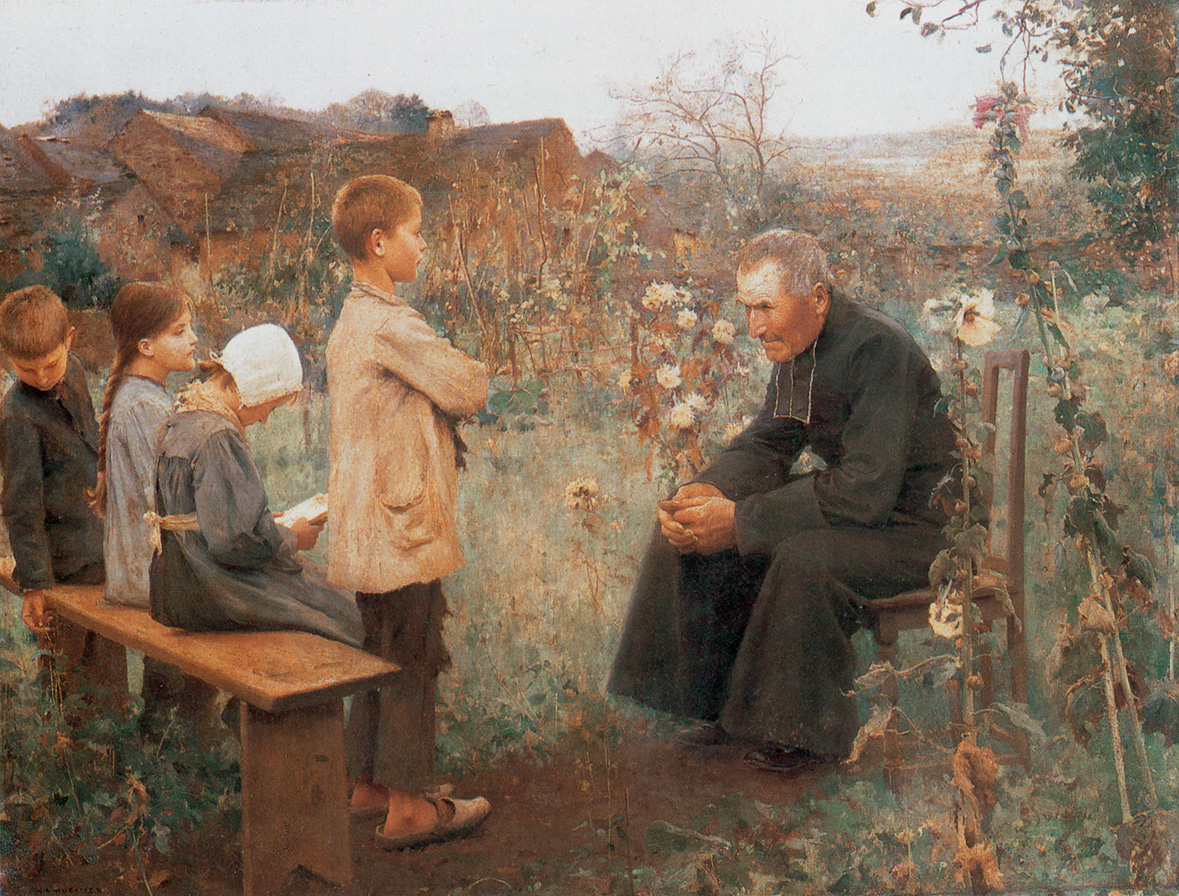
    The Catechism Lesson (La Leçon de catéchisme), 1890, Jules-Alexis Muenier | Wikimedia Commons.

    The three-year cycle of Sunday readings reflects this aspect of Lent, doing the work of reminding all of us of the major tenets of our history and faith, not to mention the importance of our sacraments. This transitions, of course, during Holy Week to recount the Passion, Death and Resurrection of our Savior, but it might be surprising to learn that the Church has ordered her readings on Sundays in Lent to help serve the formation of our catechumenate.

    So we can approach today’s readings with this framework in mind. Appropriately enough, we encounter the theme of baptism, particularly as spiritual protection. The first reading from Genesis recounts the upshot of Noah’s faithful obedience to God in building the ark. God tells him, “See, I am now establishing my covenant with you and your descendants after you and with every living creature that was with you: … there shall not be another flood to devastate the earth.” The Church sees great symbolism in the flood story. It is God’s second great covenant with humanity (the first being with Adam and Eve); the ark — the saving vessel in the face of God’s purifying force — prefigures the Church that will arise through Christ; the flood is a type of baptism, in this case a baptism that wipes away the evil of the world and blesses and ties Noah to God in a new covenant. The great tropes of baptism have been established: spiritual purification and a binding covenant with God through water.

    The first letter of St. Peter makes the connection to the flood in Noah’s time and clearly states its significance: “… a few persons, eight in all, were saved through water. This prefigured baptism, which saves you now. It is not a removal of dirt from the body but an appeal to God for a clear conscience …” This last statement is a bit confusing; is baptism an appeal to God for a clear conscience? I suppose it is, although the NRSV translation’s footnote says “Or a pledge to God from” a clear conscience. Interesting that our pledge could be perceived either as “for” or “from” a clear conscience.

    When I start wondering about translations, I often consult a few others, and I think the David Bentley Hart’s New Testament translation serves admirably (along with his three very long explanatory footnotes for this section): “… prefigures the baptism that now saves you — which is not a removal of the filth of flesh but rather the pledged consent of a good conscience to God — through resurrection of Jesus the Anointed.” He has a nice footnote to justify his translation of “pledged consent” and it does seem to wrap up the “to” vs. “from” debate by implying that God requests our good conscience in entering into the baptismal covenant and we give it to him. This reinforces the fact of our own free will and choice in baptism — something much more apparent in adult baptism than in infant baptism and thus very appropriate for this RCIA formation period.

    Noah’s Flood (Всемирный потоп), 2013, by Olga Glumcher | Image from useum.org.

    This whole discussion of conscience was initiated in the verses just prior to today’s reading. Peter encourages us to not be intimidated by those who seek to destroy our belief: “Keep your conscience clear, so that, when you are maligned, those who abuse you for your good conduct in Christ may be put to shame. For it is better to suffer for doing good, if suffering should be God’s will, than to suffer for doing evil. For Christ also suffered for sins once for all, the righteous for the unrighteous, in order to bring you to God” (1 Pet 3:16-18). A good conscience, which is part of the baptismal covenant, is important because Christians should be “living in the light.” Moreover, Peter points out that Christ, who is ultimately righteous and bears a clean conscience, suffered for all of us unrighteous souls, so he set the example of the Way we must walk. 

    All of this baptismal rubber hits the road when we encounter the gospel reading. St. Mark’s gospel, commonly seen as the earliest gospel, upon which Matthew and Luke drew, is very brief regarding the start of Christ’s ministry. There is great profundity; we must simply read it a bit slower and ponder each word.

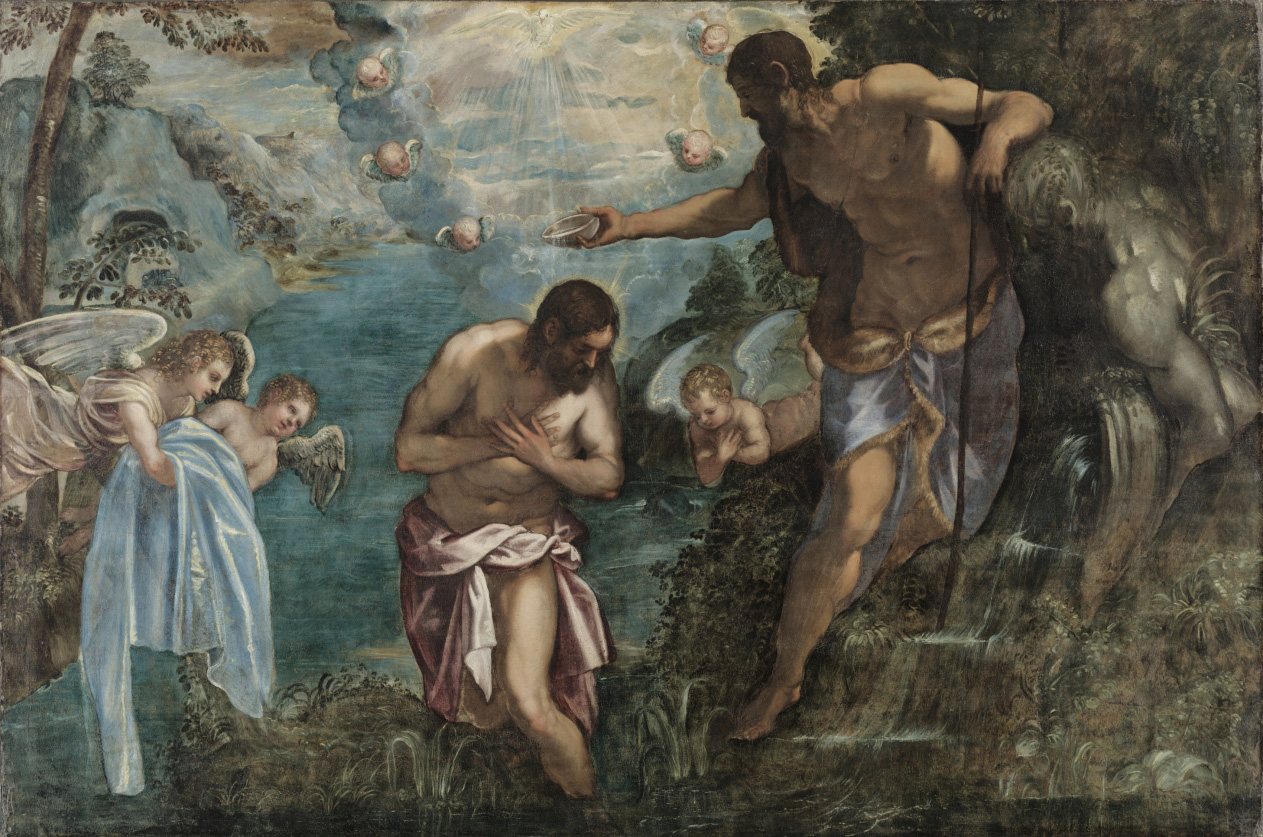
    The setup to today’s reading is the Baptism of our Lord by St. John the Baptist. Mark writes: “And just as he was coming up out of the water, he saw the heavens torn apart and the Spirit descending like a dove on him. And a voice came from heaven, ‘You are my Son, the Beloved; with you I am well pleased’” (Mk 1:10-11). So early in the first chapter of the first gospel we see the Holy Trinity in its unity as well as its diverse Persons! Consider how deep this revelation of Christ as the Son of God is: we see the outpouring of love from the Father, the participation of the Spirit, active in the earth, and Son’s willing acceptance of the covenant with His Father, which he will crown with his Blood. Christ’s Baptism reveals for all to see the endlessly flowing love of the Trinity that has burst upon the earth with his presence. This is something wholly new, and when we are baptized in Christ, it is this supernatural love and glory that is bestowed upon us as well. What a gift to be adopted sons and daughters of the Father, thanks to our great brother and teacher, Jesus Christ.

    As if sharing in the supernatural love of the Trinity was not enough, Mark shows us today how transformative a Christian baptism can be for us. He writes: “And the Spirit immediately drove him out into the wilderness. He was in the wilderness forty days, tempted by Satan; and he was with the wild beasts; and the angels waited on him” (NRSV translation). The dove-like Holy Spirit fills Jesus and immediately drives him into the desert. Matthew and Luke write that the Spirit “leads him” but Mark is undeniably writing something more forceful. The Greek word he writes is ἐκβάλλει (ekballei), the very same word used throughout the gospels when Christ “casts out” demons. Mark seems to be saying that baptismal sanctification by the Holy Spirit causes something more extreme in us than a gentle “leading into the light.” It casts the domination of worldly concerns out of our soul. This is what happens when Christ is cast into the desert, with wild beasts instead of human concerns. The supernatural force of his Baptism is so great that he cannot stay with humans who are so ordered by their passions and designs; these are not the Way to the Father.

    And while we can find profound meaning in the specific temptations that Satan imposes upon Jesus (see last year’s reflection, Getting to Know the Tempter, for thoughts on Matthew’s account of Jesus in the desert), Mark’s point is different. He notes that Jesus is tempted by the devil, but the emphasis is on the action of the Holy Spirit in Christ’s Baptism. The Spirit, let’s remember, has descended upon the Anointed One of God. While the Divine Persons undoubtedly can never be separated, we reflected last week on how Jesus put aside his divinity while taking on human form. He never stopped, on the order of being, to be the Son of God, but his time on earth in mortal form included a complete assent to being human. With his Baptism, Jesus the man is fully revealed also as a Person of the Holy Trinity, and the Spirit can dwell with him in a new way within that mortal lifetime.
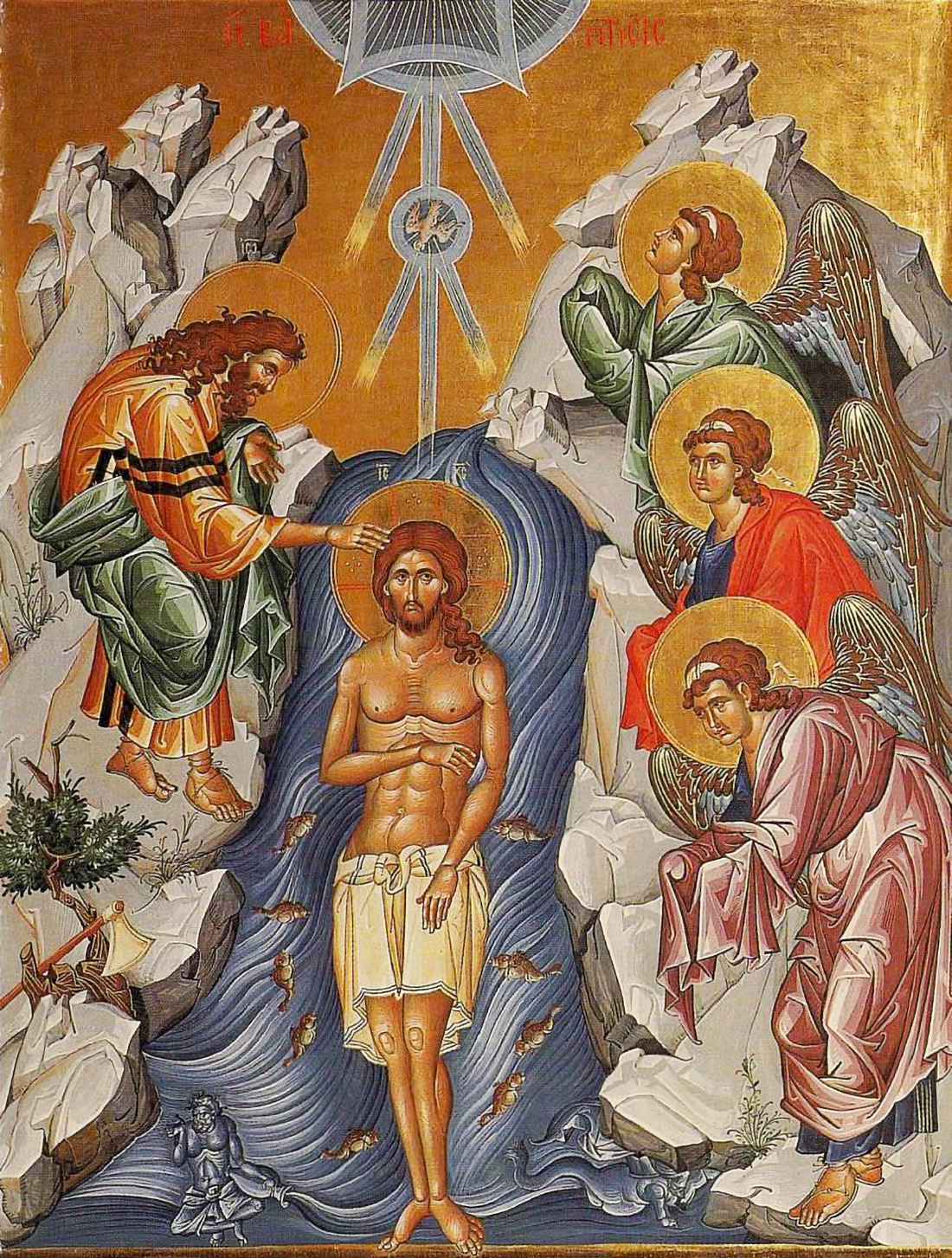
    Icon of the Baptism of our Lord, provenance unknown | Image from ricochet.com.

    So he is impelled by his Baptism and the indwelling of the Spirit to eschew the human ordering of self that occurs within civilization and go to the desert. This is something we are given in our baptism as well: a radical new orientation of ourselves within salvation history where we fully enter the End Times with Christ. This doesn’t mean we are outside of the fallen world, which is ruled by Satan. Christ is tempted by Satan, just as we shall be, even after our baptism in Christ. But Mark shrugs aside these temptations as if inconsequential, for this is the Son of God, blessed by the Father and graced by the Spirit! This is why the more important point for Mark is that “the angels ministered to him.” Christ has opened a new way of living that bests the temptations of Satan and dwells in the company of angels. This is the promise of our New Covenant that we enter into in Christian baptism.

    Mark’s final verses in today’s gospel reading affirm this new state of the world. The time of John the Baptist has passed with the Baptism of our Lord. Jesus announces: “This is the time of fulfillment. The kingdom of God is at hand. Repent, and believe in the gospel.” Note that he fulfills and concludes the very words of the Baptist, “Repent, for the kingdom of heaven has come near” (Mt 3:2). The kingdom is no longer near, it is “at hand.” The command to repent remains, for none are on the new path of Christ yet, and repentance and baptism await us all as a prerequisite to entering the Kingdom of God.

    I don’t know about you, but there is something of the fire-and-brimstone Southern preacher in the call to “repent” that may deaden our ears to this call. It’s refreshing to look at Christ’s words in a new light outside of some of our cultural stereotypes. Here again is Bentley Hart’s translation: “change your hearts and have faith in the good tidings.” Yes, this is repentance: a change of heart. It is what Baptism entails as part of our covenant with God — our promise to convert our hearts to Him. We remind ourselves of our baptism and conversion of heart every time we enter our church and bless ourselves with holy water. While on the earth, we will endlessly turn our hearts back to God, return to the Way any time we stray, and employ the sacraments to strengthen us, absolve our sins, and draw us closer and closer to our Lord.

    May we all walk the way of the catechumenate this Lent, repenting and re-affirming our covenant with God.
  • Embracing God’s Offer

    Embracing God’s Offer

    Saturday after Ash Wednesday: Isaiah 58:9b-14, Luke 5:27-32.

    God shows us in todays’ readings his great desire to redeem us. Consider how different our God is from the gods in classical Greek culture or the nature-oriented gods of other pagan cultures. These deities have either complex personal, selfish desires that conflict with humanity or they are seemingly indifferent, only responding to humans when they implore them with sacrifices and occult rituals. Our God shows Himself to be the only and true God, above these “principalities and powers” that our Judeo-Christian tradition allows space for in a lower echelon of being. Our God is true to his own principle of creative love; he loves his creation and endlessly reaches out to it with a Father’s care.

    In the first reading from Isaiah, a continuation of yesterday’s reading about false worship, God entreats his people to act in the way of goodness he has given them. He promises them that all will be well if they do so: “If you remove from your midst oppression, false accusation and malicious speech; If you bestow your bread on the hungry and satisfy the afflicted; Then light shall rise for you in the darkness, and the gloom shall become for you like midday.” These are the Father’s words of teaching and advice for the children he loves so much. We can relate to this in our own parent-child relationships. I think I’ve said some form of his words to my own children: “Then the LORD will guide you always and give you plenty even on the parched land. He will renew your strength.” The truth of our God being the one true God is so evident here — all of our instincts for love and family flow from him as our Creator. 

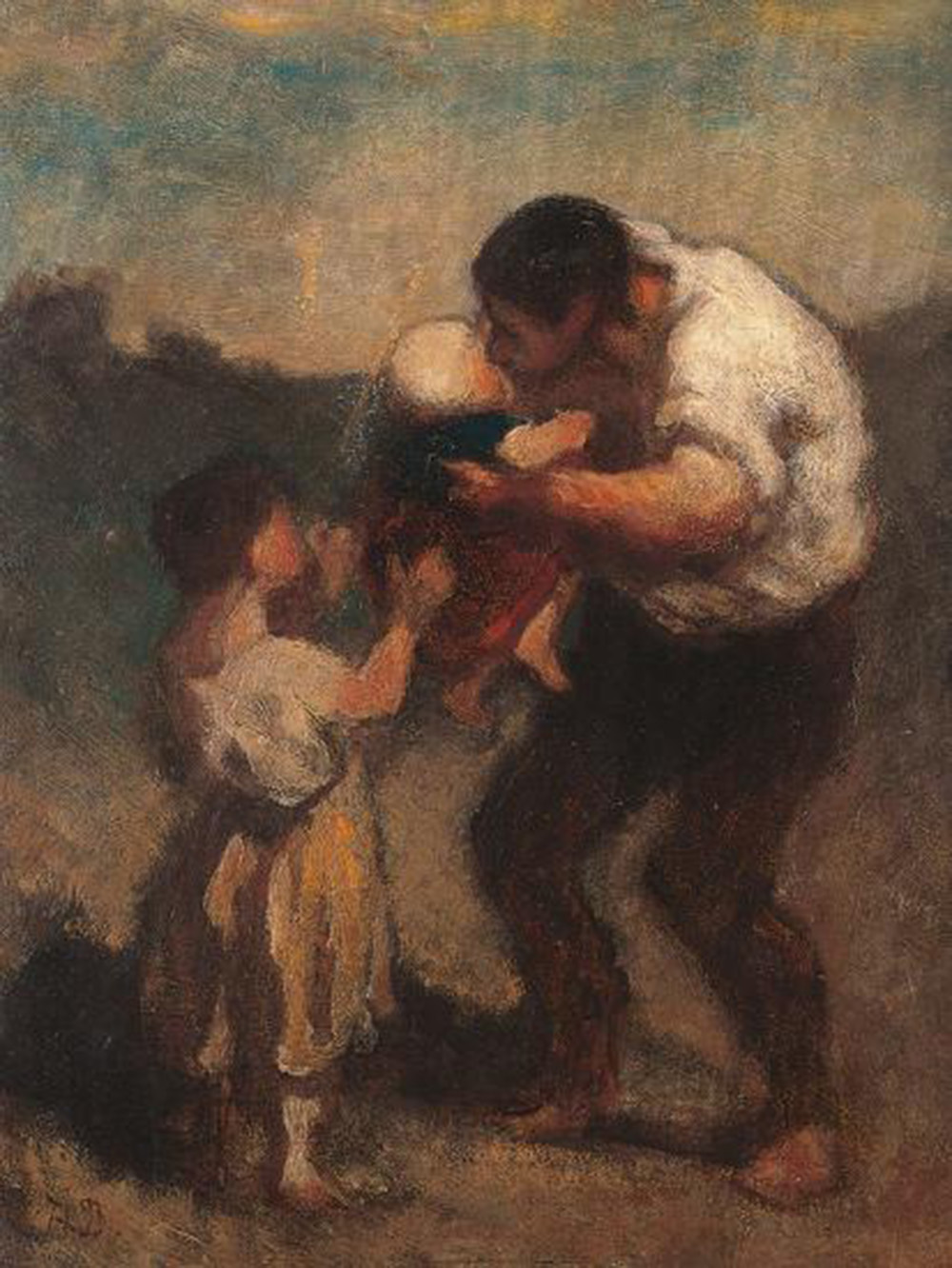
    The Kiss (1845-1848), Honoré Daumier | Image from Art.com.

    We must be careful to orient ourselves to him as the source of truth and goodness, rather than the other way around. We think we know what love is and tend to project this onto our maxim “God is love.” Thus, we might imagine that God agrees with a first-world, 21st-century impulse to give your children all of the freedom of choice and autonomy possible (thinking that this equals love). Likewise, a century or so ago, a father would likely imagine that lessons to children are best reinforced with a beating, and would project this same “rough love” onto God.

    We have to let the scriptures and the Holy Spirit guide us in understanding what love and fatherhood are all about. If not, we risk thinking we know God’s love but are really just projecting our own notions, which arise partly as a result of our cultural circumstances. 

    What we discover in the scriptures is that God provides a moral framework (the Law) and boundaries for his People to guide them back to his Kingdom for eternity. At the same time, he grants us free will, and this freedom is also an aspect of his love. That being said, he knows that an unguided free will is apt to make bad decisions, so he provides us with a clear way to live a life of love that leads back to him. We hear this guidance in today’s first reading. It ends with a promise for those who respect this way of love, which reaches its pinnacle in him:

    If you hold back your foot on the sabbath
        from following your own pursuits on my holy day;
    If you call the sabbath a delight,
        and the LORD’s holy day honorable;
    If you honor it by not following your ways,
        seeking your own interests, or speaking with malice
    Then you shall delight in the LORD,
        and I will make you ride on the heights of the earth;

    We see the Lenten theme of fasting, where we avoid our own interests while honoring him. But note the timbre of his words — we shall delight in the Lord and the sabbath. This whole-hearted embrace of our Father is a delight, not a task or trial. Only God can turn our denial of self into something delightful.

    He created us with desires, passions, and ambitions; these things help us thrive in the world, but perhaps he also gave us these things so that we can subdue and master them for a greater purpose, namely him. When we deny desire and passion, we are exercising a different type of muscle, a spiritual muscle. It’s not emotion, which would drive us to give in to the desires. It’s not intelligence, which would logically dictate that if you’re hungry you should eat. It’s not physical and it’s not emotional; it’s a spiritual impulse done solely because our spiritual Father and source of life has requested that we do it.

    It’s important to recognize this: God is helping us to grow strong spiritually because our spiritual nature connects us to him and everlasting life. His promise is not bound to our time on this earth, but to eternity. This makes his guidance, boundaries, and advice of ultimate importance and also stealthily effective as a way to salvation.

    Turning to the gospel reading, we hear the famous calling of Matthew (Levi), the tax collector. The force of the excerpt is on Christ’s simple yet powerful “Follow me” and his interaction with the Pharisees at dinner. But let’s not overlook Levi here, who like Peter, James and John dropping their nets, responds with equivalent certitude: “And leaving everything behind, he got up and followed him. Then Levi gave a great banquet for him in his house.”

    We can speculate in many directions about Levi’s motives (perhaps he saw a way out of his hateful profession?) or about his emotional state (perhaps he wanted to rise in status as a close follower of this new cult figure?) but I think all of this misses the point. A more profitable reflection might be upon that moment of connection, when God and man see each other, God holds out his hand, and man takes it without hesitation.

    Did Jesus choose Levi because he knew that something in him was ready to say yes? Or is it simply impossible for those directly approached by Christ to say no — the pull of the divine being so irresistible? Maybe the call and response is so amazing because that moment is always unique for every human being; free will is a potential monkey wrench, and receptivity to God is variable with time of life, even time of day.

    Perhaps the gospel writers describe the details of the call and response of the Apostles so plainly because the sheer fact of following Christ — the Way — is perfect and true on its own. It must be recorded and repeated. Whether fisherman, prostitute, tax collector, or rabbi, this is the very call and response that God speaks of through Isaiah. Deny yourself and delight in the Lord.

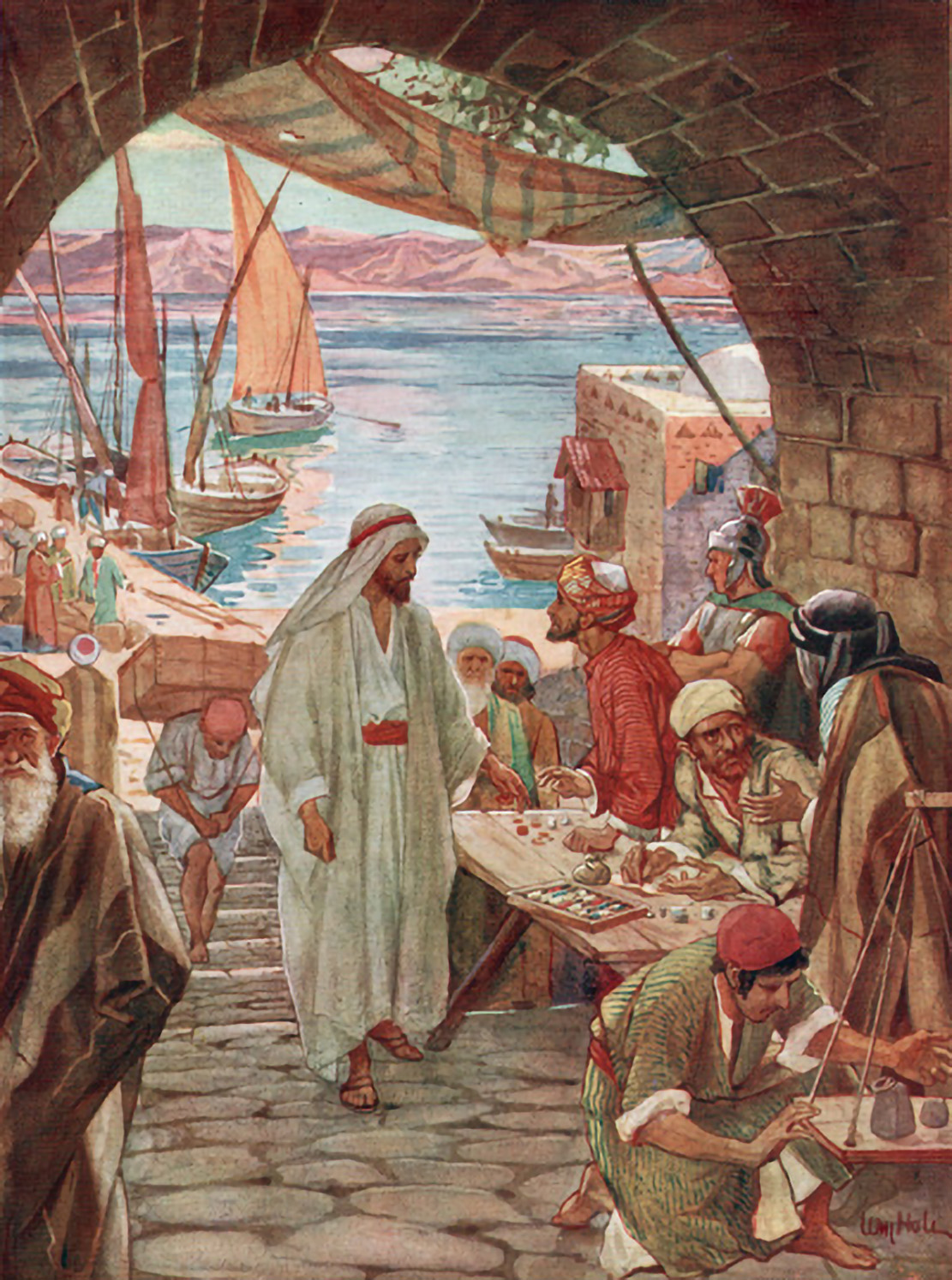
    Jesus calls Levi. From the book The Life of Jesus of Nazareth. Eighty Pictures (1906), William Hole | Wikimedia Commons.

    And in the same way that Christ speaks of the relationship between God and man in yesterday’s gospel reading — “Can the wedding guests mourn as long as the bridegroom is with them?” — he answers the peevish question from the Pharisees with a truth about who God is. He responds, “Those who are healthy do not need a physician, but the sick do. I have not come to call the righteous to repentance but sinners.”

    We will hear him expand on this truth in the Parable of the Prodigal Son. If you are a righteous person, a son who has obeyed his father, then you already have the kingdom at your fingertips. You are with God and if you realize this and delight in it (instead of being there only out of moral obedience), then you are fulfilled. In fact, you will be so filled with the Father’s love that you, too, want to rescue the sinners.

    The Pharisees’ question is ultimately one about justice: isn’t it unjust that we who have obeyed God should eat on our own while the Messiah feasts with sinners? Jesus’s response is the re-orientation of our concept of justice that we desperately need as humans. It starts with realizing who God is: the Alpha and Omega with whom all creation reaches its fullness. Being on the Way to God or in his presence means sharing in that fullness of being. As one’s outlook becomes infused with God’s being, questions of justice like the Pharisees’ become very small minded. The only justice is that everyone has a chance to join God and the fullness of being in the Kingdom. If any of us poor, sinning people is given access to God, then let us all have access! God’s love is all about this: it is all-encompassing, ever forgiving. This love is the real principle for justice.

    May we all exercise our spiritual muscle in denying ourselves this Lent so we can delight in the Lord.

  • The Spirit of Fasting

    The Spirit of Fasting

    Friday after Ash Wednesday: Isaiah 58:1-9a, Matthew 9:14-15.

    Today’s readings cast some doubt on fasting, and it’s worth digging into them to understand the teaching God delivers to us.

    The verses from Isaiah are some of the longest in the Old Testament dealing with fasting. This chapter in Isaiah tackles false vs. true worship; God is chastising the Jews for presenting themselves as holy people but acting completely differently. In short, it’s a warning against hypocrisy.

    Let’s consider the first words attributed to the Jews: “Why do we fast, and you do not see it? afflict ourselves, and you take no note of it?” God’s reply is, “you serve your own interest on your fast day, and oppress all your workers. Look, you fast only to quarrel and to fight and to strike with a wicked fist” (NRSV translation).

    There are several things going on here. First, doesn’t it seem a bit pushy and presumptuous of the people to challenge God and his non-response to their penitential acts? This should clue us into their lack of true humility before God, a true fear of God. And God’s response is that they serve their own interests on the fast day rather than obeying the great commandment to love God before all else (i.e., themselves) and then their neighbor as themselves.

    They also seem to be devolving into quarrelling and fighting with one another. This sounds pretty bad, but are we much better? Fasting makes us hungry, grumpy, and snippy. That’s part of the point, really: it forces us into a position to master not just our physical hunger but our emotional state and way we react to things around us. Pile onto this our cultural pressures of politics, people at work or home who habitually bother us, and unknowns like road rage moments, and it’s a recipe for disaster.

    The War (The First Discord), 1864, William Adolphe Bouguereau | Image from arthive.com. I’m not a huge fan of cherub pictures in general, but this seems too perfect to pass up. Here we have innocence (our desire to fast) being turned ugly by the desire to possess – specifically food. 

    God details something different: “This, rather, is the fasting that I wish: releasing those bound unjustly, untying the thongs of the yoke … Sharing your bread with the hungry, sheltering the oppressed and the homeless; Clothing the naked when you see them, and not turning your back on your own.” This is the Word of God, later to be incarnated as Jesus Christ, speaking to be sure! We hear Jesus say these same things in the gospels. But does this sound like fasting to you?

    I generally think of fasting as if I am going into a desert cave and struggling with my hunger and emotional state in an environment where I can just focus on prayer without the realities of life messing things up (I’d be too tempted to say something stupid or lash out). It’s like a taking a retreat with the Lord. And yet God plainly tells the Jews that the type of fasting he wishes is one immersed in the world and in helping others. Oy! I can’t escape it! How is it possible? It’s hard enough keeping myself level without having to worry about helping others.

    The answer, it seems, is that I probably haven’t been giving myself over to God wholly or trusting in his help. His words in the verses directly following today’s reading point us in this direction: “If you remove the yoke from among you, the pointing of the finger, the speaking of evil, if you offer your food to the hungry and satisfy the needs of the afflicted, then your light shall rise in the darkness and your gloom be like the noonday” (Is 58:9b-10). We might say he’s speaking of the virtuous cycle here: if you start doing good, that good reproduces itself in others and rejuvenates you. It’s the work of the Holy Spirit in the world.

    I particularly like how God addresses the emotional hurdles associated with fasting: “your gloom will be like the noonday.” Thank you for understanding me! And giving us the Holy Spirit to aid us in our devotion. That thing that I most feared — putting my grumpy self into contact with others where I might become that very hypocrite Isaiah addresses — is the very thing that offers me an opportunity to lighten my load. I just have to fill myself with your commands to help others and remove the temptations to be grumpy and edgy. This would likely be impossible without help, and we are in a position to be more successful than the ancient Jews. Christ has promised to lash himself to us on the yoke: “Come to me, all you that are weary and are carrying heavy burdens, and I will give you rest. Take my yoke upon you, and learn from me; for I am gentle and humble in heart, and you will find rest for your souls. For my yoke is easy, and my burden is light” (Matt 11:28-30).

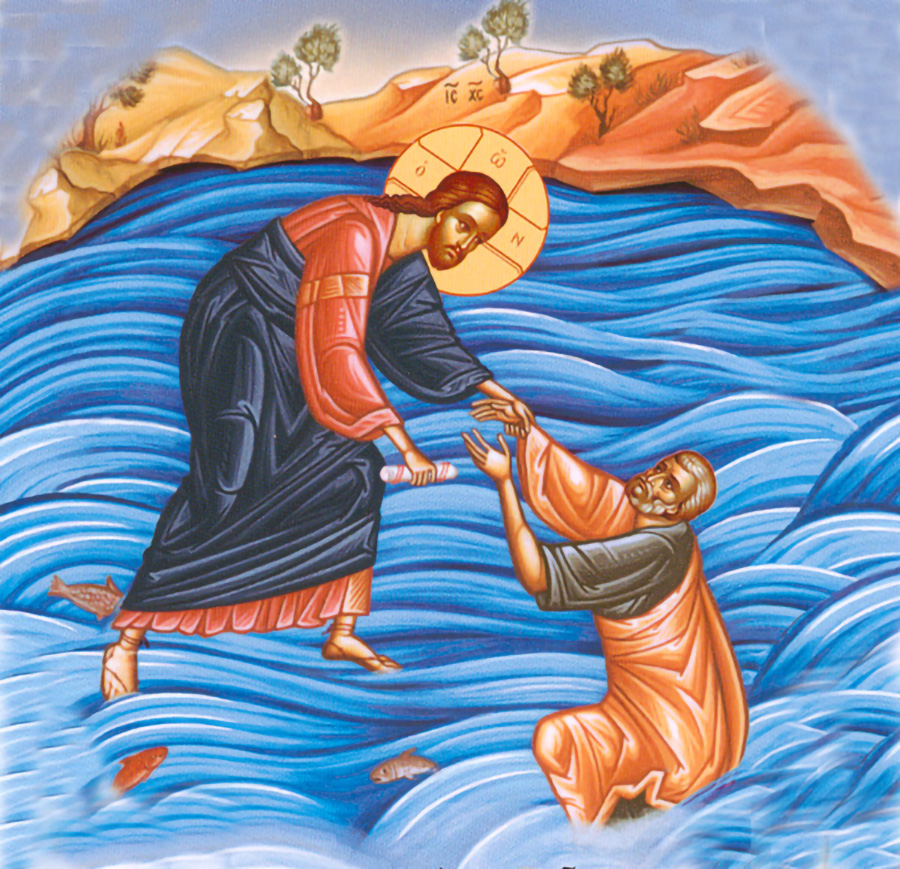
    Icon of Jesus walking on the water and helping Peter, provenance unknown | Image from www.pemptousia.gr.

    If it’s just a matter of self-discipline and mastering oneself, then it’s bound to be a hollow victory in the end, and certainly not a participation in our faith, our life in the liturgy. But if we fast with Christ at our side, we actively participate in the work of His Spirit in the world. What sounded like a burden is revealed to be an amazing spiritual activity. In his book Liturgical Asceticism, the University of Notre Dame professor of theology David Fagerberg acknowledges that fasting, solitude, and other forms of renunciation existed before Christianity and continue exist outside of it. What makes our Christian fasting different is “the degree that its source is sacramental immersion into Jesus’ life, and to the degree that this discipline frees the baptized for participation in the Mystical Body of Christ” (83). In other words, our fasting becomes a spiritual celebration of Christian liturgy the more we invite Christ to participate with us, to hold us up, and ask the Spirit to move within us and the Father to bless us in our effort.

    Fagerberg continues to distinguish our fasting from other faiths and types of fasting by showing that it is a specific response to the Christ Event in history — it is our recognition that we wait in patience for the final coming of Christ and we wait in the way Christ lived in us: allowing himself to be pierced by nails to uproot the passions and sin that ensnare us.

    Fagerberg also writes, “This liturgical asceticism initiates us into something higher than mere morality” (84). His point is that when we properly fast, with Christ at our side and love in our hearts, we are elevated beyond simply “doing the right thing.” Morality flows naturally from God, the ultimate Good; and the closer we become to God, the more we act and think in our lives in a morally correct way. But some acts of renunciation — fasting, for instance — are voluntary acts that can and should be done outside of the strict moral sense. Another way of saying this is that fasting is neither good nor bad (it is amoral) until it is united with a specific intent (see Ash Wednesday’s reflection where St. Thomas Aquinas defines fasting as virtuous only if directed to some virtuous good).

    There are many virtuous things we can direct our fast towards, and these are undoubtedly “morally good.” Fagerberg’s point is that the deepest Christian fasting is beyond just “morally good” because we participate in the actual life of Christ, fulfilling in action what we sacramentally join via Baptism and the Eucharist, bodily and mentally joining in the scope of salvation history and the awaiting of Christ’s coming in glory. We don’t fast because it’s the “right” thing to do or because the bishops declare that we have to on specific days; no, we fast in this way because we are fulfilling our purpose within the Mystical Body of Christ and becoming better spiritual beings.

    Sounds to me like I should be fasting all the time! What a fantastic and deep way to think about acts of renunciation. So, are we called to fast without ceasing as we wait for Christ’s return? After all, St. Catherine of Siena and some other saints lived this way.

    Let’s look at this question through the lens of the gospel reading. When John the Baptist’s disciples ask why they and the Pharisees fast often but his disciples do not, Jesus answers, “Can the wedding guests mourn as long as the bridegroom is with them? The days will come when the bridegroom is taken away from them, and then they will fast.” We notice a few things. First, Jesus connects fasting with mourning. In the Old Testament, the prophets advised that the people mourn their loss of God’s favor, which was brought about by their own infidelity to his law. In other words, their unfaithfulness to God resulted in his withholding his favor — this situation demanded fasting, a type of mourning, repentance and pleas for mercy. But Jesus’s use of the word mourning clearly has another edge to it as he foreshadows his own death. The second thing to notice is the content of what he’s saying: that when God is with us, there is no need or use for fasting and mourning; there is nothing missing when one is in God’s presence.

    This idea of putting fasting in its rightful place — that we might not be called to a state of constant fasting — is illustrated clearly by the Desert Fathers. In the Collected Sayings of the Desert Fathers, there is one episode shared by Abba John Cassian (360 – c.435) that reads,

    [Coming] from Palestine to Egypt, we visited one of the fathers. He entertained us and was asked by us, “Why is it that when you are entertaining brothers from elsewhere, you do not observe the rule of your fasting the way we observe it in Palestine?” “Fasting is always with me,” he replied, “but I cannot detain you with me forever. And although fasting is a useful and necessary practice, we do it because we choose to, whereas the law of God enjoins the practice of charity as a necessity. When I entertain one of you, I am serving Christ (as I am obliged to do) with full attention; and when I send you on your way, I can resume the rule of fasting, for ‘the companions of the bridegroom cannot fast while the bridegroom is with them; but when he is taken away from them, then will they fast’ [Matt 9:15] to their hearts’ content.”
    (The Book of Elders, 13.2)

    Let’s remember that the Desert Fathers were absolutely committed to physical poverty, fasting, and acts of penitence. Abba Isaiah says, “Hate everything in the world and repose of the body, for these made you an enemy of God. As a person who has an enemy fights with him, so we ought also to fight against the body to allow it no repose” (1.10). Not that these hermits’ sayings were completely uniform, but this general code of physical existence was fairly standard. This is why John Cassian’s story about the Egyptian father is worth pondering. The Egyptian ascetic notes that fasting is voluntary while charity is a commandment. His explanation that by welcoming his guest he is serving Christ is a lovely way to be looking at our interactions with each other. He even quotes today’s gospel to support his argument, suggesting that the Christ who is present in the other person is just as real and alive as Jesus was when addressing his disciples. 

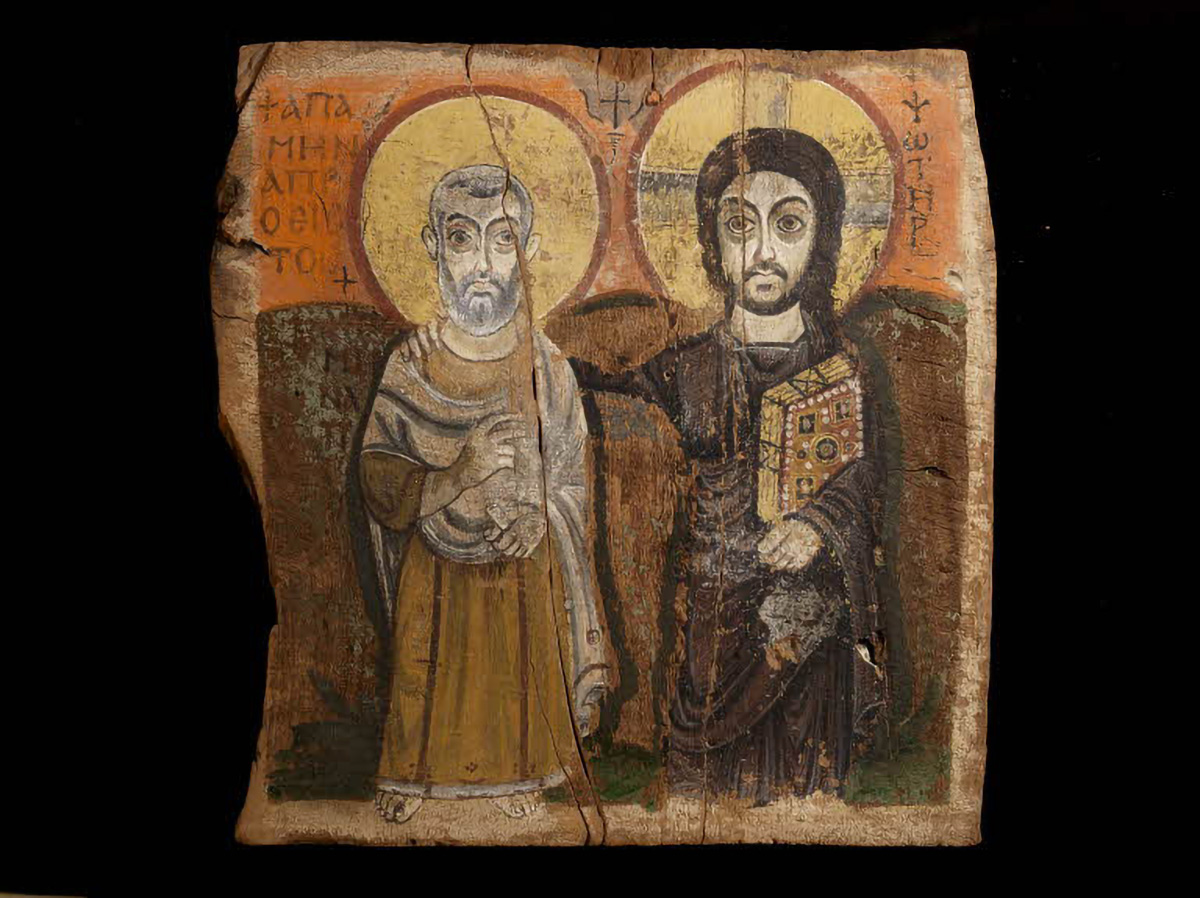
    Christ and Abbot Mena, from the monastery of Bawit in Middle Egypt. Dated to the 8th century, it represents Christ on the right (his halo has a cross) and Abbot Mena, the superior of the monastery at the time. The abbot holds a scroll in his left hand; this may have contained the rules of his monastery. | Image from the Louvre Museum.

    At the end of this reflection, it is clear that God is much more delighted when we choose to fast with the Spirit guiding us to deep, eschatologically-centered communion with God rather than when we choose to fast because it is a rule or something we “should” do. The Jews who fasted but acted poorly in Isaiah’s time as well as those who forget Christ’s presence when self-focused on fasting are examples of the wrong way to approach fasting. Even just a quick look at the saints and Desert Fathers can show us that fasting and other penitential renunciations are more of an alignment of one’s heart and spirit than a hard-and-fast set of practices.

    Each of us is called in a different way to follow Christ to the Father. We can use fasting and other renunciations of the passions and the flesh to better discern what exactly that call entails. We might find that, like St. Catherine, we are called to fast often while serving Christ in others. We might find that we are called to fast a bit less often while serving Christ in a different way. One thing is clear, however: we cannot shirk our responsibility to align our hearts in a “spirit of fasting,” for Christ tells us to deny ourselves and pick up our cross daily to follow him.

  • Doughnuts and Kenosis: Our Come-to-Jesus Moment

    Doughnuts and Kenosis: Our Come-to-Jesus Moment

    Thursday after Ash Wednesday: Deuteronomy 30:15-20, Luke 9:22-25.

    In today’s gospel reading, Jesus tells us plainly that to follow him has a personal cost, that a person must “deny himself and take up his cross daily.” This saying is familiar to most Christians, although most believers I know are more apt to quote, “love thy neighbor.” With Lent upon us, this concise description of the Christian life is especially meaningful. What exactly does it mean to deny ourselves? 

    In Luke’s gospel, today’s passage comes right after the miracle of the loaves and fishes when Jesus fed the 5,000 (not counting women and children). He is praying alone and when the disciples appear, he asks them, “Who do the crowds say I am?” followed by “But you, who do you say that I am?” Then comes Peter’s great statement of faith: “The Messiah of God.” Now, in the Gospel of St. Matthew, Jesus proceeds to name him Peter “the Rock” and gives him the keys to the kingdom of heaven. But St. Luke records a markedly different reaction: Jesus “sternly ordered and commanded them not to tell anyone.” His tone is very serious as he relates the prophecy of his own suffering: “The Son of Man must suffer greatly and be rejected by the elders, the chief priests, and the scribes, and be killed and on the third day be raised.” This is the point that “he said to all, ‘If anyone wishes to come after me, he must deny himself and take up his cross daily and follow me.’”

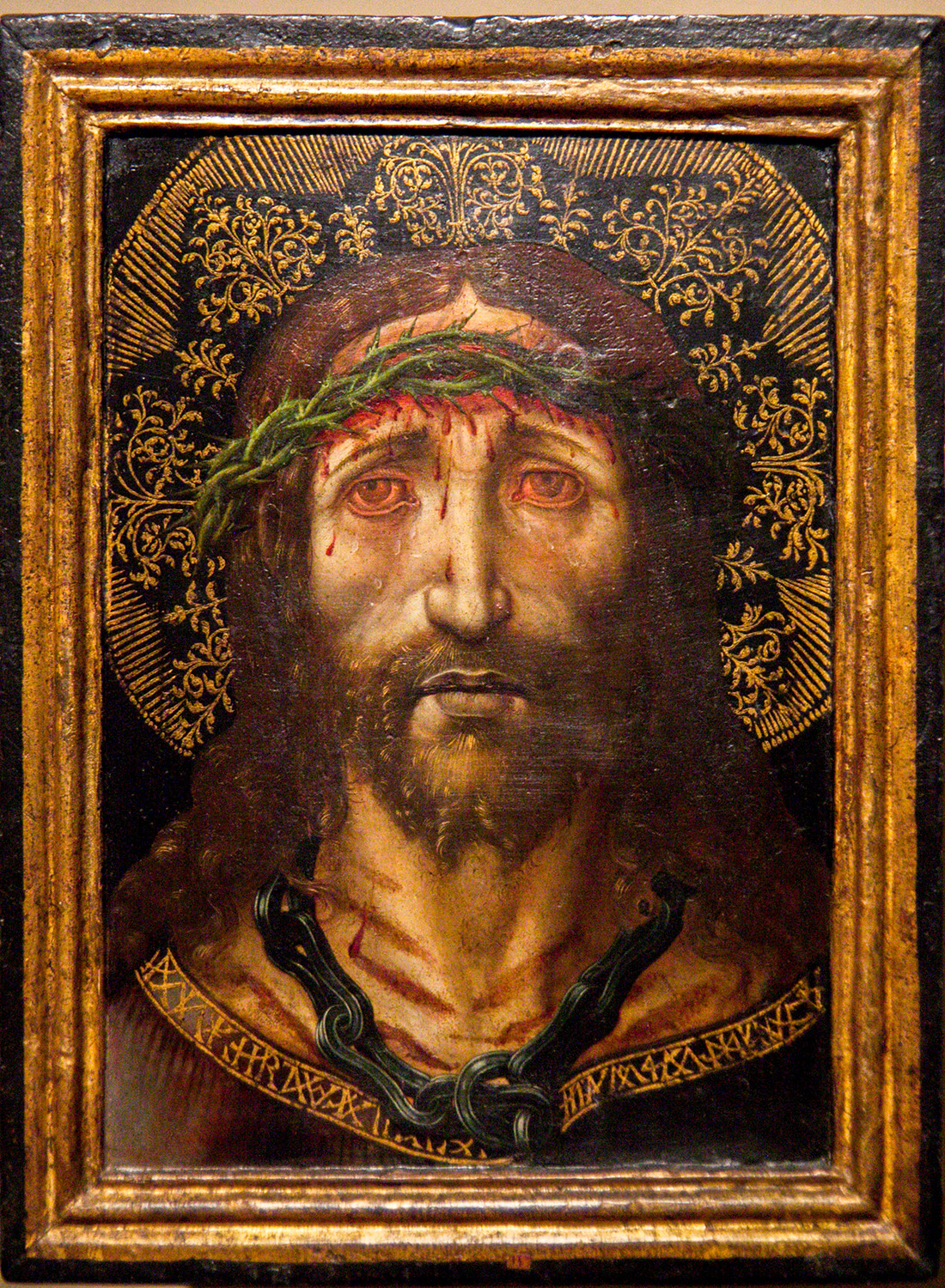
    Holy Face (1515-1525), Joan Gasco | Wikimedia Commons.

    To summarize this episode, once Christ knows that his beloved Apostles understand who he is, he decides that they must understand the repercussions of that knowledge. There was great expectation among the many Jewish sects over the coming of the Messiah, most of them boiling down to the establishment of a great Jewish nation on earth. Note how this type of expectation clashes with the great corpus of teaching and healing that Jesus had been doing in his ministry. Jesus wants to dispel these secular expectations and prepare them for the reality of what his coming will entail.

    How thoughtfully he prepares his Church, not burdening them with too much too soon! Imagine if the first works of his ministry were to tell everyone that he, a person of the One divine God, was coming to die for them because that incredible self-sacrifice would open the gates of Heaven for them once he resurrects and ascends. Not only would he sound like an overly self-confident crackpot, his message of humility and fear of God would be hypocritical. Instead, he had to do his Father’s will according to his Father’s plan. This means that even though he is the Messiah, he must eschew any earthly glory or proclamations to power. The reality is that earthly displays of power and glory are false. This is why we hear Christ tell those he heals throughout the gospels not to tell anyone of what they saw or experienced. As the very Truth itself, he cannot abide his works being proclaimed or twisted for mere earthly means. The deep truth that he must share is that God’s love — one typified by kenosis, or pouring oneself out, emptying oneself — is the matrix within which we are called to exist.

    How gently God reveals himself and his plan to us! First as a babe in an animal trough, unassuming, nothing to fear. Then, Jesus grows up within the tradition of the Chosen People that God has been cultivating for millennia. He — God Himself — deigns to be taught as just another child the ways of the Jews that he himself gave to them as commandments and precepts. He patiently listens to and learns the words of the prophets that he, the Word Incarnate, spoke to those prophets hundreds of years earlier. And when he does start teaching, he affirms every word of the law that has been given to them. Rather than bring down his awesome divinity in displays of fearful power, he draws them to himself by miracles of healing and words of love. In short, he shows them a vision of the Kingdom in his own humble self. Why does God’s plan unfold this way? Why does he subdue his rightful divine power and take on the frailty of humanity? Because he is love and this is how love works — he loves humanity and wishes for them to understand him and choose to come back to him of their own accord.

    St. Paul writes memorably to the Philippians about this very thing:

    Let the same mind be in you that was in Christ Jesus, who, though he was in the form of God, did not regard equality with God as something to be exploited, but emptied himself, taking the form of a slave, being born in human likeness. And being found in human form, he humbled himself and became obedient to the point of death—even death on a cross (Phil 2:5-8).

    Today’s gospel relates the key moment when Jesus lets his disciples know that God’s plan, and love itself, involves pain and sacrifice rather than a shortcut to glory and power. It’s important to remember that Jesus is fully human and fully divine — as a human, he shows us that we can make the decision to accept God’s way of love. None of his ministry or Passion and death is accomplished without his human assent to do the will of his Father.

    I used the Greek word kenosis above as theological shorthand for what St. Paul says, “he emptied himself, taking the form of a slave.” This word kenosis is a very important Greek term for Christianity. Fr. Jean Corbon, OP, defines it in his “Liturgical Vocabulary” in The Wellspring of Worship:

    The noun is derived from the verb “he emptied himself” or “annihilated himself” that is used in [St. Paul’s letter to the Philippians]. The Son remains God when he becomes incarnate, but he divests himself of his glory to the point of being “unrecognizable” (see Is 53:2-3). Kenosis is the properly divine way of loving: becoming man without reservation and without calling for recognition or compelling it. Kenosis refers first to the self-emptying of the Word in the Incarnation, but this is completed in the self-emptying of the Spirit in the Church, while it also reveals the self-emptying of the living God in creation. … Our divinization comes through the meeting of the kenosis of God with the kenosis of man; the fundamental requirement of the Gospel can therefore be stated as follows: we shall be one with Christ to the extent that we “lose” ourselves for him.

    As Fr. Corbon points out, kenosis is accomplished for our benefit by all members of the Trinity (this is, in fact, the state of their inexhaustibly flowing love), but we, too, are called to a type of kenosis. This is what Jesus is saying today: “If anyone wishes to come after me, he must deny himself and take up his cross daily and follow me.” Here is the true “Come to Jesus” moment! Denying oneself is not a simple matter of self-restraint over that second doughnut. The depth of Christ’s own kenosis is involved here: denying oneself is a love-filled endeavor of leaving your own desires behind and filling yourself with God’s will. 

    Denying oneself is not a simple matter of self-restraint over that second doughnut.

    Those new to Christianity ask why Jesus had to do things the way he did — dying in ignominy on the Cross especially. A part of the answer is that this “Way” itself is how we realize the Kingdom. It is the Way of God’s Love, not the logic of the world. Does this mean that we have to be demeaned in order to get to Heaven? I think that’s a question that comes from pride and fear. What a king thinks is demeaning the handmaid thinks is natural. Pride determines our outlook on what we do. This is the importance of the “deny himself” commandment. We must deny that part of ourselves that is pride, that thinks cleaning the sores from the feet of a beggar is demeaning, that thinks sitting silently and praying for some person who has lost control and is yelling at us is “weak.” If all we have to confront the difficulties and evil in the world is our own sense of who we are, then we’re bound to fight to keep that image of ourselves intact. Consider, instead, if we deny our own sense of who we are and fill ourselves instead with the invincible and inviolable will of God, and his inexhaustible love, then the concept of being demeaned is ridiculous. 

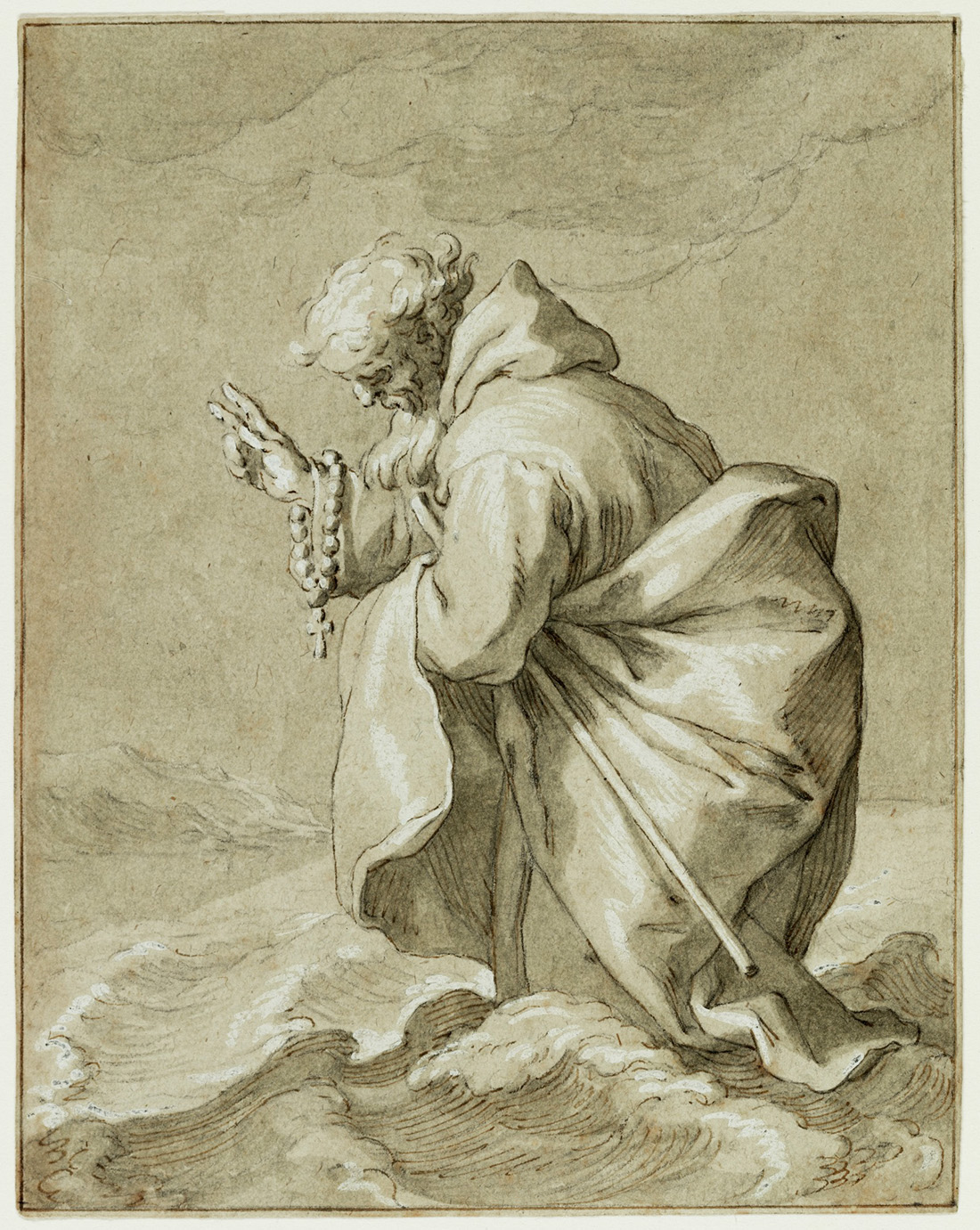
    Saintly Hermit, Walking on Water (c.1612), Abraham Bloemaert | Image courtesy the Detroit Institute of the Arts.

    What About My Personality?

    A book I am reading with our Lay Dominican chapter comes to mind. It is Fr. Reginald Garrigou-Lagrange, OP’s excellent little book Knowing the Love of God, a collection of the spiritual master’s retreat conferences as he preached them to his fellow Dominicans. He has a section entitled “The Personality of the Incarnate Word” that is very applicable to today’s gospel. He discusses the idea of our own sense of who we are, our personality:

    Many errors on the meaning of this word, personality, circulate throughout the world. Today many talk in a pompous way about the development of their personality, but, in reality, they are developing only some natural gifts that permit them to be distinguished from other persons, gifts which make their pride grow daily. They believe that to practice renunciation and the so-called passive virtues of humility, obedience, patience, and meekness, that is, to follow Christian morality in its totality, constitutes the annihilation of one’s personality (31).

    Garrigou-Lagrange goes on to define personality as “the principle of our reason and liberty,” something that makes us independent agents in the world. Importantly, he writes that personality “enables us to resist the attraction of merely sensible goods according to the judgment of our intelligence and the choice of our freedom.” What he means is that it distinguishes us from creatures who would just gorge themselves on something yummy (aka, doughnuts). We can think about consequences and make choices that might be different than the immediate “what is good right now.” I find his definition attractive; it brings together human intelligence, freedom, and volition. He then goes on to define levels of personality. The lowest level is like animal life, where people are driven “almost exclusively under the tyranny of their senses and passions.” But, he writes, “Personality can be gradually elevated as the activity of our spirit and will free itself from the purely sensible life. This can be accomplished in the measure that we learn to control the influences exercised upon us instead of passively submitting to them.” The independence of this type of personality involves a “grave danger,” however, because people might think that “the highest development of personality consists in absolute independence” (32). He notes that this is the way of pride and atheism and “is found fully realized in the Devil.”

    Garrigou-Lagrange then writes about how the mystery of the Incarnation teaches us something very different. Permit me to quote this great passage:

    While the great philosophers scarcely caught a glimpse of this, the saints truly grasped the way to the full development of our personality. It consists in losing in some way our own personality in the personality of God who alone possesses personality in the perfect sense of the word. He alone is absolutely independent in His being and actions … [The saints] were armed with a holy hatred of their own ego. They sought to make God the principle of their actions, no longer acting according to the rules of the world or their own limited judgment, but according to God’s ideas and rules as received through faith … They understood that God had to become for them another ego more intimate than their own. They had to realize that God was more “them” than they themselves because He is preeminently Being (33-34).

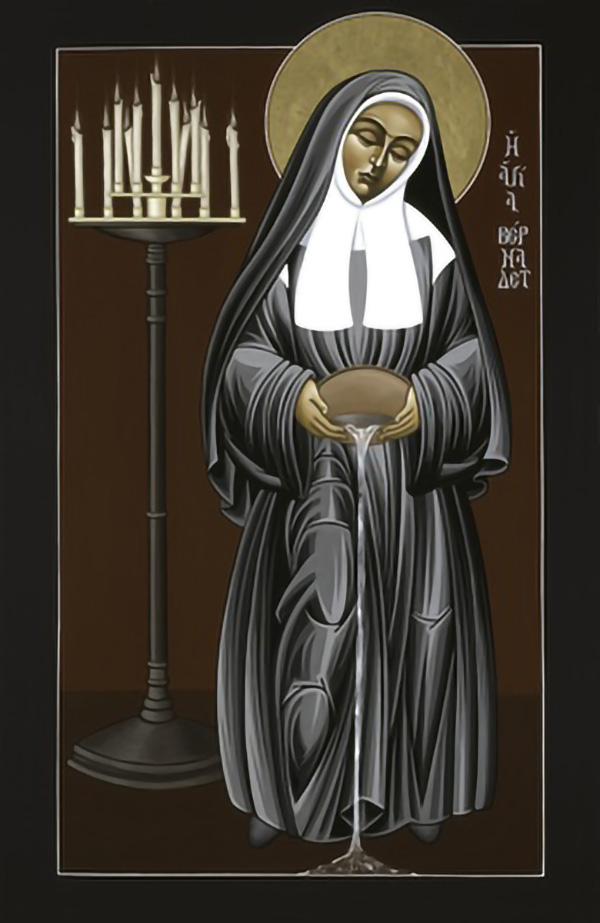
    The Kenosis of St. Bernadette of Lourdes (2020), Fr. William Hart McNichols | Image from frbillmcnichols-sacredimages.com

    These passages deserve careful thought and re-reading, to be sure. They provide another way to understand Christ’s words. Perhaps the cross we must take up daily is this work of losing our personality in the personality of God, the work of perfecting our person, which requires a kenosis. Lest we worry that this means the obliteration of our own “self,” Garrigou-Lagrange writes, “In the order of the operations of knowing and loving the saint has substituted, as it were, the divine ego for his own ego, but in the order of being his ego remains distinct from God” (34). This is an important point: we do not ever “lose” ourselves on the level of being. We are who we are. But on the level of what knowledge we accept and how we love and act in the world, we can (by the grace of God) substitute God’s person for our own. We accomplish this by filling ourselves with the Word in all ways — study of scripture, prayer, penitential acts (following Christ’s example), and in the sacraments. This is what it means to “live the liturgy” (which is not just a set of rituals we do at church). We lose that prideful way of knowing and acting that is always corrupt in this fallen world and put in its place the incorruptible way of knowing and acting that Christ gives us. In so doing, we perfect our personalities and ourselves.

    We can finally come face-to-face with the seeming paradox of Jesus’s final words in today’s gospel: “What profit is there for one to gain the whole world yet lose or forfeit himself?” Gaining the world — the sensible world that we see, feel, touch, eat, buy, etc. — is indeed profitless if we forfeit our “selves.” He is giving us a way to perfect ourselves, not forfeit our selves. The seeming paradox is that he tells us to deny ourselves so as to not forfeit ourselves (i.e., wouldn’t you be forfeiting yourself precisely by denying yourself?), but we can see that the first “self” we deny is the prideful human loner while the second “self” we wish to live forever is the person perfected in Christ. It’s still us, only fit to live in the Kingdom because we have undergone a kenosis in the image of our Maker.

    Let’s close this reflection with St. Paul, who lays out for us a concise summary of the Way of Christ: “Do not be conformed to this world, but be transformed by the renewal of your mind, that by testing you may discern what is the will of God, what is good and acceptable and perfect” (Rom 12:1-2).


  • Starting the Great Fast

    Starting the Great Fast

    Ash Wednesday: Joel 2:12-18, 2 Corinthians 5:20-6:2, Matthew 6:1-6, 16-18.

    Like a thief in the night, Lent is here. I am tempted to think, “Must I again pare down my pleasures so soon?” Maybe the start of the year was hard for us. Maybe we feel like it’s been several hard years in a row. Maybe we feel like we deserve a little break this Lent.

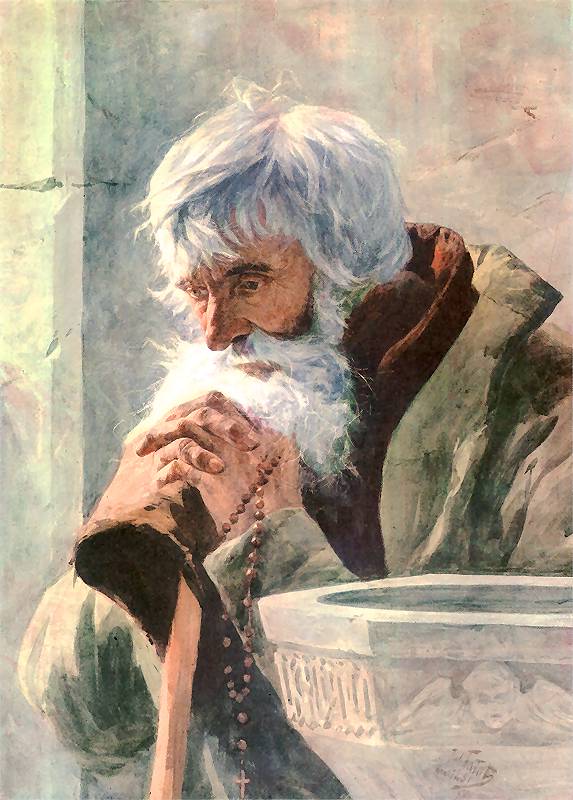
    Old Man Praying (1881), Julian Fałat | Wikimedia Commons.

    While the word “Lent” comes from old English “lengthen,” as applied to the days in Springtime, the Eastern Churches call Lent Μεγάλη Νηστεία (Megali Nisteia), which means “The Great Fast.” And while the promise of Christ’s Resurrection does approach like the slowly lengthening springtime sun, I see a deep significance in setting myself up for Lent by thinking of it as the Great Fast.

    Appropriately enough, today’s Ash Wednesday readings are all about fasting and how it was used by Jews and Christians alike as a bodily way of relating to God. This is something that might help us change our position regarding “deserving a break”: God is an essential part of the fasting equation. Without God, fasting has zero spiritual benefit and is pointless.

    Let’s consider the great commandment, gift, and tradition that is fasting. Commandment? Yes, according to St. John Chrysostom, “Fasting was the first commandment God gave to man.” He points to the Book of Genesis: “And the Lord God commanded the man, ‘You may freely eat of every tree of the garden; but of the tree of the knowledge of good and evil you shall not eat,’” (Gen 2:16-17a). I appreciate Chrysostom’s close reading here; God could have commanded Adam not to look in a special cavern, not to swim in a special pool, or not to say a certain word, but instead he commands Adam to have control over his appetite and desire.

    There have been many great essays written on the significance of the fruit of the “tree of knowledge of good and evil” being the fruit that belongs only to the Creator Himself and how Satan’s great temptation for us is to live as gods, but today I am struck by a more simple point. Chrysostom reminds us that God’s first commandment is to have bodily restraint in terms of food. On this simple level, when we fast, we can reconnect with a primal obedience to our Creator.

    In today’s first reading, God speaks through the prophet Joel to the Israelites: “return to me with your whole heart, with fasting, and weeping, and mourning; Rend your hearts, not your garments, and return to the LORD, your God.” He is talking to Adam’s ancestors, whose original father unlawfully broke his fast, and the fasting God urges upon them is a sign of their atonement, as are their tears and broken hearts. Fasting helps to mark the sincerity of their conversion back to God. And God wants His Chosen People to publicly and jointly take part: “Blow the trumpet in Zion! Proclaim a fast, call an assembly; Gather the people, notify the congregation.” Fasting unifies the people before their God and Master.

    Contrast this with our current secular culture where fasting is simply seen as another dieting option, a way to improve how you look or maybe how you feel. How strikingly different! Fasting in our faith tradition is certainly a personal response to God, but it is also a communal act of a people aware of their dependence upon God’s mercy.

    Remember the story of Jonah and the Ninevites. He (reluctantly) went to Nineveh to preach that they would be destroyed unless they repented and after just one day, “the people of Nineveh believed God; they proclaimed a fast, and everyone, great and small, put on sackcloth” (Jonah 3:5). More: “When the news reached the king of Nineveh, he rose from his throne, removed his robe, covered himself with sackcloth, and sat in ashes. Then he had a proclamation made in Nineveh: ‘By the decree of the king and his nobles: No human being or animal, no herd or flock, shall taste anything. They shall not feed, nor shall they drink water’” (Jn 3:6-7). Here we have a great, communal fast and repentance — a heartfelt response to God’s call. This story is an important illustration of what the Jewish faith calls teshuva, or the ability to repent and be forgiven by God: “When God saw what they did, how they turned from their evil ways, God changed his mind about the calamity that he had said he would bring upon them; and he did not do it” (Jonah 3:10).

    Teshuva is a persistent theme throughout the Bible, and fasting is integrally tied to this heartfelt repentance. Nearly all of the prophets speak of fasting, often in the context of teshuva. Notably, Moses fasts for 40 days and nights, as does Elijah and Jesus, the Son of God himself. (And we see these three great prophets together on the Mount of Transfiguration). John the Baptist subsists on wild locusts and honey. As we consider these prophets, the mouthpieces of God, we start to see that fasting is tied to more than just repentance and a plea for mercy. Fasting is a way for Moses to prepare to be in the presence of the divine. Fasting is a way for Elijah, Ezra, Esther and many others to ask for God’s favor and help with their specific problems. Fasting is a purification and a way for Jesus to achieve spiritual fortitude as he is tempted by the devil.

    Our great prophets teach us that fasting strengthens us spiritually — particularly our bond with God the Father — even though it seems to be weakening our bodies. Thus, Chrysostom can write, “Fasting of the body is food for the soul.”

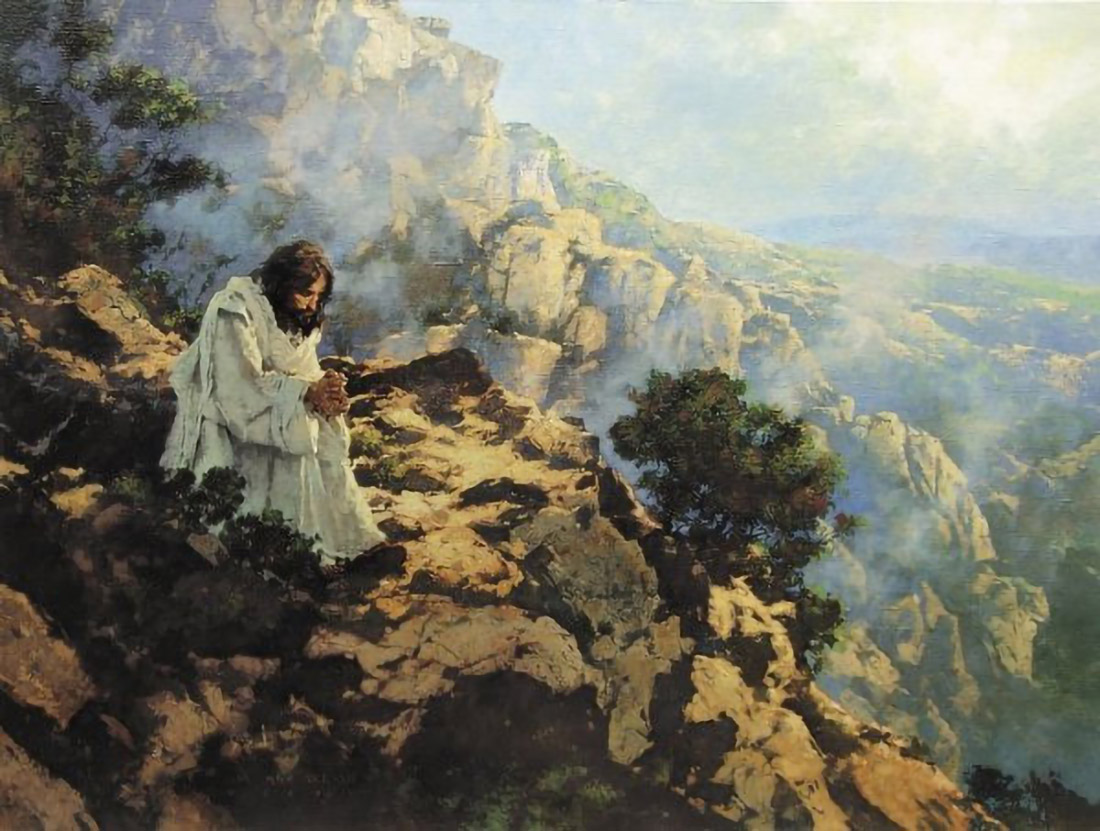
    Not by Bread Alone (2007), C. Michael Dudash | Image from christcenteredmall.com.

    In today’s gospel reading, Jesus instructs his disciples not so much on the benefits of fasting (this was a given, known thing for Jews and Gentiles alike in Jesus’s time) but on how to fast effectively. He lays out the path to being a humble, earnest child of God: “Take care not to perform righteous deeds in order that people may see them … when you pray, go to your inner room, close the door, and pray to your Father in secret … when you fast, anoint your head and wash your face, so that you may not appear to be fasting, except to your Father who is hidden. And your Father who sees what is hidden will repay you.” For a Jewish culture at times obsessed with purity and outward signs of worthiness, Christ’s words are a significant re-ordering of their priorities.

    More importantly, He presents them with a profound revelation of who God is. This Father of ours is an intensely personal one, someone who is most interested in the secret, hidden, most private moments He shares with His children. Jesus’s words also reassure us that humans are fundamentally spiritual beings — much more than just physical creatures who act within a society, when all of the “doing” is done and we are alone, our Father is with us. He has blessed us with a soul that is at the core of our being; He has called us, entrusted us to be His beloved children, living by his commandments and praising Him by sharing his love in the world.

    Lent is our time to re-order ourselves to this fundamental truth. It is not the spiritual that should be conformed to the physical — that is, we should not pray when it’s convenient for our physical routine or allow moral judgment and God’s commandments to be casually overridden by physical cravings like rich food or sexual desire. If we are fundamentally spiritual beings first and physical and emotional beings only for a time here on this earth, then the spiritual drive should always come first. The logic of fasting suddenly becomes obvious. We offer to our God a small sacrifice of our physical comfort as we put our spiritual relationship with Him first. 

    Christians have always fasted; like devout Jews at the time of Christ, they fasted two days each week. St. Paul famously accepts fasting as a part of his spiritual conversion: for three days after being struck blind on the road to Damascus he “neither ate nor drank” (Acts 9:9b). Also at his commission at Antioch: “While they were worshiping the Lord and fasting, the Holy Spirit said, ‘Set apart for me Barnabas and Saul for the work to which I have called them.’ Then after fasting and praying they laid their hands on them and sent them off” (Acts 13:2-3).

    In fact, Paul tells the Corinthians that his entire ministry has been an acceptance of physical hardship in order to do the spiritual work to which God has called him: “In toil and hardship, in frequent sleepless nights, in famine and thirst, in frequent fasts, in cold and nakedness … If I must boast, I will boast of things belonging to my weakness” (2 Cor 11:27, 30).

    Drawing upon these great lessons from the Apostolic Age, we see the desert monks emerge a century or two later, feeding upon this same wisdom. They “boast in weakness” (that is, physical weakness) like the lack of food, comfort, sex, etc. because they find that they grow strong in spirit. This monastic tradition has continued through the centuries to this day, with the vows of poverty and chastity that monks and nuns take in their vocation. This is not ritualized masochism! Christ Himself taught us the deep truth about what it means to be human, to have a body, mind, and spirit wrapped up in one being, and how the spirit must shine because it is preeminent in the order of being. Again, let’s not twist this into thinking that the Church sees the body as evil. The Catechism tells us:

    The human body shares in the dignity of “the image of God”: it is a human body precisely because it is animated by a spiritual soul, and it is the whole human person that is intended to become, in the body of Christ, a temple of the Spirit:

    Man, though made of body and soul, is a unity. Through his very bodily condition he sums up in himself the elements of the material world. Through him they are thus brought to their highest perfection and can raise their voice in praise freely given to the Creator. For this reason man may not despise his bodily life. Rather he is obliged to regard his body as good and to hold it in honor since God has created it and will raise it up on the last day”

    (CCC, citing Gaudium et Spes from the 2nd Vatican Council, 364).

    I love our theology on the body of Christ. We, the Church, are the Body of the divine Christ active in the world, and Jesus has a corporeal body that was tortured and crucified, only to rise and walk in the world before ascending to the Father. The Body of Christ is also present in our Eucharistic sacrament, to be taken in by the faithful as spiritual sustenance. There are so many levels upon which Christ’s body is the ultimate example of how human life can transcend this mortal plane, subordinated to the spirit and yet rising in significance specifically because of its lowly state.

    The body, created from the dust of the earth, is miraculous and good because God breathed life into it. Without that breath and Spirit, the body is just dust. When the origin, the breath of life, is honored above the body, then the human who is a unified body and soul can bring that body to the heavenly plane to dwell with God. Fasting is a way — an ancient and important way — that we can honor God over and above the body.
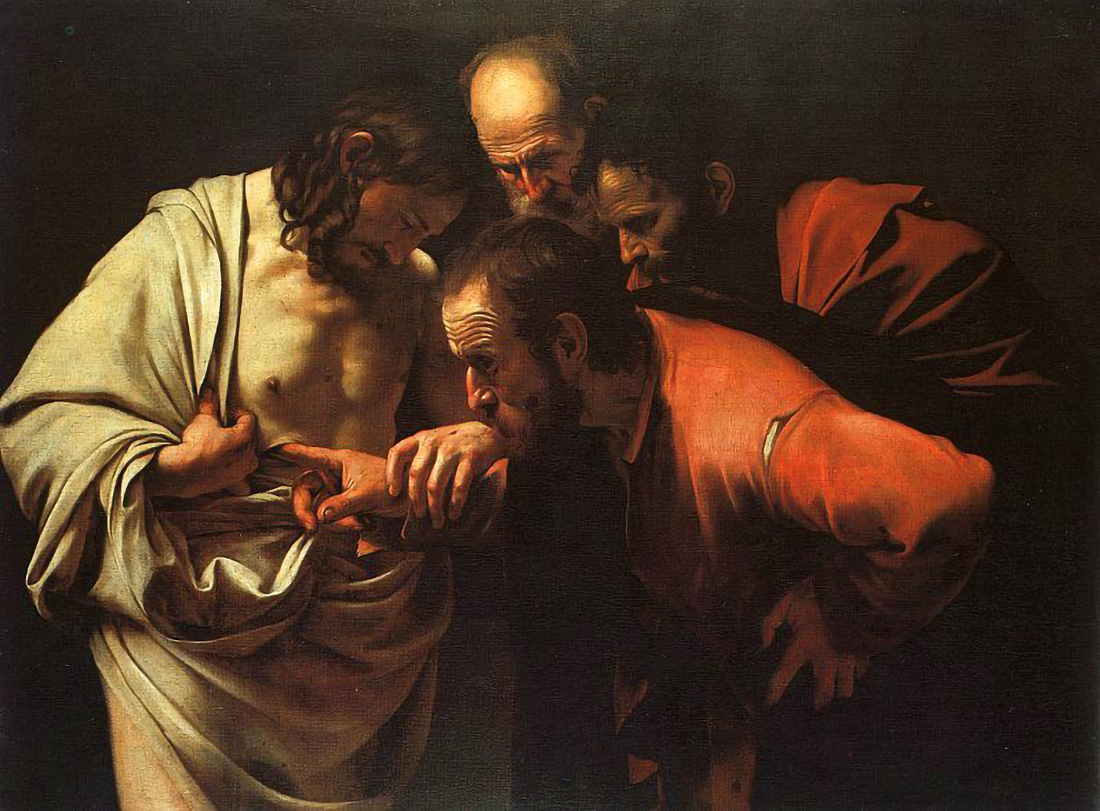
    The Incredulity of Saint Thomas (1601-1602), Caravaggio | Wikimedia Commons. Jesus is the proof that the body’s corruptibility is fleeting and tied to this earth; His sacrifice enables us to share in the rising of the body and soul to Heaven in unity with Him and the Father.

    In today’s second reading, St. Paul impresses upon the Corinthians that, as followers of Christ, what we do with our bodies matters even more than it did before Christ’s great sacrifice: “We are ambassadors for Christ, as if God were appealing through us … we appeal to you not to receive the grace of God in vain.” What he is saying is that we must carry forward Christ’s teaching and example of how the body can have everlasting life with the soul. We Christians are graced with learning the truth of Christ, which means we are entrusted with passing along the lessons, the charity, the subordination of the body to spiritual realities. We are the Body of Christ and we must uphold the sacred function of that Body in lifting up humanity through humility and charity at the cost of fleeting comforts.

    So, it’s Ash Wednesday, one of only two days of fasting that remain in the Western Catholic Church’s liturgical calendar. We really don’t ask much of ourselves these days. Let’s listen to St. Thomas Aquinas remind us of the aims of fasting: “fasting is practiced for a threefold purpose. First, in order to bridle the lusts of the flesh … Secondly, we have recourse to fasting in order that the mind may arise more freely to the contemplation of heavenly things … Thirdly, in order to satisfy for sins” (Summa 147.1). We hear him address our body (bridling lusts), our mind (contemplation of heavenly things), and our soul (atoning for sins). Fasting, in other words, is a triple-threat spiritual practice. But only if done for God! Aquinas’s entire point is to show that fasting is virtuous, with the caveat: “An act is virtuous through being directed by reason to some virtuous good.” He lays out the “virtuous good” in terms of body, mind, and soul, but of course the ultimate virtuous good is Good Itself, that is, God.

    This is why the term Μεγάλη Νηστεία, Great Fast, is so appropriate for all of Lent. This is not to say that we spend all 40 days in actual fast like our Christian forebears did (although there is a part of me that wishes I would and I could in order to be that much closer to God). It’s that we recognize these 40 days and nights as a time where we are focused on the virtuous good of God, in our bridling of our lusts, in our contemplation of heavenly things, and in our atonement for our sins.

    The aim and the thrust of fasting can be carried out throughout Lent in each moment when we hold back a rash remark, when we take that idle moment to offer a prayer to God, when we forego something little that would make us “feel good” in order to make someone else feel good or even as just a little sacrifice offered to God to let him know that we aren’t being ruled by our base earthly desires. This is how we can make all 40 days a Great Fast. And as we do, we realize it becomes easier. That spot of hunger goes away and subsides like a devil thwarted. We realize that we can live and perhaps even thrive without those creature comforts — the potato chips, the time in front of the TV — and instead spend that time reading the scriptures, singing a psalm, praying the rosary, or just reflecting quietly on Christ’s sacrifice, on the Face of God.

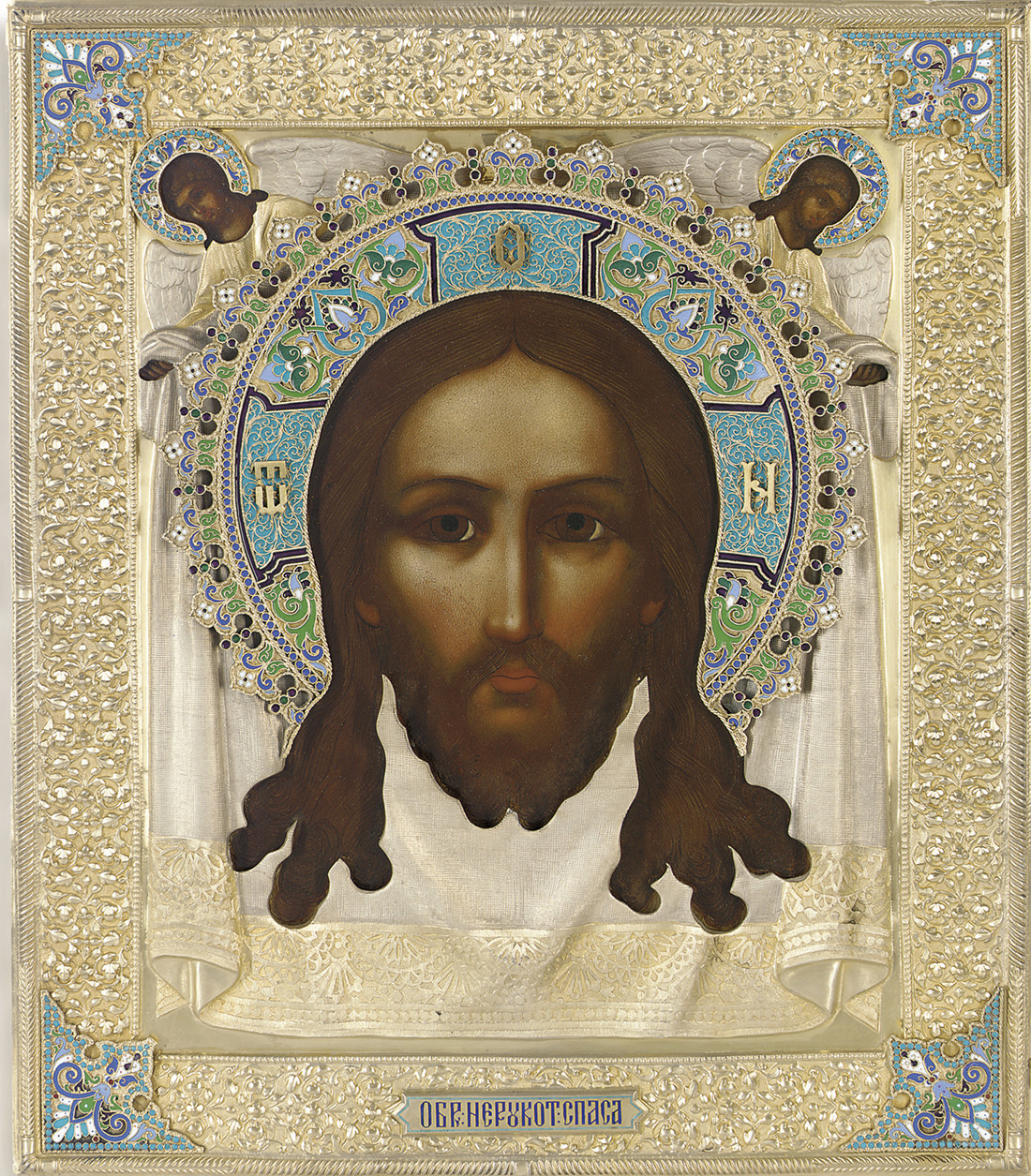
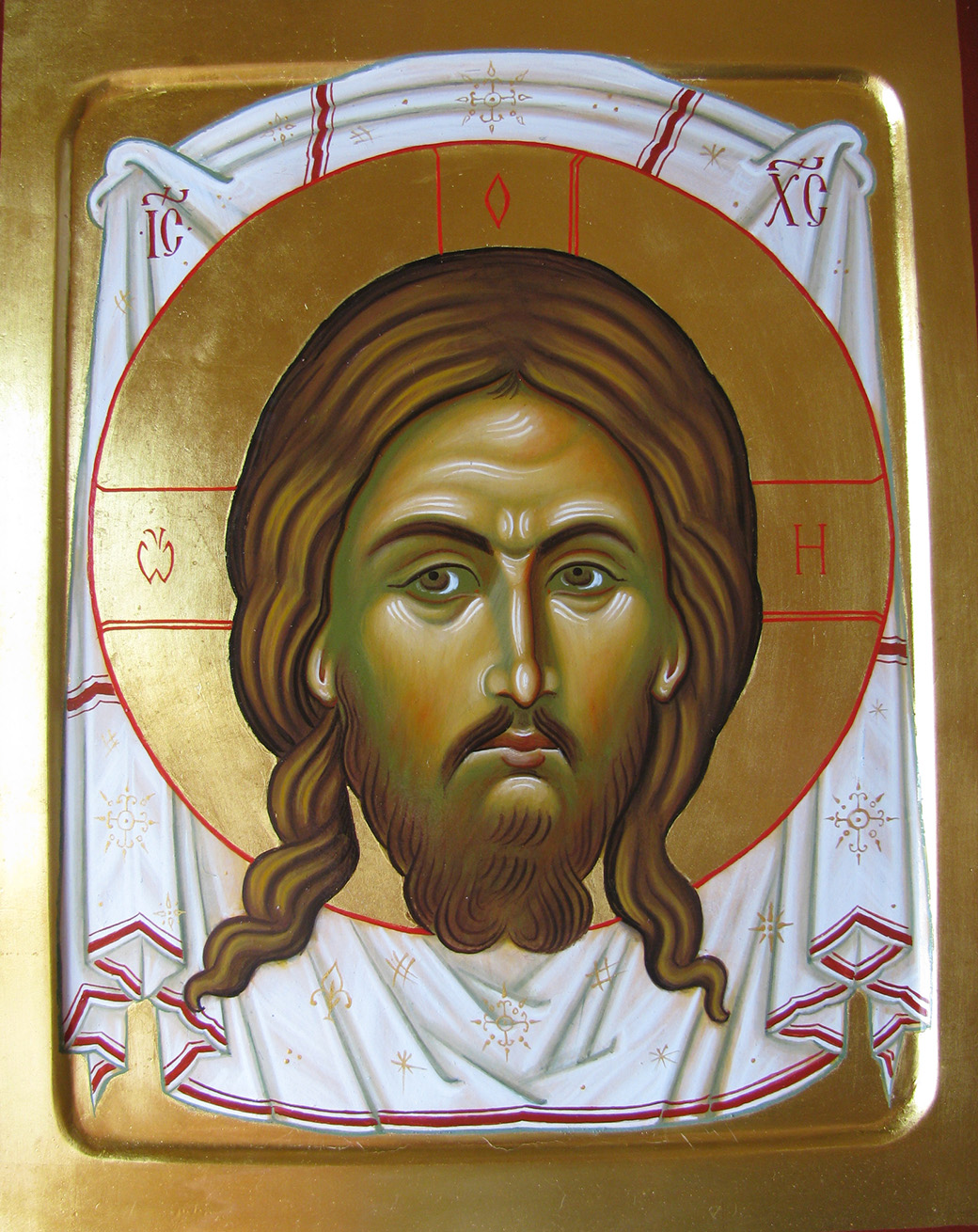
    The Mandylion (1885), Russian, Mark of Pavel Ovchinnikov with the Imperial Warrant, Moscow. A cloth with the imprinted face of Christ, its hem with stylised decoration emulating embroidery, lifted by two angels on the upper corners, each with outstretched wings bending outwards | Image from christies.com.

    My hope is that we allow the Great Fast to wash over us like a giant wave. That we do not resist its current but allow ourselves to be caught up in it — allow the Fast to grip us, determine our direction and our very breath. This is the the first step in giving ourselves to God and allowing Him to bestow His grace in our lives.


    Read the reflection from Ash Wednesday 2020 here: Ambassadors for Christ.

  • As I Have Done for You

    As I Have Done for You

    Holy Thursday – Evening Mass of the Lord’s Supper: Exodus 12:1-8, 11-14, 1 Corinthians 11:23-26, John 13:1-15.

    We know the readings of the Easter Triduum well, as we should; it is our highest of feasts, the culmination of Christ’s mission and ministry. On this Holy Thursday, the Lord is ready; his hour has come. As I consider these readings, I’ve been asking myself how I would spend my last hours on the earth, and how Christ’s message at the Last Supper can guide me.

    The first reading from Exodus recounts the institution of the Passover meal that commemorates the truly terrifying Passover night in Egypt. In describing the Passover meal, this reading relates to Holy Thursday, and in describing the blood marking the houses of the Israelites, it relates to the Lord’s death on Good Friday.

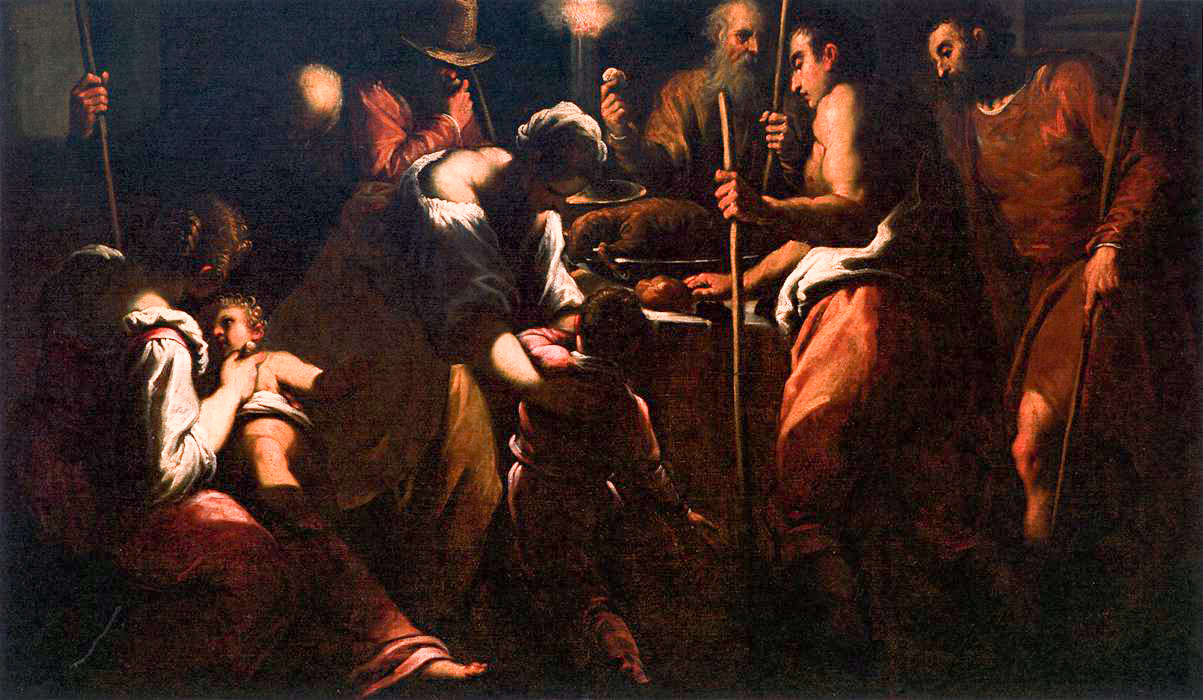
    The Paschal Lamb (1580-1581), Palma il Giovane | Wikimedia Commons.

    Jesus instituted the greatest sacrament, the Eucharist, during the Last Supper (as St. Paul recounts in the second reading). Let’s consider how the Word of God prefigured the meal of the Eucharist in the institution of the Passover meal. First, there is the regularity of the Passover meal — it is held annually on the 14th of the first month. For the Catholic Church, the Eucharistic meal is so much more central to our being that we celebrate it with every gathering (Mass), a regularity that has been instituted at least every Sunday. Next, the Word of God establishes the mark of purity for this meal; he prescribes that “The lamb must be a year-old male and without blemish.” Also, there is one lamb per family and it is to be slaughtered at twilight, at which point some of its blood is to be applied “to the two doorposts and the lintel of every house” where they “partake” of the lamb. What is the point of these prescriptive rituals? This is but one of many animal sacrifices described in the Old Testament, and part of the challenge for the Jewish nation was to uphold these prescriptions in order to display their faithfulness to God. This speaks to a certain type of ritual beauty that exists in its particularity for each sacrifice — whether those participating were in the desert, in the glorious time of King Solomon, or in the Babylonian Exile, each connected ritually with God in a way that is both shared yet particular to their place and time. In addition to instilling an appropriate thankfulness as the Jews recollect the original Passover, God was establishing a special place for the “unblemished lamb” in their cultural memory to be ready for the time when the Lamb of God, pure of sin, comes for his ultimate sacrifice.

    Eating the slaughtered lamb is an important part of the Passover ritual: “That same night they shall eat its roasted flesh with unleavened bread and bitter herbs.” The Word of God made flesh, Jesus Christ, establishes the full meaning of this ritual when he says, “This is my body that is for you. Do this in remembrance of me” (Mk 14:22, Lk 22:19, 1 Cor 11:24) and “Amen, I tell you, unless you eat the flesh of the Son of Man and drink his blood, you have no life in you” (Jn 6:53). As Christians, we understand the Passover lamb as the precursor (easier to understand and easier to “stomach”) to the true Paschal Lamb, Christ Himself.

    In the same way, we understand the Passover deliverance from the wrath of God that ravaged “every firstborn of the land, both man and beast” in Egypt as a precursor to Christ’s deliverance from the ravaging of every person on earth, condemning them to Gehenna. Our Eucharistic feast is a dense recollection of the great mystery of the Christ event: it is a gift from God, it is a joining of the food of life and the great sin-atoning sacrifice, it is a fulfillment of generations of Jewish ritual and God’s preparation of human hearts for his entrance into humanity. At the same time, it is real food, truly the flesh of the Lord present through the mystical action of the Spirit in our liturgy. The mysterious sacrament of the Eucharist, the heart of our Mass and the “source and summit of our faith,” can be plumbed endlessly for theological significance but more importantly provides real-world transformation of humanity.

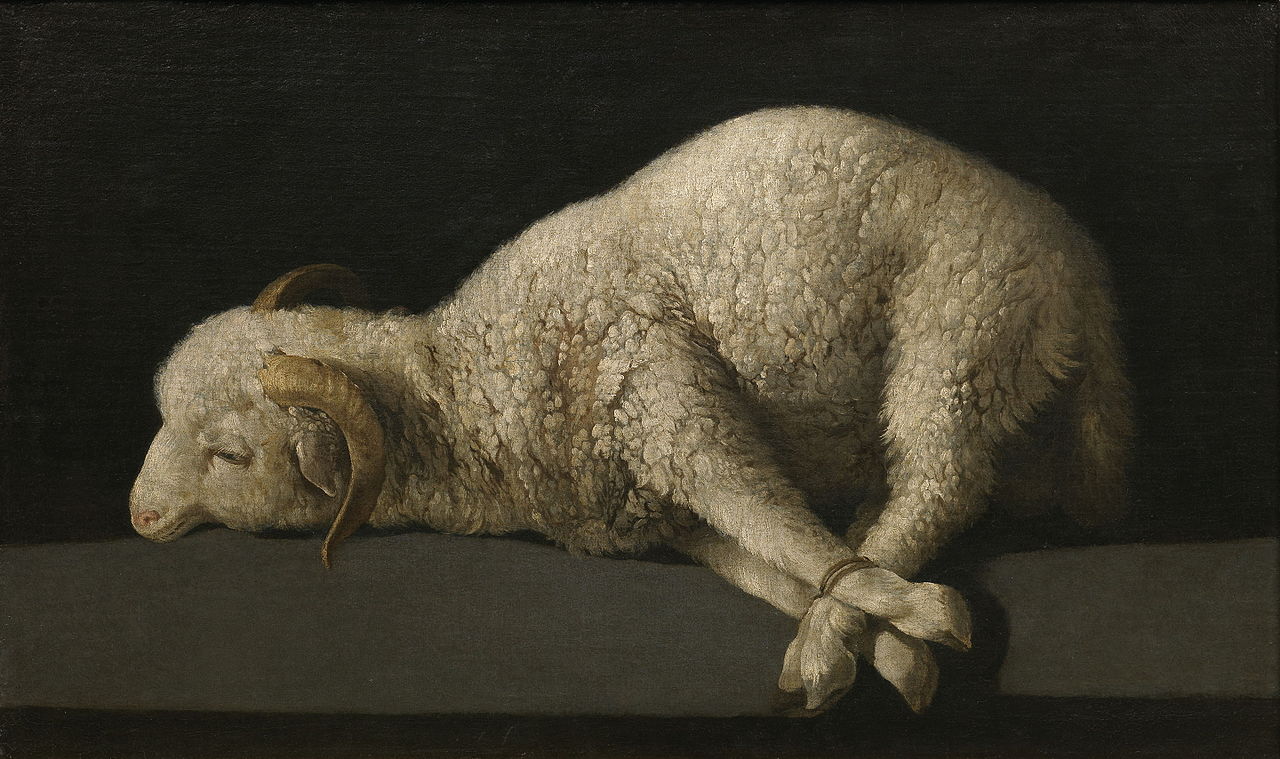
    Agnus Dei (1635-1640), Francisco de Zurbarán | Wikimedia Commons.

    A final instruction from God to Moses is important to note. He instructs the Jews to eat the Passover meal in a certain way: “with your loins girt, sandals on your feet and your staff in hand, you shall eat like those who are in flight.” This idea of being on the way to something greater, not tied to the things of this world, was embraced from the very beginning of the Church. Jesus tells his apostles on this Holy Thursday, “but because you do not belong to the world, and I have chosen you out of the world, the world hates you” (Jn 15:19).

    Peter acknowledges this transitory nature of our existence and our belonging to something other than this world in his epistle, “I appeal to you, my friends, as strangers and refugees in this world! Do not give in to bodily passions, which are always at war against the soul” (1 Peter 2:11). And, of course, St. Paul gives us a number of memorable passages related to this, including “Do not be conformed to this world, but be transformed by the renewing of your minds” (Rom 12:2). So, drawing on Jesus saying “I am the way, and the truth, and the life. No one comes to the Father except through me” (Jn 14:6), Christians very truly had their “loins girt, sandals on your feet and your staff in your hand” — in their thirst to follow Christ and be with the Father, they were “On the Way.” We read in the Acts of the Apostles that the earliest Christians referred to themselves as followers “of the Way” (cf. Acts 9:1-2).

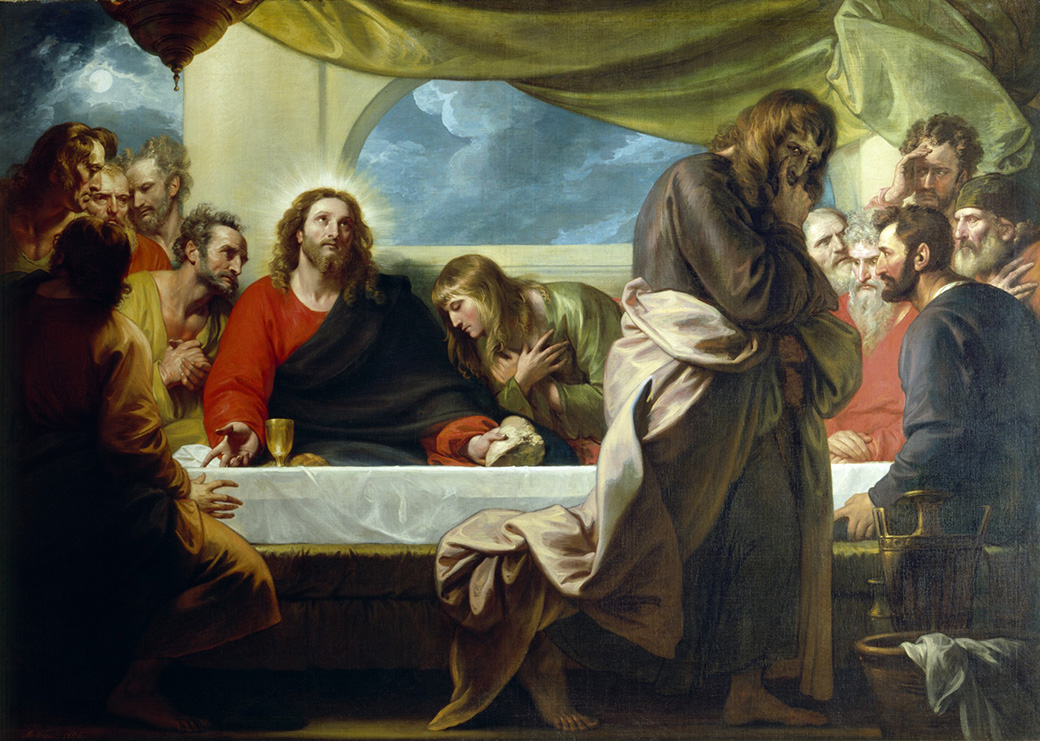
    It’s incredible that the Last Supper, this pinpoint moment in a room with his Apostles, is the moment that the Word of God begins to reveal the true fulfillment of these ancient rituals. Yet there is also the drama of Judas’s betrayal and Christ’s effort to save Judas from this great sin (see yesterday’s reflection). Despite the knowledge of his entire ministry coming to an end and the drama of betrayal and denial by his closest friends, Jesus patiently goes about setting everything in order.

    Think about the to-do list here: giving his Apostles one last great moment of teaching, instituting the Eucharist, establishing the momentum for the Church to continue, leaving time to travel “to the mountain” (Mount of Olives) to have a prayerful encounter with his Father in anticipation of the Passion and Crucifixion ahead … all in a matter of a few hours! It’s remarkably, almost serenely organized.

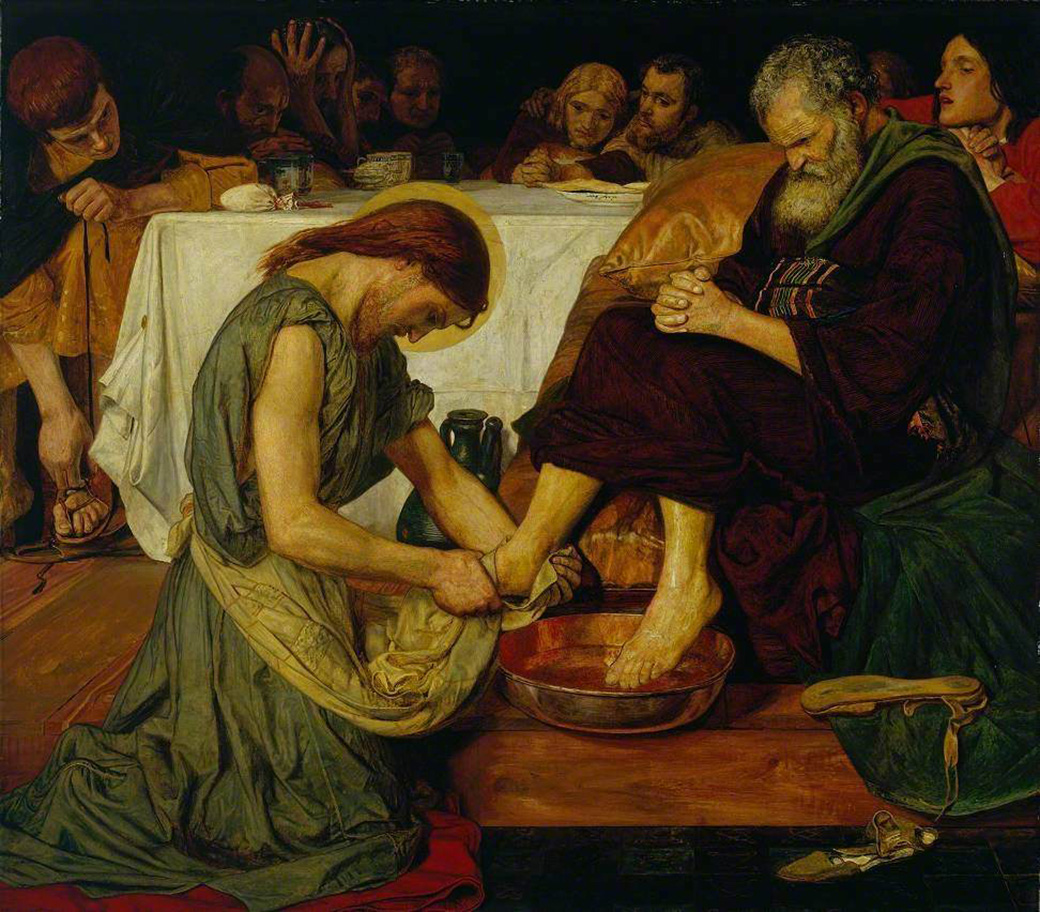
    Jesus Washing Peter’s Feet (1852-1856), Ford Madox Brown | Creative Commons, courtesy ArtUK/Tate.

    Today’s gospel focuses on Christ the servant, who “rose from supper and took off his outer garments. He took a towel and tied it around his waist. Then he poured water into a basin and began to wash the disciples’ feet.” St. Augustine of Hippo in Tractate 55 on the Gospel of John explains how each of these actions relates to something significant in the manner of his saving sacrifice. I’d like to use some of his ideas and some from other sources to consider this extraordinary action of our Lord.

    First, he rises from the supper and takes off his outer garments — as an action, this reminds me of his Resurrection to come and the garments found in the empty tomb, and as such this act of washing the feet is a salvific act akin to the Resurrection itself. St. Augustine also notes that “When about to be crucified, He was indeed stripped of His garments,” so we see a parallel in the Crucifixion, too.

    Indeed, Fr. Jean Corbon notes that the Crucifixion and Resurrection “are not two events, but two phases or moments of the same mystery” (Wellspring of Worship, 46).

    Next, Jesus ties a towel around his waist like a servant, and St. Augustine compares this to the larger humility of the Word of God taking on human form. Then, he doesn’t ask for some water in a bowl, but pours the water into the basin himself. St. Augustine notes that this is like how he “poured His blood upon the earth to wash away the filth of their sins,” and I see a clear parallel to the endless pouring out of love, of the water of everlasting life, that flows continually between the three Persons of the Trinity (as we have explored in several previous reflections).

    Finally, there is the washing of the Apostles’ feet. This lowly act of a servant is important for Jesus to model for his apostles, so much so that he tells Peter that he’ll tell him why he’s doing it after it is done, so as to not disrupt the action by discussing it. St. Augustine notes that he even deigns to wash Judas’s feet: “the greatness of His humility should be still further enhanced by the fact that He did not esteem it beneath His dignity to wash also the feet of one whose hands He already foresaw to be steeped in wickedness.”

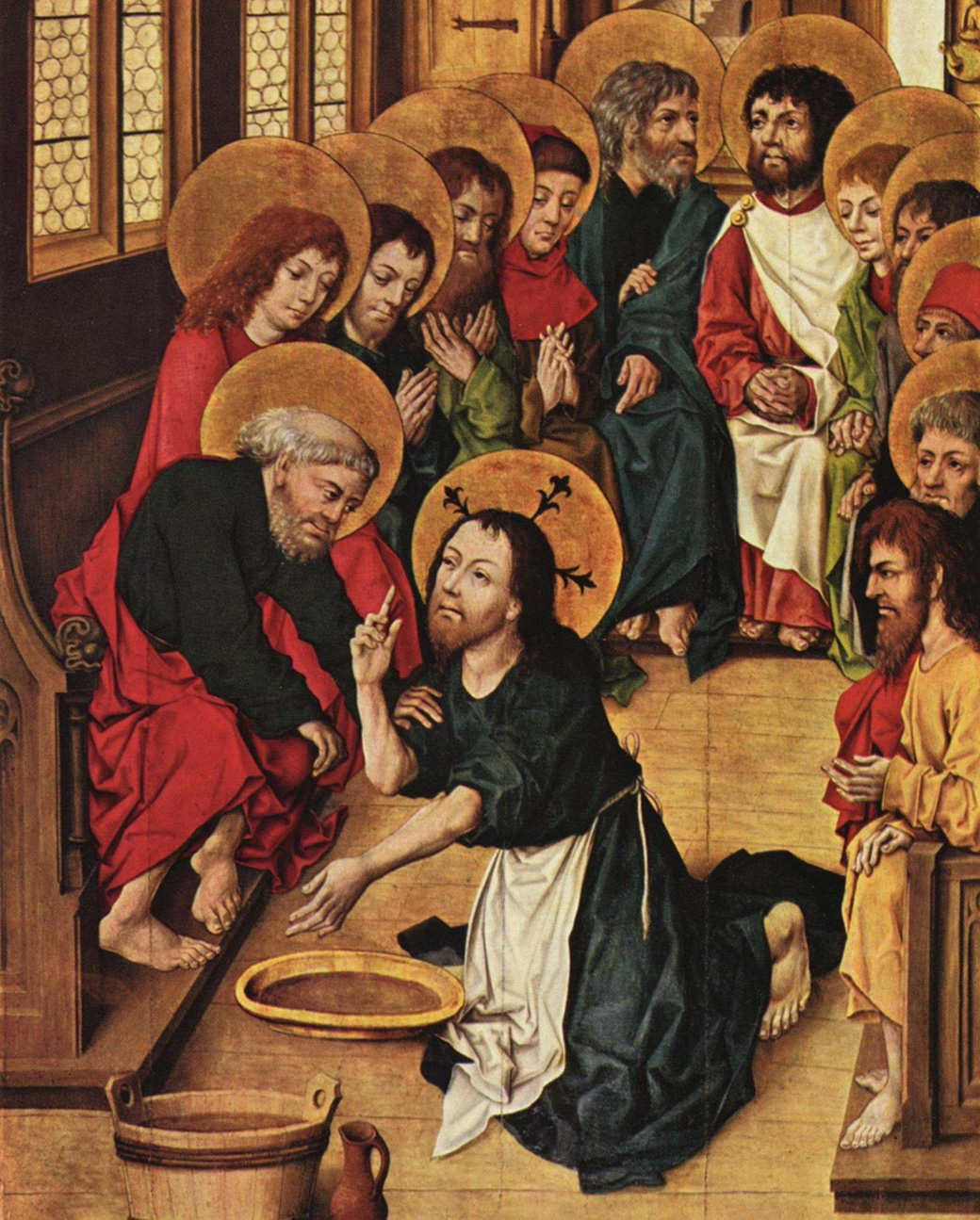
    Detail from Christ Washing the Feet of the Apostles (1475), Meister des Hausbuches | Wikimedia Commons.

    Peter’s reaction is typically passionate and vacillatory. First, he says, “You will never wash my feet” because he thinks it is too far beneath his Lord and Savior. After hearing that he needs it or he will “have no inheritance” with Christ, Peter pulls a quick 180° turn: “then not only my feet, but my hands and head as well.”

    Oh, Peter. Your heart is in the right place, but sometimes it seems like you have no check on your mouth.

    But Jesus uses Peter’s outbursts to teach us something important: “Whoever has bathed has no need except to have his feet washed, for he is clean all over.” What can this cryptic message mean? If we have bathed are “clean all over,” aren’t our feet clean, too? When I think of the feet, I think of those things that ground us, both literally and in our faith (faith means to “stand on firm ground” of that which we can’t prove, as Cardinal Joseph Ratzinger writes). And I think of those things that keep us on the move, signifying that we are agents of action in the world. Why do these appendages that ground us and yet move us require refreshment and purification before we sit down at table with our Lord?

    In his homily for Holy Thursday on March 20, 2008, Pope Benedict XVI gives us a great explanation of this response from Jesus:

    Yet here, with the distinction between bathing and the washing of the feet, an allusion to life in the community of the disciples also becomes perceptible, an allusion to the life of the Church. It then seems clear that the bathing that purifies us once and for all and must not be repeated is Baptism – being immersed in the death and Resurrection of Christ, a fact that profoundly changes our life, giving us as it were a new identity that lasts. … It seems to me that the First Letter of St John gives us the key to understanding [the “washing of the feet”]. In it we read: “If we say we have no sin, we deceive ourselves, and the truth is not in us. If we confess our sins, he is faithful and just, and will forgive our sins and cleanse us from all unrighteousness” (1: 8ff.). We are in need of the “washing of the feet”, the cleansing of our daily sins, and for this reason we need to confess our sins as St John spoke of in this Letter. We have to recognize that we sin, even in our new identity as baptized persons. We need confession in the form it has taken in the Sacrament of Reconciliation. In it the Lord washes our dirty feet ever anew and we can be seated at table with him.

    I think Pope Benedict XVI’s analysis is spot-on, and fits with this idea of the feet grounding us in faith. The liturgy, where we are “at table with the Lord,” is the wellspring for our faith to be continually renewed, refreshed, and purified. These feet, doing the work of carrying us and our Christian message around the world to all those we meet, will of course get dirty and need to be re-washed.

    So much meaning condensed in such a humble act! As Jesus asks when he is finished, “Do you realize what I have done for you?” Jesus brings the whole mystery of the Word of God’s descent into humanity into this act of a servant for his apostles. He signals this when he says, “You call me ‘teacher’ and ‘master,’  and rightly so, for indeed I am.” Remember his words from St. Matthew’s gospel back in the second week of Lent: “Call no one on earth your father; you have but one Father in heaven. Do not be called ‘Master’; you have but one master, the Christ” (Mt 23:9-10; see the reflection Led by the Master). In other words, he is invoking his own teaching to re-establish here that the Christ, the Messiah, is speaking.

    And what he says: “If I, therefore, the master and teacher, have washed your feet, you ought to wash one another’s feet. I have given you a model to follow, so that as I have done for you, you should also do.” We must understand his washing of feet as both the humility/action of a servant as well as a metaphor for a specific type of service related to the ritual cleansing in confession. As Pope Benedict XVI also says in his Holy Thursday homily: “We must wash one another’s feet in the mutual daily service of love. But we must also wash one another’s feet in the sense that we must forgive one another ever anew.”  

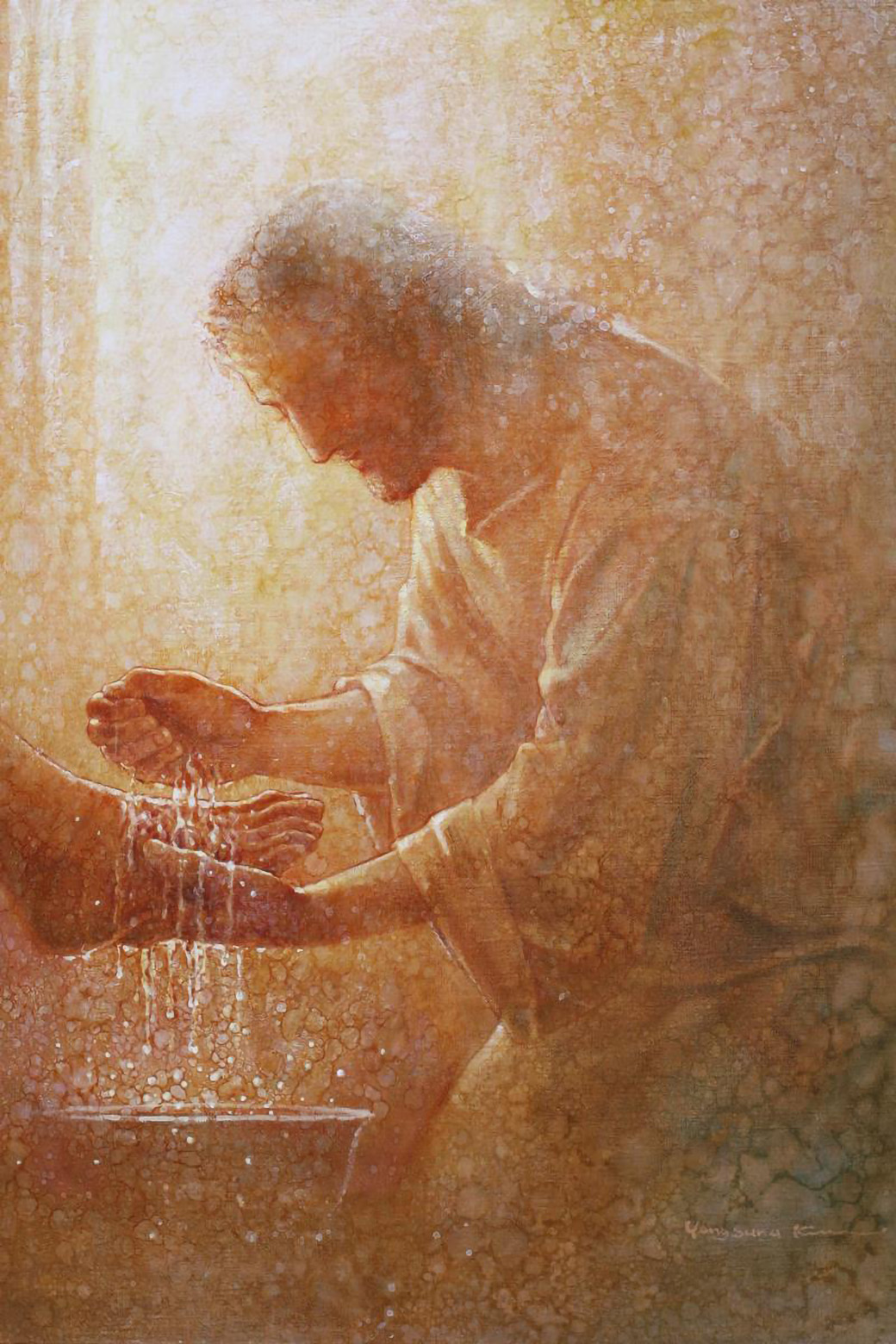
    The Servant (2000s), Yongsung Kim | image from lighthaven.net.

    And thus the Holy Thursday action of Christ in washing his apostles’ feet is a crucial act of establishing the Church. The ultimate mystery of his Death and Resurrection will usher in a new age, a New Covenant, a new opening of Heaven for humanity. But before this saving action is done, Christ sets his Church in motion through his Apostles, giving them the appropriate method, intention, and understanding of what it means to pour out love for one another in an endless example of agape on earth, irresistibly drawing people to God.

  • Courage and Cowardice

    Courage and Cowardice

    Wednesday of Holy Week: Isaiah 50:4-9a, Matthew 26:14-25.

    Today’s gospel focuses on Judas’s betrayal, much like yesterday’s reading. Coupled with the first reading from Isaiah, we get a clear look at what it means to live in the light compared to living in darkness. 

    Today’s first reading is from a section of Isaiah’s prophecy entitled “The Servant’s Humiliation and Vindication” in the NRSV Bible. He speaks in the first person as a blessed servant with a “well-trained tongue” for whom God “opens my ear that I may hear.” This servant accepts his gifts and uses them: “And I have not rebelled, have not turned back. I gave my back to those who beat me, my cheeks to those who plucked my beard; My face I did not shield from buffets and spitting.” This is a person who uses his human faculties and talents with the grace of God and is persecuted for it, like Jesus in his ministry.

    But this servant is “not disgraced,” he says, “I have set my face like flint knowing that I shall not be put to shame. He is near who upholds my right.” This servant lives fully as a human in the light of God’s presence and graces; as such, God is near to him and no amount of trying by other humans can make him disgraced or ashamed.

    I am struck by this person’s courage. Aren’t we all raised to be aware of others in our communities, to take care not to offend or make fools of ourselves? But this servant of God, by living fully in the light of God, is not defined not by social morés; he has found the true lodestar for humans: the Word of God for his well-trained tongue, the grace of God to open his ears, and the love of God to give him courage. Let’s think about this love, the source of his courage. This love coincides with a surety in the Lord, a thirst to be with Him, and an unshakable faith that what he has comes from God who has created him.

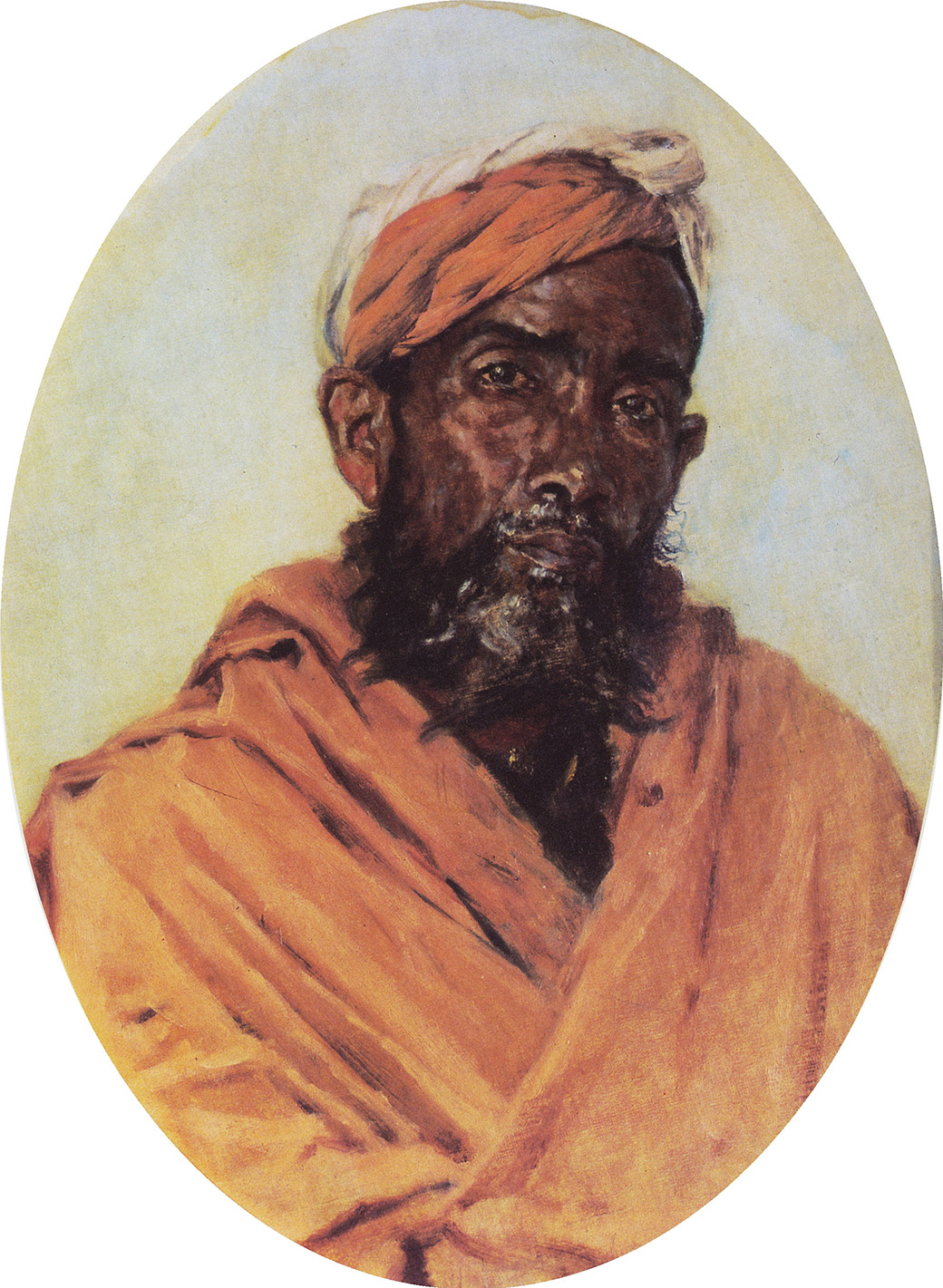
    A Muslim servant (1883), Vasily Vereshchagin | Creative Commons, courtesy arthive.com. Today’s reflection made me consider how each of us is called to be the courageous servant, near to God who upholds our “right.” It has also made me consider the Christian tenet that each of us has God within us, in our soul, and since we are called to humility and service, you can never judge a person based on their look or station in life. To that end, I’ve included a few lovely portraits from Vasily Vereshchagin that give dignity to the subjects and seem to reveal the light of God within them.

    Thus, the servant is absolutely aware that God lives beside him: “He is near who upholds my right.” I like the Lectionary translation here; the Hebrew is more literally translated as “He is near who vindicates/justifies me.” By using the phrase that the Lord upholds his “right,” we might actually come closer to the nuance in the Hebrew phrase since those words vindicate and justify have taken on a technical aspect after several thousand years of Church theology.

    We can think of this “right” in several ways. First, tracing the word “near,” the right is a statement of authority due to proximity. In other words, the servant’s sheer proximity to God, his state of “living in the light” of God, gives him the right to speak. Beyond the proximity argument, second is a statement of personal right to speak as an endowment specifically from God. This meaning traces back to the statement that “He…upholds my right.” God is gracing, upholding, this servant’s right to speak.

    Note that this is different than Natural Law envisioned by John Locke. Locke postulated that God establishes a Natural Law that grants all people certain unalienable rights. Many (myself included) think that scripture does not support Locke’s theory because, in scripture, people regularly lose their lives and communities (i.e., “rights”) when they live outside of God’s commandments and precepts. Today’s reading is a perfect example: the servant can claim his right because he lives in the light of God, as opposed to those who live in darkness. Even with the history-changing reality of Christianity, the basic right is the same: an invitation to accept God into our hearts, not a right for everyone even if they sneer at God and push him away.

    The third way we can think of “right” when the servant says “He is near who upholds my right” is the idea of correctness. God’s Word is Truth — the “well-trained tongue” is one that speaks the truth — and we can understand that the servant’s “right” is his accuracy in presenting the truth. 

    This reading culminates in a bold statement of the servant’s courage: “if anyone wishes to oppose me, let us appear together. Who disputes my right? Let him confront me.” Here is the full reality of the servant living in the light, speaking the truth. There is no space or “right” for those who live in darkness. We see a contrast between courage to speak and cowardice in not speaking, between truth and deceit.

    The Old Beggar Ninety Six Years (1891), Vasily Vereshchagin | Creative Commons, courtesy arthive.com.

    These contrasts are displayed clearly in the gospel reading from St. Matthew, where Jesus gives Judas the chance to be courageous and to speak the truth, but Judas chooses cowardice and deceit. The reading opens with an account of Judas’s visit to the chief priests and his agreement to hand over Jesus for 30 pieces of silver. We can only imagine the darkness of spirit that would have made Judas turn his back on the Word of God, the Truth incarnate. Like John who tells us that “the devil had already put it into the heart of Judas” to betray Jesus, Matthew tells us, “and from that time on he looked for an opportunity to hand him over.” In other words, Judas’s betrayal did not come about in some moment of passion but out of his fallen state.

    Just as in the gospel of John, Matthew tells us that while they were eating, Jesus says, “Amen, I say to you, one of you will betray me.” What is the point of saying this? Is it meant to alarm them, stir them up with doubt and suspicion of one another?

    St. John Chrysostom provides a window into what may have been Jesus’s motivation; he writes, “And before the supper, He had even washed his feet. And see how He spares the traitor. For He said not, such a one shall betray me; but, “one of you,” so as again to give him power of repentance by concealment. And He chooses to alarm all, for the sake of saving this man” (Homilies on Matthew, 81.1). As we reflected yesterday, Christ the Good Shepherd is at work, especially here when one of his chosen Apostles’ souls is at stake. In Chrysostom’s view, Christ is trying to give Judas a chance to come back into the light of God.

    Detail from The Last Supper in the Sistine Chapel (c.1481-1482), Cosimo Rosselli | image from sharingtravelmemories.com, including added circle. Note the devil placed on Judas’s shoulder as well as the halo that has turned gray. 

    Even after the distressed apostles say, “surely it is not me, Lord,” Jesus gives a dire warning, a last chance for Judas to come clean: “The Son of Man indeed goes, as it is written of him, but woe to that man by whom the Son of Man is betrayed. It would be better for that man if he had never been born.” Jesus has committed Himself to “going,” as John tells us, “Jesus knew that his hour had come to depart from this world and go to the Father.”

    An interesting question to ponder is if he needed to be betrayed to the chief priests; if someone had to do it even if it wasn’t Judas. It seems quite plausible that he could have simply walked into the temple the next day of his own accord and started the sequence of arrest and death. So let’s take him at his word that he was willingly accepting death and did not need to be betrayed. Then we must also see his attempt to save Judas from this great sin as genuine. He truly hoped to save him and keep him from committing this betrayal. But, as we are taught, God has given humanity free will to accept or reject him, and in this choice lies our own salvation.

    Another way to think of this is in terms of fate. “Fate” is a concept that doesn’t take responsibility for the reality of humans making choices in regards to God’s invitation to be with him. Instead, “fate” makes it seem like its’ all out of our hands. I don’t think Judas was “fated” to betray Jesus, and based on today’s reading, Jesus didn’t believe that this was somehow pre-ordained by God, because he tries to save Judas from this error.

    So, what happens when Jesus speaks in truth like Isaiah’s courageous servant, saying, “if anyone wishes to oppose me, let us appear together.” He invites Judas to speak openly of any concerns or changes of heart, to return to him, without calling him on the carpet in front of the other Apostles. What is Judas’s response? “Surely it is not I, Rabbi?” He hides in the cover of deceit, he takes on cowardice rather than courage. This is because he has taken the devil into his heart rather than God and he operates in the devil’s ways.

    Jesus simply (and I must imagine sadly) responds, “You have said so.” This is the only sad truth he can utter in the face of Judas’s cowardice and deceit. Chrysostom gives us a heck of a reaction to this:

    Oh insensibility! He inquires, when conscious to himself of such things. … What then says the most mild and gentle Jesus? “You say.” And yet He might have said, “O thou unholy, thou all unholy one; accursed, and profane; so long a time in travail with mischief, who hast gone your way, and made satanical compacts, and hast agreed to receive money, and hast been convicted by me too, do you yet dare to ask?” But none of these things did He say; but how? “You say?” fixing for us bounds and rules of long suffering (Homilies on Matthew, 81.2).

    I love Chrysostom’s commentary here, if for nothing else because it shows that in 395 AD, his jaw was dropping at the deceitfulness of Judas in the same way mine is today. I also appreciate how he concentrates on the “most mild and gentle Jesus,” who sets an example for us on “long suffering,” that is, patience in the face of troubles caused by others. 

    Baptism of Christ (1580s), workshop of Jacopo Tintoretto | Creative Commons, courtesy of Cleveland Museum of Art. I appreciate the humble servant aspect of Christ depicted here as He begins His ministry, also the form of the Spirit that is pouring out the water of everlasting life.

    Let us take the challenge from Christ to live in the light of God, to have our “right” come from him and him alone. May we well heed the terrible choice that Judas makes to turn his back on God and live in the cowardice and deceit of the devil; “woe to that man.”

  • Master of Destiny

    Master of Destiny

    Tuesday of Holy Week: Isaiah 49:1-6, John 13:21-33, 36-38.

    Today, we hear part of John’s account of the Last Supper when Jesus offers himself to and through Judas, always giving himself even in his own betrayal. As we contemplate the Word of God recorded by St. John, let us be drawn into the mystery of the Spirit that is “agitated” and the mind that understands all prophecy and all revelation.

    First, some short thoughts about the first reading from Isaiah. This is a lovely prophecy of Jesus Christ: “The Lord called me before I was born, while I was in my mother’s womb he named me. He made my mouth like a sharp sword, in the shadow of his hand he hid me.” Indeed, Christ was “called” into being upon the first word God ever uttered, as he is the very Word of God, and his name was shared with Mary and Joseph before his birth. His mouth was like a “sharp sword” in the truth and perfection of the Law that flowed from it. And for 30 years he was hidden “in the shadow” of God’s hand before his ministry started.

    Further, Isaiah prophesies, “Though I thought I had toiled in vain, and for nothing, uselessly, spent my strength, Yet my reward is with the LORD, my recompense is with my God.” As shown by Jesus’s constant arguments with the chief priests, Pharisees, and other Jews, there were plenty of times when his teachings fell on deaf ears, but as we approach his Passion, the divine relationship becomes more and more evident. It must, since his time with his disciples is coming to an end and his time of reunification with the Father in Heaven approaches.

    Finally, in today’s first reading Isaiah gives us the genesis of the Church, the mystical Body of Christ as a deliberate act by God through Christ: “I am made glorious in the sight of the LORD, and my God is now my strength! It is too little, he says, for you to be my servant, to raise up the tribes of Jacob, and restore the survivors of Israel; I will make you a light to the nations, that my salvation may reach to the ends of the earth.” This is a great reminder in Holy Week that Christ’s mission was not only to teach and convert but to unify humanity in God by establishing the Church so that his “salvation may reach to the ends of the earth.” The purpose of his great sacrifice of self was always simultaneously for God and for us.

    Mandylion, contemporary, Emilia Jankowska-Ciełuczecka | image from ikonypisane.pl. A mandylion is the reproduction of the Image of Edessa, a holy relic of the Eastern Church. The original Image of Edessa was an imprint of Jesus’s face on a cloth used by St. Vernoica to wipe his face when he carried the Cross to Golgotha. As we contemplate the mandylion, consider this simple prayer from Pope St. John Paul II: “In Your luminous Face, we learn to love and to be loved, to find freedom and reconciliation, to promote peace, which radiates from you and leads to you.” 

    John’s gospel reading delves into the mechanics of how Christ is “given up” for us, and down to the last detail, we see the integrity of his message, of the unification of his will with God’s will. Prior to today’s verses, this chapter opens with, “Now before the festival of the Passover, Jesus knew that his hour had come to depart from this world and go to the Father. … The devil had already put it into the heart of Judas son of Simon Iscariot to betray him.” Two pieces of Jesus’s foreknowledge are established: the time for his Passion, Death and Resurrection had arrived, and Judas was under Satan’s influence and ready to betray him.

    His first action after this acknowledgment that the “clock had started” is to wash the feet of his apostles, taking the role of a servant. He performs this act with all of them and asks them to do the same in their ministries. Yet Jesus notes that not everyone is receptive to his example, quoting scripture with, “The one who ate my bread has lifted his heel against me.” He speaks in a veiled way about Judas, but the apostles will understand the message clearly later that evening.

    At this point, today’s reading picks up. We hear, “Reclining at table with his disciples, Jesus was deeply troubled and testified, ‘Amen, amen, I say to you, one of you will betray me.’” The Greek phrase used for “deeply troubled” is ἐταράχθη τῷ πνεύματι (etarachthē tō pneumati), which means “agitated in spirit.” This is nearly identical to the phrase used to describe the state of his spirit when he encounters an emotional Mary just before raising Lazarus from the dead.

    In my reflection See the Glory of God, I argue that this agitation of spirit is due to the gut-like passion of God rejecting the force of death in his midst. I feel that we are experiencing the same agitation of spirit and the same underlying cause here in today’s gospel. Just as “Amen, Amen, I say to you” is a common phrase used by Jesus throughout the New Testament, and one that we can take to mean “The truth is here, I am teaching it to you,” I feel that this phrase “agitated in spirit” signals a fundamental surge of the spirit in opposition to death’s enthralling grip on someone. Here, it is Judas, and Christ’s agitation is not tied to the fact that his own death is implicated, but that this apostle he loved, someone whose feet he just washed, had given himself over to death. This is a lament from Jesus, the Good Shepherd who goes to every length to rescue one of his sheep, over the loss of Judas’s soul.

    The betrayal is even more symbolically devastating than we might think at first glance. The beloved one (John himself, the writer of the gospel) leans back on Jesus’s chest and asks who he’s talking about. Jesus replies, “It is the one to whom I hand the morsel after I have dipped it.” What morsel is he describing? Remember, this is the Last Supper, when Jesus institutes the sacrament of the Eucharist and provides his instructions to the Apostles: “This is my body, which is given for you. Do this in remembrance of me” (Lk 22:19). John, for his part, doesn’t describe the Last Supper with these same words of institution as the synoptic gospels, but simply tells us, “So he dipped the morsel and took it and handed it to Judas.”

    Could this be a different, more simple morsel of bread? Perhaps, but is any morsel of bread “simple” at this sacred meal? They are all handed to the Apostles personally by the Lord on the eve of his Passion, with his sanctifying grace and the intention of instituting the sacrament of Eucharist. It is all the Body of Christ, meant to spark the mystical Body of Christ that is the Church.

    And what happens with Judas when this holy morsel is given freely to him by Christ? John writes, “After Judas took the morsel, Satan entered him. So Jesus said to him, ‘What you are going to do, do quickly.’” It seems that Satan recoils and constricts his victim as the presence of God is placed upon him. Jesus, in turn, realizes that Judas is firmly in the devil’s grip and releases him from his presence. 

    The Last Supper (1786), Benjamin West | Creative Commons, courtesy the Detroit Institute of Arts. I think West captures a great range of humanity in the faces of the apostles and Jesus. We see the incredulous, questioning, uncomprehending, and earnest faces of most of the apostles, the divine relationship of Christ and God the Father as he institutes the sacrament of the Eucharist, and Satan darkly inhabiting the face and form of Judas.

    The apostles aren’t sure what’s going on, but Judas, Satan, and Christ are clear. John writes, “So Judas took the morsel and left at once. And it was night.” Judas takes Christ’s life, his sanctified body, and leaves with it. He doesn’t eat the morsel, he doesn’t allow it to nourish him and bring the love of God into his being. Instead, he takes the gift like a greedy child, hoarding it away. And John gives us a poetic little sentence that signals the true darkness of this moment: “And it was night.” 

    Newcomers to Christianity are more incredulous over this moment than many lifelong Catholics. Why would Jesus just let Judas go if he knew he would betray him? He has it in his power to stop the whole, horrible ordeal before it starts. Yes, he’s always had this in his power, and that’s really the point. Jesus is the master of his destiny at all times. He can feed thousands and raise the dead with nothing but a word of thanks to the Father. But Jesus isn’t just the master of his destiny — he is the Master of Destiny, that is, of all destiny for all of humanity. As such, His responsibility has always been more than his human life; his responsibility is to provide salvation for all humans — life everlasting.

    The only way to do this is to take our sin and nail it to the Cross as a sacrifice to the Father, then to descend into death in a humanity he deliberately shares with us, but raise that human form with a divinity that is solely his. His choices are divine, they always exist within the love of the Trinity that is a pouring out of the self (kenosis) to a degree that we can’t quite comprehend. So he knows that he must let this sheep Judas escape with Satan in order to start the saving action he destines for us.

    The rest of today’s reading shows us how Jesus tells his beloved apostles about his ordering of destiny. I am struck with how patient he has been throughout the gospels to this point, gradually revealing the mystery of his being and mission of salvation, trying to give them enough time to grow in understanding, and always pointing back to the glory of the Father. Now, things accelerate, as they must.

    He begins by saying, “Now is the Son of Man glorified, and God is glorified in him.” I believe that we must again remember the importance of the Last Supper here and the seed of Christian ritual that Jesus gives the Church, one that will begin to make sense as his Body and Blood are literally poured out and then when he resurrects. But, at the same time, “glorification” refers to the necessary divine reaction to the fleeing Judas. How is Judas’s betrayal the thing that causes Jesus to say “Now is the Son of Man glorified”? I believe that this act enables Christ to display the overflowing, undeserved, and totally out-of-proportion love of God that the pours out in response to our infidelity. This is beyond turning the other cheek; this is the wellspring of love.

    Christ in Glory (14th c. Crete, Greece), Hand-painted (written) icon by Plamen Kazakov | image from blessedmart.com.

    Judas is the first in a cascade of sin and evil that will be rained down on Jesus during his suffering and death. His glorification and the glorification of God resides not in the smiting of the offenders but in the patient acceptance of this evil. This ability to love in the face of all the hate and injustice that can be mustered, well, it’s supernatural. It’s so paradoxical to how humans would respond that in it is the proof and the glory of God. The plea to forgive those “who know not what they do” as he hangs on the Cross! This looking out for his sheep in the darkest of night, this is the glorification.

    So when Jesus says, “Where I am going, you cannot follow me now, though you will follow later,” we can take a double meaning. The apostles can’t follow him into never-ending love in the face of torture and hate because of the supernatural divine love it requires, and this has not yet been poured out upon humanity. Secondly, they can’t follow him into death and the underworld, where he must go so that his divine essence, which can never die, can raise up again. But, as he notes, their paths to sainthood will require them to follow in both senses.

    Our reading today ends with Jesus explaining to Peter that although he claims he will lay down his life for Jesus, he will actually deny him three times that night, before the crow signals morning. When I was younger, I imagined that a certain degree of understandable bitterness may have marked Christ’s statement, but now I see things differently. I think the emotion that overwhelms Jesus on this fateful evening that will take them to the Garden of Gethsemane is sadness.

    Not anger toward God or the people who will betray him. Not fear of the impending torturous death. Not anguish over losing his family and friends. He may have experienced some measure of these things but I think it’s been in vogue since Vatican II to emphasize these aspects his humanity, perhaps to the detriment of remembering that the Good News is about the divinity that comes to earth.

    For me, I think that if we accept the reality of the love that defines the Trinity, which is the operative force brought into the world through the man Jesus Christ, agape must define for us who he ultimately is, especially in his final hours. That love is purely selfless, only wanting to draw others to unity with God. I think he grieves for humanity in the display of evil, the enthrallment of death, all of the cowardly and wicked acts. He knows that the cup the Father wants him to drink will entail humanity digging itself even further down into the depths of evil by torturing and crucifying the Word of God, an unspeakable sin. This is the Good Shepherd, this is the Son of Man who has devoted his life to preaching the New Covenant of love, this is the Anointed One who cares more deeply than we can imagine for all of us.
    So, no, I don’t think he was bitter with Peter, but instead sad. I can even imagine a tear on the cheek of our Savior when he gently tells Peter with some irony that the Rock who pledges to lay down his life is destined to deny any connection with Jesus three times that night. A tear of sadness, not for himself, but for Peter.

  • Every Knee Should Bend

    Every Knee Should Bend

    Palm Sunday of the Passion of the Lord: (Procession with Palms: Mt 21:1-11), Isaiah 50: 4-7, Philippians 2:6-11, Matthew 26:14 – 17:66.

    In the space of a blog post, how can we take in, much less reflect upon the events we celebrate on Palm Sunday? As disciples, we go from the highest of highs, seeing our Lord’s triumphant entrance to Jerusalem to the lowest of lows in betrayal, denial, and his death. Since I will reflect on the different aspects of the Lord’s Passion, Death, and Resurrection throughout Holy Week, I will use the space here to focus primarily on the readings that happen before the gospel.

    We celebrate his triumphant entrance of Jerusalem by once again waving blessed palm branches, reading the passage from the gospel of St. Matthew, and singing “Hosanna to the Son of David!” Let’s peer into these two important symbols: the palm branches and the cry, “Hosanna!”

    Christ’s Entry into Jerusalem (1846), Jean-Hippolyte Flandrin | Creative Commons, image from iconsandimagery.blogspot.com.

    Matthew tells us, “The very large crowd spread their cloaks on the road, while others cut branches from the trees and strewed them on the road.” The use of the palm branches — both in the original procession and in our continual processions each Palm Sunday — was first planted in the mouth of the psalmist by the Word of God. It comes from Psalm 118, A Song of Victory. Here are some important verses from that psalm:

    With the Lord on my side I do not fear.
        What can mortals do to me?
    The Lord is on my side to help me;
        I shall look in triumph on those who hate me. …
    Open to me the gates of righteousness,
        that I may enter through them
        and give thanks to the Lord. …
    The stone that the builders rejected
        has become the chief cornerstone. …
    Blessed is the one who comes in the name of the Lord.
        We bless you from the house of the Lord.
    The Lord is God,
        and he has given us light.
    Bind the festal procession with branches,
        up to the horns of the altar.

    This entire psalm is a prophecy of this moment of Christ’s entrance into Jerusalem. The final verse quoted above prophesies that the branches will line the procession “up to the horns of the altar,” for this is the entrance of a king and priest, coming to make a sacrifice to God at the altar. And, indeed, Christ, our high priest and king, does this, but not in the way imagined by the Jews. His altar is Golgatha, his sacrifice is his own Body and Blood. The Song of Victory exists both in triumph and in the pain and sorrow of his sacrifice. The Christian power is always surprising, always focused on God, always revealing the truth of transcending this world through self-sacrifice.

    Christ’s Entry into Jerusalem (late 1800s), Gustave Doré | Wikimedia Commons. I quite like the impressionistic strokes in this painting, not to mention the darkness of Jesus on the donkey compared to the lightness of the surrounding elements, the reverse of what’s normally depicted. For me, this speaks to the sin that Jesus will take on, a foreboding darkness present even at this time of triumph.

    Next, Matthew tells us, “The crowds preceding him and those following kept crying out and saying: ‘Hosanna to the Son of David; blessed is the he who comes in the name of the Lord; hosanna in the highest.’” What is this Hosanna? Many of us might equate this with a triumphant shout, much like how we use “Alleluia!” It translates to something quite different, however.

    This phrase also comes from Psalm 118, verse 25: “Save us, we beseech you, O Lord! O Lord, we beseech you, give us success!” In Hebrew, this is “Anna, Yahweh, hoshi’a na! Anna, Yahweh, hasliah na!” So the Hebrew אנ העישוה (hoshi’a na), means “save us now, please!” It was originally a desperate plea to be saved.

    It is immediately followed in the psalm with “Blessed is the one who comes in the name of the Lord,” so we hear this plea of concern changing into one of joy. When the apostles tell us that the crowd shouted “Hosanna in the highest” and “Hosanna to the Son of David,” we should hear the urgent, Messianic cry applied to a specific person: Jesus Christ. We can also see how the belief in a Messiah and the sight of this wonder-worker Son of God in the flesh would inflect the desperate plea for saving with a hopeful joyousness.

    “Hosanna” in the Christian context is a cry that contains both that plea for help as well as the confidence and joy of the Resurrection that has burst upon the world. 

    Palm Sunday seems to resound with this double, somewhat contradictory knowledge. We need saving, we have been saved. Jesus rides in triumph, Jesus is condemned and killed in a shameful way. We wave palms in triumph, we kneel in sorrow. This important feast day, the bell tolling for the celebration of Holy Week, bursts at the seams with the mystery of the Christ Event. “The veil of the sanctuary was torn in two from top to bottom. The earth quaked, rocks were split, tombs were opened.” The world, and our feast day, cannot contain the mystery, nor can it break it into intelligible bits as if we can just celebrate the triumph without the sorrow. Or the sorrow without the triumph. They come together. This is Christianity.

    The Veil of the Temple (c.1700), Gilliam van der Gouwen, after Ottmar Elliger | Creative Commons, image from institutopoimenica.com. This engraving was used in the Mortier Bible, published in 1700.

    St. Paul was graced with such incisive insight into the mystery of Christ and the Church. He tells us in today’s reading from the letter to the Philippians that Jesus did not attempt to “grasp” the equality he held with God, “Rather, he emptied himself, taking the form of a slave.” This is what we commemorate during Holy Week, the “emptying” of Himself from the praise he receives on his palm-lined entry into Jerusalem. This is a deliberate act — we have to see the praises being shouted in order to comprehend the true action of Christ.

    What kind of glory is this, to empty yourself of the praise, hopes, and adoration of your people? That’s not what a king does! And what does Jesus fill himself with after becoming the slave? Sin that is not his. He descends into all of the sins in the Passion: betrayal by Judas, denial by Peter, hatred of the chief priests and Pharisees, the indifference of Pilate, torture of the soldiers, the mockery of the crowd. These, we are amply shown, are what he takes on instead of the triumph and earthly glory we associate with kings. He takes the fullness of sin of humanity and nails it, sacrifices it on the Cross with his own Body.

    Here, in the depths of this never-before-imagined degradation and sacrifice, St. Paul shows us what he gains:

    Because of this, God greatly exalted him
    and bestowed on him the name
    which is above every name,
    that at the name of Jesus
    every knee should bend,
    of those in heaven and on earth and under the earth,
    and every tongue confess that
    Jesus Christ is Lord,

    He gains God’s exaltation. This thing that humans only briefly experience at the oddest of times in our history, usually only when God chooses us and we somewhat stupidly and awkwardly do His will. Yet Jesus shows us how to do this intentionally, meaningfully and perfectly. It’s against all of our worldly instincts of raising ourselves above others. But Jesus gains the name “above every name,” that is, “Christ” and “Lord.”

    With his impossible and incredible acts of humility and carrying the burden of sin for humanity, “every knee should bend, of those in heaven and on earth and under the earth.” I love this image and this word choice. Every knee should bend! We, all of us who truly heed the reality of Christ’s entry into the world, simply cannot help but worship, adore, and pledge ourselves to Jesus Christ the Lord. Not just us! It’s beyond just us. It’s angels, demons, the dead, the “thrones and dominions.”

    Against all of our notions of triumph, it turns out that this is glory. This is a king.

    Entry of Christ into Jerusalem (c.1320), Pietro Lorenzetti | Flickr, Frans Vandewalle.
  • False Utilitarian Morality

    False Utilitarian Morality

    Saturday in the Fifth Week of Lent: Ezekiel 37:21-28, John 11:45-56.

    Today we read of the chief priests and scribes convening in the Sanhedrin about Jesus. I immediately think of the plotting that was foreshadowed in the stories of Joseph (son of Jacob) whose brothers plotted against him and the Jews who plotted against Jeremiah (see Evil Plots in Empty Hearts).

    Caiaphas, “the high priest that year,” steps up with authority to ease their consciences about a plot to have Jesus killed. It’s worth looking at Caiaphas’s words in detail. They lay out for us a false morality completely at odds with the gospel of love, mercy, and charity that Jesus preaches. 

    John tells us that the chief priests and Pharisees are concerned that their inaction against Jesus will lead to the Romans coming to “take away both our land and our nation.” They rightfully worry about an established order being disrupted — not that it needs to happen violently, but Jesus is clear that he brings a New Covenant to the world, the salvation for all, a nation beyond the Israelites, a new Jerusalem that is the spiritual Kingdom of God, and a new temple that is himself. This would rightfully cause worry and existential angst for the power structure of the Jewish nation; what is to become of them? Jesus forces them to make a decision to be a part of his New Covenant or to oppose it.

    They choose to oppose it.

    Opposing this new ordering of the world could take many forms: a disinformation campaign against him, an increase in traditional Jewish piety, exiling him to some faraway place, etc. But Caiaphas cuts them to the quick: “You know nothing.” His evil plan, the acceptance of death into his heart, fittingly starts with an insult to his comrades. The way of violence starts and ends with violence. He then presents a seemingly logical and beneficent rationale, a spoonful of sugar to help the medicine of death go down: “nor do you consider that it is better for you that one man should die instead of the people, so that the whole nation may not perish.” This is classic utilitarian morality: given an unavoidable choice, choosing that one die rather than many is the better, more moral choice.

    Annas and Caiaphas (Anne et Caïphe), 1886-1894, James Tissot | Creative Commons, courtesy the Brooklyn Museum.

    This seems to be a persuasive argument, so let’s dig into it a bit. While this thinking is as old as time, it was presented in a modern way as the “Trolley Problem” by Philippa Foot in 1967. The scenario is this: a trolley is hurtling down a track and can’t be stopped. There are five people on the track who will be killed, but you have a chance to switch the trolley to a side track where only one person will be killed. Should you switch the trolley to the side track? In other words, it’s not just a question of whether it is better to have one person die than five, but also would you intervene to make this happen?

    There are plenty of variations here, including one with a large man who could be shoved onto the track to derail the trolley and save the five people (making the violence of the act a bit more apparent). The dilemma calls into question the idea that not acting is as immoral as being complicit in murder. We’ve heard this same dilemma posed with intensified pressure as “would you kill Hitler as a young man to avoid World War II?” or similar such thought experiments. Caiaphas is setting up the same problem: killing one man to save the nation is a better, more moral act.

    Now I’m not a professional ethicist, nor do I think anyone can simply put this thought experiment to bed in a blog post. Instead, I am suggesting that our scriptures and tradition give us plenty of reasons not to be beguiled by the limited choice suggested by Caiaphas. Let’s start on the personal level: is choosing to sacrifice the one person in this dilemma the mark of a more generous person, someone more concerned with the greater good?

    Since utilitarian morality is more prevalent in a modern, nonreligious mindset, let me marshal a scientific study for evidence to the contrary. Oxford researchers published a paper in the journal Cognition in January 2015, detailing how four separate experiments teased out the fact that people revealed their true stripes apart from their answer to the trolley problem. The authors found several striking things: “rates of ‘utilitarian’ judgment were associated with a broadly immoral outlook concerning clear ethical transgressions … less donation of money to a charity, and less identification with the whole of humanity.” What’s more, people who chose to sacrifice the one person in the dilemma showed no desire for “assistance to distant people in need, self-sacrifice and impartiality, even when the utilitarian justification for these judgments was made explicit and unequivocal.” So, in short, no, making this utilitarian moral choice is not really the mark of a “good” person when judged by these many factors. (read the paper: ‘Utilitarian’ judgments in sacrificial moral dilemmas do not reflect impartial concern for the greater good.)

    From a Christian viewpoint, utilitarian morality is problematic for several reasons. First, it positions us as a type of god who is in the position of determining right and wrong for society. This is definitely the position that Caiaphas and those in the Sanhedrin occupy — as leaders, they have let the scope of their responsibilities creep from maintaining religious teaching and leading worship into questions of law and order, life and death. At the heart here is a desire to control the world and destinies of those in it. They determine right from wrong and are “playing God.” This is the opposite of the humility that is a prerequisite for our relationship to God and a building block for all of Christianity.

    Christ and the Pharisees (early 17th century), Anthony van Dyck | Creative Commons, courtesy the Metropolitan Museum of Art.

    Second, once the scope of the drama has been expanded and the actor in the drama is the controller and arbiter of right and wrong, the question of “obligation” looms large. Obligation is, in fact, the central question of the Trolley Problem: what are you obliged to do, morally speaking?

    I believe that this is the wrong focus, taking a cue from Servais Pinckaers, OP. He is a master of moral theology, whose seminal book, The Sources of Christian Ethics, contrasts a more modern morality based on obligation with an earlier Christian ethics based on happiness (as we read it from St. Augustine and St. Thomas Aquinas). Pinckaers admits that the question of obligation is important for moral theory, but questions, is it “really all that central and basic?” Citing the Franciscan William of Ockham as the poster child, he notes that morality has been reduced to following the obligation of laws prescribed by God. “For Ockham all morality was concentrated in free choice … a succession of free decision or independent acts — cases of conscience as they would later be called”(243, 244).

    You might be asking yourself, what’s so wrong with this? Indeed, this viewpoint has been so incorporated into our modern Christian consciousness that it is almost a “given.” But Pinckaers calls it “the first atomic explosion of the modern era” (242). His point is that by conceiving of ourselves as little independent islands and all of existence as independent acts, there are no “universals.” Moreover, Ockham’s philosophy separates modern ethicists from the Church Fathers and the scriptures themselves, which is a problem because Pinckaers follows St. Thomas Aquinas in seeing the Sermon on the Mount as a “perfect charter for Christian living” (162). The Beatitudes and accompanying sermon reveal the active Spirit of the Lord as a defining principle of life that unites us instead of splintering us into individual fiefdoms of independence.

    Pinckaers says, “there can be no renewal of moral theology today without the rediscovery and exploitation of the Gospel sources. They alone can restore to moral theology its true dimension and spiritual vitality”(167).

    To apply this to our current question, I would say that the trolley problem is simply a manifestation of a perverted understanding of ethics that breaks down the world into isolated questions of obligation. We are even further distanced from the moral theology Ockham envisioned because today’s philosophers don’t even agree on basic Christian tenets, so the question of obligation is not rooted in God’s Word or God’s Law, but some variant of natural law, social law, or some other human-constructed law. Is this even a moral question at this point?

    The Just and the Unjust (2016), Carolynne Coulson | image from carolynnecoulson.co.uk. The abstract forms and streakily blurred faces seem to comment on the impossibility of real justice on earth, on the unknowability of people and the mistake of judging. Who is just? Who is unjust? Perhaps Coulson is calling into question whether moral systems can truly exist, but I see this the other way – that only God has a clear picture of who we are (He is the one true moral system) and when we try to judge, our vision is as blurred as this one.

    Christ gives us the clearest of instructions: love our neighbor as ourselves. This follows from loving God first, with all of our being. For the sake of argument, let’s apply this to our trolley problem. If we are consumed with the love of God (for Him and back from Him), then the idea of intentionally causing the trolley to hurt someone (in any direction) is simply anathema. Our choice is not determined by what we do with the trolley but how we bring God’s love to people. A Christian would run towards an accident, a site of violence, with a prayer on his or her lips and a body poised to provide care and comfort.

    The Christian is the servant of God, humble in aspect, giving all power over to Him. Our work is always and primarily with and through God. By living with him at all times, we realize that this world is full of death and violence, but that doesn’t determine our outlook. We don’t choose between the lesser of deaths but the overwhelming greater of life, of the Kingdom, both in this world and in the next. We reflect God’s mercy, we swim in the matrix of his grace, and we provide light in the darkness. The trolley problem simply isn’t a problem for us, just like death isn’t a problem for us. We live on a different plane.

    So, back to our reading, Caiaphas is presenting a false utilitarian morality. It is anti-Christian not just in the false restriction of choice it presents (as if killing Jesus is the only option), but also in how it embraces death on all sides as an inevitable finality. Either the nation dies or Jesus dies. Jesus has been telling the Pharisees and scribes: come to me for life-giving water and you will never be held in the thrall of death again. Caiaphas has turned his back on this offer.

    John provides us with an interesting gloss after Caiaphas speaks: “He did not say this on his own, but since he was high priest for that year, he prophesied that Jesus was going to die for the nation, and not only for the nation, but also to gather into one the dispersed children of God.” Why does John go out of his way to relieve Caiaphas from some of his personal responsibility and shift some of the responsibility to the fulfillment of prophecy?

    John puts the power and will in Jesus’s hands in this statement: “Jesus was going to die for the nation” —Jesus is the agent of action, not Caiaphas. This is very important for John, who presents us with a Savior who is always in control and in the driver’s seat for his saving action on earth. I do not doubt this perspective is real and divinely inspired! Caiaphas becomes a type of Judas figure, one who’s actions are undoubtedly vile but also in some way the will of God because they reveal the saving work of Christ. 

    Judas (1885), Ilya Repin | Creative Commons, courtesy wikiart.org.

    Looking back at the first reading, we can see what prophecy John was referencing. God tells Ezekiel that he will “gather them from all sides to bring them back to their land. I will make them one nation upon the land … Thus the nations shall know that it is I, the LORD, who make Israel holy, when my sanctuary shall be set up among them forever.” John helps us see that Christ’s ministry is one of unification, of bringing all the nations together. Also that his death and Resurrection, which starts with Caiaphas’s venom, will open up the eternal liturgy and is the “sanctuary set up among them forever.”

    Here, on the eve of Holy Week, may we be like the Jews arriving in Jerusalem for Passover, asking one another, “What do you think? That he will not come to the feast?” We anticipate his coming, once and forever eternal.