
Tag: St. Luke

  • The Heavenly Womb

    The Fourth Sunday of Advent, Year C: Micah 5:1-4a, Hebrews 10:5-10, Luke 1:39-45.

    Today’s readings present us with a familiar scene, the kindly image of pregnant Elizabeth greeting pregnant Mary. This is the Visitation of Mary. Mary travels to the hill country, she “enters the house of Zachariah,” the women exchange pleasantries. It’s December 19th and Salt Lake City is covered in snow. The whole scene can lull us with its domesticity as I dream of cozying up to the fireplace and doing a puzzle this afternoon. The gospel reading with its overtones of “nesting” fits perfectly.

    But, let’s dwell with the Word of God for a moment and let it reveal its wonder and wisdom to us. There is something deep happening in this gospel reading. We are witnessing the turning point of history, when the time of the Prophets meets the time of the Messiah. Hidden in this countryside meeting of cousins is a glorious revelation for the world, much like the glorious revelation Himself will soon be given to the world, yet hidden in a humble manger.
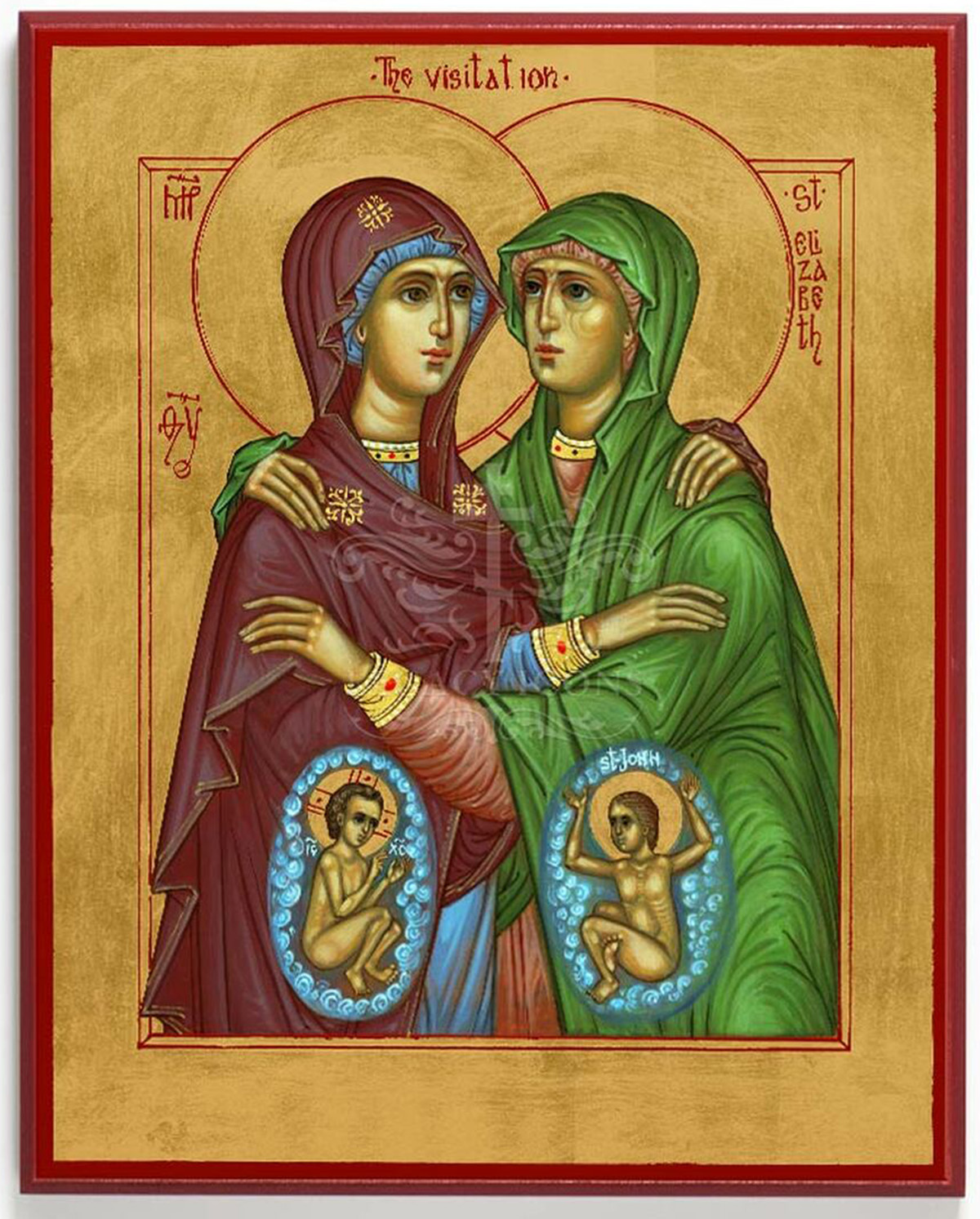
    Icon of the Visitation | Image from legacyicons.com. There are plenty of beautiful paintings of the Visitation, but I wanted to choose one here to emphasize that this was as much a meeting of Jesus and John as Mary and Elizabeth. And while it is more common to see John depicted in a pose of humility in sacred icons, I like this one particularly because it shows John “leaping for joy.”

    There are many present at this meeting – there is Elizabeth meeting Mary, but also John meeting Jesus, in fact the prophets (remember that Jesus will say, “And if you are willing to accept it, John himself is Elijah who was to come,” (Mt 11:14)) meeting the Messiah, and finally the Spirit filling humanity. Let’s remember the central action of this scene. After Mary enters the house and greets Elizabeth,

    When Elizabeth heard Mary’s greeting,
    the infant leaped in her womb, 
    and Elizabeth, filled with the Holy Spirit, 
    cried out in a loud voice and said, 
    “Blessed are you among women, 
    and blessed is the fruit of your womb.”

    Several things happen before Elizabeth speaks: first, the infant John reacts to the Messiah entering his presence. Remember, this is John’s entire reason for being – the Father has given him the solemn job of preparing the world for the Messiah and recognizing Him when He comes. John is more than a normal baby; he is chosen and exalted by God and because his soul is so much greater and full even at this stage of his life, he is able to model for us the true meaning of joy by leaping in the presence of the Lord (see last week’s reflection for more thoughts on this joy). John’s great soul seems to envelop his mother at this point because she herself prophesies! She is “filled with the Holy Spirit” and “cries out in a loud voice” – both things we read of prophets in general and John in particular during his ministry. The Holy Spirit gives her the wisdom and courage to proclaim the truth present in front of her: “Blessed are you among women, and blessed is the fruit of your womb.”

    There is a reason the Hail Mary joins these words with the angel Gabriel’s words during the Annunciation (“Hail Mary, full of grace, the Lord is with you”): this moment is John’s first pronouncement to the world that the Savior is present in his pure vessel, the virgin womb of Mary. God makes his Word heard, first through an angel and then through the Holy Spirit speaking through John and Elizabeth. Both times, the proclamation is made to Mary (and in the retelling of the gospel, to the world). Mary is, in fact, the archetype of the Church herself. The Church, who bears and protects and is transformed by Christ, is being announced as blessed and full of grace (literally and figuratively). The original Greek is worth noting, since Gabriel calls her Kecharitōmenē (One Whom Grace Inhabits) and Elizabeth calls her Eulogēmenē. I unpack Gabriel’s words in a prior reflection, but let’s understand what the Holy Spirit is saying through Elizabeth here. The root word is eulogéō, which is a combination of , meaning “well, good” and lógos, which we should all recognize as “word, reason,” or in this context “speaking,” which is how we arrive at “bless” for eulogéō. Greek scholars also note that this word can properly mean “confer what is beneficial” when we read of how God blesses His people and they bless him in return. The point is that there is an action combined with the word – the blessing is coming from someone, through being spoken, and is thereby conveyed on someone else. Who is speaking? The Holy Spirit! That means that God Himself is conveying blessings upon Mary and His Son in this scene. This scene is thus tied to not just the Annunciation but Jesus’s Baptism when the Father calls down from heaven, saying, “This is my Son, the Beloved, with whom I am well pleased” (Mt 3:17), as well as the Transfiguration when the Father proclaims, “This is my Son, whom I have chosen, listen to Him” (Lk 9:35). All of these scenes are the revelation of Christ to humanity, accomplished by the Father and the Holy Spirit.

    Returning to today’s gospel passage, let’s look at the curious self-awareness that Elizabeth shows after God proclaims the blessedness of Mary and the presence of His Son:

    And how does this happen to me, 
    that the mother of my Lord should come to me?
    For at the moment the sound of your greeting reached my ears, 
    the infant in my womb leaped for joy.

    How fascinating that her own voice is intermingled with that of the Spirit and John’s expansive soul. She is fully aware of the fact that Mary bears the Christ in her womb, and she marvels that she is lucky enough to be in the presence of them both. But she also calls attention to her own body, to the feeling of John leaping for joy. This, I believe is a purposeful and profound passage for us. We are invited to consider what it is like to be pregnant with another being growing inside us. I have no personal insights here, but I have two children and my mother had 10 pregnancies. From what I’ve observed and read, the feeling is at the same time alien and could not be more integral and personal. There is not just something growing inside you, but someone. I’ve come across this quote from author Anne Christian Buchanan and it seems insightful: “To be pregnant is to be vitally alive, thoroughly woman, and distressingly inhabited. Soul and spirit are stretched – along with body – making pregnancy a time of transition, growth, and profound beginnings.” There is something of this being “distressingly inhabited” and having one’s soul stretched going on in our gospel scene. Elizabeth is profoundly aware of the movement in her womb – something that is her but not her. She is doubly inhabited here because she is “filled with the Holy Spirit.” What are we being told about God’s will for us here?
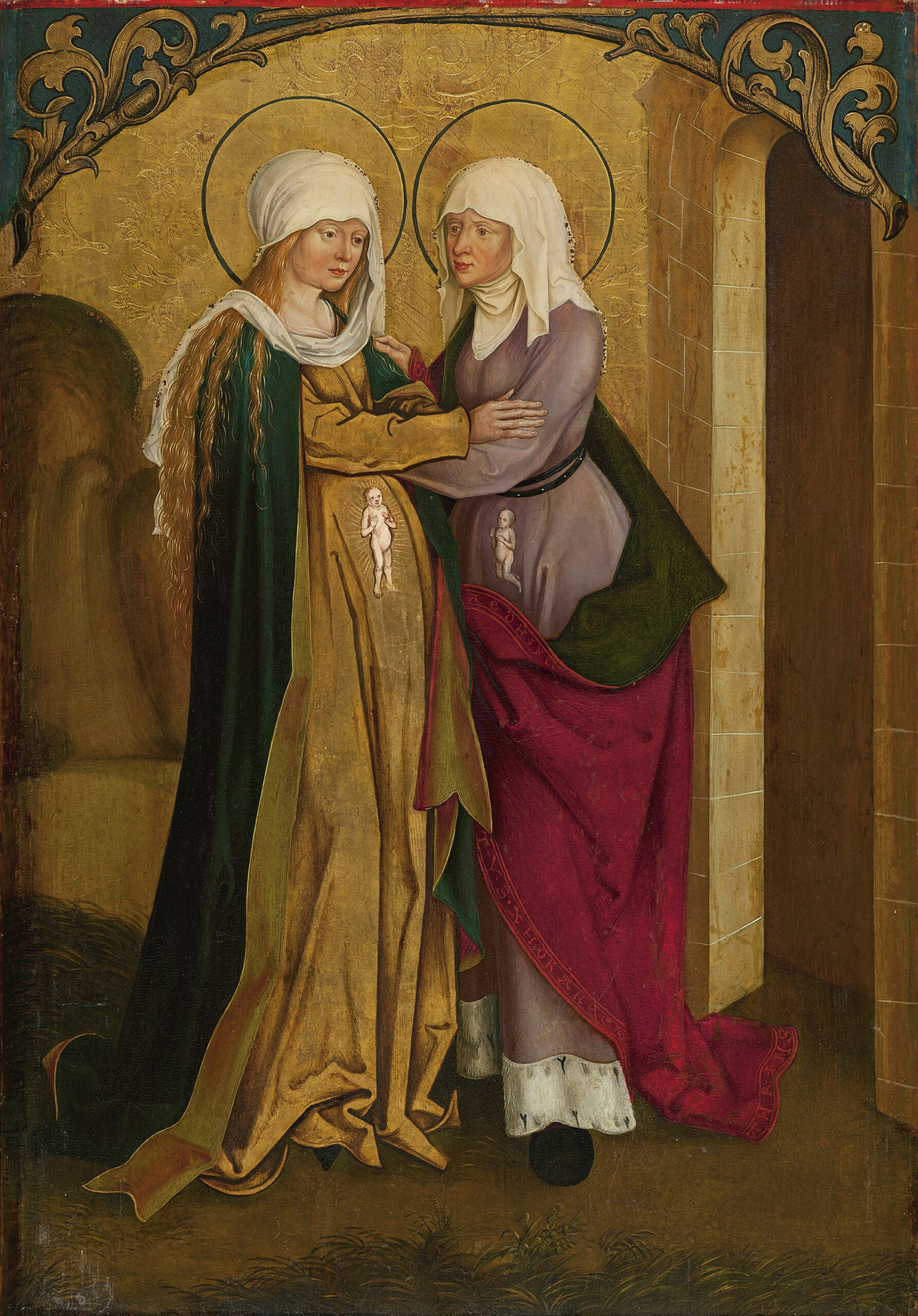
    The Visitation, Jakob and/or Hans Strüb (1505) | Image courtesy the Museo Nacional Thyssen-Bornemisza, Madrid. I like the slightly distant looks in Mary and Elizabeth’s eyes here, as if they are witnessing the expansion of their souls, the meeting of the prophet and the Savior, and the Holy Spirit beside and within them.

    Let’s take a look at Elizabeth’s final words: “Blessed are you who believed that what was spoken to you by the Lord would be fulfilled.” The final piece of the revelation puzzle begins to appear. Our work is trust in the Lord and acceptance of His will. It is Mary’s faith that has made her blessed. Mariologists would quibble here that she was blessed upon her own birth by her virgin mother, in fact blessed by God before time began. But the Holy Spirit is blessing her here for her belief and acceptance of God’s will, for she was granted free will and could have denied the incarnation of Christ offered to her. Thus, blessings come upon Mary (who is us, remember: the Church) when she accepts God’s will; more, even: when she accepts God Himself and allows Him to grow within her.

    We are invited to consider the womb as the reality of our spiritual life here on earth. It is the intersection of our biology and our spirit. Our soul – that invisible and intangible essence within us that allows us to recognize and commune with God – needs to grow, just like the body. Sadly, many of us neglect it. But Christ has shown us the Way. We must empty ourselves of personal ambition and self-centeredness and open ourselves up to the Spirit, to God’s will.

    Elizabeth and Mary are at the heart of God’s revelation of Himself to us because this is precisely how He works through us to achieve our salvation. Just as Mary is the living vessel for God, the Ark of the New Covenant, we are all to become vessels for the Spirit. Indeed, in today’s second reading during the Office of the Readings (part of the Divine Office), St. Irenaeus tells us, “Man is the vessel which receives God’s action and all his wisdom and power” (from Against Heresies). What’s more, we all undergo that mysterious, life-giving process of gestating something new and wondrous within us. Irenaeus continues: “if man perseveres in God’s love, and in obedience and gratitude to him, he will receive greater glory from him. It will be a glory which will grow ever brighter until he takes on the likeness of the one who died for him.” This is our deification, our ability to take our first steps in the Kingdom, imperfectly while still on this earth, but entrance to the Kingdom is indeed promised to us if we follow Christ the Way. What a marvelous plan that uses the very biological processes of gestating and becoming (processes He created, of course) in order to bring about the formation of the soul in the likeness of Christ. Note, though, that this plan is only made possible because of Christ. The Jews “persevered in obedience and gratitude” (off and on) but they still waited for a Messiah to save them. Humanity had no actual way to achieve eternal life or enter the Kingdom of God until Christ. Irenaeus elaborates: “He wanted to invite man to take on his likeness … establishing man in a way of life in obedience to the Father that would lead to the vision of God, and endowing man with power to receive the Father. He is the Word of God who dwelt with man and became the Son of Man to open the way for man to receive God, for God to dwell with man, according to the will of the Father.” To paraphrase Pope John Paul II, we must always remember to view the world through a Christological lens. Nothing makes sense without Him. 

    So, located in this everyday, humble scene of two pregnant women, we find the glowing embers not just of the greatest prophet and the Messiah, but the wisdom of our entire religion. We are all “pregnant” with a soul. While it may seem foreign to us, this thing can be a person, just like pregnancy. We can allow God to inhabit our souls. God can fill us with His glory, helping our souls swell with His love and moving us toward perfect unity with Him and eternal life in the Kingdom. We are all invited to participate in a heavenly womb, at once foreign to us and also something that could not be more personal. If pregnancy is “a time of transition, growth, and profound beginnings,” then the heavenly womb wherein we gestate God in our souls is even moreso. Knowingly or unknowingly, we have been doing this since our own moments of creation, and as we turn to the gospels this Advent, we can recommit ourselves to this work of believing in God, accepting His will in a deeper and deeper way until we can also leap with joy simply to be in His presence.
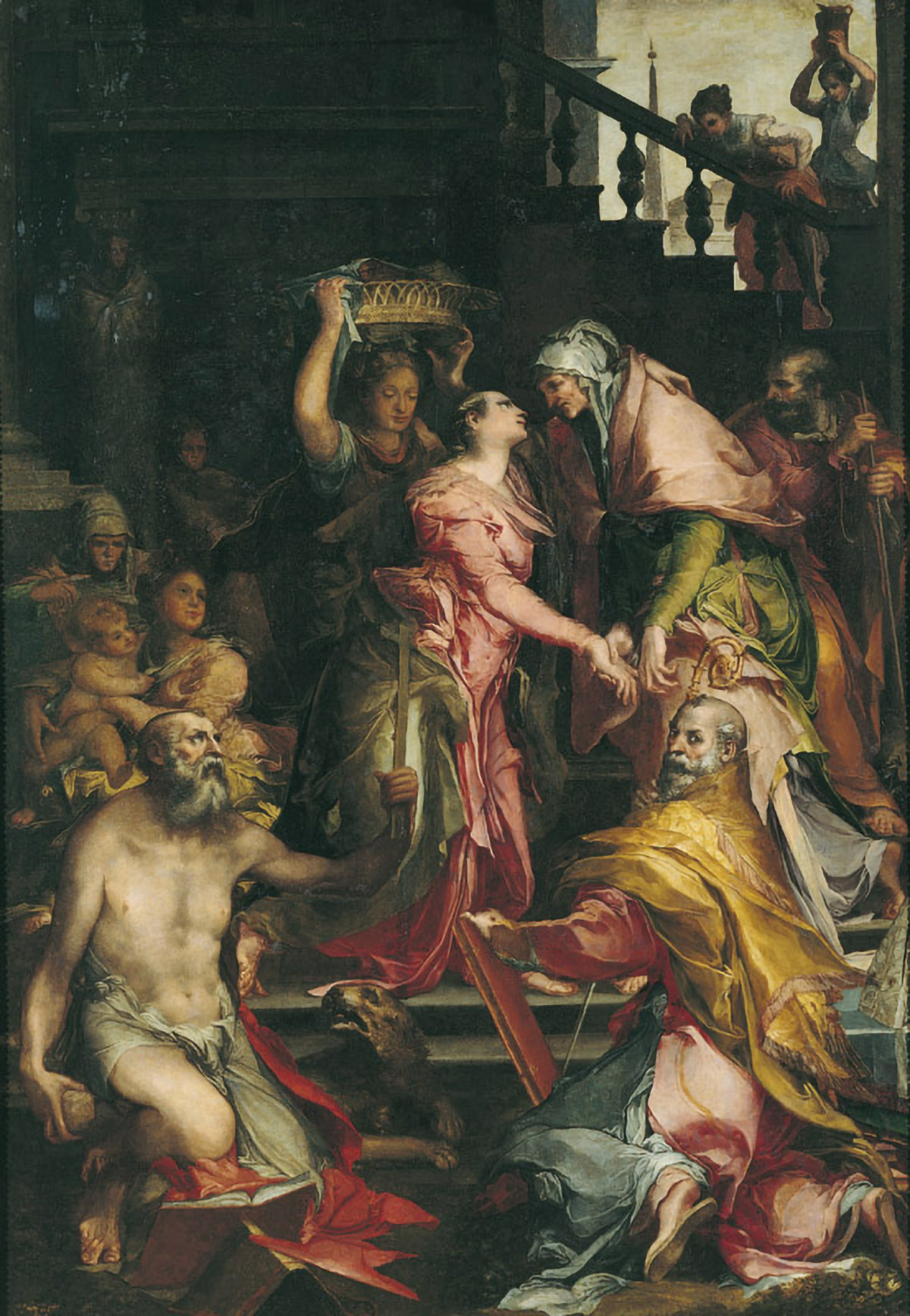
    Visitation of Mary to Saint Elizabeth, Cristoforo Gherardi (c. 1541), currently in the Musée des Augustins, Toulouse | Wikimedia Commons. Note how crowded this scene is as painted by Gherardi. An archetype for the Church, indeed!
  • As Wheat Gathered by the Lord

    Third Sunday of Advent: Zephaniah 3:14-18a, Philippians 4:4-7, Luke 3:10-18.

    Gaudete in Domino semper! These are the first words of today’s second reading and, in fact, the introit (opening chant) for the third Sunday in Advent, marking Gaudete Sunday every year. What does it mean? The Latin translates as “Rejoice in the Lord always,” so we celebrate Rejoice Sunday. Hooray!

    But what is joy, really? St. Thomas Aquinas writes that “joy is caused by love,” either in the presence of something that is loved or having that thing you love achieve it’s proper state of goodness (Summa II-II, q28.1). There is joy in earthly things, but the highest joy is spiritual because the highest form of love is charity (caritas). As St. Thomas writes, “according to 1 John 4:16: ‘He that abideth in charity, abideth in God, and God in him.’ Therefore spiritual joy, which is about God, is caused by charity” (Ibid). There is something circular here, something only the Creator Himself can generate: we rejoice in God always because God is the very charity that creates the joy we have. It boils down to simply allowing ourselves to exist wholly in His generative presence, which is love itself, and which generates the joy we experience.

    Adoration of the Magi (detail), Domenico Ghirlandaio (1488-1489) | Wikimedia Commons.

    As we dig into St. Paul’s exhortation in the second reading, we should note a subtlety to today’s Lectionary translation. We hear today, “Your kindness should be known to all,” but “kindness” is an interesting translation of the original Greek, ἐπιεικὲς (epieikes), which means gentle spirit or gentleness. The Latin Vulgate translation is Modestia vestra nota sit omnibus hominibus, or “let your moderation be known unto all men.” So, we have a key word, epieikes or modestia, which is variously translated as forbearance, gentleness, reasonableness, moderation, and humility. In fact, our Lectionary is the only place I’ve found it translated as kindness. This is a point to consider, especially in the context of what we are called to do and to be. Certainly, our call to love God and then our neighbor as ourselves (simply put, a call to caritas or agape) can manifest itself as kindness. I’m not saying this is a mis-translation. But kindness emphasizes an act that we do – something we call up within us and enact on the world around us. These other words: forbearance, gentleness, moderation, and humility, all emphasize a state of internal calm that radiates through our actions. It is best phrased in perhaps the closest translation, gentle spirit. This emphasizes an internal ordering toward God, a letting go of self rather than an assertion of self. St. Paul is exhorting the Philippians (and all of us) to be known for our gentle spirit. Indeed, in the next sentence he says, “Be anxious about nothing.” This is Christianity on earth: a gentle spirit, anxious about nothing, living in Christ and awaiting His triumphant return; awaiting our own second birth into heaven. This is the essence of Gaudete Sunday, especially.

    This gentle spirit, ordered to and ordered by God, is compatible with St. Thomas’s discussion of joy, too. He writes, “joy is not a virtue distinct from charity, but an act, or effect, of charity” (Summa, II-II, q 28.4). Joy, in other words, is brought about by charity. As stated earlier, when God loves us, joy is the natural effect. Contemplating and living in the Christ event brings this joy back to the surface of our minds. Living in Christ also means allowing God’s love – charity – to flow through us to others. Our gentle spirit can be anxious about nothing as we are rejoicing in God always because we exist within the constant effects of charity.

    This is getting a little abstract and philosophical (as St. Thomas tends to do). Let’s bring it back to the reality of Jesus Christ, man and God, alive on earth. In his excellent apostolic exhortation in 1975, Gaudete in Domino, Pope Paul VI reminds us: “But it is necessary here below to understand properly the secret of the unfathomable joy which dwells in Jesus and which is special to Him. It is especially the Gospel of Saint John that lifts the veil, by giving us the intimate words of the Son of God made man. If Jesus radiates such peace, such assurance, such happiness, such availability, it is by reason of the inexpressible love by which He knows that He is loved by His Father” (III). Pope Paul VI goes on to recount the number of ways John tells us Christ knows the Father and is united with Him: “It is an unceasing and total exchange: ‘All I have is yours and all you have is mine.’ The Father has given the Son the power to judge, the power to dispose of life. It is a mutual indwelling: ‘…I am in the Father and the Father in me….’.” Pope Paul VI’s point is to more clearly flesh out the charity that gives us joy. Perfect charity is the relationship between God the Father and God the Son: “Here there is an uncommunicable relationship of love which is identified with His existence as the Son and which is the secret of the life of the Trinity: the Father is seen here as the one, who gives Himself to the Son, without reserve and without ceasing, in a burst of joyful generosity, and the Son is seen as He who gives Himself in the same way to the Father, in a burst of joyful gratitude, in the Holy Spirit.” And, the best part: “And the disciples and all those who believe in Christ are called to share this joy.” There it is! This is the fullness of what St. Paul means when he says rejoice in the Lord always.

    Christ in Prayer, El Greco (1595-1597) | Wikimedia Commons.

    This (and every) Advent, we remember the anticipation of the world awaiting its Savior. We also anticipate the second coming of Christ. And, finally, we celebrate Christ being here with us already. This third reality is most clearly articulated here on the third Sunday of Advent through St. Paul’s words to the Philippians, who were themselves living in the new reality brought to the Earth through His death and resurrection. Zephaniah, too, in the first reading foresees this age: “the King of Israel, the LORD, is in your midst, you have no further misfortune to fear … Fear not, O Zion, be not discouraged! The LORD, your God, is in your midst, a mighty savior; he will rejoice over you with gladness, and renew you in his love.” What a deep and accurate prophecy! This is the same Word that speaks through St. Paul to the Philippians, a Word that unveils the meaning of the Christ event in the lives of humans. How can we fear misfortunes here on earth when the grave has been conquered and eternal life in Heaven has been offered to us? Humanity’s greatest fear and sadness, that we will cease to exist one day and that life has no meaning beyond the present, has been blown to bits by Christ’s sacrifice. What joy that His love of the Father has provided us a Way to the Kingdom! Rejoice in the Lord always!

    We cannot end this reflection without gazing at the titanic figure of St. John the Baptist, the great prophet, the voice crying out in the wilderness. In the gospel reading, John teaches the crowds to stop being selfish: “share with the person who has none … Stop collecting more than what is prescribed … Do not practice extortion.” Let’s remember that John has felt the effects of charity come to earth; he “leaped for joy” in Elizabeth’s womb when Mary, carrying Jesus, came near. Like a supernova, the child even as an embryo radiated charity upon the world, transforming the hearts of those open to Him. John is so transformed that he spends his life preparing the world for Jesus. What other messianic figure in that day (and there were many, as we know from the historic record) tells his expectant, adulatory followers that he doesn’t want their praise, that “one mightier than I is coming. I am not worthy to loosen the thongs of his sandals”? Only a man who has been transformed by God and holds no stock in worldly things can so thoroughly cast off the mantle that his followers want to place on him. John, filled with the zeal of the Lord, infects his followers with the anticipation of Christ that fills him. What’s more, this anticipation is not just one of looking and waiting but one that paves the way for charity. He tells them to stop being selfish while they wait so that they can prepare themselves for the more radical baptism in the Spirit that Jesus will bring to them. If they can repent, strip away their concern for worldly pleasure and security, they will create fertile ground for the message Christ brings.

    Preaching of St. John the Baptist, Domenico Ghirlandaio (1486-1490) | Wikimedia Commons.

    I choose the agricultural metaphor purposely, because John, in his brilliance as a prophet, does the same. Let us concentrate on these final words of the gospel reading as John describes Christ: “His winnowing fan is in his hand to clear his threshing floor and to gather the wheat into his barn, but the chaff he will burn with unquenchable fire.” On the most obvious level, the metaphor is one his listeners can understand given the tools and occupation common to their time and place. A winnowing fan is used at the harvest to separate the good grain from the husks, dust, stalks and other “chaff” that do not serve as food. Metaphorically, the wheat are those who please God while the evil ones are the chaff. The harvester is Christ, the one who brings the final judgment. But the metaphor is agricultural particularly because it involves growth and harvest. He could have used a metaphor of a builder choosing strong stones instead of weak ones, or any number of other metaphors. But this one reminds us that life is at stake. First, life is implicated because we can grow into wheat or dead stalks. This is a living process in which we are bound up. Second, life is at stake because the wheat will go on to a greater life (gathered into the barn, or kingdom of Heaven) while the chaff will be burned in unquenchable fire. Finally, the third and most intricate reading here is to consider what the life of mature wheat is. Wheat feeds us, it is nourishment, it is an offering of life. Literally, it forms the grain offering, the minchah, that is prescribed in the Book of Leviticus where the finest parts of the grain, the semolina, are offered to God, either ground, cooked, or burnt. This is our destiny, to feed others, and to be an offering of life to the Father. Our greatest destiny and goal is to be gathered like wheat to the Father where we cease living simply for ourselves (that is, to grow nice, fat grains on the stalk). The mature wheat, having been grown rejoicing in the charity of God, achieves its ultimate purpose: to nourish others and be an offering to God Himself. Astounding depth in a simple metaphor!

    And this is why John must begin the process by having us turn our mindset away from self and towards others. Our ultimate purpose, revealed through Christ, is to grow into something great with a purpose beyond us. If we allow ourselves to rejoice in the Lord always, to be fully caught up in His love, we just might achieve it.

    Wheat, Thomas Hart Benton (1967) | Image courtesy the Smithsonian American Art Museum.
  • The Comprehensive Way

    Second Sunday of Advent: Baruch 5:1-9, Philippians 1:4-6, 8-11, Luke 3:1-6

    It’s a phrase familiar to us: the valleys shall be filled and the hills made low. We hear it from St. Luke and Baruch in today’s readings and, of course, Isaiah, whom Luke quotes. On a purely aesthetic level, my reaction is a bit of dismay; I like mountains and valleys – they’re a magnificent part of God’s creation. But this might be part of the point – they are striking features of this world, but the Savior’s reign is not of this world. It is incomprehensibly greater and more difficult for us to imagine, much less get to. That’s the point in a nutshell: by leveling mountains and valleys, God makes the Kingdom accessible. He gives us a way to come to Him, a way specifically embodied in Jesus Christ.

    As we dig into the syntax and phrasing of Luke’s gospel, we’ll see that there are more layers to this message that speak to the role we play and the role God plays. We begin to see the genius of this image and the crystalline truth to Jesus’s words to St. Thomas as recorded by St. John, “I am the way, and the truth, and the life. No one comes to the Father except through me” (Jn 14:6).

    But first, let’s turn our attention to the prophecy in the book of Baruch, in the past seen as either a part of Jeremiah’s prophetic books, a stand-alone book written by Jeremiah’s scribe, or a text closely fitting near Jeremiah and Lamentations (incidentally, Baruch is not a part of the Protestant Bible or the Hebrew Bible, but was included in the Catholic canon as early as the mid-300s by Church Fathers like Athanasius and Cyril of Jerusalem). The prophet is directly addressing the people of faith, whom he calls “Jerusalem.” This word cannot be separated from the holy place, however, where the Jews placed their great temple, the dwelling place for God. Thus, Jerusalem is both a people and a holy place, which is why the Catholic Church teaches that the new Jerusalem is the Church herself, both a temple to God and the people of God. With this in mind, we hear the prophet say: “Jerusalem, take off your robe of mourning and misery; put on the splendor of glory from God forever: wrapped in the cloak of justice from God, bear on your head the mitre that displays the glory of the eternal name.” Note that we are hearing instructions for how to present ourselves. There is preparation happening (as we live out during this liturgical season) and that preparation takes a specific form: wrapping ourselves in the cloak of God and the ceremonial headdress (mitre) that has God’s name upon it. This means we are to proclaim ourselves as belonging to God, proudly and loudly. Note, too, that we might call this a way of presenting ourselves, and we can start to see another facet of how Christ is the Way.

    Young Man with a Mitre, Pieter van Mol (1611-1650) | Wikimedia Commons.

    Next, we hear the prophet speak in the future tense about Jerusalem and we must understand that there is an eschatological meaning here; in other words, the future being proclaimed is the final meeting of humanity and God: “For God will show all the earth your splendor: you will be named by God forever the peace of justice, the glory of God’s worship.” This is a great promise, that God will show all the earth the splendor of His faithful. And it reminds us that while we can proudly present ourselves as belonging to Him, the reason we can do this is that the real action is His. He, in fact, lifts us up. He is the agent of salvation, we are His subjects. And so the prophet commands: “Up, Jerusalem! stand upon the heights; look to the east and see your children gathered from the east and the west at the word of the Holy One, rejoicing that they are remembered by God.” What a great Advent message we hear the Jewish prophet declare hundreds of years before the birth of Christ. We present ourselves as God’s faithful, we look to the east (the direction of the rising sun and the Son of God, the Morning Star) and we see there that God has expanded His salvation to all humanity. And now the great image: “For God has commanded that every lofty mountain be made low, and that the age-old depths and gorges be filled to level ground, that Israel may advance secure in the glory of God.” By now we realize that these physical landforms are to be understood within a different context: not the earthly but the heavenly kingdom. The valleys are the low spots of the spiritual journey, the mountains are the seemingly impassible obstacles the soul faces on its journey to God. God’s work is to level the spiritual ground, to give us a way to Him, clear and straight. This Way, of course, is Jesus Christ.

    St. John makes this clear in the Book of Revelation: “I saw the holy city, the new Jerusalem, coming down out of heaven from God. It was prepared like a bride dressed for her husband. And I heard a loud voice from the throne, saying, ‘Now God’s presence is with people, and he will live with them, and they will be his people. God himself will be with them and will be their God. He will wipe away every tear from their eyes, and there will be no more death, sadness, crying, or pain, because all the old ways are gone’” (Rev 21:2-4). The new Jerusalem, the very one that God spoke about with the prophet Baruch, is shown to St. John. Jerusalem (the city, the people) has prepared itself and dressed itself with the glory of God, like a bride dressed for her husband. And in this ecstatic vision of completeness, God is there, establishing a new reality for humanity in His kingdom, one without death, sadness, crying or pain. The book of Revelation is the vision of the Church having made her way across the straightened path to be united with God.

    Armenian icon of the New Jerusalem (1645) | Wikimedia Commons. The description reads: “The Angel shows Saint John the Celestial Jerusalem, a vision which constitutes the triumphal completion of the Apocalypse.”

    In the gospel, St. Luke makes the effort to explain that John the Baptist arrives in the world in a very specific time and place. He mentions Caesar, Pontius Pilate, Herod, Annas and Caiaphas. Why might he do this? Because he wants to emphasize that well-known prophecies are being realized on earth in a real way. This is an important shift in the eyes of the Church from one age to another; from the Time of the Promises to the Last Times. So John the Baptist is recognized immediately as the one whom Isaiah prophesied: “A voice of one crying out in the desert: ‘Prepare the way of the Lord, make straight his paths.’” This preparation, this initial way we prepare ourselves, is a deeper explanation of what Baruch sees. Baruch commands the faithful to stand up proudly and wrap themselves in the cloak of God’s glory. But in practical terms, how can a sinner do this? John the Baptist, in announcing Christ, shares the first part of His Way: “John went throughout the whole region of the Jordan, proclaiming a baptism of repentance for the forgiveness of sins.” This is part of what it means to wear an ornamental headdress with God’s name on it, to proclaim yourself as His – we must repent of our sinfulness, ask for His forgiveness, be baptized, that is consecrated, to Him. The Way has begun. This is how John can exhort us to “make straight his paths,” which is to make straight within ourselves the spiritual righteousness for which God designed us. This act of getting our spiritual house in order is just the beginning of the Way, but frankly something most of us spend the greater part of our lives trying to accomplish. It’s okay, we’re still on the Way.

    The gospel reading ends with the final words of the prophecy: “Every valley shall be filled and every mountain and hill shall be made low. The winding roads shall be made straight, and the rough ways made smooth, and all flesh shall see the salvation of God.”  It’s important to see the shift in agency here. We are the agents of making straight God’s paths within ourselves, which is a matter of repentance and consecration of ourselves to God, but God is the one who does the work of filling valleys and making low mountains. This is important because we can’t think that Christianity is about us building the City of God. This work of redemption and the salvation of the New Jerusalem is entirely God’s will and only He has the power to accomplish it. We can’t be pulled in by overly charismatic communities here on earth who congratulate each other on their great work. This is a dangerous road of making idols out of our own work and clinging to this world. We must be on the Way to God, toward the spiritual kingdom that we neither deserve nor can earn nor can build. Humility is at the heart (which is why John preaches repentance and why Advent is considered a penitential season of preparation). St. Luke tells us later in this chapter that Jesus is identified as this one whom we have been preparing for. He is the salvation of God whom “all flesh shall see.” This is the importance of the incarnation of God in the flesh. He has come in a form we can see and touch, in our form, and He is the one who will straighten and smooth the Way to God.

    The Way. This was perhaps the most difficult thing for me to grasp when I was a child because its so abstract. I could see Jesus as the Truth (He always proclaims the truth since He’s the very Word of God), and I could see the Life because of the Resurrection. But the Way seemed a bit weird – He’s a human, not a dirt path! As I’ve reflected upon this over the years, however, I realize that the Way is both a path and a way of acting or comporting oneself. Plus, I realized that Christ can transcend normal boundaries like He does in the Mass when being present in the Liturgy of the Word and in the signs of the bread and wine. He is perhaps more easily understood as the Way in the fact that He provides a perfect example by which we can model our lives and behavior. But more than that He is a Way in that we walk upon Him, His body that He laid down for us; we feed spiritually upon Him in the Eucharist; we gain adopted sonship and daughtership to God the Father through His incarnation; and we walk through His empty tomb to our own Resurrections that He made possible. There is no humiliation and condescension He will not bear for us. These more mystical and spiritual Ways are so much more profound than the role modeling Way because they bridge this world and the next. They are the heart of our faith and hope. The Way is much more complex and complete than I ever realized.

    Mosaic of Christ Pantocrator (“ruler over all”) from the Hagia Sophia in Istanbul, Turkey (1261) | Wikimedia Commons.
  • Creation and Incarnation

    Creation and Incarnation

    The Solemnity of the Annunciation of the Lord: Isaiah 7:10-14, 8:10, Hebrews 10:4-10, Luke 1:26-38.

    Today’s readings should be very familiar to us. We hear God promise the virgin birth and the name Emmanuel, we hear St. Paul tell us that “the offering of the Body of Jesus Christ once for all” has taken the place of all the lesser animal sacrifices done in the Jewish tradition, and we hear St. Luke’s amazing account of Gabriel announcing to Mary that she will give birth to the Messiah.

    I’ve already written three reflections on this gospel reading: Our Blessed Kecharitōmenē, Our New Eve, and A House for Our Lord to Dwell. Mary is indeed full of grace and the worthy Ark of the New Covenant.

    The Annunciation (1915), Helena Vurnik | Image from the National Gallery of Slovenia.

    I don’t know that I have much to add to the volumes that have been written on this fundamental aspect of our faith, and I’ll keep this reflection short. One thing jumped out at me as I studied a few different commentaries and books on this subject: Mary actively participates in the same creative act that God undertakes at the beginning of time. The Incarnation is another Creation.

    This might seem terribly obvious, and if so, my apologies. But consider how Fr. Jean Corbon, OP, writes about this moment in the Annunciation: “the humble maidservant can respond to the message with all her being and in the very words that her Lord used at the beginning of time: ‘Let it be!’ (Lk 1:38 and Gen 1:3)” (Wellspring of Worship, 37).

    What Corbon references here is the Greek verb γίνομαι (gínomai), which is used in Genesis when God says “Let there be light” and there was light. The Greek translation of the Hebrew is theos gínomai phōs kai gínomai phōs. A more literal translation is “God said “become” light and light came into being. The verb gínomai is roughly translated as our verb “to be,” but it’s more properly “to become” or “to receive being.”

    It’s fairly complex, which is why Thayer’s Greek Lexicon spends over 2,460 words to describe it in their entry for gínomai. But suffice it to say that when we read Mary’s great “Yes” to God at the Annunciation, we encounter something special when the Greek says, genoito moi, which our Lectionary translates as “May it be done to me,” although she is really uttering a different voicing of the same gínomai uttered by God at the Creation of the world.

    This is why the King James Version of the Bible has it translated as “Be it to me,” which, for all its awkwardness, gets to the point of what Corbon is saying: humble Mary uses the very words her Lord used at the beginning of time, “Let it be.”

    Why is this important? Well, it’s difficult to overstress that a new creation is happening as God joins Himself to humanity. This perfect merging of the divine essence with the human mind and body is something never accomplished before or since, and it has ramifications for history both before and since.

    As Corbon writes, “The age of the mysterious ‘synergy’ between the river of life and the world of the flesh has begun; in the new creation every conception will henceforth be virginal … After the synergy of this first Pentecost, everything is unmerited and personal, everything a manifestation of the Spirit’s power … Henceforth, everything fleshly is permeated by the energy of love” (38).

    There is a lot to meditate upon in these words. The cornerstone of our faith is who Jesus is. He is the Son of God, one with God, and yet also a man. He is immortal, but took on mortality so he could die and rise (for immortality cannot die), thus transforming humanity because of this experience. Without this belief in the divine nature of Jesus, we do not have the Christian faith and humanity has not been transformed. The Annunciation as a moment of new creation is absolutely indispensable to our faith.

    In the previous quote from Corbon, he references the “first Pentecost,” that is, the first time the Spirit is poured out, emptied out in a kenosis, upon humanity. I am struck by how powerfully Corbon describes the action of the Spirit in the Incarnation of Jesus Christ. He writes:

    Mary says “Yes”, and the Spirit who unites the Word and the Yes, divine energy and human energy, gift and acceptance, comes upon her. The Spirit of the Father is the one who crafts this Covenant, fulfilled at last, between the Word and flesh. In the first creation all that exists is “called from nothingness to being”. In the new creation that is beginning here, he who is eternally begotten of the Father is fashioned out of living earth, namely, the entire being of his mother … He who is to be born of the Daughter of Zion has been conceived not by any “will of man” or by any set of determining causes but by the power of the Holy Spirit  (37-38).

    I appreciate both his insistence upon the Holy Spirit as the one who is at work in Mary (as the angel Gabriel explains, “The Holy Spirit will come upon you, and the power of the Most High will overshadow you”) as well as the difference between the first creation and this new creation. God creates from nothing in the first creation. It is his power alone that makes gínomai happen. But in this second creation, He has a raw material to join to his gínomai — a raw material that is made from dust but is illuminated with the breath of the Spirit already.

    Like an errant breeze corralled back into the tornado of God’s Spirit, humanity is joined again to its source and is able to utter a gínomai alongside her maker. It is still God’s power alone through the Holy Spirit that makes the Incarnation happen, but Mary is able to participate in a way that no part of Creation has ever been able to participate. Her free will, granted by God and guided by holiness, forms the participatory force in this new creation; likewise, her body provides the participatory substance for this new creation.

    Annunciation (Annunciazione), c.1435, Fra Angelico | Wikimedia Commons.

    Nothing can overshadow the great outpouring of love in the form of the Holy Spirit at the Incarnation — that God should stoop so low as to become one of us out of love for us is simply staggering. This is hinted at by Gabriel: “[He] will overshadow you.” But let us also recognize that Mary performs her own kenosis of spirit by yielding completely to the will of the Father. It is this synergy, this union of love pouring out one for the other in both directions, that enables the new creation to happen. This has become humanity’s model for unity with God; something we can all recognize, strive for, and pray to the Virgin to help us achieve.

    Let no one pass off the Annunciation as an unnecessary Christian myth. This deepest of encounters between God and humanity is the bedrock of our salvation!

  • The Jesus Prayer

    The Jesus Prayer

    Saturday in the Third Week of Lent: Hosea 6:1-6, Luke 18: 9-14.

    Today’s readings seem to be about us — about our fidelity and about how we pray. But just under the surface, they reveal themselves to be all about Jesus Christ, body and soul, as befits prayer itself. Reflecting on these readings, it is easy to see how the short Jesus prayer has become such a mainstay of the Church (especially the Eastern Orthodox Churches).

    In the reading from Hosea, we hear the Word of God promise his coming through the mouth of the prophet: “on the third day he will raise us up, to live in his presence.” This reference to the world-changing Resurrection of Christ is joined by a call to action on our part. Hosea says, “Let us know, let us strive to know the LORD.” I love this little repetition and reframing. We want to know the Lord but also that we may never truly fathom Him. The emphasis turns to striving to know the Lord. This effort shows our pure intentions, our focus, our dedication to God, and the way we enact this striving to know the Lord is through prayer.

    God speaks to this very thing through Hosea: “For it is love that I desire, not sacrifice, and knowledge of God rather than burnt offerings.” He wants us to want him. He wants us to love him and know him, certainly more than burnt offerings and ritual sacrifice. Ours is a God who wants a personal relationship with us, deeper than any other relationship we can forge on earth.

    I love the poetry of the scriptures, too. Hosea uses some wonderful imagery to urge us into right relationship with God: “as certain as the dawn is his coming, and his judgment shines forth like the light of day!” I love the prophet’s faith. I love that the Lord’s coming is as “certain as the dawn.” This is unshakable faith, for what do we rely on more than the changing of night into day? And the light that he brings is his judgment, his Truth, aka Jesus Christ, the Word of God in the flesh.

    In another life-giving image, Hosea tells us, “He will come to us like the rain, like spring rain that waters the earth.” We will hear from many prophets and Christ himself how physical thirst and spiritual thirst are conjoined. Jesus will perfect Hosea’s prophecy: “but those who drink of the water that I will give them will never be thirsty. The water that I will give will become in them a spring of water gushing up to eternal life” (John 4:14). Yes, he will come to us like spring rain that waters the earth.

    The reading from Hosea is a call to anticipate God’s coming in Christ and to strive to know him. How else do we do this other than prayer?

    Dawn (1896), Jules Breton | Wikimedia Commons. This work beautifully expresses Hosea’s message. The dawn arrives and we are expected to be at work, bringing the harvested wheat (souls brought to Christ) and “living water” of Christ to the world.

     Jesus addresses the question of prayer head-on in the gospel reading comparing the prayer of the Pharisee to that of the tax collector. Jesus describes the Pharisees’ showy devotion that lacks a sincere love of God in their hearts. The Pharisee in the parable “takes up his position” in the temple, which was undoubtedly one where he could be seen clearly, and “spoke this prayer to himself.” This is a huge clue that something’s backward; prayer is always offered to God and spoken to God, whether audibly or inaudibly. The Pharisee is primarily self-focused.

    After a cursory “O God” to start, we hear the Pharisee speak of himself during the whole prayer, contrasting his law-abiding deeds with “the rest of humanity — greedy, dishonest, adulterous.” Let’s note that his window on the world, himself included, is one of judgment. Jesus is clear about not being judgmental: “Do not judge, so that you may not be judged” (Mt 7:1). We all know people who are consumed with judging themselves and others (we probably fall into this camp ourselves at times). It is simply not compatible with being a Christian. Judging the worth of another being is something that rightfully belongs only to God. Furthermore, we know that he judges us all to be worth forgiving, worth saving, worth His love. We are asked to follow his lead and offer nothing but his love to the rest of Creation. 

    The Pharisee and the Publican (1661), Barent Fabritius | Image from oceansbridge.com.

    The next item to note about the Pharisee’s off-kilter prayer is how much he speaks of himself as the agent of action. What a marvelous command of grammatical structure Jesus uses to display the self-centeredness of the Pharisee. Four times we hear the Pharisee put himself as the first person subject of phrases in his prayer: “I thank you,” “I am not like,” “I fast,” and “I pay tithes.” The Pharisee has so sublimated his own sense of self-worth that, apart from being the subject of the phrases, he places himself as the grammatical agent (meaning the cause and initiator of action). This semantic idea is a great way for Jesus to make his point: it’s not just the empty show of devotion that makes the Pharisee a hypocrite, it’s his lack of conversion of heart to place the Lord first, the agent of all. This almost unconscious grammatical structuring of his prayer belies the deep perversion and reversal of order in his being. 

    Let’s compare this with what Jesus tells us about the tax collector: “But the tax collector stood off at a distance and would not even raise his eyes to heaven but beat his breast and prayed, ‘O God, be merciful to me a sinner.’” We hear much about his physical bearing — standing off, eyes lowered, beating his breast. This is the stance of supplication. It reminds us of the great supplication offered for days by Esther in order to save the Israelites in Babylonia (see the reflection Esther: Model of How to Petition the Father) and of Hananiah, Azariah, and Mishael in Nebuchadnezzar’s fiery furnace.

    The tax collector’s prayer itself is so fundamentally correct that it forms the proto-Jesus Prayer. In this prayer, Jesus gives us another example of how to pray correctly (in addition to the Lord’s Prayer, of course). Let’s dissect it: the tax collector approaches in supplication, addresses God as the agent of action in the world (he says “merciful to me,” and as such he is the object of action, not the agent), and identifies himself as a sinner in need of mercy. And as we reflected this week, mercy is the way of the Kingdom, the currency of the economy of love. Jesus wants us to “pay forward” the mercy God gives us by forgiving “seventy times seven” times (i.e., infinitely). Acknowledging that we need God’s mercy is the first step in becoming more God-like and offering His mercy to others.

    The Pharisee and the Publican (1864), Artist: After Sir John Everett Millais, Engraved and Printed by Dalziel Brothers | Creative Commons, courtesy The Metropolitan Museum of Art.

    Today’s most common form of the Jesus Prayer is, “Lord Jesus Christ, Son of God, have mercy on me, a sinner.” We can see the marriage of today’s two readings — Hosea’s striving to know God who rises on the third day and the tax collector’s humble prayer for mercy. Praying to the second Person of the Trinity, our great high priest and chief intercessor who descended to earth to dwell and suffer with us, is a key gift in our Christian lives. The Catechism of the Catholic Church teaches us, “The name ‘Jesus’ contains all: God and man and the whole economy of creation and salvation. To pray ‘Jesus’ is to invoke him and to call him within us. His name is the only one that contains the presence it signifies” (2666).

    Thus, the Jesus Prayer unites the same correctness of prayer we find in the tax collector with the new reality that Christ brought to history with his death and Resurrection. The Jesus Prayer is powerful and draws us deeper into the mystery of being a part of the Church.

    “When the holy name is repeated often by a humbly attentive heart, the prayer is not lost by heaping up empty phrases, but holds fast to the word and ‘brings forth fruit with patience.’ This prayer is possible ‘at all times’ because it is not one occupation among others but the only occupation: that of loving God, which animates and transfigures every action in Christ Jesus” (CCC, 2668).

    I can testify that I’ve come to a much deeper appreciation of the Jesus Prayer in my own prayer life. I use it often when I find myself not concentrating during the Mass to bring myself back to the sacrifice at the altar. I use it when in Adoration, contemplating the mysteries of our Savior, and I use it now and again during the day when I need to remind myself of my purpose and my center: Christ.

    What better time than Lent, in its stillness and silence, to repeat the Jesus Prayer and let it sink in to transform our hearts? Let us take the Church’s instruction to pray in Jesus’s name as we ask God for mercy in the light of our infidelities and sins.

    For we know, as certain as the dawn, He will come.

  • The Scattered People

    The Scattered People

    Thursday of the Third Week in Lent: Jeremiah 7:23-28, Luke 11:14-23.

    In today’s readings, we hear a lament from Jeremiah about the faithlessness of the Jewish people coupled with a gospel reading where Jesus’s exorcism of demons is met with skepticism. I am struck by a few things: the reluctance of humanity to accept God’s guidance and help as well as the stubbornness of humanity in believing we know what’s true and what’s not.

    But what jumps out at me most today are the final words from Jesus: “whoever does not gather with me scatters.” This tells us much about what God is trying to do and why. He offers us unity, and in unity, strength to rebuff the devil. This is the action of the Good Shepherd, to gather the sheep and save them from being scattered (which is the action of the wolf/devil).

    The Word of God today provides the logic of establishing the Church, and it is a fantastic lesson of love for humans caught in a spiritual battle with the forces of the devil.

    The Good Shepherd, 19th Century Russian Icon | Wikimedia Commons.

    In the gospel reading, Jesus drives out “a demon that was mute” and the man who was possessed begins to speak. Skeptics said, “By the power of Beelzebul, the prince of demons, he drives out demons.” In some ways, we can all identify with these skeptics. Charlatans and carnival tricks are nothing new — in fact, Jesus and later the Apostles warn Christians about being taken in by charlatans pretending to be sent from God. In our science-driven age, we are taught to mistrust things until they are examined thoroughly and (dis)proven via the scientific method (or Sherlock Holmes-level sleuthing).

    This is an unavoidable reaction to miracles, which is why true miracles, especially those accomplished by Christ, always have a greater divine purpose than just “amazing” people. Every miracle done by Christ primarily serves to point to his own divinity as the Son of God come to earth, but each also has a deeper spiritual lesson. Today, the demon is mute, and we learn something about freeing our lips in response to God’s presence in our lives.

    Jesus delivers his lesson in response to lips that have been freed by things other than God — namely, worldly mistrust, which has its origin in the serpent in the Garden of Eden. He points out the ridiculousness of their logic: “Every kingdom divided against itself will be laid waste and house will fall against house. And if Satan is divided against himself, how will his kingdom stand?” He is pointing out that Satan is always seeking to divide and pervert humanity, and that he would never come to the aid of a human to heal another human. It is against his nature and what’s more, he could not maintain “his kingdom” on earth if half the time he was helping humans and the other half he was harming them. No, Satan would never be party to his own undoing. 

    After dispelling their logic, Jesus proclaims, “But if it is by the finger of God that I drive out demons, then the Kingdom of God has come upon you.” He wants them to be open to the possibility of the truth in front of them. It’s an interesting, patient way of engaging them. He acknowledges their skepticism but points out their flawed logic. He opens the possibility of the Kingdom of God having come upon them.

    Then he talks about Satan as a strong man, fully armed and guarding his possessions (humans). Jesus accepts their belief in Satan as someone so strong he can work wonders on earth and then trumps it completely. He says, “But when one stronger than he attacks and overcomes him, he takes away the armor on which he relied and distributes the spoils.” This is the Lord on earth, pointing out that Satan can never stand in the Face of God. 

    Then comes the line that jumps out at me: “Whoever is not with me is against me, and whoever does not gather with me scatters.” The first half of this sentence is stark and absolute. It makes me shudder a bit because it has been used since 2001 in reference to our “war on terror” (first by Hilary Clinton, then George W. Bush; more recently by Turkish President Recep Tayyip Erdoğan).

    The great difference, of course, lies in Christ’s actions and in the second half of the sentence. Christ heals, Christ loves, Christ sacrifices himself, and Christ gathers his sheep. Our political figures use this phrase when employing aggressive campaigns of violence, essentially the work of the devil in the world even if it is sold as “for the greater good.” These statements may upset some people, but Christ is unequivocal in his teaching to uphold the commandments (you shall not kill); everything he does nurtures and builds up humanity so that we can find our way to God.

    If everything Jesus does as the Way, the Truth and the Light is to gather and bring people to God, anyone who is not helping in this work is truly against that gathering action. This is why he says, “whoever does not gather with me scatters.” There are two main ways that “scattering” is used in the New Testament. In the positive sense, we read about seed being scattered in the Parable of the Sower (“the seed is God’s word,” Jesus tells us). The Greek word here is related to sowing/planting: σπείρειν (speirein). But there is another, negative sense of scattering that means to waste something, disperse it, or dissipate it. This is an entirely different word, which we encounter here in today’s gospel: σκορπίζει (skorpizei). The root word here is skorpios, or scorpion — clearly a negative connotation, and possibly the connection is the concept of penetration or the way scorpions scatter when you come upon them. 

    Scorpion Oil Painting (2010), Fabrizio Cassetta | Image from fineartamerica.com.

    It does make me think about the way the devil operates in the world, this skorpios scattering. He works by tempting us, inflating our pride, making us operate solely out of selfish concerns. Looking at humanity from the 100,000-foot view, we see a mass of scorpions lashing out at one another’s dignity, each on his or her own self-determined path. The prince of the world thrives on us being scattered and without a purpose greater than our own selfish desires.

    God provides us with the great antidote to the scorpion’s venom in the form of His Son. This new Way, this brilliant Light, is a uniting force that gathers us to work together as we honor the Father. Indeed, one of Jesus’s other references to skorpios scattering occurs in the Parable of the Good Shepherd: 

    Very truly, I tell you, I am the gate for the sheep. … Whoever enters by me will be saved, and will come in and go out and find pasture. … I am the good shepherd. The good shepherd lays down his life for the sheep. The hired hand, who is not the shepherd and does not own the sheep, sees the wolf coming and leaves the sheep and runs away—and the wolf snatches them and scatters [skorpizei] them. (Jn 10:7, 9, 11-12)

    Here the devil (the wolf) is much more clearly identified with the skorpios scattering. And Christ the Good Shepherd protects us from Satan’s scattering by not leaving his sheep, by laying down his very life (which allowed him to vanquish Satan and death in Hell). We also see a clear connection to today’s reading in Luke where Jesus says “whoever does not gather with me scatters.” Jesus is completely consistent across all gospel accounts: his action is to gather the sheep, the Children of God, to himself so that through him (the gate), they can enter the Kingdom.

    What he tells his listeners today is that their response to him has eschatological implications. If they believe in him as the Son of God and follow his Way of gathering, then they are with him and have access to the Kingdom of God. On the other hand, if they are skeptical — worse yet, if they encourage others not to believe in him — then they have joined the devil in his work of scattering humanity.

    Scorpion (2008), Aarron Laidig | Image from fineartamerica.com.

    This brings us back to the mute man being given his voice in this miraculous exorcism. God always lets us have our voice, our free will. By giving this man his voice and engaging the skeptics in their arguments, Jesus is posing the question to us: what will you use your voice for? Will you join him in gathering people to the Way? Or will you join the devil in scattering people away from the Kingdom? The choice is yours.

    One last item: we can start to understand the divine logic behind the Church as the mystical Body of Christ, still at work in the world gathering humanity and providing a Way to the Father. Christ very deliberately establishes the Church and from the Apostolic Age onward, our saints and doctors of the Church have rigorously defended the need for the Church to remain united despite evils from within and without. The unity of the Church in its spiritual mission as the Body of Christ means that either we are with it in gathering people to God or we are against it in our scattering effect with the devil. May all Christian denominations understand this fundamental concept and find their way back to the one, universal Catholic Church.

  • The Unexpectedly Common

    The Unexpectedly Common

    Monday of the Third Week of Lent: 2 Kings 5:1-15ab, Luke 4:24-30.

    You’ve likely heard the adage that God works in mysterious ways. Today’s readings put a finer point on this: God ways are mysterious because they paradoxically appear to be common. Another way to say this is that God uses the things and people we know (or think we know) to enact his will in the world. This is unexpected because we expect something more flashy, more glorious.

    Oddly, we see people in both the Old and New Testaments reacting with anger when they are faced with this unexpectedly common appearance of divine will in the world. Isn’t that a bit odd? To get angry? I’d like to explore the significance of this instance of God’s plan and our reactions to it.

    God the Father with Angels, medallion, ceiling of the Stanza dell’Incendio di Borgo, Vatican City (c. 1510),
    Pietro Perugino | Wikimedia Commons.

    I particularly like the reading from the second Book of Kings because it reveals that our God is truly a God of all Creation, blessing people other than the Israelites. We might get a skewed conception of God, given our scriptural lens into God’s actions with his Chosen People. Yes, the story of humanity’s salvation lies in the Jewish people and then Christianity, but we can never allow our understanding to delimit God in any way.

    Jesus tells us that no one knows the Father except the Son, and many Doctors and saints have affirmed that God is unknowable. St. John of Damascus puts it well: “God is infinite and incomprehensible and all that is comprehensible about Him is His infinity and incomprehensibility” (On the Orthodox Faith).

    In my mind, it’s a good little jolt of remembering not to limit God when we read today that he “had brought victory to Aram” through the military commander Naaman. His reach is limitless, his love is limitless, and those outside of the Jewish nation have undoubtedly played a big role in revealing God to all the nations (as Jesus points out in the gospel reading).

    After hearing how the holder of secular power, the king of Israel, is sent into a paranoid fit at the appearance of Naaman from his powerful neighbors, Naaman finds his way to the true spiritual power of the Chosen People: the prophet Elisha. Here is the crux of the meeting: “Naaman came with his horses and chariots and stopped at the door of Elisha’s house. The prophet sent him the message: ‘Go and wash seven times in the Jordan, and your flesh will heal, and you will be clean.’”

    Note the scene: a big entourage of military might arrives at the prophet’s house and Elisha doesn’t even come outside to greet them. Elisha “sent him the message,” likely via a servant, and the message is almost offhand: “go dunk in the local river Jordan.” We can start to understand why Naaman got angry. It’s a problem of appearances.

    Naaman feels disrespected because Elisha doesn’t even appear before him. There is no ceremony, no waving of hands and calling out loudly to the Lord for healing. And the river Jordan isn’t a crystal clear mountain spring or even very big and mighty. All “signs” point to disappointment. Naaman typifies the angry disappointment of humanity facing the lack of a flashy and mighty God-on-earth.

    God is asking Naaman to accept him in humility. This is always an important step in our encounter with God. We are asked to put away our way of knowing in favor of his way of knowing. Humility (and humiliation) are our path to putting aside our own preconceptions and stubborn “knowledge” of how things work.

    Thus, God acts again through humble messengers: Naaman’s servants. They plead with the great military commander to do what was asked. Their logic is interesting. They say, you would have done something much more difficult if the prophet had asked it of you, so why not do the easier task? This reasoning resonates with him; he goes to the Jordan under the logic of a servant, finally ready to do what is asked of him.

    This is the baptismal sign under which God consecrates us to him, the same sign he gives to Noah and the earth and the same by which John the Baptist prepares us for Christ. For Naaman, “His flesh became again like the flesh of a little child, and he was clean.” We can thus understand his leprosy as a sign of his pride and reliance on his own powers of knowing rather than being open to God’s way of knowing.

    Once he humbles himself and does what he is asked, he is clean. The child-like condition of his skin mirrors the child-like openness of his soul, something Jesus asks of us: “Truly I tell you, unless you change and become like children, you will never enter the kingdom of heaven” (Mt 18:3).

    Medieval enamel and bronze altarpiece of Naaman washing in the Jordan (1150-1160), unknown artisan | Creative Commons, courtesy the British Museum.

    The final piece of the account is that Naaman returns to Elisha’s house and praises God, not the prophet. He has been truly converted to God, he has understood his humble relationship to the Creator and rightly praises Him: “Now I know that there is no God in all the earth, except in Israel.” He has changed his entire understanding of this journey — it wasn’t a journey to meet with a prophet and be cured by a human with powers; it was a journey to encounter God himself, who works through the common fabric of humanity that he loves.

    Like Naaman, the Nazarenes in the gospel reading are asked to accept the words of a prophet delivered in an unexpectedly common way. This scene from the Gospel of St. Luke occurs at the very beginning of Jesus’s ministry after he returns from his 40 days in the desert. He comes to his hometown of Nazareth and reads a famous passage from Isaiah in the synagogue: “The Spirit of the Lord is upon me, because he has anointed me to bring good news to the poor …” (Is 61:1). This is the message of deliverance in the Book of Isaiah.

    Jesus then proceeds to proclaim, “Today this scripture has been fulfilled in your hearing.” Shock of shocks! This son of Joseph, whom they all know since childhood, is claiming to be the Anointed One of God, ushering in a new era for the nation of Israel! They are incredulous; after all, they know him, he is common, and surely the Messiah won’t be the son of a common carpenter, much less that Jesus we’ve seen so many times we forget he’s even around.

    In response, Jesus begins, “Doubtless you will quote to me this proverb, ‘Doctor, cure yourself!’ And you will say, ‘Do here also in your hometown the things that we have heard you did at Capernaum’ (Lk 4:23). The proverb comes from a place of disbelief and contains an implicit “prove it to me first before I believe you” (that is, show that you’re in top shape before trying to heal me).

    Jesus knows that they want to test him, make him prove himself as the Messiah by working miracles in their midst. His answer is the same one that Naaman receives. The prophet won’t be made to perform or do circus tricks for the demanding audience. That’s not how God’s will is accomplished. He works through common, humble humanity — nothing proves this more than this moment when the Son of God acknowledges that he is also just a son of a humble carpenter named Joseph and this does not diminish in any way the power, glory, and majesty of his being the Messiah.

    Jesus sums up his poor reception among his childhood neighbors thus: “Amen, I say to you, no prophet is accepted in his own native place.” Human expectations of the miraculous and divine are too concerned with style and not concerned enough with substance. We, like Naaman and the Nazarenes, want something special, electric, and obvious to appear and wow us. Once we’ve made up our minds about people we know, we cross them off the list of potential sources of God at work in the world. We think of this as wise, worldly and mature, but God again and again tries to show us that the Spirit works through any and all according to God’s will — we can’t predict it with our intelligence, much less categorize things as likely or unlikely based on how well we know someone.

    This why Jesus’s words to “change and become like children” are so important. Children don’t carry the burden of preconceptions fossilized into place after years of experience. They are open to be amazed at the things around them, open to the wonder inherent in their parents, siblings, and friends. This is also why death to self and rebirth in the Spirit is such an important concept in the sacrament of Baptism.

    Christ in the Synagogue (1868), Nikolai Ge | Image from wikiart.org.

     Jesus goes on to give us another level of significance to Naaman and Elisha in the gospel reading. On one hand, the Nazarenes are just like Naaman in their expectations that the prophet will be flashy and commensurate with their expectations of grandeur. But on the other hand, Jesus points out that in the scope of salvation history they are the opposite of Naaman because they are the Jews, stubborn and unconverted in heart, while he is the Gentile outsider who displays a true conversion.

    Jesus sharpens the point of the Gentile miracles found in the scriptures. He says that this is not coincidence but instead God’s plan because human nature is what it is: “there were many lepers in Israel during the time of Elisha the prophet; yet not one of them was cleansed, but only Naaman the Syrian.” Jesus is saying that these Gentiles were chosen by God, like the Jewish prophets were chosen by God, and together they reveal the greatness of the Lord.

    The Jews take this as a great insult: “When the people in the synagogue heard this, they were all filled with fury.” Luke reminds us that this exchange takes place in the synagogue — the place where the Chosen People set themselves apart in their worship of their God. The weight of thousands of years of Jewish exceptionalism is felt in this moment. They were the Chosen People, special to God, with whom He makes his Covenant. They have crafted for themselves an identity in a hostile world that hinges upon their special relationship with God and here is a common man telling them — in their holy synagogue — that unlikely people and outsiders are in fact chosen by God over them, his People. It’s an outrage to them.

    They have missed Christ’s lesson. They could have reasonably reflected upon his words and allowed humility to enter their hearts like Naaman did at the prompting of his servants. Instead, in their rage, they drive him to the outskirts of town with the intention of killing him. This is not a conversion-to-God scene. Worse than missing his lesson or the opportunity to humble themselves before God, they have missed recognizing the Messiah in their midst. They are proving Jesus’s words to be true, that “no prophet is accepted in his own native place.”

    And in a sentence illustrating the massive significance of how they missed knowing him, “he passed through the midst of them and went away.” They miss recognizing Jesus, his lessons, and his new era of living in the light so profoundly that he can just pass through the midst of them. They are literally blind, groping angrily in spiritual darkness, unable to even remember who it was who they are angry with, why they are angry, or what they are doing with themselves there at the edge. (I reflected on a different aspect of this moment last year, considering the Spirit-like movement of Christ out of their midst. Read that reflection in A Prophet in his Own Land.)

    In Lent, we are called to prayer, fasting, and acts of charity (i.e., caritas or agape love). As we turn our attention to the vulnerable, the poor, and the needy, we should find ourselves reaching out to help them in some form or another. We are taught that we participate in God’s love when we act in charity and love, but let’s consider the mindset with which we approach our acts of charity and how that might impact whether we truly participate in God’s love.

    If we do good deeds with an eye on reaping eternal rewards, then this is self-serving.

    If we do good deeds simply because we are convinced it is morally right, without encountering God in the other, then we are spiritually frozen.

    If we do good deeds in an honest way but harbor a hidden feeling of the uncleanliness or lowliness of those we are serving, we are missing Christ in the same way the Nazarenes did.

    We have to become like children, ready to be filled with wonder as we notice God everywhere in creation. We cannot harbor a feeling of superiority, even if we push it down and don’t let it show. We have to humble ourselves before God, embrace our baptism and rebirth, and see that common, unexpected person as likely even more chosen than we are.

    A Shy Peasant (1877), Ilya Repin | Wikimedia Commons.
  • Tree Beside Running Waters

    Tree Beside Running Waters

    Thursday in the Second Week of Lent: Jeremiah 17:5-10, Luke 16:19-31.

    (Note: this is a lightly edited version of the reflection I originally wrote in 2020 for the Second Thursday of Lent: Beware the Enchantments of the World.) 

    Today, we hear the parable of the Rich Man and Lazarus from the gospel of St. Luke. On its surface, this parable seems to warn us of too much enjoyment in this world because we will pay for it later (in Hell). As we dig into the parable, however, we see a deeper problem with the rich man. The connection to the reading from Jeremiah becomes more apparent: the enchantments of this world distract us from God, who is busy giving us plenty of opportunities for redemption by our faith and actions.

    The opening of Jesus’s parable almost sounds like a fairy tale: “There was a rich man who dressed in purple garments and fine linen and dined sumptuously each day.” This opening may tempt us to read it as a simple morality play. But the Truth spoken by the Word of God is not just a self-improvement class. It draws our spirit to dwell with Him, even if it does so via a warning.

    Our gospel passage opens: “Jesus said to the Pharisees…” and in Luke, Chapter 15, He is, in fact, in the middle of talking to them. Let’s back up a few verses to get the full context. “The Pharisees, who were lovers of money, heard all this [his last parable that “You cannot serve God and wealth”], and they ridiculed him. So he said to them, ‘You are those who justify yourselves in the sight of others; but God knows your hearts; for what is prized by human beings is an abomination in the sight of God’” (Lk 16:14-15). These parables are specifically for them. We shall see that His criticism of loving money holds true for loving other human desires.

    The Userer, ca. 1766-1774, after George van der Mijn (1721-1763) | Creative Commons, courtesy the British Museum.

    What does today’s parable tell us about the rich man other than his expensive tastes and gluttony? We can glean that he did not seem to give alms of any sort to Lazarus, who would have been glad to have “scraps that fell” from his table. Just two days ago, we heard Jesus saying of the Pharisees: “For they preach but they do not practice. They tie up heavy burdens hard to carry and lay them on people’s shoulders, but they will not lift a finger to move them. All their works are performed to be seen.” In the rich man we see the same lack of helping as we do in the Pharisees: he does “not lift a finger” to relieve Lazarus’s suffering.

    He displays his true colors when he finds himself in Hell. Unbelievably, he retains an arrogant sense of self-worth greater than Lazarus when he says, “Send Lazarus to dip the tip of his finger in water and cool my tongue.” Here the rich man is “in torment,” asking for pity, and he’s still treating Lazarus as a servant or slave! 

    Abraham explains that they are reaping their rewards based on their experiences and actions on earth, and that “a great chasm” separates them. And still the rich man asks, “send him to my father’s house” to warn his family to mend their ways, betraying his continued dismissal of Lazarus as a person with dignity. He sees Lazarus as a tool to be employed for his family’s benefit, arguing with Abraham, “if someone from the dead goes to them, they will repent.” His sense of superiority and belief that everyone (even Abraham!) should listen to him is astounding, and certainly a pointed example for the Pharisees who were listening.

    The Parable of the Rich Man and Lazarus (1677), Jan Steen | Wikimedia Commons. I particularly like the self-important, dismissive expression of the man holding the goblet in the foreground, which captures the failings of the rich man archetype. Note that the actual rich man from the parable, however, seems to be in the upper right corner, even more removed from humanity in his gluttony. Overall, I appreciate Jan Steen’s painting for focusing on the enchantments of the world, raising a glass to toast today’s enjoyments, oblivious to the judgment that is coming.

     For his part, Abraham at first replies with a certain pity for the rich man, saying, “My child, remember that you received what was good during your lifetime …” This turns eerily neutral after the rich man displays his unrepentant attitude: “They have Moses and the prophets. Let them listen to them.” And finally he utters some baleful words indeed at the end: “If they will not listen to Moses and the prophets, neither will they be persuaded if someone should rise from the dead.” This last proclamation can clearly be applied to Christ, who will rise from the dead, and those who refuse to listen are, of course, the Pharisees themselves.

    If we return to the verse that set the context for the parable of the rich man, we can see how the parable illustrates Jesus’s point: “God knows your hearts; for what is prized by human beings is an abomination in the sight of God.” Money, gluttony, and other things “of the flesh” take the brunt of the blame, but let’s not overlook that Christ is talking about God knowing our hearts. Love of wealth and being noticed are the “bad fruit” from a diseased tree — “every good tree bears good fruit, but the bad tree bears bad fruit” (Mt 7:15). The tree itself is what concerns God — He wants us to grow strong and beautiful and bear good fruit (i.e., love one another, good deeds), which require nourishment from Him and His precepts. 

    The Rich Man in Hell, Seeing Lazarus Embraced by Abraham, from The Parable of the Rich Man and Lazarus (1554), Heinrich Aldegrever | Creative Commons, courtesy the Metropolitan Museum of Art.

    This is where the first reading from Jeremiah is helpful. He employs this same imagery of a tree that is either healthy or diseased, depending on a person’s attachment to God or to the world. He says that he “who seeks his strength in flesh … is like a barren bush in the desert … [that] stands in a lava waste, a salt and empty earth.” Conversely, “the man who trusts in the LORD … is like a tree planted beside the waters that stretches out its roots to the stream … In the year of drought it shows no distress, but still bears fruit.” I love the image of a person strong in the Lord being a plant growing by running waters (also used in the first Psalm), probably because it simplifies life: all you need to make you thrive is the Word of God. What a refreshing thought when compared to all of the other “things” we think we need to do and accumulate in this life. Applying Jeremiah’s imagery to the gospel reading, the Pharisees are the “barren bush in the desert,” removed from the life-giving spring because they reflect everything back on themselves. While they seem rich (in this life), they will find that they are barren spiritually and destitute in the next life. 

    But, look! God gives us endless chances to return to the stream of living water. What was Lazarus but a chance for the rich man to turn his heart to God and practice charity? And what was Lazarus’s suffering but his cross to bear for the salvation of another (even if that other person did not accept the salvation offered to him)? This is God’s prerogative as our Master and Creator. The Word tells us through Jeremiah at the end of today’s reading:

    I, the LORD, alone probe the mind
    and test the heart,
    To reward everyone according to his ways,
    according to the merit of his deeds. 

    This is the work of God to bring us back to unity with Him: probing our minds, providing opportunities to exercise our spiritual muscle, and ultimately rewarding us according to our ways and deeds. As fruit shows us the type of tree, our deeds reveal the heart of the person. Charity comes from a good heart that finds its refreshment in the Lord. Selfishness comes from a heart focused on this world’s enchantments and the self alone. This is why we Catholics insist that our justification (i.e., place in heaven) comes from faith and works, not just faith alone. This teaching is found throughout scripture, no more clearly than today’s readings.

    At the risk of slightly repeating myself, let’s tackle one of the common complaints humans have voiced throughout our history, “why is there suffering in the world?” The parable of the rich man is a great reply to this. For the rich man, God is probing his heart and giving him opportunities to return to the sheepfold. For Lazarus, he must remember that he will be comforted in heaven if he bears his suffering with dignity and a focus on God. What’s more, all of us must remember that God works in ways beyond our immediate knowledge to bring us closer to him. Lazarus is God’s way to reach out to the rich man’s heart. Which of us can truly bemoan the honor of being used by God for a holy purpose, even if it involves our suffering? Was this not the exact example Christ set for us? 

    The Rich Man and Lazarus (The Parables of Our Lord and Saviour Jesus Christ), 1864, Sir John Everett Millais | Creative Commons, courtesy The Metropolitan Museum of Art. I love this more tender artistic look at Lazarus, who is often sidelined in the story.

    In this vein, let’s finish this reflection with the words of St. Therèse of Lisieux. One of only three female Doctors of the Church, St. Therèse led an incredibly short life, dying at the age of 24 from tuberculosis. She suffered much (even as a child she suffered from mysterious illnesses that left her bed-bound) but bore it with incredible kindness towards others. “As Jesus had made me realize that the Cross was the means by which He would give me souls,” she said, “the more often it came my way, the more suffering attracted me.” What a fantastic attitude towards suffering!

    Since suffering was “attractive” to her as a way of doing God’s will, she saw small sacrifices less as burdens and more like acts of love. She writes, “Miss no single opportunity of making some small sacrifice, here by a smiling look, there by a kindly word; always doing the smallest right and doing it all for love.”

    And, finally, almost as a nod to Lazarus in today’s reading, she writes, “Our Lord’s love shines out just as much through a little soul who yields completely to His Grace as it does through the greatest.” Talk about a tree growing next to life-giving waters! She is a true inspiration.

    Thank you, St. Therèse for giving us such a positive way to understand turning our hearts to God and making suffering a joy to bear for the Lord.

  • The Flipside of Feeling Bad

    Monday of the Second Week in Lent: Daniel 9:4b-10, Luke 6:36-38.

    Today’s readings present us with two sides of the Christian coin: sin and forgiveness. One side is ugly and tarnished; when we look at it in the full light of day, we are humiliated by what it reveals about us. The other side, though, is shiny and new, stamped with God’s image, gorgeous to behold. As long as we walk this earth, we deal in these coins. The devil constantly presses us to use the ugly side while God offers to make it beautiful again. Our soul soars when the coin is made beautiful, but it demands a full accounting of our sin in order to flip that coin.

    The Coin Collector (1600), Joos van Craesbeeck | Creative Commons, courtesy of the Krannert Art Museum, University of Illinois.

    But God operates within a different economy: that of love. The economy of love is governed only by the rules of mercy and abundance. Jesus tells us that we can participate in God’s economy of love. He teaches us that the more we forgive others, the more we will be forgiven for our own sins. The economy of love is multiplicative, never divisive.

    Let’s consider the first reading where the author of the Book of Daniel presents an honest accounting for the sins of the Jews and an accompanying request for forgiveness. Humiliation is something the Jews knew well at the time the Book of Daniel was written (~165 BC). During this period, Antiochus IV Epiphanes was the Greek ruler over Israel who brutally put down the revolt recorded in the Book of Maccabees. “He ordered his soldiers to cut down without mercy those whom they met and to slay those who took refuge in their houses. There was a massacre of young and old, a killing of women and children, a slaughter of virgins and infants. In the space of three days, eighty thousand were lost, forty thousand meeting a violent death, and the same number being sold into slavery” (2 Maccabees 5:11–14). Then he tried to force the remaining Jews to worship Zeus on pain of death.

    Rather than bemoan their conquered and downtrodden state, the Book of Daniel acknowledges their humiliation and takes spiritual responsibility: “O LORD, we are shamefaced, like our kings, our princes, and our fathers, for having sinned against you.” The message is not all shame and doom, however. God’s covenant with his people still stands and hope is always there: “But yours, O Lord, our God, are compassion and forgiveness!” The Book of Daniel sees God’s compassion and forgiveness in the coming of the Messiah and the ultimate vindication of the chosen people. (The writer of Daniel uses the famous phrase “Son of Man” for the messiah — one that Jesus will use in reference to himself throughout his ministry.) He is pointing to Christ, waiting for a fuller experience of being human and redeemed.

    What can we learn from this long passage acknowledging sins? We aren’t Israelites who broke their covenant by worshipping idols and ignoring God’s commandments. Or are we more like them than we think? Our idols may not be golden calves, and our worship of them may not include burnt offerings, but how much more willing are we to sacrifice our time and money for things of leisure, pleasure, pride, and position than charity for our fellow human? Americans are notorious for a few things: relentless drive in the work world, greed, and consumption. I think we can honestly lament with Daniel, “we have rebelled and departed from your commandments and your laws. We have not obeyed your servants the prophets.”

    We live in a world transformed by Christ, one that the author of Daniel longed for. God has provided us with a clear path to forgiveness, namely our sacrament of Reconciliation. Let’s recall that at the heart of this sacrament is a pledge to no longer sin and an honest intention to convert back to God in our ways. Church Fathers like Tertullian see Reconciliation as the amazing gift that it is and beg us to engage fully with it: “In so far as you do not spare yourself, the more, believe me, will God spare you!” (Repentance, 203 AD). A few centuries later, St. John Chrysostom writes much the same: “Unless you tell the magnitude of your debt, you do not experience the abundance of grace” (Homilies on Lazarus (388 AD), 4.4).

    The emphasis on public confession and penance grew throughout the centuries until it was commandeered by secular Kings during their own inquisitions to root out heretics in their populace. The Spanish Inquisition is the most infamous, and these trials culminated in the highly orchestrated auto-da-fé. Prisoners were taken outside the city walls to a place called the quemadero, or burning place, where the sentences were read. Prisoners who were acquitted or whose sentence was suspended would fall on their knees in thanksgiving, but the condemned would be punished (whipping, torture, burning at the stake).

    The auto-da-fé is the pinnacle of public humiliation for sins and stands at the outward bound of a philosophy of negative reasoning around sin. In negative reasoning, if God’s mercy is given to us in the measure that we “do not spare ourselves” (to use Tertullian’s words), then extreme penance and humiliations are better guarantees of mercy. In this line of reasoning, the auto-da-fé is not only justified, its punishments are the best thing we can do to save souls. (queue the shivers)

    The Inquisition Tribunal (1808), Francisco Goya | Wikimedia Commons.

    Thankfully, Christ provides a much different teaching in today’s gospel. He says, “Stop condemning and you will not be condemned. Forgive and you will be forgiven. Give and gifts will be given to you.” In other words, live by God’s law and you will continue to live with God for eternity; carry divine love in your heart as you live, work, and act with other people, and divine love will be given to you for eternity. In addition to providing us with the Way to live in the light of truth, this is the antidote to negative reasoning about sin.

    Instead of the equation where greater humiliation and penance = greater forgiveness from God (negative reasoning), we encounter an equation where greater forgiveness towards others = greater forgiveness from God for our own sins (positive). We can see that the more we participate in the economy of love by which God operates, the more we are conforming ourselves to final unity with Him. This reciprocation is a refrain that Jesus repeats throughout his ministry. The Lord’s Prayer uses nearly the same formulation: “forgive us our trespasses, as [you see us forgiving others].”

    What changed from the old covenant in time of Daniel is that Jesus bursts into history as a bridge between Heaven and earth. He himself is the one gateway to the eternal Kingdom. Since we now have the liturgy that gives us true communion with God, we have the opportunity to carry our godliness into every aspect of our lives in a way that was never available before Christ. The liturgy as we live it is the new Way; the earliest Christians referred to themselves as followers “of the Way” (cf. Acts 9:1-2). To inhabit the spirit of the law (and let the Spirit inhabit us), we must not carry the spirit of condemnation and judgement, we must forgive and give.

    It’s easy to Monday-morning quarterback the problem with Inquisitors and the logic of the auto-da-fé. We must realize that this was a form of policing by the crown leveraged against non-Catholics and heretics, and reveals the problem with co-mingling our faith and political power structures. The state is charged with keeping the peace and enacting the national politics of a group of people. The Church is charged with saving souls. These are different aims and the centuries of Christendom in the Middle Ages gave us plenty of examples of how power structures of the state twisted and mobilized aspects of our faith for dubious ends.

    Christ calls us to something much different, much more radically personal. He calls us to begin operating within the generous, merciful economy of love. This has to be on an individual level, not a policy or state level, because it is a participation in the unique relationship God forges with each of us. Each person’s free will must be engaged within the state of life, personal histories, and sphere of influence that person has. The only law that can prescribe this type of engagement is a spiritual law because it involves the action of the soul in communion with God. No secular structure can know, much less evaluate, someone’s adherence to this law. Only God knows; and He knows us better than we know ourselves.

    Detail from the ceiling of the Sistine Chapel, the Creation of Adam (1511), Michelangelo | Wikimedia Commons.

    Finally, I’d like to explain the title of this post. Just like our Christian coin on earth is sin/forgiveness, there is an associated mindset with which we can proceed in our lives. On one hand, we can focus on the awfulness of our sinful state and approach ourselves and everyone else as impure abscesses on the Body of Christ that require penance to eradicate. Or we could focus on the gift of forgiveness God gives us and the broader economy of love. This is the clear direction in which Jesus leads us. He speaks not just of forgiveness but of three other ways to understand God’s overflowing generosity:

    Stop judging and you will not be judged.
    Stop condemning and you will not be condemned.
    Forgive and you will be forgiven.
    Give and gifts will be given to you;

    What unites these four is love and generosity — no judgement, no condemnation, just forgiving and giving. This is the way God works and Jesus is calling us to become more and more like him.

    This isn’t just good advice. His final statement in the gospel reading spells out, “For the measure with which you measure will in return be measured out to you.” I like the double meaning of measure being something you measure out to someone else as well as the way in which you take account of things. The “measure with which you measure” is not just the quantity of your generosity with others but also the way in which you’re thinking about your spiritual journey and salvation.

    This means that true salvation (i.e., divinification, union with God) comes to those in whom the spirit of generosity and forgiveness are infused to such an extent that they are everything. We are not “measuring” the number of times we forgive others or the number of gifts we give as a way to quantify or tally our movement towards Heaven. The way we go about things, “the measure with which we measure,” itself shuns the idea of quantification. We don’t count the hurts people enact on us; we don’t judge or condemn, we simply forgive. This Way of being, brought to us through Christ, is the point. And the more we walk the Way, the sooner and more completely God embraces us on that Way.

  • Embracing God’s Offer

    Embracing God’s Offer

    Saturday after Ash Wednesday: Isaiah 58:9b-14, Luke 5:27-32.

    God shows us in todays’ readings his great desire to redeem us. Consider how different our God is from the gods in classical Greek culture or the nature-oriented gods of other pagan cultures. These deities have either complex personal, selfish desires that conflict with humanity or they are seemingly indifferent, only responding to humans when they implore them with sacrifices and occult rituals. Our God shows Himself to be the only and true God, above these “principalities and powers” that our Judeo-Christian tradition allows space for in a lower echelon of being. Our God is true to his own principle of creative love; he loves his creation and endlessly reaches out to it with a Father’s care.

    In the first reading from Isaiah, a continuation of yesterday’s reading about false worship, God entreats his people to act in the way of goodness he has given them. He promises them that all will be well if they do so: “If you remove from your midst oppression, false accusation and malicious speech; If you bestow your bread on the hungry and satisfy the afflicted; Then light shall rise for you in the darkness, and the gloom shall become for you like midday.” These are the Father’s words of teaching and advice for the children he loves so much. We can relate to this in our own parent-child relationships. I think I’ve said some form of his words to my own children: “Then the LORD will guide you always and give you plenty even on the parched land. He will renew your strength.” The truth of our God being the one true God is so evident here — all of our instincts for love and family flow from him as our Creator. 

    The Kiss (1845-1848), Honoré Daumier | Image from Art.com.

    We must be careful to orient ourselves to him as the source of truth and goodness, rather than the other way around. We think we know what love is and tend to project this onto our maxim “God is love.” Thus, we might imagine that God agrees with a first-world, 21st-century impulse to give your children all of the freedom of choice and autonomy possible (thinking that this equals love). Likewise, a century or so ago, a father would likely imagine that lessons to children are best reinforced with a beating, and would project this same “rough love” onto God.

    We have to let the scriptures and the Holy Spirit guide us in understanding what love and fatherhood are all about. If not, we risk thinking we know God’s love but are really just projecting our own notions, which arise partly as a result of our cultural circumstances. 

    What we discover in the scriptures is that God provides a moral framework (the Law) and boundaries for his People to guide them back to his Kingdom for eternity. At the same time, he grants us free will, and this freedom is also an aspect of his love. That being said, he knows that an unguided free will is apt to make bad decisions, so he provides us with a clear way to live a life of love that leads back to him. We hear this guidance in today’s first reading. It ends with a promise for those who respect this way of love, which reaches its pinnacle in him:

    If you hold back your foot on the sabbath
        from following your own pursuits on my holy day;
    If you call the sabbath a delight,
        and the LORD’s holy day honorable;
    If you honor it by not following your ways,
        seeking your own interests, or speaking with malice
    Then you shall delight in the LORD,
        and I will make you ride on the heights of the earth;

    We see the Lenten theme of fasting, where we avoid our own interests while honoring him. But note the timbre of his words — we shall delight in the Lord and the sabbath. This whole-hearted embrace of our Father is a delight, not a task or trial. Only God can turn our denial of self into something delightful.

    He created us with desires, passions, and ambitions; these things help us thrive in the world, but perhaps he also gave us these things so that we can subdue and master them for a greater purpose, namely him. When we deny desire and passion, we are exercising a different type of muscle, a spiritual muscle. It’s not emotion, which would drive us to give in to the desires. It’s not intelligence, which would logically dictate that if you’re hungry you should eat. It’s not physical and it’s not emotional; it’s a spiritual impulse done solely because our spiritual Father and source of life has requested that we do it.

    It’s important to recognize this: God is helping us to grow strong spiritually because our spiritual nature connects us to him and everlasting life. His promise is not bound to our time on this earth, but to eternity. This makes his guidance, boundaries, and advice of ultimate importance and also stealthily effective as a way to salvation.

    Turning to the gospel reading, we hear the famous calling of Matthew (Levi), the tax collector. The force of the excerpt is on Christ’s simple yet powerful “Follow me” and his interaction with the Pharisees at dinner. But let’s not overlook Levi here, who like Peter, James and John dropping their nets, responds with equivalent certitude: “And leaving everything behind, he got up and followed him. Then Levi gave a great banquet for him in his house.”

    We can speculate in many directions about Levi’s motives (perhaps he saw a way out of his hateful profession?) or about his emotional state (perhaps he wanted to rise in status as a close follower of this new cult figure?) but I think all of this misses the point. A more profitable reflection might be upon that moment of connection, when God and man see each other, God holds out his hand, and man takes it without hesitation.

    Did Jesus choose Levi because he knew that something in him was ready to say yes? Or is it simply impossible for those directly approached by Christ to say no — the pull of the divine being so irresistible? Maybe the call and response is so amazing because that moment is always unique for every human being; free will is a potential monkey wrench, and receptivity to God is variable with time of life, even time of day.

    Perhaps the gospel writers describe the details of the call and response of the Apostles so plainly because the sheer fact of following Christ — the Way — is perfect and true on its own. It must be recorded and repeated. Whether fisherman, prostitute, tax collector, or rabbi, this is the very call and response that God speaks of through Isaiah. Deny yourself and delight in the Lord.

    Jesus calls Levi. From the book The Life of Jesus of Nazareth. Eighty Pictures (1906), William Hole | Wikimedia Commons.

    And in the same way that Christ speaks of the relationship between God and man in yesterday’s gospel reading — “Can the wedding guests mourn as long as the bridegroom is with them?” — he answers the peevish question from the Pharisees with a truth about who God is. He responds, “Those who are healthy do not need a physician, but the sick do. I have not come to call the righteous to repentance but sinners.”

    We will hear him expand on this truth in the Parable of the Prodigal Son. If you are a righteous person, a son who has obeyed his father, then you already have the kingdom at your fingertips. You are with God and if you realize this and delight in it (instead of being there only out of moral obedience), then you are fulfilled. In fact, you will be so filled with the Father’s love that you, too, want to rescue the sinners.

    The Pharisees’ question is ultimately one about justice: isn’t it unjust that we who have obeyed God should eat on our own while the Messiah feasts with sinners? Jesus’s response is the re-orientation of our concept of justice that we desperately need as humans. It starts with realizing who God is: the Alpha and Omega with whom all creation reaches its fullness. Being on the Way to God or in his presence means sharing in that fullness of being. As one’s outlook becomes infused with God’s being, questions of justice like the Pharisees’ become very small minded. The only justice is that everyone has a chance to join God and the fullness of being in the Kingdom. If any of us poor, sinning people is given access to God, then let us all have access! God’s love is all about this: it is all-encompassing, ever forgiving. This love is the real principle for justice.

    May we all exercise our spiritual muscle in denying ourselves this Lent so we can delight in the Lord.