Tag: St. Matthew

  • In Praise of St. Augustine

    In Praise of St. Augustine

    Feast of St. Augustine, Monday of the Twenty-first Week in Ordinary Time, Year A: 1 Thes 1:1-5, 8b-10, Mt 23:13-22.

    Apart from St. Paul, it’s hard to think of a more pivotal early figure for the Roman Catholic Church than St. Augustine of Hippo. Even in the heady time of the late Patristic Age. Just consider the list of Church Fathers from this period!

    • Gregory of Nazianzus (329 – c. 390)
    • Basil of Caesarea (c. 330 – 379)
    • John Chrysostom (347–407)
    • Ambrose (A.D. 340–397)
    • Jerome (347–420)
    • Augustine of Hippo (354–430)
    St. Augustine (1645-1650), Philippe de Champaigne | Wikimedia Commons.

    His corpus of writing is immense and highly influential: more than 100 separate titles, including Confessions, City of God, and On Christian Doctrine. It wouldn’t be until St. Thomas Aquinas came along 800 years later that the Western Church would produce such a philosophically deep and theologically important writer.

    Any facet of his life or works would serve to occupy us for days at a time. Today, I want to focus on something that might surprise you to discover: St. Augustine wrote the oldest known monastic rule in the Western Church. Yes, 150 years before St. Benedict of Nursia wrote the longer Rule of Saint Benedict, St. Augustine wrote his rule in 397 AD. We might not think of St. Augustine as particularly “monastic.” We might know of his early life as a successful rhetorician and promiscuous Roman gentleman on his way to being a provincial governor. Alternatively, we might recognize that his major vocation was as Bishop of Hippo, a position also not associated with the observance of a rule of common life. But that major turning point in his life when he was stationed in Milan (then, the most powerful seat of the Roman empire) brought him into intimate contact with the strong, orthodox St. Ambrose. He also knew other figures such as the cantankerous St. Jerome, who was translating Greek and Hebrew sources to compile new Latin texts (and picking fights with friends and enemies alike). All three men were successful Roman citizens, dedicated to secular upward mobility until they had their respective conversion moments and adult baptisms. All three men experienced that something electric in the 4th-century air that was appealing to adult converts ready to devote themselves to God. This electricity took the form of ascetical practices like virginity, voluntary poverty and other self-denials that had made their way into Christian minds from the Desert Fathers.

    Let’s recall the history of the Church in the 4th century. Under the emperor Diocletian, this century opens with one of the most severe (and final) persecutions of Christians throughout Europe, north Africa, the Levant, and the East. Royal edicts banned Christian worship, confiscated books and sacred vessels, legally destroyed churches, arrested all clergy, released apostates, and made sacrifice to pagan gods compulsory. Christians began the century in the same state of putting their lives on the line for Christ that had occurred sporadically in the previous three centuries. Martyrdom remained the very real standard for which Christians strived.

    But then along comes Emperor Constantine who surprises everyone. Christianity is made legal by the Edict of Milan in 313 and Constantine is the one who convenes the Council of Nicea in 325 to get the 1,800 bishops to agree upon and articulate their official doctrine. Imagine going from underground house churches to formal, state-sanctioned religion in the matter of a few decades. Christians who saw themselves as ready at any moment to sacrifice their lives for Christ were now surrounded by an influx of new Christians who saw it as a safe and sanctioned religion. As Henri Marrou writes in The Christian Centuries: The First Six Hundred Years, “From the spiritual point of view, of course, this progress was not wholly beneficial. The calm enjoyed by the Church deprived it of the sieve of martyrdom and on the whole lowered the quality of recruits; there is evidence of contamination, compromise, and some infiltration from the surrounding paganism, and we are no longer aware of the early fervor of the Church of Saints” (226). 

    It’s no wonder that the next several hundred years were very concerned with rooting out heresies. 

    The Four Doctors of the Western Church, Saint Augustine of Hippo (354–430) | Gerard Seghers, between 1600 and 1650, Wikimedia Commons.

    While the martyr-as-model became a rarity, the Holy Spirit had been building a new model of Christian life: the monastic. In the second half of the previous century (the late 200s), men and women began to voluntarily remove themselves from “civilized life” to the desert just outside the cities in Egypt and later the middle east. These early monastics, sometimes completely alone, sometimes in loose communities, pursued a life more “pure,” away from the temptations and irrelevancies of secular life. Their personal habits ranged from severely to loosely ascetical. Christianity found a new role model in the desert monastics.

    By the time St. Anthony the Great (the “founder of desert monasticism” although not the first) dies in 356, thousands of monks and nuns were flocking to the deserts for this lifestyle. And by the time Jerome, Ambrose, and Augustine were being baptized (respectively, 365-ish, 374, and 387 AD), the monastic lifestyle was widely upheld as the new standard of Christian behavior. All of this explains why Augustine developed his Rule in 397 – it was his ideal to continue to live in community with like-minded Christian men.

    The Rule of Saint Augustine clearly holds up the early Apostolic Church as the model for living in an intentional community. As it states, “The primary reason for your sharing life together is to live harmoniously in the house and to have one heart and one soul in seeking God. Do not call anything your own; possess everything in common … For thus you read in the Acts of the Apostles, that all things were held in common among them, and distribution was made to each one as needed” (from the text received by the Order of Preachers, as appears in the second reading of today’s Office of the Readings according to the Propers for the Order of Preachers). Thus, Christians have a lineage from apostle to martyr to monastic.

    A thousand years later, St. Augustine’s rule was just as important as St. Benedict’s. By the fifteenth century there were over 4,500 houses in Europe following the rule (from The HarperCollins Encyclopedia of Catholicism). Of particular interest to me, St. Dominic chose the Rule of Saint Augustine as the rule for his newly formed Order of Preachers. This shouldn’t surprise us since Dominic was drawn to the same Apostolic mission that appealed to St. Augustine: living simply in accord with one another while preaching the Gospel. In today’s Office of the Readings according to the Propers for the Order of Preachers, Blessed Humbert of Romans (fifth Master General of the Order of Preachers, 1254-1263) tells us how appropriate the rule is for preachers, particularly in its simplicity and emphasis on apostolic life. He writes:

    There are many rules that lay down many bodily disciplines. The rule of Saint Augustine consist of more regulations regarding spiritual actions, so that there may be the love of God and neighbor, the unity of hearts, and the harmony of lives. Who does not know that spiritual exercises are more valuable than bodily ones?

    So while St. Augustine gives the Church the most thorough synthesis and re-working of Neoplatonism within Christianity, while he gives us incredible understanding and articulation of the Trinity and other supernatural concepts, while he details exacting problems with heresies like Manicheanism and Pelagianism, he holds onto this core of simplicity in the apostolic life. His life shows us that a simple, apostolic way of living puts us on the Way to the Kingdom and reveals to us the treasures of wisdom that God is delighted to give us.

    The earliest known portrait of Augustine in a 6th-century fresco, Lateran, Rome | Wikimedia Commons

    More particular to today’s readings in the Mass, St. Augustine is a thorough foil to the scribes and Pharisees who Jesus warns in the gospel reading. Jesus calls them “blind guides” and “blind fools.” He points to their inability to see the forest through the trees: “And you say, ‘If one swears by the altar, it means nothing, but if one swears by the gift on the altar, one is obligated.’ You blind ones, which is greater, the gift, or the altar that makes the gift sacred?” Jesus is pointing out that in their tiptoeing around their many rules (case in point: do not swear by the Lord’s name), they create ridiculous new rules that have corrupted the very heart of God’s revelation to humanity. How could they ever utter the phrase, “if one swears by the altar, it means nothing”? This is the path of people who have forgotten the truths about God and instead of constantly conforming their hearts to God they conform their lives to a succession of trivial rules they make up to avoid trivial sins.

    Jesus strongly states just how off-base they have become: “One who swears by the altar swears by it and all that is upon it; one who swears by the temple swears by it and by him who dwells in it; one who swears by heaven swears by the throne of God and by him who is seated on it.”

    At stake in this gospel passage is the concept of taking oaths – that is, declaring one’s commitment to something. The scribes and Pharisees have invented some sayings that exploit loopholes in Jewish strictures, but they’ve completely lost the point along the way. They should know that the first, and really only meaningful oath they take is to God Himself, and the altar and temple are His, not theirs. As Jesus says later in this episode, “You blind guides! You strain out a gnat but swallow a camel!” (Mt 23:24).

    Are oaths that important? Absolutely! We receive baptism, we receive our faith, we receive confirmation and the gifts of the Holy Spirit; but at some point God wants us to actively swear our lives to Him. He wants us to stake our lives in Him, to have Him be the basis upon which everything else in life is measured and committed. Thus, if He is the measure of absolute commitment, the seriousness of our oaths and commitments to other things in life can be made in reference to Him.

    But doesn’t Jesus tell us elsewhere, “But I say to you, Do not swear at all, either by heaven, for it is the throne of God, or by the earth, for it is his footstool” (Mt 5:34-35a)? St. Augustine himself replies to this when replying in a letter to “Honorable Publica” (thought to be a North African Jew in the process of converting to Christianity). Augustine writes that Jesus’s words are “in my opinion spoken, not because it is a sin to swear a true oath, but because it is a heinous sin to forswear oneself: from which crime our Lord would have us keep at a great distance, when He charged us not to swear at all” (Letter 47, 398 AD). Augustine knows that in the context of commitment to the faith and to each other, oaths serve a very great purpose.

    His religious rule continues to elicit oaths of faithfulness to this day, 1600 years later.

    So, today I thank God for the life, writings, example, and rule of Saint Augustine. May we continue to plumb the depths of his writings and wisdom throughout our days here on earth and maybe even praise God in heaven alongside him. 
     

  • Feasting and Recognizing God

    Feasting and Recognizing God

    Wednesday in the 1st Week of Advent: Isaiah 25:6-10a, Matthew 15:25-37.

    In today’s readings, we encounter a stunning prophecy of the Christ Event from Isaiah and a passage from the gospel that aligns exactly with this prophecy. I’m going to focus mainly on the Isaiah passage before finishing with a connection to the gospel, so if you haven’t read the Isaiah passage, you might want to check it out now.

    In this short passage from Isaiah, he points out three aspects of the coming Reign of God: He will provide for us rich sustenance, He will remove a “veil that veils all peoples,” and we will recognize and praise Him. Let’s take these in turn.

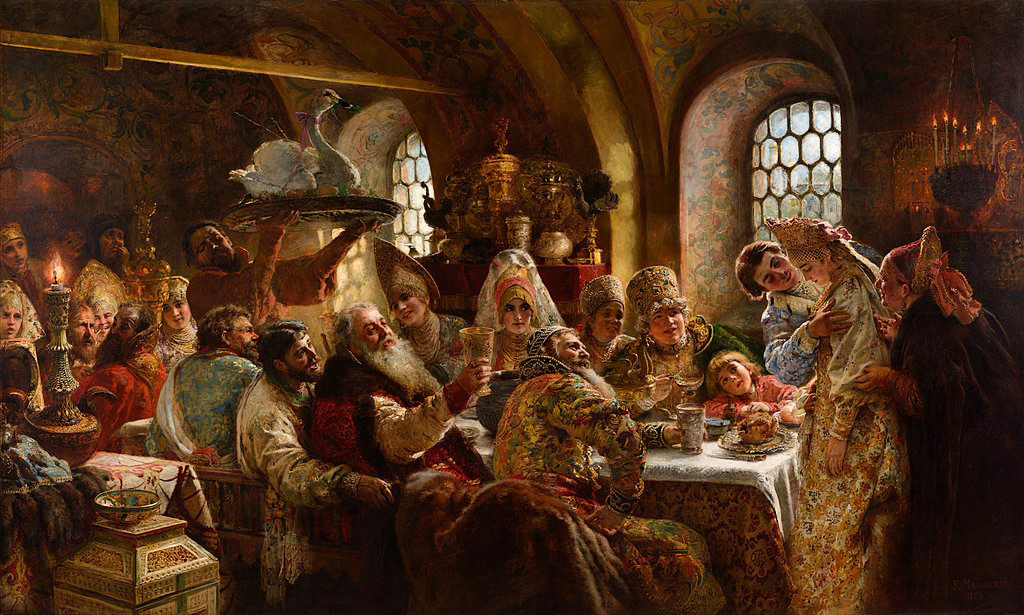
    First, God’s sustenance might be spiritual, but the image used by Isaiah is very earthly: “A feast of rich food and choice wines, juicy, rich food and pure, choice wines.” I love the repeated sentence here, with an intentional emphasis pointed out by the adjective “juicy” for the rich food and “pure” for the choice wines. What he seems to be pointing out is that God is not just going to provide a basic level of sustenance but instead a feast of the very finest things. Psychologically for Christians, this is a nice counterbalance to the ascetic life that shuns fleshly desires, as insisted upon by St. Paul, the desert Fathers, the saints of the medieval period and so many more of our Doctors and saints in the Church. These holy men and women would certainly agree with Isaiah and his description here, but would likely say that restraining ourselves from desires while on the earth is necessary to forge our spirit in Christ’s image; plus, it will make the great heavenly feast of the kingdom all the more richly appreciated. Yet we must admit that the enjoyment of feasting is something not altogether bad, or else God would not be employing this image to describe His Kingdom. One might argue that a Christian might properly enjoy moments of feasting in this lifetime, especially if a person is living morally under God’s law and focused on God’s providence and grace.

    A Boyar Wedding Feast (1883), Konstantin Makovsky | Wikimedia Commons. There is an interesting recalcitrance in the bride on the right side of the picture, with the groom attempting to coax her into enjoying their wedding feast. Indeed, the attention of all the guests is placed on this interaction. Perhaps she is sad to be married, perhaps she loved that beautiful swan that’s being served as food (ha!), or perhaps she’s terribly shy. In light of the paragraph above, though, perhaps we can read some of this recalcitrance as the pious Christian’s reaction to feast and worldly excess. I, for one, am with the groom on this one, though. If there is a time for feasting and enjoyment, let it be at a wedding feast. There is goodness in this world, and we can celebrate it appropriately.

    The second promise from Isaiah is that God will remove something that ensnares humanity: “he will destroy the veil that veils all peoples, The web that is woven over all nations; he will destroy death forever. The Lord GOD will wipe away the tears from all faces.” In a phrase, Isaiah is talking about the fallenness of the world and our natures. He calls this veil “death,” and indeed it is, but the ancient, scriptural understanding of death is deeper than we usually consider it in our analytical, scientific age. Yes, death has a technical meaning as the loss of life, measured perhaps in the absence of a heartbeat and the lack of measurable brain activity. But death also has a larger metaphysical meaning. When there is nothing ahead of us but death and a hole in the ground, then death reigns in a real psychological and even existential way. As we’ve amply seen with writers from Nietzsche onward, disbelieving in God goes hand-in-hand with the reign of death (one logically flows to the other). The reign of death is more than physical – it is spiritual, the death of the spirit. Any atheist will proclaim that nothing awaits us beyond this world, and the implications of this are diverse, but often include a softening of moral thought (i.e., if there is no larger or eternal repercussion for doing something right vs. something wrong, then why worry about making sure you’re doing things that are right? Even further, in this worldview, moral “right” is completely conceived by people rather than emanating from the source of all goodness, and so it is by definition changing and malleable).

    When moral thought and action are brought low, we Christians are taught that this is the devil at work in the world. Thus, the devil’s influence and the reign of death are tightly linked. This brings us back to our origin as recounted in Genesis: Satan – the serpent – is the cause of our temptation; and he is cursed as is humanity when cast out of the garden into the world where death reigns. Eons of weeping, blood, and sin ensue. We now live apart from God, unable to be in His presence, unable to see the truth and light clearly. St. Paul tells us, “For now we see in a mirror, dimly, but then we will see face to face” (1 Cor 13:12). So, when Isaiah promises that “he will destroy the veil that veils all peoples … he will destroy death forever,” we can understand that this is a full reconciliation with Him, a return to the garden. It is again St. Paul who helps us locate the promise of Isaiah in the Reign of Jesus Christ: “but when one turns to the Lord [Jesus Christ], the veil is removed. Now the Lord is the Spirit, and where the Spirit of the Lord is, there is freedom” (2 Cor 3:16-17). The freedom offered by Christ is a freedom from the reign of death, a removal of a veil that has ensnared us, and a reconciliation with God thanks to Christ’s great sacrifice.

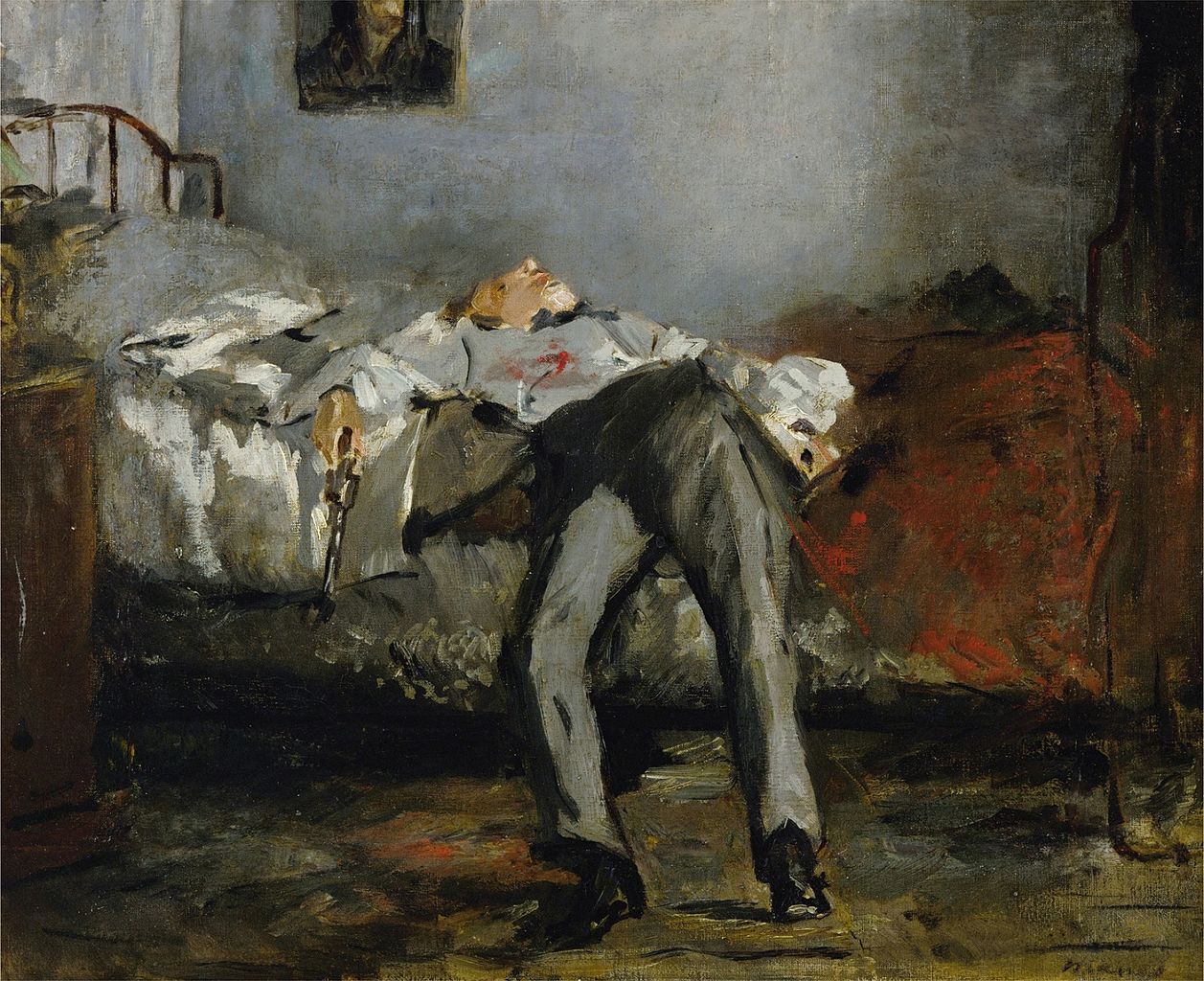
    Le Suicidé (1877), Édouard Manet | Wikimedia Commons. For me, nothing proclaims the ascendancy of the reign of death like suicide, especially in our modern era when atheism and disbelief in God compound the sin unimaginably. The great flaw in the thinking that leads to suicide is that there is no redemption, no God who can wipe away stain or guilt. In short: a complete lack of hope, which must be like living with that veil of death drawn so tightly around oneself.

    Finally, today’s prophecy by Isaiah tells that the world will recognize God as the bringer of the feast and conqueror of death. Humanity shall say, “Behold our God, to whom we looked to save us! This is the LORD for whom we looked; let us rejoice and be glad that he has saved us!” This recognition is important because God is calling us to a relationship but also gives us the free will to either refuse or answer the call. Isaiah’s prophetic vision reveals those who are present at the feast, who have the veil lifted as death is defeated. These people give God his due credit and rejoice in Him; they have answered his call to a relationship with him. Importantly, they recognize that His action is a saving action – one that saves them from the reign of death.

    Now, let’s turn to today’s gospel and see each of these three aspects of Isaiah’s prophecy in this single episode of Jesus feeding the four thousand (plus women and children!). First, the feast: this is the famous miracle of the loaves and fishes. Signaling the abundance, the richness of the feast, is the fact that after all were satisfied, “They picked up the fragments left over – seven baskets full.” Such unheard-of largess appearing without delivery carts and many villages’ worth of bakers and fishermen has only one author: God Himself. More: these people knew the writings of Isaiah, “On this mountain the LORD of hosts will provide for all peoples…” Here, with them and for them, the Reign of God was beginning – God in the form of the Messiah was here.

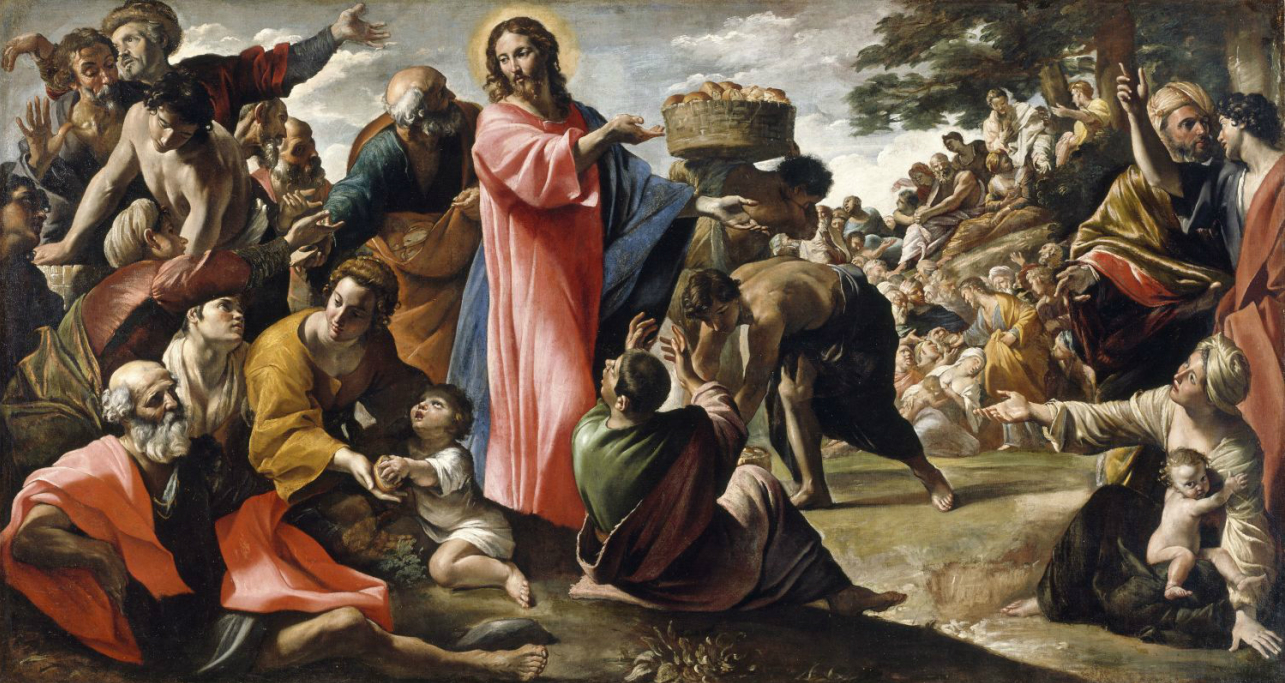
    Miracle of the Bread and Fish (1620-1623), Giovanni Lanfranco | Wikimedia Commons. I appreciate Lanfranco’s Baroque period portrayal of the serene, haloed Christ in the posture of giving in the midst of the writhing masses. Yes, the elaborate body positions were likely done to show off a certain painterly prowess for anatomy and beauty of the human form, but the effect is one that recognizes the fallenness/messiness of the world and portrays with true eyes the Messianic, generous substance of Christ.

    Second is the removal of the veil of death. Remember that the crowd had gathered because they had heard Jesus was a great teacher and healer – they came seeking Him. This is the essential ingredient for those who will be present at the eternal feast: that they answer God’s call. “Great crowds came to him, having with them the lame, the blind, the deformed, the mute, and many others. They placed them at his feet, and he cured them.” These people are in the grip of death in one form or another, not just physical death but spiritual death. Jesus often shows us that healing physical blindness in fact heals a deeper, underlying spiritual blindness. As mentioned earlier, death reigns not just physically, but spiritually. The Christ Event in history is the beginning of the Reign of Christ – death’s reign is clearly defeated in these miracles and the veil of sin, Satan, and death is lifted from these people. 

    Third is the recognition of God as the Savior. This, too, is pointed out by St. Matthew: “The crowds were amazed when they saw the mute speaking, the deformed made whole, the lame walking, and the blind able to see, and they glorified the God of Israel.” But giving thanks to God for being healed is a bit different from looking at the one who healed you and thanking him, personally, as God incarnate. And this is the aspect of Isaiah’s prophecy that is played out throughout the gospels and even to this day. As we investigated yesterday, the fantastic vision of Christ granted to Isaiah 700 years before Jesus was born was truly a glimpse into the time-defying kairos event that is God puncturing human history and coming at the end of time, swirled into one ecstatic vision. If we try to inhabit this vision, we can see that we are living within this prophecy, where the feast is available to us, death’s reign can be lifted from us, and we must strive to recognize God in the person of Christ, just like the people described in the gospels.

    The three touchstones Isaiah shares today, the feast, the removal of the veil of death, and the recognition of God as Savior, are at the heart of the Christ Event and all of our symbols and actions that emanate from it. The feast was celebrated throughout his ministry in every miraculous outpouring of sustenance and richness – wedding at Cana, feeding of the four thousand, and most clearly in the Last Supper – and it is this last example that instituted the ongoing feast of the Holy Eucharist that we continue to celebrate day after day in this contemporary moment within the Reign of Christ. The removal of the veil of death, specifically spiritual death, happens in our sacraments, notably in baptism, and integral to each of the other sacraments as we are drawn deeper and deeper into full communion with God. Over the course of our lifetimes as Catholics, we participate in the removal of this veil of death that ensnares and blinds us – it is our journey of faith. So we can see how the first two touchstones happened in Jesus’s life events and also happen our own. But this last one, our participatory acceptance and recognition of God in the form of Christ our Savior, is the one we must step up and bring to God all on our own. We pray that all are able to do this at some point before their physical bodies die. This great drama of recognizing Christ as God was brought to the forefront by Christ Himself: “Who do you say I am?” (Mat 16:15, Mk 8:29, and Lk 9:20). He asks each of us this same question. The Apostles realized that this was their great duty: to evangelize, that is, bring this good news of the Christ Event to people across the globe. Pope Benedict XVI identifies that this evangelical activity is part of the ongoing lifting of the veil of death: “But the preaching of God’s Kingdom is never just words, never just instruction. It is an event, just as Jesus himself is an event, God’s Word in person … Because the world is ruled by the powers of evil, this preaching is at the same time a struggle with those powers” (Jesus of Nazareth, 173).

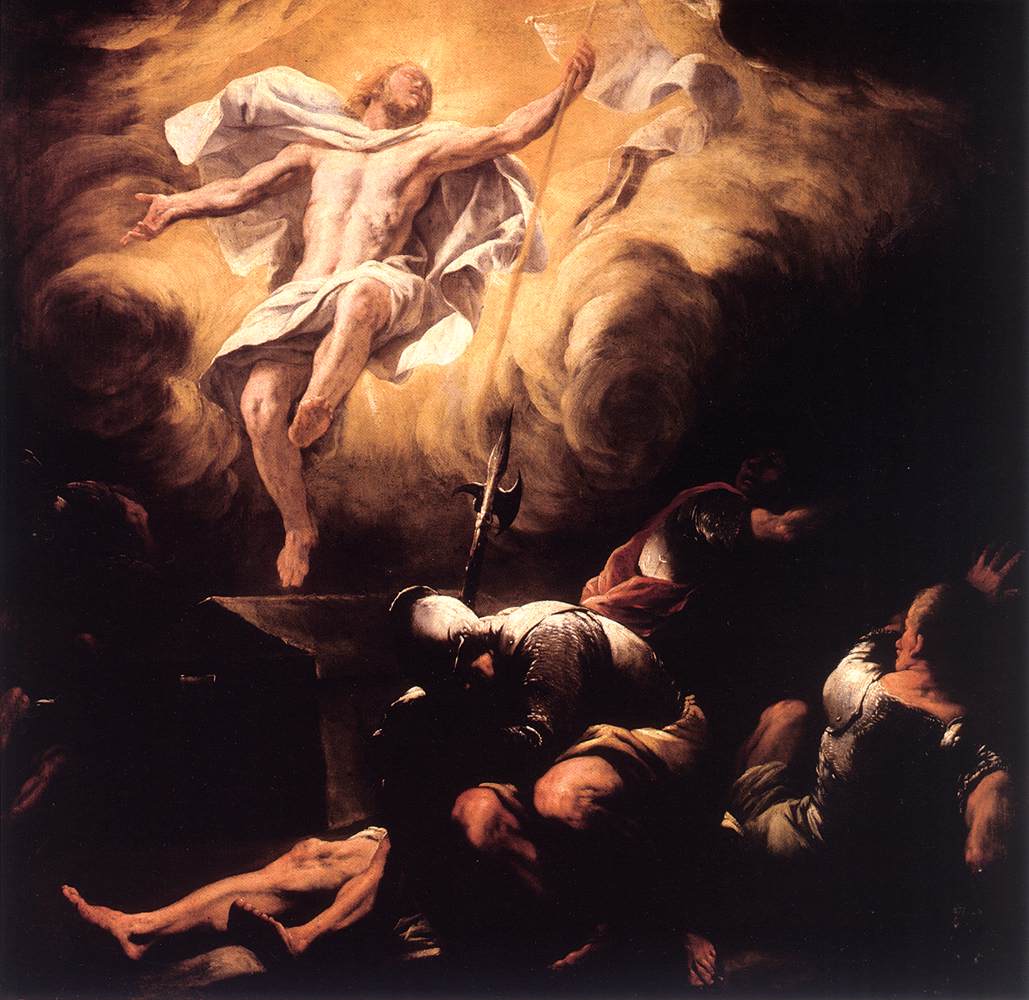
    The Resurrection (after 1655), Luca Giordano | Wikimedia Commons.

    Don’t let anyone tell you that all major religions are the same; we have a very particular core to our faith, and it is Jesus Christ, the man and God incarnate. Pope Benedict XVI, like Pope Saint John Paul II before him, writes that everything in our faith tradition and practice must be understood through a Christocentric lens. Everything about our salvation as well as the signs, symbols and language of our religion is fundamentally about Christ being God. It’s not about being morally good or doing good deeds or praying a certain way (although those things matter, especially when seen as ways of being united with our Savior). How can the popes insist on this (and not just them – think of so many saints and doctors of the Church, St. Augustine to name just one)? Well, it starts perhaps most plainly with Christ Himself, especially as revealed through the gospel of St. John: “for you will die in your sins unless you believe that I am he” (Jn 8:24). Jesus is adamant that He is the path to the Father, to salvation, to the end of the reign of death. Why might faith in Jesus Christ as the Son of God and Savior be so important for eternal salvation? I can think of several reasons, but here are two that jump most quickly to mind. First, denying that Christ is the Son of God (when He is one of three Persons of God) is, in fact, denying God (being atheist, that is). Second, the Christ Event – and only the Christ Event – is the exact action of God in the world that ushers in our salvation. This means that only Christ is the vector God provides for us to unite with Him. 

    And perhaps a third, more human reason that this specific faith in Christ as God is necessary: Jesus reveals aspects of God in a way that no one or nothing else in creation can. Jesus Christ reveals to us ways that we are made in the image of God (we are agents of truth and light as He is) and that humanity is precious to God in a special way. As we dwell on the Word of God, as uttered by the Word of God made incarnate, we learn about Him as well as the great potential within all of us. Jesus Christ becomes our “key” to knowing God and to knowing ourselves.

    Today’s gospel reading, for instance, stands out to me not just because of the amazing parallels with Isaiah’s prophecy and these three touchstones of our faith. It stands out because of what Jesus says: “My heart is moved with pity for the crowd, for they have been with me now for three days and have nothing to eat. I do not want to send them away hungry, for fear they may collapse on the way.” Matthew takes 5 lines to describe Jesus’s great compassion here, and just 2 to describe the miracle itself. This is where we find the reality of Christ – in His love and compassion. After healing hundreds, if not thousands, of people on the mountain by the Sea of Galilee, surely He would be exhausted by the sheer weight of it all. But, as God, He shows us that God never tires of compassion. He teaches us how to find that compassion in ourselves. Even after delivering them from the grip of death through His healing, His saving acts do not end. He knows their hunger and, more importantly, this hunger moves him to compassion. It never fails to amaze that our God is a God who is moved to compassion for us. This is no distant God! So, He feeds them, as only God can. Here is the same God accomplishing the same act He did for His Chosen People after freeing them from slavery in Egypt and feeding them manna in the desert. Only now our God walks among us, speaks plainly for us, and ultimately sunders the divide between our fallen earth and heaven.

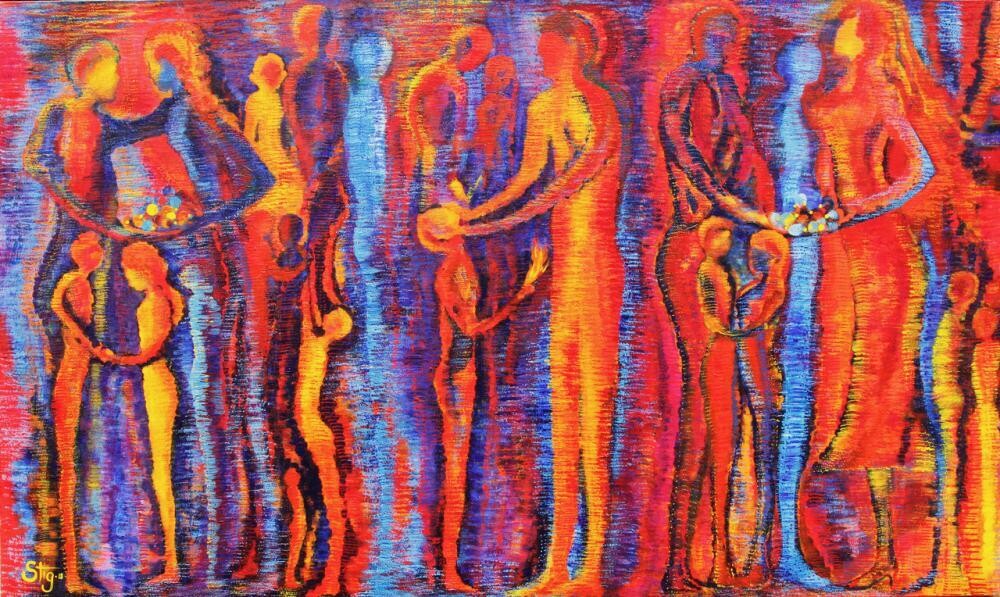
    The Miracle of the Five Loaves and Two Fish (contemporary), Grace Carol Bomer | Image from gracecarolbomer.com.

    Thank God for His compassion! Because this Advent is about anticipating the culmination of the Christ Event, and we will certainly all need compassion, understanding, and forgiveness on the Day of Judgment.

  • Why is Judas Part of the Plan?

    Why is Judas Part of the Plan?

    Wednesday of Holy Week: Isaiah 50:4-9a, Matthew 26:14-25.

    Today’s gospel is devoted to the problem of Judas Iscariot. He is a problem, isn’t he? As the betrayer of Christ, he’s a problem for the continued ministry of Jesus in the world; but on another level he’s a problem for us: what do we make of the fact that one of the Chosen Twelve was so unconvinced by God, so overcome by the devil, that he betrays the Son of God? What do we do with Judas — is he to be simply the scapegoat for everything that went wrong (did it go wrong?) or does his part in the Passion tells us more about us than we want to know? Thankfully the gospels and our tradition of saintly commentators give us some direction as we grapple with these questions.

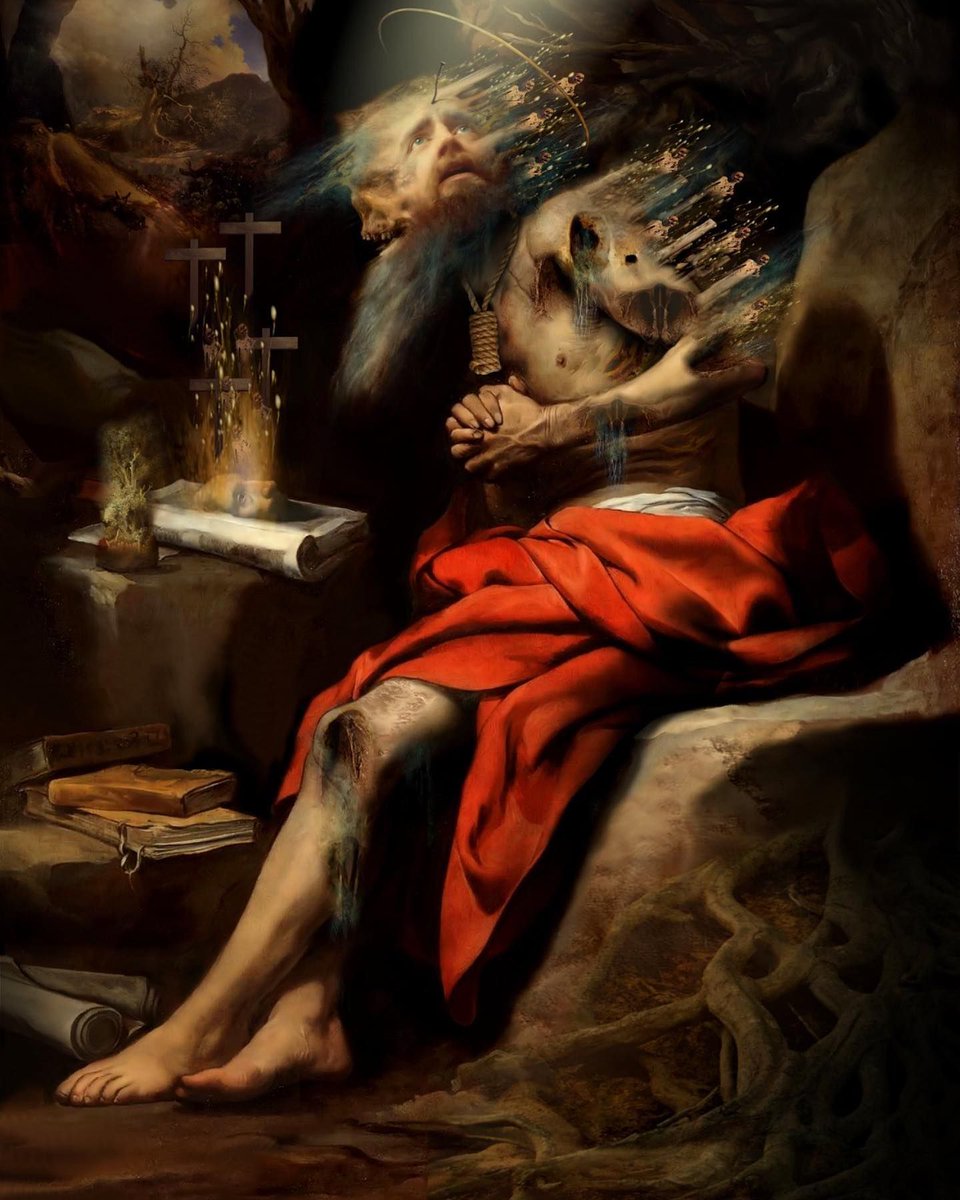
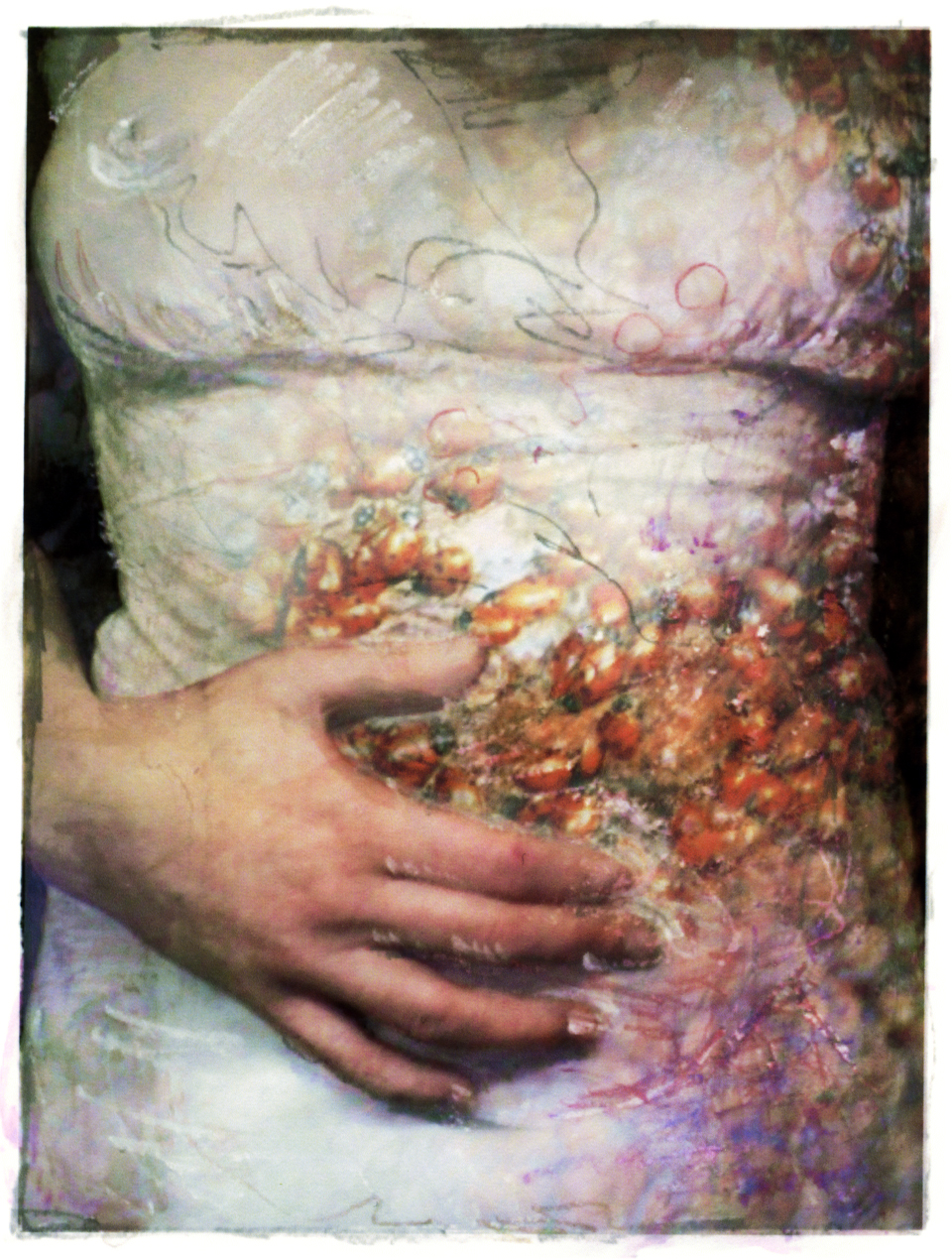
    The Vision of Judas (mid 1900s), Ettore Aldo del Vigo | Image from twitter.com. A lesser-known surrealist, del Vigo presents a haunting vision of Judas, ripped apart in his temptation and betrayal. It makes me think of a man who was dedicated to (or joined to, anointed to) Christ but whose weakness betrayed this interior ordering, ripping him apart.

    A few days ago, I reflected on how Christ escapes life-threatening circumstances several times in his ministry (Jews ready to stone Him or throw Him off a cliff). In all cases, he just slips away. A nonreligious person might chalk this up to luck or fate. We Christians believe instead that God has a plan for our salvation and that everything Christ did on earth happened within that plan. God is not subject to forces outside of himself; no force is greater than God.

    So, when we encounter Judas in the gospels, we can’t fall into the temptation of thinking “what if” Judas never betrayed Jesus, as if the betrayal was a loose thread that caught God by surprise. No, God was not surprised. Jesus knew — he tells them during the Last Supper, “Amen, I say to you, one of you will betray me.” This is not the way betrayal usually works.

    Betrayal looms large in centuries of literature and Hollywood alike, and it is usually a plot device that is revealed toward the end (or at least the middle) of a story that carries surprise and the potential for a great reversal of fortunes. We can justifiably imagine that betrayal has been a part of human history long before Jesus was born. The rise and fall of empires likely hinged more than once on betrayal.

    The psychology of betrayal is fascinating and devastating. On the part of the people who are betrayed, there is surprise, disappointment, a hole rent in their hearts, for it only qualifies as betrayal if they knew their betrayer, often intimately. Otherwise, it would simply be an assault or aggression by an enemy. Betrayal demands subterfuge and lying on the part of the betrayer. The result of this act is so horrible and unique that we have coined the name of the feeling of devastation as “feeling betrayed.”

    On the betrayer’s part, the psychology is deeply internal and secret. They truly live in an internal darkness because they must lie and be false for an amount of time before revealing their act of betrayal. In this solitary darkness, they clutch something that grows in them as a lodestone. They create a “truth” for themselves, although as Christians we see this as a falsehood because all truth comes from God and cannot be created from within ourselves. They are driven by some type of selfish desire, perhaps revenge, perhaps the desire for riches, power, or simply self-preservation and good standing. But it is a deep, deep selfishness, not shared openly with others but carried out in an inner darkness. As Christians, we recognize this state of being as living in sin, giving into the temptations of the devil.

    St. John gives us evidence that Judas had already been trapped in sin by the devil. When Judas rebukes Mary for anointing Jesus with expensive oil, John comments: “He said this not because he cared about the poor, but because he was a thief; he kept the common purse and used to steal what was put into it” (Jn 12:6). John also tells us that by the time of the Last Supper, “The devil had already put it into the heart of Judas son of Simon Iscariot to betray him” (Jn 13:2). Thus, when Jesus gives Judas the first morsel of the Eucharistic feast at the Last Supper, “After he received the piece of bread, Satan entered into him” (Jn 13:27). So, Judas Iscariot had already given himself over to the devil and was living in the darkness. 

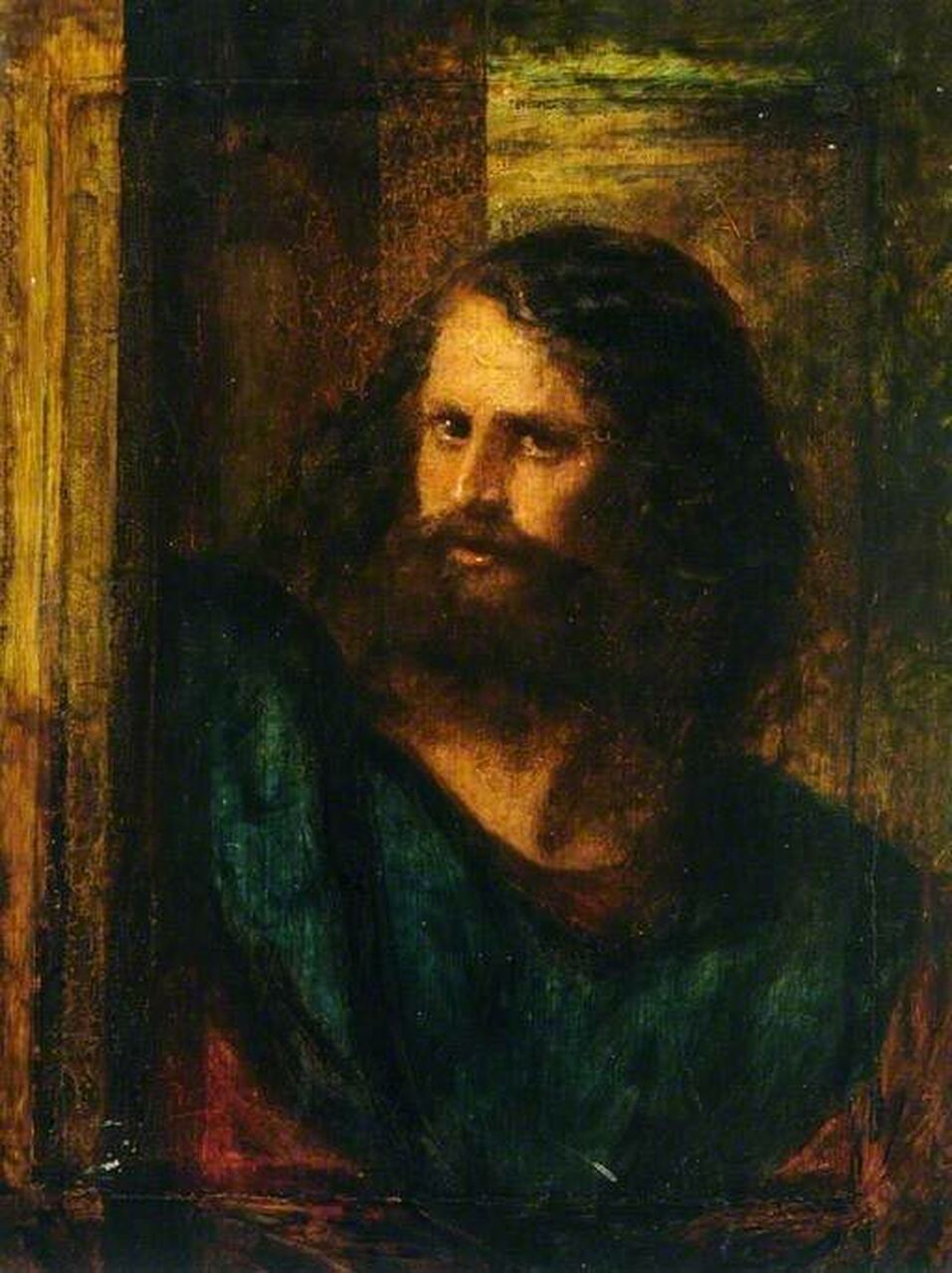
    Judas Iscariot (early 1800s), William Etty | Image from cutlermiles.com. Here is another way to envision Judas: as an attractive, energetic, believable man – someone you might be tempted to trust.

    When Jesus announces that one of the Twelve will betray him, the Apostles were “deeply distressed at this.” Since he was fully human, Jesus must have shared in this same feeling of deep distress. Yet his response is guided by his being fully divine. By sharing his knowledge, he is giving Judas a chance to live in the light, even to change his mind. Even when Judas joins the others in saying “Surely it is not I, Rabbi?” Jesus doesn’t storm about and accuse him in front of the others. Instead, he answered, “You have said so.” He meets betrayal and lies with love, as God, never shutting the door even on the most awful of sinners.

    Around the year 593 AD, Pope Saint Gregory the Great preaches movingly on this scene:

    When the Lord said, “Truly I tell you, one of you is about to betray me,” he showed that his betrayer’s conscience was well known to him. He did not confound the traitor by harsh and open rebukes, but met him with mild and silent warnings, so that he who had never been sent astray by rejection might more eas­ily be set right by repentance.

    Why, unhappy Judas, do you not make use of such great patience? See how the Lord spares your wicked attempts! Christ betrays you to no one but yourself. Neither your name nor your person is revealed, but only the secrets of your heart are touched by the word of truth and mercy. The honor of the apostolic rank is not denied to you, and neither is a share in the sacraments.

    Come back to your right mind! Set aside your madness and be wise! Mercy invites you—salvation knocks at your door—Life calls you back to life!

    See how your stainless and guiltless fellow disciples shudder at the hint of your crime! They all tremble for themselves till the author of the treachery is revealed. They are not saddened by the accusations of conscience, but each is afraid that what he knows of himself may be less true than what the Truth himself foresees.

    But you abuse the Lord’s patience in this panic of the saints. You think your bold front hides you. You add impudence to guilt, and are not frightened by such a clear test. And when the others refrain from the food in which the Lord has set his judgment, you do not hold your hand back from the dish, because your mind is not turned aside from the crime.

    –St. Gregory the Great, Sermon 58, 3

    I particularly like how Gregory says that each of the other Apostles “is afraid that what he knows of himself may be less true than what the Truth himself foresees.” What a nice insight. But also is the condemnation of Judas: “you abuse the Lord’s patience in this panic of the saints.” It is common to condemn Judas for the great crime of selling his master to the chief priests, but some contemplation on this scene helps us to see that Judas should be condemned for lacking fear of God, for abusing the Lord’s patience, for believing in himself (his “bold front”) more than in Christ, and for pride and self-assurance where humility should dwell.

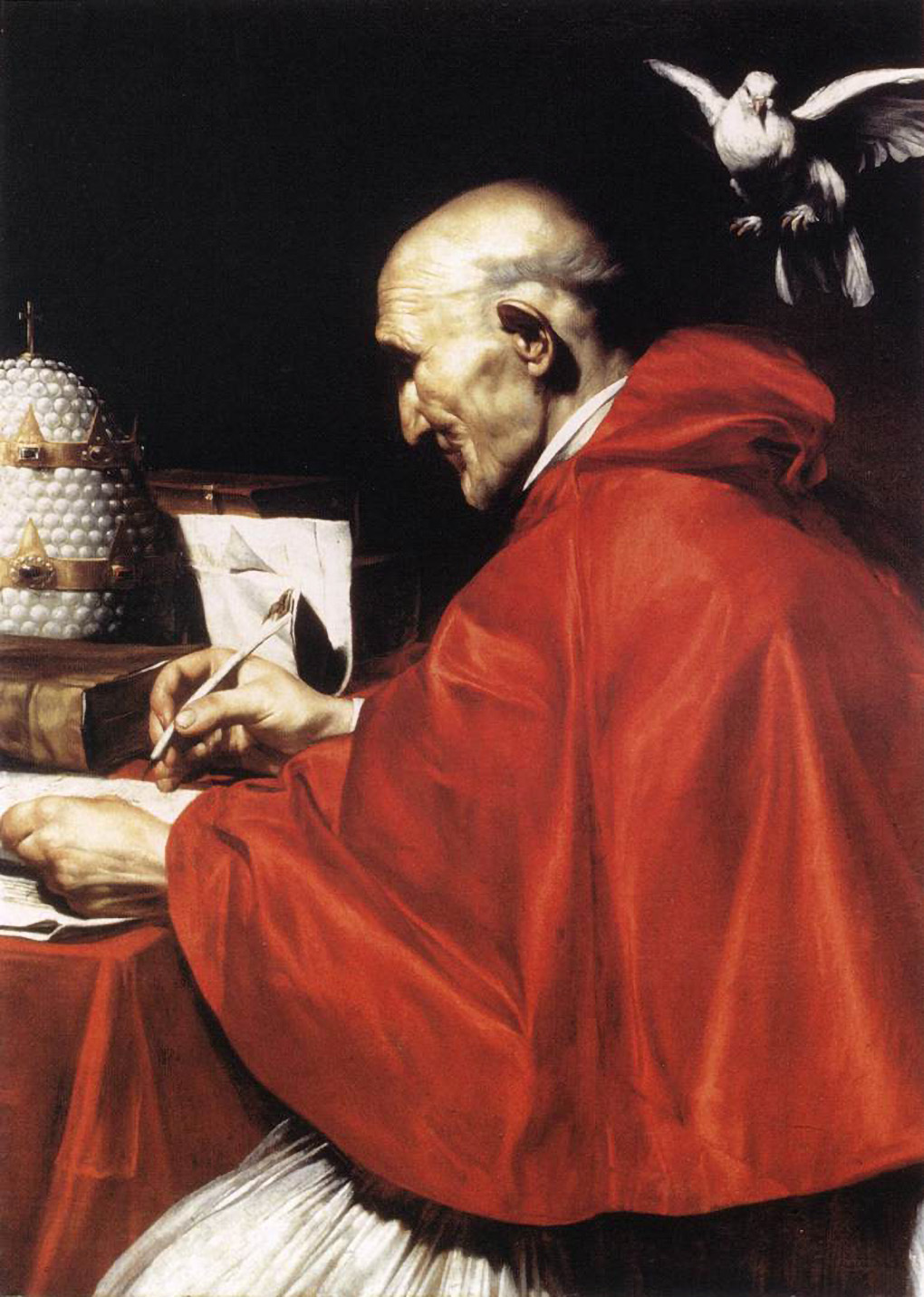
    St. Gregory the Great (1610), Carlo Saraceni | Image from Web Gallery of Art.

    Seen in its fullness, Judas’s betrayal of Jesus is simply the culmination of many sins revealing his lack of love for Christ. In its fullness, the story of Judas is really one of small sins chipping away at a soul’s dignity and perverting one’s humanity to such an extent that nothing matters anymore as much as the self-centered thoughts of this person. This is not so extraordinary, is it?

    Small sins eat away at us until big sins no longer seem big anymore. This is one of the great lessons of Judas and I have to think one of the reasons God wanted Judas to be a part of the plan of salvation. Betrayal by one of the Twelve shows us that we can never let down our guard in this life — the devil and his temptations will never stop; they will perhaps even intensify for those who grow closer to God in order to undermine our faith in Him.

    Look at the sex abuse scandal in the Church. One of the great travesties of this scandal is the fact that it was the most trusted people of our faith tradition who betrayed us: our priesthood. Was this not warned against in the gospel today? Our response cannot stop at shock and anger, it must progress to sadness and the wisdom that God gave us through Judas. We cannot let it undermine our faith in God or in His mystical Body, the Church. We can see the divine logic in including Judas as part of our salvation story, as a reminder of who we are in this world and what we must resist.

    I’d like to close this reflection with another story from St. Gregory the Great, this time a story from his life. He started out as a Benedictine monk, living in poverty, chastity, and obedience at a monastery he founded on his family’s Caelian Hill land in Rome, St. Andrew’s. Pope Benedict I disrupted this repose, however, by appointing him one of Rome’s seven deacons and then sent him off to the grandeur of the Emperor’s palace in Constantinople, much against Gregory’s will. He was recalled to Rome eight years later. The entry on catholicism.org tells the rest of this little story:

    Greatly rejoicing, he returned to his monastery, to be acclaimed its abbot. He found Rome again beset with calamities. The hand of God still lay heavy upon it. Floods and tempests battered it, and earthquakes rocked it. But worst of all, to Gregory, the spirit of the world had crept, in his absence, into his monastery. He took sad note, not of any scandalous irregularities, but of a general relaxing of the holy detachment from the goods of the world which had been a pledge, in the early days, of the continued holiness of Saint Andrew’s.

    Finally, to his relief, it all came to a head. One of the monks confessed to his assembled brothers, as he lay dying, that he had concealed in his bed three gold coins. This violation of holy poverty so shocked and so grieved Gregory that he decided to punish the erring monk in such a way that the rest of the monastery would not soon forget “the heinousness of a sin that recalled that of Judas.” And so he ordered that when Brother Justus was dead, his body should lie, not in the little cemetery of Saint Andrew’s, but “should be put in a dunghill together with the three crowns,” and all the monks were to cry with one voice as it was being let down to the earth, “Thy money be with thee unto perdition!”

    It sounds harsh, and maybe it is. I don’t think it’s just the attachment of the monk to money that recalled Judas’s sin but the betrayal of the vow to God to remain in holy poverty. We also see the connection of small sins to Judas-level sins. Gregory sadly observes “a general relaxing of the holy detachment from the goods of the world.” The goods of the world are the devil’s temptation, and Gregory knows this. For people who set themselves aside for a lifelong devotion to Christ (like the Twelve Apostles did), these temptations are a very real betrayal of their profession. Gregory was not blowing things out of proportion to the extent we might first think.

    But, ever the man of Christ, St. Gregory took a cue from our Savior’s never-ending mercy. The story finishes thus:

    Saint Gregory tells us in his Dialogues that the monk died contrite and penitent and he, out of compassion for his soul, offered up thirty consecutive Masses. On the thirtieth day, Brother Justus appeared to one of his brothers and told him that he was delivered from Purgatory. The joy of the chastened monastery knew no bounds. And God was so pleased with the discipline and charity of his servant Gregory that we find the story preserved down to our own time in the well-known “Gregorian Masses,” said on thirty consecutive days for the repose of the souls of the loved ones for whom we continue, to this day, to request them.


  • Forgiveness is Mercy in Action

    Forgiveness is Mercy in Action

    Tuesday of the Third Week in Lent: Daniel 3:25, 34-43, Matthew18:21-35.

    Today’s readings slide from Azariah’s beautiful placement of his fate in God’s hands to the damning of the unmerciful servant in the gospel. If ever there was a day to consider the term fear of God, this is it.

    The Books of Psalms and Proverbs mention fear of the Lord many times, calling it “the beginning of wisdom” and the “fountain of life” and proclaiming that the person who lives in the fear of the Lord is “blessed.” St. Thomas Aquinas reminds us that fear of God is one of the gifts of the Holy Spirit, and it is best understood not in terms of fearing something evil but fearing being separated from our Father — a filial fear.

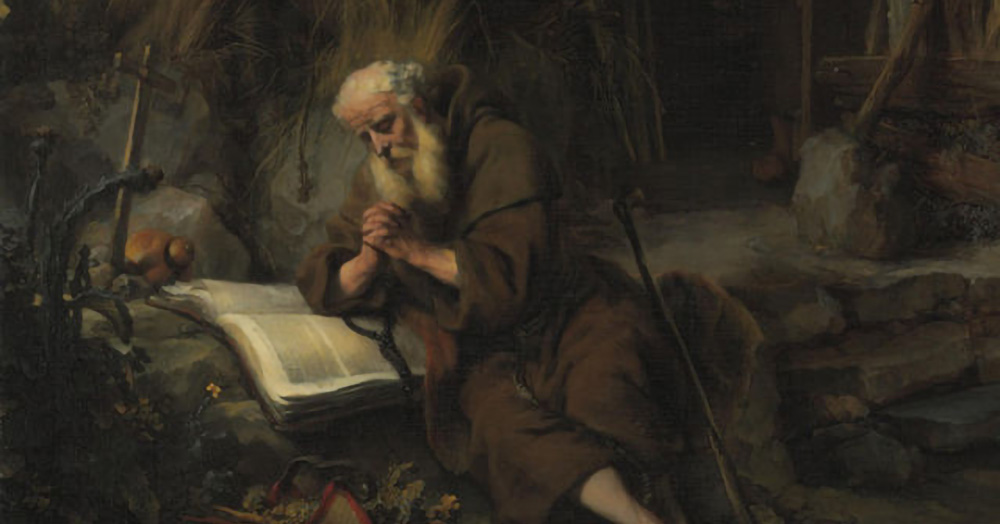
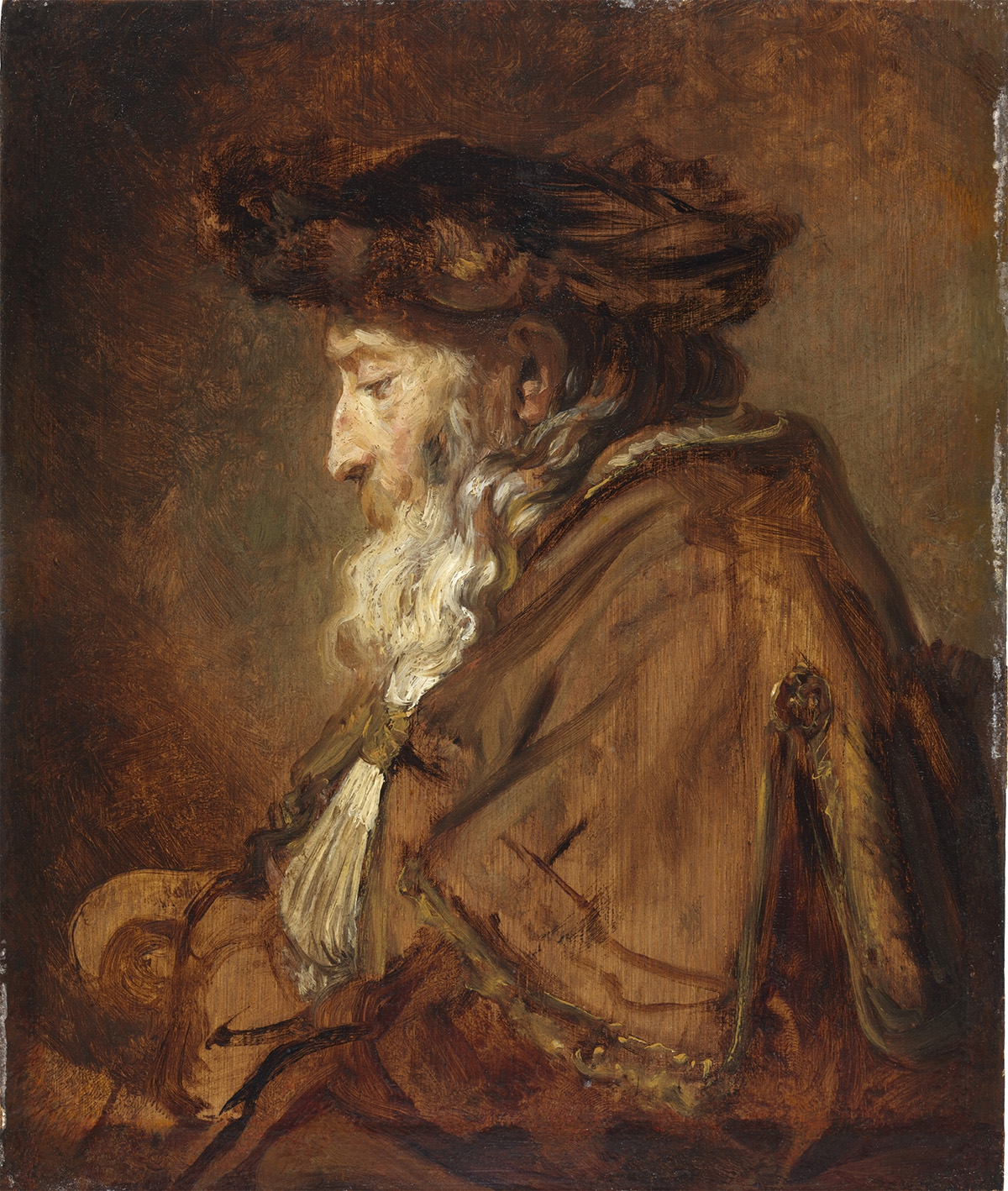
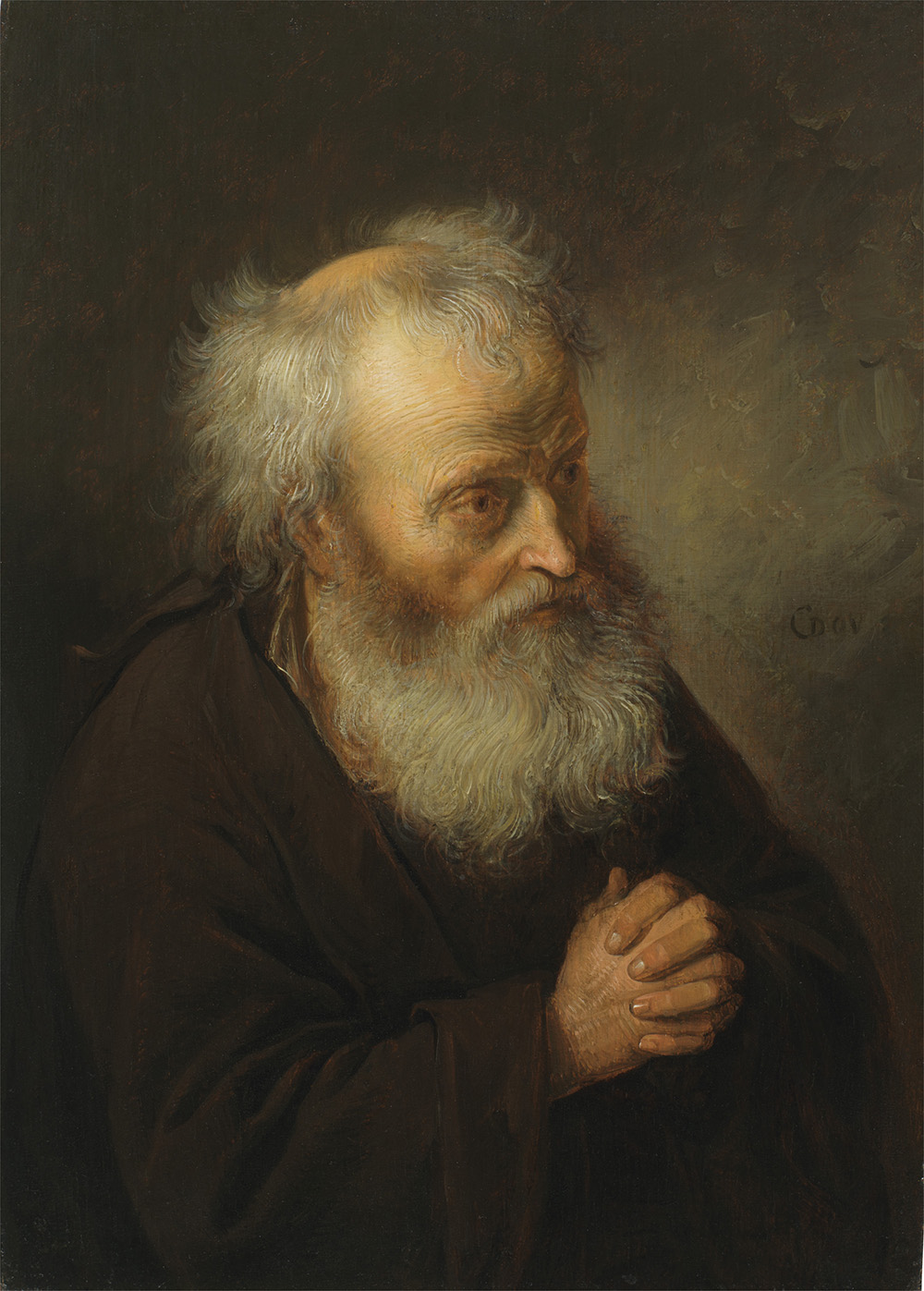
    Detail from A Hermit Praying (1663), Gerbrand van den Eeckhout | Image from artsy.net.

    Fear is a blessing? How gauche, how antiquated! We live in a time when liberation and freedom to do as you please holds the highest cultural value. But as we are swept up in this cultural moment, we have to remember that what we think is ours (our body, our thoughts, our actions) is actually a gift, too. It was a biological gift from a mother and a father, but more importantly, that spark of life, intellect, and soul is a gift from God. No biological mechanism can explain that gift of spirit that makes us human.

    Biologically, we are but atoms arranged in certain ways — proteins and fats and water that come together in a certain form. Even these building blocks had to come from somewhere, and we believe that our God is the Creator of all the universe. But more, we owe the divine Maker the fact that we are animated as intelligent, soulful beings, bridging the animal kingdom and the angelic kingdom.

    Here is where fear comes in and why we might call it a blessing. Imagine that source of divine power and goodness for just a second. Imagine how incredible it is that he cares enough to hold us in being, favored among all Creation. “Fear of God” means giving him the respect and love that he is due, but also clinging to him as the source of our being. To help us, the Holy Spirit gives us the gift of fear of God, something that aligns us spiritually, that endows us with the appropriate humble stance in front of our Creator.

    This is the way we should be thinking about the fear of God as we examine today’s readings: a gift to be treasured, one that gives us wisdom and blesses us, a feeling in our gut that we never want to be separated from our Father and the knowledge that our actions and hearts must be in line with God’s will in order to stay united with him and his grace.

    This type of fear of God is evident in Azariah in the first reading. This is part of the much-celebrated episode when the three young Jews Hananiah, Azariah, and Mishael are punished by Nebuchadnezzar for refusing to worship the gigantic golden idol he builds on the plain of Dura. They respond to the accusations against them by saying, “we have no need to present a defense to you in this matter. If our God whom we serve is able to deliver us from the furnace of blazing fire and out of your hand, O king, let him deliver us.” In a rage, he sentences them to be bound and cast into a fiery furnace so hot that it burns to death the men who throw them in.

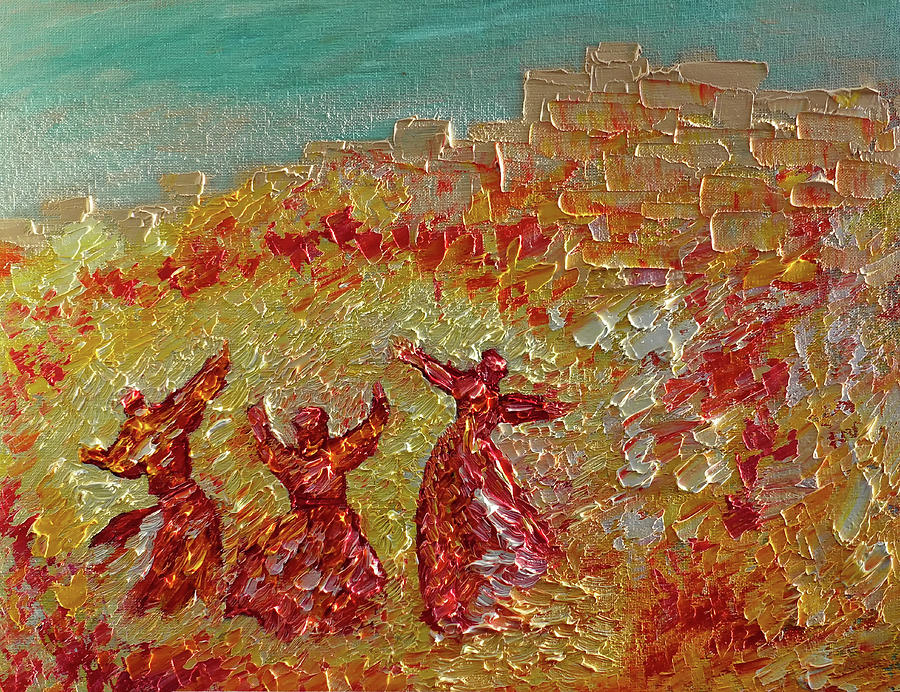
    Dancing Hebrew youths, Mishael, Azariah and Hananiah, in a fiery furnace of Nebuchadnezzar (contemporary) Zoriy Fine | Image from fineartamerica.com.

    We read the Prayer of Azariah in today’s readings, which he offers to God when they are inside the furnace. Importantly, Azariah prays not for the three of them, but for the entire nation of Israel, “for the sake of Abraham, your beloved, Isaac your servant, and Israel your holy one.” He notes how depleted Israel is (indeed, they’ve been conquered by the Babylonians and many have been dragged to Babylon). In a clear reference to the psalms, he says he has no offering but his “contrite heart and humble spirit.” (Psalm 51 reads: “For you have no delight in sacrifice; if I were to give a burnt offering, you would not be pleased. The sacrifice acceptable to God is a broken spirit; a broken and contrite heart, O God, you will not despise.”)

    Having declared his pure intentions, he says, “we fear you and seek your presence.” As we shall see in the gospel reading, this deep respect, this profound obeisance, is key to our request for mercy. The entire prayer reaches its climax with his request: “deal with us in your patience and in your abundant mercy. Deliver us in accordance with your marvelous works, and bring glory to your name, O Lord.” How important that Azariah understands that all must point back to God and his glory! He asks for deliverance not just out of a selfish desire for his own life, but knowing that Nebuchadnezzar would be amazed at the power of God to save his people. Most importantly, he models for us what a gift fear of God is.

    Spoiler alert: the three young men are saved by God and not harmed in the fiery furnace.

    Upon their deliverance, the three young men dance and sing in the furnace a great canticle of thanksgiving, one that we use in our liturgy: Week 1 Sunday Morning Prayer of the Divine Office, and repeated for each solemnity and other high feast days. The canticle is one of my favorites to chant during the Liturgy of the Hours because it starts by blessing God and then goes through all of creation, encouraging everything to bless the Lord. This canticle is important because Hananiah, Azariah, and Mishael not only model for us the fear of God and heartfelt pleas for mercy, but also the correct response once you’ve received his mercy: sharing that mercy with all of creation.

    Turning our attention to the gospel reading, the Parable of the Unmerciful Servant starts strong. The servant who owes an impossible amount of money to the king follows the lead of Hananiah, Azariah, and Mishael, showing proper respect for and dependence on the king. The original Greek uses the verb προσεκύνει (a form of proskynesis), which is often translated as “worship” elsewhere in the Bible and means to bow on your knees in a display of supplication and reverence. 

    Further examination of the Greek helps us understand the exchange between the servant and the king. Erasmo Leiva-Merikakis writes in Volume II of his masterwork Fire of Mercy, Heart of the Word, “God responded at once to the servant’s plea because the man used one of God’s dearest names in adoration of him: ὁ Μακροθύμος—’the Long-suffering One’. The man’s plea is said to have affected the almighty King’s very viscera (σπλάγχνα), hidden under all his golden robes … ‘the Lord of that servant was viscerally moved to compassion’” (647-648). The king is so moved that he forgives his entire debt! In this way, Jesus is describing God the Father in his overflowing forgiveness and mercy, far beyond our expectations. 

    The parable then turns, however, and reveals that the servant’s display of respect was only skin deep. He finds a fellow servant who owes him a much smaller debt and instead of forgiving this debt in turn, as his king forgave him, he chokes him, refuses to show him mercy, and has him imprisoned. This is a grievous sin.

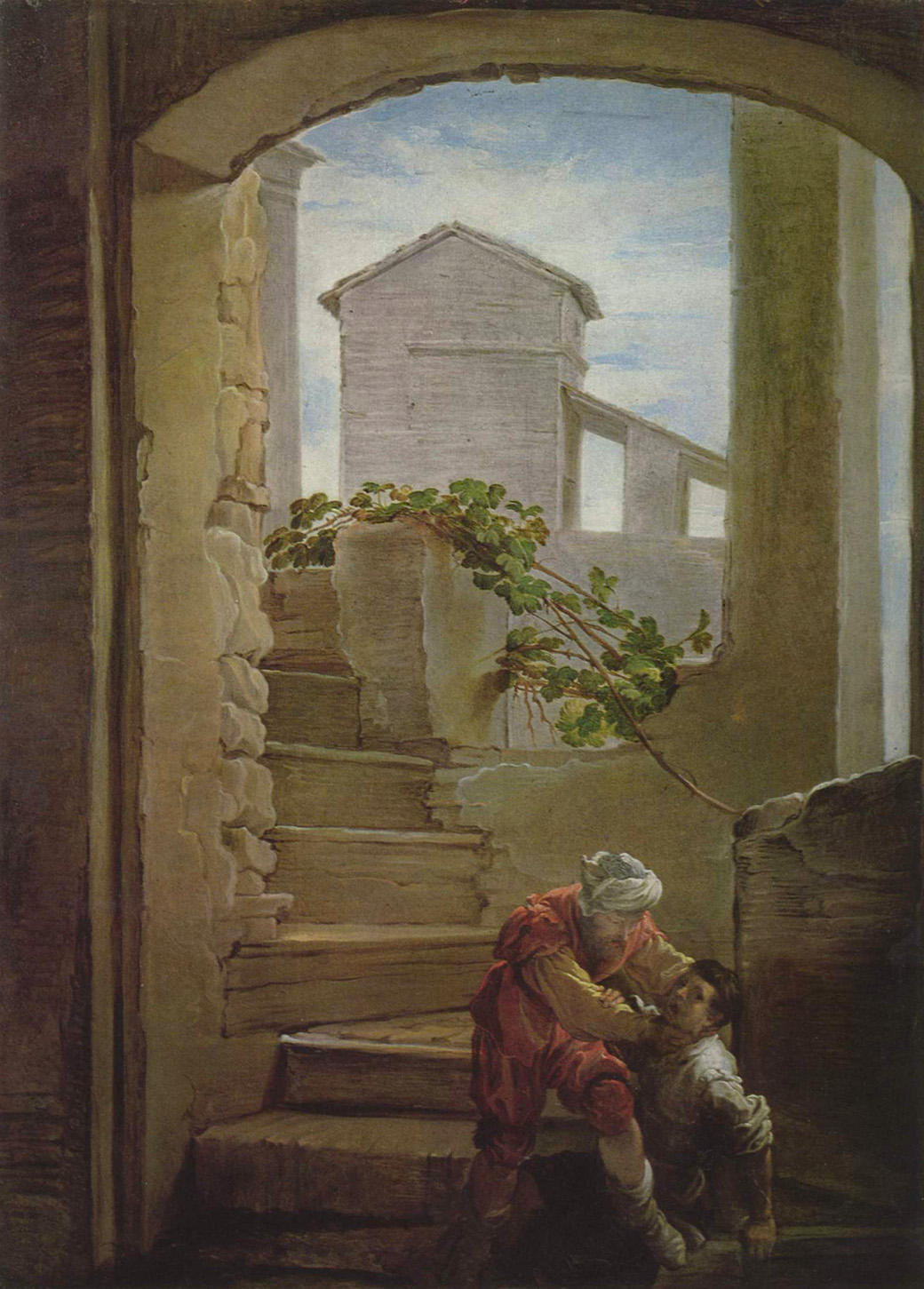
    Parable of the Wicked Servant (La parabola del servo malvagio), 1620, Domenico Fetti | Wikimedia Commons.

    The king’s action is not merely a good example for the servant. God’s mercy is a thing, alive, needing to course through us into the world. His mercy is the living force of love in the world. Leiva-Merikakis beautifully describes this, “Our vocation is to ignite conflagrations of love and forgiveness all around us. God’s light intends to be refracted through our being: it shines upon us not only for our own benefit, to dispel our own darkness, but also to stream through us and beyond us” (649). 

    Our very “vocation,” our purpose on the earth, is to share God’s mercy in the world. By so doing, we accomplish God’s will. But refusing mercy is the perversion of the Spirit. In the parable, the unmerciful servant shows that he does not have the type of fear of the Lord that is wholesome and transformative. The other servants must react at his perversion of the Spirit: “Now when his fellow servants saw what had happened, they were deeply disturbed, and went to their master and reported the whole affair.” Not sharing mercy with others is a cardinal sin. This leads us to the conclusion of the parable and a glimpse of divine justice.

    Even if it makes us uncomfortable, we must accept that God rightfully expresses anger when his goodness is hoarded and discarded. Divine justice hinges upon how we use the gifts God bestows on us, principally mercy: is it shared and given forth to others in acts of charity and love or is it discarded and replaced by selfishness, greed, and sadism? When we discard the energy of God Himself, we embrace the energy of evil, of the devil. What’s more, we reject ourselves, our purpose, to help bring others to God and into the Kingdom. We become an abomination of everything God has created us to be.

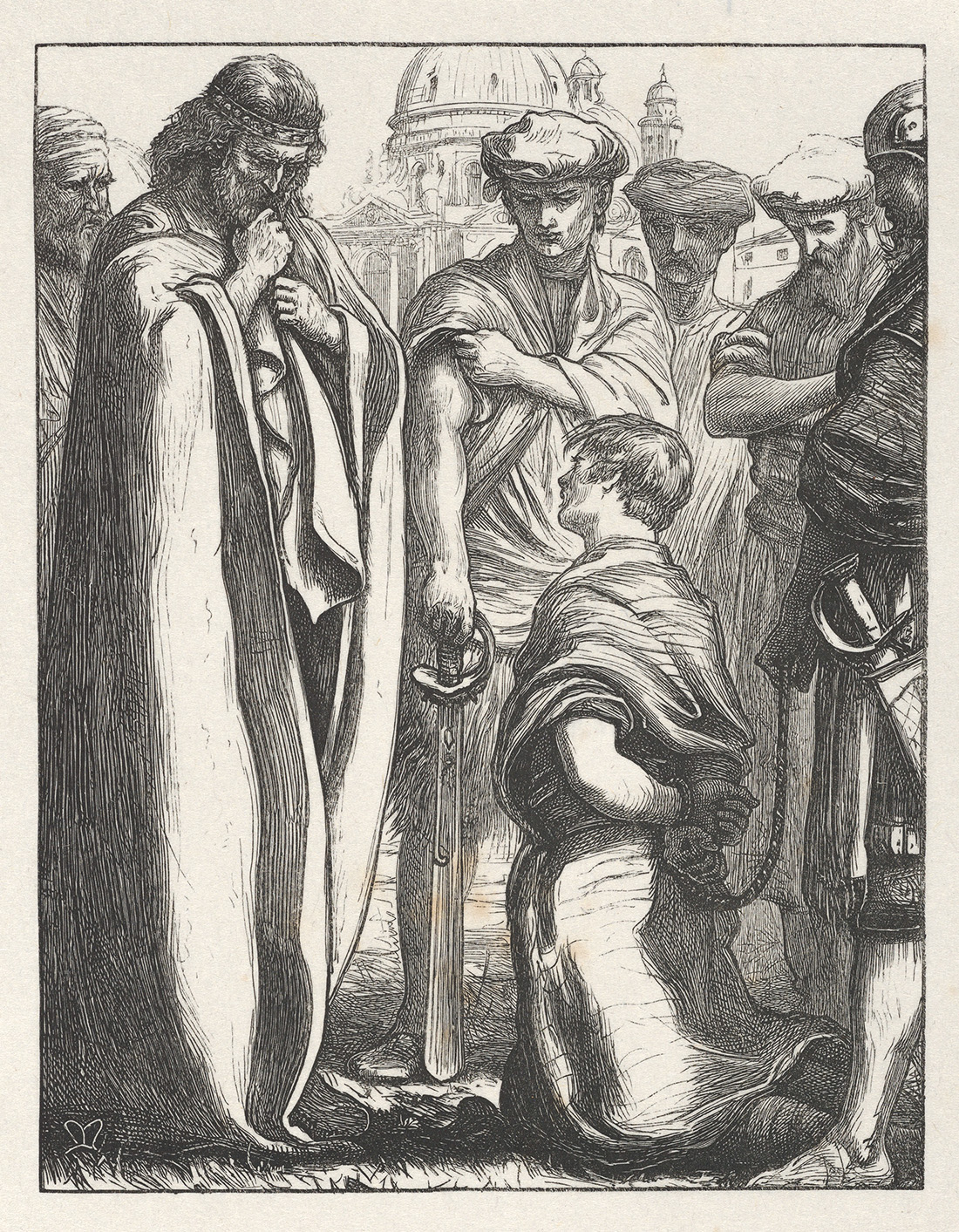
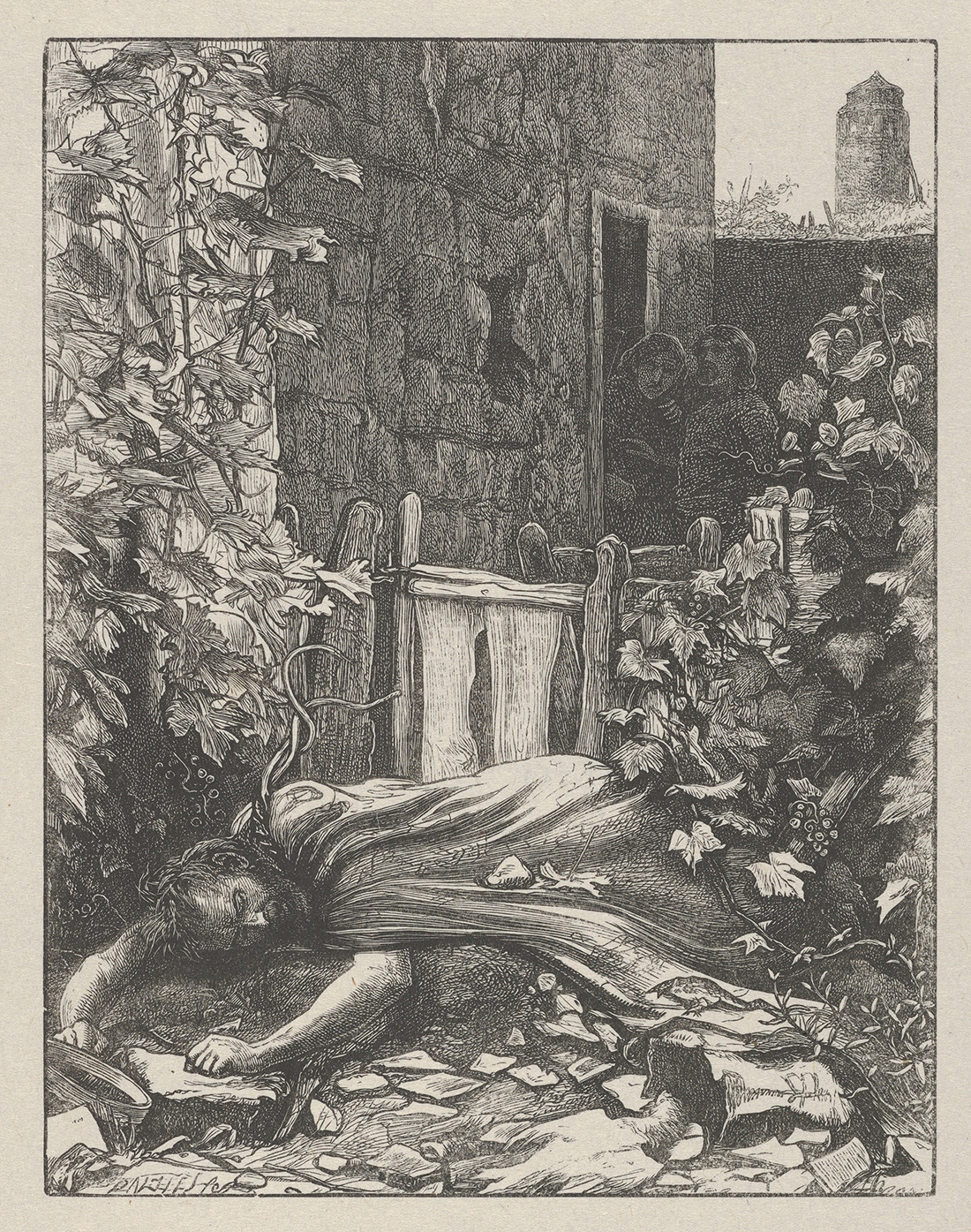
    The Unmerciful Servant (1864), artist: After Sir John Everett Millais, Engraved and printed by Dalziel Brothers | Creative Commons, courtesy The Metropolitan Museum of Art.

    So, we read that “in anger his master handed him over to the torturers.” Let’s look closely at the original Greek as we wrap our heads around God’s righteous anger and act of divine justice in this passage.

    The verb for his anger is ὀργισθεὶς (orgistheis), which can be translated as “moved to anger” or “provoked to anger.” Here we see that the king is provoked or moved by the actions of the servant; it is a response to something the servant has done. We must recall that while God is indeed all that is good, he is also the source of moral behavior, moral decision making, and moral valence (that is, what is good vs. what is bad). As such, he stands as the judge of behavior, and a judge is not silent when presented with something. Actions either uphold the good or go against the good. Being “moved to anger” means that he stands in his role as judge and proclaims the evil that he sees.

    Why anger? Why not sadness or emotionless judgment? Well, let’s return to the kind of God we know we have: one who overflows with love for his people and his creation. Is this the sign of impassivity? Should we expect a divinity so pure and full to not react viscerally to both the goodness he finds in us as well as the evil he finds in us? As it appears in today’s reading, God is viscerally moved to compassion — σπλαγχνισθεὶς (splanchnistheis) where the word σπλαγχνα (splanchna) means interior organs or intestines — and we can expect that he can be viscerally moved to something other than compassion when encountering evil. I don’t presume to know what he is moved to, but the scriptures tell us many times that he is moved to anger, so I take divine revelation for what it is.

    In his anger, the king “handed him over”: παρέδωκεν (paredōken), which occurs 18 times in the New Testament, notably when Judas hands over Christ to the chief priests, when Pilate hands over Christ to be crucified, and when Christ gives up his spirit in death. This is an irrevocable step in delivering something. And to whom does the king hand over the servant? The torturers, who will enact pain upon him “until he should pay back the whole debt” (200,000 years, I guess). We can rightfully say that in his goodness God does not take pleasure in this torture and note that he does not inflict it himself. Gehenna/Hell is set up for this purpose, a place for the people who pervert the Spirit and undermine God’s law.

    So as to not end this reflection as a total downer, let’s end with some wise words from Leiva-Merikakis, for whom today’s reading in part gives him the title for his three-volume work on St. Matthew’s gospel.

    The only thing we should be afraid of is not being merciful as our heavenly Father is merciful, for it is from unmercy that the most dire consequences flow, the ones reaching most deeply and devastatingly into both our psyche and our eternal destiny. For the Kingdom of Heaven is a kingdom of mercy, and mercy is never realized in the abstract but only through a concrete exercise of forgiveness. … Therefore, the ability to forgive our brother unceasingly and from the heart should be one of the primary concerns of our prayer, one of the most earnest pleas we make before the Throne of Grace (654).

  • People of the New Fruit

    People of the New Fruit

    Friday in the Second Week of Lent: Genesis 37:3-4, 12-13a, 17B-28a, Matthew: 21:33-43, 45-46.

    Today’s readings are truly riches in storytelling and spiritual teaching. The parallels between Jacob’s son Joseph and Jesus Christ abound in their details: both are the favored son, both are sent to help in the tending of the sheep, both are caught up in the drama of jealousy, misunderstanding, and persecution, both are put in a place of containment (Jacob in the cistern, Jesus in our attempts to limit and demarcate the presence of divinity in our lives), both find adoption by an alien people, and both end up being hugely transformative figures despite these challenges, reigning in peace and forgiveness.

    While Joseph is an early Biblical figure who prefigures the life of Jesus, what we encounter in the gospel is that Jesus is pointing beyond Himself to a Church that will grow with Him and help to unite Heaven and earth. We will see how the killed son becomes the cornerstone of an entirely new reality and the vineyard will be given over to new tenants to produce new fruit.

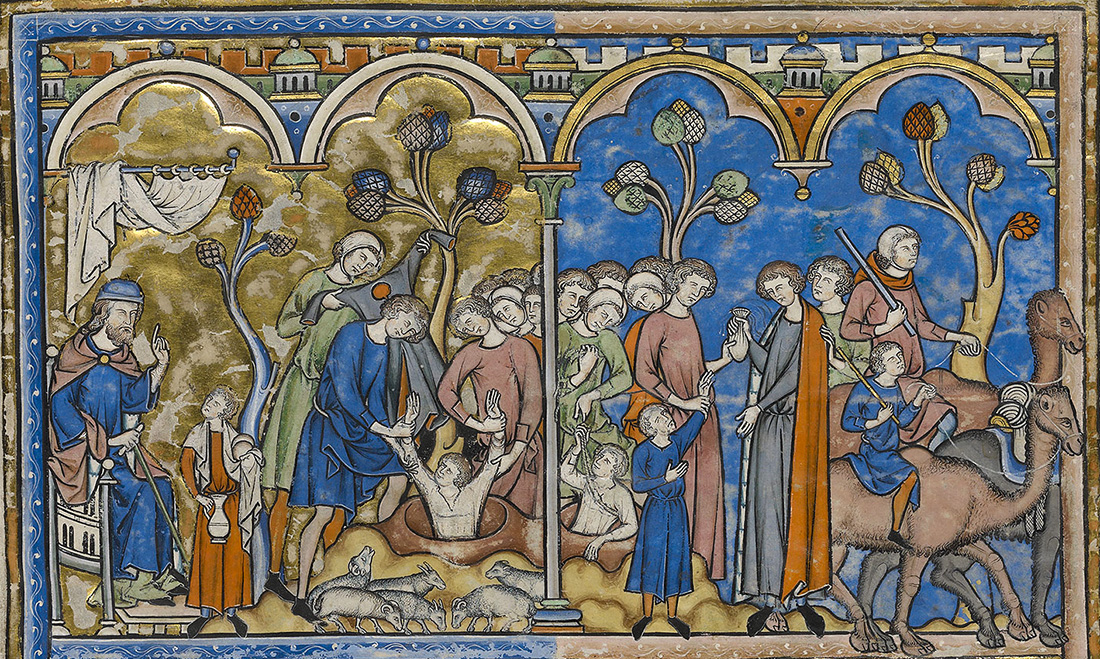
    Joseph, a favorite Son, Sold into Slavery (from an illustrated French manuscript, known as the Crusader Bible or the Morgan Bible, c.1244-1254) | Creative Commons, courtesy Pierpont Morgan Library. MS M.638.

    Before examining the gospel reading, I would be remiss if I didn’t acknowledge the huge role jealousy plays in the first reading. As we explored in Worm of the Soul two days ago, jealousy is a terrible, foundational sin that twists us into unrecognizable beings. Listen to the brothers: “Here comes that master dreamer! Come on, let us kill him and throw him into one of the cisterns here; we could say that a wild beast devoured him. … just throw him into that cistern there in the desert; but do not kill him outright. … What is to be gained by killing our brother and concealing his blood? Rather, let us sell him to these Ishmaelites.” This spiral of evil conspiracy starts with the seed of jealousy, planted in their hearts by the devil. It festers and manifests by calling him names, degrading him. This trick of twisting their minds against their very brother opens the door to seeing him as something other than fully human (much less their brother). Then we hear a sequence of plots and machinations. They have already given themselves over to sin and evil, and this sequence smacks of the guilty desperately trying to find a way not to be found out. We must recognize this tortured logic because we encounter it in ourselves in many ways. Whenever we find ourselves making certain calculations and rationalizations to avoid a certain end, it is a good time to sit up and examine what exactly we are doing. Are we living in the light or are we obscuring our actions because we’re heading down a path of darkness? This is not to say that all situations are easy and straightforward — indeed, many take careful thought and weighing of moral issues — but it is a good reminder in this Lenten season of what our more quiet soul-searching can do for us in a busy modern world.

    Turning to the gospel, Jesus is all-too-aware of the plots and machinations of the chief priests and elders of the temple who want to arrest him. They, too, are already guilty of having sinned in their hearts and turned away from the light. For them, he presents the Parable of the Wicked Tenants.

    Central to the parable is the setting: a vineyard. His listeners would immediately identify the vineyard with Israel since one of the more famous and eloquent passages in Isaiah is “The Song of the Vineyard”:

    Let me sing for my beloved
        my love-song concerning his vineyard:
    My beloved had a vineyard
        on a very fertile hill.
    He dug it and cleared it of stones,
        and planted it with choice vines;
    he built a watchtower in the midst of it,
        and hewed out a wine vat in it;
    he expected it to yield grapes,
        but it yielded wild grapes. …
    For the vineyard of the Lord of hosts
        is the house of Israel,
    and the people of Judah
        are his pleasant planting;   (Is 5:1-2, 7a).

    Isaiah’s verses question why wild grapes have grown rather than choice grapes, and Jesus answers: it is the evil in the tenants who were entrusted to care for the vineyard.

    Against the important backdrop of a vineyard, Jesus weaves a parable that presents the scope of salvation history. First, we see creation: the landlord planted a vineyard, put a hedge, dug a wine press, and built a tower. Next, the election of the nation of Israel as a hope for the world: “Then he leased it to tenants and went on a journey.” Then, we see the long line of prophets who were sent to the people as well as their brutal rejection: “the tenants seized the servants and one they beat, another they killed, and a third they stoned.” Next, we see the time of Christ, when the son comes to “obtain the produce,” but he, too, is killed. Finally, we are given the question about the final judgment: “What will the owner of the vineyard do to those tenants when he comes?” Because it presents the history of God’s work of salvation in a concise allegory, this parable should be precious to us.

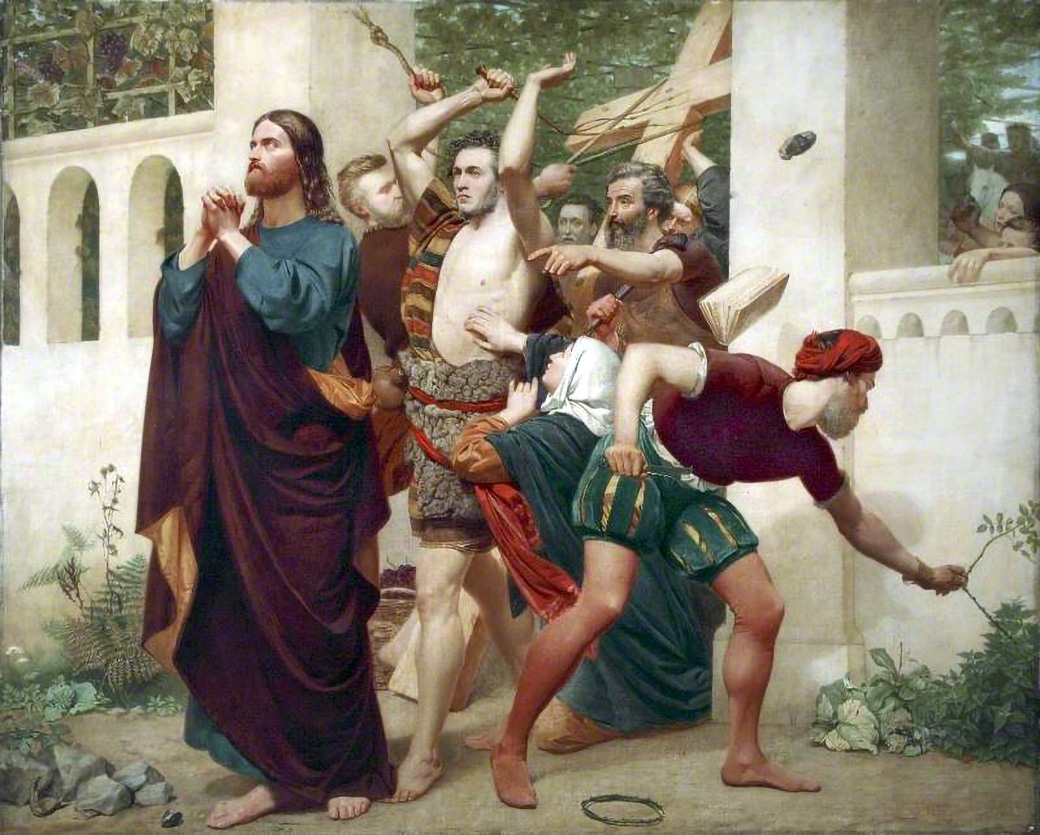
    The Wicked Husbandmen (1864), Artist: After Sir John Everett Millais, Engraver: Dalziel Brothers | Creative Commons, courtesy The Metropolitan Museum of Art.

    In his masterwork volumes on the gospel of St. Matthew, Fire of Mercy, Heart of the Word, Erasmo Leiva-Merikakis points out how central to the story (both the allegory and our reality) is the absence of the landowner. God’s physical absence is what makes the life of faith so important and what makes his return so anticipated. In Volume III, Leiva-Merikakis states, “The master’s physical absence is a kind of mystical vacuum that generates a tremendous moral crisis exposing the innermost heart of the tenants, revealing it in all its perversity” (468). Why, in fact, does God leave us to begin with? Leiva-Merikakis points out that the Hassidic answer “is that God must be absent for man’s sake, that is, if man is ever to grow fully into his divine vocation of becoming the eyes and hands and Heart of God in this word, the very dwelling place of God’s glory and truth” (468).

    God’s absence presents us with the choice: either trust in Him, His wishes, and His eventual return, or choose to forget that He was ever here and act like it’s all in our hands to do what we want. Clearly, the wicked tenants in the parable, who Jesus points out are the chief priests and Pharisees, have chosen the second option. 

    But let’s not forget that God cares deeply about his beloved vineyard, the tenants, and the precious fruit he waits for it to bear. That’s why he sends his servants (the prophets) time and again, as well as his son. When Jesus asks the priests and elders what the landlord will do to the tenants, they rightly answer, “He will put those wretched men to a wretched death and lease his vineyard to other tenants who will give him the produce at the proper times.” But God is not focused on the retribution for the wrongdoing. Instead, Jesus replies to their answer unexpectedly. In a gentle redirection, he asks, “Did you never read in the Scriptures: The stone that the builders rejected has become the cornerstone; by the Lord has this been done, and it is wonderful in our eyes.” His Good News is that God doesn’t give up on His Son or His vineyard. The “stone that the builders rejected” is presumably the son who is seized, thrown out, and killed (a clear reference to His Passion to come). Jesus puts aside the response of retribution that the elders give Him in order to point out something truly remarkable: the killed son has become the cornerstone. It is also instructive that His scriptural reference continues with by the Lord has this been done, and it is wonderful in our eyes. This is an acknowledgement that something spiritually extraordinary is going on, the good work of the Lord. Thus, the killed son doesn’t just become a martyr who lives on in the people’s memory; no, Jesus is talking about something much more extraordinary: the Resurrection and the bursting of divinity into human history, giving birth to the liturgy and creating the Church.

    The Heir Cast Out of the Vineyard (1855-1856), William Cave Thomas | Creative Commons, courtesy The World of Glass/ArtUK.

    This new reality of salvation happens in the presence, not the absence, of the Spirit of Christ, alive in the world after the Resurrection. This makes us the new tenants in as much as we share Christ with the world. In his high-priestly prayer at the Last Supper, Jesus affirms this aspect of the Church: “The glory that you have given me I have given them, so that they may be one, as we are one, I in them and you in me, that they may become completely one, so that the world may know that you have sent me and have loved them even as you have loved me” (Jn 17:22-23).

    Leiva-Merikakis elaborates: “When people look for God in a visible form, they will see only each other. When they look for Christ, they will see only Christians. By giving us his own animating and sanctifying Spirit, Christ has entrusted us with everything that is his. No, ‘entrusted’ is not to say enough. Through his death and Resurrection, he has implanted in us a wholly new life, with all the same energies and principles of life that give thrust to his own life” (469).

    If we are in part the new tenants, are we (or our deeds) not also the fruit that the landlord will find? This is the question of all of salvation history: what kind of fruit will the landlord find? God has given us the ability to tend the vineyard through Christ’s Spirit active in our lives, but our deeds and charity, indeed all that we do here on earth are our fruits.

    Can we wisely accept the Spirit of Christ in our lives as a landlord who is present? Or will we continue to act as the Israelites did and conform to the law externally while having no internal relationship to the truth? Each of us this Lent has the opportunity to re-dedicate ourselves to tending the vineyard with Christ and bringing forth the fruits pleasing to the Lord.

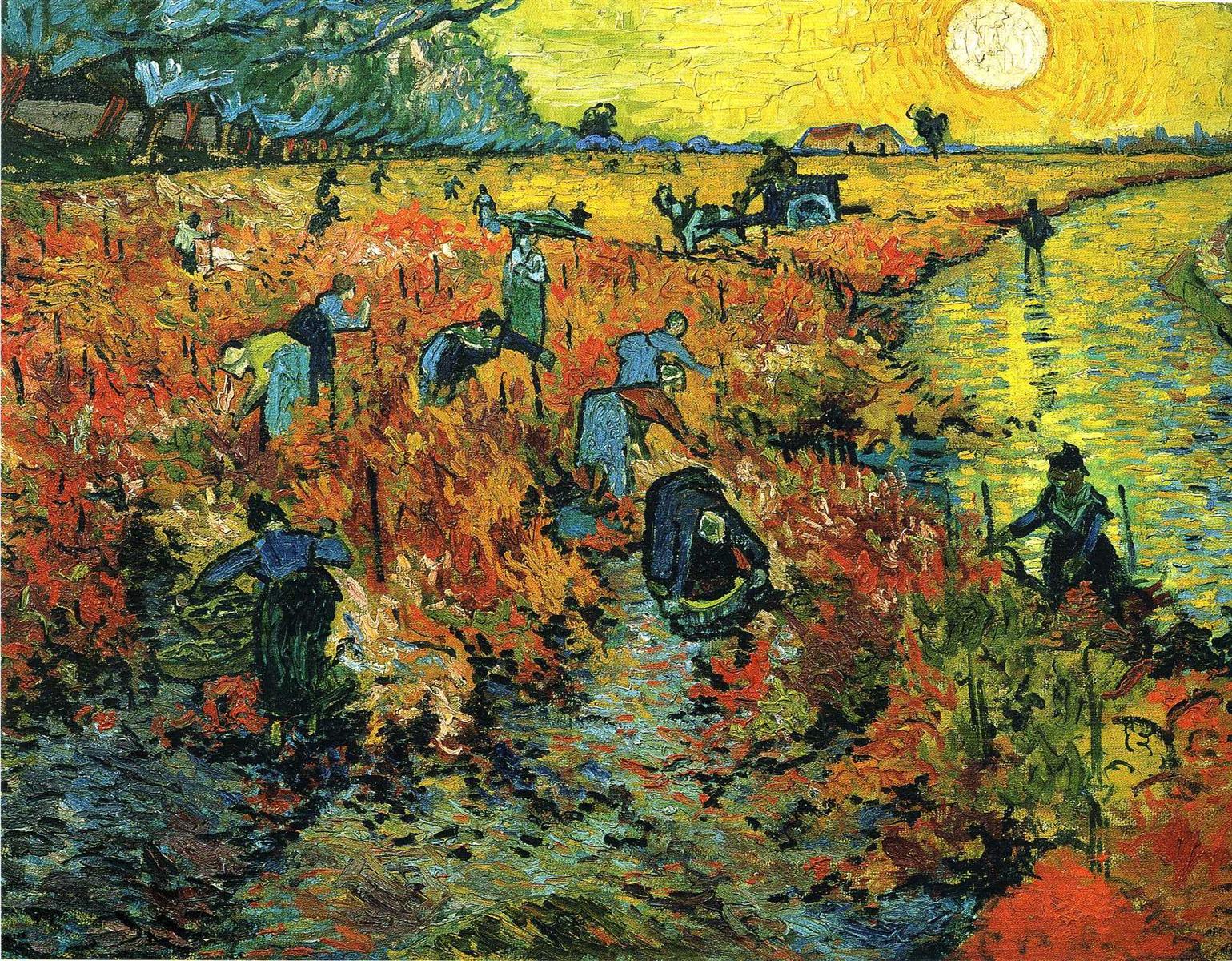
    Red Vineyards at Arles (1888), Vincent van Gogh | Creative Commons, WikiArt.org.
  • Worm of the Soul

    Worm of the Soul

    Wednesday of the Second Week in Lent: Jeremiah 18:18-20, Matthew 20:17-28.

    Today’s readings show the ugliness of jealousy, which St. Cyprian of Carthage calls “the root of all evil.” After examining the readings, I’d like to reflect on St. Cyprian’s Treatise on Jealousy and Envy, which offers some sharp insights.

    The Jews in Jeremiah’s time were tired of hearing his gloom-and-doom prophecies. In the Book of Jeremiah, we read of how his no-holds-barred warnings and criticisms land him in prison, get him beaten, and make him an outcast. Today’s reading shows the inner mindset of the Jews who wanted to discredit and destroy him: “Come, let us contrive a plot against Jeremiah … let us destroy him by his own tongue; let us carefully note his every word.”

    What provokes such evil in the hearts of his countrymen? Jeremiah wonders as much himself: “Must good be repaid with evil that they should dig a pit to take my life?”

    Jealousy (contemporary), Yvonne Wright | Image from pixels.com.

    There are many ways to react to a person who proclaims something upsetting. We can ignore them. We can disagree, perhaps loudly. We can silently listen to their harangue and think about it over time, seeing if there is any truth to it. Or, we can allow our passions to grip us and lash out. If we allow negative passions like anger to build, we begin to desire retribution in a more lasting way. This is the work of evil.

    But another sin may be in play in Jeremiah’s case, specifically jealousy. He is getting attention with his troubling prophecies, and the other priests and Jews are not liking the power and attention he is garnering. If jealousy is in the heart of Jeremiah’s adversaries, we can begin to understand how elaborate plots might develop.

    Jealousy is such an ugly sin that we never want to admit that it grips us. It’s embarrassing because it is such a strong sin, stripping us of everything elevated and good in character. Because it is ugly and embarrassing, we keep it hidden; we plot and the festering evil builds.

    In the gospel, Jesus quickly identifies this sin erupting among the Apostles and stamps it out before it can grow. When the Apostles learn of James and John’s desire to sit at Jesus’s right in Heaven, they “became indignant” and undoubtedly jealous. Jesus’s response is that while leaders in the Gentile world operate by having authority lorded over others, “it shall not be so among you. Rather, whoever wishes to be great among you shall be your servant; whoever wishes to be first among you shall be your slave.” Jesus must re-orient them to the goal of the Christian life: to serve and thereby inhabit and spread the love of the Father.

    The entire discussion of greatness and deservedness to sit at the Lord’s right hand is upended. If greatness is defined by being the best slave, then that’s a silly thing to be jealous over. In fact, as soon as you start serving people out of love, the idea of being regarded for one’s own greatness is absurd.

    And so we must ask ourselves what came over the mother of James and John (and them) when the request was made. The three of them are operating under a different mindset than Jesus’s teaching. She wants her sons to be great (and by extension, herself). As Christ points out, in the secular world this greatness comes at the cost of others — one is exalted above others, in fact the only way to know that one is exalted is by seeing others lower than you in status. This entire worldview relies on envy of that exalted status. People are motivated by jealousy over that position, even if it is currently unoccupied. This type of “greatness” will never be aligned with God’s self-giving love because at its heart is inequality and envy.

    This is precisely why Jesus must die in a mode of sacrifice, showing that glory resides not in earthly exaltation above others. He shows that glory can reside in the most detested and shunned of places: the Cross. This is the only world where greatness and God’s love can coexist: where greatness finds itself residing in servitude and sacrifice.

    So as we peel back the layers of motivation behind the persecution of Jeremiah and the yearned-for elevation of James and John, we find the ugly sin of jealousy. We also find this squarely at the heart of the Sanhedrin during the arrest, trial, and Crucifixion of Jesus. Today’s readings are a warning, pointing to the dangers of jealousy, which hides in the motivations by which we live out our lives. Lent is our time to root it out and stop it.

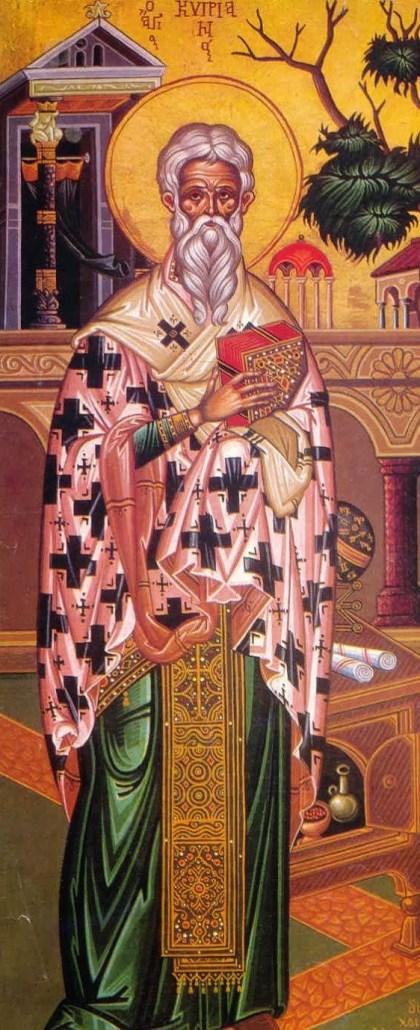
    Modern icon of Saint Cyprian, provenance unknown | Image from pilgrimcenterofhope.org.

    Saint Cyprian, Doctor of the Church, Bishop of Carthage and Martyr, was an African born of noble birth around the year 200 AD. Son of a Roman senator, he was a dissolute pagan in his youth, although well trained in rhetoric, philosophy and law. He converted to Christianity in his middle years. He went to his own beheading willingly in 258 AD after refusing to recant his Christianity during the persecutions of the Emperor Valerian.

    In his Treatise on Jealousy and Envy, St. Cyprian traces jealousy to Satan, “when he beheld man made in the image of God, broke forth into jealousy with malevolent envy— not hurling down another by the instinct of his jealousy before he himself was first hurled down by jealousy, captive before he takes captive, ruined before he ruins others” (4). This sin, therefore, is so powerful that it overcame the devil himself and is associated with the core of his own evil. “Thenceforth envy rages on the earth, in that he who is about to perish by jealousy obeys the author of his ruin, imitating the devil in his jealousy” (4).

    St. Cyprian traces how jealousy is at the heart of tragedies and figures throughout scripture: Cain and Abel, Esau and Jacob, Joseph and his brothers, King Saul and King David, and finally Christ and the Jews. Then, he proclaims that jealousy is, in fact, the source of all the other evils:

    It is the root of all evils, the fountain of disasters, the nursery of crimes, the material of transgressions. Thence arises hatred, thence proceeds animosity. Jealousy inflames avarice, in that one cannot be content with what is his own, while he sees another more wealthy. Jealousy stirs up ambition, when one sees another more exalted in honors. When jealousy darkens our perceptions, and reduces the secret agencies of the mind under its command, the fear of God is despised, the teaching of Christ is neglected, the day of judgment is not anticipated. Pride inflates, cruelty embitters, faithlessness prevaricates, impatience agitates, discord rages, anger grows hot; nor can he who has become the subject of a foreign authority any longer restrain or govern himself. By this the bond of the Lord’s peace is broken; by this is violated brotherly charity; by this truth is adulterated, unity is divided; men plunge into heresies and schisms when priests are disparaged, when bishops are envied … (6).

    We have heard the more memorable, “money is the root of all evil,” but is not money just a vector for envy? Cyprian has some memorable phrases of his own; I particularly like “nursery of crimes” and how jealousy removes our ability to “restrain or govern” ourselves. He has several great phrases at the start of the next section: “what a gnawing worm of the soul is it, what a plague-spot of our thoughts, what a rust of the heart, to be jealous of another, either in respect of his virtue or of his happiness … to make other people’s glory one’s own penalty” (7). Cyprian really brings home how jealousy is primarily a harm to our own selves, our own humanity.

    He says this even more forcefully: “Yet you are the enemy of no one’s well-being more than your own … Wherever you may be, your adversary is with you; your enemy is always in your own breast; your mischief is shut up within; you are tied and bound with the links of chains from which you cannot extricate yourself; you are captive under the tyranny of jealousy” (9). 

    Venus, Cupid, Folly and Time (detail), 1545, Angelo Bronzino | Wikimedia Commons. This figure in the background of the painting is often thought to be Jealousy.

    This does resonate, at least with me. Even just from my adolescent jealousies over love interests, jealousy threatened to be overwhelming. It definitely seemed to act like a tyrant; and a tyrant harming me and my character more than anything else. With this in mind, I think about contemporary secular credos I hear from friends, “as long as I’m not harming anyone else, then it shouldn’t be anyone’s concern.” Do we really want to ascribe to this thinking? Don’t we want to help people who are being ruled by the gnawing worm of the soul, the tyrant of jealousy?

    We are called to bring others to God, and there is no room for someone to move toward God if they are ruled by jealousy. Our love of others and charity should move us to help people overcome their jealousies and envy. So, even if they are harming themselves and not others, it really might be our business and mission as Christians to bring the light of Christ into their lives.

    But, it’s certainly enough for us during this time of Lent to try to identify the sneaky, hiding currents of jealousy in ourselves. Christ gives us many teachings like that in today’s gospel reading to help us overcome jealousy specifically by making it irrelevant. I think that in most cases, jealousy thrives in a worldview that is secular and driven by desires of this world.

    Let’s close with some words of encouragement from St. Cyprian: “Tear out from your breast thorns and thistles, that the Lord’s seed may enrich you with a fertile produce, that the divine and spiritual cornfield may abound to the plentifulness of a fruitful harvest … let all bitterness which had settled within be softened by the sweetness of Christ” (17).

  • Set Things Right

    Set Things Right

    Tuesday of the Second Week in Lent: Isaiah 1:10, 16-20, Matthew 23:1-12.

    The prophet Isaiah utters a simple phrase in today’s reading that might serve as a saying for all of Lent: “Come now, let us set things right, says the LORD.” I love God’s gentleness here, like someone seeking to calm you, reassure you, and just move forward on a new path without dwelling anymore on the past. All the more striking is the fact that it comes in the midst of serious charges of having fallen away from him.

    The ugly truth of our sin and unworthiness does not diminish God’s desire to have us convert back to Him. We shall see that Jesus, too, presents us with this same invitation: “whoever humbles himself will be exalted.” That is, the door to your exultation is open, let’s go.

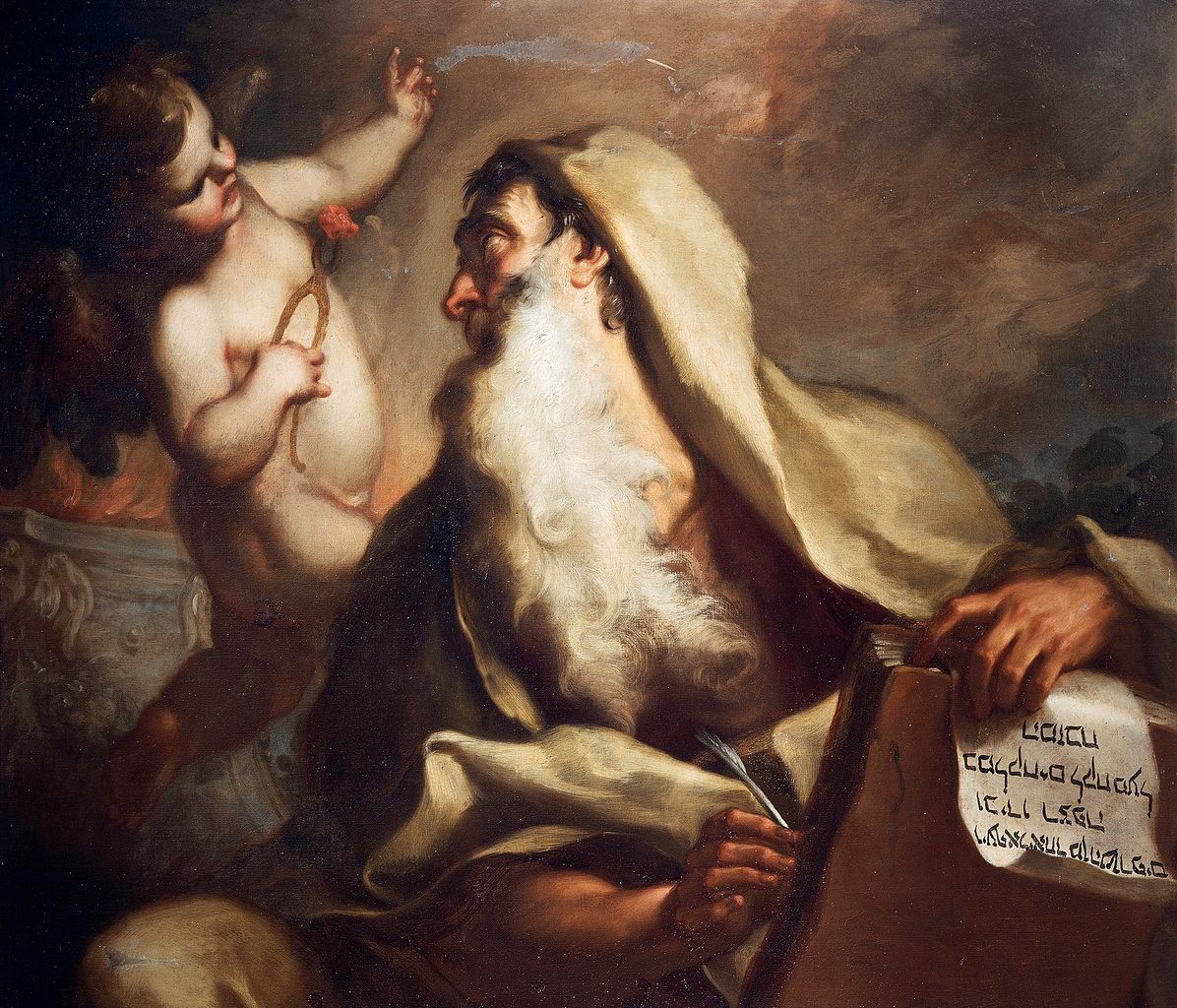
    The Prophet Isaiah (early 1700s), Antonio Balestra | Wikimedia Commons.

    The “Vision of Isaiah” concerning Judah and Jerusalem was taken down in the early 700s BC, during a low point for Judah. King Ahaz (r. 732-715 BC) had cozied up to the Assyrians, brought their tastes and religious idolatry not just into the country but into the Temple itself. How wicked was he? He also offered his son by fire to Moloch, the Canaanite god associated with child sacrifice. His wickedness did not stop despite many trials, and he even closed schools and houses of worship so religious instruction had to go underground.

    Given the king’s significant turning away from God, we can start to understand the dire warnings in Isaiah. Interestingly, these warnings are not focused on intensifying their forms of worship, which the Jewish priests may have been concerned with, and to this day characterizes the ultra-Orthodox strain of Judaism. In verses 11-14 (omitted from today’s reading), he is clear that these are no longer pleasing to the Lord: 

    I have had enough of burnt offerings of rams
        and the fat of fed beasts;
    I do not delight in the blood of bulls,
        or of lambs, or of goats. …

        Trample my courts no more;
    bringing offerings is futile;
        incense is an abomination to me. …

    Your new moons and your appointed festivals
        my soul hates;
    they have become a burden to me,
        I am weary of bearing them.

    You could imagine that the priestly class would be calling for more sacrifices, more incense, more religious festivals. But Isaiah points out that the problem is the people themselves. His encouragement is for them to “Wash yourselves clean! Put away your misdeeds from before my eyes; cease doing evil; learn to do good.” And in a verse that could come from the mouth of Jesus some 700 years later, he urges them to establish their goodness through works of mercy: “Make justice your aim: redress the wronged, hear the orphan’s plea, defend the widow.”

    The force of today’s first reading, though, is focused on the gentle promise of salvation if the people change their ways and return to God’s commandments and precepts in their hearts. Thinking of yesterday’s reflection about sin and forgiveness, this is another stunning look at God’s economy of love that wipes out debt in sheer mercy and abundance:

    Come now, let us set things right,
        says the LORD:
    Though your sins be like scarlet,
        they may become white as snow;
    Though they be crimson red,
        they may become white as wool.
    If you are willing, and obey,
        you shall eat the good things of the land;

    God is ready to forgive all, to turn our bright red sins into pure whiteness. All that is needed is our willingness and obedience.

    Turning to the gospel reading, we encounter a solid condemnation of the scribes and Pharisees by Jesus. This is interesting, to be sure, but we should avoid interpretations of the type I’ve heard where Jesus is compared to a subversive counter-culture figure. He is not an authority-toppling hippy, despite bad late-20th century interpretations.

    Separated from the reality on the ground by 2,000 years, we tend to simplify the Israel in the time of Christ. We must turn to some true Church scholarship to orient ourselves. Here is a short excerpt from The Christian Centuries, A New History of the Catholic Church, Vol One: The First Six Hundred Years (Part One by Jean Danielou):

    “The study of the primitive Church of Jerusalem has shown the complexity of the Jewish world in which the Church was growing, and the different elements which that framework introduced to it. We have mentioned the Pharisees, the Sadducees, the Essenes, the Hellenists, but there were also the Herodians and the Zealots, and Justin also names the ‘Gentists, the Merists, the Galileans, the Hellenians, the Baptists.’ The Samaritans are also mentioned” (17).

    The list actually goes on. From this glimpse of complexity, we can learn a few things, primarily that there were many power structures and communities throughout the Jewish world, and the scribes and Pharisees in Jerusalem represent a specific kind. Thus, Jesus’s criticisms must be understood not as a dig at authority in general, but at a specific type of authority that had emerged around the Holy Temple at Jerusalem.

    In fact, while Jews throughout Israel acknowledged the main temple in Jerusalem as the seat of the Holy of Holies, the Ark of the Covenant had long ago been lost, ever since the Babylonians destroyed Jerusalem in 587 BC. So, while Jerusalem continued to be regarded as the capital of Jewish priestly culture and law, Jews all over the Levant (Holy Land) had their own synagogues and self-sustaining communities. Some only made it to the temple in Jerusalem once in their lives. Meanwhile, Jews in Jerusalem developed a sense of superiority over other Jews. This was particularly evident in the scribes and Pharisees, who were the experts in the law.

    Jesus acknowledges that the scribes and Pharisees “have taken their seat on the chair of Moses. Therefore, do and observe all things whatsoever they tell you.” Let’s remind ourselves that Jesus did not come to abolish the law but to uphold every iota and perfect it (cf. Mt 5:17). But he adds that while they can speak the truth from scriptures while teaching the law, they should not be emulated as people who actually uphold that truth: “do not follow their example. For they preach but they do not practice.” What follows is a sharp critique of how they comport themselves. They tell everyone what they must do but do not help them do it. They embellish their physical appearance, specifically by widening their phylacteries and lengthening their fringes.

    These two examples are important because those things were meant to be a way to keep God’s law close to one’s heart and mind. Phylacteries are boxes affixed to the head and left arm that contain slips of paper with scriptural passages. The tassels on their clothing were commanded in the Book of Numbers by God to be worn as a reminder to keep his commandments. These devices, meant to remind a person to turn inwardly to God, were effectively showed off by the scribes and Pharisees. They were outwardly boasting using the very items meant to turn oneself inward. And then there is the problem of them wanting places of honor at tables and to be called “Rabbi.” We are presented with a picture of insufferable, arrogant, and self-absorbed teachers. 

    Portrait of an Old Man (Possibly a Rabbi), 1645, Rembrandt van Rijn | Creative Commons, courtesy The Leiden Collection

    What is this superiority complex but obsession with power? And this public preening is nothing but pride. Jesus wants to remind us that we are called to the exact opposite. The gospel ends with his words, “you have but one master, the Christ. The greatest among you must be your servant. Whoever exalts himself will be humbled; but whoever humbles himself will be exalted.”

    This injunction was admirably lived by the Desert Fathers (and Desert Mothers) who strove to be the best Christians they could a few centuries after Christ. We hear them echo His teachings clearly: “Be always mindful of your sins and do not judge others; rather become inferior to all … If somebody speaks to you about any matter whatsoever, do not argue with him; but [if he speaks well] say ‘yes’ and if he speaks badly, say: ‘You know what you are talking about’ and do not contend with him about how he spoke” (Sayings of the Desert Fathers, Matoes 11). At its heart, this humble way of acting is uncritical of others and generous. It participates in the Way of love given to us by Christ.

    Once you have turned back to the Lord, swept up in his surging wave of love, the soft but insistent voice that you take on needs only to provide a little motivation: “Come now, let us set things right.”


  • Pray for your Persecutors

    Pray for your Persecutors

    Saturday in the First Week of Lent: Deuteronomy 26:16-19, Matthew 5:43-48.

    Today’s readings spell out our compact with God in a nutshell. He will make us sacred and all he asks in return is that we love unconditionally. We will ponder today how difficult it is to love those who hate us and are mean to us, but let’s consider for a moment the flip side. How easy and generous this covenant is! After all, loving is the best feeling one can possibly have. Not just easy love for someone who’s nice to you, but also that generous love for a stranger when you give them a coffee or a blanket. God is not trying to lead us down a necessarily onerous path (although the Cross is part of the path) — He has infused this world with grace and His Spirit and nothing is greater than union with God’s grace and Spirit. They lift us up, give us strength, reveal beauty, and elevate our souls. This feels good. As Jesus tells us, “Take my yoke upon you and learn from me, for I am gentle and humble in heart, and you will find rest for your souls. For my yoke is easy and my burden is light” (Mt 11:29-30).

    Generosity (contemporary), Stig Lofnes | Image from silapix.com.

    For those like St. Thomas Aquinas, who believe our capacity for reason is an essential part of our spiritual being and scientific pursuits can aid our ability to know God’s wondrous works, the 2010s were a boom decade in happiness research. Several studies showed that people reported increased happiness when engaging in generous behaviors like giving sweets or money to others rather than keeping these things for themselves. This is “light” social science, but the hard sciences back this up.

    In the 2017 article “A neural link between generosity and happiness,” the authors use functional MRI to show that specific regions in the brain linked to happiness controls are more active in people practicing generosity: “Generous decisions engage the temporo-parietal junction (TPJ) in the experimental more than in the control group and differentially modulate the connectivity between TPJ and ventral striatum. Importantly, striatal activity during generous decisions is directly related to changes in happiness.”¹ So science has finally showed a physical manifestation of something God has been urging us to do since we’ve been human! Listening to God’s Word and practicing charity undeniably makes us feel good.

    So why is it seem to be so rare?

    We can’t forget that we’re living in a fallen world, the devil’s world. Jesus acknowledges this, for instance, before his Passion and Death in John’s gospel: “Now is the judgment of this world; now the ruler of this world will be driven out” (John 12:31).

    St. Paul writes several times how Christians, the children of light, must continue what Christ started and dispel the darkness of the world. He describes the action of Satan: “In their case the god of this world has blinded the minds of the unbelievers, to keep them from seeing the light of the gospel of the glory of Christ, who is the image of God” (2 Cor 4:4). And the devil’s primary mode of blinding us to the truth is through our senses, through temptations that beguile us and ensnare us into believing that we must fulfill our desires at all costs.

    The redemption of the world out of the clutches of the devil won’t be complete until the Judgement Day and Christ’s return. Until then, we struggle with temptations contrary to God’s law. This is our cross to bear, and why Jesus tells us, “If any want to become my followers, let them deny themselves and take up their cross and follow me” (Mt 16:24).

    The struggle is real. St. Paul writes to the Romans about the inner conflict between knowing what’s right but still doing the wrong thing: “For we know that the law is spiritual; but I am of the flesh, sold into slavery under sin. I do not understand my own actions. For I do not do what I want, but I do the very thing I hate” (Rom 7:14-15). He speaks of being sold into slavery under sin, that is the original sin of Adam and Eve that cursed humanity to be subjects of the prince of the world, Satan. 

    Yes, the struggle. This is why God and Moses are so forceful in setting the commandments before the Jewish people. God knows that, in our fallen state, we need strong guidance, a strong dose of His truth in order to sustain our moral fiber. Moses says, “This day the LORD, your God, commands you to observe these statutes and decrees. Be careful, then, to observe them with all your heart and with all your soul.” In just the short passage from Deuteronomy in today’s first reading, we hear “command,” “observe,” “walk,” “hearken,” and “keep.” On the other side of the equation, we hear twice that God has “promised” them in return and twice that this is an “agreement.”

    If it feels a little bit like a parent repeating himself to his wayward child in order to impress upon the child the need to do the right thing, well, it is exactly that. But the promise is so great. In no uncertain terms, God promises to reverse the curse that He placed on humanity via Adam and Eve: “you will be a people sacred to the LORD.” 

    This return to a sacred state from our fallen state, as we know, comes through His Son and the great sacrifice to expiate our sins. God’s patient plan is to cultivate his Chosen People to be the receptacle of his divinity (Mary, that is) and the first recipients of his mercy and grace. 

    Triptych: Crucifixion and other Scenes (1302-1308), Duccio di Buoninsegna | Creative Commons, courtesy the Royal Collection Trust, England.

    But Jesus perfects our understanding of the Ten Commandments when he comes. Today, he teaches, “You have heard that it was said, You shall love your neighbor and hate your enemy. But I say to you, love your enemies, and pray for those who persecute you.” The “hate your enemy” part was not in the Ten Commandments but rose instead as a cultural tradition, which is why Jesus must correct it.

    He explains that if we want to be a people sacred to the Lord, we must truly be worthy to be called his children; we must act like Him: “that you may be children of your heavenly Father, for he makes his sun rise on the bad and the good, and causes rain to fall on the just and the unjust.” It’s a lovely sentence to describe the indiscriminate love of the Father, because sun and rain are life-giving aspects of creation that God has created to nourish us. Jesus ends with, “So be perfect, just as your heavenly Father is perfect.” Tall order! This is the call of sainthood. But then, the reward couldn’t be greater, to reclaim our status as a people sacred to Him.

    OK, it’s time to get real with ourselves. Is perfection possible? Even just this one commandment, to love everyone, to pray for your persecutors? Let’s say that we are faithful people, that we cultivate a relationship with God in prayer and receive the sacraments as part of the Church on earth. Let’s say that we even make a point not to have “enemies,” per se. That is, even if people do evil against us, we forgive them and do not harbor hatred for them, making them an enemy. Is that the same as loving them?

    Can we remind ourselves to literally pray for the person who is being mean to us or making the planet a worse place by their greed and pride? Reason tells me that I would need a heck of a thick skin not to react badly to someone road raging at me or yelling at me in a store for no reason other than they are having a crappy day. Practically speaking, I think I would need tons of patience and tons of practice.

    While these practical considerations might be true to an extent, the one thing I’m not relying on here is God’s grace. If we are trying to be loving, wouldn’t it make sense to appeal to the author of love itself? Let’s be honest, we can’t do this on our own — our sense of pride and injustice is too great to have someone scream at us unreasonably and meet them with love in return. Or have someone drag us to court unfairly and meet them with love in return. Or have someone want to silence us, arrest us, beat us because we are different than them … and meet them with love in return.

    Thankfully, God made us more than just physical creatures. We are spiritual creatures! We have something available to us that elevates us from being mere animals and we need to enter into “that mysterious encounter known as prayer” (CCC, 2567). If we can shut off our knee-jerk response for just a moment and enter into that mystical space of prayer, it immediately helps us. Just closing your eyes and reaching out with your soul to ask God for help has a calming effect in my experience.

    We have many saints as role models for us. We also have modern role models who have dealt with some of the worst persecution outside of war — I’m speaking of icons from the civil rights movement, specifically Dr. Martin Luther King, Jr. Facing blind hatred from white supremacists, politicians reluctant to enact change, and a black populace vacillating between violent retribution and nonviolence, King’s words came from his deep Christian spirituality: “Darkness cannot drive out darkness; only light can do that. Hate cannot drive out hate; only love can do that.” King’s statement moves beyond the internal struggle to acknowledge the spiritual forces at work.

    If we do not consider that we are caught up in a much bigger world than what we perceive with our senses, we are blind to truths that we are called to understand. King helps us remember what Jesus had to say about his own Passion and Death — that it was about vanquishing Satan and death, not about his feelings or pride. I particularly like another quote from King: “I have decided to stick with love. Hate is too great a burden to bear.” He knew that beyond the emotional burden of hate, the burden of sin was much too great to carry.

    Martin Luther King, Jr. (2013), Derek Russell | Image from mccall.com

    Look at a video recording of what King had to deal with and realize that if he could channel love in the face of the hate he endured, it should be a piece of cake for most of the rest of us.

    As we keep our sights on being perfect just as our heavenly Father is perfect, Let’s remember that God knows what it’s like to be human. Jesus acknowledges the limitations of our minds and bodies to his favored apostles this when praying at the Garden of Gethsemane: “Stay awake and pray that you may not come into the time of trial; the spirit indeed is willing, but the flesh is weak” (Mt 26:41). This added gift from God is that he showed us his willingness to become completely human and experience the same weaknesses we experience. There’s some experiential empathy for you. He gives us the sacrament of Reconciliation to help us return to him with a clean soul again and again. And he gives us the richness of his Word to explore over and over in order to help us slowly, painfully, resist hatred and enmity, replacing it with the spiritual ballast of prayer. 


    ¹ Park, S., Kahnt, T., Dogan, A. et al. A neural link between generosity and happiness. Nat Commun 8, 15964 (2017). https://doi.org/10.1038/ncomms15964

  • The Problem with Little Sins

    The Problem with Little Sins

    Friday in the First Week of Lent: Ezekiel 18:21-28, Matthew 5:20-26.

    Most of us understand when something is evil because that word itself conjures the sense of serious moral wrong. Murder, for instance, is clearly evil, and hopefully we feel the same about stealing, cheating, and adultery.

    When we get to lying, things get a bit more vague. There’s that convenient category of “white lies” wherein we place our untruths not done out of malice but out of some other interest (often mistakenly considered “the other person’s own good”). I’d like to ponder this category of white lies because it attempts to bring the spirit of Christ’s words today to weaken the law that He also upholds.

    It’s a good example of how crafty we are in trying to turn a blind eye to venial sins.

    White Lie (2010), Erin Harper Vernon | Image from erinharpervernon.com.

    In the first reading, Ezekiel explains the repercussions of following or not following the moral law set by God. God speaks through Ezekiel: “If the wicked man turns away from all the sins he committed, if he keeps all my statutes and does what is right and just, he shall surely live, he shall not die.” Now some Jewish scholars and rabbis did interpret this as an eschatological “life and death,” meaning that God was speaking of eternal life in Heaven or death in Sheol. But many Jews heard this as a life and death on this earth, which implies that God’s retribution was like an instant karma type of thing (for instance, the Sadducees did not believe in resurrection).

    God continues by speaking of his relationship with us: “None of the crimes he committed shall be remembered against him; he shall live because of the virtue he has practiced.” A few notes here: first, we hear the great tenet of the Judeo-Christian faith, what the Jews call teshuva, or the ability to repent and be forgiven by God. God promises that he will not remember — completely forget! — the sins of a wicked man who turns from his sins and practices virtue. We sometimes continue to punish ourselves for past sins even after confession, so it’s important to realize that from the very first revelations to the prophets, God shares this aspect of his love for us.

    Second note: our spiritual life or death is inexorably tied to a relationship with God, not just our virtuous actions. It is not our virtuous actions by themselves that grant us spiritual life in the Kingdom, but God’s forgiveness as part of his covenant with us. This should make us want to avoid a “cold” virtuous life, where we are simply doing what is right because that’s what we’re supposed to do. We need to encounter Him at some point, in some way, and the more we encounter and embrace his love, the more we’re on the path to spiritual life in the Kingdom. God wants to make this personal.

    Ezekiel proclaims, “Do I indeed derive any pleasure from the death of the wicked? says the Lord GOD. Do I not rather rejoice when he turns from his evil way that he may live?” I just love the idea that God can derive pleasure and rejoice when we turn away from evil. Maybe it’s the thing in me that wants to please, but I can’t think of any greater calling than to cause delight in the Lord. As the source of good, he also reassures us that he’s not a deity who cackles with glee when it comes time to punish evil. This causes him no joy; he wants us all to join him in Heaven.

    As we turn to the gospel reading, we are again plunged into St. Matthew’s account of the Sermon on the Mount. It starts with God’s call to be greater even than those who represent the pinnacle of Jewish observance of the law: “unless your righteousness surpasses that of the scribes and Pharisees, you will not enter into the Kingdom of heaven.” Whoa! What is a regular, workingman Jew or Gentile supposed to think of this?

    Today’s gospel doesn’t show us, but this comes at the end of the section where Jesus proclaims, “Do not think that I have come to abolish the law or the prophets; I have come not to abolish but to fulfill … whoever breaks one of the least of these commandments, and teaches others to do the same, will be called least in the kingdom of heaven; but whoever does them and teaches them will be called great in the kingdom of heaven” (Mt 5:17, 19). I want to examine his specific phrasing here — Christ is not speaking of just obeying the law but of (dis)obeying and teaching others to do the same.

    Why does this matter? Because Christ’s entry into history has started the End Times, where we all receive a share in his divinity. By being baptized in the blood of Christ’s sacrifice, we emerge from our baptismal waters as new people, part of the Mystical Body of Christ. Thus, when we teach others something wrong, we are attempting to corrupt a very part of the divinity of Christ. Conversely, when we uphold the law and teach others to do the same, we are upholding our New Covenant with God, affirming the divinity of Christ in humanity, and bolstering the mystical relationship between our spiritual health, God’s love for us, and the love we pour out on each other in virtuous actions of charity.

    The Light of the World (1853-54), William Holman Hunt | Image from pixels.com.

    Then, Jesus delves into the seeming differences between mortal and venial sins. He acknowledges that we all are familiar with the law of mortal sin, that You shall not kill, adding, “But I say to you, whoever is angry with his brother will be liable to judgment.” Jesus seems to impose an impossible obstacle for our entrance to the Kingdom. He is equating unspoken and unacted upon anger with murder! How can we be this perfect?

    It helps to dig into the heart. What these share is evil intent. Our anger puts us in a position of opposing another person to such an extent that we wish to enact some type of violence — a verbal insult, public scorn, physical violence, etc. This reflects an attitude of hate, not love, where we no longer consider that person a brother or sister but instead see an enemy or an opponent. In this state of anger, we no longer abide by the spirit of the law. Murder is just an extreme physical manifestation of the same spiritual low point.

    Thus, Jesus wants to point out that it’s not just adherence to the outward details of the law, but an equal adherence to the spirit of the law that makes one righteous. He points out the hypocrisy of the Pharisees and Scribes throughout his ministry, and today’s teaching is an expansion of why he is upset over hypocrisy. His point here is the same as when he says, “They tie up heavy burdens, hard to bear, and lay them on the shoulders of others; but they themselves are unwilling to lift a finger to move them” (Mt 23:4). The spirit of their actions is not God’s Spirit of helping the downtrodden.

    The Law is in place to help us become more God-like, and when they place “heavy burdens” upon others (i.e., religious prescriptions) rather than helping and loving others as God does, they are no longer operating within God’s law, even though they seem to be. To rephrase Christ’s lesson here, we must allow the Holy Spirit to re-orient us in everything we think, say, and do. Otherwise, we are just as far from God when we think hateful thoughts as we are when we act them out.

    This lesson from the Incarnate Word of God is, as we would expect, the same that he shared with Ezekiel 600 years earlier. God wants to emphasize his intimate relationship with us and our salvation. He is trying to tell us that he wants a personal relationship with us; he wants us to get close to him in mind, spirit, and action.

    Fr. Reginald Garrigou-Lagrange, the great 20th century Dominican spiritual master, can help us understand why venial sins are so destructive and to be avoided. He points out that while mortal sin is like committing spiritual suicide, “He who falls into venial sin impedes the action of God from exercising itself freely on him, and little by little ruins his spiritual health just as the alcoholic ruins the health of his body” (Knowing the Love of God, 16). I appreciate the analogy here — I can see how venial sins are somewhat addictive in that we fall into the habit of doing them because we think they’re no big deal, and I can see how they are spiritually destructive. We constantly make excuses for ourselves when we commit venial sins, specifically of the vein, “I didn’t mean to do something bad.” We are trying to excuse the slight against God and fellow human.

    Garrigou-Lagrange is unsparing in his assessment of what sin means: “Sin is not only a foolishness and a vileness, but considered in relation to God it is also the blackest ingratitude, the greatest injustice, and the gravest outrage” (21). This is where I want to go with this reflection: how do we hurt our relationship with God when we sin?

    Garrigou-Lagrange justifies his statements about ingratitude, injustice, and outrage against God by reminding us of his sovereignty as Creator of the Universe. He writes, “God, the Creator, has full rights over our life. As supreme overlord He has the right of possession over our mind and our heart, and this right, more absolute than any of our property rights, remains binding even if we forget it” (21). What a wake-up call for us. We are so used to imagining that we are independent actors in the world, sovereign over our own bodies and minds, that all our cultural messaging argues to the contrary of God’s primary sovereignty.

    Contemporary American rhetoric over “rights,” in particular, is an extreme example of how we imagine that the most inviolable thing in the world is our right to do as we see fit within the law (or change the law if it’s inconvenient). But how wrong this is! The most inviolable thing is God’s sovereignty, and we are his subjects. We owe him our faith and loyalty and his Law is not to be changed in any way. This does not sit easy with the contemporary imagination.

    Of course God is no tyrant and, instead of forcing our obedience, he gives us the free will to obey or disobey, to grow closer to him or to push him away. As we’ve observed in prior reflections, he has called out to us before we searched for him. And he constantly offers us his grace. That is where we start.

    Thus, as Garrigou-Lagrange points out, “In the present, in the very instant in which it is committed, venial sin deprives the soul of a precious grace. In that instant, grace was offered us to make progress in perfection, to be charitable, fervent, and industrious … Now this grace has been lost by our neglect, our laziness, and our limited charity” (23). Perhaps if we start thinking of our venial sins in this way, as a moment when we pushed away the grace that could have perfected us, we will become more aware of the fact that they are sins.

    Sorrowing old man (“At Eternity’s Gate”), 1890, Vincent van Gogh | Wikimedia Commons.

    I want to circle back to the idea of “white lies.” This might be the most common type of venial sin and it is a real perversion of Christ’s teaching in the gospel today. We justify white lies by saying that we are operating under a spirit of goodness. We don’t want someone to get overly upset by the truth, or we want to shield them from difficult truths, so we lie. But Jesus doesn’t say that the spirit trumps the letter of the law. Upholding the spirit of God’s goodness is part and parcel of the Law that also prescribes a specific way of action. The basis of these prescriptions are the Ten Commandments and the Beatitudes. We can’t justify breaking the command to be truthful by saying we meant well. Let’s remember St. Paul’s great words to the Ephesians: “For once you were darkness, but now in the Lord you are light. Live as children of light” (Eph 5:8).

    Both readings today display how God wants us to convert to Him, fully and unreservedly. Unless we’re in a monastery, praying constantly, it’s easy for us to be tempted to venial sin and turn our backs to God’s offer of grace. But that’s why Lent is so important, so that prayer, fasting, and acts of charity can help us fight temptations and remain close to God. 

  • Asking for God’s Help

    Asking for God’s Help

    Thursday in the First Week of Lent: Esther C: 12, 14-16, 23-25, Matthew 7:7-12.

    Today, we hear Jesus tell us “Ask and it will be given to you; seek and you will find; knock and the door will be opened to you.” Christians have reflected on these words since the earliest days of the Church, and our perspectives have ranged from awe over a responsive God to expectations of a vending-machine deity. God is decidedly not a vending machine or djinn in a lamp, granting wishes. The key to understanding Jesus’s words is to put today’s gospel reading in context.

    This reading is a small excerpt from the magnificent Sermon on the Mount, which stretches from Matthew 5:1 to 7:29, three full gospel chapters. It opens with the Beatitudes, includes the Lord’s Prayer, and ends with dire warnings over not aligning oneself interiorly to God. This is one great teaching, and cherry picking a saying here and there, while easy to do, greatly misrepresents the complex threads of his teaching.

    Old Man Praying (1665-1670), Gerrit Dou | Creative Commons, courtesy The Leiden Collection.

    There are several passages that specifically warn against a flippant, easy way of asking God for what you want. The most direct might be: “Not everyone who says to me, ‘Lord, Lord,’ will enter the kingdom of heaven, but only the one who does the will of my Father in heaven. On that day many will say to me, ‘Lord, Lord, did we not prophesy in your name, and cast out demons in your name, and do many deeds of power in your name?’ Then I will declare to them, ‘I never knew you; go away from me, you evildoers.’” (Mt 7:21-23). This is a person calling out — asking, seeking, knocking — but the answer is unimaginably awful. Christ tells this person, “go away from me, you evildoers.”

    Doesn’t this contradict the excerpt from today’s gospel? Jesus explains the crucial qualifier: only the one who does the will of my Father in heaven will enter the kingdom. Another aspect of this passage that jumps out at me is when he says, “I never knew you,” to the person clamoring to enter the kingdom. Getting to know Christ is an absolutely essential part of our Christian journey. There simply is no salvation unless we acknowledge him as God, walk alongside him, and ask him to intercede for us to receive God’s mercy.

    This Christian journey happens as we live the liturgy, both sacramentally in our sacred spaces and practically in our secular spaces. And at the heart of today’s reading is a particular aspect of the journey: prayer. Our asking, seeking and knocking are ways we appeal to God through prayer.

    But let’s not get this backwards — anything we ask God in prayer is already a response to Him having first reached out to us. The Catechism of the Catholic Church states, “God calls man first. Man may forget his Creator or hide far from his face; he may run after idols or accuse the deity of having abandoned him; yet the living and true God tirelessly calls each person to that mysterious encounter known as prayer” (2567). He gave us prophets, he gave us revelation, he gave us his Son, he gives us miracles; in short, he has provided the reason to believe in him and a reason to call out to him for help.

    The question is, are we coming from a place where we are his humble servants, begging to know his will? Or are we instead coming from a place where we’ve already identified an outcome we want and are asking him to fulfill it? I want a good grade, a healthy dog, a politician to change his views, etc. In these scenarios, we have supplanted his will with our will. It’s easy to do — something, in fact, we’re much more likely to do than not because patiently, quietly, humbly discerning God’s will takes lots of prayer and lots of practice.

    Don’t get me wrong, I don’t think that asking for a good grade or a healthy dog is a bad thing. In fact, it is a sign that we want to bring God into our daily travails, to live with him and his help in everything. My gripe (to be honest – that’s what it is) is the all-too-common contemporary response we hear when people don’t get what they want. “How could God do that to me?” is the gist of this response.

    And sometimes it’s such a violent response when dealing with things like life, death, and suffering, that people decide to push God out of their lives, stop “being Catholic” (which is impossible, BTW, once you’ve been baptized into the Church), or even deny His existence. This is as transparently the work of Satan as it gets; we can practically see him sitting on the shoulder of these people prompting them to put their will ahead of God’s, to react with anger over outcomes they set for themselves, to blame God, and to ultimately decide to deny Him. We must avoid these things at all costs.

    And Jesus teaches us how to orient ourselves appropriately right here in the Sermon on the Mount. The Lord’s Prayer is the pinnacle of how to pray to our Father and the way to orient ourselves. Let’s recall our first two petitions at the beginning of the prayer, after acknowledging his holiness: “Thy kingdom come. Thy will be done …” We are asking, before all else, to hasten to the Kingdom of God. This does not mean that we are asking for death or for the end of the world, but for unification with God, which can happen while in this world as the saints show us.

    Do we believe this when we say it? Is this the thrust of our lives — to hasten to the Kingdom above all else? If it is, then earthly concerns take on a decidedly lower importance.

    The second request to God is that his will is done here on earth like we know it is in heaven. Christ repeats this many times throughout his ministry and lives it by willingly going through his Passion and Death according to the will of his Father. Jesus can’t stress enough for us how important this aspect of prayer and faith life is for us. God’s will — often unknowable and veiled — is something we hope to discern; but regardless of fully knowing, it is something we desire to be realized in the world.

    That’s real trust, you might say, and yes, it is! But there is nothing better to want than the will of Goodness itself, of Love itself, of Wisdom and Justice itself. The Lord’s Prayer teaches us to align ourselves with his will, feed ourselves on the spiritual food of his Word and worry less about this world and more about our spiritual well-being.

    Jesus reiterates this a few verses later: “Therefore I tell you, do not worry about your life, what you will eat or what you will drink, or about your body, what you will wear. Is not life more than food, and the body more than clothing? … But strive first for the kingdom of God and his righteousness, and all these things will be given to you as well” (Mt 6:25, 33). Ahh, what a salve for our constant worry! Our Lord tells us not to worry about our lives and earthly things but to “strive first” for the Kingdom and God’s righteousness, then everything else will fall into place.

    Woman in Prayer (contemporary), by Maria Magdalena Oosthuizen | Image from pinterest.com.

    So, let’s return to today’s gospel reading with the broader context of the Sermon on the Mount in mind. When Jesus says, “Ask and it will be given to you; seek and you will find; knock and the door will be opened to you,” I have to believe that he has something specific in mind. He has already told us to be humble petitioners yearning for the Kingdom, so what we are asking for is ultimately for God’s will to be done, if not understood. What we are seeking is his guidance in our lives. And we are knocking on his door in that response to his invitation to know him — we are knocking because we want his grace and love to overwhelm us in our lives.

    And just like we know how to give good gifts to our children, “how much more will your heavenly Father give good things to those who ask him.” Let’s just not imagine that we know what those good things are or when we’ll receive them, if ever in this world. Our humbleness dictates that we to not presume to put our desires or will ahead of the supreme will.

    Does Jesus direct us only to ask for God’s will to be done and nothing else? Not exactly, although I think he emphasizes that this should be first in our order of operations. Once we start to know God and love him, we can become instruments of his love in this world and that’s where charity comes in. We can bring our petitions on behalf of others, which come about because of God’s love working through us and manifesting as charity, thanks to “that mysterious encounter known as prayer.”

    And so in the Beatitudes, Jesus says, “Blessed are those who mourn, for they will be comforted.” Mourning is an act of charity for the souls of the departed. Also: “Blessed are those who hunger and thirst for righteousness, for they will be filled.” This hunger and thirst for righteousness is not just one’s own perfection but a desire for God’s justice for others in the world. And, of course, “Blessed are the merciful, for they will receive mercy.” The mercy that we pour out for our fellow humans is absolutely an act of charity, and God rewards us in the Kingdom for this.

    But let’s remember the order of operations here: 1. Love God first; ask for His will to be done, seek for His guidance, knock on His door for grace; and then: 2. Love your neighbor; ask for God’s love to pour through you to them, seek for their good, knock on His door to grace them. All of our Christian attitude and prayer is outwardly focused, not inwardly. May we remember this!

    I don’t want to miss saying a few words about the lovely reading from Esther. Here are my thoughts as recounted from last year’s reflection. For me, the Book of Esther is a bit of an odd duck in the Old Testament. It’s a great story explaining the establishment of the Jewish holiday of Purim, but the colorful narrative of ironic reversals and high-stakes changes of fortune remind me of a Shakespearean play. The setting is Babylon, and while many Jews have started to return to Israel after the Babylonian Captivity officially ends, Esther and her uncle Mordecai are some of those who remain. She’s not presented as particularly devout, and her most striking asset is her beauty, which gets her chosen as Queen after “trying out” with many other young virgins in the harem.

    But her secularism changes when the king is convinced to pass an edict that all Jews in the kingdom “shall all—wives and children included—be utterly destroyed by the swords of their enemies, without pity or restraint, on the fourteenth day of the twelfth month, Adar, of this present year.” Mordecai asks Esther to intercede with the king. In a passage before the one read today, Mordecai implores her not to “keep silence at such a time as this,” and says, “Who knows? Perhaps you have come to royal dignity for just such a time as this.” 

    The rub is that no one can come into the king’s presence without being summoned or they are killed. So in order to ask for him to change the edict, Esther must take her life in her hands. But, Esther is convinced that action is needed. And — praise the Lord — the action she takes begins with God. She responds to Mordecai: “Go, gather all the Jews to be found in Susa, and hold a fast on my behalf, and neither eat nor drink for three days, night or day. I and my maids will also fast as you do.”

    Queen Esther (1878), Edwin Long | Wikimedia Commons.

    This is where we join today’s reading. Esther, alone and “seized with mortal anguish,” falls back on the faith of her people. She covers her head with ashes and dung and utterly humbles every part of her body. Clearly, her prayer is fervent and sincere. It takes the form of both petition to help her find the right words and intercession, to save all of the Jews from slaughter. It seems to me that this reading is included in our Lectionary as a reminder of the sincerity with which we should pray to our God when we ask for his help. Also, it shows us that she is moved by charity, not selfish concerns, something that prefigures what Christ will eventually set up as the paradigm for His Church.