Category: Lent

  • Slaves of Sin

    Slaves of Sin

    Wednesday in the Fifth Week of Lent: Daniel 3:14-20, 91-92, 95, John 8: 31-42.

    Today’s readings give us a glimpse of what it looks like to be freed from the slavery of sin alongside the Son of God and also what it looks like to be stuck in our slavery. It’s clear that faith is the key ingredient.

    The first reading from the Book of Daniel is the other perspective of the reading we had two weeks ago (which we discussed in Mercy is the Master Principle). The young Jewish men named Hananiah, Mishael, and Azariah were given Persian names by King Nebuchadnezzar’s chief official. As we hear, they are called Shadrach, Meshach, and Abednego; it is a form of forced assimilation, as is the king’s decree that all must bow and worship the golden statue he has erected.

    But our young Jewish men refuse, and when called in front of the king to explain themselves, they profess their faith in the God of Abraham. Their speech is noteworthy:

    If our God, whom we serve,
    can save us from the white-hot furnace
    and from your hands, O king, may he save us!
    But even if he will not, know, O king,
    that we will not serve your god
    or worship the golden statue that you set up.

    Their faith does not depend on a display of power from God. They say “if he can save us, may he do so.” Importantly, they add, “even if he will not save us, know that we won’t serve your god or worship your statue.” Now that’s a refreshing display of faith. We’re used to hearing laments of how God can forsake his people, yet these three aren’t filled with fear, doubt, or anger.
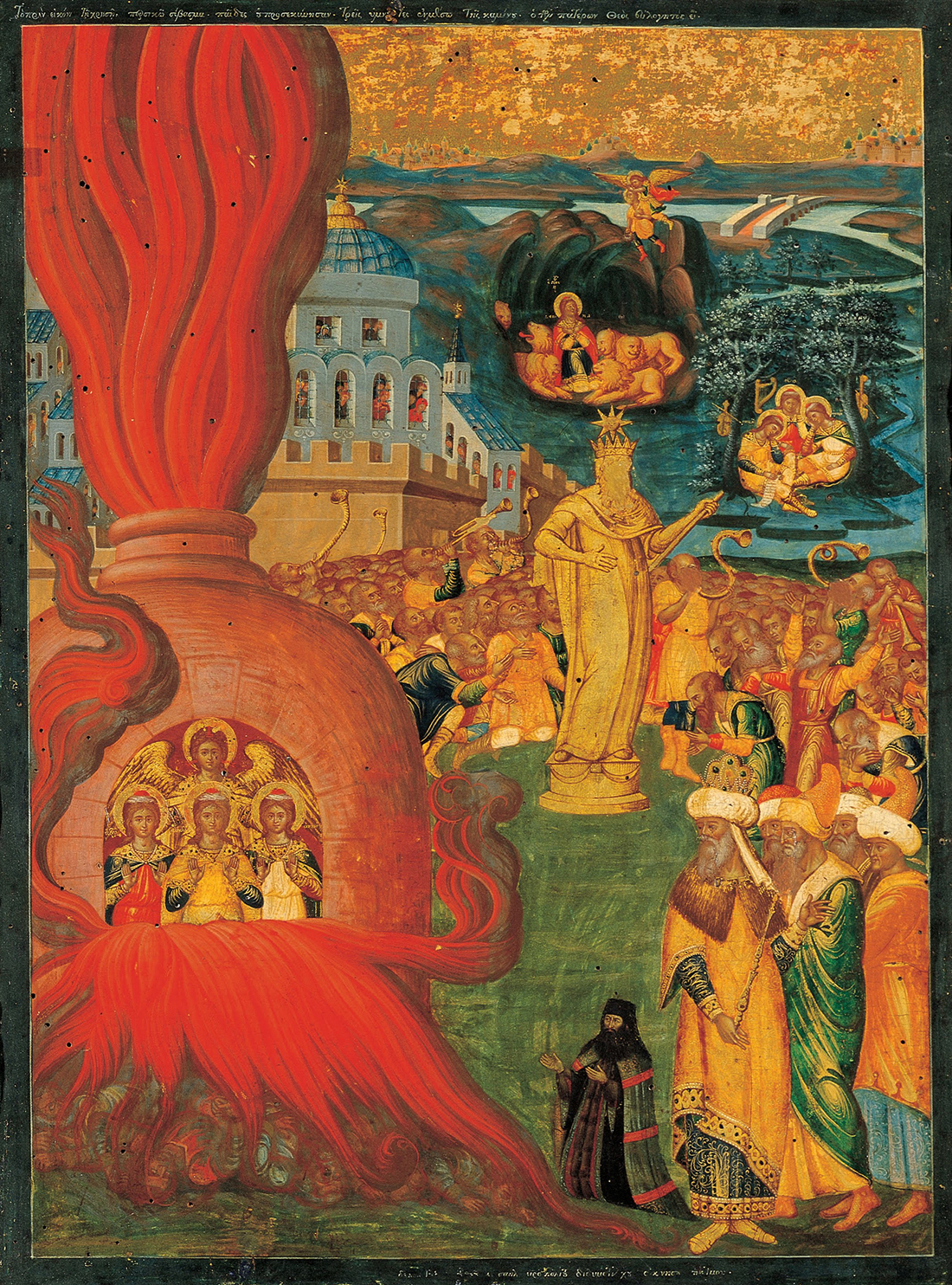
    The story of Daniel and the Three Youths in the Fiery Furnace (1725-1750), Adrianoupolitis Konstantinos | Wikimedia Commons.

    The passage we read a few weeks ago provides Azariah’s great prayer, but today we hear instead the reaction of the king before they are cast into the fire: his “face became livid with utter rage,” he heats the furnace up “seven times more than usual” and has “some of the strongest men in his army” bind them and cast them into the fire. His over-the-top, emotional reaction is emphasized in his unnecessary measures like superheating the furnace and having his strongest men cast them in. This is the reaction of human, earthly power when it is defied.

    It’s a show of power that is truly impotent in the face of a power that comes not from this world. Contrast this with God’s patience and mercy when we defy him. Also, let’s contrast this with God’s wrath, which he has under control, does not use unjustly or emotionally (see The Purifying Fire We Call God’s Wrath).

    In all of his power, King Nebuchadnezzar becomes an archetype of someone who is a slave to sin. His power, extreme passions, and pride distort his soul and the breath of divinity God has placed in humanity. He cannot blossom in his humanity, which requires embracing love. In fact, he eventually goes mad (see William Blake’s illustration below):

    “He was driven away from people and ate grass like the ox. His body was drenched with the dew of heaven until his hair grew like the feathers of an eagle and his nails like the claws of a bird. At the end of that time, I, Nebuchadnezzar, raised my eyes toward heaven, and my sanity was restored. Then I praised the Most High; I honored and glorified him who lives forever” (Dn 4:33-34).

    God shows us that when we are enslaved to sin, we become no more than base animals. It is the spark of divinity in us that raises us up from that state. God frees us from the slavery of sin, a type of insanity and animalism.
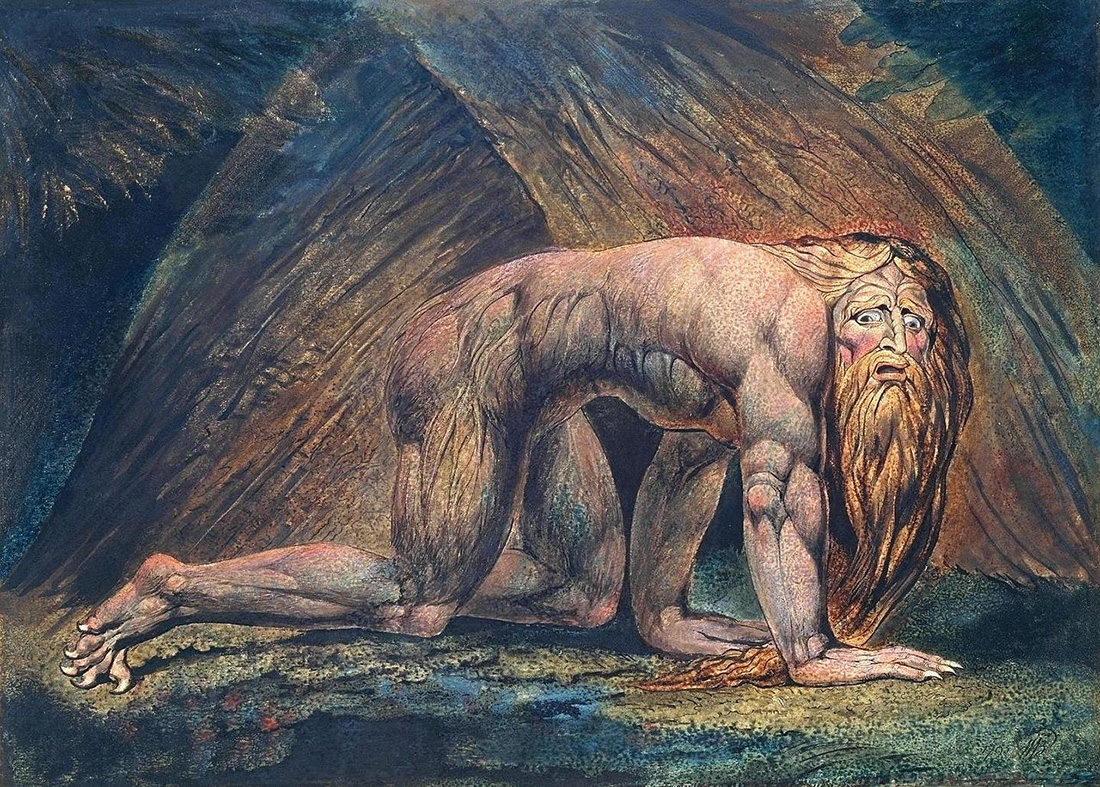
    Nebuchadnezzar, the Tate impression (1805), William Blake | Wikimedia Commons. Nebuchadnezzar was part of the so-called Large Colour Prints; a series begun in 1795 of twelve color monotype prints. These were painted on millboard, after which the board was put through Blake’s printing press. After they were printed, Blake and his wife Catherine added ink and watercolor to the impressions. It existed in four impressions (copies), now in: Tate Britain in London, the Museum of Fine Arts, Boston, the Minneapolis Institute of Art, and a fourth which has been missing since 1887.

    King Nebuchadnezzar is the figure who shows us slavery to sin but he is also the one who points out the state of being freed from sin and blessed by God. In today’s reading, he makes another notable comment. Upon seeing figures still standing in the furnace, he exclaims, “I see four men unfettered and unhurt, walking in the fire, and the fourth looks like a son of God.” This clear choice of words for “son of God,” לְבַר־ אֱלָהִֽין׃ (bar-Elahim), when read with the full view of salvation history provided by Jesus Christ, is a reminder that when we are blessed with eternal life, we live with the Son of God. Elsewhere, this figure is identified as an angel of God, but here, viewed through the white-hot fire intended to purify — the trial by fire that these young men have survived — this salvific figure is seen as the Son of God.

    This brings us to Jesus in today’s gospel from St. John. This is the third of four consecutive days we read from chapter 8 of John’s gospel where Jesus is displayed in a series of confrontations with dubious Jews in the temple area. On Monday, he schooled the scribes and Pharisees who attempted to bring him an adulteress for judgment, establishing that he was the law in letter and spirit. Yesterday, he made bold claims of his authority and parentage, noting that by disbelieving in his divinity, they will die in sin. Today, he turns to what should be a more trusting audience than the Phariseees, “those Jews who believed in him.” But even with these people, we find that their elevated notions of who they are get in the way of hearing his message.

    He tells them, “If you remain in my word, you will truly be my disciples, and you will know the truth, and the truth will set you free.” What a lovely promise! And a quotable quote, as they say, for 21st-century thinking: the truth will set you free. Our contemporary problem is that we ignore that the truth comes only from the Son of God and we think some other “truth” that we will discover will set us free.

    The problem in Jesus’s time was the second half of the aphorism, the “set you free” part. They object: “We are descendants of Abraham and have never been enslaved to anyone.” Slavery was a very much a reality in these days. They object to the use of the word because it has real-world implications and a terrifying historical value for them.
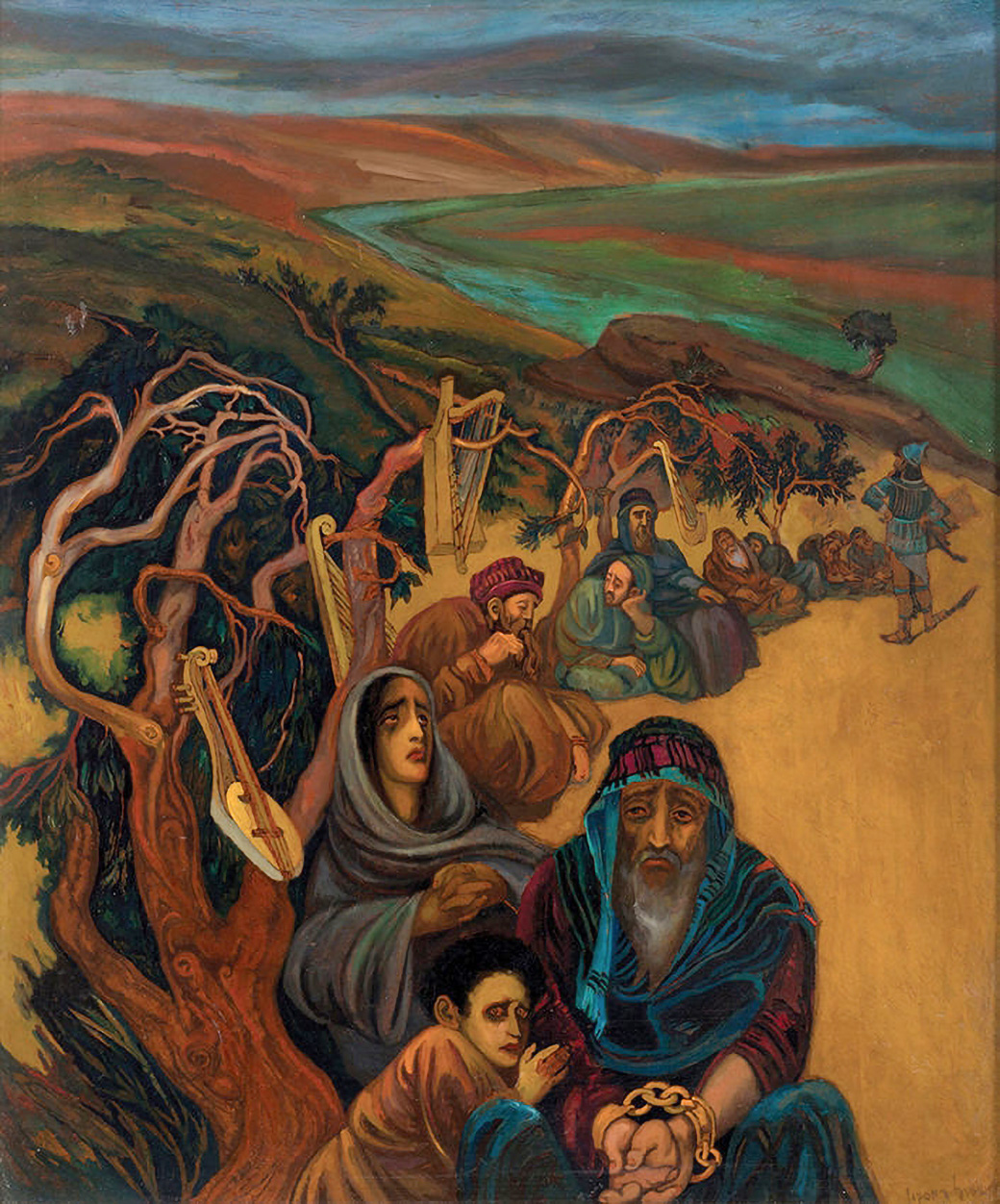
    By the rivers of Babylon there we sat down yea we wept when we remembered Zion (1942), Saul Raskin | image from mutualart.com. This is Raskin’s illustration of Psalm 137 that he painted for an illustrated Book of Psalms. Enslavement has always haunted the Jewish mind, and Jesus’s words about slavery to sin were difficult to digest.

    But Jesus doesn’t budge. Much like he does in re-framing their worldview around death and life with the raising of Lazarus (see See the Glory of God), he is determined here to re-frame their understanding of slavery and freedom. He explains, “everyone who commits sin is a slave of sin. A slave does not remain in a household forever, but a son always remains. So if the Son frees you, then you will truly be free.” His point is an important one: we slaves cannot stay in the Father’s house, the Kingdom of God, of our own volition, good works, faith, or anything else we do. It is only when the Son frees us that we stop being slaves and can become adopted sons and daughters of God.

    How does the Son free us? He brings us the truth from the Father about how we must order our lives, and we must fully accept his Truth. He also brings a New Covenant, established on the Cross, that pours out the liturgy upon us, and we must participate as one Church in this everlasting liturgy of life in order to stay in the Kingdom and no longer be slaves to sin.

    Today’s reading continues as he urges them to do what the Father has said, “I tell you what I have seen in the Father’s presence; then do what you have heard from the Father,” but they continue to oppose His point of view and the truth He is giving them. They respond that their father is Abraham, sadly identifying themselves primarily through their human progenitor rather than their Creator whom they supposedly love and worship above all else. Jesus meets them here, however, and says,

    If you were Abraham’s children,
    you would be doing the works of Abraham.
    But now you are trying to kill me,
    a man who has told you the truth that I heard from God;
    Abraham did not do this.
    You are doing the works of your father!

    Jesus will tell them even more about his relationship to Abraham in tomorrow’s reading. Here, he notes that they can’t be true children of Abraham because they are doing something he did not do; that is, Abraham listened to and obeyed God no matter how difficult his commands, while they are not. Note how subtly Jesus continues to reframe the conversation — he talks about Abraham as their spiritual father, the one who guides their moral choices, while he knows that they are talking about Abraham as their ethnic father.

    His final remark is to be read in this same spiritual vein: the work of their actual spiritual “father” (not Abraham) is to willfully not listen to the truth Jesus brings. What father does he mean other than Satan, the father of sin and prince of the world?

    They begin to meet him on this spiritual father footing, but retain a stubborn literalism in the ways of the world they think establish their own worth. They say, “We were not born of fornication.” They seek to legitimize themselves (we’re not bastards! we have a true father!), although Christ continues to push on the point that the only legitimizing source is God in heaven. They add, almost sullenly, as if finally conceding what he’s saying, “We have one Father, God.”

    Aha! They finally arrive to the place he was leading them. So Jesus can begin to make his logic heard: “If God were your Father, you would love me, for I came from God and am here; I did not come on my own, but he sent me.”
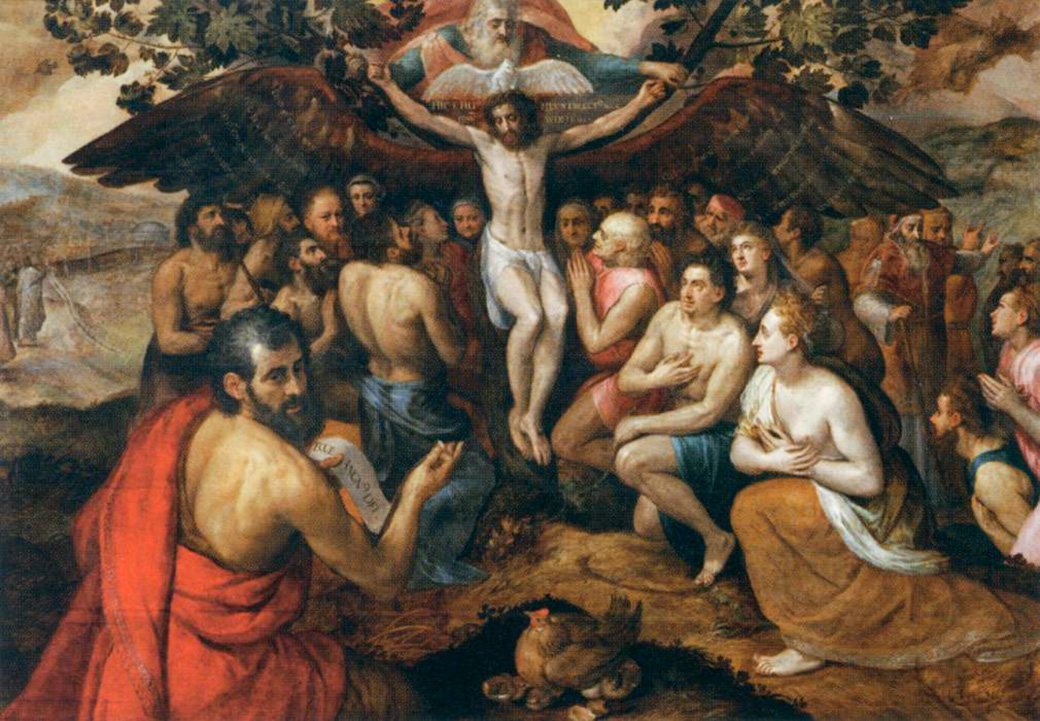
    The Sacrifice of Jesus Christ, Son of God, Gathering and Protecting Mankind (1562), Frans Floris I | Wikimedia Commons.

    This conversation continues in tomorrow’s gospel reading, but today’s reading displays for us the slavery of sin in a very interesting way. Just as shackles hold one down, hold one back from free movement, we see the Jews being held down from spiritual growth, even mental opening to the possibility of Christ. Nothing is holding them down but their own stubbornness, their own attachments to definitions made in the world (ethnicity, legitimacy from human ancestors), and their unwillingness to let go of the comfort of their self-assuredness.

    This is why Jesus preaches so energetically about the need for humility throughout his ministry. Pride is the veneer we build up over our eyes so that we will not notice our own enslavement to sin. We must dissolve this pride and open ourselves up with humility so that we can grow into the truth that Christ gives us.

    This demands a vulnerability, a willingness to say that our Father is the invisible one who we can’t prove exists but in whom we believe more solidly than the ground beneath our feet.

  • Bridging Salvation History with a Serpent

    Bridging Salvation History with a Serpent

    Tuesday in the Fifth Week of Lent: Numbers 21:4-9, John 8:21-30.

    Today’s readings present us with a seminal scene from the Old Testament that bridges the entire span of salvation history from the Garden of Eden to Christ’s Paschal Sacrifice on the Cross. In the gospel, Jesus speaks of himself in terms of the actions of Moses in the Old Testament reading, and in this way, the two passages — 1,475 years apart — shed light on one another.

    Serpent illustration by Katie Scott | courtesy katie-scott.tumblr.com.

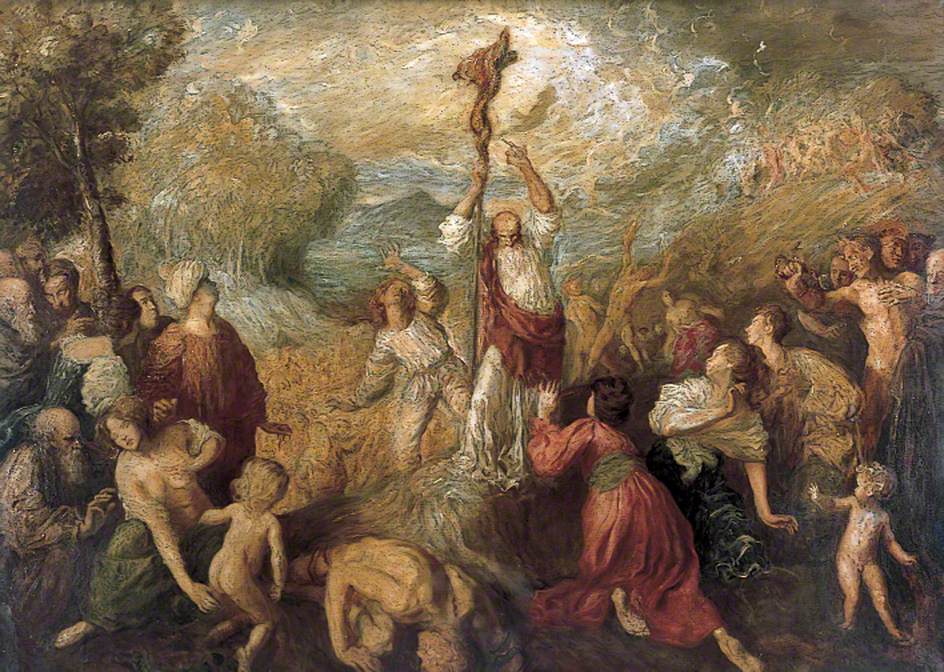
    The passage from the Book of Numbers is exceedingly odd at first glance: the Lord punishes the Israelites for complaining by sending poisonous serpents among them; upon their admission of guilt and atonement, Moses prays for deliverance, after which God instructs him to mount a serpent on a pole; subsequently, when the people look up at the serpent on the pole after being bitten, they are spared from death. What kind of witchcraft is going on here? A magic serpent staff to ward off a plague of poisonous snakes?

    Let’s slowly interrogate this story to understand what’s going on. First, what is this great sin that deserves a plague of poisonous snakes? On one hand, it seems like somewhat innocuous, albeit irritating, grumbling. We hear, “But with their patience worn out by the journey, the people complained against God and Moses.” This is just human nature, right? However, it wasn’t general complaining, it was complaining specifically against God and Moses. It showed a lack of trust, despite the wonders given to them in escaping Egypt, encountering God on Mt. Sinai, receiving the commandments, being given manna and quail and water from a rock.

    Mistrust in the midst of wonders — does this remind us of anyone? How about Adam and Eve? And who plants the seeds of mistrusting God in the mind of Eve but the serpent? Thus, God’s sending of the serpents is the reminder of humanity’s original sin in mistrusting God’s providence and grace.

    It would be fair to say that the serpent is the symbol of humanity’s sin against God. This sin is poisonous and it brings about the reign of death. The people repent and say to Moses, “We have sinned in complaining against the LORD and you. Pray the LORD to take the serpents away from us.” The first requirement in the recipe for God’s mercy has been met: contrition. Next comes Moses’s prayer, followed by divine mercy in the form of … well, another serpent. God instructs Moses to “mount it on a pole, and whoever looks at it after being bitten will live.”

    The Word of God truly seems baffling here, operating on a level that is not immediately evident. Nonetheless, being the obedient servant of God that he is, Moses complies with the Lord’s instructions, “and whenever anyone who had been bitten by a serpent looked at the bronze serpent, he lived.” The act of looking up, heavenward, to the sign of the sin they lived with, is the action that reminds them of their dependence on God and his saving mercy.

    God’s divine mercy flows to the sinful, bitten individual in that moment, not through the arcane power of a bronze staff, but through the symbol that the staff presents to the Jewish believers in God. As Catholics, we know well that in the liturgy, divine sanctification works in and through symbols, from the altar and ambo to the bread and wine. The bronze serpent on the staff is this type of sacramentalized symbol that his prophet on earth made under his instruction.

    Moses and the Brazen Serpent (1898), Augustus John | Creative Commons, courtesy UCL Art Museum/ArtUK. I like the impressionistic style Augustus John employs in this painting, the flowing waves in the forms suggesting a divine entrance into the fabric of humanity. As with any encounter with the divine, sin will merit pain and “gnashing of teeth,” and the purifying energy of God may not be pleasant for those in sin. I also see a bit of the devil in the bare-chested man on the right side of the canvas, which for me, at least, recollects the Garden of Eden connection. 

    The Jews understood the symbolic and importance of this staff as a way to encounter God’s grace and kept it around for centuries. They may have begun to confuse the symbolic function of the staff with a divine presence, however, because 740-ish years later we read in 2 Kings that King Hezekiah orders the destruction of the staff, which he calls Nehushtan (“a mere piece of brass”) because the Jews were burning incense to it and essentially treating it like an idol. 

    Now I don’t know much about divine numerology, but I do find it interesting that exactly another 740-ish years later, we hear Jesus tell Nicodemus the Pharisee: “just as Moses lifted up the serpent in the wilderness, so must the Son of Man be lifted up, that whoever believes in him may have eternal life” (Jn 3:14-15). With this statement, the Word of God doesn’t just restore the symbolic importance of the serpent staff, he also reveals the full scope of this symbol Moses was instructed to make.

    “Just as Moses lifted up the serpent” — note that the parallel being drawn is to the fixing of the serpent to the pole and lifting it up, not to the serpent itself (in other words, Jesus is not comparing himself to a serpent!). “So must the Son of Man be lifted up” — this refers to his crucifixion, where he becomes the ultimate symbol for humanity; and note that he refers to his human nature here when saying “Son of Man” to emphasize that the same sin symbolized by the serpent is being affixed to the cross in the sins of the human person, for which Jesus stands in as a sacrificial lamb.

    And finally the salvific import: “that whoever believes in him may have eternal life.” Just as the Jews who were sinful and bitten by snakes saw the staff were reminded of their belief in God and were saved from dying at that moment, we have an infinitely greater promise and divine grace given to us when we behold Christ on the Cross, believe in him, and are granted eternal life that eradicates all sway of death, as if it is only sleep by another name (as we explored in the reflection, See the Glory of God).

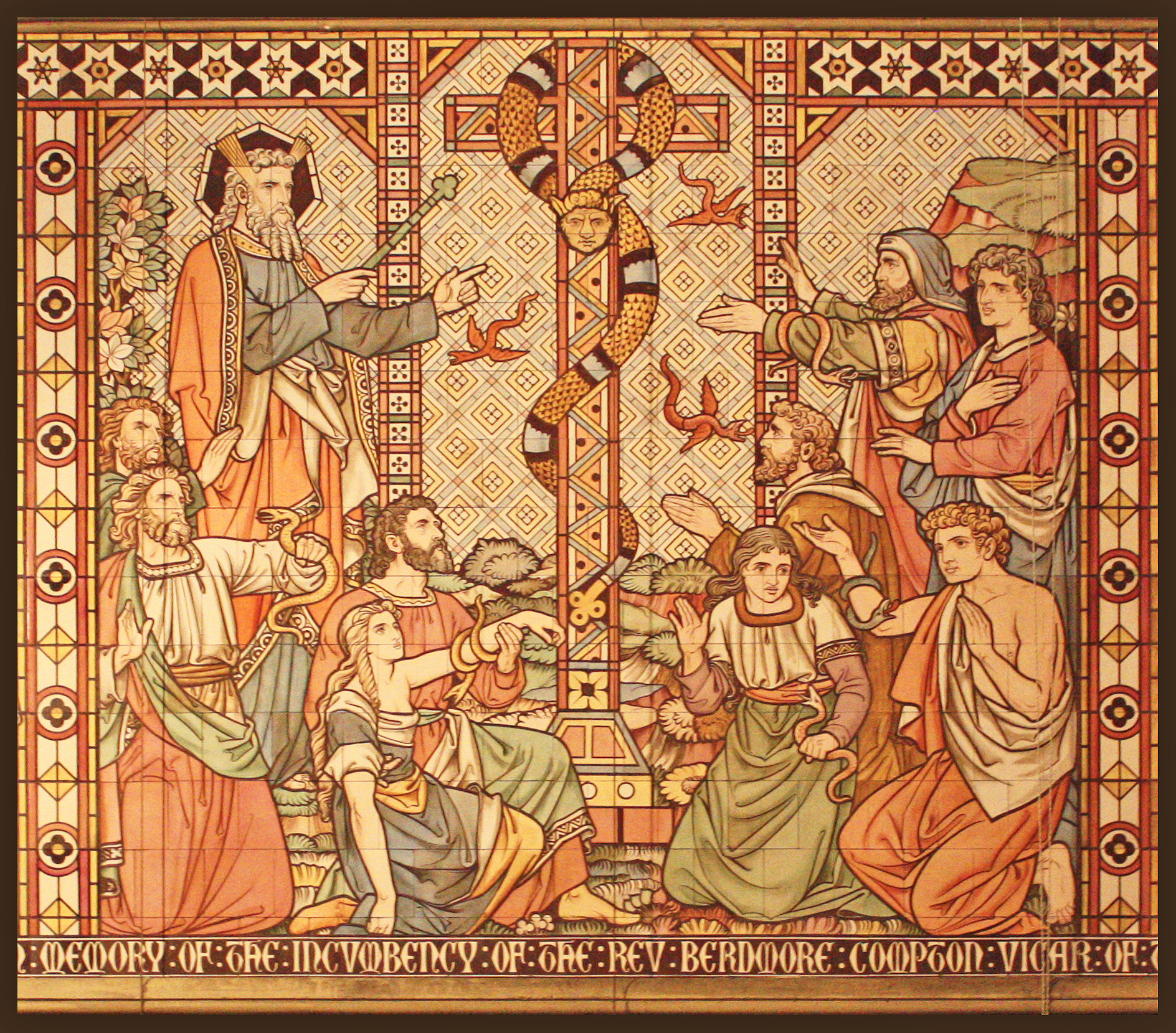
    Moses and the Bronze Serpent, mural in All Saints Margaret Street church in London (1889), tiles painted by Alexander Gibbs | photo courtesy Lawrence OP, flickr.com. Note that over the centuries, the connection of the bronze serpent and the cross has been made much more explicitly, as in this tile work.

    Sometimes the scope of God’s saving plan is just breathtaking. So many moments of patience and mercy over the millennia, from Adam and Eve, through Moses, and ultimately Jesus Christ. And so subversive of our normal worldly affections, too, in the use of the lowly and hated serpent as a resounding symbol for overcoming sin, much like using the reviled Cross as a throne for our Savior.

    All of this brings us to today’s gospel, where Jesus tells the Pharisees “if you do not believe that I AM, you will die in your sins.” This is one of a series of super bold statements John reports of Jesus. It doesn’t get much more blunt than this; by invoking the name of YAHWEH in reference to himself (I AM Who I AM), Jesus is clearly saying that he is God as well as a man. Plus, he tells them that only a belief in him as God will save them from dying in sin. We can hear echoes of his conversation with Nicodemus, “whoever believes in him may have eternal life.” His message is consistent and resounding: he is to be the symbol of sin pinned down, raised up on a Cross in hatred by men, but in reality a sacrament of God’s grace and love. This is the Word of God writ large in the temple; this is stunning.

    The Pharisees don’t get it. All they can say is, “Who are you?” The scribes and Pharisees in John’s gospel seem to be stuck in this morass of defining Jesus’s provenance. Later in this chapter, they will say, “Aren’t we right in saying that you are a Samaritan and demon-possessed?” And we’ve already heard them get hung up on their belief that the Messiah could never come from Galilee. Over and over, Jesus tries to tell them that he is from the one “who is true,” that His Father is in heaven. But this truth is too radical, too supernatural, too blasphemous in their minds to even compute.

    Jesus tries again in today’s reading to make Himself clear:

    When you lift up the Son of Man,
    then you will realize that I AM,
    and that I do nothing on my own,
    but I say only what the Father taught me.
    The one who sent me is with me.
    He has not left me alone,
    because I always do what is pleasing to him.

    Again, it is simply stunning to me how he refers to himself as “I AM” and constantly puts the focus back on God the Father. It is plain as day. Whoever tries to tell you that Jesus was a social rabble-rouser and malcontent, like so many other “Messiahs” at this point in history, well that person needs to read the Bible a little more closely. What political activist uses his moment in the limelight to say “I do nothing on my own but I only say what the Father taught me”?

    He does not seek glory and he has hard teachings (such as eating his Body and drinking his Blood for salvation) that push away many would-be followers. And he literally schools the experts in Jewish law (see yesterday’s post), establishing his own wisdom and command over divine teaching. Finally, we have his selfless, miraculous death and resurrection, when the Son of Man is raised like the serpent staff of Moses for us to gaze upon. 

    Our only job at this point is to believe. To fully believe after we have been given such wonders. Let us not be like Adam and Eve and mistrust God in the midst of the wonders we are given. Let us not be like the Israelites in the Exodus who do the same. We are a new people, the Church, in a New Covenant, and have been given the greatest sacrament of all.

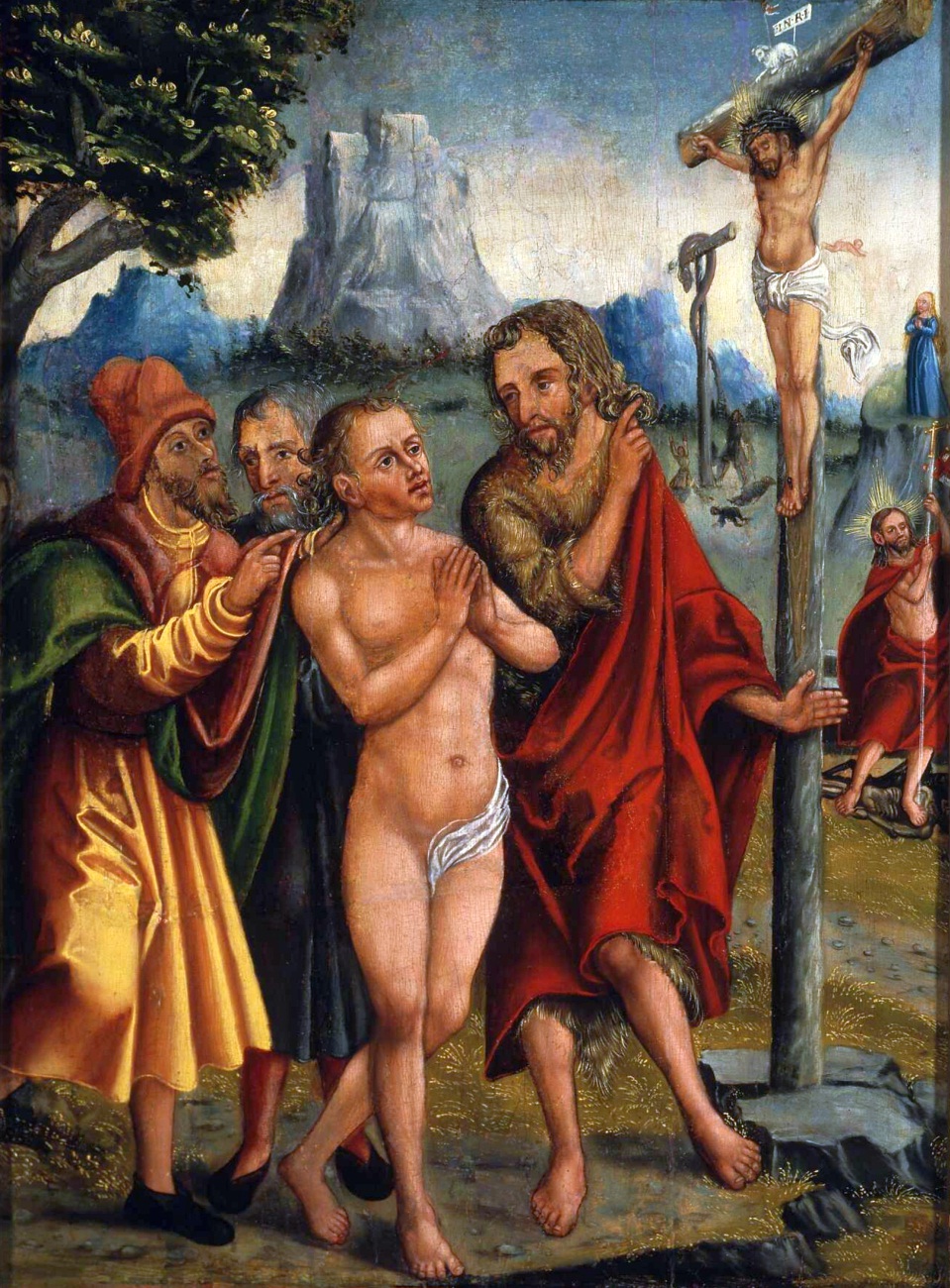
    Allegory of Salvation (c.1555), Antonius Heusler | Wikimedia Commons. The description states: John the Baptist makes a man (Adam), clothed only with a loin cloth aware of the crucified Jesus. Behind the man are standing Isaiah and an apostle. In the background are shown the Brazen Serpent, the Annunciation to the Virgin and Christ triumphing over Death and the Devil.
  • Adultery in the Heart

    Adultery in the Heart

    Monday in the Fifth Week of Lent: Daniel 13:1-9, 15-17, 19-30, 33-62, John 8:1-11.

    Adultery is the theme in today’s readings. As we are presented with stories about this sin, one of the great sins against the Ten Commandments, we learn about a different kind of adultery, which is a betrayal of God in our hearts. We also learn about the fidelity God provides even in the midst of our sin — that his law protects us from sin and also picks us up when we fall.

    In the first reading from the Book of Daniel, we read about the “God-fearing woman, Susanna” and the wicked judges who accuse her of adultery with a fictitious young man. It is they who have succumbed to lust for her. The author writes, “They suppressed their consciences; they would not allow their eyes to look to heaven.” I appreciate how this describes the moment of slipping into evil; they act here by suppressing their consciences and keeping their eyes from looking to heaven. The gaze of a person to heaven, yearning for and obeying God, is a great way to envision our relationship with him. We are always striving to be worthy of him, of his grace and mercy. By intentionally looking away from heaven, these wicked judges are breaking off their relationship with God.

    So, what is this relationship? First of all, it is a relationship that he began — with our initial Creation as his children, and then with the covenants he initiates for us throughout history. This reveals that he loves us and wants us to be close to him. As we discussed in our reflection, The Purifying Fire We Call God’s Wrath, being close to him requires some preparation because his purifying essence embraces all that is good but burns all that is evil. With his covenants, he gives us a path to follow in order to not be burned but be embraced. We call this path the Law, but note that it serves the purpose of helping us grow in the Spirit, not that it should simply be followed for the sake of being followed.

    Where does adultery come in? Well, marriage is a microcosm of this covenant with God (assuming we’re talking about marriage in the Church, not a civil union). Marriage carries with it a vow, a covenant between the man and woman. There are rules (law) to follow that define that fidelity and that covenant, but holding it together is the love they have and that will grow between them (the spirit).

    On top of this legalistic view of marriage vows, marriage is a sacrament because God sanctifies the union. The couple vows to be loving and faithful to each other with the help of the Spirit. God, in turn, enters the sacramental marriage and becomes present in their union. Each is Christ for one another.

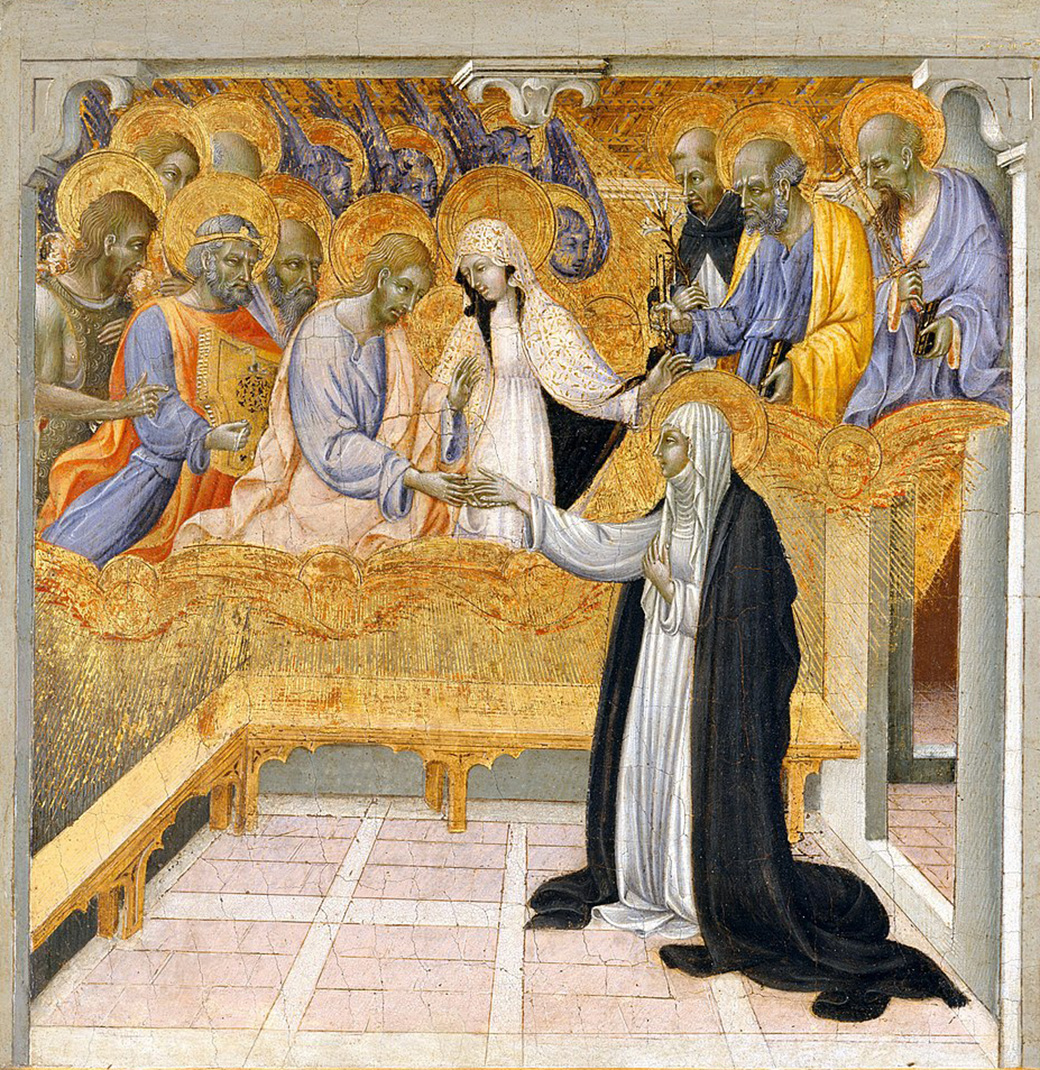
    The Mystic Marriage of Saint Catherine of Siena (c.1460), Giovanni di Paolo (Giovanni di Paolo di Grazia) | Wikimedia Commons.

    Adultery is a spiritual sin as much as a breaking of the law. That is why James in his letter “Adulterers! Do you not know that friendship with the world is enmity with God? Therefore whoever wishes to be a friend of the world becomes an enemy of God” (James 4:4). Adultery is here applied to choosing the world over God. Jesus, too, uses the word to refer to a faithless people who have turned spiritually away from God: “An evil and adulterous generation seeks for a sign, but no sign will be given to it except the sign of the prophet Jonah” (Mt 12:39).

    Some have written that because adultery is such a serious sin in God’s eyes it is used as a metaphor for spiritual sin in turning away from God. But I think this is backward. Adultery is breaking a personal covenant with one’s beloved, and Jesus teaches that the “greatest commandment” is to love God first, then love our neighbor as we love ourselves. To say that human marriage and adultery is of primary importance and it can then be extended to our relationship with God is backward in priority.

    Our personal covenant of love with God is the primary relationship that orders our lives and marriage on earth is a beautiful microcosm of that love. After all, God is the source and Christ the example of the type of selfless love we are called to bring to our marriages. Adultery with our spouse on earth is perhaps a more tangible way for us to grasp the great sin that is adultery against God.

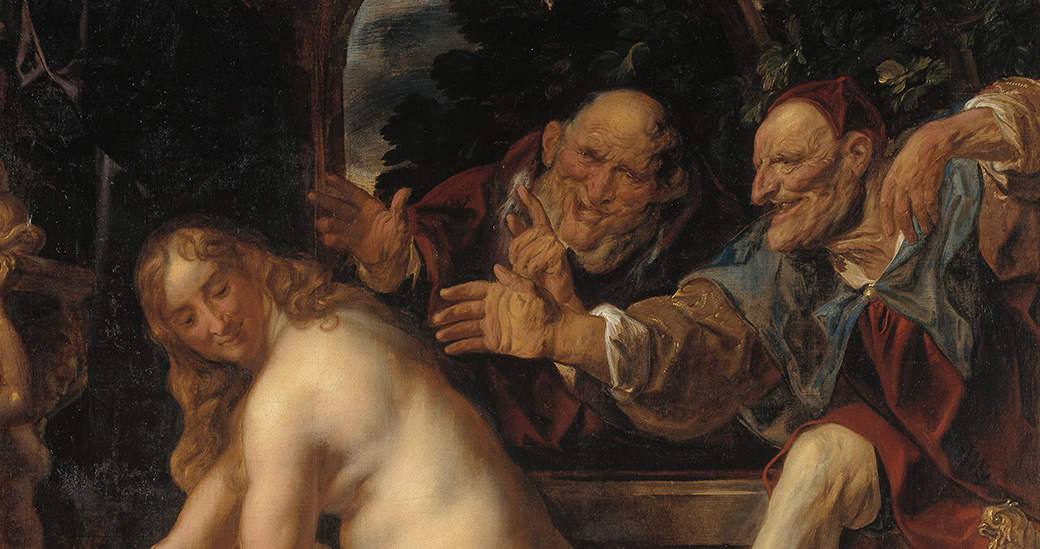
    Detail from Susanna and the Elders (1653), Jacob Jordaens | Wikimedia Commons. While I think Jodaens is off with his smiling Susanna, as if she’s enjoying the intrusion of these nasty men on her bath, I think he’s spot on with the devilish faces of the judges and their grasping hands. It speaks to their lustful focus on her.

    So when the two elder judges in the Book of Daniel “would not allow their eyes to look to heaven,” they are on the path of becoming spiritual adulterers. When they act upon their lustful desires by attempting to rape Susanna and then falsely accuse her of adultery, we are given a juxtaposition of worldly adultery and spiritual adultery. Their false testimony as judges in a court and the ensuing guilty verdict begs the question of why laws can fail to provide justice. Human justice, as we all know, often does fail and miss the mark — it is not divine justice and it is tainted by the sins each of us carries with us.

    But Susanna appeals to God for divine justice, not to the court for human justice. And, “The Lord heard her prayer. As she was being led to execution, God stirred up the holy spirit of a young boy named Daniel.” The story reminds us that while God is the source, he works in this world through the Spirit and through other people. Daniel’s youth speaks to the purity and honesty we hope for when we think of justice. And his spirit-given wisdom allows him to trap the wicked judges in their lies. The whole episode validates spiritual fidelity to God as well as marital fidelity to one’s spouse.

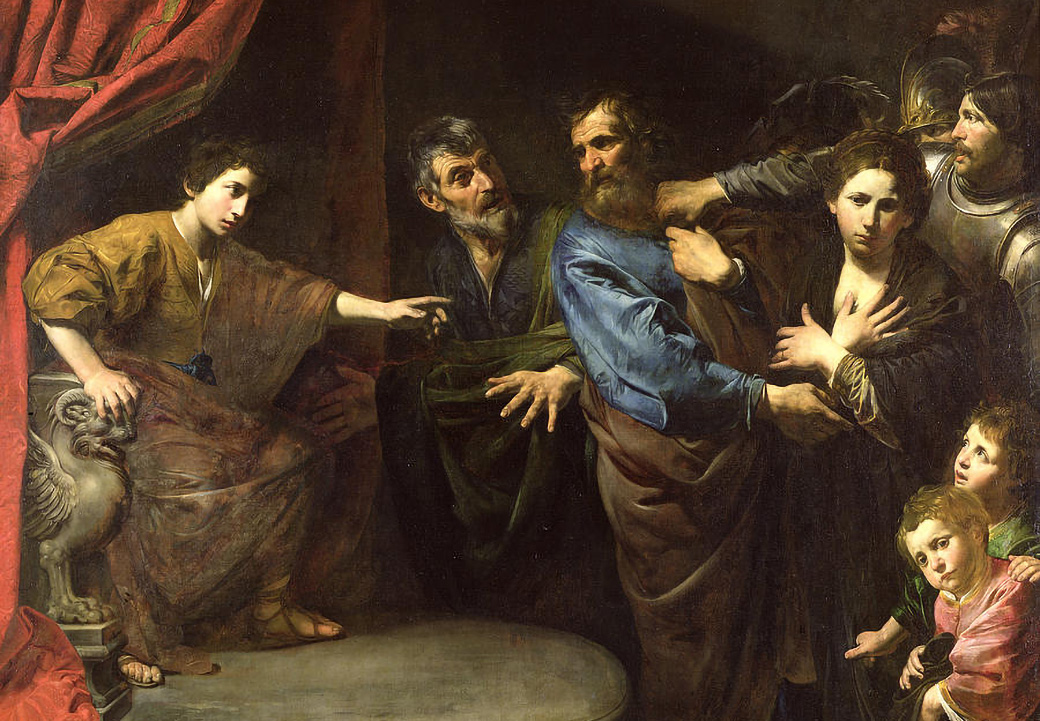
    Cropped image of The Innocence of Susanna (c.1621), Valentin de Boulogne | Creative Commons, courtesy the Metropolitan Museum of Art. Note the emphasis of the children and the child-like honesty of divine justice.

    The gospel from St. John presents another look at marital vs. spiritual adultery. In this account, the question of the Law and the Spirit come into even sharper focus. This account has often been presented to us in a very moralistic sense, i.e., don’t judge others and God’s mercy is boundless, even for sinners. But we are very far removed from traditional Jewish ritual practice, and I think we’re both missing the point and mistakenly generalizing a specific act of teaching that Jesus presents.

    All signs point to the fact that this is almost identical in nature to the first reading, where several judges are falsely accusing a woman of adultery in a miscarriage of justice. The key is when Jesus says, “Let the one among you who is without sin be the first to throw a stone at her.” He is not saying that only sinless people can execute justice (no judicial system could exist!). He is referring to the Torah where it is written that if “you make a thorough inquiry, and the charge is proved true,” then not only shall the adulterer/adulteress be stoned, but “The hands of the witnesses shall be the first raised against the person to execute the death penalty” (Deut 17:4, 7).

    You see, this woman was dragged before Jesus by the scribes and Pharisees although the Torah relates that witnesses must bring her to the temple for justice. If these scribes and Pharisees truly caught her in the act and are witnesses, then they should cast the first stone (a serious act that must be justified otherwise you are murdering, not carrying out justice). Otherwise, they are sinning by lying about witnessing the adultery.

    So, “let the one among you who is without sin” is the same as saying “whoever witnessed this should be the first to stone her.” Jesus is living the law more fully then these scribes and Pharisees are. Tellingly, no one casts a stone. 

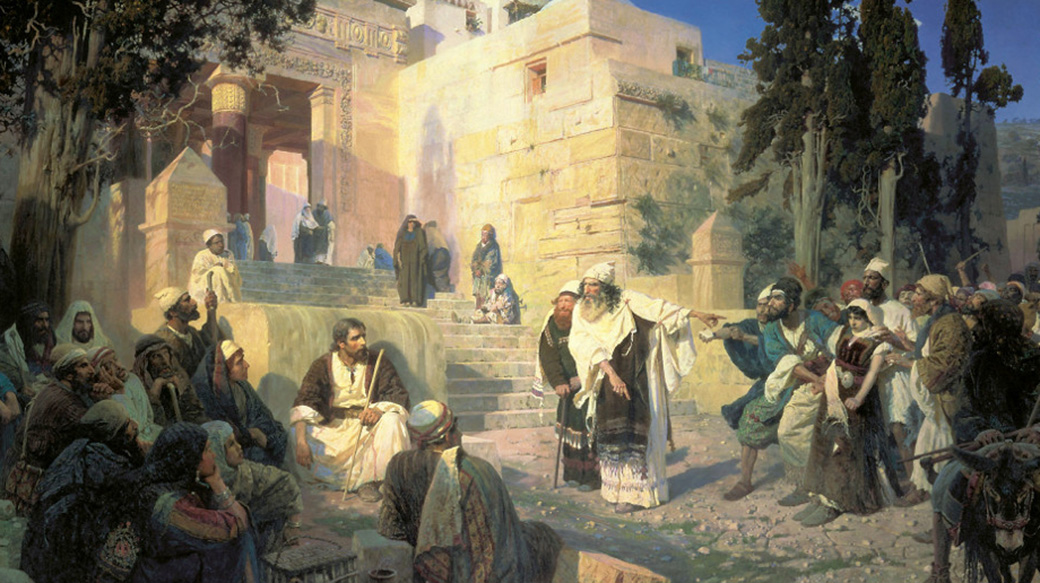
    Detail from Jesus and the Sinner Woman (c.1886), Vasily Polenov | Creative Commons, courtesy Artbible.info.

    The other key that tells us this episode is more about Jesus’s authority as the Word and Law than it is about mercy and forgiveness is his act of writing in the dirt. St. Augustine of Hippo writes an enticing few lines about this act:

    “You have heard, O Jews, you have heard, O Pharisees, you have heard, O teachers of the law, the guardian of the law, but have not yet understood Him as the Lawgiver. What else does He signify to you when He writes with His finger on the ground? For the law was written with the finger of God; but written on stone because of the hard-hearted. The Lord now wrote on the ground, because He was seeking fruit” (Tractate 33 on the Gospel of John, 5).

    This interpretive move is a nice way to look at the new reality of God in the flesh, working in humanity in a new way.

    But let us also understand this more literally within Jewish ritual law. For accusations of adultery without witnesses (as Jesus knows this is), the Torah describes a water trial (called Sotah) that the woman must undergo. It instructs, “the priest shall take holy water in an earthen vessel, and take some of the dust that is on the floor of the tabernacle and put it into the water. … the priest shall put [the charges and penalties] in writing, and wash them off into the water of bitterness. He shall make the woman drink the water of bitterness that brings the curse” (Numbers 5:17, 23).

    “Holy water” was written in Hebrew as “living water,” and we can begin to see how Christ, who is living water and our high priest, is enacting the Sotah ritual as prescribed in the Torah. He (the water) writes in the dust the charges and penalties, fulfilling the letter of the Law that He wrote. Let us also keep in the front of our minds that this is the incarnate Word of God. The Word that forms the Torah and its prescriptions around how to carry out justice. As Jesus affirms, “Do not think that I have come to abolish the Law or the Prophets; I have not come to abolish them but to fulfill them” (Mt 5:17). 

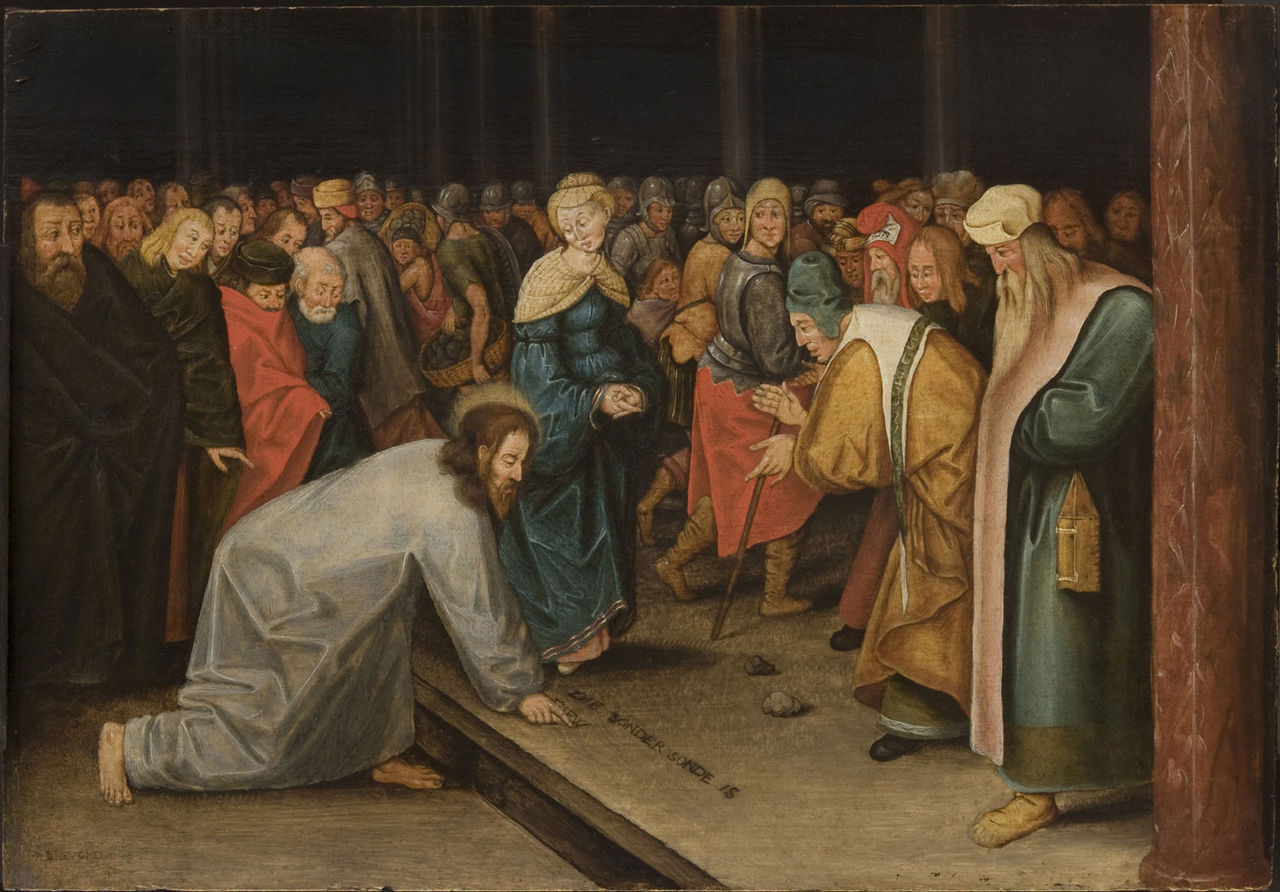
    Christ and the Woman Taken in Adultery (c.1600), Pieter Brueghel the Younger | Wikimedia Commons.

    So the scribes and Pharisees came to entrap him and they truly have no clue about who they are challenging. He is the Word, the fulfillment of the Law — he knows it better than they ever could. He knows that these prescriptions are in place so that there is no miscarriage of justice. He lifts up the law to fulfill the spiritual work it is intended to do: to keep our hearts clean from lies and sin, to keep sinners from perverting the justice God intends in the world.

    On what other evidence might we think this episode is not about “forgiveness no matter what”? His parting exchange with the woman bears no resemblance to the other miracles he performs when forgiving sin or healing. He says, “Neither do I condemn you. Go, and from now on do not sin any more.” He confirms that he was also not a witness to adultery on her part (which is the point of the encounter with the scribes and Pharisees). Does that mean that she didn’t commit adultery? Not necessarily, but that’s not his mission.

    Recall that the Samaritan woman at the well was living in adultery and had five husbands, yet he shared with her one of his most thorough revelations of divinity. Mary Magdalene was also a prostitute, but she became one of his close disciples. It’s not that adultery against a spouse doesn’t matter — the Word of God clearly says it does. It’s that his mission is about fidelity of Spirit. He preaches primarily on the dangers of adultery in the context of our most fundamental covenant with God.

    Nothing about this final exchange is like the other miracles or healings he accomplishes. He does not ask her about her faith or belief. He does not establish the atonement and request for mercy that is the requirement for spiritual healing. We must conclude that this encounter is not about sin being forgiven. So when Jesus says, “Go, and from now on do not sin any more,” I’m sure that he was speaking of spiritual adultery just as much, if not more, than spousal adultery.

    For me, at least, returning to these familiar stories with a new lens and spirit of contemplation has shed light in new ways. I’m sure that none of these reflections are the ultimate exegesis of scripture, but going through the effort has helped me feel much closer to Christ this Lent.

  • See the Glory of God

    See the Glory of God

    Fifth Sunday of Lent: Ezekiel 37:12-14, Romans 8:8-11, John 11:1-45.

    Resurrection. Each one of today’s readings discusses resurrection. The gospel presents us with the last of Jesus’s great signs in St. John’s gospel, the raising of Lazarus from the dead. We must ask ourselves: what do the prophets and Jesus have to say about death and overcoming death?

    Through the mouths of prophets in the Old Testament, God promises us a triumph over death. Because he speaks to us through analogy, millennia of commentators juggle the importance of the literal resurrection of the body, the salvific resurrection at the final judgment, and a more fundamental aspect of the triumph of the Spirit.

    What we hear in today’s reading seems to be not just a spiritual triumph, but a bodily triumph. Ezekiel says: “O my people, I will open your graves and have you rise from them.” He also says, “I will put my spirit in you that you may live, and I will settle you upon your land,” so the body and spirit are essential in this triumph over death. We clearly hear that bodies will rise from graves, and the Spirit of the Lord will be put into them.

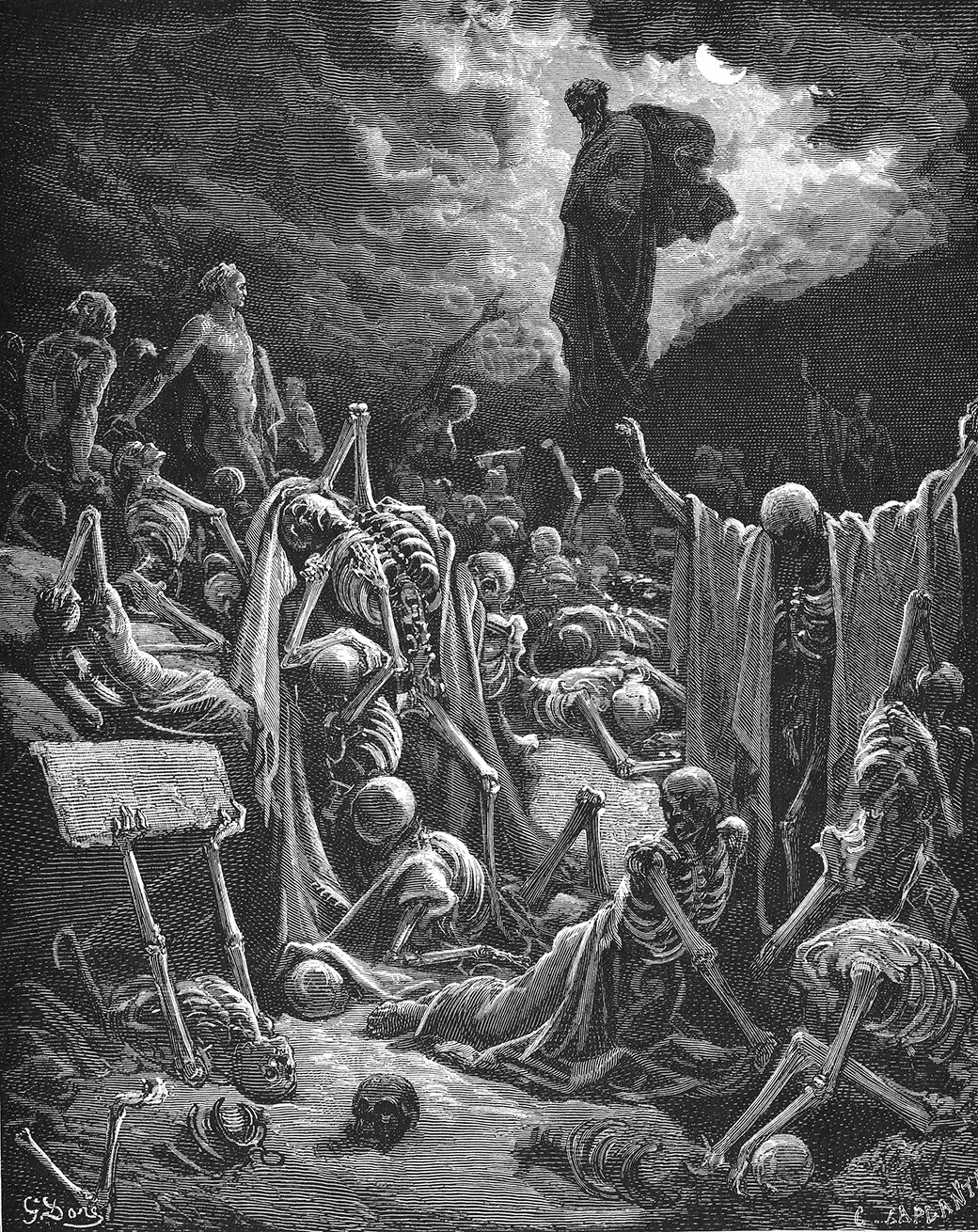
    The full context of this scene in Ezekiel, chapter 37, is that the Lord whisks Ezekiel off to a valley filled with “very dry” bones, people who were clearly dead for a long time. The Lord tells Ezekiel to prophesy to the bones and they will become people again. When Ezekiel follows his commands, they become more than just animated skeletons: “suddenly there was a noise, a rattling, and the bones came together, bone to its bone. I looked, and there were sinews on them, and flesh had come upon them, and skin had covered them.”

    Then, the Lord prompts Ezekiel to ask for the breath of life to fill them, “and the breath came into them, and they lived, and stood on their feet, a vast multitude.”

    Vision of the Valley of Dry Bones (1866), Gustave Doré | Wikimedia Commons.

    So Ezekiel prophesies about the full resurrection, body and spirit, but the Lord also makes a point that this is a metaphor for the life of faith here among his Chosen People: “Mortal, these bones are the whole house of Israel. They say, ‘Our bones are dried up, and our hope is lost; we are cut off completely.’”

    Remember that Ezekiel was a prophet during the Babylonian Exile, when the Jews were cut off from the “land of milk and honey,” where Moses had established their lands. So when Ezekiel says in today’s reading, “I will open your graves and have you rise from them, and bring you back to the land of Israel,” he is speaking of a literal return of the nation back to the land of Israel.

    Yet as Christians, we understand that the Word of God speaking through the prophets is the same Word of God that becomes incarnate in Jesus Christ. Thus we understand Ezekiel’s words through the lens of Christ as well; he establishes the new Jerusalem as the Kingdom of God and himself as the new temple. To rise bodily from the graves of the exiled Jewish people and be brought back “to the land of Israel” is to find life in the hundreds of millions of believers who make up the Church, the Body of Christ.

    Consistent throughout these levels of meaning — bodily and spiritual resurrection, Jewish nation and Christian Church — is how God’s will is opposed to death. The essence of God is the opposite of death. It is the generative spirit of life.

    St. Paul speaks of this in today’s reading, telling the Romans that the Spirit, the Person of the Trinity through Whom Christ was raised from the dead, constantly gives us this power of life. He says, “If the Spirit of the one who raised Jesus from the dead dwells in you, the one who raised Christ from the dead will give life to your mortal bodies also, through his Spirit dwelling in you.”

    We must dig deep to understand the spiritual wisdom of St. Paul. Filled with the Spirit himself, he is describing a new way of being, one which dispels a preoccupation with death. Before Christ, humanity was so preoccupied with death as the inevitable fact of existence that it ruled their minds, determined their actions, and “deadened” their souls (and continues to do so for those outside of Christianity). Paul’s consistent message in his epistles is that Christ changed all of this. By rising from the dead — moreso, by placing the divine and immortal God into a mortal human form and having that particular human’s selfless sacrifice so overpower death in significance — death need no longer dominate our lives.

    God came to us in love and gave us his Spirit to dwell within us! He writes, “if Christ is in you, although the body is dead because of sin, the spirit is alive because of righteousness.” Death, for St. Paul, is more of an accidental aspect of our bodies and fleshly desires than it is a finality. The only finality that matters to St. Paul is the unconquerable, generative life given to us by God.

    This is the point Jesus attempts to make by raising Lazarus from the dead. While this is the greatest of his miracles in the gospels, it seems that the triumph of the sign he gives might be marred by uncomprehending minds. Don’t get me wrong, there is much cause for rejoicing in this gospel reading, but if we follow Christ’s words and reactions closely, we see that John is saying something about the reception of his message.

    St. John gives us a number of clues in this chapter that what Jesus intends is flying over the heads of those with him. John signals the importance of Christ’s message at the beginning of the chapter: Jesus says, “This illness is not to end in death, but is for the glory of God, that the Son of God may be glorified through it.” The point, in other words, is “the glory of God,” not how awful death is.

    And so we hear the curious logic: “Now Jesus loved Martha and her sister and Lazarus. So when he heard that he was ill, he remained for two days in the place where he was.” What type of healer would stay put when he hears that a loved one is ill? An earthly healer bound in mind and spirit to the finality of death would run to their aid immediately. But Jesus, that is, God Incarnate, operates differently. His plan is to show his love for Lazarus and his sisters by opening their eyes to the fact that death isn’t the real finality. Or at least he will try to have them see this point.

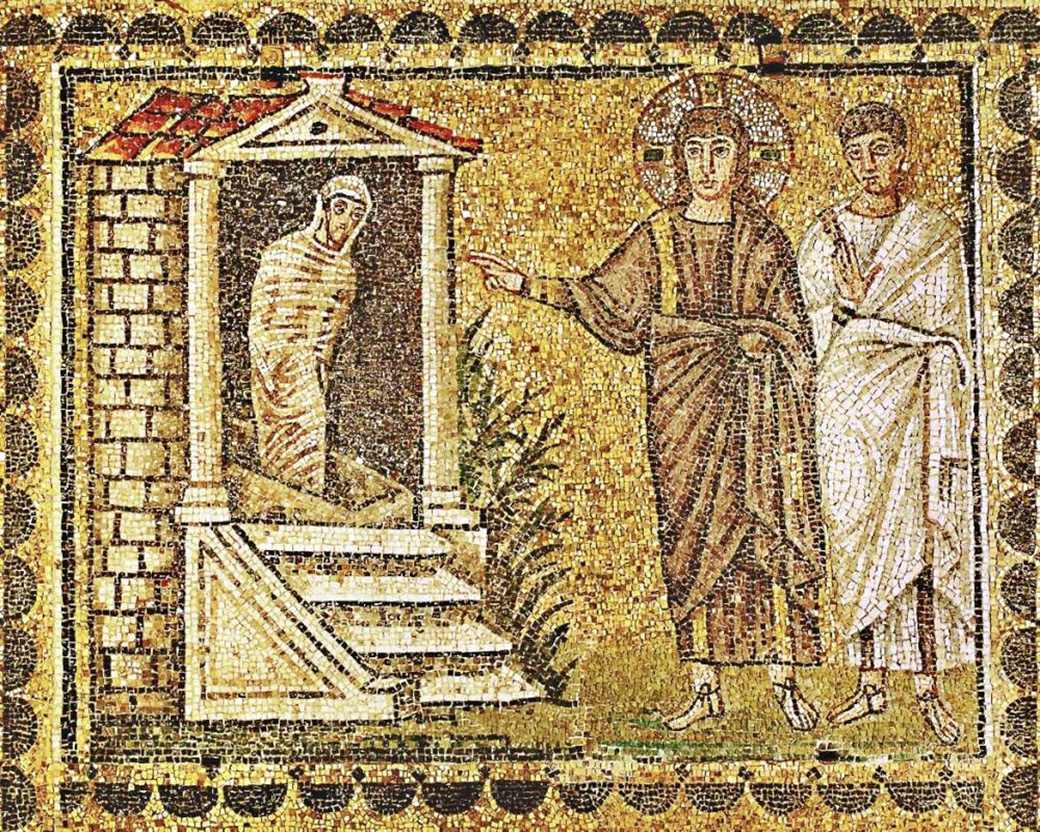
    Resurrection of Lazarus (6th century), mosaic in Sant’ Apollinare Nuovo, Ravenna, Italy | Wikimedia Commons.

    Several times he tries to tell his apostles that he’s going to wake Lazarus from his sleep. They first miss the point by saying “Master, if he is asleep, he will be saved.” As if Jesus needs a reminder of the final judgment and salvation of the righteous!

    Why does Jesus say “sleep”? If we try to understand the world through his eyes, death is just sleep by another name — it does not hold the same frightening finality and inexorable dread that it does for us.

    Jesus tries to be more direct. “Lazarus has died. And I am glad for you that I was not there, that you may believe. Let us go to him.” Then, the sad Eeyore that is Thomas says gloomily, “Let us also go to die with him.” I can just imagine the suppressed eye roll from Jesus at this weird misunderstanding of his words, as if they were going to emotionally “die” with Lazarus while sitting shiva with Lazarus’s sisters. Jesus’s message will continue to be clouded by this emotional response we have to death.

    We commonly associate Martha and Mary with the famous episode in St. Luke’s gospel when they welcome him into their house for a meal. Years of sermons have impressed upon us that Martha represents the busy believer who is caught up in the rituals of service while not basking in the Spirit right in front of her. Mary represents the opposite: choosing to bask in his presence and let other tasks slide. But this isn’t Luke’s gospel. Here, St. John perhaps gives us a reverse picture: if anything, Martha is closer to appropriately accepting Christ and what he signifies than Mary is.

    First clue: Martha comes to meet Jesus outside of town “but Mary sat at home.” Martha says that if Christ had been there Lazarus would not have died. Many have tried to read some type of chastisement in this statement, but I’m not sure the context supports it. She immediately follows this statement with a profession of faith that God will answer any of Jesus’s prayers. The sum of her statements seems like she laments that he was not there but respects his power and authority. Jesus tells her that Lazarus will rise, and her response is similar to the apostles’: “I know he will rise, in the resurrection on the last day.”

    Jesus patiently responds with one of the more memorable lines from the gospels: “I am the resurrection and the life; whoever believes in me, even if he dies, will live, and everyone who lives and believes in me will never die.” Jesus accomplishes much, theologically speaking, in this response. First, he takes her belief in the resurrection and makes it immanent in his presence. It is now, not later. Second, he blows up our traditional understanding of death and life. How can someone live “even if he dies”? How can a person of faith “never die”? Let’s recall that Jesus first refers to death as “sleep”. It does not hold the finality that we give it. In this passage, he is saying that the life he gives is way more substantial and significant than this sleep we call death. Plus, in him this life is here now; we need not wait until the last day.

    Martha seems to get it. He asks her if she believes and she proclaims that she does. She adds, “I have come to believe that you are the Christ, the Son of God, the one who is coming into the world.” Does she understand the true implications of his coming? Perhaps so! This proclamation of faith is on the order of the famous one that Peter gives him after his difficult teaching about eating his Body and drinking his Blood in order to have eternal life.

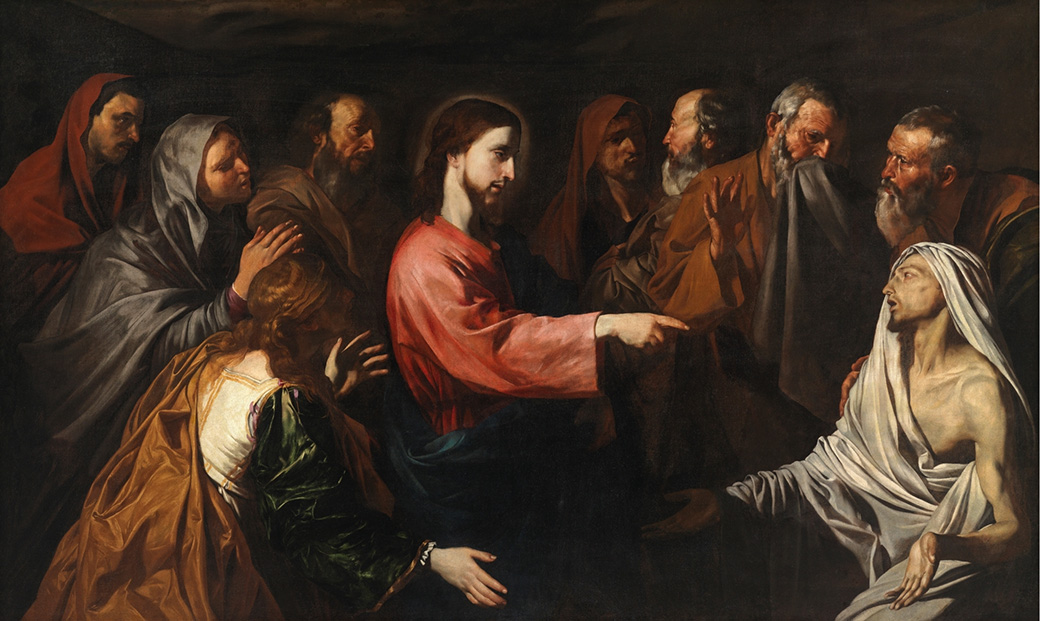
    The Raising of Lazarus (c.1616), Jusepe de Ribera, lo Spagnoletto | courtesy Museo del Prado.

    Mary, however, is another story. Martha encourages her to get out of her self-absorbed sorrow and go to see the Lord. When she does, Mary is a blubbering puddle of emotion: “she fell at his feet and said to him, ‘Lord, if you had been here, my brother would not have died.’” This is all she says as she and her companions take to weeping. She is absorbed in herself, in her belief that death holds a significant finality for Lazarus and all of us.

    Jesus’s reaction is interesting and has, in my mind, been regularly misinterpreted. There is an issue with translation. Our lectionary says “he became perturbed and deeply troubled,” while the NRSV Bible says, “he was greatly disturbed in spirit and deeply moved,” and the Douay-Rheims Bible says that he “groaned in the spirit, and troubled himself.” What’s the verb here?

    In the original Greek, it is ἐνεβριμήσατο (enebrimēsato), which literally invokes snorting like a horse. It means “to be greatly fretted or agitated; an expression of indignation” [The Analytical Greek Lexicon, p. 134]. The verb shows that his indignation was internal. The second verb phrase, ἐτάραξεν ἑαυτόν (etaraxen heauton) means “agitated (or troubled) himself.” So, this being perturbed and troubled is clearly directed inwardly. Why?

    He asks them where Lazarus has been laid and after they say, “Come and see.” Then the shortest of verses (verse 35): Ἐδάκρυσεν ὁ Ἰησοῦς. Jesus wept. The verb, a form of dakruo, means a quiet, silent weeping, and is only used for Jesus in the entire New Testament. Some of the people note his weeping as a sign of how much he cared while others grumble about the fact that he should have done something to keep Lazarus from dying. At this, Jesus becomes internally perturbed/indignant again (embrimōmenos).

    What do we make of these different emotional states of Jesus? First deeply internally agitated, then silent weeping, then internally agitated again? Fr. George Corrigan, OFM writes online the following analysis:

    Two interpretations of embrimaomai in 11:33 have been suggested. First, Jesus was ‘perturbed’ with compassion for Mary when he saw her weeping, and second, that he was ‘perturbed’ with anger. It is hard to linguistically justify the sense of “compassion.” Anger is more consistent with the word’s meaning. In the latter case there have been a number of suggestions why he was angry: (1) he was angry because of the faithless weeping and wailing of Mary and ‘the Jews’—they were grieving, as St Paul said, ‘like the rest of men, who have no hope’ (1 Thess. 4:13); (2) he was angry with death itself, the consequence of sin, which caused such pain; (3) he was angry with himself for not coming sooner to heal Lazarus and so prevent his death and the grief it caused Mary and Martha. This last suggestion is unlikely because Jesus knew he was going to raise Lazarus from death. The first suggestion has most to commend it, because the text says it was when Jesus saw Mary weeping like the rest that he became perturbed…but we often rebel at that interpretation.

    I tend to agree with Fr. Corrigan here, although I would say that “anger” isn’t quite the term I would use. Even though the Greek points to the perturbance being internal, I don’t think Christ was angry with himself. This would imply that he did something wrong, something that he regrets, and we learn especially in the gospel according to St. John that he was fully God, in control, and purposeful in all of his actions. Remember, he intentionally waited to come to visit and said that Lazarus’s state was “for the glory of God.” There is a plan here.

    I also don’t think that he’s angry with death and the associated homilies that paint this whole episode in the rhetoric of war — that Christ is doing battle with death. That perspective gives too much power and authority to death, the exact opposite of what Christ is trying to get us to understand. He calls death “sleep;” he is neither scared nor intimidated by death. He states matter-of-factly: “Our friend Lazarus is asleep, but I am going to awaken him.” As if waking someone from a dream. Easy-peasy. His whole point is that we are held under the sway and the spell of death and he has something so much more powerful and significant for us. This isn’t battle, this is swatting away the fly. It is the sizzling away of the water droplet in the awesome purifying presence of God.

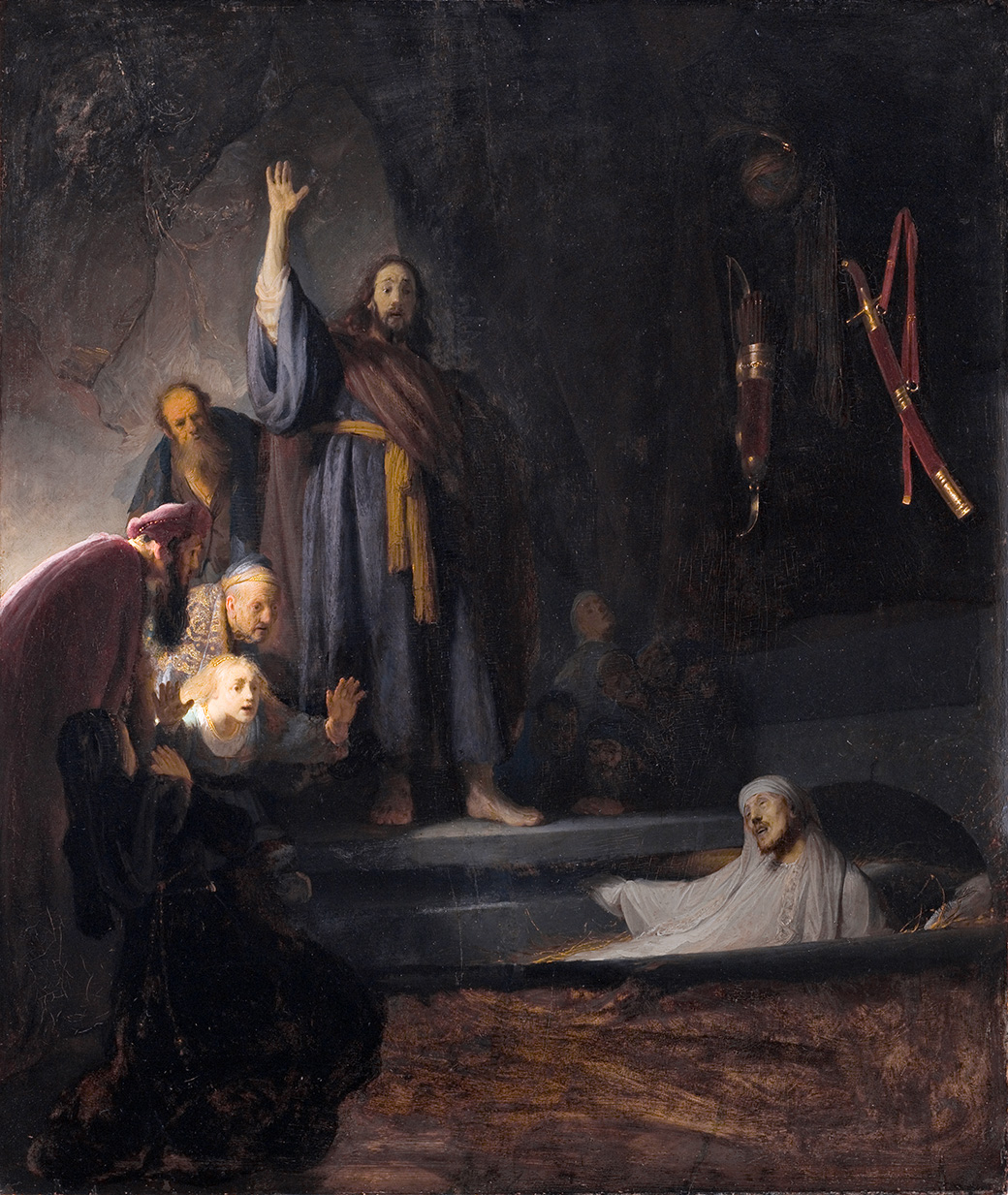
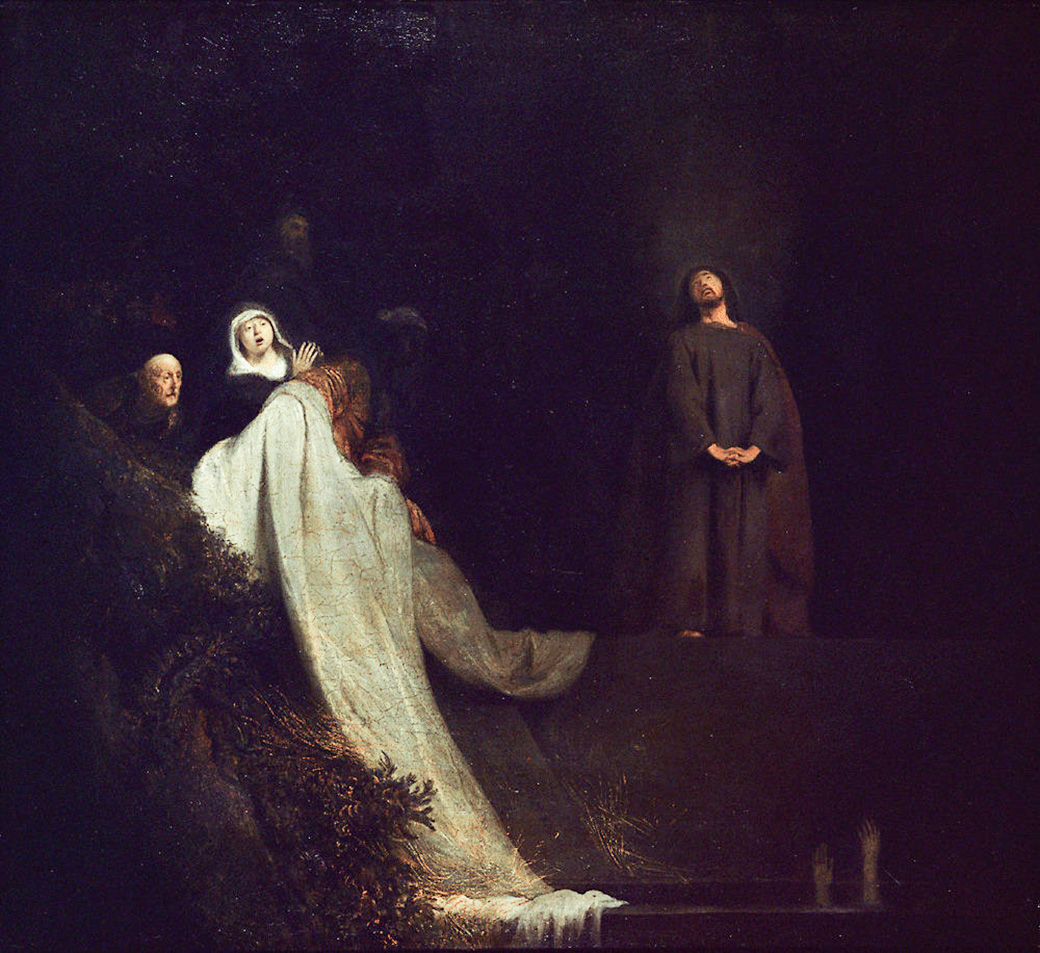
    The Raising of Lazarus (c.1630), Rembrandt | Wikimedia Commons.

    So, we are left with the first option that Fr. Corrigan presents (or maybe other options that the Word of God is waiting to plant in our hearts after fruitful contemplation). There might be an internal perturbation because Jesus is seeing the sad necessity of his Passion and death, which is coming next in the gospel. Is this a frustration with Mary and the weepers? Maybe. Perhaps it’s a frustration with the state of humanity, so captive to the thrall of death that they can’t see the alternative even when God is present with them. After all, Luke tells us he also weeps over Jersualem and their pigheadedness in not accepting him.

    The weeping and the internal agitation are not so opposite (at least one scholar has been so afield as to suggest that Jesus was bipolar!). In my mind, the agitation is the power of God surging passionately in him, a gut-like reaction to the thrall of death he finds in humanity. The silent weeping is his humanity, also fully present in him, and it is sandwiched between these surges of embrimaomai to remind us that our love and emotion comes from God and returns to God. The surges of embrimaomai embrace our human affections in a power that is not from humanity; it is from God and it agitates to release us from the thrall of death.

    So, I’d replace “anger” in this examination of the passage with a “gut-like surge, the passion of God’s rejection of death.”

    As we finish the gospel reading, we see that even after they have come to the tomb and Jesus asks them to roll back the stone, Martha, the one who seems closest to believing and understanding him, balks, saying that there will be a stench. He replies, “Did I not tell you that if you believe you will see the glory of God?”

    We hear no more about a stench, even when Lazarus comes out of the tomb. The glory of God wipes out everything that we think we know to be true. No stench, no death, no laws of physics and biology hold sway in the face of God. Jesus emphasizes this fact when he says, “Untie him and let him go.” It’s his beloved Lazarus, whom he just raised from the dead, and does he rush over to hug him and cry tears of joy with him? No. He reinforces his message that we are slaves to our perception that death holds finality over us by saying “untie” and “let go.”

    This is the New Moses, leading his people out of slavery in a new and much more radical way.

    Astonishingly, even at this, we hear that “many of the Jews” who saw this “began to believe in him.” WHAT? Not everyone was ready to throw down their belongings and follow him at that moment?? Are you kidding me? Perhaps this is what Jesus saw when he wept his silent tears. No amount of work in his mission while alive can convince the people of God’s radical descent to create a new reality outside of death for them.

    It will take his own death and Resurrection for people to see the Glory of God.

    The Raising of Lazarus (Opwekking van Lazarus), 1631, Jan Lievens | Wikimedia Commons.
  • Evil Plots in Empty Hearts

    Evil Plots in Empty Hearts

    Saturday in the Fourth Week of Lent: Jeremiah 11:18-20, John 7:40-53.

    Today’s readings display the evil plots of those who willingly disbelieve. In the Old Testament and New, we see those with hardened hearts speak ill of and plan the destruction of the righteous. We must beware of this tendency that arises when we are not open and inquiring, always humble in the presence of God.

    Jeremiah was a spitfire of a prophet, to be sure. He did God’s will without fail, but also reveled a bit in divine justice, or vengeance as he would call it. In today’s reading, God reveals to him that there are those who dislike his preaching and are plotting against him. We hear, “Let us destroy the tree in its vigor; let us cut him off from the land of the living, so that his name will be spoken no more.”

    We hear similar evil words throughout sacred scripture and secular history. It reminds me of our Lenten reading of Joseph’s brothers (sons of Jacob), plotting against him and selling him into slavery (see Tend to the Good Fruit of the Vineyard). They say, “Here comes that master dreamer! Come on, let us kill him and throw him into one of the cisterns here” (Gen 37:19-20). Both of these episodes display a disease at the heart of the speakers, their flawed hearts allow jealousy, anger, self-centerdeness, defensiveness, and, ultimately, malice to grow.

    Even if murder is not physically enacted, Jesus tells us that the intent is enough to condemn us. As the fulfillment of the law, Jesus warns us that we must be more than just followers of the letter of the law; we must allow God’s Law to inhabit our hearts. From another reading this Lent, he illustrates that while we know we should not kill, “whoever is angry with his brother will be liable to judgment” (Mt 5:22). His point is that while we might refrain from the physical act of murder, we may still hold murderous intent — malice — in our hearts (see Salvation is Based on Our Core Person … for a fuller reflection on this). The reading from Jeremiah (and Genesis) displays this murderous intent in stark words.

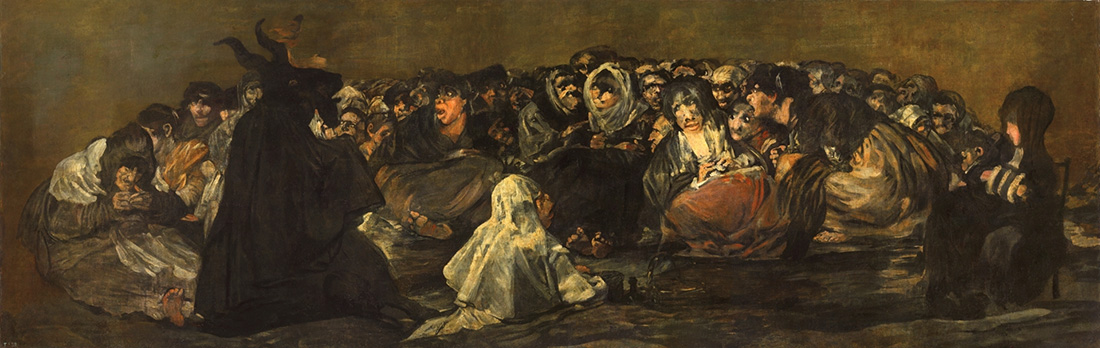
    Witches’ Sabbath, or the Great He-Goat (1820-1823), Francisco de Goya y Lucientes | Creative Commons, courtesy Museo del Prado, Madrid. The rapt and deformed (unformed might be a better description) faces of the witches painted by Goya in his “Black Period” remind me of the evil plots and empty hearts of those in the world who are paying more attention to Satan than to God. In the process, they are becoming enslaved to themselves and Satan and losing their humanity.

    Turning to today’s gospel reading from St. John, we encounter a crowd of very divided Jews reacting to Jesus’s words. Some were convinced that he was “the Christ,” while others wanted to arrest him. What has them in such a state?

    In the verses just prior to our reading, we learn that it is “last day of the festival, the great day,” which is known as Hoshana Rabbah. This is the last “day of judgment” in the Jewish calendar, when they process around the temple seven times and have a great temple service, imploring the Lord for a bountiful year ahead. Water played a special role throughout the festival of Sukkot during this period of history. On each morning of the seven days, the priests would travel down to the river to gather water and bring it back to the altars, where it would be poured into special holes that would allow the water to drain at a slow rate, flowing from God’s altar. On this last day of Hoshana Rabbah, the priest makes a great show of the water libation as an appeal to God to provide water for the people in the year ahead. It is at this time that Jesus cries out, “Let anyone who is thirsty come to me, and let the one who believes in me drink. As the scripture has said, ‘Out of the believer’s heart shall flow rivers of living water’” (Jn 7:37-38).

    No wonder the crowd is aghast! Jesus, as if in answer to the priest’s prayer, tells the people to come to him for living water. He is saying that he has God’s power of restoration for the people. This proclamation forces the Jews to make a decision, to react. Will they accept the Messiah in their midst or reject him?

    If they believe him, they must follow him in order to receive this living water that God will provide. Here, at the culmination of a great seven-day festival, replete with rituals and priestly roles, they are facing the option of potentially replacing all of these things that define them with faith in a single man (a Galilean at that!).

    On the persuasive side, his preaching during the festival has “astounded” them with his wisdom and command of God’s Word. Plus, he is renowned for working miracles, in the temple and beyond. But the stakes are incredibly high for them. The alternative to following him is that they maintain the rituals and beliefs that are much more comfortable to them. It’s inertia vs. actuation. Comfortable doubt vs. faith in something new.

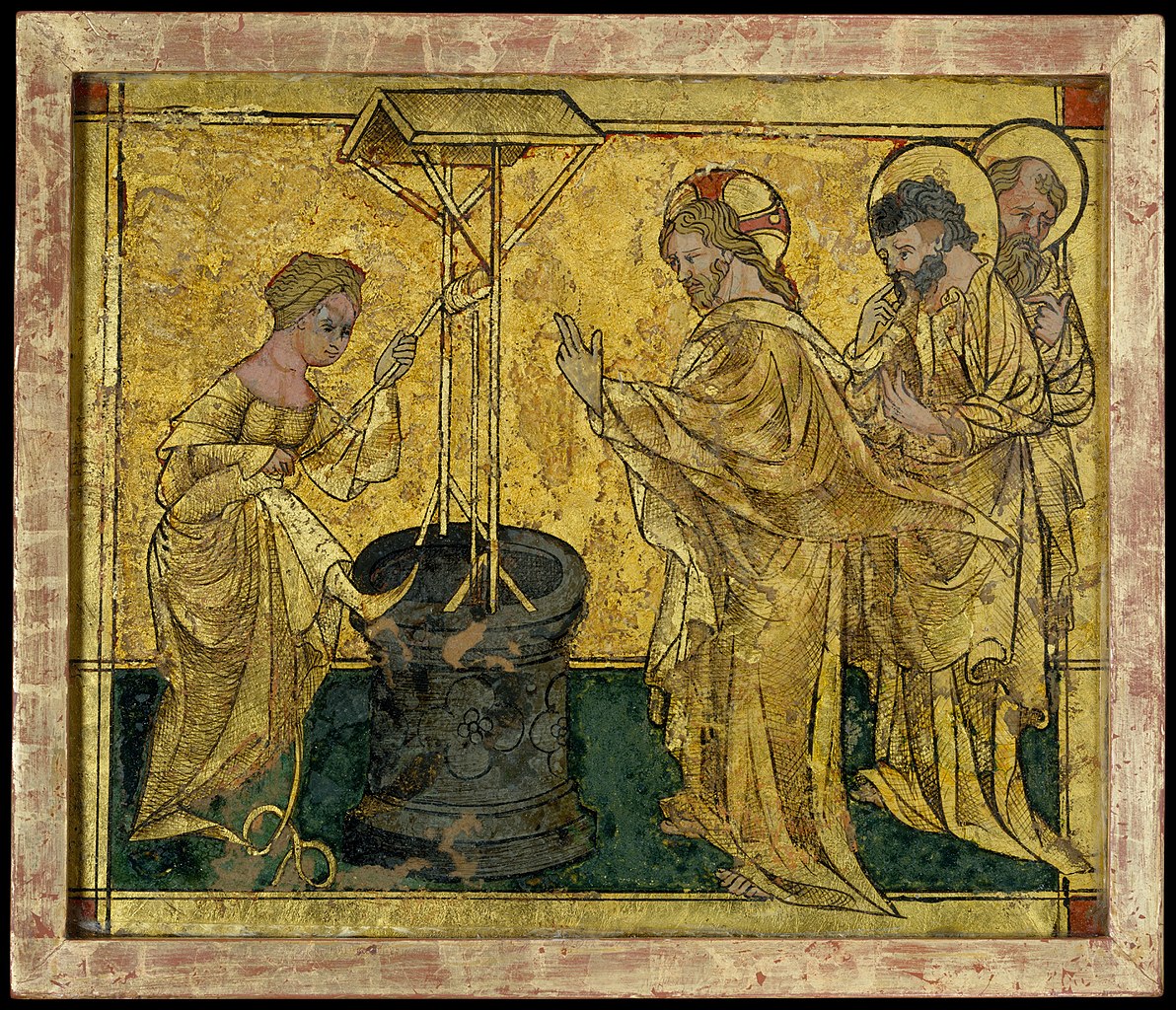
    Jesus and the Samaritan Woman at the Well (c.1420) Southwest German? | Creative Commons, courtesy the Metropolitan Museum of Art. Jesus offers us living water – will we accept his offer like the Samaritan woman (who appears about to jump into the well in her act of pulling up the water)?

    We hear that “Some of them even wanted to arrest him, but no one laid hands on him.” These are the ones who have chosen doubt, and we see where it leads them: arrest, persecution, shutting him up. The gospel emphasizes that these feelings from diseased hearts lead nowhere. St. John Chrysostom explains in his Homily 51 on the Gospel of John: 

    Such a thing is malice! It will give way to nothing, it looks to one thing only, and that is, to destroy the person against whom it plots. But what says the Scripture? “Whoever digs a pit for his neighbor, shall fall into it himself” (Proverbs 26:27). Which was the case then. For they desired to kill Him, to stop, as they thought, His preaching; the result was the opposite. For the preaching flourishes by the grace of Christ, while all that was theirs is quenched and perished; they have lost their country, their freedom, their security, their worship, they have been deprived of all their prosperity, and have become slaves and captives (Homily 51, 3).

    The problem with plotters is that they are too caught up in the short-term and in themselves. Chrysostom shows us that the long view, the perspective where we interact with the eternal, has a “rightness” that does not belong to us. This eternal perspective God invites us to share shows us that those malicious Jews (and all who exhibit malice) “have lost their freedom” in that they are captive to their own prejudice and small-mindedness; “they have been deprived of all their prosperity” in that they no longer grow as human beings but shrink into desiccated shells of hatred.

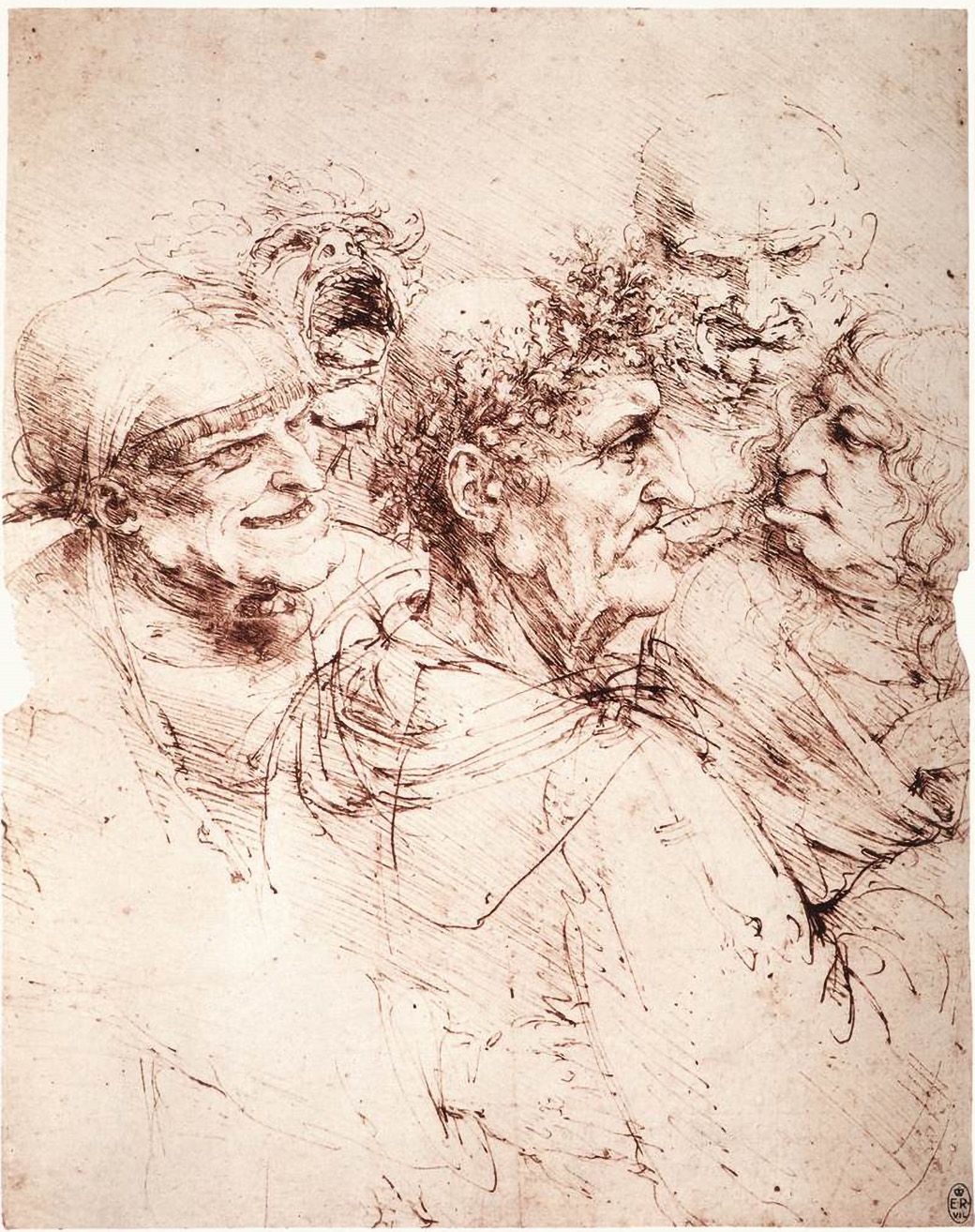
    Study of five grotesque heads (c.1494), Leonardo da Vinci | Wikimedia Commons. da Vinci’s sketch truly makes me think of the chief priests and Pharisees, wicked plotting and self-righteousness evident in their bearing.

    Today’s gospel continues by showing us the diseased hearts and malice of the chief priests and Pharisees. They chastise the guards for not arresting Jesus: “Have you also been deceived? Have any of the authorities or the Pharisees believed in him?” They attack the guards as being feeble-minded and offer themselves as the authorities on what is correct. They display their myopic determination to be seen as “right.”

    And when Nicodemus, a Pharisee who has come to Jesus previously with an open mind, urges them to give him a chance to talk with them before condemning him, they lash out. They venomously reply, “You are not from Galilee also, are you? Look and see that no prophet arises from Galilee.” We are shown that the diseased hearts of these impotent plotters devours them, so much so that they begin attacking their own.

    What a stark choice we are given in John’s gospel. On one hand, we have the Son of God, speaking with authority, working miracles, and offering life-giving water. On the other, we have the chief priests, Pharisees, and doubters — plotters all — who have no light and no truth to offer their people. All they offer is malice. If we judge by the fruits, we can see that this tree is diseased. And as Chrysostom points out, “it will come to nothing.”

    The passage ends: “Then each went to his own house.” They are left with nothing but themselves and their evil thoughts.

  • Hung Up on Our Notions of Jesus the Man

    Hung Up on Our Notions of Jesus the Man

    Friday in the Fourth Week of Lent: Wisdom 2:1a, 12-22, John 7:1-2, 10, 25-30.

    I don’t know about you, but I get a clear sense of inertia drawing us towards the Passion and Holy Week in today’s readings. I’ve always found the rejection Jesus experiences in St. John’s gospel to be palpable, and when joined with the reading from the Book of Wisdom today, it creates a profound and sad condemnation of the people in his time.

    Worse yet, we might be more implicated in this sad commentary than we realize.

    The passage from the Book of Wisdom sounds like a real-time response from the skeptics listening to Jesus, yet it was written some 80 years earlier. The wicked people in the passage complain that “he is obnoxious to us … He professes to have knowledge of God and styles himself a child of the LORD. To us he is the censure of our thoughts; merely to see him is a hardship for us.” This sounds very much like the internal mental script of the chief priests and scribes who attack and test Jesus.

    What’s more, we hear truly wicked, devilish thoughts: “With revilement and torture let us put him to the test,” “For if the just one be the son of God, he will defend him and deliver him from the hand of his foes.” These last bits of blasphemy and mockery actually did occur while Jesus hung on the Cross:

    Those who passed by derided him, shaking their heads and saying, “You who would destroy the temple and build it in three days, save yourself! If you are the Son of God, come down from the cross.” In the same way the chief priests also, along with the scribes and elders, were mocking him, saying, “He saved others; he cannot save himself. He is the King of Israel; let him come down from the cross now, and we will believe in him. He trusts in God; let God deliver him now, if he wants to; for he said, ‘I am God’s Son’” (Lk 27:39-43).

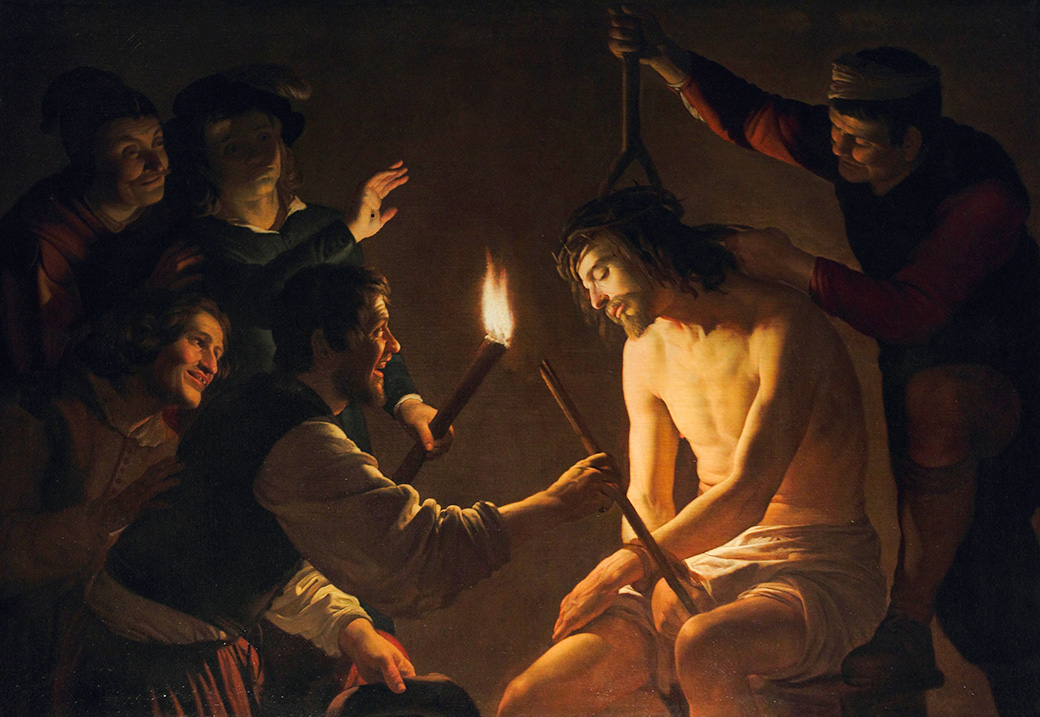
    The Mocking of Christ (1616-1617), Gerard van Honthorst | Wikimedia Commons.

    Such similarities emphasize the wickedness of the people who mocked Christ; their words are nearly identical to those called out in the Book of Wisdom decades earlier. However, as we look at this entire chapter of the Book of Wisdom from which this passage comes, we see that this wickedness refers to a larger group of people than just those who mock Christ. The chapter starts by identifying these people as those caught up in existential angst: “Short and sorrowful is our life, and there is no remedy when a life comes to its end … For we were born by mere chance, and hereafter we shall be as though we had never been … reason is a spark kindled by the beating of our hearts; when it is extinguished, the body will turn to ashes” (Wis 2:1-3). These people have rejected God and the teachings of the Jewish fathers, that he intentionally created us and has given us his covenant.

    This rejection is even deeper in that they reject the Spirit that is in each of us when they say that “reason is a spark” that comes just from our biology, and when that spark is extinguished, nothing is left but ash. This is a full denial of the spirit and the soul. It is secularism, atheism, scientism.

    What to do with this existential angst? The response of these wicked ones is to live life voraciously while they can. They say, “let us enjoy the good things that exist … Let none of us fail to share in our revelry; everywhere let us leave signs of enjoyment” (Wis 2:6, 9). When there is nothing to our existence but the world we see in front of us, there is also no basis for moral considerations. There are no repercussions beyond this world.

    Therefore, they say, “Let us oppress the righteous poor man; let us not spare the widow or regard the gray hairs of the aged. But let our might be our law of right, for what is weak proves itself to be useless” (Wis 2:10-11). By rejecting God in their flawed understanding of their own existence, these people have lost their moral bearings. Everything looks to be ripe for the picking, for the using and for the abusing.

    Thus, the final indictment against the thoughts and words of these people that we read today can be extended to all those who are amoral, who reject God, and who employ Social Darwinism in their worldview. It reads: “These were their thoughts, but they erred; for their wickedness blinded them, and they knew not the hidden counsels of God; neither did they count on a recompense of holiness nor discern the innocent souls’ reward.” The “recompense of holiness” and the “reward” is eternal salvation itself, the greatest testament to God’s being. The fact that God is there and offers us recompense and reward drives the need to order our lives according to his Word.

    This criticism is just as important today as it was 2,000 years ago. Our culture and economy are almost entirely devoted to consumption and living life voraciously. Our politics are infused with an evil streak of Social Darwinism where “might is right.” The root of the problem is the same: a rejection of God, a disavowal of the spirit and soul, and a blindness to the revelation of the Lord in history that points to a greater life beyond this one.

    The frightening implication is that when we descend into materialism or scientism, in a way we are participating in the mockery of Christ. They are logically and inexorably connected.

    Let’s put this more plainly. When all we can think about is that new car, new dress, new thing we want to buy; or when we think that the world is made of only explainable natural phenomena; or when we feel that it’s our right to get what we want, well, that’s when we’ve shut ourselves off from the source of life, from accepting the mystery, from living in the humility of a creature in God’s presence.

    And joined with these perspectives is a gut reaction that someone righteous telling us otherwise “is obnoxious to us.” In these moments, we are much further down the road of mocking Christ on the Cross than we might realize.

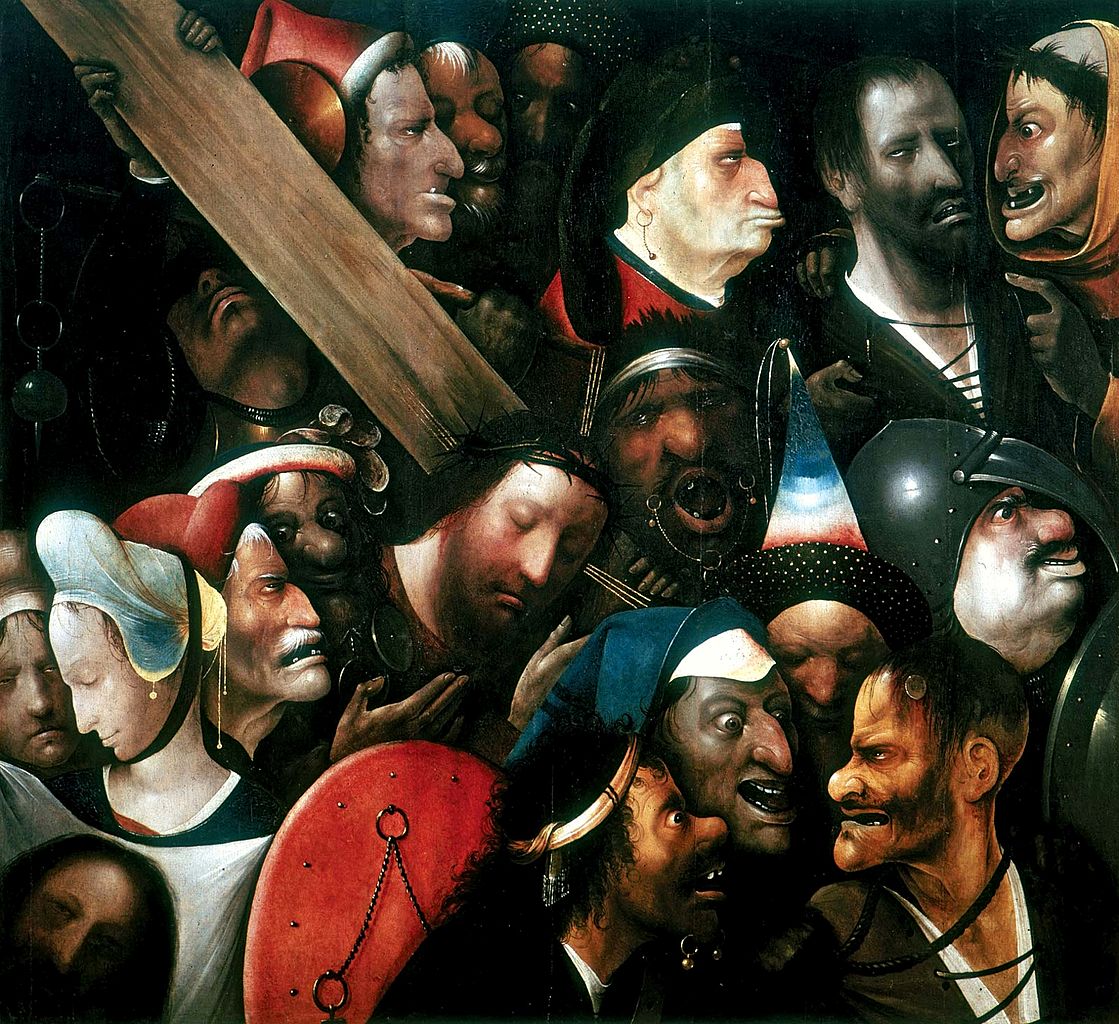
    Christ Carrying the Cross (1510-1535), Hieronymus Bosch or follower | Wikimedia Commons. Bosch is a master of grotesque human expression, and this piece is no exception. It strikes me to see the variety of ways evil is personified – that is, made personal by various people – and how the power of Satan twists and distorts us, obscuring what is good in us. The other striking thing about this painting is the serenity and prayerful visage of Christ in the midst of this miasma. 

    In the gospel reading, Christ struggles with Jews who have turned themselves away from hearing and seeing God. The reading opens by tracking the movements of our Lord almost as if he is under siege: “he did not wish to travel in Judea, because the Jews were trying to kill him.” In the full text of Chapter 7 in John’s gospel, we hear him encourage his brothers to go to Jerusalem without him during the Festival of the Tabernacles. Then he also goes, but secretly.

    Then, “About the middle of the festival Jesus went up into the temple and began to teach” (Jn 7:14). It seems that God’s will is that his incarnate Word be present and be heard at the festival. The Festival of the Tabernacles is symbolically important because the Jews commemorate their time “on the move” from Egypt to Israel when they lived in temporary accommodations (the title of the Festival, Sukkot, is translated as “tabernacles” or “booths”). Thus, they are commemorating their temporary status, and Jesus is there to move them to a new place spiritually.

    The Jews are “astonished” by his teaching and say, “How does this man have such learning when he has never been taught?” His answer is that the teaching is not his but “his who sent me.” Today’s reading focuses on this concept: hearing God through Jesus, seeing the invisible in the visible, encountering the unknown through the known. The question is if the Jews (and, by extension, we) can overcome our earth-bound notions to do so.

    But We Know Where He is From

    The Jews are hung up on a single fact: “But we know where he is from. When the Christ comes, no one will know where he is from.” They reference a belief, possibly from a passage in Isaiah or Micah, that people will not know from where the Messiah comes. Ironically, they are about to prove this belief as correct, since they do not comprehend from where Jesus comes.

    Jesus acknowledges that they might know he’s from Nazareth, in Galilee, but that’s not the whole story. He says, “You know me and also know where I am from. Yet I did not come on my own.” The Greek word translated here as “on my own” is ἐμαυτοῦ (emautou), which is translated in other editions as “of my own initiative,” “of my own accord,” and “on my own authority.” He adds, “but the one who sent me, whom you do not know, is true.” I prefer the ESV Bible version of this last sentence for clarity’s sake: “He who sent me is true, and him you do not know.” This establishes Jesus’s relationship as an ambassador for God, and the fact that the Jews do not know God in the way they should.

    He doubles down with his final sentence: “I know him, because I am from him, and he sent me.” He accomplishes several things in this sentence, establishing his own knowledge of, proximity to, and mission from God the Father. Note that Greek words used to say “from him” are παρ’αὐτοῦ (par’autou), and English doesn’t quite convey the close proximity that is connoted here. It properly means “close beside,” “in the presence of,” or “from the side of.”

    Jesus thus makes a series of explicit statements in this compact exchange:

    1. You indeed know me and that I come from Galilee
    2. But I haven’t come to you on my own authority
    3. The one who sent me is not made up, is real and, in fact, the source of all truth
    4. What’s more, you don’t know this source of truth, who happens to be your God
    5. Finally, I am the one who knows Him, I am from close beside Him, in fact He sent me specifically to you

    I find it interesting that we are told Jesus was astonishing the Jews in the temple with his learned and perfect teaching, but John doesn’t give us any of his words of teaching. Instead, we get this passage that he “exclaims” or “cries out” as he is aware of the doubts in the crowd. John is more concerned with showing us the drama of the Jews accepting Jesus the man joined with the divine Word of God. It’s interesting because this has hung up believers for millennia. The heresies of Adoptionism and Arianism reared their heads as early as a few hundred years after Christ and continue into the present day. The heart of these heresies (and of the Jewish doubters in the crowd) is that notions of Jesus as a man rule out other, mystical truths.

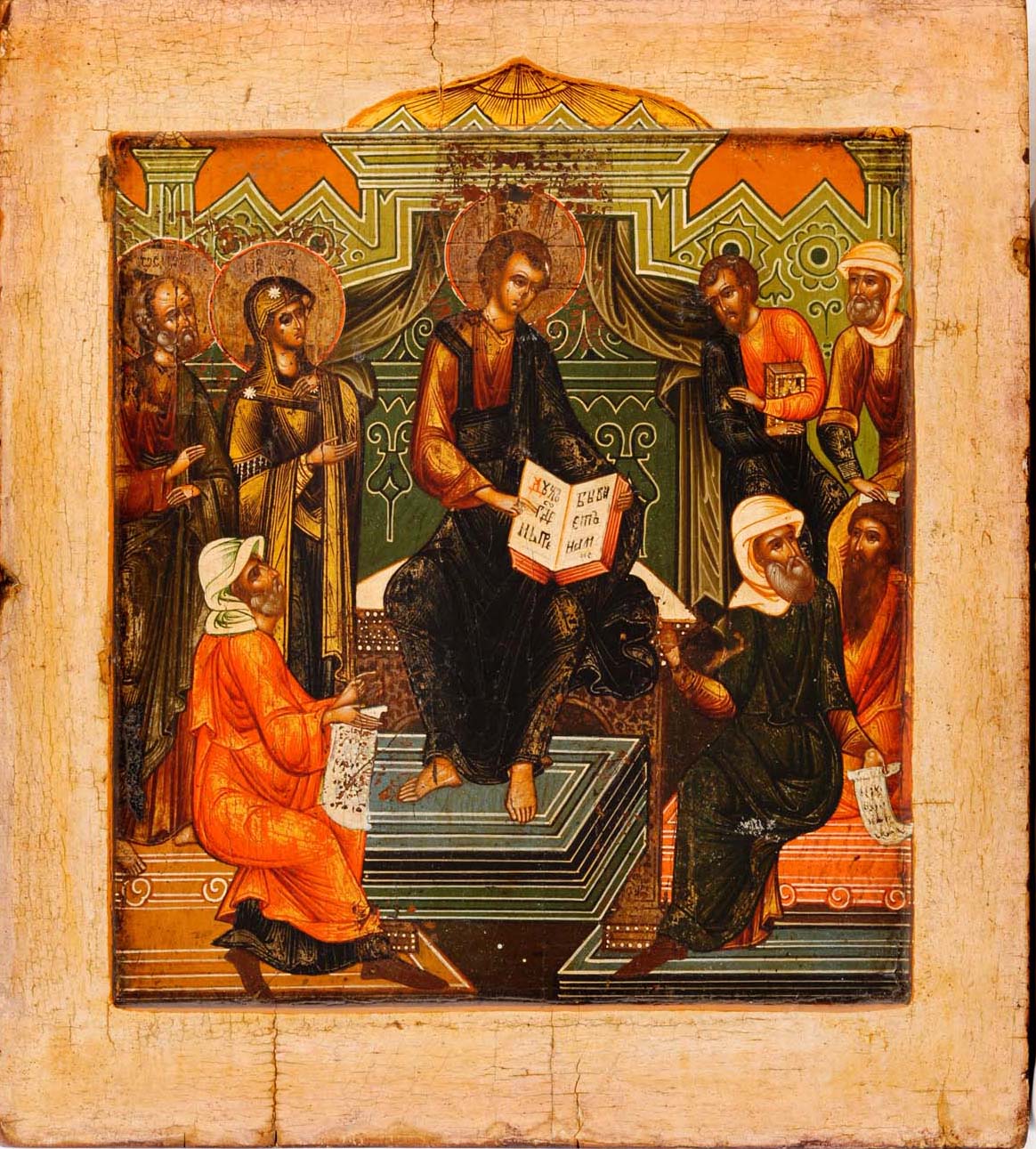
    Jesus Preaching in the Temple, c.1800, unknown Russian icon writer | Wikimedia Commons.

    This is an easy trap to fall into, especially these days as our way of knowing the world is dominated by the scientific method. I, for one, love history — imagining ages past and influences on people of different eras. But using a historical lens to interpret something fundamentally mystical — that is, the mysterious descent of the divine into the flesh of humanity — well, it leads to atrocious conclusions about Jesus like those found in Reza Aslan’s Zealot: The Life and Times of Jesus of Nazareth. Sadly, this book has been a #1 New York Times Bestseller and does nothing but present Jesus as a failed political zealot. Plus, it’s a tired, old argument of doubt. It’s so old that it happened exactly when Jesus was preaching astonishingly at the temple. It’s there in today’s reading.

    We must do better than this. We can’t ignore the historicity of Jesus, but we also can’t simply use the scientific/historical lens to look at Jesus the man. Pope Benedict XVI published Jesus of Nazareth (he was Cardinal Ratzinger at the time) as a more mature reconciliation of the facts of Jesus operating in a specific time and culture with the mystical reality of his Personhood in the Trinity. As he notes, “We are not meant to regard Jesus’ activity as taking place in some sort of mythical ‘anytime’” (11), so his historical person is important. But, he points out that his book “sees Jesus in light of his communication with the Father, which is the true center of his personality; without it, we cannot understand him at all, and it is from this center that he makes himself present to us still today” (xiv).

    This is what today’s readings are telling us: we cannot know Jesus without seeing how he dwells with the Father. Our notions of Jesus the man are simply inadequate in understanding him, the mystery of God, or the great Church that has emerged as his Body and Bride here on earth. 

  • The Purifying Fire We Call God’s Wrath

    The Purifying Fire We Call God’s Wrath

    Thursday in the Fourth Week of Lent: Exodus 32: 7-14, John 5:31-47.

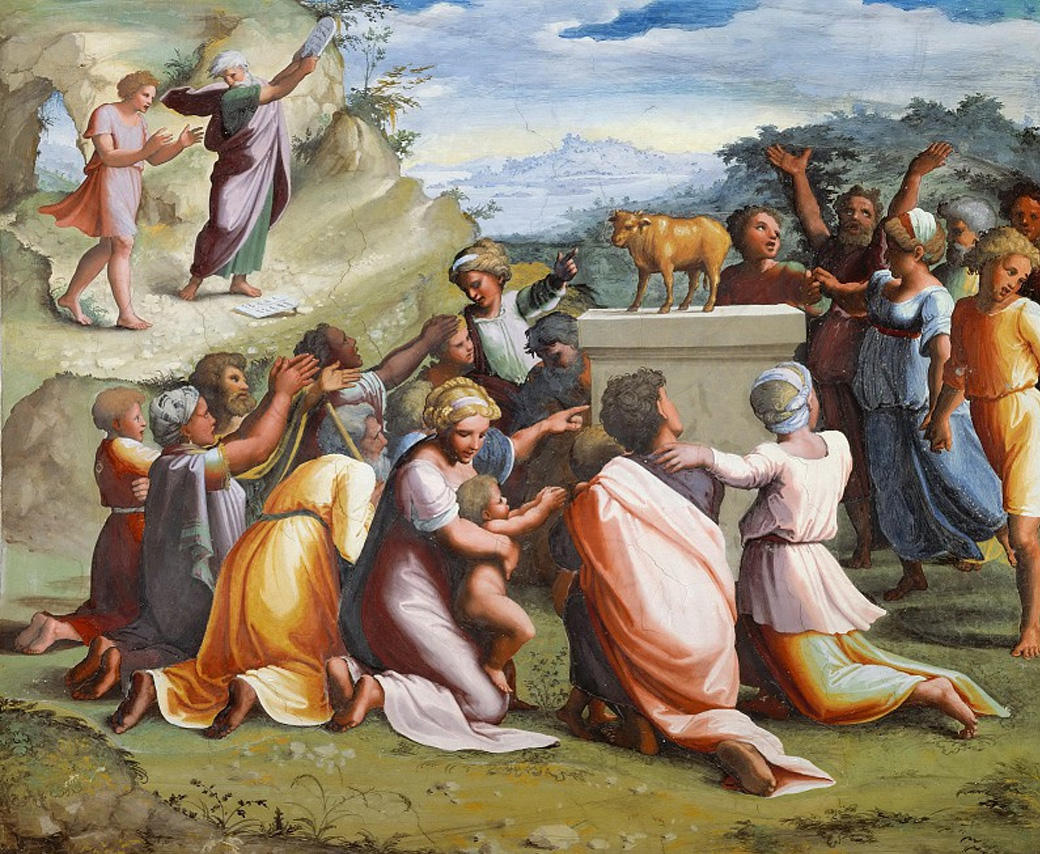
    Today’s readings give us the iconic scene in Exodus when God sees the Israelites waiting for Moses at the base of Mt. Sinai making “a molten calf and worshiping it.” God utterly rejects this, noting, “they have become depraved.” God notes “how stiff-necked this people is,” and he wants to finish creating his Covenant with Moses in the way he intended, with a receptive people. So he says, “Let me alone, then, that my wrath may blaze up against them to consume them. Then I will make of you a great nation.” Let us understand this scene carefully because we may make several theological missteps if we start to go down the wrong interpretative path.

    On one hand, we have the fire-and-brimstone set of Christians who would use this passage to claim that God is vengeful and filled with wrath for anyone who strays from the straight and narrow path. This is the gospel of fear, which is not really compatible with Christ’s message of agape. On the other hand, we have the everything-is-love set of Christians who would happily disregard this passage as “that’s not really what he meant” because nothing about this scene jives with their vision of a God they want to believe in.

    Let’s cut through what we want to believe and how we want the world to conform to our expectations, and start to see the God who is revealed to us through sacred scripture. There are a few points of doctrine that Western and Eastern Christians have always agreed upon: God is all-good, God is complete (that is, does not need anything outside of himself), and God is unchanging.

    He explains these facts about himself in his statement to Moses: “I AM who I AM.” In other words, he is defined by nothing outside of himself. He is fullness of being, and as his interactions with us throughout our history show, this fullness is essentially good.

    Untitled painting from Glory to God Alone, Tron-Eilert Holst-Pedersen | image found on tehpbilledkunst.com.

    A logical extension of these beliefs is what is called Impassibility, or the fact that God is free from affections or emotions, which are a type of changeability. In other words, if he is complete and unchanging, then he doesn’t get angry, he’s not surprised, he’s not jealous, etc. Yet this leads us to imagine an impassive (note the difference from “impassible”) God who seems not to care one way or another about anything. That can’t be right, Christ proves the opposite! Plus, we hear about wrath, anger, jealousy, delight, and more all throughout the scriptures. What’s going on here?

    One of the better articles I’ve read on this conundrum of an impassible yet wrathful God was posted on the Catholic Standard by Monsignor Charles Pope in 2019.  He explains that we must understand God’s wrath is experienced by us, not as an emotion raging within him. He writes about the analogy of trying to mix water and fire:

    God’s wrath is our experience of the total incompatibility of our sinful state before the holiness of God. Sin and God’s holiness just don’t mix; they can’t keep company. Think of fire and water; they cannot coexist in the same place. Bring them together and you can hear the conflict. Think of a small amount of water poured into a large fire: the water droplets sizzle and pop; steam rises as the water boils away. … We must be purified before entering his presence, otherwise we could not tolerate his glory. We would wail and grind our teeth, turning away in horror. The wrath is the conflict between our sin and God’s holiness. God cannot and will not change, so we must be changed or else we will experience wrath.

    So we can affirm impassibility in that God does not lose self-control or experience emotions in the ways that humans do. I tend to agree with our Church Father, Tertullian, though, who writes, “Angry he will possibly be, but not irritated, nor dangerously tempted; he will be moved, but not subverted” (Against Marcion, II.16). Tertullian’s point, in part, is that we can’t really know how God may or may not “feel,” since it is beyond our capacity. But, he notes that one thing is for sure: “it is yet palpably absurd of you to be placing human characteristics in God rather than divine ones in man, and clothing God in the likeness of man, instead of man in the image of God” (ibid, II.16).

    As I wrote in Mercy is the Master Principle, there is something in the original Greek that points to God’s visceral reaction that we might interpret (by analogy) as “emotional” or “affective.” When he is viscerally moved to compassion, the verb has its root in the word for intestines and internal organs: σπλαγχνισθεὶς (splanchnistheis). This is a nice nuance to add to Msgr. Pope’s analogy of the fire, which is by definition an element that is impassive and will burn anything regardless of its good or evil nature. Let me tentatively put this forward: because God is all goodness and purity, the purifying fire of his nature has a valence, meaning that it is weighted with all things good and against all things evil. Thus, when goodness approaches Him, the reaction is unity, which we experience as delight, warmth, and embrace. When evil approaches Him, the reaction is rejection and elimination, which we experience as wrath, anger, and jealousy.

    Transfiguration of Jesus (2004), Armando Alemdar Ara | Wikimedia Commons. I think this beautiful interpretation of the Transfiguration might also be a nice way to visualize the purifying fire of God.

    Let’s return with these thoughts to our story from Exodus. God says, “Let me alone, then, that my wrath may blaze up against them to consume them.” Two things to note: first, he maintains his discourse and relationship with Moses, not to mention the promise to build for him “a great nation.” When he asks Moses to “let him alone,” we might see this as a test for Moses, probing to see if Moses is able to fully inhabit the mercy of God and reflect this same mercy in a request to save his people. In any case, God is exhibiting his mercy here simply in the fact of conversing with Moses about it, giving him a chance to halt the purifying essence of God from burning through his people.

    The second thing to note is that God is not consumed by wrath; he is not out of control with human-like emotions. He is measured, speaking frankly and with mercy to Moses. In fact, he presents his wrath as a fundamental part of who he is, a purifying force that simply blazes up in rejection of the sin it encounters. This shows us the mercy and compassion of God while maintaining his essential, indivisible nature, “I AM who I AM.”

    Moses steps into his role of chosen prophet and law-giver admirably, reflecting back to God the mercy that he himself was shown. He pleads for the sinful people to be saved. God, ever merciful, grants his prayer.

    We hear, “So the LORD relented in the punishment, he had threatened to inflict on his people.” In some ways this wording is unfortunate because the words “punishment” and “threatened” feed a misunderstanding of God as one who is overly emotional and fickle (the theological terms would be passible and changing). This sentence could have also been written “So the LORD granted Moses’s prayer and mercifully spared the sinful people from His purifying essence.” In this way, we should understand his “punishment” as simply the incompatibility of sin and blasphemy with the presence of God. Likewise, “threatened to inflict” is “told Moses would occur if His presence fully encountered and burned/purified the sinful people.”

    The Worship of the Golden Calf (1519), Raphael | Creative Commons, courtesy arthive.com. This fresco is in the Papal Palace at the Vatican.

    The problem that caused this whole kerfuffle was that the Israelites couldn’t even make it a month in the desert without seeing miracles or a sign of their God before they turned away to embrace an idol. This brings us to the gospel reading and the theme Jesus picks up: unfaithfulness to God when you cannot see him.

    The first line Jesus speaks in today’s reading is a little fuzzy without context: “If I testify on my own behalf, my testimony is not true.” He is not contradicting what he will say later, “I am the Way, the Truth, and the Life” (Jn 14:6); instead, he is drawing a distinction between speaking on one’s own behalf and speaking with the authority and power of God. He is clear in the verse prior to the one we read: “I can do nothing on my own. As I hear, I judge; and my judgment is just, because I seek to do not my own will but the will of him who sent me.”

    Thus, “If I testify on my own behalf” means “if I’m standing here preaching to make a name for myself.” And rightfully, then, his testimony would not be “true,” since Truth comes from and points to the Father. He makes this point again in the second half of the reading: “yet if another comes in his own name, you will accept him. How can you believe, when you accept praise from one another and do not seek the praise that comes from the only God?” He refers here to those priests, prophets, and scribes who wish to get fame and glory in this world, who “accept praise from one another.” They are all caught up in a game with themselves and ignore the reality of God, invisible but not unknowable.

    Jesus is attempting to counsel the scribes and Pharisees who challenge him for doing work on the Sabbath. He tells them that he is doing the work of his Father, that he is the Son of God. He says, “The works that the Father gave me to accomplish, these works that I perform testify on my behalf that the Father has sent me.” He is attempting to make visible for them the omnipresent but invisible God. His works testify both “on his behalf” (that he is the Son of God) and they testify to the reality of God the Father. He pinpoints their lack of faith despite all of the signs of his coming, both in his works and in the scriptures:

    But you have never heard his voice nor seen his form,
    and you do not have his word remaining in you,
    because you do not believe in the one whom he has sent.
    You search the Scriptures,
    because you think you have eternal life through them;
    even they testify on my behalf.
    But you do not want to come to me to have life.

    This paints a truly pathetic picture of the ones who are persecuting Jesus. They are blind to God, deaf to God, and do not even have “his word remaining in them,” all because of their act of rejecting him. He is giving them communion with the divine Lord and they reject it. Even the scriptures to which they cling for salvation are testifying to Christ, but they choose not to see it, they “do not want to come to me to have life.” These people seem just as doomed as the ones worshipping a golden calf at the base of Mt. Sinai. Perhaps even more because they don’t have to believe through an interlocutor like Moses, they have God right in front of them, working miracles and attempting to teach them.

    Like God in the Exodus passage, however, Jesus shows them mercy and does not burn them in his purifying fire. He asserts:

    Do not think that I will accuse you before the Father:
    the one who will accuse you is Moses,
    in whom you have placed your hope.
    For if you had believed Moses,
    you would have believed me,
    because he wrote about me.

    He shows them that they have created a golden calf in Moses, that they are worshipping an image that is easier for them to believe in than the invisible God on high. But this very idol they have created is true to God and will accuse them to the Father because he knows and has written about the living Word of God long before his coming. 

    The Triumph of Christianity over Paganism (Le Triomphe du Christianisme sur le paganisme), 1868, Gustave Doré | Wikimedia Commons.

    Today’s readings give me a greater appreciation for the person of Jesus Christ, where the “I AM” in all its pure being is mysteriously united with a human nature susceptible to all of the temptations of this world. By his very nature, God rejects and purifies evil, like fire vaporizing a water droplet. Yet within the person of Jesus, this essence maintains ultimate self-control and obedience to the mercy and goodness of the Father (which he can only do because he is at the same time wholly the essence of the Father, too).

    The divine essence does not struggle with or burn out a human nature that would, if it was anyone of us, have wanted to yell, punch, or demolish the self-righteous scribes and Pharisees criticizing him. Christ somehow manages to seamlessly integrate these two natures and persevere in preaching the Truth, the Word, while warning them with mercy about their errant ways. 

    Let us attempt to understand the coming together of divine impassibility and yearning for the good. This is what we are all called to be as we imitate our Savior.

  • Water from the Temple

    Water from the Temple

    Tuesday in the Fourth Week of Lent: Ezekiel 47:1-9, 12, John 5:1-16.

    Water figures strongly in today’s readings. Water is the great bringer of spiritual purification and cleanliness. God’s law prescribed that Jews must ritually purify themselves in water before partaking in everything from meals to sacrifice before the Lord. Water is also the substance of physical life, sustaining humans and all of creation.

    We reflected at length on the connection between the life-giving and spiritual-purifying aspects of water as presented to us in the story of Jesus at Jacob’s well with the Samaritan woman (see If You Knew the Gift!). Today, we see how water figures in prophecy about the Kingdom of God, specifically in the person of Jesus Christ.

    Ezekiel, writes during the Babylonian Captivity around the years 596-574 BC, like the events found in the Book of Daniel. Ezekiel is given prophetic visions from the Lord about both the destruction of Jerusalem and the rebuilding of the temple. Remember that the temple in Jerusalem was the heart of the Jewish faith, where the presence of God dwells. It had supreme importance for them, and the destruction of the temple along with all of Jerusalem was a catastrophic event. Thus, when we hear of a rebuilt temple, we must understand that this is a restored connection with the presence of God.

    Solomon Dedicates the Temple at Jerusalem (c.1896-1902), James Tissot or followers | Wikimedia Commons.

    Today’s reading is part of Ezekiel’s vision of the restored temple; an angel shows him “water flowing out from beneath the threshold of the temple toward the east,” which is the direction that the temple faces. The angel takes him away from the temple and the water builds and deepens, first into a stream and then into a mighty river. In the east, it reveals its life-giving nature, it “empties into the sea, the salt waters, which it makes fresh. Wherever the river flows, every sort of living creature that can multiply shall live.”

    This type of imagery should be familiar to us. We have explored how Jesus tells the Samaritan woman that he provides “life-giving water.” It is the endless river of life flowing from the Trinity, the “self-opening of our Thrice-Holy God,” as Fr. Jean Corbon, OP puts it. The river in Ezekiel’s vision, therefore, we can understand as the same river of life that St. John will see in the heavenly Jerusalem in the Book of Revelation. This is the eschatological vision of the river: the life abounding in the river is everlasting life.

    In this eschatological vein, let’s examine the importance of the direction of the east that Ezekiel takes great pains to emphasize. One of our Church Fathers, Origen, explains why the direction of the east is important to us:

    “Atonement comes to you from the east. From the east comes the one whose name is Dayspring, he who is mediator between God and men. You are invited then to look always to the east: it is there that the sun of righteousness rises for you, it is there that the light is always being born for you. You are never to walk in darkness; the great and final day is not to enfold you in darkness” (Hom. 9, 5. 10: PG 12, 515. 523.).

    For centuries, this is why Catholic churches have been built with the altar facing the east. We worship in the direction of Christ, the “sun of righteousness” rising for us, where “light is always being born” for us. 

    This brings us to the physical nexus of Ezekiel’s vision. Recall that he is describing the temple. The saving nature of the river, deep and wide in the east, points to the sacred nature of the temple. Since the river starts in the temple, our experience of divinity starts in the temple. This building (like our Catholic churches) is important because it is our physical place where we encounter God.

    In Christ, though, the physical and the divine co-exist. This changes everything, and even while Ezekiel was a devout proponent of all kinds of traditional Jewish religious prescriptions, his mystical vision inexorably points to a new temple that is nothing the traditional Jewish faith could envision. God is presenting him with a vision of the new temple in the person of Christ.

    River in Saint-Clair (1908), Henri-Edmond Cross | Creative Commons, courtesy Wikiart.org. How can we imagine the divine river of life? This work of pointillism stimulates my imagination.

    At many points in Christ’s ministry, he tells us how he is establishing a new priesthood (with Peter and his apostles), a new sacrifice to replace all other ritual sacrifices (the Eucharist as initiated at the Last Supper), and a new direct communion with God through himself. Most strikingly, he not only identifies himself with the temple, but being greater than the temple: “I tell you, something greater than the temple is here. … For the Son of Man is lord of the sabbath” (Mt 12:6, 8).

    He is not abolishing physical buildings for worship, but he is re-defining the symbolic and religious meaning that the Jews placed on Jerusalem’s temple. This is most evident when the temple shroud is ripped in half and the earth shakes when he dies on the Cross. Brent Pitre, PhD, explains the importance of these events: “with the tearing of the Temple veil and the earthquake—the whole universe, ‘heaven and earth,’ were symbolically being torn asunder” (Jesus, the New Temple, and the New Priesthood, p.63). Again, with Jesus being the physical union of divinity and humanity, everything changed.

    Pitre’s article referenced above is a great academic deep-dive into the implications of Jesus replacing the Jewish concept of the temple in Jerusalem. He traces the depth of the temple in Jewish consciousness: “From a theological and liturgical perspective, for a first-century Jew, the Temple was at least four things: (1) the dwelling-place of God on earth; (2) a microcosm of heaven and earth; (3) the sole place of sacrificial worship; (4) the place of the sacrificial priesthood” (48). It’s worth a read if you’re interested in exploring this further, and it certainly underscores the radical nature of Christ’s message for the Jewish people.

    One last item to note from Ezekiel’s vision: the fruit born by the trees growing on the banks of the river has a life beyond the river. He says, “Every month they shall bear fresh fruit, for they shall be watered by the flow from the sanctuary. Their fruit shall serve for food, and their leaves for medicine.”

    As we have explored in previous reflections, Jesus counsels us in discerning between good and bad prophets, “by their fruits you will know them” (Mt 7:20). The idea is that the fruit reveals the heart of the person: “every good tree bears good fruit, but the bad tree bears bad fruit” (Mt 7:15). Thus, when Ezekiel tells us that the fruit growing on the banks of the river of life “shall serve for food and their leaves for medicine,” the Word of God is telling us that those who are fed by this divine river will be transformed in goodness, in turn feeding and healing those in the world. This is the action of God’s mercy and agape as he works his will through us.

    Turning to today’s gospel reading, we find the incarnate Word of God in Jerusalem for a Jewish feast day and he is by the Sheep Gate. This likely references the sheep market where people could buy sheep for sacrifice at the temple. There are also pools there, presumably used to ritually wash the animals before they were used in the temple. “In these lay a large number of ill, blind, lame, and crippled. One man was there who had been ill for thirty-eight years.”

    A few things are being conveyed to us. First, Jesus is drawn to the place where the outcasts go in a bid to purify themselves like the sacrificial animals. More than simply outcasts, they were spiritually unclean in the Jewish mind. They exhibit a certain desperation in waiting for a “stirring” of the waters by an angel whereby the first one in the water is cleaned by divine action. We might be reminded of the story of the Canaanite woman begging for Christ’s mercy and healing: “Even the dogs eat the crumbs that fall from their master’s table” (Mt 15:27). 

    But here there is even deeper symbolism because this is the temple, these are waters meant to be used for purification in order to give sacrifices to the Lord. When Jesus asks the paralytic “Do you want to be well?” the man answers pitiably, “I have no one to put me into the pool.” He does not ask the Lord to heal him, for he does not recognize who he might be. He simply laments his predicament. Despite his pitiful state, the man has undiminished hope and faith, having been ill for 38 years.

    Christ Healing the Sick at the Pool of Bethesda (c.1615-1620), Pedro Orrente | Wikimedia Commons.

    Given the logic of healing stories, we might expect that Jesus will be the one to “put him into the pool,” perhaps after first asking for his faith in God. But that’s not what happens. Jesus has something deeper to say and do. He instead says, “Rise, take up your mat, and walk.”

    Several things happen here. First, Jesus cuts through the ritual nature of the temple, displayed in this outlying washing pool for sacrificial animals and the infirm where the first one in the pool gets healed. He establishes a new, direct connection to healing in himself. This is underscored by his instruction to “take up your mat,” which provides a temporary dwelling place for the man in the temple. That dwelling is no longer needed.

    Second, he provides the divine energy personally to the man so that he can rise by himself and walk on his own. The river of life enables us to “bear fresh fruit” of our own. The man is enabled to be fully human, blossoming in the love of God.

    Third, Jesus performs an act of healing on the Sabbath. The Jews, particularly the Pharisees and scribes, will use this act of “work” on the Sabbath to persecute and eventually arrest Jesus. It is a major theme of the gospels, and juxtaposes their hangups with particularities of the law while disregarding the Spirit of God among them.

    But have you ever wondered that Jesus might be intentionally healing on the Sabbath, not just doing his ministry as if it were any other day? Let’s return to the quote from Matthew I referenced earlier: “I tell you, something greater than the temple is here. … For the Son of Man is lord of the sabbath” (Mt 12:6, 8). Christ is establishing in himself, here at the temple in today’s reading, what he says in that passage from Matthew. Here, in the temple, he does the “work” of replacing the temple through his own saving person and mission. As the Lord of the Sabbath, united with God to whom the sacrifice is being offered, he releases humanity from our ritual debt of sin offerings and atonement.

    In yesterday’s Office of Readings, we read the account from Leviticus on the complicated ritual for Yom Kippur, the Day of Atonement, with all of its purifications, sacrifices, and sprinkles of blood. Notably, one lamb was to be sacrificed to God while the other was to have all of the Jews’ sins cast upon its head and released into the desert as an offering to Azazel (a fallen angel, much like Satan). In today’s readings, we encounter sheep at the Sheep Gate — literal sheep, the infirm who are the pitiful sheep lost to their people, and the Lamb of God Himself. The Lamb of God replaces all of these sacrificial sheep and he saves those lost sheep.

    Christ Healing the Paralytic at the Pool of Bethesda (1667-1670), Bartolomé Esteban Murillo | Creative Commons, courtesy The National Gallery (UK).

    Yesterday’s Office of the Readings also gives us Origen’s commentary (quoted earlier). Here is another important link from Origen:

    “God taught the people of the old covenant how to celebrate the ritual offered to him in atonement for the sins of men. But you have come to Christ, the true high priest. Through his blood he has made God turn to you in mercy and has reconciled you with the Father. You must not think simply of ordinary blood but you must learn to recognize instead the blood of the Word. Listen to him as he tells you: This is my blood, which will be shed for you for the forgiveness of sins.“

    Once again, we encounter Christ in all his fullness today, enacting his saving mission with every word and deed. We must strive to see the mystery hidden deep within each passage from the Word of God. Jesus gives us a profound understanding of the water that flows from the new temple: it is him, it restores our humanity and enables a new communion with the divine. 

  • Living in the Promise

    Living in the Promise

    Monday in the Fourth Week of Lent: Isaiah 65:17-21, John 4:43-54.

    Compared to some of the well-structured parables we’ve been hearing this Lent, today’s readings are a bit vague. Perhaps “transitional” is a better way to describe them. But maybe that’s the point. We are waiting for Easter in our liturgical season and perhaps waiting for many other things in our personal lives. Waiting is an unavoidable human pastime.

    Early Spring (1892), Isaac Levitan | Creative Commons, courtesy Wikiart.org. This is how I’m feeling this morning, as I imagine many others are: hunkered down in our homes, the early spring around us silently thawing and a tinge of blue expressing the existential angst of waiting. 

    Yet the tenor of the readings is hopeful, even triumphant. Through Isaiah, the Word of God speaks about the “new heavens and new earth” he will build: “I create Jerusalem to be a joy and its people to be a delight; I will rejoice in Jerusalem and exult in my people. No longer shall the sound of weeping be heard there, or the sound of crying.” Forget earth, this sounds like Heaven. But he is speaking of earth, too. What else could this be but the end times in which we are living? The time after Christ, when Heaven truly does come down to earth and establishes a firm foothold in the Church. Can we accept this new reality?

    It requires a change in us. As he says, “The things of the past shall not be remembered or come to mind.” For the nation of Israel, this refers to both their historical struggles as well as the former covenants established by God. The New Covenant supersedes them — it does not reduce them in the slightest but intensifies God’s connection with his people.

    However, there is something scary in not remembering the past.

    Is Isaiah talking about the abolishment of history? I do not think God suggests ahistoricity for humanity, but a new and transformed historicity. In other words, the Christ event and what it reveals about God’s fullness throughout history enables us to forget our tiny lens of human nation-building and power relationships. We now have insight into God’s saving plan for us and this presents a new way to look at everything. The earth is transformed.

    This requires willing participation on our part. We have to live up to our end of the covenant and love the Lord your God with all your heart, with all your soul, with all your mind, and with all your strength. This is constant work for us to live in the light, to accept God’s agape, allow it to transform us, and then give that agape to those around us. So, we are in constant transition, sometimes living in the New Covenant, but then falling into sin. The sacraments — Confession, Eucharist, Marriage, etc. — and the never-ending liturgy are our ways to re-unite with God, to re-commit to the covenant with Him. Lent itself is a season of waiting, transition, and re-commitment.

    In today’s gospel, we find Christ in transition, going from Samaria to Galilee. And a royal official travels from Capernaum to Galilee to ask Jesus to return to his home with him to heal his son. Rather than travel with the man, Jesus tells him to go home where he will find that his son is healed. We are told that the man “believed” and left. Yet this is a two-day journey, and we can imagine that the man had a twinge of doubt as well as hope in his heart. 

    On the way home the next day, the man encounters his slaves who share the good news that his son is recovering (starting exactly at the time he met with Jesus). With this, “he and his whole household came to believe.”

    In other scenes from the gospels, we see Jesus teaching specific lessons with each healing. For example, yesterday’s parable of curing the blind man by making clay from his own saliva was a sign that he, the Christ, is the method for curing our spiritual blindness. So what do we find when we dig into this abbreviated miracle? All Jesus says is, “You may go; your son will live.”

    The Road to Emmaus (Der Gang nach Emmaus), 1891, Fritz von Uhde | Wikimedia Commons.

    I believe the lesson here lies in the travel and the transitions of spirit that are marked along the way. First, Jesus travels to us from “his native place,” where he was not recognized as the Messiah. This was a historical event for the man as he left Nazareth for Galilee, but also symbolic of overall salvation history, where God travels from the nation of Israel where he is rejected to the rest of the world. Next, the man from Capernaum travels to him, just as we are to travel to him, to leave the comfort of our homes, especially urgent in times of distress. 

    Here, at the encounter with Christ, the man petitions him in earnest, with belief in his power to save. God comforts him and pours out his mercy upon the man. Refreshed in spirit thanks to the life-giving water, the man returns home, renewed in faith. This is the model for our own encounter with Christ in the sacraments, in the Church, in our hearts. He is our hope and our wellspring.

    And in looking at the overall arc of the gospel, most of the time is spent in transition, in travel. Is this not the case for us, too? Our faith shows us the broad strokes: we are in transition between this world and the next, where we shall be united with God face-to-face. As we’ve noted before, the earliest Christians referred to themselves as followers “of the Way” (cf. Acts 9:1-2), letting this great eschatological fact define them.

    On the micro level, too, we are constantly traveling, in transition. We get to experience the Mass infrequently and ecstatic moments of union with God even less frequently. What happens outside of those moments? Well, we call it life. It’s hard to keep up a sustained outpouring of God’s love and will. We are members of the Church in part to support us in that effort to maintain our spiritual focus. But let’s be honest about the reality of this life: it exists largely in transition between moments of sin, fear, and isolation and moments of peace within God’s light.

    How are we living this life? What do we look like as we walk in this life of transition? The answer and expectation given to us is frustratingly simple; Jesus tells us, “I am the way, and the truth, and the life” (Jn 14:6). We must happily embrace what the earliest Christians did and be followers “of the Way,” because the travel, the path, and the moments of transition are in union with Christ Himself.

    He resided in our flesh, he knows us intimately, he is here with us. The great Life-Bringer, the source of Truth and Wisdom traveled just like us. With his Resurrection, he lives spiritually, personally, and mystically with each of us while we walk in this life of transition. We are not alone here. As baptized Christians, we are surrounded by and infused with the Spirit of the Lord. This must make our journey joyful and hopeful, despite all of its hardships and pain.

    This is the “new earth” of which Isaiah speaks. The Lord has promised us salvation and a place in his house. This is why he says, “No longer shall the sound of weeping be heard there, or the sound of crying.” Let us live in the promise of the Kingdom, knowing that every step we take on the Way is one step closer to him.

    Spring in Italy (1890), Isaac Levitan | Creative Commons, courtesy Wikiart.org. Perhaps this is how we can feel today, regarding the world with the promise of blossoms being fed by a running stream. Regarding the spiritual promise of the mountain, that is, of the Kingdom, ahead.
  • Seeing with the Light of the Lord

    Seeing with the Light of the Lord

    Fourth Sunday in Lent: 1 Samuel 16:1b, 6-7, 10-13a, Ephesians 5:8-14, John 9:1-41.

    Today’s readings reveal to us how differently from us that the Lord sees, and how Jesus came to reveal the blindness in us and reverse it through himself. The dialectic of light vs. darkness is another way to understand good and evil, and allows us to examine our own senses in the process. Living “in the light,” we are told, is more a matter of the heart than sight. 

    In the first reading, the Lord sends Samuel to Bethlehem to anoint the new king he has chosen from among Jesse’s eight sons. He warns Samuel, “Do not judge from his appearance or from his lofty stature, because I have rejected [these ones].” God has more to say about seeing and judging, which we might call discernment: “Not as man sees does God see, because man sees the appearance but the LORD looks into the heart.” So we receive an important message, that God peers into the very hearts of people when he “looks,” something that we are unable to do. We require God’s help when it comes to true discernment.

    Today’s passage also gives us many ways in which David prefigures Jesus. In scripture, we often encounter the “house of David” and the “Tree of Jesse” from which Jesus comes. It’s fascinating to dwell on today’s verses where God has chosen David. As we listen to the Word of God, who will be born to Mary in Bethlehem, who will be the Good Shepherd for the world, it’s interesting to hear that Jesse dwells in Bethlehem and David is out tending the sheep when the seven other sons are presented to Samuel for potential anointing. The Word is implanting prophecy about His eventual arrival. In this way, David and the lineage of Jesse are a sign of the greater thing to come.

    Root of Jesse icon, provenance unknown | Creative Commons, courtesy iconreader.wordpress.com. In Russian icons this is also known as the Tree of Jesse. Its inspiration comes from Isaiah: “There shall come forth a shoot from the stump of Jesse, and a branch shall grow out of his roots” (Is 11:1). St. Ambrose of Milan writes: “The root is the household of the Jews, the rod is Mary, the Flower of Mary is Christ. She is rightly called a rod, for she is of the royal lineage, of the house and family of David. Her Flower is Christ, Who destroyed the stench of worldly pollution and poured out the fragrance of eternal life. As He Himself said, ‘I am a flower of the plain, a lily of the valleys.’”

    Transitioning to the second reading, I am always struck at how the Word of God works through St. Paul in marvelous ways. Remember that Paul never met Christ before his death; he became an Apostle through the Risen Christ appearing to him. And what an Apostle! We have inherited so much knowledge, encouragement, and theological understanding from him.

    His conversion to Christ is a great example of what we shall see in the gospel reading: the light of Christ opens his eyes. He was spiritually blind and this blindness was rendered literally for him. We are told, “Saul got up from the ground, and though his eyes were open, he could see nothing; so they led him by the hand and brought him into Damascus. For three days he was without sight, and neither ate nor drank” (Acts 9:8-9). There is a sense of penance here, where Saul, on his way to becoming St. Paul, must go into the desert to fast and contemplate (like we do in Lent).

    But this is just the beginning for him, as he will soon pick up his cross and follow Christ in both suffering and spreading the message of salvation. The disciple Ananias is hesitant to cure his blindness as Christ bids him, but Christ tells him, “he is an instrument whom I have chosen to bring my name before Gentiles and kings and before the people of Israel; I myself will show him how much he must suffer for the sake of my name” (Acts 9:15-16). Oh, the penance will continue! To whom much is given, much will be required (Lk 12:48), says the Lord. At Ananias’s touch, the blindness falls from his eyes “like scales,” he is baptized, and he is on his new path. 

    In today’s reading from Paul’s letter to the Ephesians, he must have been thinking of his own experience when he writes, “You were once darkness, but now you are light in the Lord.” Note that he doesn’t say, you were once in darkness, but that they were darkness and now are light. He was, in fact, “darkness” in both spiritual sight and deed since he physically persecuted disciples of Christ before his own conversion. Thus Paul gives us another understanding of darkness and light not just being aspects of sight (either physical or spiritual), but also ways of being.

    He continues, “Live as children of light, for light produces every kind of goodness and righteousness and truth. Try to learn what is pleasing to the Lord. Take no part in the fruitless works of darkness.” Note how he conceives of light as “producing” goodness, not just revealing it. And how darkness produces fruitless works. We see Paul building the Church, providing instruction for fledgling communities of those baptized in Christ. Through their Baptism, Christ has opened their eyes to spiritual light, and now Paul is deepening their understanding of that light. It is a light, he says, that is active and productive in the world. This is the Holy Spirit working through the Church, part and parcel of a Baptism in Christ, who is the gateway to the divine essence, an essence that continually creates goodness in the world.

    Conversion on the Way to Damascus (1600-1601), Caravaggio | Wikimedia Commons. There is much to say about this, one of Caravaggio’s masterpieces, from the striking use of light to the opening of St. Paul at the same time of blinding him, but let’s contemplate on what Caravaggio might be saying about the person Saul was at that point by giving us such a magnificent horse’s ass to look at!

    This is a light that doesn’t just reveal truth but transforms the person. Today’s gospel from St. John is a masterpiece of depicting this revelation in the curing of the blind man. This morning, Bishop Robert Barron presents a great exposition of the gospel reading in his live-streamed daily mass and mentions how St. John’s writing is akin to icon writing, where you can look at every detail in an icon and see how rich it is in symbolism and tells another aspect of the story.

    The first detail to note is that the man is blind from birth — not from cataracts or disease, but fundamentally blind since he came into the world. Why is this important? St. Augustine tells us: “that blind man is the human race; for this blindness had place in the first man, through sin, from whom we all draw our origin, not only in respect of death, but also of unrighteousness. For if unbelief is blindness…” (Tractate 44 on John 9, 1). Recall God telling Samuel “not as man sees does God see,” and here we are given a story about how man (in general) cannot see.

    Christ passes by this man, but when his disciples fruitlessly question who is at fault for the man’s blindness, he stops. He says, “Neither he nor his parents sinned; it is so that the works of God might be made visible through him.” Again, this clues us in to the universal application of the story to all of mankind. Jesus adds, “We have to do the works of the one who sent me while it is day. … While I am in the world, I am the light of the world.” Jesus speaks here of the irresistible nature of the Spirit of the Lord, active in the world. He is compelled, he must do the works of God while here on earth. To that end, he sets about healing the blind man. He is not asked to do this, he does it gratuitously.

    As a child, I always wondered about this next bit of the gospel. With other miracles, we hear Jesus say, “your faith has healed you,” or someone is healed just by touching the hem of his garment. But here we see something that seems like a magician’s ritual: “he spat on the ground and made clay with the saliva, and smeared the clay on his eyes.” Is this necessary? How is spitting and making clay related to Christ’s mission on earth?

    Nothing Jesus does is meaningless, and he certainly doesn’t need obscure rituals to heal people. So let’s examine this act and what it signifies. St. Augustine tells us plainly, “The Word is as it were the spittle, the Flesh is the earth” (Sermon 85 on the New Testament [CXXXV. Ben.], 1). Just as “the Lord God formed man from the dust of the ground,” (Gen 2:7), we see Christ initiate a similar act of creation using the dust on the ground. This act of (re-)creation for humanity comes in the form of the uniting of the Word (his spittle) and humanity (the earth); in other words, Jesus Himself is the clay that is the unity of the river of life (spittle) and the earth. Jesus spreads Himself on the eyes of the blind man.

    And Christ emphasizes the great mystical unity and energy that is the Trinity by telling him, “Go wash in the Pool of Siloam.” John helpfully tells us, “which means Sent,” so we can connect the dots. First, washing in the pool represents Baptism. What is the Baptism Christ offers us? St. John the Baptist tells us, “he will baptize you with the Holy Spirit” (Lk 3:16). So, Christ is pointing to the work of the Holy Spirit in this baptism in the Pool of Siloam.

    Second, the pool’s name means “Sent,” and Jesus has just said, “We have to do the works of the one who sent me.” Thus, the entire affair is done under the auspices of God the Father, who has sent Christ and sends the Holy Spirit. The life-giving water of the Holy Trinity, the overflowing love that characterizes the essence of our Three-in-One God, is the action that grants sight to the man blind from birth.

    Healing of the Blind Man from Birth, unknown provenance | Creative Commons, courtesy johnsanidopoulos.com.

    Let’s think more about this pool named Sent. After the man is cured of his blindness, he is asked many times by his neighbors and the Pharisees how this came about. His answer is simple: “He put clay on my eyes, and I washed, and now I can see.” But the more he is interrogated, the more he must contemplate this action and the more he must be the light (to recall the second reading from St. Paul). This man finally takes on the role of teacher to the Pharisees, a startling reversal for one who was a beggar:

    “This is what is so amazing, that you do not know where he is from, yet he opened my eyes. We know that God does not listen to sinners, but if one is devout and does his will, he listens to him. It is unheard of that anyone ever opened the eyes of a person born blind. If this man were not from God, he would not be able to do anything.”

    He answers them with the ineffable logic of the truth and the light. And so this man sets the stage for several millennia of Christians who — once they accept Baptism and the light offered by Christ — answer skeptics with clear logic. From St. Augustine through the medieval scholastics like St. Thomas Aquinas to contemporary popes, we hear similar explanations as they evangelize in the light of Christ.

    And so we can see how the man himself is sent from the pool by God, carrying a new message for the world. All of us who are baptized Christians both receive his mercy and love have been sent by God to give his mercy and love to the world.

    This inevitably means that we will be rejected by those living in darkness. Christ finds the man after the Pharisees kick him out of the temple and reveals his true nature to him. He tells him, “I came into this world for judgment, so that those who do not see might see, and those who do see might become blind.” Here we find the double-edged sword that is the Truth: it not only saves us from spiritual blindness, but it condemns those who cling to their flawed human “sight.” God’s plan is to unite us to Him, and those who choose darkness over the light will be condemned to live in perpetual blindness.

    The Old Guitarist (1903-1904), Pablo Picasso | Wikimedia Commons. Picasso painted this during his Blue Period, a time of depression and desolation after his good friend committed suicide. We see a resignation to death in this old, blind guitarist, clinging to life in the form of his guitar. When seen in the light of today’s gospel, we might see in this the blind clinging to their earthly concerns and ways of knowing, pushing away the light offered by Christ and soon to be condemned to dwell for all eternity in that darkness unless they accept Christ.

    This brings me back to St. Paul, who lived his life being sent by the Lord, being rejected by those in darkness. Yet he never failed in passing along this great impetus of being sent — his evangelization aimed to encourage others in spreading the faith, living the faith, being active, not stagnant. As he tells us today, “now you are light in the Lord. Live as children of light.”