
Category: Year B

  • Infinite Value

    Infinite Value

    Good Friday of the Lord’s Passion: Isaiah 52:13 – 53:12, Hebrews 4:14-16; 5:7-9, John 18:1 – 19:42.

    The sad and wonderful day is here. We must mourn with Mary because her most perfect Son has been tortured and killed, and this is a grievous wrong. But we must marvel at the willing act of charity that the Son carries out by offering himself wholly to the Father.

    St. John makes no bones in today’s gospel account of the Passion and Crucifixion that Jesus is in total control and is offering himself without a struggle. He tells the most powerful secular ruler in the region, Pontius Pilate: “You would have no power over me if it had not been given to you from above,” and “My kingdom does not belong to this world. If my kingdom did belong to this world, my attendants would be fighting to keep me from being handed over to the Jews. But as it is, my kingdom is not here.” Jesus has been consistent through his entire life that he comes from his Father above and does his will. As his faithful, let us truly take on the significance of this claim.
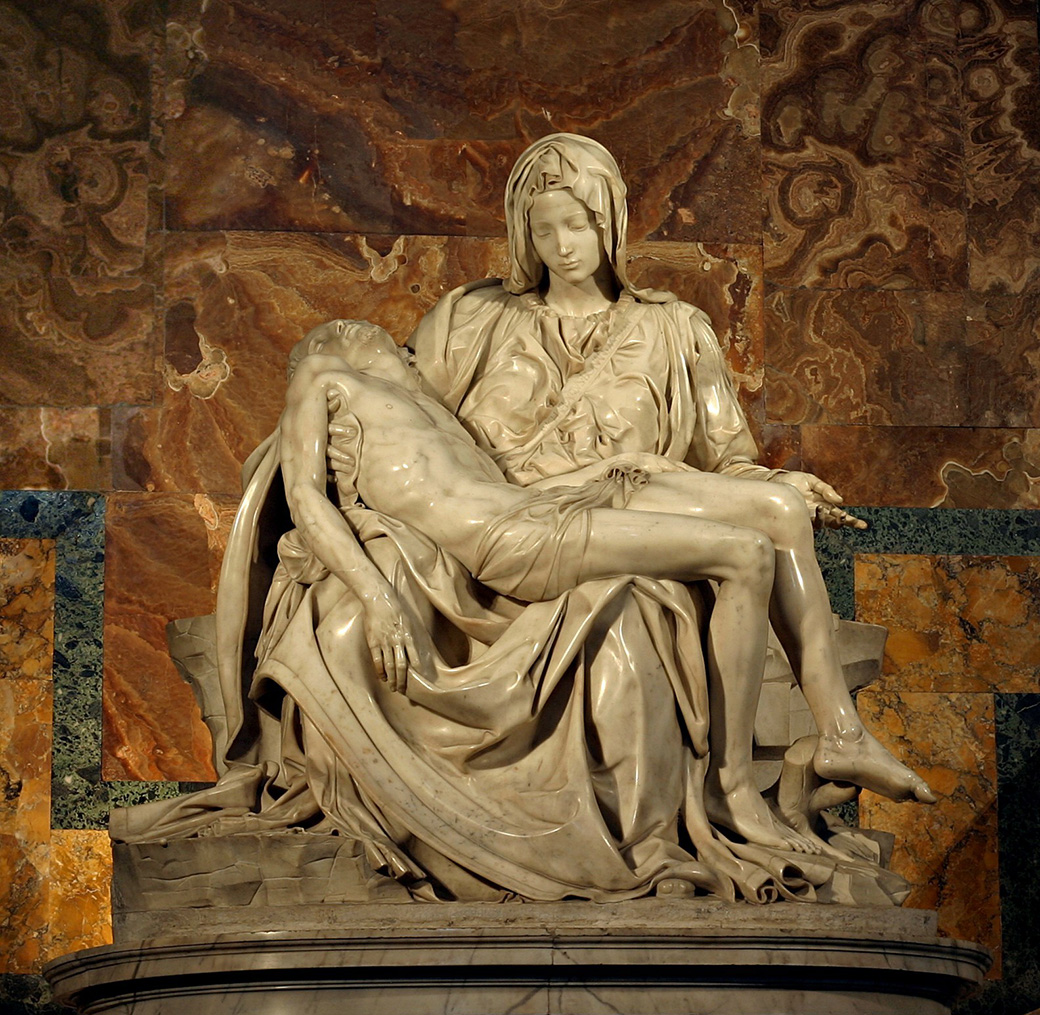
    Pietà in St. Peter’s Basilica in the Vatican (1498), Michaelangelo | Wikimedia Commons.

    It has been in vogue for the past few decades to portray the gritty reality of Christ’s suffering. I’m thinking, of course, of Mel Gibson’s The Passion of the Christ, but also books that try to know Jesus the man apart from Jesus the Lord. Yes, the bloody details of the Passion are important to remember, but they are not the point. Likewise, it is of supreme importance that he truly was a man, but it can never be separated from the fact that he is (and always was) also God. We did not invent this “extra layer” of divinity as non-believers would claim.

    So if we are to spend our Good Friday time in fruitful reflections, let us take a cue from our great saints and spiritual teachers. In the collection of retreat conferences preached to his fellow Dominicans entitled Knowing the Love of God, Fr. Reginald Garrigou-Lagrange orients us to the truly important aspects of the Passion. He helps me to understand why Christ submitted himself to the Passion and Crucifixion in the way he did:

    Jesus took upon Himself the responsibility for all the sins of men, and He began to suffer for them as if it had been He who had committed them, as if He were impious, rebellious, frenzied, cowardly, ungrateful, and sacrilegious. He felt the divine anger and divine curse weigh on His soul while hell with supreme fury broke loose against Him. The horror of evil and all vices together seemed for an instant to suffocate Him. A cry burst from His lips on the Cross: “My God, My God, why have You deserted Me?” (Mt 27:46).

    In this darkness, in this abandonment, Our Lord performed His greatest act of love. In the midst of this anguish He loved His Father above everything and He loved us even to the giving of His life for our salvation, only grieving that a greater number were not saved. This act of love makes abundant satisfaction for all hatreds. The obedience that it involves compensates for all rebellions in the eyes of God. The humiliations of the Passion redeem all acts of pride. The gentleness of Him crucified repairs all acts of anger and His sufferings pay for all sensuality.

    This act of charity of the Incarnate Word has saved the world. (36).

    In short, there is an entirely different sequence of events going on than just the physical one. The spiritual events are the important ones. What unites the physical plane with the spiritual one is Christ’s Blood. It is literally shed in whip strokes, puncturing thorns, nails, and a spear. But this is no everyday blood: it is divine blood. Do we realize this?

    It’s not in vogue to talk about the supernatural value of Christ’s Blood; this seems like a 19th century, antiquated notion wrapped up in lace and the Latin Mass. But today is the day to re-embrace the importance of Christ’s Blood and how — because of its divine source — it accomplishes things that no mere crucifixion or sacrifice can accomplish.
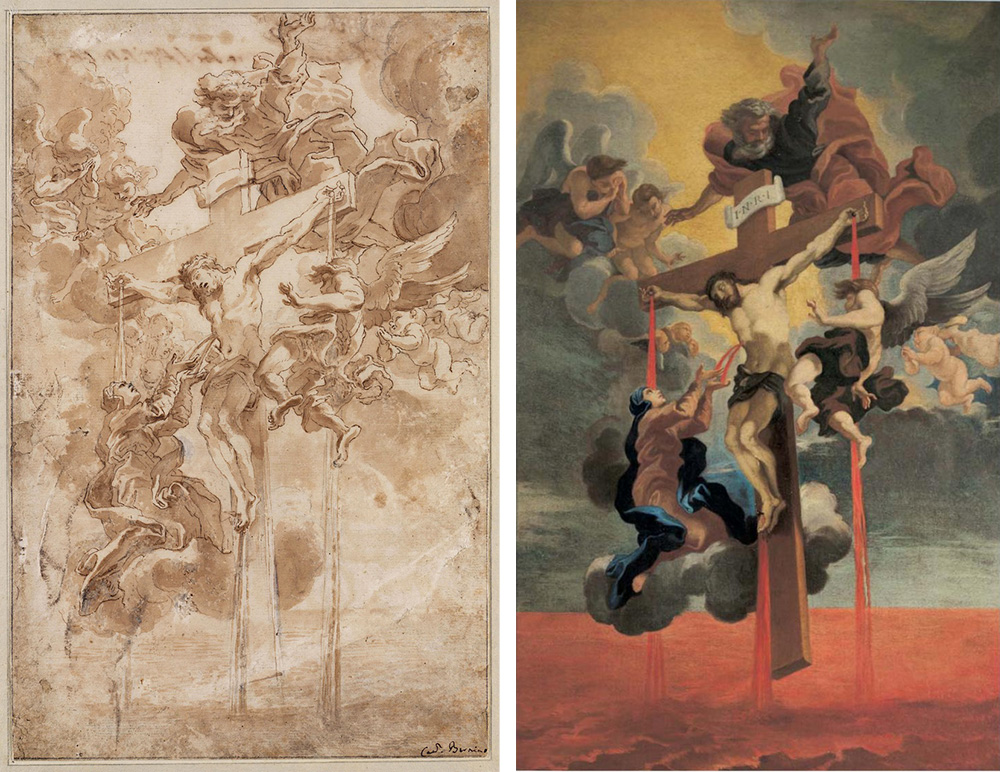
    Sanguis Christi (1670), Gian Lorenzo Bernini | Wikimedia Commons. On the left is the original drawing and on the right is a painting from the workshop of Bernini. Bernini’s biographer, Filippo Baldinucci, writes: “He sometimes deepened his thoughts and speeches with a very high esteem and concept that he always had of the efficacy of the Blood of Christ the Redeemer, in which (as he used to say) he hoped to drown his sins. To this object he drew with his own hand, and then had an image of Christ Crucified printed, from whose hands and feet flow streams of blood, which form almost a sea, and the great Queen of Heaven, who is offering it to the Eternal Father. This pious meditation also made him paint on a large canvas, which he always wanted to keep in the face of his bed in life and in death.”

    Today’s second reading in the Office of Readings is from St. John Chrysostom’s catechetical teachings to those about to become part of Catholic Church. This is very appropriate since thousands are going to be baptized into the Church tomorrow night after having gone through their teaching, soul-searching, and vows. Chrysostom writes about the power of Christ’s Blood:

    If we wish to understand the power of Christ’s blood, we should go back to the ancient account of its prefiguration in Egypt. Sacrifice a lamb without blemish, commanded Moses, and sprinkle its blood on your doors. If we were to ask him what he meant, and how the blood of an irrational beast could possibly save men endowed with reason, his answer would be that the saving power lies not in the blood itself, but in the fact that it is a sign of the Lord’s blood. In those days, when the destroying angel saw the blood on the doors he did not dare to enter, so how much less will the devil approach now when he sees, not that figurative blood on the doors, but the true blood on the lips of believers, the doors of the temple of Christ.

    If you desire further proof of the power of this blood, remember where it came from, how it ran down from the cross, flowing from the Master’s side. The gospel records that when Christ was dead, but still hung on the cross, a soldier came and pierced his side with a lance and immediately there poured out water and blood. Now the water was a symbol of baptism and the blood, of the holy eucharist. The soldier pierced the Lord’s side, he breached the wall of the sacred temple, and I have found the treasure and made it my own. So also with the lamb: the Jews sacrificed the victim and I have been saved by it.

    There flowed from his side water and blood. Beloved, do not pass over this mystery without thought; it has yet another hidden meaning, which I will explain to you. I said that water and blood symbolized baptism and the holy eucharist. From these two sacraments the Church is born: from baptism, the cleansing water that gives rebirth and renewal through the Holy Spirit, and from the holy eucharist. Since the symbols of baptism and the eucharist flowed from his side, it was from his side that Christ fashioned the Church, as he had fashioned Eve from the side of Adam. Moses gives a hint of this when he tells the story of the first man and makes him exclaim: Bone from my bones and flesh from my flesh! As God then took a rib from Adam’s side to fashion a woman, so Christ has given us blood and water from his side to fashion the Church. God took the rib when Adam was in a deep sleep, and in the same way Christ gave us the blood and the water after his own death.

    Do you understand, then, how Christ has united his bride to himself and what food he gives us all to eat? By one and the same food we are both brought into being and nourished. As a woman nourishes her child with her own blood and milk, so does Christ unceasingly nourish with his own blood those to whom he himself has given life.

    As we reflect today on the great Passion and Crucifixion, specifically on the amazing gift Christ is giving humanity, Fr. Garrigou-Lagrange can give us some final words to consider:

    According to the definition of the Church, the redemptive act of Christ has infinite value and efficacy. It makes satisfaction for any guilt whatsoever, repairs any offense against God, even though its gravity is infinite. It satisfies for all the sins of men, and still more … It merits all graces for even the most degraded souls, provided they are not stubbornly fixed in evil. It is impossible to think of a limit to the efficacy of the redemptive act. The redemptive omnipotence of the act of Christ, who immolated Himself upon the Cross, derives from the fact that it is a perfect act of charity performed by a divine Person; the perfect act of the Incarnate Word. It is a supernatural act of charity towards God which makes Him forget all offenses.
    (Knowing the Love of God, 30-31).

    What does this mean for you and me? It means that we should never be so low as to think we’re outside of the saving power of Christ. That would be a huge insult and underestimation of Christ’s redemptive act on the Cross. It also means that we owe everything to him and this act on our behalf. There is nothing that we have that was not given to us first by the Father and then, in order to make us perfect after we walk in the world in sin, by Christ.

    As I contemplate Christ on the Cross, may I be filled with humility, thankfulness, and admiration.
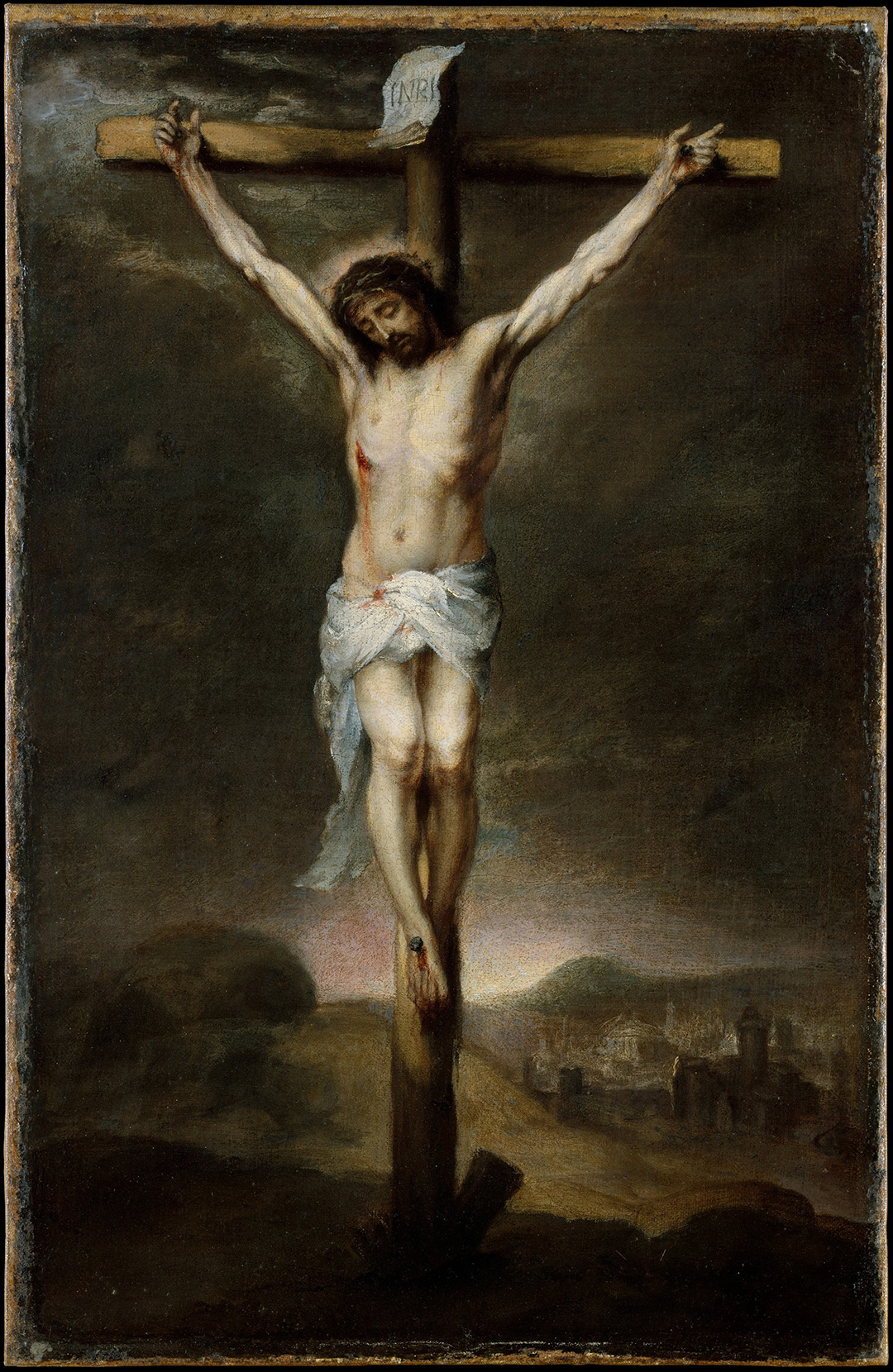
    The Crucifixion (1675), Bartolomé Estebán Murillo | Creative Commons, courtesy of the Metropolitan Museum of Art.
  • The Establishment of the Sacraments

    The Establishment of the Sacraments

    Holy Thursday – Evening Mass of the Lord’s Supper: Exodus 12:1-8, 11-14, 1 Corinthians 11:23-26, John 13:1-15.

    The Easter Triduum begins tonight with the Evening Mass of the Lord’s Supper. As I consider the readings for tonight’s Mass, I am struck by the tightly knit, condensed sequence of action and meaning that Christ gives us. The readings can barely contain it, for he not only provides the full meaning of millennia of Jewish ritual practices, he also institutes new sacraments in his actions and self that have never existed until this moment.

    Seven Sacraments Altarpiece (1445-1450), Rogier van der Weyden | Wikimedia Commons. On the left panel are baptism, confirmation and confession and on the right hand panel the ordination of a priest, marriage and the last rites. The central panel is dominated by a crucifixion in the foreground, with the sacrament of the Eucharist in the background. Angels hover over each sacrament with scrolls, with clothes color-matched to the sacraments, from white for baptism to black for the last rites.

    This is the reason that the Easter Triduum is the high point of our liturgical calendar, that these three days are considered their own liturgical season, outside of Lent. The density of the mystery at work in the world, like a spiritual supernova touched down on the earth, is simply too great for humanity to take in. It took the Church centuries to unpack, appreciate, and codify the depth of what happened, all the while maintaining steadfast faith and devotion to the sacraments instituted by our Savior. Thankfully, the Church has always been guided by the Holy Spirit, as Christ promised.

    I will try to lay out just the high points as I see them:

    • Jesus institutes our greatest sacrament, the Eucharist, which not only helps to make sense of the Passover rituals observed by the Jews since the time of Moses, but itself continues to unfold throughout the next three days, taking on its true substance only when his very Body is nailed to the Cross and his Blood is shed for humanity.
    • Jesus institutes the sacrament of confession and the importance of forgiveness as a participation in his own Spirit when he washes the feet of the Apostles.
    • Jesus passes to the Apostles these sacraments and instructions as part of the formation of the holy priesthood, which is developed as the sacrament of Holy Orders.
    • Jesus sets in motion the ways he will continue to commune with his Church after his Death, Resurrection, and Ascension. Consider how he patiently goes about setting everything in order. Think about the to-do list here: giving his apostles one last great moment of teaching, instituting the Eucharist and Reconciliation, establishing the momentum for the Church to continue, leaving time to travel “to the mountain” (Mount of Olives) to have a prayerful encounter with his Father in anticipation of the Passion and Crucifixion ahead … all in a matter of a few hours! It’s remarkably, almost serenely organized.

    I’d like to reflect briefly on these to better understand what today’s readings are telling us.


    The Eucharist as the Passover Perfected

    Regularity. The first reading recounts the prescription of the regularity of the Passover meal — it is the reason this is the first month of the Jewish calendar and it is held annually on the 14th of this month. For the Catholic Church, the Eucharistic meal is so central to our being that we celebrate it with every gathering (Mass), a regularity that has been instituted at least every Sunday.

    Purity. God prescribes that “The lamb must be a year-old male and without blemish.” God was establishing a special place for the “unblemished lamb” in their cultural memory to be ready for the time when the Lamb of God, pure of sin, comes for his ultimate sacrifice. Purity is important because it is the state in which God, as pure goodness, exists. We do these things to be united with him, and therefore we must strive for purity in ourselves to become fitting children of God.

    Ritual action. There is to be one lamb per family and it is to be slaughtered at twilight, at which point some of its blood is to be applied “to the two doorposts and the lintel of every house” where they “partake” of the lamb. What is the point of these prescriptive rituals? This is a continuation of the many animal sacrifices described in the Old Testament, and part of the challenge for the Jewish nation was to uphold these prescriptions in order to display their faithfulness to God. There is something essential to the ritual nature of religious, sacramental action: the words, gestures, and scope of action are particular and important, meant to be done faithfully and not sloppily. They display a faithfulness to the origin of the ritual: God Himself. All of this comes to a head when Christ tells his Apostles, “This is my body that is for you. Do this in remembrance of me” (Mk 14:22, Lk 22:19, 1 Cor 11:24). The “remembrance” encompasses millennia of Jewish ritual and faithfulness, culminating in the remembrance of the new Passover, the Christ Event, that ushered in salvation and eternal life for humanity.

    Last Supper (1308-1311), Duccio di Buoninsegna | Wikimedia Commons.

    Food. The slaughtered lamb is not wasted, but used as nourishment: “That same night they shall eat its roasted flesh with unleavened bread and bitter herbs.” The Word of God made flesh, Jesus Christ, establishes the full meaning of this ritual when he says,  and “Amen, I tell you, unless you eat the flesh of the Son of Man and drink his blood, you have no life in you” (Jn 6:53). As Christians, we understand the Passover lamb as the precursor (easier to understand and easier to “stomach”) to the true Paschal Lamb, Christ Himself. Our Eucharist is real food, truly the flesh of the Lord present through the mystical action of the Spirit in our liturgy, made palatable through the unbloody sacrifice present at the altar.

    Deliverance. The Passover rituals delivered the Jews from the wrath of God that ravaged “every firstborn of the land, both man and beast” in Egypt. Yet this only applied to life on the earth. How much greater is the new Passover given to us in Christ! Our life in Christ, possible because of his sacrifice and given to us as spiritual sustenance in the Eucharist, delivers us from the tyranny of death, opening up for us eternal life. 

    Transition. The idea of being on the move to something greater is central to Judeo-Christian faithful. God instructs the Jews to eat the Passover meal in a certain way: “with your loins girt, sandals on your feet and your staff in hand, you shall eat like those who are in flight.” This idea of being on the way to something greater, not tied to the things of this world, was embraced from the very beginning of the Christian Church. Jesus tells his apostles on this Holy Thursday, “but because you do not belong to the world, and I have chosen you out of the world, the world hates you” (Jn 15:19). St. Peter calls the faithful “strangers and refugees in this world” (1 Peter 2:11), and St. Paul enjoins us, “Do not be conformed to this world” (Rom 12:2). In our thirst to follow Christ and be with the Father, Christians are “On the Way.” We read in the Acts of the Apostles that the earliest Christians referred to themselves as followers “of the Way” (cf. Acts 9:1-2).


    The Washing of Feet as the Institution of the Sacrament of Reconciliation

    Phases of one mystery. Jesus connects this act to the salvific acts that will come. First, he rises from the supper and takes off his outer garments — as an action, this reminds me of his Resurrection to come and the garments found in the empty tomb, and as such this act of washing the feet is a salvific act akin to the Resurrection itself. St. Augustine also notes that “When about to be crucified, He was indeed stripped of His garments” (Tractate 55 on the Gospel of John), so we see a parallel in the Crucifixion, too. Importantly, Fr. Jean Corbon notes that the Crucifixion and Resurrection “are not two events, but two phases or moments of the same mystery” (Wellspring of Worship, 46). This is a very complex and helpful way of viewing the events we celebrate during the Easter Triduum.

    Jesus Washing Peter’s Feet (1852-1856), Ford Madox Brown | Creative Commons, courtesy ArtUK/Tate.

    Servitude. He doesn’t ask for some water in a bowl, but pours the water into the basin himself. St. Augustine notes that this is like how he “poured His blood upon the earth to wash away the filth of their sins,” and I see a clear parallel to the endless pouring out of love, of the water of everlasting life, that flows continually between the three Persons of the Trinity. God’s love is apparent in the state of perpetual servitude of the other. It is only this type of love that is able to “wash away” sins and not allow any dirt to cling to our souls. The lowly act of washing feet as a servant is important for Jesus to model for his apostles, so much so that he tells Peter that he’ll tell him why he’s doing it after it is done, so as to not disrupt the action by discussing it. St. Augustine notes that he even deigns to wash Judas’s feet: “the greatness of His humility should be still further enhanced by the fact that He did not esteem it beneath His dignity to wash also the feet of one whose hands He already foresaw to be steeped in wickedness.”

    The symbolic importance of feet. Jesus tells the Apostles, “Whoever has bathed has no need except to have his feet washed, for he is clean all over.” What can this cryptic message mean? If we have bathed and are “clean all over,” aren’t our feet clean, too? Clearly, the “bathing” Christ references is spiritual baptism, not mundane bodily bathing. Yet there remains a need to wash feet even after baptism. On a literal level, feet were often washed in the Holy Land because sandals were the footwear of choice, allowing feet to get dusty and dirty quickly. Washing feet was a sign of respect when entering a house and a sign of refreshment for a weary person. This act, therefore, already carried a symbolic meaning. But Christ imbues this with another layer of meaning, this time spiritual. Feet move us through the word — they are a reminder that we are grounded in the world and encounter sin here. Washing them provides refreshment — this time symbolic refreshment of the soul — and seeking to wash the soul is a respectful way of encountering God. St. John writes in his first epistle: “If we say we have no sin, we deceive ourselves, and the truth is not in us. If we confess our sins, he is faithful and just, and will forgive our sins and cleanse us from all unrighteousness” (1 Jn 1:8-9). Pope Benedict XVI talks about this passage in his Holy Thursday homily on March 20, 2008:

    We are in need of the “washing of the feet”, the cleansing of our daily sins, and for this reason we need to confess our sins as St John spoke of in this Letter. We have to recognize that we sin, even in our new identity as baptized persons. We need confession in the form it has taken in the Sacrament of Reconciliation. In it the Lord washes our dirty feet ever anew and we can be seated at table with him.

    Pope Benedict XVI makes the connection between Jesus’s washing of the Apostles’ feet and the sacrament of Reconciliation crystal clear. These feet, doing the work of carrying us and our Christian message around the world, will of course get dirty and need to be re-washed.


    The Foundation of the Church and the Priesthood

    So much meaning condensed in such a humble act! When he is finished, Jesus signals that something special is going on: “Do you realize what I have done for you?” He brings the whole mystery of God’s descent into humanity into this act of a servant for his Apostles. He continues, “You call me ‘teacher’ and ‘master,’  and rightly so, for indeed I am. If I, therefore, the master and teacher, have washed your feet, you ought to wash one another’s feet. I have given you a model to follow, so that as I have done for you, you should also do.”

    On the most obvious level, Jesus is conferring upon his Apostles the Holy Priesthood in his name. He is handing over his teaching to his chosen disciples, marking a development in their apprenticeship to the master where they can begin doing work like him, in his name. Specifically, however, there is an injunction to be humble, to wash feet, not have them washed by others. This very specific Christian form of priesthood is shared by all of the faithful — it is the Way of God’s love.

    Christ Washing the Feet of the Apostles (1475), Meister des Hausbuches | Wikimedia Commons.

    Continuing in this vein, there is the catechetical teaching that all of the faithful receive a share in a priestly vocation (CCC, 784). As Pope Benedict XVI also says in his Holy Thursday homily: “We must wash one another’s feet in the mutual daily service of love. But we must also wash one another’s feet in the sense that we must forgive one another ever anew.” Christ has given all of us this injunction to act humbly with forgiveness in our hearts.

    And thus the Holy Thursday action of Christ in washing his apostles’ feet is a crucial part of establishing the Church as well as the special office of the priesthood. He gives the Apostles the words and gestures and experience that make up the Eucharistic feast, which they in turn share with all Christians. He has given them the special experience of having their feet washed by the master, which they in turn are told to share with all Christians. Here is the establishment of the priesthood as well as the Church.

    But note how we can’t point to just this single moment, either. It carries no weight without the sacrifice on the Cross, which also contains no significance without the Resurrection. None of this has meaning without the Incarnation of God in human form. The point is that this one great mystery, this Christ Event, is made up of many phases as Fr. Corbon points out, and we must carry all of these in our hearts and minds as we contemplate what it means to be a true Christian. The Easter Triduum allows us the space for a concentrated moment of contemplation and prayer of thanks for this blessed gift given to us.

  • From Palms to Passion

    From Palms to Passion

    Palm Sunday of the Lord’s Passion: Mark 11:1-10, Isaiah 50:4-7, Psalm 22, Philippians 2:6-11, Mark 14:1 – 15:47.

    Holy Week is upon us. Three liturgical celebrations stand out in the life of the Church over the course of a year: The Nativity of Our Lord, Palm Sunday, and Easter. While we are invited to encounter Christ every day of the year — his Incarnation and Birth, his suffering and sacrifice, and his great Resurrection — these three celebrations stand out in the structure and content of the Mass.

    Corpus Christi Procession (La procesión de Corpus), 1887, Arcadi Mas y Fondevila | Image from artsandculture.google.com.

    Today is one of these three and it struck me as I marveled at the triple-normal attendance filling our pandemic-distanced chapel that we had all come anticipating the great and terrible narrative that was to fill the air. We knew that the initial hosannas would quickly fade into the long gospel reading detailing Christ’s betrayal, torture and death. Not only did we know it, we had gathered in numbers triple our normal size so that we could bear witness to it, mourn with Mary at his tomb, and receive sustenance from the very Body and Blood that was torn apart on that day. Even for people who weren’t completely engaged with the reason that they were there, something drew them to come, some knowledge imparted from the Church that instilled in them how important this day is.

    This entire phenomenon makes me reflect on the narrative that makes us who we are as Christians and how we participate in the telling of the story. 

    There is a grand scope to the narrative on Palm Sunday, and in the Catholic Church, we are asked to participate in its telling in a very performative way. Although this year was slightly different due to pandemic precautions, consider how the liturgical celebration starts: it starts outside the chapel. Before processing into the chapel as the Church, we read “Many people spread their cloaks on the road, and others spread leafy branches that they had cut from the fields. Those preceding him as well as those following kept crying out: ‘Hosanna! Blessed is he who comes in the name of the Lord!’” And this is what we do.

    We are a performative Church. We hold our palm leaves and sing a song of hosanna as we walk into the new Jerusalem with Christ. This is not “mere” theater. This is a huge reminder that what we do as a Church in every liturgy is performative as well as commemorative. By “performative,” let me be clear that I do not mean acting, as if we do not believe or actually live out what we’re doing. I use the word performative as in performing a ritual act.

    Religious ritual acts (in which the entire Judeo-Christian tradition is steeped, and is common to all religions) are special: done in a special place, in a special way, with special gestures and special words. This post is about interrogating the depths of meaning behind the performative acts in our liturgical life. So, to be clear, we actively celebrate Christ’s sacrifice in the form of the liturgy.

    The first reading connects Isaiah to Jesus who will come after him: “The Lord GOD has given me a well-trained tongue, that I might know how to speak to the weary a word that will rouse them.” Both men are prophets who share the Word of God as a salve for humanity. And, then: “I gave my back to those who beat me, my cheeks to those who plucked my beard; my face I did not shield from buffets and spitting.” Isaiah also lives out the mocking and beating that Jesus will, this very day, be subjected to. And, finally, the firm faith that enables such treatment to be endured: “The Lord GOD is my help, therefore I am not disgraced; I have set my face like flint, knowing that I shall not be put to shame.” We need to hear these final words of the first reading, knowing what we know about the Passion narrative to come. It helps us to endure our sympathetic suffering with Christ. It helps to palliate the treatment of our Lord.

    The responsorial psalm — oh, the psalm! It gives us the fuller context for Jesus’s final words on the Cross. The refrain of our psalm is the famous line “My God, My God, why have you forsaken me?” As Jesus utters these last words, we can both sympathize with the sentiment and be somewhat troubled by the implication. On one hand, we will see how the Passion narrative displays Jesus’s increasing abandonment by everyone who is close to him. If we take this line on its own, it seems to be that Jesus expresses complete abandonment, even by the Father. Theologically, this is greatly troubling, and actually makes no sense. The first Person of the Trinity would never (could never) abandon the second Person of the Trinity. Their love unites them in a way that is fundamental to the fabric of the universe. 

    What else could be going on here?

    Psalm 22:1-8 in the St. Albans Psalter (1100s). The first words of the Psalm in the Latin Vulgate are “Deus, Deus meus,” abbreviated here as DS DS MS. | Wikimedia Commons.

    The content of the psalm is not as dire as the first line makes it out to be. The words certainly express the distress of an individual in need of help, one who has endured scorn and who feels abandoned. But the psalm also includes verses like, “From the horns of the wild oxen you have rescued me. I will tell of your name to my brothers and sisters; in the midst of the congregation I will praise you.” Also, more to the concern of the opening line: “he did not hide his face from me, but heard when I cried to him.” It also ends on a very positive note of praise and deliverance. We hear, “future generations will be told about the Lord, and proclaim his deliverance to a people yet unborn, saying that he has done it.”

    When taken as a whole, the psalm not only speaks to the emotional condition of a man like Jesus at the culmination of his torture, but also to his redemptive action in the world.

    Just like we should not take the opening line out of context from the whole psalm, we we can learn from the context of how the Jewish tradition employed it. Rabbis attributed this psalm either to King David or Esther. The connection to Esther is so strong, in fact, that it would be prayed annually during the Fast of Esther, on the eve of the festival of Purim. Christ would have grown up praying Psalm 22 during that day and night of fasting, commemorating the three days of Esther’s fasting and prayer before she presented herself to the Babylonian King Ahasuerus and advocated to save the Jews from slaughter. The Jews prayed Psalm 22 to link themselves to this great model of petitioning the Father. The result was that God heard her prayer and saved the Jews from annihilation. 

    So, we can conceivably interpret Christ’s utterance on the Cross as beginning this same fast, this three days where he will disappear from the earth, enter the underworld to rescue humanity from the grip of death. He will enact the deliverance of the world on Easter, but here on the Cross, as he begins this fast in great sympathy with the Jerusalem he had just cried for, he is imploring the Father’s help and praising the Father as he always has.

    Returning to the Palm Sunday Liturgy of the Word, it is difficult to encounter this great text in part because it stretches over many days and many episodes central to our religious practice. We will reflect more on the Last Supper on Holy Thursday and upon the treacherous death on the Cross on Good Friday.

    One of the things that struck me as I stood in our chapel today listening to the priest and two lay people read the parts of the Passion were some of the details supplied by St. Mark in his almost breathless account. These details act like symbolic signposts, standing in for the impossible spiritual depth of the action at that moment. For me, they help to orient me within the Church as I participate in Palm Sunday and Holy Week. Below are just a few of them.

    Alabaster candle holders | Image from entertheloft.com.

    She broke the alabaster jar and poured it on his head … They were infuriated with her. Alabaster is a gorgeous, translucent white form of gypsum, often used to hold expensive oils in the ancient world such as those given as part of a woman’s dowry to her husband. The gesture from Mary of Bethany is the gesture of the Church to her Bridegroom. Mark tells us that she “broke” the jar, and whether this means a wax seal or the neck of the jar, the action is absolute and the ointment cannot be re-sealed and reused. This is an absolute devotion, using the most expensively perfumed oil. Jesus himself notes the appropriateness of her actions: “She has anticipated anointing my body for burial,” and even christens it as an act truly representative of the Church to come: “wherever the gospel is proclaimed to the whole world, what she has done will be told in memory of her.”

    Yet the other disciples were infuriated with her. Their rebuke of her is redolent with earthly concerns — noble, to be sure, in that they seek to help the poor — but these are at odds with the spiritual gravity of the moment as the ground is shifting to the Passion. Mary must have been seized by the Holy Spirit in a way that the others were not. She anoints the Anointed One of God just before he is to give them the Eucharistic sacrament.

    Jesus’s response to the disciples is one of my favorites: “The poor you will always have with you … you will not always have me. She has done what she could.” This is not just a carpe diem message, but a message of focus and intent. This is consistent with all he has said to the Pharisees about them fetishizing the law and what they “should do” over bringing the spirit of love into the world. There is supreme benediction in Christ saying, “she has done what she could.” What more would we like to hear when we are encountered with our judgment? 


    Now a young man followed him wearing nothing but a linen cloth about his body. They seized him, but he left the cloth behind and ran off naked. Who is this young man? He is not identified as a close disciple of Jesus. For me, he stands in as all of them, all of humanity in that moment. It’s as if the Holy Spirit has instilled in St. Mark a deeply felt memory of this moment when Jesus’s closest followers scramble away and disperse.

    Think about this — how does a person escape when seized, leaving behind the only piece of clothing he was wearing? It takes a good deal of panicked struggle, wriggling free, letting all sense and dignity leave you in your crazed flight response. This young man, these disciples, all of humanity, desert the Lord without their dignity in a wild flight away from the scene of his arrest. High-minded ideals are gone. Plan-oriented dreams of an ordered future disappear. Scandal has stripped us of our dignity and we run, like animals without a God.

    And so Mark records this ghostly image of a linen cloth glowing white in the darkness with nothing inside it. Why linen? Why empty? We will encounter this very same image when the stone is rolled away from the tomb! The human has left, has entered a new plane of existence. Just as Jesus Resurrects in Body and then ascends to heaven, humanity in the form of this young man disappears in its fright only to return as the Church, sanctified and Resurrected in Christ’s Spirit. The image, while representing the base betrayal of humanity, becomes an astounding promise in the midst of this horrible night.

    Young man fleeing Jesus’s arrest, unknown provenance | Image from thetinychapel.blogspot.com.

    The soldiers assembled the whole cohort. They clothed him in purple and, weaving a crown of thorns, placed it on him. This image persists in most Catholic depictions of Christ — the brutal Crown of Thorns. Why? Are we fascinated in some way at this torturous form of mockery?

    Let’s pan out, to use a cinematographer’s term, and see the scene as Mark has described it. The soldiers take him away from the Jewish crowds and into the inner courtyard of Pilate’s palace. Jesus is first betrayed by an Apostle, abandoned by his disciples, and denied by his chosen “Rock,” Peter. His is now isolated, away from his own people, the Chosen Ones of God’s Covenant. He is utterly alone in pagan hands. It is easy to overlook his increasing isolation because the narrative is full of people — crowds greeting him in Jerusalem, guards and arresting mob, priests and soldiers, streets lined with jeering onlookers, and a crowd gathered at the base of Golgotha. But Jesus has been isolated completely. 

    So the soldiers assemble the whole cohort, which must include all of the soldiers stationed there as well as Pilate’s non-military court. Here, around him, is the entire pagan world. How do they greet our Savior? It is a telling image. They dress him as a King. Yes, it is mockery, yes it is in jest and, yes, they beat him and spit on him while doing it. But nonetheless we have a vision of Christianity in the world.

    It is impossible not to acknowledge the kingship of Christ, even while scoffing. For underlying all of the worldly disbelief we claim or the hurtfulness of our actions, the truth remains: Christ is King. We can’t escape that or change it. What’s more, those who walk with Christ into the greater world will be met with mocking and crowns of thorns as well. This is the reality of being on the Way to the Kingdom, given to us in a brutal coliseum of pain.


    Pilate was amazed that he was already dead. The seat of earthly power is amazed at the quick passage of time. This must make him take stock in his own mortality. This must make him wonder about that man he just had crucified. This is something weird; is it a sign? This thought might continue to nag at him for months, years, until he decides to do something about that nagging thought — perhaps inquire with one of this new group of Christians that has persisted long after this man’s death. This leads to another moment of astonishment as he is told about the amazing life of this Jesus Christ who he crucified.

    This is the way God works. This is the way God never gives up on humanity; the way He offers mercy and forgiveness even to the most detestable of us. We must be open to the fact that Pilate himself can be saved if he recognizes God, repents for his sins, and follows the Way. More than that — we must want Pilate to be saved. That is what it means to walk with Jesus. We must fill ourselves with the absolute, unwavering love of God that heals all. We must want every single one of his sheep to be with him forever in the Kingdom.

    Christ before Pilate (1910), Jacek Malczewski | Image from wikiart.org. There are many artistic representations of Pilate, but none quite as evocative as this one, in my Mind. Malczewski delivers a powerful study of contrasts: Christ is adorned with the Crown, ropes, and blood in an almost feminine way, as if these trappings of His Passion have almost supplanted themselves as the narrative itself; He is presented as an ornament for Pilate. Meanwhile, Pilate is half-naked, self-absorbed, bored. Not so much contemplative as contemptuous. I am constantly amazed at the breadth of scriptural interpretation and imagination I find in painters! 

    There are, of course, many more images in the Passion narrative; indeed, in all of the gospels. This is how we can encounter Christ in a new way and in a new depth each time we turn back to scripture. 

    But more: let’s return to how our Catholic liturgy participates in the Passion. The Holy Spirit, as promised by Christ, guided the Church from its earliest days to put into practice the depth of imagery and symbolism we encounter in Christ’s life, Death, and Resurrection. The most obvious example is the Eucharistic feast and its remembrance and enactment of Christ’s sacrifice as well as the Last Supper.

    But the Church, living the liturgy every second of every day inside and outside of the chapel, performs the very work of the Bride of Christ in its anointings (sacramental as well as simple, such as the gentle touch and kind word to a stranger). The Church points to the empty linen cloth every time we choose humanity over politics or spirit over rules: for the cloth is made of this earth while we exist in a different spiritual plane on a specific spiritual path.

    The Church wears the purple robe and crown of thorns as our priestly sexual misconduct is paraded before the world, the evil that creeps in to mock our holy mystical Body of Christ. And the Church is made up of converted Pilates searching out other Pilates to bring to Christ for healing.

    All of these things reach a much more organized level of liturgical function in the Mass, however. It is performative in that we stand to greet the Lord, to collectively pray our Creed and the Our Father. We process to the altar both as the ministers at the start of Mass and as a people when receiving Communion, re-enacting Christ’s triumphal entry into Jerusalem. We kneel with Christ as if with him in the Garden of Gethsemane as the Eucharistic blessing is prayed. We listen to the Word of God being proclaimed to us as every Christian once did since the first Apostles, for we are all converts to a New Covenant. There is so much more!

    The point is that if we want to live a deep Christian life, we must know and embrace the depth of our faith not just in its wisdom and words, but in its symbolic and real actions both inside and outside of our churches. 

    Holy Week is upon us, and it delivers to us so much meaning, so much density. Let us prayerfully try our best to take it in.

  • Creation and Incarnation

    Creation and Incarnation

    The Solemnity of the Annunciation of the Lord: Isaiah 7:10-14, 8:10, Hebrews 10:4-10, Luke 1:26-38.

    Today’s readings should be very familiar to us. We hear God promise the virgin birth and the name Emmanuel, we hear St. Paul tell us that “the offering of the Body of Jesus Christ once for all” has taken the place of all the lesser animal sacrifices done in the Jewish tradition, and we hear St. Luke’s amazing account of Gabriel announcing to Mary that she will give birth to the Messiah.

    I’ve already written three reflections on this gospel reading: Our Blessed Kecharitōmenē, Our New Eve, and A House for Our Lord to Dwell. Mary is indeed full of grace and the worthy Ark of the New Covenant.

    The Annunciation (1915), Helena Vurnik | Image from the National Gallery of Slovenia.

    I don’t know that I have much to add to the volumes that have been written on this fundamental aspect of our faith, and I’ll keep this reflection short. One thing jumped out at me as I studied a few different commentaries and books on this subject: Mary actively participates in the same creative act that God undertakes at the beginning of time. The Incarnation is another Creation.

    This might seem terribly obvious, and if so, my apologies. But consider how Fr. Jean Corbon, OP, writes about this moment in the Annunciation: “the humble maidservant can respond to the message with all her being and in the very words that her Lord used at the beginning of time: ‘Let it be!’ (Lk 1:38 and Gen 1:3)” (Wellspring of Worship, 37).

    What Corbon references here is the Greek verb γίνομαι (gínomai), which is used in Genesis when God says “Let there be light” and there was light. The Greek translation of the Hebrew is theos gínomai phōs kai gínomai phōs. A more literal translation is “God said “become” light and light came into being. The verb gínomai is roughly translated as our verb “to be,” but it’s more properly “to become” or “to receive being.”

    It’s fairly complex, which is why Thayer’s Greek Lexicon spends over 2,460 words to describe it in their entry for gínomai. But suffice it to say that when we read Mary’s great “Yes” to God at the Annunciation, we encounter something special when the Greek says, genoito moi, which our Lectionary translates as “May it be done to me,” although she is really uttering a different voicing of the same gínomai uttered by God at the Creation of the world.

    This is why the King James Version of the Bible has it translated as “Be it to me,” which, for all its awkwardness, gets to the point of what Corbon is saying: humble Mary uses the very words her Lord used at the beginning of time, “Let it be.”

    Why is this important? Well, it’s difficult to overstress that a new creation is happening as God joins Himself to humanity. This perfect merging of the divine essence with the human mind and body is something never accomplished before or since, and it has ramifications for history both before and since.

    As Corbon writes, “The age of the mysterious ‘synergy’ between the river of life and the world of the flesh has begun; in the new creation every conception will henceforth be virginal … After the synergy of this first Pentecost, everything is unmerited and personal, everything a manifestation of the Spirit’s power … Henceforth, everything fleshly is permeated by the energy of love” (38).

    There is a lot to meditate upon in these words. The cornerstone of our faith is who Jesus is. He is the Son of God, one with God, and yet also a man. He is immortal, but took on mortality so he could die and rise (for immortality cannot die), thus transforming humanity because of this experience. Without this belief in the divine nature of Jesus, we do not have the Christian faith and humanity has not been transformed. The Annunciation as a moment of new creation is absolutely indispensable to our faith.

    In the previous quote from Corbon, he references the “first Pentecost,” that is, the first time the Spirit is poured out, emptied out in a kenosis, upon humanity. I am struck by how powerfully Corbon describes the action of the Spirit in the Incarnation of Jesus Christ. He writes:

    Mary says “Yes”, and the Spirit who unites the Word and the Yes, divine energy and human energy, gift and acceptance, comes upon her. The Spirit of the Father is the one who crafts this Covenant, fulfilled at last, between the Word and flesh. In the first creation all that exists is “called from nothingness to being”. In the new creation that is beginning here, he who is eternally begotten of the Father is fashioned out of living earth, namely, the entire being of his mother … He who is to be born of the Daughter of Zion has been conceived not by any “will of man” or by any set of determining causes but by the power of the Holy Spirit  (37-38).

    I appreciate both his insistence upon the Holy Spirit as the one who is at work in Mary (as the angel Gabriel explains, “The Holy Spirit will come upon you, and the power of the Most High will overshadow you”) as well as the difference between the first creation and this new creation. God creates from nothing in the first creation. It is his power alone that makes gínomai happen. But in this second creation, He has a raw material to join to his gínomai — a raw material that is made from dust but is illuminated with the breath of the Spirit already.

    Like an errant breeze corralled back into the tornado of God’s Spirit, humanity is joined again to its source and is able to utter a gínomai alongside her maker. It is still God’s power alone through the Holy Spirit that makes the Incarnation happen, but Mary is able to participate in a way that no part of Creation has ever been able to participate. Her free will, granted by God and guided by holiness, forms the participatory force in this new creation; likewise, her body provides the participatory substance for this new creation.

    Annunciation (Annunciazione), c.1435, Fra Angelico | Wikimedia Commons.

    Nothing can overshadow the great outpouring of love in the form of the Holy Spirit at the Incarnation — that God should stoop so low as to become one of us out of love for us is simply staggering. This is hinted at by Gabriel: “[He] will overshadow you.” But let us also recognize that Mary performs her own kenosis of spirit by yielding completely to the will of the Father. It is this synergy, this union of love pouring out one for the other in both directions, that enables the new creation to happen. This has become humanity’s model for unity with God; something we can all recognize, strive for, and pray to the Virgin to help us achieve.

    Let no one pass off the Annunciation as an unnecessary Christian myth. This deepest of encounters between God and humanity is the bedrock of our salvation!

  • Solemnity of Saint Joseph

    Solemnity of Saint Joseph

    Solemnity of Saint Joseph, Husband of the Blessed Virgin Mary

    See today’s readings here. Rather than post my own reflections on the holiness of St. Joseph and his special place in salvation history, I thought I’d post the short reflection from Pope Saint John Paul II. Before we get there, however, let’s recall that many prominent saints found great spiritual aid in Saint Joseph, namely St. Teresa of Avila, St. Francis de Sales, St. Faustina Kowalska, and St. Josemaría Escrivá. He is a beloved saint, not in small part due to his humble and silent presence as the foster-father of Christ.

    As Saint Thérèse of Lisieux said, “St. Joseph, how I love him! What does me a lot of good when I think of the Holy Family is to imagine a life that was very ordinary, just like our own.” There is great honor and great holiness that comes with being the least noticed, the least grand servant of our Lord but remaining faithful to him.

    Below is the transcript of the General Audience of Pope Saint John Paul II, on this Solemnity in the year 2003.

    St Joseph with the Infant Jesus (c.1620), Guido Reni | Wikimedia Commons.

    1. Today we are celebrating the Solemnity of St Joseph, the Husband of Mary (Mt 1,24; Lk 1,27). Scripture points him out to us as the “father” of Jesus (Lk 2,27.33.41.43.48), prepared to carry out the divine plan, even when it eluded human understanding. To him, “son of David” (Mt 1,20; Lk 1,27), God entrusted the safekeeping of the Eternal Word, made man by the power of the Holy Spirit in the womb of the Virgin Mary. St Joseph is described in the Gospel as a “just man” (Mt 1,19), and for all believers he is a model of life in faith.

    2. The word “just” evokes his moral rectitude, his sincere attachment to the practice of the law and his attitude of total openness to the will of the heavenly Father. Even in difficult and sometimes tragic moments, the humble carpenter of Nazareth never claimed for himself the right to dispute God’s plan. He awaited the call from on High and in silence respected the mystery, letting himself be guided by the Lord. Once he received the mission, he fulfils it with docile responsibility. He listens attentively to the angel, when he is asked to take as his wife the Virgin of Nazareth (cf. Mt 1,18-25), in the flight into Egypt (cf. Mt 2,13-15) and in the return to Israel (cf. ibid., 2,19-23). In few, but significant strokes, the Evangelists describe him as the caring guardian of Jesus, an attentive and faithful husband, who exercises his family authority in a constant attitude of service.

    Nothing else is said about him in the Sacred Scriptures, but this silence contains the special style of his mission: a life lived in the greyness of everyday life, but with steadfast faith in Providence.

    3. Every day St Joseph had to provide for the family’s needs with hard manual work. Thus the Church rightly points to him as the patron of workers.

    Today’s solemnity is also a wonderful occasion to reflect on the importance of work in the life of the human person, the family and the community.

    The human being is the subject and the primary agent of work, and in the light of this truth, we can clearly perceive the fundamental connection between the person, work and society. Human activity – the Second Vatican Council recalls – proceeds from the human person and is ordered to the person. According to God’s design and will, it must serve the true good of humanity and allow “man as an individual and as a member of society to cultivate and carry out his integral vocation” (cf. Gaudium et spes, n. 35).

    In order to fulfil this mission, a “tested spirituality of human work” must be cultivated that is firmly rooted in the “Gospel of work” and believers are called to proclaim and to witness to the Christian meaning of work in their many activities and occupations (cf. Laborem exercens, n. 26).

    4. May St Joseph, such a great and humble saint be an example that inspires Christian workers, who should call on him in every circumstance. Today I wish to entrust to the provident guardian of the Holy Family of Nazareth the young people who are training for their future profession, the unemployed, and those who are suffering from the hardship of the shortage of employment, families and the whole world of work, with the expectations and challenges, the problems and prospects that characterize it.

    May St Joseph, the Patron of the universal Church, watch over the entire ecclesial community and, as the man of peace that he was, may he obtain for all humanity, especially for the peoples threatened at this time by war, the precious gift of harmony and peace.

  • Lifted Like the Serpent

    Lifted Like the Serpent

    Sunday of the Fourth week in Lent: 2 Chronicles 36:14-16, 19-23, Ephesians 2:4-10, John 3:14-21.

    In today’s gospel reading, Jesus has a memorable meeting with Nicodemus, a Jewish member of the Sanhedrin, a faithful Jew, and eventually a full disciple of Jesus who comes with myrrh and aloes along with Joseph of Arimathea to retrieve his body from the Cross.

    Jesus presents himself to Nicodemus as a modern, living version of Moses’s serpent on the staff that saved the Jews bitten by poisonous serpents in the desert. While foreign to us if we are not versed in scriptures, this comparison would undoubtedly have been powerful and shocking for Nicodemus. In fact, Jesus’s words finally explain the significance of God instructing Moses to make a bronze serpent and mount it on a pole.

    As we dig into today’s gospel reading, we are struck with the entire span of salvation history from the Garden of Eden to Christ’s Paschal Sacrifice on the Cross. Also, we see Nicodemus as a true Christian, converted to Christ, moving from the darkness to the light.

    Nicodemus and Jesus on a Rooftop (1899), Henry Ossawa Tanner | Wikimedia Commons. On the left is a study that Tanner did for the finished painting on the right. I appreciate the nimbus on Christ in the study, acknowledging that he is the “Light of the World,” despite the meeting occurring at night.

    St. John tells us that Nicodemus comes to Jesus by night. In just this simple statement, we can glean many things. Some scholars believe that a leader of the Jews would only come by night because it would be unseemly for a member of the Sanhedrin to join the crowds and rabble who followed this traveling preacher by day. Whether he was too busy with his duties, too proud to be seen going to learn from an unlearned miracle-worker, or too bashful to present himself openly, we encounter this powerful man coming to Jesus under cover of night.

    As historians and scholars have envisioned this meeting, there is a compelling argument that they met on a rooftop. First of all, this was (and is) common practice for men to retire to the rooftops after their evening meal on the hot, Middle Eastern nights, in order to enjoy cooling breezes. Second, Jesus makes some memorable statements about the air and the Spirit, likely choosing the moment when the phenomenon of the breeze could help him make this point: “The wind blows where it chooses, and you hear the sound of it, but you do not know where it comes from or where it goes. So it is with everyone who is born of the Spirit” (Jn 3:8).

    Jesus speaks of a spiritual logic unknown to those merely born of the flesh, encouraging Nicodemus to break out of his disbelief and earth-bound assumptions about what is possible. So, we see Nicodemus coming to Christ at night to know more about this man sent by God, and God, in return, engages him in the deepest truths. Is this not the exact journey we all make to Christ? Do we all not suffer from a certain bashfulness to approach Him openly in a culture where our faith is seen as antiquated, naïve, and gullible? Yet Jesus is there, waiting for us with deep truths.

    These deep truths are inevitably deeper than we are prepared to comprehend. Jesus reveals himself to Nicodemus as not just “a teacher who has come from God” (as Nicodemus calls him), but as the “Son of Man” and God’s “only Son.” And Jesus ups the stakes to eternal bliss or eternal damnation based on this very fact alone: “everyone who believes in him might not perish but might have eternal life … but whoever does not believe has already been condemned, because he has not believed in the name of the only Son of God.” Nicodemus definitely got more than he bargained for by coming to this “teacher” by night.

    As we think about this “all-or-nothing” statement by Christ, we are reminded of the gospel a few days ago where he proclaimed, “whoever is not with me is against me,” that is, scattering people instead of gathering to the Kingdom. Why does our Lord deal in these absolutes? There can be no doubt here that he is asking us to be “all-in,” much like he asked Abraham to sacrifice his son or Noah to build the ark (see the post, A Glimpse of Heaven). And just as Abraham’s assent was blessed by founding the nations and Noah’s assent was blessed by saving humanity from destruction, our assent to Christ will be blessed with everlasting life.

    In all cases, the call is personal. It is an individual meeting with the unfathomable God. Just like Nicodemus, we all must go to have a personal encounter with Christ to listen to what he has to tell us.

    Pope Benedict the XVI put this succinctly at the beginning of his encyclical on love: “Being Christian is not the result of an ethical choice or a lofty idea, but the encounter with an event, a person, which gives life a new horizon and a decisive direction” (Deus Caritas Est, 1). Today’s gospel is one of many very concrete examples of this encounter in action. 

    Jesus proclaims elsewhere in John’s gospel, “I am the light of the world” (Jn 8:12), and he makes a similar statement here with Nicodemus. His words may have stung Nicodemus, since he came to Christ at night:

    “And this is the verdict, that the light came into the world, but people preferred darkness to light, because their works were evil. For everyone who does wicked things hates the light and does not come toward the light, so that his works might not be exposed. But whoever lives the truth comes to the light, so that his works may be clearly seen as done in God.”

    He is urging Nicodemus to come to him in the light of day, openly. But more than that, he needs Nicodemus to understand that God and truth dwell in the light, and this is something to always glory in, to be proud of; in fact, by believing in this truth and light, and acting in it, a person is securing for himself or herself a place in Heaven.

    Jesus mentions the concept of being exposed, and there is absolutely an aspect of vulnerability in this. As he says, the “verdict” is that “people preferred darkness to light,” thus living in the light does not exempt one from pain and suffering as a result of this exposed vulnerability. This fact is wonderfully demonstrated in Jesus’s incredible comparison of himself to Moses’s serpent on the staff.

    That story from the Book of Numbers speaks of events 1,475 years before Christ sits with Nicodemus on the roof. The passage is exceedingly odd at first glance: God first punishes the Israelites for complaining by sending poisonous serpents among them. In terms of today’s gospel, we could say that they are living in darkness (complaining and turning from God), and as a result they are bitten by serpents and die. Upon their admission of guilt and atonement, Moses prays for deliverance. At this point, God instructs Moses to mount a bronze serpent on a pole; subsequently, when the people look up at the serpent on the pole after being bitten, they are spared from death.

    Before we wonder what kind of witchcraft is going on here, let’s again consider it in terms of today’s gospel reading: by looking up at the serpent, the Jews in the desert are re-confirming their belief in God, who promises to protect them. They gaze upon the source of their suffering, the serpent, exposed, held up in the light for all to see, and they do not die. Importantly, they do not avoid suffering (that is, they continue to be bitten by serpents), but they avoid death through their continually re-confirmed faith in God.

    Moses and the Brazen Serpent (1898), Augustus John | Creative Commons, courtesy UCL Art Museum/ArtUK. I like the impressionistic style Augustus John employs in this painting, the flowing waves suggesting a divine entrance into the fabric of humanity. As with any encounter with the divine, sin will merit pain and “gnashing of teeth,” and the purifying energy of God may not be pleasant for those in sin. I also see a bit of the devil in the bare-chested man on the right side of the canvas, which for me, at least, recollects the Garden of Eden connection. 

    It would be fair to say that the serpent is the symbol of humanity’s sin against God, ever since Adam and Eve in the garden. This sin is poisonous and it brings about the reign of death. The people repent and say to Moses, “We have sinned in complaining against the LORD and you. Pray the LORD to take the serpents away from us.” The act of looking up, heavenward, to the sign of the sin they lived with, is the action that reminds them of their dependence on God and his saving mercy. God’s divine mercy flows to the sinful, bitten individual in that moment, not through the arcane power of a bronze staff, but through the symbol that the staff presents to the Jewish believers in God.

    As Catholics, we know well that, in the liturgy, divine sanctification works in and through symbols, from the altar and ambo to the bread and wine. The bronze serpent on the staff is this type of sacramentalized symbol that his prophet on earth made under his instruction.

    The Jews understood the symbolic importance of this staff as a way to encounter God’s grace and they kept the physical staff around for centuries. They may have begun to confuse the symbolic function of the staff with a divine presence, however, because 740-ish years later we read in 2 Kings that King Hezekiah orders the destruction of the staff, which he calls Nehushtan (“a mere piece of brass”) because the Jews were burning incense to it and essentially treating it like an idol. 

    Now I don’t know much about divine numerology, but I do find it interesting that exactly another 740-ish years later, we hear Jesus tell Nicodemus the Pharisee: “just as Moses lifted up the serpent in the wilderness, so must the Son of Man be lifted up, that whoever believes in him may have eternal life.” With this statement, the Word of God reveals the full scope of this symbol Moses was instructed to make. “Just as Moses lifted up the serpent”: note that the parallel being drawn is to the fixing of the serpent to the pole and lifting it up, the fact of exposure for all to see. “So must the Son of Man be lifted up”: this refers to his Crucifixion, where he becomes the ultimate symbol for humanity. And finally the salvific import: “that whoever believes in him may have eternal life.” Like the sinful Jews who re-confirmed their belief in God and were saved from dying, we receive an infinitely greater promise and divine grace given to us when we behold Christ on the Cross, believe in him, and are granted eternal life that eradicates all sway of death.

    Yes, consider this! Christ is admitting that living in the light constitutes suffering at the hands of those who live in the darkness. What greater sign than his broken and crucified Body hanging on the Cross for all to see? But just as the suffering from being bitten by serpents is ameliorated by gazing at that exposed suffering on a pole, our suffering from sin in this life is ameliorated by gazing on the Lord’s suffering on the Cross, done for our sakes. This is exactly what “on our behalf” entails!

    He allowed himself to be affixed on the Cross like the serpent on Moses’s staff so that we could have salvation as we gaze upon him and live in his light!

    Moses and the Bronze Serpent, mural in All Saints Margaret Street church in London (1889), tiles painted by Alexander Gibbs | photo courtesy Lawrence OP, flickr.com. Note that over the centuries, the connection of the bronze serpent and the cross has been made much more explicitly, as in this tile work.

    Sometimes the scope of God’s saving plan is just breathtaking. So many moments of patience and mercy over the millennia, from Adam and Eve, through Moses, and ultimately Jesus Christ. And so subversive of our normal worldly affections, too, in the use of the lowly and hated serpent as a resounding symbol for overcoming sin, much like using the reviled Cross as a throne for our Savior.

    I am brought back to the all-or-nothing statements we keep encountering this Lent. After this reflection, I am struck by the fact that Jesus is saying these absolutes because he must remind us that he is God’s plan, God’s gift. To not recognize and believe in him is to throw God’s gift back in his face. It is worse than living in sin — it is a deliberate act of defiance and rejection of our Creator. We must listen to Christ, and St. Paul does a fantastic job of reminding us in today’s second reading: “God, who is rich in mercy, because of the great love he had for us, even when we were dead in our transgressions, brought us to life with Christ — by grace you have been saved.”

    Serpent Illustration by Katie Scott | courtesy katie-scott.tumblr.com.
  • The Radicality of the New Covenant

    The Radicality of the New Covenant

    Third Sunday of Lent: Exodus 20:1-17, 1 Corinthians 1:22-25, John 2:13-25.

    Today we receive the Word of God in its most accepted and unchallenged form (the Ten Commandments) and then it its most radical and challenging — St. Paul bragging of the humiliation of the Cross and Jesus himself blowing up the concept of the Jewish temple as a sacred meeting place with God.

    The scene of Jesus casting out the moneychangers and animals was so serious that the Jews used this as one of the two main charges against Christ in his trial (that he claimed to be God and he wanted to destroy the temple). We need to ask ourselves why Jesus was so radical in today’s gospel and what it tells us about his New Covenant with us.

    Christ Driving the Traders from the Temple (Kristus uddriver kræmmerne af templet), after 1570, from the workshop of Pieter Brueghel the Elder | Wikimedia Commons.

    St. John’s account of this scene occurs at the beginning of Jesus’s ministry, unlike the three synoptic gospels where it occurs at the end. To me, this is interesting because it is another example of how John’s worldview is so transformed by Christ. Every event and detail overflow with his divinity; Christ is in control and in his power and glory throughout the gospel of John.

    The first thing that jumped out at me was the whip of cords (a flail or scourge) being used to drive the moneychangers and the animals out of the Temple. Jesus using a scourge on people? A close translation is needed here and unfortunately the Lectionary isn’t exact on this line. The original Greek specifies that the whip was only used on the animals. Here is the scholar David Bentley Hart’s translation: “And, having fashioned a stockwhip out of cords, he drove all of both the sheep and the oxen out of the Temple; he also spilled out the coins and overturned the tables of the moneychangers.”

    So while Jesus undoubtedly uses forceful methods to get the animals and money interests out of the Temple, it is not a depiction of violence against another human. This passage has been used to justify righteous war and violence, not to mention a “muscular” Christianity, and I think these are misunderstandings and poor applications of Jesus’s example.

    Christ’s point here is that they should “stop making my Father’s house a marketplace.” Having animals and moneychangers in the Temple served a very practical purpose. For those who traveled far to reach the Temple at Jerusalem, it was inconvenient and difficult to bring their required animal sacrifice with them. It was much more convenient to be able to buy an animal for sacrifice there. The doves, in particular, were targeted towards the poor and women/widows who couldn’t afford a lamb or ox but who still needed an animal sacrifice.

    Furthermore, Jewish law forbade foreign or secular coinage to be used in the Temple, hence the proliferation of money changers. Jerusalem was both a holy city and a crossroads for many cultures — caravan routes from Asia and Africa crossed there, as well as Gallic and Roman people from Europe thanks to the Roman Empire. The livestock and money changers, therefore, served a very useful purpose. But Jesus is clearly incensed that they are operating there in the Temple.

    We must not mistake his response as a simple desire for Temple purity. Jesus was not overly concerned with the fetishization of purity, as the Pharisees criticized several times (pointing out that his disciples did not fast like they did, nor did he and his disciples fastidiously wash before meals like they did). Instead, I think his point is that the Jews were placing the doing of deeds ahead of the heart-and-soul encounter with God.

    This is consistent with his critique of the Pharisees and scribes: “They tie up heavy burdens, hard to bear, and lay them on the shoulders of others; but they themselves are unwilling to lift a finger to move them. They do all their deeds to be seen by others” (Mt 23:4-5a). Yes, the livestock and money changers serve a useful purpose but this purpose is not to deepen the faithful’s experience with God. Instead, it is a marketplace of convenience, serving the needs and desires of humans.

    What’s more, those who sold the livestock and changed money made their living in this fashion — essentially profiting from a person’s journey to worship God. This self-serving practice is certainly not fit to occupy a position within the Temple. Perhaps the difficulty of bringing animals to the Temple was part of God’s plan to help people prepare their hearts for meeting him, much like our Lenten sacrifices. Perhaps the prescriptions on Temple coinage also came about purely as part of a bureaucracy of human convenience and desire. 

    The Temple Sacrifice (1995), Zely Smekhov | Image from zely-smekhov.com/

    In this light, it becomes much more clear why Jesus became so upset as to drive off the livestock and command the money changers to leave. This was no longer a dwelling place for the Lord, a sacred temple unto Him. It was simply a place of ritualized practices developed with convenience and efficiency in mind.

    The Jews had reduced the temple to spiritual rubble all on their own. All that was left was for Christ to show the inadequacy and irrelevance of the Temple as he instituted a new temple in his Body and Blood. This was not understood yet, but what was apparent was the pure shock of Jesus’s actions. Any disruption to Temple workings would be an affront to those in power — the scribes, the elders, the Sanhedrin. They held the authority in this place, and this traveling preacher was worth next to nothing in their book. Such actions were tantamount to terrorism in their eyes. Add to this the fact that he was suggesting an end to commerce and the ability for many people to obtain animals for their ritual sacrifices, and the disruptive nature of this act is apparent.

    Yet let’s not get carried away with this image of Jesus’s forcefulness and a promise of temple destruction. That is the same road the Jewish zealots tread with their expectation of the Messiah. God has his own way that does not correspond to human intelligence or intuition; that way is always love and self-sacrifice. We get the first hint of the underlying divine Way and Truth in the midst of this scene when the Evangelist writes, “His disciples recalled the words of Scripture, Zeal for your house will consume me.” This passage comes from Psalm 69, the Prayer for Deliverance from Persecution. Despite what it sounds like — someone being taken over by righteous anger (zeal) and lifted up to a position of power — this scriptural reference is to someone who is greatly persecuted and at the end of their rope, pleading for God’s deliverance.

    There is a real desperation in Psalm 69, which begins, “Save me, O God, for the waters have come up to my neck. I sink in deep mire, where there is no foothold.” It continues: “Do not let those who hope in you be put to shame because of me … It is for your sake that I have borne reproach, that shame has covered my face … It is zeal for your house that has consumed me; the insults of those who insult you have fallen on me.” In many ways, St. John’s use of this reference early on in his gospel is a foreshadowing of the Passion and Death of our Savior.

    It also helps us connect the final lines in today’s gospel when John tells us that Jesus understood human nature well. His great empathy with us comes from his Incarnation and living a fully human life; he knows life’s temptations and failings. The desperation of Psalm 69 speaks to the common human experience of trying to be faithful to God amid a culture consumed with earthly things. The reference to this psalm underlines the drastic nature of the Temple’s decline in Jesus’s mind, as well as a people so committed to their rituals instead of the presence of God in their midst that they will persecute and kill him. 

    As our gospel continues, the Jews, likely angered and put out, demand from him: “What signs do you show us, since you do these things?” Now, of course Jesus could have healed someone, raised someone from the dead, or performed some other miracle, but we are validating the mindset of the Jews if we think this way. Jesus only does miracles to bring people closer to God, to take away spiritual blindness, to enkindle hope or teach them about spiritual sustenance. The stakes here are not individual journeys of faith but the very locus of faith for the entire human race. The Temple was God’s dwelling place on earth, the most sacred place for humanity. What sign of this magnitude can Jesus give them other than himself? 

    Christ driving the Traders from the Temple (1600), version located in London, El Greco | Wikimedia Commons.

    And so he says, “Destroy this temple and in three days I shall raise it.” I envision him saying this with a quiet calm, in contrast to his other forceful actions. As John tells us, “he was speaking about the temple of his body.” What greater sign could there possibly be than the Resurrection?

    But the import of this exchange between Jesus and the Jews is that this is not just a sign. As we now know, he establishes his Body and Blood as lasting spiritual food, as part of the New Covenant with humanity. The sign of the Resurrection denotes a new reality: the liturgy bursts upon us, divinification is made possible as we walk his Way faithfully, the mystical Church is born, eternal life is made available to humans, and the old Temple is made irrelevant.

    In some ways, I almost think we can read the first part of Christ’s sentence, “Destroy this temple,” as truly referring to the Temple in Jerusalem, almost like a directive to humanity. Yes, destroy this temple because you will no longer need it and its empty, convenience-driven rituals that have made it no longer fit as a dwelling place for God. And, because He is the dwelling place of God on earth, we can understand the destruction of the Temple and his own death as an equivalency. Thus, he will raise his Body, which is and already has been the only real Temple since the Incarnation.

    Imagine the divine responsibility and patience it took for him to know this reality and to attempt to teach it to the Jews in a way they could start to accept. Not only is it a mystery of faith to understand the starting point of the Incarnation and how it has irrevocably changed the entire Jewish religion, but the ongoing work of Jesus in his ministry and acceptance of his own Sacrifice and Death is simply so counter-intuitive to our human conception of power and glory that it needed to be lived out to be believed.

    Thus, we hear John tell us that while he was in Jerusalem, “Jesus did not entrust himself” to all the people who started flocking to him; and John notes that he “did not need anyone to testify about human nature for he himself understood it well.” Because he is fully human and fully divine, Jesus knows how human hearts are fickle and how people can quickly twist signs and prophets to their own ends. He desperately wants to love humanity and bring them close to himself and the Father, but he must operate in the world in a way where his ultimate end as a loving sacrifice for humanity can be accomplished and not thwarted. Again, St. John presents us with a fully in-control Lord who steers himself and his disciples to the New Covenant with single-minded purpose.

    Artist’s illustration of a supernova, iStock

    As I reach the end of my reflection, I’m struck by the radicality of the New Covenant that is Jesus Christ. So much is centered on him, his Body and Spirit. He is the most dense spiritual supernova around which the universe rotates. He is the new Temple, transforming a type of ritual worship centered on a building into a true communion with God that provides real spiritual food.

    No human could imagine such a transformation of the Jewish covenant. It took God to come in person to make this important transformation happen and, in the process, open up for us the gates of Heaven. I suppose this is why we have such a shocking scene as he upsets the entire Temple economy in today’s gospel. How else can we grapple with the sheer upending of our old way of knowing God?

  • Worm of the Soul

    Worm of the Soul

    Wednesday of the Second Week in Lent: Jeremiah 18:18-20, Matthew 20:17-28.

    Today’s readings show the ugliness of jealousy, which St. Cyprian of Carthage calls “the root of all evil.” After examining the readings, I’d like to reflect on St. Cyprian’s Treatise on Jealousy and Envy, which offers some sharp insights.

    The Jews in Jeremiah’s time were tired of hearing his gloom-and-doom prophecies. In the Book of Jeremiah, we read of how his no-holds-barred warnings and criticisms land him in prison, get him beaten, and make him an outcast. Today’s reading shows the inner mindset of the Jews who wanted to discredit and destroy him: “Come, let us contrive a plot against Jeremiah … let us destroy him by his own tongue; let us carefully note his every word.”

    What provokes such evil in the hearts of his countrymen? Jeremiah wonders as much himself: “Must good be repaid with evil that they should dig a pit to take my life?”

    Jealousy (contemporary), Yvonne Wright | Image from pixels.com.

    There are many ways to react to a person who proclaims something upsetting. We can ignore them. We can disagree, perhaps loudly. We can silently listen to their harangue and think about it over time, seeing if there is any truth to it. Or, we can allow our passions to grip us and lash out. If we allow negative passions like anger to build, we begin to desire retribution in a more lasting way. This is the work of evil.

    But another sin may be in play in Jeremiah’s case, specifically jealousy. He is getting attention with his troubling prophecies, and the other priests and Jews are not liking the power and attention he is garnering. If jealousy is in the heart of Jeremiah’s adversaries, we can begin to understand how elaborate plots might develop.

    Jealousy is such an ugly sin that we never want to admit that it grips us. It’s embarrassing because it is such a strong sin, stripping us of everything elevated and good in character. Because it is ugly and embarrassing, we keep it hidden; we plot and the festering evil builds.

    In the gospel, Jesus quickly identifies this sin erupting among the Apostles and stamps it out before it can grow. When the Apostles learn of James and John’s desire to sit at Jesus’s right in Heaven, they “became indignant” and undoubtedly jealous. Jesus’s response is that while leaders in the Gentile world operate by having authority lorded over others, “it shall not be so among you. Rather, whoever wishes to be great among you shall be your servant; whoever wishes to be first among you shall be your slave.” Jesus must re-orient them to the goal of the Christian life: to serve and thereby inhabit and spread the love of the Father.

    The entire discussion of greatness and deservedness to sit at the Lord’s right hand is upended. If greatness is defined by being the best slave, then that’s a silly thing to be jealous over. In fact, as soon as you start serving people out of love, the idea of being regarded for one’s own greatness is absurd.

    And so we must ask ourselves what came over the mother of James and John (and them) when the request was made. The three of them are operating under a different mindset than Jesus’s teaching. She wants her sons to be great (and by extension, herself). As Christ points out, in the secular world this greatness comes at the cost of others — one is exalted above others, in fact the only way to know that one is exalted is by seeing others lower than you in status. This entire worldview relies on envy of that exalted status. People are motivated by jealousy over that position, even if it is currently unoccupied. This type of “greatness” will never be aligned with God’s self-giving love because at its heart is inequality and envy.

    This is precisely why Jesus must die in a mode of sacrifice, showing that glory resides not in earthly exaltation above others. He shows that glory can reside in the most detested and shunned of places: the Cross. This is the only world where greatness and God’s love can coexist: where greatness finds itself residing in servitude and sacrifice.

    So as we peel back the layers of motivation behind the persecution of Jeremiah and the yearned-for elevation of James and John, we find the ugly sin of jealousy. We also find this squarely at the heart of the Sanhedrin during the arrest, trial, and Crucifixion of Jesus. Today’s readings are a warning, pointing to the dangers of jealousy, which hides in the motivations by which we live out our lives. Lent is our time to root it out and stop it.

    Modern icon of Saint Cyprian, provenance unknown | Image from pilgrimcenterofhope.org.

    Saint Cyprian, Doctor of the Church, Bishop of Carthage and Martyr, was an African born of noble birth around the year 200 AD. Son of a Roman senator, he was a dissolute pagan in his youth, although well trained in rhetoric, philosophy and law. He converted to Christianity in his middle years. He went to his own beheading willingly in 258 AD after refusing to recant his Christianity during the persecutions of the Emperor Valerian.

    In his Treatise on Jealousy and Envy, St. Cyprian traces jealousy to Satan, “when he beheld man made in the image of God, broke forth into jealousy with malevolent envy— not hurling down another by the instinct of his jealousy before he himself was first hurled down by jealousy, captive before he takes captive, ruined before he ruins others” (4). This sin, therefore, is so powerful that it overcame the devil himself and is associated with the core of his own evil. “Thenceforth envy rages on the earth, in that he who is about to perish by jealousy obeys the author of his ruin, imitating the devil in his jealousy” (4).

    St. Cyprian traces how jealousy is at the heart of tragedies and figures throughout scripture: Cain and Abel, Esau and Jacob, Joseph and his brothers, King Saul and King David, and finally Christ and the Jews. Then, he proclaims that jealousy is, in fact, the source of all the other evils:

    It is the root of all evils, the fountain of disasters, the nursery of crimes, the material of transgressions. Thence arises hatred, thence proceeds animosity. Jealousy inflames avarice, in that one cannot be content with what is his own, while he sees another more wealthy. Jealousy stirs up ambition, when one sees another more exalted in honors. When jealousy darkens our perceptions, and reduces the secret agencies of the mind under its command, the fear of God is despised, the teaching of Christ is neglected, the day of judgment is not anticipated. Pride inflates, cruelty embitters, faithlessness prevaricates, impatience agitates, discord rages, anger grows hot; nor can he who has become the subject of a foreign authority any longer restrain or govern himself. By this the bond of the Lord’s peace is broken; by this is violated brotherly charity; by this truth is adulterated, unity is divided; men plunge into heresies and schisms when priests are disparaged, when bishops are envied … (6).

    We have heard the more memorable, “money is the root of all evil,” but is not money just a vector for envy? Cyprian has some memorable phrases of his own; I particularly like “nursery of crimes” and how jealousy removes our ability to “restrain or govern” ourselves. He has several great phrases at the start of the next section: “what a gnawing worm of the soul is it, what a plague-spot of our thoughts, what a rust of the heart, to be jealous of another, either in respect of his virtue or of his happiness … to make other people’s glory one’s own penalty” (7). Cyprian really brings home how jealousy is primarily a harm to our own selves, our own humanity.

    He says this even more forcefully: “Yet you are the enemy of no one’s well-being more than your own … Wherever you may be, your adversary is with you; your enemy is always in your own breast; your mischief is shut up within; you are tied and bound with the links of chains from which you cannot extricate yourself; you are captive under the tyranny of jealousy” (9). 

    Venus, Cupid, Folly and Time (detail), 1545, Angelo Bronzino | Wikimedia Commons. This figure in the background of the painting is often thought to be Jealousy.

    This does resonate, at least with me. Even just from my adolescent jealousies over love interests, jealousy threatened to be overwhelming. It definitely seemed to act like a tyrant; and a tyrant harming me and my character more than anything else. With this in mind, I think about contemporary secular credos I hear from friends, “as long as I’m not harming anyone else, then it shouldn’t be anyone’s concern.” Do we really want to ascribe to this thinking? Don’t we want to help people who are being ruled by the gnawing worm of the soul, the tyrant of jealousy?

    We are called to bring others to God, and there is no room for someone to move toward God if they are ruled by jealousy. Our love of others and charity should move us to help people overcome their jealousies and envy. So, even if they are harming themselves and not others, it really might be our business and mission as Christians to bring the light of Christ into their lives.

    But, it’s certainly enough for us during this time of Lent to try to identify the sneaky, hiding currents of jealousy in ourselves. Christ gives us many teachings like that in today’s gospel reading to help us overcome jealousy specifically by making it irrelevant. I think that in most cases, jealousy thrives in a worldview that is secular and driven by desires of this world.

    Let’s close with some words of encouragement from St. Cyprian: “Tear out from your breast thorns and thistles, that the Lord’s seed may enrich you with a fertile produce, that the divine and spiritual cornfield may abound to the plentifulness of a fruitful harvest … let all bitterness which had settled within be softened by the sweetness of Christ” (17).

  • The Flipside of Feeling Bad

    Monday of the Second Week in Lent: Daniel 9:4b-10, Luke 6:36-38.

    Today’s readings present us with two sides of the Christian coin: sin and forgiveness. One side is ugly and tarnished; when we look at it in the full light of day, we are humiliated by what it reveals about us. The other side, though, is shiny and new, stamped with God’s image, gorgeous to behold. As long as we walk this earth, we deal in these coins. The devil constantly presses us to use the ugly side while God offers to make it beautiful again. Our soul soars when the coin is made beautiful, but it demands a full accounting of our sin in order to flip that coin.

    The Coin Collector (1600), Joos van Craesbeeck | Creative Commons, courtesy of the Krannert Art Museum, University of Illinois.

    But God operates within a different economy: that of love. The economy of love is governed only by the rules of mercy and abundance. Jesus tells us that we can participate in God’s economy of love. He teaches us that the more we forgive others, the more we will be forgiven for our own sins. The economy of love is multiplicative, never divisive.

    Let’s consider the first reading where the author of the Book of Daniel presents an honest accounting for the sins of the Jews and an accompanying request for forgiveness. Humiliation is something the Jews knew well at the time the Book of Daniel was written (~165 BC). During this period, Antiochus IV Epiphanes was the Greek ruler over Israel who brutally put down the revolt recorded in the Book of Maccabees. “He ordered his soldiers to cut down without mercy those whom they met and to slay those who took refuge in their houses. There was a massacre of young and old, a killing of women and children, a slaughter of virgins and infants. In the space of three days, eighty thousand were lost, forty thousand meeting a violent death, and the same number being sold into slavery” (2 Maccabees 5:11–14). Then he tried to force the remaining Jews to worship Zeus on pain of death.

    Rather than bemoan their conquered and downtrodden state, the Book of Daniel acknowledges their humiliation and takes spiritual responsibility: “O LORD, we are shamefaced, like our kings, our princes, and our fathers, for having sinned against you.” The message is not all shame and doom, however. God’s covenant with his people still stands and hope is always there: “But yours, O Lord, our God, are compassion and forgiveness!” The Book of Daniel sees God’s compassion and forgiveness in the coming of the Messiah and the ultimate vindication of the chosen people. (The writer of Daniel uses the famous phrase “Son of Man” for the messiah — one that Jesus will use in reference to himself throughout his ministry.) He is pointing to Christ, waiting for a fuller experience of being human and redeemed.

    What can we learn from this long passage acknowledging sins? We aren’t Israelites who broke their covenant by worshipping idols and ignoring God’s commandments. Or are we more like them than we think? Our idols may not be golden calves, and our worship of them may not include burnt offerings, but how much more willing are we to sacrifice our time and money for things of leisure, pleasure, pride, and position than charity for our fellow human? Americans are notorious for a few things: relentless drive in the work world, greed, and consumption. I think we can honestly lament with Daniel, “we have rebelled and departed from your commandments and your laws. We have not obeyed your servants the prophets.”

    We live in a world transformed by Christ, one that the author of Daniel longed for. God has provided us with a clear path to forgiveness, namely our sacrament of Reconciliation. Let’s recall that at the heart of this sacrament is a pledge to no longer sin and an honest intention to convert back to God in our ways. Church Fathers like Tertullian see Reconciliation as the amazing gift that it is and beg us to engage fully with it: “In so far as you do not spare yourself, the more, believe me, will God spare you!” (Repentance, 203 AD). A few centuries later, St. John Chrysostom writes much the same: “Unless you tell the magnitude of your debt, you do not experience the abundance of grace” (Homilies on Lazarus (388 AD), 4.4).

    The emphasis on public confession and penance grew throughout the centuries until it was commandeered by secular Kings during their own inquisitions to root out heretics in their populace. The Spanish Inquisition is the most infamous, and these trials culminated in the highly orchestrated auto-da-fé. Prisoners were taken outside the city walls to a place called the quemadero, or burning place, where the sentences were read. Prisoners who were acquitted or whose sentence was suspended would fall on their knees in thanksgiving, but the condemned would be punished (whipping, torture, burning at the stake).

    The auto-da-fé is the pinnacle of public humiliation for sins and stands at the outward bound of a philosophy of negative reasoning around sin. In negative reasoning, if God’s mercy is given to us in the measure that we “do not spare ourselves” (to use Tertullian’s words), then extreme penance and humiliations are better guarantees of mercy. In this line of reasoning, the auto-da-fé is not only justified, its punishments are the best thing we can do to save souls. (queue the shivers)

    The Inquisition Tribunal (1808), Francisco Goya | Wikimedia Commons.

    Thankfully, Christ provides a much different teaching in today’s gospel. He says, “Stop condemning and you will not be condemned. Forgive and you will be forgiven. Give and gifts will be given to you.” In other words, live by God’s law and you will continue to live with God for eternity; carry divine love in your heart as you live, work, and act with other people, and divine love will be given to you for eternity. In addition to providing us with the Way to live in the light of truth, this is the antidote to negative reasoning about sin.

    Instead of the equation where greater humiliation and penance = greater forgiveness from God (negative reasoning), we encounter an equation where greater forgiveness towards others = greater forgiveness from God for our own sins (positive). We can see that the more we participate in the economy of love by which God operates, the more we are conforming ourselves to final unity with Him. This reciprocation is a refrain that Jesus repeats throughout his ministry. The Lord’s Prayer uses nearly the same formulation: “forgive us our trespasses, as [you see us forgiving others].”

    What changed from the old covenant in time of Daniel is that Jesus bursts into history as a bridge between Heaven and earth. He himself is the one gateway to the eternal Kingdom. Since we now have the liturgy that gives us true communion with God, we have the opportunity to carry our godliness into every aspect of our lives in a way that was never available before Christ. The liturgy as we live it is the new Way; the earliest Christians referred to themselves as followers “of the Way” (cf. Acts 9:1-2). To inhabit the spirit of the law (and let the Spirit inhabit us), we must not carry the spirit of condemnation and judgement, we must forgive and give.

    It’s easy to Monday-morning quarterback the problem with Inquisitors and the logic of the auto-da-fé. We must realize that this was a form of policing by the crown leveraged against non-Catholics and heretics, and reveals the problem with co-mingling our faith and political power structures. The state is charged with keeping the peace and enacting the national politics of a group of people. The Church is charged with saving souls. These are different aims and the centuries of Christendom in the Middle Ages gave us plenty of examples of how power structures of the state twisted and mobilized aspects of our faith for dubious ends.

    Christ calls us to something much different, much more radically personal. He calls us to begin operating within the generous, merciful economy of love. This has to be on an individual level, not a policy or state level, because it is a participation in the unique relationship God forges with each of us. Each person’s free will must be engaged within the state of life, personal histories, and sphere of influence that person has. The only law that can prescribe this type of engagement is a spiritual law because it involves the action of the soul in communion with God. No secular structure can know, much less evaluate, someone’s adherence to this law. Only God knows; and He knows us better than we know ourselves.

    Detail from the ceiling of the Sistine Chapel, the Creation of Adam (1511), Michelangelo | Wikimedia Commons.

    Finally, I’d like to explain the title of this post. Just like our Christian coin on earth is sin/forgiveness, there is an associated mindset with which we can proceed in our lives. On one hand, we can focus on the awfulness of our sinful state and approach ourselves and everyone else as impure abscesses on the Body of Christ that require penance to eradicate. Or we could focus on the gift of forgiveness God gives us and the broader economy of love. This is the clear direction in which Jesus leads us. He speaks not just of forgiveness but of three other ways to understand God’s overflowing generosity:

    Stop judging and you will not be judged.
    Stop condemning and you will not be condemned.
    Forgive and you will be forgiven.
    Give and gifts will be given to you;

    What unites these four is love and generosity — no judgement, no condemnation, just forgiving and giving. This is the way God works and Jesus is calling us to become more and more like him.

    This isn’t just good advice. His final statement in the gospel reading spells out, “For the measure with which you measure will in return be measured out to you.” I like the double meaning of measure being something you measure out to someone else as well as the way in which you take account of things. The “measure with which you measure” is not just the quantity of your generosity with others but also the way in which you’re thinking about your spiritual journey and salvation.

    This means that true salvation (i.e., divinification, union with God) comes to those in whom the spirit of generosity and forgiveness are infused to such an extent that they are everything. We are not “measuring” the number of times we forgive others or the number of gifts we give as a way to quantify or tally our movement towards Heaven. The way we go about things, “the measure with which we measure,” itself shuns the idea of quantification. We don’t count the hurts people enact on us; we don’t judge or condemn, we simply forgive. This Way of being, brought to us through Christ, is the point. And the more we walk the Way, the sooner and more completely God embraces us on that Way.

  • A Glimpse of Heaven

    A Glimpse of Heaven

    Second Sunday in Lent: Genesis 22:1-2, 9a, 10-13, 15-18; Romans 8:31b-34, Mark 9:2-10.

    Today’s readings demand that we stretch ourselves beyond our comfort zone. Parts of our faith are easy to accept — the Beatitudes, for example — they mirror moral truths we find in other religions and civic systems. But when it comes to actual encounters with God, which are the endgame to which we’re all drawn, I might add, we find some frankly difficult episodes.

    Sure, God is love, but is he also the one who tells a man to sacrifice his own child, and tests him up to the point of the knife going in? That sounds extreme, almost unhinged, to our rational minds. And the Transfiguration includes what some would call ghosts, voices from the clouds, and secrecy pacts. This would be the description of a skeptic, of course. As believers, we have to come face-to-face with the Transfiguration as reality, not make believe; the truth, not a story.

    Sacrifice of Isaac (1635), Rembrandt Harmensz. van Rijn | Creative Commons, courtesy the State Hermitage Museum, St. Petersburg, Russia. There are several famous paintings of this moment, but the action captured in this one really strikes me – not just the hand of the angel on Abraham’s arm and the falling knife, but also Abraham’s hand completely covering Isaac’s face, pushing back his head and bearing his neck for the sacrifice. Isaac is clearly depicted as a lamb about to be slaughtered, and the vulnerability is moving.

    Lest we think we have to leave reason by the door as we enter into these moments of faith, there are rational underpinnings to God’s actions with Abraham, the father of Judaism, Christianity, and Islam. The covenant God makes with him is fundamental for the preparation of humanity for his Son’s entry into history. It’s appropriate, then, that the patriarch understand and commit to the type of love God has in store for his progeny, God’s Chosen People.

    In poker terms, this love is all-in. No chips are set aside, nothing reserved. Today, we read that “God put Abraham to the test,” and not to belabor the comparison, but he needed to see if Abraham would go all-in. Why, we might ask, is this necessary?

    We can’t forget that God’s love allows for our own assent and free will to meet his. He never wants to take away our sovereignty over our own will; if he did, this would be a lesser love that does not respect us as complete beings. Not only that, we would be incapable of truly loving him back. We would be automatons, doing everything he willed like marionettes.

    As God is establishing his People, he needs to have these moments where his leaders, prophets, and other figures exercise their free will in the direction of faith otherwise this spiritual muscle and determination can wither and become weak. I think this is a good way of looking at what the scriptures call “testing” — it is, in fact, a loving act by God to help his chosen ones to grow in faith, to enact and uphold their end of the covenant (this is the definition of “being faithful”). They gain spiritual determination, but perhaps even more importantly they serve as a lasting example and teaching for all of us who follow.

    Who is this God? A God who wants us to come to him, not a God who cackles with sadistic glee by making us march around doing ridiculous and dangerous tasks. Every moment of salvation history is infused with God’s superabundant love. In order to truly understand our scriptures and the Word of God, this must be our starting point.

    This is why all the details are so important in our recorded scriptures. God acts with great purpose in the world and the Holy Spirit guides the pen of the authors of scriptures in order to capture these details faithfully. Two details from the first reading jump out at me today. First, it is what God’s messenger tells him: “Do not do the least thing to him. I know now how devoted you are to God, since you did not withhold from me your own beloved son.” I love how absolute the command is not to “do the least thing” to Isaac, displaying God’s absolute love for His creation. The angel acknowledges Abraham’s devotion to God (most translations write “that you fear God,” meaning you have great reverence, respect, awe, fear, and devotion), specifically because “you did not withhold from me your own beloved son.” As Christians, we see the significance of this episode because God, too, will be sacrificing his own Son (and not stopping it). God is not asking of us anything he is not willing to accomplish himself.

    The second detail that jumps out for me today is the ram. In a verse skipped over in today’s reading, Isaac asks Abraham where the lamb is for the sacrifice. Abraham replies, “God himself will provide the lamb for a burnt offering, my son” (Gen 22:8a). This is a sad-but-lovely double meaning for Abraham because in his mind Isaac is himself this lamb led to the slaughter. What prompted him to say it this way? Perhaps it was the Word of God placing this phrasing in his mouth.

    While some scholars see no significance to the fact that a ram was what God provided instead of a lamb, others see a great significance here. I tend to see significance in scriptural details as the Doctors of the Church teach us to. A ram is just an adult sheep while a lamb is a young one, and a ram’s horns make it easier to be caught in a thicket and so be delivered to Abraham. More significantly, we know that ultimately an unblemished lamb will be sacrificed once and for all; John the Baptist tells us, “Look, the Lamb of God, who takes away the sin of the world!” (John 1:29). The ram can be used for Abraham to sacrifice and save his son from physical death while Jesus, the Lamb of God, will be sacrificed to save us all from spiritual death.

    Agnus Dei (1635-1640), Fracisco de Zurbarán | Creative Commons, courtesy the Museo del Prado, Madrid.

    In the gospel reading, St. Mark’s account of the Transfiguration, Peter, James and John behold this spotless lamb: “he was transfigured before them, and his clothes became dazzling white, such as no fuller on earth could bleach them.” The Transfiguration starts where Abraham finished — they have climbed the mountain with the Son and have found the lamb acceptable to God as a sacrifice. 

    But here God more fully reveals his Truth to humanity. “Then Elijah appeared to them along with Moses, and they were conversing with Jesus.” We are invited, like Peter, James and John, to ask what this could possibly mean. On the mountain — the place of encounter with God since time immemorial — our teacher is transfigured into a vision of purity so dazzling white it hurts the eyes. Clearly he is someone special and this is a great confirmation of our decision to follow him. But now he stands in the company of the greatest law-giver and the prophet who was to return to us, talking with them as an equal would!

    To be on the same level as Moses and Elijah, well, we perhaps didn’t expect such an exalted teacher. Not to mention, these great men are dead and yet here they are, seemingly in the flesh once again and holding a conversation with him. Are they apparitions or spirits? Are we to think that they are there in some sort of resurrected body? Whatever the case, this encounter is miraculous and great. Praise be to God, and how exalted this spiritual encounter must feel to be in the presence of these three great men!

    Thus, Peter says, let’s build a tent for everyone and stay here. This is how Moses welcomed the divine presence of God to stay with them in the desert, obscured by the cloud. The tent has a sacred significance for the temporary dwelling of the divine here on earth. I can relate to Peter here. Have you ever been on a retreat or encountered the sacraments in a way that was extraordinary, when you felt the Spirit of God more palpably than you ever had before? I’ve felt that — like my soul was soaring. And above any other reaction (fear, confusion, uncertainty, nervousness) was the desire to have it continue, to keep that feeling going. Let’s build a tent and stay awhile!

    But this is not the Christian path, always on the move, always in the world. 

    And in response to Peter’s naïve declaration, the Father arrives: “from the cloud came a voice, ‘This is my beloved Son. Listen to him.’” Peter, James and John must have been thunderstruck. Their teacher’s specialness was confirmed in a way that far surpassed any expectation. Moses and Elijah now appear as minor players in the drama where the Father reveals his Son as the unblemished lamb, the Savior. And just as abruptly as Jesus was transfigured before them, it all disappears. Mark writes, “Suddenly, looking around, they no longer saw anyone but Jesus alone with them.” What was the point of having this revelation of the Son in all his Glory only visible to these three men for a few moments on a secluded mountain?

    Today’s Office of Readings gives us an explanation from Pope St. Leo the Great: 

    The great reason for this transfiguration was to remove the scandal of the cross from the hearts of his disciples, and to prevent the humiliation of his voluntary suffering from disturbing the faith of those who had witnessed the surpassing glory that lay concealed. With no less forethought he was also providing a firm foundation for the hope of holy Church. The whole body of Christ was to understand the kind of transformation that it would receive as his gift. The members of that body were to look forward to a share in that glory which first blazed out in Christ their head.

    This is a sharp insight. The Transfiguration occurs towards the end of Jesus’s ministry, shortly after he first shares with his Apostles “that the Son of Man must undergo great suffering, and be rejected by the elders, the chief priests, and the scribes, and be killed, and after three days rise again” (Mk 8:31). Peter’s response is to vigorously tell Christ not to say such things (and Jesus famously responds, “get behind me, Satan,” pointing out that it is a temptation of course to deny the bitter cup he is asked to drink and he must not be tempted away from the Father’s will). This shows us that there was likely some emotional upheaval going on with the Apostles.

    They had given up everything to follow this man they believed to be the Messiah and he tells them the endgame is great suffering and being killed. Pope St. Leo the Great recognizes the despair that must have gripped the Apostles and the fact that the Transfiguration is God’s way of showing them the truth and glory behind the sacrifice before it was made. It is a glimpse of Heaven. This vision, imprinted on the very hearts of Peter, James and John, gives them the image of their faith to share with everyone else in their time of darkest despair after the Crucifixion. Christ always is this immaculate lamb, even when pierced and covered with blood and hanging from the cross. It is his core being, the Truth. To this day, this gives us our undimmable Christian hope for our reunion with our undefeatable Savior.

    The Transfiguration of the Lord (mosaic, Church of the Transfiguration, Mount Tabor, Israel), 1924, Umberto Noni | Wikimedia Commons. The caption is Latin for “And he was transfigured before them.”

    When we recognize the great purpose and significance of the Transfiguration, it helps us start to digest and accept the wondrous event as it took place. But no less than the Resurrection itself, we are called to believe this without seeing it with our own eyes. Doubting Thomas would (without a doubt) doubt the Transfiguration as much as the bodily Resurrection of our Savior. God’s question to us is the same as it was to Abraham: are you all-in?

    Our faith demands ever fiber of our minds, bodies, and souls. We must give ourselves back to our Creator, in love, in order to enter the Kingdom. This is the same action of Christ, giving himself wholly back to his Father in love. If we are called to believe that Jesus is the Christ, the Messiah, we are also called to believe in his bodily Resurrection, his Ascension into Heaven, and his Transfiguration on the Mountain that revealed his Glory to the apostles to plant the seed of faith, hope, and love in the Church.