Category: Year B

  • Yoked to the Lord

    Wednesday in the 2nd Week of Advent: Isaiah 40:25-31, Matthew 11:28-30.

    Today’s readings strike me as a sort of Catholic Labor Day. Rather than celebrating all those who labor, today (my make-believe Catholic Labor Day) celebrates our being yoked to the Lord in spiritual work — something that eclipses whatever earthly labor we do and lightens our beings. I think it is worthwhile to explore our ideas of labor in light of today’s gospel reading; perhaps we’ll be able to gain insight into how Christ’s teaching resonates through the centuries to today.

    A little historical perspective: Labor Day arose in the USA in the late 1800s as a way to recognize the contributions of workers in our newly industrialized nation. Factories in America’s cities fueled incredible growth in jobs, and there was a great exodus from agricultural and rural areas to cities. But the work was often hard, dirty, and exploitative. The American labor movement and trade unions focused on safe working conditions and workers’ rights, and grew in power and popularity. Labor Day arose from this cultural mix: believing in the power of humans to create a better world (the rallying cry of industrialization) and the simultaneous urge to not devalue humanity as “cogs in the machine,” an inherent hazard in the race to produce cheap goods for mass consumption. This is what I want to emphasize because today’s gospel has something different to say about labor. Again: Labor Day came about as a reaction against the dehumanizing effect of industrialization, within a cultural milieu of heightened expectation of the Enlightenment ideals of humanism. While the traditional Age of Enlightenment is dated to end at the Age of Revolutions (French, American, Industrial), we can understand that this revolutionary urge was nothing more than people really taking on the Enlightenment ideals of individualism, human progress, scientism, rationalism, and opposition to religious orthodoxy. Arguably, the Age of Enlightenment continues through to this day — many of our unspoken assumptions about who we are, our place in the world, and the destiny of civilization are nothing but products of Enlightenment thinking.
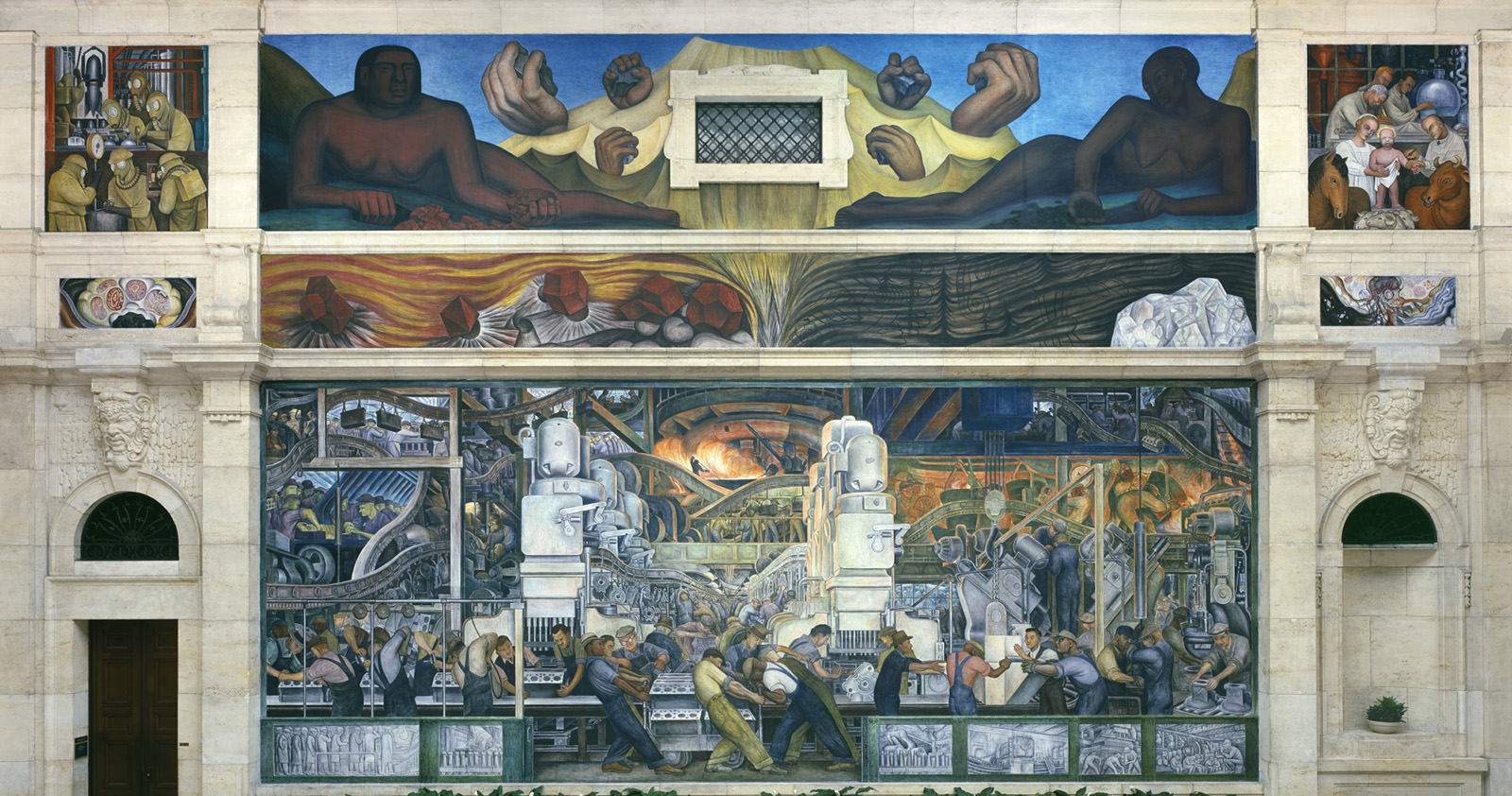
    Detroit Industry, North Wall (1932-1933), frescoes by Diego Rivera | Image from the Detroit Institute of Arts. Rivera (a Mexican immigrant and Communist), created a fascinating set of frescoes in the Detroit Institute of Arts to celebrate workers and progress brought about by the Industrial Revolution. The work is not without its symbolic and literal criticisms of progress, even though it celebrates and comes close to romanticizing the labor of workers.

    Many (myself included) would argue that Labor Day celebrates a noble ideal: that the common working person has dignity. But as a Catholic, I have some issues with the cultural environment that produced this holiday. Workers have forever been devalued in human societies. From the slaves who built the pyramids to the slaves who worked on American plantations, humans have long turned a blind eye to the human dignity that workers inherently have. You just have to watch one of any number of PBS Masterpiece shows from historical England to see that even the most civilized English manors had a rigorous upstairs/downstairs caste system where workers were thoroughly “put in their place.” Why, then, did Labor Day only develop in the late 1800s? Not to go on too long about historical movements, but populism, driven by humanist ideals reaching a crescendo in the French and American Revolutions, was the tipping point for the common person’s interests to begin to be heard on a global scale. Add to this the development of mass communication with newspapers, railroads, cable telecommunications and the like, and suddenly people could be “seen and heard.” But as is so often the case, people in the Industrial Revolution didn’t necessarily look to their past to contextualize their struggles, but instead to the immediate future. This is understandable: hungry people need food, poor people need money, people with dangerous work need safer conditions. So the ideal of upholding common human dignity took a back seat to pressing concerns and political goals.

    All of this is to say that Labor Day is rooted partly in class struggle, more firmly in the bosom of capitalism, and most unmovably in the assumption that humans alone must watch out for themselves, create their own justice, and progress to a better human future on this earth.

    Here we finally get to today’s readings because that last list of assumptions runs contrary to the Word of God. I wonder how construction workers at the turn of the last century would answer Isaiah from today’s reading: “Lift up your eyes on high and see who has created these things”? When all we see are skyscrapers and human “progress,” we must conclude that we are the ones who have created these things. Pride and self-centeredness can be social traits as well as personal ones. Thankfully, Isaiah continues in spreading the Word of God: “Why, O Jacob, do you say, and declare, O Israel, ‘My way is hidden from the LORD, and my right is disregarded by my God’?” These doubts in God’s desire or ability to see and hear us are common throughout history. Isaiah brings them up in order to answer them roundly: “Do you not know or have you not heard? The LORD is the eternal God, creator of the ends of the earth. He does not faint nor grow weary, and his knowledge is beyond scrutiny.” This is the first and most essential thing to get straight. We must realize that there is someone so much greater than us. God does not grow weary and He knows everything in the past, present, and future. Without this knowledge (not blind faith without evidence), we are doomed to go about life truly blind, without any of the great attributes we are called to have: wisdom, truthfulness, love.

    Isaiah then pivots to share with us the great promise of the Lord for those who suffer on the earth: “He gives strength to the fainting; for the weak he makes vigor abound. Though young men faint and grow weary, and youths stagger and fall, They that hope in the LORD will renew their strength, they will soar as with eagles’ wings; They will run and not grow weary, walk and not grow faint.” This promise is that God will share some of His great strength and endurance with us. It is promised to “they that hope in the Lord” — that is, those who can look up and see the works of God in creation, not just the works of mankind. This promise carries a specific message to workers, slaves, and the suffering. They are historically demeaned and dehumanized by human societies. God is the one who gives them dignity, especially when humans fail to. Of course, this message carries weight for anyone who grows weary (perhaps just weary of life) or who staggers and falls (perhaps in sin).

    Jesus repeats His promise in today’s gospel: “Come to me, all you who labor and are burdened, and I will give you rest.” Here we have the original Labor Day ideal, but perfect, without human conditions, caveats, or cultural baggage. Jesus calls “all you who labor and are burdened,” regardless of who they are or the burden they undertake. It is universal. And his promise of rest is absolute, not relegated to one day or an improved number of hours off. This promise is clearly above and beyond what humans can offer to one another. It can only come from God Himself.
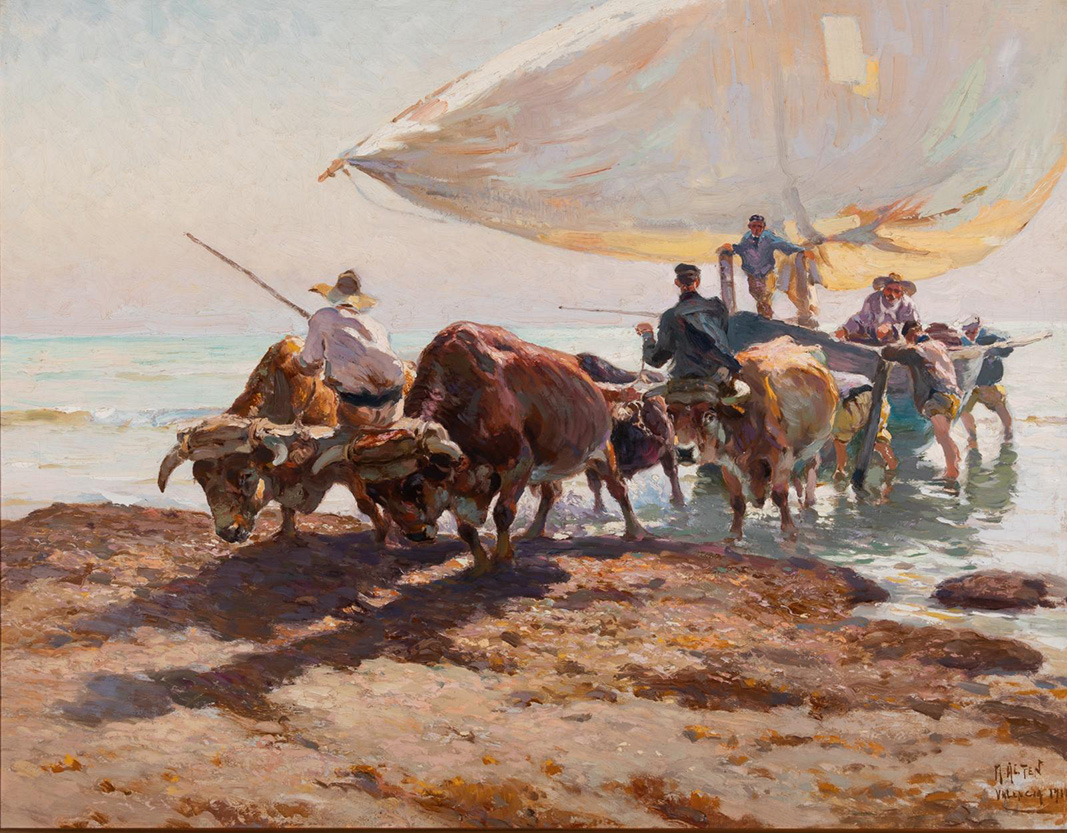
    Oxen, Boat and Fishermen, Valencia (1912), Mathias J. Alten | Image from alten.gvsuartgallery.org. I love the impressionistic strokes lighting and darkening the oxen. I also love the image of the oxen pulling the fishermen’s boat ashore in light of today’s reading and the Apostles being appointed “fishers of men.” We and Christ are teamed up to help with the work of the Apostles.

    The image of the yoke He employs is especially significant. “Take my yoke upon you and learn from me, for I am meek and humble of heart,” He says. First, let us recognize that yokes were traditionally used to join two animals in labor together. What’s more, young and inexperienced animals were (and still are) often joined with a more experienced animal to help them learn more quickly how to behave when working. Jesus’s metaphor here is deliberate: He is asking us to become yoked to Him! He will carry the burden alongside us; He will, in fact, help us to learn how to work. This is the action of God’s love come down to earth. Consider that God has already “yoked” Himself to humanity by taking on our human form, and Christ’s invitation to us has implications beyond our individual endeavors in the world. Fr. Simeon Erasmo Leiva-Merikakis writes, “He who was divine yoked himself to us through his humanity, and now he is inviting us to yoke ourselves to him and his divinity. When the Son’s yoke becomes ours as well, his Incarnation becomes our divinization. To become yoked to the divinity and glory of the Son!” (Fire of Mercy, Heart of the Word, 722-723). 

    In the second part of his statement, “and learn from me, for I am meek and humble of heart,” provides us with an understanding of what He will teach us. He points out His own meekness and humbleness of heart because this is what He wants to teach us as we go about our work in the world. Jesus’s humbleness is evident in many ways, but especially through His relationship to the Father. He is the perfection of the law, and obedience is the trait that reveals how he is humble of heart. He wants to yoke us to Him, to train us in how to be obedient to the Father alongside Him. What a revelation of what is in the core of the Divine Being: a gentleness and obedience that we are invited to share.

    Finally, we receive the same promise that the Word of God spoke to Isaiah: Jesus says, “and you will find rest for yourselves. For my yoke is easy, and my burden light.” The great lesson is that submissiveness of heart to God in fact frees us, allows us to feel rested, rejuvenates us. What a revelation for those who labor! By nature, work means that we exert ourselves, we strain; and it is anti-strain, anti-exertion, that we should do instead. This lifting of burdens is one in the heart, and it immediately impacts us psychologically and physically. We have many folk sayings about how a light heart makes for easy work, and these emanate from this same truth revealed through Christ. This is not mere mind over matter, however, let’s be clear. This is the grace of God that is promised to us as we “hope in the Lord” and show our obedience to Him.

    The last question I ask myself is “why does the Lectionary present these readings now, during Advent?” For me, there is a clear relationship to the question with which I opened these Advent reflections: For What are we Waiting? Likewise, for whom are we preparing the way? The answer to both is, of course, Christ, but we must not fall back on vagueness and trite remembrances of who Christ is and what He means for humanity’s salvation. This reading reminds us that we are marking the time of humanity’s waiting for this great yoke-mate, this selfless, humble-of-heart teacher who brings with Him the promise of lightening our loads.
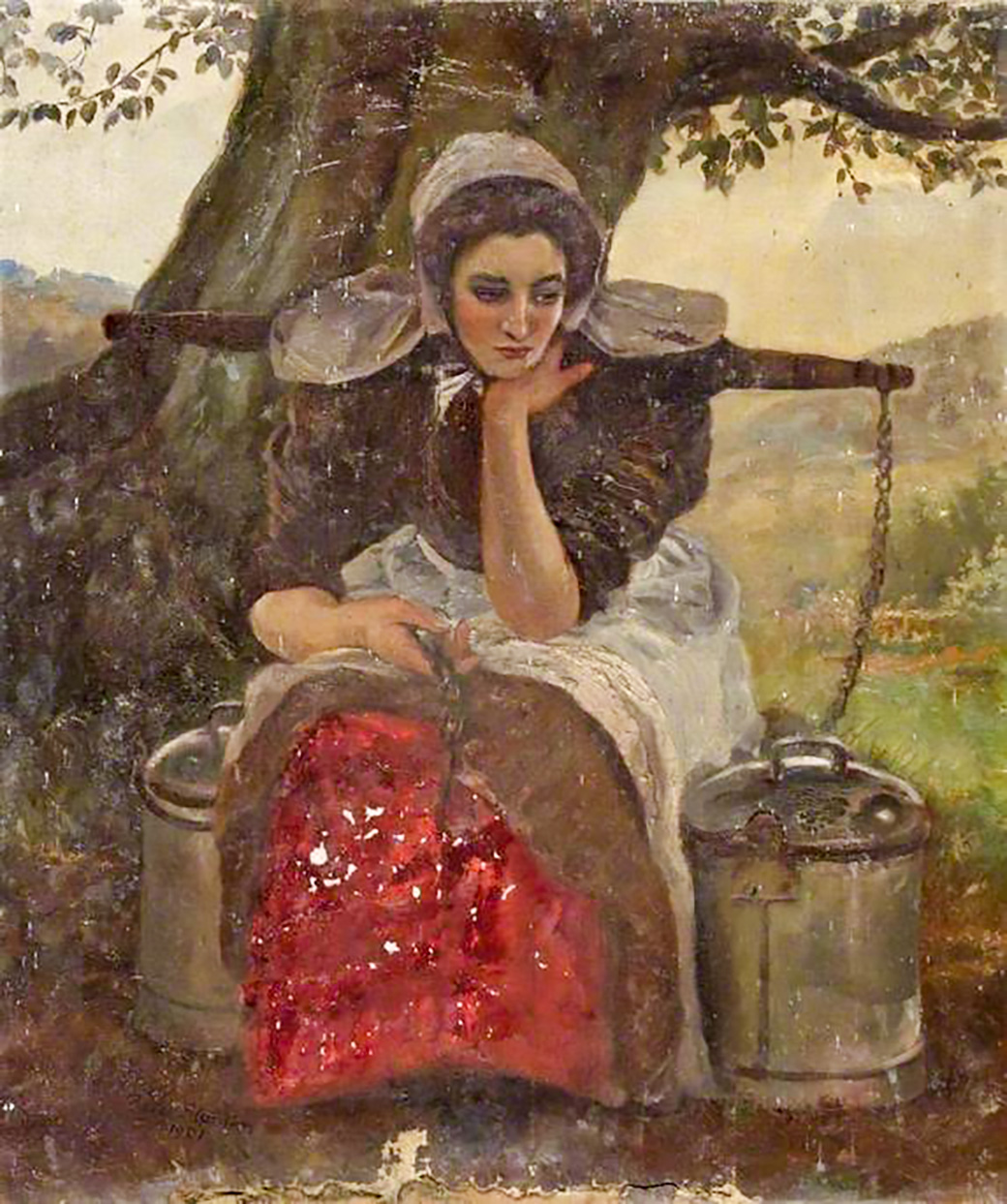
    Milk Maid (1902), Rose Emily Stanton | Creative Commons, courtesy ArtUK/The Museum in the Park.

    This reading, in the light of the opening thoughts regarding Labor Day, also points to the fact that we must expand our ideas about laboring and who is a worker beyond those tied to our cultural memory. Do we not all labor with the burden of something in this life? If not physical labor, there is the mental labor of meeting expectations, of righting wrongs we’ve done, of laboring to be more loving. The universality of Christ’s message regarding labor is important.

    Everyone, at all times, is invited by Christ to take up His yoke of obedience to the Father and learn that humbleness of heart like His will give us the rest and rejuvenation we crave.

  • The Parched Land Will Exult

    Monday in the 2nd Week of Advent: Isaiah 35:1-10, Luke 5:17-26.

    Yesterday, we reflected that part of Advent’s preparing the way for the Lord is to keep a burning vision of the heavenly Kingdom at the forefront of our minds and desires. I noted that there is a bit of a failure of the Christian imagination on this front, perhaps linked to our relatively comfortable lifestyles, at least in the USA. In today’s readings, Isaiah presents us with a fantastic vision of the Kingdom, and the gospel reading shows us how that Kingdom came to earth with Christ, a blessing on all creation.

    If we have trouble conjuring for ourselves what the Kingdom might be like, Isaiah provides the image. I love the opening to today’s reading: “The desert and the parched land will exult; the steppe will rejoice and bloom. They will bloom with abundant flowers, and rejoice with joyful song.” Here is God’s creation, meeting the glory of its Creator as He descends to greet it. For those of us who live in desert climates, we know that what looks barren and dead is actually full of life — from tiny flowers to lizards under rocks — and certain times of year give us a glimpse into what the final Kingdom might bring. The desert in bloom is beautiful. Isaiah is granted a vision that eclipses normal seasonal change, however. The steppe “rejoices” in bloom, the steppe and desert “rejoice with joyful song.” Lest we think this simple hyperbole, remember what Jesus told the Pharisees who wanted to silence the crowds singing for Him upon His entrance into Jerusalem (Palm Sunday): “I tell you, if these were silent, the stones would shout out” (Lk 19:40). All of creation rejoices to see its Creator!

    Zion Dreams (contemporary), Johnathan Harris | Image from fineartamerica.com.

    As we explored last week, the love we invite into our hearts as Christians is transformative. Isaiah’s passage today is all about God’s transformative love. We are accustomed to thinking of this love transforming human hearts, but what about non-human nature? Isaiah says, “Streams will burst forth in the desert, and rivers in the steppe. The burning sands will become pools, and the thirsty ground, springs of water.” We see all that is good bursting forth, specifically water in many forms. Water is synonymous with life — the land is returning to the state of the Garden of Eden. The dangerous aspects of nature are subsumed in order for the righteous to walk unhindered: “No lion will be there, nor beast of prey go up to be met upon it. It is for those with a journey to make, and on it the redeemed will walk.”

    As for humanity, God’s presence will “Strengthen the hands that are feeble, make firm the knees that are weak, Say to those whose hearts are frightened: Be strong, fear not!” Isaiah sees Christ coming into the world, and he relates, “he comes to save you. Then will the eyes of the blind be opened, the ears of the deaf be cleared; Then will the lame leap like a stag, then the tongue of the mute will sing.”

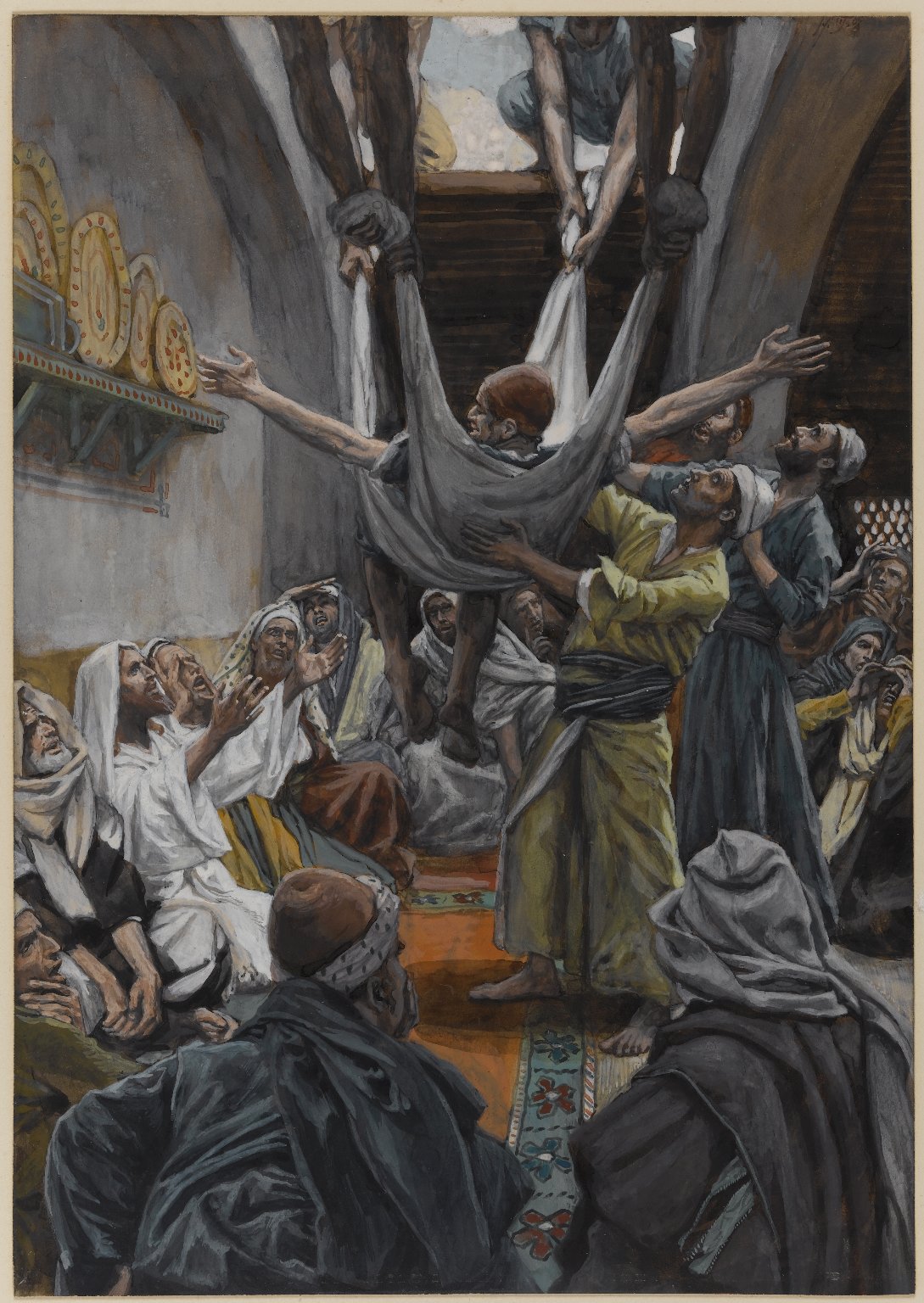
    This is exactly what happens in the gospel. We cannot mistake the fact of Christ on the earth: it is the beginning of the Reign of God. These things that are prophesied actually take place; they cannot help but take place in the presence of God! Luke’s gospel reading tells of the paralytic who was lowered through the roof in the house to be in the presence of the Messiah and be healed. Let’s recall that Jesus was teaching “Pharisees and teachers of the law, who had come from every village of Galilee and Judea and Jerusalem.” This was not a small, intimate room but more like a court of the learned surrounding their resplendent King. And into this distinguished court, a poor paralytic is lowered through the roof. Talk about crashing a party!

    And does this upset the Heavenly King? Of course not — the paralytic and those with him are exactly the subjects whom the King has come to welcome into his Kingdom. In a typical gospel social class reversal, Jesus shows love for the least of his people, over and above the more distinguished in His company. But this episode has a greater depth of meaning because Christ does not heal the man’s physical infirmity; instead “When Jesus saw their faith, he said, “As for you, your sins are forgiven.’” Jesus has ordered for us what is important: spiritual health far surpasses physical health. We see His true self and true mission. At this point, I almost become uncomfortable referring to Jesus Christ as having a “mission;” As God, He IS. His being needs no mission, it is the ongoing outpouring of creative, salvific love into the world. Like Isaiah tells us, creation rejoices and is transformed in His Presence. So, rather than seeing His true mission, let’s rephrase: we see Him.

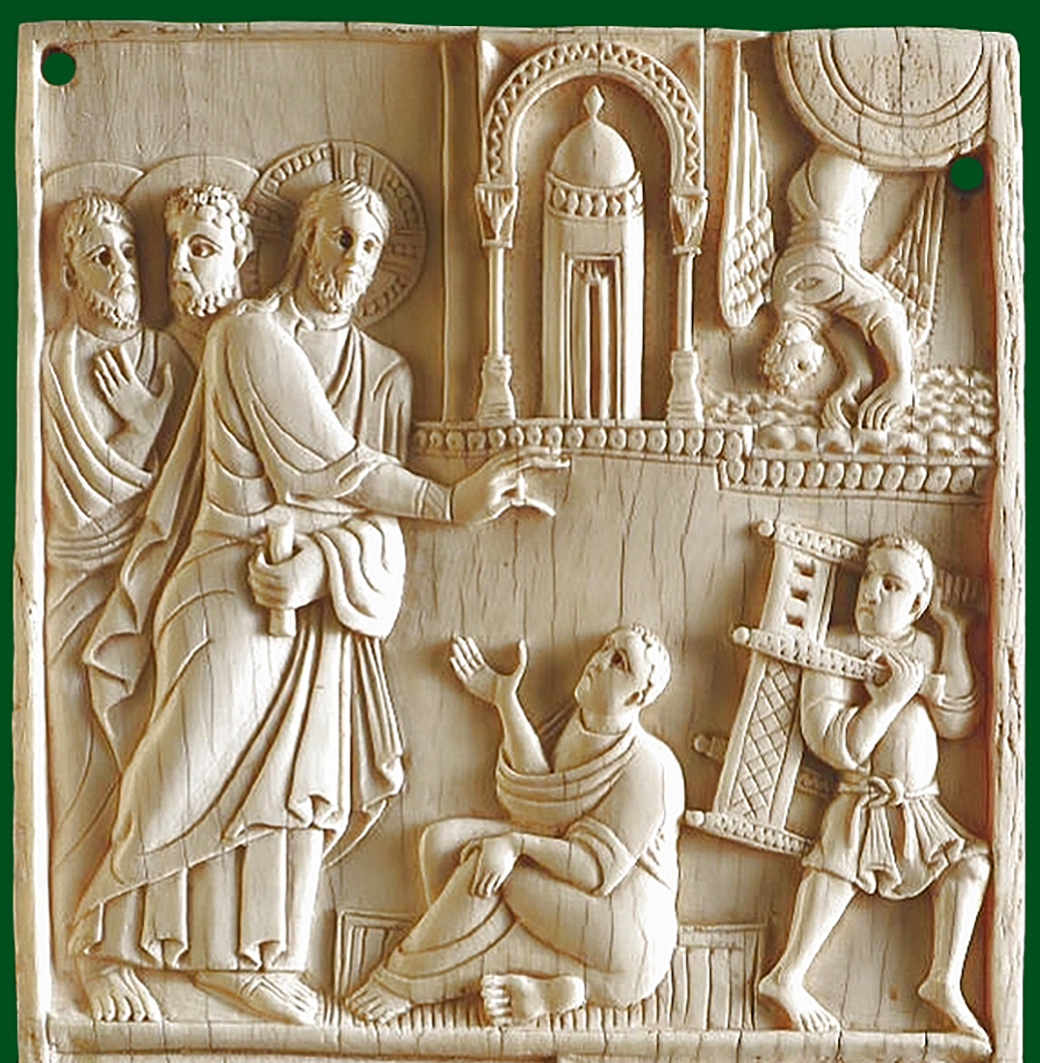
    Healing of the Paralytic (c.1100), unknown artist, from the Museo diocesano in Salerno, Italy | Image from flickr.com.

    He invites us to be faithful and, in return, He will perfect us. Last week, we reflected several times upon the concept of faith that is discussed in scripture and how it is more akin to “fidelity to my promise to you, Lord” rather than “belief in something unproven.” Faith — in our traditional Judeo-Christian sense — is a demonstrable response to something outside of us that is real, not a shaky internal belief system. So when the paralytic and his friends demonstrate their fidelity to God’s promise to send a Savior who will make “the lame leap like a stag” by coming with hope, love, and devotion into His Presence, then the Savior forgives their sins. This purification of their souls (the baptism in the Holy Spirit promised by John the Baptist) makes them suitable to inhabit the Kingdom of God for eternity.

    As we might expect, the Pharisees and scribes ask themselves, “Who is this who speaks blasphemies? Who but God alone can forgive sins?” An interesting question arises: do they lack faith? One can imagine that their insistence that God alone can forgive sins demonstrates faith in God. So maybe a lack of faith is not what’s going on with them, but a spiritual blindness. They cannot recognize God’s own Son in front of them whereas others (so often the less fortunate ones) see Him clearly. Perhaps they’re not looking for a Savior at this moment. Perhaps they’re too comfortable in their stations in life to yearn for a Savior; in fact, a Savior might spoil their career plans. We begin to see the importance of Christ’s question to Peter: “But who do you say I am?” (Mt 16:15) and more forcefully to the Jews, “you will die in your sins unless you believe that I am he” (Jn 8:24b). Denying that He is the Son of God reveals our own self-centeredness, our spiritual blindness, our inability to have prepared the way for the Lord.

    Jesus, in His love and desire to save all with Him, responds to their unspoken doubts and questioning and heals the paralyzed man, explaining why: “that you may know that the Son of Man has authority on earth to forgive sins.” This is a very specific reason, let’s consider this. A self-aggrandizing healer would not bother with the whole sins forgiven quagmire and would just heal so that people would think he’s great. A pretender Messiah would likely just stick with the sins forgiven line and avoid the work of healing a paralytic because forgiving sins is the more religiously important act. But Christ deigns to accomplish both spiritual and physical healing, not to show off His power, but specifically to accomplish another healing: healing the spiritual blindness in the scribes and Pharisees. They are blind to the Son of God in their midst for whatever reason, and the physical healing of the paralyzed man, despite being a lesser miracle, is done for them more than it’s done for the paralytic. 

    When he picks up his mat and leaves, the final lines show us that the third healing has been accomplished: “Then astonishment seized them all and they glorified God, and, struck with awe, they said, ‘We have seen incredible things today.’” What they say might on the surface sound a little underwhelming (couldn’t they say, “you are God”?) but it clues us into the problem of blindness and the healing — they now acknowledge that they have seen incredible things.

    The Palsied Man Let Down through the Roof (Le paralytique descendu du toit), c.1886-1896, James Tissot | Creative Commons, courtesy the Brooklyn Museum.

    I think this spiritual blindness continues to be a problem for us. Our imagination is not dominated by visions of the Heavenly Kingdom; we cannot see it clearly. But this is why we study scripture, why we revel in the ecstatic vision of the Kingdom that Isaiah gives us, and why we gasp with astonishment like the scribes at Jesus’s miracles. When I’ve been asked if I could go back in time to any point in history, I answer that it would absolutely be during Christ’s ministry to see and hear God walk upon the earth. But I need not be wistful for this impossible dream. What we must keep in mind during Advent is that Jesus’s life on earth is a foretaste of the eternal Kingdom promised to us. This is great news! We are all invited to experience Him for eternity — something that was only foreshadowed and begun when Jesus Christ walked in human form on the earth. It seems almost too good to be true. If you’re like me, you earnestly ask, what must we do to reach this Kingdom? 

    Christ, the Way, answers us over and over again during His ministry. In this episode, in particular, I think we are being shown an interesting perspective on salvation. We must truly be the paralytic, unable to move on our own, suffering, but filled with the vision of something incomparably better. We can only put ourselves as close to Christ as possible as a demonstration of our faith in Him.

    He does the rest.  

  • Leveling Mountains and Valleys

    Sunday in the 2nd Week of Advent: Isaiah 40:1-5, 9-11, 2 Peter 3:8-14, Mark 1:1-8.

    The second week of Advent is marked by this phrase: Prepare the Way of the Lord! We hear it from Isaiah, and 800 years later from St. John the Baptist, and 50 years later from St. Mark in his gospel, and 2,000 years later we hear it in our churches. This is our Christian clarion — the loud, clear, brassy call that something of ultimate importance comes this way. It is our King, our Lord and Savior. We must make way for Him, prepare for Him; but how exactly do we do this?

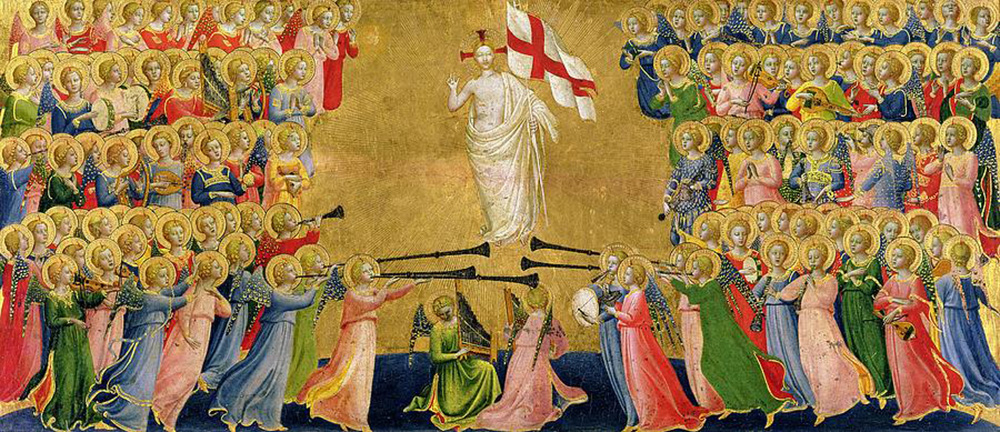
    Christ Glorified in the Court of Heaven (1423-1424), Fra Angelico | Image from fineartamerica.com. Note the clarions (long medieval-style horn) being played by the angels and the wide, straight path that is made for Him.

    Today’s readings provide the answer: we are to make way for Him in our hearts and in our minds by leveling mountains and valleys, by acknowledging our sins, and by living in holiness and devotion. But we should not get too wrapped up in what we are doing because all of this is a job of scouring of ourselves in order to let the Lord come into our beings and reign there. It is only the Lord who can do the work of sanctifying, of saving, of pouring out saving grace. We must simply scrub the house and make it as pristine as possible for the Lord to inhabit.

    Isaiah uses imagery of the land to emphasize the level of preparation that must be made: “Make straight in the wasteland a highway for our God! Every valley shall be filled in, every mountain and hill shall be made low; the rugged land shall be made a plain, the rough country, a broad valley.” Remember, this is Isaiah’s vision of what John the Baptist will be saying. We know that John’s message was a spiritual one: “I have baptized you with water; he will baptize you with the Holy Spirit.” Thus, let’s understand that Isaiah is speaking of a spiritual landscape. So, speaking of one’s soul, what vision does Isaiah provide? One of a great leveling — mountains lowered and valleys raised to create a wide plain, rough country tamed and made into a broad valley. This is a type of domestication, an ordering. What might loom in our hearts as a mountain? Perhaps unfilled ambitions. What stretches out before us like a deep valley? Our fears. What is rough country, hard to traverse? Perhaps distractions, little events in the grand scheme that we make into large things. Isaiah sees that John will ask us to perform an internal ordering, to wipe out the worldly ambitions, fears, distractions, and sins.

    In return, John baptizes people in the Jordan River. Jews had long practiced mikveh, a ritual cleaning in “living water” (a natural, running water source). Mikveh is practiced so that the person can be considered ritually pure and resume religious rites. It is used for men after normal emissions of semen and for women after childbirth or menstruation (among several other reasons). But something else is going on with John. As St. Mark relates, the Jews “were being baptized by him in the Jordan River as they acknowledged their sins.” Could these sins have been the same as those for mikveh? Perhaps, but the verse seems to encompass more than these physical impurities. Especially as it is linked to Isaiah’s prophecy and the spiritual leveling as part of the anticipation of the coming of the Lord, John’s baptism is a ritual that signifies the cleaning of their souls, not their bodies. John is clearly outside of the religious establishment, living apart in the desert, eating locusts and honey, clothed in camel hair. Something new and different is happening. And John’s message is loud and clear: “One mightier than I is coming after me. I am not worthy to stoop and loosen the thongs of his sandals. I have baptized you with water; he will baptize you with the Holy Spirit.” The people coming to John are not there for themselves, they’re there for the Messiah. They aren’t being ritually cleaned to resume normal religious worship, they’re being spiritually cleansed in order to properly await one who will truly give them a new birth in the Spirit. 

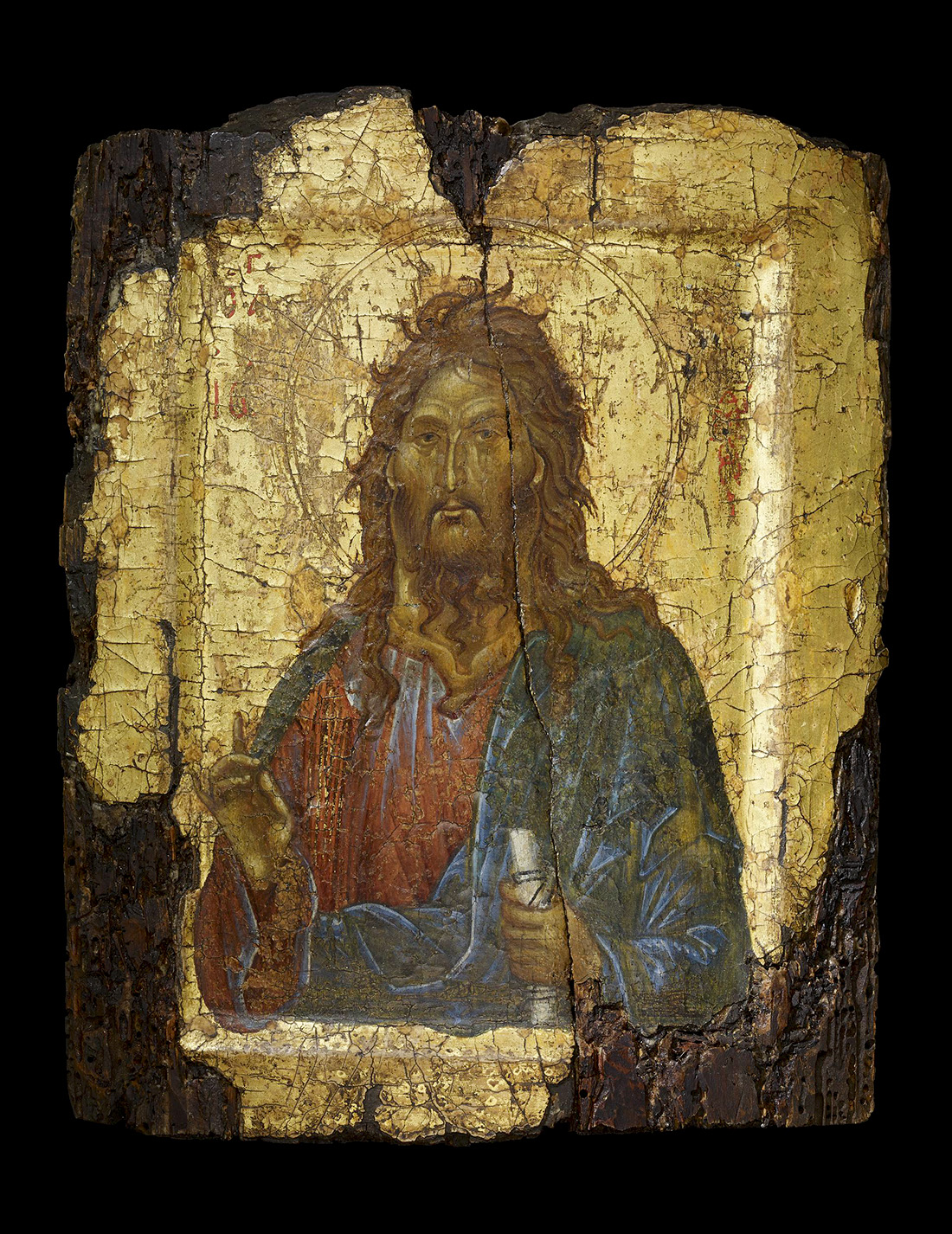
    Icon of St. John the Baptist (c.1300, Constantinople) | Creative Commons, courtesy the British Museum. Their notes: “He is identified by a Greek inscription in red on either side of the halo: ‘St John’ to the left and O Prodromos (`the Forerunner’) to the right.” He is usually depicted in icons with wild hair.

    So John’s message in the second week of Advent is that we must prepare ourselves for the one coming after him, the Christ. Jews in his time understood this to mean that they should confess their sins and undergo a ritual spiritual cleansing in the Jordan River. The second reading from St. Peter connects this same awaiting for Christ that they experienced before his ministry to the waiting we are doing now in the End Times, awaiting His return in glory. Peter tells us how and why we should be preparing ourselves: “what sort of persons ought you to be, conducting yourselves in holiness and devotion, waiting for and hastening the coming of the day of God.” He recommends conducting ourselves in holiness and devotion and hoping for (hastening) the “day of God.” Thanks to Christ, we have a perfected understanding of holy conduct and godliness; He has given us a Way to follow. But are we doing these things just to be upright and moral? Are we hoping to be patted on the head for our goody-two-shoes ways?

    Both John the Baptist and Peter speak of readying ourselves for Christ’s coming (the kairos moment that occupies at least two major historical moments). He is the reason; we want to be ready and acceptable for Christ to reign. But let’s think this through. If God is all goodness, love, and purity, then His reign is one where those qualities dominate the heavens and the earth. What room is there for hate, sin, greed, or evil? None! Do we really understand why we’re preparing in the way we are? We are awaiting the end of the world, which Jesus tells us could happen at any moment. What do we imagine comes next? Peter tells us: “we await new heavens and a new earth in which righteousness dwells. Therefore, beloved, since you await these things, be eager to be found without spot or blemish before him, at peace.” And there it is: since we await a new world where righteousness dwells, we should be eager to be found without blemish and at peace so that we can inhabit this world. I’m beginning to understand that my spiritual preparation must also include a deep contemplation (and yearning for) a world where righteousness reigns without challenge. If I don’t understand and yearn for this, then my preparations, confessions, and penances are just window dressing. There is no substance to these preparations unless I am doing them with the right goal and person in mind: Christ’s Reign of righteousness. It must be for Him and His Kingdom, not for me and my desire to “be good.”

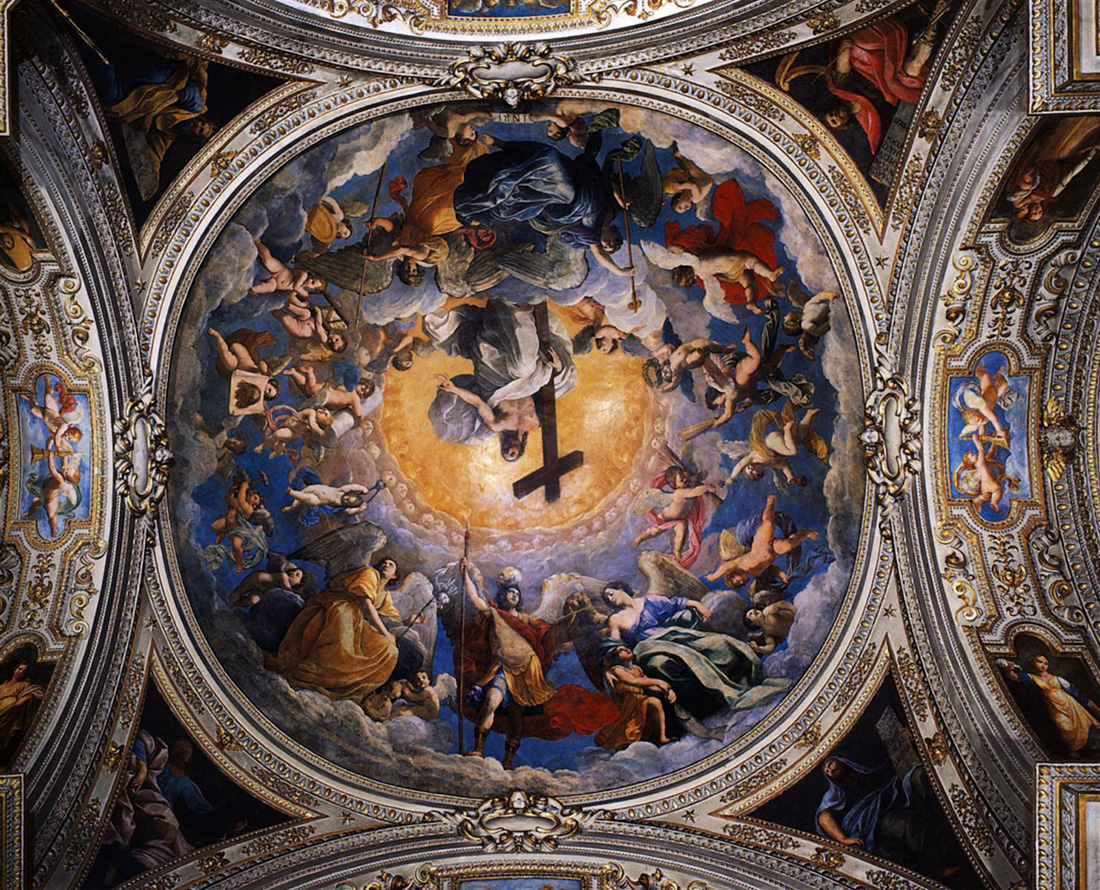
    Christ in Glory between the angels and archangels (1621), Guido Reni | Creative Commons, courtesy wikiart.org.

    But let’s be honest, we are much better at dreaming of conflict and sin than we are of goodness alone. From Dante’s Inferno to pornography (one a great and thoughtful piece of literature and the other sheer sin), we are fascinated by the fallenness of the world. Whether it’s a sick addiction to watching evil as a voyeur or a moral lesson for ourselves or a mirror where we recognize our own failings, we are drawn to stories that contain evil. Consider horror movies. Consider detective shows that delve into the worst of crimes. We entertain ourselves with these depictions. The adage behind good novel writing and good screenplays is that there must be a conflict. Without a conflict, there’s no story. We would get bored. Is this why we barely put effort into imagining “new heavens and a new earth in which righteousness dwells”? Since there’s no story here but the end of time, is there anything to imagine?

    If so, I think this is a real failure of the Catholic imagination. Some philosophers have gone so far as to call God a tyrant who imposes His magisterial will on everyone and everything in heaven; they impose a sinister heaviness on heaven and cast God as an authoritarian. What on earth is going on here? How far this is from the scriptural “fear of God” that reveres Him as the merciful and just Creator of the universe who loves His people above all else!

    Why can’t we imagine and long for “new heavens and a new earth in which righteousness dwells”? I have a theory that it has something to do with lives of comfort. It’s hard to long for something so much greater when what you’ve got is pretty good to begin with. On the other hand, for Eritrean or Syrian refugees fleeing war in their home countries, the desire for a better future is all-consuming. The poor, the hungry, those who have been humbled — they are the ones graced with a true Christian imagination and longing for God’s Kingdom. This is why Christ teaches us, “Blessed are the poor in spirit, for theirs is the kingdom of heaven” (Mt 5:3). This is why it is so important to be humble (or humbled), to eschew riches and worldly desires: these things keep us from focusing our hopes and desires squarely upon “new heavens and a new earth in which righteousness dwells.” If we are too comfortable, we have no desire or need for a greater eschatological vision. This is why Jesus proclaims, “Again I tell you, it is easier for a camel to go through the eye of a needle than for someone who is rich to enter the kingdom of God” (Mt 19:24).

    In closing, let’s consider that today’s gospel is the very first passage from St. Mark. How would you start if you had to explain something that most people would be primed to disbelieve? The great claim is there in the title: “The beginning of the gospel of Jesus Christ the Son of God. One way to begin is to trace the historical prophecies of the Jewish nation through bold figures like Isaiah and John the Baptist. The connection is undeniable between God’s promise to Isaiah, “I am sending my messenger ahead of you; he will prepare your way. A voice of one crying out in the desert” and the figure of John the Baptist, who “appeared in the desert proclaiming a baptism of repentance for the forgiveness of sins.” But there’s more than just a play for legitimacy here. St. Mark shows us that crowds listened to the clarion call from John: “People of the whole Judean countryside and all the inhabitants of Jerusalem were going out to him and were being baptized by him in the Jordan River as they acknowledged their sins.” What’s important is not just that the clarion is blown, but that people respond. This testifies to the power of the call and the truth that the messenger delivers. This is the journey of faith to which we are called: to respond to God’s call in our lives. St. Mark illustrates for us in the very opening scene of his gospel what Christianity is all about.

    May we all be people with eyes on the horizon, awaiting the coming of Christ and His Kingdom. May that vision inspire us to prepare our souls to meet Him in this glorious Kingdom.

  • The Mystery, As We Live It

    Friday in the 1st Week of Advent: Isaiah 29:17-24, Matthew 9:27-31.

    Today’s readings juxtapose more of Isaiah’s brilliant prophecy of Christ’s entrance into human history with St. Matthew’s deceptively concise illustration of how we can meet this great mystery in our lives: the healing of two blind men. In many ways, I feel that we are more aligned with blind men today than the Jews and Gentiles in the Apostolic Age. We encounter endless perspectives, philosophies and ideologies today, and a high cultural premium is attached to “choosing” an ideology to define oneself (at least for a time). In fact, Pope Francis just published an op-ed in the New York Times about who we are in the time of the COVID pandemic and he writes, “It is all too easy for some to take an idea — in this case, for example, personal freedom — and turn it into an ideology, creating a prism through which they judge everything.” Thus, not only do we resemble blind people groping about in life for something solid, for an identity, we also turn our very personal freedom to choose into an ideology that rules us, further divorcing us from encountering the mystery of God. In this vein, I think St. Matthew’s concise gospel story has much significance today.

    Let’s remind ourselves of this three-verse story:

    As Jesus passed by, two blind men followed him, crying out,
    “Son of David, have pity on us!” 
    When he entered the house,
    the blind men approached him and Jesus said to them,
    “Do you believe that I can do this?” 
    “Yes, Lord,” they said to him. 
    Then he touched their eyes and said,
    “Let it be done for you according to your faith.” 
    And their eyes were opened. 
    Jesus warned them sternly,
    “See that no one knows about this.” 
    But they went out and spread word of him through all that land.

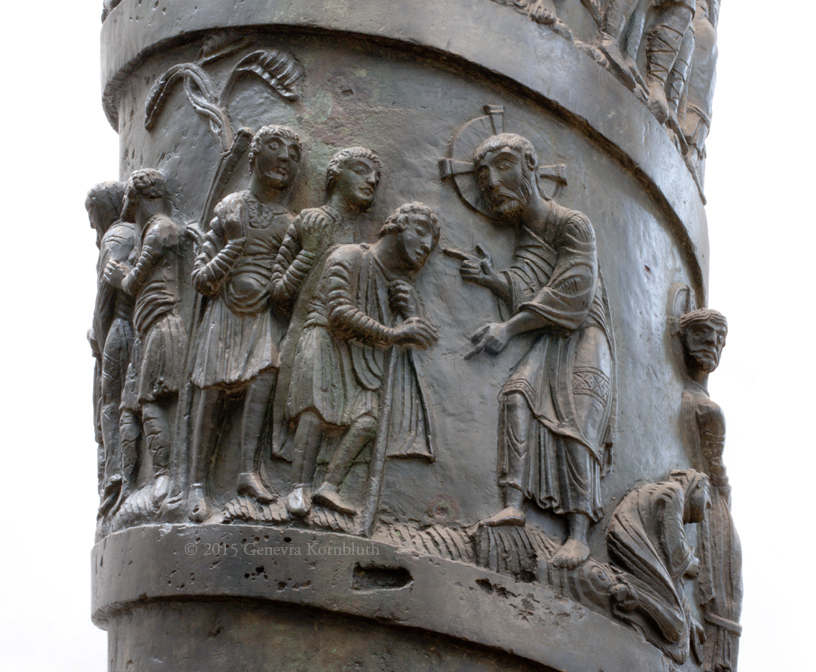
    “Healing of a Blind Man,” detail from the bronze Bernward Column in St. Mary’s Cathedral, Hildesheim, Germany, around 1020 | Photo taken by Genevra Kornbluth.

    This episode occurs in the immediate eddy of the raising of Jairus’s daughter from the dead. Recall that a sequence of important events happen in chapter 9 of Matthew’s gospel: He heals a paralytic by forgiving his sins; He calls Matthew as a disciple then dines with sinners and tax collectors; a leader of the synagogue, Jairus, asks Him to resurrect his daughter, and on the way a woman with 12 years of hemorrhages was healed by touching his cloak; He raises the daughter of Jairus; He heals the two blind men; He heals the mute man; and finally He sets about in all the villages doing this work and telling His disciples, “the harvest is plentiful, but the laborers are few.” This may seem like a laundry list of miraculous miscellany, but there is a deep logic to these events that Matthew presents to us. God is the Creator who orders all things. This includes the mystery of Christ-come-to-earth as it unfolds. This chapter speaks to the inherent ordering of the work of Christ in marrying Himself to us in the Church. The Spirit truly guides the hand of St. Matthew as he relates these events. Just for the big perspective’s sake, let’s consider the step-wise establishment of Christ’s mission in just this one chapter:

    • healing the paralytic ⇒ enabling the movement of the Spirit in our lifetimes where there was once inactivity.
    • calling Matthew ⇒ establishing Apostolic Fathers of the Church
    • dining with sinners ⇒ the feast of the Bridegroom with his Bride the Church
    • Jairus comes to him ⇒ the Jewish nation, God’s Chosen People, accept Christ as Messiah
    • hemorrhages healed ⇒ the long-time rift between humanity and God is healed through Christ
    • Jairus’s daughter is raised ⇒ death is finally overcome by Christ
    • blind men are healed ⇒ the life of faith in a nutshell
    • mute man is healed ⇒ our mouths are open to spread the Good News of Christ

    Seen at this 50,000-foot level, this is pretty remarkable. The evangelists needed to somehow encapsulate the miraculous mission and works of Christ, which must have ranged in the thousands of examples. With the guiding hand of the Holy Spirit, they not only gave us startlingly intimate stories with precise details, but infused the work with a subtle but persistent meta-narrative of salvation history unfolding through Christ’s emergence on earth as a man. As Fr. “Simeon” Erasmo Leiva-Merikakis writes, “Jesus does not just perform isolated ‘miracles’ for the undeniable benefit of individuals. At each step of his journey, the Word is building up his Church” (Fire of Mercy, Heart of the Word, Vol. I, 485).

    For today’s reading of the blind men being healed, I’d like to use Fr. Leiva-Merikakis as our guide as we look at this miniature masterpiece detailing the life of faith. Formerly a professor of Literature and Theology at the University of San Francisco and now a Trappist monk, Leiva-Merikakis is someone I greatly admire and a person I’ve quoted at length previously in this blog. He meditates on the gospel of St. Matthew, verse by verse, in his three-volume Fire of Mercy, Heart of the Word. I will be drawing from the first volume of his work here.

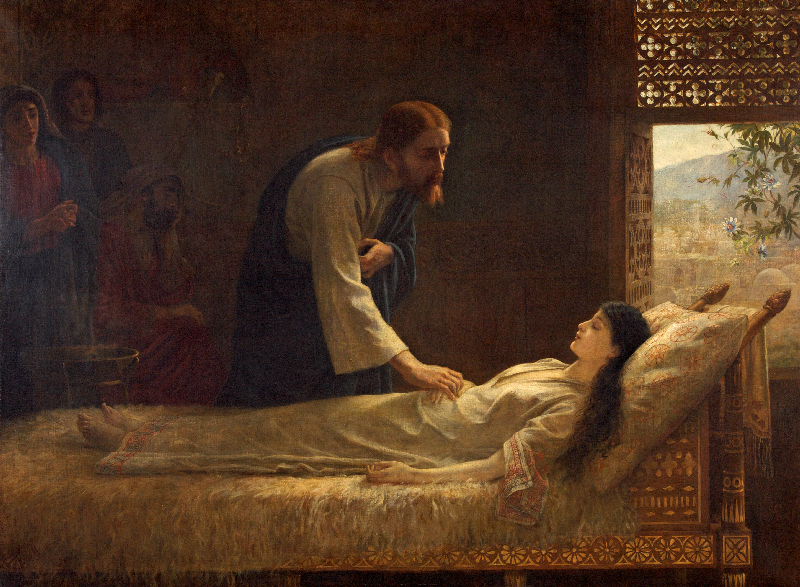
    The Raising of Jairus’ Daughter (1889), Edwin Longsden Long | Image from iconsandimagery.blogspot.com.

    So, how does it start? Truthfully, it follows immediately after the raising of Jairus’s daughter: “he went in and took her by the hand, and the girl got up. And the report of this spread throughout that district. As Jesus passed by, two blind men followed him, crying out.” It’s important to recall that news of His miracle working was already running ahead of him like wildfire. And not just any miracle working, but actual resurrection from death. This is something only God-among-us could accomplish and we can just imagine what thrill and awe swept through Capernaum as the footfalls of God graced the streets. Leiva-Merikakis conjures the imagery of the Benedictus (the Canticle of Zechariah from Luke’s gospel), which we sing during Morning Prayer each morning: In the tender compassion of our God, the dawn from on high shall break upon us, to shine on those who dwell in darkness and the shadow of death, and to guide our feet into the way of peace (Lk 1:78-79). He elaborates: “Jesus traversed the streets of Palestine on human feet with the same tireless exactitude and fecund splendor with which the fiery sun pursues his daily circuit. … Like a pair of light-hungry sunflowers, the two blind men follow Jesus’ orbit in unison” (477). I love the way Leiva-Merikakis brings his rich faith to his gospel reflections, fleshing out the concise words of the evangelist with the great mystery of Christ alive on the earth. In even this simple sentence of reportage, “As Jesus passed by, two blind men followed him,” Leiva-Merikakis teaches us that much more is going on. He elaborates: “Like a thermosensitive plant in the night, stretching out its tendrils to the imminent sun, they begin to follow Jesus in the late afternoon” (479).

    Is this not how each of us is awakened to the light of faith? The Spirit draws us with a palpable warmth to follow where it leads. We learn that it dwells in Christ, and we follow Him, seeking meaning, seeking more than just sin and death on this earth.

    Next, we read that the two men shout “Son of David, have pity on us!” This is the moment of acknowledgment. And it’s a bit odd that our lectionary translates this as “pity” because the original Greek is Ἐλέησον (Eleison). These are the words the Church will echo at the beginning of the holy liturgy for centuries to come: Kyrie Eleison! It serves a similar purpose for us in the Mass as it does for the blind men: an acknowledgment that Christ is indeed the Son of God, the anointed one, and in reverence and obeisance we ask for His mercy. Leiva-Merikakis describes the import of them calling Him Son of David:

    To proclaim Jesus to be the Son of David amounts to broadcasting God’s accomplished fidelity to his promise to have mercy on David and his line of descendants forever. … The whole Gospel stands or falls, not only on the truth of Jesus’ divine sonship, but likewise on the truth of his royal, fleshly descent from David. If Jesus is the Son of David, then the messianic era prophesied by Isaiah has already dawned, and even before the Passion and Resurrection his presence in the world must begin to bear the fruits of God’s burning mercy. (481)

    The Gospel insists on Christ’s earthly lineage through the line of David not for simply historical believability, but because it reveals how God kept His promise. Jesus isn’t just another miracle worker, model human or spiritual guru. The physical historicity of Christ as coming from the line of David is proof of God’s fidelity to His Chosen People. When the blind men acknowledge this, they have opened themselves to the truth and reality of salvation history. This is an important part of our faith journey, too.

    Next, Jesus enters the house and they approach Him there. Simple, right? Well, this building, presumably the one where He dined the night before with tax collectors and sinners, is one that He has already sanctified. That episode the night before can be likened to the wedding feast of the Bridegroom and His Bride, the Church. So, this is no ordinary following of a man into a building – it is two men of faith entering a church to encounter Christ. They follow the warmth and radiance of the Son of God, and, as Leiva-Merikakis writes, “God reciprocates such keen expectation by leading them into the house of the Church, where their eyes are opened at the very threshold, reminding us that φωτισμός (‘illumination’) was the other name for baptism in the early Church” (485). Leiva-Merikakis continues by examining the “liturgical flavor” of the episode, specifically the ritual movements of the blind men, following the great High Priest after the Kyrie eleison profession. This connection makes a lot of sense to me and again is an integral step in our faith journey as Christians – sacramental baptism and the importance of the sacred space.

    The liturgical call-and-response intensifies in the exchange where Christ asks “Do you believe I have the power to do this?” and they respond “yes.” The parallel to our Eucharistic sacrament is clear: The Body of Christ – Amen. This is the same question and assent in which we participate at every Mass. As Joseph Cardinal Ratzinger writes in Introduction to Christianity, “The Christian attitude of belief is expressed in the little word ‘Amen’, in which the meanings trust, entrust, fidelity, firmness, firm ground, stand, truth all interpenetrate each other” (76) – I’ve previously explored the deep connection between the Logos and Amen in the post Amen, The Logos is the Great I AM. The broader implications of the blind men assenting to Christ’s power to heal and save is that it is the archetype for our faith life. All Christians enact this same assent, stand on this same firm ground, over and over as we invite Him into our beings to heal and transform us.

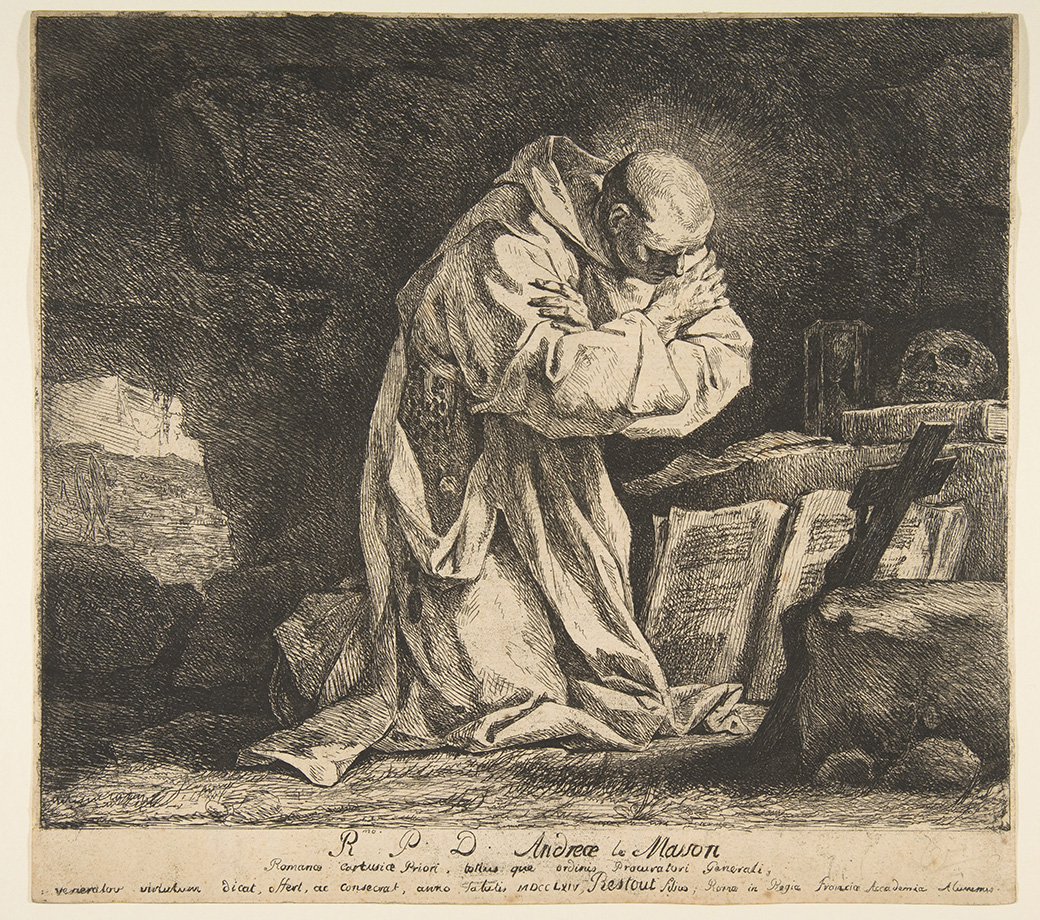
    St. Bruno (1764), Jean Bernard Restout | Creative Commons, courtesy the Metropolitan Museum of Art.

    Then, we encounter the detail that “he touched their eyes.” This is not a ritualistic magic or witchcraft. He does not necessarily need to touch their eyes in order to heal them, but he does. And this emphasis on touch – He takes Jairus’s daughter by the hand, the woman with hemorrhages touches His cloak, and here He touches their eyes – reminds us that God is, in fact, incarnate. Here God walks with feet that leave impressions in the ground, He can be touched and can touch others. The irrefutable carnality of our Messiah is something we cannot avoid. We are asked not just to embrace Him as an idea and a lofty spiritual Savior, but to eat His Flesh and drink His Blood. This means that Christians cannot dissociate ourselves from our bodies and this world. We are called to live in it while we are here, and live with Christ as our guide for how to be a human. He was real so that He could show us the path to salvation while also being flesh and blood ourselves. 

    Jesus tells them, “Let it be done for you according to your faith.” On the heels of yesterday’s reflection, we can recall that faith more properly means fidelity to God, faithfulness to His Word and law. Again, it is not the modern meaning “believing in something where there is no proof.” These blind men have demonstrated their faith by following the Spirit and Person of God the Son into the house of the Church, by proclaiming Him to be the fulfillment of God’s promise to the line of David, by asking for His mercy and by assenting to His sacramental, transformative power. This is their faith, not a collection of vague ideas in their head. Again, we can see here the same life of faith in which we participate and Christ’s response to us. If we truly believe in the promise of God that is present in Christ, we follow Him into His Church, give Him reverence, and ritually assent to His power, then His healing touch is the response. This same touch stanches flowing wounds, opens eyes, heals disease, and dispels death. 

    Once again, St. Matthew seems to give us a reporter’s account of what happened: “And their eyes were opened.” But there is genius in Matthew’s concise and precise prose. It might be tough to get through a gospel that was endlessly poetic with the eschatological reverberations of every moment during Christ’s ministry. Matthew gives us words that are pregnant with significance, and it is our prayerful study of scripture that allows the Word of God to speak to us. In this instance, we have the levels of physical healing, spiritual healing, and new life as a being seeing the world anew. St. Paul’s first letter to the Thessalonians comes to mind: “But you, beloved, are not in darkness, for that day to surprise you like a thief; for you are all children of light and children of the day; we are not of the night or of darkness” (1 Th 5:4-5). This is fundamental to our understanding of our life of faith: Christ re-creates us (He is a Person of God, the Creator, always), He transforms us in the sacraments and grace He gives us. Do we realize that we are renewed “children of light” when we finish each Mass? More importantly, do we act in a way faithful to God, in Whom we have put our trust? Is our faith demonstrated to Christ in a way that is hand-in-hand with our assent to have Him transform us? These are questions far more important than whether we take Eucharist by hand or by mouth, how many Hail Marys we say each day, or (especially!) for which candidate we voted.

    The penultimate action in this episode is the seemingly incongruous warning from Jesus. “Jesus warned them sternly,
    ‘See that no one knows about this.’” What are we to make of this abrupt change of tone? We know that Jesus wasn’t bipolar, so something else must be going on here. Part of the problem, I think, is the troublesome translation of the Greek. The verb that is translated as “warned them sternly” is ἐνεβριμήθη (enebrimēthē), which comes from the main form embrimaomai. I have reflected previously at length on this term (in the post, See the Glory of God) as it is used right before Jesus raises Lazarus from the dead. In short, I believe it has a meaning closer to “a gut-like surge of divine passion.” Other translations state “strictly charged” or “strictly instructed” instead of “warned them sternly.” Again, the strictness or sternness of this verb is attached to divine works and belief in the Gospels. It seems that Jesus is stirring a certain reverence in them about what has happened. So why stir up a warning of reverence? Leiva-Merikakis provides an answer: “To retain from this rich texture of converging mysteries only the material fact of the physiological healing would be tantamount to ‘giving a holy thing to the dogs’ and to reducing Jesus’ recreative power as Word to that of a magician, and his disciples’ faith to a conspiracy of mercenaries, anxious to ‘market’ their ringleader’s powers. It is against this tendency in man to reduce the divine that Jesus is thundering” (501). I like this explanation – it is very consonant with our scriptural understanding of God to protect the sacred, and Christ’s passionate instruction is that they do not cheapen their life of faith by spreading words simply about physical healing.

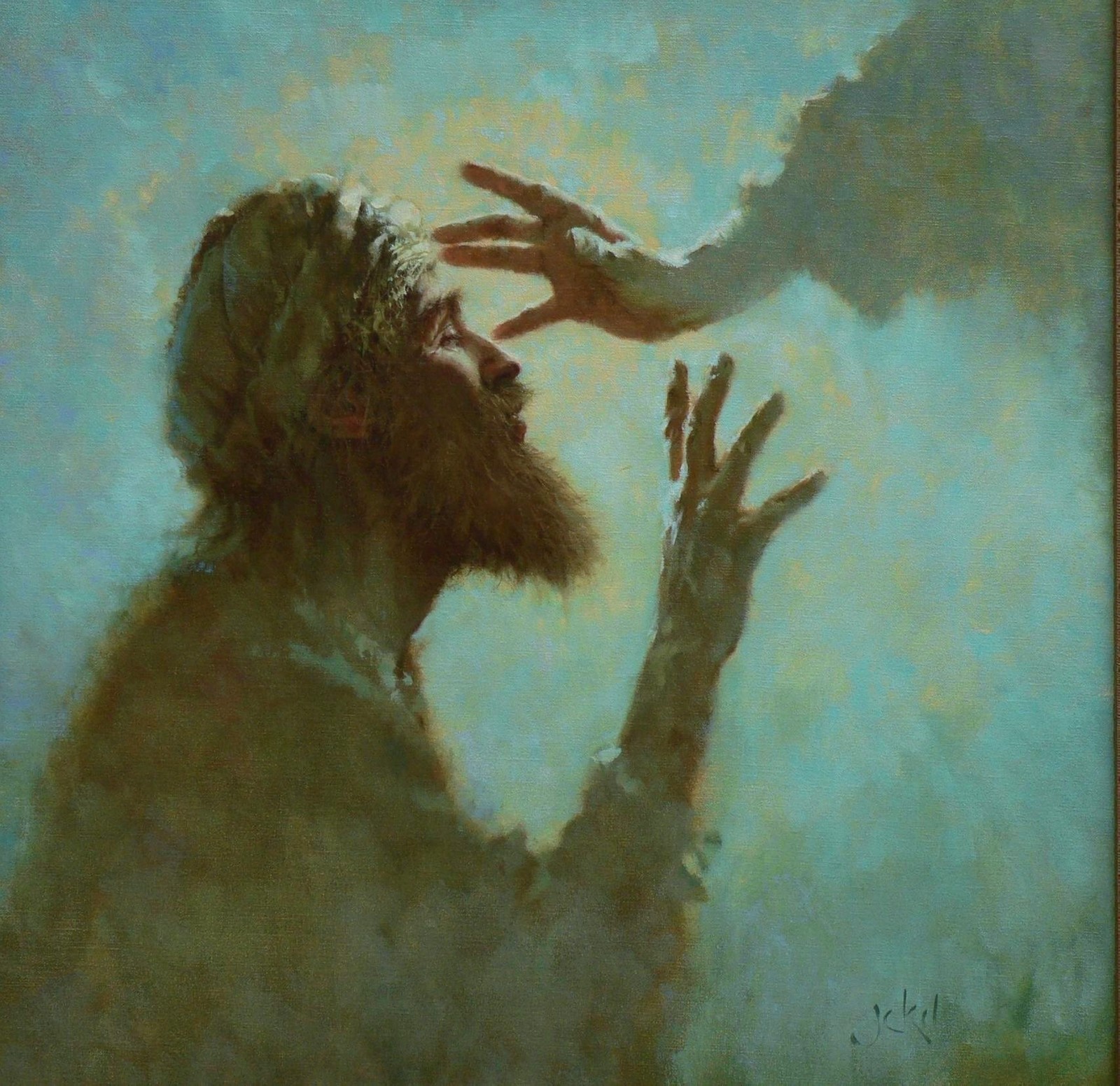
    Jesus Healing the Blind Man (2008), Brian Jekel. | Image from christian.art.

    The actual warning, too, loses much in translation. There are simply three emphatic words in the Greek: Ὁρᾶτε μηδεὶς γινωσκέτω (Horate mēdeis ginōsketō), which more correctly translated would be “See! And let no one know it.” Leiva-Merikakis explains, “[These words] have the ring of a ritual formula. And they contain a serious pun: ‘See!’ is the perfect liturgical command to accompany the enlightenment of faith and the gesture of touching the eyes” (502). But does he really want to stifle the work of evangelization? Just verses later Matthew reports that He encourages His disciples in spreading the Good News: “the harvest is plentiful, but the laborers are few.” Let’s remember that his passionate instruction is one that is concerned with a facile, cheapened message of physical healing in the face of something much deeper that is going on. Thus, “let know one know” can be interpreted as a warning against a shortcut in a faith life, a warning not to spread a type of false “knowledge.” His instruction is to “See!” which is a type of inner transformation. How does one share inner transformation? This is beyond words. “This living contact comes first; then the healing; and last of all the knowledge; and nothing can short-circuit this structure of the total act of faith” (502), writes Leiva-Merikakis.

    So, how do we take the final sentence, “But they went out and spread word of him through all that land”? Did they disobey him? The little conjunction “But” seems to imply this. Leiva-Merikakis dissents from this reading, however: “The explosion of thrill and joy conveyed … implies that the two men exactly abided by the intention of Jesus’ command. They did not go out and coolly ‘inform’ this interested party or that about what had happened, cluing them in to Jesus as a potential reservoir to be tapped. Rather … the indiscriminate energy of their new way of life bespeaks a joy at now being in the light and an inability to hide that light under a prudent bushel basket” (504). Leiva-Merikakis imagines them praising God rightfully as they dance through the streets with their newfound sight, encouraging others to go find Christ and begin their own life of faith. Let’s also note that what happens next is that a demoniacally possessed person who is mute is cured by Christ. This bolsters Leiva-Merikakis’s reading that Christ is, in fact, looking for rightly aligned speech, not necessarily silence. First, a person must be sanctified and healed by Christ, and then they can speak rightly, proclaiming the Good News.

    In closing, today’s gospel is simply astounding when read deeply, in the light of faith. I am so glad to have found spiritual teachers like Fr. Leiva-Merikakis, Fr. Jacques Corbon, and so many popes and saints to help me in my journey of lectio divina. We are blessed by the Spirit to have two thousand years of holy writings helping us plumb the never-ending depths of our sacred scripture.

  • An Eternal Rock

    Memorial of Saint Francis Xavier, Priest (Thursday in the 1st Week of Advent): Isaiah 26:1-6, Matthew 7:21, 24-27.

    Today’s readings ask us to consider how we use the word “strong” when it comes to our faith life. It seems reasonable that we encourage one another to keep our faith strong, or, as George Michael famously sang, “you gotta have faith.” But, like that song, this sentiment is completely about us, about putting things in our power. Rather than preaching this gospel of self-empowerment, our scriptures tell us – over and over, from Genesis to the Book of Revelation – that “strength” is God’s. What’s in our power? Simply to recognize this and rely upon it.

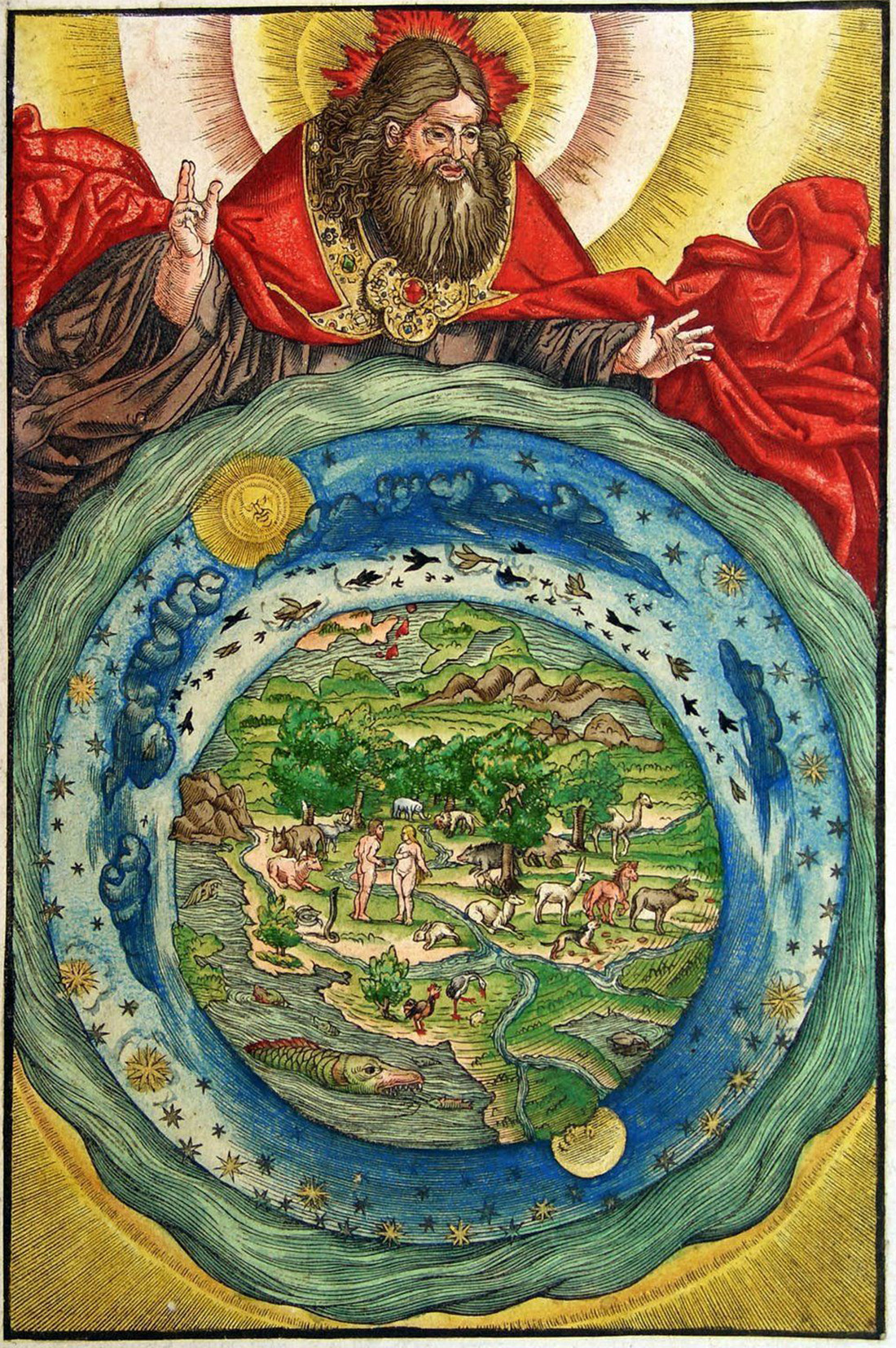
    The Creation Story (c.1530), Lucas Cranach the Elder | Image from pinterest.

    Isaiah is clear: “A strong city have we; he sets up walls and ramparts to protect us.” The prophet portrays God as a diligent ruler who builds protective structures for His people. The space created by God is what is strong. The people abjectly rely on the strength of their ruler and his fortress to protect them: “Open up the gates to let in a nation that is just, one that keeps faith.” Isaiah uses the Hebrew word אֱמֻנִֽים (’ĕ·mū·nîm), which properly means “one who is trustworthy,” although it is commonly translated as “one that keeps faith,” as in “one who did not betray his faith.” Consider this: in the ancient world, faith in something was generally understood to come from concrete proof in reality. God’s work in the world and in the lives of the Jewish people was a palpable thing. How different from what it has come to mean today, i.e., belief in something without proof. So, what Isaiah is saying is that the strong city of God should admit people who are trustworthy, who live by His commandments and do His will. He is not saying to admit people who fabricate for themselves a belief-without-proof. This was inconceivable to people who observed God in everything around them and Who was central to their very history and existence. Far from the abstract word we use today, we might say that “faith” for ancient Jews was more akin to acting in concordance with expectations. In other words, “keeping faith” or “having faith” was adhering to God’s commandments and precepts, in other words, being trustworthy. “Being faithful” was demonstrating that you could be trusted by God not to betray Him or stray from Him. “Faith” was concretely observable.

    “Trust,” on the other hand, was the word that had more in common with today’s understanding of “belief without proof.” Isaiah’s next line describes how the word trust was used: “A nation of firm purpose you keep in peace; in peace, for its trust in you.” Isaiah says that God protects his faithful people because they trust that He will come through for them. For the Jews, it’s not a question of whether there’s a God or not, it’s more a question of whether a person can trust in God’s intervention on their behalf. This clearly causes a bit of a problem in the “don’t put the Lord your God to the test” category. At issue, I think, is expecting God’s saving grace and protection in this world, in this lifetime. The prophets and, finally, Jesus Christ, clarify that God’s Kingdom is not the same as the world. Jesus repeatedly speaks of death as “sleep,”  and emphatically points out that everlasting life happens after resurrection from this sleep/death. Put your trust in God, but don’t expect His actions to come about according to your timeline or in the way you expect.

    And so our scriptures are full of the tension between trusting in God or trusting in something else in the world (money, power, our own intelligence, etc.). The problem is that humans live in a fallen state, temporarily separated from their Creator and longing to hear Him, see Him, feel Him. (We can begin to understand the divine genius behind the Incarnation – God’s loving us so much to be present to us in human form.) In our spiritual weakness, we stop trusting in the invisible One and start trusting in worldly things that give us immediate feedback and immediate satisfaction.

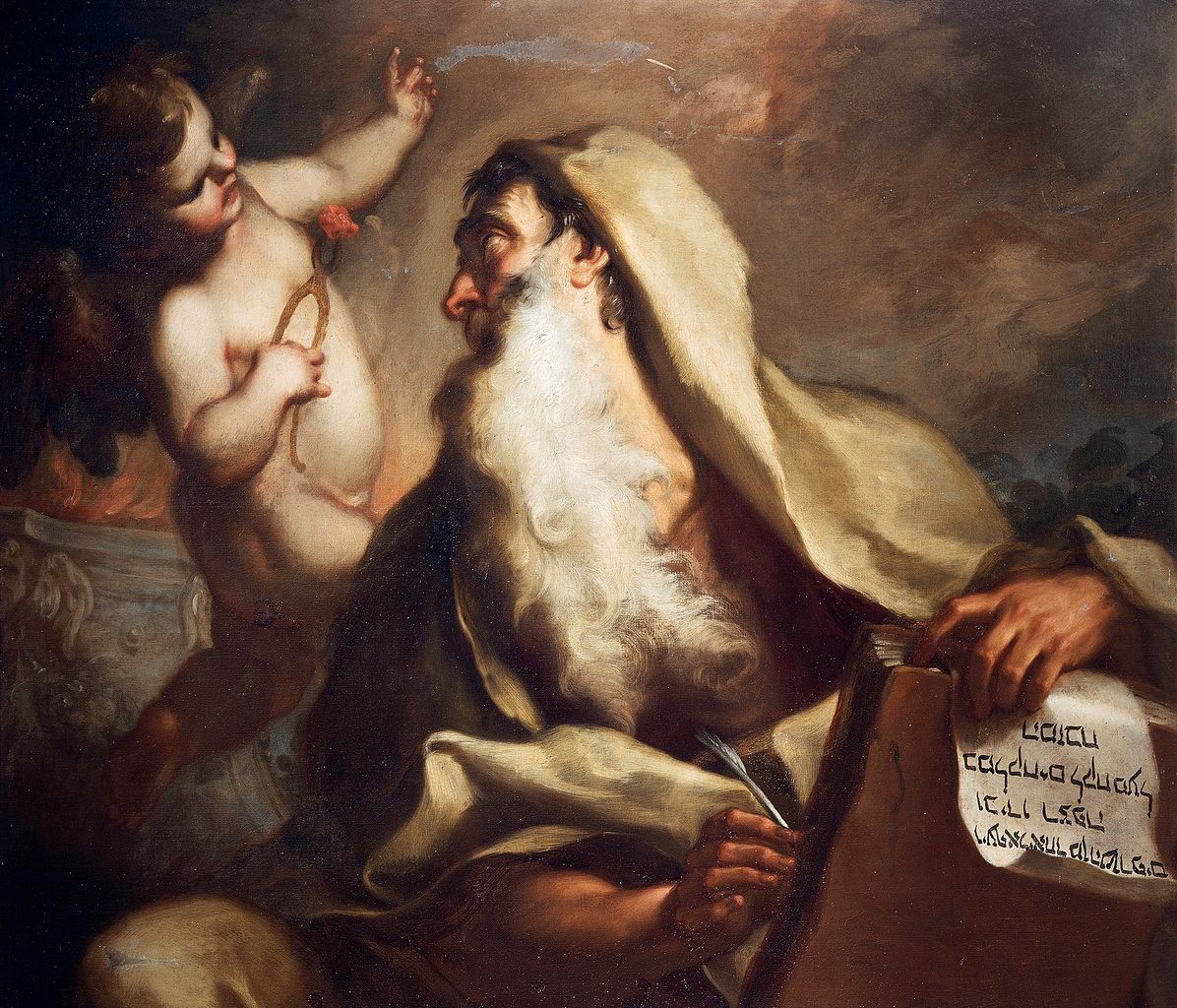
    The Prophet Isaiah (early 1700s), Antonio Balestra | Wikimedia Commons. While that looks like a dentist’s tool in the cherub’s hand, it’s not a tooth with gum tissue he’s holding – it’s the burning coal set to Isaiah’s lips.

    This is why Isaiah’s cry to his people is “Trust in the LORD forever! For the LORD is an eternal Rock.” And here we have it: the eternal rock, the strength, is the Lord. We need the urgings of the prophets because we are weak and tempted by the world. In acknowledgement of worldly temptations, Isaiah follows this with, “He humbles those in high places, and the lofty city he brings down … It is trampled underfoot by the needy, by the footsteps of the poor.” The measure of the world is wealth, and Isaiah’s words remind his listeners that this measure is false and will be overturned by God.

    In the gospel reading, Jesus takes up Isaiah’s theme of God being the rock and the strength upon which we should rely. The first verse from St. Matthew: “Not everyone who says to me, ‘Lord, Lord,’ will enter the Kingdom of heaven, but only the one who does the will of my Father in heaven.” This should sound familiar – doing “the will of my Father” is what Isaiah says about a nation “that keeps faith.” Jesus tells us that actual faithfulness to the commandments and spirit of God’s law is what we are called to do in order to enter the Kingdom of Heaven. This is a call to practice what we preach, to not simply profess to believe in God without submitting to His will.

    Next, Jesus reminds us of God’s strength being the only real, reliable strength for us. He uses the image of the rock: “Everyone who listens to these words of mine and acts on them will be like a wise man who built his house on rock. The rain fell, the floods came, and the winds blew and buffeted the house. But it did not collapse; it had been set solidly on rock.” This is an interesting little parable because through Christ the strength of God, the rock, becomes something we can work with and use. Let’s unpack this. In this parable, what we do in our lives is compared to the type of house we build. The foundation of this house is what makes the difference. If the foundation is rock, our house will not collapse. In Christ’s words, if we listen to his words and act on them, we can withstand storms and disasters, and our lives will continue (in the next life). 

    Jesus emphasizes acting on His words. In other words, living according to God’s will. The rest of the parable makes this clear:

    And everyone who listens to these words of mine
    but does not act on them
    will be like a fool who built his house on sand. 
    The rain fell, the floods came,
    and the winds blew and buffeted the house. 
    And it collapsed and was completely ruined.

    It’s interesting to dig into this. Acting on His words seems to have a bolstering effect, a solidifying effect, making our foundation solid, like rock, instead of shifty, like sand. This action is a type of embodiment of God’s will – making it real and alive through us. And that is precisely Jesus Christ Himself! He is the example of the embodiment of God’s will, even more, the mystical Incarnation of God Himself into humanity. He is the pinnacle, the apex, of His own teaching, and by following His teaching we are able to share in this embodiment of God on earth. This is part of God’s inscrutable plan, that He infuses the world through His human creatures, renewing and healing all of creation through us. 

    And the stakes could not be higher. A life built on sand results in complete ruin. The eschatological implications are severe: no entry into the eternal Kingdom of heaven. 

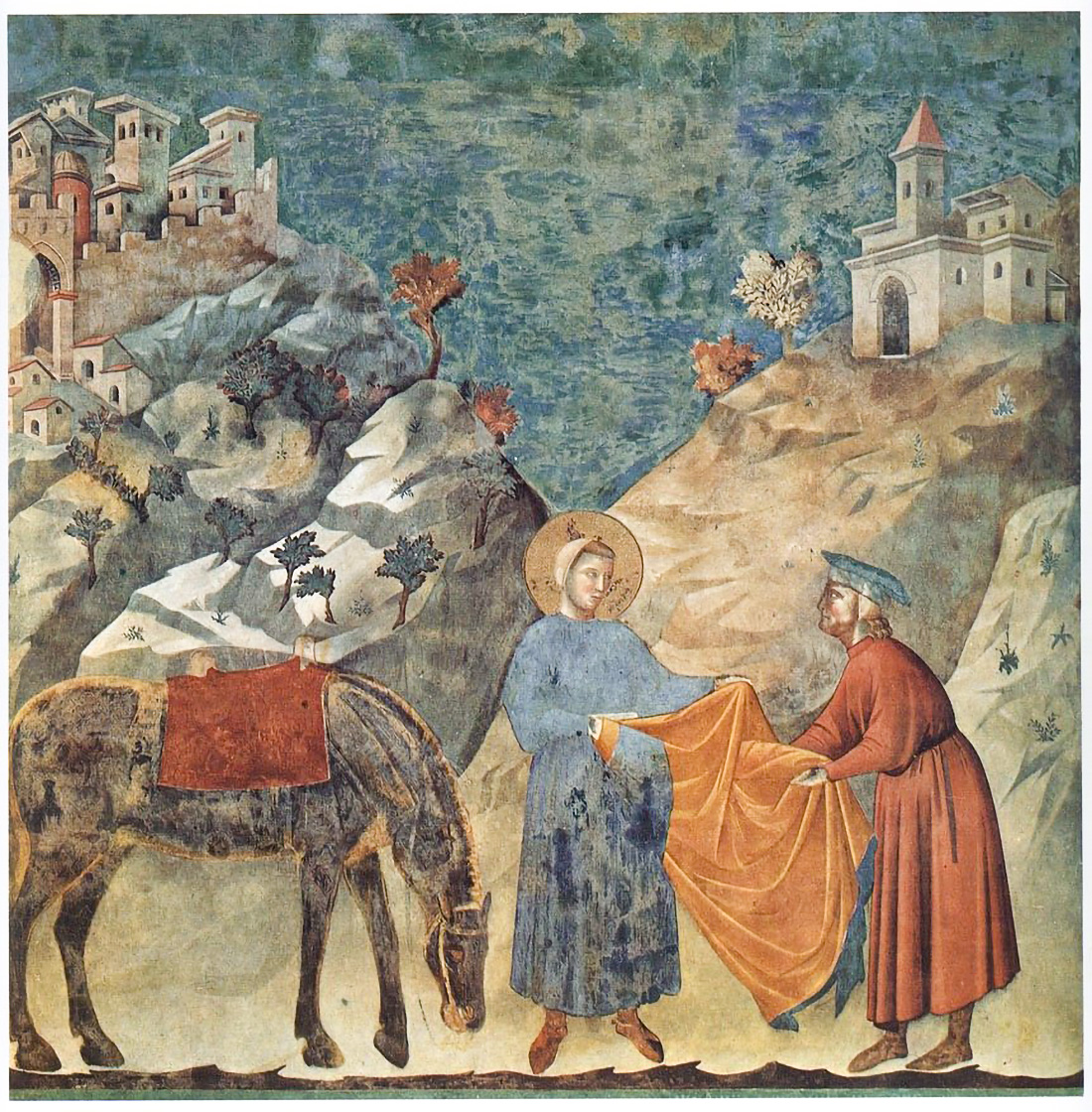
    St. Francis Giving His Mantle to a Poor Man (San Francesco Dando il suo mantello ad un povero), 1297-1299, Giotto | Creative Commons, from wikiart.org.

    The picture we are left with nicely re-frames the great challenge of Christianity. We might think that trusting in our invisible God is the challenge – what we would call today “having faith.” But this intellectualizes what is actually a challenge of actions. In other words, we’re making a mental game out of something that is much more practical and within our reach (albeit no less difficult). The challenge Christ lays before us is acting in the world according to God’s will. Listening to His Word and acting accordingly. This means forgiving, being humble, giving away wealth, caring for others more than ourselves, avoiding sin, praising and thanking and fearing God every moment. These are all things we do, and what Christ and the saints teach us is that when we do them over and over, God becomes more apparent to us and trusting in Him and relying on Him become easier and easier. 

    Let’s remember, then, why Advent is a season of penance, almsgiving, and prayer. These are the actions we are called to do before we can enter the Kingdom of Heaven.

  • On Feasting, Being Saved, and Recognizing

    Wednesday in the 1st Week of Advent: Isaiah 25:6-10a, Matthew 15:25-37.

    In today’s readings, again we encounter Isaiah’s stunning prophecy of the Christ Event and a passage from the gospel that illustrates Christ’s prophesied reign at work in the world. On Advent days like these, we are reminded that Jesus Christ’s miraculous actions 2,000 years ago are contiguous with the Church’s ongoing work in the world as His bride and with his return at the end of time. Advent is here to remind us that His works were not just historical. He began His Reign when being born unto Mary, but it continues through the Spirit’s action in the Church and we anxiously await its culmination. We are living in the End Times! Keep your lamps trimmed and burning as we await the return of the bridegroom!

    Today’s reading from Isaiah points out three aspects of the Reign of God: He will provide for us rich sustenance, He will remove a “veil that veils all peoples,” and we will recognize and praise Him. Let’s take these in turn. First, while this sustenance might be spiritual, the image used by Isaiah is rich and abundant food: “A feast of rich food and choice wines, juicy, rich food and pure, choice wines.” I love the repeated sentence here, with an intentional emphasis pointed out by the adjective “juicy” for the rich food and “pure” for the choice wines. So, not just base sustenance but a feast of the very finest things. Psychologically, for Christians this is a nice counterbalance to the ascetic life that shuns fleshly desires, as insisted upon by St. Paul, the desert Fathers, the saints of the medieval period and so many more of our Doctors and saints in the Church. They would certainly agree with Isaiah and his description here, but would say that restraining ourselves from desires while on the earth is necessary to forge our spirit in Christ’s image; plus, it will make the great heavenly feast of the kingdom all the more richly appreciated. Yet we must admit that the enjoyment of feasting is something not altogether bad, or else God would not be employing this image to describe His Kingdom. One might argue that a Christian might properly enjoy moments of feasting in this lifetime, especially if a person is living morally under God’s law and focused on God’s providence and grace.

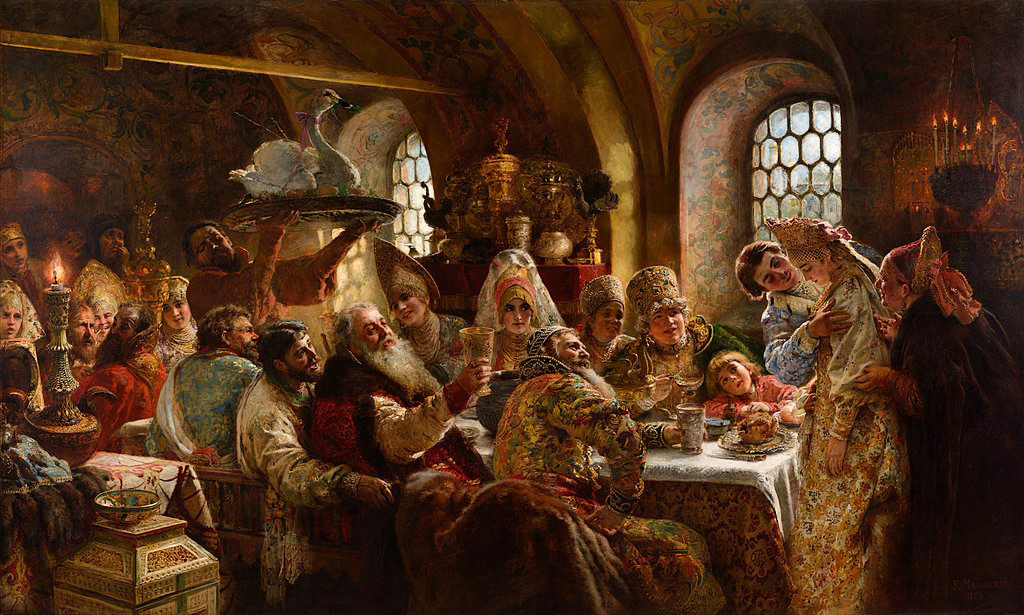
    A Boyar Wedding Feast (1883), Konstantin Makovsky | Wikimedia Commons. There is an interesting recalcitrance in the bride on the right side of the picture, with the groom attempting to coax her into enjoying their wedding feast. Indeed, the attention of all the guests is placed on this interaction. Perhaps she is sad to be married, perhaps she loved that beautiful swan that’s being served as food (ha!), or perhaps she’s terribly shy. In light of the paragraph above, though, perhaps we can read some of this recalcitrance as the pious Christian’s reaction to feast and worldly excess. I, for one, am with the groom on this one, though. If there is a time for feasting and enjoyment, let it be at a wedding feast. There is goodness in this world, and we can celebrate it appropriately.

    The second promise from Isaiah is that God will remove something that ensnares humanity: “he will destroy the veil that veils all peoples, The web that is woven over all nations; he will destroy death forever. The Lord GOD will wipe away the tears from all faces.” In a phrase, Isaiah is talking about the fallenness of the world and our natures. He calls this death, and indeed it is, but the ancient, scriptural understanding of death is deeper than we usually consider it in our analytical, scientific age. Yes, death has a technical meaning as the loss of life, measured perhaps in the absence of a heartbeat and the lack of measurable brain activity. But death also has a larger philosophical meaning. When there is nothing ahead of us but death and a hole in the ground, then death reigns in a real psychological and even existential way. As we’ve amply seen with writers from Nietzsche onward, disbelieving in God goes hand-in-hand with the reign of death (one logically flows to the other). The reign of death is more than physical – it is spiritual, the death of the spirit. Any atheist will proclaim that nothing awaits us beyond this world, and the implications of this are diverse, but often include a softening of moral thought (i.e., if there is no larger or eternal repercussion for doing something right vs. something wrong, then why worry about making sure you’re doing things that are right? Even further, in this worldview, moral “right” is completely made up by people rather than emanating from the source of all goodness). When moral thought and action are brought low, we Christians are taught that this is the devil at work in the world. Thus, the devil’s influence and the reign of death are tightly linked. This brings us back to our origin as recounted in Genesis: Satan – the serpent – is the cause of our temptation; and he is cursed as is humanity when cast out of the garden into the world where death reigns. Eons of weeping, blood, and sin ensue. We now live apart from God, unable to be in His presence, unable to see the truth and light clearly. St. Paul tells us, “For now we see in a mirror, dimly, but then we will see face to face” (1 Cor 13:12). So, when Isaiah promises that “he will destroy the veil that veils all peoples … he will destroy death forever,” we can understand that this is a full reconciliation with Him, a return to the garden. It is again St. Paul who helps us locate the promise of Isaiah in the Reign of Jesus Christ: “but when one turns to the Lord [Jesus Christ], the veil is removed. Now the Lord is the Spirit, and where the Spirit of the Lord is, there is freedom” (2 Cor 3:16-17). The freedom offered by Christ is a freedom from the reign of death, a removal of a veil that has ensnared us, and a reconciliation with God thanks to Christ’s great sacrifice.

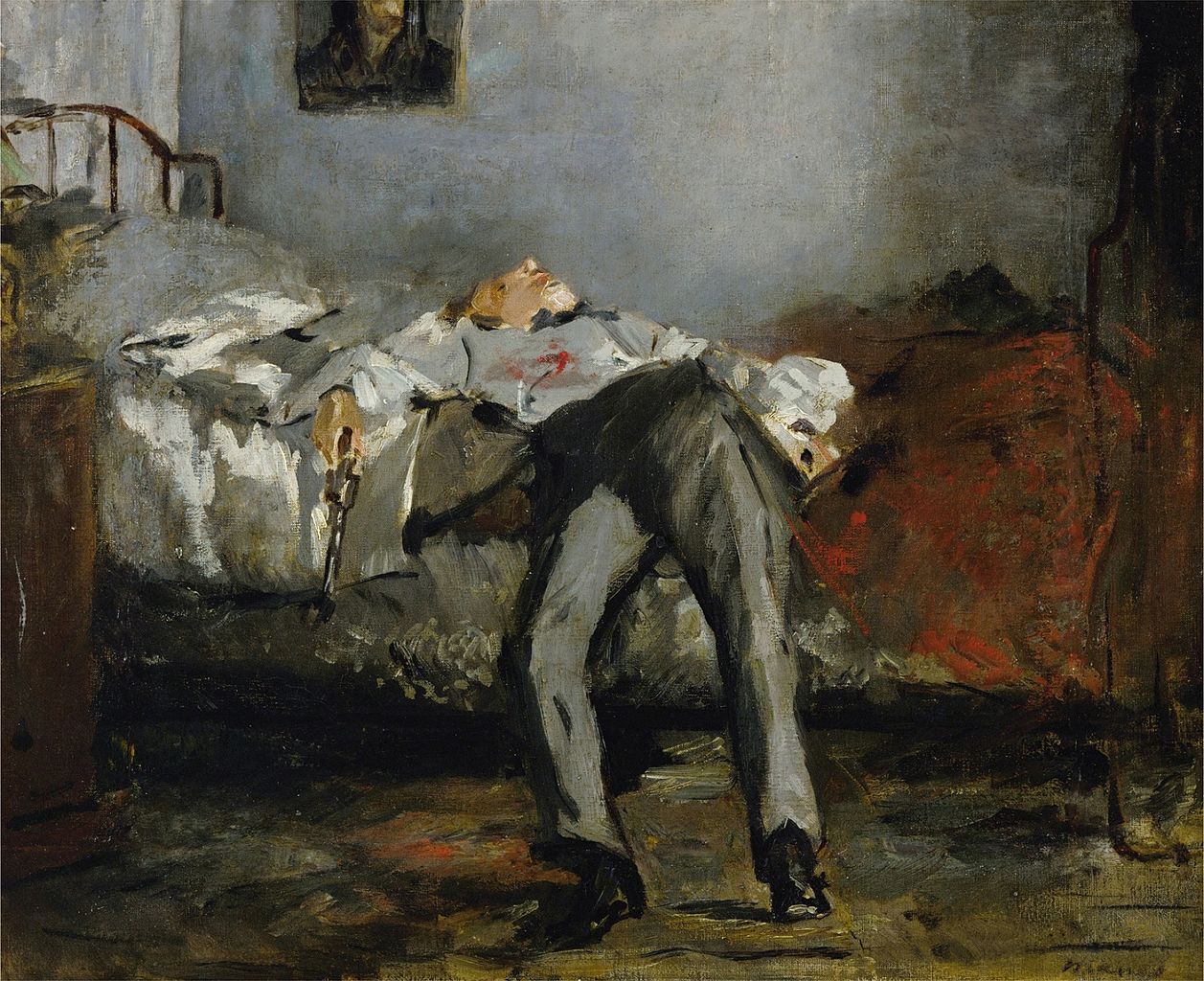
    Le Suicidé (1877), Édouard Manet | Wikimedia Commons. For me, nothing proclaims the ascendancy of the reign of death like suicide, especially in our modern era when atheism and disbelief in God compound the sin unimaginably. The great flaw in the thinking that leads to suicide is that there is no redemption, no God who can wipe away stain or guilt. In short: a complete lack of hope, which must be like living with that veil of death drawn so tightly around oneself.

    Finally, today’s prophecy by Isaiah tells that the world will recognize God as the bringer of the feast and conqueror of death. Humanity shall say, “Behold our God, to whom we looked to save us! This is the LORD for whom we looked; let us rejoice and be glad that he has saved us!” This recognition is important because God is calling us to a relationship but also gives us the free will to either refuse or answer the call. Isaiah’s prophetic vision reveals those who are present at the feast, who have the veil lifted as death is defeated. These people give God his due credit and rejoice in Him; they have answered his call to a relationship with him. Importantly, they recognize that His action is a saving action – one that saves them from the reign of death.

    Now, let’s turn to today’s gospel and see each of these three aspects of Isaiah’s prophecy in this single episode of Jesus feeding the four thousand (plus women and children!). First, the feast: this is the famous miracle of the loaves and fishes. Signaling the abundance, the richness of the feast, is the fact that after all were satisfied, “They picked up the fragments left over – seven baskets full.” Such unheard-of largess appearing without delivery carts and many villages’ worth of bakers and fishermen has only one author: God Himself. More: these people knew the writings of Isaiah, “On this mountain the LORD of hosts will provide for all peoples…” Here, with them and for them, the Reign of God was beginning – God in the form of the Messiah was here.

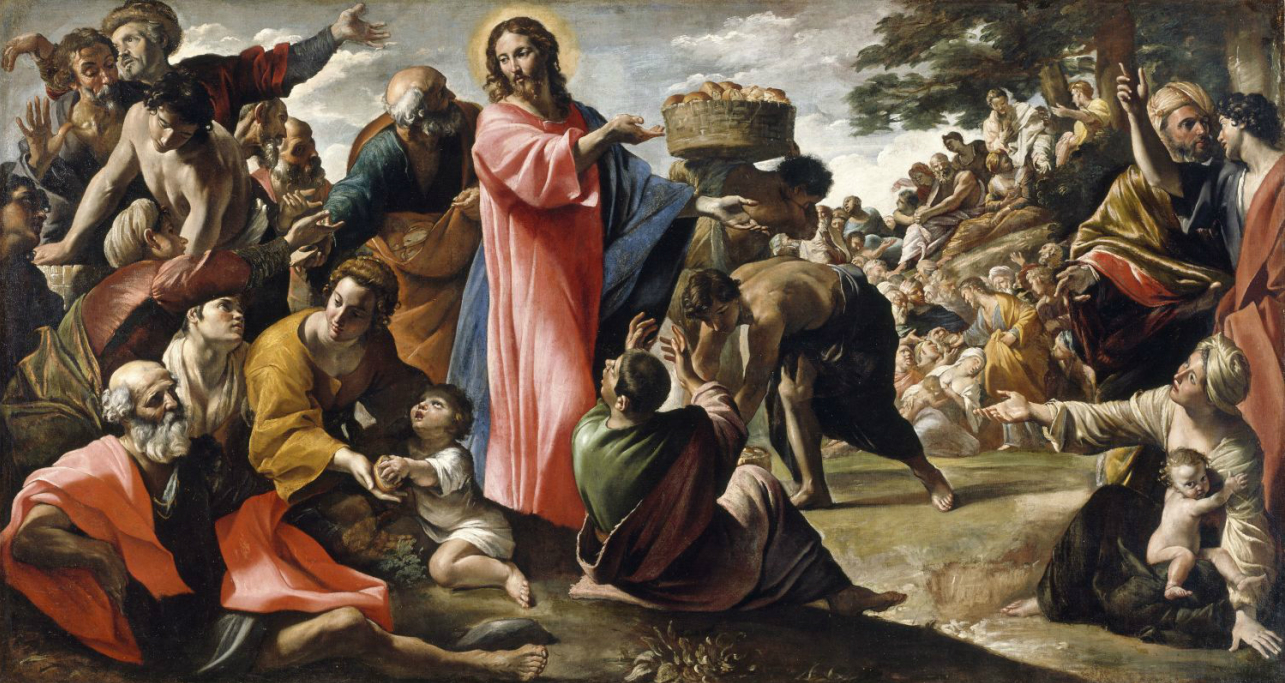
    Miracle of the Bread and Fish (1620-1623), Giovanni Lanfranco | Wikimedia Commons. I appreciate Lanfranco’s Baroque period portrayal of the serene, haloed Christ in the posture of giving in the midst of the writhing masses. Yes, the elaborate body positions were likely done to show off a certain painterly prowess for anatomy and beauty of the human form, but the effect is one that recognizes the fallenness/messiness of the world and portrays with true eyes the Messianic, generous substance of Christ.

    Second is the removal of the veil of death. Remember that the crowd had gathered because they had heard Jesus was a great teacher and healer – they came seeking Him. This is the essential ingredient for those who will be present at the eternal feast: that they answer God’s call. “Great crowds came to him, having with them the lame, the blind, the deformed, the mute, and many others. They placed them at his feet, and he cured them.” These people are in the grip of death in one form or another, not just physical death but spiritual death. Jesus often shows us that healing physical blindness in fact heals a deeper, underlying spiritual blindness. As mentioned earlier, death reigns not just physically, but spiritually. The Christ Event in history is the beginning of the Reign of Christ – death’s reign is clearly defeated in these miracles and the veil of sin, Satan, and death is lifted from these people. 

    Third is the recognition of God as the Savior. This, too, is pointed out by St. Matthew: “The crowds were amazed when they saw the mute speaking, the deformed made whole, the lame walking, and the blind able to see, and they glorified the God of Israel.” But giving thanks to God for being healed is a bit different from looking at the one who healed you and thanking him, personally, as God incarnate. And this is the aspect of Isaiah’s prophecy that is played out throughout the gospels and even to this day. As we investigated yesterday, the fantastic vision of Christ granted to Isaiah 700 years before Jesus was born was truly a glimpse into the time-defying kairos event that is God puncturing human history and coming at the end of time, swirled into one ecstatic vision. If we try to inhabit this vision, we can see that we are living within this prophecy, where the feast is available to us, death’s reign can be lifted from us, and we must strive to recognize God in the person of Christ, just like the people described in the gospels.

    The three touchstones Isaiah shares today, the feast, the removal of the veil of death, and the recognition of God as Savior, are at the heart of the Christ Event and all of our symbols and actions that emanate from it. The feast was celebrated throughout his ministry in every miraculous outpouring of sustenance and richness – wedding at Cana, feeding of the four thousand, and most clearly in the Last Supper – and it is this last example that instituted the ongoing feast of the Holy Eucharist that we continue to celebrate day after day in this contemporary moment within the Reign of Christ. The removal of the veil of death, specifically spiritual death, happens in our sacraments, notably in baptism, and integral to each of the other sacraments as we are drawn deeper and deeper into full communion with God. Over the course of our lifetimes as Catholics, we participate in the removal of this veil of death that ensnares and blinds us – it is our journey of faith. So we can see how the first two touchstones happened in Jesus’s life events and also happen our own. But this last one, our participatory acceptance and recognition of God in the form of Christ our Savior, is the one we must step up and bring to God all on our own. We pray that all are able to do this at some point before their physical bodies die. This great drama of recognizing Christ as God was brought to the forefront by Christ Himself: “Who do you say I am?” (Mat 16:15, Mk 8:29, and Lk 9:20). He asks each of us this same question. The Apostles realized that this was their great duty: to evangelize, that is, bring this good news of the Christ Event to people across the globe. Pope Benedict XVI identifies that this evangelical activity is part of the ongoing lifting of the veil of death: “But the preaching of God’s Kingdom is never just words, never just instruction. It is an event, just as Jesus himself is an event, God’s Word in person … Because the world is ruled by the powers of evil, this preaching is at the same time a struggle with those powers” (Jesus of Nazareth, 173).

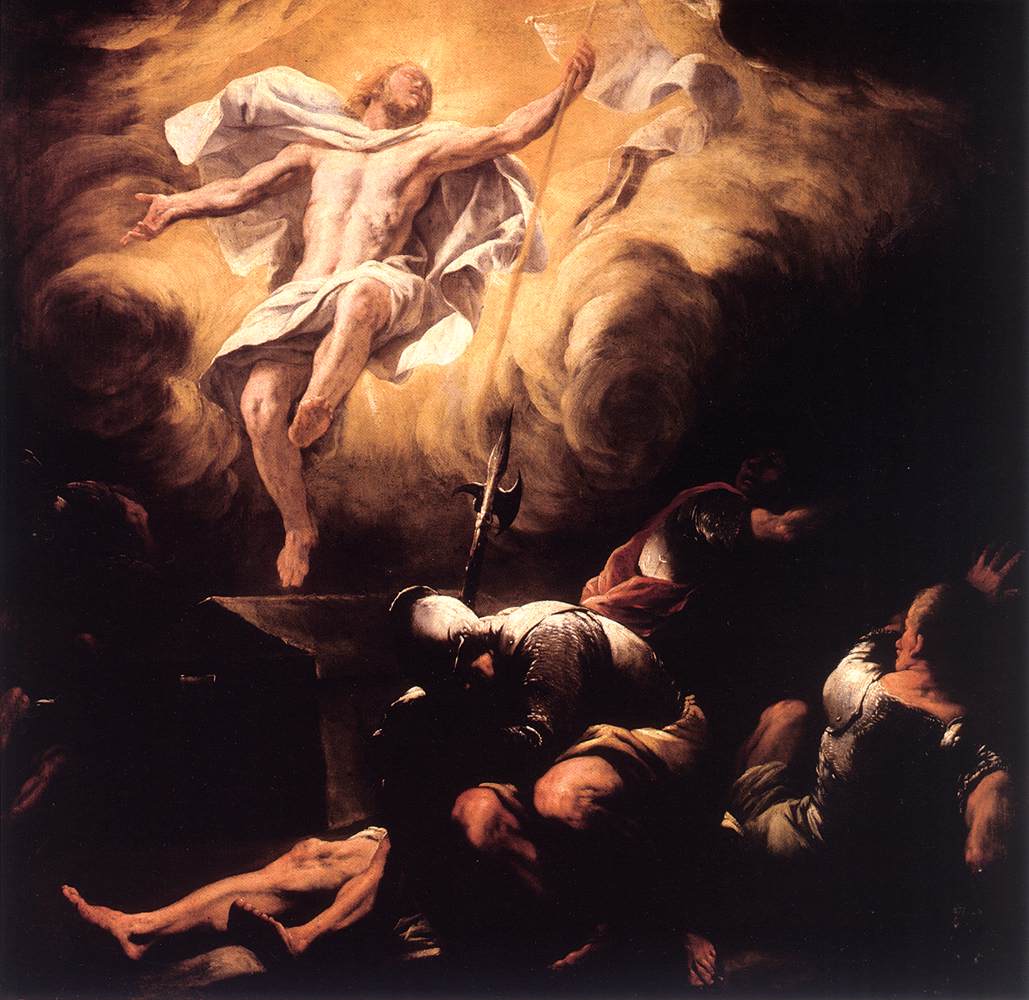
    The Resurrection (after 1655), Luca Giordano | Wikimedia Commons.

    Don’t let anyone tell you that all major religions are the same; we have a very particular core to our faith, and it is Jesus Christ, the man and God incarnate. Pope Benedict XVI, like Pope Saint John Paul II before him, writes that everything in our faith tradition and practice must be understood through a Christocentric lens. Everything about our salvation as well as the signs, symbols and language of our religion is fundamentally about Christ being God. It’s not about being morally good or doing good deeds or praying a certain way (although those things matter, especially when seen as ways of being united with our Savior). How can the popes insist on this (and not just them – think of so many saints and doctors of the Church, St. Augustine to name just one)? Well, it starts perhaps most plainly with Christ Himself, especially as revealed through the gospel of St. John: “for you will die in your sins unless you believe that I am he” (Jn 8:24). Jesus is adamant that He is the path to the Father, to salvation, to the end of the reign of death. Why might faith in Jesus Christ as the Son of God and Savior be so important for eternal salvation? I can think of several reasons, but here are two that jump most quickly to mind. First, denying that Christ is the Son of God (when He is one of three Persons of God) is, in fact, denying God (being atheist, that is). Second, the Christ Event – and only the Christ Event – is the exact action of God in the world that ushers in our salvation. This means that only Christ is the vector God provides for us to unite with Him. 

    And perhaps a third, more human reason that this specific faith in Christ as God is necessary: Jesus reveals aspects of God in a way that no one or nothing else in creation can. Jesus Christ reveals to us ways that we are made in the image of God (we are agents of truth and light as He is) and that humanity is precious to God in a special way. As we dwell on the Word of God, as uttered by the Word of God made incarnate, we learn about Him as well as the great potential within all of us. Jesus Christ becomes our “key” to knowing God and to knowing ourselves.

    Today’s gospel reading, for instance, stands out to me not just because of the amazing parallels with Isaiah’s prophecy and these three touchstones of our faith. It stands out because of what Jesus says: “My heart is moved with pity for the crowd, for they have been with me now for three days and have nothing to eat. I do not want to send them away hungry, for fear they may collapse on the way.” Matthew takes 5 lines to describe Jesus’s great compassion here, and just 2 to describe the miracle itself. This is where we find the reality of Christ – in His love and compassion. After healing hundreds, if not thousands, of people on the mountain by the Sea of Galilee, surely He would be exhausted by the sheer weight of it all. But, as God, He shows us that God never tires of compassion. He teaches us how to find that compassion in ourselves. Even after delivering them from the grip of death through His healing, His saving acts do not end. He knows their hunger and, more importantly, this hunger moves him to compassion. It never fails to amaze that our God is a God who is moved to compassion for us. This is no distant God! So, He feeds them, as only God can. Here is the same God accomplishing the same act He did for His Chosen People after freeing them from slavery in Egypt and feeding them manna in the desert. Only now our God walks among us, speaks plainly for us, and ultimately sunders the divide between our fallen earth and heaven.

    The Miracle of the Five Loaves and Two Fish (contemporary), Grace Carol Bomer | Image from gracecarolbomer.com.

    Thank God for His compassion! Because this Advent is about anticipating the culmination of the Christ Event, and we will certainly all need compassion, understanding, and forgiveness on the Day of Judgment.

  • Glimpsed by Prophets

    Tuesday in the 1st Week of Advent: Isaiah 11:1-10, Luke 10:21-24.

    Imagine what it must have been to be a true prophet! Someone like Isaiah, Joel, or Jeremiah – given glimpses of God’s will and the heavenly kingdom. Today we hear an important prophecy of Advent: Isaiah sees Jesus, sprung from the “root of Jesse,” describing him and the world he ushers in. It’s remarkable, especially in light of yesterday’s reflection, because Isaiah describes both the Jesus Christ who comes to the Apostles in the flesh and the Jesus Christ who is the bringer of the Reign of God and end times. As we reflected, this is the same Christ, the same moment of kairos that we anticipate during Advent. Let’s dive into this moment with one of our great prophets, Isaiah, for we, too, participate in the prophetic announcement he makes.

    Just as we mark Advent as a time of paring down and preparation, Isaiah foresees that God’s people will be winnowed and devastated before the root of Jesse blossoms. In the chapter prior to today’s reading, Isaiah speaks of God’s wrath at his “godless nation,” those “who make iniquitous decrees, who write oppressive statutes, to turn aside the needy from justice and to rob the poor of my people of their right” (Is 10:1-2a). Isaiah tells them that God uses the Assyrians as “the rod of my anger,” and describes the penance of the Jewish nation as the cutting down of a forest. “Look, the Sovereign, the Lord of hosts, will lop the boughs with terrifying power; the tallest trees will be cut down, and the lofty will be brought low” (Is 10:33). This is truly a penance for sins committed against God, and we can connect our penitential season to this ages-old story among God’s people. Isaiah writes of the completeness of the humbling: “The remnant of the trees of his forest will be so few that a child can write them down” (Is 10:19). This is important! We so rarely take seriously the need for things like fasting, prayer, almsgiving, and humility before our God, but it is emphasized continually in our scriptures. From Abraham taking his son to an altar to Esther, in sackcloth, praying to God for three days to Jesus himself, stripped and beaten and hung on a cross (penance for our sins, not his), we are reminded that penance and supplication are necessary precursors to deliverance. We must ask ourselves how we are participating in penance and preparation this Advent.

    Upon this backdrop of a devastated forest, Isaiah foresees a shoot springing from the root of Jesse “and from his roots a bud shall blossom.” This new growth comes from old and revered rootstock: Jesse, grandson of Ruth and Boaz, was from the tribe of Judah and his youngest son was David. Yes, the greatest king of the Israelites sprung from Jesse, but more importantly, many generations later that line of David produces Joseph, Jesus’s father. Genealogy is important in our Judeo-Christian tradition because it shows how God remains true to His People over time and why the passing down of God’s revelation through families is so important.

    O Root (c. 2010), Sr. Ansgar Holmberg, CSJ, of the Sisters of St. Joseph of Carondelet | Image from thejesusquestion.org.

    I find Isaiah’s vision so striking because he is able to perceive the action of the Trinity. “The Spirit of the LORD shall rest upon him: a Spirit of wisdom and of understanding, A Spirit of counsel and of strength, a Spirit of knowledge and of fear of the LORD, and his delight shall be the fear of the LORD.” We’ve all seen people who stand out from others, who have a light in them, who say or do something that seems divinely inspired, even if just for a moment. Imagine what Isaiah sees in Jesus, who is the Son of God, with the Spirit of the Lord indeed resting upon him, instilled in his very being, giving him wisdom, understanding, counsel, strength, and, reciprocally, such a sense of thanks and fealty to his Father that he delights in the fear of the Lord. Great mysteries of the Trinity are revealed to Isaiah in this moment, and he sees the interweaving love of the Three Persons.

    After this vision of the Trinity in Christ, Isaiah shares with us a vision of his righteous works: “Not by appearance shall he judge, nor by hearsay shall he decide, But he shall judge the poor with justice, and decide aright for the land’s afflicted.” Here we have a clear statement about how the righteous man (the Messiah, in fact) operates in terms of social justice: a preference for the poor and afflicted, without bias based on appearances. This is echoed in the book of Samuel, which relates how God guided him to choose the next king (David) from among Jesse’s sons: “the Lord said to Samuel [about the oldest son, Eliab], ‘Do not look on his appearance or on the height of his stature, because I have rejected him; for the Lord does not see as mortals see; they look on the outward appearance, but the Lord looks on the heart’” (1 Sam 16:7). God reveals to both prophets, Isaiah and Samuel, how his sight works (it peers into the unseen heart of humans) and how justice should flow from this type of God-bestowed sight and wisdom. It is worth re-reading the chronicles of David in the book of Samuel; we see parallels with Christ and how the Spirit of God dwelt with his Chosen People – specifically in the line of Jesse – in so many eras.

    But wait, you might say, perhaps Isaiah is just talking about David in this passage? Let’s get our historical timelines in order. King David made Jerusalem the capital of the united Jewish nation right around 1000 BC. Isaiah didn’t proclaim his prophecies until almost 300 years later, around 740-700 BC! He couldn’t have been talking about David because David was long dead; the kingdom had split between Judah and Israel and was about to be destroyed by the Assyrian empire. The blossoming bud from the root of Jesse is someone farther down the line from David. Isaiah the prophet sees Christ the Messiah, and although he doesn’t know his name, he describes him and the world he ushers in.

    Isaiah delivers his prophecy with some beautiful poetry: “with the breath of his lips he shall slay the wicked. Justice shall be the band around his waist, and faithfulness a belt upon his hips.” Indeed, as the incarnate Word of God, Jesus’s every word accuses and condemns wickedness. He is wrapped in justice, and will deliver it in the final judgment, and as for faithfulness, his very incarnation is the manifestation of God’s faithfulness to humanity. Only poetry can strive for the wonder and sheer beauty of this perfect Messiah that Isaiah glimpses in his prophetic vision.

    And then Isaiah’s prophecy changes from describing Christ to describing the world that Christ ushers in: “Then the wolf shall be a guest of the lamb, and the leopard shall lie down with the kid; The calf and the young lion shall browse together, with a little child to guide them.” These scenes are certainly miraculous, and, importantly, they describe a world where the needs and desires of the flesh are gone. In their place, peace reigns. The fallenness of our world is no more, in fact the very “rules” under which we think the world operates are confounded. We see nothing of the instinct of hunting creatures or the incompatibility of vulnerability and ingrained predation. Isaiah shows us a deeper reality in creation where all beings share a peaceful spirit. 

    The Peaceable Kingdom, woodcut (1950), Fritz Eichenberg, for The Catholic Worker | Image from michaelanthonyhoward.com.

    This scene culminates in the most frightening scene for a parent: “The baby shall play by the cobra’s den, and the child lay his hand on the adder’s lair. There shall be no harm or ruin on all my holy mountain; for the earth shall be filled with knowledge of the LORD, as water covers the sea.” And here, in the place where our human instinct to protect our young from danger merges with the from-the-gut animal instincts we see confounded in the preceding verses, we start to understand that a greater parent provides such powerful love that it conquers animal instinct itself. The Father does not permit “harm or ruin” because His essence infuses all of creation “as water covers the sea.” He perfects creation and removes all violence and conflict, simply through His being. This is the power of God and our ultimate destiny.

    How seamlessly Isaiah sees the humanity of Jesus as the bud from the root of Jesse as well as His divinity as the Incarnate Word as well as His kingdom, established in and with the Father’s love that transforms humanity. What Isaiah glimpses is no less than the complete mystery of the Son of God, in his kairos moment of incarnation, life, death, resurrection, and final judgment. This is properly called the Christ Event that descends upon the world and ruptures history like nothing before or after. What an ecstatic vision for Isaiah! How could he even take it in and utter it without the grace of God? 

    Importantly, this is the very vision we celebrate in Advent. We await the coming not just of the babe but the Christ Event, even while we exist within the reign he began with his sacrifice and resurrection. We exist now within a thread of historical time that is superseded by and subsumed within the great Christ Event that is ongoing.

    Turning our attention to today’s gospel from St. Luke, we must have Isaiah’s prophecy in mind. Recall that Isaiah’s first words about this bud from the stump of Jesse are: “The Spirit of the LORD shall rest upon him: a Spirit of wisdom and of understanding.” And how does the gospel start? “Jesus rejoiced in the Holy Spirit.” This is what Isaiah foresees! He glimpsed this and, through Isaiah, the Lord gave us the promise of Christ, who comes with the Spirit of the Lord resting upon him. The gifts of the Spirit are wisdom, understanding, counsel, strength, and knowledge and fear of the Lord. Jesus shares the wisdom and respect for the Lord that the Spirit gives him: “I give you praise, Father, Lord of heaven and earth, for although you have hidden these things from the wise and the learned you have revealed them to the childlike.” This is not the only time in the gospels that Jesus speaks of the blessedness of being childlike. What He means is the openness and naïve trust with which children typically encounter the world. Jesus’s own openness to and trust in His Father have resulted in God’s grace and gifts of the Spirit.

    The knowledge that is given to Christ is, in part, the reciprocal nature of His own membership in the Trinity: “All things have been handed over to me by my Father. No one knows who the Son is except the Father, and who the Father is except the Son and anyone to whom the Son wishes to reveal him.” Far from being a prideful or arrogant claim (as the Chief Priests, scribes, and Pharisees might suggest), Christ is trying to share as plainly and truthfully as possible the nature of our Trinitarian God. He is unfolding the mysteries of our faith; mysteries, we must remember, that are integral to our salvation because these mysteries transform and perfect the Jewish tradition into Christianity. Everything must become Christocentric in order for his sacrifice to his Father to make sense to us, so that we can rightfully conform ourselves to the perfect human teacher bestowed upon us, who continues to grace us in the sacraments and throughout our lives.

    The Holy Trinity I (La Santisima Trinidad I), contemporary, Candelario Cervantez | Image from fineartamerica.com.

    The import of His revelation is underscored in the final verses from today’s reading: “Turning to the disciples in private he said, ‘Blessed are the eyes that see what you see. For I say to you, many prophets and kings desired to see what you see, but did not see it, and to hear what you hear, but did not hear it.’” There is a profound humility in Christ speaking about this moment in this way. He speaks deferentially to the Spirit and the Father, ascribing to the Father alone the timing and method of revealing His instrument of salvation to the world. Jesus Christ is truly remarkable for me in this moment: when the rest of us would be understandably puffed up with importance to be graced by the Spirit and to find out that we are the gatekeepers for humanity’s salvation, Christ instead offers a gracious and deferential comment to His Apostles. Blessed are you, He confirms. Not “I am one with God! Bow down and kiss my feet!” No, quite the opposite: it’s “how blessed you are to be hearing and seeing God’s unfolding revelation in the Christ Event.” (And, soon he’ll be washing their feet.) If we want an example of how base human nature is transformed by God against every fleshly instinct, here it is. “The baby shall play by the cobra’s den … and there shall be no harm or ruin.” And here our childlike Jesus Christ realizes His Kingship without succumbing to pride or power. 

    What can we do with such humility?? It seems like I can’t even breathe without thinking of myself. In moments when I read the scriptures and re-discover His perfection, I feel like I can never abase myself enough to be worthy of my Savior. It’s good that it’s Advent. I need time to contemplate my Lord, to remember who this man and God is, to remember that my understanding of the world is circumscribed by silly laws and rules that really have nothing to do with the kingdom God holds for us. The fact that Christ turns to His Apostles in this gospel moment – apostles who were flawed humans just like us – is our sign that He loves us as much as He loves His Father. It reminds me that God’s infinite love and forgiveness is the matrix that will transform all of creation, that it’s not about me, really, and the more I can remember that, perhaps the closer I can be to the Spirit of our Lord.


  • The Church’s Mission Statement

    Monday in the 1st Week of Advent: Romans 10:9-18, Matthew 4:18-22.

    What an interesting start to Advent! Yesterday, Christ admonished us, “Be watchful! Be alert! You do not know when the time will come.” This should be a familiar refrain, a reminder that Advent is a time of waiting for both the Incarnation of Christ and the Final Judgment. This vigilance will be marked by prayer and anticipation until we celebrate the Birth of our Lord. But what do we get today, the second day of Advent and the Feast of St. Andrew the Apostle? We receive a concise exposition on eternal salvation being realized and the mission of the Church herself. This may seem incongruous with the initial message of waiting and vigil, but I think the Church, in her wisdom, places these readings and this feast at the beginning of Advent for a reason. Today, we acknowledge that the Christ Event has changed the world irrevocably and, although Advent commemorates and celebrates a time of waiting, we cannot “pretend” that the keys to the kingdom are not yet here. Christ has already brought the end times, and our active work as the Church is happening even as our liturgical calendar revolves in memorials and feasts.

    Icon of Christ, King of Kings (Greece, c.1600) | Wikimedia Commons.

    Let’s unpack today’s startlingly concise mission statement for the Church, brought to us by St. Paul. He writes to the early Christian Church in Rome: “If you confess with your mouth that Jesus is Lord and believe in your heart that God raised him from the dead, you will be saved.” While this seems simple (almost too simple!), it belies a depth of personal commitment that we might not notice at first. I’d like to take a small detour here into the issue of a person’s good works and faith and how these impact one’s salvation. The second part of Paul’s sentence quoted above, that is, “faith provides salvation,” has been surgically taken out of St. Paul’s overall corpus of writings to justify misunderstandings and heresies since the Apostolic Age. The Gnostics (many different sects) spread beliefs along the lines that faith in Jesus and other spiritual gifts were separate and more important than acts of the world and the body. This separation is dangerous because it erodes the connection between faith in Christ and moral acts here in this world. This heresy was taken up by Martin Luther and John Calvin in the 1500s, and sadly the foundation of the Protestant churches is a misunderstanding of this passage, that if you have faith alone (“belief in your heart”) in the mystery of Christ’s death Resurrection, you will be saved.

    This statement is taken out of the context of St. Paul’s full writings. We must understand that for St. Paul, “believing in your heart” the mysteries of the Christ event is a transformative thing – a person not only thinks differently, but a person also acts, speaks, and worships differently. He writes clearly to the Galatians: “the faith that finds its expression in love is all that matters” (Gal 5:6b, emphasis mine). He also tells the Corinthians: “I may have utter faith, so that I can move mountains; yet if I lack charity [do not have love], I count for nothing” (1 Cor 13:2b). Clearly, he is not telling the Romans that faith without works is salvation. For Paul, and for all Christians, faith is inextricably linked to charity, love, and good works. This is because the particular faith we have is in God who becomes man to show us that love, peace, and charity are more important than power and worldly knowledge. When we have faith in Him, we seek to embody His teachings and His example. His greatest commandment, to love God first with our whole being and then our neighbor as ourselves, unites this lesson that faith cannot be separated from moral actions here on earth.

    But this post isn’t about Catholicism vs. Protestantism. St. Paul tells us in today’s first reading that two things, faith in the Resurrection and confessing that Jesus is Lord, bring us salvation. We’ve explored how “faith in the Resurrection” is a kernel of wisdom that means faith in all of the mysteries contained in the Christ event exploding upon human history, and allowing that faith to change us, to transform us in the image of our Lord. The second bit flows from this transformation: we Christians do not sit silently in our faith. We are not lamps hidden under the bushel basket. We are called to be evangelists in our work and in our mouths. We must proclaim to everyone who will hear.

    And here we have, in a nutshell, what the Church is all about. We don’t hoard salvation to ourselves. We are not a secretive society of the select (again, Gnostic heresy). The Church is always “two or more gathered in my name” – always plural people, not a singular person. As we have faith in Christ and all that He revealed, we are transformed by God into something greater. This is grace, this is justification. And by the grace of God, we can begin to aspire to be like Christ, that is, to love everyone unconditionally, to see our Father in everyone and everything, and to ardently desire to save souls and bring them to our Father’s kingdom.

    The Calling of Peter and Andrew (1308-1311), Duccio di Buoninsegna | Wikimedia Commons.

    I, like many Catholics I know, am a little scarred by the televangelists of the 80s and 90s who co-opted many fine Biblical sayings, shouting the meaning out of them. It’s hard in some ways to read “confess with your mouth that Jesus is Lord” without hearing a Jerry Fallwell-like voice and thinking of intolerant American fundamentalism. But we must recover what the Apostles and Christ bestowed on the Church in our sacred scriptures. Our great saints proclaimed with their mouths the Truth of Christ and Wisdom of God long before our contemporary cult-of-personality evangelical preachers twisted these words to suit their purposes. I’m not saying that evangelicals are all wrong, but they are not representatives of the one, true, universal Catholic Church. In particular, we must reverse the notion that Christian evangelization is linked to intolerance and that not everyone is welcomed by God. As the Second Vatican Council’s document on evangelization, Ad Gentes, states: “The members of the Church are impelled to carry on such missionary activity by reason of the love with which they love God and by which they desire to share with all men the spiritual goods of both its life and the life to come” (7). In other words, what drives us is not to perfect the world in the image we think is in God’s mind (much less drive out sin like zealous crusaders), but our driving force is the same love with which we love God. We are driven by a desire to share with everyone spiritual good. Love and sharing. This is a topic for another post, but evangelism for Christians must be an invitation to know God through Jesus Christ done out of love for our fellow humans.

    The reason we have to return evangelization to its original dignity: it is the very first thing Christ promised His Apostles. Today’s gospel reading from St. Matthew tells us of the iconic calling of Peter, Andrew, John, and James. Christ says, “Come after me, and I will make you fishers of men.” This is the evangelical promise He gives them: they will catch men instead of fish; they will harvest humanity for God. Note that there is no hesitation: “At once they left their nets and followed him.” Again, with John and James: “He called them, and immediately they left their boat and their father and followed him.” The Voice of God speaks to them and they do not hesitate. But, no, more than the voice – the very Word of God in human form speaking corporally to them and beckoning them to be transformed into a new thing: a fisher of men. This irresistibility is an effect of the miracle of the Incarnation, which we anxiously await in Advent. With the gravity of a million suns, Christ walks the earth, pulling people to Him. That spiritual gravity cannot be overstated; it is God Himself taking His own incomprehensible, immeasurable being and distilling it into a baby. This tiny being will then draw humanity to himself, teach them in word and in deed what it means to love, and thereby give us the salvation that St. Paul speaks of.

    This is the Christian mystery of salvation and let’s note that God intends for us to be active participants in this plan. The Church, through the Apostles, is created to put on full display and shout from the mountaintops the glory of Christ. This action is and has always been evangelical. Furthermore, is it a coincidence that “evangelist” contains the word “angel”? No – the Greek word used in the gospels, εὐαγγελιστοῦ (euaggelistés), means “bringer of good news,” and the Greek word for angel, ἄγγελος (aggelos), means “a messenger.” Being an evangelist means participating in the same action of the angels as messengers of God. We are participating in announcing the kingdom of God just as the angels do. (NB: In a very specific way, we meet the angels here on earth. The Mass and Eucharistic celebration is the moment when the kingdom of heaven meets the action of the faithful on the earth and we celebrate with the angels the mysteries of our faith and gift of Christ as food for us.) In other words, God has invited us to his heavenly feast here and now, recognizing and blessing our souls as holy like the angels, and inviting us to carry out the same work as the angels. 

    Cutting from an Italian choir book (Lombardy) – Historiated initial ‘D’ of the Calling of Peter and Andrew (c. 1475-1500) | Image Courtesy the British Library Catalogue of Illuminated Manuscripts.


    Let’s return to the opening thought: what a fascinating start to Advent. Advent brings together two events that historically seem very far apart: Christ’s birth to Mary and Christ’s return at the end of time. But today’s reading shows us that these two events are in fact united (in kairos time), that the inexpressible mystery of God coming to humanity cannot be contained in a historical figure. Christ will always be more than just the historical figure who the Apostles met on the shore of Galilee. As God, he transcends time and mortality – he existed before time and outside of history (hence the misguided attempts to “know” Jesus Christ simply through a historical lens). So when He is made incarnate, human history is ruptured and ripped from a linear trajectory. The center of the universe isn’t the sun or a terrestrial body but the Body of Christ, which rises and takes its rightful place in the heavenly realm. We now orbit this spiritual truth that carries us through our lives with a centrifugal force much different than the passing of the earth around the sun and the march of time. The liturgical calendar attempts to reflect this new ordering of our lives, and Advent is a season where we approach the unification with God from both sides: as those waiting for the babe and those waiting for the judgment and final unity. But the same reality is achieved in both events: God offers us real, corporeal salvation. In one, that salvation is the form of the Savior, in whom our faith and actions carry us through this life while we await the second, in the form of that same Savior, carrying out his same saving action.

    This is how the Catechism can claim “To fulfill the Father’s will, Christ ushered in the Kingdom of heaven on earth. The Church ‘is the Reign of Christ already present in mystery’” (CCC, 763). At the same time, it teaches “Though already present in his Church, Christ’s reign is nevertheless yet to be fulfilled ‘with power and great glory’ by the King’s return to earth” (CCC, 671). The Church that Christ established is brought into clear focus, started the calling of the Apostles to become fishers of men and bringers of Good News, and continuing with us in prayer, action, and spirit.

    Finally, we can look back at the first reading from St. Paul and understand the fullness of his words. When he writes, “one confesses with the mouth and so is saved,” we can see that this evangelical act is the sharing of love that the Church was established to accomplish. We can see that our confession of Jesus Christ as Lord – as an act meant to lovingly draw people to the truth – is what makes us part of the Church, “the Reign of Christ already present in mystery.” Of course we are saved in this moment! We are fully participating in God’s plan, in the universal Church, in the Reign of Christ.

  • For What are we Waiting?

    Sunday in the 1st Week of Advent: Isaiah 63:16b-17, 19b; 64:2-7, 1 Corinthians 1:3-9, Mark 13:33-37.

    We are reminded at the beginning of Advent that we are entering a liturgical season of special significance: one where we pare back distractions and excesses as we wait for the birth of Christ. These short days and long nights of winter are supposed to be marked by prayer, almsgiving, and acts of penance. All of this while we wait for a blessed event, often cast in a heartwarming holiday glow. But the Church is clear that this is not all that we await. Christ Himself tells us in today’s gospel reading that we are also awaiting Judgment Day and our final union with God. How many of us put this awful and awesome vision in our sights as we putter about during these 4 weeks before Christmas? It’s a reminder of what a Christian should be doing: embracing this life while achingly desiring the next life. 

    For me, today’s readings ask me to consider what exactly I’m waiting for during this Advent “season of waiting.” As a child, I was waiting for that great Christmas morning of gift opening with my family. As a young adult, it was the feeling of warmth as my family gathered for the holidays; later it was the re-enactment of the “magic” of Christmas morning (and the preparations and decorations along the way) for my own children. I have to admit that on the balance my Advents haven’t been terribly spiritual. Church punctuated these years of Advents sometimes as a way to punch through the ersatz Christmas haze with moments of solemnity. Other times, Church simply heightened the anticipation for Christmas; for instance, part of the experience of Christmas Eve Mass was the relief of finally getting out of those dress clothes and into pajamas, knowing that gifts and goodies came next. I can tell myself that it’s hard to stay focused on the Christ event – that is, His coming to the world in its entirety, both as a babe and as King in judgment – when the Charlie Brown Christmas album is making me want to scamper about the house with abandon. But that’s a cop-out, and so is blaming “commercialism.” As Christians, we’re called to much, much more. Part of our journey is learning the discipline required to keep God front and center.

    Christmas Illustration 1294 – Vintage Christmas Cards – Season Greetings – Cathedral (2017), “Tuscan Afternoon” | Image from fineartamerica.com.

    There are many reasons to love the prophet Isaiah, and today’s first reading gives me another. He has such a clear understanding of God’s loving perfection and our dismal abilities to live upright lives on our own. The reading starts with a crystal clear lament over the dangers of free will: “You, LORD, are our father, our redeemer you are named forever. Why do you let us wander, O LORD, from your ways, and harden our hearts so that we fear you not?” Isaiah identifies God’s plan and permission that we have the freedom to wander from His ways and even choose to harden our hearts against Him. Isaiah asks the question that a holy man must ask: why? In other words, if you love God with all of your heart, mind, and soul, then you despise the worldly temptations that lead away from God. Wouldn’t it be better if we didn’t have those temptations or if we weren’t so easily distracted from our father and source? But God is not a tyrant; He grants us the free will to cook our own goose if we choose to.

    And cook our own goose we do! Isaiah is blunt in his assessment of how successful we’ve been with this free will of ours: “all of us have become like unclean people, all our good deeds are like polluted rags; we have all withered like leaves, and our guilt carries us away like the wind.” Two fascinating images here – the first is the uncleanliness of who we are, so much so that even what we consider to be good deeds “are like polluted rags.” I believe that what Isaiah calls pollution is the prideful belief in ourselves as authors of goodness soiling our actions. The scriptures remind us again and again that all good comes from God, not from us. When we wander from Him and do not “fear” him (i.e., revere Him as the author of all goodness), we pollute our good deeds by believing that we are creating goodness. The second image is the withering, the dying, of our souls, and the stirring image that “guilt carries us away like the wind.” Maybe because it’s autumn and I’ve been out raking leaves, but this image really touches me. Guilt, of course, requires a knowledge that what you’ve done is wrong. And as a prophet to the Chosen People, there is no room for Isaiah or his listeners to wriggle out of this one. Likewise for us, we know the revelation of our Lord Jesus Christ. We have been raised with the Good News of the gospels as our mother’s milk. Guilt should and would carry our withered husks of souls away like the wind were it not for the sacrament of Confession. Note that Isaiah also calls God “our redeemer, you are named forever,” that is, the one who rescues us from error and wipes away our sins. Before Christ, this involved rituals and sacrifices at the temple; after Christ’s great sacrifice, this entails our intentional and remorseful confession to God in the presence of a priest. Both acknowledge God’s work as redeemer.

    Study of a Spray of Dead Oak Leaves (1879), John Ruskin | Image from artfund.org.

    The hard truths about our human condition lead Isaiah to implore God with a sentiment we will hear echoed by Jesus in the gospel reading: “Would that you might meet us doing right, that we were mindful of you in our ways!” I think Isaiah answers for us what we’re really waiting for during Advent: God coming to meet us. What an interesting and theologically deep event! “Would that you might meet us doing right” means that it is God who chooses the meeting at a time and place over which we have no control. We’re used to thinking that we go to meet God when we die – that’s what we hear at every funeral, after all. But here, it seems that God is actually coming here while we’re still alive. Isaiah’s words mean that we march on in our free will existence until He comes, like children running around the house while their parents are away. Will we be going to bed at a decent hour and not eating junk food? Or will we be torturing our sister and not feeding the dog?  

    The gospel reading comes from the 13th chapter of St. Mark’s gospel. This chapter details Christ’s words towards the end of His ministry, just before His Passion, death, and Resurrection. It is almost like the Book of Revelation in miniature – He foretells the destruction of the temple, the persecution of His disciples, a “desolating sacrilege” being set up, false Messiahs, cataclysmic events in the skies, and the stars falling from heaven. This frightening series of events culminates in: “Then they will see ‘the Son of Man coming in clouds’ with great power and glory. Then he will send out the angels, and gather his elect from the four winds, from the ends of the earth to the ends of heaven” (Mk 13:26-27). This is Christ’s return for the Final Judgment when he gathers his elect, that is, those who are to be saved. This is the context for today’s reading. This is what Jesus is referring to when He says, “You do not know when the time will come.” Jesus’s words of advice for us is to be alert and watch for this final coming. He says, “Watch, therefore; you do not know when the Lord of the house is coming, … May he not come suddenly and find you sleeping.” The unspoken but obvious bit is that we want to be part of the elect, of those who are brought to heaven to live with God forever. We do this by not “sleeping” on the job, by living out a moral life according to Christ’s teachings.

    The Last Judgement (1536-1541), Michelangelo | Wikimedia Commons.

    This is one way to look at Advent, reminding ourselves to watch for the end times. In this vein, we are taught that Advent is a penitential season where we pray, give alms, and practice small acts of penance (perhaps time spent in prayer or service, perhaps small deprivations of our desires to focus us on God rather than things of this world). This is spiritual training camp. What a different perspective than “I need to get my shopping done and put lights on the house!” But this is our challenge. Yes, we can live in the now, with its joys, desires, disappointments, and victories. But we have to be constantly training for that heavenly kingdom, too. We have to find time for daily prayer and giving glory to God. Otherwise, we’re sleeping on the job.

    And God bless St. Paul for giving us the positivity and hope that we need when considering God coming to meet us. In the second reading, he reminds us that “in him you were enriched in every way, with all discourse and all knowledge, as the testimony to Christ was confirmed among you, so that you are not lacking in any spiritual gift as you wait for the revelation of our Lord Jesus Christ.” He reminds us that Christ Himself has guaranteed the spiritual gifts and enrichment to prepare us for God’s coming. All we have to do is remain faithful to His teachings and invite God to accomplish His will through us. Advent sharpens the edge on our Christian lives. In the midst of our fat, jolly, and drowsy Christmas personas, we have to also be lean, sharp, and awake.

    There is another way of looking at Advent, with less emphasis on the spiritual training camp aspect and more emphasis on the anticipation. I’d like to explore this through the play Waiting for Godot. For those familiar with Samuel Beckett’s celebrated tragicomedy, you’ll recall that it’s a play in two acts where nothing happens. Two men wait for Godot (whoever that is, although many see God in this character), but Godot never arrives. The play explores the human traits of forgetfulness, anxiety, over-intellectualizing, boredom, suffering, despair, nihilism, and absurdity. In the light of Isaiah’s reading today, it’s as if the characters are stuck in the wandering phase of free will, far from the light of Truth and purpose that is God. Their sometimes nonsensical banter reminds me of “polluted rags” and “withered leaves” blowing in the wind. It is possible to experience this play as a poignant truth-telling of the modern condition. While true, how sad it is! Theirs is a waiting with no real purpose, to the effect that the audience is convinced that they’d be better off not waiting at all and getting on with their lives. And this is the great sin described by the play and the worst temptation of our existence: to convince ourselves that we need not wait because no one is coming.

    Waiting for Godot, text by Samuel Beckett, staging by Otomar Krejca. Avignon Festival, 1978. Rufus (Estragon) and Georges Wilson (Vladimir) / photographs by Fernand Michaud | Wikimedia Commons.


    But the more fundamental error of the characters (if we read the play through a Christian lens) is that they do not know Godot, the one for whom they are waiting. Take this exchange, for example:

    POZZO: (peremptory). Who is Godot?
    ESTRAGON: Godot?
    POZZO: You took me for Godot.
    VLADIMIR: Oh no, Sir, not for an instant, Sir.
    POZZO: Who is he?
    VLADIMIR: Oh he’s a . . . he’s a kind of acquaintance.
    ESTRAGON: Nothing of the kind, we hardly know him.
    VLADIMIR: True . . . we don’t know him very well . . . but all the same . . .
    ESTRAGON: Personally, I wouldn’t even know him if I saw him.
    POZZO: You took me for him.
    ESTRAGON: (recoiling before Pozzo). That’s to say . . . you understand . . . the dusk . . . the strain . . . waiting . . . I confess . . . I imagined . . . for a second . . .
    POZZO: Waiting? So you were waiting for him?
    VLADIMIR: Well you see—

    This reveals the absurdity of waiting for someone you don’t know, yet having the meeting be important. Such a meeting creates only anxiety and questioning. This is not the type of waiting that we are called to in Advent. The concept was explained beautifully to us today by Fr. Gabriel, OP, at St. Catherine of Siena Newman Center this morning. He spoke of his childhood, when he and his brother got ready for the annual visit of their aunt, uncle and cousin. They would lay out all of their cousin’s favorite games and get everything ready so that the moment he came in, they could jump into their loving friendship with great joy. This is the type of anticipation that we might use as an analogy for the anticipation of Advent. The key is that you can’t truly anticipate someone without knowing this person already. And this is so very true of Christ. He gave the Church His Spirit so that we can know Him intimately now – in the Eucharist and sacraments, in our communal prayer as a Church, in the love that infuses the world in so many actions by the faithful. As Fr. Gabriel said, we are not waiting for a stranger or a distant judge, but for the source of love itself, our Lord Jesus Christ.

    What great joy there is in this type of Advent anticipation! It encompasses and eclipses all of the giddy night-before-Christmas moments I’ve had with my brothers, sisters, and children. Waiting for the coming of love in the person of Christ is something that can completely overtake our beings, thrill us with the exciting anticipation of being a part of that love for ever.

    In this light, I can be less critical of the “glow of the season.” It shares, however intentionally or tangentially, in the anticipation of the coming of love. All of that holiday cheer and joy is this love already present on earth, from people knowingly or unknowingly allowing God to work through them. Consider: generosity is perhaps the virtue we most associate with the season. Generosity is the loaves and the fishes, the Passion, the Eucharist, forgiveness and absolution. Generosity and charity are palpable acts of God in the world. In Advent, we are simply called to acknowledge God in these works and work to conform our entire lives to His commandments and will. We can’t be perfect, but we can try.

    In closing, I acknowledge that part of the Advent message falls flat for most modern ears. It smacks of hard work and joyless self-flagellation. I don’t think this is the case. Advent can be joyous anticipation, but also one that recognizes that all is from God and for God. The only check on our joy must be that we don’t lose ourselves in the pleasures of this world and thoughts of ourselves – the One we wait for, the One in whom we place our joy, is Christ.