Category: Year B

  • A House for the Lord to Dwell

    A House for the Lord to Dwell

    The 4th Sunday of Advent: 2 Samuel 7:1-5, 8b-12, 14a, 16, Luke 1:26-38.

    Today we are asked to witness the scope of God’s plan through the generations as He prepares a home for Himself in humanity. Can there be a better reminder that we owe all we have to God than today’s readings? He grants a Chosen People laws to live by, prophesy to announce His plans, leaders to shepherd them, and, when they’re ready, a living home for Himself: the Virgin Mary.
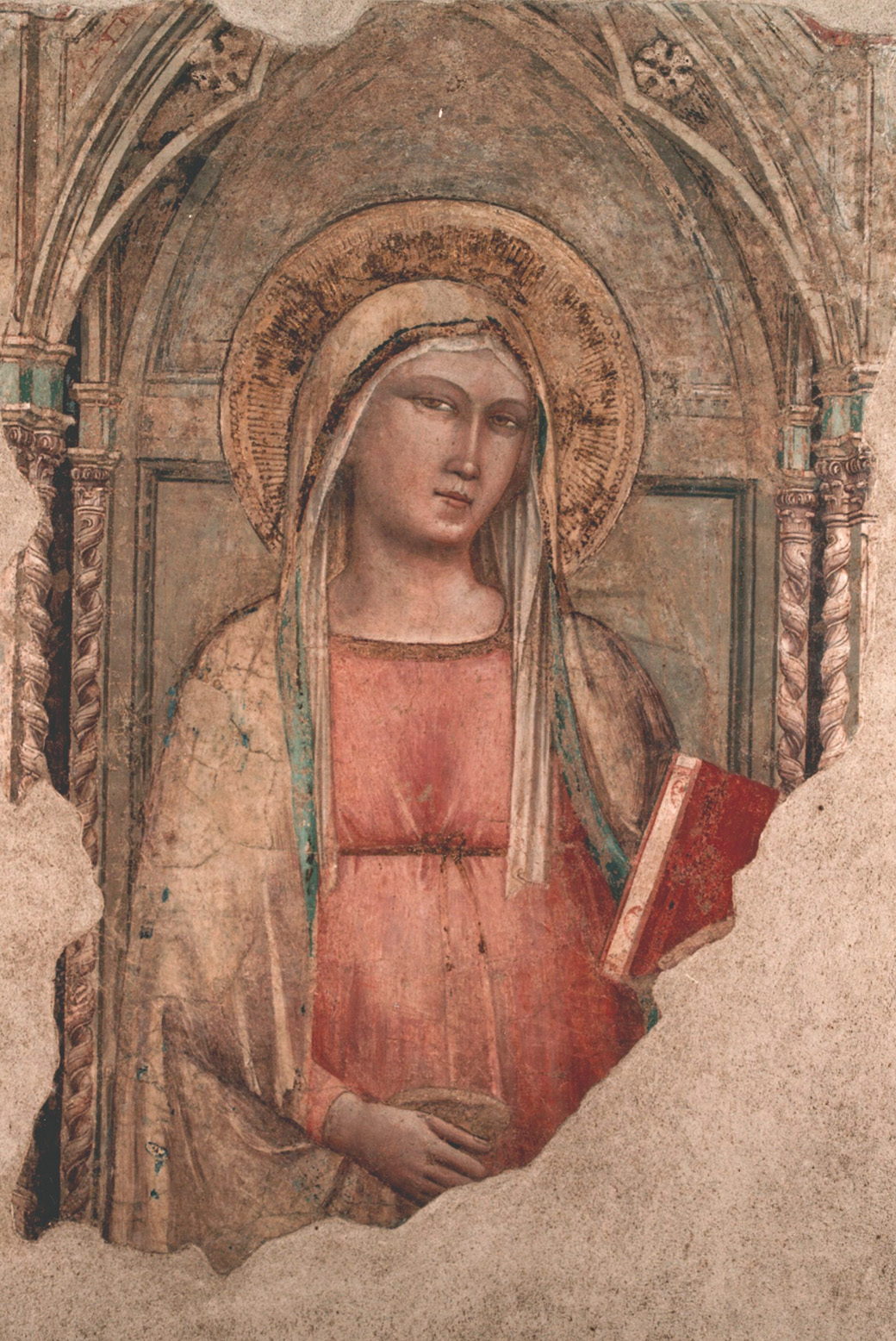
    Madonna del Parto (Our Lady of Parturition), mid-1300s, Taddeo Gaddi | Creative Commons, courtesy www.chiesadisanvito.it. The Madonna del Parto is an iconic depiction of the Virgin Mary as pregnant, usually pointing to or cradling her belly.

    I’ve always considered King David’s desire to build God a house a very reasonable and respectful one. As he concisely puts it in today’s reading, “Here I am living in a house of cedar, while the ark of God dwells in a tent!” At some point, many of us have a moment when we count our blessings and wonder if we’ve been thankful enough to God. David was pretty respectful throughout his life, but this seems like one of those moments. I can imagine him sitting on his throne in a splendid new palace in Jerusalem, surveying the finery and feeling a cold ripple of guilt ripple from his scalp down to his tailbone. We read that he was King in Hebron for 7 years before taking back Jerusalem from the Jebusites, setting up there, and calling it the City of David. He reigned there for 33 years, and “In Jerusalem, after he came from Hebron, David took more concubines and wives; and more sons and daughters were born to David” (2 Sam 5:13). But then he has this moment, something is nagging him, God seems to be calling to him. In his kingly surety, he takes 30,000 men in a festive atmosphere to go get the Ark of the Covenant where it had been housed for 20 years (the house of Abinadab) about 7 miles west of Jerusalem. David’s ecstatic: he’s purchased a new cart for the ark and they’re leading it away in great rejoicing, “David and all the house of Israel were dancing before the Lord with all their might, with songs and lyres and harps and tambourines and castanets and cymbals” (2 Sam 6:5). Personally, I love the translation of “dancing with all their might” — it conjures quite a picture! 

    But something goes wrong. They only make it partway back because as they pass through a threshing floor, the oxen make the cart sway and Uzziah (Abinadab’s son who was helping transfer the ark) uses his hand to steady the ark — touching the Ark of the Covenant is strictly forbidden — and he drops dead instantly. “David was afraid of the Lord that day” (2 Sam 6:9), and abandons his great plan, leaving the ark at the “house of Obed-edom.” The great king, who gathered his great throng of people for this royal procession was mortified, upset, and even a bit angry.
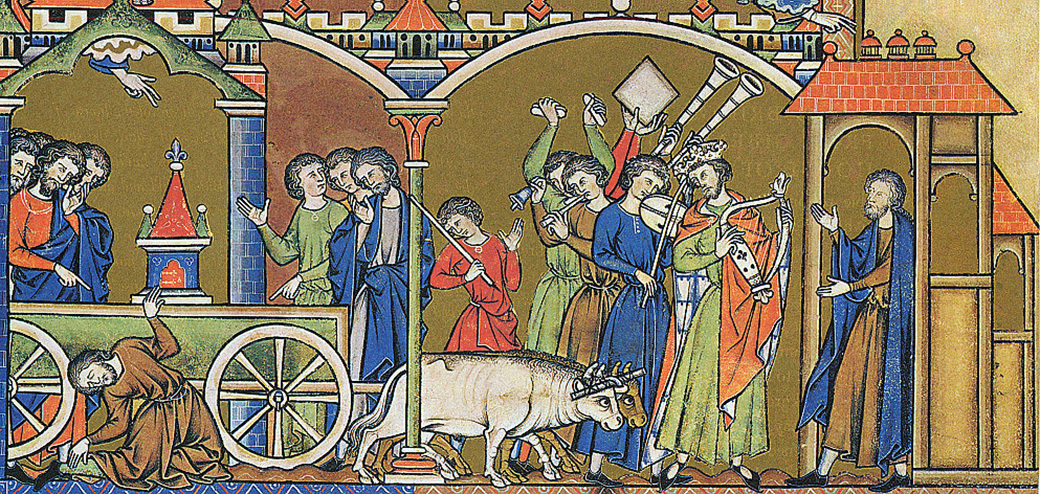
    King David brings Ark of the Covenant from Abinadab (c.1240-1250), from the Morgan Bible | Creative Commons, courtesy marysrosaries.com. Note the hand of God above the ark as Uzziah falls down dead after touching it.

    What’s going on here? Why does this happen and why is it recorded in both 2 Samuel and 1 Chronicles? The full answer lies in today’s reading, but let’s consider what we’ve just covered. It’s no accident that Uzziah is struck dead as they pass over a threshing floor, a place of the harvest. The natural order of things is backward. We have an earthly king, even though he is favored and blessed by God, who goes out to “take” God into his city. The great pride of the king reaches a physical moment when Uzziah reaches out his human hand to “steady” the divine ark. This is not God’s plan for the natural order of things. Humans must approach the Lord in humility and be led by Him, not lead Him. What is being harvested here? God?! No, that cannot be; do we dare see our immense Creator as someone to be harvested and taken to fulfill our desires? King David got it wrong.

    But God continued to call to David. He wants to establish himself with the nation of Israel, but He needs David to better understand their relationship and the great plan of salvation of which he is a part. David hears that the house of Obed-edom has been blessed by the Lord for the three months that the ark has rested there and he decides to go back to try again. This time, however, he approaches with much more reverence. This is most clearly manifested in the way the ark is handled, as David himself realizes: “the Lord our God burst out against us, because we did not give it proper care” (1 Chron 15:13b). David commands that only Levites should carry the ark (as prescribed back in Moses’s time) and set out with a large group of priests, making sacrifices and making loud music again, but this time of a much more religious ritual nature. He even wears a “linen ephod,” which is the ceremonial dress of priests. This time, they make it all the way back to Jerusalem amid great rejoicing. They place it inside the tent David has pitched for the ark, outside of his palace. David seems to be doing things right this time. While this next passage seems to be simply a description of more ritualistic practice, there’s more going on:

    David offered burnt offerings and offerings of well-being before the Lord. When David had finished offering the burnt offerings and the offerings of well-being, he blessed the people in the name of the Lord of hosts, and distributed food among all the people, the whole multitude of Israel, both men and women, to each a cake of bread, a portion of meat, and a cake of raisins  (2 Sam 6:17b-19).

    Here we have the greatest commandment in action! You shall love the Lord your God with all your heart, and with all your soul, and with all your strength, and with all your mind; and your neighbor as yourself. God is guiding David to give us an example of loving Him and then loving your neighbors. 
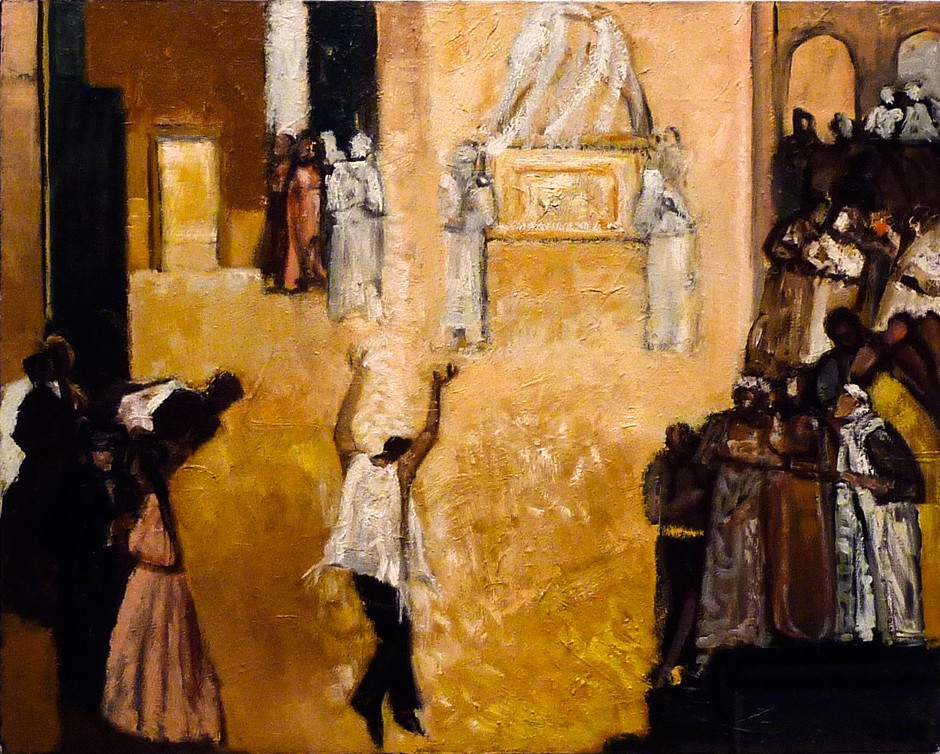
    David Dancing (1998), Richard McBee | Image from richardmcbee.com.

    But it will take Christ to explain how this needs to be a transformation of heart and continuation of God’s love as expressed in charity, because David falls back into his prideful control mode again as we read in today’s reading. God speaks in a dream to David’s right-hand man, the prophet Nathan, telling him to respond to David’s desire to build a house with a reminder that God is the one in the process of building a home for the Chosen People, not the other way around. “Should you build me a house to dwell in? It was I who took you from the pasture … I will fix a place for my people Israel.” God then shares with Nathan a fabulous insight into his saving plan for humanity: “The LORD also reveals to you that he will establish a house for you. … I will raise up your heir after you, sprung from your loins, and I will make his kingdom firm. I will be a father to him, and he shall be a son to me.” There is so much here. First, God is re-fashioning the idea of a house to mean more than the hard-roofed dwelling that David has in mind. He expands this to mean a lineage, a heritage, but more than that: a type of life that extends beyond the one that David lives. This lineage, as we know, will bring forth the Son of God, so this is more than just living genetically through his line — it is the promise of a life in Christ’s Kingdom beyond the one David lives in now. That Kingdom, distinct from David’s kingdom, is the real “house” for David and all of humanity. This also carries with it the promise to convert the literal, ritualistic practice of the Time of Promises (David’s idea of a house) into a conversion of heart and life of love in the End Times (God’s idea of a house).

    With an expanded notion of “house” in our minds, let’s turn to the gospel reading. This is Luke’s account of the Annunciation, about which I’ve already written extensively (see Our Blessed Kecharitōmenē). There is much to say about Mary’s perfect “yes” to the Lord, and if you’re craving a reflection on that, I’d suggest clicking on that post. For today, however, I’d like to follow this thread of the house for the Lord. God, being the omnipresent, omniscient Creator, has always had a great plan and logic for the universe that we’ll never comprehend until perhaps we achieve perfect union with Him. But we have a good window to His saving plan as it begins with Abraham and the Chosen People. And we just explored another milestone moment with King David. Fast forward 1,000 years and we have the gospel reading, but let’s not overlook those thousand years with the struggles of the Jewish people to understand the teachings of the Lord through their prophets, their territorial battles and exile to Babylon, and their return to Israel as a people more religious and dedicated to God. That time of formation made them the people they became: devout, expectant, forged in penance and reconciliation. Historians write that Jewish girls in Mary’s time were steeped in a tradition of the Torah and the prophets and knew that one of them, perhaps sometime soon, would become mother to the Messiah. Perhaps God’s plan in the Time of Promises was to create the culture, readiness, and parents who would produce the perfect “house” for Him to enter the world. 

    Gabriel, in all of his fearsome glory, appears to Mary and bestows a divine title, recognizing the blessings of God upon her: “Grace to you, The One Whom Grace Inhabits, The Lord is with you!” (as my reflection in the post referenced above explains). If you were graced with spiritual senses, Mary must have glowed like the sun. Gabriel’s blessed message is the great pivot point of God’s plan for humanity: “Behold, you will conceive in your womb and bear a son, and you shall name him Jesus. He will be great and will be called Son of the Most High, and the Lord God will give him the throne of David his father, and he will rule over the house of Jacob forever, and of his kingdom there will be no end.” Gabriel has fused the house of Jacob, throne of David, and Fatherhood of God into this statement. Our dogma about Christ being fully man and fully divine is based in this revelation. The house of God is now fused with the house of David in a way that David himself never could have accomplished. God told David not to build Him a house because God was building His own house, a living house in human flesh, something that David could never have conceived.
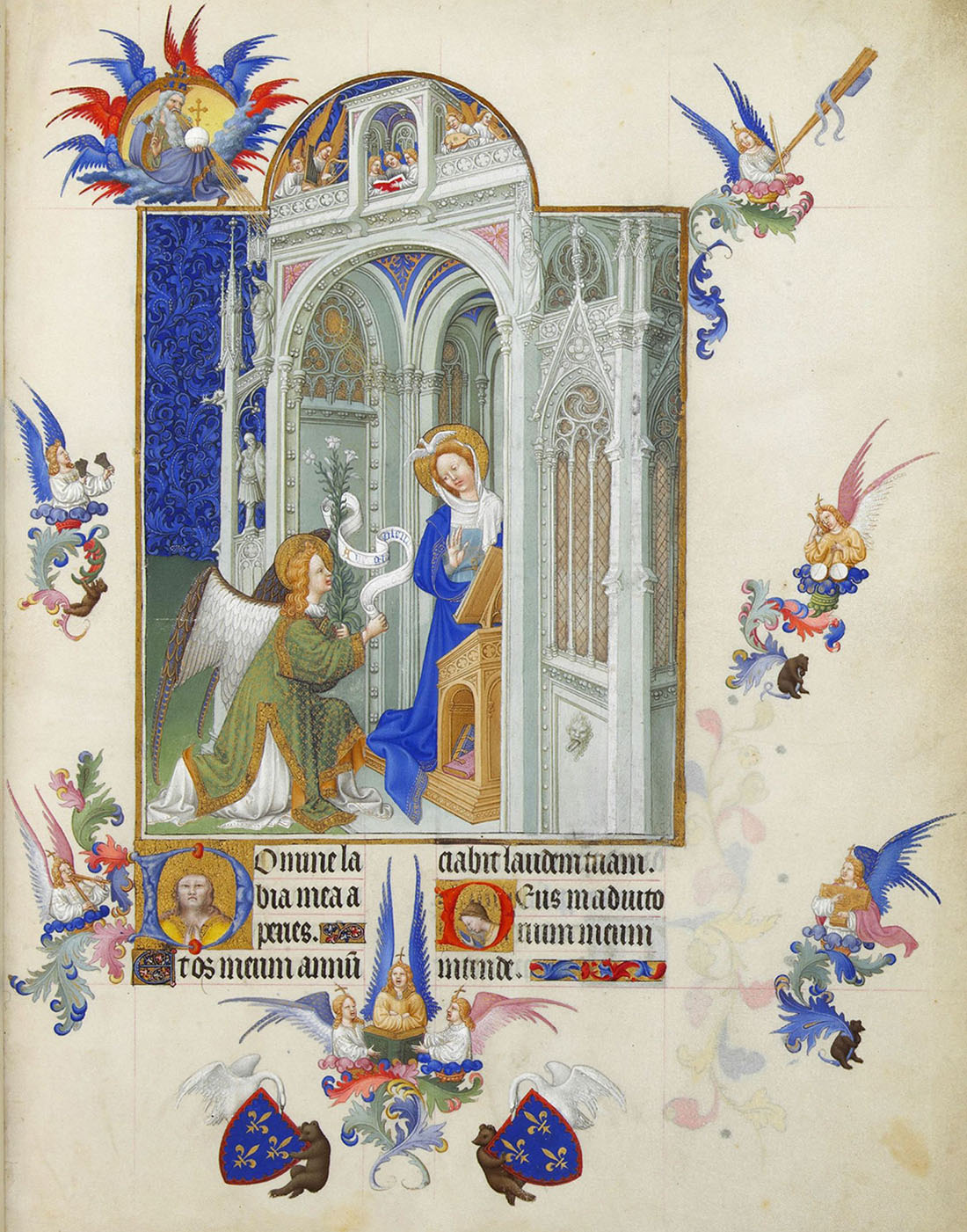
    The Annunciation (1405-1409), The Limbourg Brothers. This is a page from the Beautiful Hours (Belles Heures) commissioned by Jean de France, duc de Berry | Creative Commons, courtesy wikiart.com

    This living house is Mary’s womb. This is why Mary is the Ark of the New Covenant. She is so much more perfect than the tent that housed the Ark of the Covenant apart from humanity because she is the way that God finds a way to truly dwell within humanity. 

    Time is of no matter to God, Who exists inside and outside of time simultaneously. But to us, to humanity … well, let’s say that we’ve been waiting for this Living House of God since the earliest humans learned to grunt. And we wait for it for four weeks every Advent, a commemoration of the long Time of Promises where humanity lived in darkness, awaiting the Savior like the dawn.

    Blessed are you, Mary, Kecharitōmenē! Blessed are we, as our God comes to live in us!
     

  • “Fathering” the Word of God – Part II

    “Fathering” the Word of God – Part II

    Friday in the 3rd Week of Advent: Judges 13:2-7, 24-25a, Luke 1:5-25.

    On the heels of yesterday’s reflection of St. Joseph’s righteousness and exemplary acceptance of God’s plan for him, today’s readings give us the stories of two other scriptural fathers, 1,100 years apart, with stunning parallels. Neither father accepts God’s word to the extent that Joseph does, although both of their sons are towering figures in bringing people to God: Samson and John the Baptist. While accentuating the true blessedness of St. Joseph, both readings underline our need to trust in the Lord as well as the impact of generational germination of the Word.

    The first reading from the Book of Judges presents the origins of the near-mythological Samson, the last of the judges before the Judaic monarchy is established. Samson’s family is not particularly distinguished; we don’t know much from scripture other than his unnamed mother worked in the fields like a common Jewish woman of the time: “the angel of God came again to the woman as she sat in the field” (Jgs 13:9). But God likes to work through the humble and lowly, doesn’t He?

    The readings today give us several important parallels between Samson and John the Baptist: both of their mothers were barren and older, both sets of parents were visited by an angel promising that they would become pregnant and give birth to men who would be important figures for the Lord and His work, and both fathers do some questioning before acquiescing to the angel.

    And then there are the parallels between the men themselves. Samson is to be brought up as a Nazirite, which means “one separated” or “one consecrated.” This was a class of people as recorded in the Book of Numbers, Chapter 6. God declares to Moses that Nazirites should not shave their hair, drink alcohol, or come in contact with corpses. Being a Nazirite was a sign of consecrating oneself to God, like an early form of voluntary commitment to a religious order.

    Samson’s life was filled with episodes of conquering nature or putting it to good use: slaying the lion with his bare hands, tying torches to the tails of 300 foxes to burn Philistine fields, killing 1,000 Philistines with the jawbone of a donkey, etc. These actions and his God-given superhuman strength served to make Jew and Gentile alike marvel at the works of the Lord and believe more deeply in the Jewish God. 

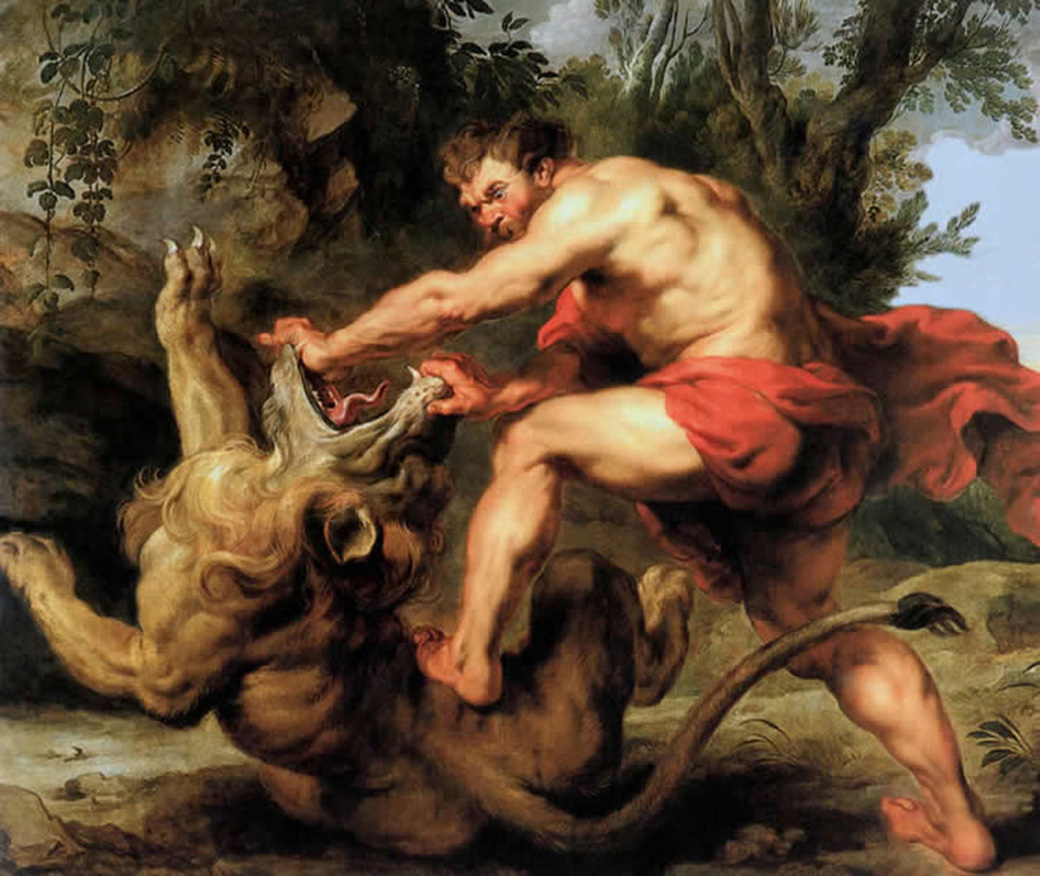
    Samson Slaying the Lion (1628), Peter Paul Rubens | Wikimedia Commons.

    John, for his part, shares many of these characteristics. We know that he was the “voice crying out in the wilderness” and he is aligned with nature in several aspects: “John wore clothing of camel’s hair with a leather belt around his waist, and his food was locusts and wild honey” (Mk 1:6, Mt 3:4). He lives apart, much like a devout Nazirite; today, we hear the angel tell his father, Zechariah: “He will drink neither wine nor strong drink.” He is also depicted throughout Christian art history as being wild in appearance, with long, uncut hair. Since he was completely devoted to being God’s mouthpiece (see A Day of Vindication by Our God), he was as close to a Nazirite in spirit as you can get, if not formally one. 

    (Recently, in his book, Jesus and the Dead Sea Scrolls, Catholic scholar John Bergsma makes a strong case that John the Baptist may have been part of the Essene movement from early in his life another proto-monastic group much like the Nazirites).

    But today’s readings aren’t about Samson and John; instead, they’re about God’s announcement of these great figures to their childless, barren parents. This, in itself, is proof of God’s loving mercy and overflowing generosity to those who remain faithful to Him. There are many stories of God granting pregnancies to barren women in the Bible, starting with our patriarch Abraham and his wife, Sarah. In sympathy with these women who lived in a culture where birthing children, especially sons, was given such importance, we see that God responds to their feelings of inadequacy, abandonment by God, and failure. Into these hearts, yearning to feel God’s healing love, He delivers a miraculous fecundity. I am reminded of previous reflections on agricultural harvest and fertility. God’s blessings carry this same imperative: to bring forth fruits of righteousness. For Samson’s mother and John’s mother, these fruits are their sons. 

    With Mary, God gives us a turning point. He sends the Spirit to bring about Jesus in her womb, and here divinity itself becomes the answer to humanity, which has repeated its sacrifices and strivings generation after generation to no avail. As Fr. Jean Corbon writes, the time leading up to Mary “is also the time when prophetic words and cultic sacrifices are repeated again and again; nothing can do away with this repetition, which signals the grip of death, until the coming of the event that ‘once and for all’ delivers man from death” (The Wellspring of Worship, 35).

    Women prayed for children in the Time of Promises because they were caught in the wheel of generational futility, the “grip of death.” With Mary, the child that is born is a new being, a God and man, who establishes His Reign on earth and delivers humanity from the grip of death. No longer do we need long for children alone to prolong our lives on the planet because Christ has opened up for us life eternal!

    After Christ, our spiritual fruits, rather than physical offspring, are the fruits for which we pray and upon which we pin our hopes.

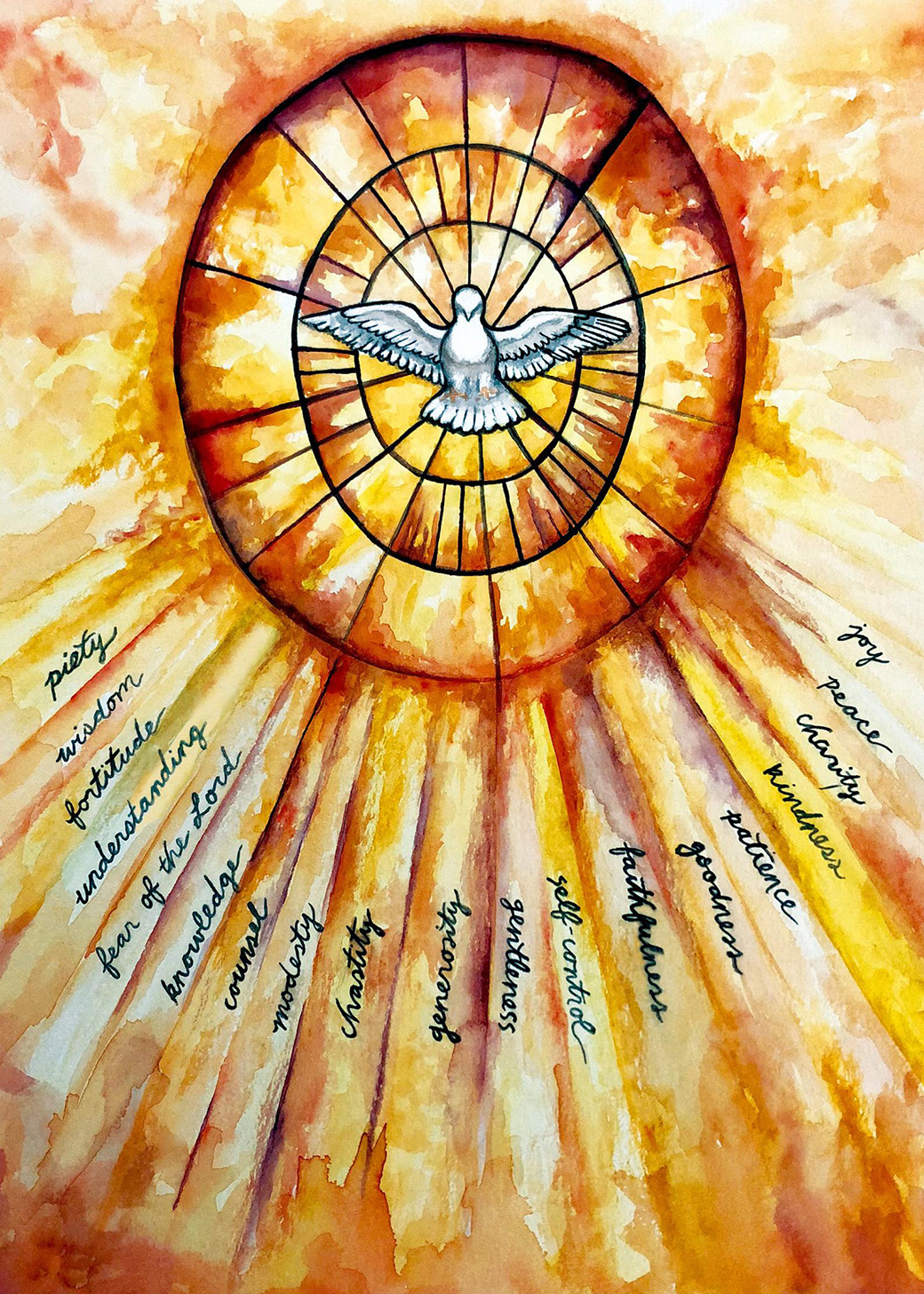
    Fruits of the Spirit (contemporary) Leann Bowen Fine Art | Image from etsy.com.

    St. Paul is very good at exhorting us to embrace this new state of being. He recognizes how the Nazirite tradition prefigured the state of being a Christian. Sanctifying ourselves to God and restraining ourselves from worldly things is now the de facto state for all. This is because of the Spirit, who descended upon Mary and whom Christ has promised will guide us throughout the End Times. Paul writes to the Galatians: “Live by the Spirit, I say, and do not gratify the desires of the flesh. … those who belong to Christ Jesus have crucified the flesh with its passions and desires” (5:16, 24).

    We are all now anointed, set apart, and sanctified for God thanks to Jesus Christ. We must live by the Spirit, and this brings us back to the idea of fruitfulness and fertility. The new fertility is one of the Spirit. Paul writes: “the fruit of the Spirit is love, joy, peace, patience, kindness, generosity, faithfulness, gentleness, and self-control” (Gal 5:22-23a). The fruit that we bring forth into the world is God’s love! This is marked by charity and the personal attributes that Paul lists.

    Note that this is real fruit — it represents the true germination of the Word in our hearts and the creation of new selves. More importantly, this new self is outwardly focused, generating God’s love within all those we meet. We cannot deny the impact of pure charity, forgiveness, patients, and generosity on others. This is the harvest we are called to bring into the Kingdom.

    Of course, we’re imperfect (thanks be to God for the sacraments of Confession and Eucharist!).

    Let’s return to the fathers in today’s readings: Manoah and Zechariah. Both men reveal an imperfect reception of the Word of God delivered by the angel. First (in verses skipped by the Lectionary), Manoah reacts to his wife’s news of the angel by asking God to hear it himself: “O Lord, I pray, let the man of God whom you sent come to us again and teach us what we are to do concerning the boy who will be born” (Jgs 13:8). God sends His angel again, but once again to Manoah’s wife, and she has to run to get Manoah to meet him.

    We are witnessing a little frustration by Manoah that God isn’t doing things the way he wants him to. Manoah asks the angel what they should do with the child and the angel responds a bit dismissively, “Let the woman give heed to all that I said to her” (Jgs 13:13). Like Joseph, Manoah is being asked to take a back seat here, but he’s not quite as good at accepting this as Joseph.

    Manoah wants to make an offering to the angel in response to the news and asks, “What is your name, so that we may honor you when your words come true?” But the angel of the Lord said to him, “Why do you ask my name? It is too wonderful” (Jgs 13:17-18). While not doing anything specifically against God here, Manoah is living in a way where his actions and expectations are driven by the culture of the Jewish law: he offers the prescribed sacrifice and attempts to take control of the situation as the man of the house. Contrast this with Joseph hearing the Word of God and responding in righteousness from the heart. Both men are asked to “father” the Word of God, and Joseph clearly is more configured internally to the Word Himself than Manoah.

    We see a similar circumstance with Zechariah. We hear Zechariah respond to the angel with much more challenge in his demeanor: “How shall I know this? For I am an old man, and my wife is advanced in years.” This would be surprising for those who associate the trappings of piety with actual conformation to God. Zechariah was of the priestly class and in the much-respected role of entering the sanctuary of the Lord alone to burn incense. Of course, Christ preached many times against those who appear to be living according to the law but are not transformed in their hearts, so from our perspective as Christians we should not be too surprised.

    Unlike the episode with Manoah, the angel is not shy about using his own name in a bit of a smack-down: “I am Gabriel, who stand before God. I was sent to speak to you and to announce to you this good news. But now you will be speechless and unable to talk until the day these things take place, because you did not believe my words, which will be fulfilled at their proper time.” How ironic that the father of the great Voice in the Wilderness would be silenced himself throughout his wife’s pregnancy! God’s plan for the announcement and coming of His Son has no room for lukewarm reception or obstacles.

    Zechariah, like Manoah before him and Joseph after him, must take a humble position while fathering the Word of God, and in his case, it must be an externally enforced humbling.

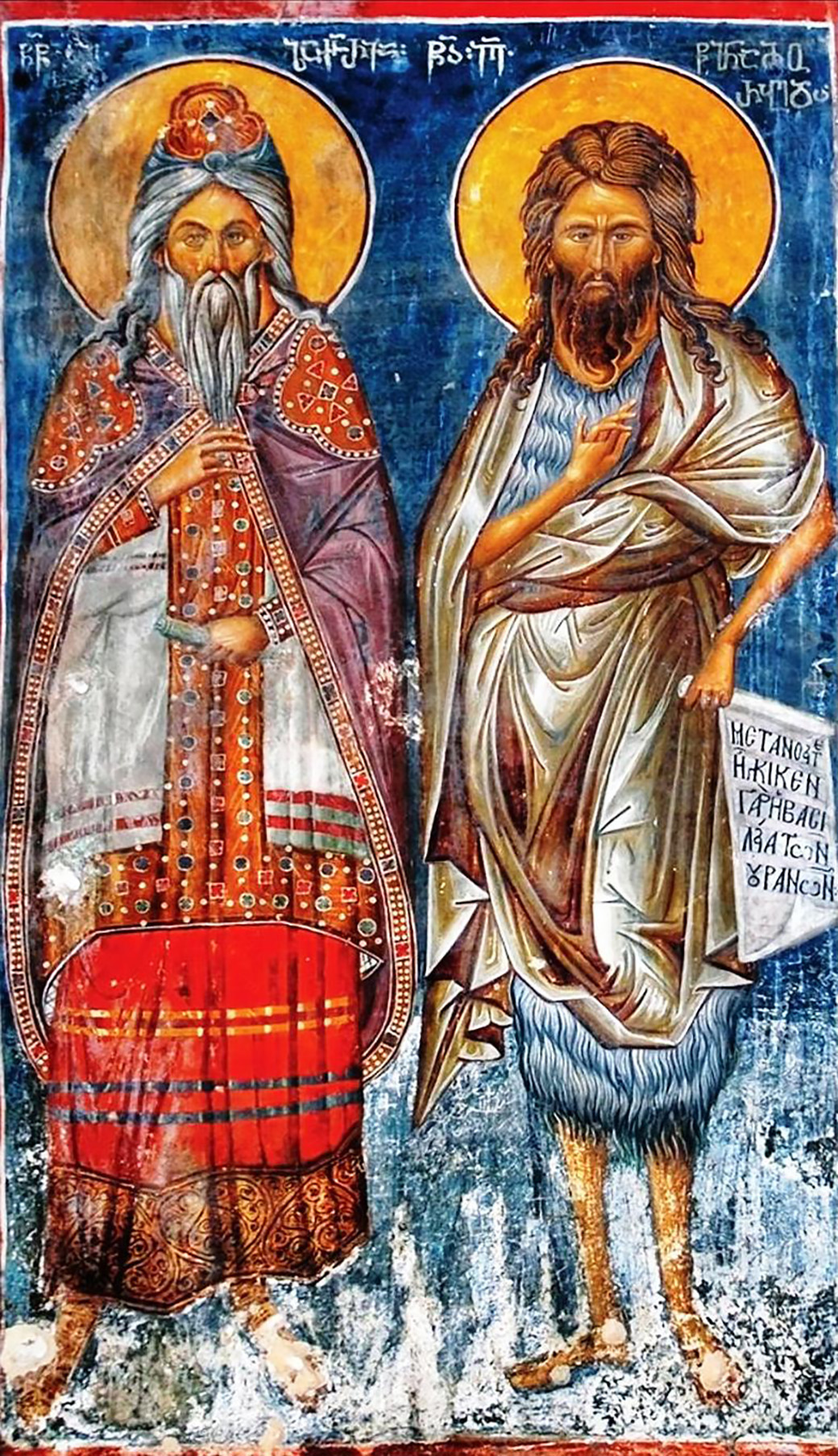
    Zechariah and St. John the Baptist. A medieval Georgian fresco from Monastery of the Cross, Jerusalem (c.1600s) | Wikimedia Commons.

    I’m not trying to take Manoah and Zechariah down a peg — don’t get me wrong. Both men are great figures in our faith tradition. When his tongue is loosed at the circumcision and naming of John, Zechariah gives us one of the great canticles that we chant daily at Lauds (this is the gospel reading on Christmas Eve Mass during the day). Their stories do, however, contrast with Joseph’s humble fathering of the Word, and they give us room to reflect on how we might be fathering the Word in our own lives. We all must germinate and gestate the Word in our hearts and souls; we all must meet God’s plan with humility and acceptance rather than hesitation and excuses; and we all must bring forth the fruits of the Spirit during our time here on earth.

    As we remind ourselves of our Nazirite calling as Christians during this Advent time of waiting and anticipation, we might be tempted to wonder if this is worth it. After all, if the cycle of human reproduction and death ended 2,000 years ago in Christ, why does it still feel that we’re on that hamster wheel? Be comforted in the fact that this confusion over the time of Christ’s Second Coming has existed from the earliest Apostolic Age. In St. Peter’s second letter we read his exhortation to keep the faith:

    But do not ignore this one fact, beloved, that with the Lord one day is like a thousand years, and a thousand years are like one day. The Lord is not slow about his promise, as some think of slowness, but is patient with you, not wanting any to perish, but all to come to repentance. But the day of the Lord will come like a thief, and then the heavens will pass away with a loud noise, and the elements will be dissolved with fire, and the earth and everything that is done on it will be disclosed  (3:8-10).

    This is the message of Advent. Keep your lamps trimmed and burning, for we know neither the day nor the hour when the Lord will come in judgment. “Therefore, beloved, while you are waiting for these things, strive to be found by him at peace, without spot or blemish; and regard the patience of our Lord as salvation” (2 Peter 3:14-15a).

  • The Back-Seat Servitude of Fatherhood

    The Back-Seat Servitude of Fatherhood

    Friday in the 3rd Week of Advent: Jeremiah 23:5-8, Matthew 1:18-25.

    Today’s readings provide us with further prophecy about the coming Messiah, but from Jeremiah rather than the Advent-friendly Isaiah. Jeremiah gives a unique name for Christ the Messiah: The Lord Our Righteousness. At least most translations phrase it this way, although our lectionary for some reason chooses “The Lord Our Justice.” This raises some interesting thoughts regarding the relationship between righteousness and justice, which we’ll touch on later. But I’d like to stick with righteousness for a moment, because it gives us a lens with which we can explore the gospel reading.

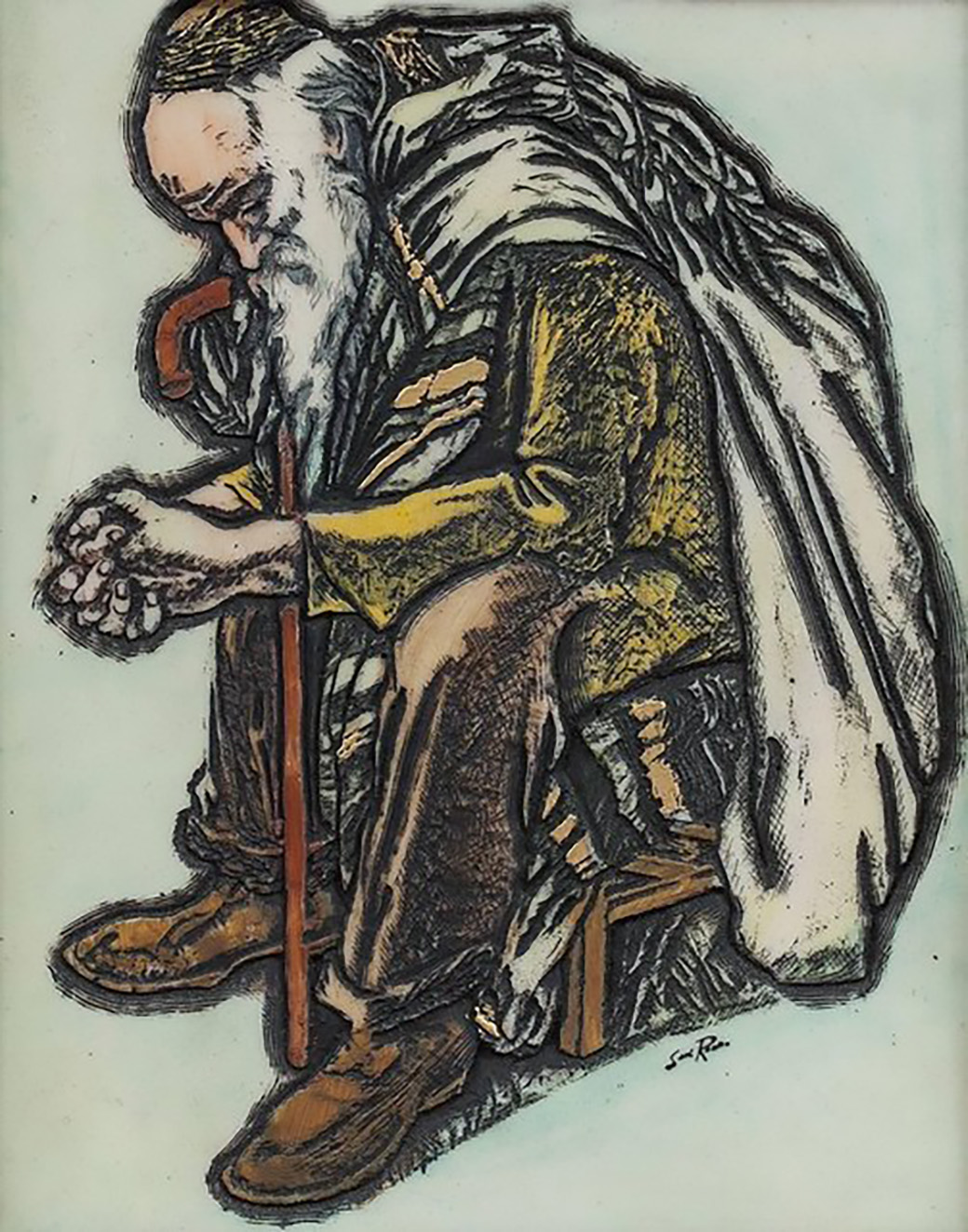
    Meditation (mid-1900s), Saul Raskin, (carved ivorine plaque) | Image from artsy.net.

    Jeremiah’s passage in the original Hebrew calls the Messiah יְהוָ֥ה ׀ צִדְקֵֽנוּ׃  (Yahweh Tsidkenu). The root here is tsedek, and the -enu is the suffix that means “our”; elsewhere in scriptures we read tsedeka, which is translated as “your righteousness,” almost always applied to God. Why am I making a point of tracing out this word? Because righteousness is at stake in the birth of Christ.

    Righteousness means a state of blamelessness, of living completely according to God’s law, of being worthy. Let’s not get sidetracked by the modern insult, “she’s so self-righteous.” This casts righteousness in the exact opposite light of what the word means. It is the state of being worthy of praise because one abides by God’s law. Jeremiah proclaims, “This is the name they give him: ‘The LORD Our Righteousness.’” In other words, Jesus Christ’s very name proclaims how his spotless worthiness is the hope and fulfillment of the Jewish people (“our” righteousness). Jeremiah underlines that God’s law made perfect is joined with a human person in this coming Messiah.

    What is a fitting way for the Lord Our Righteousness to come into the world? If righteousness is the key concept, we might expect an exceptional family for him to be born into. We’re not talking about glory (which is later revealed), so the circumstances are humble. We’re not talking about earthly success and savvy, so the circumstances are poor. No, “righteousness” is, above all, a trait characterized by the willingness to live by God’s Word. The Blessed Virgin Mary is our Queen of Heaven for a reason: she gives us the ultimate example of righteousness with her acceptance of the Holy Spirit at the Annunciation and subsequent Incarnation.

    But there’s more to the family.

    St. Matthew’s gospel is the one source that describes Joseph in the detail we hear today. Mark and John skip the Nativity entirely and Luke picks up on the journey to Bethlehem. But Matthew dwells for a moment upon Joseph, deeming it necessary and appropriate to describe the righteousness of Jesus’s family down to the foster father. Joseph, as Matthew tells us, is a very righteous man: “Joseph her husband, since he was a righteous man, yet unwilling to expose her to shame, decided to divorce her quietly.” This reaction actually goes above and beyond the law set by the Jews. He could have denounced her publicly and she could have been stoned to death for adultery. This shows his true righteousness because he understands that God’s laws are based on love, and he acts out of love, not retribution.

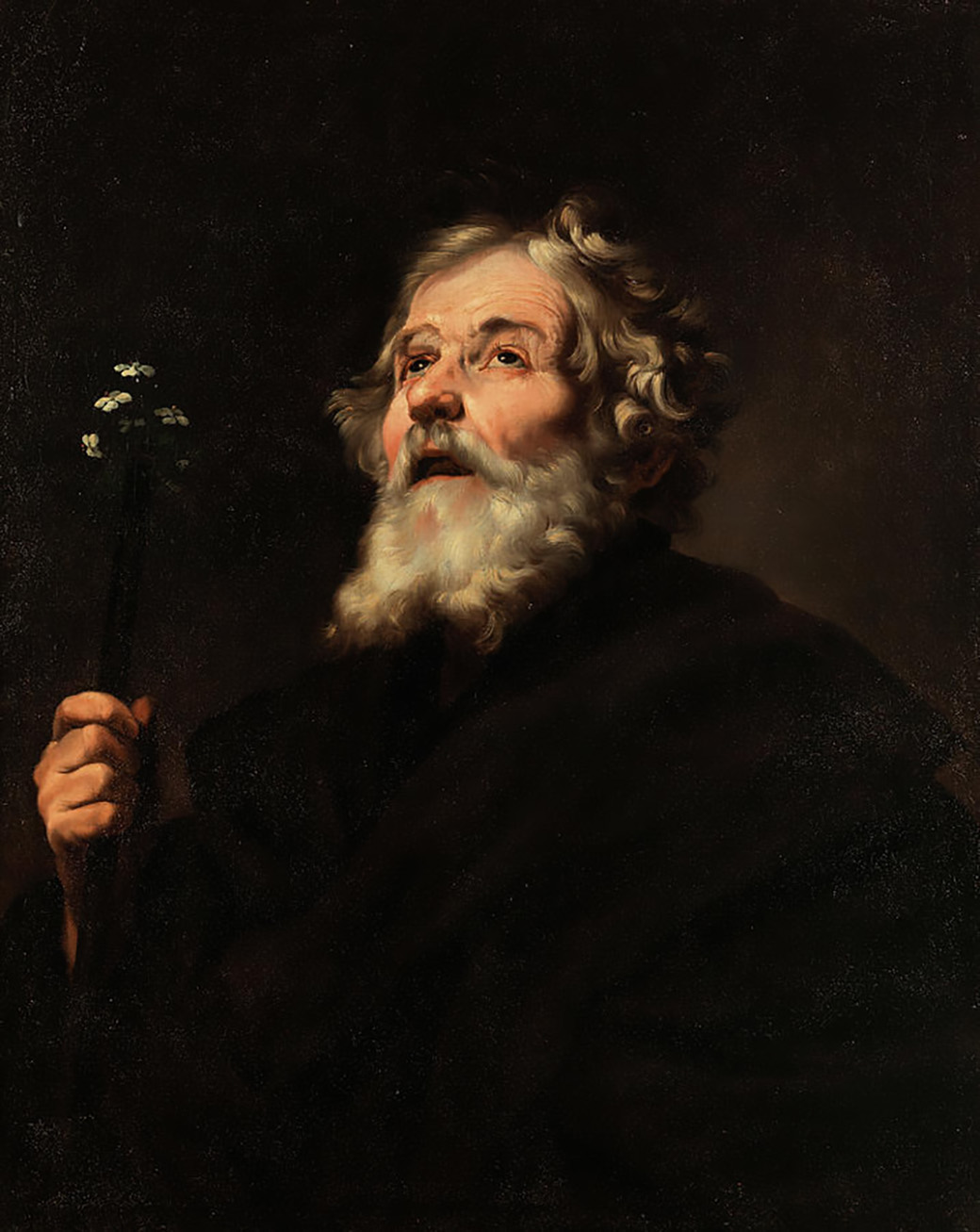
    Saint Joseph (1635), Jusepe de Ribera | Image from fineartamerica.com. I appreciate the way Ribera paints Joseph as focused intently on the voice of God. He was, after all, visited four times by angels who direct his actions in the gospels. 

    But next he is visited by an angel in a dream who tells him, “Joseph, son of David, do not be afraid to take Mary your wife into your home. For it is through the Holy Spirit that this child has been conceived in her.” It was a step beyond expectations to divorce her quietly, but now God is asking him to swallow all pride and take her into his home, to trust that God miraculously impregnated the Virgin by the Holy Spirit.

    It would take an exceptional man to agree to this. Everyone would know that Mary was pregnant before their marriage and would likely question whether Joseph was the father, given their customary distance prior to marriage. The insinuation would be that he was a cuckold, a pathetic creature who is betrayed sexually by his partner, possibly the biggest blow to a man’s pride that can happen.

    God is asking Joseph to look past all of this in great humility because something greater and more wonderful is going on: “She will bear a son and you are to name him Jesus, because he will save his people from their sins.” With fidelity and trust in God, this can be seen as an amazing blessing — a God-bestowed name for the child and the role of spiritual savior, surpassing even Messianic hopes for a great king. Through the lens of doubt, however, this could be seen as another blow: not even being able to name the child much less shape his destiny. God is asking Joseph to nearly disappear as a man and a father figure, against even his purest instincts and lawful expectations.

    Matthew then relates, without fanfare or hints of emotional struggle, “When Joseph awoke, he did as the angel of the Lord had commanded him and took his wife into his home. He had no relations with her until she bore a son, and he named him Jesus.” On the surface, we see a cowed man, stripped of his virility and authority — the very things that “man” has meant likely since the beginning of our race. What a lesson God provides us here, and what a worthy, righteous man in Joseph to do God’s will and become this new man! For it is precisely in the re-fashioning of an authority figure into a slave to God that Joseph helps to save the world through his son, Jesus.

    Let there be no doubt, Jesus has an earthly father in Joseph, the man who procured food, shelter, and clothing for him and likely taught him a trade, not to mention passed down to him his birthright by training him in the Jewish faith. Why couldn’t God simply have worked through Mary, single Mother of God? The answer is partly to teach us that the sacred bond of marriage is grounded in faithfulness to God, and the answer must also be that Joseph can become an icon of a humble, righteous father, willing to take the back seat in servitude.

    And this is another key feature of righteousness: a willing servitude to the Father in Heaven. Joseph, we are told, does “as the angel of the Lord had commanded him.” He understands his relationship to God; he owes everything he has and everything he is to God. He does not think twice about who his real master is and he willingly follows his commands. I can’t even think of such unbegrudging servitude existing in this contemporary period. We look down on the very concept of servitude — and rightfully so if it is solely defined as servitude to another human being in this fallen world. But servitude to God is the definition of righteousness! Joseph’s willing servitude to God is proof of his righteousness, of his worthiness to be the earthly foster father of Jesus Christ.

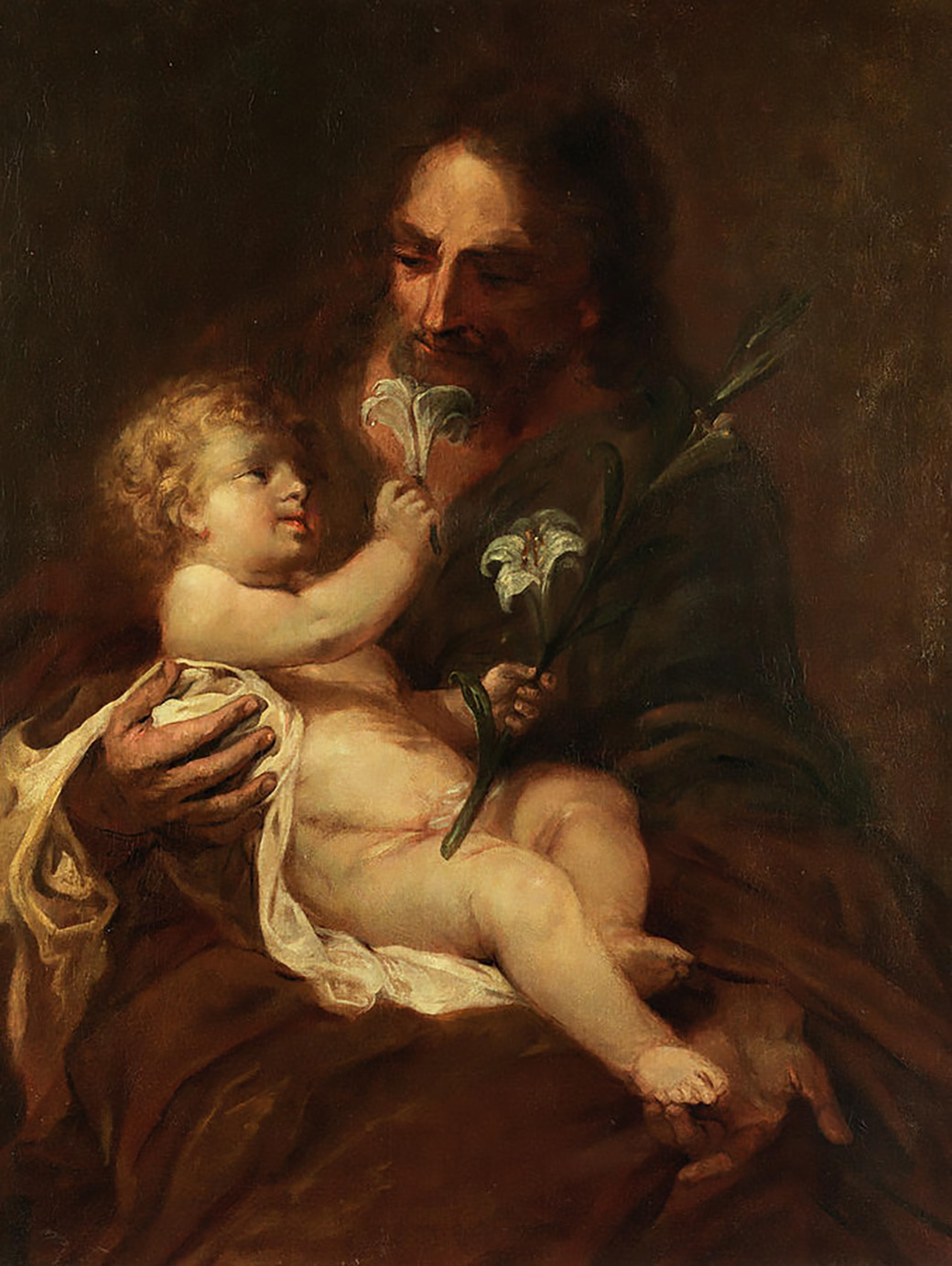
    Saint Joseph with the Infant Savior (mid 1600s), Bartolomé Esteban Murillo | Image from pixels.com. There’s something I love in this painting even though the facial details are blurry and Jesus is decidedly cherubic here. It might be the attitude of cautious awe I see in Joseph, his unselfconscious willingness to be in the background, gingerly cradling the salvation of all humanity.

    Now, let’s open ourselves to something even more amazing. In his righteousness, Joseph is one of the first humans to participate in the new life offered to us by Christ. Jesus is not yet born, yet Joseph has become a servant of the Trinitarian God (including the Son) and allows His saving grace to inhabit him.

    Let’s look at this with the words of St. Paul in mind: “And having been liberated from sin you were enslaved to righteousness” (Rom 6:18, translation from David Bentley Hart’s The New Testament). In Paul’s mind, Christ’s saving act not only liberates us from sin but enslaves us to righteousness. We have a new master here, bestowed upon humanity by adoption in Christ. Consider that this same transforming love of Christ fills Joseph in his assent to foster-fatherhood, another adoptive relationship, more intimate than the one we will all receive. What’s more, in a way Joseph prefigures the sacrifice his son will make on the cross. He gives his person, his pride, his authority to the Father.

    We can start to realize that Joseph is the perfect earthly father for Jesus, not a bystander in his life, not a second-rate role in the great drama of salvation history. Joseph is completely caught up in the self-sacrificing love of the Trinity, achieving glory in heaven while humbly, simply seeking to serve his master.

    Now that’s justice. Heavenly Justice. So we can also understand if Jeremiah’s title is translated as “The Lord Our Justice” because Christ the Lord is setting right the scale and scope of justice. Justice flows from righteousness, from a re-configuration of one’s heart to God’s will and God’s love.

    Let’s end by returning to St. Paul. Living in righteousness himself, Paul was filled with the Spirit, filled with fidelity to God. This enables him to write, “But now that you have been freed from sin and enslaved to God, the advantage you get is sanctification. The end is eternal life” (Rom 6:22). Note that our sanctification, our gift of liberation from death and the promised end of eternal life all have this happy enslavement to God as part of the equation.

    How many of us happily enslave ourselves to God? Can we follow everything that our conscience, guided by God’s Word and Spirit, presents to us? Can we bring ourselves to do whatever we sense as his will, even if it is as emasculating and potentially embarrassing as what he asked of Joseph? If we can’t, we need to re-evaluate our priorities, because we are not serving our true master. We’re turning our backs on the freedom from enslavement to sin that Christ won for us on the Cross.

    If it all sounds too hard, St. Paul has some words of encouragement: “For sin’s wages are death, but the free gift of God is eternal life in Christ Jesus our Lord” (Rom 6:23).

  • A Lion Recumbent

    A Lion Recumbent

    Thursday in the 3rd Week of Advent: Genesis 49:2, 8-10, Matthew 1:1-17

    Today’s readings are bursting with royal significance; pregnant, as it were, with the promise of triumph. It’s no wonder that expectations for the Messiah were so high by the time Jesus was born. God’s promise to His People is so great. Unimaginably great, and given the geopolitical crush of occupying powers, they could not help but try to materialize this promise in earthly kingdom-making.

    But this was never God’s plan. He offers lasting peace, yes, but a peace of the soul that is much deeper and more significant than the temporal peace found in human boundary-drawing. This misunderstanding and lack of preparedness in the hearts of the Jewish nation would mean a horrible crucifixion of God Himself, which proves to be the very action by which God ushers His peace into the world.

    The first reading from Genesis presents Jacob (given the name Israel by God) on his deathbed, calling his sons to gather around him so he can prophesy their futures. His sons, of course, are the heads of the twelve tribes of Israel. We might remember that Jacob is a bit of a scoundrel — he swipes his older brother Esau’s birthright impersonating him to their blind, old father Isaac on his deathbed (albeit, according to his mother Rebecca’s plot). Jacob also had children via four women (two wives and two handmaids to the wives), and famously showed favor to the second wife, Rachel, and her sons, Joseph and Benjamin.

    So, while Jacob (Israel) is the very foundation of the Jewish nation, we must recognize that he is very far from perfect. Nonetheless, God loves and blesses him. Two lessons here: the Chosen People have a lot of growing to do in forming themselves to God’s image, and God will continue to mysteriously love us and bless us even in our sins and stupidity.

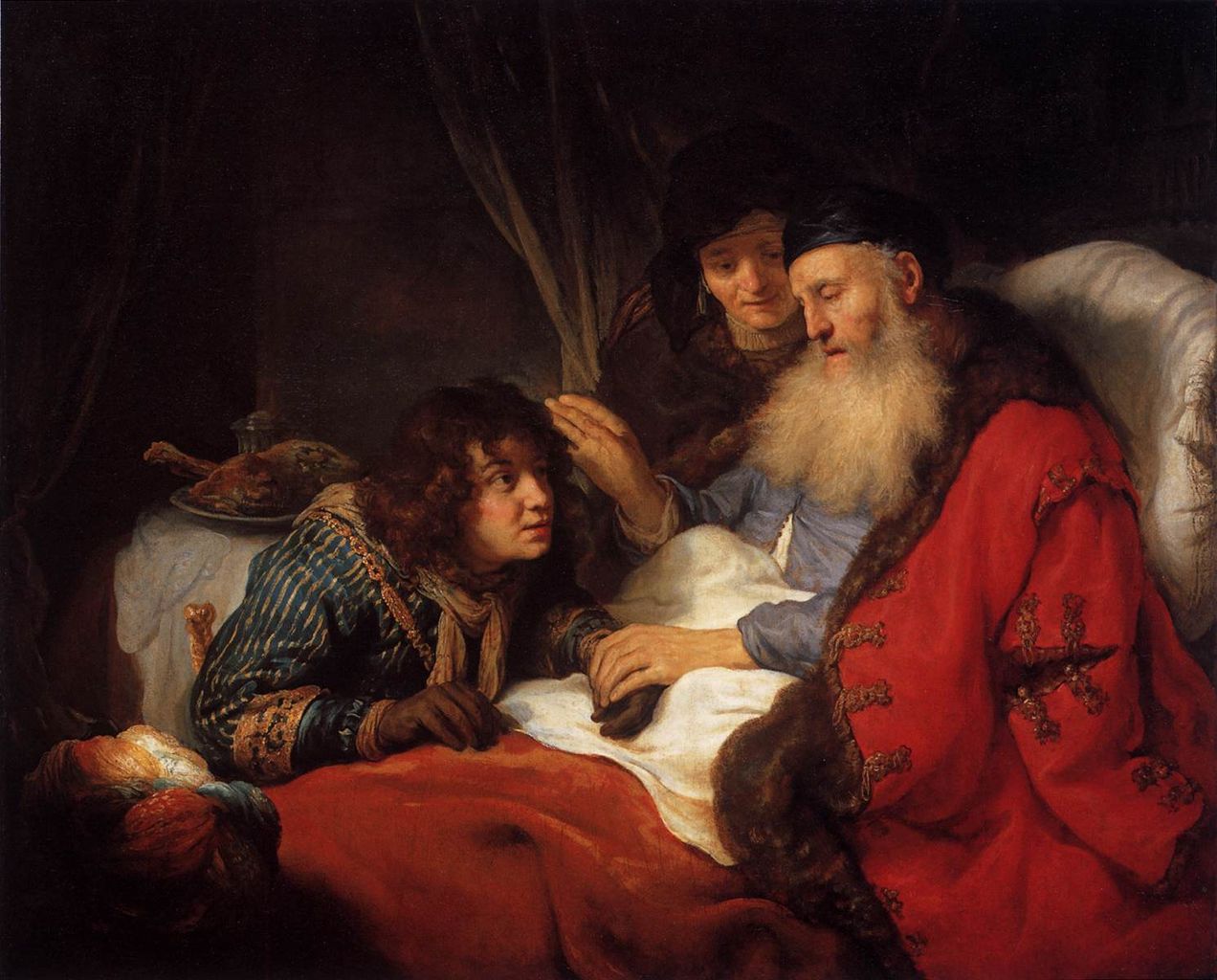
    Isaac Blessing Jacob (1638), Govert Flinck | Wikimedia Commons.

    Today’s reading gives us Jacob’s words about his son Judah, who is not really his favorite, a middle son to his first wife Leah. Despite his father’s lukewarm feelings, Judah receives the second-best treatment in the book of Genesis, advocating for selling Joseph to the caravan rather than killing him, interceding on Benjamin’s behalf, and showing strong leadership among his brothers. Judah seems blessed by God. And Jacob acknowledges this: “You, Judah, shall your brothers praise … Judah, like a lion’s whelp, you have grown up on prey, my son. He crouches like a lion recumbent, the king of beasts–who would dare rouse him?” In some ways, this is a curious statement because other sons have shown much more violence than Judah. Simeon and Levi, in particular, slaughter all the men in the city for the supposed rape of their sister Dinah. So, how has he “grown up on prey” other than having to live in the wake of his father (the lion) and his dealings?

    It also seems a bit like a backhanded compliment offered to someone you secretly fear: a crouching lion, who would dare rouse him? I think Jacob sees the greatness in him and his line, but does not quite know what to make of it. This is appropriate, since the Messiah will come from his line and the people will not know what to make of Him, either.

    I do like this image, though: a lion recumbent. We’ll return to this in reference to Christ.

    Jacob foresees another thing in Judah: “The scepter shall never depart from Judah.” This and the accompanying lines about the mace and tribute brought to him speak to a lasting reign, a lasting peace, that comes through Judah.

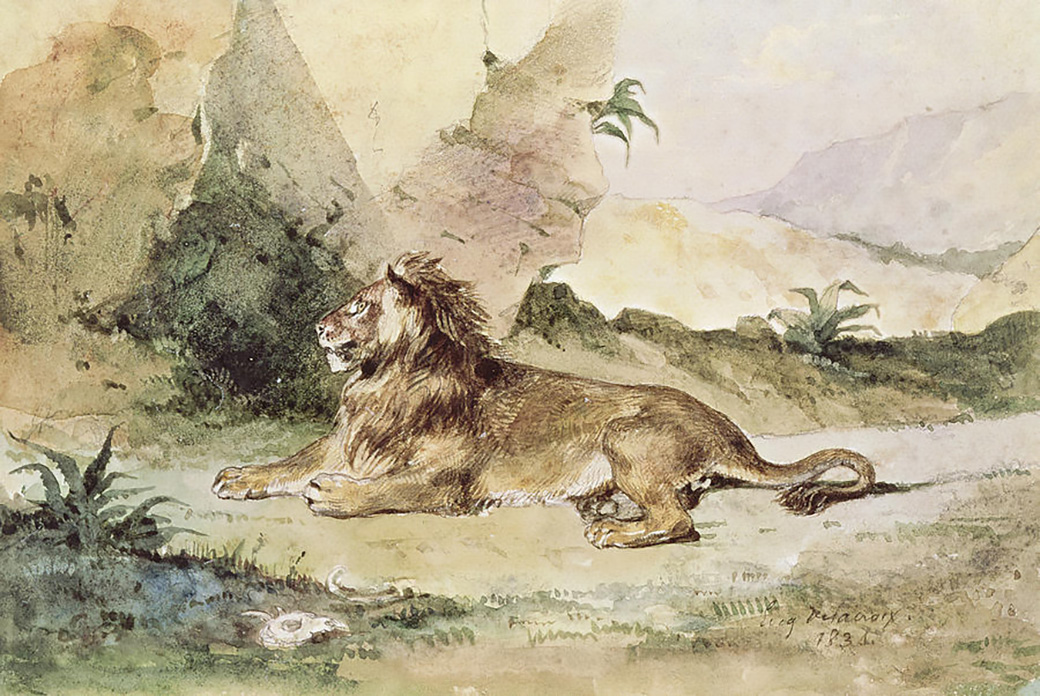
    A Lion In The Desert (1834), Eugene Delacroix | Image from arthive.com.

    Today’s responsorial psalm spikes the readings with significance. We sing: “Justice shall flourish in his time, and fullness of peace for ever.” This links overtly to the last words we hear from Jacob about his son Judah. But we know that the psalmist speaks inside and outside his own time here, not necessarily about Judah or even King David, but of the ultimate destiny of the nation, God’s plan for his people.

    Thus, we can see many figures in the following lines: “O God, with your judgment endow the king, and with your justice, the king’s son; He shall govern your people with justice and your afflicted ones with judgment.” In light of the first reading, the “king” is Israel and the “king’s son” is Judah. Closer to the historical time of the psalmist, the “king” could be King David and the “king’s son” Solomon, the wisest of all men, blessed by God. In both cases, we see the extension of a familial reign, where a father and son extend a reign of justice and righteous judgment.

    As Christians, we see the deeper theological meaning of God the Father and Jesus Christ, His Son establishing a heavenly kingdom. Christ is also in the line of Judah and David, as we read in the gospel. He unites the earthly and heavenly, the human and the divine. Today, we are urged to consider how Jesus Christ ushers in “fullness of peace for ever.” What could this mean after two millennia of wars, death and strife? Most unbelievers would be happy to point this out as a refutation of our “wishful thinking.”

    Let’s consider this in light of the gospel reading, the opening to St. Matthew’s gospel. Lectors everywhere cringe with dread over having to pronounce this seemingly endless string of biblical names. Kids shift on their feet, dads space out with glazed looks, even a pious mom or two wonders if we have to hear the whole list.

    Well, take heart, because Matthew didn’t stuff his gospel with filler. His Jewish listeners would quickly be steeped in the history of their nation, great figures and the stories surrounding them would immerse them in an illustrious familial history. Even today, we can recognize some seminal names: Isaac, Judah, Ruth, Jesse, David, Solomon.

    As the list builds and swells, we anticipate a culmination. We participate in an Advent expectation as we wait to see where this is heading. He ends it: “… Jacob the father of Joseph, the husband of Mary. Of her was born Jesus who is called the Christ.” Jesus who is called the Christ is the fulfillment of this heritage.

    With the weight of 2,500 years of Jewish prophecy, we realize that God’s plan is here laid out for us. And Matthew punctuates this larger plan by showing how 14 generations separate Abraham and David, David and the Babylonian Exile, and the Exile and Jesus Christ. There is a perfection in this, a plan. We mentioned earlier how Jacob’s (Israel’s) imperfections reveal the immaturity of the Chosen People in the scope of salvation history. Well over a thousand years later, God determines that Mary embodies the readiness of the nation.

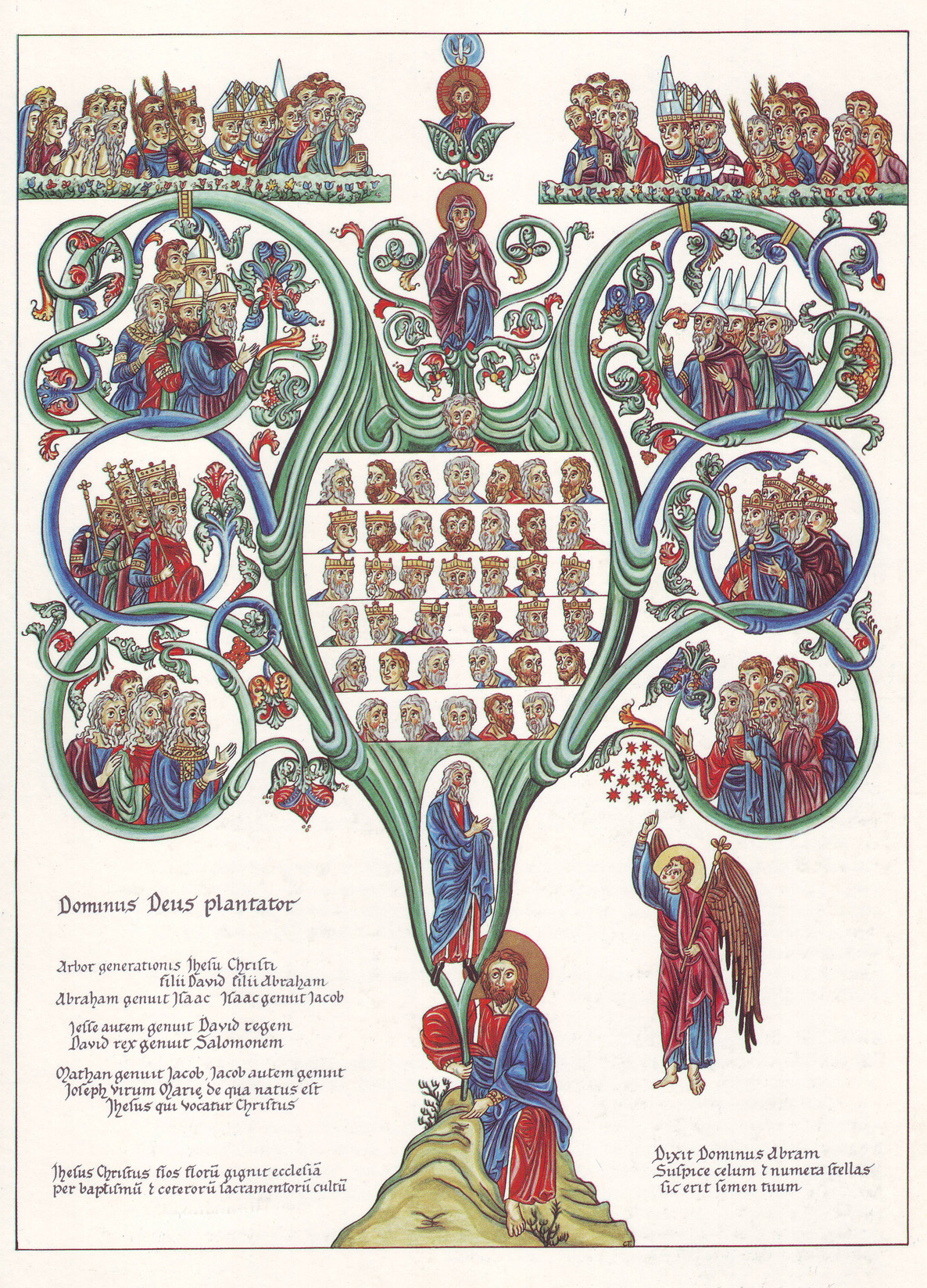
    Tree of Jesse illustration from the Hortus Deliciarum (c.1180), Herrad of Landsberg | Wikimedia Commons.

    This gospel reading requires patience to read, patience to hear, and patience to contemplate its significance. How the Holy Spirit blessed the evangelist! Just hearing this gospel as it is written brings us closer to God in receptiveness and spirit.

    The psalms recall God’s perception of time: “For a thousand years in your sight are like yesterday when it is past, or like a watch in the night” (Ps 90:4). This doesn’t mean that God could care less about what happens in the span of those thousand years — quite the contrary, He constantly, tirelessly offers his grace and forgiveness to everyone at every second. It’s just that his love is so overwhelming and so much the fabric of Him that little setbacks (like a semi-scoundrel called Jacob or a spaced-out dad at Mass) are meaningless. We can often overlook flaws in a loved one. We realize that the little things don’t matter; in fact, little flaws can be endearing.

    Thus, love is the lens by which patience is a part of God’s character. Patience is a virtue (as my mom repeated endlessly to me in my childhood) because it goes hand-in-glove with the love that God is. The gospel brings this patience to us experientially, and we begin to understand that 42 generations in a family is simply the time it takes for the Word of God to germinate. 

    Once we struggle through our antsy-ness, do our breathing or mindfulness training or meditation and finally achieve patience, we perhaps notice something else. True patience, the kind that is tethered to love, is nearly indistinguishable from a peaceful heart. 

    Think of it: we push aside the things that make us impatient, disquieting things, in order to achieve patience. We have to focus on something of a longer perspective, not the little things here and now that make us antsy to get something resolved. We adjust our bearings and this longer, broader field of vision gives us the ability to relax and be patient. What is that but a taste of true peace?

    This gospel reading provides a long view that enables us to start to grasp a bit of God’s plan. If we’re fidgeting or spacing out, it’s likely because we’re thinking of something other than encountering Christ. If we yearn for God and His entrance to humanity, this gospel allows us to join in God’s patience over the generations.

    And at the end of the genealogy lies our lion, recumbent in a manger. 

    I love the combination of the two readings today because it gives us this image: Christ, the king of the beasts, a lion, yet recumbent. There are so many ways this image resonates with me. King of the beasts, of course, meaning king of all creation; Christ is King of the Universe. “Who would dare rouse him?” takes on a solemnity as we consider the shepherds, angels, and the magi adoring the Christ child.

    But the idea of a recumbent lion is perhaps the most evocative. The dangerousness and ferocity of the lion is well-known and feared — we might consider the fears of Israel’s neighbors in the Old Testament upon their entrance into the Levant, knowing that no army could stand in the way of God and His plan. Or we might consider that Christ will come again for the Final Judgment. But the lion is recumbent. The great question: Why?

    God is the primary mover, there is no force that can exert itself against Him. Nothing would make Him be recumbent but His own will. Why does He choose to sit back and be peaceable, despite His awesome power?

    Perhaps this is the point in itself. As Christ teaches us, there is a power greater than what comes from kings and swords. This power arises from love — first for our Creator and then for our fellow human — and gives birth to charity, never violence. This is the promised “fullness of peace forever.” It comes not from an unbeatable army and impregnable national border (talking to you, U.S.A.), but from the fragile and mercurial hearts of humans, transformed and forged into something made stronger than armies by the grace of God.

    Christ gives us a Way to achieve peace in our hearts, which, in truth, is the only peace that matters because it is the achievement of the Kingdom. He is the way, he is the mystical bond between us and God, and the gateway to the Kingdom. We will sing this at his coming in a week and a half with the angels: “Glory to God in the highest heaven, and on earth peace among those whom he favors!”


    I want to thank Suzanne for sharing her thoughts this morning about today’s psalm and its relation to our reflection yesterday. She got me excited to write this reflection. Marriage is a blessing!

  • Justice Like Gentle Rain

    Wednesday in the 3rd Week of Advent: Isaiah 45:6c-8, 18, 21c-25, Luke 7:18b-23.

    Justice is something I’ve been considering a lot in the face of crooked politicians making themselves rich while being morally abhorrent in behavior and policy. Of course it’s important to remember that this is nothing new — every generation has human greed and sin, dating back before the days of King Herod in Israel. But certainly there are times all of us want justice not to descend on the earth “like gentle rain,” but instead like a cracking, vindicating lightning bolt. God, in His mercy, has a different plan; if justice were so severe, there would be very few of us left to marvel at it!

    Today’s readings tackle God’s promise of justice, and contemplating them has helped me start to reconsider what justice on earth might look like. Undoubtedly, we are faced with two types of justice: the justice that happens on Judgment Day, when souls are weighed and either accepted into heaven or sent to hell, and the secular justice that we experience while alive on the earth. I’m starting to wonder if there isn’t also a third — one that straddles these two — the loving, forgiving justice of God working through humanity here on earth. This is perhaps the most tenuous and paradoxical of all; it might be uncommon or it might be the most common thing ever, a testament to God’s grace at work in the world; it might seem fleeting in its smallness but likely looms as the most eventful thing in a person’s life, configuring them to the light until death. It seems to be the stuff of novels, a wispy but significant thread in the human experience that turns out to be stronger than steel. How can we truly explore this justice without living it? Let’s turn to scripture.

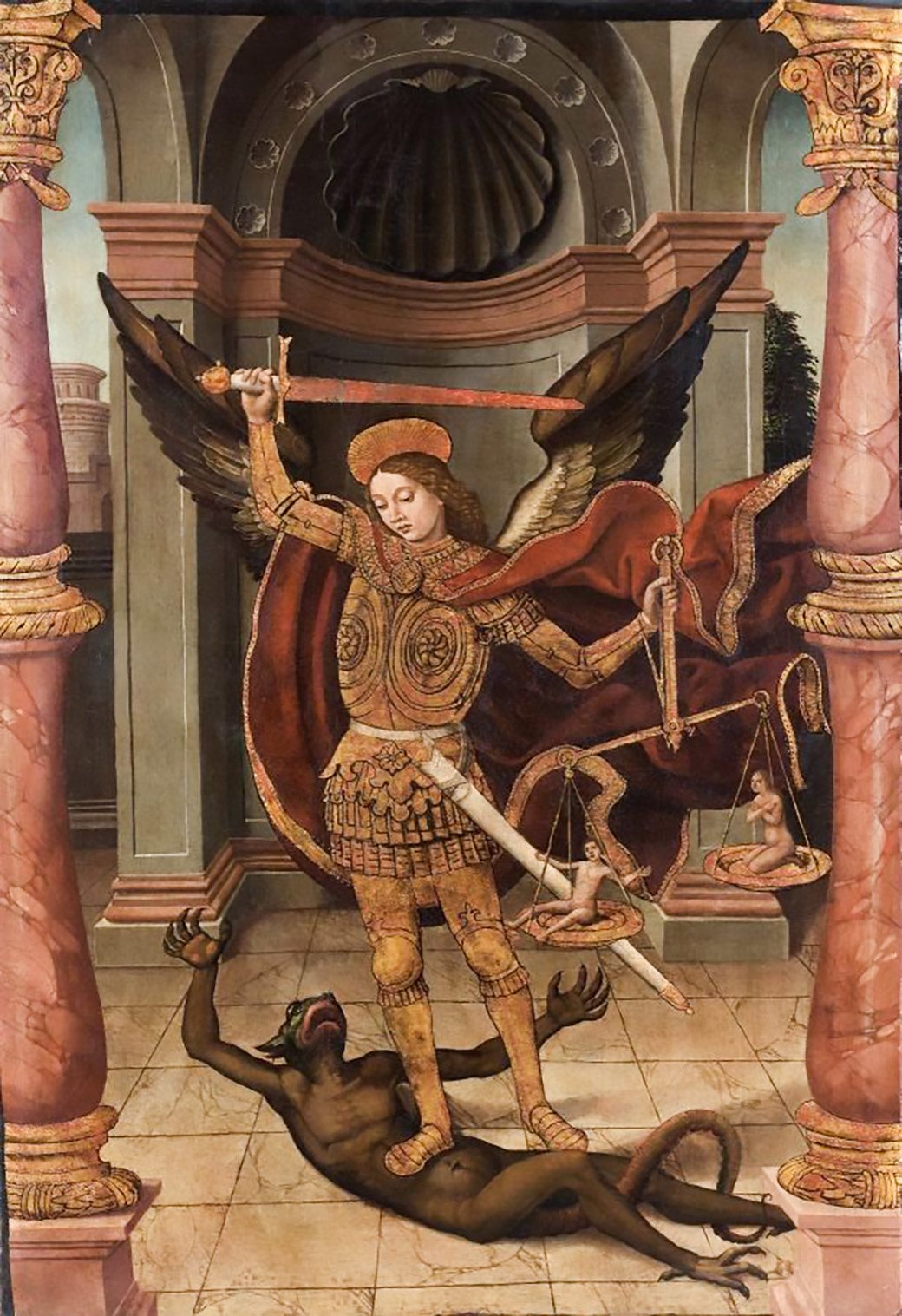
    Saint Michael Vanquishing Satan (early 1500s), attributed to Pedro Romana | Image from pinterest.com. This divine justice, meted out by Christ and the angels, is not something we can expect to apply to common, legal justice we hope to see enacted in this lifetime.

    God, speaking through Isaiah, says, “Let justice descend, O heavens, like dew from above, like gentle rain let the skies drop it down.” He speaks of justice like dew, like a gentle rain — I’m reminded of manna in the Exodus, feeding the Jews who were following God’s commands. This is definitely not a fire-and-brimstone justice but more like a blessing. He then says, “Let the earth open and salvation bud forth; let justice also spring up!” We read earlier this week how Isaiah prophesies that salvation budding forth on the earth will be in the form of the Christ, the Anointed One. Thus, the “earth opening” to bring forth salvation we can understand as Mary bringing forth divinity, the mystery of the Incarnation. The corollary statement is “let justice also spring up,” which means that a second way God is giving the world justice is through His Son on earth. Thus, we have two forms of earthly justice given to us by God: His blessing/grace from above and His Son, the Way, the Truth and the Light made incarnate here on earth.

    For the past few years, I’ve nearly given up on the idea of earthly justice, probably because I’m always putting it in secular terms. In other words, “why can’t that person go to jail or be found guilty and punished accordingly?” In the face of what seems like injustice all around and an increasing culture of hate and self-centeredness, I have turned my eyes to the heavenly kingdom to come. My past year of lectio divina, however, has made it apparent that God means for us to experience the Kingdom here and now if we can only meet Him, fully open to do His will. Nothing speaks more clearly to this desire for us to experience a kind of heavenly justice while alive on earth like these lines from Isaiah today: “The creator of the heavens, who is God, The designer and maker of the earth who established it, Not creating it to be a waste, but designing it be lived in: I am the LORD, and there is no other.” The culmination of the sentence is an confirmation of the first part of the Jewish profession of faith, the shema: Hear O Israel, the Lord is our God, the Lord is One. The force of the sentence is that our God is the only God in the heavens, in fact he created the heavens and the earth, and nothing is impossible for Him to decree or to do. Yet placed in this sentence is an affirmation that earth was created for real, true, full living: “not creating it to be a waste, but designing it to be lived in.” For me, this means I can’t just scorn this world as a testament to the fallenness of humanity (no matter how much I want to at times). God wants us to live fully in the world, not to have it be a waste.

    But how can we trust that God’s great plan for this world he created is not going to be wasted anyway, given the freewill granted to humanity to mess things up if they so choose? Well, here’s where faithfulness to God and trust in Him come to roost. Isaiah continues: “Turn to me and be safe, all you ends of the earth, for I am God; there is no other!” The answer is really quite simple: if you truly believe in your singular, all powerful creator God, then from what you know of His benevolence and scope of salvation history, you can’t doubt. In Isaiah’s words is comfort for anxiety: “Turn to me and be safe.” There is safety in the turning to Him, in the posture: physical, mental, and spiritual. 

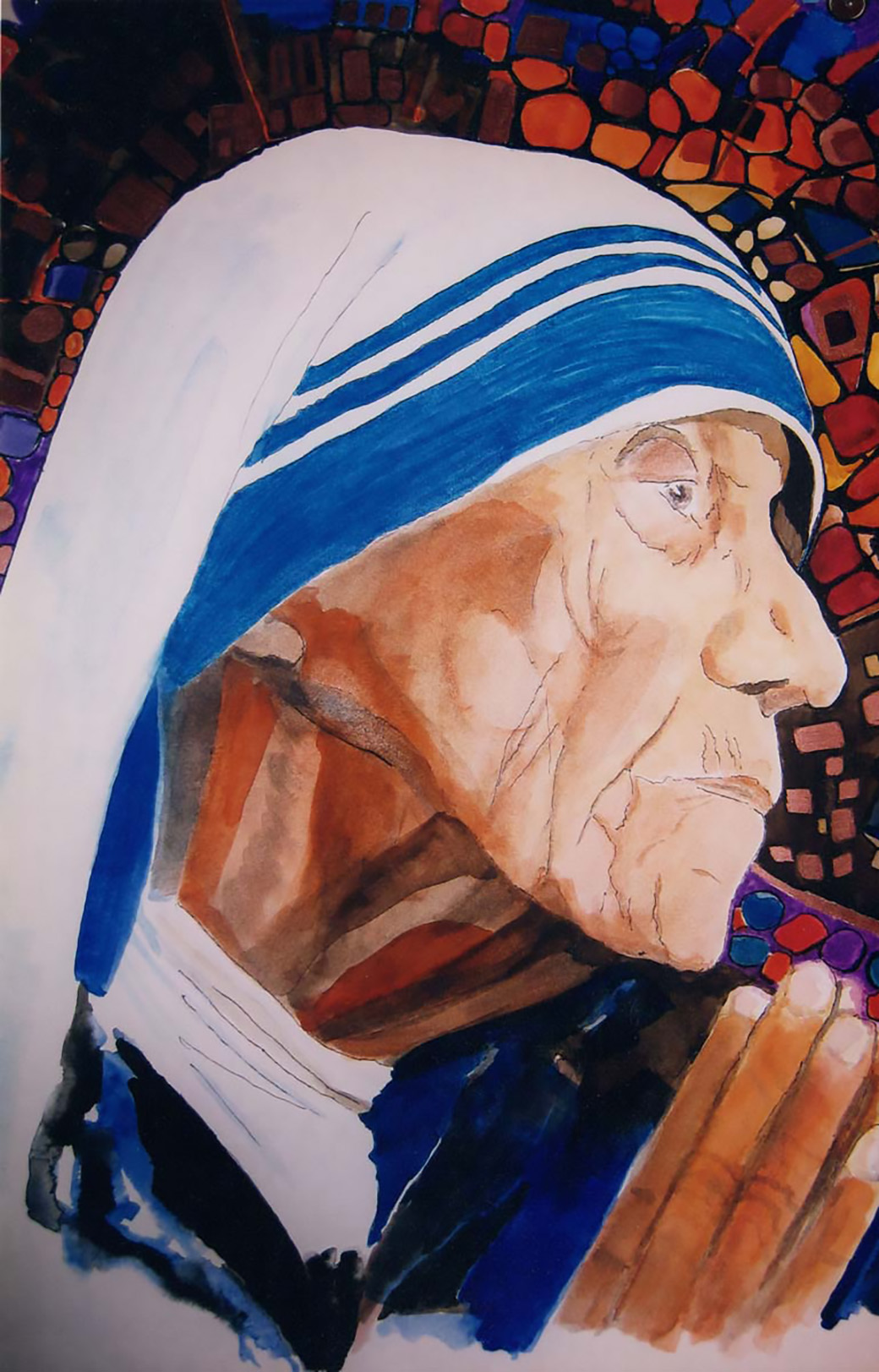
    Mother Teresa (contemporary), Br. Michael Valdes, CFC | Image from the Edmund Rice Christian Brothers Art Foundation. I can’t think of a better contemporary portrait of real justice and power in the world than the life of St. Mother Teresa.

    After these words of comfort, Isaiah then brings us back to justice: “Only in the LORD are just deeds and power. Before him in shame shall come all who vent their anger against him.” What does it mean that only in the Lord are just deeds and power? Does the preposition here mean that justice and power are relegated to heaven only and are only wielded by God from on high? Or does it leave room that those who live in the Lord may also accomplish just deeds and wield power (a power and justice that rightly come from God and belong to Him)? We have to be careful with our definitions; remember that Christ’s great lesson is that power resides in taking up the cross, a very contrary understanding to temporal power. Power flows from a love that conquers and purifies everything. It is reasonable to surmise that justice, too, is subject to love as its guiding principle.

    God is known by His transformative love. What does His love transform other than beings in the sphere of creation? Revelation teaches us that this happens specifically in human hearts. Thus, as God’s love becomes active in the world in human hearts, so “just deeds and power” are present. The logic that flows from our scriptures teaches us about this third type of justice and power: while God may wield justice and power from on high, He also chooses to have them present in the world through us because He transforms us and conforms our hearts to Him.

    Note how Isaiah’s second sentence paired to this declaration characterizes base, worldly actions as “venting anger against him.” I don’t think that all actions outside of those done in the Lord are a type of “vented anger” (some may be simply indifferent), but this category might be more expansive than we imagine. Any act that inherently works against love is contrary to God. Even the smallest thing that is done out of self-interest instead of love for another belies a type of vented anger, frustration, or brushing off of God’s law and God’s always-outwardly-focused love. I am reminded of the past few days’ worth of reflections on sin, even venial sin, and how it is the “blackest ingratitude, the greatest injustice, and the gravest outrage” to God, our rightful master. Thus, of course “before him in shame shall come all who vent their anger against him!”

    The message I hear as I contemplate Isaiah’s words is that in order to have justice, we must trust in and channel the God who is love — love that is beyond Platonic, erotic, fraternal, and even agape; the unselfish, always forgiving, always wanting the best for the other, desiring to sow the seeds that will bear fruit in the other love of God that we cannot describe, understand, or even feel. We are poor vessels to carry His love and spread it, but it is His plan, nonetheless. It prepares us for eventual unity with Him. We are bound to fail, but how we deal with our failures is also of the essence (can we accept His forgiveness as His created creatures?).

    At issue here is the fact that instead of embracing this charge to channel God’s love, we want to skip straight to the justice and the power. It’s convenient for us to think that justice can be implemented without that difficult, slow process of loving (which often changes the whole scenario and outcome), or that what we think is “power” can simply be enacted/enforced (even if, deep down, it’s just venting anger at God). Perhaps this is because our prophets and Lord have given us such great visions of justice and power that we want to just make it so. But this is impossible — “Only in the LORD are just deeds and power” — that is, justice and power must flow from Him and His transformative love. We can’t even conceive of what justice in any given circumstance will look like until we enter into this love. We can’t conceive of what power looks like either.

    That’s not entirely true. Christ shows us the power of God here on earth. In today’s gospel reading, John the Baptist sends his disciples to Christ to see for themselves if He is the Messiah. “At that time Jesus cured many of their diseases, sufferings, and evil spirits; he also granted sight to many who were blind.” He manifests God’s love here on earth, pouring out blessings, healings (spiritual and physical), and above all, forgiveness and mercy. Jesus tells John’s disciples, “Go and tell John what you have seen and heard: the blind regain their sight, the lame walk, lepers are cleansed, the deaf hear, the dead are raised, the poor have the good news proclaimed to them. And blessed is the one who takes no offense at me.” Jesus calls us to testify to Him and His works. This none other than the same refrain He spoke to Isaiah 800 years earlier: “Turn to me and be safe, all you ends of the earth, for I am God; there is no other!” He is here to prove to us that we can trust in Him. We must share that essential message around the world because trust in God combats our propensity to define for ourselves justice and power without having His love as the essential part of the equation.

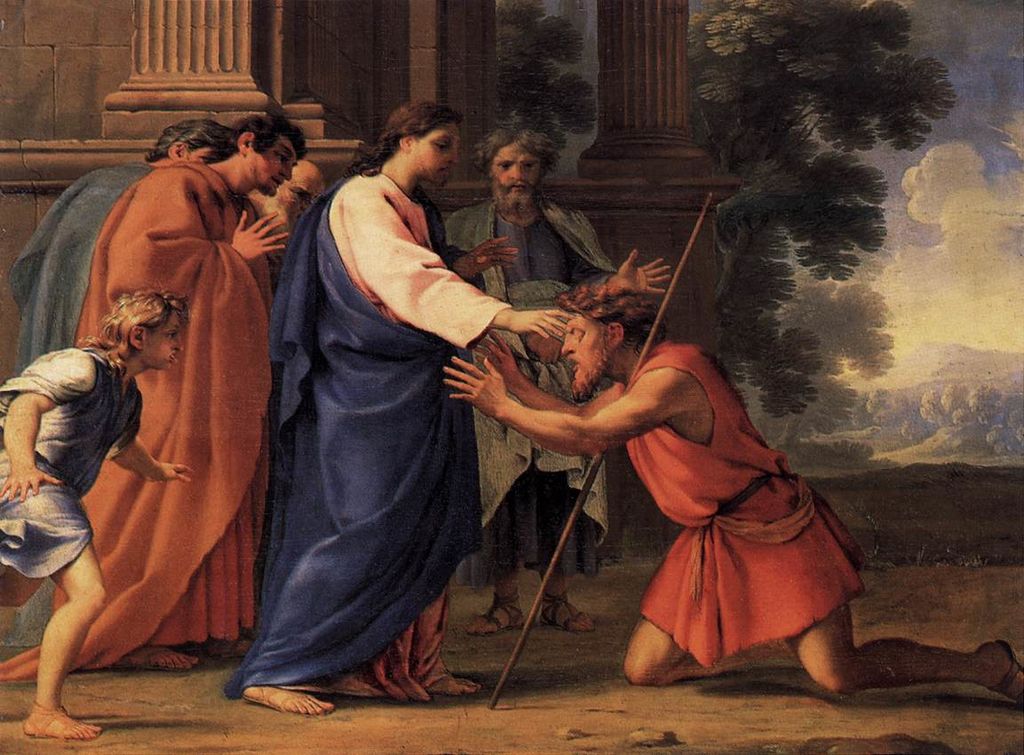
    Christ Healing the Blind Man (1645), Eustache Le Sueur | Wikimedia Commons.

    But why might he say, “And blessed is the one who takes no offense at me”? Who would take offense at healings and raising from the dead? Well, yesterday’s gospel shows us: the chief priests and elders who are shocked to hear that tax collectors and prostitutes are getting into the Kingdom of Heaven ahead of them. Those who embrace being transformed by God’s love are accessing the Kingdom being given to them here and now by Christ. This offends those who have practiced piety for so long but whose hearts are frozen in judgement against their “lesser” fellow humans. They think they know what justice looks like: this person who worked on the Sabbath or who consorts with prostitutes should not enter the Kingdom, much less be God Himself! These same people supposedly have power that they wield with their earthly positions in the synagogue. But that sense of justice and power is totally perverted. It means nothing if it does not emanate from God’s love. 

    This, of course, applies today. I know many a pious Catholic who prays longer, harder, and more frequently than 99% of us, but their hearts are frozen in judgement against those who are “polluting” the Church. What a sad state! Not just them; really any of us who gain our bearings in the world by defining “justice” as we see it are guilty of the same offense. I’m starting to realize that “justice” as a social and legal concept needs to be taken down from its secular pedestal lest it defile our understanding of divine justice, which is never ours to define or even completely comprehend. We might have to be jury members or judges in our work and civic life, but this should in some ways fill us with dread and unease. We are called to something much greater, and the more we can turn to that greater being, the more we can enact real justice in the world. 

  • Accepting Correction

    Accepting Correction

    Tuesday in the 3rd Week of Advent: Zephaniah 3:1-2. 9-13, Matthew 21:28-32.

    People who know me would probably say I’m famously bad at taking correction. It’s something I’ve tried to work on for a long, long time. I’m still not great at it. I’m not sure how my mother and father ever dealt with such a pig-headed son, but thankfully they had 7 other kids to distract them from me. When I consider why it’s so hard to take correction, a few things come to mind: embarrassment, indignation, pride, defensiveness, inability to separate a critique of an action from critique of who I fundamentally am. In all of these things is a single thread: putting myself first.

    Pouting (contemporary), Kim Roberti | Image from pinterest.com.

    Today’s readings speak loudly to people like me. Zephaniah laments the pig-headedness of the Jews in Judah, and the Lord promises a great humbling, after which peace will come. In the gospel reading, Jesus re-frames this lesson as an internal conversion of heart, although the punishment and salvation message remains. Through both, I can see how accepting correction is a very necessary ingredient for being taken into the Kingdom.

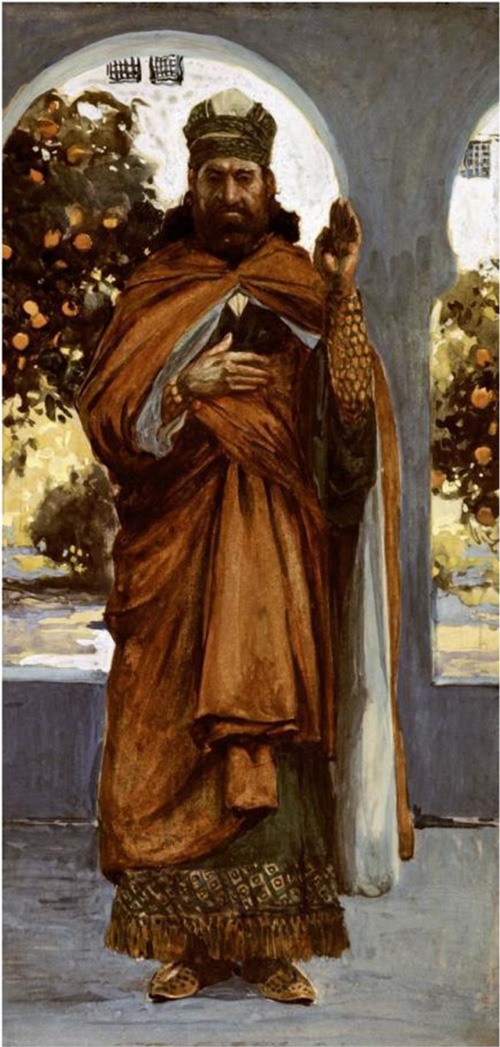
    The Prophet Zephaniah (1888), James Tissot | Image from christianimagesource.com.

    The prophet Zephaniah lived in Judah under King Josiah (640-609 BC), who reigned until 13 years before the nation’s defeat by the Babylonians. The Judeans had seen the defeat of the northern kingdom of Israel by the Assyrians 100 years prior, and yet continued to be faithless to God. This is what Zephaniah laments — he tries to get them to return to the Lord and foresees their great humbling during the Babylonian Captivity. The crown jewel of Judah is Jerusalem, a beacon for the Jewish people, and it is about Jerusalem that today’s reading speaks: “Woe to the city, rebellious and polluted, to the tyrannical city! She hears no voice, accepts no correction; In the LORD she has not trusted, to her God she has not drawn near.” Here is where scripture speaks to me — I can see myself in this refusal to hear other voices and accepting no correction. The very next sentence declares that such pigheadedness is a lack of trust in God. That’s a bit of a blow. Just when I think it’s all about me, even then it’s really about God!

    This is the irony of pride: the self-absorbed person cannot even be pitied (something they’d deserve yet despise) because the real offense is not to themselves but to God. As we reflected last Friday in The Lukewarm and the Cynical, “Sin is not only a foolishness and vileness, but considered in relation to God it is also the blackest ingratitude, the greatest injustice, and the gravest outrage” (Fr. Garrigou-Lagrange, Knowing the Love of God, 21). Once again: our hearts and souls rightly belong to God, and closing them off from Him is unjust and a great offense. 

    What does God do about this offense? Zephaniah tells us, “For then I will change and purify the lips of the peoples … remove from your midst the proud braggarts, And you shall no longer exalt yourself.” Once again we are told that God’s purifying love removes pride. In the saga of the Jewish people, this purification is seen in the fall of Jerusalem and Babylonian Captivity. They do not perish, because God loves them. In fact, many historians claim that the Jews who returned to the Holy Land after the Babylonian Captivity were much more serious observers of God’s law than those before this penitential time.¹

    God promises this very thing to Zephaniah: ” I will leave as a remnant in your midst a people humble and lowly, Who shall take refuge in the name of the LORD: the remnant of Israel. They shall do no wrong and speak no lies; Nor shall there be found in their mouths a deceitful tongue; They shall pasture and couch their flocks with none to disturb them.” What a testament to His love that He does not simply destroy evil-doers, but provides opportunities for penitence and conversion.

    And what happens on a large societal scale in the Old Testament, Jesus brings to us on an individual level.

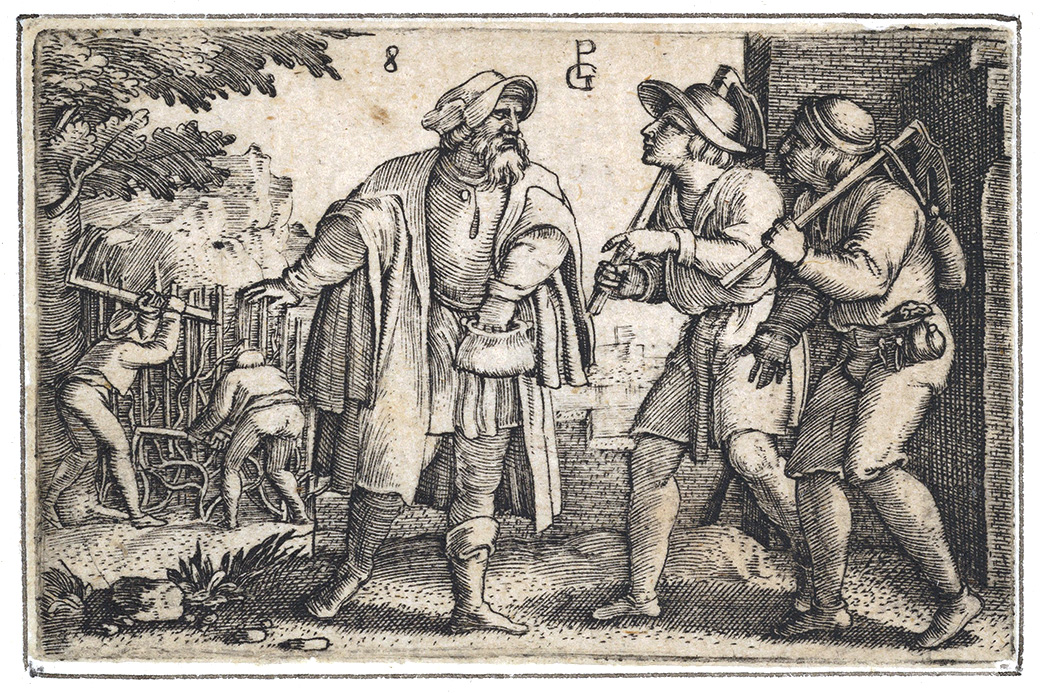
    The Parable of the Father and His Two Sons in the Vineyard, from The Story of Christ (1534-1535), Georg Pencz | Creative Commons, courtesy the Metropolitan Museum of Art.

    Jesus teaches us via the parable of the two sons. Of the one who has obeyed the will of his father, he says, “The son said in reply, ‘I will not,’ but afterwards he changed his mind and went.” The short parable is clear in what happens: an immediate refusal, then a conversion of heart followed by right action. Is this not the archetype for so many of us?

    I was blessed to have been brought up in a Catholic family and heard this parable from a very early age. I thought of it often growing up, mostly because my hotheaded inability to take correction put me in that immediate refusal mode. But the grace afforded me by my baptism into the Church and ongoing formation as a Catholic blew on that little ember of a developing conscience and I slowly applied moral sense to my life. My often sheepish conversion to do what was asked was followed by a (usually) quiet compliance.

    Today’s parable is absolutely fundamental to the Christian life. Jesus explains to the chief priests and elders — with what we might imagine to be a breathless, earnest desire to save them — “Amen, I say to you, tax collectors and prostitutes are entering the Kingdom of God before you.” How could these reviled, impure people enter the Kingdom ahead of those who are considered the crème-de-la-crème of Jewish society?

    Jesus explains that these impure people listened to and followed John the Baptist’s warnings, whereas these chief priests and elders remained skeptical.

    And think of the context here. This is chapter 21 in the gospel according to Matthew. It opens with Jesus’s triumphal entry into Jerusalem, followed by his throwing the money changers out of the temple and cursing the fig tree. Then we have yesterday’s reading where the chief priests and scribes can’t respond in truth to his question about John, followed by this parable and then the parable of the wicked tenants. This is a sequence of Christ’s arrival and sweeping the selfish pride out of Jerusalem.

    We hear how the Lord tells Zephaniah “I remove from your midst the proud braggarts, And you shall no longer exalt yourself,” and we see Jesus fulfill this promise. This is a time of winnowing, separating the chaff from the wheat, and a time of discernment, to understand what is in the hearts of the people.

    Jesus continues to heal the blind and lame in this chapter (Mt 21:14) — he could not possibly withhold his very nature of love and healing — but his message includes a very serious warning as he tells the chief priests and elders, “the kingdom of God will be taken away from you and given to a people that produces the fruits of the kingdom” (Mt 21:43). We can never forget that Christ is simultaneously the generous healer and the bringer of the end of time; the innocent lamb and the judge who divides the goats and the sheep.

    Christ, outside of time, tells us simultaneously of our past, present, and future, but never withholds the living water that flows from Him and His wounds.

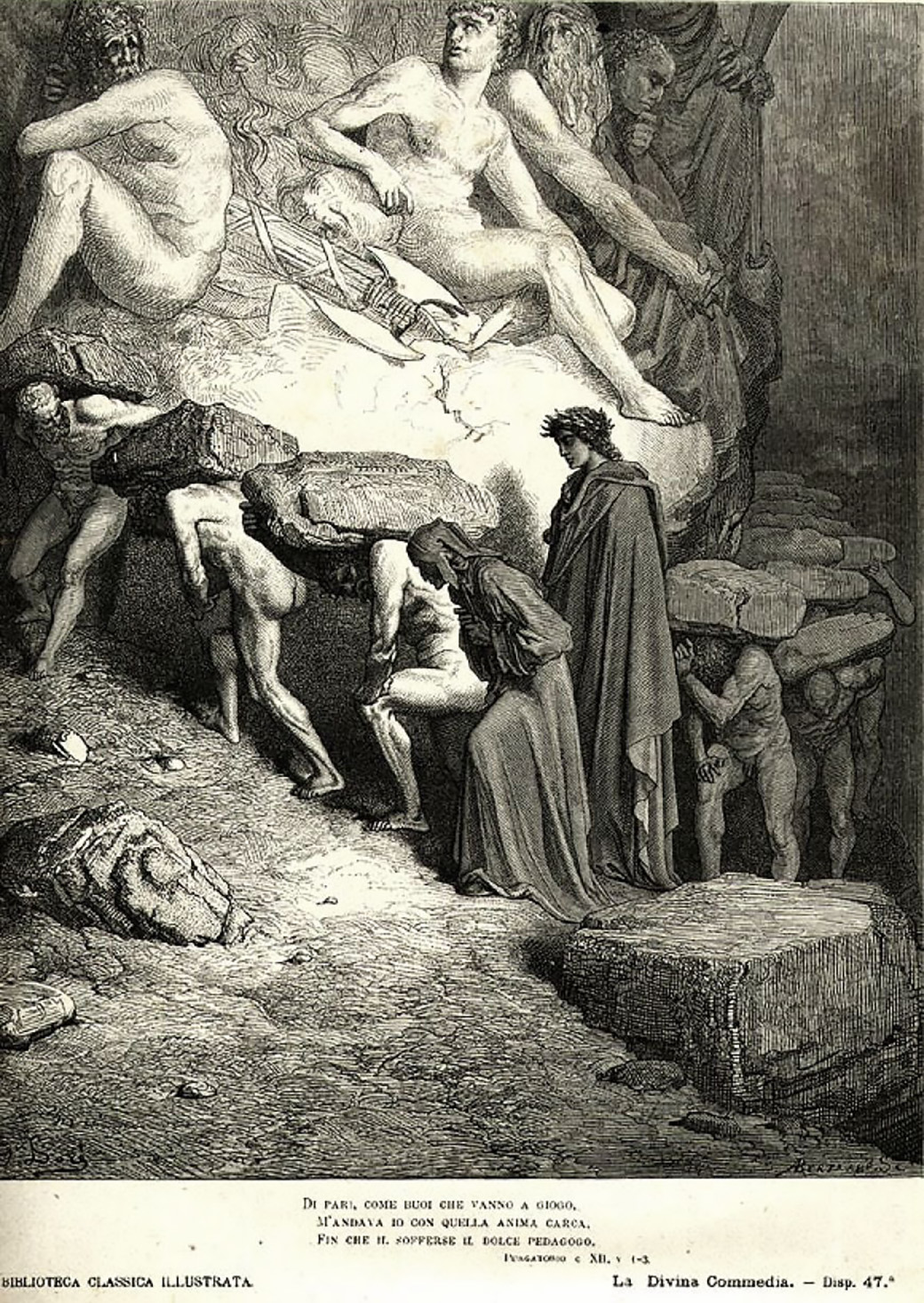
    The Prideful – Oderisi, Purgatorio Canto 12 verses 1-2 (c 1857), Gustave Doré | Wikimedia Commons. This is how Dante imagines the prideful must spend their time in Purgatory – dragging massive rocks up a mountain while chanting a modified form of the Lord’s Prayer in a type of enforced humbling/penance.

    And we can see how this is an Advent message. We are all the son who refuses — with every sin we commit!

    With every sin, we refuse God and shut our hearts to him. Consider the simplest choice to exit a conversation with someone who wants to talk because we’re bored, tired, or would rather be doing something else. In this example, we have put ourselves first and not sublimated ourselves to the will of the Father. The Good News is that as long as we have breath, we can convert our hearts and do God’s will. Jesus promises us the Kingdom; he never withholds it. We simply have to have that real, ongoing, continual conversion of heart — perhaps learn to accept correction — and start producing the fruits of the kingdom.

    We are waiting for that glorious King to be born, and we have these weeks to prepare the way in our hearts.


    ¹ Barton, George A. “Influence of the Babylonian Exile on the Religion of Israel.” The Biblical World, vol. 37, no. 6, 1911, pp. 369–378. JSTOR, www.jstor.org/stable/3141403.

  • Truth Speaks in Silence

    Truth Speaks in Silence

    Memorial of Saint John of the Cross, priest and doctor of the Church, Monday in the 3rd Week of Advent: Numbers 24:2-7, 15-17a, Matthew 21:23-27.

    Today (in the year 2020), we celebrate the memorial of one of our great mystics and doctors of the Church, St. John of the Cross. He cultivated an intense personal and internal relationship with God and wrote beautifully on the Divine Essence as well as the paradoxes he experienced in having God so close yet so immensely far and silent. I find that today’s readings, in all their seeming obscurity, help us explore alongside St. John of the Cross the loudness of truth that God so often presents to us in His silence.

    The first thing I thought about the first reading was, “wait, who is this Balaam, son of Beor?” I had to read up on him, and it turns out he was a non-Jewish seer/prophet, well-known throughout the Levant, graced with the actual truth and Word of our Lord. He lived when the Israelites were finishing their 40 year desert wandering and having great military successes, winning their place in the region. They had defeated Sihon, King of the Amorites and Og, King of Bashan, and so the other rulers in the region were getting very nervous.

    Balak, King of Moab, sends for Balaam, asking him to curse the Israelites. Over three chapters in the Book of Numbers, we read this interesting story about Balaam, who seven times lives up to his words: “Although Balak were to give me his house full of silver and gold, I could not go beyond the command of the Lord my God, to do less or more” (Nm 22:18). There is an interesting sequence of events where God tells Balaam not join Balak and not curse the Israelites because they are blessed, and Balaam sends back Balak’s men.

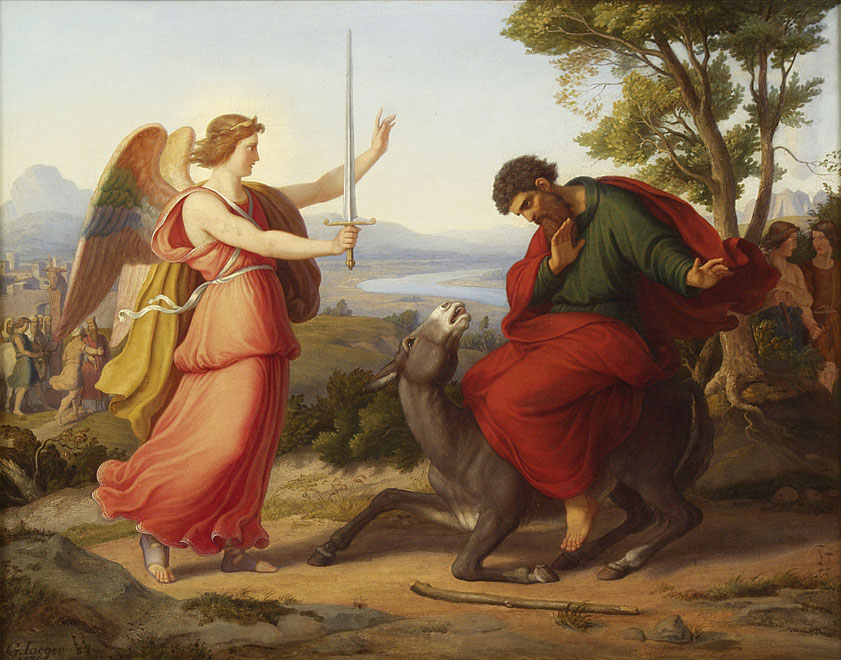
    When Balak sends messengers a second time, Balaam waits for God’s instructions and God says he can go as long as he will “do only what I tell you to do” (Nm 22:20). But next God sends an angel apparently to stop Balaam on his journey, who tells him “I have come out as an adversary, because your way is perverse before me” (Nm 22:32). What actually ensues is a physical resistance battle between Balaam and his mule, who is trying to obey the angel Balaam doesn’t see. Finally, the angel admits him passage, saying, “Go with the men; but speak only what I tell you to speak” (Nm 22:35). Indeed, over the course of seven prophecies in the presence of King Balak, Balaam has nothing but praise for Israel, even prophecy of their Messiah.

    Balaam and the Angel (1836), Gustav Jager | Wikimedia Commons.

    What to make of this curious treatment of the Gentile prophet? It’s not that God changes his mind a lot (this is contrary to God’s nature), but instead Balaam’s internal struggle with hearing God’s truth and setting out on a mission contrary to this truth. He is serving an enemy of God’s Chosen People; he has yoked himself, as it were, to an evil force contrary to God. He is the example of someone who is trying to serve two masters at once, which is never tenable.

    So why does God permit him to go on this mission for Balak? Perhaps so he can provide all of us who read the scriptures an example and valuable lesson. We learn that leading such a life is a tortuous process, where both of your masters are unhappy and unfulfilled with your service. We also learn that in the end, the Lord our God will always be vindicated and triumph. This leads us to today’s reading.

    In today’s reading, we hear of Balaam’s praise of Israel and prophecy of the Messiah. What we don’t hear is the consternation of his earthly master, Balak: “What have you done to me? I brought you to curse my enemies, but now you have done nothing but bless them.” Balaam answered, “Must I not take care to say what the Lord puts into my mouth?” (Nm 23:11-12). It seems that Balaam is completely at the mercy of God’s will, even with an angry earthly king breathing down his neck.

    It’s not clear whether Balaam is concerned for his own safety here or wishes he could just say something to please Balak. But when it comes time for him to prophesy, he is gripped by the Holy Spirit: “the spirit of God came upon him, and he gave voice to his oracle.” Things truly seem out of his hands. To the Jews, this was proof that even Gentile prophets could not disobey the overwhelming power of the God of Abraham. God’s truth is undeniable to those who are graced to receive it.

    One last thought on the first reading: it is remarkable that this early in the Jewish tradition, before they have crossed the Jordan in their military might, before they have built Jerusalem and the great temple, we hear a prophecy of the future Messiah: “I see him, though not now; I behold him, though not near: A star shall advance from Jacob, and a staff shall rise from Israel.” Most translations actually translate “staff” as “scepter.”

    The Hebrew word שֵׁ֙בֶט֙ (shebet) is alternatively translated as rod, scepter, staff, or tribe; it essentially means a ruling authority. So Balaam gives us a very Advent-sounding prophecy of a star that rises and a new reign arising from Israel. We Christians clearly interpret this to be Jesus, the Morning Star, and the Reign of Christ.

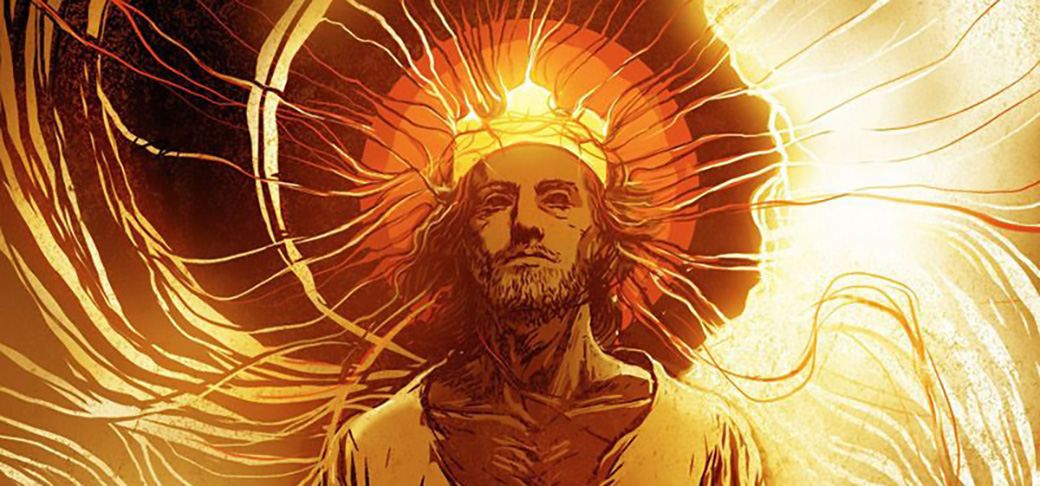
    Detail from Christ the Morning Star (contemporary), Chris Koelle | Image from pinterest.com. See more of Chris Koelle’s work.

    In the gospel reading, the question of shebet seems to come up again. The Jews are seeing Balaam’s prophecy come true in their time: a shebet has arisen from Israel in the form of this man Jesus. Remember, the Book of Numbers is the fourth of the five books of the Torah, their most sacred texts. The books of the prophets are also replete with references to the Messiah that seem to be fulfilled in Jesus as well — Jesus’s works and words are striking a chord deep in the Jewish psyche and memory.

    Thus, “the chief priests and the elders of the people approached him as he was teaching and said, ‘By what authority are you doing these things? And who gave you this authority?’” Jesus’s reply is a counter-question that points back to the voice crying out in the wilderness, John the Baptist. As we reflected yesterday, he is the ultimate testament to Christ’s divinity as he fulfills Isaiah’s prophecy of the announcement of the Messiah. Jesus has come for those who long for God, who have listened to John and prepared a way for the Lord in their hearts. He is asking the chief priests and elders if they have prepared the way.

    Instead of answering him clearly, we see exactly the type of tortured mentality we encountered with Balaam. They are serving a worldly master — their fears of the crowd and their political machinations — while attempting to encounter God’s truth. This is untenable, as Balaam showed us so long ago. They have clearly not prepared the way for the Lord in their hearts. They are not filled with the burning yearning for God, otherwise they would see Christ for who He is.

    Jesus cannot invite them to the wedding feast of the Lord while they vacillate between the pull of the world and the pull of God. He brings not peace but the sword to people like this (cf. Mt 10:34) — they must choose God or the world, not both. And there are consequences. 

    Conversely, St. John of the Cross is a master of preparing the way. If I had to imagine his heart in Isaiah’s terms, I would imagine a broad plain, as fertile as it gets, blossoming with the fruits of God’s Word and grace. This master of contemplation writes extensively on encountering God, and a key to understanding St. John of the Cross is to understand his conception of God’s omnipresence and simultaneous indwelling in our souls. At the risk of tackling something that is difficult in just a short amount of space, I want to quickly explore this because it can shed light on today’s readings’ tortured figures. 

    One theological point that we must understand before encountering St. John of the Cross is this: God is immense and omnipresent (not able to be pinned down to a specific “location”) but also makes Himself present to our souls in a special, intimate way through His grace. Fr. Donald F. Haggerty writes in Faith and Reason (Fall 1991 issue) a nice primer on the theological intricacies of St. John of the Cross. He writes, “God inhabiting the soul can now become the intimate object of a knowledge and love that unites the soul with God in the bond of grace. The divine Persons give themselves to the soul so that it might possess them in a real and substantial manner.” This means that God is closer to us than we are to ourselves! (Our mind tries to mediate with our soul whereas He has direct presence with our soul).

    Haggerty continues: “Any notion of a distant or impersonal God dissolves when He is understood to be the Guest of one’s own flesh. … Paradoxically it would seem, [St. John observes that] the more God is experienced as the source of one’s own life of the spirit, the more powerfully transcendent, incomprehensible, and inaccessible His divinity becomes.” This makes sense to me as a novice to contemplation; the more I consider how God and grace might exist within, without and through me, the more I realize how fantastically other He is, how I would love to know Him better but how impossible that seems, how communion with Him is indescribable, literally silent because my words as a created being fall so short of the type of communication that is God in my soul.

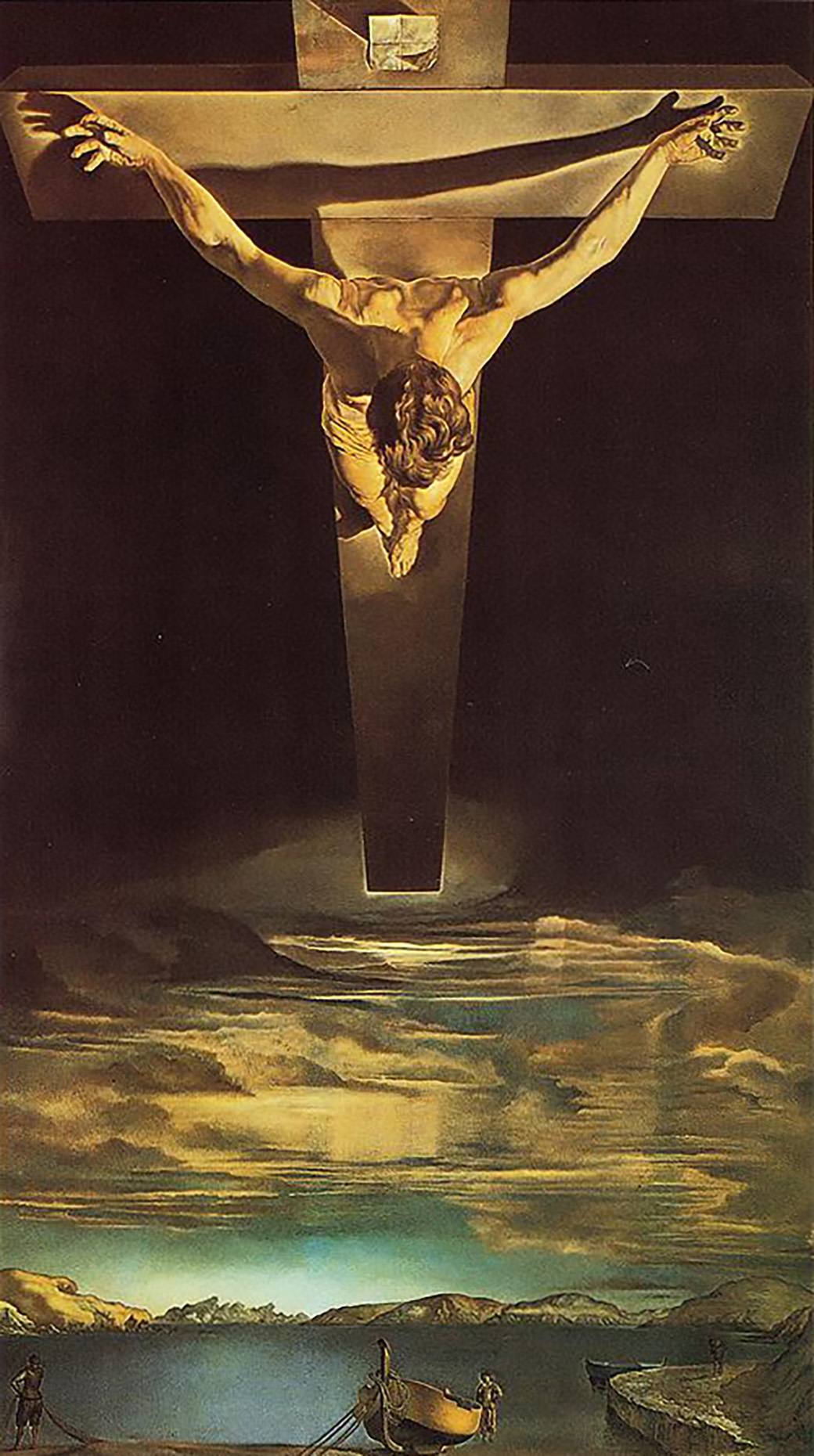
    Christ of Saint John of the Cross (1951), Salvador Dalí | Image from fineartamerica.com. I’m not a huge fan of surrealism, but it seems particularly appropriate for the silent, inward-yet-outward contemplation of St. John of the Cross and his close-yet-far theology. The perspectives on Christ that his contemplations must have garnered him seemed to be highlighted by Dalí’s emphasis on position and size of the crucified Christ over the fishermen (evangelists).

    This is where we pick up St. John of the Cross. He has so many amazing nuggets in his prose. Here’s one that’s made-to-order for Advent: “What we need most in order to make progress is to be silent before this great God with our appetite and with our tongue, for the language he best hears is silent love.” I love this idea of finding a language by which we can communicate with God because this is striving to bring the mind in concert with what the soul is able to experience without mediation.

    And here we have St. John’s recipe: silencing our worldly appetites and our tongue; communicating in silent love. Whew! If only I could still the craziness of my media-soaked head enough to get there. Thank God for retreats at Benedictine monasteries! In any case, it does seem that this is something the penitential Advent season calls us to try: more silence, darkness lit by three (next week, four) candles, and love for our God that fills our hearts and souls.

    Finally, I’d like to just reflect back on the issues the figures in today’s readings encounter. Balaam does communicate with God and hear His truth — he must have a solid fear of God — but the inability to silence the world and his desires seems to be his downfall. The chief priests as well seem very far from a contemplative experience of God. They have no stillness in their souls, no honest response to the indwelling of God that might help them recognize the very presence of God in their midst.

    It’s a great challenge for us. Thankfully we have our entire lives to grow into this communication of silent love so that we can become more and more receptive to God’s truth within and without.

  • A Day of Vindication by our God

    Third Sunday of Advent: Isaiah 61:1-2a, 10-11, 1 Thessalonians 5:16-24, John 1:6-8, 19-28.

    One of my favorite passages from Isaiah occurs in today’s readings. It seems to have been especially significant for Christ as well since we see Him read it to His hometown synagogue in Luke’s gospel. (I have to admit that another reason I like this passage is that I fondly recall playing what I think is Matt Maher’s best composition, Isaiah 61.) Today, the voice of the Anointed One is spoken (announced, as it were) by Isaiah while John the Baptist likewise cries out in the desert, also announcing Christ, and also quoting Isaiah. This third Sunday in Advent marks a great intersection of prophecy, the fulfillment of the Time of Promises, and the announcement of the Incarnation in our midst.

    Isaiah 61 (ccontemporary), Br. Michael Valdes, CFC | Image from the Edmund Rice Christian Brothers Art Foundation.

    The Messiah’s words of self-announcement through the mouth of Isaiah are so poetic. For me, perhaps their most lovely attribute is that they give glory to God the Father with every line, while still revealing the role and personhood of the Messiah. He begins with “The spirit of the Lord GOD is upon me, because the LORD has anointed me,” and we see the Blessed Trinity in full display. He speaks of the action of the Holy Spirit, resting upon him, sent by the Father as a way to anoint the Son. This is the fundamental relationship of the Three Persons as we understand it. The Father is the creative force, the genius of Creation, who sends the Spirit to grace, bless, and anoint in the created universe. The Son is the full recipient of the Father’s Spirit and Love, the promised Anointed One sent to do His will as none other in history can. As we read the rest of the opening sentence, we receive a condensed nugget of the Christian mystery of faith: “he has sent me to bring glad tidings to the poor, to heal the brokenhearted, to proclaim liberty to the captives and release to the prisoners, to announce a year of favor from the LORD and a day of vindication by our God.” Christ’s redemptive power, the Good News, the healing, the freeing from enslavement to sin, and the victory over death are all here prophesied. Amazing!

    This is the sentence that Jesus reads in the synagogue at Nazareth when He starts his ministry, just after resisting the Devil’s temptations in the desert (Luke 4:16-19). We can marvel at the layers of revelation in the Word of God speaking through Isaiah nearly 800 years before Christ will quote his prophecy in the Nazorean synagogue. The Word, now incarnate, speaks the very words He delivered to Isaiah so long before. Why does He reveal Himself in this way? One reason is that God sows in the heart of humanity a longing for deliverance, a desire to know Him that grows over time and is not only appropriate for the dignity of the Son of God but makes humanity more receptive to His message. Another reason that becomes apparent is that there is an inherent humility to the coming of the Lord — first as a fragile baby born in an animal stall, and even in his revelation of Himself in this way. Let’s remind ourselves of what St. Luke writes after Jesus reads this verse from Isaiah: “And he rolled up the scroll, gave it back to the attendant, and sat down. The eyes of all in the synagogue were fixed on him. Then he began to say to them, ‘Today this scripture has been fulfilled in your hearing.’ All spoke well of him and were amazed at the gracious words that came from his mouth” (Lk 4:20-22a). Jesus sits! And instead of proclaiming “It’s me! I am the Anointed One!” He says that this illustrious prophecy has been fulfilled in their presence. There’s no doubt about what He’s saying, but He couldn’t have chosen a more meek and humble way to say it. It’s important to note that Christ is not only lending legitimacy to Himself here — He is blessing the entire past tradition and Time of Prophecies. His divine majesty radiates in all directions, past, present, and future, from this moment of His Reign beginning on earth. Imagine if the prophecy was never fulfilled: it would cast doubt on not only the beloved prophets but God’s fidelity to his people; perhaps even God’s existence. Christ’s coming attests to God in every way, blessing the entire stream of salvation history. He truly is — by His very existence — a day of vindication by our God. And for one brief moment, before they recall that He is Joseph’s son and their human instinct of skepticism takes over, the entire synagogue recognizes Him as the Anointed One: “All spoke well of him and were amazed at the gracious words that came from his mouth.” Even here, in the episode that teaches us much about humanity’s inability to discern truth in front of them, we see that creation cannot help but recognize the incredible, humble and gracious majesty in front of them.

    Christ in Majesty, historiated initial ‘A’ on a bifolium from an Antiphonal (c.1400), unknown artist | Image from christies.com. From the description at Christies: “This bifolium comes from a magnificent Antiphonal made for an unidentified Benedictine monastery. The initial opens the responsory for the first Sunday of Advent, ‘Aspiciens a longe ecce video dei potentiam’. Carrying the opening of the first feast of the Antiphonal, this page is illuminated more extensively and more splendidly than any other and it is certainly the work of the principal illuminator. The exquisite monochrome figures in the initial staves and the full-page border inhabited with birds, beasts and figures are unique features. This artist is not precisely identifiable but he was clearly within the circle and influence of the illuminators responsible for two of the greatest manuscripts produced for the court of Wenceslas IV: the Master of the Golden Bull and the Master of the Bible of Konrad of Vechta. This leaf can be placed alongside them as being one of the highest achievements of Bohemian court illumination and thus of European art of around 1400.

    Jesus Christ Himself, fully human and part of creation, also rejoices in the Incarnation: 

    I rejoice heartily in the LORD,
    in my God is the joy of my soul;
    for he has clothed me with a robe of salvation
    and wrapped me in a mantle of justice,
    like a bridegroom adorned with a diadem,
    like a bride bedecked with her jewels.
    As the earth brings forth its plants,
    and a garden makes its growth spring up,
    so will the Lord GOD make justice and praise
    spring up before all the nations.

    This gracious way of rejoicing is simply a pleasure to read and contemplate. May we all say the words, “in my God is the joy of my soul”! The image of the Father clothing His Son in a “robe of salvation” is beautiful on its own, and takes on a heart-wrenching quality when we recall the robe and crown of thorns the soldiers put on Him during His Passion. The other lines evoke the pure beauty of a bride and groom on their wedding day and the life-affirming nature of an abundant garden as they contemplate the Kingdom of Heaven that is here. For what else is the promise of ultimate justice for humanity and never-ending praise for God but the Kingdom of Heaven? All of this spoken without boasting and with continual deference to the Father, from whom all these blessings flow.

    When we study the gospels, we discover that Christ’s entire ministry is a deliberate and methodical revelation of His prophesied divinity and Incarnation to His followers. This simple point is so important for Jesus to make because 1) it shows the overabundant generosity of the Father, 2) it must be insisted upon because of its sheer uniqueness and miraculous nature in the history of the universe, and 3) it’s impossible to understand the redemptive quality of Christ’s sacrifice and Resurrection unless we recognize that He is, in fact, God’s Son, the promised Anointed One who perfects the Old Covenant and offers saving grace from the nation of Israel to the rest of humanity. 

    And thus John the Baptist occupies this seminal pivot point between the Old Covenant and the New, proclaiming that the Son of God has finally come to earth. We’ve grown up knowing that this was his message, and he sort-of disappears in the wake of Christ’s great ascendency. I think he might be slightly dismissed as an interesting side note in our contemplation of our faith. But let’s consider how important this final prophet is (and recall our reflection on Thursday when Jesus said John is, in fact, the greatest of Jewish prophets, Elijah, come back as promised). The evangelists give him pride of place at the beginning of the gospels; St. John in today’s gospel states, “A man named John was sent from God. He came for testimony, to testify to the light, so that all might believe through him.” John the evangelist is matter-of-fact here: John the Baptist was sent from God to testify to the light, that is, to testify that the Christ has actually come and graced the earth with His Presence. Note that the evangelist states that the reason the Baptist does this is “so that all might believe through him.” This statement carries many layers of meaning. We begin to appreciate the importance the Jewish faith placed on prophets and their role in speaking the truth — prophets ratify, in a way, the will of God on earth. We see this throughout the old testament when the kings and judges would summon the great prophets of the age to help them interpret God’s will in events as they unfold. God Himself establishes this co-leadership of prophets among the Chosen People as He appoints Aaron, Moses’ brother, as his prophet (Exodus 7:1). Also present in the evangelist’s words is the knowledge that as the one announcing the arrival of the Messiah, the Baptist is the last of the prophets, the fulfillment of what they had promised, and this is another way people can believe in Christ “through him.”

    St. John the Baptist (1878), Auguste Rodin | Creative Commons, courtesy the Metropolitan Museum of Art.

    Properly stated, a prophet is someone who speaks for God to His People (cf. Amos 3:8; Jer. 1:7,17; Ezek. 3:4). The original Hebrew נָבִיא (nabi) is a cognate of Akkadian verb nabu = “to call” and Arabic naba’a = “to announce.” We see this shared meaning of “calling out” very clearly in John the Baptist. He defines his entire existence as simply that: crying out in the wilderness. He is nothing but a voice, God’s mouthpiece in the world, with a simple message. The way he proclaims this to the priests sent to question him again sheds light on the layered mystery of revelation in God’s plan: “I am the voice of one crying out in the desert,
    ‘make straight the way of the Lord,’
    as Isaiah the prophet said.” Like Jesus, John identifies himself through the words of Isaiah. Unlike Jesus’s meek appearance when He sits in the synagogue to share this revelation, John is wild in appearance, unabashedly baptizing all who will come, loud in his proclamations. He is the living voice of God’s Word in a different way than Christ (who is actually God). The grammar of his statement to the priests attests to this, the small “I am” before Isaiah’s prophesy echoes the great I AM of God Himself to Moses. Rather than “I AM who I AM,” John places his entire being, his “I am,” in Isaiah’s prophecy to be the voice crying out in the wilderness. This matches the wildness of his character; his entire being is truly a voice crying out in the wilderness. We can appreciate his abandonment to his prophetic appointment from God as we consider the readings of the past week that remind us to encounter the passionate love of God with an equally passionate seizing of God into our beings, violently pushing aside our worldly attachments and roadblocks. John refuses any other definition for himself. He tells them that he is not the Christ, not the Prophet, not Elijah — he refuses to be distracted by considerations of his own personhood because he has given himself completely to the task before him, to be the voice crying out in the desert, “make straight the way of the Lord!”

    So, let us thank St. John the Baptist for his indefatigable demonstration of faith in God and his reminder that we must always be in the process of making straight the way for the Lord. As much as Jesus’s teachings perfect us, this remains the initial Christian call: prepare your heart, level the mountains and valleys it contains to make a straight path for Christ to come in and transform it. We must not only recall and thank St. John the Baptist, but we must imagine him here before us in his camel hair shirt, up to his calves in the Jordan, offering us a handful of blessing water as he repeats, make straight the way of the Lord. We can never tire of hearing it, never think we’re above the raw wildness of his character and call, because if there’s one thing we’re good at, it’s obscuring that way for the Lord with our own desires and thoughts of ourselves.

  • The Lukewarm and the Cynical

    Friday in the 2nd Week of Advent: Isaiah 48:17-19, Matthew 11:16-19.

    Today’s readings put an exclamation mark on yesterday’s message about being enflamed with the passion of God’s transformative love and seizing the Kingdom of Heaven offered to us. God promises much to us if we listen to His Redeemer, His Son. Yet we find Jesus in the gospel reading lamenting over the fact that the people of that generation are lukewarm, cynical, and do not listen to His teaching.

    The first thing we hear from Isaiah is a recognition that Jesus Christ, who he calls “the Redeemer” and “the Holy One of Israel,” is the very same “I, the LORD, your God,” who speaks to His People. This is remarkable, affirming the divinity of Christ some 750 years before His birth unto Mary. What’s more, Isaiah foresees that He will be present on earth to guide and teach His People. He will “teach you what is for your good, and lead you on the way you should go.” Again, as we’ve seen throughout Advent, Isaiah affirms that God’s promise for overabundant life, grace, and the escape of death is tied to the Redeemer’s coming: “If you would hearken to my commandments, your prosperity would be like a river, and your vindication like the waves of the sea.” In this way, the New Covenant of Christ is a clear extension and perfection of the Old Covenant under which Isaiah and the Jewish people were tied to God.

    Rivers of Living Water (contemporary), Dyed4You Art | Image from dyed4youart.com.

    It’s no secret that the Jews in power did not listen to Christ and follow His teachings, as the Passion and Crucifixion attest. But Jesus laments a more general inattention to His teaching from the entire generation: “To what shall I compare this generation? It is like children who sit in marketplaces and call to one another, ‘We played the flute for you, but you did not dance, we sang a dirge but you did not mourn.’” Jesus seems to be referencing the refrain from a children’s game. This is an ingenious analogy. In one sense, the “we” of the refrain could be Jesus and John, who called to one another through their mothers’ wombs, John singing the dirge of repentance and Jesus playing the flute of salvation. In another, more overt sense, the children are the people who hear these calls and do not respond. Further, they are the ones who sit and pantomime the whole scene, calling it out to one another as if bystanders who just observe from afar. This is the ultimate picture of indifference, of being lukewarm. And as we explored yesterday, the transformative love of God inherently calls us to be passionate, to violently break through our indifference and sin to seize the Kingdom being offered to us.

    Jesus then points out a deep cynicism and skepticism at the heart of the people who do not respond to these divine calls. “For John came neither eating nor drinking, and they said, ‘He is possessed by a demon.’ The Son of Man came eating and drinking and they said, ‘Look, he is a glutton and a drunkard, a friend of tax collectors and sinners.’” These are the words of people who are comfortable with a type of restrained piety (how many of these have we all seen in our lifetimes!). They like a certain amount of propriety with their piety. John’s wild appearance and extreme fasting was too much for them — they accused him of being possessed. Jesus’s overflowing majesty and generosity, on the other hand, causes them to brand him a glutton and drunkard (not to mention impure by association with tax collectors and sinners). Jesus has little patience for this type of piety, which betrays that a person has not accepted God’s transformative love into their hearts. They are not filled with the passionate love of God. And the deep sin here is that they hold onto their own sense of “knowing” what’s real, what’s worthwhile, how the world should work. They choose their own comfort zone over God. This is what I mean by skepticism. It is their own sense of how they want to see the world that makes them disparage John and Jesus. They are skeptical of John and Jesus’s claims because they haven’t opened themselves up to be transformed by god’s love.

    Yesterday’s second reading in the Office of the Readings does a lovely job of portraying the love that Jesus sees is absent from “this generation.” Saint Peter Chrysologus, the bishop of Ravenna from 433-450AD was known for his short, simple, but inspired sermons. He says:

    But in all the events we have recalled, the flame of God’s love set human hearts on fire and intoxicated human senses. Wounded by love, men longed to see God with their bodily eyes. How could our narrow human vision perceive one whom the whole world cannot contain? What will be, what ought to be, what can be – the law of love does not care about these things. Love does not have judgement, reason, strategy. Love refuses to be consoled when its goal proves impossible, refuses to be cured if its goal is difficult to achieve. Love destroys the lover if he cannot obtain what he loves. It goes where it is led, not where it ought to go. Love gives birth to desire, it bursts into flame and that fire draws it to seek forbidden things. What more is there to say? Love cannot accept not seeing the thing that it loves.

    We can see how Jesus laments for these people — they show none of the signs of loving God. Are we any better? Are we “wounded by love” so that we long to see God? Do we allow love to transform us so that we do not have judgement, reason, or strategy? This is true abandonment of ourselves to God!

    Icon of the Sacred Heart of Jesus | Image from Immaculata Helvetia on flickriver.com.

    But I’m making this all seem like it’s a fair and open choice to make when in fact it’s not. We owe ourselves to God. Let’s take some instruction from Fr. Reginald Garrigou-Lagrange, OP, a French Dominican priest who lived from 1877-1964. Karol Wojtyla (later Pope St. John Paul II) specifically traveled to Rome to seek out the personal instruction of the faculty’s most famous professor, none other than Fr. Garrigou-Lagrange. He has been called “one of the greatest philosophers and theologians of the 20th century” (by Fr. Timothy Draper in the foreword to the book cited below). In the short book Knowing the Love of God, a collection of his retreat talks, Garrigou reminds us that as our Creator God “has the right of possession over our mind and our heart, and this right, more absolute than any of our property rights, remains binding even if we forget it” (21).

    Rightly, this entire discussion of being indifferent and not inflaming our hearts in longing for God belongs in the realm of sin. As I stated above, the sins of pride and self-centeredness are what lead us to disparage others (John and Jesus, nonetheless!) and not follow God’s commandments, not give Him our hearts. Of course, talking about sin is about as out-of-fashion as offering someone a ride in a horse-drawn carriage. Garrigou-Lagrange doesn’t hesitate to go there, however. And I find him compelling. He starts by reminding us how we got here: “For the world the true evils are diseases, tuberculosis, paralysis, infirmities of every kind, poverty, and ruin. Pride, on the contrary, is not an evil in the eyes of the world; rather, it is even necessary for attaining success. A life given over to pleasure or laziness is not an evil for those rich enough to lead this type of existence” (16). He reminds us just how reasonable pride, pleasure, and laziness seem to us. But he shows how this cascades into something more serious: “We place our childish whim in opposition to the will of God and it conquers. Is this not without doubt foolishness? It is the foolishness of an instant but it can become habitual and then produce a darkening or complete blinding of the spirit” (18).

    Given God’s proper sovereignty over our mind and heart, consider well what he then says about sin: “Sin is not only a foolishness and vileness, but considered in relation to God it is also the blackest ingratitude, the greatest injustice, and the gravest outrage” (21). These are serious statements, and it might shock you to learn that he’s talking about venial sins! I, for one, try not to berate myself for small sins, but reading this in the light of the past two days’ readings, I wonder if I’ve been letting myself off a little too easy. If I was inflamed with the passionate, transformative love of God, then I would shun even small sins with passion because they take me away from God.

    Garrigou-Lagrange speaks to the seriousness of even small moments of venial sin: “It does not kill the soul, but it leaves it without force and energy for the good. It diminishes the fervor of divine love, darkens the eyes of the soul and obscures the vision of God” (23). Not only does this remind me of my own life, it reminds me of today’s gospel reading. Here we have venial sinners, like kids calling out to one another in a certain callous sing-song of inactivity. They are diminished people, “without force and energy for the good.”

    Let us keep this in mind this Advent as we prepare the way for the Lord and await our Savior to be born (and come again). Can we overcome the diversions of sin, clear out the roadblocks of laziness and indifference? Let’s end with this thought from Garrigou-Lagrange:

    What diverts us from our ultimate end is sin. Fittingly we ask ourselves: do we have the divine hatred of sin? Do we try our utmost to understand that such a hatred, which has created hell, proceeds necessarily from the love owed God, and that such a hatred must be profound, intense, and without limits as is this love itself?
    (15)


  • The Violent Transformation of Love

    The Violent Transformation of Love

    Thursday in the 2nd Week of Advent: Isaiah 41:13-20, Matthew 11:11-15.

    Today’s readings appear to be head-scratchers. The gospel, in particular, quotes Jesus speaking in an ominous-sounding tone about the violent taking the Kingdom of Heaven by force. But as we dig into them, the readings reveal a consistent truth about the sometimes violent nature of love as it transforms something lukewarm into something passionate. We also can realize that Jesus is applying this understanding to the change of epochs from the Time of Promises to the End Times in which we live in love as the Church.

    Isaiah provides a startlingly Christ-like promise to the Chosen People 750 years before Christ — well, startling until you recall that it is the Word, Jesus Christ Himself, who is speaking through Isaiah, and then we recognize in yet another way the proof of God in the world. Isaiah says, “Fear not, O worm Jacob, O maggot Israel; I will help you, says the LORD; your redeemer is the Holy One of Israel.” Sounds harsh, doesn’t it? Is Isaiah just name-calling? He does ridicule the Chosen People soundly throughout his prophecies for how they have turned from God and stopped living according to his law. But there’s more here.

    What are worms and maggots but the lowliest of things, creatures who live off of death and decay? Isaiah is simply stating a fact that they are caught in the world ruled by death, something that Jesus will finally dispel for humanity. Isaiah actually gives them great hope here because God promises to help them, and not only that: their redeemer will be one of them, in the line of Israel. 

    And then we encounter our first visions of violence: “I will make of you a threshing sledge,
    sharp, new, and double-edged, To thresh the mountains and crush them, to make the hills like chaff.” God is speaking in terms of a violent transformation, that Israel will be a tool for the nations, sharp enough to crush them. He does not mention pagan “nations” being crushed like chaff, but instead the mountains and hills. Could these be the obstacles in life that loom before us?

    He continues: “When you winnow them, the wind shall carry them off and the storm shall scatter them.” In this image, Israel is doing the important work of threshing and winnowing grain, removing the useless and non-nutritious bits of the world and keeping that which gives life. This does not seem to be a blind violence intent on destruction.

    Threshing sledge. Illustration from Earthly Footsteps of the Man of Galilee (1884), Bishop John H. Vincent | Wikimedia Commons. The threshing sledge had sharp rocks or bits of metal studded into the bottom of the board. The driver would stand on it to put weight on the scythed grain and an animal would haul him around a large area called the threshing floor. This breaks up the usable bits of grain from the chaff. These are further refined by putting them in large baskets and tossing into the air to catch the batch again, with the wind carrying away the lighter bits of chaff.

    The next verses help to explain that something of a different order is going on. “The afflicted and the needy seek water in vain, their tongues are parched with thirst. I, the LORD, will answer them; I, the God of Israel, will not forsake them.” The passage resumes the refrain of God’s help and love for Israel and other poor “worms” in need. The sharp threshing sledge — a tool for the harvest (see The Generous Harvest without Cost for more thoughts on the importance of harvesting in God’s plan) — seems to be more of a refinement than a destruction. Water is synonymous with life in sacred scripture, and God paints his promise with the imagery of overwhelming, death-defying life sprouting everywhere: “I will open up rivers on the bare heights, and fountains in the broad valleys; I will turn the desert into a marshland, and the dry ground into springs of water.” The land itself is transformed by God’s love, in order to support life and help humanity thrive. Thus, Isaiah presents an undeniable image of violence on the earth paired with God’s saving, life-giving, transformative love.

    But how can love be violent? We think of love as comfort, protection, and peace. Without the correct lens to understand God’s Word, we end up like the Messianic Jews in Jesus’s time, awaiting a King who will enact the violence of destruction to create an earthly kingdom for the Jews. They might have even referenced Isaiah’s passage to support their arguments (they are “thirsty” for their own nation and God promises that they will crush and scatter).

    Of course, Jesus Christ is our lens to understand this seeming paradox, not to mention the Redeemer who is promised. An important explanation of this joining of violence and love comes today, although it seems even weirder at first glance. Jesus is doing a number of things in the gospel reading: testifying to John the Baptist’s greatness, marking the transition from the Old Covenant and Time of Promises to the New Covenant and the End Times, and pairing a type of violence with his new reign of love.

    The Baptism of Christ (1580-1582), Jacopo Tintoretto | Image from savevenice.org.

    Overtly, today’s gospel is about John the Baptist. He opens with, “among those born of women there has been none greater than John the Baptist.” Note that Jesus qualifies his statement with “born of women” — the contrast being “born of God” or “born of the Spirit,” which applies to Him and also all Christians who are baptized in His Name and become a part of His Bride, the Church. So, Jesus is saying that John is the greatest person ever to have been born to date. Indeed, we call him the greatest of the prophets. This is because he prepares the way for the Lord, always points away from himself and to the Son of God, demonstrating for us the appropriate posture of all humanity.

    Then Jesus quickly qualifies His statement: “yet the least in the Kingdom of heaven is greater than he.” This does not detract from John’s greatness, but simply states the fact that those who are united with God in the Kingdom are on a completely different level of greatness, simply by their proximity to and joining with the Creator. Nothing on earth can compare with the glory and splendor of the Kingdom of heaven. Jesus is drawing some distinctions for the crowd who has gathered to be with Him.

    And the next distinction is inscrutable upon first hearing it: “From the days of John the Baptist until now, the Kingdom of heaven suffers violence, and the violent are taking it by force.” Jesus is marking a distinction of times: the time before John versus the time “of” John, when Christ has been walking the earth as his contemporary. Jesus says that the Kingdom suffers violence, and those violent people are forcefully taking it. What’s going on here? We must ponder this.

    Recall that in the Gospel of St. Matthew, John’s disciples had just come to join the crowds around Jesus and asked him if he was the Messiah. Jesus told them to report back to John truthfully about what they see (the proof is in the pudding!). John’s disciples, who in truth are Jesus’s disciples just like the crowds gathered there, are what is different about this time of “John the Baptist until now.” People are earnestly seeking God, dropping everything else in their lives, living anew in a Spirit-fueled way. Are these the “violent” whom Jesus says are taking the Kingdom by force?

    We certainly can’t think that He means the Romans, the Herodians, and others who cause violence to the people. He preaches many times against this type of worldly power; we need simply scan the Beatitudes to know that these people are not “taking the Kingdom.” Plus, such a reading implies that somehow the Kingdom of Heaven is vulnerable and that the Son of God has anxiety over its unlawful seizure. No, this is untenable — God’s reign is absolute and God does not feel anxiety over injustice; instead He destroys evil with an unyielding, purifying fire.

    So if Jesus is not anxious about an unlawful violence, we must conclude that He is saying these things with a certain recognition of the righteousness of “the violent taking it by force.” This must be God’s plan.

    Thankfully, Fr. Simeon Erasmo Leiva-Merikakis helped to make sense of this passage for me. He translates the original Greek as “the Kingdom of Heaven is irrupting forcefully, and the forceful are seizing it.” I will quote at length his masterful interpretation:

    The Lord’s saying here possesses a resonance of deep mystery: Is violence being done to the Kingdom or by the Kingdom? The Greek middle voice here admits either the rendering given above or the more traditional “the Kingdom of Heaven suffers violence.” However, any number of signs from the context prompt us to understand the passage in terms of the forceful initiative undertaken by the Kingdom of Heaven to establish itself on earth as a new reality. We have been prepared for such an understanding by Jesus’ declaration, “I have come to bring not peace but the sword upon the earth” (10:34). … His followers must be persons of deep convictions, whose faith is more powerful than the natural human fear of “those who can kill the body” (10:28). Above all, the Christian must be a person who loves Jesus more than father and mother, son or daughter (10:37). All of these are particular aspects of the salutary interior violence a person must do to himself in order to be “worthy of Jesus”, an heir of the Kingdom, and a child of the Father of the Word. The mysterious formulation, then, appears to mean that the “violence” or “forcefulness” that God himself is using so as to tear down the barriers that the human heart has erected against the approach of grace must be matched by the decision on the part of individuals to respond just as violently and forcefully in embracing that grace. … The Kingdom does not fall on us like the rain: we must repent, change our way of life, catch the fire of the love of God in Jesus, cling to God just as passionately as we previously clung to our wayward desires.
    (Fire of Mercy, Heart of the Word, Vol. I, 659-660)

    I particularly like how Leiva-Merikakis identifies the violence as of the type God Himself uses to tear down barriers in the human heart. How does God do this other than love? We begin to see how God’s love has an inherent violence against sloth and against evil. We, as Christians, are called to respond to this internal violence caused by love and just as forcefully “embrace the grace.”

    I am reminded of this passage from the Book of Revelation: “I know your works; you are neither cold nor hot. I wish that you were either cold or hot. So, because you are lukewarm, and neither cold nor hot, I am about to spit you out of my mouth” (Rev 3:15-16). We are not called to be lukewarm Christians, nodding at what we hear, kneeling at the right time, learning the prayers by rote but without a conversion of heart that translates into charity. We are called to grasp Christ and hold Him close, to change our lives from the base temptations and evil in the world so that we can yoke ourselves to Christ, allow Him to perfect us, and be worthy of the Kingdom.

    St. Francis Embraces Christ on the Cross (Abrazo de San Francisco al crucificado), 1620, Francisco Ribalta | Wikimedia Commons.

    This speaks to the violence inherent in any kind of change or passion. Change is a movement from one state of being to another. It is inherently and unavoidably disruptive. And as we’ve identified throughout Advent, God’s love is transformative. This means there is a certain awesome violence in this love that dislodges us from self-centeredness and inactivity. Remember Isaiah’s words from God today: “I will open up rivers on the bare heights, and fountains in the broad valleys; I will turn the desert into a marshland, and the dry ground into springs of water.” This transformation is life-giving, not destructive. This is a force to rejoice in, not to fear. This is an internal violence that may upend our lives, but only for the better!

    So Jesus is marking the time of His coming — the time of John the Baptist helping his disciples prepare the way for the Lord — as one of an internal violence, fueled by the Spirit, where those who are “moved” are seizing the Kingdom of Heaven within this sphere of transformative love.

    The final bit of today’s gospel finds Jesus emphatically marking the end of the age of the prophets. He says, “All the prophets and the law prophesied up to the time of John. And if you are willing to accept it, he is Elijah, the one who is to come.” Jesus is saying that the time of the prophets (also called the Age of Promises) ends with John. All of the prophets until John prepared the people with prophecies of what was to come, but John actually announced that the Son of God has arrived. The last sentence shows that John is the fulfillment of the time of prophecy; Jesus is referring to the Book of Malachi: “Lo, I will send you the prophet Elijah before the great and terrible day of the Lord comes” (Mal 4:5). Jesus tells the crowds that John closes the cycle of prophecy, fulfilling the promise of Elijah’s coming. John has inaugurated the era of Christ’s Reign, the Kingdom of Heaven come down to earth.

    So, let us not be too meek and mild in our hearts this Advent. Today’s readings remind us that God’s transformative love is violent, in a good way, and we are called to seize the Kingdom by throwing ourselves into it wholeheartedly, opening ourselves completely.

    Hope (La Speranza), 2018, Carolin Goedeke | Image from Etsy.com where the original painting is on sale.