Tag: salvation

  • From Palms to Passion

    From Palms to Passion

    Palm Sunday of the Lord’s Passion: Mark 11:1-10, Isaiah 50:4-7, Psalm 22, Philippians 2:6-11, Mark 14:1 – 15:47.

    Holy Week is upon us. Three liturgical celebrations stand out in the life of the Church over the course of a year: The Nativity of Our Lord, Palm Sunday, and Easter. While we are invited to encounter Christ every day of the year — his Incarnation and Birth, his suffering and sacrifice, and his great Resurrection — these three celebrations stand out in the structure and content of the Mass.
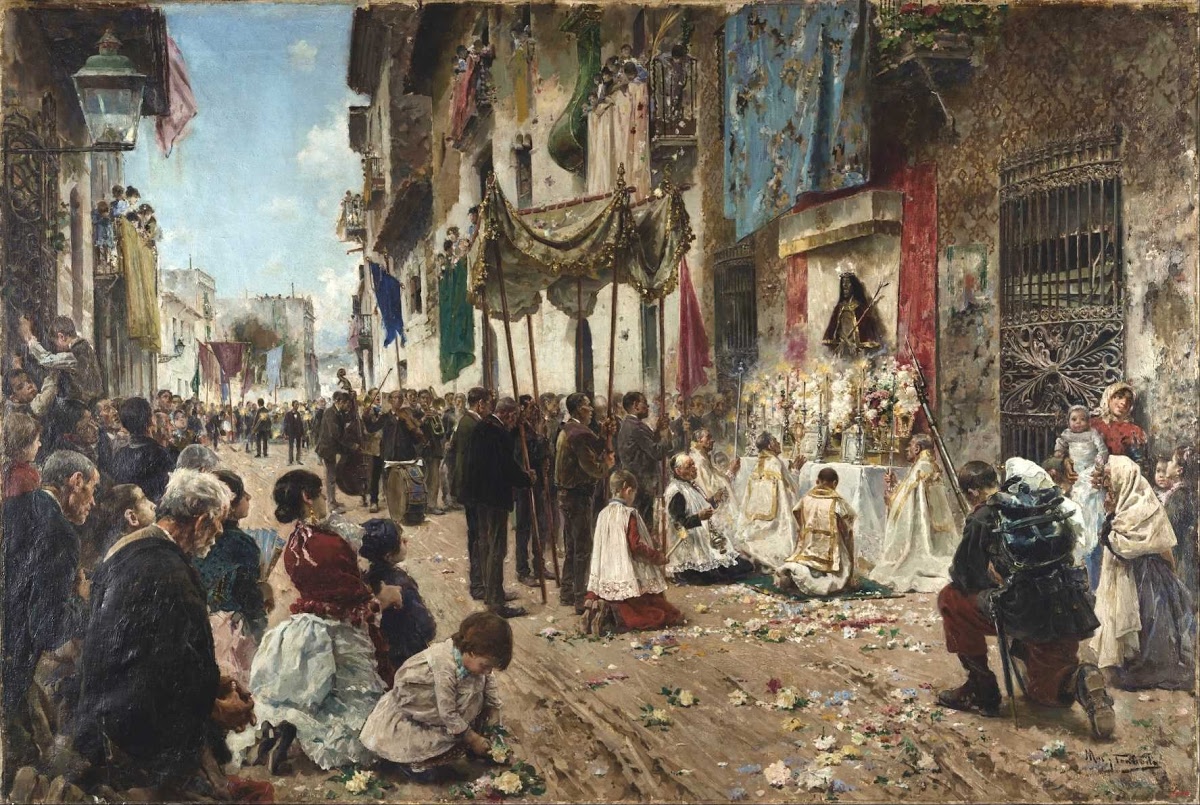
    Corpus Christi Procession (La procesión de Corpus), 1887, Arcadi Mas y Fondevila | Image from artsandculture.google.com.

    Today is one of these three and it struck me as I marveled at the triple-normal attendance filling our pandemic-distanced chapel that we had all come anticipating the great and terrible narrative that was to fill the air. We knew that the initial hosannas would quickly fade into the long gospel reading detailing Christ’s betrayal, torture and death. Not only did we know it, we had gathered in numbers triple our normal size so that we could bear witness to it, mourn with Mary at his tomb, and receive sustenance from the very Body and Blood that was torn apart on that day. Even for people who weren’t completely engaged with the reason that they were there, something drew them to come, some knowledge imparted from the Church that instilled in them how important this day is.

    This entire phenomenon makes me reflect on the narrative that makes us who we are as Christians and how we participate in the telling of the story. 

    There is a grand scope to the narrative on Palm Sunday, and in the Catholic Church, we are asked to participate in its telling in a very performative way. Although this year was slightly different due to pandemic precautions, consider how the liturgical celebration starts: it starts outside the chapel. Before processing into the chapel as the Church, we read “Many people spread their cloaks on the road, and others spread leafy branches that they had cut from the fields. Those preceding him as well as those following kept crying out: ‘Hosanna! Blessed is he who comes in the name of the Lord!’” And this is what we do.

    We are a performative Church. We hold our palm leaves and sing a song of hosanna as we walk into the new Jerusalem with Christ. This is not “mere” theater. This is a huge reminder that what we do as a Church in every liturgy is performative as well as commemorative. By “performative,” let me be clear that I do not mean acting, as if we do not believe or actually live out what we’re doing. I use the word performative as in performing a ritual act.

    Religious ritual acts (in which the entire Judeo-Christian tradition is steeped, and is common to all religions) are special: done in a special place, in a special way, with special gestures and special words. This post is about interrogating the depths of meaning behind the performative acts in our liturgical life. So, to be clear, we actively celebrate Christ’s sacrifice in the form of the liturgy.

    The first reading connects Isaiah to Jesus who will come after him: “The Lord GOD has given me a well-trained tongue, that I might know how to speak to the weary a word that will rouse them.” Both men are prophets who share the Word of God as a salve for humanity. And, then: “I gave my back to those who beat me, my cheeks to those who plucked my beard; my face I did not shield from buffets and spitting.” Isaiah also lives out the mocking and beating that Jesus will, this very day, be subjected to. And, finally, the firm faith that enables such treatment to be endured: “The Lord GOD is my help, therefore I am not disgraced; I have set my face like flint, knowing that I shall not be put to shame.” We need to hear these final words of the first reading, knowing what we know about the Passion narrative to come. It helps us to endure our sympathetic suffering with Christ. It helps to palliate the treatment of our Lord.

    The responsorial psalm — oh, the psalm! It gives us the fuller context for Jesus’s final words on the Cross. The refrain of our psalm is the famous line “My God, My God, why have you forsaken me?” As Jesus utters these last words, we can both sympathize with the sentiment and be somewhat troubled by the implication. On one hand, we will see how the Passion narrative displays Jesus’s increasing abandonment by everyone who is close to him. If we take this line on its own, it seems to be that Jesus expresses complete abandonment, even by the Father. Theologically, this is greatly troubling, and actually makes no sense. The first Person of the Trinity would never (could never) abandon the second Person of the Trinity. Their love unites them in a way that is fundamental to the fabric of the universe. 

    What else could be going on here?
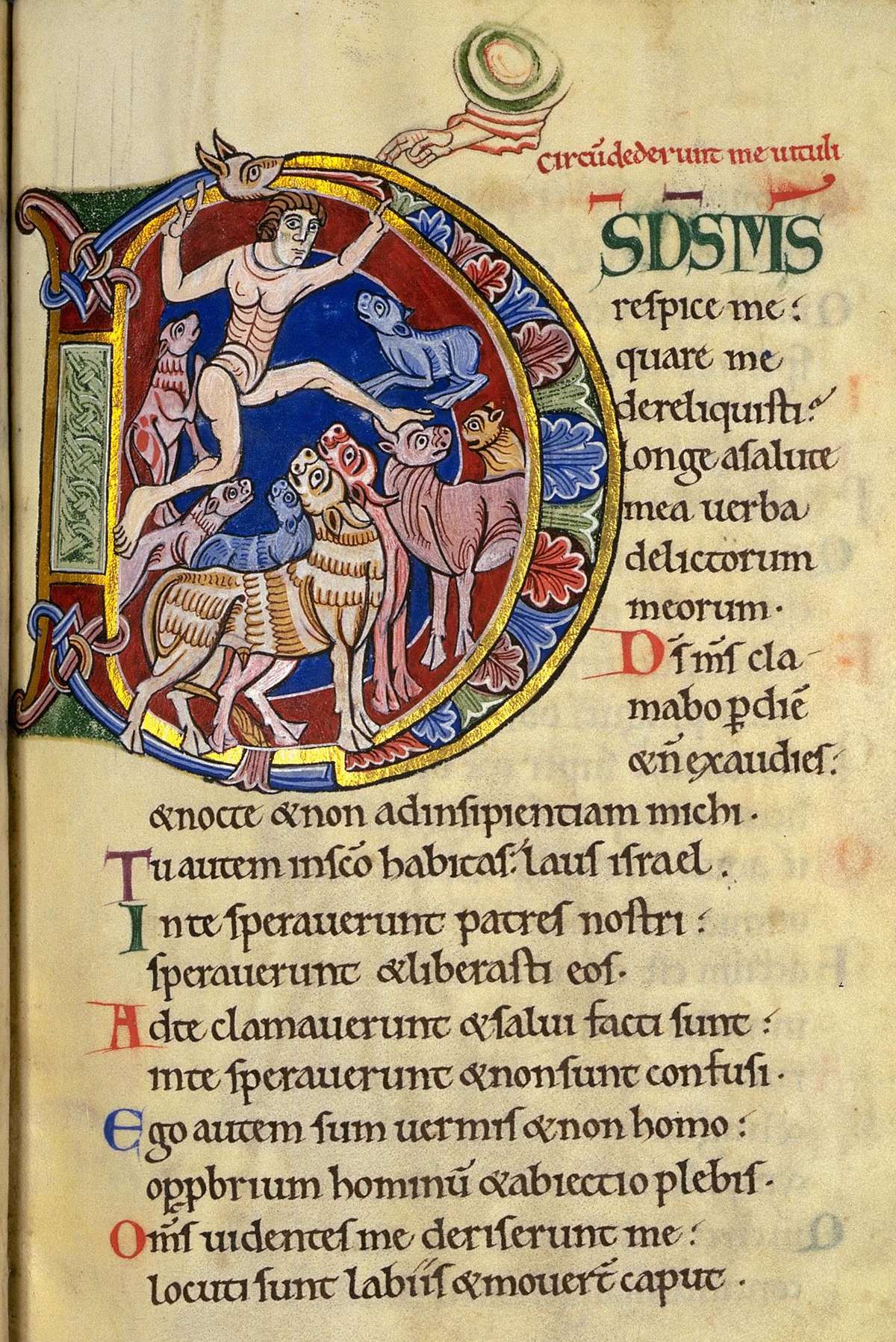
    Psalm 22:1-8 in the St. Albans Psalter (1100s). The first words of the Psalm in the Latin Vulgate are “Deus, Deus meus,” abbreviated here as DS DS MS. | Wikimedia Commons.

    The content of the psalm is not as dire as the first line makes it out to be. The words certainly express the distress of an individual in need of help, one who has endured scorn and who feels abandoned. But the psalm also includes verses like, “From the horns of the wild oxen you have rescued me. I will tell of your name to my brothers and sisters; in the midst of the congregation I will praise you.” Also, more to the concern of the opening line: “he did not hide his face from me, but heard when I cried to him.” It also ends on a very positive note of praise and deliverance. We hear, “future generations will be told about the Lord, and proclaim his deliverance to a people yet unborn, saying that he has done it.”

    When taken as a whole, the psalm not only speaks to the emotional condition of a man like Jesus at the culmination of his torture, but also to his redemptive action in the world.

    Just like we should not take the opening line out of context from the whole psalm, we we can learn from the context of how the Jewish tradition employed it. Rabbis attributed this psalm either to King David or Esther. The connection to Esther is so strong, in fact, that it would be prayed annually during the Fast of Esther, on the eve of the festival of Purim. Christ would have grown up praying Psalm 22 during that day and night of fasting, commemorating the three days of Esther’s fasting and prayer before she presented herself to the Babylonian King Ahasuerus and advocated to save the Jews from slaughter. The Jews prayed Psalm 22 to link themselves to this great model of petitioning the Father. The result was that God heard her prayer and saved the Jews from annihilation. 

    So, we can conceivably interpret Christ’s utterance on the Cross as beginning this same fast, this three days where he will disappear from the earth, enter the underworld to rescue humanity from the grip of death. He will enact the deliverance of the world on Easter, but here on the Cross, as he begins this fast in great sympathy with the Jerusalem he had just cried for, he is imploring the Father’s help and praising the Father as he always has.

    Returning to the Palm Sunday Liturgy of the Word, it is difficult to encounter this great text in part because it stretches over many days and many episodes central to our religious practice. We will reflect more on the Last Supper on Holy Thursday and upon the treacherous death on the Cross on Good Friday.

    One of the things that struck me as I stood in our chapel today listening to the priest and two lay people read the parts of the Passion were some of the details supplied by St. Mark in his almost breathless account. These details act like symbolic signposts, standing in for the impossible spiritual depth of the action at that moment. For me, they help to orient me within the Church as I participate in Palm Sunday and Holy Week. Below are just a few of them.

    Alabaster candle holders | Image from entertheloft.com.

    She broke the alabaster jar and poured it on his head … They were infuriated with her. Alabaster is a gorgeous, translucent white form of gypsum, often used to hold expensive oils in the ancient world such as those given as part of a woman’s dowry to her husband. The gesture from Mary of Bethany is the gesture of the Church to her Bridegroom. Mark tells us that she “broke” the jar, and whether this means a wax seal or the neck of the jar, the action is absolute and the ointment cannot be re-sealed and reused. This is an absolute devotion, using the most expensively perfumed oil. Jesus himself notes the appropriateness of her actions: “She has anticipated anointing my body for burial,” and even christens it as an act truly representative of the Church to come: “wherever the gospel is proclaimed to the whole world, what she has done will be told in memory of her.”

    Yet the other disciples were infuriated with her. Their rebuke of her is redolent with earthly concerns — noble, to be sure, in that they seek to help the poor — but these are at odds with the spiritual gravity of the moment as the ground is shifting to the Passion. Mary must have been seized by the Holy Spirit in a way that the others were not. She anoints the Anointed One of God just before he is to give them the Eucharistic sacrament.

    Jesus’s response to the disciples is one of my favorites: “The poor you will always have with you … you will not always have me. She has done what she could.” This is not just a carpe diem message, but a message of focus and intent. This is consistent with all he has said to the Pharisees about them fetishizing the law and what they “should do” over bringing the spirit of love into the world. There is supreme benediction in Christ saying, “she has done what she could.” What more would we like to hear when we are encountered with our judgment? 


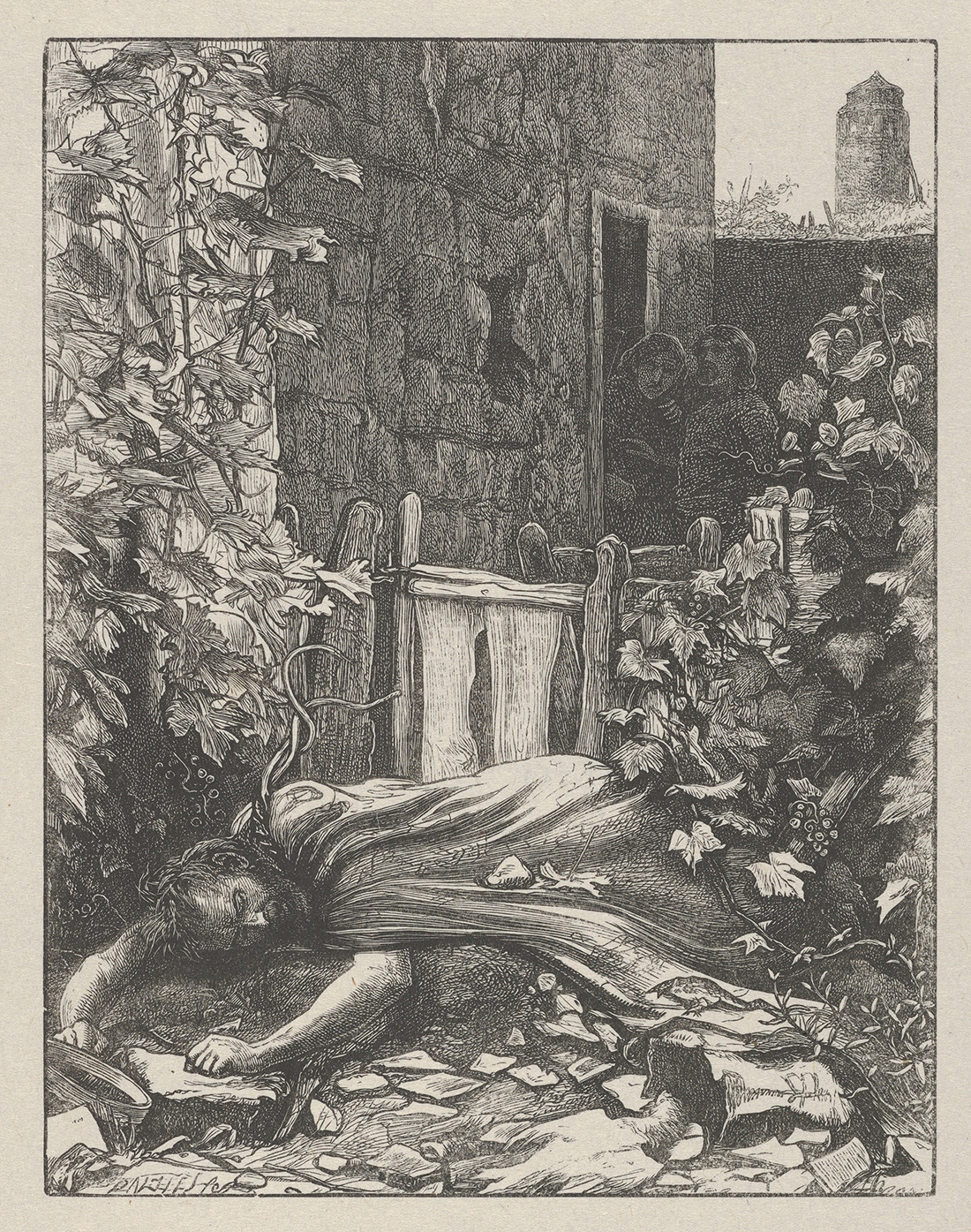
    Now a young man followed him wearing nothing but a linen cloth about his body. They seized him, but he left the cloth behind and ran off naked. Who is this young man? He is not identified as a close disciple of Jesus. For me, he stands in as all of them, all of humanity in that moment. It’s as if the Holy Spirit has instilled in St. Mark a deeply felt memory of this moment when Jesus’s closest followers scramble away and disperse.

    Think about this — how does a person escape when seized, leaving behind the only piece of clothing he was wearing? It takes a good deal of panicked struggle, wriggling free, letting all sense and dignity leave you in your crazed flight response. This young man, these disciples, all of humanity, desert the Lord without their dignity in a wild flight away from the scene of his arrest. High-minded ideals are gone. Plan-oriented dreams of an ordered future disappear. Scandal has stripped us of our dignity and we run, like animals without a God.

    And so Mark records this ghostly image of a linen cloth glowing white in the darkness with nothing inside it. Why linen? Why empty? We will encounter this very same image when the stone is rolled away from the tomb! The human has left, has entered a new plane of existence. Just as Jesus Resurrects in Body and then ascends to heaven, humanity in the form of this young man disappears in its fright only to return as the Church, sanctified and Resurrected in Christ’s Spirit. The image, while representing the base betrayal of humanity, becomes an astounding promise in the midst of this horrible night.
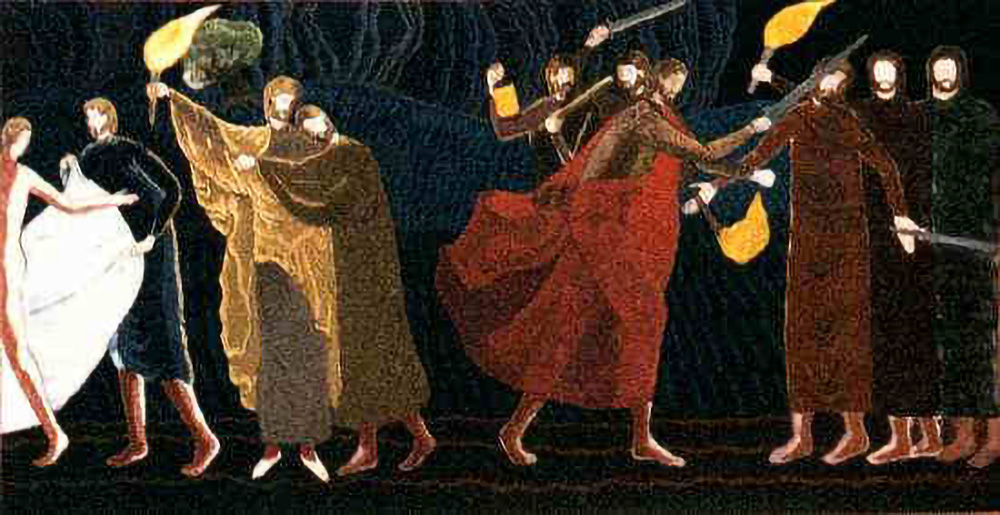
    Young man fleeing Jesus’s arrest, unknown provenance | Image from thetinychapel.blogspot.com.

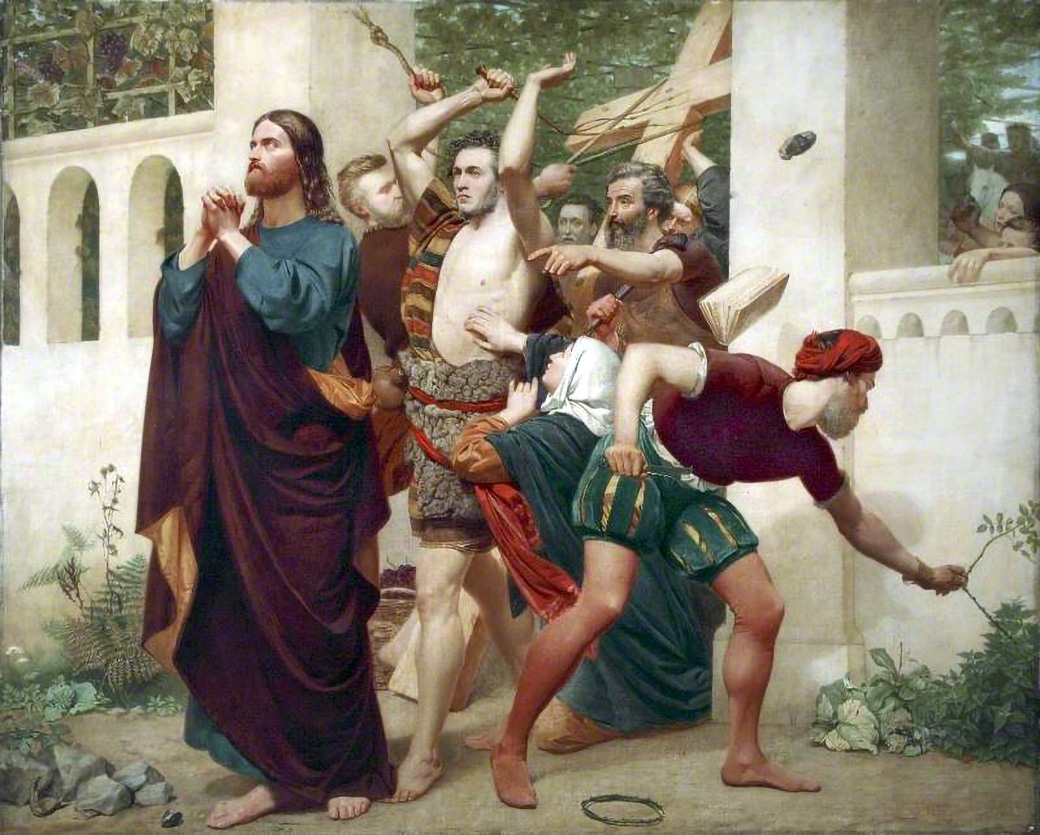
    The soldiers assembled the whole cohort. They clothed him in purple and, weaving a crown of thorns, placed it on him. This image persists in most Catholic depictions of Christ — the brutal Crown of Thorns. Why? Are we fascinated in some way at this torturous form of mockery?

    Let’s pan out, to use a cinematographer’s term, and see the scene as Mark has described it. The soldiers take him away from the Jewish crowds and into the inner courtyard of Pilate’s palace. Jesus is first betrayed by an Apostle, abandoned by his disciples, and denied by his chosen “Rock,” Peter. His is now isolated, away from his own people, the Chosen Ones of God’s Covenant. He is utterly alone in pagan hands. It is easy to overlook his increasing isolation because the narrative is full of people — crowds greeting him in Jerusalem, guards and arresting mob, priests and soldiers, streets lined with jeering onlookers, and a crowd gathered at the base of Golgotha. But Jesus has been isolated completely. 

    So the soldiers assemble the whole cohort, which must include all of the soldiers stationed there as well as Pilate’s non-military court. Here, around him, is the entire pagan world. How do they greet our Savior? It is a telling image. They dress him as a King. Yes, it is mockery, yes it is in jest and, yes, they beat him and spit on him while doing it. But nonetheless we have a vision of Christianity in the world.

    It is impossible not to acknowledge the kingship of Christ, even while scoffing. For underlying all of the worldly disbelief we claim or the hurtfulness of our actions, the truth remains: Christ is King. We can’t escape that or change it. What’s more, those who walk with Christ into the greater world will be met with mocking and crowns of thorns as well. This is the reality of being on the Way to the Kingdom, given to us in a brutal coliseum of pain.


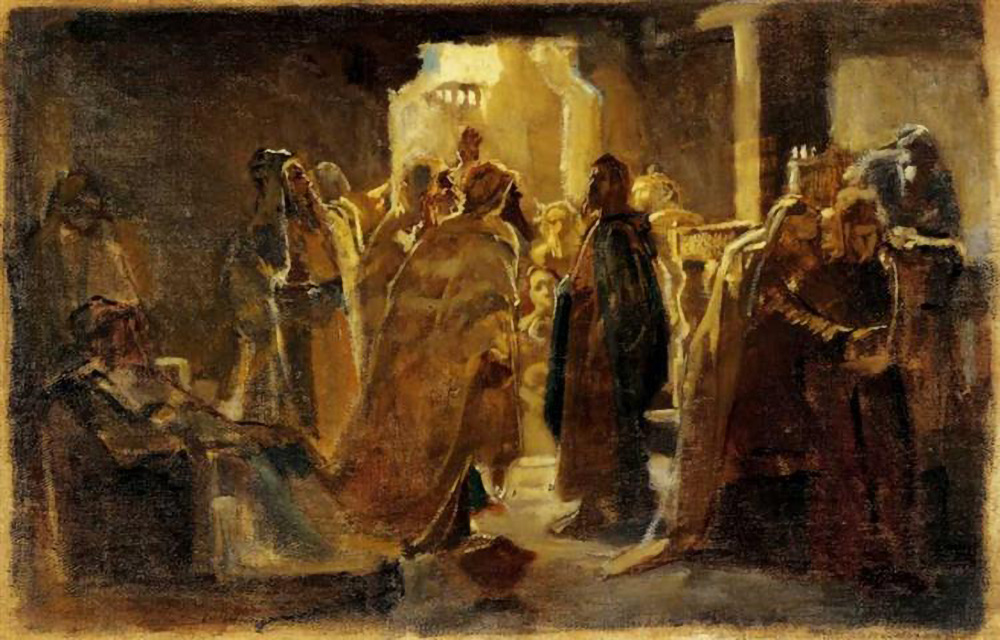
    Pilate was amazed that he was already dead. The seat of earthly power is amazed at the quick passage of time. This must make him take stock in his own mortality. This must make him wonder about that man he just had crucified. This is something weird; is it a sign? This thought might continue to nag at him for months, years, until he decides to do something about that nagging thought — perhaps inquire with one of this new group of Christians that has persisted long after this man’s death. This leads to another moment of astonishment as he is told about the amazing life of this Jesus Christ who he crucified.

    This is the way God works. This is the way God never gives up on humanity; the way He offers mercy and forgiveness even to the most detestable of us. We must be open to the fact that Pilate himself can be saved if he recognizes God, repents for his sins, and follows the Way. More than that — we must want Pilate to be saved. That is what it means to walk with Jesus. We must fill ourselves with the absolute, unwavering love of God that heals all. We must want every single one of his sheep to be with him forever in the Kingdom.
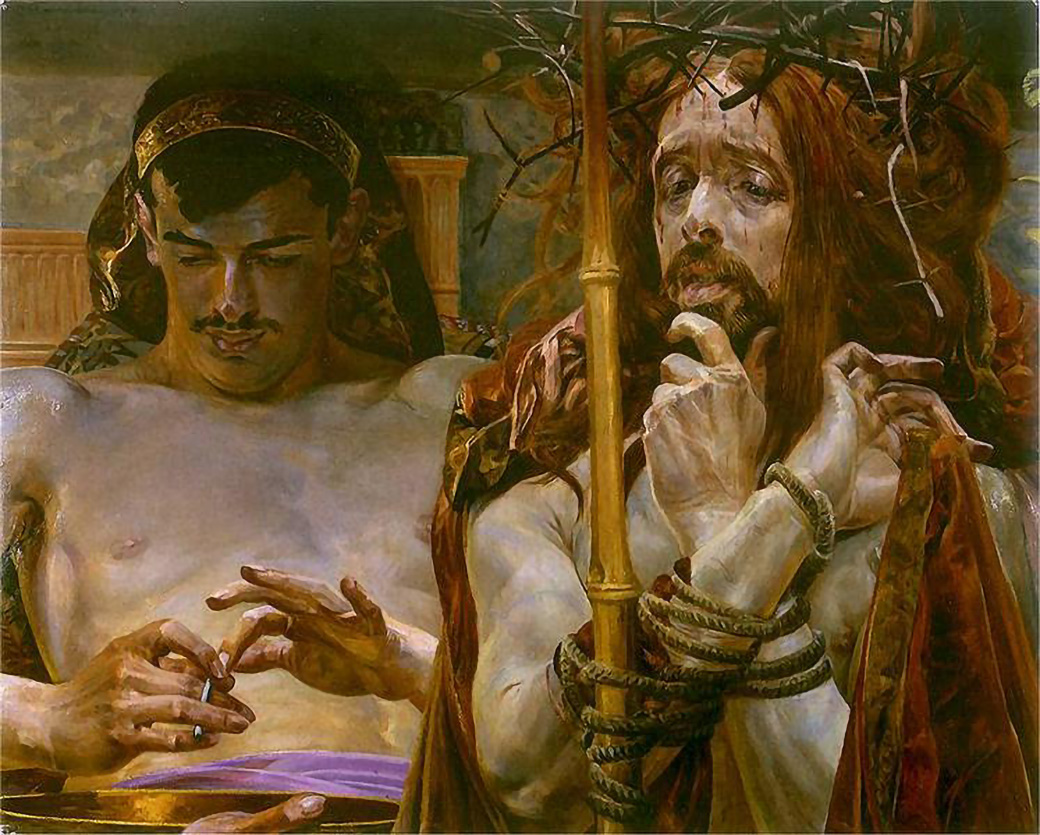
    Christ before Pilate (1910), Jacek Malczewski | Image from wikiart.org. There are many artistic representations of Pilate, but none quite as evocative as this one, in my Mind. Malczewski delivers a powerful study of contrasts: Christ is adorned with the Crown, ropes, and blood in an almost feminine way, as if these trappings of His Passion have almost supplanted themselves as the narrative itself; He is presented as an ornament for Pilate. Meanwhile, Pilate is half-naked, self-absorbed, bored. Not so much contemplative as contemptuous. I am constantly amazed at the breadth of scriptural interpretation and imagination I find in painters! 

    There are, of course, many more images in the Passion narrative; indeed, in all of the gospels. This is how we can encounter Christ in a new way and in a new depth each time we turn back to scripture. 

    But more: let’s return to how our Catholic liturgy participates in the Passion. The Holy Spirit, as promised by Christ, guided the Church from its earliest days to put into practice the depth of imagery and symbolism we encounter in Christ’s life, Death, and Resurrection. The most obvious example is the Eucharistic feast and its remembrance and enactment of Christ’s sacrifice as well as the Last Supper.

    But the Church, living the liturgy every second of every day inside and outside of the chapel, performs the very work of the Bride of Christ in its anointings (sacramental as well as simple, such as the gentle touch and kind word to a stranger). The Church points to the empty linen cloth every time we choose humanity over politics or spirit over rules: for the cloth is made of this earth while we exist in a different spiritual plane on a specific spiritual path.

    The Church wears the purple robe and crown of thorns as our priestly sexual misconduct is paraded before the world, the evil that creeps in to mock our holy mystical Body of Christ. And the Church is made up of converted Pilates searching out other Pilates to bring to Christ for healing.

    All of these things reach a much more organized level of liturgical function in the Mass, however. It is performative in that we stand to greet the Lord, to collectively pray our Creed and the Our Father. We process to the altar both as the ministers at the start of Mass and as a people when receiving Communion, re-enacting Christ’s triumphal entry into Jerusalem. We kneel with Christ as if with him in the Garden of Gethsemane as the Eucharistic blessing is prayed. We listen to the Word of God being proclaimed to us as every Christian once did since the first Apostles, for we are all converts to a New Covenant. There is so much more!

    The point is that if we want to live a deep Christian life, we must know and embrace the depth of our faith not just in its wisdom and words, but in its symbolic and real actions both inside and outside of our churches. 

    Holy Week is upon us, and it delivers to us so much meaning, so much density. Let us prayerfully try our best to take it in.
  • The Tree in its Vigor

    The Tree in its Vigor

    Saturday of the Fourth Week of Lent: Jeremiah 11:18-20, John 7:40-53.

    Today we observe two men of God in their prime: the prophet Jeremiah and Jesus Christ. As strong as they are in their relationship with the Father, they are besieged by the evil that walks among humanity. Despite being the living embodiment of God’s Truth, the peoples’ response was, “Let us destroy the tree in its vigor.”

    We should certainly take note of this historic violence against God’s anointed ones, not because we fear to repeat it (after all, Jesus is the final prophet), but because it presents us with a perspective on God’s chosen way to operate in humanity. This perspective, coupled with the Christ Event in its fullness, should prompt us to quicken our steps to the Lord, keep our lamps trimmed and burning, for the Lord will come like a thief in the night and we must be upright and ready.

    The reality is that we live the Last Times, the final age before the Judgment, and if we do not pay attention to all that has been given to us (scriptural revelation and the gift of Christ Himself), then we are dooming ourselves as surely as the chief priests and Pharisees who conspired against Christ.

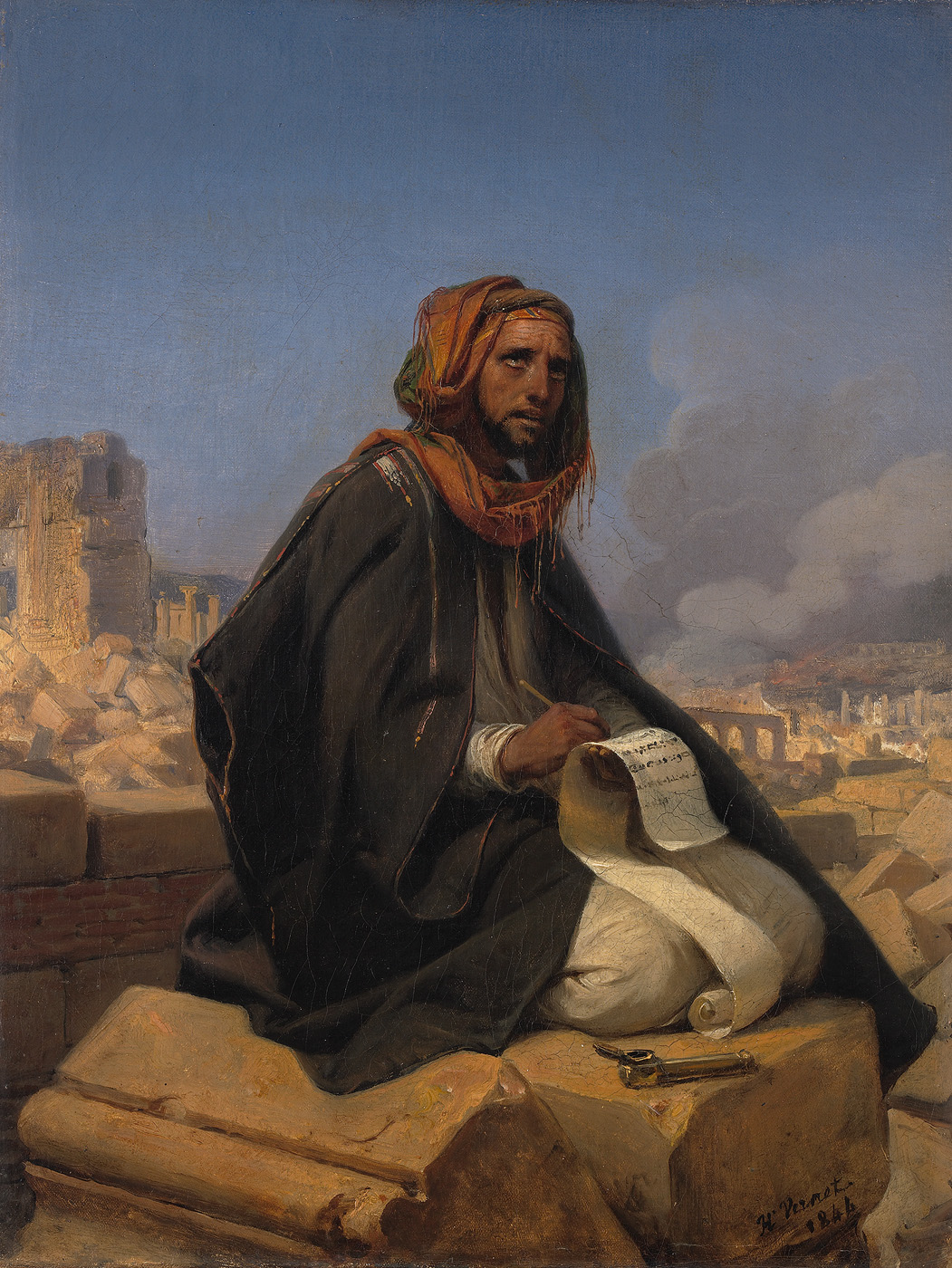
    Jeremiah on the Ruins of Jerusalem (Jeremia op de puinhopen van Jeruzalem), 1844, Horace Vernet | Wikimedia Commons.

    Jeremiah is as simple yet as troubled a soul as there can be. Simple in that he is the model of fidelity to the Lord, doing his will without question and delivering difficult prophecies without sugar-coating them. There is no guile, no politicking. Yet he is troubled in every other way.

    He concisely shares his state of affairs in today’s reading: “Yet I, like a trusting lamb led to slaughter, had not realized that they were hatching plots against me.” People mock him, imprison him, beat him, conspire against him, and he is emotionally ripped up because he sees what lies in store for Judah and mourns their intractable defiance of the Lord. No one listens during his entire ministry and indeed the nation is destroyed as the Babylonian Exile begins.

    Jeremiah gives us a look into the evil hearts of his enemies: “Let us destroy the tree in its vigor; let us cut him off from the land of the living, so that his name will be spoken no more.” I note two things about this. First, there is a reaction against his strength in the Lord — they recognize that he is at the top of his prophetic game, a “tree in its vigor.” This is the reaction of the prince of this world to the presence of holiness. Second, this reaction is so forceful that it seeks the utter destruction of the prophet. It is not enough to kill him, but to ensure that “his name will be spoken no more.”

    They want to not only destroy the man but the divine truth that he has brought into the world. This erasure enables the devil to work without opposition. Satan preys on our base instincts and works through us to destroy truth and beauty.

    But we cannot be sucked into dualism, a worldview that pits good forces against equivalent evil forces like a version of Star Wars. That is a heretical teaching that the Church has stamped out many times in her history. This is why the lectionary includes the final verse of today’s first reading: “But, you, O LORD of hosts, O just Judge, searcher of mind and heart, Let me witness the vengeance you take on them, for to you I have entrusted my cause!” This is not just a message that good will win out in the end. What it shows us is that Jeremiah has been blessed with a tiny glimpse of the divine intelligence, enough to show him that God has a great plan for humanity in which his lifetime is just a fraction of a breath.

    Jeremiah knows that there will be a “vengeance” against evil at some point and he is asking to witness it. I don’t think this has been included just to make Jeremiah look like a vengeful guy, with evil in his own heart. No, that’s completely inconsistent with who we know Jeremiah to be. Enraptured in the divine vision, he longs to see full justice restored for humanity — this is the Kingdom of God — and he wants to be present for it (which he will, indeed, after Jesus resurrects).

    But God’s plan is that evil is allowed to act upon humanity in Jeremiah’s age. He could stop it, but he doesn’t. Why? This is the great question that so consumes people bothered by suffering in the world. Why are we left to be vulnerable to evil?

    There is something greater going on. Let’s remember that God asks nothing of us that he does not also ask of his Son.

    Looking at today’s gospel reading, Jesus experiences much more success in planting Truth and his Word in the world (of course!) — he converts countless people to himself, and in today’s reading we hear several proclaim that he is “the Christ.” But perhaps the greatest mystery (and point of beauty) in God’s plan is how delicately he enters into humanity, allowing for personal sovereignty of will rather than eradicating all evil and opposition in a forceful application of the divine will. So, the great drama of our God’s self-willed vulnerability unfolds. The conspiracy of those supposed to be his greatest defenders, the upholders of divine law, is shown in its awfulness.

    What is so interesting here is that we do witness a type of scriptural/religious tyranny, but on the side of the Jews. This is a great contrast to our Lord’s refusal to be a divine tyrant. The Jews have painted themselves into a corner: “The Christ will not come from Galilee, will he?” They have fetishized scriptural accounts and their huge corpus of rabbinic teaching to such an extent that rather than being open to the Lord in the world, they have narrowed and perverted their expectations. This is what I mean by a religious tyranny, where it is not God speaking to them, but their manmade understanding of religious teaching that looms over them and determines their reactions to Truth in their midst.

    They are specific: “Does not Scripture say that the Christ will be of David’s family and come from Bethlehem, the village where David lived?” And it is worth noting that so much of the Jewish tradition at that point was concerned with restrictions — what you cannot touch, cannot eat, cannot say, cannot do. By living only in the restrictions and not in the life-giving love that God calls them to, they lose their autonomy to respond to Truth in their midst. 

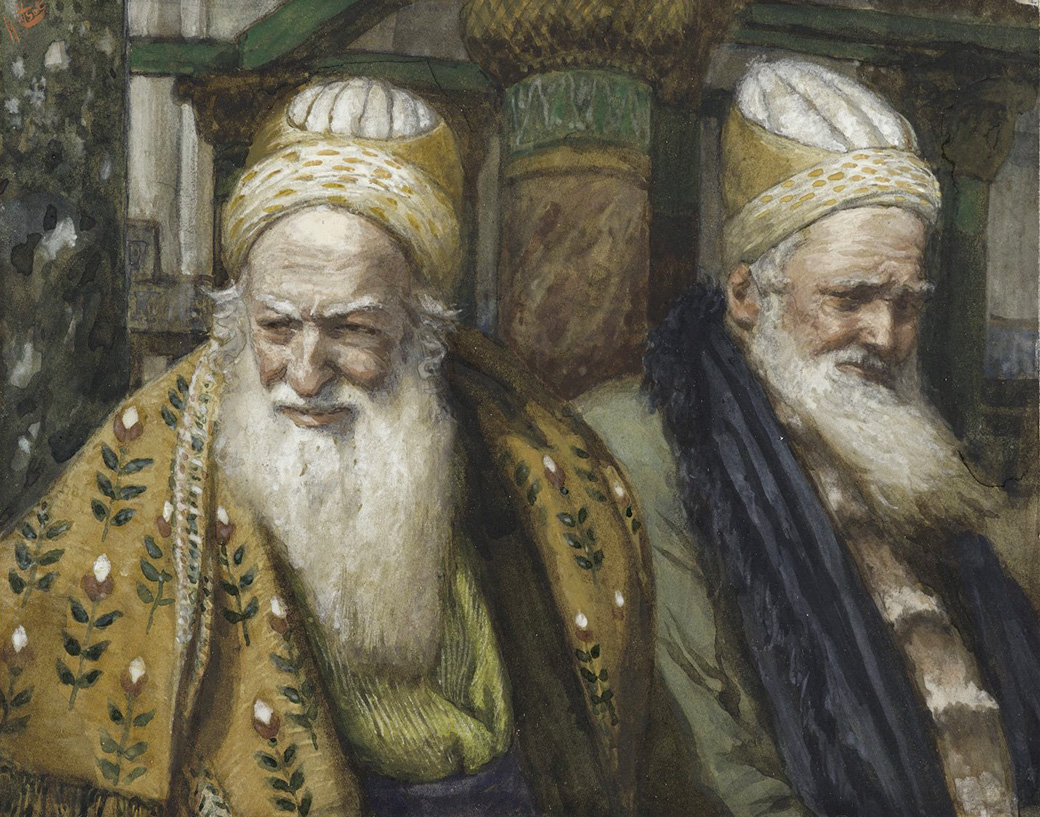
    Annas and Caiaphas (Anne et Caïphe), 1886-1894, James Tissot | Creative Commons, courtesy the Brooklyn Museum.

    The result? We are told, “So a division occurred in the crowd because of him.” God is allowing us the space to see for ourselves, to contrast the freedom of belief in the Truth with the constriction of fetishizing the trappings of truth. God is creating for us the opportunity to make a choice of our own free will, to decide to come to him or, alternatively, reject him. 

    When the guards return empty-handed to the chief priests and scribes, they are mocked: “Have you also been deceived? Have any of the authorities or the Pharisees believed in him? But this crowd, which does not know the law, is accursed.” Note how the leaders of the religious tyranny operate in darkness, in mockery and deceit. They show their narrow-minded clutching at scraps of prophecy by saying the crowd does not know the law. How ironic, since Jesus tells us he is the very fulfillment of the law!

    At stake here is the true meaning of “knowing.” The priests and scribes have filled themselves with book knowledge and the grammar of restrictions, which they wield like weapons of power. But God presents himself to us so that we can know him as a person, and this knowledge is used as a salve for humanity. The “knowing” that God is calling us to is always completely wrapped up in his personhood and the personhood of humans.

    He takes the form of a human in part to show us that when we open ourselves to him, we are also opening ourselves to each other. Godliness is absolute openness to knowing each other fully, not judging, not forcing our will or the other’s, but knowing and accepting. When this “knowing” is joined with loving, then we are on our way to the Kingdom.

    Nicodemus, who came timidly to Jesus at night to get to know him better, is the one Pharisee who is on the Way. He slows the Pharisees’ frenzy by challenging them to adhere to the spirit of the law — to not condemn before hearing someone first. Having started his own journey of knowing, he brings both truth and humanity back to the scene of these circling sharks. They spit a mocking comment at him before we hear the end of the episode: “Then each went to his own house.” How fitting that these men filled with worldly knowledge and power plays disperse, alone. They do not “know” God or humanity, which draws us together, not apart.

    Today, we encounter a contrast of visions. First is the worldly vision of the religious leaders who wield their knowledge as weapons to divide humanity. Second is God’s plan for humanity as revealed through his “trees in their vigor,” marked by gentleness and a personal knowing that heals and unites.

    The worldly vision is all-too-familiar; we see it in force to this day in our governments, businesses, and even families. The second has also been laid out for us to see plainly. We’ve had access to this amazing perspective on God’s personhood and plan for 2,000 years. We have no excuse, we cannot plead ignorance, and we cannot expect that God has more to reveal and more prophets to send.

    The Church has always insisted that we are living in the End Times, the last period before Christ will return for the Final Judgment. This Lent, let’s all realize that the time is now, there is no other. 

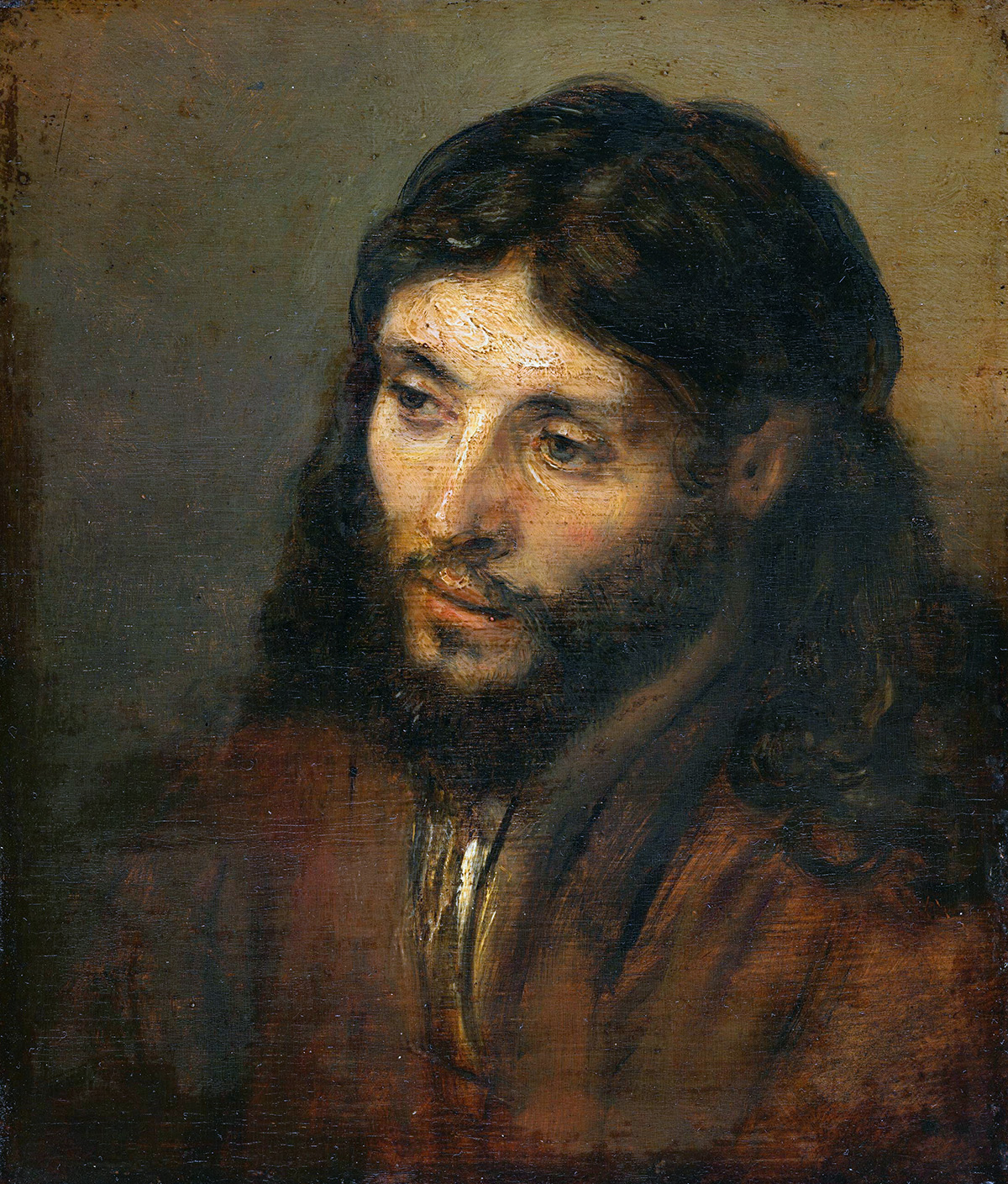
    Head of Christ (c.1648), Rembrandt | Wikimedia Commons.

    I want to finish with a reminder of why everyone was a-buzz in today’s gospel reading. In the verses just prior to our reading, we learn that it is “last day of the festival, the great day,” which is known as Hoshana Rabbah. This is the last “day of judgment” in the Jewish calendar when they process around the temple seven times and have a great temple service, imploring the Lord for a bountiful year ahead. On this last day of Hoshana Rabbah, the priest makes a great show of the water libation as an appeal to God to provide water for the people in the year ahead. It is at this time that Jesus cries out, “Let anyone who is thirsty come to me, and let the one who believes in me drink. As the scripture has said, ‘Out of the believer’s heart shall flow rivers of living water’” (Jn 7:37-38).

    No wonder the crowd is amazed! Jesus, as if in answer to the priest’s prayer, tells the people to come to him for living water. He is establishing that he has God’s power of restoration for the people. The Jews must make a decision: will they accept and follow the Messiah in their midst or reject Him? 

    Will you?

  • Forgiving our Great Affront

    Forgiving our Great Affront

    Thursday of the Fourth Week of Lent: Exodus 32:7-14, John 5:31-47.

    Today’s readings pull no punches in shining a light on our inability to recognize God and remain faithful to Him. But they also show us that God’s overwhelming love, mercy, and forgiveness wipe away this great affront. This is our God: deserving of all honor and glory, but as the source of goodness and love, willing to erase the greatest affront and welcome us back to himself.

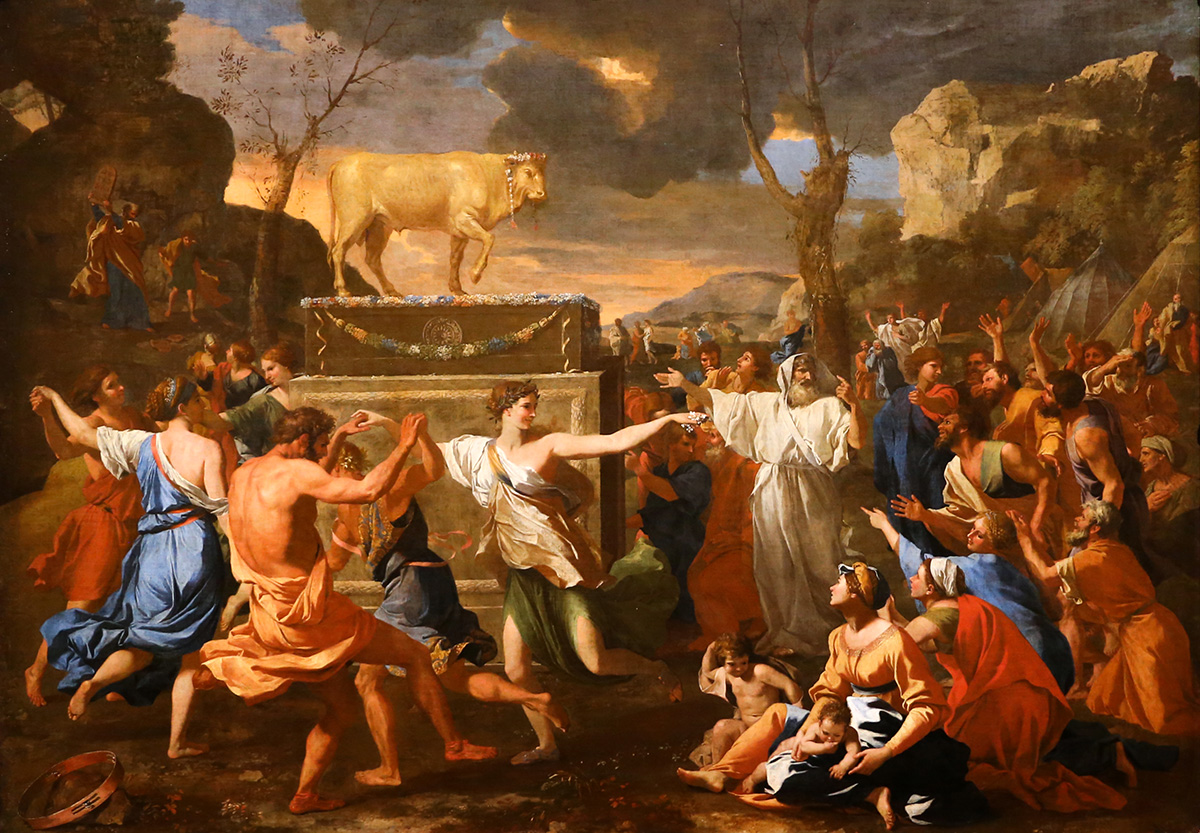
    The Adoration of the Golden Calf (L’Adoration du veau d’or), 1633-1634, Nicolas Poussin | Wikimedia Commons.

    The famous incident of the golden calf is the subject of the first reading. In the verses just prior to this, the extent of God’s betrayal is shown in the person of his chosen priest, Aaron. Aaron, Moses’s brother, who has been by his side for all of the wonders God worked in Egypt, who held up Moses’s arms during the long battle with Amalek so the Jews could win, is the one who builds the calf. Aaron responds to the wishes of the people who were tired of waiting for Moses (occupied on Mount Sinai with God). He takes all of their gold rings, melts them, and casts a statue of a golden calf. Then, he says, “These are your gods, O Israel, who brought you up out of the land of Egypt!” and “he built an altar before it; and Aaron made proclamation and said, ‘Tomorrow shall be a festival to the Lord.’”

    Now, that’s truly messed up if you asked me. I understand the desperation of a people lost and wandering in the desert without a home, but this extreme of abandoning the God who made himself known personally to Aaron, who singlehandedly brought them all out of slavery … it’s almost unfathomable.

    It’s surprising, but on second thought, not terribly different from all of us today who abandon God despite all of the blessings we’ve received. It is interesting that those who receive the most blessings on earth are often the quickest to abandon God when reflecting on the troubles that plague humanity. People in poorer countries (in South America and Africa, for instance) are the ones who comprise the bulk of the Catholic Church nowadays while rates of atheists in first-world countries are higher than ever before.

    Perhaps God makes up for whatever blessings of earthly pleasures are lacking for some people by blessing them with greater faith. Or perhaps striving to live with dignity in the face of great obstacles reminds us of our humility in the face of things greater than us and thereby find room in our hearts to honor God and seek his help. Either way, the poor and less fortunate seem to be more faithful to God.

    We begin to understand Jesus when he says, “many who are first will be last, and the last will be first” (Mt 19:30) — that is, the “first” in this world will be last in the Kingdom because they have abandoned God while the “last” in this world will be first in the Kingdom because they remained faithful.

    There is something of this conundrum in the Jews who are tarrying at the base of Mt. Sinai. Over the course of their miraculous deliverance from slavery in Egypt, they have benefitted from miracle after miracle: waters parting, manna and quail being given as food, water sprouting from rocks at the strike of Moses’s staff. And oddly we hear at each turn how they are abandoning God for idols or not obeying his commandments. Their ongoing blessings seem to engender a sense of entitlement rather than thankfulness. The more they receive, the less they recognize the giver of the gifts.

    This culminates in them so forgetting who God is that they clamor for Aaron to invent someone for them to worship: “Come, make gods for us, who shall go before us; as for this Moses, the man who brought us up out of the land of Egypt, we do not know what has become of him” (Ex 32:1b).

    Let’s not tell ourselves that this is the work of particularly evil or callous people. The story of the Jews in the desert is the story of all humanity failing to recognize God in their blessings. It is the story of our lost wanderings, being led back to God and the Promised Land (i.e., the Kingdom of God), but questioning him and his ways at every step. Sadly, it is the story of our contemporary descent into idolatry and atheism even when we have been shown the way.

    What is God’s response to this unfaithfulness? He tells Moses he’s ready to purify these people: “that my wrath may blaze up against them to consume them. Then I will make of you a great nation.” Whoa! This is the God of Love. Let’s unpack this so that we don’t think there is some sort of contradiction going on.

    The Church teaches us that God is all good, complete, and unchanging. He is the origin of all creation, not a part of it, as He tells Moses: “I AM who I AM.” As the only complete and unchanging thing in the universe (or outside of the universe), he doesn’t get angry, he’s not surprised, he’s not jealous, etc. That doesn’t mean he doesn’t care, mind you, or doesn’t yearn for us more than we yearn for him. When we encounter moments like today’s in the Scriptures, we have to remember what all of revelation has taught us about God and read the passage as it has been laid down by a mortal.

    One of the better articles I’ve read on this topic was posted on the Catholic Standard by Monsignor Charles Pope in 2019. He writes that God’s “wrath” can be called “wrath” only in how it is experienced by us, not as an emotion raging within him. He writes about the analogy of trying to mix water and fire:

    God’s wrath is our experience of the total incompatibility of our sinful state before the holiness of God. Sin and God’s holiness just don’t mix; they can’t keep company. Think of fire and water; they cannot coexist in the same place. Bring them together and you can hear the conflict. Think of a small amount of water poured into a large fire: the water droplets sizzle and pop; steam rises as the water boils away. … We must be purified before entering His presence, otherwise we could not tolerate His glory. We would wail and grind our teeth, turning away in horror. The wrath is the conflict between our sin and God’s holiness. God cannot and will not change, so we must be changed or else we will experience wrath.

    So we can affirm that God does not lose self-control or experience emotions in the ways that humans do. I tend to agree with our Church Father, Tertullian, though, who writes, “Angry He will possibly be, but not irritated, nor dangerously tempted; He will be moved, but not subverted” (Against Marcion, II.16). Tertullian’s point, in part, is that we can’t really know how or if God experiences “feelings,” since it is beyond our capacity. But, he notes that one thing is for sure: “it is yet palpably absurd of you to be placing human characteristics in God rather than divine ones in man, and clothing God in the likeness of man, instead of man in the image of God” (ibid, II.16).

    As I wrote in Forgiveness is Mercy in Action last week, there is something in the original Greek that points to God’s visceral reaction that we might interpret (by analogy) as “emotional” or “affective.” When he is viscerally moved to compassion, the verb has its root in the word for intestines and internal organs: σπλαγχνισθεὶς (splanchnistheis). This is a nice nuance to add to Msgr. Pope’s analogy of the fire, which is by definition an element that is impassive and will burn anything regardless of its good or evil nature.

    Let me tentatively put this forward: because God is all goodness and purity, the purifying fire of his nature has a valence, meaning that it is weighted with all things good and against all things evil. Thus, when goodness approaches Him, the reaction is unity, which we experience as delight, warmth, and embrace. When evil approaches Him, the reaction is rejection and elimination, which we experience as wrath, anger, and jealousy.

    Transfiguration of Jesus (2004), Armando Alemdar Ara | Wikimedia Commons. I think this beautiful interpretation of the Transfiguration might also be a nice way to visualize the purifying fire of God.

    Let’s return with these thoughts to our story from Exodus. God says, “Let me alone, then, that my wrath may blaze up against them to consume them.” Two things to note: first, he maintains his discourse and relationship with Moses, not to mention the promise to build for him “a great nation.” When he asks Moses to “let him alone,” we might see this as a the way Moses interprets this moment of sensing the momentum of God’s purifying fire and the opening Moses himself has in terms of begging for mercy for his people.

    For those who welcome the idea of a God who tests us, perhaps he is probing to see if Moses is able to fully inhabit the mercy of God and reflect this same mercy in a request to save his people. In any case, we can say that God is exhibiting his own mercy here simply in the act of conversing with Moses, giving him a chance to halt his purifying essence from burning through his people.

    The second thing to note is that God is not consumed by wrath; he is not out of control with human-like emotions. He is measured, speaking frankly and with mercy to Moses. In fact, he presents his wrath as a fundamental part of who he is, a purifying force that simply blazes up in rejection of the sin it encounters. This shows us the mercy and compassion of God while maintaining his essential, indivisible nature, “I AM who I AM.”

    Moses steps into his role of chosen prophet and law-giver admirably, reflecting back to God the mercy that he himself was shown. He pleads for the sinful people to be saved. God, ever merciful, grants his prayer. We hear, “So the LORD relented in the punishment, he had threatened to inflict on his people.” In some ways this wording is unfortunate because the words “punishment” and “threatened” feed a misunderstanding of God as one who is overly emotional and fickle (the theological terms would be passible and changing). This sentence could have also been written “So the LORD granted Moses’s prayer and mercifully spared the sinful people from His purifying essence.” In this way, we should understand his “punishment” as simply the incompatibility of sin and blasphemy with the presence of God. Likewise, “threatened to inflict” is “told Moses would occur if His presence fully encountered and burned/purified the sinful people.”

    Could worshipping a golden calf after God has saved you countless times be the biggest affront possible? It’s close, but I think how we treat Jesus Christ is worse. After all, we take his greatest gift, his only Son, don’t believe him, mock him, torture him, and crucify him. It is the same type of affront — faithlessness — but many degrees more egregious.

    Today’s gospel reading is a continuation of yesterday’s, when Jesus is talking about his consubstantial relationship with the Father, like a flame and the light it gives forth. He is trying to show the ridiculousness of the Jews’ accusations of blasphemy; they are distrustful of the only one telling the truth! But how do you convince distrustful people? You have prophets testify to your coming throughout the scriptures, including a living example in John the Baptist. More, you have the Father’s miracles coursing through you that testify to the Truth you are. What more could they want?

    This is what Jesus tells them. They have the promised gift of life from God and refuse to accept it. He speaks of an interesting mindset, particularly Jewish: “You search the Scriptures, because you think you have eternal life through them; even they testify on my behalf. But you do not want to come to me to have life.” This is not the disbelief of an atheist or pagan. This is the disbelief of a people who have become fossilized in what they consider to be truth, yet is only prophecy, only something that points to the truth yet to come in a very real way: Jesus the Christ.

    They think they have eternal life through the scriptures, that is, by living out written laws and prescriptions, but Jesus tells them this is not eternal life — it is only part of the path of living on the earth right now. Importantly, he points out the big affront: “you do not want to come to me to have life.” This is the stubbornness and pride of the “stiff-necked” people. They must acknowledge that they need something more, that they are still vulnerable and dependent on God, in order to want to come to Christ. They do not do so.

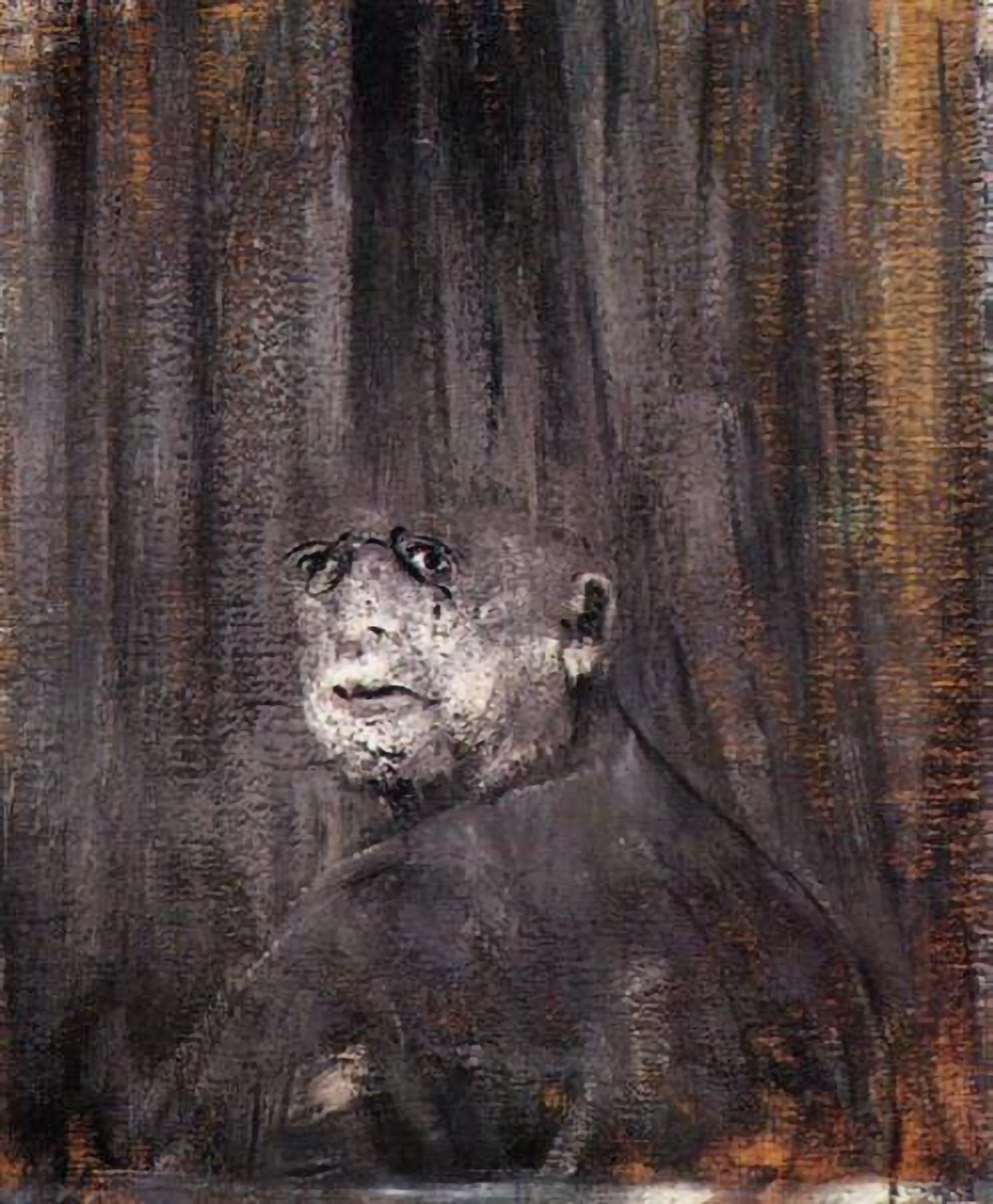
    Head III (1949), Francis Bacon | Wikimedia Commons. Bacon was an Irish-born British figurative painter known for his raw, unsettling imagery, and claimed that he strove to render “the brutality of fact.” This is neither his most abstract nor most macabre work, but one that I think speaks to the mind of humans when we think that we “know best.” There is a pride in this man’s demeanor and hints of scholarly knowledge in his eyeglasses. And while we see his features and face, it is as if they emerge with great effort, for he is but a shell of what a full human should be. Importantly, his mind is obliterated – lost to a vacuum of some sort rather than full and defined with actual Truth.

    “Moreover,” Jesus says, “I know that you do not have the love of God in you.” Oh, the shame and trembling if they only knew who was saying this to them! It is interesting to me that Jesus separates this ultimate sin of turning one’s back on God from the earlier point about them not wanting to come to him. Jesus instructs us here that one can be imperfect and prideful yet still perhaps have a kernel of God’s love inside them. Sadly, the Jews who disbelieve and accuse him are both prideful and lack God’s love inside them, meaning that the truth they supposedly found in the scriptures is not something they have incorporated into themselves. They lack God’s love out of their own fault, not because it has been withheld from them. This is a horrible state of affairs, a great affront to our Creator, to whom we owe our lives, our intelligence, our souls, everything. 

    But like the Father, the Son loves and gives mercy. Despite their accusations against him and their disbelief in who he IS, he says, “Do not think that I will accuse you before the Father: the one who will accuse you is Moses, in whom you have placed your hope.” Like the Father, he IS, meaning he will radiate and purify with his love through his actions and his very being. His saving mission at this moment in history is to teach, to suffer, to die, to resurrect, and to initiate the Church in Spirit and Truth.

    But we must remember his words from yesterday (part of this same dialogue), when he says, “[the Father] has given him authority to execute judgment, because he is the Son of Man.” This discussion, in other words, has an eschatological bent. It is concerned with everlasting life or everlasting torment. The Son’s mission isn’t done with the establishment of the Church — it will eventually conclude with his presiding over Judgement Day. He will embody the purifying love of the Father. He returns to that concept when he says “Do not think that I will accuse you before the Father.” It sends a chill up my spine to imagine how these unconverted Jews will wither when they see their great hero, Moses, prostrate before the Son of God and condemning them.

    The take-home message is clear: be grateful to God for your life and every blessing in it. Be faithful to God — especially when thinking and talking about him with others. Your testimony to the Truth of God and Jesus Christ is an essential element of your salvation. And, like Jesus tells us, whether you believe it or not, the Truth has already been testified to.

  • New Heavens and a New Earth

    New Heavens and a New Earth

    Monday of the Fourth Week of Lent: Isaiah 65:17-21, John 4:43-54.

    Yesterday we leapt forward, pushing our clocks ahead an hour as we transitioned into Daylight Savings Time. My wife spent her life getting up early to swim (around 5 am!) and so this transition always bothered her because just as the sun would be making its way into her morning workouts, she’d be plunged back into darkness for another month.

    Yesterday, she went walking with a good friend who confided to her that she actually sets her alarm clock back 5 minutes each day for a month leading up to Daylight Savings Time because she has such a hard time adjusting to the change.

    On the other hand, I am more of an evening person, so I am more bothered in the fall when my evenings suddenly go black much sooner than I thought they would. It’s an interesting lesson in how we create little realities for ourselves that are sometimes revealed for what they are: self-made constructions of happiness and comfort.

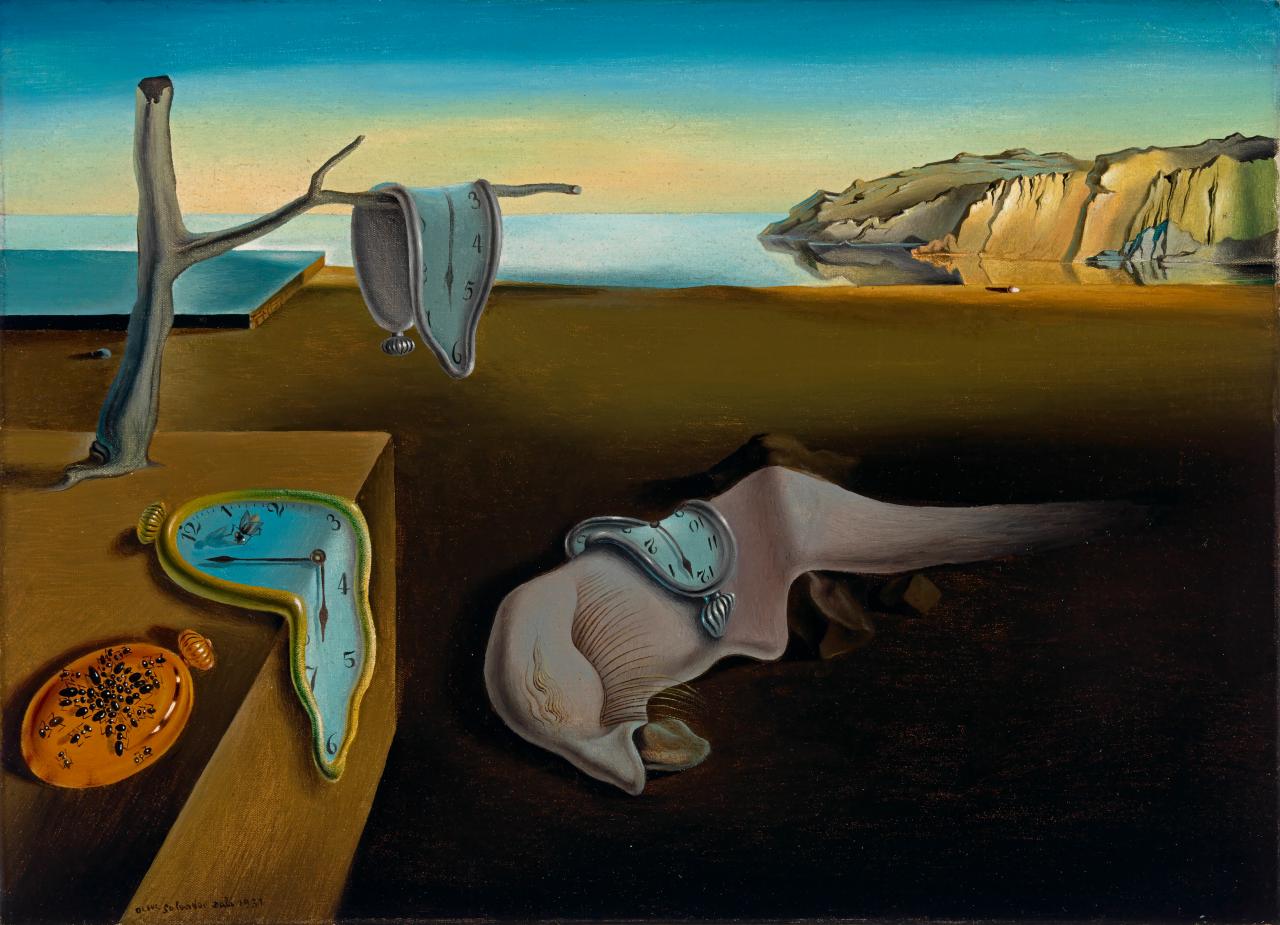
    The Persistence of Memory (1931), Salvador Dalí | Image from the Museum of Modern Art.

    Sure enough, yesterday I had a moment of elation when I looked out the window after dinner and realized how light it was. I could go for a walk, enjoy the sunshine, maybe putter around in the garden! Suddenly, new possibilities were open to me that haven’t been open for the past I-don’t-know-how-long. Silly, I know, but that was how I felt. And what really changed? Nothing but an arbitrary shift of the clock. 

    This incredible shift in mindset is something we’re asked to experience in today’s readings. And rather than an arbitrary clock change, an actual new reality has opened up between Heaven and earth to cause this change in mindset.

    If we allow ourselves to be complacent in what we think we know of the New Testament, the gospel reading appears like any other healing story. A man asks Jesus to heal his son and Jesus does it without even having to go to the man’s house. But if we allow the new reality of God-come-to-earth as Christ to illuminate our souls — like we allow the newfound post-dinner hour of light to illuminate our outlook on the evening — something altogether different is happening.

    St. John tells us that Jesus is traveling back to Galilee after coming north through Samaria. In the verses just prior to this, Jesus encounters the Samaritan woman at the well and in their conversation he reveals to her, “I am the Christ” (Jn 4:26). Based on his conversation with her, she believes and so does an entire town of Samaritans who get him to spend several days with them. Who he is — the reality of the Messiah come to earth — has dawned upon them and changed their entire outlook on their own lives.

    To signal that a new spiritual reality is making itself known, a reality more important and fundamental than the earthly reality, Jesus rebuffs his disciples’ urgings to eat by responding, “My food is to do the will of him who sent me and to complete his work” (Jn 4:34).

    He goes on to encourage them to help him usher in the new mindset that should accompany this new reality: “look around you, and see how the fields are ripe for harvesting. The reaper is already receiving wages and is gathering fruit for eternal life, so that sower and reaper may rejoice together” (Jn 4:35b-36). Jesus is trying to get the Apostles to notice this new reality in which they have a part to play.

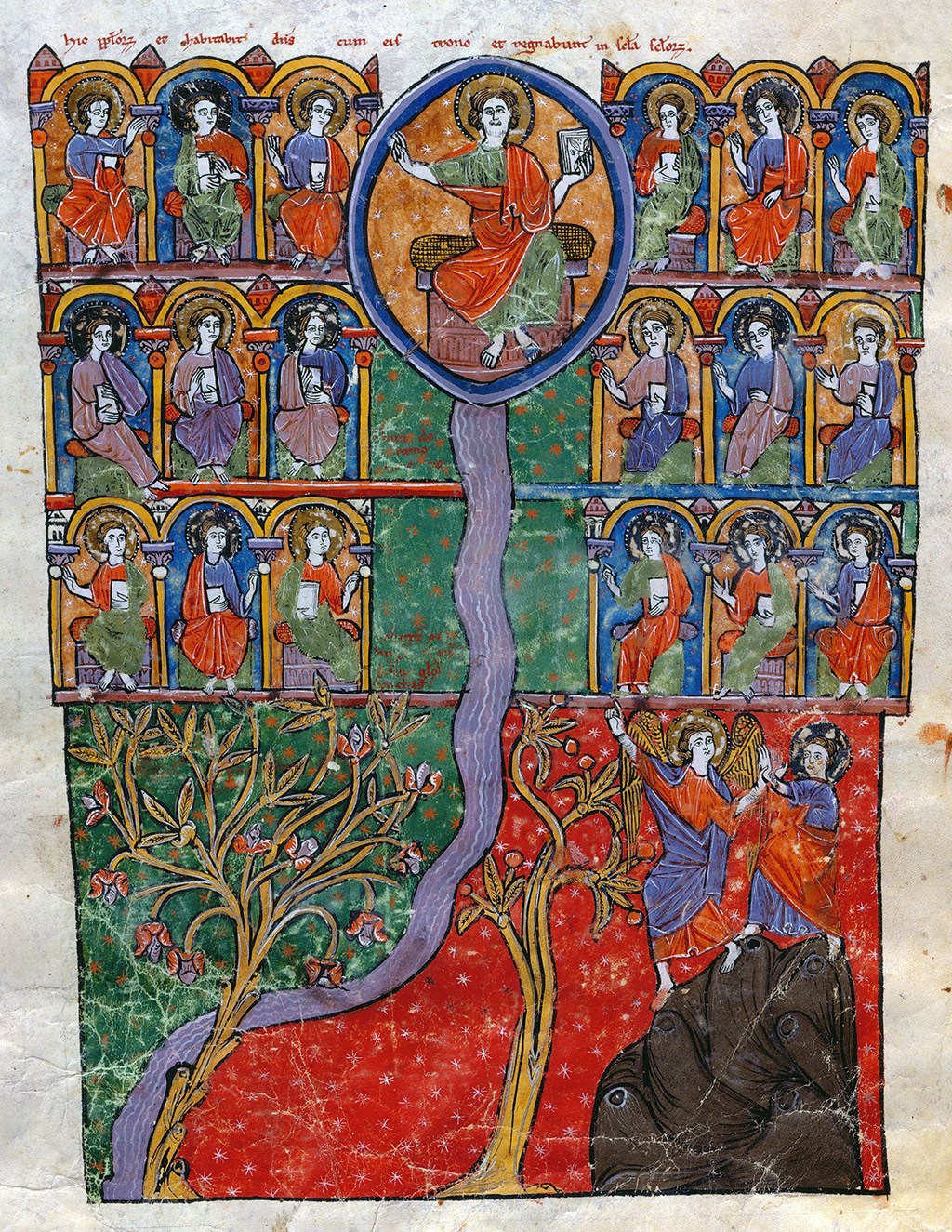
    Christ Enthroned Over the River of Life (1220), Beatus of Liébana | Creative Commons, courtesy of the Morgan Library & Museum. This is MS M.429 (fol. 141), called the Las Huelgas Apocalypse, the latest dated (1220) and largest surviving manuscript of a Spanish tradition of illuminated commentaries on the Apocalypse by the monk Beatus of Liébana. The series of manuscripts constitutes Spain’s most important contribution to medieval manuscript illumination.

    We are so used to being Christian that we no longer comprehend the massive change of reality that happened at the Incarnation. Perhaps we never fully understood it. Fr. Jean Corbon, OP, writes, “In Jesus the entire energy of love impregnates human energy with an ‘anointing’ that makes this human energy its own and gives it life” (Wellspring of Worship, 40). In other words, the divine love that continually flows between Father, Son and Holy Spirit now descends into humanity to find a new home there, to begin to work within humanity until the end of time.

    Fr. Corbon reminds us that the first creation moment saw everything come from nothingness into being, but “In the new creation that is beginning here, he who is eternally begotten of the Father is fashioned out of living earth, namely, the entire being of his mother” (37). This new creation is something that has never existed before: fully God and fully human, a man to change history and the fabric of spiritual being.

    This is what the Father promises to Isaiah in the first reading today! He proclaims, “Lo, I am about to create new heavens and a new earth; The things of the past shall not be remembered or come to mind. Instead, there shall always be rejoicing and happiness in what I create.” The newness of our beings, when divinity has come to dwell among us, cannot be overemphasized. It is an entirely new creation, creating a new heaven and earth that did not exist before.

    He continues: “For I create Jerusalem to be a joy and its people to be a delight; I will rejoice in Jerusalem and exult in my people.” The Catechism teaches us that the Church herself, the bride of Christ, is the New Jerusalem that God promises. It exists on both Heaven and Earth and is beloved to the Lord.

    What we encounter in Chapter 4 of John’s gospel is the beginning of the New Jerusalem, brought about during the new creation that Jesus Christ has ushered in. This is a new reality filling the world with light — the Samaritans see it like new hours granted by Daylight Savings Time. Can we? Does it affect our mindset as much as the arbitrary change in hours does?

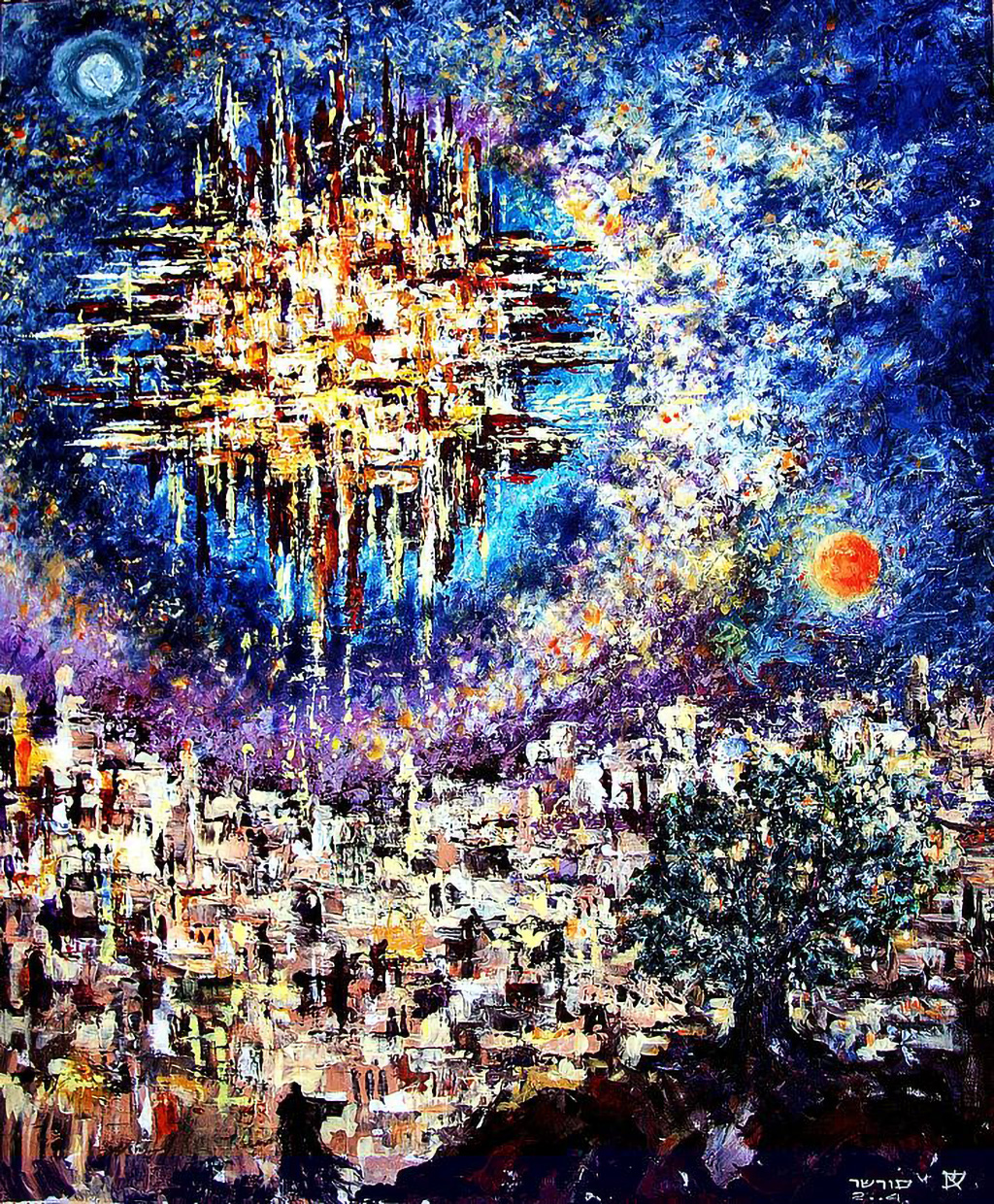
    New Jerusalem Revealed (contemporary), Alexander Sorsher | Image from pixels.com.

    When the royal official in today’s gospel reading asks Jesus to come to his house to heal his son, Jesus responds, “Unless you people see signs and wonders, you will not believe.” Perhaps Jesus is contrasting the man’s state of mind with that of the Samaritans, who believed in him purely by encountering him and speaking with him. No “signs and wonders” were required apart from the truth that he spoke. But the man just plows on as if not hearing: “Sir, come down before my child dies.”

    What is going on here?

    I think this speaking-past-one-another illustrates how this man is oblivious to the reality that the Messiah has ushered in. The man has not come to encounter Christ — he is living in his usual, un-transformed world that is dominated by fear of death. He has come not to encounter a new reality that does away with that fear but instead to find something that will, in fact, confirm his fears of the ultimate domination of death by keeping it at bay for a while.

    Notably, though, he does not come to “test” Jesus — it seems that he already has placed a good deal of hope in him. Thus, when Jesus says that they need signs and wonders “to believe,” it seems that he is referring to a deeper “belief” than the more surface belief that he is a type of healer. He seems to be just stating a fact of human nature.

    He may be gently lamenting that this man isn’t of the right mindset, but he nonetheless performs this wondrous act of healing. He heals the man’s son not to prove that he’s a wonder-worker, but to affect the man’s entire mindset on the reality that walks among them. He performs this miracle so that the man might be shocked out of his usual, un-transformed world and believe in something greater: the new creation and the New Jerusalem being built around him. This is why Jesus always points back to the Father — it is the Creator who is accomplishing this new creation by incarnating His Word in humanity. Belief in Jesus is belief in the Father, belief in salvation, belief in a new spiritual reality.

    How curious that we can be more affected by our clock changes than changes in the fabric of our spiritual reality! As Christians, we’re called to become more attentive to our spiritual selves (by dying to our worldly senses and desires) so that we can be awestruck by the Christ Event dumping immense light into our lives.

    That’s what Lent is here for: to help us become aware once again, appreciative once again, transformed once again.


  • Lifted Like the Serpent

    Lifted Like the Serpent

    Sunday of the Fourth week in Lent: 2 Chronicles 36:14-16, 19-23, Ephesians 2:4-10, John 3:14-21.

    In today’s gospel reading, Jesus has a memorable meeting with Nicodemus, a Jewish member of the Sanhedrin, a faithful Jew, and eventually a full disciple of Jesus who comes with myrrh and aloes along with Joseph of Arimathea to retrieve his body from the Cross.

    Jesus presents himself to Nicodemus as a modern, living version of Moses’s serpent on the staff that saved the Jews bitten by poisonous serpents in the desert. While foreign to us if we are not versed in scriptures, this comparison would undoubtedly have been powerful and shocking for Nicodemus. In fact, Jesus’s words finally explain the significance of God instructing Moses to make a bronze serpent and mount it on a pole.

    As we dig into today’s gospel reading, we are struck with the entire span of salvation history from the Garden of Eden to Christ’s Paschal Sacrifice on the Cross. Also, we see Nicodemus as a true Christian, converted to Christ, moving from the darkness to the light.

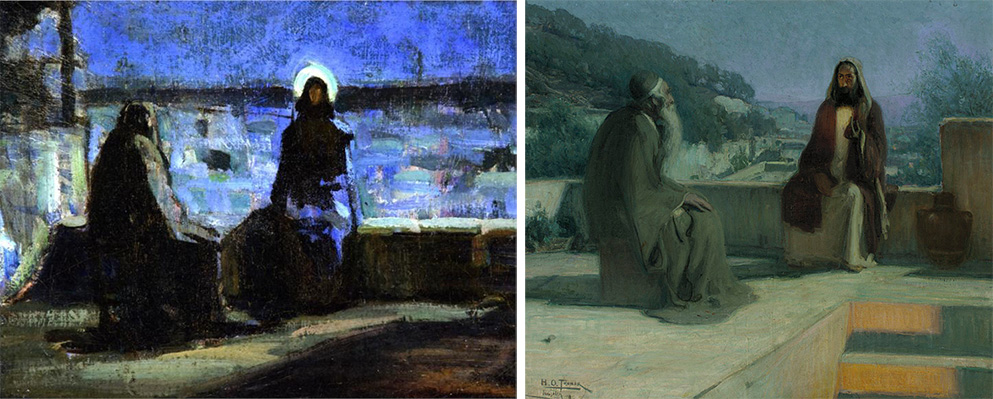
    Nicodemus and Jesus on a Rooftop (1899), Henry Ossawa Tanner | Wikimedia Commons. On the left is a study that Tanner did for the finished painting on the right. I appreciate the nimbus on Christ in the study, acknowledging that he is the “Light of the World,” despite the meeting occurring at night.

    St. John tells us that Nicodemus comes to Jesus by night. In just this simple statement, we can glean many things. Some scholars believe that a leader of the Jews would only come by night because it would be unseemly for a member of the Sanhedrin to join the crowds and rabble who followed this traveling preacher by day. Whether he was too busy with his duties, too proud to be seen going to learn from an unlearned miracle-worker, or too bashful to present himself openly, we encounter this powerful man coming to Jesus under cover of night.

    As historians and scholars have envisioned this meeting, there is a compelling argument that they met on a rooftop. First of all, this was (and is) common practice for men to retire to the rooftops after their evening meal on the hot, Middle Eastern nights, in order to enjoy cooling breezes. Second, Jesus makes some memorable statements about the air and the Spirit, likely choosing the moment when the phenomenon of the breeze could help him make this point: “The wind blows where it chooses, and you hear the sound of it, but you do not know where it comes from or where it goes. So it is with everyone who is born of the Spirit” (Jn 3:8).

    Jesus speaks of a spiritual logic unknown to those merely born of the flesh, encouraging Nicodemus to break out of his disbelief and earth-bound assumptions about what is possible. So, we see Nicodemus coming to Christ at night to know more about this man sent by God, and God, in return, engages him in the deepest truths. Is this not the exact journey we all make to Christ? Do we all not suffer from a certain bashfulness to approach Him openly in a culture where our faith is seen as antiquated, naïve, and gullible? Yet Jesus is there, waiting for us with deep truths.

    These deep truths are inevitably deeper than we are prepared to comprehend. Jesus reveals himself to Nicodemus as not just “a teacher who has come from God” (as Nicodemus calls him), but as the “Son of Man” and God’s “only Son.” And Jesus ups the stakes to eternal bliss or eternal damnation based on this very fact alone: “everyone who believes in him might not perish but might have eternal life … but whoever does not believe has already been condemned, because he has not believed in the name of the only Son of God.” Nicodemus definitely got more than he bargained for by coming to this “teacher” by night.

    As we think about this “all-or-nothing” statement by Christ, we are reminded of the gospel a few days ago where he proclaimed, “whoever is not with me is against me,” that is, scattering people instead of gathering to the Kingdom. Why does our Lord deal in these absolutes? There can be no doubt here that he is asking us to be “all-in,” much like he asked Abraham to sacrifice his son or Noah to build the ark (see the post, A Glimpse of Heaven). And just as Abraham’s assent was blessed by founding the nations and Noah’s assent was blessed by saving humanity from destruction, our assent to Christ will be blessed with everlasting life.

    In all cases, the call is personal. It is an individual meeting with the unfathomable God. Just like Nicodemus, we all must go to have a personal encounter with Christ to listen to what he has to tell us.

    Pope Benedict the XVI put this succinctly at the beginning of his encyclical on love: “Being Christian is not the result of an ethical choice or a lofty idea, but the encounter with an event, a person, which gives life a new horizon and a decisive direction” (Deus Caritas Est, 1). Today’s gospel is one of many very concrete examples of this encounter in action. 

    Jesus proclaims elsewhere in John’s gospel, “I am the light of the world” (Jn 8:12), and he makes a similar statement here with Nicodemus. His words may have stung Nicodemus, since he came to Christ at night:

    “And this is the verdict, that the light came into the world, but people preferred darkness to light, because their works were evil. For everyone who does wicked things hates the light and does not come toward the light, so that his works might not be exposed. But whoever lives the truth comes to the light, so that his works may be clearly seen as done in God.”

    He is urging Nicodemus to come to him in the light of day, openly. But more than that, he needs Nicodemus to understand that God and truth dwell in the light, and this is something to always glory in, to be proud of; in fact, by believing in this truth and light, and acting in it, a person is securing for himself or herself a place in Heaven.

    Jesus mentions the concept of being exposed, and there is absolutely an aspect of vulnerability in this. As he says, the “verdict” is that “people preferred darkness to light,” thus living in the light does not exempt one from pain and suffering as a result of this exposed vulnerability. This fact is wonderfully demonstrated in Jesus’s incredible comparison of himself to Moses’s serpent on the staff.

    That story from the Book of Numbers speaks of events 1,475 years before Christ sits with Nicodemus on the roof. The passage is exceedingly odd at first glance: God first punishes the Israelites for complaining by sending poisonous serpents among them. In terms of today’s gospel, we could say that they are living in darkness (complaining and turning from God), and as a result they are bitten by serpents and die. Upon their admission of guilt and atonement, Moses prays for deliverance. At this point, God instructs Moses to mount a bronze serpent on a pole; subsequently, when the people look up at the serpent on the pole after being bitten, they are spared from death.

    Before we wonder what kind of witchcraft is going on here, let’s again consider it in terms of today’s gospel reading: by looking up at the serpent, the Jews in the desert are re-confirming their belief in God, who promises to protect them. They gaze upon the source of their suffering, the serpent, exposed, held up in the light for all to see, and they do not die. Importantly, they do not avoid suffering (that is, they continue to be bitten by serpents), but they avoid death through their continually re-confirmed faith in God.

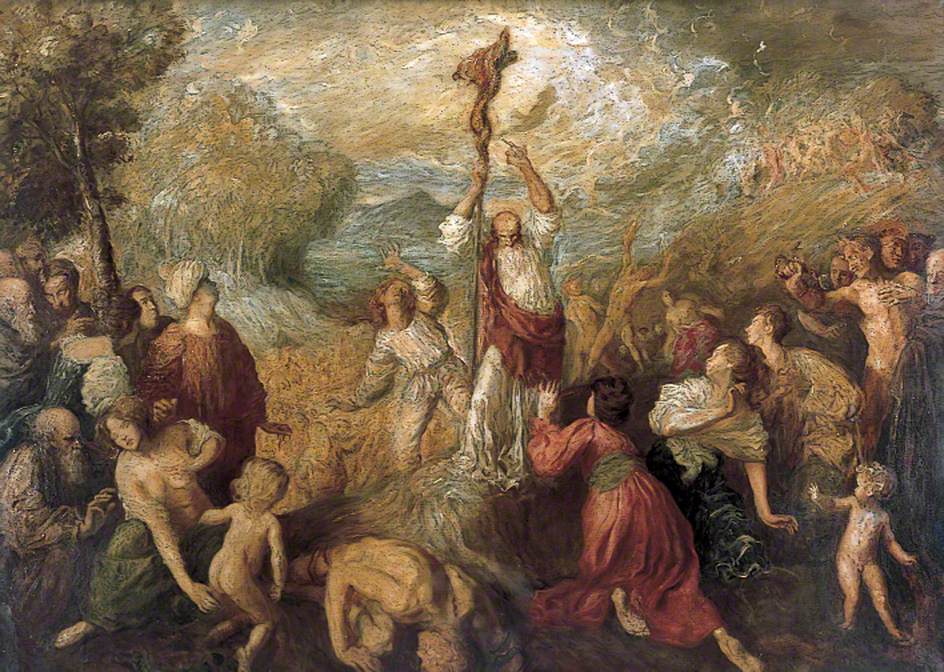
    Moses and the Brazen Serpent (1898), Augustus John | Creative Commons, courtesy UCL Art Museum/ArtUK. I like the impressionistic style Augustus John employs in this painting, the flowing waves suggesting a divine entrance into the fabric of humanity. As with any encounter with the divine, sin will merit pain and “gnashing of teeth,” and the purifying energy of God may not be pleasant for those in sin. I also see a bit of the devil in the bare-chested man on the right side of the canvas, which for me, at least, recollects the Garden of Eden connection. 

    It would be fair to say that the serpent is the symbol of humanity’s sin against God, ever since Adam and Eve in the garden. This sin is poisonous and it brings about the reign of death. The people repent and say to Moses, “We have sinned in complaining against the LORD and you. Pray the LORD to take the serpents away from us.” The act of looking up, heavenward, to the sign of the sin they lived with, is the action that reminds them of their dependence on God and his saving mercy. God’s divine mercy flows to the sinful, bitten individual in that moment, not through the arcane power of a bronze staff, but through the symbol that the staff presents to the Jewish believers in God.

    As Catholics, we know well that, in the liturgy, divine sanctification works in and through symbols, from the altar and ambo to the bread and wine. The bronze serpent on the staff is this type of sacramentalized symbol that his prophet on earth made under his instruction.

    The Jews understood the symbolic importance of this staff as a way to encounter God’s grace and they kept the physical staff around for centuries. They may have begun to confuse the symbolic function of the staff with a divine presence, however, because 740-ish years later we read in 2 Kings that King Hezekiah orders the destruction of the staff, which he calls Nehushtan (“a mere piece of brass”) because the Jews were burning incense to it and essentially treating it like an idol. 

    Now I don’t know much about divine numerology, but I do find it interesting that exactly another 740-ish years later, we hear Jesus tell Nicodemus the Pharisee: “just as Moses lifted up the serpent in the wilderness, so must the Son of Man be lifted up, that whoever believes in him may have eternal life.” With this statement, the Word of God reveals the full scope of this symbol Moses was instructed to make. “Just as Moses lifted up the serpent”: note that the parallel being drawn is to the fixing of the serpent to the pole and lifting it up, the fact of exposure for all to see. “So must the Son of Man be lifted up”: this refers to his Crucifixion, where he becomes the ultimate symbol for humanity. And finally the salvific import: “that whoever believes in him may have eternal life.” Like the sinful Jews who re-confirmed their belief in God and were saved from dying, we receive an infinitely greater promise and divine grace given to us when we behold Christ on the Cross, believe in him, and are granted eternal life that eradicates all sway of death.

    Yes, consider this! Christ is admitting that living in the light constitutes suffering at the hands of those who live in the darkness. What greater sign than his broken and crucified Body hanging on the Cross for all to see? But just as the suffering from being bitten by serpents is ameliorated by gazing at that exposed suffering on a pole, our suffering from sin in this life is ameliorated by gazing on the Lord’s suffering on the Cross, done for our sakes. This is exactly what “on our behalf” entails!

    He allowed himself to be affixed on the Cross like the serpent on Moses’s staff so that we could have salvation as we gaze upon him and live in his light!

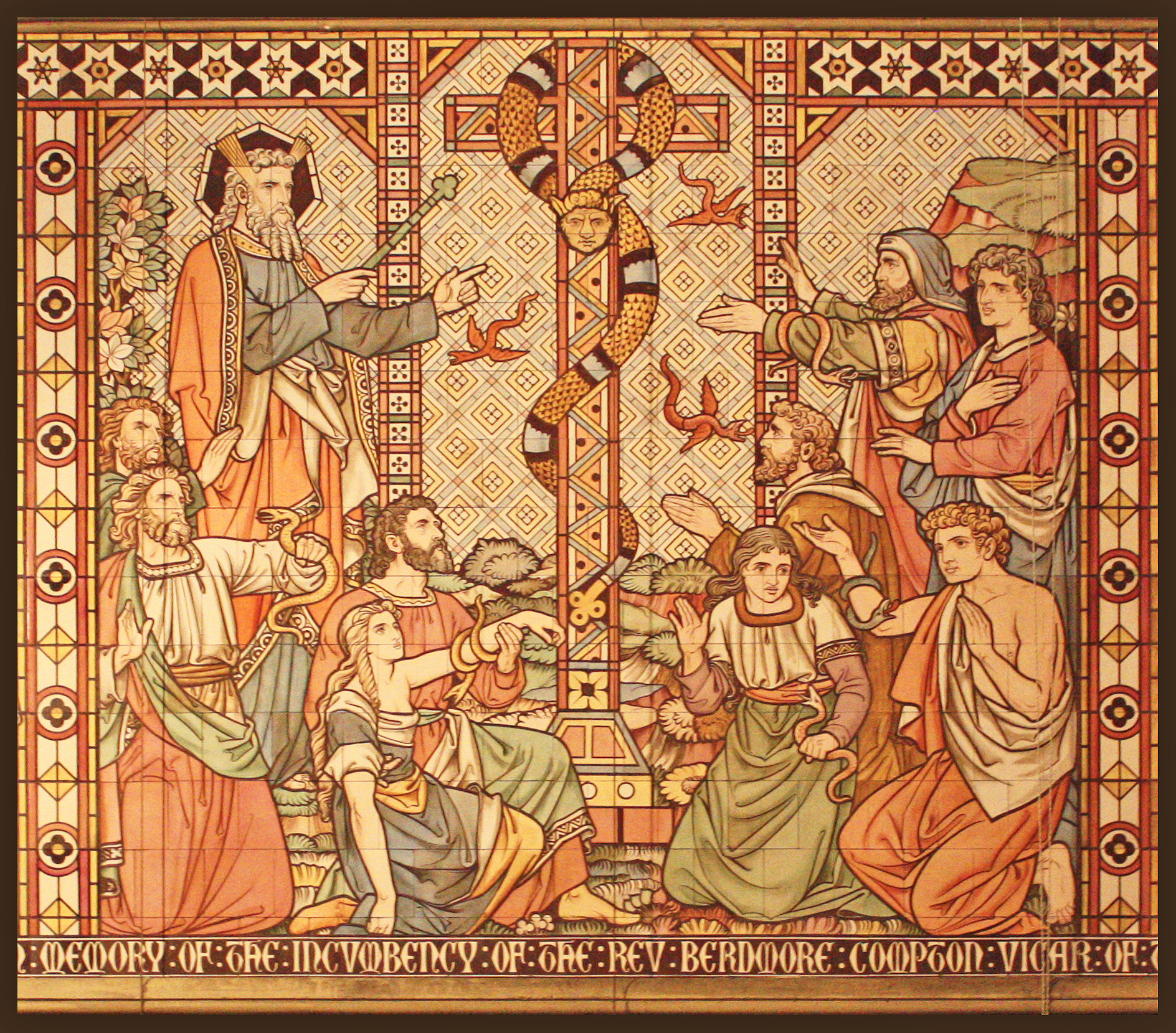
    Moses and the Bronze Serpent, mural in All Saints Margaret Street church in London (1889), tiles painted by Alexander Gibbs | photo courtesy Lawrence OP, flickr.com. Note that over the centuries, the connection of the bronze serpent and the cross has been made much more explicitly, as in this tile work.

    Sometimes the scope of God’s saving plan is just breathtaking. So many moments of patience and mercy over the millennia, from Adam and Eve, through Moses, and ultimately Jesus Christ. And so subversive of our normal worldly affections, too, in the use of the lowly and hated serpent as a resounding symbol for overcoming sin, much like using the reviled Cross as a throne for our Savior.

    I am brought back to the all-or-nothing statements we keep encountering this Lent. After this reflection, I am struck by the fact that Jesus is saying these absolutes because he must remind us that he is God’s plan, God’s gift. To not recognize and believe in him is to throw God’s gift back in his face. It is worse than living in sin — it is a deliberate act of defiance and rejection of our Creator. We must listen to Christ, and St. Paul does a fantastic job of reminding us in today’s second reading: “God, who is rich in mercy, because of the great love he had for us, even when we were dead in our transgressions, brought us to life with Christ — by grace you have been saved.”

    Serpent Illustration by Katie Scott | courtesy katie-scott.tumblr.com.
  • Forgiveness is Mercy in Action

    Forgiveness is Mercy in Action

    Tuesday of the Third Week in Lent: Daniel 3:25, 34-43, Matthew18:21-35.

    Today’s readings slide from Azariah’s beautiful placement of his fate in God’s hands to the damning of the unmerciful servant in the gospel. If ever there was a day to consider the term fear of God, this is it.

    The Books of Psalms and Proverbs mention fear of the Lord many times, calling it “the beginning of wisdom” and the “fountain of life” and proclaiming that the person who lives in the fear of the Lord is “blessed.” St. Thomas Aquinas reminds us that fear of God is one of the gifts of the Holy Spirit, and it is best understood not in terms of fearing something evil but fearing being separated from our Father — a filial fear.

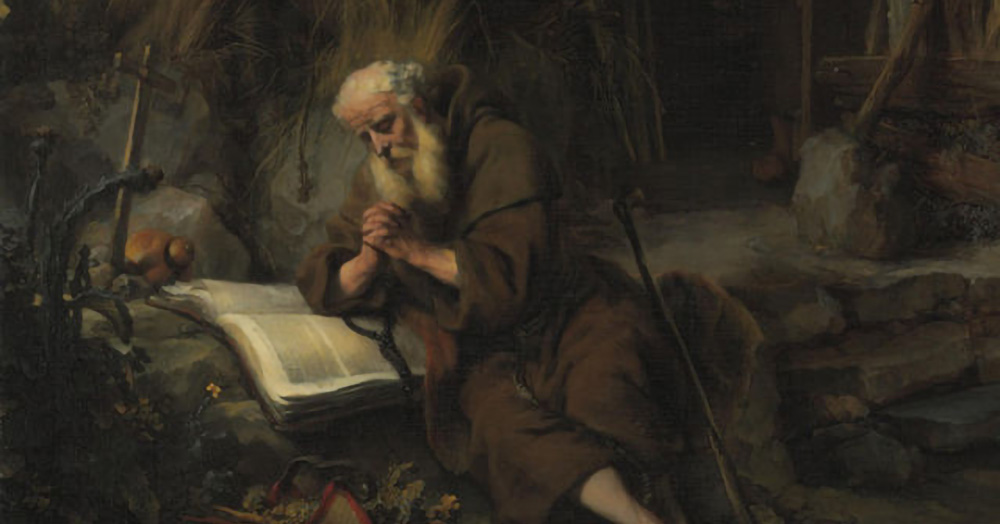
    Detail from A Hermit Praying (1663), Gerbrand van den Eeckhout | Image from artsy.net.

    Fear is a blessing? How gauche, how antiquated! We live in a time when liberation and freedom to do as you please holds the highest cultural value. But as we are swept up in this cultural moment, we have to remember that what we think is ours (our body, our thoughts, our actions) is actually a gift, too. It was a biological gift from a mother and a father, but more importantly, that spark of life, intellect, and soul is a gift from God. No biological mechanism can explain that gift of spirit that makes us human.

    Biologically, we are but atoms arranged in certain ways — proteins and fats and water that come together in a certain form. Even these building blocks had to come from somewhere, and we believe that our God is the Creator of all the universe. But more, we owe the divine Maker the fact that we are animated as intelligent, soulful beings, bridging the animal kingdom and the angelic kingdom.

    Here is where fear comes in and why we might call it a blessing. Imagine that source of divine power and goodness for just a second. Imagine how incredible it is that he cares enough to hold us in being, favored among all Creation. “Fear of God” means giving him the respect and love that he is due, but also clinging to him as the source of our being. To help us, the Holy Spirit gives us the gift of fear of God, something that aligns us spiritually, that endows us with the appropriate humble stance in front of our Creator.

    This is the way we should be thinking about the fear of God as we examine today’s readings: a gift to be treasured, one that gives us wisdom and blesses us, a feeling in our gut that we never want to be separated from our Father and the knowledge that our actions and hearts must be in line with God’s will in order to stay united with him and his grace.

    This type of fear of God is evident in Azariah in the first reading. This is part of the much-celebrated episode when the three young Jews Hananiah, Azariah, and Mishael are punished by Nebuchadnezzar for refusing to worship the gigantic golden idol he builds on the plain of Dura. They respond to the accusations against them by saying, “we have no need to present a defense to you in this matter. If our God whom we serve is able to deliver us from the furnace of blazing fire and out of your hand, O king, let him deliver us.” In a rage, he sentences them to be bound and cast into a fiery furnace so hot that it burns to death the men who throw them in.

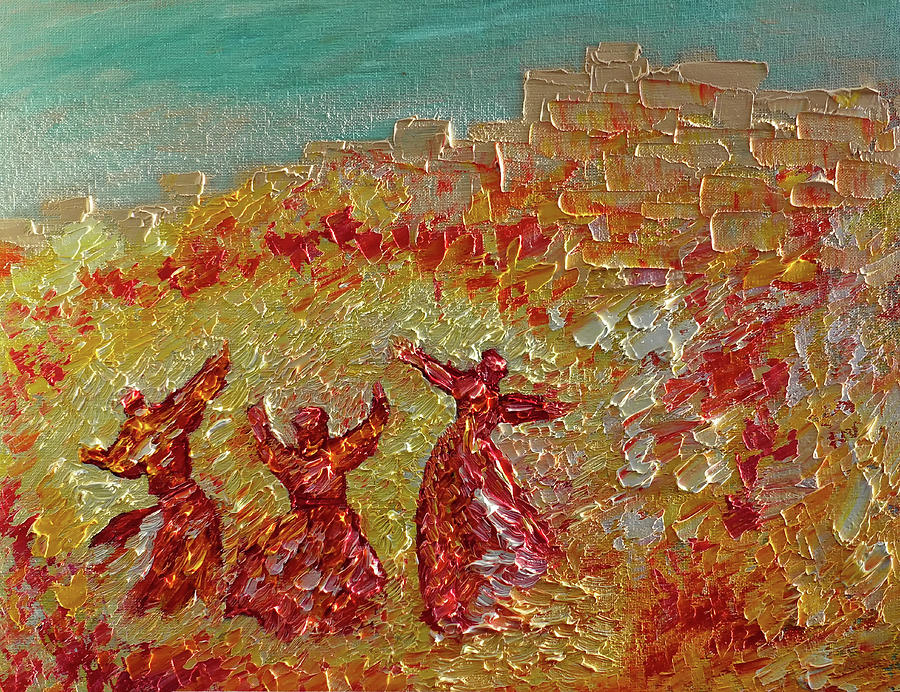
    Dancing Hebrew youths, Mishael, Azariah and Hananiah, in a fiery furnace of Nebuchadnezzar (contemporary) Zoriy Fine | Image from fineartamerica.com.

    We read the Prayer of Azariah in today’s readings, which he offers to God when they are inside the furnace. Importantly, Azariah prays not for the three of them, but for the entire nation of Israel, “for the sake of Abraham, your beloved, Isaac your servant, and Israel your holy one.” He notes how depleted Israel is (indeed, they’ve been conquered by the Babylonians and many have been dragged to Babylon). In a clear reference to the psalms, he says he has no offering but his “contrite heart and humble spirit.” (Psalm 51 reads: “For you have no delight in sacrifice; if I were to give a burnt offering, you would not be pleased. The sacrifice acceptable to God is a broken spirit; a broken and contrite heart, O God, you will not despise.”)

    Having declared his pure intentions, he says, “we fear you and seek your presence.” As we shall see in the gospel reading, this deep respect, this profound obeisance, is key to our request for mercy. The entire prayer reaches its climax with his request: “deal with us in your patience and in your abundant mercy. Deliver us in accordance with your marvelous works, and bring glory to your name, O Lord.” How important that Azariah understands that all must point back to God and his glory! He asks for deliverance not just out of a selfish desire for his own life, but knowing that Nebuchadnezzar would be amazed at the power of God to save his people. Most importantly, he models for us what a gift fear of God is.

    Spoiler alert: the three young men are saved by God and not harmed in the fiery furnace.

    Upon their deliverance, the three young men dance and sing in the furnace a great canticle of thanksgiving, one that we use in our liturgy: Week 1 Sunday Morning Prayer of the Divine Office, and repeated for each solemnity and other high feast days. The canticle is one of my favorites to chant during the Liturgy of the Hours because it starts by blessing God and then goes through all of creation, encouraging everything to bless the Lord. This canticle is important because Hananiah, Azariah, and Mishael not only model for us the fear of God and heartfelt pleas for mercy, but also the correct response once you’ve received his mercy: sharing that mercy with all of creation.

    Turning our attention to the gospel reading, the Parable of the Unmerciful Servant starts strong. The servant who owes an impossible amount of money to the king follows the lead of Hananiah, Azariah, and Mishael, showing proper respect for and dependence on the king. The original Greek uses the verb προσεκύνει (a form of proskynesis), which is often translated as “worship” elsewhere in the Bible and means to bow on your knees in a display of supplication and reverence. 

    Further examination of the Greek helps us understand the exchange between the servant and the king. Erasmo Leiva-Merikakis writes in Volume II of his masterwork Fire of Mercy, Heart of the Word, “God responded at once to the servant’s plea because the man used one of God’s dearest names in adoration of him: ὁ Μακροθύμος—’the Long-suffering One’. The man’s plea is said to have affected the almighty King’s very viscera (σπλάγχνα), hidden under all his golden robes … ‘the Lord of that servant was viscerally moved to compassion’” (647-648). The king is so moved that he forgives his entire debt! In this way, Jesus is describing God the Father in his overflowing forgiveness and mercy, far beyond our expectations. 

    The parable then turns, however, and reveals that the servant’s display of respect was only skin deep. He finds a fellow servant who owes him a much smaller debt and instead of forgiving this debt in turn, as his king forgave him, he chokes him, refuses to show him mercy, and has him imprisoned. This is a grievous sin.

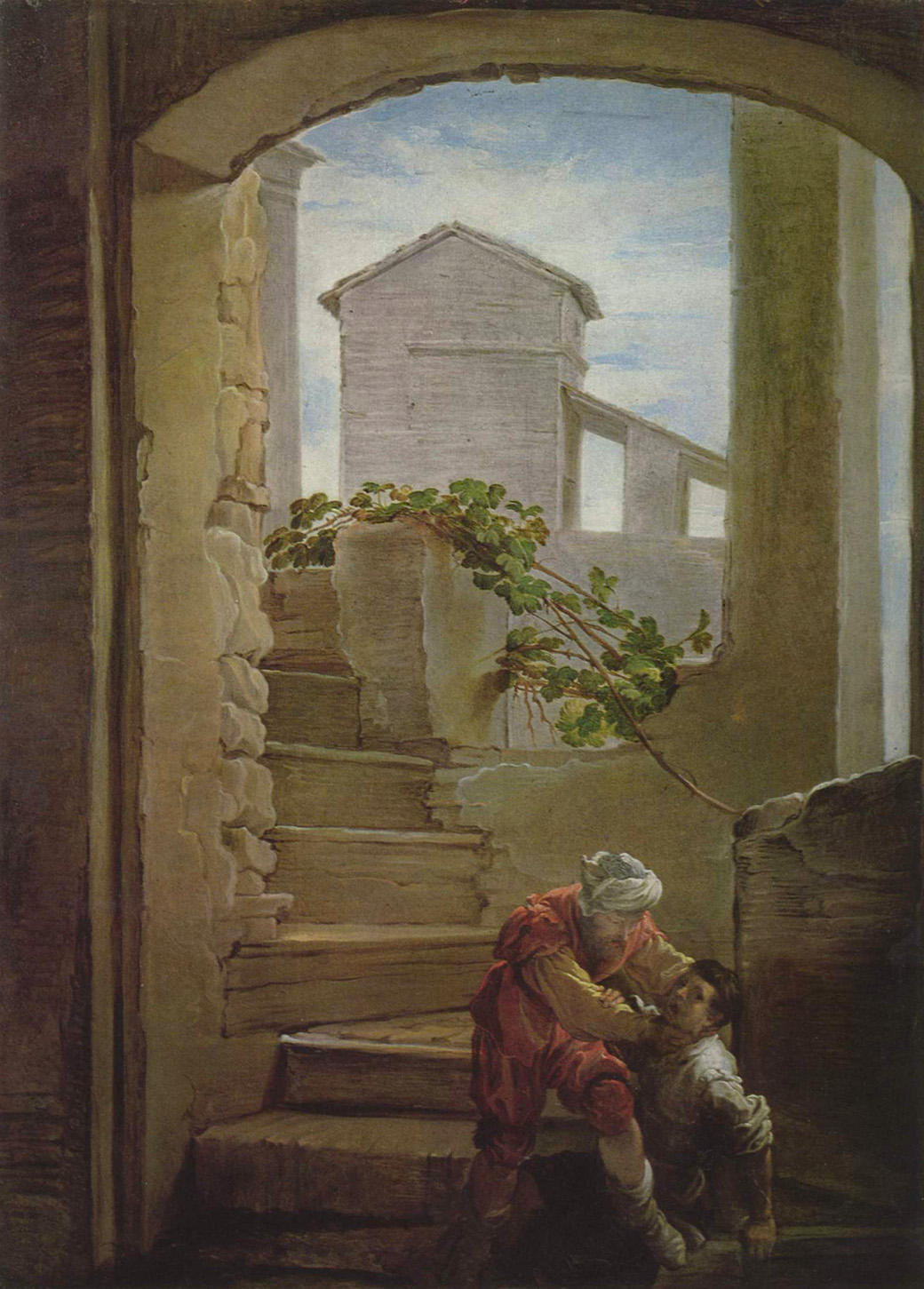
    Parable of the Wicked Servant (La parabola del servo malvagio), 1620, Domenico Fetti | Wikimedia Commons.

    The king’s action is not merely a good example for the servant. God’s mercy is a thing, alive, needing to course through us into the world. His mercy is the living force of love in the world. Leiva-Merikakis beautifully describes this, “Our vocation is to ignite conflagrations of love and forgiveness all around us. God’s light intends to be refracted through our being: it shines upon us not only for our own benefit, to dispel our own darkness, but also to stream through us and beyond us” (649). 

    Our very “vocation,” our purpose on the earth, is to share God’s mercy in the world. By so doing, we accomplish God’s will. But refusing mercy is the perversion of the Spirit. In the parable, the unmerciful servant shows that he does not have the type of fear of the Lord that is wholesome and transformative. The other servants must react at his perversion of the Spirit: “Now when his fellow servants saw what had happened, they were deeply disturbed, and went to their master and reported the whole affair.” Not sharing mercy with others is a cardinal sin. This leads us to the conclusion of the parable and a glimpse of divine justice.

    Even if it makes us uncomfortable, we must accept that God rightfully expresses anger when his goodness is hoarded and discarded. Divine justice hinges upon how we use the gifts God bestows on us, principally mercy: is it shared and given forth to others in acts of charity and love or is it discarded and replaced by selfishness, greed, and sadism? When we discard the energy of God Himself, we embrace the energy of evil, of the devil. What’s more, we reject ourselves, our purpose, to help bring others to God and into the Kingdom. We become an abomination of everything God has created us to be.

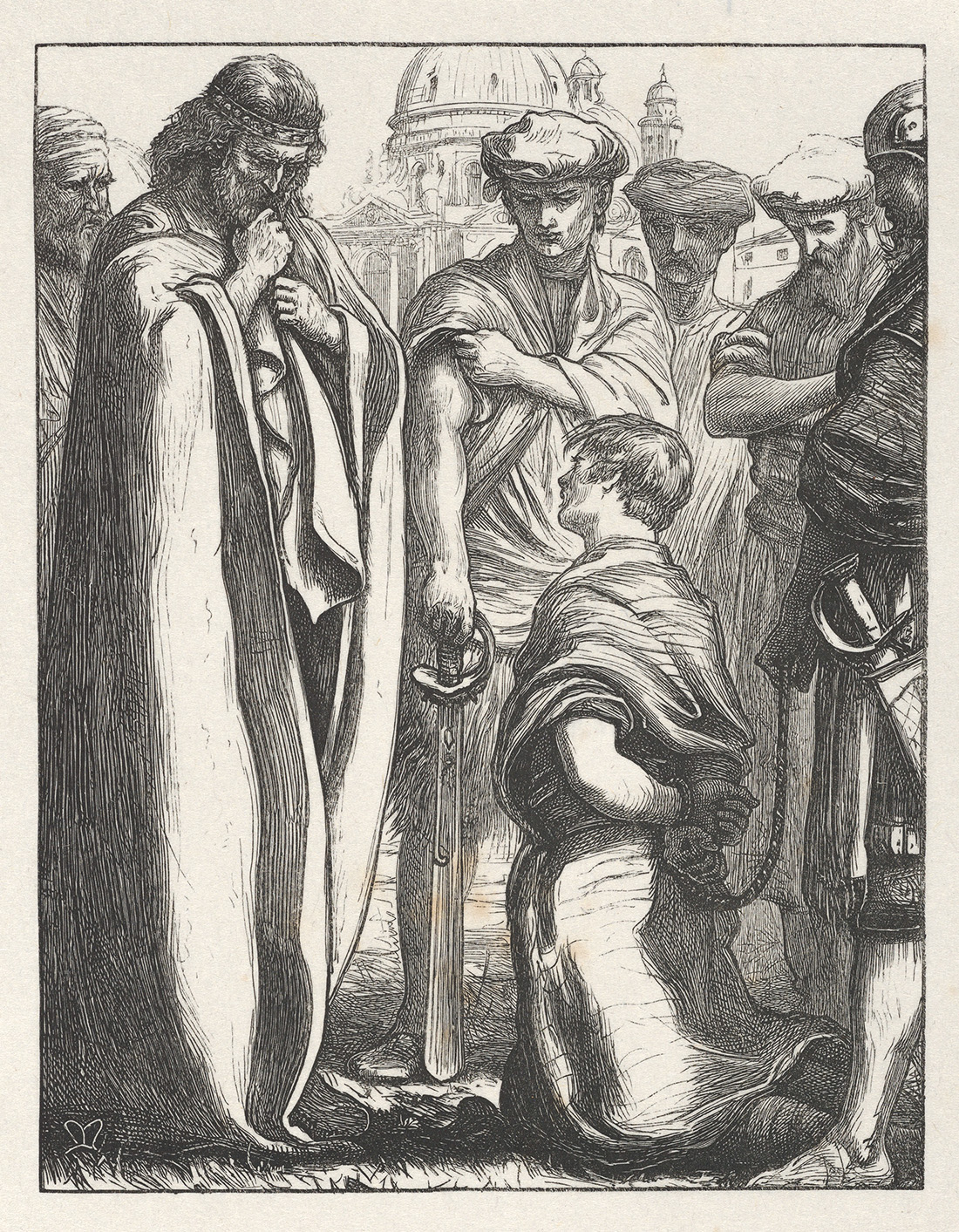
    The Unmerciful Servant (1864), artist: After Sir John Everett Millais, Engraved and printed by Dalziel Brothers | Creative Commons, courtesy The Metropolitan Museum of Art.

    So, we read that “in anger his master handed him over to the torturers.” Let’s look closely at the original Greek as we wrap our heads around God’s righteous anger and act of divine justice in this passage.

    The verb for his anger is ὀργισθεὶς (orgistheis), which can be translated as “moved to anger” or “provoked to anger.” Here we see that the king is provoked or moved by the actions of the servant; it is a response to something the servant has done. We must recall that while God is indeed all that is good, he is also the source of moral behavior, moral decision making, and moral valence (that is, what is good vs. what is bad). As such, he stands as the judge of behavior, and a judge is not silent when presented with something. Actions either uphold the good or go against the good. Being “moved to anger” means that he stands in his role as judge and proclaims the evil that he sees.

    Why anger? Why not sadness or emotionless judgment? Well, let’s return to the kind of God we know we have: one who overflows with love for his people and his creation. Is this the sign of impassivity? Should we expect a divinity so pure and full to not react viscerally to both the goodness he finds in us as well as the evil he finds in us? As it appears in today’s reading, God is viscerally moved to compassion — σπλαγχνισθεὶς (splanchnistheis) where the word σπλαγχνα (splanchna) means interior organs or intestines — and we can expect that he can be viscerally moved to something other than compassion when encountering evil. I don’t presume to know what he is moved to, but the scriptures tell us many times that he is moved to anger, so I take divine revelation for what it is.

    In his anger, the king “handed him over”: παρέδωκεν (paredōken), which occurs 18 times in the New Testament, notably when Judas hands over Christ to the chief priests, when Pilate hands over Christ to be crucified, and when Christ gives up his spirit in death. This is an irrevocable step in delivering something. And to whom does the king hand over the servant? The torturers, who will enact pain upon him “until he should pay back the whole debt” (200,000 years, I guess). We can rightfully say that in his goodness God does not take pleasure in this torture and note that he does not inflict it himself. Gehenna/Hell is set up for this purpose, a place for the people who pervert the Spirit and undermine God’s law.

    So as to not end this reflection as a total downer, let’s end with some wise words from Leiva-Merikakis, for whom today’s reading in part gives him the title for his three-volume work on St. Matthew’s gospel.

    The only thing we should be afraid of is not being merciful as our heavenly Father is merciful, for it is from unmercy that the most dire consequences flow, the ones reaching most deeply and devastatingly into both our psyche and our eternal destiny. For the Kingdom of Heaven is a kingdom of mercy, and mercy is never realized in the abstract but only through a concrete exercise of forgiveness. … Therefore, the ability to forgive our brother unceasingly and from the heart should be one of the primary concerns of our prayer, one of the most earnest pleas we make before the Throne of Grace (654).

  • The Unexpectedly Common

    The Unexpectedly Common

    Monday of the Third Week of Lent: 2 Kings 5:1-15ab, Luke 4:24-30.

    You’ve likely heard the adage that God works in mysterious ways. Today’s readings put a finer point on this: God ways are mysterious because they paradoxically appear to be common. Another way to say this is that God uses the things and people we know (or think we know) to enact his will in the world. This is unexpected because we expect something more flashy, more glorious.

    Oddly, we see people in both the Old and New Testaments reacting with anger when they are faced with this unexpectedly common appearance of divine will in the world. Isn’t that a bit odd? To get angry? I’d like to explore the significance of this instance of God’s plan and our reactions to it.

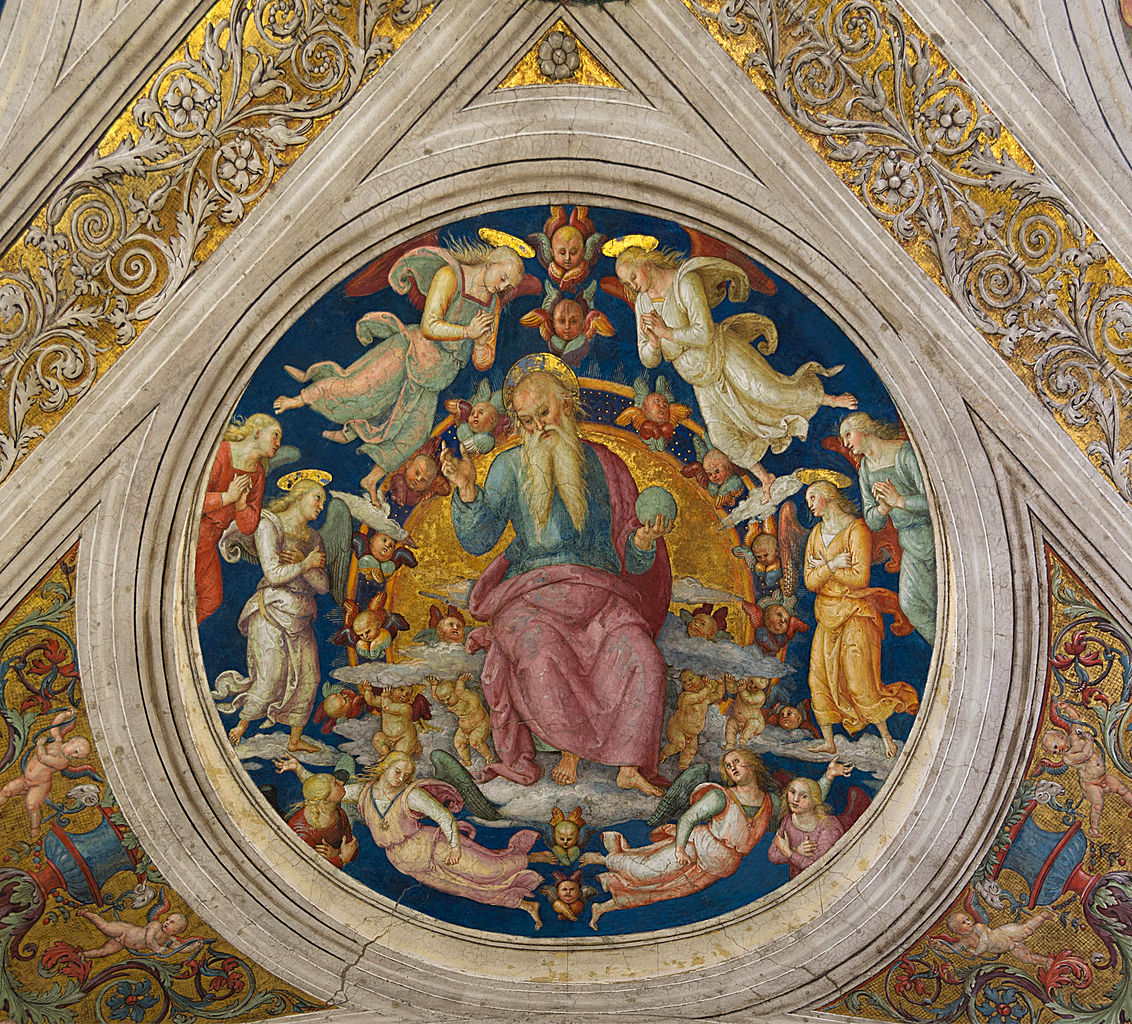
    God the Father with Angels, medallion, ceiling of the Stanza dell’Incendio di Borgo, Vatican City (c. 1510),
    Pietro Perugino | Wikimedia Commons.

    I particularly like the reading from the second Book of Kings because it reveals that our God is truly a God of all Creation, blessing people other than the Israelites. We might get a skewed conception of God, given our scriptural lens into God’s actions with his Chosen People. Yes, the story of humanity’s salvation lies in the Jewish people and then Christianity, but we can never allow our understanding to delimit God in any way.

    Jesus tells us that no one knows the Father except the Son, and many Doctors and saints have affirmed that God is unknowable. St. John of Damascus puts it well: “God is infinite and incomprehensible and all that is comprehensible about Him is His infinity and incomprehensibility” (On the Orthodox Faith).

    In my mind, it’s a good little jolt of remembering not to limit God when we read today that he “had brought victory to Aram” through the military commander Naaman. His reach is limitless, his love is limitless, and those outside of the Jewish nation have undoubtedly played a big role in revealing God to all the nations (as Jesus points out in the gospel reading).

    After hearing how the holder of secular power, the king of Israel, is sent into a paranoid fit at the appearance of Naaman from his powerful neighbors, Naaman finds his way to the true spiritual power of the Chosen People: the prophet Elisha. Here is the crux of the meeting: “Naaman came with his horses and chariots and stopped at the door of Elisha’s house. The prophet sent him the message: ‘Go and wash seven times in the Jordan, and your flesh will heal, and you will be clean.’”

    Note the scene: a big entourage of military might arrives at the prophet’s house and Elisha doesn’t even come outside to greet them. Elisha “sent him the message,” likely via a servant, and the message is almost offhand: “go dunk in the local river Jordan.” We can start to understand why Naaman got angry. It’s a problem of appearances.

    Naaman feels disrespected because Elisha doesn’t even appear before him. There is no ceremony, no waving of hands and calling out loudly to the Lord for healing. And the river Jordan isn’t a crystal clear mountain spring or even very big and mighty. All “signs” point to disappointment. Naaman typifies the angry disappointment of humanity facing the lack of a flashy and mighty God-on-earth.

    God is asking Naaman to accept him in humility. This is always an important step in our encounter with God. We are asked to put away our way of knowing in favor of his way of knowing. Humility (and humiliation) are our path to putting aside our own preconceptions and stubborn “knowledge” of how things work.

    Thus, God acts again through humble messengers: Naaman’s servants. They plead with the great military commander to do what was asked. Their logic is interesting. They say, you would have done something much more difficult if the prophet had asked it of you, so why not do the easier task? This reasoning resonates with him; he goes to the Jordan under the logic of a servant, finally ready to do what is asked of him.

    This is the baptismal sign under which God consecrates us to him, the same sign he gives to Noah and the earth and the same by which John the Baptist prepares us for Christ. For Naaman, “His flesh became again like the flesh of a little child, and he was clean.” We can thus understand his leprosy as a sign of his pride and reliance on his own powers of knowing rather than being open to God’s way of knowing.

    Once he humbles himself and does what he is asked, he is clean. The child-like condition of his skin mirrors the child-like openness of his soul, something Jesus asks of us: “Truly I tell you, unless you change and become like children, you will never enter the kingdom of heaven” (Mt 18:3).

    Medieval enamel and bronze altarpiece of Naaman washing in the Jordan (1150-1160), unknown artisan | Creative Commons, courtesy the British Museum.

    The final piece of the account is that Naaman returns to Elisha’s house and praises God, not the prophet. He has been truly converted to God, he has understood his humble relationship to the Creator and rightly praises Him: “Now I know that there is no God in all the earth, except in Israel.” He has changed his entire understanding of this journey — it wasn’t a journey to meet with a prophet and be cured by a human with powers; it was a journey to encounter God himself, who works through the common fabric of humanity that he loves.

    Like Naaman, the Nazarenes in the gospel reading are asked to accept the words of a prophet delivered in an unexpectedly common way. This scene from the Gospel of St. Luke occurs at the very beginning of Jesus’s ministry after he returns from his 40 days in the desert. He comes to his hometown of Nazareth and reads a famous passage from Isaiah in the synagogue: “The Spirit of the Lord is upon me, because he has anointed me to bring good news to the poor …” (Is 61:1). This is the message of deliverance in the Book of Isaiah.

    Jesus then proceeds to proclaim, “Today this scripture has been fulfilled in your hearing.” Shock of shocks! This son of Joseph, whom they all know since childhood, is claiming to be the Anointed One of God, ushering in a new era for the nation of Israel! They are incredulous; after all, they know him, he is common, and surely the Messiah won’t be the son of a common carpenter, much less that Jesus we’ve seen so many times we forget he’s even around.

    In response, Jesus begins, “Doubtless you will quote to me this proverb, ‘Doctor, cure yourself!’ And you will say, ‘Do here also in your hometown the things that we have heard you did at Capernaum’ (Lk 4:23). The proverb comes from a place of disbelief and contains an implicit “prove it to me first before I believe you” (that is, show that you’re in top shape before trying to heal me).

    Jesus knows that they want to test him, make him prove himself as the Messiah by working miracles in their midst. His answer is the same one that Naaman receives. The prophet won’t be made to perform or do circus tricks for the demanding audience. That’s not how God’s will is accomplished. He works through common, humble humanity — nothing proves this more than this moment when the Son of God acknowledges that he is also just a son of a humble carpenter named Joseph and this does not diminish in any way the power, glory, and majesty of his being the Messiah.

    Jesus sums up his poor reception among his childhood neighbors thus: “Amen, I say to you, no prophet is accepted in his own native place.” Human expectations of the miraculous and divine are too concerned with style and not concerned enough with substance. We, like Naaman and the Nazarenes, want something special, electric, and obvious to appear and wow us. Once we’ve made up our minds about people we know, we cross them off the list of potential sources of God at work in the world. We think of this as wise, worldly and mature, but God again and again tries to show us that the Spirit works through any and all according to God’s will — we can’t predict it with our intelligence, much less categorize things as likely or unlikely based on how well we know someone.

    This why Jesus’s words to “change and become like children” are so important. Children don’t carry the burden of preconceptions fossilized into place after years of experience. They are open to be amazed at the things around them, open to the wonder inherent in their parents, siblings, and friends. This is also why death to self and rebirth in the Spirit is such an important concept in the sacrament of Baptism.

    Christ in the Synagogue (1868), Nikolai Ge | Image from wikiart.org.

     Jesus goes on to give us another level of significance to Naaman and Elisha in the gospel reading. On one hand, the Nazarenes are just like Naaman in their expectations that the prophet will be flashy and commensurate with their expectations of grandeur. But on the other hand, Jesus points out that in the scope of salvation history they are the opposite of Naaman because they are the Jews, stubborn and unconverted in heart, while he is the Gentile outsider who displays a true conversion.

    Jesus sharpens the point of the Gentile miracles found in the scriptures. He says that this is not coincidence but instead God’s plan because human nature is what it is: “there were many lepers in Israel during the time of Elisha the prophet; yet not one of them was cleansed, but only Naaman the Syrian.” Jesus is saying that these Gentiles were chosen by God, like the Jewish prophets were chosen by God, and together they reveal the greatness of the Lord.

    The Jews take this as a great insult: “When the people in the synagogue heard this, they were all filled with fury.” Luke reminds us that this exchange takes place in the synagogue — the place where the Chosen People set themselves apart in their worship of their God. The weight of thousands of years of Jewish exceptionalism is felt in this moment. They were the Chosen People, special to God, with whom He makes his Covenant. They have crafted for themselves an identity in a hostile world that hinges upon their special relationship with God and here is a common man telling them — in their holy synagogue — that unlikely people and outsiders are in fact chosen by God over them, his People. It’s an outrage to them.

    They have missed Christ’s lesson. They could have reasonably reflected upon his words and allowed humility to enter their hearts like Naaman did at the prompting of his servants. Instead, in their rage, they drive him to the outskirts of town with the intention of killing him. This is not a conversion-to-God scene. Worse than missing his lesson or the opportunity to humble themselves before God, they have missed recognizing the Messiah in their midst. They are proving Jesus’s words to be true, that “no prophet is accepted in his own native place.”

    And in a sentence illustrating the massive significance of how they missed knowing him, “he passed through the midst of them and went away.” They miss recognizing Jesus, his lessons, and his new era of living in the light so profoundly that he can just pass through the midst of them. They are literally blind, groping angrily in spiritual darkness, unable to even remember who it was who they are angry with, why they are angry, or what they are doing with themselves there at the edge. (I reflected on a different aspect of this moment last year, considering the Spirit-like movement of Christ out of their midst. Read that reflection in A Prophet in his Own Land.)

    In Lent, we are called to prayer, fasting, and acts of charity (i.e., caritas or agape love). As we turn our attention to the vulnerable, the poor, and the needy, we should find ourselves reaching out to help them in some form or another. We are taught that we participate in God’s love when we act in charity and love, but let’s consider the mindset with which we approach our acts of charity and how that might impact whether we truly participate in God’s love.

    If we do good deeds with an eye on reaping eternal rewards, then this is self-serving.

    If we do good deeds simply because we are convinced it is morally right, without encountering God in the other, then we are spiritually frozen.

    If we do good deeds in an honest way but harbor a hidden feeling of the uncleanliness or lowliness of those we are serving, we are missing Christ in the same way the Nazarenes did.

    We have to become like children, ready to be filled with wonder as we notice God everywhere in creation. We cannot harbor a feeling of superiority, even if we push it down and don’t let it show. We have to humble ourselves before God, embrace our baptism and rebirth, and see that common, unexpected person as likely even more chosen than we are.

    A Shy Peasant (1877), Ilya Repin | Wikimedia Commons.
  • People of the New Fruit

    People of the New Fruit

    Friday in the Second Week of Lent: Genesis 37:3-4, 12-13a, 17B-28a, Matthew: 21:33-43, 45-46.

    Today’s readings are truly riches in storytelling and spiritual teaching. The parallels between Jacob’s son Joseph and Jesus Christ abound in their details: both are the favored son, both are sent to help in the tending of the sheep, both are caught up in the drama of jealousy, misunderstanding, and persecution, both are put in a place of containment (Jacob in the cistern, Jesus in our attempts to limit and demarcate the presence of divinity in our lives), both find adoption by an alien people, and both end up being hugely transformative figures despite these challenges, reigning in peace and forgiveness.

    While Joseph is an early Biblical figure who prefigures the life of Jesus, what we encounter in the gospel is that Jesus is pointing beyond Himself to a Church that will grow with Him and help to unite Heaven and earth. We will see how the killed son becomes the cornerstone of an entirely new reality and the vineyard will be given over to new tenants to produce new fruit.

    Joseph, a favorite Son, Sold into Slavery (from an illustrated French manuscript, known as the Crusader Bible or the Morgan Bible, c.1244-1254) | Creative Commons, courtesy Pierpont Morgan Library. MS M.638.

    Before examining the gospel reading, I would be remiss if I didn’t acknowledge the huge role jealousy plays in the first reading. As we explored in Worm of the Soul two days ago, jealousy is a terrible, foundational sin that twists us into unrecognizable beings. Listen to the brothers: “Here comes that master dreamer! Come on, let us kill him and throw him into one of the cisterns here; we could say that a wild beast devoured him. … just throw him into that cistern there in the desert; but do not kill him outright. … What is to be gained by killing our brother and concealing his blood? Rather, let us sell him to these Ishmaelites.” This spiral of evil conspiracy starts with the seed of jealousy, planted in their hearts by the devil. It festers and manifests by calling him names, degrading him. This trick of twisting their minds against their very brother opens the door to seeing him as something other than fully human (much less their brother). Then we hear a sequence of plots and machinations. They have already given themselves over to sin and evil, and this sequence smacks of the guilty desperately trying to find a way not to be found out. We must recognize this tortured logic because we encounter it in ourselves in many ways. Whenever we find ourselves making certain calculations and rationalizations to avoid a certain end, it is a good time to sit up and examine what exactly we are doing. Are we living in the light or are we obscuring our actions because we’re heading down a path of darkness? This is not to say that all situations are easy and straightforward — indeed, many take careful thought and weighing of moral issues — but it is a good reminder in this Lenten season of what our more quiet soul-searching can do for us in a busy modern world.

    Turning to the gospel, Jesus is all-too-aware of the plots and machinations of the chief priests and elders of the temple who want to arrest him. They, too, are already guilty of having sinned in their hearts and turned away from the light. For them, he presents the Parable of the Wicked Tenants.

    Central to the parable is the setting: a vineyard. His listeners would immediately identify the vineyard with Israel since one of the more famous and eloquent passages in Isaiah is “The Song of the Vineyard”:

    Let me sing for my beloved
        my love-song concerning his vineyard:
    My beloved had a vineyard
        on a very fertile hill.
    He dug it and cleared it of stones,
        and planted it with choice vines;
    he built a watchtower in the midst of it,
        and hewed out a wine vat in it;
    he expected it to yield grapes,
        but it yielded wild grapes. …
    For the vineyard of the Lord of hosts
        is the house of Israel,
    and the people of Judah
        are his pleasant planting;   (Is 5:1-2, 7a).

    Isaiah’s verses question why wild grapes have grown rather than choice grapes, and Jesus answers: it is the evil in the tenants who were entrusted to care for the vineyard.

    Against the important backdrop of a vineyard, Jesus weaves a parable that presents the scope of salvation history. First, we see creation: the landlord planted a vineyard, put a hedge, dug a wine press, and built a tower. Next, the election of the nation of Israel as a hope for the world: “Then he leased it to tenants and went on a journey.” Then, we see the long line of prophets who were sent to the people as well as their brutal rejection: “the tenants seized the servants and one they beat, another they killed, and a third they stoned.” Next, we see the time of Christ, when the son comes to “obtain the produce,” but he, too, is killed. Finally, we are given the question about the final judgment: “What will the owner of the vineyard do to those tenants when he comes?” Because it presents the history of God’s work of salvation in a concise allegory, this parable should be precious to us.

    The Wicked Husbandmen (1864), Artist: After Sir John Everett Millais, Engraver: Dalziel Brothers | Creative Commons, courtesy The Metropolitan Museum of Art.

    In his masterwork volumes on the gospel of St. Matthew, Fire of Mercy, Heart of the Word, Erasmo Leiva-Merikakis points out how central to the story (both the allegory and our reality) is the absence of the landowner. God’s physical absence is what makes the life of faith so important and what makes his return so anticipated. In Volume III, Leiva-Merikakis states, “The master’s physical absence is a kind of mystical vacuum that generates a tremendous moral crisis exposing the innermost heart of the tenants, revealing it in all its perversity” (468). Why, in fact, does God leave us to begin with? Leiva-Merikakis points out that the Hassidic answer “is that God must be absent for man’s sake, that is, if man is ever to grow fully into his divine vocation of becoming the eyes and hands and Heart of God in this word, the very dwelling place of God’s glory and truth” (468).

    God’s absence presents us with the choice: either trust in Him, His wishes, and His eventual return, or choose to forget that He was ever here and act like it’s all in our hands to do what we want. Clearly, the wicked tenants in the parable, who Jesus points out are the chief priests and Pharisees, have chosen the second option. 

    But let’s not forget that God cares deeply about his beloved vineyard, the tenants, and the precious fruit he waits for it to bear. That’s why he sends his servants (the prophets) time and again, as well as his son. When Jesus asks the priests and elders what the landlord will do to the tenants, they rightly answer, “He will put those wretched men to a wretched death and lease his vineyard to other tenants who will give him the produce at the proper times.” But God is not focused on the retribution for the wrongdoing. Instead, Jesus replies to their answer unexpectedly. In a gentle redirection, he asks, “Did you never read in the Scriptures: The stone that the builders rejected has become the cornerstone; by the Lord has this been done, and it is wonderful in our eyes.” His Good News is that God doesn’t give up on His Son or His vineyard. The “stone that the builders rejected” is presumably the son who is seized, thrown out, and killed (a clear reference to His Passion to come). Jesus puts aside the response of retribution that the elders give Him in order to point out something truly remarkable: the killed son has become the cornerstone. It is also instructive that His scriptural reference continues with by the Lord has this been done, and it is wonderful in our eyes. This is an acknowledgement that something spiritually extraordinary is going on, the good work of the Lord. Thus, the killed son doesn’t just become a martyr who lives on in the people’s memory; no, Jesus is talking about something much more extraordinary: the Resurrection and the bursting of divinity into human history, giving birth to the liturgy and creating the Church.

    The Heir Cast Out of the Vineyard (1855-1856), William Cave Thomas | Creative Commons, courtesy The World of Glass/ArtUK.

    This new reality of salvation happens in the presence, not the absence, of the Spirit of Christ, alive in the world after the Resurrection. This makes us the new tenants in as much as we share Christ with the world. In his high-priestly prayer at the Last Supper, Jesus affirms this aspect of the Church: “The glory that you have given me I have given them, so that they may be one, as we are one, I in them and you in me, that they may become completely one, so that the world may know that you have sent me and have loved them even as you have loved me” (Jn 17:22-23).

    Leiva-Merikakis elaborates: “When people look for God in a visible form, they will see only each other. When they look for Christ, they will see only Christians. By giving us his own animating and sanctifying Spirit, Christ has entrusted us with everything that is his. No, ‘entrusted’ is not to say enough. Through his death and Resurrection, he has implanted in us a wholly new life, with all the same energies and principles of life that give thrust to his own life” (469).

    If we are in part the new tenants, are we (or our deeds) not also the fruit that the landlord will find? This is the question of all of salvation history: what kind of fruit will the landlord find? God has given us the ability to tend the vineyard through Christ’s Spirit active in our lives, but our deeds and charity, indeed all that we do here on earth are our fruits.

    Can we wisely accept the Spirit of Christ in our lives as a landlord who is present? Or will we continue to act as the Israelites did and conform to the law externally while having no internal relationship to the truth? Each of us this Lent has the opportunity to re-dedicate ourselves to tending the vineyard with Christ and bringing forth the fruits pleasing to the Lord.

    Red Vineyards at Arles (1888), Vincent van Gogh | Creative Commons, WikiArt.org.
  • Something Greater Is Here

    Something Greater Is Here

    Wednesday of the First Week of Lent: Jonah 3:1-10, Luke 11:29-32.

    We are steeped in the importance of Christology with today’s readings. In his 1998 Encyclical Letter, Fides et Ratio, Pope Saint John Paul II writes, “The word of God reveals the final destiny of men and women and provides a unifying explanation of all that they do in the world” (81). Do we really understand that the incarnate Word of God is this important?

    Do we interpret all of history through Christ or do we think that he’s just one voice among many holy voices?

    Today’s readings lead us to reflect on Christ, the “Something Greater,” who came to earth. Note that the reflection below is a lightly edited and revised version of the one I posted last year on this day in Lent.

    Today’s readings trace the Word’s presence among several faithless generations as an agent of conversion to God. The first reading tells us of Jonah and the Ninevites. The short Book of Jonah is as rich a study of human error as it is brief in length. The reading we receive today is the entirety of Chapter 3, one quarter of the whole Book of Jonah. It occurs after Jonah has already tried to flee God’s command to warn the people of Nineveh, after he is swallowed by the giant fish for three days and then spit back up on land after his prayer of distress from the belly of the fish. In other words, we encounter a man who believes in God but is unwilling to do His work. God puts him through trials to purify his heart, and Jonah finally realizes his indebtedness to God and converts to do the work he is asked. Many of us live a parallel relationship with God.

    Jonah and the Whale (Jonas uitgespuwd door de walvis), 1621, Pieter Lastman | Wikimedia Commons.

    Note that the beginning of today’s reading is specific about who speaks to Jonah: “the word of the LORD,” that is, the Son of God. The Word of God is patient with Jonah, willing to put up with Jonah’s reluctance to show us how we can be His instruments in the world. While Nineveh would have taken three days to walk through, the people listen to Jonah on just his first day, much to his surprise. In fact, everyone, king included, puts on sackcloth, fasts, repents, and asks God to be spared. Jonah, unwilling and unwitting as he is, has done the Lord’s work and brings about a miraculous change in the people that saves them.

    (As an aside, Chapter 4 of Jonah is worth revisiting if you haven’t read it lately. We see a pouting Jonah get angry with God because he was made to look like a fool since his warning did not come true. He just doesn’t understand that he should rejoice over the success of his warning and God’s resulting mercy. God gives him one last lesson in the matter. Jonah is so relatable!)

    In the gospel reading, Jesus recalls Jonah’s work as well as the Jewish King Solomon as a way to show his contemporaries that they are completely missing God in front of them. Christ says,

    At the judgment
    the queen of the south will rise with the men of this generation
    and she will condemn them,
    because she came from the ends of the earth
    to hear the wisdom of Solomon,
    and there is something greater than Solomon here.

    Let’s take a moment to recall this piece of Jewish history as related in the 1st Book of Kings, Chapter 10 .  After he takes the throne, King Solomon displays that he truly loves God and makes many sacrifices to Him. He is then visited by God in a dream and told: “Ask what I should give you.” Solomon asks for wisdom to best govern God’s people. It pleases God greatly that Solomon’s petition was not selfish but for the benefit of the nation. The Word of God replies, “Indeed I give you a wise and discerning mind; no one like you has been before you and no one like you shall arise after you.” (Note that the Book of Wisdom in the Bible is also known as the Wisdom of Solomon).

    What is the Wisdom of God? St. Thomas Aquinas tells us (and the Catechism of the Catholic Church quotes this), “In God, power, essence, will, intellect, wisdom, and justice are all identical. Nothing therefore can be in God’s power which could not be in his just will or his wise intellect” (CCC 271). Wisdom is part and parcel of God’s intellect and power. And God shares his Wisdom through his Word, which is Truth. Therefore, the Word of God, who is Christ, is the expression of Wisdom, and was a constant companion of Solomon.

    Back to our passage, “the queen of the south” is the Queen of Sheba (Sheba is thought to be either modern-day Yemen or Ethiopia). She hears of Solomon’s fame and “came to test him with hard questions.” She brings a huge retinue with loads of treasures and precious spices. She’s very skeptical, but after speaking with him and seeing firsthand how he rules, she exclaims, “The report was true that I heard in my own land of your accomplishments and of your wisdom, but I did not believe the reports until I came and my own eyes had seen it. Not even half had been told me; your wisdom and prosperity far surpass the report that I had heard.” She bestows great treasures upon him.

    To recap: the Ninevites and the Queen of Sheba are Gentiles (non-Jews) who come to believe thanks to a Jewish figure who walks with the Word of God and does God’s will. Is this not exactly Jesus’s mission as He establishes the Church? First, he starts with the Chosen People but then opens the gates of the Kingdom to all humanity. The point in today’s passage is that if Gentiles can be converted — those who don’t even know the rich history of the Chosen People’s walk with God over the centuries — then how bad is it that Jews themselves can’t listen to the Word of God right in front of them? To be condemned by the Queen of Sheba and the Ninevites is ignominious indeed!

    The Queen of Sheba (1911), Edmund Dulac | Image from The Cleveland Museum of Art.

    Jesus does not call them an evil generation because of a general lack of faith in God or a betrayal of his commandments, but because of their lack of faith in Him. He says, “At the judgment the men of Nineveh will arise with this generation and condemn it, because at the preaching of Jonah they repented, and there is something greater than Jonah here.” Yes, that something greater is the Word of God in the flesh. Unlike the warnings of the prophets in the Old Testament, who were mainly concerned with those disobeying God’s laws, Jesus has a very specific condemnation related to not believing in his divinity.

    Why is this so important? Because the New Covenant given to us — our new Baptism — relies on the faith that God himself has made a sacrifice in the form of a human in order to open up a new reality of communion with Him. If we don’t believe that Jesus is God, then we are closing the door to our own salvation. 

    But Christ proclaims, “no sign will be given it [this generation], except the sign of Jonah.” This has at least two levels of meaning. First, the sign of Jonah is a call to repentance. Jonah’s words that scared an entire city and its king into wearing sackcloth and begging for mercy were, “Forty days more, and Nineveh shall be overthrown!” Christ gives this same sign to the Jews, and the earthquake that shakes the temple and the curtain of the Holy of Holies being torn in half do indeed overthrow the Old Covenant. The new Jerusalem is born: it is the resurrected body of Christ.

    Second, we have to understand that the “sign of Jonah” was also understood as a positive thing. God goes out of his way to cure Jonah of his bitterness and vengeful nature at the end of the Book of Jonah. In the gospel reading, Jesus makes a distinction between Jonah’s words and the overall sign that he became: “Just as Jonah became a sign to the Ninevites, so will the Son of Man be to this generation.” The good news here is that the Ninevites listened to Jonah. He did, in fact, save them from destruction. His words were those of condemnation, but the result was repentance. Thus, the overall “sign” Jonah represents is conversion. Christ is letting them know that He is a sign from the Father, who wants them to repent and see His Son. That sign is a hopeful one of conversion and deliverance.

    The third level of meaning in the “sign of Jonah” is the one least expected by the Jews. What do we usually associate with Jonah? The whale! He spends three days in the belly of the whale and then is miraculously spit up on the beach. This is the sign of resurrection. What a sign to receive! And, truly, that sign of Jonah launched the Church as the Body of Christ that exists to this day and will exist forever.

  • The Dawn from on High

    The Dawn from on High

    Thursday in the 4th Week of Advent: 2 Samuel 7:1-5, 8b-12, 14a, 16, Luke 1:67-79.

    Christmas Eve! Ah, the Dickensian glow that illuminates my image of this day. It’s the day of antique sweets in lamp-lit Victorian windows, snowball fights and sledding, and the night Scrooge finds a heart. But this Christmas Eve of my mind is based on novels and centuries of traditions from various nations and tribes. We customarily think that the original one was very different, in a desert culture without any of these comfy trappings. But was it any less “magical” feeling?

    Mosaic of Joseph and Mary traveling to Bethlehem (1315-1320), Chora Church in Istanbul | Wikimedia Commons.

    Let’s consider Bethlehem: December and January offer cold, often rainy days. Snow is rare, but not unheard of because Bethlehem is actually on a plateau 2,550 feet above sea level. This is all the more interesting since the Dead Sea is 1,100 feet below sea level, just 30 miles east of Bethlehem (by car, that is; it’s about 20 miles as the crow flies). Joseph, leading a donkey with a very pregnant Mary on it, has likely spent a few days in Jerusalem, packed with travelers trying to get to their ancestral homes for the census taking. Could there have been shops with sweets? Sure. How about kids frolicking in the streets? Sure!

    They leave the cacophony to hustle the final six miles southeast to Bethlehem. The town is packed, and there’s a fair chance they’re wet and cold and looking for a warm fire to settle in — especially welcome before Mary gives birth. We can imagine their sense of relief, even at just a stable. It’s a place they can be out of the space of strangers with curious eyes and expectations of social niceties. Joseph likely got a fire going, unpacked some blankets, and heated up some food and water while Mary began her birthing pains.

    So, on the surface, we find some similarities that link our current experience of Christmas Eve with theirs. But as we turn to today’s readings, we see that there are deeper feelings — anticipation for something great we feel in our hearts — that link us more strongly to them.

    In today’s first reading, we find King David musing about building God a house, but God tells the prophet Nathan in a dream that He is the one building a house for King David — a line of heirs who will produce a son that God will be a father to. So, the first impression we have today is an earthly debt we owe to our God and an unlikely response from Him: a waving off of this debt and a promise, in fact, of something new and awesome that He will give us. The promise of a great Christmas present! Now that is something that resonates with the little boy in me on Christmas Eve!

    Detail from Zacharias Writes Down the Name of his Son (1486-1490), Domenico Ghirlandaio | Wikimedia Commons.

    The gospel reading is a continuation of St. Luke’s gospel from the past few days. This is the great Canticle of Zechariah, also called the Benedictus, which he prophesies directly after his lips are loosened by the Lord. The first thing we hear is that he is “filled with the Holy Spirit,” which means that he is inspired by and experiencing the same Person of God who conceived Jesus in Mary’s womb and moved John in Elizabeth’s womb as Jesus came near.

    We often consider the Spirit as “fleeting” since He comes and goes like the wind in the world. Yet He operates with all the power, memory, and fullness of God the Father. The Holy Spirit connects moments of salvation history in an unexpected way. His presence can connect a person with all the great kairos of God’s coming to humanity, instilling a sense of peace and gravity that only comes with one aware of and active within that great plan.

    Moments with the Holy Spirit exist outside of linear time because they are an immersion in God Himself. The prophet Jeremiah, Zechariah the father of John, and St. Catherine of Siena (among many, many others) exist together in God when they are “filled with the Holy Spirit.” This sharing in the Spirit is what unites our Catholic (that is, universal) Church in a mystical relationship with the saints and angels. And nothing seems to better describe this moment of being filled by the Spirit than the great mixture of anticipation and joy of the coming of the Savior. Perhaps the feeling generated by the Holy Spirit is the true “Christmas spirit,” and we’ve just let secular notions replace the real thing.

    When we hear the Canticle of Zechariah, prophesied on the moment of Elijah’s return, the final prophet’s entry upon the scene, we share in the same heartfelt feelings of Christmas Eve. Zechariah speaks here on behalf of all of us recognizing that tomorrow brings the greatest Christmas present of all: Christ Himself.

    A short sidebar: isn’t it fascinating that Zechariah prophesies at the coming of his son, the great, last prophet? What I mean is that the trumpets heralding the coming of the Christ Event are simply multiplying. We know that John will be the great herald of the Messiah, but we even have a voice heralding the herald! We must imagine that the God-fearing people of Judea were tingling with prophetic trumpets in their ears.

    The Kingdom (20th century), unknown illustrator | Image from Pinterest.com. Could this be the shared vision of those who have been “filled with the Holy Spirit”?

    On to the Benedictus. The Holy Spirit, through Zechariah’s human voice, is thanking the Father, bending the knee to the Son, and encouraging the Baptist. This is what the world must do on Christmas Eve. “Blessed be the Lord, the God of Israel; for he has come to his people and set them free. He has raised up for us a mighty Savior, born of the house of his servant David.” We know this is the Spirit talking because He speaks of the Father and Son long before mentioning John, even though the mouth is Zechariah’s and he’s speaking at his own son John’s circumcision.

    The thanks and blessing go first to the Father, and the honor to the Son of the Father, the Messiah. Next is the profession of faith that leads to absolute trust in God: He has spoken through the prophets, He promised to show mercy, He gave an oath to Abraham. The Spirit seamlessly knits together God’s plan, despite the thousands of years separating events. This is kairos time. 

    This being said, the Spirit can turn His focus on the baby John: “You, my child, shall be called the prophet of the Most High, for you will go before the Lord to prepare his way.” The Spirit enables Zechariah to give a fatherly mission and blessing upon his son, the prophet-to-be. Even though the Spirit is the one talking, the man Zechariah is still there and in full possession of his faculties. He would not know his son’s destiny without the Spirit, and we can imagine the tears of joy that filled his eyes, how honored he must have felt to have Elijah returned as his son.

    These feelings of honor deepen into a river of gratitude and awe as he announces the Messiah, anticipating his son’s work: “In the tender compassion of our God the dawn from on high shall break upon us, to shine on those who dwell in darkness and the shadow of death, and to guide our feet into the way of peace.” The imagery of light is beautifully employed. Christ is the “dawn from on high,” sent with “tender compassion” by God, and “breaking” upon us. This gentle yet fierce dawn, brilliant and powerful, shines on the people of darkness who dwell in the “shadow of death.” Christ’s light is so pure it illuminates the Way, “guiding our feet into the way of peace.” As Christ will tell us, that Way is straight back to the Father, the One who has given us the dawn.

    The Spirit can find no better image for humans to understand the Christmas gift given by the Father. The Spirit tells us through Isaiah 750 years earlier: “The people who walked in darkness have seen a great light … and there shall be endless peace for the throne of David and his kingdom” (Is 9:2a, 7a). And the Spirit will speak through St. Paul 40-50 years later: “For once you were darkness, but now in the Lord you are light. Live as children of light” (Eph 5:8). Light is used from the beginning of scriptures (God said let there be light and there was light) to the end as a way to describe God’s plan and the purity of things infused by Him. Light is the work of prophecy, revealing truth, as we see in Zechariah today.

    The Sun (Solen), 1911, Edvard Munch | Wikimedia Commons.

    Light — real, life-saving light in human form — is also the Christmas gift that makes us giddy for Christmas morning. In a passive way, we can receive this great, undeserved gift, but do we recognize the extent of the gift? If we really receive Him, He begins to transform us. We receive blessings as we bend our will to his. We start to glow with His light.

    And as He taught us, our light is not meant to be hidden under a bushel basket. Sharing His light with others, we participate in the work of God here on earth. This is a step towards divinification or theosis for ourselves, but we think not of our own rewards. The important bit is that light. That precious dawning sun for humanity that we suddenly, amazingly can permit to shine through our very selves.

    Now that’s a Christmas gift!