Tuesday in the 3rd Week of Advent: Zephaniah 3:1-2. 9-13, Matthew 21:28-32.
People who know me would probably say I’m famously bad at taking correction. It’s something I’ve tried to work on for a long, long time. I’m still not great at it. I’m not sure how my mother and father ever dealt with such a pig-headed son, but thankfully they had 7 other kids to distract them from me. When I consider why it’s so hard to take correction, a few things come to mind: embarrassment, indignation, pride, defensiveness, inability to separate a critique of an action from critique of who I fundamentally am. In all of these things is a single thread: putting myself first.
Pouting (contemporary), Kim Roberti | Image from pinterest.com.
Today’s readings speak loudly to people like me. Zephaniah laments the pig-headedness of the Jews in Judah, and the Lord promises a great humbling, after which peace will come. In the gospel reading, Jesus re-frames this lesson as an internal conversion of heart, although the punishment and salvation message remains. Through both, I can see how accepting correction is a very necessary ingredient for being taken into the Kingdom.
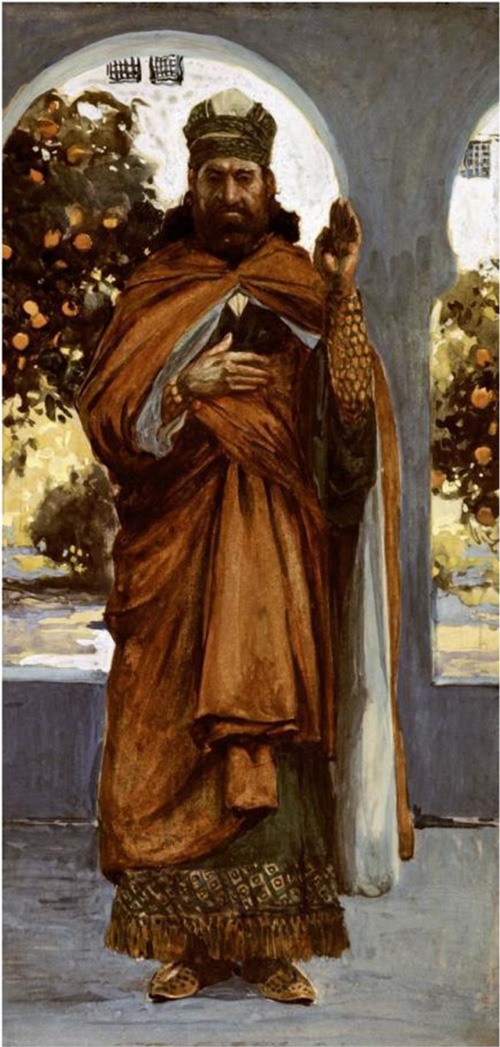
The Prophet Zephaniah (1888), James Tissot | Image from christianimagesource.com.
The prophet Zephaniah lived in Judah under King Josiah (640-609 BC), who reigned until 13 years before the nation’s defeat by the Babylonians. The Judeans had seen the defeat of the northern kingdom of Israel by the Assyrians 100 years prior, and yet continued to be faithless to God. This is what Zephaniah laments — he tries to get them to return to the Lord and foresees their great humbling during the Babylonian Captivity. The crown jewel of Judah is Jerusalem, a beacon for the Jewish people, and it is about Jerusalem that today’s reading speaks: “Woe to the city, rebellious and polluted, to the tyrannical city! She hears no voice, accepts no correction; In the LORD she has not trusted, to her God she has not drawn near.” Here is where scripture speaks to me — I can see myself in this refusal to hear other voices and accepting no correction. The very next sentence declares that such pigheadedness is a lack of trust in God. That’s a bit of a blow. Just when I think it’s all about me, even then it’s really about God!
This is the irony of pride: the self-absorbed person cannot even be pitied (something they’d deserve yet despise) because the real offense is not to themselves but to God. As we reflected last Friday in The Lukewarm and the Cynical, “Sin is not only a foolishness and vileness, but considered in relation to God it is also the blackest ingratitude, the greatest injustice, and the gravest outrage” (Fr. Garrigou-Lagrange, Knowing the Love of God, 21). Once again: our hearts and souls rightly belong to God, and closing them off from Him is unjust and a great offense.
What does God do about this offense? Zephaniah tells us, “For then I will change and purify the lips of the peoples … remove from your midst the proud braggarts, And you shall no longer exalt yourself.” Once again we are told that God’s purifying love removes pride. In the saga of the Jewish people, this purification is seen in the fall of Jerusalem and Babylonian Captivity. They do not perish, because God loves them. In fact, many historians claim that the Jews who returned to the Holy Land after the Babylonian Captivity were much more serious observers of God’s law than those before this penitential time.¹
God promises this very thing to Zephaniah: ” I will leave as a remnant in your midst a people humble and lowly, Who shall take refuge in the name of the LORD: the remnant of Israel. They shall do no wrong and speak no lies; Nor shall there be found in their mouths a deceitful tongue; They shall pasture and couch their flocks with none to disturb them.” What a testament to His love that He does not simply destroy evil-doers, but provides opportunities for penitence and conversion.
And what happens on a large societal scale in the Old Testament, Jesus brings to us on an individual level.
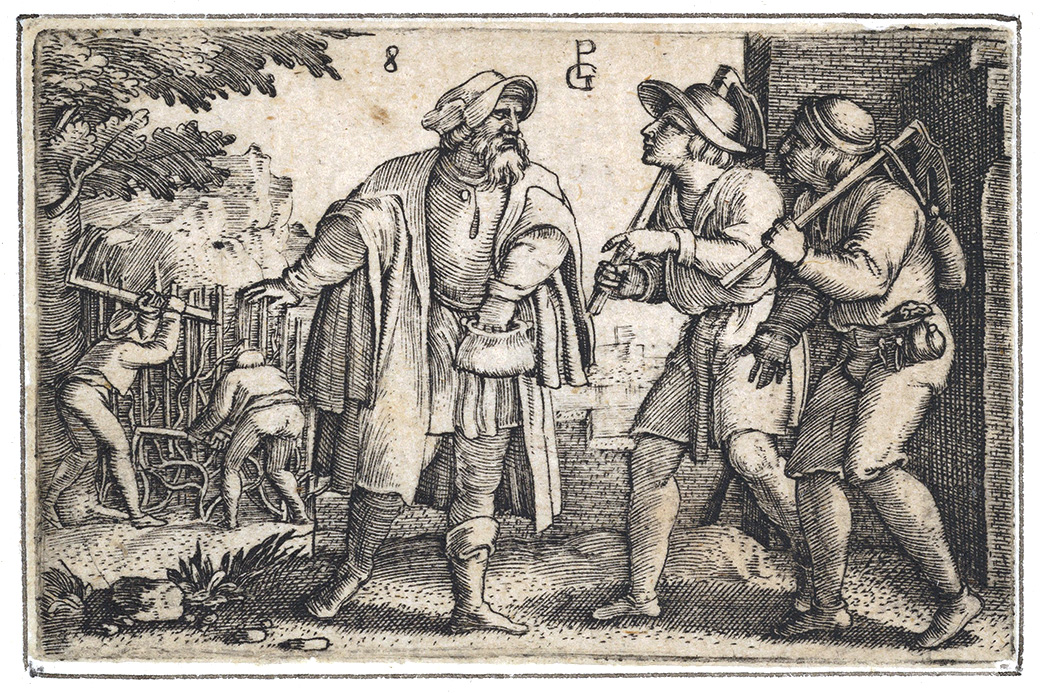
The Parable of the Father and His Two Sons in the Vineyard, from The Story of Christ (1534-1535), Georg Pencz | Creative Commons, courtesy the Metropolitan Museum of Art.
Jesus teaches us via the parable of the two sons. Of the one who has obeyed the will of his father, he says, “The son said in reply, ‘I will not,’ but afterwards he changed his mind and went.” The short parable is clear in what happens: an immediate refusal, then a conversion of heart followed by right action. Is this not the archetype for so many of us?
I was blessed to have been brought up in a Catholic family and heard this parable from a very early age. I thought of it often growing up, mostly because my hotheaded inability to take correction put me in that immediate refusal mode. But the grace afforded me by my baptism into the Church and ongoing formation as a Catholic blew on that little ember of a developing conscience and I slowly applied moral sense to my life. My often sheepish conversion to do what was asked was followed by a (usually) quiet compliance.
Today’s parable is absolutely fundamental to the Christian life. Jesus explains to the chief priests and elders — with what we might imagine to be a breathless, earnest desire to save them — “Amen, I say to you, tax collectors and prostitutes are entering the Kingdom of God before you.” How could these reviled, impure people enter the Kingdom ahead of those who are considered the crème-de-la-crème of Jewish society?
Jesus explains that these impure people listened to and followed John the Baptist’s warnings, whereas these chief priests and elders remained skeptical.
And think of the context here. This is chapter 21 in the gospel according to Matthew. It opens with Jesus’s triumphal entry into Jerusalem, followed by his throwing the money changers out of the temple and cursing the fig tree. Then we have yesterday’s reading where the chief priests and scribes can’t respond in truth to his question about John, followed by this parable and then the parable of the wicked tenants. This is a sequence of Christ’s arrival and sweeping the selfish pride out of Jerusalem.
We hear how the Lord tells Zephaniah “I remove from your midst the proud braggarts, And you shall no longer exalt yourself,” and we see Jesus fulfill this promise. This is a time of winnowing, separating the chaff from the wheat, and a time of discernment, to understand what is in the hearts of the people.
Jesus continues to heal the blind and lame in this chapter (Mt 21:14) — he could not possibly withhold his very nature of love and healing — but his message includes a very serious warning as he tells the chief priests and elders, “the kingdom of God will be taken away from you and given to a people that produces the fruits of the kingdom” (Mt 21:43). We can never forget that Christ is simultaneously the generous healer and the bringer of the end of time; the innocent lamb and the judge who divides the goats and the sheep.
Christ, outside of time, tells us simultaneously of our past, present, and future, but never withholds the living water that flows from Him and His wounds.
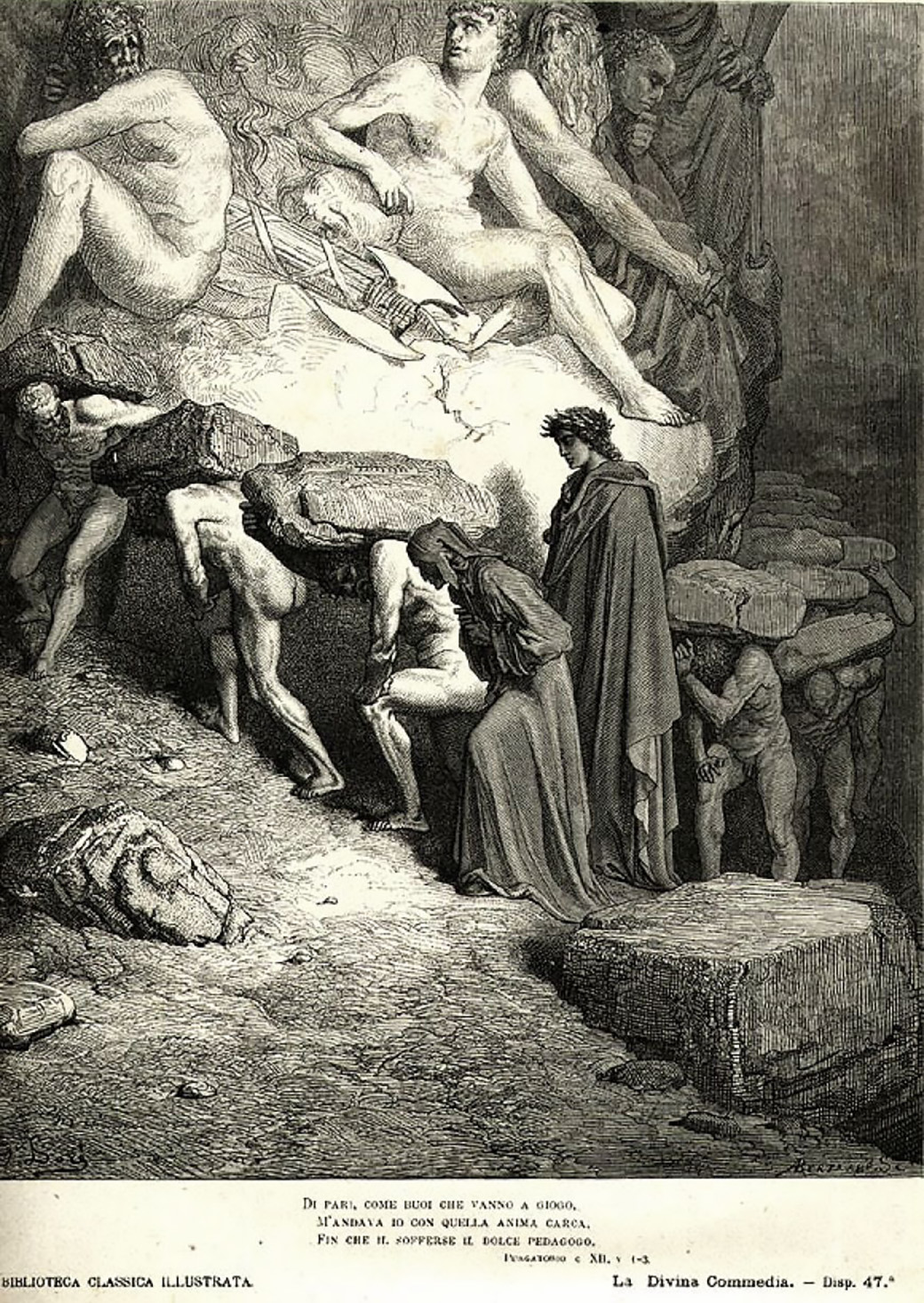
The Prideful – Oderisi, Purgatorio Canto 12 verses 1-2 (c 1857), Gustave Doré | Wikimedia Commons. This is how Dante imagines the prideful must spend their time in Purgatory – dragging massive rocks up a mountain while chanting a modified form of the Lord’s Prayer in a type of enforced humbling/penance.
And we can see how this is an Advent message. We are all the son who refuses — with every sin we commit!
With every sin, we refuse God and shut our hearts to him. Consider the simplest choice to exit a conversation with someone who wants to talk because we’re bored, tired, or would rather be doing something else. In this example, we have put ourselves first and not sublimated ourselves to the will of the Father. The Good News is that as long as we have breath, we can convert our hearts and do God’s will. Jesus promises us the Kingdom; he never withholds it. We simply have to have that real, ongoing, continual conversion of heart — perhaps learn to accept correction — and start producing the fruits of the kingdom.
We are waiting for that glorious King to be born, and we have these weeks to prepare the way in our hearts.
¹ Barton, George A. “Influence of the Babylonian Exile on the Religion of Israel.” The Biblical World, vol. 37, no. 6, 1911, pp. 369–378. JSTOR, www.jstor.org/stable/3141403.
Monday in the 2nd Week of Advent: Isaiah 35:1-10, Luke 5:17-26.
Yesterday, we reflected that part of Advent’s preparing the way for the Lord is to keep a burning vision of the heavenly Kingdom at the forefront of our minds and desires. I noted that there is a bit of a failure of the Christian imagination on this front, perhaps linked to our relatively comfortable lifestyles, at least in the USA. In today’s readings, Isaiah presents us with a fantastic vision of the Kingdom, and the gospel reading shows us how that Kingdom came to earth with Christ, a blessing on all creation.
If we have trouble conjuring for ourselves what the Kingdom might be like, Isaiah provides the image. I love the opening to today’s reading: “The desert and the parched land will exult; the steppe will rejoice and bloom. They will bloom with abundant flowers, and rejoice with joyful song.” Here is God’s creation, meeting the glory of its Creator as He descends to greet it. For those of us who live in desert climates, we know that what looks barren and dead is actually full of life — from tiny flowers to lizards under rocks — and certain times of year give us a glimpse into what the final Kingdom might bring. The desert in bloom is beautiful. Isaiah is granted a vision that eclipses normal seasonal change, however. The steppe “rejoices” in bloom, the steppe and desert “rejoice with joyful song.” Lest we think this simple hyperbole, remember what Jesus told the Pharisees who wanted to silence the crowds singing for Him upon His entrance into Jerusalem (Palm Sunday): “I tell you, if these were silent, the stones would shout out” (Lk 19:40). All of creation rejoices to see its Creator!
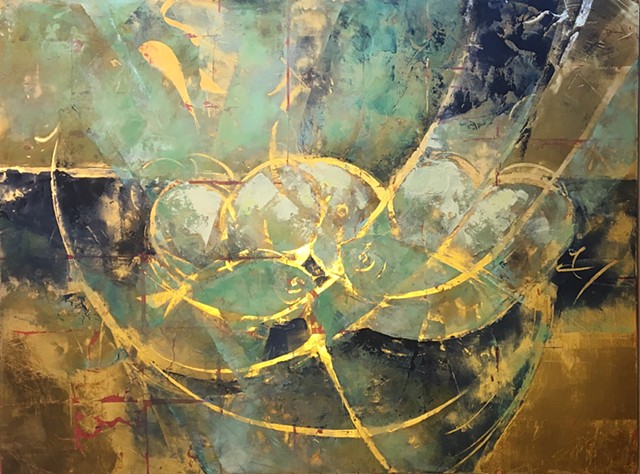
Zion Dreams (contemporary), Johnathan Harris | Image from fineartamerica.com.
As we explored last week, the love we invite into our hearts as Christians is transformative. Isaiah’s passage today is all about God’s transformative love. We are accustomed to thinking of this love transforming human hearts, but what about non-human nature? Isaiah says, “Streams will burst forth in the desert, and rivers in the steppe. The burning sands will become pools, and the thirsty ground, springs of water.” We see all that is good bursting forth, specifically water in many forms. Water is synonymous with life — the land is returning to the state of the Garden of Eden. The dangerous aspects of nature are subsumed in order for the righteous to walk unhindered: “No lion will be there, nor beast of prey go up to be met upon it. It is for those with a journey to make, and on it the redeemed will walk.”
As for humanity, God’s presence will “Strengthen the hands that are feeble, make firm the knees that are weak, Say to those whose hearts are frightened: Be strong, fear not!” Isaiah sees Christ coming into the world, and he relates, “he comes to save you. Then will the eyes of the blind be opened, the ears of the deaf be cleared; Then will the lame leap like a stag, then the tongue of the mute will sing.”
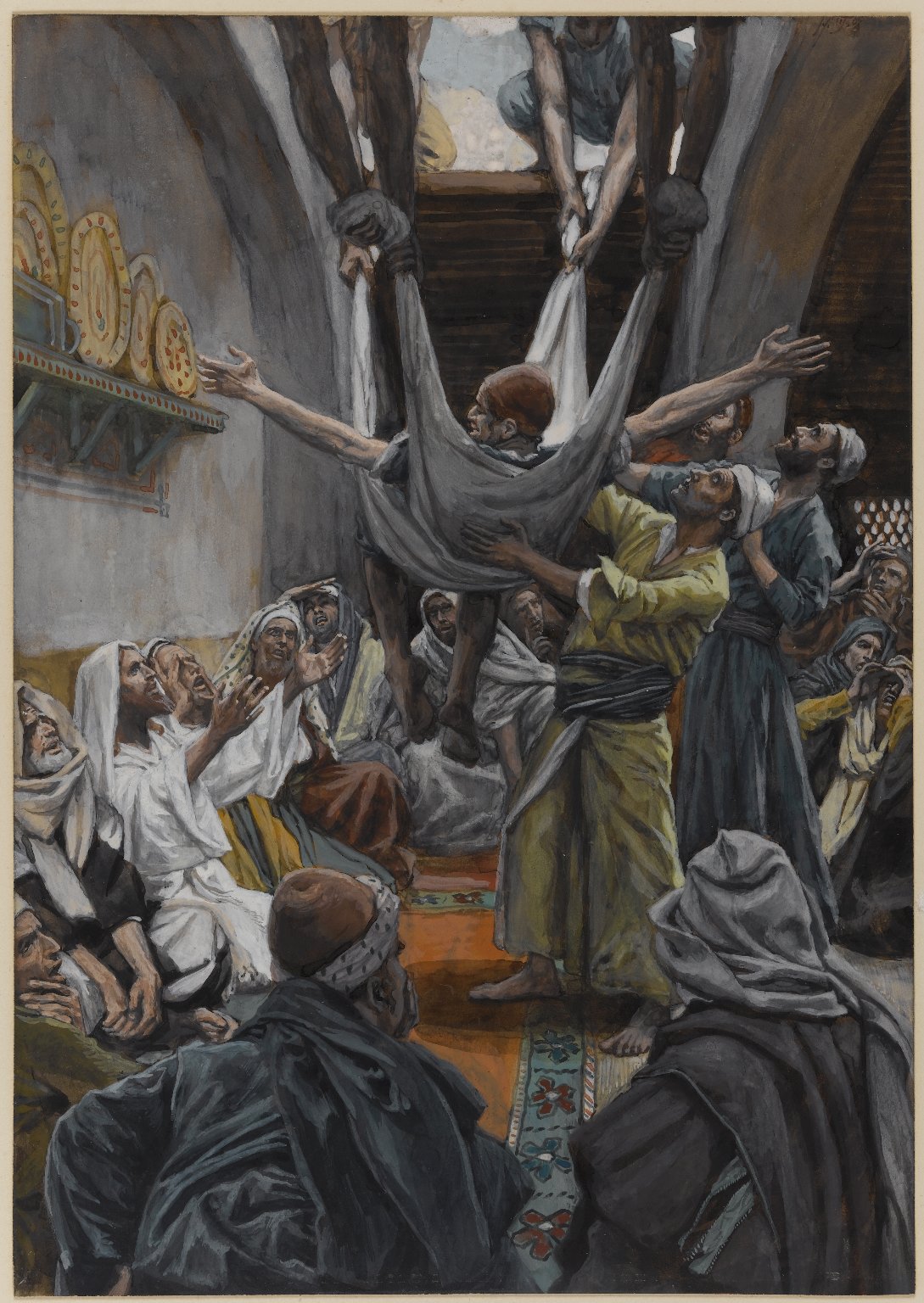
This is exactly what happens in the gospel. We cannot mistake the fact of Christ on the earth: it is the beginning of the Reign of God. These things that are prophesied actually take place; they cannot help but take place in the presence of God! Luke’s gospel reading tells of the paralytic who was lowered through the roof in the house to be in the presence of the Messiah and be healed. Let’s recall that Jesus was teaching “Pharisees and teachers of the law, who had come from every village of Galilee and Judea and Jerusalem.” This was not a small, intimate room but more like a court of the learned surrounding their resplendent King. And into this distinguished court, a poor paralytic is lowered through the roof. Talk about crashing a party!
And does this upset the Heavenly King? Of course not — the paralytic and those with him are exactly the subjects whom the King has come to welcome into his Kingdom. In a typical gospel social class reversal, Jesus shows love for the least of his people, over and above the more distinguished in His company. But this episode has a greater depth of meaning because Christ does not heal the man’s physical infirmity; instead “When Jesus saw their faith, he said, “As for you, your sins are forgiven.’” Jesus has ordered for us what is important: spiritual health far surpasses physical health. We see His true self and true mission. At this point, I almost become uncomfortable referring to Jesus Christ as having a “mission;” As God, He IS. His being needs no mission, it is the ongoing outpouring of creative, salvific love into the world. Like Isaiah tells us, creation rejoices and is transformed in His Presence. So, rather than seeing His true mission, let’s rephrase: we see Him.
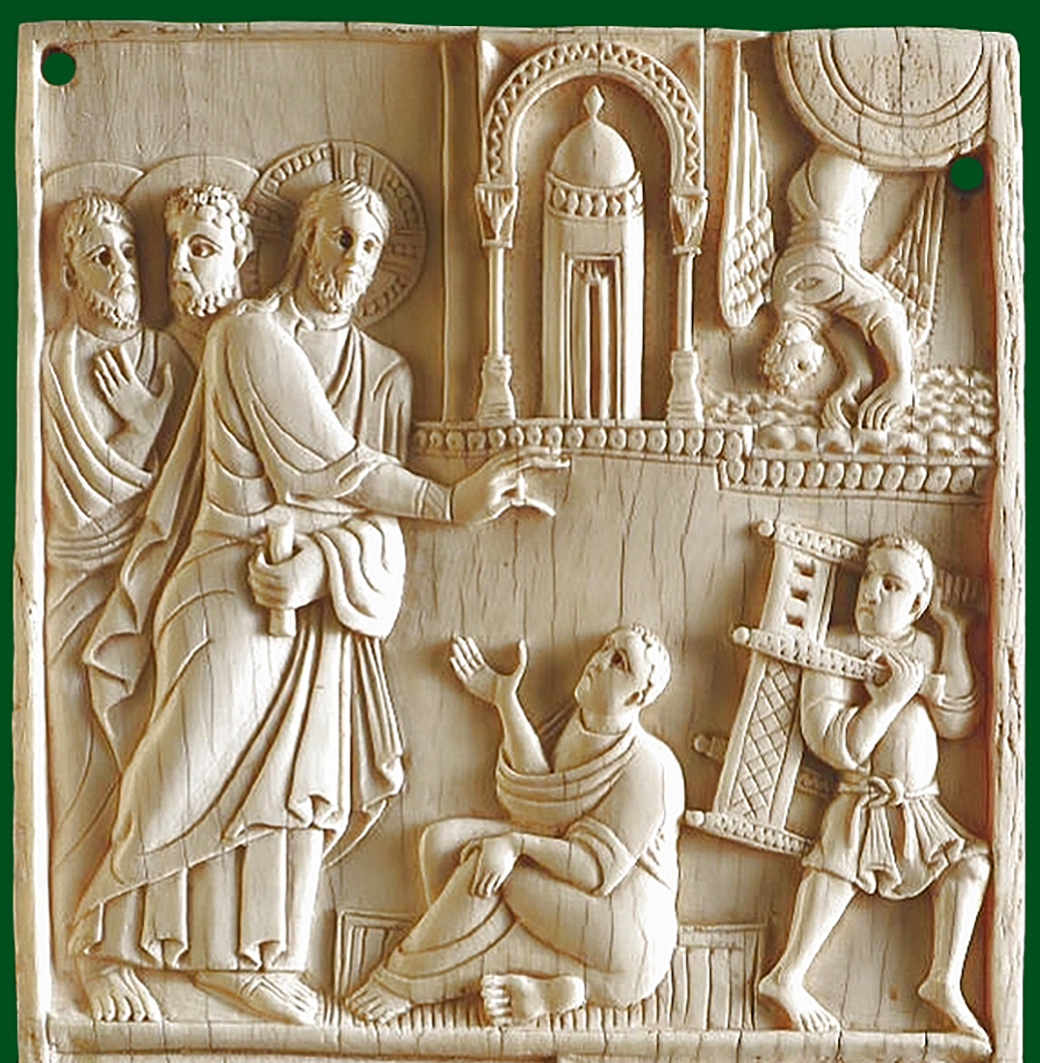
Healing of the Paralytic (c.1100), unknown artist, from the Museo diocesano in Salerno, Italy | Image from flickr.com.
He invites us to be faithful and, in return, He will perfect us. Last week, we reflected several times upon the concept of faith that is discussed in scripture and how it is more akin to “fidelity to my promise to you, Lord” rather than “belief in something unproven.” Faith — in our traditional Judeo-Christian sense — is a demonstrable response to something outside of us that is real, not a shaky internal belief system. So when the paralytic and his friends demonstrate their fidelity to God’s promise to send a Savior who will make “the lame leap like a stag” by coming with hope, love, and devotion into His Presence, then the Savior forgives their sins. This purification of their souls (the baptism in the Holy Spirit promised by John the Baptist) makes them suitable to inhabit the Kingdom of God for eternity.
As we might expect, the Pharisees and scribes ask themselves, “Who is this who speaks blasphemies? Who but God alone can forgive sins?” An interesting question arises: do they lack faith? One can imagine that their insistence that God alone can forgive sins demonstrates faith in God. So maybe a lack of faith is not what’s going on with them, but a spiritual blindness. They cannot recognize God’s own Son in front of them whereas others (so often the less fortunate ones) see Him clearly. Perhaps they’re not looking for a Savior at this moment. Perhaps they’re too comfortable in their stations in life to yearn for a Savior; in fact, a Savior might spoil their career plans. We begin to see the importance of Christ’s question to Peter: “But who do you say I am?” (Mt 16:15) and more forcefully to the Jews, “you will die in your sins unless you believe that I am he” (Jn 8:24b). Denying that He is the Son of God reveals our own self-centeredness, our spiritual blindness, our inability to have prepared the way for the Lord.
Jesus, in His love and desire to save all with Him, responds to their unspoken doubts and questioning and heals the paralyzed man, explaining why: “that you may know that the Son of Man has authority on earth to forgive sins.” This is a very specific reason, let’s consider this. A self-aggrandizing healer would not bother with the whole sins forgiven quagmire and would just heal so that people would think he’s great. A pretender Messiah would likely just stick with the sins forgiven line and avoid the work of healing a paralytic because forgiving sins is the more religiously important act. But Christ deigns to accomplish both spiritual and physical healing, not to show off His power, but specifically to accomplish another healing: healing the spiritual blindness in the scribes and Pharisees. They are blind to the Son of God in their midst for whatever reason, and the physical healing of the paralyzed man, despite being a lesser miracle, is done for them more than it’s done for the paralytic.
When he picks up his mat and leaves, the final lines show us that the third healing has been accomplished: “Then astonishment seized them all and they glorified God, and, struck with awe, they said, ‘We have seen incredible things today.’” What they say might on the surface sound a little underwhelming (couldn’t they say, “you are God”?) but it clues us into the problem of blindness and the healing — they now acknowledge that they have seen incredible things.
The Palsied Man Let Down through the Roof (Le paralytique descendu du toit), c.1886-1896, James Tissot | Creative Commons, courtesy the Brooklyn Museum.
I think this spiritual blindness continues to be a problem for us. Our imagination is not dominated by visions of the Heavenly Kingdom; we cannot see it clearly. But this is why we study scripture, why we revel in the ecstatic vision of the Kingdom that Isaiah gives us, and why we gasp with astonishment like the scribes at Jesus’s miracles. When I’ve been asked if I could go back in time to any point in history, I answer that it would absolutely be during Christ’s ministry to see and hear God walk upon the earth. But I need not be wistful for this impossible dream. What we must keep in mind during Advent is that Jesus’s life on earth is a foretaste of the eternal Kingdom promised to us. This is great news! We are all invited to experience Him for eternity — something that was only foreshadowed and begun when Jesus Christ walked in human form on the earth. It seems almost too good to be true. If you’re like me, you earnestly ask, what must we do to reach this Kingdom?
Christ, the Way, answers us over and over again during His ministry. In this episode, in particular, I think we are being shown an interesting perspective on salvation. We must truly be the paralytic, unable to move on our own, suffering, but filled with the vision of something incomparably better. We can only put ourselves as close to Christ as possible as a demonstration of our faith in Him.
Wednesday in the 1st Week of Advent: Isaiah 25:6-10a, Matthew 15:25-37.
In today’s readings, again we encounter Isaiah’s stunning prophecy of the Christ Event and a passage from the gospel that illustrates Christ’s reign at work in the world. On Advent days like these, we are reminded that Jesus Christ’s miraculous actions 2,000 years ago are contiguous with the Church’s ongoing work in the world as His bride and with his return at the end of time. Advent is here to remind us that his works were not just historical. He began his reign when being born unto Mary, but it continues through the Spirit’s action in the Church and we anxiously await its culmination. We are living in the End Times! Keep your lamps trimmed and burning as we await the return of the bridegroom!
Today’s reading from Isaiah points out three aspects of the Reign of God: 1.) He will provide for us rich sustenance, 2.) He will remove a “veil that veils all peoples,” and 3.) we will recognize and praise Him. Let’s take these in turn.
First, while this sustenance might be spiritual, the image used by Isaiah is rich and abundant food: “A feast of rich food and choice wines, juicy, rich food and pure, choice wines.” I love the repeated sentence here, with an intentional emphasis pointed out by the adjective “juicy” for the rich food and “pure” for the choice wines. So, not just base sustenance but a feast of the very finest things. Psychologically, for Christians this is a nice counterbalance to the ascetic life that shuns fleshly desires, as insisted upon by St. Paul, the Desert Fathers, the saints of the medieval period and so many more of our Doctors and saints in the Church. They would certainly agree with Isaiah and his description here, but would say that restraining ourselves from desires while on the earth is necessary to forge our spirit in Christ’s image; plus, it will make the great heavenly feast of the kingdom all the more richly appreciated. Yet we must admit that the enjoyment of feasting is something not altogether bad, or else God would not be employing this image to describe His Kingdom. One might argue that a Christian might properly enjoy moments of feasting in this lifetime, especially if a person is living morally under God’s law and focused on God’s providence and grace.
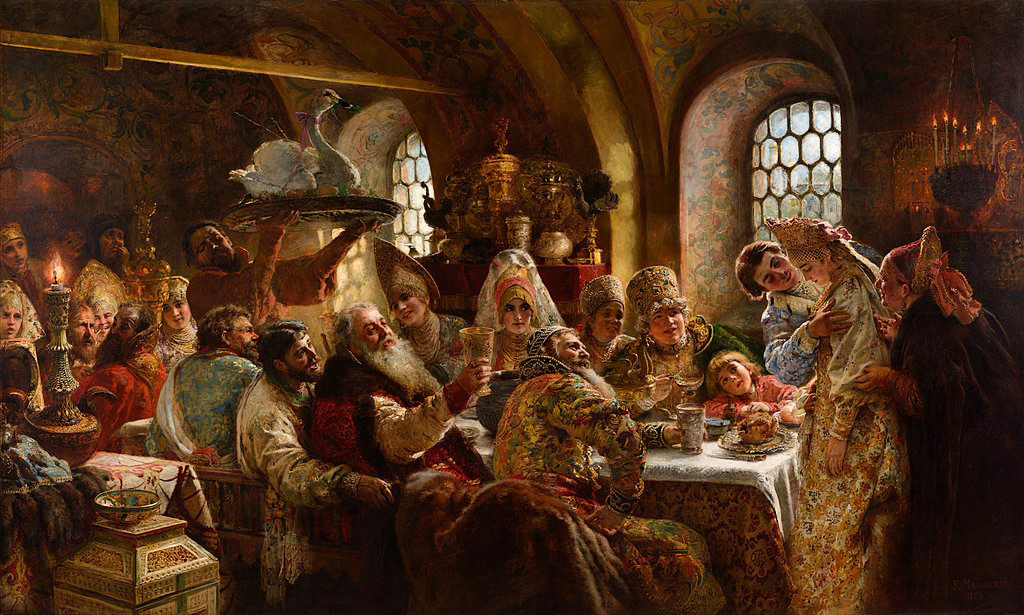
A Boyar Wedding Feast (1883), Konstantin Makovsky | Wikimedia Commons. There is an interesting recalcitrance in the bride on the right side of the picture, with the groom attempting to coax her into enjoying their wedding feast. Indeed, the attention of all the guests is placed on this interaction. Perhaps she is sad to be married, perhaps she loved that beautiful swan that’s being served as food (ha!), or perhaps she’s terribly shy. In light of the paragraph above, though, perhaps we can read some of this recalcitrance as the pious Christian’s reaction to feast and worldly excess. I, for one, am with the groom on this one, though. If there is a time for feasting and enjoyment, let it be at a wedding feast. There is goodness in this world, and we can celebrate it appropriately.
The second promise from Isaiah is that God will remove something that ensnares humanity: “he will destroy the veil that veils all peoples, The web that is woven over all nations; he will destroy death forever. The Lord GOD will wipe away the tears from all faces.” In a phrase, Isaiah is talking about the fallenness of the world and our natures. He calls this death, and indeed it is, but the ancient, scriptural understanding of death is deeper than we usually consider it in our analytical, scientific age. Yes, death has a technical meaning as the loss of life, measured perhaps in the absence of a heartbeat and the lack of measurable brain activity. But death also has a larger philosophical meaning. When there is nothing ahead of us but death and a hole in the ground, then death reigns in a psychological and even existential way. As we’ve amply seen with writers from Nietzsche onward, disbelieving in God goes hand-in-hand with the reign of death (one logically flows to the other). The reign of death is more than physical — it is spiritual, the death of the spirit.
When there is nothing ahead of us but death and a hole in the ground, then death reigns in a psychological and even existential way.
Any atheist will proclaim that nothing awaits us beyond this world, and the implications of this are diverse, but often include a softening of moral thought (i.e., if there is no larger or eternal repercussion for doing something right vs. something wrong, then why worry about making sure you’re doing things that are right? Even further, in this worldview, moral “right” is completely made up by people rather than emanating from the source of all goodness). When moral thought and action are brought low, we Christians are taught that this is the devil at work in the world. Thus, the devil’s influence and the reign of death are tightly linked. This brings us back to our origin as recounted in Genesis: Satan — the serpent — is the cause of our temptation; and he is cursed along with humanity when cast out of the garden into the world where death reigns. Eons of weeping, blood, and sin ensue.
We now live apart from God, unable to be in His presence, unable to see the truth and light clearly. St. Paul tells us, “For now we see in a mirror, dimly, but then we will see face to face” (1 Cor 13:12). So, when Isaiah promises that “he will destroy the veil that veils all peoples … he will destroy death forever,” we can understand that this is a full reconciliation with Him, a return to the garden. It is again St. Paul who helps us locate the promise of Isaiah in the Reign of Jesus Christ: “but when one turns to the Lord [Jesus Christ], the veil is removed. Now the Lord is the Spirit, and where the Spirit of the Lord is, there is freedom” (2 Cor 3:16-17). The freedom offered by Christ is a freedom from the reign of death, a removal of a veil that has ensnared us, and a reconciliation with God thanks to Christ’s great sacrifice.
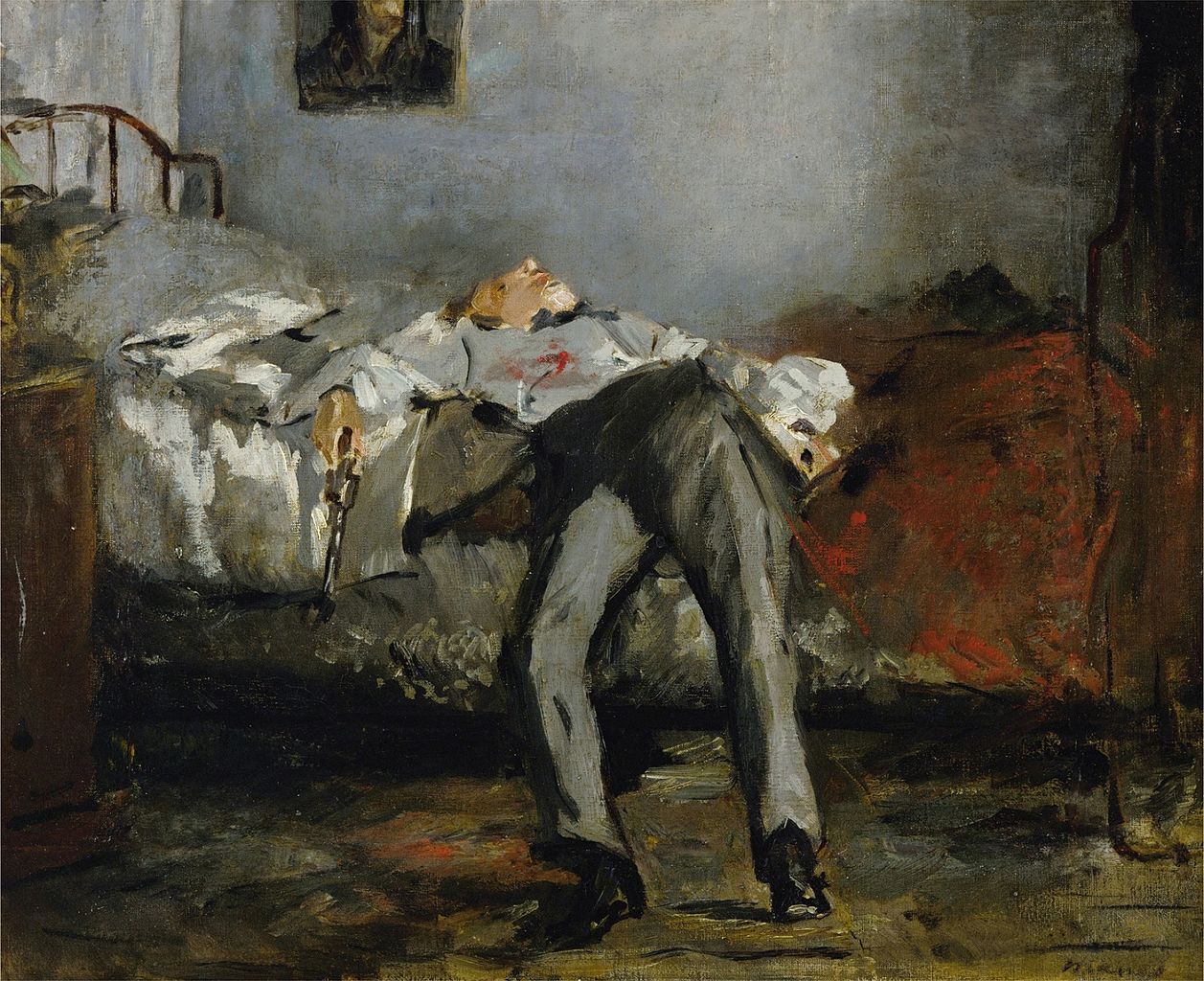
Le Suicidé (1877), Édouard Manet | Wikimedia Commons. For me, nothing proclaims the ascendancy of the reign of death like suicide, especially in our modern era when atheism and disbelief in God compound the sin unimaginably. The great flaw in the thinking that leads to suicide is that there is no redemption, no God who can wipe away stain or guilt. In short: a complete lack of hope, which must be like living with that veil of death drawn so tightly around oneself.
Finally, today’s prophecy by Isaiah tells that the world will recognize God as the bringer of the feast and conqueror of death. Humanity shall say, “Behold our God, to whom we looked to save us! This is the LORD for whom we looked; let us rejoice and be glad that he has saved us!” This recognition is important because God is calling us to a relationship but also gives us the free will to either refuse or answer the call. Isaiah’s prophetic vision reveals those who are present at the feast, who have the veil lifted as death is defeated. These people give God his due credit and rejoice in Him; they have answered his call to a relationship with him. Importantly, they recognize that His action is a saving action — one that saves them from the reign of death.
Now, let’s turn to today’s gospel and see each of these three aspects of Isaiah’s prophecy in this single episode of Jesus feeding the four thousand (plus women and children!). First, the feast: this is the famous miracle of the loaves and fishes. Signaling the abundance, the richness of the feast, is the fact that after all were satisfied, “They picked up the fragments left over — seven baskets full.” Such unheard-of largess appearing without delivery carts and many villages’ worth of bakers and fishermen has only one author: God Himself. Moreover, these people knew the writings of Isaiah, “On this mountain the LORD of hosts will provide for all peoples…” Here, with them and for them, the Reign of God was beginning — God in the form of the Messiah was here.
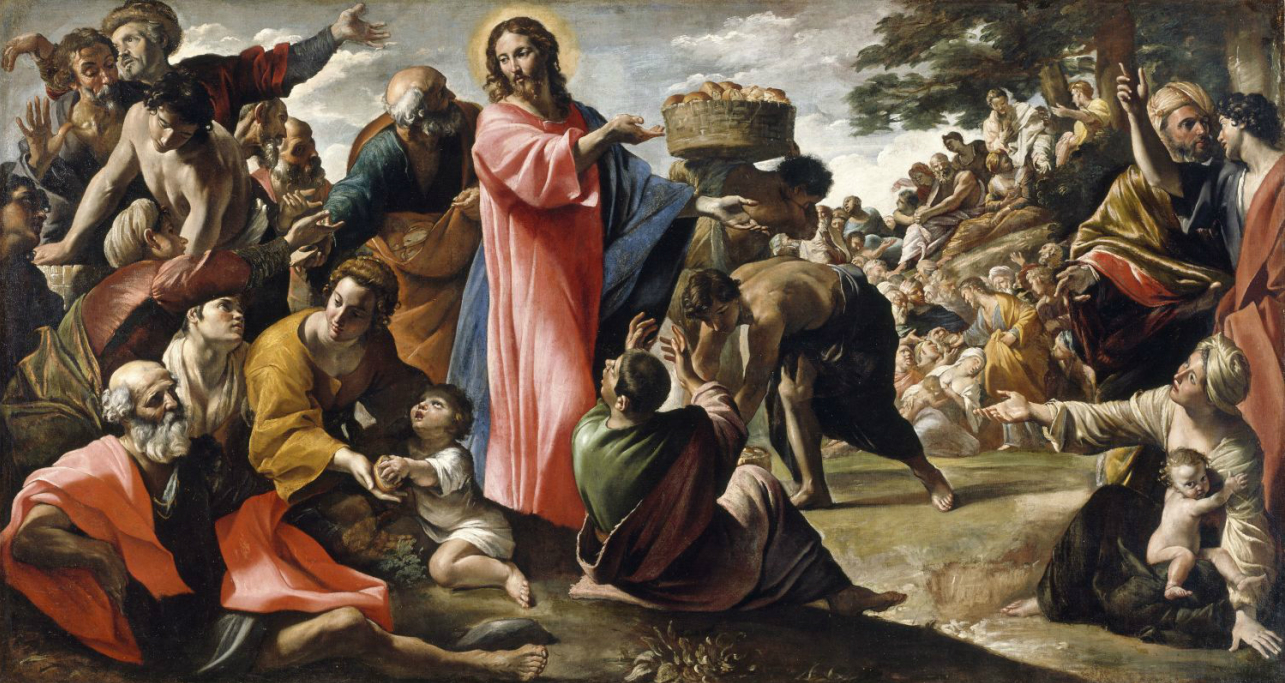
Miracle of the Bread and Fish (1620-1623), Giovanni Lanfranco | Wikimedia Commons. I appreciate Lanfranco’s Baroque period portrayal of the serene, haloed Christ in the posture of giving in the midst of the writhing masses. Yes, the elaborate body positions were likely done to show off a certain painterly prowess for anatomy and beauty of the human form, but the effect is one that recognizes the fallenness/messiness of the world and portrays with true eyes the Messianic, generous substance of Christ.
Second is the removal of the veil of death. Remember that the crowd had gathered because they had heard Jesus was a great teacher and healer — they came seeking him. This is the essential ingredient for those who will be present at the eternal feast: that they answer God’s call. “Great crowds came to him, having with them the lame, the blind, the deformed, the mute, and many others. They placed them at his feet, and he cured them.” These people are in the grip of death in one form or another, not just physical death but spiritual death. Jesus often shows us that healing physical blindness in fact heals a deeper, underlying spiritual blindness. As mentioned earlier, death reigns not just physically, but spiritually. The Christ Event in history is the beginning of the Reign of Christ — death’s reign is clearly defeated in these miracles and the veil of sin, Satan, and death is lifted from these people.
Third is the recognition of God as the Savior. This, too, is pointed out by St. Matthew: “The crowds were amazed when they saw the mute speaking, the deformed made whole, the lame walking, and the blind able to see, and they glorified the God of Israel.” But giving thanks to God for being healed is a bit different from looking at the one who healed you and thanking him, personally, as God incarnate. And this is the aspect of Isaiah’s prophecy that is played out throughout the gospels and even to this day. As we investigated yesterday, the fantastic vision of Christ granted to Isaiah 700 years before Jesus was born was truly a glimpse into the time-defying kairos event that is God puncturing human history and coming at the end of time, swirled into one ecstatic vision. If we try to inhabit this vision, we can see that we are living within this prophecy, where the feast is available to us, death’s reign can be lifted from us, and we must strive to recognize God in the person of Christ, just like the people described in the gospels.
The three touchstones Isaiah shares today, the feast, the removal of the veil of death, and the recognition of God as Savior, are at the heart of the Christ Event and all of our symbols and actions that emanate from it.
The feast was celebrated throughout his ministry in every miraculous outpouring of sustenance and richness — wedding at Cana, feeding of the four thousand, and most clearly in the Last Supper — and it is this last example that instituted the ongoing feast of the Holy Eucharist that we continue to celebrate day after day in this contemporary moment within the Reign of Christ.
The removal of the veil of death, specifically spiritual death, happens in our sacraments, notably in baptism, and integral to each of the other sacraments as we are drawn deeper and deeper into full communion with God. Over the course of our lifetimes as Catholics, we participate in the removal of this veil of death that ensnares and blinds us – it is our journey of faith. So we can see how the first two touchstones happened in Jesus’s life events and also happen our own.
But this last one, our participatory acceptance and recognition of God in the form of Christ our Savior, is the one we must step up and bring to God all on our own. We pray that all are able to do this at some point before their physical bodies die. This great drama of recognizing Christ as God was brought to the forefront by Christ Himself: “Who do you say I am?” (Mat 16:15, Mk 8:29, and Lk 9:20). He asks each of us this same question.
The Apostles realized that this was their great duty: to evangelize, that is, bring this good news of the Christ Event to people across the globe. Pope Benedict XVI identifies that this evangelical activity is part of the ongoing lifting of the veil of death: “But the preaching of God’s Kingdom is never just words, never just instruction. It is an event, just as Jesus himself is an event, God’s Word in person … Because the world is ruled by the powers of evil, this preaching is at the same time a struggle with those powers” (Jesus of Nazareth, 173).
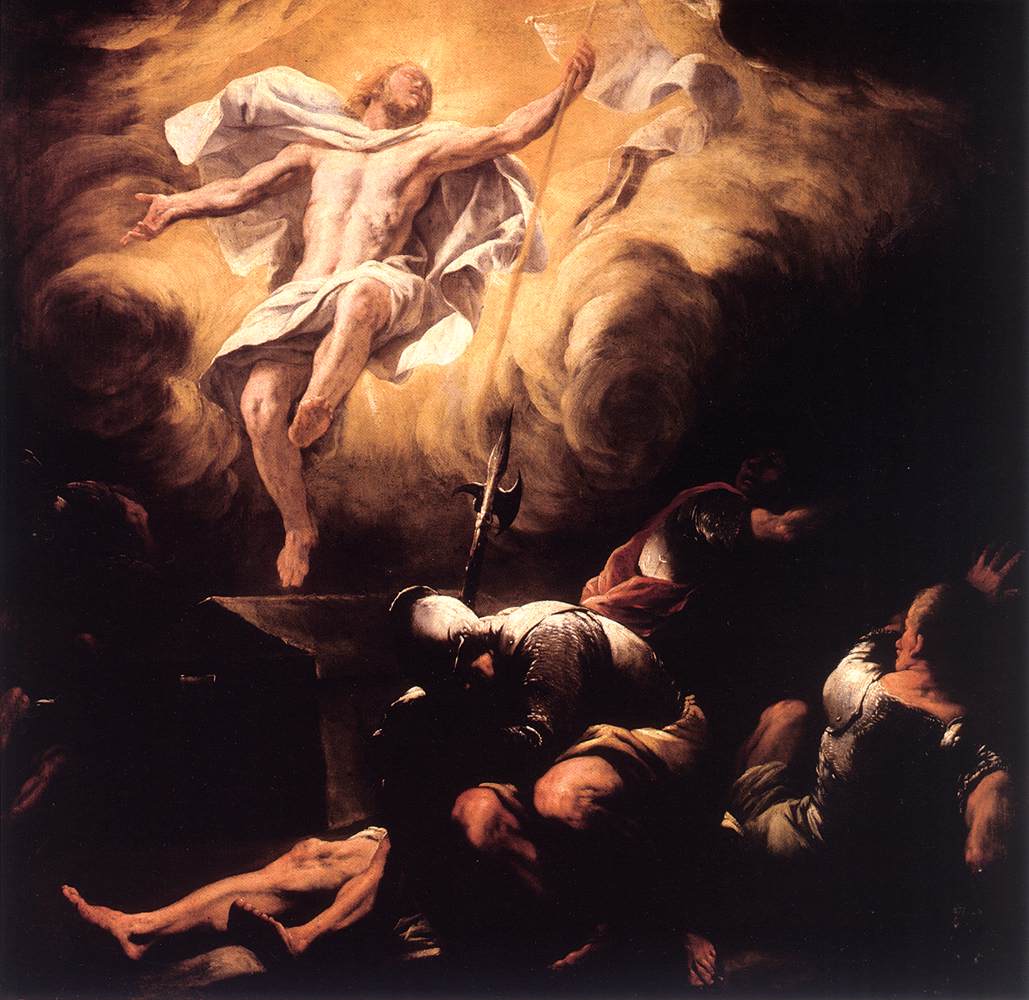
The Resurrection (after 1655), Luca Giordano | Wikimedia Commons.
Don’t let anyone tell you that all major religions are the same; we have a very particular core to our faith, and it is Jesus Christ, the man and God incarnate. Pope Benedict XVI, like Pope Saint John Paul II before him, writes that everything in our faith tradition and practice must be understood through a Christocentric lens.
Everything about our salvation as well as the signs, symbols and language of our religion are fundamentally about Christ being God. It’s not about being morally good or doing good deeds or praying a certain way (although those things matter, especially when seen as ways of being united with our Savior). How can the popes insist on this (and not just them — think of so many saints and doctors of the Church, St. Augustine to name just one)? Well, it starts perhaps most plainly with Christ Himself, especially as revealed through the gospel of St. John: “for you will die in your sins unless you believe that I am he” (Jn 8:24). Jesus is adamant that He is the path to the Father, to salvation, to the end of the reign of death.
Why might faith in Jesus Christ as the Son of God and Savior be so important for eternal salvation? I can think of several reasons, but here are two that jump most quickly to mind. First, denying that Christ is the Son of God (when He is one of three Persons of God) is, in fact, denying God (being atheist, that is). Second, the Christ Event — and only the Christ Event — is the exact action of God in the world that ushers in our salvation. This means that only Christ is the vector God provides for us to unite with Him.
And perhaps a third, more human reason that this specific faith in Christ as God is necessary: Jesus reveals aspects of God in a way that no one or nothing else in creation can. Jesus Christ reveals to us ways that we are made in the image of God (we are agents of truth and light as He is) and that humanity is precious to God in a special way. As we dwell on the Word of God, as uttered by the Word of God made incarnate, we learn about Him as well as the great potential within all of us. Jesus Christ becomes our “key” to knowing God and to knowing ourselves.
Today’s gospel reading, for instance, stands out to me not just because of the amazing parallels with Isaiah’s prophecy and these three touchstones of our faith. It stands out because of what Jesus says: “My heart is moved with pity for the crowd, for they have been with me now for three days and have nothing to eat. I do not want to send them away hungry, for fear they may collapse on the way.” Matthew takes 5 lines to describe Jesus’s great compassion here, and just 2 to describe the miracle itself. This is where we find the reality of Christ — in his love and compassion. After healing hundreds, if not thousands, of people on the mountain by the Sea of Galilee, surely he would be exhausted by the sheer weight of it all. But, as God, He shows us that God never tires of compassion. He teaches us how to find that compassion in ourselves. Even after delivering them from the grip of death through his healing, his saving acts do not end. He knows their hunger and, more importantly, this hunger moves him to compassion.
It never fails to amaze that our God is a God who is moved to compassion for us. This is no distant God! So, he feeds them, as only God can. Here is the same God accomplishing the same act He did for His Chosen People after freeing them from slavery in Egypt and feeding them manna in the desert. Only now our God walks among us, speaks plainly for us, and ultimately sunders the divide between our fallen earth and heaven.
The Miracle of the Five Loaves and Two Fish (contemporary), Grace Carol Bomer | Image from gracecarolbomer.com.
Thank God for His compassion! Because this Advent is about anticipating the culmination of the Christ Event, and we will certainly all need compassion, understanding, and forgiveness on the Day of Judgment.
Monday in the 1st Week of Advent: Romans 10:9-18, Matthew 4:18-22.
What an interesting start to Advent! Yesterday, Christ admonished us, “Be watchful! Be alert! You do not know when the time will come.” This should be a familiar refrain, a reminder that Advent is a time of waiting for both the Incarnation of Christ and the Final Judgment. This vigilance will be marked by prayer and anticipation until we celebrate the Birth of our Lord.
But what do we get today, the second day of Advent and the Feast of St. Andrew the Apostle? We receive a concise exposition on salvation and the mission of the Church herself. This may seem incongruous with the initial message of waiting and vigil, but I think the Church, in her wisdom, places these readings and this feast at the beginning of Advent for a reason.
Today, we acknowledge that the Christ Event has changed the world irrevocably and, although Advent commemorates and celebrates a time of waiting, we cannot “pretend” that the keys to the kingdom are not yet here. Christ has already brought the end times, and our active work as the Church is happening even as our liturgical calendar revolves in memorials and feasts.
Icon of Christ, King of Kings. Greek, c. 1600. | Creative Commons, courtesy Wikimedia.
Let’s unpack today’s startlingly concise mission statement for the Church, brought to us by St. Paul. He writes to the early Christian Church in Rome: “If you confess with your mouth that Jesus is Lord and believe in your heart that God raised him from the dead, you will be saved.” While this seems simple (almost too simple!), it belies a depth of personal commitment that we might not notice at first.
I’d like to take a small detour here and examine how good works and faith impact one’s salvation. The second part of Paul’s sentence quoted above, that is, “faith provides salvation,” has been surgically taken out of St. Paul’s overall corpus of writings to justify misunderstandings and heresies since the Apostolic Age. The Gnostics (many different sects) spread beliefs along the lines that faith in Jesus and other spiritual gifts were separate and more important than acts of the world and the body. This separation is dangerous because it erodes the connection between faith in Christ and moral acts here in this world. This heresy was taken up by Martin Luther and John Calvin in the 1500s, and sadly the foundation of the Protestant churches is a misunderstanding of this passage, that if you have faith alone (“belief in your heart”) in the mystery of Christ’s death Resurrection, you will be saved.
(In fact, both the Catholic Church and Protestant churches affirm that faith alone justifies us, but this is a separate, much more technical term. The Catholic Church goes on to affirm that both faith and works contribute to our ultimate salvation.)
This statement is taken out of the context of St. Paul’s full writings. We must understand that for St. Paul, “believing in your heart” the mysteries of the Christ event is a transformative thing — a person not only thinks differently, but also acts, speaks, and worships differently. He writes clearly to the Galatians: “the faith that finds its expression in love is all that matters” (Gal 5:6b, emphasis mine). He also tells the Corinthians: “I may have utter faith, so that I can move mountains; yet if I lack charity [do not have love], I count for nothing” (1 Cor 13:2b). Clearly, he is not telling the Romans that faith without works is salvation. For Paul, and for all Christians, faith is inextricably linked to charity, love, and good works. This is because the particular faith we have is in God who becomes man to show us that love, peace, and charity are more important than power and worldly knowledge. When we have faith in Him, we seek to embody His teachings and His example. His greatest commandment, to love God first with our whole being and then our neighbor as ourselves, unites this lesson that faith cannot be separated from moral actions here on earth.
But this post isn’t about Catholicism vs. Protestantism. St. Paul tells us in today’s first reading that two things, faith in the Resurrection and confessing that Jesus is Lord, bring us salvation. We’ve explored how “faith in the Resurrection” is a kernel of wisdom that means faith in all of the mysteries contained in the Christ Event and allowing that faith to change us, to transform us in the image of our Lord. The second bit flows from this transformation: we Christians do not sit silently in our faith. We are not lamps hidden under the bushel basket. We are called to be evangelists in our work and in our mouths. We must proclaim to everyone who will hear.
And here we have, in a nutshell, what the Church is all about. We don’t hoard salvation to ourselves. We are not a secretive society of the select (again, Gnostic heresy). The Church is always “two or more gathered in my name” — always plural people, not a singular person. As we have faith in Christ and all that he revealed, we are transformed by God into something greater. And by the grace of God, we can begin to aspire to be like Christ, that is, to love everyone unconditionally, to see our Father in everyone and everything, and to ardently desire to save souls and bring them to our Father’s kingdom.
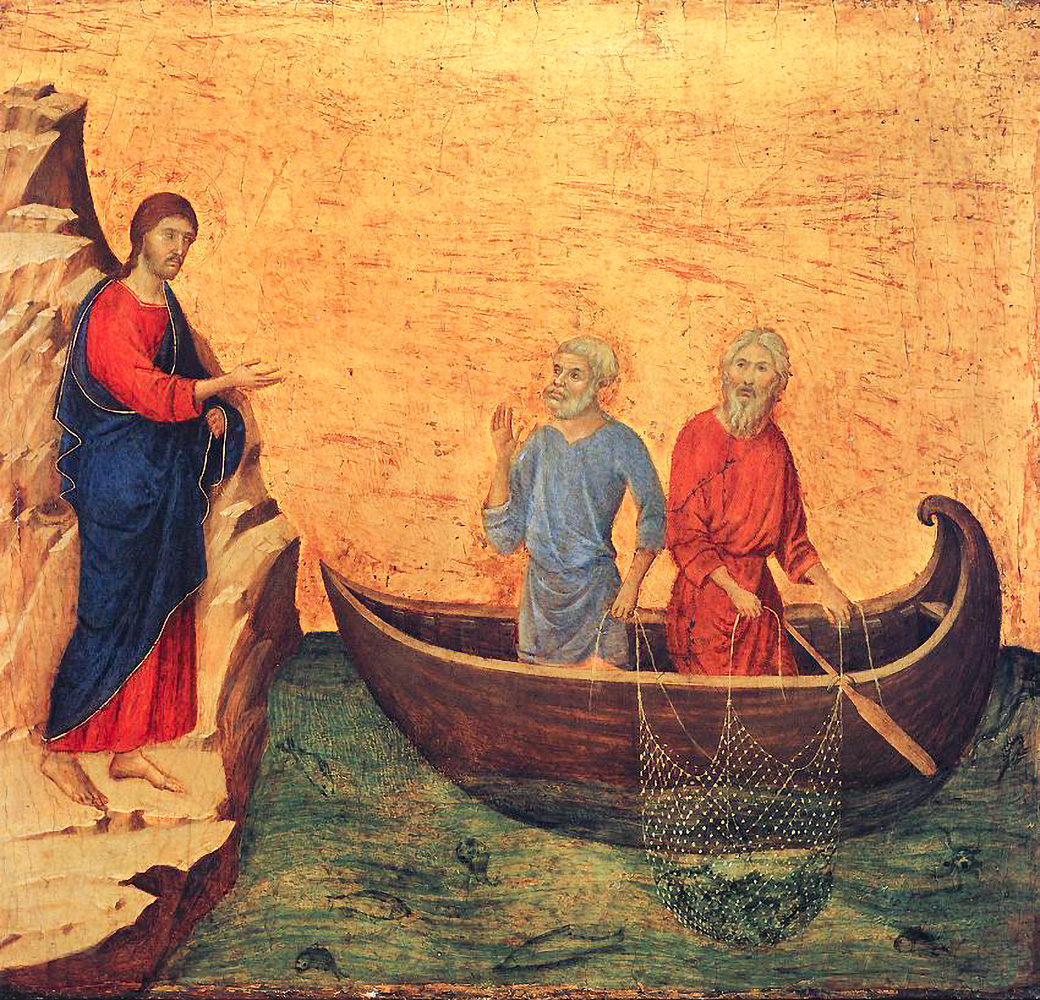
The Calling of Peter and Andrew (1308-1311), Duccio di Buoninsegna | Wikimedia Commons.
I, like many Catholics I know, am a little scarred by the televangelists of the 80s and 90s who co-opted many fine Biblical sayings, shouting the meaning out of them. It’s hard in some ways to read “confess with your mouth that Jesus is Lord” without hearing a Jerry Fallwell-like voice and thinking of intolerant American fundamentalism. But we must recover what the Apostles and Christ bestowed on the Church in our sacred scriptures. Our great saints proclaimed with their mouths the Truth of Christ and Wisdom of God long before our contemporary cult-of-personality evangelical preachers twisted these words to suit their purposes. I’m not saying that evangelicals are all wrong, but they are not representatives of the one, true, universal Catholic Church.
In particular, we must reverse the notion that Christian evangelization is linked to intolerance and that not everyone is welcomed by God. As the Second Vatican Council’s document on evangelization, Ad Gentes, states: “The members of the Church are impelled to carry on such missionary activity by reason of the love with which they love God and by which they desire to share with all men the spiritual goods of both its life and the life to come” (7). In other words, what drives us is not to perfect the world in the image we think is in God’s mind (much less drive out sin like zealous crusaders), but our driving force is the same love with which we love God. We are driven by a desire to share with everyone spiritual goodness. Love and sharing. This is a topic for another post, but evangelism for Christians must be an invitation to know God through Jesus Christ done out of love for our fellow humans.
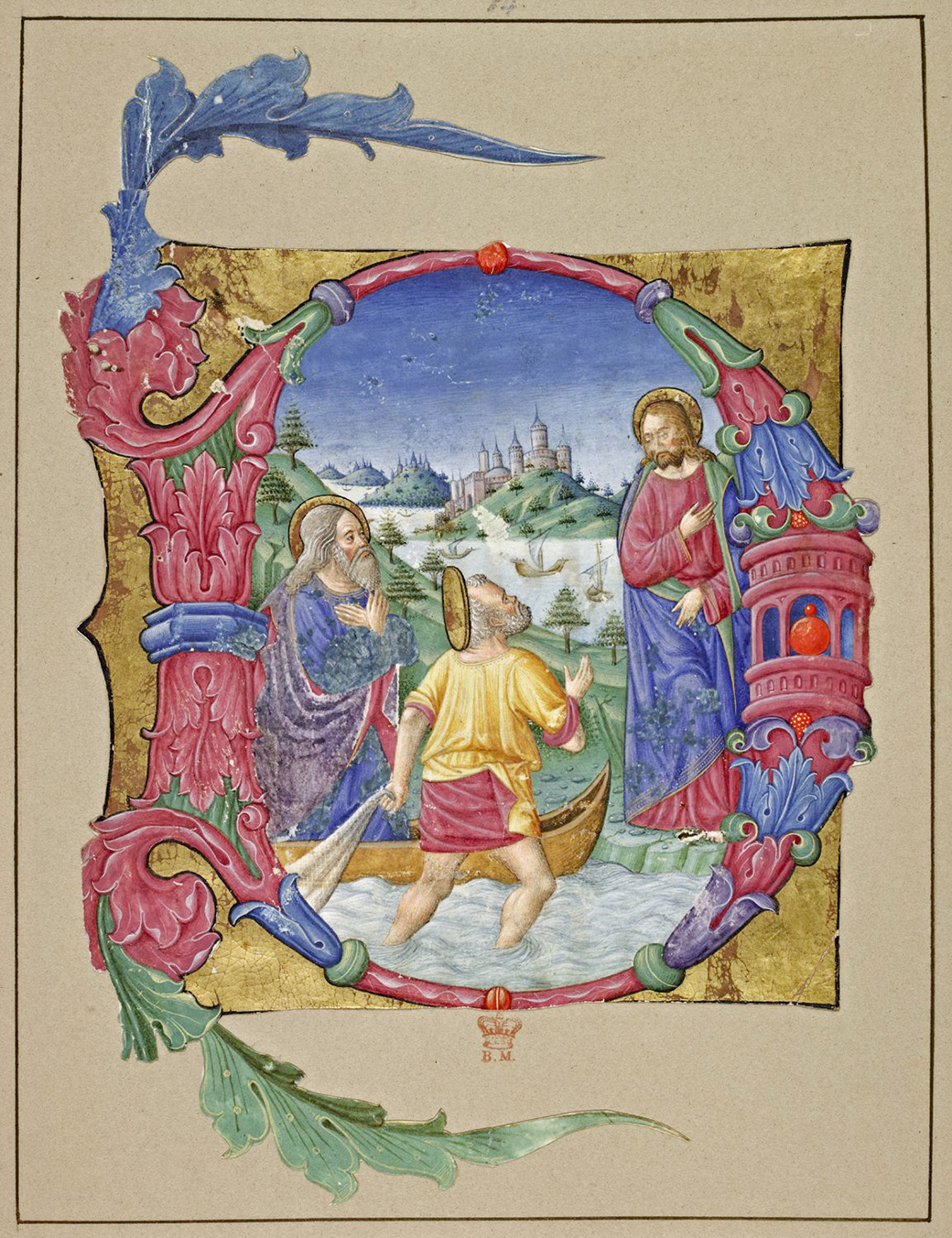
Another reason we have to return evangelization to its original dignity: it is the very first thing Christ promised his Apostles. Today’s gospel reading from St. Matthew tells us of the iconic calling of Peter, Andrew, John, and James. Christ says, “Come after me, and I will make you fishers of men.” This is the evangelical promise he gives them: they will catch men instead of fish; they will harvest humanity for God. Note that there is no hesitation: “At once they left their nets and followed him.” Again, with John and James: “He called them, and immediately they left their boat and their father and followed him.” The Voice of God speaks to them and they do not hesitate. But, no, more than the voice — the very Word of God in human form speaking corporally to them and beckoning them to be transformed into a new thing: a fisher of men.
This irresistibility is an effect of the miracle of the Incarnation, which we anxiously await in Advent. With the gravity of a million suns, Christ walks the earth, pulling people to himself. That spiritual gravity cannot be overstated; it is God Himself taking His own incomprehensible, immeasurable being and distilling it into a baby. This tiny being will then draw humanity to himself, teach them in word and in deed what it means to love, and thereby give us the salvation that St. Paul speaks of.
This is the Christian mystery of salvation and let’s note that God intends for us to be active participants in this plan. The Church, through the Apostles, is created to put on full display and shout from the mountaintops the glory of Christ. This action is and has always been evangelical. Furthermore, is it a coincidence that “evangelist” contains the word “angel”? No — the Greek word used in the gospels, εὐαγγελιστοῦ (euaggelistés), means “bringer of good news,” and the Greek word for angel, ἄγγελος (aggelos), means “a messenger.” Being an evangelist means participating in the same action of the angels as messengers of God. We are participating in announcing the kingdom of God just as the angels do. (NB: In a very specific way, we meet the angels here on earth. The Mass and Eucharistic celebration is the moment when the kingdom of heaven meets the action of the faithful on the earth and we celebrate with the angels the mysteries of our faith and gift of Christ as food for us.) In other words, God has invited us to his heavenly feast here and now, recognizing and blessing our souls as holy like the angels, and inviting us to carry out the same work as the angels.
Cutting from an Italian choir book (Lombardy) – Historiated initial ‘D’ of the Calling of Peter and Andrew (c. 1475-1500) | Image Courtesy the British Library Catalogue of Illuminated Manuscripts.
Let’s return to the opening thought: what a fascinating start to Advent. Advent brings together two events that historically seem very far apart: Christ’s birth to Mary and Christ’s return at the end of time. But today’s reading shows us that these two events are in fact united (in kairos time), that the inexpressible mystery of God coming to humanity cannot be contained in a historical figure. Christ will always be more than just the historical figure who the Apostles met on the shore of Galilee. As God, he transcends time and mortality — he existed before time and outside of history (hence attempts to “know” Jesus Christ simply through a historical lens are misguided).
When he is made incarnate, human history is ruptured and ripped from a linear trajectory. The center of the universe isn’t the sun or a terrestrial body but the Body of Christ, which rises and takes its rightful place in the heavenly realm. We now orbit this spiritual truth that carries us through our lives with a centrifugal force much different than the passing of the earth around the sun and the march of time. The liturgical calendar attempts to reflect this new ordering of our lives, and Advent is a season where we approach the unification with God from both sides: as those waiting for the babe and those waiting for the judgment and final unity. But the same reality is achieved in both events: God offers us real, corporeal salvation. In one, that salvation is the form of the Savior, in whom our faith and actions carry us through this life while we await the second, in the form of that same Savior, carrying out his same saving action.
This is how the Catechism can claim “To fulfill the Father’s will, Christ ushered in the Kingdom of heaven on earth. The Church ‘is the Reign of Christ already present in mystery’” (CCC, 763). At the same time, it teaches “Though already present in his Church, Christ’s reign is nevertheless yet to be fulfilled ‘with power and great glory’ by the King’s return to earth” (CCC, 671). The Church that Christ established is brought into clear focus, started the calling of the Apostles to become fishers of men and bringers of Good News, and continuing with us in prayer, action, and spirit.
Finally, we can look back at the first reading from St. Paul and understand the fullness of his words. When he writes, “one confesses with the mouth and so is saved,” we can see that this evangelical act is the sharing of love that the Church was established to accomplish. We can see that our confession of Jesus Christ as Lord — as an act meant to lovingly draw people to the truth — is what makes us part of the Church, “the Reign of Christ already present in mystery.” Of course we are saved in this moment! We are fully participating in God’s plan, in the universal Church, in the Reign of Christ.
Monday and Tuesday in the 20th Week of Ordinary Time: Ezekiel 28:1-10, Matthew 19:16-30.
The end of Chapter 19 in the Gospel of St. Matthew must really stick in the craw of those who believe in the so-called prosperity gospel. This predominantly evangelical belief system is a type of vending machine theology: if you strictly obey God’s commandments, you will be blessed with wealth, health, and power. Let’s dive into these passages to see what Jesus teaches us through the rich young man and why this might completely refute the prosperity gospel.
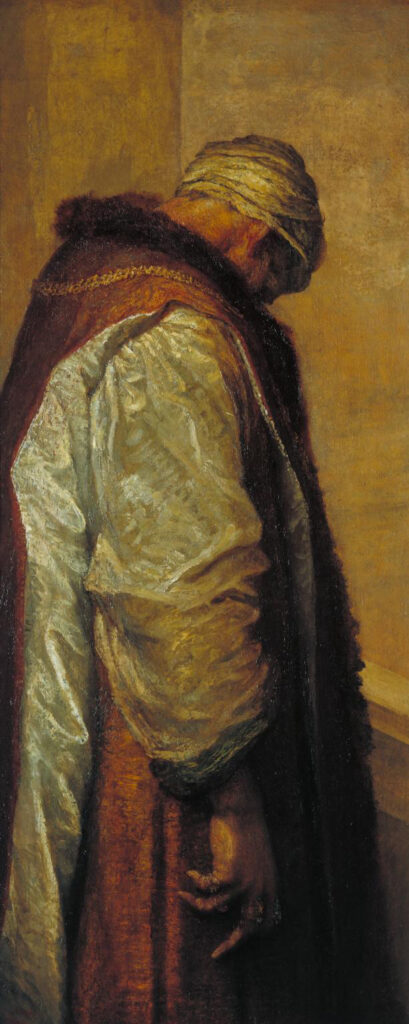
‘For he had great possessions’ (1894), George Frederic Watts | Creative Commons, courtesy the Tate Museum.
This man approaches Jesus and asks, “Teacher, what good deed must I do to have eternal life?” On the surface, this is a question that likely orbits within each of us as we contemplate our spiritual lives. We hear of the promise of eternal life many times from Jesus, and we’re Christian, so it follows that eternal life is really the goal here. But notice the transactional nature of the young man’s mindset: I do a good deed and get eternal life. He is looking to secure — to possess — eternal life. This should be our first clue that something is not right, as well as a reminder that we must be thoughtful in how we phrase our searchings, even silently in our hearts, truly asking for only what keeps us on the Way that is Christ.
Jesus responds incisively, not to the man’s question but to his mindset: “Why do you ask me about the good? There is only One who is good.” Christ must gently correct and re-orient him because what the man calls “good” is drastically off-target. Like many, the man sees good and evil as adjectives that describe works we do, perhaps even thoughts that we have. Jesus has come to re-educate humanity that “good” is not an adjective or an abstract noun but a person. “God is good” might be an approbation but more deeply it is a statement of fact. Anything that exists as a good thing exists that way because God is being made manifest through it. God, the Father, Son, and Holy Spirit are the source and reality of all goodness. So, it’s almost nonsensical for the young man to ask Jesus “what good deed must I do” as if he is the one creating goodness in a deed. As I contemplated all of the verses that follow, I realized that Jesus’s answer is contained here in this first statement: if we can truly recognize that God is the only one who is good, then we will devote everything to this source of goodness and eventually achieve our unification with him (i.e., eternal life).
Jesus then tells him, “If you wish to enter into life, keep the commandments.” Jesus is effectively slowing the man down, taking him back several steps. He does not answer his question about how to “have eternal life” but instead answers how he can simply begin the path, to “enter into life.” The man is eager, but not aware of his own spiritual infancy.
The man expresses his eagerness by rushing forward, as if not hearing Jesus’s calm re-direction. He demands to know which commandments to keep. Interestingly, Jesus replies with the last six commandments that concern oneself and one’s neighbor but not with the first four that have to do with God. Why? I think that it’s helpful to remind ourselves that Jesus is telling him how to “enter into life,” which has much to do with orienting oneself in the manner God intends for us. Jesus meets the man on his own worldly turf. Perhaps he is leading him slowly to a realization.
The man claims that he is already on this path: “All of these I have observed. What do I still lack?” Note, though, that his question again uses the language of possession. He wants to secure something, to have it, to own it.
At this point, our Lord challenges the core of the man’s tainted mindset: “If you wish to be perfect, go, sell what you have and give to the poor, and you will have treasure in heaven. Then come, follow me.” Like so many conversations with the Pharisees and scribes, Jesus speaks to the need for the Chosen People to go deeper than a surface adherence to rules. He urges them not just to a conversion of heart towards God, but also to a radical abandonment of their own worldly concerns as they let the goodness and truth of God infuse them and explode into the world as selfless charity. For this rich young man, as with many if not most of us, the rubber hits the road when it comes to wealth and possessions.
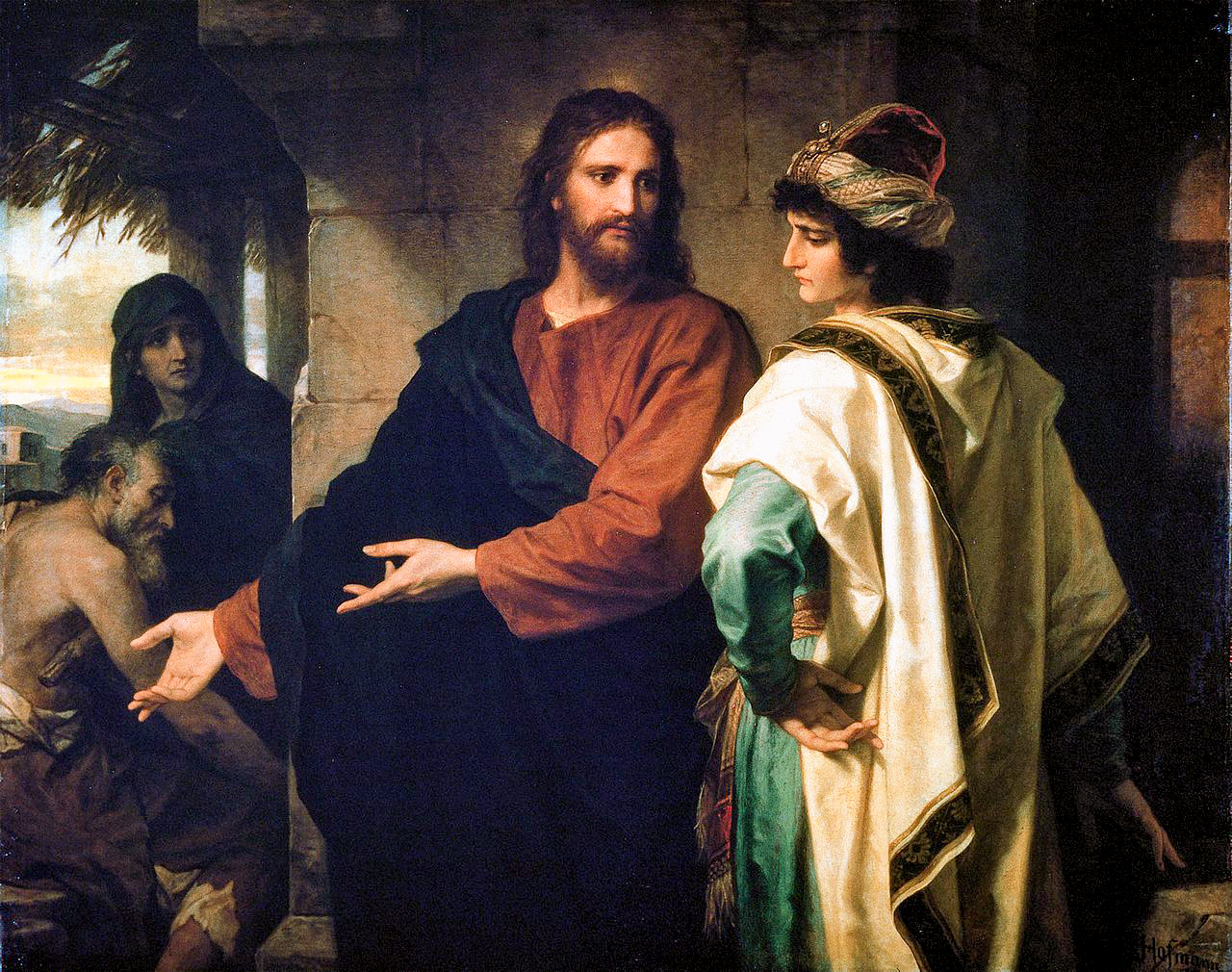
Christ and the Rich Young Ruler (1889), Heinrich Hofmann | Wikimedia Commons.
But let’s not misunderstand Jesus. It’s not just letting go of wealth for the sake of renouncing earthly possessions. This, as we see in Buddhism, retains the desire to bring enlightenment to oneself, to possess it, to have that enlightenment as a personal trait. Jesus is much more radical than this and promises us so much more. The real Christian transformation is that you empty yourself, forget your own needs and desires, in order to be filled by something new that is fundamentally not you and can never be possessed by you. God, the ultimate source and reality of all goodness, is the One who can fill you, the One you constantly strive to get closer to, the One whose endless generosity you can share profligately about the world in charity.
Note Christ’s last sentence: “Then come, follow me.” The man is not done when he sells his possessions and gives to the poor. No, he has just begun his glorious journey to God. And, with what must have seemed like astonishing directness to his listeners, Jesus points to Himself as God-on-earth, both a man who walks the way to the Father and the divine God who gifts humanity with the end of the reign of death.
But the young man doesn’t seem to grasp even half of this. Psychologically, this message is devastating for him: “When the young man heard this word, he went away grieving, for he had many possessions” (NRSV translation). Indeed, for anyone who views their relationship to life as a to-do list, a wall awaiting plaques of accomplishment, or a book detailing many conquests, this message is a stark wake-up call. God does not want us to possess anything. He wishes for us to wipe our minds of the drive to own, to possess, to accomplish for ourselves. He wants us to replace this drive with the thirst to love Him and love others. True love of God, by which Christ means a love that orients our every waking moment, provides us with superhuman endurance, true peace and true happiness. Nothing we can possess in our world can compare with this.
After 2,000 years of Christian monasticism and the ecclesiastic vow of poverty, this message isn’t exactly alien for us to hear. We’ve had some time to let it sink into our culture. But not the apostles! After the young man leaves, Jesus goes on to instruct His apostles: “Amen, I say to you, it will be hard for one who is rich to enter the Kingdom of heaven. Again I say to you, it is easier for a camel to pass through the eye of a needle than for one who is rich to enter the Kingdom of God.” The Jewish culture of the time absolutely associated wealth and prosperity with blessings from God (and here we notice an early version of the prosperity gospel). God may very well bestow prosperity upon people as a blessing — who am I to deny the wonderful and mysterious works of the Lord? But prosperity comes with a great cost as well (perhaps, then, it’s a curse or a trial?). Christ’s strong statements here speak to the dangers inherent in wealth. On the heels of the interaction with the rich young man, it’s clear that the dangers lie in seeing possessions as an end in themselves, in being sidetracked by the accumulation of things and wealth and thereby fostering a selfishness that is offensive to God. If one dies rich, chances are that one held onto wealth and possessions to the very end and did not truly convert to God. Thus, it is hard for such a person to enter the Kingdom.
Our lectionary states, “When the disciples heard this, they were greatly astonished and said, ‘Who then can be saved?’” Fr. Erasmo Leiva-Merikakis translates this as “the disciples recoiled with fear” (Fire of Mercy, Heart of the Word, Volume 3, 185). He writes, “It is too little to say that they were ‘greatly astonished,’ because this verb refers to an upset in one’s rational capacity at confronting the unexpected. The context calls for something more visceral. … ‘To be panic-struck’ or ‘driven out of one’s senses’ is closer to the contextual meaning, since a clear element of fear is here present as the disciples suddenly see salvation itself hanging in the balance” (185-186). Their worldview was dominated by maintaining a national Jewish identity in the face of occupation by invaders; wealth signified power whereas poverty signified disgrace and being forsaken by God. Yet here is the Savior telling them that a rich man will find it hard to enter the Kingdom of God. Not only was salvation in the balance, their entire system of what signifies worthiness was being turned on its head.
Despite the apostles’ astonishment, this is an ages-old pitfall. Some 600 years earlier, Ezekiel passes down a harsh warning, as heard in Tuesday’s first reading: “And yet you are a man, and not a god, however you may think yourself like a god … By your wisdom and your intelligence you have made riches for yourself; You have put gold and silver into your treasuries. By your great wisdom applied to your trading you have heaped up your riches; your heart has grown haughty from your riches.” The problem that God points out through Ezekiel is that riches corrupt a person’s heart and make that person imagine personal godliness. Many preachers and writers make pains to point out that there is nothing inherently wrong in wealth. While this might be true (although below I argue it is not), I think the point is overplayed. We are all-too-soothed by these words that let us off the hook from the condemnation of being attached to ourselves, this world, and our power within it. So, yes, gold is not the devil; it’s a shiny, inanimate metal and it has historically been put to good use to adorn holy and sacred things. Such adornment is meant to be a sign — one that falls far short of the true, transcendent glory of God, but something acknowledging that true wealth, honor, power, and glory belongs to the Creator.
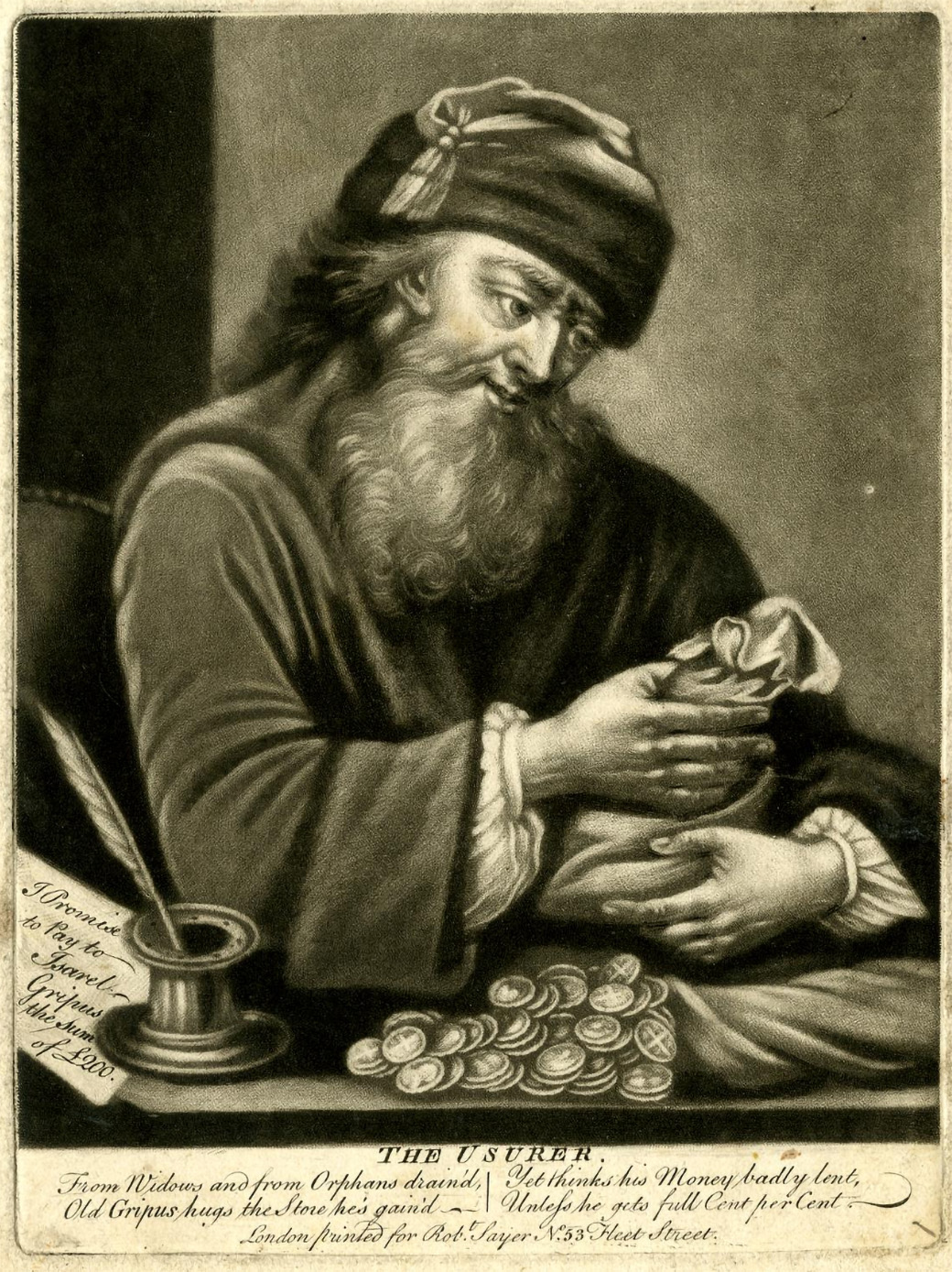
The Userer, ca. 1766-1774, after George van der Mijn (1721-1763) | Creative Commons, courtesy the British Museum. The poem under the title reads: “From Widows and from Orphans drain’d, / Old Gripus hugs the Store he’s gain’d — / Yet thinks his Money badly lent, / Unless he gets full Cent per Cent.”
But wealth is inseparable from possession. The definition of wealth is an amassment of valuables. In other words, wealth cannot exist without it being possessed. The syllogism is simple: if wealth is by definition possession, and if possession is (by Jesus’s definition) an obstacle to unity with God, then wealth is an obstacle to unity with God. Is wealth really not evil in itself? I’d argue it is because it operates on the level of covetousness and personal gain that is contrary to God’s law.
OK, what about gold and jewels, are they evil? Maybe not as an ornament, but as something that operates within a system of value and personal enrichment, then maybe that should give us pause. We can’t pretend that these “valuables” are just lying about the world and existing without an overwhelming human urge to use them for influence, power, authority, security, etc. (it’s called economics). Then let’s consider that when we hide valuable things from view, we commit an act of selfishness, distrust, and subterfuge. We don’t leave valuables out and about. Today, we don’t even use paper currency, much less gold and silver coinage. We use plastic cards hidden in wallets and bags, worthless in themselves, but carrying the weight of sometimes unimaginable power. These worthless cards and the stigma/badge of “creditworthiness” are manifestations of a world where wealth has taken on such importance that it defines our personal value. Your wealth determines your nutrition, safety, housing, education, and social status. What I’m getting at is that these inanimate things are no longer inanimate when they comprise our way of living in the world with one another. They become levers of power, ways of discrimination, and traps of self-absorption. So, I would argue, not only does “wealth” have a valence that weighs heavily on the side of evil, but so do “precious” things, money, credit, etc. They are evil because they are used to replace and fundamentally degrade the value of a human, of a person.¹
But into this world enters Jesus Christ, patiently telling those who will listen that wealth and possessions have absolutely nothing to do with true value (personal or otherwise). Leiva-Merikakis puts this nicely: “God’s revelation of his deepest self by becoming poor in our sight means that the riches that belong to him by his nature as God are of a wholly different order from what the world ordinarily means by ‘riches.’ Therefore, for us to become ‘rich’ through Christ’s poverty means becoming rich as God is rich and not as the world and our fallen nature envision being rich” (188).
So, in answer to the apostles’ “Who then can be saved?”, “Jesus looked at them and said, ‘For men this is impossible, but for God all things are possible.’ Let’s first note that St. Matthew records how Jesus’s “answer” begins with Him looking at them. At this point, after their panic-struck recoiling with fear about salvation and their worldview being turned on its head, this is less of a Q&A and more of a moment when the apostles have realized they are nothing and are psychologically adrift. They are not yet the heroes and martyrs as we conceive of them. By noting how Jesus first “looked at them,” St. Matthew guides us to imagine the calm, powerful gaze of the Savior and Master, stilling their fear, feeding them the truth. And this truth is an unblinking reiteration that people cannot “save” themselves through any kind of action or possession or quality. People must simply empty themselves and walk to God with an open heart ready to do his will. It is God who embraces us, who does the saving.
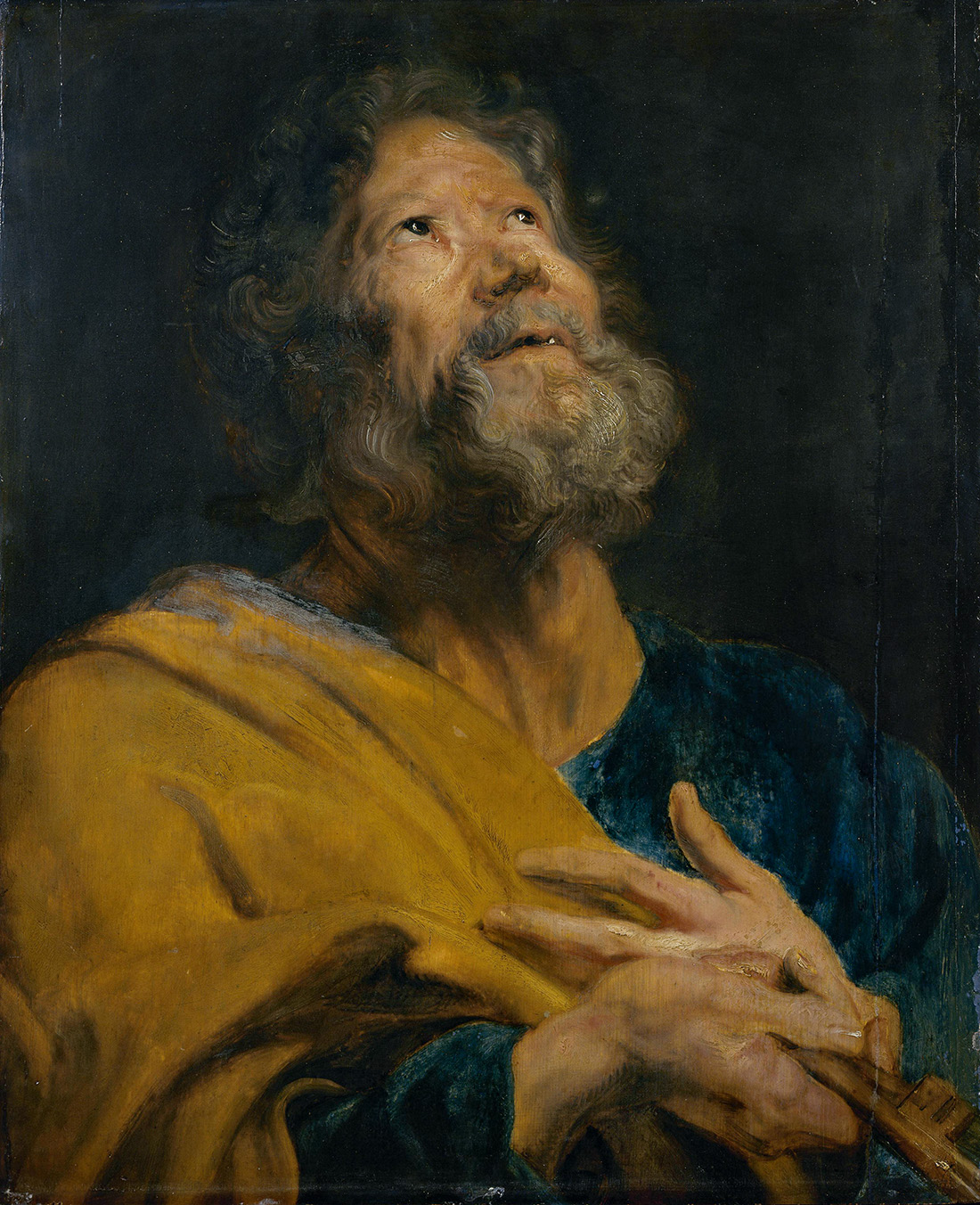
The Penitent Apostle Peter (1617-1618), Anthony van Dyck | Wikimedia Commons. I find it very heartening to think of the apostles as having very human frailty and flaws as they are portrayed in the gospels.
Jesus reassures them that they, in their nothingness and psychological angst, will have an honored place by His side in heaven simply by being His apostles. He explains that all who give of themselves, their families, and their possessions for the sake of His name “will receive a hundred times more, and will inherit eternal life.” His message is clear: the order of things is reversed. Worldly wealth is not eternal, spiritual wealth. Amassing things for oneself decreases spiritual value while giving up what one has increases spiritual value. This is why he ends with “many who are first will be last, and the last will be first.” The inversion of our worldly order must be firmly understood if we are to grasp Christ’s message.
On a personal note, I’m no less susceptible to the psychological angst and panic than the apostles over this message. Apart from making alarming statements to my wife about the spiritual dangers of saving for retirement, I’m still struggling to find out how I can separate myself from attachments to money and possessions as I turn fully toward God. I think we all need prayers as we make this journey.
¹ Lest you worry that this paragraph smacks too much of socialism, Marxism, or any other -ism, let me assure you that I hold these systems in as much contempt as capitalism (or patriotism!). In the end, they’re all Godless ideologies. They all see this world as the ultimate in importance. They all seek to give people a certain type of gain or wealth or value here in this world while alive, because (as the unspoken finale of each attests), there’s nothing else, nothing greater. They all operate in a mode where possession (of money, land, power, etc.) is the only meaningful mode they can imagine. How sad! And what an amazing and needed antidote Christianity, with all of its mystical transcendence, offers us. The Christian’s very first admission of faith is that something way greater than what we see or can possess — God — wants us to join Him in heaven. From day one, the Christian operates outside of ideologies of the world and joins himself or herself to a mystical reality beyond our understanding.
Monday – Wednesday in the 10th Week of Ordinary Time: 1 Kings 17-18, Matthew 5: 1-19.
The first three days of this week (see Monday, Tuesday, and Wednesday readings) give us consecutive readings from the first book of Kings in the Old Testament and the Sermon on the Mount from the gospel of St. Matthew. We have the story of Elijah’s God-imposed exile from the Israelites juxtaposed with the Beatitudes and Christ’s sayings about who He is and what we are called to be. There are many provocative connections between these texts, which, at first glance, we might not immediately identify with each other.
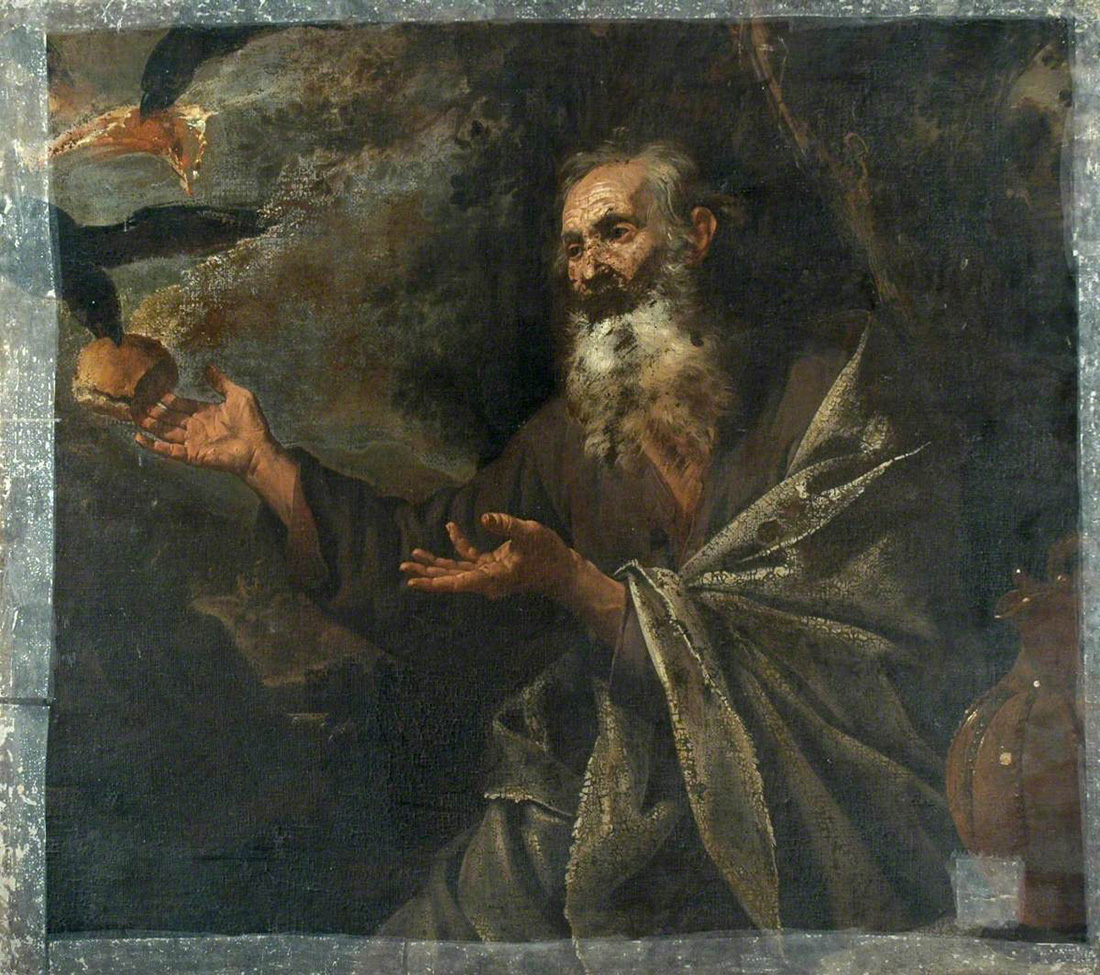
Elijah Fed by the Ravens (c.1630-1670), Manner of Pier Francesco Mola, previously attributed to Jusepe de Ribera | Creative Commons, courtesy ArtUK.
Let’s look at the Elijah story as a whole. Elijah is an important figure for at least three religions: Judaism, Christianity, and Islam. He was a prophet and miracle worker who displayed a zeal and devotion to God at a time when the Israelites had all but abandoned Him while adopting idolatrous faith in Ba’al and Asherah. The time period is 800 years before Christ, the Jewish state is split into the northern kingdom (Israel) and the southern kingdom (Judah, which contained Jerusalem). Elijah is a prophet in the northern kingdom and the King during his time was the absolutely awful King Ahab (let your next reading of Moby-Dick take on new significance). Ahab came after a series of bad kings starting with Jeroboam but scripture tells us “Ahab son of Omri did evil in the sight of the Lord more than all who were before him” (1 Kings 16:30), and again: “Ahab did more to provoke the anger of the Lord, the God of Israel, than had all the kings of Israel who were before him” (1 Kings 16:33). Part of the problem was his wife, Jezebel, a Phoenician princess who was undoubtedly a strong political match that helped stabilize Israel in the region. Ahab allows Jezebel to erect statues and temples to the Canaanite god Baʿal and the goddess Asherah. She does such a thorough job that she nearly exterminates the priests and prophets of the Jewish God (except the ones who hide in mountain caves) and brings in hundreds of her own prophets to Baʿal. The northern kingdom of Israel seems to have no state support for Yahweh, and the people fall into idolatry. Even the accursed city of Jericho — the first city to fall under Joshua’s entrance into the Promised Land after the Jews had wandered in the desert for 40 years with Moses — is rebuilt under King Ahab’s rule despite the curse Joshua had laid upon it if it were rebuilt (which comes true).
As we see over and over in our salvation history, God intervenes on behalf of His Chosen People through his anointed prophets. The Israelites have brought a disastrous drought upon themselves due to their unrepentant idolatry and Elijah tells King Ahab, “there shall be neither dew nor rain these years, except by my word” (1 Kings 17:1). The Word of God tells Elijah to go east of the boundary of Israel, the Jordan river, to “Wadi Cherith.” A wadi is a feature of desert hydrogeology, a seasonal creek that does not have water year-round. They range from relatively flat areas to more wild, ravine-line gullies. “Cherith” is the English spelling of the Hebrew name כְּרִית “Kərīṯ”, which means cut off or separated — something Elijah is being asked to do — it also means “carved” or “gorge,” which suggests that this was one of the more wild wadis, probably good for hiding from an angry king. The Word tells Elijah, “You shall drink from the wadi, and I have commanded the ravens to feed you there” (1 Kings 17:4). What makes this interesting is that the raven was among the birds the Jews were told to consider “detestable.” In Leviticus, we hear that the Lord tells Moses and Aaron that all ravens (among other birds and animals) “shall not be eaten; they are detestable” (Lev 11:13). Furthermore, “And by these you shall become unclean. Whoever touches their carcass shall be unclean until the evening, and whoever carries any part of their carcass shall wash his clothes and be unclean until the evening” (Lev 11:24-25). For this reason, God-fearing Jews would avoid ravens. Yet the ravens bring Elijah bread and meat in the morning and evening (thus he doesn’t eat them or necessary touch them), but the whole setup is definitely on the edge of being unclean from a strict Judaism standpoint.
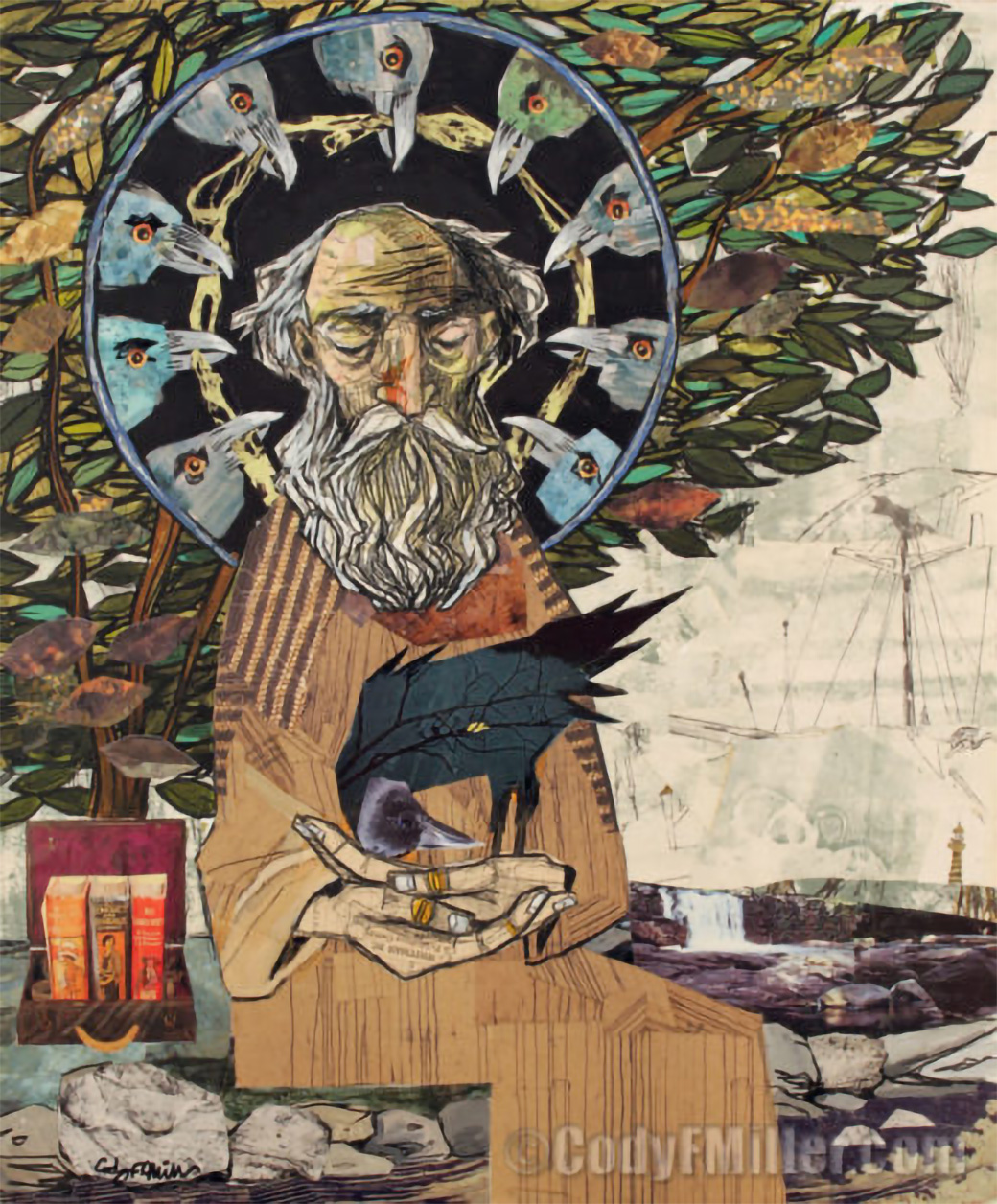
Elijah Being Fed by the Ravens III (contemporary), Cody Miller | Image from codyfmiller.com. I like the interesting crown of ravens, suggestive of course of Christ’s crown of thorns. Suffering and being outcast while proclaiming God’s Word are things these two share.
But Elijah doesn’t bat an eye. He goes there as God commands until the wadi dries up. He accepts the water, bread, and meat provided by God. It reminds me of the vision Peter receives in the Acts of the Apostles when a great sheet from descends from heaven with all sorts of detestable creatures on it and God encourages him to eat, saying “What God has made clean, you must not call profane” (Acts 10:15). While Peter understood this as opening up restrictive purity laws as well as opening up the new Christian Church for Gentiles, his vision and the Elijah raven episode emphasize obedience and humility in the face of God’s will.
And here we have our first connection to the Sermon on the Mount. With the Beatitudes, Jesus reaffirms the type of human who is pleasing in God’s eyes, and it has everything to do with humility, obedience, and authenticity over appearances.
Entire books have been written on the Beatitudes, so I can’t do much justice here, but let’s think about what type of person Jesus describes as being “blessed.” These are his words: the poor in spirit, they who mourn, the meek, they who hunger and thirst for righteousness, the merciful, the clean of heart, the peacemakers, they who are persecuted for the sake of righteousness. This is not a picture of the proud and strong, of those in power or even those in control of what happens to them. The “clean of heart,” in particular, gets after the type of purity that God desires. The extensive rules given to Moses are meant to create a person who is dedicated absolutely to God, who will follow His prescriptions over his or her own desires and pleasures. The purity laws help to remind the Jews that their goal is to purify themselves specifically for the Lord, not as bragging rights over their neighbors or as cause to visibly separate themselves from other humans. The purity laws are meant for Jews to take seriously the idea of cleaning out the evil from their lives and becoming truly pure internally, that is, “clean of heart.”
This is an important point. I’ve heard my fellow Christians (and Jewish friends) scoff at the crazy list of unclean and impure things in the Jewish tradition. Orthodox Jews are seen as going way overboard. I don’t pretend to be able to parse out the differences between what’s impure and what’s allowed (nor to know when someone is fetishizing the idea of worldly impurity as an affectation of character rather than a true devotion to God), but this act is very much solidly within the Christian tradition, too. Consider Lent, when we forgo pleasures and seek to purify our hearts through prayer, penance, self-denial, and repentance for our sins as we prepare for Easter. Consider the lives of monastic communities, some of whom live in silence, many of which regularly observe fasts or have restricted diets. And how about the mortification of the flesh?? This isn’t some bygone practice done by masochistic medieval saints; it’s come to light that Pope St. John Paul II practiced mortification of the flesh. The National Catholic Reporter states, “Msgr. Slawomir Oder, postulator of the late pope’s cause [for canonization], said Pope John Paul used self-mortification ‘both to affirm the primacy of God and as an instrument for perfecting himself’” (Pope John Paul practiced self-mortification, Jan 10, 2010). All of these Christian practices align with the same motives of the Jewish purity laws: to create a clean heart, a devotion to God, a reminder that the flesh is weak and the world should not be the object of our attachment or desire. Together with the Jews, we share a belief that sin, evil, and Satan (the tempter) are real aspects of our life in the world and that we must guard against aligning ourselves with the devil.
This is a good time to reflect on Wednesday’s gospel reading, a continuation of the Sermon on the Mount in St. Matthew’s account, when Jesus proclaims, “Do not think that I have come to abolish the law or the prophets. I have come not to abolish but to fulfill.” We Christians are a continuation and fulfillment of Judaism. We pervert and misunderstand Christ if we imagine ourselves outside of the Jewish tradition. He very clearly states that He is not starting something new or breaking with God’s revelation to humanity for the preceding thousands of years. While not starting something new, He absolutely brings something new to us: divinity dwelling as man on the earth and His sacrifice of Himself for the salvation of humanity. But He is continuing, perfecting, and fulfilling God’s promise to humanity, not starting fresh. Jesus is insistent on this point, always pointing back to the Jewish patriarchs, couching His actions in the prophecies of Jewish prophets, and speaking the Word of God that His own divine nature shared with these people over the previous millennia.
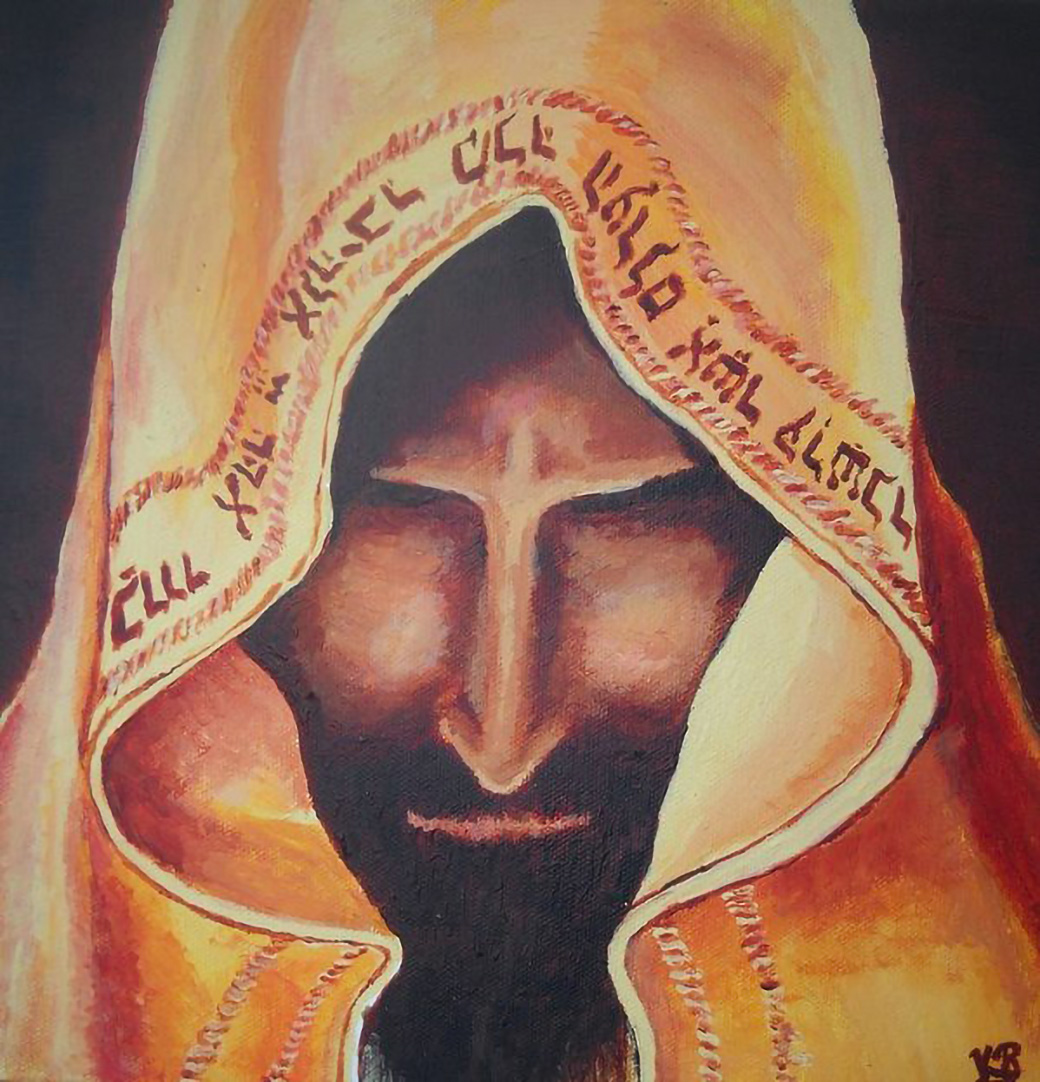
Praying Jew (contemporary), Kerstin Berthold | Image from fineartamerica.com.
On this point, let’s return to Elijah, with whom Jesus’s divine nature, the Word of God, was present. After the water in the wadi dries up, God tells Elijah, “Move on to Zarephath of Sidon and stay there. I have designated a widow there to provide for you.” So God continues to care for Elijah as an exile from Israel, hidden now in a Phoenecian city. But watch what God does here through Elijah. When Elijah meets the widow, she is about to make her last meal for herself and her son because they are destitute. Elijah asks for her to trust in the Lord who has told him, “The jar of flour shall not go empty, nor the jug of oil run dry, until the day when the LORD sends rain upon the earth.” The woman obeys Elijah, displays faith in the Lord and his prophet, and indeed the flour and oil replenish themselves and the three of them eat for a year. Despite the outward, slightly shameful appearance of an exiled Jew living with a widow in a Gentile city, this is the fundamental cycle of God’s saving work in humanity. First, He asks His chosen one to trust Him and bestows His grace when the chosen one obeys, especially in humble circumstances. Next, He asks that person to be an instrument of His will on the earth, bringing others to faith and under the grace of God. This is the core of our faith and salvation: hearing God’s call, trusting in Him, and bringing others to God’s light. These readings show this with Elijah, but scriptures also show this cycle with other prophets in their times and Christ in His time. We must realize that this is also true for us in our time.
This reading of Elijah and the widow of Zarephath occurred yesterday (Tuesday), and the accompanying gospel reading recounts Christ’s lesson directly following the Beatitudes where he tells his disciples that they are the salt of the earth and the light of the world. We can see how Christ’s words echo the life example Elijah sets: “Just so, your light must shine before others, that they may see your good deeds and glorify your heavenly Father.” This is the cycle in which we are called to participate, like Elijah and like Christ Himself. This is the meaning of life: to listen to the Father, become pure of heart and poor in spirit, let our faith shine in our deeds, and have our glorification of the Father draw others to God’s embrace.
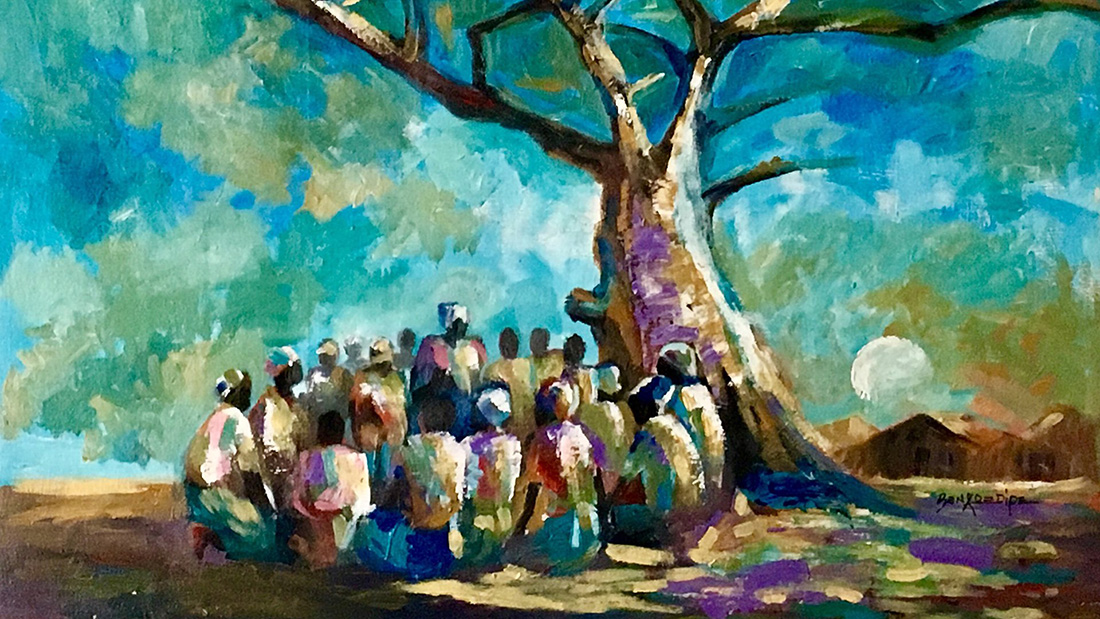
Story Telling (contemporary), Benedict Adedipe | Creative Commons, courtesy imb.org. We have so much ability to draw others into God’s embrace. Do we take these opportunities?
These readings end with a note of finality today (Wednesday). After three years of drought, God tells Elijah: “Go, present yourself to Ahab; I will send rain on the earth” (1 Kings 18:1). When he meets Ahab, who calls him the “troubler of Israel,” he says: “have all Israel assemble for me at Mount Carmel, with the four hundred fifty prophets of Baal and the four hundred prophets of Asherah, who eat at Jezebel’s table” (1 Kings 18:19). Once the people are assembled, Elijah makes a very clear statement: “How long will you straddle the issue? If the LORD is God, follow him; if Baal, follow him.” Based on archaeological evidence of home shrines and figurines of gods like Asherah, scholars argue that polytheism was relatively normal among the Jewish people until after the Babylonian exile (605-539 BC). Elijah’s statement here supports this assertion; he sees devotion to many gods as not just inconsistent with the teaching that Yahweh is the only God, but downright heretical and needing to be stamped out. Simply put, if you follow our God, you can’t at the same time follow another.
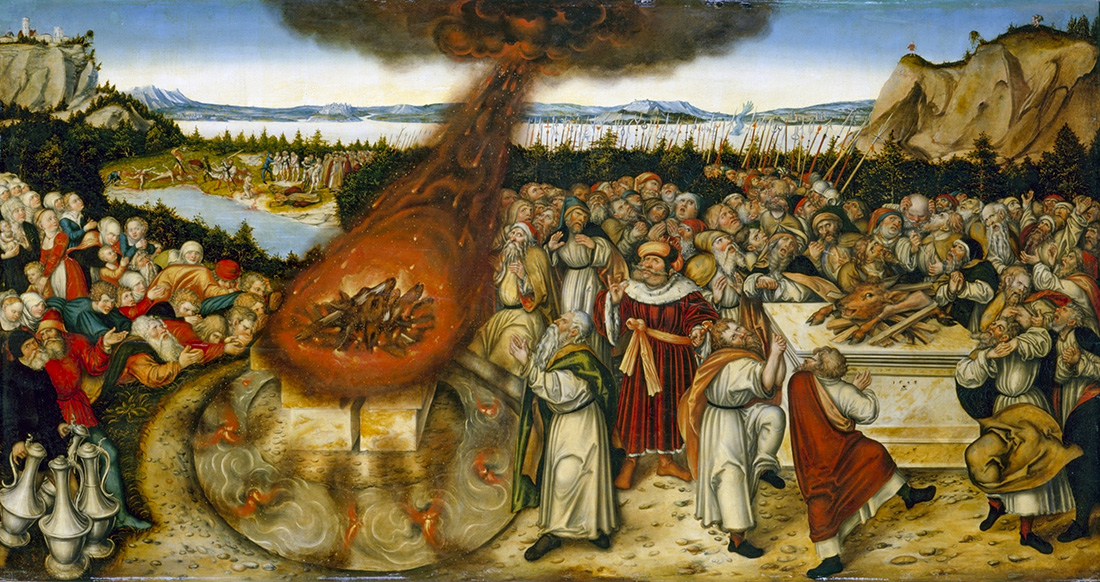
So Elijah, at God’s instruction, announces the great sacrifice challenge. The hundreds of prophets for Baʿal can’t get their bull offering to ignite on their altar despite frenzied dancing, prayers, and self-laceration for hours. Before Elijah calls upon God to immolate his offering, he accomplishes a symbolic re-baptism of Israel in the faith by dousing the butchered bull, sticks, and altar in water three times (we can see the Father, Son, and Holy Spirit in God’s instructions here) until the trench around it is full. Elijah’s prayer to God over the offering ends with, “Answer me, that this people may know that you, LORD, are God and that you have brought them back to their senses.” On one hand, it seems incredible that the Jews would need more convincing or to be brought back to their senses after God so proved Himself to them through Abraham, Moses, Jacob, David, Solomon, and so many other early figures. But considering that the people had been ruled by weak and faithless kings in the northern kingdom for generations, I suppose it makes some sense. Still, I’m starting to feel Jesus when we hear Him say, “Unless you see signs and wonders you will not believe” (Jn 4:48).
God’s answer exhibits his totality: “The LORD’s fire came down and consumed the burnt offering, wood, stones, and dust, and it lapped up the water in the trench.” Vaporizing water, burning up stones and dust — signs that not a shred of doubt should be left in the minds of the Israelites. Indeed, they have the fear of God put back in them: “Seeing this, all the people fell prostrate and said, ‘The LORD is God! The LORD is God!’” But while the lectionary reading ends here, scriptures contain one more verse: “Elijah said to them, ‘Seize the prophets of Baal; do not let one of them escape.’ Then they seized them; and Elijah brought them down to the Wadi Kishon, and killed them there” (1 Kings 18:40). Sensitive modern readers might balk at this verse and wonder why such retribution is necessary. But we must not edit scriptures to fit our sensibilities and ideas of who God is. The totality of God includes judgment. Most of us do not experience judgment here on earth and we are taught that it is something that happens in the afterlife but that’s not saying God can’t exact judgment whenever He cares to. When offering His people a chance to come back to Him, when entering human history so directly through the lives of His prophets, God makes Himself present in ways that cannot exclude all parts of His totality. He is salvation for the just and devastation for the evil. There’s no way around this, it is His nature as being all pure, all good, the divine Lord. There is no room for anathema and evil in the presence of the divine love – it simply cannot exist together because then it would no longer be pure, divine love. We may prefer to concentrate on the loving salvation God offers us, and that’s fine, but we would be wrong if we thought that God did not bring terrible justice down on the evil among us.
Elijah and the Priests of Baal (1545), Lucas Cranach the Younger | Image from arthive.com.
And so we can better understand today’s gospel reading as well. Just like God’s divine totality uplifts the faithful and crushes the unfaithful, Jesus reminds us of the ultimate fate that awaits us: “Therefore, whoever breaks one of the least of these commandments and teaches others to do so will be called least in the Kingdom of heaven. But whoever obeys and teaches these commandments will be called greatest in the Kingdom of heaven.” Tying this all together, we can see that the great cycle of salvation in which we are called to participate has very real consequences. It’s not just to feel good or to torture ourselves with guilt in this world. These are eternal consequences and ones that should define us.
Monday and Tuesday the Fourth Week of Easter – Acts of the Apostles 11:1-26, John: 10:11-18, 22-30.
Yesterday’s and today’s readings are in sequence, both the first reading and the gospel. I’d like to think about them together because this provides a fuller look at how the Church first spread beyond the Jewish enclaves around Jerusalem and into the Gentile communities of the Near East. They also show us how Jesus is simultaneously fulfilling the specific promise of Israel’s Messiah yet defining the community of “sheep” to be saved by criteria that are not restricted to a Jewish heritage.
Good Shepherd, 5th-century mosaic from the tomb of Galla Placidia in Ravenna | image from flickr.com.
Let’s start with the gospel readings where Jesus uses the image of the Good Shepherd to describe Himself. The first aspect of the good shepherd He points out is self-sacrifice: “I am the good shepherd. A good shepherd lays down his life for the sheep.” This is in contrast to the paid worker who abandons the sheep in tough times because he only works for money. The second aspect is a hard-to-describe quality of knowing: “I know mine and mine know me, just as the Father knows me and I know the Father.” How can we understand this? This type of knowing can only come from a few things: perhaps a long, close acquaintance such as one with a friend, family member, or co-worker with whom you interact every day; or another way to “know” someone comes through the bond of love and trust that transcends the physical aspects of the person. This second type of knowing we might see in a mother and child, forged through gestation, feeding, and care over years, present in their mental and physical attachments. Or we might see this in a husband and wife who have grown so close in love that they know what the other person is thinking, they anticipate the other person’s needs before they are spoken, they instinctively know when the other enters the room without having to look up. This is what I mean by a love and trust that transcends the physical aspects of a person — you don’t need to see them to feel their presence, you don’t even need to have them be present to hear them in your mind, how they might react to something. In this way, love and trust fuse people together in an altogether more-than-physical way. We might dare to call this way of knowing mystical because it belongs to the family of spiritual mystery that we encounter in the liturgy.
Jesus is saying that He knows His sheep and they know Him in this way. More than that, this is the same way that He and the Father are in relationship. How incredible! I’d definitely use the term mystical once we understand that this is a sharing in the Personhood of the Trinity. I don’t want to lose track of the first way I identified above, the close acquaintance gained by repeated interaction. This is displayed in Jesus’s constant prayer to the Father throughout His life — whether in the desert, on the mountain, before meals and miracles, or simply in His solo time. This way of prayer is an essential element of our mystical “knowing” when we have a hard time seeing the physical presence of God the Father, Son, and Holy Spirit. Jesus models for us the love and trust born of filial relationship as well as the prayer life that reinforces the companionship, love, and trust: these are our ways of knowing God.
The message of the Good Shepherd would have meant something specific to His Jewish audience. The Word of God first used this language with Ezekiel (see Ezekiel chapter 34), and the full message was that God Himself will come to replace the bad shepherds (i.e., chief priests and leaders) of Israel: “my sheep have become food for all the wild animals, since there was no shepherd; and because my shepherds have not searched for my sheep, but the shepherds have fed themselves, and have not fed my sheep … I myself will search for my sheep, and will seek them out” (Ez 34:8,11). Thus, when Jesus says that He is the Good Shepherd, by invoking Ezekiel He is telling them that they have fallen down on the job of shepherding God’s people and that He Himself is God, here to do the work Himself.
Initial M depicting the parable of the Good Shepherd from a French illustrated manuscript | Creative Commons, courtesy the Free Library of Philadelphia.
What’s more, the Word of God tells Ezekiel that His sheep are more than just those living in Israel: “I will bring them out from the peoples and gather them from the countries, and will bring them into their own land; and I will feed them on the mountains of Israel, by the watercourses, and in all the inhabited parts of the land. 14 I will feed them with good pasture, and the mountain heights of Israel shall be their pasture” (Ez 34:13-14a). Here we see a different and broadened definition of God’s people than “descendants of Abraham and Jacob” or “house of David” or “of the twelve tribes.” In other words, the genetic heritage that grants the Jews the status of Chosen People is not equivalent to the group of people who will be saved (here called “my sheep”). I make this point not to diminish in any way the important status of the Chosen People, but to point out that the eschatological end God envisions for humanity is not restricted to the Chosen People. God reveals Himself as the great “I AM,” the only God, to the Chosen People so that they can nurture this truth over the millennia and become a shining light for all of the nations. As He tells Isaiah: “I will give you as a light to the nations,that my salvation may reach to the end of the earth” (Is 49:6). Thus, Israel as a light to the nations, is there precisely so that salvation may reach beyond it, “to the end of the earth.”
Jesus is the promised “light to the nations.” Remember, when he is presented in the Temple as a child, holy Simeon took him in his arms and declares Jesus to be, “a light for revelation to the Gentilesand for glory to your people Israel” (Luke 2:32). Thus, we can see the trajectory of these various threads. When Ezekiel relates that God will feed his sheep “on the mountains of Israel,” he is referring to the spiritual wisdom and revelation of Judaism. Those sheep from outside of the Jewish nation will be brought to “the mountain heights of Israel” to feed on the good pasture of their spiritual wisdom. In this manner, Jesus glorifies Israel while being a revelation for Gentiles. He does not create a new religion but fulfills all of the prophecies and promises within Judaism: “Do not think that I have come to abolish the law or the prophets; I have come not to abolish but to fulfill” (Matt 5:17). He upholds Judaism while making way for the eschatological expansion of the faith to the rest of the world. So, yes, His ministry is primarily, overwhelmingly, focused on Jews, Jewish towns, and Jerusalem; His chosen twelve disciples stand as the chosen twelve tribes, and all of His Words and works are those that He seeded in the minds and mouths of the Jewish prophets over the millennia. But multiple times throughout the gospels we receive the message that the reign of God that He brings is open to non-Jews: the exorcism of the Canaanite woman’s daughter, healing of the Centurion’s servant, etc.
The story of the Canaanite woman in Matthew, chapter 15 is especially interesting because some people use one of Jesus’s quotes to show that He only came for the Jews: “I was sent only to the lost sheep of the house of Israel” (Matt 15:14). But that interpretation takes the quote out of context. This is actually His answer to his disciples who want Him to send the woman away — it’s a statement that reveals what they’re thinking and not a fulfillment of their request to dismiss her. In fact, after she shows perseverance in asking for His help, He commends her and grants her wish for her daughter. The lesson is clearly a contrast: the woman’s perseverance of faith stands out against constant skepticism and lack of acceptance from the Jews. Jesus makes abundantly clear that His saving work is open to all who have faith.
That’s why we have to pay special attention to His words in yesterday’s gospel: “I have other sheep that do not belong to this fold. I must bring them also, and they will listen to my voice. So there will be one flock, one shepherd.” Who are His sheep? “Other sheep that do not belong to this fold” may mean dispersed Jews in other lands, or — as we see fulfilled in the Acts of the Apostles — the “Greeks,” the Gentiles. Jesus establishes the fact that His sheep “know” him like He knows the Father, that they will “listen to my voice.” This spiritual, mystical knowing does not rely on genetic Jewish heritage. This is the knowledge that the Creator places in our souls at the moment of our creation. This is our response to God within us, cultivated as we listen to His call and by our prayers, our desire, our thirst.
In today’s gospel, Jesus repeats this language and makes even more clear that His sheep are not simply those of Jewish heritage. He says to the Jews gathered around Him: “you do not believe, because you are not among my sheep. My sheep hear my voice; I know them, and they follow me.” So, not only are the sheep to be saved and brought into this “one flock” open beyond those of Jewish heritage, some Jews will actually be excluded from the flock. The Chosen People kept the flame of God’s revelation to humanity alive, but the sheep to be saved are those who respond to God with all their hearts, minds, and souls — a different set of people not determined by the status of Chosen People.
I Am the Good Shepherd (contemporary), Jackson Studios | image from etsy.com.
Once again, we hear the Word of God before He is incarnated as Jesus telling Ezekiel these same things hundreds of years earlier: “I myself will judge between the fat sheep and the lean sheep. 21 Because you pushed with flank and shoulder, and butted at all the weak animals with your horns until you scattered them far and wide, 22 I will save my flock, and they shall no longer be ravaged; and I will judge between sheep and sheep.” Thus, the Jews themselves will be sorted according to their acts and their hearts.
This message was lost in the fervor of the Jews being astounded at Jesus’s claim that “The Father and I are one.” They want to stone Him right after He says this. And then, of course, this great “blasphemy” (aka truth!) is used as the rationale for His Crucifixion. Therefore, this message did not sink in right away for the first Jewish followers of Christ who made up the Apostolic Church. When evangelizing throughout the Near East, at first they went only to Jewish synagogues. Today’s first reading tells us that the disciples fleeing the persecutions in Jerusalem “went as far as Phoenicia, Cyprus, and Antioch, preaching the word to no one but Jews.” But some preached Jesus Christ to the “Greeks” in Antioch (meaning non-Jews, aka Gentiles). This is the first record of deliberate evangelization to non-Jews. The author writes: “The hand of the Lord was with them and a great number who believed turned to the Lord.” What does it mean that “the hand of the Lord was with them”? Throughout the Bible, the hand of God signifies protection, blessing, and anointing. God tells Isaiah: “I will strengthen you, I will help you,I will uphold you with my victorious right hand” (Is 41:10b). Thus, those preaching to the Gentiles in Antioch are strengthened and protected by God in their efforts.
So, when the church in Jerusalem hears of this unprecedented work and sends Barnabas to investigate, he “saw the grace of God, he rejoiced and encouraged them all to remain faithful to the Lord in firmness of heart.” Let’s remember that Jesus promised, “I know mine and mine know me,” so Barnabas, filled with the Spirit, recognized that same Spirit of Christ alive in the work of the disciples preaching to the Gentiles. This mystical knowledge, so palpable at Pentecost, continues to pulsate through the early Church, calling the sheep who thirst for God, Jew and Gentile alike.
This is no small thing. As Peter tells us in the episode that yesterday’s first reading summarizes, “it is unlawful for a Jew to associate with or to visit a Gentile” (Acts 10:28). But God provides Peter with a vision as he prays in which all of creation descends from heaven on a white sheet. It is a sign of the purification of Creation by Jesus’s great sacrifice. With Christ as the new Adam, Creation itself is re-sanctified and is no longer unclean. God’s voice tells Peter, “What God has made clean, you must not call profane.” The ripple effects of the Christ event in the fabric of history are making themselves felt in this revelation to Peter.
Peter Baptizing the Centurion Cornelius (1709), Francesco Trevisani | image from flickr.com.
Guided by the Holy Spirit, Peter ministers to Cornelius the centurion and his household of Gentiles. Thanks to his vision, Peter is beginning to understand what Jesus was saying when he said, “I have other sheep that do not belong to this fold. I must bring them also, and they will listen to my voice.” Cornelius tells him that he was praying at his house when an angel appeared and tells him that his prayers were answered and he should seek out Peter. This is a man who is spending time with God, who yearns for Him; a man who is one of the sheep. So, Peter admits, “I truly understand that God shows no partiality, 35 but in every nation anyone who fears him and does what is right is acceptable to him” (Acts 10:34-35).
Jesus promises his Apostles that the Holy Spirit will be sent to them after He ascends to heaven, and indeed this is what happens in the house of Cornelius: “While Peter was still speaking, the Holy Spirit fell upon all who heard the word. 45 The circumcised believers who had come with Peter were astounded that the gift of the Holy Spirit had been poured out even on the Gentiles” (Acts 10:44-45). This is another Pentecost moment, and here the Holy Spirit descends upon Gentiles! Even the grumbling Jewish members of the fledgling Church in Jerusalem are mollified when they hear that the Holy Spirit was present to the Gentiles in the same manner He came to them:
[Peter said]: “If then God gave them the same gift he gave to us
when we came to believe in the Lord Jesus Christ,
who was I to be able to hinder God?”
When they heard this,
they stopped objecting and glorified God, saying,
“God has then granted life-giving repentance to the Gentiles too.”
The last two days’ worth of readings presents to us the growth of the Church beyond the Jewish community within which Jesus Christ came and ministered. It shows that the Spirit didn’t “force” a growth outside of the Jewish communities (as some scholars argue) but that this was a Spirit-fueled unveiling of a promise given to the Jews by Ezekiel and then Jesus. This idea of the eschatological sheep in God’s flock being defined outside of the strict genetics of the Jewish race was always present in God’s teaching. Just like the Holy Spirit came to infuse the Apostles in the upper room with the grace, wisdom, and courage to start their ministry in Jerusalem, the Spirit came to expand this grace to include Gentiles.
The growth of the Church unfurled precisely in the order promised by Christ, with the undeniable logic of the grain of wheat, dead to the earth but rising again in great bounty. No other gospel makes this as clear as the gospel of St. John, which is one of the reasons I find it so appealing. We find in the very first chapter, through the mouth of John the Baptist, that Jesus’s saving action would be for the benefit of the world, not just the Jewish nation: “Here is the Lamb of God who takes away the sin of the world!” (Jn 1:29). The first epistle from John also makes the scope of His mission crystal clear: “he is the atoning sacrifice for our sins, and not for ours only but also for the sins of the whole world” (1 Jn 2:2).
In my mind, the move of some theologians to reduce the mission of Jesus to only gathering the nation of Israel to fulfill the prophecies pertaining to the Jewish God is too limiting and deaf to the revelation of the Spirit after the Resurrection. It is of the same ilk as writings that attempt to distill some version of a historical Jesus from the Christianity that developed after Jesus. Historical underpinnings are very important, as is the deep spiritual Jewish formation of the culture within which Jesus was born. But an attempt to find a Christ “before” or “outside of” Christology simply denies the fullness of God’s entry into the stream of human history.
Friday the Third Week of Easter: Acts of the Apostles 9:1-20, John 6:52-59.
Today’s readings are two incredibly important passages; one describes Saul’s transformation from persecutor to “chosen instrument” of Christ, and the other gives us Christ’s words that insist upon the literal ingestion of his flesh and blood, which we Catholics likewise insist is present in the Eucharist. What emerges as we hear these readings is a persistent focus on the need for the body, the flesh, to be purified and perfected as we are on our way to salvation.
In the first reading, we find “Saul, still breathing murderous threats against the disciples of the Lord.” He asks the high priest for letters to go to synagogues in Damascus that would give him the authority to arrest Christians and bring them back to Jerusalem in chains. He is zealous in his desire to stamp out the new Way of Jesus Christ. But, like prophets before him (Noah, Jonah), God has radically different plans for him. We are familiar with the story: a light flashes all around him and he falls to the ground (no horse is mentioned, but that has somehow crept its way into the story). He and his companions hear the voice of Christ: “I am Jesus, whom you are persecuting. Now get up and go into the city and you will be told what you must do.”
The Conversion of Saint Paul, detail (c.1600), Caravaggio | Wikimedia Commons.
Paul’s conversion has a significant physical aspect: “Saul got up from the ground, but when he opened his eyes he could see nothing; so they led him by the hand and brought him to Damascus. For three days he was unable to see, and he neither ate nor drank.” Whenever we encounter blindness in our scriptures, we can understand it to signify spiritual blindness, which certainly can be applied in this instance. But note here how the physicality of the blindness reduces Saul from this puffed up, powerful persecutor so someone who must be led by the hand. He becomes absolutely dependent on people, like a child. This is undoubtedly part of the penance of his conversion, and by taking the time to explain this aspect of the story, the author of the Acts of the Apostles is taking on the same insistence of the physicality of our faith that we will encounter in the gospel.
His physical and spiritual dependence is again emphasized when he is told that Ananias, a follower of the Way, will be the one to heal him. Saul is made vulnerable, delivered into the hands of the very people he set out to imprison. And how do disciples of Christ respond to persecutors? They turn the other cheek, they offer love, and in this case, spiritual and physical healing. Again, we hear very physical details about the healing: “Immediately things like scales fell from his eyes and he regained his sight. He got up and was baptized, and when he had eaten, he recovered his strength.” The scales are a physical manifestation of the spiritual mire, the spiritual blindness of this man who was a primary witness of the martyrdom of St. Stephen. It’s as if his sin and self-imposed blockages to the Word of God were crystallized, precipitated out of solution, pulled out like a filter that cleans filthy water. Directly after he gets up, able to see, we hear that he is baptized. Even though this seems to be reported casually, this is no small matter. Baptism in the name of Jesus Christ marked a full conversion of a person to the new Way and a direct rebuke of the chief priests and scribes who had murdered Christ. By accepting baptism, Saul was making a 180-degree turn towards Christ and away from the high priest whose approval he had just sought.
Another aspect of Saul’s conversion is his self-imposed fasting. Fasting was an important aspect of having an appropriate “fear of God” in the Jewish tradition. The fast, or taʿanith, was specifically when atoning for sins, to accompany contrition in the heart, and in supplication during earnest prayer (see our reflection Esther: Model of How to Petition the Father). Any reader familiar with Jewish tradition (which continues in Christian tradition) would understand that Saul would be searching his heart in atonement over those three days and would be deep in supplication and prayer with God. As St. Isaac the Syrian wrote, “When a man begins to fast, he straightway yearns in his mind to enter into converse with God” (Homilies 37, in Ascetical Homilies, 171). Yet once again we are tuned into the physicality of Saul’s conversion, that the once virile man who dragged Christians to prisons in chains had been reduced to a weak, blind, and utterly dependent child. This is just the beginning of the Way of the Cross. As Jesus tells Ananias, “I will show him what he will have to suffer for my name.” A more literal translation of this passage is “I will show him how much it behooves him to [or he must] suffer for my name.” But the point isn’t penance, it’s deliverance from the reign of death and into the salvation found in the reign of God. For Saul is cured of his blindness, he is made strong again at the hand of Jesus’s disciples, he is baptized into the inheritance of everlasting life. It’s simply that the Way of the Cross naturally involves suffering, which the one who suffers comes to understand is nothing more than purification in the Name of the Lord.
Ananias Restoring the Sight of St. Paul (1631), Pietro da Cortona | Wikimedia Commons.
Our Church Father Tertullian provides us with a nice way to think about a central truth in our faith. The Catechism of the Catholic Church quotes him as writing: “The flesh is the hinge of salvation” (CCC, 1015). The fuller context of the quote is as follows: “no soul can ever obtain salvation unless while it is in the flesh it has become a believer. To such a degree is the flesh the pivot [hinge] of salvation, that since by it the soul becomes linked with God, it is the flesh which makes possible the soul’s election by God. ” (De Resurrectione Carnis translated by Ernest Evans, 8). Written sometime around 220 AD, this passage summarizes a “take-home message” from Christ’s ministry and the scope of salvation history leading up to it. The flesh is clearly central — as Tertullian put it, a pivot, fulcrum, or hinge — to salvation, a phenomenon of the soul. Let’s unpack this. First, the soul is seamlessly united to the body in this life; the union of the soul (breath of God) and the body (clay or dust of the earth) is what makes me a person. The body is intimately entwined with the soul and thus it is part and parcel of our connection to God as defined at creation. Second, Christ spoke again and again about the importance of accepting God and the Way while alive here on earth, before the death of the body. More than just accepting God, we are called to act with charity towards our fellow humans (charity being a perfect reflection of the outpouring love that is God). In other words, what we do while we have these bodies matters. Our faith in God and our works of mercy and charity secure our salvation. Both faith and works happen while our personhood inhabits the bodies we have been given. Thus, “the flesh is the hinge of salvation” since without the actions of the flesh, salvation could not be secured.
I have to address one other item before we return to today’s readings. The title of Tertullian’s work is translated as “The Resurrection of the Flesh,” and the question inevitably turns to what happens after our death — if we achieve salvation, is our very flesh raised from the dead? This has been debated since the earliest days of the Church. St. Paul has a strong opinion that he relates to the Corinthians: “What is sown is perishable, what is raised is imperishable. 43 It is sown in dishonor, it is raised in glory. It is sown in weakness, it is raised in power. 44 It is sown a physical body, it is raised a spiritual body. If there is a physical body, there is also a spiritual body” (1 Cor 15:42-44). He makes himself even more clear a few verses later: “flesh and blood cannot inherit the kingdom of God, nor does the perishable inherit the imperishable. 51 Listen, I will tell you a mystery! We will not all die, but we will all be changed” (1 Cor 15:50-51). But 300 years later, St. Jerome and St. Augustine insist that our bodies are indeed resurrected on the last day, and the medieval scholastics agree with them. So we read in the Catechism of the Catholic Church a quote from the Council of Lyons in 1274: “We believe in the true resurrection of this flesh that we now possess” (CCC, 1017). But this has been debated up through our contemporary times. St. Pope John Paul II wrote what is probably the most reasonable way to speak of our resurrection and eternal life: “It is always necessary to maintain a certain restraint in describing these ‘ultimate realities’ since their depiction is always unsatisfactory” (General Audience, 1999). In other words, we can affirm that whatever comprises our “person” will rise to have eternal life with God. In this life on earth, our “person” is understood to be a seamless union between soul and body, but will that be the same case (or the same body) at our resurrection? We will only know for sure on the Last Day!
Quintus Septimius Florens Tertullianus, engraving by unknown artist | Wikimedia Commons.
Back to our readings. I am struck by how Christ insists upon the fundamental physicality with which we live our lives “on the Way.” Saul is to become one of the great examples of a man beaten, imprisoned, starved, shipwrecked, and rejected repeatedly while at the same time joyously bringing the light of the Word of God to the world. How can we expect the flesh to endure such things? Who would want to endure such things?
Jesus gives us the answer in today’s gospel, the culmination of the Discourse on the Bread from Heaven: “Just as the living Father sent me and I have life because of the Father, so also the one who feeds on me will have life because of me. This is the bread that came down from heaven. Unlike your ancestors who ate and still died, whoever eats this bread will live forever.” Here is the great promise, the New Covenant. The one who feeds on me will have life because of me. What’s more, this bread that is His Flesh and Blood guarantees life forever. OK, pretty good reason to have our own bodies endure the Way of the Cross. Also, the promise includes a wellspring of life that we must understand extends to this life, not just life in Heaven. This food sustains and uplifts, rejuvenates and expands a person like no regular food can do.
The great question that has splintered groups from the Catholic Church is whether Jesus refers to symbolic flesh or literal flesh. We Catholics believe that He didn’t just stop at a symbolic or spiritual understanding of eating His Flesh and Blood. He says, “my Flesh is true food, and my Blood is true drink. Whoever eats my Flesh and drinks my Blood remains in me and I in him.” This is a response to the Jews saying, “How can this man give us his Flesh to eat?” He doesn’t respond by saying “I am referring to my flesh symbolically,” but instead repeats Himself, rephrases Himself, never losing the stubborn physicality of the message. Of course, His Flesh and Blood is spiritual food, but He also insists that it is His Body, His Flesh and Blood, the same physical thing that He brings to the Cross.
Breaking the Bread at Emmaus, a mosaic by Fr. Marko Ivan Rupnik, SJ | image from diocesi.torino.it.
What are we to make of this? Should we be grossed out and turn away like “many of his disciples” after they hear this teaching? Certainly not! We are not cannibals who feast on bloody flesh for flesh’s sake. The Eucharist is an unbloody offering of the flesh, done sacramentally and reverently, where the Holy Spirit is the means and the goal. Christ’s way of giving the Spirit to us through his flesh is an orienting reminder to who we are as Christians, willing to sacrifice our very selves to the Father. It is an insistence that the flesh matters. Just like fasting and mortification of the flesh are ways to purify the body, not in disdain for it but in acknowledgment of its intimate union with the soul, we can see how Christ’s offering of himself as food is another acknowledgment of the importance of our bodies. The body must be nourished by the right food — spiritual food — if it is to be ready to walk the Way of the Cross.
As Tertullian writes, the flesh is the hinge of salvation. We must not hide that, we must exult in that. Our greatest sacrament embraces Christ’s sacrificed Flesh and Blood, brought to the Father with greatest reverence, Who in turn offers it back to us as the Bread from Heaven. Alleluia!
Thursday in the Third Week of Easter: Acts of the Apostles 8:26-40, John 6:44-51.
Today’s readings describe the action by which we find salvation in Jesus Christ, and it starts by being first drawn by the Father. St. John gives us Jesus’s description of this action in the Discourse of the Bread from Heaven, and the Acts of the Apostles provides a concrete example in the Ethiopian eunuch master of the treasury.
Let’s start with the gospel. This is the end of the Discourse of the Bread from Heaven in John that we have been reading all week. Let’s recall that this discussion with the crowds begins with a provocation by them. They ask Jesus for a sign so that they can believe that He is the Chosen One from God. They say, “What work are you performing? Our ancestors ate the manna in the wilderness …” as a way to bring up Moses’s greatness in comparison. This gives Jesus the impetus for discussing bread from heaven. He reminds them that it was not Moses, but God the Father who provided the manna, and that the bread God provides in the form of his Son is bread that does more than just fill your belly: this bread provides everlasting life.
The Gathering of the Manna (1460-1470), Master of the Gathering of the Manna | Wikimedia Commons. Note how this medieval painting depicts the manna in a decidedly communion host-like shape.
At His words, the crowds grumble, murmur, whisper, express discontent (the Greek word used is egongyzon). In the verse prior to the ones we hear today, they say, “Is not this Jesus, the son of Joseph, whose father and mother we know? How can he now say, ‘I have come down from heaven’?” Jesus does not take offense. We’ve already seen Him deal with this same type of disbelief in His hometown of Nazareth (see the reflection A Prophet in His Own Land). His response simply turns their questioning back on themselves. He says, “No one can come to me unless the Father who sent me draws him.” In other words, if you’re really wondering about the truth of what I’m telling you, search first for the Father in yourself. In the next verse, He quotes Isaiah 54:13: “They shall all be taught by God,” and in so doing demonstrates that His coming — and their acceptance of it — has been set up throughout the history of their people. If they had listened to the prophets and more importantly the Father, they would have no question in their hearts about what he’s saying. There would be no egongyzon.
I love the phrase Jesus uses to describe how the Father works: He draws us. For the Jews, God had been working for millennia through the prophets, the judges, the kings, and the multitude of signs and wonders He gave them. His many covenants with the Jewish patriarchs were meant to draw the Jewish nation to Him, in heart and mind. By quoting the prophets, Jesus is reminding them of God’s active role in drawing them to Him.
But God draws all of humanity, at all points in history. This is evident most plainly in the beauty that we encounter in the world. Whether the sublime beauty of a rainbow or mountain range or the artistic beauty of a painting or cathedral, beauty itself is the creative gift of God in the world. We have a gut-like reaction to something outside of us. Whatever the beautiful thing is, it is fundamentally outside of us and fills us with a sense of wonder and appreciation for something other. Beauty is an antidote for self-absorption, one of the steps required as we encounter holiness. As we embrace and encounter beauty, we inevitably open ourselves up, specifically in the direction of wonder and appreciation, and these are attributes of the “awe” of God and the “fear” of God. Beauty is a mode by which God pulls and draws us to Him.
Nasturtiums (1957), Ansel Adams | Creative Commons, image from superkintaro.tumblr.com. Who can deny that the beauty of creation beckons to us? Whether form, spacing, color, texture, or a combination of these and more, there is something arresting that pulls us out of our headspace and makes us stop to gaze, to wonder, to connect. This, we must all realize, is God drawing us to Him. How can we respond?
I don’t think that beauty is the only way God draws us to Him (as the medieval scholastics amply laid out, goodness and truth are equally “transcendent” qualities found in God and in creation that draw us to Him), but I particularly like it. What’s so interesting about beauty, what’s so Catholic about it, is that it operates concretely in the world but at the same time clearly points to something that’s difficult to describe … for lack of a better word, something spiritual. The Catholic faith, like beauty, is firmly grounded in the world (it does not see the body as evil) yet equally embraces the spirit and the indescribable (i.e., God). If the core description of beauty is that something earthly and created exists in a way that points to something transcendent and spiritual, then Jesus Christ is the ultimate beauty, precisely because this body-pointing-to-heaven movement is made so transparent.
In today’s reading, Jesus clarifies that not only is being drawn to God a prerequisite to coming to Him, but in fact an inevitability: “Everyone who listens to my Father and learns from him comes to me.” This action of first being drawn to the Father and then finding your way to Christ is illustrated in the first reading from the Acts of the Apostles. This reading is a lovely portrayal of how God is the mover of all things, especially when one is open to receiving Him and doing His will. In this chapter from Acts, we discover that the apostle Philip was a mighty evangelist for Christ. First, he performs exorcisms, healings, and baptisms in Samaria, where he gathers a great following. Then, “the angel of the Lord spoke to Philip,” and commanded him to take a road south from Jerusalem, which he does at once. Note a few things here: Philip does not argue with the urgings of the Lord (via an angel) but is happy to go where he is sent. Second, this is the state of the Apostolic Church after Pentecost: one in body, mind, and spirit with the Lord, actively being led by the Spirit. This is the reign of God on earth, and the incredible spread of His Church is the fruit.
Philip is encouraged to approach an Ethiopian eunuch from the court of the Queen of Ethiopia. We learn some key facts about him: he has access to the entire wealth of the kingdom, being in charge of her treasury; he is curious and adventurous in the world, traveling to Jerusalem to see the holy city and worship; and he is learned enough to have procured scrolls containing the prophecies of Isaiah. In short, here is a man who has been drawn to the Father. He seeks out the truth and goodness of the holy city of which the entire region knows, he is drawn to further study Jewish holy texts even though he is an outsider to Judaism. Where will the Father take this man now that he has been drawn?
Philip and the Ethiopian Eunuch from the illustrated manuscript the Menologion of Basil II (c.1000), unknown illustrator | Wikimedia Commons, from the Vatican Library.
Philip eagerly obeys the Spirit and “ran up and heard him reading Isaiah the prophet.” This man has even learned to read and speak Hebrew! Philip asks if he understands what is being prophesied and the man wisely says he needs a teacher, so he invites Philip into the chariot with him. Being drawn to the Father, he is not suspicious of this solo Jew wandering in the desert but opens himself up, inviting interaction, displaying courage and honesty. The passage is none other than Isaiah’s prophecy of the Savior’s Death:
Like a sheep he was led to the slaughter,
and as a lamb before its shearer is silent,
so he opened not his mouth.
In his humiliation justice was denied him.
Who will tell of his posterity?
For his life is taken from the earth.
And here we perceive an even deeper drawing in of Philip, in addition to the Ethiopian man. God speaks through Isaiah directly to Philip: Who will tell of his posterity? And again through the Ethiopian man: “I beg you, about whom is the prophet saying this? About himself, or about someone else?” God’s work is never complete, but constantly in action, spilling out His message of love and salvation over and over, through the liturgy, through the mouths of the faithful, and to the ears of the faithful and uninitiated alike.
It’s a fantastic recounting that “Philip opened his mouth and, beginning with this Scripture passage, he proclaimed Jesus to him.” Certainly, it could have simply said, “Philip proclaimed Jesus to him.” But it is important to note that this was a recounting of salvation history that the Word of God proclaimed through prophets for millennia, culminating in Christ. And it is an important note that the Word of God is an active force (through the Spirit) even now because Philip is just a vessel, a man who opens his mouth, while the true agent of the action is the implied Word of God, the divinity that spills forth from Philip. Where does the “drawing in” action of God lead humanity? Directly to Jesus Christ, as He says in the gospel reading, “Everyone who listens to my Father and learns from him comes to me.”
Philip the Apostle Baptizing the Eunuch, Treasurer of Candace, Queen of the Ethiopians (18th century), unknown artist | from The Russian Museum in St. Petersburg, image from Flickr.
And the eunuch, bless his soul, receives the Word of God and believes with an immediacy that would make the skeptical Jews who actually met Jesus blush: “the eunuch said, ‘Look, there is water. What is to prevent my being baptized?’” Wow! That’s some effective catechism, Philip! And Philip baptizes him with water, signaling the repentance of the man’s sins and willingness to enter into a new reality with Christ. Some of the best bits of this joyful story happen after this baptism: “the Spirit of the Lord snatched Philip away [to Azotus on the Mediterranean coast], and the eunuch saw him no more, but continued on his way rejoicing.” The Spirit, ever active during the establishment of the Church, whisks Philip away to the cool coast for more evangelical work. The eunuch, likely suitably amazed, continues on his way, “rejoicing.” How fantastic that his heart is filled with joy at this encounter and baptism — God responded to his being “drawn in” by providing an overwhelming and overflowing grace. And let us not forget that this is the master of the treasury in Ethiopia, symbolic of the conversion of Gentile power to the true source of power in the world.
This is the activity of God: to provide for us through a gradual unfolding of Himself that culminates in the form of his Son in the flesh, an inexhaustible mystery, an inexhaustible font of grace and blessing, a gateway back to the Father, the source of the liturgy that always continues to provide for us until the end of time. Note that this is not a willy-nilly grace or a mercurial God! He shows us over and over how this was carefully planned, heralded in the days of the prophets and the Jewish patriarchs, carefully seeded in the virgin womb of the perfect Mother as he entered history in the fragile form of a baby. All of this was planned and pre-ordained as a way to prepare humanity to accept the gift of Christ that transforms the world. Now imagine being that gift, the Christ, and trying to explain to the “stiff-necked” Chosen People the import of your ministry.
Back to our gospel reading, Christ attempts to meet them on their level and put things in terms of the manna-from-Moses history they first brought up, “Your ancestors ate the manna in the desert, but they died; this is the bread that comes down from heaven so that one may eat it and not die. I am the living bread that came down from heaven.” To me (and probably you), this seems clear as day. But we have the hindsight of the initiated, those who have inherited millennia of Christology that began when Christ explained to his apostles in the upper room and “opened their minds to understand the scriptures,” (Lk 24:45-49) and to the disciples going to Emmaus, “beginning with Moses and all the prophets, he interpreted to them the things about himself in all the scriptures” (Lk 24:27). As a small side note, I strongly disagree with theologians who claim that a highly-developed Christology such as we find in the gospel of St. John was developed later, in the century following Christ’s death — these passages from Luke and similar ones in the other gospels show us that Christ Himself gave the apostles this understanding of His importance to the world. But the Jews who heard his words in today’s gospel had no benefit of the Resurrection and Christ’s teaching thereafter. The “living bread come down from heaven,” what does this mean when you’re a man standing in front of us?
Icon of the Supper at Emmaus (20th century), unknown icon writer | image from blogs.ancientfaith.com.
So Jesus makes it explicit: “whoever eats this bread will live forever; and the bread that I will give is my Flesh for the life of the world.” In tomorrow’s reading, we’ll hear how the astounded Jews questioned him about this eat-my-flesh statement and how He doubles down and explains “my Flesh is true food, and my Blood is true drink.” We’ll also hear how “many of his disciples” leave him because of this “hard” teaching. In today’s reading, he firmly establishes two facts: 1) the living bread come down from heaven grants eternal life, and 2) this bread has a fundamentally sacrificial quality where his very flesh will be sacrificed for the life of the world. Thus, there is a transactional quality to his fleshly sacrifice, like the sin offerings that the Jews had been performing for God for millennia. The difference is that this sacrificial offering will provide eternal life while the former ones done with lambs only remitted the sins of the people for a moment of purification.
Jesus is providing a teaching about the nature of our Triune God. Each Person of the Trinity perpetually offers the gift of Himself to the other Persons in the Trinity. This outpouring of self in love is the very definition of the Trinity. God draws us to the Son. The Son, in turn, offers Himself back to God. When Jesus says “the bread that I will give,” His gift is to God first, “for the life of the world,” and then also for us as we sacramentally recall and enact this once-and-forever sacrifice in our Mass. My point is that Jesus must teach us about His relationship with the Father while telling us about our own salvation. The sequence of saving action He shares with us is this: first, the Father draws us to Him, second, a natural and inevitable result of being drawn to the Father is to believe in Jesus Christ, His Son, and third, we enter into the divine relationship of love between the Father and the Son through the liturgy when we sacramentally Eat his Flesh and Drink his Blood. We can ponder elsewhere how this devouring of the bread from heaven is a transformational act for our bodies and our souls, a way to physically bring Christ to our bodies while accepting the Spirit into our souls, all in adoration and awe of the Father. But here, let’s ponder that each of these stages of entering into the reign of God demands our free will, choice, and acceptance of the gifts being offered to us. It is our choice to be drawn to God and not resist it. It’s our choice to believe in the Son as we understand that all of the Father’s work in the world points to the Son (just as the Ethiopian eunuch believes). And it is our choice to enter into the liturgy, to join the one, Holy, Apostolic, Catholic Church.
Blessed are we to learn of God’s plan, to have access to the divine relationship of love here and now, and in entering this divine relationship, to transform the world around us with love!
Good Friday of the Lord’s Passion: Isaiah 52:13 – 53:12, Hebrews 4:14-16; 5:7-9, John 18:1 – 19:42.
With so much evil at work in the events of the Lord’s Passion and Crucifixion, it feels almost like an oxymoron to call this “Good” Friday, but the Truth that is Christ, the Word of God, nailed and hung on a cross for all to see, that is the Good that we commemorate. This is what it means to be Catholic: to understand the ultimate good while acknowledging the evil; to stand in the face of our chaotic, sinful nature and embrace the saving reality of Jesus Christ rather than run screaming and crazed into the abyss of nihilism. Today’s readings , in particular, with the strong, in-control Jesus shown to us by St. John teach us that the Truth rises above the petty evils of the humans who try to have power over it.
The first reading from Isaiah is so striking. The Word of God speaks so clearly of his own Passion and Death through the mouth of Isaiah. He foretells the beating, scourging, and crown of thorns: “Even as many were amazed at him — so marred was his look beyond human semblance.” He foretells his blessed silence in the face of persecution: “Though he was harshly treated, he submitted and opened not his mouth; like a lamb led to the slaughter.” He foretells his ignominious death when he was treated like a criminal: “a grave was assigned him among the wicked and a burial place with evildoers, though he had done no wrong nor spoken any falsehood.” Such precision of detail in this prophecy!
But the most significant aspect of Isaiah’s prophecy is that the Word of God tells us the reason this Passion is endured. He says, “he was pierced for our offenses, crushed for our sins; upon him was the chastisement that makes us whole, by his stripes we were healed.” This idea of taking on sin as a “lamb led to the slaughter” was understood from the time of Moses in the use of the scapegoat. When instituting Yom Kippur (the Day of Atonement), the Word of God instructed Moses:
Aaron shall cast lots on the two goats, one lot for the Lord and the other lot for Azazel. Aaron shall present the goat on which the lot fell for the Lord, and offer it as a sin offering; but the goat on which the lot fell for Azazel shall be presented alive before the Lord to make atonement over it, that it may be sent away into the wilderness to Azazel. … Then Aaron shall lay both his hands on the head of the live goat, and confess over it all the iniquities of the people of Israel, and all their transgressions, all their sins, putting them on the head of the goat, and sending it away into the wilderness by means of someone designated for the task. The goat shall bear on itself all their iniquities to a barren region; and the goat shall be set free in the wilderness. (Leviticus 16:8-10, 21-22).
Jews Praying in the Synagogue on Yom Kippur (1878), Maurycy Gottlieb | Wikimedia Commons.
So the scapegoat was in use in Judaism about 1500 years before Christ. About 700 years before he comes to earth in the flesh, through Isaiah, the Word of God sows in the memory of the Jewish people the significance of the new sacrifice he will accomplish: “through his suffering, my servant shall justify many, and their guilt he shall bear. … he shall take away the sins of many, and win pardon for their offenses.” As a new scapegoat, Jesus Christ will be the ultimate sacrifice, uniting the two goats Aaron was told to use, the son Isaac and the substitute ram Abraham sacrificed, and all of the millions of other sacrificial animals and food items the Jews had slaughtered and burned over the millennia. As the true Son sacrificed, Christ puts an end to the endless wheel of animal sacrifice. These animals could never intentionally take on the sins of all and in an overwhelming river of agape atone for humanity — only the divine Son of God, the Messiah, could do this.
Today’s readings shift in tone with the second reading from St. Paul to the Hebrews, when he writes, “we have a great high priest who has passed through the heavens, Jesus, the Son of God.” While Christ is the ultimate sacrifice, the replacement for the scapegoat, he is also God-and-man, who institutes the new covenant through himself. He somehow seamlessly integrates the ultimate agency of “great high priest” with the supplication of a servant. John’s account of his Passion in the gospel reading shows us how he accomplishes this.
Note how differently the arrest transpires from the accounts in the synoptic gospels. Here, “Jesus, knowing everything that was going to happen to him, went out and said to them, ‘Whom are you looking for?’” He, knowing all, is the one who goes to them. It’s not Judas who holds the agency, the power, by going to him and kissing him on the cheek. It is Jesus who holds the agency and the power.
This is emphasized when he tells them “I AM,” the same words used by God the Father to Moses. This is the moment of the great I AM, the Word of God, speaking Truth in all its splendor. And this Truth is too much for the guards to handle: “they turned away and fell to the ground.” Jesus is willing to be the sacrifice for all and to accept the Passion and Crucifixion, so he is not intending to scorch them with glory of God. But even so, just the sheer Truth of the Word asserting his being and authority in his moment of glory sends shockwaves through the earth and humbles those with evil intent, against their will.
So he must ask them again who they are looking for and then says, “I told you that I AM. So if you are looking for me, let these men go.” Even at the beginning of his humiliation, he is the one issuing instructions. Such is the power of God and the blindness of those who do not see it.
Detail from The Capture of Christ with the Malchus Episode, Dirck van Baburen (1617) | Creative commons, courtesy Wikimedia.
I love the response he gives to Peter when he cuts off the ear of the slave: “Put your sword into its scabbard. Shall I not drink the cup that the Father gave me?” By asking Peter this question, he maintains his Way, that is, to teach how to bring oneself into right relationship with the Father, even in the midst of the heightened tension and passions of his arrest. His love for his disciples (and all of humanity) never dims; he is ever-constant in his mission to bring them closer to God, closer to understanding that accepting the “cup” given to you by the Father is the ultimate good and right thing to do.
Christ’s integrity is on full display throughout John’s account of the Passion. When questioned by Annas, he simply replies that he never hid in secret and always preached the truth in the temple area for all to hear. When the temple guard strikes him for speaking this way (apparently this man considered it impertinent), Jesus replies: “If I have spoken wrongly, testify to the wrong; but if I have spoken rightly, why do you strike me?” Jesus never wavers from “speaking rightly,” that is, bringing the truth of God to the world.
Altarpiece with the Passion of Christ: Flagellation (c.1480-1495), anonymous (German) | Creative Commons, courtesy The Walters Art Museum.
This discourse on truth in action and in word reaches a high point with Pilate. Taking up significant space in the gospel of John, this exchange displays for us the truth of God over and against a worldly relativism. Upon the question of his kingship, Jesus replies, “My kingdom does not belong to this world.” He establishes the foundation for his words and actions in an irreproachable source: Heaven, eternity. In his Roman worldview, Pilate may have understood this to mean Mount Olympus, home of the Roman gods. For any worldview, this claim is astonishing.
But Pilate cuts to the chase, since Jesus uses the word “kingdom”: “Then you are a king?” Jesus’s response lays bare the question at hand, namely, how can a secular power judge God? This is a short-circuit of the fundamental relation of things. Jesus says: “You say I am a king. For this I was born and for this I came into the world, to testify to the truth. Everyone who belongs to the truth listens to my voice.” So there we have it: Christ is here not for some earthly understanding of power or kingship, but to testify to the Truth. And the way he speaks of Truth is analogous to God Himself, since people can already “belong to the truth,” and these people listen to his voice. God and Truth as presented by Jesus are the same, incorruptible thing. Truth (and God) is an undeniable thing, more real than the fantasies of power we lay upon the world.
Pilate’s response betrays the horrible relativism that blinds our eyes, plugs our ears, and stifles our mouths when it comes to God’s Truth: “What is truth?” In the narrative, Pilate immediately goes to the Jews to say that he finds no guilt in Jesus, presumably because Jesus clearly has no intention of disrupting the secular power structures at work. But Pilate’s offhand “What is truth?” hangs in the air for us to weigh against the solid, undeniable truth of God-and-man in the shackled body of Jesus Christ.
What is truth? Truth stands in front of you! Here he is, the great I AM whose utterance of his being makes men fall prostrate. The one who has openly taught in Jerusalem’s temple for years, the one whose truth is so real and cutting that the chief priests and elders can’t stand it anymore.
But Pilate sees the world through political eyes, through a mind that seeks to live another day, fight another fight until death finally takes him. In this world where the prize is simply survival and worldly success as much as you can manage, truth becomes malleable according to the circumstance. This is a natural consequence of giving oneself only to this world. This moral relativism is an easy way to drug a conscience into a stupor so that it no longer bothers you.
But conscience is the voice of the spirit God gives you at your birth. By smothering it with explanations that soothe it, you are turning your back on God, stifling his voice in your life. When you flippantly dismiss truth as something that we simply construct to take a stand on something arbitrary, you seek to place yourself outside of God’s law.
Christ Carrying the Cross (Cristo abrazado a la cruz), 1580s, El Greco | Wikimedia Commons.
Yet here in the gospel of John, even Pilate who has completely given in to moral relativism responds to something in Jesus. What is this mysterious something that convinces Pilate and leads him to say, “I find no guilt in him,” and offer to release him or Barrabbas? What else but the Truth that Jesus Christ embodies in human form causes Pilate, even after the Jews take Barrabbas and demand crucifixion, to say, “Take him yourselves and crucify him. I find no guilt in him.”
Even then, when they say Jesus made himself Son of God and Pilate “became even more afraid,” he goes to Jesus to have one last conversation. Jesus, shackled and unloved, asserts to Pilate that he “would have no power over me if it had not been given to you from above.” Jesus refuses to budge from his claim to truth from Heaven, showing Pilate that even he, the unbeliever in truth, is operating within its omnipotent sphere. Pilate, clearly shaken, “tried to release him.”
We know that this ends in Jesus’s Crucifixion, that Pilate succumbs to the secular pressures of being an appointee of Caesar’s and grants the Jews their bloodthirsty wish. But it is striking to see how Jesus in his quiet statements of authority in God, as the bringer of the Truth, holds Pilate in thrall over and against his self-proclaimed skepticism of truth. His interaction with Christ continues to resound in Pilate: “Pilate also had an inscription written and put on the cross. It read, ‘Jesus the Nazorean, the King of the Jews.’”
And so perhaps Pilate doesn’t succumb as completely as we think. He proclaims the Truth that came to him; he places the Truth over the head of the Savior. When the chief priests ask him to change it to indicate that this was a claim that Christ made, not the Truth, he responds, “What I have written, I have written.”
Christ on the Cross (1745-1750), Giovanni Battista Tiepolo | Wikimedia Commons.
Why is there so much focus on Jesus Christ as the embodiment of God’s Truth on earth during this Passion? In short, this is the great belief of our faith. Jesus Christ wasn’t just another man, another teacher, prophet, or miracle-worker. He was (and is, as he is Resurrected, in Heaven, and our primary intercessor with the Father) the very Truth itself. What that Truth says is, “I AM,” thus he is God. That Truth gives us the greatest commandment, the Way to the Father.
Our faith is that the historical particularities of the God-and-man in 33 AD matter. The Word of God was made incarnate at a particular time in a particular place, according to a plan that is not ours to understand in its completeness but to live within thanks to the grace of God and the saving work of his Son. Why does this matter? Because this real Truth said real things and performed real actions. We can never accept moral relativism, in fact, we are called to repudiate the slipperiness of relativism with the very fiber of our beings. We believe in an absolute Truth, that truth has been expressed by God on this earth in Jesus Christ — both his knowable words and works put down in the New Testament as well as his unknowable mystery.
This is not fashionable. We live in an age of acceptance of all perspectives. I’m not saying that we shouldn’t accept others and all of the differences they represent. We absolutely should! But we accept them for the God in them, as brothers and sisters on the Way to God. We don’t accept viewpoints that seek to weaken or refute Jesus Christ’s sovereign claim to Truth. We don’t accept statements that place our Lord on a continuum of some-right-but-some-wrong things. We cannot become watered-down Christians! Look, today, at what our Lord did for us, becoming the ultimate sacrifice, the scapegoat to end scapegoats, shouldering the burden of humanity’s sins and still standing in the great truth of His “I AM.” Our response can only be a humble and truthful Lord Have Mercy!
Mural of the crucified Christ and Trinity above the altar at the Cathedral of the Madeleine in Salt Lake City, Utah (1918), Felix Lieftuchter | Creative Commons, image courtesy Lynn R. Johnson