Tag: salvation

  • As I Have Done for You

    As I Have Done for You

    Holy Thursday – Evening Mass of the Lord’s Supper: Exodus 12:1-8, 11-14, 1 Corinthians 11:23-26, John 13:1-15.

    We know the readings of the Easter Triduum well, as we should; it is our highest of feasts, the culmination of Christ’s mission and ministry. On this Holy Thursday, the Lord is ready; his hour has come. As I consider these readings, I’ve been asking myself how I would spend my last hours on the earth, and how Christ’s message at the Last Supper can guide me.

    The first reading from Exodus recounts the institution of the Passover meal that commemorates the truly terrifying Passover night in Egypt. In describing the Passover meal, this reading relates to Holy Thursday, and in describing the blood marking the houses of the Israelites, it relates to the Lord’s death on Good Friday.
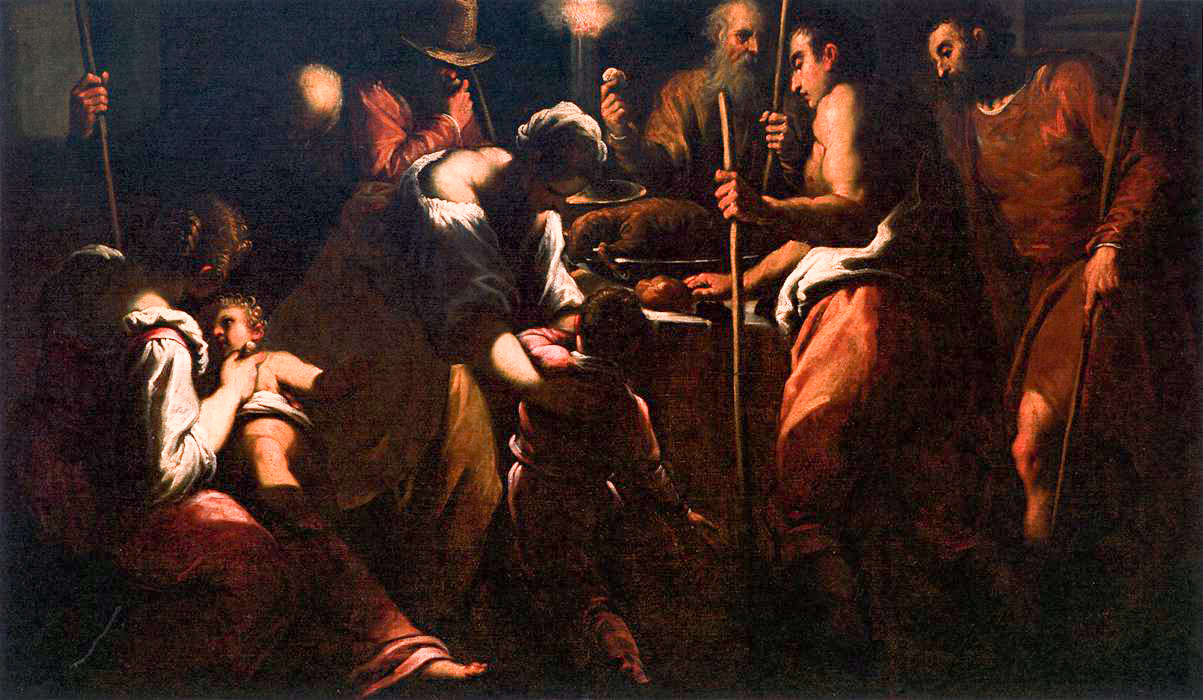
    The Paschal Lamb (1580-1581), Palma il Giovane | Wikimedia Commons.

    Jesus instituted the greatest sacrament, the Eucharist, during the Last Supper (as St. Paul recounts in the second reading). Let’s consider how the Word of God prefigured the meal of the Eucharist in the institution of the Passover meal. First, there is the regularity of the Passover meal — it is held annually on the 14th of the first month. For the Catholic Church, the Eucharistic meal is so much more central to our being that we celebrate it with every gathering (Mass), a regularity that has been instituted at least every Sunday. Next, the Word of God establishes the mark of purity for this meal; he prescribes that “The lamb must be a year-old male and without blemish.” Also, there is one lamb per family and it is to be slaughtered at twilight, at which point some of its blood is to be applied “to the two doorposts and the lintel of every house” where they “partake” of the lamb. What is the point of these prescriptive rituals? This is but one of many animal sacrifices described in the Old Testament, and part of the challenge for the Jewish nation was to uphold these prescriptions in order to display their faithfulness to God. This speaks to a certain type of ritual beauty that exists in its particularity for each sacrifice — whether those participating were in the desert, in the glorious time of King Solomon, or in the Babylonian Exile, each connected ritually with God in a way that is both shared yet particular to their place and time. In addition to instilling an appropriate thankfulness as the Jews recollect the original Passover, God was establishing a special place for the “unblemished lamb” in their cultural memory to be ready for the time when the Lamb of God, pure of sin, comes for his ultimate sacrifice.

    Eating the slaughtered lamb is an important part of the Passover ritual: “That same night they shall eat its roasted flesh with unleavened bread and bitter herbs.” The Word of God made flesh, Jesus Christ, establishes the full meaning of this ritual when he says, “This is my body that is for you. Do this in remembrance of me” (Mk 14:22, Lk 22:19, 1 Cor 11:24) and “Amen, I tell you, unless you eat the flesh of the Son of Man and drink his blood, you have no life in you” (Jn 6:53). As Christians, we understand the Passover lamb as the precursor (easier to understand and easier to “stomach”) to the true Paschal Lamb, Christ Himself.

    In the same way, we understand the Passover deliverance from the wrath of God that ravaged “every firstborn of the land, both man and beast” in Egypt as a precursor to Christ’s deliverance from the ravaging of every person on earth, condemning them to Gehenna. Our Eucharistic feast is a dense recollection of the great mystery of the Christ event: it is a gift from God, it is a joining of the food of life and the great sin-atoning sacrifice, it is a fulfillment of generations of Jewish ritual and God’s preparation of human hearts for his entrance into humanity. At the same time, it is real food, truly the flesh of the Lord present through the mystical action of the Spirit in our liturgy. The mysterious sacrament of the Eucharist, the heart of our Mass and the “source and summit of our faith,” can be plumbed endlessly for theological significance but more importantly provides real-world transformation of humanity.
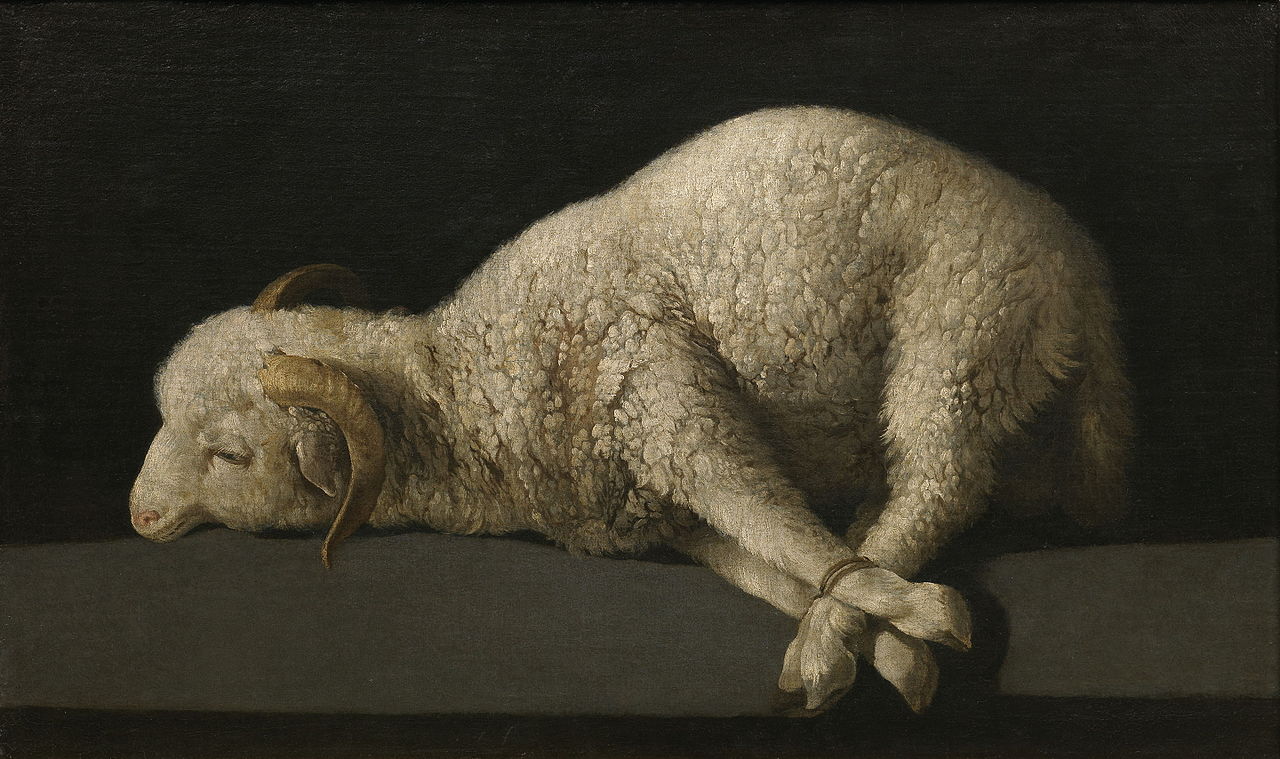
    Agnus Dei (1635-1640), Francisco de Zurbarán | Wikimedia Commons.

    A final instruction from God to Moses is important to note. He instructs the Jews to eat the Passover meal in a certain way: “with your loins girt, sandals on your feet and your staff in hand, you shall eat like those who are in flight.” This idea of being on the way to something greater, not tied to the things of this world, was embraced from the very beginning of the Church. Jesus tells his apostles on this Holy Thursday, “but because you do not belong to the world, and I have chosen you out of the world, the world hates you” (Jn 15:19).

    Peter acknowledges this transitory nature of our existence and our belonging to something other than this world in his epistle, “I appeal to you, my friends, as strangers and refugees in this world! Do not give in to bodily passions, which are always at war against the soul” (1 Peter 2:11). And, of course, St. Paul gives us a number of memorable passages related to this, including “Do not be conformed to this world, but be transformed by the renewing of your minds” (Rom 12:2). So, drawing on Jesus saying “I am the way, and the truth, and the life. No one comes to the Father except through me” (Jn 14:6), Christians very truly had their “loins girt, sandals on your feet and your staff in your hand” — in their thirst to follow Christ and be with the Father, they were “On the Way.” We read in the Acts of the Apostles that the earliest Christians referred to themselves as followers “of the Way” (cf. Acts 9:1-2).

    It’s incredible that the Last Supper, this pinpoint moment in a room with his Apostles, is the moment that the Word of God begins to reveal the true fulfillment of these ancient rituals. Yet there is also the drama of Judas’s betrayal and Christ’s effort to save Judas from this great sin (see yesterday’s reflection). Despite the knowledge of his entire ministry coming to an end and the drama of betrayal and denial by his closest friends, Jesus patiently goes about setting everything in order.

    Think about the to-do list here: giving his Apostles one last great moment of teaching, instituting the Eucharist, establishing the momentum for the Church to continue, leaving time to travel “to the mountain” (Mount of Olives) to have a prayerful encounter with his Father in anticipation of the Passion and Crucifixion ahead … all in a matter of a few hours! It’s remarkably, almost serenely organized.
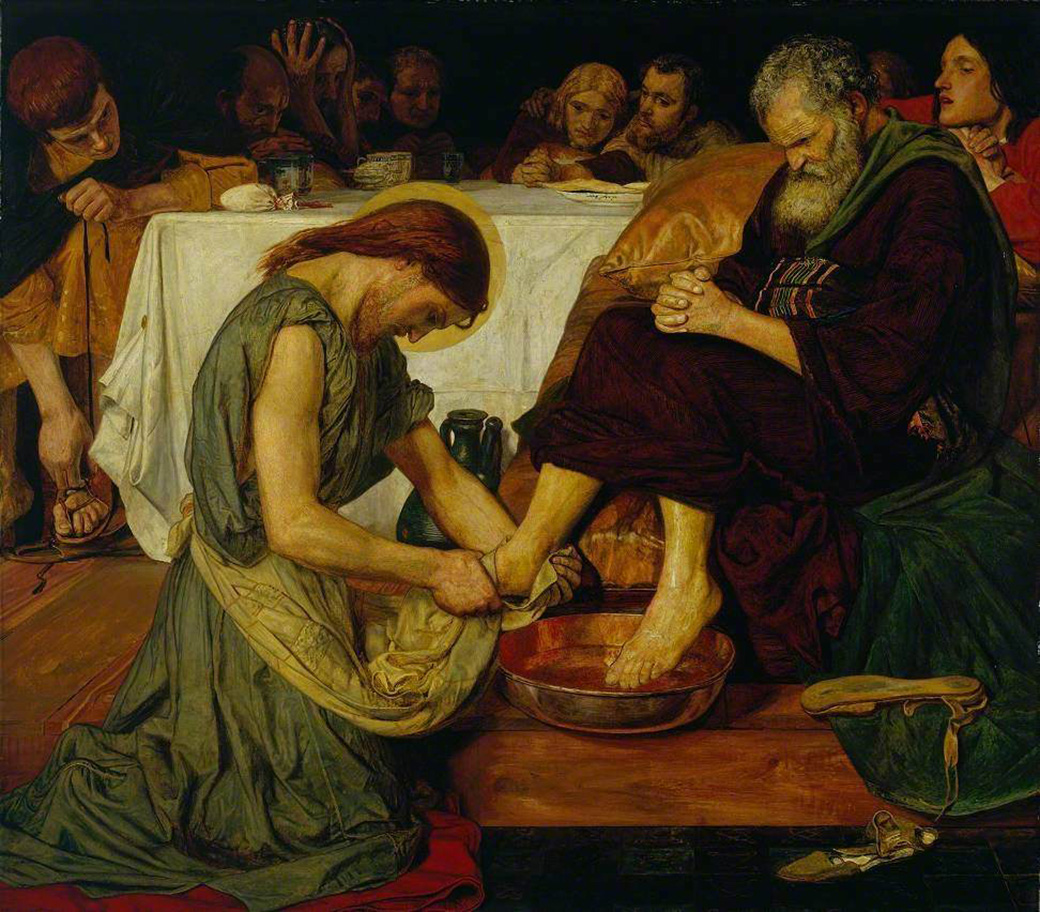
    Jesus Washing Peter’s Feet (1852-1856), Ford Madox Brown | Creative Commons, courtesy ArtUK/Tate.

    Today’s gospel focuses on Christ the servant, who “rose from supper and took off his outer garments. He took a towel and tied it around his waist. Then he poured water into a basin and began to wash the disciples’ feet.” St. Augustine of Hippo in Tractate 55 on the Gospel of John explains how each of these actions relates to something significant in the manner of his saving sacrifice. I’d like to use some of his ideas and some from other sources to consider this extraordinary action of our Lord.

    First, he rises from the supper and takes off his outer garments — as an action, this reminds me of his Resurrection to come and the garments found in the empty tomb, and as such this act of washing the feet is a salvific act akin to the Resurrection itself. St. Augustine also notes that “When about to be crucified, He was indeed stripped of His garments,” so we see a parallel in the Crucifixion, too.

    Indeed, Fr. Jean Corbon notes that the Crucifixion and Resurrection “are not two events, but two phases or moments of the same mystery” (Wellspring of Worship, 46).

    Next, Jesus ties a towel around his waist like a servant, and St. Augustine compares this to the larger humility of the Word of God taking on human form. Then, he doesn’t ask for some water in a bowl, but pours the water into the basin himself. St. Augustine notes that this is like how he “poured His blood upon the earth to wash away the filth of their sins,” and I see a clear parallel to the endless pouring out of love, of the water of everlasting life, that flows continually between the three Persons of the Trinity (as we have explored in several previous reflections).

    Finally, there is the washing of the Apostles’ feet. This lowly act of a servant is important for Jesus to model for his apostles, so much so that he tells Peter that he’ll tell him why he’s doing it after it is done, so as to not disrupt the action by discussing it. St. Augustine notes that he even deigns to wash Judas’s feet: “the greatness of His humility should be still further enhanced by the fact that He did not esteem it beneath His dignity to wash also the feet of one whose hands He already foresaw to be steeped in wickedness.”
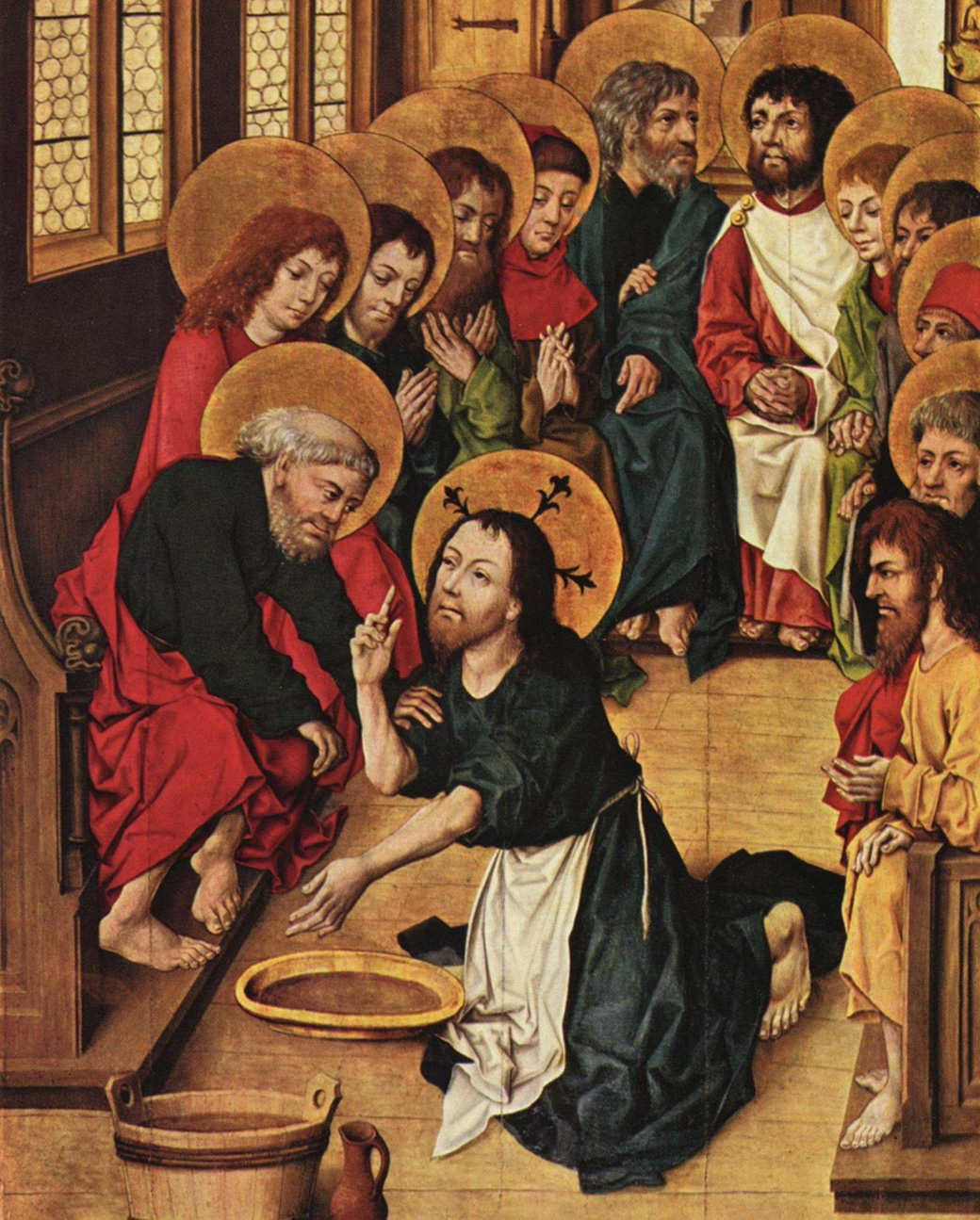
    Detail from Christ Washing the Feet of the Apostles (1475), Meister des Hausbuches | Wikimedia Commons.

    Peter’s reaction is typically passionate and vacillatory. First, he says, “You will never wash my feet” because he thinks it is too far beneath his Lord and Savior. After hearing that he needs it or he will “have no inheritance” with Christ, Peter pulls a quick 180° turn: “then not only my feet, but my hands and head as well.”

    Oh, Peter. Your heart is in the right place, but sometimes it seems like you have no check on your mouth.

    But Jesus uses Peter’s outbursts to teach us something important: “Whoever has bathed has no need except to have his feet washed, for he is clean all over.” What can this cryptic message mean? If we have bathed are “clean all over,” aren’t our feet clean, too? When I think of the feet, I think of those things that ground us, both literally and in our faith (faith means to “stand on firm ground” of that which we can’t prove, as Cardinal Joseph Ratzinger writes). And I think of those things that keep us on the move, signifying that we are agents of action in the world. Why do these appendages that ground us and yet move us require refreshment and purification before we sit down at table with our Lord?

    In his homily for Holy Thursday on March 20, 2008, Pope Benedict XVI gives us a great explanation of this response from Jesus:

    Yet here, with the distinction between bathing and the washing of the feet, an allusion to life in the community of the disciples also becomes perceptible, an allusion to the life of the Church. It then seems clear that the bathing that purifies us once and for all and must not be repeated is Baptism – being immersed in the death and Resurrection of Christ, a fact that profoundly changes our life, giving us as it were a new identity that lasts. … It seems to me that the First Letter of St John gives us the key to understanding [the “washing of the feet”]. In it we read: “If we say we have no sin, we deceive ourselves, and the truth is not in us. If we confess our sins, he is faithful and just, and will forgive our sins and cleanse us from all unrighteousness” (1: 8ff.). We are in need of the “washing of the feet”, the cleansing of our daily sins, and for this reason we need to confess our sins as St John spoke of in this Letter. We have to recognize that we sin, even in our new identity as baptized persons. We need confession in the form it has taken in the Sacrament of Reconciliation. In it the Lord washes our dirty feet ever anew and we can be seated at table with him.

    I think Pope Benedict XVI’s analysis is spot-on, and fits with this idea of the feet grounding us in faith. The liturgy, where we are “at table with the Lord,” is the wellspring for our faith to be continually renewed, refreshed, and purified. These feet, doing the work of carrying us and our Christian message around the world to all those we meet, will of course get dirty and need to be re-washed.

    So much meaning condensed in such a humble act! As Jesus asks when he is finished, “Do you realize what I have done for you?” Jesus brings the whole mystery of the Word of God’s descent into humanity into this act of a servant for his apostles. He signals this when he says, “You call me ‘teacher’ and ‘master,’  and rightly so, for indeed I am.” Remember his words from St. Matthew’s gospel back in the second week of Lent: “Call no one on earth your father; you have but one Father in heaven. Do not be called ‘Master’; you have but one master, the Christ” (Mt 23:9-10; see the reflection Led by the Master). In other words, he is invoking his own teaching to re-establish here that the Christ, the Messiah, is speaking.

    And what he says: “If I, therefore, the master and teacher, have washed your feet, you ought to wash one another’s feet. I have given you a model to follow, so that as I have done for you, you should also do.” We must understand his washing of feet as both the humility/action of a servant as well as a metaphor for a specific type of service related to the ritual cleansing in confession. As Pope Benedict XVI also says in his Holy Thursday homily: “We must wash one another’s feet in the mutual daily service of love. But we must also wash one another’s feet in the sense that we must forgive one another ever anew.”  
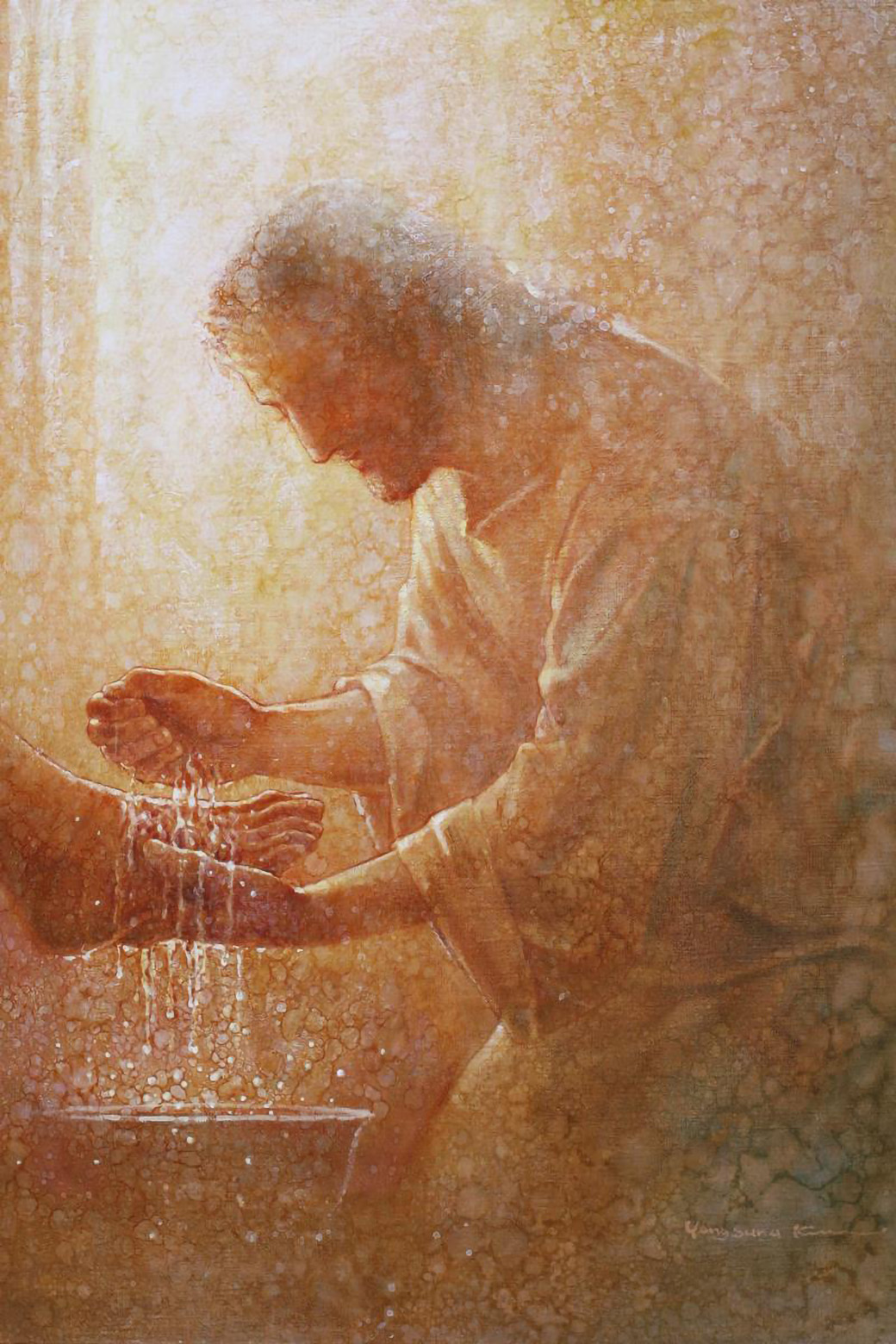
    The Servant (2000s), Yongsung Kim | image from lighthaven.net.

    And thus the Holy Thursday action of Christ in washing his apostles’ feet is a crucial act of establishing the Church. The ultimate mystery of his Death and Resurrection will usher in a new age, a New Covenant, a new opening of Heaven for humanity. But before this saving action is done, Christ sets his Church in motion through his Apostles, giving them the appropriate method, intention, and understanding of what it means to pour out love for one another in an endless example of agape on earth, irresistibly drawing people to God.

  • Bridging Salvation History with a Serpent

    Bridging Salvation History with a Serpent

    Tuesday in the Fifth Week of Lent: Numbers 21:4-9, John 8:21-30.

    Today’s readings present us with a seminal scene from the Old Testament that bridges the entire span of salvation history from the Garden of Eden to Christ’s Paschal Sacrifice on the Cross. In the gospel, Jesus speaks of himself in terms of the actions of Moses in the Old Testament reading, and in this way, the two passages — 1,475 years apart — shed light on one another.

    Serpent illustration by Katie Scott | courtesy katie-scott.tumblr.com.

    The passage from the Book of Numbers is exceedingly odd at first glance: the Lord punishes the Israelites for complaining by sending poisonous serpents among them; upon their admission of guilt and atonement, Moses prays for deliverance, after which God instructs him to mount a serpent on a pole; subsequently, when the people look up at the serpent on the pole after being bitten, they are spared from death. What kind of witchcraft is going on here? A magic serpent staff to ward off a plague of poisonous snakes?

    Let’s slowly interrogate this story to understand what’s going on. First, what is this great sin that deserves a plague of poisonous snakes? On one hand, it seems like somewhat innocuous, albeit irritating, grumbling. We hear, “But with their patience worn out by the journey, the people complained against God and Moses.” This is just human nature, right? However, it wasn’t general complaining, it was complaining specifically against God and Moses. It showed a lack of trust, despite the wonders given to them in escaping Egypt, encountering God on Mt. Sinai, receiving the commandments, being given manna and quail and water from a rock.

    Mistrust in the midst of wonders — does this remind us of anyone? How about Adam and Eve? And who plants the seeds of mistrusting God in the mind of Eve but the serpent? Thus, God’s sending of the serpents is the reminder of humanity’s original sin in mistrusting God’s providence and grace.

    It would be fair to say that the serpent is the symbol of humanity’s sin against God. This sin is poisonous and it brings about the reign of death. The people repent and say to Moses, “We have sinned in complaining against the LORD and you. Pray the LORD to take the serpents away from us.” The first requirement in the recipe for God’s mercy has been met: contrition. Next comes Moses’s prayer, followed by divine mercy in the form of … well, another serpent. God instructs Moses to “mount it on a pole, and whoever looks at it after being bitten will live.”

    The Word of God truly seems baffling here, operating on a level that is not immediately evident. Nonetheless, being the obedient servant of God that he is, Moses complies with the Lord’s instructions, “and whenever anyone who had been bitten by a serpent looked at the bronze serpent, he lived.” The act of looking up, heavenward, to the sign of the sin they lived with, is the action that reminds them of their dependence on God and his saving mercy.

    God’s divine mercy flows to the sinful, bitten individual in that moment, not through the arcane power of a bronze staff, but through the symbol that the staff presents to the Jewish believers in God. As Catholics, we know well that in the liturgy, divine sanctification works in and through symbols, from the altar and ambo to the bread and wine. The bronze serpent on the staff is this type of sacramentalized symbol that his prophet on earth made under his instruction.

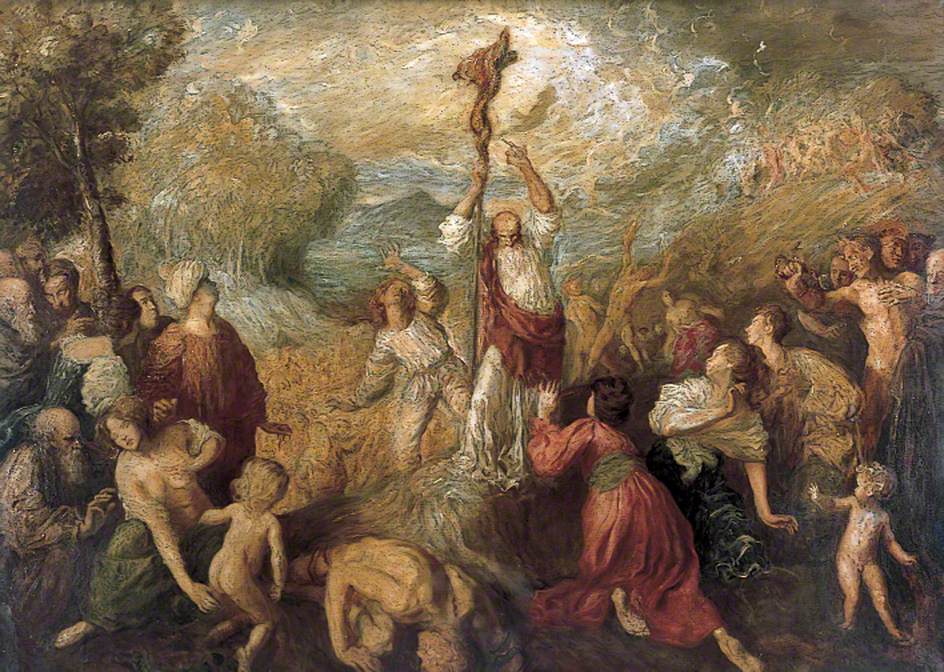
    Moses and the Brazen Serpent (1898), Augustus John | Creative Commons, courtesy UCL Art Museum/ArtUK. I like the impressionistic style Augustus John employs in this painting, the flowing waves in the forms suggesting a divine entrance into the fabric of humanity. As with any encounter with the divine, sin will merit pain and “gnashing of teeth,” and the purifying energy of God may not be pleasant for those in sin. I also see a bit of the devil in the bare-chested man on the right side of the canvas, which for me, at least, recollects the Garden of Eden connection. 

    The Jews understood the symbolic and importance of this staff as a way to encounter God’s grace and kept it around for centuries. They may have begun to confuse the symbolic function of the staff with a divine presence, however, because 740-ish years later we read in 2 Kings that King Hezekiah orders the destruction of the staff, which he calls Nehushtan (“a mere piece of brass”) because the Jews were burning incense to it and essentially treating it like an idol. 

    Now I don’t know much about divine numerology, but I do find it interesting that exactly another 740-ish years later, we hear Jesus tell Nicodemus the Pharisee: “just as Moses lifted up the serpent in the wilderness, so must the Son of Man be lifted up, that whoever believes in him may have eternal life” (Jn 3:14-15). With this statement, the Word of God doesn’t just restore the symbolic importance of the serpent staff, he also reveals the full scope of this symbol Moses was instructed to make.

    “Just as Moses lifted up the serpent” — note that the parallel being drawn is to the fixing of the serpent to the pole and lifting it up, not to the serpent itself (in other words, Jesus is not comparing himself to a serpent!). “So must the Son of Man be lifted up” — this refers to his crucifixion, where he becomes the ultimate symbol for humanity; and note that he refers to his human nature here when saying “Son of Man” to emphasize that the same sin symbolized by the serpent is being affixed to the cross in the sins of the human person, for which Jesus stands in as a sacrificial lamb.

    And finally the salvific import: “that whoever believes in him may have eternal life.” Just as the Jews who were sinful and bitten by snakes saw the staff were reminded of their belief in God and were saved from dying at that moment, we have an infinitely greater promise and divine grace given to us when we behold Christ on the Cross, believe in him, and are granted eternal life that eradicates all sway of death, as if it is only sleep by another name (as we explored in the reflection, See the Glory of God).

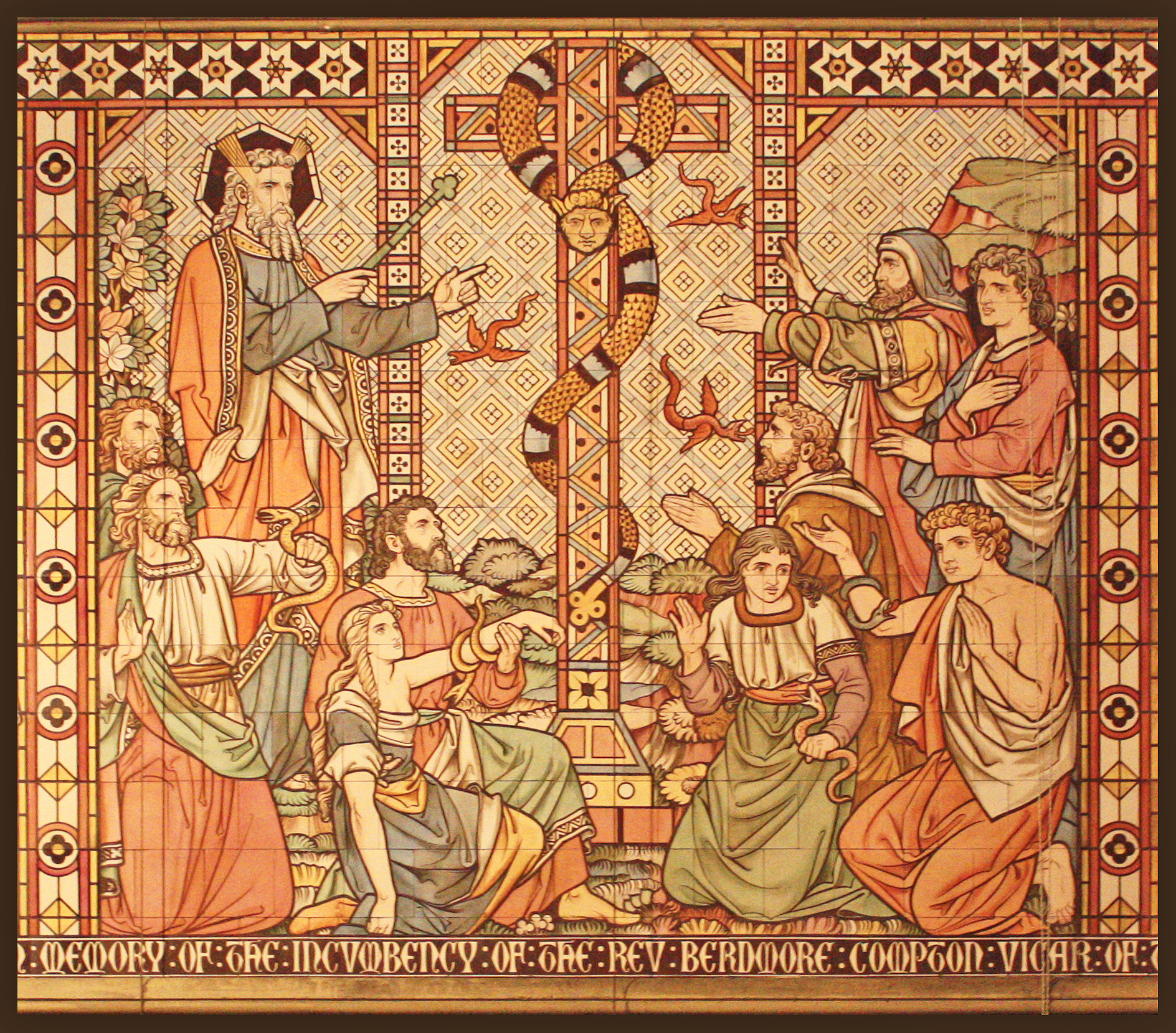
    Moses and the Bronze Serpent, mural in All Saints Margaret Street church in London (1889), tiles painted by Alexander Gibbs | photo courtesy Lawrence OP, flickr.com. Note that over the centuries, the connection of the bronze serpent and the cross has been made much more explicitly, as in this tile work.

    Sometimes the scope of God’s saving plan is just breathtaking. So many moments of patience and mercy over the millennia, from Adam and Eve, through Moses, and ultimately Jesus Christ. And so subversive of our normal worldly affections, too, in the use of the lowly and hated serpent as a resounding symbol for overcoming sin, much like using the reviled Cross as a throne for our Savior.

    All of this brings us to today’s gospel, where Jesus tells the Pharisees “if you do not believe that I AM, you will die in your sins.” This is one of a series of super bold statements John reports of Jesus. It doesn’t get much more blunt than this; by invoking the name of YAHWEH in reference to himself (I AM Who I AM), Jesus is clearly saying that he is God as well as a man. Plus, he tells them that only a belief in him as God will save them from dying in sin. We can hear echoes of his conversation with Nicodemus, “whoever believes in him may have eternal life.” His message is consistent and resounding: he is to be the symbol of sin pinned down, raised up on a Cross in hatred by men, but in reality a sacrament of God’s grace and love. This is the Word of God writ large in the temple; this is stunning.

    The Pharisees don’t get it. All they can say is, “Who are you?” The scribes and Pharisees in John’s gospel seem to be stuck in this morass of defining Jesus’s provenance. Later in this chapter, they will say, “Aren’t we right in saying that you are a Samaritan and demon-possessed?” And we’ve already heard them get hung up on their belief that the Messiah could never come from Galilee. Over and over, Jesus tries to tell them that he is from the one “who is true,” that His Father is in heaven. But this truth is too radical, too supernatural, too blasphemous in their minds to even compute.

    Jesus tries again in today’s reading to make Himself clear:

    When you lift up the Son of Man,
    then you will realize that I AM,
    and that I do nothing on my own,
    but I say only what the Father taught me.
    The one who sent me is with me.
    He has not left me alone,
    because I always do what is pleasing to him.

    Again, it is simply stunning to me how he refers to himself as “I AM” and constantly puts the focus back on God the Father. It is plain as day. Whoever tries to tell you that Jesus was a social rabble-rouser and malcontent, like so many other “Messiahs” at this point in history, well that person needs to read the Bible a little more closely. What political activist uses his moment in the limelight to say “I do nothing on my own but I only say what the Father taught me”?

    He does not seek glory and he has hard teachings (such as eating his Body and drinking his Blood for salvation) that push away many would-be followers. And he literally schools the experts in Jewish law (see yesterday’s post), establishing his own wisdom and command over divine teaching. Finally, we have his selfless, miraculous death and resurrection, when the Son of Man is raised like the serpent staff of Moses for us to gaze upon. 

    Our only job at this point is to believe. To fully believe after we have been given such wonders. Let us not be like Adam and Eve and mistrust God in the midst of the wonders we are given. Let us not be like the Israelites in the Exodus who do the same. We are a new people, the Church, in a New Covenant, and have been given the greatest sacrament of all.

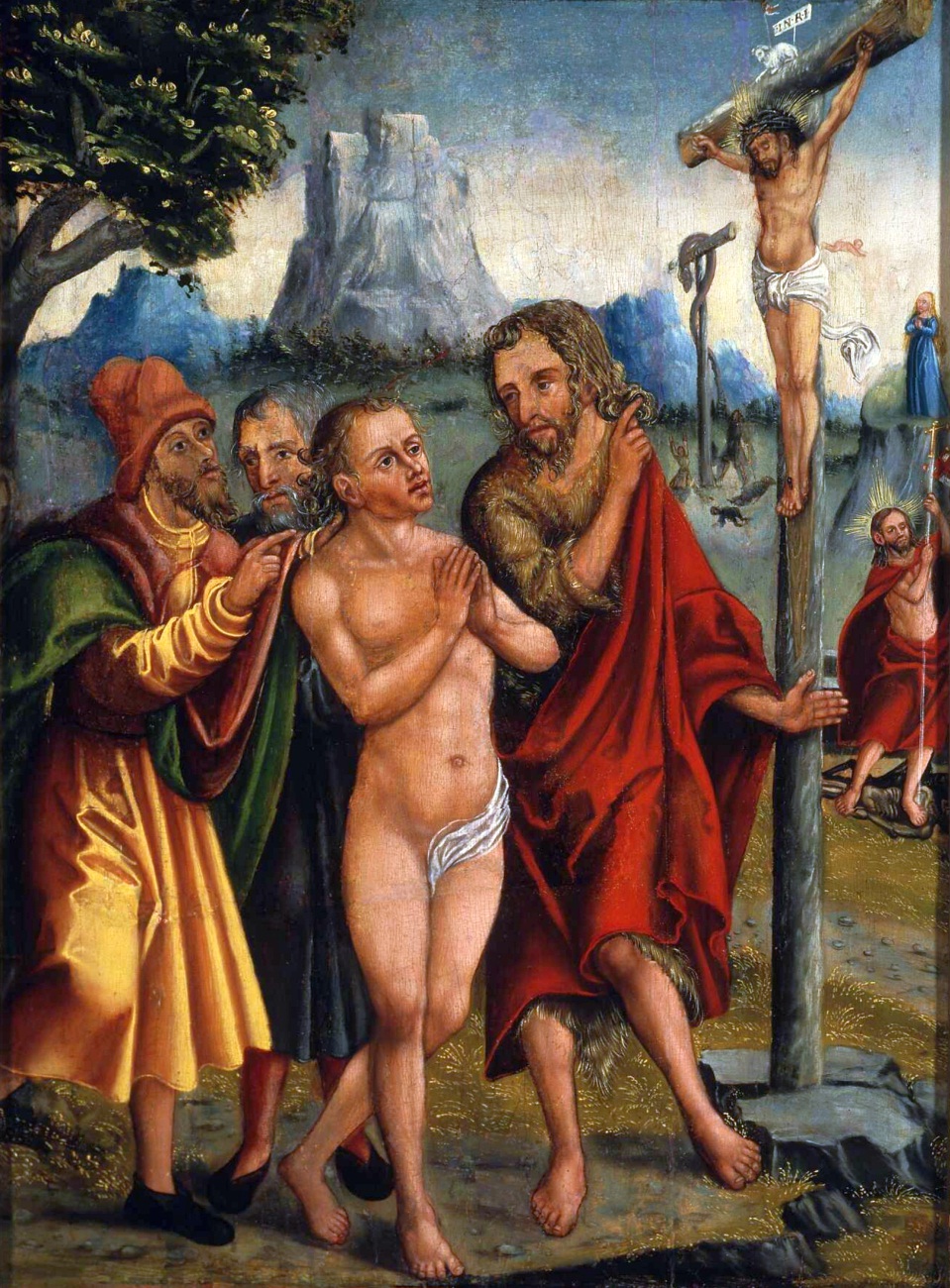
    Allegory of Salvation (c.1555), Antonius Heusler | Wikimedia Commons. The description states: John the Baptist makes a man (Adam), clothed only with a loin cloth aware of the crucified Jesus. Behind the man are standing Isaiah and an apostle. In the background are shown the Brazen Serpent, the Annunciation to the Virgin and Christ triumphing over Death and the Devil.
  • Water from the Temple

    Water from the Temple

    Tuesday in the Fourth Week of Lent: Ezekiel 47:1-9, 12, John 5:1-16.

    Water figures strongly in today’s readings. Water is the great bringer of spiritual purification and cleanliness. God’s law prescribed that Jews must ritually purify themselves in water before partaking in everything from meals to sacrifice before the Lord. Water is also the substance of physical life, sustaining humans and all of creation.

    We reflected at length on the connection between the life-giving and spiritual-purifying aspects of water as presented to us in the story of Jesus at Jacob’s well with the Samaritan woman (see If You Knew the Gift!). Today, we see how water figures in prophecy about the Kingdom of God, specifically in the person of Jesus Christ.

    Ezekiel, writes during the Babylonian Captivity around the years 596-574 BC, like the events found in the Book of Daniel. Ezekiel is given prophetic visions from the Lord about both the destruction of Jerusalem and the rebuilding of the temple. Remember that the temple in Jerusalem was the heart of the Jewish faith, where the presence of God dwells. It had supreme importance for them, and the destruction of the temple along with all of Jerusalem was a catastrophic event. Thus, when we hear of a rebuilt temple, we must understand that this is a restored connection with the presence of God.

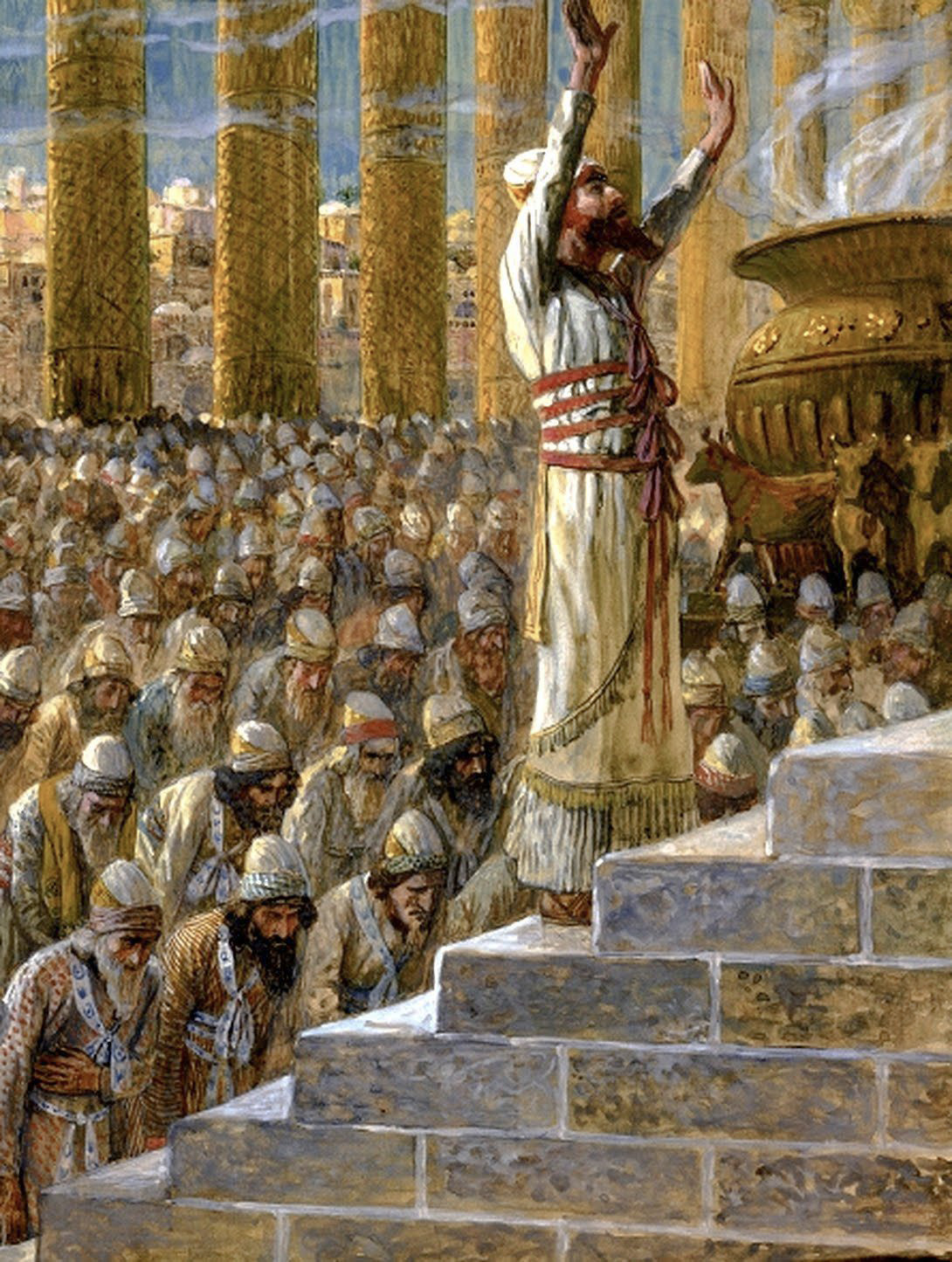
    Solomon Dedicates the Temple at Jerusalem (c.1896-1902), James Tissot or followers | Wikimedia Commons.

    Today’s reading is part of Ezekiel’s vision of the restored temple; an angel shows him “water flowing out from beneath the threshold of the temple toward the east,” which is the direction that the temple faces. The angel takes him away from the temple and the water builds and deepens, first into a stream and then into a mighty river. In the east, it reveals its life-giving nature, it “empties into the sea, the salt waters, which it makes fresh. Wherever the river flows, every sort of living creature that can multiply shall live.”

    This type of imagery should be familiar to us. We have explored how Jesus tells the Samaritan woman that he provides “life-giving water.” It is the endless river of life flowing from the Trinity, the “self-opening of our Thrice-Holy God,” as Fr. Jean Corbon, OP puts it. The river in Ezekiel’s vision, therefore, we can understand as the same river of life that St. John will see in the heavenly Jerusalem in the Book of Revelation. This is the eschatological vision of the river: the life abounding in the river is everlasting life.

    In this eschatological vein, let’s examine the importance of the direction of the east that Ezekiel takes great pains to emphasize. One of our Church Fathers, Origen, explains why the direction of the east is important to us:

    “Atonement comes to you from the east. From the east comes the one whose name is Dayspring, he who is mediator between God and men. You are invited then to look always to the east: it is there that the sun of righteousness rises for you, it is there that the light is always being born for you. You are never to walk in darkness; the great and final day is not to enfold you in darkness” (Hom. 9, 5. 10: PG 12, 515. 523.).

    For centuries, this is why Catholic churches have been built with the altar facing the east. We worship in the direction of Christ, the “sun of righteousness” rising for us, where “light is always being born” for us. 

    This brings us to the physical nexus of Ezekiel’s vision. Recall that he is describing the temple. The saving nature of the river, deep and wide in the east, points to the sacred nature of the temple. Since the river starts in the temple, our experience of divinity starts in the temple. This building (like our Catholic churches) is important because it is our physical place where we encounter God.

    In Christ, though, the physical and the divine co-exist. This changes everything, and even while Ezekiel was a devout proponent of all kinds of traditional Jewish religious prescriptions, his mystical vision inexorably points to a new temple that is nothing the traditional Jewish faith could envision. God is presenting him with a vision of the new temple in the person of Christ.

    River in Saint-Clair (1908), Henri-Edmond Cross | Creative Commons, courtesy Wikiart.org. How can we imagine the divine river of life? This work of pointillism stimulates my imagination.

    At many points in Christ’s ministry, he tells us how he is establishing a new priesthood (with Peter and his apostles), a new sacrifice to replace all other ritual sacrifices (the Eucharist as initiated at the Last Supper), and a new direct communion with God through himself. Most strikingly, he not only identifies himself with the temple, but being greater than the temple: “I tell you, something greater than the temple is here. … For the Son of Man is lord of the sabbath” (Mt 12:6, 8).

    He is not abolishing physical buildings for worship, but he is re-defining the symbolic and religious meaning that the Jews placed on Jerusalem’s temple. This is most evident when the temple shroud is ripped in half and the earth shakes when he dies on the Cross. Brent Pitre, PhD, explains the importance of these events: “with the tearing of the Temple veil and the earthquake—the whole universe, ‘heaven and earth,’ were symbolically being torn asunder” (Jesus, the New Temple, and the New Priesthood, p.63). Again, with Jesus being the physical union of divinity and humanity, everything changed.

    Pitre’s article referenced above is a great academic deep-dive into the implications of Jesus replacing the Jewish concept of the temple in Jerusalem. He traces the depth of the temple in Jewish consciousness: “From a theological and liturgical perspective, for a first-century Jew, the Temple was at least four things: (1) the dwelling-place of God on earth; (2) a microcosm of heaven and earth; (3) the sole place of sacrificial worship; (4) the place of the sacrificial priesthood” (48). It’s worth a read if you’re interested in exploring this further, and it certainly underscores the radical nature of Christ’s message for the Jewish people.

    One last item to note from Ezekiel’s vision: the fruit born by the trees growing on the banks of the river has a life beyond the river. He says, “Every month they shall bear fresh fruit, for they shall be watered by the flow from the sanctuary. Their fruit shall serve for food, and their leaves for medicine.”

    As we have explored in previous reflections, Jesus counsels us in discerning between good and bad prophets, “by their fruits you will know them” (Mt 7:20). The idea is that the fruit reveals the heart of the person: “every good tree bears good fruit, but the bad tree bears bad fruit” (Mt 7:15). Thus, when Ezekiel tells us that the fruit growing on the banks of the river of life “shall serve for food and their leaves for medicine,” the Word of God is telling us that those who are fed by this divine river will be transformed in goodness, in turn feeding and healing those in the world. This is the action of God’s mercy and agape as he works his will through us.

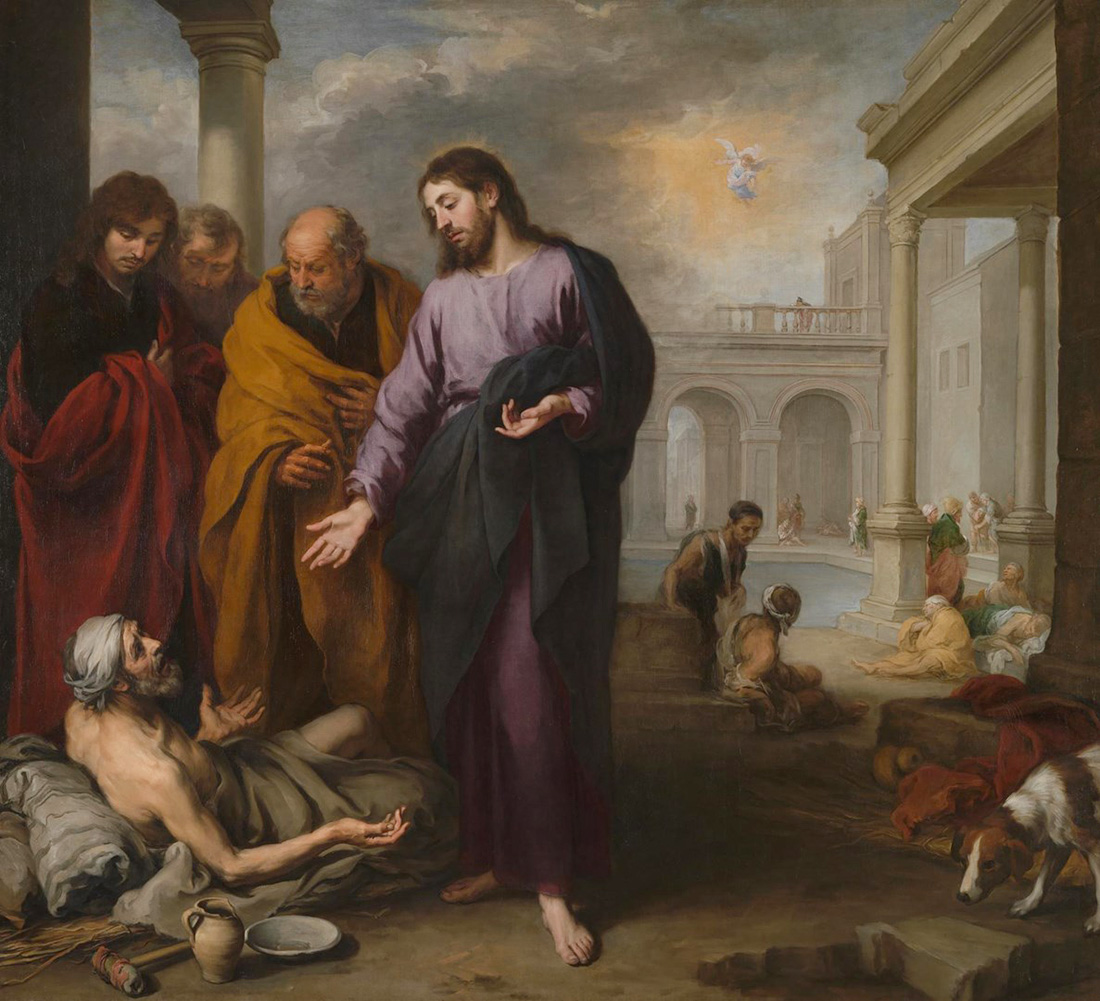
    Turning to today’s gospel reading, we find the incarnate Word of God in Jerusalem for a Jewish feast day and he is by the Sheep Gate. This likely references the sheep market where people could buy sheep for sacrifice at the temple. There are also pools there, presumably used to ritually wash the animals before they were used in the temple. “In these lay a large number of ill, blind, lame, and crippled. One man was there who had been ill for thirty-eight years.”

    A few things are being conveyed to us. First, Jesus is drawn to the place where the outcasts go in a bid to purify themselves like the sacrificial animals. More than simply outcasts, they were spiritually unclean in the Jewish mind. They exhibit a certain desperation in waiting for a “stirring” of the waters by an angel whereby the first one in the water is cleaned by divine action. We might be reminded of the story of the Canaanite woman begging for Christ’s mercy and healing: “Even the dogs eat the crumbs that fall from their master’s table” (Mt 15:27). 

    But here there is even deeper symbolism because this is the temple, these are waters meant to be used for purification in order to give sacrifices to the Lord. When Jesus asks the paralytic “Do you want to be well?” the man answers pitiably, “I have no one to put me into the pool.” He does not ask the Lord to heal him, for he does not recognize who he might be. He simply laments his predicament. Despite his pitiful state, the man has undiminished hope and faith, having been ill for 38 years.

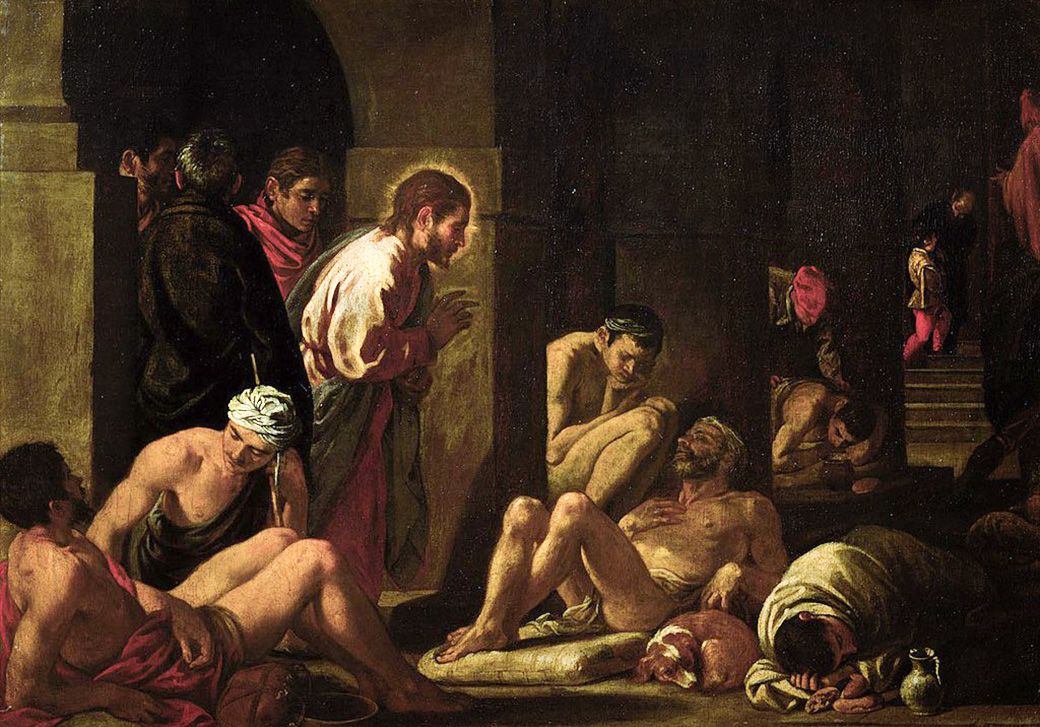
    Christ Healing the Sick at the Pool of Bethesda (c.1615-1620), Pedro Orrente | Wikimedia Commons.

    Given the logic of healing stories, we might expect that Jesus will be the one to “put him into the pool,” perhaps after first asking for his faith in God. But that’s not what happens. Jesus has something deeper to say and do. He instead says, “Rise, take up your mat, and walk.”

    Several things happen here. First, Jesus cuts through the ritual nature of the temple, displayed in this outlying washing pool for sacrificial animals and the infirm where the first one in the pool gets healed. He establishes a new, direct connection to healing in himself. This is underscored by his instruction to “take up your mat,” which provides a temporary dwelling place for the man in the temple. That dwelling is no longer needed.

    Second, he provides the divine energy personally to the man so that he can rise by himself and walk on his own. The river of life enables us to “bear fresh fruit” of our own. The man is enabled to be fully human, blossoming in the love of God.

    Third, Jesus performs an act of healing on the Sabbath. The Jews, particularly the Pharisees and scribes, will use this act of “work” on the Sabbath to persecute and eventually arrest Jesus. It is a major theme of the gospels, and juxtaposes their hangups with particularities of the law while disregarding the Spirit of God among them.

    But have you ever wondered that Jesus might be intentionally healing on the Sabbath, not just doing his ministry as if it were any other day? Let’s return to the quote from Matthew I referenced earlier: “I tell you, something greater than the temple is here. … For the Son of Man is lord of the sabbath” (Mt 12:6, 8). Christ is establishing in himself, here at the temple in today’s reading, what he says in that passage from Matthew. Here, in the temple, he does the “work” of replacing the temple through his own saving person and mission. As the Lord of the Sabbath, united with God to whom the sacrifice is being offered, he releases humanity from our ritual debt of sin offerings and atonement.

    In yesterday’s Office of Readings, we read the account from Leviticus on the complicated ritual for Yom Kippur, the Day of Atonement, with all of its purifications, sacrifices, and sprinkles of blood. Notably, one lamb was to be sacrificed to God while the other was to have all of the Jews’ sins cast upon its head and released into the desert as an offering to Azazel (a fallen angel, much like Satan). In today’s readings, we encounter sheep at the Sheep Gate — literal sheep, the infirm who are the pitiful sheep lost to their people, and the Lamb of God Himself. The Lamb of God replaces all of these sacrificial sheep and he saves those lost sheep.

    Christ Healing the Paralytic at the Pool of Bethesda (1667-1670), Bartolomé Esteban Murillo | Creative Commons, courtesy The National Gallery (UK).

    Yesterday’s Office of the Readings also gives us Origen’s commentary (quoted earlier). Here is another important link from Origen:

    “God taught the people of the old covenant how to celebrate the ritual offered to him in atonement for the sins of men. But you have come to Christ, the true high priest. Through his blood he has made God turn to you in mercy and has reconciled you with the Father. You must not think simply of ordinary blood but you must learn to recognize instead the blood of the Word. Listen to him as he tells you: This is my blood, which will be shed for you for the forgiveness of sins.“

    Once again, we encounter Christ in all his fullness today, enacting his saving mission with every word and deed. We must strive to see the mystery hidden deep within each passage from the Word of God. Jesus gives us a profound understanding of the water that flows from the new temple: it is him, it restores our humanity and enables a new communion with the divine. 

  • Mercy is the Master Principle

    Mercy is the Master Principle

    Tuesday in the Third Week of Lent: Daniel 3:25, 34-43, Matthew 18:21-35.

    Today, we read a parable about God’s great mercy and the expectation that we will, in turn, extend that mercy to each other. Mercy, we learn, is the great master principle upon which divine justice is built, and it is an action that stems not from the human heart, but from the heart of the Lord.

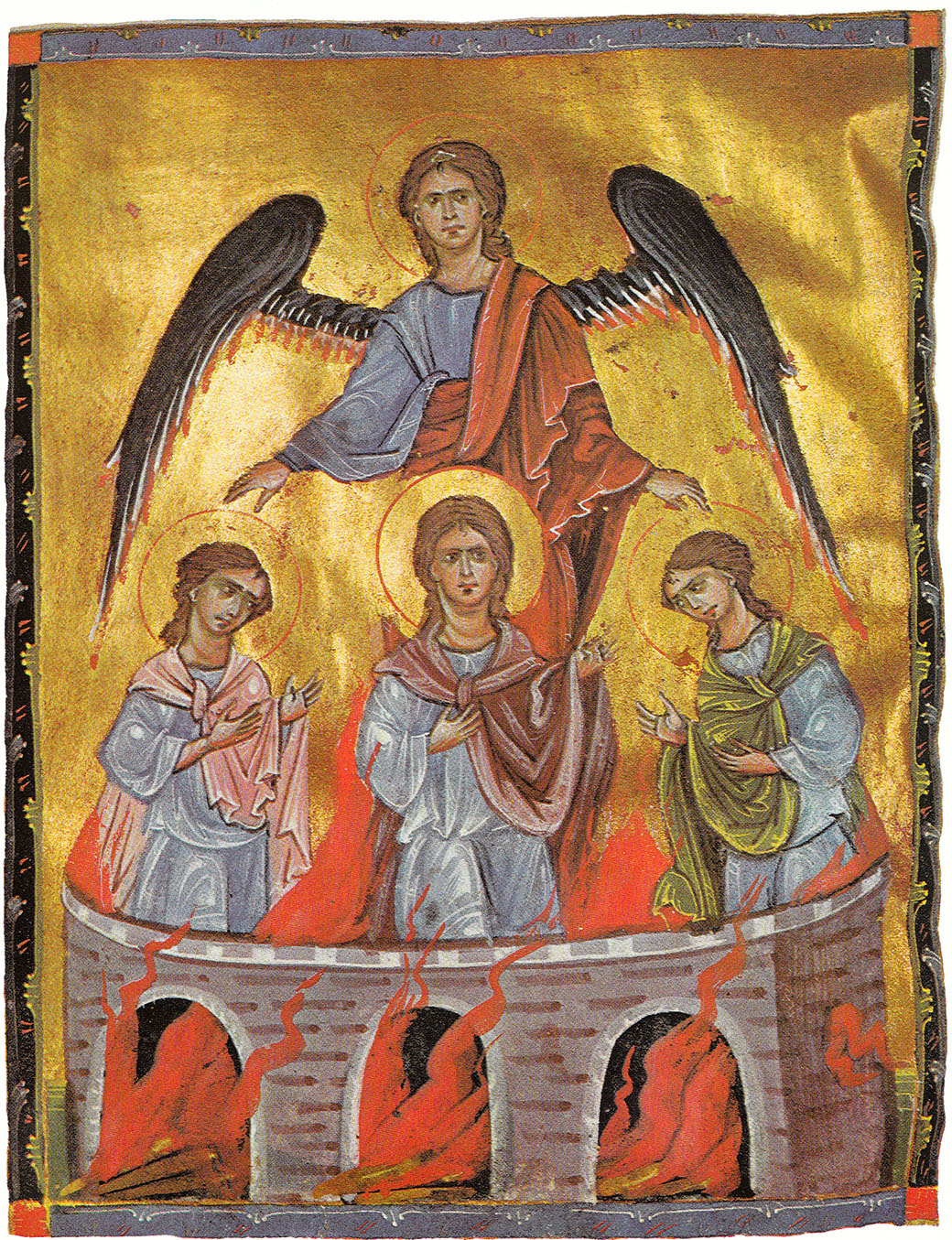
    The beginning of the book of Daniel, although written ~165 BC, details the stories of Daniel and his friends in Babylon around the year 600 BC. Today’s reading comes from the much-celebrated episode when the three young Jews Hananiah, Azariah, and Mishael are punished by Nebuchadnezzar for refusing to worship the gigantic golden idol he builds on the plain of Dura. They respond to the accusations against them by saying, “we have no need to present a defense to you in this matter. If our God whom we serve is able to deliver us from the furnace of blazing fire and out of your hand, O king, let him deliver us.” In a rage, he sentences them to be bound and cast into a fiery furnace so hot that it burns to death the men who throw them in.

    Fiery Furnace, Shadrach, Meshach, and Abednego (1266), Toros Roslin (circa 1210–1270), who was the most prominent Armenian manuscript illuminator in the High Middle Ages | Wikimedia Commons.

    We read the Prayer of Azariah in today’s readings, which he offers to God when they are inside the furnace. Importantly, Azariah prays not for the three of them, but for the entire nation of Israel, “for the sake of Abraham, your beloved, Isaac your servant, and Israel your holy one.” He notes how depleted Israel is (indeed, they’ve been conquered by the Babylonians and many have been dragged to Babylon). In a clear reference to the psalms, he says he has no offering but his “contrite heart and humble spirit.” (Psalm 51 reads: “For you have no delight in sacrifice; if I were to give a burnt offering, you would not be pleased. The sacrifice acceptable to God is a broken spirit; a broken and contrite heart, O God, you will not despise.”)

    Having declared his pure intentions, he says, “we fear you and seek your presence.” As we shall see in the gospel reading, this deep respect, this profound obeisance, is crucial to our request for mercy. The entire prayer reaches its climax with his appeal: “deal with us in your patience and in your abundant mercy. Deliver us in accordance with your marvelous works, and bring glory to your name, O Lord.” How important that Azariah understands that all must point back to God and his glory! He asks for deliverance not just out of a selfish desire for his own life, but knowing that Nebuchadnezzar would be amazed at the power of God to save his people.

    The reader of the Book of Daniel is held in suspense a bit longer. After the passage we read today, we hear that the king’s servants stoke the fire mightily, and it rises 49 cubits (73.5 feet!) above the furnace. The point is that God’s people are being purified. The fiery furnace is the symbol of ultimate trial by fire, which is only met and conquered in the Spirit, with a steadfast faith and fundamental reliance on God. They prove that their hearts are pure, focused on God, and they ask for his mercy. Thus, “the angel of the Lord came down into the furnace to be with Azariah and his companions, and drove the fiery flame out of the furnace, and made the inside of the furnace as though a moist wind were whistling through it.”

    Upon their deliverance, the three young men dance and sing in the furnace a great canticle of thanksgiving, one that we use in our liturgy: Week 1 Sunday Morning Prayer of the Divine Office, and repeated for each solemnity and other high feast days. The canticle is one of my favorites to chant during the Liturgy of the Hours because it starts by blessing God and then goes through all of creation, encouraging everything to bless the Lord. (Some of my favorites: sun and moon, fire and heat, dolphins and water creatures.)

    This canticle is important because Hananiah, Azariah, and Mishael not only model for us the correct approach and posture to have before God when begging for mercy, but also the correct response once you’ve received his mercy: sharing that mercy with all of creation.

    The Parable of the Unmerciful Servant in today’s gospel reading clearly depicts the other side of this coin. Today’s gospel reading begins with Peter asking Jesus how many times we should forgive someone. Jesus corrects Peter’s guess of seven (the number of perfection in Jewish numerology, and already a literal number that would test the most patient person) to say seventy times seven — essentially, an infinite number of times. He then explains the reasoning with the Parable of the Unmerciful Servant.

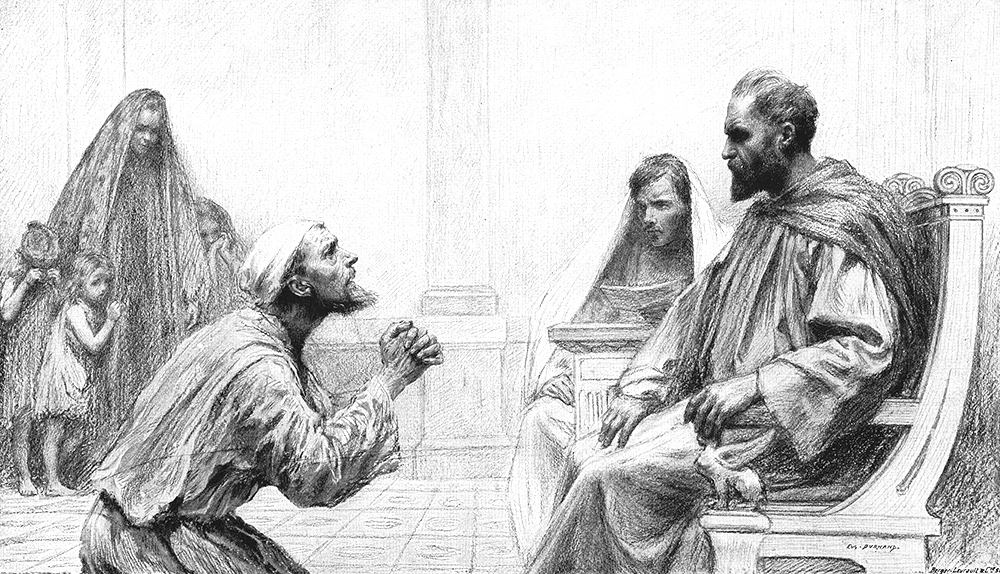
    The Unmerciful Servant (1908), Eugène Burnand | Creative Commons, courtesy eugene-burnand.com.

    Our lectionary reading says the servant owed the king “a huge amount,” although the scriptures specify “10,000 talents;” a talent is equal to 6,000 denarii, and since a typical Jewish laborer earned 300 denarii a year (1 denarius per day, 6 days per week, minus religious holidays), it would take around 200,000 years to earn 10,000 talents! Clearly, this is an impossible amount to pay back.

    The king proclaims a sentence according to the law, that he, his family and his property be sold. At this, “the servant fell down, did him homage, and said, ‘Be patient with me, and I will pay you back in full.’” Now, there is no way the king could expect to be paid back in full, but the servant follows the lead of Hananiah, Azariah, and Mishael in that he shows proper respect for and dependence on the king. The original Greek uses the verb προσεκύνει (a form of proskynesis), which is often translated as “worship” elsewhere in the Bible and means to bow on your knees in a display of supplication and reverence. 

    Further examination of the Greek helps us understand the exchange between the servant and the king. Erasmo Leiva-Merikakis writes in Volume II of his masterwork Fire of Mercy, Heart of the Word, “God responded at once to the servant’s plea because the man used one of God’s dearest names in adoration of him: ὁ Μακροθύμος—’the Long-suffering One’. The man’s plea is said to have affected the almighty King’s very viscera (σπλάγχνα), hidden under all his golden robes … ‘the Lord of that servant was viscerally moved to compassion’” (647-648).

    And the king goes beyond giving the servant time to repay, instead forgiving his entire debt! In this way, Jesus is describing God the Father in his overflowing forgiveness and mercy, far beyond even our expectations.

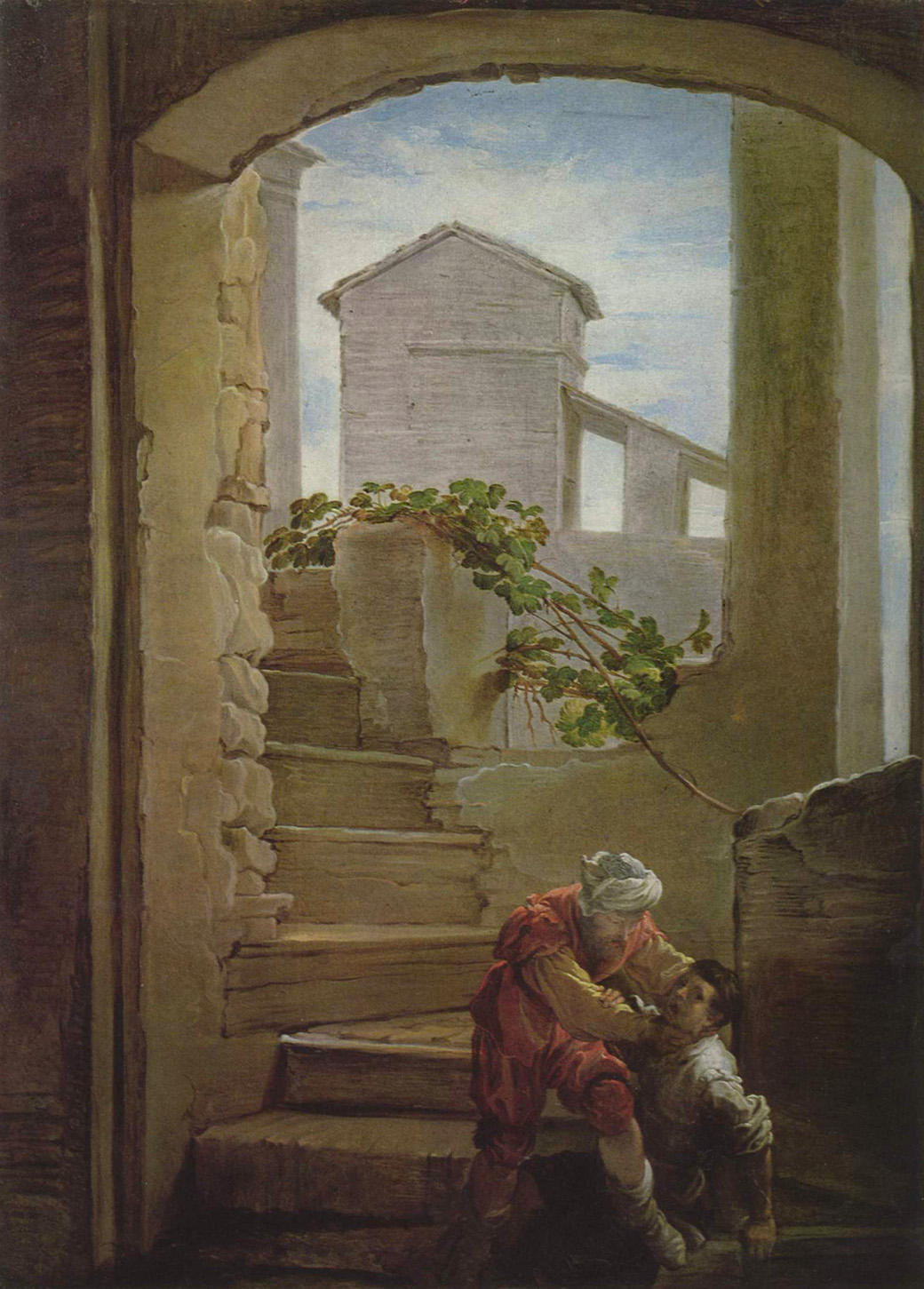
    The parable now turns on the actions of the forgiven servant. He finds a fellow servant who owes him a much smaller debt and instead of forgiving this debt in turn, as his king forgave him, he chokes him, refuses to show him mercy, and has him imprisoned. This is a grievous sin.

    Parable of the Wicked Servant (La parabola del servo malvagio), 1620, Domenico Fetti | Wikimedia Commons.

    The king’s action is not merely a good example for the servant. God’s mercy is a thing, alive, needing to course through us into the world. His mercy is the living force of love in the world. Leiva-Merikakis beautifully describes this, “Our vocation is to ignite conflagrations of love and forgiveness all around us. God’s light intends to be refracted through our being: it shines upon us not only for our own benefit, to dispel our own darkness, but also to stream through us and beyond us” (649). 

    As Leiva-Merikakis points out, God sharing his mercy implicates our very “vocation,” our purpose on the earth. And the kingdom reacts at the injustice, the perversion of Spirit in its midst: “Now when his fellow servants saw what had happened, they were deeply disturbed, and went to their master and reported the whole affair.” As Leiva-Merikakis writes, “Mercilessness looms as the primary enemy of the hierarchy of being as established by divine creation and decree” (653). In other words, God — as the fullness of mercy and goodness — fills us with mercy so that we, in turn, can allow the overflowing mercy to be shared with the rest of creation (this is what he means by “hierarchy”). Not sharing mercy with others is a cardinal sin, a “primary enemy.” This leads us to the conclusion of the parable and a glimpse of divine justice.

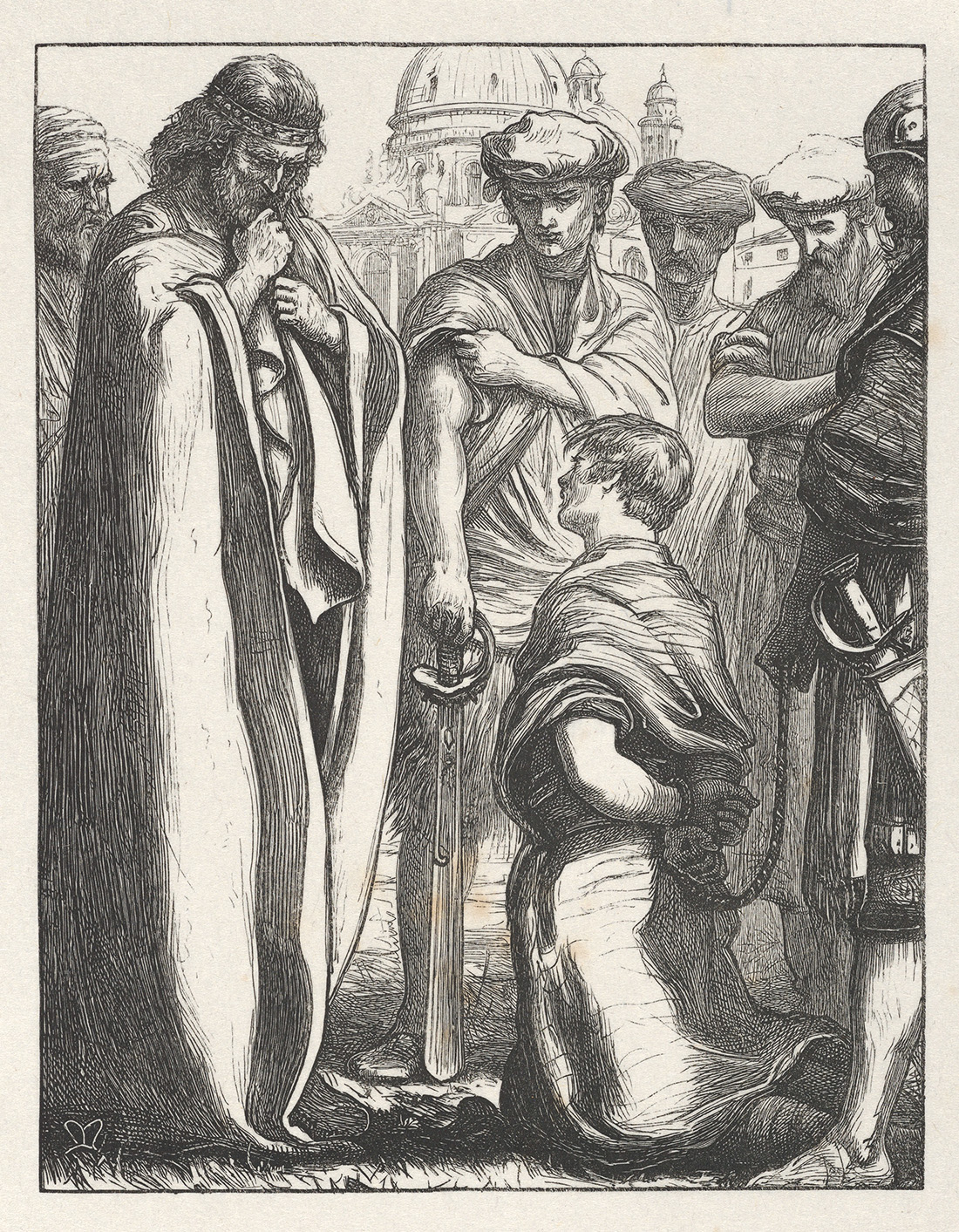
    The Unmerciful Servant (1864), artist: After Sir John Everett Millais, Engraved and printed by Dalziel Brothers | Creative Commons, courtesy The Metropolitan Museum of Art.

    Even if it makes us uncomfortable, we must accept that God rightfully expresses anger when his goodness is hoarded and discarded. Divine justice hinges upon how we use the gifts God bestows on us, principally mercy: is it shared and given forth to others in acts of charity and love or is it discarded and replaced by selfishness, greed, and sadism? When we discard the energy of God Himself, we embrace the energy of evil, of the devil. What’s more, we reject ourselves, our purpose, to help bring others to God and into the Kingdom. We become an abomination of everything God has created us to be.

    So, we read that “in anger his master handed him over to the torturers.” Much has been said in recent years about how God is all goodness and could never have vengeance or anger. I think we come close to ignoring parts of scripture if we take this too far. Let’s look closely at the original Greek as we wrap our heads around God’s righteous anger and act of divine justice in this passage.

    The verb for his anger is ὀργισθεὶς (orgistheis), which can be translated as “having been angry,” “moved to anger,” or “provoked to anger.” Here we see that the king is provoked or moved by the actions of the servant; it is a response to something the servant has done. We must recall that while God is indeed all that is good, he is also the source of moral behavior, moral decision making, and moral valence (that is, what is good vs. what is bad). As such, he stands as the judge of behavior, and a judge is not silent when presented with something. Actions either uphold the good or go against the good. Being “moved to anger” means that he stands in his role as judge and proclaims the evil that he sees.

    Why anger? Why not sadness or emotionless judgment? Well, let’s return to the kind of God we know we have: one who overflows with love for his people and his creation. Is this the sign of impassivity? Should we expect a divinity so pure and full to not react viscerally to both the goodness he finds in us as well as the evil he finds in us? As it appears in today’s reading, God is viscerally moved to compassion — σπλαγχνισθεὶς (splanchnistheis) where the word σπλαγχνα (splanchna) means interior organs or intestines — and we can expect that he can be viscerally moved to something other than compassion when encountering evil. I don’t presume to know what he is moved to, but the scriptures tell us many times that he is moved to anger, so I take divine revelation for what it is.

    In his anger, the king “handed him over”: παρέδωκεν (paredōken), which occurs 18 times in the New Testament, notably when Judas hands over Christ to the chief priests, when Pilate hands over Christ to be crucified, and when Christ gives up his spirit in death. This is an irrevocable step in delivering something. And to whom does the king hand over the servant? The torturers, who will enact pain upon him “until he should pay back the whole debt” (200,000 years, I guess). We can rightfully say that, in his goodness, God does not take pleasure in this torture and note that he does not inflict it himself. Gehenna/Hell is set up for this purpose, a place for the people who pervert the Spirit and undermine God’s law.

    So as to not end this reflection as a total downer, let’s end with some wise words from Leiva-Merikakis, for whom today’s reading in part gives him the title for his three-volume work on St. Matthew’s gospel.

    The only thing we should be afraid of is not being merciful as our heavenly Father is merciful, for it is from unmercy that the most dire consequences flow, the ones reaching most deeply and devastatingly into both our psyche and our eternal destiny. For the Kingdom of Heaven is a kingdom of mercy, and mercy is never realized in the abstract but only through a concrete exercise of forgiveness. … Therefore, the ability to forgive our brother unceasingly and from the heart should be one of the primary concerns of our prayer, one of the most earnest pleas we make before the Throne of Grace (654).

  • A Prophet in his Own Land

    A Prophet in his Own Land

    Monday in the Third Week of Lent: 2 Kings 5:1-15, Luke 4:24-30.

    Today’s readings are an excellent example of how the New Testament can help to clarify seemingly incongruous events in the Old Testament. It’s a good reminder of how the fullness of God exists outside of (yet operates within) linear time and history.

    When I first read the second book of Kings and encountered the prophet Elisha, I had to do a double-take. Does this book really describe how he fed a hundred people with 20 loaves? How he cured lepers, knew men’s hearts and deeds without them saying anything, and even raised a boy from the dead?? These are too close to Jesus’s miracles to be a coincidence. Nearly 900 years before Christ, we encounter a prophet, the disciple and successor to Elijah, who performs very “Messianic” miracles. What do we make of this?

    It’s safe to say that Elisha prefigures Jesus and the New Covenant that will be established. Let’s remember that the prophets were men and women who dedicated themselves utterly to God, who lived righteous lives and were granted special graces from God, enabling them to do his will in extraordinary ways. Above all, prophets were the mouthpieces for the Word of God. That same Word is, of course, Jesus Christ. When they perform miracles, the Spirit works in the world through them, much in the way that the Word is spoken by them. Thus, it is God, the Spirit and the Word, who works through Elisha. Christ is performing works in a time long before his coming in the flesh as a way to prepare the hearts of humanity for the new reality he will bring.

    Elisha the Prophet (2011), E. G. Gauger

    When we realize that God works (and has always worked) in the world through us, it should come as no surprise that those speaking and acting in truth are being used by him in similar ways as he will act as the Word Incarnate.

    Let us see the ways Christ is operating in human history 900 years before his Incarnation. In today’s reading, we find a Syrian (Aramean) general, Naaman, who learns from a captured Israeli servant girl that there is a prophet in Israel who can cure his leprosy. Note that Syria is an active enemy of Israel at this time, and in just the next chapter of 2 Kings, Elisha helps to thwart an Aramean attack.

    In this episode, Elisha asks the king of Israel to send Naaman — not just an outsider from the tribe of Israel but an enemy — to him. When Elisha asks for Naaman to be sent to him, we hear earlier echoes of Jesus (like a pebble dropped in time that ripples both backward and forward on our timeline): “Love your enemies and pray for those who persecute you” (Mt 5:44, see the reflection The Difficult New Covenant of Love).

    Elisha tells Naaman, “Go and wash seven times in the Jordan, and your flesh will heal, and you will be clean.” The Jordan River will become the workplace of St. John the Baptist in his mission of repentance and preparing the way for Christ. Just as John washes sin away in the Jordan, Naaman will wash away the uncleanliness of leprosy. Moreover, Christ (through Elisha) is performing the first baptism of a Gentile in the Spirit of the Lord. This will become the New Covenant, salvation opened up for the entire world through baptism in Jesus’s name.

    Naaman, the great commander with his horses and chariots, gets angry. He expected more of a show, perhaps more attention and honor given his status. Elisha, for his part, acts like Christ might, not impressed by worldly power. For Naaman, why travel all this way just to be told to jump in Israel’s little river, no match for the great Syrian rivers? Here we see the ever-present challenge of faith presented to us in the scriptures. And who is it but the lowly servants who have faith and encourage Naaman to follow Elisha’s instructions? “Blessed are the poor in spirit,” says our Lord.

    When he is cured of his leprosy (through faith, encouraged by the lowly), he returns to Elisha to profess his newfound faith in the Jewish God. What is omitted in today’s reading is that he also wants to bestow lavish gifts on Elisha for his miracle, but Elisha refuses them, saying, “As the Lord lives, whom I serve, I will accept nothing!” This is concordant with our teaching that God’s gifts are given freely to us, who do not deserve them.

    Elisha refuses the gifts of Naaman (Elisa verweigert die Annahme der Geschenke Naemans), 1637, Pieter Fransz de Grebber | Wikimedia Commons.

    Without Christ and the New Testament, I find that Elisha’s deeds stand out as exceptional but a little pointless. What happens when he dies but more of the same for God’s people? They remain in an endless holding pattern of ritual observance and sacrifice, praying for God’s protection and grace in this world. Elisha did great things, but then he died like the other prophets. He reveals some important things about God, but they don’t really coalesce into their fullness until Christ. To Jews of the time, for instance, what’s the point of healing an Aramean leper general when they’re fighting for their nation’s survival?

    This is where our distance from these events is a grace in itself. We are able to make connections between the Old and New Testaments in a way countless millions were never able to. The Second Vatican Council’s Dogmatic Constitution on Divine Revelation, Dei Verbum, remarks pointedly on the relationship between the testaments:

    “God, the inspirer and author of the books of both Testaments, in his wisdom has so brought it about that the New should be hidden in the Old and that the Old should be made manifest in the New. For, although Christ founded the new Covenant in his blood, still the books of the Old Testament, all of them caught up into the Gospel message, attain and show forth their full meaning in the New Testament and, in their turn, shed light on it and explain it.”

    Today’s reading is an excellent example of how the “New should be hidden in the Old and the Old should be manifest in the New.” I also appreciate how the Council points out the reciprocal nature of this relationship, how the Old Testament can shed light on the New while at the same time its stories show their full meaning in the New Testament. This attests to the nature of God Himself, who is fully active at all times, both within time and outside of it. 

    The notion of “fullness” is important here. Let’s start with a definition of fullness as the completeness of abundance; that is, something that is already abundant and overflowing somehow being complete. The proposition of our faith is that the fullness of God inhabits the universe at all times.

    He instructs Moses to tell the Israelites: “I AM has sent me to you.” His name, his being, is summed up in being itself. There is nothing more fundamental — no other level supporting being itself.

    At the risk of our heads exploding over the ontological implications of God’s being (which we can never truly comprehend until we come face to face with Him), let’s listen to some wisdom from our Church Fathers. St. Gregory Nazianzen says, “God always was and always is, and always will be; or rather, God always Is. For Was and Will Be are fragments of our time, and of changeable nature. But He is Eternal Being … like some great Sea of Being, limitless and unbounded, transcending all conception of time and nature” (~388 AD, Oration 45, The Second Oration on Easter, III). The fullness of God’s being is limitless and unbounded, transcending time.

    God’s revelation has taught us some other things about his fullness: He endlessly pours his Spirit and love upon his Creation, especially humanity in which he incarnated his Son. He tirelessly calls us to him, thirsts for us (see the reflection If You Knew the Gift!), with inexhaustible forgiveness in his heart. Thus, the fullness of his being in all time is characterized by his love, care, and thirst for us. He meets us in our mortal reality of linear time through a progressive revelation of himself, yet at every stage of revelation, he and his message are fully there.

    (As a side note, when I read of the “immensity” of God, I think of this very fullness of his being.)

    In all the similarities between Christ and early prophets like Elisha, let us not forget that Christ is also the most exceptional historical figure, the most blessed man, the Anointed One of God. While the Word and Spirit work through the prophets, the Word itself is joined with mankind in Jesus Christ. This manifestation of God on earth is greater than all of the prophets, it is the perfection of the Law and the Spirit.

    Humans can only try to uphold the law and live in the Spirit from the distance of their mortality while Jesus is the actual manifestation of the Law and Spirit, incomparable to us in his essence. His miracles supersede Elisha’s in every way — Christ feeds 40,000 while Elisha feeds 100, Christ heals 40 lepers while Elisha heals one, etc. Interestingly, we are told that when a dead man is buried near Elisha’s bones and touches them, he immediately jumps back up, alive. Christ, on the other hand, brings eternal life for all humanity. 

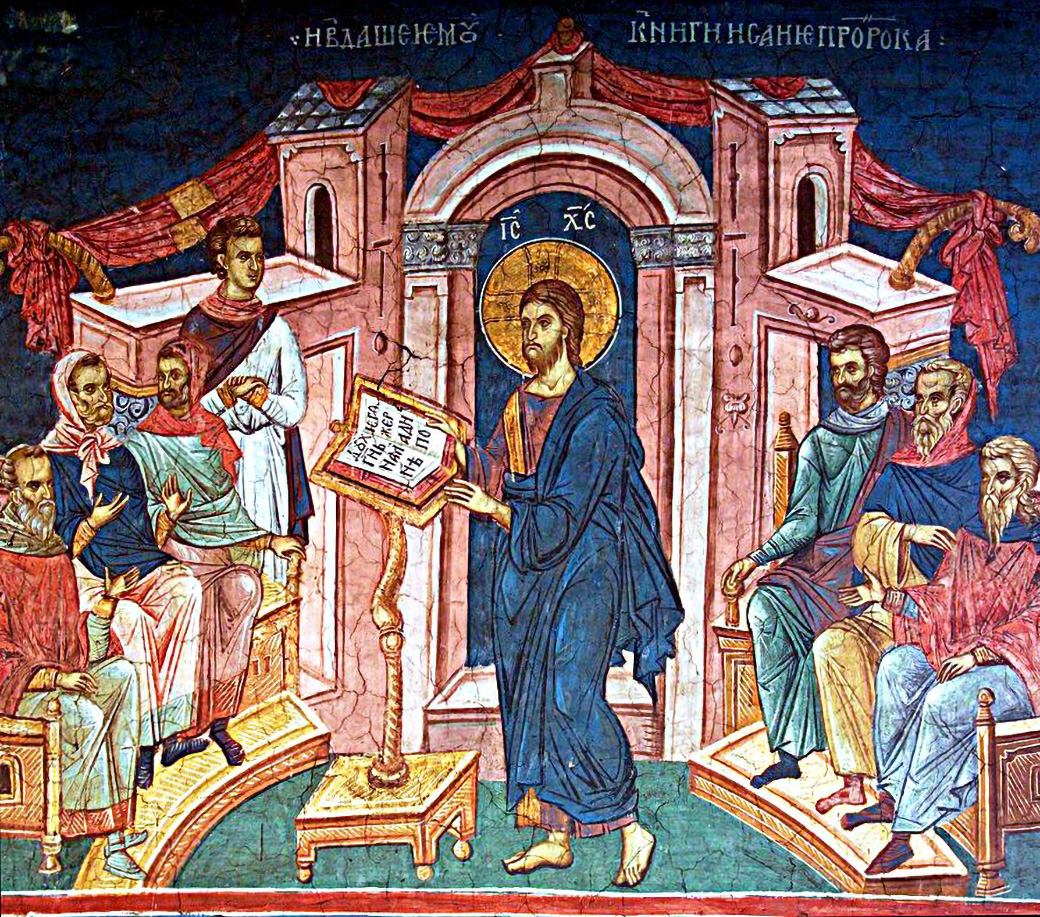
    Jesus Teaches at the Synagogue in Nazareth, unknown icon author | Creative Commons, benedicamusdominoblog.com

    So what do we make of Jesus in today’s reading being the prophet not accepted in his “native place”? I always saw this as a sad, personal low point for Jesus. But upon reflection, I think I was dead wrong. In fact, it’s a pretty triumphant moment, where he gives us the reason for Elisha’s incongruous act of healing non-Jews in difficult times.

    Remember, the Nazarenes in his hometown had just heard him say that the fulfillment of Isaiah’s prophecy was him, standing in front of them. They were astounded. Then he says that they might be expecting a miracle from him, but no such thing would happen (this is where our reading picks up).

    He declares, “no prophet is accepted in his own native place,” and thereby tells them that he will not be working wonders in their midst. Then he uses an episode in Elijah and the story of Naaman and Elisha as proof that prophets are to work wonders for those outside their “native place.” This infuriates them. They must have felt brushed aside, as if he was saying they weren’t worth the trouble. Worse yet, that non-Jews and pagans were more deserving of God’s graces than they were. So they mob him and push him out of town with murderous intent.

    And the miraculous thing upon which our reading might hinge: “But he passed through the midst of them and went away.” Whaaaa?

    How mysterious … like the wind or a spirit.

    Exactly.

    Although not “a spirit,” but THE Spirit. Jesus physically redoubles his message by passing directly through the midst of them, as the grace of God being taken from them and given to others. This is, of course, the message he will continue to spread when he talks with the Samaritan woman, welcomes and eats with sinners, and more. The Good News is that eternal salvation is being offered to all peoples, all nations through Christ. This significant broadening of salvation beyond the nation of Israel is a large part of his ministry, and it begins here in his hometown of Nazareth. 

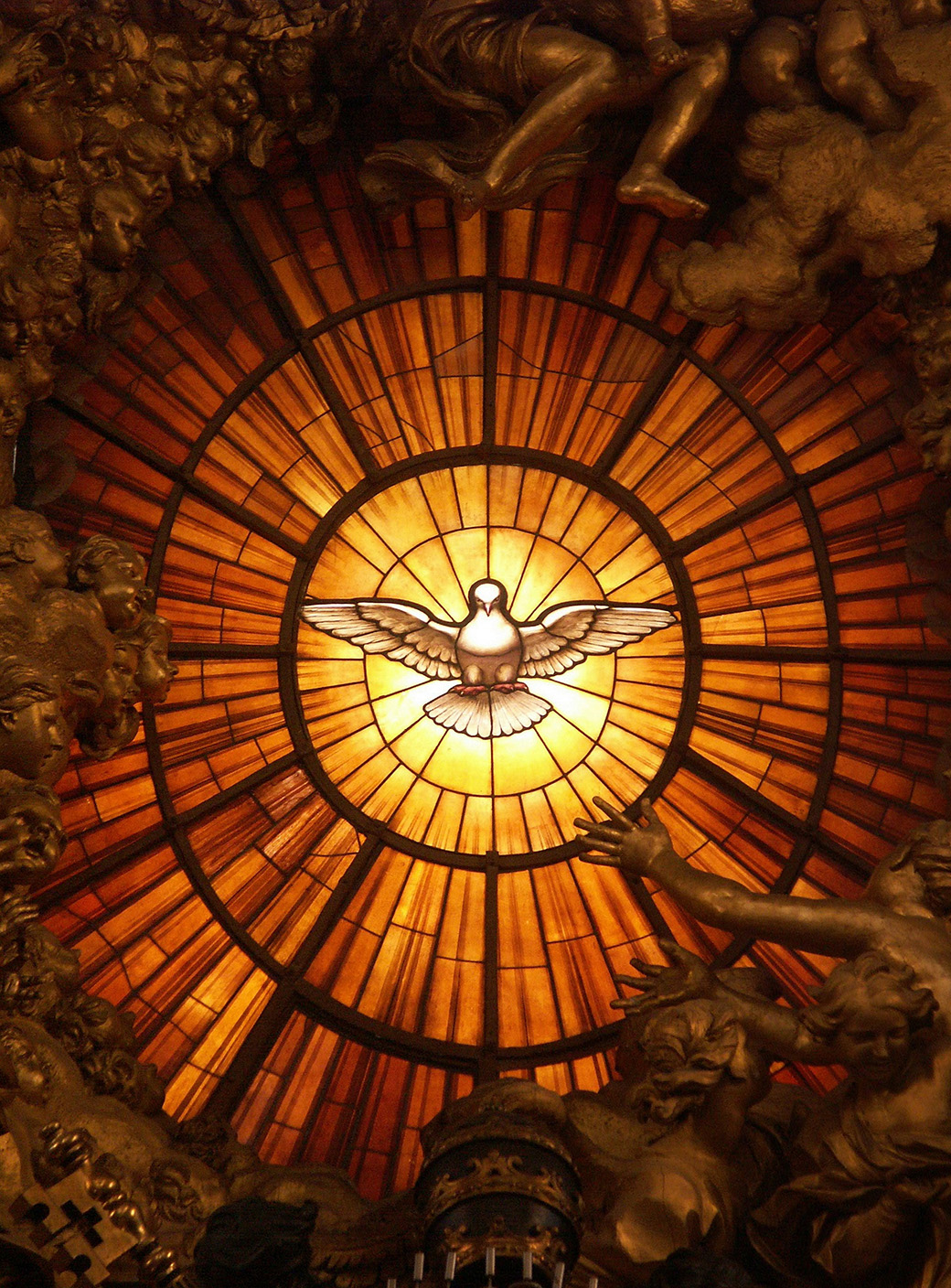
    Dove of the Holy Spirit (ca. 1660, stained glass, Throne of St. Peter, St. Peter’s Basilica, Vatican), Gian Lorenzo Bernini | Wikimedia Commons.

    This new salvation is brought about in the Spirit, and Jesus “passing through the midst of them” is both the sign and the reality of this message. He voices this message later to Nicodemus the Pharisee: “You must be born from above. The wind blows where it chooses, and you hear the sound of it, but you do not know where it comes from or where it goes. So it is with everyone who is born of the Spirit” (Jn 3:8). In fact, the Greek here shows that wind (πνεῦμα, pneuma) and Spirit (Πνεύματος, pneumatos) are the same word. The lack of stable physical location for the wind/Spirit is the same for those who are “born of the Spirit,” i.e., baptized as Christians. They no longer belong to Israel, to particular castes or families, but to God, not of this world.

    Thus, like the wind and the Spirit, “he passed through the midst of them and went away.”

    This does not mean that Nazarenes (and Israel as a whole) are not welcome in the Kingdom, simply that they need to understand that the Old Covenant establishing them as the Chosen People is being replaced by a New Covenant that is not bound by a place or a nation. They are the first, in fact, to be invited into the New Covenant and to be born of the Spirit. 

    The West Wind (1891), Winslow Homer | Wikimedia Commons.

     So what are we to make of the fact that they were told by God that they were the Chosen People for the prior several millennia? Just like Elisha’s deeds only making sense as a prefiguring of Christ’s opening up of the New Covenant, we can see the appellation “Chosen People” making sense in Christ as well. They were chosen to receive the prophets, to prepare the hearts of mankind for the Anointed One, the Son of God, to be born into their tribe and then open up the Kingdom to all. Importantly, the millennia of God working within his Chosen People led to Mary the Mother of God being trained by generations of those abiding by the law of God. She was perfect in mind, body and spirit, ready to say yes to God, to be the Ark of the New Covenant.

    Therefore, let us look past the anger of the Nazarenes and read the triumphant message in today’s gospel. Jesus is never defined by the fact that he is not accepted but hated. He bears it all willingly because his message is not about himself as a man, but himself as divine reality — unbound by time or circumstance — in our midst.