Tuesday of the Second Week of Advent: Isaiah 40:1-11, Matthew 18:12-14.
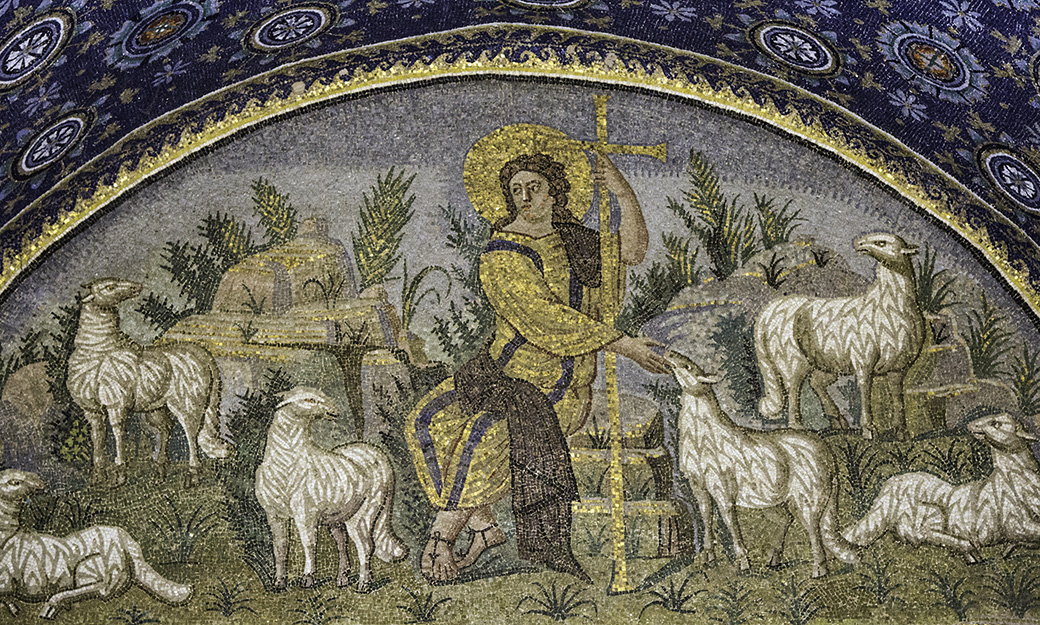
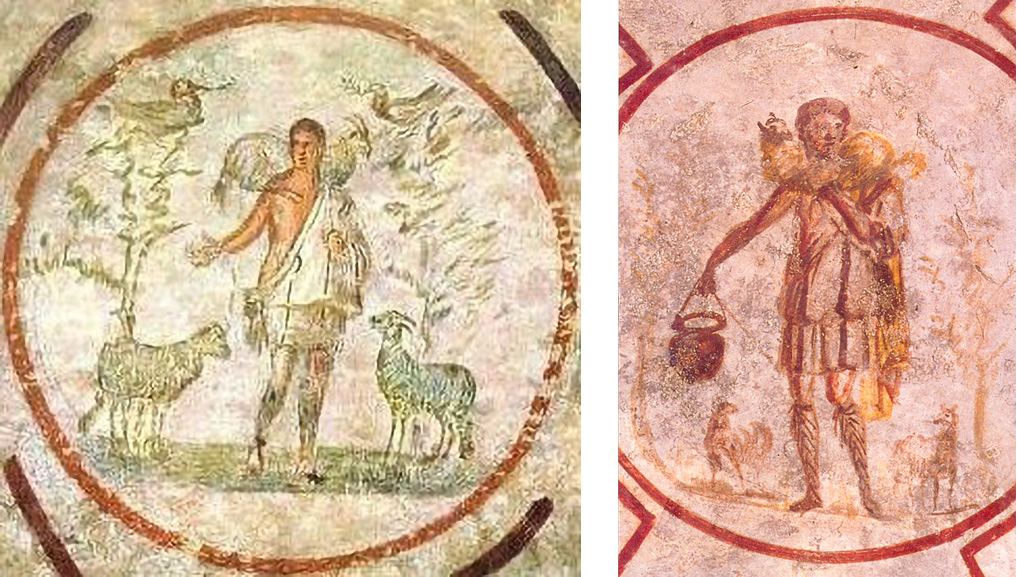
Today’s gospel presents the Parable of the Lost Sheep, and Christ as the Good Shepherd is one of the oldest artistic representations we have from the early Christian Church. Clearly, this image resonates with us. But is it more than a nice metaphor?
God the Father is far beyond our comprehension. We need metaphor and analogy to even begin to contemplate Him. As Jesus says today, “In just the same way, it is not the will of your heavenly Father that one of these little ones be lost.” He explicitly points to the analogy aspect of the parable (“in just the same way…”) in order to help us understand a small aspect of God’s will.
But the Son of God was made incarnate as a man, so we have a physical, historical understanding of him. He literally tended to humans like precious creatures waiting for the harvest — it’s no coincidence that he invites Simon and Andrew to “fish for men,” and that he says, “I am the good shepherd. The good shepherd lays down his life for the sheep” (Jn 10:11).
This last passage, in particular, invites us to understand Christ in a more literal way rather than metaphorically.
3rd century paintings of Christ the Good Shepherd in the Roman Catacombs (Catacomb of Priscilla on left, Catacomb of St Callixtus on right) | Creative Commons, courtesy Wikimedia.
I’d like to quote a passage from the Trappist monk, Fr. Erasmo Leiva-Merikakis, PhD — from his master work of reflections on the Gospel of St. Matthew:
Every scene in the Gospel represents a new step in the Son’s search for his lost sheep. Golgotha is the moment when he fully finds us, because it is then that he gives all he has to give—the very substance of divinity. He finds us by entering into our locus of despairing darkness and filling us there with his love and life. “I will bind up the crippled, and I will strengthen the weak”: But how? Our resurrection and healing gush forth from his suffering. In the words of Isaiah:
Surely he has borne our griefs and carried our sorrows. . . . He was wounded for our transgressions, he was bruised for our iniquities; upon him was the chastisement that made us whole, and with his stripes we are healed. All we like sheep have gone astray; we have turned every one to his own way; and the Lord has laid on him the iniquity of us all. (Is 53:4-6).
Jesus, in whom “all the fulness of God was pleased to dwell,” could not make peace between us and the Father, could not restore us lost sheep to the heavenly flock, without the spilling of “the blood of his Cross” (Col 1:19-20). It was by this outpouring of the human blood of the incarnate God that the Father “delivered us from the dominion of darkness and transferred us to the kingdom of his beloved Son” (Col 1:13). (Fire of Mercy: Heart of the Word, Vol III, 627)
We might be so familiar with the words of St. John’s gospel, “the good shepherd lays down his life for the sheep,” that we forget how very real that act was accomplished by Jesus Christ. God is the best of all good shepherds — so much so that we can use him as the basis of comparison in the metaphor, “you are as good of a shepherd as Jesus Christ with how selflessly you lay down your life…”
I don’t want to detour too far on John’s gospel; today’s gospel reading from Matthew is about searching for and not forgetting the lost sheep. This parable is the promise that God wants every one of us to be with Him, no matter how lowly or sinful we might think we are. And, of course, sin is the main way we lose our way from the flock bound for heaven. Consider this — the person so lost in sin that he can’t be recognized is actively sought out to the ends of the earth by our diligent Good Shepherd. If that’s not good news for those in despair, I don’t know what is.
As we turn our eyes to gaze lovingly on this Good Shepherd, let us return to Isaiah’s words from the first reading. He describes a strong, powerful God whose Word lasts forever — long after humanity is gone. He describes a God for whom we flatten mountains and fill in valleys to make way for his majesty and might. As we turn our eyes to gaze on Him, what do we see?
Here comes with power the Lord GOD, who rules by his strong arm;
Isaiah uses the language we hear throughout the Old Testament: God who smites the enemies of Israel with his “strong arm”
Here is his reward with him, his recompense before him.
Something is different here. God appears on the wide way we have prepared with His reward. What is this reward, this recompense, but the very flock He has been shepherding!
Like a shepherd he feeds his flock; in his arms he gathers the lambs, Carrying them in his bosom, and leading the ewes with care.
And what is he doing with this harvest of sheep? He is feeding them, gathering them in his arms and carrying them in his bosom! What tenderness! What a seeming paradox that the mightiest of all, whose breath can level mountains, is to be found in heaven doing that which he loves the most: tending his flock of souls.
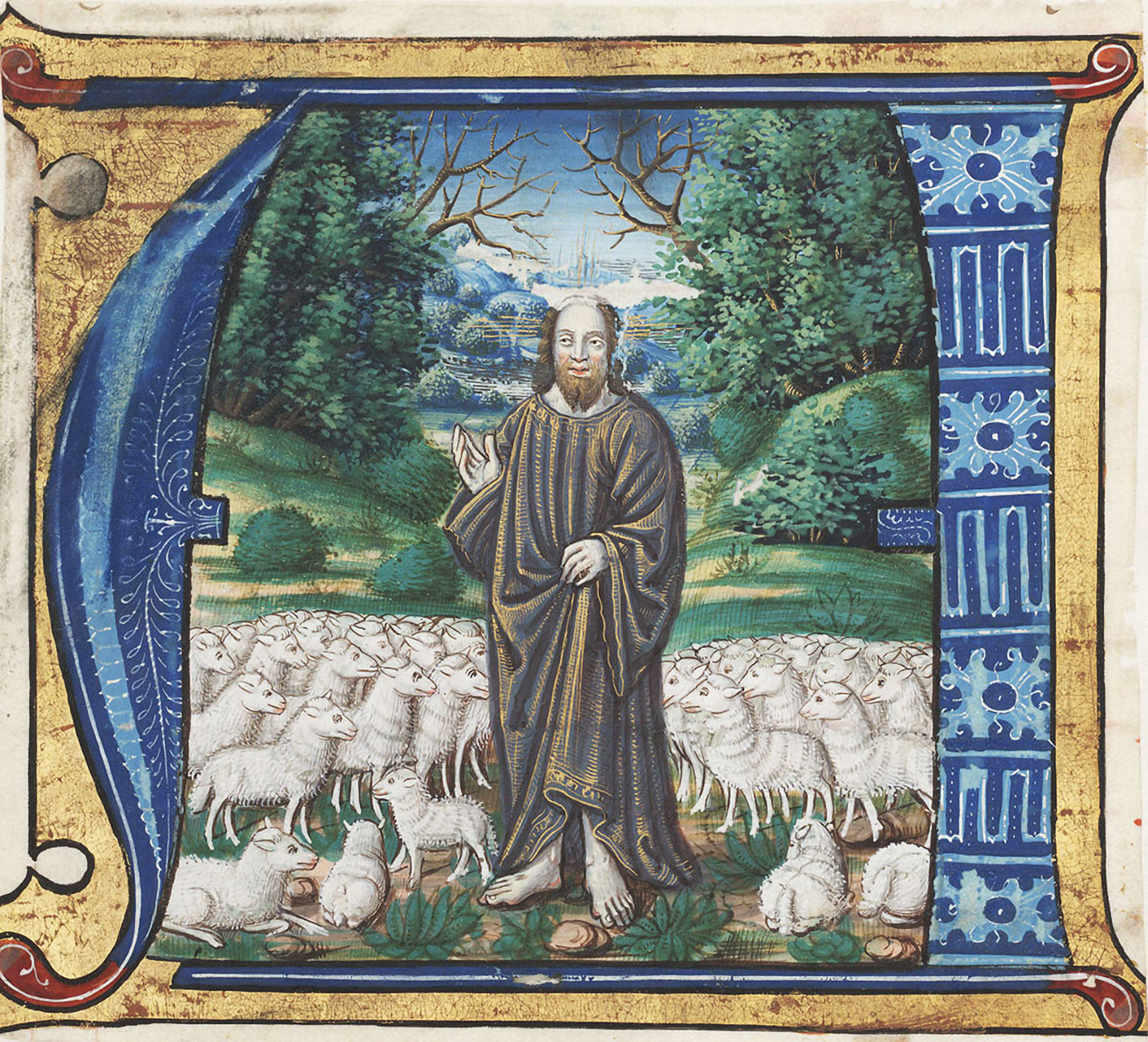
Historiated “A” depicting Christ the Good Shepherd from French manuscript (1525) | public domain, image from the Free Library of Philadelphia.
Let’s consider the foretaste of heaven we have on earth in the celebration of the liturgy. As we approach the Mass and the Holy Eucharist, let us remember that Christ’s great sacrifice was one where he carried us in his bosom all the way to the Cross and beyond. He came to earth to physically enact the work of the Good Shepherd, giving us our redemption, salvation, and a peek at the very heart of God.
When we eat the Eucharist, we are imbibing in the flesh of the one who carries us in his bosom, who protects us, and who literally died for us.
In Advent, this is who we wait for. We offer a comparatively paltry sacrifice in the form of prayer, fasting and alms to mark this season that anticipates the one who offers the greatest sacrifice of all.
Monday of the Second Week of Advent: Isaiah 35:1-10, Luke 5:17-26.
Isaiah was graced with such vision! He saw the coming of Christ and all that this meant for humanity; his poetic prophecies are treasures. Today’s readings again present us with the call and response, the promise and the fulfillment, of our faith. Isaiah prophesies that Christ will heal the lame, and Luke describes a memorable episode of the paralytic being lowered through the roof. Yet beyond this prophesied miracle lies a deep message about walking a path, taking courage, and being ecstatically in awe of God.
Today, Isaiah tells us that “they will see the glory of the Lord,” and then, “Strengthen the hands that are feeble, make firm the knees that are weak, Say to those whose hearts are frightened: Be strong, fear not!” This is the consequence of seeing the Lord: gaining strength, overcoming fear. There are many things to fear in this world, tyrants, bullies, sickness and death, loneliness. But encountering God puts all of these fears in perspective. Holding His gaze and being drawn by His love, all of those fears are dwarfed and overcome. This is the state of the Christian! God has made Himself known to us, come in the flesh in the form of the Son, and if we dwell in His love, all of our earthly concerns wither and fade. We gain the strength and desire to be with Him.
So in the gospel story we can think of the paralytic and his friends who might have feared the logistics of the crowd or maybe the blowback for disrupting the conversation with all the “Pharisees and teachers of the law” who came from miles around. They might have feared embarrassment, failure, and so many other things. But, they saw the Lord! They were drawn by him and given strength to overcome their fears. Their reward was great: “When Jesus saw their faith, he said, ‘As for you, your sins are forgiven.’”
Next, Jesus delivers a great demonstration of how the outward signs of healing are but a foretaste of the spiritual healing he offers. But I would like to focus on what happens after that. What does the paralytic do once he is healed? “He stood up immediately before them, picked up what he had been lying on, and went home, glorifying God.” He doesn’t rest or bask in the healing but goes on his way. Indeed, this is Jesus’s command: “I say to you, rise, pick up your stretcher, and go home.” What is important here?
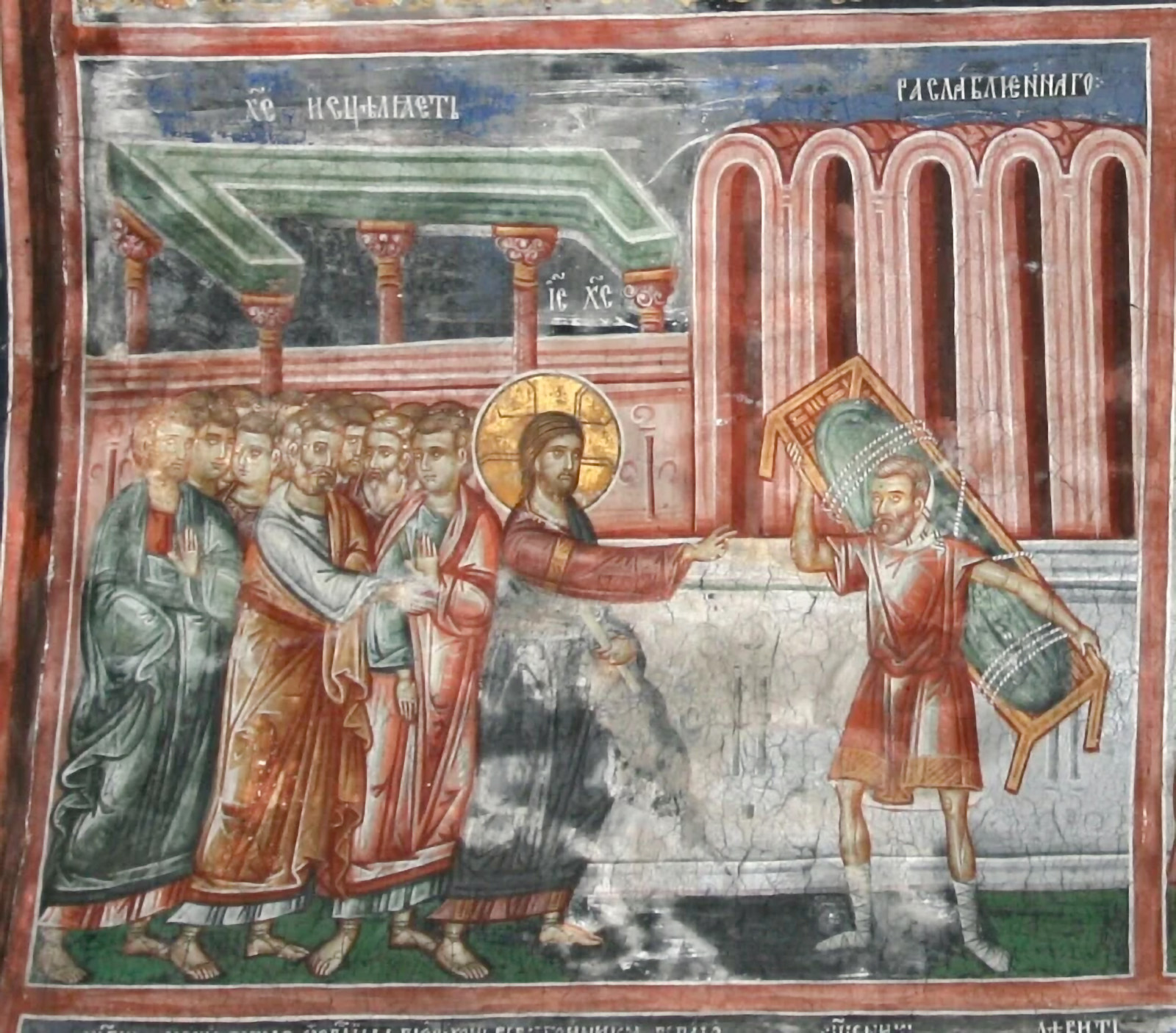
Ceiling fresco from Patriarchate of Peć Monastery, Serbia (1300s) | Image from russianicons.wordpress.com. Although this is the scene from the paralytic laying by the pool of Bethesda, note that Jesus’s command is the same: “Rise, take up your bed, and walk.”
Let’s look at two things: the stretcher and “home.” The stretcher/mat/bed is the symbol of the man’s beaten down life. All of his defeat, anguish, questions, and trials laid on that mat with him for years. He was bound to that mat as Christ was bound to the Cross. It was his burden, but also his sense of who he was – it defined him. By commanding him to “pick up your stretcher and go home,” Jesus is saying in a different way what he will later tell his disciples, “If anyone would come after me, let him deny himself and take up his cross daily and follow me.” Simply put, this is the Way to heaven. This is the Way that Christ himself walked and that he wants us to walk. We are not meant to forget the world’s troubles but to pick them up, to work to help solve them, to bring love into the world. This is what picking up your cross and following Christ is all about. Acknowledging this meaning, we can also see how “go home” has a deeper meaning than his earthly home. Jesus is telling the paralytic – and us – to pick up his cross and travel the way to his heavenly home.
If there is any doubt that “home” refers to heaven, let’s return to Isaiah’s reading. He says, “A highway will be there, called the holy way … It is for those with a journey to make, and on it the redeemed will walk. Those whom the LORD has ransomed will return and enter Zion singing, crowned with everlasting joy.” Yes! This is the Way of Christ prophesied. A veritable “highway” for the redeemed. I love how Isaiah phrases the purpose of the highway: “it is for those with a journey to make.” This is no road of simple connections. It is meant specifically for those who desire to see God, those who have chosen this journey as their life’s purpose.
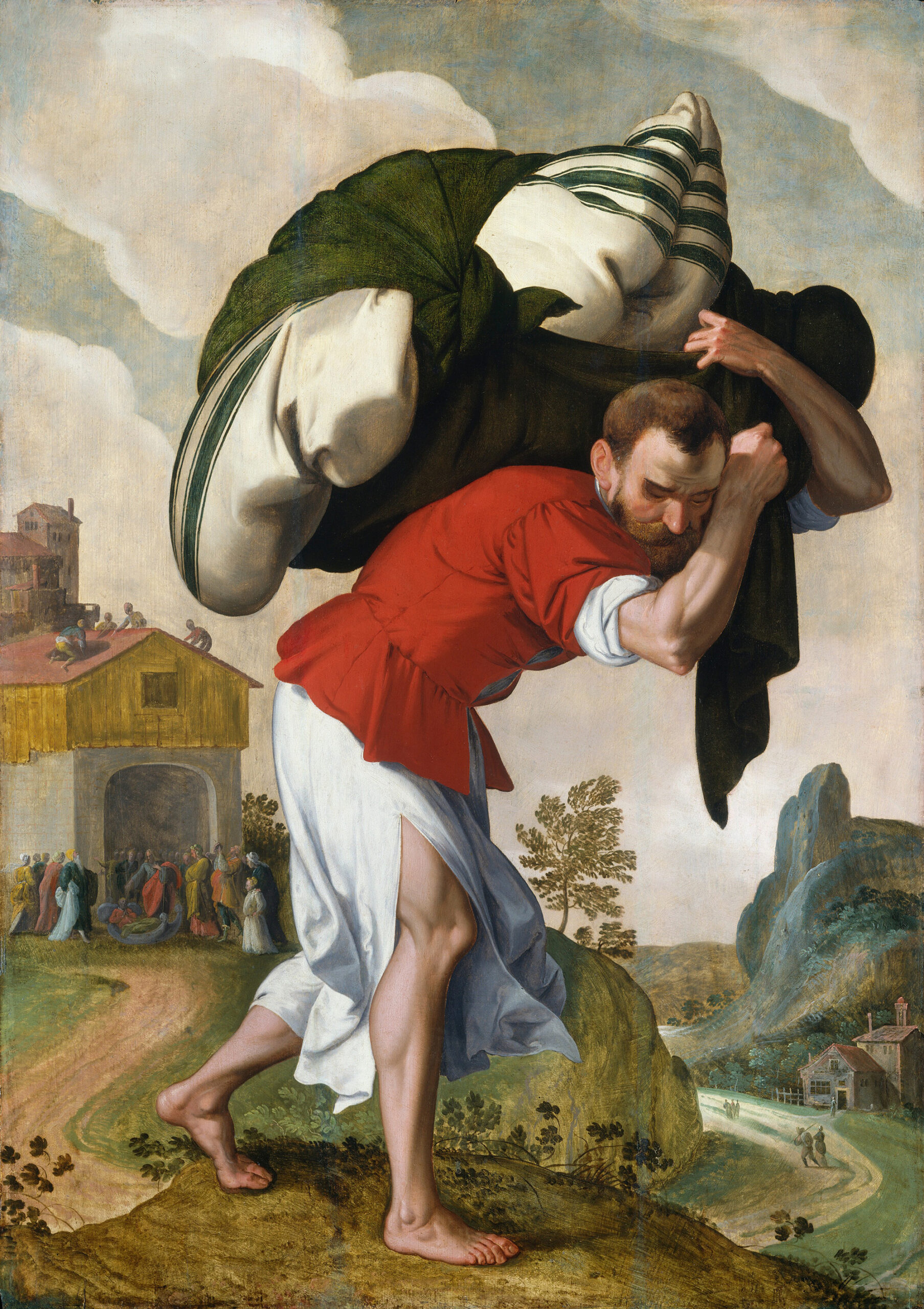
The Healing of the Paralytic, unknown Dutch painter (1560-1590) | public domain, courtesy the National Gallery of Art. I love the painter’s focus on walking the Way, carrying his burden. This is the work we are all called to do in life once we meet Christ in our baptism.
The final piece of today’s reflection unites the last words of Isaiah and Luke. Isaiah says, “They will meet with joy and gladness, sorrow and mourning will flee.” This is the promise to those on the Way, but it is also attested to by those witnessing the healing of the paralytic. Luke relates, “Then astonishment seized them all and they glorified God, and, struck with awe, they said, ‘We have seen incredible things today.’” This happens multiple times in the gospels, and the Greek word used for “amazement” is no mere wonder at a magic trick or coincidence. The original text reads, “ἔκστασις ἔλαβεν” (ekstasis elaben), meaning “amazement seized them.” Ekstasis literally means “to be or stand outside oneself, a removal to elsewhere,” and in written usage it means a displacement, a disturbance of mind caused by shock, bewilderment, or amazement. It also means a trance and an ecstasy. This is something far beyond what our normal powers of perception can resolve. Watching the paralytic meet Jesus, be healed physically and spiritually, and embark upon the Way, the scribes, priests, and disciples of Jesus were seized by a displacement of their mind, equal parts bewildering and ecstatic. In their ecstasy, they began to glorify God and fear Him, saying, “we have seen remarkable things today.” But remarkable things doesn’t quite translate the original Greek παράδοξα (paradoxa), which means something close to paradoxical, but more properly “something astonishing we didn’t expect.”
Why does this matter? Because this is the state of conversion, something we always are in the process of experiencing as we journey to God. We must continually convert ourselves to the Lord because this world entrances us with its dramas and enticements. We must inhabit this ekstasis, be seized by bewilderment and astonishment over God’s power, goodness, and magnetism.
Thus, we receive three great pieces of instruction today in Advent: 1) seek to encounter the Lord because He will give you great courage to overcome your earthly fears, 2) pick up those fears and trials and journey down that highway made for us in the Way that Christ established, and 3) allow yourself to be continually seized by ekstasis over the glory and power of our God. May we take this instruction to heart!
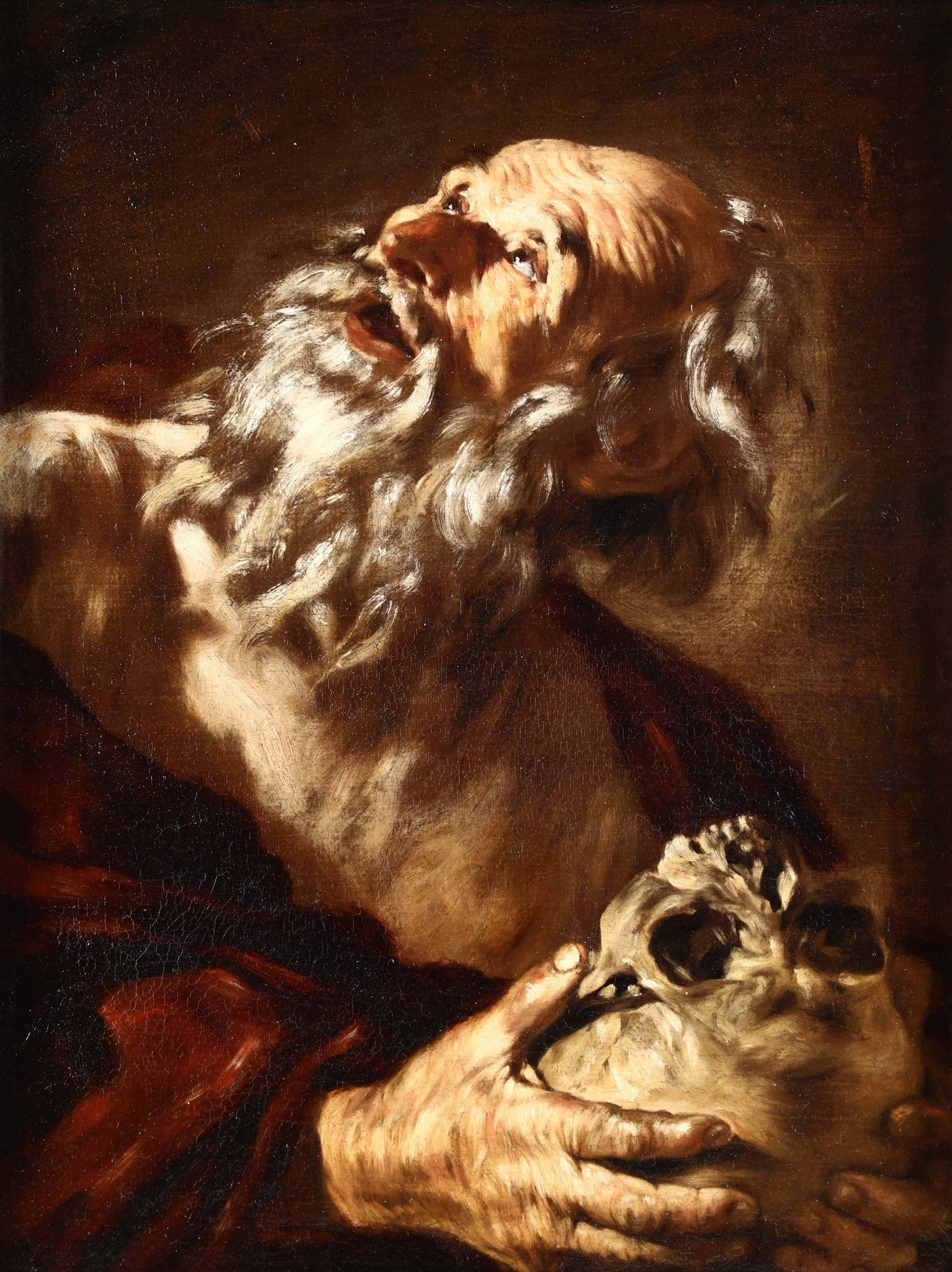
Saint Jerome (San Gerolamo), Giovanni Serodine (1620) | Creative Commons, courtesy Wikimedia.
Second Sunday in Advent: Isaiah 11:1-10, Romans 15:4-9, Matthew 3:1-12.
It is not in fashion to bring up damnation as a part of our religion. Heck, people look at you like you’re a superstitious nut if you mention Satan. The decades after Vatican II in America attempted to make Mass more “engaging,” and the catechism of both children and adults in the past 50 years … well, it softened, for lack of a better word. In a discussion with our first year Lay Dominican inquirers, several of us shared stories of priests we knew in our childhood telling people that more strict matters of doctrine and moral teaching were optional (or at least they would turn their heads and ignore it). Lest we think this is just anecdotal evidence, a 2021 Pew research poll asking if you could go to heaven if you don’t believe in God showed that 45% of non-Catholic Christians said yes to this prompt while 68% of Catholics said yes. Heaven without believing in God! Worse yet, a full 10% of the Catholics surveyed said they don’t believe in heaven (!!). What’s more, 26% of these Catholics don’t believe in hell.
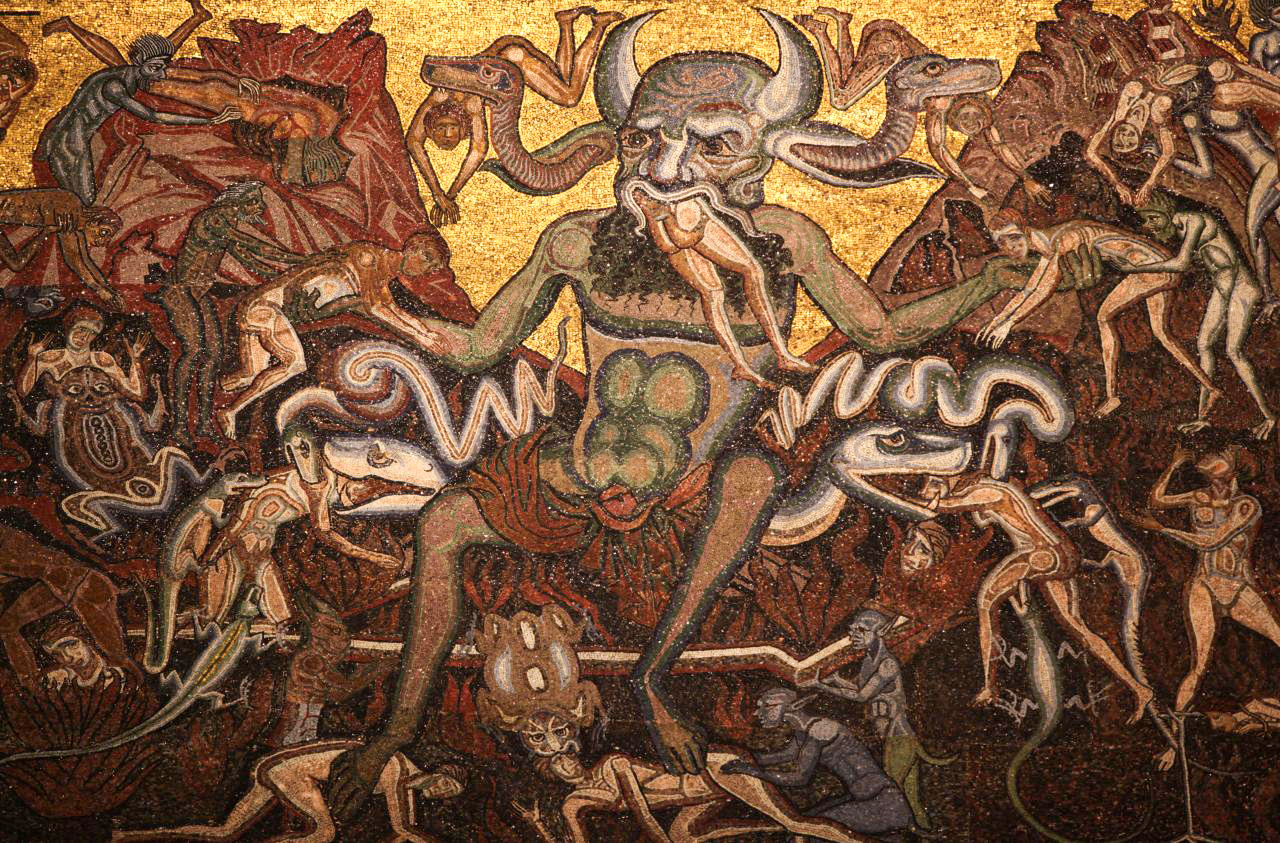
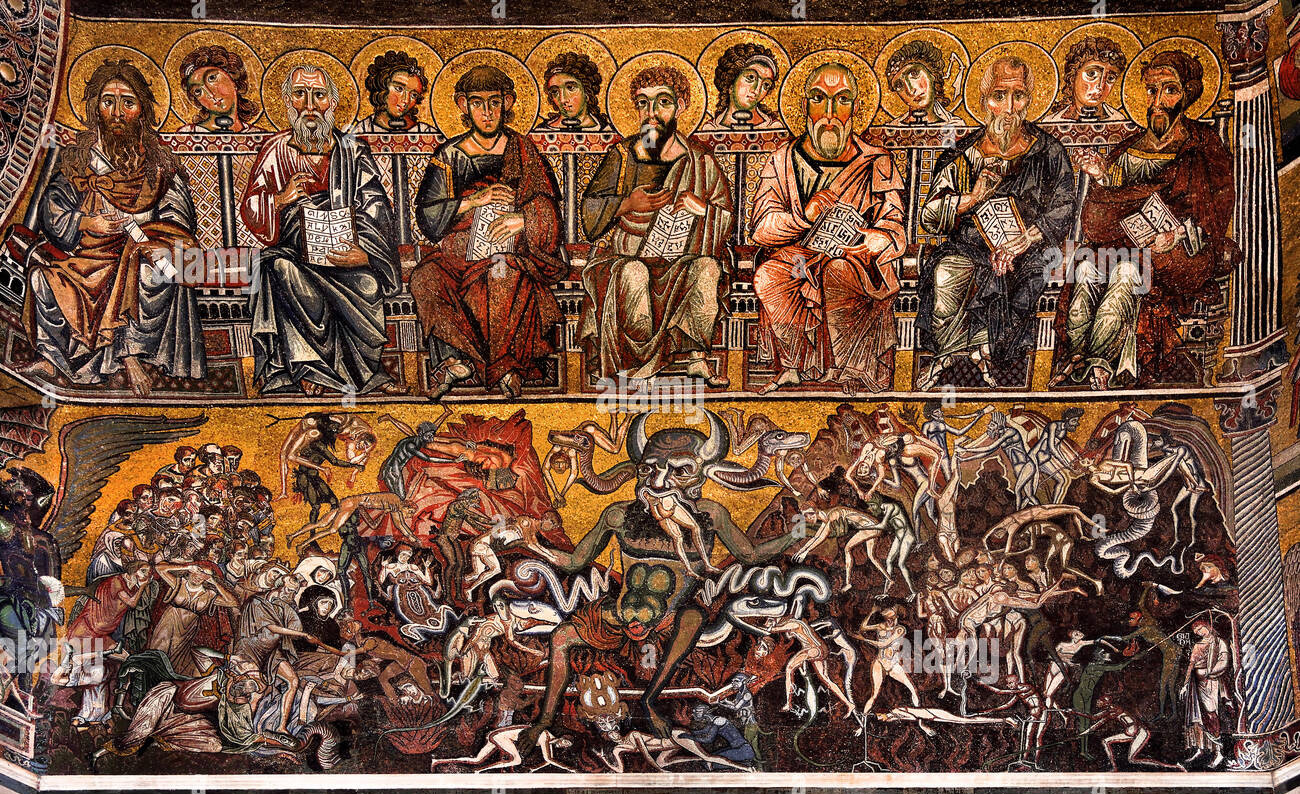
Mosaic depiction of Satan in Hell, Baptistery of Saint John in Florence, Italy (1260-75) | Image courtesy Holly Hayes on Flickr. More on this image below, at the end of the reflection.
These are fundamental aspects of our faith. Christ didn’t come to earth to start a feel-good-about-yourself community of do-gooders. If we deny the whole point of our faith — going to heaven to be in union with God — then there is no point in calling ourselves Christian. Let’s put this another (more positive) way … if we believe in Jesus Christ, it would do good to listen to what he promises us: heaven for those who walk in his Way, hell for those who don’t. This is reality for eternity, of course, which might be the very thing that people don’t want to come to grips with.
Why bring this up now, in cosy, rosy Advent of all times? Well, I’m just following the Lectionary here. Today’s readings give us the same first reading from Isaiah that we encountered on Tuesday of week one, paired with Matthew’s introduction of St. John the Baptist. I reflected on much of the Isaiah reading on Tuesday, but I’d like to focus on two different lines from this passage today: “He shall strike the ruthless with the rod of his mouth, and with the breath of his lips he shall slay the wicked.” Isaiah is, of course, referring to the Anointed One, the shoot from the stump of Jesse, who we know as Jesus Christ. In the midst of passages that glow about his wisdom, fear of the Lord, and faithfulness, Isaiah puts in these lines about striking the ruthless and slaying the wicked. If these lines seem out of place, then we must remind ourselves of God’s plan.
The key word that unites these concepts of peace and retribution occurs in the very next line: “Justice shall be the band around his waist.” God’s justice is that the pure of heart are rewarded while the wicked are punished. Both of these, reward and punishment, are part of God’s promise to His People. We can’t choose to ignore this.
Thus, the line after this also follows logically: “and faithfulness a belt upon his hips.” The Messiah is, above all, faithful to the Lord whom he loves and fears. It is faithfulness to the Father’s will that makes the distribution of justice happen. Aren’t these great qualities, justice and faithfulness? Then why do I still sense some Catholics squirming with uneasiness at these words?
This was always the job of the prophesied Messiah: to bring peace and justice. Why have we skewed so far towards the peaceful Lamb of God rather than the Lord of Justice in our modern age? What is it about divine justice and retribution that disturbs us? Perhaps it is because we have ingrained in ourselves a very correct Christian morality of upholding life — not harming others and not judging others. This is good! But let’s not apply the rules of the servants to the master. It’s like ants in a little plastic ant farm looking out at the human caring for them and saying, wait, why aren’t you rooting around in sand? What has been given to us for our own good is not for us to turn around and try to apply to God.
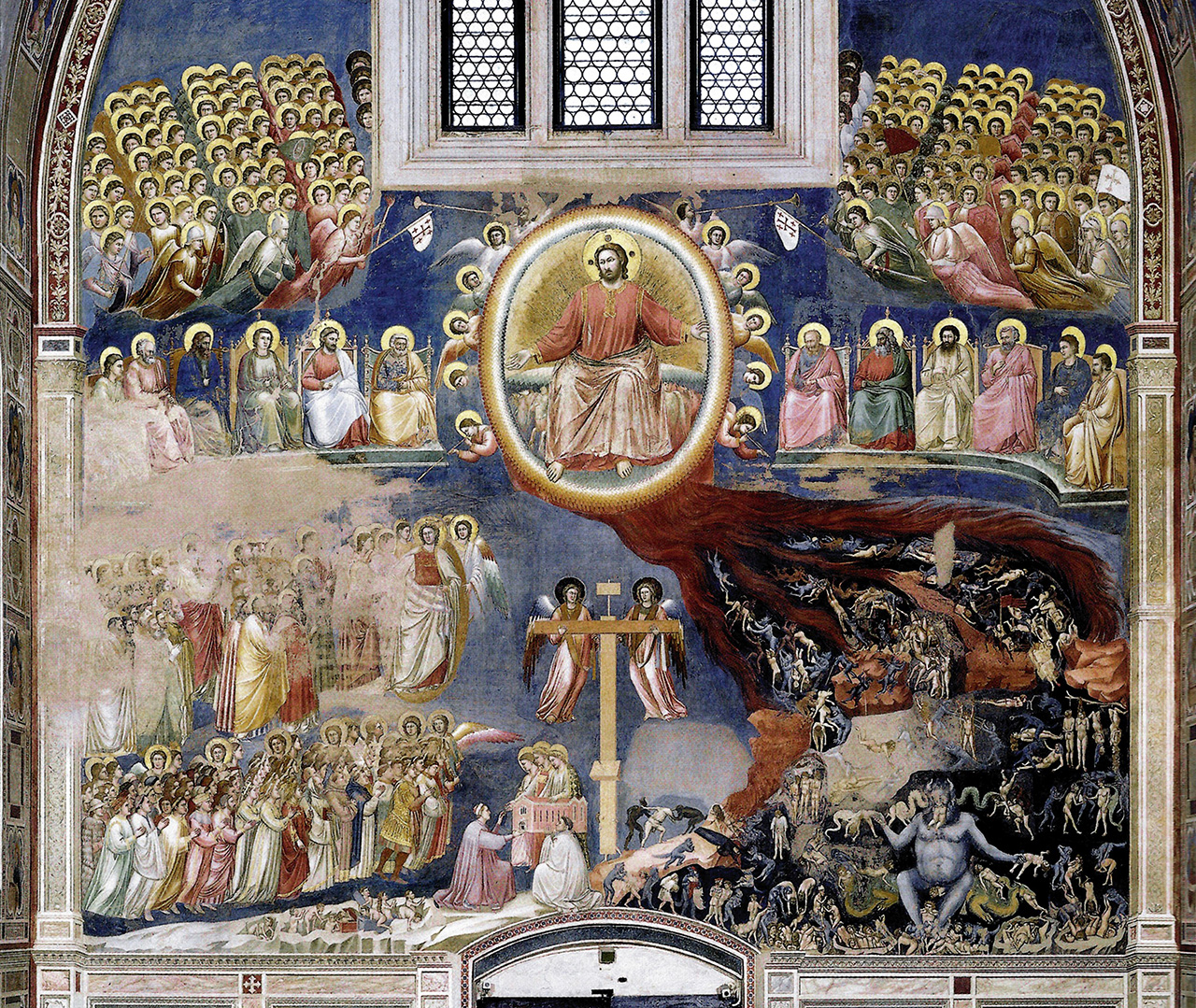
Last Judgement, Giotto (1306) | Creative Commons, courtesy Wikimedia. The Last Judgment at the Arena Chapel (Cappella Scrovegni), in Padua. Christ in Majesty is surrounded by a rainbow mandorla and angels, flanked by the Apostles. The Heavenly Host is above, while the saved and the damned are shown below, rising to Heaven or being dragged to Hell. What would our faith be without Christ as rightful judge at the Last Judgement? We can’t excise this from our beliefs and still call ourselves Catholics.
In fact, God is the only just judge. It is his rightful role. To tell him not to judge is like telling a fish not to swim. It is what He was always meant to do. Instead of fretting over this, we should thank him endlessly for his love and mercy (and for being God, because only the one who knows us better than we know ourselves would be qualified to be our judge). So, why be uneasy with the fact that the just judge will come to dispense justice?
Maybe it’s because we think the punishment doesn’t suit the crime (amateur, unqualified mini judges that we are). We might argue that just because someone does some bad stuff here on earth, that doesn’t merit eternal damnation, without parole! Apart from the fact that we’re breaking rule #1 (it’s not our place to judge or weigh merit), there are two problems with this line of reasoning. First, we have forgotten that actions in this life have consequences beyond the immediate ones. Think of the butterfly effect. On a physical level, a drunk driving accident that paralyzes a person impacts them and their family and acquaintances for generations, far beyond what we could know or anticipate. A worse crime might occur on a spiritual level, where our sins might spiritually cripple someone, even cause them to turn from God and lose their own salvation. This is a grave crime indeed.
Second, and related, we misunderstand what type of beings we are, having a body, mind, and soul. This makes us believe a weird version of the Las Vegas slogan, “what happens on earth stays on earth.” In fact, what we do on earth has impact in the afterlife, precisely because our soul is irrevocably wrapped up in the actions of our mind and body. Our soul receives the stain when we sin with our body. God has given us a physical life here as well as a greater life that our soul is already a part of, even while we’re here on earth. Thus, our eternal soul is committing crimes that resonate in eternity while we are here on earth. Even to our limited rational mind and logic, the punishment suits the crime.
The scarier part here is that atheists and others who don’t take heaven and hell seriously are not exempt from justice and punishment just because they mistakenly choose to stick their heads in the sand about the whole matter. They are committing crimes in eternity without even accepting the moral teaching that would help them avoid sin and repent for the ones they have committed. We should have pity on them. This is why the salvation of souls is such an important goal for Dominicans (and all Christians), and something that will always be needed.
So, can we Catholics accept the fact that God, our just judge, will come to both reward and punish?
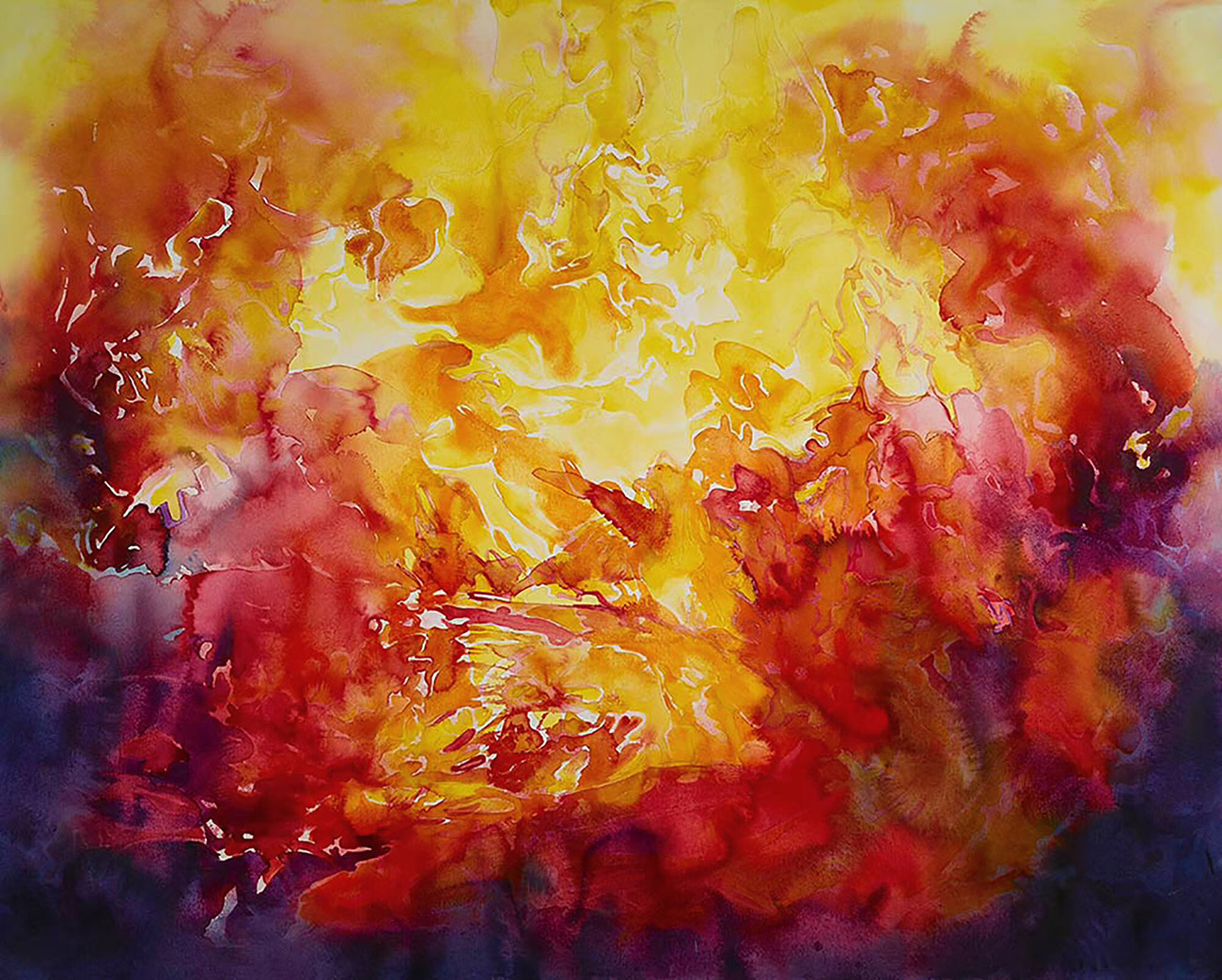
No? You say God is love and he would never punish because that’s evil? Ho, ho – one final objection to overcome. I won’t dwell on the fact that we are in no place to dictate what God can’t do, and that we live in faith, meaning in the totality of the faith and revelation that has been handed down to us (including the bits about divine retribution). Instead, I’ll attempt the more rational, logical argument, following Aquinas’s lead. The point that God is pure love and goodness is the very proof that punishment and banishment to Gehenna must happen. Pure goodness cannot exist alongside evil. That would be impossible, like trying to make oil become part of water. God’s goodness is like a white hot, purifying flame, and those who have been tested in the fire during life, like gold purified from slag, will glory in the pure flame of God’s love (this is reward). Meanwhile, those who have remained slag, or perhaps piled on more muck that they created themselves, will smoke and burn and writhe in the presence of God’s love.
Perhaps this is hell, the burning out. Perhaps it is a place in the underworld. I don’t know. But what I know is the promise, in the words of Jesus Christ:
Woe to you, scribes and Pharisees, hypocrites! For you are like whitewashed tombs, which on the outside look beautiful, but inside they are full of the bones of the dead and of all kinds of filth. So you also on the outside look righteous to others, but inside you are full of hypocrisy and lawlessness … You snakes, you brood of vipers! How can you escape being sentenced to hell? (Mt 23:27,28, 33).
I bring up all of this is to get us to the point of understanding St. John the Baptist, who makes his appearance every Advent as we contemplate the coming of Jesus Christ. I love John. What a figure! The final prophet, the bridge between the old covenant and the new, the voice crying out in the wilderness. In our reverence of this saint, however, let’s not lose sight of just what a wild figure he was. “John wore clothing made of camel’s hair and had a leather belt around his waist. His food was locusts and wild honey.” This is not normal — not now, not then. Setting the fashion for centuries’ worth of future desert ascetics wasn’t his only standout quality, though. He was a true fire and brimstone preacher, and famous throughout the land. Something was different with him and his message.
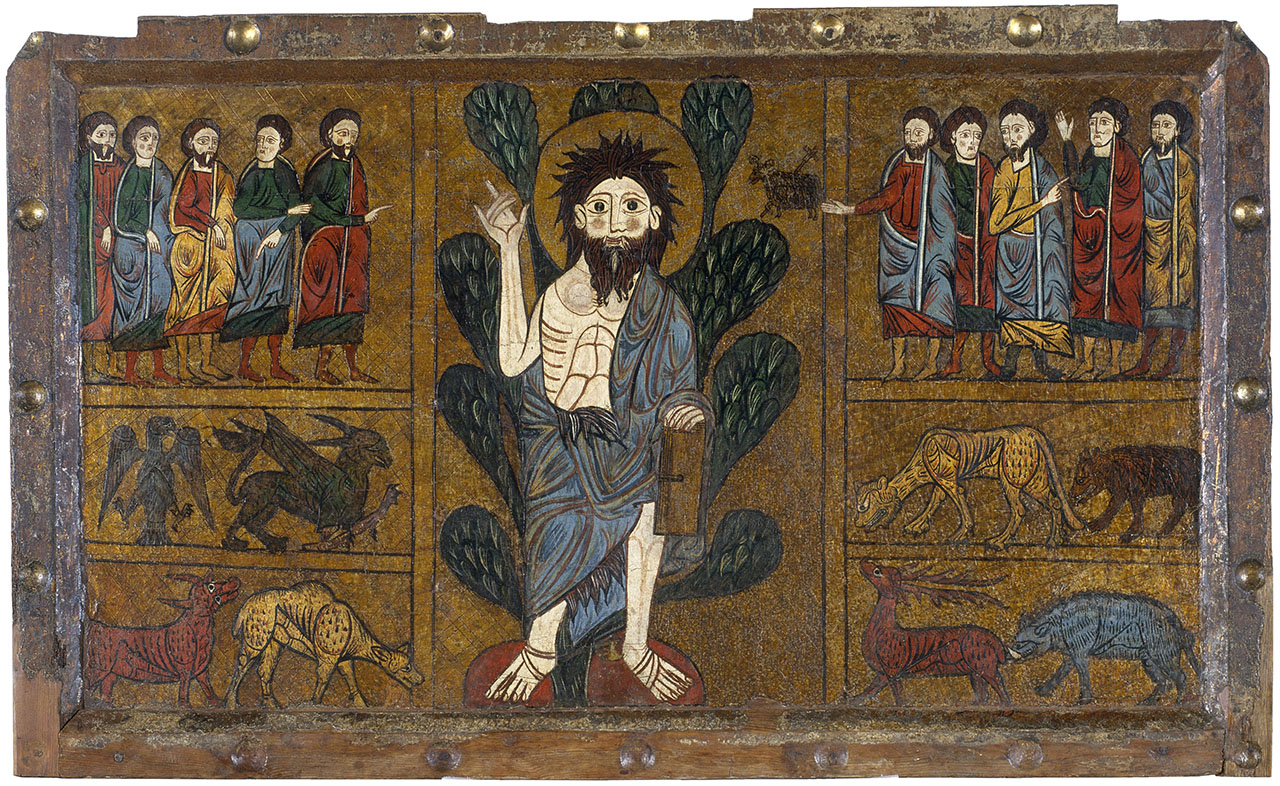
Altar Frontal from Gésera, Spain (1200s) depicting John the Baptist preaching in the desert, surrounded by wild animals | Image from Museu Nacional d’Art de Catalunya, Barcelona.
We are told that his message was, “Repent, for the kingdom of heaven is at hand!” This is something that Jesus would echo throughout his ministry, too. So, after God spent centuries preparing His People to develop their faith, culminating in the woman who would bear God as the Ark of the New Covenant, John spends these last moments before Jesus begins his ministry by preparing the people to bear the Word in their hearts.
John and Jesus share a fondness for calling out Pharisees: “When he saw many of the Pharisees and Sadducees coming to his baptism, he said to them, ‘You brood of vipers! Who warned you to flee from the coming wrath?’” We cannot turn a blind eye to the fact that John and Jesus’s message was one of preparing for the Final Judgement, the “coming wrath.” Today’s readings put this uncomfortable fact front and center. Advent is about preparing for Jesus, and that preparation has very, very serious stakes.
Consider how central “fire” is to St. John’s short speech about God’s judgment. “Even now the ax lies at the root of the trees. Therefore every tree that does not bear good fruit will be cut down and thrown into the fire.” Fire consumes the trees that do not bear the fruit for which they were planted. And then: “His winnowing fan is in his hand. He will clear his threshing floor and gather his wheat into his barn, but the chaff he will burn with unquenchable fire.” Fire immolates the leftover and useless chaff that was separated from the life-bearing grain. In both instances, fire is the judgement rendered, and importantly that fire cleans. It is a way to finalize the harvest season, to reset an ordered existence.
So, when John also tells us that Jesus “will baptize you with the Holy Spirit and fire,” we must realize that the cleansing, ordered, perfect fire of God is present with us from the very beginning of our journey to Him. Our baptism is conducted with the grace of the Holy Spirit and the soul-cleansing effect of fire. Fire is there in the beginning and it will be there in the end. There is a place for fire.
After all, there is even fire (in a positive sense, as in baptism), for those who will enter heaven. Being united to the divine glory that is the fiery love and goodness of God, our earthly concerns will be immolated by the great love we will bear in our whole beings, participating fully in that irresistible and never-ending flow of love in the Trinity.
If we are still bugged by the question of how do we feel about a God who judges harshly, then I think we need to contemplate the wild, frightening words of St. John the Baptist. We must take seriously the covenant God has made with us. We must repent for our sins, convert our hearts, and strive with all of our beings to be on the right side of the judgement. And we have to understand that there is a rightful place for fire.
Christ and the Last Judgement, mosaic in Saint John Baptistery in Florence, Italy (1260-75) | Image is a preview download from Alamy.com. Here we have the fuller composition of the image at the top of this reflection (apologies for the watermarks). Note that the damned in hell are presided over by the council of prophets and angels – in particular, note the wild-haired St. John the Baptist on the far left. This is a good reminder of our doctrine: hell is a sentence that is passed on those who have not “born good fruit” in life and accepted God; it is just and ordered, promised from the beginning. Unlike popular culture conceptions of good and evil fighting it out in an almost-equal battle (think of Star Wars), we condemn that heresy as dualism. Evil and Satan certainly exist, but they serve as part of the crucible of perfecting ourselves in this life and then as the jailers of hell in the afterlife. God has no equal and Jesus has already defeated death and Satan. The other important aspect of this mosaic is that it shows the deep medieval understanding of the important truths of the faith that are inaugurated with baptism. This magnificent Battistero di San Giovanni reveals to the initiates on the inside of its walls in glorious fashion the mysteries of our faith, including the fact that they are being baptized with the Holy Spirit and fire. They are being brought into the faith that promises a Final Judgement by fire from the very beginning.
aturday in the First Week of Advent: Isaiah 30:19-21, 23-26, Matthew 9:35–10:1, 5A, 6-8.
I have reflected in the past on the use of agricultural metaphors in scripture (see The Generous Harvest Without Cost, and Laborers for the Harvest), and today’s readings provide another opportunity to do so. The backyard gardener in me loves these metaphors – there is something so wholesome, so fundamentally human about working the land and then transforming its products into food and drink. The harvest, in particular, connects to something even deeper – life itself in those plants, which has reached a ripeness that yields fruit; this is the germ of the new generation, whether eaten by humans or plowed back into the earth for next year’s crop.
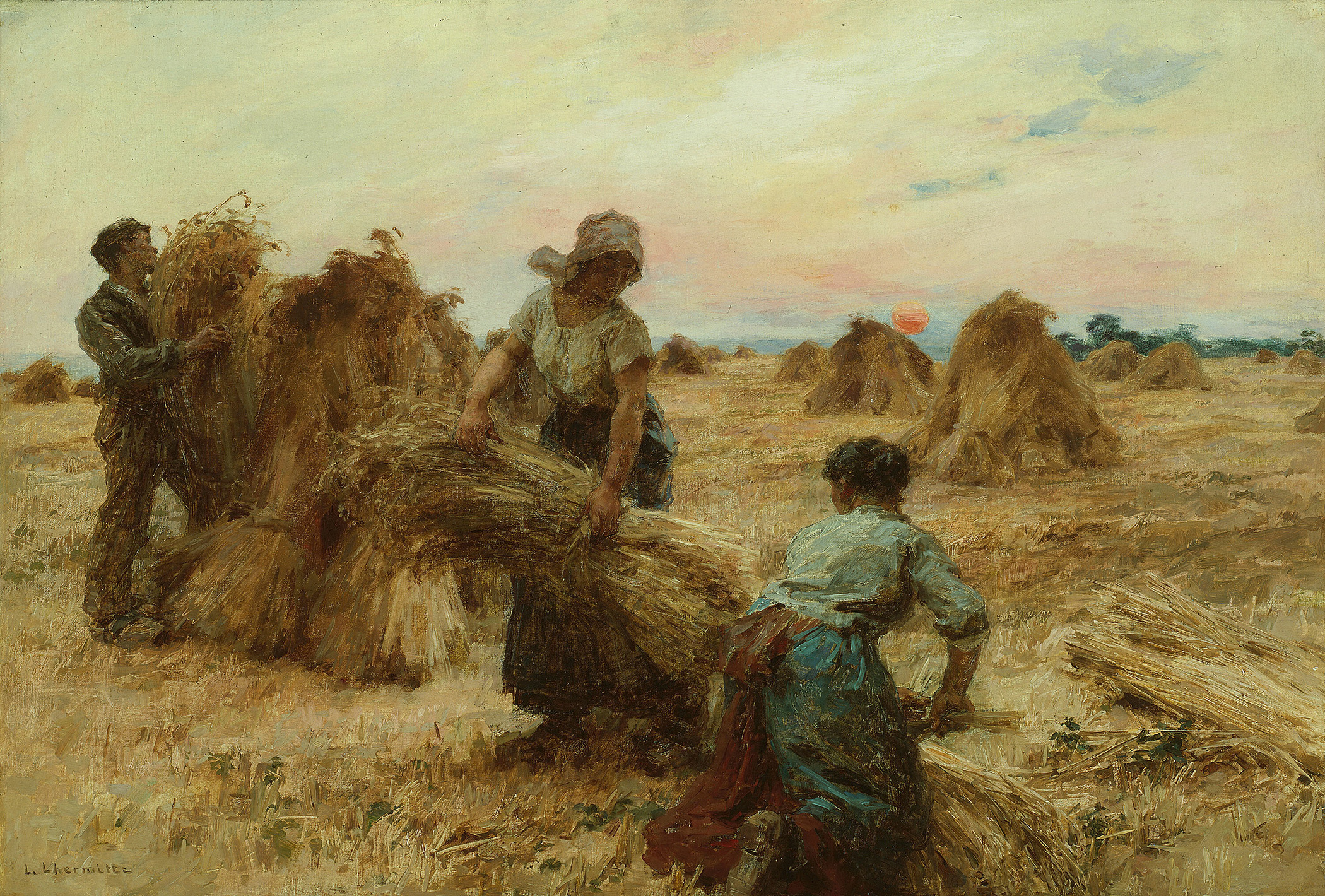
The Harvesters, Léon Augustin Lhermitte (1888-1889) | Creative Commons, courtesy the Art Institute of Chicago.
I’ll get philosophical here and claim that the fecundity of Creation reaches an inflection point in the harvest. OK, two $5 words there. Fecundity, meaning all of the potential fertility of a system. Inflection point, which my mathematician wife would happily define for us as the point on a curve when it changes concavity (convex to concave or vice versa) – imagine the very crest of a wave. If life on earth has a cyclical nature, then harvest is one inflection point while germination is its twin.
The entire cycle of germination ⇔ harvest is graced by the Creator, as Isaiah tells us today: “He will give rain for the seed that you sow in the ground, And the wheat that the soil produces will be rich and abundant.” But let’s not confuse this with “praying for rain” as in pagan nature worship. Isaiah is talking about God’s providential grace, His purposeful blessing of His People that is outside of the natural course of random weather patterns and such. This is a promise of something special and new: “No longer will your Teacher hide himself, but with your own eyes you shall see your Teacher.” Images of nature and harvest in scripture always serve as signs of something greater. Thus, Isaiah promises with apocalyptic language, “The light of the moon will be like that of the sun and the light of the sun will be seven times greater … On the day the LORD binds up the wounds of his people.” Once again, let there be no doubt that this is the promise of a great intervention on the part of God for His people. And, as we have reflected nearly every day of this first week of Advent, that great intervention is Jesus Christ, God made flesh.
So, what do we make of these agricultural signs once the promise is being fulfilled?
As he works his ministry of healing bodies and souls, Jesus has compassion on the “harassed and helpless” crowds (or “troubled and abandoned” as the lectionary states). He tells his disciples, “The harvest is plentiful, but the laborers are few; therefore ask the Lord of the harvest to send out laborers into his harvest.” The harvest – the inflection point where the ripeness of Creation is given over – is no longer portrayed as a harvest of wheat but a harvest of souls. The master of the harvest in the Time of Promises (Old Testament) would have always been a human, harvesting food for the good of the human community. But now, Jesus explains that the master of the harvest is God Himself, and what is being harvested – the ripe fruit of Creation – are souls in need of saving.
This is a fairly huge point. Jesus has compassion on a particular group: the helpless, abandoned crowds of troubled people. These poor, sick, demented, sinful people are his ripe fruit! He does not send the apostles to go harvest all the priests and Pharisees who uphold the Mosaic law down to the tiniest restriction. Jesus sees with the eyes of the Father, past the sin and ailments to the soul. This is the great message of hope that Jesus brings us: we are all children of God, all worthy to be saved. The outward trappings of failure matter little to God. It is faith and a contrite heart that God looks for.
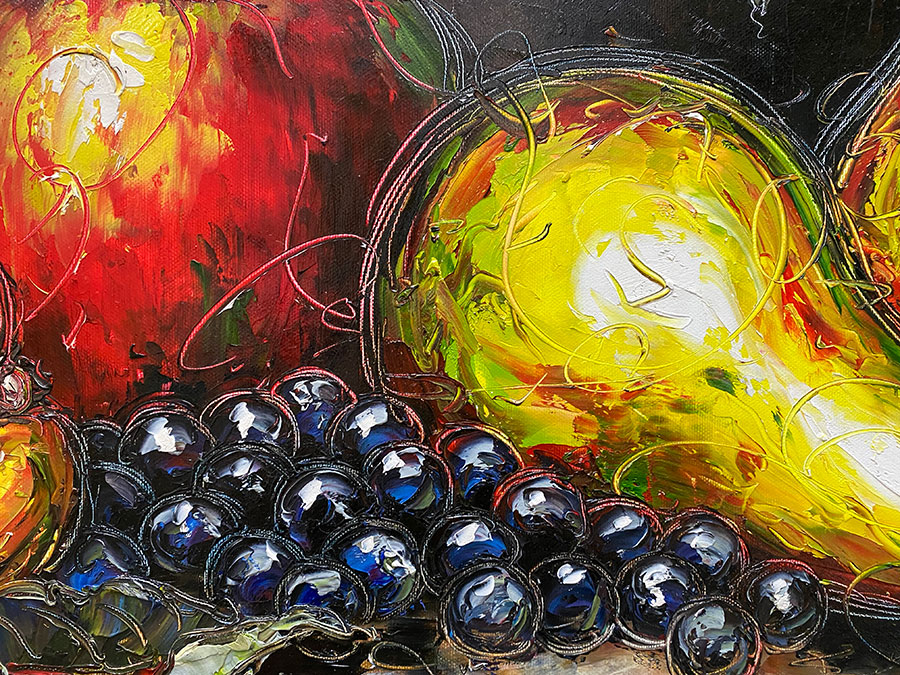
Detail from October Harvest, Van Matino (contemporary) | Image from Art Leaders Gallery. When I first saw this detail crop of the larger painting, I honestly couldn’t figure out what it was at first – the glowing pear on the right was so lustrous that I thought it was an abstract painting. The richness of the colors in the fruit is a nice analogy for what God must see in us – our shining souls – rather than how we picture ourselves.
And what of the cycle? If harvest is the first inflection point, what of germination? What will come of this harvest?
Jesus tells them, “As you go, make this proclamation: ‘The Kingdom of heaven is at hand.’ Cure the sick, raise the dead, cleanse lepers, drive out demons.” These are things you do for people in spiritual trouble; rather, that you do for souls in need of saving. Jesus makes it clear that the disciples and his own ministry are operating on a new plane: a spiritual one that transcends the physical one. The Kingdom of heaven is at hand! The new life that Jesus is in the process of begetting with this harvest of souls is infinitely greater. It is eternal life in heaven.
Cycles are abolished with this set of inflection points to end all cycles. The harvest that Christ began in his ministry and successfully established with his sacrifice to the Father has changed the concavity of history. We exist now in the end times, able to be a part of the harvest of souls as laborers and the harvested. We await the final germination of our souls in the Kingdom of Heaven, that final inflection point upward. This is explained in the letter to the Hebrews:
For Christ did not enter a sanctuary made by human hands, a mere copy of the true one, but he entered into heaven itself, now to appear in the presence of God on our behalf. Nor was it to offer himself again and again, as the high priest enters the Holy Place year after year with blood that is not his own; for then he would have had to suffer again and again since the foundation of the world. But as it is, he has appeared once for all at the end of the age to remove sin by the sacrifice of himself. And just as it is appointed for mortals to die once, and after that the judgment, so Christ, having been offered once to bear the sins of many, will appear a second time, not to deal with sin, but to save those who are eagerly waiting for him. (Heb 9:24-28).
Yes, may we all be “eagerly waiting for him,” harvested and ready to gain new life in the Kingdom. And, particularly for those of the Dominican charism, we must hear the call to be laborers in this harvest – the salvation of souls must be our heart’s desire, just as it is God’s.
Friday of the First Week of Advent: Isaiah 29:17-24 , Matthew 9:27-31.
Today’s readings speak to one another in a grand call and response across the liturgy. Truly, this happens throughout the scriptures, as Christ fulfills the words he gave the prophets. The Liturgy of the Word shows us in written/oral form what happened in reality for people of faith (the blind, the lame, the deaf, etc.). As we celebrate the Mass throughout the course of our lives, we reenact another reality – the great spiritual reality we cannot perceive with our senses – and this, too, is the great call and response between the Father and the Church.
Today’s call and response is more concrete. We hear Isaiah’s prophecy that “the eyes of the blind shall see” and the gospel gives us Jesus’s miraculous healing of two blind men. As we know, blindness in scriptures is both a physical ailment as well as a metaphor for spiritual blindness. Thus, the “call” in the Old Testament is that people will no longer be blind to God in their midst and the “response” of the New Testament is Jesus, in fact, being recognized as the Anointed One, the Son of God. The physical healing is a sign of this spiritual movement toward God.
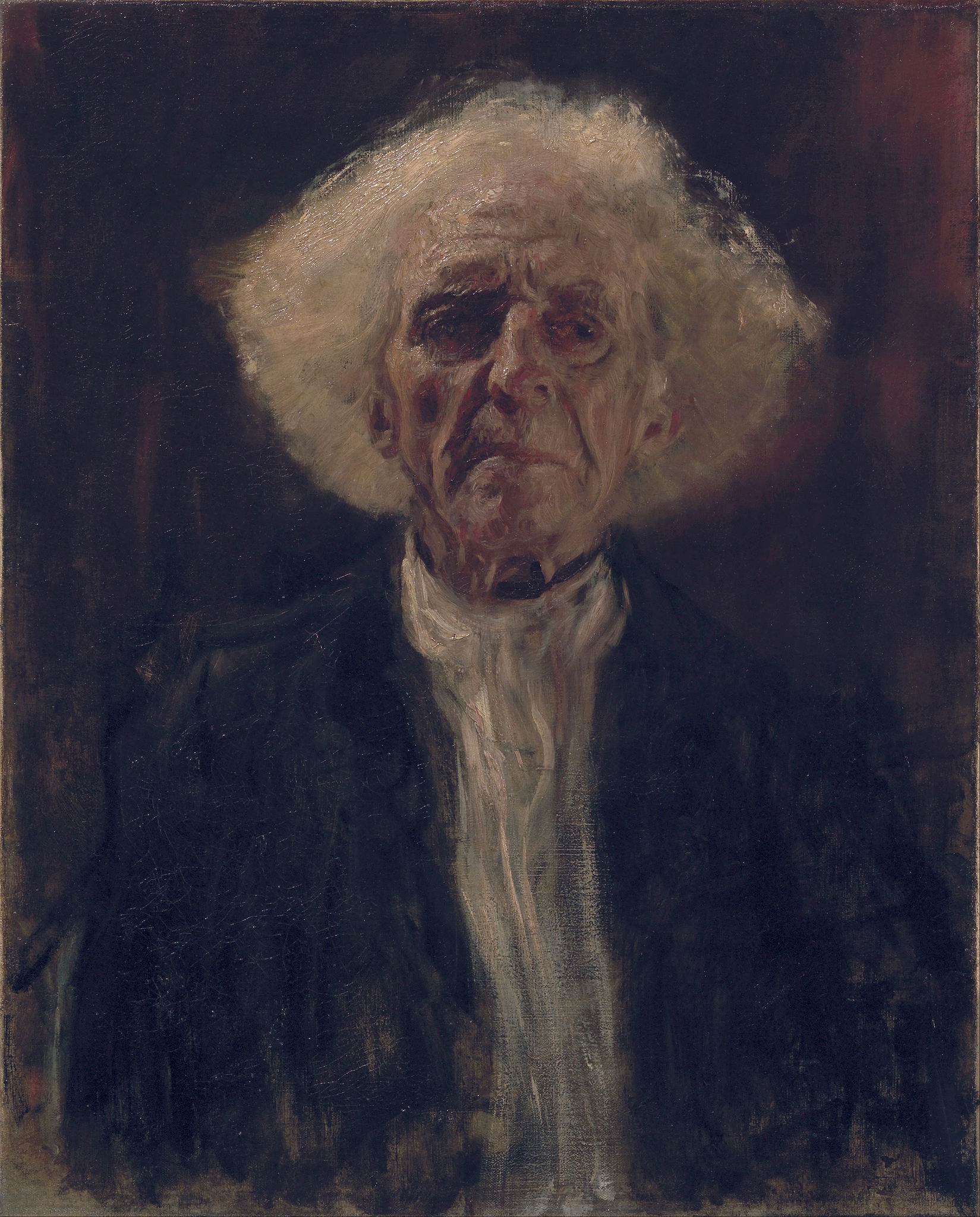
The Blind Man, Gustav Klimt (1896) | Creative Commons, courtesy Wikimedia. I find Klimt’s portrait here to be moving, and not in the way that I normally associate with the blind (who provoke in me feelings of intense pity and sadness). Let us consider what Klimt might be telling us about blindness. This is a man of advanced age, with a corpse-like forehead and deep wrinkles that suggest not just age but an emotive life now spent. This is echoed in the skin hanging from his neck and the deep bag under his left eye. The man is not smiling. He has a an uncertain mouth and furrows between his eyes. The eye that is shown is watery and has wandered far to his left. More than weakness of the eyes, this speaks to a depletion of spirit. Half of his face is in darkness, a deep, black hollow in the cheek emphasizing the approach of this man’s death. The great contrast in the painting is the man’s white hair, splayed out from his head in an almost inverse halo. The hair seems neatly coiffed despite its wildness. If portraits can present to us a summation of a person, this one seems to give us a man who wants to control his appearance and very self, but seems to be in a losing battle with time. In all, we encounter a man who has reached the end of his days, and his outlook is uncertain at best. I pity him, but not because of his physical blindness. He is the opposite of beatified. Why? If it is because he is blind, surely its not an indictment of people with disability but one of a deeper, perhaps spiritual significance. Is this a man who has been willfully blind to God in his life and has arranged himself in life according only to his own powers, only to find that this is woefully inadequate in the face of death?
Digging into the Word given to Isaiah, we see so much detail: “On that day the deaf shall hear the words of a book; And out of gloom and darkness, the eyes of the blind shall see. The lowly will ever find joy in the LORD, and the poor rejoice in the Holy One of Israel.” Just this part has so much resonance. The deaf hearing “the words of a book” is the literal opening of ears that physically do not hear, the opening of the ears of the heart to God and His message of hope, and the words they hear are not just any words but the “words of a book” – that is, the great book of scripture, incarnate in Jesus Christ, the Word Himself. The next line emphasizes the spiritual sign of curing blindness: “out of gloom and darkness” speaks to the spiritual desolation of people who are not open to God in their lives. And in the third line we find the joy and rejoicing that cannot be suppressed, as demonstrated by the blind men in the gospel reading who “went out and spread word of him through all that land” despite Jesus asking them not to. In these three lines in particular, the first reading and gospel speak to one another in perfect synchronicity.
But, as always, Jesus fulfills scripture in surprising ways. One exchange at the heart of today’s healing reveals the true kernel of the spiritual call and response. Jesus asks the men, “Do you believe that I can do this?” and they answer yes. Isn’t this the BIG call and response of each of our lives? It belongs to the constellation of big questions humanity has always dealt with: is there a God? What type of god is he? Does God (or the gods) take an active role in our lives or does He sit back after having set everything in motion? What is incredible is that we have an answer to every one of these questions. Jesus answers them definitively and clearly throughout his ministry, death, and resurrection. Despite this, we ask those same questions again and again.
It is our weaker nature to question and disbelieve anything our senses cannot “prove.” The fact of love alone proves this. The thing we can’t quantify, can’t prove but simply feel and enact – that thing we call love is stronger than history, blood, even death. We can love ancient enemies. We can love a stranger like we would a brother or mother. Our love for those who have passed from this life makes their spirit live and breathe within us. This is our stronger nature – stronger because it participates in God and His grace while the nature of disbelief and cynicism will always be weaker because it is a product of Satan in our lives.
Beyond this rational argument about our nature and the fact of love, Jesus himself tells us of the essential power of our assent to God in our midst: “Let it be done for you according to your faith,” he says. “And their eyes were opened.” Deceptively simple. On one hand, we might be led to think that it is all in our power, in a type of mind-over-matter situation. But this is untrue. Those with faith receive sight and blessings. They don’t make a new reality for themselves. Not to mention, this thing called faith is itself an amazing gift, a matrix of communion between humanity and God that we have received from our ancestors. I didn’t make up Christianity just like Abraham didn’t make up Judaism. Our faith has been received by humans since the beginning of time when God planted the revelation of Himself in Creation and, in a special way, in angelic revelation to the prophets. This precious gift of faith passed down to us must be received, adored, absorbed, believed, and lived, however, in order for it to be efficacious.
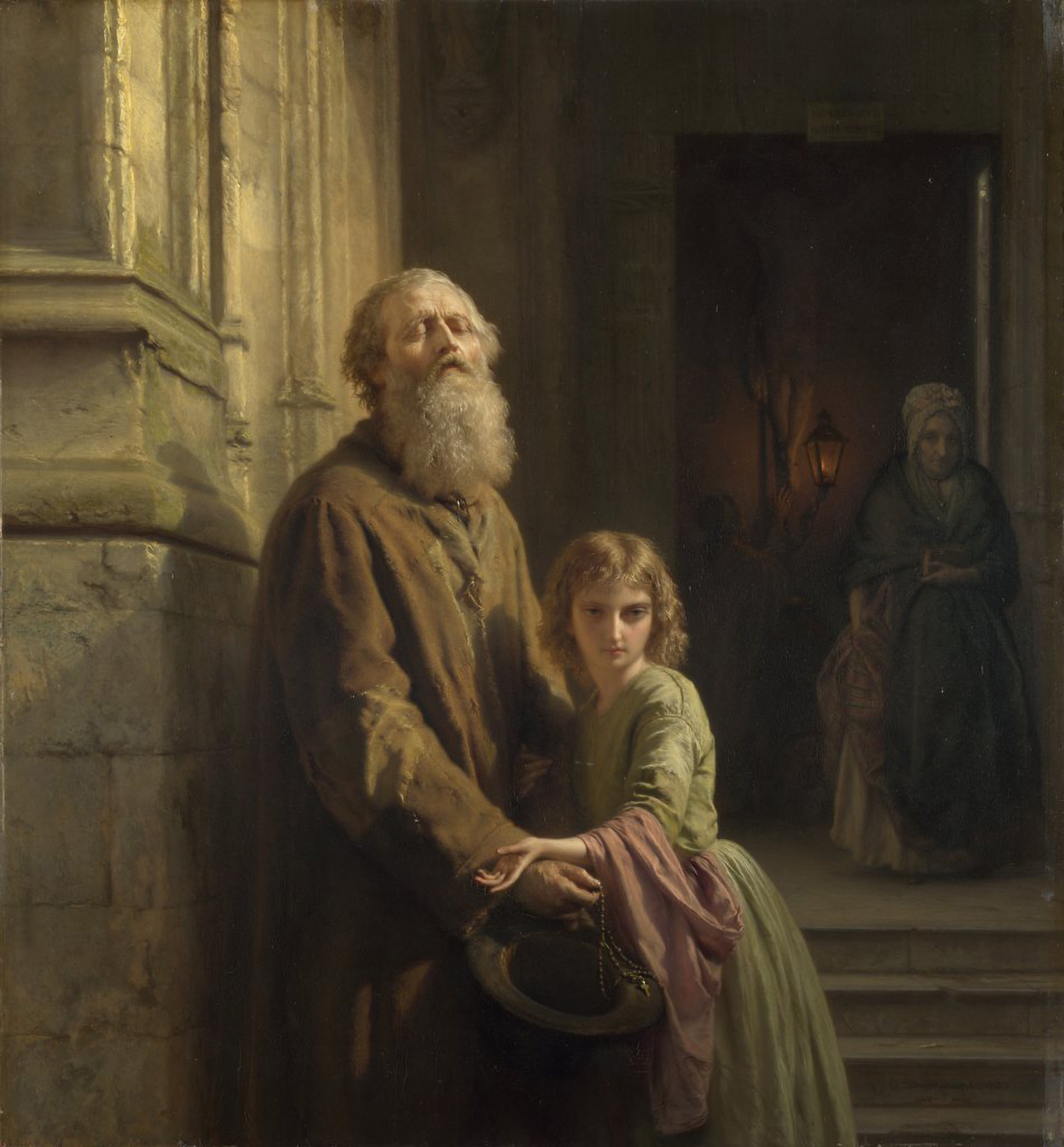
The Blind Beggar, Josephus Laurentius Dyckmans (1853) | Creative Commons, image courtesy The National Gallery. Compared to Klimt’s painting, Dychmans is much more overtly religious and presents a more lovable figure. The beggar holds a rosary while a woman in the dim background reaches up to the feet of Christ on a crucifix. The title of the painting recalls the blind beggar in the gospel of Mark and Luke (and found in today’s gospel of Matthew in the form of two blind men), all of whom hear Jesus say a form of “your faith has healed you.” All three stories have the blind man call out to Jesus, saying, “have mercy on me.” While many scholars see perseverance in calling out to Christ as the lesson from these gospel episodes, I feel that Dychmans emphasizes this openness of heart and trueness of faith. The man’s look is patently that of a penitent sinner receiving the grace of God, shining on him from above. The church is a great edifice that frames the scene and stands in for the great faith that sustains him. Most interesting to me is the sexless child holding the man with one arm and extending a hand of offering with the other. The child’s look is steady and firm, and the wide-set eyes lend an animalistic (perhaps sheep-like?) quality to the face. This person emanates youthful vigor and purity, and whether meant to be an angel or Christ himself, the juxtaposition with the blind man is very interesting.
A word about “blind faith.” What an interesting oxymoron in the light of today’s gospel where faith gives sight, not blindness. I’ve felt unease as a young man about believing everything the Church teaches, and my young adult children have interrogated me along these same lines. Indeed, growing up involves learning not be gullible, not to be “taken” by this con man or that ideology. So, a certain amount of skepticism is to be expected, if not encouraged. But, once the fundamental question of “is this actually God I encounter in my received faith?” has been answered affirmatively, then the game must change. For, if you believe that this is God, the only appropriate stance is on your knees. When we accept God, we make our hearts docile to His Word, His revelation of Himself. The docile heart does not challenge or demand anything from its God; nor does it from those things God has established for our benefit such as the Church and the communion of saints and angels. This is not “blind” faith, but faith that has been opened, like a rose unfurling, receiving sweet rain and nourishing sunshine, and then perfuming the world with its irresistible scent. The purer the faith (the less it is questioned and the more it is embraced and its endless depths plumbed for truth), the more we delight the Lord and receive His grace.
May we understand our faith as the blessed gift it is this Advent, and may it be done for us according to our faith.
Thursday of the First Week of Advent, Year A: Isaiah 26:1-6, Matthew 7:21, 24-27.
The beginning of the first week of Advent has set our eyes upon the goal: Christ’s entrance into the world and – at the same time – the fullness of the Kingdom that will come. Today’s readings remind us that to partake in this prize that we anticipate, we must have faith and do God’s will.
As Jesus says in the gospel reading, “Not everyone who says to me, ‘Lord, Lord,’ will enter the Kingdom of heaven.” Maybe it’s just me, but those words send a chill down my spine. The thought of not spending eternity in God’s presence is my greatest fear. Perhaps we run the risk of getting too comfy with the thought of our ever-merciful, ever-loving God that we forget we have a real covenant with Him, one that we must uphold on our end, too.
Isaiah is given this knowledge, as he relates in the first reading: “Open up the gates to let in a nation that is just, one that keeps faith.” These are the two ingredients: keeping faith in God (and, as we shall see with Jesus, in His Son), and being “just,” which means acting according to God’s will.
Justice is a big theme in the Old Testament, and it boils down to the application of God’s law to human situations. Justice is where the rubber hits the road, as they say. We read in the Psalms: “Blessed are they who observe justice, who do righteousness at all times!” (Ps 106:3). Justice was understood as an active thing that people do, and righteousness is specifically applied to those who act justly.
Justice and righteousness, of course, cannot be understood outside of their relationship with God, who is the ultimate source of justice and good. A person’s righteousness is measured against how much his “doing justice” is in line with God’s goodness and justice. And it is God’s will that we act justly and be righteous, as we read in Proverbs: “To do righteousness and justice is more acceptable to the Lord than sacrifice” (Pro 21:3).
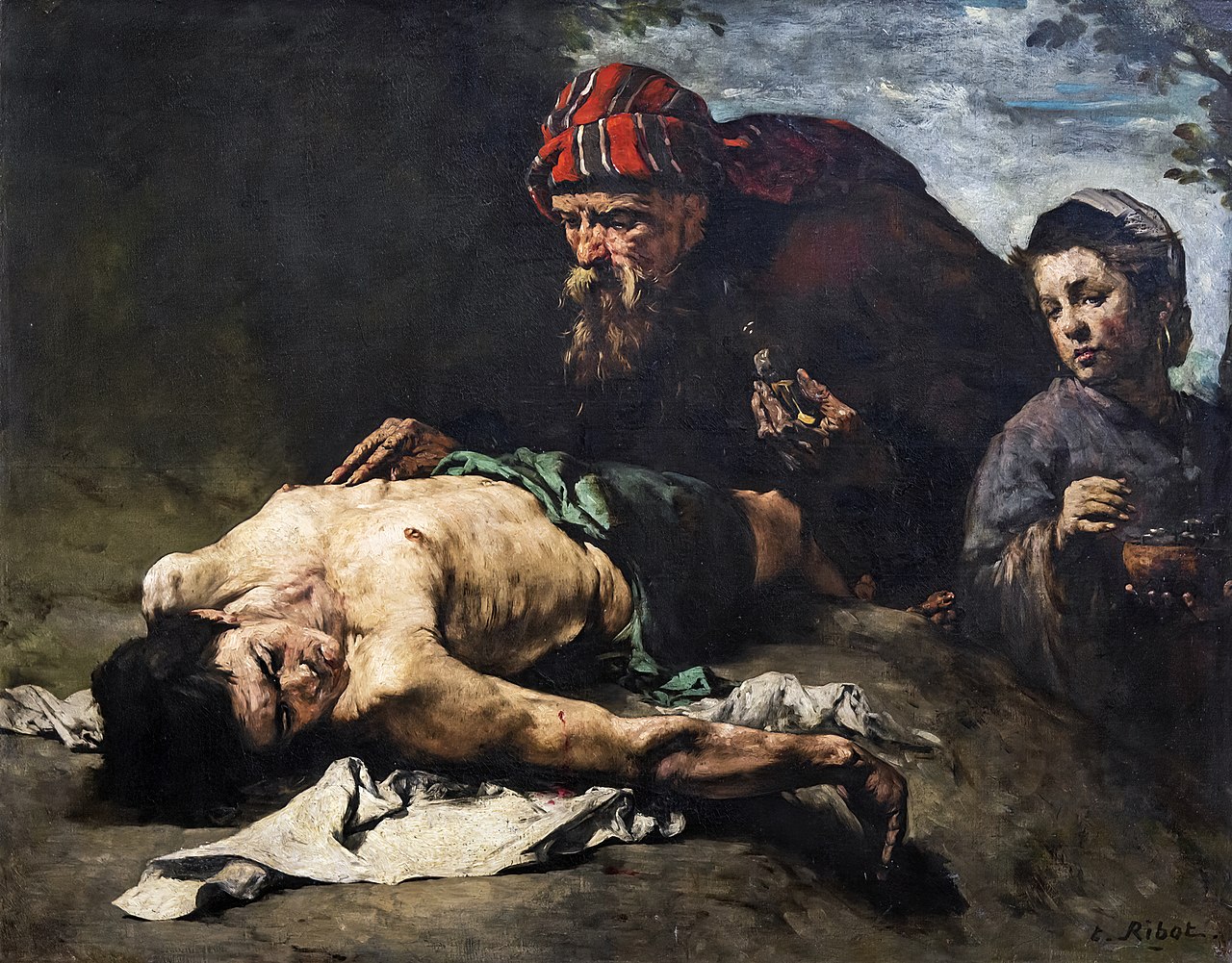
The Good Samaritan (Le Bon Samaritain), Théodule Ribot (1870) – Musée des beaux-arts de Pau | Creative Commons, courtesy Wikimedia. I can’t think of a greater example of “doing righteousness” than the one Jesus gives us in the parable of the Good Samaritan. I particularly like Ribot’s use of chiaroscuro and style of realism that anticipates the brushstrokes of impressionism because they heighten the ever singular nature of righteousness as the application of God’s will in a particular encounter between humans, often without any observers.
Jesus ratifies this understanding of active justice = righteousness, and raises the stakes when he says in today’s gospel that the one who will enter Heaven is “only the one who does the will of my Father.” This is new. Before Jesus, there was no way for humanity to gain entry into the Kingdom for eternity – this was not on the table for the Jewish nation and thus their hope took on a more worldly, nation-building aspect. But with Christ, the horizon of hope and the aspirations of humanity became immeasurably greater.
With Jesus, the prophecies about a triumphant Jerusalem were shown to be about a heavenly Jerusalem, not an earthly one. The true temple is now understood as the Body of Christ, and the laws of the prophets is perfected in the Way of Love that he demonstrated.
The first ingredient for salvation is faith in Jesus Christ: if you don’t accept that he is the true Son of God, then you can’t accept the new Jerusalem, the new temple, or the Way of Love as the only path to Heaven. All of those things rest in the person of Jesus Christ. But today Jesus reminds us that this is not all – “Not everyone who says to me, ‘Lord, Lord,’ will enter the Kingdom of heaven.” Why is this not all? Because Jesus himself is but the fullest expression of loving the Father and doing His will. Jesus always points back to the Father, insists that “His will be done.”
And, crucially, His will is not to be done passively. Doing God’s will means … well, doing.
Even though God could act decisively in Creation without us doing anything (after all, He created it to begin with!), His will is precisely that we act in the same love He brings to Creation. Jesus could not be clearer in today’s reading: “only the one who does the will of my Father in heaven” will spend eternity in Heaven. Emphasis on “does the will,” not “accepts” or “watches” or “approves of.” This doesn’t mean that we should run out and start a mission house for the poor or sell everything we have and give it to the Church (unless you hear God’s call to do that). We don’t have to invent things to do. Instead, let’s consider every act we already do throughout our day and weigh them against whether they are in line with God’s will.
The words that we do (or do not) offer to someone in greeting as we pass them – are they in line with the Father’s will? How about the thoughts that enter our head before we even formulate words of greeting? Is our heart conformed to God? Do we think generous thoughts about people we know as well as strangers? If not, now’s the time to start praying for God’s mercy to enter our hearts, to soften them, to fill our minds with positive, generous, loving things. This is the work of resisting the temptations to hate, jealousy, resentment, etc. that Satan spends his hours insinuating in our minds. It takes prayer, reliance on God’s power, and placing ourselves at His feet. He is our armor of light and will protect us.
But something, too, should be said about engagement and encounter. Especially in today’s pandemic-conscious environment, we have become accustomed to a certain amount of personal, sanitized space. Whether working from home or avoiding that person who is coughing, we live in a very different world than just a few years ago. Yet we have to admit that God is found in encounter with others, and the Church is fundamentally a community and communion of many. God’s will is particularly meaningful when applied to others. The great commandment is to love God above all else AND love our neighbors as ourselves. This demands some type of encounter and engagement. This doesn’t have to be face-to-face (especially for those who are sick, immunocompromised, etc.), but for most of us, the post-pandemic era perhaps tempts us to be a little more selfish with our space and time.
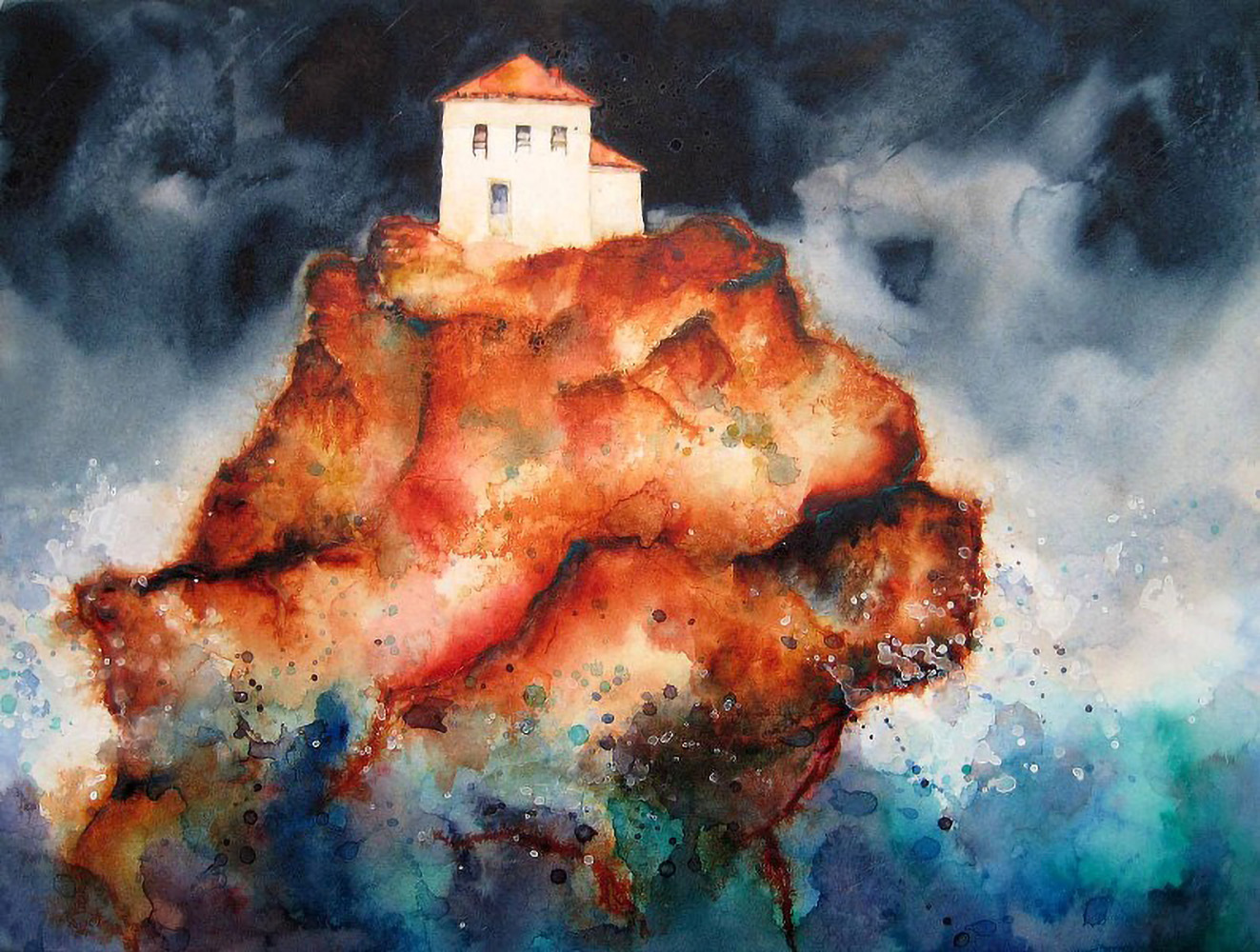
House Built on Rock, Sandi Hester (contemporary) | Image from paintingtheword.com.
One last thing resonates with me about today’s gospel reading. Jesus’s analogy is interesting: “Everyone who listens to these words of mine and acts on them will be like a wise man who built his house on rock.” The first half of his statement is a repetition of what he said earlier about doing God’s will, only this time God is configured as “these words of mine” (this is coming from the Word of God, the Logos himself, of course). Remember Jesus’s words, “If you know me, you will know my Father also” (John 14:7a). Next, the analogy is to build a house on a rock. The force of this analogy is the solidity and permanence of the structure. If faith is the firm ground upon which we stand in life, then the full Way of Christ – faith plus doing God’s will – is that solidity multiplied and lasting, carrying us all the way to Heaven.
It makes sense that Jesus presents this analogy as a man building his house because it is by the sweat of our brow, the good work we do, that we multiply the solidity of our faith. You may have noticed this in practice. Have you ever felt bad about giving some money to someone in need or providing a cheery hello to someone and seeing their expression change to a creaky grin, surprised at the random niceness sent their way? God has built within us a natural reinforcement for doing His will – it feels good. It is the companion to our conscience, which alerts us when something against God’s will is afoot. This positive reinforcement for acts of love and generosity is baked into the very acts themselves. It’s the true source of happiness. It’s doing God’s will.
Today’s readings echo resoundingly the active preparation we are called to do in Advent upon which we reflected on the first Sunday of the season. May we all prepare actively through prayer, praise, feast, and love!
Wednesday in the First Week of Advent – the Feast of Saint Andrew, Apostle: Romans 10:9-18, Matthew 4:18-22.
Today we celebrate the Feast of an Apostle – St. Andrew, to be precise. The readings mark his calling and celebrate the evangelical work of all the apostles. Feasts stud the liturgical calendar like cloves spiked into the oranges of a fragrant mulled cider. They interrupt liturgical seasons like prairie dogs sticking their heads out of their holes in seemingly flat landscape. Yet despite their seeming incongruity and randomness with respect to the liturgical seasons, they always point back to the great revelation of God in our midst and help us deepen our ongoing festival of the Lord.
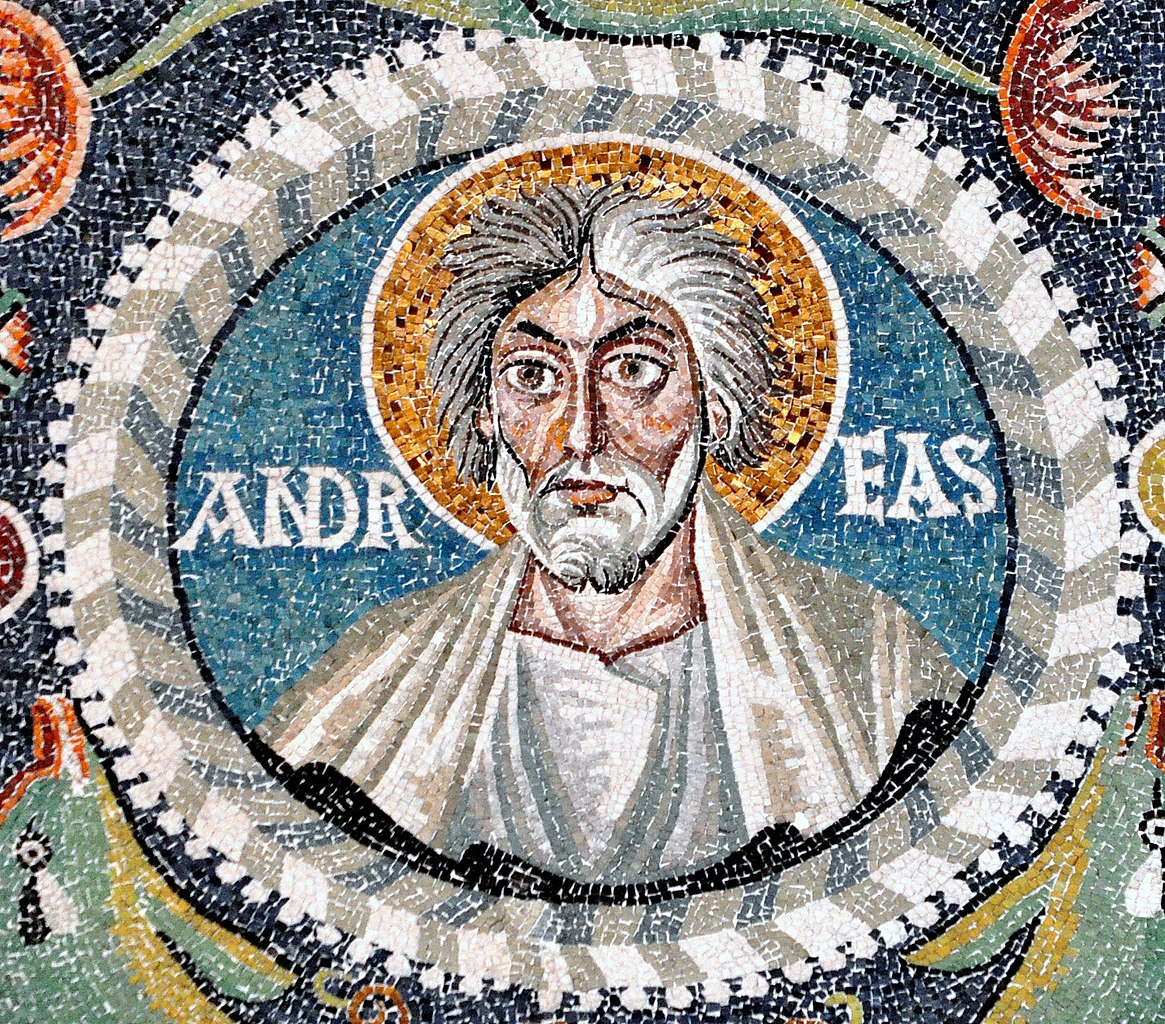
Andrew the Apostle, detail of the mosaic in the Basilica of San Vitale, Ravenna Italy (526-547) | Creative Commons, courtesy Wikimedia.
What does it mean to feast? What is the nature of a festival? German Catholic philosopher Josef Pieper (1904-1997) has written several books that look closely at these questions and provide us with a proper understanding. Pieper acknowledges that a festival is a “day of rejoicing” and, more profoundly, that “joy is the response of a lover receiving what he loves” (In Tune with the World, 18). He musters St. John Chrysostom as proof – the great saint wrote, “Ubi caritas gaudete, ibi est festivitas,” “Where love rejoices, there is festivity.” True joy, true festival, means that love is at work, responding to something sublime that is the object of what the feasting person longs for. The next move Pieper makes in his small, must-read book, In Tune with the World, interestingly uses a note from Frederich Nietzsche in Book IV of his Will to Power: “To have joy in anything, one must approve everything.” Pieper latches onto this insight and writes:
Festivity lives on affirmation. Even celebrations for the dead, All Souls and Good Friday, can never be truly celebrated except on the basis of faith that all is well with the world and life as a whole. If there is no consolation, the idea of a funeral as a solemn act is self-contradictory … Consolation exists only on the premise that grief, sorrow, death, are accepted, and therefore affirmed, as meaningful in spite of everything. … To celebrate a festival means: to live out, for some special occasion and in an uncommon manner, the universal assent to the world as a whole (21, 23).
Finally, Pieper can connect the dots for us: “there can be no more radical assent to the world than the praise of God, the lauding of the Creator of this same world. One cannot conceive a more intense, more unconditional affirmation of being” (24). Aha! So, my praise of God is an assent to all that He has created. Can I get an Amen?? To me, this makes a lot of sense. Folding back in Chrysostom’s phrase, where love rejoices, this compounds the need to define festival in relationship to God, who is pure love. True festival and feasting mean partaking in the very joyous love that God offers us, it means stopping our usual utilitarian work and activity to simply feast with Him on love.
I go to the trouble of defining feasting because, as Pieper details, there are many false festivals in today’s culture. We can’t simply make ourselves happy without reason. We can’t pretend to celebrate something that is hollow in its core. True feasting, with thankfulness for God and his Creation at its heart, is the most important activity that humans can do – and the highest form of this feasting occurs in the liturgy. Our rituals of prayer, thanksgiving, sacrament, and community are the truest and purest form of festival that we can encounter on earth. All other festivals have meaning to the degree that they participate in liturgical festivity. Fourth of July? Not so much. Halloween? No, sir. Christmas? Of course (if done right)!
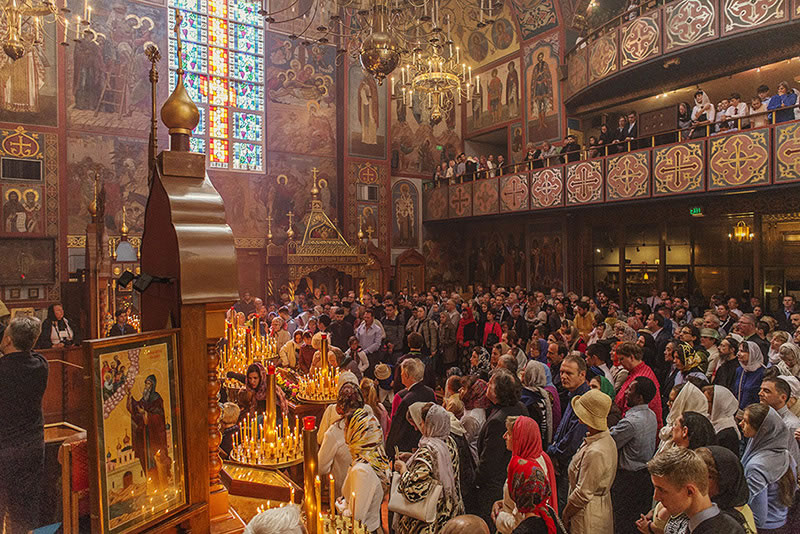
Photo of the Divine Liturgy at Holy Virgin Russian Orthodox Cathedral – Joy of All Who Sorrow – in San Francisco, CA | Image from anothercity.org. Tell me this doesn’t look like a festival!
Special feasts during the liturgical year are not interruptions of a season, but punctuations. Every aspect of liturgy participates in the gift of the Holy Spirit, the constantly reciprocated divine love that is the Trinity. Feasts allow us to contemplate different ways the love of the Trinity has dwelt with humanity. Notably, Christ is the center of these since he is the Incarnation of the divinity, our Chief Priest, our intercessor with the Father. When we celebrate a feast day, we have the opportunity to dwell with God outside of work and utilitarian effort, to reflect upon the focus of the feast and rejoice in thankfulness. What’s more, we celebrate alongside the saints and angels in heaven!
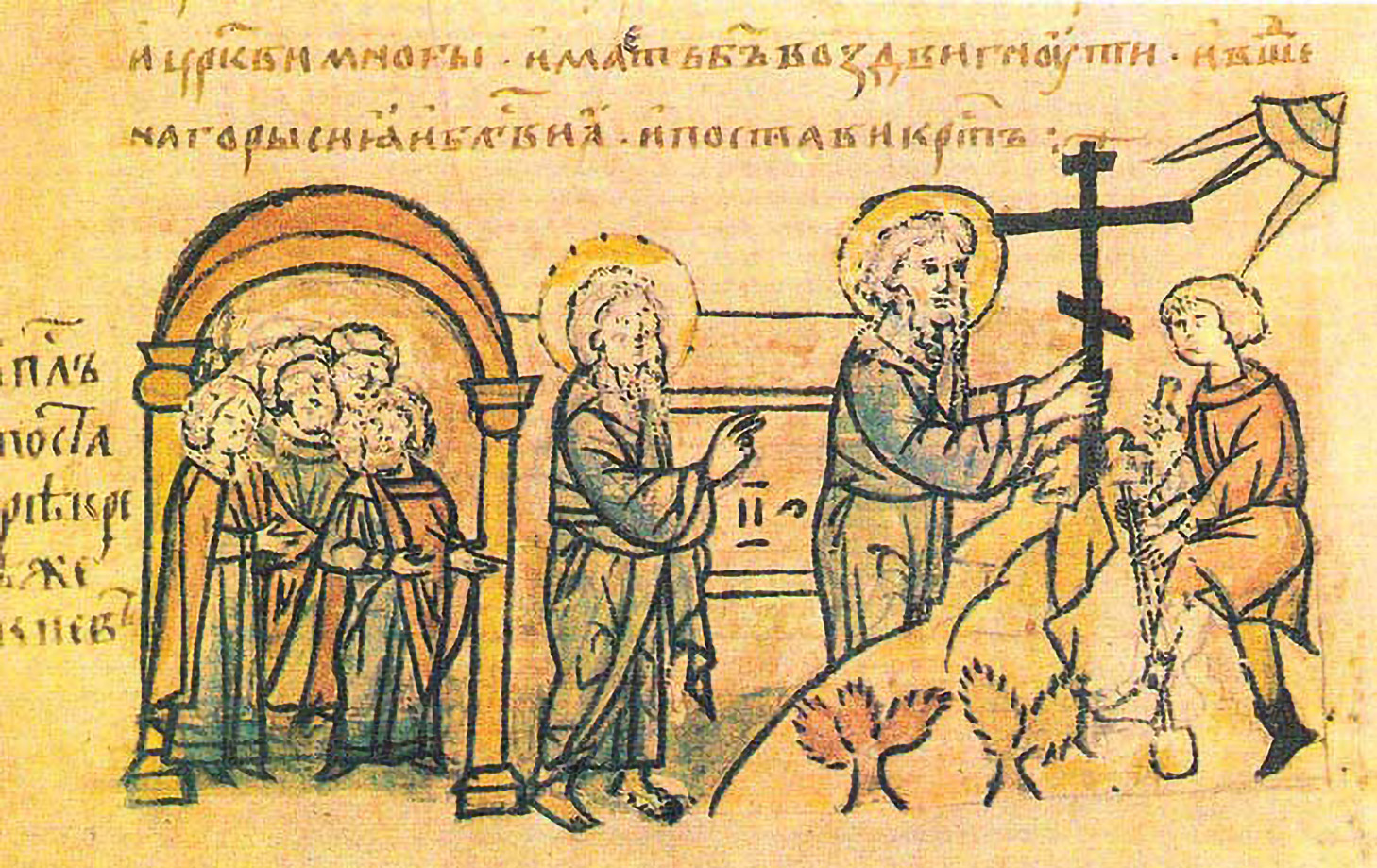
So, we celebrate with Andrew, brother of Simon Peter, today. We consider his courage and the ray of faith and trust that must have pierced his heart when Jesus met them on the shores of Galilee, inviting them to drop their nets and follow him. We pat him on his heavenly back for such courage and faith! We put our arms around his shoulders to walk with him during Christ’s ministry, Passion, death and Resurrection. And then we gaze on him lovingly as he sets about evangelizing in the world after the Holy Spirit descends and sets the apostles afire. For, as St. Paul writes in the first reading today, “But how can they call on him in whom they have not believed? And how can they believe in him of whom they have not heard? And how can they hear without someone to preach?” Feasting with St. Paul and St. Andrew, they reveal to us that they didn’t think twice about traveling around the Levant and Asia – souls needed to hear about Jesus Christ so that they could be saved. As we remember the great stories of St. Andrew in the Byzantine Church – that he went through what was to become Constantinople, traveled all around the Black Sea into what is today’s Ukraine, all the way up the Dnieper River to the future location of Kyiv, where he erected a cross on the site where the Saint Andrew’s Church of Kyiv currently stands, and where he prophesied the foundation of a great Christian city – we can imagine hearing his great seafaring tales over mugs of beer. This is a feast, after all! We affirm the world that God created, in its need for salvation, in its tales of adventure, sacrifice, strife, joy, and love.
Saint Andrew erecting the cross on the hills of the Dnieper River; a prophecy of the city of Kyiv (15th century) | Creative Commons, courtesy Wikimedia. This is from the Radziwiłł Letopis, also known as the Königsberg Chronicle, which is an Old East Slavic illuminated manuscript from the 15th-century; it is believed to be a copy of a 13th-century original.
And of course feast days can shed light on the liturgical season in which they fall; they are both rooted in the same constant festival of the liturgy. The Feast of St. Andrew sheds light on the Advent season, too. Andrew and the Apostles are our link to the Christ Event that we prepare for. They are the ones who saw and believed, who preached and spread the Word so that we, too, could become brothers and sisters in Christ. Without Andrew and the other Apostles, we would not be celebrating Advent and would be stuck in pagan ways, ignorant of the saving grace of Christ. So, with them and the angels, we await to greet Christ at his birth and again at his second coming.
Tuesday in the First Week of Advent: Isaiah 11:1-10, Luke 10:21-24.
When I read today’s readings, it’s hard to contain my sense of expectation for the Kingdom. Isaiah’s poetic language gives sparkling life to the visions God has revealed to him. Luke then shows us an intimate moment outside of his teaching and miracles when Jesus speaks directly to his Father, thanking Him. “The kingdom of God is at hand,” Jesus says earlier in this chapter of Luke, and the impact of today’s readings urges us to share Jesus’s gratitude for what God has given us in history.
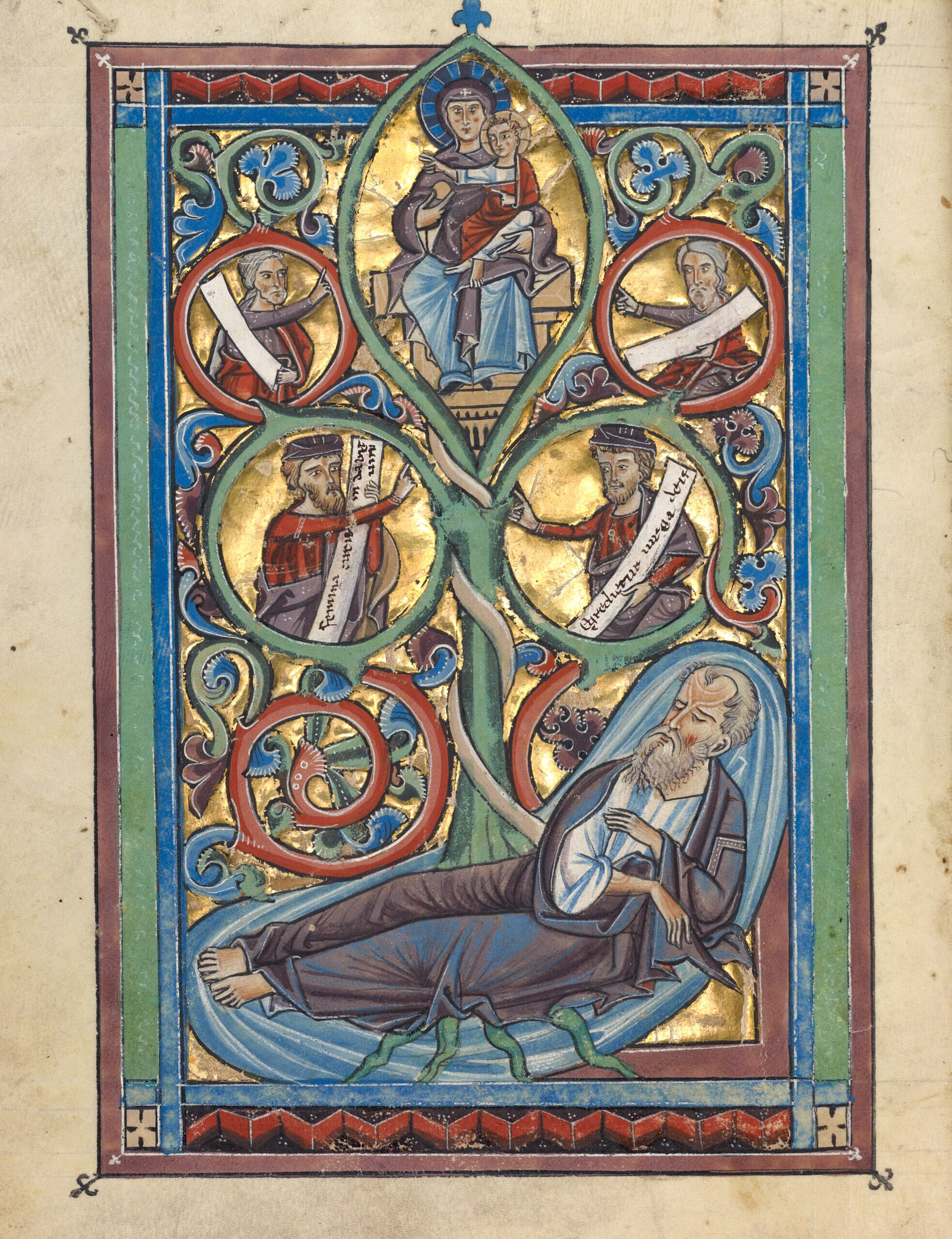
Much like we saw in Sunday’s reading from Isaiah, chapter 2, today we also find a vision of Christ’s coming into humanity followed immediately by the more eschatological vision of God’s kingdom yet to come. This is Advent! We celebrate and await both of these events simultaneously. The first part of today’s passage describes Jesus in lyrical imagery: “A shoot shall sprout from the stump of Jesse, and from his roots a bud shall blossom.” This naturalistic image of regeneration from something old and thought to be dead is yet another reminder of God’s constancy. The kingdom of Judah to which Jesse belonged fell to the Assyrians during Isaiah’s lifetime. It seemed to be the total destruction of God’s people, as the kingdoms of Israel and Samaria had fallen some years earlier. But God shares a great promise of redemption and regeneration with Isaiah. The “stump” of Jesse is not dead – God still has plans for His people.
The Tree of Jesse, unknown artist from a psalter in Würzburg, Germany (1240-1250) | Image courtesy the Getty Museum. From the Getty description: “In this image, as was traditional in representations of this theme, Jesse appears as the root, from which sprouts a tree supporting the Virgin and Child. Above Jesse, two prophets hold scrolls with verses that were understood to refer to the Virgin. Along with two prophets whose scrolls were never filled in, they point towards the Virgin and Child. At the top of the tree, the Virgin presents an orb, symbol of the Messiah’s dominion, while Jesus raises his hand in blessing.”
Isaiah is shown that the Spirit of God will rest upon His Messiah: “The Spirit of the LORD shall rest upon him: a Spirit of wisdom and of understanding, A Spirit of counsel and of strength, a Spirit of knowledge and of fear of the LORD, and his delight shall be the fear of the LORD.” The Holy Spirit is key to today’s readings. Isaiah is taught that the Spirit gives specific gifts and, of these, the fear of the Lord is especially prized. What does this teach us? The Book of Proverbs tells us that the fear of the Lord is “the beginning of knowledge” (Prov 1:7), “a fountain of life” (Prov 14:27), and that “To fear the Lord is to hate evil” (Prov 8:13). The gifts of the Spirit find their strength in this greatest gift, the fear of the Lord. By delighting in his God-given fear of the Lord, Jesus devotes himself entirely to God’s will, fighting evil, and establishing the Kingdom as God intends. Can we imagine what having a Spirit of fear of the Lord – and delighting in it – might be like, personally? Could it be a knowledge of our utter dependence, leading to an aching and a joy to do His Will? Could such a sublime giving over of ourselves to the fear of the Lord be the fabric of miracles?
Then Isaiah gives us some shocking images almost humorous in their unbelievability: “Then the wolf shall be a guest of the lamb, and the leopard shall lie down with the kid; The calf and the young lion shall browse together, with a little child to guide them.” Whaaaa?? I particularly like the image of a lion eating hay and a baby frolicking in a cobra’s den. But let’s not dismiss this as fancy or hyperbole. This is a divine vision of the kingdom! Isaiah makes this clear: “There shall be no harm or ruin on all my holy mountain; for the earth shall be filled with knowledge of the LORD, as water covers the sea.” He employs the same prophetic imagery of the holy mountain that signals the meeting of humanity and divinity, and we see that, in addition, all of creation is caught up in God’s will. All of creation is suffused with God in the kingdom; this means that they shun evil like oil avoids mixing with water. Love is simply incompatible with harm, and we receive a remarkable vision of heaven where even the base instincts and hungers that we consider to be “natural” simply fade away in the presence of God. Even a leopard will lie down peaceably with a baby goat. This is a vision of life perfected, of the resurrection, where things still exist bodily and in distinct kind, but their “trueness” is one revealed and perfected by God, according to His plan. We might say it’s like the Garden of Eden, but it’s even greater.
At the end of this passage, Isaiah says something that might be confusing to some readers: “On that day, the root of Jesse, set up as a signal for the nations, the Gentiles shall seek out, for his dwelling shall be glorious.” What is clear here is that non-Jews will seek out Jesus Christ, who shines in the world as a “signal,” guiding them to his glorious kingdom. What is less clear is the phrase “on that day.” Without a knowledge in prophetic language and faith in how Christ’s reign has revealed itself in history, we can run into problems like fundamentalist Christians who attempt to read every passage in scripture literally. A small digression here: to read scriptures strictly literally is to deny the richness of human culture (poetry, lyricism, allegory, etc.) but also to deny the difficult-to-express but ever-so-important language of mystical revelation. Our faith, from Abraham until now, has as its hallmark the revelation of God in the hearts of humans, too fragile to ever truly contain His Word. Not just a facet of our religion, but it’s hallmark. God speaks to Abraham, Moses, David, Jesse, all the prophets, Jesus … and then to countless saints, famously including St. John of the Cross and Theresa of Avila who attempted to describe the way all Christians can strive to have a mystical experience of God. Revelation and mystical experiences of God confound language and intellect, as they necessarily must since they have the divine essence at their root. Thus, when we read revelation, we must understand that language itself is struggling to express the glories revealed to us, and must employ allegory, symbols, poetry, and more just to convey a bit of what was revealed.
Back to “on that day.” We must understand that Isaiah is speaking in kairos time, not chronos time. In fact, all of revelation is primarily about kairos time. The Greeks understood kairos as the proper or supreme moment, a time when something is fulfilled. In this passage, the “day” Isaiah is talking about is the “day of the Lord,” or the coming of Christ into humanity. As discussed in Sunday’s reflection, we can properly call this the Christ Event, which is not just the Incarnation or Nativity, but the sum of everything Christ means to us, including the Day of Judgment and final establishment of the kingdom of God. We exist now within a thread of historical time that is superseded by and subsumed within the great Christ Event that is ongoing. So, Isaiah’s vision of the Kingdom is rightfully associated with the coming of Jesus Christ as understood in kairos time.
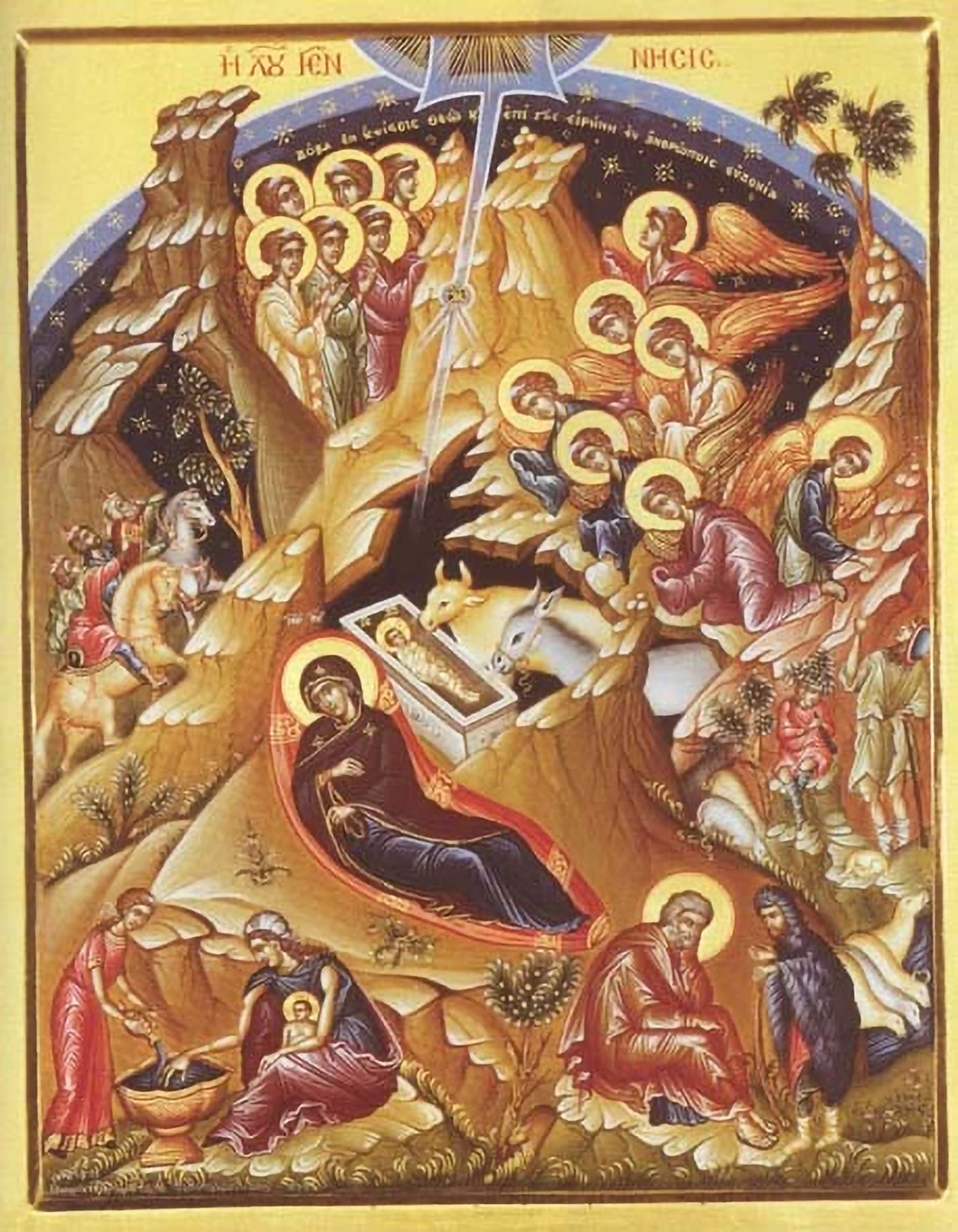
Byzantine icon of the Nativity, provenance unknown | Image from orthodoxcityhermit.com. It is interesting to compare images of the Nativity from Western art to those from Eastern Orthodox art. Icon “writers” are masters of depicting kairos time. From a Western perspective, we prioritize realism, even in our religious art, and thus a specific moment is usually depicted from a chronos perspective. But in highly symbolic Eastern icons, moments like the angels proclaiming to the shepherds, the arrival of the three magi, Joseph questioning the illogic of the Incarnation (and being tempted by a Satan figure to disbelief), and the trinity shining down on the birth of Christ can all happen in the same painting. In fact, one might argue that the spiritual significance of the Christ Event would be lessened if such details and other symbols were absent.
And so, with Isaiah’s words ringing in our ears, Jesus picks up the holy resonance and trumpets his thankfulness for the Spirit of the Lord resting upon him:
Jesus rejoiced in the Holy Spirit and said, “I give you praise, Father, Lord of heaven and earth, for although you have hidden these things from the wise and the learned you have revealed them to the childlike. Yes, Father, such has been your gracious will.”
Contextually, this appears in the gospel of Luke right after the 70 disciples return from the mission he sent them upon. This is the very first incarnation of the Church, the followers of Christ who he infuses with his Holy Spirit to work miracles in the world. They return jubilant, saying “Lord, in your name even the demons submit to us!” Jesus shares their joy and adds, “Nevertheless, do not rejoice at this, that the spirits submit to you, but rejoice that your names are written in heaven” (Lk 10:17 and 20). In other words, do not rejoice at the powers you have here on earth, for they belong to God, not you; instead, rejoice that you have been chosen by God to be a part of His plan and will.
Today’s passage occurs immediately after and is a continuation of Jesus’s joyous thankfulness. And he is directly talking about revelation: “you have revealed [these hidden things] to the childlike.” As we consider this, we realize that this is the same revelation shared with Isaiah. Jesus, the blossoming growth from the stump of Jesse, has the Spirit of God upon him and is establishing the kingdom for humanity. And consider the significance of how this played out: Jesus shares the Spirit of God with his disciples so that they can defeat evil in the world and bring about the nearness of the Kingdom. Have you ever heard someone wonder if Jesus could have just snapped his fingers and saved humanity/ended suffering while he was alive? Being God and all… Well, the answer is that he exists exclusively to do the Father’s will. If that was the Father’s will, then, yes, that’s possible. But clearly that wasn’t the Father’s will. Instead, He willed that Jesus establish a Way for us to follow, establish a Church on earth for us to work God’s will ourselves, and establish our justification to belong to Heaven as his brothers and sisters, thanks to his own merit and sacrifice for our sins. Today’s gospel passage occurs as Jesus and the 70 disciples see the middle part of the plan, the establishment of the Church for our own benefit.
Still, it is Christ alone who sees the great revelation being played out and the stunning graciousness of God’s will. This is how we must all feel about God’s will for humanity: joyous thankfulness. Perhaps this is why Advent is not canonically known as a penitential season but instead is treated as “penitential lite” (sic). We celebrate the fruits of revelation occurring in our midst! We must be utterly thankful and joyous over this. As Jesus says to his disciples, “Blessed are the eyes that see what you see.” No matter how much we might be disappointed with humanity, with Catholics, with the ungodliness of our existence, we must never forget this. We must celebrate the great spiritual gifts and divine will that has given us Christ and the Church.
Monday of the First Week in Advent, Year A: Isaiah 4:2-6, Matthew 8:5-11.
Today’s gospel reading is repeated, in part, during the Liturgy of the Eucharist. The final words that we, the faithful, say before receiving Communion are derived from the centurion in today’s reading. They are also some of my favorite words used in the Mass, where we all set ourselves bare before our Lord and declare our faith in his supernatural authority. Lord, I am not worthy that you should enter under my roof, but only say the word and my soul shall be healed. If we could only have this admission of our abject reliance on God stay with us throughout our entire day, every day!
Let’s unpack this meeting between Christ and the centurion to better understand those words and why Jesus was so amazed by them. In Matthew’s gospel, this scene happens right after the Sermon on the Mount when Jesus shares his great teachings, the Beatitudes. The feeling in the air was electric. As Matthew relates, “when Jesus had finished saying these things, the crowds were astounded at his teaching, for he taught them as one having authority, and not as their scribes” (Mt 7:28-29). The crowds are struck by the density and reality of who Jesus is and the teachings he gives them. He is no normal teacher, this man who just told them he has come to “fulfill” the law and the prophets, who calls God “our father in heaven,” and who declares which people will go to heaven and which won’t. As he comes down the mountain, great crowds follow him, caught up in his words and his very being. Upon reaching the bottom of the mountain, he heals a leper who says “Lord, if you choose, you can make me clean” (Mt 8:2b), which symbolizes the sickness of the world being swept away by God’s choice to send His Son and also anticipates the thrust of the next scene with the centurion. Jesus’s response, “I do choose. Be made clean!” is a fantastic example of the fundamental relationship we bear to him: we ask in humility for his help, with full trust and faith in his power; then, he meets our plea with mercy and the full, free will of the Creator to lift us up.
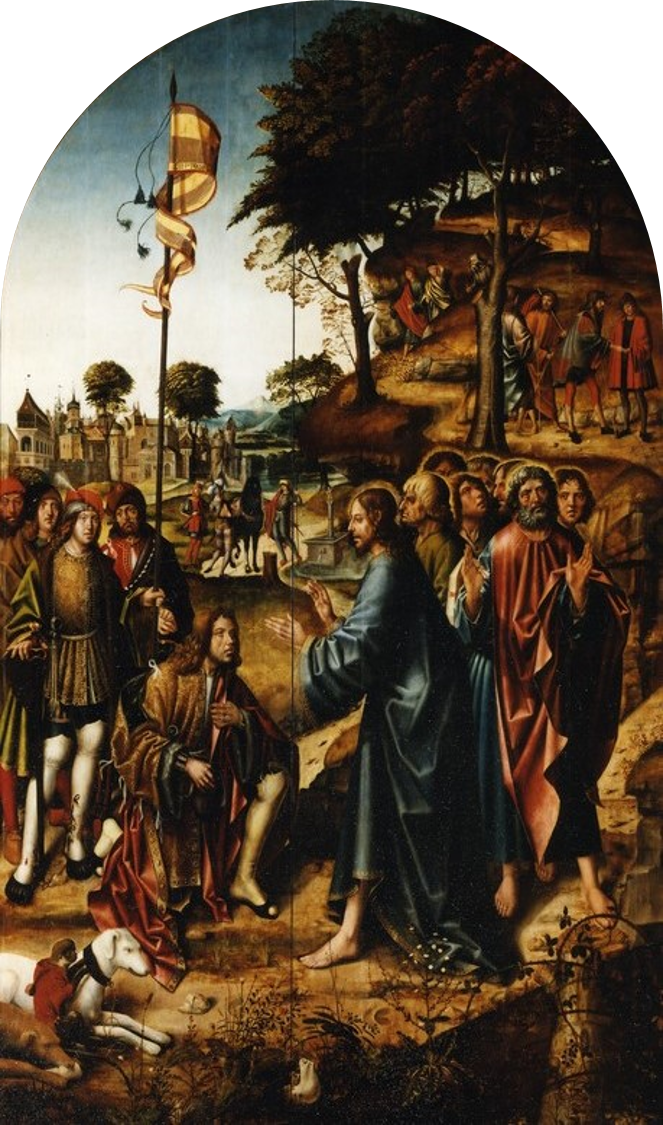
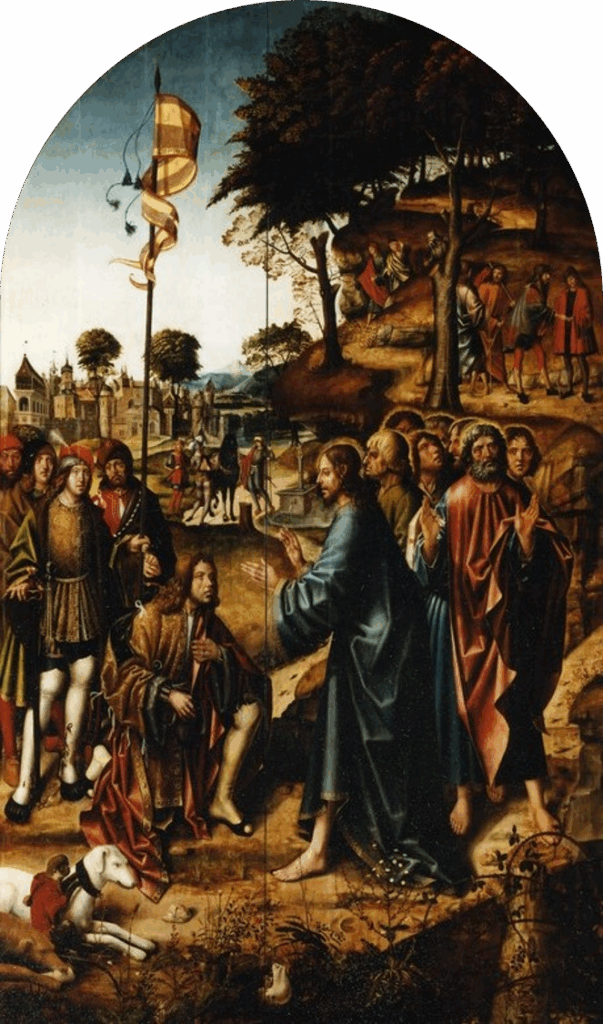
Jesus and the Centurion, part of the Polyptych of the Charola of the Convent of Christ, Tomar, Portugal (1510), Jorge Afonso | Creative Commons, courtesy Wikimedia. Note the Mount of the Beatitudes on the right, although the kneeling centurion lacks his authentic first-century garb, to be sure! The dog is a common symbol of fidelity (faith). However, I’m not sure what to make of the monkey wearing a robe in between the two dogs – monkeys often symbolized the base instincts and sin.
This fundamental structure of our relationship to God is further illustrated by the centurion. He pleads with Jesus to help his suffering servant, to which Jesus simply replies, “I will come and cure him.” You would think that the centurion would jump at this chance to have Jesus come to his home and heal the servant, like everyone else in the gospel stories. But he doesn’t – he actually takes his own humility and trust in the Lord’s power to a deeper level than we see elsewhere. He gives Jesus a great gift: “Lord, I am not worthy to have you enter under my roof; only say the word and my servant will be healed.” Only say the word! How many levels of meaning can we find in that phrase!
Some scholars might point out that this humility, while surprising coming from the Roman occupiers of the region, is actually appropriate given the fact that any gentile should not expect a great rabbi to risk becoming impure by visiting their home. So, is this just a courtesy offered to Jesus, acknowledging religious custom and purity laws? Matthew makes a point of saying that’s not the case; something else is going on. The centurion explains himself: “For I too am a man subject to authority, with soldiers subject to me. And I say to one, ‘Go,’ and he goes; and to another, ‘Come here,’ and he comes; and to my slave, ‘Do this,’ and he does it.” The centurion is emphasizing his life of obedience as a soldier. He is used to being subject to a greater authority and being that greater authority for others. But this is just an analogy of the authority that he recognizes in Jesus – a divine authority to command the natural and the supernatural worlds to obey him.
The fact that the centurion is part of a Roman occupying force is, in fact, central to the scene, but in a surprising way. The discipline that the military life has ground into him has surfaced to serve a greater purpose in his life. Millennia of Catholics have seen the benefit of obeying authority in conforming themselves humbly to God. We see this in our strict Church hierarchy from the Pope, through the Bishops and our pastors, and notably it became central to the monastic traditions. A vow of obedience by monks and nuns can draw the lineage of its spiritual power and efficacy directly to this scene with the centurion.
And, behold, the Lord himself is “amazed” by this human, this despised Roman gentile. He emphasizes the fact that the centurion is not Jewish, “Amen, I say to you, in no one in Israel have I found such faith.” Jesus then affirms that many non-Jews will recline “at the banquet in the Kingdom of heaven.” What is left out of the lectionary today is the severe warning to the Jews that they, the heirs to the kingdom, “will be thrown into the outer darkness, where there will be weeping and gnashing of teeth” thanks to their unbelief. Also missing from the lectionary are his final words to the centurion: “Go; let it be done for you according to your faith.” I love this simple response in part because it shows us that our relationship with God is just that: a two-way relationship. The centurion isn’t just included in Matthew’s gospel as a “type” or straw man for a teaching. Jesus makes the effort to respond personally to him, as he does to all of those who come seeking him throughout the gospels. Moreover, Jesus reminds us that the centurion has shown us what faith is. Faith is this unflagging trust in the ultimate authority of God that whatever He says will be done. Faith is won by obedience, not by continual testing, probing, and skepticism. That is the great contrast between the Jewish scribes, priests, and Pharisees and the centurion. They try to test Jesus and his Word by skeptically questioning, not by trusting his authority. We might recognize this way of “knowing,” which only increased through the Enlightenment as humans increasingly considered ourselves the only arbiters over what is true. Today, our scientific-oriented society wouldn’t think of accepting physical healing based on the word of a remarkable holy man (not even the Son of God, I’m afraid). We are taught that it is a great virtue to interrogate everything, to hold back on belief until we are convinced by unbiased facts.
But the great scholastic thinker and Doctor of the Church, Thomas Aquinas, pursued his deep dive into human reason with a pre-existing, deep faith in God and His ultimate authority and sovereignty over Creation. While Aquinas believed that there were many ways to find evidence for the existence of God, he also acknowledges that salvific knowledge arrives in a different manner: “it was necessary for the salvation of man that certain truths which exceed human reason should be made known to him by divine revelation” (Summa, Ia, 1.1). He is saying that there are truths that exceed human reason. This is important, and something no die-hard, atheistic scientist would admit. Further, Aquinas is saying that God has deigned to share with us these truths through revelation – a statement that speaks to the love God has for us and the faculties other than reason that humans are capable of. So, while Aquinas really prioritizes and devotes himself to proofs of reason, he concedes that for some people it is perfectly appropriate to accept truths of the faith on the basis of sacred teaching, while others attempt to demonstrate these truths by means of reason (Summa, Ia 2.2 ad 1). And here we arrive at faith, that is, accepting truths on the basis of sacred teaching alone.
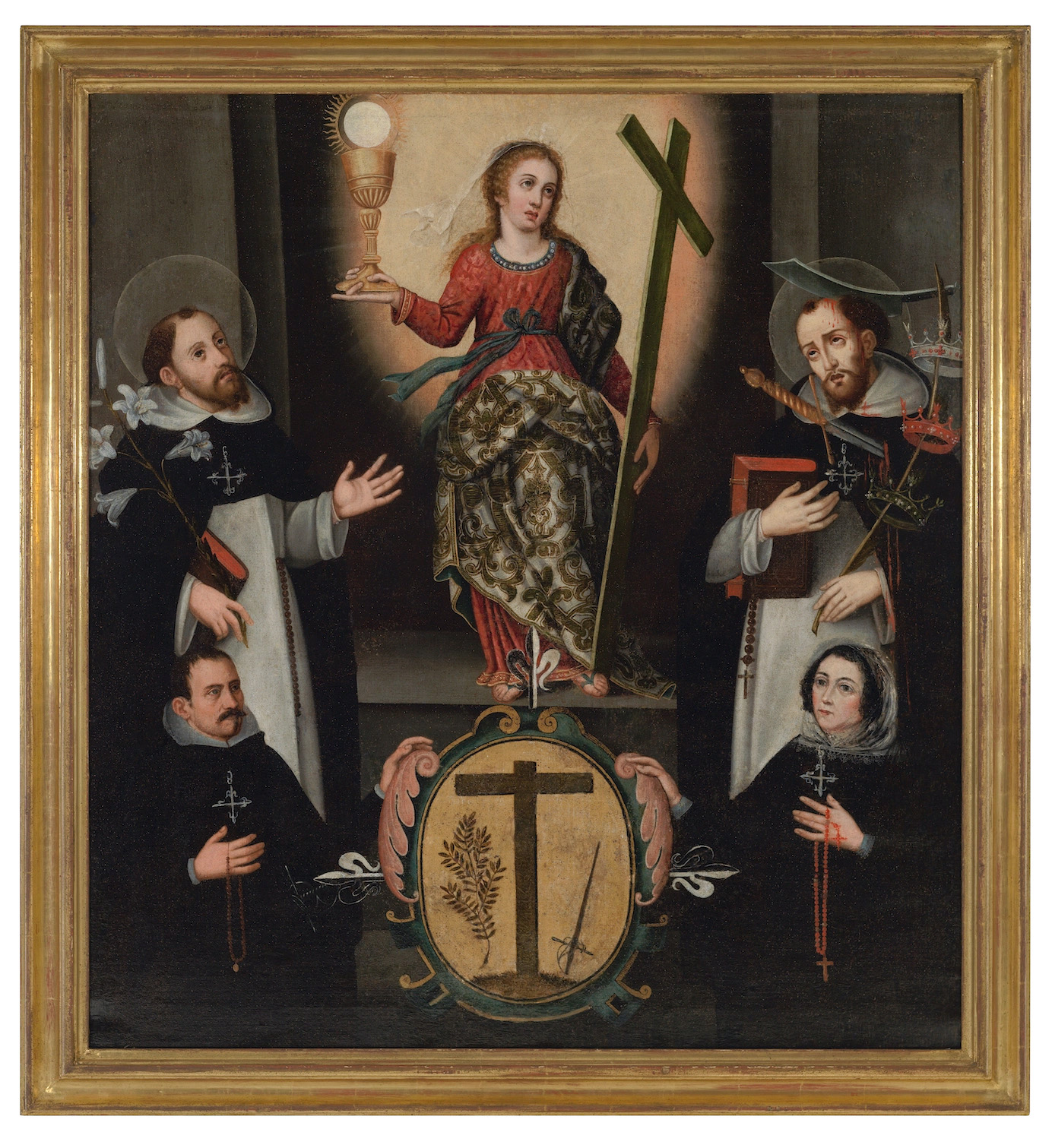
Allegory of Faith with Saints Dominic and Peter of Verona and the Donor, Baltasar Francisco Ramírez and his Wife, unknown painter (1626) | Image from https://thomafoundation.org/. The Allegory of Faith is a common Christian topic for painters, and many earlier versions were highly symbolic. By this date, however, the painter has chosen simply the symbols of the Eucharist and the Cross, themselves rich enough to symbolize the entire scope of salvation history. Of course, I chose this because our father in the rule, St. Dominic appears on the left and across from him the martyred St. Peter of Verona, another early Dominican.
Joseph Cardinal Ratzinger’s fantastic book Introduction of Christianity emphasizes that we accept this character of our faith every time we pray: “‘Amen’ simply says once again in its own way what belief means: the trustful placing of myself on a ground that upholds me, not because I have made it and checked it by my own calculations but, rather, precisely because I have not made it and cannot check it” (75). As modern Catholics, we must work to uphold this ground of faith upon which we walk as a legitimate and essential aspect of being human. Jesus certainly did.
First Sunday of Advent, Year A: Isaiah 2:1-5, Romans 13:11-14, Matthew 24:37-44.
This Sunday presents a group of readings that speak to the essential character of Advent. The theme, of course, is preparation for God’s coming. As we are taught, this coming is something that happens in the stream of time (Christ’s coming into humanity) as well as something greater that ends the world as we know it. Advent invites us to once again celebrate the great coming that has already happened and also to prepare ourselves for the final coming that has yet to happen.
The Descent of the Holy Ghost, Sandro Botticelli (1495-1505) | Creative Commons, Photo by Birmingham Museums Trust.
What strikes me in these readings is the fully active nature of this preparation we are called to do. This isn’t a “sit still and wait patiently” moment like those I was trained to endure as a child. Nor is it a frantic “get the house ready before the guests arrive” type of preparation. Instead, it’s a renewal of the call that Jesus puts in our hearts throughout his ministry – a reminder that he has given us the Way to think, love, behave, and pray. This is what makes Christianity not just a good theological or moral system; it is meant to be lived out actively here and now because, as Jesus promises us, “at an hour you do not expect, the Son of Man will come.”
Let’s first consider Isaiah’s prophecy. Isaiah, being given the vision of Christ’s entry into humanity, struggles to explain this heavenly plan (as any human would), employing both prophetic and poetic language. Just imagine if God gave you the vision of divinity’s supernova explosion into humanity. How would that knowledge manifest itself in your imagination? Isaiah says that “the mountain of the LORD’s house shall be established as the highest mountain.” This is an interesting doubling of prophetic and symbolic language. First, mountains have great meaning in scripture: they symbolize the nearness of God, God’s protection, and the act of worship. Second, Isaiah adds “of the LORD’s house,” which is sung in the Psalms as the dreamed-of resting place for the righteous (i.e., heaven). It is also seen in earthly terms as the temple built by Solomon in Jerusalem, physically housing the Ark of the Covenant in the Holy of Holies. In both senses, the “house” is where God, in His glory and majesty, is found. So, when Isaiah calls this the “mountain of the LORD’s house,” there’s a bit of emphasis going on, like “the oceanic center of the ocean.” This mountain is the place where the very heart of the divine person of God can be found. Interestingly, he says that this “will be established as the highest mountain.” A devout Jewish prophet would already think of God as the “highest mountain,” so what can he mean by this action of “being established”? This isn’t a theological statement about the order of things – it’s a statement about something happening, about humanity realizing who God is in a new way. I understand this as Isaiah prophesying the Christ Event. By that, I mean the Incarnation, Jesus’s ministry, the Passion, Crucifixion, Resurrection, establishment of the Church, and Ascension to heaven. This is how He is “established as the highest mountain.”
Some Famous Mountains in Scripture
Mt. Moriah – where Abraham was to sacrifice Isaac and where Solomon built God’s temple
Mt. Sinai – Moses meets God, receives the 10 commandments
Mt. Ararat – Noah’s ark is deposited by God
Mt. Zion – captured by David and becomes the site of Jerusalem (its temple considered the “Lord’s house”)
Mt. Carmel – Where Elijah challenged the prophets of Baal.
Mt. Tabor – Jesus is transfigured
Mount of Olives – Jesus prays before his Passion and Crucifixion
Isaiah shares that “All nations shall stream toward it,” as indeed thousands were baptized in the Spirit the day of Pentecost and ever since, over the centuries. Importantly, people go to this “mountain” that is Christ in order to learn how to live correctly: “that he may instruct us in his ways, and we may walk in his paths.” Here in 710 BC we hear Isaiah giving us a kernel of truly Christian teaching! We don’t go to Christ in order to passively sit and bask in his presence (although we can do this during Adoration). We aren’t a religion where our highest experience is a letting go of the world and reality, like Buddhist nirvana. No, just as God cared about His creation so much that He sent Jesus to be with us, we are called to care about His creation and “walk in his paths.” The point of meeting God on His mountain is so that we can learn to live rightly in the world He has given us, not so that we can abandon the world. And what does this meeting with Christ give us? Isaiah prophetically tells us that it is to love one another fully (just as Jesus will teach nearly 800 years later). Isaiah speaks of this love as the reign of peace, when people will “beat their swords into plowshares” and “one nation shall not raise the sword against another.” As Isaiah sees, Christ makes the Kingdom of God a reality for us, here and now. The Kingdom is marked by peace and love.
Once Isaiah receives this vision, there is nothing greater to hope for than the Kingdom made available to us. Thus, Isaiah’s passage ends with the exhortation, “let us walk in the light of the Lord!” This is exactly where we are in Advent. We are reminded of the great coming of the Lord and urged to follow the Way he has provided, to “walk in the light.”
Sentinel Shadows, Roland Lee (2019) | Image from the artist’s website. There are many depictions of what the mountain of the Lord’s house might look like, and it’s great to remember that in our very own state of Utah we happen to have a National Park named Zion, where the religious imagination can run wild in new directions.
St. Paul takes up this same message, with the same realization that Isaiah received. I love the domestic simplicity of his words: “it is the hour now for you to awake from sleep. For our salvation is nearer now than when we first believed.” Paul is rousting us from our sleep, kicking the bed frame, pulling off the sheets. “The night is advanced,” he writes, “the day is at hand.” This whirlwind of motion and action continues: “Let us then throw off the works of darkness and put on the armor of light; let us conduct ourselves properly as in the day.” He paints a picture of lively action and – importantly – light. He contrasts the light of day with the dark acts of night. Light is central to both Isaiah and Paul. This imagery if very familiar to us, its meaning seemingly obvious, but do we really understand what it means to “walk in the light” and “put on the armor of light”?
On the most mundane level, light allows us to see things clearly. Things in the light are exposed for all to see – given time to examine them, we can notice the smallest of details. Walking in the light, then, means first to allow ourselves to be seen and not hiding from scrutiny or observance.
But light isn’t just a neutral source of illumination. As we know from our founding story of Genesis, light comes specifically from the Creator: “God said, ‘Let there be light’; and there was light. And God saw that the light was good” (Gen 1:3-4a). Light, understood within our belief system, thus also has a moral significance. If God created it AND called it good, then it is good! So, while light promotes understanding (c.f., “The unfolding of your words gives light; it imparts understanding to the simple,” Ps 119:130), this is an understanding that is good, upright, morally correct. Now we are getting deeper. To “walk in the light” means that we live in a way that is open to scrutiny but also a way that imparts moral understanding to those around us. This is why we hear in Proverbs, “the path of the righteous is like the light of dawn, that shines brighter and brighter until the full day” (Pro 4:18).
A final level of meaning attached to light is theological. Everything we have said about light culminates in the figure of Jesus Christ: he is the understanding, the Logos, of God that has come to illuminate the moral way for humanity. As he himself says, “I am the Light of the world; he who follows Me will not walk in the darkness, but will have the Light of life” (Jn 8:12). If the second person of the Trinity is Light itself (and, closely related, Wisdom and Truth), then his redemptive work on earth is to bring us into his light, which provides a path to eternal life with the Father. He didn’t come just to be a light and then retreat off into heaven – he calls us adopted brothers and sisters and thus sons and daughters of the Father. Our baptism in water and the Spirit cleanse us and initiate us, while the other sacraments help to feed us and keep us in the light that is Christ. This is exactly what St. Paul is saying in today’s reading and what he writes elsewhere, for instance, to the Ephesians: “for you were formerly darkness, but now you are Light in the Lord; walk as children of Light” (Eph 5:8). Living in Christ as the Light of the world — “putting on” Christ — is essentially transformative.
So, with this mini examination of “light” under our belts, let’s look again at Paul’s words: “put on the armor of light … put on the Lord Jesus Christ.” Paul is dedicated to this analogy of armoring ourselves with the power of God. We can turn again to his letter to the Ephesians where he describes it in detail:
Put on the whole armor of God, so that you may be able to stand against the wiles of the devil. For our struggle is not against enemies of blood and flesh, but against the rulers, against the authorities, against the cosmic powers of this present darkness, against the spiritual forces of evil in the heavenly places. Therefore take up the whole armor of God, so that you may be able to withstand on that evil day, and having done everything, to stand firm. Stand therefore, and fasten the belt of truth around your waist, and put on the breastplate of righteousness. As shoes for your feet put on whatever will make you ready to proclaim the gospel of peace. With all of these, take the shield of faith, with which you will be able to quench all the flaming arrows of the evil one. Take the helmet of salvation, and the sword of the Spirit, which is the word of God (Eph 6:11-17).
Paul reminds us of the spiritual world in which we live, invisible to our eyes but real nonetheless. He depicts this as the battleground that really matters. To modern ears, this might sound archaic and superstitious. But we must realize that Paul is describing the same things we encounter today, just in a manner of understanding that “moderns” no longer use. In both ages, we might see a person who seeks profit out of every situation to the extent of openly cheating others. People in Paul’s age would describe them as being under the influence of evil spirits or the devil. We just call them selfish. More close to home, we might be tempted to shout at the person who cuts us off in traffic, to make fun of someone, to lie about something small, etc. What makes us act in these ways, with no charity in our hearts, no light in our actions? What else but “the spiritual forces of evil”? They tempt us to commit venial sins and walk in darkness. The armor of light is spiritual armor to protect us from “the cosmic powers of this present darkness.”
Good and Evil (Le Bien et Le Mal), Victor Orsel (1829-1832) | Image courtesy Wikimedia Commons. Sometimes we mistakenly think of the battle of good and evil as an evenly matched war, but this is not the Catholic understanding (that’s actually the heresy of dualism). In fact, Christ and his angels are infinitely more powerful and effective than Satan and his demons. As this painting depicts, it is more a question of our choices to “put on the armor of light” versus our decision to give into temptation that has the most impact on how we perceive this battle in our lives.
Paul assures us that we can trust this armor of light to help us live without sin. When we “put on” Christ, we can do so joyfully, for we know our Savior has already beaten death and Satan, and with him in our hearts, there is nothing we cannot do.
But I ask myself: isn’t this what we’re supposed to be doing all the time? Isn’t this what it means to be Christian? And the answer is yes. Yet this season of Advent puts special attention on walking in the light. Why?
The answer comes from the mouth of our Savior. “you do not know on which day your Lord will come,” he says in the gospel reading, and like the master of the house not knowing when the thief comes, “you also must be prepared, for at an hour you do not expect, the Son of Man will come.” What a tension we live with! Something momentous hangs over us: a moment of ending, judgment, and new beginning. The stakes are so much higher than simple death; we are talking about eternal damnation or eternal glory. Let’s say that again: eternal.
There are a few ways we can react to this: 1. rejection. This path can only be taken by willfully turning our back on God and His Word. What we know of hell is that it is precisely this willful rejection of God. If we’re this far down the road to even be considering Jesus’s words, we have accepted a certain relationship to our Creator, and rejection of his teaching of judgment simply means we reject Him and have placed ourselves in hell.
The second reaction is anxiety and fear. This is a normal, rational reaction to having something momentous hanging over us. Rational because we know that we do not deserve heaven, and frankly we can never earn it. But this is not a particularly spiritual or faithful reaction. What do we know of our God? Over and over in scriptures we hear of His great mercy. We learn that He yearns for us to be with him in the Kingdom. And we have proof of this in his Son, who He sent to us so that we can have a Way to heaven. Only a loving God would give His son as a sacrifice for our unworthiness. This is his great sign that He will provide the grace, mercy, and love to bring us to him. Our half of the covenant is that we promise to walk in the light.
So all of this leads us quite naturally and logically to the third reaction: hope and joy. Jesus reassures us: “Do not be afraid, little flock, for it is your Father’s good pleasure to give you the kingdom” (Luke 12:32). What a simple and awesome message! Like today’s gospel of Matthew, Luke’s gospel quickly follows these words with the thief analogy: “You also must be ready, for the Son of Man is coming at an unexpected hour” (Luke 12:40). This pairing of confidence in the Father’s mercy with a warning for preparedness is a necessary component of our Christian worldview. Our human nature coupled with the constant spiritual barrage of temptation creates a situation where we slip into sin. If we had overwhelming confidence in God’s mercy without a warning for preparedness, we would be tempted to just wait to repent until things got really bad (or on our deathbed). It is critical that we remain spiritually upright because the judgment will come without warning. This is the eschatological reason that Christians act the way we do.
Doing good because we want the reward of heaven is a bit of a simplistic understanding, however. The deeper reason is wrapped up in who God is: pure light, life, goodness, truth, wisdom, beauty, and love. We crave final union with this pure divinity, and we learn to walk in the ways of light, goodness, and truth while here on earth because we love all that He is. We follow his law (perfected in Christ) because we don’t want to offend the One most deserving of all our love and because we trust that He gives us his law for our own benefit. The deeper reason Christians act the way we do is all about conforming our hearts to our God.
With so much at stake (eternity) and with the goal of conforming our hearts to God and his law, we must open ourselves to a real examination. Is walking in the light and being prepared only about avoiding sin and doing good deeds? It must be more than that. If we walk in the spiritual light, preparing for final union with God, the goal is to become as much like Christ as we can so that union is possible. Trying to fuse dirty iron with pure gold is not the scenario we want. So, ask yourself the hard questions: do I prioritize the “right” of a person to choose what happens with their body knowing the outcome may be aborted children, even if I claim that I am personally pro-life? Here’s another: do I support the “right” for people to carry weapons of death, perhaps even carrying my own out of fear? Does God call us to protect our lives at all costs or does He instead say, “There is no greater love than to lay down one’s life for one’s friends”? As we start to examine “hot button” topics, American Catholics tend to find that their heart is steered more by their political convictions than by God’s teaching. But God’s teachings aren’t there to make us feel good about our political party affiliations. And the opposite is certainly untrue as well. Really, truly walking in the light means conforming all of our heart to God and his teaching of righteousness. So, a third question: while maintaining the teachings of the Church, do I treat transgender and gay people, illegal immigrants, the homeless, and sinners of all stripes with love and respect, equal to me as a child of God, even if I believe that their choices and lifestyles are against God? So often we mistakenly judge others based on moral teachings we are trying to live up to. We have only one rule about how to act with others: love your neighbor as yourself. Putting on Christ and living in the light also means not judging, but loving. If this is uncomfortable, well, good! Because the stakes are high.
The Last Supper, Eularia Clarke (1962) | Image courtesy of the late artist’s website. Eularia Clarke was a painter in England who placed Christ in contemporary situations, something that I think we can learn a lot from. Here, Christ’s giving of himself as bread in a cafe implies that we can encounter the same forces of evil (see the devil on Judas’s shoulder on the left), doubt, generosity, etc. in everyday circumstances. The lesson is that we have the opportunity to play out both the human and supernatural aspects of Christ everyday.
Back to the thrust of today’s readings, let’s remember that the spirit of Advent is active preparedness – one of both deeds and conversion of heart. I particularly like Luke’s companion gospel to today’s passage from Matthew: “Be dressed for action and have your lamps lit; be like those who are waiting for their master to return from the wedding banquet, so that they may open the door for him as soon as he comes and knocks” (Luke 12:35-36). We are “dressed for action” in our armor of light. The lamps are lit with God’s wisdom so that we can see the Way. And we understand ourselves as humble servants of our great master, who is returning for us on the Day of Judgment. What a great vision, and may we all live up to it!