Author: Michael Mozdy OP

  • The Sadness of Losing Sheep

    The Sadness of Losing Sheep

    Tuesday of Holy Week: Isaiah 49:1-6, John 13:21-33, 36-38.

    Today, we hear part of  John’s account of the Last Supper when Jesus offers himself to and through Judas, always giving himself even in his own betrayal. As we contemplate the Word of God recorded by St. John, let us be drawn into the mystery of the Spirit that is “agitated” and the mind that understands all prophecy and all revelation. Below is a lightly edited version of my post from this same day in 2020.

    The gospel reading opens with, “Reclining at table with his disciples, Jesus was deeply troubled and testified, ‘Amen, amen, I say to you, one of you will betray me.’” The Greek phrase used for “deeply troubled” is ἐταράχθη τῷ πνεύματι (etarachthē tō pneumati), which means “agitated in spirit.” This is nearly identical to the phrase used to describe the state of his spirit when he encounters an emotional Mary just before raising Lazarus from the dead.

    In my reflection See the Glory of God, I argue that this agitation of spirit is due to the gut-like passion of God rejecting the force of death in his midst. I feel that we are experiencing the same agitation of spirit and the same underlying cause here in today’s gospel. Just as “Amen, Amen, I say to you” is a common phrase used by Jesus throughout the New Testament, and one that we can take to mean “The truth is here, I am teaching it to you,” I feel that this phrase “agitated in spirit” signals a fundamental surge of the spirit in opposition to death’s enthralling grip on someone. Here, it is Judas, and Christ’s agitation is not tied to the fact that his own death is implicated, but that this apostle he loved, someone whose feet he just washed, had given himself over to death. This is a lament from Jesus, the Good Shepherd who goes to every length to rescue one of his sheep, over the loss of Judas’s soul.

    The betrayal is even more symbolically devastating than we might think at first glance. The beloved one (John himself, the writer of the gospel) leans back on Jesus’s chest and asks who he’s talking about. Jesus replies, “It is the one to whom I hand the morsel after I have dipped it.” What morsel is He describing? Remember, this is the Last Supper, when Jesus institutes the sacrament of the Eucharist and provides his instructions to the apostles: “This is my body, which is given for you. Do this in remembrance of me” (Lk 22:19). John, for his part, doesn’t describe the Last Supper with these same words of institution as the synoptic gospels, but simply tells us, “So he dipped the morsel and took it and handed it to Judas.”

    Could this be a different, more simple morsel of bread? Perhaps, but is any morsel of bread “simple” at this sacred meal? They are all handed to the apostles personally by the Lord on the eve of his Passion, with his sanctifying grace and the intention of instituting the sacrament of Eucharist. It is all the Body of Christ, meant to spark the mystical Body of Christ that is the Church.

    And what happens with Judas when this holy morsel is given freely to him by Christ? John writes, “After Judas took the morsel, Satan entered him. So Jesus said to him, ‘What you are going to do, do quickly.’” It seems that Satan recoils and constricts his victim as the presence of God is placed upon him. Jesus, in turn, realizes that Judas is firmly in the devil’s grip and releases him from His Presence.
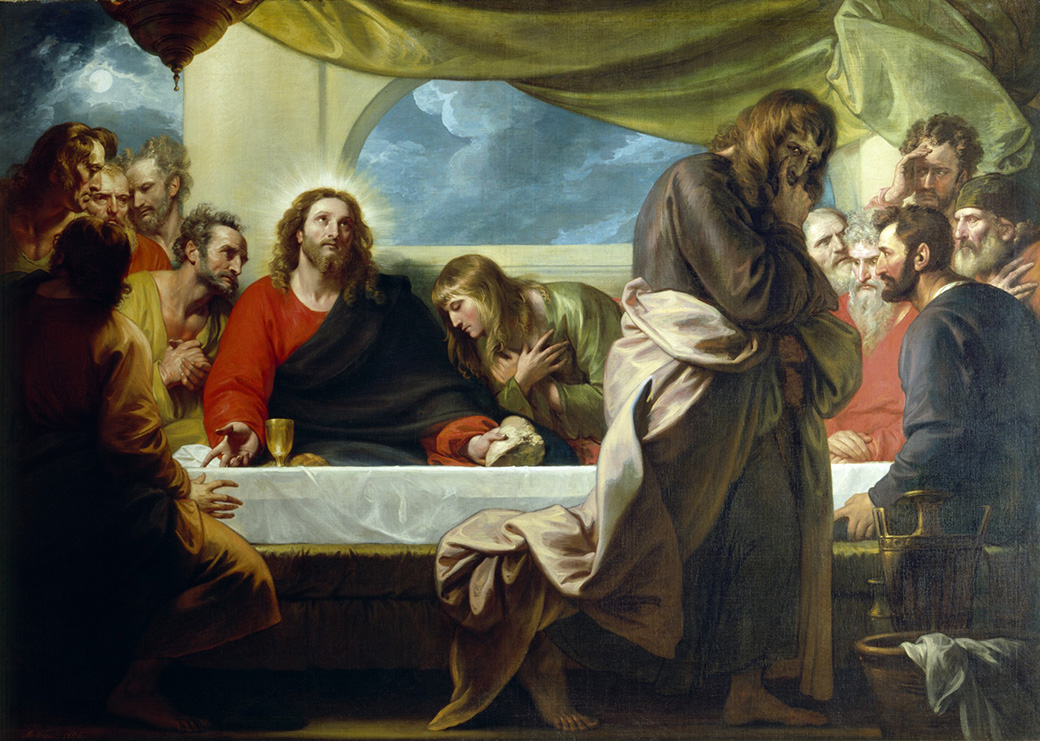
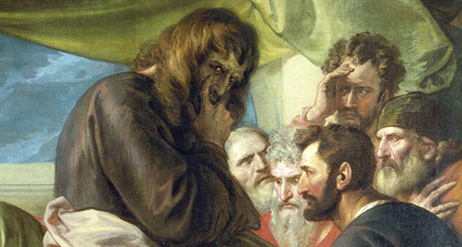
    The Last Supper (1786), Benjamin West | Creative Commons, courtesy the Detroit Institute of Arts. I think West captures a great range of humanity in the faces of the apostles and Jesus. We see the incredulous, questioning, uncomprehending, and earnest faces of most of the apostles, the divine relationship of Christ and God the Father as he institutes the sacrament of the Eucharist, and Satan darkly inhabiting the face and form of Judas.

    The Apostles aren’t sure what’s going on, but Judas, Satan, and Christ are clear. John writes, “So Judas took the morsel and left at once. And it was night.” Judas takes Christ’s life, His sanctified body, and leaves with it. He doesn’t eat the morsel, he doesn’t allow it to nourish him and bring the love of God into his being. Instead, he takes the gift like a greedy child, hoarding it away. And John gives us a poetic little sentence that signals the true darkness of this moment: “And it was night.” 

    Newcomers to Christianity are more incredulous over this moment than many lifelong Catholics. Why would Jesus just let Judas go if he knew he would betray him? He has it in his power to stop the whole, horrible ordeal before it starts. Yes, he’s always had this in his power, and that’s really the point. Jesus is the master of his destiny at all times. He can feed thousands and raise the dead with nothing but a word of thanks to the Father.

    But Jesus isn’t just the master of his destiny — He is the Master of Destiny, that is, of all destiny for all of humanity. As such, his responsibility has always been more than his human life; his responsibility is to provide salvation for all humans — life everlasting. The only way to do this is to take our sin and nail it to the Cross as a sacrifice to the Father, then to descend into death in a humanity He deliberately shares with us, but raise that human form with a divinity that is solely His. His choices are divine, they always exist within the love of the Trinity that is a pouring out of the self (kenosis) to a degree that we can’t quite comprehend. So he knows that he must let this sheep Judas escape with Satan in order to start the saving action he destines for us.

    The rest of today’s reading shows us how Jesus tells his beloved Apostles about his ordering of destiny. I am struck with how patient he has been throughout the gospels to this point, gradually revealing the mystery of his being and mission of salvation, trying to give them enough time to grow in understanding, and always pointing back to the glory of the Father. Now, things accelerate, as they must.

    He begins by saying, “Now is the Son of Man glorified, and God is glorified in him.” I believe that we must again remember the importance of the Last Supper here and the seed of Christian ritual that Jesus gives the Church, one that will begin to make sense as his Body and Blood are literally poured out and then when he resurrects. But at the same time “glorification” refers to the necessary divine reaction to the fleeing Judas. How is Judas’s betrayal the thing that causes Jesus to say “Now is the Son of Man glorified”?

    I believe that this act enables Christ to display the overflowing, undeserved, and totally out-of-proportion love of God that the pours out in response to our infidelity. This is beyond turning the other cheek; this is the wellspring of love.
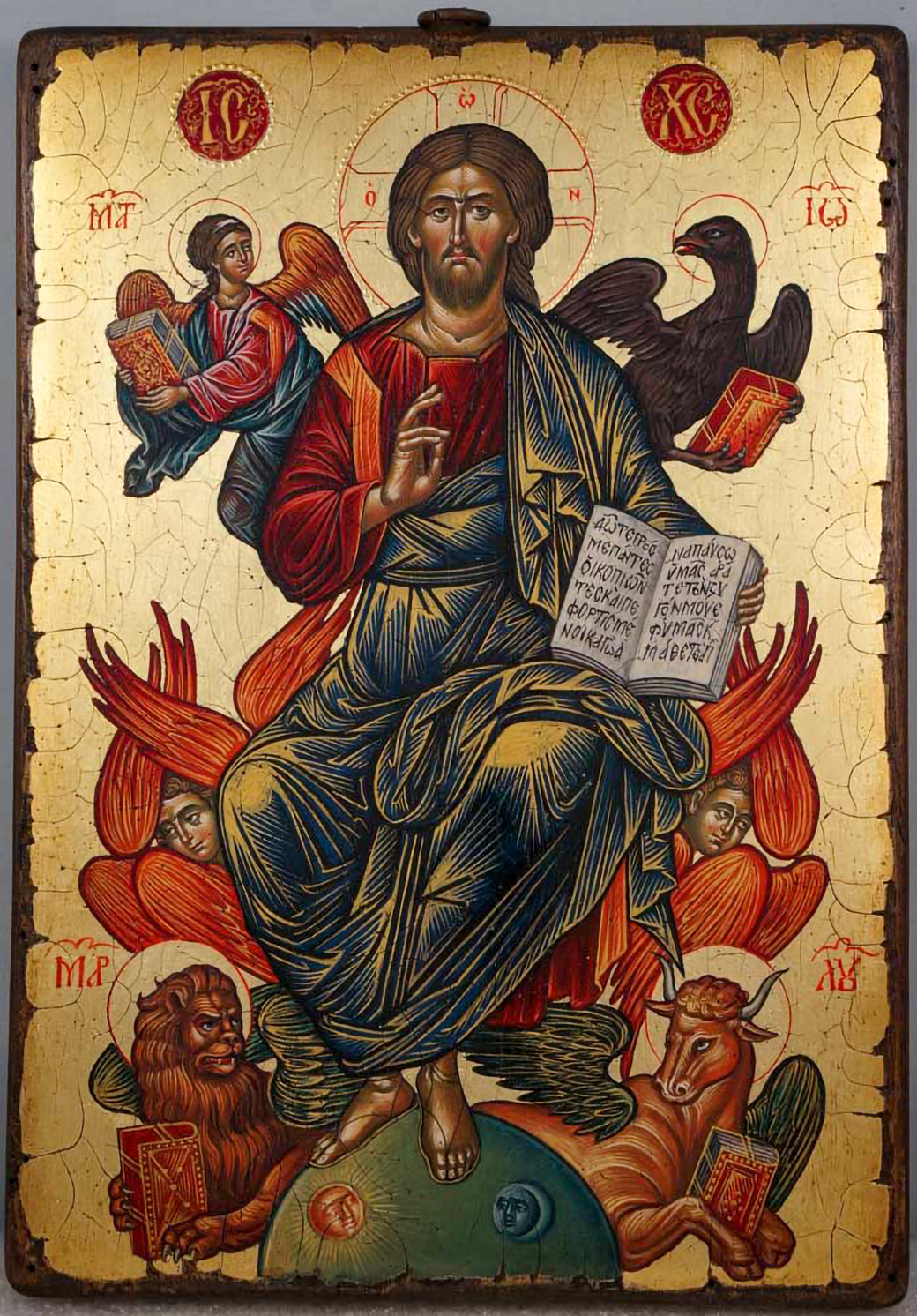
    Christ in Glory (14th c. Crete, Greece), Hand-painted (written) icon by Plamen Kazakov | image from blessedmart.com.

    Judas is the first in a cascade of sin and evil that will be rained down on Jesus during his suffering and death. His glorification and the glorification of God resides not in the smiting of the offenders but in the patient acceptance of this evil. This ability to love in the face of all the hate and injustice that can be mustered, well, it’s supernatural. It’s so paradoxical to how humans would respond that in it is the proof and the glory of God. The plea to forgive those “who know not what they do” as he hangs on the Cross! This looking out for his sheep in the darkest of night, this is the glorification.

    So when Jesus says, “Where I am going, you cannot follow me now, though you will follow later,” we can take a double meaning. The apostles can’t follow him into the never-ending love in the face of torture and hate because of the supernatural divine love it requires, and this has not yet been poured out upon humanity. Secondly, they can’t follow him into death and the underworld, where he must go so that his divine essence, which can never die, can raise up again. But, as he notes, their paths to sainthood will require them to follow in both senses.

    Our reading today ends with Jesus explaining to Peter that although he claims he will lay down his life for Jesus, he will actually deny him three times that night, before the crow signals morning. When I was younger, I imagined that a certain degree of understandable bitterness may have marked Christ’s statement, but now I see things differently.

    I think the emotion that overwhelms Jesus on this fateful evening that will take them to the Garden of Gethsemane is sadness. Not anger toward God or the people who will betray him. Not fear of the impending torturous death. Not anguish over losing his family and friends. He may have experienced some measure of these things but I think it’s been in vogue since Vatican II to emphasize these aspects his humanity, perhaps to the detriment of remembering that the Good News is about the divinity that comes to earth. For me, I think that if we accept the reality of the love that defines the Trinity, which is the operative force brought into the world through the man Jesus Christ, agape must define for us who he ultimately is, especially in his final hours. That love is purely selfless, only wanting to draw others to unity with God.

    I think he grieves for humanity in the display of evil, the enthrallment of death, all of the cowardly and wicked acts. He knows that the cup the Father wants him to drink will entail humanity digging itself even further down into the depths of evil by torturing and crucifying the Word of God, an unspeakable sin. This is the Good Shepherd, this is the Son of Man who has devoted his life to preaching the New Covenant of love, this is the Anointed One who cares more deeply than we can imagine for all of us.

    So, no, I don’t think he was bitter with Peter, but instead sad. I can even imagine a tear on the cheek of our Savior when he gently tells Peter with some irony that the Rock who pledges to lay down his life is destined to deny any connection with Jesus three times that night. A tear of sadness, not for himself, but for Peter, a lost sheep who will thankfully eventually find his way back to the Father.
  • From Palms to Passion

    From Palms to Passion

    Palm Sunday of the Lord’s Passion: Mark 11:1-10, Isaiah 50:4-7, Psalm 22, Philippians 2:6-11, Mark 14:1 – 15:47.

    Holy Week is upon us. Three liturgical celebrations stand out in the life of the Church over the course of a year: The Nativity of Our Lord, Palm Sunday, and Easter. While we are invited to encounter Christ every day of the year — his Incarnation and Birth, his suffering and sacrifice, and his great Resurrection — these three celebrations stand out in the structure and content of the Mass.

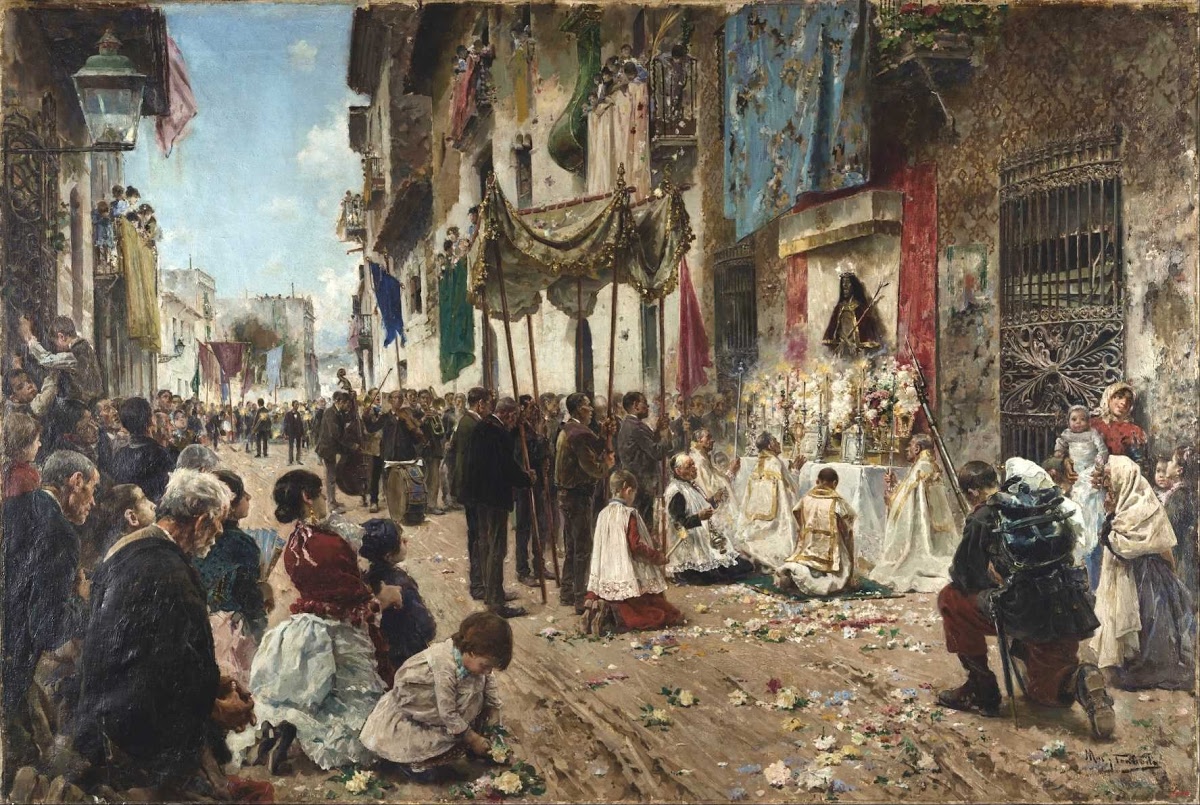
    Corpus Christi Procession (La procesión de Corpus), 1887, Arcadi Mas y Fondevila | Image from artsandculture.google.com.

    Today is one of these three and it struck me as I marveled at the triple-normal attendance filling our pandemic-distanced chapel that we had all come anticipating the great and terrible narrative that was to fill the air. We knew that the initial hosannas would quickly fade into the long gospel reading detailing Christ’s betrayal, torture and death. Not only did we know it, we had gathered in numbers triple our normal size so that we could bear witness to it, mourn with Mary at his tomb, and receive sustenance from the very Body and Blood that was torn apart on that day. Even for people who weren’t completely engaged with the reason that they were there, something drew them to come, some knowledge imparted from the Church that instilled in them how important this day is.

    This entire phenomenon makes me reflect on the narrative that makes us who we are as Christians and how we participate in the telling of the story. 

    There is a grand scope to the narrative on Palm Sunday, and in the Catholic Church, we are asked to participate in its telling in a very performative way. Although this year was slightly different due to pandemic precautions, consider how the liturgical celebration starts: it starts outside the chapel. Before processing into the chapel as the Church, we read “Many people spread their cloaks on the road, and others spread leafy branches that they had cut from the fields. Those preceding him as well as those following kept crying out: ‘Hosanna! Blessed is he who comes in the name of the Lord!’” And this is what we do.

    We are a performative Church. We hold our palm leaves and sing a song of hosanna as we walk into the new Jerusalem with Christ. This is not “mere” theater. This is a huge reminder that what we do as a Church in every liturgy is performative as well as commemorative. By “performative,” let me be clear that I do not mean acting, as if we do not believe or actually live out what we’re doing. I use the word performative as in performing a ritual act.

    Religious ritual acts (in which the entire Judeo-Christian tradition is steeped, and is common to all religions) are special: done in a special place, in a special way, with special gestures and special words. This post is about interrogating the depths of meaning behind the performative acts in our liturgical life. So, to be clear, we actively celebrate Christ’s sacrifice in the form of the liturgy.

    The first reading connects Isaiah to Jesus who will come after him: “The Lord GOD has given me a well-trained tongue, that I might know how to speak to the weary a word that will rouse them.” Both men are prophets who share the Word of God as a salve for humanity. And, then: “I gave my back to those who beat me, my cheeks to those who plucked my beard; my face I did not shield from buffets and spitting.” Isaiah also lives out the mocking and beating that Jesus will, this very day, be subjected to. And, finally, the firm faith that enables such treatment to be endured: “The Lord GOD is my help, therefore I am not disgraced; I have set my face like flint, knowing that I shall not be put to shame.” We need to hear these final words of the first reading, knowing what we know about the Passion narrative to come. It helps us to endure our sympathetic suffering with Christ. It helps to palliate the treatment of our Lord.

    The responsorial psalm — oh, the psalm! It gives us the fuller context for Jesus’s final words on the Cross. The refrain of our psalm is the famous line “My God, My God, why have you forsaken me?” As Jesus utters these last words, we can both sympathize with the sentiment and be somewhat troubled by the implication. On one hand, we will see how the Passion narrative displays Jesus’s increasing abandonment by everyone who is close to him. If we take this line on its own, it seems to be that Jesus expresses complete abandonment, even by the Father. Theologically, this is greatly troubling, and actually makes no sense. The first Person of the Trinity would never (could never) abandon the second Person of the Trinity. Their love unites them in a way that is fundamental to the fabric of the universe. 

    What else could be going on here?

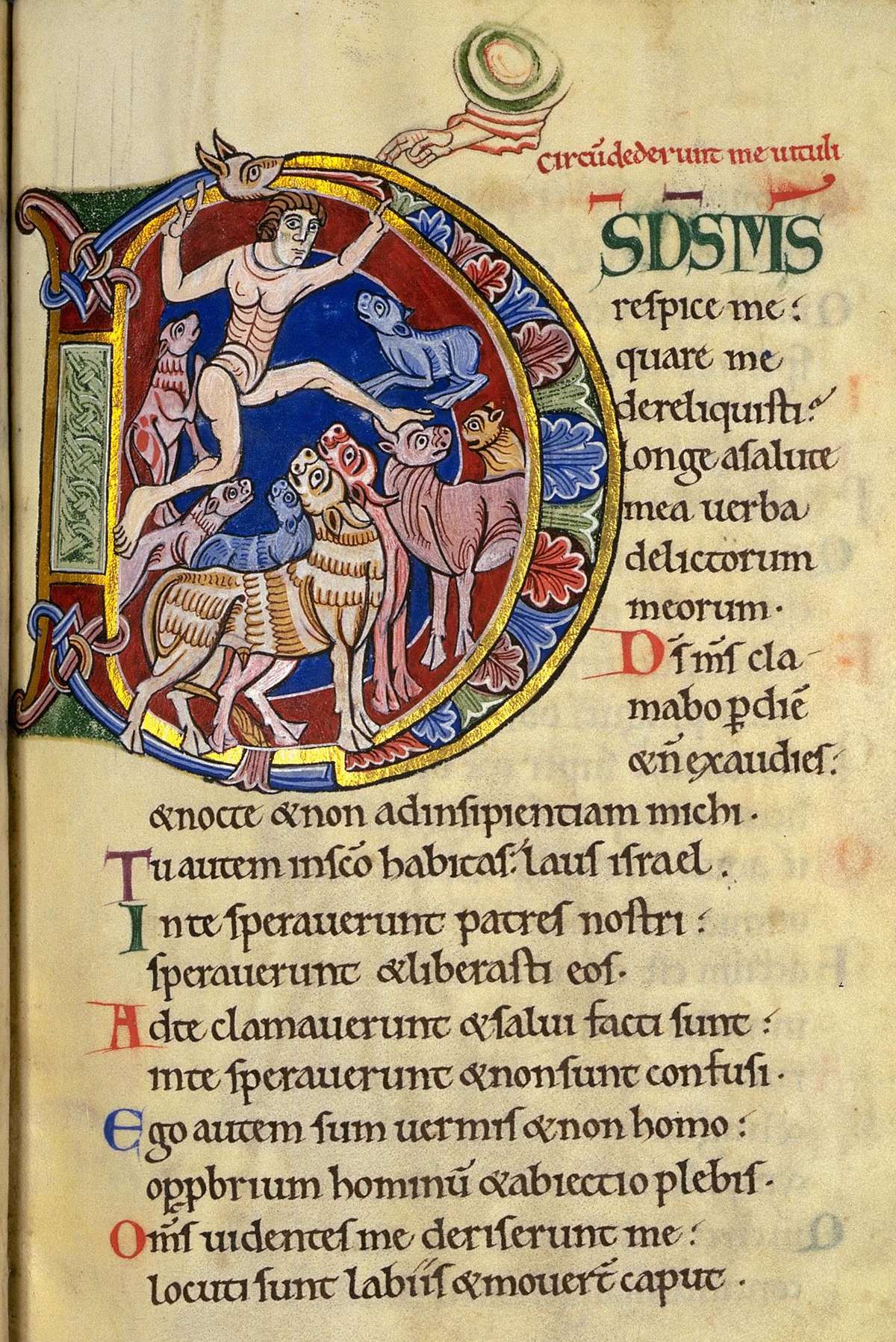
    Psalm 22:1-8 in the St. Albans Psalter (1100s). The first words of the Psalm in the Latin Vulgate are “Deus, Deus meus,” abbreviated here as DS DS MS. | Wikimedia Commons.

    The content of the psalm is not as dire as the first line makes it out to be. The words certainly express the distress of an individual in need of help, one who has endured scorn and who feels abandoned. But the psalm also includes verses like, “From the horns of the wild oxen you have rescued me. I will tell of your name to my brothers and sisters; in the midst of the congregation I will praise you.” Also, more to the concern of the opening line: “he did not hide his face from me, but heard when I cried to him.” It also ends on a very positive note of praise and deliverance. We hear, “future generations will be told about the Lord, and proclaim his deliverance to a people yet unborn, saying that he has done it.”

    When taken as a whole, the psalm not only speaks to the emotional condition of a man like Jesus at the culmination of his torture, but also to his redemptive action in the world.

    Just like we should not take the opening line out of context from the whole psalm, we we can learn from the context of how the Jewish tradition employed it. Rabbis attributed this psalm either to King David or Esther. The connection to Esther is so strong, in fact, that it would be prayed annually during the Fast of Esther, on the eve of the festival of Purim. Christ would have grown up praying Psalm 22 during that day and night of fasting, commemorating the three days of Esther’s fasting and prayer before she presented herself to the Babylonian King Ahasuerus and advocated to save the Jews from slaughter. The Jews prayed Psalm 22 to link themselves to this great model of petitioning the Father. The result was that God heard her prayer and saved the Jews from annihilation. 

    So, we can conceivably interpret Christ’s utterance on the Cross as beginning this same fast, this three days where he will disappear from the earth, enter the underworld to rescue humanity from the grip of death. He will enact the deliverance of the world on Easter, but here on the Cross, as he begins this fast in great sympathy with the Jerusalem he had just cried for, he is imploring the Father’s help and praising the Father as he always has.

    Returning to the Palm Sunday Liturgy of the Word, it is difficult to encounter this great text in part because it stretches over many days and many episodes central to our religious practice. We will reflect more on the Last Supper on Holy Thursday and upon the treacherous death on the Cross on Good Friday.

    One of the things that struck me as I stood in our chapel today listening to the priest and two lay people read the parts of the Passion were some of the details supplied by St. Mark in his almost breathless account. These details act like symbolic signposts, standing in for the impossible spiritual depth of the action at that moment. For me, they help to orient me within the Church as I participate in Palm Sunday and Holy Week. Below are just a few of them.

    Alabaster candle holders | Image from entertheloft.com.

    She broke the alabaster jar and poured it on his head … They were infuriated with her. Alabaster is a gorgeous, translucent white form of gypsum, often used to hold expensive oils in the ancient world such as those given as part of a woman’s dowry to her husband. The gesture from Mary of Bethany is the gesture of the Church to her Bridegroom. Mark tells us that she “broke” the jar, and whether this means a wax seal or the neck of the jar, the action is absolute and the ointment cannot be re-sealed and reused. This is an absolute devotion, using the most expensively perfumed oil. Jesus himself notes the appropriateness of her actions: “She has anticipated anointing my body for burial,” and even christens it as an act truly representative of the Church to come: “wherever the gospel is proclaimed to the whole world, what she has done will be told in memory of her.”

    Yet the other disciples were infuriated with her. Their rebuke of her is redolent with earthly concerns — noble, to be sure, in that they seek to help the poor — but these are at odds with the spiritual gravity of the moment as the ground is shifting to the Passion. Mary must have been seized by the Holy Spirit in a way that the others were not. She anoints the Anointed One of God just before he is to give them the Eucharistic sacrament.

    Jesus’s response to the disciples is one of my favorites: “The poor you will always have with you … you will not always have me. She has done what she could.” This is not just a carpe diem message, but a message of focus and intent. This is consistent with all he has said to the Pharisees about them fetishizing the law and what they “should do” over bringing the spirit of love into the world. There is supreme benediction in Christ saying, “she has done what she could.” What more would we like to hear when we are encountered with our judgment? 


    Now a young man followed him wearing nothing but a linen cloth about his body. They seized him, but he left the cloth behind and ran off naked. Who is this young man? He is not identified as a close disciple of Jesus. For me, he stands in as all of them, all of humanity in that moment. It’s as if the Holy Spirit has instilled in St. Mark a deeply felt memory of this moment when Jesus’s closest followers scramble away and disperse.

    Think about this — how does a person escape when seized, leaving behind the only piece of clothing he was wearing? It takes a good deal of panicked struggle, wriggling free, letting all sense and dignity leave you in your crazed flight response. This young man, these disciples, all of humanity, desert the Lord without their dignity in a wild flight away from the scene of his arrest. High-minded ideals are gone. Plan-oriented dreams of an ordered future disappear. Scandal has stripped us of our dignity and we run, like animals without a God.

    And so Mark records this ghostly image of a linen cloth glowing white in the darkness with nothing inside it. Why linen? Why empty? We will encounter this very same image when the stone is rolled away from the tomb! The human has left, has entered a new plane of existence. Just as Jesus Resurrects in Body and then ascends to heaven, humanity in the form of this young man disappears in its fright only to return as the Church, sanctified and Resurrected in Christ’s Spirit. The image, while representing the base betrayal of humanity, becomes an astounding promise in the midst of this horrible night.

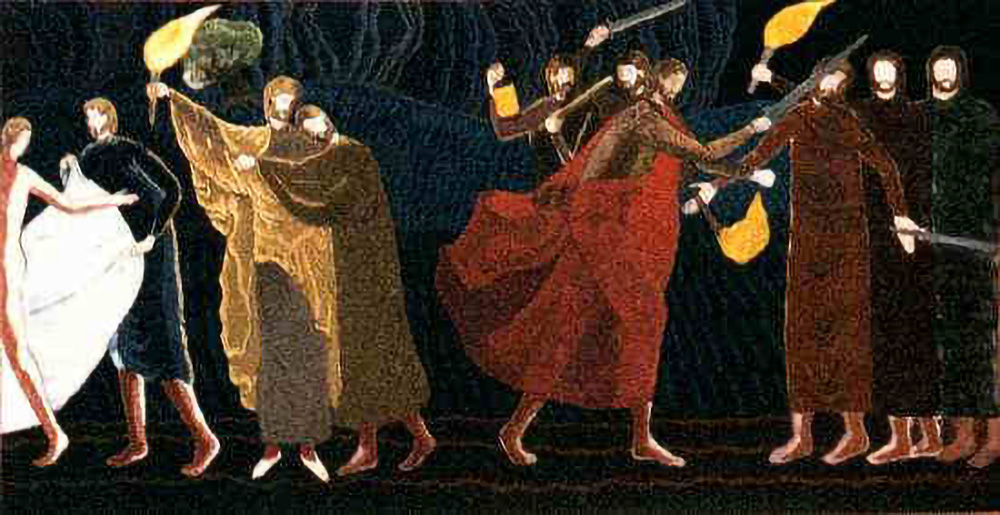
    Young man fleeing Jesus’s arrest, unknown provenance | Image from thetinychapel.blogspot.com.

    The soldiers assembled the whole cohort. They clothed him in purple and, weaving a crown of thorns, placed it on him. This image persists in most Catholic depictions of Christ — the brutal Crown of Thorns. Why? Are we fascinated in some way at this torturous form of mockery?

    Let’s pan out, to use a cinematographer’s term, and see the scene as Mark has described it. The soldiers take him away from the Jewish crowds and into the inner courtyard of Pilate’s palace. Jesus is first betrayed by an Apostle, abandoned by his disciples, and denied by his chosen “Rock,” Peter. His is now isolated, away from his own people, the Chosen Ones of God’s Covenant. He is utterly alone in pagan hands. It is easy to overlook his increasing isolation because the narrative is full of people — crowds greeting him in Jerusalem, guards and arresting mob, priests and soldiers, streets lined with jeering onlookers, and a crowd gathered at the base of Golgotha. But Jesus has been isolated completely. 

    So the soldiers assemble the whole cohort, which must include all of the soldiers stationed there as well as Pilate’s non-military court. Here, around him, is the entire pagan world. How do they greet our Savior? It is a telling image. They dress him as a King. Yes, it is mockery, yes it is in jest and, yes, they beat him and spit on him while doing it. But nonetheless we have a vision of Christianity in the world.

    It is impossible not to acknowledge the kingship of Christ, even while scoffing. For underlying all of the worldly disbelief we claim or the hurtfulness of our actions, the truth remains: Christ is King. We can’t escape that or change it. What’s more, those who walk with Christ into the greater world will be met with mocking and crowns of thorns as well. This is the reality of being on the Way to the Kingdom, given to us in a brutal coliseum of pain.


    Pilate was amazed that he was already dead. The seat of earthly power is amazed at the quick passage of time. This must make him take stock in his own mortality. This must make him wonder about that man he just had crucified. This is something weird; is it a sign? This thought might continue to nag at him for months, years, until he decides to do something about that nagging thought — perhaps inquire with one of this new group of Christians that has persisted long after this man’s death. This leads to another moment of astonishment as he is told about the amazing life of this Jesus Christ who he crucified.

    This is the way God works. This is the way God never gives up on humanity; the way He offers mercy and forgiveness even to the most detestable of us. We must be open to the fact that Pilate himself can be saved if he recognizes God, repents for his sins, and follows the Way. More than that — we must want Pilate to be saved. That is what it means to walk with Jesus. We must fill ourselves with the absolute, unwavering love of God that heals all. We must want every single one of his sheep to be with him forever in the Kingdom.

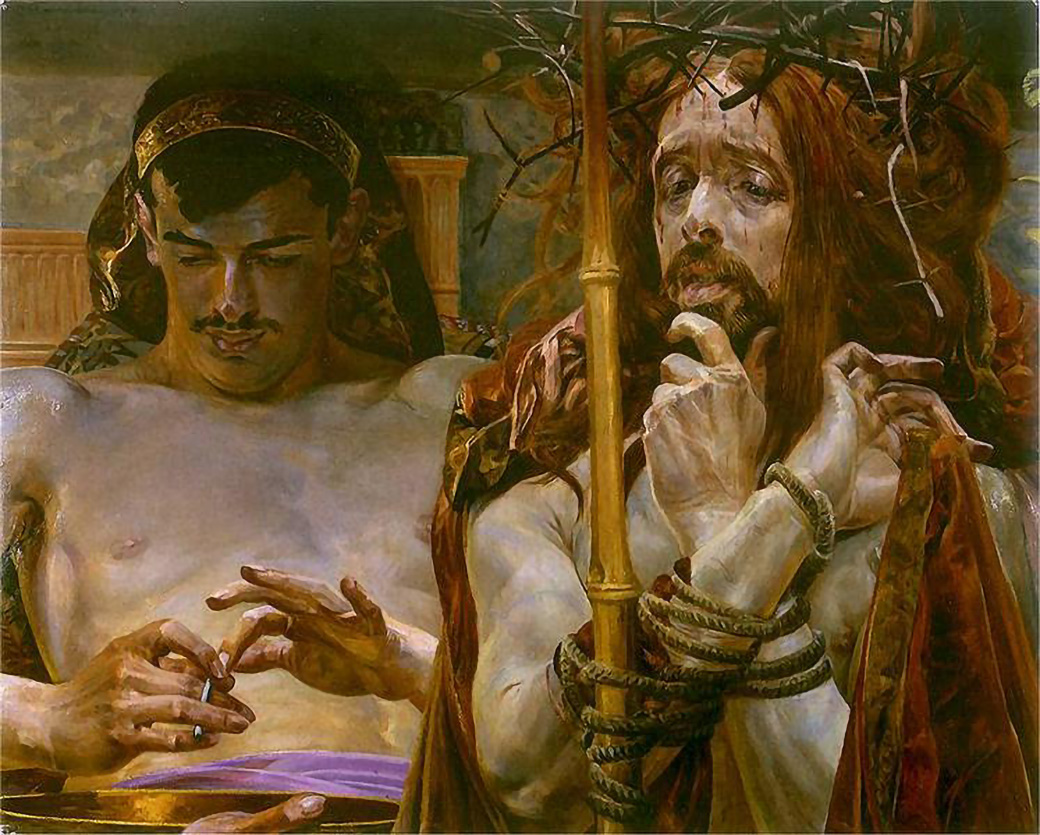
    Christ before Pilate (1910), Jacek Malczewski | Image from wikiart.org. There are many artistic representations of Pilate, but none quite as evocative as this one, in my Mind. Malczewski delivers a powerful study of contrasts: Christ is adorned with the Crown, ropes, and blood in an almost feminine way, as if these trappings of His Passion have almost supplanted themselves as the narrative itself; He is presented as an ornament for Pilate. Meanwhile, Pilate is half-naked, self-absorbed, bored. Not so much contemplative as contemptuous. I am constantly amazed at the breadth of scriptural interpretation and imagination I find in painters! 

    There are, of course, many more images in the Passion narrative; indeed, in all of the gospels. This is how we can encounter Christ in a new way and in a new depth each time we turn back to scripture. 

    But more: let’s return to how our Catholic liturgy participates in the Passion. The Holy Spirit, as promised by Christ, guided the Church from its earliest days to put into practice the depth of imagery and symbolism we encounter in Christ’s life, Death, and Resurrection. The most obvious example is the Eucharistic feast and its remembrance and enactment of Christ’s sacrifice as well as the Last Supper.

    But the Church, living the liturgy every second of every day inside and outside of the chapel, performs the very work of the Bride of Christ in its anointings (sacramental as well as simple, such as the gentle touch and kind word to a stranger). The Church points to the empty linen cloth every time we choose humanity over politics or spirit over rules: for the cloth is made of this earth while we exist in a different spiritual plane on a specific spiritual path.

    The Church wears the purple robe and crown of thorns as our priestly sexual misconduct is paraded before the world, the evil that creeps in to mock our holy mystical Body of Christ. And the Church is made up of converted Pilates searching out other Pilates to bring to Christ for healing.

    All of these things reach a much more organized level of liturgical function in the Mass, however. It is performative in that we stand to greet the Lord, to collectively pray our Creed and the Our Father. We process to the altar both as the ministers at the start of Mass and as a people when receiving Communion, re-enacting Christ’s triumphal entry into Jerusalem. We kneel with Christ as if with him in the Garden of Gethsemane as the Eucharistic blessing is prayed. We listen to the Word of God being proclaimed to us as every Christian once did since the first Apostles, for we are all converts to a New Covenant. There is so much more!

    The point is that if we want to live a deep Christian life, we must know and embrace the depth of our faith not just in its wisdom and words, but in its symbolic and real actions both inside and outside of our churches. 

    Holy Week is upon us, and it delivers to us so much meaning, so much density. Let us prayerfully try our best to take it in.

  • The Unwitting Prophet Caiaphas

    The Unwitting Prophet Caiaphas

    Saturday in the Fifth Week of Lent: Ezekiel 37:21-28, John 11:45-56.

    Today, the momentum gathering for Holy Week is palpable, both at home and in the daily readings. Tonight we sing first Vespers for Palm Sunday, and the antiphons will sing of the beginnings of the Passion. In today’s readings, we encounter Ezekiel’s first prophecy of Christ uniting the nations and then the gospel shows how the high priest Caiaphas unwittingly echoes this prophecy.

    We should pay attention here: Caiaphas is a lesson in not using religious language to justify political moves.

    The prophecy recorded in Ezekiel is this: “I will take the children of Israel from among the nations to which they have come, and gather them from all sides to bring them back to their land. I will make them one nation upon the land.” The promise of unification on their own land has been integral to the Jewish nation to this day, likely because of verses like this: “they shall live on it forever, they, and their children, and their children’s children, with my servant David their prince forever.” Theirs is a very literal interpretation of this promise, whereas Christians understand this to refer to the new Jerusalem, the Kingdom of God.

    John attributes a similar prophetic voice to Caiaphas: “He did not say this on his own, but since he was high priest for that year, he prophesied that Jesus was going to die for the nation, and not only for the nation, but also to gather into one the dispersed children of God.” The phrase he did not say this on his own is found throughout scriptures as a way to say that the Spirit of God is active in a person. It follows, then, that John would write that he prophesied.

    Undoubtedly the same Holy Spirit revealed this to St. John as he wrote down the holy, inspired gospel. It is an interesting comment on the fact that God uses all parts of humanity in His plan of salvation. Caiaphas was, by all accounts, a highly political man and perhaps a tool of his influential father-in-law, Annas. Caiaphas was one of five men to serve as high priest who were either sons or sons in law-of Annas, who was high priest from A.D. 6-15 when the Romans had previously deposed him. So, God presents Caiaphas with the prophetic wisdom that Jesus is meant to gather into one the dispersed children of God. What Caiaphas does with this prophetic wisdom is another thing altogether.

    The scene in the gospel is the convening of the Sanhedrin. We think of this as being a plot of a few bad apples, but historically the Great Sanhedrin in Jerusalem, which met every day except the Sabbath, was comprised of 71 elders (priests and scribes). Their function was that of a supreme Jewish court, among other things. This was no small cabal of plotters. This was the primary body of respected Jews who held power in Jerusalem.

    The Sanhedrin was undoubtedly central to the operation of the Jewish religious/social state, but since they were under Roman rule and the Roman procurator appointed the high priest, it was plagued with politics (and even accusations of members being collaborators with the Romans). This uneasy relationship with Rome, along with a Jewish populace that chafed at the thought of being subjugated, made those in the Sanhedrin politically jumpy to say the least. 

    John writes, “So the chief priests and the Pharisees convened the Sanhedrin and said, ‘What are we going to do? This man is performing many signs. If we leave him alone, all will believe in him, and the Romans will come and take away both our land and our nation.’” This is a summary of what was likely some months of worrying and discussion that came to a head on this day. Their worry is that a Messiah who unites the people would be seen as a sign of revolt or instigation against their Roman rulers.

    Note how divorced this is from what the common people (like the Apostles) felt and yearned for. The Apostles and other disciples of Jesus show us that the Messiah was more than a political figure. In fact, one couldn’t avoid the fact that Jesus tells them directly that the Kingdom he preached was “not of this world.” The people yearn for salvation and a relationship with God, or at least God’s Anointed One. These are upright intentions.

    The Sanhedrin, on the other hand, displays none of this. They are stuck in their worldly concerns. In a way, its understandable, since we’ve seen leaders in most every culture prioritize political and territorial concerns over everything else. And yet this is Israel, of which God says “you shall be for me a priestly kingdom and a holy nation,” (Ex 19:6). St. Peter writes something similar to the Jews living outside of the Holy Land in his first letter: “But you are a chosen race, a royal priesthood, a holy nation, God’s own people” (1 Peter 2:9). Is the Sanhedrin acting like it is a priestly kingdom or just another secular fiefdom?

    John directly quotes Caiaphas as saying, “You know nothing, nor do you consider that it is better for you that one man should die instead of the people, so that the whole nation may not perish.” Caiaphas appears to be a man of determination. Perhaps the vision from the Holy Spirit of what Jesus means to the Jewish people has given him this confidence. But his utterly political perspective twists this prophetic knowledge to its own purposes.

    If his compatriots know nothing, he thinks he knows something important, but all he does with this important knowledge is to make a cold military calculation: one life to save many. This is the arithmetic of death, of loss. He is ruled by worldly concerns.

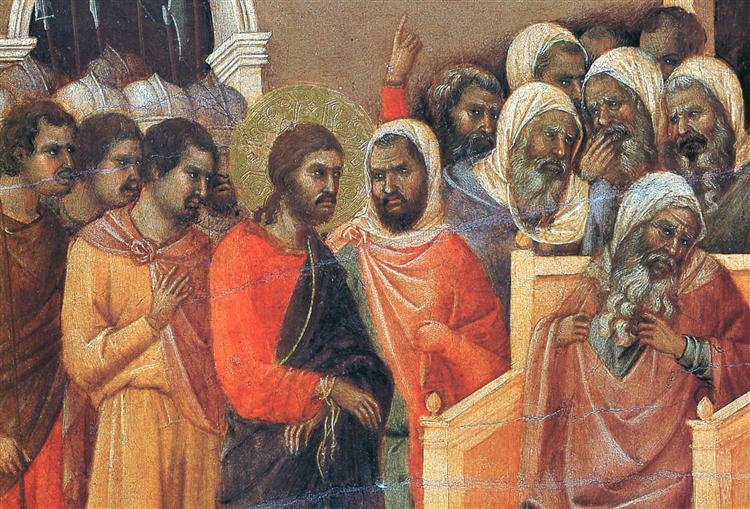
    Christ before Caiaphas (1308-1311), Duccio di Buoninsegna | Image from Wikiart.org.

    This is an important lesson for how to live out our lives. If we are open to God, faithful to the spirit as well as the letter of the law, and cultivate love, then we can avoid misusing any wisdom that God grants us. Caiaphas has not grown in the Lord and has not cultivated a heart and mind that is receptive to God’s will. The only will we see present in his short speech is his own cold, calculating will that is preoccupied with earthly power relations.

    Thank you, God, for an alternative way that you’ve given us in your Son, the Way, the Truth, and the Life. No one comes to the Father except through Him. 


  • Hotheads and Zealots

    Hotheads and Zealots

    Friday of the Fifth Week of Lent: Jeremiah 20:10-13, John 10:31-42.

    I feel that I have less and less to say about the readings as we approach Holy Week. This could be a result of the distractions at home and in work or it could be because the weekday readings are the same from year to year and I don’t wish to repeat what I wrote in previous years. I can say that today, though, it is also in part due to a reaction against the people who rejected Christ in the gospels.

    I don’t know if it’s a sense of weariness over this rejection that we never forget in the life of the Church or perhaps a question of how many times I can reflect on the wrongness of humanity for not recognizing God in our midst. In any case, St. John’s gospel presents us with a number of episodes where the Jews continue to disbelieve, test, not listen to, and flat out insult our Lord, and today’s readings are another example. This being said, I hope to lay out a few observations below.

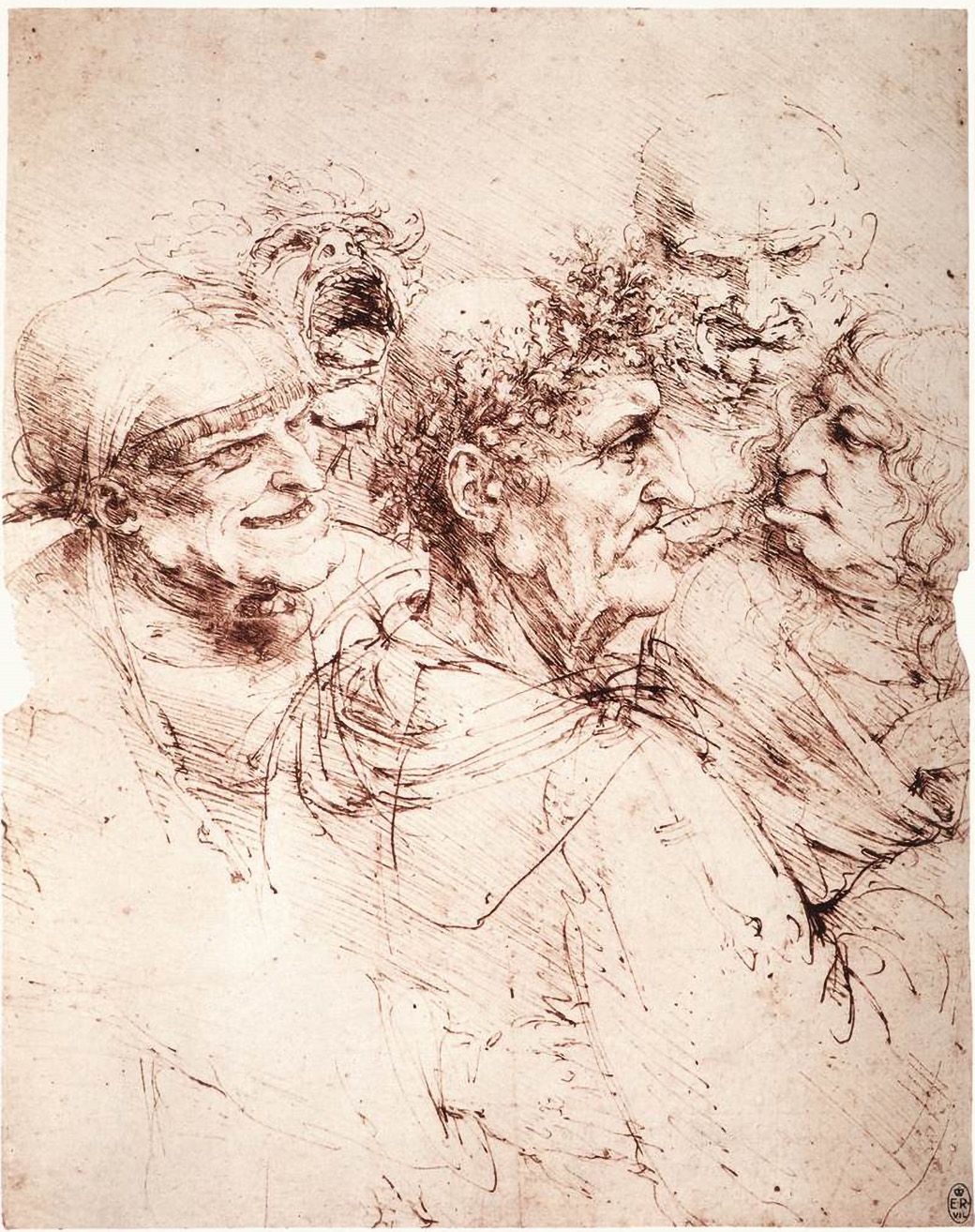
    Study of five grotesque heads (c.1494), Leonardo da Vinci | Wikimedia Commons.

    When we read that “The Jews picked up rocks to stone Jesus,” it’s a little jolt of surprise — wait, that’s not how he dies! Reading the gospels, we realize that Jesus came face-to-face with murderous intent several times (almost getting thrown off a cliff at Nazareth being another). Imagine if a random stoning over blasphemy was the story of his death. He would of course accomplish the Resurrection because immortality cannot be subject to death, but the great drama of the Passion is missing.

    As we approach Holy Week, we can reflect on the importance of the sequence of events happening in the way God intended for them to happen. We will encounter the praise and worship of his entrance into Jerusalem, a forecast of Christian worship in the form of the Church, but also a darkly ironic celebration just before betrayal, torture, and crucifixion at the hands of the people. Perhaps the stoning that could have happened in today’s reading was not enough of a judgement; by this I mean that all of the secular and religious powers had to participate in their wholly inappropriate judging and condemnation of the Son of God — today’s cluster of angry Jews did not fulfill the requirements that all of human powers must symbolically play in the drama of the Lord’s self-sacrifice. 

    While not the great drama to come, today’s pericope offers a different type of deliverance. It is a lesson in contrasting patience and human reason with hothead zealousness. Jesus surely shows us how reason and intellect are a blessing from God, but also how they must be joined to a spiritual reality that they cannot explain. In response to the Jews picking up stones with the intent to kill him, Jesus, the master of the Law, asks which of his “many good works from my Father” justify death by stoning. He is meeting anger and impulse with dry facts and the law.

    When they respond it is not his deeds but rather blasphemy, let’s understand how difficult and frustrating it would be for the Son of God to hear that he’s the one blaspheming, much less have to defend himself from these accusations. By definition, God cannot blaspheme against himself. All that he says is creative and generative; he does not contradict himself.

    But if they don’t accept him as God (in fact, this is the very thing they think makes him a blasphemer), then how to explain it to them? In the verses prior to this he has just said, “The works that I do in my Father’s name testify to me; but you do not believe, because you do not belong to my sheep. My sheep hear my voice. I know them, and they follow me” (Jn 10:25b-27). In other words, either they recognize him as Lord through his deeds and Word, or they simply do not because they do not have the Father in them. By this point, the whole conversation is moot, which is likely why the Jews picked up stones — they had nothing more to say with words.

    But Jesus does not give up, much less participate in violence. He continues to reach out to them, long past the point when they were open to listening. He goes on to justify His words by pointing to scripture (Psalm 82), and justify Himself by pointing to “my Father’s works.” This is the action of the Father — endless mercy, endlessly reaching out to us even when we push Him away. Jesus even goes so far as to say, “even if you do not believe me, believe the works, so that you may realize and understand that the Father is in me and I am in the Father.” He simply wants them to honor the Father here, knowing that a rejection of Himself is a rejection of the Father.

    But it is not to be, and when they try to arrest him, “he escaped from their power.” What an interesting turn of phrase here. The power they have is the power of the world, the power of Satan whispering in their ears, and this is a power that has no grip over Christ. The original Greek reads that he “went forth from” (ἐξῆλθεν / exēlthen) — interestingly, the same verb used to describe the water and blood that “flowed” from his side when he is pierced by a spear on the Cross — “their grasp” (literally, their hands). This sense of “going forth” like flowing water reinforces the sense of irrefutability of the logic that we hear from the Logos of God. When water flows, we are somewhat at a loss of how to stop it, just like the Word of God can’t be stoppered and Jesus can’t be arrested before his time. These things are not subject to the will of humanity; they operate on a different plane and they are inevitable.

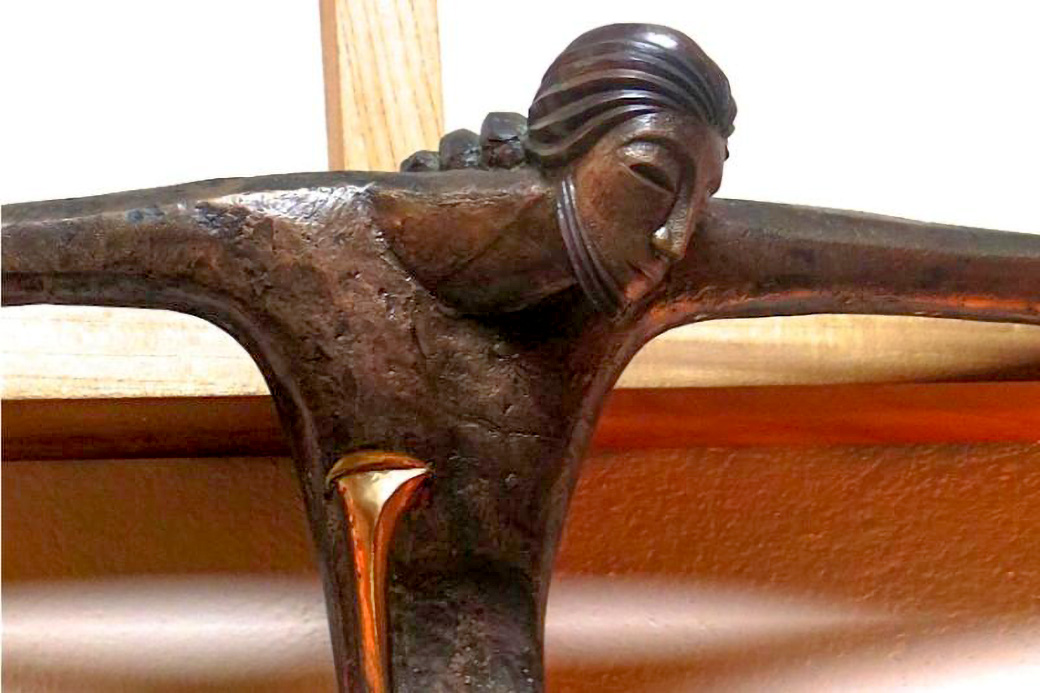
    Crucifix of the Pierced Heart of Jesus from the Mother House Chapel of the Religious of the Sacred Heart of Jesus, Ixelles, Belgium | image from rscjinternational.org.

    My prayer for today is that we learn some specific lessons from our Lenten gospel readings: that our role is never to be judge or executioner; that we refrain from trying to interrogate the Lord or pin him down (hold him in our grasp) and instead trust that he’s always there for us and look to join him in the Spirit, which blows where the Father wills it. And that we check our own blasphemy any time we hear disrespect against the Father, Son, or Holy Spirit.

  • Creation and Incarnation

    Creation and Incarnation

    The Solemnity of the Annunciation of the Lord: Isaiah 7:10-14, 8:10, Hebrews 10:4-10, Luke 1:26-38.

    Today’s readings should be very familiar to us. We hear God promise the virgin birth and the name Emmanuel, we hear St. Paul tell us that “the offering of the Body of Jesus Christ once for all” has taken the place of all the lesser animal sacrifices done in the Jewish tradition, and we hear St. Luke’s amazing account of Gabriel announcing to Mary that she will give birth to the Messiah.

    I’ve already written three reflections on this gospel reading: Our Blessed Kecharitōmenē, Our New Eve, and A House for Our Lord to Dwell. Mary is indeed full of grace and the worthy Ark of the New Covenant.

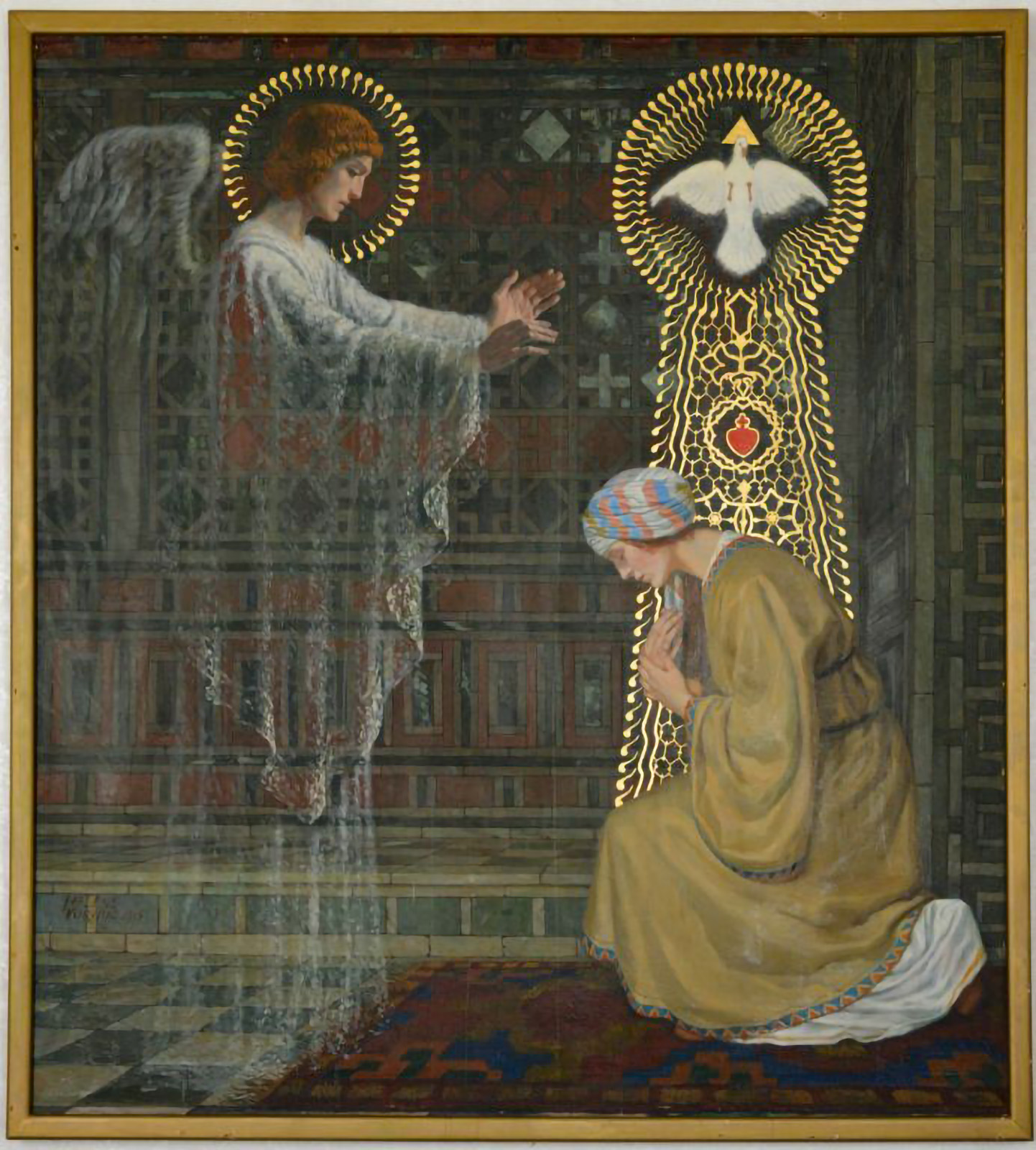
    The Annunciation (1915), Helena Vurnik | Image from the National Gallery of Slovenia.

    I don’t know that I have much to add to the volumes that have been written on this fundamental aspect of our faith, and I’ll keep this reflection short. One thing jumped out at me as I studied a few different commentaries and books on this subject: Mary actively participates in the same creative act that God undertakes at the beginning of time. The Incarnation is another Creation.

    This might seem terribly obvious, and if so, my apologies. But consider how Fr. Jean Corbon, OP, writes about this moment in the Annunciation: “the humble maidservant can respond to the message with all her being and in the very words that her Lord used at the beginning of time: ‘Let it be!’ (Lk 1:38 and Gen 1:3)” (Wellspring of Worship, 37).

    What Corbon references here is the Greek verb γίνομαι (gínomai), which is used in Genesis when God says “Let there be light” and there was light. The Greek translation of the Hebrew is theos gínomai phōs kai gínomai phōs. A more literal translation is “God said “become” light and light came into being. The verb gínomai is roughly translated as our verb “to be,” but it’s more properly “to become” or “to receive being.”

    It’s fairly complex, which is why Thayer’s Greek Lexicon spends over 2,460 words to describe it in their entry for gínomai. But suffice it to say that when we read Mary’s great “Yes” to God at the Annunciation, we encounter something special when the Greek says, genoito moi, which our Lectionary translates as “May it be done to me,” although she is really uttering a different voicing of the same gínomai uttered by God at the Creation of the world.

    This is why the King James Version of the Bible has it translated as “Be it to me,” which, for all its awkwardness, gets to the point of what Corbon is saying: humble Mary uses the very words her Lord used at the beginning of time, “Let it be.”

    Why is this important? Well, it’s difficult to overstress that a new creation is happening as God joins Himself to humanity. This perfect merging of the divine essence with the human mind and body is something never accomplished before or since, and it has ramifications for history both before and since.

    As Corbon writes, “The age of the mysterious ‘synergy’ between the river of life and the world of the flesh has begun; in the new creation every conception will henceforth be virginal … After the synergy of this first Pentecost, everything is unmerited and personal, everything a manifestation of the Spirit’s power … Henceforth, everything fleshly is permeated by the energy of love” (38).

    There is a lot to meditate upon in these words. The cornerstone of our faith is who Jesus is. He is the Son of God, one with God, and yet also a man. He is immortal, but took on mortality so he could die and rise (for immortality cannot die), thus transforming humanity because of this experience. Without this belief in the divine nature of Jesus, we do not have the Christian faith and humanity has not been transformed. The Annunciation as a moment of new creation is absolutely indispensable to our faith.

    In the previous quote from Corbon, he references the “first Pentecost,” that is, the first time the Spirit is poured out, emptied out in a kenosis, upon humanity. I am struck by how powerfully Corbon describes the action of the Spirit in the Incarnation of Jesus Christ. He writes:

    Mary says “Yes”, and the Spirit who unites the Word and the Yes, divine energy and human energy, gift and acceptance, comes upon her. The Spirit of the Father is the one who crafts this Covenant, fulfilled at last, between the Word and flesh. In the first creation all that exists is “called from nothingness to being”. In the new creation that is beginning here, he who is eternally begotten of the Father is fashioned out of living earth, namely, the entire being of his mother … He who is to be born of the Daughter of Zion has been conceived not by any “will of man” or by any set of determining causes but by the power of the Holy Spirit  (37-38).

    I appreciate both his insistence upon the Holy Spirit as the one who is at work in Mary (as the angel Gabriel explains, “The Holy Spirit will come upon you, and the power of the Most High will overshadow you”) as well as the difference between the first creation and this new creation. God creates from nothing in the first creation. It is his power alone that makes gínomai happen. But in this second creation, He has a raw material to join to his gínomai — a raw material that is made from dust but is illuminated with the breath of the Spirit already.

    Like an errant breeze corralled back into the tornado of God’s Spirit, humanity is joined again to its source and is able to utter a gínomai alongside her maker. It is still God’s power alone through the Holy Spirit that makes the Incarnation happen, but Mary is able to participate in a way that no part of Creation has ever been able to participate. Her free will, granted by God and guided by holiness, forms the participatory force in this new creation; likewise, her body provides the participatory substance for this new creation.

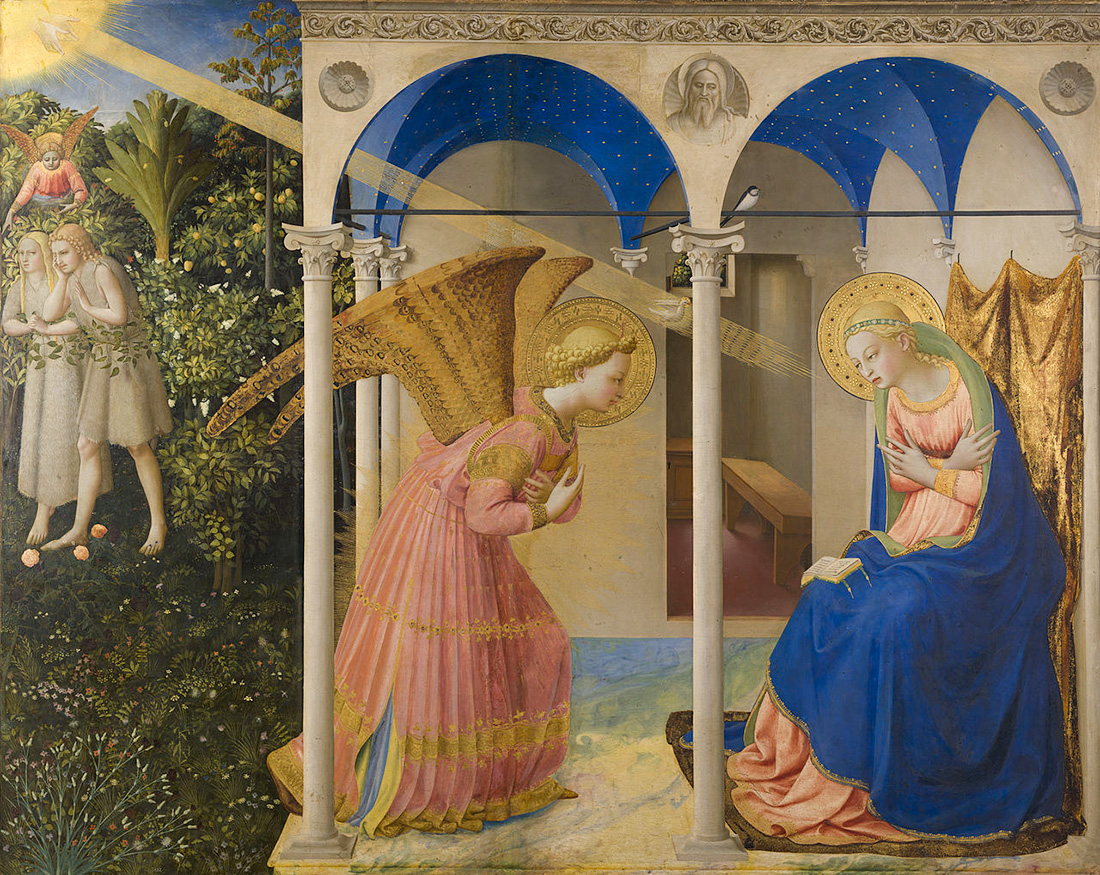
    Annunciation (Annunciazione), c.1435, Fra Angelico | Wikimedia Commons.

    Nothing can overshadow the great outpouring of love in the form of the Holy Spirit at the Incarnation — that God should stoop so low as to become one of us out of love for us is simply staggering. This is hinted at by Gabriel: “[He] will overshadow you.” But let us also recognize that Mary performs her own kenosis of spirit by yielding completely to the will of the Father. It is this synergy, this union of love pouring out one for the other in both directions, that enables the new creation to happen. This has become humanity’s model for unity with God; something we can all recognize, strive for, and pray to the Virgin to help us achieve.

    Let no one pass off the Annunciation as an unnecessary Christian myth. This deepest of encounters between God and humanity is the bedrock of our salvation!

  • The Dense Life

    The Dense Life

    Wednesday of the Fifth Week of Lent: Daniel 3:14-20, 91-92, 95, John 8:31-42.

    Ah, freedom! It’s a major aspect of today’s gospel reading. Who knows more about freedom than the American (so we tell ourselves)? There was an article in one of our local news outlets, the Deseret News, just before the November 2020 presidential election that shed a lot of light on how Americans have thrown their notions of the constitution, the symbol of the flag, and personal freedoms into a blender to arrive at a specific brand of in-your-face freedom.

    The article is called Big Flags on Big Trucks, and details the phenomenon of “caravanning as a conservative way of protesting,” including a 6-mile-long train of trucks and cars flying flags and pro-Trump propaganda that drove the 380-mile length of Utah’s I-15 in late October, 2020. Now, people’s political persuasions are not my concern with this site. A quote from this article, however, reveals something about how Americans have twisted the concept of freedom to mean the opposite of what Christ means.

    “Liberals are always in your face. They want to push their opinion on you,” says a 22-year-old construction worker quoted in the article, “I have freedom of speech. I can say what I feel too.” Indeed, on both sides of the political spectrum, freedom means the unfiltered, unregulated firehose of opinion. Because American “freedom” implies the lack of any check or law, it has instilled a type of anarchy in the national psyche.

    It’s not too much of a leap to claim that Americans still have a bit of the wild West in them, feeling like they have the right to take matters into their own hands — certainly with words, but also with actions, guns, whatever. Our concept of freedom empowers us to “say what I feel” or “do as I please.” The result is that we envision ourselves as mini deities, marching about the world according to rules that we make up for ourselves, or no rules at all.

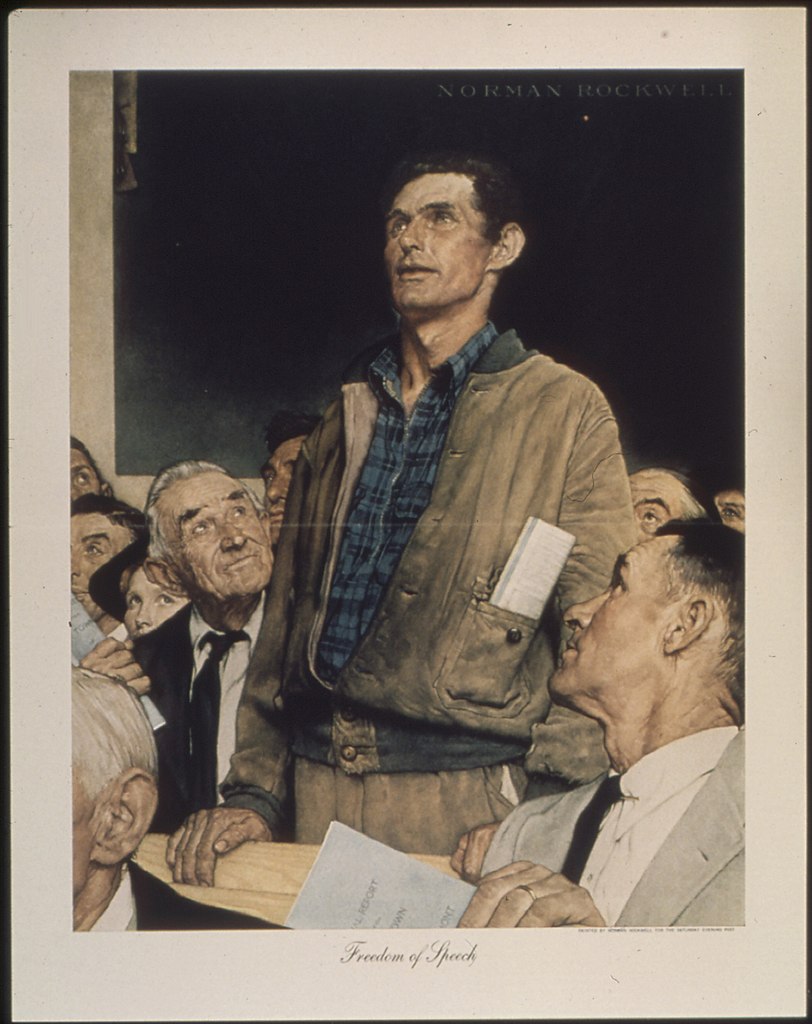
    Freedom of Speech (btw 1941-1945), Norman Rockwell | Wikimedia Commons.

    It’s important to state that this is a new (and errant) way of thinking about freedom. Human civilizations until the last several hundred years regularly had enslavement and servitude as part of cultures around the world. When someone was freed from slavery, this meant they could operate in society as any other citizen — according to the laws and prescriptions of the society. Free citizens certainly enjoyed more rights than slaves, but no one was exempt from the law, except the rulers, and even then certain codes of conduct were expected.

    Americans founded their society on revolution from a colonial master, and the rhetoric of freedom has always enjoyed center stage. “Freedom” as a national touchstone grew with our abolishment of slavery after the Civil War (something that lagged behind European countries, by the way), and enfranchisement of women and people of color in the 20th century. I would claim that the civil freedoms we enjoy are not that different from many, if not most, other countries around the world, but in our minds, we are exceptional.

    Much has been written about American exceptionalism in academic circles, and suffice it to say here that our exceptionalism has many levels: we feel exempt from many prescriptions that other cultures have but also more exceptional in character, in the fiber of who we are, which results in a ton of entitlement. I don’t think any of us intentionally feels this way — it’s simply something that we take on by millions of subtle and not-so-subtle messages in our public discourse, our entertainment, our advertising, etc.

    In my mind, the consequence of American exceptionalism as a part of our national character is that we are weaker, more arrogant, and less conformed to Christ. To put it bluntly, personal or national exceptionalism is a form of sin, where we place ourselves above others.

    As children of God, equal to all other children of God, we are lying to ourselves when we imagine a type of exceptionalism. As Dostoevsky wrote,

    “People who lie to themselves and listen to their own lie come to such a pass that they cannot distinguish the truth within them, or around them, and so lose all respect for themselves and for others. And having no respect, they cease to love, and in order to occupy and distract themselves without love they give way to passions and to coarse pleasures, and sink to bestiality in their vices, all from continual lying to others and to themselves.” (The Brothers Karamazov, II, 2).

    Dostoevsky rightly locates the loss of truth as a crucial part of the spiral of sin.

    Christ speaks today of the role of truth in establishing true freedom: “If you remain in my word, you will truly be my disciples, and you will know the truth, and the truth will set you free.” Christ promises freedom, but at the end of a sequence of things that starts with a personal journey with him.

    Let’s start with the beginning: “If you remain in my word.” His word is both the teaching of the man Jesus as well as the Word of God contained in all of scripture. Jesus is affirming the laws and prescriptions of how to act and comport oneself as laid down for millennia in the scriptures as well as his own perfection of the law as he reveals during his ministry. Remaining in his word is where we start. Many (or most) of us may spend our entire lives just trying to get here, aspiring to remain, not slip, to train ourselves to resist worldly temptations, to pray often to the Father, and to serve our fellow human like Christ taught. 

    Christ promises that if we remain in his word, we will truly be his disciples. This means we will have a personal relationship with our teacher. Our lives become more than just following rules of behavior. We are immersed in a spiritual relationship that feeds us and transforms us. It is dynamic. We learn from him and lean on him and he rejoices with us when we succeed in turning to goodness and away from evil. He also comforts us when we slip.

    As we check in with ourselves on this journey, we can start to see that we are living a fuller, denser life, allowing ourselves to be conformed to something divine, to take on a spiritual dimension that promises to be more meaty than our physical one.

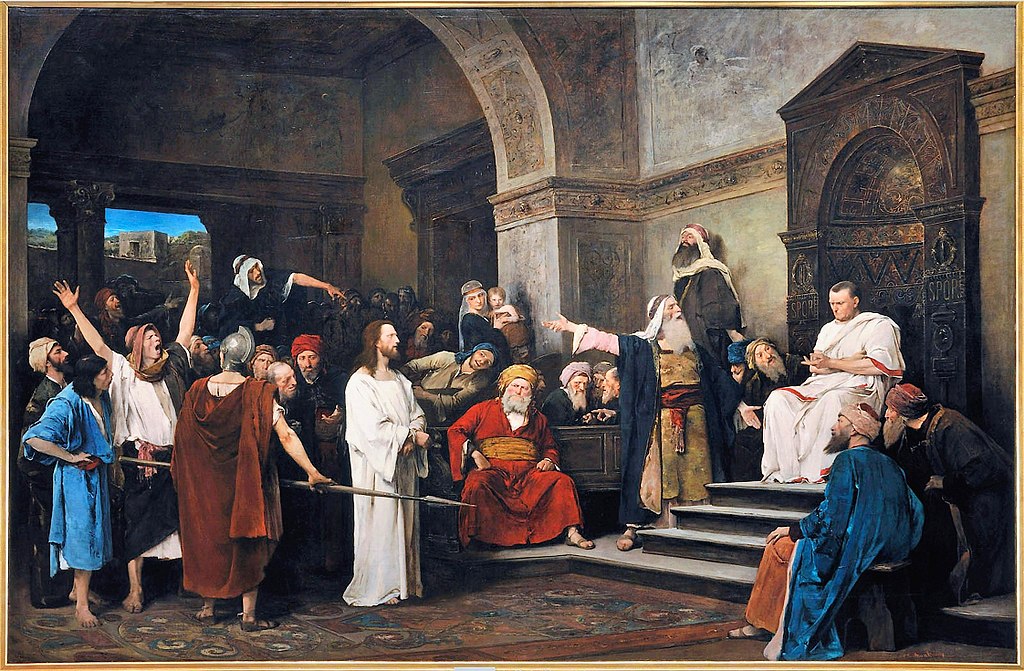
    Christ in Front of Pilate (1881), Mihály Munkácsy | Wikimedia Commons. Nietzsche (see next paragraph) aligns himself with one of the greatest theological “misses” in the Passion story, Pilate’s offhand retort to Christ. In The Anti-Christ, Nietzsche writes, “Must I add that, in the whole New Testament, there appears but a solitary figure worthy of honor? Pilate, the Roman viceroy. … The noble scorn of a Roman, before whom the word “truth” was shamelessly mishandled, enriched the New Testament with the only saying that has any value—and that is at once its criticism and its destruction: ‘What is truth?’”

    Then Jesus promises us that we “will know the truth.” After remaining in his Word and developing a personal relationship with our teacher, we will know the Truth. Let’s pause here and say that anyone who thinks that truth is a matter of context or is subjective depending on who you are, well, this person cannot call herself a Christian. Jesus clearly here and elsewhere tells us that there is a (singular) Truth — that Truth lives in God and we apprehend it through Christ as the Way.

    In fact, this is how he can say, “I am the Way, the Truth, and the Light.” To deny that there is Truth is at the heart of atheism. Thus, Nietzsche says, “What is the truth, but a lie agreed upon.” In this world of Nietzsche, nothing exists but people making things up and calling them “rational” or “true” or “false.”

    Apart from this being simply counter to everything God has revealed about reality, I find it quite a mental stretch, like a bad dystopian movie or an episode of the Twilight Zone. There are too many things that exist beyond us and to which we respond to limit the world in this way. Certainly, in God’s great created universe we can find amazement and life that surprises us, that we do not create. But even in what we do create, like artwork, there is something about beauty that speaks to something transcendent, something that carries meaning outside of what we determine it should be.

    Thus, even the cynical, anti-Christian, existentialist student of Nietzsche, Albert Camus, writes, “Fiction is the lie through which we tell the truth.” He affirms that there is truth, and that we tell ourselves fictions, some of which reveal the truth that is external to what we can create on our own.

    Pope Francis does a lovely job of summarizing how Christianity conveys a denser, more profound understanding of truth:

    In Christianity, truth is not just a conceptual reality that regards how we judge things, defining them as true or false. The truth is not just bringing to light things that are concealed, “revealing reality”, as the ancient Greek term aletheia (from a-lethès, “not hidden”) might lead us to believe. Truth involves our whole life. In the Bible, it carries with it the sense of support, solidity, and trust, as implied by the root ‘aman, the source of our liturgical expression Amen. Truth is something you can lean on, so as not to fall. In this relational sense, the only truly reliable and trustworthy One – the One on whom we can count – is the living God. Hence, Jesus can say: “I am the truth” (Jn 14:6). We discover and rediscover the truth when we experience it within ourselves in the loyalty and trustworthiness of the One who loves us. This alone can liberate us: “The truth will set you free” (Jn 8:32).
    – from Pope Francis’s message on World Communications Day, January 24, 2018.

    So, Truth necessarily involves the “only truly reliable and trustworthy One,” God. It is only in our lifelong walk with Christ, within the fabric of that personal relationship where he transforms us into better and better human beings, that we start to recognize and discover Truth.

    Thus, we arrive at the final part of this complex relationship and promise from Christ: “the truth will set you free.” We will get to the “free from what?” question presently, but first let’s linger on the fact that freedom comes as a result of a lifelong walk on the Way to the Kingdom where we discover truth “in the loyalty and trustworthiness of the One who loves us.” Contrast this complex, experiential definition with the American concept of freedom (“say what I feel” or “do as I please”). How self-centered and shallow it is revealed to be! There is no discovery of Truth that underlies this type of “freedom”; everything comes from within our flawed selves.

    This is, in fact, the very definition of living in a state of sin and without God in our hearts. It’s hard to think of a saint who hasn’t warned us about allowing ourselves to be led by our passions and desires. St. Benedict: “No one should follow what he considers to be good for himself, but rather what seems good for another.” St. Alphonso Liguori: “He who trusts in himself is lost. He who trusts in God can do all things.” (We could go on and on).

    The point is that when we follow our own desires, we are being ruled by the prince of this world. This is how Satan works in us, by having us elevate our own interests above everything else. The Ten Commandments were given to us to help us push back on these desires and temptations — coveting property and people, disrespecting our parents, destroying people who stand in our way, and putting ourselves ahead of God. Sinning is giving into the unchecked desires of self that are not conformed to God.

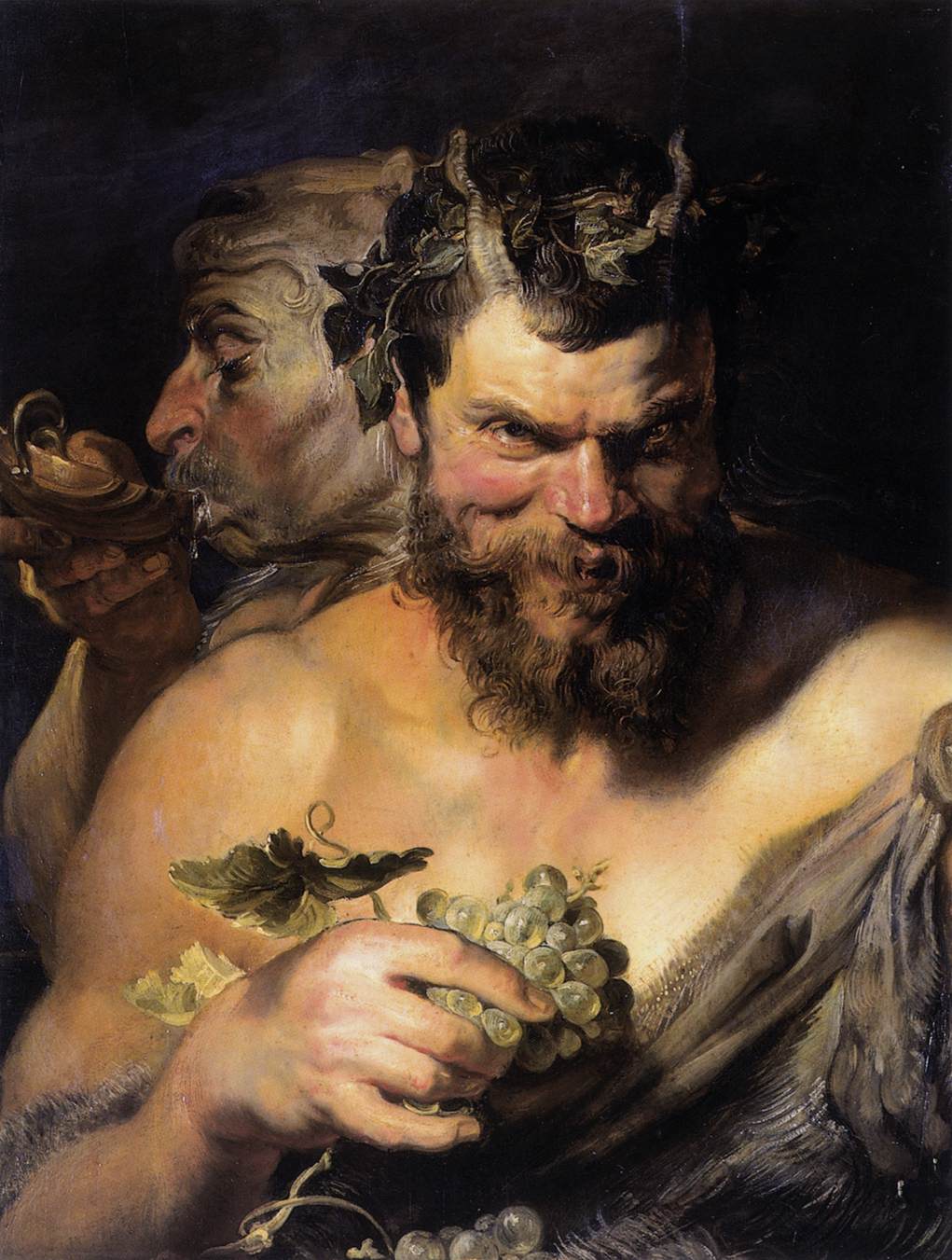
    Two Satyrs (1618-1619), Peter Paul Rubens | Wikimedia Commons.

    (NB., desire can be good, too! Desire for God, sexual desire for a spouse, desire to have someone else do well or be saved from suffering, etc.)

    So when Christ speaks of being set free, of course, he is saying, “everyone who commits sin is a slave of sin.” The slavery of sin is what he has come to free us from. Imagine if we lived in a land where people proudly spoke of their freedom and — instead of the right to bear arms, to say whatever they pleased, or to hold private property — they meant freedom from sin. Now, that would be a country to be proud of!

    Along these lines, imagine if we found our purpose in this density of being, this filling out of ourselves with meaning and Truth. Rather than pursing the goal of proving our worth by showing off accomplishments that we’ve done all on our own, as if our own merit is the driving force in our lives, what if we pursue the goal of being shown Truth and goodness from outside of ourselves, by God. The first is a lonely, selfish, and ultimately shallow existence. The second is filled with the life of the heavenly hosts, it’s expansive, and it’s an ultimately deep existence.

    We must close with St. Paul because we have to realize that Jesus gave us our freedom from sin permanently and irrevocably. While it continues to be our challenge and call to find truth after a lifelong personal walk with Christ, he permanently changed our ontological spiritual state with his death and resurrection.

    Do you not know that all of us who have been baptized into Christ Jesus were baptized into his death? Therefore we have been buried with him by baptism into death, so that, just as Christ was raised from the dead by the glory of the Father, so we too might walk in newness of life. For if we have been united with him in a death like his, we will certainly be united with him in a resurrection like his. We know that our old self was crucified with him so that the body of sin might be destroyed, and we might no longer be enslaved to sin. For whoever has died is freed from sin. But if we have died with Christ, we believe that we will also live with him. We know that Christ, being raised from the dead, will never die again; death no longer has dominion over him. The death he died, he died to sin, once for all; but the life he lives, he lives to God. So you also must consider yourselves dead to sin and alive to God in Christ Jesus. Therefore, do not let sin exercise dominion in your mortal bodies, to make you obey their passions. (Romans 6:3-12).

  • The Limits of Language

    The Limits of Language

    Tuesday of the Fifth Week of Lent: Numbers 21:4-9, John 8:21-30.

    For me, today’s readings expose the limits of language to convey God’s plan. More than language, really, it’s a limit to our very capacity to understand. The reason we call these things the mysteries of our faith is not that they are to be blown over or passed of as simply “unknowable” (that’s a cop out, in some ways). It’s because they exist within a divine logic that we do not have access to here on the earthly plane.

    I imagine that some saints and mystics have had encounters with this divine logic and entered an ecstasy that included an understanding, in parts, of God’s ways. What this tells us is that pure worldly knowledge and intelligence are poor ways to “interrogate” or understand these mysteries. God IS, and there is an experiential aspect to encountering God’s divine plan.

    In other words, the more we can exist in a way that is conformed to God’s image, the more our very existence is compatible with Him. What follows it that the more we can conform to Him, the more we might gain insights into the mysteries of our faith.

    We discussed the seminal Lenten image of Moses’s bronze serpent on the staff in the reflections Lifted Like the Serpent and Bridging Salvation History with a Serpent. We encounter that full reading from the Book of Numbers today. It is very difficult to understand how this thing that resembles an idol could be prescribed by God, who detests all forms of idolatry in his Chosen People. In fact, the entire thing doesn’t really reveal its meaning until Jesus comes and compares his own Crucifixion with the bronze serpent, which happens about 1,475 years later.

    This is a good example of the divine intelligence, where millennia are but a breath, where symbols contain a depth of meaning that may only reveal itself in another age. We can react to this in many ways, from frustration to withdrawal. This is why God constantly tells us that he loves us and won’t abandon us. He calls us to him and strengthens us with opportunities to exercise our spiritual muscle of faith in him over and over again. The overwhelming message is clear: we are his sheep, we need to trust in our Good Shepherd. His plan is unknowable to us as calculus is to a sheep, likely infinitely moreso. 

    When I first really grappled with the first reading some years ago, I was left with a lot of questions. It’s somewhat funny that the text just plows along without anyone’s doubt being expressed. That’s why I was pleased to find that I wasn’t the only one imagining that Moses’s introduction of a bronze staff would have been met with some skepticism. The excellent series The Chosen opened episode 7 with this exact scene, and Joshua confronts Moses with all of these doubts. Moses replies, “It’s an act of faith, not reason!” It’s worth a peek if you haven’t seen it:

    Moving to today’s gospel reading, we find that Jesus’s words are oddly unilluminating for the Pharisees. When I read this passage, I find myself frustrated, undoubtedly as St. John must have been when recalling the exchange. Every time Jesus offers a kernel of truth about himself or a piece of wisdom about eternal life, they respond like idiots. This is the perspective of a believer: he’s giving you gold, giving you the truth about his very self, and you respond with lame, cynical questions! And the perspective of an unbeliever: he’s talking in riddles, not answering us in plain language or at least the language we’re expecting.

    How can these perspectives be so different? He is the Word of God, the light casting away darkness, bringing intelligibility to the universe. Perhaps this is the genius of how St. John has presented the gospel here. There is no better way to convey the difference between walking the Way and being an unbeliever — it should make those of us who love Christ want to help him explain to the pigheaded Pharisees, make them understand that the stakes couldn’t be higher here and they’re fumbling the ball. Think of some of the exchange:

    Jesus: I am going away and you will look for me, but you will die in your sin.

    Pharisees: He is not going to kill himself, is he?

    [My reaction: Miss the point much? He’s concerned about you missing out on your salvation]

    Jesus: You belong to this world, but I do not belong to this world. That is why I told you that you will die in your sins. For if you do not believe that I AM, you will die in your sins.

    Pharisees: Who are you?

    [My reaction: He just told you He is the great I AM!]

    Jesus: the one who sent me is true, and what I heard from him I tell the world.

    Pharisees: They did not realize that he was speaking to them of the Father.

    [My reaction: !!]

    Jesus: When you lift up the Son of Man, then you will realize that I AM, and that I do nothing on my own, but I say only what the Father taught me.

    Pharisees:

    At this point, my reaction has to move past frustration and figure out what John is telling us about Christ. Is his point that language is simply inadequate to explain the mystery of the Trinity and the Incarnation? I don’t think so. It’s true, language only goes so far, but language can go much further than we give it credit. That is why the scriptures will continue to reveal the treasures of wisdom to us throughout our lives — they are inexhaustible. As St. Paul tells the Romans, “O the depth of the riches and wisdom and knowledge of God!” (Rom 11:33).

    But what is required is an alignment of one’s spirit with the spirit of Truth. Simply put, we have to want to encounter God. If we don’t want to encounter God, it will all seem like rubbish, ravings of a crazy cult. Indeed, we have heard such accusations from atheists over the last few centuries.

    Are You Talking to Me? (contemporary), Witold Gilewicz and Janusz Gilewicz | Image from artpal.com.

    When we admit to ourselves that we actually want to get to know God, that we’re willing to take on faith the entire tradition and revelation of himself to humanity, we start to see meaning where before we saw nothing. We are not creating meaning — this meaning existed long before our little brains encountered it — it’s more like we finally moved the radio dial off of static and tuned into the divine frequency. In our gospel reading today, Jesus is broadcasting loud and clear to those tuned into the divine frequency. The Pharisees, sadly, are not just on static, they’re on their own channel that broadcasts nothing but politics and self-assuredness.

    Jesus tells us something else of great importance at the end of today’s reading: “The one who sent me is with me. He has not left me alone, because I always do what is pleasing to him.” Remember, with every revelation about himself, he is instructing us on the Way to the Kingdom. He is our role model, our high priest, and our Savior. The more we can be like him, the more we will be on our way to the Kingdom. And here he shares that the divine frequency carries more than just wisdom. It is a spiritual reality where God himself walks alongside us.

    “The one who sent me is with me. He has not left me alone, because I always do what is pleasing to him.” The promise is the same as it has always been: God will not leave us alone, and in return we should do what is pleasing to him. It’s amazing how the core of our faith is always this simple covenant of loving care. But this is more real than perhaps we ever hoped! Jesus tells us that the very real being of God is “with” him and “has not left me alone.” We have to be open to the ways of the Spirit and spiritual realities to understand this, but once we open ourselves, the reality is stunning.

    This is no distant judge from on high who checks his list each time we sin. This is our shepherd and partner every step of our life. He doesn’t leave us when we’re exhausted and crabby, or when we can’t afford a meal, or when we suffer an embarrassing failure. This should transform how we pray to him; he is much closer than we imagined, much more interested in giving us his mercy and help than we thought. The psalmist writes beautifully on this:

    O Lord, you have searched me and known me.
    You know when I sit down and when I rise up;
        you discern my thoughts from far away.
    You search out my path and my lying down,
        and are acquainted with all my ways.
    Even before a word is on my tongue,
        O Lord, you know it completely.
    You hem me in, behind and before,
        and lay your hand upon me.
    Such knowledge is too wonderful for me;
        it is so high that I cannot attain it.

    Where can I go from your spirit?
        Or where can I flee from your presence?
    If I ascend to heaven, you are there;
        if I make my bed in Sheol, you are there. …

    For it was you who formed my inward parts;
        you knit me together in my mother’s womb.
    I praise you, for I am fearfully and wonderfully made.
        Wonderful are your works    (Psalm 139:1-8, 13-14).

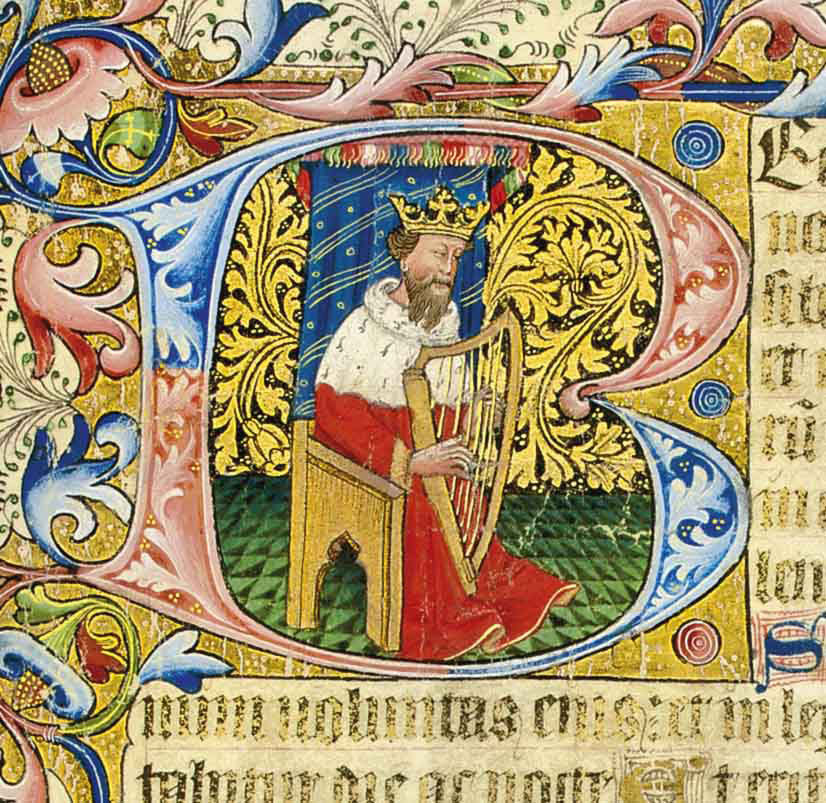
    Medieval artist’s rendering of King David as the psalmist in the Rice Psalter (mid-1400s) | Image from christies.com.

    This is a great aspect of God’s Wisdom for us to comprehend: not only does God exist, not only does he care that you do “what is pleasing” to him, he is so close to your being that you could never escape even if you wanted to. Why are so many of us spending our lives running away from the source of all goodness that springs up like a well within us?

    It’s time for us to tune into the divine frequency, to walk the Way with Christ who has always been right here with us.

  • Lust and Justice

    Lust and Justice

    Monday of the Fifth Week of Lent: Daniel 13:1-9, 15-17, 19-30, 33-62, John 8:1-11.

    Wow, what a first reading today – 1,079 words! I’m guessing, but I think it’s the longest one outside of Easter Vigil. Thankfully, it reads like the script for a telenovela, so there’s a certain pacing and several plot twists to keep us interested. This reading and the gospel seem to be about adultery — at least the accusation of adultery. But in the end, they are more about lust, the perversion of God’s law, and divine justice. Let’s dig in.

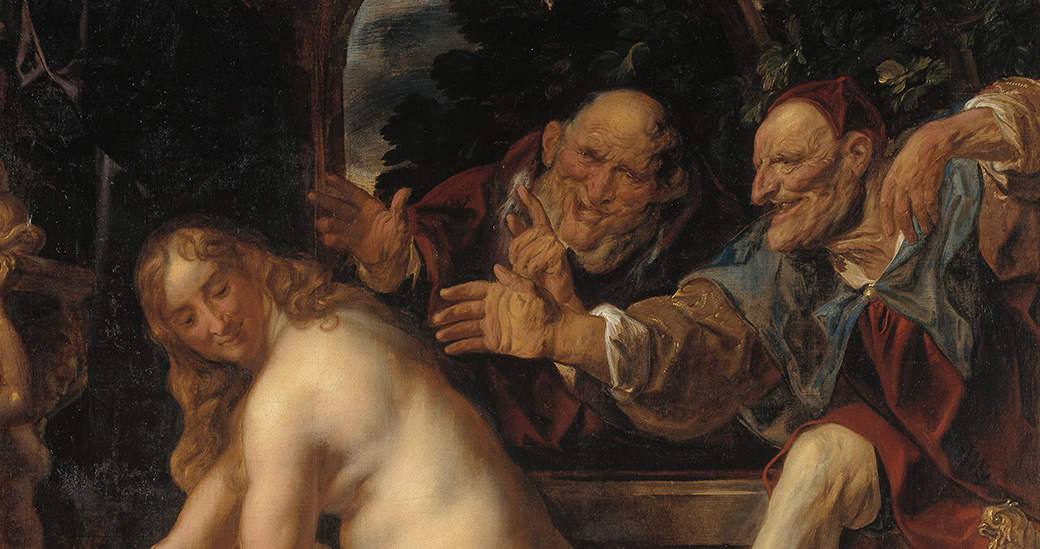
    Detail from Susanna and the Elders (1653), Jacob Jordaens | Wikimedia Commons. While I think Jordaens is off with his smiling Susanna, as if she’s enjoying the intrusion of these nasty men on her bath, I think he’s spot on with the devilish faces of the judges and their grasping hands. It speaks to their lustful focus on her.

    Susanna, the heroine of the first reading and my wife’s namesake, is a fitting object of desire: “a very beautiful and God-fearing woman.” This reading is ostensibly about her, but really it’s about the two elder judges, complete degenerates that they are. When they begin to lust after her, the state of their sin is described in these terms: “They suppressed their consciences; they would not allow their eyes to look to heaven, and did not keep in mind just judgments.” This strikes me as being so on-point. Unbridled lust is absolutely a suppression of our God-given conscience, something that we have to cultivate and listen to in order to live upright lives.

    Lust is a determined effort not to look at God, for who can contemplate the face of God and still be drawn to evil? They also are determined not to think of “just judgements” — ironic for judges, and a choice that will come back to bite them. This description cuts right to the spiritual truth of their actions. When we think of being caught up in lust, this series of choices made on the spiritual plane might not occur to us because physical desire can be so blinding of a force (at least in my experience as a man), almost like animal instinct. We’ve all heard of or experienced sex as a result of being “caught up in the moment.” To me, at least, lust doesn’t seem as calculated or deliberate as it is described, but when I think about it, this is exactly what’s going on in terms of my spiritual being. Lust has an amazing ability to cause a huge discrepancy between what we experience mentally and physically and what we experience spiritually.

    All religious orders must address lust as communities of same-sex people living out their lives in sexual abstinence. Our saints from religious orders have gone to great lengths to preserve their purity. St. Josemaria Escriva said: “To defend his purity, St. Francis of Assisi rolled in the snow, St. Benedict threw himself into a thorn bush, St. Bernard plunged into an icy pond…You…what have you done?” Now that speaks to the power of temptation and lust!

    Yes, there’s something special about this sin, as St. Alphonsus Liguori writes, “In temptations against chastity, the spiritual masters advise us, not so much to contend with the bad thought, as to turn the mind to some spiritual, or, at least, indifferent object. It is useful to combat other bad thoughts face to face, but not thoughts of impurity.” How interesting, and consistent with the description of how the judges were affected in today’s first reading. If turning your thoughts to a spiritual matter is the best way to combat lust, then the description of how they “would not allow their eyes to look to heaven” is telling indeed.

    In addition, the line about how they suppressed their consciences is exactly the opposite of what Pope Saint John Paul II writes about how to deal with lust: “Deep within yourself, listen to your conscience, which calls you to be pure…a home is not warmed by the fire of pleasure, which burns quickly like a pile of withered grass. Passing encounters are only a caricature of love; they injure hearts and mock God’s plan.” I bring up all of these saints not just to complement the description of the sin in the first reading, but to help us remember that even though the sin appears to be purely physical, it is in fact a deep spiritual injury to ourselves and God.

    Lust as temptation is dangerous because it perverts our spiritual nature, turning us into baser animal creatures. If unchecked, it culminates in lust as an action. Today, we hear the two elder judges tell Susanna, “give in to our desire, and lie with us. If you refuse, we will testify against you.” Their spiritual natures are so undermined and perverted that they threaten rape and end up carrying out false testimony when she screams for help.

    Shortly after this, we hear the cringe-worthy, sleazy details of their false testimony. How interesting that the train wreck of sins is so caught up in power and wielding power on this earth. It is no mere coincidence that these men are elder judges. They represent the corrupting influence of the world, the depravity that reigns in the place where justice should be.

    As a sharp contrast, a young Daniel (think: new life in the spirit) intervenes to help restore a community twisted by sin: “God stirred up the holy spirit of a young boy named Daniel, and he cried aloud: ‘… Are you such fools, O children of Israel! To condemn a woman of Israel without examination and without clear evidence? Return to court, for they have testified falsely against her.’” Here we have God’s intervention because grave sin and injustice are at stake. The reading hinges on this moment, when God works through his chosen prophet Daniel to confront the people with truth.

    Like an early version of a detective crime story, Daniel smoothly trips up the elders to reveal their treachery. Finally, unlike what we hear in the gospel, divine justice is enacted on the spot.

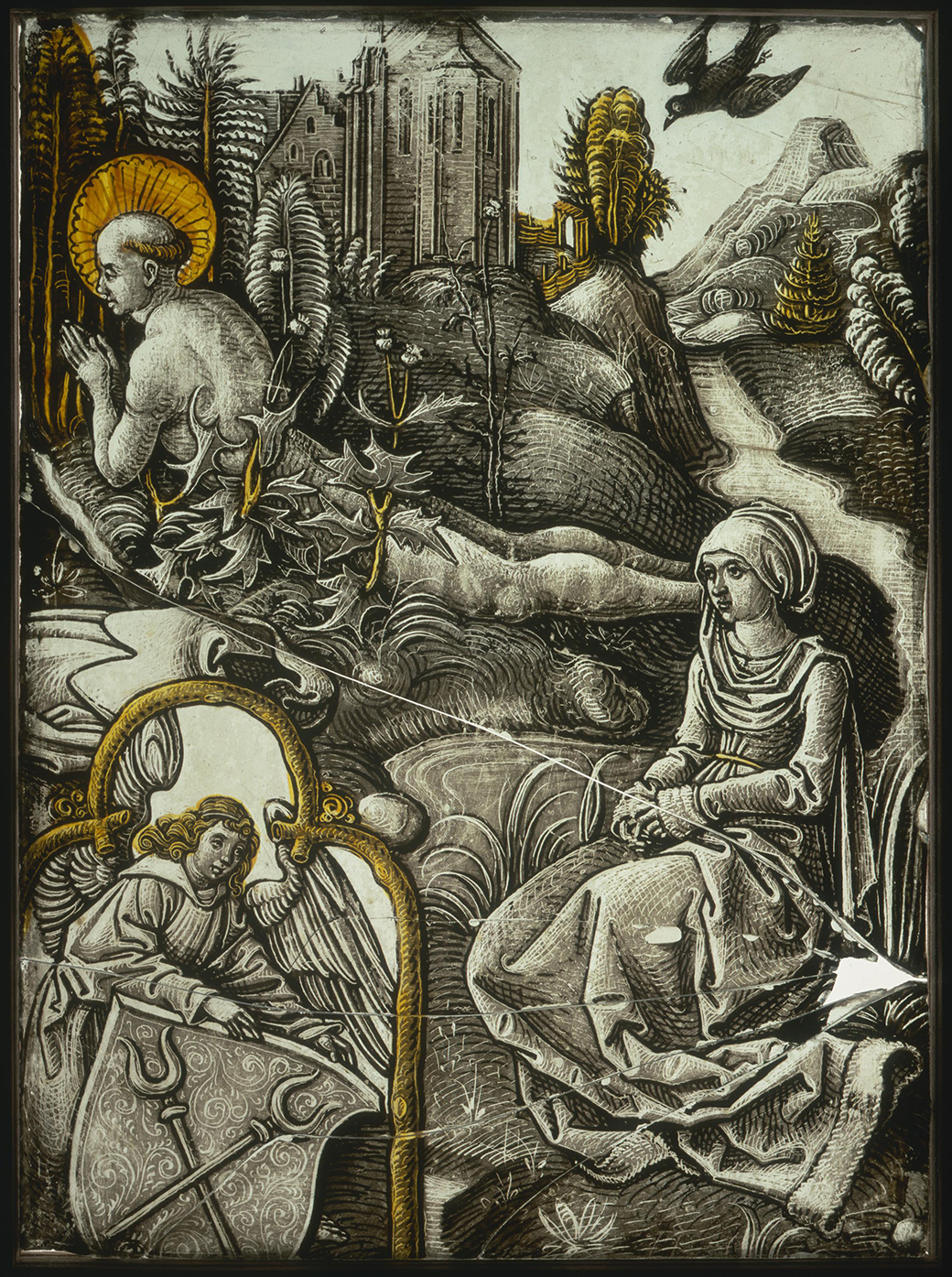
    The Self-Mortification of St. Benedict (1496), Albrecht Dürer | Creative Commons, courtesy of the Isabella Stewart Gardner Museum. From their website: “This window depicts an episode from the life of Saint Benedict (ca. 480–547). Satan, in the form of black birds, flutters around the saint. The young saint overcame his sexual desires (represented by the woman seen at the right) by throwing himself into a thorn bush. Albrecht Dürer shows Benedict lying in a thicket, deep in prayer.” One word: ouch.

    I think this is more than a critique of Jewish law and earthly justice systems. Likewise, I think it’s more than a simple morality fable even though the narrative structure reads like it. Remember that we are told that there was a prophecy about these judges: “of whom the Lord said, ‘Wickedness has come out of Babylon: from the elders who were to govern the people as judges.’” This brings the scope of salvation history into play. God has announced their coming, and as we see with other prophesied events, their arrival is a moment for God to reveal something about his desire to have us come to him in the Kingdom. It’s more than just a story of right vs. wrong.

    We learn two things in this vein:

    1. God hears us when we are pure of heart and call out to Him. Susanna precipitates David’s prophetic intervention when she cries, “O eternal God, you know what is hidden and are aware of all things before they come to be: you know that they have testified falsely against me.” Then we are told, “The Lord heard her prayer.”
    2. God promises divine justice, especially when earthly justice falls short due to human guile. Daniel does not promise a lynch mob or a simple execution; instead, he speaks of justice delivered by spiritual beings: “the angel of God waits with a sword to cut you in two so as to make an end of you both.” And even though the people do take the judges’ lives, Daniel’s words speak to a much more profound justice. God, through this scripture, gives us a vision of the Kingdom, where purity and virtue live with him and where sin and perversion of the spirit are eradicated.

    Let’s turn to the gospel, where Jesus Christ is the true way we will be re-configured in the Spirit. Daniel’s life and works simply pointed to Christ, like an early promise of the configuring and justice yet to be fully unveiled. And Jesus, as ever, surprises us with a teaching about God’s law and justice. 

    When the scribes and Pharisees throw a woman into the middle of the place where Jesus is teaching, St. John tells us that their question to Jesus about punishing her adultery was “to test him, so that they could have some charge to bring against him.” How like the elder judges in the Book of Daniel!

    They are here on false pretenses, not interested in justice but instead their own gain. Like the elder judges, they have bound themselves to the quest for worldly power and control; in so doing, they are avoiding looking at God. They lust not for sexual relations but for power, specifically the power of the judge to charge and condemn Jesus.

    Christ and the Adulterous Woman (contemporary), Domenico Morelli | Image from pixels.com. Excusing the overtly neo-classical elements of this painting (including Jesus’s robes), I like the use of light and dark to delineate Christ and the accusers.

    The other important thing here is the way the narrative of adultery is dealt with. On the surface, this episode seems to be a slam-dunk according to Jewish law, and when Jesus allows the woman to go unpunished, it seems to subvert that law. But John’s statement about their hidden intentions changes the narrative completely.

    They are not seeking to identify sin at all. Christ knows what is in their hearts, and for him this encounter is about their own falseness, not about the woman. After all, isn’t this what all encounters with God are about? When we stand before God, it is a personal encounter — we don’t go with a list of people we want to praise or condemn. Our role as his creation, his servants, is not one where we play judge or colleague.

    So as the Sun of Righteousness turns his gaze on the scribes and Pharisees, let’s remember that he understands their priestly role as upholders of God’s commandments and precepts. In fact, he shows them that their sin is the betrayal of the solemn, pure role they are supposed to play for their community.

    St. Augustine of Hippo explains the ironic position that these false upholders of the law occupy:

    “You have heard, O Jews, you have heard, O Pharisees, you have heard, O teachers of the law, the guardian of the law, but have not yet understood Him as the Lawgiver. What else does He signify to you when He writes with His finger on the ground? For the law was written with the finger of God; but written on stone because of the hard-hearted. The Lord now wrote on the ground, because He was seeking fruit” (Tractate 33 on the Gospel of John, 5).

    Thank you, St. Augustine, for connecting that mysterious detail from today’s gospel to the writing of the law. Many people wonder what Jesus may have been writing on the ground. The simple act of doing so in response to the question he was asked almost seems like an evasion or an act of rudely ignoring them. But not so! You see, these are professionals of the law, brought together in their common purpose of tripping up Jesus, not by some coincidental experience of all seeing a woman commit adultery at the same time. In other words, although they claim that she was “caught in the act,” they are not themselves the witnesses. This is a form of false witness in itself.

    For accusations of adultery without witnesses, the Torah describes a water trial (called Sotah) that the woman must undergo. As part of this, “the priest shall put [the charges and penalties] in writing, and wash them off into the water of bitterness” (Numbers 5:23). Here we have the incarnate Word of God, the One who forms the Torah and its prescriptions around how to carry out justice, bending down to enact the prescriptions of the law in front of the scribes and Pharisees. He is reminding them that there is a form of earthly justice that was handed to them by God and which is a solemn gift not to be tampered with. He knows that these prescriptions are in place so that there is no miscarriage of justice. He lifts up the law to fulfill the spiritual work it is intended to do: to keep our hearts clean from lies and sin, to keep sinners from perverting the justice God intends in the world.

    So when he stands back up at their insistence and says, “Let the one among you who is without sin be the first to throw a stone at her,” we understand that this is a specific accusation against them. He knows their hearts and they have been called out. In response, “they went away one by one, beginning with the elders.” The elders, the ones who should know better than the rest, but in whom lies the entropy of sin. They slink off first, avoiding the embarrassment of those left later.

    Christ and the Adulteress (1532), Lucas Cranach the Elder | Wikimedia Commons. Lucas Cranach gets the focus of this episode correct in the variously ugly, refined, worldly, and half-interested looks of the scribes and Pharisees to the left of Jesus.

    Then they are left alone. Jesus’s simple questioning is a reminder of how we must all encounter God: “Woman, where are they? Has no one condemned you?” We must all account for our sins in honesty before God, no one else will be there to condemn or defend us. He knows our hearts and our deeds. But then we have this pestering problem of him letting a woman “caught in the act” of adultery leave unpunished. What is the point of this episode? That no matter what you do, all will be forgiven?

    I don’t think so. Jesus is incarnated to give us a new way, a new unity with God, not to judge and destroy. His mission is about fidelity of Spirit. If he has anything new to say about adultery, it is to point out that the worst adultery is to break our most fundamental covenant and union with God. This spiritual adultery is what the scribes and Pharisees just committed, not the woman.

    Nothing about this final exchange is like the other miracles or healings he accomplishes. He does not ask her about her faith or belief. He does not establish the atonement and request for mercy that is the requirement for spiritual healing. We must conclude that this encounter is not about sin being forgiven. Not her sin, certainly, because he doesn’t ritually absolve her.

    Instead, He renews God’s call to be holy: “Go, and from now on do not sin any more.” It’s not that he didn’t know if she committed adultery and was unwilling to point it out. After all, he told the Samaritan woman at the well that she had five husbands and was living in adultery at that moment.

    No, the lesson of today’s gospel is not so much about forgiveness as it is about the ultimate sanctity of our spiritual fidelity with God.

  • The Tree in its Vigor

    The Tree in its Vigor

    Saturday of the Fourth Week of Lent: Jeremiah 11:18-20, John 7:40-53.

    Today we observe two men of God in their prime: the prophet Jeremiah and Jesus Christ. As strong as they are in their relationship with the Father, they are besieged by the evil that walks among humanity. Despite being the living embodiment of God’s Truth, the peoples’ response was, “Let us destroy the tree in its vigor.”

    We should certainly take note of this historic violence against God’s anointed ones, not because we fear to repeat it (after all, Jesus is the final prophet), but because it presents us with a perspective on God’s chosen way to operate in humanity. This perspective, coupled with the Christ Event in its fullness, should prompt us to quicken our steps to the Lord, keep our lamps trimmed and burning, for the Lord will come like a thief in the night and we must be upright and ready.

    The reality is that we live the Last Times, the final age before the Judgment, and if we do not pay attention to all that has been given to us (scriptural revelation and the gift of Christ Himself), then we are dooming ourselves as surely as the chief priests and Pharisees who conspired against Christ.

    Jeremiah on the Ruins of Jerusalem (Jeremia op de puinhopen van Jeruzalem), 1844, Horace Vernet | Wikimedia Commons.

    Jeremiah is as simple yet as troubled a soul as there can be. Simple in that he is the model of fidelity to the Lord, doing his will without question and delivering difficult prophecies without sugar-coating them. There is no guile, no politicking. Yet he is troubled in every other way.

    He concisely shares his state of affairs in today’s reading: “Yet I, like a trusting lamb led to slaughter, had not realized that they were hatching plots against me.” People mock him, imprison him, beat him, conspire against him, and he is emotionally ripped up because he sees what lies in store for Judah and mourns their intractable defiance of the Lord. No one listens during his entire ministry and indeed the nation is destroyed as the Babylonian Exile begins.

    Jeremiah gives us a look into the evil hearts of his enemies: “Let us destroy the tree in its vigor; let us cut him off from the land of the living, so that his name will be spoken no more.” I note two things about this. First, there is a reaction against his strength in the Lord — they recognize that he is at the top of his prophetic game, a “tree in its vigor.” This is the reaction of the prince of this world to the presence of holiness. Second, this reaction is so forceful that it seeks the utter destruction of the prophet. It is not enough to kill him, but to ensure that “his name will be spoken no more.”

    They want to not only destroy the man but the divine truth that he has brought into the world. This erasure enables the devil to work without opposition. Satan preys on our base instincts and works through us to destroy truth and beauty.

    But we cannot be sucked into dualism, a worldview that pits good forces against equivalent evil forces like a version of Star Wars. That is a heretical teaching that the Church has stamped out many times in her history. This is why the lectionary includes the final verse of today’s first reading: “But, you, O LORD of hosts, O just Judge, searcher of mind and heart, Let me witness the vengeance you take on them, for to you I have entrusted my cause!” This is not just a message that good will win out in the end. What it shows us is that Jeremiah has been blessed with a tiny glimpse of the divine intelligence, enough to show him that God has a great plan for humanity in which his lifetime is just a fraction of a breath.

    Jeremiah knows that there will be a “vengeance” against evil at some point and he is asking to witness it. I don’t think this has been included just to make Jeremiah look like a vengeful guy, with evil in his own heart. No, that’s completely inconsistent with who we know Jeremiah to be. Enraptured in the divine vision, he longs to see full justice restored for humanity — this is the Kingdom of God — and he wants to be present for it (which he will, indeed, after Jesus resurrects).

    But God’s plan is that evil is allowed to act upon humanity in Jeremiah’s age. He could stop it, but he doesn’t. Why? This is the great question that so consumes people bothered by suffering in the world. Why are we left to be vulnerable to evil?

    There is something greater going on. Let’s remember that God asks nothing of us that he does not also ask of his Son.

    Looking at today’s gospel reading, Jesus experiences much more success in planting Truth and his Word in the world (of course!) — he converts countless people to himself, and in today’s reading we hear several proclaim that he is “the Christ.” But perhaps the greatest mystery (and point of beauty) in God’s plan is how delicately he enters into humanity, allowing for personal sovereignty of will rather than eradicating all evil and opposition in a forceful application of the divine will. So, the great drama of our God’s self-willed vulnerability unfolds. The conspiracy of those supposed to be his greatest defenders, the upholders of divine law, is shown in its awfulness.

    What is so interesting here is that we do witness a type of scriptural/religious tyranny, but on the side of the Jews. This is a great contrast to our Lord’s refusal to be a divine tyrant. The Jews have painted themselves into a corner: “The Christ will not come from Galilee, will he?” They have fetishized scriptural accounts and their huge corpus of rabbinic teaching to such an extent that rather than being open to the Lord in the world, they have narrowed and perverted their expectations. This is what I mean by a religious tyranny, where it is not God speaking to them, but their manmade understanding of religious teaching that looms over them and determines their reactions to Truth in their midst.

    They are specific: “Does not Scripture say that the Christ will be of David’s family and come from Bethlehem, the village where David lived?” And it is worth noting that so much of the Jewish tradition at that point was concerned with restrictions — what you cannot touch, cannot eat, cannot say, cannot do. By living only in the restrictions and not in the life-giving love that God calls them to, they lose their autonomy to respond to Truth in their midst. 

    Annas and Caiaphas (Anne et Caïphe), 1886-1894, James Tissot | Creative Commons, courtesy the Brooklyn Museum.

    The result? We are told, “So a division occurred in the crowd because of him.” God is allowing us the space to see for ourselves, to contrast the freedom of belief in the Truth with the constriction of fetishizing the trappings of truth. God is creating for us the opportunity to make a choice of our own free will, to decide to come to him or, alternatively, reject him. 

    When the guards return empty-handed to the chief priests and scribes, they are mocked: “Have you also been deceived? Have any of the authorities or the Pharisees believed in him? But this crowd, which does not know the law, is accursed.” Note how the leaders of the religious tyranny operate in darkness, in mockery and deceit. They show their narrow-minded clutching at scraps of prophecy by saying the crowd does not know the law. How ironic, since Jesus tells us he is the very fulfillment of the law!

    At stake here is the true meaning of “knowing.” The priests and scribes have filled themselves with book knowledge and the grammar of restrictions, which they wield like weapons of power. But God presents himself to us so that we can know him as a person, and this knowledge is used as a salve for humanity. The “knowing” that God is calling us to is always completely wrapped up in his personhood and the personhood of humans.

    He takes the form of a human in part to show us that when we open ourselves to him, we are also opening ourselves to each other. Godliness is absolute openness to knowing each other fully, not judging, not forcing our will or the other’s, but knowing and accepting. When this “knowing” is joined with loving, then we are on our way to the Kingdom.

    Nicodemus, who came timidly to Jesus at night to get to know him better, is the one Pharisee who is on the Way. He slows the Pharisees’ frenzy by challenging them to adhere to the spirit of the law — to not condemn before hearing someone first. Having started his own journey of knowing, he brings both truth and humanity back to the scene of these circling sharks. They spit a mocking comment at him before we hear the end of the episode: “Then each went to his own house.” How fitting that these men filled with worldly knowledge and power plays disperse, alone. They do not “know” God or humanity, which draws us together, not apart.

    Today, we encounter a contrast of visions. First is the worldly vision of the religious leaders who wield their knowledge as weapons to divide humanity. Second is God’s plan for humanity as revealed through his “trees in their vigor,” marked by gentleness and a personal knowing that heals and unites.

    The worldly vision is all-too-familiar; we see it in force to this day in our governments, businesses, and even families. The second has also been laid out for us to see plainly. We’ve had access to this amazing perspective on God’s personhood and plan for 2,000 years. We have no excuse, we cannot plead ignorance, and we cannot expect that God has more to reveal and more prophets to send.

    The Church has always insisted that we are living in the End Times, the last period before Christ will return for the Final Judgment. This Lent, let’s all realize that the time is now, there is no other. 

    Head of Christ (c.1648), Rembrandt | Wikimedia Commons.

    I want to finish with a reminder of why everyone was a-buzz in today’s gospel reading. In the verses just prior to our reading, we learn that it is “last day of the festival, the great day,” which is known as Hoshana Rabbah. This is the last “day of judgment” in the Jewish calendar when they process around the temple seven times and have a great temple service, imploring the Lord for a bountiful year ahead. On this last day of Hoshana Rabbah, the priest makes a great show of the water libation as an appeal to God to provide water for the people in the year ahead. It is at this time that Jesus cries out, “Let anyone who is thirsty come to me, and let the one who believes in me drink. As the scripture has said, ‘Out of the believer’s heart shall flow rivers of living water’” (Jn 7:37-38).

    No wonder the crowd is amazed! Jesus, as if in answer to the priest’s prayer, tells the people to come to him for living water. He is establishing that he has God’s power of restoration for the people. The Jews must make a decision: will they accept and follow the Messiah in their midst or reject Him? 

    Will you?

  • Solemnity of Saint Joseph

    Solemnity of Saint Joseph

    Solemnity of Saint Joseph, Husband of the Blessed Virgin Mary

    See today’s readings here. Rather than post my own reflections on the holiness of St. Joseph and his special place in salvation history, I thought I’d post the short reflection from Pope Saint John Paul II. Before we get there, however, let’s recall that many prominent saints found great spiritual aid in Saint Joseph, namely St. Teresa of Avila, St. Francis de Sales, St. Faustina Kowalska, and St. Josemaría Escrivá. He is a beloved saint, not in small part due to his humble and silent presence as the foster-father of Christ.

    As Saint Thérèse of Lisieux said, “St. Joseph, how I love him! What does me a lot of good when I think of the Holy Family is to imagine a life that was very ordinary, just like our own.” There is great honor and great holiness that comes with being the least noticed, the least grand servant of our Lord but remaining faithful to him.

    Below is the transcript of the General Audience of Pope Saint John Paul II, on this Solemnity in the year 2003.

    St Joseph with the Infant Jesus (c.1620), Guido Reni | Wikimedia Commons.

    1. Today we are celebrating the Solemnity of St Joseph, the Husband of Mary (Mt 1,24; Lk 1,27). Scripture points him out to us as the “father” of Jesus (Lk 2,27.33.41.43.48), prepared to carry out the divine plan, even when it eluded human understanding. To him, “son of David” (Mt 1,20; Lk 1,27), God entrusted the safekeeping of the Eternal Word, made man by the power of the Holy Spirit in the womb of the Virgin Mary. St Joseph is described in the Gospel as a “just man” (Mt 1,19), and for all believers he is a model of life in faith.

    2. The word “just” evokes his moral rectitude, his sincere attachment to the practice of the law and his attitude of total openness to the will of the heavenly Father. Even in difficult and sometimes tragic moments, the humble carpenter of Nazareth never claimed for himself the right to dispute God’s plan. He awaited the call from on High and in silence respected the mystery, letting himself be guided by the Lord. Once he received the mission, he fulfils it with docile responsibility. He listens attentively to the angel, when he is asked to take as his wife the Virgin of Nazareth (cf. Mt 1,18-25), in the flight into Egypt (cf. Mt 2,13-15) and in the return to Israel (cf. ibid., 2,19-23). In few, but significant strokes, the Evangelists describe him as the caring guardian of Jesus, an attentive and faithful husband, who exercises his family authority in a constant attitude of service.

    Nothing else is said about him in the Sacred Scriptures, but this silence contains the special style of his mission: a life lived in the greyness of everyday life, but with steadfast faith in Providence.

    3. Every day St Joseph had to provide for the family’s needs with hard manual work. Thus the Church rightly points to him as the patron of workers.

    Today’s solemnity is also a wonderful occasion to reflect on the importance of work in the life of the human person, the family and the community.

    The human being is the subject and the primary agent of work, and in the light of this truth, we can clearly perceive the fundamental connection between the person, work and society. Human activity – the Second Vatican Council recalls – proceeds from the human person and is ordered to the person. According to God’s design and will, it must serve the true good of humanity and allow “man as an individual and as a member of society to cultivate and carry out his integral vocation” (cf. Gaudium et spes, n. 35).

    In order to fulfil this mission, a “tested spirituality of human work” must be cultivated that is firmly rooted in the “Gospel of work” and believers are called to proclaim and to witness to the Christian meaning of work in their many activities and occupations (cf. Laborem exercens, n. 26).

    4. May St Joseph, such a great and humble saint be an example that inspires Christian workers, who should call on him in every circumstance. Today I wish to entrust to the provident guardian of the Holy Family of Nazareth the young people who are training for their future profession, the unemployed, and those who are suffering from the hardship of the shortage of employment, families and the whole world of work, with the expectations and challenges, the problems and prospects that characterize it.

    May St Joseph, the Patron of the universal Church, watch over the entire ecclesial community and, as the man of peace that he was, may he obtain for all humanity, especially for the peoples threatened at this time by war, the precious gift of harmony and peace.